Official Paper

UP CNET BSc Nursing 2025 Sample Paper (Previous Year Paper)

120 questions · 140 minutes · with answers · free

Nursing Aptitude (24 questions)

1

What does the term "nursing" primarily mean?

  1. ((a))

    Do nurish to the patient

  2. ((b))

    Do care of the patient

  3. ((c))

    To serve the patient

  4. ((d))

    All of the above

Show Answer
Answer: ((d))

All of the above

Correct Answer: 4) All of the above

Rationale:

  • Nursing as a profession includes multiple facets of patient care. It involves nourishing the patient through nutritional support, providing care through medical management, and serving the patient by attending to their overall well-being. Each of these components contributes to the holistic approach of nursing.
  • Nurses not only provide physical care but also address the emotional and psychological aspects of the patient's condition, demonstrating compassion and support. Therefore, "nourishing," "caring," and "serving" are all part of the nursing role, making option 4 the most comprehensive and accurate response.

Explanation of Other Options:

1) Do nourish to the patient

  • Rationale: Nourishing the patient is a significant part of nursing, especially in terms of providing nutritional support and maintaining proper fluid and electrolyte balance. However, nursing care involves more than just nourishment; it includes various other responsibilities such as administering medications and offering psychological support.

2) Do care of the patient

  • Rationale: Caring for the patient is at the heart of nursing. Nurses provide not just physical care but also emotional, social, and psychological support. They manage medical treatments, monitor the patient's condition, and provide education and support to the patient and their family members.

3) To serve the patient

  • Rationale: Serving the patient is a key aspect of nursing, but it refers to a broader range of tasks that nurses perform. This includes direct care, attending to needs, offering comfort, and facilitating communication between the patient and other healthcare providers. However, serving alone does not encompass the complete scope of nursing responsibilities.

Conclusion:

  • Nursing is a comprehensive profession that involves nourishing, caring, and serving patients in various ways. All three actions contribute to the goal of improving health and supporting the patient through the healing process. Therefore, all of the above options are correct in the context of nursing practice.

2

What is Florence Nightingale’s definition of nursing?

  1. ((a))

    The act of promoting the health of patients

  2. ((b))

    The act of utilizing the environment of the patient to assist him in his recovery

  3. ((c))

    The act of only treating patients

  4. ((d))

    The act of caring for the mentally ill

Show Answer
Answer: ((b))

The act of utilizing the environment of the patient to assist him in his recovery

Correct Answer: The act of utilizing the environment of the patient to assist him in his recovery

Rationale:

  • Florence Nightingale is often recognized as the founder of modern nursing. She believed in a holistic approach to healthcare, emphasizing the importance of the patient's environment in the healing process.
  • Her definition of nursing involved utilizing the environment to aid recovery. This included ensuring proper ventilation, cleanliness, adequate lighting, proper nutrition, and quietness to promote healing.
  • Nightingale's environmental theory posited that a healthy environment could significantly improve patient outcomes and speed up the recovery process.

Explanation of Other Options:

The act of promoting the health of patients

  • Rationale: While promoting health is a significant aspect of nursing, Florence Nightingale’s definition was more specific. She focused on how the environment plays a crucial role in the recovery process.

The act of only treating patients

  • Rationale: This definition is too narrow and does not encompass the comprehensive nature of nursing as described by Florence Nightingale. Nursing is not just about treatment but also involves preventive care, education, and the creation of a conducive environment for healing.

The act of caring for the mentally ill

  • Rationale: Although caring for the mentally ill is a part of nursing, Florence Nightingale’s definition was broader and included all aspects of patient care, not just mental health.

Conclusion:

  • Florence Nightingale’s definition of nursing emphasizes the importance of the patient’s environment in the recovery process. Her approach to nursing was holistic, considering factors such as cleanliness, light, air, and diet, which were revolutionary at her time and laid the foundation for modern nursing practices.
3

What is the role of a nurse as per the Indian Nursing Council (INC)?

  1. ((a))

    To provide uniformity in nursing education

  2. ((b))

    To manage healthcare institutions

  3. ((c))

    To train physicians

  4. ((d))

    To serve only as a caregiver

Show Answer
Answer: ((a))

To provide uniformity in nursing education

Correct Answer: To provide uniformity in nursing education

Rationale:

  • The Indian Nursing Council (INC) was established to ensure the quality and uniformity of nursing education across India. This is achieved by setting standards for nursing education and practice, accrediting institutions, and overseeing the implementation of these standards.
  • By providing uniformity in nursing education, the INC ensures that nurses across the country have consistent training and knowledge, which is critical for maintaining high standards of healthcare.

Explanation of Other Options:

To manage healthcare institutions

  • Rationale: While nurses can play significant roles in managing healthcare institutions, the primary role of the Indian Nursing Council is not to manage these institutions but to regulate and standardize nursing education.

To train physicians

  • Rationale: The training of physicians is typically handled by medical councils and institutions specializing in medical education. The INC focuses on nursing education and does not directly train physicians.

To serve only as a caregiver

  • Rationale: While caregiving is a fundamental role of nurses, the Indian Nursing Council's responsibility is broader. It includes setting educational standards and ensuring uniformity in nursing education, which ultimately enhances the caregiving role of nurses.

Conclusion:

  • The primary role of the Indian Nursing Council is to provide uniformity in nursing education, which is essential for maintaining high standards in the nursing profession across India. This ensures that all nurses receive consistent and high-quality training, preparing them to deliver excellent healthcare services.
4

Who was the first professional & psychiatric nurse in the United States?

  1. ((a))

    Linda Richards

  2. ((b))

    Florence Nightingale

  3. ((c))

    Mary Seacole

  4. ((d))

    Virginia Henderson

Show Answer
Answer: ((a))

Linda Richards

Correct Answer: Linda Richards

Rationale:

  • Linda Richards (1841-1930) is recognized as the first professionally trained nurse in the United States. She graduated from the New England Hospital for Women and Children in Boston in 1873. Richards dedicated her career to improving the standards and practices of nursing education and care. She is also considered the first American psychiatric nurse, having established nurse training programs in psychiatric hospitals.
  • Richards traveled extensively to improve her knowledge and skills, even spending time in England to study under Florence Nightingale. Her efforts were instrumental in shaping the nursing profession in the United States and Japan, where she also founded training schools.

Explanation of Other Options:

Florence Nightingale

  • Rationale: Florence Nightingale (1820-1910) is known as the founder of modern nursing. Her work during the Crimean War and her efforts in establishing the first scientifically-based nursing school, the Nightingale Training School for Nurses in London, were groundbreaking. However, she was not the first professional nurse in the United States, and she is more closely associated with British nursing.

Mary Seacole

  • Rationale: Mary Seacole (1805-1881) was a British-Jamaican nurse who also made significant contributions to the field of nursing, especially noted for her work during the Crimean War. While she is celebrated for her pioneering efforts, she was not the first professional nurse in the United States.

Virginia Henderson

  • Rationale: Virginia Henderson (1897-1996) was a prominent nurse, researcher, and theorist known for her definition of nursing and the development of the Nursing Need Theory. Her contributions to nursing theory and education were substantial, but she was not the first professional nurse in the United States.

Conclusion:

  • Linda Richards holds the distinction of being the first professionally trained nurse in the United States. Her efforts laid the groundwork for the professionalization of nursing and the establishment of nursing education programs, both in general and psychiatric nursing.
5

What does "R" in the acronym "NURSE" stand for?

  1. ((a))

    Respect

  2. ((b))

    Responsibility

  3. ((c))

    Rest

  4. ((d))

    Right to privacy

Show Answer
Answer: ((b))

Responsibility

Correct Answer: Responsibility

Rationale:

  • The acronym "NURSE" stands for key principles and values in the nursing profession, and "R" specifically stands for "Responsibility". This refers to the duty of nurses to take ownership of their actions, decisions, and the care they provide to patients.
  • Responsibility in nursing encompasses a wide range of duties including patient care, adhering to medical protocols, maintaining patient confidentiality, and continually updating their skills and knowledge to provide the best possible care.

Explanation of Other Options:

Respect

  • Rationale: Respect is a fundamental value in nursing, emphasizing the importance of honoring the dignity and rights of all individuals. However, it is not represented by the "R" in the acronym "NURSE".

Rest

  • Rationale: Rest is essential for the well-being of nurses and their patients, highlighting the need for sufficient breaks and recovery time. Nonetheless, it does not correspond to the "R" in "NURSE".

Right to Privacy

  • Rationale: The right to privacy is crucial in the nursing profession, ensuring patient information is kept confidential and secure. This value is integral but not specifically denoted by "R" in the "NURSE" acronym.

Conclusion:

  • The "R" in "NURSE" stands for "Responsibility," which underscores the essential duty of nurses to provide accountable and ethical care to their patients. While respect, rest, and the right to privacy are also important in nursing, they are not what "R" represents in the acronym.
6

What is the primary focus of public health nursing according to the ICN?

  1. ((a))

    Only direct patient care

  2. ((b))

    Collaborating with other healthcare professionals

  3. ((c))

    Disease prevention and health promotion at the community level

  4. ((d))

    Specializing in specific medical fields

Show Answer
Answer: ((c))

Disease prevention and health promotion at the community level

Correct Answer: Disease prevention and health promotion at the community level

Rationale:

  • The primary focus of public health nursing, according to the International Council of Nurses (ICN), is on disease prevention and health promotion at the community level. Public health nurses aim to improve the overall health of populations by addressing the social determinants of health, promoting healthy lifestyles, and preventing the spread of diseases.
  • This involves a range of activities such as community education, vaccination programs, health screenings, and working with communities to develop policies that promote health and well-being. Public health nurses work to identify health risks and implement strategies to mitigate these risks at the community level.

Explanation of Other Options:

Only direct patient care

  • Rationale: While direct patient care is an important aspect of nursing, it is not the primary focus of public health nursing. Public health nursing emphasizes broader health initiatives and community-level interventions rather than focusing solely on individual patient care.

Collaborating with other healthcare professionals

  • Rationale: Collaboration with other healthcare professionals is a component of public health nursing, but it is not the primary focus. While teamwork and interdisciplinary collaboration are essential in achieving public health goals, the central focus remains on disease prevention and health promotion at the community level.

Specializing in specific medical fields

  • Rationale: Specialization in specific medical fields is more relevant to clinical nursing and medical professions rather than public health nursing. Public health nursing is more concerned with broad public health strategies and interventions rather than focusing on specific medical specialties.

Conclusion:

  • Public health nursing is fundamentally about improving health outcomes at the community level through prevention and health promotion. While direct patient care, collaboration with other healthcare professionals, and specialization in specific medical fields are important aspects of healthcare, they are not the primary focus of public health nursing as defined by the ICN.
7

What year did the Indian Nursing Act become amended?

  1. ((a))

    1950

  2. ((b))

    1949

  3. ((c))

    2006

  4. ((d))

    1975

Show Answer
Answer: ((c))

2006

Correct Answer: 2006

Rationale:

  • The Indian Nursing Act was amended in the year 2006. This amendment was made to bring about significant changes in the regulation and practice of nursing in India. The aim was to improve the standards of nursing education and practice, ensuring better healthcare services across the country.
  • The amendment included provisions for the establishment of the Indian Nursing Council (INC) and defined its roles and responsibilities. The INC was tasked with maintaining the quality of nursing education and ensuring that nursing professionals adhered to the ethical standards of the profession.
  • Additionally, the amendment introduced stringent guidelines for the accreditation of nursing schools and colleges, aiming to standardize the curriculum and ensure that nursing students receive comprehensive training.

Explanation of Other Options:

1950

  • Rationale: The year 1950 is incorrect as the Indian Nursing Act was not amended in this year. This was a period shortly after India gained independence and the focus was primarily on establishing various governmental structures and policies.

1949

  • Rationale: The year 1949 is incorrect. This was the year when the Indian Nursing Council Act was initially passed, establishing the Indian Nursing Council for the first time. However, the significant amendment in question was made much later.

1975

  • Rationale: The year 1975 is incorrect as there were no major amendments to the Indian Nursing Act during this year. While there might have been developments in the healthcare sector, the landmark amendment came in 2006.

Conclusion:

  • Among the given options, 2006 is the correct year when the Indian Nursing Act was amended. This amendment was a crucial step towards enhancing the quality of nursing education and practice in India, ensuring that healthcare services are delivered efficiently and ethically.
8

What does "E" in the "NURSE" acronym stand for?

  1. ((a))

    Efficiency

  2. ((b))

    Empathy

  3. ((c))

    Education

  4. ((d))

    Examinations

Show Answer
Answer: ((a))

Efficiency

The correct answer is: 3) Efficiency

Explanation:

Literal meaning of NURSE,

  • N= Nobility, Knowledge.
  • U= Understanding, Usefulness.
  • R= Responsibility, Righteousness.
  • S= Simplicity, Sympathy.
  • E= Efficency, Equanimity.

Additional Information:

  • Nurses play a vital role in healthcare systems, demonstrating a commitment to quality care through their knowledge, simplicity, and compassion. Their role extends beyond medical tasks, also encompassing emotional and psychological support for patients.
9

Which action is NOT a part of the nurse's responsibility in promoting health?

  1. ((a))

    Educating patients on lifestyle changes

  2. ((b))

    Taking care of the technical aspects of patient care

  3. ((c))

    Administering medications

  4. ((d))

    Collaborating with other health professionals

Show Answer
Answer: ((b))

Taking care of the technical aspects of patient care

Correct Answer: Taking care of the technical aspects of patient care

Rationale:

  • Nurses play a crucial role in promoting health, but their responsibilities extend beyond just the technical aspects of patient care. Promoting health involves a holistic approach that includes educating patients, administering medications, and collaborating with other health professionals.
  • While taking care of the technical aspects of patient care is important, it is not directly related to the promotion of health. It involves tasks such as monitoring vital signs, managing equipment, and performing procedures, which are essential for patient care but not specifically aimed at health promotion.

Explanation of Other Options:

Educating patients on lifestyle changes

  • Rationale: Educating patients on lifestyle changes is a key component of health promotion. It involves providing information and guidance on healthy behaviors, such as proper nutrition, regular exercise, smoking cessation, and stress management, to improve patients' overall well-being.

Administering medications

  • Rationale: Administering medications is a critical responsibility of nurses that contributes to health promotion. Proper medication administration ensures that patients receive the correct treatment for their conditions, which helps in managing symptoms, preventing complications, and improving health outcomes.

Collaborating with other health professionals

  • Rationale: Collaborating with other health professionals is essential for a comprehensive approach to health promotion. Working as part of a multidisciplinary team allows nurses to coordinate care, share knowledge, and develop strategies to address the diverse needs of patients, ultimately leading to better health outcomes.

Conclusion:

  • In summary, the technical aspects of patient care, while important, are not specifically aimed at promoting health. Health promotion involves a broader approach that includes education, medication administration, and collaboration with other healthcare professionals. These activities help patients adopt healthier lifestyles, manage their conditions effectively, and achieve better overall health.
10

The "R" in "NURSE" refers to which of the following?

  1. ((a))

    Respect

  2. ((b))

    Responsibility

  3. ((c))

    Reliability

  4. ((d))

    Recognition

Show Answer
Answer: ((b))

Responsibility

The correct answer is 2) Responsibility.

In the acronym NURSE, the letter “R” stands for Responsibility.

It highlights that a nurse must be accountable for patient care, follow ethical principles, perform duties safely, and take responsibility for clinical decisions and actions.

Explanation of Other Options:

  • 1) Respect → Important nursing value, but not represented by “R” in this acronym.
  • 3) Reliability → A good quality of a nurse, but not the standard expansion here.
  • 4) Recognition → Not related to the acronym meaning.

Common Expansion of NURSE:

  • N – Nobility
  • U – Usefulness / Understanding
  • R – Responsibility
  • S – Sympathy / Service
  • E – Efficiency

Hence, Responsibility is the correct answer.

11

What is the primary function of the Indian Nursing Council?

  1. ((a))

    Provide medical education

  2. ((b))

    Regulate nursing education and practice in India

  3. ((c))

    Promote global nursing standards

  4. ((d))

    Handle healthcare management

Show Answer
Answer: ((b))

Regulate nursing education and practice in India

Correct Answer: Regulate nursing education and practice in India

Rationale:

  • The primary function of the Indian Nursing Council (INC) is to regulate nursing education and practice in India. The INC is a national regulatory body for nurses and nursing education in India.
  • The INC sets standards for nursing education by prescribing the syllabus and curriculum for nursing courses to ensure a high standard of nursing education and uniformity across the country.
  • It also oversees the approval and recognition of nursing institutions and programs to ensure that they meet the required standards.
  • The INC is responsible for maintaining a registry of qualified nurses and ensuring their continuous professional development and adherence to ethical standards in nursing practice.

Explanation of Other Options:

Provide medical education

  • Rationale: This option is incorrect because the primary responsibility of the INC is not to provide medical education in general. Medical education typically refers to education for becoming a doctor or physician, which is regulated by other bodies such as the Medical Council of India.

Promote global nursing standards

  • Rationale: While promoting global nursing standards can be a part of the broader objectives, it is not the primary function of the INC. The primary focus of the INC is on regulating nursing education and practice within India.

Handle healthcare management

  • Rationale: This option is incorrect because healthcare management involves the administration and management of healthcare systems and facilities, which is beyond the scope of the INC's primary functions. Healthcare management is typically overseen by different administrative bodies and institutions.

Conclusion:

  • The Indian Nursing Council is primarily responsible for regulating nursing education and practice in India. It ensures that nursing institutions meet the required standards for education and that the nursing professionals adhere to ethical practices. This is crucial for maintaining the quality of nursing care in the country.
12

Who is responsible for regulating nursing standards in India?

  1. ((a))

    Ministry of Health and Family Welfare

  2. ((b))

    Indian Nursing Council (INC)

  3. ((c))

    World Health Organization

  4. ((d))

    Central Government

Show Answer
Answer: ((b))

Indian Nursing Council (INC)

Correct Answer: Indian Nursing Council (INC)

Rationale:

  • The Indian Nursing Council (INC) is a statutory body under the Government of India, constituted under the Indian Nursing Council Act, 1947. It is responsible for regulating and maintaining the standards of nursing education and practice in India.
  • The INC lays down the curriculum and syllabus for nursing courses and periodically reviews and updates them to ensure that the nursing education imparted in India is of high quality and meets international standards.
  • It also inspects and approves nursing institutions, ensuring they meet the required infrastructure, faculty, and other standards necessary for providing quality nursing education.
  • The INC is involved in the registration of nursing professionals, ensuring that they are qualified to practice and maintain professional standards in their work.

Explanation of Other Options:

Ministry of Health and Family Welfare

  • Rationale: While the Ministry of Health and Family Welfare is involved in the overall health policy, planning, and implementation for the country, it does not directly regulate nursing standards. Its role is more overarching, covering a wide range of health-related areas.

World Health Organization

  • Rationale: The World Health Organization (WHO) is a specialized agency of the United Nations responsible for international public health. It provides global health guidelines, research, and support but does not regulate nursing standards in individual countries.

Central Government

  • Rationale: The term "Central Government" is a broad term referring to the entire federal government of India. While it encompasses various ministries and bodies, including the Ministry of Health and Family Welfare, the direct regulation of nursing standards is specifically handled by the Indian Nursing Council (INC).

Conclusion:

  • The Indian Nursing Council (INC) is the authoritative body responsible for regulating nursing standards in India. It ensures that nursing education and practice adhere to high standards, safeguarding the quality of healthcare services provided by nursing professionals in the country.
13

Which is NOT an example of good nursing practice?

  1. ((a))

    Building trust with patients

  2. ((b))

    Collaborating with healthcare teams

  3. ((c))

    Ignoring patient concerns

  4. ((d))

    Continuously learning and improving skills

Show Answer
Answer: ((c))

Ignoring patient concerns

Correct Answer: Ignoring patient concerns

Rationale:

  • Ignoring patient concerns is not an example of good nursing practice. Effective nursing care involves actively listening to and addressing patient concerns to ensure their needs are met and to provide high-quality care. Ignoring these concerns can lead to a lack of trust, decreased patient satisfaction, and potentially harmful outcomes for the patient.

Explanation of Other Options:

Building trust with patients

  • Rationale: Building trust with patients is a fundamental aspect of good nursing practice. Trust ensures that patients feel comfortable and secure, which can positively impact their willingness to share important health information and adhere to treatment plans.

Collaborating with healthcare teams

  • Rationale: Collaborating with healthcare teams is essential for providing comprehensive and coordinated care. Effective collaboration ensures that all aspects of a patient's health are addressed, and it allows for the sharing of expertise and resources among healthcare professionals.

Continuously learning and improving skills

  • Rationale: Continuously learning and improving skills is critical for nurses to stay current with the latest medical advancements and best practices. Ongoing education and professional development ensure that nurses can provide the highest standard of care.

Conclusion:

  • Among the given options, ignoring patient concerns is clearly not an example of good nursing practice. Good nursing practice involves building trust, collaborating with healthcare teams, and continuously learning and improving skills to provide the best possible care for patients.
14

What was Florence Nightingale famously known for carrying during the Crimean War?

  1. ((a))

    A medical kit

  2. ((b))

    A lamp

  3. ((c))

    A stethoscope

  4. ((d))

    A syringe

Show Answer
Answer: ((b))

A lamp

Correct Answer: 2) A lamp

Rationale:

  • Florence Nightingale is famously known for carrying a lamp during the Crimean War. She became known as "The Lady with the Lamp" because of her habit of making rounds at night to tend to wounded soldiers. The image of her carrying a lamp symbolized her commitment to providing care to soldiers during the dark hours, showcasing her dedication and compassion.
  • Nightingale's actions in the war were crucial in improving hygiene and patient care, and her efforts led to significant improvements in the nursing profession and hospital administration, laying the foundation for modern nursing practices.

Explanation of Other Options:

1) A medical kit

  • Rationale: While Florence Nightingale played a key role in the medical care of soldiers, she was more famously associated with carrying a lamp during her rounds. Medical kits were used by many nurses, but Nightingale's lamp became her most iconic symbol during the Crimean War.

3) A stethoscope

  • Rationale: The stethoscope is an important tool in modern medical practice, but Florence Nightingale was not particularly known for carrying it during the Crimean War. Her legacy is more strongly associated with her reforms in hygiene and patient care, as well as the use of the lamp during her night rounds.

4) A syringe

  • Rationale: A syringe is commonly used in medical procedures, but Florence Nightingale's legacy is not centered around the use of syringes. Her iconic contribution was in improving sanitation and healthcare delivery, not specifically in the administration of injections or medicines.

Conclusion:

  • Florence Nightingale's association with a lamp during the Crimean War is a well-known symbol of her dedication to nursing and improving patient care. Her actions during the war not only saved countless lives but also helped shape the modern nursing profession, emphasizing the importance of hygiene and patient-centered care.
15

Where did Florence Nightingale establish her first nursing school?

  1. ((a))

    Paris

  2. ((b))

    New York

  3. ((c))

    London

  4. ((d))

    Florence

Show Answer
Answer: ((c))

London

Correct Answer: London

Rationale:

  • Florence Nightingale, known as the founder of modern nursing, established her first nursing school at St Thomas' Hospital in London in 1860. This institution was named the Nightingale Training School and Home for Nurses.
  • The establishment of the Nightingale Training School marked a significant milestone in the development of professional nursing. Nightingale's model of nursing education included both practical and theoretical training, setting the standard for nursing education worldwide.

Explanation of Other Options:

Paris

  • Rationale: Although Paris was an important center for medical training and advancements during the 19th century, Florence Nightingale did not establish a nursing school there. Her influence, however, contributed to nursing reforms across Europe, including in France.

New York

  • Rationale: New York City has a rich history in nursing education, but Florence Nightingale did not establish a school there. The first American nursing school based on Nightingale's principles was the Bellevue Hospital School of Nursing, founded in 1873.

Florence

  • Rationale: Florence is Florence Nightingale's birthplace, and while it is historically significant to her life, she did not establish her first nursing school there. Her work in nursing education primarily took place in London, England.

Conclusion:

  • Florence Nightingale's establishment of the Nightingale Training School in London was a pivotal moment in the history of nursing. It helped professionalize nursing and established rigorous standards for the education and practice of nurses, influencing nursing education globally.
16

What is the primary role of a nurse as an educator?

  1. ((a))

    To perform surgeries

  2. ((b))

    To provide patients with information about their health

  3. ((c))

    To assist physicians in diagnosis

  4. ((d))

    To handle medical equipment

Show Answer
Answer: ((b))

To provide patients with information about their health

Correct Answer: To provide patients with information about their health

Rationale:

  • The primary role of a nurse as an educator is to provide patients with information about their health. This includes educating patients on their diagnosis, treatment plans, medications, lifestyle changes, and preventive measures. By doing so, nurses empower patients to take an active role in their own health care, leading to better health outcomes and increased patient satisfaction.
  • Nurses use their expertise to explain complex medical information in an understandable way, ensuring that patients and their families are well-informed and can make educated decisions about their health care.
  • Nurses also provide education on managing chronic conditions, postoperative care, and healthy lifestyle choices, thereby promoting overall wellness and disease prevention.

Explanation of Other Options:

To perform surgeries

  • Rationale: Performing surgeries is not the primary role of a nurse. This task is typically the responsibility of surgeons and surgical specialists. While nurses play a crucial role in supporting surgical procedures, such as preparing the patient and assisting during the surgery, they do not perform the surgeries themselves.

To assist physicians in diagnosis

  • Rationale: Assisting physicians in diagnosis is not the primary role of a nurse as an educator. While nurses may collect and record patient information that can aid in the diagnostic process, the responsibility for diagnosing medical conditions typically falls to physicians and other licensed medical practitioners.

To handle medical equipment

  • Rationale: Handling medical equipment is an important part of a nurse's role, but it is not their primary role as an educator. Nurses are trained to operate and manage medical equipment to ensure patient safety and effective treatment, but their educational role focuses more on patient instruction and health education.

Conclusion:

  • The primary role of a nurse as an educator is to provide patients with information about their health. This aspect of nursing is crucial for patient empowerment and improving health outcomes. While nurses perform a variety of other essential tasks, their role in patient education is fundamental to the practice of nursing.
17

An otolaryngologist (ENT) specializes in the treatment of which body part?

  1. ((a))

    Heart

  2. ((b))

    Lungs

  3. ((c))

    Eyes

  4. ((d))

    Ears, Nose, and Throat

Show Answer
Answer: ((d))

Ears, Nose, and Throat

Correct Answer: Ears, Nose, and Throat

Rationale:

  • An otolaryngologist, commonly known as an ENT specialist, is a medical doctor who specializes in the diagnosis and treatment of disorders related to the ears, nose, and throat.
  • These specialists are trained to manage conditions such as sinusitis, hearing loss, ear infections, sleep apnea, and voice disorders, among others.
  • ENT doctors also handle surgeries related to these areas, including tonsillectomies, adenoidectomies, and reconstructive surgeries of the head and neck.

Explanation of Other Options:

Heart

  • Rationale: The heart is treated by a cardiologist, not an otolaryngologist. Cardiologists are specialized in diagnosing and treating heart conditions such as coronary artery disease, heart rhythm disorders, and heart failure.

Lungs

  • Rationale: The lungs are treated by a pulmonologist, not an otolaryngologist. Pulmonologists specialize in respiratory system disorders, including asthma, chronic obstructive pulmonary disease (COPD), and lung infections.

Eyes

  • Rationale: The eyes are treated by an ophthalmologist, not an otolaryngologist. Ophthalmologists specialize in eye care, including vision correction, cataract surgery, and treatment of eye diseases like glaucoma and macular degeneration.

Conclusion:

  • Among the given options, an otolaryngologist specifically focuses on the ears, nose, and throat. These specialists are essential for managing a wide range of conditions affecting these parts of the body, making them crucial in the field of medical care.
18

A specialist who treats musculoskeletal issues and injuries is a:

  1. ((a))

    Rheumatologist

  2. ((b))

    Sports Medicine Specialist

  3. ((c))

    Orthopedic Surgeon

  4. ((d))

    Dermatologist

Show Answer
Answer: ((c))

Orthopedic Surgeon

Correct Answer: Orthopedic Surgeon

Rationale:

  • An Orthopedic Surgeon is a medical specialist who focuses on diagnosing, treating, and managing issues related to the musculoskeletal system. This includes bones, joints, ligaments, tendons, and muscles.
  • Orthopedic surgeons perform various surgical procedures to correct musculoskeletal issues, such as joint replacements, fracture repairs, and arthroscopy, among others.
  • They also manage non-surgical treatments such as physical therapy, medications, and other interventions to improve musculoskeletal health.

Explanation of Other Options:

Rheumatologist

  • Rationale: A Rheumatologist is a specialist in internal medicine who focuses on diagnosing and treating rheumatic diseases, which are autoimmune and inflammatory conditions affecting joints, muscles, and bones. They do not perform surgeries.

Sports Medicine Specialist

  • Rationale: A Sports Medicine Specialist is a physician who focuses on the treatment and prevention of injuries related to sports and exercise. They may work with athletes to optimize performance and recovery but typically do not perform surgeries.

Dermatologist

  • Rationale: A Dermatologist is a medical doctor specializing in the diagnosis and treatment of skin conditions. They are not involved in treating musculoskeletal issues.

Conclusion:

  • Among the given options, an Orthopedic Surgeon is the appropriate specialist for treating musculoskeletal issues and injuries. They possess the necessary expertise and skills to perform both surgical and non-surgical interventions to address a wide range of musculoskeletal conditions.
19

Which specialist deals with conditions related to the urinary system and male reproductive system?

  1. ((a))

    Orthopedic Surgeon

  2. ((b))

    Urologist

  3. ((c))

    Neurologist

  4. ((d))

    Rheumatologist

Show Answer
Answer: ((b))

Urologist

Correct Answer: Urologist

Rationale:

  • A urologist is a medical specialist who focuses on diseases and conditions of the urinary tract and the male reproductive system. This includes the kidneys, ureters, bladder, urethra, and male reproductive organs such as the testes, prostate, and penis.
  • Urologists diagnose and treat a wide variety of conditions such as urinary tract infections (UTIs), kidney stones, bladder control problems, and prostate issues. They also perform surgeries on the urinary tract and male reproductive organs.

Explanation of Other Options:

Orthopedic Surgeon

  • Rationale: An orthopedic surgeon specializes in the diagnosis, treatment, and surgery of the musculoskeletal system, which includes bones, joints, ligaments, tendons, and muscles. They do not deal with the urinary or male reproductive systems.

Neurologist

  • Rationale: A neurologist is a specialist who diagnoses and treats disorders of the nervous system, which includes the brain, spinal cord, and nerves. They do not focus on the urinary or male reproductive systems.

Rheumatologist

  • Rationale: A rheumatologist is a specialist who deals with the diagnosis and therapy of rheumatic diseases, which are autoimmune and inflammatory diseases that affect the joints, muscles, and bones. They do not specialize in conditions of the urinary or male reproductive systems.

Conclusion:

  • Among the given options, a urologist is the correct specialist for conditions related to the urinary system and male reproductive system. They are specifically trained to handle a wide range of issues in these areas, from infections to surgical interventions.
20

The symbol representing the need for extra precautions when handling chemotherapy drugs is:

  1. ((a))

    Skull and crossbones

  2. ((b))

    A yellow triangle with a red border

  3. ((c))

    Biohazard symbol

  4. ((d))

    A red cross with a green background

Show Answer
Answer: ((b))

A yellow triangle with a red border

Correct Answer: A yellow triangle with a red border

Rationale:

  • The symbol of a yellow triangle with a red border is commonly used to indicate the need for extra precautions when handling hazardous substances, including chemotherapy drugs. This symbol is a universal warning sign that alerts healthcare professionals to the potential risks and the necessity for careful handling to ensure safety.
  • Chemotherapy drugs are potent medications used to treat cancer. They can be hazardous to those who handle them, necessitating special precautions such as the use of personal protective equipment (PPE) and following specific safety protocols to prevent exposure.

Explanation of Other Options:

Skull and crossbones

  • Rationale: The skull and crossbones symbol is used to indicate the presence of toxic or poisonous substances that can cause serious harm or death if ingested, inhaled, or absorbed through the skin. It is not specifically used for chemotherapy drugs.

Biohazard symbol

  • Rationale: The biohazard symbol is used to signify biological substances that pose a threat to human health, such as infectious agents or materials contaminated with bodily fluids. This symbol is not specifically used for indicating chemotherapy drug hazards.

A red cross with a green background

  • Rationale: The red cross symbol is internationally recognized as a symbol for medical and first aid services. It does not indicate the need for extra precautions when handling hazardous substances like chemotherapy drugs.

Conclusion:

  • Among the given options, the yellow triangle with a red border is the correct symbol indicating the need for extra precautions when handling chemotherapy drugs. This symbol is crucial for ensuring the safety of healthcare workers and preventing accidental exposure to these hazardous medications.
21

Which disease is caused by a parasitic infection and is transmitted through mosquito bites?

  1. ((a))

    Malaria

  2. ((b))

    Measles

  3. ((c))

    Tuberculosis

  4. ((d))

    Cholera

Show Answer
Answer: ((a))

Malaria

Correct Answer: Malaria

Rationale:

  • Malaria is a disease caused by a parasitic infection, specifically by parasites of the genus Plasmodium. The disease is transmitted through the bites of infected female Anopheles mosquitoes.
  • When the mosquito bites a human, it injects the Plasmodium parasites into the bloodstream, where they travel to the liver, mature, and then infect red blood cells, leading to the symptoms of malaria.
  • Symptoms of malaria include fever, chills, headache, nausea, and vomiting, and if left untreated, it can cause severe complications and even death.

Explanation of Other Options:

Measles

  • Rationale: Measles is a highly contagious viral disease caused by the measles virus. It is spread through respiratory droplets from coughing and sneezing, not through mosquito bites.
  • Symptoms include high fever, cough, runny nose, red eyes, and a characteristic red rash that usually starts on the face and spreads to the rest of the body.

Tuberculosis

  • Rationale: Tuberculosis (TB) is an infectious disease caused by the bacterium Mycobacterium tuberculosis. It primarily affects the lungs and is spread through airborne droplets when an infected person coughs or sneezes.
  • Symptoms include a persistent cough, weight loss, fever, night sweats, and coughing up blood.

Cholera

  • Rationale: Cholera is an acute diarrheal illness caused by infection of the intestine with the bacterium Vibrio cholerae. It is typically spread through contaminated water and food, not mosquito bites.
  • Symptoms include severe watery diarrhea, vomiting, and leg cramps, which can lead to dehydration and shock if not treated promptly.

Conclusion:

  • Among the given options, malaria is the disease that is caused by a parasitic infection and transmitted through mosquito bites. It is important to differentiate it from other diseases like measles, tuberculosis, and cholera, which have different modes of transmission and causative agents.
22

Which disease is associated with severe mental health issues and often requires psychiatric intervention?

  1. ((a))

    Cancer

  2. ((b))

    Tuberculosis

  3. ((c))

    Asthma

  4. ((d))

    Schizophrenia

Show Answer
Answer: ((d))

Schizophrenia

Correct Answer: Schizophrenia

Rationale:

  • Schizophrenia is a severe mental health disorder that affects how a person thinks, feels, and behaves. Individuals with schizophrenia may seem like they have lost touch with reality, which can be distressing for both the individual and their family and friends.
  • The symptoms of schizophrenia can include hallucinations, delusions, disorganized thinking, and extremely disorganized or abnormal motor behavior. It often requires psychiatric intervention including medication and therapy to manage symptoms and improve quality of life.
  • Schizophrenia typically appears in late adolescence or early adulthood, and its exact cause is not known, though a combination of genetics, brain chemistry, and environment are believed to contribute to its development.

Explanation of Other Options:

Cancer

  • Rationale: Cancer refers to a group of diseases characterized by the uncontrolled growth and spread of abnormal cells. While cancer can significantly impact mental health, it is primarily a physical health condition that may require treatments such as surgery, chemotherapy, and radiation therapy.

Tuberculosis

  • Rationale: Tuberculosis (TB) is a bacterial infection that primarily affects the lungs but can spread to other organs. It is treated with antibiotics over a period of months. While it can have mental health impacts, it is primarily an infectious disease requiring medical intervention.

Asthma

  • Rationale: Asthma is a chronic respiratory condition characterized by inflamed airways, causing difficulty in breathing, wheezing, and shortness of breath. It is managed with inhalers and medication to control symptoms and prevent flare-ups. It does not typically require psychiatric intervention.

Conclusion:

  • Among the given options, schizophrenia is the condition most closely associated with severe mental health issues that often require psychiatric intervention. Proper diagnosis and management are crucial for improving the quality of life for individuals with schizophrenia.
23

Which non-communicable disease is most commonly linked to lifestyle factors like poor diet and lack of physical activity?

  1. ((a))

    Hypertension

  2. ((b))

    Pneumonia

  3. ((c))

    Malaria

  4. ((d))

    Tuberculosis

Show Answer
Answer: ((a))

Hypertension

Correct Answer: Hypertension

Rationale:

  • Hypertension, commonly known as high blood pressure, is a non-communicable disease (NCD) that is most commonly linked to lifestyle factors such as poor diet, lack of physical activity, and excessive alcohol consumption.
  • It is a major risk factor for cardiovascular diseases, including heart attack and stroke.
  • Hypertension often develops over many years and can occur due to a combination of genetic predisposition and environmental factors, including an unhealthy lifestyle.
  • Lifestyle modifications such as a balanced diet, regular physical activity, maintaining a healthy weight, reducing salt intake, and avoiding tobacco use are crucial for preventing and managing hypertension.

Explanation of Other Options:

Pneumonia

  • Rationale: Pneumonia is an infectious disease that affects the lungs and is caused by bacteria, viruses, or fungi. It is not primarily linked to lifestyle factors but rather to infections.

Malaria

  • Rationale: Malaria is a mosquito-borne infectious disease caused by Plasmodium parasites. It is not related to lifestyle factors but is transmitted through the bites of infected Anopheles mosquitoes.

Tuberculosis

  • Rationale: Tuberculosis (TB) is an infectious disease caused by the Mycobacterium tuberculosis bacteria. It primarily affects the lungs and is spread from person to person through airborne particles. It is not associated with lifestyle factors.

Conclusion:

  • Among the given options, hypertension is the non-communicable disease most commonly linked to lifestyle factors such as poor diet and lack of physical activity. Addressing these lifestyle factors is essential for preventing and managing hypertension and reducing the risk of associated cardiovascular diseases.
24

Which disease is caused by a bacterial infection and can lead to severe dehydration and death if left untreated?

  1. ((a))

    Cholera

  2. ((b))

    Hepatitis B

  3. ((c))

    Influenza

  4. ((d))

    Malaria

Show Answer
Answer: ((a))

Cholera

Correct Answer: Cholera

Rationale:

  • Cholera is an infectious disease caused by the bacterium Vibrio cholerae. It is typically spread through contaminated water and food.
  • The primary symptom of cholera is severe diarrhea, which can lead to rapid dehydration and electrolyte imbalance.
  • If left untreated, cholera can cause severe dehydration and death within hours.
  • Treatment typically involves rehydration with oral rehydration salts (ORS) and intravenous fluids in severe cases. Antibiotics can also be used to reduce the duration and severity of the illness.

Explanation of Other Options:

Hepatitis B

  • Rationale: Hepatitis B is a viral infection that affects the liver. It is caused by the hepatitis B virus (HBV) and is transmitted through contact with infectious body fluids, such as blood, semen, and vaginal fluids.
  • Symptoms can range from mild to severe and may include jaundice, fatigue, nausea, and abdominal pain. Chronic infection can lead to liver cirrhosis and liver cancer.

Influenza

  • Rationale: Influenza, commonly known as the flu, is a viral infection caused by influenza viruses. It primarily affects the respiratory system.
  • Symptoms include fever, chills, muscle aches, cough, congestion, runny nose, headaches, and fatigue. Severe cases can lead to pneumonia and other complications.

Malaria

  • Rationale: Malaria is a mosquito-borne infectious disease caused by Plasmodium parasites. It is transmitted through the bite of an infected Anopheles mosquito.
  • Symptoms include fever, chills, sweating, headaches, nausea, and vomiting. Severe cases can cause anemia, respiratory distress, and organ failure.

Conclusion:

  • Among the given options, cholera is the disease caused by a bacterial infection that can lead to severe dehydration and death if left untreated. Effective treatment and preventive measures, such as clean water and sanitation, are essential to control the spread of cholera.

Physics (24 questions)

25

Acceleration voltage in an electron gun is 50000 volt, de-Brogile wavelength of electron will be:

  1. ((a))

    0.55Å

  2. ((b))

    0.055Å

  3. ((c))

    0.077Å

  4. ((d))

    0.095Å

Show Answer
Answer: ((b))

0.055Å

CONCEPT:

 According to de Broglie matter has a dual nature of wave-particle.

The wave associated with each moving particle is called matter waves.

Characteristics of Matter waves:

  1. ​​The lighter the particle, the greater is the de Broglie wavelength.
  2. The higher the velocity of the particle, the smaller is its de Broglie wavelength.
  3. The de Broglie wavelength of a particle is independent of the charge or nature of the particle.
  4. The matter waves are not electromagnetic in nature. Only charged particles produce electromagnetic waves.

​CALCULATION:

Given V = 50000V and m = 9.1 × 10⁻³¹ kg

  • de Broglie wavelength associated with the particle,

(⇒ λ = \frac{h}{\sqrt{2mE}})     -----(1)

  • The energy of a charged particle in the electric field of voltage V is given as,

⇒ E = eV    -----(2)

Where h = Planck's constant = 6.6 × 10⁻³⁴ J-s, m = mass of the particle, e = 1.6 × 10⁻¹⁹ C and V = voltage

⇒ E = 1.6 × 10-19 × 50000 = 8 × 10-15 J

So,

(⇒ λ = \frac{6.6×10^{-34}}{\sqrt{2×9.1×10^{-31}×8×10^{-15}}})

⇒ λ = 0.55 × 10-11 = 0.055 Å

  • Hence, option 2 is correct.
26

The wavelength range of microwave is-

  1. ((a))

    1 mm to 0.1 m

  2. ((b))

    1 mm to 100 km

  3. ((c))

    390 nm  to 750 nm

  4. ((d))

    10-8 m to 400 nm

Show Answer
Answer: ((a))

1 mm to 0.1 m

CONCEPT:

  • Electromagnetic spectrum: It is a collection of a range of different waves in sequential order from radio to gamma electromagnetic waves.

Frequency (ν) = speed of light (c)/wavelength (λ)

  • Microwaves: They come in the range of 1 mm to 0.1 meters and of the frequency range between 300 MHz to 300 GHz.
  • Microwaves are generally used in Radars, Transmission towers, Microwave Ovens, etc.

EXPLANATION:

  • The wavelength range of the microwave is 1 mm to 0.1 m.
  • Hence option 1 is correct.
<br>

Additional Information

RadiationRange of wavelengthsTypical wavelengthIncreasing wavelength Decreasing Energy Decreasing frequency
Gamma10-16 m – 10-10 m10-15 m
X-Rays10-13 m – 10-8 m10-10 m
UV10-8 m – 400 nm10-8 m
Visible Light400 nm – 700 nm
Infra-red700 nm – 10-3 m10-5 m
Microwaves10-3 m – 10-1 m10-2 m
Radio waves10-1 m – 106 m102 m
27

The magnitude of torque produced by a force passing through the line of action of the force and intersecting axis of rotation will be

  1. ((a))

    always non-zero.

  2. ((b))

    always negative

  3. ((c))

    zero

  4. ((d))

    None

Show Answer
Answer: ((c))

zero

Correct option-3

Torque-

  • Torque produced by a force is a physical quantity that is defined to determine the rotational effect of the force and it can be easily related to parameters involved in the rotational motion of the rigid body.
  • It measures the force that can cause an object to rotate about an axis.
  • Likewise in linear kinematics Force is what causes an object to accelerate. Similarly, torque is what causes an angular acceleration. So, it can be defined as the rotational equivalent of linear force.
  • It is a vector quantity that is denoted by (\vec{\tau }.)
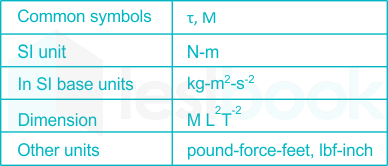
  • Its SI unit is Newton-meter (N-m).


The torque of a force is defined as a point or an axis of rotation.

For example-

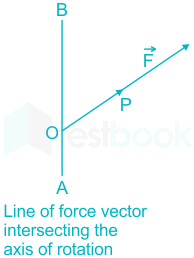
Consider a force F is acting on a particle P and let r be the position vector of the particle about some reference point O as shown in the figure below.

The torque of this force F, about O is defined as,

(\vec{\tau }=\vec{r}\times \vec{F})

It is a vector quantity having its direction perpendicular to both r and F, according to the rule of the cross product.

Explanation:-

When a force applied at a point of intersection with the axis lies on the extending its line of action, the torque about that point will be zero.

because the position vector of the point will become parallel to the applied force vector. 

The figure shown below supports the statement-

Hence, option-3 is correct.

Some important points about torque-

28

Which of the following physical quantities can be expressed as the vector product of two vectors?

  1. ((a))

    Torque

  2. ((b))

    Angular momentum

  3. ((c))

    Linear velocity 

  4. ((d))

    All of the above

Show Answer
Answer: ((d))

All of the above

Option (4)

CONCEPT:

  • Vector Product (cross product): Its magnitude is equal to the products of the magnitude of two vectors and sine of the angle between them and whose direction is perpendicular to the plane of the two vectors
<br>

Mathematically it is written as: 

(\vec {A} ) × (\vec {B}) = ABsinθ 

Where θ is the angle between a vector (\vec {A} ) and (\vec {B}) 

  • Torque, Angular momentum, and Instantaneous velocity all can be expressed as the vector products of two vectors.
<br>

EXPLANATION:

  • Torque (τ): The torque acting on a particle is equal to the vector products of its position vector ( \vec r )and force vector (\vec F)

τ = ({\vec r \times }{\vec F})

  • Angular momentum (L): It is equal to the cross product of its position vector ( \vec r ) and the linear momentum (\vec p).

(\vec L) = ( \vec r )× (\vec p)

  • Linear Velocity (v): It is equal to the cross product of its angular velocity ω and the position vector ( \vec r ).

(\vec v) = (\vec \omega ) × ( \vec r )

  • These physical quantities can be expressed as the vector products of two vectors.
  • Hence all of the above options are correct.
29

A step up transformer has

  1. ((a))

    EMF per turn higher in secondary winding when compared to the primary

  2. ((b))

    EMF per turn equal in both primary and secondary windings

  3. ((c))

    EMF per turn higher in primary winding when compared to the secondary

  4. ((d))

    None of the above

Show Answer
Answer: ((b))

EMF per turn equal in both primary and secondary windings

Concept:

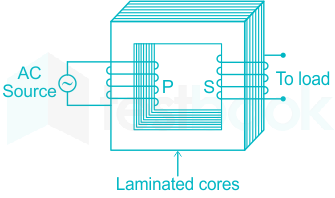
  • Transformer: An electrical device that is used to transfer electrical energy from one electrical circuit to another is called a transformer.

There are two types of transformers:

  • Step-up transformer: The transformer which increases the potential is called a step-up transformer.
  • The number of turns in the secondary coil is more than that in the primary coil.
  • Step-down transformer: The transformer which decreases the potential is called a step-down transformer.
  • The number of turns in the secondary coil is less than that in the primary coil.

Explanation:

  • In a transformer, primary volt-ampere is equal to secondary volt-ampere and primary ampere-turns are also equal to secondary ampere-turns.
  • So, EMF per turn in both windings is equal. Total induced emf on both sides depends on the number of turns, flux, and frequency.
  • If the number of turns on the secondary is more than the primary, then the emf induced in the secondary will be more than the primary side and vice versa, but the emf per turn in both the windings is equal.

​V1 I1 = ​V2 I2

N1I1 = N2I2 

 ∴(\frac{{{E_1}}}{{{N_1}}} = \frac{{{E_2}}}{{{N_2}}})

30

Extracting the original information-bearing signal from a carrier wave is called

  1. ((a))

    Modulation

  2. ((b))

    Demodulation

  3. ((c))

    Amplification

  4. ((d))

    Transmission

Show Answer
Answer: ((b))

Demodulation

CONCEPT:

  • The process of increasing the volume of sound with the help of an amplifier is called amplifications.
  • Extracting the original information-bearing signal from a carrier wave is called Demodulation.
  • The process of transmitting the signal wave from one place to another is called transmission.
  • The process of super imposing message signal on carrier wave is called modulation.

EXPLANATION:

  • Since the extracting the original information-bearing signal from a carrier wave is called Demodulation. So option 2 is correct.
31

In propagation of sound compression is:

  1. ((a))

    Region of High density and High pressure

  2. ((b))

    Region of High density and Low pressure

  3. ((c))

    Region of Low density and High pressure

  4. ((d))

    Region of Low density and Low pressure

Show Answer
Answer: ((a))

Region of High density and High pressure

CONCEPT:

  • Compression: Compression is a region in a longitudinal wave where the particles are closest together.
  • Compression has high density and high pressure
  • Rarefaction: A rarefaction is a region in a longitudinal wave where the particles are furthest apart.
  • Rarefaction has a low density and low pressure

EXPLANATION:

  • In the propagation of sound compression is region of high density and high pressure. So option 1 is correct.
32

The amount of force needed to accelerate a 10 kg mass at 2.5m/s2 is ______.

  1. ((a))

    4 N

  2. ((b))

    7.5 N

  3. ((c))

    25 N

  4. ((d))

    12.5 N

Show Answer
Answer: ((c))

25 N

The correct answer is 25 N.

Key Points

To find the amount of force needed to accelerate a mass, we use Newton's second law of motion, which states: (\rm F= ma)

Where:

  • F is the force,
  • m is the mass,
  • a is the acceleration.

Given:

  • (\rm m = 10 kg),
  • (\rm a= 2.5 m/s^2),

We can calculate F as follows:

(\rm F=10 Kg \times 2.5 m/s^2= 25N)

Therefore, the force needed is 25 N.

Additional Information

  • Force:
  • Force is an interaction that, when unopposed, will change the motion of an object.
  • A force can cause an object with mass to change its velocity (which includes to begin moving from a state of rest), i.e., to accelerate.
  • Force is a vector quantity, meaning it has both magnitude and direction.
  • Newton's Second Law of Motion:
  • It states that the force acting on an object is equal to the mass of the object times its acceleration ((\rm F= ma)).
  • This law explains how the velocity of an object changes when it is subjected to an external force.
  • Mass:
  • Mass is a property of a physical body and a measure of its resistance to acceleration when a force is applied.
  • The mass of an object also determines the strength of its gravitational attraction to other bodies.
  • Acceleration:
  • Acceleration is the rate of change in the velocity of an object with respect to time.
  • It is a vector quantity, meaning it has both magnitude and direction.
33

The product of the total mass of a system and the velocity of the center of mass is:

  1. ((a))

    the angular momentum of the system

  2. ((b))

    the linear momentum of the system

  3. ((c))

    the total energy of the system

  4. ((d))

    the potential energy of the system

Show Answer
Answer: ((b))

the linear momentum of the system

The correct answer is option 2) i.e. the linear momentum of the system

CONCEPT:

  • Linear momentum: Momentum is defined as the impact due to a moving object.
  • Linear momentum, p = mv

Where m is the mass of the object and v is the velocity of the object.

EXPLANATION:

Let us consider a system of particles with each particle having a mass  m and velocity v.

If p is the linear momentum od each particle, p = mv

Total linear momentum, Σp = Σmv = Σm . Σv = M.vcom

Where M is the sum of mass of all particles, and vcom is the velocity of the centre of mass.

The vector addition of velocities will give a net velocity with respect to the centre of mass.

Hence, the linear momentum of a system = product of the total mass of a system and the velocity of the centre of mass

34

If the net external torque on a rotating object is zero, Which of the following quantity will be constant?

  1. ((a))

    Angular velocity

  2. ((b))

    Linear velocity

  3. ((c))

    Linear momentum

  4. ((d))

    angular momentum

Show Answer
Answer: ((d))

angular momentum

CONCEPT**:**

  • Angular Momentum (L): It is a property of a body in rotational motion.
  • The moment of linear momentum is known as angular momentum.

L = r × p = r × mv

where p is the momentum of the body, r is the distance of linear momentum from the axis of rotation, m is the mass of the body, and v is the velocity of the body.

  • Linear momentum Conservation: When in a system, there is no external force then the total momentum (P) of the system will be conserved.
  • Angular momentum Conservation: When in a system, there is no external torque then the total angular momentum (L) of the system will be conserved.
<br>

EXPLANATION**:**

  • If net external torque on a rotating object is zero, Its angular momentum will be conserved i.e. will be constant.
  • Linear momentum is conserved when there is no external force on the body.
  • Linear velocity is constant when a body is moving with a constant speed and constant direction.
  • The angular velocity of a body is constant if it is moving in a uniform circular motion.
  • So the correct answer is option 4.
35

The torque on a rectangular coil placed in a uniform magnetic field is large when the

  1. ((a))

    Number of turns is large

  2. ((b))

    Number of turns is less

  3. ((c))

    Plane of the coil is perpendicular to the magnetic field

  4. ((d))

    Area of the coil is small

Show Answer
Answer: ((a))

Number of turns is large

CONCEPT:

  • A rectangular coil always acts as a magnetic dipole of dipole moment M.
  • The dipole moment of a rectangular coil is given by:
  • The dipole moment of the coil (M) = N I A

Where N is the number of turns, I is current in the coil and A is the area of the rectangular coil

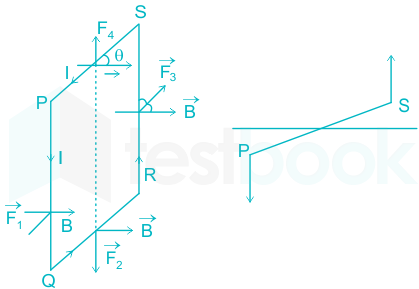
  • The torque of the magnetic field on any magnetic dipole moment is given by;

⇒ T = M × B = MB Sinθ

Where M × B = cross product of Area vector A and magnetic field vector B and θ = the angle between area vector A and magnetic field B.

EXPLANATION:

  • The dipole moment of the coil is

⇒ M = N I A

Torque on rectangular coil (T) = M × B = MB Sinθ = N I A B Sinθ

  • According to the above formula of the torque on a rectangular coil in a magnetic field, torque will be large when the number of turns is large. So option 1 is correct and option 2 is wrong.
  • If the magnetic field is perpendicular to the plane of the coil then it will be along the area vector. So the angle between the area vector and the magnetic field will be zero and finally, the torque will be zero. So option 3 is wrong.
  • If the area will be small then torques will also be small. So option 4 is wrong.
36

Which of the following scales of temperature does not have negative degrees of temperature?

  1. ((a))

    Kelvin

  2. ((b))

    Reaumur

  3. ((c))

    Fahrenheit

  4. ((d))

    all of these

Show Answer
Answer: ((a))

Kelvin

The correct answer is Kelvin.

Key Points

  • The Kelvin scale is an absolute temperature scale starting at absolute zero, the point where all molecular motion ceases.
  • Absolute zero is defined as 0 K on the Kelvin scale, which is equivalent to -273.15°C on the Celsius scale.
  • Since the Kelvin scale starts from absolute zero, it does not have negative values.
  • The Kelvin scale is primarily used in scientific contexts, especially in physics and chemistry, due to its absolute nature.
  • The Kelvin scale is named after William Thomson, 1st Baron Kelvin, who proposed it in the mid-19th century.

Additional Information

  • Reaumur Scale
  • The Reaumur scale, also known as the "octogesimal division," has its freezing point of water at 0 degrees and the boiling point of water at 80 degrees.
  • It is not commonly used today and has been largely replaced by the Celsius and Kelvin scales.
  • Fahrenheit Scale
  • The Fahrenheit scale, used primarily in the United States, sets the freezing point of water at 32 degrees and the boiling point at 212 degrees.
  • This scale can have negative values; for instance, the freezing point of brine is 0°F, which is lower than the freezing point of water.
  • Celsius Scale
  • The Celsius scale sets the freezing point of water at 0 degrees and the boiling point at 100 degrees under standard atmospheric pressure.
  • It can have negative values, for example, temperatures below the freezing point of water.
  • Temperature Scales Comparison
  • The Kelvin scale is used in scientific measurements where absolute values are necessary.
  • The Celsius scale is widely used around the world in everyday temperature measurements.
  • The Fahrenheit scale is used primarily in the United States for everyday temperature measurements.
37

The acceleration due to gravity of an object

  1. ((a))

    is zero at the centre of earth

  2. ((b))

    is independent of its mass

  3. ((c))

    is lesser at equator than at the poles

  4. ((d))

    All of the above

Show Answer
Answer: ((d))

All of the above

The correct answer is option 4) i.e. All of the above

CONCEPT:

  • Law of Universal Gravitation: It states that all objects attract each other with a force that is proportional to the masses of two objects and inversely proportional to the square of the distance that separates their centres.

It is given mathematically as follows:

(F = \frac{Gm_1m_2}{R^2})

Where m1 and m2 are the mass of two objects, G is the gravitational constant and R is the distance between their centres.

  • The gravitational force acting on an object of mass m placed on the surface of Earth is:

(F = \frac{GMm}{R^2})

Where R is the radius of the earth. 

  • From Newton's second law, F = ma = mg

⇒ mg = (\frac{GMm}{R^2})

Therefore, acceleration due to gravity, g = (\frac{GM}{R^2})

  • The Earth is shaped like an ellipsoid where the region around the equator bulges outwards more as compared to the poles.

EXPLANATION:

  • Acceleration due to gravity, g = (\frac{GM}{R^2})
  • At the centre of the earth, R = 0. Therefore, g = zero.
  • Since the equator is bulged outwards as compared to the poles, the radius of the earth decreases as we move from the equator to the poles. Therefore, gravity increases from the equator to the poles.
  • Acceleration due to gravity of an object is independent of its mass as g only depends on the mass of the earth (M) and the radius of the earth (R).​

Hence**, all the given statements are correct.**

38

If the magnetic field due to a single turn circular coil is B. Then the value of magnetic field due a circular coil with 10 turns will be: (Other parameters are to be kept same)

  1. ((a))

    10 B

  2. ((b))

    5 B

  3. ((c))

    100 B

  4. ((d))

    B

Show Answer
Answer: ((a))

10 B

The correct answer is 10 B.

Key Points

  • The magnetic field (B) created by a coil is directly proportional to the number of turns (N) in the coil.
  • If a single-turn coil produces a magnetic field B, then a coil with 10 turns will produce a magnetic field proportional to 10 times the single-turn coil.
  • The relationship can be expressed as B10 turns = N * Bsingle turn, where N is the number of turns.
  • Therefore, for 10 turns, the magnetic field B10 turns = 10 * B.
  • Hence, the magnetic field due to a circular coil with 10 turns will be 10 B.

Additional Information

  • Magnetic Field:
  • It is a vector field that describes the magnetic influence on moving electric charges, electric currents, and magnetic materials.
  • The symbol for the magnetic field is B, and it is measured in teslas (T).
  • Electromagnetic Induction:
  • It is the production of an electromotive force (EMF) across an electrical conductor in a changing magnetic field.
  • This principle is fundamental in the operation of transformers, inductors, and many types of electrical generators and motors.
  • Right-Hand Rule:
  • It is a mnemonic for understanding the direction of the magnetic field relative to the direction of the current.
  • If you point your thumb in the direction of the current, the curl of your fingers shows the direction of the magnetic field loops.
  • Solenoid:
  • A solenoid is a coil wound into a tightly packed helix, which generates a magnetic field when an electric current passes through it.
  • The magnetic field inside a solenoid is uniform and parallel to the axis of the solenoid.
39

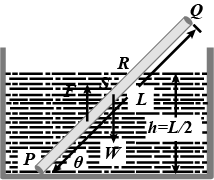
A block of ice floats on a liquid of density 1.2 in a beaker then level of liquid when ice completely melt

  1. ((a))

    Remains same

  2. ((b))

    Rises

  3. ((c))

    Lowers

  4. ((d))

    (a), (b) or (c)

Show Answer
Answer: ((b))

Rises

Calculation:

The volume of liquid displaced by floating ice is given by

(V_D = \frac{M} {\sigma_l})

The volume of water formed by melting ice,

(V_F = \frac{M} {\sigma_W})

If (\sigma_l > \sigma_W, then, \frac{M} {\sigma_L} < \frac{M} {\sigma_W})  i.e (V_D < V_F)

Therefore,

Volume of liquid displaced by floating ice will be lesser than water formed and so the level of liquid will rise.

40

The layer of the earth's atmosphere from where radio waves are reflected is 

  1. ((a))

    Troposphere

  2. ((b))

    Ionosphere

  3. ((c))

    Mesosphere

  4. ((d))

    Stratosphere

Show Answer
Answer: ((b))

Ionosphere

Correct option-2

Concept:

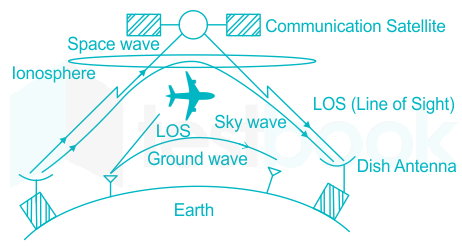
In a communication system, the electromagnetic waves transmitted by the transmitter travels in three different modes to reach the receiver according to its frequency range.

1. Ground wave propagation or surface wave propagation (nearly 2 kHz to 2 MHZ) 2. Sky-wave propagation or ionospheric propagation (nearly 3 MHZ to 30 MHZ) 3. Space wave propagation (nearly 30 MHZ to 400 MHZ)

  1. Ground wave propagation:
  • If the electromagnetic waves transmitted by the transmitter antenna over the surface of the earth reach the receiver, then the propagation is called ground wave propagation.
  • In this mode of transmitting and receiving antennas must be close to the earth's surface.
  • During effective transmission through ground wave propagation mobe, electrical signals are attenuated over a distance.
  1. Sky-wave propagation:
  • In the sky-wave propagation, the electromagnetic wave is radiated from the antenna, directed upwards at large angles gets reflected by the ionosphere back to the earth.
  • The frequency range of EM waves in this mode of propagation is 3 to 30 MHZ.
  • It is used for short-wave broadcast services medium and high frequencies are for long-distance radio communication.
  1. Space wave propagation: 
  • The process of sending and receiving information signals through space is called space wave communication.
  • The EM waves above 30 MHZ frequency traveling from the transmitter to receiver in a straight line are used for line of sight communication (LOS).
<br>

Explanation:

  • If we wish to send radio signals at far stations then we must believe in skywave propagation.
  • In any sky-wave propagation, we broadcast the radio signal over a long distance by the reflection of signals from the ionosphere.
  • Actually, the ionosphere acts as a rare medium whose refractive index is less than the free space value.
  • When the radio wave specific frequency send to the ionospheric layer, the bending of the beam reaches at some critical angle, after that, it will be reflected back.
  • This phenomenon is also called ionospheric TIR (total internal reflection).

Hence, option-2 is correct.

  • EM waves of frequency above 30 MHZ can easily penetrate through the ionosphere and do not undergo reflection.
  • Extremely long-distance communication is also possible as radio waves can undergo multiple reflections between the earth and ionosphere.
  • A single reflection helps the radio waves to travel about 4000km.
  • The charged ions of the ionosphere provide a reflecting medium for reflection of radio waves or communication waves back to the earth's surface within the permitted frequency range.
  • This phenomenon is called the total internal reflection of the EM wave.
41

What is the dimensional formula of strain?

  1. ((a))

    M0L0T0

  2. ((b))

    M1L-1T-2

  3. ((c))

    M0L0T-1

  4. ((d))

    None of the above

Show Answer
Answer: ((a))

M0L0T0

CONCEPT:

  • Measurement of any physical quantity involves comparison with a certain basic, arbitrarily chosen, internationally accepted reference standard called unit, and a Dimension is a mathematical tool used for studying the nature of physical quantities.
  • The basic concept of dimensions is that we can add or subtract only those quantities which have the same dimensions.
  • And the dimensional formula is defined as the expression of the physical quantity in terms of mass, length, and time.

​EXPLANATION:

Strain:

  • The ratio of change in configuration to the original configuration is called strain.
  • As the strain is the ratio of two like quantities, it has no units and no dimensions.
  • and has no dimension.
  • Its dimension can be expressed as M0L0T0.

​The correct answer is M0L0T0​.   

QuantitiesDimension
StressM1L-1T-2
FrequencyM0L0T-1
Dynamic viscosityM1L-1T-1
Kinematic viscosityL2T−1
Magnetic FluxM1 L2 T-2 I-1
Magnetic fieldM1 T-2 I-1
PowerML2T-3
TorqueM1L2T-2
WorkML2T-2
PressureML-1T-2
ForceM1L1T-2
Surface TensionM1L0T-2
42

Mobility of free electrons in a conductor is

  1. ((a))

    Directly proportional to electron density

  2. ((b))

    Directly proportional to relaxation time

  3. ((c))

    Inversely proportional to electron density

  4. ((d))

    Inversely proportional to relaxation time

Show Answer
Answer: ((b))

Directly proportional to relaxation time

CONCEPT:

  • The measurement of the effect of electric field on the motion of electrons is called mobility of electrons.
  • Mobility of electrons is equal to drift velocity per unit electric field.

Mobility (μ) of free electrons is given by:

(\mu =\frac{e~\tau }{m})

Where e is charge on an electron, m is mass of an electron and τ is relaxation time.

EXPLANATION

  • According to the given formula for the mobility of free electrons, it is directly proportional to the relaxation time. So option 2 is correct.
  • The mobility of free electrons varies sometimes directly proportional to electron density and sometimes it varies inversely proportional to electron density. So options 1 and 3 are wrong.
43

Dyne is a unit of ______.

  1. ((a))

    Force

  2. ((b))

    Energy

  3. ((c))

    Work

  4. ((d))

    None of the above

Show Answer
Answer: ((a))

Force

option(1)

CONCEPT:

  • Dyne: It is those centimeter-gram-second system units that represent the Force.

EXPLANATION:

  • Dyne: It is the unit of force in the centimeter-gram-second system of physical units, is equal to the force.

1 dyne equals =  0.00001 newtons.

or 1 N = 100000 dyne 

Additional Information

  • Force: It is those vector quantity that is a vector product of mass and acceleration.

Force = mass × acceleration

  • Energy: It is that physical quantity that is defined as the capacity to doing work.

Energy = Power × Time, the S.I unit of power is Watt.

  • Work: It is that physical quantity that is a product of Force and displacement

Work = Force× displacement, The SI unit of work is Jule

44

For having a large magnification power of a compound microscope

  1. ((a))

    length of the microscope tube must be small

  2. ((b))

    focal lengths of objective lens and eye-piece should be large

  3. ((c))

    focal lengths of objective lens and eye-piece should be small

  4. ((d))

    focal length of eye-piece must be smaller than the focal length of objective lens

Show Answer
Answer: ((c))

focal lengths of objective lens and eye-piece should be small

CONCEPT:

  • Compound Microscope: A compound microscope is a high magnification microscope that uses a compound lens system to obtain a bigger image of small objects.
  • A compound microscope has multiple lenses: the objective lens is compounded (multiplied) by the eyepiece lens to obtain a high magnification.
  • Higher magnification is achieved by using two lenses rather than just a single magnifying lens.

The total magnification of a compound microscope: 

M = moMe

(M=\frac{L}{f_o}\times\frac{D}{f_e})

where L is the tube length, fo is objective focal length, fe is eyepiece focal length, and D is shortest distance Point D = 25 cm

EXPLANATION:

  • The total magnification of a compound microscope is

(M=\frac{L}{f_o}\times\frac{D}{f_e})

  • M will increase if fo and fe are small.
  • For having the large magnification power of a compound microscope, the focal lengths of the objective lens and eye-piece should be small.
  • So the correct answer is option 3.
45

If the molecule of a monoatomic gas is free to move in a space, then its degree of freedom is:

  1. ((a))

    6

  2. ((b))

    2

  3. ((c))

    3

  4. ((d))

    None of these

Show Answer
Answer: ((c))

3

CONCEPT:

Law of equipartition of energy:

  • According to the law of equipartition of energy, for any dynamic system in thermal equilibrium, the total energy for the system is equally divided among the degree of freedom with each degree of freedom having average energy equal to (\frac{1}{2}k_BT).

Where kB = Boltzmann constant and T = absolute temperature

  • If a molecule is constrained to move along a line then it has one degree of freedom.
  • If a molecule is constrained to move in a plane then it has two degrees of freedom.
  • If a molecule is free to move in space then it has three degrees of freedom.
  • Molecules of a monatomic gas like argon have only translational degrees of freedom.
  • Molecule of diatomic gas such as O2 and N2 has three translational degrees of freedom. But in addition, it has also two independent axes of rotation. The molecule thus has two rotational degrees of freedom, each of which contributes a term to the total energy consisting of translational energy and rotational energy
  • Molecules like CO even at moderate temperatures have a mode of vibration, i.e. its atoms oscillate along the interatomic axis like a one-dimensional oscillator, and contribute a vibrational energy term to the total energy.
  • While each translational and rotational degree of freedom has contributed only one ‘squared term’ but one vibrational mode contributes two ‘squared terms’: kinetic and potential energies.

EXPLANATION:

  • We know that if a molecule is free to move in space then it has three degrees of freedom. Hence, option 3 is correct.
46

The rate of change of linear momentum is __________.

  1. ((a))

    External Force 

  2. ((b))

    Kinetic energy

  3. ((c))

    Potential energy

  4. ((d))

    Power

Show Answer
Answer: ((a))

External Force 

CONCEPT:

  • Momentum: A property of a body in motion that is equal to the product of the body's mass and velocity is called momentum.

P = mv

where P is the momentum of the body, m is the mass of the body, and v is the velocity of the body.

  • Newton's Second Law of Motion: It says that the net external force on a system or body is equal to the change in momentum of the system or body divided by the time over which it changes.

Mathematically:

(F_{ext} = {Δ p \over Δ t})

where Fext is the external force on the system, Δp is the change in momentum, and Δt is the change in time.

EXPLANATION:

Newton's second law of motion in momentum form can be written as:

(F_{ext} = {Δ p \over Δ t})

which says the rate of change of momentum ( {Δ p \over Δ t}) is equal to the external force on a system.

So the correct answer is option 1.

47

An electric dipole is placed in a varying electric field. The dipole then experiences:

  1. ((a))

    a torque and no net force

  2. ((b))

    a torque and a net force

  3. ((c))

    no force

  4. ((d))

    no torque

Show Answer
Answer: ((b))

a torque and a net force

The correct answer is option 2) i.e a torque and a net force

CONCEPT:

  • Electric field strength is a measure of the electric field intensity at a point due to a charge. It is the amount of electric force produced per unit charge.
  • Electric field strength (E) at a point due to a point charge q is given by the formula

 (E =\frac{F}{q})

Where r is the distance from the point charge to the point at which E is determined.

  • Electric dipole a couple formed from two equal opposite charges q and –q, which are separated by a distance 2a.

EXPLANATION:

In a uniform electric field:

  • When an electric dipole is placed in a uniform electric field of intensity E, the negative and positive charges experience two forces -qE and +qE respectively.
  • These two forces are opposite and hence, the net force the dipole experiences will be zero. However, Since they are separated by a distance, a torque is produced.

In a varying or non-uniform electric field:

  • In a varying electric field, the force experienced by the two charges of the dipole will be of different magnitudes, and hence, the dipole will experience a net force.
  • Since the charges are separated by a distance, they will experience a torque as before.

Thus, an electric dipole is placed in varying electric field experiences a torque and a net force.

48

To use the Galvanometer as Voltmeter we must connect _______.

  1. ((a))

    A high resistance in parallel with galvanometer

  2. ((b))

    A low resistance in parallel with galvanometer

  3. ((c))

    A high resistance in series with galvanometer.

  4. ((d))

    A low resistance in series with galvanometer.

Show Answer
Answer: ((c))

A high resistance in series with galvanometer.

To use Galvanometer as a Voltmeter we must connect a high resistance in series with it, because it must draw a very small current, otherwise the voltage measurement will disturb the original set up by an amount which is very large.

Chemistry (24 questions)

49

The Chlorination of methane is an example of

  1. ((a))

    Elimination reaction

  2. ((b))

    Substitution reaction

  3. ((c))

    Addition reaction

  4. ((d))

    Oxidation reaction

Show Answer
Answer: ((b))

Substitution reaction

CONCEPT:

Substitution Reaction

  • A substitution reaction is a chemical reaction during which one functional group in a chemical compound is replaced by another functional group.
  • In organic chemistry, substitution reactions are common and are categorized as nucleophilic, electrophilic, or radical substitutions depending on the nature of the substituting species.

EXPLANATION:

  • In the chlorination of methane:

CH4 + Cl2 → CH3Cl + HCl

  • Methane (CH4) reacts with chlorine (Cl2).
  • One hydrogen atom in methane is replaced by a chlorine atom, forming chloromethane (CH3Cl) and hydrochloric acid (HCl).
  • This reaction involves the substitution of a hydrogen atom in methane with a chlorine atom, making it a substitution reaction.

Therefore, the chlorination of methane is an example of a substitution reaction.

50

The mass of 0.5 mole of N2 gas is

  1. ((a))

    7 g

  2. ((b))

    14 g

  3. ((c))

    21 g

  4. ((d))

    28 g

Show Answer
Answer: ((b))

14 g

CONCEPT:

Molar Mass and Mole Calculation

  • The molar mass of a substance is the mass of one mole of that substance, usually expressed in grams per mole (g/mol).
  • The molar mass of nitrogen gas (N2) can be calculated by adding the atomic masses of two nitrogen atoms.
  • The molar mass of a single nitrogen atom (N) is approximately 14 g/mol.

EXPLANATION:

  • For nitrogen gas (N2):
  • The molar mass of N2 = 14 g/mol (for one N atom) × 2 = 28 g/mol
  • To find the mass of 0.5 mole of N2 gas, we use the formula:
  • Mass = Number of moles × Molar mass
  • Mass = 0.5 moles × 28 g/mol
  • Mass = 14 grams

Therefore, the mass of 0.5 mole of N2 gas is 14 grams.

51

Which of the following anions has a valency of -3 ?  

  1. ((a))

    Nitride 

  2. ((b))

    Nitrate 

  3. ((c))

    Sulphide 

  4. ((d))

    Sulphate 

Show Answer
Answer: ((a))

Nitride 

CONCEPT:

Valency of Anions

  • Valency refers to the combining capacity of an element or ion. It is determined by the number of electrons an atom can lose, gain, or share to achieve a full outer shell.
  • Anions are negatively charged ions formed when atoms gain electrons. The valency of an anion is equal to the number of electrons gained by the atom.

EXPLANATION:

  • To determine which anion has a valency of -3, we need to look at the common anions and their charges:
  • Nitride (N3-): Nitrogen gains 3 electrons to achieve a full outer shell, resulting in a valency of -3.
  • Nitrate (NO3-): The nitrate ion has a valency of -1.
  • Sulphide (S2-): Sulfur gains 2 electrons to form the sulphide ion, giving it a valency of -2.
  • Sulphate (SO42-): The sulphate ion has a valency of -2.

Therefore, the anion with a valency of -3 is Nitride (N3-).

52

The volume of one mole of a gas at normal temperature and pressure is _________ Litre.

  1. ((a))

    11.2

  2. ((b))

    22.4

  3. ((c))

    33.3

  4. ((d))

    44.4

Show Answer
Answer: ((b))

22.4

The correct answer is Option 2.

Key Points

  • One mole of an ideal gas occupies 22.4 liters at standard temperature and pressure (STP).
  • Standard temperature and pressure (STP) is defined as a temperature of 0°C (273.15 K) and a pressure of 1 atm (101.325 kPa).
  • This volume is known as the molar volume of a gas.
  • The concept is based on the Ideal Gas Law, which states that PV=nRT, where P is pressure, V is volume, n is the number of moles, R is the gas constant, and T is temperature.

Additional Information

  • Avogadro's Law: This law states that equal volumes of gases, at the same temperature and pressure, contain an equal number of molecules.
  • Ideal Gas Law: The equation PV=nRT is used to describe the behavior of an ideal gas.
  • Gas Constant (R): The value of R in the Ideal Gas Law is 8.314 J/(mol·K) or 0.0821 L·atm/(mol·K).
  • Real Gases: Deviations from the Ideal Gas Law occur at high pressures and low temperatures where intermolecular forces become significant.
  • Molar Mass: The mass of one mole of a substance (element or compound) is expressed in grams per mole (g/mol).
53

Dehydration of ethanol gives which among the following?

  1. ((a))

    ethene

  2. ((b))

    ether

  3. ((c))

    ester

  4. ((d))

    ethane

Show Answer
Answer: ((a))

ethene

The correct answer is ethene.

Key Points

  • Dehydration of ethanol involves the removal of a water molecule (H2O) from an ethanol molecule.
  • This process typically requires the presence of a strong acid catalyst, such as concentrated sulfuric acid (H2SO4) or phosphoric acid (H3PO4).
  • When ethanol is heated with a strong acid catalyst, it undergoes a reaction to form ethene (C2H4), a simple alkene.
  • The chemical equation for this dehydration reaction is: C2H5OH → C2H4 + H2O.
  • Ethene is a colorless gas with a slightly sweet smell and is widely used in the chemical industry, particularly in the production of polyethylene.

Additional Information

  • Dehydration Reaction
  • A dehydration reaction is a chemical reaction in which water is removed from a compound.
  • This type of reaction is commonly used to convert alcohols into alkenes.
  • Ethene (Ethylene)
  • Ethene, also known as ethylene, is the simplest alkene with the formula C2H4.
  • It is a key raw material in the petrochemical industry, primarily used in the production of polymers such as polyethylene.
  • Acid Catalysts
  • Acid catalysts are substances that increase the rate of a chemical reaction by donating a proton (H+) to the reactants.
  • Common acid catalysts used in dehydration reactions include sulfuric acid and phosphoric acid.
  • Polyethylene
  • Polyethylene is a widely used plastic made from the polymerization of ethene (ethylene).
  • It is used in various applications including packaging, containers, and insulation.
54

ΔQ = ΔU + ΔW is equation for ___________

  1. ((a))

    Zeroth Law of Thermodynamics

  2. ((b))

    Third Law of Thermodynamics

  3. ((c))

    Second Law of Thermodynamics

  4. ((d))

    First Law of Thermodynamics

Show Answer
Answer: ((d))

First Law of Thermodynamics

The correct answer is First Law of Thermodynamics.

Key Points

  • The First Law of Thermodynamics is a version of the law of conservation of energy, adapted for thermodynamic processes.
  • It states that energy cannot be created or destroyed in an isolated system.
  • The change in the internal energy of a system (ΔU) is equal to the heat added to the system (ΔQ) minus the work done by the system on its surroundings (ΔW).
  • This can be mathematically expressed as ΔQ = ΔU + ΔW.

Additional Information

  • Internal Energy (U)
  • It is the total energy contained within a system, including kinetic and potential energy at the molecular level.
  • Changes in internal energy can result from heat transfer or work done.
  • Heat (Q)
  • It is a form of energy transfer between systems due to a temperature difference.
  • Heat transfer can occur through conduction, convection, or radiation.
  • Work (W)
  • In thermodynamics, work is the energy transferred when an object is moved by a force.
  • Positive work is done by the system when it expands against an external pressure.
  • Applications of the First Law
  • It is used to analyze various thermodynamic cycles such as the Carnot cycle, Otto cycle, and refrigeration cycles.
  • It helps in understanding the energy efficiency of engines and other systems.
  • Limitations
  • The First Law does not provide information about the direction of processes or the feasibility of reactions.
  • It does not explain entropy changes or the Second Law of Thermodynamics.
55

Rate of reaction DOES NOT depend on

  1. ((a))

    Concentration

  2. ((b))

    Temperature

  3. ((c))

    Catalyst

  4. ((d))

    Pressure

Show Answer
Answer: ((d))

Pressure

The correct answer is Pressure.

Key Points

  • The rate of a chemical reaction generally depends on several factors including concentration, temperature, and the presence of a catalyst.
  • Pressure can influence the rate of reaction in cases where gases are involved, but it is not a general factor for all reactions.
  • In reactions involving only solids or liquids, pressure typically has little to no effect on the rate of reaction.
  • Key factors such as concentration, temperature, and catalysts directly affect the speed at which reactants are converted to products.

Additional Information

  • Concentration
  • The rate of reaction generally increases with the concentration of reactants because there are more particles available to collide and react.
  • According to the collision theory, the frequency of effective collisions increases with concentration.
  • Temperature
  • Raising the temperature typically increases the rate of reaction as particles move faster and collide more energetically.
  • Higher temperatures provide the energy needed to overcome activation energy barriers.
  • Catalyst
  • Catalysts speed up reactions without being consumed by lowering the activation energy required for the reaction to proceed.
  • Enzymes are biological catalysts that play crucial roles in speeding up biochemical reactions.
  • Activation Energy
  • Activation energy is the minimum energy that reacting particles need to collide successfully and start a reaction.
  • Lowering the activation energy increases the rate of reaction.
56

Law of octaves was propounded by

  1. ((a))

    John Newlands

  2. ((b))

    Johann Dobereiner

  3. ((c))

    Ivanovich Mendeleev

  4. ((d))

    Henry Moseley

Show Answer
Answer: ((a))

John Newlands

The correct answer is John Newlands.

Key Points

  • John Newlands was an English chemist who first proposed the law of octaves in 1864.
  • The law of octaves states that elements, when arranged by increasing atomic mass, exhibit similar properties at every eighth element.
  • Newlands’ law was an early attempt to classify the elements in a systematic way before the development of the modern periodic table.
  • His work was initially criticized, but it paved the way for the later development of the periodic table by Dmitri Mendeleev.

Additional Information

  • Johann Dobereiner
  • German chemist known for his work on the classification of elements.
  • Introduced the concept of triads, groups of three elements with similar properties, in 1829.
  • Triads were an early attempt to show a relationship between atomic weights and properties of elements.
  • Dmitri Mendeleev
  • Russian chemist who created the first widely accepted periodic table in 1869.
  • Arranged elements by increasing atomic weight and grouped elements with similar properties.
  • Predicted the existence and properties of undiscovered elements, which were later found.
  • Henry Moseley
  • British physicist who established the concept of atomic number in 1913.
  • Showed that the periodic table should be arranged by atomic number, not atomic weight.
  • His work led to the modern definition of the periodic table.
57

Rate of reaction for the equation 2HI - l+ H2 can be expressed as

  1. ((a))

    -Δ[HI]/Δt

  2. ((b))

    -Δ[H2]/Δt

  3. ((c))

    +ΔHI/Δt

  4. ((d))

    -1/2ΔHI/Δt

Show Answer
Answer: ((d))

-1/2ΔHI/Δt

The correct answer is -1/2Δ[HI]/Δt.

Key Points

  • The rate of reaction for the equation 2HI → I2 + H2 is expressed as the change in concentration of HI over time.
  • Since 2 moles of HI decompose to form 1 mole each of I2 and H2, the rate of decrease of HI is twice the rate of formation of products.
  • The negative sign indicates that the concentration of HI is decreasing over time.
  • The factor of 1/2 accounts for the stoichiometric coefficient of HI in the balanced chemical equation, ensuring the correct rate expression.

Additional Information

  • Rate of Reaction
  • It is defined as the change in concentration of reactants or products per unit time.
  • The rate can be expressed as the rate of disappearance of reactants or the rate of appearance of products.
  • Stoichiometry
  • It refers to the quantitative relationships between reactants and products in a balanced chemical equation.
  • Stoichiometric coefficients are used to determine the relative amounts of substances consumed and produced in a reaction.
  • Reaction Order
  • It indicates the power to which the concentration of a reactant is raised in the rate law.
  • Determined experimentally, it helps in understanding the dependence of the rate on reactant concentrations.
  • Rate Law
  • It is an equation that relates the rate of a reaction to the concentration of reactants.
  • For the reaction aA + bB → cC, the rate law is usually written as Rate = k[A]^m[B]^n, where k is the rate constant and m, n are the orders of the reaction with respect to A and B, respectively.
58

Which of the following come under the category of chemical change? 

A. Growth of plant

B. Rusting of iron

C. Mixing of iron fillings and sand

D. Freezing of water

E. None of the above

Choose the most appropriate answer from the options given below:

  1. ((a))

    E only

  2. ((b))

    B only

  3. ((c))

    C only

  4. ((d))

    B and C only

Show Answer
Answer: ((b))

B only

The correct answer is B only.

Key Points

  • Rusting of iron is a chemical change as it involves the formation of a new substance, iron oxide, which is different from the original material.
  • Chemical changes result in the production of one or more new substances with different properties from the original substances.
  • During rusting, iron reacts with oxygen and moisture in the environment, leading to corrosion.
  • This process is irreversible under normal conditions, further confirming it as a chemical change.

Additional Information

  • Physical vs Chemical Change
  • Physical changes affect the form of a chemical substance but not its chemical composition (e.g., melting ice).
  • Chemical changes involve making or breaking of bonds between atoms, resulting in new substances (e.g., burning wood).
  • Indicators of Chemical Changes
  • Change in color, temperature, formation of a precipitate, and evolution of gas are common indicators.
  • Production of light or sound can also indicate a chemical change.
  • Examples of Chemical Changes
  • Burning of paper, digestion of food, and baking a cake are classic examples.
  • These processes produce new substances with different properties from the reactants.
  • Importance of Understanding Chemical Changes
  • Helps in various industries such as pharmaceuticals, agriculture, and manufacturing.
  • Understanding these changes is crucial in environmental science to address issues like pollution and recycling.
59

How many moles of CO2 are present in a gas jar containing 1.506 × 1023 molecules of carbon dioxide?

  1. ((a))

    0.5

  2. ((b))

    1

  3. ((c))

    2

  4. ((d))

    0.25

Show Answer
Answer: ((d))

0.25

The correct answer is 0.25

Concept:

Mole:

  • The mole is a unit of measurement for the amount of substance.
  • One mole of any substance contains exactly (6.022 \times 10^{23}) entities (this number is known as Avogadro's number (N_A).
  • Formula to calculate moles: (n = \frac{N}{N_A})

Calculation:

Given,

Number of molecules of( CO_2 = N = 1.506 \times 10^{23})

Avogadro's number, (N_A = 6.022 \times 10^{23} , \text{molecules/mol})

Number of moles of (CO_2),

⇒ (n = \frac{N}{N_A})

⇒( n = \frac{1.506 \times 10^{23}}{6.022 \times 10^{23}})

⇒ (n \approx 0.25 \ moles)

∴ The number of moles of ( CO_2 ) present is 0.25.

60

Solid sodium bicarbonate was placed on a strip of pH paper. The colour of the strip:

  1. ((a))

    Turned blue

  2. ((b))

    Turned red 

  3. ((c))

    Turned green and slightly yellow

  4. ((d))

    Did not change

Show Answer
Answer: ((d))

Did not change

The correct answer is Did not change.

Key Points

  • Sodium bicarbonate (NaHCO3) is a weak base and slightly alkaline in nature.
  • pH paper is an indicator that changes color based on the pH of the substance it comes into contact with.
  • Solid sodium bicarbonate typically has a pH around 8-9 when dissolved in water, but the solid form does not readily change the pH paper color.
  • The color of the pH paper does not change significantly because the bicarbonate ions in the solid form are not free to react with the paper.

Additional Information

  • pH Scale
  • The pH scale ranges from 0 to 14, where 7 is neutral, below 7 is acidic, and above 7 is basic (alkaline).
  • The pH paper is a tool used to measure the acidity or alkalinity of a solution.
  • Sodium Bicarbonate
  • Commonly known as baking soda, sodium bicarbonate is used in cooking, cleaning, and sometimes as a medicinal antacid.
  • It is a chemical compound with the formula NaHCO3.
  • Indicators
  • Indicators are substances that change color in response to changes in pH.
  • Common indicators include litmus paper, phenolphthalein, and methyl orange.
  • Reactivity of Solids
  • Solid compounds are generally less reactive with indicators compared to their aqueous solutions.
  • This is because the ions in solids are not free to interact with the indicator.
61

Which of the following electrolytes is used in the electrolytic refining of copper?

  1. ((a))

    Sodium sulphate

  2. ((b))

    Cuprous chloride

  3. ((c))

    Copper oxide

  4. ((d))

    Copper sulphate

Show Answer
Answer: ((d))

Copper sulphate

The correct answer is Copper sulphate.

Key Points

  • Copper sulphate (CuSO4) is commonly used as the electrolyte in the electrolytic refining of copper.
  • In this process, impure copper is used as the anode, and a pure copper sheet is used as the cathode.
  • When an electric current is passed through the electrolyte solution, copper ions from the anode dissolve into the solution and are deposited on the cathode.
  • Impurities present in the impure copper either remain in the solution or fall to the bottom as anode sludge.
  • This process helps in obtaining high-purity copper from impure copper.

Additional Information

  • Electrolytic Refining
  • It is a process used to purify metals by electrolysis.
  • This method is used for metals like copper, zinc, and aluminum.
  • The process ensures the removal of impurities and produces high-purity metal.
  • Copper Extraction
  • Copper is extracted from its ores through processes like smelting and electrolysis.
  • The extracted copper is further refined through electrolytic refining to achieve high purity.
  • Applications of Copper
  • Copper is widely used in electrical wiring due to its excellent electrical conductivity.
  • It is also used in plumbing, roofing, and industrial machinery.
  • Copper alloys, such as bronze and brass, have various applications in decorative arts and manufacturing.
62

Which of the following is produced when hydrochloric acid reacts with water?

  1. ((a))

    Both H₃O⁺ and Cl⁻

  2. ((b))

    Both HO⁻ and Cl⁻

  3. ((c))

    Only Cl⁻

  4. ((d))

    Only H₃O⁺

Show Answer
Answer: ((a))

Both H₃O⁺ and Cl⁻

The correct answer is Both H₃O⁺ and Cl⁻.

Key Points

  • When hydrochloric acid (HCl) reacts with water (H₂O), it dissociates completely to form hydronium ions (H₃O⁺) and chloride ions (Cl⁻).
  • This dissociation is a characteristic of strong acids like HCl, which ionize completely in aqueous solutions.
  • The reaction can be written as: HCl + H₂O → H₃O⁺ + Cl⁻.
  • Hydrochloric acid is a common laboratory reagent and is used in various industrial and chemical processes.

Additional Information

  • Dissociation of Acids:
  • Acids dissociate in water to release hydrogen ions (H⁺). In the case of strong acids like HCl, this process is complete.
  • The hydrogen ions do not exist freely in solution but rather associate with water molecules to form hydronium ions (H₃O⁺).
  • The general reaction for the dissociation of a strong acid HA in water is: HA + H₂O → H₃O⁺ + A⁻.
  • Hydronium Ion (H₃O⁺):
  • The hydronium ion is a positively charged ion formed when a hydrogen ion (H⁺) associates with a water molecule (H₂O).
  • It is represented as H₃O⁺ and is the form in which protons are found in aqueous solution.
  • Chloride Ion (Cl⁻):
  • The chloride ion is a negatively charged ion formed when hydrochloric acid dissociates in water.
  • It is represented as Cl⁻ and is a common anion found in various salts and solutions.
  • Hydrochloric Acid (HCl):
  • Hydrochloric acid is a strong acid that completely ionizes in water to form hydronium ions and chloride ions.
  • It is widely used in the chemical industry for pH control, as a reagent in laboratories, and in the production of chlorides.
63

Which of the following element is used in the process of galvanization?

  1. ((a))

    Sodium

  2. ((b))

    Copper

  3. ((c))

    Zinc

  4. ((d))

    Tin

Show Answer
Answer: ((c))

Zinc

The correct answer is Zinc.

Key Points

  • Zinc is the primary element used in the process of galvanization.
  • Galvanization is a method used to protect iron and steel from rusting.
  • During galvanization, a layer of zinc is applied to the surface of the metal.
  • Zinc's natural resistance to corrosion helps prevent the underlying metal from rusting.

Additional Information

  • Hot-dip Galvanization
  • In this process, the metal is dipped into a bath of molten zinc.
  • This method creates a thick, durable layer of zinc on the surface.
  • Electro-galvanization
  • This process uses an electric current to deposit a thin layer of zinc.
  • It is often used for smaller items like screws and nails.
  • Corrosion Protection
  • Zinc acts as a sacrificial anode, meaning it will corrode first before the iron or steel does.
  • This property significantly extends the lifespan of galvanized materials.
  • Applications of Galvanized Metals
  • Galvanized steel is commonly used in construction, automotive, and electrical industries.
  • Examples include roofing materials, car bodies, and electrical boxes.
64

The conductivity of a weak acid HA of concentration 0.001mol L−1 is 2.0 × 10⁻⁵Scm−1

If Λm °(HA) = 190Scm2mol−1, the ionization constant (Ka) of HA is equal to ________ 10−6  ×

  1. ((a))

    24

  2. ((b))

    48

  3. ((c))

    12

  4. ((d))

    45

Show Answer
Answer: ((c))

12

CONCEPT:

Conductivity and Ionization Constant (Ka)

  • The conductivity (κ ) of a solution is related to the molar conductivity (Λm ) and the concentration (c) of the electrolyte.
  • The relationship is given by:

Λm=κc

  • Molar conductivity at infinite dilution (Λ∘m ) is the conductivity of an electrolyte at such a low concentration that further dilution does not change its molar conductivity.
  • The degree of ionization (α) of a weak electrolyte can be calculated using the formula:

α=ΛmΛ∘m

  • The ionization constant (Ka ) is related to the degree of ionization (α) and the concentration (c) by:

Ka=cα2

EXPLANATION:

  • Given:
  • Concentration, c=0.001mol/L
  • Conductivity, κ=2.0×10⁻⁵S/cm
  • Molar conductivity at infinite dilution, Λ∘m=190S cm2/mol
  • Calculate molar conductivity (Λm ):
  • Λm=κc
  • Λm=2.0×10⁻⁵S/cm0.001mol/L
  • Λm=2.0×10⁻²S cm2/mol
  • Calculate degree of ionization (α):
  • α=ΛmΛ∘m
  • α=2.0×10⁻²S cm2/mol190S cm2/mol
  • α=2.0×10−2190
  • α=1.05×10⁻⁴
  • Calculate ionization constant (Ka ):
  • Ka=cα2
  • Ka=0.001×(1.05×10−4)2
  • Ka=0.001×1.1025×10−8
  • Ka=1.1025×10⁻¹¹
  • Ka=11×10−12
  • Ka=12×10−12≈12×10−6

Therefore, the ionization constant (Ka ) of HA is approximately 12 × 10-6.

65

An atom has 17 protons, 18 neutrons, and 17 electrons. What is its mass number?

  1. ((a))

    18

  2. ((b))

    24

  3. ((c))

    35

  4. ((d))

    34

Show Answer
Answer: ((c))

35

The correct answer is 35.

Key Points

  • The mass number of an atom is calculated by summing the number of protons and neutrons in its nucleus.
  • In this case, the atom has 17 protons and 18 neutrons.
  • The formula for the mass number (A) is A = Number of Protons + Number of Neutrons.
  • Therefore, the mass number of this atom is 17 + 18 = 35.

Additional Information

  • Atomic Number
  • The atomic number is the number of protons in the nucleus of an atom.
  • It determines the chemical properties of an element and its place in the periodic table.
  • For this atom, the atomic number is 17, indicating it is chlorine (Cl).
  • Isotopes
  • Isotopes are variants of a particular chemical element that have different numbers of neutrons.
  • Chlorine has two stable isotopes: Cl-35 and Cl-37.
  • Isotopes have the same atomic number but different mass numbers.
  • Neutrons
  • Neutrons are neutral particles found in the nucleus of an atom.
  • They contribute to the mass of the atom but do not affect its chemical properties.
  • The number of neutrons in this atom is 18.
  • Electrons
  • Electrons are negatively charged particles orbiting the nucleus of an atom.
  • In a neutral atom, the number of electrons equals the number of protons.
  • For this atom, there are 17 electrons.
66

Which of the following statements is correct when an acid is dissolved in water?

a) The separation of H+ ions from HCl molecules cannot occur in the absence of water.

b) Hydrogen ions must always be shown as H+ (aq) or hydronium ion (H3O+).

  1. ((a))

    Only a 

  2. ((b))

    Only b 

  3. ((c))

    Botha and b  

  4. ((d))

    Neither a nor b  

Show Answer
Answer: ((c))

Botha and b  

The Correct answer is Both a and b.

Key Points

  • The separation of H+ ions from HCl molecules indeed cannot occur in the absence of water. Water is necessary to facilitate the dissociation process.
  • Hydrogen ions in an aqueous solution are always shown as H+ (aq) or H3O+ (hydronium ion). This is because hydrogen ions cannot exist freely in water; they combine with water molecules to form hydronium ions.
  • When an acid like HCl is dissolved in water, it dissociates into H+ (aq) and Cl- (aq), demonstrating the necessity of water for this process.
  • The correct representation of hydrogen ions in water as H+ (aq) or H3O+ ensures a more accurate depiction of their behavior in solution.
  • Both statements are correct and together they provide a comprehensive understanding of the behavior of acids in water.

 Additional Information

  • Hydronium Ion (H3O+)
  • The hydronium ion is formed when a water molecule accepts a hydrogen ion (proton).
  • It plays a key role in the chemistry of acids and bases in aqueous solutions.
  • Hydronium ions are responsible for the acidic properties of solutions.
  • Dissociation in Water
  • Dissociation is the process by which molecules split into smaller particles such as ions.
  • This process is crucial in understanding the behavior of acids, bases, and salts in water.
  • Water acts as a solvent and facilitates the dissociation of ionic compounds.
67

In a displacement reaction, what is the key factor that determines whether a more reactive metal will displace a less reactive metal from its compound? 

  1. ((a))

    Temperature of the reaction 

  2. ((b))

    Size of the metal atoms 

  3. ((c))

    Position of the metals in the reactivity series

  4. ((d))

    Concentration of the compound 

Show Answer
Answer: ((c))

Position of the metals in the reactivity series

The correct answer is Position of the metals in the reactivity series.

Key Points

  • In a displacement reaction, the reactivity of the metals involved plays a crucial role.
  • The reactivity series is an arrangement of metals in order of their reactivity, from most reactive to least reactive.
  • A more reactive metal can displace a less reactive metal from its compound.
  • This is because the more reactive metal has a greater tendency to lose electrons and form positive ions.
  • For example, zinc can displace copper from copper sulfate solution because zinc is higher in the reactivity series than copper.

 Additional Information

  • Temperature of the reaction
  • While temperature can affect the rate of reaction, it does not determine whether one metal will displace another.
  • Displacement reactions are more influenced by the reactivity of the metals involved.
  • Size of the metal atoms
  • The size of metal atoms does not play a significant role in displacement reactions.
  • It is the reactivity and ability to lose electrons that matter more in these reactions.
  • Concentration of the compound
  • While the concentration of the compound can affect the rate of a reaction, it does not determine the displacement of metals.
  • The ability to displace another metal is primarily dependent on the relative reactivity of the metals.
68

Which of the following compounds is/are saturated? 

(i) C2H6

(ii) C3H8

(iii) C2H4

(iv) C4H10

  1. ((a))

    i and iv

  2. ((b))

    i and ii

  3. ((c))

    i, ii and iii

  4. ((d))

    i, ii and iv

Show Answer
Answer: ((d))

i, ii and iv

The correct answer is 4.

Key Points

  • Saturated compounds are organic molecules containing only single bonds between carbon atoms.
  • C2H6 (ethane) is a saturated compound with single bonds only.
  • C3H8 (propane) is also saturated, containing only single bonds.
  • C4H10 (butane) is a saturated compound with single carbon-carbon bonds.
  • C2H4 (ethylene) is unsaturated because it contains a double bond between carbon atoms.

Additional Information

  • Alkanes:
  • Alkanes are hydrocarbons with only single covalent bonds between carbon atoms.
  • They follow the general formula CnH2n+2.
  • Examples: Methane (CH4), Ethane (C2H6), Propane (C3H8).
  • Alkenes:
  • Alkenes are hydrocarbons containing at least one double bond between carbon atoms.
  • They follow the general formula CnH2n.
  • Examples: Ethylene (C2H4), Propylene (C3H6).
  • Saturation in Organic Chemistry:
  • Saturation refers to the presence of single bonds between carbon atoms in a compound.
  • Saturated compounds are typically less reactive than unsaturated compounds.
  • Hydrocarbons:
  • Hydrocarbons are organic compounds consisting entirely of hydrogen and carbon.
  • They can be classified into alkanes, alkenes, alkynes, and aromatic hydrocarbons based on the types of bonds they contain.
69

Which of the following statements is/are correct?

A) Zinc and lead are more reactive elements than copper.

B) Zinc and lead are less reactive elements than copper.

C) An iron nail become yellow in colour when it is dipped in the copper sulphate solutions.

  1. ((a))

    Only C

  2. ((b))

    Only A and C

  3. ((c))

    Only A and B

  4. ((d))

    Only A

Show Answer
Answer: ((d))

Only A

The correct answer is Option 4.

Key Points

  • Reactivity Series: Zinc is more reactive than copper, and lead is also more reactive than copper. This follows the order of reactivity in the metal reactivity series.
  • Zinc Reactivity: Zinc can displace copper from its compounds due to its higher reactivity.
  • Lead Reactivity: Lead, although less reactive than zinc, is still more reactive than copper.
  • Iron and Copper Sulphate Reaction: An iron nail dipped in copper sulphate solution will turn brownish-red due to the deposition of copper, not yellow.

Additional Information

  • Metal Reactivity Series: This series ranks metals from highest to lowest reactivity. Elements like potassium and sodium are at the top, while gold and platinum are at the bottom.
  • Displacement Reactions: More reactive metals can displace less reactive metals from their compounds in aqueous solutions.
  • Copper Sulphate Solution: It is a blue solution commonly used in school experiments to demonstrate displacement reactions.
  • Iron and Copper Reaction: When iron reacts with copper sulphate, iron displaces copper, forming iron sulphate and copper metal, which deposits on the iron surface.
  • Color Changes in Reactions: The color change in chemical reactions involving transition metals can often indicate the formation of different compounds or the deposition of metals.
70

Match the class of organic compounds (Column I) with the suffix used (Column II). 

Column IColumn II
i.Ketonea.-al (-CHO)
ii.Alkeneb.-one (C=O)
iii.Aldehydec.-ene (-C=C-)
iv.Carboxylic acidd.-oic acid (-COOH)
  1. ((a))

    i - c, ii - d, iii - b, iv - a

  2. ((b))

    i - b, ii - c, iii - a, iv - d

  3. ((c))

    i - c, ii - b, iii - a, iv - d

  4. ((d))

    i - b, ii - c, iii - d, iv - a

Show Answer
Answer: ((b))

i - b, ii - c, iii - a, iv - d

The correct answer is 2) i - b, ii - c, iii - a, iv - d.

Key Points

  • Ketone uses the suffix -one indicating the presence of a carbonyl group (C=O).
  • Alkene uses the suffix -ene indicating the presence of a carbon-carbon double bond (-C=C-).
  • Aldehyde uses the suffix -al indicating the presence of a formyl group (-CHO).
  • Carboxylic acid uses the suffix -oic acid indicating the presence of a carboxyl group (-COOH).

Additional Information

  • Keto Group (C=O):
  • Found in ketones, characterized by the carbonyl group bonded to two carbon atoms.
  • Example: Propanone (acetone), the simplest ketone.
  • Alkene Group (-C=C-):
  • Alkenes are hydrocarbons with at least one carbon-carbon double bond.
  • Example: Ethene (ethylene), used in the production of polyethylene.
  • Formyl Group (-CHO):
  • Found in aldehydes, characterized by a carbonyl group bonded to at least one hydrogen atom.
  • Example: Methanal (formaldehyde), used in the production of resins.
  • Carboxyl Group (-COOH):
  • Found in carboxylic acids, characterized by a carbonyl and hydroxyl group attached to the same carbon.
  • Example: Ethanoic acid (acetic acid), a key component of vinegar.
71

Which of the following metals reacts with very dilute nitric acid to evolve hydrogen gas?

  1. ((a))

    Mn

  2. ((b))

    Al

  3. ((c))

    Fe

  4. ((d))

    Zn

Show Answer
Answer: ((a))

Mn

The correct answer is Manganese (Mn).

Key Points

  • Manganese (Mn) reacts with very dilute nitric acid to evolve hydrogen gas.
  • When dilute nitric acid is used, it acts as a typical acid releasing hydrogen gas.
  • Manganese is a transition metal with the atomic number 25.
  • Unlike other metals, when reacted with very dilute nitric acid, manganese releases hydrogen gas instead of producing nitrogen oxides.
  • In most cases, nitric acid acts as a strong oxidizing agent, but in its dilute form, it can facilitate the release of hydrogen gas with certain metals.

 Additional Information

  • Aluminium (Al)
  • Aluminium reacts with nitric acid to form a passive oxide layer, preventing the release of hydrogen gas.
  • This passive layer makes aluminium resistant to further reaction with nitric acid.
  • Iron (Fe)
  • Iron reacts with nitric acid, but instead of releasing hydrogen gas, it typically forms iron nitrate (Fe(NO₃)₃) and nitrogen oxides (NO or NO₂).
  • Iron does not release hydrogen gas when reacted with nitric acid due to the oxidizing nature of nitric acid.
  • Zinc (Zn)
  • Zinc reacts with nitric acid to form zinc nitrate (Zn(NO₃)₂) and nitrogen oxides (NO or NO₂), rather than releasing hydrogen gas.
  • Like iron, the reaction of zinc with nitric acid results in the formation of nitrogen oxides due to the strong oxidizing properties of nitric acid.
72

What did Rutherford's gold foil experiment conclude about the structure of an atom? 

  1. ((a))

    Atoms are composed of protons, neutrons, and electrons in a random arrangement. 

  2. ((b))

    Atoms have a uniform positive charge spread throughout their volume. 

  3. ((c))

    Atoms consist of a positively charged nucleus and negatively charged electrons. 

  4. ((d))

    Atoms are indivisible and are solid spheres. 

Show Answer
Answer: ((c))

Atoms consist of a positively charged nucleus and negatively charged electrons. 

The correct answer is Atoms consist of a positively charged nucleus and negatively charged electrons..

Key Points

  • Rutherford's gold foil experiment demonstrated that atoms have a small, dense, positively charged nucleus.
  • Most of the atom's volume is empty space, with electrons orbiting the nucleus.
  • Only a few alpha particles were deflected, indicating that the nucleus occupies a very small region of the atom.
  • The experiment disproved the earlier plum pudding model proposed by J.J. Thomson, which suggested a uniform positive charge.
  • The nucleus contains protons and neutrons, while electrons are located outside the nucleus.

Additional Information

  • Alpha Particles:
  • Alpha particles are positively charged particles consisting of two protons and two neutrons.
  • They were used in Rutherford's experiment to probe the structure of the atom.
  • Nucleus:
  • The nucleus is the dense central part of an atom, containing protons and neutrons.
  • It accounts for almost all the mass of the atom but occupies only a tiny fraction of its volume.
  • Electron Cloud:
  • The electron cloud is the region surrounding the nucleus where electrons are likely to be found.
  • Electrons are negatively charged and move rapidly around the nucleus.
  • Plum Pudding Model:
  • Proposed by J.J. Thomson, it suggested that atoms were made up of electrons scattered within a "soup" of positive charge.
  • This model was refuted by Rutherford's gold foil experiment.

Biology (24 questions)

73

Which of the following cells have dendrites and axons?

  1. ((a))

    Fibres

  2. ((b))

    Nerve cells  

  3. ((c))

    White blood cells 

  4. ((d))

    Red blood cells 

Show Answer
Answer: ((b))

Nerve cells  

The correct answer is Nerve cells.

Key Points

  • Nerve cells, also known as neurons, are specialized cells that transmit information throughout the body.
  • Neurons have unique structures called dendrites and axons that help in the conduction of nerve impulses.
  • Dendrites receive signals from other neurons and convey this information to the cell body.
  • Axons transmit signals away from the cell body to other neurons, muscles, or glands.
  • Neurons are integral to the nervous system, which includes the brain, spinal cord, and peripheral nerves.

Additional Information

  • Neurons
  • Neurons are the basic building blocks of the nervous system.
  • They are highly specialized for the processing and transmission of cellular signals.
  • The human brain contains approximately 86 billion neurons.
  • Synapses
  • Synapses are the junctions where neurons communicate with each other.
  • They can be chemical or electrical.
  • Chemical synapses use neurotransmitters to transmit signals across the synaptic cleft.
  • Myelin Sheath
  • The myelin sheath is a fatty layer that covers the axons of many neurons.
  • It increases the speed at which electrical impulses travel along the axon.
  • Diseases such as multiple sclerosis can damage the myelin sheath, leading to neurological problems.
  • Glial Cells
  • Glial cells are non-neuronal cells that provide support and protection for neurons.
  • They are essential for maintaining homeostasis, forming myelin, and providing support and protection for neurons.
  • Types of glial cells include astrocytes, oligodendrocytes, and microglia.
74

In phloem, which of the following cells are dead cells? 

  1. ((a))

    Companion cells 

  2. ((b))

    Phloem fibres 

  3. ((c))

    Sieve cells 

  4. ((d))

    Phloem parenchyma 

Show Answer
Answer: ((b))

Phloem fibres 

The correct answer is Phloem fibres.

Key Points

  • Phloem fibres, also known as bast fibres, are the only dead cells in the phloem tissue.
  • They provide mechanical support to the plant.
  • These fibres are elongated, thick-walled, and lignified cells.
  • Unlike other phloem cells, they lose their protoplasm at maturity.

Additional Information

  • Phloem Tissue:
  • Phloem is a complex tissue in vascular plants responsible for the transport of organic nutrients, particularly sucrose, from source tissues (leaves) to sink tissues (roots, flowers, fruits).
  • It consists of several types of cells: sieve elements, companion cells, phloem fibres, and phloem parenchyma.
  • Sieve Elements:
  • Sieve elements are the major conducting cells in phloem, consisting of sieve tubes in angiosperms and sieve cells in gymnosperms.
  • They are living cells at maturity but lack a nucleus, ribosomes, and other organelles.
  • Companion Cells:
  • Companion cells are closely associated with sieve tube elements in angiosperms.
  • They help in the maintenance and functioning of sieve tube elements and are living cells with a dense cytoplasm and a prominent nucleus.
  • Phloem Parenchyma:
  • Phloem parenchyma cells are living cells that store and transport nutrients within the phloem.
  • They also help in the repair and regeneration of phloem tissue.
75

Identify the INCORRECT statement about regeneration.  

  1. ((a))

    Amoeba exhibit regeneration. 

  2. ((b))

    These specialist cells multiply rapidly and produce a large number of new cells. 

  3. ((c))

    Specialised cells are responsible for regeneration.  

  4. ((d))

    Hydra and Planaria show regeneration mode of reproduction 

Show Answer
Answer: ((a))

Amoeba exhibit regeneration. 

The correct answer is Amoeba exhibit regeneration..

Key Points

  • Regeneration is a process whereby some organisms can regrow lost or damaged parts of their body.
  • Specialised cells are responsible for regeneration and they multiply rapidly to form new tissues.
  • Organisms such as Hydra and Planaria are known for their remarkable regenerative capabilities.
  • Amoeba, being a unicellular organism, does not exhibit regeneration as it reproduces by binary fission.

Additional Information

  • Binary Fission:
  • A type of asexual reproduction where a single organism divides into two equal parts, each becoming a new organism.
  • Amoeba reproduces through binary fission.
  • Hydra:
  • A small, freshwater organism known for its ability to regenerate entire bodies from small pieces.
  • Regeneration occurs through the proliferation of specialized cells called interstitial cells.
  • Planaria:
  • A type of flatworm capable of regenerating any part of its body.
  • Planaria utilize pluripotent stem cells known as neoblasts for regeneration.
  • Specialised Cells:
  • These cells have the ability to divide and differentiate to form various types of tissues and organs.
  • They play a crucial role in the regeneration process.
76

Which of the following functions is NOT regulated by the medulla in the hind brain? 

  1. ((a))

    Regulation of hearing

  2. ((b))

    Vomiting control 

  3. ((c))

    Salivary regulation 

  4. ((d))

    Blood pressure regulation  

Show Answer
Answer: ((a))

Regulation of hearing

The correct answer is Regulation of hearing.

Key Points

  • The medulla oblongata is responsible for regulating essential autonomic functions of the body.
  • It controls functions such as breathing, heart rate, and blood pressure.
  • Other functions of the medulla include regulating reflex actions like vomiting, coughing, sneezing, and swallowing.
  • Regulation of hearing is primarily managed by the auditory cortex in the temporal lobe of the brain, not the medulla.

Additional Information

  • Medulla Oblongata
  • The medulla oblongata is a section of the brainstem that connects the brain to the spinal cord.
  • It plays a crucial role in transmitting signals between the brain and the spinal cord.
  • Autonomic Nervous System
  • The autonomic nervous system controls involuntary physiological functions such as heart rate, digestion, respiratory rate, and pupillary response.
  • It is divided into the sympathetic and parasympathetic systems.
  • Auditory Cortex
  • The auditory cortex is located in the temporal lobe and is responsible for processing auditory information.
  • It is crucial for the perception and interpretation of sounds.
  • Brainstem
  • The brainstem consists of the midbrain, pons, and medulla oblongata.
  • It controls essential life functions such as breathing, heartbeat, and blood pressure.
77

What is the name of the connective tissue that connects two bones to each other? 

  1. ((a))

    Adipose tissue

  2. ((b))

    Cartilage

  3. ((c))

    Tendon 

  4. ((d))

    Ligament 

Show Answer
Answer: ((d))

Ligament 

The correct answer is Ligament.

Key Points

  • Ligaments are a type of connective tissue that connect bones to other bones in joints.
  • They are composed of dense, fibrous connective tissue that provides stability and support to joints.
  • Ligaments are crucial for maintaining the structure of the skeletal system and enabling proper movement.
  • They contain collagen fibers, which provide tensile strength and elasticity to withstand various types of stresses.

Additional Information

  • Tendons
  • Tendons are connective tissues that connect muscles to bones.
  • They are composed mainly of collagen fibers and are designed to withstand tension.
  • Tendons play a vital role in transmitting the force generated by muscles to bones, facilitating movement.
  • Cartilage
  • Cartilage is a flexible connective tissue found in various parts of the body, including joints, ear, and nose.
  • It provides cushioning and reduces friction between bones in joints.
  • There are three types of cartilage: hyaline, elastic, and fibrocartilage, each serving different functions.
  • Adipose Tissue
  • Adipose tissue, or body fat, is a type of connective tissue that stores energy in the form of fat.
  • It also provides insulation and cushioning to protect organs and tissues.
  • Adipose tissue is found beneath the skin, around internal organs, and in bone marrow.
  • Fibrous Connective Tissue
  • Fibrous connective tissue is characterized by a dense arrangement of collagen fibers.
  • It includes ligaments, tendons, and the dermis layer of the skin.
  • This type of tissue provides strength, support, and flexibility to various body structures.
78

Which is the outer covering of the brain?

  1. ((a))

    Arachnoid mater

  2. ((b))

    Dura mater

  3. ((c))

    Thalamic mater

  4. ((d))

    Pia mater

Show Answer
Answer: ((b))

Dura mater

The correct answer is Dura mater.

Key Points

  • Dura mater is the thick, durable membrane closest to the skull.
  • It is the outermost of the three layers of the meninges that surround the brain and spinal cord.
  • The dura mater provides a tough protective layer for the brain.
  • It is composed of dense connective tissue and has an outer periosteal layer and an inner meningeal layer.

Important Points

  • Arachnoid mater: It is the middle layer of the meninges, situated between the dura mater and pia mater. It is named for its web-like appearance.
  • Thalamic mater: This term is incorrect in the context of the meninges. There is no such structure as "thalamic mater" in the anatomy of the brain.
  • Pia mater: It is the delicate innermost layer of the meninges that clings tightly to the surface of the brain and spinal cord, following all their contours.

Additional Information

  • Meninges: The three layers of protective tissue called the dura mater, arachnoid mater, and pia mater that surround the neuraxis (the axis of the central nervous system).
  • Cerebrospinal Fluid (CSF): The clear fluid found in the brain and spinal cord, which acts as a cushion to protect these organs from injury.
  • Subarachnoid Space: The space between the arachnoid mater and the pia mater, which is filled with cerebrospinal fluid.
79

In which year was the fluid mosaic model proposed by Singer and Nicolson? The model commonly represented cell membrane structure and dynamics.

  1. ((a))

    1960

  2. ((b))

    1981

  3. ((c))

    1993

  4. ((d))

    1972

Show Answer
Answer: ((d))

1972

The correct answer is 1972.

Key Points

  • The fluid mosaic model was proposed by S.J. Singer and G.L. Nicolson in 1972.
  • This model describes the structure of cell membranes as a mosaic of components that gives the membrane a fluid character.
  • It emphasizes that the cell membrane is flexible and constantly in motion, rather than being static.
  • The model was revolutionary for illustrating the dynamic nature of the lipid bilayer and the embedded proteins.

Additional Information

  • Lipid Bilayer:
  • A double layer of lipids that forms the core structure of the cell membrane.
  • Each lipid molecule has a hydrophilic (water-attracting) head and two hydrophobic (water-repelling) tails.
  • Integral Proteins:
  • Proteins that are embedded within the lipid bilayer.
  • They can span the entire membrane (transmembrane proteins) or be attached to only one side.
  • Peripheral Proteins:
  • Proteins that are attached to the exterior or interior surfaces of the lipid bilayer.
  • They are not embedded within the lipid bilayer.
  • Fluidity:
  • Refers to the viscous nature of the lipid bilayer, allowing lateral movement of molecules within the layer.
  • Fluidity is influenced by temperature and the composition of the lipid molecules.
  • Mosaic Nature:
  • Describes the heterogeneous composition of the cell membrane, including lipids, proteins, and carbohydrates.
  • These components are not uniformly distributed, contributing to the diverse functionality of the cell membrane.
80

The tube which grows out of pollen grain to reach the ovary, travels through the: 

  1. ((a))

    anther 

  2. ((b))

    filament

  3. ((c))

    style 

  4. ((d))

    petal 

Show Answer
Answer: ((c))

style 

The correct answer is style.

Key Points

  • The pollen tube grows from the pollen grain and travels through the style to reach the ovary.
  • The style is a slender stalk that connects the stigma to the ovary in the flower.
  • The primary function of the style is to provide a pathway for the pollen tube to deliver sperm cells to the ovule.
  • The growth of the pollen tube through the style is a crucial step in the fertilization process in flowering plants.

Additional Information

  • Stigma
  • The stigma is the part of the pistil where pollen germinates.
  • It is typically sticky, aiding in the capture of pollen grains.
  • Ovary
  • The ovary is the enlarged basal portion of the pistil where ovules are produced.
  • After fertilization, the ovary develops into a fruit.
  • Anther
  • The anther is the part of a stamen that contains the pollen.
  • It is typically located at the top of the filament.
  • Filament
  • The filament is the stalk that supports the anther in the stamen.
  • It helps position the anther for effective pollen transfer.

81

An organism simply splits into two equal halves during cell division. What is it known as? 

  1. ((a))

    Regeneration 

  2. ((b))

    Spore formation 

  3. ((c))

    Binary fission  

  4. ((d))

    Budding 

Show Answer
Answer: ((c))

Binary fission  

The correct answer is Binary fission.

Key Points

  • Binary fission is a form of asexual reproduction.
  • In this process, a single organism divides into two equal parts.
  • Each part develops into a new organism identical to the parent.
  • This method is common in prokaryotic organisms like bacteria.
  • It ensures rapid population growth in favorable environments.
  • Binary fission occurs through simple mitotic cell division.
  • Examples of organisms that reproduce by binary fission include Amoeba and Paramecium.

 Additional Information

  • Regeneration
  • Regeneration is the process by which organisms replace or restore lost or damaged tissues or body parts.
  • It is seen in organisms like starfish, lizards, and planarians.
  • Unlike binary fission, regeneration involves the formation of new tissues from the remaining part.
  • Spore formation
  • Spore formation is a method of asexual reproduction where an organism produces spores that develop into new individuals.
  • This method is common in fungi, algae, and some bacteria.
  • Spores are typically resistant to harsh environmental conditions.
  • Budding
  • Budding is an asexual reproduction method where a new organism grows from a bud on the parent organism.
  • It is observed in organisms like yeasts and hydras.
  • The new organism remains attached until it is mature and then detaches.
82

In Bryophyllum, vegetative propagation takes place by: 

  1. ((a))

    pistil 

  2. ((b))

    buds produced in the notches along the leaf margin  

  3. ((c))

    petal 

  4. ((d))

    stamen 

Show Answer
Answer: ((b))

buds produced in the notches along the leaf margin  

The correct answer is buds produced in the notches along the leaf margin.

Key Points

  • Bryophyllum is known for its unique method of vegetative propagation through the production of buds in the notches along the leaf margin.
  • These buds can grow into new plants when they fall off and find suitable conditions, such as moist soil.
  • This type of vegetative propagation allows Bryophyllum to reproduce quickly and efficiently without the need for seeds.
  • The buds along the leaf margins are called adventitious buds, which means they can develop into complete plants.

Additional Information

  • Vegetative Propagation:
  • It is a form of asexual reproduction in plants where new individuals arise without the production of seeds or spores.
  • Common methods include the use of runners, tubers, bulbs, and plantlets.
  • Adventitious Buds:
  • These are buds that develop in unusual places, such as along the leaf margin or on roots, rather than at the tips of stems or in leaf axils.
  • They have the potential to grow into complete plants, aiding in rapid vegetative propagation.
  • Advantages of Vegetative Propagation:
  • Allows for the rapid multiplication of plants.
  • Ensures genetic uniformity, as the offspring are clones of the parent plant.
  • Enables propagation of plants that do not produce viable seeds.
  • Examples of Plants Using Vegetative Propagation:
  • Potato (tubers), Onion (bulbs), Strawberry (runners), and Bryophyllum (leaf buds).
83

Flexibility in plants is due to: 

  1. ((a))

    sclerenchyma  

  2. ((b))

    collenchyma 

  3. ((c))

    cambium 

  4. ((d))

    parenchyma 

Show Answer
Answer: ((b))

collenchyma 

The correct answer is collenchyma.

Key Points

  • Collenchyma is a specialized plant tissue that provides flexible support to plant organs, allowing for growth and movement.
  • It is typically found in regions of primary growth, such as stems, leaves, and petioles.
  • Collenchyma cells have unevenly thickened walls, which contribute to their ability to provide mechanical support while still allowing for flexibility.
  • This tissue is particularly abundant in parts of plants that are subject to bending and swaying, such as the edges of leaves and young stems.

Additional Information

  • Sclerenchyma:
  • This tissue provides rigid support and strength to plants but lacks the flexibility of collenchyma.
  • Sclerenchyma cells have thick, lignified walls and are often dead at maturity.
  • Commonly found in seed coats, nutshells, and fibers.
  • Parenchyma:
  • These are the most common plant cells, involved in photosynthesis, storage, and tissue repair.
  • Parenchyma cells have thin walls and are alive at maturity.
  • They are found throughout the plant body.
  • Cambium:
  • This is a type of meristematic tissue responsible for secondary growth in plants.
  • It forms new layers of vascular tissue, increasing the thickness of stems and roots.
84

Select the correct statement.

  1. ((a))

    When a girl is born, the ovaries already contain thousands of immature eggs.

  2. ((b))

    Many eggs are produced every month by the ovary.

  3. ((c))

     The fallopian tube is also known as womb.

  4. ((d))

    One oviduct forms the uterus.

Show Answer
Answer: ((a))

When a girl is born, the ovaries already contain thousands of immature eggs.

The correct answer is 1) When a girl is born, the ovaries already contain thousands of immature eggs..

Key Points

  • Females are born with a finite number of eggs. At birth, a female's ovaries contain approximately 1-2 million immature eggs (oocytes).
  • These eggs remain dormant until puberty, when they begin to mature during the menstrual cycle.
  • Throughout a woman's reproductive life, only about 400-500 eggs will mature and be released during ovulation.
  • By the time of puberty, the number of eggs decreases to about 300,000 to 400,000.

Additional Information

  • Oogenesis: The process of egg formation in females is known as oogenesis. It begins before birth and is completed only if fertilization occurs.
  • Follicles: Each immature egg is contained within a structure called a follicle. During the menstrual cycle, follicles grow and mature, preparing for the release of an egg.
  • Menstrual Cycle: The cycle typically lasts about 28 days, during which an egg matures and is released from the ovary (ovulation). If the egg is not fertilized, it is shed during menstruation.
  • Hormonal Regulation: The maturation and release of eggs are regulated by hormones such as Follicle Stimulating Hormone (FSH) and Luteinizing Hormone (LH).
85

Complex substances are broken down into simpler ones with the use of bio-catalysts called: 

  1. ((a))

    oil 

  2. ((b))

    enzymes 

  3. ((c))

    fat 

  4. ((d))

    carbohydrates 

Show Answer
Answer: ((b))

enzymes 

The correct answer is enzymes.

Key Points

  • Enzymes are bio-catalysts that accelerate biochemical reactions in living organisms.
  • They are essential for metabolic processes, including the breakdown of complex substances into simpler ones.
  • Enzymes are highly specific in their action, each catalyzing a particular reaction or set of reactions.
  • They function under mild conditions of temperature and pH, characteristic of the cellular environment.

Additional Information

  • Types of Enzymes:
  • Hydrolases: Catalyze hydrolysis reactions, breaking down molecules by adding water.
  • Oxidoreductases: Involved in oxidation-reduction reactions, transferring electrons between molecules.
  • Transferases: Transfer functional groups from one molecule to another.
  • Active Site: The specific region on an enzyme where the substrate binds and the reaction occurs.
  • Cofactors: Non-protein molecules or ions required for the proper functioning of some enzymes.
  • Enzyme Inhibition: The process by which the activity of an enzyme is decreased or stopped. Inhibitors can be competitive or non-competitive.
  • Role in Digestion: Enzymes such as amylase, protease, and lipase play crucial roles in the digestion of carbohydrates, proteins, and fats, respectively.
86

The upward and downward growth of a plant is due to which of the following tropisms? 

  1. ((a))

    Geotropism 

  2. ((b))

    Phototropism  

  3. ((c))

    Chemotropism 

  4. ((d))

    Hydrotropism 

Show Answer
Answer: ((a))

Geotropism 

The correct answer is Geotropism.

Key Points

  • Geotropism is the growth of plant organs in response to gravity.
  • Roots exhibit positive geotropism, growing downward towards gravitational pull.
  • Shoots exhibit negative geotropism, growing upward away from gravitational pull.
  • This response helps plants to anchor in soil and obtain necessary nutrients and water.
  • The hormone auxin plays a significant role in geotropic responses by redistributing growth in plant cells.

Additional Information

  • Phototropism
  • It is the growth of plant organs in response to light.
  • Shoots usually show positive phototropism by growing towards light sources.
  • Hydrotropism
  • It refers to the growth of plant roots towards moisture or water.
  • This response helps plants maximize water uptake from the soil.
  • Chemotropism
  • It involves growth or movement in response to a chemical stimulus.
  • An example is the growth of pollen tubes towards ovules during fertilization.
  • Plant Hormones
  • Plant hormones like auxins, gibberellins, cytokinins, ethylene, and abscisic acid regulate various growth responses.
  • Auxins are key in phototropic and geotropic responses, influencing cell elongation.
87

In an ecosystem, physical factors like temperature, rainfall, wind, soil and minerals are: 

  1. ((a))

    decomposers  

  2. ((b))

    abiotic components 

  3. ((c))

    living components 

  4. ((d))

    biotic components 

Show Answer
Answer: ((b))

abiotic components 

The correct answer is abiotic components.

Key Points

  • Abiotic components refer to the non-living physical and chemical elements in an ecosystem.
  • These components include factors such as temperature, rainfall, wind, soil, and minerals.
  • Abiotic factors significantly influence the types of organisms that can live in an ecosystem and their distribution.
  • Examples of abiotic components also include sunlight, water, air, and nutrients.
  • Abiotic components interact with biotic components (living organisms) to create a balanced ecosystem.

Additional Information

  • Biotic Components:
  • Biotic components are the living organisms in an ecosystem, such as plants, animals, fungi, and microorganisms.
  • They interact with abiotic components to sustain life and maintain ecological balance.
  • Decomposers:
  • Decomposers are organisms like bacteria and fungi that break down dead organic matter, returning nutrients to the soil.
  • They play a crucial role in nutrient cycling within ecosystems.
  • Importance of Abiotic Factors:
  • Abiotic factors determine the physical environment in which biotic components live.
  • They influence growth rates, reproductive success, and survival of organisms.
  • Interaction of Abiotic and Biotic Factors:
  • Both sets of components interact to create a dynamic and functional ecosystem.
  • Changes in abiotic factors can lead to shifts in the types of biotic communities present.
88

Which of the following is INCORRECTLY matched related to the excretory system of humans?

  1. ((a))

    Ureter - a pair

  2. ((b))

    Kidney - a pair

  3. ((c))

    Urinary bladder - unpaired

  4. ((d))

    Urethra - a pair

Show Answer
Answer: ((d))

Urethra - a pair

The correct answer is Urethra - a pair.

Key Points

  • The urethra is a tube that carries urine from the urinary bladder to the outside of the body.
  • In males, the urethra also carries semen during ejaculation.
  • Humans have a single urethra, which is unpaired.
  • The female urethra is approximately 4 cm long, while the male urethra is about 20 cm long.
  • The urethra opens at the external urethral orifice, which is located at the tip of the penis in males and above the vaginal opening in females.

 Additional Information

  • Ureter
  • The ureters are a pair of tubes that carry urine from the kidneys to the urinary bladder.
  • Each human body has a pair of ureters, one attached to each kidney.
  • The ureters are approximately 25-30 cm long.
  • They enter the urinary bladder at an oblique angle to prevent the backflow of urine.
  • Kidney
  • Humans have a pair of kidneys, which are vital organs for filtering blood and producing urine.
  • Each kidney is located on either side of the spine, just below the rib cage.
  • Kidneys help in removing waste products and excess substances from the blood.
  • They also regulate electrolyte balance and blood pressure.
  • Urinary bladder
  • The urinary bladder is a hollow, muscular organ that stores urine until it is excreted.
  • It is located in the pelvis, just above and behind the pubic bone.
  • The bladder can hold between 300-500 mL of urine.
  • When it is full, stretch receptors in the bladder signal the brain to initiate the urge to urinate.
89

Where does the oxygen-rich blood from the lungs come into the heart? 

  1. ((a))

    the pulmonary arteries 

  2. ((b))

    the left ventricle 

  3. ((c))

    the pulmonary veins  

  4. ((d))

    the left atrium 

Show Answer
Answer: ((d))

the left atrium 

The correct answer is the left atrium.

Key Points

  • Oxygen-rich blood from the lungs enters the heart through the left atrium.
  • The left atrium receives oxygenated blood from the pulmonary veins, which carry blood from the lungs.
  • Once filled, the left atrium contracts, pushing blood into the left ventricle.
  • The left ventricle then pumps the oxygenated blood to the rest of the body through the aorta.

Additional Information

  • Pulmonary Circulation:
  • Pulmonary circulation is the movement of blood between the heart and the lungs.
  • It involves the right ventricle pumping deoxygenated blood to the lungs via the pulmonary arteries.
  • Oxygenated blood returns to the left atrium through the pulmonary veins.
  • Systemic Circulation:
  • Systemic circulation moves oxygenated blood from the heart to the rest of the body.
  • The left ventricle pumps oxygenated blood into the aorta, which branches into smaller arteries and reaches tissues throughout the body.
  • Heart Chambers:
  • The heart has four chambers: two atria (upper chambers) and two ventricles (lower chambers).
  • The atria receive blood, while the ventricles pump blood out of the heart.
  • Valves of the Heart:
  • Heart valves ensure one-way blood flow through the heart chambers.
  • Major valves include the mitral valve (between left atrium and ventricle) and the tricuspid valve (between right atrium and ventricle).
90

Which of the following scientists made the following statement?

“All cells arise from preexisting cells.”

  1. ((a))

    Rudolf Virchow 

  2. ((b))

    Robert Brown 

  3. ((c))

    Purkinje 

  4. ((d))

    Robert Hooke 

Show Answer
Answer: ((a))

Rudolf Virchow 

The correct answer is Rudolf Virchow.

Key Points

  • Rudolf Virchow was a German physician, anthropologist, pathologist, prehistorian, biologist, writer, editor, and politician.
  • He is known for his advancement of public health and his famous statement, "Omnis cellula e cellula" which translates to "All cells arise from preexisting cells".
  • Virchow's work in cell theory laid the foundation for modern pathology.
  • He made significant contributions to understanding diseases at the cellular level, thus being considered one of the founding figures of modern medicine.

Additional Information

  • Cell Theory:
  • Originally proposed by Matthias Schleiden and Theodor Schwann in 1838-1839.
  • It states that all living organisms are composed of cells, and cells are the basic unit of structure and function in organisms.
  • Virchow added the third tenet that all cells arise from preexisting cells, completing the modern cell theory.
  • Pathology:
  • It is the study of the causes and effects of disease or injury.
  • Virchow's research in pathology helped understand that diseases could be traced to specific cell abnormalities.
  • Public Health:
  • Virchow was a pioneer in advocating for public health reforms.
  • He worked on improving sanitation and hygiene to prevent the spread of diseases.
  • Microscopic Pathology:
  • Virchow's use of the microscope to study tissues and cells revolutionized the field of pathology.
  • This approach allowed for the detailed study of disease processes at the cellular level.
91

Which of the following cell organelles have their own DNA and ribosomes? 

  1. ((a))

    Golgi apparatus 

  2. ((b))

    Lysosomes 

  3. ((c))

    Endoplasmic reticulum 

  4. ((d))

    Mitochondria 

Show Answer
Answer: ((d))

Mitochondria 

The correct answer is 4) Mitochondria.

Key Points

  • Mitochondria are known as the powerhouse of the cell, generating most of the cell's supply of ATP, used as a source of chemical energy.
  • Mitochondria have their own circular DNA (mtDNA), which is distinct from the cell's nuclear DNA.
  • The presence of their own ribosomes allows mitochondria to synthesize some of their own proteins.
  • Mitochondrial DNA is inherited maternally, meaning it is passed down from mother to offspring.
  • They are involved in a range of other processes, including cell signaling, cellular differentiation, and the control of the cell cycle and cell growth.

Additional Information

  • Endosymbiotic Theory:
  • This theory suggests that mitochondria were once free-living prokaryotic organisms that were engulfed by ancestral eukaryotic cells.
  • The symbiotic relationship provided the host cell with additional energy, while the engulfed organism received protection and a stable environment.
  • Chloroplasts:
  • Chloroplasts, found in plant cells and some algae, also contain their own DNA and ribosomes.
  • Like mitochondria, chloroplasts are thought to have originated from endosymbiotic cyanobacteria.
  • Ribosomes:
  • Ribosomes are the molecular machines responsible for protein synthesis in cells.
  • They read the information encoded in messenger RNA (mRNA) and translate it into a specific sequence of amino acids to form a protein.
  • ATP (Adenosine Triphosphate):
  • ATP is the primary energy carrier in all living organisms on earth.
  • It captures chemical energy obtained from the breakdown of food molecules and releases it to fuel other cellular processes.
92

Variation is useful for the survival of species over time. These variations occur due to errors in:

  1. ((a))

    formation of red blood cells

  2. ((b))

    DNA copying

  3. ((c))

    differentiation of white blood cells

  4. ((d))

    formation of neurons

Show Answer
Answer: ((b))

DNA copying

The correct answer is DNA copying.

Key Points

  • Variations are crucial for the survival and evolution of species, providing a way for organisms to adapt to changing environments.
  • These variations occur due to errors in the DNA copying process during cell division.
  • Such errors, known as mutations, can introduce new traits in organisms which may enhance their survival and reproduction.
  • While some mutations can be harmful, others can be beneficial and contribute to the genetic diversity of a population.

Additional Information

  • DNA Replication:
  • DNA replication is the process by which a DNA molecule makes a copy of itself during cell division.
  • It ensures that each new cell receives an exact copy of the organism's genetic material.
  • The process involves enzymes like DNA polymerase, which helps in adding nucleotides to the growing DNA strand.
  • Mutation:
  • A mutation is a change in the DNA sequence that can lead to variations in the genetic code.
  • Mutations can occur spontaneously or be induced by external factors such as radiation and chemicals.
  • They play a critical role in evolution by introducing new genetic variations.
  • Genetic Variation:
  • Genetic variation refers to the differences in DNA sequences among individuals within a population.
  • It is essential for natural selection, as it provides the raw material for evolutionary change.
  • High genetic variation within a population increases its ability to adapt to environmental changes.
  • Natural Selection:
  • Natural selection is the process by which organisms with advantageous traits are more likely to survive and reproduce.
  • Over time, these advantageous traits become more common within the population.
  • Natural selection drives the evolution of species by favoring traits that enhance survival and reproductive success.
93

Which of the following is correctly matched? 

  1. ((a))

    Unisexual flower - Watermelon 

  2. ((b))

    Unisexual flower - Mustard 

  3. ((c))

    Bisexual flower - Watermelon 

  4. ((d))

    Bisexual flower - Papaya 

Show Answer
Answer: ((a))

Unisexual flower - Watermelon 

The correct answer is Unisexual flower - Watermelon.

Key Points

  • Watermelon (Citrullus lanatus) is known for producing unisexual flowers, meaning that each flower is either male or female.
  • In watermelon plants, male flowers produce pollen, while female flowers develop into the fruit after pollination.
  • Unisexual flowers in watermelons help in ensuring cross-pollination, which can lead to better genetic diversity and fruit production.
  • Pollination in watermelons is typically carried out by bees, which transfer pollen from male to female flowers.

Additional Information

  • Unisexual Flowers:
  • Unisexual flowers contain either male (staminate) or female (pistillate) reproductive organs, but not both.
  • Examples of plants with unisexual flowers include cucumbers, pumpkins, and corn.
  • Bisexual Flowers:
  • Bisexual flowers contain both male and female reproductive organs within the same flower.
  • Examples include roses, lilies, and tomatoes.
  • Pollination:
  • Pollination is the process of transferring pollen from the male part of the flower (anther) to the female part (stigma).
  • It can occur via wind, water, or animals (particularly insects like bees).
  • Cross-Pollination:
  • Cross-pollination involves the transfer of pollen from the flower of one plant to the flower of another plant of the same species.
  • This process enhances genetic diversity within a plant species.
94

Nitrogen is an essential component of which of the following?

  1. ((a))

    Vitamins

  2. ((b))

    Carbohydrates

  3. ((c))

    Proteins

  4. ((d))

    Fats

Show Answer
Answer: ((c))

Proteins

The correct answer is Proteins.

Key Points

  • Nitrogen is a fundamental element in the building blocks of life, particularly proteins.
  • Proteins are composed of amino acids, which contain nitrogen in their amino groups.
  • Unlike carbohydrates and fats, proteins have nitrogen as a key component, making it essential for their structure.
  • Nitrogen is necessary for the synthesis of nucleotides, which are the building blocks of DNA and RNA.
  • Proteins play a crucial role in various biological functions, including enzyme catalysis, cell signaling, and structural support.

Additional Information

  • Vitamins
  • Vitamins are organic compounds required in small quantities for essential metabolic reactions in the body.
  • They do not provide energy but are crucial for various biochemical processes.
  • Carbohydrates
  • These are organic compounds consisting of carbon, hydrogen, and oxygen, primarily used by the body for energy.
  • Carbohydrates are classified into sugars, starches, and fibers.
  • Fats
  • Fats are a type of lipid and are an essential component of the diet, providing energy and supporting cell growth.
  • They help in the absorption of fat-soluble vitamins and are important for hormonal and cellular functions.
95

Identify another name of Choanocytes. 

  1. ((a))

    Sperm cells

  2. ((b))

    Flame cells 

  3. ((c))

    Collar cells

  4. ((d))

    Stem cells

Show Answer
Answer: ((c))

Collar cells

Source Code:

The correct answer is Collar cells.

Key Points

  • Choanocytes, also known as collar cells, are specialized cells found in sponges.
  • These cells have a central flagellum surrounded by a collar of microvilli which help in the movement of water through the sponge's body.
  • Choanocytes play a crucial role in feeding by trapping and phagocytizing food particles from the water.
  • The structure of choanocytes is similar to choanoflagellates, which are considered the closest living relatives of animals.

Additional Information

  • Sponges (Phylum Porifera)
  • Sponges are simple, multicellular animals that lack true tissues and organs.
  • They have porous bodies and a unique feeding system driven by choanocytes.
  • Sponges play an important ecological role in filtering water and providing habitat for other marine organisms.
  • Feeding Mechanism
  • Water enters the sponge through pores called ostia and flows through internal canals.
  • Choanocytes capture food particles from the water, which is then expelled through an opening called the osculum.
  • Reproduction in Sponges
  • Sponges can reproduce both sexually and asexually.
  • Asexual reproduction often occurs through budding or fragmentation.
  • Sexual reproduction involves the release of sperm into the water, which is captured by another sponge's choanocytes and used to fertilize eggs internally.
  • Choanoflagellates
  • These are single-celled and colonial flagellate eukaryotes considered the closest living relatives of animals.
  • Their cell structure is remarkably similar to that of choanocytes in sponges.
  • Studies of choanoflagellates provide insights into the origin and evolution of multicellular animals.
96

Identify a structure that plays a role in motility. 

  1. ((a))

    Flagella

  2. ((b))

    Pili

  3. ((c))

    Villi

  4. ((d))

    Fimbria

Show Answer
Answer: ((a))

Flagella

The correct answer is Flagella.

Key Points

  • Flagella are long, whip-like structures that protrude from the cell body of certain prokaryotic and eukaryotic cells, aiding in cell motility.
  • They are primarily composed of a protein called flagellin in prokaryotes and microtubules arranged in a 9+2 arrangement in eukaryotes.
  • Flagella move in a propeller-like motion to propel the cell through its environment, essential for the locomotion of many bacteria and sperm cells.
  • In bacteria, flagella can be located at one end of the cell (polar), both ends (amphitrichous), or all over the cell surface (peritrichous).
  • The rotation of the flagella is powered by a motor protein complex located at the base of the flagellum, driven by the flow of protons across the cell membrane.

Additional Information

  • Pili
  • Pili are short, hair-like structures on the surface of prokaryotic cells that are involved in attachment to surfaces and in conjugation (DNA transfer between cells).
  • Pili are made of a protein called pilin and are not involved in motility.
  • Villi
  • Villi are small, finger-like projections found in the small intestine of many vertebrates.
  • They increase the surface area for absorption of nutrients.
  • Fimbriae
  • Fimbriae are similar to pili but are typically more numerous and shorter.
  • They are used by bacteria to adhere to host cells and surfaces, aiding in colonization and infection.
  • Cilia
  • Cilia are short, hair-like structures found on the surface of eukaryotic cells.
  • They can move in a coordinated manner to move fluid or mucus over the cell surface or to propel single-celled organisms.

English (24 questions)

97

Select the correctly spelt word.  

  1. ((a))

    preceade 

  2. ((b))

    complement 

  3. ((c))

    represant 

  4. ((d))

    mechinary 

Show Answer
Answer: ((b))

complement 

Correct answer: Option 2) complement 

 Key Points

  • "Complement" is the correct spelling.
  • "Preceade" is an incorrect spelling of "precede".
  • "Represant" is an incorrect spelling of "represent".
  • "Mechinary" is an incorrect spelling of "machinery".

Therefore, the correctly spelt word is "complement". 

 Additional Information

  • "Precede" means to come or go before something else in time or order.
  • "Represent" means to act or speak on behalf of someone or something else.
  • "Machinery" means the system of machines, parts, and tools used in a factory or other industrial operation.
98

Fill up the blank with the correct option. A lot of work ______ yet to be done.

  1. ((a))

    are

  2. ((b))

    were

  3. ((c))

    is

  4. ((d))

    have

Show Answer
Answer: ((c))

is

The correct answer is "Option 3" i.e. 'is'.

 Key Points

  • This sentence is centered around verb agreement with quantifiers. The phrase 'a lot of work' is treated as singular, since 'work' is an uncountable noun here.
  • An example sentence would be: "A lot of effort has gone into completing this project."
  • The correct term 'is' (है) aligns with the singular context- 'a lot of work'.

Therefore, the correct answer is - Option 3 "is".

 Additional Information

  • 'Are' is incorrect as it's used with plural nouns or pronouns.
  • 'Were' does not fit here, as it's the past tense of the plural form of the verb 'be'.
  • 'Have' does not align with 'a lot of work', which is a singular uncountable noun.
99

A bunch of keys ______ found hanging from a nail on the wall.

  1. ((a))

    are

  2. ((b))

    were

  3. ((c))

    was

  4. ((d))

    have

Show Answer
Answer: ((c))

was

The correct answer is Option 3) was

Key Points

  • "Was" is the correct form of the verb to use because "a bunch of keys" is treated as a singular noun phrase, despite referring to multiple keys.
  • The subject-verb agreement dictates "was" due to the singular collective noun "a bunch."
  • This choice grammatically matches the singular collective subject with the singular form of the verb, "was," indicating the keys were found at a specific point in time.

Therefore, the correct answer is- "A bunch of keys was found hanging from a nail on the wall."

 Additional Information

  • Are: Would be used for plural subjects, which doesn’t apply here since "a bunch of keys" is treated as singular.
  • Were: Also used for plural subjects or with "you," it doesn’t match the singular collective noun used here.
  • Have: "Have" is used for present perfect tense, which isn’t the tense being employed in this sentence.
100

Select the most appropriate synonym of the given word.

Justifiable

  1. ((a))

    Indefensible 

  2. ((b))

    Neutral 

  3. ((c))

    Maintainable 

  4. ((d))

    Reasonable 

Show Answer
Answer: ((d))

Reasonable 

The correct answer is 'Reasonable'.

Key Points

  • The most appropriate synonym for the word "Justifiable" is: Reasonable.
  • Meanings of the words:
  • Indefensible (अरक्षणीय) - Not justifiable or capable of being defended.
  • Neutral (तटस्थ) - Not favoring either side in a dispute; impartial.
  • Maintainable (रखने योग्य) - Capable of being maintained or defended.
  • Reasonable (उचित) - Fair and sensible; based on good sense or sound judgment.
  • Example sentence: The decision to increase taxes seemed reasonable given the current economic situation.
101

Directions : Out of the given alternatives, choose the one which can be substituted for the given words or sentence.

An action thought out and planned in advance

  1. ((a))

    premeditated 

  2. ((b))

    premature 

  3. ((c))

    prelude

  4. ((d))

    prejudicial

Show Answer
Answer: ((a))

premeditated 

The correct answer is: Option 1 i.e. premeditated.

Key Points

  • The word "An action thought out and planned in advance" means something that has been deliberately considered and decided upon before being executed. (पहले से सोची गई और योजना बनाई गई क्रिया)
  • Example: The robbery was premeditated, as the criminals had mapped out their escape route days before.
  • "Premeditated" refers to an action that has been planned or thought out beforehand. (पूर्वनियोजित)
  • Example: The murder was premeditated, as the suspect had clearly planned it weeks in advance.

Therefore, the correct answer is: premeditated.

Additional Information

Here are the other options explained along with their Hindi meanings and example sentences:

  • Premature (असमय): Occurring or done before the usual or proper time; too early.
  • Example: The baby was born premature, at only seven months.
  • Prelude (प्रस्तावना): An action or event serving as an introduction to something more important.
  • Example: The short speech was a prelude to the main event.
  • Prejudicial (हानिकारक): Harmful or detrimental to someone or something.
  • Example: His prejudicial comments could damage the company's reputation.
102

Select the option that is correct spelling.  

  1. ((a))

    sufficiant

  2. ((b))

    suffice 

  3. ((c))

    sufuse

  4. ((d))

    Sulfer

Show Answer
Answer: ((b))

suffice 

The correct answer is 'Suffice'.


Key Points

  • The correctly spelt word is suffice.
  • Suffice means to be enough or adequate. (पर्याप्त होना)
  • Example: A few more chairs should suffice for the guests at the party.
  • ​Hence, the correct spelling is 'suffice'.

Therefore, the correct answer is "Option 2".


Additional Information

  • Sufficiant is a misspelling of the word "sufficient" which means adequate for the purpose without excess. (पर्याप्त)
  • Sufuse does not appear to be a standard word.
  • Sulfer is a common misspelling of "Sulphur". Sulphur is a chemical element known for its yellow colour and distinct smell, used in various industrial and chemical processes. (गंधक)
103

She said, "Merry Christmas!".Which of the following is the correct indirect speech of the above statement?

  1. ((a))

    She told me Merry Christmas

  2. ((b))

    She said that Christmas was Merry

  3. ((c))

    She wished me a Merry Christmas

  4. ((d))

    She called me a Merry Christmas.

Show Answer
Answer: ((c))

She wished me a Merry Christmas

The correct answer is: She wished me a Merry Christmas.

Key Points

  • When changing direct speech to indirect speech, the sentence structure often changes.
  • The direct speech 'Merry Christmas!' is an expression of a wish or greeting.
  • In indirect speech, wishes or greetings are often reported with the verb 'wish' followed by the object and the content of the wish.
  • Therefore, 'She said, "Merry Christmas!"' becomes 'She wished me a Merry Christmas' in indirect speech, maintaining the essence of wishing.

Hence, the correct answer is: She wished me a Merry Christmas.

104

Direction: Choose the correct one word substitute given below:

A cure for all disease

  1. ((a))

    panacea

  2. ((b))

    antidote

  3. ((c))

    laxative

  4. ((d))

    purgative

Show Answer
Answer: ((a))

panacea

The correct answer is:' panacea'.

Key Points

  • The given one word substitution is: 'A cure for all disease'.(हर बीमारी का एक इलाज)
  • The meaning of the one word substitution is a remedy for all the ills, an answer or a solution to all the difficulties.
  • Example: Healthy lifestyle is a cure for all disease.
  • Hence, the correct answer is: 'panacea'.(रामबाण)

Therefore, the correct answer is: 'Option 1'.

Additional Information

  • 'antidote' means a medicine taken or given to counteract a particular poison.(विषहर औषध)
  • 'laxative' means having a tendency to loosen or relax.(रेचक)
  • 'purgative' means  a medicine that causes you to get rid of unwanted waste from your body.(रेचक)
105

Choose the correct cohesive device for the following sentence. I drove to the library _____ I was too lazy to walk.

  1. ((a))

    moreover

  2. ((b))

    despite

  3. ((c))

    however

  4. ((d))

    because

Show Answer
Answer: ((d))

because

The correct answer is "because". 

Key Points

  • Cohesive devices are used in writing and speaking to show the relationships between ideas and to ensure coherence in a text.
  • "Moreover" is used to add information that agrees with or supports what has previously been said.
  • "Despite" is used to express contrast by indicating that something happened or is true in spite of other factors.
  • "However" is used to introduce a statement that contrasts with or seems to contradict something that has been said previously.
  • "Because" is used to introduce a clause that states the reason or cause for what is mentioned in the main clause.
  • In the given sentence, the reason for driving to the library is explained by mentioning laziness to walk.
  • Therefore, "because" rightly introduces the cause or reason for the action performed.
  • Hence, the correct answer is "Option 4".
106

Select the most appropriate synonym of the given word.

 'Organize'

  1. ((a))

    Disorder

  2. ((b))

    Arrange 

  3. ((c))

    Separate

  4. ((d))

    Dissolve

Show Answer
Answer: ((b))

Arrange 

The correct answer is "Arrange".

Key Points

  • Arrange: The act of putting in a particular order or suitable place.
  • For Example - She took time to arrange the flowers beautifully in the vase.
  • Organize: The act of arranging into a structured and systematic order or set up an administrative structure for.
  • For Example - She took a weekend to organize her wardrobe, sorting clothes by season and color.

Therefore, the correct answer is "Option 2".

Additional Information

  • Disorder: A state of confusion due to lack of organization or coherent structure.
  • Separate: To cause to stop being together, united, or connected.
  • Dissolve: To make or become liquefied by moisture, or to bring an end to (a meeting, assembly, partnership).
107

Select the option that expresses the given sentence in indirect speech.

She said, “I am preparing for the exam.”

  1. ((a))

    She said that she was preparing for the exam.

  2. ((b))

    She said that she had been preparing for the exam.

  3. ((c))

    She said that she is preparing for the exam.

  4. ((d))

    She said that she am preparing for the exam

Show Answer
Answer: ((a))

She said that she was preparing for the exam.

The correct answer is: She said that she was preparing for the exam.

Key Points

  • The sentence in the Direct Speech is in Present Continuous Tense. Therefore, the sentence in the Indirect Speech should be in Past Continuous Tense.
  • Present Continuous (Subject + is/am/are + V1 +ing + Object) should be converted into Past Continuous (Subject + was/were + V1 + ing + Object).
  • For example:
  • He said, “I am checking the assignment.” (Direct Speech)
  • He said that he was checking the assignment. (Indirect Speech)
  • The following things in the sentence should change when changed from Direct speech to Indirect Speech:
  • ‘Said’ to ‘said that’
  • ‘I’ to ‘she’
  • ‘Am preparing’ to ‘was preparing’.

Therefore, the correct answer is: She said that she was preparing for the exam.

108

Select the most appropriate option to fill in the blank.

The actress is very __________ and takes pride in her appearance all the time.

  1. ((a))

    vein

  2. ((b))

    wane

  3. ((c))

    vane

  4. ((d))

    vain

Show Answer
Answer: ((d))

vain

The correct word is**: vain.**

Key Points

  • The sentence is describing someone who takes excessive pride in their appearance, which is the definition of "vain." (दंभी)
  • "Vain" means having or showing an excessively high opinion of one's appearance, abilities, or worth.
  • ​For example: She was vain about her looks, spending hours in front of the mirror.

Thus, the complete sentence is: "The actress is very vain and takes pride in her appearance all the time."

Additional Information

  • "Vein" is a blood vessel or a distinctive style. (नस)
  • ​For example: The nurse found a vein to draw blood from the patient's arm.
  • "Wane" means to decrease in size, extent, or degree. (पतन)
  • ​For example: His interest in the hobby began to wane after a few months.
  • "Vane" refers to a device that shows the direction of the wind, typically a weather vane. (फलक)
  • ​For example: The weather vane showed that the wind was coming from the north.
109

Select the most appropriate ANTONYM of the given word.

Catastrophic

  1. ((a))

    Calamity 

  2. ((b))

    Fortuitous 

  3. ((c))

    Fiasco 

  4. ((d))

    Sabotage 

Show Answer
Answer: ((b))

Fortuitous 

The correct answer is 'Fortuitius'

Key Points

  • The given word is "Catastrophic."
  • Meaning of the words: 
  • Calamity (आपदा) - an event causing great and often sudden damage or distress; a disaster.
  • Fortuitous (आकस्मिक) - happening by chance rather than intention; fortunate.
  • Fiasco (असफलता) - a complete failure, especially in a humiliating or ridiculous way.
  • Sabotage (साजिश या खलबली करना) - deliberately destroy, damage, or obstruct (something), typically for political or military advantage.
  • The antonym of "Catastrophic" would be a word that represents the opposite meaning, indicating a positive outcome or a lack of disastrous consequences.
  • Therefore, the most appropriate antonym of "Catastrophic" is option 2) Fortuitous.
  • Example sentence: The fortuitous discovery of a cure for the disease prevented what could have been a catastrophic outbreak.
110

Direction : Fill in the blanks with the correct (appropriate) modal auxiliaries from among the alternatives given below them. 

______ I come in, ma’am ?

  1. ((a))

    Can

  2. ((b))

    May

  3. ((c))

    Will

  4. ((d))

    Must

Show Answer
Answer: ((b))

May

The correct answer is 'May'.

 Key Points

  • The correct form is 'May I come in, ma’am?' In English.
  • 'May' is often used to formally ask for permission.
  • It is a modal auxiliary verb that is used to express possibility or permission.
  • 'May' is considered more polite and formal than 'can' when asking for permission.

Therefore, the correct answer is Option 2.

111

Find out correct spelling: 

  1. ((a))

    Lieutenant 

  2. ((b))

    Leiutenant

  3. ((c))

    Lieutenent

  4. ((d))

    Leftenant

Show Answer
Answer: ((a))

Lieutenant 

The correct answer is "Lieutenant". 

Key Points

  • "Lieutenant" is the correct spelling for a rank in the military and other uniformed services.
  • The pronunciation and spelling of "lieutenant" can vary between British and American English.
  • In British English, it is sometimes pronounced as "leftenant," but it is still spelled "lieutenant."
  • The other options, "Leiutenant," "Lieutenent," and "Leftenant," are incorrect spellings of the word.
  • Therefore, the correct answer is "Option 1".
112

Directions: Each of the following sentences in this section has a blank space with four options. Select whichever preposition or determiner you consider the most appropriate for the blank space and indicate your response on the Answer Sheet accordingly.

There is a mark _______ the wall.

  1. ((a))

    on

  2. ((b))

    by

  3. ((c))

    into

  4. ((d))

    from

Show Answer
Answer: ((a))

on

The correct answer is 'Option 1' i.e. on.

Key Points

  • The preposition "on" is used to indicate that something is in a position above something else and touching it.
  • In the context of the sentence, "on" is the most appropriate preposition as it indicates that the mark is physically located on the surface of the wall.
  • The preposition "on" is commonly used to describe the placement of objects on surfaces, such as walls, tables, and floors.
  • Other prepositions like "by," "into," and "from" do not accurately describe the relationship between the mark and the wall in this context.

Therefore, the correct answer is: on

Additional Information

  • By: Indicates proximity or location next to something but not necessarily touching it. Example: "The chair is by the table."
  • Into: Indicates movement from outside to a point inside something. Example: "She walked into the room."
  • From: Indicates the point of origin or starting point of something. Example: "He came from the city."
113

Find that mis-spelt word?

  1. ((a))

    literature

  2. ((b))

    composition

  3. ((c))

    poetry

  4. ((d))

    grammer

Show Answer
Answer: ((d))

grammer

The correct answer is "Grammer".

Key Points

  • The correct spelling is "Grammar," not "Grammer."
  • Hence, the correct answer is ‘Option 4’ as it contains the misspelled word "Grammer."

Additional Information

  • Let's have a look at the correctly spelt words
  • Literature: This term denotes written works, especially those considered to have artistic or intellectual value.
  • Composition: Refers to the act of putting together elements to form a whole.
  • Poetry: A form of literary expression using rhythmic and metaphorical language.
114

Select the most appropriate ANTONYM of the given word.

Damp

  1. ((a))

    Misty 

  2. ((b))

    Arid 

  3. ((c))

    Tropical 

  4. ((d))

    Soaked

Show Answer
Answer: ((b))

Arid 

The correct answer is 'Arid'.

Key Points

  • The correct antonym for "Damp" is: Arid.
  • Meaning of the words:
  • Misty (धुंधला) - full of, covered with, or accompanied by mist.
  • Arid (शुष्क) - (of land or a climate) having little or no rain; too dry or barren to support vegetation.
  • Tropical (उष्णकटिबंधीय) - of, typical of, or peculiar to the tropics; hot and humid.
  • Soaked (भिगोना) - extremely wet; saturated.
  • Example sentence: "The desert climate is known for its arid conditions, with very little rainfall throughout the year."
115

Select the most appropriate synonym of the given word.

Dreadful

  1. ((a))

    Feeble

  2. ((b))

    Terrible 

  3. ((c))

    Auspicious 

  4. ((d))

    Propitious

Show Answer
Answer: ((b))

Terrible 

The correct answer is 'Terrible'.

Key Points

  • Here's the explanation: 
  • Feeble (दुर्बल) - lacking physical strength, especially as a result of age or illness.
  • Terrible (भयानक) - extremely bad or serious; causing terror or fear.
  • Auspicious (शुभ) - conducive to success; favorable.
  • Propitious (अनुकूल) - giving or indicating a good chance of success; favorable.
  • Sentence using the correct synonym: "The dreadful storm caused widespread damage to the coastal areas."
  • Explanation: The word "dreadful" means causing great fear or terror. Among the given options, "terrible" is the most appropriate synonym as it shares a similar meaning to "dreadful." "Feeble" means weak and lacks the intensity conveyed by "dreadful." "Auspicious" and "propitious" have positive connotations, opposite to the negative sense conveyed by "dreadful."
116

Directions: Each of the following sentences in this section has a blank space with four options. Select whichever preposition or determiner you consider the most appropriate for the blank space and indicate your response on the Answer Sheet accordingly.

I'll see you _______ the morning.

  1. ((a))

    at

  2. ((b))

    on

  3. ((c))

    along

  4. ((d))

    in

Show Answer
Answer: ((d))

in

The correct answer is '4' i.e. in.

Key Points

  • In English, the preposition 'in' is commonly used with parts of the day, such as 'in the morning', 'in the afternoon', and 'in the evening'.
  • The preposition 'at' is typically used with specific times, such as 'at 7 AM' or 'at noon'.
  • The preposition 'on' is generally used with days and dates, such as 'on Monday' or 'on July 4th'.
  • The other options 'along' and the absence of a preposition do not fit the context of the sentence.

Therefore, the correct answer is- Option 4.

Additional Information

  • at: This preposition is used for specific points in time, like 'at 7 AM'.
  • on: This preposition is used with days and dates, such as 'on Monday' or 'on July 4th'.
  • along: This preposition is used to indicate movement in a line parallel to a reference point, like 'along the river'.
  • The absence of a preposition would make the sentence grammatically incorrect and incomplete.
117

Directions: Each of the following sentences in this section has a blank space with four options. Select whichever preposition or determiner you consider the most appropriate for the blank space and indicate your response on the Answer Sheet accordingly.

We met a very nice family _______ our holiday.

  1. ((a))

    while

  2. ((b))

    into

  3. ((c))

    during

  4. ((d))

    by

Show Answer
Answer: ((c))

during

The correct answer is 'Option 3' i.e. 'during'.

Key Points

  • The sentence talks about meeting a family at a specific time when the speaker was on holiday.
  • The preposition "during" is used to indicate a period or duration of time within which something happens.
  • "During" fits correctly in the context as it specifies the time frame of the holiday when the meeting occurred.
  • Other prepositions like "while," "into," and "by" do not fit the context as accurately as "during."

Therefore, the correct answer is 'during'.

Additional Information

  • While: This preposition is used to indicate something happening at the same time as another event. "While" would imply simultaneous actions, which isn't the case here.
  • Into: This preposition generally indicates movement or transformation. It does not fit the context of meeting someone during a holiday.
  • By: This preposition is used to indicate the means or the agent performing an action or the proximity to a location or time. It does not appropriately indicate the timeframe of the holiday.
118

Direction: Choose the correct one word substitute from the given options:

Difficult or impossible to read.

  1. ((a))

    Legible

  2. ((b))

    Illogical

  3. ((c))

    Illegible

  4. ((d))

    Ineligible

Show Answer
Answer: ((c))

Illegible

The correct answer is: 'Illegible'.

Key Points

  • The given one word substitution is: 'Difficult or impossible to read'.(पढ़ना कठिन या असंभव)
  • The meaning of the one word substitution is impossible to understand.
  • Hence, the correct option of the one word substitution is: 'Illegible'.(अस्पष्ट)

Therefore, the correct answer is: 'Option 3'.

Additional Information

  • 'Legible' means capable of being read, especially with ease, as writing or printing; easily readable.(पढ़ने योग्य)
  • 'Illogical' means lacking sense or clear, sound reasoning.(विसंगत)
  • 'Ineligible' means not legally or morally qualified, not fit to be chosen or not suitable.(अनुचित)
119

Choose the correct passive form of this sentence.

Close the door and put out the lights.

  1. ((a))

    You close the door and put out the lights.

  2. ((b))

    Let the door be closed and put out the lights.

  3. ((c))

    Let the door be closed and the lights put out.

  4. ((d))

    The door must be closed and the lights must be put out.

Show Answer
Answer: ((c))

Let the door be closed and the lights put out.

The correct answer is Option 3.

Key Points

  • The original sentence is an imperative sentence instructing someone to perform two actions: closing the door and putting out the lights.
  • The passive voice form for imperative sentences often starts with "Let" followed by the object being acted upon, then “be” plus the past participle of the verb, and if necessary, the agent introduced by “by.”
  • There is no explicit subject in imperative sentences, but it is understood as "you."
  • Passive Format:
  • Let + object + be + past participle form of the verb.
  • Active Format
  • Verb + Object.
  • Passive Format for imperative sentences: Let + Object + be + V3.
  • passive voice would be: "Answer the question" becomes "Let the question be answered."

Therefore, the correct answer is- "Let the door be closed and the lights put out."

Additional Information

  • ("You close the door and put out the lights.") merely restates the imperative in active voice with an explicit subject "you", which does not convert it to passive.
  • ("Let the door be closed and put out the lights.") correctly starts converting the first verb to passive but leaves the second verb in its active imperative form.
  • ("The door must be closed and the lights must be put out.") suggests an obligation rather than simply converting the original imperative into its passive form.
120

The boy was taken by his father to a monastery. In the active voice, this sentence would be:

  1. ((a))

    The father took the boy to a monastery.

  2. ((b))

     The father and the boy went to a monastery

  3. ((c))

    A monastery was visited by the boy and his father

  4. ((d))

    The boy went to a monastery with his father.

Show Answer
Answer: ((a))

The father took the boy to a monastery.

The correct answer is Option (1).

Key Points

  • The sentence is in passive voice and needs to be converted to active voice.
  • The tense of the given sentence is simple past tense.
  • In the given sentence, the subject is "his father" and the object is "the boy."
  • Passive Format:
  • Subject + helping verb (was/were) + V3 (past participle) + by + Object.
  • Active Format:
  • ​ Subject + V2 (past simple verb) + Object.
  • Example:
  • Passive: The book was read by the girl.
  • Active: The girl read the book.

Therefore, the correct answer is- “The father took the boy to a monastery.”

Additional Information

  • Option (2) "The father and the boy went to a monastery" implies mutual action rather than one performing an action on the other, which does not accurately reflect the "taken by his father" part.
  • Option (3) "A monastery was visited by the boy and his father" remains in passive voice and doesn't make clear the action of being taken.
  • Option (4) "The boy went to a monastery with his father" suggests a joint action or mutual decision rather than the direct action of the father taking the boy as required by the active voice transformation.

Confusion Points

  • We have to choose the most appropriate option from the given options. Here Option (1) is the most appropriate among the other options.
  • However, "His father took the boy to a monastery." This version specifies that the boy was taken to the monastery by his own father, adding a layer of clarity about the relationship between "the boy" and "the father." It's equally valid and might be more fitting depending on the context.
  • As there is no option
  • But it is a Previous Year Paper Allahabad High Court RO 2016 Held On 8 Jan 2017. The question and selected option match the Previous Year's Paper.

Attempt this paper under real exam conditions

Timed interface, section switching, instant scoring, and question-by-question analytics — free.

Start Timed Attempt