Official Paper

JEE Advanced 2025 Paper-1 (Previous Year Paper)

48 questions · 180 minutes · with answers · free

Physics (16 questions)

1

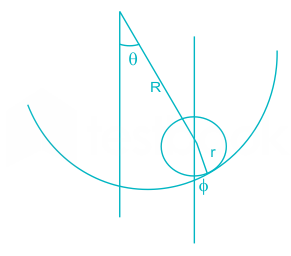
The center of a disk of radius r and mass m is attached to a spring of spring constant k, inside a ring of radius R > r as shown in the figure. The other end of the spring is attached on the periphery of the ring. Both the ring and the disk are in the same vertical plane. The disk can only roll along the inside periphery of the ring, without slipping. The spring can only be stretched or compressed along the periphery of the ring, following the Hooke’s law. In equilibrium, the disk is at the bottom of the ring. Assuming small displacement of the disc, the time period of oscillation of center of mass of the disk is written as T = (\frac{2 \pi}{ω}). The correct expression for ω is (g is the acceleration due to gravity): 
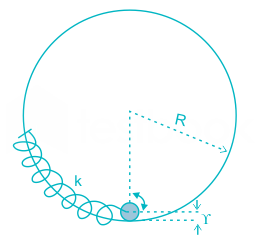
  1. ((a))

    (\sqrt{\frac{2}{3}\left(\frac{g}{R-r}+\frac{k}{m}\right)})

  2. ((b))

    (\sqrt{\frac{2 g}{3(R-r)}+\frac{k}{m}})

  3. ((c))

    (\sqrt{\frac{1}{6}\left(\frac{g}{R-r}+\frac{k}{m}\right)})

  4. ((d))

    (\sqrt{\frac{1}{4}\left(\frac{g}{R-r}+\frac{k}{m}\right)})

Show Answer
Answer: ((a))

(\sqrt{\frac{2}{3}\left(\frac{g}{R-r}+\frac{k}{m}\right)})

Calculation:

From conservation of energy:

Total mechanical energy = Translational KE + Rotational KE + Spring PE + Gravitational PE

⇒ (1/2) m v2 + (1/2) (ICM + m(R − r)2) θ̇2 + (1/2) k ((R − r) θ)2 + mg (R − r)(1 − cosθ) = Constant

For rolling without slipping v = (R-r)θ̇ = rϕ̇   

Total energy:

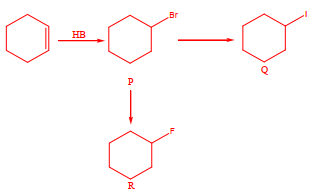
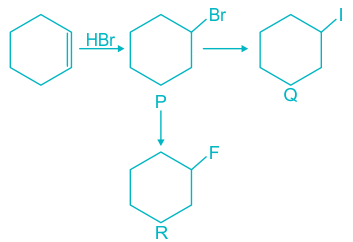
E = (1/2) m(R−r)2θ̇2 + (1/2)((1/2)mr2 + m(R−r)2)θ̇2 + (1/2)k(R−r)2θ2 + mg(R−r)(1−cosθ) = constant

Differentiating w.r.t time:

⇒ [ (3/4) m(R−r)2 + (1/4) m r2 ] θ̈ + [ k(R−r)2/2 + mg(R−r) ] θ = 0

⇒ θ̈ + ω2θ = 0

⇒ ω2 = [k(R−r)2/2 + mg(R−r)] / [ (3/4) m(R−r)2 + (1/4) m r2 ]

Neglecting r2 as r << (R−r):

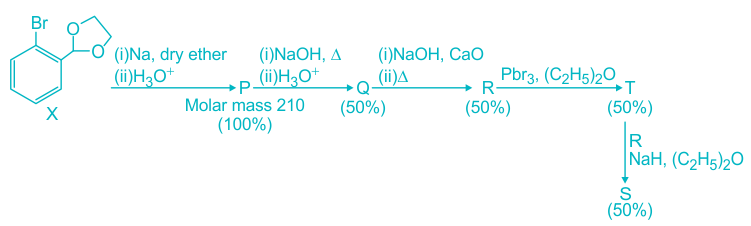
⇒ ω = √[(2/3)(k/m + g/(R−r))] ϕ 

Therefore, correct option is A.
2

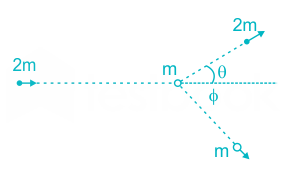
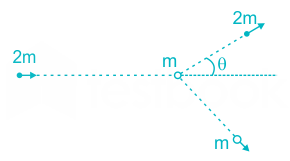
In a scattering experiment, a particle of mass 2m collides with another particle of mass m, which is initially at rest. Assuming the collision to be perfectly elastic, the maximum angular deviation θ of the heavier particle, as shown in the figure, in radians is: 
  1. ((a))

    π

  2. ((b))

    tan-1(\left(\frac{1}{2}\right))

  3. ((c))

    (\frac{\pi}{3})

  4. ((d))

    (\frac{\pi}{6})

Show Answer
Answer: ((d))

(\frac{\pi}{6})

Calculation:

<br>

From the conservation of momentum:

2m v1 = 2m v1f cos θ + 2m v2f cos ϕ     (i)

2m v1f sin θ = m v2f sin ϕ     (ii)

Using conservation of kinetic energy:

1/2 (2m) v12 + 1/2 m (0)2 = 1/2 (2m) v1f2 + 1/2 m v2f2     (iii)

⇒ 2 v12 = 2 v1f2 + v2f2     (iv)

From equations (i), (ii), and (iii), we get:

3 v1f2 − 4 v1 v1f cos θ + v2f2 = 0

⇒ (−4 v1 cos θ)2 − 4(3)(v12) ≥ 0

cos2 θ ≥ 3/4

⇒ cos θ ≥ √3/2

⇒ θ = π / 6

Therefore, the correct option is D: π / 6.

3

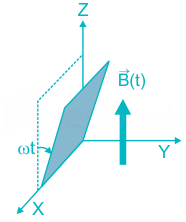
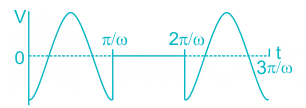
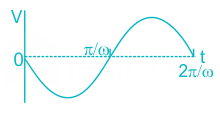
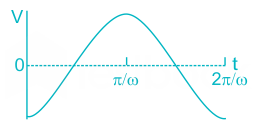
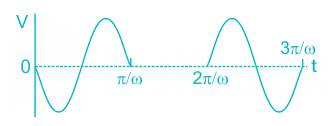
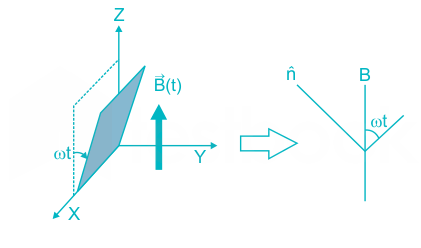
A conducting square loop initially lies in the XZ plane with its lower edge hinged along the X-axis. Only in the region y ≥ 0, there is a time dependent magnetic field pointing along the Z-direction, (\vec{B}(t)=B_{0}(\cos ω t) \hat{K}) where B0 is a constant. The magnetic field is zero everywhere else. At time t = 0, the loop starts rotating with constant angular speed ω about the X axis in the clockwise direction as viewed from the +X axis (as shown in the figure). Ignoring self-inductance of the loop and gravity, which of the following plots correctly represents the induced e.m.f. (V) in the loop as a function of time:

  1. ((a))

  2. ((b))

  3. ((c))

  4. ((d))

Show Answer
Answer: ((a))

Calculation:

The induced emf is given by: ε = -dϕ/dt

The magnetic flux ϕ is: ϕ = B ⋅ A = B A sin(ωt)

For y ≥ 0: B = B0 cos(ωt)

For y ≤ 0: B = 0

For rotation from t = 0 to t = T/2: The loop will be in the magnetic field, and thus there will be flux. But for t ≥ T/2, there is no flux, and hence no induced emf.

Thus, for 0 ≤ t ≤ T/2:

The flux is: ϕ = (A B0)/2 sin(2ωt)

Induced emf: ε = -dϕ/dt = -ω B0 cos(2ωt) A

4

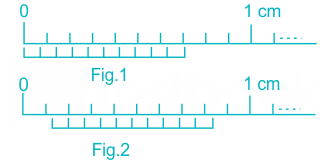
Figure 1 shows the configuration of main scale and Vernier scale before measurement. Fig. 2 shows the configuration corresponding to the measurement of diameter D of a tube. The measured value of D is: 

  1. ((a))

    0.12 cm 

  2. ((b))

    0.11 cm 

  3. ((c))

    0.13 cm  

  4. ((d))

    0.14 cm 

Show Answer
Answer: ((c))

0.13 cm  

Calculation:

 1 MSD = 0.1 cm

7 MSD = 10 VSD

∴ VC = 1 MSD − 1 VSD = (3/10) MSD = 0.03 cm

Measured value

= MSR + VSR = 0.1 + 0.03 = 0.13 cm

Therefore, the measured value of diameter D is 0.13 cm, which corresponds to option C.

5

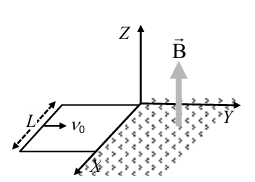
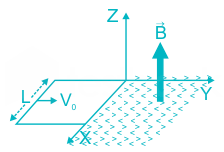
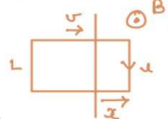
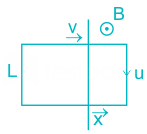
A conducting square loop of side L, mass M and resistance R is moving in the XY plane with its edges parallel to the X and Y axes. The region y ≥ 0 has a uniform magnetic field, (\vec{B}=B_{0} k). The magnetic field is zero everywhere else. At time t = 0, the loop starts to enter the magnetic field with an initial velocity (v_{0} \hat{\jmath}) m/s, as shown in the figure. Considering the quantity K = (\frac{B_{0}^{2} L^{2}}{R M}) in appropriate units, ignoring self-inductance of the loop and gravity, which of the following statements is/are correct:  

  1. ((a))

    If v0 = 1.5KL, the loop will stop before it enters completely inside the region of magnetic field.

  2. ((b))

    When the complete loop is inside the region of magnetic field, the net force acting on the loop is zero.  

  3. ((c))

    If v0 = (\frac{K L}{10}), the loop comes to rest at t = (\left(\frac{1}{K}\right) \ln \left(\frac{5}{2}\right)).

  4. ((d))

    If v0 = 3KL, the complete loop enters inside the region of magnetic field at time t = (\left(\frac{1}{K}\right) \ln \left(\frac{3}{2}\right)).

Show Answer
Answer: ((a))

If v0 = 1.5KL, the loop will stop before it enters completely inside the region of magnetic field.

Calculation:

For x < L

i = B0 l v / R

mv dv/dx = B02 l2 / R v ⇒ ∫v0v v dv = −(B02 l2) / (mR) ∫0x dx ⇒ v = v0 − kx

Also, dv/dt = −kv ⇒ ∫v0v (dv / v) = −k ∫0t dt ⇒ v = v0 e−kt ⇒ t = 1 / k ln(v0 / v) = 1 / k ln(v0 / (v0 − kx))

If v0 > KL, the loop will fully enter the region of the magnetic field after time:

t = 1 / k ln(v0 / (v0 − KL))

and continue to move with velocity:

v = v0 − KL

6

Length, breadth and thickness of a strip having a uniform cross section are measured to be 10.5 cm, 0.05 mm, and 6.0 µm, respectively. Which of the following option(s) give(s) the volume of the strip in cm3 with correct significant figures:

  1. ((a))

    3.2 × 10⁻⁵ 

  2. ((b))

    32.0 × 10⁻⁶ 

  3. ((c))

    3.0 × 10⁻⁵ 

  4. ((d))

    3 × 10⁻⁵

Show Answer
Answer: ((a))

3.2 × 10⁻⁵ 

Explanation:

The number of significant figures in the result must be equal to the number of significant figures in the measured value with the least number of significant figures.

For example, in the measured value 0.05 mm, there is only 1 significant figure.

7

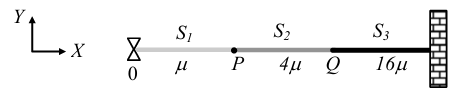
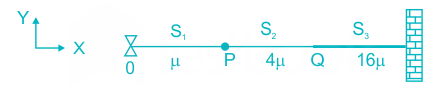
Consider a system of three connected strings, S1 , S2 and S3 with uniform linear mass densities μ kg/m, 4μ kg/m and 16μ kg/m, respectively, as shown in the figure. S1 and S2 are connected at the point P, whereas S2 and S3 are connected at the point Q, and the other end of S3 is connected to a wall. A wave generator O is connected to the free end of S1 . The wave from the generator is represented by y = y0 cos(ωt − kx) cm, where y0 , ω and k are constants of appropriate dimensions. Which of the following statements is/are correct:

  1. ((a))

    When the wave reflects from P for the first time, the reflected wave is represented by  y = α1y0 cos(ωt + kx + π) cm, where α1 is a positive constant.

  2. ((b))

    When the wave transmits through P for the first time, the transmitted wave is represented by y = α2y0 cos(ωt - kx) cm, where α2 is a positive constant.

  3. ((c))

    When the wave reflects from Q for the first time, the reflected wave is represented by y = α3y0 cos(ωt - kx + π) cm, where α3 is a positive constant.

  4. ((d))

    When the wave transmits through Q for the first time, the transmitted wave is represented by y = α4y0 cos(ωt - 4kx) cm, where α4 is a positive constant.

Show Answer
Answer: ((a))

When the wave reflects from P for the first time, the reflected wave is represented by  y = α1y0 cos(ωt + kx + π) cm, where α1 is a positive constant.

Calculation:

At point P, the wave moves from a lighter string (μ) to a denser string (4μ), hence:

y = α1 y0 cos(ωt + kx + π)

y = α2 y0 cos(ωt - kx)

Reflected wave: undergoes a phase change of π, so the equation becomes:

Transmitted wave: enters the denser medium, no phase change, so:

At point Q, the wave again moves from 4μ to 16μ (denser), so:

y = α3 y0 cos(ωt - kx + π)

y = α4 y0 cos(ωt - 4kx)

Reflected wave: undergoes a phase change of π, becomes:

Transmitted wave: in a medium with 4× linear mass density → the wave number becomes 4k:

Thus, options A and D are correct.

8

A person sitting inside an elevator performs a weighing experiment with an object of mass 50 kg. Suppose that the variation of the height y (in m) of the elevator, from the ground, with time t (in s) is given by y = (8\left[1+\sin \left(\frac{2 π t}{T}\right)\right]), where T = 40π s. Taking acceleration due to gravity, g = 10 m/s2,  the maximum variation of the object's weight (in N) as observed in the experiment is _______.

9

A cube of unit volume contains 35 × 107 photons of frequency 1015 Hz. If the energy of all the photons is viewed as the average energy being contained in the electromagnetic waves within the same volume, then the amplitude of the magnetic field is 𝛼 × 10−9 T. Taking permeability of free space μ0 = 4π × 10−7 Tm/A, Planck’s constant ℎ = 6 × 10⁻³⁴ Js and π = (\frac{22}{7}), the value of 𝛼 is ________.

10

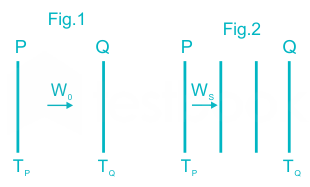
Two identical plates P and Q, radiating as perfect black bodies, are kept in vacuum at constant absolute temperatures TP and TQ, respectively, with TQ < TP, as shown in Fig. 1. The radiated power transferred per unit area from P to Q is 𝑊0. Subsequently, two more plates, identical to P and Q, are introduced between P and Q, as shown in Fig. 2. Assume that heat transfer takes place only between adjacent plates. If the power transferred per unit area in the direction from P to Q (Fig. 2) in the steady state is 𝑊𝑆, then the ratio (\frac{W_{0}}{W_{S}}) is _______

11

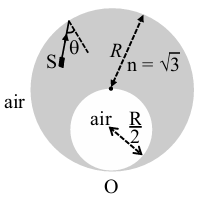
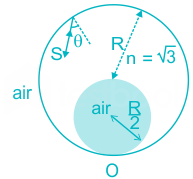
A solid glass sphere of refractive index 𝑛 = √3 and radius 𝑅 contains a spherical air cavity of radius (\frac{\mathrm{R}}{2}), as shown in the figure. A very thin glass layer is present at the point O so that the air cavity (refractive index 𝑛 = 1) remains inside the glass sphere. An unpolarized, unidirectional and monochromatic light source 𝑆 emits a light ray from a point inside the glass sphere towards the periphery of the glass sphere. If the light is reflected from the point O and is fully polarized, then the angle of incidence at the inner surface of the glass sphere is 𝜃. The value of sin 𝜃 is _______

12

A single slit diffraction experiment is performed to determine the slit width using the equation, (\frac{b d}{D}) = mλ, where 𝑏 is the slit width, 𝐷 the shortest distance between the slit and the screen, 𝑑 the distance between the 𝑚th diffraction maximum and the central maximum, and λ is the wavelength. D and 𝑑 are measured with scales of least count of 1 cm and 1 mm, respectively. The values of λ and m are known precisely to be 600 nm and 3, respectively. The absolute error (in 𝜇m) in the value of 𝑏 estimated using the diffraction maximum that occurs for 𝑚 = 3 with 𝑑 = 5 mm and 𝐷 = 1 m is _______

13

Consider an electron in the 𝑛 = 3 orbit of a hydrogen-like atom with atomic number 𝑍. At absolute temperature 𝑇, a neutron having thermal energy 𝑘B𝑇 has the same de Broglie wavelength as that of this electron. If this temperature is given by T = (\frac{Z^{2} h^{2}}{\alpha \pi^{2} a_{0}^{2} m_{N} k_{B}}),  (where ℎ is the Planck’s constant, 𝑘𝐵 is the Boltzmann constant, 𝑚N is the mass of the neutron and 𝑎0 is the first Bohr radius of hydrogen atom) then the value of 𝛼 is _______

14

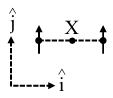
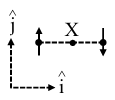
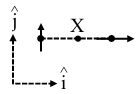
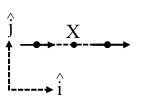
List-I shows four configurations, each consisting of a pair of ideal electric dipoles. Each dipole has a dipole moment of magnitude 𝑝, oriented as marked by arrows in the figures. In all the configurations the dipoles are fixed such that they are at a distance 2𝑟 apart along the 𝑥 direction. The midpoint of the line joining the two dipoles is 𝑋. The possible resultant electric fields (\vec{E}) at 𝑋 are given in List-II. Choose the option that describes the correct match between the entries in List-I to those in List-II. 

List-IList-II
(P)(1)(\vec{E}) = 0
(Q)(2)(\vec{E}) = (-\frac{p}{2 \pi \epsilon_{0} r^{3}} \hat{\mathrm{j}})
(R)(3)(\vec{E}) = (-\frac{p}{4 \pi \epsilon_{0} r^{3}}(\hat{\mathrm{i}}-\hat{\mathrm{j}}))
(S)(4)(\vec{E}) = (=\frac{p}{4 \pi \epsilon_{0} \mathrm{r}^{3}}(2 \hat{\mathrm{i}}-\hat{\mathrm{j}}))
(5)(\vec{E}) = (\frac{p}{\pi \epsilon_{0} \mathrm{r}^{3}} \hat{\mathrm{i}})
  1. ((a))

    P→3, Q→1, R→2, S→4

  2. ((b))

    P→4, Q→5, R→3, S→1

  3. ((c))

    P→2, Q→1, R→4, S→5

  4. ((d))

    P→2, Q→1, R→3, S→5

Show Answer
Answer: ((c))

P→2, Q→1, R→4, S→5

Calculation:

The electric field due to a dipole at a point in space depends on the position relative to the dipole. It is typically expressed in terms of:

E = (1 / 4πε0) × (p / r3)

Pointwise Breakdown:

For P:

E = (1 / 4πε0) × (p / r3) × 2(-↓) = - (p / 2πε0 r3) ↓

For Q:

E = 0

(This is typically the center of the dipole, where the fields cancel.)

ForcR:

E = (p / 4πε0 r3) × (2→ - ↓)

For S:

E = 2 × (p / 4πε0 r3) × 2(→) = - (p / πε0 r3) →

(Note: The final expression has a negative sign, which likely comes from vector direction considerations.)

15

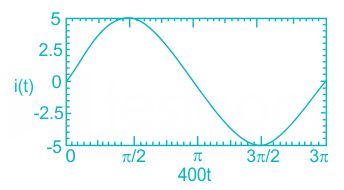
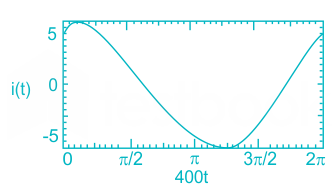
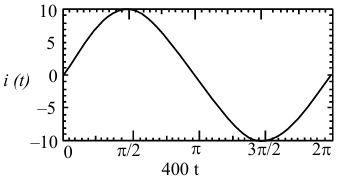
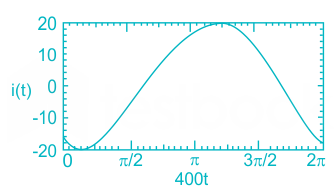
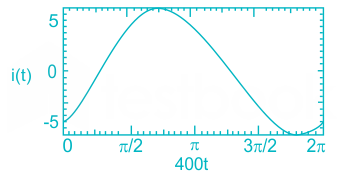
A circuit with an electrical load having impedance 𝑍 is connected with an AC source as shown in the diagram. The source voltage varies in time as V(𝑡) = 300 sin(400𝑡) V, where 𝑡 is time in s. List-I shows various options for the load. The possible currents i(𝑡) in the circuit as a function of time are given in List-II. 

Choose the option that describes the correct match between the entries in List-I to those in List-II. 

List-IList-II
(P)(1)
(Q)(2)
(R)(3)
(S)(4)
(5)
  1. ((a))

    P→3, Q→5, R→2, S→1

  2. ((b))

    P→1, Q→5, R→2, S→3

  3. ((c))

    P→3, Q→4, R→2, S→1

  4. ((d))

    P→1, Q→4, R→2, S→5

Show Answer
Answer: ((a))

P→3, Q→5, R→2, S→1

Calculation:

Given Expressions for  (P), (Q), (R), and (S):

(P): Given voltage: vz = 10 sin(400t)   (volts)

Impedance: Z = R   ⇒   Purely resistive

(Q): Z = jωL,   ω = 400,   L = x   (inductive)

Voltage: V = 6 sin(400t - 53°)   V

(R): Z = jωL + R = 50 + j10,   ⇒   |Z| = √(502 + 102) = √2600

Voltage: V = 6 sin(400t + 53°)   V

(Phase shift is positive, indicating a capacitive nature.)

(S): Z = jωL + R = 60 + j60,   ⇒   |Z| = √(602 + 602) = 60√2

Voltage: V = 300 sin(400t) / 60√2 = 5 sin(400t)

16

List-I shows various functional dependencies of energy (𝐸) on the atomic number (𝑍). Energies associated with certain phenomena are given in List-II.

Choose the option that describes the correct match between the entries in List-I to those in List-II. 

List-IList-II
(P)E ∝ Z2(1)energy of characteristic x-rays
(Q)E ∝ (Z – 1)2(2)electrostatic part of the nuclear binding energy for stable nuclei with mass numbers in the range 30 to 170
(R)E ∝ Z (Z – 1)(3)energy of continuous x-rays
(S)E is practically independent of 𝑍(4)average nuclear binding energy per nucleon for stable nuclei with mass number in the range 30 to 170
(5)energy of radiation due to electronic transitions from hydrogen-like atoms
  1. ((a))

    P→4, Q→3, R→1, S→2  

  2. ((b))

    P→5, Q→2, R→1, S→4

  3. ((c))

    P→5, Q→1, R→2, S→4  

  4. ((d))

    P→3, Q→2, R→1, S→5

Show Answer
Answer: ((c))

P→5, Q→1, R→2, S→4  

Calculation:

For (P): E ∝ Z2

Energy of radiation due to electronic transition in hydrogen-like atoms.

Ex- In hydrogen-like atoms, energy levels are given by: En = -13.6 Z2 / n2 eV, so energy difference scales with Z2.

for (Q): E ∝ (Z - 1)2

Energy of Kα characteristic X-rays.

Ex- Moseley’s law: ν ∝ (Z - 1)2 accounts for the screening effect of inner electrons.

For (R): E ∝ Z(Z - 1)

Coulombic repulsion energy among protons in a nucleus.

Ex- Total Coulomb energy scales like: ECoulomb ∝ Z(Z - 1) / R (where R ∝ A1/3).

For (S): Binding energy per nucleon is nearly constant for nuclei with mass number 30 < A < 170.

This is a well-known trend and is maximum around iron (A ≈ 56).

Chemistry (16 questions)

17

The heating of NH4NO2 at 60–70ºC and NH4NO3 at 200–250ºC is associated with the formation of nitrogen containing compounds X and Y, respectively. X and Y, respectively, are

  1. ((a))

    N2 and N2O

  2. ((b))

    NH3 and NO2

  3. ((c))

    NO and N2O

  4. ((d))

    N2 and NH3

Show Answer
Answer: ((a))

N2 and N2O

CONCEPT:

Decomposition of Ammonium Nitrate (NH4NO3)

  • Ammonium nitrate (NH4NO3) undergoes decomposition when heated at different temperatures. The products of this decomposition depend on the temperature range at which the heating occurs.
  • At temperatures between 60°C and 70°C, NH4NO3 decomposes to form nitrogen (N2) and water (H2O).
  • At higher temperatures, around 200°C to 250°C, NH4NO3 decomposes to form nitrogen dioxide (NO2) and water (H2O), along with other nitrogen compounds.

EXPLANATION:

  • The decomposition of NH4NO3 at lower temperatures (60°C-70°C) leads to the formation of nitrogen (N2) and water:

2 NH4NO3 → N2 + 4 H2O

  • At higher temperatures (200°C-250°C), NH4NO3 decomposes to form nitrogen dioxide (NO2) and water:

2 NH4NO3 → 2 NO2 + 2 H2O

  • Therefore, the compounds formed at these two temperature ranges are nitrogen (N2) and nitrogen dioxide (NO2), respectively.

Therefore, the correct answer is A) N2 and N2O.

18

The correct order of the wavelength maxima of the absorption band in the ultraviolet-visible region for the given complexes is

  1. ((a))

    [Co(CN)6]3– < [Co(NH3)6]3+ < [Co(NH3)5(H2O)]3+ < [Co(NH3)5(Cl)]2+

  2. ((b))

    [Co(NH3)5(Cl)]2+ < [Co(NH3)5(H2O)]3+ < [Co(NH3)6]3+ < [Co(CN)6]3–

  3. ((c))

    [Co(CN)6]3– < [Co(NH3)5(Cl)]2+ < [Co(NH3)5(H2O)]3+ < [Co(NH3)6]3+ 

  4. ((d))

    [Co(NH3)6]3+ < [Co(CN)6]3– < [Co(NH3)5(Cl)]2+ < [Co(NH3)5(H2O)]3+

Show Answer
Answer: ((a))

[Co(CN)6]3– < [Co(NH3)6]3+ < [Co(NH3)5(H2O)]3+ < [Co(NH3)5(Cl)]2+

CONCEPT:

Absorption Band Maxima and Ligand Field Theory

  • The absorption band maxima in the ultraviolet-visible region of transition metal complexes are influenced by the ligand field around the metal ion.
  • According to ligand field theory, the nature of the ligands affects the splitting of the d-orbitals in the metal center, which determines the energy gap between the higher and lower d-orbitals. This energy gap corresponds to the absorption of light in the visible or ultraviolet region.
  • Ligands that create a stronger ligand field (such as cyanide) cause a larger splitting of the d-orbitals, leading to absorption at lower wavelengths (higher energy). On the other hand, ligands that create a weaker field (such as chloride or water) lead to smaller splittings, resulting in absorption at higher wavelengths (lower energy).

EXPLANATION:

  • For the given complexes, the ligand field strengths are as follows:
  • [Co(CN)6]3– (cyanide) is the strongest field ligand, leading to a larger splitting of the d-orbitals.
  • [Co(NH3)6]3+ (ammonia) is a moderate field ligand, causing moderate splitting.
  • [Co(NH3)5(H2O)]3+ (water) creates a weaker ligand field compared to ammonia.
  • [Co(NH3)5(Cl)]2+ (chloride) also creates a weaker field, but stronger than water.
  • The absorption maxima for these complexes would follow this order:
  • [Co(CN)6]3– (strongest field, highest absorption energy, shortest wavelength)
  • [Co(NH3)6]3+ (moderate field strength, intermediate absorption energy)
  • [Co(NH3)5(Cl)]2+ (weaker field than ammonia, lower absorption energy)
  • [Co(NH3)5(H2O)]3+ (weakest field, lowest absorption energy, longest wavelength)
  • Thus, the correct order of the wavelength maxima of the absorption band is:
  • Option 1: [Co(CN)6]3– < [Co(NH3)6]3+ < [Co(NH3)5(H2O)]3+ < [Co(NH3)5(Cl)]2+

Therefore, the correct answer is Option 1: [Co(CN)6]3– < [Co(NH3)6]3+ < [Co(NH3)5(H2O)]3+ < [Co(NH3)5(Cl)]2+.

19

One of the products formed from the reaction of permanganate ion with iodide ion in neutral aqueous medium is

  1. ((a))

    I2

  2. ((b))

    (\mathrm{IO}_{3}^{-})

  3. ((c))

    (\mathrm{IO}_{4}^{-})

  4. ((d))

    (\mathrm{IO}_{2}^{-})

Show Answer
Answer: ((b))

(\mathrm{IO}_{3}^{-})

CONCEPT:

Reaction of Permanganate Ion with Iodide Ion in Neutral Aqueous Medium

  • The reaction of permanganate ion (MnO4) with iodide ion (I) in a neutral aqueous medium leads to the reduction of the permanganate ion and the oxidation of iodide ion.
  • In a neutral medium, the permanganate ion is reduced to MnO2 (manganese dioxide), and iodide ions are oxidized to form iodate ions (IO3).
  • The balanced chemical equation for this reaction is as follows:
  • 2MnO4 + 2I + 2H2O → 2MnO2 + 2OH + I2 (in acidic medium)
  • In a neutral medium, the final product of iodide oxidation is IO3 (iodate ion). Therefore, the permanganate ion is reduced to MnO2 while iodide ion is oxidized to iodate (IO3).

EXPLANATION:

  • In neutral aqueous medium, the iodide ion (I) is oxidized by permanganate to form iodate (IO3), which is the main product of the reaction.
  • The reduction of permanganate results in the formation of manganese dioxide (MnO2), which is a solid product.
  • Thus, the correct product formed from the reaction of permanganate ion with iodide ion in neutral aqueous medium is IO3.
  • Hence, the correct answer is IO3 (Iodate ion).

Therefore, the correct answer is IO3.

20

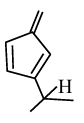
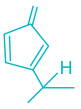
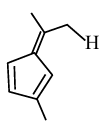
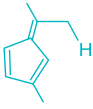
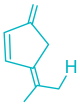
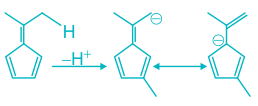
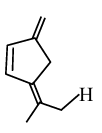
Consider the depicted hydrogen (H) in the hydrocarbons given below. The most acidic hydrogen (H) is

  1. ((a))

  2. ((b))

  3. ((c))

  4. ((d))

Show Answer
Answer: ((b))

CONCEPT:

Acidity of Hydrogens in Hydrocarbons

  • The acidity of a hydrogen in hydrocarbons is determined by the stability of the conjugate base formed when the hydrogen is removed. The more stabilized the conjugate base, the more acidic the hydrogen.
  • Factors that stabilize the conjugate base include:
  • Resonance stabilization (where the negative charge can be delocalized).
  • Inductive effects (where electron-withdrawing groups increase acidity).
  • Aromatic stabilization (where the conjugate base benefits from the stability of an aromatic ring).

EXPLANATION:

  • Option 1: A cyclohexene derivative where the hydrogen is on a carbon in the ring. This structure doesn’t provide significant stabilization of the conjugate base, so the hydrogen is less acidic.
  • Option 2: This structure has a hydrogen attached to a carbon next to an electronegative group, which can stabilize the conjugate base via inductive effects or resonance. This makes the hydrogen more acidic.
  • Option 3: This is a substituted benzene ring with a hydrogen attached to a carbon. The conjugate base here is stabilized by resonance from the aromatic ring, making it more acidic than Option 1.
  • Option 4: This structure has a hydrogen attached to a carbon next to a conjugated system, which can help stabilize the conjugate base, increasing the acidity of the hydrogen compared to Option 1.
  • Among these options, the hydrogen in Option 2 is the most acidic because it is adjacent to a group that can stabilize the conjugate base through inductive or resonance effects.

Therefore, the most acidic hydrogen is in Option 2.

21

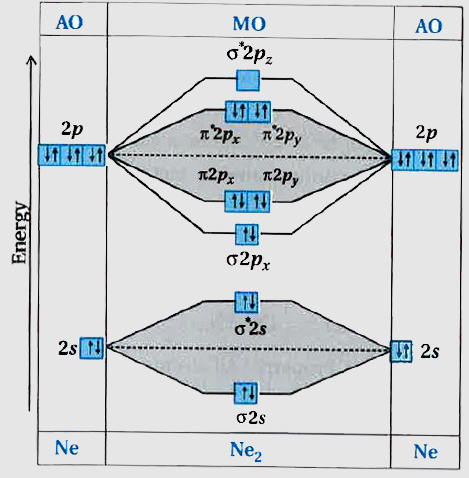
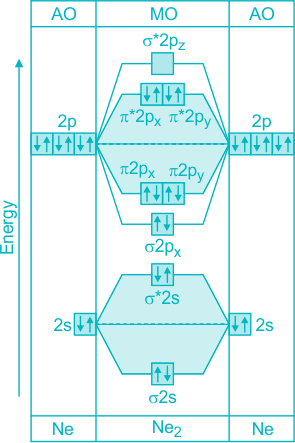
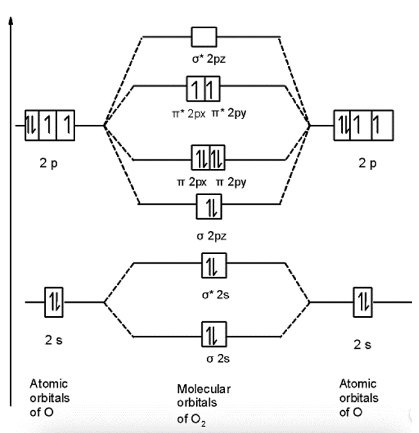
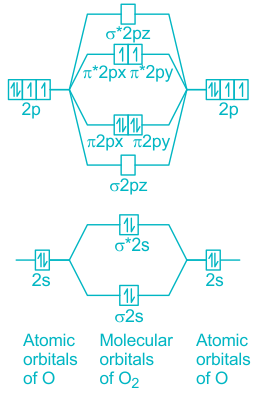
Regarding the molecular orbital (MO) energy levels for homonuclear diatomic molecules, the INCORRECT statement(s) is(are) 

  1. ((a))

    Bond order of Ne2 is zero.

  2. ((b))

    The highest occupied molecular orbital (HOMO) of F2 is σ-type.

  3. ((c))

    Bond energy of (\mathrm{O}_{2}^{+}) is smaller than the bond energy of O2.

  4. ((d))

    Bond length of Li2 is larger than the bond length of B2

Show Answer
Answer: ((a))

Bond order of Ne2 is zero.

CONCEPT:

Molecular Orbitals (MOs) in Homonuclear Diatomic Molecules

  • The bond order is determined by the difference between the number of electrons in bonding molecular orbitals and antibonding molecular orbitals. The formula for bond order is:

Bond Order = (Number of electrons in bonding MOs - Number of electrons in antibonding MOs) / 2

  • The highest occupied molecular orbital (HOMO) refers to the highest energy molecular orbital that contains electrons, which may be either a bonding (σ-type) or an antibonding (σ* or π*) orbital, depending on the molecule.
  • The bond energy of a molecule is influenced by the bond order, with a higher bond order generally corresponding to higher bond energy.
  • The bond length is related to the bond order—higher bond order molecules generally have shorter bond lengths.

EXPLANATION:

  • Statement 1: Bond order of Ne2 is zero.
  • This statement is correct. In Ne2, the number of electrons in bonding and antibonding orbitals is the same, leading to a bond order of zero.

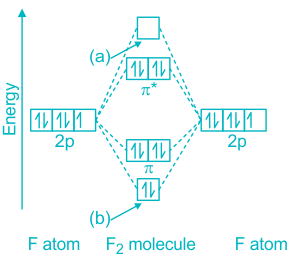
  • Statement 2: The highest occupied molecular orbital (HOMO) of F2 is σ-type.
  • This statement is incorrect. In F2, the HOMO is of π-type (π2p), not σ-type. The π-type orbitals are higher in energy than the σ-type orbitals in F2 due to the overlap and energy levels in the molecular orbital diagram.

Part of the molecular orbital diagram of F2is shown below.i. Iden... |  Channels for Pearson+

  • Statement 3: Bond energy of O2+ is smaller than the bond energy of O2.
  • This statement is correct. O2+ has a bond order of 2.5, while O2 has a bond order of 2. A higher bond order typically leads to a stronger bond and therefore higher bond energy, meaning the bond energy of O2 is greater than that of O2+.

The Increasing Order of the Bond Order of O2, O2-, O2+ and O22-

Bond order of${{\text{O}}{\text{2}}}$,  $\text{O}{\text{2}}^{\text{+}}$, $O_{2}^{-}$ and  \[\text{O}{\text{2}}^{\text{2-}}\] is in order. (A)  $\text{O}{\text{2}}^{\text{- }}\langle \text{ O}_{2}^{2-}\text{  }\langle \text{ }{{\text ...

  • Statement 4: Bond length of Li2 is larger than the bond length of B2.
  • This statement is incorrect. While the bond order in Li2 is 1, and in B2 it is also 1, Li2 has a larger bond length because lithium atoms are larger than boron atoms. However, the bond lengths are comparable based on their atomic sizes, and the bond order is the same.

Therefore, the incorrect statement is Option 2 and 3.

22

The pair(s) of diamagnetic ions is(are) 

  1. ((a))

    La3+, Ce4+

  2. ((b))

    Yb2+, Lu3+  

  3. ((c))

    La2+, Ce3+ 

  4. ((d))

    Yb3+, Lu2+

Show Answer
Answer: ((a))

La3+, Ce4+

CONCEPT:

Diamagnetism in Ions

  • Diamagnetism is the property of a substance to create an opposing magnetic field when subjected to an external magnetic field. This happens when all the electrons in an atom or ion are paired, which leads to no unpaired electrons in the electron configuration.
  • Ions that are diamagnetic have only paired electrons, meaning there are no unpaired electrons in their molecular orbitals or atomic orbitals.
  • In contrast, paramagnetic ions have at least one unpaired electron, leading to a net magnetic moment.

EXPLANATION:

  • Option 1: La3+ and Ce4+
  • Both La3+ and Ce4+ have fully paired electrons in their electron configurations. La3+ has the electron configuration [Xe] 4f0, and Ce4+ has the configuration [Xe] 4f0 as well. Thus, they are both diamagnetic.
  • Option 2: Yb2+ and Lu3+
  • Yb2+ has the electron configuration [Xe] 4f13 and Lu3+ has the configuration [Xe] 4f0. Yb2+ has all paired electrons, and Lu3+ has paired electrons as well. Therefore, both ions are diamagnetic.
  • Option 3: La2+ and Ce3+
  • La2+ has an electron configuration of [Xe] 4f1, and Ce3+ has [Xe] 4f1 as well. Both ions have unpaired electrons, making them paramagnetic, not diamagnetic.
  • Option 4: Yb3+ and Lu2+
  • The neutral ytterbium atom has the configuration [Xe] 4f¹⁴ 5d¹ 6s².

The neutral lutetium atom has the configuration [Xe] 4f¹⁴ 5d¹ 6s².

Therefore, the correct diamagnetic ions are found in Option 1, Option 2

23

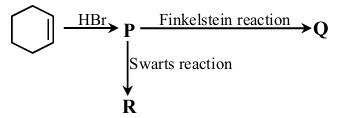
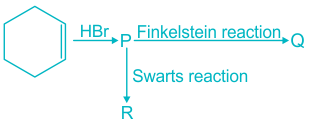
For the reaction sequence given below, the correct statement(s) is(are) 

(In the options, X is any atom other than carbon and hydrogen, and it is different in P, Q and R)

  1. ((a))

    C–X bond length in P, Q and R follows the order Q > R > P.  

  2. ((b))

     C–X bond enthalpy in P, Q and R follows the order R > P > Q.

  3. ((c))

    Relative reactivity toward SN2 reaction in P, Q and R follows the order P > R > Q.

  4. ((d))

    pKa value of the conjugate acids of the leaving groups in P, Q and R follows the order R > Q > P.

Show Answer
Answer: ((a))

C–X bond length in P, Q and R follows the order Q > R > P.  

CONCEPT:

Finkelstein and Swarts Reactions

  • The Finkelstein reaction involves the exchange of halides in a polar solvent, typically acetone, where an alkyl halide reacts with a metal halide (e.g., NaI in acetone) to produce a new halide.
  • The Swarts reaction is a halogen exchange reaction where alkyl halides react with halogens in the presence of a metal (e.g., fluorine) to give the corresponding fluoroalkane.
  • In the given reaction sequence, P, Q, and R differ in their X substituent (which is not carbon or hydrogen, and it varies in P, Q, and R).
  • The bond length, enthalpy, reactivity, and pKa of conjugate acids can be affected by the type of halogen (X) attached to the molecule.

EXPLANATION:

  • Statement 1: C–X bond length in P, Q, and R follows the order Q > R > P.
  • This is incorrect. The C–X bond length is typically longer in halides where the halogen atom is larger. Hence, for halides, I > Br > Cl, meaning the bond length order is Q (I) > P (Br) > R (F).
  • Statement 2: C–X bond enthalpy in P, Q, and R follows the order R > P > Q.
  • This statement is correct. The bond dissociation enthalpy is highest for the C–F bond (due to strong bond strength), followed by C–Cl and then C–Br. Hence, the bond enthalpy order is C–F > C–Cl > C–Br.
  • Statement 3: Relative reactivity toward SN2 reaction in P, Q, and R follows the order P > R > Q.
  • This is incorrect. In an SN2 reaction, the reactivity decreases as the halogen size increases, meaning that alkyl fluorides are the most reactive, followed by alkyl bromides and iodides.
  • Statement 4: pKa value of the conjugate acids of the leaving groups in P, Q, and R follows the order R > Q > P.
  • This is correct. The conjugate acid of iodide (HI) has the lowest pKa (strongest acid), followed by HBr, and then HF (weakest acid). Therefore, the pKa order is HI < HBr < HF.

Therefore, the correct statements is Option 2 i.e  C–X bond enthalpy in P, Q and R follows the order R > P > Q..

24

In an electrochemicalcell, dichromate ions in aqueous acidic medium are reduced to Cr3+. The current (in amperes) that flows through the cell for 48.25 minutes to produce 1 mole of Cr3+ is _______.

Use: 1 Faraday = 96500 C mol–1  

25

At 25°C, the concentration of H+ ions in 1.00 × 10⁻³ M aqueous solution of a weak monobasic acid having acid dissociation constant (Ka) = 4.00 × 10⁻¹¹ is X × 10–7 M. The value of X is _______.

Use: Ionic product of water (Kw) = 1.00 × 10⁻¹⁴ at 25°C

26

Molar volume (Vm) of a van der Waals gas can be calculated by expressing the van der Waals equation as a cubic equation with Vm as the variable. The ratio (in mol dm−3) of the coefficient of (V_{m}^{2}) to the coefficient of Vm for a gas having van der Waals constants a = 6.0 dm6 atm mol−2 and b = 0.060 dm3 mol−1 at 300 K and 300 atm is _______.

Use: Universal gas constant (R) = 0.082 dm3 atm mol−1 K−1

27

Considering ideal gas behavior, the expansion work done (in kJ) when 144 g of water is electrolyzed completely under constant pressure at 300 K is _______.

Use: Universal gas constant (R) = 8.3 J K1 mol−1; Atomic mass (in amu): H = 1, O = 16

28

The monomer (X) involved in the synthesis of Nylon 6,6 gives positive carbylamine test. If 10 moles of X are analyzed using Dumas method, the amount (in grams) of nitrogen gas evolved is _______.

Use: Atomic mass of N (in amu) = 14

29

The reaction sequence given below is carried out with 16 moles of X. The yield of the major product in each step is given below the product in parentheses. The amount (in grams) of S produced is_______.

Use: Atomic mass (in amu): H = 1, C = 12, O = 16, Br = 80

30

The correct match of the group reagents in List-I for precipitating the metal ion given in List-II from solutions, is

List-IList-II
(P)Passing H2S in the presence of NH4OH(1)Cu2+ 
(Q)(NH4)2CO3 in the presence of NH4OH(2)Al3+
(R)NH4OH in the presence of NH4Cl(3)Mn2+ 
(S)Passing H2S in the presence of dilute HCl(4)Ba2+
(5)Mg2+
  1. ((a))

    P → 3 ; Q → 4 ; R → 2 ; S → 1

  2. ((b))

    P → 4 ; Q → 2 ; R → 3 ; S → 1

  3. ((c))

    P → 3 ; Q → 4 ; R → 1 ; S → 5

  4. ((d))

    P → 5 ; Q → 3 ; R → 2 ; S → 4

Show Answer
Answer: ((a))

P → 3 ; Q → 4 ; R → 2 ; S → 1

CONCEPT:

Precipitation of Metal Ions using Group Reagents

  • Group reagents are chemicals that are used to selectively precipitate metal ions from their solutions based on their solubility and reactivity.
  • The process typically involves adding a reagent that forms an insoluble compound with a specific metal ion. The ions that precipitate are usually those with the least solubility in the given conditions.
  • For example, adding H2S in the presence of NH4OH can precipitate metal ions like Mn2+ as MnS.
  • Similarly, other reagents such as (NH4)2CO3, NH4OH, and HCl can be used to precipitate different metal ions such as Ba2+, Al3+, Cu2+, etc.

EXPLANATION:

  • P: Passing H2S in the presence of NH4OH
  • This reagent combination is used to precipitate Mn2+ as MnS.
  • Thus, P → 3 (Mn2+)
  • Q: (NH4)2CO3 in the presence of NH4OH
  • This reagent combination precipitates Ba2+ as BaCO3.
  • Thus, Q → 4 (Ba2+)
  • R: NH4OH in the presence of NH4Cl
  • This reagent combination is used to precipitate Al3+ as Al(OH)3.
  • Thus, R → 2 (Al3+)
  • S: Passing H2S in the presence of dilute HCl
  • This reagent combination is used to precipitate Cu2+ as CuS.
  • Thus, S → 1 (Cu2+)

Therefore, the correct match is P → 3 ; Q → 4 ; R → 2 ; S → 1

31

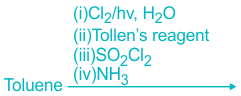
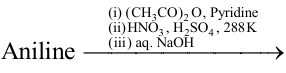
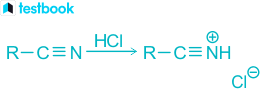
The major products obtained from the reactions in List-II are the reactants for the named reactions mentioned in List-I. Match each entry in List-I with the appropriate entry in List-II and choose the correct options.

List-IList-II
(P)Stephen reaction(1)
(Q)Sandmeyer reaction(2)
(R)Hoffmann bromamide degradation reaction(3)
(S)Cannizzaro reaction(4)
(5)
  1. ((a))

    P → 2 ; Q → 4 ; R → 1 ; S → 3

  2. ((b))

    P → 2 ; Q → 3 ; R → 4 ; S → 1

  3. ((c))

    P → 5 ; Q → 3 ; R → 4 ; S → 2

  4. ((d))

    P → 5 ; Q → 4 ; R → 2 ; S → 1

Show Answer
Answer: ((b))

P → 2 ; Q → 3 ; R → 4 ; S → 1

CONCEPT:

Organic Reactions and Their Products

  • Each organic reaction has a specific reagent or set of reagents that lead to the formation of particular products. The reagents used in these reactions are crucial to determining the product formed in each case.
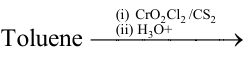
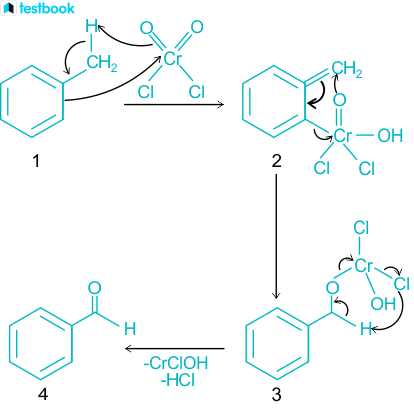
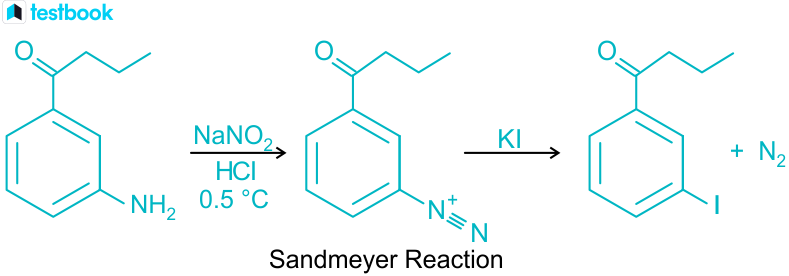
  • For example, in the Stephen reaction, the conversion of toluene (methylbenzene) to benzaldehyde involves the use of CrO3 in CS2 or H2O+. In the Sandmeyer reaction, a diazonium salt undergoes halogenation with CuX.
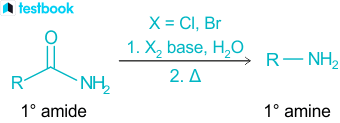
  • In the Cannizzaro reaction, a non-enolizable aldehyde undergoes disproportionation in the presence of strong bases, while the Hoffmann bromamide degradation reaction involves the formation of amines from amides.

EXPLANATION:

  • P: Stephen reaction – This reaction involves the oxidation of toluene to benzaldehyde using CrO3 in CS2 or H2O+. The correct corresponding entry is (1) Toluene with the reagents (i) CrO3, Cl2/CS2 or (ii) H2O+.

Stephen's reaction mechanism: Learn ...

<br>

Etard Reaction: Learn Mechanism, Equation & Application

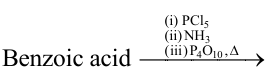
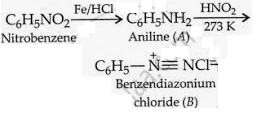
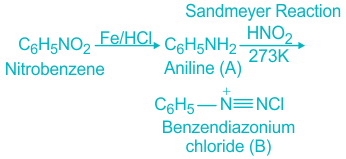
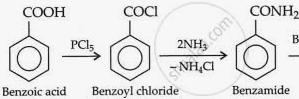
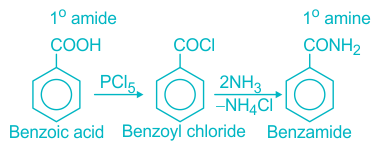
  • Q: Sandmeyer reaction – In this reaction, the diazonium salt of an aromatic amine is treated with CuX to form the corresponding halide. The corresponding entry is (3) Nitrobenezene with reagents (i) PC1 or (ii) NH3, (iii) P4O10, Δ.

Potassium Iodide: Definition, Structure, Formula, Preparation

<br>

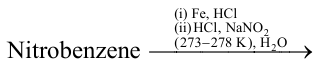
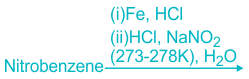
  • R: Hoffmann bromamide degradation reaction – This reaction involves the degradation of amides to primary amines by the use of bromine in the presence of NaOH. The correct corresponding entry is (2) Benzoic acid with reagents (i) Fe, HCl, or (ii) HCl, NaNO3, (273–278 K), H2O.

Hoffmann Bromamide reaction - Learn ...

<br>

<br>

When benzamide is heated with phosphorus pentoxide (P4O10), it undergoes a dehydration reaction to produce benzonitrile

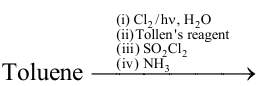
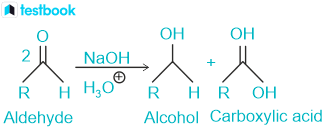
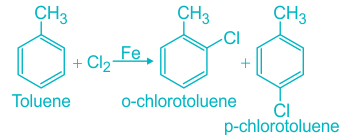
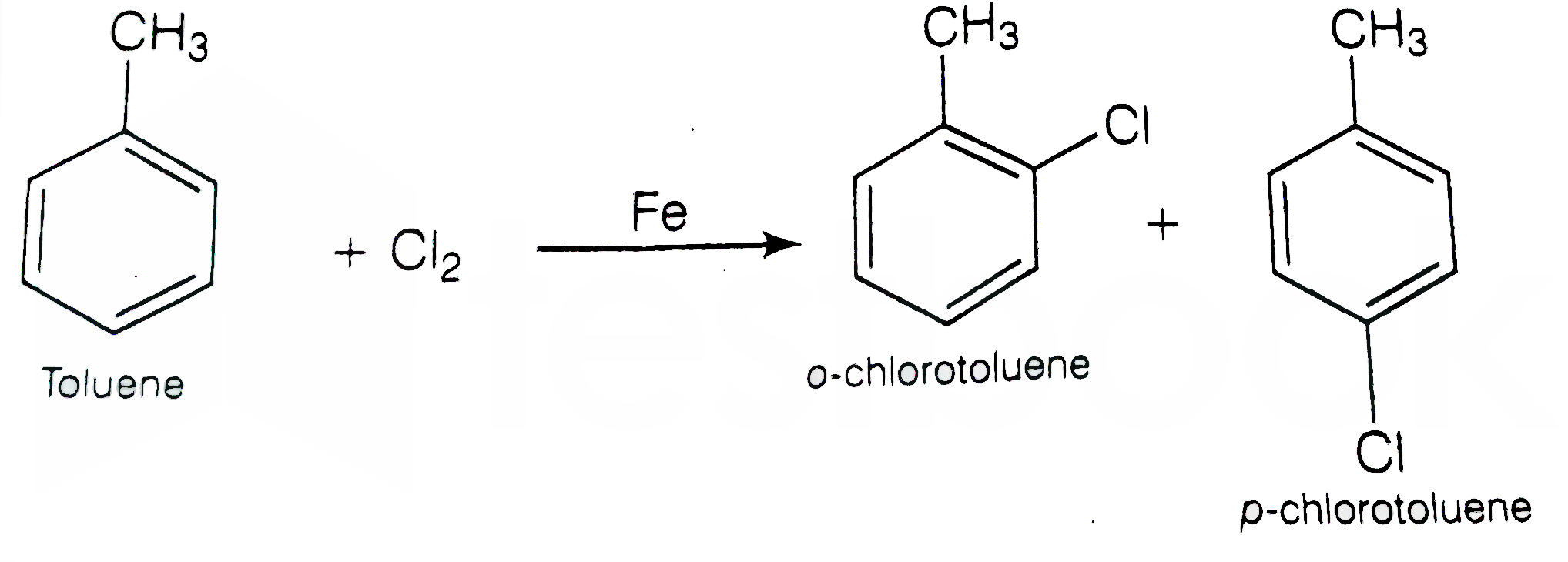
  • S: Cannizzaro reaction – This reaction involves the disproportionation of non-enolizable aldehydes in the presence of strong bases to form a mixture of alcohol and acid. The correct corresponding entry is (4) Toluene with reagents (i) Cl2, hv, H2O or (ii) Tollen’s reagent.

Cannizzaro Reaction Mechanism: Learn ...

<br> <br>

![Solved] Toluene reacts with chlorine in the presence of light to giv](https://storage.googleapis.com/tb-img/production/21/05/ARH_NCERT_EXE_CHM_XII_C10_S01_020_S01.png)
<br>

Therefore, the correct match is Option 2: P → 2 ; Q → 3 ; R → 4 ; S → 1.

32

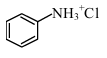
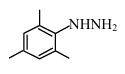
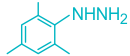
Match the compounds in List-I with the appropriate observations in List-II and choose the correct option. 

List-IList-II
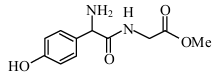
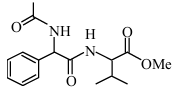
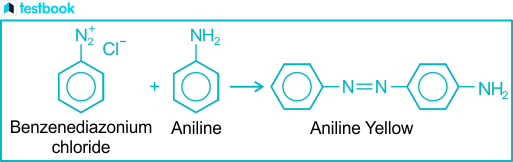
(P) (1)Reaction with phenyl diazonium salt gives yellow dye.
(Q) (2)Reaction with ninhydrin gives purple color and it also reacts with FeCl3 to give violet color.
(R) (3)Reaction with glucose will give corresponding hydrazone.
(S) (4)Lassiagne extract of the compound treated with dilute HCl followed by addition of aqueous FeCl3 gives blood red color.
(5)After complete hydrolysis, it will give ninhydrin test and it DOES NOT give positive phthalein dye test.
  1. ((a))

    P → 1 ; Q → 5 ; R → 4 ; S → 2

  2. ((b))

    P → 2; Q → 5 ; R → 1 ; S → 3

  3. ((c))

    P → 5 ; Q → 2 ; R → 1 ; S → 4

  4. ((d))

    P → 2 ; Q → 1 ; R → 5 ; S → 3

Show Answer
Answer: ((b))

P → 2; Q → 5 ; R → 1 ; S → 3

CONCEPT:

Reactions and Tests for Organic Compounds

  • Certain organic compounds undergo characteristic reactions with specific reagents, giving rise to distinct observations such as color changes or the formation of precipitates.
  • For example, phenyl diazonium salts react with compounds containing amino or hydroxyl groups to produce dyes of specific colors. Similarly, compounds containing hydrazine groups react with glucose to give corresponding hydrazones.
  • Each compound in List-I has a unique reaction with a corresponding reagent, as indicated in List-II.

EXPLANATION:

  • R: Reaction with phenyl diazonium salt gives yellow dye.
  • This compound is an amino acid derivative and gives the ninhydrin test. The yellow dye formation is characteristic of the reaction of amino acid derivatives with phenyl diazonium salts.
  • Thus, P → 1 (Reaction with phenyl diazonium salt gives yellow dye).

Preparation of Aniline Yellow - Process, Materials, Procedure, and Viva  Questions

  • P: Reaction with ninhydrin gives purple color and it also reacts with FeCl3 to give violet color.
  • This compound is an amino acid derivative that reacts with ninhydrin to give a purple color. It also reacts with FeCl3 to give a violet color, indicating the presence of a phenol group.
  • Thus, Q → 5 (Reaction with ninhydrin gives purple color and reacts with FeCl3 to give violet color).
  • S: Reaction with glucose will give corresponding hydrazone.
  • This compound contains a hydrazine group and reacts with glucose to form a hydrazone, which is a common reaction for hydrazines.
  • Thus, R → 3 (Reaction with glucose gives corresponding hydrazone).

Therefore, the correct match is Option B: P → 1 ; Q → 5 ; R → 3 ; S → 4.

Mathematics (16 questions)

33

Let ℝ denote the set of all real numbers. Let ai, bi ∈ ℝ for i ∈ {1, 2, 3}.

Define the functions f : ℝ → ℝ , g : ℝ → ℝ, and h : → ℝ → ℝ by 

f (x) = a1 + 10x + a2x2 + a3x3 + x4,

g (x) = b1 + 3x + b2x2 + a3x3 + x4

h (x) = f (x + 1) – g(x + 2). 

If f (x) ≠ g(x) for every x ∈ ℝ, then the coefficient of x3 in h(x) is

  1. ((a))

    8

  2. ((b))

    2

  3. ((c))

    -4

  4. ((d))

    -6

Show Answer
Answer: ((c))

-4

Concept:

  • Polynomial Functions: These are algebraic expressions involving powers of the variable x. The highest power defines the degree.
  • Function Transformation: When evaluating f(x + 1) or g(x + 2), we shift the graph of the function horizontally.
  • Equal Functions: If f(x) ≠ g(x) ∀ x ∈ ℝ, then their difference is a non-zero function ∀ x.
  • Coefficient Comparison: Equating coefficients of like powers of x in polynomials helps find unknown constants.


Calculation:

Let f(x) = a1 + 10x + a2x2 + a3x3 + x4

Let g(x) = b1 + 3x + b2x2 + b3x3 + x4

Define h(x) = f(x + 1) − g(x + 2)

Given: f(x) ≠ g(x) ∀ x ∈ ℝ

⇒ f(x) − g(x) ≠ 0 ∀ x

⇒ (a3 − b3)x3 + (a2 − b2)x2 + 3x + a1 − b1 = 0

This equation has no real solution ⇔ Identically zero only if:

⇒ a3 = b3, and quadratic (a2 − b2)x2 + 7x + a1 − b1 has no real roots.

Now, h(x) = (x + 1)4 + a3(x + 1)3 + a2(x + 1)2 + 10(x + 1) + a1 − (x + 2)4 − b3(x + 2)3 − b2(x + 2)2 − 3(x + 2) − b1

Coefficient of x3 in h(x):

= Coeff. of x3 from (x + 1)4 + a3(x + 1)3 − (x + 2)4 − b3(x + 2)3

= 4 + a3 × 1 − 8 − b3 × 1

= 4 + a3 − 8 − b3 = −4 (Given: a3 = b3)

∴ The coefficient of x3 in h(x) is −4.

34

Three students S1, S2 and S3 are given a problem to solve. Consider the following events :

U : At least one of S1, S2 and S3 can solve the problem,

V : S1 can solve the problem, given that neither S2 nor S3 can solve the problem,

W : S2 can solve the problem and S3 cannot solve the problem,

T : S3 can solve the problem.

For any event E, let P(E) denote the probability of E.  

If P(U) = (\frac{1}{2}), P(V) = (\frac{1}{10}) and P(W) = (\frac{1}{12}),

then P(T) is equal to

  1. ((a))

    (​​)(\frac{13}{36})

  2. ((b))

    (\frac{1}{3})

  3. ((c))

    (\frac{19}{60})

  4. ((d))

    (\frac{1}{4})

Show Answer
Answer: ((a))

(​​)(\frac{13}{36})

Concept:

  • Probability of Union of Events: The probability of the union of events A, B, C is P(A ∪ B ∪ C).
  • Intersection of Events: The intersection represents common outcomes. Denoted as P(A ∩ B).
  • Venn Diagram: A useful visual to represent unions, intersections, and complements of sets/events.
  • Total Probability: The sum of all individual and overlapping probabilities in the sample space equals 1.
  • Fraction Algebra: Used for solving unknowns by setting up equations with fractions.


Calculation:

P(U) = P(S1 ∪ S2 ∪ S3) = 1/5

P(V) = P(S1 / (S2 ∪ S3)) = 1/10

Let P(S1 ∩ (S2 ∪ S3)) = x

P(V) = x / (0.5 + x) = 1/10

⇒ 10x = 0.5 + x

⇒ 9x = 0.5

⇒ x = 5/90 = 1/18

P(T) = 1/2 − 1/12 − 1/18

P(T) = 13/36

∴ Final Answer: P(T) = 13/36

35

Let denote the set of all real numbers. Define the function f : ℝ → ℝ by

f(x) = (\left{\begin{array}{cc} 2-2 x^{2}-x^{2} \sin \frac{1}{x} & \text { if } x \neq 0 \ 2 & \text { if } x=0 \end{array}\right.)

Then which one of the following statements is TRUE ?

  1. ((a))

    The function f is NOT differentiable at x = 0

  2. ((b))

    There is a positive real number δ, such that f is a decreasing function on the interval (0, δ)

  3. ((c))

    For any positive real number δ, the function f is NOT an increasing function on the interval (–δ, 0)

  4. ((d))

    x = 0 is a point of local minima of f 

Show Answer
Answer: ((b))

There is a positive real number δ, such that f is a decreasing function on the interval (0, δ)

Concept:

  • Continuity at a Point: A function f(x) is said to be continuous at x = a if limx→a f(x) = f(a).
  • Differentiability at a Point: A function is differentiable at x = a if both left-hand and right-hand derivatives exist and are equal.
  • Left-hand Limit (LHL): limh→0⁺ f(a + h) must be finite and match the derivative from the right side.
  • Trigonometric Limits: Use limx→0 sin(1/x) does not exist but x·sin(1/x) → 0 as x → 0.


Calculation:

f(x) = (\left{\begin{array}{cc} 2-2 x^{2}-x^{2} \sin \frac{1}{x} & \text { if } x \neq 0 \ 2 & \text { if } x=0 \end{array}\right.) 

f(x) is continuous at x = 0 and differentiable at x = 0

f′(x) = −4x − 2x·sin(1/x) + cos(1/x)

⇒ f′(x) = −2x[2 + sin(1/x)] + cos(1/x)

Now,

limh→0⁺ f(h) = limh→0⁺ [2 − 2h² − h²·sin(1/h)]

= limh→0⁺ [2 − h²(2 + sin(1/h))]

⇒ limh→0⁺ f(h) = 2

∴ f(x) is decreasing from x = 0 to some positive x = δ.

Hence Option 2 is the correct answer

36

Consider the matrix

P = (\left(\begin{array}{lll} 2 & 0 & 0 \ 0 & 2 & 0 \ 0 & 0 & 3 \end{array}\right)).

Let the transpose of a matrix X be denoted by XT. Then the number of 3 × 3 invertible matrices Q with integer entries, such that Q–1 = QT and PQ = QP, is

  1. ((a))

    32

  2. ((b))

    8

  3. ((c))

    16

  4. ((d))

    24

Show Answer
Answer: ((c))

16

Concept:

  • Orthogonal Matrix: A square matrix Q is orthogonal if Q × QT = I, where I is the identity matrix and QT is the transpose of Q.
  • Matrix Multiplication Property: If matrices P and Q commute (i.e., PQ = QP), then they satisfy certain structural constraints.
  • Zero Pattern Multiplication: When multiplying matrices with zeroes in known positions, use simplification by directly eliminating multiplication with zero elements.
  • Identity Matrix (I): A diagonal matrix with 1’s on the diagonal and 0 elsewhere. Acts as a multiplicative identity for matrices.


Calculation:

P = (\left(\begin{array}{lll} 2 & 0 & 0 \ 0 & 2 & 0 \ 0 & 0 & 3 \end{array}\right)) 

Let Q = (\left(\begin{array}{lll} a_1 & a_2 & a_3 \ b_1 & b_2 & b_3 \ c_1 & c_2 & c_3 \end{array}\right))  

Given: PQ = QP

From multiplication, equating PQ and QP leads to constraints:

a3 = 0, b3 = 0, c1 = 0, c2 = 0

Thus Q becomes: (\left(\begin{array}{lll} a_1 & a_2 & 0 \ b_1 & b_2 & 0 \ 0 & 0 & c_3 \end{array}\right)) 

Q is orthogonal ⇒ Q × QT = I

a12 + a22 = 1

b12 + b22 = 1

a1b1 + a2b2 = 0

c32 = 1

⇒ c3 = ±1

Now two cases:

Case 1: a2 = 1, b2 = 0 ⇒ d2 = 0 ⇒ 1 solution

Case 2: a2 = 0, b2 = 1 ⇒ d2 = 0 ⇒ 1 solution

Case 3: a2 = 1/2, b2 = 1/2, and a1b1 + a2b2 = 0 ⇒ 4 solutions

So total number of Q matrices = 2 × (4 + 4) = 16

∴ Total number of orthogonal matrices Q is 16.

37

Let L1 be the line of intersection of the planes given by the equations

2x + 3y + z = 4 and x + 2y + z = 5.

Let L2 be the line passing through the point P(2, –1, 3) and parallel to L1 . Let M denote the plane given by the equation

2x + y – 2z = 6

Suppose that the line L2 meets the plane M at the point Q. Let R be the foot of the perpendicular drawn from P to the plane M.

Then which of the following statements is (are) TRUE ?

  1. ((a))

    The length of the line segment PQ is 9√3   

  2. ((b))

    The length of the line segment QR is 15  

  3. ((c))

    The area of ΔPQR is (\frac{3}{2} \sqrt{234})

  4. ((d))

    The acute angle between the line segments PQ and PR is cos-1(\left(\frac{1}{2 \sqrt{3}}\right))

Show Answer
Answer: ((a))

The length of the line segment PQ is 9√3   

Concept:

Line of Intersection of Planes and Geometry in 3D:

  • Intersection Line Direction: The line of intersection of two planes is parallel to the cross product of their normal vectors.
  • Parametric Line: A line through a point and parallel to a direction vector is written in parametric form.
  • Foot of Perpendicular: The foot of the perpendicular from a point to a plane lies on a line perpendicular to the plane and passing through that point.
  • Distance Between Points: Given two points A(x1, y1, z1) and B(x2, y2, z2), the distance is √((x2−x1)2 + (y2−y1)2 + (z2−z1)2).
  • Angle Between Vectors: The acute angle θ between two vectors A and B is given by cosθ = (A · B) / (|A||B|).
  • Area of Triangle in 3D: Area = ½ × |PQ| × |QR| × sinθ


Calculation:

Given,

Plane 1: 2x + 3y + z = 4

Plane 2: x + 2y + z = 5

Normal vectors: n1 = 2i + 3j + k, n2 = i + 2j + k

⇒ Direction of line L1 = n1 × n2

| i j k |

2 3 1

1 2 1

⇒ i(3×1 − 1×2) − j(2×1 − 1×1) + k(2×2 − 3×1)

⇒ i(1) − j(1) + k(1) = i − j + k

⇒ Direction vector = (1, −1, 1)

Point P = (2, −1, 3)

⇒ Equation of L2: (x−2)/1 = (y+1)/−1 = (z−3)/1 = α

Plane M: 2x + y − 2z = 6

Let Q = (2+α, −1−α, 3+α) lies on plane M

⇒ 2(2+α) + (−1−α) − 2(3+α) = 6

⇒ 4 + 2α −1 − α −6 − 2α = 6

⇒ −α = 9 ⇒ α = −9

⇒ Q = (−7, 8, −6)

⇒ PQ = Q − P = (−9, 9, −9)

⇒ |PQ| = √(81 + 81 + 81) = √243 = 9√3

To find foot of perpendicular R from P to plane M:

Direction ratios of perpendicular line = normal of plane = (2, 1, −2)

Let line: (x−2)/2 = (y+1)/1 = (z−3)/−2 = t

⇒ x = 2 + 2t, y = −1 + t, z = 3 − 2t

Substitute into plane: 2x + y − 2z = 6

⇒ 2(2 + 2t) + (−1 + t) − 2(3 − 2t) = 6

⇒ 4 + 4t − 1 + t − 6 + 4t = 6

⇒ 7t = 9 ⇒ t = 1

⇒ R = (4, 0, 1)

QR = Q − R = (−7−4, 8−0, −6−1) = (−11, 8, −7)

⇒ |QR| = √(121 + 64 + 49) = √234

PR = P − R = (2−4, −1−0, 3−1) = (−2, −1, 2)

⇒ |PR| = √(4 + 1 + 4) = √9 = 3

Area(ΔPQR) = ½ × |PQ| × |QR| × sinθ

⇒ Area = ½ × 9√3 × √234 × 1/(3√3) = (3/2)√234

To find angle between PQ and PR:

⇒ cosθ = (−9×−2 + 9×−1 + (−9)×2) / (|PQ||PR|)

⇒ cosθ = (18 − 9 − 18) / (9√3 × 3)

⇒ cosθ = −9 / 27√3 = −1 / 3√3

Acute angle ⇒ cos−1(1 / 2√3)

∴ Correct options are 1 and 3

38

Let ℕ denote the set of all natural numbers, and ℤ denote the set of all integers. Consider the functions ƒ : ℕ → ℤ and g : ℤ → ℕ defined by

f(n) = (\left{\begin{array}{ll} (n+1) / 2 & \text { if } n \text { is odd ,} \ (4-n) / 2 & \text { if } n \text { is even, } \end{array}\right.)

and 

g(n) = (\left{\begin{array}{cc} 3+2 n & \text { if } n \geq 0, \ -2 n & \text { if } n<0. \end{array}\right.)

Define (g ∘ ƒ)(n) = g(ƒ(n)) for all n ∈ ℕ, and (f ∘ g)(n) = ƒ(g(n)) for all n ∈ ℕ.

Then which of the following statements is (are) TRUE ?

  1. ((a))

    g ∘ ƒ is NOT one-one and g ∘ ƒ is NOT onto

  2. ((b))

    g ∘ ƒ is NOT one-one but f ∘ g is onto

  3. ((c))

    g is one-one and g is onto

  4. ((d))

    ƒ is NOT one-one but ƒ is onto

Show Answer
Answer: ((a))

g ∘ ƒ is NOT one-one and g ∘ ƒ is NOT onto

Concept:

Properties of Composition of Functions:

  • Function Composition: For two functions f: A → B and g: B → C, the composite function g ∘ f is defined as (g ∘ f)(x) = g(f(x)).
  • Injective (One-One): A function is one-one if every element of the codomain is mapped by at most one element of the domain.
  • Surjective (Onto): A function is onto if every element of the codomain has a pre-image in the domain.
  • Natural Numbers: The set of natural numbers N = {1, 2, 3, ...}
  • Integers: The set of integers Z = {..., −3, −2, −1, 0, 1, 2, 3, ...}


Calculation:

Given,

Function f: N → Z

f(n) = (\left{\begin{array}{ll} (n+1) / 2 & \text { if } n \text { is odd ,} \ (4-n) / 2 & \text { if } n \text { is even, } \end{array}\right.)   

⇒ f(1) = 1, f(2) = −1, f(3) = 2, f(4) = −2, f(5) = 3, ...

⇒ The image of f contains all integers (both positive and negative)

⇒ f is onto.

Now checking if f is one-one:

f(2) = −1 and f(4) = −2, f(6) = −3, ... (even numbers give negative integers)

f(1) = 1, f(3) = 2, f(5) = 3, ... (odd numbers give positive integers)

But f(−1) and f(−3) do not exist in N ⇒ f is not one-one.

Now g: Z → N

g(n) = (\left{\begin{array}{cc} 3+2 n & \text { if } n \geq 0, \ -2 n & \text { if } n<0. \end{array}\right.)   

⇒ g(0) = 3, g(1) = 5, g(2) = 7, ... (odd numbers ≥ 3)

g(−1) = 2, g(−2) = 4, g(−3) = 6, ... (even numbers ≥ 2)

⇒ g(Z) = {2, 3, 4, 5, 6, ...} (excluding 1)

⇒ g is not onto N

Now, gof (n) = g(f(n))

If n is odd, f(n) = (n+1)/2 ≥ 1

⇒ f(n) ∈ Z, f(n) ≥ 1

⇒ use g(n ≥ 0)

⇒ g(f(n)) = 3 + 2 × (n+1)/2 = 3 + (n+1) = n + 4

If n is even, f(n) = −n/2

⇒ f(n) < 0

⇒ use g(n < 0)

⇒ g(f(n)) = −2 × (−n/2) = n

⇒ gof(n) = (\left{\begin{array}{cc} n+4 & \text { if } \text{n is odd} , \ n & \text { if } \text{n is even} . \end{array}\right.)

Let n1 = 2, n2 = 6

⇒ gof(2) = 2, gof(6) = 6

But gof(1) = 5, gof(3) = 7 ⇒ all values distinct

Still, g(f(n)) does not cover all of N

⇒ gof is not onto

Also, for gof to be one-one, g(f(n)) should be unique for all n

g(f(1)) = 5, g(f(2)) = 2, g(f(3)) = 7, g(f(4)) = 4

⇒ All values unique

⇒ gof is one-one

Now fog(n) = f(g(n))

If n ≥ 0

⇒ g(n) = 3 + 2n (odd number)

⇒ f(g(n)) = (g(n) + 1)/2

⇒ f(g(n)) = (3 + 2n + 1)/2 = (4 + 2n)/2 = 2 + n ∈ N

If n < 0

⇒ g(n) = −2n (even)

⇒ f(g(n)) = −g(n)/2 = n ∈ Z

⇒ f(g(n)) = (\left{\begin{array}{cc} n+2 & \text { if } n\geq 0 , \ n & \text { if } n<0 . \end{array}\right.)

So, fog(n) maps Z to N and is one-one

fog is one-one, but image is not all of N

⇒ fog is not onto

∴ Correct options are 1 and 4.

39

Let ℝ denote the set of all real numbers. Let z1 = 1 + 2i and z2 = 3i be two complex numbers, where i = . Let (\sqrt{-1}). Let

S = {(x,y) ∈ ℝ × ℝ : |x + iy - z1| = 2|x + iy - z2|}.

Then which of the following statements is (are) TRUE ?

  1. ((a))

    S is a circle with centre (\left(-\frac{1}{3}, \frac{10}{3}\right))

  2. ((b))

    S is a circle with centre (\left(\frac{1}{3}, \frac{8}{3}\right))

  3. ((c))

    S is a circle with radius (\frac{\sqrt{2}}{3})

  4. ((d))

    S is a circle with radius (\frac{2 \sqrt{2}}{3})

Show Answer
Answer: ((a))

S is a circle with centre (\left(-\frac{1}{3}, \frac{10}{3}\right))

Concept:

Geometric Interpretation of Complex Numbers:

  • Modulus Condition: |z − z1| = 2|z − z2| implies locus is a circle with geometric condition.
  • Division of Line Segment: A point divides a line segment AB in ratio m:n internally using the formula:

 (x, y) = ((mBx + nAx) / (m + n), (mBy + nAy) / (m + n))

  • External Division Formula: Same formula with denominator (m − n) for external division.
  • Centre of a Circle: Midpoint of diameter.
  • Radius of Circle: Half the distance between endpoints of diameter.

Formula: r = CD / 2


Calculation:

Given,

z = x + iy, z1 = 1 + 2i, z2 = 3i

⇒ |z − z1| = 2|z − z2|

Let A = z1, B = z2, P = z

⇒ PA = 2PB

⇒ P lies on a circle with CD as diameter

Where C divides AB internally in 2:1, and D divides AB externally in 2:1

A = (1, 2), B = (0, 3)

⇒ C = ((2×0 + 1×1)/(2+1), (2×3 + 1×2)/(2+1)) = (1/3, 8/3)

⇒ D = ((2×0 − 1×1)/(2−1), (2×3 − 1×2)/(2−1)) = (−1, 4)

Centre S = midpoint of CD = ((1/3 −1)/2, (8/3 + 4)/2)

⇒ S = (−1/3, 10/3)

CD = √((1/3 + 1)2 + (8/3 − 4)2) = √((4/3)2 + (−4/3)2)

⇒ CD = √(16/9 + 16/9) = √(32/9) = (4√2)/3

Radius r = CD / 2 = (2√2)/3

∴ The radius of the required circle is (2√2)/3 and its centre is (−1/3, 10/3).

40

Let the set of all relations R on the set {a, b, c, d, e, f }, such that R is reflexive and symmetric, and R contains exactly 10 elements, be denoted by S.

Then the number of elements in S is _______.

41

For any two points M and N in the XY-plane, let (\overrightarrow{M N}) denote the vector from M to N, and (\overrightarrow{0}) denote the zero vector. Let P, Q and R be three distinct points in the XY-plane. Let S be a point inside the triangle ΔPQR such that 

(\overrightarrow{S P}+5 \overrightarrow{S Q}+6 \overrightarrow{S R}=\overrightarrow{0})

Let E and F be the mid-points of the sides PR and QR, respectively. Then the value of (\frac{\text { length of the line segment } E F}{\text { length of the line segment } E S}) is _______ .

42

Let S be the set of all seven-digit numbers that can be formed using the digits 0, 1 and 2. For example 2210222 is in S, but 0210222 is NOT in S.

Then the number of elements x in S such that at least one the digits 0 and 1 appears exactly twice in x, is equal to ________.

43

Let α and β be the real numbers such that 

(\lim {x \rightarrow 0} \frac{1}{x^{3}}\left(\frac{\alpha}{2} \int{0}^{x} \frac{1}{1-t^{2}} d t+\beta x \cos x\right)=2)

Then the value of α + β is ________.

44

Let ℝ denote the set of all real numbers. Let f : ℝ → ℝ be a function such that f (x) > 0 for all x ∈ ℝ, and f (x + y) = f(x) f(y) for all x, y ∈ ℝ.

Let the real numbers a,a2 …., a50 be in an arithmetic progression. If f (a31) = 64 f (a25), and  

(\sum_{i=1}^{50} f\left(a_{i}\right)=3\left(2^{25}+1\right) )

then the value of  (\sum_{i=6}^{30} f\left(a_{i}\right) ) is _______.

45

For all x > 0, let y1(x), y2(x), and y3(x) be the functions satisfying 

(\rm \frac{d y_{1}}{d x}) - (sin x)2 y1 = 0,y1(1) = 5, 

(\rm\frac{d y_{2}}{d x}) - (cos x)2 y2 = 0,y2(1) = (\frac{1}{3}), 

(\rm \frac{d y_{3}}{d x}) - (\rm \left(\frac{2-x^{3}}{x^{3}}\right)) y3 = 0,y3(1) = (\frac{3}{5e}), 

respectively. Then (\rm \lim {x \rightarrow 0^{+}} \frac{y{1}(x) y_{2}(x) y_{3}(x)+2 x}{e^{3 x} \sin x}) is equal to _______ .

46

Consider the following frequency distribution : 

Value458961211
Frequency5f1f22113


Suppose that the sum of the frequencies is 19 and the median of this frequency distribution is 6. For the given frequency distribution, let α denote the mean deviation about the mean, β denote the mean deviation about the median, and σ2 denote the variance.

Match each entry in List-I to the correct entry in List-II and choose the correct option.

List-IList-II
(P)1 + 9ƒ2 is equal to(1)146
(Q)19α is equal to(2)47
(R)19β is equal to(3)48
(S)19σ2 is equal to(4)145
(5)55
  1. ((a))

    (P)→(5), (Q)→(3), (R)→(2), (S)→(4)

  2. ((b))

    (P)→(5), (Q)→(2), (R)→(3), (S)→(1)

  3. ((c))

    (P)→(5), (Q)→(3), (R)→(2), (S)→(1)

  4. ((d))

    (P)→(3), (Q)→(2), (R)→(5), (S)→(4)

Show Answer
Answer: ((c))

(P)→(5), (Q)→(3), (R)→(2), (S)→(1)

Concept:

  • The problem involves the calculation of Mean, Mean Deviation about Mean (α), Mean Deviation about Median (β), and Variance (σ2) from a given frequency distribution.
  • The Mean is the average of all values weighted by their frequencies.
  • Mean deviation about mean (α) is the average of absolute deviations from the mean, weighted by frequencies.
  • Mean deviation about median (β) is the average of absolute deviations from the median, weighted by frequencies.
  • Variance (σ2) is the average of the squares of deviations from the mean, weighted by frequencies.


Calculation:

Given,

Total frequency sum = 19

Median of the distribution = 6

Let the unknown frequencies be f1 and f2.

Total frequency, N = 12 + f1 + f2

Sum of frequencies = 19 ⇒ 12 + f1 + f2 = 19 ⇒ f1 + f2 = 7

Median class is 6. Hence, the cumulative frequency before 6 is 5 + f1 (must be less than 10)

Since 5 + f1 < 10 and 5 + f1 + f2 > 9, find f1 and f2 accordingly:

⇒ 6 + f1 = 10 ⇒ f1 = 4, f2 = 3

Now compute Σfixi:

Σfixi = 4×5 + 5×4 + 6×1 + 8×3 + 9×3 + 11×1 + 12×2 = 133

Mean, = Σfixi / Σfi = 133 / 19 ≈ 7

Mean deviation about mean (α):

α = Σfi|xi - x̄| / Σfi = 48 / 19

⇒ 19α = 48     (Q ⇒ 3)

Mean deviation about median (β):

β = Σfi|xi - Median| / Σfi = 49 / 19

⇒ 19β = 49     (R ⇒ 2)

Variance σ2:

σ2 = Σfixi2 / Σfi - (mean)2 = 146 / 19

⇒ 19σ2 = 146     (S ⇒ 1)

Now compute:

7f1 + 9f2 = 7×4 + 9×3 = 28 + 27 = 55     (P ⇒ 5)

∴ The correct matching is P → 5, Q → 3, R → 2, S → 1.

Hence, Option 3 is the correct answer.

47

Let ℝ denote the set of all real numbers. For a real number x, let [x] denote the greatest integer less than or equal to x. Let n denote a natural number.

Match each entry in List-I to the correct entry in List-II and choose the correct option. 

List-IList-II
(P)The minimum value of n for which the function ƒ(x) = (\left[\frac{10 x^{3}-45 x^{2}+60 x+35}{n}\right]) is continuous on the interval [1, 2], is(1)8
(Q)The minimum value of n for which g(x) = (2n- 13n - 15)(x3 + 3x), x c, is an increasing function on ℝ, is(2)9
(R)The smallest natural number n which is greater than 5, such that x = 3 is a point of local minima of h(x) = (x2 – 9)n(x2 + 2x + 3), is(3)5
(S)Number of x0 ∈ ℝ such that ' (l(x)=\sum_{k=0}^{4}\left(\sin |x-k|+\cos \left|x-k+\frac{1}{2}\right|\right), x \in \mathbb{R},) is NOT differentiable at x0, is(4)6
(5)10
  1. ((a))

    (P)→(1), (Q)→(3), (R)→(2), (S)→(5)

  2. ((b))

    (P)→(2), (Q)→(1), (R)→(4), (S)→(3)

  3. ((c))

    (P)→(5), (Q)→(1), (R)→(4), (S)→(3)

  4. ((d))

    (P)→(2), (Q)→(3), (R)→(1), (S)→(5)

Show Answer
Answer: ((b))

(P)→(2), (Q)→(1), (R)→(4), (S)→(3)

Concept:

  • The question involves testing continuity of rational functions, minima of polynomial functions, and differentiability of composite trigonometric and floor functions.
  • Continuity requires the numerator and denominator to cancel out the points where the denominator becomes zero.
  • For finding the minima, the first derivative is used to locate critical points, and the second derivative test confirms whether the point is a minima.
  • Non-differentiability occurs where absolute functions like sin |x - k| cause sharp turns (cusps).


Calculation:

P) Let k(x) = 10x3 - 45x2 + 60x + 35

⇒ k′(x) = 30x2 - 90x + 60 = 30(x - 1)(x - 2)

⇒ k(x) is continuous in [1, 2]

⇒ [k(1), k(2)] are same integer for all x ∈ [1, 2]

⇒ Minimum value of n = 9     

(P → 2)

Q) g(x) = (2n2 - 13n - 15) / (n2 + 3x)

⇒ (2n2 - 13n - 15) / (n2 + 3x) ≥ 0 for g(x) ≥ 0 for g(x) = mix of n & x

⇒ Minimum value of n is 5     

(Q → 1)

R) h(x) = (x2 - 9)2(x2 + 2x + 3)

⇒ h(x) has a local minima at x = 3 for n = 6

⇒ (3 + δ) h(3 + δ) (δ is a small positive real number)

⇒ has local minimum at x = 3 for n = 6

⇒ (R → 4)

S) g(x) = sin |x - k| + cos |x - k - 1/2| + sin |x - k - 1| + cos |x - k - 3/2| + ⋯ + sin |x - 4| + cos |x - 9/2|

as sin |x - k| is non-differentiable at x = k    

but, cos |x - λ| is differentiable at x = λ

⇒ g(x) is non-differentiable at x0 = 0, 1, 2, 3, 4 (5 points)

⇒ (S → 3)

∴ The correct matching is P → 2, Q → 1, R → 4, S → 3.

Hence, Option 2 is the correct answer.

48

Let (\vec{w}=\hat{i}+\hat{j}-2 \hat{k}), and (\overrightarrow{\mathrm{u}} ) and ( \overrightarrow{\mathrm{v}})  be two vectors such that (\vec{u} \times \vec{v}=\vec{w} ) and (\vec{v} \times \vec{w}=\vec{u} ). Let α, β, γ and t be real numbers such that 

(\vec{u}=α \hat{i}+β \hat{j}+γ \hat{k},-t α+β+γ=0, α-t β+γ=0, \text { and } α+β-t γ=0 .)

Match each entry in List-I to the correct entry in List-II and choose the correct option.

List-IList-II
(P)(|\vec{v}|^{2}) is equal to (1)0
(Q)If α = √3 then γ2 is equal to(2)1
(R)If α = √3 then (β + γ )2 is equal to(3)2
(S)If α = √2 then t + 3 is equal to(4)3
(5)5
  1. ((a))

    (P)→(2), (Q)→(1), (R)→(4), (S)→(5)

  2. ((b))

    (P)→(2), (Q)→(4), (R)→(3), (S)→(5)

  3. ((c))

    (P)→(2), (Q)→(1), (R)→(4), (S)→(3)

  4. ((d))

    (P)→(5), (Q)→(4), (R)→(1), (S)→(3)

Show Answer
Answer: ((a))

(P)→(2), (Q)→(1), (R)→(4), (S)→(5)

Concept:

  • The vectors , , and are mutually perpendicular vectors.
  • Given u̅ × v̅ = w̅ and v̅ × w̅ = u̅, these satisfy the cross-product properties of mutually orthogonal vectors.
  • The magnitudes and dot products follow the identity: (v̅ × w̅) × v̅ = w̅
  • Applying vector triple product:
  • w̅(v̅ · v̅) − v̅(v̅ · w̅) = w̅
  • w̅(|v̅|² − 1) − v̅(v̅ · w̅) = 0̅
  • For non-zero w̅, we conclude |v̅|² = 1 and v̅ · w̅ = 0.


Calculation:

Given,

w̅ = î + ĵ − 2k̂

αa + βb + γc equations:

⇒ -tα + β + γ = 0 ..........(i)

⇒ α − tβ + γ = 0 ..........(ii)

⇒ α + β − tγ = 0 ..........(iii)

Subtract (ii) − (iii):

⇒ α(1 + t) + β(1 + t) = (t + 1)γ

Subtract (iii) − (i):

⇒ β(1 + t) + γ(1 + t) = (t + 1)α

Subtract (i) − (ii):

⇒ α(1 + t) + γ(1 + t) = (t + 1)β

Either t = −1 or α = β = γ:

⇒ √(α² + β² + γ²) = √6

Let α = √2, then:

⇒ tα − α = −α − tα

⇒ t = 2

For α = √3:

⇒ t = −1

⇒ α + β + γ = 0

⇒ α + β − 2γ = 0

⇒ γ = 0

Calculating List-I:

Q) If α = √3, then γ² = 0 ⇒ 1

P) |w̅|² = |î + ĵ − 2k̂|² = 1 + 1 + 4 ⇒ 6

But as per List-II options, for |v̅|² = 1 ⇒ (P) → 2

R) If α = √3, then (β² + γ²) = 3 ⇒ (R) → 4

S) If α = √2, then t + 3 = 2 + 3 = 5 ⇒ (S) → 5

∴ Final Matching is: (P) → 2, (Q) → 1, (R) → 4, (S) → 5.

Correct option: (1)

Attempt this paper under real exam conditions

Timed interface, section switching, instant scoring, and question-by-question analytics — free.

Start Timed Attempt