Official Paper

AIIMS BSc NURSING 2025 Memory-Based Paper (Previous Year Paper)

100 questions · 120 minutes · with answers · free

General Knowledge (10 questions)

1

Who founded the Sikh Empire?

  1. ((a))

    Maharaja Ranjit Singh

  2. ((b))

    Guru Gobind Singh

  3. ((c))

    Banda Singh Bahadur

  4. ((d))

    Maharaja Hari Singh

Show Answer
Answer: ((a))

Maharaja Ranjit Singh

CONCEPT:

Foundation of the Sikh Empire

  • The Sikh Empire was a major political entity that existed in the Indian subcontinent during the first half of the 19th century.
  • It was formed through the unification of independent Sikh confederacies known as Misls, which were sovereign states governed by various Sikh chieftains.

EXPLANATION:

  • Maharaja Ranjit Singh: He was the leader of the Sukerchakia Misl who successfully unified the fractured Sikh groups. He captured Lahore in 1799 and was proclaimed the 'Maharaja of Punjab' in 1801, marking the formal beginning of the Sikh Empire.
  • Guru Gobind Singh: He was the tenth and final human Sikh Guru. While he established the Khalsa (the community of initiated Sikhs) and provided the spiritual and military framework for the Sikh resistance, the political empire was established long after his time.
  • Banda Singh Bahadur: He was a military commander who led the Sikhs against the Mughal Empire and established a temporary Sikh rule in parts of Northern India, but he did not establish the unified Sikh Empire.
  • Maharaja Hari Singh: He was the last ruling Maharaja of the princely state of Jammu and Kashmir, reigning much later, from 1925 to 1947.

Therefore, the Sikh Empire was founded by Maharaja Ranjit Singh.

2

Which is the smallest state of India in terms of area?

  1. ((a))

    Goa

  2. ((b))

    Sikkim

  3. ((c))

    Tripura

  4. ((d))

    Mizoram

Show Answer
Answer: ((a))

Goa

CONCEPT:

Geographical Area of Indian States

  • India consists of 28 states and 8 union territories, each varying significantly in geographical size.
  • The ranking of states by land area is a key geographical fact, where Rajasthan is the largest and Goa is the smallest.

EXPLANATION:

  • Comparing the areas of the states provided in the options:
  • Goa: It covers an area of approximately 3,702 km2, making it the smallest state in India by land area.
  • Sikkim: It covers an area of approximately 7,096 km2. While it is the smallest state by population, it is the second smallest by area.
  • Tripura: It covers an area of approximately 10,486 km2, ranking as the third smallest state.
  • Mizoram: It covers an area of approximately 21,081 km2, which is significantly larger than the others mentioned.
  • Geographically, Goa is situated on the southwestern coast of India within the region known as the Konkan.

Therefore, the smallest state of India in terms of area is Goa.

3

Which is the longest river of India?

  1. ((a))

    Ganga

  2. ((b))

    Yamuna

  3. ((c))

    Brahmaputra

  4. ((d))

    Godavari

Show Answer
Answer: ((a))

Ganga

CONCEPT:

River Systems in India

  • The length of a river is determined by the total distance it flows from its source to its mouth.
  • In the context of the longest river of India, the measurement usually refers to the total length of the river that flows through the Indian territory.

EXPLANATION:

  • The lengths of the major rivers mentioned in the options are as follows:
  • Ganga: It is the longest river in India, with a total length of approximately 2,525 km. It originates from the Gangotri glacier and flows through the plains of Northern India into the Bay of Bengal.
  • Godavari: It is the second-longest river in India and the longest in Peninsular India, with a length of about 1,465 km. It is often referred to as 'Dakshina Ganga'.
  • Yamuna: A major tributary of the Ganga, it flows for about 1,376 km.
  • Brahmaputra: While its total length is around 2,900 km, most of its course is in Tibet and Bangladesh. Only about 916 km of the Brahmaputra flows within India.

Therefore, the Ganga is the longest river of India.

4

Who led the Jhansi Regiment?

  1. ((a))

    Rani Durgavati

  2. ((b))

    Captain Lakshmi

  3. ((c))

    Ahilyabai Holkar

  4. ((d))

    Rani Avantibai

Show Answer
Answer: ((b))

Captain Lakshmi

CONCEPT:

The Rani of Jhansi Regiment

  • The Rani of Jhansi Regiment was the women's wing of the Indian National Army (INA), also known as the Azad Hind Fauj.
  • It was established in 1943 by Netaji Subhas Chandra Bose to involve women in the armed struggle for India's independence from British rule.
  • The regiment was named after Rani Lakshmi Bai, the legendary Queen of Jhansi who fought in the Revolt of 1857.

EXPLANATION:

  • The regiment was led by Captain Lakshmi Sahgal (born Lakshmi Swaminathan).
  • She was a medical doctor by profession who met Subhas Chandra Bose in Singapore and volunteered to lead the women's unit.
  • Under her leadership, the regiment received military training, including drill, use of firearms, and bayonet charges.
  • Regarding the other options:
  • Rani Durgavati was the ruling Queen of Gondwana in the 16th century who fought against the Mughal Empire.
  • Ahilyabai Holkar was the Maratha Queen of the Malwa kingdom in the 18th century, known for her administration and building temples.
  • Rani Avantibai was the Queen of Ramgarh (present-day Madhya Pradesh) who led an army against the British during the 1857 rebellion.

Therefore, the Jhansi Regiment was led by Captain Lakshmi.

5

What is the ratio of length and width of the Indian flag?

  1. ((a))

    2:3

  2. ((b))

    3:2

  3. ((c))

    1:2

  4. ((d))

    1:1

Show Answer
Answer: ((b))

3:2

CONCEPT:

National Flag of India (Tiranga)

  • The Indian National Flag is a horizontal tricolor of deep saffron (kesari) at the top, white in the middle, and dark green at the bottom in equal proportion.
  • The design and specifications of the flag are defined by the Flag Code of India.
  • The flag must always be rectangular in shape.

EXPLANATION:

  • According to the Flag Code of India, the standard dimensions of the flag follow a specific proportion.
  • The ratio of the width (height) of the flag to its length is specified as 2:3.
  • The question asks for the ratio of length to width.
  • Based on the official specification:
  • Width : Length = 2 : 3
  • Length : Width = 3 : 2

Therefore, the ratio of length and width of the Indian flag is 3:2.

6

How long did Sunita Williams remain in space?

  1. ((a))

    100 days

  2. ((b))

    195 days

  3. ((c))

    250 days

  4. ((d))

    300 days

Show Answer
Answer: ((b))

195 days

CONCEPT:

Space Missions and Astronaut Records

  • Space missions involve astronauts staying aboard the International Space Station (ISS) for extended periods to conduct scientific experiments and maintenance.
  • Records are tracked for individual mission duration and cumulative time spent in space to study the long-term effects of microgravity on the human body.

EXPLANATION:

  • Sunita Williams is a distinguished NASA astronaut of Indian origin who has completed multiple missions to the International Space Station.
  • In her first mission (Expedition 14/15), she was launched aboard the space shuttle Discovery with the STS-116 mission on December 9, 2006.
  • She served as a flight engineer and set a record at that time for the longest single spaceflight by a woman.
  • She returned to Earth on June 22, 2007, aboard the shuttle Atlantis (STS-117).
  • The total duration of her stay in space during this mission was 195 days.

Therefore, Sunita Williams remained in space for 195 days during her record-breaking first mission.

7

What is India's highest gallantry award ?

  1. ((a))

    Param Vir Chakra

  2. ((b))

    Maha Vir Chakra

  3. ((c))

    Vir Chakra

  4. ((d))

    Ashoka Chakra

Show Answer
Answer: ((a))

Param Vir Chakra

CONCEPT:

Gallantry Awards in India

  • Gallantry awards are honors instituted by the Government of India to recognize acts of bravery and sacrifice of the officers/personnel of the Armed Forces, other lawfully constituted forces, and civilians.
  • These awards are classified into two main categories:
  • Wartime Gallantry Awards: For conspicuous acts of bravery in the presence of the enemy.
  • Peacetime Gallantry Awards: For courageous action or self-sacrifice away from the battlefield.

EXPLANATION:

  • The wartime gallantry awards, in order of precedence, are:
  • Param Vir Chakra (PVC): It is India s highest military decoration, awarded for displaying distinguished acts of valor during wartime. The name translates to 'Wheel of the Ultimate Brave'.
  • Maha Vir Chakra (MVC): It is the second-highest gallantry award.
  • Vir Chakra: It is the third-highest gallantry award.
  • The peacetime gallantry awards, in order of precedence, are:
  • Ashoka Chakra: The highest peacetime gallantry award (equivalent to the Param Vir Chakra).
  • Kirti Chakra: The second-highest peacetime gallantry award.
  • Shaurya Chakra: The third-highest peacetime gallantry award.
  • As the question asks for India s highest gallantry award overall (typically referring to the highest wartime honor unless specified), the answer is the Param Vir Chakra.

Therefore, the Param Vir Chakra is India s highest gallantry award.

8

Where is Satyameva Jayate taken from?

  1. ((a))

    Rigveda

  2. ((b))

    Mundaka Upanishad

  3. ((c))

    Bhagavad Gita

  4. ((d))

    Atharvaveda

Show Answer
Answer: ((b))

Mundaka Upanishad

CONCEPT:

National Motto of India

  • 'Satyameva Jayate' (Truth Alone Triumphs) is the national motto of India.
  • It is inscribed in Devanagari script at the base of the Lion Capital of Ashoka, which serves as the National Emblem of India.

EXPLANATION:

  • Origin of the Phrase:
  • The phrase 'Satyameva Jayate' is taken from the Mundaka Upanishad.
  • The Mundaka Upanishad is one of the primary (Mukhya) Upanishads and is associated with the Atharvaveda.
  • Significance and Adoption:
  • The complete mantra is: 'Satyameva jayate nanrtam', which translates to 'Truth alone triumphs, not falsehood'.
  • It was adopted as the national motto of India on 26 January 1950, the day India became a Republic.
  • The motto was popularized by Pandit Madan Mohan Malaviya during the Indian independence movement.

Therefore, the phrase 'Satyameva Jayate' is taken from the Mundaka Upanishad.

9

Who is called the Missile Man of India?

  1. ((a))

    Dr. A.P.J. Abdul Kalam

  2. ((b))

    Homi J. Bhabha

  3. ((c))

    Vikram Sarabhai

  4. ((d))

    C.V. Raman

Show Answer
Answer: ((a))

Dr. A.P.J. Abdul Kalam

CONCEPT:

Missile Man of India

  • The title 'Missile Man of India' is a popular designation given to the scientist who spearheaded the development of indigenous ballistic missiles and launch vehicle technology in the country.
  • This recognition is primarily due to leadership in the Integrated Guided Missile Development Program (IGMDP) and contributions to the Indian Space Research Organisation (ISRO).

EXPLANATION:

  • Dr. A.P.J. Abdul Kalam: He was an Indian aerospace scientist who served as the 11th President of India. He played a crucial role in the development of India's first indigenous Satellite Launch Vehicle (SLV-III) and led the IGMDP, which resulted in the creation of missiles like Agni and Prithvi. Due to these monumental contributions, he is widely known as the Missile Man of India.
  • Homi J. Bhabha: He is known as the 'Father of the Indian Nuclear Programme'.
  • Vikram Sarabhai: He is considered the 'Father of the Indian Space Programme'.
  • C.V. Raman: He was a Nobel Prize-winning physicist known for the discovery of the Raman Effect.

Therefore, Dr. A.P.J. Abdul Kalam is called the Missile Man of India.

10

The sacred books of the Jainas are known as?

  1. ((a))

    Agama

  2. ((b))

    Tripitaks

  3. ((c))

    Shruti

  4. ((d))

    None of the above

Show Answer
Answer: ((a))

Agama

Ans: (1)

Key Points

Agamas – Sacred Scriptures of Jainism

1. What are Agamas?

  • Agamas (or Agam Sutras) are the canonical texts of Jainism, containing the teachings of the Tirthankaras.
  • Primarily preserved by the Svetambara sect, though Digambara sect has its own scriptural tradition.
  • Compiled by Ganadharas, the chief disciples of Mahavira, the 24th Tirthankara.

2. Contents of the Agamas:

  • Philosophical Teachings – Concepts like karma, soul (jiva), and liberation (moksha).
  • Cosmology – Detailed descriptions of the universe and time cycles.
  • Ethical Conduct – Rules for monks, nuns, and lay followers.
  • Religious Narratives – Stories of past lives, saints, and moral lessons.
  • Scientific Concepts – Includes knowledge of mathematics, astronomy, and logic.

3. Types of Jain Literature:

  • Canonical Works: Core texts (e.g., Twelve Angas) forming the religious foundation.
  • Non-Canonical Works: Commentaries, narratives, and texts on rituals and philosophy.

4. Languages Used:

  • Ardhamagadhi Prakrit – Primary language of early Jain scriptures.
  • Others include Sanskrit, Apabhraṃśa, Tamil, and Kannada in later literature.

5. Key Jain Texts:

  • Shatkhand-agam and Kasay-pahud – Important to the Digambara sect.
  • Tattvārtha-sūtra – The only text accepted by both Svetambaras and Digambaras.
  • Twelve Angas – Regarded as the oldest and most authoritative texts.

6. Oral Tradition and Memorization:

  • Monks and nuns traditionally memorized the Agamas due to restrictions on writing or owning texts.
  • This oral transmission helped preserve Jain teachings over centuries.

Physics (30 questions)

11

Two bodies mass ( 1\text{ kg} ) & ( 4\text{ kg} ) connected with spring of spring constant ( K = 5\text{ N/m} ) find time period.

  1. ((a))

    ( \frac{4\pi}{5}\text{ s} )

  2. ((b))

    ( \frac{2\pi}{5}\text{ s} )

  3. ((c))

    ( \pi\text{ s} )

  4. ((d))

    ( 2\pi\text{ s} )

Show Answer
Answer: ((a))

( \frac{4\pi}{5}\text{ s} )

CONCEPT:

Two-Body Spring-Mass System

  • When two masses ( m_1 ) and ( m_2 ) are connected by a spring and oscillate, the system can be treated as a single body with an effective mass called the reduced mass (( \mu )).
  • The reduced mass (( \mu )) is calculated as:

( \mu = \frac{m_1 \cdot m_2}{m_1 + m_2} )

  • The time period (( T )) of the oscillations for such a system is given by the formula:

( T = 2\pi \sqrt{\frac{\mu}{K}} )

where ( K ) is the spring constant.

EXPLANATION:

  • Given parameters:
  • Mass of the first body (( m_1 )) = 1 kg
  • Mass of the second body (( m_2 )) = 4 kg
  • Spring constant (( K )) = 5 N/m
  • Step 1: Calculate the reduced mass (( \mu )):
  • ( \mu = \frac{1 \times 4}{1 + 4} )
  • ( \mu = \frac{4}{5} \text{ kg} )
  • Step 2: Calculate the time period (( T )):
  • Using the formula ( T = 2\pi \sqrt{\frac{\mu}{K}} ):
  • ( T = 2\pi \sqrt{\frac{4/5}{5}} )
  • ( T = 2\pi \sqrt{\frac{4}{25}} )
  • ( T = 2\pi \times \frac{2}{5} )
  • ( T = \frac{4\pi}{5} \text{ s} )

Therefore, the time period of the system is ( \frac{4\pi}{5} \text{ s} ).

12

Mutual Inductance between 2 coil is ( 2\text{H} ) current changes form ( 0 ) to ( 10\text{ A} ) in ( 0.5\text{ sec} ). find EMF-

  1. ((a))

    ( 20\text{ V} )

  2. ((b))

    ( 60\text{ V} )

  3. ((c))

    ( 40\text{ V} )

  4. ((d))

    ( 80\text{ V} )

Show Answer
Answer: ((c))

( 40\text{ V} )

CONCEPT:

Mutual Induction and EMF

  • Mutual Induction is the property of two coils such that a change in current in one coil induces an electromotive force (EMF) in the neighboring coil.
  • The magnitude of the induced EMF ((e)) is directly proportional to the rate of change of current ((dI/dt)) in the first coil.
  • The mathematical relationship is expressed as:

(e = M \frac{dI}{dt})

  • Where:
  • (e) is the induced EMF in Volts (V).
  • (M) is the coefficient of mutual inductance in Henrys (H).
  • (dI) is the change in current in Amperes (A).
  • (dt) is the time interval in seconds (s).

EXPLANATION:

  • From the problem, we have the following given values:
  • Mutual Inductance ((M)) = (2\text{ H})
  • Change in current ((dI)) = (10\text{ A} - 0\text{ A} = 10\text{ A})
  • Time interval ((dt)) = (0.5\text{ s})
  • To find the induced EMF, we substitute these values into the mutual induction formula:
  • (e = M \times \frac{dI}{dt})
  • (e = 2 \times \frac{10}{0.5})
  • Calculating the rate of change of current:
  • (\frac{10}{0.5} = 20\text{ A/s})
  • Multiplying by the mutual inductance:
  • (e = 2 \times 20)
  • (e = 40\text{ V})

Therefore, the magnitude of the induced EMF is 40 V.

13

Distance between 2 slits = ( 2\text{mm} ) and distance between slit and screen is ( D = 1.6\text{ m} ) and wavelenth of light = ( 500\text{nm} ).

  1. ((a))

    ( 0.2\text{ mm} )

  2. ((b))

    ( 0.4\text{ mm} )

  3. ((c))

    ( 0.8\text{ mm} )

  4. ((d))

    ( 1.6\text{ mm} )

Show Answer
Answer: ((b))

( 0.4\text{ mm} )

CONCEPT:

Fringe Width in Young's Double Slit Experiment (YDSE)

  • Fringe width (β) is defined as the distance between two consecutive bright or dark fringes on the interference pattern.
  • The formula to calculate the fringe width is:

β = (λD) / d

  • Where:
  • λ is the wavelength of the light used.
  • D is the distance between the slits and the screen.
  • d is the distance between the two slits (slit separation).

EXPLANATION:

  • Given parameters:
  • Distance between slits (d) = 2 mm = 2 × 10⁻³ m
  • Distance between slits and screen (D) = 1.6 m
  • Wavelength of light (λ) = 500 nm = 500 × 10-9 m
  • Substituting the values into the fringe width formula:
  • β = (500 × 10-9 m × 1.6 m) / (2 × 10⁻³ m)
  • β = (800 × 10-9) / (2 × 10⁻³)
  • β = 400 × 10-6 m
  • Converting the result into millimeters (mm):
  • β = 0.4 × 10⁻³ m
  • β = 0.4 mm

Therefore, the fringe width is 0.4 mm.

14

Find radius of trajectory of proton given ( V = 4 \times 10^{5}\text{ m/s} ) ( B = 0.01\text{ T} )

  1. ((a))

    ( 0.2\text{ m} )

  2. ((b))

    ( 0.8\text{ m} )

  3. ((c))

    ( 0.6\text{ m} )

  4. ((d))

    ( 0.4\text{ m} )

Show Answer
Answer: ((d))

( 0.4\text{ m} )

CONCEPT:

Radius of a Charged Particle in a Magnetic Field

  • When a charged particle moves perpendicular to a uniform magnetic field, it experiences a magnetic force that acts as a centripetal force, causing it to move in a circular path.
  • The radius (r) of this circular trajectory is given by the formula:

r = (m × V) / (q × B)

  • Where:
  • m is the mass of the particle.
  • V is the velocity of the particle.
  • q is the charge of the particle.
  • B is the magnetic field strength.

EXPLANATION:

  • Given parameters for the proton:
  • Velocity (V) = 4 × 10⁵ m/s
  • Magnetic Field (B) = 0.01 T
  • Mass of a proton (m) ≈ 1.67 × 10⁻²⁷ kg
  • Charge of a proton (q) ≈ 1.6 × 10⁻¹⁹ C
  • Substituting the values into the radius formula:
  • r = (1.67 × 10-27 kg × 4 × 105 m/s) / (1.6 × 10-19 C × 0.01 T)
  • r = (6.68 × 10⁻²²) / (1.6 × 10⁻²¹)
  • r = 4.175 × 10⁻¹ m
  • r ≈ 0.4175 m
  • The calculated radius is approximately 0.4 m.

Therefore, the radius of the trajectory of the proton is 0.4 m.

15

Powers of objective and eye lens 2D & 20 D find length of telescope

  1. ((a))

    45 cm

  2. ((b))

    50 cm

  3. ((c))

    55 cm

  4. ((d))

    60 cm

Show Answer
Answer: ((c))

55 cm

CONCEPT:

Telescope Length and Lens Power

  • The power (P) of a lens is the reciprocal of its focal length (f). When power is expressed in Diopters (D), the focal length is in meters (m):

f = 1 / P

  • For an astronomical telescope in normal adjustment (where the final image is formed at infinity), the length of the telescope (L) is defined as the distance between the objective lens and the eye lens.
  • The formula for the length of a telescope in normal adjustment is:

L = fo + fe

where fo is the focal length of the objective lens and fe is the focal length of the eye lens.

EXPLANATION:

  • Given values:
  • Power of objective lens (Po) = 2 D
  • Power of eye lens (Pe) = 20 D
  • Step 1: Calculate the focal length of the objective lens (fo):
  • fo = 1 / Po = 1 / 2 m
  • fo = 0.5 m = 50 cm
  • Step 2: Calculate the focal length of the eye lens (fe):
  • fe = 1 / Pe = 1 / 20 m
  • fe = 0.05 m = 5 cm
  • Step 3: Calculate the length of the telescope (L):
  • L = fo + fe
  • L = 50 cm + 5 cm
  • L = 55 cm

Therefore, the length of the telescope is 55 cm.

16

A thin rod has mass M=100g and length L=0.3m. Find its moment of inertia about its centre of mass (COM).

  1. ((a))

    ( 2.5 imes 10^{-4} ext{ kg.m}^{2} )

  2. ((b))

    ( 5.0 imes 10^{-4} ext{ kg.m}^{2} )

  3. ((c))

    ( 7.5 imes 10^{-4} ext{ kg.m}^{2} )

  4. ((d))

    ( 1.0 imes 10^{-3} ext{ kg.m}^{2} )

Show Answer
Answer: ((c))

( 7.5 imes 10^{-4} ext{ kg.m}^{2} )

CONCEPT:

Moment of Inertia (M.O.I) of a Thin Rod

  • The moment of inertia (I) of a uniform thin rod of mass (M) and length (L) about an axis passing through its center of mass (COM) and perpendicular to its length is defined by the formula:

( I = \frac{1}{12} ML^{2} )

  • It is important to ensure all units are in the SI system (Mass in kg and Length in m) before calculation.

EXPLANATION:

  • Given data:
  • Mass (M) = 100 g = 0.1 kg (since 1000 g = 1 kg)
  • Length (L) = 0.3 m
  • Substituting the given values into the M.O.I formula for a rod about its COM:
  • ( I = \frac{1}{12} \times 0.1 \times (0.3)^{2} )
  • ( I = \frac{1}{12} \times 0.1 \times 0.09 )
  • ( I = \frac{0.009}{12} )
  • ( I = 0.00075 \text{ kg.m}^{2} )
  • Converting the result into scientific notation:
  • ( I = 7.5 \times 10^{-4} \text{ kg.m}^{2} )

Therefore, the Moment of Inertia of the thin rod about its center of mass is 7.5 × 10⁻⁴ kg.m2.

17

Find terminal Voltage given Emf = 12 v internal resistance = 1 ohm & R = 5 ohm

  1. ((a))

    10 V

  2. ((b))

    9.25 V

  3. ((c))

    8.5 V

  4. ((d))

    7.75 V

Show Answer
Answer: ((a))

10 V

CONCEPT:

Terminal Voltage (V) and Internal Resistance

  • Terminal voltage is the potential difference across the terminals of a cell when current is being drawn from it.
  • The total current (I) in a circuit with an external resistance (R), a cell of electromotive force (EMF, E), and internal resistance (r) is given by:

I = E / (R + r)

  • The terminal voltage (V) can be calculated using either the external circuit parameters or the internal cell parameters:

V = I × R

OR

V = E - Ir

EXPLANATION:

  • In the given problem:
  • EMF (E) = 12 V
  • Internal resistance (r) = 1 Ω
  • External resistance (R) = 5 Ω
  • Step 1: Calculate the total current (I) flowing through the circuit:
  • I = E / (R + r)
  • I = 12 / (5 + 1)
  • I = 12 / 6
  • I = 2 A
  • Step 2: Calculate the terminal voltage (V) using the external resistance:
  • V = I × R
  • V = 2 A × 5 Ω
  • V = 10 V
  • Alternatively, calculating using the EMF and internal voltage drop:
  • V = E - Ir
  • V = 12 V - (2 A × 1 Ω)
  • V = 12 V - 2 V
  • V = 10 V

Therefore, the terminal voltage is 10 V.

18

Dimension of mobility.

  1. ((a))

    ( [M^{-1} L^{0} T^{2} A] )

  2. ((b))

    ( [MLT^{-2} A^{-1}] )

  3. ((c))

    ( [MT^{-2}A] )

  4. ((d))

    ( [M^{-1}LT^{3}A] )

Show Answer
Answer: ((a))

( [M^{-1} L^{0} T^{2} A] )

CONCEPT:

Mobility (μ)

  • Mobility is defined as the magnitude of the drift velocity per unit electric field.
  • Mathematically, it is expressed as:

μ=vdEμ=vdE

where vdvd

is the drift velocity and EE

is the electric field.

  • The SI unit of mobility is m2V−1s−1m2V−1s−1

or m⋅s−1⋅N−1⋅Cm⋅s−1⋅N−1⋅C

.

EXPLANATION:

  • To find the dimensions of mobility (μμ

), we use the formula:

μ=vdEμ=vdE

  • Dimensions of Drift Velocity (vdvd

):

[vd]=[LT−1][vd]=[LT−1]

  • Dimensions of Electric Field (EE

):

  • Electric field is force per unit charge: E=FqE=Fq
  • Dimensions of Force (FF

) = [MLT−2][MLT−2]

  • Dimensions of Charge (q=I×tq=I×t

) = [AT][AT]

  • So, [E]=[MLT−2][AT]=[MLT−3A−1][E]=[MLT−2][AT]=[MLT−3A−1]
  • Dimensions of Mobility (μμ

):

  • [μ]=[vd][E][μ]=[vd][E]
  • [μ]=[LT−1][MLT−3A−1][μ]=[LT−1][MLT−3A−1]
  • [μ]=[M−1L1−1T−1−(−3)A1][μ]=[M−1L1−1T−1−(−3)A1]
  • [μ]=[M−1L0T2A][μ]=[M−1L0T2A]

Therefore, the dimension of mobility is [M−1L0T2A][M−1L0T2A]

.

19

Find the magnetic field B of an electromagnetic wave if the electric field amplitude is E=5.6 V/m. (Given: f=50 MHz)

  1. ((a))

    ( 1.9 \times 10^{-8} \text{ T} )

  2. ((b))

    ( 1.8 \times 10^{-8} \text{ T} )

  3. ((c))

    ( 2.0 \times 10^{-8} \text{ T} )

  4. ((d))

    ( 5.6 \times 10^{-8} \text{ T} )

Show Answer
Answer: ((a))

( 1.9 \times 10^{-8} \text{ T} )

CONCEPT:

Relationship between Electric and Magnetic Fields in Electromagnetic Waves

  • In an electromagnetic wave traveling through a vacuum or air, the electric field (E) and the magnetic field (B) amplitudes are related by the speed of light (c).
  • The relationship is expressed by the formula:

c = E / B

where c is approximately 3 × 10⁸ m/s.

  • From this, the magnitude of the magnetic field can be calculated using:

B = E / c

EXPLANATION:

  • Identify the given parameters:
  • Electric field amplitude (E) = 5.6 V/m
  • Frequency (f) = 50 MHz (Note: The frequency is not required for determining the ratio between E and B).
  • Speed of light (c) = 3 × 10⁸ m/s
  • Substitute the values into the magnetic field formula:
  • B = E / c
  • B = 5.6 / (3 × 10⁸)
  • B = (5.6 / 3) × 10-8
  • B ≈ 1.866... × 10-8 T
  • Rounding the result to two significant figures to match the provided choices:
  • B ≈ 1.9 × 10⁻⁸ T

Therefore, the value of B is 1.9 × 10⁻⁸ T.

20

A pipe is closed at one end. If the speed of sound is v=330 m/s and the length of the pipe is L=55 cm, find the fundamental frequency.

  1. ((a))

    150 Hz

  2. ((b))

    300 Hz

  3. ((c))

    75 Hz

  4. ((d))

    600 Hz

Show Answer
Answer: ((a))

150 Hz

CONCEPT:

Fundamental Frequency of a Pipe Closed at One End

  • In a pipe closed at one end, the fundamental mode of vibration consists of a node at the closed end and an antinode at the open end.
  • The length (L) of the pipe is equal to one-fourth of the wavelength (λ), i.e., L = λ/4.
  • The fundamental frequency (f) is given by the formula:

f = v / 4L

where:

  • v is the speed of sound in the medium.
  • L is the length of the pipe.

EXPLANATION:

  • Given parameters:
  • Velocity of sound (v) = 330 m/s
  • Length of the pipe (L) = 55 cm = 0.55 m
  • Applying the values to the fundamental frequency formula:
  • f = v / (4 × L)
  • f = 330 / (4 × 0.55)
  • f = 330 / 2.2
  • f = 150 Hz

Therefore, the fundamental frequency of the pipe is 150 Hz.

21

Charge 5 micro coulombs, -5 micro coulombs length of electric dipole is 0.2 m E = 20 v/m and 8 between P & E is 30° then find the torque

  1. ((a))

    ( 1 \times 10^{-5} ) N.m

  2. ((b))

    ( 2 \times 10^{-5} ) N.m

  3. ((c))

    ( 5 \times 10^{-6} ) N.m

  4. ((d))

    ( 1 \times 10^{-6} ) N.m

Show Answer
Answer: ((a))

( 1 \times 10^{-5} ) N.m

CONCEPT:

Torque on an Electric Dipole in a Uniform Electric Field

  • Electric Dipole Moment (P): It is the product of the magnitude of one of the charges and the distance between them. It is given by:

P = q × d

where 'q' is the charge and 'd' is the dipole length.

  • Torque (τ): When an electric dipole is placed in a uniform electric field (E) at an angle (θ), it experiences a torque given by:

τ = P × E × sin(θ)

EXPLANATION:

  • Given values:
  • Charge (q) = 5 μC = 5 × 10⁻⁶ C
  • Length of dipole (d) = 0.2 m
  • Electric field (E) = 20 V/m
  • Angle (θ) = 30°
  • Step 1: Calculate the electric dipole moment (P):
  • P = q × d
  • P = (5 × 10⁻⁶ C) × (0.2 m)
  • P = 1 × 10⁻⁶ C.m
  • Step 2: Calculate the torque (τ):
  • τ = P × E × sin(θ)
  • τ = (1 × 10-6) × 20 × sin(30°)
  • τ = 20 × 10-6 × 0.5 (Since sin 30° = 0.5)
  • τ = 10 × 10-6 N.m
  • τ = 1 × 10⁻⁵ N.m

Therefore, the torque is 1 × 10⁻⁵ N.m.

22

Two polaroids at angle 30° and unpolarised light passes through one with ( I = 40 \text{ w/m}^2 ) find the intensity after passes another

  1. ((a))

    30 W/m(^2)

  2. ((b))

    20 W/m(^2)

  3. ((c))

    10 W/m(^2)

  4. ((d))

    15 W/m(^2)

Show Answer
Answer: ((d))

15 W/m(^2)

CONCEPT:

Polarization and Malus Law

  • When unpolarized light of intensity I0 passes through a polarizer, the intensity of the transmitted light (I1) becomes half of the incident intensity:

I1 = I0 / 2

  • Malus Law: It states that when completely plane-polarized light is incident on an analyzer, the intensity I of the light transmitted through the analyzer is proportional to the square of the cosine of the angle θ between the transmission axes of the polarizer and the analyzer:

I2 = I1 cos2θ

EXPLANATION:

  • Given data:
  • Initial intensity of unpolarized light, I0 = 40 W/m2
  • Angle between the two polaroids, θ = 30°
  • Step 1: Calculate the intensity of light after passing through the first polaroid (I1):

I1 = I0 / 2

I1 = 40 / 2 = 20 W/m2

  • Step 2: Calculate the intensity of light after passing through the second polaroid (I2) using Malus Law:

I2 = I1 cos2θ

I2 = 20 × cos2(30°)

  • Since cos(30°) = √3 / 2, we have cos2(30°) = 3 / 4:

I2 = 20 × (3 / 4)

I2 = 5 × 3 = 15 W/m2

Therefore, the intensity after passing through the second polaroid is 15 W/m2.

23

v = 220 volt
f = 50 Hz
R-L-C circuit having R = 10 Ohm
powerfactor = 0.5
find average power?

  1. ((a))

    605 W

  2. ((b))

    2420 W

  3. ((c))

    1210 W

  4. ((d))

    2200 W

Show Answer
Answer: ((c))

1210 W

CONCEPT:

Average Power in an AC Circuit

  • The average power (Pavg) dissipated in an R-L-C circuit depends on the RMS voltage, RMS current, and the power factor.
  • The formula for average power is:

Pavg = VrmsIrms cosφ

  • The power factor (cosφ) is the ratio of resistance (R) to impedance (Z):

cosφ = R / Z ⇒ Z = R / cosφ

  • Since Irms = Vrms / Z, we can substitute Z to get:

Irms = Vrms / (R / cosφ) = (Vrms cosφ) / R

  • Substituting Irms back into the power formula:

Pavg = Vrms × [(Vrms cosφ) / R] × cosφ = (Vrms2 / R) cos2φ

EXPLANATION:

  • Given values:
  • Voltage (V) = 220 V
  • Resistance (R) = 10 Ω
  • Power factor (cosφ) = 0.5
  • Using the derived formula for average power:
  • Pavg = (V2 / R) × cos2φ
  • Placing the values into the equation:
  • Pavg = (2202 / 10) × (0.5)2
  • Pavg = (48400 / 10) × 0.25
  • Pavg = 4840 × 0.25
  • Pavg = 1210 W

Therefore, the average power is 1210 W.

24

The energy density ( 10^5 ) ( JM^{-3} ) find value of magnetic field in a solenoid

  1. ((a))

    0.5013 T

  2. ((b))

    0.0324 T

  3. ((c))

    0.0081 T

  4. ((d))

    0.0648 T

Show Answer
Answer: ((a))

0.5013 T

CONCEPT:

Magnetic Energy Density (u)

  • Magnetic energy density represents the magnetic energy stored per unit volume in a given region.
  • For a solenoid or any magnetic field B in a vacuum or air, the energy density is given by the formula:

u = B2 / (2μ0)

  • Where:
  • u is the energy density (J/m3).
  • B is the magnetic field strength (Tesla, T).
  • μ0 is the permeability of free space (μ0 ≈ 4π × 10-7 T·m/A).

EXPLANATION:

  • From the given problem:
  • The energy density u = 105 J/m3.
  • The permeability of free space μ0 ≈ 4π × 10-7 T·m/A.
  • We need to find the magnetic field B. Rearranging the energy density formula:
  • B2 = 2 × μ0 × u
  • B = √(2 × μ0 × u)
  • Substituting the values:
  • B = √(2 × 4π × 10-7 × 10⁵)
  • B = √(8π × 10-2)
  • B = √(0.08 × 3.14159)
  • B = √(0.251327)
  • B ≈ 0.5013 T

Therefore, the value of the magnetic field (B) in the solenoid is approximately 0.5013 T.

25

R. I.(n) = 1.6 find the ratio of angle of prism to angle of minimum deviation.

  1. ((a))

    3:2

  2. ((b))

    5:3

  3. ((c))

    2:1

  4. ((d))

    4:3

Show Answer
Answer: ((b))

5:3

CONCEPT:

Refractive Index of a Thin Prism

  • For a thin prism, where the angle of the prism is small, the relationship between the refractive index (n), the angle of the prism (A), and the angle of minimum deviation (δm) is given by the formula:

δm = (n - 1)A

  • In this equation:
  • n represents the refractive index of the prism material.
  • A represents the angle of the prism.
  • δm represents the angle of minimum deviation.

EXPLANATION:

  • Given values:
  • Refractive Index (n) = 1.6
  • Applying the thin prism formula:
  • δm = (n - 1)A
  • δm = (1.6 - 1)A
  • δm = 0.6A
  • The question asks for the ratio of the angle of the prism (A) to the angle of minimum deviation (δm):
  • Ratio = A / δm
  • A / δm = 1 / 0.6
  • A / δm = 10 / 6
  • A / δm = 5 / 3
  • The ratio can be written as 5:3.

Therefore, the ratio of the angle of prism to the angle of minimum deviation is 5:3.

26

find acceleration given
w = 0.5 rad / sec
A = 5 cm
at position x = 4 cm

  1. ((a))

    0.02 ( m/s^2 )

  2. ((b))

    0.0125 ( m/s^2 )

  3. ((c))

    0.01 ( m/s^2 )

  4. ((d))

    0.005 ( m/s^2 )

Show Answer
Answer: ((c))

0.01 ( m/s^2 )

CONCEPT:

Acceleration in Simple Harmonic Motion (SHM)

  • In Simple Harmonic Motion, the magnitude of acceleration (a) of a particle at a given displacement (x) from its mean position is directly proportional to the displacement and is governed by the angular frequency (ω).
  • The mathematical relation is:

a = ω2x

  • Where:
  • a = acceleration (m/s2)
  • ω = angular frequency (rad/s)
  • x = displacement from the mean position (m)

EXPLANATION:

  • Given data:
  • Angular frequency (ω) = 0.5 rad/sec
  • Amplitude (A) = 5 cm
  • Displacement (x) = 4 cm
  • To find the acceleration in standard units (m/s2), we must first convert the displacement from centimeters (cm) to meters (m):
  • x = 4 cm = 4 / 100 m = 0.04 m
  • Using the acceleration formula:
  • a = ω2x
  • a = (0.5)2 × 0.04
  • a = 0.25 × 0.04
  • a = 0.01 m/s2

Therefore, the acceleration at the position x = 4 cm is 0.01 m/s2.

27

A lens power 5 D forms virtual image having magnification 2.5 find position of object.

  1. ((a))

    12 cm

  2. ((b))

    30 cm

  3. ((c))

    8 cm

  4. ((d))

    16 cm

Show Answer
Answer: ((a))

12 cm

STRICT FORMAT. DO NOT ADD EXTRA TEXT.

Question: A lens power 5 D forms virtual image having magnification 2.5 find position of object.

Options: A. 12 cm B. 30 cm C. 8 cm D. 16 cm

CONCEPT:

  • Power of a Lens (P): The power of a lens is defined as the reciprocal of its focal length (f). When focal length is measured in centimeters, the relation is:

f = 100 / P

  • Magnification (m): For a lens, the linear magnification is the ratio of the image distance (v) to the object distance (u). It can also be expressed using focal length (f) and object distance (u):

m = f / (f + u)

  • Sign Convention:
  • For a virtual image formed by a lens, the magnification is positive.
  • A convex lens has a positive power and a positive focal length.

EXPLANATION:

  • Given data:
  • Power of the lens, P = 5 D
  • Magnification, m = 2.5 (positive for a virtual image)
  • Step 1: Calculate the focal length (f) of the lens.

f = 100 / P

f = 100 / 5 = 20 cm

  • Step 2: Apply the magnification formula.

m = f / (f + u)

2.5 = 20 / (20 + u)

  • Step 3: Solve the equation for the object distance (u).

20 + u = 20 / 2.5

20 + u = 8

u = 8 - 20

u = -12 cm

  • The negative sign indicates that the object is placed in front of the lens at a distance of 12 cm.

Therefore, the position of the object is 12 cm.

28

Stopping Potiential = -2.5 ev having (\lambda = 400 \text{ nm}) find work function = ?

  1. ((a))

    0.6 eV

  2. ((b))

    2.5 eV

  3. ((c))

    3.1 eV

  4. ((d))

    3.7 eV

Show Answer
Answer: ((a))

0.6 eV

CONCEPT:

Einstein's Photoelectric Equation

  • According to Einstein's photoelectric equation, the energy of an incident photon (E) is used in two parts: overcoming the work function (Φ) of the metal and providing maximum kinetic energy (Kmax) to the emitted photoelectron.

E = Φ + Kmax

  • The energy of a photon (E) in electron-volts (eV) can be calculated using the wavelength (λ) in nanometers (nm) as:

E (eV) = 1240 / λ (nm)

  • The maximum kinetic energy (Kmax) is numerically equal to the stopping potential (Vs) when expressed in electron-volts:

Kmax = e × Vs

EXPLANATION:

  • Given values:
  • Wavelength of incident light (λ) = 400 nm
  • Stopping Potential (Vs) magnitude = 2.5 V
  • Maximum Kinetic Energy (Kmax) = 2.5 eV
  • Step 1: Calculate the energy of the incident photon (E):
  • E = 1240 / λ
  • E = 1240 / 400
  • E = 3.1 eV
  • Step 2: Use the photoelectric equation to find the work function (Φ):
  • E = Φ + Kmax
  • 3.1 eV = Φ + 2.5 eV
  • Φ = 3.1 eV - 2.5 eV
  • Φ = 0.6 eV

Therefore, the work function of the material is 0.6 eV.

29

Three capacitor (c_1 = 1 \mu F), (c_2 = 2 \mu F), (c_3 = 3 \mu F) connected in series with voltage (v = 10 \text{ volt}) then find potential difference at (c_2) ?

  1. ((a))

    2.73 V

  2. ((b))

    3.33 V

  3. ((c))

    10 V

  4. ((d))

    5 V

Show Answer
Answer: ((a))

2.73 V

CONCEPT:

Capacitors in Series

  • In a series connection, the charge (Q) on each capacitor is the same.
  • The equivalent capacitance (Ceq) for a series combination is calculated using the formula:

1/Ceq = 1/C1 + 1/C2 + 1/C3

  • The total potential difference (V) across the combination is the sum of the potential differences across individual capacitors:

V = V1 + V2 + V3

  • The potential difference across an individual capacitor is given by:

Vi = Q / Ci

EXPLANATION:

  • Given parameters:
  • Capacitance C1 = 1 μF
  • Capacitance C2 = 2 μF
  • Capacitance C3 = 3 μF
  • Total Voltage V = 10 V
  • Step 1: Calculate the equivalent capacitance (Ceq):
  • 1/Ceq = 1/C1 + 1/C2 + 1/C3
  • 1/Ceq = 1/1 + 1/2 + 1/3
  • 1/Ceq = (6 + 3 + 2) / 6
  • 1/Ceq = 11/6 μF-1
  • Ceq = 6/11 μF
  • Step 2: Calculate the total charge (Q) in the circuit:
  • Q = Ceq × V
  • Q = (6/11 μF) × 10 V
  • Q = 60/11 μC
  • Step 3: Calculate the potential difference across C2 (V2):
  • V2 = Q / C2
  • V2 = (60/11 μC) / 2 μF
  • V2 = 30/11 V
  • V2 ≈ 2.73 V

Therefore, the potential difference across C2 is 2.73 V.

30

Two blocks (3\text{kg}) & (1\text{ kg}) placed horizontal surface (f = 5\text{ N}) on left side find the force between two bodies

  1. ((a))

    (0\text{ N})

  2. ((b))

    (5\text{ N})

  3. ((c))

    (3.75\text{ N})

  4. ((d))

    (1.25\text{ N})

Show Answer
Answer: ((d))

(1.25\text{ N})

CONCEPT:

Newton's Second Law of Motion

  • According to Newton's second law, the net force acting on an object is equal to the product of its mass and acceleration:

F = m × a

  • When two blocks are placed in contact on a frictionless horizontal surface and a force is applied, they move together with a common acceleration.
  • The contact force (or the force between the two bodies) can be calculated by analyzing the individual blocks using their respective free-body diagrams.

EXPLANATION:

  • Given:
  • Mass of the first block (m1) = 3 kg
  • Mass of the second block (m2) = 1 kg
  • Applied force (F) = 5 N (from the left side on the 3 kg block)
  • Step 1: Calculate the common acceleration of the system.
  • Total mass (M) = m1 + m2 = 3 kg + 1 kg = 4 kg
  • Acceleration (a) = Total Force / Total Mass
  • a = 5 N / 4 kg = 1.25 m/s2
  • Step 2: Find the force between the two blocks.
  • The force between the two blocks (let it be 'f') is the contact force.
  • Consider the 1 kg block. The only horizontal force acting on it is the contact force 'f' exerted by the 3 kg block.
  • Using F = ma for the 1 kg block:
  • f = m2 × a
  • f = 1 kg × 1.25 m/s2
  • f = 1.25 N
  • Alternatively, for the 3 kg block:
  • F - f = m1 × a
  • 5 N - f = 3 kg × 1.25 m/s2
  • 5 N - f = 3.75 N
  • f = 5 N - 3.75 N = 1.25 N

Therefore, the force between the two bodies is 1.25 N.

31

A wire of length 5mm current 5 amperes flowing in X-axis find B at a distance 1m on Y-axis.

  1. ((a))

    (1.0 \times 10^{-9}\text{ T})

  2. ((b))

    (2.5 \times 10^{-9}\text{ T})

  3. ((c))

    (5.0 \times 10^{-9}\text{ T})

  4. ((d))

    (1 \times 10^{-6}\text{ T})

Show Answer
Answer: ((b))

(2.5 \times 10^{-9}\text{ T})

CONCEPT:

Biot-Savart Law

  • The Biot-Savart Law is used to calculate the magnetic field (B) produced by a current-carrying segment. For a short wire element, the magnetic field is given by:

B = (μ0 / 4π) × (I dl sin θ) / r2

  • Where:
  • μ0 / 4π = 10-7 T·m/A (Permeability of free space constant)
  • I is the electric current
  • dl is the length of the wire element
  • r is the distance to the point where the field is measured
  • θ is the angle between the current direction and the position vector of the point

EXPLANATION:

  • Given values from the problem:
  • Current (I) = 5 A
  • Length of wire (dl) = 5 mm = 5 × 10⁻³ m
  • Distance (r) = 1 m
  • The wire is along the X-axis and the observation point is on the Y-axis. Therefore, the angle (θ) between the current element and the position vector is 90°.
  • Calculation of the magnetic field:
  • Using the Biot-Savart formula:
  • B = (10-7) × (5 × 5 × 10-3 × sin 90°) / (1)2
  • Since sin 90° = 1:
  • B = 10-7 × 25 × 10-3
  • B = 25 × 10-10 T
  • B = 2.5 × 10⁻⁹ T

Therefore, the magnetic field (B) at a distance 1 m on the Y-axis is 2.5 × 10⁻⁹ T.

32

(2) wires having current (5\text{ A}) & (2\text{A}) placed at a distance (0.2\text{m}) find force per unit length.

  1. ((a))

    (1 imes 10^{-5}\text{ N/m})

  2. ((b))

    (2 imes 10^{-5}\text{ N/m})

  3. ((c))

    (1 imes 10^{-6}\text{ N/m})

  4. ((d))

    (5 imes 10^{-6}\text{ N/m})

Show Answer
Answer: ((a))

(1 imes 10^{-5}\text{ N/m})

CONCEPT:

Magnetic Force Between Two Parallel Wires

  • When two long parallel wires carry currents (I_1) and (I_2) and are separated by a distance (r), they exert a force on each other due to the magnetic fields they produce.
  • The magnitude of the force per unit length ((f) or (F/L)) is calculated using the formula:

(f = \frac{\mu_0 I_1 I_2}{2\pi r})

  • Where (\mu_0) is the permeability of free space, which is equal to (4\pi \times 10^{-7}\text{ T}\cdot\text{m/A}).

EXPLANATION:

  • Given data:
  • Current in the first wire ((I_1)) = (5\text{ A})
  • Current in the second wire ((I_2)) = (2\text{ A})
  • Distance between the wires ((r)) = (0.2\text{ m})
  • Using the formula for force per unit length:
  • (f = \frac{4\pi \times 10^{-7} \times 5 \times 2}{2\pi \times 0.2})
  • Simplifying the expression by canceling (2\pi):
  • (f = \frac{2 \times 10^{-7} \times 10}{0.2})
  • (f = \frac{20 \times 10^{-7}}{0.2})
  • (f = \frac{200 \times 10^{-7}}{2})
  • (f = 100 \times 10^{-7}\text{ N/m})
  • (f = 1 \times 10^{-5}\text{ N/m})

Therefore, the force per unit length is (1 \times 10^{-5}\text{ N/m}).

33

A focal length of objective lens is 50 cm and focal length of eye lens is 5 cm & length of tube is 15 cm and D = 25 m then find magnification of microscope?

  1. ((a))

    2.0

  2. ((b))

    3.0

  3. ((c))

    1.8

  4. ((d))

    6.0

Show Answer
Answer: ((c))

1.8

CONCEPT:

Magnification of a Compound Microscope

  • A compound microscope consists of two lenses: the objective lens and the eye lens (eyepiece).
  • The total magnification (M) is the product of the magnification of the objective lens (mo) and the magnifying power of the eye lens (me).
  • When the final image is formed at the least distance of distinct vision (D), the total magnification is given by the approximate formula:

M = mo × me ≈ (L / fo) × (1 + D / fe)

  • Where:
  • L is the tube length of the microscope.
  • fo is the focal length of the objective lens.
  • fe is the focal length of the eye lens.
  • D is the least distance of distinct vision (standard value is 25 cm).

EXPLANATION:

  • Given the following values:
  • Focal length of objective lens (fo) = 50 cm
  • Focal length of eye lens (fe) = 5 cm
  • Length of the tube (L) = 15 cm
  • Least distance of distinct vision (D) = 25 cm
  • Step 1: Calculate the magnification produced by the objective lens (mo):

mo = L / fo

mo = 15 / 50 = 0.3

  • Step 2: Calculate the magnifying power of the eye lens (me) for an image formed at D:

me = 1 + (D / fe)

me = 1 + (25 / 5)

me = 1 + 5 = 6

  • Step 3: Calculate the total magnification (M):

M = mo × me

M = 0.3 × 6

M = 1.8

Therefore, the magnification of the microscope is 1.8.

34

Velocity of the fourth orbit of hydrogen atom?

  1. ((a))

    (2.18 \times 10^{6}\text{ m/s})

  2. ((b))

    (5.45 \times 10^{5}\text{ m/s})

  3. ((c))

    (1.09 \times 10^{6}\text{ m/s})

  4. ((d))

    (4.00 \times 10^{5}\text{ m/s})

Show Answer
Answer: ((b))

(5.45 \times 10^{5}\text{ m/s})

CONCEPT:

Bohr Model - Velocity of an Electron

  • According to Bohr's atomic model, an electron revolves around the nucleus in specific circular orbits.
  • The velocity of an electron in the nth orbit of a hydrogen-like atom is given by the formula:

vn = v0 × (Z / n)

  • Where:
  • vn is the velocity of the electron in the nth orbit.
  • v0 is the velocity of the electron in the first orbit of hydrogen (n=1), which is approximately 2.18 × 10⁶ m/s.
  • Z is the atomic number of the element.
  • n is the principal quantum number or the orbit number.

EXPLANATION:

  • For a Hydrogen atom:
  • The atomic number (Z) = 1.
  • We need to find the velocity in the fourth orbit:
  • The orbit number (n) = 4.
  • Using the velocity formula:
  • vn = (2.18 × 10⁶ × Z) / n
  • v4 = (2.18 × 106 × 1) / 4
  • v4 = 0.545 × 10⁶ m/s
  • v4 = 5.45 × 10⁵ m/s

Therefore, the velocity of the fourth orbit of a hydrogen atom is 5.45 × 10⁵ m/s.

35

If Magnetic susceptibility is 2499 then find magnetic permeability?

  1. ((a))

    (10^{-3} \pi\text{ H/m})

  2. ((b))

    (10^{-4} \pi\text{ H/m})

  3. ((c))

    (10^{-3} \times 2 \pi\text{ H/m})

  4. ((d))

    (10^{-2} \pi\text{ H/m})

Show Answer
Answer: ((a))

(10^{-3} \pi\text{ H/m})

CONCEPT:

Magnetic Permeability and Susceptibility

  • Magnetic susceptibility (χm) is a measure of how much a material will become magnetized in an applied magnetic field.
  • The relative permeability (μr) of a material is related to its magnetic susceptibility (χm) by the equation:

μr = 1 + χm

  • The absolute magnetic permeability (μ) is the product of the permeability of free space (μ0) and the relative permeability (μr):

μ = μ0 × μr

  • The standard value for the permeability of free space (μ0) is 4π × 10-7 H/m.

EXPLANATION:

  • Given information:

Magnetic susceptibility (χm) = 2499

  • Step 1: Calculate the relative permeability (μr):
  • μr = 1 + χm
  • μr = 1 + 2499
  • μr = 2500
  • Step 2: Calculate the magnetic permeability (μ):
  • μ = μ0 × μr
  • μ = (4π × 10-7 H/m) × 2500
  • μ = 10000 × π × 10-7 H/m
  • μ = 104 × π × 10-7 H/m
  • μ = 10-3π H/m

Therefore, the magnetic permeability (μ) is 10-3π H/m.

36

Find the minimum wavelength of paschen series ( R = 1.1 \times 10^7 m^{-1} )

  1. ((a))

    656 nm

  2. ((b))

    102.5 nm

  3. ((c))

    818 nm

  4. ((d))

    1220 nm

Show Answer
Answer: ((c))

818 nm

CONCEPT:

Rydberg Formula for Hydrogen Spectrum:

The wavelengths of the spectral lines in the hydrogen spectrum can be calculated using the Rydberg formula: 1/λ = R (1/n12 - 1/n22)

Where:

λ is the wavelength of the emitted radiation. R is the Rydberg constant (1.1 × 10⁷ m-1). n1 and n2 are integers such that n2 > n1.

For the Paschen series, the electron transitions from higher energy levels to the third energy level (n1 = 3). The minimum wavelength (also known as the series limit) occurs when the transition happens from the highest possible energy level (n2 = ∞).

EXPLANATION:

To find the minimum wavelength of the Paschen series:

Set n1 = 3 Set n2 = ∞

Substituting these values into the Rydberg formula: 1/λmin = R (1/32 - 1/∞2) 1/λmin = R (1/9 - 0) 1/λmin = R/9

Therefore, λmin = 9/R Given R = 1.1 × 10⁷ m-1:

λmin = 9 / (1.1 × 10⁷) λmin ≈ 8.1818 × 10⁻⁷ m

Converting the wavelength to nanometers (1 nm = 10-9 m):

λmin ≈ 818.18 nm

Therefore, the minimum wavelength of the Paschen series is approximately 818 nm.

37

What is the molar specific heat of an ideal monoatomic gas at constant pressure?

  1. ((a))

    ( 5/2 R )

  2. ((b))

    ( 3/2 R )

  3. ((c))

    ( 3 R )

  4. ((d))

    ( 2 R )

Show Answer
Answer: ((a))

( 5/2 R )

CONCEPT:

Molar Specific Heat Capacities

  • The molar specific heat at constant volume (Cv) is defined as the amount of heat energy required to raise the temperature of one mole of a gas by one unit at constant volume.
  • The molar specific heat at constant pressure (Cp) is defined as the amount of heat energy required to raise the temperature of one mole of a gas by one unit at constant pressure.
  • For an ideal gas, these two specific heats are related by Mayer's relation:

Cp - Cv = R

where R is the Universal Gas Constant.

  • The molar specific heat at constant volume is also related to the degrees of freedom (f) of the gas molecules:

Cv = (f/2)R

EXPLANATION:

  • For an ideal monoatomic gas (such as Helium or Argon), the atoms are considered point masses that can only move in three-dimensional space.
  • The number of degrees of freedom (f) for a monoatomic gas is 3 (all translational).
  • Calculating the molar specific heat at constant volume (Cv):
  • Cv = (f/2)R
  • Cv = (3/2)R
  • Calculating the molar specific heat at constant pressure (Cp) using Mayer's relation:
  • Cp = Cv + R
  • Cp = (3/2)R + R
  • Cp = (5/2)R

Therefore, the molar specific heat of an ideal monoatomic gas at constant pressure is 5/2 R.

38

A beam of natural light falls on a system of 5 polaroids, which arranged in succession such that the pass axis of each polaroid is turned through 60° with respect to the preceding one. The fraction of the incident light intensity that passes through the system is

  1. ((a))

    (\frac{1}{64})

  2. ((b))

    (\frac{1}{32})

  3. ((c))

    (\frac{1}{256})

  4. ((d))

    (\frac{1}{512})

Show Answer
Answer: ((d))

(\frac{1}{512})

Concept:

Malus' Law:

  • According to Malus' Law, when a plane polarized light passes through a polaroid, the intensity of the transmitted light I is given by:
  • I = I₀ × cos²(θ), where:
  • I₀ = Initial intensity of the light
  • θ = Angle between the light's polarization direction and the polaroid's transmission axis
  • For a system of multiple polaroids, the intensity after passing through each polaroid is multiplied by the corresponding factor of cos²(θ), where θ is the angle between the pass axis of the polaroid and the previous one.

Calculation:

For each of the 5 polaroids, the angle between their pass axes is 60°, so the fraction of light intensity that passes through each polaroid is:

cos²(60°) = (1/2)² = 1/4

Since there are 5 polaroids, the total fraction of intensity that passes through the system is:

(1/4)⁵ = 1/512

∴ The fraction of the incident light intensity that passes through the system is 1/512, which corresponds to Option 4.

39

A steel ball of mass m is moving with a kinetic energy K. The de Broglie wavelength associated with the ball is

  1. ((a))

    (\frac{\mathrm{h}}{2 \mathrm{mK}})

  2. ((b))

    (\sqrt{\frac{\mathrm{h}}{2 \mathrm{mK}}})

  3. ((c))

    (\frac{\mathrm{h}}{\sqrt{2 \mathrm{mK}}})

  4. ((d))

    meaningless

Show Answer
Answer: ((c))

(\frac{\mathrm{h}}{\sqrt{2 \mathrm{mK}}})

Explanation:

de Broglie Wavelength:

de Broglie suggested that every moving particle has an associated wavelength, called the de Broglie wavelength, which is given by the formula:

λ = h / p, where:

λ = de Broglie wavelength

h = Planck's constant (6.626 × 10⁻³⁴ J·s)

p = Momentum of the particle (kg·m/s)

The momentum p is related to the kinetic energy K by the relation:

p = √(2mK), where:

m = mass of the particle (kg)

K = kinetic energy (J)

Using the formula for de Broglie wavelength and substituting the momentum:

λ = h / p = h / √(2mK)

∴ The de Broglie wavelength associated with the ball is h / √(2mK), which corresponds to Option 3.

40

When the wavelength of radiation falling on a metal is changed from 500 nm to 200 nm, the maximum kinetic energy of the photoelectrons becomes three times larger. The work function of the metal is close to:

  1. ((a))

    0.81 eV

  2. ((b))

    1.02 eV

  3. ((c))

    0.52 eV

  4. ((d))

    0.61 eV

Show Answer
Answer: ((d))

0.61 eV

Concept:

Photoelectric Effect:

  • The kinetic energy of photoelectrons K.E. is given by the Einstein photoelectric equation:
  • K.E. = hf - φ, where:
  • h = Planck's constant (6.626 × 10⁻³⁴ J·s)
  • f = Frequency of the incident radiation
  • φ = Work function of the metal
  • The frequency f is related to the wavelength λ by the equation: f = c / λ, where:
  • c = Speed of light (3 × 10⁸ m/s)
  • λ = Wavelength of the incident radiation
  • When the wavelength is decreased, the frequency increases, and thus the kinetic energy of the photoelectrons increases.

Calculation:

Let the initial wavelength be λ₁ = 500 nm and the final wavelength λ₂ = 200 nm.

The kinetic energy is proportional to the frequency, so when the wavelength changes, the kinetic energy of the photoelectrons is affected by the ratio of the frequencies:

Since frequency is inversely proportional to wavelength, we can write:

K.E.₂ / K.E.₁ = f₂ / f₁ = λ₁ / λ₂

The problem states that the kinetic energy becomes three times larger:

K.E.₂ / K.E.₁ = 3, so:

3 = λ₁ / λ₂ = 500 nm / 200 nm

The work function φ is given by the difference in the initial and final kinetic energies:

φ ≈ K.E.₁ (1 - 1 / 3) = 2/3 K.E.₁

Using this, we get that the work function of the metal is approximately 0.61 eV.

∴ The work function of the metal is close to 0.61 eV, which corresponds to Option 4.

Chemistry (30 questions)

41

What will be the oxidation number of the elements in ( O_3, P_4 ) and ( S_8 )?

  1. ((a))

    -1, 0, +1

  2. ((b))

    1, +1, -2

  3. ((c))

    0, 0, 0

  4. ((d))

    -2, 1, 0

Show Answer
Answer: ((c))

0, 0, 0

CONCEPT:

Oxidation State of Elements in Free State

  • The oxidation number of an atom in an element in its free or uncombined state (elemental form) is always zero.
  • This rule applies to all allotropic forms of an element, whether they are monoatomic, diatomic, or polyatomic molecules.

EXPLANATION:

  • In the given molecules:
  • ( O_3 ) (Ozone): Ozone is an allotrope of oxygen. Since it consists only of oxygen atoms in their elemental form, the oxidation number of O is 0.
  • ( P_4 ) (White Phosphorus): This is the elemental form of phosphorus. Because it is not combined with any other distinct element, the oxidation number of P is 0.
  • ( S_8 ) (Sulfur): This is a polyatomic allotropic form of sulfur. Since it is composed solely of sulfur atoms, the oxidation number of S is 0.
  • In all these instances, the atoms are bonded to other atoms of the same element. Due to the lack of difference in electronegativity between identical atoms, the shared electrons are not shifted toward any particular atom, resulting in an oxidation state of zero.

Therefore, the oxidation numbers of the elements in ( O_3, P_4 ), and ( S_8 ) are 0, 0, and 0.

42

Which of the following is true for an adiabatic process

  1. ((a))

    (\Delta H = 0)

  2. ((b))

    (\Delta W = 0)

  3. ((c))

    (\Delta Q = 0)

  4. ((d))

    (\Delta V = 0)

Show Answer
Answer: ((c))

(\Delta Q = 0)

CONCEPT:

Adiabatic Process

  • An adiabatic process is a thermodynamic process in which there is no exchange of heat or mass between a system and its surroundings.
  • In an adiabatic process, the system is often thermally insulated, ensuring that the total heat content remains constant throughout the change.
  • According to the definition, the heat transfer (Q) is zero.

EXPLANATION:

  • The First Law of Thermodynamics is given by the equation:

ΔU = Q - W

Where ΔU is the change in internal energy, Q is the heat added to the system, and W is the work done by the system.

  • For an adiabatic process, the defining characteristic is that no heat is transferred into or out of the system.
  • Therefore, for an adiabatic process:

ΔQ = 0

  • Let us evaluate the other options:
  • ΔH = 0: This refers to an isoenthalpic process, where enthalpy remains constant.
  • ΔW = 0: This refers to a process where no work is done, typically occurring in isochoric processes where volume is constant.
  • ΔV = 0: This refers to an isochoric process, where the volume of the system does not change.

Therefore, for an adiabatic process, ΔQ = 0 is the correct condition.

43

What products are obtained from the hydrolysis of lactose?

  1. ((a))

    Glucose + Galactose

  2. ((b))

    Glucose + Glucose

  3. ((c))

    Glucose + Fructose

  4. ((d))

    Lactose + Lactose

Show Answer
Answer: ((a))

Glucose + Galactose

CONCEPT:

Hydrolysis of Disaccharides

  • Disaccharides are carbohydrates that yield two monosaccharide molecules upon hydrolysis with dilute acids or specific enzymes.
  • Lactose, also known as milk sugar, is a disaccharide found naturally in milk.
  • The process of hydrolysis breaks the glycosidic bond that holds the two monosaccharide units together by adding a water molecule.

EXPLANATION:

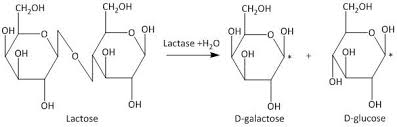
lactose class 12 chemistry CBSE

  • Lactose (C12H22O11) is a reducing sugar composed of two different monosaccharide units.
  • It consists of one molecule of β-D-galactose and one molecule of β-D-glucose.
  • These units are joined by a β(1→4) glycosidic linkage between the C1 of galactose and the C4 of glucose.
  • When lactose undergoes hydrolysis, either catalyzed by the enzyme lactase or by dilute acid, the glycosidic bond is cleaved.
  • The chemical reaction is represented as:

Lactose + H2O → D-Glucose + D-Galactose

  • As a result, the products obtained are glucose and galactose.

Hence, the products obtained from the hydrolysis of lactose are Glucose and Galactose.

44

What is the electronic configuration of palladium?

  1. ((a))

    Kr (5s^2 4d^8)

  2. ((b))

    Kr (5s^1 4d^9)

  3. ((c))

    Kr (4d^{10})

  4. ((d))

    Kr (5s^2 4d^{10})

Show Answer
Answer: ((c))

Kr (4d^{10})

CONCEPT:

Electronic Configuration of Transition Metals

  • Electronic configuration represents the distribution of electrons of an atom in its atomic orbitals.
  • According to the Aufbau principle, electrons occupy orbitals in the order of increasing energy (1s, 2s, 2p, 3s, 3p, 4s, 3d, 4p, 5s, 4d...).
  • Transition metals (d-block elements) often show anomalous electronic configurations. This occurs because the energy difference between the (n-1)d and ns orbitals is very small, and stability is gained by having half-filled or completely filled d-subshells.

EXPLANATION:

  • Palladium (Pd) has an atomic number of 46.
  • The nearest preceding noble gas is Krypton (Kr), which has an atomic number of 36. This accounts for the first 36 electrons: [Kr].
  • Subtracting the noble gas core from the total atomic number: 46 - 36 = 10 electrons remaining to be filled.
  • Based on the standard Aufbau filling order, one would expect the configuration to be [Kr] 5s2 4d8.
  • However, Palladium is a unique case in the 4d transition series. It achieves maximum stability by completely filling the 4d subshell.
  • To achieve this, both electrons from the 5s orbital are moved to the 4d orbital, resulting in a 4d10 5s0 configuration.
  • This makes Palladium the only element in the periodic table with a closed-shell configuration in its ground state among the transition elements of its period (having an empty outer s-orbital).
  • The final electronic configuration is: Kr 4d10.

Therefore, the electronic configuration of palladium is Kr 4d10.

45

If 200 ml aqueous solution of 10 g NaOH is prepared then find the molarity of the resulting solution?

  1. ((a))

    1.25 M

  2. ((b))

    1.5 M

  3. ((c))

    1.66 M

  4. ((d))

    12.5 M

Show Answer
Answer: ((a))

1.25 M

CONCEPT:

Molarity (M)

  • Molarity is the concentration of a solution expressed as the number of moles of solute per liter of solution.
  • The formula for calculating molarity is:

Molarity (M) = Moles of solute (n) / Volume of solution in liters (V)

  • The number of moles (n) is calculated using the formula:

n = Mass of solute / Molar mass of solute

EXPLANATION:

  • Step 1: Calculate the molar mass of NaOH
  • Atomic mass of Sodium (Na) = 23 g/mol
  • Atomic mass of Oxygen (O) = 16 g/mol
  • Atomic mass of Hydrogen (H) = 1 g/mol
  • Molar mass of NaOH = 23 + 16 + 1 = 40 g/mol
  • Step 2: Calculate the number of moles of NaOH
  • Given mass of NaOH = 10 g
  • Number of moles (n) = 10 g / 40 g/mol
  • n = 0.25 moles
  • Step 3: Convert the volume of the solution to liters
  • Given volume = 200 mL
  • Volume in liters (V) = 200 / 1000 = 0.2 L
  • Step 4: Calculate the Molarity
  • Molarity (M) = n / V
  • M = 0.25 moles / 0.2 L
  • M = 1.25 M

Therefore, the molarity of the resulting solution is 1.25 M.

46

Atomic radii and ionic radius of lanthanoid series increases from ( La ) to ( lu ) due to?

  1. ((a))

    Lanthanoid contraction

  2. ((b))

    Actenoid contraction

  3. ((c))

    Intermolecular bonding

  4. ((d))

    None

Show Answer
Answer: ((a))

Lanthanoid contraction

CONCEPT:

Lanthanoid Contraction

  • Lanthanoid contraction refers to the steady decrease in the size of atoms and trivalent ions (M3+) of the lanthanoid elements as the atomic number increases.
  • This trend is observed throughout the series from Lanthanum (Z=57) to Lutetium (Z=71).

EXPLANATION:

  • As we move across the lanthanoid series from ( La ) to ( Lu ), the atomic number and nuclear charge increase by one unit at each successive element.
  • The additional electrons are filled into the inner 4f subshell. Due to the diffuse nature and peculiar shape of f-orbitals, 4f electrons have a very poor shielding effect.
  • This poor shielding effect is unable to effectively counteract the increasing nuclear charge. Consequently, the effective nuclear charge experienced by the outer electrons increases.
  • The increased nuclear pull causes the electron cloud to contract, resulting in a progressive decrease in the atomic and ionic radii across the series.
  • Because the radii decrease (contract) rather than increase as we move from ( La ) to ( Lu ), the premise of the question is factually incorrect.

Therefore, the atomic and ionic radii of the lanthanoid series decrease across the series due to lanthanoid contraction, making None the correct choice.

47

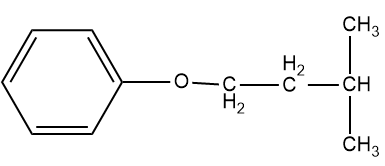
 IUPAC Name?

  1. ((a))

    (isopentyloxy)benzene

  2. ((b))

    (3-Methylbutoxy)benzene

  3. ((c))

    (2-Methylbutoxy)benzene

  4. ((d))

    Butanoic acid(3-Methylbutyl)benzene

Show Answer
Answer: ((b))

(3-Methylbutoxy)benzene

CONCEPT:

IUPAC Nomenclature of Ethers

  • Ethers are named as alkoxy derivatives of the parent hydrocarbon.
  • The larger carbon-containing part is selected as the parent chain, while the smaller part attached through oxygen is named as an alkoxy substituent.
  • When an alkoxy group is attached directly to a benzene ring, the compound is named as alkoxybenzene.
  • The alkyl group attached to oxygen in the given structure is 3-methylbutyl (isopentyl).
  • Therefore, the corresponding alkoxy substituent is 3-methylbutoxy.

EXPLANATION:

  • The given compound contains a benzene ring attached to an oxygen atom, indicating an aromatic ether.
  • The group attached through oxygen is:

–CH2–CH2–CH(CH3)2

  • Numbering the alkyl chain from the carbon attached to oxygen:
  • Carbon-1: CH2
  • Carbon-2: CH2
  • Carbon-3: CH bearing a methyl group
  • Carbon-4: Terminal CH3
  • The alkyl part is therefore 3-methylbutyl.
  • As an alkoxy substituent, it becomes 3-methylbutoxy.
  • Since this substituent is attached directly to a benzene ring, the IUPAC name is:

(3-Methylbutoxy)benzene

  • This compound is also commonly known as isopentyloxybenzene or isoamyloxybenzene.

Therefore, the IUPAC name of the given compound is (3-Methylbutoxy)benzene.

48

Which of the following compounds does not give Friedel-Crafts reaction?

  1. ((a))

    Benzene

  2. ((b))

    Chloro Benzene

  3. ((c))

    Benzoic Acid

  4. ((d))

    Phenol

Show Answer
Answer: ((c))

Benzoic Acid

CONCEPT:

Friedel-Crafts Reaction

  • Friedel-Crafts reactions (alkylation and acylation) are types of electrophilic aromatic substitution reactions that require an electron-rich aromatic ring to proceed effectively.
  • Substances containing strongly deactivating groups (electron-withdrawing groups) generally do not undergo Friedel-Crafts reactions.
  • Deactivating groups, such as –COOH, –NO2, –SO3H, and –CN, withdraw electron density from the benzene ring through resonance (–M effect) and inductive (–I effect) mechanisms, making the ring too electron-deficient to react with the electrophile.

EXPLANATION:

  • In the given compounds:
  • Benzene: It is the simplest aromatic ring and readily undergoes Friedel-Crafts reactions in the presence of a Lewis acid catalyst like anhydrous AlCl3.
  • Chlorobenzene: The chlorine atom is deactivating due to its –I effect, but it also has a +M effect. While it reacts slower than benzene, it still undergoes Friedel-Crafts reactions and directs the incoming group to the ortho and para positions.
  • Benzoic Acid: This compound contains the carboxylic acid group (–COOH), which is a strongly deactivating group. It significantly reduces the electron density of the aromatic ring, preventing electrophilic attack. Furthermore, the AlCl3 catalyst coordinates with the oxygen atoms of the –COOH group, which further deactivates the system and consumes the catalyst.
  • Phenol: The –OH group is a strong activating group. Although it can react with AlCl3 to form a phenolate-type complex which hinders the reaction, Friedel-Crafts reactions are still possible under certain conditions, unlike with strongly deactivated rings.

Therefore, benzoic acid does not give Friedel-Crafts reaction.

49

The number of unpaired electrons in the paramagnetic complex Ion ( [FeF_{6}]^{3-} ) is ?

  1. ((a))

    2

  2. ((b))

    3

  3. ((c))

    4

  4. ((d))

    5

Show Answer
Answer: ((d))

5

CONCEPT:

Crystal Field Theory and Electronic Configuration

  • The number of unpaired electrons in a coordination complex is determined by the oxidation state of the central metal ion and the strength of the surrounding ligands.
  • Weak Field Ligands (WFL): According to the spectrochemical series, ligands like F- are weak field ligands. They do not cause pairing of electrons in the d-orbitals, leading to high-spin complexes.
  • Octahedral Splitting: In an octahedral field, the d-orbitals split into two sets: t2g (lower energy) and eg (higher energy).

EXPLANATION:

  • Step 1: Determine the oxidation state of Iron (Fe).
  • Let the oxidation state of Fe be x.
  • The charge on the fluoride ligand (F) is -1.
  • For the complex [FeF6]3-: x + 6(-1) = -3
  • x - 6 = -3 ⇒ x = +3
  • So, the metal ion is Fe3+.
  • Step 2: Write the electronic configuration of Fe3+.
  • Atomic number of Iron (Fe) is 26.
  • Ground state configuration: [Ar] 3d6 4s2
  • Fe3+ configuration: [Ar] 3d5 (three electrons removed: two from 4s and one from 3d).
  • Step 3: Analyze the ligand strength and electron distribution.
  • F- is a weak field ligand.
  • Since it is a weak field ligand, the crystal field splitting energy (Δo) is less than the pairing energy (P).
  • Therefore, the 5 electrons in the 3d subshell will occupy the orbitals singly following Hund's rule.
  • Configuration: t2g3 eg2
  • Step 4: Count the unpaired electrons.
  • The distribution is: 3 electrons in t2g and 2 electrons in eg.
  • All 5 electrons are unpaired.

Therefore, the number of unpaired electrons in the complex ion [FeF6]3- is 5.

50

Which of the following is not a nucleophile?

  1. ((a))

    ( BF_{3} )

  2. ((b))

    ( NH_{3} )

  3. ((c))

    ( C_{2}H_{5}O^{-} )

  4. ((d))

    All of these

Show Answer
Answer: ((a))

( BF_{3} )

CONCEPT:

Nucleophiles and Electrophiles

  • Nucleophile: A nucleophile is an electron-rich chemical species that has the ability to donate an electron pair to an electron-deficient species (an electrophile) to form a chemical bond. Nucleophiles can be neutral molecules containing lone pairs of electrons or negatively charged ions. Examples include ( NH_{3}, H_{2}O, OH^{-}, ) and ( CN^{-} ).
  • Electrophile: An electrophile is an electron-deficient chemical species that accepts an electron pair from a nucleophile. These species typically have an incomplete octet or carry a positive charge. Examples include ( BF_{3}, AlCl_{3}, ) and ( H^{+} ).

EXPLANATION:

  • ( BF_{3} ) (Boron trifluoride):
  • In ( BF_{3} ), the central boron atom forms three covalent bonds with three fluorine atoms.
  • Since boron has 3 valence electrons, the total number of electrons in its outermost shell after bonding is 6.
  • Because it has an incomplete octet (less than 8 electrons), it is electron-deficient and acts as a Lewis acid or an electrophile. Therefore, it cannot act as a nucleophile.
  • ( NH_{3} ) (Ammonia):
  • The nitrogen atom in ammonia has five valence electrons. It uses three electrons to bond with hydrogen atoms, leaving one lone pair of electrons.
  • This lone pair can be donated to an electrophile, making ( NH_{3} ) a nucleophile.
  • ( C_{2}H_{5}O^{-} ) (Ethoxide ion):
  • The ethoxide ion carries a formal negative charge on the oxygen atom.
  • This makes the species highly electron-rich, allowing it to act as a strong nucleophile by donating an electron pair.

Therefore, ( BF_{3} ) is not a nucleophile.

51

Which of the following statements is/are correct?
I. Atomic radius increases as we go from left to right in a period
II. Atomic size increases as we go down a group.

  1. ((a))

    Both I and II

  2. ((b))

    Neither I nor II

  3. ((c))

    Only II

  4. ((d))

    Only I

Show Answer
Answer: ((c))

Only II

CONCEPT:

Periodic Trends: Atomic Radius

  • In a Period: Atomic radius generally decreases from left to right across a period. This occurs because the number of protons in the nucleus increases, leading to a higher effective nuclear charge that pulls the electron cloud closer to the nucleus.
  • In a Group: Atomic radius increases moving down a group. This is because each successive element down the group has an additional electron shell (energy level), which increases the distance between the nucleus and the outermost electrons, despite the increase in nuclear charge.

EXPLANATION:

  • Analysis of Statement I:
  • Statement I says atomic radius increases as we go from left to right in a period.
  • As we move from left to right, electrons are added to the same valence shell while the nuclear charge increases. This results in a greater inward pull on the electrons, making the atom smaller.
  • Therefore, Statement I is incorrect.
  • Analysis of Statement II:
  • Statement II says atomic size increases as we go down a group.
  • As we move down a group, the principal quantum number increases, meaning new electron shells are added. These additional shells outweigh the increase in nuclear charge, causing the atom to expand.
  • Therefore, Statement II is correct.
  • Conclusion:
  • Statement I is false.
  • Statement II is true.

Therefore, only statement II is correct.

52

Write the highest oxidation state of Cr and Mn.

  1. ((a))

    +2,+3

  2. ((b))

    +6,+7

  3. ((c))

    +4,-4

  4. ((d))

    +3, -5

Show Answer
Answer: ((b))

+6,+7

CONCEPT:

Highest Oxidation State of Transition Metals

  • For the 3d transition series, the oxidation states are determined by the loss of electrons from both the 4s and 3d subshells.
  • The highest oxidation state of a transition element is generally equal to the total number of electrons present in both the (n-1)d and ns orbitals.
  • This trend increases from Scandium (+3) to Manganese (+7) and then decreases as electrons begin to pair up in the d-orbitals.

EXPLANATION:

  • Chromium (Cr):
  • The atomic number of Chromium is 24.
  • Its electronic configuration is [Ar] 3d5 4s1.
  • The total number of valence electrons available for bonding is 5 (from 3d) + 1 (from 4s) = 6.
  • Thus, the highest oxidation state of Cr is +6 (as seen in compounds like K2Cr2O7).
  • Manganese (Mn):
  • The atomic number of Manganese is 25.
  • Its electronic configuration is [Ar] 3d5 4s2.
  • The total number of valence electrons available for bonding is 5 (from 3d) + 2 (from 4s) = 7.
  • Thus, the highest oxidation state of Mn is +7 (as seen in compounds like KMnO4).

Therefore, the highest oxidation states of Cr and Mn are +6 and +7, respectively.

53

By which bond, amino acids are joined together?

  1. ((a))

    Dipole-Dipole

  2. ((b))

    Ionic

  3. ((c))

    Hydrogen

  4. ((d))

    Amide

Show Answer
Answer: ((d))

Amide

CONCEPT:

Peptide Linkage and Amino Acids

  • Proteins are polymers of amino acids linked together by a specific type of covalent bond known as a peptide bond.
  • A peptide bond is formed through a condensation reaction between two amino acids, involving the loss of a water molecule.
  • Chemically, this linkage is classified as an amide functional group.

EXPLANATION:

  • Amino acids contain both an amino group (-NH2) and a carboxyl group (-COOH).
  • During protein synthesis, the carboxyl group of one amino acid reacts with the amino group of another amino acid.
  • This process releases a molecule of water (H2O) and forms a bond between the carbon of the carbonyl group and the nitrogen of the amine group:

-COOH + H2N- → -CO-NH- + H2O

  • The resulting -CO-NH- linkage is called a peptide bond in biochemistry, but in organic chemistry, it is fundamentally an amide bond.
  • Other options like Hydrogen bonds, Ionic bonds, and Dipole-Dipole interactions are intermolecular forces that help in the folding (secondary and tertiary structure) of proteins, but they do not join the amino acids into a primary chain.

Therefore, amino acids are joined together by amide bonds.

54

Match the following.

Column IColumn II
(I) HomohapticA) EDTA
(ii) HeterohapticB) ([Fe(CNH_{3})]^{3+})
(iii) PolydentateC) ([Re(H_{2}O){2}(NH{3})_{2}])
(iv) BidentateD) (C_{2}O_{4}^{2-})
  1. ((a))

    I-B, II-C, III-A, IV-D

  2. ((b))

    I-B, III-C, II-A, IV-D

  3. ((c))

    II-B, I-C, III-A, IV-D

  4. ((d))

    IV-B, II-C, III-A, I-D

Show Answer
Answer: ((a))

I-B, II-C, III-A, IV-D

CONCEPT:

  • Homohaptic (Homoleptic) Complexes: These are coordination complexes where the central metal atom or ion is bound to only one kind of donor group or ligand.
  • Heterohaptic (Heteroleptic) Complexes: These are coordination complexes where the central metal atom or ion is bound to more than one kind of donor group or ligand.
  • Polydentate Ligands: These are ligands that can bond to a central metal ion through multiple donor atoms. Examples include EDTA, which is a hexadentate ligand.
  • Bidentate Ligands: These are ligands that have two donor atoms and can coordinate to the metal ion at two positions simultaneously. Examples include the oxalate ion (C2O42-).

EXPLANATION:

  • (I) Homohaptic: This refers to a complex with only one type of ligand. In the given options, [Fe(CNH3)]3+ (B) represents a complex with a single ligand type surrounding the metal.

Match: (I) → B

  • (ii) Heterohaptic: This refers to a complex with different types of ligands. The complex [Re(H2O)2(NH3)2] (C) contains both water (H2O) and ammonia (NH3) ligands.

Match: (ii) → C

  • (iii) Polydentate: EDTA (A), or ethylenediaminetetraacetate, is a well-known polydentate ligand that can form six bonds with a metal ion (hexadentate).

Match: (iii) → A

  • (iv) Bidentate: The oxalate ion, C2O42- (D), is a bidentate ligand as it coordinates to the central metal atom through two oxygen atoms.

Match: (iv) → D

Therefore, the correct matching is: I-B, II-C, III-A, IV-D.

55

Match the following.

Column IColumn II
(a) Vit E(i) Night blindness
(b) Vit C(ii) Beri-Beri
(c) Vit A(iii) Muscular weakness
(d) Vit B(iv) Scurvy
  1. ((a))

    a-iii, b-iv, c-i, d-ii

  2. ((b))

    a-iii, b-iv, c-ii, d-i

  3. ((c))

    a-ii, b-iv, c-i, d-iii

  4. ((d))

    a-iii, b-i, c-iv, d-ii

Show Answer
Answer: ((a))

a-iii, b-iv, c-i, d-ii

CONCEPT:

Vitamins and Deficiency Diseases

  • Vitamins are organic compounds required by the body in small amounts for various metabolic processes, growth, and health maintenance.
  • A lack of specific vitamins in the diet over a long period leads to deficiency diseases. Each vitamin has a characteristic deficiency symptom or disease associated with it.

EXPLANATION:

  • (a) Vitamin E: It acts as an antioxidant and is important for the immune system and cell signaling. Its deficiency can lead to muscular weakness and increased fragility of red blood cells.
  • Match: (a) → (iii)
  • (b) Vitamin C: Also known as ascorbic acid, it is essential for the synthesis of collagen and maintenance of healthy gums. Deficiency of Vitamin C leads to Scurvy, characterized by bleeding gums and loose teeth.
  • Match: (b) → (iv)
  • (c) Vitamin A: It is critical for maintaining healthy vision, especially in low light. The deficiency of Vitamin A results in Night blindness (inability to see well at night).
  • Match: (c) → (i)
  • (d) Vitamin B: Vitamin B1 (Thiamine) deficiency is well known to cause Beri-Beri, a disease that affects the nervous system and the heart.
  • Match: (d) → (ii)

Therefore, the correct matching is a-iii, b-iv, c-i, d-ii.

56

statement- I All Aldehyde and Ketone are given Positive Tollen Test.
Statement- II only aldehyde are given positive Fehlling test

  1. ((a))

    Both I and II

  2. ((b))

    Neither I nor II

  3. ((c))

    Only II

  4. ((d))

    Only I

Show Answer
Answer: ((c))

Only II

CONCEPT:

Identification of Aldehydes and Ketones

  • Tollens Test (Silver Mirror Test):
  • Tollens reagent is an ammoniacal solution of silver nitrate, [Ag(NH3)2]+.
  • It is a mild oxidizing agent that oxidizes aldehydes to carboxylate ions. During this reaction, Ag+ ions are reduced to metallic silver, forming a silver mirror on the inner wall of the reaction vessel.
  • Ketones generally do not respond to Tollens test.
  • Fehling Test:
  • Fehling solution consists of a mixture of copper(II) sulfate and sodium potassium tartrate in an alkaline medium.
  • It oxidizes aliphatic aldehydes to carboxylate ions, while the copper(II) ions are reduced to cuprous oxide (Cu2O), which appears as a reddish-brown precipitate.
  • Ketones and aromatic aldehydes do not typically give a positive Fehling test.

EXPLANATION:

  • Statement I: All Aldehyde and Ketone are given Positive Tollen Test.
  • This statement is incorrect. Tollens test is a characteristic test for aldehydes. While aldehydes (both aliphatic and aromatic) give a positive result, ketones do not. Therefore, the test is used to distinguish between these two functional groups.
  • Statement II: only aldehyde are given positive Fehlling test.
  • This statement is correct in the context of comparing aldehydes and ketones. Since ketones do not show a positive response to Fehling solution, the ability to give a positive Fehling test is limited to the aldehyde group (specifically aliphatic aldehydes).

Therefore, Statement I is incorrect and Statement II is correct.

57

Solutions having the same osmotic pressure are called:

  1. ((a))

    Hypertonic

  2. ((b))

    Hypotonic

  3. ((c))

    Isotonic

  4. ((d))

    Normal

Show Answer
Answer: ((c))

Isotonic

CONCEPT:

Osmotic Pressure (Π)

  • Osmotic pressure is a colligative property, meaning it depends on the number of solute particles in a solution rather than their identity.
  • It is the minimum pressure that must be applied to a solution to prevent the inward flow of its pure solvent across a semipermeable membrane.
  • The osmotic pressure (Π) is given by the equation: Π = iCRT, where C is the molar concentration, R is the gas constant, T is the temperature, and i is the Van't Hoff factor.

EXPLANATION:

  • Solutions are categorized based on their relative osmotic pressures:
  • Isotonic Solutions: Two solutions that have the same osmotic pressure at the same temperature are called isotonic solutions. When these solutions are separated by a semipermeable membrane, there is no net movement of solvent (osmosis) between them.
  • Hypertonic Solutions: If one solution has a higher osmotic pressure than another, it is called hypertonic relative to the second solution.
  • Hypotonic Solutions: If one solution has a lower osmotic pressure than another, it is called hypotonic relative to the second solution.
  • Since the question asks for solutions having the same osmotic pressure, they are referred to as isotonic.

Therefore, solutions having the same osmotic pressure are called Isotonic.

58

For a spontaneous process at constant pressure and temperature, (\Delta G^\circ) & (\Delta S) are:

  1. ((a))

    (\Delta G^\circ = 0, \Delta S = 0)

  2. ((b))

    (\Delta G^\circ < 0, \Delta S > 0)

  3. ((c))

    (\Delta G^\circ > 0, \Delta S > 0)

  4. ((d))

    (\Delta G^\circ = 1, \Delta S = 1)

Show Answer
Answer: ((b))

(\Delta G^\circ < 0, \Delta S > 0)

CONCEPT:

Criteria for Spontaneity

  • The spontaneity of a process at constant temperature and pressure is determined by the change in Gibbs Free Energy ((\Delta G)).
  • According to the Second Law of Thermodynamics, a spontaneous process must result in an increase in the total entropy of the universe ((\Delta S_{total} > 0)).
  • For a system at constant temperature and pressure, the relationship between these thermodynamic properties is defined by the equation:

(\Delta G = \Delta H - T\Delta S)

EXPLANATION:

  • A process is considered spontaneous if it can occur without continuous external intervention.
  • The mathematical conditions for spontaneity at constant pressure and temperature are:
  • Gibbs Free Energy Change: The change must be negative, meaning (\Delta G < 0). This indicates that the free energy of the system decreases.
  • Entropy Change: For a process to be naturally favorable, the entropy change ((\Delta S)) is typically positive ((\Delta S > 0)), representing an increase in the disorder or randomness of the system.
  • In standard conditions, these criteria are often expressed as (\Delta G^\circ < 0) and (\Delta S > 0).
  • Evaluating the given conditions:
  • If (\Delta G^\circ < 0), the reaction is spontaneous in the forward direction.
  • If (\Delta S > 0), the disorder of the system increases, which contributes to making the Gibbs Free Energy change more negative (as seen in the equation (\Delta G = \Delta H - T\Delta S)).

Therefore, for a spontaneous process at constant pressure and temperature, the conditions are (\Delta G^\circ < 0) and (\Delta S > 0).

59

The Decreasing Order of C-X Bond Length in (CH_3-X)

  1. ((a))

    (CH_2I > CH_3Br > CH_3Cl > CH_3F)

  2. ((b))

    (CH_3F > CH_3Cl > CH_3Br > CH_3I)

  3. ((c))

    (CH_3F > CH_3Cl > CH_3I > CH_3Br)

  4. ((d))

    (CH_3I > CH_3Cl > CH_3F > CH_3Br)

Show Answer
Answer: ((a))

(CH_2I > CH_3Br > CH_3Cl > CH_3F)

CONCEPT:

  • Bond Length: It is defined as the equilibrium distance between the nuclei of two bonded atoms in a molecule.
  • Atomic Size: In the periodic table, as we move down a group, the atomic size (radius) increases because the number of electron shells increases.
  • Relationship: For a bond between a fixed atom (Carbon) and different atoms of the same group (Halogens), the bond length increases as the size of the halogen atom increases.

EXPLANATION:

  • The halogens involved in the C-X bond are Fluorine (F), Chlorine (Cl), Bromine (Br), and Iodine (I).
  • These elements belong to Group 17 of the periodic table. The order of their atomic size is:

F < Cl < Br < I

  • As the size of the halogen atom (X) increases, the distance between the nucleus of the Carbon atom and the nucleus of the Halogen atom also increases.
  • Consequently, the bond length of the C-X bond increases in the order:

C-F < C-Cl < C-Br < C-I

  • The numerical values for bond lengths in methyl halides are approximately:
  • C-F: 139 pm
  • C-Cl: 178 pm
  • C-Br: 193 pm
  • C-I: 214 pm
  • Therefore, the decreasing order of C-X bond length is:

CH3-I > CH3-Br > CH3-Cl > CH3-F

Therefore, the decreasing order of C-X bond length is CH3I > CH3Br > CH3Cl > CH3F.

60

Zirconium is a transition element. But Zinc is not. Why?

  1. ((a))

    Both (Zr^{3+}) and (Zn^{2+}) ions are colourless and form white compounds

  2. ((b))

    In case of Zr, 3d orbitals are partially filled but in Zn these are filled

  3. ((c))

    Last electron is assumed to be added to 4s level in case of Zn

  4. ((d))

    Both Zr and Zn do not exhibit variable oxidation states

Show Answer
Answer: ((b))

In case of Zr, 3d orbitals are partially filled but in Zn these are filled

CONCEPT:

Transition Elements

  • According to the IUPAC definition, a transition element is an element that has an incompletely filled d-subshell in its ground state or in any of its common oxidation states.
  • The d-block elements belong to groups 3 to 12 of the periodic table. While all transition elements are d-block elements, not all d-block elements (like Zinc, Cadmium, and Mercury) are transition elements because they do not have partially filled d-orbitals.

EXPLANATION:

  • Zirconium ((Zr)):
  • The atomic number of Zirconium is 40.
  • Its ground state electronic configuration is ([Kr] 4d^2 5s^2).
  • Since the 4d-orbital is partially filled (it contains 2 electrons out of a possible 10), Zirconium satisfies the criteria for being a transition element.
  • Zinc ((Zn)):
  • The atomic number of Zinc is 30.
  • Its ground state electronic configuration is ([Ar] 3d^{10} 4s^2).
  • In its most common oxidation state ((Zn^{2+})), the electronic configuration is ([Ar] 3d^{10}).
  • In both its neutral atomic form and its stable ionic form, the 3d-subshell is completely filled. Therefore, Zinc is not classified as a transition element.
  • The defining difference between a transition element (like Scandium or Zirconium) and Zinc is the presence of partially filled d-orbitals in the former and completely filled d-orbitals in the latter.

Therefore, Zirconium is a transition element because it has a partially filled d-subshell, whereas Zinc is not because its d-subshell is completely filled in both its ground and ionic states.

61

(N_2 + O_2 \rightarrow 2NO)
0.5M 0.7M 0.4M
so, calculate the value of Kc.

  1. ((a))

    0.58

  2. ((b))

    0.48

  3. ((c))

    1.15

  4. ((d))

    2014

Show Answer
Answer: ((b))

0.48

CONCEPT:

Equilibrium Constant (Kc)

  • For a reversible chemical reaction at equilibrium, the equilibrium constant (Kc) is defined as the ratio of the product of the molar concentrations of the products to the product of the molar concentrations of the reactants, with each concentration raised to a power equal to its stoichiometric coefficient in the balanced chemical equation.
  • For a general reaction:

aA + bB ↔ cC

The equilibrium constant expression is:

Kc = [C]c / ([A]a[B]b)

EXPLANATION:

  • The given chemical reaction is:

N2(g) + O2(g) ↔ 2NO(g)

  • From the balanced equation, the stoichiometric coefficients are:
  • Nitrogen (N2): 1
  • Oxygen (O2): 1
  • Nitric Oxide (NO): 2
  • The given equilibrium concentrations are:
  • [N2] = 0.5 M
  • [O2] = 0.7 M
  • [NO] = 0.4 M
  • The expression for the equilibrium constant (Kc) is:

Kc = [NO]2 / ([N2][O2])

  • Substituting the given values into the expression:
  • Kc = (0.4)2 / (0.5 × 0.7)
  • Kc = 0.16 / 0.35
  • Kc ≈ 0.457
  • The calculated value (0.457) is approximately 0.46. Comparing this with the provided options, 0.48 is the most suitable choice.

Therefore, the value of Kc is 0.48.

62

Which of the following carbohydrates is the sweetest sugar?

  1. ((a))

    Glucose

  2. ((b))

    Fructose

  3. ((c))

    Cellulose

  4. ((d))

    Maltose

Show Answer
Answer: ((b))

Fructose

CONCEPT:

Relative Sweetness of Sugars

  • Sweetness is a sensory property of carbohydrates that varies depending on their molecular structure.
  • To quantify sweetness, sucrose (common table sugar) is used as a standard reference and is assigned a value of 100. Other sugars are then rated relative to this value.

EXPLANATION:

  • Fructose: It is a simple monosaccharide found in honey, fruits, and root vegetables. It is the sweetest of all naturally occurring carbohydrates, with a relative sweetness index of approximately 173 compared to sucrose.
  • Glucose: Also known as blood sugar, it is a monosaccharide that serves as a primary energy source. It is less sweet than sucrose, having a relative sweetness index of about 74.
  • Maltose: This is a disaccharide consisting of two glucose units. It is significantly less sweet than both fructose and glucose, with a sweetness index of approximately 32.
  • Cellulose: It is a complex polysaccharide found in the cell walls of plants. Because it is a large, insoluble molecule, it does not stimulate the sweetness receptors on the tongue and is therefore not sweet.

Therefore, fructose is the sweetest sugar among the given options.

63

What is the symbol for an atom containing 20 protons 18, electron, 22 neutrons?

  1. ((a))

    ( Mg^{2+} )

  2. ((b))

    ( Sc^{3+} )

  3. ((c))

    ( Ca^{2+} )

  4. ((d))

    ( K^{+} )

Show Answer
Answer: ((c))

( Ca^{2+} )

CONCEPT:

Atomic Structure and Ion Notation

  • Atomic Number (Z): The identity of an element is determined by the number of protons in its nucleus.
  • Mass Number (A): This is the sum of the protons and neutrons in an atom.

A = Number of Protons + Number of Neutrons

  • Net Charge: Atoms are neutral when they have an equal number of protons and electrons. If these numbers differ, the particle is an ion with a charge.

Charge = Number of Protons - Number of Electrons

EXPLANATION:

  • To identify the correct symbol, we use the given subatomic particles:
  • Protons = 20
  • Electrons = 18
  • Neutrons = 22
  • Step 1: Identify the element
  • The atomic number is equal to the number of protons. With 20 protons, the atomic number is 20.
  • The element with atomic number 20 on the periodic table is Calcium (Ca).
  • Step 2: Calculate the net charge
  • Charge = Protons - Electrons
  • Charge = 20 - 18 = +2
  • Since the charge is +2, the symbol must include a 2+ superscript.
  • Step 3: Determine the mass number (A)
  • Mass Number = 20 (protons) + 22 (neutrons) = 42.
  • While the options focus on the element and charge, the specific isotope described is 42Ca2+.
  • Conclusion:
  • Combining the element symbol (Ca) and the calculated charge (+2), we get the symbol Ca2+.

Therefore, the symbol for an atom containing 20 protons, 18 electrons, and 22 neutrons is Ca2+.

64

Which one is strongest electrolyte in the following?

  1. ((a))

    HF

  2. ((b))

    ( NH_{3} )

  3. ((c))

    ( CaCl_{2} )

  4. ((d))

    ( AgCl_{2} )

Show Answer
Answer: ((c))

( CaCl_{2} )

CONCEPT:

Electrolytes:

  • Electrolytes are substances that produce ions when dissolved in a solvent (like water) or in a molten state, allowing the solution to conduct electricity.
  • Strong Electrolytes: These are substances that dissociate or ionize completely into ions in an aqueous solution. This category includes strong acids, strong bases, and most soluble ionic salts.
  • Weak Electrolytes: These are substances that only partially ionize in solution, meaning a significant amount of the substance remains as neutral molecules.

EXPLANATION:

  • Analyzing the given options:
  • HF (Hydrofluoric Acid): Although it is a halogen acid, it is a weak acid. It does not dissociate completely in water due to the high bond enthalpy of the H-F bond.
  • NH3 (Ammonia): It is a weak base. In water, it only partially reacts to form NH4+ and OH- ions.
  • CaCl2 (Calcium Chloride): It is a highly soluble ionic salt. In an aqueous solution, it dissociates completely into its constituent ions:

CaCl2(aq) → Ca2+(aq) + 2Cl-(aq)

Because it ionizes 100%, it acts as a strong electrolyte.

  • AgCl2: Silver salts like AgCl are generally sparingly soluble in water, and the formula AgCl2 is not a standard stable simple salt compared to the highly soluble CaCl2.
  • Among the substances listed, CaCl2 is a soluble ionic salt that dissociates fully into ions, making it the strongest electrolyte.

Therefore, CaCl2 is the strongest electrolyte.

65

The energy required to completely separate one mole of solid ionic compound into gaseous constituent ions is called ........

  1. ((a))

    Lattice energy

  2. ((b))

    ionization energy

  3. ((c))

    Electron gain enthalpy

  4. ((d))

    sublimation energy

Show Answer
Answer: ((a))

Lattice energy

CONCEPT:

Lattice Energy

  • Lattice energy is defined as the energy required to completely separate one mole of a solid ionic compound into its constituent gaseous ions.
  • It can also be defined as the energy released when gaseous ions come together to form one mole of an ionic crystal.
  • This value reflects the stability of the ionic crystal; higher lattice energy indicates a more stable compound.

EXPLANATION:

  • The process described in the question involves breaking the bonds within a solid lattice to produce free ions in the gas phase.

Example: MX(s) → M+(g) + X-(g)

  • Let's look at the other terms:
  • Ionization energy: This is the energy required to remove an electron from an isolated gaseous atom.
  • Electron gain enthalpy: This is the energy change when an electron is added to an isolated gaseous atom.
  • Sublimation energy: This is the energy required to convert a solid directly into a gas, but it does not necessarily involve the separation into ions.
  • By definition, the specific energy associated with separating an ionic solid into its gaseous ions is the Lattice energy.

Therefore, the energy required to completely separate one mole of solid ionic compound into gaseous constituent ions is called Lattice energy.

66
  1. Aniline does not give a Friedel-Crafts reaction.
  2. Aromatic primary amines cannot be prepared by Gabriel thylamide synthesis.

The correct statement is

  1. ((a))

    Both I and II

  2. ((b))

    Neither I nor II

  3. ((c))

    Only II

  4. ((d))

    Only I

Show Answer
Answer: ((a))

Both I and II

CONCEPT:

  • Friedel-Crafts Reaction: This is an electrophilic aromatic substitution reaction that requires a Lewis acid catalyst, such as anhydrous AlCl3, to generate an electrophile.
  • Gabriel Phthalimide Synthesis: This is a method used for the preparation of primary amines. It involves the nucleophilic substitution (SN2) of an alkyl halide by the phthalimide anion.

EXPLANATION:

  • Statement 1: Aniline does not give Friedel Crafts reaction.
  • Aniline is a Lewis base because of the lone pair of electrons on the nitrogen atom of the -NH2 group.
  • The catalyst used in Friedel-Crafts reactions, anhydrous AlCl3, is a strong Lewis acid.
  • Instead of catalyzing the substitution on the ring, AlCl3 reacts with aniline to form a salt complex (C6H5NH2+AlCl3-).
  • The positive charge on the nitrogen atom in this complex makes the group strongly electron-withdrawing, which deactivates the benzene ring and prevents the electrophilic substitution. Thus, the statement is correct.
  • Statement 2: Aromatic primary amines cannot be prepared by Gabriel phthalimide synthesis.
  • Gabriel synthesis involves a nucleophilic attack by the phthalimide anion on an organic halide.
  • To prepare aromatic primary amines, one would need to use an aryl halide (like chlorobenzene).
  • Aryl halides do not undergo nucleophilic substitution (SN2) under ordinary conditions because the C-X bond has partial double bond character due to resonance, and the carbon atom is sp2 hybridized. Thus, the statement is correct.

Therefore, both statements I and II are correct.

67

The catalytic activity of transition elements is related to their:

  1. ((a))

    Variable oxidation states

  2. ((b))

    Surface area

  3. ((c))

    complex formation ability

  4. ((d))

    magnetic moment.

Show Answer
Answer: ((a))

Variable oxidation states

CONCEPT:

Catalytic Activity of Transition Elements

  • Transition metals and their compounds are well-known for their exceptional catalytic properties in various chemical reactions.
  • This catalytic activity is primarily attributed to two main factors:
  • The ability to exhibit variable oxidation states.
  • The ability to form complex compounds or intermediates.
  • By changing oxidation states, transition metals can form unstable intermediate compounds with reactants, providing an alternative reaction pathway with a lower activation energy.

EXPLANATION:

  • Transition elements act as efficient catalysts because they can easily transition between different oxidation states.
  • For example, in the reaction between iodide (I-) and persulphate (S2O82-) ions, Iron (Fe) acts as a catalyst by switching between Fe2+ and Fe3+ states.
  • In the Contact process, Vanadium pentoxide (V2O5) acts as a catalyst where Vanadium changes its oxidation state to facilitate the conversion of SO2 to SO3.
  • Furthermore, transition metals have vacant d-orbitals that allow them to form coordination complexes with reactant molecules. This weakens the bonds within the reactants and brings them closer together on the catalyst surface.
  • While surface area is important in heterogeneous catalysis (providing more sites for adsorption), the fundamental chemical reason for the versatile catalytic nature of transition elements is their electronic configuration allowing variable oxidation states.

Therefore, the catalytic activity of transition elements is related to their variable oxidation states.

68

The following are the catalysts and their respective process/reactions. The wrong pair is

  1. ((a))

    ([RhCl(PPh_{3})_{2}]) : Hydrogenation

  2. ((b))

    (TiCl + Al(C_{2}H_{3})_{3}) : Polymerisation

  3. ((c))

    (V_{2}O_{3}) : Haber Bosch proc process

  4. ((d))

    Nickel : Hydrogenation

Show Answer
Answer: ((c))

(V_{2}O_{3}) : Haber Bosch proc process

CONCEPT:

Catalysis in Industrial Processes

  • Catalysts are substances that increase the rate of a chemical reaction without being consumed in the process. They work by providing an alternative reaction pathway with a lower activation energy.
  • Transition metals and their compounds are frequently used as catalysts in industrial applications due to their ability to change oxidation states and form complexes.

EXPLANATION:

  • Wilkinson Catalyst: The complex ([RhCl(PPh_{3})_{3}]) (often referred to in variations like the one in Option A) is a well-known homogeneous catalyst used for the hydrogenation of alkenes.
  • Ziegler-Natta Catalyst: This is a mixture typically consisting of titanium tetrachloride ((TiCl_{4})) and triethylaluminium [(Al(C_{2}H_{5})_{3})]. it is used for the polymerization of ethene and propene to produce high-density plastics.
  • Hydrogenation of Oils: Finely divided Nickel (Ni) is the standard catalyst used in the industrial hydrogenation of vegetable oils (unsaturated fats) to produce vanaspati ghee (saturated fats).
  • Haber-Bosch Process: This process for the manufacture of ammonia ((NH_{3})) uses finely divided Iron (Fe) as the catalyst, often with molybdenum or alumina as promoters.
  • Vanadium pentoxide ((V_{2}O_{5})) or other vanadium oxides are used as catalysts in the Contact Process for the oxidation of sulfur dioxide ((SO_{2})) to sulfur trioxide ((SO_{3})), not in the Haber-Bosch process.

Therefore, the wrong pair is V2O3 : Haber Bosch process.

69

Here is the typed version with correct formatting and some optional clarification:

1– Cellulose: Only (C_{1}-C_{4}) linkage

2- Starch: Contains both (C_{1}-C_{4}) and (C_{1}-C_{6}) linkages

  1. ((a))

    Both I and II

  2. ((b))

    Neither I nor II

  3. ((c))

    Only II

  4. ((d))

    Only I

Show Answer
Answer: ((a))

Both I and II

CONCEPT:

Polysaccharides

  • Polysaccharides are complex carbohydrates formed by the polymerization of a large number of monosaccharide units joined together by glycosidic linkages.
  • Cellulose: It is the most abundant organic substance in the plant kingdom and a major constituent of cell walls. It is a straight-chain polysaccharide.
  • Starch: It is the main storage polysaccharide of plants. It is a polymer of α-glucose and consists of two components: Amylose and Amylopectin.

EXPLANATION:


  • Difference Between Starch and Cellulose ...

Analysis of Statement 1: Cellulose

  • Cellulose is a linear polymer of β-D-glucose units.
  • The glucose units are joined by glycosidic linkages between C1 of one glucose unit and C4 of the next glucose unit (β-1,4-glycosidic linkage).
  • There is no branching in cellulose, so it contains only C1-C4 linkages. Hence, statement 1 is correct.

Difference Between Starch and Cellulose ...

  • Analysis of Statement 2: Starch
  • Starch is made up of two components:
  • Amylose: A water-soluble component which is a long unbranched chain with α(1→4) glycosidic linkages.
  • Amylopectin: A water-insoluble component which is a branched-chain polymer. The main chain is formed by α(1→4) glycosidic linkages, while branching occurs by C1-C6 glycosidic linkages.
  • Since starch contains both amylose and amylopectin, it possesses both C1-C4 and C1-C6 linkages. Hence, statement 2 is correct.

Both statements I and II are correct.

70

Which statement is logical according to Werner's theory?

  1. ((a))

    Primary valency can be ionized

  2. ((b))

    Secondary valency can be ionized

  3. ((c))

    Primary and secondary valency do not ionize

  4. ((d))

    Only primary valency does not ionize

Show Answer
Answer: ((a))

Primary valency can be ionized

CONCEPT:

Werner's Theory of Coordination Compounds

  • Alfred Werner proposed that in coordination compounds, central metal atoms exhibit two types of valencies:
  • Primary Valency: This corresponds to the oxidation state of the metal ion. These valencies are ionizable and are satisfied by negative ions.
  • Secondary Valency: This corresponds to the coordination number of the metal ion. These valencies are non-ionizable. They are satisfied by ligands (neutral molecules or negative ions) and have a fixed orientation in space.

EXPLANATION:

  • Based on the postulates of Werner's theory:
  • Primary valencies are the bonds that can break in a solution to form ions. For example, in [Co(NH3)6]Cl3, the three chloride ions satisfy the primary valency and can be ionized in aqueous solution.
  • Secondary valencies are the coordinate bonds between the metal and the ligands inside the coordination sphere. These do not dissociate into ions in solution.
  • Evaluating the logical nature of the statements:
  • The statement 'Primary valency can be ionized' is correct because primary valencies represent the ionic part of the complex that dissociates in water.
  • The statement 'Secondary valency can be ionized' is incorrect because coordination bonds do not ionize.
  • The statement 'Primary and secondary valency do not ionize' is incorrect because the primary valency is ionizable.
  • The statement 'Only primary valency does not ionize' is incorrect because it is the secondary valency that does not ionize.

Therefore, the logical statement according to Werner's theory is that primary valency can be ionized.

Biology (30 questions)

71

Which gas was absent in Miller experiment

  1. ((a))

    ( O_2 )

  2. ((b))

    ( H_2 )

  3. ((c))

    ( NH_3 )

  4. ((d))

    ( Ch_4 )

Show Answer
Answer: ((a))

( O_2 )

CONCEPT:

Miller-Urey Experiment

  • The Miller-Urey experiment was conducted in 1953 by Stanley Miller and Harold Urey to simulate the conditions of the primitive Earth's atmosphere.
  • The purpose of the experiment was to demonstrate that organic molecules (like amino acids) could be synthesized from inorganic precursors under the conditions of the early Earth.
  • The early Earth had a reducing atmosphere, which is characterized by the absence of free oxygen.

EXPLANATION:

  • In the experimental setup, Miller and Urey used a closed system where they circulated a specific mixture of gases.
  • The gases used in the experiment to represent the primitive atmosphere were:
  • Methane (CH4)
  • Ammonia (NH3)
  • Hydrogen (H2)
  • Water vapor (H2O)
  • Energy was provided by electric sparks to simulate lightning, and the temperature was maintained at approximately 800°C.
  • Oxygen (O2) was notably absent from the experiment because the primitive Earth atmosphere was reducing in nature. Free oxygen only appeared much later in Earth's history after the evolution of photosynthetic organisms.
  • If oxygen had been present, it would have oxidized and destroyed the newly formed organic molecules.

Therefore, the gas that was absent in the Miller experiment was O2.

72

Which disease is caused by virus

  1. ((a))

    common cold

  2. ((b))

    Typhoid

  3. ((c))

    Malaria

  4. ((d))

    Pneumonia

Show Answer
Answer: ((a))

common cold

CONCEPT:

Diseases and Causative Agents

  • Infectious diseases are caused by various pathogens, which include bacteria, viruses, fungi, and protozoa.
  • Viral Diseases: These are illnesses caused by viruses. Viruses are microscopic organisms that can only replicate inside the living cells of a host. Examples include the common cold, influenza, and hepatitis.
  • Bacterial Diseases: These are caused by bacteria, such as Typhoid and Tuberculosis.
  • Protozoan Diseases: These are caused by single-celled eukaryotes, such as Malaria.

EXPLANATION:

  • Common cold: It is a viral infectious disease of the upper respiratory tract. It is most commonly caused by rhinoviruses, though other viruses like coronaviruses or adenoviruses can also be responsible.
  • Typhoid: This is a bacterial disease caused by the bacterium Salmonella typhi. It is usually spread through contaminated food or water.
  • Malaria: This is a disease caused by a protozoan parasite of the genus Plasmodium. It is transmitted to humans through the bite of an infected female Anopheles mosquito.
  • Pneumonia: This is an inflammatory condition of the lung affecting primarily the microscopic air sacs known as alveoli. While it can be caused by viruses, the most common cause is the bacterium Streptococcus pneumoniae.

Therefore, the disease caused by a virus is the common cold.

73

Which of the following is auto immune disease?

  1. ((a))

    Alzheimer's disease

  2. ((b))

    Cystic fibrosis

  3. ((c))

    Sickle cell anemia

  4. ((d))

    Rheumatoid arthritis

Show Answer
Answer: ((d))

Rheumatoid arthritis

CONCEPT:

Autoimmune Disease

  • An autoimmune disease is a condition in which the immune system mistakenly attacks the body's own healthy cells, tissues, and organs.
  • In a healthy body, the immune system can distinguish between 'self' cells and 'non-self' (foreign) cells like bacteria or viruses. In an autoimmune disorder, the immune system fails to recognize 'self' and produces antibodies or T-cells that target the body's own tissues.

EXPLANATION:

  • Rheumatoid arthritis: This is a chronic inflammatory disorder and a well-known autoimmune disease. In this condition, the immune system mistakenly attacks the synovium—the lining of the membranes that surround the joints—leading to inflammation, pain, and potential joint deformity.
  • Alzheimer's disease: This is a neurodegenerative disorder characterized by progressive cognitive decline and memory loss, primarily associated with the accumulation of amyloid plaques and tau tangles in the brain. It is not primarily classified as an autoimmune disease.
  • Cystic fibrosis: This is a hereditary (genetic) disorder caused by a mutation in the CFTR gene. It affects the movement of salt and water in and out of cells, leading to thick, sticky mucus in the lungs and digestive system.
  • Sickle cell anemia: This is an inherited blood disorder caused by a genetic mutation in the hemoglobin gene, which results in red blood cells assuming an abnormal, sickle-like shape.

Therefore, Rheumatoid arthritis is the autoimmune disease among the given options.

74

First Antibiotic is -

  1. ((a))

    Fungus

  2. ((b))

    Bacteria

  3. ((c))

    Virus

  4. ((d))

    Protozoa

Show Answer
Answer: ((a))

Fungus

CONCEPT:

Antibiotics

  • Antibiotics are powerful medicines that fight bacterial infections by either killing bacteria or making it difficult for them to grow and multiply.
  • The first true antibiotic was discovered accidentally from a living organism belonging to the kingdom Fungi.

EXPLANATION:

  • The first antibiotic discovered was Penicillin.
  • It was discovered in 1928 by the Scottish bacteriologist Alexander Fleming.
  • Fleming noticed that a mold named Penicillium notatum had contaminated one of his culture plates of Staphylococcus bacteria and was preventing the bacteria from growing.
  • The organism Penicillium notatum is a type of Fungus (mold).
  • Following this discovery, antibiotics were developed to treat various life-threatening bacterial diseases.

Therefore, the first antibiotic was derived from a Fungus.

75

Which hormone is secreted by ovary-

  1. ((a))

    HCG

  2. ((b))

    HPL

  3. ((c))

    Relaxin

  4. ((d))

    oxytocin

Show Answer
Answer: ((c))

Relaxin

CONCEPT:

Hormones of the Female Reproductive System

  • The ovaries are the primary reproductive organs in females that produce gametes (ova) and secrete several essential hormones.
  • The hormones primarily secreted by the ovaries are Estrogen, Progesterone, and Relaxin.
  • Relaxin is a protein hormone produced by the corpus luteum of the ovary and, during pregnancy, also by the placenta.

EXPLANATION:

  • Relaxin: It is secreted by the ovary (specifically the corpus luteum). During the later stages of pregnancy, Relaxin helps to relax the pubic symphysis and the pelvic ligaments, and it also aids in the dilation of the uterine cervix to facilitate childbirth.
  • HCG (Human Chorionic Gonadotropin): This hormone is secreted by the placenta after the embryo implants in the uterine wall. It is not secreted by the ovary.
  • HPL (Human Placental Lactogen): This hormone is also produced by the placenta and is involved in regulating the mother's metabolism to support fetal growth.
  • Oxytocin: It is synthesized in the hypothalamus and released by the posterior pituitary gland. It plays a role in uterine contractions during labor and milk ejection during breastfeeding.

Therefore, Relaxin is the hormone secreted by the ovary.

76

( CO_{2} ) Acceptor In ( C_{4} ) Plants -

  1. ((a))

    PGA

  2. ((b))

    RUBP

  3. ((c))

    PEP

  4. ((d))

    PGAL

Show Answer
Answer: ((c))

PEP

CONCEPT:

C4 Pathway (Hatch-Slack Pathway)

  • C4 plants utilize a specialized mechanism to fix CO2 to minimize photorespiration, especially in high-temperature and high-light environments.
  • This process is called the Hatch-Slack pathway and involves two types of photosynthetic cells: mesophyll cells and bundle sheath cells.

EXPLANATION:

  • In C4 plants, the primary CO2 acceptor is a 3-carbon molecule called Phosphoenolpyruvate (PEP).
  • This initial fixation reaction occurs in the cytoplasm of mesophyll cells.
  • The enzyme PEP carboxylase (PEPcase) catalyzes the reaction where CO2 is added to PEP to form a 4-carbon compound, Oxaloacetic acid (OAA).
  • The reaction can be represented as:

PEP (3C) + CO2 + H2O → Oxaloacetic acid (4C)

  • Comparison with other molecules:
  • RuBP (Ribulose-1,5-bisphosphate) is the primary CO2 acceptor in C3 plants.
  • PGA (3-phosphoglyceric acid) is the first stable product formed in the C3 cycle.
  • PGAL (Phosphoglyceraldehyde) is an intermediate product in the sugar-forming steps of photosynthesis.

Therefore, the primary CO2 acceptor in C4 plants is PEP.

77

first product of ( C_{4} ) cycle

  1. ((a))

    OAA (uc)

  2. ((b))

    PGA

  3. ((c))

    PEP

  4. ((d))

    RuBP

Show Answer
Answer: ((a))

OAA (uc)

CONCEPT:

C4 Cycle (Hatch-Slack Pathway)

  • The C4 cycle is a photosynthetic process used by certain plants (like maize and sugarcane) to fix carbon dioxide more efficiently, particularly under high light and temperature conditions.
  • It is named the C4 pathway because the first stable intermediate formed during the fixation of atmospheric carbon dioxide is a molecule containing four carbon atoms.

EXPLANATION:

  • In C4 plants, the process of carbon fixation occurs in two different types of cells: mesophyll cells and bundle sheath cells.
  • The initial fixation of atmospheric CO2 takes place in the mesophyll cells.
  • The primary CO2 acceptor is a 3-carbon compound called Phosphoenolpyruvate (PEP).
  • The reaction is catalyzed by the enzyme PEP carboxylase (PEPCase), which adds CO2 to PEP.
  • The immediate result of this reaction is the formation of Oxaloacetic Acid (OAA), which is a 4-carbon organic acid.
  • The chemical equation for this step is:

Phosphoenolpyruvate (3C) + CO2 + H2O → Oxaloacetate (4C) + Pi

  • Because OAA is the very first stable product formed in this pathway, these plants are categorized as C4 plants.
  • Other compounds like PGA (3-Phosphoglyceric acid) are the first products of the C3 cycle, while RuBP is the CO2 acceptor in the C3 cycle.

Therefore, the first product of the C4 cycle is OAA (Oxaloacetic Acid).

78

Which ion is known to suppress sperm motility?

  1. ((a))

    Copper

  2. ((b))

    Magnesium

  3. ((c))

    Mercury

  4. ((d))

    Calcium

Show Answer
Answer: ((a))

Copper

CONCEPT:

Mechanism of Copper-releasing IUDs

  • Intrauterine Devices (IUDs) are effective contraceptive tools used to prevent pregnancy.
  • Copper-releasing IUDs (such as CuT, Cu7, and Multiload 375) function by releasing copper ions (Cu2+) into the uterine cavity.
  • The released ions change the biochemical environment of the uterus and the cervix, making it hostile to sperm.

EXPLANATION:

  • The copper ions (Cu2+) released from the IUD have a direct effect on male gametes (sperm):
  • Sperm Motility: Copper ions act as a spermicide. They significantly reduce the motility (the ability to swim) of sperm. This prevents the sperm from reaching the fallopian tubes to fertilize the ovum.
  • Fertilizing Capacity: These ions also suppress the fertilizing capacity of the sperm, ensuring that even if a sperm reaches the egg, it is less likely to successfully penetrate and fertilize it.
  • Phagocytosis: The presence of the IUD and copper ions increases the phagocytosis of sperm within the uterus, where white blood cells engulf and destroy the sperm cells.
  • In contrast, ions like Calcium (Ca2+) are actually necessary for sperm motility and the acrosome reaction required for fertilization.

Therefore, copper ions are known to suppress sperm motility and their fertilizing capacity.

79

Antagonastic of Gibberelin Harmone-

  1. ((a))

    Auxin

  2. ((b))

    Cytokinin

  3. ((c))

    Abscisic Acid (ABA)

  4. ((d))

    Ethylene

Show Answer
Answer: ((c))

Abscisic Acid (ABA)

CONCEPT:

Hormonal Antagonism in Plants

  • Phytohormones are chemical messengers that regulate various aspects of plant growth and development.
  • Antagonism refers to the phenomenon where two hormones have opposing effects on the same physiological process.
  • Gibberellins (GA) are growth-promoting hormones responsible for stem elongation, breaking seed and bud dormancy, and stimulating seed germination.
  • Abscisic Acid (ABA) is primarily a growth-inhibiting hormone that promotes seed dormancy, inhibits germination, and helps plants respond to stress conditions.

EXPLANATION:

  • Gibberellins and Abscisic Acid (ABA) act as a classic pair of antagonistic hormones in several plant processes:
  • Seed Dormancy and Germination: Gibberellins stimulate the production of enzymes (like alpha-amylase) that break down stored food in seeds to facilitate germination. In contrast, Abscisic Acid (ABA) induces and maintains seed dormancy, preventing germination during unfavorable conditions.
  • Growth Regulation: While Gibberellins promote cell division and elongation, ABA acts as a general growth inhibitor and is often referred to as the 'stress hormone' because it shuts down growth processes to conserve energy during stress.
  • Other hormones mentioned:
  • Auxin: Primarily promotes cell elongation and apical dominance; it often works synergistically with Gibberellins.
  • Cytokinin: Promotes cell division and delays senescence.
  • Ethylene: A gaseous hormone primarily involved in fruit ripening and leaf abscission.

Therefore, the antagonist of Gibberellin hormone is Abscisic Acid (ABA).

80

Protonema is a characteristic of-

  1. ((a))

    Ulothrix

  2. ((b))

    Polytrichum

  3. ((c))

    polysiphonia

  4. ((d))

    marchantia

Show Answer
Answer: ((b))

Polytrichum

CONCEPT:

Protonema

  • The life cycle of a moss (Bryopsida) involves two distinct stages of the gametophyte: the protonema stage and the leafy stage.
  • The protonema is the first stage that develops directly from the germination of a spore. It is typically a creeping, green, branched, and filamentous structure.
  • The second stage is the leafy stage, which develops from the secondary protonema as a lateral bud.

EXPLANATION:

  • Polytrichum:
  • It belongs to the class Bryopsida (mosses).
  • Like other mosses, its spore germinates to form a filamentous protonema before developing into the mature leafy gametophyte.
  • Ulothrix:
  • It is a genus of green algae (Chlorophyceae). Its life cycle does not involve a protonema stage; the zygote or spores typically develop directly into new filaments.
  • Polysiphonia:
  • It is a genus of red algae (Rhodophyceae). It has a complex triphasic life cycle but does not possess a protonema stage.
  • Marchantia:
  • It is a liverwort (Hepaticopsida). In liverworts, the spore germinates directly into the thalloid gametophyte, and a distinct filamentous protonema stage is generally absent.

Therefore, protonema is a characteristic of Polytrichum.

81

What family does house fly belong to?

  1. ((a))

    Insecta

  2. ((b))

    Muscidae

  3. ((c))

    Diptera

  4. ((d))

    Formicidae

Show Answer
Answer: ((b))

Muscidae

CONCEPT:

Biological classification is a system used by scientists to categorize and organize living organisms into hierarchical groups. The taxonomic hierarchy for the common housefly (Musca domestica) is as follows:

  • Kingdom: Animalia
  • Phylum: Arthropoda
  • Class: Insecta
  • Order: Diptera
  • Family: Muscidae
  • Genus: Musca
  • Species: domestica

EXPLANATION:

  • In the taxonomic hierarchy:
  • Insecta represents the Class. Organisms in this class have three pairs of legs and a body divided into three segments (head, thorax, and abdomen).
  • Diptera represents the Order. This includes insects that possess a single pair of functional wings and a pair of reduced hindwings called halteres.
  • Muscidae represents the Family. This family includes the common housefly and related species.
  • Formicidae is the taxonomic family for ants, which belongs to the order Hymenoptera.

Therefore, the housefly belongs to the family Muscidae.

82

RNA Without Protien capsid -

  1. ((a))

    Viroid

  2. ((b))

    lichen

  3. ((c))

    Prion

  4. ((d))

    Virus

Show Answer
Answer: ((a))

Viroid

CONCEPT:

Infectious Agents: Viruses, Viroids, and Prions

  • Viruses: These are nucleoproteins where the genetic material (DNA or RNA) is enclosed within a protective protein coat called a capsid.
  • Viroids: These are smaller than viruses and consist of a short, circular, single-stranded RNA molecule. Crucially, they lack a protein capsid.
  • Prions: These are infectious agents composed entirely of misfolded proteins, containing no nucleic acids.

EXPLANATION:

  • Viroids:
  • Discovered by T.O. Diener in 1971, viroids were found to be the causative agent of potato spindle tuber disease.
  • They consist of free RNA of low molecular weight.
  • Unlike viruses, they do not have a protein coat (capsid) to protect the RNA.
  • Comparing other entities:
  • Virus: Contains both nucleic acid and a protein capsid.
  • Prion: Consists of protein only, without RNA or DNA.
  • Lichen: A symbiotic association between an alga (phycobiont) and a fungus (mycobiont), which is a complex organism rather than a sub-viral infectious particle.

Therefore, RNA without a protein capsid is a Viroid.

83

Sex Determination In Human-

  1. ((a))

    XY

  2. ((b))

    XO

  3. ((c))

    ZW

  4. ((d))

    Haplodiploid

Show Answer
Answer: ((a))

XY

CONCEPT:

Chromosomal Theory of Sex Determination

  • Sex determination is the process that determines the biological sex of an individual. In humans, this is governed by the chromosomal makeup of the zygote.
  • Humans possess 23 pairs of chromosomes. 22 pairs are autosomes (non-sex chromosomes), and the 23rd pair is the sex chromosomes (allosomes).
  • The presence of specific sex chromosomes (X or Y) determines whether an individual develops as a male or a female.

EXPLANATION:

  • In humans, the sex determination system is the XY system.
  • Females are homogametic, meaning they have two similar sex chromosomes (XX). All eggs produced by a female carry an X chromosome.
  • Males are heterogametic, meaning they have two different sex chromosomes (XY). Males produce two types of sperm: 50% carry the X chromosome and 50% carry the Y chromosome.
  • During fertilization:
  • If a sperm carrying an X chromosome fertilizes the egg (X), the resulting zygote is XX (female).
  • If a sperm carrying a Y chromosome fertilizes the egg (X), the resulting zygote is XY (male).
  • Comparison with other systems:
  • XO system: Found in some insects like grasshoppers (females XX, males XO).
  • ZW system: Found in birds and some reptiles (females ZW, males ZZ).
  • Haplodiploid system: Found in honeybees and ants, where sex is determined by the number of sets of chromosomes (males are haploid, females are diploid).

Therefore, the mechanism of sex determination in humans is the XY system.

84

Which is not part of stometal apparatus -

  1. ((a))

    Guard cells

  2. ((b))

    Subsidiary cells

  3. ((c))

    Stomatal pore

  4. ((d))

    Cuticle

Show Answer
Answer: ((d))

Cuticle

CONCEPT:

Stomatal Apparatus

  • The stomatal apparatus is a specialized structure found in the epidermal layer of plants, primarily on leaves, which facilitates gas exchange and transpiration.
  • It is composed of three specific parts:
  • Stomatal aperture (pore): The central opening for gas exchange.
  • Guard cells: A pair of specialized epidermal cells (kidney-shaped in dicots and dumbbell-shaped in grasses) that regulate the opening and closing of the pore.
  • Subsidiary cells: Specialized epidermal cells that surround the guard cells and assist in their movement.

EXPLANATION:

  • Based on the components of the stomatal apparatus:
  • Guard cells: These are the primary regulatory cells of the apparatus.
  • Subsidiary cells: These are accessory cells that form part of the stomatal complex.
  • Stomatal pore: This is the opening through which gases and water vapor pass.
  • Cuticle: The cuticle is a waxy, non-cellular protective layer secreted by the epidermis that covers the surface of leaves and stems to reduce water loss. It is not a structural part of the stomatal apparatus itself.

Therefore, the Cuticle is not a part of the stomatal apparatus.

85

Which of the following statements about binomial nomenclature is correct?

  1. ((a))

    The genus name is written with a capital first letter.

  2. ((b))

    The species epithet is written in small letters.

  3. ((c))

    Both words are separately underlined when handwritten.

  4. ((d))

    All of the above

Show Answer
Answer: ((d))

All of the above

CONCEPT:

Binomial Nomenclature

  • Binomial nomenclature is the formal, two-part naming system for living organisms developed by Carolus Linnaeus.
  • This system provides a unique, universally accepted name for every species, avoiding confusion caused by local or common names.
  • The system is governed by four universal rules:
  • Biological names are generally derived from Latin (or are Latinized) and are written in italics when printed.
  • The first word represents the Genus, and the second word represents the specific epithet.
  • When handwritten, the genus and specific epithet are underlined separately. When printed, they are italicized to indicate their Latin origin.
  • The Genus name must always begin with a capital letter, while the specific epithet must always begin with a small letter.

EXPLANATION:

  • Let us analyze the statements provided based on the universal rules:
  • Genus name capitalization: It is a fundamental rule that the first letter of the genus name is written in capital (e.g., Homo).
  • Specific epithet casing: The specific epithet must start with a small letter (e.g., sapiens). The rest of the letters in the epithet are also typically small.
  • Handwriting convention: When writing biological names by hand, it is mandatory to underline the genus and the specific epithet separately (e.g., Homo sapiens). This is done to denote their Latin origin when italics are not possible.
  • Typing and Printing: In modern scientific writing, biological names are italicized whenever they are typed or printed (e.g., Homo sapiens).

Therefore, all of the above options are correct.

86

Which of the following statements about Drosophila melanogaster (fruit fly) is incorrect in the context of its use in genetic experiments?

  1. ((a))

    It has a short / 2-week life cycle

  2. ((b))

    Grows in complex rare medium

  3. ((c))

    Shows clear sex differentiation

  4. ((d))

    A single mating produces a large population

Show Answer
Answer: ((b))

Grows in complex rare medium

CONCEPT:

Characteristics of Drosophila melanogaster in Genetics

  • Drosophila melanogaster, commonly known as the fruit fly, is a model organism widely used in genetic research, particularly in the studies conducted by T.H. Morgan.
  • It was selected for chromosomal studies because of its simple biological requirements and clear inheritance patterns.

EXPLANATION:

  • Culture Medium: Drosophila can be easily grown and maintained on a simple synthetic medium in a laboratory setting. They do not require a complex or rare medium for growth.
  • Life Cycle: They have a very short life cycle, completing their development from egg to adult in approximately two weeks.
  • Reproductive Rate: A single mating is capable of producing a large population of progeny, which provides ample data for genetic analysis.
  • Sexual Dimorphism: There is a clear sex differentiation between the organisms. Male and female flies are easily distinguishable by their body size and abdominal features.
  • Phenotypic Variations: It has many types of hereditary variations that can be easily observed under low-power microscopes.

Therefore, the statement that Drosophila grows in a complex rare medium is incorrect, as it actually grows on a simple synthetic medium.

87

Alternate phyllotaxy is found in which of the following plant?

  1. ((a))

    Calotropis

  2. ((b))

    Guava

  3. ((c))

    Alstonia

  4. ((d))

    China Rose

Show Answer
Answer: ((d))

China Rose

CONCEPT:

Phyllotaxy

  • Phyllotaxy is the pattern of arrangement of leaves on the stem or branch of a plant.
  • It is categorized into three main types:
  • Alternate: A single leaf arises at each node in an alternate manner.
  • Opposite: A pair of leaves arise at each node and lie opposite to each other.
  • Whorled: More than two leaves arise at a node and form a circle or whorl.

EXPLANATION:

  • Based on the types of phyllotaxy:
  • China Rose: It shows alternate phyllotaxy where a single leaf arises at each node in an alternate fashion. Other examples include mustard and sunflower.
  • Calotropis and Guava: These plants show opposite phyllotaxy where a pair of leaves arise at each node opposite to each other.
  • Alstonia: This plant shows whorled phyllotaxy where more than two leaves arise at a node to form a whorl.
  • By analyzing the options:
  • Calotropis → Opposite
  • Guava → Opposite
  • Alstonia → Whorled
  • China Rose → Alternate

Therefore, alternate phyllotaxy is found in China Rose.

88

Absent in female frogs are-

  1. ((a))

    Trunk

  2. ((b))

    Copulatory pad

  3. ((c))

    Webbed feet

  4. ((d))

    Tympanic

Show Answer
Answer: ((b))

Copulatory pad

CONCEPT:

Sexual Dimorphism in Frogs

  • Frogs exhibit sexual dimorphism, which refers to the visible physical differences between male and female individuals of the same species.
  • These differences are primarily associated with reproductive behaviors and mating calls.
  • Male frogs possess certain secondary sexual characters that are completely absent in female frogs.

EXPLANATION:

  • Copulatory pads: These are also known as nuptial pads. They are rough, swollen structures located on the first digit (finger) of the forelimbs of male frogs. Their function is to help the male grip the female firmly during amplexus (the mating process). Female frogs do not possess these pads.
  • Trunk: The body of a frog is divided into a head and a trunk. This anatomical feature is present in both male and female frogs.
  • Webbed feet: Both male and female frogs have webbed feet, which are an adaptation for swimming in aquatic environments.
  • Tympanic (Tympanum): The tympanum is the external hearing organ (ear drum) of the frog. It is present in both males and females, though in some species, the size of the tympanum may differ between the sexes.
  • Another feature absent in female frogs is the vocal sac, which males use to amplify their mating calls.

Therefore, the copulatory pad is absent in female frogs.

89

Write The Not True About Kingdom Monera-

  1. ((a))

    All bacteria are heterotrophs.

  2. ((b))

    Cyanobacteria Are Photosynthetic

  3. ((c))

    Anabaena is a cyanobacterium.

  4. ((d))

    Methanogens live in anaerobic environments

Show Answer
Answer: ((a))

All bacteria are heterotrophs.

CONCEPT:

Kingdom Monera

  • Kingdom Monera includes all prokaryotic organisms, such as bacteria, cyanobacteria, and archaebacteria.
  • One of the most important characteristics of bacteria is their metabolic diversity.
  • While most bacteria are heterotrophs (relying on other organisms for food), some are autotrophs (synthesizing their own food).

EXPLANATION:

  • Analyzing the statements regarding Kingdom Monera:
  • All Bacteria Are Hetrotroph: This statement is incorrect. Although the majority of bacteria are heterotrophs, there are autotrophic bacteria. For example, Cyanobacteria are photosynthetic autotrophs, and others are chemosynthetic autotrophs.
  • Cynobacteria Are Photosynthetic: This is a true statement. Cyanobacteria (also known as blue-green algae) contain chlorophyll a and perform photosynthesis.
  • Methenogen is living In hars habitate: This is a true statement. Methanogens are a type of Archaebacteria that live in extreme or harsh environments, such as marshy areas or the digestive tracts of ruminant animals.
  • Anabena: Anabaena is a genus of filamentous cyanobacteria known for nitrogen fixation, which belongs to Kingdom Monera.

Therefore, the statement 'All Bacteria Are Hetrotroph' is not true.

90

Identify the correct region marked by the red arrow in the image.

  1. ((a))

    Region of maturation

  2. ((b))

    Region of elongation

  3. ((c))

    Region of meristematic activity

  4. ((d))

    Root cap

Show Answer
Answer: ((b))

Region of elongation

CONCEPT:

Regions of the Root

  • The structure of a root tip is divided into four distinct regions, each characterized by specific cellular functions and development stages.
  • These regions, from the tip moving upwards towards the stem, are the root cap, the region of meristematic activity, the region of elongation, and the region of maturation.

EXPLANATION:

  • The anatomical zones of the root can be identified by the following features:
  • Root Cap: A thimble-like covering that protects the growing root apex as it pushes through the soil.
  • Region of Meristematic Activity: Located just above the root cap, where cells are small, thin-walled, and undergo rapid cell division.
  • Region of Elongation: The zone where cells undergo rapid lengthening and enlargement, leading to the increase in the vertical length of the root.
  • Region of Maturation: The zone where cells differentiate into specialized tissues. This region is easily identified by the presence of root hairs that absorb water and minerals.
  • In a standard longitudinal section of a root, the labels follow this order from bottom to top:
  • The protective tip: Root cap
  • The zone above the cap: Region of meristematic activity
  • The middle zone: Region of elongation
  • The top zone (with hairs): Region of maturation

Based on the anatomical structure of the root, the missing name is identified as the specific zone indicated in the diagram: Root cap, Meristematic, Elongation, or Maturation.

91

Which of the following statements about pollen grains is incorrect?

  1. ((a))

    Vegetative cell is bigger and Generative Cell is smaller

  2. ((b))

    The outer layer of pollen grain, called exine, is made up of sporopollenin

  3. ((c))

    Pollen grains do not lose their viability immediately after being released from the anther.

  4. ((d))

    Pollen grains are produced in the ovule of a flower.

Show Answer
Answer: ((d))

Pollen grains are produced in the ovule of a flower.

CONCEPT:

Structure and Development of Pollen Grains

  • Pollen Grains: These are the male gametophytes of flowering plants, produced within the microsporangia of the anthers.
  • Wall Layers: They possess a two-layered wall. The outer layer, exine, is composed of sporopollenin (one of the most resistant organic materials). The inner layer, intine, is thin and made of cellulose and pectin.
  • Cellular Composition: A mature pollen grain typically contains a large vegetative cell (rich in food reserves) and a smaller generative cell (which floats in the cytoplasm of the vegetative cell).
  • Viability: This is the period during which pollen grains remain functional. It is not uniform and depends on environmental factors and the specific plant species.

EXPLANATION:

  • Analysis of the provided statements:
  • Statement A: In a mature pollen grain, the vegetative cell is indeed larger and contains abundant food reserves, while the generative cell is smaller and spindle-shaped. This statement is correct.
  • Statement B: The exine is the tough outer layer and is characterized by the presence of sporopollenin, which protects the pollen from high temperatures, acids, and enzymes. This statement is correct.
  • Statement C: Pollen viability is highly variable. In plants like rice and wheat, viability is lost within 30 minutes, but in others like the Rosaceae or Solanaceae families, it can last for months. It is not lost immediately. This statement is incorrect.
  • Statement D: Pollen grains are produced in the anthers (specifically the pollen sacs or microsporangia). The ovule is the part of the flower where the female gametophyte (embryo sac) is produced. This statement is incorrect.

Therefore, the incorrect statements are that pollen grains lose viability immediately (C) and that they are produced in the ovule (D).

92

Which type of DNA is primarily used in DNA fingerprinting?

  1. ((a))

    Coding DNA

  2. ((b))

    Mitochondrial DNA

  3. ((c))

    Satellite DNA / non-coding repeated DNA

  4. ((d))

    Ribosomal DNA

Show Answer
Answer: ((c))

Satellite DNA / non-coding repeated DNA

CONCEPT:

DNA Fingerprinting and Repetitive DNA

  • DNA fingerprinting is a technique used to identify individuals by analyzing specific regions of their DNA that are highly variable.
  • The process relies on identifying differences in specific regions of DNA sequences called repetitive DNA, where a small stretch of DNA is repeated many times.

EXPLANATION:

  • In the human genome, a large portion of DNA does not code for proteins; these are called non-coding sequences.
  • When genomic DNA is subjected to density gradient centrifugation, it separates into a major peak (bulk DNA) and several smaller peaks known as Satellite DNA.
  • Satellite DNA is categorized into different types like micro-satellites and mini-satellites based on the base composition, length of the segment, and the number of repetitive units.
  • These satellite DNA sequences show a high degree of polymorphism (variation), which forms the basis of DNA fingerprinting.
  • VNTRs (Variable Number Tandem Repeats) belong to the category of mini-satellite DNA and are used as probes in the fingerprinting process because the number of repeats varies from person to person.
  • Coding DNA, Mitochondrial DNA, and Ribosomal DNA are not typically used as the primary markers for standard DNA profiling because they do not exhibit the same level of repetitive polymorphism found in satellite DNA.

Therefore, Satellite DNA / non-coding repeated DNA is the type of DNA primarily used in DNA fingerprinting.

93

What is the function of the Tapetum ?

  1. ((a))

    Provide protection

  2. ((b))

    Produce pollen grains

  3. ((c))

    Provide nourishment to the developing pollen grains

  4. ((d))

    Store and protect pollen grains

Show Answer
Answer: ((c))

Provide nourishment to the developing pollen grains

CONCEPT:

Structure of the Microsporangium

  • A typical microsporangium (anther) is surrounded by four wall layers: the epidermis, endothecium, middle layers, and the tapetum.
  • The tapetum is the innermost layer that directly surrounds the sporogenous tissue where microspores develop into pollen grains.

EXPLANATION:

  • The cells of the tapetum are characterized by having dense cytoplasm and typically possess more than one nucleus (multinucleated).
  • The primary function of the tapetum is to provide nourishment to the developing pollen grains.
  • As the pollen grains mature, the tapetum cells breakdown, and their contents are utilized by the developing microspores.
  • In addition to nutrition, the tapetum also helps in the formation of the pollen wall (exine) by secreting sporopollenin and other essential proteins.
  • The other three outer layers of the anther (epidermis, endothecium, and middle layers) primarily function to provide protection and aid in the dehiscence of the anther to release the mature pollen grains.

Therefore, the function of the tapetum is to provide nourishment to the developing pollen grains.

94

Which of the following fishes has four pairs of gills covered by an operculum?

  1. ((a))

    Petromyzon

  2. ((b))

    Pristis

  3. ((c))

    Trygon

  4. ((d))

    Labeo (Rohu), Catla, Clarias (Magur)

Show Answer
Answer: ((d))

Labeo (Rohu), Catla, Clarias (Magur)

CONCEPT:

Classification of Fishes based on Respiratory Organs

  • Osteichthyes (Bony fishes): This class includes both marine and fresh water fishes with bony endoskeleton. Their body is streamlined and they have four pairs of gills which are covered by an operculum on each side.
  • Chondrichthyes (Cartilaginous fishes): These are marine animals with a cartilaginous endoskeleton. The gill slits are separate and usually lack an operculum.
  • Cyclostomata (Jawless fishes): Members of this class are ectoparasites on some fishes. They have an elongated body bearing 6-15 pairs of gill slits for respiration, without an operculum.

EXPLANATION:

  • Petromyzon: It belongs to the class Cyclostomata. It has 6 to 15 pairs of gill slits for respiration, which are not covered by an operculum.
  • Pristis (Saw fish) and Trygon (Sting ray): These belong to the class Chondrichthyes. In these fishes, the gill slits are separate and the operculum is absent.
  • Labeo (Rohu), Catla (Katla), and Clarias (Magur): These are examples of bony fishes (Osteichthyes).
  • They have a bony endoskeleton.
  • They possess four pairs of gills.
  • Each side of the gills is covered by a bony flap called an operculum.

Therefore, Labeo (Rohu), Catla, and Clarias (Magur) have four pairs of gills covered by an operculum.

95

Which of the following statements is true regarding open vascular bundles?

  1. ((a))

    They are present in dicot stem

  2. ((b))

    Secondary growth is absent

  3. ((c))

    They are found in monocot root

  4. ((d))

    Xylem and phloem are not separated by cambium

Show Answer
Answer: ((a))

They are present in dicot stem

CONCEPT:

Vascular Bundles: Open vs. Closed

  • Vascular bundles are the primary components of the transport system in plants, consisting of xylem and phloem.
  • Open Vascular Bundles: These bundles contain a layer of meristematic tissue known as cambium between the xylem and the phloem. The presence of cambium allows the plant to produce secondary tissues (secondary growth).
  • Closed Vascular Bundles: These bundles lack cambium between the xylem and phloem. Consequently, they do not possess the ability to undergo secondary growth.

EXPLANATION:

  • In dicotyledonous stems, the vascular bundles are arranged in a ring and possess intrafascicular cambium between the xylem and phloem. Therefore, they are classified as open vascular bundles.
  • In monocotyledonous plants (both stems and roots), the vascular bundles lack cambium, making them closed vascular bundles.
  • Analyzing the given statements:
  • Statement A: They are present in dicot stem. This is true.
  • Statement B: Secondary growth is absent. This is false because open bundles are specifically characterized by their ability for secondary growth.
  • Statement C: They are found in monocot root. This is false as monocots have closed bundles.
  • Statement D: Xylem and phloem are not separated by cambium. This is false; in open bundles, the cambium is the layer that separates the xylem and phloem.

Therefore, the true statement is that open vascular bundles are present in dicot stems.

96

Open vascular bundle and secoundry growth present in

  1. ((a))

    monocot stem

  2. ((b))

    monocot root

  3. ((c))

    Dicot stem

  4. ((d))

    Dicot root

Show Answer
Answer: ((c))

Dicot stem

CONCEPT:

Vascular Bundles and Secondary Growth

  • Open Vascular Bundles: These are vascular bundles in which a layer of meristematic tissue called cambium is present between the xylem and phloem. This cambium facilitates the formation of secondary xylem and phloem.
  • Secondary Growth: This is the increase in the thickness or girth of the plant body due to the activity of lateral meristems, specifically the vascular cambium and cork cambium.
  • Closed Vascular Bundles: These bundles lack cambium, and therefore, they do not undergo secondary growth.

EXPLANATION:

  • Dicot Stem: In dicotyledonous stems, the vascular bundles are arranged in a ring. Each bundle is conjoint, collateral, and open because of the presence of intrafascicular cambium between the xylem and phloem. This structure allows for secondary growth to occur.
  • Monocots: Both monocot stems and monocot roots possess closed vascular bundles (lacking cambium). As a result, typical secondary growth is absent in monocots.
  • Dicot Root: While dicot roots do undergo secondary growth, the cambium originates differently (it is completely secondary in origin), and the term 'open vascular bundle' is specifically used to describe the primary arrangement found in the stems where cambium is already present between the primary xylem and phloem.

Therefore, the presence of open vascular bundles and secondary growth is a characteristic feature of the Dicot stem.

97

Match the Following:

Column AColumn B
1. Delivery of babya. Parturition
2. Embryo development in female bodyb. Gestation
3. Introducing sperm into female tractc.Insemination
  1. ((a))

    1-a, 2-b, 3-c

  2. ((b))

    1-b, 2-a, 3-c

  3. ((c))

    1-c, 2-b, 3-a

  4. ((d))

    1-a, 2-c, 3-b

Show Answer
Answer: ((a))

1-a, 2-b, 3-c

CONCEPT:

Human reproduction involves several physiological stages that ensure the development and birth of offspring. These include:

  • Insemination: The process of deposition of sperms by the male into the female reproductive tract.
  • Gestation: The period of time during which an embryo or fetus develops inside the uterus of the mother.
  • Parturition: The act of giving birth or the process of delivering the baby from the uterus at the end of the pregnancy period.

EXPLANATION:

  • 1. Delivery of baby: In biological terms, the process of childbirth where the fetus is expelled from the womb is known as Parturition. Hence, 1 matches with a.
  • 2. Embryo development in female body: The duration between conception and birth, specifically the development of the embryo within the female body, is called the Gestation period. Hence, 2 matches with b.
  • 3. Introducing sperm into female tract: The transfer of male gametes into the female genital tract for the purpose of fertilization is termed Insemination. Hence, 3 matches with c.

By matching the terms, we get the sequence: 1-a, 2-b, and 3-c.

98

Identify a, b, and c in the provided image:   

  1. ((a))

    a-Ovary, b-Uterus, c-Cervix

  2. ((b))

    a-Uterus, b-Ovary, c-Cervix

  3. ((c))

    a-Cervix, b-Uterus, c-Ovary

  4. ((d))

    a-Ovary, b-Cervix, c-Uterus

Show Answer
Answer: ((a))

a-Ovary, b-Uterus, c-Cervix

CONCEPT:

Female Reproductive System

  • The human female reproductive system consists of a pair of ovaries along with a pair of oviducts, uterus, cervix, vagina, and the external genitalia located in the pelvic region.
  • Each organ has a specific anatomical position and physiological function related to gametogenesis, fertilization, and pregnancy.

EXPLANATION:

  • Based on the provided anatomical diagram of the female reproductive system:
  • a - Ovary: These are the primary female sex organs that produce the female gamete (ovum) and several steroid hormones (ovarian hormones). In the diagram, 'a' points to one of the almond-shaped structures.
  • b - Uterus: Also known as the womb, it is an inverted pear-shaped muscular organ where the development of the baby takes place. In the diagram, 'b' points to the main body of this organ.
  • c - Cervix: The uterus opens into the vagina through a narrow cervix. The cavity of the cervix is called the cervical canal. In the diagram, 'c' points to this lower neck-like portion of the uterus.
  • Matching these identifications:
  • a → Ovary
  • b → Uterus
  • c → Cervix

Therefore, the correct labeling for the given diagram is a-Ovary, b-Uterus, c-Cervix.

99

Why is the activity of juxtaglomerular (JG) cells required?

  1. ((a))

    To increase blood glucose levels

  2. ((b))

    To regulate blood pressure and blood volume

  3. ((c))

    To reabsorb urea from urine

  4. ((d))

    To digest proteins in the stomach

Show Answer
Answer: ((b))

To regulate blood pressure and blood volume

CONCEPT:

Juxtaglomerular (JG) Cells and Blood Pressure Regulation

  • Juxtaglomerular (JG) cells are specialized cells located in the afferent arterioles of the kidney's nephrons.
  • These cells function as baroreceptors (pressure sensors) that monitor the blood pressure entering the glomerulus.
  • They are responsible for the secretion of the enzyme renin, which initiates the Renin-Angiotensin-Aldosterone System (RAAS), a critical hormonal cascade for maintaining homeostasis.

EXPLANATION:

  • The activity of JG cells is essential for managing systemic hemodynamics:
  • Detection: When JG cells detect a decrease in blood pressure, blood volume, or a drop in sodium chloride levels, they respond by releasing renin into the bloodstream.
  • RAAS Pathway: Renin converts the plasma protein angiotensinogen into angiotensin I, which is subsequently converted into angiotensin II.
  • Functions of Angiotensin II:
  • It acts as a potent vasoconstrictor, narrowing the blood vessels to increase blood pressure immediately.
  • It stimulates the adrenal cortex to secrete aldosterone, a hormone that promotes the reabsorption of sodium ions and water in the renal tubules.
  • Result: The increased reabsorption of water expands the total blood volume, and the vasoconstriction increases blood pressure, restoring them to normal levels.
  • Other functions like glucose regulation (pancreas), urea reabsorption (passive/ADH), and protein digestion (stomach) are handled by different organs and systems.

Therefore, the activity of juxtaglomerular (JG) cells is required to regulate blood pressure and blood volume.

100

What is the function of renin secret by juxtaglomerular (JG) cells?

  1. ((a))

    Increase blood pressure

  2. ((b))

    Increase Blood Volume

  3. ((c))

    Decrease Blood Volume

  4. ((d))

    A and B

Show Answer
Answer: ((d))

A and B

CONCEPT:

Renin-Angiotensin-Aldosterone System (RAAS)

  • The juxtaglomerular (JG) cells of the kidney are specialized cells that sense changes in blood pressure and sodium levels.
  • When blood pressure or blood volume decreases, JG cells secrete an enzyme called renin into the bloodstream.
  • Renin plays a crucial role in maintaining homeostatic control of systemic blood pressure and fluid balance.

EXPLANATION:

  • The secretion of renin triggers a sequence of hormonal activations:
  • Renin converts angiotensinogen (secreted by the liver) into Angiotensin I.
  • Angiotensin I is then converted into Angiotensin II by the Angiotensin-Converting Enzyme (ACE).
  • Angiotensin II performs several functions to correct low blood pressure:
  • It acts as a powerful vasoconstrictor, which narrows the blood vessels and directly increases blood pressure.
  • It stimulates the secretion of aldosterone from the adrenal cortex.
  • Aldosterone promotes the reabsorption of sodium ions and water in the renal tubules, which increases blood volume.
  • Since renin is the initiator of this process that leads to both increased vasoconstriction and increased fluid retention, its function is to increase both blood pressure and blood volume.

Therefore, the function of renin secreted by juxtaglomerular (JG) cells is to increase both blood pressure and blood volume.

Attempt this paper under real exam conditions

Timed interface, section switching, instant scoring, and question-by-question analytics — free.

Start Timed Attempt