Official Paper

AIIMS BSc NURSING 2024 Memory-Based Paper (Previous Year Paper)

100 questions · 120 minutes · with answers · free

General Knowledge (10 questions)

1

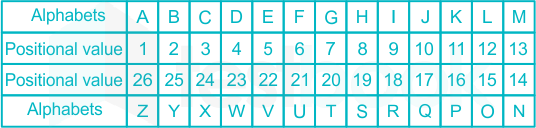
In a code language, if LUCK is written as L2U1C3K1, then what is the last digit for the code for XEROX in that same language?

  1. ((a))

    4

  2. ((b))

    3

  3. ((c))

    2

  4. ((d))

    1

Show Answer
Answer: ((a))

4

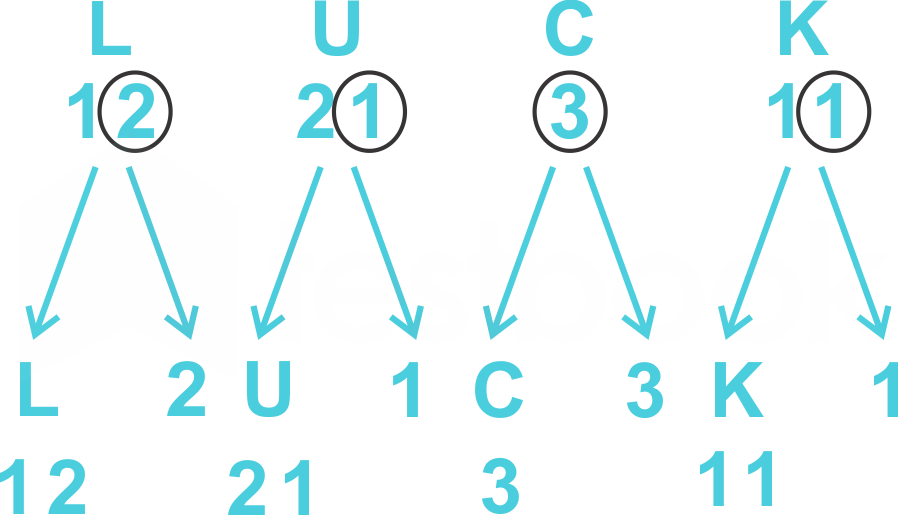
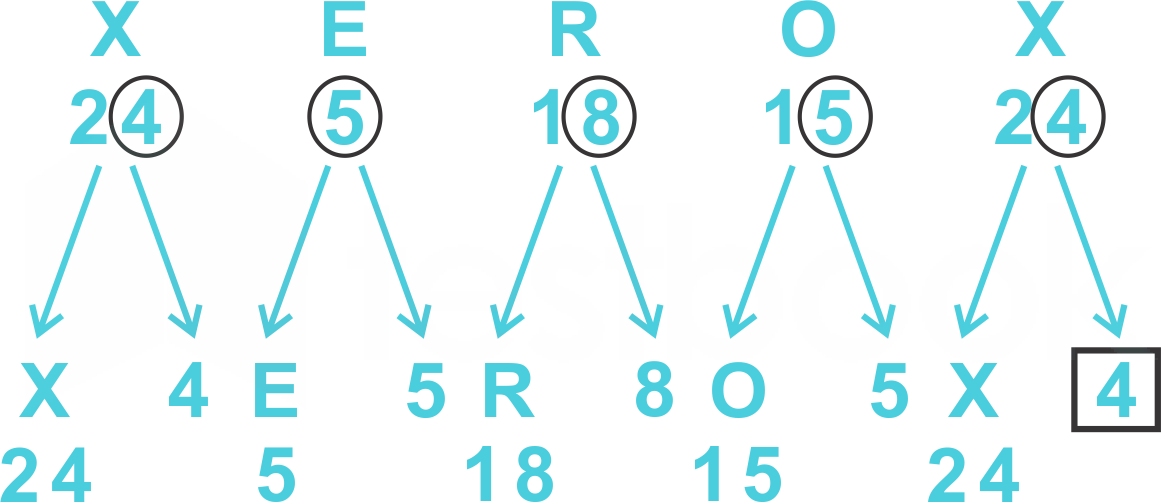
The logic followed here is:

LUCK is written as L2U1C3K1

Similarly,

XEROX is written as

Thus, the last digit of the code for XEROX is '4'.

Hence, "Option 1" is the correct answer.

2

If 'yellow' means 'green', 'green' means 'white', white means 'red', 'red' means 'black', 'black' means 'blue' and 'blue' means 'violet', which of the following represents the colour of human blood?

  1. ((a))

    black

  2. ((b))

    violet

  3. ((c))

    red

  4. ((d))

    None of these

Show Answer
Answer: ((a))

black

Given:

Given itemIs called
yellowgreen
greenwhite
whitered
redblack
blackblue
blueviolet

So, the colour of human blood is 'red' which is called 'black'.

Hence, "Option 1" is the correct answer.

3

Which is the number that comes next in this sequence?

5, 16, 51, 158, .....

  1. ((a))

    1452

  2. ((b))

    483

  3. ((c))

    481

  4. ((d))

    1454

Show Answer
Answer: ((c))

481

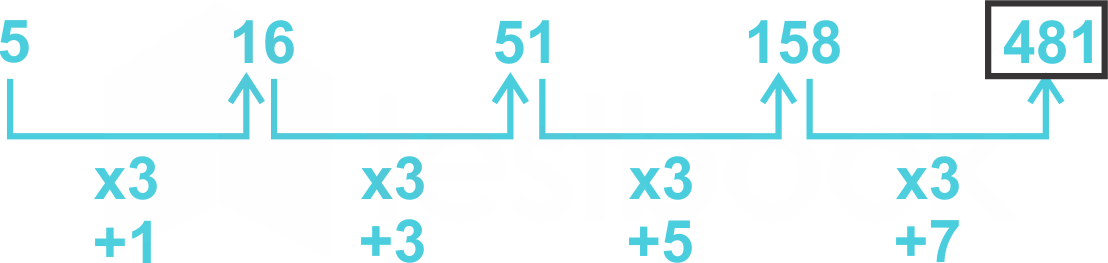
The logic followed here is:

Hence, "Option 3" is the correct answer.

4

The first official language commission was appointed in 1955. Who was the chairman of this commission?

  1. ((a))

    KM Munshi

  2. ((b))

    B.G Kher

  3. ((c))

    MC Chhagla

  4. ((d))

    Kalekar

Show Answer
Answer: ((b))

B.G Kher

The correct answer is B.G.Kher.

Key Points

  • Dr. Rajendra Prasad at the time the president of India appointed the Official Language Commission on June 7, 1955.
  • B. G. Kher became the chairperson of the Official language commission.
  • Kher was also the first chief minister of the state of Bombay after Independence.
  • As defined in Article - 344 of the Constitution, it shall be the duty of the Commission to make recommendations to the President as to:
  • the progressive use of the Hindi language for the official purposes of the Union.
  • restrictions on the use of the English language for all or any of the official purposes of the Union.
  • the language to be used for all or any of the purposes mentioned in Article 348.
  • the form of numerals to be used for any one or more specified purposes of the Union.
5

Which of the following is/are features of the Doldrums?

  1. Weak horizontal movement of air
  2. Low Pressure on ground
  3. Presence around equator

Select the option from the codes given below:

  1. ((a))

    Only 1 & 2

  2. ((b))

    Only 2 & 3

  3. ((c))

    Only 1 & 3

  4. ((d))

    1, 2 & 3

Show Answer
Answer: ((d))

1, 2 & 3

Ans: (4)

Key Points

The Doldrums (Intertropical Convergence Zone - ITCZ)

1. Location:

  • Situated around the equator, typically between 5°N and 5°S latitude.
  • Encircles the Earth as a narrow belt, though it shifts slightly with the seasons.

2. Atmospheric and Climatic Features:

  • Low Atmospheric Pressure: Caused by the convergence of warm air masses, which rise due to intense equatorial heating.
  • Calm Winds: Known for little to no horizontal wind movement, making sailing difficult in pre-engine days.
  • High Humidity: Warm, moist air creates humid conditions in this region.
  • Frequent Thunderstorms: Rising air cools rapidly, leading to cloud formation and intense storms.

3. Trade Wind Convergence:

  • The Doldrums form at the point where the northeast and southeast trade winds meet.
  • This convergence causes vertical uplift, not horizontal motion, creating the calm.

4. Impact on Navigation:

  • Historically problematic for sail-powered ships, which could get trapped due to the lack of wind.
  • Sailors coined the term “doldrums” to describe the frustrating stillness.

5. Seasonal Behavior:

  • The ITCZ migrates slightly north or south depending on the Earth's tilt and the Sun's position, affecting regional weather and rainfall patterns.
6

Buccal cavity is a component of which organ system?

  1. ((a))

    Digestive system

  2. ((b))

    Circulatory system

  3. ((c))

    Respiratory system

  4. ((d))

    Reproductive system

Show Answer
Answer: ((a))

Digestive system

Ans: (1)

Key Points

Buccal Cavity – Part of the Alimentary Canal:

1. System Involved:

  • The buccal cavity is a key component of the digestive system, marking the starting point of digestion.

2. Structures Found in the Buccal Cavity:

  • Teeth: Involved in mechanical breakdown of food through chewing (mastication).
  • Tongue: Helps in mixing food, tasting, and initiating swallowing.
  • Salivary glands: Secrete saliva containing enzymes like amylase to begin carbohydrate digestion.
  • Hard and Soft Palates: Separate the oral and nasal cavities and assist in swallowing.

3. Main Functions:

  • Ingestion: Entry point for food into the digestive tract.
  • Mastication: Chewing food to aid mechanical digestion.
  • Salivation: Moistens food and starts enzymatic digestion.
  • Swallowing: Forms the chewed food into a bolus and pushes it into the pharynx.

4. Alternate Names:

  • Also known as the oral cavity or simply the mouth.
7

The sacred books of the Jainas are known as?

  1. ((a))

    Agama

  2. ((b))

    Tripitaks

  3. ((c))

    Shruti

  4. ((d))

    None of the above

Show Answer
Answer: ((a))

Agama

Ans: (1)

Key Points

Agamas – Sacred Scriptures of Jainism

1. What are Agamas?

  • Agamas (or Agam Sutras) are the canonical texts of Jainism, containing the teachings of the Tirthankaras.
  • Primarily preserved by the Svetambara sect, though Digambara sect has its own scriptural tradition.
  • Compiled by Ganadharas, the chief disciples of Mahavira, the 24th Tirthankara.

2. Contents of the Agamas:

  • Philosophical Teachings – Concepts like karma, soul (jiva), and liberation (moksha).
  • Cosmology – Detailed descriptions of the universe and time cycles.
  • Ethical Conduct – Rules for monks, nuns, and lay followers.
  • Religious Narratives – Stories of past lives, saints, and moral lessons.
  • Scientific Concepts – Includes knowledge of mathematics, astronomy, and logic.

3. Types of Jain Literature:

  • Canonical Works: Core texts (e.g., Twelve Angas) forming the religious foundation.
  • Non-Canonical Works: Commentaries, narratives, and texts on rituals and philosophy.

4. Languages Used:

  • Ardhamagadhi Prakrit – Primary language of early Jain scriptures.
  • Others include Sanskrit, Apabhraṃśa, Tamil, and Kannada in later literature.

5. Key Jain Texts:

  • Shatkhand-agam and Kasay-pahud – Important to the Digambara sect.
  • Tattvārtha-sūtra – The only text accepted by both Svetambaras and Digambaras.
  • Twelve Angas – Regarded as the oldest and most authoritative texts.

6. Oral Tradition and Memorization:

  • Monks and nuns traditionally memorized the Agamas due to restrictions on writing or owning texts.
  • This oral transmission helped preserve Jain teachings over centuries.
8

Chaliyar River, recently seen in news, originates from which hills?

  1. ((a))

    Elambalari Hills

  2. ((b))

    Nelliyampathy Hills

  3. ((c))

    Kalrayan Hills

  4. ((d))

    Coonoor Hills

Show Answer
Answer: ((a))

Elambalari Hills

Ans: (1)

Key Points

Chaliyar River – Overview

1. Origin:

  • Originates from: Ilambaleri (or Elambalari) Hills in the Nilgiri Mountains, part of the Western Ghats.
  • Location: Near the Wayanad–Malappuram district border in Kerala.

2. River Course:

  • Flows primarily through Malappuram district.
  • Takes a southward route before reaching the sea.

3. Major Tributaries:

  • Chaliyarpuzha
  • Punnapuzha
  • Kanjirapuzha
  • Karimpuzha
  • Iruvahnipuzha
  • Thottumukkampuzha
  • Together, they form the Chaliyar River drainage system.

4. Termination Point:

  • The river drains into the Lakshadweep Sea at Beypore, also known as Chaliyam Harbour.

5. In the News:

  • Recently highlighted due to landslides in Wayanad, where the river became a “haunting symbol” and a “floating graveyard” due to debris and destruction.

6. Other Key Facts:

  • The Nilambur region along the river’s banks is noted for natural goldfields.
  • The total drainage area of the Chaliyar is approximately 2,933 sq km, with 388 sq km lying in Tamil Nadu.
9

Pobitora Wildlife Sanctuary, recently seen in news, is located in which state?

  1. ((a))

    Nagaland

  2. ((b))

    Manipur

  3. ((c))

    Assam

  4. ((d))

    Arunachal Pradesh

Show Answer
Answer: ((c))

Assam

Ans: (3)

Key Points

Pobitora Wildlife Sanctuary – Key Highlights

1. Location:

  • Situated in Morigaon district, Assam.
  • Lies on the southern bank of the Brahmaputra River.

2. Notable Features:

  • Known for one of the highest densities of one-horned rhinoceros in the world.
  • Often called “Mini Kaziranga” due to similar terrain and wildlife as Kaziranga National Park.
  • Hosts diverse fauna such as:
  • Leopards, leopard cats, fishing cats, jungle cats
  • Feral buffaloes, wild pigs, and Chinese pangolins
  • Vegetation:
  • About 72% is wet savannah dominated by grasses like Arundo donax and Saccharum species.
  • Remaining area includes various water bodies.

3. Recent News:

  • Assam Cabinet’s move to de-notify the sanctuary was put on hold by the Supreme Court.
  • The court stated the Forest Department acted without consulting key authorities like the Revenue Department and Chief Minister.
  • Reports of rhinoceros straying out of the sanctuary.
  • A recent case involved a rhino fatally attacking a biker outside sanctuary limits.

4. Historical Background:

  • Declared a reserved forest in 1971.
  • Upgraded to a wildlife sanctuary in 1987.

5. Area:

  • Total protected area covers 38.81 square kilometers.
10

What is a Bailey bridge, recently seen in news?

  1. ((a))

    A modular, prefabricated bridge designed for quick assembly with minimal construction work

  2. ((b))

    A stone bridge

  3. ((c))

    A wooden bridge used in rural areas

  4. ((d))

    A type of suspension bridge

Show Answer
Answer: ((a))

A modular, prefabricated bridge designed for quick assembly with minimal construction work

Ans: (1)

Key Points

Bailey Bridge – Key Highlights

1. What is a Bailey Bridge?

  • A modular, prefabricated truss bridge designed for rapid construction in varied terrains.
  • Ideal for use in emergency situations, including military and disaster scenarios.

2. Design & Structure:

  • Modular Components: Built from pre-fabricated, standardized parts.
  • Assembly: Uses pins and bolts, eliminating the need for heavy equipment.
  • Time-Efficient: Can be constructed within hours or days, even in remote or difficult conditions.

3. Features & Advantages:

  • Versatile: Suitable for military, civil, and infrastructure applications.
  • Durable: Capable of withstanding heavy loads and harsh environments.
  • Portable: Easily transported and assembled at the required site.

4. Historical Background:

  • Invented by Sir Donald Bailey, a British engineer during World War II.
  • Developed to provide a strong, portable bridge for wartime mobility and supply routes.

5. Applications:

  • Military operations
  • Disaster relief and rescue missions
  • Civil engineering and rural connectivity
  • Remote infrastructure development
  • Hydropower and construction projects

6. Recent Usage in India:

  • The Indian Army deployed Bailey bridges in Wayanad, Kerala for rescue operations following landslides.
  • Demonstrates the bridge’s continued relevance in emergency response and terrain access.

Physics (30 questions)

11

If P, Q and R are physical quantities, having different dimensions, then which mathematical operation given below can never be physically meaningful?

  1. ((a))

    (P-Q)/R

  2. ((b))

    PQ-R

  3. ((c))

    PQ/R

  4. ((d))

    (PR - Q2)/R

Show Answer
Answer: ((a))

(P-Q)/R

CONCEPT:

Physical Quantities and Dimensions

  • Physical quantities are properties or characteristics of a system that can be measured or calculated from other measurements.
  • Each physical quantity has a dimension that can be represented by a combination of the basic dimensions (mass, length, time, etc.).
  • In order for a mathematical operation involving physical quantities to be physically meaningful, the quantities must have compatible dimensions.

EXPLANATION:

  • Let's examine the given options:
  • Option 1: (P-Q)/R
  • For this operation to be meaningful, P and Q must have the same dimensions because only quantities with the same dimensions can be subtracted. If P and Q have the same dimensions, (P-Q) will have the same dimension as P (or Q), but it is given P and Q have a different dimension thus it cannot be meaningful quantity.
  • Option 2: PQ-R
  • For this operation to be meaningful, PQ and R must have the same dimensions. PQ represents the product of P and Q, so the dimensions of PQ are the product of the dimensions of P and Q. Unless R has the same dimensions as PQ.
  • Option 3: PQ/R
  • This operation is meaningful if the dimensions of PQ are compatible with the dimensions of R. Specifically, the dimensions of PQ should be equal to the dimensions of R. This means that the dimensions of P multiplied by the dimensions of Q should result in the dimensions of R.
  • Option 4: (PR - Q2)/R
  • For this operation is meaningful, PR and Q2 must have the same dimensions. Since Q2 represents Q multiplied by itself, its dimensions are the square of the dimensions of Q. PR represents the product of P and R, so its dimensions are the product of the dimensions of P and R. Additionally, (PR - Q2)/R must be dimensionally consistent.

Therefore, the correct answer is option 1: (P-Q)/R.

12

The position vector of a particle changes with time according to the relation (\rm \vec{r}(t)=15 t^{2} \hat{i}+\left(4-20 t^{2}\right) \hat{j} ) What is the magnitude of the acceleration at t = 1?

  1. ((a))

    40

  2. ((b))

    25 

  3. ((c))

    100 

  4. ((d))

    50

Show Answer
Answer: ((d))

50

CONCEPT:

Position Vector and Acceleration

  • The position vector of a particle provides information about its location in space as a function of time.
  • Acceleration is the rate of change of velocity with respect to time.
  • To find acceleration, we need to differentiate the position vector twice with respect to time.

EXPLANATION:

  • Given position vector: r(t) = 15t2 i + (4 - 20t2) j
  • First, we find the velocity by differentiating the position vector with respect to time:
  • *v(*t) = dr(t)/dt = 30t i - 40t j
  • Next, we find the acceleration by differentiating the velocity with respect to time:
  • a(t) = dv(t)/dt = 30 i - 40 j
  • At t = 1, the acceleration vector is:
  • a(1) = 30 i - 40 j
  • To find the magnitude of the acceleration:
  • |a(1)| = √(302 + (-40)2)
  • |a(1)| = √(900 + 1600)
  • |a(1)| = √2500
  • |a(1)| = 50

Therefore, the correct answer is option 4: 50.

13

The ranges and heights for two projectiles projected with the same initial velocity at angles 42° and 48° with the horizontal are R1, R2 and H1, H2 respectively. Choose the correct option:

  1. ((a))

    R1 > R2 and H1 = H2

  2. ((b))

    R1 = R2 and H1 < H2

  3. ((c))

    R1 < R2 and H1 < H2

  4. ((d))

    R1 = R2 and H1 = H2

Show Answer
Answer: ((b))

R1 = R2 and H1 < H2

CONCEPT:

Projectile Motion

  • When two projectiles are launched with the same initial velocity but at different angles, their ranges and maximum heights can be compared.
  • The range (R) of a projectile is given by the formula: R = (v² × sin(2θ)) / g where:
  • v is the initial velocity
  • θ is the angle of projection
  • g is the acceleration due to gravity
  • The maximum height (H) of a projectile is given by the formula: H = (v² × sin²(θ)) / (2g)

EXPLANATION:

  • Let's examine the given options:
  • Option 1: R₁ > R₂ and H₁ = H₂
  • This option suggests the range of the first projectile is greater than that of the second, and their maximum heights are equal. This is incorrect because if the angles of projection are different, their maximum heights will also differ.
  • Option 2: R₁ = R₂ and H₁ < H₂
  • This option suggests the ranges of both projectiles are equal, but the height of the first is less than that of the second. This is correct. When two angles are complementary (e.g., 42° and 48°), the projectiles have equal ranges but different maximum heights.
  • Option 3: R₁ < R₂ and H₁ < H₂
  • This is incorrect because complementary angles result in equal ranges, so R₁ cannot be less than R₂ in this context.
  • Option 4: R₁ = R₂ and H₁ = H₂
  • This option assumes both range and height are equal, which is incorrect as maximum height depends on the square of sine of the angle, and hence varies with angle.

Therefore, the correct answer is: Option 2 — R₁ = R₂ and H₁ < H₂.

14

A cyclist moving at a speed of 20 m/s takes a turn, if he doubles his speed then chance of overturn

  1. ((a))

    is doubled

  2. ((b))

    is halved

  3. ((c))

    becomes four times

  4. ((d))

    becomes 1/4 times

Show Answer
Answer: ((c))

becomes four times

CONCEPT:

Chance of Overturn for a Cyclist

  • When a cyclist takes a turn, the chance of overturn depends on the speed of the cyclist and the centripetal force required to keep the cyclist on the curved path.
  • The centripetal force is proportional to the square of the speed of the cyclist.

EXPLANATION:

  • Let's examine the given options:
  • Option 1: is doubled
  • This option suggests that the chance of overturn is directly proportional to the speed. However, the chance of overturn actually depends on the square of the speed.
  • Option 2: is halved
  • This option suggests that the chance of overturn decreases as the speed increases, which is incorrect because the chance increases with speed.
  • Option 3: becomes four times
  • This option is correct. Since the chance of overturn is proportional to the square of the speed, doubling the speed will increase the chance of overturn by a factor of four.
  • Option 4: becomes 1/4 times
  • This option suggests that the chance of overturn decreases by a factor of four, which is incorrect because the chance increases with speed.

Therefore, the correct answer is option 3: becomes four times.

15

A car is negotiating a curved road of radius R. The road is banked at an angle θ. the coefficient of friction between the tyres of the car and the road is μs. The maximum safe velocity on this road is:

  1. ((a))

    (\sqrt{g R^{2} \frac{\mu_{s}+\tan \theta}{1-\mu_{s} \tan \theta}})

  2. ((b))

    (\sqrt{g R \frac{\mu_{s}+\tan \theta}{1-\mu_{s} \tan \theta}})

  3. ((c))

    (\sqrt{\frac{g}{R} \frac{\mu_{s}+\tan \theta}{1-\mu_{2} \tan \theta}})

  4. ((d))

    (\sqrt{\frac{g}{R^{2}} \frac{\mu_{\mathrm{s}}+\tan \theta}{1-\mu_{\mathrm{s}} \tan \theta}})

Show Answer
Answer: ((b))

(\sqrt{g R \frac{\mu_{s}+\tan \theta}{1-\mu_{s} \tan \theta}})

Calculation

Solution

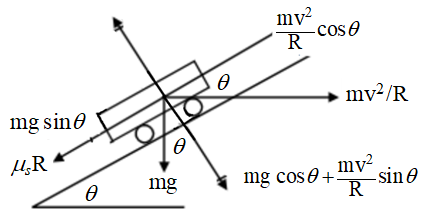
From the above diagram, we have

N = mg cosθ + (mv² / R) sinθ                        (1)

fmax = μN ⇒ fmax = μs mg cosθ + (μs mv² / R) sinθ

mg sinθ + fmax = (mv² / R) cosθ                     (2)

Putting the value

mg sinθ + μs mg cosθ + (μs mv² / R) sinθ = (mv² / R) cosθ

g sinθ + μs g cosθ = (v² / R)(cosθ − μs sinθ)

gR [ (tanθ + μs) / (1 − μs tanθ) ] = v²

v = √[ gR (tanθ + μs) / (1 − μs tanθ) ]

16

Two solid rubber balls A and B having masses 200 & 400 gm respectively are moving in opposite direction with velocity of A equal to 0.3 m/sec. After collision the two balls come to rest when the velocity of B is

  1. ((a))

    0.15 m/sec

  2. ((b))

    1.5 m/sec

  3. ((c))

    -0.15 m/sec

  4. ((d))

    None of these

Show Answer
Answer: ((c))

-0.15 m/sec

Calcultion:

Initial momentum of Ball A = 0.2 × 0.3 = 0.06 kg·m/s

Initial momentum of Ball B = 0.4 × vB

Total initial momentum = 0.06 + 0.4 × vB

According to conservation of momentum:

0.06 + 0.4 × vB = 0

0.4 × vB = -0.06

vB = -0.06 / 0.4

vB = -0.15 m/sec

17

A sphere rolls down an inclined plane without slipping. What fraction of its total energy is rotational ?

  1. ((a))

    (\frac{2}{7})

  2. ((b))

    (\frac{3}{7})

  3. ((c))

    (\frac{4}{7})

  4. ((d))

    (\frac{5}{7})

Show Answer
Answer: ((a))

(\frac{2}{7})

Calculation:

 A sphere rolling without slipping has both translational and rotational kinetic energy.

Rotational Kinetic Energy (KR) = (1/2) × I × (v2 / r2)

Moment of Inertia of a solid sphere, I = (2/5)mr2

So, KR = (1/2) × (2/5)mr2 × (v2 / r2) = (1/5)mv2

Translational Kinetic Energy (KTr) = (1/2)mv2

Total Energy (KTotal) = KR + KTr = (1/5)mv2 + (1/2)mv2

Convert to common denominator:

KTotal = (2/10 + 5/10)mv2 = (7/10)mv2

Fraction of Rotational Energy = KR / KTotal = (1/5)mv2 / (7/10)mv2

Cancel mv2:

Fraction = (1/5) / (7/10) = (2/7)

Answer: Option 1) 2/7

18

For a satellite orbiting in an orbit, close to the surface of earth, to escape, the percentage increase in the velocity is ________.

  1. ((a))

    41%

  2. ((b))

    61% 

  3. ((c))

    81%

  4. ((d))

    98%

Show Answer
Answer: ((a))

41%

Concept:

To escape Earth's gravity, a satellite in low Earth orbit must increase its velocity from orbital velocity (vo) to escape velocity (ve).

Formulae:

  • Orbital velocity (vo) = √(GM / R)
  • Escape velocity (ve) = √(2GM / R)

So, ve = √2 × vo

Percentage increase in velocity = [(ve - vo) / vo] × 100%

= [(√2 × vo - vo) / vo] × 100%

= (√2 - 1) × 100%

≈ (1.414 - 1) × 100% = 0.414 × 100% = 41.4%

Answer: Option 1) 41%

19

The orbital velocity of an artificial satellite in a circular orbit just above the earth's surface is v0. For a satellite orbiting at an altitude of half of the earth's radius, the orbital velocity is

  1. ((a))

    (\left(\sqrt{\left(\frac{2}{3}\right)}\right) \mathrm{v}_{0})

  2. ((b))

    (\rm \frac{2}{3} v_{0})

  3. ((c))

    (\rm \frac{3}{2} v_{0})

  4. ((d))

    (\sqrt{\left(\frac{3}{2}\right)} \mathrm{v}_{0})

Show Answer
Answer: ((a))

(\left(\sqrt{\left(\frac{2}{3}\right)}\right) \mathrm{v}_{0})

Calculation:

Orbital velocity (v) of a satellite at distance r from the center of the Earth is given by:

v = √(GM / r)

Let v0 be the orbital velocity just above the Earth's surface. Then:

v0 = √(GM / R)

Now consider a satellite at an altitude of half the Earth's radius. So, total distance from Earth's center = R + R/2 = (3/2)R

New orbital velocity (v') = √(GM / (3R/2)) = √((2/3) × GM / R)

= √(2/3) × √(GM / R)

= √(2/3) × v0

Answer: Option 1) √(2/3) × v0

20

Wax is coated on the inner wall of a capillary tube and the tube is then dipped in water. Then, compared to the unwaxed capillary, the angle of contact θ and the height h upto which water rises change. These changes are:

  1. ((a))

    θ increases and h also increases

  2. ((b))

    θ decreases and h also decreases

  3. ((c))

    θ increases and h decreases

  4. ((d))

    θ decreases and increases

Show Answer
Answer: ((c))

θ increases and h decreases

CONCEPT:

Capillary Action and Contact Angle

  • When a liquid rises or falls in a narrow tube due to the adhesive forces between the liquid and the tube wall and the cohesive forces within the liquid, it is known as capillary action.
  • The angle of contact (θ) is the angle formed between the tangent to the liquid surface and the solid surface inside the tube.
  • Water typically has a low contact angle with materials it can wet (hydrophilic materials), leading to capillary rise.
  • If the tube is made hydrophobic (e.g., by coating with wax), the contact angle increases, leading to a decrease in the height of the liquid rise.

EXPLANATION:

  • Let's examine the given options:
  • Option 1: θ increases and h also increases
  • This option is incorrect because if the contact angle θ increases (due to wax coating), the height h up to which water rises decreases.
  • Option 2: θ decreases and h also decreases
  • This option is incorrect because if the contact angle θ decreases, the height h up to which water rises increases.
  • Option 3: θ increases and h decreases
  • This option is correct because if the contact angle θ increases (due to wax coating), the height h up to which water rises decreases.
  • Option 4: θ decreases and h increases
  • This option is incorrect because if the contact angle θ decreases, the height h up to which water rises increases.

Therefore, the correct answer is option 3: θ increases and h decreases.

21

A soap bubble of radius R is surrounded by another soap bubble of radius 2R, as shown. Take surface tension = S. Then the pressure inside the smaller soap bubble, in excess of the atmospheric pressure, will be

  1. ((a))

    4S/R

  2. ((b))

    35/R

  3. ((c))

    6S/R

  4. ((d))

    None of these

Show Answer
Answer: ((c))

6S/R

Concept: Excess pressure inside a soap bubble is given by 4S / R due to two surfaces (inner and outer) under surface tension.

Let:

P0 = Atmospheric pressure

P1 = Pressure inside the larger bubble (radius 2R)

P2 = Pressure inside the smaller bubble (radius R)

Pressure inside the larger bubble:

P1 = P0 + 4S / (2R) = P0 + 2S / R

Pressure difference between smaller and larger bubble:

P2 - P1 = 4S / R

Substituting from (i) and (ii):

P2 - P0 = (P2 - P1) + (P1 - P0)

= (4S / R) + (2S / R) = 6S / R

Answer: Option 3) 6S / R

22

The work done in increasing the size of a soap film from 10 cm × 6 cm to 10 cm × 11 cm is 3 × 10⁻⁴ joule. The surface tension of the film is:

  1. ((a))

    1.5 × 10⁻² N/m

  2. ((b))

    3.0 × 10-2 N/m

  3. ((c))

    6.0 × 10⁻² N/m

  4. ((d))

    11.0 × 10⁻² N/m

Show Answer
Answer: ((b))

3.0 × 10-2 N/m

CONCEPT:

Surface tension is the property of a liquid that makes its surface behave like a stretched elastic membrane. For a soap film, there are two free surfaces. Therefore, the work done in increasing the surface area is:

W = 2TΔA

where:

  • W = Work done
  • T = Surface tension
  • ΔA = Increase in area of one surface

EXPLANATION:

Given:

  • Initial dimensions = 10 cm × 6 cm
  • Final dimensions = 10 cm × 11 cm
  • Work done, W = 3 × 10⁻⁴ J

Step 1: Calculate the initial area

A1 = 10 × 6 = 60 cm2

Step 2: Calculate the final area

A2 = 10 × 11 = 110 cm2

Step 3: Increase in area

ΔA = A2 − A1

= 110 − 60 = 50 cm2

Convert into SI unit:

50 cm2 = 50 × 10−4 m2 = 5 × 10⁻³ m2

Step 4: Use the formula for a soap film

W = 2TΔA

Rearranging,

T = W / 2ΔA

Substitute the values:

T = (3 × 10⁻⁴) / (2 × 5 × 10−3) = (3 × 10⁻⁴) / (10 × 10−3)

= (3 × 10⁻⁴) / (10−2) = 3 × 10⁻² N/m

Final Answer: The surface tension of the film is:  3 × 10⁻² N/m

Correct Option: (2)

23

In an isothermal process, the amount of heat given to a system is equal to

  1. ((a))

    net increase in internal energy

  2. ((b))

    net work done by the system 

  3. ((c))

    net decrease in internal energy

  4. ((d))

    net change in volume

Show Answer
Answer: ((b))

net work done by the system 

CONCEPT:

Isothermal Process

An isothermal process is a thermodynamic process in which the temperature of a system remains constant.

In such a process, the heat given to the system is used entirely to perform work, as the internal energy of an ideal gas depends only on temperature.

EXPLANATION:

Let's examine the given options:

Option 1: Net increase in internal energy

In an isothermal process, the internal energy of the system remains constant because the temperature does not change. Hence, this option is incorrect.

Option 2: Net work done by the system

In an isothermal process, the heat given to the system is entirely converted into work done by the system. Hence, this option is correct.

Option 3: Net decrease in internal energy

Similar to option 1, the internal energy does not change in an isothermal process. Hence, this option is incorrect.

Option 4: Net change in volume

While the volume may change in an isothermal process, this option does not directly relate to the heat given to the system. Hence, this option is incorrect.

Therefore, the correct answer is option 2: Net work done by the system.
24

A carnot engine takes in 3000 kcal of heat from a reservoir at 627°C and gives it to a sink at 27°C. The work done by the engine is

  1. ((a))

    4.2 × 10⁶ J

  2. ((b))

    8.4 × 10⁶ J

  3. ((c))

    16.8 × 10⁶ J

  4. ((d))

    zero

Show Answer
Answer: ((b))

8.4 × 10⁶ J

CONCEPT:

Carnot Engine

A Carnot engine is an idealized thermodynamic engine that operates on the Carnot cycle. It is the most efficient possible engine, as it works on reversible processes.

The efficiency of a Carnot engine depends on the temperatures of the heat source and the heat sink.

EXPLANATION:

Given:

Heat absorbed from the reservoir (QH) = 3000 kcal

Temperature of the heat source (TH) = 627°C = 900 K

Temperature of the heat sink (TC) = 27°C = 300 K

The efficiency of a Carnot engine is given by:

η = 1 - (TC/TH)

Substitute the values to find the efficiency:

η = 1 - (300/900)

η = 1 - 1/3

η = 2/3

Work done by the engine (W) is given by:

W = η × QH

QH in joules = 3000 kcal × 4184 J/kcal = 12552 × 103 J

W = (2/3) × 12552 × 103 J

W = 8370.66 × 103 J ≈ 8.4 × 10⁶ J

Therefore, the correct answer is option 2: 8.4 × 10⁶ J.

25

If E is the translational kinetic energy, then which of the following relation holds good

  1. ((a))

    PV = E

  2. ((b))

    PV = (\frac{3}{2})E

  3. ((c))

    PV = 3E

  4. ((d))

    PV = (\frac{2}{3})E

Show Answer
Answer: ((d))

PV = (\frac{2}{3})E

CONCEPT:

Translational Kinetic Energy and Pressure-Volume Relation

Translational kinetic energy is the energy possessed by an object due to its motion from one place to another.

In thermodynamics, the relationship between the pressure (P), volume (V), and the translational kinetic energy (E) of an ideal gas can be derived from the ideal gas law.

EXPLANATION:

Let's examine the given options:

Option 1: PV = E

This is incorrect. The pressure-volume product is not equal to the translational kinetic energy.

Option 2: PV = 323232

E

This is incorrect. While 323232

E is related to the total kinetic energy per mole of gas, it is not the correct relation for PV.

Option 3: PV = 3E

This is incorrect. The factor of 3 is not applicable in this context.

Option 4: PV = 232323

E

This is correct. The pressure-volume product (PV) of an ideal gas is directly proportional to the translational kinetic energy (E) with the relation PV = 232323

E.

Therefore, the correct answer is option 4: PV = 232323

E.

26

When a sound wave goes from one medium to another, the quantity that remains unchanged is

  1. ((a))

    frequency

  2. ((b))

    amplitude

  3. ((c))

    wavelength

  4. ((d))

    speed

Show Answer
Answer: ((a))

frequency

CONCEPT:

Properties of Sound Waves

Sound waves are mechanical waves that require a medium to travel through. They can propagate through solids, liquids, and gases.

When a sound wave travels from one medium to another, several properties of the wave can change, such as its speed, wavelength, and amplitude.

The frequency of a sound wave, however, remains unchanged when it moves from one medium to another.

EXPLANATION:

Let's examine the given options:

Option 1: Frequency

The frequency of a sound wave is determined by the source of the sound and does not change when the wave moves from one medium to another.

Option 2: Amplitude

The amplitude of a sound wave can change as it moves between different media due to the varying densities and elastic properties of the media.

Option 3: Wavelength

The wavelength of a sound wave changes when it enters a different medium because the speed of sound is different in different media.

Option 4: Speed

The speed of a sound wave varies depending on the medium through which it is traveling. For example, sound travels faster in solids than in liquids and gases.

Therefore, the correct answer is option 1: Frequency.

27

In the wave equation

y = 0.5 sin (\frac{2 \pi}{\lambda}) (400t - x)m

the velocity of the wave will be:

  1. ((a))

    200 m/s

  2. ((b))

    200√2 m/s

  3. ((c))

    400 m/s

  4. ((d))

    400√2 m/s

Show Answer
Answer: ((c))

400 m/s

Concept:

Wave Equation:

The general form of a wave equation is y = A sin(kx - ωt), where:

A = Amplitude of the wave

k = Wave number (k = 2π / λ)

ω = Angular frequency (ω = 2πf)

t = Time

x = Position

The wave velocity v can be calculated using the relation:

v = ω / k

Calculation:

Given the wave equation: y = 0.5 sin(2π / λ (400t - x)) m, we can identify the following:

ω = 2π × 400 = 800π rad/s

k = 2π / λ

The velocity of the wave is given by:

v = ω / k = (800π) / (2π / λ) = 400λ

Since the equation is in the standard wave form, we can conclude that the velocity of the wave is 400 m/s.

∴ The velocity of the wave is 400 m/s, which corresponds to Option 3.

28

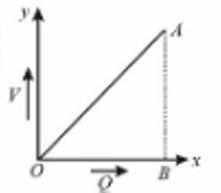
Charge Q on a capacitor varies with voltage V as shown in the figure, where Q is taken along the X-axis and V along the Y-axis. The area of triangle OAB represents

  1. ((a))

    capacitance

  2. ((b))

    capacitive reactance

  3. ((c))

    magnetic field between the plates 

  4. ((d))

    energy stored in the capacitor

Show Answer
Answer: ((d))

energy stored in the capacitor

Concept:

Energy Stored in a Capacitor:

The energy U stored in a capacitor is given by the formula:

U = 1/2 × Q × V, where:

Q = Charge on the capacitor (Coulombs)

V = Voltage across the capacitor (Volts)

The graph given in the question represents the relationship between charge Q and voltage V on the capacitor. The area of the triangle OAB represents the energy stored in the capacitor, as the energy stored is the product of charge and voltage divided by 2.

Calculation:

The area of triangle OAB is given by:

Area = 1/2 × base × height

Here, base = Q (charge) and height = V (voltage). Thus, the area is equivalent to the energy stored in the capacitor.

∴ The area of triangle OAB represents the energy stored in the capacitor, which corresponds to Option 4.

29

A parallel plate condenser with oil between the plates (dielectric constant of oil K = 2) has a capacitance C. If the oil is removed, then capacitance of the capacitor becomes

  1. ((a))

    √2C

  2. ((b))

    2C

  3. ((c))

    (\frac{\mathrm{C}}{\sqrt{2}})

  4. ((d))

    (\frac{C}{2})

Show Answer
Answer: ((d))

(\frac{C}{2})

Concept:

Capacitance of a Parallel Plate Capacitor:

  • The capacitance C of a parallel plate capacitor with a dielectric material between the plates is given by the formula:
  • C = (K × ε₀ × A) / d, where:
  • K = Dielectric constant of the material (dimensionless)
  • ε₀ = Permittivity of free space (8.85 × 10⁻¹² F/m)
  • A = Area of the plates (m²)
  • d = Distance between the plates (m)
  • When a dielectric material (oil) is inserted between the plates, the capacitance increases by a factor of K (dielectric constant).
  • If the oil is removed (K = 1 for air or vacuum), the capacitance will be reduced by a factor of K.

Calculation:

Initially, the capacitance is C = K × C₀, where C₀ is the capacitance without the oil.

Given that K = 2 with the oil, the capacitance becomes C = 2 × C₀.

When the oil is removed (K = 1), the capacitance reduces to:

C' = C / K = 2C / 2 = C / 2

∴ The capacitance of the capacitor becomes C / 2, which corresponds to Option 4.

30

A dielectric slab is inserted between the plates of an isolated charged capacitor. Which of the following quantities remain unchanged?

  1. ((a))

    The charge on the capacitor

  2. ((b))

    The stored energy in the Capacitor

  3. ((c))

    The potential difference between the plates

  4. ((d))

    The electric field in the capacitor

Show Answer
Answer: ((a))

The charge on the capacitor

Concept:

Effect of Inserting a Dielectric Slab:

  • When a dielectric slab is inserted between the plates of a charged capacitor, the following effects are observed:
  • The capacitance increases due to the dielectric constant of the material.
  • If the capacitor is isolated (not connected to a battery), the charge on the plates remains constant, as no external source is available to change the charge.
  • The potential difference between the plates decreases, as the dielectric reduces the effective electric field between the plates.
  • The stored energy in the capacitor decreases because energy is proportional to the square of the voltage, and the voltage decreases.
  • The electric field inside the capacitor also decreases, since the dielectric reduces the field between the plates.

Explanation:

Since the capacitor is isolated, the charge remains constant. The insertion of the dielectric only affects the electric field, voltage, and energy stored in the capacitor. The charge on the capacitor does not change because there is no external circuit to either supply or remove charge.

∴ The charge on the capacitor remains unchanged, which corresponds to Option 1.

31

Which one of the following electrical meter has the smallest resistance?

  1. ((a))

    Ammeter 

  2. ((b))

    Milliameter

  3. ((c))

    Galvanometer 

  4. ((d))

    Voltmeter

Show Answer
Answer: ((b))

Milliameter

CONCEPT:

Electrical Meters and Resistance

  • Electrical meters are devices used to measure electrical quantities such as current, voltage, and resistance. The resistance of these meters is an important factor in their design and functionality.
  • Ammeter, milliameter, galvanometer, and voltmeter are different types of electrical meters, each with varying resistances.

EXPLANATION:

  • Let's examine the given options:
  • Option 1: Ammeter
  • An ammeter is used to measure electric current. It is designed to have very low resistance so that it does not affect the current it is measuring.
  • Option 2: Milliameter
  • A milliameter is a type of ammeter that measures small currents in milliamperes. It also has very low resistance, similar to an ammeter.
  • Option 3: Galvanometer
  • A galvanometer is an instrument for detecting and measuring small electric currents. It has higher resistance compared to an ammeter and milliameter.
  • Option 4: Voltmeter
  • A voltmeter is used to measure electrical potential difference between two points. It is designed to have high resistance to minimize the current draw from the circuit being measured.

Therefore, the correct answer is option 2: Milliameter.

32

The current in the primary circuit of a potentiometer wire is 0.5 A, ρ for the wire is 4 × 10⁻⁷ Ω-m and area of cross- section of wire is 8 × 10⁻⁶ m2. The potential gradient in the wire would be

  1. ((a))

    25 mV/meter

  2. ((b))

    2.5 mV/meter

  3. ((c))

    25 V/meter

  4. ((d))

    10 V/meter

Show Answer
Answer: ((a))

25 mV/meter

Concept:

Potential Gradient in a Wire:

  • The potential gradient ΔV/Δx is given by the formula:
  • ΔV/Δx = I × ρ / A, where:
  • I = Current through the wire (A)
  • ρ = Resistivity of the wire (Ω·m)
  • A = Cross-sectional area of the wire (m²)
  • Potential gradient represents how much the potential changes per unit length along the wire.

Calculation:

Given:

  • Current I = 0.5 A
  • Resistivity ρ = 4 × 10⁻⁷ Ω·m
  • Area A = 8 × 10⁻⁶ m²

We can calculate the potential gradient using the formula:


ΔV/Δx = (0.5 A × 4 × 10⁻⁷ Ω·m) / (8 × 10⁻⁶ m²)

ΔV/Δx = 25 × 10⁻³ V/m = 25 mV/m

∴ The potential gradient in the wire is 25 mV/meter, which corresponds to Option 1.

33

The period of oscillation of a magnet in a vibration magnetometer is 2 sec. The period of oscillation of a magnet whose magnetic moment is four times that of the first magnet is

  1. ((a))

    1 sec 

  2. ((b))

    5 sec

  3. ((c))

    8 sec

  4. ((d))

    0.5 sec

Show Answer
Answer: ((a))

1 sec 

CONCEPT:

Vibration Magnetometer

  • A vibration magnetometer measures the period of oscillation of a magnet in a magnetic field.
  • The period of oscillation (T) is inversely proportional to the square root of the magnetic moment (M) of the magnet.
  • Mathematically, T∝1M√T∝1M

.

EXPLANATION:

  • Given:
  • The period of oscillation of the first magnet, T1=2T1=2

sec.

  • The magnetic moment of the second magnet, M2=4M1M2=4M1

.

  • Since T∝1M√T∝1M

:

  • T2=T14√=22=1T2=T14=22=1

sec.

Therefore, the correct answer is option 1: 1 sec.

34

In an AC generator, a coil with N turns, all of the same area A and total resistance R, rotates with frequency ω in a magnetic field B. The maximum value of emf generated in the coil is

  1. ((a))

    N.A.B.R.ω

  2. ((b))

    N.A.B.

  3. ((c))

    N.A.B.R.

  4. ((d))

    N.A.B.ω

Show Answer
Answer: ((d))

N.A.B.ω

CONCEPT:

AC Generator

  • An AC generator is a device that converts mechanical energy into electrical energy using the principle of electromagnetic induction.
  • The emf (electromotive force) generated in a coil rotating in a magnetic field depends on the number of turns in the coil, the area of the coil, the magnetic field strength, and the angular frequency of rotation.

EXPLANATION:

  • Let's examine the given options:
  • Option 1: N.A.B.R.ω
  • This option includes resistance (R), which is not part of the formula for the maximum emf generated.
  • Option 2: N.A.B.
  • This option is missing the angular frequency (ω), which is necessary for calculating the maximum emf.
  • Option 3: N.A.B.R.
  • This option incorrectly includes resistance (R), which does not influence the maximum emf generated.
  • Option 4: N.A.B.ω
  • This option correctly includes the number of turns (N), the area of the coil (A), the magnetic field strength (B), and the angular frequency of rotation (ω).

Therefore, the correct answer is option 4: N.A.B.ω.

35

A oscillator using a resonant circuit with an inductor L (of negligible resistance) and a capacitor C in series produce oscillations of frequency f. If L is doubled and C is changed to 4C, the frequency will be

  1. ((a))

    8f

  2. ((b))

    f/2√2 

  3. ((c))

    f/2

  4. ((d))

    f/4

Show Answer
Answer: ((b))

f/2√2 

CONCEPT:

Frequency of Oscillations in an LC Circuit

  • The frequency of oscillations in a resonant LC circuit is given by the formula:

f = 1 / (2π√(LC))

where:

  • f is the frequency of oscillation
  • L is the inductance
  • C is the capacitance

EXPLANATION:

  • Initially, the frequency of the oscillator is given by:

f = 1 / (2π√(LC))

  • When the inductance L is doubled and the capacitance C is changed to 4C, the new frequency f' is given by:

f' = 1 / (2π√(2L * 4C)) = 1 / (2π√(8LC))

Now, factor out the 8:

f' = 1 / (2π√(8)√(LC))

Since √8 = 2√2, we have:

f' = 1 / (2π * 2√2 * √(LC)) = 1 / (2√2 * 2π√(LC))

Therefore:

f' = f / (2√2)

Therefore, the correct answer is option 2: f / 2√2.

36

Given below is a list of E.M spectrum and its use. Which one does not match?

  1. ((a))

    U.V rays - finger prints detection

  2. ((b))

    I.R. rays - Secret writing on ancient walls

  3. ((c))

    X-rays - Atomic structure

  4. ((d))

    Microwaves - forged document detection

Show Answer
Answer: ((d))

Microwaves - forged document detection

CONCEPT:

Electromagnetic Spectrum

  • The electromagnetic spectrum encompasses all types of electromagnetic radiation, each with varying wavelengths and frequencies.
  • Different parts of the spectrum have different applications, from radio waves used in communication to gamma rays used in medical treatments.

EXPLANATION:

  • Let's examine the given options:
  • Option 1: U.V rays - finger prints detection
  • Ultraviolet (U.V) rays are indeed used in forensic science to detect and analyze fingerprints.
  • Option 2: I.R. rays - Secret writing on ancient walls
  • Infrared (I.R.) rays can be used to reveal hidden layers of writing or paintings on ancient walls, as they penetrate the surface layers and highlight the underlying details.
  • Option 3: X-rays - Atomic structure
  • X-rays are used in X-ray crystallography to determine the atomic structure of crystals, including biological molecules like proteins and DNA.
  • Option 4: Microwaves - forged document detection
  • Microwaves are typically not used for detecting forged documents. This application does not align with the usual uses of microwaves.

Therefore, the correct answer is option 4: Microwaves - forged document detection.

37

A ray of light passes through an equilateral prism such that the angle of incidence is equal to the angle of emergence and the latter is equal to 3/4th of the angle of prism. The angle of deviation is

  1. ((a))

    45°

  2. ((b))

    39°

  3. ((c))

    20°

  4. ((d))

    30°

Show Answer
Answer: ((d))

30°

CONCEPT:

Angle of Deviation in a Prism

  • The angle of deviation is the angle between the incident ray and the emergent ray when light passes through a prism.
  • For an equilateral prism, the angle of the prism (A) is 60°.
  • If the angle of incidence (i) is equal to the angle of emergence (e) and e = 3/4 A, then we can use these relationships to find the angle of deviation (D).

EXPLANATION:

  • Let’s analyze the given conditions:
  • The angle of the prism (A) = 60°.
  • The angle of incidence (i) is equal to the angle of emergence (e).
  • The angle of emergence (e) = (3/4)A = (3/4) × 60° = 45°.
  • Using the prism formula:
  • For minimum deviation, i = e and A = 60°.
  • The formula for angle of deviation (D) in a prism is:
  • D = i + e - A
  • Since i = e = 45°:
  • D = 45° + 45° - 60°
  • D = 90° - 60°
  • D = 30°

Therefore, the correct answer is option 4: 30°.

38

A beam of natural light falls on a system of 5 polaroids, which arranged in succession such that the pass axis of each polaroid is turned through 60° with respect to the preceding one. The fraction of the incident light intensity that passes through the system is

  1. ((a))

    (\frac{1}{64})

  2. ((b))

    (\frac{1}{32})

  3. ((c))

    (\frac{1}{256})

  4. ((d))

    (\frac{1}{512})

Show Answer
Answer: ((d))

(\frac{1}{512})

Concept:

Malus' Law:

  • According to Malus' Law, when a plane polarized light passes through a polaroid, the intensity of the transmitted light I is given by:
  • I = I₀ × cos²(θ), where:
  • I₀ = Initial intensity of the light
  • θ = Angle between the light's polarization direction and the polaroid's transmission axis
  • For a system of multiple polaroids, the intensity after passing through each polaroid is multiplied by the corresponding factor of cos²(θ), where θ is the angle between the pass axis of the polaroid and the previous one.

Calculation:

For each of the 5 polaroids, the angle between their pass axes is 60°, so the fraction of light intensity that passes through each polaroid is:

cos²(60°) = (1/2)² = 1/4

Since there are 5 polaroids, the total fraction of intensity that passes through the system is:

(1/4)⁵ = 1/512

∴ The fraction of the incident light intensity that passes through the system is 1/512, which corresponds to Option 4.

39

A steel ball of mass m is moving with a kinetic energy K. The de Broglie wavelength associated with the ball is

  1. ((a))

    (\frac{\mathrm{h}}{2 \mathrm{mK}})

  2. ((b))

    (\sqrt{\frac{\mathrm{h}}{2 \mathrm{mK}}})

  3. ((c))

    (\frac{\mathrm{h}}{\sqrt{2 \mathrm{mK}}})

  4. ((d))

    meaningless

Show Answer
Answer: ((c))

(\frac{\mathrm{h}}{\sqrt{2 \mathrm{mK}}})

Explanation:

de Broglie Wavelength:

de Broglie suggested that every moving particle has an associated wavelength, called the de Broglie wavelength, which is given by the formula:

λ = h / p, where:

λ = de Broglie wavelength

h = Planck's constant (6.626 × 10⁻³⁴ J·s)

p = Momentum of the particle (kg·m/s)

The momentum p is related to the kinetic energy K by the relation:

p = √(2mK), where:

m = mass of the particle (kg)

K = kinetic energy (J)

Using the formula for de Broglie wavelength and substituting the momentum:

λ = h / p = h / √(2mK)

∴ The de Broglie wavelength associated with the ball is h / √(2mK), which corresponds to Option 3.

40

When the wavelength of radiation falling on a metal is changed from 500 nm to 200 nm, the maximum kinetic energy of the photoelectrons becomes three times larger. The work function of the metal is close to:

  1. ((a))

    0.81 eV

  2. ((b))

    1.02 eV

  3. ((c))

    0.52 eV

  4. ((d))

    0.61 eV

Show Answer
Answer: ((d))

0.61 eV

Concept:

Photoelectric Effect:

  • The kinetic energy of photoelectrons K.E. is given by the Einstein photoelectric equation:
  • K.E. = hf - φ, where:
  • h = Planck's constant (6.626 × 10⁻³⁴ J·s)
  • f = Frequency of the incident radiation
  • φ = Work function of the metal
  • The frequency f is related to the wavelength λ by the equation: f = c / λ, where:
  • c = Speed of light (3 × 10⁸ m/s)
  • λ = Wavelength of the incident radiation
  • When the wavelength is decreased, the frequency increases, and thus the kinetic energy of the photoelectrons increases.

Calculation:

Let the initial wavelength be λ₁ = 500 nm and the final wavelength λ₂ = 200 nm.

The kinetic energy is proportional to the frequency, so when the wavelength changes, the kinetic energy of the photoelectrons is affected by the ratio of the frequencies:

Since frequency is inversely proportional to wavelength, we can write:

K.E.₂ / K.E.₁ = f₂ / f₁ = λ₁ / λ₂

The problem states that the kinetic energy becomes three times larger:

K.E.₂ / K.E.₁ = 3, so:

3 = λ₁ / λ₂ = 500 nm / 200 nm

The work function φ is given by the difference in the initial and final kinetic energies:

φ ≈ K.E.₁ (1 - 1 / 3) = 2/3 K.E.₁

Using this, we get that the work function of the metal is approximately 0.61 eV.

∴ The work function of the metal is close to 0.61 eV, which corresponds to Option 4.

Chemistry (30 questions)

41

An example of covalent solid is

  1. ((a))

    MgO 

  2. ((b))

    Mg

  3. ((c))

    SiC

  4. ((d))

    CaF2

Show Answer
Answer: ((c))

SiC

CONCEPT:

Covalent Solids

  • Covalent solids, also known as network solids, are solids where atoms are bonded together by covalent bonds in a continuous network extending throughout the material.
  • They have high melting points and are usually very hard. Examples include diamond, silicon carbide, and quartz.

EXPLANATION:

  • Let's examine the given options:
  • Option 1: MgO
  • Magnesium oxide (MgO) is an ionic solid, not a covalent solid. It consists of Mg2+ and O2- ions held together by ionic bonds.
  • Option 2: Mg
  • Magnesium (Mg) is a metallic solid, where atoms are held together by metallic bonds.
  • Option 3: SiC
  • Silicon carbide (SiC) is a covalent solid. In SiC, each silicon atom is covalently bonded to four carbon atoms, forming a very hard and high-melting-point network.
  • Option 4: CaF2
  • Calcium fluoride (CaF2) is an ionic solid, consisting of Ca2+ and F- ions held together by ionic bonds.

Therefore, the correct answer is option 3: SiC.

42

The molality (in mol kg-1) of 1 mole of solute in 50 g of solvent is

  1. ((a))

    10

  2. ((b))

    20

  3. ((c))

    30

  4. ((d))

    40

Show Answer
Answer: ((b))

20

CONCEPT:

Molality (m)

  • Molality (m) is a measure of the concentration of a solute in a solution.
  • It is defined as the number of moles of solute per kilogram of solvent.
  • The formula for molality is:

m = (moles of solute) / (mass of solvent in kg)

EXPLANATION:

  • Given data:
  • Moles of solute = 1 mole
  • Mass of solvent = 50 g
  • Convert mass of solvent to kilograms:
  • 50 g = 50 / 1000 kg = 0.05 kg
  • Using the molality formula:
  • m = (moles of solute) / (mass of solvent in kg)
  • = 1 mole / 0.05 kg
  • = 20 mol kg-1

Therefore, the molality of 1 mole of solute in 50 g of solvent is 20 mol kg-1.

Other Options Explanation:

  • Option 1 (10 mol kg-1):
  • This would be the result if the mass of the solvent was 100 g (0.1 kg) instead of 50 g.
  • m = 1 mole / 0.1 kg = 10 mol kg-1
  • Option 3 (30 mol kg-1):
  • This would be the result if the mass of the solvent was approximately 33.33 g (0.03333 kg).
  • m = 1 mole / 0.03333 kg ≈ 30 mol kg-1
  • Option 4 (40 mol kg-1):
  • This would be the result if the mass of the solvent was 25 g (0.025 kg).
  • m = 1 mole / 0.025 kg = 40 mol kg-1
43

Which of the following molecules is eliminated during peptide bond formation?

  1. ((a))

    H2O

  2. ((b))

    NH3

  3. ((c))

    CH3OH

  4. ((d))

    CO2

Show Answer
Answer: ((a))

H2O

CONCEPT:

Peptide Bond Formation

  • A peptide bond is a covalent bond formed between two amino acids during protein synthesis.
  • The bond is formed between the carboxyl group (–COOH) of one amino acid and the amino group (–NH2) of another amino acid.
  • During the formation of a peptide bond, a molecule of water (H2O) is eliminated in a condensation reaction.

EXPLANATION:

  • In the peptide bond formation process:

R1-COOH + H2N-R2 → R1-CO-NH-R2 + H2O

  • The –OH group from the carboxyl group of one amino acid and a hydrogen atom from the amino group of another amino acid combine to form a water molecule (H2O).
  • This results in the formation of a peptide bond (–CO-NH–) between the two amino acids.

Therefore, the correct answer is option 1: H2O.

Explanation of Other Options:

  • Option 2 (NH3): Ammonia (NH3) is not eliminated during peptide bond formation. It is not involved in the condensation reaction between amino acids.
  • Option 3 (CH3OH): Methanol (CH3OH) is not a byproduct of peptide bond formation. It is not produced during the reaction between amino acids.
  • Option 4 (CO2): Carbon dioxide (CO2) is not eliminated during peptide bond formation. It is not a byproduct of the condensation reaction between amino acids.
44

In which of the following pairs, both molecules possess dipole moment?

  1. ((a))

    CO2, BCI3

  2. ((b))

    BCL3, NF3

  3. ((c))

    CO2, SO2

  4. ((d))

    SO2,NF3

Show Answer
Answer: ((d))

SO2,NF3

CONCEPT:

Dipole Moment

  • The dipole moment is a measure of the separation of positive and negative electrical charges within a molecule.
  • A molecule has a dipole moment if it has polar bonds that do not cancel each other out. This happens when there is an asymmetric distribution of electron density.

EXPLANATION:

  • Option 1: CO2 and BCl3
  • CO2 is a linear molecule with two polar bonds that cancel each other out, resulting in zero dipole moment.
  • BCl3 is a trigonal planar molecule where the dipoles cancel out, resulting in zero dipole moment.
  • Option 2: BCl3 and NF3
  • BCl3 has zero dipole moment as explained above.
  • NF3 has a trigonal pyramidal shape with a net dipole moment due to the lone pair on nitrogen and the difference in electronegativities between N and F.
  • Option 3: CO2 and SO2
  • CO2 has zero dipole moment as explained above.
  • SO2 has a bent shape and a net dipole moment due to the difference in electronegativities between S and O.
  • Option 4: SO2 and NF3
  • SO2 has a bent shape and a net dipole moment as explained above.
  • NF3 has a net dipole moment as explained above.
  • Both molecules possess dipole moments, making this the correct answer.

Therefore, the correct answer is option 4: SO2 and NF3.

45

The electrolyte used in mercury cell is 

  1. ((a))

    Moist paste of NH4Cl and ZnCl

  2. ((b))

    38% solution of H2SO4

  3. ((c))

    Paste of KOH and ZnO

  4. ((d))

    Paste of MgCl2, and HgO

Show Answer
Answer: ((c))

Paste of KOH and ZnO

CONCEPT:

Mercury Cell

  • The mercury cell, also known as a mercury battery, is a non-rechargeable electrochemical battery.
  • It consists of a zinc anode, a mercury oxide cathode, and an electrolyte that is typically a paste of potassium hydroxide (KOH) and zinc oxide (ZnO).
  • These cells are known for their stable output voltage and long shelf life.

EXPLANATION:

  • The electrolyte used in a mercury cell is a paste of KOH and ZnO.
  • Other options are incorrect:
  • Option 1: A moist paste of NH4Cl and ZnCl2 is used in dry cells, not mercury cells.
  • Option 2: A 38% solution of H2SO4 is typically used in lead-acid batteries, not mercury cells.
  • Option 4: A paste of MgCl2 and HgO is not a known electrolyte for mercury cells.

Therefore, the correct answer is option 3: Paste of KOH and ZnO.

46

Which one of the following ores does not contain iron"

  1. ((a))

    Hematite

  2. ((b))

    Magnetite

  3. ((c))

    Calamine

  4. ((d))

    Siderite

Show Answer
Answer: ((c))

Calamine

CONCEPT:

Ores and their Metal Content

  • An ore is a naturally occurring solid material from which a metal or valuable mineral can be extracted profitably.
  • Different ores contain different metals, and identifying the metal content is essential in metallurgy.

EXPLANATION:

  • Considering the options given:
  • Hematite (Fe2O3):
  • Hematite is an iron ore containing iron in the form of iron(III) oxide (Fe2O3).
  • Magnetite (Fe3O4):
  • Magnetite is also an iron ore containing iron in the form of iron(II,III) oxide (Fe3O4).
  • Calamine (ZnCO3):
  • Calamine is a zinc ore containing zinc in the form of zinc carbonate (ZnCO3).
  • It does not contain iron.
  • Siderite (FeCO3):
  • Siderite is an iron ore containing iron in the form of iron(II) carbonate (FeCO3).

Therefore, the correct answer is option 3: Calamine (ZnCO3) does not contain iron.

47

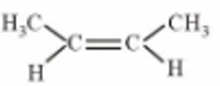
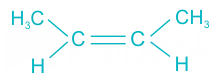
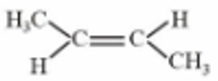
The major product formed in the following reaction is

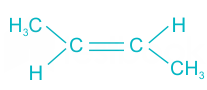
(\mathrm{H}{3} \mathrm{C}-\mathrm{C} \equiv\mathrm{C}-\mathrm{CH}{3}+\mathrm{Na} \xrightarrow{\text { Liquid } \mathrm{NH}_{3}})

  1. ((a))

    (\mathrm{H}{3} \mathrm{C}-\mathrm{CH}{2}-\mathrm{C}=\mathrm{C}^{-} \mathrm{Na}^{+})

  2. ((b))

    (\mathrm{H}{3} \mathrm{C}-\mathrm{C}=\mathrm{C}-\mathrm{CH}{2}^{-} \mathrm{Na}^{+})

  3. ((c))

  4. ((d))

Show Answer
Answer: ((d))

CONCEPT:

Reduction of Alkynes using Sodium in Liquid Ammonia

  • When an alkyne is treated with sodium (Na) in liquid ammonia (NH3), it undergoes reduction to form a trans-alkene.
  • This reaction is also known as the Birch reduction.
  • The reduction occurs via a radical anion intermediate, leading to the formation of a trans-alkene as the major product.

EXPLANATION:

  • In the given reaction:

H3C-C≡C-CH3 + Na → (Liquid NH3)

  • The alkyne (H3C-C≡C-CH3) is reduced by sodium in liquid ammonia.
  • During the Birch reduction, sodium donates an electron to the alkyne, forming a radical anion.
  • Protonation of this radical anion by ammonia results in the formation of a trans-alkene.
  • The major product formed is:

H3C-CH=CH-CH3

Other Options:

  • Option 1: H3C-CH2-C=CH- Na+
  • This is not the major product as it represents an intermediate rather than the final reduced product.
  • Option 2: H3C-C≡C-CH2- Na+
  • This is also not the major product as it indicates an incomplete reduction where the alkyne is still present.

Therefore, the correct answer is option 4: H3C-CH=CH-CH3.

48

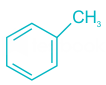
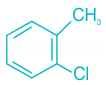
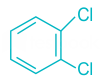
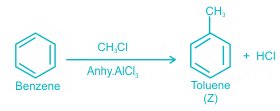
The product (Z) of the following reaction is

  1. ((a))

  2. ((b))

  3. ((c))

  4. ((d))

Show Answer
Answer: ((b))

CONCEPT:

Friedel-Crafts Alkylation Reaction

  • The Friedel-Crafts alkylation is an electrophilic aromatic substitution reaction in which an alkyl group is added to an aromatic ring using an alkyl halide (like CH3Cl) and a Lewis acid catalyst (like AlCl3).
  • In this reaction, the alkyl halide (CH3Cl) reacts with the aromatic compound (benzene) in the presence of anhydrous AlCl3 to form a methylated product (toluene, C6H5CH3) and HCl as a byproduct.

EXPLANATION:

  • In the given reaction:

C6H6 (benzene) + CH3Cl (methyl chloride) → C6H5CH3 (toluene) + HCl

  • The Lewis acid AlCl3 activates the methyl chloride (CH3Cl) by accepting a lone pair of electrons from the chlorine atom, which creates a methyl carbocation (CH3+), a highly reactive species.
  • The methyl carbocation (CH3+) then attacks the electron-rich benzene ring, resulting in the substitution of a hydrogen atom with a methyl group to form toluene (C6H5CH3).
  • The byproduct of this reaction is hydrochloric acid (HCl), which is released during the reaction.
  • The reaction follows the mechanism of electrophilic aromatic substitution.

Therefore, the product (Z) of the reaction is Toluene (C6H5CH3).

49

A process will be spontaneous at all temperatures if:

  1. ((a))

    ΔH > 0 and ΔS < 0

  2. ((b))

    ΔH < 0 and ΔS < 0

  3. ((c))

    ΔH < 0 and ΔS > 0

  4. ((d))

    ΔH > 0 and ΔS > 0

Show Answer
Answer: ((c))

ΔH < 0 and ΔS > 0

CONCEPT:

Gibbs Free Energy (ΔG)

  • Gibbs Free Energy (ΔG) determines the spontaneity of a process.
  • The relationship between ΔG, enthalpy (ΔH), and entropy (ΔS) is given by the equation:

ΔG = ΔH - TΔS

  • A process is spontaneous if ΔG < 0.
  • For a process to be spontaneous at all temperatures, ΔG must always be negative regardless of the temperature (T).

EXPLANATION:

  • To determine when ΔG is always negative:
  • ΔG = ΔH - TΔS
  • For ΔG to be negative at all temperatures, ΔH must be negative and ΔS must be positive.
  • This is because:
  • If ΔH < 0 and ΔS > 0, then -TΔS is always negative, making ΔG negative.
  • If ΔH > 0 and ΔS < 0, then both terms would be positive, making ΔG positive.
  • If ΔH < 0 and ΔS < 0, the sign of ΔG would depend on the temperature.
  • If ΔH > 0 and ΔS > 0, the sign of ΔG would again depend on the temperature.

Therefore, the correct answer is option 3: ΔH < 0 and ΔS > 0.

50

In alkaline medium, (\mathrm{MnO}_{4}^{-}) oxidises I- to

  1. ((a))

    IO-

  2. ((b))

    (\mathrm{IO}_{4}^{-})

  3. ((c))

    I2

  4. ((d))

    (\mathrm{IO}_{3}^{-})

Show Answer
Answer: ((d))

(\mathrm{IO}_{3}^{-})

CONCEPT:

Oxidation in Alkaline Medium

  • In an alkaline medium, the oxidation states of various species can change due to the presence of hydroxide ions (OH-).
  • Permanganate ion (MnO4-) is a strong oxidizing agent, and its ability to oxidize other species varies with the medium (acidic, neutral, or alkaline).

EXPLANATION:

  • In an alkaline medium, MnO4- oxidizes iodide ions (I-) to iodate ions (IO3-).
  • The balanced half-reaction for the oxidation of I- in alkaline medium is:

MnO4- + I- + OH- → IO3- + MnO2 + H2O

Therefore, in alkaline medium, MnO4- oxidizes I- to IO3-.

51

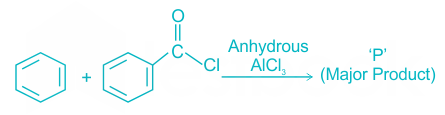
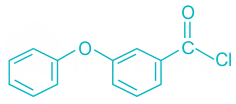
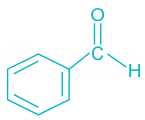
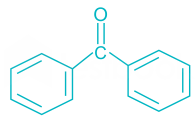
Identify major product 'P' formed in the following reaction.

  1. ((a))

  2. ((b))

  3. ((c))

  4. ((d))

Show Answer
Answer: ((d))

CONCEPT:

Friedel-Crafts Acylation

  • Friedel-Crafts acylation is a reaction where an acyl group (RCO-) is introduced to an aromatic ring (such as benzene) using an acyl chloride (RCOCl) and a Lewis acid (usually AlCl3).
  • This reaction is an electrophilic aromatic substitution in which the acyl group replaces a hydrogen atom on the aromatic ring.
  • The AlCl3 acts as a catalyst and helps in the generation of the acylium ion (RCO+), which is a highly electrophilic species that attacks the aromatic ring.

EXPLANATION:

  • In the given reaction:

C6H6 + RCOCl → C6H5CO-R


    • The acyl chloride (RCOCl) reacts with AlCl3 to form the acylium ion (RCO+), which then attacks the benzene ring.
  • The mechanism of the reaction involves:
  • Generation of the acylium ion (RCO+) by the interaction of acyl chloride with AlCl3.
  • Attack of the acylium ion on the benzene ring to form the intermediate complex.
  • Loss of a proton from the intermediate complex results in the final product, an aryl ketone (C6H5CO-R).

Therefore, the major product 'P' formed in the reaction is an aryl ketone (C6H5CO-R).

52

Type of isomerism which exists between [Pd(C6H5),(SCN)2] and [Pd(C6H5),(NCS)2] is:

  1. ((a))

    Linkage isomerism

  2. ((b))

    Coordination isomerism

  3. ((c))

    Ionisation isomerism

  4. ((d))

    Solvate isomerism

Show Answer
Answer: ((a))

Linkage isomerism

CONCEPT:

Linkage Isomerism

  • Linkage isomerism occurs when a particular ligand can coordinate to the central metal atom or ion through two or more different atoms.
  • This type of isomerism is possible when a ligand has more than one donor atom but coordinates through only one donor atom at a time.
  • The classic example involves the thiocyanate ligand (SCN-), which can bond through either the sulfur atom or the nitrogen atom to the metal center.

EXPLANATION:

  • In the given complexes:

[Pd(C6H5)(SCN)2] and [Pd(C6H5)(NCS)2]

  • The ligand SCN- can attach to the palladium (Pd) center through either the sulfur atom (S) or the nitrogen atom (N).
  • In [Pd(C6H5)(SCN)2], the thiocyanate ligand is bonded through the sulfur atom.
  • In [Pd(C6H5)(NCS)2], the thiocyanate ligand is bonded through the nitrogen atom.

Therefore, the type of isomerism which exists between [Pd(C6H5)(SCN)2] and [Pd(C6H5)(NCS)2] is linkage isomerism.

53

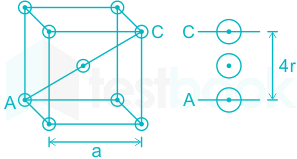
The number of atoms per unit cell of BCC structure is

  1. ((a))

    1

  2. ((b))

    2

  3. ((c))

    4

  4. ((d))

    6

Show Answer
Answer: ((b))

2

CONCEPT:

Body-Centered Cubic (BCC) Structure

  • A body-centered cubic (BCC) unit cell has atoms at each of its eight corners and a single atom at the center of the cube.
  • Each corner atom is shared among eight adjacent unit cells, and the center atom belongs entirely to the unit cell.

EXPLANATION:

F1 Ashik Madhu 14.08.20 D27

  • In a BCC unit cell:
  • There are 8 corner atoms, each shared by 8 unit cells. Therefore, the contribution of corner atoms per unit cell is 18 × 8 = 1 atom.
  • There is 1 atom at the center of the unit cell, which is not shared with any other unit cell. Therefore, the contribution of the center atom per unit cell is 1 atom.
  • Adding these contributions together:
  • Total number of atoms per unit cell = 1 (from corners) + 1 (from center) = 2 atoms.

Therefore, the number of atoms per unit cell of BCC structure is 2.

54

The reaction 2N2O5 (\rightleftharpoons) 2N2O4 + O2 is

  1. ((a))

    Bimolecular and second order

  2. ((b))

    Unimolecular and first order

  3. ((c))

    Bimolecular and first order

  4. ((d))

    Bimolecular and zero order

Show Answer
Answer: ((c))

Bimolecular and first order

CONCEPT:

Order and Molecularity of Chemical Reactions

  • Molecularity refers to the number of reactant molecules involved in an elementary step of the reaction.
  • Order of reaction is the sum of the powers of the concentration terms in the rate equation.
  • A reaction can be unimolecular, bimolecular, or trimolecular based on the number of molecules involved.
  • The order of reaction can be zero, first, second, etc., based on how the rate depends on the concentration of reactants.

EXPLANATION:

  • Consider the given reaction:

2N2O5 ⇌ 2N2O4 + O2

  • For the reaction:
  • The reaction involves two molecules of N2O5 as reactants, making it bimolecular.
  • The given reaction is described as first order, indicating that the rate of reaction depends linearly on the concentration of N2O5.
  • Therefore, the correct classification for the reaction is bimolecular and first order.

Therefore, the correct answer is option 3.

55

Which one of the following has the same number of atoms as are in 6g of H2O?

  1. ((a))

    0.4g He

  2. ((b))

    22g CO2

  3. ((c))

    1g H2

  4. ((d))

    12g CO

Show Answer
Answer: ((c))

1g H2

CONCEPT:

Number of Atoms in a Given Mass

  • The number of atoms in a given mass of a substance can be calculated using Avogadro's number, which is 6.022 x 10²³ atoms per mole.
  • The molar mass of a substance is used to convert the mass of the substance to moles.
  • Once the number of moles is known, it can be multiplied by Avogadro's number to find the number of atoms.

EXPLANATION:

  • First, we calculate the number of moles in 6g of H2O:
  • Molar mass of H2O = 2(1) + 16 = 18 g/mol
  • Number of moles of H2O = mass / molar mass = 6 g / 18 g/mol = 1/3 mol
  • The number of atoms in 1/3 mol of H2O:
  • Each molecule of H2O has 3 atoms (2 hydrogen + 1 oxygen)
  • Total number of atoms = 1/3 mol x 6.022 x 1023 molecules/mol x 3 atoms/molecule = 6.022 x 10²³ atoms
  • 0.4g He
  • Molar mass of He = 4 g/mol
  • Number of moles of He = 0.4 g / 4 g/mol = 0.1 mol
  • Number of atoms = 0.1 mol x 6.022 x 1023 atoms/mol = 6.022 x 10²² atoms
  • 22g CO2
  • Molar mass of CO2 = 12 + 2(16) = 44 g/mol
  • Number of moles of CO2 = 22 g / 44 g/mol = 0.5 mol
  • Number of molecules = 0.5 mol x 6.022 x 1023 molecules/mol = 3.011 x 10²³ molecules
  • Each molecule of CO2 has 3 atoms (1 carbon + 2 oxygen)
  • Number of atoms = 3.011 x 10²³ molecules x 3 atoms/molecule = 9.033 x 10²³ atoms
  • 1g H2
  • Molar mass of H2 = 2 g/mol
  • Number of moles of H2 = 1 g / 2 g/mol = 0.5 mol
  • Number of molecules = 0.5 mol x 6.022 x 1023 molecules/mol = 3.011 x 10²³ molecules
  • Each molecule of H2 has 2 atoms (2 hydrogen)
  • Number of atoms = 3.011 x 10²³ molecules x 2 atoms/molecule = 6.022 x 10²³ atoms
  • 12g CO
  • Molar mass of CO = 12 + 16 = 28 g/mol
  • Number of moles of CO = 12 g / 28 g/mol = 0.4286 mol
  • Number of molecules = 0.4286 mol x 6.022 x 1023 molecules/mol = 2.579 x 10²³ molecules
  • Each molecule of CO has 2 atoms (1 carbon + 1 oxygen)
  • Number of atoms = 2.579 x 10²³ molecules x 2 atoms/molecule = 5.158 x 10²³ atoms

Therefore, the correct answer is option 3, which is 1g H2.

56

In water, which of the following gases has the highest Henry's law constant at 293 K?

  1. ((a))

    N2

  2. ((b))

    O2

  3. ((c))

    He

  4. ((d))

    H2

Show Answer
Answer: ((c))

He

CONCEPT:

Henry's Law Constant

  • Henry's Law states that the amount of gas dissolved in a liquid is directly proportional to the partial pressure of the gas above the liquid.
  • The constant of proportionality is known as Henry's Law Constant (KH).
  • A higher Henry's Law constant indicates that the gas is less soluble in water.
  • Mathematically, Henry's Law is represented as:

C = KH * P

where,

  • C is the concentration of the gas in the liquid.
  • KH is the Henry's Law constant.
  • P is the partial pressure of the gas.

EXPLANATION:

  • The gases mentioned in the options (N2, O2, He, H2) have different solubilities in water at 293 K.
  • Among these gases, helium (He) has the highest Henry's Law constant.
  • This means that helium is the least soluble gas in water at 293 K.
  • The values of the Henry's Law constants are typically as follows:
  • N2: 1.67 × 10⁻⁵ mol/(L·atm)
  • O2: 1.30 × 10⁻⁵ mol/(L·atm)
  • He: 3.72 × 10⁻⁴ mol/(L·atm)
  • H2: 7.80 × 10⁻⁵ mol/(L·atm)
  • As seen, helium (He) has the highest Henry's Law constant, making it the correct answer.

Therefore, in water, helium (He) has the highest Henry's Law constant at 293 K.

57

Arrange the oxides CrO, CrO3 and Cr2O3 in the decreasing order of acidic strength

  1. ((a))

    CrO3 > Cr2O3 > CrO

  2. ((b))

    CrO3 > CrO > Cr2O3

  3. ((c))

    CrO > Cr2O3 > CrO3

  4. ((d))

    CrO > CrO3 > Cr2O3

Show Answer
Answer: ((a))

CrO3 > Cr2O3 > CrO

CONCEPT:

Acidic Strength of Oxides

  • The acidic strength of oxides generally increases with the oxidation state of the central atom.
  • Oxides of metals tend to be basic, while oxides of non-metals tend to be acidic. Transition metals, like chromium, can form oxides that have varying acidic or basic properties based on their oxidation states.

EXPLANATION:

  • For chromium oxides:
  • CrO (Chromium(II) oxide) has chromium in a +2 oxidation state.
  • Cr2O3 (Chromium(III) oxide) has chromium in a +3 oxidation state.
  • CrO3 (Chromium(VI) oxide) has chromium in a +6 oxidation state.
  • The acidic strength of these oxides increases with the oxidation state of chromium:
  • CrO is basic due to the low oxidation state of +2.
  • Cr2O3 is amphoteric (can act as both acid and base) due to the intermediate oxidation state of +3.
  • CrO3 is highly acidic due to the high oxidation state of +6.
  • Therefore, the decreasing order of acidic strength of these oxides is:
  • CrO3 > Cr2O3 > CrO

Therefore, the correct answer is option 1: CrO3 > Cr2O3 > CrO.

58

Which of the following alkyl halide is most reactive towards substitution by SNI mechanism?

  1. ((a))

    (CH3)3C-Br

  2. ((b))

    (CH3)3C-I

  3. ((c))

    (CH3)3C-F

  4. ((d))

    (CH3)3C-Cl

Show Answer
Answer: ((b))

(CH3)3C-I

CONCEPT:

SNI Mechanism

  • SNI (Substitution Nucleophilic Internal) mechanism is a type of nucleophilic substitution reaction where the nucleophile is introduced internally in the molecule.
  • The reactivity of alkyl halides towards SNI mechanism depends on the leaving group ability, where a better leaving group increases the reactivity.
  • In SNI mechanism, the leaving group should be able to stabilize the negative charge that develops during the transition state.

EXPLANATION:​

  • The leaving group ability of halogens decreases in the order: I > Br > Cl > F.
  • Iodine (I) is the best leaving group among the halides mentioned because it is larger and can stabilize the negative charge more effectively.
  • Therefore, (CH3)3C-I will be the most reactive towards substitution by the SNI mechanism.

Therefore, the correct answer is (CH3)3C-I.

59

Which of the following ions has the maximum magnetic moment?

  1. ((a))

    Mn+2 

  2. ((b))

    Fe+2

  3. ((c))

    Ti+2

  4. ((d))

    Cr+2

Show Answer
Answer: ((a))

Mn+2 

CONCEPT:

Magnetic Moment

  • The magnetic moment of an ion is related to the number of unpaired electrons present in the ion.
  • It can be calculated using the formula:

μ = √(n(n+2)) BM

  • Where μ is the magnetic moment and n is the number of unpaired electrons.

EXPLANATION:

IonElectronic ConfigurationNumber of Unpaired ElectronsMagnetic Moment (BM)
Mn2+[Ar] 3d55√35
Fe2+[Ar] 3d64√24
Ti2+[Ar] 3d22√8
Cr2+[Ar] 3d44√24

Therefore, the ion with the maximum magnetic moment is Mn2+.

60

The octahedral diamagnetic low spin complex among the following is

  1. ((a))

    [NiCl4]2-

  2. ((b))

    [CoCl6]3-

  3. ((c))

    [CoF6]3-

  4. ((d))

    [Co(NH3)6)3+

Show Answer
Answer: ((d))

[Co(NH3)6)3+

CONCEPT:

Diamagnetism and Low Spin Complexes

  • Diamagnetic complexes have all paired electrons, resulting in no net magnetic moment.
  • In octahedral complexes, the electronic configuration can be influenced by the nature of ligands, leading to high spin or low spin configurations.
  • Strong field ligands such as CN- and NH3 cause pairing of electrons, resulting in low spin complexes.

EXPLANATION:

  • [NiCl4]2-:
  • Nickel (Ni2+) has a d8 configuration.
  • Chloride (Cl-) is a weak field ligand, leading to a high spin complex.
  • High spin d8 configuration in a tetrahedral field does not result in a diamagnetic complex.
  • [CoCl6]3-:
  • Cobalt (Co3+) has a d6 configuration.
  • Chloride (Cl-) is a weak field ligand, leading to a high spin complex.
  • High spin d6 configuration in an octahedral field does not result in a diamagnetic complex.
  • [CoF6]3-:
  • Cobalt (Co3+) has a d6 configuration.
  • Fluoride (F-) is a weak field ligand, leading to a high spin complex.
  • High spin d6 configuration in an octahedral field does not result in a diamagnetic complex.
  • [Co(NH3)6]3+:

  • Cobalt (Co3+) has a d6 configuration.
  • Ammonia (NH3) is a strong field ligand, leading to a low spin complex.
  • Low spin d6 configuration in an octahedral field results in all paired electrons, making it diamagnetic.

Therefore, the octahedral diamagnetic low spin complex among the given options is [Co(NH3)6]3+.

61

The strongest acid from the following is

  1. ((a))

  2. ((b))

  3. ((c))

  4. ((d))

Show Answer
Answer: ((a))

CONCEPT:

Acidity and Electron-Withdrawing Groups (EWG)

  • Acidity of compounds is influenced by the ability of substituents on the aromatic ring to either donate or withdraw electron density.
  • Electron-Withdrawing Groups (EWGs), such as -NO2, -CN, -COOH, etc., decrease the electron density on the ring, making the hydrogen more likely to dissociate as a proton (H+), which increases the acidity of the compound.
  • In contrast, Electron-Donating Groups (EDGs), such as -CH3, -OH, -OCH3, increase the electron density on the ring, making the hydrogen less likely to dissociate, thus decreasing the acidity.

EXPLANATION:

  • In the given compounds:

The compound with -NO2 (Nitro group) is the strongest acid among the options.

  • The -NO2 group is a strong electron-withdrawing group (EWG), which pulls electron density away from the ring, making the hydrogen on the hydroxyl group (OH) more acidic.
  • The -OH group in the presence of -NO2 becomes more likely to release a proton (H+), increasing the acidity.
  • The -Cl (Chlorine) and -CH3 (Methyl) groups are less electron-withdrawing, and thus, they do not increase the acidity as much as -NO2.
  • The -OH group attached to the benzene ring with an electron-donating group like -CH3 decreases the ring's ability to lose a proton, thereby reducing acidity.

Therefore, the strongest acid from the following compounds is the one with the -NO2 group attached to the benzene ring.

62

Identify the non-reducing sugar from the following:

  1. ((a))

    Maltose 

  2. ((b))

    Sucrose

  3. ((c))

    Lactose

  4. ((d))

    Glucose

Show Answer
Answer: ((b))

Sucrose

CONCEPT:

Non-Reducing Sugar

  • Sugars are categorized based on their ability to act as reducing agents. Reducing sugars contain free aldehyde or ketone groups that can react with oxidizing agents.
  • Non-reducing sugars do not have free aldehyde or ketone groups due to their glycosidic bonds. Thus, they cannot act as reducing agents.

EXPLANATION:

  • Maltose (option 1) is a reducing sugar because it has a free aldehyde group.
  • Sucrose (option 2) is a non-reducing sugar because the glycosidic bond between glucose and fructose blocks the free aldehyde or ketone groups.
  • Lactose (option 3) is a reducing sugar because it has a free aldehyde group.
  • Glucose (option 4) is a reducing sugar because it has a free aldehyde group.

Therefore, the correct answer is option 2, Sucrose.

63

Clemmensen reduction of a ketone is carried out in the presence of:

  1. ((a))

    LiAlH4

  2. ((b))

    Zn-Hg with HCI

  3. ((c))

    Glycol with KOH

  4. ((d))

    H2 with Pt as catalyst

Show Answer
Answer: ((b))

Zn-Hg with HCI

CONCEPT:

Clemmensen Reduction

  • Clemmensen reduction is a chemical reaction used to reduce ketones to the corresponding alkanes.
  • It involves the use of zinc amalgam (Zn-Hg) and hydrochloric acid (HCl).
  • The mechanism proceeds through the formation of a zinc intermediate that facilitates the reduction.

EXPLANATION:

Example of Clemmensen Reduction

  • In Clemmensen reduction, the conditions required are acidic and involve the use of metal catalysts.
  • The reduction of the ketone occurs in the presence of Zn-Hg and HCl, which provides the necessary electrons for the reduction process.
  • Therefore, the correct answer is option 2: Zn-Hg with HCl.

Therefore, Clemmensen reduction of a ketone is carried out in the presence of Zn-Hg with HCl.

64

The product A formed in the following reaction is

A

  1. ((a))

  2. ((b))

  3. ((c))

  4. ((d))

Show Answer
Answer: ((d))

CONCEPT:

Diazotization Reaction

  • Diazotization is the process of forming a diazonium salt (ArN2Cl) from an amine group (-NH2) in an aromatic compound by reaction with nitrous acid (HNO2) generated in situ.
  • The general reaction for diazotization is:

Ar-NH2 + HNO2 → Ar-N2Cl

where Ar is an aromatic ring.

  • In this process, the amino group (-NH2) on the aromatic ring is converted into a diazonium group (Ar-N2Cl), which is a highly reactive intermediate that can undergo further reactions, such as substitution with various nucleophiles.
  • The diazonium group (Ar-N2Cl) is often used to introduce a halogen (e.g., chlorine) onto the aromatic ring by subsequent treatment with a halogenating agent like Cl2.

EXPLANATION:


  • In the given reaction:

The starting compound is aniline (C6H5NH2), which undergoes diazotization with sodium nitrite (NaNO2) and hydrochloric acid (HCl) at 0°C to form a diazonium salt (C6H5–N2Cl).

  • Here, the amine group (-NH2) on the benzene ring is converted into a diazonium ion (Ar-N2Cl).
  • Diazonium ion formation is followed by chlorination with Cl2 to replace the diazonium group with a chlorine atom (Cl).
  • After treatment with Cl2, the product A is obtained, which is chlorobenzene (C6H5Cl).

Therefore, the major product 'A' formed in the reaction is chlorobenzene (C6H5Cl).

65

IUPAC name of following compound is:

  1. ((a))

    2-Aminopentanenitrile

  2. ((b))

    2-Aminobutanenitrile

  3. ((c))

    3-Aminobutanenitrile

  4. ((d))

    3-Aminopropanenitrile

Show Answer
Answer: ((c))

3-Aminobutanenitrile

CONCEPT:

IUPAC Nomenclature of Organic Compounds

  • The IUPAC name of an organic compound is determined by following specific rules and naming conventions.
  • For nitriles, the suffix "-nitrile" is used to denote the presence of a cyano group (-CN).
  • When naming compounds with substituents like amino groups (-NH2), the position of the substituent is indicated by numbering the carbon chain starting from the carbon attached to the nitrile group.

EXPLANATION:

  • In the given compound:
  • The longest carbon chain containing the nitrile group is identified.
  • The numbering of the carbon chain starts from the carbon of the nitrile group (C1).
  • The position of the amino group (-NH2) is determined based on its location in the chain.
  • .

  • 3-Aminobutanenitrile

Therefore, the correct IUPAC name for the given compound is 3-Aminobutanenitrile.

66

'Adsorption' principle is used for which of the following purification method?

  1. ((a))

    Chromatography 

  2. ((b))

    Sublimation

  3. ((c))

    Extraction

  4. ((d))

    Distillation

Show Answer
Answer: ((a))

Chromatography 

CONCEPT:

Adsorption Principle in Purification Methods

  • Adsorption is a process in which atoms, ions, or molecules from a substance (which can be a gas, liquid, or dissolved solid) adhere to a surface of the adsorbent.
  • It is widely used in various purification methods to separate components based on their different affinities to the adsorbent material.

EXPLANATION:

  • In the context of the given purification methods:
  • Chromatography: This technique relies on adsorption principles, where different compounds in a mixture adhere to the stationary phase (adsorbent) to varying degrees, allowing their separation.
  • Sublimation: This process involves changing a substance from solid to gas without passing through the liquid phase and is not related to adsorption.
  • Extraction: This method involves separating components based on their solubilities in different immiscible liquids and does not involve adsorption.
  • Distillation: This technique separates substances based on their different boiling points and does not utilize adsorption.

Therefore, the correct answer is option 1: Chromatography, which uses the adsorption principle for purification.

67

The variation of molar conductivity with concentration of n electrolyte (X) in aqueous solution is shown in the given figure.

The electrolyte X is:

  1. ((a))

    HCI

  2. ((b))

    NaCl

  3. ((c))

    ΚΝΟ3

  4. ((d))

    CH3COOH

Show Answer
Answer: ((d))

CH3COOH

CONCEPT:

Molar Conductivity of Electrolytes

  • Molar conductivity (Λm) is the conductance of all the ions produced by one mole of an electrolyte in a given solution.
  • It varies with the concentration of the electrolyte, usually increasing as concentration decreases due to ion-ion interactions.
  • For strong electrolytes, molar conductivity increases slightly with dilution because ions are already well dissociated.
  • For weak electrolytes, molar conductivity increases significantly with dilution as more ions dissociate.

EXPLANATION:

  • The given figure shows the variation of molar conductivity with concentration.
  • For strong electrolytes like HCl and NaCl, the increase in molar conductivity with dilution is relatively small.
  • For weak electrolytes like CH3COOH (acetic acid), the increase in molar conductivity with dilution is more pronounced due to increased ionization.
  • The given figure likely shows a significant increase in molar conductivity with dilution, indicating that the electrolyte X is a weak electrolyte.
  • Among the given options, CH3COOH is the weak electrolyte.

Therefore, the electrolyte X is CH3COOH.

68

The noble gas that does NOT occur in the atmosphere is:

  1. ((a))

    He

  2. ((b))

    Kr

  3. ((c))

    Ne

  4. ((d))

    Ra

Show Answer
Answer: ((d))

Ra

CONCEPT:

Noble Gases in the Atmosphere

  • Noble gases are a group of chemical elements with similar properties. They are all odorless, colorless, monatomic gases with very low chemical reactivity.
  • The noble gases that occur naturally in the atmosphere include helium (He), neon (Ne), argon (Ar), krypton (Kr), and xenon (Xe).

EXPLANATION:

  • Radon (Ra) is a noble gas but it does NOT occur in the atmosphere in significant amounts because it is radioactive and has a short half-life.
  • The other noble gases listed (helium (He), neon (Ne), and krypton (Kr)) do occur in the atmosphere.

Therefore, the noble gas that does NOT occur in the atmosphere is Radon (Ra).

69

For the gaseous reaction, N2O5 → 2NO2 + (\frac{1}{2})O2 the rate can be expressed as

(-\frac{\mathrm{d}\left[\mathrm{~N}{2} \mathrm{O}{5}\right]}{\mathrm{dt}}=\mathrm{K}{1}\left[\mathrm{~N}{2} \mathrm{O}_{5}\right])

(+\frac{\mathrm{d}\left[\mathrm{NO}{2}\right]}{\mathrm{dt}}=\mathrm{K}{2}\left[\mathrm{~N}{2} \mathrm{O}{5}\right])

(+\frac{\mathrm{d}\left[\mathrm{O}{2}\right]}{\mathrm{dt}}=\mathrm{K}{3}\left[\mathrm{~N}{2} \mathrm{O}{5}\right])

The correct relation between K1, K2 and K3 is

  1. ((a))

    K1 = 2K2 = 4K3

  2. ((b))

    2K1 = K2 = 4K3

  3. ((c))

    2K1 = 3K2 = 4K3

  4. ((d))

    4K1 = 2K2 = K3

Show Answer
Answer: ((b))

2K1 = K2 = 4K3

CONCEPT:

Rate of Reaction and Rate Constants

  • The rate of a reaction is a measure of how quickly reactants are converted into products. It can be expressed in terms of the change in concentration of reactants or products per unit time.
  • For the reaction: N2O5 → 2NO2 + 1212

O2

  • The rate can be written as:
  • -d[N2O5]dtd[N2O5]dt

= k1[N2O5]

  • +d[NO2]dtd[NO2]dt

= k2[N2O5]

  • +d[O2]dtd[O2]dt

= k3[N2O5]

EXPLANATION:

  • For the given reaction, we can relate the rate constants k1, k2, and k3 based on the stoichiometry of the reaction:
  • The decomposition of 1 mole of N2O5 produces 2 moles of NO2.
  • The decomposition of 1 mole of N2O5 produces 0.5 moles of O2.
  • This implies:
  • k2 should be twice k1 because 2 moles of NO2 are produced for every mole of N2O5 decomposed.
  • k3 should be half of k1 because 0.5 moles of O2 are produced for every mole of N2O5 decomposed.
  • Thus, we can write:
  • k2 = 2k1
  • k1 = 4k3

Therefore, the correct relation between k1, k2, and k3 is 2k1 = k2 = 4k3.

70

Which one of the following is applicable for an adiabatic expansion of an ideal gas?

  1. ((a))

    ΔE = 0 

  2. ((b))

    ΔW = ΔE

  3. ((c))

    ΔW = - ΔE

  4. ((d))

    ΔW = 0

Show Answer
Answer: ((c))

ΔW = - ΔE

CONCEPT:

Adiabatic Expansion of an Ideal Gas

  • An adiabatic process is one in which no heat is exchanged between the system and its surroundings.
  • For an ideal gas undergoing adiabatic expansion, the change in internal energy (ΔE) is equal to the work done (ΔW).
  • Since there is no heat exchange (Q = 0), the first law of thermodynamics can be written as:

ΔE = Q - ΔW

ΔE = 0 - ΔW

ΔE = -ΔW

EXPLANATION:

  • In an adiabatic expansion:

ΔE = -ΔW

  • Therefore, the work done by the system (ΔW) is equal to the negative change in internal energy (ΔE).
  • Thus, for adiabatic expansion of an ideal gas:
  • ΔW =- ΔE

Therefore, the correct answer is  ΔW = -ΔE.

Biology (30 questions)

71

Which is not related to Aminocentesis.

  1. ((a))

    Klinefelter syndrome

  2. ((b))

    Turner syndrome

  3. ((c))

    Down's syndrome

  4. ((d))

    Jaundice

Show Answer
Answer: ((d))

Jaundice

The correct answer is Jaundice

Concept:

  • Aminocentesis is a medical procedure used primarily in prenatal diagnosis to obtain amniotic fluid, which contains fetal cells and various chemicals produced by the baby.
  • This procedure is commonly used to diagnose chromosomal abnormalities and fetal infections.
  • Common conditions diagnosed through amniocentesis include Down syndrome, Klinefelter syndrome, Turner syndrome, and other genetic disorders.

Explanation:

  • Down Syndrome: This is a genetic disorder caused by the presence of an extra chromosome 21. Amniocentesis can detect this condition through chromosomal analysis of the fetal cells in the amniotic fluid.
  • Klinefelter Syndrome: This is a genetic condition in males caused by an extra X chromosome (47,XXY). Amniocentesis can identify this syndrome by analyzing the chromosomes of the fetal cells.
  • Turner Syndrome: This is a condition affecting females where one of the X chromosomes is missing or partially missing (45,X). Amniocentesis can detect Turner syndrome through chromosomal analysis.
  • Jaundice: This is a medical condition characterized by yellowing of the skin and eyes due to elevated levels of bilirubin in the blood. It is not related to genetic abnormalities or chromosomal analysis, and hence, it is not detected through amniocentesis.
72

Taxonomy refers to

  1. ((a))

    Identification

  2. ((b))

    Nomenclature 

  3. ((c))

    Classification

  4. ((d))

    All of above

Show Answer
Answer: ((d))

All of above

The correct answer is All of the above

Explanation:

  • Taxonomy is the science of defining and naming groups of biological organisms based on shared characteristics. It involves a systematic approach to classify and organize living organisms into a structured framework.
  • The primary objectives of taxonomy are to identify, name, and classify organisms. These three processes are interconnected and form the basis of taxonomy.
  • Identification: This is the process of determining and recognizing an organism as a distinct entity. It involves observing and comparing the characteristics of an organism to known species to ascertain its identity. Identification helps in distinguishing one organism from another.
  • Nomenclature: This refers to the assigning of names to organisms based on a standardized system. The International Code of Zoological Nomenclature (ICZN) and the International Code of Botanical Nomenclature (ICBN) provide guidelines for naming animals and plants, respectively. Proper nomenclature ensures that each organism has a unique and universally accepted name.
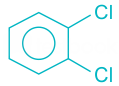
  • Classification: This is the process of organizing organisms into hierarchical groups based on their evolutionary relationships and shared characteristics. Classification involves grouping organisms into categories such as kingdom, phylum, class, order, family, genus, and species.
73

Three germ layer and Mesoderm lines space called

  1. ((a))

    Coelom

  2. ((b))

    Pseudocoelom

  3. ((c))

    Acoelom

  4. ((d))

    None of these

Show Answer
Answer: ((a))

Coelom

The correct answer is Coelom

Explanation:

  • During the embryonic development of triploblastic animals, three primary germ layers are formed: the ectoderm, mesoderm, and endoderm.
  • The coelom is a fluid-filled cavity that lies within the mesoderm and is lined by mesodermal tissue.
  • This cavity allows for the development and expansion of internal organs and provides a space for them to move independently of the body wall.

Fig: Diagrammatic sectional view of (a) Coelomate (b) Pseudocoelomate (c) Acoelomate

Other Options:

  • Pseudocoelom: A pseudocoelom is a body cavity that is not fully lined by mesodermal tissue. Instead, it is partially lined by tissue derived from the mesoderm and endoderm. This type of body cavity is found in pseudocoelomate animals, such as roundworms (Nematoda). It does not provide as much structural support or organ development potential as a true coelom.
  • Acoelom: Acoelomate animals lack a body cavity altogether. Their internal organs are embedded directly within solid mesodermal tissue. This condition is seen in simpler animals such as flatworms (Platyhelminthes). The absence of a coelom limits the complexity and size of these organisms.
74

Bond in the DNA chain

  1. ((a))

    Phosphodiester

  2. ((b))

    Hydrogen

  3. ((c))

    Glycosidic bond

  4. ((d))

    All of these

Show Answer
Answer: ((d))

All of these

The correct answer is All of these

Concept:

  • DNA, or deoxyribonucleic acid, is the molecule that carries the genetic instructions used in the growth, development, functioning, and reproduction of all known living organisms and many viruses.
  • The DNA chain is composed of nucleotides, each containing a phosphate group, a sugar molecule (deoxyribose), and a nitrogenous base.

Explanation:

  • Phosphodiester Bond:
  • This type of bond forms the backbone of the DNA strand.
  • It connects the 5'-phosphate group of one nucleotide to the 3'-hydroxyl group of another nucleotide, creating a strong covalent linkage.
  • Hydrogen Bond:
  • DNA is a double-stranded helical molecule. The two strands are complementary and anti-parallel.
  • The hydrogen bonds between the paired bases (A-T and G-C), repeated along the length of the DNA double helix, hold the two strands together in the double helix.
  • There are two hydrogen bonds between Adenine and Thymine base pair, whereas, there are three hydrogen bonds between Guanine and Cytosine base pair.

  • Glycosidic Bond: This type of bond connects the nitrogenous base to the sugar molecule (deoxyribose) in a nucleotide.

75

Incorrect statement about metaphase stage.

  1. ((a))

    Spindle fibres are attached to small disc-shaped structure at the surface of centromeres called kinetochores.

  2. ((b))

    The plane of alignment of the homologous pair of chromosomes at metaphase is referred to as metaphasic plate.

  3. ((c))

    Chromosomes appear to be made up of two sister chromatids.

  4. ((d))

    Centromere division.

Show Answer
Answer: ((d))

Centromere division.

The correct answer is Centromere division

Explanation:

Metaphase is a stage of mitosis in the eukaryotic cell cycle where chromosomes align in the middle of the cell before being separated into each of the two daughter cells. During metaphase, the chromosomes become highly condensed, making them easier to observe under a microscope.

  • Spindle fibers are attached to small disc-shaped structures at the surface of centromeres called kinetochores: This is a correct statement. During metaphase, the spindle fibers attach to the kinetochores, which are protein complexes assembled on the centromere of each chromosome.
  • The plane of alignment of the homologous pair of chromosomes at metaphase is referred to as the metaphase plate: This is a correct statement. The metaphase plate is an imaginary plane that is equidistant from the two centrosome poles and is where chromosomes align during metaphase.
  • Chromosomes appear to be made up of two sister chromatids: This is a correct statement. Each chromosome during metaphase consists of two sister chromatids, which are identical copies of the original chromosome, connected by a centromere.
  • Centromere division: This is the incorrect statement. Centromere division, or the separation of sister chromatids, occurs during anaphase, not during metaphase. During metaphase, the chromosomes are merely aligned at the metaphase plate.
76

Incorrect about Trichome

  1. ((a))

    Unicellular

  2. ((b))

    Multicellular

  3. ((c))

    Present in stem

  4. ((d))

    Epidermal tissue system

Show Answer
Answer: ((a))

Unicellular

The correct answer is Unicellular

Explanation:

  • Trichomes are hair-like outgrowths of the epidermis in plants. They can be found on stems, leaves, and reproductive organs.
  • These structures serve various functions such as protection against herbivores, reducing water loss, and sometimes aiding in seed dispersal.
  • Trichomes are generally multicellular, consisting of multiple cells forming the hair-like structures.
  • Trichomes originate from the epidermal tissue system, which is the outermost layer of cells in plants. This tissue system plays a crucial role in protection and interaction with the environment.
77

Sliding theory states that

  1. ((a))

    Actin and myosin filaments shorten and slide past each other.

  2. ((b))

    When myofilaments slide past each other, shortening of actin filaments occur.

  3. ((c))

    When myofilaments slide past each other shortening of myosin filaments occur.

  4. ((d))

    Actin and myosin filaments do not shorten they only past each other.

Show Answer
Answer: ((d))

Actin and myosin filaments do not shorten they only past each other.

The correct answer is Actin and myosin filaments do not shorten they only pass each other.

Concept:

  • The sliding filament theory is a widely accepted explanation for how muscles contract to produce force. It was first proposed by scientists Huxley and Hanson in the 1950s.
  • According to this theory, muscle contraction occurs when the thin actin filaments slide past the thick myosin filaments, causing the sarcomere (the functional unit of a muscle fiber) to shorten.
  • During contraction, the myosin heads bind to actin, forming cross-bridges, and then pull the actin filaments toward the center of the sarcomere through a series of power strokes.
  • This sliding of filaments does not involve any shortening of the filaments themselves; instead, it is the relative movement of the actin and myosin filaments that leads to muscle contraction.

Explanation:

Actin and myosin filaments do not shorten; they only pass each other.

  • This is the correct answer. The sliding filament theory describes that during muscle contraction, the actin and myosin filaments slide past one another without changing their length, leading to the shortening of the sarcomere and thus the muscle itself.

Other Options:

  • Actin and myosin filaments shorten and slide past each other.
  • This is incorrect because the actin and myosin filaments do not shorten during muscle contraction. They remain the same length but slide past each other to create the shortening of the muscle.
  • When myofilaments slide past each other, shortening of actin filaments occur.
  • This is incorrect because actin filaments do not shorten. The sliding filament theory specifies that it is the sliding of the filaments, not their shortening, that leads to muscle contraction.
  • When myofilaments slide past each other, shortening of myosin filaments occur.
  • This is incorrect because myosin filaments do not shorten. Similar to actin, the myosin filaments remain the same length and it is their sliding action relative to the actin filaments that causes contraction.
78

Tidal volume

  1. ((a))

    2500 - 3000 ml

  2. ((b))

    500 ml

  3. ((c))

    1100 - 1200 ml

  4. ((d))

    1000 - 1100 ml

Show Answer
Answer: ((b))

500 ml

The correct answer is 500 ml

Explanation:

  • Tidal volume (TV) is the volume of air moved into or out of the lungs during normal, quiet breathing.
  • Tidal Volume (TV) is the Volume of air inspired or expired during normal respiration. It is approx. 500 mL., i.e., a healthy man can inspire or expire approximately 6000 to 8000 mL of air per minute.

 Additional Information

  • Inspiratory capacity (IC)  - Total volume of air a person can inspire after a normal expiration. This includes tidal volume and inspiratory reserve volume (TV+IRV).
  • Expiratory Capacity (EC): Total volume of air a person can expire after a normal inspiration. This includes tidal volume and expiratory reserve volume (TV+ERV).
  • Vital Capacity (VC) - The maximum volume of air a person can breathe in after a forced expiration. This includes ERV, TV and IRV
  • Residual Volume (RV) - Volume of air remaining in the lungs even after a forcible expiration. This averages 1100 mL to 1200 mL.
  • Functional Residual Capacity (FRC): Volume of air that will remain in the lungs after a normal expiration. This includes ERV+RV.
79

Match the names of the scientists with their contributions and choose the correct answer.

Column-I ContributionsColumn-II Name of scientists
A.PCR(i)Hershey & Chase
B.DNA Fingerprinting(ii)Kary Mullis
C.DNA genetic material(iii)Messelson & Stahl
D.Semiconservative replication(iv)Alec Jeffreys
  1. ((a))

    A-(iii), B-(ii), C-(iv), D-(i)

  2. ((b))

    A (ii), B-(iv), C-(i), D-(iii)

  3. ((c))

    A-(ii), B-(iii), C-(i), D-(iv)

  4. ((d))

    A-(ii), B-(iv), C-(iii), D-(i)

Show Answer
Answer: ((b))

A (ii), B-(iv), C-(i), D-(iii)

The correct answer is A-(ii), B-(iv), C-(i), D-(iii).

Explanation:

  • A. PCR - Kary Mullis (ii):
  • Polymerase Chain Reaction (PCR) is a technique used to amplify a segment of DNA, producing millions of copies of a particular DNA sequence.
  • Kary Mullis developed the PCR technique in 1983, which revolutionized molecular biology and genetic research.
  • B. DNA Fingerprinting - Alec Jeffreys (iv):
  • DNA fingerprinting is a method used to identify individuals based on their unique DNA profiles.
  • Alec Jeffreys developed DNA fingerprinting in 1984, which has applications in forensic science, paternity testing, and genetic studies.
  • C. DNA as genetic material - Hershey & Chase (i):
  • In 1952, Alfred Hershey and Martha Chase conducted experiments using bacteriophages to demonstrate that DNA is the genetic material, not protein.
  • D. Semiconservative replication - Meselson & Stahl (iii):
  • Matthew Meselson and Franklin Stahl conducted experiments in 1958 that demonstrated DNA replication is semiconservative. This means that each new DNA molecule consists of one old strand and one new strand.
80

Match the following (column-I with column-II).

Column-I (Microbes)Column-II (Organic acid)
A.Aspergillus niger(i)Butyric acid
B.Clostridium butylicum(ii)Citric acid
C.Acetobacter aceti(iii)Lactic acid
D.Lactobacillus(iv)Acetic acid
  1. ((a))

    A-(i), B-(iii), C-(iv), D-(ii)

  2. ((b))

    A-(iii), B-(i), C-(iv), D-(ii) 

  3. ((c))

    A-(ii), B-(i), C-(iv), D-(iii)

  4. ((d))

    A-(i), B-(ii), C-(iii), D-(iv)

Show Answer
Answer: ((c))

A-(ii), B-(i), C-(iv), D-(iii)

The correct answer is A-(ii), B-(i), C-(iv), D-(iii)

Explanation:

  • Aspergillus niger: This fungus is widely used in the industrial production of citric acid. It is known for its high yield of citric acid, which is used in food, pharmaceuticals, and other industries.
  • Clostridium butylicum: This bacterium is known for producing butyric acid, which is used in the synthesis of various chemicals and as a flavoring agent.
  • Acetobacter aceti: This bacterium is used in the production of acetic acid, which is commonly known as vinegar. It is essential in food preservation and as a condiment.
  • Lactobacillus: This genus of bacteria is involved in the production of lactic acid, which is used in the dairy industry, pharmaceuticals, and as a preservative. Hence, D-(iii) is correct.
81

Sleep wake cycle regulated by

  1. ((a))

    Melatonin (pineal gland) 

  2. ((b))

    GH (pituitary gland)

  3. ((c))

    Adrenaline (adrenal gland)

  4. ((d))

    Thyroxin (thyroid gland)

Show Answer
Answer: ((a))

Melatonin (pineal gland) 

The correct answer is Melatonin (pineal gland)

Explanation:

  • The sleep-wake cycle, also known as the circadian rhythm, is a natural, internal process that regulates the sleep-wake cycle and repeats roughly every 24 hours. It is influenced by various factors, but the primary regulator is the hormone melatonin, which is produced by the pineal gland in the brain.
  • Melatonin is often referred to as the "sleep hormone" because it is responsible for signaling the body to prepare for sleep as it gets dark outside.
  • Melatonin also influences metabolism, pigmentation, the menstrual cycle as well as our defense capability.

Other Options:

  • Growth Hormone (GH) (pituitary gland): GH is produced by the pituitary gland and primarily stimulates growth, cell reproduction, and cell regeneration. It plays an important role in human development.
  • Adrenaline (adrenal gland): Adrenaline, also known as epinephrine, is a hormone and neurotransmitter produced by the adrenal glands. It is part of the body's fight-or-flight response and prepares the body for a quick reaction in stressful situations. Adrenaline increases heart rate, muscle strength, blood pressure, and sugar metabolism.
  • Thyroxin (thyroid gland): Thyroxin, or T4, is a hormone produced by the thyroid gland. It regulates metabolism, heart rate, and growth and development.
82

Heart Dub sound originated from

  1. ((a))

    closure of S.L.V.

  2. ((b))

    closure of A.V.

  3. ((c))

    closure of T.V.

  4. ((d))

    closure of V.V.

Show Answer
Answer: ((a))

closure of S.L.V.

The correct answer is closure of S.L.V.

Explanation:

  • The heart produces characteristic sounds, commonly referred to as the "lub-dub" sounds, which are crucial for diagnosing heart conditions.
  • The "lub" sound, known as the first heart sound (S1), is produced by the closure of the atrioventricular (AV) valves, which include the mitral and tricuspid valves.
  • The "dub" sound, known as the second heart sound (S2), is produced by the closure of the semilunar valves (SLV), which include the aortic and pulmonary valves.
83

Glycolysis end product is

  1. ((a))

    PGA

  2. ((b))

    Pyruvic Acid (PA)

  3. ((c))

    Acetyl CoA

  4. ((d))

    Citric Acid

Show Answer
Answer: ((b))

Pyruvic Acid (PA)

The correct answer is Pyruvic Acid (PA)

Concept:

  • Glycolysis is the metabolic pathway that converts glucose (C6H12O6) into pyruvate, releasing energy and forming ATP (adenosine triphosphate) and NADH (nicotinamide adenine dinucleotide).
  • It is the first step in cellular respiration and occurs in the cytoplasm of the cell.
  • Glycolysis does not require oxygen (anaerobic process), making it essential for both aerobic and anaerobic organisms.

Explanation:

  • PGA (Phosphoglycerate): This is an intermediate compound formed during glycolysis, not the end product. Specifically, 3-phosphoglycerate is formed in the middle stages of glycolysis.
  • Pyruvic Acid (PA): The end product of glycolysis. Each molecule of glucose is converted into two molecules of pyruvic acid. This pyruvate can then be used in the Krebs cycle (aerobic respiration) or fermentation (anaerobic processes).
  • Acetyl CoA: This is not a direct product of glycolysis. Pyruvic acid undergoes oxidative decarboxylation to form Acetyl CoA before entering the Krebs cycle.
  • Citric Acid: This is a product of the Krebs cycle, not glycolysis. It is formed when Acetyl CoA combines with oxaloacetic acid in the first step of the Krebs cycle.

Fig: Steps in Glycolysis

84

Which is not a product of light reaction?

  1. ((a))

    NADPH

  2. ((b))

    H2O

  3. ((c))

    O

  4. ((d))

    ATP

Show Answer
Answer: ((b))

H2O

The correct answer is H2O

Explanation:

  • The light reaction, also known as the light-dependent reaction, is the first stage of photosynthesis where light energy is converted into chemical energy.
  • During this process, light energy is captured by chlorophyll and used to produce ATP and NADPH, which are used in the Calvin cycle, the second stage of photosynthesis.
  • Water (H2O) is split into oxygen, protons, and electrons in a process known as photolysis. The electrons are used to replace those lost by chlorophyll in the light reaction.
  • NADPH: This is one of the main products of the light reaction. It is generated when the electrons from the water splitting process are ultimately transferred to NADP+, forming NADPH.
  • H2O: This is not a product of the light reaction but rather a reactant. Water is consumed during the light-dependent reactions, where it is split into oxygen, protons, and electrons.
  • O2: This is a product of the light reaction. Oxygen is released into the atmosphere as a byproduct of the splitting of water molecules during photolysis.
  • ATP: This is another key product of the light reaction. The energy from light is used to convert ADP and inorganic phosphate into ATP via a process called photophosphorylation.

85

Which type of antibody present in colostrum

  1. ((a))

    IgG

  2. ((b))

    IgM

  3. ((c))

    IgA

  4. ((d))

    IgE

Show Answer
Answer: ((c))

IgA

The correct answer is IgA

Explanation:

  • Colostrum is the first form of milk produced immediately following the delivery of the newborn.
  • It is rich in antibodies, especially IgA, which play a crucial role in providing immunity to the newborn during the first few days of life.
  • IgA antibodies are essential for mucosal immunity and are found in high concentrations in colostrum.
  • It plays a significant role in protecting the mucous membranes lining the respiratory and gastrointestinal tracts. By providing passive immunity, IgA helps to safeguard the newborn from infections during the early stages of life.

Other Options:

  • IgG: While Immunoglobulin G (IgG) is the most common antibody in blood and extracellular fluid, providing long-term protection. IgG is mainly transferred to the newborn through the placenta during pregnancy.
  • IgM: Immunoglobulin M (IgM) is the first antibody to respond to an infection and is primarily found in the blood and lymphatic fluid.
  • IgE: Immunoglobulin E (IgE) is associated with allergic reactions and is found in very small amounts in the body.
86

ABA is a derivative of

  1. ((a))

    Carotenoids 

  2. ((b))

    Adenine

  3. ((c))

    IAA

  4. ((d))

    ABA

Show Answer
Answer: ((a))

Carotenoids 

The correct answer is Carotenoids

Concept:

  • Abscisic acid (ABA) is a plant hormone that plays an important role in regulating plant growth, development, and stress responses. It is particularly known for its role in seed dormancy and response to environmental stresses such as drought.
  • ABA is synthesized in the plastids of plant cells from carotenoids, which are pigments that also contribute to photosynthesis and photoprotection.

Explanation:

  • Carotenoids: These are organic pigments found in the chloroplasts and chromoplasts of plants and some other photosynthetic organisms. ABA is derived from carotenoids, specifically through the oxidative cleavage of carotenoids such as violaxanthin and neoxanthin.
  • Adenine: This is a nucleobase (a purine derivative) used in the formation of nucleotides of DNA and RNA. It is not related to the synthesis of ABA.
  • IAA (Indole-3-Acetic Acid): This is a major plant hormone known as auxin, which is involved in cell elongation, root growth, and other growth processes. It is not a precursor or derivative of ABA.
  • ABA: This is the hormone in question and not its precursor. The question is specifically about the derivative or precursor of ABA.
87

Adenine derivative is

  1. ((a))

    ABA

  2. ((b))

    Auxin

  3. ((c))

    Cytokinin/Kinetin

  4. ((d))

    GA

Show Answer
Answer: ((c))

Cytokinin/Kinetin

The correct answer is Cytokinin/Kinetin

Explanation:

  • The plant growth regulators (PGRs) are small, simple molecules of diverse chemical composition.
  • They could be indole compounds (indole-3-acetic acid, IAA); adenine derivatives (N6 -furfurylamino purine, kinetin), derivatives of carotenoids (abscisic acid, ABA); terpenes (gibberellic acid,GA3) or gases (ethylene, C2H4).
  • Adenine derivatives are a class of plant hormones that include cytokinins. These compounds are derived from the adenine molecule, which is one of the four nucleotides in DNA and RNA.
  • Cytokinins are involved in various plant growth processes such as cell division, shoot and root growth, and the delay of senescence (aging).
  • Kinetin is one of the most well-known cytokinins and was the first to be discovered. It is used in tissue culture to stimulate cell division.

Other Options:

  • ABA (Abscisic Acid): This is a plant hormone involved in many plant developmental processes, including seed dormancy, leaf senescence, and response to environmental stress. It is a derivative of carotenoids.
  • Auxin: This is another class of plant hormones that play a critical role in the regulation of plant growth and development, particularly in cell elongation and the directional growth of roots and shoots.
  • GA (Gibberellins): These are a group of plant hormones that regulate growth and influence various developmental processes, including stem elongation, germination, and flowering. It is classified as a terpene.
88

Which neuron have one dendron and one axon

  1. ((a))

    multipolar

  2. ((b))

    bipolar

  3. ((c))

    apolar

  4. ((d))

    pseudopolar

Show Answer
Answer: ((b))

bipolar

The correct answer is bipolar

Concept:

  • Neurons are specialized cells of the nervous system that transmit signals throughout the body.
  • They consist of a cell body (soma), dendrites, and an axon.
  • Neurons can be classified based on the number of processes extending from their cell body.

Explanation:

  • Bipolar neurons:
  • These neurons have one dendron and one axon.
  • They are primarily found in sensory organs such as the retina of the eye, the olfactory epithelium, and the cochlear and vestibular ganglia of the ear.
  • The structure allows them to effectively transmit sensory information to the central nervous system.
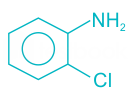
  • Multipolar neurons:
  • These neurons have one axon and multiple dendrites.
  • They are the most common type of neuron in the human body and are primarily found in the brain and spinal cord.
  • Their multiple dendrites allow them to integrate a large amount of information from other neurons.
  • Apolar neurons:
  • These neurons do not have distinct axons or dendrites.
  • They are not typically found in the human nervous system and are more common in simpler organisms.
  • Pseudounipolar neurons:
  • These neurons have a single process that branches into two extensions: one that functions like a dendrite and one that functions like an axon.
  • They are commonly found in sensory ganglia of the peripheral nervous system.

  • This structure allows them to quickly transmit sensory information to the spinal cord.
89

Which of following does not cause degradation of the cell wall

  1. ((a))

    Lipase

  2. ((b))

    Pectinase

  3. ((c))

    Lysozyme

  4. ((d))

    Chitinase

Show Answer
Answer: ((a))

Lipase

The correct answer is Lipase

Concept:

  • The cell wall is a crucial structure in many organisms, providing support and protection. Various enzymes can degrade the cell wall by breaking down its components.
  • Different enzymes target specific components of the cell wall, such as proteins, polysaccharides, and other biopolymers.

Explanation:

  • Lipase: Lipase is an enzyme that breaks down lipids (fats) into fatty acids and glycerol. It does not target cell wall components, hence does not cause degradation of the cell wall.
  • Pectinase: Pectinase breaks down pectin, a polysaccharide found in the cell walls of plants, making it effective in degrading plant cell walls.
  • Lysozyme: Lysozyme is an enzyme that degrades the peptidoglycan layer of bacterial cell walls, making it effective in breaking down bacterial cell walls.
  • Chitinase: Chitinase breaks down chitin, a component of fungal cell walls, thus it is involved in the degradation of fungal cell walls.
90

Female heterogamety is

  1. ((a))

    XX - XY

  2. ((b))

    ZW - ZZ

  3. ((c))

    XX - XO

  4. ((d))

    YY - XX

Show Answer
Answer: ((b))

ZW - ZZ

The correct answer is ZW - ZZ

Explanation:

  • Sex-determination mechanisms vary among different organisms. One of the mechanisms is female heterogamety.
  • Heterogametic sex refers to the sex that has two different sex chromosomes, while homogametic sex has two of the same kind.
  • In female heterogamety, females have two different types of sex chromosomes (e.g., ZW), while males have two of the same type (e.g., ZZ)
  • ZW - ZZ: In this system, females are ZW (heterogametic), and males are ZZ (homogametic). This system is common in birds, some fish, and some insects. The Z chromosome carries genes essential for development, while the W chromosome often determines femaleness.
  • XX - XY: This is not an example of female heterogamety. In this system, males are the heterogametic sex (XY), and females are the homogametic sex (XX). This system is found in humans and many other mammals.
  • XX - XO: This is also not an example of female heterogamety. In this system, females are the homogametic sex (XX), and males have only one X chromosome and no corresponding Y chromosome (XO). This system is found in certain insects, such as grasshoppers.
  • YY - XX: This option is incorrect because it does not represent any known sex determination system. Typically, the Y chromosome is associated with males, and the XX combination is associated with females.
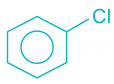
91

The hormone that maintains the endometrium.
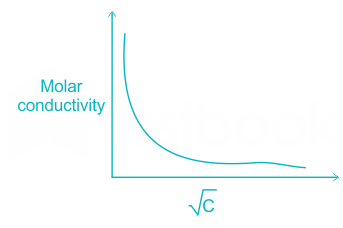
  1. ((a))
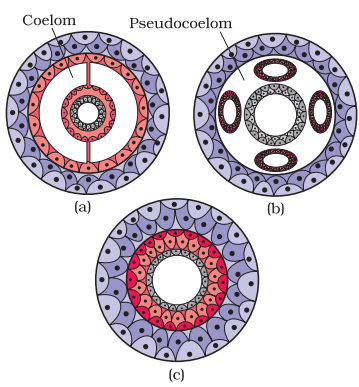
    Estrogen

  2. ((b))

    Progesterone

  3. ((c))

    Relaxin

  4. ((d))

    Androgen

Show Answer
Answer: ((b))

Progesterone

The correct answer is Progesterone

Explanation:

  • The endometrium is the inner lining of the uterus, which thickens in preparation for the potential implantation of an embryo.
  • Progesterone is the hormone primarily responsible for maintaining the endometrium, ensuring it is suitable for embryo implantation and supporting early pregnancy.
  • Progestrone hormone is produced by the corpus luteum in the ovary after ovulation. Progesterone maintains the endometrium, making it receptive to implantation by an embryo and supporting early stages of pregnancy. If pregnancy does not occur, progesterone levels fall, leading to the shedding of the endometrial lining during menstruation.

Other Options:

  • Estrogen: Estrogen is a hormone that plays a key role in regulating the menstrual cycle and the development of female secondary sexual characteristics. It helps in the initial thickening of the endometrium but does not maintain it.
  • Relaxin: Relaxin is a hormone produced by the ovaries and the placenta. It plays a role in relaxing the ligaments in the pelvis and softening and widening the cervix during childbirth.
  • Androgen: Androgens are a group of hormones, including testosterone, that are typically associated with male traits and reproductive activity.
92

Bt-toxin is activated in

  1. ((a))

    alkaline pH of gut

  2. ((b))

    Acidic pH of gut

  3. ((c))

    Neutral pH of gut

  4. ((d))

    None of these

Show Answer
Answer: ((a))

alkaline pH of gut

The correct answer is an alkaline pH of gut

Explanation:

Bacillus thuringiensis is a bacterium that produces proteins toxic to certain insects. These proteins are used in genetically modified crops to provide resistance against insect pests. The Bt toxin, produced by Bacillus thuringiensis, is toxic to insect pests. It is not active in the bacterial form but becomes active once ingested by the insect.

  • The Bt toxin is produced in an inactive form (protoxin). When an insect ingests the Bt plant, the protoxin is converted to an active form in the insect's gut, leading to the insect's death.
  • The conversion of the protoxin to the active toxin occurs in the alkaline environment of the insect's gut. This active toxin binds to the gut cells, creating pores and causing cell lysis, leading to the insect's death.
  • Insects that feed on Bt plants have an alkaline pH in their gut, which activates the Bt protoxin.
  • The active toxin binds to receptors in the gut cells, forming pores and causing cell death. This disrupts the digestive system of the insect, eventually leading to its death.
93

Which component of blood is not related to blood coagulation?

  1. ((a))

    Plasma

  2. ((b))

    Serum

  3. ((c))

    Fibrinogen

  4. ((d))

    Thrombin

Show Answer
Answer: ((b))

Serum

The correct answer is Serum

Explanation:

  • The blood coagulation process, also known as blood clotting, is a complex mechanism that involves various components of the blood. This process is essential for preventing excessive bleeding when blood vessels are injured.
  • Key components involved in blood coagulation include plasma, fibrinogen, and thrombin. These elements work together to form a clot and stop bleeding.
  • Plasma: Plasma is the liquid portion of blood that carries cells and proteins throughout the body. It contains clotting factors that are crucial for the blood coagulation process. When blood clotting is initiated, these factors are activated to form a clot.
  • Fibrinogen: Fibrinogen is a plasma protein that plays a critical role in blood clotting. It is converted into fibrin by the action of thrombin, forming a mesh that helps to stabilize the blood clot.
  • Thrombin: Thrombin is an enzyme that is essential in the coagulation process. It converts fibrinogen into fibrin, which then forms a stable clot to prevent bleeding.

Serum: Serum is the liquid part of blood that remains after blood has clotted. It does not contain clotting factors because they are consumed in the clotting process. Therefore, serum is not involved in blood coagulation.

94

In 100 ml deoxygenated blood, blood carries _______ ml CO2 to alveoli.

  1. ((a))

    4 ml

  2. ((b))

    5 ml

  3. ((c))

    15 ml

  4. ((d))

    20 ml

Show Answer
Answer: ((a))

4 ml

The correct answer is 4 ml

Explanation:

  • The transport of carbon dioxide (CO2) in the blood is a critical process for maintaining the body’s acid-base balance and for the removal of metabolic waste.
  • CO2 is carried in the blood from the tissues to the lungs, where it is exhaled.
  • In deoxygenated blood, CO2 is transported in three main forms: dissolved in plasma, as bicarbonate ions (HCO3-), and bound to hemoglobin as carbaminohemoglobin.
  • The majority of CO2 is carried in the form of bicarbonate ions, but a significant portion is also carried dissolved in plasma and attached to hemoglobin.
  • The correct amount of CO2 carried by 100 ml of deoxygenated blood to the alveoli is 4 ml.  The CO2 is transported from the tissues to the lungs where it is expelled during exhalation.
95

Where is maximum diversity found?

  1. ((a))

    Species

  2. ((b))

    Phylum

  3. ((c))

    Family

  4. ((d))

    Genus

Show Answer
Answer: ((b))

Phylum

The correct answer is Phylum

Concept:

  • In biological classification, the hierarchy of taxa includes several levels, from broad to specific. These levels are Domain, Kingdom, Phylum, Class, Order, Family, Genus, and Species.
  • Each level represents a rank in the classification system, where Phylum is one of the higher taxonomic ranks.
  • Phylum groups together organisms that share a basic structural framework and certain key characteristics, making it a level with high diversity.

Fig: Taxonomic categories showing hierarchial arrangement in ascending order.

Explanation:

  • Species: The species level is the most specific level of classification. It groups organisms that are capable of interbreeding and producing fertile offspring. While there is diversity within species, it is limited compared to higher taxonomic levels.
  • Phylum: This is a higher taxonomic rank that groups together organisms based on fundamental body plans and structures.
  • Family: This rank is more specific than Order but more inclusive than Genus. It groups together related genera (plural of genus).
  • Genus: This is a rank above species and below family. It includes one or more species that are closely related
96

Which has the least similarity?

  1. ((a))

    Species

  2. ((b))

    Phylum

  3. ((c))

    Family

  4. ((d))

    Genus

Show Answer
Answer: ((b))

Phylum

The correct answer is Phylum

Explanation:

  • In biological classification, the hierarchy of taxonomic ranks is used to organize and categorize organisms in a systematic manner.
  • Each rank represents a different level of organization and relationship among organisms.
  • The main taxonomic ranks include Domain, Kingdom, Phylum/Division, Class, Order, Family, Genus, and Species.
  • As we go higher from species to kingdom, the number of common characteristics goes on decreasing.
  • The lower the taxa, the more are the characteristics that the members within the taxon share.
  • The higher the category, greater is the difficulty of determining the relationship to other taxa at the same level.

Fig: Taxonomic categories showing hierarchial arrangement in ascending order.

In conclusion, Phylum has the least similarity among its members compared to Species, Family, and Genus because it is a higher taxonomic rank that groups organisms based on very broad characteristics.

97

Which relationship does Lichen show?

  1. ((a))

    Commensalism

  2. ((b))

    Parasitism

  3. ((c))

    Mutualism

  4. ((d))

    Amensalism

Show Answer
Answer: ((c))

Mutualism

The correct answer is Mutualism

Explanation:

  • Lichens are symbiotic associations between fungi and algae or cyanobacteria. This partnership is a classic example of mutualism, where both organisms benefit from each other.
  • The fungus provides the structure and protection for the algae or cyanobacteria, while the algae or cyanobacteria perform photosynthesis to produce food that benefits the fungus.
  • Lichens can thrive in harsh environments where neither the fungus nor the algae could survive alone, such as on rocks, tree bark, and other exposed surfaces.

Other Options:

  • Commensalism: This is an interaction where one organism benefits, and the other is neither helped nor harmed. An example would be barnacles on a whale.
  • Parasitism: In parasitism, one organism (the parasite) benefits at the expense of the other organism (the host). An example would be tapeworms in the intestines of animals.
  • Amensalism: This is a type of interaction where one organism is inhibited or destroyed while the other remains unaffected. An example would be the release of antibiotics by fungi that kill surrounding bacteria.

Additional Information

Species ASpecies BName of InteractionsExamples
++MutualismFungi and root of a higher plant in Mycorrtizae
--CompetitionA Leopard and a Lion in a forest/grassland
+-PredationIn the rocky intertidal communities of the American Pacific Coast the starfish Pisaster is an important predator.
+-ParasitismA Cuckoo laying egg in a Crow's nest (Brood Parasitism)
+0CommensalismA cattle egret and a Cattle in a field
-0AmensalismGrazing cattle and insects. When cattle graze in grass, birds eat the insects, but the cattle are unharmed.
98

Balanoglossus is a member of which phylum?

  1. ((a))

    Arthropoda

  2. ((b))

    Mollusca

  3. ((c))

    Coelenterata

  4. ((d))

    Hemichordata

Show Answer
Answer: ((d))

Hemichordata

The correct answer is Hemichordata

Explanation:

  • Hemichordata is a small phylum of marine deuterostome animals, generally considered the sister group of the echinoderms.
  • Hemichordata consists of a small group of worm-like marine animals with the organ-system level of organisation.
  • They are bilaterally symmetrical, triploblastic and coelomate animals.
  • The body is cylindrical and is composed of an anterior proboscis, a collar and a long trunk.
  • Examples of Hemichordata are Balanoglossus and Saccoglossus.

Other Options:

  • Arthropoda: This is the largest phylum in the animal kingdom, including insects, arachnids, and crustaceans. They have segmented bodies, exoskeletons, and jointed appendages. Examples are Apis (Honey bee), Bombyx (Silkworm), Laccifer (Lac insect), Anopheles, Culex and Aedes (Mosquitoes) Locusta (Locust), living fossil – Limulus (King crab).
  • Mollusca: This phylum includes soft-bodied animals, many of which have hard external shells, such as snails, clams, and squids. Mollusks have a distinct body plan that includes a muscular foot, visceral mass, and mantle. Examples are Pila.
  • Coelenterata (Cnidaria): This phylum comprises aquatic animals like jellyfish, corals, and sea anemones. They are characterized by their radial symmetry, a simple body plan with a single opening, and specialized stinging cells called cnidocytes. Examples are Obelia, Aurelia
99

Which one is not a false fruit?

  1. ((a))

    Apple 

  2. ((b))

    Strawberry

  3. ((c))

    Cashew

  4. ((d))

    Mango

Show Answer
Answer: ((d))

Mango

The correct answer is Mango

Explanation:

  • Fruits are typically classified as true fruits and false fruits based on the part of the plant they develop from.
  • True fruits develop from the ovary of a flower and contain seeds, while false fruits develop from other parts of the flower, such as the receptacle or calyx.
  • Mango is a true fruit as it develops from the ovary of the flower and contains the seed(s) within.
  • Apple: This is a false fruit because it develops from the receptacle of the flower rather than the ovary. The fleshy part we eat is derived from the enlarged receptacle.
  • Strawberry: This is also a false fruit. The fleshy part of the strawberry is derived from the receptacle, and the true fruits are the tiny seeds on its surface.
  • Cashew: The cashew apple is a false fruit, developed from the pedicel of the flower, while the true fruit is the cashew nut itself.
100

Enzyme/microorganism that helps in clot dissolution.

  1. ((a))

    Cyclosporin

  2. ((b))

    Pectinase

  3. ((c))

    Streptokinase

  4. ((d))

    Protease

Show Answer
Answer: ((c))

Streptokinase

The correct answer is Streptokinase

Explanation:

  • Cyclosporin: This is an immunosuppressive drug that is primarily used to prevent organ transplant rejection and to treat certain autoimmune conditions. Cyclosporin A is produced by the fungus Trichoderma polysporum.
  • Pectinase: This enzyme breaks down pectin, a polysaccharide found in plant cell walls. It is commonly used in the food industry, particularly in fruit juice production
  • Streptokinase: This is an enzyme produced by certain strains of Streptococci bacteria. It is used as a thrombolytic medication to dissolve blood clots in patients who have suffered from conditions like myocardial infarction, pulmonary embolism, and stroke. Streptokinase works by converting plasminogen to plasmin, which then breaks down fibrin, the main protein component of blood clots.
  • Protease: This is a general term for enzymes that break down proteins.

Attempt this paper under real exam conditions

Timed interface, section switching, instant scoring, and question-by-question analytics — free.

Start Timed Attempt