Official Paper

SBI Clerk Prelims Memory Based Paper (Held On: 27 February 2025 Shift 1) (Previous Year Paper)

100 questions · 60 minutes · with answers · free

English Language (30 questions)

1

Directions: In the given question below, four sentences are given that may or may not contain an error. Choose the one that is grammatically as well as contextually correct and meaningful. If all the sentences are correct, mark "All are correct" as your answer.

  1. ((a))

    I has written that paper for more than seven hours.

  2. ((b))

    It is a place where most people knows each other.

  3. ((c))

    He has took a train to reach her mother.

  4. ((d))

    She crossed that channel on 4th Nov 1989.

  5. ((e))

    All are correct

Show Answer
Answer: ((d))

She crossed that channel on 4th Nov 1989.

The correct answer is- 'She crossed that channel on 4th Nov 1989.'

Key Points  

  • Option 1 is incorrect.
  • Have is used with the pronouns I, you, we, and they, while has is used with he, she, and it.
  • Example: I have played with her.
  • Thus, 'has' needs to be replaced by 'have'.
  • Correct Sentence: I have written that paper for more than seven hours.
  • Option 2 is incorrect.
  • The subject "most people" is a plural subject, so we need a plural helping verb (know) with it.
  • Example: Most people are using email instead of writing letters.
  • Correct Sentence: It is a place where most people know each other.
  • Option 3 is incorrect.
  • The present perfect is often used for an action that started at some time in the past and is still continuing now.
  • The present perfect is formed using the construction "Subject + has/have + V3."
  • Example: He has not received the phone.
  • ​So, we need to replace "took" with "taken."
  • Correct Sentence: He has taken a train to reach her mother.
  • Option 4 is correct.
  • It correctly follows the structure of a Simple Past Tense: Subject + V2 + Object
  • Example: We left the city on time.
  • So, the correct answer is Option 4.

Correct sentence: She crossed that channel on 4th Nov 1989.

2

Directions: In each of the questions below, four sentences are given. Choose the one that is grammatically as well as contextually incorrect. If all the sentences are correct, mark 'All are correct' as your answer.

  1. ((a))

    Either my mother or my brother is cooking dinner.

  2. ((b))

    This night we have an appointment at a big restaurant for a corporate meeting.

  3. ((c))

    Newt Gingrich's America's Greatest Challenge​ serves as a rallying cry for the American people and a plan of action for our leaders in government.

  4. ((d))

    Two gallons of water is too much to drink in a day.

  5. ((e))

    All are correct.

Show Answer
Answer: ((b))

This night we have an appointment at a big restaurant for a corporate meeting.

The correct answer is Option 2.

Key Points

  • Let us explore the grammatical errors in the sentences:
  • In Option 2, the use of the phrase 'This night' is incorrect.
  • The correct phrase is 'Tonight'.
  • Thus, the sentence should be 'Tonight we have an appointment at a big restaurant for a corporate meeting'.
  • In Option 1, the sentence is correct as given.
  • In Option 3, the sentence is correct as given.
  • In Option 4, the sentence is correct as given.

Hence, the correct answer is option 2.

3

In the following question, two columns are given containing three phrases each. In the first column phrases are A, B, C and in the second column, the phrases are D, E, F. A phrase from the first column may or may not connect with a phrase from the second column to make a grammatically and contextually correct sentence. There are five options, four of which display the sequence(s) in which the phrases can be joined to form a grammatically and contextually correct sentence. If none of the options given forms a correct sentence after combination, select ‘None of these' as your answer.

Column(1)Column(2)
(A) Those who sleep with dogs(D) prevents misfortune.
(B) Where the water is shallow,(E) will rise with fleas
(C) A tree gone septic where(F) stare me out.
  1. ((a))

    C-D and B-F

  2. ((b))

    A-E

  3. ((c))

    B-E

  4. ((d))

    A-F

  5. ((e))

    None of the above

Show Answer
Answer: ((b))

A-E

The correct answer is A-E.

Key Points

  • Part A states 'Those who sleep with dogs​​' and part E states 'will rise with flea'.
  • The phrase used means people must be cautious of the company they keep as it will affect their reputation.
  • Here, 'dogs' is used to refer to the kind of company with low status and 'fleas' refers to how a typical kind of company will affect us in future.
  • There is only one correct combination in the given options i.e. A-E is the correct combination.

The correct sentence is*,* A*-E:*** Those who sleep with dogs will rise with fleas.

Additional Information

Let us see the meanings of the other words:

Other wordsMeanings
misfortunean unfortunate condition or event.
shallownot exhibiting, requiring, or capable of serious thought.
septicinfected with microorganisms, especially harmful bacteria.
4

In the following question, two columns are given containing three phrases each. In the first column phrases are A, B, C and in the second column, the phrases are D, E, F. A phrase from the first column may or may not connect with a phrase from the second column to make a grammatically and contextually correct sentence. There are five options, four of which display the sequence(s) in which the phrases can be joined to form a grammatically and contextually correct sentence. If none of the options given forms a correct sentence after combination, select ‘None of these' as your answer.

Column(1)Column(2)
(A) The pollutants diffuse(D) a series of discrete steps.
(B) They wish that prices(E) would go down.
(C) It has been a most(F) into the soil.
  1. ((a))

    B-E and A-F

  2. ((b))

    A-E 

  3. ((c))

    B-F

  4. ((d))

    C-D

  5. ((e))

    None of the above

Show Answer
Answer: ((a))

B-E and A-F

The correct answer is B-E and A-F​.

Key Points

  • There are two correct combinations in the given options to form a meaningful sentence.
  • Part B and part E should join conceptually. Part B states 'They wish that prices' and part E completes the sentence stating 'would go down'.
  • B-E tells us that everyone wishes for prices to drop. So, B-E is the correct combination.
  • Part A and part F should join conceptually. Part A states 'The pollutants diffuse' and part F completes the sentence stating 'into the soil'.
  • In A-F, the word diffuse means 

spread out over a large area; not concentrated. Here, it's said that pollutants in soil spread over a wide area. 

So, A-F is the correct combination.

The correct sentences are:

  • B-E: They wish that prices would decline.
  • A-F: The pollutants diffuse into the soil.
5

In the following question, two columns are given containing three phrases each. In the first column phrases are A, B, C and in the second column, the phrases are D, E, F. A phrase from the first column may or may not connect with a phrase from the second column to make a grammatically and contextually correct sentence. There are five options, four of which display the sequence(s) in which the phrases can be joined to form a grammatically and contextually correct sentence. If none of the options given forms a correct sentence after combination, select ‘None of these' as your answer.

Column(1)Column(2)
(A)The change happens(D)  evidence for convicting him.
(B)They haven't produced any credible(E)  response from him.
(C)The training aeroplane(F)  has dual controls.
  1. ((a))

    B-D and C-F

  2. ((b))

    A-F 

  3. ((c))

    C-D

  4. ((d))

    B-E

  5. ((e))

    None of the above

Show Answer
Answer: ((a))

B-D and C-F

The correct answer is B-D and C-F.

Key Points

  • There are two correct combinations in the given options to form a meaningful sentence.
  • Part B and part D should join conceptually. Part B state 'They haven't produced any credible​' and part D completes the sentence stating 'evidence for convicting him'.
  • B-D, the word credible means able to be believed; convincing and convicting means to declare (someone) to be guilty of a criminal offence by the verdict of a jury. Here, it's said that they were not able to declare him guilty due to a lack of convincing evidence. So, B-D is the correct combination.
  • Part C and part F should join conceptually.  Part C states 'The training aeroplane​' and part F completes the sentence stating 'has dual controls'.
  • In C-F, aeroplane and its controls belong to the same context.  So, C-F is the correct combination.

The correct sentences are:

  • B-D: They haven't produced any credible evidence for convicting him.
  • C-F: The training aeroplane has dual controls.

Read the passage given below and then answer the questions given below the passage.

Manila, the pulsating heart of the Philippines, has witnessed a dramatic surge in tourism, driven largely by the city's vibrant street art and historical architecture. This influx, while boosting the local economy, has created a complex tapestry of benefits and burdens for its residents. The iconic Intramuros, a walled city showcasing Spanish colonial heritage, has become a photographer's paradise. Tourists, eager to snap that perfect Instagram shot, often congregate in narrow alleyways, disrupting the daily lives of those who call these streets home. The breath taking view of Manila Bay’s sunset, once a tranquil moment for locals, is now frequently obscured by selfie sticks and camera flashes. The problem isn't just the sheer number of visitors; it's the lack of respect for the community. Many residents complain about tourists entering their private courtyards without permission, turning their homes into unwitting backdrops. The constant noise and congestion have made simple tasks, like grocery shopping or commuting to work, a frustrating ordeal.

To address these issues, the local government has _________ several measures. Designated photography zones have been established in popular areas, encouraging tourists to capture their memories without impeding pedestrian flow. Cultural sensitivity workshops are being offered to tour guides, emphasising the importance of respecting local customs and privacy. Moreover, a system of "community ambassadors" has been introduced, where residents are trained to interact with tourists, provide information, and gently guide them towards responsible behaviour. However, the most controversial solution has been the temporary barricading of certain residential streets during peak tourist hours. While this has effectively reduced congestion, it has also sparked debate about accessibility and the balance between tourism and local life. Critics argue that it creates a sense of exclusion and hinders residents' freedom of movement. Supporters, on the other hand, maintain that it's a necessary step to preserve the quality of life for those who have lived in these neighbourhoods for generations. The debate continues, highlighting the delicate dance between promoting tourism and protecting the soul of Manila.

6

According to the passage, what is NOT a measure taken by the local government to address the issues caused by the influx of tourists?

  1. ((a))

    Establishing designated photography zones.

  2. ((b))

    Offering cultural sensitivity workshops to tour guides.

  3. ((c))

    Banning tourists from entering Intramuros.

  4. ((d))

    Introducing a system of "community ambassadors."

  5. ((e))

    Temporarily barricading certain residential streets during peak tourist hours.

Show Answer
Answer: ((c))

Banning tourists from entering Intramuros.

The correct answer is Option 3.


Key Points

  • The passage mentions several measures taken by the local government to address tourist-related issues.
  • These include establishing designated photography zones, offering cultural sensitivity workshops, introducing community ambassadors, and temporarily barricading residential streets.
  • Banning tourists from entering Intramuros is not mentioned as a measure taken by the local government.

Therefore, the correct answer is Option 3.


Additional Information

  • Designated photography zones: These zones help manage tourist activity without disrupting pedestrian flow.
  • Cultural sensitivity workshops: These workshops educate tour guides on respecting local customs and privacy.
  • Community ambassadors: Residents trained to manage tourists and promote respectful behavior.
  • Temporary barricading: Residential streets are temporarily barricaded during peak tourist hours to reduce congestion.
7

According to the passage, what has been an outcome of tourists congregating in narrow alleyways of Intramuros?

  1. ((a))

    Enhanced economic opportunities for local businesses.

  2. ((b))

    Disruption of daily lives of residents.

  3. ((c))

    Increased safety and security for tourists.

  4. ((d))

    Better preservation of historical sites.

  5. ((e))

    Less foot traffic in popular tourist areas.

Show Answer
Answer: ((b))

Disruption of daily lives of residents.

The correct answer is Option 2.


Key Points

  • Tourists congregating in narrow alleyways of Intramuros disrupt the daily lives of residents.
  • Residents experience inconvenience as tourists often gather in these areas.
  • Daily activities of locals are impacted by the presence of tourists eager to take photos.

Therefore, the correct answer is Option 2.


Additional Information

  • Designated photography zones: An initiative to reduce the inconvenience caused to residents by tourists.
  • Cultural sensitivity workshops: Educating tour guides to respect local customs and privacy.
  • Community ambassadors: Residents trained to manage tourists and promote respectful behavior.
8

Which of the following statements is true according to the passage?

  1. ((a))

    The local government has punished individuals who enter private courtyards without permission.

  2. ((b))

    The number of tourists in Manila has remained constant over the years.

  3. ((c))

    Cultural sensitivity workshops are offered to residents.

  4. ((d))

    The barricading of residential streets has reduced congestion.

  5. ((e))

    There are no complaints from residents about the influx of tourists.

Show Answer
Answer: ((d))

The barricading of residential streets has reduced congestion.

The correct answer is Option 4.


Key Points

  • Statement 1: The local government has punished individuals who enter private courtyards without permission.
  • This statement is incorrect as the passage does not mention any punitive measures taken by the local government against individuals who enter private courtyards without permission.
  • Statement 2: The number of tourists in Manila has remained constant over the years.
  • This statement is incorrect as the passage indicates that there has been a dramatic surge in tourism in Manila.
  • Statement 3: Cultural sensitivity workshops are offered to residents.
  • This statement is incorrect as the passage mentions that cultural sensitivity workshops are being offered to tour guides, not residents.
  • Statement 4: The barricading of residential streets has reduced congestion.
  • This statement is correct as the passage mentions that the temporary barricading of certain residential streets has effectively reduced congestion.
  • Statement 5: There are no complaints from residents about the influx of tourists.
  • This statement is incorrect as the passage clearly states that many residents have complained about the disruptions caused by tourists.

​Therefore, the correct answer is: ‘The barricading of residential streets has reduced congestion’.

9

According to the passage, which of the following statements is incorrect?

A) Many residents have complained about tourists entering their private courtyards without permission.

B) Designated photography zones have created more privacy issues for the residents.

C) Temporarily barricading residential streets has been a controversial solution.

  1. ((a))

    Only A

  2. ((b))

    Only B

  3. ((c))

    Only C

  4. ((d))

    A and C

  5. ((e))

    B and C

Show Answer
Answer: ((b))

Only B

The correct answer is Option 2.


Key Points

  • Statement A: Many residents have complained about tourists entering their private courtyards without permission.
  • This statement is correct as it accurately reflects the context provided in the passage.
  • Statement B: Designated photography zones have created more privacy issues for the residents.
  • The passage mentions that designated photography zones have been established to help manage tourism impact, but it does not claim that these zones have created more privacy issues for the residents.
  • Statement C: Temporarily barricading residential streets has been a controversial solution.
  • This statement is correct as it aligns with the information provided in the passage about the controversy surrounding the temporary barricading of streets.
  • Hence, the statement B is identified as incorrect in the context of the passage.
  • CopyCopy

Therefore, the correct answer is: ‘Only B’.

10

What will fit in the blank taken from the passage: “To address these issues, the local government has _________ several measures.”

  1. ((a))

    enacted

  2. ((b))

    planned

  3. ((c))

    overlooked

  4. ((d))

    ignored

  5. ((e))

    rejected

Show Answer
Answer: ((a))

enacted

The correct answer is 'enacted'.


Key Points

  • The word "enacted" means to make (a bill or other proposal) law. (अधिनियमित)
  • In the context of the passage, the local government has taken legal steps or established rules to address the issues caused by tourism.
  • The other options: "planned," "overlooked," "ignored," and "rejected" do not fit the context as appropriately.

​Therefore, the correct answer is 'Option 1'.

Complete Sentence: To address these issues, the local government has enacted several measures.

Additional Information

  • Planned (योजना बनाई): means deciding on and arranging in advance.
  • Overlooked (नज़रअंदाज किया): means failing to notice something.
  • Ignored (अनदेखा करना): means refusing to take notice of or acknowledge.
  • Rejected (अस्वीकृत किया): means dismissing as inadequate, unacceptable, or faulty.
11

Which of the following words is similar in meaning to “view” in the context of the passage?

  1. ((a))

    Sight

  2. ((b))

    Opinion

  3. ((c))

    Policy

  4. ((d))

    Review

  5. ((e))

    Belief

Show Answer
Answer: ((a))

Sight

The correct answer is: Option 1 i.e., Sight.

Key Points

  • The word "view" means the ability to see something or to be seen from a particular place. (दृश्य)
  • Example: The view of the mountains from my window is breathtaking.
  • "Sight" refers to the ability to see something or the act of seeing. (दृश्य)
  • Example: She was awestruck by the sight of the Grand Canyon.

​Therefore, the correct answer is: Sight.

Additional Information

Here are the other options explained along with their Hindi meanings and example sentences:

  • Opinion (राय): A belief or judgment that rests on grounds insufficient to produce complete certainty.
  • Example: In my opinion, the movie was quite interesting.
  • Policy (नीति): A course or principle of action adopted or proposed by an organization or individual.
  • Example: The company's return policy is very customer-friendly.
  • Review (समीक्षा): A formal assessment or examination of something with the possibility or intention of instituting change if necessary.
  • Example: The book received a favourable review in the newspaper.
  • Belief (विश्वास): An acceptance that a statement is true or that something exists.
  • Example: She held a firm belief in the justice system.
12

Which of the following words is similar in meaning to “snap” in the context of the passage?

  1. ((a))

    Break

  2. ((b))

    Seize

  3. ((c))

    Click

  4. ((d))

    Crack

  5. ((e))

    Quick

Show Answer
Answer: ((c))

Click

The correct answer is: Option 3 i.e., Click.

Key Points

  • The word "snap" means to quickly take a photograph. (फोटोग्राफ लेना)
  • Example: Tourists love to snap photos of Manila's historical sites.
  • "Click" refers to the act of taking a photograph, often with a camera or smartphone. (क्लिक करना)
  • Example: She managed to click a beautiful picture of the sunset.

​Therefore, the correct answer is: Click.

Additional Information

Here are the other options explained along with their Hindi meanings and example sentences:

  • Break (तोड़ना): The action of separating into pieces or parts.
  • Example: She accidentally broke the vase while cleaning.
  • Seize (पकड़ना): To take hold of suddenly and forcibly.
  • Example: The police managed to seize the stolen goods.
  • Crack (दरार): A line on the surface of something along which it has split without breaking apart.
  • Example: There was a large crack in the wall after the earthquake.
  • Quick (तेजी से): Moving fast or doing something in a short time.
  • Example: She gave a quick response to the question.
13

Which of the following words is opposite in meaning to “private” in the context of the passage?

  1. ((a))

    Secret

  2. ((b))

    Exclusive

  3. ((c))

    Open

  4. ((d))

    Confidential

  5. ((e))

    Personal

Show Answer
Answer: ((c))

Open

The correct answer is: Option 3 i.e., Open.

Key Points

  • The word "private" means something that is intended for or restricted to the use of a particular person, group, or class. (निजी)
  • Example: The meeting was held in a private room to ensure confidentiality.
  • "Open" means accessible to everyone and not restricted. (खुला)
  • Example: The park is open to the public every day from dawn to dusk.
  • Hence, we can infer that the opposite of 'private' is 'open'.

Therefore, the correct answer is: Option 3 i.e., Open.

Additional Information

Here are the other options explained along with their Hindi meanings and example sentences:

  • Secret (गुप्त): Something that is kept or meant to be kept unknown or unseen by others.
  • Example: She whispered a secret in her best friend's ear.
  • Exclusive (विशेष): Restricted to a particular person, group, or area.
  • Example: The club is an exclusive venue for members only.
  • Confidential (गोपनीय): Intended to be kept secret.
  • Example: The documents contained confidential information.
  • Personal (व्यक्तिगत): Belonging to or affecting a particular person rather than anyone else.
  • Example: He shared his personal experiences during the interview.
14

Direction: Evaluate the following word, accompanied by three sentences containing it. Determine the sentence(s) that accurately convey the meaning of the given word.

Fabricated

A. The witness admitted that he had fabricated his testimony to avoid getting into trouble.

B. The tailor fabricated a beautiful dress from the finest silk.

C. They fabricated new rules to ensure that the game was fair for all participants.

  1. ((a))

    Only A

  2. ((b))

    Both A & B

  3. ((c))

    Only C

  4. ((d))

    All A, B & C

  5. ((e))

    None of these

Show Answer
Answer: ((b))

Both A & B

The correct answer is option 2.

Key Points

  • To answer this question, let's first understand the meaning of the word given in the question:
  • Fabricated: to make up or invent (something, such as a story or lie), often with the connotation of being false or deceptive; to construct or manufacture something. (बनाना, गढ़ना)
  • Now, let's examine the given sentences:
  • Sentence A: The witness admitted that he had fabricated his testimony to avoid getting into trouble.
  • This sentence correctly uses the word "fabricated" to describe the act of making up false testimony.
  • Sentence B: The tailor fabricated a beautiful dress from the finest silk.
  • This sentence also correctly uses the word "fabricated" to describe the construction or creation of a dress.
  • Sentence C: They fabricated new rules to ensure that the game was fair for all participants.
  • This sentence incorrectly uses the word "fabricated". The word carries a strong negative connotation of deception or forgery, which contradicts the context of "ensuring fairness."
  • So, only sentences A and B correctly use the word "fabricated".

Therefore, the correct answer is "Both A & B."

15

Direction: Evaluate the following word, accompanied by three sentences containing it. Determine the sentence(s) that accurately convey the meaning of the given word.

Gearing

A. The athletes are gearing up earnestly to increase the country’s medal count.

B. The car was stuck in third gearing, making it harder to ascend the steep hill.

C. She is always gearing herself for success, no matter the obstacles.

  1. ((a))

    Only A

  2. ((b))

    Both A & C

  3. ((c))

    Only B

  4. ((d))

    All A, B & C

  5. ((e))

    None of these

Show Answer
Answer: ((b))

Both A & C

The correct answer is option 2.

Key Points

  • To answer this question, let's first understand the meaning of the word given in the question:
  • Gearing: Preparing or getting ready for a specific task or event. It can also refer to the mechanism in vehicles that involves gears. (तैयार करना, सुसज्जित करना)
  • Now, let's examine the given sentences:
  • Sentence A: The athletes are gearing up earnestly to increase the country’s medal count.
  • This sentence correctly uses the word "gearing" to describe the athletes preparing for an event to increase the medal count.
  • Sentence B: The car was stuck in third gearing, making it harder to ascend the steep hill.
  • This sentence incorrectly uses the word "gearing" because the correct term should be "gear" instead of "gearing" in this context.
  • Sentence C: She is always gearing herself for success, no matter the obstacles.
  • This sentence correctly uses the word "gearing" to describe someone preparing themselves for success despite obstacles.
  • So, both sentences A and C correctly use the word "gearing" to illustrate different contexts of preparing for something.

Therefore, the correct answer is "Both A & C."

16

Directions: In the following sentence, a phrase is given in bold. Select the appropriate phrase from the options given below that can replace the phrase in bold to make the sentence grammatically and contextually correct and mark it as your answer. If the sentence is correct as it is, mark 'No correction required', as the answer.

Billions of people voting in elections this year may intensifying pressure on governments to spend or cut taxes.

  1. ((a))

    may intensify pressure

  2. ((b))

    might intensifying pressure

  3. ((c))

    may intensify pressured

  4. ((d))

    mustn't intensify pressured

  5. ((e))

    No correction required

Show Answer
Answer: ((a))

may intensify pressure

The correct answer is option 1.

Key Points

  • The correct phrase is "may intensify pressure."
  • The phrase given in bold, "may intensifying pressure," is grammatically incorrect because "may" is a modal verb that should be followed by the base form of the verb. In this case, "intensifying" is the gerund form, and it should be replaced with the base form "intensify" to maintain proper grammar and convey the intended meaning.
  • The correct sentence after the phrase replacement would be: "Billions of people voting in elections this year may intensify pressure on governments to spend or cut taxes."


Additional Information

Modal verbs such as may, can, might, could, will, would, shall, should, and must express various degrees of possibility, permission, necessity, or ability. They are used to convey the speaker's attitude or certainty.

  • Let's understand their usage:
  • May: Indicates possibility or permission. 
  • For Example:
  • She may attend the meeting later.
  • Can: Denotes ability or permission. 
  • For Example:
  • He can solve complex problems easily.
  • Might: Suggests a possibility or a more tentative permission. 
  • For Example:
  • It might rain this evening.
  • Could: Indicates past ability or a polite request. 
  • For Example:
  • She could speak three languages.
  • Will: Expresses future certainty or willingness. 
  • For Example:
  • They will arrive by noon.
  • Would: Indicates a conditional action or a polite request. 
  • For Example:
  • If I had time, I would join you.
  • Shall: Used for offers or suggestions in first-person. 
  • For Example:
  • Shall I help you with that?
  • Should: Expresses advisability or obligation. "
  • For Example:
  • You should finish your homework before bedtime.
  • Must: Indicates necessity or strong obligation. 
  • For Example:
  • I must complete the project by tomorrow.
17

Directions: In the following sentence, a phrase is given in bold. Select the appropriate phrase from the options given below that can replace the phrase in bold to make the sentence grammatically and contextually correct and mark it as your answer. If the sentence is correct as it is, mark 'No correction required', as the answer.

Nifty 50, an index, consists from stocks with consistently rising prices, highlighting the momentum aspect of its composition.

  1. ((a))

    consisting in stocks

  2. ((b))

    consists of stocks

  3. ((c))

    consists off stocks

  4. ((d))

    stocks consisting of

  5. ((e))

    No correction required

Show Answer
Answer: ((b))

consists of stocks

The correct answer is option 2.

Key Points

  • The correct phrase is "consists of stocks."
  • The phrase given in bold, "consists from stocks," is grammatically incorrect because the preposition "from" is not the correct preposition to use with the verb "consist." The correct usage is "consist of," which establishes a proper relationship between the index (Nifty 50) and its constituent elements (stocks).
  • The correct sentence after the phrase replacement would be: "Nifty 50, an index, consists of stocks with consistently rising prices, highlighting the momentum aspect of its composition."


Additional Information

  • "Consist of" means to be composed or made up of specific elements or components. It indicates the presence of individual parts forming a whole.
  • For example:
  • The salad consists of lettuce, tomatoes, and cucumbers.
  • The team consists of experienced professionals from diverse backgrounds.
  • The novel consists of three main plotlines that intertwine seamlessly.
18

Directions: In the following sentence, a phrase is given in bold. Select the appropriate phrase from the options given below that can replace the phrase in bold to make the sentence grammatically and contextually correct and mark it as your answer. If the sentence is correct as it is, mark 'No correction required', as the answer.

Declining foreign direct investment is expected to rebound, reflecting optimism among domestic and foreign investors.

  1. ((a))

    expecting to rebound

  2. ((b))

    expected rebound

  3. ((c))

    expect to rebound

  4. ((d))

    expected to rebounds

  5. ((e))

    No correction required

Show Answer
Answer: ((e))

No correction required

The correct answer is option 5.

Key Points

  • The phrase given in bold, "expected to rebound," is error-free. It correctly indicates anticipation of an increase or recovery in foreign direct investment.
  • This sentence discusses the anticipation of a recovery in foreign direct investment after a previous decline, indicating optimism among both domestic and foreign investors.
  • Now, let's understand some important vocabulary given in the question:
  • Declining - experiencing a decrease or reduction in quantity, quality, or value (कमी होना)
  • For Example -
  • The declining sales figures raised concerns among the company's executives.
  • Foreign - of, from, in, or characteristic of a country or language other than one's own (विदेशी)
  • For Example -
  • Learning a foreign language can open up new opportunities for personal and professional growth.
  • Investment - the action or process of investing money for profit or material result (निवेश)
  • For Example -
  • The company made a significant investment in research and development to stay competitive in the market.
  • Rebound - to recover or bounce back after a decline or setback (उत्तेजना)
  • For Example -
  • After a period of economic recession, the stock market showed signs of a rebound.
  • Reflecting - indicating or showing a particular condition or quality (प्रतिबिम्बित)
  • For Example -
  • The positive feedback from customers is reflecting the success of the new product.
  • Optimism - a hopeful and positive outlook on the future or the success of something (आशावाद)
  • For Example -
  • Despite facing challenges, her optimism motivated the team to work towards achieving their goals.
  • Domestic - relating to or happening within one's own country; not foreign (घरेलू)
  • For Example -
  • The government implemented domestic policies to strengthen the economy and support local industries.

Directions: In the following passage, some words have been deleted. Select the most appropriate option to fill in each blank.

Companies in today's market primarily depend on three main factors: capital, trust, and innovation. While capital is crucial for funding operations and innovation drives growth, trust (A) ______ an indispensable role in the sustainability of any business. Trust is the foundation upon which long-term relationships with stakeholders, including customers, employees, and investors, are built. Firstly, companies must (B) ______ a culture of trust with their employees. When employees feel trusted, they are more likely to be engaged, motivated, and productive. This, in turn, leads to higher levels of (C) ______ and reduces turnover rates. To build trust with customers, companies need to deliver dependable products and services. This means consistently meeting or exceeding customer expectations. Transparent communication and ethical practices also (D) ______ significantly towards fostering trust. Investors are more inclined to fund companies they trust. They look for firms that have a track record of honesty, (E) ______ reporting, and robust corporate governance. A breach of trust with investors can lead to severe reputational damage and financial losses. In conclusion, while capital and innovation are vital, trust remains a (F) ______ component that ensures the continuous growth and stability of a company.

19

Which of the following is the most appropriate option to fill in the blank labelled as (A)?

  1. ((a))

    performs

  2. ((b))

    displays

  3. ((c))

    plays

  4. ((d))

    exhibits

  5. ((e))

    shows

Show Answer
Answer: ((c))

plays

The correct answer is 'plays'.


Key Points

  • The passage emphasizes the crucial role of trust in the sustainability of a business.
  • The appropriate verb should convey the active and significant contribution of trust.
  • "Plays" is the most suitable verb for this context as it denotes taking an active part in achieving a specific goal.
  • Other options ("performs", "displays", "exhibits", "shows") do not fit as well in the context of emphasizing trust's role.

Therefore, the correct answer is 'Option 3'.


Complete Passage: Companies in today's market primarily depend on three main factors: capital, trust, and innovation. While capital is crucial for funding operations and innovation drives growth, trust plays an indispensable role in the sustainability of any business. Trust is the foundation upon which long-term relationships with stakeholders, including customers, employees, and investors, are built. Firstly, companies must (B) ______ a culture of trust with their employees. When employees feel trusted, they are more likely to be engaged, motivated, and productive. This, in turn, leads to higher levels of (C) ______ and reduces turnover rates. To build trust with customers, companies need to deliver dependable products and services. This means consistently meeting or exceeding customer expectations. Transparent communication and ethical practices also (D) ______ significantly towards fostering trust. Investors are more inclined to fund companies they trust. They look for firms that have a track record of honesty, (E) ______ reporting, and robust corporate governance. A breach of trust with investors can lead to severe reputational damage and financial losses. In conclusion, while capital and innovation are vital, trust remains a (F) ______ component that ensures the continuous growth and stability of a company.


Additional Information

  • Performs (प्रदर्शन करता है): "Performs" means to carry out an action, which does not emphasize the crucial role of trust.
  • Displays (दिखाता है): "Displays" means to show, but it does not convey active importance.
  • Exhibits (प्रदर्शित करता है): "Exhibits" means to show or display, which also lacks the emphasis on the role played.
  • Shows (दिखाता है): "Shows" means to display or exhibit, which is less specific than "plays".
20

Which of the following is the most appropriate option to fill in the blank labelled as (B)?

  1. ((a))

    create

  2. ((b))

    establish

  3. ((c))

    destroy

  4. ((d))

    undermine

  5. ((e))

    erode

Show Answer
Answer: ((b))

establish

The correct answer is 'establish'.


Key Points

  • The passage emphasizes the importance of trust within a company.
  • Companies must build or form a culture of trust, which involves creating a solid foundation of trust among employees.
  • "Establish" is the most suitable option as it means to set up or lay the groundwork for something, in this case, a culture of trust.
  • Other options like "'create', 'destroy', 'undermine', and 'erode'" do not fit well in the context of creating a positive culture of trust within a company.

Therefore, the correct answer is 'Option 2'.


Complete Passage: Companies in today's market primarily depend on three main factors: capital, trust, and innovation. While capital is crucial for funding operations and innovation drives growth, trust plays an indispensable role in the sustainability of any business. Trust is the foundation upon which long-term relationships with stakeholders, including customers, employees, and investors, are built. Firstly, companies must establish a culture of trust with their employees. When employees feel trusted, they are more likely to be engaged, motivated, and productive. This, in turn, leads to higher levels of (C) ______ and reduces turnover rates. To build trust with customers, companies need to deliver dependable products and services. This means consistently meeting or exceeding customer expectations. Transparent communication and ethical practices also (D) ______ significantly towards fostering trust. Investors are more inclined to fund companies they trust. They look for firms that have a track record of honesty, (E) ______ reporting, and robust corporate governance. A breach of trust with investors can lead to severe reputational damage and financial losses. In conclusion, while capital and innovation are vital, trust remains a (F) ______ component that ensures the continuous growth and stability of a company.


Additional Information

  • Create (बनाना): "Create" means to bring something into existence, but "establish" better captures the intent of setting up a long-term culture of trust.
  • Destroy (नष्ट करना): "Destroy" is the opposite of what is needed in this context as it means to ruin or put an end to.
  • Undermine (कमजोर करना): "Undermine" means to weaken or damage, which contradicts the goal of building trust.
  • Erode (क्षीण करना): "Erode" means to gradually wear away, which also contradicts the aim of enhancing trust.
21

Which of the following is the most appropriate option to fill in the blank labelled as (C)?

  1. ((a))

    absenteeism

  2. ((b))

    dissatisfaction

  3. ((c))

    productivity

  4. ((d))

    liability

  5. ((e))

    indifference

Show Answer
Answer: ((c))

productivity

The correct answer is 'productivity'.


Key Points

  • The passage discusses the impact of trust on employee behavior and outcomes.
  • When employees feel trusted, they are likely to exhibit positive behaviors such as engagement, motivation, and increased output.
  • "Productivity" is the most appropriate term as it refers to the efficiency and output of employees, which is expected to improve with trust.
  • Other options ("'absenteeism', 'dissatisfaction', 'liability', and 'indifference'") do not fit the context of the positive outcome being described.

Therefore, the correct answer is 'Option 3'.


Complete Passage: Companies in today's market primarily depend on three main factors: capital, trust, and innovation. While capital is crucial for funding operations and innovation drives growth, trust plays an indispensable role in the sustainability of any business. Trust is the foundation upon which long-term relationships with stakeholders, including customers, employees, and investors, are built. Firstly, companies must establish a culture of trust with their employees. When employees feel trusted, they are more likely to be engaged, motivated, and productive. This, in turn, leads to higher levels of productivity and reduces turnover rates. To build trust with customers, companies need to deliver dependable products and services. This means consistently meeting or exceeding customer expectations. Transparent communication and ethical practices also (D) ______ significantly towards fostering trust. Investors are more inclined to fund companies they trust. They look for firms that have a track record of honesty, (E) ______ reporting, and robust corporate governance. A breach of trust with investors can lead to severe reputational damage and financial losses. In conclusion, while capital and innovation are vital, trust remains a (F) ______ component that ensures the continuous growth and stability of a company.


Additional Information

  • Absenteeism (अनुपस्थिति): "Absenteeism" refers to frequent absence from work, which is not a positive outcome of trust.
  • Dissatisfaction (असंतोष): "Dissatisfaction" refers to a lack of contentment, which contradicts the positive effect of trust.
  • Liability (दायित्व): "Liability" refers to a state of being responsible for something, typically negatively.
  • Indifference (उदासीनता): "Indifference" refers to a lack of interest or concern, which does not reflect the positive engagement expected from trust.
22

Which of the following is the most appropriate option to fill in the blank labelled as (D)?

  1. ((a))

    hamper

  2. ((b))

    detract

  3. ((c))

    prevent

  4. ((d))

    neglect

  5. ((e))

    contribute

Show Answer
Answer: ((e))

contribute

The correct answer is 'contribute'.


Key Points

  • The passage discusses how transparent communication and ethical practices help in fostering trust.
  • The verb chosen should indicate a positive action that supports the development of trust.
  • "Contribute" is the most appropriate option as it means to help achieve or provide something, in this case, fostering trust.
  • Other options like "'hamper', 'detract', 'prevent', and 'neglect'" do not fit the context of positively supporting trust.

Therefore, the correct answer is 'Option 5'.


Complete Passage: Companies in today's market primarily depend on three main factors: capital, trust, and innovation. While capital is crucial for funding operations and innovation drives growth, trust plays an indispensable role in the sustainability of any business. Trust is the foundation upon which long-term relationships with stakeholders, including customers, employees, and investors, are built. Firstly, companies must establish a culture of trust with their employees. When employees feel trusted, they are more likely to be engaged, motivated, and productive. This, in turn, leads to higher levels of productivity and reduces turnover rates. To build trust with customers, companies need to deliver dependable products and services. This means consistently meeting or exceeding customer expectations. Transparent communication and ethical practices also contribute significantly towards fostering trust. Investors are more inclined to fund companies they trust. They look for firms that have a track record of honesty, (E) ______ reporting, and robust corporate governance. A breach of trust with investors can lead to severe reputational damage and financial losses. In conclusion, while capital and innovation are vital, trust remains a (F) ______ component that ensures the continuous growth and stability of a company.


Additional Information

  • Hamper (बाधा डालना): "Hamper" means to obstruct or interfere with, which is the opposite of fostering trust.
  • Detract (खटकना): "Detract" means to take away from, which does not fit the context of aiding trust.
  • Prevent (रोकना): "Prevent" means to stop from happening, which does not align with the goal of fostering trust.
  • Neglect (उपेक्षा करना): "Neglect" means to fail to care for, which contradicts the positive effect of fostering trust.
23

Which of the following is the most appropriate option to fill in the blank labelled as (E)?

  1. ((a))

    expedited

  2. ((b))

    certified

  3. ((c))

    irregular

  4. ((d))

    prompt

  5. ((e))

    accurate

Show Answer
Answer: ((e))

accurate

The correct answer is 'accurate'.


Key Points

  • The passage discusses the trust investors have in companies that exhibit certain characteristics, particularly in their reporting.
  • Investors look for honesty and reliability in a company's financial and operational reporting.
  • "Accurate" reports are essential as they ensure that the company is presenting truthful and precise information.
  • Other options ("'expedited', 'certified', 'irregular', and 'prompt'") do not specifically capture the importance of reliability and precision in reporting.

Therefore, the correct answer is 'Option 5'.


Complete Passage: Companies in today's market primarily depend on three main factors: capital, trust, and innovation. While capital is crucial for funding operations and innovation drives growth, trust plays an indispensable role in the sustainability of any business. Trust is the foundation upon which long-term relationships with stakeholders, including customers, employees, and investors, are built. Firstly, companies must establish a culture of trust with their employees. When employees feel trusted, they are more likely to be engaged, motivated, and productive. This, in turn, leads to higher levels of productivity and reduces turnover rates. To build trust with customers, companies need to deliver dependable products and services. This means consistently meeting or exceeding customer expectations. Transparent communication and ethical practices also contribute significantly towards fostering trust. Investors are more inclined to fund companies they trust. They look for firms that have a track record of honesty, accurate reporting, and robust corporate governance. A breach of trust with investors can lead to severe reputational damage and financial losses. In conclusion, while capital and innovation are vital, trust remains a (F) ______ component that ensures the continuous growth and stability of a company.


Additional Information

  • Expedited (त्वरित): "Expedited" means to speed up a process, which does not necessarily indicate reliability or precision.
  • Certified (प्रमाणित): "Certified" means formally recognized or assured, which partially fits but does not emphasize accuracy specifically.
  • Irregular (अनियमित): "Irregular" means not consistent or uniform, which is the opposite of what is desired in reporting.
  • Prompt (तत्पर): "Prompt" means quick or on time, which does not directly address accuracy or reliability.
24

Which of the following is the most appropriate option to fill in the blank labelled as (F)?

  1. ((a))

    marginal

  2. ((b))

    roundabout

  3. ((c))

    trivial

  4. ((d))

    critical

  5. ((e))

    frivolous

Show Answer
Answer: ((d))

critical

The correct answer is 'critical'.


Key Points

  • The passage emphasizes the importance of trust in the sustainability and stability of a company.
  • The word chosen should reflect the significant and vital role trust plays.
  • "Critical" is the most appropriate option as it means extremely important and essential for the continuous growth and stability of a company.
  • Other options ("'marginal', 'roundabout', 'trivial', and 'frivolous'") do not convey the necessary importance of trust in this context.

Therefore, the correct answer is 'Option 4'.


Complete Passage: Companies in today's market primarily depend on three main factors: capital, trust, and innovation. While capital is crucial for funding operations and innovation drives growth, trust plays an indispensable role in the sustainability of any business. Trust is the foundation upon which long-term relationships with stakeholders, including customers, employees, and investors, are built. Firstly, companies must establish a culture of trust with their employees. When employees feel trusted, they are more likely to be engaged, motivated, and productive. This, in turn, leads to higher levels of productivity and reduces turnover rates. To build trust with customers, companies need to deliver dependable products and services. This means consistently meeting or exceeding customer expectations. Transparent communication and ethical practices also contribute significantly towards fostering trust. Investors are more inclined to fund companies they trust. They look for firms that have a track record of honesty, accurate reporting, and robust corporate governance. A breach of trust with investors can lead to severe reputational damage and financial losses. In conclusion, while capital and innovation are vital, trust remains a critical component that ensures the continuous growth and stability of a company.


Additional Information

  • Marginal (सीमांत): "Marginal" means of minor importance or insignificant.
  • Roundabout (घुमावदार): "Roundabout" is indirect or not straightforward, which does not convey importance.
  • Trivial (तुच्छ): "Trivial" means of little value or importance.
  • Frivolous (मूर्खतापूर्ण): "Frivolous" means not having any serious purpose or value.
25

Directions: In the given question below, four sentences are given that may or may not contain an error. Choose the one that is grammatically as well as contextually correct and meaningful. If all the sentences are correct, mark "All are correct" as your answer.

  1. ((a))

    He wanted to buy a new house, but he didn't have money for that.

  2. ((b))

    Rakesh had left the city when I reached his room.

  3. ((c))

    Seven plus seven makes fourteen.

  4. ((d))

    Why didn't he leave her alone?

  5. ((e))

    All are correct

Show Answer
Answer: ((e))

All are correct

The correct answer is option 5.

Key Points

To answer this question, let's break down each sentence to identify the grammatically and contextually correct ones:

  • 1) He wanted to buy a new house, but he didn't have money for that.
  • This is a well-structured compound sentence. The coordinating conjunction "but" correctly connects two independent clauses to show a contrast, and the tenses are consistent.
  • This sentence is grammatically and contextually correct.
  • 2) Rakesh had left the city when I reached his room.
  • This sentence correctly applies the rules for the past perfect tense. When two actions happen in the past, the past perfect ("had left") is used for the earlier action, and the simple past ("reached") is used for the action that happened second.
  • This sentence is grammatically and contextually correct.
  • 3) Seven plus seven makes fourteen.
  • In English grammar, arithmetic equations and sums are generally treated as a single, unified mathematical concept. Therefore, they correctly take a singular verb ("makes").
  • This sentence is grammatically and contextually correct.
  • 4) Why didn't he leave her alone?
  • This is a flawlessly structured interrogative sentence. It follows the standard formula for asking a question in the past tense: Wh-word + auxiliary verb + subject + base verb + object.
  • This sentence is grammatically and contextually correct.
  • So, out of the given sentences, all sentences (1, 2, 3, and 4) are grammatically and contextually correct.
  • Therefore, the correct answer is "All are correct."
26

Directions: In the given sentence, four words, given in bold are marked as (A), (B), (C) and (D). These words may or may not be placed in their right places. Four options with different arrangements of these words are given below, mark the option with the correct arrangement as your answer. If no change is required mark 'No rearrangement required' as your answer.

Academics (A) doesn’t take mental health seriously (B) and it is the government (C) that have to step in, more so in a competitive (D) digital world.

  1. ((a))

    CBAD

  2. ((b))

    CABD

  3. ((c))

    BCAD

  4. ((d))

    BADC

  5. ((e))

    No rearrangement required

Show Answer
Answer: ((a))

CBAD

The correct answer is option 1.

Key Points

Let's replace all the bold words with blanks - 

______ (A) don’t take mental health ______ (B) and it is the ______ (C) that has to step in, more so in a ______ (D) digital world.

  • To answer the question let's first look at the meanings of all the marked words - 
  • (A) Government - It's a noun and it means 'the group of people with the authority to govern a country or state; a particular ministry in office'. (सरकार​)
  • (B) Seriously - It's an adverb and it means 'in a solemn or considered manner'. (गंभीरता से)
  • (C) Academics - It's a noun and it means 'teachers or scholars in a university or other institute of higher education'. (शैक्षणिक)
  • (D) Competitive - It's an adjective and it means 'relating to or characterized by competition' (प्रतिस्पर्द्धी)
  • The noun 'government' should come in the third blank because we need a singular noun in the first blank.
  • Also, the noun 'academics ' is a singular noun and it should come in the first blank followed by the article 'the'.
  • Both the adjective 'competitive' and the adverb 'seriously' are given in their right places.
  • Therefore, the correct answer is 'CBAD'.


The correct sentence after rearrangement would be - Government doesn’t take mental health seriously and it is the academics that have to step in, more so in a competitive digital world.

27

Directions: In the given sentence, four words, given in bold are marked as (A), (B), (C) and (D). These words may or may not be placed in their right places. Four options with different arrangements of these words are given below, mark the option with the correct arrangement as your answer. If no change is required mark 'No rearrangement required' as your answer.

The digital anonymity (A) provide platforms (B) initially but later search (C) students into them where they suck (D) for emotional support and love.

  1. ((a))

    ADBC

  2. ((b))

    BDCA

  3. ((c))

    CABD

  4. ((d))

    BADC

  5. ((e))

    No rearrangement required

Show Answer
Answer: ((d))

BADC

The correct answer is option 4.

Key Points

Let's replace all the bold words with blanks - 

The digital ______ (A) provide ______ (B) initially but later ______ (C) students into them where they ______ (D) for emotional support and love.

  • To answer the question let's first look at the meanings of all the marked words - 
  • (A) Anonymity - It's a noun and it means 'the condition of being anonymous'. (गुमनामी)
  • (B) Platforms - It's a noun and it means 'computer technologies that can be used with some types of software programs'.
  • (C) Search - It's a verb and it means 'try to find something by looking or otherwise seeking carefully and thoroughly'. (खोज)
  • (D) Suck - It's a verb and it means 'an act of sucking something'. (चूसना)
  • After looking at the meanings of all the marked words we can conclude that 'platforms' which is a noun should come in the first blank preceded by the adjective 'digital' that describes the quality of the noun 'platforms'.
  • And the noun 'anonymity' should come in the second blank while the verb 'search' should come in the last blank.
  • Also, the verb 'suck' should come in the third blank as it makes the phrase 'suck into' which means 'involve someone in something without their choosing' (में फँसना).
  • Therefore, the correct answer is 'BADC'.


The correct sentence after rearrangement would be - The digital platforms provide anonymity initially but later suck students into them where they search for emotional support and love.

28

Directions: In the given sentence, four words, given in bold are marked as (A), (B), (C) and (D). These words may or may not be placed in their right places. Four options with different arrangements of these words are given below, mark the option with the correct arrangement as your answer. If no change is required mark 'No rearrangement required' as your answer.

The slumber (A) of student suicides and recent (B) murders by students in Telangana in gruesome (C) times have jolted people out of their spree(D)

  1. ((a))

    ACBD

  2. ((b))

    DCBA

  3. ((c))

    BADC

  4. ((d))

    CBAD

  5. ((e))

    No rearrangement required

Show Answer
Answer: ((b))

DCBA

The correct  answer is option 2.

Key Points

Let's replace all the bold words with blanks - 

The ______ (A) of student suicides and ______ (B) murders by students in Telangana in ______ (C) times have jolted people out of their ______. (D)

  • To answer the question let's first look at the meanings of all the marked words - 
  • (A) Slumber - It's a noun and it means 'a very light state of sleep, almost awake'. (नींद)
  • (B) Recent - It's an adjective and it means 'having happened, begun, or been done not long ago'. (हाल ही का)
  • (C) Gruesome - It's an adjective and it means 'causing repulsion or horror; grisly'. (भीषण)
  • (D) Spree - It's a noun and it means 'a spell or sustained period of unrestrained activity of a particular kind' (गतिविधि)
  • After looking at the meanings of all the marked words we can conclude that 'gruesome' which is an adjective should come in the second blank followed by the noun 'murders' as it is describing the quality of the noun 'murders'.
  • And the adjective 'recent' should come in the third blank followed by the noun 'times' as it is describing the quality of the noun 'times'.
  • Also, the noun 'slumber' should come in the last blank as it fits in the phrase 'jolted out of their slumber' and 'spree' should come in the first blank.
  • Therefore, the correct answer is 'DCBA'.


The correct sentence after rearrangement would be - The spree of student suicides and gruesome murders by students in Telangana in recent times have jolted people out of their slumber.

29

Directions: In the following question, there is a sentence given with four words marked as (A), (B), (C) and (D). These words may or may not be placed in their correct order. Four options with different arrangements of these words are given. Mark the option with the correct arrangement as your answer. If no rearrangement is required, mark option (5) as your answer.

We waited for our their (A) to fall asleep to have our surprise (B) meeting in the living room about parents (C) clandestine (D) anniversary party.

  1. ((a))

    A-B

  2. ((b))

    C-A

  3. ((c))

    B-D & A-C

  4. ((d))

    C-D

  5. ((e))

    No rearrangement required

Show Answer
Answer: ((c))

B-D & A-C

The correct answer is option 3 i.e. B-D & A-C.

Key PointsThe given sentence is - 

We waited for our ______ (A) to fall asleep to have our ______ (B) meeting in the living room about ______ (C) ______ (D) anniversary party.

To answer the question let's first look at the meanings of all the marked words.

  • (A) Their - It's a determiner that means 'belonging to or associated with the people or things previously mentioned or easily identified' (उनकी/उनका)
  • (B) Surprise - It's a verb that means 'cause (someone) to feel mild astonishment or shock' (चकित करना)
  • (C) Parents - It's a noun that means 'a person's mother and father' (माता-पिता)
  • (D) Clandestine - It's an adjective that means 'kept secret or done secretively' (गुप्त)


After looking at the meanings of all the marked words we can conclude that 'their' should be interchanged with 'parents' because 'their' should come before 'anniversary party' (their anniversary party means the anniversary party which is thrown for them/parents) and 'parents' should come before 'to fall asleep'. 

Also, 'Surprise' should be interchanged with 'clandestine' because clandestine would be a more suitable adjective for 'meeting' (Clandestine meeting means a secret meeting) and 'surprise' would be a more suitable adjective for 'anniversary party' (Surprise anniversary party means the party which is a surprise for the person it is thrown).

Therefore, the correct answer would be B-D & A-C

The correct sentence after rearrangement -

'We waited for our parents to fall asleep to have our clandestine meeting in the living room about their surprise anniversary party.'

30

Directions: In the given sentence, four words, given in bold are marked as (A), (B), (C) and (D). These words may or may not be placed in their right places. Four options with different arrangements of these words are given below, mark the option with the correct arrangement as your answer. If no change is required mark 'No rearrangement required' as your answer.

The eligible (A) number of employees who will be exercised (B) under the new order will only be known after exact (C) employees have covered (D) the option.

  1. ((a))

    ADCB

  2. ((b))

    CBAD

  3. ((c))

    DCBA

  4. ((d))

    CDAB

  5. ((e))

    No rearrangement required

Show Answer
Answer: ((d))

CDAB

The correct answer is option 4.

Key Points

Let's replace all the bold words with blanks - 

The _____ (A) number of employees who will be _____ (B) under the new order will only be known after _____ (C) employees have _____ (D) the option.

  • To answer the question let's first look at the meanings of all the marked words - 
  • (A) Eligible - It's an adjective and it means 'having the right to do or obtain something; satisfying the appropriate conditions'. (योग्य)
  • (B) Exercised - It's a verb and it means 'use or apply (a faculty, right, or process)'. (प्रयोग)
  • (C) Exact - It's an adjective and it means 'not approximated in any way; precise'. (एकदम सही)
  • (D) Covered - It's a verb and it means '(of insurance) protect against a liability, loss, or accident involving financial consequences'. (अन्तर्निहित)
  • After looking at the meanings of all the marked words we can conclude that 'exact' which is an adjective should come in the first blank followed by the noun 'number' as it is describing the quality of the noun 'number'.
  • And the adjective 'eligible' should come in the third blank followed by the noun 'employees' as it is describing the quality of the noun 'employees'.
  • Also, the verb 'covered' should come in the second blank as it takes the preposition 'under' and hence the verb 'exercised' should come in the fourth blank.
  • Therefore, the correct answer is 'CDAB'.


The correct sentence after rearrangement would be - The exact number of employees who will be covered under the new order will only be known after eligible employees have exercised the option.

Numerical Ability (35 questions)

31

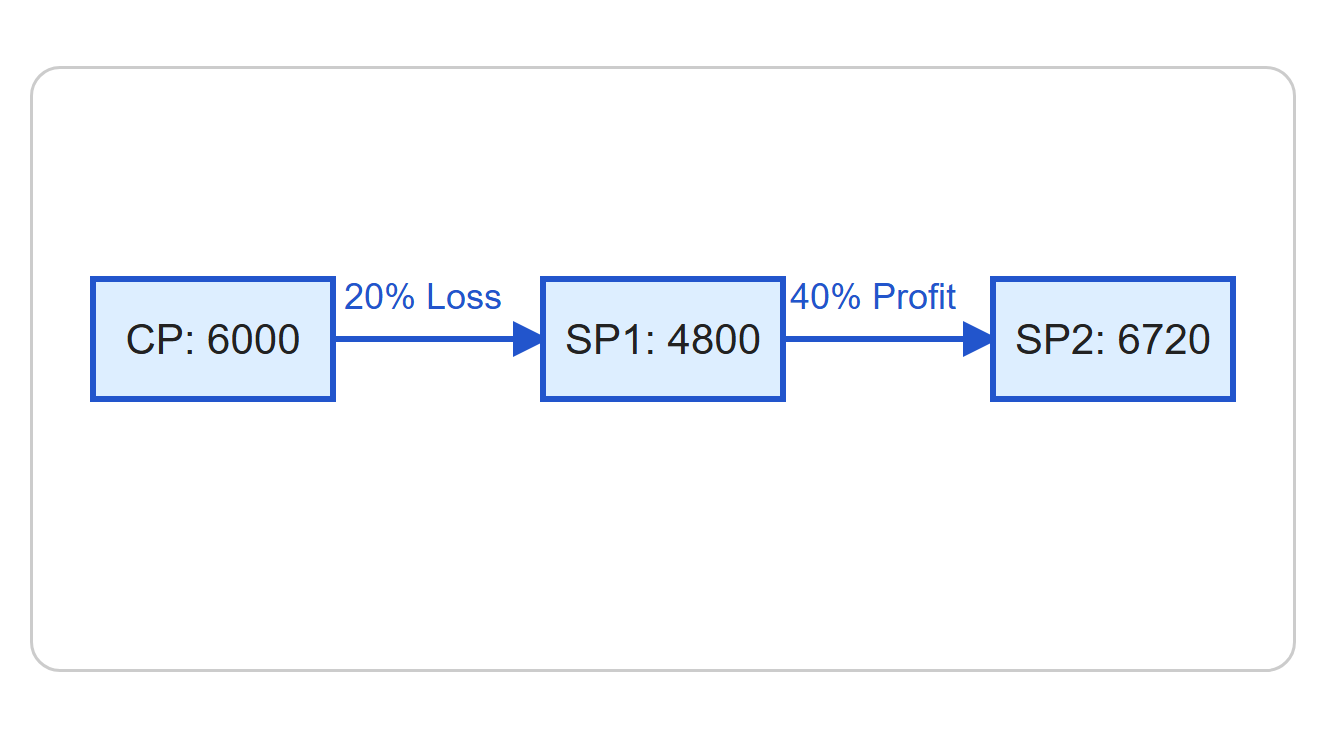
A product costs 6000 Rs. It is sold at a 20% loss. From the selling price, a new product is bought and sold at a 40% profit. What is the overall profit (in Rs) on the whole transaction?

  1. ((a))

    120 Rs

  2. ((b))

    240 Rs

  3. ((c))

    360 Rs

  4. ((d))

    480 Rs

  5. ((e))

    720 Rs

Show Answer
Answer: ((e))

720 Rs

Shortcut Trick

Net change percentage = a + b + (a × b) ÷ 100

Here, a = −20% (loss) and b = +40% (profit).

Net profit% = −20 + 40 + (−20 × 40) ÷ 100 = 20 − 8 = 12%.

Overall profit = 12% of 6000 = 0.12 × 6000 = 720.

∴ The correct answer is 720 Rs.

Alternate Method

Given → Initial Cost Price (CP1) = 6000 Rs, Loss% = 20%, Profit% on second item = 40%. Formulas: SP = CP × (100 ± Gain/Loss)% ÷ 100 | Overall Profit = Final SP − Initial CP.

⇒ Selling Price of first product (SP1) = 6000 × (100 − 20) ÷ 100 = 6000 × 0.8 = 4800 Rs.

⇒ Cost Price of second product (CP2) = SP1 = 4800 Rs.

⇒ Selling Price of second product (SP2) = 4800 × (100 + 40) ÷ 100 = 4800 × 1.4 = 6720 Rs.

⇒ Overall Profit = Final SP − Initial CP = 6720 − 6000 = 720 Rs.

∴ The correct answer is 720 Rs.

Additional Information

Successive Percentage Change

When a value is changed by x% and then the resulting value is changed by y%, the net change is (x + y + xy/100)%.

Profit and Loss Basics

Profit occurs when SP > CP. Loss occurs when CP > SP. Both are always calculated on the CP unless stated otherwise.

32

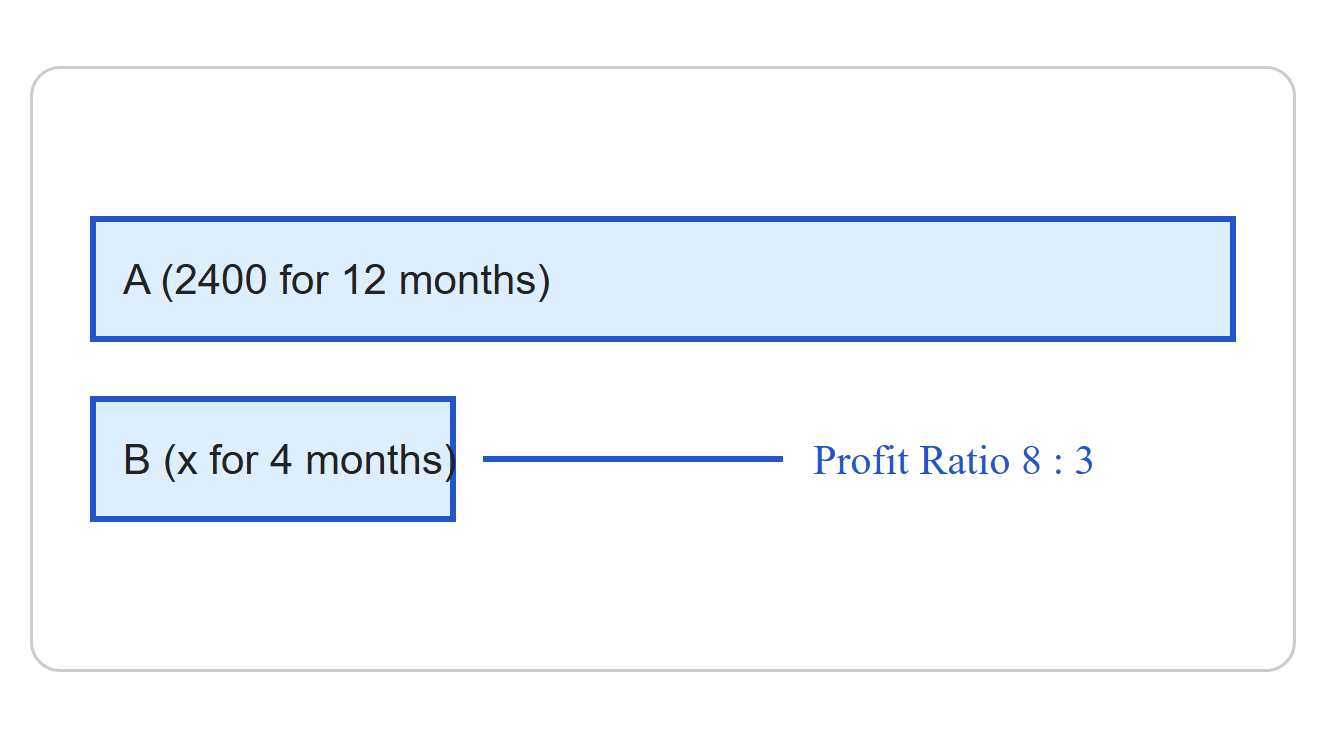
A invests ₹2400 for 12 months. After 8 months, B joins with an investment of ₹x. After one year, the profit of B is 3/11 of the total profit. Find the value of x.

  1. ((a))

    ₹1800

  2. ((b))

    ₹2700

  3. ((c))

    ₹2200

  4. ((d))

    ₹2400

  5. ((e))

    ₹1900

Show Answer
Answer: ((b))

₹2700

Shortcut Trick

Ratio of Profit of B to Total = 3 : 11, so ratio of Profit A : B = (11 − 3) : 3 = 8 : 3.

Ratio of Investments × Time = Profit Ratio.

(2400 × 12) ÷ (x × 4) = 8 ÷ 3.

(600 × 12) ÷ x = 8 ÷ 3 ⇒ 7200 ÷ x = 8 ÷ 3.

x = (7200 × 3) ÷ 8 = 900 × 3 = 2700.

∴ The correct answer is ₹2700.

Alternate Method

Given → Investment of A = ₹2400, Time of A = 12 months, Time of B = 12 − 8 = 4 months. Profit of B = 3/11 of Total. Formulas: Profit Ratio = (InvestmentA × TimeA) : (InvestmentB × TimeB).

Total Profit = 11 units, B Profit = 3 units, A Profit = 11 − 3 = 8 units. ⇒ (2400 × 12) ÷ (x × 4) = 8 ÷ 3 ⇒ 28800 ÷ 4x = 8 ÷ 3 ⇒ 7200 ÷ x = 8 ÷ 3 ⇒ 8x = 21600 ⇒ x = 2700.

∴ The correct answer is ₹2700.

Additional Information

Partnership Concept

When multiple persons invest capital for different time periods, the profit is distributed in the ratio of the product of their capital and time.

Investment Formula

Investment = Profit ÷ Time. If the profit ratio and time ratio are known, the investment ratio can be calculated directly.

Directions: Read the data carefully and answer the following questions. 

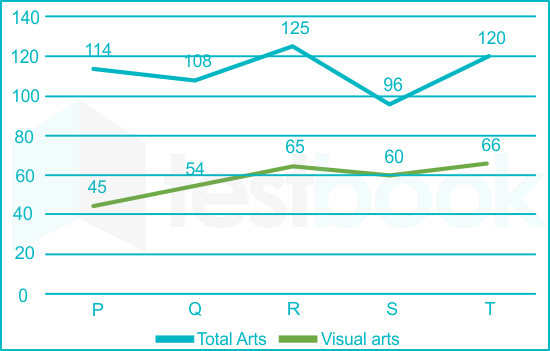
The line graph represents the sum of Fine Art and Visual Art and only Visual Art across 5 exhibitions.

Total Arts = Fine Arts + Visual Arts

33

The number of fine arts in T is what percent of the total number of arts in same exhibition?

  1. ((a))

    45%

  2. ((b))

    40%

  3. ((c))

    60%

  4. ((d))

    55%

  5. ((e))

    30%

Show Answer
Answer: ((a))

45%

General Solution:

The given data represents the Total Arts and Visual Arts across 5 exhibitions (P, Q, R, S, T). From this, we can derive the Fine Arts for each exhibition using the formula:

Fine Arts = Total Arts − Visual Arts

Using the formula above, we calculate the Fine Arts for each exhibition:

Exhibition P:

Fine Arts = 114 − 45 = 69

Exhibition Q:

Fine Arts = 108 − 54 = 54

Exhibition R:

Fine Arts = 125 − 65 = 60

Exhibition S:

Fine Arts = 96 − 60 = 36

Exhibition T:

Fine Arts = 120 − 66 = 54

Thus,

ExhibitionTotal ArtsVisual ArtsFine Arts
P1144569
Q1085454
R1256560
S966036
T1206654


Calculations:

The formula to calculate the percentage is:

Percentage = (Part / Whole) × 100

Here:

Part = Fine Arts in T = 54

Whole = Total Arts in T = 120

Substitute the values into the formula:

Percentage = (54 / 120) × 100 = 45%.

Thus, the correct answer is 45%

34

The total number of arts in T is equal to the sum of the visual arts in which one of the following pairs?

  1. ((a))

    S and T

  2. ((b))

    P and R

  3. ((c))

    Q and T

  4. ((d))

    Q and R

  5. ((e))

    P and S

Show Answer
Answer: ((c))

Q and T

General Solution:

The given data represents the Total Arts and Visual Arts across 5 exhibitions (P, Q, R, S, T). From this, we can derive the Fine Arts for each exhibition using the formula:

Fine Arts = Total Arts − Visual Arts

Using the formula above, we calculate the Fine Arts for each exhibition:

Exhibition P:

Fine Arts = 114 − 45 = 69

Exhibition Q:

Fine Arts = 108 − 54 = 54

Exhibition R:

Fine Arts = 125 − 65 = 60

Exhibition S:

Fine Arts = 96 − 60 = 36

Exhibition T:

Fine Arts = 120 − 66 = 54

Thus,

ExhibitionTotal ArtsVisual ArtsFine Arts
P1144569
Q1085454
R1256560
S966036
T1206654


Calculations:

From the table:

Total Arts in T = 120

We need to check the sum of Visual Arts for each pair of exhibitions and see which one equals 120.

Pair 1: S and T

Visual Arts in S = 60

Visual Arts in T = 66

Total = 60 + 66 = 126

126 ≠ 120 → Not a match.

Pair 2: P and R

Visual Arts in P = 45

Visual Arts in R = 65

Total = 45 + 65 = 110

110 ≠ 120 → Not a match.

Pair 3: Q and T

Visual Arts in Q = 54

Visual Arts in T = 66

Total = 54 + 66 = 120

120 = 120 → Match!

Pair 4: Q and R

Visual Arts in Q = 54

Visual Arts in R = 65

Total = 54 + 65 = 119

119 ≠ 120 → Not a match.

Pair 5: P and S

Visual Arts in P = 45

Visual Arts in S = 60

Total = 45 + 60 = 105

105 ≠ 120 → Not a match.

The pair Q and T has a sum of Visual Arts equal to the Total Arts in Exhibition T.

35

Find the ratio of the number of fine arts in R and T together to the number of total arts in P.

  1. ((a))

    5:6

  2. ((b))

    2:3

  3. ((c))

    1:1

  4. ((d))

    6:5

  5. ((e))

    3:2

Show Answer
Answer: ((c))

1:1

General Solution:

The given data represents the Total Arts and Visual Arts across 5 exhibitions (P, Q, R, S, T). From this, we can derive the Fine Arts for each exhibition using the formula:

Fine Arts = Total Arts − Visual Arts

Using the formula above, we calculate the Fine Arts for each exhibition:

Exhibition P:

Fine Arts = 114 − 45 = 69

Exhibition Q:

Fine Arts = 108 − 54 = 54

Exhibition R:

Fine Arts = 125 − 65 = 60

Exhibition S:

Fine Arts = 96 − 60 = 36

Exhibition T:

Fine Arts = 120 − 66 = 54

Thus,

ExhibitionTotal ArtsVisual ArtsFine Arts
P1144569
Q1085454
R1256560
S966036
T1206654


Calculations:

From the table:

Fine Arts in R and T together:

Fine Arts in R = 60

Fine Arts in T = 54

Total Fine Arts in R and T = 60 + 54 = 114

Total Arts in P = 114

The ratio of the number of Fine Arts in R and T together to the number of Total Arts in P is:

Ratio = Fine Arts in R and T / Total Arts in P = 114 / 1 = 1:1

Thus, the correct answer is 1:1.

36

Find the total number of fine arts in P and R together.

  1. ((a))

    115

  2. ((b))

    129

  3. ((c))

    108

  4. ((d))

    123

  5. ((e))

    None of these

Show Answer
Answer: ((b))

129

General Solution:

The given data represents the Total Arts and Visual Arts across 5 exhibitions (P, Q, R, S, T). From this, we can derive the Fine Arts for each exhibition using the formula:

Fine Arts = Total Arts − Visual Arts

Using the formula above, we calculate the Fine Arts for each exhibition:

Exhibition P:

Fine Arts = 114 − 45 = 69

Exhibition Q:

Fine Arts = 108 − 54 = 54

Exhibition R:

Fine Arts = 125 − 65 = 60

Exhibition S:

Fine Arts = 96 − 60 = 36

Exhibition T:

Fine Arts = 120 − 66 = 54

Thus,

ExhibitionTotal ArtsVisual ArtsFine Arts
P1144569
Q1085454
R1256560
S966036
T1206654


Calculations:

From the table, we know the Fine Arts for each exhibition:

Exhibition P: Fine Arts = 69

Exhibition R: Fine Arts = 60

To find the total number of Fine Arts in P and R together, we add the Fine Arts of P and R:

Total Fine Arts (P + R) = 69 + 60 = 129

Thus, the total number of Fine Arts in P and R together is 129.

37

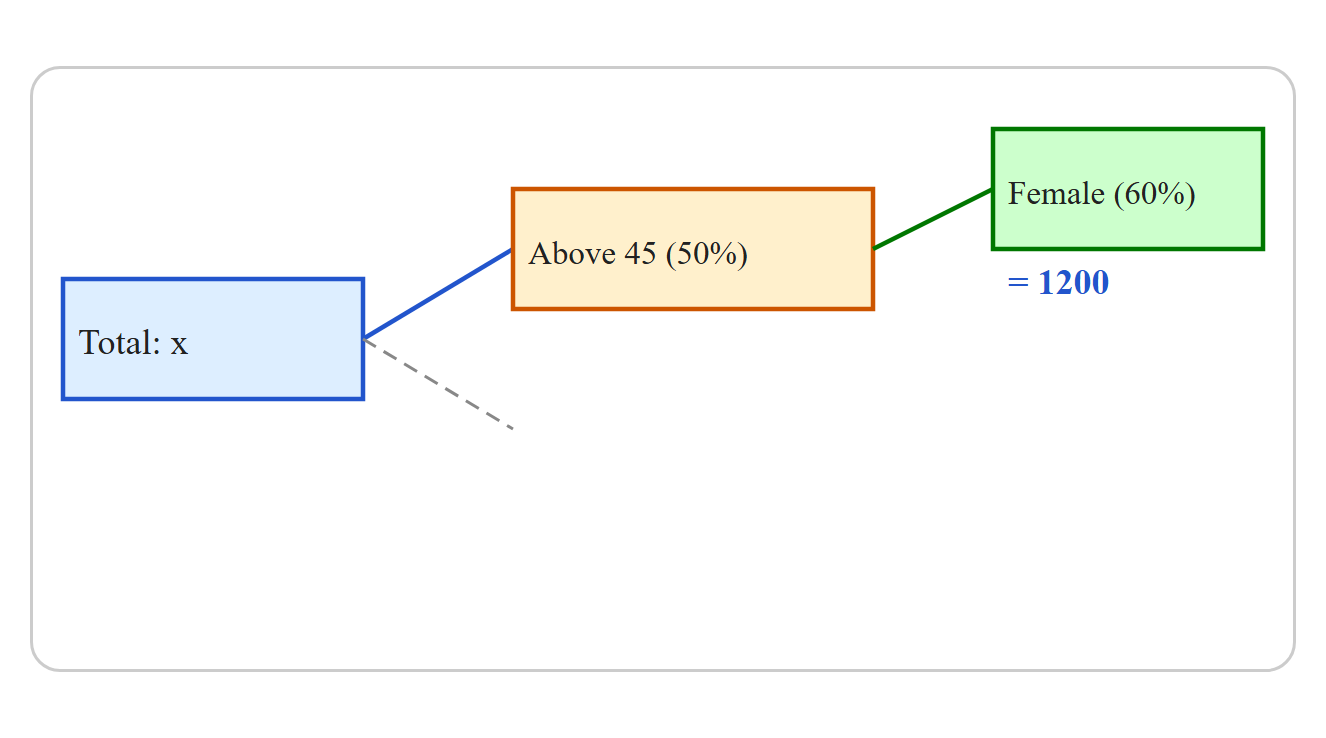
In a factory 50% of the workers are above 45 years and of these 60 % are female and the rest are male. If there are 1200 female workers above 45 years then find the total number of workers in the factory?

  1. ((a))

    4500

  2. ((b))

    4600

  3. ((c))

    4000

  4. ((d))

    4100

  5. ((e))

    4200

Show Answer
Answer: ((c))

4000

Shortcut Trick

Let total workers be 100%.

Workers above 45 years = 50%.

Female workers above 45 = 60% of 50% = 30%.

Given, 30% = 1200 ⇒ 1% = 40.

Total workers = 100% = 100 × 40 = 4000.

∴ The correct answer is 4000 workers.

Alternate Method

Given: Female workers above 45 = 1200; % Above 45 = 50%; % Female in that group = 60%.

Formula: Total Workers × % Above 45 × % Female = 1200

⇒ Let Total workers be x.

⇒ x × (50/100) × (60/100) = 1200

⇒ x × (1/2) × (3/5) = 1200

⇒ x × (3/10) = 1200

⇒ x = (1200 × 10) ÷ 3

⇒ x = 400 × 10 = 4000

∴ The correct answer is 4000 workers.

Additional Information

Successive Percentage Change

When percentages are applied sequentially on a base value, the effective percentage is P1 × P2 / 100.

Base Value Concept

Always identify the base (100%) correctly; in this case, females are 60% of the 50% subset, not the whole population.

38

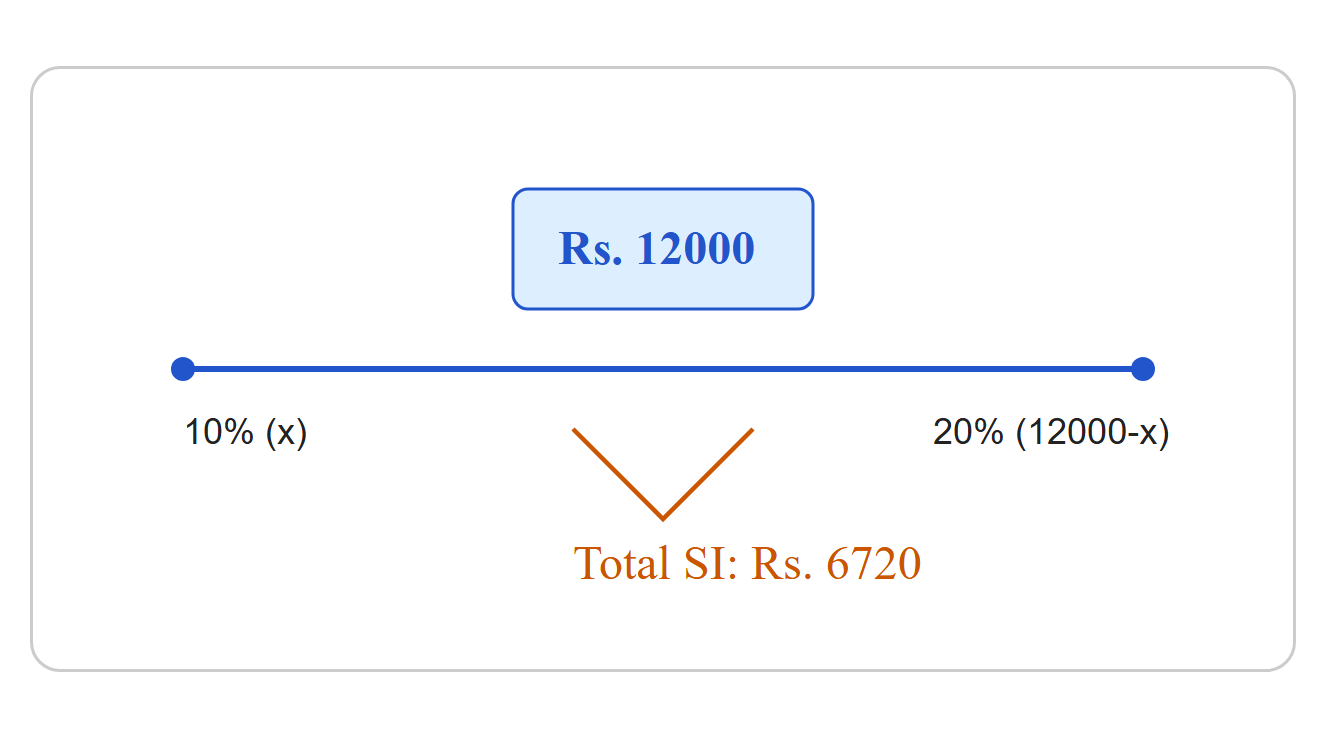
Rakesh invested Rs. 12000 in two different schemes. First at 10% per annum, rest at 20% per annum and thus in 4 years the total interest from both the amounts collected was Rs. 6720. What was the amount lent out @ 20% per annum?

  1. ((a))

    Rs. 4600

  2. ((b))

    Rs. 4400

  3. ((c))

    Rs. 4800

  4. ((d))

    Rs. 5000

  5. ((e))

    None of these

Show Answer
Answer: ((c))

Rs. 4800

Shortcut Trick

Overall interest rate per annum = (6720 ÷ 4) × 100 ÷ 12000 = 14%.

Using Alligation: (Scheme 1: 10%) vs (Scheme 2: 20%) with Mean (14%).

Ratio of investments = (20 − 14) : (14 − 10) = 6 : 4 = 3 : 2.

Amount @ 20% = (2 ÷ 5) × 12000 = 4800.

∴ The correct answer is Rs. 4800.

Alternate Method

Given: Total Principal (P) = Rs. 12000, Total SI = Rs. 6720, Time (T) = 4 years, R1 = 10%, R2 = 20%.

Formula: SI = (P × R × T) ÷ 100

⇒ Let the amount lent at 20% be Rs. x.

⇒ Amount lent at 10% = (12000 − x).

⇒ [(12000 − x) × 10 × 4] ÷ 100 + [x × 20 × 4] ÷ 100 = 6720

⇒ (12000 − x) × 40 + 80x = 672000

⇒ 480000 − 40x + 80x = 672000

⇒ 40x = 672000 − 480000

⇒ 40x = 192000

⇒ x = 192000 ÷ 40 = 4800

∴ The correct answer is Rs. 4800.

Additional Information

Simple Interest (SI)

The interest remains constant every year on the original principal. SI = (P × R × T) ÷ 100.

Alligation in Interest

When a sum is divided into two parts with different rates, the ratio of parts = (Rate2 − Avg Rate) : (Avg Rate − Rate1).

Effective Annual Rate

If interest is calculated for multiple years, the total percentage interest is R × T%.

39

Mohan is 12 years younger than Krishna. Mohan's age is 40% of the sum of his and Krishna's age.  what will be Mohan's age after 8 years? 

  1. ((a))

    24 years

  2. ((b))

    36 years

  3. ((c))

    32 years

  4. ((d))

    30 years

  5. ((e))

    31 years

Show Answer
Answer: ((c))

32 years

Shortcut Trick

Ratio of Mohan's age to (Mohan + Krishna) = 40% = 2 : 5.

If Mohan = 2 units and Sum = 5 units, then Krishna = 5 − 2 = 3 units.

Difference = 3 − 2 = 1 unit → 12 years.

Mohan's current age = 2 × 12 = 24 years.

Mohan's age after 8 years = 24 + 8 = 32 years.

∴ The correct answer is 32 years.

Alternate Method

Given: Krishna = Mohan + 12

Formula: Mohan = 0.40 × (Mohan + Krishna)

⇒ M = 0.4(M + M + 12)

⇒ M = 0.4(2M + 12)

⇒ M = 0.8M + 4.8

⇒ 0.2M = 4.8

⇒ M = 4.8 ÷ 0.2 = 24 years

⇒ Age after 8 years = 24 + 8 = 32 years

∴ The correct answer is 32 years.

Additional Information

Age Difference Property

The difference between the ages of two persons remains constant throughout their lives, regardless of the number of years passed.

Percentage to Ratio Conversion

Always convert percentages to simple fractions (e.g., 40% = 2/5) to solve ratio-based age problems faster without using variables.

40

The length of a rectangle is four times its breadth. If its length is increased by 20 cm. and breadth is increased by 30 cm, the area of the rectangle is increased by 880 cm2. Find the length of the rectangle.

  1. ((a))

    12 cm

  2. ((b))

    10 cm

  3. ((c))

    15 cm

  4. ((d))

    8 cm

  5. ((e))

    6 cm

Show Answer
Answer: ((d))

8 cm

Shortcut Trick

Let breadth = x and length = 4x.

New Area − Old Area = 880

(4x + 20)(x + 30) − 4x2 = 880

120x + 20x + 600 = 880 ⇒ 140x = 280 ⇒ x = 2 cm.

Length = 4 × 2 = 8 cm.

∴ The correct answer is 8 cm.

Alternate Method

Given: Length (L) = 4 × Breadth (B); Lnew = L + 20; Bnew = B + 30; Area Increase = 880 cm2.

Formula: Area of Rectangle = Length × Breadth

⇒ Original Area = 4x × x = 4x2

⇒ New Area = (4x + 20)(x + 30) = 4x2 + 120x + 20x + 600

⇒ (4x2 + 140x + 600) − 4x2 = 880

⇒ 140x + 600 = 880

⇒ 140x = 280

⇒ x = 2 cm

⇒ Length = 4x = 4 × 2 = 8 cm

∴ The correct answer is 8 cm.

Additional Information

Perimeter of Rectangle

The total boundary length of a rectangle is given by 2 × (Length + Breadth).

Diagonal of Rectangle

The distance between opposite corners is calculated using Pythagoras theorem: d = √(L2 + B2).

Area Change Percentage

If length increases by a% and breadth by b%, net area change % = a + b + (a × b)/100.

41

What will come in place of the question mark?

√4 × 100% of 26 = 13 × ?

  1. ((a))

    3

  2. ((b))

    3.5

  3. ((c))

    1

  4. ((d))

    2

  5. ((e))

    4

Show Answer
Answer: ((e))

4

Concept used:

We have to follow the BODMAS rule

Calculation:

√4 × 100% of 26 = 13 × ?

⇒ 2 × 1 of 26 = 13 × ?

⇒ 2 × 26 = 13 × ?

⇒ 52/13 = ?

⇒ ? = 4

The value of ? is 4

42

What will come in place of the question mark (?) in the following question?

50% of 250 + 125 = ? – 50

  1. ((a))

    250

  2. ((b))

    325

  3. ((c))

    300

  4. ((d))

    200

  5. ((e))

    450

Show Answer
Answer: ((c))

300

Concept:

We have to follow the BODMAS rule

Calculation:

50% of 250 + 125 = ? – 50

⇒ 125 + 125 + 50 = ?

⇒ 250 + 50 = ?

⇒ 300 = ?

300 will come in place of question mark.

43

What will come in place of the question mark (?) in the following question?

24% of 120 + 35% of 560 = ?

  1. ((a))

    225.6

  2. ((b))

    224.8

  3. ((c))

    324.8

  4. ((d))

    224.5

  5. ((e))

    226.8

Show Answer
Answer: ((b))

224.8

Calculation:

24% of 120 + 35% of 560 = ?

⇒ 28.8 + 196 = ?

⇒ 224.8 = ?

224.8 will come in place of the question mark

44

What should come in the place of (?) in the following question

√1296 - √576 = √? + 3 × 2

  1. ((a))

    12

  2. ((b))

    14

  3. ((c))

    17

  4. ((d))

    9

  5. ((e))

    None of these

Show Answer
Answer: ((e))

None of these

Concept:

Follow BODMAS rule to solve this question, as per the order given below, 

<br>

Calulation:

√1296 - √576 = √? + 3 × 2

⇒ 36 – 24 = √? + 6

⇒ 12 = √? + 6

⇒ √? = 6

⇒ ? = 36

∴ The value of ? is 36

45

What will come in the place of the question mark ‘?’ in the following question?

{(219 + 24) × 3}1/2 = ?/5

  1. ((a))

    130

  2. ((b))

    133

  3. ((c))

    137

  4. ((d))

    135

  5. ((e))

    139

Show Answer
Answer: ((d))

135

Concept used:

Calculation:

{(219 + 24) × 3}1/2 = ?/5

⇒ {243 × 3}1/2 = ?/5

⇒ {729}1/2 = ?/5

⇒ 27 = ?/5

⇒ ? = 135

The value of ? is 135.

46

What will come in the place of the question mark ‘?’ in the following question?

(√121 × √169 × √324) ÷ 78 + 24 = ?

  1. ((a))

    63

  2. ((b))

    27

  3. ((c))

    57

  4. ((d))

    67

  5. ((e))

    43

Show Answer
Answer: ((c))

57

Concept used:

Calculation:

(√121 × √169 × √324) ÷ 78 + 24 = ?

(11 × 13 × 18) ÷ 78 + 24 = ?

2574 ÷ 78 + 24 = ?

33 + 24 = ?

57 = ?

57 will come in place of the question mark.

47

What will come in place of the question mark (?) in the following question?

(1/4) + (22/7) + (32/15) + ? = 6

  1. ((a))

    299/380

  2. ((b))

    199/420

  3. ((c))

    363/480

  4. ((d))

    119/299

  5. ((e))

    549/1099

Show Answer
Answer: ((b))

199/420

Concept used:

Follow BODMAS rule to solve this question, as per the order given below:

Calculation:

(1/4) + (22/7) + (32/15) + ? = 6

⇒ 6 – [(1/4) + (22/7) + (32/15)] = ?

⇒ 6 – [(105 + 1320 + 896)/420] = ?

⇒ 6 – (2321/420) = ?

⇒ (2520 – 2321)/420 = ?

⇒ 199/420 = ?

 The value of ? is 199/420

48

What will come in place of the question mark (?) in the following question?

18% of 27 + 2% of 207 = (?)2

  1. ((a))

    4

  2. ((b))

    6

  3. ((c))

    5

  4. ((d))

    3

  5. ((e))

    2

Show Answer
Answer: ((d))

3

Concept Used:

Follow BODMAS rule to solve this question, as per the order given below, 

Calculation:

18% of 27 + 2% of 207 = (?)2

⇒ 4.86 + 4.14 = (?)2

⇒ 9 = (?)2

⇒ 3 = ?

3 will come in place of question mark

49

What will come in place of question mark(?) in the following questions?

? = (7/5) of 55 + (3/8) of 1376 − 52

  1. ((a))

    568

  2. ((b))

    506

  3. ((c))

    554

  4. ((d))

    550

  5. ((e))

    571

Show Answer
Answer: ((a))

568

Concept Used:

Follow BODMAS rule to solve this question, as per the order given below, 

Calculation:

? = (7/5) of 55 + (3/8) of 1376 − 52

⇒ ? = (7) ×  11 + (3) × 172 − 52

⇒ ? = 77 + 516 − 25

⇒ ? = 52 + 516 

⇒ ? = 568

<br>

Hence, option 1 is correct.

50

What will come in place of the question mark (?) in the following question?

(65 ÷ 26) ÷ 5 of 10 × (47 + 78) = ?

  1. ((a))

    2.25

  2. ((b))

    50

  3. ((c))

    6.25

  4. ((d))

    45

  5. ((e))

    2.75

Show Answer
Answer: ((c))

6.25

Concept Used:

Follow BODMAS rule to solve this question, as per the order given below, 

Calculation:

(65 ÷ 26) ÷ 5 of 10 × (47 + 78) = ?

2.5 ÷ 5 of 10 × 125 = ?

2.5 ÷ 50 × 125 = ?

0.05 × 125 = ?

6.25 = ?

6.25 will come in place of the question mark

51

A train running at a speed of 20 m/s takes 22 seconds to pass a bridge and it takes 10 seconds to pass a man who is running at a speed of 5 m/s in the same direction. Find the length of the bridge.

  1. ((a))

    150 m

  2. ((b))

    200 m

  3. ((c))

    290 m

  4. ((d))

    300 m

  5. ((e))

    350 m

Show Answer
Answer: ((c))

290 m

Shortcut Trick

Relative Speed with man = 20 − 5 = 15 m/s.

Length of Train (LT) = Relative Speed × Time = 15 × 10 = 150 m.

Total distance to cross bridge = LT + LB = Train Speed × Time = 20 × 22 = 440 m.

Length of Bridge (LB) = 440 − 150 = 290 m.

∴ The correct answer is 290 m.

Alternate Method

Given:

Speed of train (VT) = 20 m/s

Speed of man (VM) = 5 m/s (Same direction)

Time to pass man (t1) = 10 s

Time to pass bridge (t2) = 22 s

Formula Used:

Distance = Speed × Time

Relative Speed (Same direction) = V1 − V2

Calculations:

⇒ Relative speed of train w.r.t man = 20 − 5 = 15 m/s

⇒ Length of train (LT) = Relative Speed × t1 = 15 × 10 = 150 m

⇒ Total distance to cross bridge = LT + Length of Bridge (LB)

⇒ LT + LB = VT × t2

⇒ 150 + LB = 20 × 22

⇒ 150 + LB = 440

⇒ LB = 440 − 150 = 290 m

∴ The correct answer is 290 m.

Additional Information

Relative Speed

When two objects move in the same direction, relative speed = S1 − S2. In opposite directions, relative speed = S1 + S2.

Crossing Stationary Objects

To cross a point object (pole, man), distance = LTrain. To cross an object with length (bridge, platform), distance = LTrain + LObject.

Unit Conversion

To convert km/hr to m/s, multiply by 5/18. To convert m/s to km/hr, multiply by 18/5.

52

A container contains 100 litres of milk. If 10 % of milk was replaced by water and this process was repeated two times more, then find the quantity of the milk in the final mixture.

  1. ((a))

    82.9 litres

  2. ((b))

    72.9 litres

  3. ((c))

    62.9 litres

  4. ((d))

    72 litres

  5. ((e))

    None of these

Show Answer
Answer: ((b))

72.9 litres

Shortcut Trick

Initial quantity = 100 litres

Replacement fraction = 10% = 1/10

Remaining fraction after 1 process = 1 − 1/10 = 9/10

Since the process is repeated two times more (total 3 times):

Final Milk = 100 × (9/10)3 = 100 × 729/1000 = 72.9 litres

∴ The correct answer is 72.9 litres.

Alternate Method

Given:

Initial quantity of milk (x) = 100 litres

Quantity replaced (y) = 10% of 100 = 10 litres

Number of times the process is performed (n) = 3

Formula Used:

Final quantity = x × (1 − y/x)n

Calculations:

⇒ Final Quantity = 100 × (1 − 10/100)3

⇒ Final Quantity = 100 × (1 − 1/10)3

⇒ Final Quantity = 100 × (9/10) × (9/10) × (9/10)

⇒ Final Quantity = 100 × 0.9 × 0.9 × 0.9

⇒ Final Quantity = 100 × 0.729

⇒ Final Quantity = 72.9 litres

∴ The correct answer is 72.9 litres.

Additional Information

Successive Replacement Formula

The formula Final Quantity = Initial × (1 − r/100)n is used when a fixed percentage r is replaced n times.

Mixture Replacement with Different Quantities

If different amounts a, b, c are replaced each time, the final quantity is x × (1 − a/x) × (1 − b/x) × (1 − c/x).

Ratio of Milk to Water

After the process, the quantity of water = Total Capacity − Final Milk. In this case, 100 − 72.9 = 27.1 litres.

53

The average of 30 numbers is 9, the average of first 15 numbers is 8 and that of next 13 numbers is also 8. What will be the average of last two numbers?

  1. ((a))

    46

  2. ((b))

    20

  3. ((c))

    23

  4. ((d))

    12

  5. ((e))

    9

Show Answer
Answer: ((c))

23

Shortcut Trick

Total deviation from average (9) for 28 numbers = 28 × (8 − 9) = −28.

To maintain the average, the last two numbers must compensate for this deficit.

Sum of last two numbers = (2 × 9) + 28 = 18 + 28 = 46.

Average of last two numbers = 46 ÷ 2 = 23.

∴ The correct answer is 23.

Alternate Method

Given: Total numbers = 30, Overall average = 9, First 15 average = 8, Next 13 average = 8.

⇒ Total sum of 30 numbers = 30 × 9 = 270

⇒ Sum of first 15 numbers = 15 × 8 = 120

⇒ Sum of next 13 numbers = 13 × 8 = 104

⇒ Sum of last 2 numbers = Total sum − (Sum of 15 + Sum of 13)

⇒ Sum of last 2 numbers = 270 − (120 + 104) = 270 − 224 = 46

⇒ Average of last 2 numbers = 46 ÷ 2 = 23

∴ The correct answer is 23.

Additional Information

Basic Average Formula

Average = (Sum of all observations) ÷ (Total number of observations).

Net Deviation Method

The sum of deviations of all observations from the arithmetic mean is always zero. This helps in finding missing values quickly.

Weighted Average

When groups have different sizes, Combined Average = (n1x1 + n2x2 + ...) ÷ (n1 + n2 + ...).

54

A can complete a work in 12 days, B can complete the same work in 7(1/2) days, and B along with C together can complete the work in 7(1/5) days. How many days will C alone take to complete the work?

  1. ((a))

    100 days

  2. ((b))

    120 days

  3. ((c))

    150 days

  4. ((d))

    180 days

  5. ((e))

    200 days

Show Answer
Answer: ((d))

180 days

Shortcut Trick

Convert mixed fractions: B = 15/2 days, B+C = 36/5 days.

Total Work (LCM of 12, 15, 36) = 180 units.

Efficiency: B = 180 ÷ (15/2) = 24; B + C = 180 ÷ (36/5) = 25.

Efficiency of C = (B + C) − B = 25 − 24 = 1 unit/day.

Time taken by C = 180 ÷ 1 = 180 days.

∴ The correct answer is 180 days.

Alternate Method

Given:

Time taken by A = 12 days

Time taken by B = 7(1/2) days = 15/2 days

Time taken by B + C = 7(1/5) days = 36/5 days

Formula Used:

Total Work = Time × Efficiency

Efficiency = Total Work ÷ Time

PersonDaysTotal WorkEfficiency
A1218015
B15/224
B + C36/525

Calculations:

⇒ Total work = LCM of numerators (12, 15, 36) = 180 units

⇒ Efficiency of B = 180 ÷ (15/2) = (180 × 2) ÷ 15 = 24

⇒ Efficiency of B + C = 180 ÷ (36/5) = (180 × 5) ÷ 36 = 25

⇒ Efficiency of C = (Efficiency of B + C) − (Efficiency of B)

⇒ Efficiency of C = 25 − 24 = 1

⇒ Time taken by C alone = Total Work ÷ Efficiency of C

⇒ Time taken by C alone = 180 ÷ 1 = 180 days

∴ The correct answer is 180 days.

Additional Information

LCM of Fractions

To find the LCM of fractions, calculate (LCM of Numerators) ÷ (HCF of Denominators).

Work and Wages

Wages are always distributed in the ratio of the efficiency of the workers or the work done by them.

Inverse Relation

Efficiency is inversely proportional to the time taken to complete a specific task. If Time ratio is x:y, Efficiency ratio is y:x.

Directions: Read the data carefully and answer the following questions.

The following table shows the number of candidates visiting three colleges (A, B, and C) as exam centers over three years (2020, 2021, and 2022):

College202020212022
A455260
B384755
C425058
55

The average number of candidates who visited College C over the three years is what percentage of the total number of candidates who visited all three colleges in 2022?

  1. ((a))

    28.90%

  2. ((b))

    32.50%

  3. ((c))

    34.80%

  4. ((d))

    37.30%

  5. ((e))

    41.20%

Show Answer
Answer: ((a))

28.90%

College C total = 42 (2020) + 50 (2021) + 58 (2022) = 42 + 50 + 58 = 150

Average = 150 / 3 = 50

Total candidates in 2022 = College A (60) + College B (55) + College C (58) = 60 + 55 + 58 = 173

Percentage = 50 / 173 × 100 = 28.90%

Thus, the correct answer is 28.90%

56

What is the difference between the number of candidates who visited College C in 2021 and College B in 2020, and what is the ratio of this difference to the number of candidates who visited College A in 2021?

  1. ((a))

    7, 7 : 52

  2. ((b))

    8, 2 : 13

  3. ((c))

    9, 9 : 52

  4. ((d))

    10, 5 : 26

  5. ((e))

    12, 3 : 13

Show Answer
Answer: ((e))

12, 3 : 13

College C in 2021 = 50

College B in 2020 = 38

Difference = 50 − 38 = 12

College A in 2021 = 52

Ratio = 12 / 52 or 12:52 = 3:13

Hence the correct answer is 12, 3:13

57

Which college had the highest total number of candidates visiting over the three years?

  1. ((a))

    College A

  2. ((b))

    College B

  3. ((c))

    College C

  4. ((d))

    Both A and C

  5. ((e))

    Both B and C

Show Answer
Answer: ((a))

College A

College with the highest total number of candidates visiting over the three years:

College A: 

2020 = 45

2021 = 52

2022 = 60

Total = 45 + 52 + 60 = 157

College B:

2020 = 38

2021 = 47

2022 = 55

Total = 38 + 47 + 55 = 140

College C:

2020 = 42

2021 = 50

2022 = 58

Total = 42 + 50 + 58 = 150

College A (157 candidates) had the highest total number of candidates visiting over the three years.

58

The number of candidates who visited College B in 2020 is what percentage less than the number of candidates who visited College A in 2022?

  1. ((a))

    33.33%

  2. ((b))

    36.67%

  3. ((c))

    40.00%

  4. ((d))

    43.33%

  5. ((e))

    46.67%

Show Answer
Answer: ((b))

36.67%

College B in 2020 = 38

College A in 2022 = 60

Difference = 60 − 38 = 22

Percentage less = 22 / 60 × 100 = 36.67%

Thus, the correct answer is 36.67%

59

What is the ratio of the total number of candidates who visited College A over the three years to the total number of candidates who visited College C over the three years?

  1. ((a))

    150:157

  2. ((b))

    157:150

  3. ((c))

    14:15

  4. ((d))

    157:140

  5. ((e))

    15:14

Show Answer
Answer: ((b))

157:150

Total for College A = 45 + 52 + 60 = 157

Total for College C = 42 + 50 + 58 = 150

Ratio = 157:150

Thus, the correct answer is 157:150.

60

Find the wrong number in the following series:

2880, 480, 96, 24, 6, 4

  1. ((a))

    480

  2. ((b))

    96

  3. ((c))

    24

  4. ((d))

    6

  5. ((e))

    4

Show Answer
Answer: ((d))

6

Solution:

Given Series: 2880, 480, 96, 24, 6, 2

Logic Used:

2880 ÷ 6 = 480 

480 ÷ 5 = 96 

96 ÷ 4 = 24 

24 ÷ 3 = 8  (given 6 instead of 8)

8 ÷ 2 = 4 

∴ The wrong number in the series is 6.

61

Find the wrong term in the given series.

 69, 117, 161, 253, 299, 391

  1. ((a))

    161

  2. ((b))

    117

  3. ((c))

    253

  4. ((d))

    299

  5. ((e))

    69

Show Answer
Answer: ((b))

117

Solution :

The series follows the following pattern :

⇒ 23 × 3 = 69

⇒ 23 × 5 = 115

⇒ 23 × 7 = 161

⇒ 23 × 11 = 253

⇒ 23 × 13 = 299

⇒ 23 × 17 = 391

⇒ The wrong term in the series will be 117.

Hence 117 is the correct answer.

62

In the following number series, a wrong number is given. Find out the wrong number.

6, 14, 22, 36, 50, 66, 84

  1. ((a))

    36

  2. ((b))

    66

  3. ((c))

    22

  4. ((d))

    6

  5. ((e))

    50

Show Answer
Answer: ((c))

22

Calculation:

The series follows the following pattern

6 + 8 = 14

14 + 10 = 24 ≠ 22

24 + 12 = 36

36 + 14 = 50

50 + 16 = 66

66 + 18 = 84

∴ The wrong value is 22

63

An amount is invested at 10% per annum compound interest for 2 years, and the interest earned is ₹945. What is the principal amount?

  1. ((a))

    ₹4,000

  2. ((b))

    ₹4,500

  3. ((c))

    ₹4,800

  4. ((d))

    ₹5,000

  5. ((e))

    ₹5,200

Show Answer
Answer: ((b))

₹4,500

Shortcut Trick

Effective Successive Interest Rate for 2 years at 10% = 10 + 10 + (10 × 10)/100 = 21%.

Given Compound Interest (21%) = ₹945.

1% = 945 ÷ 21 = ₹45.

Principal (100%) = 45 × 100 = ₹4,500.

∴ The correct answer is ₹4,500.

Alternate Method

Given: Rate (R) = 10%, Time (T) = 2 years, Compound Interest (CI) = ₹945.

Formula Used: CI = P[(1 + R/100)T − 1]

⇒ 945 = P[(1 + 10/100)2 − 1]

⇒ 945 = P[(11/10)2 − 1]

⇒ 945 = P[121/100 − 1]

⇒ 945 = P[21/100]

⇒ P = (945 × 100) ÷ 21

⇒ P = 45 × 100 = 4,500

∴ The correct answer is ₹4,500.

Additional Information

Effective Rate for Compound Interest

For 2 years, the effective rate is x + y + (xy/100)%. For 10%, it is 10 + 10 + 1 = 21%.

Difference between CI and SI

The difference for 2 years is P(R/100)2. For 3 years, it is P(R/100)2 × (3 + R/100).

Amount Formula

Total Amount A = P(1 + R/100)n, where n is the number of compounding periods.

64

The speed of a boat in still water is 24 km/hr, and the speed of the stream is 6 km/hr. If the speed of the stream decreases by 50% and the speed of the boat decreases by 25%, what will be the time taken by the boat to travel 63 km downstream?

  1. ((a))

    2 hours

  2. ((b))

    3 hours

  3. ((c))

    4 hours

  4. ((d))

    5 hours

  5. ((e))

    6 hours

Show Answer
Answer: ((b))

3 hours

Shortcut Trick

New Boat Speed = 24 − 25% of 24 = 18 km/hr.

New Stream Speed = 6 − 50% of 6 = 3 km/hr.

New Downstream Speed = 18 + 3 = 21 km/hr.

Time taken = 63 ÷ 21 = 3 hr.

∴ The correct answer is 3 hr.

Alternate Method

Given: Initial boat speed (u) = 24 km/hr, Initial stream speed (v) = 6 km/hr, Distance (D) = 63 km.

Formula Used: Downstream Speed = New Boat Speed + New Stream Speed; Time = Distance ÷ Speed

⇒ New Boat Speed (unew) = 24 × (1 − 25/100) = 24 × 0.75 = 18 km/hr

⇒ New Stream Speed (vnew) = 6 × (1 − 50/100) = 6 × 0.50 = 3 km/hr

Downstream Speed = unew + vnew = 18 + 3 = 21 km/hr

Time Required = Distance ÷ Downstream Speed = 63 ÷ 21 = 3 hr

∴ The correct answer is 3 hr.

Additional Information

Downstream Speed

When the boat travels in the direction of the stream, its effective speed is (u + v) km/hr.

Upstream Speed

When the boat travels against the direction of the stream, its effective speed is (u − v) km/hr.

Speed in Still Water

Calculated as (Downstream Speed + Upstream Speed) ÷ 2.

Stream Speed

Calculated as (Downstream Speed − Upstream Speed) ÷ 2.

65

A can fill a tank in 30 hours and B is 120% as efficient as A. If they fill the tank on alternate hours starting with A, find time to fill the tank completely (in hours).

  1. ((a))

    27.33

  2. ((b))

    28.4

  3. ((c))

    26.6

  4. ((d))

    26.33

  5. ((e))

    None of these

Show Answer
Answer: ((a))

27.33

Shortcut Trick

Efficiency ratio A : B = 100 : 120 = 5 : 6.

Total Work = Efficiency of A × Time of A = 5 × 30 = 150 units.

Alternate hours (A then B): 2-hour cycle work = 5 + 6 = 11 units.

Number of cycles = 150 ÷ 11 = 13 full cycles (26 hours) + 7 units remaining.

Next hour (A's turn): A fills 5 units in 1 hour. Remaining 2 units filled by B in 2/6 = 0.33 hours.

Total time = 26 + 1 + 0.33 = 27.33 hours.

∴ The correct answer is 27.33 hours.

Alternate Method

Given: Time taken by A = 30 hours. Efficiency of B = 120% of A.

Formula: Total Work = Efficiency × Time; Time = Work ÷ Efficiency.

PersonEfficiencyTotal WorkTime Taken
A515030 hours
B625 hours

⇒ Efficiency of A = 5 units/hr (assumed from 100%).

⇒ Efficiency of B = 1.20 × 5 = 6 units/hr.

⇒ Total capacity of tank = 30 × 5 = 150 units.

⇒ In 1st hour (A) = 5 units, 2nd hour (B) = 6 units. Total in 2 hours = 11 units.

⇒ In 13 cycles (26 hours), work done = 13 × 11 = 143 units.

⇒ Remaining work = 150 − 143 = 7 units.

⇒ 27th hour: A fills 5 units. Remaining = 7 − 5 = 2 units.

⇒ Time for B to fill remaining = 2 ÷ 6 = 1/3 hour = 0.33 hours.

⇒ Total time = 26 + 1 + 0.33 = 27.33 hours.

∴ The correct answer is 27.33 hours.

Additional Information

Efficiency and Time Relation

Efficiency is inversely proportional to the time taken to complete a task. If efficiency ratio is x:y, time ratio is y:x.

Alternate Work Pattern

In alternate work, always calculate the work done in one complete cycle (sum of efficiencies of all persons involved) before finding the remaining work.

Pipes and Cisterns

Filling pipes have positive efficiency while outlet/leakage pipes have negative efficiency. Total work is the tank capacity.

Reasoning Ability (35 questions)

Directions: Read the following information carefully and answer the questions.

 Eight boxes, labelled as, V, T, N, R, A, X, J and S are kept one above the other in a single stack but not necessarily in the same order.

Only two boxes are placed between V and X. Box R is kept immediately above box S. Box J is kept two places above box N. Box T is placed immediately below box N. The number of boxes placed below R is one. Box A is placed two places above box V. Box V is placed immediately above box N. Only two boxes are kept above box V.

66

Which box is placed at the top of the stack?

  1. ((a))

    T

  2. ((b))

    X

  3. ((c))

    S

  4. ((d))

    A

  5. ((e))

    J

Show Answer
Answer: ((d))

A

Given: 8 boxes are placed on above another in a stack.

Based on the given conditions, we get the following possibilities-

  1. Only two boxes are placed between V and X. Only two boxes are kept above box V. From these, we get-
STACK NUMBERBOX
1.
2.
3.V
4.
5.
6.X
7.
8.


  1. Box R is kept immediately above box S. The number of boxes placed below R is one. From these, we get-
STACK NUMBERBOX
1.
2.
3.V
4.
5.
6.X
7.R
8.S


  1. Box J is kept two places above box N. Box T is placed immediately below box N. Box A is placed two places above box V. Box V is placed immediately above box N. From these, we get the final table as follows-
STACK NUMBERBOX
1.A
2.J
3.V
4.N
5.T
6.X
7.R
8.S


From the final table, we see that Box A is at the top of the stack.

Hence, Box A is kept at the top of the stack.

67

How many boxes are placed below X?

  1. ((a))

    3

  2. ((b))

    1

  3. ((c))

    5

  4. ((d))

    6

  5. ((e))

    2

Show Answer
Answer: ((e))

2

Given: 8 boxes are placed on above another in a stack.

Based on the given conditions, we get the following possibilities-

  1. Only two boxes are placed between V and X. Only two boxes are kept above box V. From these, we get-
STACK NUMBERBOX
1.
2.
3.V
4.
5.
6.X
7.
8.


  1. Box R is kept immediately above box S. The number of boxes placed below R is one. From these, we get-
STACK NUMBERBOX
1.
2.
3.V
4.
5.
6.X
7.R
8.S


  1. Box J is kept two places above box N. Box T is placed immediately below box N. Box A is placed two places above box V. Box V is placed immediately above box N. From these, we get the final table as follows-
STACK NUMBERBOX
1.A
2.J
3.V
4.N
5.T
6.X
7.R
8.S


From the final table, we see that two boxes are placed below X.

Hence, 2 boxes are placed below X.

68

Which box is placed fifth from the bottom of the stack?

  1. ((a))

    X

  2. ((b))

    S

  3. ((c))

    N

  4. ((d))

    A

  5. ((e))

    J

Show Answer
Answer: ((c))

N

Given: 8 boxes are placed on above another in a stack.

Based on the given conditions, we get the following possibilities-

  1. Only two boxes are placed between V and X. Only two boxes are kept above box V. From these, we get-
STACK NUMBERBOX
1.
2.
3.V
4.
5.
6.X
7.
8.


  1. Box R is kept immediately above box S. The number of boxes placed below R is one. From these, we get-
STACK NUMBERBOX
1.
2.
3.V
4.
5.
6.X
7.R
8.S


  1. Box J is kept two places above box N. Box T is placed immediately below box N. Box A is placed two places above box V. Box V is placed immediately above box N. From these, we get the final table as follows-
STACK NUMBERBOX
1.A
2.J
3.V
4.N
5.T
6.X
7.R
8.S


From the final table, we see that Box N is placed fifth from bottom.

Hence, box N is placed fifth from the bottom of the stack.

69

Which box is placed between T and R?

  1. ((a))

    J

  2. ((b))

    V

  3. ((c))

    S

  4. ((d))

    X

  5. ((e))

    A

Show Answer
Answer: ((d))

X

Given: 8 boxes are placed on above another in a stack.

Based on the given conditions, we get the following possibilities-

  1. Only two boxes are placed between V and X. Only two boxes are kept above box V. From these, we get-
STACK NUMBERBOX
1.
2.
3.V
4.
5.
6.X
7.
8.


  1. Box R is kept immediately above box S. The number of boxes placed below R is one. From these, we get-
STACK NUMBERBOX
1.
2.
3.V
4.
5.
6.X
7.R
8.S


  1. Box J is kept two places above box N. Box T is placed immediately below box N. Box A is placed two places above box V. Box V is placed immediately above box N. From these, we get the final table as follows-
STACK NUMBERBOX
1.A
2.J
3.V
4.N
5.T
6.X
7.R
8.S


From the final table, we see that box X is placed between box T and box R.

Hence, box X is placed between box T and box R.

70

How many boxes are placed between V and R?

  1. ((a))

    4

  2. ((b))

    6

  3. ((c))

    2

  4. ((d))

    3

  5. ((e))

    0

Show Answer
Answer: ((d))

3

Given: 8 boxes are placed on above another in a stack.

Based on the given conditions, we get the following possibilities-

  1. Only two boxes are placed between V and X. Only two boxes are kept above box V. From these, we get-
STACK NUMBERBOX
1.
2.
3.V
4.
5.
6.X
7.
8.


  1. Box R is kept immediately above box S. The number of boxes placed below R is one. From these, we get-
STACK NUMBERBOX
1.
2.
3.V
4.
5.
6.X
7.R
8.S


  1. Box J is kept two places above box N. Box T is placed immediately below box N. Box A is placed two places above box V. Box V is placed immediately above box N. From these, we get the final table as follows-
STACK NUMBERBOX
1.A
2.J
3.V
4.N
5.T
6.X
7.R
8.S


From the final table, we see that three boxes are placed between V and R.

Hence, 3 boxes are placed between V and R.

71

Direction: In the following question assuming the given statements to be true, find which of the conclusion(s) among given conclusions is/are definitely true and then give your answers accordingly.

Statements:

F > H = K > L; D ≤ P < R = F

Conclusions:  

I. R < K

II. R > D

  1. ((a))

    Only I follows

  2. ((b))

    Only II follows

  3. ((c))

    Either I or Ii follows

  4. ((d))

    None follow

  5. ((e))

    Both I and II follow

Show Answer
Answer: ((b))

Only II follows

Given statements: F > H = K > L; D ≤ P < R = F

By combining: D ≤ P < R = F > H = K > L

Conclusions:

I. R < K → False (as R = F > H = K, implies R > K)

II. R > D → True (as D ≤ P < R, implies R > D) 

Hence, only II follows.

72

Direction: In the following question assuming the given statements to be true, find which of the conclusion(s) among given conclusions is/are definitely true and then give your answers accordingly.

Statements:

D ≤ E = L < M; U = L ≥ O > S 

Conclusions:  

I. E > S

II. U < M

  1. ((a))

    Only I follows

  2. ((b))

    Only II follows

  3. ((c))

    Both I and II follows

  4. ((d))

    None follow

  5. ((e))

    Either I or II follows

Show Answer
Answer: ((c))

Both I and II follows

Given statements: D ≤ E = L < M; U = L ≥ O > S 

By combining: D ≤ E = L ≥ O > S; U = L < M

Conclusions: 

I. E > S → True (as E = L ≥ O > S, implies E > S) 

II. U < M → True (as U = L < M, implies U < M)

Hence, Both I and II follows.

73

Directions: In the following question assuming the statements to be true, find the conclusion which is/are correct and answer accordingly.

Statements: N ≤ Q; M > B; Q = R < O < M

Conclusions:

I. N < O

II. Q ≤ M

  1. ((a))

    Both conclusion I and II follow.

  2. ((b))

    Either conclusion I or conclusion II follows.

  3. ((c))

    Only conclusion I follows.

  4. ((d))

    Only conclusion II follows.

  5. ((e))

    Neither conclusion I nor conclusion II follows.

Show Answer
Answer: ((c))

Only conclusion I follows.

Given statements: N ≤ Q; M > B; Q = R < O < M

Combining: N ≤ Q = R < O < M > B

Conclusions:

I. N < O → True (as N ≤ Q = R < O → N < O)

II. Q ≤ M → False (as N ≤ Q = R < O < M → Q < M, thus Q ≤ M cannot be true)

Hence, only conclusion I follows.

Directions: Read the given information carefully and answer the questions asked below.

Eight people A, R, W, Q, T, Z, O and X are sitting around a square table in such a way that four of them sit at four corners of the table while four sit in the middle of each of the four sides. People who are sitting at the corner are facing the center while people sitting in the middle are facing outside the center.

Z is sitting second to left of X. Two persons are sitting between Z and A. Q is sitting second to the right of A. T who is not facing inside is sitting third to the right of W, who is the immediate neighbour of both O and Z. Z is one of the immediate neighbour of R.

74

Who is sitting exactly opposite to Z?

  1. ((a))

    Q

  2. ((b))

    X

  3. ((c))

    O

  4. ((d))

    T

  5. ((e))

    A

Show Answer
Answer: ((d))

T

According to the given information,

1. Z is sitting second to left of X.

2. Two persons are sitting between Z and A.


3. Q is sitting second to the right of A.


4. T who is not facing inside is sitting third to the right of W, who is the immediate neighbour of both O and Z. Here case 1 - A and case 1 - B gets eliminated because T is facing inside.

5. Z is one of the immediate neighbour of R. Here case 2 - B gets eliminated because Z will not be one of the immediate neighbour of R.

Hence, T is the correct answer.

75

Who among the following are facing inside?

  1. ((a))

    A, O, W, Z

  2. ((b))

    X, A, T, W

  3. ((c))

    T, X, Z, O

  4. ((d))

    Q, R, W, A

  5. ((e))

    O, X, R, W

Show Answer
Answer: ((d))

Q, R, W, A

According to the given information,

1. Z is sitting second to left of X.

2. Two persons are sitting between Z and A.


3. Q is sitting second to the right of A.


4. T who is not facing inside is sitting third to the right of W, who is the immediate neighbour of both O and Z. Here case 1 - A and case 1 - B gets eliminated because T is facing inside.

5. Z is one of the immediate neighbour of R. Here case 2 - B gets eliminated because Z will not be one of the immediate neighbour of R.

Hence, Q, R, W, A is the correct answer.

76

Who is sitting third to the right of O?

  1. ((a))

    R

  2. ((b))

    X

  3. ((c))

    A

  4. ((d))

    Z

  5. ((e))

    Q

Show Answer
Answer: ((a))

R

According to the given information,

1. Z is sitting second to left of X.

2. Two persons are sitting between Z and A.


3. Q is sitting second to the right of A.


4. T who is not facing inside is sitting third to the right of W, who is the immediate neighbour of both O and Z. Here case 1 - A and case 1 - B gets eliminated because T is facing inside.

5. Z is one of the immediate neighbour of R. Here case 2 - B gets eliminated because Z will not be one of the immediate neighbour of R.

Hence, R is the correct answer.

77

Who are the immediate neighbours of Q?

  1. ((a))

    T and A

  2. ((b))

    T and W

  3. ((c))

    X and Z

  4. ((d))

    T and X

  5. ((e))

    Z and W

Show Answer
Answer: ((d))

T and X

According to the given information,

1. Z is sitting second to left of X.

2. Two persons are sitting between Z and A.


3. Q is sitting second to the right of A.


4. T who is not facing inside is sitting third to the right of W, who is the immediate neighbour of both O and Z. Here case 1 - A and case 1 - B gets eliminated because T is facing inside.

5. Z is one of the immediate neighbour of R. Here case 2 - B gets eliminated because Z will not be one of the immediate neighbour of R.

Hence, T and X is the correct answer.

78

Who is to the immediate left of Z?

  1. ((a))

    R

  2. ((b))

    W

  3. ((c))

    X

  4. ((d))

    O

  5. ((e))

    A

Show Answer
Answer: ((b))

W

According to the given information,

1. Z is sitting second to left of X.

2. Two persons are sitting between Z and A.


3. Q is sitting second to the right of A.


4. T who is not facing inside is sitting third to the right of W, who is the immediate neighbour of both O and Z. Here case 1 - A and case 1 - B gets eliminated because T is facing inside.

5. Z is one of the immediate neighbour of R. Here case 2 - B gets eliminated because Z will not be one of the immediate neighbour of R.

Hence, W is the correct answer.

79

How many such pairs of digits are there in the number ‘153742’, each of which has as many digits between them in the number (both forward and backward direction) as they have between them in the Numeric Series?

  1. ((a))

    None

  2. ((b))

    One

  3. ((c))

    Two

  4. ((d))

    Three

  5. ((e))

    More than three

Show Answer
Answer: ((c))

Two

Hence, two such pairs are there in the number ‘153742’, each of which has as many digits between them in the number (both forward and backward direction) as they have between them in the Numeric Series.

Direction: Answer the questions based on the information given below:

Six persons G, H, I, J, K and L are comparing their weights. J is heavier than only two persons. K is heavier than only L and lighter than J. I’s weight is less than only H’s weight. The third heaviest weight is 150 kg and the fifth heaviest weight is 70 kg.

80

What will be the possible weight of J?

  1. ((a))

    80

  2. ((b))

    180

  3. ((c))

    40

  4. ((d))

    160

  5. ((e))

    None of these

Show Answer
Answer: ((a))

80

Six persons: G, H, I, J, K and L.

  1. J is heavier than only two persons.

J > >

  1. K is heavier than only L and lighter than J

J > K > L

  1. I’s weight is less than only H’s weight.

H > I

The arrangement is H > I > G > J > K > L.

  1. The third heaviest weight is 150 kgs and the fifth heaviest weight is 70 kgs.

G = 150 and K = 70

The final arrangement is

H > I > G > J > K > L.

Hence, J is in between G and K so it may be 80kgs.

81

Who among the following is heaviest?

  1. ((a))

    I

  2. ((b))

    H

  3. ((c))

    K

  4. ((d))

    L

  5. ((e))

    None of these

Show Answer
Answer: ((b))

H

Six persons: G, H, I, J, K and L.

  1. J is heavier than only two persons.

 ⇒  > ____ > ___ > J > ___ >

  1. K is heavier than only L and lighter than J

⇒ ____> ____ > ___ > J  > K > L

  1. I’s weight is less than only H’s weight.

⇒ H > I > ___ > J  > K > L

As, only G is left. So, G will seat the vacant place.

The final arrangement is H > I > G > J > K > L.

  1. The third heaviest weight is 150 kgs and the fifth heaviest weight is 70 kgs.

G = 150 and K = 70

The final arrangement is

H > I > G > J > K > L.

Hence, H is the heaviest.

82

Who among the following are lighter than H and heavier than K?

i) L

ii) I

iii) J

iv) G

  1. ((a))

    (i), (ii) & (iii) 

  2. ((b))

    (ii), (iii) & (iv) 

  3. ((c))

    (i), (ii) & (iv) 

  4. ((d))

    (i) & (ii) 

  5. ((e))

    None of these

Show Answer
Answer: ((b))

(ii), (iii) & (iv) 

Six persons: G, H, I, J, K and L.

  1. J is heavier than only two persons.

J > >

  1. K is heavier than only L and lighter than J

J > K > L

  1. I’s weight is less than only H’s weight.

H > I

The arrangement is H > I > G > J > K > L.

  1. The third heaviest weight is 150 kgs and the fifth heaviest weight is 70 kgs.

G = 150 and K = 70

The final arrangement is

H > I > G > J > K > L.

Hence, I, J and G are lighter than H and heavier than K.

Direction: On the basis of the alphabets given below, answer the following questions:

T R G S O I W P A Q D V E U X Z B Y C H F

83

How many such consonants are there in the above series, each of which is immediately preceded by a vowel and followed by a consonant?

  1. ((a))

    Three

  2. ((b))

    Two

  3. ((c))

    One

  4. ((d))

    Five

  5. ((e))

    Six

Show Answer
Answer: ((a))

Three

Given Series: T R G S O I W P A Q D V E U X Z B Y C H F

According to the question, Consonant should be followed by a Consonant and preceded by a Vowel.

So, Vowel → Consonant → Consonant

T R G S O I W P A Q D V E U X Z B Y C H F

Clearly, three Consonants are there, which are followed by a consonant and preceded by a vowel. (I W P, A Q D, UX Z)

Hence, Three is the correct answer.

84

In the above alphabets, if each letter starting from S, is represented by the day of the week starting from Sunday, then what is the position of first occurring Sunday from the right?

  1. ((a))

    Sixth

  2. ((b))

    Seventh

  3. ((c))

    Third

  4. ((d))

    Eighth

  5. ((e))

    Fourth

Show Answer
Answer: ((e))

Fourth

Given Series: T R G S O I W P A Q D V E U X Z B Y C H F

RGSOIWPAQDVEUXZBYCHF
SundayMondayTuesdayWednesdayThursdayFridaySaturdaySundayMondayTuesdayWednesdayThursdayFridaySaturdaySundayMondayTuesdayWednesday


Clearly from the right end, first Sunday is occur at Y, which is at fourth place from the right end.

Hence, Fourth is the correct answer.

85

How many such vowels are there in the above series, each of which is immediately preceded by a vowel and followed by a consonant?

  1. ((a))

    Three

  2. ((b))

    One

  3. ((c))

    Two

  4. ((d))

    Five

  5. ((e))

    Six

Show Answer
Answer: ((c))

Two

Given Series: T R G S O I W P A Q D V E U X Z B Y C H F

According to the question, Vowel should be followed by a Consonant and preceded by a Vowel.

So, Vowel → Vowel → Consonant

T R G S O I W P A Q D V E U X Z B Y C H F

Clearly, only two such vowels are there.

Hence, Two is the correct answer.

86

If all the vowels are dropped from the above arrangement, which letter will be the fourth letter to the left of the ninth letter from the left end?

  1. ((a))

    P

  2. ((b))

    W

  3. ((c))

    A

  4. ((d))

    I

  5. ((e))

    S

Show Answer
Answer: ((b))

W

Given Series: T R G S O I W P A Q D V E U X Z B Y C H F

When all the vowels are dropped from the arrangement, i.e. A, E, I, O, U is dropped the remaining series will be:

T R G S W P Q D V X Z B Y C H F

The ninth letter from the left is: T R G S W P Q D V X Z B Y C H F

The fourth letter from the left of V is: T R G S W P Q D V

Hence, W is the correct answer.

Shortcut:

When in the question, both element is given from the same end is given we subtract the number of the elements.

So, 9th Element from left - 4th element from left = 5th element from the left

So, T R G S W P Q D V X Z B Y C H F

Hence, W is the correct answer.

87

In the following letter clusters, which will replace the question mark (?)

PQD, SAY, EBY, WEY, ?

  1. ((a))

    RFD

  2. ((b))

    AYX

  3. ((c))

    OQW

  4. ((d))

    RZP

  5. ((e))

    QUX

Show Answer
Answer: ((e))

QUX

Given Series:  T R G S O I W P A Q D V E U X Z B Y C H F

The pattern followed here is:

P Q D →→ First element is on left side of the second element and third element is on right side of the second element.

S A Y → First element is on left side of the second element and third element is on right side of the second element.

E B Y→ First element is on left side of the second element and third element is on right side of the second element.

W E Y→ First element is on left side of the second element and third element is on right side of the second element.

Same pattern is followed in Option 5: 

QUX → First element is on left side of the second element and third element is on right side of the second element.

Hence, QUX is the correct answer.

88

Directions: In the question below are given three statements followed by two conclusions numbered I and II. You have to take the given statements to be true even if they seem to be at variance with commonly known facts. Read all the conclusions and then decide which of the given conclusions logically follows from the given statements disregarding commonly known facts.

Statements:

Some Rain is Water.

Only a few Water is Air.

Only Air is wind.

Conclusions:

I. Some Water is not Air.

II. All Air can be Water.

  1. ((a))

    Only I follow

  2. ((b))

    Only II follow

  3. ((c))

    Both I and II follow

  4. ((d))

    Either I or II follow

  5. ((e))

    Neither I nor II follow

Show Answer
Answer: ((a))

Only I follow

The least possible Venn diagram for the given statements is as follows,

Conclusions:

I. Some Water is not Air → True (It is clear that some Water is Air and the remaining part of the water is not air. So, the conclusion is true)

II. All air can be water → False (In case of ‘Only’ – the part of Air never make any positive relation with any other element other than Wind. So, the conclusion is false).

Hence, Only conclusion I follow.

Additional Information

1) Some part of A is B then if the rest part is negative there is a possibility that some negative is true. 

2) If the rest part is true then the possibility of all positive is true. 

3) Some of the remaining portions may be true or maybe false it will depend on the other statements.

89

Direction: In the question below are given three statements followed by two conclusions numbered I and II. You have to take the given statements to be true even if they seem to be at variance with commonly known facts. Read all the conclusions and then decide which of the given conclusions logically follows from the given statements disregarding commonly known facts.

Statements:

All Rose is Lily. 

Only a few lily is lotus.

No lotus is daisy.

Conclusions:

I. Some daisy can be rose.

II.some lily is not daisy.

  1. ((a))

    Only I Follows 

  2. ((b))

    Only II follows

  3. ((c))

    Either I Or II follows

  4. ((d))

    Neither I Nor II follows

  5. ((e))

    Both I and II follows

Show Answer
Answer: ((e))

Both I and II follows

Solutions:

The least possible Venn diagram for the given statements is as follows

Conclusions:

  1. Some daisy can be Rose ⇒ True ( As there is no relation between daisy and Rose, so it is possible)
  2. Some Lily is not daisy ⇒ True ( As lily which is lotus can never be a daisy, so some lily is not daisy is true)

Hence, Both conclusions I and II follow.

90

Direction: Some statements are given followed by some conclusions. You have to consider the statements to be true even if they seem to be at variance from commonly known facts. You have to decide which of the given conclusions if any, follow from the given statements.

Statements:

All Phone are Laptop.

Only a few Laptop are Stylus.

No Laptop is Tablet.

Conclusions:

I. All Stylus can be Tablet.

II. No Tablet is Phone.

  1. ((a))

    If only conclusion I follows.

  2. ((b))

    If only conclusion II follows.

  3. ((c))

    If either conclusion I or II follows.

  4. ((d))

    If neither conclusion I nor II follows.

  5. ((e))

    If both conclusions I and II follow.

Show Answer
Answer: ((b))

If only conclusion II follows.

The least possible Venn diagram for the given statements is as follows-

Conclusions:

I. All Stylus can be Tablet → False (As some Stylus are Laptop and no Laptop are Tablet, so that Stylus which are Laptop will never be Tablet)

II. No Tablet is Phone → True (As ‘All phones are laptops’ and ‘No Laptop is Tablet’)

Hence, only conclusion II follows.

91

In the given word ‘PRACTICE’ if the consonants are changed to the previous letter and the vowels are changed to the next letters as per the alphabetical series, then which letter/letters are repeated more than once?

  1. ((a))

    Q, B

  2. ((b))

    S, F

  3. ((c))

    J, O

  4. ((d))

    Only B

  5. ((e))

    B, J

Show Answer
Answer: ((d))

Only B

If the vowels are changed to the next letter and the consonants are changed to the previous letters:

Given WordPRACTICE
After changeOQBBSJBF


Therefore, there is only one letter that is B, which is repeated more than once. 

Hence, only one letter is repeated more than once.

Directions:- Read the following comprehension carefully and answer the questions given below.

Eight people P, Q, R, S, T, U, V and W are living in a eight floor building where topmost floor is numbered as 8 and bottommost floor numbered as 1. U lives on an even numbered floor below floor 5. T lives two floor above U. Only one person lives between V and T. There are only three people lives between W and T. W lives immediately above R. Only one person lives between Q and P and Q lives above P. P lives on floor 3. S lives above U.

92

Who lives on floor 7?

  1. ((a))

    R

  2. ((b))

    Q

  3. ((c))

    S

  4. ((d))

    T

  5. ((e))

    W

Show Answer
Answer: ((c))

S

Eight people - P, Q, R, S, T, U, V and W.

1- U lives on an even numbered floor below floor 5.

2- T lives two floors above U.

3- Only one person lives between V and T.

CASE-1CASE-2
FloorPersonPerson
8V
7
6TV
5
4UT
3
2U
1


4- There are only three people lives between W and T.

5- W lives immediately above R. 

6- P lives on floor 3.

7- Only one person lives between Q and P and Q lives above P.  

CASE-1CASE-2
FloorPersonPerson
8VW
7R
6TV
5QQ
4UT
3PP
2WU
1R


8- S lives above U. So case- 2 gets eliminated.

So, the Final arrangement;

FloorPerson
8V
7S
6T
5Q
4U
3P
2W
1R


Hence, S lives on floor 7.

93

How many people lives between Q and V?

  1. ((a))

    Three

  2. ((b))

    Two

  3. ((c))

    None

  4. ((d))

    One

  5. ((e))

    Five

Show Answer
Answer: ((b))

Two

Eight people - P, Q, R, S, T, U, V and W 

1- U lives on an even numbered floor below floor 5.

2- T lives two floor above U.

3- Only one person lives between V and T.

CASE-1CASE-2
FloorPersonPerson
8V
7
6TV
5
4UT
3
2U
1


4- There are only three people lives between W and T.

5- W lives immediately above R. 

6- P lives on floor 3.

7- Only one person lives between Q and P and Q lives above P.  


CASE-1CASE-2
FloorPersonPerson
8VW
7R
6TV
5QQ
4UT
3PP
2WU
1R


8- S lives above U. So case-2 gets eliminated.

So, Final arrangement;

FloorPerson
8V
7S
6T
5Q
4U
3P
2W
1R


Hence, Two people live between Q and V.

94

U lives on which floor?

  1. ((a))

    8th

  2. ((b))

    7th

  3. ((c))

    4th

  4. ((d))

    5th

  5. ((e))

    1st

Show Answer
Answer: ((c))

4th

Eight people P, Q, R, S, T, U, V and W. 

1- U lives on an even numbered floor below floor 5.

2- T lives two floor above U.

3- Only one person lives between V and T.

CASE-1CASE-2
FloorPersonPerson
8V
7
6TV
5
4UT
3
2U
1


4- There are only three people lives between W and T.

5- W lives immediately above R. 

6- P lives on floor 3.

7- Only one person lives between Q and P and Q lives above P.  


CASE-1CASE-2
FloorPersonPerson
8VW
7R
6TV
5QQ
4UT
3PP
2WU
1R


8- S lives above U. So case-2 gets eliminated.

So, Final arrangement;

FloorPerson
8V
7S
6T
5Q
4U
3P
2W
1R


Hence, U lives on floor 4.

95

Four of five are similar in a certain way find the odd one out?

  1. ((a))

    V

  2. ((b))

    T

  3. ((c))

    P

  4. ((d))

    W

  5. ((e))

    U

Show Answer
Answer: ((c))

P

Eight people - P, Q, R, S, T, U, V and W. 

1- U lives on an even numbered floor below floor 5.

2- T lives two floor above U.

3- Only one person lives between V and T.

CASE-1CASE-2
FloorPersonPerson
8V
7
6TV
5
4UT
3
2U
1


4- There are only three people lives between W and T.

5- W lives immediately above R. 

6- P lives on floor 3.

7- Only one person lives between Q and P and Q lives above P.  


CASE-1CASE-2
FloorPersonPerson
8VW
7R
6TV
5QQ
4UT
3PP
2WU
1R


8- S lives above U. So case-2 gets eliminated.

So, Final arrangement;

FloorPerson
8V
7S
6T
5Q
4U
3P
2W
1R


Here, V, T, U, W lives on even numered floor and P lives on odd numbered floor

Hence, P is an odd one from the other.

96

Who lives three floors above R?

  1. ((a))

    Q

  2. ((b))

    P

  3. ((c))

    S

  4. ((d))

    U

  5. ((e))

    T

Show Answer
Answer: ((d))

U

Eight people - P, Q, R, S, T, U, V and W. 

1- U lives on an even numbered floor below floor 5.

2- T lives two floors above U.

3- Only one person lives between V and T.

CASE-1CASE-2
FloorPersonPerson
8V
7
6TV
5
4UT
3
2U
1


4- There are only three people lives between W and T.

5- W lives immediately above R. 

6- P lives on floor 3.

7- Only one person lives between Q and P and Q lives above P.  


CASE-1CASE-2
FloorPersonPerson
8VW
7R
6TV
5QQ
4UT
3PP
2WU
1R


8- S lives above U. So case-2 gets eliminated.

So, Final arrangement;

FloorPerson
8V
7S
6T
5Q
4U
3P
2W
1R


Hence, U lives three floors above R.

97

Find out the missing term of the following series.

BD, FH, JL, NP, ?

  1. ((a))

    QS

  2. ((b))

    UW

  3. ((c))

    TV

  4. ((d))

    VX

  5. ((e))

    RT

Show Answer
Answer: ((e))

RT

The logic followed here is:

So, 'RT' will be the missing term in the given series.

Hence, the correct answer is 'RT'.

Direction: Study the information given below carefully and answer the questions that follow.

Point J is 8m to the east of point K. Point M is 4m to the north of point N. Point P is 5m to the south of point O. Point N is 10m to the east of point O. Point L is 6m to the south of point K. Point L is 5m to the west of point M.

98

In which direction is point K with respect to point N?

  1. ((a))

    North

  2. ((b))

    South 

  3. ((c))

    East

  4. ((d))

    North-West

  5. ((e))

    South-West

Show Answer
Answer: ((d))

North-West

According to the given information, we get the following figure,

Hence, point K is to the north-west of point N.

99

In which direction is point L with respect to point J?

  1. ((a))

    North

  2. ((b))

    South 

  3. ((c))

    East

  4. ((d))

    North-West

  5. ((e))

    South-West

Show Answer
Answer: ((e))

South-West

According to the given information, we get the following figure,

Hence, point L is to the south-west of point J.

100

If a person travels from L to P via points M, N and O then what distance will he/she cover?

  1. ((a))

    25 m

  2. ((b))

    45 m

  3. ((c))

    34 m

  4. ((d))

    24 m

  5. ((e))

    32 m

Show Answer
Answer: ((d))

24 m

According to the given information, we get the following figure,

Total distance travelled from L to P = LM + MN + NO + OP = 5m + 4m + 10m + 5m = 24m

Hence, the distance travelled by a person from L to P is 24m.

Attempt this paper under real exam conditions

Timed interface, section switching, instant scoring, and question-by-question analytics — free.

Start Timed Attempt