Official Paper

SBI Clerk Prelims Memory Based Paper (Held On: 22 February 2025 Shift 3) (Previous Year Paper)

100 questions · 60 minutes · with answers · free

English Language (30 questions)

1

Read each sentence to find out if there is any grammatical error/mistake in it. Choose the sentence/option, which is CORRECT (without any errors in it). If all the sentences are correct, mark option 5 as the answer.

  1. ((a))

    It's selfish of Kamla to think only about herself.

  2. ((b))

    It's selfish for Kamla to think only about herself.

  3. ((c))

    Its selfish off Kamla to think only about herself. 

  4. ((d))

    Its selfish about Kamla to think only about herself. 

  5. ((e))

    All are correct.

Show Answer
Answer: ((a))

It's selfish of Kamla to think only about herself.

The correct answer is Option 1.

 

Key Points

  • Options 3 and 4 contain errors with the usage of "its" instead of "it's". "It's" is a contraction for "it is" while "its" is a possessive pronoun.
  • Option 3 also uses "off" incorrectly instead of "of".
  • Option 4 incorrectly uses "about" instead of "of".
  • Option 2 is grammatically incorrect because "selfish" and "to think only about herself" need the preposition "of" to indicate Kamla's selfishness.

Therefore, the correct answer is 1.


Correct Sentence: "It's selfish of Kamla to think only about herself."

 

Additional Information

  • 1: "It's selfish of Kamla to think only about herself." – This part of the sentence is grammatically correct and does not require any changes.
  • 2: "It's selfish for Kamla to think only about herself." – This part of the sentence is grammatically incorrect and requires the preposition "of".
  • 3: "Its selfish off Kamla to think only about herself." – This part of the sentence is grammatically incorrect due to the usage of "its" and "off".
  • 4: "Its selfish about Kamla to think only about herself." – This part of the sentence has incorrect prepositions and possessive pronouns.
  • No error – This would be correct if there were no mistakes, but there is an error in parts 2, 3, and 4.

2

Read each sentence to find out if there is any grammatical error/mistake in it. Choose the sentence/option, which is CORRECT (without any errors in it). If all the sentences are correct, mark option 5 as the answer.

  1. ((a))

    Rahul's boss kept him waiting for over a hour.

  2. ((b))

    Rahul's boss kept his waiting for over the hour.

  3. ((c))

    Rahul's boss kept him waiting for over an hour.

  4. ((d))
    Rahul kept him boss waiting for an hour.

  5. ((e))

    All are correct.

Show Answer
Answer: ((c))

Rahul's boss kept him waiting for over an hour.

The correct answer is Option 3.


Key Points

  • The correct article before "hour" is "an" because "hour" starts with a vowel sound.
  • Option 1 is incorrect because "a hour" should be "an hour".
  • Option 2 is incorrect because "his" should be "him".
  • Option 4 is incorrect.

Therefore, the correct answer is Option 3.


Correct Sentence: "Rahul's boss kept him waiting for over an hour."


Additional Information

  • Option 1: "a hour" is incorrect because "hour" starts with a vowel sound and should be preceded by "an".
  • Option 2: "his waiting" is incorrect because it should be "him waiting".
  • Option 4: "Rahul kept him boss waiting for an hour" is an incorrect sentence.
  • Option 5: This would be correct if all the options were correct, but they are not.
3

Which of the following options should replace the underlined phrase to make the sentence grammatically correct? If the sentence is already correct, choose "No correction required."

The government has announced plans to launch a new initiative aimed at reducing plastic waste in the oceans.

  1. ((a))

    aimed to reduce

  2. ((b))

    aiming at reducing

  3. ((c))

    to aim reduce

  4. ((d))
    for reducing aims

  5. ((e))
    No correction required

Show Answer
Answer: ((e))

No correction required

The correct answer is Option 5 i.e. No correction required.

Key Points

  • The original sentence is grammatically correct, so the correct answer is "No correction required."
  • The sentence follows the correct structure of a sentence with a subject, verb, and object.
  • The subject is "The government," the verb is "has announced," and the object is "plans to launch a new initiative aimed at reducing plastic waste in the oceans."
  • The phrase "aimed at reducing plastic waste in the oceans" is a prepositional phrase that modifies "initiative."
  • The phrase "aimed at" shows the purpose of the initiative, which is to reduce plastic waste in the oceans.
  • Therefore, the sentence is already grammatically correct, and we don't need to make any changes.
4

Directions: In the following sentence, a part of the sentence is underlined. Below are given alternatives to the underlined part, which may improve the sentence. Choose the correct alternative. In case no improvement is needed, choose the alternative that indicates 'No improvement'.

His entry to the team dressing room was restrict as an official inquiry had been constituted against him.

  1. ((a))

    Is restricting as an

  2. ((b))

    Was restricting as a

  3. ((c))

    Was restricted as an

  4. ((d))

    Is restricted as a

  5. ((e))

    No improvement

Show Answer
Answer: ((c))

Was restricted as an

The correct answer is "Was restricted as an".

Key Points

  • In the underlined segment, the use of the base form of the verb 'restrict' is incorrect.
  • The sentence is in the simple past tense and in the passive voice therefore, the past participle form of the verb 'restricted' will be used.
  • The simple past passive is a verb tense that is used when something was done by someone at some time in the past.
  • The formula for the simple past passive is: Object + was/were + verb3 (past participle).
  • Example: The mistakes were corrected by the teacher.
  • The underlined part hence must be replaced with ''was restricted as an'' to make it a grammatically correct sentence.

Hence, the correct answer is option 3.

Correct Sentence: His entry to the team dressing room was restricted as an official inquiry had been constituted against him.

Additional Information

  • ''Is restricting'' is in the present continuous tense.
  • ''Was restricting'' is in the past continuous tense.
  • ''Is restricted'' is in the simple present passive tense.
5

Directions: In the following sentence, a part of the sentence is underlined. Below are given alternatives to the underlined part, which may improve the sentence. Choose the correct alternative. In case no improvement is needed, choose the alternative that indicates 'No improvement'.

We got at touch with the bank to check out the suspect's story.

  1. ((a))

    Got to touch from

  2. ((b))

    Got in touch with

  3. ((c))

    Getting at touch with

  4. ((d))

    Got at touch from

  5. ((e))

    No improvement

Show Answer
Answer: ((b))

Got in touch with

The correct answer is "Got in touch with".

Key Points

  • In the underlined segment, the use of the preposition 'at' is incorrect.
  • The preposition 'at' is used for expressing a particular state or condition.
  • The preposition 'in' should be used in place of 'at'.
  • The preposition 'in' is often followed by a noun (here, touch) without a determiner expressing a state or condition.
  • The phrase "in touch with" means a state in which people communicate with one another, especially by calling or writing; a state of familiarity or being updated with a situation. (एक ऐसी स्थिति जिसमें लोग एक-दूसरे से संवाद करते हैं, विशेषकर कॉल करके या लिखकर)


Hence, the correct answer is option 2.

Correct Sentence: We got in touch with the bank to check out the suspect's story.

Additional Information

  • The preposition 'to' is used as an infinitive of purpose to mean 'in order to'.
6

Directions: In the following sentence, a part of the sentence is underlined. Below are given alternatives to the underlined part, which may improve the sentence. Choose the correct alternative. In case no improvement is needed, choose the alternative that indicates 'No improvement'.

Mrs. Kavitha is eclipsed by her husband who is much livelier and more intelligent than she is.

  1. ((a))

    Much lively and more intelligent

  2. ((b))

    Much liveliest and most intelligent

  3. ((c))

    More lively and much intelligent

  4. ((d))

    Much more lively and much more intelligent

  5. ((e))

    No improvement

Show Answer
Answer: ((e))

No improvement

The correct answer is "No improvement".

Key Points

  • In the given sentence, a comparison is made between Mrs. Kavitha and her husband.
  • Hence, the comparative degree of the adjectives has to be used.
  • In the given sentence, ''more intelligent'' is the comparative degree of ''intelligent'', and ''livelier'' is also the comparative degree.
  • Hence, no improvement is needed in the sentence.

Correct Sentence: Mrs. Kavitha is eclipsed by her husband who is much livelier and more intelligent than she is.

Additional Information

  • The comparative degree of comparison is used to compare two nouns that have the same quality or the particular quality of a noun at two different times.
  • ''Lively'' is the positive degree of comparison.
  • The positive degree of comparison is basically the original form of the adjective. This degree does not allow you to make any comparisons.
  • ''Liveliest'' is the superlative degree of comparison.
  • The superlative degree of comparison is the highest degree of comparison. It is used to compare the similar qualities shared by more than two nouns.
7

Which of the following options should replace the underlined phrase to make the sentence grammatically correct? If the sentence is already correct, choose "No correction required."

The teacher asked her students to read the novel over the weekend and to be prepare to discuss it in class on Monday.

  1. ((a))

    to prepare for discussing it in class on Monday

  2. ((b))

    prepared discussing on Monday

  3. ((c))

    to be preparing discussing on Monday

  4. ((d))

    to be prepared to discuss it in class on Monday

  5. ((e))

    No correction required

Show Answer
Answer: ((d))

to be prepared to discuss it in class on Monday

The correct answer is Option 4.


Key Points

  • The original sentence contains the phrase "to be prepare," which is incorrect.
  • The correct form should be "to be prepared" to ensure proper grammatical structure.
  • Thus, the phrase should be "to be prepared to discuss it in class on Monday" to make the sentence correct.

Therefore, the correct answer is Option 4.


Correct Sentence: "The teacher asked her students to read the novel over the weekend and to be prepared to discuss it in class on Monday.

Read the passage given below and then answer the questions given below the passage.

Dhampur was a village painted in hues of ochre and dust, a remote place where the sun beat down mercilessly and opportunities were as scarce as rain in the dry season. For generations, its inhabitants had toiled in the fields, their lives dictated by the rhythm of the land. Education was a luxury they couldn't afford, a distant dream whispered in hushed tones. Then came Anika. A young woman with eyes that held the fire of a thousand suns and a heart overflowing with compassion. She arrived with a single, worn leather satchel and an unwavering belief in the power of knowledge. Anika saw the potential hidden within the village's children, their bright eyes dulled by the lack of opportunity. She began teaching under the shade of a sprawling banyan tree, her voice echoing with stories and lessons. Initially, resistance met her efforts. Some villagers, bound by tradition, saw no value in learning. "Our children need to work, not read," they'd mutter, their faces etched with years of hardship. Anika, however, possessed an unshakeable grit. She persevered, visiting each home, explaining the transformative power of education, and demonstrating how literacy could ________ them.

One day, Anika decided to take a bold step. She decided to create a complete and comprehensive plan, a detailed document that would encompass the plight of Dhampur's children and the urgent need for a proper school. This plan, an envelope of information, detailed every aspect of the children's lack of education, addressed to the district education officer. The plan, penned with unwavering hope, became a symbol of their collective desire for change. The response was slow. Days turned into weeks, and the villagers began to lose hope. But Anika refused to give up. She organised a peaceful protest, the villagers marching with banners and chanting slogans, their voices echoing through the dusty lanes. The protest caught the attention of local media and, eventually, the government. The effect was swift. A team of officials visited Dhampur, witnessing the passion and determination of the villagers. Within months, a small but functional school was built. Anika, with the support of the government, established a curriculum tailored to the needs of the village, focusing on practical skills alongside traditional education. The school became a beacon of hope. Children, once destined for a life of manual labour, now learnt to read, write, and dream of a brighter future. The government provided resources, including textbooks and teacher training, ensuring the sustainability of the initiative. Dhampur, once a forgotten village, was now a testament to the power of education and the unwavering spirit of one woman who dared to dream.

8

Which of the following describes the initial resource that Anika used to begin teaching the children of Dhampur?

  1. ((a))

    A government-provided classroom.

  2. ((b))

    A collection of donated textbooks.

  3. ((c))

    A shaded space under a sprawling banyan tree.

  4. ((d))

    A temporary school building constructed by the villagers.

  5. ((e))

    A digital classroom with tablets.

Show Answer
Answer: ((c))

A shaded space under a sprawling banyan tree.

The correct answer is Option 3.


Key Points

  • Anika began teaching the children under the shade of a banyan tree.
  • She used this shaded space as an initial resource before any formal structure was provided.
  • This setting was essential to the beginning of her educational efforts in the village.

Therefore, the correct answer is Option 3.


Additional Information

  • Option 1: A government-provided classroom – The text indicates that there was no formal classroom provided initially.
  • Option 2: A collection of donated textbooks – There's no mention of textbooks at the start.
  • Option 4: A temporary school building constructed by the villagers – The passage does not mention any temporary building created by the villagers initially.
  • Option 5: A digital classroom with tablets – This option is not viable given the context of the village's initial conditions.
9

According to the passage, what was the primary reason for the resistance initially faced by Anika when she began teaching in Dhampur?

  1. ((a))

    The villagers were inherently opposed to any change.

  2. ((b))

    The villagers believed their children needed to prioritize work over education.

  3. ((c))

    Anika's teaching methods were considered unconventional.

  4. ((d))

    The villagers feared that education would lead to migration.

  5. ((e))

    Anika lacked the necessary qualifications to teach.

Show Answer
Answer: ((b))

The villagers believed their children needed to prioritize work over education.

The correct answer is Option 2.


Key Points

  • The primary reason for the resistance Anika faced
  • was the villagers' belief that their children needed to prioritize work over education.
  • This belief was rooted in their years of hardship and the necessity of manual labor for survival.

Therefore, the correct answer is Option 2.


Explanation: "Some villagers, bound by tradition, saw no value in learning. 'Our children need to work, not read,' they'd mutter, their faces etched with years of hardship."


Additional Information

  • A: "The villagers were inherently opposed to any change." – This is not mentioned in the passage as the primary reason for resistance.
  • C: "Anika's teaching methods were considered unconventional." – The passage doesn't indicate this as a reason for resistance.
  • D: "The villagers feared that education would lead to migration." – This fear is not mentioned in the passage.
  • E: "Anika lacked the necessary qualifications to teach." – This was not cited as a reason in the passage.
10

According to the passage, how did Anika attempt to convince the villagers of the value of education?

  1. ((a))

    By bribing them

  2. ((b))

    By visiting each home and explaining the benefits

  3. ((c))

    By threatening them

  4. ((d))

    By appealing to the village head

  5. ((e))

    By ignoring their concerns and continuing to teach

Show Answer
Answer: ((b))

By visiting each home and explaining the benefits

The correct answer is Option 2.


Key Points

  • Anika attempted to convince the villagers of the value of education
  • by visiting each home and explaining the transformative power of education.
  • This method showed her unshakeable grit and compassion.
  • Her efforts eventually led to the establishment of a small but functional school.

Therefore, the correct answer is Option 2.


Explanation: "Anika accomplished her goal by visiting each home, explaining the benefits of education, and teaching under the shade of a sprawling banyan tree."


Additional Information

  • A: "Anika saw the potential hidden within the village's children," – This part of the passage indicates her initial motivation.
  • C: "She began teaching under the shade of a sprawling banyan tree," – This part of the passage describes where she started teaching.
  • D: "Some villagers, bound by tradition, saw no value in learning," – This part describes the initial resistance she faced.
  • No error – This would be the correct option if there were no valid details of how she convinced the villagers, but the passage specifies her home visits.
11

According to the passage, which of the given statements is correct?

A) Anika's intervention began with fundraising for the village.

B) The children of Dhampur initially resisted attending Anika's classes.

C) Local media coverage played a significant role in garnering attention for the village's cause.

  1. ((a))

    Only A

  2. ((b))

    Only B

  3. ((c))

    Only C

  4. ((d))

    A and C

  5. ((e))

    B and C

Show Answer
Answer: ((c))

Only C

The correct answer is Option 3.


Key Points

  • Statement A: Anika's intervention began with fundraising for the village.
  • This statement is incorrect as the passage indicates that Anika's intervention began with teaching under the banyan tree, not with fundraising.
  • Statement B: The children of Dhampur initially resisted attending Anika's classes.
  • This statement is incorrect because the passage does not mention that the children resisted attending Anika's classes. The resistance came from some villagers, not the children.
  • Statement C: Local media coverage played a significant role in garnering attention for the village's cause.
  • This statement is correct as the passage notes that the protest organized by Anika and the villagers caught the attention of local media, leading to government action.
  • Hence, statement C is identified as correct in the context of the passage.

Therefore, the correct answer is: ‘Only C’.

12

What will fit in the blank taken from the passage: “Anika, however, possessed an unshakeable grit. She persevered, visiting each home, explaining the transformative power of education, and demonstrating how literacy could ________ them.”

  1. ((a))

    enrich

  2. ((b))

    empower

  3. ((c))

    distract

  4. ((d))

    weaken

  5. ((e))

    overwhelm

Show Answer
Answer: ((b))

empower

The correct answer is 'empower'.


Key Points

  • The word "empower" means to give someone the authority or power to do something. (सशक्त बनाना)
  • Anika demonstrated how literacy could empower the villagers, giving them the ability to read and write and, thus, open opportunities for a better future.
  • The other options: "enrich," "distract," "weaken," and "overwhelm" do not fit the context as appropriately.

​Therefore, the correct answer is 'Option 2'.

Complete Sentence: Anika, however, possessed an unshakeable grit. She persevered, visiting each home, explaining the transformative power of education, and demonstrating how literacy could empower them.

Additional Information

  • Enrich (समृद्ध करना): means to improve or enhance the quality or value of something.
  • Distract (ध्यान भटकाना): means to divert attention from something.
  • Weaken (कमजोर करना): means to make someone or something less powerful or strong.
  • Overwhelm (अभिभूत करना): means to overpower or to have a strong emotional impact.
13

Which of the following words is similar in meaning to "envelope" in the context of the passage?

  1. ((a))

    Barrier

  2. ((b))

    Wrapper

  3. ((c))

    Obstacle

  4. ((d))

    Division

  5. ((e))

    Cover

Show Answer
Answer: ((e))

Cover

The correct answer is: Option 5 i.e., Cover.

Key Points

  • The word "envelope" in the context of the passage means something that contains or encloses. (लिफाफा)
  • Example: She handed him the envelope, which contained the detailed plan for the new project.
  • "Cover" refers to something that protects, shelters, or conceals an object or information. (आवरण)
  • Example: The book's cover was beautifully designed, attracting many readers.
  • Hence, we can infer that the word with a similar meaning to 'envelope' in the passage is 'cover.'

Therefore, the correct answer is: Cover.

Additional Information

Here are the other options explained along with their Hindi meanings and example sentences:

  • Barrier (बाधा): Something that blocks the way or prevents movement or access.
  • Example: The river serves as a natural barrier between the two countries.
  • Wrapper (लपेटना): A piece of paper, plastic, or other material used to cover and protect something.
  • Example: The chocolate bar was tightly sealed in a colourful wrapper.
  • Obstacle (अड़चन): Something that obstructs or hinders progress.
  • Example: The committee faces several obstacles in implementing the new policy.
  • Division (विभाजन): The action of separating something into parts or the process of being separated.
  • Example: There was a clear division of responsibilities among the team members.
14

Which of the following words is similar in meaning to "grit" in the context of the passage?

  1. ((a))

    Softness

  2. ((b))

    Resilience

  3. ((c))

    Vacancy

  4. ((d))

    Despair

  5. ((e))

    Neglect

Show Answer
Answer: ((b))

Resilience

The correct answer is: Option 2 i.e., Resilience.

Key Points

  • The word "grit" means courage and resolve; strength of character. (साहस)
  • Example: Despite the many challenges, his grit and determination helped him succeed.
  • "Resilience" refers to the capacity to recover quickly from difficulties; toughness. (लचीलाता)
  • Example: The community showed incredible resilience in the face of the natural disaster.
  • Hence, we can infer that the word with a similar meaning to 'grit' in the passage is 'resilience.'

Therefore, the correct answer is: Resilience.

Additional Information

Here are the other options explained along with their Hindi meanings and example sentences:

  • Softness (नर्मी): The quality of being gentle and not harsh.
  • Example: His softness in dealing with people made him a beloved leader.
  • Vacancy (खाली): An unoccupied position or job.
  • Example: There is a vacancy for a receptionist position at the new office.
  • Despair (निराशा): The complete loss or absence of hope.
  • Example: He was filled with despair after hearing the bad news.
  • Neglect (उपेक्षा): Failure to care for something or someone properly.
  • Example: The garden showed signs of neglect after weeks without maintenance.
15

Which of the following words is the antonym of "remote" in the context of the passage?

  1. ((a))

    Isolated

  2. ((b))

    Distant

  3. ((c))

    Accessible

  4. ((d))

    Secluded

  5. ((e))

    Obscure

Show Answer
Answer: ((c))

Accessible

The correct answer is: Option 3 i.e., Accessible.

Key Points

  • The word "remote" in the context of the passage means a place that is far away from cities and other places where people live. (दूरस्थ)
  • Example: They live in a remote village in the mountains.
  • "Accessible" refers to a place that can be easily reached or entered. (सुलभ)
  • Example: The city center is easily accessible by public transport.
  • Hence, we can infer that the antonym of 'remote' in the passage is 'accessible.'

Therefore, the correct answer is: Accessible.

Additional Information

Here are the other options explained along with their Hindi meanings and example sentences:

  • Isolated (पृथक): Far away from other places, buildings, or people; remote.
  • Example: The cabin is very isolated, perfect for those who seek solitude.
  • Distant (दूर): Located far away; remote.
  • Example: He could see distant mountains through the haze.
  • Secluded (एकांत): Not seen or visited by many people; private.
  • Example: They found a secluded spot by the lake for their picnic.
  • Obscure (अस्पष्ट): Not well known; uncertain.
  • Example: The origins of the ancient artifact remain obscure.
16

Read each sentence to find out if there is any grammatical error/mistake in it. Choose the sentence/option, which is CORRECT (without any errors in it). If all the sentences are correct, mark option 5 as the answer.

  1. ((a))

    The food was divided between the beggars.

  2. ((b))

    The food was divided among the beggars.

  3. ((c))

    The food was divided in between the beggars.

  4. ((d))

    All are incorrect.

  5. ((e))

    All are correct

Show Answer
Answer: ((b))

The food was divided among the beggars.

The correct answer is Option 2.


Key Points

  • Option 1 is incorrect because "between" is used when referring to two entities, whereas "among" is used for more than two.
  • Option 3 is incorrect because "in between" is not grammatically suitable in this context where the direct division among multiple beggars is indicated.
  • Option 4 suggests all are incorrect, but one option is correct.
  • Option 2 is correct because "among" properly indicates a division involving more than two entities.

Therefore, the correct answer is 2.


Correct Sentence: "The food was divided among the beggars."


Additional Information

  • 1: "The food was divided between the beggars." – This part of the sentence is incorrect because "between" should be used for two entities.
  • 2: "The food was divided among the beggars." – This part of the sentence is grammatically correct for more than two entities.
  • 3: "The food was divided in between the beggars." – This part of the sentence is incorrect due to improper use of the phrase "in between".
  • 4: "All are incorrect." – This would be correct if all parts were wrong, but part 2 is correct.
  • 5: "All are correct." – This would be correct if all parts were right, but part 1 and 3 are incorrect.
17

Directions: In the following sentence, four words are given in bold, out of which one word can be inappropriate. Find the inappropriate word. Mark 'no error' if all the words are correctly written.

They were accepted (A) by a population eager for repose (B), who had merged together (C) old class distinctions in the conflicts (D) of preceding centuries.

  1. ((a))

    A

  2. ((b))

    B

  3. ((c))

    C

  4. ((d))

    D

  5. ((e))

    No error

Show Answer
Answer: ((c))

C

The correct answer is 'C'.

Key Points 

  • Let us explore the marked option:-
  • 'merged together': It is a superfluous structure as merged means 'to combine to form a single entity.'. hence, 'together' will not be necessary.
  • ​The correct phrase will be 'merged'.
  • Merge means to combine to form a single entity.
  • When we use a sentence that has ‘merged’, there is no need to mention ‘together’. It is a redundant word.
  • For Example- The companies were merged together for business.
  • Here, the word ‘together’ can be omitted and the sentence can be written as- The companies were merged for business.
  • Hence, the correct answer is option 3.

Correct Sentence: They were accepted by a population eager for repose, who had merged old class distinctions in the conflicts of preceding centuries.

Additional Information 

  • accepted: generally believed or recognized to be valid or correct.
  • repose: a state of rest, sleep, or tranquillity.
  • conflicts: a serious disagreement or argument, typically a protracted one.

Important Points 

  • ​Superfluous means "more than required" -Use it when pointing out something that could be removed without detracting from the quality of something.
18

Directions: In the following sentence, four words are given in bold, out of which one word can be inappropriate. Find the inappropriate word. Mark 'no error' if all the words are correctly written.

An engine plane is an inclined (A) road, up which loaded cars are hauled (B) by a stationery (C) engine and rope, the empty cars running down by gravity, dragging (D) the rope after them.

  1. ((a))

    A

  2. ((b))

    B

  3. ((c))

    C

  4. ((d))

    D

  5. ((e))

    No error

Show Answer
Answer: ((c))

C

The correct answer is 'C'.

Key Points  

  • Let us explore the marked option:-
  • 'stationery': This word is not appropriate as per the context of the given sentence.
  • 'stationery' means materials (such as paper, pens, and ink) that are used for writing or typing.
  • It should be replaced by the word 'stationary' which means not moving or not intended to be moved.
  • The sentence states that "an engine plane ​is an inclined road, up which loaded cars are hauled by a motionless engine and rope"
  • Hence, the correct answer is option 3.

Correct Sentence: An engine plane is an inclined road, up which loaded cars are hauled by a stationary engine and rope, the empty cars running down by gravity, dragging the rope after them.

Additional Information 

  • inclined: leaning or turning away from the vertical or horizontal; sloping.
  • hauled: (of a person) pull or drag with effort or force.
  • dragging: pull (someone or something) along forcefully, roughly, or with difficulty.

 Important Points 

  • ​A homophone is one of two or more words that are pronounced the same but have different spellings:
  • Baring vs. bearing. Baring means "to bare," while bearing means "to bear."
  • Bolder vs. boulder. Bolder is more bold, and boulder is more rock.
  • Canon vs. cannon. Canon is an accepted principle or rule, while cannon is a big gun.
  • Cite vs. sight vs. site. In most cases, site refers to a location, sight refers to vision, and cite is something you put in a report.
  • Creak vs. creek. Creak is a noise, while creek is a small stream of water.
19

Directions: In the following sentence, four words are given in bold, out of which one word can be inappropriate. Find the inappropriate word. Mark 'no error' if all the words are correctly written.

Given free reign (A) to improvise (B) as he saw fit, the law student had found the employee and created (C) his own sting (D).

  1. ((a))

    A

  2. ((b))

    B

  3. ((c))

    C

  4. ((d))

    D

  5. ((e))

    No error

Show Answer
Answer: ((a))

A

The correct answer is 'A'.

Key Points   

  • Let us explore the marked option:-
  • 'reign': This word is not appropriate as per the context of the given sentence.
  • 'reign' means hold royal office; rule as monarch.
  • It should be replaced by the word 'rein' which means a long, narrow strap attached at one end to a horse's bit, typically used in pairs to guide or check a horse in riding or driving.
  • Hence, the correct answer is option 1.

Correct Sentence: Given free rein to improvise as he saw fit, the law student had found the employee and created his own sting.

Additional Information  

  • improvise: create and perform (music, drama, or verse) spontaneously or without preparation.
  • created: bring (something) into existence.
  • sting: a carefully planned operation, typically one involving deception.

Important Points 

  • ​A homophone is one of two or more words that are pronounced the same but have different spellings:
  • Baring vs. bearing. Baring means "to bare," while bearing means "to bear."
  • Bolder vs. boulder. Bolder is more bold, and boulder is more rock.
  • Canon vs. cannon. Canon is an accepted principle or rule, while cannon is a big gun.
  • Cite vs. sight vs. site. In most cases, site refers to a location, sight refers to vision, and cite is something you put in a report.
  • Creak vs. creek. Creak is a noise, while creek is a small stream of water.
20

Directions: In the following sentence, four words are given in bold, out of which one word can be inappropriate. Find the inappropriate word. Mark 'no error' if all the words are correctly written.

The shepherd (A) led them gently (B) back to the hut and gave them there(C) usual supper (D) of bread and milk.

  1. ((a))

    A

  2. ((b))

    B

  3. ((c))

    C

  4. ((d))

    D

  5. ((e))

    No error

Show Answer
Answer: ((c))

C

The correct answer is 'C'.

Key Points   

  • Let us explore the marked option:-
  • 'there': This word is not appropriate as per the context of the given sentence.
  • 'there' means in, at, or to that place or position.
  • It should be replaced by the word 'their' which means belonging to or associated with the people or things previously mentioned or easily identified.
  • Hence, the correct answer is option 3.

Correct Sentence: The shepherd led them gently back to the hut and gave them their usual supper of bread and milk.

Additional Information  

  • shepherd: a person who tends and rears sheep.
  • gently: with a mild, kind, or tender manner.
  • supper: an evening meal, typically a light or informal one.

Important Points  

  • ​A homophone is one of two or more words that are pronounced the same but have different spellings:
  • Baring vs. bearing. Baring means "to bare," while bearing means "to bear."
  • Bolder vs. boulder. Bolder is more bold, and boulder is more rock.
  • Canon vs. cannon. Canon is an accepted principle or rule, while cannon is a big gun.
  • Cite vs. sight vs. site. In most cases, site refers to a location, sight refers to vision, and cite is something you put in a report.
  • Creak vs. creek. Creak is a noise, while creek is a small stream of water.
21

Directions: In the following sentence, four words are given in bold, out of which one word can be inappropriate. Find the inappropriate word. Mark 'no error' if all the words are correctly written.

The approach near  (A) to his house was free (B), and he loved to pass through the city unattended (C) and to pay unexpected (D) visits to his friends.

  1. ((a))

    A

  2. ((b))

    B

  3. ((c))

    C

  4. ((d))

    D

  5. ((e))

    No error

Show Answer
Answer: ((a))

A

The correct answer is 'A' 

Key Points

  • Let us explore the marked option:-
  • 'approach near': It is a superfluous structure as climb means 'come near or nearer to (someone or something) in distance or time'. hence, 'near' will not be necessary.
  • ​The correct phrase will be 'approach to'.
  • When we use a sentence that has ‘approach’, avoid mentioning ‘near’. It is a redundant word.
  • For Example- The mother approached near him for work.
  • Here, the word ‘near’ can be omitted and the sentence can be written as- The mother approached him for work.
  • Hence, the correct answer is option 1.

Correct Sentence: The approach to his house was free, and he loved to pass through the city unattended and to pay unexpected visits to his friends.


Additional Information  

  • free: able to act or be done as one wishes; not under the control of another.
  • unattended: not noticed or dealt with.
  • unexpected: not expected or regarded as likely to happen.


Important Points 

  • ​Superfluous means "more than required" -Use it when pointing out something that could be removed without detracting from the quality of something.

Directions: In the following passage, some words have been deleted. Select the most appropriate option to fill in each blank.

Food production companies are constantly looking for ways to attract customers, and one of the most effective methods is through eye-catching (A) ________. The design, colour, and overall presentation of a product can significantly influence a consumer's (B) ________ to purchase. In addition, companies often use (C) ________ data to fine-tune their packaging designs and marketing strategies. This ensures that the products not only stand out on the (D) ________ but also resonate with the target audience. Another important factor is the (E) ________ of the packaging. Companies aim to use materials that protect the product and are (F) ________ friendly to appeal to environmentally conscious consumers.

22

Which of the following is the most appropriate option to fill in the blank labelled as (A)?

  1. ((a))

    nutrition

  2. ((b))

    packaging

  3. ((c))

    production

  4. ((d))

    advertisement

  5. ((e))

    marketing

Show Answer
Answer: ((b))

packaging

The correct answer is 'packaging'.


Key Points

  • The passage discusses how companies attract customers through various methods.
  • The appropriate noun should indicate a visual and appealing element that attracts consumers' attention.
  • "Packaging" fits well as it denotes the design and presentation of the product, which aligns with the context of influencing consumers' purchase decisions.
  • Other options ("nutrition", "production", "advertisement", "marketing") do not fit the context of visual and appealing design.

Therefore, the correct answer is 'Option 2'.


Complete Passage: Food production companies are constantly looking for ways to attract customers, and one of the most effective methods is through eye-catching packaging. The design, colour, and overall presentation of a product can significantly influence a consumer's (B) ________ to purchase. In addition, companies often use (C) ________ data to fine-tune their packaging designs and marketing strategies. This ensures that the products not only stand out on the (D) ________ but also resonate with the target audience. Another important factor is the (E) ________ of the packaging. Companies aim to use materials that protect the product and are (F) ________ friendly to appeal to environmentally conscious consumers.


Additional Information

  • Nutrition (पोषण): "Nutrition" means the intake of food in relation to the body’s dietary needs, which does not fit the context of attractive visual design.
  • Production (उत्पादन): "Production" means the process of manufacturing or creating a product, which does not reflect the visual aspect aimed at consumers.
  • Advertisement (विज्ञापन): "Advertisement" means a public promotion of some product or service, which is not specifically referring to the design of product packaging.
  • Marketing (विपणन): "Marketing" means the action or business of promoting and selling products, which includes packaging but is broader in scope.
23

Which of the following is the most appropriate option to fill in the blank labelled as (B)?

  1. ((a))

    need

  2. ((b))

    hesitation

  3. ((c))

    decision

  4. ((d))

    refusal

  5. ((e))

    strategy

Show Answer
Answer: ((c))

decision

The correct answer is 'decision'.


Key Points

  • The passage discusses how companies attract customers through various methods such as design, color, and overall presentation of a product.
  • The appropriate noun should indicate the action taken by the consumer influenced by these aspects.
  • "Decision" fits well as it denotes the consumer's choice to purchase the product, which aligns with the context of the passage.
  • Other options ("need", "hesitation", "refusal", "strategy") do not fit the context of describing the consumer's action influenced by the packaging.

Therefore, the correct answer is 'Option 3'.


Complete Passage: Food production companies are constantly looking for ways to attract customers, and one of the most effective methods is through eye-catching packaging. The design, colour, and overall presentation of a product can significantly influence a consumer's decision to purchase. In addition, companies often use (C) ________ data to fine-tune their packaging designs and marketing strategies. This ensures that the products not only stand out on the (D) ________ but also resonate with the target audience. Another important factor is the (E) ________ of the packaging. Companies aim to use materials that protect the product and are (F) ________ friendly to appeal to environmentally conscious consumers.


Additional Information

  • Need (आवश्यकता): "Need" means requirement, which does not directly align with the context of making a choice to purchase.
  • Hesitation (संकोच): "Hesitation" means a pause due to uncertainty, which does not align with the context of influencing a positive action.
  • Refusal (अस्वीकार): "Refusal" means the act of declining, which is opposite to the context of making a purchase decision.
  • Strategy (रणनीति): "Strategy" means a plan of action, which is not directly related to the consumer's action to purchase.
24

Which of the following is the most appropriate option to fill in the blank labelled as (C)?

  1. ((a))

    traditional

  2. ((b))

    speculative

  3. ((c))

    anecdotal

  4. ((d))

    scientific

  5. ((e))

    irrelevant

Show Answer
Answer: ((d))

scientific

The correct answer is 'scientific'.


Key Points

  • The passage discusses how companies collect and utilize data to improve their packaging designs and marketing strategies.
  • The appropriate adjective should indicate the reliable and methodical nature of the data used.
  • "Scientific" fits well as it denotes data that is collected through systematic and empirical methods, aligning with the context of companies making informed decisions.
  • Other options ("traditional", "speculative", "anecdotal", "irrelevant") do not fit the context of describing reliable and data-driven decisions.

Therefore, the correct answer is 'Option 4'.


Complete Passage: Food production companies are constantly looking for ways to attract customers, and one of the most effective methods is through eye-catching packaging. The design, colour, and overall presentation of a product can significantly influence a consumer's decision to purchase. In addition, companies often use scientific data to fine-tune their packaging designs and marketing strategies. This ensures that the products not only stand out on the (D) ________ but also resonate with the target audience. Another important factor is the (E) ________ of the packaging. Companies aim to use materials that protect the product and are (F) ________ friendly to appeal to environmentally conscious consumers.


Additional Information

  • Traditional (पारंपरिक): "Traditional" means something that is long-established, which does not align with the context of utilizing modern and reliable data methods.
  • Speculative (काल्पनिक): "Speculative" means based on conjecture rather than knowledge, which does not indicate reliable or systematic data.
  • Anecdotal (किस्सागोई): "Anecdotal" means based on personal accounts rather than facts or research, which contrasts with systematic and empirical data.
  • Irrelevant (अप्रासंगिक): "Irrelevant" means not connected with something, which is the opposite of the intended meaning of useful and suitable data for decision-making.
25

Which of the following is the most appropriate option to fill in the blank labelled as (D)?

  1. ((a))

    shelves

  2. ((b))

    production

  3. ((c))

    office

  4. ((d))

    factory

  5. ((e))

    restaurants

Show Answer
Answer: ((a))

shelves

The correct answer is 'shelves'.


Key Points

  • The passage is discussing the visibility and attractiveness of product packaging to consumers.
  • Packaged products are typically placed on store "shelves" where consumers can see and select them.
  • "Shelves" fits well as it denotes the location where products are displayed in stores, making it appropriate for this context.
  • Other options ("production", "office", "factory", "restaurants") do not align with the context of consumer visibility and product placement.

Therefore, the correct answer is 'Option 1'.


Complete Passage: Food production companies are constantly looking for ways to attract customers, and one of the most effective methods is through eye-catching packaging. The design, colour, and overall presentation of a product can significantly influence a consumer's decision to purchase. In addition, companies often use scientific data to fine-tune their packaging designs and marketing strategies. This ensures that the products not only stand out on the shelves but also resonate with the target audience. Another important factor is the (E) ________ of the packaging. Companies aim to use materials that protect the product and are (F) ________ friendly to appeal to environmentally conscious consumers.


Additional Information

  • Production (उत्पादन): "Production" refers to the creation or manufacturing of goods, which does not align with the context of displaying products.
  • Office (कार्यालय): "Office" is a place of business or administrative work, which is not relevant to the display and sale of products.
  • Factory (कारखाना): "Factory" is a place where products are manufactured, which does not align with the consumer-facing context of the passage.
  • Restaurants (रेस्टोरेंट): "Restaurants" are places where food is served, not where product packaging is displayed to attract consumers.
26

Which of the following is the most appropriate option to fill in the blank labelled as (E)?

  1. ((a))

    longevity

  2. ((b))

    shape

  3. ((c))

    recyclability

  4. ((d))

    size

  5. ((e))

    functionality

Show Answer
Answer: ((c))

recyclability

The correct answer is 'recyclability'.


Key Points

  • The passage discusses the importance of packaging in attracting customers to food production companies.
  • Companies not only focus on the design but also on the environmental impact of their packaging.
  • "Recyclability" fits well as it addresses the need for environmentally friendly packaging materials.
  • Other options ("longevity", "shape", "size", "functionality") do not emphasize the environmental aspect as clearly.

Therefore, the correct answer is 'Option 3'.


Complete Passage: Food production companies are constantly looking for ways to attract customers, and one of the most effective methods is through eye-catching packaging. The design, colour, and overall presentation of a product can significantly influence a consumer's decision to purchase. In addition, companies often use scientific data to fine-tune their packaging designs and marketing strategies. This ensures that the products not only stand out on the shelves but also resonate with the target audience. Another important factor is the recyclability of the packaging. Companies aim to use materials that protect the product and are (F) ________ friendly to appeal to environmentally conscious consumers.


Additional Information

  • Longevity (दीर्घायु): "Longevity" means long life or duration, which does not specifically address the environmental aspect of packaging.
  • Shape (आकृति): "Shape" refers to the form of an object, which does not emphasize the eco-friendly nature of packaging.
  • Size (आकार): "Size" refers to the dimensions of the packaging, which is not primarily concerned with its environmental impact.
  • Functionality (कार्यप्रणाली): "Functionality" means the quality of being suited to serve a purpose well, which does not specifically emphasize environmental friendliness.
27

Which of the following is the most appropriate option to fill in the blank labelled as (F)?

  1. ((a))

    eco

  2. ((b))

    fashion

  3. ((c))

    consumer

  4. ((d))

    mind

  5. ((e))

    user

Show Answer
Answer: ((a))

eco

The correct answer is 'eco'.


Key Points

  • The passage mentions that companies aim to use materials that protect the product and appeal to environmentally conscious consumers.
  • The appropriate adjective should indicate environmental friendliness.
  • "Eco" is a prefix commonly used to describe things that are environmentally friendly or sustainable.
  • Other options ("fashion", "consumer", "mind", "user") do not align with the context of environmental friendliness.

Therefore, the correct answer is 'Option 1'.


Complete Passage: Food production companies are constantly looking for ways to attract customers, and one of the most effective methods is through eye-catching packaging. The design, colour, and overall presentation of a product can significantly influence a consumer's decision to purchase. In addition, companies often use scientific data to fine-tune their packaging designs and marketing strategies. This ensures that the products not only stand out on the shelves but also resonate with the target audience. Another important factor is the recyclability of the packaging. Companies aim to use materials that protect the product and are (F) eco friendly to appeal to environmentally conscious consumers.


Additional Information

  • Fashion (फ़ैशन): "Fashion" refers to current styles or trends, which does not relate to environmental friendliness.
  • Consumer (उपभोक्ता): "Consumer" refers to a person who purchases goods, which does not indicate environmental friendliness.
  • Mind (मन): "Mind" refers to a person's thoughts or intellect, which does not relate to environmental friendliness.
  • User (उपयोगकर्ता): "User" refers to a person who uses a product, which does not indicate environmental friendliness.
28

Read each sentence to find out if there is any grammatical error/mistake in it. Choose the sentence/option, which is CORRECT (without any errors in it). If all the sentences are correct, mark option 5 as the answer.

  1. ((a))

    I would love to meet the author of this novel.

  2. ((b))

    I would love to meet an author of this novel.

  3. ((c))

    I would love to meet a author of this novel. 

  4. ((d))

    I would love to meet author of this novel. 

  5. ((e))

    All are correct.

Show Answer
Answer: ((a))

I would love to meet the author of this novel.

The correct answer is Option 1.


Key Points

  • The primary issue in the sentences is the use of articles before the word "author."
  • Option 1 is correct because "the author" specifies a particular author of the novel, making the sentence clear and grammatically correct.
  • Option 2 is incorrect because "an author" implies one of possibly many authors of the novel, which can be ambiguous if the novel has only one author.
  • Option 3 is incorrect because "a author" should be "an author" due to the vowel sound at the beginning of "author."
  • Option 4 is incorrect because it lacks an article before "author," which makes the sentence grammatically incomplete.

Therefore, the correct answer is Option 1.


Correct Sentence: "I would love to meet the author of this novel."


Additional Information

  • Option 1: "I would love to meet the author of this novel." – This sentence is correct and specifies a particular author.
  • Option 2: "I would love to meet an author of this novel." – This sentence is ambiguous and implies there could be multiple authors.
  • Option 3: "I would love to meet a author of this novel." – This sentence is incorrect due to the use of "a" instead of "an."
  • Option 4: "I would love to meet author of this novel." – This sentence is incorrect as it lacks an article before "author."
  • Option 5: "All are correct." – This option is incorrect because only Option 1 is correct.
29

The question below consists of a set of labelled sentences. Out of the five options given, select the most logical order of the sentences to form a coherent paragraph.

P: The worrying bit is that regular consumption of junk food even for few days can lead to a mental meltdown.

Q: The dark side of junk foods is not an unknown fact.

R: junk food can actually cause serious damage to your brain.

S: Not only do they add inches to your waistline, but scientists and researchers have also indicated through various studies that

  1. ((a))

    QSRP

  2. ((b))

    PQRS

  3. ((c))

    PQSR

  4. ((d))

    RQPS

  5. ((e))

    None of the above

Show Answer
Answer: ((a))

QSRP

The correct answer is option 1, i.e. QSRP.

Key Points

  • From Q it is clear that it is the introductory sentence because it is independent of other sentences and introduces the central idea. S is next as it gives further information about Q. ‘S and R’ are a mandatory pair as R completes S.
  • Hence we can conclude that the correct structuring is QSRP and can be read as “The dark side of junk foods is not an unknown fact. Not only do they add inches to your waistline, but scientists and researchers have also indicated through various studies that junk food can actually cause serious damage to your brain. The worrying bit is that regular consumption of junk food even for few days can lead to a mental meltdown.”
30

The question below contains four statements. Indicate the sequence which correctly assembles the statements and completes the paragraph.

A. The robot, powered by NTU-coded algorithms, comprises a 3D camera and two robotic arms featuring grippers to pick up objects.

B. Prior to the assembly, the robot took 11 minutes and 21 seconds to plan the motion pathways.

C. Nanyang Technological University (NTU) has released a video.

D. Showing an autonomous robot assembling furniture giant Ikea's chair in 8 minutes 55 seconds.

  1. ((a))

    ABCD

  2. ((b))

    BDCA

  3. ((c))

    DCAB

  4. ((d))

    CDAB

  5. ((e))

    ABDC

Show Answer
Answer: ((d))

CDAB

The correct answer is option 4, i.e., CDAB.

Key Points

  • Among the given set of sentences, ‘C’ is the starting sentence as it introduces a central idea about the video released by NTU.
  • ‘D’ follows ‘C’ as it completes ‘C’ by discussing the video released by the NTU.
  • ‘A’ and ‘B’ further follows the same idea respectively.
  • Moreover, once we know that ‘C’ is the introductory sentence, we can mark option 4 as our answer as there is only option starting with c.
  • Thus, making the order of the rearranged sentence as CDAB making option 4 as the correct answer.

Hence, the passage can be correctly written as Nanyang Technological University (NTU) has released a video showing an autonomous robot assembling furniture giant Ikea's chair in 8 minutes 55 seconds. The robot, powered by NTU-coded algorithms, comprises a 3D camera and two robotic arms featuring grippers to pick up objects. Prior to the assembly, the robot took 11 minutes and 21 seconds to plan the motion pathways.

Numerical Ability (35 questions)

Directions: Read the data carefully and answer the following questions. 

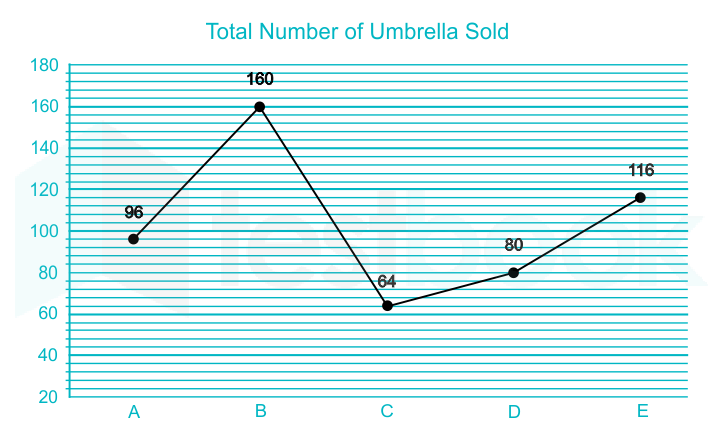
The line graph given below shows the total number of folded and unfolded umbrellas sold by five shops. 

31

Total number of umbrellas sold by shops C and D together is what percentage of the number of umbrellas sold by shop B?

  1. ((a))

    80%

  2. ((b))

    85%

  3. ((c))

    90%

  4. ((d))

    95%

  5. ((e))

    None of these

Show Answer
Answer: ((c))

90%

From the data:

Shop C: 64 umbrellas

Shop D: 80 umbrellas

Total umbrellas sold by C and D:

Total C + D = 64 + 80 = 144

From the data:

Shop B: 160 umbrellas

Now, let's calculate the percentage.

We use the formula:

Percentage = Part / Whole × 100

Here:

Part = Total umbrellas sold by C and D = 144

Whole = Umbrellas sold by B = 160

Substitute the values:

Percentage = 144 / 160× 100

Simplify:

Percentage = 0.9 × 100 = 90%

Thus, the total number of umbrellas sold by shops C and D together is 90% of the number of umbrellas sold by shop B.

32

The ratio of total number of folded to unfolded umbrellas sold by shop A is 5:3. If 2/3 rd of unfolded umbrellas are black in colour and 3/4th of folded umbrellas are black in colour, then find the number of black colour umbrellas sold by shop A.

  1. ((a))

    45

  2. ((b))

    91

  3. ((c))

    69

  4. ((d))

    57

  5. ((e))

    73

Show Answer
Answer: ((c))

69

Total umbrellas sold by Shop A.

From the data:

Total umbrellas sold by Shop A = 96

The ratio of folded to unfolded umbrellas is 5:3.

Let:

Folded umbrellas = 5x 

Unfolded umbrellas = 3x 

Total umbrellas:

5x + 3x = 8x

Given that the total umbrellas sold by Shop A is 96:

8x = 96

x = 12

Now:

Folded umbrellas = 5x = 5 × 12 = 60 

Unfolded umbrellas = 3x = 3 × 12 = 36 

3/4th of folded umbrellas are black.

Black folded umbrellas:

3/4 × 60 = 45

2/3th of unfolded umbrellas are black.

Black unfolded umbrellas:

2/3 × 36 = 24

Total black umbrellas sold by Shop A.

Total black umbrellas = Black folded umbrellas + Black unfolded umbrellas

Total black umbrellas = 45 + 24 = 69

Thus, the number of black umbrellas sold by Shop A is 69.

33

If the number of unfolded umbrellas sold by shop D are 55% of the total number of umbrellas sold by D and the total number of unsold folded umbrellas in shop D are 5/9 th of the total number of folded umbrellas sold by shop D, then find the total number of unsold folded umbrellas in shop D.

  1. ((a))

    10

  2. ((b))

    5

  3. ((c))

    20

  4. ((d))

    15

  5. ((e))

    25

Show Answer
Answer: ((c))

20

From the data, the total number of umbrellas sold by Shop D is 80.

It is given that the number of unfolded umbrellas sold by Shop D is 55% of the total umbrellas sold by Shop D. 

Unfolded umbrellas sold by D = 55% × 80 = 0.55 × 80 = 44

The total umbrellas sold by Shop D consist of folded and unfolded umbrellas. Therefore:

Folded umbrellas sold by D = Total umbrellas sold by D - Unfolded umbrellas sold by D

Folded umbrellas sold by D = 80 - 44 = 36

It is given that the total number of unsold folded umbrellas in Shop D is 5/9 of the total number of folded umbrellas sold by Shop D. 

Unsold folded umbrellas in D = 5 / 9 × Folded umbrellas sold by D

Unsold folded umbrellas in D = 5 / 9 × 36 = 20

The total number of unsold folded umbrellas in Shop D is 20.

34

What is the average of total number of umbrellas sold by A, C and E together? 

  1. ((a))

    78

  2. ((b))

    92

  3. ((c))

    60

  4. ((d))

    75

  5. ((e))

    80

Show Answer
Answer: ((b))

92

From the data:

Shop A: 96 umbrellas

Shop C: 64 umbrellas

Shop E: 116 umbrellas

Total umbrellas A + C + E = 96 + 64 + 116

Total umbrellas A + C + E = 276

The average is calculated by dividing the total number of umbrellas by the number of shops 3 in this case:

Average = (Total umbrellas A + C + E) / Number of shops

Average = 276 / 3 = 92

Thus, the average of the total number of umbrellas sold by shops A, C, and E is 92.

35

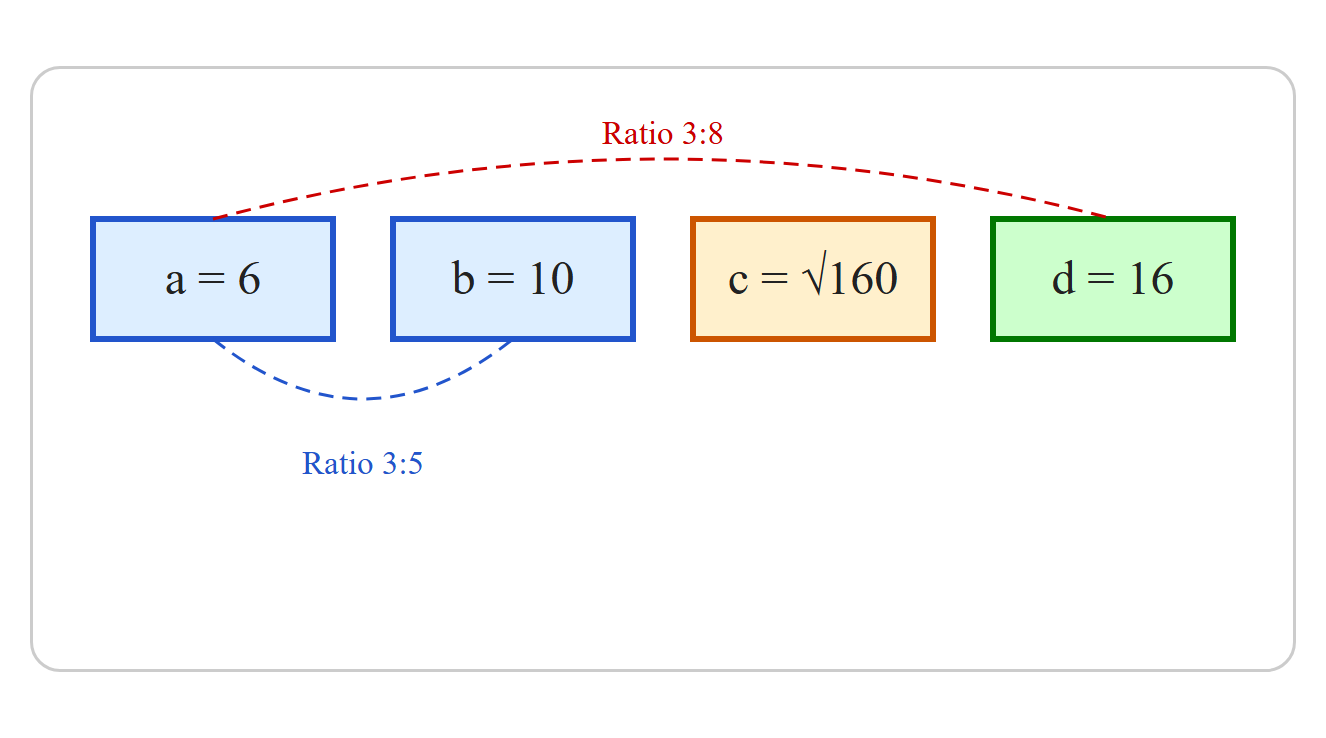
If the ratio of folded to unfolded umbrellas sold by Shop B is 3:5, and the ratio of folded to unfolded umbrellas sold by Shop D is 1:3, then the total number of folded umbrellas sold by Shop B and Shop D together is:

  1. ((a))

    80

  2. ((b))

    90

  3. ((c))

    100

  4. ((d))

    120

  5. ((e))

    110

Show Answer
Answer: ((a))

80

Total umbrellas sold by Shop B = 160

Ratio of folded to unfolded umbrellas = 3:5

Let the number of folded umbrellas = 3x 

Let the number of unfolded umbrellas = 5x 

Total umbrellas = 3x + 5x = 8x 

So, 8x = 160 

Solving for x:

x = 160 / 8 = 20

Folded umbrellas sold by Shop B:

3x = 3 × 20 = 60

Total umbrellas sold by Shop D = 80

Ratio of folded to unfolded umbrellas = 1:3

Let the number of folded umbrellas = y 

Let the number of unfolded umbrellas = 3y 

Total umbrellas = y + 3y = 4y 

So, 4y = 80 

Solving for y:

y = 80 / 4 = 20

Folded umbrellas sold by Shop D:

y = 20

Folded umbrellas Shop B = 60

Folded umbrellas Shop D = 20

Total folded umbrellas:

60 + 20 = 80

Thus, the correct answer is 80.

36

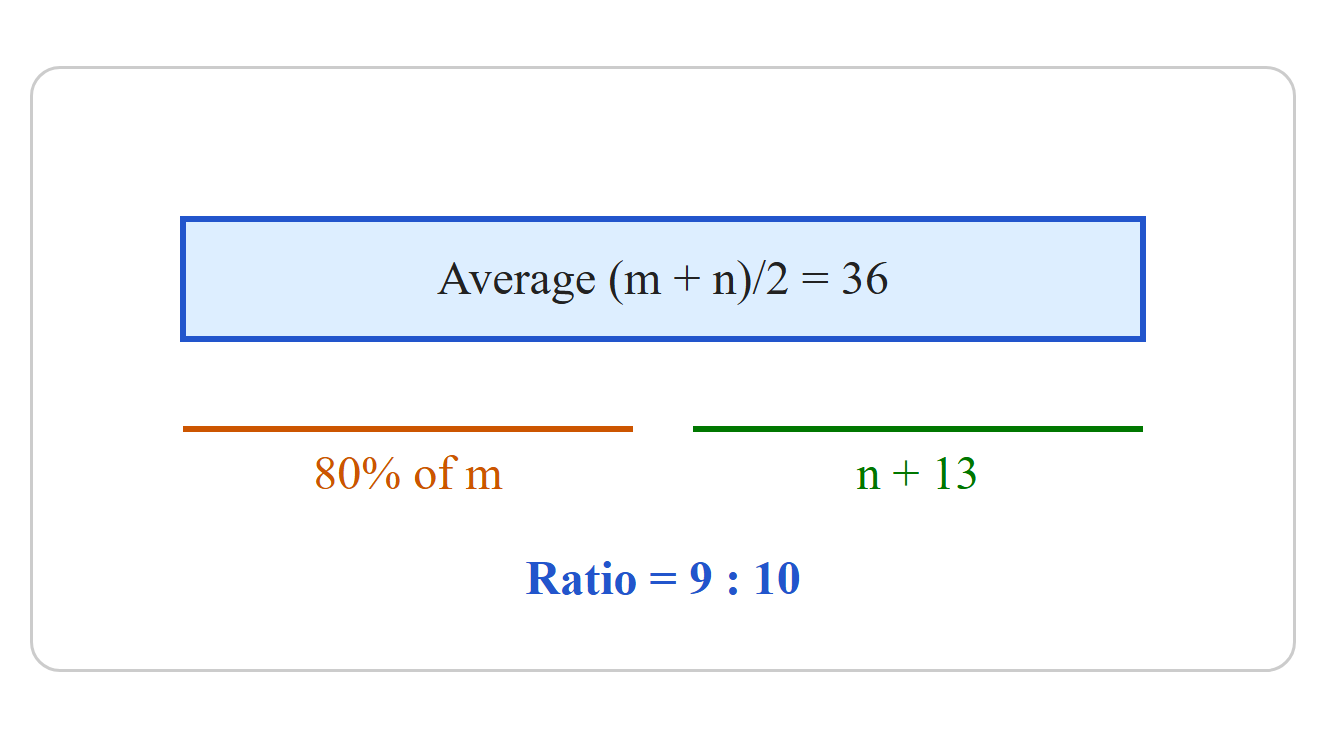
The average of two numbers m and n is 36. The ratio of 80% of m to (n+13) is 9:10. Find the value of m.

  1. ((a))

    45

  2. ((b))

    50

  3. ((c))

    55

  4. ((d))

    60

  5. ((e))

    65

Show Answer
Answer: ((a))

45

Shortcut Trick

Sum of m and n = 36 × 2 = 72. So, n = 72 − m.

Ratio equation: (0.8m) / (72 − m + 13) = 9/10.

8m = 9 × (85 − m) ⇒ 8m = 765 − 9m ⇒ 17m = 765.

m = 765 ÷ 17 = 45.

∴ The correct answer is 45.

Alternate Method

Given:

Average of m and n = 36

Ratio [80% of m] : [n + 13] = 9 : 10

Calculations:

⇒ (m + n) / 2 = 36

⇒ m + n = 72

⇒ n = 72 − m

⇒ 80% of m = 0.8m = 4m/5

⇒ (4m/5) / (n + 13) = 9/10

⇒ (4m/5) / (72 − m + 13) = 9/10

⇒ (4m) / [5 × (85 − m)] = 9/10

⇒ 40m = 45 × (85 − m)

⇒ 8m = 9 × (85 − m)

⇒ 8m = 765 − 9m

⇒ 17m = 765

⇒ m = 45

∴ The correct answer is 45.

Additional Information

Average Concept

Average is the sum of observations divided by the number of observations. For two numbers, Average = (m + n) ÷ 2.

Percentage to Fraction Conversion

To simplify calculations, convert percentages to fractions: 80% = 80/100 = 4/5 or 0.8.

Ratio and Proportion

If a:b = c:d, then a/b = c/d. This allows for cross-multiplication to solve for unknown variables.

37

X, Y, and Z entered into a partnership and invested their amounts for time periods in the ratio 3:4:6 respectively. The ratio of their investments was 4:6:5 respectively. If X's share out of the profit was Rs 18,000, what was the total profit?

  1. ((a))

    Rs 90,000

  2. ((b))

    Rs 96,000

  3. ((c))

    Rs 99,000

  4. ((d))

    Rs 1,02,000

  5. ((e))

    Rs 1,06,000

Show Answer
Answer: ((c))

Rs 99,000

Shortcut Trick

Profit ratio is calculated as (Investment × Time).

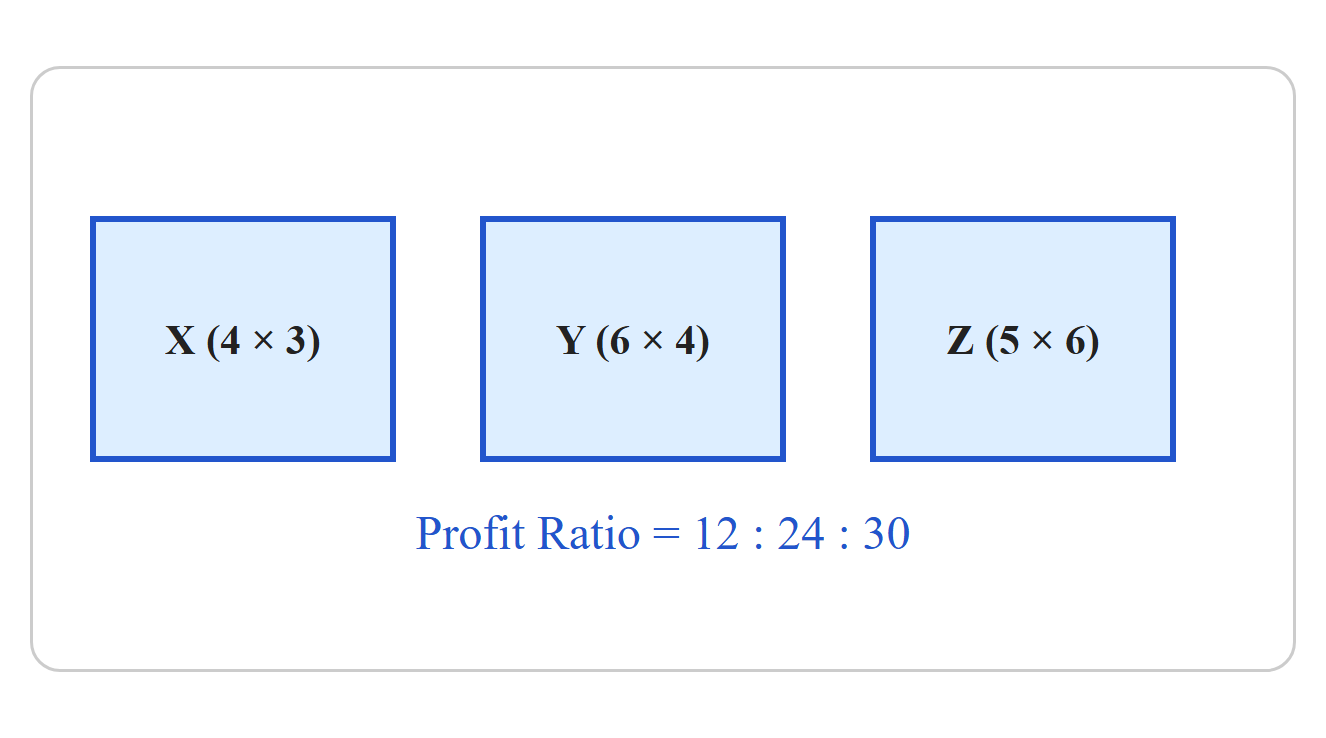
Profit Ratio X : Y : Z = (4 × 3) : (6 × 4) : (5 × 6) = 12 : 24 : 30.

Simplified Profit Ratio = 2 : 4 : 5.

X's share (2 units) = Rs 18,000 ⇒ 1 unit = Rs 9,000.

Total profit (2 + 4 + 5 = 11 units) = 11 × 9,000 = Rs 99,000.

∴ The correct answer is Rs 99,000.

Alternate Method

Given → Investment ratio = 4 : 6 : 5 | Time ratio = 3 : 4 : 6 | X's profit = Rs 18,000. Formulas: Profit = Investment × Time | Total Profit = Sum of individual profit shares.

⇒ Calculate profit ratio for X, Y, and Z: (4 × 3) : (6 × 4) : (5 × 6) = 12 : 24 : 30. ⇒ Reducing the ratio by dividing by 6: 2 : 4 : 5. ⇒ Let the profit shares be 2k, 4k, and 5k. ⇒ Given X's share 2k = 18,000 ⇒ k = 9,000. ⇒ Total Profit = 2k + 4k + 5k = 11k. ⇒ Total Profit = 11 × 9,000 = 99,000.

∴ The correct answer is Rs 99,000.

Additional Information

Partnership Basics

In a partnership, the profit is distributed in the ratio of the product of Capital (Investment) and Time. If time is constant, profit is proportional to investment.

Ratio of Investments

If profits (P) and time (T) are known, the investment (I) ratio can be found using I = P ÷ T.

38

A shopkeeper marks up the cost price of an item by 50% and then gives a 20% discount on the marked price. If the profit earned by the shopkeeper is ₹660, what is the difference between the profit and the discount given?

  1. ((a))

    ₹440

  2. ((b))

    ₹540

  3. ((c))

    ₹330

  4. ((d))

    ₹280

  5. ((e))

    None of these

Show Answer
Answer: ((c))

₹330

Shortcut Trick

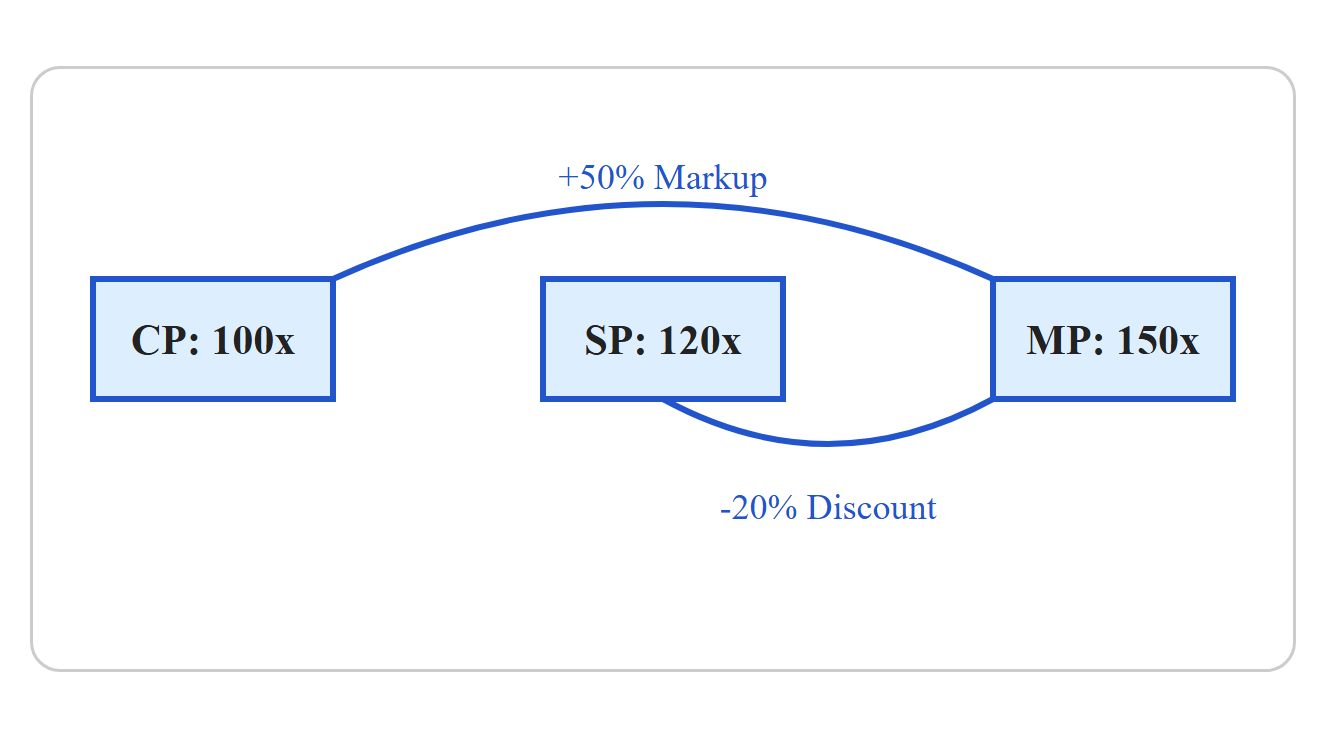
Let the Cost Price (CP) be 100 units.

Marked Price (MP) = 100 + 50% of 100 = 150 units.

Selling Price (SP) = 150 − 20% of 150 = 150 − 30 = 120 units.

Profit = SP − CP = 120 − 100 = 20 units. Given 20 units = ₹660, so 1 unit = ₹33.

Discount = MP − SP = 150 − 120 = 30 units.

Difference between Discount and Profit = 30 − 20 = 10 units = 10 × 33 = ₹330.

∴ The correct answer is ₹330.

Alternate Method

Given: Markup% = 50%, Discount% = 20%, Profit = ₹660. Formulas: Profit = SP − CP | SP = MP × (100 − D%) ÷ 100 | MP = CP × (100 + Markup%) ÷ 100.

⇒ Let CP = x. Then MP = 1.5x and SP = 0.8 × 1.5x = 1.2x. ⇒ Profit = 1.2x − x = 0.2x. Given 0.2x = 660 ⇒ x = 3300. ⇒ Profit = 0.2 × 3300 = ₹660. ⇒ Discount = MP − SP = 1.5x − 1.2x = 0.3x = 0.3 × 3300 = ₹990. ⇒ Difference = 990 − 660 = ₹330.

∴ The correct answer is ₹330.

Additional Information

Markup and Profit Relationship

Net Profit% can be calculated using the successive percentage formula: Net% = m − d − (m × d)/100, where m is markup% and d is discount%.

Relation between CP and MP

The ratio of CP to MP is given by: CP/MP = (100 − Discount%)/(100 + Profit%).

39

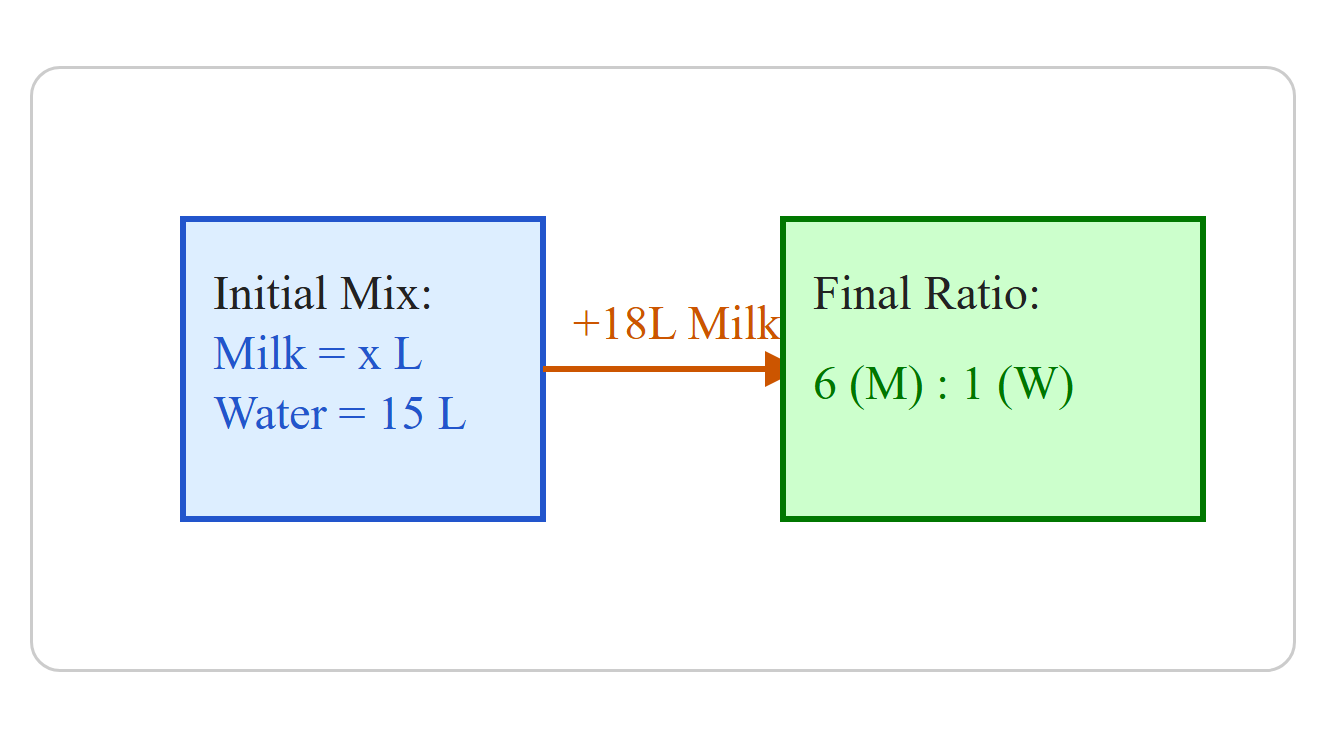
A mixture initially contains 'x' liters of milk and 15 liters of water. 18 liters of milk are then added to the mixture. The resulting mixture has a milk to water ratio of 6:1.  What is the value of 'x'?

  1. ((a))

    60 litres

  2. ((b))

    72 litres

  3. ((c))

    84 litres

  4. ((d))

    90 litres

  5. ((e))

    None of these

Show Answer
Answer: ((b))

72 litres

Shortcut Trick

Ratio of Milk to Water = 6 : 1

Given Water = 15 litres (1 unit = 15 litres)

Total Milk (final) = 6 × 15 = 90 litres

Initial Milk (x) = Final Milk − Added Milk = 90 − 18 = 72 litres

∴ The correct answer is 72 litres.

Alternate Method

Given:

Initial Milk = x litres, Initial Water = 15 litres

Milk added = 18 litres

Final Ratio (Milk : Water) = 6 : 1

Calculations:

⇒ (Initial Milk + Added Milk) ÷ Water = 6 ÷ 1

⇒ (x + 18) ÷ 15 = 6 ÷ 1

⇒ x + 18 = 15 × 6

⇒ x + 18 = 90

⇒ x = 90 − 18

⇒ x = 72

∴ The correct answer is 72 litres.

Additional Information

Ratio and Proportion

A ratio compares two quantities. If a : b = c : d, then product of extremes (a×d) equals product of means (b×c).

Mixture Problems

When only one component is added to a mixture, the quantity of the other component remains constant in terms of absolute units.

Unitary Method

Find the value of one unit by dividing the given total by its ratio share, then multiply to find other values.

Directions: Read the data carefully and answer the following questions. 

Three individuals, A, B, and C, were given a set of questions. They attempted some of them. The number of questions attempted by B is 50% of the total questions he was given. A was given 20 fewer questions than B. C was given 130 questions. The combined number of questions attempted by A and C is 145. The total number of questions given to all three is twice the total number of questions they attempted. Additionally, the number of questions attempted by B and C is the same.

40

Find the ratio of the number of questions attempted by A to the number of questions given to B.

  1. ((a))

    11:34

  2. ((b))

    13:35

  3. ((c))

    12:29

  4. ((d))

    13:37

  5. ((e))

    11:36

Show Answer
Answer: ((e))

11:36

General Solution:

Let:

GA : Questions given to A

GB : Questions given to B

GC : Questions given to C

AA : Questions attempted by A

AB : Questions attempted by B

AC : Questions attempted by C

B attempted 50% of the questions he was given:

AB = 0.5 × GB

A was given 20 fewer questions than B:

GA = GB - 20

C was given 130 questions:

GC = 130

Combined questions attempted by A and C is 145:

AA + AC = 145

Total questions given to all three is twice the total questions they attempted:

GA + GB + GC = 2 × (AA + AB + AC)

Number of questions attempted by B and C is the same:

AB = AC

From Equation 1:

AB = 0.5 × GB

From Equation 3:

GC = 130

From Equation 2:

GA = GB - 20

From Equation 4:

AA + AC = 145

From Equation 5:

GA + GB + GC = 2 × (AA + AB + AC)

Substitute GA = GB - 20 and GC = 130 into Equation 5:

GB - 20 + GB + 130 = 2 × (AA + AB + AC)

Simplify:

2GB + 110 = 2 × (AA + AB + AC)

GB + 55 = AA + AB + AC

From Equation 4:

AA + AC = 145

From Equation 6:

AB = AC

Substitute AB = Ainto GB + 55 = AA + AB + AC:

GB + 55 = AA + AB + AC

GB + 55 = AA + 2AC

From Equation 4:

AA = 145 - AC

Substitute AA = 145 - AC into GB + 55 = AA + 2AC:

GB + 55 = 145 - AC + 2AC

Simplify:

GB + 55 = 145 + AC

GB = 90 + AC

From Equation 1:

AB = 0.5 × GB

From Equation 6:

AB = AC

So:

AC = 0.5 × GB

Substitute AC = 0.5 × Ginto GB = 90 + AC:

GB = 90 + 0.5 × GB

Subtract 0.5 × Gfrom both sides:

0.5 × GB = 90

GB = 180

Now, find AC:

AC = 0.5 × GB = 0.5 × 180 = 90

From Equation 6:

AB = AC = 90

From Equation 4:

AA = 145 - AC = 145 - 90 = 55

From Equation 2:

GA = GB - 20 = 180 - 20 = 160

From Equation 3:

GC = 130

Thus,

PersonGivenAttempted
A16055
B18090
C13090


Calculations:

Questions attempted by A: 55

Questions given to B: 180

The ratio of Ato GB is:

A/ GB = 55 / 180

Divide both numerator and denominator by 5 to simplify:

55 / 180 = 11 / 36

Thus, the ratio of the number of questions attempted by A to the number of questions given to B is: 11:36

41

Find the total number of questions not attempted by A, B, and C together.

  1. ((a))

    235

  2. ((b))

    215

  3. ((c))

    245

  4. ((d))

    225

  5. ((e))

    205

Show Answer
Answer: ((a))

235

General Solution:

Let:

GA : Questions given to A

GB : Questions given to B

GC : Questions given to C

AA : Questions attempted by A

AB : Questions attempted by B

AC : Questions attempted by C

B attempted 50% of the questions he was given:

AB = 0.5 × GB

A was given 20 fewer questions than B:

GA = GB - 20

C was given 130 questions:

GC = 130

Combined questions attempted by A and C is 145:

AA + AC = 145

Total questions given to all three is twice the total questions they attempted:

GA + GB + GC = 2 × (AA + AB + AC)

Number of questions attempted by B and C is the same:

AB = AC

From Equation 1:

AB = 0.5 × GB

From Equation 3:

GC = 130

From Equation 2:

GA = GB - 20

From Equation 4:

AA + AC = 145

From Equation 5:

GA + GB + GC = 2 × (AA + AB + AC)

Substitute GA = GB - 20 and GC = 130 into Equation 5:

GB - 20 + GB + 130 = 2 × (AA + AB + AC)

Simplify:

2GB + 110 = 2 × (AA + AB + AC)

GB + 55 = AA + AB + AC

From Equation 4:

AA + AC = 145

From Equation 6:

AB = AC

Substitute AB = AC into GB + 55 = AA + AB + AC:

GB + 55 = AA + AB + AC

GB + 55 = AA + 2AC

From Equation 4:

AA = 145 - AC

Substitute AA = 145 - AC into GB + 55 = AA + 2AC:

GB + 55 = 145 - AC + 2AC

Simplify:

GB + 55 = 145 + AC

GB = 90 + AC

From Equation 1:

AB = 0.5 × GB

From Equation 6:

AB = AC

So:

AC = 0.5 × GB

Substitute AC = 0.5 × GB into GB = 90 + AC:

GB = 90 + 0.5 × GB

Subtract 0.5 × GB from both sides:

0.5 × GB = 90

GB = 180

Now, find AC:

AC = 0.5 × GB = 0.5 × 180 = 90

From Equation 6:

AB = AC = 90

From Equation 4:

AA = 145 - AC = 145 - 90 = 55

From Equation 2:

GA = GB - 20 = 180 - 20 = 160

From Equation 3:

GC = 130

Thus,

PersonGivenAttempted
A16055
B18090
C13090


Calculations:

Not Attempted = Given − Attempted

For A:

Not Attempted = 160 − 55 = 105

For B:

Not Attempted = 180 − 90 = 90

For C:

Not Attempted = 130 − 90 = 40

Now, sum the not attempted questions for A, B, and C:

Total Not Attempted = 105 + 90 + 40 = 235

Thus, the total number of questions not attempted by A, B, and C together is 235.

42

If the total number of questions given to D is 20% less than that by C and questions attempted by D are 75% of the total questions given to D. Then find the number of questions attempted by D. 

  1. ((a))

    75

  2. ((b))

    65

  3. ((c))

    78

  4. ((d))

    68

  5. ((e))

    69

Show Answer
Answer: ((c))

78

General Solution:

Let:

GA : Questions given to A

GB : Questions given to B

GC : Questions given to C

AA : Questions attempted by A

AB : Questions attempted by B

AC : Questions attempted by C

B attempted 50% of the questions he was given:

AB = 0.5 × GB

A was given 20 fewer questions than B:

GA = GB - 20

C was given 130 questions:

GC = 130

Combined questions attempted by A and C is 145:

AA + AC = 145

Total questions given to all three is twice the total questions they attempted:

GA + GB + GC = 2 × (AA + AB + AC)

Number of questions attempted by B and C is the same:

AB = AC

From Equation 1:

AB = 0.5 × GB

From Equation 3:

GC = 130

From Equation 2:

GA = GB - 20

From Equation 4:

AA + AC = 145

From Equation 5:

GA + GB + GC = 2 × (AA + AB + AC)

Substitute GA = GB - 20 and GC = 130 into Equation 5:

GB - 20 + GB + 130 = 2 × (AA + AB + AC)

Simplify:

2GB + 110 = 2 × (AA + AB + AC)

GB + 55 = AA + AB + AC

From Equation 4:

AA + AC = 145

From Equation 6:

AB = AC

Substitute AB = AC into GB + 55 = AA + AB + AC:

GB + 55 = AA + AB + AC

GB + 55 = AA + 2AC

From Equation 4:

AA = 145 - AC

Substitute AA = 145 - AC into GB + 55 = AA + 2AC:

GB + 55 = 145 - AC + 2AC

Simplify:

GB + 55 = 145 + AC

GB = 90 + AC

From Equation 1:

AB = 0.5 × GB

From Equation 6:

AB = AC

So:

AC = 0.5 × GB

Substitute AC = 0.5 × GB into GB = 90 + AC:

GB = 90 + 0.5 × GB

Subtract 0.5 × GB from both sides:

0.5 × GB = 90

GB = 180

Now, find AC:

AC = 0.5 × GB = 0.5 × 180 = 90

From Equation 6:

AB = AC = 90

From Equation 4:

AA = 145 - AC = 145 - 90 = 55

From Equation 2:

GA = GB - 20 = 180 - 20 = 160

From Equation 3:

GC = 130

Thus,

PersonGivenAttempted
A16055
B18090
C13090


Calculations:

C was given GC = 130 questions.

It is stated that D was given 20% less than C. So:

G= G− 0.20 × GC

G= 130 − 0.20 × 130

G= 130 − 26

G= 104

It is stated that D attempted 75% of the total questions given to D. So:

A= 0.75 × GD

A= 0.75 × 10⁴

A= 78

Thus, the number of questions attempted by D is 78.

43

If C scored 70 marks, with 1 mark awarded for each correct answer and a penalty of 1/4th mark for each incorrect answer, how many questions did C answer incorrectly?

  1. ((a))

    8

  2. ((b))

    10

  3. ((c))

    16

  4. ((d))

    25

  5. ((e))

    20

Show Answer
Answer: ((c))

16

General Solution:

Let:

GA : Questions given to A

GB : Questions given to B

GC : Questions given to C

AA : Questions attempted by A

AB : Questions attempted by B

AC : Questions attempted by C

B attempted 50% of the questions he was given:

AB = 0.5 × GB

A was given 20 fewer questions than B:

GA = GB - 20

C was given 130 questions:

GC = 130

Combined questions attempted by A and C is 145:

AA + AC = 145

Total questions given to all three is twice the total questions they attempted:

GA + GB + GC = 2 × (AA + AB + AC)

Number of questions attempted by B and C is the same:

AB = AC

From Equation 1:

AB = 0.5 × GB

From Equation 3:

GC = 130

From Equation 2:

GA = GB - 20

From Equation 4:

AA + AC = 145

From Equation 5:

GA + GB + GC = 2 × (AA + AB + AC)

Substitute GA = GB - 20 and GC = 130 into Equation 5:

GB - 20 + GB + 130 = 2 × (AA + AB + AC)

Simplify:

2GB + 110 = 2 × (AA + AB + AC)

GB + 55 = AA + AB + AC

From Equation 4:

AA + AC = 145

From Equation 6:

AB = AC

Substitute AB = AC into GB + 55 = AA + AB + AC:

GB + 55 = AA + AB + AC

GB + 55 = AA + 2AC

From Equation 4:

AA = 145 - AC

Substitute AA = 145 - AC into GB + 55 = AA + 2AC:

GB + 55 = 145 - AC + 2AC

Simplify:

GB + 55 = 145 + AC

GB = 90 + AC

From Equation 1:

AB = 0.5 × GB

From Equation 6:

AB = AC

So:

AC = 0.5 × GB

Substitute AC = 0.5 × GB into GB = 90 + AC:

GB = 90 + 0.5 × GB

Subtract 0.5 × GB from both sides:

0.5 × GB = 90

GB = 180

Now, find AC:

AC = 0.5 × GB = 0.5 × 180 = 90

From Equation 6:

AB = AC = 90

From Equation 4:

AA = 145 - AC = 145 - 90 = 55

From Equation 2:

GA = GB - 20 = 180 - 20 = 160

From Equation 3:

GC = 130

Thus,

PersonGivenAttempted
A16055
B18090
C13090


Calculations:

Let:

x: Number of correct answers by C 

y: Number of incorrect answers by C

C attempted 90 questions:


x + y = 90

C scored 70 marks:

x - (1/4)y = 70

From x + y = 90, we can write:

x = 90 - y

Substitute x = 90 - y into the second equation:

(90 - y) - (1/4)y = 70

90 - (5/4)y = 70

(5/4)y = 20

y = 16

Thus, the number of incorrect questions answered by C is 16.

44

A, B, and C can complete a piece of work individually in 40 days, 80 days, and 10 days, respectively. If they work together, how many days will they take to complete the work?

  1. ((a))

    80/7 days

  2. ((b))

    120/11 days

  3. ((c))

    80/9 days

  4. ((d))

    80/11 days

  5. ((e))

    120/7 days

Show Answer
Answer: ((d))

80/11 days

Shortcut Trick

Total Work = LCM(40, 80, 10) = 80 units.

Efficiency of A = 2, B = 1, C = 8.

Combined Efficiency = 2 + 1 + 8 = 11 units/day.

Time taken = 80 ÷ 11 days.

∴ The correct answer is 80/11 days.

Alternate Method

Given:

Time taken by A = 40 days

Time taken by B = 80 days

Time taken by C = 10 days

Formula Used:

Total Work = Time × Efficiency

Time = Total Work ÷ Combined Efficiency

PersonDaysTotal WorkEfficiency
A408080 ÷ 40 = 2
B8080 ÷ 80 = 1
C1080 ÷ 10 = 8

Calculations:

Total Efficiency of (A + B + C) = 2 + 1 + 8 = 11 units/day

Total Work = 80 units

Time taken by all three together = Total Work ÷ Total Efficiency

⇒ Time = 80/11 days

∴ The correct answer is 80/11 days.

Additional Information

Work and Efficiency

Efficiency is inversely proportional to the time taken to complete a work. If a person completes work in 'n' days, their 1-day work is 1/n.

Combined Work Formula

For three people with times x, y, and z, the combined time is (x × y × z) ÷ (xy + yz + zx).

Pipes and Cisterns

Similar logic applies where filling pipes have positive efficiency and leakage/outlet pipes have negative efficiency.

45

Two individuals, A and B, travel a certain distance. A travels at a speed of 5 km/h for 2 hours, and B travels at a speed of 8 km/h for 1 hour. What is the approximate average speed of A and B for the entire journey?

  1. ((a))

    5 km/hr

  2. ((b))

    5.5 km/hr

  3. ((c))

    6 km/hr

  4. ((d))

    6.5 km/hr

  5. ((e))

    7.5 km/hr

Show Answer
Answer: ((c))

6 km/hr

Shortcut Trick

Total Distance = (5 × 2) + (8 × 1) = 10 + 8 = 18 km.

Total Time = 2 + 1 = 3 hours.

Average Speed = Total Distance ÷ Total Time = 18 ÷ 3 = 6 km/h.

∴ The correct answer is 6 km/hr.

Alternate Method

Given:

Speed of A = 5 km/h, Time of A = 2 hours.

Speed of B = 8 km/h, Time of B = 1 hour.

Formula Used:

Average Speed = Total Distance ÷ Total Time

Calculations:

⇒ Distance covered by A = Speed × Time = 5 × 2 = 10 km.

⇒ Distance covered by B = Speed × Time = 8 × 1 = 8 km.

⇒ Total distance = 10 + 8 = 18 km.

⇒ Total time taken = 2 + 1 = 3 hours.

⇒ Average Speed = 18 ÷ 3 = 6 km/h.

∴ The correct answer is 6 km/hr.

Additional Information

Weighted Average Speed

When different speeds are maintained for different durations, Average Speed = (s1t1 + s2t2) ÷ (t1 + t2).

Equal Distance Case

If a person travels equal distances at speeds x and y, the average speed is given by the Harmonic Mean: 2xy ÷ (x + y).

Relative Speed

In the same direction, relative speed = s1 − s2. In the opposite direction, relative speed = s1 + s2.

46

If a sum of money is invested at 12% simple interest for 3 years, and for 8 years then the difference between the interests earned from the two investments is ₹2,880. What is the sum invested?

  1. ((a))

    Rs. 4200

  2. ((b))

    Rs. 4800

  3. ((c))

    Rs. 5400

  4. ((d))

    Rs. 5600

  5. ((e))

    Rs. 6000

Show Answer
Answer: ((b))

Rs. 4800

Shortcut Trick

Rate of Interest = 12% per annum.

Difference in Time = 8 years − 3 years = 5 years.

Difference in Interest % = 12% × 5 = 60%.

Given 60% of Sum = ₹2,880 → Sum = 2880 ÷ 0.6 = ₹4,800.

∴ The correct answer is ₹4800.

Alternate Method

Given: Rate (R) = 12%, Time1 (T1) = 3 years, Time2 (T2) = 8 years, Difference in SI = ₹2,880.

Formula Used: Simple Interest (SI) = (P × R × T) ÷ 100

⇒ [(P × 12 × 8) ÷ 100] − [(P × 12 × 3) ÷ 100] = 2880

⇒ (96P − 36P) ÷ 100 = 2880

⇒ 60P ÷ 100 = 2880

⇒ 0.6P = 2880

⇒ P = 2880 ÷ 0.6 = 4800

∴ The correct answer is ₹4800.

Additional Information

Simple Interest vs Amount

The total Amount (A) is the sum of Principal (P) and Interest (I). A = P + (P × R × T)/100.

Difference in SI for same Principal

If R is constant, Difference in SI = P × R × (T2 − T1) ÷ 100. If T is constant, Difference in SI = P × (R2 − R1) × T ÷ 100.

Rule of 72

A quick way to estimate how long it takes to double your money: Time ≈ 72 ÷ Interest Rate (used mainly for Compound Interest).

47

What will come in the place of the question mark ‘?’ in the following question?

1/8 of 248 × 18/6 + ? = 744/8 + 125

  1. ((a))

    125

  2. ((b))

    120

  3. ((c))

    114

  4. ((d))

    112

  5. ((e))

    None of these

Show Answer
Answer: ((a))

125

Concept Used

Using BODMAS 

Calculation:

⇒ 1/8 of 248 × 18/6 + ? = 744/8 + 125

⇒ 31 × 3 + ? = 93 + 125

⇒ 93 + ? = 218

⇒ ? = 218 – 93

⇒ ? = 125

∴ The ? is  125

48

What will come in the place of the question mark ‘?’ in the following question?

(1/3) of 570 + (1/8) of 6464 - √81 = ?

  1. ((a))

    989

  2. ((b))

    799

  3. ((c))

    699

  4. ((d))

    900

  5. ((e))

    None of these

Show Answer
Answer: ((a))

989

Given:

(1/3) of 570 + (1/8) of 6464 - √81 = ?

Concept Used:

Follow the BODMAS rule according to the table given below:

Calculation:

(1/3) of 570 + (1/8) of 6464 - √81 = ?

⇒ (1/3 × 570) + (1/8 × 6464) - 9 = ?

⇒ 190 + 808 – 9 = ?

⇒ 998 – 9 = ?

⇒ ? = 989

The value of ‘?’ Is 989.

49

What will come in the place of the question mark ‘?’ in the following question?

(√729 ÷ 9 + 13 × 4)/5 = ?

  1. ((a))

    8

  2. ((b))

    12

  3. ((c))

    11

  4. ((d))

    15

  5. ((e))

    9

Show Answer
Answer: ((c))

11

Given:

(√729 ÷ 9 + 13 × 4)/5 = ?

Rule:

Calculation:

(√729 ÷ 9 + 13 × 4)/5 = ?

⇒ (27 ÷ 9 + 13 × 4)/5 = ?

⇒ (3 + 13 × 4)/5 = ?

⇒ (3 + 52)/5 = ?

⇒ ? = 55/5

∴ The required answer is 11.

Hint

√ 729 = 27

50

What will come in the place of the question mark ‘?’ in the following question?

60% of (4/7) of 630 = ?

  1. ((a))

    216

  2. ((b))

    205

  3. ((c))

    230

  4. ((d))

    190

  5. ((e))

    195

Show Answer
Answer: ((a))

216

Convert the data into mathematical form,

⇒ 630 × (4/7) × (60/100) = ?

⇒ 90 × 4 × 0.6 = ?                                      

⇒ ? = 216

51

What will come in place of the question mark (?) in the following question?

60% of 360 + 56 ÷ 8 = ? + 5 × 4

  1. ((a))

    213

  2. ((b))

    223

  3. ((c))

    203

  4. ((d))

    233

  5. ((e))

    133

Show Answer
Answer: ((c))

203

Given:

60% of 360 + 56 ÷ 8 = ? + 5 × 4

Concept used:

Follow the BODMAS rule according to the table given below:

Calculation:

60% of 360 + 56 ÷ 8 = ? + 5 × 4

⇒ (60/100) × 360 + 7 = ? + 20

⇒ (3/5) × 360 + 7 – 20 = ?

⇒ ? = 216 – 13

⇒ ? = 203

∴ 203 will come in place of the question mark (?).

52

What should come in the place of question mark ‘?’ in the following question?

2/9 of 405 ÷ 15 + 23 = √(?)

  1. ((a))

    841

  2. ((b))

    800

  3. ((c))

    843

  4. ((d))

    851

  5. ((e))

    None of these

Show Answer
Answer: ((a))

841

Concept:

Follow BODMAS rule to solve this question, as per the order given below.

Step - 1: Parts of an equation enclosed in 'Brackets' must be solved first, and following BODMAS rule in the bracket.

Step - 2: Any mathematical 'Of' or 'Exponent' must be solved next.

Step - 3: Next, the parts of the equation that contain 'Division' and 'Multiplication' are calculated.

Step - 4: Last but not the least, the parts of the equation that contain 'Addition' and 'Subtraction' should be calculated. 

Calculation:

Applying BODMAS:

Taking square both sides

⇒ (2/9 of 405 ÷ 15 + 23)2 = x

⇒ (90 ÷ 15 + 23)2 = x

⇒ (6 + 23)2 = x

⇒ (29)2 = x

⇒ x = 841

53

What will come in place of the question mark ‘?’ in the following question?

√(5/8 × 32% of 1200 ÷ 16 + 34) = ?

  1. ((a))

    9

  2. ((b))

    6

  3. ((c))

    8

  4. ((d))

    7

  5. ((e))

    12

Show Answer
Answer: ((d))

7

√(5/8 × 32% of 1200 ÷ 16 + 34)

Applying BODMAS Rule;

⇒ √(5/8 × (32/100) × 1200 ÷ 16 + 34)

⇒ √(5/8 × 384 ÷ 16 + 34)

⇒ √(5/8 × 24 + 34)

⇒ √(15 + 34)

⇒ √49

⇒ 7

54

What will come in the place of the question mark ‘?’ in the following question?

125% of 560 + 22% of 450 = ?

  1. ((a))

    799

  2. ((b))

    782

  3. ((c))

    700

  4. ((d))

    749

  5. ((e))

    None of these

Show Answer
Answer: ((a))

799

Given:

125% of 560 + 22% of 450 = ?

Concept Used:

Follow the BODMAS rule according to the table given below:

Calculation:

125% of 560 + 22% of 450 = ?

⇒ 125/100 × 560 + 22/100 × 450

⇒ 5/4 × 560 + 11/50 × 450

⇒ 700 + 99

⇒ 799

The value of ? is 799.

55

What will come in place of the question mark (?) in the following equation?

25 × 4 ÷ 5 = 80 ÷ 20 × ?

  1. ((a))

    8

  2. ((b))

    10

  3. ((c))

    12

  4. ((d))

    5

  5. ((e))

    17

Show Answer
Answer: ((d))

5

Follow BODMAS rule to solve this question, as per the order given below, 

Step-1: Parts of an equation enclosed in 'Brackets' must be solved first, and in the bracket, 

Step-2: Any mathematical 'Of' or 'Exponent' must be solved next, 

Step-3: Next, the parts of the equation that contain 'Division' and 'Multiplication' are calculated, 

Step-4: Last but not least, the parts of the equation that contain 'Addition' and 'Subtraction' should be calculated 

 25 × 4 ÷ 5 = 80 ÷ 20 × ?

⇒ 25 × (4/5) = 4 × ?

⇒ 5 × 4 = 4 × ?

∴ ? = 5

56

What should come in place of question mark (?) in the following question?

153 ÷ 17 × (9)2 – 53 = (?)2

  1. ((a))

    ±26

  2. ((b))

    √26

  3. ((c))

    –729

  4. ((d))

    27

  5. ((e))

    √27

Show Answer
Answer: ((a))

±26

Concept used:

Follow BODMAS rule to solve this question, as per the order given below:

⇒ 153 ÷ 17 × (9)2 – 53 = (?)2

⇒ 9 × (9)2 – 53 = (?)2

⇒ 729 – 53 = (?)2

⇒ (±26)2 = (?)2

∴ ? = ±26

57

The speed of a boat in still water is 18 km/hr. When traveling upstream, the boat covers 60 km in 4 hours. Find the difference between the distance the boat can cover in 3 hours while traveling downstream and 173 km.

  1. ((a))

    112 km 

  2. ((b))

    92 km 

  3. ((c))

    110 km 

  4. ((d))

    98 km 

  5. ((e))

    120 km

Show Answer
Answer: ((c))

110 km 

Shortcut Trick

Upstream speed (u) = 60 km ÷ 4 hours = 15 kmph.

Stream speed (v) = Still water speedUpstream speed = 18 − 15 = 3 kmph.

Downstream speed (d) = Still water speed + Stream speed = 18 + 3 = 21 kmph.

Downstream distance (3 hr) = 21 × 3 = 63 km.

Difference = 173 − 63 = 110 km.

∴ The correct answer is 110 km.

Alternate Method

Given: Speed of boat in still water (x) = 18 kmph, Upstream distance = 60 km, Time = 4 hr.

Formula Used: Speed = Distance ÷ Time; Upstream speed = x − y; Downstream speed = x + y.

Upstream Speed = 60 ÷ 4 = 15 kmph.

⇒ Let Stream Speed be y kmph.

⇒ 18 − y = 15

⇒ y = 3 kmph.

Downstream Speed = 18 + 3 = 21 kmph.

Distance covered in 3 hours downstream = 21 × 3 = 63 km.

Required Difference = 173 − 63 = 110 km.

∴ The correct answer is 110 km.

Additional Information

Still Water Speed Formula

Speed of boat in still water (x) = (Downstream speed + Upstream speed) ÷ 2.

Stream Speed Formula

Speed of current/stream (y) = (Downstream speed − Upstream speed) ÷ 2.

Average Speed of Boat

Average speed for a round trip = (Downstream Speed × Upstream Speed) ÷ Still Water Speed.

Directions: Study the given table carefully and answer the given questions. 

The following table shows the number of mobile covers sold by three persons A, B, and C in three different months March, April, and May.

PersonMarchAprilMay
A947292
B12099102
C886570
58

Find the average number of mobile covers sold by B in all the given months.

  1. ((a))

    103

  2. ((b))

    105

  3. ((c))

    107

  4. ((d))

    111

  5. ((e))

    114

Show Answer
Answer: ((c))

107

The total number of mobile covers sold by B.

Total = March + April + May = 120 + 99 + 102 = 321

The average is calculated as:

Average = Total / Number of months

Here, the number of months = 3.

So:

Average = 321 / 3 = 107

Thus, the average number of mobile covers sold by B in all the given months is 107.

59

If in the month of April, A sold each mobile cover in Rs.50, then find the total revenue generated by him in April.

  1. ((a))

    Rs. 4800

  2. ((b))

    Rs. 3600

  3. ((c))

    Rs. 6400

  4. ((d))

    Rs. 5600

  5. ((e))

    Rs. 2400

Show Answer
Answer: ((b))

Rs. 3600

A sold 72 mobile covers in April.

Each mobile cover is sold for Rs. 50.

Total revenue = Number of covers sold × Price per cover

Total revenue =72 × 50 = 3600 .

Thus, the total revenue generated by A in April is Rs. 3600.

60

The number of mobile covers sold by C in April is what percent of the number of mobile covers sold by B in March?

  1. ((a))

    62.13% 

  2. ((b))

    44.72% 

  3. ((c))

    88.22% 

  4. ((d))

    54.17% 

  5. ((e))

    60.42%

Show Answer
Answer: ((d))

54.17% 

C in April: 65 mobile covers.

B in March: 120 mobile covers.

The formula to calculate the percentage is:

Percentage = Part / Whole × 100

Here:

Part = Number of mobile covers sold by C in April = 65.

Whole = Number of mobile covers sold by B in March = 120.

Substitute the values:

Percentage = 65 / 120 × 100

65 / 120 = 0.5417

Percentage = 0.5417 × 100 = 54.17%

Thus, the number of mobile covers sold by C in April is 54.17% of the number of mobile covers sold by B in March.

61

If out of the total mobile covers sold by C in March, the ratio of blue color mobile cover and black color mobile cover sold were 4: 7, then find the number of black color mobile cover sold by C in March. 

  1. ((a))

    56

  2. ((b))

    63

  3. ((c))

    70

  4. ((d))

    35

  5. ((e))

    48

Show Answer
Answer: ((a))

56

We are given:

Total mobile covers sold by C in March = 88.

The ratio of blue color mobile covers to black color mobile covers sold by C in March is 4:7.

Let the number of blue color mobile covers be 4x, and the number of black color mobile covers be 7x.

4x + 7x = 88

11x = 88

x = 88 / 11 = 8

Black color mobile covers = 7x = 7 × 8 = 56

Thus, the number of black color mobile covers sold by C in March is 56.

62

Find the ratio of number of mobile covers sold by A and B together in March to the number of mobile covers sold by C in May and March together. 

  1. ((a))

    97:71 

  2. ((b))

    23:77 

  3. ((c))

    107:79 

  4. ((d))

    97:79 

  5. ((e))

    71:77

Show Answer
Answer: ((c))

107:79 

A's sales in March = 94

B's sales in March = 120

Total =94 + 120 = 214 

C's sales in May = 70

C's sales in March = 88

Total =70 + 88 = 158 

The ratio of the number of mobile covers sold by A and B together in March to the number of mobile covers sold by C in May and March together is:

Ratio = A and B in March / C in May and March = 214 / 158

Simplify the ratio by dividing both numbers by 2:

214 / 158 = 107 / 79

Thus, the ratio is 107:79.

63

The length and breadth of a rectangle are in the ratio 5:3.  The perimeter of the rectangle is equal to the perimeter of a square.  The side of the square is equal to the radius of a circle. What is the area of the circle if the breadth of the rectangle is 12 cm?

  1. ((a))

    121π cm²

  2. ((b))

    196π cm²

  3. ((c))

    225π cm²

  4. ((d))

    256π cm²

  5. ((e))

    289π cm²

Show Answer
Answer: ((d))

256π cm²

Shortcut Trick

Breadth 3 units = 12 cm → 1 unit = 4 cm.

Length = 5 × 4 = 20 cm.

Side of Square = (Length + Breadth) ÷ 2 = (20 + 12) ÷ 2 = 16 cm.

Radius of Circle = Side of Square = 16 cm.

Area of Circle = π × (16)2 = 256π cm2.

∴ The correct answer is 256π cm2.

Alternate Method

Given: Ratio L:B = 5:3, Breadth = 12 cm, Perimeterrect = Perimetersq, Sidesq = Radiuscircle.

Formula Used: Perimeter of rectangle = 2(L + B); Perimeter of square = 4 × Side; Area of circle = πr2.

⇒ 3 units = 12 cm

⇒ 1 unit = 4 cm

⇒ Length = 5 × 4 = 20 cm

⇒ Perimeter of rectangle = 2(20 + 12) = 64 cm

⇒ Perimeter of square = 64 cm

⇒ 4 × Side = 64 ⇒ Side = 16 cm

⇒ Radius (r) = 16 cm

⇒ Area of circle = π × (16)2 = 256π cm2

∴ The correct answer is 256π cm2.

Additional Information

Rectangle Properties

Perimeter = 2(l + b) and Area = l × b. Diagonal d = √(l2 + b2).

Square Properties

Perimeter = 4a and Area = a2. Diagonal d = a√2.

Circle Properties

Circumference = 2πr and Area = πr2. Diameter D = 2r.

64

Four positive numbers, a, b, c, and d, are related in a specific way.  The first number, a, is to the second number, b, as 3 is to 5.  Interestingly, the ratio between b and c is the same as the ratio between c and d.  Furthermore, the ratio of a to d is given as 3 to 8.  Given that d has a value of 16, determine the numerical value of b.

  1. ((a))

    8

  2. ((b))

    10

  3. ((c))

    12

  4. ((d))

    15

  5. ((e))

    5

Show Answer
Answer: ((b))

10

Shortcut Trick

Given ratio a : d = 3 : 8 and d = 16.

a = (3/8) × 16 = 6.

Given a : b = 3 : 5. Since a = 6 (which is 2 × 3), then b = 2 × 5 = 10.

Checking consistency: Since b/c = c/d, then c2 = b × d = 10 × 16 = 160, which is valid for positive numbers.

∴ The correct answer is 10.

Alternate Method

Given: a : b = 3 : 5, b/c = c/d, a : d = 3 : 8, and d = 16.

⇒ From ratio a : d = 3 : 8 and d = 16:

⇒ a/16 = 3/8

a = (3 × 16) ÷ 8 = 6

⇒ Now using ratio a : b = 3 : 5:

⇒ 6/b = 3/5

⇒ 3 × b = 6 × 5

⇒ 3b = 30

b = 10

∴ The correct answer is 10.

Additional Information

Continued Proportion

When a, b, c are in continued proportion, then a/b = b/c, which implies b2 = ac. Here b is the mean proportional.

Ratio Scaling

If a : b = m : n, and the value of a is known, then b = (a × n) ÷ m.

Compound Ratio

The compound ratio of a : b and c : d is (a × c) : (b × d).

65

Average score of the 3/4th of the class is 80% of the class average. Find the ratio of average score of the remaining class to that of entire class.

  1. ((a))

    3 : 7

  2. ((b))

    7 : 3

  3. ((c))

    4 : 9

  4. ((d))

    9 : 4

  5. ((e))

    8 : 5

Show Answer
Answer: ((e))

8 : 5

Shortcut Trick

Let total students = 4 and class average = 100.

Total score = 4 × 100 = 400.

Score of 3 students = 3 × 80% of 100 = 3 × 80 = 240.

Score of remaining 1 student = 400 − 240 = 160.

Ratio = 160 : 100 = 8 : 5.

∴ The correct answer is 8 : 5.

Alternate Method

Given:

⇒ Let total number of students = n

⇒ Let Entire Class Average = A

Total Score = n × A

Calculations:

⇒ Number of students in 3/4th group = (3/4)n

⇒ Average of this group = 80% of A = 0.8A

⇒ Total score of this group = (3/4)n × 0.8A = 0.6nA

⇒ Remaining students = n − (3/4)n = (1/4)n

⇒ Total score of remaining students = nA − 0.6nA = 0.4nA

⇒ Average of remaining students = 0.4nA ÷ (1/4)n = 0.4A × 4 = 1.6A

⇒ Required Ratio = 1.6A : A = 1.6 : 1 = 16 : 10

⇒ Simplified Ratio = 8 : 5

∴ The correct answer is 8 : 5.

Additional Information

Weighted Average Formula

Total Average (Av) = (n1a1 + n2a2) ÷ (n1 + n2), where n is the quantity and a is the average.

Deviation Method

The sum of deviations of individual groups from the total average must be zero: n1(a1 − Av) + n2(a2 − Av) = 0.

Reasoning Ability (35 questions)

Directions: Read the instructions carefully to answer the following questions:

There are ten persons sitting in two parallel rows in such a manner that five persons - P, Q, R, S, T are sitting in a row - 1 facing towards the south direction and five persons - A, B, C, D, E are sitting in a row - 2 facing towards the north, such that all persons in both the rows facing each other.

Q is sitting at the end of the row (either left or right). A is sitting opposite to the one who is second to the right of Q. A and D are immediate neighbours of each other and D is second to the right of E. S is third to the left of R and is not neighbour of T. R is opposite to B.

66

Who is sitting opposite to E?

  1. ((a))

    P

  2. ((b))

    R

  3. ((c))

    T

  4. ((d))

    S

  5. ((e))

    None of these

Show Answer
Answer: ((c))

T

1) A is sitting opposite to the one who is second to the right of Q. 

2) Q is sitting at the end of the row (either left or right)

So, Q will sit at the right end of the row:

3) A and D are immediate neighbours of each other and D is second to the right of E:

So, D will sit to the immediate right of A.

4) S is third to the left of R and is not neighbour of T.

  1. R is opposite to B.

So, B will sit immediate left of E and C will sit to the immediate right of D:

Here, S is not the neighbour of T, so T will sit immediate left of R and P will sit immediate right of S.

So, the final figure according to the question is:


Hence, T is sitting opposite to E.

67

Which pair of persons is sitting diagonally opposite to each other?

  1. ((a))

    BQ

  2. ((b))

    RC

  3. ((c))

    ET

  4. ((d))

    Both 1 and 2

  5. ((e))

    both 2 and 3

Show Answer
Answer: ((d))

Both 1 and 2

1)  A is sitting opposite to the one who is second to the right of Q. 

2) Q is sitting at the end of the row (either left or right)

So, Q will sit at the right end of the row:

3) A and D are immediate neighbours of each other and D is second to the right of E:

So, D will sit to the immediate right of A.

4) S is third to the left of R and is not a neighbour of T.

  1. R is opposite to B.

So, B will sit immediate left of E and C will sit to the immediate right of D:

Here, S is not the neighbour of T, so T will sit immediate left of R and P will sit immediate right of S.

So, the final figure according to the question is:


Hence, Both 1 and 2 (RC and BQ) are sitting diagonally opposite to each other.

68

Who is third to the right of the one who is opposite to R?

  1. ((a))

    E

  2. ((b))

    A

  3. ((c))

    C

  4. ((d))

    None

  5. ((e))

    D

Show Answer
Answer: ((e))

D

1)  A is sitting opposite to the one who is second to the right of Q. 

2) Q is sitting at the end of the row (either left or right)

So, Q will sit at the right end of the row:

3) A and D are immediate neighbours of each other and D is second to the right of E:

So, D will sit to the immediate right of A.

4) S is third to the left of R and is not a neighbour of T.

  1. R is opposite to B.

So, B will sit immediate left of E and C will sit to the immediate right of D:

Here, S is not the neighbour of T, so T will sit immediate left of R and P will sit immediate right of S.

So, the final figure according to the question is:


Here, opposite of R is B

And 3rd to the right of B is D

Hence, D is third to the right of the one who is opposite to R.

69

Four of the following five are alike in a certain way thus form a group. Which one of the following does not belong to that group?

  1. ((a))

    B

  2. ((b))

    P

  3. ((c))

    R

  4. ((d))

    C

  5. ((e))

    Q

Show Answer
Answer: ((b))

P

1)  A is sitting opposite to the one who is second to the right of Q. 

2) Q is sitting at the end of the row (either left or right)

So, Q will sit at the right end of the row:

3) A and D are immediate neighbours of each other and D is second to the right of E:

So, D will sit to the immediate right of A.

4) S is third to the left of R and is not neighbour of T.

  1. R is opposite to B.

So, B will sit immediate left of E and C will sit to the immediate right of D:

Here, S is not the neighbour of T, so T will sit immediate left of R and P will sit immediate right of S.

So, the final figure according to the question is:


Here, R, C, Q, B are sitting at the end of the rows except P.

Hence, P does not belong to that group.

70

Which of the following statements is / are true regarding S?

  1. ((a))

    Opposite to D

  2. ((b))

    Immediate neighbour of Q

  3. ((c))

    Second to the left of T.

  4. ((d))

    Immediate left of the one who is opposite to A

  5. ((e))

    All are true

Show Answer
Answer: ((e))

All are true

1)  A is sitting opposite to the one who is second to the right of Q. 

2) Q is sitting at the end of the row (either left or right)

So, Q will sit at the right end of the row:

3) A and D are immediate neighbours of each other and D is second to the right of E:

So, D will sit to the immediate right of A.

4) S is third to the left of R and is not a neighbour of T.

  1. R is opposite to B.

So, B will sit immediate left of E and C will sit to the immediate right of D:

Here, S is not the neighbour of T, so T will sit immediate left of R and P will sit immediate right of S.

So, the final figure according to the question is:


So,

(1) Opposite to D - True 

(2) Immediate neighbour of Q - True

(3) Second to the left of T - True

(4) Immediate left of the one who is opposite to A - True (Opposite to A is P, so S is the immediate neighbour of P)

Hence, All are correct.

71

Directions**:** In the question given below are given three statements followed by two conclusions numbered I and II. You have to take the given statements to be true even if they seem to be at variance with commonly known facts. Read all the conclusions and then decide which of the given conclusions logically follows from the given statements disregarding commonly known facts.

Statements:

All sticks are poles.

Some poles are rods.

Only a few stands are rods.

Conclusions:

I. Some stands are sticks.

II. Some stands are poles.

  1. ((a))

    Only conclusion I follows.

  2. ((b))

    Only conclusion II follows.

  3. ((c))

    Either conclusion I or II follows.

  4. ((d))

    Both conclusions follow.

  5. ((e))

    Neither conclusion I nor II follows.

Show Answer
Answer: ((e))

Neither conclusion I nor II follows.

The least possible Venn Diagram for the given data:

Conclusions:

I. Some stands are sticks → False (it is possible but not definite, as no direct relation between the two is given).

II. Some stands are poles → False (it is possible but not definite, as no direct relation between the two is given).

Hence, "Neither conclusion I nor II follows."

72

Direction: In the question below are given three statements followed by two conclusions numbered I, and II  .You have to take the given statements to be true even if they seem to be at variance with commonly known facts. Read all the conclusions and then decide which of the given conclusions logically follows from the given statements disregarding commonly known facts.

Statements

Only a few Bag are Box

Only Box are pen

No Bag is copy

Conclusions

I. All Box being Bag is a possibility

II. Some Pen are copy

  1. ((a))

    Only I follows

  2. ((b))

    Only II follows

  3. ((c))

    Both I and II follows

  4. ((d))

    Either I or II follows

  5. ((e))

    Neither I nor II follows

Show Answer
Answer: ((e))

Neither I nor II follows

Venn diagram for the given statements are follows.

Conclusions

I. All Box being Bag is a possibility - False(Given Only Box are Pen means Pen cannot be others thus All Box being Bag is a possibility not follows)

II. Some Pen are copy - False (Because the relation between Pen and Copy is not given thus Some Pen are copy not follows)

Hence, Neither I nor II follows.

73

Directions: In the question below are given three statements followed by two conclusions. You have to take the given statements to be true even if they seem to be at variance with commonly known facts. Read all the conclusions and then decide which of the given conclusions logically follows from the given statements disregarding commonly known facts.

Statements:

I. Only a few earphones are laptop

II. Some earphones are book

III. Only books are diary

Conclusions:

I. Some diary are earphones is a possibility

II. Few laptops are books is a possibility

  1. ((a))

    Only conclusion I follows

  2. ((b))

    Only conclusion II follows

  3. ((c))

    Either conclusion I or II follows

  4. ((d))

    Neither conclusion I nor II follows

  5. ((e))

    Both conclusion I and II follows

Show Answer
Answer: ((b))

Only conclusion II follows

The least possible Venn diagram for the given statements is as follows:


Conclusions:

I. Some diary are earphones is a possibility → False (Because the relation of “only” is given between the elements, which implies that the element can positive relation with its object only)

II. Few laptops are books is a possibility → True (Because no definite positive or negative relation is defined between the elements)

Hence, only conclusion II follows

Additional Information

Meaning of word used in a syllogism:

  1. Only means some + some not

  2. Few means some 

  3. If it is given only A is B then it means that the element can have relation with its object only.

74

Direction: In the question below are given three statements followed by two conclusions numbered I, and II. You have to take the given statements to be true even if they seem to be at variance with commonly known facts. Read all the conclusions and then decide which of the given conclusions logically follows from the given statements disregarding commonly known facts.

Statement:

No mango is apple

Only grapes are apples

Only a few grapes are guava

Conclusion:

I. No grapes are mango

II. Only a few mango are guava

  1. ((a))

    Only I follows

  2. ((b))

    Only II follows

  3. ((c))

    Both I and II follows

  4. ((d))

    Either I or II follows

  5. ((e))

    Neither I nor II follows

Show Answer
Answer: ((e))

Neither I nor II follows

The least possible Venn diagram for the given statements is as follows:

Conclusion:

I. No grapes are mango → False (as the relation of mango and apple is definite but the relation of mango is not definite with grapes)

II. Only a few mango are guava → False (as the relation between mango and apple is definite but the relation of mango and guava is not definite)

Hence, Neither I nor II follows.

Direction: Study the following information carefully and answer the given questions.

In a certain code language,

‘di ma ti bi’ means ‘sky is blue colour’,

‘ti ja ma pa’ means ‘moon colour is white’,

‘ma ca fo ti’ means ‘sun is red colour’,

’ma di ko’ means ‘ocean is blue’.

75

Which of the following means ‘red’ in that code language?

  1. ((a))

    bi

  2. ((b))

    ca

  3. ((c))

    fo

  4. ((d))

    Either 2 or 3

  5. ((e))

    ma

Show Answer
Answer: ((d))

Either 2 or 3

According to the given information-

Hence, ‘red’ is coded as either ‘ca’ or ‘fo’.

76

Code ‘ti’ is for which word in the given language?

  1. ((a))

    sky

  2. ((b))

    blue

  3. ((c))

    colour

  4. ((d))

    Either 1 or 2

  5. ((e))

    sun

Show Answer
Answer: ((c))

colour

According to the given information:

Hence, 'ti' is coded for 'colour'.

77

Which of the following means ‘moon’ in that code language?

  1. ((a))

    bi

  2. ((b))

    ca

  3. ((c))

    ja

  4. ((d))

    pa

  5. ((e))

    Either 3 or 4

Show Answer
Answer: ((e))

Either 3 or 4

According to the given information-

Hence, ‘moon’ is coded as either ‘ja’ or ‘pa’.

78

Code ‘bi ma ko di’ is for which of the following sentence in given language?

  1. ((a))

    sky is ocean colour

  2. ((b))

    moon is red ocean

  3. ((c))

    sky is ocean blue

  4. ((d))

    sun is blue ocean

  5. ((e))

    moon is blue ocean

Show Answer
Answer: ((c))

sky is ocean blue

According to the given information-

Code ‘bi’ corresponds to ‘sky’,

Code ‘ma’ corresponds to ‘is’,

 Code ‘ko’ corresponds to ‘ocean’,

Code ‘di’ corresponds to 'blue'.

Hence, the only possible answer is ‘sky is ocean blue’.

79

Code ‘ko’ is for which word in the given language?

  1. ((a))

    sky

  2. ((b))

    blue

  3. ((c))

    colour

  4. ((d))

    ocean

  5. ((e))

    sun

Show Answer
Answer: ((d))

ocean

According to the given information-

Hence 'ko' is coded for 'ocean'.

80

How many such pairs of letters are there in the word “REQUIRE” each of which has as many letters between them in the word (in both forward and backward directions), as they have between them in the English alphabetical series?

  1. ((a))

    Three

  2. ((b))

    One

  3. ((c))

    four

  4. ((d))

    Two 

  5. ((e))

    Five

Show Answer
Answer: ((b))

One

The given word can be represented as follows,

Hence, we get 1 such pair “RU”.

Directions: Study the following information carefully to answer the given questions.

Seven sports -  Football, Cricket, Kabaddi, Squash, Hockey, Archery, and Tennis are played in an indoor stadium in a week, starting from Monday to Sunday, not necessarily in the same order. Cricket is played on the last day of the week. More than two sports are played in between Squash and Football. Hockey is played on Thursday. Football is played one of the days after Archery. Squash is played five days before the day Cricket is played. Tennis is played three days before Hockey. Hockey is played one of the days before Kabaddi is played.

81

How many sports are played after Archery? 

  1. ((a))

    One 

  2. ((b))

    Two

  3. ((c))

    Four

  4. ((d))

    Three

  5. ((e))

    None

Show Answer
Answer: ((c))

Four

Given: Seven sports -  Football, Cricket, Kabaddi, Squash, Hockey, Archery, and Tennis are played in an indoor stadium in a week, starting from Monday to Sunday, not necessarily in the same order. 

Based on the given conditions, we get the following possiblities:

1.  Cricket is played on the last day of the week. Hockey is played on Thursday. 

Squash is played five days before the day Cricket is played. Tennis is played three days before Hockey. 

Hockey is played one of the days before Kabaddi is played. 

Combining these, we get-

| Days | Subjects (Case 1) | Subjects (Case 2) | | --- | --- | --- | | Monday | Tennis | Tennis | | Tuesday | Squash | Squash | | Wednesday | | | | Thursday | Hockey | Hockey | | Friday | Kabaddi | | | Saturday | | Kabaddi | | Sunday | Cricket | Cricket |DaysSubjects (Case 1)Subjects (Case 2)MondayTennisTennisTuesdaySquashSquashWednesdayThursdayHockeyHockeyFridayKabaddiSaturdayKabaddiSundayCricketCricket
DaysSubjects (Case 1)Subjects (Case 2)
MondayTennisTennis
TuesdaySquashSquash
Wednesday
ThursdayHockeyHockey
FridayKabaddi
SaturdayKabaddi
SundayCricketCricket


2. Football is played one of the days after Archery. 

| Days | Subjects (Case 1) | Subjects (Case 2) | | --- | --- | --- | | Monday | Tennis | Tennis | | Tuesday | Squash | Squash | | Wednesday | Archery | Archery | | Thursday | Hockey | Hockey | | Friday | Kabaddi | Football | | Saturday | Football | Kabaddi | | Sunday | Cricket | Cricket |DaysSubjects (Case 1)Subjects (Case 2)MondayTennisTennisTuesdaySquashSquashWednesdayArcheryArcheryThursdayHockeyHockeyFridayKabaddiFootballSaturdayFootballKabaddiSundayCricketCricket
DaysSubjects (Case 1)Subjects (Case 2)
MondayTennisTennis
TuesdaySquashSquash
WednesdayArcheryArchery
ThursdayHockeyHockey
FridayKabaddiFootball
SaturdayFootballKabaddi
SundayCricketCricket


3.More than two sports are played in between Squash and Football.  Hence case 2 gets eliminated. 

So, the final arrangement will be:

DaysSubjects
MondayTennis
TuesdaySquash
WednesdayArchery
ThursdayHockey
FridayKabaddi
SaturdayFootball
SundayCricket


From the above arrangement, we see that four sports are played after Archery. 

Hence, four sports are played after Archery.

82

On which day Football is played with respect to Kabaddi?

  1. ((a))

    Immediately after

  2. ((b))

    Immediately before

  3. ((c))

    Two days before 

  4. ((d))

    Two days after 

  5. ((e))

    None of these 

Show Answer
Answer: ((a))

Immediately after

Given: Seven sports -  Football, Cricket, Kabaddi, Squash, Hockey, Archery, and Tennis are played in an indoor stadium in a week, starting from Monday to Sunday, not necessarily in the same order. 

Based on the given conditions, we get the following possiblities:

1.  Cricket is played on the last day of the week. Hockey is played on Thursday. 

Squash is played five days before the day Cricket is played. Tennis is played three days before Hockey. 

Hockey is played one of the days before Kabaddi is played. 

Combining these, we get-

| Days | Subjects (Case 1) | Subjects (Case 2) | | --- | --- | --- | | Monday | Tennis | Tennis | | Tuesday | Squash | Squash | | Wednesday | | | | Thursday | Hockey | Hockey | | Friday | Kabaddi | | | Saturday | | Kabaddi | | Sunday | Cricket | Cricket |DaysSubjects (Case 1)Subjects (Case 2)MondayTennisTennisTuesdaySquashSquashWednesdayThursdayHockeyHockeyFridayKabaddiSaturdayKabaddiSundayCricketCricket
DaysSubjects (Case 1)Subjects (Case 2)
MondayTennisTennis
TuesdaySquashSquash
Wednesday
ThursdayHockeyHockey
FridayKabaddi
SaturdayKabaddi
SundayCricketCricket


2. Football is played one of the days after Archery. 

| Days | Subjects (Case 1) | Subjects (Case 2) | | --- | --- | --- | | Monday | Tennis | Tennis | | Tuesday | Squash | Squash | | Wednesday | Archery | Archery | | Thursday | Hockey | Hockey | | Friday | Kabaddi | Football | | Saturday | Football | Kabaddi | | Sunday | Cricket | Cricket |DaysSubjects (Case 1)Subjects (Case 2)MondayTennisTennisTuesdaySquashSquashWednesdayArcheryArcheryThursdayHockeyHockeyFridayKabaddiFootballSaturdayFootballKabaddiSundayCricketCricket
DaysSubjects (Case 1)Subjects (Case 2)
MondayTennisTennis
TuesdaySquashSquash
WednesdayArcheryArchery
ThursdayHockeyHockey
FridayKabaddiFootball
SaturdayFootballKabaddi
SundayCricketCricket


3.More than two sports are played in between Squash and Football.  Hence case 2 gets eliminated. 

So, the final arrangement will be:

DaysSubjects
MondayTennis
TuesdaySquash
WednesdayArchery
ThursdayHockey
FridayKabaddi
SaturdayFootball
SundayCricket


From the above arrangement, we see that Football is played immediately after Kabaddi. 

Hence,  Football is played immediately after Kabaddi.

83

Which sport is played three days before Cricket?

  1. ((a))

    Archery

  2. ((b))

    Football

  3. ((c))

    Hockey

  4. ((d))

    Squash

  5. ((e))

    Tennis

Show Answer
Answer: ((c))

Hockey

Given: Seven sports -  Football, Cricket, Kabaddi, Squash, Hockey, Archery, and Tennis are played in an indoor stadium in a week, starting from Monday to Sunday, not necessarily in the same order. 

Based on the given conditions, we get the following possiblities:

1.  Cricket is played on the last day of the week. Hockey is played on Thursday. 

Squash is played five days before the day Cricket is played. Tennis is played three days before Hockey. 

Hockey is played one of the days before Kabaddi is played. 

Combining these, we get-

| Days | Subjects (Case 1) | Subjects (Case 2) | | --- | --- | --- | | Monday | Tennis | Tennis | | Tuesday | Squash | Squash | | Wednesday | | | | Thursday | Hockey | Hockey | | Friday | Kabaddi | | | Saturday | | Kabaddi | | Sunday | Cricket | Cricket |DaysSubjects (Case 1)Subjects (Case 2)MondayTennisTennisTuesdaySquashSquashWednesdayThursdayHockeyHockeyFridayKabaddiSaturdayKabaddiSundayCricketCricket
DaysSubjects (Case 1)Subjects (Case 2)
MondayTennisTennis
TuesdaySquashSquash
Wednesday
ThursdayHockeyHockey
FridayKabaddi
SaturdayKabaddi
SundayCricketCricket


2. Football is played one of the days after Archery. 

| Days | Subjects (Case 1) | Subjects (Case 2) | | --- | --- | --- | | Monday | Tennis | Tennis | | Tuesday | Squash | Squash | | Wednesday | Archery | Archery | | Thursday | Hockey | Hockey | | Friday | Kabaddi | Football | | Saturday | Football | Kabaddi | | Sunday | Cricket | Cricket |DaysSubjects (Case 1)Subjects (Case 2)MondayTennisTennisTuesdaySquashSquashWednesdayArcheryArcheryThursdayHockeyHockeyFridayKabaddiFootballSaturdayFootballKabaddiSundayCricketCricket
DaysSubjects (Case 1)Subjects (Case 2)
MondayTennisTennis
TuesdaySquashSquash
WednesdayArcheryArchery
ThursdayHockeyHockey
FridayKabaddiFootball
SaturdayFootballKabaddi
SundayCricketCricket


3.More than two sports are played in between Squash and Football.  Hence case 2 gets eliminated. 

So, the final arrangement will be:

DaysSubjects
MondayTennis
TuesdaySquash
WednesdayArchery
ThursdayHockey
FridayKabaddi
SaturdayFootball
SundayCricket


From the above arrangement, we see that Hockey is played three days before Cricket. 

Hence, Hockey is played three days before Cricket.

84

Which sport is played on Saturday?

  1. ((a))

    Cricket

  2. ((b))

    Kabaddi

  3. ((c))

    Football

  4. ((d))

    Archery

  5. ((e))

    None of these

Show Answer
Answer: ((c))

Football

Given: Seven sports -  Football, Cricket, Kabaddi, Squash, Hockey, Archery, and Tennis are played in an indoor stadium in a week, starting from Monday to Sunday, not necessarily in the same order. 

Based on the given conditions, we get the following possiblities:

1.  Cricket is played on the last day of the week. Hockey is played on Thursday. 

Squash is played five days before the day Cricket is played. Tennis is played three days before Hockey. 

Hockey is played one of the days before Kabaddi is played. 

Combining these, we get-

| Days | Subjects (Case 1) | Subjects (Case 2) | | --- | --- | --- | | Monday | Tennis | Tennis | | Tuesday | Squash | Squash | | Wednesday | | | | Thursday | Hockey | Hockey | | Friday | Kabaddi | | | Saturday | | Kabaddi | | Sunday | Cricket | Cricket |DaysSubjects (Case 1)Subjects (Case 2)MondayTennisTennisTuesdaySquashSquashWednesdayThursdayHockeyHockeyFridayKabaddiSaturdayKabaddiSundayCricketCricket
DaysSubjects (Case 1)Subjects (Case 2)
MondayTennisTennis
TuesdaySquashSquash
Wednesday
ThursdayHockeyHockey
FridayKabaddi
SaturdayKabaddi
SundayCricketCricket


2. Football is played one of the days after Archery. 

| Days | Subjects (Case 1) | Subjects (Case 2) | | --- | --- | --- | | Monday | Tennis | Tennis | | Tuesday | Squash | Squash | | Wednesday | Archery | Archery | | Thursday | Hockey | Hockey | | Friday | Kabaddi | Football | | Saturday | Football | Kabaddi | | Sunday | Cricket | Cricket |DaysSubjects (Case 1)Subjects (Case 2)MondayTennisTennisTuesdaySquashSquashWednesdayArcheryArcheryThursdayHockeyHockeyFridayKabaddiFootballSaturdayFootballKabaddiSundayCricketCricket
DaysSubjects (Case 1)Subjects (Case 2)
MondayTennisTennis
TuesdaySquashSquash
WednesdayArcheryArchery
ThursdayHockeyHockey
FridayKabaddiFootball
SaturdayFootballKabaddi
SundayCricketCricket


3.More than two sports are played in between Squash and Football.  Hence case 2 gets eliminated. 

So, the final arrangement will be:

DaysSubjects
MondayTennis
TuesdaySquash
WednesdayArchery
ThursdayHockey
FridayKabaddi
SaturdayFootball
SundayCricket


From the above arrangement, we see that Football is played on a Saturday. 

Hence, Football is played on a Saturday.

85

Which of the following statement is incorrect?

  1. ((a))

    Football was played on Saturday

  2. ((b))

    Kabaddi was played on Saturday

  3. ((c))

    Archery was played on Wednesday

  4. ((d))

    None of these is incorrect

  5. ((e))

    Squash was played on Tuesday

Show Answer
Answer: ((b))

Kabaddi was played on Saturday

Given: Seven sports -  Football, Cricket, Kabaddi, Squash, Hockey, Archery, and Tennis are played in an indoor stadium in a week, starting from Monday to Sunday, not necessarily in the same order. 

Based on the given conditions, we get the following possiblities:

1.  Cricket is played on the last day of the week. Hockey is played on Thursday. 

Squash is played five days before the day Cricket is played. Tennis is played three days before Hockey. 

Hockey is played one of the days before Kabaddi is played. 

Combining these, we get-

| Days | Subjects (Case 1) | Subjects (Case 2) | | --- | --- | --- | | Monday | Tennis | Tennis | | Tuesday | Squash | Squash | | Wednesday | | | | Thursday | Hockey | Hockey | | Friday | Kabaddi | | | Saturday | | Kabaddi | | Sunday | Cricket | Cricket |DaysSubjects (Case 1)Subjects (Case 2)MondayTennisTennisTuesdaySquashSquashWednesdayThursdayHockeyHockeyFridayKabaddiSaturdayKabaddiSundayCricketCricket
DaysSubjects (Case 1)Subjects (Case 2)
MondayTennisTennis
TuesdaySquashSquash
Wednesday
ThursdayHockeyHockey
FridayKabaddi
SaturdayKabaddi
SundayCricketCricket


2. Football is played one of the days after Archery. 

| Days | Subjects (Case 1) | Subjects (Case 2) | | --- | --- | --- | | Monday | Tennis | Tennis | | Tuesday | Squash | Squash | | Wednesday | Archery | Archery | | Thursday | Hockey | Hockey | | Friday | Kabaddi | Football | | Saturday | Football | Kabaddi | | Sunday | Cricket | Cricket |DaysSubjects (Case 1)Subjects (Case 2)MondayTennisTennisTuesdaySquashSquashWednesdayArcheryArcheryThursdayHockeyHockeyFridayKabaddiFootballSaturdayFootballKabaddiSundayCricketCricket
DaysSubjects (Case 1)Subjects (Case 2)
MondayTennisTennis
TuesdaySquashSquash
WednesdayArcheryArchery
ThursdayHockeyHockey
FridayKabaddiFootball
SaturdayFootballKabaddi
SundayCricketCricket


3.More than two sports are played in between Squash and Football.  Hence case 2 gets eliminated. 

So, the final arrangement will be:

DaysSubjects
MondayTennis
TuesdaySquash
WednesdayArchery
ThursdayHockey
FridayKabaddi
SaturdayFootball
SundayCricket


From the above arrangement, we see that Kabaddi was played on Friday and not Saturday. 

Hence, Kabaddi was played on Saturday is the incorrect option.

86

If it is possible to make a meaningful word with the 2nd, 5th, 7th and 10th letters of the word “DISGUISING”, which of the following will be the second letter of that word? If more than one such word can be formed, give 'X' as the answer and if no such word can be formed, give 'Y' as the answer.

  1. ((a))

    G

  2. ((b))

    I

  3. ((c))

    S

  4. ((d))

    X

  5. ((e))

    Y

Show Answer
Answer: ((e))

Y

Given: DISGUISING

2nd, 5th, 7th and 10th letters are - I, U, S, G

Meaningful word is - No meaningful word can be formed. 

Hence, the correct answer is Y.

Direction: The following questions are based on the given numbers. Study the information carefully and answer the questions-

389     524     471     379     787

87

If the first and the third digits are interchanged within the numbers, then what is the product of the first and second digit of the lowest number?

  1. ((a))

    5

  2. ((b))

    7

  3. ((c))

    12

  4. ((d))

    14

  5. ((e))

    6

Show Answer
Answer: ((b))

7

If the first and the third digits are interchanged within the numbers, then we get:

389 → 983

524 → 425

471 → 174

379 → 973

787 → 787

Thus, 174 is the lowest number.

Product of the first and second digit of 174 → 1 * 7 = 7

Hence, 7 is the product of the first and second digit of the lowest number.

88

If 2 is subtracted from the even numbers and 1 is added to the odd numbers, then what will be the resultant of the product of the first and third digit of the fourth lowest number?

  1. ((a))

    12

  2. ((b))

    14

  3. ((c))

    8

  4. ((d))

    56

  5. ((e))

    10

Show Answer
Answer: ((e))

10

From the given information, it can be clearly determined that:

The even number is 524.

Odd numbers are 389, 379, 471, and 787.

If 2 is subtracted from the even numbers, we get:

524 – 2 → 522

If 1 is added to the odd numbers, we get:

389 + 1 → 390

471 + 1 → 472

379 + 1 → 380

787 + 1 → 788

So, 380 < 390 < 472 < 522 < 788

Thus, among the newly formed numbers, 522 is the fourth-lowest.

The first digit of 522 is 5

The third digit of 522 is 2.

5 * 2 = 10

Hence, 10 is the resultant of the product of the first and third digit of the fourth lowest number.

89

If 1 is added to the even digits and 1 is subtracted from the odd digits within the numbers, then which among the following will be the fourth highest number?

  1. ((a))

    524

  2. ((b))

    389

  3. ((c))

    787

  4. ((d))

    379

  5. ((e))

    471

Show Answer
Answer: ((b))

389

If 1 is added to the even digits and 1 is subtracted from the odd digits within the numbers, then we get:

389 → 298

524 → 435

471 → 560

379 → 268

787 → 696

So, 268 < 298 < 435 < 560 < 696

Thus, 298 is the fourth-highest number and it originated from 389.

Hence, 389 will be the fourth-highest number.

90

If the digits are arranged in ascending order form left to right within the numbers, then which among the following will be the lowest number?

  1. ((a))

    389

  2. ((b))

    787

  3. ((c))

    471

  4. ((d))

    524

  5. ((e))

    379

Show Answer
Answer: ((c))

471

If the digits are arranged in ascending order form left to right within the numbers, we get:

389 → 389

524 → 245

471 → 147

379 → 379

787 → 778

Thus, 147 is the lowest number which originated from 471.

Hence, 471 will be the lowest number.

91

Which among the following numbers is exactly divisible by 6?

  1. ((a))

    471

  2. ((b))

    787

  3. ((c))

    389

  4. ((d))

    379

  5. ((e))

    None of these

Show Answer
Answer: ((e))

None of these

A number is divisible by 6 only when the 6 is divisible by 2 and 3 where 2 and 3 are coprime numbers.

389 → 389 is not divisable by 2.

389 = 3 + 8 + 9 = 20 which is not divisable by 3.

471 → 471 is not divisable by 2.

471 = 4 + 7 + 1 = 12 which is divisible by 3.

379 → 379 is not divisable by 2.

379 = 3 + 7 + 9 = 19 which is not divisible by 3.

787 → 789 is not divisable by 2.

789 = 7 + 8 + 7 = 22 which is not divisible by 3.

Hence, No one number is divisible by 6.

Directions: Study the following information and answer the given questions.

Eight persons A, B, C, D, E, F, G, and H are sitting around a circle and facing the centre. B sits third to the right of H. Neither F nor H is an immediate neighbour of D. Only one person sits between D and E. C sits second to the left of A. G does not sit opposite  A. G is not an immediate neighbour of D. B sits third to the left of F.

92

Who sits second to the right of B ?

  1. ((a))

    G

  2. ((b))

    D

  3. ((c))

    E

  4. ((d))

    C

  5. ((e))

    A

Show Answer
Answer: ((d))

C

Eight persons: A, B, C, D, E, F, G, and H

1) B sits third to the right of H. 

2) B sits third to the left of F.

3) Neither F nor H is not an immediate neighbour of D.

(Here, Two possible cases: Case1: D sits immediate right of B. Case2: D sits immediate left of B)

4) Only one person sits between D and E. 

5) C sits second to the left of A.

  1. G does not sit opposite A.  

 7) G is not an immediate neighbor of D. 

(Case2: we eliminated case 2)

This will be our final arrangement.

Hence, C sits second to the right of B.

93

Who amongst the following sits opposite to H?

  1. ((a))

    B

  2. ((b))

    D

  3. ((c))

    F

  4. ((d))

    E

  5. ((e))

    A

Show Answer
Answer: ((b))

D

Eight persons: A, B, C, D, E, F, G, and H

1) B sits third to the right of H. 

2) B sits third to the left of F.

3) Neither F nor H is not an immediate neighbour of D.

(Here, Two possible cases: Case1: D sits immediate right of B. Case2: D sits immediate left of B)

4) Only one person sits between D and E. 

5) C sits second to the left of A.

  1. G does not sit opposite A.  

 7) G is not an immediate neighbour of D. 

(Case2: we eliminated case 2)

This will be our final arrangement.

Hence, D sits opposite H.

94

Which of the following are immediate neighbors of A ?

  1. ((a))

    FC

  2. ((b))

    HG

  3. ((c))

    HC

  4. ((d))

    FG

  5. ((e))

    FH

Show Answer
Answer: ((e))

FH

Eight persons: A, B, C, D, E, F, G, and H

1) B sits third to the right of H. 

2) B sits third to the left of F.

3) Neither F nor H is not an immediate neighbour of D.

(Here, Two possible cases: Case1: D sits immediate right of B. Case2: D sits immediate left of B)

4) Only one person sits between D and E. 

5) C sits second to the left of A.

  1. G does not sit opposite A.  

 7) G is not an immediate neighbour of D. 

(Case2: we eliminated case 2)

This will be our final arrangement.

Hence, F and H are immediate neighbours of A.

95

Who is sitting 3rd to the right of E?

  1. ((a))

    D

  2. ((b))

    E

  3. ((c))

    H

  4. ((d))

    F

  5. ((e))

    C

Show Answer
Answer: ((e))

C

Eight persons: A, B, C, D, E, F, G, and H

1) B sits third to the right of H. 

2) B sits third to the left of F.

3) Neither F nor H is not an immediate neighbour of D.

(Here, Two possible cases: Case1: D sits immediate right of B. Case2: D sits immediate left of B)

4) Only one person sits between D and E. 

5) C sits second to the left of A.

  1. G does not sit opposite A.  

 7) G is not an immediate neighbour of D. 

(Case2: we eliminated case 2)

This will be our final arrangement.

Hence, C is sitting 3rd to the right of E.

96

Who amongst the following is sitting 2nd to the left of C?

  1. ((a))

    A

  2. ((b))

    D

  3. ((c))

    E

  4. ((d))

    B

  5. ((e))

    G

Show Answer
Answer: ((d))

B

Eight persons: A, B, C, D, E, F, G, and H

1) B sits third to the right of H. 

2) B sits third to the left of F.

3) Neither F nor H is not an immediate neighbour of D.

(Here, Two possible cases: Case1: D sits immediate right of B. Case2: D sits immediate left of B)

4) Only one person sits between D and E. 

5) C sits second to the left of A.

  1. G does not sit opposite A.  

 7) G is not an immediate neighbour of D. 

(Case2: we eliminated case 2)

This will be our final arrangement.

Hence, B is sitting 2nd to the left of C.

97

If each of the odd digits in the number 8463247 is increased by ‘1’ and each of the even digits is decreased by ‘1’, then which of the following will be the sum of the digits of the number?

  1. ((a))

    32

  2. ((b))

    31

  3. ((c))

    28

  4. ((d))

    29

  5. ((e))

    30

Show Answer
Answer: ((b))

31

Given number**:** 8463247

After changing as per the question, the number becomes: 7354138

So, the sum of digits of the number is = 7 + 3 + 5 + 4 + 1 + 3 + 8 = 31.

Hence, 31 is the correct ans.

Directions: Study the information given below carefully and answer the questions that follow.

Point R is 6 km to the south of point J. Point S is 4 km to the north of point M. Point H is 10 km to the east of point S. Point M is 7 km to the west of point R. Point P is 6 km to the north of point F. Point D is 4 km to the east of point S. Point F is 4 km to the south of point D. Point N is 3 km to the west of point H. Point U is 6 km to the south of point D.

98

What is the distance between points J and P?

  1. ((a))

    4 km

  2. ((b))

    5 km

  3. ((c))

    10 km

  4. ((d))

    6 km

  5. ((e))

    3 km

Show Answer
Answer: ((e))

3 km

The least possible diagram based on the given information,

Clearly, the distance between points J and P is 3 km.

99

Four of the following five are alike in a certain way based on their position and thus form a group. Which of the following does not belong to the group?

  1. ((a))

    S

  2. ((b))

    U

  3. ((c))

    D

  4. ((d))

    N

  5. ((e))

    H

Show Answer
Answer: ((b))

U

The least possible diagram based on the given information,

Except U, all others lie in the same line.

Hence, U does not belong to the group.

100

What is the direction of point S from point U?

  1. ((a))

    South-East

  2. ((b))

    West

  3. ((c))

    East

  4. ((d))

    North-West

  5. ((e))

    South-West

Show Answer
Answer: ((d))

North-West

The least possible diagram based on the given information,

Clearly, point S is to the north-west of point U.

Attempt this paper under real exam conditions

Timed interface, section switching, instant scoring, and question-by-question analytics — free.

Start Timed Attempt