Official Paper

SBI Clerk Prelims Memory Based Paper (Held On: 22 February 2025 Shift 2) (Previous Year Paper)

100 questions · 60 minutes · with answers · free

English Language (30 questions)

1

Directions: Find out the most effective word from the given options to fill the blanks of the following question.

  1. Her _____ statement created a division between the two groups.
  2. Although the writer meant to be kind, his words implied a _____ point of view.
  1. ((a))

    Warm

  2. ((b))

    Sympathetic

  3. ((c))

    Laudative

  4. ((d))

    Complimentary

  5. ((e))

    Pejorative

Show Answer
Answer: ((e))

Pejorative

The correct answer is 'Pejorative.'

Key Points

  • Pejorative means expressing disapproval or belittling the importance of something.​
  • In the first sentence, filling the blank with 'pejorative' would imply that the reason for separation between two groups is a disapproving statement.
  • In the second sentence, filling the blank with 'pejorative' would imply that the statement of the writer has been taken in a disapproving way.
  • Therefore, the most appropriate word to be filled in the blank is 'pejorative'.

Hence, the correct answer is option 5.

Complete Sentences:

  1. Her pejorative statement created a division between the two groups.
  2. Although the writer meant to be kind, his words implied a pejorative point of view.

Additional Information

  • Let us explore the other options:
  • Warm means having or showing enthusiasm, affection, or kindness.
  • Sympathetic means feeling, showing or expressing sympathy.
  • Laudative means expressing praise and commendation.
  • Complimentary means praising or approving.

2

Directions: Find out the most effective word from the given options to fill the blanks of the following question.

  1. It sounded like three ______ tapes or CDs being played simultaneously.
  2. They are excellent at bringing _____ ideas together in creative ways.
  1. ((a))

    Disparate

  2. ((b))

    Patriot

  3. ((c))

    Ruthless

  4. ((d))

    Urbane

  5. ((e))

    Deter

Show Answer
Answer: ((a))

Disparate

The correct answer is 'Disparate.'

Key Points

  • Disparate means very different from each other.​
  • In the first sentence, filling the blank with 'disparate' would imply that different tapes or CDs are being played at the same time.
  • In the second sentence, filling the blank with 'disparate' would imply bringing different ideas for producing new things.
  • Therefore, the most appropriate word to be filled in the blank is 'disparate'.

Hence, the correct answer is option 1.

Complete Sentences:

  1. It sounded like three disparate tapes or CDs being played simultaneously.
  2. They are excellent at bringing disparate ideas together in creative ways.

Additional Information

  • Let us explore the other options:
  • Patriot means a person who loves his or her country and is ready to defend it against an enemy.
  • Ruthless means having or showing no pity or compassion for others.
  • Urbane means (of a person) courteous and refined in manner.
  • Deter means discourage someone from doing something by instilling doubt or fear of the consequences.
3

Directions: Find out the most effective word from the given options to fill the blanks of the following question.

  1. Komal is an ______ reader who always has a book in her hands.
  2. As a nurse, Sheela has an ______ desire to help others.
  1. ((a))

    Intermittent

  2. ((b))

    Occasional

  3. ((c))

    Inveterate

  4. ((d))

    Transient

  5. ((e))

    Interim

Show Answer
Answer: ((c))

Inveterate

The correct answer is 'Inveterate.'

Key Points

  • Inveterate means to have a particular interest or habit that is unlikely to change.​
  • In the first sentence, filling the blank with 'inveterate' would imply reading books very often.
  • In the second sentence, filling the blank with 'inveterate' would imply the habit of enjoyment in helping others.
  • Therefore, the most appropriate word to be filled in the blank is 'inveterate'.

Hence, the correct answer is option 3.

Complete Sentences:

  1. Komal is an inveterate reader who always has a book in her hands.
  2. As a nurse, Sheela has an inveterate desire to help others.

Additional Information

  • Let us explore the other options:
  • Intermittent means occurring at irregular intervals; not continuous or steady.
  • Occasional means occurring, appearing, or done infrequently and irregularly.
  • Transient means lasting only for a short time; impermanent.
  • Interim means not final or lasting; temporary until somebody/something more permanent is found.
4

A sentence/ a part of sentence is underlined. Four alternatives are given to the underlined part which will improve the meaning of the sentence. Choose the correct alternatives. In case no improvement needed, click the option corresponding to 'No improvement'.

We can quick reach the other part of the earth within hours, all thanks to advancing technology.

  1. ((a))

    quickness to reach

  2. ((b))

    quicker to reach

  3. ((c))

    quickly reach

  4. ((d))

    quick reach

  5. ((e))

    No improvement

Show Answer
Answer: ((c))

quickly reach

The correct answer is 'quickly reach'.

Key Points

  • The error is in the usage of 'quick' in the underlined part.
  • The sentence talks about how reaching the other part of the earth has become easy, thanks to advancing technology.
  • The correct word for the underlined part must be 'quickly' which means at a fast speed; rapidly. The adverb form of 'quick' must be used as it describes the verb 'reach'.
  • 'quick' must be replaced with 'quickly'. 

Thus the correct sentence is - We can quickly reach the other part of the earth within hours, all thanks to advancing technology.

Important Points

  • 'quickness' is the noun form of the word 'quick'.
  • 'quicker' is the comparative degree of the word 'quick'.
5

A sentence/ a part of sentence is underlined. Four alternatives are given to the underlined part which will improve the meaning of the sentence. Choose the correct alternatives. In case no improvement needed, click the option corresponding to 'No improvement'.

Diseases like diabetes and hypertension are repeatedly on the rise and affecting more and more young individuals.

  1. ((a))

    early individuals

  2. ((b))

    most young individuals

  3. ((c))

    youngest individuals 

  4. ((d))

    younger individuals

  5. ((e))

    No improvement

Show Answer
Answer: ((d))

younger individuals

The correct answer is 'younger individuals'.

Key Points

  • The error is in the usage of 'young' in the underlined part.
  • The sentence talks about how diabetes and hypertension are rising among young people.
  • The correct word for the underlined part must be 'younger' which means an inferior in age or junior. In the sentence, the word 'more' is used which suggests comparative degree. ''younger' is the comparative degree of 'young'.
  • 'young' must be replaced with 'younger'. 

Thus the correct sentence is - Diseases like diabetes and hypertension are repeatedly on the rise and affecting more and more younger individuals.

Important Points

  • Degrees of comparison relate to adjectives and adverbs. Every adjective and adverb can be written in one of three degrees: The positive degree, the comparative degree, superlative degree.
  • The positive degree offers no comparison. It just tells us about the existence of a quality.
  • ​For example, Lee is hungry.
  • The comparative degree compares two things to show which has the lesser or greater degree of the quality.
  • ​​For example, Lee is hungrier than Mark.
  • The superlative degree compares more than two things to show which has the least or greatest degree of quality.
  • ​​​For example, Lee is the hungriest of all.
6

A sentence/ a part of sentence is underlined. Four alternatives are given to the underlined part which will improve the meaning of the sentence. Choose the correct alternatives. In case no improvement needed, click the option corresponding to 'No improvement'.

Protein are required to build, maintain, and restore blood, muscle, bones, skin, and organs in the body.

  1. ((a))

    is require

  2. ((b))

    are require

  3. ((c))

    required by body

  4. ((d))

    is required

  5. ((e))

    No improvement

Show Answer
Answer: ((d))

is required

The correct answer is 'is required​​'.

Key Points

  • The error is in the usage of 'are' in the underlined part.
  • The sentence talks about protein and how it helps our body.
  • The correct word for the underlined part must be 'is' which is used for present tense and singular nouns. In the sentence, 'protein' is mentioned which is singular so the verb used must also be singular.
  • 'are' must be replaced with 'is'. 

Thus the correct sentence is - Protein is required to build, maintain, and restore blood, muscle, bones, skin, and organs in the body.

Important Points

  • 'are' is used for present tense and plural nouns.
  • 'required' is used for past tense.
  • 'required by body' is in passive form but the sentence is in active form.

Read the passage given below and then answer the questions given below the passage.

In the picturesque village of Sundarpur, nestled in lush greenery, Mr. Verma and his daughter Meera embarked on a transformative journey to restore their ancestral farmland through organic farming. Mr. Verma, an experienced cultivator with a deep-rooted belief in nature's role in sustainable agriculture, joined forces with Meera, whose innovative spirit sought to integrate modern ecological practices with traditional methods. Despite the villagers' cautious advice to avoid farming, the duo remained resolute in their mission. They began by meticulously analysing the soil and local climate, understanding that healthy land was the cornerstone of successful cultivation. Embracing organic techniques, they replaced synthetic chemicals with natural compost and implemented crop rotation, allowing essential nutrients to deeply percolate into the soil. This persistent and dedicated approach __________ the once-depleted earth into a thriving bed of life.


As seasons passed, the fruits of their labour blossomed. Lush crops flourished where barren fields once lay, and the renewed soil fertility brought about a harmonious ecological balance. Their innovative methods not only boosted productivity but also cultivated a sustainable environment that benefitted the entire community. Initially sceptical, the villagers witnessed the remarkable quality of the Verma's produce and soon marvelled at the transformation. Their success garnered attention far and wide. An impressed agricultural committee visited Sundarpur, recognising Mr. Verma and Meera for their pioneering work in sustainable farming with a prestigious award. This accolade was a testament to their dedication and ingenuity, inspiring other local farmers to explore environmentally friendly cultivation practices. In the end, the story of Mr. Verma and Meera exemplifies the transformative power of perseverance and informed decision-making in agriculture. Their journey underscores the significance of understanding soil dynamics and climatic conditions in achieving a bountiful harvest, ultimately paving the way for a greener, more sustainable future.

7

According to the passage, what did Mr. Verma and Meera do to restore the health of their farmland's soil?

  1. ((a))

    Used synthetic chemicals

  2. ((b))

    Implemented natural compost and crop rotation

  3. ((c))

    Adopted mechanized farming techniques

  4. ((d))

    Introduced genetically modified crops

  5. ((e))

    Sought external funding from the government

Show Answer
Answer: ((b))

Implemented natural compost and crop rotation

The correct answer is Option 2.


Key Points

  • Mr. Verma and Meera embraced organic techniques to restore their farmland.
  • They replaced synthetic chemicals with natural compost.
  • They also implemented crop rotation to allow essential nutrients to percolate into the soil.

Therefore, the correct answer is Option 2.


Explanation: To restore the health of their farmland's soil, Mr. Verma and Meera used natural compost and implemented crop rotation, avoiding synthetic chemicals and embracing sustainable farming practices.


Additional Information

  • 1: Used synthetic chemicals – This is incorrect as they avoided synthetic chemicals and used natural compost instead.
  • 3: Adopted mechanized farming techniques – This is incorrect as the passage does not mention mechanized farming techniques being used.
  • 4: Introduced genetically modified crops – This option is incorrect because the passage highlights organic farming, not genetically modified crops.
  • 5: Sought external funding from the government – This is incorrect as there is no mention of seeking external funding; the focus was on sustainable farming practices.
8

Which of the following factors has not been cited as part of Mr. Verma and Meera's approach to farming?

  1. ((a))

    Meticulously analysing the soil and local climate

  2. ((b))

    Embracing organic techniques

  3. ((c))

    Promoting monoculture practices

  4. ((d))

    Replacing synthetic chemicals

  5. ((e))

    Implementing crop rotation

Show Answer
Answer: ((c))

Promoting monoculture practices

The correct answer is Option 3.


Key Points

  • Mr. Verma and Meera's approach to farming included meticulously analysing the soil and local climate, embracing organic techniques, replacing synthetic chemicals, and implementing crop rotation.
  • Promoting monoculture practices was not mentioned as part of their approach.
  • Their farming practices focused on sustainable and eco-friendly methods, unlike monoculture which often depletes soil nutrients.
  • This omission highlights their commitment to biodiversity and ecological balance.

Therefore, the correct answer is Option 3.


Additional Information

  • Soil Analysis: Understanding the soil composition helped them in deciding the best organic practices to use, ensuring a healthier yield.
  • Organic Techniques: Using natural compost and avoiding synthetic chemicals promoted long-term soil health.
  • Crop Rotation: This practice prevented nutrient depletion and reduced soil erosion.
  • Sustainable Practices: Their farming practices aimed at achieving ecological balance and enhancing biodiversity.
9

According to the passage, what was the initial reaction of the villagers towards Mr. Verma and Meera's farming initiatives?

  1. ((a))

    Enthusiastic and supportive

  2. ((b))

    Cautious and sceptical

  3. ((c))

    Indifferent and neutral

  4. ((d))

    Hostile and obstructive

  5. ((e))

    Encouraging and helpful

Show Answer
Answer: ((b))

Cautious and sceptical

The correct answer is Option 2.


Key Points

  • The passage mentions that the villagers gave cautious advice to avoid farming initially.
  • This suggests that the villagers were not initially enthusiastic or supportive of the farming initiatives.
  • They were sceptical about the success of Mr. Verma and Meera's approach to farming.

Therefore, the correct answer is Option 2.


Explanation: The villagers' initial reaction was cautious and sceptical, as they advised Mr. Verma and Meera to avoid farming. However, this scepticism eventually turned into admiration as they witnessed the success and quality of the produce.


Additional Information

  • 1: Enthusiastic and supportive – This is incorrect since the passage indicates the villagers were cautious and gave advice to avoid farming.
  • 3: Indifferent and neutral – This option is incorrect as the villagers were not indifferent; they were actively advising against the farming initiatives.
  • 4: Hostile and obstructive – This is incorrect as the passage does not suggest any hostility or obstruction from the villagers.
  • 5: Encouraging and helpful – This is incorrect because the villagers were initially cautious and sceptical, not encouraging.
10

Which of the following best describes the ultimate impact of Mr. Verma and Meera's farming practices on the community?

  1. ((a))

    Increased dependency on external assistance

  2. ((b))

    Decreased agricultural productivity

  3. ((c))

    Decline in ecological balance

  4. ((d))

    Benefitted the entire community through sustainable practices

  5. ((e))

    Led to conflicts among local farmers

Show Answer
Answer: ((d))

Benefitted the entire community through sustainable practices

The correct answer is Option 4.


Key Points

  • Mr. Verma and Meera embraced sustainable and organic farming practices, transforming their once-depleted farmland into a thriving bed of life.
  • Their innovative methods not only enhanced soil fertility and productivity but also cultivated a harmonious ecological balance.
  • The entire community benefitted from their sustainable practices, and the villagers were inspired by the remarkable quality of their produce.
  • Their success was recognized with a prestigious award, which inspired other local farmers to explore environmentally friendly cultivation practices.

Therefore, the correct answer is Option 4.


Additional Information

  • 1: Increased dependency on external assistance – This option does not align with the passage, which emphasizes self-sufficiency through sustainable practices.
  • 2: Decreased agricultural productivity – This option is incorrect as the passage highlights increased productivity.
  • 3: Decline in ecological balance – This option is incorrect as the passage mentions the restoration of ecological balance.
  • 5: Led to conflicts among local farmers – There is no mention of conflicts in the passage; instead, the community was inspired by their success.
11

According to the passage, which of the given statements is incorrect?

A) The villagers remained sceptical even after the success of Mr. Verma and Meera's farming methods.

B) The agricultural committee awarded Mr. Verma and Meera for their work.

C) The renewed soil fertility created a harmonious ecological balance.

  1. ((a))

    Only A

  2. ((b))

    Only B

  3. ((c))

    Only C

  4. ((d))

    A and B

  5. ((e))

    B and C

Show Answer
Answer: ((a))

Only A

The correct answer is Option 1.


Key Points

  • Statement A: The villagers remained sceptical even after the success of Mr. Verma and Meera's farming methods.
  • This statement is incorrect because the passage indicates that the villagers’ scepticism was replaced by amazement and acceptance after seeing the success of Mr. Verma and Meera's farming methods.
  • Statement B: The agricultural committee awarded Mr. Verma and Meera for their work.
  • This statement is correct as it accurately reflects the context provided in the passage.
  • Statement C: The renewed soil fertility created a harmonious ecological balance.
  • This statement is correct as it aligns with the information provided in the passage.
  • Hence, the statement A is identified as incorrect in the context of the passage.

Therefore, the correct answer is: ‘Only A’.

12

What will fit in the blank taken from the passage: 'This dedicated approach ________ the once-depleted earth into a thriving bed of life'?

  1. ((a))

    diminished

  2. ((b))

    revitalized

  3. ((c))

    eroded

  4. ((d))

    displaced

  5. ((e))

    contaminated

Show Answer
Answer: ((b))

revitalized

The correct answer is 'revitalized'.


Key Points

  • The word "revitalized" means to imbue something with new life and vitality. (नवजीवन प्रदान करना)
  • In the context of the passage, "revitalized" appropriately describes transforming the once-depleted earth into a thriving bed of life.
  • The other options: "diminished," "eroded," "displaced," and "contaminated" do not fit the context as appropriately as they imply negative outcomes.

​Therefore, the correct answer is 'Option 2'.

Complete Sentence: This persistent and dedicated approach revitalized the once-depleted earth into a thriving bed of life.

Additional Information

  • Diminished (घटाया हुआ): means to make or become less.
  • Eroded (क्षीण): means gradually worn away.
  • Displaced (विस्थापित): means moved from the usual or proper place.
  • Contaminated (प्रदूषित): means made impure or unclean.
13

Which of the following words is similar in meaning to "persist" as used in the context of the passage?

  1. ((a))

    Cease

  2. ((b))

    Endure

  3. ((c))

    Terminate

  4. ((d))

    Conclude

  5. ((e))

    Surrender

Show Answer
Answer: ((b))

Endure

The correct answer is: Option 2 i.e., 'Endure'.

Key Points

  • The word "persist" means to continue firmly or obstinately in an opinion or a course of action despite difficulty or opposition. (अवस्थित रहना)
  • Example: Despite the obstacles, he persisted in his studies and eventually graduated with honors.
  • "Endure" refers to suffering something painful or difficult patiently or remaining in existence. (सहन करना)
  • Example: Soldiers had to endure long hours and harsh conditions during the battle.
  • Hence, 'endure' is similar in meaning to 'persist'.

Therefore, the correct answer is: Option 2 i.e., 'Endure'.

Additional Information

Here are the other options explained along with their Hindi meanings and example sentences:

  • Cease (रोकना): To bring or come to an end.
  • Example: The factory had to cease operations due to the severe storm.
  • Terminate (समाप्त करना): To bring to a conclusion or end.
  • Example: The contract was terminated due to a breach of terms.
  • Conclude (समाप्त करना): To bring to an end.
  • Example: The conference will conclude with a keynote speech.
  • Surrender (आत्मसमर्पण करना): To give up or yield to the power, control, or possession of another.
  • Example: The enemy was forced to surrender after a long battle.
14

Which of the following words is closest in meaning to "percolate" as used in the passage?

  1. ((a))

    Block

  2. ((b))

    Seep

  3. ((c))

    Halt

  4. ((d))

    Contain

  5. ((e))

    Accumulate

Show Answer
Answer: ((b))

Seep

The correct answer is: Option 2 i.e., 'Seep'.

Key Points

  • The word "percolate" means gradually filter through a porous surface or substance. (रिसना)
  • Example: The coffee slowly percolated through the filter.
  • "Seep" means to flow or pass slowly through small openings. (रिसना)
  • Example: Water began to seep through the cracks in the basement wall.
  • Hence, the word "percolate" is closest in meaning to "seep."

Therefore, the correct answer is: Option 2 i.e., 'Seep'.

Additional Information

Here are the other options explained along with their Hindi meanings and example sentences:

  • Block (अवरोधित करना): To prevent movement through something.
  • Example: The road was blocked due to the fallen tree.
  • Halt (रोकना): To stop or cause to stop.
  • Example: The guard called to halt the progress of the vehicle.
  • Contain (समाहित करना): To hold or include within.
  • Example: The bottle contains water.
  • Accumulate (संचय करना): To gather or collect, often in gradual degrees.
  • Example: Dust accumulated on the shelves over time.
15

Directions: In the following questions, there is a statement divided into four parts, when arranged properly forms a coherent sentence both grammatically and contextually. Choose the best alternative among the five options given below each statement as your answer.

when the Indian Plate, then part of the southern supercontinent Gondwana, (A)/ to its south-west, and later, south and south-east (B)/ began a north-eastward drift caused by seafloor spreading (C)/ India's defining geological processes began 75 million years ago (D)/

  1. ((a))

    ADCB

  2. ((b))

    BCDA

  3. ((c))

    DACB

  4. ((d))

    CBAD

  5. ((e))

    BDAC

Show Answer
Answer: ((c))

DACB

The correct answer is 'DACB'.

Key Points

  • Part D will be the first sentence of the sequence because it introduces the topic of India's defining geological processes that began 75 million years ago.
  • Part A will come after D as it gives information about the Indian Plate, then part of the southern supercontinent Gondwana 75 million years ago.
  • Part C will come after A as it gives information about the Indian Plate that it began a north-eastward drift caused by seafloor spreading.
  • Part 'B' is the concluding or last part as it concludes by giving information about the directions of the drift that is to its southwest, and later, south and south-east.

Hence, the correct answer is option 3.

Correct Sentence: India's defining geological processes began 75 million years ago when the Indian Plate, then part of the southern supercontinent Gondwana, began a north-eastward drift caused by seafloor spreading to its south-west, and later, south and south-east.

Important Points

  • Important Rules to Solve the Sentence Jumbles:
  • Read the sentences attentively and try to comprehend the idea or theme of the sentences.
  • Try to identify the opening and closing sentences.
  • Try to identify the mandatory pairs. Two sentences can be connected through various connectors and other determinants.
16

Directions: In the following questions, there is a statement divided into four parts, when arranged properly forms a coherent sentence both grammatically and contextually. Choose the best alternative among the five options given below each statement as your answer.

reportedly abandoned 24 vehicles (A)/ at its general command headquarters, but had repelled the attack, (B)/ the Sudanese Army said it was attacked by the RSF (C)/ inflicting "heavy losses" on the RSF, which had (D)/

  1. ((a))

    BDAC

  2. ((b))

    CBDA

  3. ((c))

    DCAB

  4. ((d))

    ABCD

  5. ((e))

    DBCA

Show Answer
Answer: ((b))

CBDA

The correct answer is 'CBDA'.

Key Points

  • Part C will be the first sentence of the sequence because it introduces the topic of the Sudanese Army saying it was attacked by the RSF.
  • Part B will come after C as it gives information about where the Sudanese Army is being attacked by the RSF.
  • Part D will come after B as it gives information about how the Sudanese Army reacted to the attack i.e. they had repelled the attack inflicting "heavy losses" on the RSF.
  • Part 'A' is the concluding or last part as it concludes by giving information about the ''heavy losses'' of the RSF i.e. the RSF abandoned 24 vehicles.

Hence, the correct answer is option 2.

Correct Sentence: The Sudanese Army said it was attacked by the RSF at its general command headquarters, but had repelled the attack, inflicting "heavy losses" on the RSF, which had reportedly abandoned 24 vehicles.

Important Points

  • Important Rules to Solve the Sentence Jumbles:
  • Read the sentences attentively and try to comprehend the idea or theme of the sentences.
  • Try to identify the opening and closing sentences.
  • Try to identify the mandatory pairs. Two sentences can be connected through various connectors and other determinants.
17

Read the sentence given below to find out if it contains an error. The error, if any, will be in one part of the sentence. if the sentence is error free, select No error or option 5. Ignore errors of punctuation if any.

If you had told (A) me about the (B) meeting, I wouldn’t (C) have missed it. (D) No Error  (E)

  1. ((a))

    A

  2. ((b))

    B

  3. ((c))

    C

  4. ((d))

    D

  5. ((e))

    E

Show Answer
Answer: ((e))

E

The correct answer is 'E' i.e. this part of the sentence has no error.

Key Points

  • The sentence is errorless.
  • We make the third conditional by using the past perfect after 'if' and then 'would have' and the past participle in the second part of the sentence:
  • If + past perfect, ...would + have + past participle.
  • It talks about the past. It's used to describe a situation that didn't happen, and to imagine the result of this situation.
  • Ex: If she had studied, she would have passed the exam. (but, really we know she didn't study and so she didn't pass)

Additional Information

Conditional sentence type:

If-clauseMain-clause
Zero conditionalSimple presentSimple present
First conditionalSimple presentSimple future
Second conditionalSimple pastPresent conditional
Third conditionalPast perfectPerfect conditional
18

Read the sentence given below to find out if it contains an error. The error, if any, will be in one part of the sentence. if the sentence is error free, select No error or option 5. Ignore errors of punctuation if any.

If I met (A) the Queen of England (B), I would have (C) say hello. (D) No Error (E)

  1. ((a))

    A

  2. ((b))

    B

  3. ((c))

    C

  4. ((d))

    D

  5. ((e))

    E

Show Answer
Answer: ((c))

C

The correct answer is 'C' i.e. this part of the sentence has an error.

Key Points

  • In the third part of the sentence, 'would have' is the mistake.
  • We need to omit 'have' from Part C.
  • The second conditional uses the past simple after if, then 'would' and the infinitive:
  • if + past simple, ...would + infinitive
  • : If I won the lottery, I would buy a big house.
  • Hence, the correct answer is Option 3.

The correct sentence is: If I met the Queen of England, I would say hello.

Additional Information

Conditional sentence type:


If-clauseMain-clause
Zero conditionalSimple presentSimple present
First conditionalSimple presentSimple future
Second conditionalSimple pastPresent conditional
Third conditionalPast perfectPerfect conditional
19

Read the sentence given below to find out if it contains an error. The error, if any, will be in one part of the sentence. if the sentence is error free, select No error or option 5. Ignore errors of punctuation if any.

At the porch (A) he met two of the (B) landed gentry, (C) one of who he knew. (D) No Error (E)

  1. ((a))

    A

  2. ((b))

    B

  3. ((c))

    C

  4. ((d))

    D

  5. ((e))

    E

Show Answer
Answer: ((d))

D

The correct answer is 'D' i.e. this part of the sentence has an error.

Key Points

  • We need to replace 'whom' with 'who' to correct the sentence.
  • We use Who as a relative pronoun to introduce a relative clause about people.
  • Ex: The police officer who came was a friend of my father’s.
  • Whom is the object form of 'who'. We use whom to refer to people in formal styles or in writing when the person is the object of the verb.
  • Ex: Whom did he marry?
  • Hence, option 4 is the correct answer.

​Thus the correct sentence is: At the porch, he met two of the landed gentry, one of whom he knew.

Additional Information 

  • 'Who' should be used to refer to the subject of a sentence.
  • 'Whom' should be used to refer to the object of a verb or preposition.
  • When in doubt, try this simple trick: If you can replace the word with “he”’ or “she,” use who. If you can replace it with “him” or “her,” use whom. (Here we can say, She saw her at the store)

Directions: In the following passage, some words have been deleted. Select the most appropriate option to fill in each blank.

Rainforests are incredibly important ecosystems that provide a home to a vast array of species and play a crucial role in regulating the Earth's climate. These dense forests are primarily found in tropical regions and are characterized by high levels of rainfall and biodiversity. The Amazon Rainforest, for example, is often referred to as the "lungs of the Earth" because it produces a significant portion of the world's _____ (A). Rainforests are also vital for ______ (B) carbon dioxide from the atmosphere, which helps mitigate the effects of climate change. However, these ecosystems are under threat due to ______ (C) activities such as logging, agriculture, and mining. Deforestation not only destroys the habitat of countless species but also releases large amounts of carbon dioxide into the atmosphere, exacerbating global warming. Conservation efforts are essential to protect these vital ecosystems and ensure the ______ (D) of the planet's biodiversity. Sustainable practices and policies can help reduce the impact of human activities and promote the ______ (E) of rainforests for future generations.

20

Which of the following is the most appropriate option to fill in the blank labelled as (A)?

  1. ((a))

    water

  2. ((b))

    oxygen

  3. ((c))

    food

  4. ((d))

    oil

  5. ((e))

    minerals

Show Answer
Answer: ((b))

oxygen

The correct answer is option B.

Key Points

To answer this question, let's first understand the context of the sentence containing the blank labelled as (1):

The Amazon Rainforest is referred to as the "lungs of the Earth" because it produces a significant portion of the world's oxygen.

  • This sentence conveys the idea that the rainforest plays a crucial role in generating oxygen.
  • Blank (1) should be filled with a word conveying the idea of an essential element produced by the rainforest, which is "oxygen."
  • Now, let's understand the meanings of the given words as options:
  • Water - a transparent, odorless, tasteless liquid that forms the seas, lakes, rivers, and rain and is the basis of the fluids of living organisms.
  • Oxygen - a chemical element with symbol O and atomic number 8, essential for respiration.
  • Food - any nutritious substance that people or animals eat or drink or that plants absorb to maintain life and growth.
  • Oil - a viscous liquid derived from petroleum, especially for use as a fuel or lubricant.
  • Minerals - solid, naturally occurring inorganic substances.
  • Given the context and the meanings of the words, the most appropriate option to fill in the blank labelled as (1) is "oxygen."
  • Therefore, the correct answer is "oxygen."
  • The complete sentence would be: "The Amazon Rainforest is often referred to as the "lungs of the Earth" because it produces a significant portion of the world's oxygen."
21

Which of the following is the most appropriate option to fill in the blank labelled as (B)?

  1. ((a))

    emitting

  2. ((b))

    capturing

  3. ((c))

    generating

  4. ((d))

    releasing

  5. ((e))

    producing

Show Answer
Answer: ((b))

capturing

The correct answer is option B.

Key Points

To answer this question, let's first understand the context of the sentence containing the blank labelled as (2):

Rainforests play a crucial role in capturing carbon dioxide from the atmosphere, which helps mitigate climate change.

  • This sentence conveys the idea that rainforests help in reducing carbon dioxide levels.
  • Blank (2) should be filled with a word conveying the idea of taking in or absorbing carbon dioxide, which is "capturing."
  • Now, let's understand the meanings of the given words as options:
  • Emitting - producing and discharging something, especially gas or radiation.
  • Capturing - taking into one's possession or control by force.
  • Generating - producing or creating something.
  • Releasing - allowing or enabling to escape from confinement; setting free.
  • Producing - making or manufacturing from components or raw materials.
  • Given the context and the meanings of the words, the most appropriate option to fill in the blank labelled as (2) is "capturing."
  • Therefore, the correct answer is "capturing."
  • The complete sentence would be: "Rainforests are also vital for capturing carbon dioxide from the atmosphere, which helps mitigate the effects of climate change."
22

Which of the following is the most appropriate option to fill in the blank labelled as (C)?

  1. ((a))

    natural

  2. ((b))

    renewable

  3. ((c))

    human

  4. ((d))

    wildlife

  5. ((e))

    seasonal

Show Answer
Answer: ((c))

human

The correct answer is option C.

Key Points

To answer this question, let's first understand the context of the sentence containing the blank labelled as (3):

Rainforests are under threat due to human activities such as logging, agriculture, and mining.

  • This sentence conveys the idea that human activities are the main cause of deforestation.
  • Blank (3) should be filled with a word conveying the idea of actions done by people, which is "human."
  • Now, let's understand the meanings of the given words as options:
  • Natural - existing in or caused by nature; not made or caused by humankind.
  • Renewable - not depleted when used, such as solar energy.
  • Human - relating to or characteristic of people or human beings.
  • Wildlife - wild animals collectively; the native fauna (and sometimes flora) of a region.
  • Seasonal - relating to or characteristic of a particular season of the year.
  • Given the context and the meanings of the words, the most appropriate option to fill in the blank labelled as (3) is "human."
  • Therefore, the correct answer is "human."
  • The complete sentence would be: "However, these ecosystems are under threat due to human activities such as logging, agriculture, and mining."
23

Which of the following is the most appropriate option to fill in the blank labelled as (D)?

  1. ((a))

    Destruction

  2. ((b))

    Expansion

  3. ((c))

    Survival

  4. ((d))

    Reduction

  5. ((e))

    Extinction

Show Answer
Answer: ((c))

Survival

The correct answer is option C.

Key Points

To answer this question, let's first understand the context of the sentence containing the blank labelled as (4):

Conservation efforts are essential to protect these vital ecosystems and ensure the survival of the planet's biodiversity.

  • This sentence conveys the idea that conservation is necessary to keep the planet's biodiversity alive.
  • Blank (4) should be filled with a word conveying the idea of continued existence, which is "survival."
  • Now, let's understand the meanings of the given words as options:
  • Destruction - the action or process of causing so much damage to something that it no longer exists or cannot be repaired.
  • Expansion - the action of becoming larger or more extensive.
  • Survival - the state or fact of continuing to live or exist, typically in spite of an accident, ordeal, or difficult circumstances.
  • Reduction - the action or fact of making something smaller or less in amount, degree, or size.
  • Extinction - the state or process of a species, family, or larger group being or becoming extinct.
  • Given the context and the meanings of the words, the most appropriate option to fill in the blank labelled as (4) is "survival."
  • Therefore, the correct answer is "survival."
  • The complete sentence would be: "Conservation efforts are essential to protect these vital ecosystems and ensure the survival of the planet's biodiversity."
24

Which of the following is the most appropriate option to fill in the blank labelled as (E)?

  1. ((a))

    depletion

  2. ((b))

    exploitation

  3. ((c))

    deforestation

  4. ((d))

    preservation

  5. ((e))

    pollution

Show Answer
Answer: ((d))

preservation

The correct answer is option D.

Key Points

To answer this question, let's first understand the context of the sentence containing the blank labelled as (5):

Sustainable practices and policies can help reduce the impact of human activities and promote the preservation of rainforests for future generations.

  • This sentence conveys the idea that sustainable practices aim to protect rainforests.
  • Blank (5) should be filled with a word conveying the idea of maintaining and protecting, which is "preservation."
  • Now, let's understand the meanings of the given words as options:
  • Depletion - reduction in the number or quantity of something.
  • Exploitation - the action or fact of treating someone unfairly in order to benefit from their work.
  • Deforestation - the action of clearing a wide area of trees.
  • Preservation - the action of preserving something, especially the environment.
  • Pollution - the presence in or introduction into the environment of a substance which has harmful or poisonous effects.
  • Given the context and the meanings of the words, the most appropriate option to fill in the blank labelled as (5) is "preservation."
  • Therefore, the correct answer is "preservation."
  • The complete sentence would be: "Sustainable practices and policies can help reduce the impact of human activities and promote the preservation of rainforests for future generations."
25

Directions: In the following question, a sentence is given with four words marked as (A), (B), (C), and (D). These words may or may not be placed in the correct order. Four options with different arrangements of these words have been provided. Mark the option with the correct arrangement as the answer. If no rearrangement is required, mark option (5) as your answer.

Albert Einstein’s intelligence(A) left behind a legacy(B) of knowledge that understand**(C)** physics and how we changed**(D)** gravity.

  1. ((a))

    C-D

  2. ((b))

    D-A

  3. ((c))

    A-B

  4. ((d))

    B-C

  5. ((e))

    B-D

Show Answer
Answer: ((a))

C-D

The correct answer is 'C-D.'

Key Points

  • The given sentence talks about Albert Einstein whose learning has left behind a long-lasting impact that changed physics and how we understand gravity.
  • Let us explore the meaning of the highlighted words:
  • Intelligence - The ability to understand, learn and think. (समझने, सीखने और सोचने की क्षमता; बुद्धि, समझ, प्रज्ञा)
  • Legacy - The long-lasting impact of particular events, actions, etc. that took place in the past, or of a person’s life. (परंपरा)
  • Understand - To know or realize the meaning of something. (किसी बात का अर्थ समझना उसे जानना या महसूस करना)
  • Changed - To make somebody or something different. (बदलना, परिवर्तन करना)
  • Thus, (C) and (D) must be interchanged.

Hence, the correct answer is option 1.

Correct Sentence: Albert Einstein’s intelligence left behind a legacy of knowledge that changed physics and how we understand gravity.

26

Directions: In the following question, a sentence is given with four words marked as (A), (B), (C), and (D). These words may or may not be placed in the correct order. Four options with different arrangements of these words have been provided. Mark the option with the correct arrangement as the answer. If no rearrangement is required, mark option (5) as your answer.

Rakhi tried to denied**(A)** her financial problems by filing for bankruptcy(B), but that effort failed(C) when her petition was tackle(D).

  1. ((a))

    A-B

  2. ((b))

    A-D

  3. ((c))

    B-C

  4. ((d))

    B-D

  5. ((e))

    No change required

Show Answer
Answer: ((b))

A-D

The correct answer is 'A-D.'

Key Points

  • The given sentence talks about Rakhi who tried to tackle her financial problems by filing for bankruptcy, but that effort failed when her petition was rejected.
  • Let us explore the meaning of the highlighted words:
  • Denied - To refuse to admit or accept something. (किसी बात से इनकार करना; किसी बात को नकारना)
  • Bankruptcy - The state of being bankrupt. (दिवालियापन, दिवाला)
  • Failed - To not be successful in something. (असफल होना)
  • Tackle - To make an effort to deal with a difficult situation or problem. (कठिन स्थिति या समस्‍या का हल निकालने का प्रयास करना)
  • Thus, (A) and (D) must be interchanged.

Hence, the correct answer is option 2.

Correct Sentence: Rakhi tried to tackle her financial problems by filing for bankruptcy, but that effort failed when her petition was denied.

27

Directions: In the following question, a sentence is given with four words marked as (A), (B), (C), and (D). These words may or may not be placed in the correct order. Four options with different arrangements of these words have been provided. Mark the option with the correct arrangement as the answer. If no rearrangement is required, mark option (5) as your answer.

The patient knew**(A)** that the doctor trusted(B) what he was doing and agreed to undergo(C) the risky(D) surgery.

  1. ((a))

    D-A

  2. ((b))

    C-B

  3. ((c))

    A-B

  4. ((d))

    B-D

  5. ((e))

    C-D

Show Answer
Answer: ((c))

A-B

The correct answer is 'A-B.'

Key Points

  • The given sentence talks about a patient who believed that the doctor knew what he was doing and agreed to undergo a risky surgery.
  • Let us explore the meaning of the highlighted words:
  • Knew - To have knowledge or information in your mind. (किसी बात या व्‍यक्ति की जानकारी होना)
  • Trusted - To believe that somebody is good, sincere, honest, etc, and that he or she will not trick you or try to harm you. (किसी पर विश्‍वास या भरोसा करना)
  • Undergo - To have a difficult or unpleasant experience. (कठिन या अप्रिय स्थिति में से गुज़रना, कठिन या अप्रिय स्थिति को झेलना)
  • Risky - Involving the possibility of something bad happening; dangerous. (जोखिम की संभावना वाला, जोखिम भरा; ख़तरनाक)
  • Thus, (A) and (B) must be interchanged.

Hence, the correct answer is option 3.

Correct Sentence: The patient trusted that the doctor knew what he was doing and agreed to undergo the risky surgery.

28

Direction: Evaluate the following word, accompanied by three sentences containing it. Determine the sentence(s) that accurately convey(s) the meaning of the given word

Incendiary

A. The politician’s incendiary remarks caused uproar among the public.

B. The new song by the pop star was described as incendiary by the critics.

C. They used incendiary materials to start the campfire.

  1. ((a))

    Only A

  2. ((b))

    All A, B & C

  3. ((c))

    Both B & C

  4. ((d))

    Both A & C

  5. ((e))

    None of these

Show Answer
Answer: ((b))

All A, B & C

The correct answer is option 2.

Key Points

  • To answer this question, let's first understand the meaning of the word given in the question:
  • Incendiary:
  • Causing or designed to cause fires.
  • Tending to stir up conflict; inflammatory.

(आग लगाने वाला, उत्तेजक)

  • Now, let's examine the given sentences:
  • Sentence A: The politician’s incendiary remarks caused uproar among the public.
  • This sentence correctly uses the word "incendiary" in the sense of causing conflict or stirring up strong emotions.
  • Sentence B: The new song by the pop star was described as incendiary by the critics.
  • This sentence also correctly uses the word "incendiary" in the figurative sense, suggesting the song stirred up strong reactions or controversy.
  • Sentence C: They used incendiary materials to start the campfire.
  • This sentence accurately uses the word "incendiary" in the literal sense, referring to materials that cause fire.
  • So, all three sentences correctly use the word "incendiary" to illustrate different contexts of its meanings.

Therefore, the correct answer is "All A, B, and C."

29

Direction: Evaluate the following word, accompanied by three sentences containing it. Determine the sentence(s) that accurately convey(s) the meaning of the given word

Venerable

A. The old, venerable building was a town landmark.

B. She was considered venerable for her wisdom and kindness.

C. His venerable driving skills were appreciated by all passengers.

  1. ((a))

    Only A

  2. ((b))

    Only B

  3. ((c))

    All A, B & C

  4. ((d))

    Both A & B

  5. ((e))

    None of these

Show Answer
Answer: ((d))

Both A & B

The correct answer is option 4, 'Both A & B'.

Key Points

  • To answer this question, let's first understand the meaning of "venerable":
  • Venerable - accorded a great deal of respect, especially because of age, wisdom, or character.
  • Now, let's examine the given sentences:
  • Sentence A: The old, venerable building was a town landmark.
  • This sentence correctly uses "venerable" to describe an old building that is respected and valued as a landmark, which aligns well with the definition.
  • Sentence B: She was considered venerable for her wisdom and kindness.
  • "Venerable" is appropriately used here to describe a person who is deeply respected due to her wisdom and kindness, matching the definition perfectly.
  • Sentence C: His venerable driving skills were appreciated by all passengers.
  • This sentence misuses "venerable" because it incorrectly applies it to describe driving skills, which are typically not described in terms of respect or reverence due to age, wisdom, or character.
  • Only sentences A and B correctly use "venerable" to describe subjects respected for their age, wisdom, or character.
  • Therefore, the correct answer is "Both A & B."
30

Direction: Evaluate the following word, accompanied by three sentences containing it. Determine the sentence(s) that accurately convey(s) the meaning of the given word.

Convoluted

A. The directions he gave were so convoluted that we got lost.

B. The novel’s plot was too convoluted to follow.

C. His convoluted appearance made him stand out at the formal party.

  1. ((a))

    Only A

  2. ((b))

    Both A & B

  3. ((c))

    Both B & C

  4. ((d))

    All A, B & C

  5. ((e))

    None of these

Show Answer
Answer: ((b))

Both A & B

The correct answer is option 2, 'Both A & B'.

Key Points

  • To answer this question, let's first understand the meaning of "convoluted":
  • Convoluted - (especially of an argument, story, or sentence) extremely complex and difficult to follow.
  • Now, let's examine the given sentences:
  • Sentence A: The directions he gave were so convoluted that we got lost.
  • This sentence correctly uses "convoluted" to describe directions that were complex and confusing, aligning perfectly with the definition.
  • Sentence B: The novel’s plot was too convoluted to follow.
  • "Convoluted" is used appropriately here to describe a plot that is overly complex and challenging to understand, which is a correct use of the word.
  • Sentence C: His convoluted appearance made him stand out at the formal party.
  • This sentence misuses "convoluted" because the term does not apply to physical appearances in the sense intended by the definition focused on complexity in narrative or argumentative structures.
  • Only sentences A and B use "convoluted" correctly to describe situations that are complex and difficult to follow.
  • Therefore, the correct answer is "Both A & B."

Numerical Ability (35 questions)

31

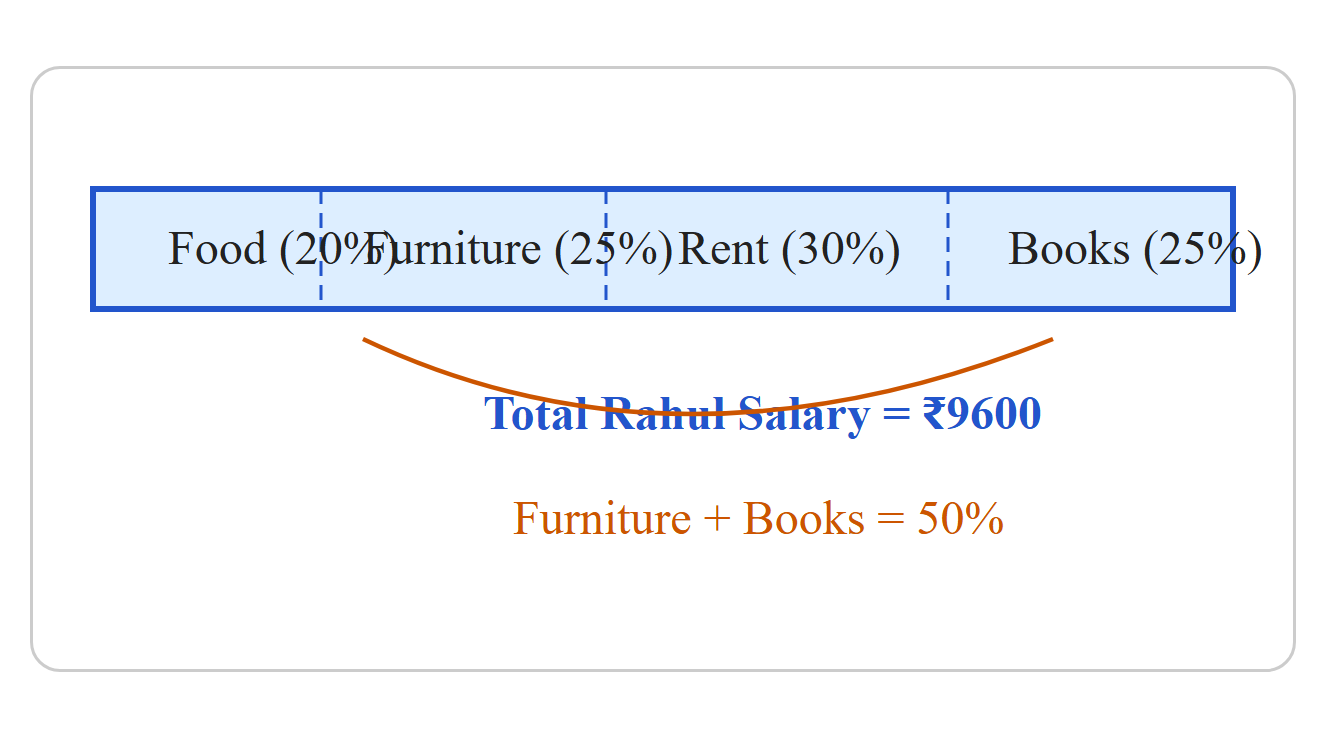
Rahul spends 20% of his monthly salary on food. He spends 25% on furniture, 30% on rent and remaining on books. find the amount Rahul spend on books and furniture together if Rahuls's salary is 20% less than john's salary which is equal to Rs. 12000 per month.

  1. ((a))

    4800

  2. ((b))

    2400

  3. ((c))

    3400

  4. ((d))

    2800

  5. ((e))

    4400

Show Answer
Answer: ((a))

4800

Shortcut Trick

John salary = ₹12000. Rahul salary = 80% of 12000 = ₹9600.

Spent on Food (20%) + Furniture (25%) + Rent (30%) = 75%.

Remaining for Books = 100% − 75% = 25%.

Total for Books + Furniture = 25% + 25% = 50%.

Required Amount = 50% of ₹9600 = ₹4800.

∴ The correct answer is ₹4800.

Alternate Method

Given: John salary = ₹12000, Rahul salary = 20% less than John, Expenses: Food = 20%, Furniture = 25%, Rent = 30%.

Calculations:

Rahul salary = 12000 − (20% of 12000)

Rahul salary = 12000 − 2400 = ₹9600

Percentage spent on Books = 100 − (20 + 25 + 30) = 25%

Total % for Books and Furniture = 25% + 25% = 50%

Required Amount = 50% of 9600 = 9600 ÷ 2 = ₹4800

∴ The correct answer is ₹4800.

Additional Information

Percentage Change

To find a value x% less than a base B, use the formula: B × (100 − x)/100.

Successive Percentage Expenditure

If expenses are given as a % of the 'total' salary, they are additive. If given as % of 'remaining', they are multiplicative.

Base Value Concept

Always identify the correct base (Rahul's salary vs John's salary) before applying percentage calculations.

32

A and B together can finish a work in 15 days. B and C take 18 days to finish the work. A, B and C can complete the work in 10 days. If A’s wage is Rs. 600 then, what is wage of B?

  1. ((a))

    450

  2. ((b))

    300

  3. ((c))

    200

  4. ((d))

    500

  5. ((e))

    750

Show Answer
Answer: ((b))

300

Shortcut Trick

Total Work (LCM of 15, 18, 10) = 90 units.

Efficiency of (A+B+C) = 90 ÷ 10 = 9 units/day.

Efficiency of (B+C) = 90 ÷ 18 = 5 units/day ⇒ Efficiency of A = 9 − 5 = 4 units.

Efficiency of (A+B) = 90 ÷ 15 = 6 units/day ⇒ Efficiency of B = 6 − 4 = 2 units.

Wage ratio = Efficiency ratio ⇒ A : B = 4 : 2 = 2 : 1.

If 2 units = ₹600, then 1 unit (B’s wage) = ₹300.

∴ The correct answer is ₹300.

Alternate Method

Given: Time taken by (A+B) = 15 days, (B+C) = 18 days, (A+B+C) = 10 days. A’s wage = ₹600.

Formula: Efficiency = Total Work ÷ Time; Wage ∝ Efficiency.

PersonDaysTotal WorkEfficiency
A + B15906
B + C185
A + B + C109

⇒ Efficiency of A = Efficiency(A+B+C) − Efficiency(B+C) = 9 − 5 = 4

⇒ Efficiency of B = Efficiency(A+B) − Efficiency(A) = 6 − 4 = 2

⇒ Wage is distributed in the ratio of efficiencies of A : B = 4 : 2 = 2 : 1

⇒ Since A’s wage (2 units) = ₹600

⇒ B’s wage (1 unit) = 600 ÷ 2 = ₹300

∴ The correct answer is ₹300.

Additional Information

Work and Wages Relationship

Wages are always distributed in the ratio of work done. If all persons work for the same duration, the wage ratio is identical to their efficiency ratio.

LCM Method for Total Work

Total work is assumed as the Least Common Multiple (LCM) of the individual days to ensure efficiencies are whole numbers, simplifying calculations.

Efficiency of Individual in a Group

Efficiency of one person can be found by subtracting the combined efficiency of others from the total combined efficiency: Eff(A) = Eff(A+B+C) − Eff(B+C).

33

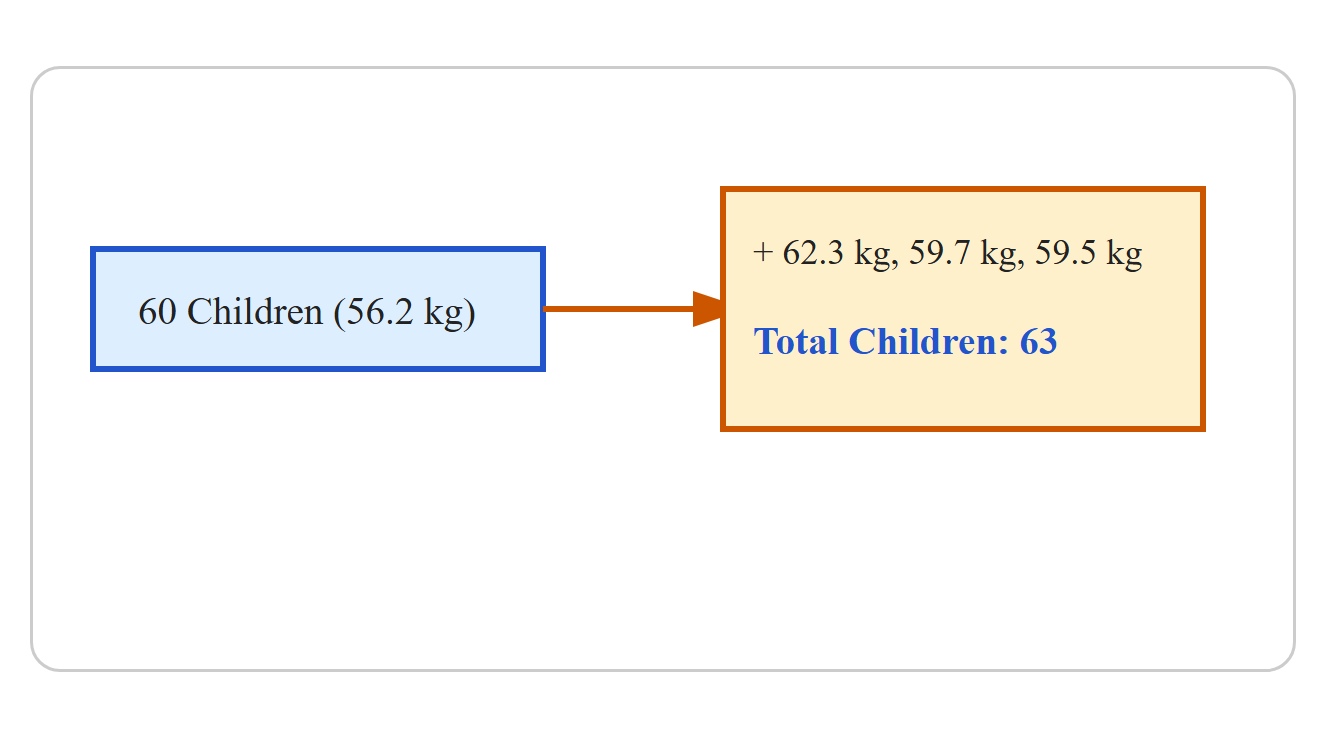
The average weight of 60 children of a class is 56.2 kg. When three more children with weight 62.3 kg, 59.7 kg, and 59.5 kg join the class, what is the average weight of the 63 children in the class?

  1. ((a))

    56.40

  2. ((b))

    59.45

  3. ((c))

    45.76

  4. ((d))

    59.76

  5. ((e))

    57.76

Show Answer
Answer: ((a))

56.40

Shortcut Trick

Initial average = 56.2 kg.

Calculate deviations of new weights from 56.2: (62.3 − 56.2) + (59.7 − 56.2) + (59.5 − 56.2) = 6.1 + 3.5 + 3.3 = 12.9 kg.

Net change in average = Total Deviation ÷ Total children = 12.9 ÷ 63 ≈ 0.20 kg.

New average = 56.2 + 0.20 = 56.40 kg.

∴ The correct answer is 56.40 kg.

Alternate Method

Given: Initial average weight of 60 children = 56.2 kg. Weights of 3 new children = 62.3 kg, 59.7 kg, and 59.5 kg.

Formula Used: Average = (Sum of all observations) ÷ (Total number of observations)

⇒ Total weight of 60 children = 60 × 56.2 = 3372 kg.

⇒ Total weight of 63 children = 3372 + 62.3 + 59.7 + 59.5

⇒ Total weight of 63 children = 3372 + 181.5 = 3553.5 kg.

⇒ New Average = 3553.5 ÷ 63

⇒ New Average = 56.408... ≈ 56.40 kg.

∴ The correct answer is 56.40 kg.

Additional Information

Deviation Method for Average

New Average = Old Average + (Sum of deviations ÷ New total count). This avoids large multiplications.

Weighted Average

When two groups are combined, Combined Average = (n1x1 + n2x2) ÷ (n1 + n2), where n is the count and x is the average.

34

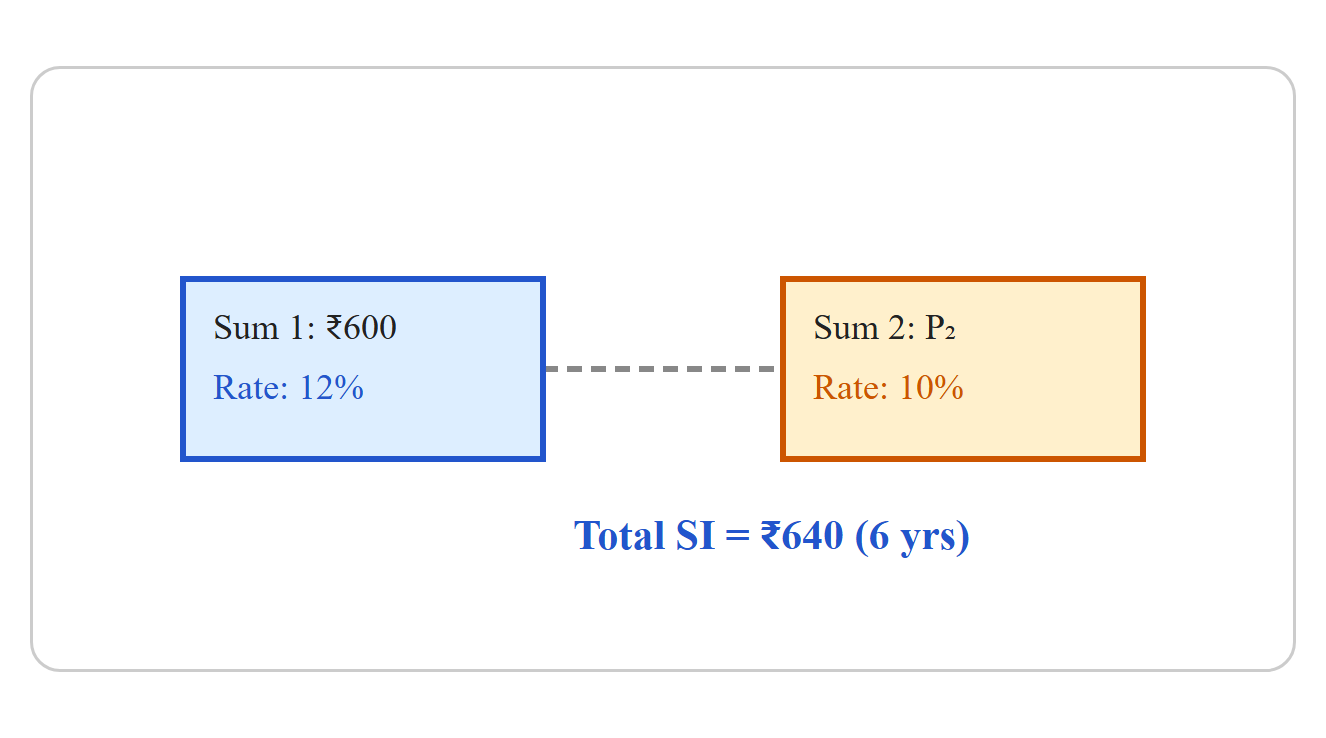
Rs. 600 was invested at 12% per annum simple interest and a certain sum of money invested at 10% per annum simple interest. If the sum of the interests on both the sums after 6 years is Rs. 640, the latter sum of money is

  1. ((a))

    Rs. 346.66

  2. ((b))

    Rs. 356.66

  3. ((c))

    Rs. 436.66

  4. ((d))

    Rs. 456.66

  5. ((e))

    Rs. 465.66

Show Answer
Answer: ((a))

Rs. 346.66

Shortcut Trick

Total Interest = ₹640

Interest from First Sum = 600 × 12% × 6 = ₹432

Interest from Second Sum = 640 − 432 = ₹208

Second Sum = (208 × 100) ÷ (10 × 6) = 2080 ÷ 6 = ₹346.66

∴ The correct answer is ₹346.66.

Alternate Method

Given:

Principal 1 (P1) = ₹600, Rate 1 (R1) = 12%, Time (T) = 6 years

Rate 2 (R2) = 10%, Total Simple Interest (SItotal) = ₹640

Formula Used:

Simple Interest (SI) = (P × R × T) ÷ 100

⇒ SI1 = (600 × 12 × 6) ÷ 100

⇒ SI1 = 6 × 12 × 6 = ₹432

⇒ SI2 = SItotal − SI1

⇒ SI2 = 640 − 432 = ₹208

⇒ SI2 = (P2 × 10 × 6) ÷ 100

⇒ 208 = (P2 × 60) ÷ 100

⇒ P2 = (208 × 100) ÷ 60

⇒ P2 = 2080 ÷ 6 = ₹346.66

∴ The correct answer is ₹346.66.

Additional Information

Simple Interest Property

Simple interest remains constant every year because it is always calculated on the original Principal amount.

Amount Formula

Total Amount (A) = Principal (P) + Simple Interest (SI). In this question, the interest was additive.

35

Present age of Ankit is thrice the present age of his son. If 4 years ago the ratio of their age is 13 : 3. What is present age of Ankit?

  1. ((a))

    30 years

  2. ((b))

    25 years

  3. ((c))

    60 years

  4. ((d))

    45 years

  5. ((e))

    65 years

Show Answer
Answer: ((a))

30 years

Shortcut Trick

Ratio of Ankit : Son now is 3 : 1 (Difference = 2 units).

Ratio 4 years ago was 13 : 3 (Difference = 10 units).

Equating differences: Multiply present ratio by 5 → 15 : 5.

Change in units: 15 − 13 = 2 units → 4 years. So, 1 unit = 2 years.

Ankit's present age = 15 × 2 = 30 years.

∴ The correct answer is 30 years.

Alternate Method

Given: Present age ratio is 3 : 1. Ratio 4 years ago was 13 : 3.

Let the present age of the son be x and Ankit be 3x.

⇒ (3x − 4) / (x − 4) = 13 / 3

⇒ 3 × (3x − 4) = 13 × (x − 4)

⇒ 9x − 12 = 13x − 52

⇒ 13x − 9x = 52 − 12

⇒ 4x = 40

⇒ x = 10

⇒ Ankit's present age = 3x = 3 × 10 = 30 years.

∴ The correct answer is 30 years.

Additional Information

Concept of Age Difference

The difference between the ages of two people always remains constant regardless of the number of years passed.

Ratio Balancing Method

To solve age ratio problems quickly, multiply the ratios such that the difference between the parts (e.g., 15−5=10 and 13−3=10) becomes equal.

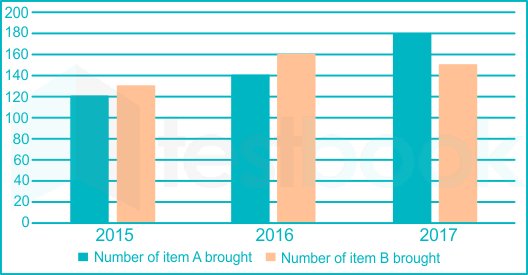
The given bar graphs shows the number of items brought by A and B in the year 2015, 2016 and 2017.

36

Out of total number of item brought by A in 2016, 2/7th item is plastic item. Find the number of plastic items brought by A in 2016?

  1. ((a))

    10

  2. ((b))

    20

  3. ((c))

    60

  4. ((d))

    80

  5. ((e))

    40

Show Answer
Answer: ((e))

40

Calculations:

Total number of items brought by A in 2016 = 140 

Number of plastic items brought by A = 140 × 2 /7 = 40

37

Find the ratio between total number of items brought by A and B together in the year 2015 and 2016?

  1. ((a))

    5:6

  2. ((b))

    2:3

  3. ((c))

    4:5

  4. ((d))

    4:9

  5. ((e))

    8:7

Show Answer
Answer: ((a))

5:6

Calculations:

Total number of items brought by A and B in 2015 = 120 + 130 = 250

Total number of items brought by A and B in 2016 = 140 + 160 = 300

Required ratio = 250 : 300 = 5:6

38

Number of items brought by C in the year 2016 is 45 more than the average number of items brought by A and B in same year. Find the number of items brought by C in the year 2016?

  1. ((a))

    215

  2. ((b))

    205

  3. ((c))

    235

  4. ((d))

    195

  5. ((e))

    265

Show Answer
Answer: ((d))

195

Calculations:

Total number of items brought by A and B in 2016 = 140 + 160 = 300

Average number of items brought by A and B in 2016 = 300/2 = 150

Number of items brought by C in the year 2016:

= 150 + 45 = 195

39

Number of items brought by A and B in 2018 is 25% and 20% more than the previous year respectively. Find the total item brought by A and B together in the year 2018?

  1. ((a))

    205

  2. ((b))

    405

  3. ((c))

    415

  4. ((d))

    395

  5. ((e))

    385

Show Answer
Answer: ((b))

405

Calculations:

Number of items brought by A in 2017 = 180

Number of items brought by B in 2017 = 150

Total item brought by A and B together in the year 2018 is:

[180 × 125/100] + [150 ×120/100] = 225 + 180 = 405

40

Total number of items brought by A in the year 2015 and 2016 together is how much less than the number of item brought by B in same year?

  1. ((a))

    68

  2. ((b))

    66

  3. ((c))

    30

  4. ((d))

    45

  5. ((e))

    48

Show Answer
Answer: ((c))

30

Calculations:

Total number of items brought by A in the year 2015 and 2016 together = 120 + 140 = 260

Total number of items brought by B in the year 2015 and 2016 together = 130 + 160 = 290

So, required difference is 290 – 260 = 30

41

Difference between number of items brought by B and A in the year 2015 is x - 5. Find the value of x?

  1. ((a))

    10

  2. ((b))

    32

  3. ((c))

    35

  4. ((d))

    15

  5. ((e))

    25

Show Answer
Answer: ((d))

15

Calculations:

Total number of items brought by A in the year 2015 = 120

Total number of items brought by B in the year 2015 = 130

Difference between number items brought by B and A is 130 - 120 = 10

So, x – 5 = 10 ⇒  x = 15.

42

Find the value of x.

125 ÷ 5 ×  171 ÷ 27 ÷ 249 ×  9 = x ÷ 83

  1. ((a))

    525

  2. ((b))

    425

  3. ((c))

    475

  4. ((d))

    325

  5. ((e))

    400

Show Answer
Answer: ((c))

475

Solution:

125 ÷ 5 ×  171 ÷ 27 ÷ 249 ×  9 = x ÷ 83

25 ×  (171/27) ×  (1/249) ×  9 = x/83

25 ×  (19/3) ×  (3/83) = x/83

x = 25 ×  19

x = 475

43

Find the value of x.

42 ÷ 6 ×  3 + 5 – (8 + 7) + 123 = x

  1. ((a))

    128

  2. ((b))

    134

  3. ((c))

    126

  4. ((d))

    122

  5. ((e))

    118

Show Answer
Answer: ((b))

134

Solution:

42 ÷ 6 ×  3 + 5 – (8 + 7) + 123 = x

7 ×  3 + 5 – (15) + 123 = x

21 + 5 – 15 + 123 = x

x = 134

44

What value will come in the place of the question mark ‘?’ in the following question?

5265 ÷ 117 + 67 × 85 - 1172 + 289 + 263 - 120 = (?)

  1. ((a))

    5000

  2. ((b))

    5500

  3. ((c))

    5100

  4. ((d))

    5198

  5. ((e))

    5200

Show Answer
Answer: ((a))

5000

Concept used:

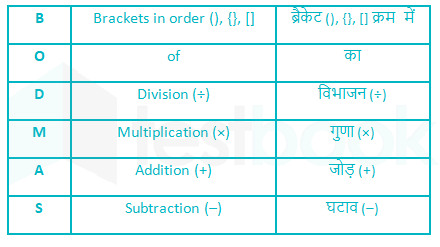
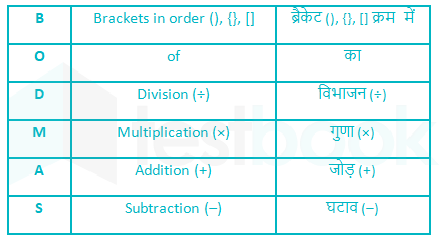
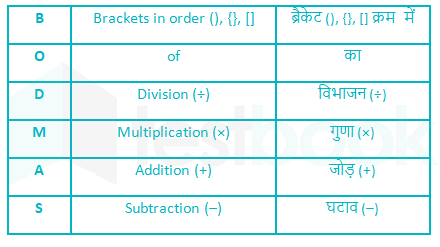
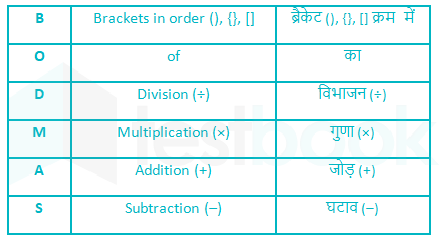
Follow BODMAS rule to solve this question, as per the order given below.

Step - 1: Parts of an equation enclosed in 'Brackets' must be solved second, and following BODMAS rule in the bracket

Step - 2: Any mathematical 'Of' or 'Exponent' must be solved next.

Step - 3: Next, the parts of the equation that contain 'Division' and 'Multiplication' are calculated.

Step - 4: Last but not least, the parts of the equation that contain 'Addition' and 'Subtraction' should be calculated.

Calculations:

5265 ÷ 117 + 67 × 85 - 1172 + 289 + 263 - 120 = (?)

⇒ 45 + 5695 - 1172 + 289 + 263 - 120 = (?)

⇒  45 + 5695 - 1172 + 289 + 263 - 120 = (?)

⇒ 6292 - 1292 = (?)

⇒ ? = 5000

Hence, the correct answer is 5000.

45

What value will come in the place of the question mark ‘?’ in the following question?

(159 + 321) ÷ 4 + (7250/50) + (4130 – 1270) ÷ 110 + 33 = ?2

  1. ((a))

    19

  2. ((b))

    18

  3. ((c))

    16

  4. ((d))

    14

  5. ((e))

    20

Show Answer
Answer: ((b))

18

Concept used:

Follow BODMAS rule to solve this question, as per the order given below.

Step - 1: Parts of an equation enclosed in 'Brackets' must be solved second, and following BODMAS rule in the bracket

Step - 2: Any mathematical 'Of' or 'Exponent' must be solved next.

Step - 3: Next, the parts of the equation that contain 'Division' and 'Multiplication' are calculated.

Step - 4: Last but not least, the parts of the equation that contain 'Addition' and 'Subtraction' should be calculated.

Calculations:

(159 + 321) ÷ 4 + (7250/50) + (4130 – 1270) ÷ 110 + 33 = ?2

⇒ 480 ÷ 4 + 145 + 2860 ÷ 110 + 33 = ?2

⇒ 120 + 145 + 26 + 33 = ?2

⇒ 324 = ?2

⇒ √324 = ?

⇒ 18 = ?

Hence, the correct answer is 18.

46

What will come in the place of the question mark ‘?’ in the following question?

18 + 27 - 14 = ? + 10 + 20

  1. ((a))

    4

  2. ((b))

    5

  3. ((c))

    1

  4. ((d))

    -1

  5. ((e))

    None of these.

Show Answer
Answer: ((c))

1

Given:

18 + 27 - 14 = ? + 10 + 20

Concept used:

Follow the BODMAS rule according to the table given below:

Calculation:

18 + 27 - 14 = ? + 10 + 20

⇒ 45 - 14 = ? + 30

⇒ 31 = ? + 30

⇒ ? = 31 - 30 = 1

The value of ? is 1

47

What will come in the place of the question mark ‘?’ in the following question?

(√1024 + 19 × 12) ÷ √676 - 4 + 4680 ÷ ? = 474

  1. ((a))

    10

  2. ((b))

    8

  3. ((c))

    16

  4. ((d))

    3

  5. ((e))

    11

Show Answer
Answer: ((a))

10

Given:

(√1024 + 19 × 12) ÷ √676 - 4 + 4680 ÷ ? = 474

Concept Used:

Calculation:

(√1024 + 19 × 12) ÷ √676 - 4 + 4680 ÷ ? = 474

⇒ (32 + 228) ÷ 26 - 4 + 4680 ÷ ? = 474

⇒ 10 - 4 + 4680 ÷ ? = 474

⇒ 4680 ÷ ? = 468

⇒ 4680 ÷ 468 = ?

⇒ ? = 10

∴ The value of (?) is 10.

48

What will come in the place of the question mark ‘?’ in the following question?

(14)2 × 10 ÷ 4 - (15)2 + 16 = ?2 + 52

  1. ((a))

    4

  2. ((b))

    16

  3. ((c))

    8

  4. ((d))

    10

  5. ((e))

    14

Show Answer
Answer: ((b))

16

Given:  

(14)2 × 10 ÷ 4 - (15)2 + 16 = ?2 + 52

Concept Used:

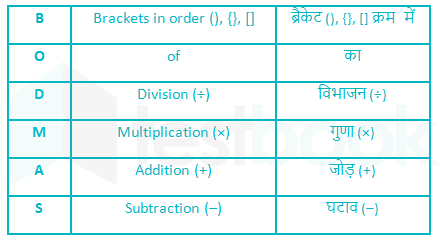
Follow the BODMAS rule according to the table given below:

Calculation:

(14)2 × 10 ÷ 4 - (15)2 + 16 = ?2 + 52

⇒ 196 × 10 × 1/4 - 225 + 16 = ?2 + 25

⇒ 98 × 5 - 225 + 16 = ?2 + 25

⇒ 490 - 225 + 16 = ?2 + 25

⇒ 490 - 225 + 16 - 25 = ?2 

⇒  ?2 = 506 - 250 = 256

⇒ ? = √256 = 16

 16 will come in place of the question mark '?'.

49

What will come in the place of the question mark ‘?’ in the following question?

(72 × 6 - 36 × 6) ÷ 12 = 288 ÷ ?

  1. ((a))

    12

  2. ((b))

    26

  3. ((c))

    16

  4. ((d))

    14

  5. ((e))

    18

Show Answer
Answer: ((c))

16

Concept used:

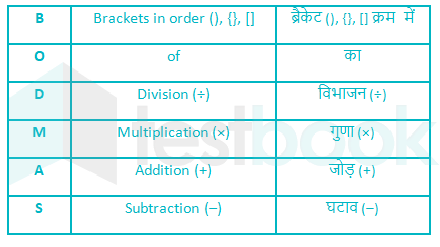
Follow the BODMAS rule according to the table given below:


Calculation:

⇒ (72 × 6 - 36 × 6) ÷ 12 = 288 ÷ ?

⇒ (432 - 216) ÷ 12 = 288 ÷ ?

⇒ 216 ÷ 12 = 288 ÷ ?

⇒ ? = 288 ÷ 18 = 16

∴ The value of ? is 16.

50

What will come in the place of the question mark ‘?’ in the following question?

53 × 3 + 85 ÷ 5 - √(?) × 6 = 356

  1. ((a))

    25

  2. ((b))

    36

  3. ((c))

    49

  4. ((d))

    64

  5. ((e))

    81

Show Answer
Answer: ((b))

36

Given:

53 × 3 + 85 ÷ 5 - √(?) × 6 = 356

Concept used:

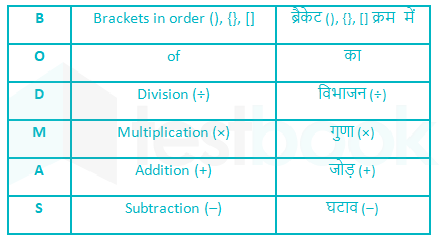
Follow the BODMAS rule according to the table given below:

Calculation:

53 × 3 + 85 ÷ 5 - √(?) × 6 = 356

⇒ 125 × 3 + 17 - √(?) × 6 = 356

⇒ 375 + 17 - √(?) × 6 = 356

⇒ √(?) × 6 = 36

⇒ √(?) = 6

⇒ ? = 62

⇒ ? = 36

∴ 36 should come in place of the question mark (?).

51

What will come in the place of the question mark ‘?’ in the following question?

328 ÷ 8 + 25 × 2.4 + ? = (11)2

  1. ((a))

    21

  2. ((b))

    22

  3. ((c))

    20

  4. ((d))

    23

  5. ((e))

    24

Show Answer
Answer: ((c))

20

Given:

328 ÷ 8 + 25 × 2.4 + ? = (11)2

Concept used:

Follow the BODMAS rule according to the table given below:

Calculation:

328 ÷ 8 + 25 × 2.4 + ? = (11)2

⇒ 41 + 60 + ? = 121

⇒ 101 + ? = 121

⇒ ? = 20

∴ 20 should come in place of the question mark (?).

52

What will come in the place of the question mark ‘?’ in the following question?

15 × 678 - 10 × 802 + 60 ÷ 6 = ? × 50 ÷ 5

  1. ((a))

    216

  2. ((b))

    179

  3. ((c))

    185

  4. ((d))

    246

  5. ((e))

    175

Show Answer
Answer: ((a))

216

Given:

15 × 678 - 10 × 802 + 60 ÷ 6 = ? × 50 ÷ 5

Concept Used:

Calculation:

15 × 678 - 10 × 802 + 60 ÷ 6 = ? × 50 ÷ 5

⇒ 10170 - 8020 + 10 = ? × 10

⇒ 2160 = ? × 10

⇒ 2160/10 = ?

⇒ ? = 216

∴ The value of ? is 216

53

What will come in the place of the question mark ‘?’ in the following question?

549 ÷ 3 × 54 - 25 × 321 + 31 = ?

  1. ((a))

    1888

  2. ((b))

    1886

  3. ((c))

    1866

  4. ((d))

    1898

  5. ((e))

    1889

Show Answer
Answer: ((a))

1888

Calculation:

We use the BODMAS rule as follows:

According to the rule ‘division’ should be solved first

⇒ 549 ÷ 3 × 54 - 25 × 321 + 31 = ?

⇒ 183 × 54 - 25 × 321 + 31 = ?

⇒ 9882 - 8025 + 31 = ?

⇒ 9913 - 8025 = ?

⇒ ? = 1888

∴ required answer is 1888.

54

The ratio of the speed of stream to the speed of the boat in still water is 5 : 16. A boat goes 33 km in 90 minutes upstream, find the time taken by boat to cover the distance of 35 km downstream.

  1. ((a))

    40 minutes

  2. ((b))

    20 minutes

  3. ((c))

    60 minutes

  4. ((d))

    50 minutes

  5. ((e))

    30 minutes

Show Answer
Answer: ((d))

50 minutes

Shortcut Trick

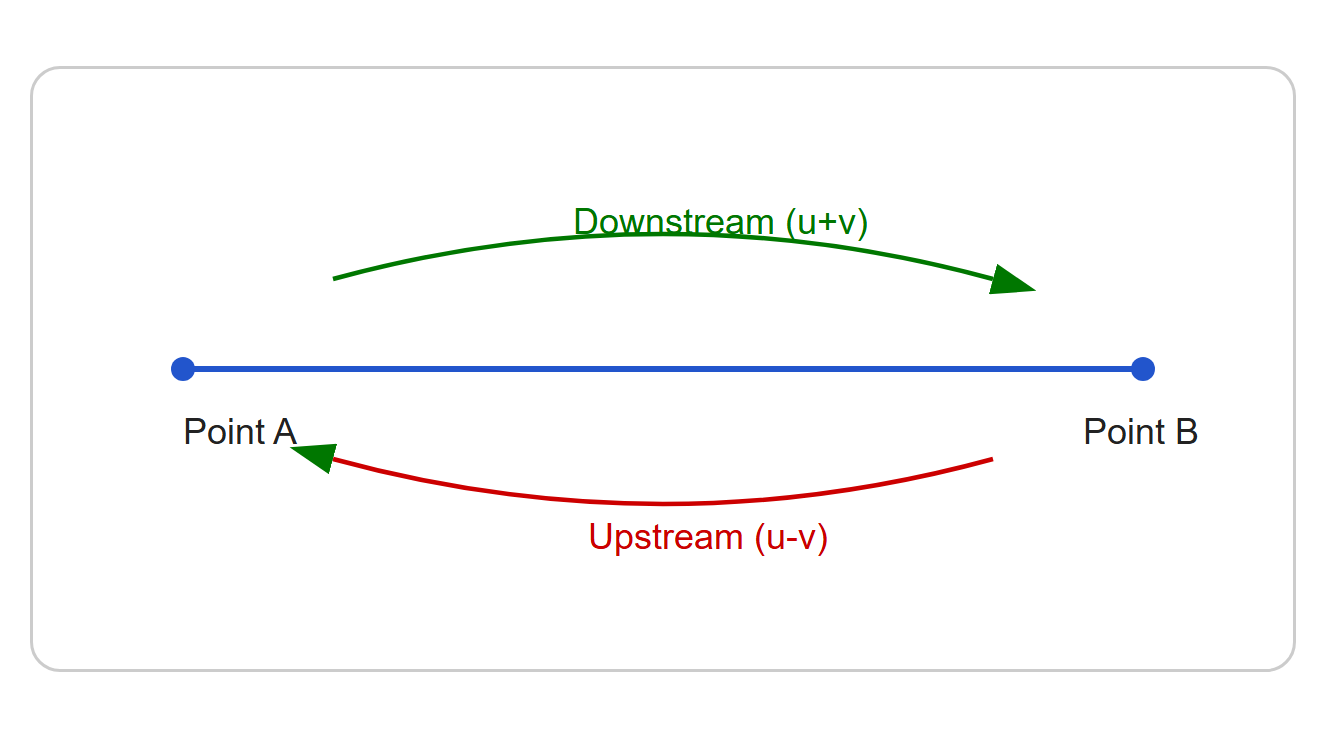
Ratio of Boat Speed (u) : Stream Speed (v) = 16 : 5

Upstream Speed (u−v) = 11 units | Downstream Speed (u+v) = 21 units

Upstream Speed = 33 km ÷ 1.5 hours = 22 kmph ⇒ 1 unit = 2 kmph

Downstream Speed = 21 × 2 = 42 kmph

Time Downstream = (35 ÷ 42) × 60 = 50 min

∴ The correct answer is 50 min.

Alternate Method

Given: Ratio of stream speed (v) to boat speed (u) = 5 : 16. Upstream distance = 33 km, Upstream time = 90 min (1.5 hours).

Formula Used: Speed = Distance ÷ Time; Upstream Speed (Sup) = u − v; Downstream Speed (Sdown) = u + v.

⇒ Let Boat speed = 16x and Stream speed = 5x

Upstream speed = 16x − 5x = 11x

⇒ 11x = 33 km ÷ 1.5 hr = 22 kmph

⇒ x = 2 kmph

Downstream speed = 16x + 5x = 21x = 21 × 2 = 42 kmph

Time taken for 35 km downstream = (35 ÷ 42) hours

⇒ Time in minutes = (35 ÷ 42) × 60 = 5 × 10 = 50 min

∴ The correct answer is 50 min.

Additional Information

Relative Speed in Water

Downstream speed is the sum (u + v) and Upstream speed is the difference (u − v) of boat and stream speeds.

Boat Speed Calculation

Speed of boat in still water (u) = (Downstream Speed + Upstream Speed) ÷ 2.

Stream Speed Calculation

Speed of stream (v) = (Downstream Speed − Upstream Speed) ÷ 2.

55

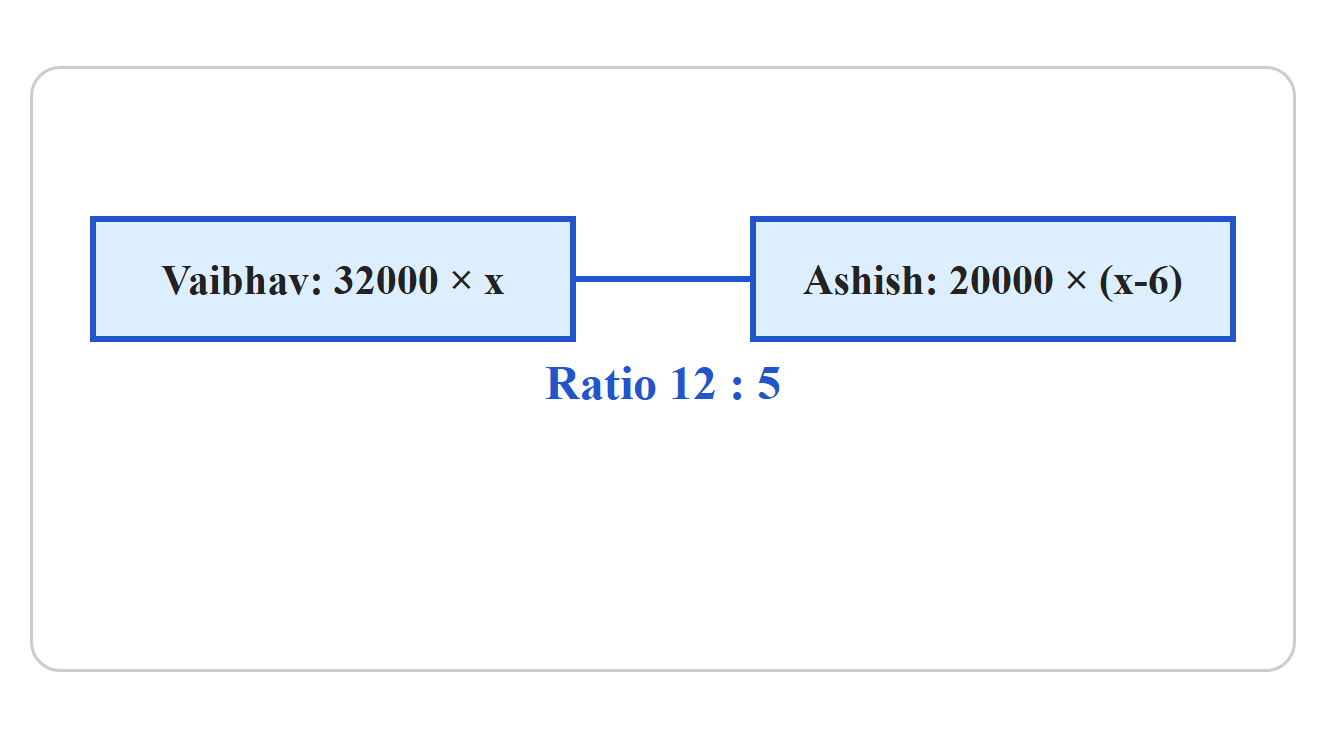
In a Business Vaibhav invested Rs. 32000 for ‘x’ months, after 6 months Ashish joined the business with the amount equal to Rs. 20000. If the ratio of profit received is 12 : 5, Find the duration of amount invested by Vaibhav.

  1. ((a))

    24 months

  2. ((b))

    12 months

  3. ((c))

    9 months

  4. ((d))

    18 months

  5. ((e))

    15 months

Show Answer
Answer: ((d))

18 months

Shortcut Trick

Profit Ratio = (Capital1 × Time1) : (Capital2 × Time2)

Ratio of Capitals = 32000 : 20000 = 8 : 5.

Time for Vaibhav = x, Time for Ashish = (x − 6).

Ratio = (8 × x) : (5 × (x − 6)) = 12 : 5.

Solving 8x ÷ (5x − 30) = 12 ÷ 5 ⇒ 40x = 60x − 360 ⇒ 20x = 360 ⇒ x = 18.

∴ The correct answer is 18 months.

Alternate Method

Given: Vaibhav Investment = Rs. 32000, Ashish Investment = Rs. 20000, Profit Ratio = 12 : 5, Ashish joined after 6 months.

Formula: Profit = Investment × Time period

⇒ Let Vaibhav invested for x months.

Ashish joined 6 months later, so his time = (x − 6) months.

⇒ (32000 × x) ÷ (20000 × (x − 6)) = 12 ÷ 5

⇒ (32 × x) ÷ (20 × (x − 6)) = 12 ÷ 5

⇒ (8x) ÷ (5 × (x − 6)) = 12 ÷ 5

⇒ 8x ÷ (x − 6) = 12

⇒ 8x = 12x − 72

⇒ 4x = 72 ⇒ x = 18 months.

∴ The correct answer is 18 months.

Additional Information

Partnership Principle

In a partnership, the profit is distributed among partners in the ratio of the product of their investment and time duration.

Time Calculation

If a person joins 'n' months after the start, their investment duration is (Total Time − n).

56

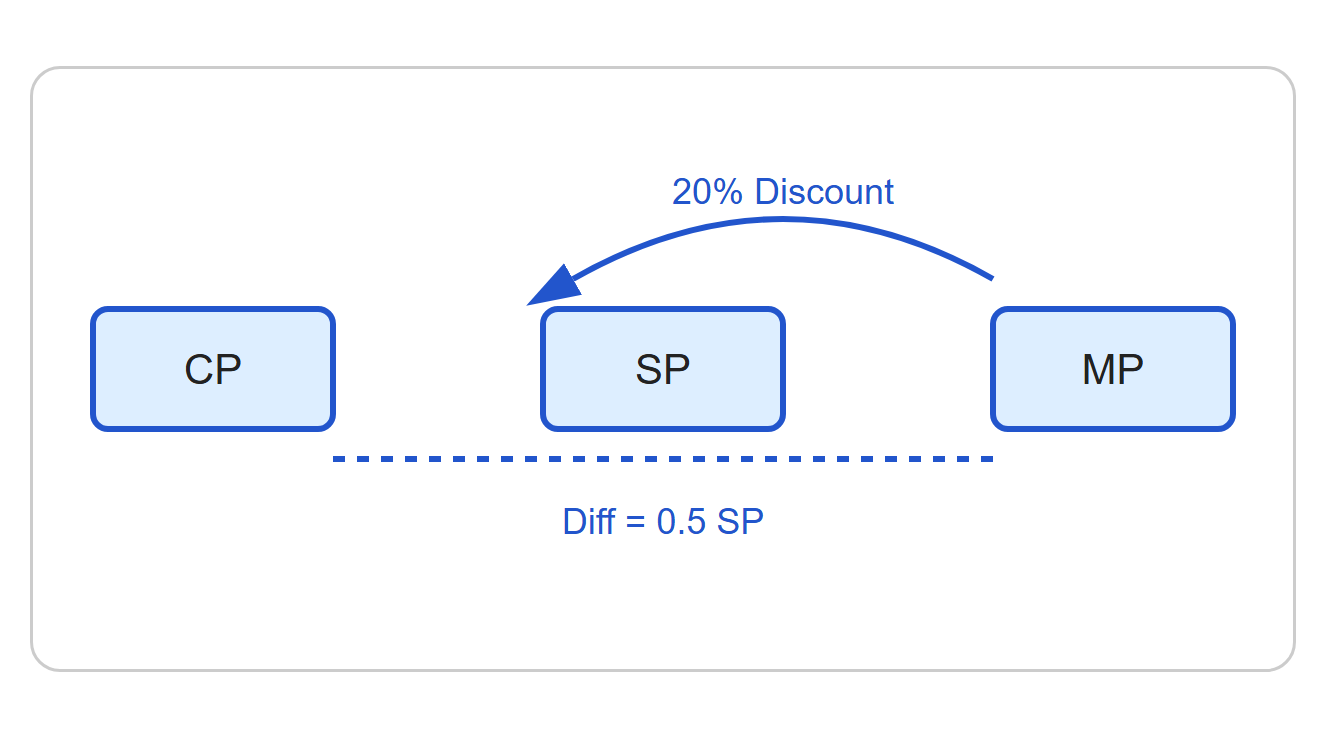
Difference between marked price and the cost price is 50% of the selling price. if the discount percentage is 20% , then find the ratio between marked price and cost price.

  1. ((a))

    5 : 3

  2. ((b))

    7 : 5

  3. ((c))

    3 : 5

  4. ((d))

    7 : 11

  5. ((e))

    None

Show Answer
Answer: ((a))

5 : 3

Shortcut Trick

Assume Marked Price (MP) is 100.

Given Discount = 20%, so Selling Price (SP) = 100 − 20 = 80.

Difference (MP − CP) = 50% of SP = 0.5 × 80 = 40.

Since MP − CP = 40, then 100 − CP = 40 ⇒ Cost Price (CP) = 60.

Ratio MP : CP = 100 : 60 = 5 : 3.

∴ The correct answer is 5 : 3.

Alternate Method

Given: MP − CP = 0.5 × SP and Discount% = 20%

Formulas: SP = MP × (100 − D%) ÷ 100

⇒ Let Marked Price be M and Cost Price be C.

Selling Price (S) = M − 0.20M = 0.8M.

⇒ According to the question: M − C = 0.5 × S.

⇒ M − C = 0.5 × (0.8M) = 0.4M.

⇒ M − 0.4M = C ⇒ 0.6M = C.

⇒ M ÷ C = 1 ÷ 0.6 = 10 ÷ 6 = 5 ÷ 3.

∴ The correct answer is 5 : 3.

Additional Information

Marked Price and Discount

Marked Price (MP) is the price printed on an item. Discount is always calculated on the MP. SP = MP − Discount.

Relationship between CP, SP, and MP

Profit is SP − CP, whereas Discount is MP − SP. To find the ratio between MP and CP, we can use the formula MP ÷ CP = (100 + P%) ÷ (100 − D%) if profit percentage is known.

57

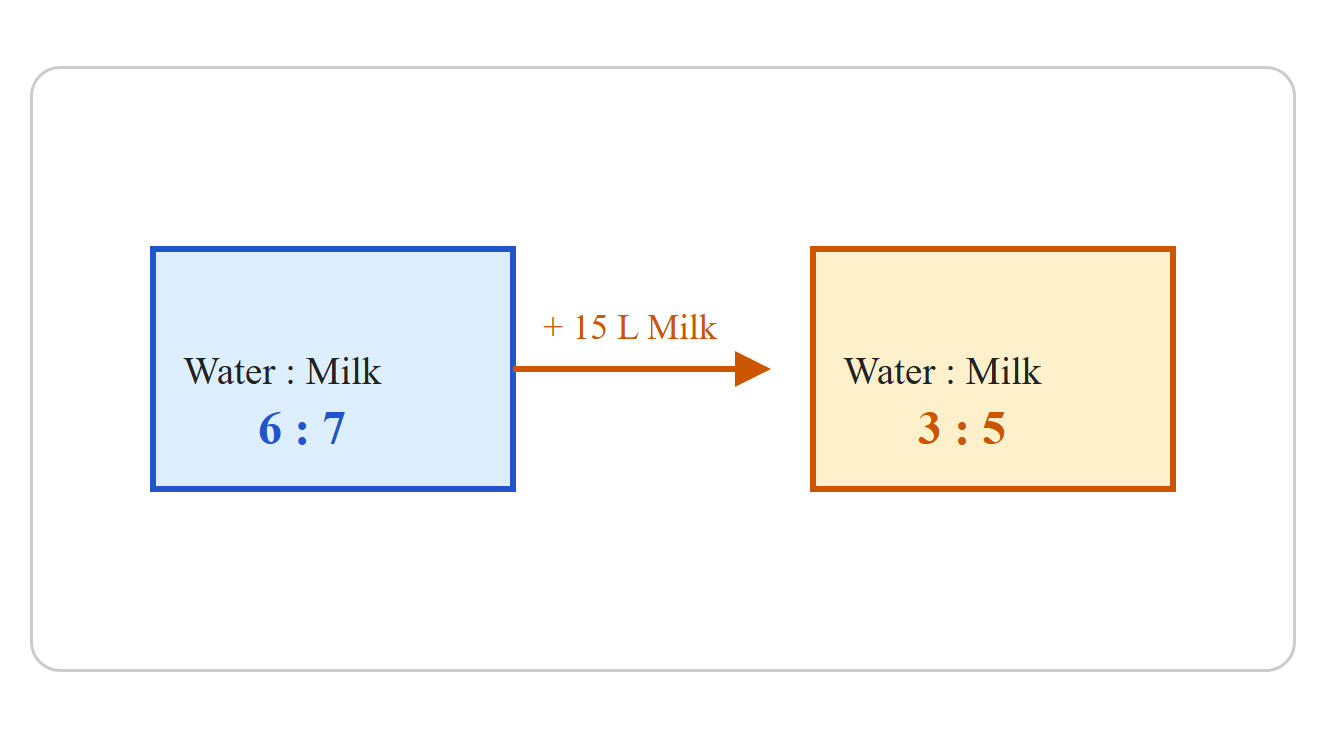
In x litres of a mixture contains water and milk in the ratio of 6: 7. If 15 litres of milk is added to the mixture so that the ratio of water and milk become 3: 5. What is the value of x?

  1. ((a))

    64

  2. ((b))

    65

  3. ((c))

    60

  4. ((d))

    52

  5. ((e))

    48

Show Answer
Answer: ((b))

65

Shortcut Trick

Initial Ratio (Water : Milk) = 6 : 7

Final Ratio (Water : Milk) = 3 : 5. To make Water constant, multiply final ratio by 2 → 6 : 10.

Increase in Milk = 10 − 7 = 3 units. Given, 3 units = 15 litres → 1 unit = 5 litres.

Initial mixture x = (6 + 7) units = 13 units = 13 × 5 = 65 litres.

∴ The correct answer is 65 litres.

Alternate Method

Given: Initial ratio 6:7, added 15 litres milk, final ratio 3:5.

Formula Used: Ratio × constant = Quantity; Initial Value x = Sum of initial components.

⇒ Let water = 6k and milk = 7k. Total volume x = 13k.

⇒ 6k / (7k + 15) = 3 / 5

⇒ 5 × 6k = 3 × (7k + 15)

⇒ 30k = 21k + 45

⇒ 9k = 45 ⇒ k = 5

⇒ x = 13 × 5 = 65 litres.

∴ The correct answer is 65 litres.

Additional Information

Constant Variable Concept

When only one component is added or removed from a mixture, the quantity of the other component remains constant. Always equate its ratio units first.

Alligation Rule

Used to find the ratio in which two quantities are mixed to get a final concentration: (Higher value − Mean) / (Mean − Lower value).

Replacement Method

Final Quantity = Initial Quantity × (1 − amount replaced/total)n, where n is the number of times the process is repeated.

The given table shows the number of book issue in three library [P, Q, and R] to three person [ A, B and C].

LibraryABC
P182025
Q303510
R241632
58

Find the difference between total number of books issued to A and total number of books issued to C in all library together?

  1. ((a))

    11

  2. ((b))

    5

  3. ((c))

    7

  4. ((d))

    8

  5. ((e))

    6

Show Answer
Answer: ((b))

5

Calculations:

Total number of books issued to A in all library together

⇒ 18 + 30 + 24 = 72

Total number of books issued to C in all library together

⇒ 25 + 10 + 32 = 67

So, required difference 72 – 67 = 5

59

Ratio of between number of books issued to A and B in library Q is 6:x. Find the value of 9x?

  1. ((a))

    45

  2. ((b))

    30

  3. ((c))

    63

  4. ((d))

    64

  5. ((e))

    88

Show Answer
Answer: ((c))

63

Calculations:

Number of books issued to A in library Q = 30

Number of books issued to B in library Q = 35

Required ratio 30 : 35 = 6: 7

So, x = 7 ⇒  9x = 9 × 7 = 63

60

Number of books issued to D in library R is 12 more than the 25% of number of books issued to C in same library. Find the number of books issued to D in library R?

  1. ((a))

    45

  2. ((b))

    35

  3. ((c))

    26

  4. ((d))

    20

  5. ((e))

    25

Show Answer
Answer: ((d))

20

Calculations:

Total number of books issued to C in library R = 32

Number of books issued to D in library R:

⇒ 32 × 25/100 + 12

⇒ 8 + 12 = 20

61

Out of total book issued to A, 25% is friction book. Find number of books issued to A is friction book?

  1. ((a))

    26

  2. ((b))

    14

  3. ((c))

    16

  4. ((d))

    12

  5. ((e))

    18

Show Answer
Answer: ((e))

18

Calculations:

Total Number of books issued to A = 18 + 30 + 24 = 72

Total Number of fiction books issued to A = 72 × (25 /100)

Total Number of fiction books issued to A = 18

62

Total number of book issue in library P to all three people together is how less than the number of book issue in library Q to all three people together?

  1. ((a))

    26

  2. ((b))

    32

  3. ((c))

    12

  4. ((d))

    14

  5. ((e))

    22

Show Answer
Answer: ((c))

12

Calculations:

Total number of book issue in library P to all three people together = [18 + 20 + 25] = 63

Total number of book issue in library Q to all three people together = [30 + 35 +10] = 75

So, Total number of book issue in library P to all three people together is 75 – 63 = 12 less than the number of book issue in library Q to all three people together.

63

In a Village the number of literate to illiterate is in the ratio 4: 1. 70%  of the literate are males and remaining are females and 20% of the illiterate are females and remaining are males.If the total number of females in the village is 56. Find the total number of males and females in the village.

  1. ((a))

    180

  2. ((b))

    230

  3. ((c))

    200

  4. ((d))

    210

  5. ((e))

    190

Show Answer
Answer: ((c))

200

Shortcut Trick

Assume Total Population = 100 units.

Literates = 80 units, Illiterates = 20 units (Ratio 4 : 1).

Literate Females = 30% of 80 = 24 units | Illiterate Females = 20% of 20 = 4 units.

Total Females = 24 + 4 = 28 units → 56 (Given).

1 unit = 2 | Total population = 100 × 2 = 200.

∴ The correct answer is 200.

Alternate Method

Given: Ratio of Literate to Illiterate = 4 : 1. Total Females = 56.

Let Literate = 400x and Illiterate = 100x. Total Population = 500x.

⇒ Literate Females = 30% of 400x = 0.30 × 400x = 120x.

⇒ Illiterate Females = 20% of 100x = 0.20 × 100x = 20x.

⇒ Total Females = 120x + 20x = 140x.

⇒ 140x = 56

⇒ x = 56 ÷ 140 = 0.4

⇒ Total Population = 500 × 0.4 = 200.

∴ The correct answer is 200.

Additional Information

Ratio Distribution

To divide a quantity N in ratio a : b, the parts are [a/(a+b)] × N and [b/(a+b)] × N.

Percentage of a Group

If x% are males, then (100 − x)% are females, provided there are only two categories.

Unitary Method

Finding the value of a single unit (140 units = 56 → 1 unit = 0.4) to calculate the total required value.

64

If the sum of the length and breadth of a rectangle is equal to the diameter of a circle, which is 56 cm, then what is the ratio between the circumference of the circle and the perimeter of the rectangle?

  1. ((a))

    10 : 7

  2. ((b))

    11 : 7

  3. ((c))

    4 : 7

  4. ((d))

    14 : 11

  5. ((e))

    7 : 11

Show Answer
Answer: ((b))

11 : 7

Shortcut Trick

Circumference of Circle = π × d = (22/7) × 56 = 176 cm.

Perimeter of Rectangle = 2 × (L + B). Given L + B = diameter = 56 cm.

⇒ Perimeter = 2 × 56 = 112 cm.

Ratio = 176 : 112 = 11 : 7 (dividing both by 16).

∴ The correct answer is 11 : 7.

Alternate Method

Given:

Diameter (d) of circle = 56 cm.

Sum of length (L) and breadth (B) of rectangle (L + B) = 56 cm.

Formula Used:

Circumference of circle (C) = π × d

Perimeter of rectangle (P) = 2 × (L + B)

Calculations:

⇒ C = (22/7) × 56

⇒ C = 22 × 8 = 176 cm

⇒ P = 2 × 56 = 112 cm

⇒ Ratio = C / P = 176 / 112

⇒ Ratio = (16 × 11) / (16 × 7) = 11 / 7

∴ The correct answer is 11 : 7.

Additional Information

Circle Properties

Area of circle = πr2 or (πd2)/4. Circumference = 2πr or πd.

Rectangle Mensuration

Area of rectangle = L × B. Diagonal = √(L2 + B2).

Standard π Values

For calculations involving 7 or its multiples, use π ≈ 22/7 for easier cancellation.

65

A bus is travelling at a speed of 25 km/h. It takes 10 hours for the bus to cover the distance from point A to point B. If the speed of the bus increases by 100%, how much time will the bus take to cover the same distance?

  1. ((a))

    2 Hours

  2. ((b))

    5 Hours

  3. ((c))

    2 Hours and 30 Minutes

  4. ((d))

    7 Hours and 30 Minutes

  5. ((e))

    4 Hours

Show Answer
Answer: ((b))

5 Hours

Shortcut Trick

When distance is constant, time is inversely proportional to speed (T ∝ 1/S).

Initial speed = 100% → New speed = 100% + 100% = 200%.

Speed ratio = 1 : 2 ∴ Time ratio = 2 : 1.

2 units = 10 hours ⇒ 1 unit = 5 hours.

∴ The correct answer is 5 hr.

Alternate Method

Given: Initial Speed (S1) = 25 km/h, Initial Time (T1) = 10 hours.

Formula Used: Distance = Speed × Time

⇒ Total Distance = S1 × T1 = 25 × 10 = 250 km.

⇒ New Speed (S2) = 25 + (100% of 25) = 25 + 25 = 50 km/h.

⇒ New Time (T2) = Distance ÷ S2

⇒ T2 = 250 ÷ 50 = 5 hours.

∴ The correct answer is 5 hr.

Additional Information

Inverse Proportion Rule

If distance is constant, S1 × T1 = S2 × T2. This allows for quick calculation without finding the actual distance.

Percentage Increase in Speed

A 100% increase means the value doubles (New = Old × 2). Similarly, a 200% increase means the value triples.

Average Speed

For two equal distances covered at speeds x and y, Average Speed = (2 × x × y) ÷ (x + y).

Reasoning Ability (35 questions)

Directions: Study the information below carefully and answer the following questions.

Eight people P, Q, R, S, T, U, V and W, they have different designation as General Manager, Deputy General Manager, Assistant General Manager, Manager, Assistant Manager, Sectional Officer, Cashier and Clerk. The order of seniority is same as given above i.e. General manager is the senior-most and the Clerk is the junior-most.

U is junior to W. Only five people have their designations between S and V. Sectional Officer is senior to V. Only three people have their designation between P and U. Q is immediately junior to W. More than two people are senior to Q. S is senior to R, who is senior to T. U is senior to at least three designations. P is not the Clerk.

66

Who is the Sectional Officer?

  1. ((a))

    T

  2. ((b))

    U

  3. ((c))

    R

  4. ((d))

    W

  5. ((e))

    P

Show Answer
Answer: ((c))

R

From the given instructions:

Eight people P, Q, R, S, T, U, V and W, they have different designation as General Manager, Deputy General Manager, Assistant General Manager, Manager, Assistant Manager, Sectional Officer, Cashier and Clerk. The order of seniority is same as given above i.e. General manager is the senior-most and the Clerk is the junior-most. So, we can a draw a structure as:

DesignationPerson
General Manager
Deputy General Manager
Assistant General Manager
Manager
Assistant Manager
Sectional Officer
Cashier
Clerk


  1. Only five people have their designations between S and V. Sectional Officer is senior to V. So, we have two cases:
Case 1Case 2
DesignationPersonPerson
General ManagerS
Deputy General ManagerS
Assistant General Manager
Manager
Assistant Manager
Sectional Officer
CashierV
ClerkV


  1. More than two people are senior to Q. Q is immediately junior to W. U is senior to at least three designations. U is junior to W. Only three people have their designation between P and U.

So, from above conditions we can say that U can only be placed at Assistant Manager. So, we can say,

Case 1Case 2
DesignationPersonPerson
General ManagerSP
Deputy General ManagerS
Assistant General ManagerWW
ManagerQQ
Assistant ManagerUU
Sectional Officer
CashierV
ClerkV


So, here we can clearly see that Case 1 is invalid, as there is no space to place P. So, Case 1 gets cancelled out.

  1. S is senior to R, who is senior to T.

So, Final Arrangement:

DesignationPerson
General ManagerP
Deputy General ManagerS
Assistant General ManagerW
ManagerQ
Assistant ManagerU
Sectional OfficerR
CashierT
ClerkV


R is the Sectional Officer.

67

How many designations are there between W and T?

  1. ((a))

    One

  2. ((b))

    Three

  3. ((c))

    Four

  4. ((d))

    Two

  5. ((e))

    None of these

Show Answer
Answer: ((b))

Three

From the given instructions:

Eight people P, Q, R, S, T, U, V and W, they have different designation as General Manager, Deputy General Manager, Assistant General Manager, Manager, Assistant Manager, Sectional Officer, Cashier and Clerk. The order of seniority is same as given above i.e. General manager is the senior-most and the Clerk is the junior-most. So, we can a draw a structure as:

DesignationPerson
General Manager
Deputy General Manager
Assistant General Manager
Manager
Assistant Manager
Sectional Officer
Cashier
Clerk


  1. Only five people have their designations between S and V. Sectional Officer is senior to V. So, we have two cases:
Case 1Case 2
DesignationPersonPerson
General ManagerS
Deputy General ManagerS
Assistant General Manager
Manager
Assistant Manager
Sectional Officer
CashierV
ClerkV


  1. More than two people are senior to Q. Q is immediately junior to W. U is senior to at least three designations. U is junior to W. Only three people have their designation between P and U.

So, from above conditions we can say that U can only be placed at Assistant Manager. So, we can say,

Case 1Case 2
DesignationPersonPerson
General ManagerSP
Deputy General ManagerS
Assistant General ManagerWW
ManagerQQ
Assistant ManagerUU
Sectional Officer
CashierV
ClerkV


So, here we can clearly see that Case 1 is invalid, as there is no space to place P. So, Case 1 gets cancelled out.

  1. S is senior to R, who is senior to T.

So, Final Arrangement:

DesignationPerson
General ManagerP
Deputy General ManagerS
Assistant General ManagerW
ManagerQ
Assistant ManagerU
Sectional OfficerR
CashierT
ClerkV

Three designations are there between W and T.

68

Who is just junior to Deputy General Manager?

  1. ((a))

    Q

  2. ((b))

    T

  3. ((c))

    R

  4. ((d))

    W

  5. ((e))

    V

Show Answer
Answer: ((d))

W

From the given instructions:

Eight people P, Q, R, S, T, U, V and W, they have different designation as General Manager, Deputy General Manager, Assistant General Manager, Manager, Assistant Manager, Sectional Officer, Cashier and Clerk. The order of seniority is same as given above i.e. General manager is the senior-most and the Clerk is the junior-most. So, we can a draw a structure as:

DesignationPerson
General Manager
Deputy General Manager
Assistant General Manager
Manager
Assistant Manager
Sectional Officer
Cashier
Clerk


  1. Only five people have their designations between S and V. Sectional Officer is senior to V. So, we have two cases:
Case 1Case 2
DesignationPersonPerson
General ManagerS
Deputy General ManagerS
Assistant General Manager
Manager
Assistant Manager
Sectional Officer
CashierV
ClerkV


  1. More than two people are senior to Q. Q is immediately junior to W. U is senior to at least three designations. U is junior to W. Only three people have their designation between P and U.

So, from above conditions we can say that U can only be placed at Assistant Manager. So, we can say,

Case 1Case 2
DesignationPersonPerson
General ManagerSP
Deputy General ManagerS
Assistant General ManagerWW
ManagerQQ
Assistant ManagerUU
Sectional Officer
CashierV
ClerkV


So, here we can clearly see that Case 1 is invalid, as there is no space to place P. So, Case 1 gets cancelled out.

  1. S is senior to R, who is senior to T.

So, Final Arrangement:

DesignationPerson
General ManagerP
Deputy General ManagerS
Assistant General ManagerW
ManagerQ
Assistant ManagerU
Sectional OfficerR
CashierT
ClerkV

W is just junior to Deputy General Manager.

69

What is the designation of Q?

  1. ((a))

    Assistant General Manager

  2. ((b))

    Sectional Officer

  3. ((c))

    Manager

  4. ((d))

    Cashier

  5. ((e))

    Deputy General manager

Show Answer
Answer: ((c))

Manager

From the given instructions:

Eight people P, Q, R, S, T, U, V and W, they have different designation as General Manager, Deputy General Manager, Assistant General Manager, Manager, Assistant Manager, Sectional Officer, Cashier and Clerk. The order of seniority is same as given above i.e. General manager is the senior-most and the Clerk is the junior-most. So, we can a draw a structure as:

DesignationPerson
General Manager
Deputy General Manager
Assistant General Manager
Manager
Assistant Manager
Sectional Officer
Cashier
Clerk


  1. Only five people have their designations between S and V. Sectional Officer is senior to V. So, we have two cases:
Case 1Case 2
DesignationPersonPerson
General ManagerS
Deputy General ManagerS
Assistant General Manager
Manager
Assistant Manager
Sectional Officer
CashierV
ClerkV


  1. More than two people are senior to Q. Q is immediately junior to W. U is senior to at least three designations. U is junior to W. Only three people have their designation between P and U.

So, from above conditions we can say that U can only be placed at Assistant Manager. So, we can say,

Case 1Case 2
DesignationPersonPerson
General ManagerSP
Deputy General ManagerS
Assistant General ManagerWW
ManagerQQ
Assistant ManagerUU
Sectional Officer
CashierV
ClerkV


So, here we can clearly see that Case 1 is invalid, as there is no space to place P. So, Case 1 gets cancelled out.

  1. S is senior to R, who is senior to T.

So, Final Arrangement:

DesignationPerson
General ManagerP
Deputy General ManagerS
Assistant General ManagerW
ManagerQ
Assistant ManagerU
Sectional OfficerR
CashierT
ClerkV

Q is the Manager.

70

How many designations are there below V?

  1. ((a))

    None

  2. ((b))

    Two

  3. ((c))

    Four

  4. ((d))

    Three

  5. ((e))

    One

Show Answer
Answer: ((a))

None

From the given instructions:

Eight people P, Q, R, S, T, U, V and W, they have different designation as General Manager, Deputy General Manager, Assistant General Manager, Manager, Assistant Manager, Sectional Officer, Cashier and Clerk. The order of seniority is same as given above i.e. General manager is the senior-most and the Clerk is the junior-most. So, we can a draw a structure as:

DesignationPerson
General Manager
Deputy General Manager
Assistant General Manager
Manager
Assistant Manager
Sectional Officer
Cashier
Clerk


  1. Only five people have their designations between S and V. Sectional Officer is senior to V. So, we have two cases:
Case 1Case 2
DesignationPersonPerson
General ManagerS
Deputy General ManagerS
Assistant General Manager
Manager
Assistant Manager
Sectional Officer
CashierV
ClerkV


  1. More than two people are senior to Q. Q is immediately junior to W. U is senior to at least three designations. U is junior to W. Only three people have their designation between P and U.

So, from above conditions we can say that U can only be placed at Assistant Manager. So, we can say,

Case 1Case 2
DesignationPersonPerson
General ManagerSP
Deputy General ManagerS
Assistant General ManagerWW
ManagerQQ
Assistant ManagerUU
Sectional Officer
CashierV
ClerkV


So, here we can clearly see that Case 1 is invalid, as there is no space to place P. So, Case 1 gets cancelled out.

  1. S is senior to R, who is senior to T.

So, Final Arrangement:

DesignationPerson
General ManagerP
Deputy General ManagerS
Assistant General ManagerW
ManagerQ
Assistant ManagerU
Sectional OfficerR
CashierT
ClerkV

No designations is there below V. V is having junior most designation.

71

Direction: In the question below are given three statements followed by two conclusions numbered I and II. You have to take the given statements to be true even if they seem to be at variance with commonly known facts. Read all the conclusions and then decide which of the given conclusions logically follows from the given statements disregarding commonly known facts.

Statements:

Only a few ant is Bird

Some Bird is drum

Only drum is wood

Conclusions:

I. All wood can be ant

II. All ant can be drum

  1. ((a))

    Only I follow

  2. ((b))

    Only II follow

  3. ((c))

    Either I or II follows

  4. ((d))

    Neither I nor II follows

  5. ((e))

    Both I and II follows

Show Answer
Answer: ((b))

Only II follow

The least possible Venn diagram for the given statements is as follows

Conclusions:

I. All wood can be ant → False ( as the only drum is wood, which means all wood is drum, and wood can form only positive relation with drum, not with other elements. Hence, All wood can be ant is false).

II. All ant can be drum → True ( as there is no relation between ant and drum. so, it is possible. Hence, all ant can be drum is true).

Hence, Only II follows is the correct answer.

72

Directions: In the question given below are given three statements followed by two conclusions numbered I and II. You have to take the given statements to be true even if they seem to be at variance with commonly known facts. read all the conclusions and then decide which of the given conclusions logically follows from the given statements disregarding commonly known facts.

Statements:

All stones are marbles.

Some marbles are tiles.

Only a few graphites are tiles.

Conclusions:

I. All graphite being marble is a possibility.

II. Some stones being tiles is a possibility.

  1. ((a))

    Neither conclusion I nor II follows

  2. ((b))

    Both conclusions follow

  3. ((c))

    Only conclusion I follows

  4. ((d))

    Only conclusion II follows

  5. ((e))

    Either conclusion I or II follows.

Show Answer
Answer: ((b))

Both conclusions follow

The least possible Venn Diagram for the given data:

Conclusions:

I. All graphite being marble is a possibility → True (it is possible for all graphites to be marble as it does not violate any statement.)

II. Some stones being tiles is a possibility → True (it is possible for some stones to be tiles as it does not violate any statement.)

Hence, "both conclusions follow."

73

Direction: The question below is given three statements followed by two conclusions: I and II. You have to take the given statements to be true even if they seem to be at variance with commonly known facts. Read all the conclusions and then decide which of the given conclusions logically follows from the given statements disregarding commonly known facts.

Statement:

All flowers are leaves

Some leaves are steams

Only a few steams are stones

Conclusion:

I. All stones are leaves is a possibility

II. Some stones are not leaves

  1. ((a))

    Both I and II follows

  2. ((b))

    Either I or II follows

  3. ((c))

    Only I follows

  4. ((d))

    Neither I nor II follows

  5. ((e))

    Only II follows

Show Answer
Answer: ((c))

Only I follows

The least possible Venn diagram for the given statements is as follows:


Conclusion:

I. All stones are leaves is a possibility → True (As there is no definite relation between leaves and stones, If we will take stones inside leaves then no statement will be violated)

II. Some stones are not leaves → False (As there is no definite relation between leaves and stones but no negative statement is there so no negative conclusion will follow)

Hence, Only I follows​.

Additional information:

If there is no negative statement then no negative conclusion will follow.

Directions: Study the following information carefully to answer the given questions:

E 4 W 2 G 6 @ S 5 8 X A ! I M 9 & Q ^ J L # 7 * C $ G V % K

74

Which of the following is 8th to the right of 14th from the left end of the above arrangement?

  1. ((a))

    6

  2. ((b))

    C

  3. ((c))

    !

  4. ((d))

  5. ((e))

    M

Show Answer
Answer: ((d))

The logic follows here is :-

Given series :

Left side E 4 W 2 G 6 @ S 5 8 X A ! I M 9 & Q ^ J L # 7 * C $ G V % K Right side

 8th to the right of 14th from the left end → 14th from left end + 8th to right of 14th → 22nd from left end 

Clearly, 22nd from left end is '#'.

Thus, the correct answer is "#".

75

How many such vowels are there in above arrangement, each of which is immediately preceded by a symbol and immediately followed by a consonant?

  1. ((a))

    Two

  2. ((b))

    One

  3. ((c))

    Four

  4. ((d))

    None

  5. ((e))

    Three

Show Answer
Answer: ((b))

One

The logic follows here is :-

Given series :

Left side E 4 W 2 G 6 @ S 5 8 X A ! I M 9 & Q ^ J L # 7 * C $ G V % K Right side

Vowels that are which is immediately preceded by a symbol and immediately followed by a consonant is :

E 4 W 2 G 6 @ S 5 8 X A ! I M 9 & Q ^ J L # 7 * C $ G V % K

Hence, there is only one vowel which is immediately preceded by a symbol and immediately followed by a consonant.

Thus, the correct answer is "One".

76

Four of following five are alike in a certain way based on their positions in the above arrangement and so form a group. Which is the one that does not belong to that group?

  1. ((a))

    W@G

  2. ((b))

    XM!

  3. ((c))

    @X5

  4. ((d))

    LC7

  5. ((e))

    &^M

Show Answer
Answer: ((e))

&^M

The logic follows here is :-

Given series :

E 4 W 2 G 6 @ S 5 8 X A ! I M 9 & Q ^ J L # 7 * C $ G V % K

Here, the group formed is second element is +4 element of first element and third element is -2 of second element.

Hence, &^M does not belong to the group.

Thus, the answer is "&^M".

77

If all the numbers in the above arrangement are dropped, then which of the following will be the 8th from the left end?

  1. ((a))

    M

  2. ((b))

    Q

  3. ((c))

    !

  4. ((d))

    S

  5. ((e))

    &

Show Answer
Answer: ((c))

!

The logic follows here is :-

Given series :

E 4 W 2 G 6 @ S 5 8 X A ! I M 9 & Q ^ J L # 7 * C $ G V % K

If all numbers are dropped the series is :

E W G @ S X A ! I M & Q ^ J L # * C $ G V % K

Therefore, 8th from left end is '!'.

Thus, the correct answer is "!".

78

How many such symbols are there in the above arrangement each of which are immediately preceded by a number and followed by an alphabet?

  1. ((a))

    One

  2. ((b))

    Four

  3. ((c))

    Three

  4. ((d))

    Five

  5. ((e))

    Two

Show Answer
Answer: ((c))

Three

The logic follows here is :-

Given series :

E 4 W 2 G 6 @ S 5 8 X A ! I M 9 & Q ^ J L # 7 * C $ G V % K

Symbols which are immediately preceded by a number and followed by an alphabet is :

E 4 W 2 G 6 @ S 5 8 X A ! I M 9 & Q ^ J L # 7 * C $ G V % K

Hence, there are three symbols which are immediately preceded by a number and followed by an alphabet.

Thus, the correct answer is "Three".

79

How many pairs of letters are there in the word “CATASTROPHE” each of which has as many letters between them as in the English alphabetical series in both forward and backward directions?

  1. ((a))

    Three

  2. ((b))

    Four

  3. ((c))

    Five

  4. ((d))

    Two

  5. ((e))

    One

Show Answer
Answer: ((b))

Four

Given word: CATASTROPHE

The alphabets are positioned as in the following order,

The given word can be represented as follows,

In forward direction: ST, OP.

In backward direction: OT, PR.

Hence, there are 4 pairs of letters.

Direction: Study the given information and answer the following questions:

Eight persons namely A, B, C, E, F, G, H, and K  are buying groceries but not necessarily in the same order. Only two persons buy before A. G buys immediately after F. Only one person buys after E. The number of persons who bought groceries between A and G is two. K buys immediately before F. The number of persons who bought between H and C is zero with C buying after H.

80

Who is the last person to buy groceries?

  1. ((a))

    G

  2. ((b))

    F

  3. ((c))

    A

  4. ((d))

    E

  5. ((e))

    B

Show Answer
Answer: ((e))

B

Given: Eight persons namely A, B, C, E, F, G, H, and K  are buying groceries but not necessarily in the same order.

Based on the conditions given, we get the following possibilities:

1. Only two persons buy before A. 

The number of persons who bought groceries between A and G is two.

Combining these, we get-

S.No.PERSONS
1.
2.
3.A
4.
5.
6.G
7.
8.


2. G buys immediately after F. 

K buys immediately before F.

Combining these, we get-

S.No.PERSONS
1.
2.
3.A
4.K
5.F
6.G
7.
8.


3. The number of persons who bought between H and C is zero with C buying after H. 

Only one person buys after E.

Combining these, we get the final arrangement as follows:

S.No.PERSONS
1.H
2.C
3.A
4.K
5.F
6.G
7.E
8.B


Therefore, we see that B is the last person to buy groceries. 

Hence, B is the last person to buy.

81

Who bought groceries immediately after C?

  1. ((a))

    B

  2. ((b))

    E

  3. ((c))

    K

  4. ((d))

    A

  5. ((e))

    F

Show Answer
Answer: ((d))

A

Given: Eight persons namely A, B, C, E, F, G, H, and K  are buying groceries but not necessarily in the same order.

Based on the conditions given, we get the following possibilities:

1. Only two persons buy before A. 

The number of persons who bought groceries between A and G is two.

Combining these, we get-

S.No.PERSONS
1.
2.
3.A
4.
5.
6.G
7.
8.


2. G buys immediately after F. 

K buys immediately before F.

Combining these, we get-

S.No.PERSONS
1.
2.
3.A
4.K
5.F
6.G
7.
8.


3. The number of persons who bought between H and C is zero with C buying after H. 

Only one person buys after E.

Combining these, we get the final arrangement as follows:

S.No.PERSONS
1.H
2.C
3.A
4.K
5.F
6.G
7.E
8.B


Therefore, we see that A buys groceries immediately after C.

Hence, A buys immediately after C.

82

How many persons bought between K and B?

  1. ((a))

    Four

  2. ((b))

    None

  3. ((c))

    One

  4. ((d))

    Five

  5. ((e))

    Three

Show Answer
Answer: ((e))

Three

Given: Eight persons namely A, B, C, E, F, G, H, and K  are buying groceries but not necessarily in the same order.

Based on the conditions given, we get the following possibilities:

1. Only two persons buy before A. 

The number of persons who bought groceries between A and G is two.

Combining these, we get-

S.No.PERSONS
1.
2.
3.A
4.
5.
6.G
7.
8.


2. G buys immediately after F. 

K buys immediately before F.

Combining these, we get-

S.No.PERSONS
1.
2.
3.A
4.K
5.F
6.G
7.
8.


3. The number of persons who bought between H and C is zero with C buying after H. 

Only one person buys after E.

Combining these, we get the final arrangement as follows:

S.No.PERSONS
1.H
2.C
3.A
4.K
5.F
6.G
7.E
8.B


Therefore, we see that three persons bought between K and B. 

Hence, three persons bought between K and B.

83

Who bought five persons after H?

  1. ((a))

    K

  2. ((b))

    F

  3. ((c))

    B

  4. ((d))

    G

  5. ((e))

    E

Show Answer
Answer: ((d))

G

Given: Eight persons namely A, B, C, E, F, G, H, and K  are buying groceries but not necessarily in the same order.

Based on the conditions given, we get the following possibilities:

1. Only two persons buy before A. 

The number of persons who bought groceries between A and G is two.

Combining these, we get-

S.No.PERSONS
1.
2.
3.A
4.
5.
6.G
7.
8.


2. G buys immediately after F. 

K buys immediately before F.

Combining these, we get-

S.No.PERSONS
1.
2.
3.A
4.K
5.F
6.G
7.
8.


3. The number of persons who bought between H and C is zero with C buying after H. 

Only one person buys after E.

Combining these, we get the final arrangement as follows:

S.No.PERSONS
1.H
2.C
3.A
4.K
5.F
6.G
7.E
8.B


Therefore, we see that G bought groceries five persons after H. 

Hence, G bought five persons after H.

84

Which of the following is the odd pair out?

  1. ((a))

    HK

  2. ((b))

    AG

  3. ((c))

    CE

  4. ((d))

    FB

  5. ((e))

    KE

Show Answer
Answer: ((c))

CE

Given: Eight persons namely A, B, C, E, F, G, H, and K  are buying groceries but not necessarily in the same order.

Based on the conditions given, we get the following possibilities:

1. Only two persons buy before A. 

The number of persons who bought groceries between A and G is two.

Combining these, we get-

S.No.PERSONS
1.
2.
3.A
4.
5.
6.G
7.
8.


2. G buys immediately after F. 

K buys immediately before F.

Combining these, we get-

S.No.PERSONS
1.
2.
3.A
4.K
5.F
6.G
7.
8.


3. The number of persons who bought between H and C is zero with C buying after H. 

Only one person buys after E.

Combining these, we get the final arrangement as follows:

S.No.PERSONS
1.H
2.C
3.A
4.K
5.F
6.G
7.E
8.B


Therefore, we see that apart from CE, all the other given pairs have two persons between them. 

Hence, CE is the odd one out.

Direction: Study the following information carefully and answer the given questions. 

In a certain code language,

'Ram exam analysis book' means ‘ts ie mn' as’,

'current admit exam analysis'  means ‘mn bn st ie’,

'current quiz analysis book' means  ‘cd as mn bn’,

'ram book image article' means ‘ts as yj yx’.

85

Which of the following is the code of 'admit'?

  1. ((a))

    st

  2. ((b))

    bn

  3. ((c))

    ie

  4. ((d))

    mn

  5. ((e))

    None of these

Show Answer
Answer: ((a))

st

Hence, 'admit' is coded as 'st'

86

Which of the following coded as 'bn'? 

  1. ((a))

    quiz

  2. ((b))

    book

  3. ((c))

    admit

  4. ((d))

    Current

  5. ((e))

    None of these

Show Answer
Answer: ((d))

Current

Hence, 'bn' is coded as 'current'

87

What may be the code of quiz book?

  1. ((a))

    st ie

  2. ((b))

    cd mn

  3. ((c))

    ie bn

  4. ((d))

    mn ie

  5. ((e))

    cd as

Show Answer
Answer: ((e))

cd as

Hence, 'quiz book' is coded as 'cd as'

88

Which of the following code is coded for ‘Exam’?

  1. ((a))

    mn

  2. ((b))

    ie

  3. ((c))

    bn

  4. ((d))

    cd

  5. ((e))

    None of these

Show Answer
Answer: ((b))

ie

Hence, 'Exam' is coded as 'ie'

89

What will be the code of 'article'?

  1. ((a))

    yj

  2. ((b))

    Either 1 or 5

  3. ((c))

    as

  4. ((d))

    None of these

  5. ((e))

    yx

Show Answer
Answer: ((b))

Either 1 or 5

Hence, Either 1 or 5 (This code is not specify as either yr or yj )

90

If it is possible to make a meaningful word with the third, sixth, seventh and eights letters of the word "REGENERATION" which of the following will be the second letter from the right end of that newly formed word? If more than one such word can be made, give M as the answer and if no such word can be made, give Y as the answer?

  1. ((a))

    M

  2. ((b))

    E

  3. ((c))

    Y

  4. ((d))

    A

  5. ((e))

    R

Show Answer
Answer: ((a))

M

The third, sixth, seventh and eight letters of the word REGENERATION is G, E, R and A respectively. There are more than one word can be formed by using these letters - GEAR, AGER, RAGE.

Hence, More than one word word can be formed so M is the answer.

Direction: Study the following information to answer the given questions:

Eight persons M, N, O, P, Q, R, S and T are sitting around the square table. Four sits on the corners while four sits on the middle of the sides. Persons at the corners face away from the center and persons on the sides face towards the center.

T sits third to the right of N. P sits opposite to R and both sit on the corners. Q is adjacent to neither T nor N. S sits second to the right of R. M sits second to the left of O, who does not sit opposite to T.

91

Who sits second to the left of N?

  1. ((a))

    O

  2. ((b))

    M

  3. ((c))

    P

  4. ((d))

    S

  5. ((e))

    Q

Show Answer
Answer: ((e))

Q

Persons: M, N, O, P, Q, R, S and T.

  1. T sits third to the right of N.

  2. P sits opposite to R and both sit on the corners. 

  1. S sits second to the right of R.  

  1. Q is adjacent to neither T nor N. 

  1. M sits second to the left of O, who does not sit opposite to T. So, case 2 would be invalid. 

Hence, Q sits second to the left of N.

92

How many persons sit between R and O when counted from left of O?

  1. ((a))

    Three

  2. ((b))

    Four

  3. ((c))

    Two

  4. ((d))

    One

  5. ((e))

    Six

Show Answer
Answer: ((c))

Two

Persons: M, N, O, P, Q, R, S and T.

  1. T sits third to the right of N.

  2. P sits opposite to R and both sit on the corners. 

  1. S sits second to the right of R.  

  1. Q is adjacent to neither T nor N. 

  1. M sits second to the left of O, who does not sit opposite to T. So, case 2 would be invalid. 

Hence, two persons sit between R and O when counted from left of O.

93

______ sits opposite to T.

  1. ((a))

    M

  2. ((b))

    P

  3. ((c))

    S

  4. ((d))

    Q

  5. ((e))

    O

Show Answer
Answer: ((c))

S

Persons: M, N, O, P, Q, R, S and T.

  1. T sits third to the right of N.

  2. P sits opposite to R and both sit on the corners. 

  1. S sits second to the right of R.  

  1. Q is adjacent to neither T nor N. 

  1. M sits second to the left of O, who does not sit opposite to T. So, case 2 would be invalid. 

Hence, S sits opposite to T.

94

Which of the following statement is correct?

  1. ((a))

    O sits second to the left of M

  2. ((b))

    S sits immediate right of N

  3. ((c))

    T sits second to the right of R

  4. ((d))

    M sits opposite to Q

  5. ((e))

    All are correct

Show Answer
Answer: ((d))

M sits opposite to Q

Persons: M, N, O, P, Q, R, S and T.

  1. T sits third to the right of N.

  2. P sits opposite to R and both sit on the corners. 

  1. S sits second to the right of R.  

  1. Q is adjacent to neither T nor N. 

  1. M sits second to the left of O, who does not sit opposite to T. So, case 2 would be invalid. 

Hence, only statement 4) is correct.

95

Who sits second to the left of P?

  1. ((a))

    S

  2. ((b))

    N

  3. ((c))

    R

  4. ((d))

    T

  5. ((e))

    M

Show Answer
Answer: ((a))

S

Persons: M, N, O, P, Q, R, S and T.

  1. T sits third to the right of N.

  2. P sits opposite to R and both sit on the corners. 

  1. S sits second to the right of R.  

  1. Q is adjacent to neither T nor N. 

  1. M sits second to the left of O, who does not sit opposite to T. So, case 2 would be invalid. 

Hence, S sits second to the left of P.

Directions: Read the following information carefully and answer the question that follow:

There are five persons L, M, N, O, and P, who have different weights. M weighs more than only two peoples. M weighs more than L but less than P. N weighs less than O, whose weight is less than only one person. N weighs 45kg.

96

Who weighs least among all?

  1. ((a))

    N

  2. ((b))

    L

  3. ((c))

    O

  4. ((d))

    None of these

  5. ((e))

    Cannot be determined

Show Answer
Answer: ((e))

Cannot be determined

  1. M weighs more than only two peoples

>> M >>

2) M weighs more than L but less than P. here we have 4 cases.

Case 1: P > ____ > M > L > ____

Case 2: ____ > P > M > L > ____

Case 3: P > ____ > M > _____ > L

Case 4: ____ > P > M > ____> L

3) N weighs less than O, whose weight is less than only one person. Here Case 2 and case 4 get eliminated.

Case 1: P > O > M > L > N

Case 3: P > O > M > N > L

Hence, We cannot determine who weighs least.

97

If N weighs the least and M weighs 52kg what will be the possible weight of L?

  1. ((a))

    58kg

  2. ((b))

    50kg

  3. ((c))

    40kg

  4. ((d))

    44Kg

  5. ((e))

    None of these

Show Answer
Answer: ((b))

50kg

  1. M weighs more than only two peoples.

>> M >>

2) M weighs more than L but less than P. here we have 4 cases.

Case 1: P > ____ > M > L > ____

Case 2: ____ > P > M > L > ____

Case 3: P > ____ > M > _____ > L

Case 4: ____ > P > M > ____> L

3) N weighs less than O, whose weight is less than only one person. Here Case 2 and case 4 get eliminated.

Case 1: P > O > M > L > N

Case 3: P > O > M > N > L

  1. According to the Question If N weighs the least and M weighs 52kg then Case 3 will be cancelled. 

P > O > M > L > N

So probable weight for L will be between 45kg - 52kg

Hence, The Possible weight of L is 50Kg.

Direction: Six points - P1, P2, P3, P4, P5 and P6 are located at different positions from each other. P2 is 8km east of P1. P3 is 7km south of P2. P4 which is 10km east of P3 and 6km north of P5. P6 is 18km west of P5.

98

What is the shortest distance between point P1 and P6?

  1. ((a))

    10 km

  2. ((b))

    12 km

  3. ((c))

    15 km

  4. ((d))

    13 km

  5. ((e))

    None of the above

Show Answer
Answer: ((d))

13 km

According to the given information,

The distance between point P1 and P6 = 7 + 6 = 13 km

Hence, 13 km is the correct answer.

99

Point P4 is in which direction with respect to P2?

  1. ((a))

    South

  2. ((b))

    North

  3. ((c))

    Northeast

  4. ((d))

    Southeast

  5. ((e))

    Southwest

Show Answer
Answer: ((d))

Southeast

According to the given information,

Hence, Southeast is the correct answer.

100

Point P1 is in which direction with respect to P5?

  1. ((a))

    North

  2. ((b))

    West

  3. ((c))

    Northeast

  4. ((d))

    Southwest

  5. ((e))

    Northwest

Show Answer
Answer: ((e))

Northwest

According to the given information,

Hence, Northwest is the correct answer.

Attempt this paper under real exam conditions

Timed interface, section switching, instant scoring, and question-by-question analytics — free.

Start Timed Attempt