Official Paper

SBI Clerk Prelims Memory Based Paper (Held On: 22 February 2025 Shift 1) (Previous Year Paper)

100 questions · 60 minutes · with answers · free

English Language (30 questions)

1

Directions: In the following question, some parts of the sentence may have an error. The error, if any, will be in one part of the sentence. Find out which part of the sentence has an error and select the appropriate option. If a sentence is free from errors, select 'No error' as your answer.

Thirteen M.A.s and seven bachelors, (A)/ beside the president, (B)/ John Hornley, B.D., were (C)/ named in the charter. (D)/ No error (E)/.

  1. ((a))

    A

  2. ((b))

    B

  3. ((c))

    C

  4. ((d))

    D

  5. ((e))

    E

Show Answer
Answer: ((b))

B

The correct answer is 'B' i.e. this part of the sentence has an error.

Key Points

  • In the second part of the given sentence, the use of the preposition 'beside' is incorrect.
  • The preposition 'beside' means ''close to'' or ''next to'' somebody or something.
  • Example: She sat down beside the fire.
  • The given sentence is saying that thirteen M.A.s and seven bachelors apart from the president, John Hornley, B.D, were named in the charter.
  • Therefore, the preposition 'besides' should be used in place of the preposition 'beside'.
  • The preposition 'besides' means ''in addition to'' or ''apart from'' somebody or something.
  • Example: Besides milk and butter, we need some vegetables.

Hence, the correct answer is option 2.

Correct Sentence: Thirteen M.A.s and seven bachelors, besides the president, John Hornley, B.D., were named in the charter.


2

Directions: In the following question, some parts of the sentence may have an error. The error, if any, will be in one part of the sentence. Find out which part of the sentence has an error and select the appropriate option. If a sentence is free from errors, select 'No error' as your answer.

I would like to (A)/ take a moment to (B)/ summarize briefly the facts (C)/ that I presented earlier. (D)/ No error (E)/.

  1. ((a))

    A

  2. ((b))

    B

  3. ((c))

    C

  4. ((d))

    D

  5. ((e))

    E

Show Answer
Answer: ((c))

C

The correct answer is 'C' i.e. this part of the sentence has an error.

Key Points

  • In the given sentence, the words 'summarize' and 'briefly' are used side by side in part C, thus the sentence is corrupted by redundancy.
  • The meaning of 'summarize' is to express briefly.
  • The word 'briefly' is included in the meaning of 'summarize'.
  • So, both 'briefly' and 'summarize' can’t be used in a single sentence.
  • Therefore, we can say that using the word 'briefly' along with 'summarize' is redundant.

Hence, the only possible answer is option 3.

Correct Sentence: I would like to take a moment to summarize the facts that I presented earlier.

3

Directions: In the following question, some parts of the sentence may have an error. The error, if any, will be in one part of the sentence. Find out which part of the sentence has an error and select the appropriate option. If a sentence is free from errors, select 'No error' as your answer.

He took us all (A)/ out to dinner at (B)/ one of the best Japanese (C)/ restaurant in town. (D)/ No error (E)/.

  1. ((a))

    A

  2. ((b))

    B

  3. ((c))

    C

  4. ((d))

    D

  5. ((e))

    E

Show Answer
Answer: ((d))

D

The correct answer is 'D' i.e. this part of the sentence has an error.

Key Points

  • In the fourth part of the given sentence, the singular form of the noun ''restaurant'' is incorrect.
  • The ''one of'' in the given sentence is a singular term and is generally used to talk about a noun or a pronoun.
  • The noun or a pronoun used after the phrase ''one of'' is always in the plural form ( as we are talking of one person/place/thing out of many).
  • Therefore, the plural form of the noun ''restaurants'' should be used in place of the singular noun 'restaurant'.

Hence, the correct answer is option 4.

Correct sentence: He took us all out to dinner at one of the best Japanese restaurants in town.

Additional Information

  • The helping verb will always be in the singular form, as the helping verb agrees with ''one of'' and not with the plural noun in the sentence.
4

Directions: In the following question, some parts of the sentence may have an error. The error, if any, will be in one part of the sentence. Find out which part of the sentence has an error and select the appropriate option. If a sentence is free from errors, select 'No error' as your answer.

If Vikas had known (A)/ that he would learn (B)/ so much, he will have (C)/ watched this lesson. (D)/ No error (E)/.

  1. ((a))

    A

  2. ((b))

    B

  3. ((c))

    C

  4. ((d))

    D

  5. ((e))

    E

Show Answer
Answer: ((c))

C

The correct answer is 'C' i.e. this part of the sentence has an error.

Key Points

  • In the third part of the given sentence, the use of the base form of the verb ''will'' in the main clause is incorrect.
  • The given sentence is the third conditional sentence explaining that present circumstances would be different if something different had happened in the past.
  • The third conditional sentence format: If + past perfect, modal auxiliary (would, could, should, etc.)​ + have + past participle.
  • When using the third conditional, we use the past perfect i.e. had + past participle (here, known) in the if-clause and the modal auxiliary (would, could, should, etc.) + have + past participle (here, watched) in the main clause.
  • Therefore, the past participle form of the verb ''would'' should be used in place of the base form of the verb ''will''.

Hence, the correct answer is option 3.

Correct sentence: If Vikas had known that he would learn so much, he would have watched this lesson.

5

Directions: In the following question, some parts of the sentence may have an error. The error, if any, will be in one part of the sentence. Find out which part of the sentence has an error and select the appropriate option. If a sentence is free from errors, select 'No error' as your answer.

He will not (A)/ have given you (B)/ a fine if (C)/ you had apologized. (D)/ No error (E)/.

  1. ((a))

    A

  2. ((b))

    B

  3. ((c))

    C

  4. ((d))

    D

  5. ((e))

    E

Show Answer
Answer: ((a))

A

The correct answer is 'A' i.e. this part of the sentence has an error.

Key Points

  • In the first part of the given sentence, the use of the base form of the verb ''will'' in the main clause is incorrect.
  • The given sentence is the third conditional sentence explaining that present circumstances would be different if something different had happened in the past.
  • The third conditional sentence format: If + past perfect, modal auxiliary (would, could, should, etc.)​ + have + past participle.
  • When using the third conditional, we use the past perfect i.e. had + past participle (here, apologized) in the if-clause and the modal auxiliary (would, could, should, etc.) + have + past participle (here, given) in the main clause.
  • Therefore, the past participle form of the verb ''would'' should be used in place of the base form of the verb ''will''.

Hence, the correct answer is option 1.

Correct sentence: He would not have given you a fine if you had apologized.

6

Direction: Evaluate the following word, accompanied by three sentences containing it. Determine the sentence(s) that accurately convey the meaning of the given word.

Batch

A. The factory produced a new batch of cars every month.

B. The chemistry student carefully prepared a batch of solutions for the experiment.

C. She felt a batch of emotions when she watched my favourite movie.

  1. ((a))

    Only A

  2. ((b))

    Both A & B

  3. ((c))

    Only C

  4. ((d))

    All A, B and C

  5. ((e))

    Both A & C

Show Answer
Answer: ((b))

Both A & B

The correct answer is option 2.

Key Points

  • To answer this question, let's first understand the meaning of the word given in the question:
  • Batch: a quantity or consignment of goods produced at one time. (समूह, खेप)
  • Now, let's examine the given sentences:
  • Sentence A: The factory produced a new batch of cars every month.
  • This sentence correctly uses the word "batch" to describe a quantity of cars produced at one time.
  • Sentence B: The chemistry student carefully prepared a batch of solutions for the experiment.
  • This sentence correctly uses the word "batch" to describe a quantity of solutions prepared at one time.
  • Sentence C: She felt a batch of emotions when she watched her favourite movie.
  • This sentence incorrectly uses the word "batch" to describe a group of emotions, which is not the most correct usage.
  • So, sentences A and B correctly use the word "batch" to illustrate different contexts of groups or quantities.

Therefore, the correct answer is "Both A and B."

7

Direction: Evaluate the following word, accompanied by three sentences containing it. Determine the sentence(s) that accurately convey the meaning of the given word.

Slip

A. He had to carefully slip the paperwork into the envelope without anyone noticing.

B. The baby played with the slip, smiling at her reflection.

C. Due to a slip in communication, they arrived at different locations.

  1. ((a))

    Only A

  2. ((b))

    Both A & B

  3. ((c))

    Only C

  4. ((d))

    Both A & C

  5. ((e))

    All A, B & C

Show Answer
Answer: ((d))

Both A & C

The correct answer is option 4.

Key Points

  • To answer this question, let’s first understand the meaning of the word given in the question:
  • Slip: to move or cause to move smoothly and quickly; to make a mistake or error; a small, often unnoticed move or action. (फिसलना, ग़लती)
  • Now, let’s examine the given sentences:
  • Sentence A: He had to carefully slip the paperwork into the envelope without anyone noticing.
  • This sentence correctly uses the word "slip" to describe a small, unnoticed move or action.
  • Sentence B: The baby played with the slip, smiling at her reflection.
  • This sentence does not correctly use the word "slip" accurately in context.
  • Sentence C: Due to a slip in communication, they arrived at different locations.
  • This sentence correctly uses the word "slip" to describe a mistake or error.
  • So, both sentences A and C correctly use the word "slip" in different contexts.

Therefore, the correct answer is "Both A & C."

8

Direction: Evaluate the following word, accompanied by three sentences containing it. Determine the sentence(s) that accurately convey the meaning of the given word.

Frame

A. She admired the intricate frame of the painting on the wall.

B. He tried to frame her for the crime, but the evidence proved her innocence.

C. The athlete managed to frame the difficult task by completing it effortlessly

  1. ((a))

    Only A

  2. ((b))

    Both A & B

  3. ((c))

    Only C

  4. ((d))

    Both B & C

  5. ((e))

    Both A & C

Show Answer
Answer: ((b))

Both A & B

The correct answer is option 2.

Key Points

  • To answer this question, let's first understand the meaning of the word given in the question:
  • Frame: a structure that surrounds or encloses something such as a picture, door, or window; to falsely incriminate someone. (ढाँचा, फंसाना)
  • Now, let's examine the given sentences:
  • Sentence A: She admired the intricate frame of the painting on the wall.
  • This sentence correctly uses the word "frame" to describe a structure that surrounds a painting.
  • Sentence B: He tried to frame her for the crime, but the evidence proved her innocence.
  • This sentence correctly uses the word "frame" in the sense of falsely incriminating someone.
  • Sentence C: The athlete managed to frame the difficult task by completing it effortlessly.
  • This sentence incorrectly uses the word "frame" as it does not fit naturally in this context.
  • So, both sentences A and B correctly use the word "frame" to illustrate different contexts.

Therefore, the correct answer is Both A & B.

Read the passage given below and then answer the questions given below the passage.

Road rage has become an increasingly alarming phenomenon that threatens the safety and well-being of motorists and pedestrians alike. Defined as aggressive or violent behaviour stemming from a driver's uncontrolled anger at the actions of another road user, road rage incidents are on the rise globally. These incidents not only lead to serious accidents but can also escalate to physical confrontations, and in worst-case scenarios, even shootings. A significant contributing factor to the surge in road rage can be attributed to the ever-increasing traffic congestion in urban areas. People, frustrated by long commutes and delays, often find themselves resorting to aggressive driving behaviours. This impatience on the road, combined with the stress of modern life, creates a volatile environment that can quickly spiral out of control. In recent years, there have been numerous reports of road rage incidents turning fatal. In one notable case, a minor fender bender led to a heated argument between two drivers. What started as a verbal spat quickly escalated into a full-blown ________ when one of the drivers retrieved a firearm from his vehicle, resulting in a tragic shooting. Such incidents underline the urgent need for measures to prevent road rage and promote road safety. Authorities and road safety experts have been advocating for various strategies to curb road rage. One effective approach is the implementation of stringent traffic laws combined with enhanced enforcement measures. Visible police presence and regular traffic checks can act as deterrents for aggressive driving. Additionally, public awareness campaigns that educate drivers about the dangers of road rage and the importance of remaining calm while driving can make a significant difference. Furthermore, cities can invest in improving infrastructure to reduce traffic congestion. Well-maintained roads, efficient public transportation systems, and the development of alternative routes can alleviate the frustration experienced by commuters. Encouraging the use of carpooling and ridesharing services can also decrease the number of vehicles on the road, thereby reducing the instances of road rage. While infrastructural changes and law enforcement are crucial, individual responsibility is equally important. Drivers must understand that resorting to aggressive behaviour or confrontations can have dire consequences. Practicing patience, empathy, and respect for other road users is essential for ensuring the safety of everyone on the road. In conclusion, road rage is a growing menace that requires collective action from authorities, communities, and individuals. By adopting a multi-faceted approach that includes strict law enforcement, improved infrastructure, public education, and personal responsibility, we can mitigate the risks associated with road rage and create safer roads for all.

9

According to the passage, which of the following has been identified as a contributing factor to the increase in road rage incidents?

  1. ((a))

    Poor weather conditions

  2. ((b))

    Increased traffic congestion

  3. ((c))

    Advanced vehicle technology

  4. ((d))

    Improved road infrastructure

  5. ((e))

    Higher gas prices

Show Answer
Answer: ((b))

Increased traffic congestion

The correct answer is Option 2.


Key Points

  • The passage identifies increased traffic congestion as a significant factor contributing to road rage incidents.
  • Traffic congestion leads to frustration and impatience among drivers.
  • This frustration can often result in aggressive driving behaviors.
  • The passage suggests that addressing traffic congestion can help reduce road rage incidents.

Therefore, the correct answer is Option 2.


Additional Information

  • Option 1: Poor weather conditions are not mentioned as a factor in the passage.
  • Option 3: Advanced vehicle technology is not discussed in relation to road rage in the passage.
  • Option 4: Improved road infrastructure is suggested as a solution, not a contributing factor.
  • Option 5: Higher gas prices are not mentioned as a reason for increased road rage.
10

Which of the following measures is suggested in the passage to reduce the instances of road rage?

  1. ((a))

    Lighter traffic penalties

  2. ((b))

    Increased tolerance for minor traffic violations

  3. ((c))

    Encouraging aggressive driving habits

  4. ((d))

    Implementation of stringent traffic laws

  5. ((e))

    Decreased police presence on the roads

Show Answer
Answer: ((d))

Implementation of stringent traffic laws

The correct answer is Option 4.


Key Points

  • The passage emphasizes the need for the implementation of stringent traffic laws to curb road rage incidents.
  • Stringent traffic laws combined with enhanced enforcement measures can act as deterrents for aggressive driving.
  • Visible police presence and regular traffic checks are highlighted as methods to promote road safety.
  • The passage suggests that adopting strict law enforcement can significantly reduce the instances of road rage.

Therefore, the correct answer is Option 4.


Additional Information

  • Option 1: The passage does not suggest lighter traffic penalties as a measure to reduce road rage.
  • Option 2: Increased tolerance for minor traffic violations is not mentioned in the passage.
  • Option 3: Encouraging aggressive driving habits would worsen the problem and is not advocated in the passage.
  • Option 5: The passage suggests increased police presence, not decreased.
11

Which of the following is NOT mentioned as a strategy to curb road rage in the passage?

  1. ((a))

    Enhanced enforcement measures

  2. ((b))

    Visible police presence

  3. ((c))

    Strict no-tolerance policies for speed violations

  4. ((d))

    Development of alternative routes

  5. ((e))

    Public awareness campaigns

Show Answer
Answer: ((c))

Strict no-tolerance policies for speed violations

The correct answer is Option 3.


Key Points

  • The passage does not mention "strict no-tolerance policies for speed violations" as a strategy to curb road rage.
  • Instead, it emphasizes enhanced enforcement measures and the importance of visible police presence.
  • The development of alternative routes is suggested as a way to reduce traffic congestion, thus alleviating road rage.
  • Public awareness campaigns are also highlighted to educate drivers on the dangers of road rage.

Therefore, the correct answer is Option 3.


Additional Information

  • Option 1: Enhanced enforcement measures are mentioned as a deterrent for aggressive driving.
  • Option 2: Visible police presence is highlighted as a strategy to promote road safety.
  • Option 4: Development of alternative routes is suggested to alleviate traffic congestion and reduce frustration among drivers.
  • Option 5: Public awareness campaigns are mentioned to educate drivers about road rage.
12

Which of the following most accurately states the main idea of the passage?

  1. ((a))

    Road rage incidents are mostly caused by poor road conditions and environmental factors.

  2. ((b))

    Traffic laws should be more relaxed to prevent drivers from becoming frustrated.

  3. ((c))

    Road rage is a growing problem that requires cooperation between authorities and individuals to address through various measures.

  4. ((d))

    Most road rage incidents occur due to misunderstandings between drivers and pedestrians.

  5. ((e))

    Public transportation is the sole solution to the issue of road rage.

Show Answer
Answer: ((c))

Road rage is a growing problem that requires cooperation between authorities and individuals to address through various measures.

The correct answer is Option 3.


Key Points

  • The passage highlights that road rage is a growing problem endangering both motorists and pedestrians.
  • It emphasizes the need for cooperation between authorities, communities, and individuals to address this issue through various measures.
  • Suggested measures include stringent traffic laws, improved infrastructure, public education, and fostering personal responsibility among drivers.

Therefore, the correct answer is Option 3.


Summary: The passage details the growing menace of road rage, emphasizing the need for a comprehensive approach involving stricter laws, better infrastructure, public awareness, and personal responsibility to mitigate its risks and ensure road safety.


Additional Information

  • Option 1: Incorrect because the passage mentions traffic congestion as a factor but not as the sole cause.
  • Option 2: Incorrect because relaxing traffic laws would likely exacerbate the problem, not solve it.
  • Option 4: Incorrect because the passage discusses road rage incidents involving more than just misunderstandings.
  • Option 5: Incorrect because public transportation is suggested as one of several solutions, not the only solution.
13

What will fit in the blank taken from the passage: "What started as a verbal spat quickly escalated into a full-blown ________ when one of the drivers retrieved a firearm from his vehicle, resulting in a tragic shooting."

  1. ((a))

    collision

  2. ((b))

    dispute

  3. ((c))

    confrontation

  4. ((d))

    altercation

  5. ((e))

    discussion

Show Answer
Answer: ((d))

altercation

The correct answer is 'altercation'.


Key Points

  • The word "altercation" means a noisy argument or confrontation.
  • In the context of the passage, a verbal spat escalating into a physical confrontation fits the description of an altercation.
  • The other options: "collision," "dispute," and "discussion" do not convey the escalating intensity leading to the tragic shooting as appropriately as "altercation" does.

​Therefore, the correct answer is 'Option 4'.

Complete Sentence: What started as a verbal spat quickly escalated into a full-blown altercation when one of the drivers retrieved a firearm from his vehicle, resulting in a tragic shooting.

Additional Information

  • Collision (टक्कर): means an instance of one moving object or person striking violently against another.
  • Dispute (विवाद): means a disagreement or argument.
  • Confrontation (सामना): means a hostile or argumentative situation between opposing parties. Though similar, it does not capture the progression from a verbal argument to a physical altercation as well as "altercation" does.
  • Discussion (चर्चा): means the action or process of talking about something in order to reach a decision or to exchange ideas.
14

Which of the following words is similar in meaning to "shooting" in the context of the passage?

  1. ((a))

    Photographing

  2. ((b))

    Discharging

  3. ((c))

    Aiming

  4. ((d))

    Directing

  5. ((e))

    Loading

Show Answer
Answer: ((b))

Discharging

The correct answer is: Option 2 i.e., 'Discharging'.

Key Points

  • The word "shooting" means the action or practice of firing a gun or other weapon, typically to hit a target or cause harm. (गोलीबारी)
  • Example: The police responded quickly to the shooting incident at the mall.
  • "Discharging" refers to the action of releasing or firing a gun or weapon, similar in context to shooting. (गोली चलाना)
  • Example: The soldier was discharging his firearm during the training exercise.

Therefore, the correct answer is "Discharging".

Additional Information

Here are the other options explained along with their Hindi meanings and example sentences:

  • Photographing (फोटोग्राफी करना): The action of taking photographs.
  • Example: He has a passion for photographing landscapes.
  • Aiming (निशाना साधना): Directing a weapon or other object at a target.
  • Example: He spent time aiming his bow carefully before releasing the arrow.
  • Directing (निर्देशन करना): Managing or guiding someone or something.
  • Example: The director was directing the actors during the rehearsal.
  • Loading (लोड करना): Putting ammunition into a weapon or loading something into or onto another.
  • Example: They were loading the truck with supplies for the journey.
15

Which of the following words is similar in meaning to "resort" in the context of the passage?

  1. ((a))

    Desert

  2. ((b))

    Utilize

  3. ((c))

    Abandon

  4. ((d))

    Seek

  5. ((e))

    Avoid

Show Answer
Answer: ((b))

Utilize

The correct answer is: Option 2 i.e., 'Utilize'.

Key Points

  • The word "resort" means to turn to and adopt a strategy or course of action, especially an extreme or undesirable one, so as to resolve a difficult situation. (सहारा लेना)
  • Example: When negotiations failed, they had to resort to legal action.
  • "Utilize" refers to making practical and effective use of something. (उपयोग करना)
  • Example: She decided to utilize her skills to improve the team's performance.

Therefore, the correct answer is "Utilize".

Additional Information

Here are the other options explained along with their Hindi meanings and example sentences:

  • Desert (त्यागना): To abandon someone or something.
  • Example: He decided to desert his post in the army.
  • Abandon (छोड़ देना): To give up completely or desert someone or something.
  • Example: They were forced to abandon their home due to the flood.
  • Seek (खोजना): To attempt to find or obtain something.
  • Example: She went to seek advice from her mentor.
  • Avoid (बचना): To keep away from or stay clear of.
  • Example: He tries to avoid traffic by leaving early in the morning.
16

Directions: In the following sentence, four words are given in bold, out of which one is misspelled. Find the misspelled word.

Her long hair (A) fell forword (B) as she bent (C) to tie (D) her shoes.

  1. ((a))

    A

  2. ((b))

    B

  3. ((c))

    C

  4. ((d))

    D

  5. ((e))

    No error

Show Answer
Answer: ((b))

B

The correct answer is 'B.'

Key Points 

  • Among the given options, the incorrectly spelled word is 'Forword.'
  • Its correct spelling is 'Forward'.
  • It means 'in the direction that is in front of you; towards the front, end or future.' (सामने की दिशा में)
  • Example*: Keep going forward and try not to look back.​*
  • ​Therefore, the correct answer is Option 2.

Correct sentence: Her long hair fell forward as she bent to tie her shoes.


Additional Information   

  • Let's look at the meaning of other words:
  • Hair: the mass of long thin strands that grow on the head and body of people and animals; one such strand. (बाल, केश)
  • Bent: not straight. (मुड़ा, नत, टेढ़ा, झुका)
  • Tie: to fasten somebody/something or fix somebody/something in position with rope, string, etc.; to make a knot in something. ((रस्‍सी आदि से चीज़ों को परस्‍पर) बाँधना, कसना; किसी चीज़ में गाँठ लगाना)
17

Directions: In the following sentence, four words are given in bold, out of which one is misspelled. Find the misspelled word.

Some kittens (A) have even (B) been named after mytological (C) creatures (D).

  1. ((a))

    A

  2. ((b))

    B

  3. ((c))

    C

  4. ((d))

    D

  5. ((e))

    No error

Show Answer
Answer: ((c))

C

The correct answer: "C."

Key Points 

  • The incorrectly spelled word is 'mytological.'
  • Its correct spelling is 'mythological.'
  • It means 'connected with myths.' (पौराणिक कथाओं से संबंधित; पौराणिक)
  • Example*: The tree of life is one of the oldest of all mythological symbols.*
  • Therefore, the correct answer is Option 3.

Correct sentence: Some kittens have even been named after mythological creatures.

Additional Information    

  • The noun form of "Mythological" is "Mythology."
  • The meaning of the word "Myth" is a story from past times, especially the one about gods and men of courage.
18

Directions: In the following sentence, four words are given in bold, out of which one is misspelled. Find the misspelled word.

Amanda launched (A) into an authoritetive (B) disquisition (C) about contracts (D).

  1. ((a))

    A

  2. ((b))

    B

  3. ((c))

    C

  4. ((d))

    D

  5. ((e))

    No error

Show Answer
Answer: ((b))

B

The correct answer: "B"

Key Points 

  • The incorrectly spelled word is 'authoritetive.'
  • Its correct spelling is 'authoritative.'
  • It means 'having authority; demanding or expecting that people obey you.' (अधिकारिक; आदेशात्‍मक, आज्ञासूचक)
  • Example*: She has an authoritative manner that at times is almost arrogant.*
  • ​Therefore, the correct answer is Option 2.

Correct sentence: Amanda launched into an authoritative disquisition about contracts.

Additional Information

  • Let us explore the meanings of the other words:
  • Launched: to start something new or to show something for the first time. (कोई नया काम शुरू करना या किसी वस्‍तु को पहली बार प्रदर्शित करना)
  • Disquisition: a long or elaborate essay or discussion on a particular subject. (किसी विशेष विषय पर लंबा या विस्तृत निबंध या चर्चा)
  • Contracts: a written legal agreement. (इक़रारनामा, अनुबंध-पत्र)
19

Directions: In the following sentence, four words are given in bold, out of which one is misspelled. Find the misspelled word.

She's known for her wild (A) hairdos (B) and outragious (C) costumes (D).

  1. ((a))

    A

  2. ((b))

    B

  3. ((c))

    C

  4. ((d))

    D

  5. ((e))

    No error

Show Answer
Answer: ((c))

C

The correct answer: "C"

Key Points 

  • The incorrectly spelled word among the words is 'Outragious.'
  • The correct spelling is "Outrageous."
  • The meaning of the word "Outrageous" is shockingly bad or excessive. ("Outrageous" का अर्थ है चौंका देने वाला))
  • Example: The judge criticized the "outrageous greed" of some of the bankers.
  • Therefore, the correct answer is Option 3.​

Correct sentence: She's known for her wild hairdos and outrageous costumes.


Additional Information

  • Let us see the meanings of the other options:
  • Wild: (used about animals or plants) living or growing in natural conditions, not looked after by people. ((पशु या पौधे) जंगली (प्राकृतिक अवस्‍थाओं में रहने या उगने वाले), वन्‍य)
  • Hairdos: the way in which a person's hair is styled. (जिस तरह से किसी व्यक्ति के बालों को स्टाइल किया जाता है)
  • Costumes: a set or style of clothes worn by people in a particular country or in a particular historical period. (किसी विशेष देश या काल में लोगों की विशेष पोशाक)

Directions: In the following passage, some words have been deleted. Select the most appropriate option to fill in each blank.

Bees play a critical role in our ecosystem, not just through the production of honey, but also in food production due to their pollination activities. Pollination is the process by which pollen is transferred from the male part of a flower to the female part, enabling fertilization (A) _______ the production of seeds. Bees are one of the primary (B) _______ that accomplish this task. In fact, it’s estimated that about one-third of the food we consume daily relies on pollination, primarily by bees. Without bees, many of the crops that constitute our diet would be significantly (C) _______. This includes fruits like apples, vegetables like cucumbers, and even nuts. These insects are also vital for plants that provide the seeds for certain animal feeds. As a result, the (D) _______ of bees would not only impact human food supplies but also animal husbandry. Unfortunately, bee populations have been in decline due to factors like pesticide exposure, habitat loss, and climate change. Protecting bees is crucial for maintaining biodiversity and ensuring food security. Various (E) _______ are in place to protect and encourage the health of bee colonies, including the planting of wildflowers and the reduction of pesticide use. The role bees play (F) _______ enriching our diet and supporting agriculture cannot be overstated.

20

Which of the following is the most appropriate option to fill in the blank labelled as (A)?

  1. ((a))

    and

  2. ((b))

    or

  3. ((c))

    but

  4. ((d))

    so

  5. ((e))

    hence

Show Answer
Answer: ((a))

and

The correct answer is 'and'.


Key Points

  • The passage discusses the process of pollination and its role in fertilization and seed production.
  • The appropriate conjunction should connect the two related actions, "enabling fertilization" and "the production of seeds."
  • "And" fits well as it indicates that both actions occur as part of the same process.
  • Other options ("or", "but", "so", and "hence") do not fit the context of describing the dual outcomes of pollination.

Therefore, the correct answer is 'Option 1'.


Complete Passage: Bees play a critical role in our ecosystem, not just through the production of honey, but also in food production due to their pollination activities. Pollination is the process by which pollen is transferred from the male part of a flower to the female part, enabling fertilization and the production of seeds. Bees are one of the primary (B) _______ that accomplish this task. In fact, it’s estimated that about one-third of the food we consume daily relies on pollination, primarily by bees. Without bees, many of the crops that constitute our diet would be significantly (C) _______. This includes fruits like apples, vegetables like cucumbers, and even nuts. These insects are also vital for plants that provide the seeds for certain animal feeds. As a result, the (D) _______ of bees would not only impact human food supplies but also animal husbandry. Unfortunately, bee populations have been in decline due to factors like pesticide exposure, habitat loss, and climate change. Protecting bees is crucial for maintaining biodiversity and ensuring food security. Various (E) _______ are in place to protect and encourage the health of bee colonies, including the planting of wildflowers and the reduction of pesticide use. The role bees play (F) _______ enriching our diet and supporting agriculture cannot be overstated.


Additional Information

  • Or: "Or" indicates a choice, which does not fit the context of describing the outcomes of pollination.
  • But: "But" indicates a contrast, which does not align with the ideas being connected.
  • So: "So" indicates a result, which does not properly link the actions in this sentence.
  • Hence: "Hence" indicates a consequence, which does not fit the context of describing simultaneous outcomes.
21

Which of the following is the most appropriate option to fill in the blank labelled as (B)?

  1. ((a))

    mammals

  2. ((b))

    insects

  3. ((c))

    birds

  4. ((d))

    animals

  5. ((e))

    creatures

Show Answer
Answer: ((b))

insects

The correct answer is 'insects'.


Key Points

  • The passage emphasizes the role of bees in the pollination process.
  • Bees belong to a category of animals that can help with pollination.
  • "Insects" is the suitable option since bees are insects.
  • Other options ("mammals", "birds", "animals", and "creatures") are either too broad or not accurate for describing bees.

Therefore, the correct answer is 'Option 2'.


Complete Passage: Bees play a critical role in our ecosystem, not just through the production of honey, but also in food production due to their pollination activities. Pollination is the process by which pollen is transferred from the male part of a flower to the female part, enabling fertilization and the production of seeds. Bees are one of the primary insects that accomplish this task. In fact, it’s estimated that about one-third of the food we consume daily relies on pollination, primarily by bees. Without bees, many of the crops that constitute our diet would be significantly (C) _______. This includes fruits like apples, vegetables like cucumbers, and even nuts. These insects are also vital for plants that provide the seeds for certain animal feeds. As a result, the (D) _______ of bees would not only impact human food supplies but also animal husbandry. Unfortunately, bee populations have been in decline due to factors like pesticide exposure, habitat loss, and climate change. Protecting bees is crucial for maintaining biodiversity and ensuring food security. Various (E) _______ are in place to protect and encourage the health of bee colonies, including the planting of wildflowers and the reduction of pesticide use. The role bees play (F) _______ enriching our diet and supporting agriculture cannot be overstated.


Additional Information

  • Mammals: Bees are not mammals, so this option is incorrect.
  • Birds: While some birds can assist in pollination, bees are not birds.
  • Animals: This is too broad of a category and not specific to the context.
  • Creatures: While this could work, it is not as specific as "insects."
22

Which of the following is the most appropriate option to fill in the blank labelled as (C)?

  1. ((a))

    diversified

  2. ((b))

    enhanced

  3. ((c))

    sustained

  4. ((d))

    diminished

  5. ((e))

    increased

Show Answer
Answer: ((d))

diminished

The correct answer is 'diminished'.


Key Points

  • The passage discusses the importance of bees in pollination and its impact on food crops.
  • Without bees, many of the crops that make up our diet would be negatively affected.
  • "Diminished" is appropriate as it means reduced, indicating a decrease in crop availability without bees.
  • Other options ("diversified", "enhanced", "sustained", and "increased") do not convey the idea of reduction in crop availability.

Therefore, the correct answer is 'Option 4'.


Complete Passage: Bees play a critical role in our ecosystem, not just through the production of honey, but also in food production due to their pollination activities. Pollination is the process by which pollen is transferred from the male part of a flower to the female part, enabling fertilization and the production of seeds. Bees are one of the primary insects that accomplish this task. In fact, it’s estimated that about one-third of the food we consume daily relies on pollination, primarily by bees. Without bees, many of the crops that constitute our diet would be significantly diminished*. This includes fruits like apples, vegetables like cucumbers, and even nuts. These insects are also vital for plants that provide the seeds for certain animal feeds. As a result, the (D) _______ of bees would not only impact human food supplies but also animal husbandry. Unfortunately, bee populations have been in decline due to factors like pesticide exposure, habitat loss, and climate change. Protecting bees is crucial for maintaining biodiversity and ensuring food security. Various (E) _______ are in place to protect and encourage the health of bee colonies, including the planting of wildflowers and the reduction of pesticide use. The role bees play (F) _______ enriching our diet and supporting agriculture cannot be overstated.*


Additional Information

  • Diversified: Means varied, which does not fit the context of a negative impact.
  • Enhanced: Means increased, which is opposite to the intended meaning.
  • Sustained: Means maintained, which does not imply reduction.
  • Increased: Means grown, which is opposite to the intended meaning.
23

Which of the following is the most appropriate option to fill in the blank labelled as (D)?

  1. ((a))

    abundance

  2. ((b))

    scarcity

  3. ((c))

    disappearance

  4. ((d))

    reproduction

  5. ((e))

    migration

Show Answer
Answer: ((c))

disappearance

The correct answer is 'disappearance'.


Key Points

  • The passage mentions that the decline in bee populations would have negative consequences.
  • "Disappearance" accurately captures the idea of bees being lost entirely, leading to significant impacts.
  • Other options ("abundance", "scarcity", "reproduction", and "migration") do not fit well in the context of complete loss or significant reduction of bee populations.

Therefore, the correct answer is 'Option 3'.


Complete Passage: Bees play a critical role in our ecosystem, not just through the production of honey, but also in food production due to their pollination activities. Pollination is the process by which pollen is transferred from the male part of a flower to the female part, enabling fertilization and the production of seeds. Bees are one of the primary insects that accomplish this task. In fact, it’s estimated that about one-third of the food we consume daily relies on pollination, primarily by bees. Without bees, many of the crops that constitute our diet would be significantly diminished. This includes fruits like apples, vegetables like cucumbers, and even nuts. These insects are also vital for plants that provide the seeds for certain animal feeds. As a result, the disappearance of bees would not only impact human food supplies but also animal husbandry. Unfortunately, bee populations have been in decline due to factors like pesticide exposure, habitat loss, and climate change. Protecting bees is crucial for maintaining biodiversity and ensuring food security. Various (E) _______ are in place to protect and encourage the health of bee colonies, including the planting of wildflowers and the reduction of pesticide use. The role bees play (F) _______ enriching our diet and supporting agriculture cannot be overstated.


Additional Information

  • Abundance: Means plenty, which does not fit the context of negative impact.
  • Scarcity: Means lack, but does not fully capture the idea of complete loss.
  • Reproduction: Means creation of new bees, which is not related to the negative impact described.
  • Migration: Means moving from one place to another, which does not fit the context of bee populations being in decline.
24

Which of the following is the most appropriate option to fill in the blank labelled as (E)?

  1. ((a))

    ideas

  2. ((b))

    suggestions

  3. ((c))

    proposals

  4. ((d))

    notions

  5. ((e))

    measures

Show Answer
Answer: ((e))

measures

The correct answer is 'measures'.


Key Points

  • The passage discusses the importance of taking actions to protect and encourage the health of bee colonies.
  • "Measures" refers to actions or steps taken to achieve a particular goal, such as protecting bee health.
  • Other options ("ideas", "suggestions", "proposals", and "notions") do not convey the concrete actions implied in the context.

Therefore, the correct answer is 'Option 5'.


Complete Passage: Bees play a critical role in our ecosystem, not just through the production of honey, but also in food production due to their pollination activities. Pollination is the process by which pollen is transferred from the male part of a flower to the female part, enabling fertilization and the production of seeds. Bees are one of the primary insects that accomplish this task. In fact, it’s estimated that about one-third of the food we consume daily relies on pollination, primarily by bees. Without bees, many of the crops that constitute our diet would be significantly diminished. This includes fruits like apples, vegetables like cucumbers, and even nuts. These insects are also vital for plants that provide the seeds for certain animal feeds. As a result, the disappearance of bees would not only impact human food supplies but also animal husbandry. Unfortunately, bee populations have been in decline due to factors like pesticide exposure, habitat loss, and climate change. Protecting bees is crucial for maintaining biodiversity and ensuring food security. Various measures are in place to protect and encourage the health of bee colonies, including the planting of wildflowers and the reduction of pesticide use. The role bees play (F) _______ enriching our diet and supporting agriculture cannot be overstated.


Additional Information

  • Ideas: General thoughts or concepts, not specific actions.
  • Suggestions: Recommendations, but slightly less concrete than measures.
  • Proposals: Formal plans, but implies initial stage, not actual implementation.
  • Notions: General beliefs or understandings, not actions.
25

Which of the following is the most appropriate option to fill in the blank labelled as (F)?

  1. ((a))

    in

  2. ((b))

    at

  3. ((c))

    by

  4. ((d))

    with

  5. ((e))

    for

Show Answer
Answer: ((a))

in

The correct answer is 'in'.


Key Points

  • The phrase "in enriching our diet and supporting agriculture" means involvement in the activities of enriching our diet and supporting agriculture.
  • "In" is the appropriate preposition to indicate involvement in a process or activity.
  • Other options ("at", "by", "with", and "for") do not fit appropriately in the context of involvement in a process or activity.

Therefore, the correct answer is 'Option 1'.


Complete Passage: Bees play a critical role in our ecosystem, not just through the production of honey, but also in food production due to their pollination activities. Pollination is the process by which pollen is transferred from the male part of a flower to the female part, enabling fertilization and the production of seeds. Bees are one of the primary insects that accomplish this task. In fact, it’s estimated that about one-third of the food we consume daily relies on pollination, primarily by bees. Without bees, many of the crops that constitute our diet would be significantly diminished. This includes fruits like apples, vegetables like cucumbers, and even nuts. These insects are also vital for plants that provide the seeds for certain animal feeds. As a result, the disappearance of bees would not only impact human food supplies but also animal husbandry. Unfortunately, bee populations have been in decline due to factors like pesticide exposure, habitat loss, and climate change. Protecting bees is crucial for maintaining biodiversity and ensuring food security. Various measures are in place to protect and encourage the health of bee colonies, including the planting of wildflowers and the reduction of pesticide use. The role bees play in enriching our diet and supporting agriculture cannot be overstated.


Additional Information

  • At: Generally indicates a specific location or point in time, which does not fit the context of involvement in an activity.
  • By: Generally indicates means or agency, not involvement in a process.
  • With: Generally indicates accompaniment or possession, not involvement in a process.
  • For: Generally indicates purpose or recipient, not involvement in a process.
26

The question below contains five scattered segments of a sentence. Indicate the sequence which correctly assembles the segments and completes the sentence.

A. that dance was once

B. an integral part of 

C. everyday life, accompanying both

D. many scholars have suggested

E. practical activities and religious rituals

  1. ((a))

    ABCDE

  2. ((b))

    DABCE

  3. ((c))

    CDEBA

  4. ((d))

    EABCD

  5. ((e))

    BCADE

Show Answer
Answer: ((b))

DABCE

The correct answer is option 2 i.e. DABCE.

Key Points

  • First is D as it establishes the subject i.e. scholars. D is the only opening segment that can form a meaningful and grammatically correct sentence.
  • Next is A as it tells what the suggestion was related to i.e. dance.
  • B follows A as it describes the importance of dance.
  • Next is C as it contextually follows B.
  • Last is E as it tells what all are accompanied by dance i.e.
<br>

Correct sentence- Many scholars have suggested that dance was once an integral part of everyday life, accompanying both practical activities and religious rituals.

27

The question below contains five scattered segments of a sentence. Indicate the sequence which correctly assembles the segments and completes the sentence.

A. citizens were

B. compelled to

C. attend dance dramas

D. to encourage allegiance 

E. in ancient Greece,

  1. ((a))

    CDEBA

  2. ((b))

    ADEBC

  3. ((c))

    EABCD

  4. ((d))

    ABECD

  5. ((e))

    BCDEA

Show Answer
Answer: ((c))

EABCD

The correct answer is option 3 i.e. EABCD.

Key Points

  • First is E as it refers to the place which is being talked about i.e. Greece. E is the only opening segment that can form a meaningful and grammatically correct sentence.
  • Next is A as it contextually follows E by mentioning its citizens.
  • B follows A as it elaborates A by stating that these citizens were compelled to do something.
  • Next is C as it tells what they were compelled to do.
  • Last is D as it states the purpose of attending dance dramas.
<br>

Correct sentence- In ancient Greece, citizens were compelled to attend dance dramas partly in order to encourage allegiance.

28

The question below contains five scattered segments of a sentence. Indicate the sequence which correctly assembles the segments and completes the sentence.

A. figure skating, particularly

B. is more difficult to 

C. of ice dance competition,

D. distinguish from dance

E. in its contemporary form

  1. ((a))

    AECBD

  2. ((b))

    CDBAE

  3. ((c))

    ABCDE

  4. ((d))

    ACEBD

  5. ((e))

    EABCD

Show Answer
Answer: ((a))

AECBD

The correct answer is option 1 i.e. AECBD.

Key Points

  • First is A as it establishes the subject i.e. figure skating. A is the only opening segment that can form a meaningful and grammatically correct sentence.
  • Next is E as it tells which specific form is being referred to.
  • C follows E as it logically follows E.
  • Next is B as it further describes figure skating.
  • Last is D as it contextually follows B by stating that it is more difficult to differentiate figure skating from dance.
<br>

Correct sentence- Figure skating, particularly in its contemporary form of ice dance competition, is more difficult to distinguish from dance.

29

The question below contains five scattered segments of a sentence. Indicate the sequence which correctly assembles the segments and completes the sentence.

A. options between

B. public and private systems

C. education options in Toronto

D. its population and thereby offer a wide range of

E. reflect the diversity of

  1. ((a))

    DCEAB

  2. ((b))

    ABCDE

  3. ((c))

    DBACE

  4. ((d))

    BCADE

  5. ((e))

    CEDAB

Show Answer
Answer: ((e))

CEDAB

The correct answer is option 5 i.e. CEDAB.

Key Points

  • First is C as it establishes the subject i.e. education options. C is the only opening segment that can form a meaningful and grammatically correct sentence.
  • Next is E as it states what these options represent.
  • D follows E as it tells in which aspect this diversity is found in.
  • Next is A as it tells what they(education options) offer.
  • Last is B as it contextually follows B.
<br>

Correct sentence- Education options in Toronto reflect the diversity of its population and thereby offer a wide range of options between public and private systems.

30

The question below contains five scattered segments of a sentence. Indicate the sequence which correctly assembles the segments and completes the sentence.

A. The University of Toronto

B. and is globally 

C. respected for its research

D. is one of the

E. top universities in Canada

  1. ((a))

    ABCDE

  2. ((b))

    ADEBC

  3. ((c))

    DEABC

  4. ((d))

    ACBED

  5. ((e))

    CDEBA

Show Answer
Answer: ((b))

ADEBC

The correct answer is option 2 i.e. ADEBC.

Key Points

  • First is A as it establishes the subject i.e. the University of Toronto. A is the only opening segment that can form a meaningful and grammatically correct sentence.
  • Next is D as it contextually follows A.
  • E follows D as it states where this university is located.
  • Next is B as it elaborates E.
  • Last is C as it tells for which aspect it is globally known.
<br>

Correct sentence- The University of Toronto is one of the top universities in Canada and is globally respected for its research.

Numerical Ability (35 questions)

31

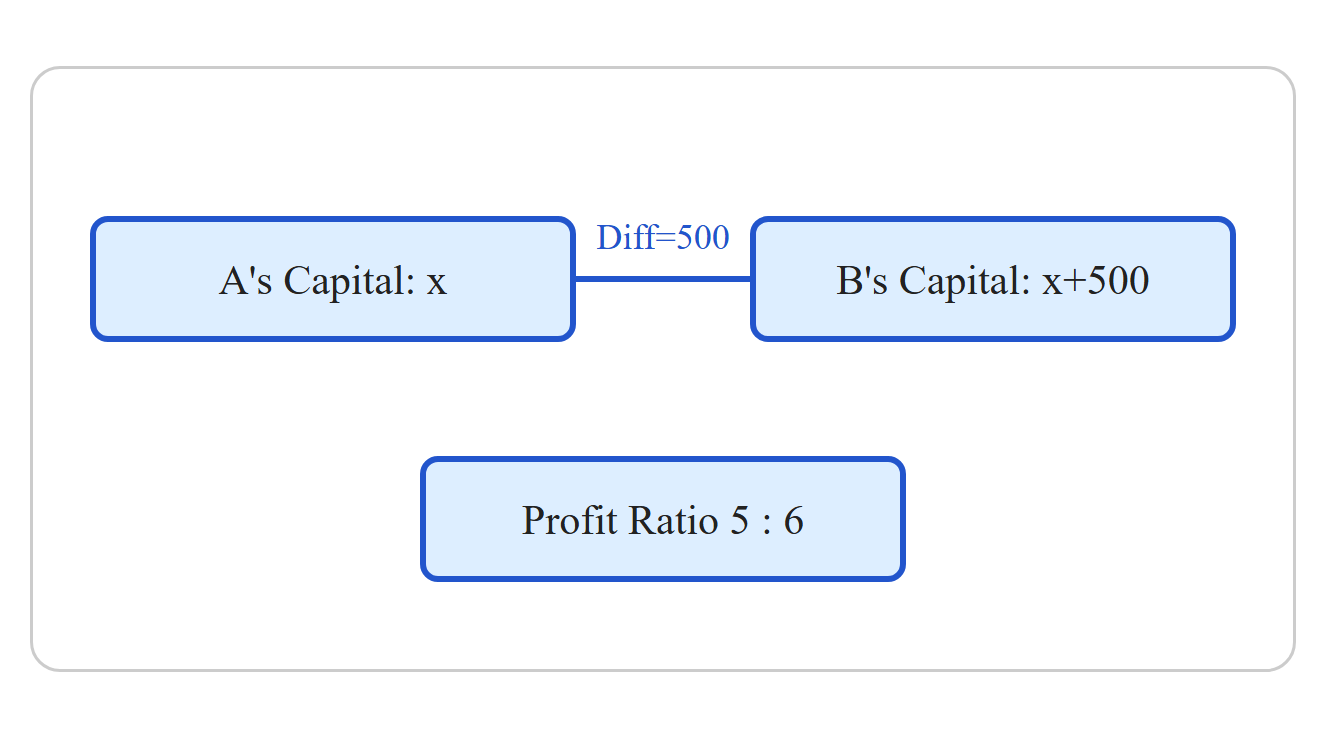
A and B entered into a partnership where A invested ₹x and B invested ₹(x + 500) for one year. At the end of the year, the profit of A is 1/6th less than the profit of B. What is the value of x?

  1. ((a))

    ₹1000

  2. ((b))

    ₹1500

  3. ((c))

    ₹2000

  4. ((d))

    ₹2500

  5. ((e))

    ₹3000

Show Answer
Answer: ((d))

₹2500

Shortcut Trick

Profit ratio of A : B is derived from the statement 1/6th less: If B = 6, then A = 6 − 1 = 5.

Ratio of profits PA : PB = 5 : 6. Since time is the same (1 year), Profit ratio = Investment ratio.

Difference in ratio parts = 6 − 5 = 1 unit. Given investment difference = ₹500.

∴ 1 unit = ₹500. Value of x (A's investment) = 5 units = 5 × 500 = ₹2500.

∴ The correct answer is ₹2500.

Alternate Method

Given: A's Investment = ₹x, B's Investment = ₹(x + 500), Time = 1 year.

Formulas: Profit = Investment × Time | Profit Ratio = (I1 × T1) : (I2 × T2)

⇒ Let B's profit be PB. Then A's profit PA = PB − (1/6)PB = (5/6)PB.

⇒ PA / PB = 5 / 6.

⇒ Since time is equal, x / (x + 500) = 5 / 6.

⇒ 6x = 5(x + 500) ⇒ 6x = 5x + 2500.

⇒ x = 2500.

∴ The correct answer is ₹2500.

Additional Information

Partnership Ratios

When the time period for all partners is the same, the profit is distributed solely in the ratio of their investments.

Fractional Change

If a value is 1/n less than another, it is represented as (1 − 1/n) of that value, or (n − 1)/n.

32

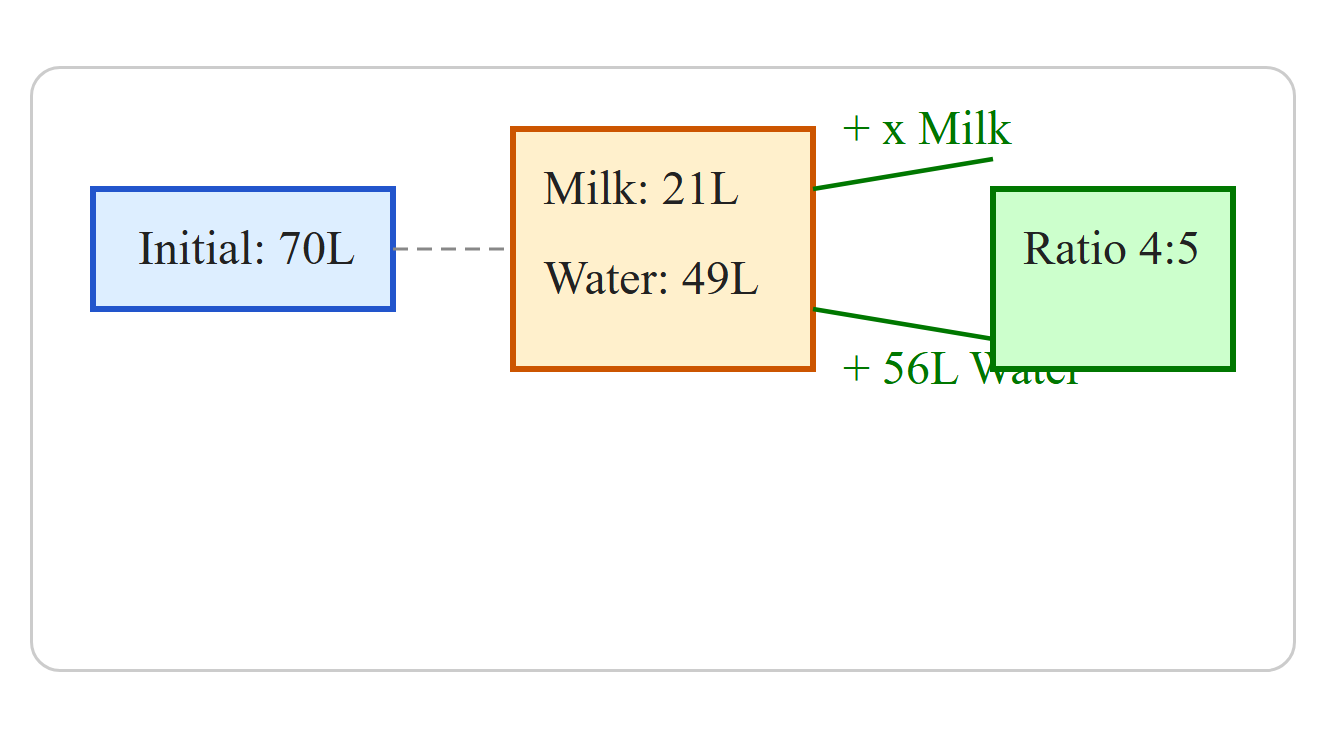
A mixture of 70 litres contains milk and water in the ratio 3:7. Then, x litres of milk is added, and 56 litres of water is added. After this, the ratio of milk to water becomes 4:5. What is the value of x?

  1. ((a))

    60 litres

  2. ((b))

    71 litres

  3. ((c))

    64 litres

  4. ((d))

    56 litres

  5. ((e))

    63 litres

Show Answer
Answer: ((e))

63 litres

Shortcut Trick

Initial Milk = 3/10 × 70 = 21 litres; Initial Water = 7/10 × 70 = 49 litres.

New Water = 49 + 56 = 105 litres.

Ratio 4:5 means 5 units = 105 litres → 1 unit = 21 litres.

New Milk = 4 units = 4 × 21 = 84 litres.

Value of x = 84 − 21 = 63 litres.

∴ The correct answer is 63 litres.

Alternate Method

Given: Initial Volume = 70 litres, Ratio M:W = 3:7, Water added = 56 litres, New ratio = 4:5.

Calculations:

Initial Milk = 70 × (3 / (3 + 7)) = 21 litres

Initial Water = 70 − 21 = 49 litres

Final Water = 49 + 56 = 105 litres

⇒ Let final Milk be Mf. Then Mf / 105 = 4 / 5

⇒ Mf = (4/5) × 105 = 4 × 21 = 84 litres

x = Final Milk − Initial Milk = 84 − 21 = 63 litres

∴ The correct answer is 63 litres.

Additional Information

Ratio Distribution

To divide a quantity Q in ratio a:b, the parts are Q × a/(a+b) and Q × b/(a+b).

Mixture Alligation

When adding a pure component (like 100% milk), the concentration changes based on the weighted average of the components.

Constant Quantity Concept

If only one component is added, the other component remains proportionally constant relative to its own previous absolute value.

33

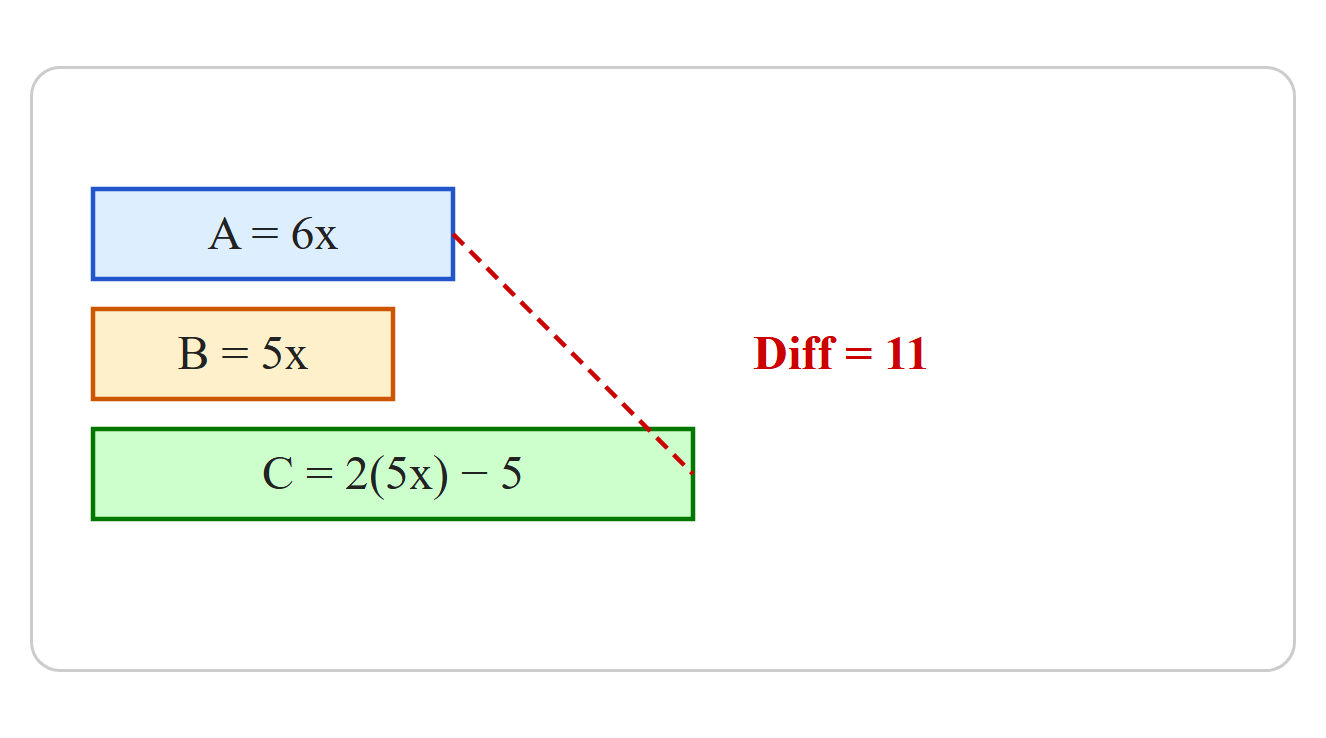
The ratio of the ages of A and B is 6:5, and the age of C is 5 years less than twice the age of B. The difference between the ages of C and A is 11 years. What is the age of A?

  1. ((a))

    24 years

  2. ((b))

    30 years

  3. ((c))

    36 years

  4. ((d))

    42 years

  5. ((e))

    18 years

Show Answer
Answer: ((a))

24 years

Shortcut Trick

Let the common ratio for A and B be x. Ages are 6x and 5x.

C age → 2 × 5x − 5 = 10x − 5.

Difference (C − A) → (10x − 5) − 6x = 11 ⇒ 4x = 16 ⇒ x = 4.

Age of A → 6 × 4 = 24 years.

∴ The correct answer is 24 years.

Alternate Method

Given: Ratio of A:B = 6:5. Age of C = 2 × B − 5. C − A = 11.

Calculations:

⇒ Let age of A = 6x and age of B = 5x.

⇒ Age of C = 2(5x) − 5 = 10x − 5.

⇒ According to the problem: C − A = 11

⇒ (10x − 5) − 6x = 11

⇒ 4x − 5 = 11

⇒ 4x = 16

x = 4

⇒ Age of A = 6 × 4 = 24.

∴ The correct answer is 24 years.

Additional Information

Ratio to Actual Value

If ratio is a:b, actual values are ax and bx where x is the highest common factor (HCF).

Age Problems Logic

Always define the ages of all individuals in terms of a single variable to simplify linear equations.

Difference Property

The difference between the ages of two people remains constant throughout their lives.

34

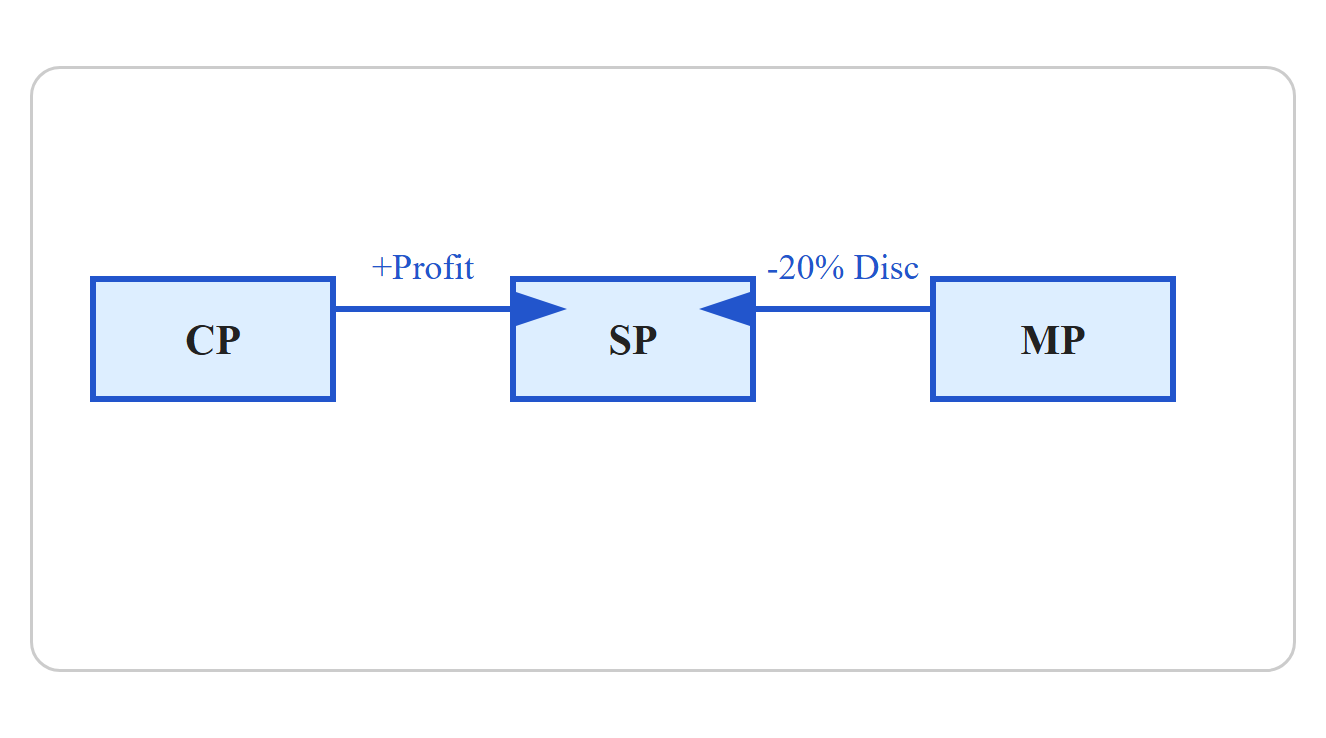
An article is sold at a selling price (SP) of Rs 2400 after a discount of 20% on the marked price (MP). If the profit earned is 20% of the marked price, what will be the profit if the article is sold at Rs 2700?

  1. ((a))

    Rs 600

  2. ((b))

    Rs 700

  3. ((c))

    Rs 800

  4. ((d))

    Rs 900

  5. ((e))

    Rs 450

Show Answer
Answer: ((d))

Rs 900

Shortcut Trick

Discount = 20% ⇒ SP = 80% of MP ⇒ 2400 = 0.8 × MP ⇒ MP = 3000.

Profit = 20% of MP = 0.2 × 3000 = 600.

CP = SP − Profit = 2400 − 600 = 1800.

New SP = 2700.

New Profit = New SP − CP = 2700 − 1800 = 900.

∴ The correct answer is Rs 900.

Alternate Method

Given → SP1 = 2400, Discount = 20%, Profit = 20% of MP, SP2 = 2700. Formulas → MP = SP ÷ (1 − D%), CP = SP − Profit.

⇒ MP = 2400 ÷ (1 − 0.20) = 2400 ÷ 0.8 = 3000. ⇒ Profitinitial = 20% of 3000 = 600. ⇒ CP = SP1 − Profitinitial = 2400 − 600 = 1800. ⇒ New Profit = SP2 − CP = 2700 − 1800 = 900.

∴ The correct answer is Rs 900.

Additional Information

Relationship between MP and CP

Marked Price is the price listed on the label, and Discount is always calculated on the Marked Price. Profit is calculated on the Cost Price unless stated otherwise.

Mark-up Percentage

Mark-up % = [(MP − CP) ÷ CP] × 100. It represents how much higher the MP is relative to the CP.

35

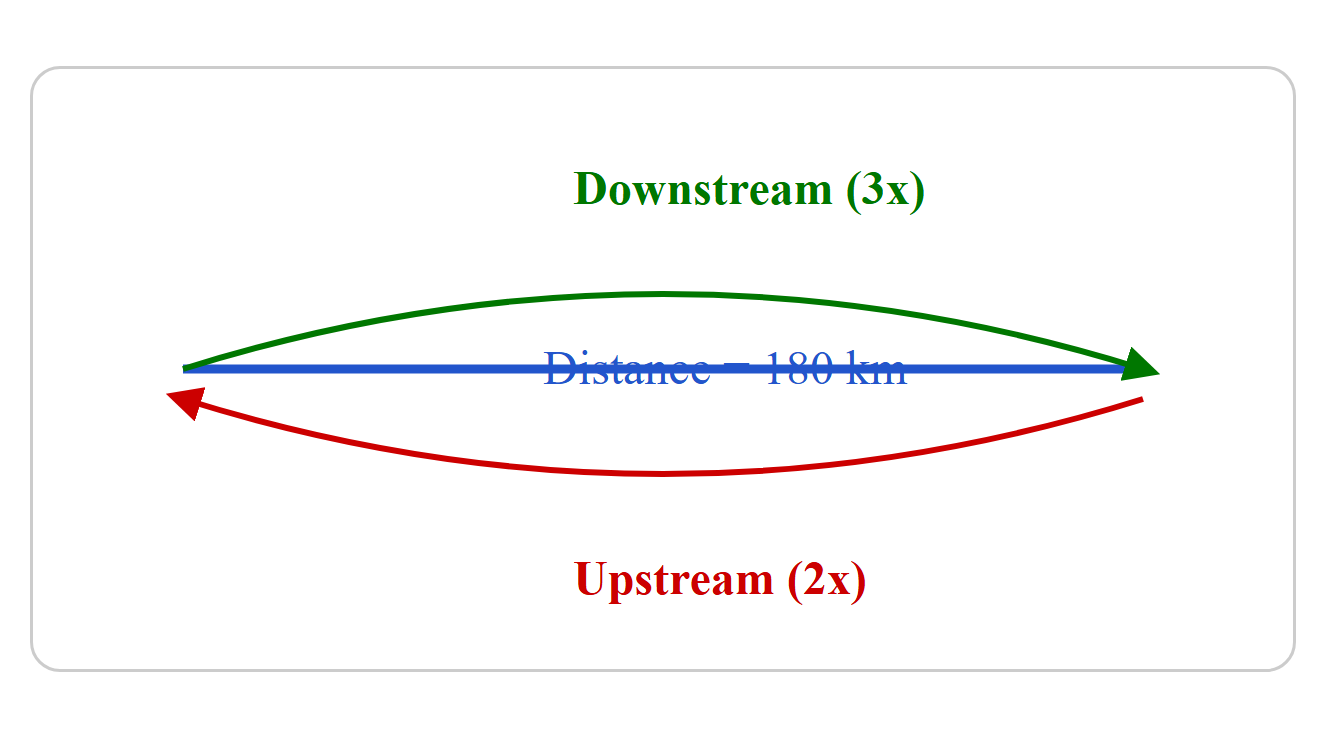
A boat travels upstream and downstream in a river. The ratio of the boat's upstream speed to its downstream speed is 2:3. The total time taken by the boat to cover 180 km both upstream and downstream is 7.5 hours. What is the downstream speed of the boat?

  1. ((a))

    75 km/h

  2. ((b))

    88 km/h

  3. ((c))

    60 km/h

  4. ((d))

    54 km/h

  5. ((e))

    None of these

Show Answer
Answer: ((c))

60 km/h

Shortcut Trick

Ratio of Upstream Speed (U) to Downstream Speed (D) is 2 : 3.

Total time = (Distance ÷ U) + (Distance ÷ D) ⇒ 7.5 = (180 ÷ 2x) + (180 ÷ 3x).

7.5 = 90/x + 60/x ⇒ 7.5 = 150/x ⇒ x = 150 ÷ 7.5 = 20.

Downstream Speed = 3x = 3 × 20 = 60 km/h.

∴ The correct answer is 60 km/h.

Alternate Method

Given: Upstream Speed : Downstream Speed = 2 : 3. Total Distance = 180 km. Total Time = 7.5 hours.

Formula Used: Time = Distance ÷ Speed

⇒ Let Upstream Speed = 2x and Downstream Speed = 3x.

⇒ Total Time = (180 ÷ 2x) + (180 ÷ 3x) = 7.5

⇒ 90/x + 60/x = 7.5

⇒ 150/x = 7.5

⇒ x = 150 ÷ 7.5 = 20

⇒ Downstream Speed = 3 × 20 = 60 km/h.

∴ The correct answer is 60 km/h.

Additional Information

Speed in Still Water

It is the average of downstream and upstream speeds: B = (D + U) ÷ 2.

Speed of Current (Stream)

It is half the difference between downstream and upstream speeds: S = (D − U) ÷ 2.

Average Speed for Round Trip

Average Speed = (2 × U × D) ÷ (U + D), which is also equal to Total Distance ÷ Total Time.

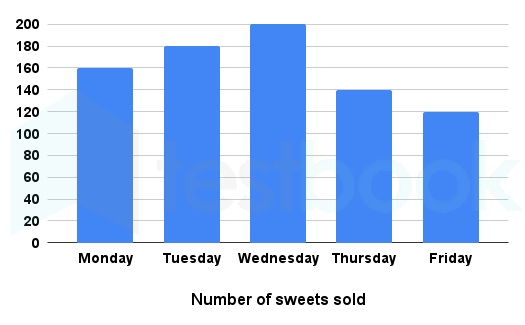
The bar graphs show the number of sweet sold in a shop on five days [ Monday, Tuesday, Wednesday, Thursday and Friday] of week.

36

Number of sweet sold on Monday is _____ less than the number of sweet sold on Tuesday and Number of sweet sold on Wednesday is ____ more than the number of sweet sold on Friday. Find which of the following satisfy the blank?

  1. ((a))

    40, 80

  2. ((b))

    20, 60

  3. ((c))

    40, 60

  4. ((d))

    50, 60

  5. ((e))

    20, 80

Show Answer
Answer: ((e))

20, 80

Calculation:

Difference between Monday and Tuesday

⇒ 180 - 160 = 20

So, the number of sweets sold on Monday is 20 less than on Tuesday.

Difference between Wednesday and Friday

⇒ 200 - 120 = 80

So, the number of sweets sold on Wednesday is 80 more than on Friday.

∴ The correct answer is: 20, 80.

37

Number of sweet sold on Thursday is [x + 45]. Find the value of x? 

  1. ((a))

    70

  2. ((b))

    80

  3. ((c))

    95

  4. ((d))

    75

  5. ((e))

    105

Show Answer
Answer: ((c))

95

Calculation:

Number of sweets sold on Thursday = x + 45

From the provided data, the number of sweets sold on Thursday = 140

⇒ x + 45 = 140

⇒ x = 140 - 45

⇒ x = 95

∴ The value of x is 95.

38

Ratio number of sweet sold on Friday and Saturday is 4:7. Find the number of sweet sold on Saturday?

  1. ((a))

    240

  2. ((b))

    260

  3. ((c))

    290

  4. ((d))

    210

  5. ((e))

    285

Show Answer
Answer: ((d))

210

Calculation:

Number of sweets sold on Friday = 120

Ratio of sweets sold on Friday to Saturday = 4 : 7

We need to find the number of sweets sold on Saturday.

Since the number of sweets sold on Friday is given as 120:

⇒ 4x = 120

⇒ x = 120 / 4

⇒ x = 30

Now, the number of sweets sold on Saturday:

⇒ 7x = 7 × 30

⇒ 210

∴ The number of sweets sold on Saturday is 210.

39

Find the difference between number of sweet sold on Wednesday and Thursday together and number of sweet sold on Monday and Tuesday together?

  1. ((a))

    4

  2. ((b))

    6

  3. ((c))

    70

  4. ((d))

    0

  5. ((e))

    50

Show Answer
Answer: ((d))

0

Calculation:

Total sweets sold on Wednesday and Thursday

⇒ 200 + 140 = 340

Total sweets sold on Monday and Tuesday

⇒ 160 + 180 = 340

Required difference

⇒ 340 - 340 = 0

∴ The difference between the number of sweets sold on Wednesday and Thursday together and Monday and Tuesday together is 0.

40

Only 40% and 60% sweet sold at shop on Monday and Tuesday out of total sweet made. Find the total number of unsold sweet on Monday and Tuesday together?

  1. ((a))

    560

  2. ((b))

    360

  3. ((c))

    320

  4. ((d))

    270

  5. ((e))

    280

Show Answer
Answer: ((b))

360

Calculation:

Number of sweets sold on Monday = 160

Only 40% of the total sweets made were sold on Monday.

Total sweets made on Monday:

⇒ (160 × 100) / 40

⇒ 16000 / 40 = 400

Unsold sweets on Monday:

⇒ 400 - 160 = 240

Number of sweets sold on Tuesday = 180

Only 60% of the total sweets made were sold on Tuesday.

Total sweets made on Tuesday:

⇒ (180 × 100) / 60

⇒ 300

Unsold sweets on Tuesday:

⇒ 300 - 180 = 120

Total unsold sweets = Unsold sweets on Monday + Unsold sweets on Tuesday

⇒ 240 + 120 = 360

∴ The total number of unsold sweets on Monday and Tuesday together is 360.

41

What should come in place of the question mark (?) in the following question?

162 + (5/8) of 344 + ? = 500

  1. ((a))

    19

  2. ((b))

    23

  3. ((c))

    29

  4. ((d))

    31

  5. ((e))

    17

Show Answer
Answer: ((c))

29

Given:

162 + (5/8) of 344 + ? = 500

Concept used:

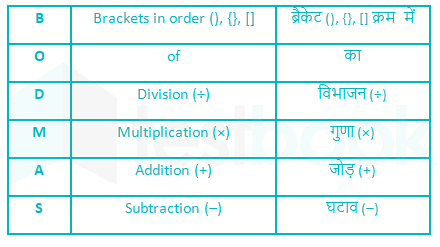
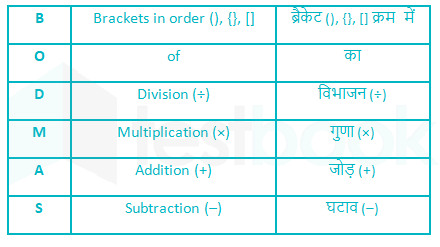
Follow the BODMAS rule according to the table given below:

Calculation:

162 + (5/8) of 344 + ? = 500

⇒ 256 + (5/8) of 344 + ? = 500

⇒ 256 + 215 + ? = 500

⇒ ? = 500 - 471

⇒ ? = 29

∴ 29 should come in place of the question mark (?).

42

What should come in place of the question mark '?' in the following question?

10% of 450 - (8 × 5) = ? × 5

  1. ((a))

    8.2

  2. ((b))

    2

  3. ((c))

    1

  4. ((d))

    5

  5. ((e))

    None of these

Show Answer
Answer: ((c))

1

Given:

10% of 450 - (8 × 5) = ? × 5

Concept used:

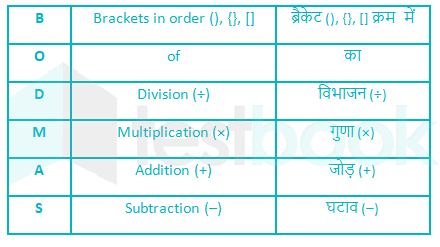
Follow the BODMAS rule according to the table given below:

Calculation:

10% of 450 - (8 × 5) = ? × 5

⇒ 45 - 40 = ? × 5

⇒ 5 = ? × 5

⇒ ? = 1

∴ The value of '?' is 1.

43

What should come in place of the question mark (?) in the following question?

78 ÷ 6 × 5 + √625 = ? × 9

  1. ((a))

    9

  2. ((b))

    8

  3. ((c))

    10

  4. ((d))

    7

  5. ((e))

    6

Show Answer
Answer: ((c))

10

Given:

78 ÷ 6 × 5 + √625 = ? × 9

Concept used:

Follow the BODMAS rule according to the table given below:

Calculation:

78 ÷ 6 × 5 + √625 = ? × 9

⇒ 13 × 5 + 25 = ? × 9

⇒ 65 + 25 = ? × 9

⇒ ? × 9 = 90

⇒ ? = 10

∴ 10 should come in place of the question mark (?).

44

What should come in place of the question mark (?) in the following question?

122 × 5 - √400 + ? × 5 = 850

  1. ((a))

    20

  2. ((b))

    25

  3. ((c))

    30

  4. ((d))

    35

  5. ((e))

    40

Show Answer
Answer: ((c))

30

Given:

122 × 5 - √400 + ? × 5 = 850

Concept used:

Follow the BODMAS rule according to the table given below:

Calculation:

122 × 5 - √400 + ? × 5 = 850

⇒ 144 × 5 - 20 + ? × 5 = 850

⇒ 720 - 20 + ? × 5 = 850

⇒ ? × 5 = 150

⇒ ? = 30

∴ 30 should come in place of the question mark (?).

45

What will come in the place of the question mark ‘?’ in the following question?

20 - 102 = 41 - ?2

  1. ((a))

    12

  2. ((b))

    10

  3. ((c))

    7

  4. ((d))

    11

  5. ((e))

    9

Show Answer
Answer: ((d))

11

Given:

20 - 102 = 41 - ?2 

Concept used:

Follow the BODMAS rule according to the table given below:

Calculation:

20 - 102 = 41 - ?2 

⇒ 20 - 100 = 41 - ?2

⇒ -80 = 41 - ?2

⇒ ?2 = 121

⇒ ? = 11

∴ The value of ? is 11.

46

What will come in the place of the question mark ‘?’ in the following question?

5656 ÷ 28 × 11 - 333 = ?

  1. ((a))

    1789

  2. ((b))

    1989

  3. ((c))

    1889

  4. ((d))

    2089

  5. ((e))

    None of these

Show Answer
Answer: ((c))

1889

Given:

5656 ÷ 28 × 11 - 333 = ?

Concept used:

Follow the BODMAS rule according to the table given below:

Calculation:

5656 ÷ 28 × 11 - 333 = ?

⇒ 202 × 11 - 333 = ?

⇒ 2222 - 333 = ?

⇒ ? = 1889

∴ The value of ? is 1889.

47

What should come in the place of the question mark ‘?’ in the following question?

90 × 20% of 105 ÷ 3 = ?

  1. ((a))

    630

  2. ((b))

    600

  3. ((c))

    615

  4. ((d))

    610

  5. ((e))

    None of these

Show Answer
Answer: ((a))

630

Given:

90 × 20% of 105 ÷ 3 = ?

Concept Used:

Follow the BODMAS rule according to the table given below:

Calculation:

90 × 20% of 105 ÷ 3 = ?

⇒ 90 × (1/5) × 105/3 = ?

⇒ 18 × 35 = ?

⇒ ? = 630

The value of ‘?’ Is 630.

Hint

20% = 1/5

48

What should come in the place of the question mark ‘?’ in the following question?

440 + 1825 ÷ 25 + 102 = 215 + ?

  1. ((a))

    375

  2. ((b))

    400

  3. ((c))

    425

  4. ((d))

    450

  5. ((e))

    None of these

Show Answer
Answer: ((b))

400

Given:

440 + 1825 ÷ 25 + 102 = 215 + ?

Concept Used:

Follow the BODMAS rule according to the table given below:

Calculation:

440 + 1825 ÷ 25 + 102 = 215 + ?

⇒ 440 + (1825/25) + 102 = 215 + ?

⇒ 440 + 73 + 102 - 215 = ?

⇒ ? = 400

The value of ‘?’ Is 400.

49

What will come in the place of the question mark ‘?’ in the following question?

(4/9) of (729/2) + 400 = ?

  1. ((a))

    462

  2. ((b))

    662

  3. ((c))

    562

  4. ((d))

    362

  5. ((e))

    262

Show Answer
Answer: ((c))

562

Given:

(4/9) of (729/2) + 400 = ?

Concept used:

Follow the BODMAS rule according to the table given below:

Calculation:

(4/9) of (729/2) + 400 = ?

⇒ 81 × 2 + 400 = ?

⇒ 162 + 400 = ?

⇒ ? = 562

∴ The value of ? is 562.

50

What will come in the place of the question mark '?' in the following question?

 378 + ?1/2 = 25% of 2400 - 192

  1. ((a))

     784

  2. ((b))

     900

  3. ((c))

     576

  4. ((d))

     400

  5. ((e))

     625

Show Answer
Answer: ((b))

 900

Given :

 378 + ?1/2 = 25% of 2400 - 192

 Calculation :

  378 + ?1/2  = 25% of 2400 - 192

 ⇒ 378 + ?1/2 = (2400 × 1 / 4 ) - 192

 ⇒ 378 + ?1/2 = 600 - 192

 ⇒ ?1/2  = 408 - 378

 ⇒ ?1/2  = 30

 ⇒ (?)2×1/2 = 302

 ⇒ ? = 900

 Hence,900 will come in the place of '?'.

51

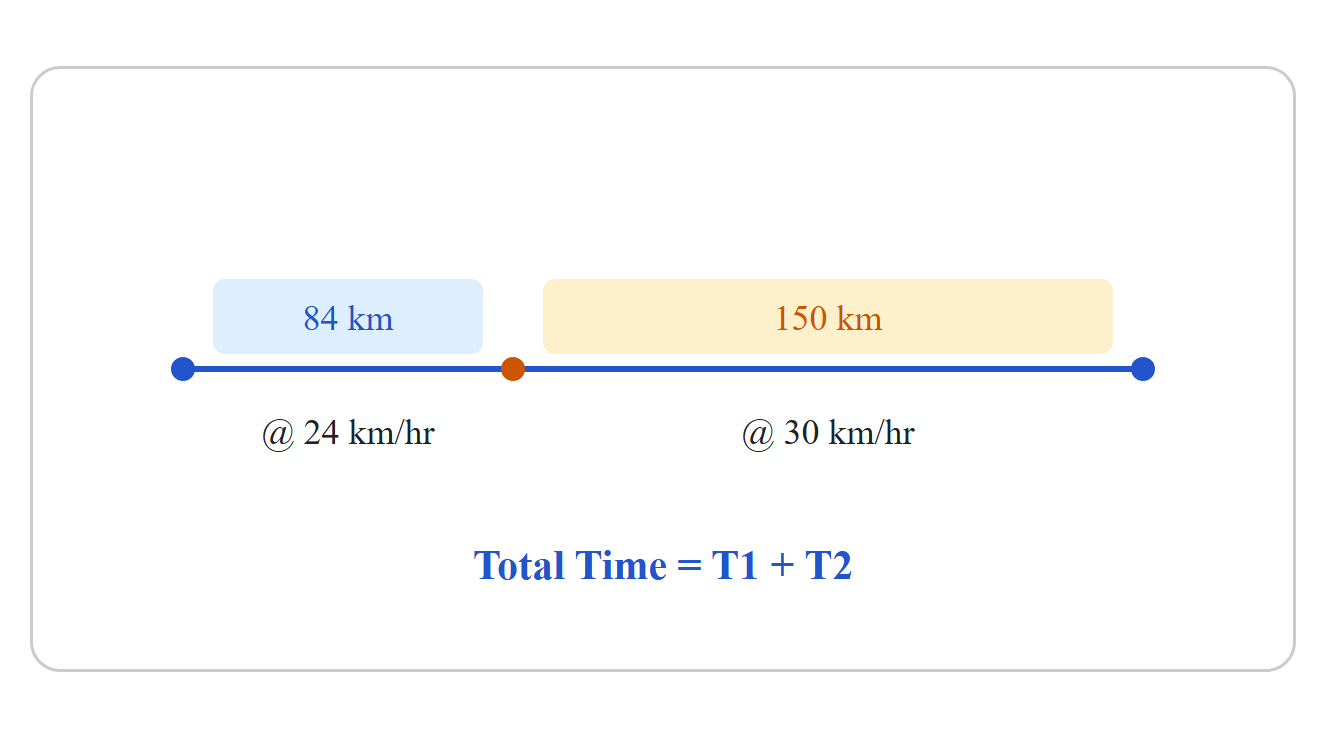
A car travels at a speed of 24 km/hr and covers a distance of 84 km. After that, the car increases its speed by 25% and covers the next 150 km. What is the total time taken for the entire journey?

  1. ((a))

    8.5 hours

  2. ((b))

    9.25 hours

  3. ((c))

    10.75 hours

  4. ((d))

    11.5 hours

  5. ((e))

    None of these

Show Answer
Answer: ((a))

8.5 hours

Shortcut Trick

First part time = 84 ÷ 24 = 3.5 hr

New speed = 24 × 1.25 = 30 km/hr

Second part time = 150 ÷ 30 = 5 hr

Total time = 3.5 + 5 = 8.5 hr

∴ The correct answer is 8.5 hr.

Alternate Method

Given: First distance (D1) = 84 km, First speed (S1) = 24 km/hr, Second distance (D2) = 150 km.

Formula Used: Time = Distance ÷ Speed

⇒ Time for first part (T1) = D1 ÷ S1

⇒ T1 = 84 ÷ 24 = 3.5 hr

⇒ Increased speed (S2) = S1 + (25% of S1)

⇒ S2 = 24 + (25/100 × 24) = 24 + 6 = 30 km/hr

⇒ Time for second part (T2) = D2 ÷ S2

⇒ T2 = 150 ÷ 30 = 5 hr

⇒ Total Time = T1 + T2 = 3.5 + 5 = 8.5 hr

∴ The correct answer is 8.5 hr.

Additional Information

Average Speed Formula

Average Speed = Total Distance ÷ Total Time. For this journey, Average Speed = (84 + 150) ÷ 8.5 ≈ 27.53 km/hr.

Percentage Increase in Speed

When speed increases by x%, the new speed is S × (1 + x/100). Here, 24 × (1 + 0.25) = 24 × 1.25 = 30 km/hr.

Unit Conversion

To convert km/hr to m/s, multiply by 5/18. To convert m/s to km/hr, multiply by 18/5.

52

A person spends 20% of their salary on rent. Out of the remaining salary, 30% is spent on Food, 25% is spent on Transport, and the rest is spent on Entertainment. If the amount spent on Entertainment is ₹16,560, what is the total salary of the person?

  1. ((a))

    ₹69,000

  2. ((b))

    ₹56,000

  3. ((c))

    ₹35,000

  4. ((d))

    ₹46,000

  5. ((e))

    ₹72,000

Show Answer
Answer: ((d))

₹46,000

Let the total salary be S.

Amount spent on rent =20% of S.

Remaining salary after rent = 80% of S.

Amount spent on Food = 30% of the remaining salary.

Amount spent on Transport = 25% of the remaining salary.

Amount spent on Entertainment = Remaining percentage of the remaining salary.

Total percentage spent on Food and Transport = 30% + 25% = 55% 

Percentage spent on Entertainment = 100% - 55% = 45%.

Entertainment = 45%of the remaining salary.

Given that Entertainment = ₹16,560:

45% of 80% of S = 16,560

0.45 × 0.8 × S = 16,560

0.36 × S = 16,560

S = 16,560 / 0.36

S = 46,000

Thus, the total salary of the person is ₹46,000.

53

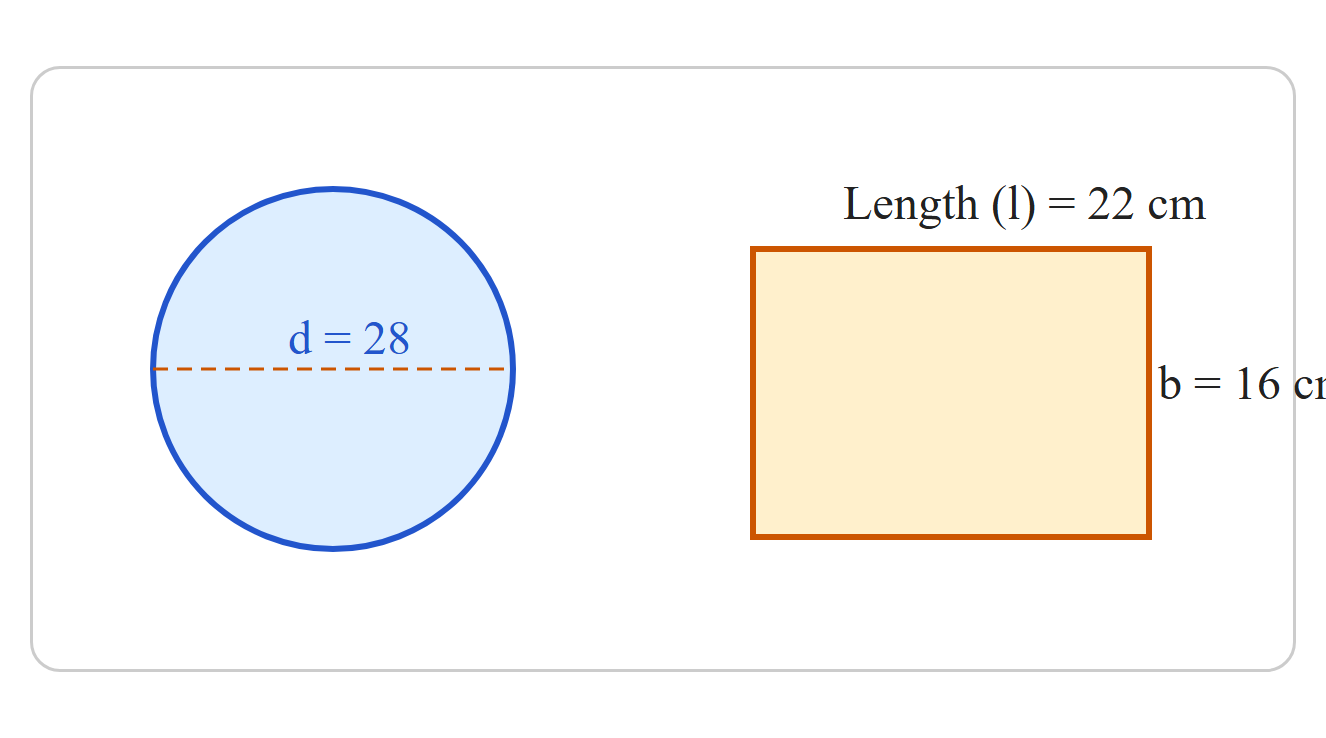
The ratio of the diameter of a circle to the breadth of a rectangle is 7:4. The area of the circle is 616 cm². If the length of the rectangle is 6 cm more than its breadth, what is the area of the rectangle?

  1. ((a))

    268 cm2

  2. ((b))

    286 cm2

  3. ((c))

    305 cm2

  4. ((d))

    352 cm2

  5. ((e))

    346 cm2

Show Answer
Answer: ((d))

352 cm2

Shortcut Trick

Area of circle 616 cm2Radius (r) = 14 cm, Diameter (d) = 28 cm.

Ratio Diameter : Breadth = 7 : 4 ⇒ 7 units = 28 cm ⇒ 1 unit = 4 cm.

Breadth (b) = 4 × 4 = 16 cm; Length (l) = 16 + 6 = 22 cm.

Area of rectangle = 22 × 16 = 352 cm2.

∴ The correct answer is 352 cm2.

Alternate Method

Given: Area of circle = 616 cm2, Ratio d : b = 7 : 4, l = b + 6.

Formula Used: Area of Circle = πr2; Area of Rectangle = l × b.

⇒ πr2 = 616

⇒ (22/7) × r2 = 616

⇒ r2 = (616 × 7) ÷ 22 = 28 × 7 = 196

Radius (r) = 14 cm ∴ Diameter (d) = 28 cm

⇒ Diameter : Breadth = 7 : 4 ⇒ 28 : b = 7 : 4

Breadth (b) = (28 × 4) ÷ 7 = 16 cm

Length (l) = 16 + 6 = 22 cm

Area of rectangle = 22 × 16 = 352 cm2

∴ The correct answer is 352 cm2.

Additional Information

Circle Properties

Circumference = 2πr and Diameter = 2r. For r = 7, Area = 154; for r = 14, Area = 616.

Rectangle Perimeter

Perimeter of a rectangle is given by 2(l + b), where l is length and b is breadth.

Ratio Applications

If a : b = x : y, then a = kx and b = ky where k is a constant proportionality factor.

The table shows the number movie shows in three months [January, February and March] in three different multiplexes [A, B, and C].

MonthsABC
January180270140
February160210200
March150220240
54

Find the difference between total number of movies shows in February and March in all multiplex together?

  1. ((a))

    45

  2. ((b))

    56

  3. ((c))

    40

  4. ((d))

    85

  5. ((e))

    70

Show Answer
Answer: ((c))

40

Calculation:

Total shows in February = 160 + 210 + 200 = 570

Total shows in March = 150 + 220 + 240 = 610

Difference = Total shows in March - Total shows in February

⇒ 610 - 570 = 40

∴ The difference between the total number of movie shows in February and March across all multiplexes is 40.

55

Number movie shows in January at D is 5/7th of the number of movies shows in January at C. Find number the number of movies shows at D in January?

  1. ((a))

    120

  2. ((b))

    140

  3. ((c))

    150

  4. ((d))

    100

  5. ((e))

    160

Show Answer
Answer: ((d))

100

Calculation:

Number of movie shows in January at multiplex C = 140

Number of movie shows in January at D is 5/7th of that at C.

We need to find the number of movie shows at D in January.

Shows at D = (5/7) × Shows at C

⇒ (5/7) × 140

⇒ 700 / 7

⇒ 100

∴ The number of movie shows in January at D is 100.

56

Find the ratio of total number of shows in January and February together in B and in February and March together in C?

  1. ((a))

    12 : 11

  2. ((b))

    11 : 12

  3. ((c))

    12 : 13

  4. ((d))

    13 : 12

  5. ((e))

    5 : 6

Show Answer
Answer: ((a))

12 : 11

Calculation:

Total shows in January and February at B = 270 + 210 = 480

Total shows in February and March at C = 200 + 240 = 440

Required Ratio = (Total shows in B for January & February) : (Total shows in C for February & March)

⇒ 480 : 440

⇒ 12 : 11

∴ The required ratio is 12 : 11.

57

Number of movies shows in April at C is 25% more than the number of movies shows in March at same multiplex, Find the number of movies shows in April at C?

  1. ((a))

    250

  2. ((b))

    300

  3. ((c))

    320

  4. ((d))

    280

  5. ((e))

    340

Show Answer
Answer: ((b))

300

Calculation:

Number of movie shows in March at multiplex C = 240

Number of movie shows in April at C is 25% more than in March.

Number of shows in April at C:

⇒ 240 × (1 + 25/100)

⇒ 240 × (1 + 0.25)

⇒ 240 × 1.25

⇒ 300

∴ The number of movie shows in April at C is 300.

58

Total number of movies shows in January and February at A is how much less than the number of movies in same months at B?

  1. ((a))

    120

  2. ((b))

    165

  3. ((c))

    160

  4. ((d))

    170

  5. ((e))

    140

Show Answer
Answer: ((e))

140

Calculation:

Total shows at A:

⇒ 180 + 160 = 340

Total shows at B:

⇒ 270 + 210 = 480

Difference = Total shows at B - Total shows at A

⇒ 480 - 340 = 140

∴ The number of movie shows in January and February at A is 140 less than at B.

59

30% of a principal is invested at 12% per annum, and 70% of the principal is invested at 8% per annum. The sum of the interests earned from both investments is 2438. What is the principal?

  1. ((a))

    30,000

  2. ((b))

    22,750

  3. ((c))

    26,500

  4. ((d))

    28,000

  5. ((e))

    None of these

Show Answer
Answer: ((c))

26,500

Shortcut Trick

Let the total principal be 100 units.

Weighted Interest Rate = (30% × 12%) + (70% × 8%) = 3.6% + 5.6% = 9.2%.

9.2% of Principal = 2438

Principal = 2438 ÷ 0.092 = 26500.

∴ The correct answer is 26,500.

Alternate Method

Given: Interest 1 (at 12%) + Interest 2 (at 8%) = 2438.

Formula Used: Simple Interest (SI) = (P × R × T) ÷ 100

⇒ Let Principal be P.

⇒ SI1 = (0.30P × 12 × 1) ÷ 100 = 0.036P

⇒ SI2 = (0.70P × 8 × 1) ÷ 100 = 0.056P

⇒ Total Interest = 0.036P + 0.056P = 0.092P

⇒ 0.092P = 2438

⇒ P = 2438 ÷ 0.092 = 26500

∴ The correct answer is 26,500.

Additional Information

Weighted Average Rate of Interest

When a principal is divided, the effective rate Reff = (w1r1 + w2r2 + ...), where w is the weightage of each part.

Simple Interest Properties

Simple interest is calculated only on the original principal. Interest remains constant every year if the rate and principal are unchanged.

60

A, B, and C can complete a work individually in 48 days, 72 days, and 54 days, respectively. A and B work together for 16 days, and the remaining work is completed by C alone. How many days will C take to complete the work?

  1. ((a))

    22 days

  2. ((b))

    24 days

  3. ((c))

    26 days

  4. ((d))

    28 days

  5. ((e))

    18 days

Show Answer
Answer: ((b))

24 days

Shortcut Trick

Total Work (LCM of 48, 72, 54) = 432 units.

Efficiencies: A = 9, B = 6, C = 8.

Work done by (A + B) in 16 days = (9 + 6) × 16 = 15 × 16 = 240 units.

Remaining Work = 432 − 240 = 192 units.

Time taken by C = 192 ÷ 8 = 24 days.

∴ The correct answer is 24 days.

Alternate Method

Given: Individual time of A = 48 days, B = 72 days, C = 54 days.

Formula Used: Efficiency = Total Work ÷ Time; Work Done = Efficiency × Time.

PersonDaysTotal WorkEfficiency
A484329
B726
C548

⇒ Total work = LCM(48, 72, 54) = 432 units.

Combined Efficiency of A and B = 9 + 6 = 15 units/day.

⇒ Work completed by A and B in 16 days = 15 × 16 = 240 units.

Remaining Work = 432 − 240 = 192 units.

⇒ Days taken by C to finish remaining work = 192 ÷ 8 = 24 days.

∴ The correct answer is 24 days.

Additional Information

Pipes & Cisterns

Conceptually identical to Time & Work, where inlet pipes have positive efficiency and outlet pipes have negative efficiency.

Work and Wages

Wages are distributed in the ratio of the actual work done by each person, or in the ratio of their efficiencies if they work for the same duration.

Alternate Day Work

Calculate the work done in one cycle (sum of efficiencies over the cycle period) and then divide the total work by the cycle total.

61

What should come in the place of (?) in the given series?

15, 17, ?, 25, 32, 43

  1. ((a))

    17

  2. ((b))

    20

  3. ((c))

    32

  4. ((d))

    43

  5. ((e))

    25

Show Answer
Answer: ((b))

20

Calculation 

⇒ 15 + 2 = 17 

⇒ 17 + 3 = 20

⇒ 20 + 5 = 25 

⇒ 25 + 7 = 32 

⇒ 32 + 11 = 43 

∴ The missing number is 20

62

What should come in the place of (?) in the given series?

2, 9, 30, ?, 282, 849

  1. ((a))

    90

  2. ((b))

    93

  3. ((c))

    96

  4. ((d))

    99

  5. ((e))

    87

Show Answer
Answer: ((b))

93

Solution:

2, 9, 30, ?, 282, 849

The series follows the following pattern:

⇒ 2 x 3 + 3 = 9

⇒ 9 x 3 + 3 = 30

⇒ 30 x 3 + 3 = 93

⇒ 93 x 3 + 3 = 282

⇒ 282 x 3 + 3 = 849

⇒ The missing term in the series will be 93.

Hence, 93 is the correct answer.

63

What should come in place of the question mark '?' in the following number series?

110, 120, 135, 155, 180, ?

  1. ((a))

    200

  2. ((b))

    220

  3. ((c))

    210

  4. ((d))

    230

  5. ((e))

    None of these

Show Answer
Answer: ((c))

210

Given:

110, 120, 135, 155, 180, ?

Calculation:

Considering the above series, the logic can be explained as follows

∴ The required value of "?" is 210

64

The average weight of 3 children is 20 kg. The weight of Chinu is three times the weight of Bhavya and weight of Arshi is twice that of Bhavya, Find the weight of Chinu.

  1. ((a))

    20 kg

  2. ((b))

    30 kg

  3. ((c))

    10 kg

  4. ((d))

    15 kg

  5. ((e))

    25 kg

Show Answer
Answer: ((b))

30 kg

Shortcut Trick

Ratio of weights: Chinu : Arshi : Bhavya = 3 : 2 : 1

Total ratio parts = 3 + 2 + 1 = 6 units

Total weight = Average × Count = 20 × 3 = 60 kg

1 unit = 60 ÷ 6 = 10 kg

Chinu (3 units) = 3 × 10 = 30 kg

∴ The correct answer is 30 kg.

Alternate Method

Given:

Average weight of 3 children = 20 kg

Let the weight of Bhavya be x kg.

Weight of Chinu = 3x kg

Weight of Arshi = 2x kg

Formula Used:

Total Sum = Average × Number of entities

Calculations:

⇒ Total Weight = 20 × 3 = 60 kg

⇒ x + 3x + 2x = 60

⇒ 6x = 60

⇒ x = 10 kg

⇒ Weight of Chinu = 3x = 3 × 10 = 30 kg

∴ The correct answer is 30 kg.

Additional Information

Average Property

Average is the sum of observations divided by the total number of observations. Formula: Average = Σxi / n.

Ratio & Proportion

If A:B = a:b and B:C = b:c, then A:B:C = a:b:c. This is used to distribute a total value among multiple parties.

Weighted Average

Used when different groups have different averages. Formula: (n1×Avg1 + n2×Avg2) / (n1 + n2).

65

In a group of people, 40% are male, and the rest are female. Among the females, 40% are graduates, and the remaining are postgraduates. If the total number of female postgraduates is 360, what is the number of males in the group?

  1. ((a))

    200

  2. ((b))

    300

  3. ((c))

    400

  4. ((d))

    500

  5. ((e))

    600

Show Answer
Answer: ((c))

400

Shortcut Trick

Let Total People = 100 units. Females = 60 units.

Postgraduate Females = 60% of 60 units = 36 units.

36 units → 360 ⇒ 1 unit = 10.

Males = 40 units = 40 × 10 = 400.

∴ The correct answer is 400.

Alternate Method

Given:

Percentage of males = 40%

Percentage of females = 100% − 40% = 60%

Percentage of Postgraduate females = 100% − 40% = 60% of females.

Total Postgraduate females = 360.

Calculations:

⇒ Let total number of people be 'x'.

⇒ Number of females = 0.60x

⇒ Number of Postgraduate females = 60% of 0.60x = 360

⇒ 0.60 × 0.60x = 360

⇒ 0.36x = 360

⇒ x = 360 ÷ 0.36 = 1000

⇒ Number of males = 40% of 1000 = 0.40 × 1000 = 400

∴ The correct answer is 400.

Additional Information

Percentage Breakdown

When a subgroup is defined as a percentage of another subgroup, multiply the percentages: Final % = Sub-percentage × Main percentage.

Base Change Rule

Always identify the correct base for percentage calculations (e.g., 40% of females means the base is the total number of females, not the total group).

Reasoning Ability (35 questions)

Directions: Study the following information carefully and answer the questions that follow

Eight people L, M, N, O, P, Q, R, and S are sitting in a row facing North. N is sitting at one, end and only two people are sitting between N and L. Q is an immediate neighbor of one who is sitting at extreme end. No one is sitting between Q and M, who is sitting at extreme end. P is sitting to the immediate left of L and only two persons are sitting between P and O. R is an immediate neighbor of neither O nor Q.

66

Who is sitting second to left of S?

  1. ((a))

    P

  2. ((b))

    L

  3. ((c))

    Q

  4. ((d))

    M

  5. ((e))

    None of these

Show Answer
Answer: ((a))

P

  1. N is sitting at one end, and only two people are sitting between N and L.


  1. Q is an immediate neighbor of one who is sitting at extreme end. No one is sitting between Q and M, who is sitting at extreme end


  1. P is sitting to the immediate left of L and only two persons are sitting between P and O


  1. R is an immediate neighbor of neither O nor Q

Hence, case 2 gets canceled.

So, the final arrangement will be


Hence, P is sitting second to the left of S.

67

How many people are sitting between R and O?

  1. ((a))

    Two

  2. ((b))

    Five

  3. ((c))

    Four

  4. ((d))

    Six

  5. ((e))

    None of these

Show Answer
Answer: ((e))

None of these

  1. N is sitting at one end, and only two people are sitting between N and L.

  1. Q is an immediate neighbor of one who is sitting at extreme end. No one is sitting between Q and M, who is sitting at extreme end

  1. P is sitting to the immediate left of L and only two persons are sitting between P and O

  1. R is an immediate neighbor of neither O nor Q

Hence, case 2 gets canceled.

So, the final arrangement will be

Hence, Three people are sitting between R and O.

68

Which of the following statement is true?

  1. ((a))

    Q is sitting third to the right of S

  2. ((b))

    All of the statements are true

  3. ((c))

    P is an immediate neighbor of O

  4. ((d))

    M is sitting fourth to the right of L

  5. ((e))

    None of the given statements are true

Show Answer
Answer: ((d))

M is sitting fourth to the right of L

  1. N is sitting at one end, and only two people are sitting between N and L.

  1. Q is an immediate neighbor of one who is sitting at extreme end. No one is sitting between Q and M, who is sitting at extreme end

  1. P is sitting to the immediate left of L and only two persons are sitting between P and O

  1. R is an immediate neighbor of neither O nor Q

Hence, case 2 gets canceled.

So, the final arrangement will be

Hence, M is sitting fourth to the right of L.

69

Who is sitting third to the right of P?

  1. ((a))

    L

  2. ((b))

    N

  3. ((c))

    O

  4. ((d))

    S

  5. ((e))

    None of these

Show Answer
Answer: ((c))

O

  1. N is sitting at one end, and only two people are sitting between N and L.

  1. Q is an immediate neighbor of one who is sitting at extreme end. No one is sitting between Q and M, who is sitting at extreme end

  1. P is sitting to the immediate left of L and only two persons are sitting between P and O

  1. R is an immediate neighbor of neither O nor Q

Hence, case 2 gets canceled.

So, the final arrangement will be

Hence, O is sitting third to the right of P.

70

Who is sitting second to the right of one, who is sitting immediate to the left of O?

  1. ((a))

    L

  2. ((b))

    Q

  3. ((c))

    S

  4. ((d))

    R

  5. ((e))

    None of these

Show Answer
Answer: ((b))

Q

  1. N is sitting at one end, and only two people are sitting between N and L.

  1. Q is an immediate neighbor of one who is sitting at extreme end. No one is sitting between Q and M, who is sitting at extreme end

  1. P is sitting to the immediate left of L and only two persons are sitting between P and O

  1. R is an immediate neighbor of neither O nor Q

Hence, case 2 gets canceled.

So, the final arrangement will be

Immediate to the left of O → S

Second to the right of S → Q

Hence, Q is sitting second to the right of one, who is sitting immediate to the left of O.

71

Direction: In each question below are given some statements followed by some conclusions. You have to take the given statements to be true even if they seem to be at variance with commonly known facts. Read all the conclusions and then decide which of the given conclusions logically follows/follow from the given statements, disregarding commonly known facts

Statements:

Only a few Cities are Districts.

No Districts is States.

All States are Country.

Conclusions:

I. Some Cities is not Country.

II. All Country being Cities is a possibility.

  1. ((a))

    Only conclusion I follows

  2. ((b))

    Only conclusion II follows

  3. ((c))

    Both conclusion I and II follows

  4. ((d))

    Either conclusion I or II follows

  5. ((e))

    Neither conclusion I nor II follows

Show Answer
Answer: ((b))

Only conclusion II follows

The least possible diagram for the given statement is as follows,

Conclusions:

I. Some Cities is not Country → False (As there is no direct or negative relation between cities and country, it is possible that some cities can be country. So, some cities is not country is false. Hence, it does not follow) 

II. All Country being Cities is a possibility →True (As there is no direct or negative relation between cities and country, all country being cities is a possibility. Hence, it follows) 

Thus, Only Conclusion II follows.

72

Direction: In the question below, there are three statements followed by two conclusions numbered I and II. You have to take the given statements to be true even if they seem to be at variance with commonly known facts. Read all the conclusions and then decide which of the given conclusions logically follows them from the given statements disregarding commonly known facts.

Statements:

Only a few true are false.

No false is correct.

All wrong are correct.

Conclusions:

I. Some false can be wrong.

II. Some true can be correct.

  1. ((a))

    Both I and II follow

  2. ((b))

    Only I follow

  3. ((c))

    None follow

  4. ((d))

    Either I or II follow

  5. ((e))

    Only II follow

Show Answer
Answer: ((e))

Only II follow

The least possible Venn Diagram for the given statements will be as follows,

<br>


I. Some false can be wrong → False (as no false is correct and all wrong is correct. certainly, no false is wrong)

II. Some true can be correct → True (as we know only some true cannot be correct but there might be some true which is correct. So, the possibility holds true)

Hence, only II follow.

73

DIRECTIONS: In the question below are given two statements followed by two conclusions. You have to take the given statements to be true even if they seem to be at variance with commonly known facts. Read all the conclusions and then decide which of the given conclusions logically follows from the given statements disregarding the commonly known facts.

Statements :

All land are ground.

All big are land.

Only a few big are pond.

Conclusion :

I. Some ground are pond.

II. Some pond are land.

  1. ((a))

    Only conclusion I follows

  2. ((b))

    Only conclusion II follows

  3. ((c))

    Either conclusion I or II follows

  4. ((d))

    Neither conclusion I nor II follows

  5. ((e))

    Both conclusion I and II follow

Show Answer
Answer: ((e))

Both conclusion I and II follow

The least possible Venn diagram;

Conclusion :

I. Some ground are pond → True (As we can see from the diagram some part of pond is ground, Hence some ground are pond is true)

II. Some pond are land → True ( As we can see from diagram some part of pond is land, Hence some pond are land is true)

since both the conclusions are true Hence, both I and II follow.

74

If it is possible to make a meaningful word with the 1st, 2nd, 6th and 9th letters of the word “VOUCHERING”, which of the following will be the second letter from the left end of that word? If more than one such word can be formed, give 'X' as the answer and if no such word can be formed, give 'Y' as the answer.

  1. ((a))

    G

  2. ((b))

    V

  3. ((c))

    E

  4. ((d))

    X

  5. ((e))

    Y

Show Answer
Answer: ((b))

V

Given- VOUCHERING

1st, 2nd, 6th, and 9th letters are - V, O, E, and N. 

Meaningful word is- OVEN.

(left end) O V E N (right end)

Hence, the second letter from the left end of the word is V.

Directions: Read the following information carefully and answer the questions.

Eight friends L, W, B. F, X, N, S and U decide to deposit a certain amount of money in a trip fund. Each of them deposits the amount either on the 8th or on the 27th of four different months, January, May, June and November. All the information given are not necessarily in the same order.

W and F deposits in the same month. L deposits on the second allotted date of the month that contains 30 days. N is the last person to deposit the money. B deposits the money in the month of January. W deposits the money on the 8th of May. U deposit immediately before B. X doesn’t deposit in the same month as N. S deposits the money in the month of November.

75

Who deposits on the 8th of June?

  1. ((a))

    F

  2. ((b))

    L

  3. ((c))

    N

  4. ((d))

    X

  5. ((e))

    S

Show Answer
Answer: ((d))

X

Given: Eight friends deposit money on eight different days of four different months.

Based on the given conditions, we get the following possibilities-

  1. L deposits on the second allotted date of the month that contains 30 days. N is the last person to deposit the money. From these, we get-
MONTHDATEPERSON
JANUARY8th
27th
MAY8th
27th
JUNE8th
27thL
NOVEMBER8th
27thN


  1. W deposits the money on the 8th of May. W and F deposits in the same month. S deposits the money in the month of November. From these, we get-
MONTHDATEPERSON
JANUARY8th
27th
MAY8thW
27thF
JUNE8th
27thL
NOVEMBER8thS
27thN


  1. B deposits the money in the month of January.  U deposit immediately before B.  X doesn’t deposit in the same month as N. From these, we get the final table as follows-
MONTHDATEPERSON
JANUARY8thU
27thB
MAY8thW
27thF
JUNE8thX
27thL
NOVEMBER8thS
27thN


From the final table, we see that X deposits money on the 8th of June.

Hence, X deposits in the month of June.

76

Who deposits money in the same month as B?

  1. ((a))

    X

  2. ((b))

    W

  3. ((c))

    U

  4. ((d))

    N

  5. ((e))

    L

Show Answer
Answer: ((c))

U

Given: Eight friends deposit money on eight different days of four different months.

Based on the given conditions, we get the following possibilities-

  1. L deposits on the second allotted date of the month that contains 30 days. N is the last person to deposit the money. From these, we get-
MONTHDATEPERSON
JANUARY8th
27th
MAY8th
27th
JUNE8th
27thL
NOVEMBER8th
27thN


  1. W deposits the money on the 8th of May. W and F deposits in the same month. S deposits the money in the month of November. From these, we get-
MONTHDATEPERSON
JANUARY8th
27th
MAY8thW
27thF
JUNE8th
27thL
NOVEMBER8thS
27thN


  1. B deposits the money in the month of January.  U deposit immediately before B.  X doesn’t deposit in the same month as N. From these, we get the final table as follows-
MONTHDATEPERSON
JANUARY8thU
27thB
MAY8thW
27thF
JUNE8thX
27thL
NOVEMBER8thS
27thN


From the final table, we see that U and B deposits in the same month.

Hence, U deposits in the same month as B.

77

Who deposits on the 27th of June?

  1. ((a))

    B

  2. ((b))

    F

  3. ((c))

    N

  4. ((d))

    L

  5. ((e))

    S

Show Answer
Answer: ((d))

L

Given: Eight friends deposit money on eight different days of four different months.

Based on the given conditions, we get the following possibilities-

  1. L deposits on the second allotted date of the month that contains 30 days. N is the last person to deposit the money. From these, we get-
MONTHDATEPERSON
JANUARY8th
27th
MAY8th
27th
JUNE8th
27thL
NOVEMBER8th
27thN


  1. W deposits the money on the 8th of May. W and F deposits in the same month. S deposits the money in the month of November. From these, we get-
MONTHDATEPERSON
JANUARY8th
27th
MAY8thW
27thF
JUNE8th
27thL
NOVEMBER8thS
27thN


  1. B deposits the money in the month of January.  U deposit immediately before B.  X doesn’t deposit in the same month as N. From these, we get the final table as follows-
MONTHDATEPERSON
JANUARY8thU
27thB
MAY8thW
27thF
JUNE8thX
27thL
NOVEMBER8thS
27thN


From the final table, we see that L deposits money on the 27th of June.

Hence, L deposits on the 27th of June.

78

Which pair of persons deposits in the month of May?

  1. ((a))

    X and L

  2. ((b))

    Cannot be determined

  3. ((c))

    U and B

  4. ((d))

    S and L

  5. ((e))

    W and F

Show Answer
Answer: ((e))

W and F

Given: Eight friends deposit money on eight different days of four different months.

Based on the given conditions, we get the following possibilities-

  1. L deposits on the second allotted date of the month that contains 30 days. N is the last person to deposit the money. From these, we get-
MONTHDATEPERSON
JANUARY8th
27th
MAY8th
27th
JUNE8th
27thL
NOVEMBER8th
27thN


  1. W deposits the money on the 8th of May. W and F deposits in the same month. S deposits the money in the month of November. From these, we get-
MONTHDATEPERSON
JANUARY8th
27th
MAY8thW
27thF
JUNE8th
27thL
NOVEMBER8thS
27thN


  1. B deposits the money in the month of January.  U deposit immediately before B.  X doesn’t deposit in the same month as N. From these, we get the final table as follows-
MONTHDATEPERSON
JANUARY8thU
27thB
MAY8thW
27thF
JUNE8thX
27thL
NOVEMBER8thS
27thN


From the final table, we see that W and F deposit in the month of May.

Hence, the required pair is W and F.

79

Who among the following is the odd one out?

  1. ((a))

    W

  2. ((b))

    X

  3. ((c))

    B

  4. ((d))

    U

  5. ((e))

    S

Show Answer
Answer: ((c))

B

Given: Eight friends deposit money on eight different days of four different months.

Based on the given conditions, we get the following possibilities-

  1. L deposits on the second allotted date of the month that contains 30 days. N is the last person to deposit the money. From these, we get-
MONTHDATEPERSON
JANUARY8th
27th
MAY8th
27th
JUNE8th
27thL
NOVEMBER8th
27thN


  1. W deposits the money on the 8th of May. W and F deposits in the same month. S deposits the money in the month of November. From these, we get-
MONTHDATEPERSON
JANUARY8th
27th
MAY8thW
27thF
JUNE8th
27thL
NOVEMBER8thS
27thN


  1. B deposits the money in the month of January.  U deposit immediately before B.  X doesn’t deposit in the same month as N. From these, we get the final table as follows-
MONTHDATEPERSON
JANUARY8thU
27thB
MAY8thW
27thF
JUNE8thX
27thL
NOVEMBER8thS
27thN


From the final table, we see that all of them deposit money on the 8th of the month except B.

Hence, B is the odd one out.

Direction: Answer the questions based on the sequence of numbers given.

6 6 5 9 9 6 9 9 6 2 1 6 7 9 9 9 8 5 2 6 9 5 9 5 9 5 6 9 9

80

How many numbers are prime that are there in the sequence (consider each digit as a different one)?

  1. ((a))

    3

  2. ((b))

    4

  3. ((c))

    5

  4. ((d))

    7

  5. ((e))

    8

Show Answer
Answer: ((e))

8

Consider the series given:

6 6 5 9 9 6 9 9 6 2 1 6 7 9 9 9 8 5 2 6 9 5 9 5 9 5 6 9 9

Thus, there are 8 numbers that are prime.

81

How many distinct unique digits in the sequence are divisible by 2?

  1. ((a))

    3

  2. ((b))

    4

  3. ((c))

    5

  4. ((d))

    7

  5. ((e))

    8

Show Answer
Answer: ((a))

3

Consider the series given:

6 6 5 9 9 6 9 9 6 2 1 6 7 9 9 9 8 5 2 6 9 5 9 5 9 5 6 9 9

Unique digits present in the sequence are 1 2 5 6 7 8 9 and the unique digits that are divisible by 2 are 2 6 8

Thus, there are 3 digits that are divisible by 2.

82

Which of the following numbers have highest frequency?

  1. ((a))

    2

  2. ((b))

    4

  3. ((c))

    5

  4. ((d))

    6

  5. ((e))

    9

Show Answer
Answer: ((e))

9

Consider the series given:

6 6 5 9 9 6 9 9 6 2 1 6 7 9 9 9 8 5 2 6 9 5 9 5 9 5 6 9 9

From the above sequence we can say that number 9 is repeated for 12 times in the series.

Thus, number 9 has the highest frequency in the sequence.

83

If all the numbers are arranged in ascending order from left then which of the following will be in the centre of the sequence?

  1. ((a))

    2

  2. ((b))

    5

  3. ((c))

    6

  4. ((d))

    7

  5. ((e))

    8

Show Answer
Answer: ((c))

6

Consider the series given:

6 6 5 9 9 6 9 9 6 2 1 6 7 9 9 9 8 5 2 6 9 5 9 5 9 5 6 9 9

Arranging the numbers in ascending order, we get the following:

1 2 2 5 5 5 5 5 6 6 6 6 6 6 6 7 8 9 9 9 9 9 9 9 9 9 9 9 9

Thus, number 6 is at exactly middle of the sequence.

84

If the given digits in the sequence are used to form a highest three-digit number (all three digits need to be unique) and lowest three-digit number (all three digits need to be unique). What is the difference between highest three-digit number and lowest three-digit number?

  1. ((a))

    694

  2. ((b))

    862

  3. ((c))

    963

  4. ((d))

    764

  5. ((e))

    None of the above

Show Answer
Answer: ((b))

862

Consider the series given:

6 6 5 9 9 6 9 9 6 2 1 6 7 9 9 9 8 5 2 6 9 5 9 5 9 5 6 9 9

The highest three-digit number that can be formed from the given digits in the sequence (all three digits need to be unique) is = 987

6 6 5 9 9 6 9 9 6 2 1 6 7 9 9 9 8 5 2 6 9 5 9 5 9 5 6 9 9

The lowest three-digit number that can be formed from the given digits in the sequence is 125

Difference= Highest three-digit number – Lowest three-digit number

Highest number = 987

Lowest number =125

Difference = 987 – 125 = 862

Thus, the difference between highest three-digit number and lowest three-digit number is 862

85

If all the letters in the word 'HUNGRILY' are arranged according to the English alphabetical order, starting from the left to the right, then the position of how many letters will remain unchanged in the newly formed sequence of letters?

  1. ((a))

    Three

  2. ((b))

    Four

  3. ((c))

    None

  4. ((d))

    One

  5. ((e))

    Five

Show Answer
Answer: ((d))

One

Given word: HUNGRILY

Now, if the letter of this word are arranged in an alphabetical orders starting from the left to the right, then we get-

(left end) G H I L N R U Y (right end)

Therefore, we see that only one letter, that is Y remains in its original position. The rest of the letters change their positions. 

Hence, the position of only one letter remains unchanged.

Direction: Study the following information carefully and answer the questions following it.

There are eight persons A, B, C, D, E, F, G, and H are sitting around a square table. Four of them are sitting in the middle of the table facing outside and the rest of them are sitting on the corner of the table facing inside. Only one person seat between G and A. F and G seats opposite to each other and facing each other. D does not sit adjacent to B. E does not seat between A and F. B seats third to the left of A. G does not seat to the immediate left of  B. H and D are immediate left of each other.

86

Which of the following persons are sitting at the corners?

  1. ((a))

    HFAC

  2. ((b))

    GAHD

  3. ((c))

    FAGB

  4. ((d))

    FHAG

  5. ((e))

    None of these

Show Answer
Answer: ((d))

FHAG

Eight : persons A, B, C, D, E, F, G and H 

  1. Only one person seat between G and A.

  2. F and G seats opposite to each other and facing each other.

3) B seats third to the left of A.

  1. G does not seat to the immediate left of  B.

Using this statement, case 2 will be eliminated.

  1. E does not seat between A and F.

So, E sits between A and G.

  1. D does not sit adjacent to B.

  2. H and D are immediate left of each other.

The final arrangement is shown below:

F, H, A and G are sitting on the corners.

Hence, FHAG is the correct answer.

87

Which of the following statement is true?

  1. ((a))

    A and D are sitting at the corners

  2. ((b))

    E is sitting opposite to H 

  3. ((c))

    C sits second to the right of E

  4. ((d))

    B sits second to the right of G

  5. ((e))

    None of these

Show Answer
Answer: ((c))

C sits second to the right of E

Eight : persons A, B, C, D, E, F, G and H 

  1. Only one person seat between G and A.

  2. F and G seats opposite to each other and facing each other.

3) B seats third to the left of A.

  1. G does not seat to the immediate left of  B.

Using this statement, case 2 will be eliminated.

  1. E does not seat between A and F.

So, E sits between A and G.

6) D does not sit adjacent to B.

  1. H and D are immediate left of each other.

The final arrangement is shown below:

Hence, C sits second to the right of E is true.

88

What is the position of F with respect to D?

  1. ((a))

    F is sitting second to the left of D

  2. ((b))

    F is sitting third to the left of D

  3. ((c))

    F is sitting third to the right of D

  4. ((d))

    F is the immediate neighbour of D

  5. ((e))

    None of these

Show Answer
Answer: ((b))

F is sitting third to the left of D

Eight : persons A, B, C, D, E, F, G and H 

  1. Only one person seat between G and A.

  2. F and G seats opposite to each other and facing each other.

3) B seats third to the left of A.

  1. G does not seat to the immediate left of  B.

Using this statement, case  2 will be eliminated.

  1. E does not seat between A and F.

So, E sits between A and G.

6) D does not sit adjacent to B.

  1. H and D are immediate left of each other.

The final arrangement is shown below:

Hence, F is sitting third to the left of D.

89

Which of the following statement is false?

  1. ((a))

    E is siting opposite to B

  2. ((b))

    C sits third to the right of H

  3. ((c))

    A and H are sitting at the corners

  4. ((d))

    G sits third to the left of B

  5. ((e))

    H is immediate right of B

Show Answer
Answer: ((d))

G sits third to the left of B

Eight : persons A, B, C, D, E, F, G and H 

  1. Only one person seat between G and A.

  2. F and G seats opposite to each other and facing each other.

3) B seats third to the left of A.

  1. G does not seat to the immediate left of  B.

Using this statement, case 2 will be eliminated.

  1. E does not seat between A and F.

So, E sits between A and G.

6) D does not sit adjacent to B.

  1. H and D are immediate left of each other.

The final arrangement is shown below:


Except option 4 all are correct information. G sits third to the right of B.

Hence, the false statement is "G sits third to the left of B".

90

Who is sitting immediate right of E?

  1. ((a))

    G

  2. ((b))

    A

  3. ((c))

    D

  4. ((d))

    B

  5. ((e))

    None of these

Show Answer
Answer: ((b))

A

Eight : persons A, B, C, D, E, F, G and H 

  1. Only one person seat between G and A.

  2. F and G seats opposite to each other and facing each other.

3) B seats third to the left of A.

  1. G does not seat to the immediate left of  B.

Using this statement, case 2 will be eliminated.

  1. E does not seat between A and F.

So, E sits between A and G.

6) D does not sit adjacent to B.

  1. H and D are immediate left of each other.

The final arrangement is shown below:


Hence, A is sitting immediate right of E.

91

How many such pairs of digits are there in the number ‘857169224’, each of which has as many digits between them in the number (both forward and backward direction) as they have between them in the natural number series?

  1. ((a))

    One

  2. ((b))

    Two

  3. ((c))

    Three

  4. ((d))

    Four

  5. ((e))

    None

Show Answer
Answer: ((d))

Four

Forward: (5, 9), (2, 4)

Backward: (2, 7), (2, 8)

Hence, four such pairs are there in the number ‘857169224’, each of which has as many digits between them in the number (both forward and backward direction) as they have between them in the natural number series.

92

Direction: In the following question assuming the given statements to be True, find which of the conclusion among given conclusions is/are definitely true and then give your answers accordingly.

Statements: M < U ≥ Y > D; X ≥ B > U

Conclusions:

I. M < X

II. B > D

  1. ((a))

    Only II is True

  2. ((b))

    Neither I nor II is True

  3. ((c))

    Both I and II are True

  4. ((d))

    Either I or II is True

  5. ((e))

    Only I is True

Show Answer
Answer: ((c))

Both I and II are True

Given statements: M < U ≥ Y > D; X ≥ B > U

On combining: X ≥ B > U > M; X ≥ B > U ≥ Y > D

Conclusions:

I. M < X → True (as X ≥ B > U > M → X > M)

II. B > D → True (as B > U ≥ Y > D → B > D)

Hence, Both I and II are True.

93

Directions: In the following question assuming the given statements to be True, find which of the conclusion among given conclusions is / are definitely true and then give your answers accordingly.

Statements: M > A ≥ T > F = Y ≤ S < P

Conclusions:

I. F < P

II. A > S

  1. ((a))

    Only I is True.

  2. ((b))

    Only II is True.

  3. ((c))

    Both I and II are True.

  4. ((d))

    Either I or II is True.

  5. ((e))

    None is True.

Show Answer
Answer: ((a))

Only I is True.

Given statements : M > A ≥ T > F = Y ≤ S < P 

Conclusions: 

I: F < P → True ( as F = Y ≤ S < P → F < P )

II: A > S → False ( as A ≥ T > F = Y ≤ S → A > Y and Y ≤ S ) → thus clear relation between A and S cannot be determined

Therefore, only conclusion I is True.

94

Directions: In the following question assuming the given statements to be True, find which of the conclusion among given conclusions is / are definitely true and then give your answers accordingly.

Statements: A ≥ B ≤ C > D > E < F = K ≥ M

Conclusions:

I. A > C

II. E ≤ M

  1. ((a))

    Only I is True

  2. ((b))

    Only II is True

  3. ((c))

    Both I and II are True

  4. ((d))

    Neither I nor II is True

  5. ((e))

    Either I or II are true

Show Answer
Answer: ((d))

Neither I nor II is True

Given statements:  A ≥ B ≤ C > D > E < F = K ≥ M

Conclusions:

I. A > C → False ( as A ≥ B ≤ C → thus clear relation between A and C cannot be determined)

II. E ≤ M→ False ( as E < F = K  ≥ M→ thus clear relation between E and M cannot be determined)

Hence, Neither I nor II is True.

Directions: Read the following comprehension carefully and answer the questions given below.


A certain number of people are sitting in a linear row facing North. R sits fifth from the left end of the row. Only two persons sit between R and G, who sits to the right of R. X sits second to the left of G. Only one person sits to the left of L. Three persons sit between X and A, who sits second from the right end of the row. L sits third to the left of R. V sits sixth to the right of R.

95

What is the total number of persons sitting in the row?

  1. ((a))

    13

  2. ((b))

    15

  3. ((c))

    10

  4. ((d))

    11

  5. ((e))

    12

Show Answer
Answer: ((d))

11

Given: A certain number of people are sitting in a linear row facing North.

Based on the given conditions, we get the following possibilities:

  1. R sits fifth from the left end of the row.

Only two persons sit between R and G, who sits to the right of R.

Combining these, we get-

2. X sits second to the left of G.

Three persons sit between X and A, who sits second from the right end of the row.

Combining these, we get-

3. Only one person sits to the left of L.

L sits third to the left of R.

Combining these, we get-

4. V sits sixth to the right of R.

From this, we get the final arrangement as follows:

Therefore, we see that the total number of persons sitting in the row is 11. 

Hence, the total number of persons sitting in the row is 11.

96

How many persons sit between L and G?

  1. ((a))

    8

  2. ((b))

    3

  3. ((c))

    4

  4. ((d))

    5

  5. ((e))

    6

Show Answer
Answer: ((d))

5

Given: A certain number of people are sitting in a linear row facing North.

Based on the given conditions, we get the following possibilities:

  1. R sits fifth from the left end of the row.

Only two persons sit between R and G, who sits to the right of R.

Combining these, we get-

2. X sits second to the left of G.

Three persons sit between X and A, who sits second from the right end of the row.

Combining these, we get-

3. Only one person sits to the left of L.

L sits third to the left of R.

Combining these, we get-

4. V sits sixth to the right of R.

From this, we get the final arrangement as follows:

Therefore, we see that five persons are seated between L and G. 

Hence, five persons sit between L and G.

97

What is the position of R with respect to A?

  1. ((a))

    Sixth to the right

  2. ((b))

    Immediate left

  3. ((c))

    Third to the left

  4. ((d))

    Fifth to the right

  5. ((e))

    Fifth to the left

Show Answer
Answer: ((e))

Fifth to the left

Given: A certain number of people are sitting in a linear row facing North.

Based on the given conditions, we get the following possibilities:

  1. R sits fifth from the left end of the row.

Only two persons sit between R and G, who sits to the right of R.

Combining these, we get-

2. X sits second to the left of G.

Three persons sit between X and A, who sits second from the right end of the row.

Combining these, we get-

3. Only one person sits to the left of L.

L sits third to the left of R.

Combining these, we get-

4. V sits sixth to the right of R.

From this, we get the final arrangement as follows:

Therefore, we see that R sits fifth to the left of A. 

Hence, R sits fifth to the left of A.

Direction: Study the following information carefully and answer the given questions:

There are eight members A, B, C, D, E, F, G and H in a family. Male members in a family are less than female members in a family. D is married to A’s sister. F is sister-in-law of B and mother of A. H is the father of C’s mother. G is the nephew of A. H is father-in-law of D and has two daughters. F does not have siblings. C is the granddaughter of F. A is unmarried.
98

How is G related to H? 

  1. ((a))

    Son

  2. ((b))

    Nephew

  3. ((c))

    Granddaughter

  4. ((d))

    Grandson 

  5. ((e))

     Niece 

Show Answer
Answer: ((d))

Grandson 

Eight members: A, B, C, D, E, F, G and H.

  1. D is married to A’s sister.
  2. F is the mother of A.
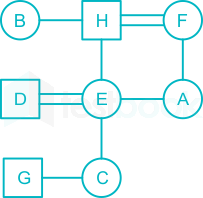
  3. H is father-in-law of D and C is the granddaughter of F.

  1. F is sister-in-law of B. F does not have siblings
  2. G is the nephew of A. A is unmarried.
  3. H has two daughters.

  1. Male members in a family are less than female members in a family.

Thus, G is the grandson of H.

99

If H is related to E in the same way as D is related to __________. 

  1. ((a))

    A

  2. ((b))

    B

  3. ((c))

    C

  4. ((d))

    F

  5. ((e))

    G

Show Answer
Answer: ((c))

C

Eight members: A, B, C, D, E, F, G and H.

  1. D is married to A’s sister.
  2. F is the mother of A.
  3. H is father-in-law of D and C is the granddaughter of F.

  1. F is sister-in-law of B. F does not have siblings
  2. G is the nephew of A. A is unmarried.
  3. H has two daughters.

  1. Male members in a family are less than female members in a family.

If H is related to E in the same way as D is related to C.

100

If P is the son of B, then how is A related to P? 

  1. ((a))

    Aunt

  2. ((b))

    Sister

  3. ((c))

    Daughter

  4. ((d))

    Cousin

  5. ((e))

    Sister-in-law

Show Answer
Answer: ((d))

Cousin

Eight members: A, B, C, D, E, F, G and H.

  1. D is married to A’s sister.
  2. F is the mother of A.
  3. H is father-in-law of D and C is the granddaughter of F.

  1. F is sister-in-law of B. F does not have siblings
  2. G is the nephew of A. A is unmarried.
  3. H has two daughters.

  1. Male members in a family are less than female members in a family.

If P is the son of B, 

A is the cousin of P.

Attempt this paper under real exam conditions

Timed interface, section switching, instant scoring, and question-by-question analytics — free.

Start Timed Attempt