Official Paper

IBPS PO Prelims Memory Based Paper (Held On: 30 September 2023 Shift 2) (Previous Year Paper)

100 questions · 60 minutes · with answers · free

English Language (30 questions)

Directions: The following sentences form a paragraph. The rest of the sentences are marked as A, B, C, D, E and F. Sentence 'E' is in the correct place. The rest of the sentences are not given in their proper order. Read the sentences and answer the following questions.

A. It has reduced the sacred affair of marriage to a business deal.

B. The parents of the brides are often put under inhuman pressure for a handsome dowry.

C. To eradicate this social evil, a total change in the outlook of society is a must.

D. The Dowry system is evil in society.

E. In many cases, young brides are ruthlessly tortured or pushed to suicide.

F. Sometimes they become paupers to get their daughters married.

1

Which sentence should be the FIRST sentence in the paragraph?

  1. ((a))

    D

  2. ((b))

    C

  3. ((c))

    F

  4. ((d))

    A

  5. ((e))

    B

Show Answer
Answer: ((a))

D

The correct answer is D.

Key Points

  • The given paragraph is about the dowry system.
  • Sentence D is the first sentence as it introduces the topic of the paragraph 'Dowry system' by mentioning its evil effect on society.
  • Sentence A is the second sentence as it explains how the dowry system has affected the sacredness of marriage.
  • Sentence B is the third sentence as it explains how badly the parents of the bride get affected by the demand for dowry.
  • Sentence F is the fourth sentence as it says the parents even become poor or bankrupt to get their daughters married.
  • Sentence E is in the correct place so it's the fifth sentence as it explains the ruthless effect of the dowry system on young brides.
  • Sentence C is the sixth sentence as it concludes the paragraph by giving the solution of eradicating the dowry system from society.
  • The correct sequence is DABFEC.

Correct Paragraph: The Dowry system is evil in society. It has reduced the sacred affair of marriage to a business deal. The parents of the brides are often put under inhuman pressure for a handsome dowry. Sometimes they become paupers to get their daughters married. In many cases, young brides are ruthlessly tortured or pushed to suicide. To eradicate this social evil, a total change in the outlook of society is a must.

2

Which sentence should be the SECOND sentence in the paragraph?

  1. ((a))

    F

  2. ((b))

    D

  3. ((c))

    A

  4. ((d))

    B

  5. ((e))

    C

Show Answer
Answer: ((c))

A

The correct answer is A.

Key Points

  • The given paragraph is about the dowry system.
  • Sentence D is the first sentence as it introduces the topic of the paragraph 'Dowry system' by mentioning its evil effect on society.
  • Sentence A is the second sentence as it explains how the dowry system has affected the sacredness of marriage.
  • Sentence B is the third sentence as it explains how badly the parents of the bride get affected by the demand for dowry.
  • Sentence F is the fourth sentence as it says the parents even become poor or bankrupt to get their daughters married.
  • Sentence E is in the correct place so it's the fifth sentence as it explains the ruthless effect of the dowry system on young brides.
  • Sentence C is the sixth sentence as it concludes the paragraph by giving the solution of eradicating the dowry system from society.
  • The correct sequence is DABFEC.

Correct Paragraph: The Dowry system is evil in society. It has reduced the sacred affair of marriage to a business deal. The parents of the brides are often put under inhuman pressure for a handsome dowry. Sometimes they become paupers to get their daughters married. In many cases, young brides are ruthlessly tortured or pushed to suicide. To eradicate this social evil, a total change in the outlook of society is a must.
3

Which sentence should be the THIRD sentence in the paragraph?

  1. ((a))

    C

  2. ((b))

    A

  3. ((c))

    F

  4. ((d))

    B

  5. ((e))

    D

Show Answer
Answer: ((d))

B

The correct answer is B.

Key Points

  • The given paragraph is about the dowry system.
  • Sentence D is the first sentence as it introduces the topic of the paragraph 'Dowry system' by mentioning its evil effect on society.
  • Sentence A is the second sentence as it explains how the dowry system has affected the sacredness of marriage.
  • Sentence B is the third sentence as it explains how badly the parents of the bride get affected by the demand for dowry.
  • Sentence F is the fourth sentence as it says the parents even become poor or bankrupt to get their daughters married.
  • Sentence E is in the correct place so it's the fifth sentence as it explains the ruthless effect of the dowry system on young brides.
  • Sentence C is the sixth sentence as it concludes the paragraph by giving the solution of eradicating the dowry system from society.
  • The correct sequence is DABFEC.

Correct Paragraph: The Dowry system is evil in society. It has reduced the sacred affair of marriage to a business deal. The parents of the brides are often put under inhuman pressure for a handsome dowry. Sometimes they become paupers to get their daughters married. In many cases, young brides are ruthlessly tortured or pushed to suicide. To eradicate this social evil, a total change in the outlook of society is a must.

4

Which sentence should be the FOURTH sentence in the paragraph?

  1. ((a))

    A

  2. ((b))

    B

  3. ((c))

    C

  4. ((d))

    D

  5. ((e))

    F

Show Answer
Answer: ((e))

F

The correct answer is F.

Key Points

  • The given paragraph is about the dowry system.
  • Sentence D is the first sentence as it introduces the topic of the paragraph 'Dowry system' by mentioning its evil effect on society.
  • Sentence A is the second sentence as it explains how the dowry system has affected the sacredness of marriage.
  • Sentence B is the third sentence as it explains how badly the parents of the bride get affected by the demand for dowry.
  • Sentence F is the fourth sentence as it says the parents even become poor or bankrupt to get their daughters married.
  • Sentence E is in the correct place so it's the fifth sentence as it explains the ruthless effect of the dowry system on young brides.
  • Sentence C is the sixth sentence as it concludes the paragraph by giving the solution of eradicating the dowry system from society.
  • The correct sequence is DABFEC.

Correct Paragraph: The Dowry system is evil in society. It has reduced the sacred affair of marriage to a business deal. The parents of the brides are often put under inhuman pressure for a handsome dowry. Sometimes they become paupers to get their daughters married. In many cases, young brides are ruthlessly tortured or pushed to suicide. To eradicate this social evil, a total change in the outlook of society is a must.

5

Which sentence should be the SIXTH sentence in the paragraph?

  1. ((a))

    B

  2. ((b))

    C

  3. ((c))

    A

  4. ((d))

    D

  5. ((e))

    F

Show Answer
Answer: ((b))

C

The correct answer is C.

Key Points

  • The given paragraph is about the dowry system.
  • Sentence D is the first sentence as it introduces the topic of the paragraph 'Dowry system' by mentioning its evil effect on society.
  • Sentence A is the second sentence as it explains how the dowry system has affected the sacredness of marriage.
  • Sentence B is the third sentence as it explains how badly the parents of the bride get affected by the demand for dowry.
  • Sentence F is the fourth sentence as it says the parents even become poor or bankrupt to get their daughters married.
  • Sentence E is in the correct place so it's the fifth sentence as it explains the ruthless effect of the dowry system on young brides.
  • Sentence C is the sixth sentence as it concludes the paragraph by giving the solution of eradicating the dowry system from society.
  • The correct sequence is DABFEC.

Correct Paragraph: The Dowry system is evil in society. It has reduced the sacred affair of marriage to a business deal. The parents of the brides are often put under inhuman pressure for a handsome dowry. Sometimes they become paupers to get their daughters married. In many cases, young brides are ruthlessly tortured or pushed to suicide. To eradicate this social evil, a total change in the outlook of society is a must.
6

Directions: ​In the question below, a sentence is given with two blanks, indicating that some parts are missing. Identify the correct pair of words that fit in the sentence to make it grammatically and contextually correct.

The truth ________ in every substance of this universe yet it is _________ from many.

  1. ((a))

    Present, Close

  2. ((b))

    Lies, Distant

  3. ((c))

    Disappear, Flourished

  4. ((d))

    Exist, Absence

  5. ((e))

    Persist, Perfused

Show Answer
Answer: ((b))

Lies, Distant

The correct answer is Option (2) i.e. Lies, Distant

Key Points

 Let's look at the meaning of the correct answer:

  • Lies - be, remain, or be kept in a specified state.
  • ​Example - "The abbey lies in ruins today."
  • Distant - a long way away in space or time,
  • ​Example - travel to distant parts of the world
  • From the given meaning we can conclude that the correct answer is lies, distant

Thus the correct sentence is: "The truth lies in every substance of this universe yet it is distant from many.*"*​

Additional Information

 Let's discuss the meaning of other options:

  • Disappear - to become impossible to see or to find
  • Perfuse - permeate or suffuse (something) with a liquid, color, quality, etc
  • Persist - to perform a task, etc. or to put a plan into action
  • Flourish - to be strong and healthy; to develop in a successful way
7

Directions: ​In the question below, a sentence is given with two blanks, indicating that some parts are missing. Identify the correct pair of words that fit in the sentence to make it grammatically and contextually correct.

The poverty-stricken, the penurious are mostly ___________ with indigence that __________ nothing but suffering.

  1. ((a))

    Indifferent, Affects

  2. ((b))

    Languid, Perfuses

  3. ((c))

    Engulfed, Contains

  4. ((d))

    Helpless, Persists

  5. ((e))

    Shrink, Leads

Show Answer
Answer: ((c))

Engulfed, Contains

The correct answer is Option (3) i.e. Engulfed, Contains 

Key Points

 Let's look at the meaning of the correct answer:

  • Engulfed - to cover or surround somebody/something completely
  • ​Example - Within a few minutes the factory was engulfed in flames.
  • Contains - to have something inside or as part of itself,
  • ​Example - Each box contains 24 tins.
  • From the given meaning we can conclude that the correct answer is engulfed, contains

Thus the correct sentence is: "The poverty-stricken, the penurious are mostly engulfed with indigence that contains nothing but suffering. *"*​

Additional Information

 Let's discuss the meaning of other options:

  • Languid - weak or faint from illness or fatigue.
  • Perfuses - permeate or suffuse with a liquid, colour, or quality.
  • Persists - to continue to exist
  • Shrink - to become smaller or make something smaller
8

Directions: ​In the question below, a sentence is given with two blanks, indicating that some parts are missing. Identify the correct pair of words that fit in the sentence to make it grammatically and contextually correct.

The Bog-standards never _________ on the hard work. As their _________ is always 'topsy- turvy'.

  1. ((a))

    Arise, Practice

  2. ((b))

    Choose, Consideration

  3. ((c))

    Understand, Execution

  4. ((d))

    Push, Goal

  5. ((e))

    Forget, Foundation

Show Answer
Answer: ((d))

Push, Goal

The correct answer is Option (4) i.e. Push, Goal

Key Points

 Let's look at the meaning of the correct answer:

  • Push - to use force to move somebody/something forward or away from you
  • ​Example - She pushed him into the water.
  • Goal - an idea of the future or desired result that a person or a group of people envision,
  • ​Example - The goal is to win at any cost this time.
  • From the given meaning we can conclude that the correct answer is push, goal.

Thus the correct sentence is: "The Bog-standards never push on the hard work. As their goal is always 'topsy- turvy'. *".*​

Additional Information

 Let's discuss the meaning of other options:

  • consideration - an act of thinking about something carefully or for a long time
  • foundation - the idea, principle, or fact on which something is based
  • execution - to perform a task, etc. or to put a plan into action
9

Directions: ​In the question below, a sentence is given with two blanks, indicating that some parts are missing. Identify the correct pair of words that fit in the sentence to make it grammatically and contextually correct.

The dolorous ___________ all the time for something they do not ________on easily.

  1. ((a))

    Hesitate, Look

  2. ((b))

    Irritates, Execute

  3. ((c))

    Cry, Catch

  4. ((d))

    Smiles, Portray

  5. ((e))

    Barge, Faith

Show Answer
Answer: ((c))

Cry, Catch

The correct answer is Option (3) i.e. Cry, catch

Key Points

 Let's look at the meaning of the correct answer:

  • cry - to make a noise and produce tears in your eyes, for example, because you are unhappy or have hurt yourself
  • ​Example - The baby never stops crying​
  • catch - to capture somebody/something that you have been following or looking for,
  • ​Example - Two policemen ran after the thief and caught him at the end of the street.
  • From the given meaning we can conclude that the correct answer is Cry, Catch.

Thus the correct sentence is: "The dolorous cry all the time for something they do not catch on easily. *".*​

Additional Information

 Let's discuss the meaning of other options:

  • hesitate - to pause before you do something or before you make a decision, usually because you are uncertain or worried
  • irritate - to make somebody angry; to annoy
  • execute - to perform a task, etc. or to put a plan into action
  • portray - to show somebody/something in a picture; to describe somebody/something in a piece of writing
  • barge- to push people out of the way in order to get past them
10

Directions: ​In the question below, a sentence is given with two blanks, indicating that some parts are missing. Identify the correct pair of words that fit in the sentence to make it grammatically and contextually correct.

The impatient ragamuffins were the main _________ of the dictators who were not _________ with their behaviours.

  1. ((a))

    Attention, Jealous

  2. ((b))

    Curiosity, Satisfied

  3. ((c))

    Culprits, Aware

  4. ((d))

    Whippersnappers, Upright

  5. ((e))

    Grumbletonians, Convienenced

Show Answer
Answer: ((b))

Curiosity, Satisfied

The correct answer is Option (2)Curiosity, Satified.

Key Points

 Let's look at the meaning of the correct answer:

  • curiosity - a state in which you want to learn more about something
  • ​Example - My fingers tremble with curiosity, confusion, and excitement.
  • satisfied - you’re satisfied, you’re contented,
  • ​Example - I patted myself, satisfied that they were flat enough that my uncle would not notice them.
  • From the given meaning we can conclude that the correct answer is Curiosity, Satisfied.

Thus the correct sentence is: "The impatient ragamuffins were the main curiosity of the dictators who were not satisfied with their behaviours.*".*​

Additional Information

 Let's discuss the meaning of other options:

  • attention - the process whereby a person concentrates on some
  • jealous - suspicious or unduly suspicious or fearful of being displaced by a rival
  • culprits - someone who perpetrates wrongdoing
  • aware - having or showing knowledge or understanding or realization or perception
  • Whippersnappers- someone who is unimportant but cheeky and presumptuous
  • Upright- in a vertical position; not sloping
  • Grumbletonians - A person who is often discontented, thereby taken to grumbling
  • convenience- something that makes things easier, quicker or more comfortable
11

Directions: In the following sentence, four words given in bold are marked as (A), (B), (C), and (D), which are possible pairs to be interchanged. Choose the pair(s) of words that need to be interchanged to make the sentence grammatically correct and meaningful. If no interchange is required, mark option 5 i.e., "No interchange required" as your answer.

Following the attendance (A), the fin-tech firm requiring (B) increased office pandemic (C) from one day per week initially to now gradually (D) employees to be present at the physical office for four days each week.

  1. ((a))

    A-B

  2. ((b))

    D-A

  3. ((c))

    C-A, D-B

  4. ((d))

    A-B, C-D

  5. ((e))

    No interchange required

Show Answer
Answer: ((c))

C-A, D-B

The correct answer is option 3.

 Key Points To answer this question, let's first understand the meanings of the marked words:

  • Attendance - the act of being present at a particular place or event (हाजरी)
  • For Example -
  • The teacher took attendance at the beginning of the class to see which students were present.
  • Requiring - demanding or needing something as necessary (आवश्यकता होना)
  • For Example -
  • She is requiring additional time to complete the project.
  • Pandemic - an outbreak of a disease that occurs on a global scale, affecting a large number of people and often crossing international boundaries (महामारी)
  • For Example -
  • The COVID-19 pandemic had a profound impact on the world's healthcare systems and economies.
  • Gradually - in a slow or gradual manner, taking place over a period of time (धीरे-धीरे)
  • For Example -
  • She gradually improved her language skills by practising a little bit every day.
  • After understanding the meanings of the marked words, we can conclude that in the given sentence, "attendance" should be interchanged with "pandemic" to make it grammatically correct because the sentence is about the pandemic's impact on office attendance.
  • Similarly, "requiring" should be interchanged with "gradually" to clarify that the increase in office presence is happening slowly over time, making the sentence contextually correct.
  • Hence, the correct answer is "C-A, D-B."


The correct sentence after the rearrangement would be: "Following the pandemic, the fin-tech firm gradually increased office attendance from one day per week initially to now requiring employees to be present at the physical office for four days each week."

12

Directions: In the following question, a sentence is given with four words marked as (A), (B), (C), and (D). These words may or may not be placed in the correct order. Four options with different arrangements of these words have been provided. Mark the option with the correct arrangement as the answer. If no rearrangement is required, mark option (5) as your answer.

After our troops left(A) the war-torn country, resorted**(B)** occurred when the citizens regression**(C)** to their unstable(D) form of government.

  1. ((a))

    A-D

  2. ((b))

    C-B

  3. ((c))

    D-B

  4. ((d))

    C-A

  5. ((e))

    No change required

Show Answer
Answer: ((b))

C-B

The correct answer is 'C-B.'

Key Points

  • The given sentence says that after the troops departed from the country racked or devastated by war, a decline or relapse occurred when the citizens fall back on their unstable form of government.
  • Let us explore the meaning of the highlighted words:
  • Left - To go away from somewhere. (कहीं से दूर चले जाना)
  • Resorted - To turn to and adopt a course of action, especially an extreme or undesirable one so as to resolve a difficult situation. (विवशता में किसी भी अरुचिकर उपाय का सहारा लेना)
  • Regression - A return to a former or less developed state. (वापसी, प्रतीपगमन)
  • Unstable - Likely to change or fail; not firmly established. (जो कभी भी बदल या गिर सकता है; डाँवाँडोल, अस्थिर)
  • Thus, (C) and (B) must be interchanged.

Hence, the correct answer is option 2.

Correct Sentence: After our troops left the war-torn country, regression occurred when the citizens resorted to their unstable form of government.

13

Directions: In the following question, a sentence is given with four words marked as (A), (B), (C), and (D). These words may or may not be placed in the correct order. Four options with different arrangements of these words have been provided. Mark the option with the correct arrangement as the answer. If no rearrangement is required, mark option (5) as your answer.

While Iyer seemed to be recovering(A) after his surgery(B) last week, he started to regress(C) today and is now bedridden(D).

  1. ((a))

    A-D

  2. ((b))

    B-C

  3. ((c))

    C-A

  4. ((d))

    D-B

  5. ((e))

    No change required

Show Answer
Answer: ((e))

No change required

The correct answer is 'No change required.'

Key Points

  • The given sentence talks about Iyer who seemed to be getting better after his surgery but started to relapse or worsen today and is now confined to bed.
  • Let us explore the meaning of the highlighted words:
  • Recovering - To become well again after you have been ill. (बीमारी के बाद स्‍वास्‍थ्‍य लाभ करना)
  • Surgery - Medical treatment in which your body is cut open so that part of it can be removed or repaired. (शल्‍य-क्रिया, शल्‍य-चिकित्‍सा, शरीर के रोगग्रस्‍त अंग को काटकर निकाल देना या सुधार देना)
  • Regress - To go back to a former condition or a less developed way of behaving. (आचरण या स्थिति की पूर्व या अविकसित अवस्था में लौट जाना, प्रतिगमन करना, बदतर होना, पतन होना)
  • Bedridden - Confined to bed by sickness. (बीमारी के कारण बिस्तर पर पड़ा हुआ)
  • Thus, no change is required in the sentence.

Hence, the correct answer is option 5.

Correct Sentence: While Iyer seemed to be recovering after his surgery last week, he started to regress today and is now bedridden.

14

Directions: In the following question, a sentence is given with four words marked as (A), (B), (C), and (D). These words may or may not be placed in the correct order. Four options with different arrangements of these words have been provided. Mark the option with the correct arrangement as the answer. If no rearrangement is required, mark option (5) as your answer.

When my friend’s backpack was stolen(A) in a foreign country, the concern**(B)** of her missing passport and visa caused significance**(C)** since she was unable(D) to leave the country.

  1. ((a))

    B-C

  2. ((b))

    D-A

  3. ((c))

    A-B

  4. ((d))

    C-D

  5. ((e))

    No change required

Show Answer
Answer: ((a))

B-C

The correct answer is 'B-C.'

Key Points

  • The given sentence says that when someone's backpack was looted in a foreign country, the importance of her missing passport and visa caused worry since she was not able to leave the country.
  • Let us explore the meaning of the highlighted words:
  • Stolen - To take something from a person, shop, etc. without permission and without intending to return it or pay for it. (चुराना, चोरी करना)
  • Concern - A feeling of worry; something that causes worry. (चिंता; परवाह; चिंताजनक बात)
  • Significance - The quality of being worthy of attention; importance. (किसी बात का महत्व)
  • Unable - Not able to do something. (असमर्थ, अशक्त)
  • Thus, (B) and (C) must be interchanged.

Hence, the correct answer is option 1.

Correct Sentence: When my friend’s backpack was stolen in a foreign country, the significance of her missing passport and visa caused concern since she was unable to leave the country.

15

Which of the phrases given in the options should replace the word/phrase that is underlined in the sentence to make it grammatically correct? if the sentence is correct as it is given and no correction is required, select 'No correction required' as the answer.

Because the deal cannot enter into force in its current form, India's foreign minister said that signing it would only cost India a little.

  1. ((a))

    It would cost India only a little.

  2. ((b))

    It would only cost India little.

  3. ((c))

    It would costing India only a little.

  4. ((d))

    It will only cost India little.

  5. ((e))

    No correction required

Show Answer
Answer: ((a))

It would cost India only a little.

The correct answer is Option 1.


Key Points

  • The original sentence placement of "only" can be improved for clarity.
  • Moving "only" next to "a little" clarifies that the cost is minimal.
  • The best replacement provided is "It would cost India only a little."
  • Thus, the error is resolved by choosing Option 1.

Therefore, the correct answer is Option 1.


Correct Sentence: "Because the deal cannot enter into force in its current form, India's foreign minister said that signing it would cost India only a little."


Additional Information

  • Option 2: "It would only cost India little." – Less natural and not as clear.
  • Option 3: "It would costing India only a little." – Grammatically incorrect (incorrect verb form).
  • Option 4: "It will only cost India little." – Changes tense and lacks clarity.
  • Option 5: "No correction required." – Original sentence needed improvement for clarity.
16

Which of the phrases given in the options should replace the word/phrase that is underlined in the sentence to make it grammatically correct? if the sentence is correct as it is given and no correction is required, select 'No correction required' as the answer.

Hardly had the peoples reached Mumbai then they were ordered to return to Delhi.

  1. ((a))

    the peoples reached Mumbai then

  2. ((b))

    the peoples reached Mumbai than

  3. ((c))

    the people reached Mumbai when

  4. ((d))

    the people's reached Mumbai when

  5. ((e))

    No correction required

Show Answer
Answer: ((c))

the people reached Mumbai when

The correct answer is the people reached Mumbai when.

Key Points

  • There are two errors in the bold part.
  • Firstly, the term ‘people’ is a collective noun. Collective nouns are used in the singular form. Therefore, ‘peoples’ must be replaced by ‘people’ in order to make the sentence correct.
  • Secondly, ‘hardly’ and ‘when’ form a pair of coordinating conjunctions. Coordinating conjunctions join phrases, words, etc. of equal ranks. Therefore, ‘when’ should be used instead of ‘than’ in order to make it a grammatically correct sentence.
  • Among the choices available, option 3 replaces the bold part most appropriately.
  • Hence, option 3 is the correct answer.

The correct sentence is: Hardly had the people reached Mumbai when they were ordered to return to Delhi.

Additional Information

  • Hardly -when is used in past perfect tense sentences as follows. Sometimes we use Scarcely-when in place of Hardly-when
  • Hardly had the race started when we started cheering.
  • Scarcely had you asked a question when he answered it.
  • We can use 'no sooner- than' as follows.
  • No sooner did we call him than he responded.
17

Which of the phrases given in the options should replace the word/phrase that is underlined in the sentence to make it grammatically correct? if the sentence is correct as it is given and no correction is required, select 'No correction required' as the answer.

The committee was split on whether the new regulations for the National Health Protection Scheme should be implemented.

  1. ((a))

    were split on whether 

  2. ((b))

    is split on whether 

  3. ((c))

    has been split on whether 

  4. ((d))

    was split over whether

  5. ((e))

    No correction required

Show Answer
Answer: ((a))

were split on whether 

The correct answer is were split on whether

Key Points

  • If the committee members are unanimous regarding a decision, in that case, the committee is considered as a singular collective noun and a singular verb is used in the context. On the other hand, if a committee has members differing in their views regarding something, the plural form of the verb is used in that case.
  • In the given context, the committee members are differing in their opinions and therefore a plural form of the verb should be used. As the tense is correct in the sentence, the correct verb should have been ‘were’.
  • This makes option 1 the correct choice among the given options.

The correct sentence is: The committee were split on whether the new regulations for the National Health Protection Scheme should be implemented.

18

Which of the phrases given in the options should replace the word/phrase that is underlined in the sentence to make it grammatically correct? if the sentence is correct as it is given and no correction is required, select 'No correction required' as the answer.

BJP is the country's only political party with a trained political human resource, which will serve as the backing bone in the organization’s workforce in the coming years.

  1. ((a))

    the backing bone of the organization’s

  2. ((b))

    the backbone in the organization’s

  3. ((c))

    the backbone of the organization’s

  4. ((d))

    the backbones of the organization’s

  5. ((e))

    No correction required

Show Answer
Answer: ((c))

the backbone of the organization’s

The correct answer is "The backbone of the organization's"

Key Points 

  • The correct idiomatic expression in this sentence is ‘the backbone of' and not 'the backing bone in'.
  • Be the backbone (Idiom): The part of something that makes it successful or strong.
  • Ex: Ordinary volunteers form the backbone of most charitable organizations.
  • Hence ‘the backbone of’ should be used in place of ‘the backing bone in’ to make the sentence grammatically correct.
  • Among the given choices, only option 3 replaces the given bold part most appropriately.
  • Hence the correct answer is Option 3.

The correct sentence is: BJP is the country's only political party with a trained political human resource, which will serve as the backbone of the organization’s workforce in the coming years.

Directions: Read the passage and answer the questions:

The importance of External Affairs Minister S. Jaishankar’s visit to Russia this week can be gleaned from the special effort New Delhi and Moscow have made to make the meetings successful and productive. For India, at the end of a year of prolific diplomacy, a five-day visit would seem unusually long, particularly as the Kremlin leadership normally does not see high-level foreign visits at all in this period right before its holiday season. It is equally unusual for Russian President Vladimir Putin to meet lower-ranking foreign officials, as he did while meeting Mr. Jaishankar. The warmth was significant given that Prime Minister Narendra Modi has skipped the annual leadership summit, an unbroken tradition from 2000-21, for two years now, leading to speculation about the health of the India-Russia relationship after the Ukraine war. While India took care not to criticise Russia, worries over the flagging of defence supplies, continued issues over paying Russia for imports in third currencies, and the general decline in other bilateral engagements have persisted. It is clear that a large part of Mr. Jaishankar’s mission was to smooth over the perception of differences. The resultant agreements, pertaining to furthering collaboration in future Kudankulam nuclear power projects, fostering connectivity, trade and resuming talks for the Eurasian Economic Union-India free trade agreement, and joint military production indicate that bilateral relations are on track. So is multilateral cooperation, especially as Russia plans to host the expanded BRICS summit next year, and India and Russia continue to coordinate positions at the UN and SCO. Mr. Jaishankar’s announcement that imports of Russian hydrocarbons will continue to rise despite the West’s Russian sanctions, indicated the strength of ties that continue “regardless of political fluctuations”.

Mr. Jaishankar’s affirmation that the annual leadership summit will be resumed in 2024, appeared to signify that both sides are working to _______ any static in the relationship. His statement that the India-Russia relationship was the ‘only constant in world politics’ over the last six decades would not have gone unnoticed especially in Washington and Beijing, given some of the friction in India-U.S. relations over the Pannun investigation, as well as U.S. President Joseph Biden’s decision not to accept Mr. Modi’s invitation for Republic Day, while India-China relations have ended another year in impasse over the military standoff. It remains to be seen whether the bonhomie will yield concrete movement on the rupee-rouble payment mechanism, or on expediting the delayed delivery of S-400 air system units. However, the larger import of his visit, and his words that the “geopolitical and strategic convergence” between India and Russia in a multipolar world that is “rebalancing”, will be watched most closely by votaries and critics of the relationship.

19

According to the context of the passage, which of the following words could be the antonym of 'prolific'?

  1. ((a))

    Abundant

  2. ((b))

    Fruitful

  3. ((c))

    Sterile

  4. ((d))

    Productive

  5. ((e))

    Plentiful

Show Answer
Answer: ((c))

Sterile

The correct answer is 'Sterile'.

Key Points

  • The term 'prolific' means producing many works, results, or offspring, usually with the implication of them being high quality. It implies abundance. (उपजाऊ)
  • Example: He was a prolific writer, producing dozens of novels and hundreds of short stories.
  • The term 'Sterile' means not able to produce children, young animals, or plant seeds. In a more figurative sense, it might mean unproductive or not producing results. (बांझ)
  • Example: The project turned out to be sterile and didn't bring the desired outcomes.
  • Hence, the correct antonym for 'prolific' is 'Sterile'.

Therefore, the correct answer is ‘Option 3’.

 Additional Information

  • 'Abundant' refers to existing or available in large quantities; plentiful. (प्रचुर)
  • 'Fruitful' means producing good or helpful results; productive. (उपजाऊ)
  • 'Productive' refers to producing or able to produce large amounts of goods, crops, or other commodities. (उत्पादक)
  • 'Plentiful' means existing in or yielding great quantities; abundant. (प्रचुर)
20

According to the passage, why was Mr. Jaishankar’s visit to Russia deemed significant?

  1. ((a))

    To negotiate President Putin's visit to India.

  2. ((b))

    To initiate military talks.

  3. ((c))

    To smooth over the perceived differences between India and Russia.

  4. ((d))

    To participate in the BRICS summit.

  5. ((e))

    To ensure swift delivery of S-400 air system units.

Show Answer
Answer: ((c))

To smooth over the perceived differences between India and Russia.

The correct answer is ‘To smooth over the perceived differences between India and Russia.’

Key Points

  • The passage specifically notes that a substantial component of Mr. Jaishankar’s mission was to smooth over the perception of differences between the two nations.
  • The visit sought to address some of the issues currently affecting the India-Russia relationship, including defence supplies and issues over payment for imports.
  • Although other details were discussed during the visit, these were secondary to the primary mission of addressing perceived differences.
  • Therefore, it would be accurate to say that the primary rationale for the visit was to "smooth over the perceived differences" as per option 3.

Therefore, the correct answer is ‘Option 3’.

 Additional Information

  • Option 1: The negotiation of President Putin's visit to India is not mentioned as a key reason for Mr. Jaishankar’s visit.
  • Option 2: While military talks could be a part of discussions, they were not the main focus, as per the passage.
  • Option 4: Participation in the BRICS summit is not mentioned as a reason for this visit.
  • Option 5: Ensuring swift delivery of S-400 air system units was not noted as the primary objective of the visit.
21

What can be inferred from Mr. Jaishankar’s announcement about the increase in imports of Russian hydrocarbons despite the West’s sanctions?

  1. ((a))

    India is reliant on Russia for its hydrocarbon needs.

  2. ((b))

    India intends to strengthen its relationship with Russia, irrespective of outside pressure.

  3. ((c))

    India is going against the West's decisions.

  4. ((d))

    India's internal industry is unable to fulfill its hydrocarbon needs.

  5. ((e))

    India is challenging the West’s authority.

Show Answer
Answer: ((b))

India intends to strengthen its relationship with Russia, irrespective of outside pressure.

The correct answer is ‘India intends to strengthen its relationship with Russia, irrespective of outside pressure.’

Key Points

  • The decision by India to continue importing Russian hydrocarbons despite sanctions from the West showcases India's intention to maintain its ties with Russia.
  • It displays an effort to strengthen relationships regardless of political influences from the outside.
  • The implication of the action indicates India's strategic decision to prioritize its relationship with Russia over Western opposition.
  • Although other interpretations could possibly be drawn, Option 2 best reflects the inference that can be made based on the details given.

Therefore, the correct answer is ‘Option 2’.

 Additional Information

  • Option 1: Although it is clear that India imports hydrocarbons from Russia, it does not necessarily mean that India is solely reliant on Russia for these imports.
  • Option 3: It represents a divergence in policy from the West's approach, but it is not necessarily an outright opposition.
  • Option 4: The import decision does not indicate the competence or incompetence of the Indian internal industry.
  • Option 5: The action does not necessarily challenge the West's authority; it just highlights India's priorities.
22

What does the idiom 'smooth over' mean in the context of the passage?

  1. ((a))

    To make things worse.

  2. ((b))

    To ignore or overlook.

  3. ((c))

    To make less severe or serious.

  4. ((d))

    To worsen a situation.

  5. ((e))

    To incite conflict.

Show Answer
Answer: ((c))

To make less severe or serious.

The correct answer is ‘To make less severe or serious’.

Key Points

  • In the context of the passage, 'smooth over' refers to Mr. Jaishankar's intention to mitigate the perceived differences or issues between India and Russia.
  • Therefore, the idiom 'smooth over' means to make less severe or serious, as per option 3.
  • The other options offer meanings that contradict the context in which the idiom is used in the passage.

Therefore, the correct answer is ‘Option 3’.

 Additional Information

  • 'To make things worse' or 'to worsen a situation' is the opposite of 'smooth over'.
  • 'To ignore or overlook' is not suitable as the context implies direct action to address and lessen issues.
  • 'To incite conflict' contradicts the meaning of 'smooth over'.
23

According to the passage, which of the following statements is correct?

A. The annual leadership summit between India and Russia has not been skipped since 2000.

B. Mr. Jaishankar assured that the imports of Russian hydrocarbons will rise despite the West’s Russian sanctions.

C. The India-Russia relationship is the only constant in world politics over the last six decades according to Mr. Jaishankar.

  1. ((a))

    Only A.

  2. ((b))

    Only B.

  3. ((c))

    A and C.

  4. ((d))

    B and C.

  5. ((e))

    A, B, and C.

Show Answer
Answer: ((d))

B and C.

The correct answer is Option 4.


Key Points

  • Statement A: Incorrect.
  • The passage states that the annual leadership summit between India and Russia has been skipped for two years, breaking the unbroken tradition from 2000-2021.
  • Statement B: Correct.
  • Mr. Jaishankar assured that imports of Russian hydrocarbons will rise despite the West’s Russian sanctions.
  • Statement C: Correct.
  • Mr. Jaishankar stated that the India-Russia relationship was the “only constant in world politics” over the last six decades.
  • These statements indicate the continuous and strong bilateral relationship between India and Russia.

Therefore, the correct answer is B and C.


Additional Information

  • Option 1: Only A.
  • This is incorrect because statement A is incorrect as per the passage.
  • Option 2: Only B.
  • This is partially correct but incomplete, as it only includes statement B and omits the also-correct statement C.
  • Option 3: A and C.
  • This is incorrect because statement A is not accurate according to the passage.
  • Option 5: A, B, and C.
  • This is incorrect because statement A is inaccurate, even though B and C are correct.
24

What does the author mean by "geopolitical and strategic convergence" between India and Russia in a multipolar world that is "rebalancing"?

  1. ((a))

    It refers to the alignment of India and Russia's diplomatic policies in a politically turnabout global scenario.

  2. ((b))

    It suggests a shift in nuclear power between India and Russia

  3. ((c))

    The phrase means the cultural affinity between India and Russia.

  4. ((d))

    It indicates Russia and India strategizing against a common adversary.

  5. ((e))

    It implies the economic merge between India and Russia in the global market.

Show Answer
Answer: ((a))

It refers to the alignment of India and Russia's diplomatic policies in a politically turnabout global scenario.

The correct answer is ‘It refers to the alignment of India and Russia's diplomatic policies in a politically turnabout global scenario.’

Key Points

  • "Geopolitical and strategic convergence" refers to shared political interests and the alignment of strategic objectives between the two countries.
  • The world is "rebalancing" implies a shift in the global political scenario, with power dynamics changing among the countries.
  • This suggests that despite geopolitical complexities, both India and Russia are finding common ground and aligning their strategies.
  • Option 1 clearly encapsulates these points, offering a more holistic explanation.

Therefore, the correct answer is ‘Option 1’.

 Additional Information

  • Option 2: The statement does not suggest a shift in nuclear power.
  • Option 3: It has nothing to do with cultural affinity.
  • Option 4: The phrase does not necessarily indicate strategizing against a common adversary.
  • Option 5: The phrase does not refer to an economic merge.
25

What will fit in the blank taken from the passage: 'According to Mr. Jaishankar, both Russia and India are working to ________ any static in their relationship.'

  1. ((a))

    Increase

  2. ((b))

    Avoid

  3. ((c))

    Multiply

  4. ((d))

    Eliminate

  5. ((e))

    Compmodify

Show Answer
Answer: ((d))

Eliminate

The correct answer is ‘Eliminate’.

Key Points

  • The blank is referring to the efforts by both Russia and India to address and reduce any problems, issues, or 'static' between them.
  • The context of the sentence implies that the word should suggest getting rid of or lessening something negative, in this case, the 'static' or issues.
  • Hence, the best word to fit in would be 'Eliminate', which speaks to the idea of completely removing or getting rid of something.
  • The other options do not fit the context in the most appropriate way.

Therefore, the correct answer is ‘Option 4’.

Complete Sentence: According to Mr. Jaishankar, both Russia and India are working to eliminate any static in their relationship.

Additional Information

  • 'Increase' and 'Multiply' would imply intensifying the issues, contrary to the intended meaning.
  • 'Avoid' could imply temporary evasion rather than a resolution.
  • 'Compmodify' is not a standard word and thus, inappropriate.
26

What could be the most suitable title for the passage?

  1. ((a))

    The Unresolved Issues in the India-Russia Relationship

  2. ((b))

    India-Russia Relations: Standing against the Tides.

  3. ((c))

    The Jaishankar Visit: Significance and Outcomes.

  4. ((d))

    Geopolitical Strategy: India and Russia's Grand Plan.

  5. ((e))

    BRICS Summit 2024: Looking Ahead.

Show Answer
Answer: ((b))

India-Russia Relations: Standing against the Tides.

The correct answer is ‘India-Russia Relations: Standing against the Tides’.

Key Points

  • The primary focus of the passage is the diplomatic efforts of India through Mr. Jaishankar’s visit and its intent to maintain its relationship with Russia despite international complications.
  • Option 2, "India-Russia Relations: Standing against the Tides", rightly encapsulates this main thought and is broader to include all the key points discussed in the passage.
  • It reflects the issues, intentions, and outcomes of the diplomatic relations between the nations and the strategizing amidst geopolitical dynamics.
  • The other options are specific branches of the central theme and, therefore, do not holistically represent the passage.

Therefore, the correct answer is ‘Option 2’.

 Additional Information

  • Option 1: The passage is not only about the unresolved issues but also covers diplomatic initiatives, agreements, and future plans.
  • Option 3: The visit part is a significant aspect, but the title does not represent the geopolitical dynamics and outcomes completely.
  • Option 4 and 5: They are parts of the passage but not the central theme.
27

Directions: In the following question, a sentence is divided into four parts (A), (B), (C), and (D). The error, if any, will only be in one part of the sentence. Choose the option with the part containing the error and mark it, if the sentence is free from errors, mark 'No error' as your answer.

He bought an (A)/ answering machine that (B)/ play back his messages (C)/ when he calls (D)/.

  1. ((a))

    A

  2. ((b))

    B

  3. ((c))

    C

  4. ((d))

    D

  5. ((e))

    No error

Show Answer
Answer: ((c))

C

The correct answer is 'C' i.e., this part of the sentence has an error.

Key Points

  • In the third part of the given sentence, the plural form of the verb 'play' is incorrect.
  • The subject 'machine' in the given sentence is singular.
  • We know that a singular verb is used with a singular subject and a plural verb with a plural subject.
  • Therefore, the singular form of the verb 'plays' should be used with the singular subject 'machine'.
  • The singular form of the verb 'plays' should be used in place of the plural form of the verb 'play'.

Hence, the correct answer is option 3.

Correct sentence: He bought an answering machine that plays back his messages when he calls.

<br>

Additional Information

  • Subjects and verbs must agree with one another in number (singular or plural).
  • Thus, if a subject is singular, its verb must also be singular; if the subject is plural, its verb must also be plural.
28

Directions: In the following question, a sentence is divided into four parts (A), (B), (C), and (D). The error, if any, will only be in one part of the sentence. Choose the option with the part containing the error and mark it, if the sentence is free from errors, mark 'No error' as your answer.

Moreover, a educated workforce (A)/ is argued to be (B)/ one of the important prerequisites (C)/ for economic expansion and advancement (D)/.

  1. ((a))

    A

  2. ((b))

    B

  3. ((c))

    C

  4. ((d))

    D

  5. ((e))

    No error

Show Answer
Answer: ((a))

A

The correct answer is 'A' i.e., this part of the sentence has an error.

Key Points

  • In the given sentence, the noun 'workforce' is not specified.
  • The definite article 'the' is used before singular and plural nouns when the noun is specific.
  • 'A' and 'an' are indefinite articles, which means that they refer to or introduce an unspecified noun.
  • We use 'a' before a consonant sound and 'an' before a vowel sound (here, educated).
  • ''No article'' is used when we refer to general ideas, plurals, or uncountable nouns.
  • Therefore, the indefinite article 'an' should be used in place of the indefinite article 'a'.

Hence, the correct answer is option 1.

Correct Sentence: Moreover, an educated workforce is argued to be one of the important prerequisites for economic expansion and advancement.

Additional Information

There are three articles: a, an, and the. Articles are used before nouns or noun equivalents and are a type of adjective.

RULESCOUNT NOUNSNON-COUNT NOUNS
Specific identity not knowna, an(no article)
Specific identity is knownthethe
All things or things in general(no article)(no article)
29

Directions: In the following question, a sentence is divided into four parts (A), (B), (C), and (D). The error, if any, will only be in one part of the sentence. Choose the option with the part containing the error and mark it, if the sentence is free from errors, mark 'No error' as your answer.

Between the big-ticket items, (A)/ one that is set to (B)/ put a spell on buyers (C)/ is Walt Disney’s last will (D)/.

  1. ((a))

    A

  2. ((b))

    B

  3. ((c))

    C

  4. ((d))

    D

  5. ((e))

    No error

Show Answer
Answer: ((a))

A

The correct answer is 'A' i.e., this part of the sentence has an error.

Key Points

  • In the first part of the given sentence, the use of the preposition 'between' is incorrect.
  • We use the preposition 'between' to refer to two things that are separated.
  • 'Between' is used when referring to one-to-one relationships.
  • Example: Negotiations between the member states collapsed last night.
  • We use 'among' to talk about things that are not separated because they are part of a group crowd or mass of objects.
  • The preposition 'among' means being a member or member of a larger set.
  • 'Among' is used when referring to indistinct or nonspecific relationships.
  • Example: There wasn’t much unity among the council members.
  • Therefore, the preposition 'among' should be used in place of the preposition 'between'.

Hence, the correct answer is option 1.

Correct Sentence: Among the big-ticket items, one that is set to put a spell on buyers is Walt Disney’s last will.

30

Directions: In the following question, a sentence is divided into four parts (A), (B), (C), and (D). The error, if any, will only be in one part of the sentence. Choose the option with the part containing the error and mark it, if the sentence is free from errors, mark 'No error' as your answer.

One of the most striking (A)/ and salutary things (B)/ in American life are (C)/ the widespread study of law (D)/.

  1. ((a))

    A

  2. ((b))

    B

  3. ((c))

    C

  4. ((d))

    D

  5. ((e))

    No Error

Show Answer
Answer: ((c))

C

The correct answer is 'C' i.e., this part of the sentence has an error.

Key Points

  • In the third part of the given sentence, the plural form of the verb 'are' is incorrect.
  • The phrase ''One of'' in the given sentence is a singular term and is generally used to talk about a noun or a pronoun.
  • The noun or a pronoun used after the phrase ''one of'' is always in the plural form (as we are talking of one person/place/thing out of many).
  • But the helping verb will always be in the singular form (here, is), as the helping verb agrees with ''one of'' and not with the plural noun in the sentence.
  • Therefore, the singular form of the verb 'is' should be used in place of the plural form of the verb 'are'.

Hence, the correct answer is option 3.

Correct sentence: One of the most striking and salutary things in American life is the widespread study of law.

<br>

Additional Information

  • Subjects and verbs must agree with one another in number (singular or plural).
  • Thus, if a subject is singular, its verb must also be singular; if the subject is plural, its verb must also be plural.

Quantitative Aptitude (35 questions)

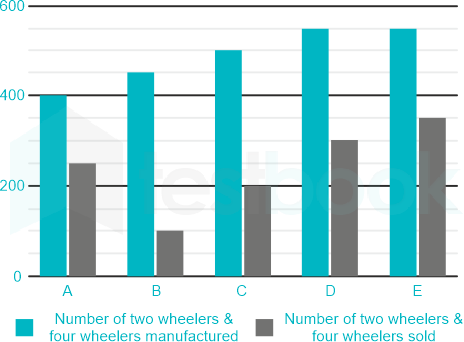
Directions: The following bar graph shows the number of two wheelers and number of four wheelers manufactured and number of two wheelers and four wheelers sold by five different companies A, B, C, D and E. 


31

Find the difference between average number of two wheelers and four wheelers sold and average number of two wheelers and four wheelers unsold.

  1. ((a))

    30

  2. ((b))

    10

  3. ((c))

    15

  4. ((d))

    20

  5. ((e))

    35

Show Answer
Answer: ((b))

10

General solution:


Company A:

Number of two wheelers and four wheelers manufactured = 400

Number of two wheelers and four wheelers sold = 250

Number of two wheelers and four wheelers unsold = (400 - 250) = 150


Company B:

Number of two wheelers and four wheelers manufactured = 450

Number of two wheelers and four wheelers sold = 100

Number of two wheelers and four wheelers unsold = (450 - 100) = 350


Company C:

Number of two wheelers and four wheelers manufactured = 500

Number of two wheelers and four wheelers sold = 200

Number of two wheelers and four wheelers unsold = (500 - 200) = 300


Company D:

Number of two wheelers and four wheelers manufactured = 550

Number of two wheelers and four wheelers sold = 300

Number of two wheelers and four wheelers unsold = (550 - 300) = 250


Company E:

Number of two wheelers and four wheelers manufactured = 550

Number of two wheelers and four wheelers sold = 350

Number of two wheelers and four wheelers unsold = (550 - 350) = 200


CompaniesNumber of two wheelers and four wheelers soldNumber of two wheelers and four wheelers unsold
A250150
B100350
C200300
D300250
E350200


Solution:

Average of two wheelers and four wheelers sold = (250 + 100 + 200 + 300 + 350)/5 = 240

Average of two wheelers and four wheelers unsold = (150 + 350 + 300 + 250 + 200)/5 = 250

Required difference = (250 - 240) = 10

32

If the number of four wheelers to two wheelers sold in the company E are in the ratio 4:3. If the 30% of the four wheelers sold is maruti and remaining are Tata and number of two wheelers sold are 40% are KTM and remaining are Royal Enfield. Find the total number of Tata and KTM bikes sold in company E.

  1. ((a))

    150

  2. ((b))

    130

  3. ((c))

    160

  4. ((d))

    200

  5. ((e))

    250

Show Answer
Answer: ((d))

200

General solution:


Company A:

Number of two wheelers and four wheelers manufactured = 400

Number of two wheelers and four wheelers sold = 250

Number of two wheelers and four wheelers unsold = (400 - 250) = 150


Company B:

Number of two wheelers and four wheelers manufactured = 450

Number of two wheelers and four wheelers sold = 100

Number of two wheelers and four wheelers unsold = (450 - 100) = 350


Company C:

Number of two wheelers and four wheelers manufactured = 500

Number of two wheelers and four wheelers sold = 200

Number of two wheelers and four wheelers unsold = (500 - 200) = 300


Company D:

Number of two wheelers and four wheelers manufactured = 550

Number of two wheelers and four wheelers sold = 300

Number of two wheelers and four wheelers unsold = (550 - 300) = 250


Company E:

Number of two wheelers and four wheelers manufactured = 550

Number of two wheelers and four wheelers sold = 350

Number of two wheelers and four wheelers unsold = (550 - 350) = 200


CompaniesNumber of two wheelers and four wheelers soldNumber of two wheelers and four wheelers unsold
A250150
B100350
C200300
D300250
E350200


Solution:

Number of four wheelers sold in company E = 350/7 ×  4 = 200

Number of two wheelers sold in company E = (350 - 200) = 150

Number of maruti four wheelers sold = 200 ×  30/100 = 60

Number of Tata four wheelers sold = (200 - 60) = 140

Number of  KTM two wheelers sold = 150 ×  (40/100) = 60

Required total = (140 + 60) = 200

33

If 70% of unsold vehicles in company D are four wheelers and number four wheelers unsold in company E is 5 more than that number of four wheelers unsold in company D. Find the sum of the unsold two wheelers in company D and E.

  1. ((a))

    105

  2. ((b))

    115

  3. ((c))

    95

  4. ((d))

    80

  5. ((e))

    125

Show Answer
Answer: ((c))

95

General solution:


Company A:

Number of two wheelers and four wheelers manufactured = 400

Number of two wheelers and four wheelers sold = 250

Number of two wheelers and four wheelers unsold = (400 - 250) = 150


Company B:

Number of two wheelers and four wheelers manufactured = 450

Number of two wheelers and four wheelers sold = 100

Number of two wheelers and four wheelers unsold = (450 - 100) = 350


Company C:

Number of two wheelers and four wheelers manufactured = 500

Number of two wheelers and four wheelers sold = 200

Number of two wheelers and four wheelers unsold = (500 - 200) = 300


Company D:

Number of two wheelers and four wheelers manufactured = 550

Number of two wheelers and four wheelers sold = 300

Number of two wheelers and four wheelers unsold = (550 - 300) = 250


Company E:

Number of two wheelers and four wheelers manufactured = 550

Number of two wheelers and four wheelers sold = 350

Number of two wheelers and four wheelers unsold = (550 - 350) = 200


CompaniesNumber of two wheelers and four wheelers soldNumber of two wheelers and four wheelers unsold
A250150
B100350
C200300
D300250
E350200


Solution:

Number of four wheelers unsold in company D = 70/100 ×  250 = 175

Number of two wheelers unsold in company D = (250 - 175) = 75

Number of four wheelers unsold in company E = (175 + 5) = 180

Number of two wheelers unsold in company E = (200 - 180) = 20

Required sum = (75 + 20) = 95

34

In company B and C the number of vehicles (Two wheelers + Four wheelers) sold to males to females are in the ratio 3 : 2 and 4 : 1 respectively. Then find the ratio between the number of vehicles sold to male and females.

  1. ((a))

    13: 8

  2. ((b))

    11: 4

  3. ((c))

    14: 5

  4. ((d))

    12: 7

  5. ((e))

    11: 5

Show Answer
Answer: ((b))

11: 4

General solution:


Company A:

Number of two wheelers and four wheelers manufactured = 400

Number of two wheelers and four wheelers sold = 250

Number of two wheelers and four wheelers unsold = (400 - 250) = 150


Company B:

Number of two wheelers and four wheelers manufactured = 450

Number of two wheelers and four wheelers sold = 100

Number of two wheelers and four wheelers unsold = (450 - 100) = 350


Company C:

Number of two wheelers and four wheelers manufactured = 500

Number of two wheelers and four wheelers sold = 200

Number of two wheelers and four wheelers unsold = (500 - 200) = 300


Company D:

Number of two wheelers and four wheelers manufactured = 550

Number of two wheelers and four wheelers sold = 300

Number of two wheelers and four wheelers unsold = (550 - 300) = 250


Company E:

Number of two wheelers and four wheelers manufactured = 550

Number of two wheelers and four wheelers sold = 350

Number of two wheelers and four wheelers unsold = (550 - 350) = 200


CompaniesNumber of two wheelers and four wheelers soldNumber of two wheelers and four wheelers unsold
A250150
B100350
C200300
D300250
E350200


Solution:

Number of vehicles sold to males  by company B = 100/5 ×  3= 60

Number of vehicles  sold to females  by company B  = (100 - 60) = 40

Number of vehicles sold to males by company C  = 200/5 ×  4 = 160

Number of vehicles sold to females by company C = (200 - 160) = 40

Required difference = (160 + 60): (80) = 220: 80 = 11: 4

35

In company A 30% of the sold vehicles are two wheelers and the remaining are four wheelers and the number of four wheelers in unsold vehicles is 40%. Then find the difference between the total number of two wheelers and four wheelers manufactured in company A.

  1. ((a))

    85

  2. ((b))

    80

  3. ((c))

    70

  4. ((d))

    75

  5. ((e))

    95

Show Answer
Answer: ((c))

70

General solution:


Company A:

Number of two wheelers and four wheelers manufactured = 400

Number of two wheelers and four wheelers sold = 250

Number of two wheelers and four wheelers unsold = (400 - 250) = 150


Company B:

Number of two wheelers and four wheelers manufactured = 450

Number of two wheelers and four wheelers sold = 100

Number of two wheelers and four wheelers unsold = (450 - 100) = 350


Company C:

Number of two wheelers and four wheelers manufactured = 500

Number of two wheelers and four wheelers sold = 200

Number of two wheelers and four wheelers unsold = (500 - 200) = 300


Company D:

Number of two wheelers and four wheelers manufactured = 550

Number of two wheelers and four wheelers sold = 300

Number of two wheelers and four wheelers unsold = (550 - 300) = 250


Company E:

Number of two wheelers and four wheelers manufactured = 550

Number of two wheelers and four wheelers sold = 350

Number of two wheelers and four wheelers unsold = (550 - 350) = 200


CompaniesNumber of two wheelers and four wheelers soldNumber of two wheelers and four wheelers unsold
A250150
B100350
C200300
D300250
E350200
<br>

Solution:

Number of two wheelers sold in company A = 250 ×  (30/100) = 75

Number of four wheelers sold in company A = (250 - 75) = 175

Number of four wheelers unsold in company A = 150 ×  40/100 = 60

Number of two wheelers unsold in company A = (150 - 60) = 90

Number of two wheelers manufactured = (90 + 75) = 165

Number of four wheelers manufactured = (175 + 60) = 235

Required difference = (235 - 165) = 70

36

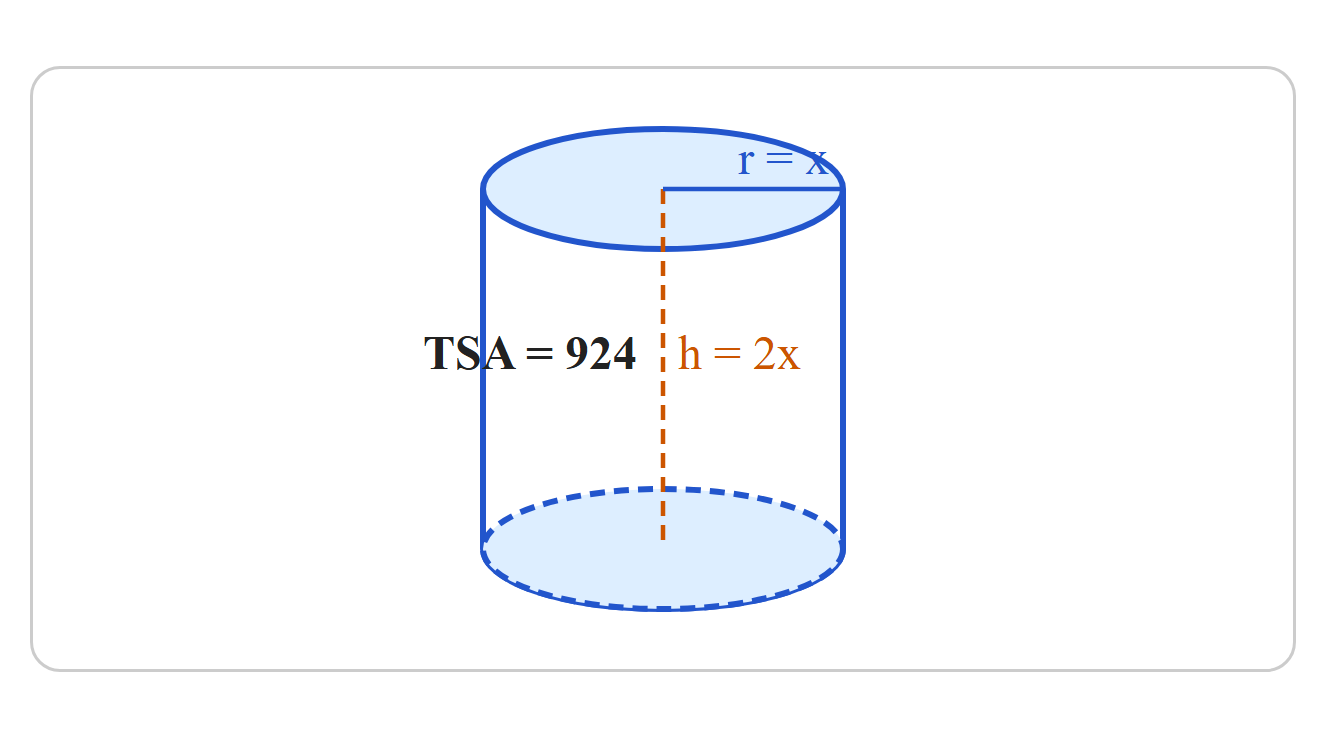
The height and radius of a right circular cylinder is 2:1 and total surface area of cylinder was 924 cm2 .Find the volume of cylinder.

  1. ((a))

    2250 cm3

  2. ((b))

    2186 cm3

  3. ((c))

    2156 cm3

  4. ((d))

    2046 cm3

  5. ((e))

    None of these

Show Answer
Answer: ((c))

2156 cm3

Shortcut Trick

Ratio of Height (h) to Radius (r) = 2 : 1. Let h = 2x and r = x.

Total Surface Area (TSA) = 2πr(r + h) = 2 × (22/7) × x × (x + 2x) = 924.

⇒ (44/7) × 3x2 = 924 ⇒ x2 = 49 ⇒ x = 7 cm.

Volume = πr2h = (22/7) × 72 × 14 = 22 × 7 × 14 = 2156 cm3.

∴ The correct answer is 2156 cm3.

Alternate Method

Given: Ratio of height to radius = 2 : 1, TSA = 924 cm2.

Formula Used: TSA = 2πr(h + r); Volume = πr2h

⇒ Let Radius (r) = x and Height (h) = 2x.

⇒ 2 × (22/7) × x × (2x + x) = 924

⇒ 2 × (22/7) × 3x2 = 924

⇒ (132/7) × x2 = 924

⇒ x2 = (924 × 7) ÷ 132

⇒ x2 = 7 × 7 = 49 ⇒ x = 7 cm.

⇒ Radius (r) = 7 cm, Height (h) = 14 cm.

⇒ Volume = (22/7) × 7 × 7 × 14

⇒ Volume = 22 × 7 × 14 = 2156 cm3.

∴ The correct answer is 2156 cm3.

Additional Information

Curved Surface Area of Cylinder

The area of the side surface of the cylinder is given by CSA = 2πrh.

Volume of Hollow Cylinder

If R is outer radius and r is inner radius, Volume = π(R2 − r2)h.

Base Area of Cylinder

The base of a right circular cylinder is a circle, so Base Area = πr2.

37

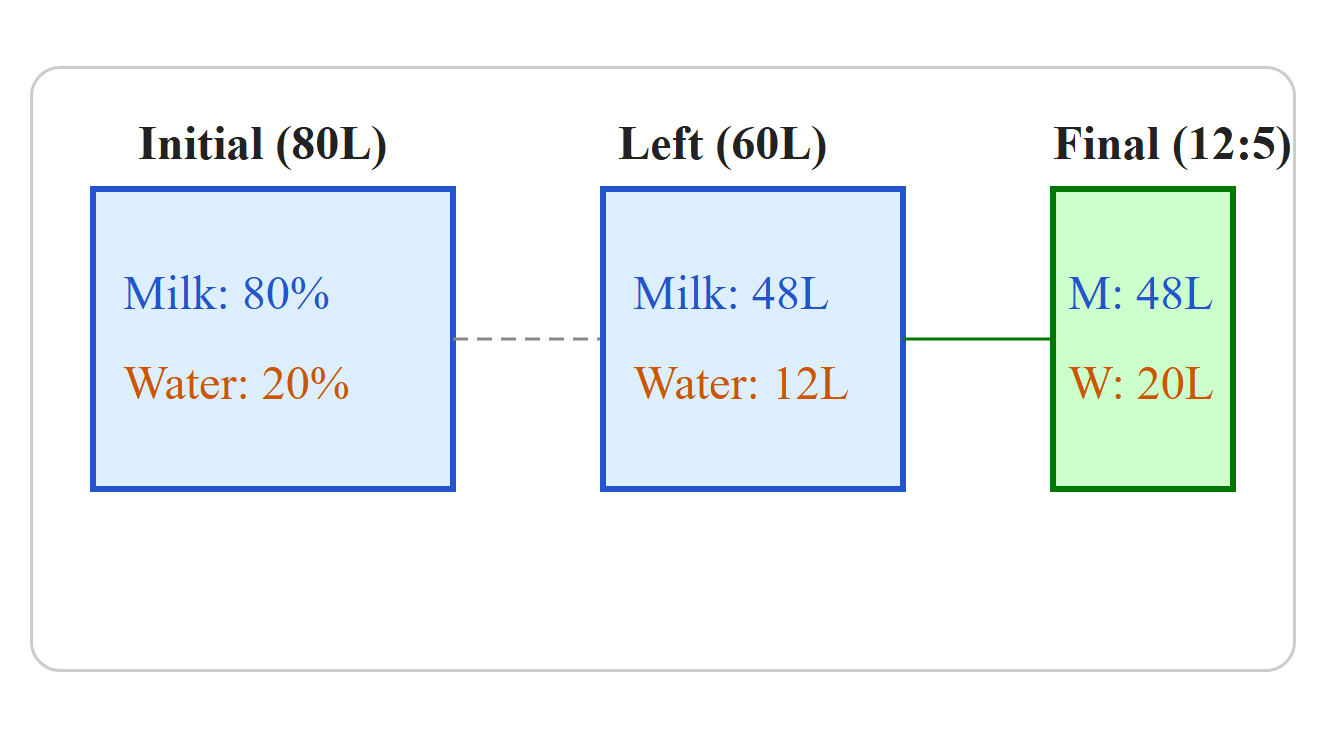
In 79.99 litres of mixture of milk and water, presence of water is 20.13% of total mixture. If 24.99% of this mixture is taken out and certain amount of water is added, then the ratio of milk and water becomes 12:5. Find the quantity of water added.

  1. ((a))

    10

  2. ((b))

    6

  3. ((c))

    8

  4. ((d))

    12

  5. ((e))

    5

Show Answer
Answer: ((c))

8

Shortcut Trick

Approximate Total mixture = 80 litres, Water = 20%, Milk = 80%.

Mixture remaining after 25% removal = 80 × 0.75 = 60 litres.

Remaining Milk = 80% of 60 = 48 litres; Remaining Water = 20% of 60 = 12 litres.

Final ratio 12:5 means 12 units = 48 litres ⇒ 1 unit = 4 litres.

Required Water = 5 units = 5 × 4 = 20 litres. Added Water = 20 − 12 = 8 litres.

∴ The correct answer is 8 litres.

Alternate Method

Given: Total Mixture ≈ 80 litres, Water ≈ 20.13% ≈ 20%, Removal ≈ 25%.

Step 1: Calculate initial quantities in litres.

⇒ Total mixture = 80 litres.

⇒ Water = 20% of 80 = 16 litres.

⇒ Milk = 80 − 16 = 64 litres.

Step 2: Calculate remaining quantities after taking out 25% of mixture.

⇒ Milk remaining = 64 − (25% of 64) = 64 − 16 = 48 litres.

⇒ Water remaining = 16 − (25% of 16) = 16 − 4 = 12 litres.

Step 3: Let x be the quantity of water added.

⇒ Milk : (Water + x) = 12 : 5

⇒ 48 / (12 + x) = 12 / 5

⇒ 4 / (12 + x) = 1 / 5

⇒ 20 = 12 + x

⇒ x = 20 − 12 = 8 litres.

∴ The correct answer is 8 litres.

Additional Information

Mixture Removal Property

When a portion of a mixture is removed, the ratio of components in the remaining mixture stays the same as the initial ratio.

Mixtures & Alligations

For replacement problems, Quantity left = Initial Quantity × (1 − Removed/Total)n, where n is the number of operations.

Approximation Rule

In banking exams, values like 79.99 or 20.13% should be rounded to the nearest whole number (80 and 20%) to speed up calculations.

38

What approximate value should come in the place of question mark (?) in the following question?

12.98 + 417.98 = 34.98 × 19.98 - ?2 - 99.99

  1. ((a))

    11

  2. ((b))

    6

  3. ((c))

    21

  4. ((d))

    13

  5. ((e))

    17

Show Answer
Answer: ((d))

13

Follow BODMAS rule to solve this question, as per the order given below.

Step - 1: Parts of an equation enclosed in 'Brackets' must be solved first, and following BODMAS rule in the bracket -

Step - 2: Any mathematical 'Of' or 'Exponent' must be solved next.

Step - 3: Next, the parts of the equation that contain 'Division' and 'Multiplication' are calculated.

Step - 4: Last but not the least, the parts of the equation that contain 'Addition' and 'Subtraction' should be calculated.

Since, we need to find out the approximate value, we can write these values to their nearest integers.

Given expression is

12.98 + 417.98 = 34.98 × 19.98 - ?2 - 99.99

13 + 418 = 35 × 20 - ?2 - 100

⇒ 13 + 418 = 700 - ?2 - 100

⇒ 431 = 700 - ?2 - 100

⇒ ?2 = 700 - 431 - 100

⇒ ? = √169 = 13

39

What approximate value should come in the place of question mark (?) in the following question?

44.99% of 399.99 + 49.99% of 299.99 = ? + 69.99% of 199.99

  1. ((a))

    190

  2. ((b))

    140

  3. ((c))

    210

  4. ((d))

    180

  5. ((e))

    170

Show Answer
Answer: ((a))

190

Follow BODMAS rule to solve this question, as per the order given below.

Step - 1: Parts of an equation enclosed in 'Brackets' must be solved first, and following BODMAS rule in the bracket -

Step - 2: Any mathematical 'Of' or 'Exponent' must be solved next.

Step - 3: Next, the parts of the equation that contain 'Division' and 'Multiplication' are calculated.

Step - 4: Last but not the least, the parts of the equation that contain 'Addition' and 'Subtraction' should be calculated.

Since, we need to find out the approximate value, we can write these values to their nearest integers.

Given expression is

44.99% of 399.99 + 49.99% of 299.99 = ? + 69.99% of 199.99

⇒ 45% of 400 + 50% of 300 = ? + 70% of 200

⇒ 180 + 150 = ? + 140

⇒ 330 = ? + 140

∴ ? = 190

40

What approximate value should come in the place of question mark (?) in the following question?

[12.935 ÷ 12.984] × [13.033 ÷ 13.136] = 12.83(? – 4)

  1. ((a))

    3

  2. ((b))

    4

  3. ((c))

    8

  4. ((d))

    5

  5. ((e))

    2

Show Answer
Answer: ((e))

2

Follow BODMAS rule to solve this question, as per the order given below.

Step - 1: Parts of an equation enclosed in 'Brackets' must be solved first, and following BODMAS rule in the bracket -

Step - 2: Any mathematical 'Of' or 'Exponent' must be solved next.

Step - 3: Next, the parts of the equation that contain 'Division' and 'Multiplication' are calculated.

Step - 4: Last but not the least, the parts of the equation that contain 'Addition' and 'Subtraction' should be calculated.

Since, we need to find out the approximate value, we can write these values to their nearest integers.

Given expression is

[12.935 ÷ 12.984] × [13.033 ÷ 13.136] = 12.83(? – 4)

⇒ [135 ÷ 134] × [133 ÷ 136] = 13(? – 4)

⇒ 13 × 13-3 = 13(? – 4)

⇒ 13-2 = 13(? – 4)

⇒ ? - 4 = -2

⇒ ? = 2

41

What approximate value should come in the place of question mark (?) in the following question?

(124.95 × 5.98) – (110.02 × 7.96) + 669.95 = ? × 8.99

  1. ((a))

    40

  2. ((b))

    50

  3. ((c))

    80

  4. ((d))

    60

  5. ((e))

    30

Show Answer
Answer: ((d))

60

Follow BODMAS rule to solve this question, as per the order given below.

Step - 1: Parts of an equation enclosed in 'Brackets' must be solved first, and following BODMAS rule in the bracket -

Step - 2: Any mathematical 'Of' or 'Exponent' must be solved next.

Step - 3: Next, the parts of the equation that contain 'Division' and 'Multiplication' are calculated.

Step - 4: Last but not the least, the parts of the equation that contain 'Addition' and 'Subtraction' should be calculated.

Since, we need to find out the approximate value, we can write these values to their nearest integers.

Given expression is

(124.95 × 5.98) – (110.02 × 7.96) + 669.95 = ? × 8.99

⇒ (125 × 6) – (110 × 8) + 670 = ? × 9

⇒ 750 – 880 + 670 = ? × 9

⇒ 1420 – 880 = ? × 9

⇒ 540 = ? × 9

∴ ? = 60

42

What approximate value should come in the place of question mark (?) in the following question?

349.99 – [15.952 – (87.88 + 95.94) ÷ 7.99] = ?

  1. ((a))

    123

  2. ((b))

    117

  3. ((c))

    137

  4. ((d))

    133

  5. ((e))

    113

Show Answer
Answer: ((b))

117

Follow BODMAS rule to solve this question, as per the order given below.

Step - 1: Parts of an equation enclosed in 'Brackets' must be solved first, and following BODMAS rule in the bracket -

Step - 2: Any mathematical 'Of' or 'Exponent' must be solved next.

Step - 3: Next, the parts of the equation that contain 'Division' and 'Multiplication' are calculated.

Step - 4: Last but not the least, the parts of the equation that contain 'Addition' and 'Subtraction' should be calculated.

Since, we need to find out the approximate value, we can write these values to their nearest integers.

Given expression is

349.99 – [15.952 – (87.88 + 95.94) ÷ 7.99] = ?

⇒ 350 – [162 – (88 + 96) ÷ 8] = ?

⇒ 350 – [162 – 184 ÷ 8] = ?

⇒ 350 – [162 – 23] = ?

⇒ 350 – [256 – 23] = ?

⇒ 350 – 233 = ?

∴ ? = 117

43

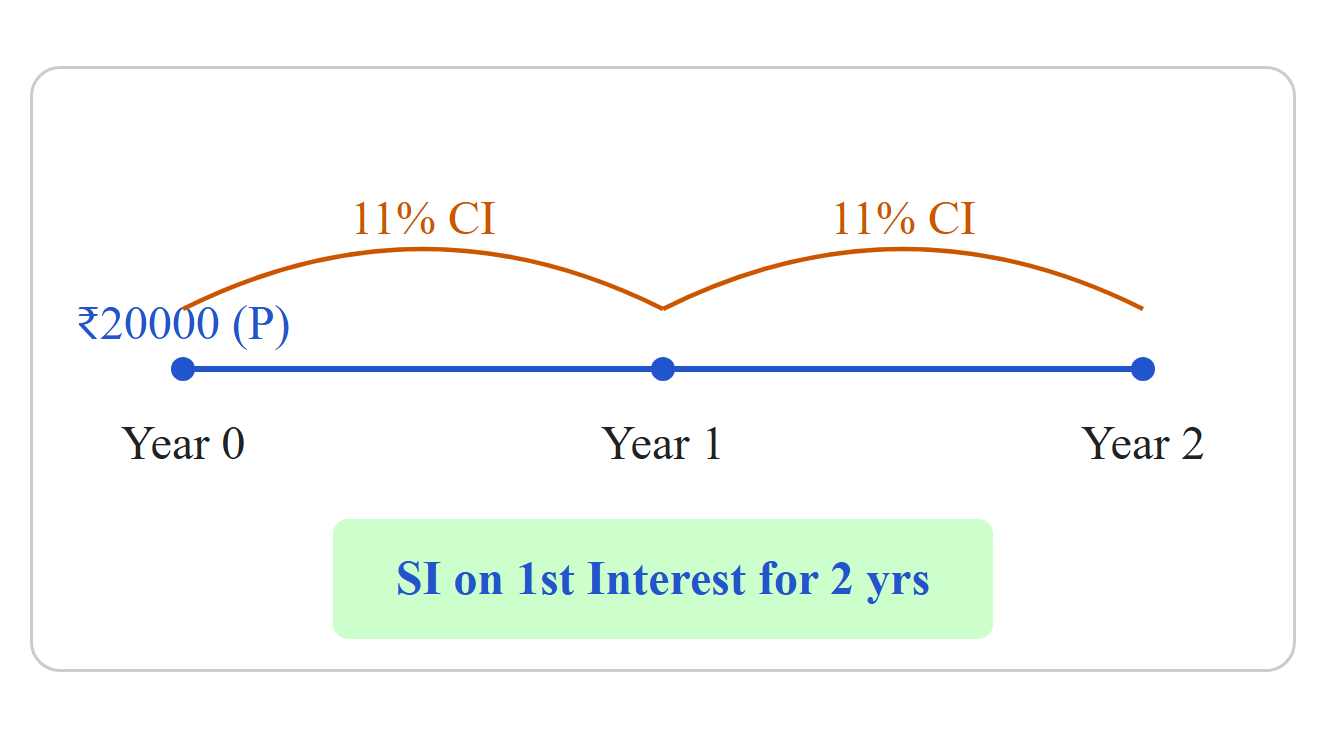
An amount of Rs.20000 is invested at the rate of 11% per annum for 2 years at Compound Interest. The interest received is again invested at the same rate for the same time. Find the simple interest received from the second investment.

  1. ((a))

    1011.75

  2. ((b))

    1021.24

  3. ((c))

    1031.56

  4. ((d))

    1040.45

  5. ((e))

    None of these

Show Answer
Answer: ((b))

1021.24

Shortcut Trick

Effective Compound Interest rate for 2 years at 11% = 11 + 11 + (11 × 11)/100 = 23.21%.

First Interest amount = 23.21% of ₹20000 = ₹4642.

Simple Interest on second investment = (4642 × 11 × 2) / 100 = 4642 × 0.22 = ₹1021.24.

∴ The correct answer is ₹1021.24.

Alternate Method

Given: Principal (P1) = ₹20000, Rate (R) = 11%, Time (T) = 2 years.

Formula Used: CI = P[(1 + R/100)T − 1]; SI = (P × R × T) / 100.

⇒ 1st Interest (CI) = 20000 × [(1 + 11/100)2 − 1]

⇒ CI = 20000 × [1.2321 − 1] = 20000 × 0.2321 = ₹4642.

⇒ 2nd Principal (P2) = 1st Interest = ₹4642.

⇒ SI received = (4642 × 11 × 2) / 100

⇒ SI = (4642 × 22) / 100 = 102124 / 100 = ₹1021.24.

∴ The correct answer is ₹1021.24.

Additional Information

Effective Rate of Compound Interest

For 2 years, the net percentage change formula (x + y + xy/100) provides the effective CI rate relative to the principal.

Simple Interest vs Compound Interest

While SI is calculated only on the principal, CI is calculated on the principal plus the accumulated interest of previous periods.

CI − SI Difference for 2 years

The difference between CI and SI for 2 years is given by the formula P(R/100)2.

44

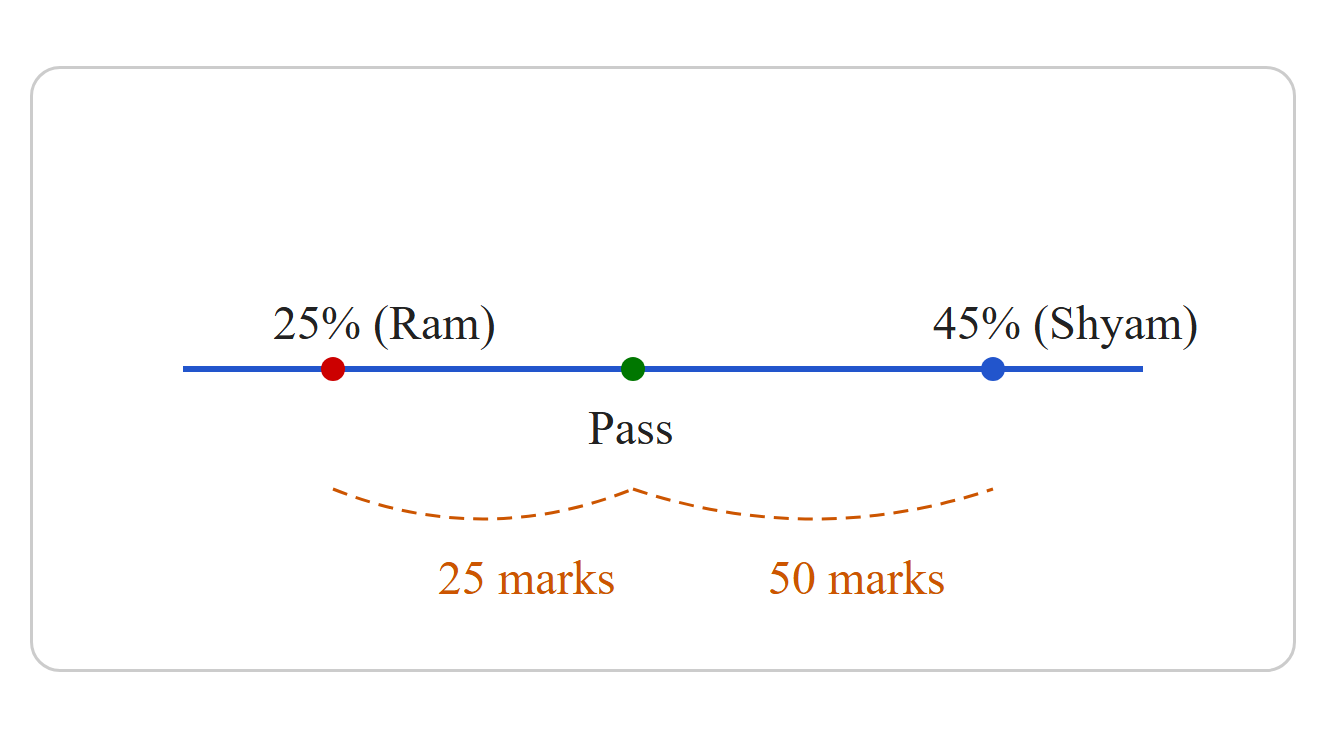
In an examination, Ram scored 25% marks and failed by 25 marks. Shyam scored 45% marks and obtained 50 marks more than passing marks. Find the maximum marks.

  1. ((a))

    500 

  2. ((b))

    375

  3. ((c))

    250

  4. ((d))

    275

  5. ((e))

    575

Show Answer
Answer: ((b))

375

Shortcut Trick

Difference in percentage marks = 45% − 25% = 20%

Difference in actual marks = 50 − (−25) = 75 marks

20% of Maximum Marks = 75 marks

100% of Maximum Marks = 75 × 5 = 375 marks

∴ The correct answer is 375.

Alternate Method

Given: Ram score = 25%, Shyam score = 45%, Marks gap = 25 (fail) and 50 (extra).

Let Maximum Marks be M.

Passing Marks = 25% of M + 25

Passing Marks = 45% of M − 50

⇒ 25% of M + 25 = 45% of M − 50

⇒ 45% of M − 25% of M = 50 + 25

⇒ 20% of M = 75

⇒ (20/100) × M = 75

⇒ M = (75 × 100) ÷ 20

⇒ M = 375

∴ The correct answer is 375.

Additional Information

Passing Percentage

To find the passing percentage, substitute M back into the passing marks equation: (25% × 375 + 25) ÷ 375 × 100 = 31.66%.

Percentage Change Base

In examination problems, the Maximum Marks always acts as the base (100%) for calculating scored or passing percentages.

Successive Percentage

For problems involving repeated changes, use the net effect formula: a + b + (ab/100).

Directions:  The given table shows the total number of students (Males + Females) attended the interview, Percentage of girls attended the interview , number of males selected and percentage of selected students in five different schools.


SchoolsTotal number of students (Male + Female) attend interviewPercentage of females attend interviewTotal students (Male + Female) selected in interviewNumber of Males selected In interview
A70040%500350
B65060%400250
C75030%450300
D80045%550325
E90055%600300
45

1/3rd and 1/5 th of the females selected from school A and school  B respectively are from city P and remaining are from city Q and 1/7th and 1/10 th of males selected from school A and school B are from city Q. Find the number of students (male  + female) from school A and school B are from city Q.

  1. ((a))

    255

  2. ((b))

    265

  3. ((c))

    275

  4. ((d))

    295

  5. ((e))

    285

Show Answer
Answer: ((d))

295

Solution:


School A:

Total number of students (Male + Female) attend interview = 700

Number of female attend interview = 700 ×  (40/100) = 280

Number of males attend interview = (700 - 280) = 420

Number of males selected in interview = 350

Number of males unselected in interview = 420 - 350 = 70

Total number students selected in interview = 500

Number of females selected in interview = 500 - 350 =150

Number of females unselected in interview = 280 - 150 = 130


School B:

Total number of students (Male + Female) attend interview = 650

Number of female attend interview = 650 ×  (60/100) = 390

Number of males attend interview = (650 - 390) = 260

Number of males selected in interview = 250

Number of males unselected in interview = 260 - 250 = 10

Total number students selected in interview = 400

Number of females selected in interview = 400 - 250 =150

Number of females unselected in interview = 390 - 150 = 240


School C:

Total number of students (Male + Female) attend interview = 750

Number of female attend interview = 750 ×  (30/100) = 225

Number of males attend interview = (750 - 225) = 525

Number of males selected in interview = 300

Number of males unselected in interview = 525 - 300 = 225

Total number students selected in interview = 450

Number of females selected in interview = 450 - 300 =150

Number of females unselected in interview = 225 - 150 = 75


School D:

Total number of students (Male + Female) attend interview = 800

Number of female attend interview = 800 ×  (45/100) = 360

Number of males attend interview = (800 - 360) = 440

Number of males selected in interview = 325

Number of males unselected in interview = 440 - 325 = 115

Total number students selected in interview = 550

Number of females selected in interview = 550 - 325 =225

Number of females unselected in interview = 360 - 225 = 135


School E:

Total number of students (Male + Female) attend interview = 900

Number of female attend interview = 900 ×  (55/100) = 495

Number of males attend interview = (900 - 495) = 405

Number of males selected in interview = 300

Number of males unselected in interview = 405 - 300 = 105

Total number students selected in interview = 600

Number of females selected in interview = 600 - 300 = 300

Number of females unselected in interview = 495 - 300 = 195


SchoolsNumber of males attend interviewNumber of females attend InterviewNumber of males selectedNumber of males unselectedNumber of females selectedNumber of females unselected
A42028035070150130
B26039025010150240
C52522530022515075
D440360325115225135
E405495300105300195


Solution:

Number of females selected from school A from city P= 150 ×  1/3 = 50

Number of females selected from school A from city Q = (150 - 50) = 100

Number of females selected from school B from city P = 150 ×  1/5 = 30

Number of females selected from school B from city Q = 150 - 30 = 120 

Number of males selected from school A from city Q = 350 ×  1/7 = 50

Number of males selected from school B from city Q = 250 ×  1/10 = 25

Required total = (100 + 120 + 50 + 25) = 295

46

Average number of males selected is what percentage of the total females selected from all the schools.

  1. ((a))

    36.78%

  2. ((b))

    34.57%

  3. ((c))

    31.28%

  4. ((d))

    30.78%

  5. ((e))

    27.89%

Show Answer
Answer: ((c))

31.28%

Solution:


School A:

Total number of students (Male + Female) attend interview = 700

Number of female attend interview = 700 ×  (40/100) = 280

Number of males attend interview = (700 - 280) = 420

Number of males selected in interview = 350

Number of males unselected in interview = 420 - 350 = 70

Total number students selected in interview = 500

Number of females selected in interview = 500 - 350 =150

Number of females unselected in interview = 280 - 150 = 130


School B:

Total number of students (Male + Female) attend interview = 650

Number of female attend interview = 650 ×  (60/100) = 390

Number of males attend interview = (650 - 390) = 260

Number of males selected in interview = 250

Number of males unselected in interview = 260 - 250 = 10

Total number students selected in interview = 400

Number of females selected in interview = 400 - 250 =150

Number of females unselected in interview = 390 - 150 = 240


School C:

Total number of students (Male + Female) attend interview = 750

Number of female attend interview = 750 ×  (30/100) = 225

Number of males attend interview = (750 - 225) = 525

Number of males selected in interview = 300

Number of males unselected in interview = 525 - 300 = 225

Total number students selected in interview = 450

Number of females selected in interview = 450 - 300 =150

Number of females unselected in interview = 225 - 150 = 75


School D:

Total number of students (Male + Female) attend interview = 800

Number of female attend interview = 800 ×  (45/100) = 360

Number of males attend interview = (800 - 360) = 440

Number of males selected in interview = 325

Number of males unselected in interview = 440 - 325 = 115

Total number students selected in interview = 550

Number of females selected in interview = 550 - 325 =225

Number of females unselected in interview = 360 - 225 = 135


School E:

Total number of students (Male + Female) attend interview = 900

Number of female attend interview = 900 ×  (55/100) = 495

Number of males attend interview = (900 - 495) = 405

Number of males selected in interview = 300

Number of males unselected in interview = 405 - 300 = 105

Total number students selected in interview = 600

Number of females selected in interview = 600 - 300 = 300

Number of females unselected in interview = 495 - 300 = 195


SchoolsNumber of males attend interviewNumber of females attend InterviewNumber of males selectedNumber of males unselectedNumber of females selectedNumber of females unselected
A42028035070150130
B26039025010150240
C52522530022515075
D440360325115225135
E405495300105300195

Solution:

Average number of males selected = (350 + 250 + 300 + 325 + 300)/5 = 305

Total females selected from all the schools = (150 + 150 + 150 + 225 + 300) = 975

Required percentage = 305/975 × 100 = 31.28%

47

If 1/6 th of the males selected from school C for TCS and 1/5 th of the females selected form school C for TCS. Find the number of male and females selected for TCS from school C.

  1. ((a))

    130

  2. ((b))

    140

  3. ((c))

    120

  4. ((d))

    80

  5. ((e))

    110

Show Answer
Answer: ((d))

80

Solution:


School A:

Total number of students (Male + Female) attend interview = 700

Number of female attend interview = 700 ×  (40/100) = 280

Number of males attend interview = (700 - 280) = 420

Number of males selected in interview = 350

Number of males unselected in interview = 420 - 350 = 70

Total number students selected in interview = 500

Number of females selected in interview = 500 - 350 =150

Number of females unselected in interview = 280 - 150 = 130


School B:

Total number of students (Male + Female) attend interview = 650

Number of female attend interview = 650 ×  (60/100) = 390

Number of males attend interview = (650 - 390) = 260

Number of males selected in interview = 250

Number of males unselected in interview = 260 - 250 = 10

Total number students selected in interview = 400

Number of females selected in interview = 400 - 250 =150

Number of females unselected in interview = 390 - 150 = 240


School C:

Total number of students (Male + Female) attend interview = 750

Number of female attend interview = 750 ×  (30/100) = 225

Number of males attend interview = (750 - 225) = 525

Number of males selected in interview = 300

Number of males unselected in interview = 525 - 300 = 225

Total number students selected in interview = 450

Number of females selected in interview = 450 - 300 =150

Number of females unselected in interview = 225 - 150 = 75


School D:

Total number of students (Male + Female) attend interview = 800

Number of female attend interview = 800 ×  (45/100) = 360

Number of males attend interview = (800 - 360) = 440

Number of males selected in interview = 325

Number of males unselected in interview = 440 - 325 = 115

Total number students selected in interview = 550

Number of females selected in interview = 550 - 325 =225

Number of females unselected in interview = 360 - 225 = 135


School E:

Total number of students (Male + Female) attend interview = 900

Number of female attend interview = 900 ×  (55/100) = 495

Number of males attend interview = (900 - 495) = 405

Number of males selected in interview = 300

Number of males unselected in interview = 405 - 300 = 105

Total number students selected in interview = 600

Number of females selected in interview = 600 - 300 = 300

Number of females unselected in interview = 495 - 300 = 195


SchoolsNumber of males attend interviewNumber of females attend InterviewNumber of males selectedNumber of males unselectedNumber of females selectedNumber of females unselected
A42028035070150130
B26039025010150240
C52522530022515075
D440360325115225135
E405495300105300195


Solution:

Number of males selected for TCS from school C = 300 ×  1/6 = 50

Number of females selected for TCS from school C = 150 ×  1/5 = 30

Required total = (50 + 30) = 80

48

Find the difference between average numbers of unselected males and average number of unselected females from all the schools?

  1. ((a))

    60

  2. ((b))

    45

  3. ((c))

    30

  4. ((d))

    50

  5. ((e))

    40

Show Answer
Answer: ((d))

50

Solution:


School A:

Total number of students (Male + Female) attend interview = 700

Number of female attend interview = 700 ×  (40/100) = 280

Number of males attend interview = (700 - 280) = 420

Number of males selected in interview = 350

Number of males unselected in interview = 420 - 350 = 70

Total number students selected in interview = 500

Number of females selected in interview = 500 - 350 =150

Number of females unselected in interview = 280 - 150 = 130


School B:

Total number of students (Male + Female) attend interview = 650

Number of female attend interview = 650 ×  (60/100) = 390

Number of males attend interview = (650 - 390) = 260

Number of males selected in interview = 250

Number of males unselected in interview = 260 - 250 = 10

Total number students selected in interview = 400

Number of females selected in interview = 400 - 250 =150

Number of females unselected in interview = 390 - 150 = 240


School C:

Total number of students (Male + Female) attend interview = 750

Number of female attend interview = 750 ×  (30/100) = 225

Number of males attend interview = (750 - 225) = 525

Number of males selected in interview = 300

Number of males unselected in interview = 525 - 300 = 225

Total number students selected in interview = 450

Number of females selected in interview = 450 - 300 =150

Number of females unselected in interview = 225 - 150 = 75


School D:

Total number of students (Male + Female) attend interview = 800

Number of female attend interview = 800 ×  (45/100) = 360

Number of males attend interview = (800 - 360) = 440

Number of males selected in interview = 325

Number of males unselected in interview = 440 - 325 = 115

Total number students selected in interview = 550

Number of females selected in interview = 550 - 325 =225

Number of females unselected in interview = 360 - 225 = 135


School E:

Total number of students (Male + Female) attend interview = 900

Number of female attend interview = 900 ×  (55/100) = 495

Number of males attend interview = (900 - 495) = 405

Number of males selected in interview = 300

Number of males unselected in interview = 405 - 300 = 105

Total number students selected in interview = 600

Number of females selected in interview = 600 - 300 = 300

Number of females unselected in interview = 495 - 300 = 195


SchoolsNumber of males attend interviewNumber of females attend InterviewNumber of males selectedNumber of males unselectedNumber of females selectedNumber of females unselected
A42028035070150130
B26039025010150240
C52522530022515075
D440360325115225135
E405495300105300195


Solution:

Average number of unselected females = (130 + 240 + 75 + 135 + 195)/5 = 155

Average number of unselected males = (70 + 10 + 225 + 115 + 105)/5 = 105

Required difference = (155 - 105) = 50

Directions:  The given table shows the total number of students (Males + Females) attended the interview, Percentage of girls attended the interview , number of males selected and percentage of selected students in five different schools.


SchoolsTotal number of students (Male + Female) attend interviewPercentage of females attend interviewTotal students (Male + Female) selected in interviewNumber of Males selected In interview
A70040%500350
B65060%400250
C75030%450300
D80045%550325
E90055%600300
49

If 2/7 of the females attending interviews from school A are from section I and 1/5 of the females selected from school A are from section I. Find the number of female students from school A are unselected from section  I in school A.

  1. ((a))

    30

  2. ((b))

    55

  3. ((c))

    50

  4. ((d))

    40

  5. ((e))

    65

Show Answer
Answer: ((c))

50

Solution:


School A:

Total number of students (Male + Female) attend interview = 700

Number of female attend interview = 700 ×  (40/100) = 280

Number of males attend interview = (700 - 280) = 420

Number of males selected in interview = 350

Number of males unselected in interview = 420 - 350 = 70

Total number students selected in interview = 500

Number of females selected in interview = 500 - 350 =150

Number of females unselected in interview = 280 - 150 = 130


School B:

Total number of students (Male + Female) attend interview = 650

Number of female attend interview = 650 ×  (60/100) = 390

Number of males attend interview = (650 - 390) = 260

Number of males selected in interview = 250

Number of males unselected in interview = 260 - 250 = 10

Total number students selected in interview = 400

Number of females selected in interview = 400 - 250 =150

Number of females unselected in interview = 390 - 150 = 240


School C:

Total number of students (Male + Female) attend interview = 750

Number of female attend interview = 750 ×  (30/100) = 225

Number of males attend interview = (750 - 225) = 525

Number of males selected in interview = 300

Number of males unselected in interview = 525 - 300 = 225

Total number students selected in interview = 450

Number of females selected in interview = 450 - 300 =150

Number of females unselected in interview = 225 - 150 = 75


School D:

Total number of students (Male + Female) attend interview = 800

Number of female attend interview = 800 ×  (45/100) = 360

Number of males attend interview = (800 - 360) = 440

Number of males selected in interview = 325

Number of males unselected in interview = 440 - 325 = 115

Total number students selected in interview = 550

Number of females selected in interview = 550 - 325 =225

Number of females unselected in interview = 360 - 225 = 135


School E:

Total number of students (Male + Female) attend interview = 900

Number of female attend interview = 900 ×  (55/100) = 495

Number of males attend interview = (900 - 495) = 405

Number of males selected in interview = 300

Number of males unselected in interview = 405 - 300 = 105

Total number students selected in interview = 600

Number of females selected in interview = 600 - 300 = 300

Number of females unselected in interview = 495 - 300 = 195


SchoolsNumber of males attend interviewNumber of females attend InterviewNumber of males selectedNumber of males unselectedNumber of females selectedNumber of females unselected
A42028035070150130
B26039025010150240
C52522530022515075
D440360325115225135
E405495300105300195

Solution:

Number of females attending interview from school A from section I = 280 × (2/7) = 80

Number of female selected from school A from section I = 150 × (1/5) = 30

Number of females Unselected from school A from section I = (80 - 30) = 50

50

Average number of books read by Ankur in 3 days (Monday, Tuesday, and Wednesday) is 20. On Monday he read 10 more books than that on Tuesday. On Wednesday he read 10 books less than that on Tuesday. Find the number of books read on each day.

  1. ((a))

    30, 20 and 10

  2. ((b))

    10, 20 and 40

  3. ((c))

    20, 20 and 20

  4. ((d))

    40, 10 and 10

  5. ((e))

    15, 15 and 30

Show Answer
Answer: ((a))

30, 20 and 10

Shortcut Trick

Let the number of books read on Tuesday be x.

According to the given deviations: Monday = x + 10 and Wednesday = x − 10.

The Average of these three days is simply the middle value (Tuesday) because they are in an Arithmetic Progression with a common difference of 10.

∴ Tuesday = Average = 20 books.

Monday = 20 + 10 = 30 and Wednesday = 20 − 10 = 10.

∴ The correct answer is 30, 20 and 10.

Alternate Method

Given: Average = 20 books, Days = 3.

Formula Used: Total Sum = Average × Number of entities.

⇒ Total books = 20 × 3 = 60.

⇒ Let books on Tuesday = x.

⇒ Monday = x + 10, Wednesday = x − 10.

⇒ (x + 10) + x + (x − 10) = 60.

⇒ 3x = 60 ⇒ x = 20.

⇒ Monday = 20 + 10 = 30; Tuesday = 20; Wednesday = 20 − 10 = 10.

∴ The correct answer is 30, 20 and 10.

Additional Information

Average in Arithmetic Progression

If terms are in AP, the Average is always the Middle Term (for odd number of terms) or the mean of the two middle terms.

Average Change Rule

If each observation is increased or decreased by a constant k, the Average also increases or decreases by k.

51

P and Q started a business of garment. P invested Rs 50,000 and Q invested Rs 75,000. After 7 months, P withdraws Rs 20,000 and Q invested additional investment of Rs. 5,000. At the end of the year, business earned a profit of Rs 1,10,000. Find the share of P.(Approx)

  1. ((a))

    Rs. 42,000

  2. ((b))

    Rs. 38,597

  3. ((c))

    Rs. 52,000

  4. ((d))

    Rs. 48,597

  5. ((e))

    Rs. 44,000

Show Answer
Answer: ((b))

Rs. 38,597

Shortcut Trick

Ratio of Profit Share is determined by the ratio of Investment × Time.

Effective investment of P = (50 × 7) + (30 × 5) = 350 + 150 = 500 units.

Effective investment of Q = (75 × 7) + (80 × 5) = 525 + 400 = 925 units.

Profit ratio P : Q = 500 : 925 = 20 : 37.

Share of P = 20 ÷ (20 + 37) × 1,10,000 = 20 ÷ 57 × 1,10,000 ≈ 38,596.49.

∴ The correct answer is Rs. 38,597.

Alternate Method

Given → P initial = Rs. 50,000; Q initial = Rs. 75,000; Time = 12 months; Total Profit = Rs. 1,10,000. Formulas: Profit Ratio = (I1 × T1) : (I2 × T2) | Profit Share = (Ratio Part ÷ Total Parts) × Total Profit.

⇒ P total investment units = (50,000 × 7) + (30,000 × 5) = 3,50,000 + 1,50,000 = 5,00,000. ⇒ Q total investment units = (75,000 × 7) + (80,000 × 5) = 5,25,000 + 4,00,000 = 9,25,000. ⇒ Ratio P : Q = 5,00,000 : 9,25,000 = 500 : 925 = 20 : 37. ⇒ Total units = 20 + 37 = 57 units. ⇒ Share of P = (20 ÷ 57) × 1,10,000 ≈ Rs. 38,596.49.

∴ The correct answer is Rs. 38,597.

Additional Information

Partnership Basics

In a compound partnership, the profit is shared based on the product of the capital and the duration of investment.

Active vs Sleeping Partner

An active partner manages the business and may receive a salary or extra profit, while a sleeping partner only provides capital.

52

Two equations I and II are given below in question. You have to solve these equations and give the answer.

I. x2 - 10x + 25 = 0

II. y2 + 10y + 24 = 0

  1. ((a))

    x < y

  2. ((b))

    x > y

  3. ((c))

    x ≤ y

  4. ((d))

    x ≥ y

  5. ((e))

    x = y or the relation between x and y can't be established.

Show Answer
Answer: ((b))

x > y

Given:

I. x2 – 10x + 25 = 0

II. y2 + 10y + 24 = 0

Calculation:

I. x2 – 10x + 25 = 0

⇒ x2 - 5x - 5x + 25 = 0

⇒ x(x - 5) - 5(x - 5)= 0

⇒ (x - 5)(x - 5) = 0

⇒ x = 5, 5

II. y2 + 10y + 24 = 0

⇒ y+ 6y + 4y + 24 = 0

⇒ y(y + 6) + 4(y + 6) =0

⇒ (y + 6)(y + 4) = 0

⇒ y = (-6), (-4)

Value of ‘x’RelationValue of ‘y’
5>-6
5>-4


When we compared the values of ‘x’ and ‘y’ in the table above, we found that there is only ONE relation between X and Y i.e. >. So, a relation between x and y is “x > y”.

 After comparison, all the values of x and y the relation is “x > y”.

<br>

Shortcut Trick

I. x2 - 10x + 25 = 0

There are three terms = a, b, and c

Where 'a' = value of x2, 'b' = Value of x, 'c' = 25

If value of 'c' is positive value and value of 'b' is negative value, then both the values of x is POSITIVE value.

II. y2 + 10y + 24 = 0

There are also three terms = a, b, and c

Where 'a' = value of y2, 'b' = Value of y, 'c' = 24

If the value of 'c' is a positive value and the value of 'b' is also a positive value, then both value of y is NEGATIVE value.

 After comparison, all the values of x and y, the relation between x and y is "x > y".

53

In the given question, two equations numbered l and II are given. Solve both the equations and mark the appropriate answer.

I. 7x2 - 4x - 51 = 0

II. y2 - 24y + 143 = 0

  1. ((a))

    x > y

  2. ((b))

    x < y

  3. ((c))

    x ≥ y

  4. ((d))

    x ≤ y

  5. ((e))

    x = y or relation between x and y can not be established.

Show Answer
Answer: ((b))

x < y

Given:

I. 7x2 - 4x - 51 = 0

II. y2 - 24y + 143 = 0

Calculation:

From I,

7x2 - 4x - 51 = 0

⇒ 7x2 - 21x + 17x - 51 = 0

⇒ 7x(x - 3) + 17(x - 3) = 0

⇒ (x - 3)(7x + 17) = 0

Taking,

⇒ (x - 3) = 0 or (7x + 17) = 0

⇒ x = 3 or (-17/7)

From II,

y2 - 24y + 143 = 0

⇒ y2 - 11y - 13y + 143 = 0

⇒ y(y - 11) - 13(y - 11) = 0

⇒ (y - 11)(y - 13) = 0

Taking,

⇒ (y - 11) = 0 or (y - 13) = 0

⇒ y = 11 or 13

Comparison between x and y (via Tabulation):

Value of xValue of yRelation
311x < y
313x < y
-17/711x < y
-17/713x < y


 x < y.

54

In the given question, two equations numbered l and II are given. Solve both the equations and mark the appropriate answer.

I. 2x2 - 17x + 36 = 0

II. y2 + 10y + 24 = 0

  1. ((a))

    x > y

  2. ((b))

    x < y

  3. ((c))

    x ≥ y

  4. ((d))

    x ≤ y

  5. ((e))

    No relation in x and y or x = y

Show Answer
Answer: ((a))

x > y

Given:

I. 2x2 - 17x + 36 = 0

II. y2 + 10y + 24 = 0

Calculation:

From I

2x2 - 17x + 36 = 0

⇒ 2x2 - 8x - 9x + 36 = 0

⇒ 2x(x - 4) - 9(x - 4) = 0

⇒ (x - 4)(2x - 9) = 0

⇒ x = 4, 9/2

From II

y2 + 10y + 24 = 0

⇒ y2 + 6y + 4y + 24 = 0

⇒ y(y + 6) + 4(y + 6) = 0

⇒ (y + 6)(y + 4) = 0

⇒ y = -6, -4

Comparison between x and y (via Tabulation) 

Value of xValue of yRelation between x & y
4-6x > y
4-4x > y
9/2-6x > y
9/2-4x > y


∴ x > y

Important Points

Sign Method
EquationSignRemark
ax2 + bx + c = 0-Ve, -VeSame signs
ax2 - bx + c = 0+Ve, +VeSame signs
ax2 + bx - c = 0-Ve, +VeLarger root is negative
smaller root is positive
ax2 - bx - c = 0-Ve, +VeLarger root is positive
smaller root is negative


Shortcut Trick

If ax2 - bx + c = 0  then roots will be always +ve

If ax2 + bx + c = 0  then roots will be always -ve

So, without solving the equations we can say the answer.

55

In the given question, two equations numbered l and II are given. Solve both the equations and mark the appropriate answer.

I. 3x2 + 2x – 8 = 0,

II. 3y– 14y + 16 = 0

  1. ((a))

    x > y

  2. ((b))

    x < y

  3. ((c))

    x ≥ y

  4. ((d))

    x ≤ y

  5. ((e))

    x = y or relation cannot be established

Show Answer
Answer: ((b))

x < y

I. 3x2 + 2x – 8 = 0

⇒ 3x2 + 6x – 4x – 8 = 0

⇒ 3x(x + 2) – 4(x + 2) = 0

⇒ (3x – 4) (x + 2) = 0

⇒ x = 4/3 or -2

II. 3y2 – 14y + 16 = 0

⇒ 3y2 – 6y – 8y + 16 = 0

⇒ 3y(y – 2) – 8(y – 2) = 0

⇒ (3y – 8) (y – 2) = 0

⇒ y = 8/3 or 2

Value of xValue of yResult
4/38/3x < y
-28/3x < y
4/32x < y
-22x < y

∴ x < y

56

In the given question, two equations numbered l and II are given. You have to solve both the equations and mark the appropriate answer-

I. x2 - 12x + 11 = 0

II. 3y2 + 12y + 9 = 0

  1. ((a))

    x > y

  2. ((b))

    x ≥ y

  3. ((c))

    x < y

  4. ((d))

    x ≤ y

  5. ((e))

    x = y or the relation cannot be determined

Show Answer
Answer: ((a))

x > y

Equation I:

x2 – 12x + 11 = 0

⇒ x2 – x – 11x + 11 = 0

⇒ (x – 11) (x – 1) = 0

⇒ x = 11 or x = 1

Equation II:

3y2 + 12y + 9 = 0

⇒ 3y2 + 3y + 9y + 9 = 0

⇒ (3y + 9) (y + 1) = 0

⇒ y = - 3 or y = - 1

Comparing the values of x and y we get,

x > y

57

Train passes a platform in 30 seconds and the speed of train is 72 kmph. If the same train crosses another platform which is triple the length of first platform is 45 sec, then find the length of train ?

  1. ((a))

     480 

  2. ((b))

     450

  3. ((c))

     510

  4. ((d))

     420

  5. ((e))

     360

Show Answer
Answer: ((b))

 450

Shortcut Trick

Speed = 72 kmph = 72 × 5/18 = 20 m/s.

Distance 1 (T + P) = 20 × 30 = 600 m.

Distance 2 (T + 3P) = 20 × 45 = 900 m.

Subtracting both: (T + 3P) − (T + P) = 2P = 900 − 600 = 300 m ⇒ P = 150 m.

Length of train (T) = 600 − 150 = 450 m.

∴ The correct answer is 450 m.

Alternate Method

Given:

Speed of train = 72 kmph

Time to cross platform 1 (P1) = 30 sec

Time to cross platform 2 (P2 = 3P1) = 45 sec

Formula Used:

Distance = Speed × Time

Calculations:

⇒ Speed in m/s = 72 × (5/18) = 20 m/s

⇒ Let length of train be L and length of first platform be P

⇒ L + P = 20 × 30 = 600 m ----(Eq 1)

⇒ L + 3P = 20 × 45 = 900 m ----(Eq 2)

⇒ (Eq 2) − (Eq 1) ⇒ 2P = 300

⇒ P = 150 m

⇒ Substitute P in Eq 1: L + 150 = 600

⇒ L = 600 − 150 = 450 m

∴ The correct answer is 450 m.

Additional Information

Unit Conversion

To convert km/hr to m/s, multiply by 5/18. To convert m/s to km/hr, multiply by 18/5.

Relative Speed

When two objects move in the same direction, relative speed = S1 − S2. In opposite directions, relative speed = S1 + S2.

Crossing Objects

When a train crosses a platform/bridge, total distance = Length of train + Length of platform.

58

Pipe A and B can fill the tank in 9 hours and 15 hours respectively and pipe C can empty the tank in 25 hours. If pipe A , B and C are opened simultaneously, pipe A was closed after four hours , pipe B was closed one hour before pipe A was closed and pipe C was closed after 10 hours. Then, Find what part of tank is filled ?

  1. ((a))

    1145\frac{11}{45}

  2. ((b))

    2245\frac{22}{45}

  3. ((c))

    1140\frac{11}{40}

  4. ((d))

    1045\frac{10}{45}

  5. ((e))

    1445\frac{14}{45}

Show Answer
Answer: ((a))

1145\frac{11}{45}

Shortcut Trick

Total Capacity (LCM of 9, 15, 25) = 225 units.

Efficiencies: A = 25, B = 15, C = −9.

Work done: A (4 hrs) + B (3 hrs) + C (10 hrs) = (25 × 4) + (15 × 3) − (9 × 10).

Filled part = 55 ÷ 225 = 11/45.

∴ The correct answer is 11/45.

Alternate Method

PersonTime (hrs)Total CapacityEfficiency
Pipe A922525
Pipe B1515
Pipe C (Outlet)25−9

Given:

Pipe A is opened for 4 hours.

Pipe B is closed 1 hour before Pipe A ⇒ 4 − 1 = 3 hours.

Pipe C is opened for 10 hours.

Calculations:

⇒ Water filled by A = 25 × 4 = 100 units

⇒ Water filled by B = 15 × 3 = 45 units

⇒ Water emptied by C = 9 × 10 = 90 units

⇒ Net water filled = 100 + 45 − 90 = 55 units

⇒ Part of tank filled = 55 ÷ 225

⇒ Simplified fraction = 11/45

∴ The correct answer is 11/45.

Additional Information

Pipes and Cisterns Concept

Efficiency of an inlet pipe is taken as positive (+), while the efficiency of an outlet (leakage) pipe is taken as negative (−).

Work-Time Relationship

Total Work = Efficiency × Time. The part filled is the ratio of actual units filled to the total capacity of the tank.

Directions: The given caselet gives the information about the number of managers (Male + Female)  and number of clerks (Male + Female) working in the three different companies X, Y and Z.

The total  number of managers working in company X is 90 and the number of female clerks working in Company X is 10 less than the total number of managers working in company X. Number of male clerks to female clerks in company X are in the ratio 9: 8. Number of male managers working in company Z is 10 more than the female manager in the same company. Total number of managers in company Z is the same as the number of female clerks in company X. Number of male clerks in company Z is 10 more than the number of male clerks in company X. Total clerks in company Z is 165. Average number of male and female managers in company Z is the same as the number of female clerks in company Y which is 30 less than that of males in the same company. Number of male managers to female managers in company Y are in the ratio 4: 5. Difference between the number of male and female managers in company Y is 15. Number of male managers to female managers in company X is 5: 4.

59

Number of male clerks in Company X and Y is what percentage of the total number of female clerks in all the companies. 

  1. ((a))

    78.90%

  2. ((b))

    78.89%

  3. ((c))

    78.80%

  4. ((d))

    83.89%

  5. ((e))

    86.48%

Show Answer
Answer: ((e))

86.48%

General Solution:


Total number of managers (Male + Female) in company X = 90

Number of male managers in company X= 90/9 ×  5 = 50

Number of female managers in company X = 90 - 50 = 40

Number of female clerks working in Company X is 10 less than the total number of managers working in company X 

Number of female clerks working in Company X = (90 - 10) = 80

Number of male clerks working in company X = 80/8 ×  9 = 90

Number of male managers working in company Z = (x + 10)

Number of female managers working in company Z = x

Total number of managers in company Z is the same as the number of female clerks in company X

Number of managers in company Z = 80

x + x + 10 = 80

2x = 70

x = 35

Number of male managers in company Z = (35 + 10) = 45

Number of female managers in company Z = 35

Number of male clerks in company Z is 10 more than the number of male clerks in company X

Number of male clerks in company Z = 90 + 10 = 100

Number of female clerks in company Z = 165 - 100 = 65

Average number of male and female managers in company Z is the same as the number of female clerks in company Y which is 30 less than that of males in the same company.

Number of female clerks in company Y = (45 + 35)/2 = 80/2 = 40

Number of male clerks in company Y = (40 + 30) = 70

Number of male managers to female managers in company Y are in the ratio 4: 5

Number of male managers in company Y = 4 ×  15 = 60

Number of female managers in company Y = 5 ×  15 = 75


CompaniesNumber of male managersNumber of female managersNumber of male clerksNumber of female clerks
X50409080
Y60757040
Z453510065


Solution:

Number of male clerks in company X = 90

Number of male clerks in company Y = 70

Total female clerks in all the company = (80 + 40 + 65)

Required percentage = (160/185) ×  100 = 86.48%

60

If the number of male managers and female managers in company Z is increased by 20% and 40% respectively. Find the difference between total male managers in all the given companies and total female managers in all the given companies.

  1. ((a))

    20

  2. ((b))

    0

  3. ((c))

    10

  4. ((d))

    15

  5. ((e))

    5

Show Answer
Answer: ((b))

0

General Solution:


Total number of managers (Male + Female) in company X = 90

Number of male managers in company X= 90/9 ×  5 = 50

Number of female managers in company X = 90 - 50 = 40

Number of female clerks working in Company X is 10 less than the total number of managers working in company X 

Number of female clerks working in Company X = (90 - 10) = 80

Number of male clerks working in company X = 80/8 ×  9 = 90

Number of male managers working in company Z = (x + 10)

Number of female managers working in company Z = x

Total number of managers in company Z is the same as the number of female clerks in company X

Number of managers in company Z = 80

x + x + 10 = 80

2x = 70

x = 35

Number of male managers in company Z = (35 + 10) = 45

Number of female managers in company Z = 35

Number of male clerks in company Z is 10 more than the number of male clerks in company X

Number of male clerks in company Z = 90 + 10 = 100

Number of female clerks in company Z = 165 - 100 = 65

Average number of male and female managers in company Z is the same as the number of female clerks in company Y which is 30 less than that of males in the same company.

Number of female clerks in company Y = (45 + 35)/2 = 80/2 = 40

Number of male clerks in company Y = (40 + 30) = 70

Number of male managers to female managers in company Y are in the ratio 4: 5

Number of male managers in company Y = 4 ×  15 = 60

Number of female managers in company Y = 5 ×  15 = 75


CompaniesNumber of male managersNumber of female managersNumber of male clerksNumber of female clerks
X50409080
Y60757040
Z453510065


Solution:

Male managers in company Z = 45 ×  120/100 = 54

Female managers in company Z = 35 ×  140/100 = 49

Total male managers in all companies = (50 + 60  + 54) = 164

Total female managers in all companies = (40 + 75 + 49) = 164

Required difference = (164 - 164) = 0

61

Find the ratio between the number of male managers in Company X and Y to the number of male clerks in company X and Y.

  1. ((a))

    13: 17

  2. ((b))

    11: 16

  3. ((c))

    11: 20

  4. ((d))

    19: 21

  5. ((e))

    19: 25

Show Answer
Answer: ((b))

11: 16

General Solution:


Total number of managers (Male + Female) in company X = 90

Number of male managers in company X= 90/9 ×  5 = 50

Number of female managers in company X = 90 - 50 = 40

Number of female clerks working in Company X is 10 less than the total number of managers working in company X 

Number of female clerks working in Company X = (90 - 10) = 80

Number of male clerks working in company X = 80/8 ×  9 = 90

Number of male managers working in company Z = (x + 10)

Number of female managers working in company Z = x

Total number of managers in company Z is the same as the number of female clerks in company X

Number of managers in company Z = 80

x + x + 10 = 80

2x = 70

x = 35

Number of male managers in company Z = (35 + 10) = 45

Number of female managers in company Z = 35

Number of male clerks in company Z is 10 more than the number of male clerks in company X

Number of male clerks in company Z = 90 + 10 = 100

Number of female clerks in company Z = 165 - 100 = 65

Average number of male and female managers in company Z is the same as the number of female clerks in company Y which is 30 less than that of males in the same company.

Number of female clerks in company Y = (45 + 35)/2 = 80/2 = 40

Number of male clerks in company Y = (40 + 30) = 70

Number of male managers to female managers in company Y are in the ratio 4: 5

Number of male managers in company Y = 4 ×  15 = 60

Number of female managers in company Y = 5 ×  15 = 75


CompaniesNumber of male managersNumber of female managersNumber of male clerksNumber of female clerks
X50409080
Y60757040
Z453510065


Solution:

Number of male managers in company X and Y = (50 + 60) = 110

Number of male clerks in company  and Y = (90 + 70) = 160

Required percentage = 11: 16

62

At present, the ratio of the age of Hrick and Oindrila is x ∶ y. If Hirck's age is increased by 4 years and Oindrila's age is increased by 2 years, then the new ratio of their age will be 2 ∶ 3. If the sum of their present age is 44 years, find the original ratio of their age.

  1. ((a))

    7 ∶ 4

  2. ((b))

    4 ∶ 7

  3. ((c))

    4 ∶ 5

  4. ((d))

    5 ∶ 4

  5. ((e))

    None of these

Show Answer
Answer: ((b))

4 ∶ 7

Shortcut Trick

Sum of ages after increases = 44 + 4 + 2 = 50 years.

New ratio is 2 ∶ 3 → Total parts = 5.

5 units = 50 ⇒ 1 unit = 10.

New ages: Hrick = 2 × 10 = 20, Oindrila = 3 × 10 = 30.

Present ages: Hrick = 20 − 4 = 16, Oindrila = 30 − 2 = 28.

Original ratio = 16 ∶ 28 = 4 ∶ 7.

∴ The correct answer is 4 ∶ 7.

Alternate Method

Given: Sum of Present Ages = 44 years. New Ratio = 2 ∶ 3 after adding 4 and 2 years respectively.

Calculations:

⇒ Let Hrick's present age be H and Oindrila's be O.

⇒ H + O = 44 — (Equation 1)

⇒ (H + 4) ÷ (O + 2) = 2 ÷ 3

⇒ 3(H + 4) = 2(O + 2)

⇒ 3H + 12 = 2O + 4 ⇒ 3H − 2O = −8 — (Equation 2)

⇒ From (1), O = 44 − H. Substitute in (2):

⇒ 3H − 2(44 − H) = −8

⇒ 3H − 88 + 2H = −8 ⇒ 5H = 80 ⇒ H = 16

⇒ O = 44 − 16 = 28

⇒ Ratio x ∶ y = 16 ∶ 28 = 4 ∶ 7

∴ The correct answer is 4 ∶ 7.

Additional Information

Ratio and Sum Relation

If the sum of two quantities is S and their ratio is a ∶ b, then the quantities are [a ÷ (a+b)] × S and [b ÷ (a+b)] × S.

Age Problems Shift

When ages are increased or decreased, the sum of ages changes by the total number of years added to or subtracted from each individual.

63

A boat starts travelling from point P, travels to point Q then returns to point P. The boat takes 12 hours to complete the journey. The speed of the stream is 5 km/hour and the speed of the boat in still water is 10 km/hour. What is the distance between P and Q?

  1. ((a))

    45

  2. ((b))

    25

  3. ((c))

    35

  4. ((d))

    55

  5. ((e))

    60

Show Answer
Answer: ((a))

45

Shortcut Trick

Downstream speed (u) = 10 + 5 = 15 km/hr

Upstream speed (v) = 10 − 5 = 5 km/hr

Distance (D) = [Total Time × (u × v)] ÷ (u + v)

⇒ D = [12 × (15 × 5)] ÷ (15 + 5) = (12 × 75) ÷ 20 = 45 km

∴ The correct answer is 45 km.

Alternate Method

Given:

Speed of boat in still water (x) = 10 km/hr

Speed of stream (y) = 5 km/hr

Total time taken = 12 hours

Formula Used:

Time = Distance ÷ Speed

Downstream Speed = x + y | Upstream Speed = x − y

Calculations:

⇒ Downstream speed = 10 + 5 = 15 km/hr

⇒ Upstream speed = 10 − 5 = 5 km/hr

⇒ Total Time = (Distance ÷ Downstream Speed) + (Distance ÷ Upstream Speed)

⇒ 12 = (D ÷ 15) + (D ÷ 5)

⇒ 12 = (D + 3D) ÷ 15

⇒ 12 = 4D ÷ 15

⇒ 4D = 12 × 15

⇒ D = (12 × 15) ÷ 4

⇒ D = 3 × 15 = 45 km

∴ The correct answer is 45 km.

Additional Information

Relative Speed in Water

When a boat moves with the flow (downstream), speeds are added: U = B + S. Against the flow (upstream), speeds are subtracted: V = B − S.

Average Speed for Round Trip

For a round trip between two points, Average Speed = (2 × U × V) ÷ (U + V). Total Distance = Average Speed × Total Time ÷ 2.

Speed Conversion

To convert km/hr to m/s, multiply by 5/18. To convert m/s to km/hr, multiply by 18/5.

64

A shopkeeper has two items X and Y. Marked price of item Y is 40% more than the marked price of item X. The shopkeeper sold item X at 30% discount and item Y at 15% discount. On this transaction he made 20% loss on item X and 12% profit on item Y. If the total loss of the shopkeeper was Rs. 228, then find the marked price of the item Y?

  1. ((a))

    Rs. 6520

  2. ((b))

    Rs. 6410

  3. ((c))

    Rs. 6720

  4. ((d))

    Rs. 6820

  5. ((e))

    Rs. 6020

Show Answer
Answer: ((c))

Rs. 6720

Shortcut Trick

Let MP of X = 100u, then MP of Y = 140u.

SP of X = 100u × 0.7 = 70u | CP of X = 70u ÷ 0.8 = 87.5u | Loss X = 17.5u.

SP of Y = 140u × 0.85 = 119u | CP of Y = 119u ÷ 1.12 = 106.25u | Profit Y = 12.75u.

Net loss = 17.5u − 12.75u = 4.75u. Given 4.75u = Rs. 228.

1u = 228 ÷ 4.75 = 48. MP of Y = 140 × 48 = Rs. 6720.

∴ The correct answer is Rs. 6720.

Alternate Method

Given: MPY = 1.4 × MPX, DiscountX = 30%, DiscountY = 15%, Loss%X = 20%, Profit%Y = 12%, Total Loss = Rs. 228.

Formulas: SP = MP × (100 − D)% | CP = SP × 100 ÷ (100 ± P/L)% | Profit/Loss = |CP − SP|

⇒ Let Marked Price of X = 100x and Y = 140x.

Selling Price X = 70x, Selling Price Y = 140x × 0.85 = 119x.

Cost Price X = 70x ÷ 0.80 = 87.5x. Cost Price Y = 119x ÷ 1.12 = 106.25x.

⇒ Loss on X = 87.5x − 70x = 17.5x. Profit on Y = 119x − 106.25x = 12.75x.

⇒ Total Loss = 17.5x − 12.75x = 4.75x = 228 ⇒ x = 48.

⇒ Marked Price of Y = 140 × 48 = 6720.

∴ The correct answer is Rs. 6720.

Additional Information

Relationship between CP and MP

The ratio of CP to MP can be expressed as CP/MP = (100 − D%)/(100 ± P/L%).

Mark-up Percentage

Mark-up% = [(MP − CP) / CP] × 100. It represents how much higher the MP is compared to the CP.

65

Time taken by P to finish a piece of work is twice the time taken Q and thrice the time taken by R. If all three of them work together, it takes them 9 days to complete the entire work. How much time will 'R' need to finish the work alone?

  1. ((a))

    18 days

  2. ((b))

    19 days

  3. ((c))

    23 days

  4. ((d))

    21 Days

  5. ((e))

    15 Days

Show Answer
Answer: ((a))

18 days

Shortcut Trick

Ratio of Time taken by P : Q : R = 6 : 3 : 2 (Taking LCM of 1, 2, 3 as 6).

Ratio of Efficiency (Inverse of Time) = 1/6 : 1/3 : 1/2 ⇒ 1 : 2 : 3.

Total Work = Total Efficiency × Total Days = (1 + 2 + 3) × 9 = 54 units.

Time for R = Total Work ÷ Efficiency of R = 54 ÷ 3 = 18 days.

∴ The correct answer is 18 days.

Alternate Method

Given: Time(P) = 2 × Time(Q) = 3 × Time(R). Combined time = 9 days.

Formula Used: Efficiency ∝ 1/Time; Total Work = Combined Efficiency × Time.

PersonRelative TimeTotal WorkEfficiency
P6x18x3
Q3x6
R2x9

⇒ Let the time taken by P be 6x, Q be 3x, and R be 2x.

⇒ One day work of P, Q, and R: 1/6x + 1/3x + 1/2x = 1/9.

⇒ (1 + 2 + 3) / 6x = 1/9.

⇒ 6 / 6x = 1/9 ⇒ 1/x = 1/9 ⇒ x = 9.

⇒ Time taken by R alone = 2x = 2 × 9 = 18 days.

∴ The correct answer is 18 days.

Additional Information

Efficiency and Time Relation

Efficiency is inversely proportional to the time taken. If the ratio of time is a:b, the ratio of efficiency is b:a.

Work and Wages

Wages are distributed in the ratio of efficiency or the ratio of work done by each person.

Combined Work Formula

If A takes 'a' days and B takes 'b' days, together they take (a × b) / (a + b) days to complete the work.

Reasoning Ability (35 questions)

Direction: Read the following information carefully and answer the given question.

Six people Sunil, Raj, Anita, Vanya, Dhruv, and Moksh are going for the interview they like different Poetry namely Life, Wind, Remember, Stars, Alone, and Echo. Their interviews are scheduled from Monday to Saturday(of the same week).

Anita's interview is scheduled for Wednesday. One person has an interview between the days Anita and Sunil have an interview. The person who likes Life poetry has an interview just after the person who likes wind poetry. Remember Poetry is liked by the person who has an interview just a day before the interview of Anita. Raj likes Echo poetry and his interview is not scheduled for Thursday. Two persons have an interview scheduled between Vanya and Moksh. Dhruv does not like Wind and Remember Poetry. Vanya and Sunil do not like Stars Poetry.

66

Which of the following Poetry is liked by the person whose interview is scheduled on Monday?

  1. ((a))

    Remember

  2. ((b))

    Alone

  3. ((c))

    Echo

  4. ((d))

    Life

  5. ((e))

    Wind

Show Answer
Answer: ((b))

Alone

People: Sunil, Raj, Anita, Vanya, Dhruv, and Moksh

Poetry: Life, Wind, Remember, Stars, Alone, and Echo.

Days: Monday to Saturday(of the same week).

1) Anita's interview is scheduled for Wednesday. Remember Poetry is liked by the person who has an interview just a day before the interview of Anita. One person has an interview between the days Anita and Sunil have an interview.

The position of whether Sunil's interview is scheduled before Anita or after is not given. It gives rise to two cases.

Case 1Case 2
DaysPersonPoetryPersonPoetry
MondaySunil
TuesdayRememberRemember
WednesdayAnitaAnita
Thursday
FridaySunil
Saturday


2) Two persons have an interview scheduled between Vanya and Moksh. Raj likes Echo poetry and his interview is not scheduled for Thursday. 

Case 1Case 2
DaysPersonPoetryPersonPoetry
MondaySunilVanya/Moksh
TuesdayVanya/MokshRememberRemember
WednesdayAnitaAnita
ThursdayVanya/Moksh
FridayVanya/MokshSunil
SaturdayRajEchoRajEcho


  1. The only possibility for Dhruv to have the interview in Case 1 is Thursday and Case 2 is Tuesday. The person who likes Life poetry has an interview just after the person who likes wind poetry. Dhruv does not like Wind and Remember Poetry. 

In Case 2, Dhruv likes to Remember Poetry. It contradicts the condition that Dhruv does not like Remember Poetry. That is why Case 2 is eliminated.

DaysPersonPoetry
MondaySunil
TuesdayVanya/MokshRemember
WednesdayAnitaWind
ThursdayDhruvLife
FridayVanya/Moksh
SaturdayRajEcho


4) Vanya and Sunil do not like Stars Poetry. So, the only possibility is that Moksh likes Stars Poetry.

The final arrangement is:

DaysPersonPoetry
MondaySunilAlone
TuesdayVanyaRemember
WednesdayAnitaWind
ThursdayDhruvLife
FridayMokshStars
SaturdayRajEcho


Hence, Alone Poetry is liked by the person whose interview is scheduled on Monday.

67

Four of the following five are alike in a certain way as per the given arrangement and hence form a group. Find the one that doesn't belong to that group.

  1. ((a))

    Sunil-Alone

  2. ((b))

    Raj-Echo

  3. ((c))

    Anita-Wind

  4. ((d))

    Vanya-Life

  5. ((e))

    Dhruv-Life

Show Answer
Answer: ((d))

Vanya-Life

People: Sunil, Raj, Anita, Vanya, Dhruv, and Moksh

Poetry: Life, Wind, Remember, Stars, Alone, and Echo.

Days: Monday to Saturday(of the same week).

1) Anita's interview is scheduled for Wednesday. Remember Poetry is liked by the person who has an interview just a day before the interview of Anita. One person has an interview between the days Anita and Sunil have an interview.

The position of whether Sunil's interview is scheduled before Anita or after is not given. It gives rise to two cases.

Case 1Case 2
DaysPersonPoetryPersonPoetry
MondaySunil
TuesdayRememberRemember
WednesdayAnitaAnita
Thursday
FridaySunil
Saturday


2) Two persons have an interview scheduled between Vanya and Moksh. Raj likes Echo poetry and his interview is not scheduled for Thursday. 

Case 1Case 2
DaysPersonPoetryPersonPoetry
MondaySunilVanya/Moksh
TuesdayVanya/MokshRememberRemember
WednesdayAnitaAnita
ThursdayVanya/Moksh
FridayVanya/MokshSunil
SaturdayRajEchoRajEcho


  1. The only possibility for Dhruv to have the interview in Case 1 is Thursday and Case 2 is Tuesday. The person who likes Life poetry has an interview just after the person who likes wind poetry. Dhruv does not like Wind and Remember Poetry. 

In Case 2, Dhruv likes to Remember Poetry. It contradicts the condition that Dhruv does not like Remember Poetry. That is why Case 2 is eliminated.

DaysPersonPoetry
MondaySunil
TuesdayVanya/MokshRemember
WednesdayAnitaWind
ThursdayDhruvLife
FridayVanya/Moksh
SaturdayRajEcho


4) Vanya and Sunil do not like Stars Poetry. So, the only possibility is that Moksh likes Stars Poetry.

The final arrangement is:

DaysPersonPoetry
MondaySunilAlone
TuesdayVanyaRemember
WednesdayAnitaWind
ThursdayDhruvLife
FridayMokshStars
SaturdayRajEcho


The given pairs represents the set of person and the poetry they like. Vanya likes Remember Poetry but in the given pair Life Poetry is give. That is why Vanya-Life is wrong Pair.

Hence, Vanya-Life doesn't belong to the group.

68

Which of the following poetry is liked by the one who give interview after two days from the day on which the person who likes Wind poetry give interview?

  1. ((a))

    Life

  2. ((b))

    Either Remember or Alone

  3. ((c))

    Alone

  4. ((d))

    Either Echo or Life

  5. ((e))

    Stars

Show Answer
Answer: ((e))

Stars

People: Sunil, Raj, Anita, Vanya, Dhruv, and Moksh

Poetry: Life, Wind, Remember, Stars, Alone, and Echo.

Days: Monday to Saturday(of the same week).

1) Anita's interview is scheduled for Wednesday. Remember Poetry is liked by the person who has an interview just a day before the interview of Anita. One person has an interview between the days Anita and Sunil have an interview.

The position of whether Sunil's interview is scheduled before Anita or after is not given. It gives rise to two cases.

Case 1Case 2
DaysPersonPoetryPersonPoetry
MondaySunil
TuesdayRememberRemember
WednesdayAnitaAnita
Thursday
FridaySunil
Saturday


2) Two persons have an interview scheduled between Vanya and Moksh. Raj likes Echo poetry and his interview is not scheduled for Thursday. 

Case 1Case 2
DaysPersonPoetryPersonPoetry
MondaySunilVanya/Moksh
TuesdayVanya/MokshRememberRemember
WednesdayAnitaAnita
ThursdayVanya/Moksh
FridayVanya/MokshSunil
SaturdayRajEchoRajEcho


  1. The only possibility for Dhruv to have the interview in Case 1 is Thursday and Case 2 is Tuesday. The person who likes Life poetry has an interview just after the person who likes wind poetry. Dhruv does not like Wind and Remember Poetry. 

In Case 2, Dhruv likes to Remember Poetry. It contradicts the condition that Dhruv does not like Remember Poetry. That is why Case 2 is eliminated.

DaysPersonPoetry
MondaySunil
TuesdayVanya/MokshRemember
WednesdayAnitaWind
ThursdayDhruvLife
FridayVanya/Moksh
SaturdayRajEcho


4) Vanya and Sunil do not like Stars Poetry. So, the only possibility is that Moksh likes Stars Poetry.

The final arrangement is:

DaysPersonPoetry
MondaySunilAlone
TuesdayVanyaRemember
WednesdayAnitaWind
ThursdayDhruvLife
FridayMokshStars
SaturdayRajEcho


Hence, Stars poetry is liked by the who gives an interview after two days from the day on which the person who likes Wind poetry gives an interview.

69

The number of days after the day on which ___ person interview is equal to the number of days before the person who likes wind.

  1. ((a))

    The one who likes Alone poetry

  2. ((b))

    Sunil

  3. ((c))

    Vanya

  4. ((d))

    The one who likes Life poetry

  5. ((e))

    Raj

Show Answer
Answer: ((d))

The one who likes Life poetry

People: Sunil, Raj, Anita, Vanya, Dhruv, and Moksh

Poetry: Life, Wind, Remember, Stars, Alone, and Echo.

Days: Monday to Saturday(of the same week).

1) Anita's interview is scheduled for Wednesday. Remember Poetry is liked by the person who has an interview just a day before the interview of Anita. One person has an interview between the days Anita and Sunil have an interview.

The position of whether Sunil's interview is scheduled before Anita or after is not given. It gives rise to two cases.

Case 1Case 2
DaysPersonPoetryPersonPoetry
MondaySunil
TuesdayRememberRemember
WednesdayAnitaAnita
Thursday
FridaySunil
Saturday


2) Two persons have an interview scheduled between Vanya and Moksh. Raj likes Echo poetry and his interview is not scheduled for Thursday. 

Case 1Case 2
DaysPersonPoetryPersonPoetry
MondaySunilVanya/Moksh
TuesdayVanya/MokshRememberRemember
WednesdayAnitaAnita
ThursdayVanya/Moksh
FridayVanya/MokshSunil
SaturdayRajEchoRajEcho


  1. The only possibility for Dhruv to have the interview in Case 1 is Thursday and Case 2 is Tuesday. The person who likes Life poetry has an interview just after the person who likes wind poetry. Dhruv does not like Wind and Remember Poetry. 

In Case 2, Dhruv likes to Remember Poetry. It contradicts the condition that Dhruv does not like Remember Poetry. That is why Case 2 is eliminated.

DaysPersonPoetry
MondaySunil
TuesdayVanya/MokshRemember
WednesdayAnitaWind
ThursdayDhruvLife
FridayVanya/Moksh
SaturdayRajEcho


4) Vanya and Sunil do not like Stars Poetry. So, the only possibility is that Moksh likes Stars Poetry.

The final arrangement is:

DaysPersonPoetry
MondaySunilAlone
TuesdayVanyaRemember
WednesdayAnitaWind
ThursdayDhruvLife
FridayMokshStars
SaturdayRajEcho


Hence, Correct answer is The one who likes Life poetry.

70

How many days are there between the days on which Vanya and Raj interview is scheduled?

  1. ((a))

    Three

  2. ((b))

    Two

  3. ((c))

    Either One or Three

  4. ((d))

    One

  5. ((e))

    Four

Show Answer
Answer: ((a))

Three

People: Sunil, Raj, Anita, Vanya, Dhruv, and Moksh

Poetry: Life, Wind, Remember, Stars, Alone, and Echo.

Days: Monday to Saturday(of the same week).

1) Anita's interview is scheduled for Wednesday. Remember Poetry is liked by the person who has an interview just a day before the interview of Anita. One person has an interview between the days Anita and Sunil have an interview.

The position of whether Sunil's interview is scheduled before Anita or after is not given. It gives rise to two cases.

Case 1Case 2
DaysPersonPoetryPersonPoetry
MondaySunil
TuesdayRememberRemember
WednesdayAnitaAnita
Thursday
FridaySunil
Saturday


2) Two persons have an interview scheduled between Vanya and Moksh. Raj likes Echo poetry and his interview is not scheduled for Thursday. 

Case 1Case 2
DaysPersonPoetryPersonPoetry
MondaySunilVanya/Moksh
TuesdayVanya/MokshRememberRemember
WednesdayAnitaAnita
ThursdayVanya/Moksh
FridayVanya/MokshSunil
SaturdayRajEchoRajEcho


  1. The only possibility for Dhruv to have the interview in Case 1 is Thursday and Case 2 is Tuesday. The person who likes Life poetry has an interview just after the person who likes wind poetry. Dhruv does not like Wind and Remember Poetry. 

In Case 2, Dhruv likes to Remember Poetry. It contradicts the condition that Dhruv does not like Remember Poetry. That is why Case 2 is eliminated.

DaysPersonPoetry
MondaySunil
TuesdayVanya/MokshRemember
WednesdayAnitaWind
ThursdayDhruvLife
FridayVanya/Moksh
SaturdayRajEcho


4) Vanya and Sunil do not like Stars Poetry. So, the only possibility is that Moksh likes Stars Poetry.

The final arrangement is:

DaysPersonPoetry
MondaySunilAlone
TuesdayVanyaRemember
WednesdayAnitaWind
ThursdayDhruvLife
FridayMokshStars
SaturdayRajEcho


Hence, Three days are there between the days on which Vanya and Raj's interview is scheduled.

71

Direction: In the following question, assuming the given statement to be true, find which of the conclusion(s) among the given conclusions is/are definitely true, and then give your answers accordingly.

Statement:

N ≥ M ≥ L = A, D > C ≥ A

Conclusions:

I. N > C

II. L ≥ D

  1. ((a))

    Only I follows

  2. ((b))

    Only Il follows

  3. ((c))

    Both I and II follows

  4. ((d))

    Either I or II follows

  5. ((e))

    Neither I nor II follows

Show Answer
Answer: ((e))

Neither I nor II follows

Given statements: N ≥ M ≥ L = A, D > C ≥ A

On combining: N ≥ M ≥ L = A ≤ C < D

Conclusions:

I. N > C → False (as N ≥ M ≥ L = A ≤ C, so no definite relationship can be determined between N and C.)

II. L ≥ D → False (as L = A ≤ C < D, so D is greater than L and not L is greater than or equal to D.)

There is no direct relation given between N and C so the first conclusion doesn't follow. L is smaller than D so the second conclusion also doesn't follow.

Hence, the correct answer is Neither I nor II follows.

72

Direction: In the following question assuming the given statement to be true, find which of the conclusion among given conclusions is/are definitely true and then give your answers accordingly.

Statements: P Q > R = S < T, R > V U

Conclusions:

I. V < P

II. S ≤ U

  1. ((a))

    Only II follow

  2. ((b))

    Only I follow

  3. ((c))

    Both follow

  4. ((d))

    Neither I nor II follow

  5. ((e))

    Either I or II follow

Show Answer
Answer: ((b))

Only I follow

Given statements: P ≥ Q > R = S < T, R > V ≤ U

On combining: P ≥ Q > R > V ≤ U, T > S = R > V ≤ U

Conclusions:

I. V < P → True (as P ≥ Q > R > V, so, V is less than P)

II. S ≤ U → False (as S = R > V ≤ U, so, no specific relation can be obtained between S and U)

Hence, only I follow.

73

Directions: In the following statements assuming the following statements to be true, find which of the conclusions among the given conclusions is/are definitely true and then give your answers accordingly.

Statements: P > Q < R; R = E; A ≥ E; S < W > E

Conclusions: 

I. P > E

II. Q ≤ W

  1. ((a))

    Only I follows

  2. ((b))

    Both I and II follow

  3. ((c))

    Only II follow

  4. ((d))

    None follows

  5. ((e))

    Either I or II follows

Show Answer
Answer: ((d))

None follows

Given statement: P > Q < R; R = E; A ≥ E; S < W > E

Combined statement: P > Q < R = E < W > S; A ≥ E < W > S

Conclusions: 

I. P > E → False ( P > Q < R = E, From this combined sentence we cannot get any clear conclusion. Hence, conclusion is false.)

II. Q ≤ W → False ( In the combined statement we can see Q < W but required is greater than equal at the same time. Hence, Conclusion is false.)

Hence, None of the Conclusion Follows.

Direction: Read the following information carefully and answer the given question.

Seven persons Meera, Hari, Nita, Ritu, Geeta, Anu, and Som are seated in a row. Some of them are facing the north direction while some of them are facing the south direction but not necessarily in the same order.

At least two persons are sitting to the right of Som, who is facing north direction. Som and Hari are not sitting at the extreme ends of the row. Two persons are sitting between Som and Hari. Meera is sitting immediately left of Hari and not more than one person sits between Meera and Som. All the people sitting right side of Nita are facing the North direction. Geeta is sitting at one of the extreme ends and Anu is sitting immediately right of Geeta. Ritu is sitting in the middle of the row and facing the same direction as Hari.

74

How many persons are sitting to the left of Anu?

  1. ((a))

    Two

  2. ((b))

    Six

  3. ((c))

    Five

  4. ((d))

    Three

  5. ((e))

    One

Show Answer
Answer: ((e))

One

Person: Meera, Hari, Nita, Ritu, Geeta, Anu, and Som. 

Directions: North and South.

  1. At least two persons are sitting to the right of Som, who is facing north direction. Som and Hari are not sitting at the extreme ends of the row. Two persons are sitting between Som and Hari. Meera is sitting immediately left of Hari and not more than one person sits between Meera and Som. 

2) Ritu is sitting in the middle of the row and facing the same direction as Hari. Geeta is sitting at one of the extreme ends and Anu is sitting immediately right of Geeta. 

In Case 3, Meera is sitting in the middle of the row which contradicts the given condition that Ritu is sitting in the middle of the row. That is why Case 3 is eliminated. 

3) All the people sitting on the right side of Nita face the North. In Case 1, The only possible position for Nita is extreme left. Still, Hari, Ritu, and Geeta are facing the south direction which contradicts the fact that all people sitting right Nita are facing North direction. So, Case 1 is eliminated. In Case 2, the possible position of Nita is the extreme right end. So, Nita will face south and all other persons will face North.

The final arrangement is:

Hence, One person is sitting to the left of Anu.

75

Who sits second to the right of the person who sits in the middle of the row?

  1. ((a))

    Meera

  2. ((b))

    Nita

  3. ((c))

    Hari

  4. ((d))

    Anu

  5. ((e))

    Som

Show Answer
Answer: ((c))

Hari

Person: Meera, Hari, Nita, Ritu, Geeta, Anu, and Som. 

Directions: North and South.

  1. At least two persons are sitting to the right of Som, who is facing north direction. Som and Hari are not sitting at the extreme ends of the row. Two persons are sitting between Som and Hari. Meera is sitting immediately left of Hari and not more than one person sits between Meera and Som.


2) Ritu is sitting in the middle of the row and facing the same direction as Hari. Geeta is sitting at one of the extreme ends and Anu is sitting immediately right of Geeta. 

In Case 3, Meera is sitting in the middle of the row which contradicts the given condition that Ritu is sitting in the middle of the row. That is why Case 3 is eliminated. 

3) All the people sitting on the right side of Nita face the North. In Case 1, The only possible position for Nita is extreme left. Still, Hari, Ritu, and Geeta are facing the south direction which contradicts the fact that all people sitting right Nita are facing North direction. So, Case 1 is eliminated. In Case 2, the possible position of Nita is the extreme right end. So, Nita will face south and all other persons will face North.

The final arrangement is:

Hence, Hari sits second to the right of the person who sits in the middle of the row.

76

Four of the following five are alike in a certain way based on their position. Which of the following does not belongs to that group?

  1. ((a))

    Meera

  2. ((b))

    Geeta

  3. ((c))

    Nita

  4. ((d))

    Hari

  5. ((e))

    Som

Show Answer
Answer: ((c))

Nita

Person: Meera, Hari, Nita, Ritu, Geeta, Anu, and Som. 

Directions: North and South.

  1. At least two persons are sitting to the right of Som, who is facing north direction. Som and Hari are not sitting at the extreme ends of the row. Two persons are sitting between Som and Hari. Meera is sitting immediately left of Hari and not more than one person sits between Meera and Som

2) Ritu is sitting in the middle of the row and facing the same direction as Hari. Geeta is sitting at one of the extreme ends and Anu is sitting immediately right of Geeta. 

In Case 3, Meera is sitting in the middle of the row which contradicts the given condition that Ritu is sitting in the middle of the row. That is why Case 3 is eliminated. 

3) All the people sitting on the right side of Nita face the North. In Case 1, The only possible position for Nita is extreme left. Still, Hari, Ritu, and Geeta are facing the south direction which contradicts the fact that all people sitting right Nita are facing North direction. So, Case 1 is eliminated. In Case 2, the possible position of Nita is the extreme right end. So, Nita will face south and all other persons will face North.

The final arrangement is:

All the given persons are facing North except Nita. Hence, Nita does not belongs to the group.

77

Who sits second to the right of Som?

  1. ((a))

    Hari

  2. ((b))

    Nita

  3. ((c))

    Meera

  4. ((d))

    Geeta

  5. ((e))

    Anu

Show Answer
Answer: ((c))

Meera

Person: Meera, Hari, Nita, Ritu, Geeta, Anu, and Som. 

Directions: North and South.

  1. At least two persons are sitting to the right of Som, who is facing north direction. Som and Hari are not sitting at the extreme ends of the row. Two persons are sitting between Som and Hari. Meera is sitting immediately left of Hari and not more than one person sits between Meera and Som.


2) Ritu is sitting in the middle of the row and facing the same direction as Hari. Geeta is sitting at one of the extreme ends and Anu is sitting immediately right of Geeta. 

In Case 3, Meera is sitting in the middle of the row which contradicts the given condition that Ritu is sitting in the middle of the row. That is why Case 3 is eliminated. 

3) All the people sitting on the right side of Nita face the North. In Case 1, The only possible position for Nita is extreme left. Still, Hari, Ritu, and Geeta are facing the south direction which contradicts the fact that all people sitting right Nita are facing North direction. So, Case 1 is eliminated. In Case 2, the possible position of Nita is the extreme right end. So, Nita will face south and all other persons will face North.

The final arrangement is:

Hence, Meera sits second to the right of Som.

78

How many persons are facing north direction?

  1. ((a))

    One

  2. ((b))

    Three

  3. ((c))

    Two

  4. ((d))

    Five

  5. ((e))

    Six

Show Answer
Answer: ((e))

Six

Person: Meera, Hari, Nita, Ritu, Geeta, Anu, and Som. 

Directions: North and South.

  1. At least two persons are sitting to the right of Som, who is facing north direction. Som and Hari are not sitting at the extreme ends of the row. Two persons are sitting between Som and Hari. Meera is sitting immediately left of Hari and not more than one person sits between Meera and Som. 

2) Ritu is sitting in the middle of the row and facing the same direction as Hari. Geeta is sitting at one of the extreme ends and Anu is sitting immediately right of Geeta. 

In Case 3, Meera is sitting in the middle of the row which contradicts the given condition that Ritu is sitting in the middle of the row. That is why Case 3 is eliminated. 

3) All the people sitting on the right side of Nita face the North. In Case 1, The only possible position for Nita is extreme left. Still, Hari, Ritu, and Geeta are facing the south direction which contradicts the fact that all people sitting right Nita are facing North direction. So, Case 1 is eliminated. In Case 2, the possible position of Nita is the extreme right end. So, Nita will face south and all other persons will face North.

The final arrangement is:

Hence, Six persons are facing the north direction.

79

Directions: Read the given information carefully and answer the following questions.

How many such pairs of digits are there in the number “2947159842”, each of which has as many digits between them in the number (both forward and backward direction) as they have between them in the numerical series?

  1. ((a))

    Five

  2. ((b))

    Two

  3. ((c))

    Four

  4. ((d))

    One

  5. ((e))

    Three

Show Answer
Answer: ((a))

Five

Given number:2947159842 

Forward Pair: 24

Backward Pair: 59, 79, 57, 89

Five Pairs of digits are there in the number “2947159842”.

Hence correct answer is Five.

Direction: Read the following information carefully and answer the given question.

Ten persons A, B, C, D, E, F, G, H, J, and K are staying in either Flat A or Flat B of a five-storey building. But not necessarily in the same order. Flat A is to the west of Flat B. The lowermost floor is numbered as 1 and the floor immediately above it is numbered as 2 and so on. Each of the floors has two flats in it Flat A and Flat B. Flat A on floor two is immediately above Flat A on floor one and immediately below Flat A on floor three and so on. In the same way, Flat B of floor two is immediately above the flat B of floor one and immediately below the flat B of Floor three and so on.

C lives on an even-numbered floor. K lives in the east of the flat on which C lives. Both E and D live on the same floor. E lives either on the topmost floor or the lowermost floor. Two floors are between E and F but they live in different flats.  Both K and D live in the same flat. H who lives on an odd-numbered floor lives below J and both live in different flat numbers. C lives above E. J does not live on the same floor and flat as B. G lives to the west of J.

80

Four of the following five are alike in a certain way as per the given arrangement and hence form a group. Find the one who doesn't belong to that group.

  1. ((a))

    F

  2. ((b))

    D

  3. ((c))

    K

  4. ((d))

    C

  5. ((e))

    J

Show Answer
Answer: ((d))

C

Persons: A, B, C, D, E, F, G, H, J, and K 

Flat: A and B 

Floors: Five

1) C lives on an even-numbered floor. K lives in the east of the flat on which C lives. 

Case 1Case 2
FloorFlat AFlat BFlat AFlat B
5
4CK
3
2CK
1


2)  Both E and D live on the same floor. E lives either on the topmost floor or the lowermost floor. Two floors are between E and F but they live in different flats.  Both K and D live in the same flat.

Case 1Case 2
FloorFlat AFlat BFlat AFlat B
5ED
4FCK
3
2CKF
1ED


3) C lives above E. H who lives on an odd-numbered floor lives below J and both live in different flat numbers. G lives to the west of J.

  1. J does not live on the same floor and flat as B. As J lives in Flat B that is why B lives in Flat A.

In Case 2, C lives below E which contradicts the condition that C lives above E. So, Case 2 is eliminated. 

FloorFlat AFlat B
5GJ
4BF
3H
2CK
1ED


  1. A lives on floor 3 in flat B.

The final arrangement is:

FloorFlat AFlat B
5GJ
4BF
3HA
2CK
1ED


All the given persons belong to Flat B except C. Hence, C does not belong to the group.

81

How many floors are there between H and J?

  1. ((a))

    Two

  2. ((b))

    Either Two or Three

  3. ((c))

    Three

  4. ((d))

    One

  5. ((e))

    Either One or Two

Show Answer
Answer: ((d))

One

Persons: A, B, C, D, E, F, G, H, J, and K 

Flat: A and B 

Floors: Five

1) C lives on an even-numbered floor. K lives in the east of the flat on which C lives. 

Case 1Case 2
FloorFlat AFlat BFlat AFlat B
5
4CK
3
2CK
1


2)  Both E and D live on the same floor. E lives either on the topmost floor or the lowermost floor. Two floors are between E and F but they live in different flats.  Both K and D live in the same flat.

Case 1Case 2
FloorFlat AFlat BFlat AFlat B
5ED
4FCK
3
2CKF
1ED


3) C lives above E. H who lives on an odd-numbered floor lives below J and both live in different flat numbers. G lives to the west of J.

  1. J does not live on the same floor and flat as B. As J lives in Flat B that is why B lives in Flat A.

In Case 2, C lives below E which contradicts the condition that C lives above E. So, Case 2 is eliminated. 

FloorFlat AFlat B
5GJ
4BF
3H
2CK
1ED


  1. A lives on floor 3 in flat B.

The final arrangement is:

FloorFlat AFlat B
5GJ
4BF
3HA
2CK
1ED


Hence, One floor is between H and J.

82

Which of the following lives to the west of D?

  1. ((a))

    G

  2. ((b))

    The one who lives to the north of B.

  3. ((c))

    F

  4. ((d))

    The one who lives to the southwest of K.

  5. ((e))

    H

Show Answer
Answer: ((d))

The one who lives to the southwest of K.

Persons: A, B, C, D, E, F, G, H, J, and K 

Flat: A and B 

Floors: Five

1) C lives on an even-numbered floor. K lives in the east of the flat on which C lives. 

Case 1Case 2
FloorFlat AFlat BFlat AFlat B
5
4CK
3
2CK
1


2)  Both E and D live on the same floor. E lives either on the topmost floor or the lowermost floor. Two floors are between E and F but they live in different flats.  Both K and D live in the same flat.

Case 1Case 2
FloorFlat AFlat BFlat AFlat B
5ED
4FCK
3
2CKF
1ED


3) C lives above E. H who lives on an odd-numbered floor lives below J and both live in different flat numbers. G lives to the west of J.

  1. J does not live on the same floor and flat as B. As J lives in Flat B that is why B lives in Flat A.

In Case 2, C lives below E which contradicts the condition that C lives above E. So, Case 2 is eliminated. 

FloorFlat AFlat B
5GJ
4BF
3H
2CK
1ED


  1. A lives on floor 3 in flat B.

The final arrangement is:

FloorFlat AFlat B
5GJ
4BF
3HA
2CK
1ED


Hence, E (the one who lives to the southwest of K) lives to the west of D.

83

What is the position of G with respect to K?

  1. ((a))

    Three floor above

  2. ((b))

    Immediately below

  3. ((c))

    Three floor below

  4. ((d))

    Immediately above

  5. ((e))

    Two floor below

Show Answer
Answer: ((a))

Three floor above

Persons: A, B, C, D, E, F, G, H, J, and K 

Flat: A and B 

Floors: Five

1) C lives on an even-numbered floor. K lives in the east of the flat on which C lives. 

Case 1Case 2
FloorFlat AFlat BFlat AFlat B
5
4CK
3
2CK
1


2)  Both E and D live on the same floor. E lives either on the topmost floor or the lowermost floor. Two floors are between E and F but they live in different flats.  Both K and D live in the same flat.

Case 1Case 2
FloorFlat AFlat BFlat AFlat B
5ED
4FCK
3
2CKF
1ED


3) C lives above E. H who lives on an odd-numbered floor lives below J and both live in different flat numbers. G lives to the west of J.

  1. J does not live on the same floor and flat as B. As J lives in Flat B that is why B lives in Flat A.

In Case 2, C lives below E which contradicts the condition that C lives above E. So, Case 2 is eliminated. 

FloorFlat AFlat B
5GJ
4BF
3H
2CK
1ED


  1. A lives on floor 3 in flat B.

The final arrangement is:

FloorFlat AFlat B
5GJ
4BF
3HA
2CK
1ED


Hence, G is stays three floor above K.

84

On which of the following floor and flat does A stay?

  1. ((a))

    Floor 1, Flat A

  2. ((b))

    Floor 3, Flat B

  3. ((c))

    Floor 2, Flat B

  4. ((d))

    Floor 3, Flat A

  5. ((e))

    Floor 5, Flat B

Show Answer
Answer: ((b))

Floor 3, Flat B

Persons: A, B, C, D, E, F, G, H, J, and K 

Flat: A and B 

Floors: Five

1) C lives on an even-numbered floor. K lives in the east of the flat on which C lives. 

Case 1Case 2
FloorFlat AFlat BFlat AFlat B
5
4CK
3
2CK
1


2)  Both E and D live on the same floor. E lives either on the topmost floor or the lowermost floor. Two floors are between E and F but they live in different flats.  Both K and D live in the same flat.

Case 1Case 2
FloorFlat AFlat BFlat AFlat B
5ED
4FCK
3
2CKF
1ED


3) C lives above E. H who lives on an odd-numbered floor lives below J and both live in different flat numbers. G lives to the west of J.

  1. J does not live on the same floor and flat as B. As J lives in Flat B that is why B lives in Flat A.

In Case 2, C lives below E which contradicts the condition that C lives above E. So, Case 2 is eliminated. 

FloorFlat AFlat B
5GJ
4BF
3H
2CK
1ED


  1. A lives on floor 3 in flat B.

The final arrangement is:

FloorFlat AFlat B
5GJ
4BF
3HA
2CK
1ED


Hence, A stays on Floor 3, Flat B.

85

If it is possible to make only one 5-letter English word with the 1st, 3rd, 7th, 8th and 12th letters of the word 'APPROACHABLE', which of the following will be the second letter from the left end of that word? If no such word can be made give 'Y' as the answer and if more than one such word can be made give 'Z' as the answer.

  1. ((a))

    Y

  2. ((b))

    E

  3. ((c))

    Z

  4. ((d))

    A

  5. ((e))

    R

Show Answer
Answer: ((c))

Z

Given word: APPROACHABLE

1st, 3rd, 7th, 8th and 12th letters of the word APPROACHABLE are: P, C, A, H and E

Combining and un-jumbling the letters we get: CHEAP, and PEACH

Since 2 words are possible from the letters.

Hence, the answer is Z.

Direction: Read the following information carefully and answer the given question.

In a family, there are eight members M, N, O, P, Q, R, S, and T. There are two couples in this family. P is the husband of T. S is the sister-in-law of P. N is the Paternal Uncle of Q and R. M has only two sons. N is unmarried. O is the grandmother of R. Q is the sister of R. R is the son of T.

86

Which of the following statements is True?

I. O is the male member of the family.

II T is the sister of S.

III Q and R are siblings.

  1. ((a))

    Only I

  2. ((b))

    Only II

  3. ((c))

    Only III

  4. ((d))

    Only I and II

  5. ((e))

    Only II and III

Show Answer
Answer: ((e))

Only II and III

We follow the given symbols to illustrate the relations:

Eight members: M, N, O, P, Q, R, S, and T

1) P is the husband of T. R is the son of T. Q is the sister of R.

2) O is the grandmother of R. N is the Paternal Uncle of Q and R. 

3) S is the sister-in-law of P. M has only two sons. There are two couples in this family. 

The final arrangement is:

O is the female member of the family. So, Statement I is false. Hence, Only II and III is true.

87

How many male members are there in the family?

  1. ((a))

    Four

  2. ((b))

    One

  3. ((c))

    Three

  4. ((d))

    Two

  5. ((e))

    Six

Show Answer
Answer: ((a))

Four

We follow the given symbols to illustrate the relations:

Eight members: M, N, O, P, Q, R, S, and T

1) P is the husband of T. R is the son of T. Q is the sister of R.

2) O is the grandmother of R. N is the Paternal Uncle of Q and R. 

3) S is the sister-in-law of P. M has only two sons. There are two couples in this family. 

The final arrangement is:

Four male members are there in the family.

88

How is M related to T?

  1. ((a))

    Father

  2. ((b))

    Mother

  3. ((c))

    Father-in-Law

  4. ((d))

    Uncle

  5. ((e))

    Sister

Show Answer
Answer: ((c))

Father-in-Law

We follow the given symbols to illustrate the relations:

Eight members: M, N, O, P, Q, R, S, and T

1) P is the husband of T. R is the son of T. Q is the sister of R.

2) O is the grandmother of R. N is the Paternal Uncle of Q and R. 

3) S is the sister-in-law of P. M has only two sons. There are two couples in this family. 

The final arrangement is:

Hence, M is the father-in-law of T.

89

Four of the following Five letter clusters are alike in a certain way and one is different. Pick the odd one out.

  1. ((a))

    IDWS

  2. ((b))

    UQJF

  3. ((c))

    OKPL

  4. ((d))

    ETGV

  5. ((e))

    ANMZ

Show Answer
Answer: ((a))

IDWS

In all the options, except IDWS, the first and last letter are the pair of opposite letters and the middle two letters are also the pair of opposite letters.

For example, in UQJF, U and F are the pair of opposite letters and QJ is also the pair of opposite letters.

In IDWS, it should be R instead of S to make it correct.

Hence, the correct answer is IDWS.

Direction: Read the following information carefully and answer the given question.

A certain number of persons are sitting in a row facing North. R is sitting second from one of the ends of the row. Four persons are sitting in between R and T. The number of persons sitting between U and P is the same as the number of persons sitting between T and S. V is sitting second to the right of S. The number of persons sitting between V and Q is one more than the number of persons sitting to the right of Q. Two persons are sitting between T and S. More than three persons are sitting between R and S. Five persons are sitting between V and Q. U is sitting third from one of the end and P is not an immediate neighbor of Q.

90

How many persons are sitting between T and the one who sits second to the right of S?

  1. ((a))

    One

  2. ((b))

    Eight

  3. ((c))

    Ten

  4. ((d))

    Four

  5. ((e))

    Two

Show Answer
Answer: ((d))

Four

All the persons are facing Noth direction.

1)  R is sitting second from one of the ends of the row. Four persons are sitting between R and T. Two persons are sitting between T and S. More than three persons are sitting between R and S. V is sitting second to the right of S.


2)  Five persons are sitting between V and Q. The number of persons sitting between V and Q is one more than the number of persons sitting to the right of Q.

As five persons are sitting between V and Q four persons will be sitting to the right of Q. In Case 2, if we place five persons in between V and Q then the condition that four persons will be sitting to the right of Q cannot be fulfilled. So, Case 2 is eliminated.

3) U is sitting third from one of the ends and P is not an immediate neighbor of Q. The number of persons sitting between U and P is the same as the number of persons sitting between T and S.

As two persons are sitting between T and S that is why two persons are sitting between U and P. U is sitting third from the left end because if we place U third from the right end then P will be an immediate neighbor of Q which contradicts the given condition.

The final arrangement is:

Hence, Four persons are sitting between T and the one who sits second to the right of S.

91

Who sits Fourth to the right of U?

  1. ((a))

    V

  2. ((b))

    T

  3. ((c))

    R

  4. ((d))

    S

  5. ((e))

    Q

Show Answer
Answer: ((b))

T

All the persons are facing Noth direction.

1)  R is sitting second from one of the ends of the row. Four persons are sitting between R and T. Two persons are sitting between T and S. More than three persons are sitting between R and S. V is sitting second to the right of S.

2)  Five persons are sitting between V and Q. The number of persons sitting between V and Q is one more than the number of persons sitting to the right of Q.

As five persons are sitting between V and Q four persons will be sitting to the right of Q. In Case 2, if we place five persons in between V and Q then the condition that four persons will be sitting to the right of Q cannot be fulfilled. So, Case 2 is eliminated.

3) U is sitting third from one of the ends and P is not an immediate neighbor of Q. The number of persons sitting between U and P is the same as the number of persons sitting between T and S.

As two persons are sitting between T and S that is why two persons are sitting between U and P. U is sitting third from the left end because if we place U third from the right end then P will be an immediate neighbor of Q which contradicts the given condition.

The final arrangement is:

Hence, T sits fourth to the right of U.

92

How many persons are sitting in the row?

  1. ((a))

    20 people

  2. ((b))

    16 people

  3. ((c))

    25 people

  4. ((d))

    13 people

  5. ((e))

    22 people

Show Answer
Answer: ((e))

22 people

All the persons are facing Noth direction.

1)  R is sitting second from one of the ends of the row. Four persons are sitting between R and T. Two persons are sitting between T and S. More than three persons are sitting between R and S. V is sitting second to the right of S.

2)  Five persons are sitting between V and Q. The number of persons sitting between V and Q is one more than the number of persons sitting to the right of Q.

As five persons are sitting between V and Q four persons will be sitting to the right of Q. In Case 2, if we place five persons in between V and Q then the condition that four persons will be sitting to the right of Q cannot be fulfilled. So, Case 2 is eliminated.

3) U is sitting third from one of the ends and P is not an immediate neighbor of Q. The number of persons sitting between U and P is the same as the number of persons sitting between T and S.

As two persons are sitting between T and S that is why two persons are sitting between U and P. U is sitting third from the left end because if we place U third from the right end then P will be an immediate neighbor of Q which contradicts the given condition.

The final arrangement is:

Hence, 22 people are sitting in the row.

93

Direction: In the question below are given three statements followed by two conclusions numbered I and II. You have to take the given statements to be true even if they seem to be at variance with commonly known facts. Read all the conclusions and then decide which of the given conclusions logically follows from the given statements disregarding commonly known facts.

Statements:

No One is Two.

Some Two are Three.

All Three are Four.

Conclusions:

I. All Four can be One.

II. All One can be Four.

  1. ((a))

    Only I follows

  2. ((b))

    Only II follows

  3. ((c))

    Both I and II follow

  4. ((d))

    Either I or II follows

  5. ((e))

    Neither I nor II follows

Show Answer
Answer: ((b))

Only II follows

The least possible Venn diagram for the given statements is as follows -

<br>

Conclusions:

I. All Four can be One. → False (It is not possible that All Four are One as the part of Four which is Two cannot be One. So, it doesn't follow)

II. All One can be Four. → True (It is possible that All One is Four as there is no negative relation given between them.)

Hence, the correct answer is Only II follows.

94

Direction: In the question below, there are two statements followed by two conclusions numbered I and II. You have to take the given statements to be true even if they seem to be at variance with commonly known facts. Read all the conclusions and then decide which of the given conclusions logically follows them from the given statements disregarding commonly known facts.

Statements:

No force is friction.

Some friction is pull.

All pull is gravity.

Conclusions:

I. All pull can be force.   

II. Some gravity is friction.

  1. ((a))

    None follow

  2. ((b))

    Either I or II follow

  3. ((c))

    Both follow

  4. ((d))

    Only I follow

  5. ((e))

    Only II follow

Show Answer
Answer: ((e))

Only II follow

The least possible Venn Diagram for the given statements will be as follows,

<br>


I.  All pull can be force → False (as some pull is friction  and no friction is force so some pull is not force)

II. Some gravity is friction → True (as all pull is gravity and some pull is friction certainly, some gravity which is pull is friction)

Hence**, only II follow.**

95

Directions: In the question below are given two statements followed by two conclusions numbered I and II. You have to take the given statements to be true even if they seem to be at variance with commonly known facts. Read all the conclusions and then decide which of the given conclusions logically follows from the given statements disregarding commonly known facts.


Statement-I: Only a few Bat are Ball.

Statement II: Only a few Ball are Black.

Statement-III: Few Bat are Card.


Conclusion-I: Some Card are Black.

Conclusion-II: Some Bat are not Black.

  1. ((a))

    Only I follows

  2. ((b))

    Only II follows

  3. ((c))

    Either I or II follows

  4. ((d))

    Neither I nor II follows

  5. ((e))

    Both I and II follow

Show Answer
Answer: ((d))

Neither I nor II follows

The least possible venn diagram shown below.

Conclusions:-

1- Some Card are Black - False (There is no definite relation between Card and Black and It is possible that some Card can be Black. Therefore some Card are Black is false).

2- Some Bat are not Black- False (there is no definite relation between Bat and Black and it is possible that some Bat can not be Black. Therefore some Bat are not Black is false).


Hence, Neither I nor II follows.

Direction: Read the following information carefully and answer the given question.

Five Persons Jai, Zia, Devin, Richard, and Mark are going on vacation in different cities Mongolia, Lisbon, Tokyo, Bennett, and Nagasaki. They are born in different years, 1968, 1971, 1987, 1997, and 2007. But not necessarily in the same order.

The person who went to Mongolia is half the age of the person who went to Lisbon city for vacation. Two persons are born between Devin and Mark. Richard is born just before Zia is born. The person who visited Tokyo was not born in the year 2007. The person who went on vacation in Nagasaki has an age which is multiple of Five. Mark is not the eldest person among the five persons. Devin age is not an even number. 

Note: The base year for the calculating age is 2023.

96

Which city Zia visited for vacation?

  1. ((a))

    Tokyo

  2. ((b))

    Nagasaki

  3. ((c))

    Bennett

  4. ((d))

    Mangolia

  5. ((e))

    Lisbon

Show Answer
Answer: ((a))

Tokyo

Person: Jai, Zia, Devin, Richard, and Mark

Cities: Mongolia, Lisbon, Tokyo, Bennett, and Nagasaki.

Year: 1968, 1971, 1987, 1997, and 2007. 

Base year: 2023

The ages of the given persons are calculated as follows:

Age of the person who is born in the year 1968: 2023-1968=55 years. Similarly, calculate the others.

1) The person who went to Mongolia is half the age of the person who went to Lisbon city for vacation. The person who went on vacation in Nagasaki has an age which is multiple of Five. Two persons are born between Devin and Mark.

The person born in 1997 is 26 years old which is half the age of the person born in 1971 which is 52 years old. So,  the Person with 26 years of age went to Mongolia and the person with 52 years of age went to Lisbon for vacation. The Person born in 1968 has age 55 years which is a multiple of 5. So, The person who went to Nagasaki is 55 years of age.

Case 1Case 2
YearAgePersonCityPersonCity
196855Devin/MarkNagasakiNagasaki
197152LisbonDevin/MarkLisbon
198736
199726Devin/MarkMongoliaMongolia
200716Devin/Mark


2) Richard is born just before Zia is born. The person who visited Tokyo was not born in the year 2007.

Case 1Case 2
YearAgePersonCityPersonCity
196855Devin/MarkNagasakiNagasaki
197152RichardLisbonDevin/MarkLisbon
198736ZiaTokyoRichardTokyo
199726Devin/MarkMongoliaZiaMongolia
200716Devin/Mark


3) Mark is not the eldest person among the five persons. Devin age is not an even number. In Case 2, Devin's age can only be an even number which contradicts the given condition. So, Case 2 is eliminated.

The final arrangement is:

YearAgePersonCity
196855DevinNagasaki
197152RichardLisbon
198736ZiaTokyo
199726MarkMongolia
200716JaiBennett


Hence, Zia visited Tokyo for vacation.

97

Richard was born in which of the following year?

  1. ((a))

    1968

  2. ((b))

    2007

  3. ((c))

    1971

  4. ((d))

    1997

  5. ((e))

    1987

Show Answer
Answer: ((c))

1971

Person: Jai, Zia, Devin, Richard, and Mark

Cities: Mongolia, Lisbon, Tokyo, Bennett, and Nagasaki.

Year: 1968, 1971, 1987, 1997, and 2007. 

Base year: 2023

The ages of the given persons are calculated as follows:

Age of the person who is born in the year 1968: 2023-1968=55 years. Similarly, calculate the others.

1) The person who went to Mongolia is half the age of the person who went to Lisbon city for vacation. The person who went on vacation in Nagasaki has an age which is multiple of Five. Two persons are born between Devin and Mark.

The person born in 1997 is 26 years old which is half the age of the person born in 1971 which is 52 years old. So,  the Person with 26 years of age went to Mongolia and the person with 52 years of age went to Lisbon for vacation. The Person born in 1968 has age 55 years which is a multiple of 5. So, The person who went to Nagasaki is 55 years of age.

Case 1Case 2
YearAgePersonCityPersonCity
196855Devin/MarkNagasakiNagasaki
197152LisbonDevin/MarkLisbon
198736
199726Devin/MarkMongoliaMongolia
200716Devin/Mark


2) Richard is born just before Zia is born. The person who visited Tokyo was not born in the year 2007.

Case 1Case 2
YearAgePersonCityPersonCity
196855Devin/MarkNagasakiNagasaki
197152RichardLisbonDevin/MarkLisbon
198736ZiaTokyoRichardTokyo
199726Devin/MarkMongoliaZiaMongolia
200716Devin/Mark


3) Mark is not the eldest person among the five persons. Devin age is not an even number. In Case 2, Devin's age can only be an even number which contradicts the given condition. So, Case 2 is eliminated.

The final arrangement is:

YearAgePersonCity
196855DevinNagasaki
197152RichardLisbon
198736ZiaTokyo
199726MarkMongolia
200716JaiBennett


Hence, Richard was born in 1971.

98

Who among the following was born in the year 1997?

  1. ((a))

    Zia

  2. ((b))

    Devin

  3. ((c))

    Richard

  4. ((d))

    Jai

  5. ((e))

    Mark

Show Answer
Answer: ((e))

Mark

Person: Jai, Zia, Devin, Richard, and Mark

Cities: Mongolia, Lisbon, Tokyo, Bennett, and Nagasaki.

Year: 1968, 1971, 1987, 1997, and 2007. 

Base year: 2023

The ages of the given persons are calculated as follows:

Age of the person who is born in the year 1968: 2023-1968=55 years. Similarly, calculate the others.

1) The person who went to Mongolia is half the age of the person who went to Lisbon city for vacation. The person who went on vacation in Nagasaki has an age which is multiple of Five. Two persons are born between Devin and Mark.

The person born in 1997 is 26 years old which is half the age of the person born in 1971 which is 52 years old. So,  the Person with 26 years of age went to Mongolia and the person with 52 years of age went to Lisbon for vacation. The Person born in 1968 has age 55 years which is a multiple of 5. So, The person who went to Nagasaki is 55 years of age.

Case 1Case 2
YearAgePersonCityPersonCity
196855Devin/MarkNagasakiNagasaki
197152LisbonDevin/MarkLisbon
198736
199726Devin/MarkMongoliaMongolia
200716Devin/Mark


2) Richard is born just before Zia is born. The person who visited Tokyo was not born in the year 2007.

Case 1Case 2
YearAgePersonCityPersonCity
196855Devin/MarkNagasakiNagasaki
197152RichardLisbonDevin/MarkLisbon
198736ZiaTokyoRichardTokyo
199726Devin/MarkMongoliaZiaMongolia
200716Devin/Mark


3) Mark is not the eldest person among the five persons. Devin age is not an even number. In Case 2, Devin's age can only be an even number which contradicts the given condition. So, Case 2 is eliminated.

The final arrangement is:

YearAgePersonCity
196855DevinNagasaki
197152RichardLisbon
198736ZiaTokyo
199726MarkMongolia
200716JaiBennett


Hence, Mark was born in the year 1997.

99

Which of the following statement is/are true?

  1. ((a))

    Devin went on vacation in Bennett.

  2. ((b))

    The person who was born in 1987 went on vacation in Tokyo.

  3. ((c))

    Zia is born in year 2007.

  4. ((d))

    Both 1 and 3

  5. ((e))

    Both 1 and 2

Show Answer
Answer: ((b))

The person who was born in 1987 went on vacation in Tokyo.

Person: Jai, Zia, Devin, Richard, and Mark

Cities: Mongolia, Lisbon, Tokyo, Bennett, and Nagasaki.

Year: 1968, 1971, 1987, 1997, and 2007. 

Base year: 2023

The ages of the given persons are calculated as follows:

Age of the person who is born in the year 1968: 2023-1968=55 years. Similarly, calculate the others.

1) The person who went to Mongolia is half the age of the person who went to Lisbon city for vacation. The person who went on vacation in Nagasaki has an age which is multiple of Five. Two persons are born between Devin and Mark.

The person born in 1997 is 26 years old which is half the age of the person born in 1971 which is 52 years old. So,  the Person with 26 years of age went to Mongolia and the person with 52 years of age went to Lisbon for vacation. The Person born in 1968 has age 55 years which is a multiple of 5. So, The person who went to Nagasaki is 55 years of age.

Case 1Case 2
YearAgePersonCityPersonCity
196855Devin/MarkNagasakiNagasaki
197152LisbonDevin/MarkLisbon
198736
199726Devin/MarkMongoliaMongolia
200716Devin/Mark


2) Richard is born just before Zia is born. The person who visited Tokyo was not born in the year 2007.

Case 1Case 2
YearAgePersonCityPersonCity
196855Devin/MarkNagasakiNagasaki
197152RichardLisbonDevin/MarkLisbon
198736ZiaTokyoRichardTokyo
199726Devin/MarkMongoliaZiaMongolia
200716Devin/Mark


3) Mark is not the eldest person among the five persons. Devin age is not an even number. In Case 2, Devin's age can only be an even number which contradicts the given condition. So, Case 2 is eliminated.

The final arrangement is:

YearAgePersonCity
196855DevinNagasaki
197152RichardLisbon
198736ZiaTokyo
199726MarkMongolia
200716JaiBennett


Devin went on vacation in Nagasaki. Zia was born in 1987. So, Options 1 and 3 are false. Hence, The person who was born in 1987 went on vacation in Tokyo is the correct statement.

100

Which among the following combination is true?

  1. ((a))

    1997-Richard

  2. ((b))

    2007-Devin

  3. ((c))

    1987-Zia

  4. ((d))

    1997-Devin

  5. ((e))

    1968-Jia

Show Answer
Answer: ((c))

1987-Zia

Person: Jai, Zia, Devin, Richard, and Mark

Cities: Mongolia, Lisbon, Tokyo, Bennett, and Nagasaki.

Year: 1968, 1971, 1987, 1997, and 2007. 

Base year: 2023

The ages of the given persons are calculated as follows:

Age of the person who is born in the year 1968: 2023-1968=55 years. Similarly, calculate the others.

1) The person who went to Mongolia is half the age of the person who went to Lisbon city for vacation. The person who went on vacation in Nagasaki has an age which is multiple of Five. Two persons are born between Devin and Mark.

The person born in 1997 is 26 years old which is half the age of the person born in 1971 which is 52 years old. So,  the Person with 26 years of age went to Mongolia and the person with 52 years of age went to Lisbon for vacation. The Person born in 1968 has age 55 years which is a multiple of 5. So, The person who went to Nagasaki is 55 years of age.

Case 1Case 2
YearAgePersonCityPersonCity
196855Devin/MarkNagasakiNagasaki
197152LisbonDevin/MarkLisbon
198736
199726Devin/MarkMongoliaMongolia
200716Devin/Mark


2) Richard is born just before Zia is born. The person who visited Tokyo was not born in the year 2007.

Case 1Case 2
YearAgePersonCityPersonCity
196855Devin/MarkNagasakiNagasaki
197152RichardLisbonDevin/MarkLisbon
198736ZiaTokyoRichardTokyo
199726Devin/MarkMongoliaZiaMongolia
200716Devin/Mark


3) Mark is not the eldest person among the five persons. Devin age is not an even number. In Case 2, Devin's age can only be an even number which contradicts the given condition. So, Case 2 is eliminated.

The final arrangement is:

YearAgePersonCity
196855DevinNagasaki
197152RichardLisbon
198736ZiaTokyo
199726MarkMongolia
200716JaiBennett


Hence, 1987-Zia is the true combination.

Attempt this paper under real exam conditions

Timed interface, section switching, instant scoring, and question-by-question analytics — free.

Start Timed Attempt