Official Paper

IBPS PO Prelims Memory Based Paper (Held On: 19 October 2024 Shift 1) (Previous Year Paper)

100 questions · 60 minutes · with answers · free

Reasoning Ability (35 questions)

Directions: Read the given information carefully and answer the following questions.

Seven persons Kriti, Lavanya, Mahesh, Narender, Pooja, Rajat, and Suman are sitting around a circular table. Some of them are facing outside and some of them are facing inside the centre. 

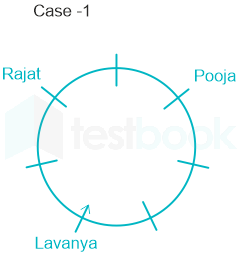
Rajat is sitting second to the left of Lavanya. One person is sitting between Pooja and Rajat. Three persons are sitting between Pooja and Kriti. Mahesh and Suman are immediately left of each other. Suman is not the immediate neighbour of Pooja. Narender sits second to the right of Kriti. The Immediate neighbours of Narender faces the same direction. Rajat and Kriti face opposite directions. Narender faces inside. No three persons facing the same direction sit together.
1

Who is sitting second to the left of the one who is sitting third to the left of Pooja?

  1. ((a))

    Mahesh

  2. ((b))

    Narender

  3. ((c))

    Rajat

  4. ((d))

    Kriti

  5. ((e))

    Suman

Show Answer
Answer: ((c))

Rajat

Seven persons Kriti, Lavanya, Mahesh, Narender, Pooja, Rajat, and Suman are sitting around a circular table.

Some of them are facing outside and some of them are facing inside the centre.

  1. Rajat is sitting second to the left of Layanya. One person is sitting between Pooja and Rajat.
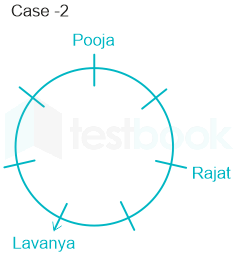
  1. Three persons are sitting between Pooja and Kriti. Mahesh and Suman are immediately left of each other. Suman is not the immediate neighbor of Pooja.
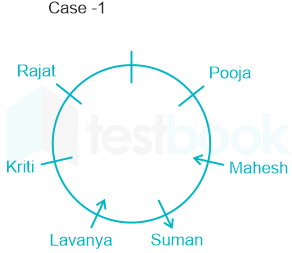
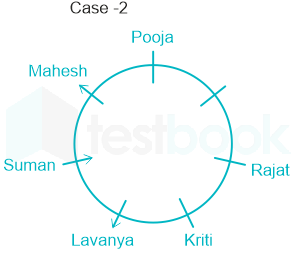
  1. Narender sits second to the right of Kriti. Rajat and Kriti face opposite directions. The immediate neighbor of Narender faces the same direction. Narender faces inside
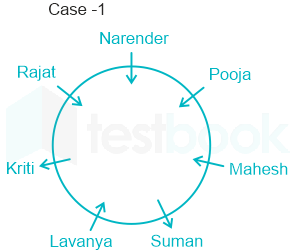
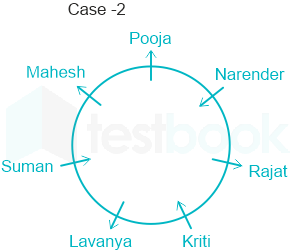
  1. No three persons facing the same direction sit together.

In Case 1, Narender, Rajat, Pooja, and Mahesh are facing the same direction. This contradicts the given condition. So, case 1 is eliminated.

The final arrangement is:
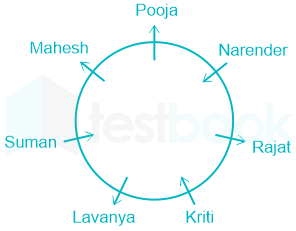
Hence, Rajat is sitting second to the left of the one sitting third to the left of Pooja.

2

Who are the immediate neighbours of Suman?

  1. ((a))

    Pooja, Rajat

  2. ((b))

    Narender, Kriti

  3. ((c))

    Rajat, Lavanya

  4. ((d))

    Mahesh, Lavanya

  5. ((e))

    Narender, Pooja

Show Answer
Answer: ((d))

Mahesh, Lavanya

Seven persons Kriti, Lavanya, Mahesh, Narender, Pooja, Rajat, and Suman are sitting around a circular table.

Some of them are facing outside and some of them are facing inside the centre.

  1. Rajat is sitting second to the left of Layanya. One person is sitting between Pooja and Rajat.

  1. Three persons are sitting between Pooja and Kriti. Mahesh and Suman are immediately left of each other. Suman is not the immediate neighbor of Pooja.
  1. Narender sits second to the right of Kriti. Rajat and Kriti face opposite directions. The immediate neighbor of Narender faces the same direction. Narender faces inside

  1. No three persons facing the same direction sit together.

In Case 1, Narender, Rajat, Pooja, and Mahesh are facing the same direction. This contradicts the given condition. So, case 1 is eliminated.

The final arrangement is:

Mahesh and Lavanya are the immediate neighbours of Suman.

3

Who is sitting just between Kriti and Narender ?

  1. ((a))

    Rajat

  2. ((b))

    Mahesh

  3. ((c))

    Suman

  4. ((d))

    Lavanya

  5. ((e))

    Pooja

Show Answer
Answer: ((a))

Rajat

Seven persons Kriti, Lavanya, Mahesh, Narender, Pooja, Rajat, and Suman are sitting around a circular table.

Some of them are facing outside and some of them are facing inside the centre.

  1. Rajat is sitting second to the left of Layanya. One person is sitting between Pooja and Rajat.

  1. Three persons are sitting between Pooja and Kriti. Mahesh and Suman are immediately left of each other. Suman is not the immediate neighbor of Pooja.
  1. Narender sits second to the right of Kriti. Rajat and Kriti face opposite directions. The immediate neighbor of Narender faces the same direction. Narender faces inside

  1. No three persons facing the same direction sit together.

In Case 1, Narender, Rajat, Pooja, and Mahesh are facing the same direction. This contradicts the given condition. So, case 1 is eliminated.

The final arrangement is:

Rajat is sitting between Kriti and Narender.

4

How many persons are facing inside?

  1. ((a))

    One 

  2. ((b))

    Two

  3. ((c))

    Three

  4. ((d))

    Four

  5. ((e))

    Five

Show Answer
Answer: ((c))

Three

Seven persons Kriti, Lavanya, Mahesh, Narender, Pooja, Rajat, and Suman are sitting around a circular table.

Some of them are facing outside and some of them are facing inside the centre.

  1. Rajat is sitting second to the left of Layanya. One person is sitting between Pooja and Rajat.

  1. Three persons are sitting between Pooja and Kriti. Mahesh and Suman are immediately left of each other. Suman is not the immediate neighbor of Pooja.
  1. Narender sits second to the right of Kriti. Rajat and Kriti face opposite directions. The immediate neighbor of Narender faces the same direction. Narender faces inside

  1. No three persons facing the same direction sit together.

In Case 1, Narender, Rajat, Pooja, and Mahesh are facing the same direction. This contradicts the given condition. So, case 1 is eliminated.

The final arrangement is:

Three persons are facing inside.

5

How many persons are sitting between Pooja and Lavanya when counted to the right of Pooja?

  1. ((a))

    One

  2. ((b))

    Two

  3. ((c))

    Three

  4. ((d))

    Four

  5. ((e))

    Five

Show Answer
Answer: ((c))

Three

Seven persons Kriti, Lavanya, Mahesh, Narender, Pooja, Rajat, and Suman are sitting around a circular table.

Some of them are facing outside and some of them are facing inside the centre.

  1. Rajat is sitting second to the left of Layanya. One person is sitting between Pooja and Rajat.

  1. Three persons are sitting between Pooja and Kriti. Mahesh and Suman are immediately left of each other. Suman is not the immediate neighbor of Pooja.
  1. Narender sits second to the right of Kriti. Rajat and Kriti face opposite directions. The immediate neighbor of Narender faces the same direction. Narender faces inside

  1. No three persons facing the same direction sit together.

In Case 1, Narender, Rajat, Pooja, and Mahesh are facing the same direction. This contradicts the given condition. So, case 1 is eliminated.

The final arrangement is:

Three persons are sitting between Pooja and Lavanya when counted to the right of Pooja

6

Find the odd one out from the given options:

  1. ((a))

    BEIN

  2. ((b))

    LOSX

  3. ((c))

    DGJN

  4. ((d))

    HKOT

  5. ((e))

    FIMR

Show Answer
Answer: ((c))

DGJN

The pattern followed here is:

  1. BEIN → B + 3 = E; E + 4 = I; I + 5 = N

  2. LOSX → L + 3 = O; O + 4 = S; S + 5 = X

  3. DGJN → D + 3 = G; G + 3 = J; J + 4 = N

  4. HKOT → H + 3 = K; K + 4 = O; O + 5 = T

  5. FIMR → F + 3 = I; I + 4 = M; M + 5 = R

Thus, DGJN does not fulfil the above condition. So, it is the odd one out from the given options.

7

If all the vowels of the word ‘UMBRELLA’ are changed to the letter which sits two positions behind in the English alphabetical series and all the consonants are changed to the letter which sits two positions ahead in the English alphabetical series, then the alphabets thus obtained are arranged in reverse order, starting from the left to the right, according to the English alphabetical series. Which of the following is the combination of letters that are second from the left end and second from the right end respectively of the newly formed rearranged sequence?

  1. ((a))

    CS

  2. ((b))

    NO

  3. ((c))

    YC

  4. ((d))

    NN

  5. ((e))

    TD

Show Answer
Answer: ((e))

TD

The word is ‘UMBRELLA’.

The vowels are shifted to two places behind and the consonants are shifted two places ahead in the English alphabetical series. The alphabets thus formed are then arranged in a reverse order according to the English alphabetical series. Hence, we get-

LETTERSUMBRELLA
CONSONANTS (C)/ VOWELS (V)VCCCVCCV
-2 IF V/+2 IF C-2+2+2+2-2+2+2-2
RESULTANT LETTERSODTCNNY
REARRANGEMENTYTSONNDC


The second letter from the left is T and the second letter from the right is D.

Hence, the correct combination of letters is TD.

Direction: Study the following information carefully and answer the questions given below:

Eight persons - F, G, H, I, J, K, L, and M were born in the years - 1951, 1960, 1965, 1971, 1975, 1982, 1987, and 1994 not necessarily in the same order. They were born on the same date i.e. on 1st February of these years. Make all the age calculations as of 1st February 2023.

F was aged twice as old as H. Two persons were younger than G but older than H. The number of persons older than I was twice as much as the number of persons older than L. K was born after 1980. Nobody was born between I and M.

8

In which of the following year was J born?

  1. ((a))

    1951

  2. ((b))

    1960

  3. ((c))

    1975

  4. ((d))

    ​1994

  5. ((e))

    Cannot be determined

Show Answer
Answer: ((b))

1960

Given:

Eight persons - F, G, H, I, J, K, L, and M

Eight years - 1951, 1960, 1965, 1971, 1975, 1982, 1987 and 1994

They were born on the same date i.e. on 1st February of these years.

Make all the age calculations as of 1st February 2023.

So, the ages of all the persons will be as follows -

YearAgePersons
195172
196063
196558
197152
197548
198241
198736
199429


Now,

1) F was aged twice as old as H. H's age can be 29 or 36 while F's age can be 58 or 72.

  1. Two persons were younger than G but older than H. 
YearAgeCase ICase II
195172F
196063
196558F
197152G
197548G
198241
198736H
199429H


3) The number of persons older than I was twice as much as the number of persons older than L.

4) Nobody was born between I and M.

YearAgeCase ICase II
195172F
196063
196558FL
197152LG
197548GI
198241MM
198736IH
199429H


5) K was born after 1980. This is not possible in Case I so it gets eliminated.

The final arrangement is -

YearAgeCase II
195172F
196063J
196558L
197152G
197548I
198241M
198736H
199429K


J was born in the year 1960.

Hence, the correct answer is 1960.

9

Who among the following was the youngest?

  1. ((a))

    J

  2. ((b))

    F

  3. ((c))

    H

  4. ((d))

    K

  5. ((e))

    None of these

Show Answer
Answer: ((d))

K

Given:

Eight persons - F, G, H, I, J, K, L, and M

Eight years - 1951, 1960, 1965, 1971, 1975, 1982, 1987 and 1994

They were born on the same date i.e. on 1st February of these years.

Make all the age calculations as of 1st February 2023.

So, the ages of all the persons will be as follows -

YearAgePersons
195172
196063
196558
197152
197548
198241
198736
199429


Now,

1) F was aged twice as old as H. H's age can be 29 or 36 while F's age can be 58 or 72.

  1. Two persons were younger than G but older than H. 
YearAgeCase ICase II
195172F
196063
196558F
197152G
197548G
198241
198736H
199429H


3) The number of persons older than I was twice as much as the number of persons older than L.

4) Nobody was born between I and M.

YearAgeCase ICase II
195172F
196063
196558FL
197152LG
197548GI
198241MM
198736IH
199429H


5) K was born after 1980. This is not possible in Case I so it gets eliminated.

The final arrangement is -

YearAgeCase II
195172F
196063J
196558L
197152G
197548I
198241M
198736H
199429K


K is the youngest among all.

Hence, the correct answer is K.

10

How many persons were born between F and L?

  1. ((a))

    None

  2. ((b))

    One

  3. ((c))

    Two

  4. ((d))

    Three

  5. ((e))

    More than three

Show Answer
Answer: ((b))

One

Given:

Eight persons - F, G, H, I, J, K, L, and M

Eight years - 1951, 1960, 1965, 1971, 1975, 1982, 1987 and 1994

They were born on the same date i.e. on 1st February of these years.

Make all the age calculations as of 1st February 2023.

So, the ages of all the persons will be as follows -

YearAgePersons
195172
196063
196558
197152
197548
198241
198736
199429


Now,

1) F was aged twice as old as H. H's age can be 29 or 36 while F's age can be 58 or 72.

  1. Two persons were younger than G but older than H. 
YearAgeCase ICase II
195172F
196063
196558F
197152G
197548G
198241
198736H
199429H


3) The number of persons older than I was twice as much as the number of persons older than L.

4) Nobody was born between I and M.

YearAgeCase ICase II
195172F
196063
196558FL
197152LG
197548GI
198241MM
198736IH
199429H


5) K was born after 1980. This is not possible in Case I so it gets eliminated.

The final arrangement is -

YearAgeCase II
195172F
196063J
196558L
197152G
197548I
198241M
198736H
199429K


One person was born between F and L.

Hence, the correct answer is One.

11

How many persons were younger than I?

  1. ((a))

    One

  2. ((b))

    Three

  3. ((c))

    Five

  4. ((d))

    Seven

  5. ((e))

    None of the above

Show Answer
Answer: ((b))

Three

Given:

Eight persons - F, G, H, I, J, K, L, and M

Eight years - 1951, 1960, 1965, 1971, 1975, 1982, 1987 and 1994

They were born on the same date i.e. on 1st February of these years.

Make all the age calculations as of 1st February 2023.

So, the ages of all the persons will be as follows -

YearAgePersons
195172
196063
196558
197152
197548
198241
198736
199429


Now,

1) F was aged twice as old as H. H's age can be 29 or 36 while F's age can be 58 or 72.

  1. Two persons were younger than G but older than H. 
YearAgeCase ICase II
195172F
196063
196558F
197152G
197548G
198241
198736H
199429H


3) The number of persons older than I was twice as much as the number of persons older than L.

4) Nobody was born between I and M.

YearAgeCase ICase II
195172F
196063
196558FL
197152LG
197548GI
198241MM
198736IH
199429H


5) K was born after 1980. This is not possible in Case I so it gets eliminated.

The final arrangement is -

YearAgeCase II
195172F
196063J
196558L
197152G
197548I
198241M
198736H
199429K


Three persons were younger than I.

Hence, the correct answer is Three.

12

Which of the following combination is correct?

  1. ((a))

    K - 1987

  2. ((b))

    L - 52 years

  3. ((c))

    M - 1982

  4. ((d))

    H - 29 years

  5. ((e))

    All are correct

Show Answer
Answer: ((c))

M - 1982

Given:

Eight persons - F, G, H, I, J, K, L, and M

Eight years - 1951, 1960, 1965, 1971, 1975, 1982, 1987 and 1994

They were born on the same date i.e. on 1st February of these years.

Make all the age calculations as of 1st February 2023.

So, the ages of all the persons will be as follows -

YearAgePersons
195172
196063
196558
197152
197548
198241
198736
199429


Now,

1) F was aged twice as old as H. H's age can be 29 or 36 while F's age can be 58 or 72.

  1. Two persons were younger than G but older than H. 
YearAgeCase ICase II
195172F
196063
196558F
197152G
197548G
198241
198736H
199429H


3) The number of persons older than I was twice as much as the number of persons older than L.

4) Nobody was born between I and M.

YearAgeCase ICase II
195172F
196063
196558FL
197152LG
197548GI
198241MM
198736IH
199429H


5) K was born after 1980. This is not possible in Case I so it gets eliminated.

The final arrangement is -

YearAgeCase II
195172F
196063J
196558L
197152G
197548I
198241M
198736H
199429K


Among the given options, only 'M - 1982' is correct.

Hence, the correct answer is M - 1982.

Direction: Study the following information carefully to answer the given questions.

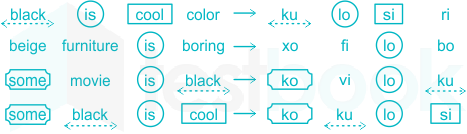
In a certain code language,

"black is cool color" is coded as "ku lo si ri"

"beige furniture is boring" is coded as "xo fi lo bo"

"some movie is black" is coded as "ko vi lo ku"

"some black is cool" is coded as "ko ku lo si"

13

What is the code for 'cool'

  1. ((a))

    si

  2. ((b))

    ku

  3. ((c))

    ko

  4. ((d))

    lo

  5. ((e))

    xo

Show Answer
Answer: ((a))

si

Given statement:

"black is cool color" is coded as "ku lo si ri"

"beige furniture is boring" is coded as "xo fi lo bo"

"some movie is black" is coded as "ko vi lo ku"

"some black is cool" is coded as "ko ku lo si"

We get:

is – lo

some - ko

black - ku

cool - si

The codes for ‘movie’, ' boring', and ‘color’ is determined by elimination, i.e. all the other codes in the sentence are determined:

movie - vi

color – ri

We can not clearly determine the codes for ‘beige’ and ‘furniture’:

beige – xo/fi/bo

furniture – xo/fi/bo

boring - xo/fi/bo

Hence, the code for 'cool' is si.

14

What does the code 'bo' mean?

  1. ((a))

    color

  2. ((b))

    boring

  3. ((c))

    movie

  4. ((d))

    beige

  5. ((e))

    Can not be determined

Show Answer
Answer: ((e))

Can not be determined

Given statement:

"black is cool color" is coded as "ku lo si ri"

"beige furniture is boring" is coded as "xo fi lo bo"

"some movie is black" is coded as "ko vi lo ku"

"some black is cool" is coded as "ko ku lo si"

We get:

is – lo

some - ko

black - ku

cool - si

The codes for ‘movie’, ' boring', and ‘color’ is determined by elimination, i.e. all the other codes in the sentence are determined:

movie - vi

color – ri

We can not clearly determine the codes for ‘beige’ and ‘furniture’:

beige – xo/fi/bo

furniture – xo/fi/bo

boring - xo/fi/bo

Hence, the code 'bo' can not be determined.

15

How will the sentence 'black is not cool' be coded as?

  1. ((a))

    ku lo xo bo

  2. ((b))

    ku ko ni bo

  3. ((c))

    ku lo ni si

  4. ((d))

    xo fi lo bo

  5. ((e))

    ku lo ko ni

Show Answer
Answer: ((c))

ku lo ni si

Given statement:

"black is cool color" is coded as "ku lo si ri"

"beige furniture is boring" is coded as "xo fi lo bo"

"some movie is black" is coded as "ko vi lo ku"

"some black is cool" is coded as "ko ku lo si"

We get:

is – lo

some - ko

black - ku

cool - si

The codes for ‘movie’, ' boring', and ‘color’ is determined by elimination, i.e. all the other codes in the sentence are determined:

movie - vi

color – ri

We can not clearly determine the codes for ‘beige’ and ‘furniture’:

beige – xo/fi/bo

furniture – xo/fi/bo

boring - xo/fi/bo


Since 'Not' is not given, we will go for a code that is not given in the information.

And we know, the codes for:

black - ku

is - lo

cool - si

Hence, the code for 'black is not cool' is ku lo ni si.

16

What is the code for 'movie'?

  1. ((a))

    lo

  2. ((b))

    ku

  3. ((c))

    bo

  4. ((d))

    vi

  5. ((e))

    ri

Show Answer
Answer: ((d))

vi

Given statement:

"black is cool color" is coded as "ku lo si ri"

"beige furniture is boring" is coded as "xo fi lo bo"

"some movie is black" is coded as "ko vi lo ku"

"some black is cool" is coded as "ko ku lo si"

We get:

is – lo

some - ko

black - ku

cool - si

The codes for ‘movie’, ' boring', and ‘color’ is determined by elimination, i.e. all the other codes in the sentence are determined:

movie - vi

color – ri

We can not clearly determine the codes for ‘beige’ and ‘furniture’:

beige – xo/fi/bo

furniture – xo/fi/bo

boring - xo/fi/bo

Hence, the code for 'movie' is vi.

17

What is the code for 'furniture'?

  1. ((a))

    lo

  2. ((b))

    fi

  3. ((c))

    bo

  4. ((d))

    xo

  5. ((e))

    Either option 2, 3 or 4

Show Answer
Answer: ((e))

Either option 2, 3 or 4

Given statement:

"black is cool color" is coded as "ku lo si ri"

"beige furniture is boring" is coded as "xo fi lo bo"

"some movie is black" is coded as "ko vi lo ku"

"some black is cool" is coded as "ko ku lo si"

We get:

is – lo

some - ko

black - ku

cool - si

The codes for ‘movie’, ' boring', and ‘color’ is determined by elimination, i.e. all the other codes in the sentence are determined:

movie - vi

color – ri

We can not clearly determine the codes for ‘beige’ and ‘furniture’:

beige – xo/fi/bo

furniture – xo/fi/bo

boring - xo/fi/bo

Since the code for furniture is not defined.

Hence, the code for furniture will either be fi or xo.

Direction: Study the following information carefully to answer the given questions.

A family of eight people – P, Q, R, S, T, W, X, and Z, from three generations live in a house. S, the daughter of Q, is married to the son of T. R is the son of X, who is married to T. Z has two daughters. Q is the grandfather of P. T is the mother of two sons. R is not married to S.

18

Who is the father of Z?

  1. ((a))

    R

  2. ((b))

    S

  3. ((c))

    T

  4. ((d))

    X

  5. ((e))

    W

Show Answer
Answer: ((d))

X

Given:

Eight people – P, Q, R, S, T, W, X, and Z

  1. S, the daughter of Q, is married to the son of T.

<br>
  1. R is the son of X, who is married to T.

  1. Z has two daughters.

  1. Q is the grandfather of P.

  1. T is the mother of two sons.

  1. R is not married to S.

Combining it all together:

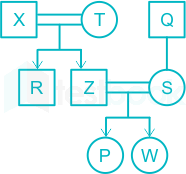
Hence, X is the father of Z.

19

Which of the following statements is/are correct?

I. There are four females in the family

II. R and Q are both male

III. S is the mother of P

IV. T is the mother-in-law of S

  1. ((a))

    Only Statements I and IV are correct

  2. ((b))

    Only Statements II and III are correct

  3. ((c))

    Only Statements I and III are correct

  4. ((d))

    All of the given statements are correct

  5. ((e))

    None of the given statements are correct

Show Answer
Answer: ((d))

All of the given statements are correct

Given:

Eight people – P, Q, R, S, T, W, X, and Z

  1. S, the daughter of Q, is married to the son of T.

<br>
  1. R is the son of X, who is married to T.

  1. Z has two daughters.

  1. Q is the grandfather of P.

  1. T is the mother of two sons.

  1. R is not married to S.

Combining it all together:

I. There are four females in the family - True

II. R and Q are both male - True

III. S is the mother of P - True

IV. T is the mother-in-law of S - True

Hence, the correct answer is Option 4.

20

Who is the daughter of T?

  1. ((a))

    P

  2. ((b))

    Q

  3. ((c))

    R

  4. ((d))

    Nobody

  5. ((e))

    Z

Show Answer
Answer: ((d))

Nobody

Given:

Eight people – P, Q, R, S, T, W, X, and Z

  1. S, the daughter of Q, is married to the son of T.

<br>
  1. R is the son of X, who is married to T.

  1. Z has two daughters.

  1. Q is the grandfather of P.

  1. T is the mother of two sons.

  1. R is not married to S.

Combining it all together:

T only has sons.

Hence, the correct answer is Option 4.

Direction: Study the given information carefully and answer the following questions.

There are six persons namely A, B, C, D, M and O are sitting in a row facing north direction but not necessarily in the same order. All have different age.

C sits 3rd from one of the end. The number of persons sitting right of the one who is 12 years old is same as the number of persons sitting to the left of D. D sits immediate left of C. O sits 2nd to the right of the one who is 6 years old. C is not 12 years old. Two persons sit between D and B, whose age is twice than D. M sits to the right of A. The one who is 36 years old sits 3rd to the left of the one who is 15 years old. The age of A is sum of D and O. The age of O is 18 year.

21

What is the age of A?

  1. ((a))

    30

  2. ((b))

    25

  3. ((c))

    24

  4. ((d))

    18

  5. ((e))

    36

Show Answer
Answer: ((c))

24

Six Persons: A, B, C, D, M and O

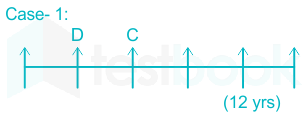
  1. C sits 3rd from one of the end.

  2. The number of persons sitting to the right of the one who is 12 years old is same as the number of persons sitting to the left of D

  3. D sits to the immediate left of C.

  4. C is not 12 years old.

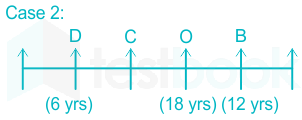
  1. Two persons sit between D and B, whose age is twice than D.

B is 12 years old.

B's age = 2 × D's age

D will be 6 years old.

  1. O sits 2nd to the right of the one who is 6 years old. The age of O is 18 years.

  1. M sits to the right of A.

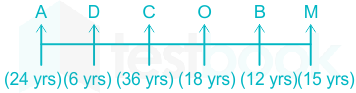
  2. The one who is 36 years old sits 3rd to the left of the one who is 15 years old.

So, C is 36 years old and M is 15 years old.

  1. The age of A is sum of D and O. The age of O is 18 year.

A's age = D's age + O’s age

A = 18 + 6 = 24 years

A’s age is 24 years.

22

What is the position of M with respect to O?

  1. ((a))

    Second to the right

  2. ((b))

    Third to the left

  3. ((c))

    Second to the left

  4. ((d))

    First to the right

  5. ((e))

    None of these

Show Answer
Answer: ((a))

Second to the right

Six Persons: A, B, C, D, M and O

  1. C sits 3rd from one of the end.

  2. The number of persons sitting to the right of the one who is 12 years old is same as the number of persons sitting to the left of D

  3. D sits to the immediate left of C.

  4. C is not 12 years old.

  1. Two persons sit between D and B, whose age is twice than D.

B is 12 years old.

B's age = 2 × D's age

D will be 6 years old.

  1. O sits 2nd to the right of the one who is 6 years old. The age of O is 18 years.

  1. M sits to the right of A.

  2. The one who is 36 years old sits 3rd to the left of the one who is 15 years old.

So, C is 36 years old and M is 15 years old.

  1. The age of A is sum of D and O. The age of O is 18 year.

A's age = D's age + O’s age

A = 18 + 6 = 24 years

 M is second to the right of O.

23

How many people are sitting between A and B?

  1. ((a))

    Two

  2. ((b))

    Three

  3. ((c))

    One

  4. ((d))

    More than three

  5. ((e))

    None of these

Show Answer
Answer: ((b))

Three

Six Persons: A, B, C, D, M and O

  1. C sits 3rd from one of the end.

  2. The number of persons sitting to the right of the one who is 12 years old is same as the number of persons sitting to the left of D

  3. D sits to the immediate left of C.

  4. C is not 12 years old.

  1. Two persons sit between D and B, whose age is twice than D.

B is 12 years old.

B's age = 2 × D's age

D will be 6 years old.

  1. O sits 2nd to the right of the one who is 6 years old. The age of O is 18 years.

  1. M sits to the right of A.

  2. The one who is 36 years old sits 3rd to the left of the one who is 15 years old.

So, C is 36 years old and M is 15 years old.

  1. The age of A is sum of D and O. The age of O is 18 year.

A's age = D's age + O’s age

A = 18 + 6 = 24 years

Three people are sitting between A and B namely D, C and O.

24

Who is sitting on the extreme right end?

  1. ((a))

    A

  2. ((b))

    C

  3. ((c))

    O

  4. ((d))

    B

  5. ((e))

    M

Show Answer
Answer: ((e))

M

Six Persons: A, B, C, D, M and O

  1. C sits 3rd from one of the end.

  2. The number of persons sitting to the right of the one who is 12 years old is same as the number of persons sitting to the left of D

  3. D sits to the immediate left of C.

  4. C is not 12 years old.

  1. Two persons sit between D and B, whose age is twice than D.

B is 12 years old.

B's age = 2 × D's age

D will be 6 years old.

  1. O sits 2nd to the right of the one who is 6 years old. The age of O is 18 years.

  1. M sits to the right of A.

  2. The one who is 36 years old sits 3rd to the left of the one who is 15 years old.

So, C is 36 years old and M is 15 years old.

  1. The age of A is sum of D and O. The age of O is 18 year.

A's age = D's age + O’s age

A = 18 + 6 = 24 years

 M is sitting on the extreme right end.

25

Who is 36 years old?

  1. ((a))

    A

  2. ((b))

    C

  3. ((c))

    M

  4. ((d))

    B

  5. ((e))

    D

Show Answer
Answer: ((b))

C

Six Persons: A, B, C, D, M and O

  1. C sits 3rd from one of the end.

  2. The number of persons sitting to the right of the one who is 12 years old is same as the number of persons sitting to the left of D

  3. D sits to the immediate left of C.

  4. C is not 12 years old.

  1. Two persons sit between D and B, whose age is twice than D.

B is 12 years old.

B's age = 2 × D's age

D will be 6 years old.

  1. O sits 2nd to the right of the one who is 6 years old. The age of O is 18 years.

  1. M sits to the right of A.

  2. The one who is 36 years old sits 3rd to the left of the one who is 15 years old.

So, C is 36 years old and M is 15 years old.

  1. The age of A is sum of D and O. The age of O is 18 year.

A's age = D's age + O’s age

A = 18 + 6 = 24 years

 C is 36 years old.

26

How many pair of letters are there in the word "LABIALISE" that has as many letters between them in the word as in the alphabet? (Both forward & backward direction)

  1. ((a))

    Two

  2. ((b))

    Four

  3. ((c))

    One

  4. ((d))

    Three

  5. ((e))

    More than four

Show Answer
Answer: ((b))

Four

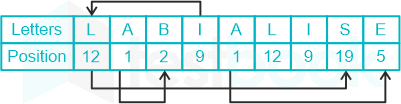
Given word: LABIALISE

The given word can be represented as follows,

Hence, we can see that 4 such pairs are there → Forward: LS, AB, AE; Backward: IL

So, the answer is 4 pairs.

27

If it is possible to make only one 4 letters meaningful word without repetition of the letter with the third, fifth, seventh and ninth letters of the word 'STEADFAST', which would be the second letter of the word from the left? If more than one such word can be formed, give X as the answer. If no such word can be formed, give K as your answer.

  1. ((a))

    X

  2. ((b))

    T

  3. ((c))

    A

  4. ((d))

    K

  5. ((e))

    None of these

Show Answer
Answer: ((c))

A

Given word is: STEADFAST

The third, fifth, seventh and ninth letter is: E, D, A and T

A meaningful word from this is - DATE

Only one meaningful word can be formed.

Clearly, A is the second letter from the left.

Hence, the correct answer is "A".

Directions: Read the instructions carefully and answer the question below:

Six boxes A, B, C, D, E and F are stacked one above the other but not necessarily in the same order. Six items Helmet, Medicines, Ropes, Safety Jackets, Torch lights and Water bottles are kept in each of the boxes but not necessarily in the same order. The position of boxes is numbered 1 to 6, bottommost position being numbered 1.

Box A contains Ropes and is placed on an even numbered position. One box is placed between Box A and Box D. Torch lights are placed in the topmost box. Box containing Safety Jackets is kept at the position which is numbered as even prime number. Box C is kept at the bottommost position. Safety jackets are not kept in box D. Box E which contains Medicines is kept below the box which contains Water bottles. Box B does not contain Safety Jackets.

28

What item is kept in Box C?

  1. ((a))

    Water bottles

  2. ((b))

    Safety jackets

  3. ((c))

    Medicines

  4. ((d))

    Helmets 

  5. ((e))

    Ropes

Show Answer
Answer: ((d))

Helmets 

Six boxes: A, B, C, D, E and F

Six items: Helmet, Medicines, Ropes, Safety Jackets, Torch lights and Water bottles

Boxes: (bottommost) 1 to 6 (topmost)

i) Box A contains Ropes and is placed on an even numbered position.

ii) Box containing Safety Jackets is kept at the position which is numbered as even prime number.

iii) Torch lights are placed in the topmost box.

BoxItem
6Torch lights
5
4Box ARopes
3
2Safety Jackets
1


iv) One box is placed between Box A and Box D.

v) Box C is kept at the bottommost position.

vi) Safety jackets are not kept in box D.

BoxItem
6Box DTorch lights
5
4Box ARopes
3
2Safety Jackets
1Box C


vii) Box E which contains Medicines is kept below the box which contains Water bottles.

viii) Box B does not contain Safety Jackets.

BoxItem
6Box DTorch lights
5Box BWater bottles
4Box ARopes
3Box EMedicines
2Box FSafety Jackets
1Box CHelmets
<br>

Hence, item Helmets is kept in Box C.

29

How many boxes are kept between the boxes which contains Water bottles and Safety Jackets?

  1. ((a))

    Four

  2. ((b))

    Two

  3. ((c))

    One

  4. ((d))

    None

  5. ((e))

    Three

Show Answer
Answer: ((b))

Two

Six boxes: A, B, C, D, E and F

Six items: Helmet, Medicines, Ropes, Safety Jackets, Torch lights and Water bottles

Boxes: (bottommost) 1 to 6 (topmost)

i) Box A contains Ropes and is placed on an even numbered position.

ii) Box containing Safety Jackets is kept at the position which is numbered as even prime number.

iii) Torch lights are placed in the topmost box.

BoxItem
6Torch lights
5
4Box ARopes
3
2Safety Jackets
1


iv) One box is placed between Box A and Box D.

v) Box C is kept at the bottommost position.

vi) Safety jackets are not kept in box D.

BoxItem
6Box DTorch lights
5
4Box ARopes
3
2Safety Jackets
1Box C


vii) Box E which contains Medicines is kept below the box which contains Water bottles.

viii) Box B does not contain Safety Jackets.

BoxItem
6Box DTorch lights
5Box BWater bottles
4Box ARopes
3Box EMedicines
2Box FSafety Jackets
1Box CHelmets
<br>

Hence, two boxes are kept between the boxes which contains Water bottles and Safety Jackets.

30

How many boxes are kept between box B and box E?

  1. ((a))

    Four

  2. ((b))

    Two

  3. ((c))

    One

  4. ((d))

    None

  5. ((e))

    Three

Show Answer
Answer: ((c))

One

Six boxes: A, B, C, D, E and F

Six items: Helmet, Medicines, Ropes, Safety Jackets, Torch lights and Water bottles

Boxes: (bottommost) 1 to 6 (topmost)

i) Box A contains Ropes and is placed on an even numbered position.

ii) Box containing Safety Jackets is kept at the position which is numbered as even prime number.

iii) Torch lights are placed in the topmost box.

BoxItem
6Torch lights
5
4Box ARopes
3
2Safety Jackets
1


iv) One box is placed between Box A and Box D.

v) Box C is kept at the bottommost position.

vi) Safety jackets are not kept in box D.

BoxItem
6Box DTorch lights
5
4Box ARopes
3
2Safety Jackets
1Box C


vii) Box E which contains Medicines is kept below the box which contains Water bottles.

viii) Box B does not contain Safety Jackets.

BoxItem
6Box DTorch lights
5Box BWater bottles
4Box ARopes
3Box EMedicines
2Box FSafety Jackets
1Box CHelmets
<br>

Hence, one box is kept between box B and box E.

31

Which item is placed in box D?

  1. ((a))

    Water bottles

  2. ((b))

    Safety jackets

  3. ((c))

    Torch lights

  4. ((d))

    Helmets 

  5. ((e))

    Ropes

Show Answer
Answer: ((c))

Torch lights

Six boxes: A, B, C, D, E and F

Six items: Helmet, Medicines, Ropes, Safety Jackets, Torch lights and Water bottles

Boxes: (bottommost) 1 to 6 (topmost)

i) Box A contains Ropes and is placed on an even numbered position.

ii) Box containing Safety Jackets is kept at the position which is numbered as even prime number.

iii) Torch lights are placed in the topmost box.

BoxItem
6Torch lights
5
4Box ARopes
3
2Safety Jackets
1


iv) One box is placed between Box A and Box D.

v) Box C is kept at the bottommost position.

vi) Safety jackets are not kept in box D.

BoxItem
6Box DTorch lights
5
4Box ARopes
3
2Safety Jackets
1Box C


vii) Box E which contains Medicines is kept below the box which contains Water bottles.

viii) Box B does not contain Safety Jackets.

BoxItem
6Box DTorch lights
5Box BWater bottles
4Box ARopes
3Box EMedicines
2Box FSafety Jackets
1Box CHelmets
<br>

Hence, a torch light is placed in box D.

32

Which of the following combination is correct?

  1. ((a))

    Box A – Medicines

  2. ((b))

    Box F – Helmets

  3. ((c))

    Box B – Ropes

  4. ((d))

    Box E – Safety Jackets 

  5. ((e))

    Box D – Torch lights

Show Answer
Answer: ((e))

Box D – Torch lights

Six boxes: A, B, C, D, E and F

Six items: Helmet, Medicines, Ropes, Safety Jackets, Torch lights and Water bottles

Boxes: (bottommost) 1 to 6 (topmost)

i) Box A contains Ropes and is placed on an even numbered position.

ii) Box containing Safety Jackets is kept at the position which is numbered as even prime number.

iii) Torch lights are placed in the topmost box.

BoxItem
6Torch lights
5
4Box ARopes
3
2Safety Jackets
1


iv) One box is placed between Box A and Box D.

v) Box C is kept at the bottommost position.

vi) Safety jackets are not kept in box D.

BoxItem
6Box DTorch lights
5
4Box ARopes
3
2Safety Jackets
1Box C


vii) Box E which contains Medicines is kept below the box which contains Water bottles.

viii) Box B does not contain Safety Jackets.

BoxItem
6Box DTorch lights
5Box BWater bottles
4Box ARopes
3Box EMedicines
2Box FSafety Jackets
1Box CHelmets
<br>

Here, in each pair the box is followed by the item placed immediately below it, except ‘Box D – Torch lights ‘.

Hence**, ‘Box D – Torch lights’** is correct.

Directions: Read the following information carefully and answer the questions.

Seven persons – Y, F, B, R, X, E, and S went to the same library and read different number of articles in one day. Only one person reads more articles than R. S reads more articles than Y but less than R. B reads the least number of articles. The number of persons who read more articles than Y is equal to the number of persons who read less articles than Y. Only one person reads less articles than E. S reads 10 articles. F reads more than E but less than Y.

33

Who reads the fourth highest number of articles?

  1. ((a))

    F

  2. ((b))

    E

  3. ((c))

    R

  4. ((d))

    Y

  5. ((e))

    S

Show Answer
Answer: ((d))

Y

Given: Seven persons read different number of articles in a particular day.

Based on the given conditions, we get the following possibilities-

  1. Only one person reads more articles than R. The number of persons who read more articles than Y is equal to the number of persons who read less articles than Y. From these, we get-
PERSONARTICLES READ/DAY
R
Y


  1. S reads more articles than Y but less than R. S reads 10 articles. From these, we get-
PERSONARTICLES READ/DAY
R
S10
Y


  1. Only one person reads less articles than E. B reads the least number of articles. F reads more than E but less than Y. From these, we get the final table as follows-
PERSONARTICLES READ/DAY
X
R
S10
Y
F
E
B


From the above final table, we see that person Y read the fourth highest number of articles in a day.

Hence, person Y read the fourth highest.

34

What is the possible number of articles read by F? 

  1. ((a))

    14

  2. ((b))

    13

  3. ((c))

    18

  4. ((d))

    17

  5. ((e))

    7

Show Answer
Answer: ((e))

7

Given: Seven persons read different number of articles in a particular day.

Based on the given conditions, we get the following possibilities-

  1. Only one person reads more articles than R. The number of persons who read more articles than Y is equal to the number of persons who read less articles than Y. From these, we get-
PERSONARTICLES READ/DAY
R
Y


  1. S reads more articles than Y but less than R. S reads 10 articles. From these, we get-
PERSONARTICLES READ/DAY
R
S10
Y


  1. Only one person reads less articles than E. B reads the least number of articles. F reads more than E but less than Y. From these, we get the final table as follows-
PERSONARTICLES READ/DAY
X
R
S10
Y
F
E
B


From the above final table, we see that F reads less articles than S.

Hence, the possible number of articles read by F is 7.

35

If Y reads 8 articles then what is the average number of articles read by S and Y?

  1. ((a))

    6

  2. ((b))

    12

  3. ((c))

    9

  4. ((d))

    10

  5. ((e))

    8

Show Answer
Answer: ((c))

9

Given: Seven persons read different number of articles in a particular day.

Based on the given conditions, we get the following possibilities-

  1. Only one person reads more articles than R. The number of persons who read more articles than Y is equal to the number of persons who read less articles than Y. From these, we get-
PERSONARTICLES READ/DAY
R
Y


  1. S reads more articles than Y but less than R. S reads 10 articles. From these, we get-
PERSONARTICLES READ/DAY
R
S10
Y


  1. Only one person reads less articles than E. B reads the least number of articles. F reads more than E but less than Y. From these, we get the final table as follows-
PERSONARTICLES READ/DAY
X
R
S10
Y
F
E
B


From the above final table, we see that if Y reads 8 articles and S reads 10 articles, then their average number of articles read per day is 9.

Hence, the required average is 9.

English Language (30 questions)

Read the passage given below and then answer the questions given below the passage.

Psychology has always been a fascinating field that explores the intricacies of the human mind and behaviour. One particular area of study that has garnered considerable attention is the performance of women in various domains, especially in professional and academic settings. Recent research suggests that women often perform better than men under certain conditions, and this observation has led to intriguing insights within the context of psychology. The idea that women might excel in specific areas is not just a modern concept but has historical roots as well. Traditionally, women were thought to be suited for roles that required patience, meticulous planning, and empathy. These attributes, when analyzed through the lens of contemporary psychology, provide a compelling explanation for why women frequently outperform their male counterparts in environments that demand these traits. For example, women tend to excel in tasks that involve multitasking, detailed planning, and long-term strategizing. This is often attributed to their ability to lay a solid foundation of organizational skills and emotional intelligence. One psychological theory that explains this phenomenon involves the different approaches women and men take when it comes to problem-solving and decision-making. Studies have shown that women are more likely to adopt a collaborative approach, seeking input from others and considering multiple perspectives. This tendency not only fosters a more inclusive environment but also leads to more well-rounded and effective solutions. In contrast, men are more prone to taking a direct and solitary approach, which, while efficient in certain situations, may not always yield the best results. Another interesting element to consider is the concept of stress and its impact on performance. Psychological research indicates that women and men handle stress differently. Women, in general, are more likely to employ coping strategies that involve seeking social support, which can mitigate the negative effects of stress. This social approach to stress management enables them to maintain high levels of performance even under pressure. Men, on the other hand, might resort to more individualistic strategies that don't offer the same level of relief and, as a consequence, might find their performance hindered when faced with high-stress situations. Moreover, the role of societal expectations and cultural norms cannot be overlooked. For years, women have had to navigate through systems and structures that were predominantly designed with men in mind. This has necessitated not only adaptability but also a higher degree of effort and competence to succeed. As a result, women often develop a resilience and a set of skills that directly contribute to their exceptional performance. This resilience is evidenced by their persistence and ability to excel even in the face of adversity. In addition, psychological studies highlight the importance of education and upbringing. From a young age, girls are often encouraged to excel academically and work diligently to prove their capabilities. This early encouragement to lay strong academic foundations can translate into ________ performance in higher education and professional environments. Furthermore, the increase in female role models in various industries provides ongoing motivation and proof that high achievement is within reach. In conclusion, the superior performance of women in various domains can be attributed to a blend of innate psychological traits, effective stress management strategies, societal and cultural influences, and early education. By fostering an environment where both men and women can play to their strengths, we can create a more equitable and productive society. The insights gained from psychology not only help us understand these dynamics but also lay the groundwork for promoting sustained success across genders.

36

According to the passage, which attribute is often linked to women’s superior performance in environments that demand patience, meticulous planning, and empathy?

  1. ((a))

    Physical strength

  2. ((b))

    Technical skills

  3. ((c))

    Organizational skills

  4. ((d))

    Risk-taking behaviour

  5. ((e))

    Competitive nature

Show Answer
Answer: ((c))

Organizational skills

The correct answer is Option 3.


Key Points

  • The passage highlights the importance of specific attributes linked to women’s performance in environments demanding patience, meticulous planning, and empathy.
  • Organizational skills are identified as one of the main contributing factors to this superior performance.
  • Women’s ability to excel in multitasking, detailed planning, and long-term strategizing is emphasized.
  • These traits are anchored in the context of contemporary psychology and historical perspectives.

Therefore, the correct answer is Organizational skills.


Additional Information

  • Physical strength – This attribute is not associated with the performance context described in the passage.
  • Technical skills – While valuable, this is not the focus of the passage regarding women’s superior performance.
  • Risk-taking behaviour – This is indirectly mentioned, but not cited as a primary factor in women's superior performance.
  • Competitive nature – Not highlighted as a key attribute in the given context for women’s performance.
37

The passage states that women are more likely to adopt which approach to problem-solving and decision-making?

  1. ((a))

    Aggressive

  2. ((b))

    Collaborative

  3. ((c))

    Solitary

  4. ((d))

    Competitive

  5. ((e))

    Hierarchical

Show Answer
Answer: ((b))

Collaborative

The correct answer is Option 2.


Key Points

  • The passage mentions that women are more likely to adopt a collaborative approach to problem-solving and decision-making.
  • This approach involves seeking input from others and considering multiple perspectives.
  • The collaborative approach fosters a more inclusive environment and leads to more well-rounded and effective solutions.
  • In contrast, men are described as more prone to taking a direct and solitary approach.

Therefore, the correct answer is Collaborative.


Additional Information

  • Aggressive – This approach is not mentioned in the passage as characteristic of women's problem-solving style.
  • Solitary – This approach is described as more typical of men, not women.
  • Competitive – Not highlighted in the context of the problem-solving and decision-making approaches of women.
  • Hierarchical – This approach is not discussed in the passage in relation to women's decision-making style.
38

Which of the following sentence(s) can be inferred from the passage?

A. Women are generally better at stress management than men because they seek social support.

B. Men’s performance improvement methods under stress are less effective compared to women’s methods.

C. Societal expectations have consistently favoured women in professional and academic settings.

  1. ((a))

    Only A

  2. ((b))

    Only B

  3. ((c))

    Only C

  4. ((d))

    Both A and B

  5. ((e))

    All A, B, and C

Show Answer
Answer: ((d))

Both A and B

The correct answer is 'Option 4'.


Key Points

  • A. Women are generally better at stress management than men because they seek social support.
  • This can be inferred from the passage. The passage explains that women often seek social support to manage stress, which helps them maintain high performance levels.
  • B. Men’s performance improvement methods under stress are less effective compared to women’s methods.
  • This can be inferred from the passage. The passage states that men tend to use individualistic strategies under stress, which may not provide as much relief and could hinder their performance.
  • C. Societal expectations have consistently favoured women in professional and academic settings.
  • This cannot be inferred from the passage. In fact, the passage suggests that women have had to adapt and work harder in systems predominantly designed with men in mind.

Therefore, the correct answer is Both A and B.


Additional Information

  • Only A: Incorrect because both A and B can be inferred from the passage.
  • Only B: Incorrect because both A and B can be inferred from the passage.
  • Only C: Incorrect because C cannot be inferred from the passage.
  • All A, B, and C: Incorrect because C cannot be inferred from the passage.
39

What will fit in the blank taken from the passage: ‘This early encouragement to lay strong academic foundations can translate into ________ performance in higher education and professional environments’?

  1. ((a))

    average

  2. ((b))

    exceptional

  3. ((c))

    mediocre

  4. ((d))

    subpar

  5. ((e))

    trivial

Show Answer
Answer: ((b))

exceptional

The correct answer is 'exceptional'.


Key Points

  • The passage discusses how early encouragement in academics can lead to performance in higher education and professional environments.
  • The appropriate adjective should describe a high level of performance resulting from this early encouragement.
  • "Exceptional" fits well as it denotes a very high level of performance, which aligns with the context of the passage.
  • Other options ("average", "mediocre", "subpar", "trivial") do not fit the context of describing high achievement in education and professional environments.

Therefore, the correct answer is 'Option 2'.


Complete Passage: This early encouragement to lay strong academic foundations can translate into exceptional performance in higher education and professional environments.


Additional Information

  • Average: "Average" means a typical or normal level, which does not reflect the high achievement discussed in the passage.
  • Mediocre: "Mediocre" means of only moderate quality, not very good, which doesn't align with describing strong performance.
  • Subpar: "Subpar" means below an average level, which is not fitting for describing high achievement in the given context.
  • Trivial: "Trivial" means of little value or importance, which does not describe significant achievement or performance.
40

According to the passage, which of the following statements is incorrect?

A) Women tend to adopt a direct and solitary approach to decision-making.

B) Cultural norms have necessitated higher levels of resilience in women.

C) Emotional intelligence is a key factor in women’s ability to multitask effectively.

  1. ((a))

    Only A

  2. ((b))

    Only B

  3. ((c))

    Only C

  4. ((d))

    A and B

  5. ((e))

    A and C

Show Answer
Answer: ((a))

Only A

The correct answer is Option 1.


Key Points

  • Statement A: Women tend to adopt a direct and solitary approach to decision-making.
  • This statement is incorrect as the passage states that women generally adopt a collaborative approach to decision-making.
  • Statement B: Cultural norms have necessitated higher levels of resilience in women.
  • This statement is correct as it aligns with the context provided in the passage.
  • Statement C: Emotional intelligence is a key factor in women’s ability to multitask effectively.
  • This statement is correct as it accurately reflects the context provided in the passage.
  • Hence, the statement A is identified as incorrect in the context of the passage.

Therefore, the correct answer is: ‘Only A’.

41

According to the passage, which of the following statements is correct?

A) Women generally perform less well under stress than men.

B) Women’s performance superiority is solely a modern phenomenon.

C) Resilience developed by women often contributes to their exceptional performance.

  1. ((a))

    Only A

  2. ((b))

    Only B

  3. ((c))

    Only C

  4. ((d))

    A and B

  5. ((e))

    B and C

Show Answer
Answer: ((c))

Only C

The correct answer is Option 3.


Key Points

  • Statement A: Women generally perform less well under stress than men.
  • This statement is incorrect because the passage explains that women often handle stress better due to their tendency to seek social support.
  • Statement B: Women’s performance superiority is solely a modern phenomenon.
  • This statement is incorrect as the passage states that the idea of women excelling in specific areas has historical roots.
  • Statement C: Resilience developed by women often contributes to their exceptional performance.
  • This statement is correct because the passage mentions that resilience, developed through navigating systems and structures, contributes to women’s exceptional performance.
  • Hence, the statement C is identified as correct in the context of the passage.

Therefore, the correct answer is: ‘Only C’.

42

According to the passage, which of the following statements is correct?

A) Men are more likely to employ collaborative approaches in problem-solving.

B) Societal expectations have historically influenced women’s performance.

C) Early educational encouragement has no effect on girls' professional success.

  1. ((a))

    Only A

  2. ((b))

    Only B

  3. ((c))

    Only C

  4. ((d))

    A and B

  5. ((e))

    B and C

Show Answer
Answer: ((b))

Only B

The correct answer is Option 2.


Key Points

  • Statement A: Men are more likely to employ collaborative approaches in problem-solving.
  • This statement is incorrect because the passage states that women are more likely to adopt collaborative approaches, whereas men are more prone to taking direct and solitary approaches.
  • Statement B: Societal expectations have historically influenced women’s performance.
  • This statement is correct as the passage mentions that women have had to navigate through systems and structures designed with men in mind, necessitating adaptability and higher competence.
  • Statement C: Early educational encouragement has no effect on girls' professional success.
  • This statement is incorrect because the passage highlights the importance of early educational encouragement in laying strong academic foundations, which can translate into higher performance in professional environments.
  • Hence, the statement B is identified as correct in the context of the passage.

Therefore, the correct answer is: ‘Only B’.

43

According to the passage, which of the following statements is incorrect?

A) Men tend to perform better when they employ individualistic strategies under stress.

B) Women often excel in environments that involve multitasking and detailed planning.

C) Societal expectations have always favoured women's superior performance in all areas.

  1. ((a))

    Only A

  2. ((b))

    Only B

  3. ((c))

    Only C

  4. ((d))

    A and C

  5. ((e))

    B and C

Show Answer
Answer: ((d))

A and C

The correct answer is Option 4.


Key Points

  • Statement A: Men tend to perform better when they employ individualistic strategies under stress.
  • This statement is incorrect because the passage mentions that men might find their performance hindered when they resort to individualistic strategies under stress.
  • Statement B: Women often excel in environments that involve multitasking and detailed planning.
  • This statement is correct according to the passage.
  • Statement C: Societal expectations have always favoured women's superior performance in all areas.
  • This statement is incorrect because the passage notes that women have had to navigate through systems and structures predominantly designed for men, which implies that societal expectations did not always favor women's performance.
  • Hence, the statements A and C are identified as incorrect in the context of the passage.

Therefore, the correct answer is: ‘A and C’.

44

Which of the following words is similar in meaning to “lay” as used in the passage?

  1. ((a))

    settle

  2. ((b))

    lift

  3. ((c))

    establish

  4. ((d))

    disturb

  5. ((e))

    remove

Show Answer
Answer: ((c))

establish

The correct answer is: Option 3.

Key Points

  • The word "lay" means to put something down or to set a foundation for something. (रखना / आधार बनाना)
  • Example: They need to lay the groundwork for the new project before moving forward.
  • "establish" means to set up or create something on a firm or permanent basis. (स्थापित करना)
  • Example: She managed to establish a successful career in the tech industry.

Therefore, the correct answer is: establish.

Additional Information

Here are the other options explained along with their Hindi meanings and example sentences:

  • Settle (बसाना): To resolve or reach an agreement about something.
  • Example: They decided to settle their differences through conversation.
  • Lift (उठाना): To raise to a higher position or level.
  • Example: Can you lift that box for me?
  • Disturb (परेशान करना): To interrupt the quiet, rest, or peace of something.
  • Example: Please do not disturb the meeting.
  • Remove (हटाना): To take something away or off from the position occupied.
  • Example: You need to remove the old files from the computer.
45

Which of the following words is opposite in meaning to “approach” as used in the passage?

  1. ((a))

    method

  2. ((b))

    distance

  3. ((c))

    exit

  4. ((d))

    process

  5. ((e))

    avoidance

Show Answer
Answer: ((e))

avoidance

The correct answer is: Option 5'.

Key Points

  • The word "approach" means to come near or closer to something or someone in terms of distance, method, or time. (निकट आना / तरीका)
  • Example: The new approach to teaching has shown significant improvements in student outcomes.
  • "avoidance" means the action of keeping away from or not doing something. (बचाव / टालना)
  • Example: His avoidance of difficult tasks led to more problems in the long run.

Therefore, the correct answer is: avoidance.

Additional Information

Here are the other options explained along with their Hindi meanings and example sentences:

  • Method (तरीका): A particular procedure for accomplishing or approaching something.
  • Example: We need a new method to solve this problem.
  • Distance (दूरी): The amount of space between two places or points.
  • Example: The distance between the two cities is about 200 miles.
  • Exit (बाहर निकलना): A way out of a place or situation.
  • Example: Please find the nearest exit in case of an emergency.
  • Process (प्रक्रिया): A series of actions or steps taken in order to achieve a particular end.
  • Example: The process of applying for a visa can be quite complex.
46

Direction: Evaluate the following word, accompanied by three sentences containing it. Determine the sentence(s) that accurately convey the meaning of the given word.

Come up

A. She managed to come up with a brilliant solution during the meeting.

B. The old house's pipes need to be come up due to leaks.

C. Every time I talk to him, new topics come up in our conversation.

  1. ((a))

    Only A

  2. ((b))

    Both A & C

  3. ((c))

    Only B

  4. ((d))

    All A, B & C

  5. ((e))

    None of these

Show Answer
Answer: ((b))

Both A & C

The correct answer is option 2.

Key Points

  • To answer this question, let's first understand the meaning of the word given in the question:
  • Come up: to arise or be mentioned in conversation; to think of or devise (something, such as an idea or solution). (उद्भव होना, चर्चा में आना, किसी विचार या समाधान के साथ आना)
  • Now, let's examine the given sentences:
  • Sentence A: She managed to come up with a brilliant solution during the meeting.
  • This sentence correctly uses the phrase "come up" to describe devising a solution.
  • Sentence B: The old house's pipes need to be come up due to leaks.
  • This sentence incorrectly uses the phrase "come up". It should refer to fixing or replacing the pipes.
  • Sentence C: Every time I talk to him, new topics come up in our conversation.
  • This sentence correctly uses the phrase "come up" to describe new topics arising in conversation.
  • So, only sentences A and C correctly use the phrase ""come up" to illustrate different contexts of devising ideas or arising in conversation.

Therefore, the correct answer is "Both A & C."

47

Direction: Evaluate the following word, accompanied by three sentences containing it. Determine the sentence(s) that accurately convey the meaning of the given word.

Get across

A. The teacher struggled to get across the complex ideas to the students.

B. The cat managed to get across the busy street safely.

C. They get across the river by using a small boat.

  1. ((a))

    Only A

  2. ((b))

    Both A & B

  3. ((c))

    Only C

  4. ((d))

    All A, B & C

  5. ((e))

    None of these

Show Answer
Answer: ((d))

All A, B & C

The correct answer is option 4.

Key Points

  • To answer this question, let's first understand the meaning of the word given in the question:
  • Get across: to successfully communicate or convey (something); to move from one side to the other. (समझाना, एक ओर से दूसरी ओर जाना)
  • Now, let's examine the given sentences:
  • Sentence A: The teacher struggled to get across the complex ideas to the students.
  • This sentence correctly uses the phrase "get across" to describe the act of communicating ideas effectively.
  • Sentence B: The cat managed to get across the busy street safely.
  • This sentence also correctly uses the phrase "get across" to describe moving from one side of the street to the other.
  • Sentence C: They get across the river by using a small boat.
  • This sentence accurately uses the phrase "get across" to describe moving from one side of the river to the other.
  • So, all three sentences correctly use the phrase ""get across" to illustrate different contexts of communicating or moving across.

Therefore, the correct answer is "All A, B, and C."

48

Direction: Evaluate the following word, accompanied by three sentences containing it. Determine the sentence(s) that accurately convey the meaning of the given word.

Check out

A. We decided to check out the new restaurant downtown.

B. She asked the librarian if she could check out the latest mystery novel.

C. The hotel asked guests to check out by noon.

  1. ((a))

    Only A

  2. ((b))

    Both A & C

  3. ((c))

    Only B

  4. ((d))

    All A, B & C

  5. ((e))

    None of these

Show Answer
Answer: ((d))

All A, B & C

The correct answer is option 4.

Key Points

  • To answer this question, let's first understand the meaning of the word given in the question:
  • Check out: to examine or look at something; to borrow a book from a library; to leave and pay for a hotel stay. (जाँच करना, पुस्तक उधार लेना, होटल से चेक-आउट करना)
  • Now, let's examine the given sentences:
  • Sentence A: We decided to check out the new restaurant downtown.
  • This sentence correctly uses the phrase "check out" to describe the act of examining or trying out the new restaurant.
  • Sentence B: She asked the librarian if she could check out the latest mystery novel.
  • This sentence also correctly uses the phrase "check out" to describe borrowing a book from the library.
  • Sentence C: The hotel asked guests to check out by noon.
  • This sentence accurately uses the phrase "check out" to describe the process of leaving and paying for a hotel stay.
  • So, all three sentences correctly use the phrase ""check out" to illustrate different contexts of examining, borrowing, or leaving.

Therefore, the correct answer is "All A, B, and C."

49

In question below a sentence with four words printed in bold type is given. These are lettered (A), (B), (C) and (D). One of these four words printed in bold may be either wrongly spelt or inappropriate in the context of the sentence. Find out the word, which is wrongly spelt or inappropriate, if any. The letter of that word is your answer. If all the words printed in bold are correctly spelt and also appropriate in the context of the sentence mark (E)i.e., all correct as your answer.

She shade(A) tears as if to display her grief(B), but they were not a genuine(C) expression(D) of sorrow. All correct(E)

  1. ((a))

    A

  2. ((b))

    B

  3. ((c))

    C

  4. ((d))

    D

  5. ((e))

    E

Show Answer
Answer: ((a))

A

The correct option is 'A' as it should be "shed tears" which means to cry, instead of "shade tears" which has no meaning. ‘Shade’ means ‘shadow’ and bears no relation to tears.

50

In question below a sentence with four words printed in bold type is given. These are lettered (A), (B), (C) and (D). One of these four words printed in bold may be either wrongly spelt or inappropriate in the context of the sentence. Find out the word, which is wrongly spelt or inappropriate, if any. The letter of that word is your answer. If all the words printed in bold are correctly spelt and also appropriate in the context of the sentence mark (E) i.e., all correct as your answer.

The messanger’s(A) story that appeared(B) incredible(C) has turned out(D)to be true. All correct(E)

  1. ((a))

    A

  2. ((b))

    B

  3. ((c))

    C

  4. ((d))

    D

  5. ((e))

    E

Show Answer
Answer: ((a))

A

"Messanger's" is an incorrect spelling. The correct spelling is 'messenger's'.

51

In the following question, each sentence is provided with four words in bold. These are lettered (A), (B), (C) and (D). One of these four words may either be wrongly spelt or inappropriately used. Find the wrong word, if any. The letter with which that word is marked, is the answer. If all the words printed in bold are correctly spelt and also appropriate in the context of the sentence mark (E) i.e., all correct as your answer.

Have you noticed (A) that the country is on the brink (B) of a sirious (C) disaster (D)? All correct (E)

  1. ((a))

    A

  2. ((b))

    B

  3. ((c))

    C

  4. ((d))

    D

  5. ((e))

    E

Show Answer
Answer: ((c))

C

The word ‘sirious’ is the wrong spelling. The correct spelling is ‘serious’.

52

In the following question, each sentence is provided with four words in bold. These are lettered (A), (B), (C) and (D). One of these four words may either be wrongly spelt or inappropriately used. Find the wrong word, if any. The letter with which that word is marked, is the answer. If all the words printed in bold are correctly spelt and also appropriate in the context of the sentence mark (E) i.e., all correct as your answer

Almost(A)two hours have elapsed(B) since he fell(C) asleep(D). All correct(E).

  1. ((a))

    A

  2. ((b))

    B

  3. ((c))

    C

  4. ((d))

    D

  5. ((e))

    E

Show Answer
Answer: ((e))

E

The given sentence is correct.

53

The following question consists of a single sentence with one blank only. You are given four words as choices and from these choices, you have to pick up one correct answer, which will make the sentence meaningfully complete.

The police department has offered a __________ for the capture of the gang.

  1. ((a))

    Profit

  2. ((b))

    Reward

  3. ((c))

    National prize

  4. ((d))

    Loss

  5. ((e))

    Betwixt 

Show Answer
Answer: ((b))

Reward

The correct answer is option 2.

The correct word in this context would be 'reward' since it means a thing given in recognition of service, effort, or achievement.

Note: Betwixt is an archaic term which means 'between'

54

The following question consists of a single sentence with one blank only. You are given five words as choices and from these choices, you have to pick up one correct answer, which will make the sentence meaningfully complete.

First impressions can be ________.

  1. ((a))

    Impression

  2. ((b))

    Impressive

  3. ((c))

    Deception

  4. ((d))

    Deceptive

  5. ((e))

    Decept

Show Answer
Answer: ((d))

Deceptive

The sentence is a proverb and the correct form of the word to be used in this context is 'deceptive'.

'Deceptive' means 'giving an appearance or impression different from the true one; misleading'.

55

The following question consists of a single sentence with one blank only. You are given four words as choices and from these choices, you have to pick up one correct answer, which will make the sentence meaningfully complete.

Under the Sarva S**hiksha Abhiyan, all children under the age of fifteen should ___________ go to school.

  1. ((a))

    Compelled

  2. ((b))

    Compulsory 

  3. ((c))

    Compulsorily 

  4. ((d))

    Compel 

  5. ((e))

    Compiled

Show Answer
Answer: ((c))

Compulsorily 

The correct answer is option 3.

Key Points

  • The correct form of the word 'compulsory' to be used in the context of the sentence is 'compulsorily'.
  • 'Compulsorily' is the adverb form of the word 'compulsory', which means 'required, mandatory, obligatory'.
  • So, the word that would fit the blank would be Compulsorily.

Additional Information

  • Compel means force or oblige (someone) to do something.
  • Compiled means produce (a list or book) by assembling information collected from other sources.
56

Fill in the blank with the correct word.

Chitra's death throws sharply into focus, yet again, the ever increasing _________ of being a journalist in India

  1. ((a))

    Responsibility

  2. ((b))

    Perils

  3. ((c))

    Onus

  4. ((d))

    Guilt

  5. ((e))

    Restraint

Show Answer
Answer: ((b))

Perils

The correct word is 'perils.' It means 'serious and immediate danger.' It makes sense because we are talking about the death of a person most probably a journalist. 

Responsibility: the state or fact of having a duty to deal with something or of having control over someone.

Onus: something that is one's duty or responsibility.

Guilt: the fact of having committed a specified or implied offence or crime.

Restraint: a measure or condition that keeps someone or something under control.

57

In the question below, three statements are given which may or may not be grammatically correct. Identify the statement/statements that is/are incorrect.

I. Its hazardous to use a handheld cell phone while driving.

II. They are also dangerous says, researchers.

III. Sugar and flour are needed for the recipe.

  1. ((a))

    Only I

  2. ((b))

    Only II

  3. ((c))

    Only III

  4. ((d))

    Only I and II

  5. ((e))

    Only II and III

Show Answer
Answer: ((d))

Only I and II

The correct answer is 'Only I and II'.

Key Points

In the given statements, the errors are in statement I and statement II.​

  • ​​​In statement I, its should be replaced by it’s (it is) to make the sentence grammatically correct.
  • Here Its is a possessive determiner we use to say that something belongs to or refers to something whereas it’s is a contraction of “it is” or “it has”.
  • For e.g.- 1. Its been a year since the last time they met. (Incorrect)                          2. It’s been a year since the last time they met. (Correct)
  • In statement II, the verb should be say in place of says since the subject is researchers, which is plural in number. According to the Subject-verb Concord, the verb must agree with its subject in number and person.
  • For e.g.- No examples are relevant to the case

Thus, the correct sentences are I. It’s hazardous to use a handheld cell phone while driving.  and II. T**hey are also dangerous say, researchers.

Statement III is grammatically and contextually correct. Sentence III is an example of subject-verb agreement with a compound subject.

Additional Information

Compound subjects (two subjects in the same sentence) usually take a plural verb, unless the combination is treated as singular in popular usage or the two subjects refer to the same thing or person.

  • Neither my dad nor my brothers know how to ski. (Correct sentence)
  • Corn and cheese are great on a pizza. (Correct sentence)
58

In the question below, three statements are given which may or may not be grammatically correct. Identify the statement/statements that is/are incorrect.

I. India’s manufacturing sector was believed to be at the verge of sickness.

II. The changing fortune is indicated by increasing investment.

III. Clouds hung thick and grey in Bengaluru airport.

  1. ((a))

    Only I

  2. ((b))

    Only II

  3. ((c))

    Only III

  4. ((d))

    Only II and III

  5. ((e))

    Only I and III

Show Answer
Answer: ((e))

Only I and III

The correct answer is 'Only I and III'.

Key Points

In the given statements, the errors are in statement I and statement III.

  • In statement I, the preposition at will be replaced by on to make the sentence grammatically correct. The idiom on the verge of means at the point when (something) is about to happen or is very likely to happen.
  • For e.g.- The company was on the verge of going bankrupt.
  • In statement III, the preposition in will be replaced by over because the preposition in indicates rest or motion inside anything or refer to a period of time usually in the future.
  • For e.g.- She is in the garden.
  • He will return in a month
<br>

Here the sentence talks about clouds so we have to use the preposition over which means moving across space above someone or something to make the sentence grammatically correct.

  • Statement II is grammatically and contextually correct. Here the preposition by is used which means according to; from the evidence of.
  • For e.g.- By my watch, it is 10:30.
  • Thus the correct sentences are: I. India’s manufacturing sector was believed to be on the verge of sickness. and **​II. Clouds hung thick and grey over Bengaluru airport.
<br>

Additional Information

Over can be used in the following ways

As a prepositionAs an adverb
It happened over a hundred years ago. Two men were fighting over her.He fell over and broke his arm. The semester will be over soon.
59

From the options given below, select the option which states the correct combination of incorrect/correct sentences.

A) The Moors has invaded Spain in the eighth century, and much of the Spanish language derives from Arabic.

B) The magician has been mystifying his audiences for years with his amazing tricks.

C) It must have been very strange for him to be alone after they were married for more than 50 years.

  1. ((a))

    Both B and C are incorrect

  2. ((b))

    Both A and C are incorrect

  3. ((c))

    Both A and B are incorrect

  4. ((d))

    Only A is incorrect

  5. ((e))

    None of these

Show Answer
Answer: ((b))

Both A and C are incorrect

The correct answer is Option 2) i.e. Both A and C are incorrect.

Key Points

  • A) Sentence A is incorrect. 'invaded Spain' should be there in place of 'has invaded Spain'
  • Explanation: When a specified time of past is mentioned then we use past indefinite in place of the present perfect tense.
  • B) Sentence B is correct.
  • Explanation: Since the action is continuing from the past into the present, the perfect tense is correctly used.
  • C) Sentence C is incorrect. 'they had been married' should be there in place of 'they were married'
  • Explanation: Present perfect tense is used denoting an action completed prior to some past point of time specified or implied.

Correct Sentence A: 'The Moors invaded Spain in the eighth century, and much of the Spanish language derives from Arabic.' 

<br>

Correct Sentence C: 'It must have been very strange for him to be alone after they had been married for more than 50 years.' 

60

From the options given below, select the option which states the correct combination of incorrect/correct sentences.

A) They meditate if the virtues of the one will exalt or diminish the force of the other, or correct any of its nocent qualities.

B) The album marks a slight return to more elaborated ambiances and more defined melodic lines, yet Ford firmly remains on minimal grounds here.

C) Boulton realized not only that this engine could power his manufactory, but that its production might be a profitable business venture.

  1. ((a))

    Only B is incorrect

  2. ((b))

    Both B and C are incorrect

  3. ((c))

    Only A is incorrect

  4. ((d))

    Both A and C are incorrect

  5. ((e))

    None of these

Show Answer
Answer: ((d))

Both A and C are incorrect

The correct answer is Option 4) i.e. Both A and C are incorrect

Key Points

  • A) Sentence A is incorrect. 'whether the virtues' should be there in place of 'if the virtues'
  • Explanation: 'whether...or' is the correct pair of conjunction
  • B) Sentence B is correct.
  • Explanation: 'Yet' is used to express a new idea regardless of what the existing one suggests.
  • C) Sentence C is incorrect. 'but also that its production' should be there in place of 'but that its production'
  • Explanation: 'not only...but also' is the correct pair of conjunction

Correct Sentence A: 'They meditate whether the virtues of the one will exalt or diminish the force of the other, or correct any of its nocent qualities.' 

<br>

Correct Sentence C: 'Boulton realized not only that this engine could power his manufactory, but also that its production might be a profitable business venture.' 

Direction: The following sentences form a paragraph. The sentences are - A, B, C, D, E and F. Sentence E is fixed and its position cannot be changed. The rest of the sentences are not given in their proper order. Read the sentences and answer the following questions.

A. These countries do business through international trade, whereby they import and export goods across the globe.

B. People can now get whatever they want and from any country.

C. Things that were only found in developed countries can now be found in other countries across the world.

D. Globalization has created and expanded foreign trade in the world.

E. Organizations have been established with a view to control and regulate the trade activities of the countries in the world so as to have fair trade.

F. World trade organizations emerged as a powerful international organization capable of effectively influencing individual governments to follow international trade rules, copyrights, policies on subsidies, taxes and tariffs.

61

Which sentence should be the first sentence in the paragraph?

  1. ((a))

    A

  2. ((b))

    F

  3. ((c))

    D

  4. ((d))

    B

  5. ((e))

    C

Show Answer
Answer: ((c))

D

The correct answer is D.

Key Points

  • The given paragraph is about Globalization.
  • Sentence D is the first sentence as it introduces the topic of the paragraph by talking about how globalisation influences foreign trade in the world.
  • Sentence C is the second sentence as it continues D by explaining that things that were only found in developed countries are now found in other countries as well thus expanding foreign trade.
  • Sentence B is the third sentence as it explains that people in other countries can get whatever they want because things from different countries can be traded now.
  • Sentence A is the fourth sentence as it explains the international trade in which countries import and export across the globe.
  • Sentence E is at the correct place so it's the fifth sentence explaining that to overlook these trades and to maintain a fair trade, some organizations have been established.
  • Sentence F is the sixth sentence as it continues E, it talks about World trade organizations which is one of such organisations established to influence individual governments to follow international trade rules, copyrights, policies on subsidies, taxes and tariffs.
  • The correct sequence is DCBAEF.

Additional Information

  • Globalization is the process by which businesses or other organizations develop international influence or start operating on an international scale.
62

Which sentence should be the second sentence in the paragraph?

  1. ((a))

    A

  2. ((b))

    B

  3. ((c))

    D

  4. ((d))

    F

  5. ((e))

    C

Show Answer
Answer: ((e))

C

The correct answer is C.

Key Points

  • The given paragraph is about Globalization.
  • Sentence D is the first sentence as it introduces the topic of the paragraph by talking about how globalisation influences foreign trade in the world.
  • Sentence C is the second sentence as it continues D by explaining that things that were only found in developed countries are now found in other countries as well thus expanding foreign trade.
  • Sentence B is the third sentence as it explains that people in other countries can get whatever they want because things from different countries can be traded now.
  • Sentence A is the fourth sentence as it explains the international trade in which countries import and export across the globe.
  • Sentence E is at the correct place so it's the fifth sentence explaining that to overlook these trades and to maintain a fair trade, some organizations have been established.
  • Sentence F is the sixth sentence as it continues E, it talks about World trade organizations which is one of such organisations established to influence individual governments to follow international trade rules, copyrights, policies on subsidies, taxes and tariffs.
  • The correct sequence is DCBAEF.

Additional Information

  • Foreign trade is the exchange of capital, goods, and services across international borders or territories.
  • ​For example, Foreign trade is of critical importance to the economy.
63

Which sentence should be the third sentence in the paragraph?

  1. ((a))

    B

  2. ((b))

    C

  3. ((c))

    D

  4. ((d))

    F

  5. ((e))

    A

Show Answer
Answer: ((a))

B

The correct answer is B.

Key Points

  • The given paragraph is about Globalization.
  • Sentence D is the first sentence as it introduces the topic of the paragraph by talking about how globalisation influences foreign trade in the world.
  • Sentence C is the second sentence as it continues D by explaining that things that were only found in developed countries are now found in other countries as well thus expanding foreign trade.
  • Sentence B is the third sentence as it explains that people in other countries can get whatever they want because things from different countries can be traded now.
  • Sentence A is the fourth sentence as it explains the international trade in which countries import and export across the globe.
  • Sentence E is at the correct place so it's the fifth sentence explaining that to overlook these trades and to maintain a fair trade, some organizations have been established.
  • Sentence F is the sixth sentence as it continues E, it talks about World trade organizations which is one of such organisations established to influence individual governments to follow international trade rules, copyrights, policies on subsidies, taxes and tariffs.
  • The correct sequence is DCBAEF.

Additional Information

  • The word copyrights means exclusive and assignable legal right, given to the originator for a fixed number of years, to print, publish, perform, film, or record literary, artistic, or musical material.
  • ​​For example, His family still holds the copyright to his songs.
64

Which sentence should be the fourth sentence in the paragraph?

  1. ((a))

    D

  2. ((b))

    A

  3. ((c))

    F

  4. ((d))

    B

  5. ((e))

    C

Show Answer
Answer: ((b))

A

The correct answer is A.

Key Points

  • The given paragraph is about Globalization.
  • Sentence D is the first sentence as it introduces the topic of the paragraph by talking about how globalisation influences foreign trade in the world.
  • Sentence C is the second sentence as it continues D by explaining that things that were only found in developed countries are now found in other countries as well thus expanding foreign trade.
  • Sentence B is the third sentence as it explains that people in other countries can get whatever they want because things from different countries can be traded now.
  • Sentence A is the fourth sentence as it explains the international trade in which countries import and export across the globe.
  • Sentence E is at the correct place so it's the fifth sentence explaining that to overlook these trades and to maintain a fair trade, some organizations have been established.
  • Sentence F is the sixth sentence as it continues E, it talks about World trade organizations which is one of such organisations established to influence individual governments to follow international trade rules, copyrights, policies on subsidies, taxes and tariffs.
  • The correct sequence is DCBAEF.

Additional Information

  • The word subsidies means a sum of money granted by the state or a public body to help an industry or business keep the price of a commodity or service low. 
  • ​​​For example, The company receives a heavy subsidy from the national government.
65

Which sentence should be the sixth sentence in the paragraph?

  1. ((a))

    B

  2. ((b))

    C

  3. ((c))

    D

  4. ((d))

    F

  5. ((e))

    A

Show Answer
Answer: ((d))

F

The correct answer is F.

Key Points

  • The given paragraph is about Globalization.

  • Sentence D is the first sentence as it introduces the topic of the paragraph by talking about how globalisation influences foreign trade in the world.

  • Sentence C is the second sentence as it continues D by explaining that things that were only found in developed countries are now found in other countries as well thus expanding foreign trade.

  • Sentence B is the third sentence as it explains that people in other countries can get whatever they want because things from different countries can be traded now.

  • Sentence A is the fourth sentence as it explains the international trade in which countries import and export across the globe.

  • Sentence E is at the correct place so it's the fifth sentence explaining that to overlook these trades and to maintain a fair trade, some organizations have been established.

  • Sentence F is the sixth sentence as it continues E, it talks about World trade organizations which is one of such organisations established to influence individual governments to follow international trade rules, copyrights, policies on subsidies, taxes and tariffs.

  • The correct sequence is DCBAEF.

Additional Information

  • The word countries is plural for the word country. Here, country ends with a 'y' so its plural form will have a '-ies'.
  • Regular nouns are changed to plural by adding an 's'.
  • If the singular noun ends in ‑s, -ss, -sh, -ch, -x, or -z, add ‑es to the end to make it plural.

Quantitative Aptitude (35 questions)

Directions: Study the following caselet shows the information about the number of shirts and sarees sold in three different shops A, B and C.

Total sarees sold in all the three shops is 2000. Number of sarees sold in shop B is 25% more than that  in shop A.Number of sarees sold in shop C is 50 more than that  in shop A. Ratio between the number of sarees to shirts sold in shop A is 3: 2. Number of shirts sold in shop B is 100 more than that  in shop A. Average number of shirts sold in all the three shops is 450.

66

 Find the difference between the number of sarees sold in shop A and the number of shirts sold in shop C.

  1. ((a))

    170

  2. ((b))

    180

  3. ((c))

    150

  4. ((d))

    120

  5. ((e))

    160

Show Answer
Answer: ((c))

150

General solution:

Total number of sarees sold in all the shops A, B and C = 2000

Number of sarees sold in shop A = x

Number of sarees sold in shop B = x ×  (125/100) = 1.25x

Number of sarees sold in shop C = (x + 50)

(x + 1.25x + x + 50) = 2000

3.25x = 1950

x = 600

Number of sarees sold in shop A = 600

Number of sarees sold in shop B = 1.25 ×  600 = 750

Number of sarees sol in shop C = (600 + 50) = 650

Number of shirts sold in shop A = 600/3 ×  2 = 400

Number of shirts sold in shop B = (400 + 100) = 500

Total shirts sold in all the shops = 450 ×  3 = 1350

Number of shirts sold in shop C = (1350 - (400 + 500)) = 450


Name of the shopNumber of sarees soldNumber of shirts sold
A600400
B750500
C650450
<br>

Solution:

Number of sarees sold in shop A = 600

Number of shirts sold in shop C = 450

Required difference = (600 - 450) = 150

67

Find the sum of the total  number of sarees sold in shop B and C and the total  number of shirts sold in shop B and C.

  1. ((a))

    2250

  2. ((b))

    2450

  3. ((c))

    2350

  4. ((d))

    2150

  5. ((e))

    2550

Show Answer
Answer: ((c))

2350

General solution:

Total number of sarees sold in all the shops A, B and C = 2000

Number of sarees sold in shop A = x

Number of sarees sold in shop B = x ×  (125/100) = 1.25x

Number of sarees sold in shop C = (x + 50)

(x + 1.25x + x + 50) = 2000

3.25x = 1950

x = 600

Number of sarees sold in shop A = 600

Number of sarees sold in shop B = 1.25 ×  600 = 750

Number of sarees sol in shop C = (600 + 50) = 650

Number of shirts sold in shop A = 600/3 ×  2 = 400

Number of shirts sold in shop B = (400 + 100) = 500

Total shirts sold in all the shops = 450 ×  3 = 1350

Number of shirts sold in shop C = (1350 - (400 + 500)) = 450


Name of the shopNumber of sarees soldNumber of shirts sold
A600400
B750500
C650450


Solution:

Number of sarees sold in shop B = 750

Number of sarees sold in shop C = 650

Number of shirts sold in shop B = 500

Number of shirts sold in shop C = 450

Required sum = (750 + 650 + 500 + 450) = 2350

68

 Find the ratio between the number of sarees sold in shop C  to the number of shirts sold in shop B.

  1. ((a))

    6: 7

  2. ((b))

    12: 7

  3. ((c))

    13: 10

  4. ((d))

    11: 9

  5. ((e))

    14: 9

Show Answer
Answer: ((c))

13: 10

General solution:

Total number of sarees sold in all the shops A, B and C = 2000

Number of sarees sold in shop A = x

Number of sarees sold in shop B = x ×  (125/100) = 1.25x

Number of sarees sold in shop C = (x + 50)

(x + 1.25x + x + 50) = 2000

3.25x = 1950

x = 600

Number of sarees sold in shop A = 600

Number of sarees sold in shop B = 1.25 ×  600 = 750

Number of sarees sol in shop C = (600 + 50) = 650

Number of shirts sold in shop A = 600/3 ×  2 = 400

Number of shirts sold in shop B = (400 + 100) = 500

Total shirts sold in all the shops = 450 ×  3 = 1350

Number of shirts sold in shop C = (1350 - (400 + 500)) = 450


Name of the shopNumber of sarees soldNumber of shirts sold
A600400
B750500
C650450
<br>

Solution:

Number of sarees sold in shop C = 650

Number of shirts sold in shop B = 500

Required ratio = 650: 500 = 13: 10

69

If 20% and 40% of the sarees sold in shop B and C is at discounted price respectively and remaining are at the marked price.Find total sarees sold at the marked price in shop B and C.

  1. ((a))

    1050

  2. ((b))

    1010

  3. ((c))

    1030

  4. ((d))

    990

  5. ((e))

    970

Show Answer
Answer: ((d))

990

General solution:

Total number of sarees sold in all the shops A, B and C = 2000

Number of sarees sold in shop A = x

Number of sarees sold in shop B = x ×  (125/100) = 1.25x

Number of sarees sold in shop C = (x + 50)

(x + 1.25x + x + 50) = 2000

3.25x = 1950

x = 600

Number of sarees sold in shop A = 600

Number of sarees sold in shop B = 1.25 ×  600 = 750

Number of sarees sol in shop C = (600 + 50) = 650

Number of shirts sold in shop A = 600/3 ×  2 = 400

Number of shirts sold in shop B = (400 + 100) = 500

Total shirts sold in all the shops = 450 ×  3 = 1350

Number of shirts sold in shop C = (1350 - (400 + 500)) = 450


Name of the shopNumber of sarees soldNumber of shirts sold
A600400
B750500
C650450


Solution:

Number of sarees from shop B sold at discounted price = 750 ×  (20/100) = 150

Number of sarees from shop C sold at discounted price = 650 ×  (40/100) = 260

Number of sarees sold at marked price in shop B and C = (750 + 650) - (150 + 260) = 990

70

Number of shirts sold in shop C is what percentage of the number of shirts sold in shop B.

  1. ((a))

    60%

  2. ((b))

    90%

  3. ((c))

    120%

  4. ((d))

    80%

  5. ((e))

    75%

Show Answer
Answer: ((b))

90%

General solution:

Total number of sarees sold in all the shops A, B and C = 2000

Number of sarees sold in shop A = x

Number of sarees sold in shop B = x ×  (125/100) = 1.25x

Number of sarees sold in shop C = (x + 50)

(x + 1.25x + x + 50) = 2000

3.25x = 1950

x = 600

Number of sarees sold in shop A = 600

Number of sarees sold in shop B = 1.25 ×  600 = 750

Number of sarees sol in shop C = (600 + 50) = 650

Number of shirts sold in shop A = 600/3 ×  2 = 400

Number of shirts sold in shop B = (400 + 100) = 500

Total shirts sold in all the shops = 450 ×  3 = 1350

Number of shirts sold in shop C = (1350 - (400 + 500)) = 450


Name of the shopNumber of sarees soldNumber of shirts sold
A600400
B750500
C650450


Solution:

Number of shirts sold in shop B = 500

Number of shirts sold in shop C = 450

Required percentage = (450/500) ×  100 = 90%

71

A boat can row 18 km downstream and back in 8 hours. If the speed of boat is increased to twice its previous speed, it can row same distance downstream and back in 3.2 hours. Find the speed of boat in still water.

  1. ((a))

    9 km/hr

  2. ((b))

    5 km/hr

  3. ((c))

    4 km/hr

  4. ((d))

    8 km/hr

  5. ((e))

    6 km/hr

Show Answer
Answer: ((e))

6 km/hr

Shortcut Trick

Let speed of boat be u and speed of stream be v.

Case 1: 18/(u + v) + 18/(u − v) = 8 ⇒ 36u / (u2 − v2) = 8 ⇒ u2 − v2 = 4.5u

Case 2: 18/(2u + v) + 18/(2u − v) = 3.2 ⇒ 72u / (4u2 − v2) = 3.2 ⇒ 4u2 − v2 = 22.5u

Subtracting Eq 1 from Eq 2: 3u2 = 18u ⇒ u = 6 km/hr.

∴ The correct answer is 6 km/hr.

Alternate Method

Given: Total Distance = 18 km each way, Total Time 1 = 8 hours, Total Time 2 (with 2u) = 3.2 hours.

Formula Used: Time = Distance ÷ Speed

⇒ 18/(u + v) + 18/(u − v) = 8

⇒ 18 × (2u / (u2 − v2)) = 8

⇒ 36u = 8(u2 − v2) ⇒ v2 = u2 − 4.5u --- (Equation 1)

⇒ 18/(2u + v) + 18/(2u − v) = 3.2

⇒ 18 × (4u / (4u2 − v2)) = 3.2

⇒ 72u = 3.2(4u2 − v2) ⇒ v2 = 4u2 − 22.5u --- (Equation 2)

⇒ Equating v2: u2 − 4.5u = 4u2 − 22.5u

⇒ 3u2 = 18u

u = 6 km/hr

∴ The correct answer is 6 km/hr.

Additional Information

Downstream and Upstream Speed

Downstream speed (D) = u + v and Upstream speed (U) = u − v, where u is boat speed and v is stream speed.

Speed of Boat in Still Water

Speed of boat (u) = (D + U) ÷ 2.

Speed of Current

Speed of current (v) = (D − U) ÷ 2.

72

Three people P, Q, R can do a piece of work in 18 days, 24 days, and 30 days respectively. if P works regularly and (Q + R) help him every third day. how long will it take for them to complete the work?

  1. ((a))

    12 days

  2. ((b))

    121212\frac12 days

  3. ((c))

    123512\frac35 days

  4. ((d))

    13 days

  5. ((e))

    132313\frac23 days

Show Answer
Answer: ((c))

123512\frac35 days

Shortcut Trick

Total Work (LCM of 18, 24, 30) = 360 units.

Efficiencies: P = 20, Q = 15, R = 12.

3-day cycle: Day 1 (P) + Day 2 (P) + Day 3 (P+Q+R) = 20 + 20 + 47 = 87 units.

In 4 cycles (12 days): 87 × 4 = 348 units. Remaining = 360 − 348 = 12 units.

Time for remaining work = 12 ÷ 20 = 3/5 days.

Total time = 12 + 3/5 = 12 3/5 days.

∴ The correct answer is 12 3/5 days.

Alternate Method

Given: Time taken by P = 18 days, Q = 24 days, R = 30 days.

PersonDaysTotal WorkEfficiency
P1836020
Q2415
R3012

⇒ Efficiency of P = 360 ÷ 18 = 20 units/day

⇒ Efficiency of Q = 360 ÷ 24 = 15 units/day

⇒ Efficiency of R = 360 ÷ 30 = 12 units/day

⇒ Work done in Day 1 (P only) = 20 units

⇒ Work done in Day 2 (P only) = 20 units

⇒ Work done in Day 3 (P+Q+R) = 20 + 15 + 12 = 47 units

⇒ Total work in 1 cycle (3 days) = 20 + 20 + 47 = 87 units

⇒ Work done in 4 cycles (12 days) = 87 × 4 = 348 units

⇒ Remaining work = 360 − 348 = 12 units

⇒ Time taken by P to do remaining work = 12 ÷ 20 = 3/5 days

⇒ Total time = 12 + 3/5 = 12 3/5 days

∴ The correct answer is 12 3/5 days.

Additional Information

LCM Method for Time and Work

Total work is assumed as the LCM of individual time periods to ensure efficiencies are whole numbers. Efficiency = Total Work ÷ Time.

Alternate Day / Periodic Help Work

In periodic help problems, identify the repeating cycle (e.g., 3 days here) and calculate the total work done in one complete cycle.

Work and Wages Relation

Wages are always distributed in the ratio of the actual work done by each person, which is Efficiency × Time.

73

Ratio of Milk and Water in Vessel P is 6 : 5 and same mixture in vessel Q in the ratio of 4 : 3. 22 liters of mixture from vessel P taken out and poured into vessel Q, now the ratio becomes 22 : 17. If new quantity of mixture in vessel Q is equal to the initial quantity of mixture in vessel P, then find quantity of milk after 22 liter of mixture has been taken out from vessel P?

  1. ((a))

    336/13

  2. ((b))

    436/11

  3. ((c))

    336/11

  4. ((d))

    236/11

  5. ((e))

    375/11

Show Answer
Answer: ((c))

336/11

Shortcut Trick

In 22 liters from Vessel P (Ratio 6:5), Milk = 12 liters and Water = 10 liters.

Let Vessel Q initial quantity be 7x. Milk = 4x, Water = 3x.

New ratio in Q: (4x + 12) / (3x + 10) = 22 / 17 ⇒ 68x + 204 = 66x + 220 ⇒ 2x = 16 ⇒ x = 8.

New quantity in Q = 7 × 8 + 22 = 78 liters = Initial quantity in P.

Quantity in P after taking out 22 liters = 78 − 22 = 56 liters. Milk = (6/11) × 56 = 336/11 liters.

∴ The correct answer is 336/11 liters.

Alternate Method

Given: Ratio P (6:5), Ratio Q (4:3), Transfer 22 L, New Q ratio (22:17).

⇒ In 22 L from P: Milk = 22 × (6/11) = 12 L; Water = 22 × (5/11) = 10 L.

⇒ Let initial Milk and Water in Q be 4x and 3x.

⇒ (4x + 12) / (3x + 10) = 22 / 17

⇒ 17(4x + 12) = 22(3x + 10) ⇒ 68x + 204 = 66x + 220

⇒ 2x = 16 ⇒ x = 8.

⇒ Initial quantity in Q = 7 × 8 = 56 liters.

⇒ New quantity in Q = 56 + 22 = 78 liters.

⇒ Initial quantity in P = 78 liters.

⇒ Quantity in P after removal = 78 − 22 = 56 liters.

Milk in remaining P = 56 × (6/11) = 336/11 liters.

∴ The correct answer is 336/11 liters.

Additional Information

Mixture Removal Property

When a part of a mixture is removed, the ratio of components in the remaining mixture and the removed part remains the same as the initial ratio.

Alligation Method

Can be used when two mixtures are mixed to find the resulting concentration or ratio. Quantity1/Quantity2 = (C2 − Cm)/(Cm − C1).

Replacement Formula

Final Quantity = Initial Quantity × (1 − x/V)n, where x is volume replaced and V is total volume.

Directions: Study the following questions carefully and answer the questions.

The table below shows the total number of vehicles (Car + Bike) sold in four different cities, K. L. M. and N by companies X and Y and the number of bikes sold by company Y.

CitiesTotal number of vehicles (Car + Bike) soldNumber of bikes sold by company Y
K400250
L350150
M300200
N450250
74

 In city K, the ratio of the number of cars sold by company X to the number of bikes sold by company X is 3: 2. The number of cars sold by company Y in city K is 10% of the number of bikes sold by company Y in city N. The number of cars sold by company X in city K is what percentage of the number of bikes sold by company Y in city M.

  1. ((a))

    32.5%

  2. ((b))

    37.5%

  3. ((c))

    42.5%

  4. ((d))

    45%

  5. ((e))

    50%

Show Answer
Answer: ((b))

37.5%

Solution:

The number of cars sold by company Y in city K = 250 x 10/100 = 25

The number of cars and bikes sold by company X in city K = 400 – 250 – 25 = 125

The number of cars sold by company X in city K = 125 x 3/5 = 75

Required percentage = 75/200 x 100 = 37.5%

75

The number of bikes sold by company X in city L is 33.33% of the number of bikes sold by company Y in city L. The number of cars sold by company X in city L is 50% of the number of bikes sold by company Y in city N. Find the number of cars sold by company Y in city L.

  1. ((a))

    35

  2. ((b))

    40

  3. ((c))

    25

  4. ((d))

    30

  5. ((e))

    45

Show Answer
Answer: ((c))

25

Solution:

The number of bikes sold by company Y in city L = 150

The number of bikes sold by company X in city L = 150 x 33.33/100 = 50

The number of cars sold by company X in city L = 250 x 50/100 = 125

The number of cars sold by company Y in city L = 350 – 150 – 50 – 125 = 25

76

The number of cars sold by company X in city M is 20 more than the number of cars sold by company Y in city M. The number of bikes sold by company X in city M is 20. Find the number of cars sold by company Y in city M.

  1. ((a))

    40

  2. ((b))

    20

  3. ((c))

    30

  4. ((d))

    25

  5. ((e))

    45

Show Answer
Answer: ((c))

30

Solution:

The number of bikes sold by company X in city M = 20

The total number of cars sold by companies X and Y in city M = 300 – 200 – 20 = 80

The number of bikes sold by company Y in city M = (80 - 20)/2 = 30

77

The number of bikes sold by company X in city N is 30% of the number of bikes sold by company Y in city N. The ratio of the number of cars sold by company X to company Y is 16: 9. Find the number of cars sold by company Y in city N.

  1. ((a))

    65

  2. ((b))

    60

  3. ((c))

    45

  4. ((d))

    50

  5. ((e))

    55

Show Answer
Answer: ((c))

45

Solution:

The number of bikes sold by company X in city N = 250 x 30/100 = 75

The number of cars sold by company Y in city N = (450 – 250 - 75) x 9/25 = 125 x 9/25

The number of cars sold by company Y in city N = 45

78

The average number of vehicles (car + Bike) sold by companies X and Y together in cities M, N, and O is 350. The number of bikes sold by company Y in city O is 60% of the number of bikes sold by company Y in city L. The number of cars sold by company Y in city O is 30 less than the number of bikes sold by company Y in city O. Find the total number of bikes and cars sold by company X in city O.

  1. ((a))

    200

  2. ((b))

    100

  3. ((c))

    120

  4. ((d))

    150

  5. ((e))

    250

Show Answer
Answer: ((d))

150

Solution:

The number of vehicles (car + bike) sold by companies X and Y in city O = 350 x 3 – 300 – 450 = 300

The number of bikes sold by company Y in city O = 150 x 60/100 = 90

The number of cars sold by company Y in city O = 90 – 30 = 60

Required total = 300 – 90 – 60 = 150

79

Find the wrong term in the following series ?

1000 , 1001 , 993 , 1002 , 936 , 963

  1. ((a))

    1001

  2. ((b))

    993

  3. ((c))

    1002

  4. ((d))

    936

  5. ((e))

    963

Show Answer
Answer: ((d))

936

Given:

1000 , 1001 , 993 , 1002 , 936 , 963

Calculation:

Here the logic follows as,

Hence, 936 is the wrong term

\therefore The correct answer is 936.

80

Find the wrong term in the following series ?

5 , 14 , 53 , 128 , 240, 390

  1. ((a))

    5

  2. ((b))

    14

  3. ((c))

    53

  4. ((d))

    128

  5. ((e))

    240

Show Answer
Answer: ((a))

5

Given:

5 , 14 , 53 , 128 , 240, 390

Calculation:

Here the logic follows as,

<br>

14 - 4 = 10 

Hence, 5 is the wrong term

\therefore The correct answer is 5.

81

Find the wrong term in the following series.

205 , 236 , 279 , 304 , 341

  1. ((a))

    205

  2. ((b))

    236

  3. ((c))

    279

  4. ((d))

    304

  5. ((e))

    341

Show Answer
Answer: ((c))

279

Given:

205 , 236 , 279 , 304 , 341

Calculation:

Here the logic follows as,

Hence, 279 is the wrong term

\therefore The correct answer is 279.

82

In the following number series, a wrong number is given. Find out the wrong number.

74, 125, 76, 122, 79, 117

  1. ((a))

    79

  2. ((b))

    117

  3. ((c))

    122

  4. ((d))

    74

  5. ((e))

    125

Show Answer
Answer: ((a))

79

Calculation:

⇒ 74 + 51 = 125

⇒ 125 – 49 = 76

⇒ 76 + 46 = 122

⇒ 122 – 42 = 80

⇒ 80 + 37 = 117

∴ The wrong number is 79

83

In each of the following number series, the wrong number is given, find out that number.

87, 114, 103, 130, 119, 144, 135

  1. ((a))

    119

  2. ((b))

    114

  3. ((c))

    87

  4. ((d))

    135

  5. ((e))

    144

Show Answer
Answer: ((e))

144

Calculation:

The series follows the following pattern:

⇒ 87 + 27 = 114

⇒ 114 – 11 = 103

⇒ 103 + 27 = 130

⇒ 130 – 11 = 119

⇒ 119 + 27 = 146

⇒ 146 – 11 = 135

∴ The wrong number is 144

84

A principal of Rs. 12000 is 3/5 th itself at x% rate of interest for 5 years. If the same principal is invested for 2 years  at compound interest (x + 4)% annum. Find the interest amount.

  1. ((a))

    Rs.4292.3

  2. ((b))

    Rs.4890.4

  3. ((c))

    Rs.4147.2

  4. ((d))

    Rs. 4219.8

  5. ((e))

    Rs.4231.9

Show Answer
Answer: ((c))

Rs.4147.2

Shortcut Trick

Simple Interest = 3/5 × Principal ⇒ Rate x = (3/5 × 100) ÷ 5 = 12%.

New CI Rate = 12% + 4% = 16%.

For 2 years at 16%, Effective Rate = 16 + 16 + (16 × 16)/100 = 34.56%.

CI = 12000 × 34.56% = 120 × 34.56 = ₹4147.2.

∴ The correct answer is ₹4147.2.

Alternate Method

Given: Principal (P) = ₹12000, Time (T1) = 5 years, SI = 3/5 × P, Time (T2) = 2 years, CI Rate = (x + 4)%.

Formula Used: SI = (P × R × T)/100 and CI = P[(1 + R/100)n − 1].

⇒ SI = 3/5 × 12000 = ₹7200.

⇒ 7200 = (12000 × x × 5) / 100.

⇒ 7200 = 600x ⇒ x = 12%.

⇒ New Rate = 12 + 4 = 16%.

⇒ CI = 12000 × [(1 + 16/100)2 − 1].

⇒ CI = 12000 × [(1.16)2 − 1] = 12000 × [1.3456 − 1].

⇒ CI = 12000 × 0.3456 = ₹4147.2.

∴ The correct answer is ₹4147.2.

Additional Information

Effective Rate of CI

For 2 years, the effective interest rate is R + R + (R × R)/100 percent of the Principal.

Relationship between SI and CI

Difference for 2 years = P × (R/100)2. For the 1st year, SI and CI are always equal if compounded annually.

85

Shyam travels 360 km at 'x + 4' km/hr, completing the journey in 15 hours. If he boosted his speed by (x + 4)/4, it would decrease his trip time by 'y' hours. If Shyam were to travel at a pace of 'x - y' km/hr, how many hours would it take him to cover a distance of 187 km?

  1. ((a))

    12 hr

  2. ((b))

    13 hr

  3. ((c))

    14 hr

  4. ((d))

    11 hr

  5. ((e))

    None of these

Show Answer
Answer: ((d))

11 hr

Shortcut Trick

Initial speed (x + 4) = 360 ÷ 15 = 24 kmph.

Speed boost = 24 ÷ 4 = 6 kmph → New speed = 30 kmph.

New time = 360 ÷ 30 = 12 hours → Time saved y = 15 − 12 = 3 hours.

Final speed = x − y = 20 − 3 = 17 kmph.

Required time = 187 ÷ 17 = 11 hours.

∴ The correct answer is 11 hr.

Alternate Method

Given: Total distance = 360 km, Time taken = 15 hours at speed (x + 4) km/hr.

Formula Used: Speed = Distance ÷ Time; Time = Distance ÷ Speed.

⇒ Speed (x + 4) = 360 ÷ 15

⇒ x + 4 = 24 km/hr

⇒ x = 20 km/hr

⇒ Boosted speed = (x + 4) + (x + 4)/4 = 24 + 24/4 = 30 km/hr

⇒ New trip time = 360 ÷ 30 = 12 hours

⇒ y (Time decrease) = 15 − 12 = 3 hours

⇒ Target speed = x − y = 20 − 3 = 17 km/hr

⇒ Required time = 187 ÷ 17 = 11 hours

∴ The correct answer is 11 hr.

Additional Information

Speed-Time Relation

For a constant distance, speed is inversely proportional to time (S1 × T1 = S2 × T2).

Average Speed

Average Speed = Total Distance ÷ Total Time. For two equal distances with speeds a and b, Average Speed = 2ab/(a + b).

86

A , B and C started a business with capital in the ratio of 8 : 6 : 5. After 8 months A withdrew 25% of his capital while C increased 20% of his investment if at the end of the year total profit of the business is Rs14000 then what is the profit share of C?

  1. ((a))

     12000

  2. ((b))

     7000

  3. ((c))

     4000

  4. ((d))

     8000

  5. ((e))

     6000

Show Answer
Answer: ((c))

 4000

Shortcut Trick

Ratio of Profit = Σ(Capital × Time)

A : B : C = (8 × 8 + 6 × 4) : (6 × 12) : (5 × 8 + 6 × 4)

A : B : C = (64 + 24) : 72 : (40 + 24) = 88 : 72 : 64

Simplified Ratio = 11 : 9 : 8. Total units = 11 + 9 + 8 = 28 units.

28 units = Rs. 14000 ⇒ 1 unit = Rs. 500.

Profit of C = 8 × 500 = Rs. 4000.

∴ The correct answer is Rs. 4000.

Alternate Method

Given → Initial Capital Ratio A:B:C = 8:6:5. Time = 12 months. Formulas → Profit Share = Capital × Time Period

⇒ A's investment: (8 × 8 months) + (8 × 75% × 4 months) = 64 + 24 = 88. ⇒ B's investment: (6 × 12 months) = 72. ⇒ C's investment: (5 × 8 months) + (5 × 120% × 4 months) = 40 + 24 = 64. ⇒ Total Investment Ratio A:B:C = 88 : 72 : 64 = 11 : 9 : 8. ⇒ Sum of ratios = 11 + 9 + 8 = 28. ⇒ C's share = (8 ÷ 28) × 14000 = 8 × 500 = 4000.

∴ The correct answer is Rs. 4000.

Additional Information

Partnership Basics

Profit is distributed based on the product of Capital and Time. If time is constant, profit ratio equals capital ratio.

Percentage Changes

To calculate a 25% decrease, multiply by 0.75. For a 20% increase, multiply by 1.20.

87

In an election, 5% of the applicants were found ineligible and 85% of the eligible candidates belonged to the general category. If 4275 eligible candidates belonged to other categories, then how many voters appeared for the elections?

  1. ((a))

    30,000

  2. ((b))

    35,000

  3. ((c))

    37,000

  4. ((d))

    35,500

  5. ((e))

    None of these

Show Answer
Answer: ((a))

30,000

Shortcut Trick

Let the total number of applicants be 100 units.

Eligible candidates = 95% of 100 = 95 units.

Other categories = (100% − 85%) of eligible = 15% of 95 = 14.25 units.

Given: 14.25 units = 4275 ⇒ 1 unit = 300.

Total applicants = 100 × 300 = 30,000.

∴ The correct answer is 30,000.

Alternate Method

Given:

Ineligible = 5% ⇒ Eligible = 95%

General Category = 85% of eligible ⇒ Other Categories = 15% of eligible

Other Categories candidates = 4275

Calculations:

Let the total number of voters be x.

⇒ Eligible candidates = x × (95/100)

⇒ Other categories = x × (95/100) × (15/100) = 4275

⇒ x × 0.95 × 0.15 = 4275

⇒ x × 0.1425 = 4275

⇒ x = 4275 ÷ 0.1425

⇒ x = 30,000

∴ The correct answer is 30,000.

Additional Information

Successive Percentage change

When a value is reduced by a% and then further by b%, the remaining value is P × (1 − a/100) × (1 − b/100).

Base change in Election problems

Always identify the base for each percentage. Here, 85% is of the eligible candidates, not the total applicants.

Ratio Method

Fractions can be used for faster calculation: 95% = 19/20 and 15% = 3/20. Total = 4275 × (20/19) × (20/3).

88

A container contains 100 litres of milk. If 10 % of milk was replaced by water and this process was repeated two times more, then find the quantity of the milk in the final mixture.

  1. ((a))

    82.9 litres

  2. ((b))

    72.9 litres

  3. ((c))

    62.9 litres

  4. ((d))

    72 litres

  5. ((e))

    None of these

Show Answer
Answer: ((b))

72.9 litres

Shortcut Trick

Initial quantity = 100 litres

Replacement fraction = 10% = 1/10

Remaining fraction after 1 process = 1 − 1/10 = 9/10

Since the process is repeated two times more (total 3 times):

Final Milk = 100 × (9/10)3 = 100 × 729/1000 = 72.9 litres

∴ The correct answer is 72.9 litres.

Alternate Method

Given:

Initial quantity of milk (x) = 100 litres

Quantity replaced (y) = 10% of 100 = 10 litres

Number of times the process is performed (n) = 3

Formula Used:

Final quantity = x × (1 − y/x)n

Calculations:

⇒ Final Quantity = 100 × (1 − 10/100)3

⇒ Final Quantity = 100 × (1 − 1/10)3

⇒ Final Quantity = 100 × (9/10) × (9/10) × (9/10)

⇒ Final Quantity = 100 × 0.9 × 0.9 × 0.9

⇒ Final Quantity = 100 × 0.729

⇒ Final Quantity = 72.9 litres

∴ The correct answer is 72.9 litres.

Additional Information

Successive Replacement Formula

The formula Final Quantity = Initial × (1 − r/100)n is used when a fixed percentage r is replaced n times.

Mixture Replacement with Different Quantities

If different amounts a, b, c are replaced each time, the final quantity is x × (1 − a/x) × (1 − b/x) × (1 − c/x).

Ratio of Milk to Water

After the process, the quantity of water = Total Capacity − Final Milk. In this case, 100 − 72.9 = 27.1 litres.

89

What approximate value should come in the place of the question mark ‘?’ in the following question?

(5.96)3 ÷ 17.98 + 47.88 – ? × 1.95 = 19.93

  1. ((a))

    15

  2. ((b))

    12

  3. ((c))

    25

  4. ((d))

    20

  5. ((e))

    18

Show Answer
Answer: ((d))

20

Concept Used:

Follow the BODMAS rule according to the table given below:

Calculation:

(5.96)3 ÷ 17.98 + 47.88 – ? × 1.95 = 19.93

⇒ 63 ÷ 18 + 48 – ? × 2 = 20

⇒ 216 ÷ 18 + 48 – ? × 2 = 20

⇒ 12 + 48 – ? × 2 = 20

⇒ – ?× 2 = 20 – 60

⇒ -2 × ? = -40

⇒ ? = 20

∴ The value of ? is 20

90

What approximate value should come in place of ‘?’ in the following equation:

350.97 ÷ 27.02 + (13.99)2 ÷ 28.04 = ?

  1. ((a))

    13

  2. ((b))

    20

  3. ((c))

    7

  4. ((d))

    15

  5. ((e))

    None of these

Show Answer
Answer: ((b))

20

Solution:

Rules of Approximation:

  1. If a number has digits to the right of the decimal less than 5, then just drop the digits to the right of the decimal. The number so obtained will be the approximated value.
  2. If a number has digits to the right of the decimal more than 5, then just drop the digits to the right of the decimal and raise the remaining number by '1'.The number so obtained will be the approximated value.

Concept Used:       

Follow BODMAS rule to solve this question, as per the order given below,

Calculation:

351 ÷ 27 + (14)2 ÷ 28 = ?

⇒ 351 ÷ 27 + 196 ÷ 28 = ?

⇒ 13 + 7 = ?

∴ ? = 20

91

What approximate will come in the place of the question mark ‘?’ in the following question?

{(17.09 + 2.01) × 107.6 ÷ 75.6} + 71.40 × 11.90 = ?

  1. ((a))

    859

  2. ((b))

    889

  3. ((c))

    879

  4. ((d))

    825

  5. ((e))

    881

Show Answer
Answer: ((c))

879

Concept used:

Follow BODMAS rule to solve this question, as per the order given below,

Calculations:

{(17.09 + 2.01) × 107.6 ÷ 75.6} + 71.40 × 11.90 = ?

⇒ {(17 + 2) × 108 ÷ 76} + 71 × 12 = ?

⇒ 19 × 108 ÷ 76 + 852 = ?

⇒ 27 + 852 = ?

⇒ ? = 879

 The value of ? is 879

92

What approximate value should come in place of “?” in the following equation:

{(784.03)1/2 × 3.97} + (29.07 × 12.96) = (?)2 – (7.92 × 5.01)

  1. ((a))

    529

  2. ((b))

    8

  3. ((c))

    24

  4. ((d))

    23

  5. ((e))

    None of these

Show Answer
Answer: ((d))

23

Rules of Approximation:

  1. If a number has digits to the right of the decimal less than 5, then just drop the digits to the right of the decimal. The number so obtained will be the approximated value.
  2. If a number has digits to the right of the decimal more than 5, then just drop the digits to the right of the decimal and raise the remaining number by '1'.The number so obtained will be the approximated value.

Concept Used:       

Follow BODMAS rule to solve this question, as per the order given below,

Calculation:

{(784)1/2 × 4} + (29 × 13) = (?)2 – (8 × 5)

⇒ {28 × 4} + (29 × 13) = (?)2 – (8 × 5)

⇒ {28 × 4} + 377 = (?)2 – 40

⇒ 112 + 377 = (?)2 – 40

⇒ 489 = (?)2 – 40

⇒ (?)2 = 489 + 40

⇒ (?)2 = 529

∴ ? = 23

93

What approximate value will come in the place of the question mark ‘?’ in the following question?

49.99% of 799.897 + 24.99% of 200.012 = 9 × ?

  1. ((a))

    80

  2. ((b))

    60

  3. ((c))

    50

  4. ((d))

    70

  5. ((e))

    None

Show Answer
Answer: ((c))

50

Concept used:

Follow BODMAS rule to solve this question, as per the order given below:

Calculation:

49.99% of 799.897 + 24.99% of 200.012 = 9 × ?

On taking the approximate values, we get:

⇒ 50% of 800 + 25% of 200 = 9 × ?

⇒ (50/100) × 800 + (25/100) × 200 = 9 × ?

⇒ 400 + 50 = 9 × ?

⇒ ? = 450/9 = 50

 The value of ? is 50

94

A shopkeeper allows two successive discounts of X% on a shirt which is marked at Rs 2500 and sells it at Rs 1764. Find the selling price of the shirt if the shopkeeper would have given X  + 2 % of two equal successive discounts?

  1. ((a))

     1681

  2. ((b))

     2025

  3. ((c))

     1936

  4. ((d))

     1600

  5. ((e))

     1849

Show Answer
Answer: ((a))

 1681

Shortcut Trick

For two equal successive discounts of X%, the ratio of Marked Price (MP) to Selling Price (SP) is (100)2 : (100 − X)2.

Given MP = 2500 and SP = 1764 ⇒ √2500 : √1764 = 50 : 42.

Discount X% = (50 − 42) ÷ 50 × 100 = 16%.

New discount rate = 16% + 2% = 18%.

New SP = 2500 × (82 ÷ 100) × (82 ÷ 100) = 25 × 0.82 × 82 = 1681.

∴ The correct answer is Rs 1681.

Alternate Method

Formulas: SP = MP × (1 − d1/100) × (1 − d2/100) | Net Discount = a + b − ab/100

⇒ 1764 = 2500 × (1 − X/100)2

⇒ (1 − X/100)2 = 1764 ÷ 2500 = 0.7056

⇒ 1 − X/100 = √0.7056 = 0.84 ⇒ X/100 = 0.16 ⇒ X = 16%

⇒ New Discount rate = X + 2 = 18%

⇒ New SP = 2500 × (1 − 18/100)2 = 2500 × (0.82)2

⇒ New SP = 2500 × 0.6724 = 1681

∴ The correct answer is Rs 1681.

Additional Information

Successive Discounts

When two discounts 'a' and 'b' are given one after another, the single equivalent discount is (a + b − ab/100)%.

Relation between MP and SP

SP is always calculated on the Marked Price. SP = MP × (100 − D%)/100.

95

If the price of an Iphone is reduced by 20% during the festival season, its sale is increased by 80%. If the percentage by which the net sale is increased be m, then what will be the square root of m+5 ? 

  1. ((a))

    7

  2. ((b))

    11

  3. ((c))

    13

  4. ((d))

    17

  5. ((e))

    5

Show Answer
Answer: ((a))

7

Shortcut Trick

Net change % = x + y + (x × y)/100 where x = −20% (reduction) and y = +80% (increase).

m = −20 + 80 + (−20 × 80)/100 = 60 − 16 = 44%.

Required value = √(m + 5) = √(44 + 5) = √49 = 7.

∴ The correct answer is 7.

Alternate Method

Given:

Initial Price = 100, Initial Sale = 100 ⇒ Initial Revenue = 100 × 100 = 10000

Calculations:

⇒ New Price = 100 − 20% of 100 = 80

⇒ New Sale = 100 + 80% of 100 = 180

⇒ New Revenue = 80 × 180 = 14400

⇒ Increase in Revenue = 14400 − 10000 = 4400

⇒ Percentage increase (m) = (4400 ÷ 10000) × 100 = 44%

⇒ Value to find = √(m + 5) = √(44 + 5) = √49 = 7

∴ The correct answer is 7.

Additional Information

Successive Percentage Change

When a quantity is changed by x% and then by y%, the overall change is given by [x + y + (xy/100)]%.

Revenue Relationship

Revenue is the product of Price and Consumption (or Sale). If both change, the product change follows the successive percentage rule.

Percentage to Fraction

20% reduction = 4/5 multiplier; 80% increase = 9/5 multiplier. Net multiplier = (4/5) × (9/5) = 36/25. Increase = 11/25 = 44%.

Directions: Study the following direction shows the total number of persons invested in Fixed deposits and mutual funds and number of persons invested in mutual funds in five different banks A, B, C, D and E.


96

20% of the persons who invested in Fixed deposit in Bank A are females and remaining are males and 30% of the persons invested in Mutual funds are in Bank A males , Find the number of males invested in both Fixed deposit and Mutual funds in bank A.

  1. ((a))

    460

  2. ((b))

    380

  3. ((c))

    390

  4. ((d))

    420

  5. ((e))

    520

Show Answer
Answer: ((b))

380

General solution:

Bank A:

Number of persons invested in (Fixed deposit + Mutual Funds) = 600

Number of persons invested in Fixed deposit = 400

Number of persons invested in Mutual Funds = (600 - 400) =200


Bank B:

Number of persons invested in (Fixed deposit + Mutual Funds) = 450

Number of persons invested in Fixed deposit = 300

Number of persons invested in Mutual Funds = (450 - 300) =150


Bank C:

Number of persons invested in (Fixed deposit + Mutual Funds) = 750

Number of persons invested in Fixed deposit = 500

Number of persons invested in Mutual Funds = (750 - 500) =250


Bank D:

Number of persons invested in (Fixed deposit + Mutual Funds) = 700

Number of persons invested in Fixed deposit = 250

Number of persons invested in Mutual Funds = (700 - 250) = 450


Bank E:

Number of persons invested in (Fixed deposit + Mutual Funds) = 650

Number of persons invested in Fixed deposit = 350

Number of persons invested in Mutual Funds = (650 - 350) = 300 


Name of the bankNumber of persons invested in Fixed depositNumber of persons invested in Mutual Fund
Bank A400200
Bank B300150
Bank C500250
Bank D250450
Bank E350300

Solution:

Number of persons invested in Fixed deposition Bank A = 400

Number of females invested in Fixed deposit in Bank A= 400 ×  20/100 = 80

Number of males invested in Fixed deposit in Bank A = (400 - 80) = 320

Number of males invested in Mutual funds in Bank A = 200 ×  (30/100) = 60

Total males invested in both Mutual funds and Fixed deposit in Bank A = (320 + 60) = 380

97

If 1/3 and 1/5 of the number of persons invested in Fixed deposit in Bank B and C respectively for 2 years and remaining are invested for 5 years. Find the difference between the total number of persons invested in Mutual funds in Bank  B and Bank C together and the number of persons invested in fixed deposits for the time period of 5 years from the Bank B and C.

  1. ((a))

    220

  2. ((b))

    180

  3. ((c))

    150

  4. ((d))

    250

  5. ((e))

    200

Show Answer
Answer: ((e))

200

General solution:

Bank A:

Number of persons invested in (Fixed deposit + Mutual Funds) = 600

Number of persons invested in Fixed deposit = 400

Number of persons invested in Mutual Funds = (600 - 400) =200


Bank B:

Number of persons invested in (Fixed deposit + Mutual Funds) = 450

Number of persons invested in Fixed deposit = 300

Number of persons invested in Mutual Funds = (450 - 300) =150


Bank C:

Number of persons invested in (Fixed deposit + Mutual Funds) = 750

Number of persons invested in Fixed deposit = 500

Number of persons invested in Mutual Funds = (750 - 500) =250


Bank D:

Number of persons invested in (Fixed deposit + Mutual Funds) = 700

Number of persons invested in Fixed deposit = 250

Number of persons invested in Mutual Funds = (700 - 250) = 450


Bank E:

Number of persons invested in (Fixed deposit + Mutual Funds) = 650

Number of persons invested in Fixed deposit = 350

Number of persons invested in Mutual Funds = (650 - 350) = 300 


Name of the bankNumber of persons invested in Fixed depositNumber of persons invested in Mutual Fund
Bank A400200
Bank B300150
Bank C500250
Bank D250450
Bank E350300

Solution:

Number of persons invested in Fixed deposit in Bank B = 300

Number of persons invested in Fixed deposit in Bank C = 500

Number of persons invested in Fixed deposit in Bank B for 2 years = 300 ×  1/3 = 100

Number of persons invested in Fixed deposit in Bank B for 5 years = (300 - 100) = 200

Number of persons invested in Fixed deposit in Bank C for 2 years = 500 ×  1/5 = 100

Number of persons invested in Fixed deposit in Bank C for 5 years = (500 - 100) = 400

Total number of persons invested in Mutual funds in Bank B and C = (150 + 250) = 400

Required difference = (600 - 400) = 200

98

If the number of persons invested in Fixed deposit from Bank D is increased by x the ratio between the number of persons invested in Fixed deposits to Mutual funds in Bank D is 13: 18. Find the value of x.

  1. ((a))

    95

  2. ((b))

    60

  3. ((c))

    75

  4. ((d))

    125

  5. ((e))

    80

Show Answer
Answer: ((c))

75

General solution:

Bank A:

Number of persons invested in (Fixed deposit + Mutual Funds) = 600

Number of persons invested in Fixed deposit = 400

Number of persons invested in Mutual Funds = (600 - 400) =200


Bank B:

Number of persons invested in (Fixed deposit + Mutual Funds) = 450

Number of persons invested in Fixed deposit = 300

Number of persons invested in Mutual Funds = (450 - 300) =150


Bank C:

Number of persons invested in (Fixed deposit + Mutual Funds) = 750

Number of persons invested in Fixed deposit = 500

Number of persons invested in Mutual Funds = (750 - 500) =250


Bank D:

Number of persons invested in (Fixed deposit + Mutual Funds) = 700

Number of persons invested in Fixed deposit = 250

Number of persons invested in Mutual Funds = (700 - 250) = 450


Bank E:

Number of persons invested in (Fixed deposit + Mutual Funds) = 650

Number of persons invested in Fixed deposit = 350

Number of persons invested in Mutual Funds = (650 - 350) = 300 


Name of the bankNumber of persons invested in Fixed depositNumber of persons invested in Mutual Fund
Bank A400200
Bank B300150
Bank C500250
Bank D250450
Bank E350300

Solution:

Number of persons invested in Fixed deposit from Bank D = 250

Number of persons invested  in Mutual deposits from Bank D = 450

Number of persons invested in Bank D is increased by x in Fixed deposit then the ratio becomes 13: 18

(250 + x)/(450) = 13/18

(4500 +18x) = 5850

1350/18 = x

x = 75

99

Find the difference between the average number of persons invested in Fixed deposit in Bank B, Bank D and Bank E and the average number of persons invested in Mutual funds in Bank A, Bank C and Bank E.

  1. ((a))

    45

  2. ((b))

    65

  3. ((c))

    30

  4. ((d))

    50

  5. ((e))

    40

Show Answer
Answer: ((d))

50

General solution:

Bank A:

Number of persons invested in (Fixed deposit + Mutual Funds) = 600

Number of persons invested in Fixed deposit = 400

Number of persons invested in Mutual Funds = (600 - 400) =200


Bank B:

Number of persons invested in (Fixed deposit + Mutual Funds) = 450

Number of persons invested in Fixed deposit = 300

Number of persons invested in Mutual Funds = (450 - 300) =150


Bank C:

Number of persons invested in (Fixed deposit + Mutual Funds) = 750

Number of persons invested in Fixed deposit = 500

Number of persons invested in Mutual Funds = (750 - 500) =250


Bank D:

Number of persons invested in (Fixed deposit + Mutual Funds) = 700

Number of persons invested in Fixed deposit = 250

Number of persons invested in Mutual Funds = (700 - 250) = 450


Bank E:

Number of persons invested in (Fixed deposit + Mutual Funds) = 650

Number of persons invested in Fixed deposit = 350

Number of persons invested in Mutual Funds = (650 - 350) = 300 


Name of the bankNumber of persons invested in Fixed depositNumber of persons invested in Mutual Fund
Bank A400200
Bank B300150
Bank C500250
Bank D250450
Bank E350300

Solution:

 Number of persons invested in Fixed deposits in Bank B = 300

Number of persons invested in Fixed deposits in Bank D = 250

Number of persons invested in Fixed deposits in Bank E = 350

Average number of persons  invested in Fixed deposits in Bank B, D and E = (300 + 250 + 350)/3 = 900/3 = 300

Number of persons invested in Mutual deposits in Bank  A = 200

Number of persons invested in Mutual deposits in Bank C = 250

Number of persons invested in Mutual deposits in Bank E = 300

Average  number of persons invested in Mutual funds in Bank A, C and E = (200 + 250 + 300) = 750/3 = 250

Required difference = (300 - 250) = 50

100

Find the ratio between the number of persons invested in Mutual funds in Bank E to the number of persons invested in Fixed deposits in same Bank. 

  1. ((a))

    7: 9

  2. ((b))

    6: 7

  3. ((c))

    3: 5

  4. ((d))

    4: 5

  5. ((e))

    5: 6

Show Answer
Answer: ((b))

6: 7

General solution:

Bank A:

Number of persons invested in (Fixed deposit + Mutual Funds) = 600

Number of persons invested in Fixed deposit = 400

Number of persons invested in Mutual Funds = (600 - 400) =200


Bank B:

Number of persons invested in (Fixed deposit + Mutual Funds) = 450

Number of persons invested in Fixed deposit = 300

Number of persons invested in Mutual Funds = (450 - 300) =150


Bank C:

Number of persons invested in (Fixed deposit + Mutual Funds) = 750

Number of persons invested in Fixed deposit = 500

Number of persons invested in Mutual Funds = (750 - 500) =250


Bank D:

Number of persons invested in (Fixed deposit + Mutual Funds) = 700

Number of persons invested in Fixed deposit = 250

Number of persons invested in Mutual Funds = (700 - 250) = 450


Bank E:

Number of persons invested in (Fixed deposit + Mutual Funds) = 650

Number of persons invested in Fixed deposit = 350

Number of persons invested in Mutual Funds = (650 - 350) = 300 


Name of the bankNumber of persons invested in Fixed depositNumber of persons invested in Mutual Fund
Bank A400200
Bank B300150
Bank C500250
Bank D250450
Bank E350300
<br>

Solution:

Number of persons invested in Mutual funds in Bank E = 300

Number of persons invested in Fixed deposits in Bank E = 350

Required ratio = 300: 350 = 6: 7

Attempt this paper under real exam conditions

Timed interface, section switching, instant scoring, and question-by-question analytics — free.

Start Timed Attempt