Exam Guides
UPSC CSE 2026: Complete Strategy for Prelims, Mains & Interview
India's most comprehensive guide to UPSC Civil Services Examination 2026. Covers the complete exam structure (Prelims, Mains, Interview), 18-month phase-wise strategy, essential books, answer writing framework, optional subject selection, newspaper reading discipline, and how to handle negative marking intelligently.
This legacy article was owner-approved for publication. Verify time-sensitive claims against current official sources before acting.

UPSC CSE 2026: Complete Strategy for Prelims, Mains & Interview
The UPSC Civil Services Examination (CSE) is the most competitive examination in India — and arguably one of the toughest in the world. Every year, nearly 11–13 lakh applicants register, approximately 5 lakh appear, and only 1,000–1,100 are finally selected for services like the IAS, IPS, IFS, IRS, and 20+ other Group A & B Central Services.
This is not a 3-month exam. It is a 2–3 year journey of disciplined, structured preparation. This guide gives you the complete roadmap.
---
| Attribute | Detail |
|---|---|
| Questions | 100 MCQs |
| Marks | 200 |
| Duration | 2 hours |
| Negative Marking | 1/3rd mark per wrong answer |
| Language | Bilingual (Hindi + English) |
Exam Overview
The Civil Services Examination has three stages:
Preliminary Examination (Prelims) — Screening Stage
Main Examination (Mains) — Merit Stage
Personality Test (Interview) — Final Stage
The entire process from Prelims notification to final result takes approximately 12–14 months per cycle.
---
Stage 1: Preliminary Examination
Prelims is conducted in a single day with two papers:
GS Paper 1 — General Studies
Attribute | Detail |
|---|---|
Questions | 100 MCQs |
Marks | 200 |
Duration | 2 hours |
Negative Marking | 1/3rd mark per wrong answer |
Language | Bilingual (Hindi + English) |
Key Topics: History (Ancient, Medieval, Modern), Geography (Physical, Human, Indian), Polity (Constitutional framework), Economy (Basic concepts + Current), Environment & Ecology, Science & Technology, Current Events (national + international).
GS Paper 2 — CSAT (Civil Services Aptitude Test)
Attribute | Detail |
|---|---|
Questions | 80 MCQs |
Marks | 200 |
Duration | 2 hours |
Negative Marking | 1/3rd mark per wrong answer |
Qualifying Marks | 33% (66 marks) — qualifying only |
CSAT tests Comprehension, Logical Reasoning, Analytical Ability, Basic Numeracy, and Data Interpretation. The marks are not counted in merit — you only need to qualify (score 66+).
Critical: Only GS Paper 1 marks count for Prelims cutoff. CSAT is a qualifier. In 2024, the Prelims cutoff for General was ~98.34/200.
---
How to Handle Negative Marking in Prelims
The 1/3rd negative marking is the strategic cornerstone of Prelims:
Rule of 4: If you can eliminate even 1 wrong option, the expected value of attempting is positive. If 2 options are eliminated, your odds are significantly better.
Never guess randomly. Skip if you have zero idea.
Typically, candidates who crack Prelims attempt 80–90 out of 100 questions — not all 100.
Target: 110–120 marks in GS Paper 1 to clear Prelims with a comfortable margin above the cutoff.
In high-difficulty years (2021, 2023), cutoffs dipped to 87–92; in moderate years, they touch 100–105.
---
Stage 2: Main Examination
Mains is a written exam conducted over 5–7 days with 9 papers:
Paper | Subject | Marks |
|---|---|---|
Paper A | Indian Language (Compulsory) | 300 (Qualifying: 90) |
Paper B | English (Compulsory) | 300 (Qualifying: 75) |
Paper I | Essay | 250 |
Paper II | GS I — History, Geography, Society | 250 |
Paper III | GS II — Polity, Governance, IR | 250 |
Paper IV | GS III — Economy, Environment, S&T | 250 |
Paper V | GS IV — Ethics, Integrity, Aptitude | 250 |
Paper VI | Optional Subject Paper 1 | 250 |
Paper VII | Optional Subject Paper 2 | 250 |
Total Marks for Merit: 1,750 (Essay + GS I–IV + Optional I & II) Qualifying Papers (not counted in merit): Indian Language + English
Answer Writing: The Core Skill
Mains is a written examination — your command of structured, analytical answer writing directly determines your score. Key principles:
Introduction: Define the topic or state its significance (2–3 sentences)
Body: Use sub-headings, bullet points, data, examples. GS IV demands case-study style reasoning.
Conclusion: Forward-looking, balanced. Reference to government policy or constitutional values.
Diagrams & Maps: Use wherever relevant (Geography, Economy, Polity)
Word Limit: GS answers are 150–250 words. Essay is 1,000–1,200 words.
Start answer writing practice from Day 1 of Mains preparation, not after finishing syllabus.
---
Stage 3: Personality Test (Interview)
Attribute | Detail |
|---|---|
Marks | 275 |
Duration | 30–45 minutes |
Conducted by | UPSC Board (5 members + Chairperson) |
The Interview is not a knowledge test — it is a personality assessment. UPSC evaluates mental alertness, critical reasoning, balance of judgement, leadership, social cohesion, and integrity. Know your DAF (Detailed Application Form) inside-out — every hobby, work experience, and educational background is fair game.
Total Marks: Mains (1,750) + Interview (275) = 2,025 marks determine your final All India Rank.
---
Essential Books for UPSC CSE 2026
Foundation (Start Here — NCERT Stack)
NCERT History: 6th to 12th (Old + New)
NCERT Geography: 6th to 12th (Fundamentals of Physical Geography + India — People and Economy)
NCERT Polity: 11th (Indian Constitution at Work) + 12th (Politics in India Since Independence)
NCERT Economy: 11th (Indian Economic Development) + 12th (Introductory Macroeconomics)
NCERT Science: 6th to 10th (for Environment + Basic Science)
Standard References
Subject | Book |
|---|---|
Polity | M. Laxmikanth — Indian Polity (mandatory, read 3–4 times) |
Economy | Ramesh Singh — Indian Economy or Nitin Singhania Economy |
Geography | G.C. Leong — Certificate Physical & Human Geography |
Modern History | Spectrum — A Brief History of Modern India |
Ancient/Medieval History | R.S. Sharma (Ancient), Satish Chandra (Medieval) |
Art & Culture | Nitin Singhania — Indian Art and Culture |
Environment | Shankar IAS Environment |
Ethics (GS IV) | Lexicon for Ethics + ARC Reports |
International Relations | Ministry Websites + The Hindu |
---
18-Month Phase-Wise Strategy
Phase 1 (Months 1–6): Foundation & NCERT
Complete all NCERTs in 3–4 months (reading + notes)
Start standard books alongside: Laxmikanth (Polity), Spectrum (History)
Begin The Hindu reading daily — 60–75 minutes: Editorial + National + International pages
Start a current affairs notebook: Monthly compilation, topic-wise
No mock tests yet — focus on building conceptual base
Phase 2 (Months 7–12): Standard Books + Answer Writing
Complete remaining standard references (Economy, Geography, Environment)
Start daily answer writing — 2 answers/day, get them evaluated by peers or mentors
Attempt 2 Prelims mocks per week (from Month 9 onwards)
Start optional subject preparation in parallel (target 50–60% syllabus done by Month 12)
GS IV Ethics: Complete Lexicon + 20 case studies
Phase 3 (Months 13–18): Prelims Blitz + Mains Deepening
4–5 Prelims mocks per week in Month 13–14
Revise all notes; consolidate Current Affairs (Jan 2025–May 2026)
Post-Prelims: Intensive Mains preparation for 4 months
Sectional Mains mocks (GS1, GS2, GS3, GS4 individually)
Complete 2 Optional Papers; previous year mains practice
Essay: Write 1 essay per week; peer review is essential
---
The Hindu Reading Strategy
Don't read The Hindu like a newspaper. Read it as an exam preparation tool:
Editorial Page — Read both editorials daily. Understand the argument structure, not just content.
National Section — Note government schemes, Supreme Court judgments, Parliamentary proceedings.
International — Track India's bilateral relations, major global events, UN/G20 developments.
Economy — Budget news, RBI policies, trade data, fiscal indicators.
Skip: Sports, Entertainment, Lifestyle (unless relevant to current affairs)
Maintain a weekly current affairs digest — 2–3 pages of handwritten notes covering key events, organized by GS paper relevance.
---
Optional Subject Selection Guide
The optional (500 marks = 250×2) can make or break your rank. Selection criteria:
Factor | Weight |
|---|---|
Subject interest | High |
Overlap with GS syllabus | High (saves dual prep time) |
Availability of good coaching/material | Moderate |
Historical scoring trend | Moderate |
Your graduation subject | Moderate |
High GS Overlap Optionals: Sociology, Geography, Public Administration, History, Political Science, Anthropology
High Scoring Optionals (historically): Mathematics, Literature subjects (scoring but niche), Anthropology
Never choose an optional solely because it is "scoring" — if you find it uninteresting, you will abandon it mid-preparation.
---
Important Statistics to Keep in Mind
Metric | 2022 | 2023 | 2024 |
|---|---|---|---|
Vacancies | 1,012 | 1,105 | 1,056 |
Prelims appeared | ~5.7L | ~6.0L | ~5.8L |
Prelims qualified | ~13,090 | ~14,624 | ~13,855 |
Mains appeared | ~12,500 | ~13,900 | ~13,200 |
Final recommended | 933 | 1,016 | 989 |
Interview average score | ~175/275 | ~180/275 | ~178/275 |
---
Final Word
UPSC CSE is a marathon, not a sprint. The candidates who succeed are not necessarily the smartest — they are the most consistent, organized, and resilient. Build your foundation right, practice answer writing from early on, read quality content every day, and take mock tests seriously. Every failure is data. Every revision is compounding. Start today.
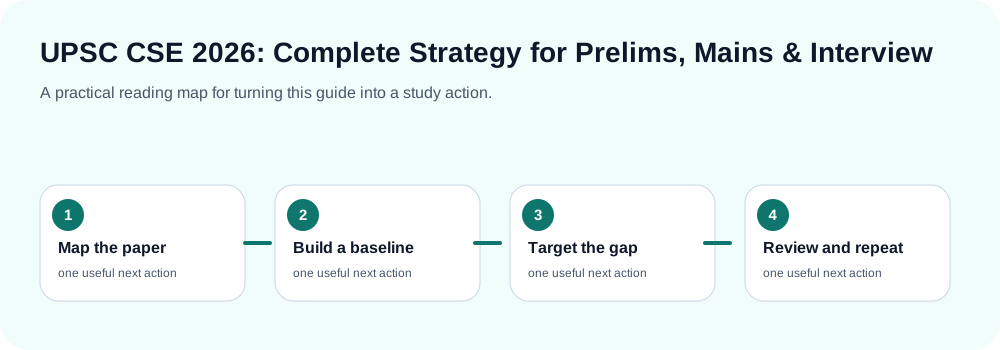
- Map the paperUse the exam pattern and eligibility details in this guide.
- Build a baselineTake a timed diagnostic mock before changing your routine.
- Target the gapChoose one weak section and practise it deliberately.
- Review and repeatLog errors, revise, and retest under time pressure.
Revision note: Published after explicit owner approval; official-source verification remains recommended for time-sensitive claims.
Keep YourMockTest in your Google results
Add us as a Preferred Source to see fresh exam updates and preparation guidance more often in Google Search.
Add YourMockTest as a Preferred Source