Exam Guides
RBI Grade B 2026: Complete Roadmap from Phase 1 to Interview
The most prestigious banking exam in India demands a 6-month dedicated strategy. This expert guide covers Phase 1 & 2 patterns, ESI & FM paper breakdown, economics topics, recommended books, salary perks, and interview preparation for RBI Grade B 2026.
This legacy article was owner-approved for publication. Verify time-sensitive claims against current official sources before acting.

Among all competitive banking examinations in India, the Reserve Bank of India Grade B Officer examination stands alone. It is not just a job — it is an entry into the nerve centre of India's financial system. An RBI Grade B officer shapes monetary policy, regulates India's banks, manages foreign exchange reserves, and contributes to landmark RBI publications like the Annual Report and the Monetary Policy Report. The starting gross salary of approximately ₹1.17 lakh per month (exclusive of HRA, DA, and perquisites worth several lakhs), along with premium housing in RBI colonies, club memberships, and exceptional job security, makes this the dream destination for serious banking aspirants.
With only 200–300 vacancies per year and competition from IIM graduates, UPSC aspirants, and working professionals with economics PhDs, this exam demands a fundamentally different preparation approach. Here is your complete, expert roadmap.
---
Read the chart as a quick comparison, not as a replacement for the official source or the detailed explanation below.
Why RBI Grade B is the Most Prestigious Banking Exam
Regulatory power: RBI Grade B officers regulate commercial banks — they are at the top of the banking hierarchy.
Intellectual challenge: The exam tests economic analysis, policy reasoning, and descriptive writing — not just speed-based MCQs.
Salary & Perquisites: Basic pay ~₹55,200 + DA + HRA + Grade Pay. Total compensation including all benefits: ₹16–22 lakhs per annum CTC (varies by city). Free/subsidised housing in major metros, medical benefits, children's education allowance, and an exceptional pension scheme.
Career growth: Promotion to Assistant General Manager (AGM), Deputy General Manager (DGM), and beyond — all through a structured, merit-based process.
Work-life balance: Unlike commercial banking, RBI follows government work hours (9:30 AM – 5:30 PM), with no sales targets or weekend mandatory banking.
---
Exam Structure: Phase 1 to Interview
Phase 1: Online Preliminary Examination
Section | Questions | Marks | Duration |
|---|---|---|---|
General Awareness | 80 | 80 | 25 minutes |
English Language | 30 | 30 | 25 minutes |
Quantitative Aptitude | 30 | 30 | 25 minutes |
Reasoning | 60 | 60 | 45 minutes |
Total | 200 | 200 | 120 minutes |
Negative marking: 0.25 marks per wrong answer. Phase 1 is qualifying only — scores are NOT counted in final merit.
Phase 1 Cutoff (General, 2024): ~107 out of 200.
Phase 2: Written Examination (Main)
Paper | Type | Marks | Duration |
|---|---|---|---|
Paper 1: Economic & Social Issues (ESI) | Objective + Descriptive | 100 | 90 minutes |
Paper 2: English (Writing Skills) | Descriptive only | 100 | 90 minutes |
Paper 3: Finance & Management (FM) | Objective + Descriptive | 100 | 90 minutes |
Total | 300 | 4 hrs 30 min |
Phase 2 is the real battleground. Each paper has both MCQ and descriptive components. For Paper 1 (ESI) and Paper 3 (FM), approximately 60 marks are objective (30 questions) and 40 marks are descriptive (2 questions).
Interview
Marks: 75
Based on general awareness, personality, banking knowledge, and situation-based questions.
Final Merit: Phase 2 (300 marks) + Interview (75 marks) = 375 marks total.
---
Paper Breakdown: ESI (Economic & Social Issues)
The ESI paper is what truly separates RBI Grade B from all other banking exams. It requires you to think like an economist, not just recall facts.
Core Topics
Indian Economy:
GDP measurement (GVA, CPI, WPI, IIP) — understand what each measures and its limitations
Monetary Policy: Repo Rate, Reverse Repo, MSF, CRR, SLR, Open Market Operations (OMOs)
Fiscal Policy: Types of deficits (Revenue, Fiscal, Primary, Effective Revenue), FRBM Act targets
Inflation: Types (demand-pull, cost-push), RBI's inflation targeting mandate (4% ±2%), CPI basket composition
Banking sector: NPAs, resolution (IBC, SARFAESI, DRT), Basel III norms, capital adequacy
Balance of Payments: Current account, Capital account, Forex reserves management
External sector: FDI vs FII, FEMA, import-export policy, trade deficit
Indian Social Issues:
Poverty measurement (Multidimensional Poverty Index, Tendulkar Committee)
Human Development Index (HDI) — India's rank, components
Education policy (NEP 2020), health indicators (IMR, MMR, Life Expectancy)
Financial inclusion: Jan Dhan Yojana progress, credit penetration in rural areas
Sustainable Development Goals (SDGs) — India's progress on key goals
Global Economy:
IMF, World Bank, WTO — functions and current initiatives
G20 presidency milestones and financial agenda
BRICS financial developments, dollar vs multi-currency debates
Global inflation trends, US Federal Reserve interest rate decisions and their impact on India
Descriptive Questions in ESI (40 marks):
Typically 2 questions of 20 marks each: one broad essay ("Evaluate RBI's monetary policy response to post-COVID inflation"), one analytical question ("Discuss the impact of rising fiscal deficit on Indian economy")
Expect 600–800 words per answer. Use economic data, recent RBI reports, and structured arguments.
---
Paper Breakdown: Finance & Management (FM)
Finance Topics:
Financial markets: Money Market instruments (T-bills, Commercial Paper, Certificate of Deposit, Repo), Bond markets, Equity markets
Basel Accords: Basel I (credit risk), Basel II (market + operational risk), Basel III (Capital Conservation Buffer, Countercyclical Buffer, LCR, NSFR)
Financial inclusion: Priority Sector Lending norms, RBI guidelines, MUDRA
Foreign Exchange: Types of exchange rate systems, Purchasing Power Parity (PPP), Exchange rate management by RBI
Derivatives: Forwards, Futures, Options, Swaps — basic concepts and hedging rationale
Financial Statement Analysis: P&L, Balance Sheet, Cash Flow, key ratios (NIM, ROA, ROE, CRAR)
Management Topics:
Classical theories: Taylor's Scientific Management, Fayol's 14 Principles, Max Weber's Bureaucracy
Modern theories: Theory X/Y (McGregor), Herzberg's Two-Factor, Maslow's Hierarchy, Vroom's Expectancy
Leadership styles: Transformational vs. Transactional, Servant Leadership
Organisational behaviour: Conflict resolution, motivation, communication channels
Human Resource Management: Recruitment, Performance Appraisal, Training & Development
Strategic management: SWOT, Porter's Five Forces, BCG Matrix
Risk management in banks: Types of risk (credit, market, operational, liquidity), risk mitigation frameworks
---
Paper 2: English Writing Skills
This paper is entirely descriptive (no MCQs). Typically:
Essay (40 marks): 800–1,000 words on an economic/financial/social topic
Précis Writing (20 marks): Reduce a 250-word passage to ~80 words while retaining core meaning
Comprehension (20 marks): Answer analytical questions from a given passage
Business/Official Letter (20 marks): Write a formal correspondence
Writing Skills Preparation:
Read 2 editorials daily from The Hindu and Economic Times
Practice writing 800-word essays 3× per week. Time yourself to 60 minutes.
Précis: The #1 skill is identifying the one core idea per paragraph and compressing it to one sentence.
Build a vocabulary of financial and economic terms that add precision to your writing.
---
6-Month Preparation Strategy
Month 1–2: Phase 1 + ESI/FM Foundation
Phase 1 Preparation:
GA: Read The Hindu and RBI.org.in daily. RBI Grade B GA is heavily banking/economy-centric — not general current affairs.
Quant (Phase 1 level): 30 questions in 25 minutes — Simplification, DI, Arithmetic basics. Phase 1 Quant is easier than Clerk Mains level.
Reasoning (Phase 1): 60 questions in 45 minutes — Puzzles, Syllogism, Inequalities, Coding. Aim for 45+ correct.
English: Error Spotting, RC, Vocabulary. Standard approach.
ESI Foundation:
Read Mrunal Patel's Economy lectures (YouTube/PDF) — the most efficient economics foundation for competitive exams.
Supplement with Ramesh Singh's "Indian Economy" (9th edition or later) — Chapters 1–6 are must-reads.
Make flashcards for: RBI functions, monetary policy tools, fiscal deficit formulas, GDP components.
FM Foundation:
Finance: Study NCERT Class 11–12 Accountancy for financial statement basics.
Basel norms: Use RBI's official "Basel III Framework" publication on rbi.org.in — it is publicly available and authentic.
Management: Schermerhorn's "Management" or Robbins' "Organizational Behaviour" (selected chapters on motivation, leadership, OB).
Month 3–4: Phase 2 Deep Dive
ESI: Finish Mrunal + Ramesh Singh. Now move to reading RBI Annual Report (current year) — especially the chapters on monetary policy and financial stability.
FM Finance: Study financial markets in depth. RBI's "Report on Trend and Progress of Banking in India" is a goldmine for FM questions.
FM Management: Practice applying theories to banking scenarios. "As RBI Grade B officer, how would you apply Herzberg's theory to branch staff motivation?"
English: Write 3 essays per week. Share with peers or use AI tools for feedback on structure and flow.
Mocks: 1 Phase 2 full mock every 10 days. Review all descriptive answers critically.
Month 5–6: Consolidation + Interview Prep
Week | Focus |
|---|---|
Week 17–18 | Phase 1 full mocks daily (5 total) — target 120+ score |
Week 19–20 | Phase 2 mocks (2 total) + descriptive essay intensive |
Week 21 | Current affairs consolidation (6-month digest) + FM revision |
Week 22–24 | Interview preparation: banking topics, situational questions, HR questions |
---
Recommended Books
Subject | Book | Author/Source |
|---|---|---|
Indian Economy | Indian Economy | Ramesh Singh |
Economy (Lectures) | Mrunal Economy Course | Mrunal Patel (YouTube/Unacademy) |
FM — Finance | RBI Financial Stability Report | RBI.org.in (free PDF) |
FM — Management | Management | Schermerhorn / Robbins OB |
English | Word Power Made Easy | Norman Lewis |
Current Affairs | RBI Monthly Bulletin | RBI.org.in (free) |
Banking Awareness | Banking Awareness | Arihant / BSC Publishing |
Phase 1 Quant | Quantitative Aptitude | R.S. Aggarwal |
---
Interview Preparation
RBI Grade B interview panel typically consists of 5–6 senior RBI officials. Expect 20–30 minutes of intensive questioning.
Key Interview Areas:
Tell me about yourself: Structure as: Education → Why Economics/Banking → What you've done to prepare → Why RBI specifically
Current RBI policies: What is the current Repo Rate? What was the basis for the last policy decision? What is RBI's stance on inflation?
Situational: "If you are posted to the DNBS (Department of Non-Banking Supervision), how would you approach a grey area compliance case?"
Economics: Explain the transmission mechanism of monetary policy. Why does Repo Rate cut not immediately reduce loan rates?
Personal: Why RBI and not commercial banking? What do you find challenging about regulatory work?
Trending topics: Digital Rupee (e-₹), CBDC global developments, climate risk in financial stability, crypto regulation
Interview Do's:
Acknowledge when you don't know something. Guessing impresses no one at this level.
Quote actual RBI data and reports — it demonstrates authentic preparation.
Ask a thoughtful question at the end if invited.
---
How YourMockTest Supports RBI Grade B Aspirants
YourMockTest offers RBI Grade B-specific preparation tools:
Phase 1 full mocks with exact 200-question, 120-minute format and difficulty calibrated to actual Phase 1 papers
ESI objective MCQ practice with topic-wise question banks covering all monetary policy, fiscal policy, and social sector topics
Phase 2 descriptive essay evaluator — AI-powered evaluation giving scores on content, structure, and language
GA weekly capsule — curated banking and economic current affairs, updated every Monday
Previous year Phase 2 descriptive questions (2019–2025) with model answers written by economists
RBI Grade B is a marathon, not a sprint. Six months of consistent, structured preparation — with the right books, daily reading, and mock-driven improvement — puts this extraordinary opportunity within reach. Begin today.
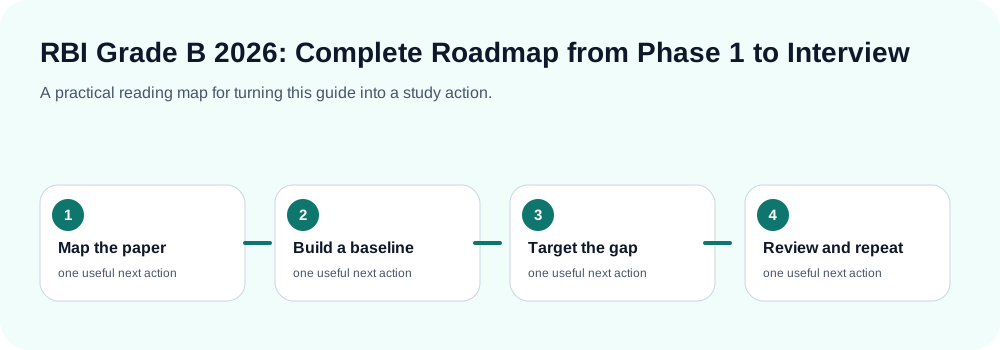
- Map the paperUse the exam pattern and eligibility details in this guide.
- Build a baselineTake a timed diagnostic mock before changing your routine.
- Target the gapChoose one weak section and practise it deliberately.
- Review and repeatLog errors, revise, and retest under time pressure.
Revision note: Published after explicit owner approval; official-source verification remains recommended for time-sensitive claims.
Keep YourMockTest in your Google results
Add us as a Preferred Source to see fresh exam updates and preparation guidance more often in Google Search.
Add YourMockTest as a Preferred Source