Study Tips
How to Manage Exam Anxiety Before and During Government Exams
Exam anxiety is not a weakness — it's a physiological response that can be trained down. This guide covers four science-backed techniques for managing anxiety before SSC CGL, UPSC Prelims, IBPS PO, and Railway CBT exams, including an exam-day minute-by-minute protocol.
This legacy article was owner-approved for publication. Verify time-sensitive claims against current official sources before acting.
Anxiety vs. the optimal performance zone
Some anxiety before an exam is not a problem — it is the mechanism your brain uses to raise your alertness and processing speed. The Yerkes-Dodson law (1908) describes an inverted U relationship between arousal and performance: too little arousal (boredom, low stakes) produces poor performance, and too much (panic) also produces poor performance. The peak is in between — a state of alert calm.
The goal of exam anxiety management is not to eliminate stress but to bring cortisol from the panic zone back into the optimal performance zone.
| Anxiety type | What it feels like | Most effective technique |
|---|---|---|
| **Pre-exam anticipatory anxiety** (days before) | Dread, sleep problems, avoidance, rumination | Exposure (more mocks), behavioural activation, structured preparation |
| **Morning-of anxiety** | Racing heart, nausea, forgetfulness | Box breathing, grounding, physical movement, no new revision |
| **During-exam panic** (sudden freeze) | Blank mind, hands shaking, can't read the question | 4-7-8 breathing, question skip protocol, anchoring to preparation |
| **Post-question regret anxiety** | "I chose B but it might be C" thought loops | Submit protocol: mark and move; no re-checking after the 30-second rule |
The 4 types of exam anxiety — and which techniques address each
Anxiety type | What it feels like | Most effective technique |
|---|---|---|
Pre-exam anticipatory anxiety (days before) | Dread, sleep problems, avoidance, rumination | Exposure (more mocks), behavioural activation, structured preparation |
Morning-of anxiety | Racing heart, nausea, forgetfulness | Box breathing, grounding, physical movement, no new revision |
During-exam panic (sudden freeze) | Blank mind, hands shaking, can't read the question | 4-7-8 breathing, question skip protocol, anchoring to preparation |
Post-question regret anxiety | "I chose B but it might be C" thought loops | Submit protocol: mark and move; no re-checking after the 30-second rule |
Technique 1: Box breathing (for morning-of and during-exam anxiety)
Box breathing is used by Navy SEALs, surgeons, and competitive athletes to reduce acute cortisol within 2–3 minutes. The pattern:
Step | Duration | What to do |
|---|---|---|
Inhale | 4 seconds | Breathe in slowly through the nose |
Hold | 4 seconds | Hold at the top of the breath |
Exhale | 4 seconds | Release slowly through the mouth |
Hold | 4 seconds | Hold at the bottom (lungs empty) |
Repeat | 4–6 cycles | Continue until heart rate decreases |
When to use: At the exam centre while waiting to enter. In the restroom before sitting at the computer. Once during the exam if you hit a panic question — look at the ceiling, 4 seconds in, 4 seconds hold, 4 seconds out, then skip the question and continue.
Technique 2: The 5-4-3-2-1 grounding technique (for morning-of panic)
Grounding interrupts anxiety spirals by forcing the brain back into present-moment sensory processing.
Step | Instruction |
|---|---|
5 | Name five things you can see in the room right now |
4 | Name four things you can physically feel (floor under feet, chair, etc.) |
3 | Name three things you can hear |
2 | Name two things you can smell |
1 | Name one thing you can taste |
This takes 90 seconds. It is most useful in the morning before leaving for the exam centre — in the bathroom, or during the commute — when anticipatory anxiety peaks.
Technique 3: Systematic desensitisation through mock tests
Exam anxiety is partially a novelty response — your nervous system treats the unfamiliar exam environment as a threat. Systematic desensitisation removes the novelty:
Take at least 15 full-length digital mocks before the actual exam
Simulate real exam conditions: no pause, timed, phone away, headphones off
Practice starting the exam even when you "don't feel ready" — this replicates the exam-day experience of anxiety at the start that usually dissipates within 10 minutes of reading questions
After 15 exposures to a simulated exam environment, the anxiety response reduces significantly. This is not a motivational claim — it is the mechanism of exposure therapy, which works for performance anxiety as well as phobias.
Technique 4: Cognitive reframing — what elite performers do
Elite performers (sportspeople, surgeons, performers) use a simple reframe that research by Alison Wood Brooks at Harvard Business School (2014) validated:
Reframe "I am anxious" to "I am excited."
Anxiety and excitement are physiologically near-identical states — elevated heart rate, heightened alertness, racing thoughts. The only difference is the story you attach to the sensation. When you say "I am anxious," the sensation feels threatening. When you say "I am excited about this exam," the same sensation becomes motivating.
Practice this reframe in the final week before the exam by saying it out loud when you feel pre-exam nerves: "I am excited. I've prepared for this. This is a familiar situation."
The exam-day anxiety management protocol
Time | Action |
|---|---|
Night before | Stop revision at 9 PM. Light meal. No exam talk. Sleep 7–8 hours. Clothes and documents ready |
Morning of exam | Normal breakfast (not heavy). No new revision. 5-4-3-2-1 grounding if anxious. Leave 30 min early |
At the exam centre | Avoid comparing preparation with other candidates. Box breathing 3–4 cycles while waiting |
First 10 questions | Go slow — deliberately. Read carefully. This is the settling period where anxiety dissipates |
If you hit a panic question | Skip immediately. Do not stare at it. Box breath. Move to the next question |
Mid-exam check (30 min in) | Quick palette review: how many answered? On track? Adjust attempt speed if needed |
Final 5 minutes | Return to marked questions. No re-opening already-answered ones (regret anxiety). Submit calmly |
What not to do the night before
Night-before mistakes that increase exam-day anxiety: > > - Attempting a full mock the night before: This activates performance anxiety and disrupts sleep > - Reading coverage gaps: Discovering what you haven't studied the night before creates anticipatory dread > - Staying up late to revise: Sleep deprivation impairs retrieval speed and working memory — both critical for a 36-second-per-question exam > - Discussing the exam with other anxious aspirants: Group anxiety is contagious > - Checking social media for "cutoff predictions": Invented numbers create imaginary pressure
Is your anxiety exam-specific or generalised?
If your anxiety significantly impairs daily functioning (not just exam performance), it may be worth speaking with a qualified mental health professional. The techniques above are evidence-based for performance anxiety — they are not a substitute for clinical support when anxiety is generalised.
Practice the techniques before exam day
Do not try box breathing for the first time in the exam centre. Practice it now: take a full-length SSC CGL or UPSC Prelims mock test under strict conditions (timed, no pause, phone away) and apply the exam-day protocol above. The more you rehearse the anxiety management techniques in practice, the more automatic they become on the actual day.
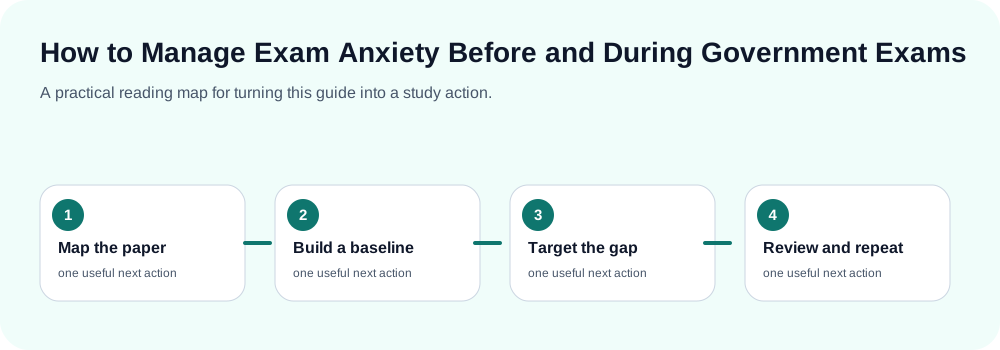
- Map the paperUse the exam pattern and eligibility details in this guide.
- Build a baselineTake a timed diagnostic mock before changing your routine.
- Target the gapChoose one weak section and practise it deliberately.
- Review and repeatLog errors, revise, and retest under time pressure.
Revision note: Published after explicit owner approval; official-source verification remains recommended for time-sensitive claims.
Keep YourMockTest in your Google results
Add us as a Preferred Source to see fresh exam updates and preparation guidance more often in Google Search.
Add YourMockTest as a Preferred Source