Productivity
How to Build a High-Performance Study Schedule
Generic schedules fail because they ignore your biology. This guide shows you how to design a personalised study routine using chronotype data, the 90-minute Ultradian cycle, and a weekly structure tailored to SSC CGL, UPSC, and Banking exam timelines.
This legacy article was owner-approved for publication. Verify time-sensitive claims against current official sources before acting.
Why this matters for competitive exam aspirants
For SSC CGL, UPSC CSE, IBPS PO, and Railway exams, the difference between a 145 and a 158 in Tier 1 is often not how many hours you studied — it is when and how those hours were structured. A student who studies 4 hours at the right time, with the right session lengths, will outperform one who logs 8 unfocused hours at the wrong time of day.
This guide will help you build a schedule around your biology, not against it.
| Task type | Recommended session length | Why |
|---|---|---|
| Full mock test (Tier 1 = 60 min) | 90-minute block (60 min exam + 30 min review) | Mirrors the real exam duration; the review is part of the learning |
| Quantitative Aptitude problem sets | 90-minute Ultradian block | Complex reasoning needs sustained focus; 25-minute Pomodoro is too short |
| Mathematics / Algebra / Geometry | 90-minute block | Multi-step problems require uninterrupted working memory |
| Essay or answer writing (UPSC) | 90-minute block | Structuring and writing one essay takes ~40 min; the block allows drafting + review |
| Current affairs reading | 25-minute Pomodoro | Light reading; natural break points at each article |
| Flashcard review (Anki, GK) | 25-minute Pomodoro | Repetitive recall tasks benefit from short bursts |
| Vocabulary or Grammar rules | 25-minute Pomodoro | Spaced, short repetition beats long cramming |
Step 1: Identify your chronotype before building any schedule
Oxford neuroscientist Dr. Russell Foster and circadian rhythm researchers identify three chronotypes. Most study schedules are designed for larks — and fail everyone else.
Which chronotype are you? > > - Morning Lark — naturally alert between 6–10 AM; mental energy drops significantly by 3–4 PM. > - Intermediate type — peak alertness 10 AM–2 PM; moderately alert in early mornings and evenings. > - Night Owl — lowest alertness in the morning; peak performance between 8 PM–midnight. > > How to measure yours: For 14 days, attempt the same 20-question Quant set at four different times — 7 AM, 11 AM, 4 PM, and 8 PM. Record your accuracy and time. Your biological peak will be visible in the data by Day 10.
Once you know your chronotype, schedule your hardest subject (Quantitative Aptitude, Reasoning, UPSC Essay) during your peak hours. Schedule Current Affairs reading, flashcard review, and GK revision at your low-energy periods.
Step 2: Match session length to task weight
The Basic Rest-Activity Cycle (BRAC), identified by sleep researcher Nathaniel Kleitman, is a 90-minute alertness cycle the brain naturally follows throughout the day. Your concentration peaks every ~90 minutes, then dips for 15–20 minutes before recovering.
Task type | Recommended session length | Why |
|---|---|---|
Full mock test (Tier 1 = 60 min) | 90-minute block (60 min exam + 30 min review) | Mirrors the real exam duration; the review is part of the learning |
Quantitative Aptitude problem sets | 90-minute Ultradian block | Complex reasoning needs sustained focus; 25-minute Pomodoro is too short |
Mathematics / Algebra / Geometry | 90-minute block | Multi-step problems require uninterrupted working memory |
Essay or answer writing (UPSC) | 90-minute block | Structuring and writing one essay takes ~40 min; the block allows drafting + review |
Current affairs reading | 25-minute Pomodoro | Light reading; natural break points at each article |
Flashcard review (Anki, GK) | 25-minute Pomodoro | Repetitive recall tasks benefit from short bursts |
Vocabulary or Grammar rules | 25-minute Pomodoro | Spaced, short repetition beats long cramming |
Step 3: Build your weekly schedule
This template works for aspirants preparing for SSC CGL or IBPS PO with 5–6 months to go. Adjust the subject labels for UPSC (replace Quant with Polity or History). Saturdays are reserved for full mocks; Sundays are reset and review days.
Time slot | Monday–Friday | Saturday | Sunday |
|---|---|---|---|
Peak hour block 1 (e.g., 6:00–7:30 AM for larks) | Hardest subject: Quant / Reasoning / UPSC GS Paper | Full-length Tier 1 mock (60 min + 30 min review) | Light revision only |
Transition (7:30–8:30 AM) | Breakfast + newspaper / current affairs | Error log analysis from mock | Rest or walk |
Peak hour block 2 (9:30–11:00 AM) | Second priority subject: English / Polity / Economy | Weak-area drilling based on mock errors | Optional: current affairs notes |
Mid-morning (11:00 AM–12:30 PM) | Third subject or sectional mock (25 questions timed) | Static GK revision | — |
Afternoon (1:30–3:00 PM) | Revision of previously covered chapters | Optional Tier 2 practice | — |
Rest (3:00–4:00 PM) | 20-min nap if possible; no screens | Break | — |
Afternoon block (4:00–5:30 PM) | General Awareness + Current affairs | — | — |
Evening (7:00–8:30 PM) | Current affairs notes; flashcard review (Anki) | Current affairs | — |
Daily review (9:30–9:50 PM) | What did I cover? What is tomorrow's priority? | Weekly review (20 min) | Plan next week |
For working aspirants (preparing alongside a job):
Use commute time for current affairs audio or Anki flashcard review.
Reserve Saturday mornings exclusively for full mock tests — non-negotiable.
Two focused 90-minute weekday sessions beat one unfocused 4-hour Saturday session every time.
Step 4: The 3-week chronotype experiment
Do not guess your peak hours — measure them with this protocol:
Pick one task type: 20 Quant questions at a fixed difficulty.
Attempt the same type of questions at 7 AM, 11 AM, 4 PM, and 8 PM — on different days, not the same day.
Record accuracy % and average time per question for each slot.
After 21 days, you will have 5–6 data points per time slot. Your peak will be clearly visible.
Shift your hardest subject sessions to that slot permanently.
This is not a minor optimisation. Research suggests identifying and using your biological peak can improve effective cognitive output by 15–20% on the same study hours.
Step 5: Avoid the 5 schedule-breaking traps
Trap | What it looks like | Fix |
|---|---|---|
All-or-nothing days | "I only have 45 min, so I'll skip today" | Use the minimum viable dose: 30 min of Anki + one editorial still maintains the habit |
No mock integration | Studying topics but never timing yourself | Lock Saturday mornings as mock-only, non-negotiable |
Motivation-dependent schedule | Only study when inspired | Design the environment: study desk = only study; phone physically out of room |
New topics in the final 2 weeks | "I haven't covered Data Sufficiency yet" | Final 2 weeks are revision-only; accept the gap and consolidate what you know |
Measuring hours instead of outcomes | "I studied for 6 hours" | Measure topics covered + mock accuracy improvement each week |
Tools that support this schedule
Anki: Spaced repetition flashcard app for GK, vocabulary, and formulas. 20 minutes daily is enough.
Notion or Google Calendar: Block recurring 90-minute sessions as calendar events with exam labels.
Forest App: Gamified focus timer that discourages phone use during sessions.
YourMockTest: Full-length SSC CGL, UPSC Prelims, and Banking mocks with section-wise analytics — use these to fill your Saturday mock slot.
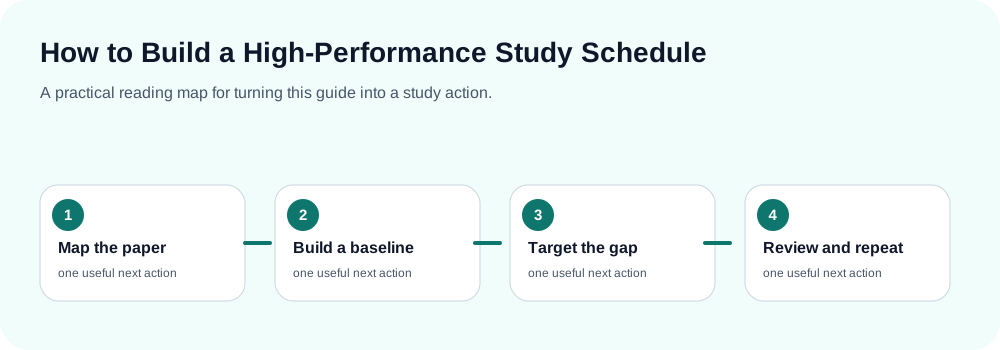
- Map the paperUse the exam pattern and eligibility details in this guide.
- Build a baselineTake a timed diagnostic mock before changing your routine.
- Target the gapChoose one weak section and practise it deliberately.
- Review and repeatLog errors, revise, and retest under time pressure.
Next action
Before planning next week's schedule, run the chronotype test for just one day: solve the same 20 Quant questions at two different times today and compare your accuracy. Then take a full exam practice test on YourMockTest to anchor Saturday's mock slot to real exam conditions.
Revision note: Published after explicit owner approval; official-source verification remains recommended for time-sensitive claims.
Keep YourMockTest in your Google results
Add us as a Preferred Source to see fresh exam updates and preparation guidance more often in Google Search.
Add YourMockTest as a Preferred Source