Study Tips
Consistency vs. Intensity: Which Study Approach Actually Wins Competitive Exams?
Most aspirants who burn out mid-preparation chose intensity over consistency. This guide explains the compound growth effect of daily study habits, how to calculate your minimum daily dose for each exam, and why the highest scorers in SSC CGL and UPSC are almost always the most consistent — not the most intense.
This legacy article was owner-approved for publication. Verify time-sensitive claims against current official sources before acting.
The most common study mistake in competitive exam preparation
"I'll study 12 hours this weekend to make up for the week." This logic is applied by the majority of aspirants who fail their first attempt — and by almost none of the aspirants who pass.
Weekend compensation doesn't work because learning is not like financial debt. You cannot bank concentrated effort on Sunday and expect your brain to retain it as well as six daily 2-hour sessions would have. This guide explains why, and gives you a concrete framework for building the consistency habit that actually produces results.
| Daily improvement | Annual multiplier |
|---|---|
| 1% better each day | 37.8× after 365 days |
| 0% (stagnation) | 1× after 365 days |
| -1% each day (regression) | 0.026× after 365 days |
The compound effect of daily study
Small daily improvements compound exactly like financial interest. The math is clear:
Daily improvement | Annual multiplier |
|---|---|
1% better each day | 37.8× after 365 days |
0% (stagnation) | 1× after 365 days |
-1% each day (regression) | 0.026× after 365 days |
Source: The compound interest formula applied to daily performance improvement, as popularised by James Clear in Atomic Habits (2018).
For exam preparation, daily improvement means: each session builds on the previous one. Vocabulary learned today gets reinforced tomorrow. Quant formulas practiced today don't need re-learning next week. The compound effect of daily practice is the mechanism that produces aspirants who score 175/200 in SSC CGL — they have accumulated compound gains across hundreds of small daily sessions.
Intensity vs. consistency: what the data shows
Study pattern | Short-term feel | Long-term result | Common in |
|---|---|---|---|
High-intensity sporadic | Productive, satisfying on the day | Rapid forgetting, burnout, anxiety | Failed first attempts |
Moderate-intensity consistent | Slower progress visible daily | Compound growth, sustainable, exam-ready | Successful multi-exam aspirants |
Low-intensity daily minimum | Low energy but maintained habit | Better than nothing; prevents skill decay | Working aspirants in prep phase |
Zero days | Rest | Skill decay begins within 48 hours for recently-learned material | Dangerous if habitual |
The most important insight: A 2-hour daily session sustained for 6 months produces approximately 360 hours of preparation. A 10-hour Sunday session sustained for the same 6 months produces approximately 240 hours — and produces far lower retention per hour due to cognitive overload.
Intensity has a place — but not where most aspirants put it
Intensity is not the enemy. It has a specific, legitimate role:
Context where intensity works | Context where intensity fails |
|---|---|
Full-length mock tests (60–90 min sustained) | Daily learning of new topics (mental overload causes poor encoding) |
Cramming static GK in the final 2 weeks | Building a new skill (Algebra, Grammar rules) — requires spaced repetition, not cramming |
Answer writing marathons (UPSC Mains prep) | Making up for missed preparation days — the missed learning cannot be replicated in one session |
Dedicated revision sprints (1 week before exam) | Replacing the consistency habit — sprints work only when built on a consistent foundation |
The minimum daily dose by exam
Consistency does not require hours. It requires a minimum viable daily dose — the smallest amount of daily engagement that prevents skill decay and maintains momentum.
Target exam | Minimum viable daily dose | What it covers |
|---|---|---|
SSC CGL | 90 minutes | 30 min Quant + 30 min English + 30 min GA/Reasoning rotation |
UPSC CSE | 3 hours | 90 min Subject reading + 60 min newspaper + 30 min revision |
IBPS PO/Clerk | 90 minutes | 30 min Quant + 30 min Reasoning + 30 min English/GA rotation |
RRB NTPC | 60 minutes | 20 min Maths + 20 min Reasoning + 20 min GA |
RBI Grade B | 3 hours | 90 min ESI/Finance + 60 min Reasoning + 30 min English |
For working aspirants (7-8 hours in office daily), the minimum dose is achievable in the morning before work (60 min) + commute (flashcards, audio) + evening (30–45 min). The full session schedule is a weekend investment.
Building the consistency habit: the 3-part framework
- Design your environment before willpower runs out
Willpower is a finite resource that depletes through the day. Don't rely on it to start your study session. Instead:
Set up your study desk the night before (books open, notes out, Anki app open)
Use a fixed start time as an anchor — not "when I feel ready" but "at 6:30 AM every day"
Remove friction: phone in another room, social apps logged out, study location dedicated to study only
- Track the streak, not the score
The daily streak is more motivating than score improvement because it is immediately visible. Use a physical calendar with an X for each completed minimum-dose day. After 14 consecutive days, breaking the streak becomes genuinely painful — this is the consistency flywheel starting to turn.
Do not let perfect be the enemy of consistent. A 30-minute current affairs review on a hard day counts. A 20-minute Anki session on a travel day counts. Zero days are the only failure state.
- Rescue protocols for zero-day prevention
Situation | Rescue protocol |
|---|---|
Illness or genuine exhaustion | 15-minute Anki flashcard review only; preserve the streak |
Travel day | Download 2 Quant sets on the app offline; do them on commute |
Work deadline week | Reduce to GA revision (20 min) and one sectional mock (15 min) |
"I don't feel like it" | Commit to 10 minutes only; decision to continue is made after 10 minutes |
The honest comparison: 6-month trajectories
Month | Consistent aspirant (90 min/day) | Sporadic aspirant (10 hr weekend) |
|---|---|---|
Month 1 | Foundation complete; first mock taken | NCERT reading, no mock yet |
Month 2 | Speed building; 65% accuracy in mocks | Intense weekend study; 52% mock accuracy |
Month 3 | Error patterns identified; targeted drilling | Burnout week; motivation crash |
Month 4 | 75% mock accuracy; weak areas identified | Recovery; back to 60% accuracy |
Month 5 | 80%+ accuracy; 3 mocks/week; desensitised | Last-minute cramming pressure |
Exam day | Prepared, calm, familiar with interface | Stressed, cramming the night before |
Start the streak today
Decide on your minimum daily dose from the table above. Set an alarm for the same time tomorrow. Then take a practice test on YourMockTest right now — even a 20-question sectional test — to start Day 1 of the streak.
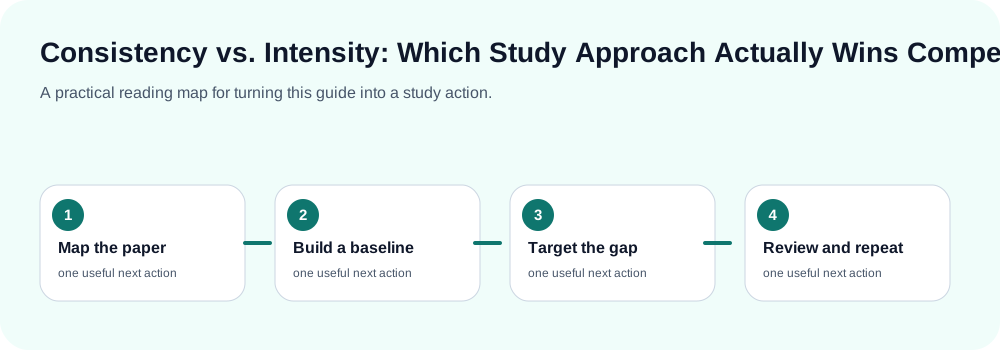
- Map the paperUse the exam pattern and eligibility details in this guide.
- Build a baselineTake a timed diagnostic mock before changing your routine.
- Target the gapChoose one weak section and practise it deliberately.
- Review and repeatLog errors, revise, and retest under time pressure.
Revision note: Published after explicit owner approval; official-source verification remains recommended for time-sensitive claims.
Keep YourMockTest in your Google results
Add us as a Preferred Source to see fresh exam updates and preparation guidance more often in Google Search.
Add YourMockTest as a Preferred Source