Exam Guides
CAPF AC 2026: Paper 1, Paper 2 & Physical Standards Complete Guide
Comprehensive guide to CAPF AC 2026 — Assistant Commandant in BSF/CRPF/CISF/SSB/ITBP. Covers Paper 1 and Paper 2 strategy, physical standards, medical requirements, PET criteria, interview process, descriptive writing tips, recommended books, and career growth to DIG/IG.
This legacy article was owner-approved for publication. Verify time-sensitive claims against current official sources before acting.

The Central Armed Police Forces (CAPF) Assistant Commandant (AC) examination is one of the most coveted government officer-level examinations for graduates who wish to serve in India's paramilitary forces. Conducted by the Union Public Service Commission (UPSC), CAPF AC 2026 offers opportunities to join five prestigious Central Armed Police Forces as a Group A Gazetted Officer (Assistant Commandant) — the equivalent of a Sub-Inspector's entry at the officer level.
---
| Force | Full Name | Primary Role |
|---|---|---|
| BSF | Border Security Force | India-Pakistan and India-Bangladesh border protection |
| CRPF | Central Reserve Police Force | Internal security, counter-insurgency, elections |
| CISF | Central Industrial Security Force | Protection of airports, PSUs, government infrastructure |
| SSB | Sashastra Seema Bal | India-Nepal and India-Bhutan border management |
| ITBP | Indo-Tibetan Border Police | High-altitude India-China border, Himalayan glacier duty |
What is CAPF AC and Which Forces Can You Join?
Force | Full Name | Primary Role |
|---|---|---|
BSF | Border Security Force | India-Pakistan and India-Bangladesh border protection |
CRPF | Central Reserve Police Force | Internal security, counter-insurgency, elections |
CISF | Central Industrial Security Force | Protection of airports, PSUs, government infrastructure |
SSB | Sashastra Seema Bal | India-Nepal and India-Bhutan border management |
ITBP | Indo-Tibetan Border Police | High-altitude India-China border, Himalayan glacier duty |
The CAPF AC role is a Gazetted Officer position with command authority from day one — you lead a unit of 100+ personnel directly after training.
---
Eligibility Criteria for CAPF AC 2026
Educational Qualification: Any Bachelor's degree from a recognised university
Age: 20–25 years (Age relaxation: SC/ST — 5 years, OBC — 3 years, Ex-Servicemen — 5 years)
Gender: Open to both males and females
Physical Standards: Must meet prescribed height, chest, and visual standards (detailed below)
Nationality: Indian citizen only
Character: No criminal record or pending legal proceedings
---
CAPF AC 2026 Selection Process Overview
The CAPF AC selection involves four stages:
Paper I — Written Objective (250 marks)
Paper II — Written Descriptive (200 marks)
Physical Standards Test (PST) & Physical Efficiency Test (PET) — Qualifying
Medical Examination & Interview (Personality Test) — 150 marks
Total Marks for Merit: Paper I + Paper II + Interview = 600 marks
---
Paper I: General Ability and Intelligence (250 Marks)
Format: 125 questions | 2 Hours | Objective MCQ Marking: +2 per correct answer | -0.66 per wrong answer (1/3 negative)
Section-wise Breakup:
Section | Approx. Questions | Marks |
|---|---|---|
General Mental Ability & Reasoning | 25–30 | 50–60 |
General Science | 20–25 | 40–50 |
Current Events & National Affairs | 15–20 | 30–40 |
Indian History (incl. Freedom Struggle) | 15–18 | 30–36 |
Indian Polity, Constitution & Governance | 12–15 | 24–30 |
Indian Economy | 8–10 | 16–20 |
Geography of India & World | 10–12 | 20–24 |
Paper I Difficulty Level
Paper I is equivalent to UPSC Prelims GS standard — aspirants who have prepared for UPSC CSE Prelims will find CAPF Paper I relatively manageable. First-time aspirants should treat Paper I with the same rigor as UPSC Prelims GS Paper 1.
Key Difference from UPSC Prelims: CAPF Paper I has no current affairs trap questions — the emphasis is on factual, stable knowledge from standard NCERT sources.
Paper I Preparation Resources:
History: Spectrum's A Brief History of Modern India (Rajiv Ahir) — non-negotiable
Polity: Indian Polity by M. Laxmikanth (read full book, not shortcuts)
Geography: NCERT Class 11–12 Physical and Human Geography
Economy: NCERT Class 11–12 Economics + Indian Economy by Ramesh Singh (selected chapters)
Science: NCERT Class 9–10 Science (all chapters)
Reasoning: A Modern Approach to Verbal & Non-Verbal Reasoning by R.S. Aggarwal
---
Paper II: General Studies, Essay & Comprehension (200 Marks)
Format: 3 Hours | Descriptive (handwritten) | Pen-and-paper mode
This is where CAPF AC differs fundamentally from all other defence exams — it demands genuine writing ability, structured thought, and command over English language.
Paper II Structure:
Component | Marks | Length |
|---|---|---|
Essay (1 of 2 topics given, write 1) | 80 | 600–800 words |
Précis Writing (1 passage, ~250 words, reduce to ~80) | 40 | 80 words |
Reading Comprehension (1 passage, 5 questions) | 40 | — |
Grammar & Composition (sentences, corrections, translation) | 40 | — |
Why Paper II is the Hardest Component
Paper II eliminates a large proportion of candidates who are otherwise strong in GK. Reasons:
Essay Writing requires an original argument — not a list of facts. You need a clear thesis, structured paragraphs, examples, and a conclusion.
Précis Writing is a dying art — reducing a 250-word passage to 80 words without losing core meaning is technically demanding.
3 hours of handwriting is physically exhausting — handwriting practice is essential.
Word limits are strict — over/under-writing is penalised.
Essay Topics Pattern (Last 5 Years):
Social issues: "Role of Women in Nation Building", "Urban-Rural Divide"
Governance: "Decentralisation and Panchayati Raj", "Police Reforms in India"
Philosophy: "Courage is the first virtue", "Corruption is the price we pay for democracy"
Defence/Security: "Naxalism — a socio-economic problem", "Cyber warfare and national security"
Paper II Preparation Strategy:
For Essays:
Write 2 practice essays per week — one social, one abstract/defence topic
Learn the PEEL structure (Point, Evidence, Explain, Link) for each paragraph
Build an example bank: statistics (NCRB crime data, Census 2011, Economic Survey) and case studies
Read The Hindu editorial daily — note the argument structure, not just content
For Précis:
Practice reducing newspaper articles daily
The 1:3 ratio rule — précis should be approximately 1/3rd of original length
Never add your own views; stick to the author's original ideas
For Grammar:
Master: Transformation of sentences, error correction, voice change, clauses
Wren & Martin Chapter by Chapter practice recommended
---
Physical Standards Test (PST)
Parameter | Male | Female |
|---|---|---|
Height | Min 165 cm (Gen/OBC), 162.5 cm (SC/ST/Hill areas) | Min 157 cm |
Chest | Min 81 cm (unexpanded), 86 cm (expanded) — 5 cm expansion mandatory | N/A |
Weight | Proportionate to height and age per medical standards | Proportionate |
Important for ITBP/SSB: Candidates from North-Eastern states, Gorkhas, Garhwalis, Kumaonis get 5 cm height relaxation.
Physical Efficiency Test (PET)
Event | Male Standard | Female Standard |
|---|---|---|
100 Metre Race | 16 seconds | 18 seconds |
800 Metre Race | 3 min 45 sec | 4 min 45 sec |
Long Jump | Min 3.5 metres (3 chances) | Min 2.7 metres |
Shot Put (7.26 kg for male, 4 kg for female) | Min 4.5 metres | Min 3 metres |
PST and PET are qualifying only — marks are NOT added to merit list. However, failing either means disqualification regardless of how well you performed in Paper I and Paper II.
PET Preparation: Start 60 days before your medical/PET date. Daily: 800m timed run, 100m sprints, long jump practice. Increase distance over time for endurance.
---
Medical Examination: Vision is Critical
Medical examination is one of the most important stages — CAPFs have strict vision requirements unlike many civil services:
Eye Standard | Male | Female |
|---|---|---|
Far Vision (Corrected) | 6/6 in better eye, 6/9 in worse eye | Same |
Far Vision (Uncorrected) | 6/12 in better eye, 6/36 in worse eye | Same |
Near Vision | N6 in better eye, N9 in worse eye | Same |
Colour Vision | No colour blindness | Same |
Spectacle Power | Max myopia -4D, hyperopia +4D total | Same |
Additional Medical Checks:
No flat foot (except slight degree)
No knock knees, varicose veins
Normal hearing (audiometry test)
Normal blood pressure, no diabetes
No psychiatric history
CAPF Insight: Vision disqualification is the single most common reason for medical rejection in CAPFs. Get your eyes checked 6 months before the exam if you wear spectacles — LASIK surgery is allowed (with 6-month waiting period post-surgery).
---
Interview / Personality Test (150 Marks)
The Personal Interview for CAPF AC carries 150 marks — this is substantial and can make or break your final rank.
Interview Panel: Typically 3–4 senior officers from the UPSC board, often including a CAPF DG/IG level officer.
Topics Covered:
Personal background and motivation for joining CAPFs (not defence)
Understanding of the specific CAPF you wish to join (BSF vs CISF vs CRPF — know the difference!)
Internal security situation: Naxalism, Northeast insurgency, border issues
Government policies: SMART policing, community policing, CAA, NRC
Current events: last 6 months mandatory
Ethical dilemmas: "If your senior orders you to do something unethical, what will you do?"
Key Interview Tip: CAPF interviewers test conviction and clarity of purpose — why specifically CAPF and not IPS or army? Have a clear, genuine answer. Mentioning a family connection or specific social issue (e.g., "I want to work in CRPF anti-Naxal operations") shows seriousness.
---
Career Growth: From Assistant Commandant to DIG/IG
Rank | Pay Level | Typical Years of Service |
|---|---|---|
Assistant Commandant | Level 10 (₹56,100) | On joining |
Deputy Commandant | Level 11 (₹67,700) | 4–6 years |
Commandant | Level 13 (₹1,18,500) | 10–13 years |
Deputy Inspector General (DIG) | Level 14 (₹1,44,200) | 15–18 years |
Inspector General (IG) | Level 15 (₹1,82,200) | 20–22 years |
Additional Director General (ADG) | Level 16 | 25+ years |
Director General (DG) | Level 17 | 30+ years |
Posting Preferences: Assistant Commandants can express preference for forces and regions during the interview. BSF and ITBP have tough frontier postings (border areas, high altitude) with additional Hard Area Allowance and High Altitude Allowance — making effective take-home salaries significantly higher.
---
6-Month Preparation Plan
Month | Focus |
|---|---|
Month 1 | NCERT History (Class 8–12) + Paper II essay practice (2/week) |
Month 2 | NCERT Geography + Polity (Laxmikanth) + Précis practice (daily) |
Month 3 | Economy + Science NCERTs + Reasoning + Paper I mock tests |
Month 4 | Paper I full mocks (every 3 days), Paper II timed essays, Grammar revision |
Month 5 | Current affairs compilation, defence/policing news, weak area targeted study |
Month 6 | Full paper simulations (Paper I + II same day), physical preparation, interview prep |
---
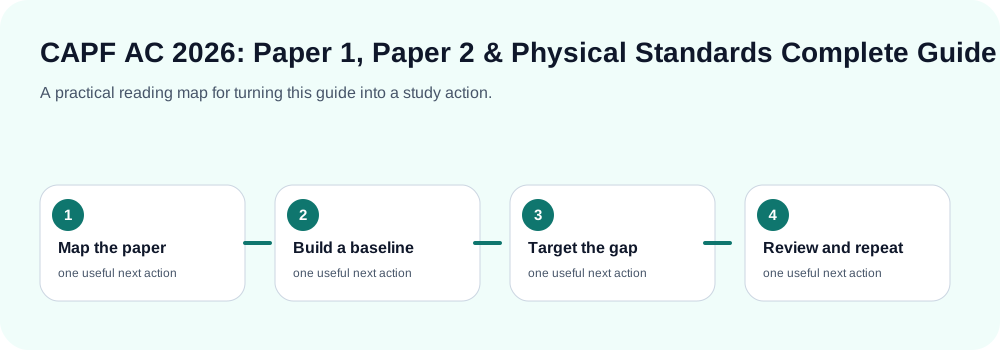
- Map the paperUse the exam pattern and eligibility details in this guide.
- Build a baselineTake a timed diagnostic mock before changing your routine.
- Target the gapChoose one weak section and practise it deliberately.
- Review and repeatLog errors, revise, and retest under time pressure.
Conclusion
CAPF AC 2026 rewards candidates who develop two distinct skill sets simultaneously: the analytical GK recall needed for Paper I, and the literary composition skills needed for Paper II. Most candidates underestimate Paper II — making it the greatest differentiator on the final merit list.
Begin your CAPF AC 2026 preparation on YourMockTest with CAPF-specific Paper I practice tests, essay evaluation tools, and précis writing exercises to build the complete profile of a future Assistant Commandant.
Revision note: Published after explicit owner approval; official-source verification remains recommended for time-sensitive claims.
Keep YourMockTest in your Google results
Add us as a Preferred Source to see fresh exam updates and preparation guidance more often in Google Search.
Add YourMockTest as a Preferred Source