Official Paper

UPTET 2021 Paper 2 (Social Science) (Hindi / English / Sanskrit) (Previous Year Paper)

150 questions · 150 minutes · with answers · free

Child Development and Pedagogy (30 questions)

1

The main characteristic of basic instinct is that which is found only in

  1. ((a))

    human beings

  2. ((b))

    cats and rats

  3. ((c))

    all organisms and it is inborn and natural

  4. ((d))

    artists

Show Answer
Answer: ((c))

all organisms and it is inborn and natural

Basic Instinct is an inherited or innate psychological disposition which determines its possessor to perceive or pays attention to, objects of a certain class, to experience an emotional excitement of a particular quantity upon perceiving such objects, and to act in regard to it in a particular manner, or at least, to experience an impulsive to such an action.

Characteristics of Basic Instinct

  • The main characteristic of basic instinct is inborn and natural that is found in all living organisms.
  • No one can develop in their later stages, it is an inborn talent or ability to feel the things that may be going to happen or not in near future.
  • Instinct is a vibe, that can be negative and positive.
  • The instincts are dominated by the pleasure principle (the chief characteristic of psychic energy) and are inherited.
  • Basic instinct may undergo more or less serious failures to pass through certain stages of development called the fixation of the instinct.
  • These instincts drive the satisfaction of which is the prime intention of mental activity are essentially somatic needs.
  • These are basically connected with the preservation of self and of species, which may be considered as needs.
  • The aim of basic instinct is the preservation of the individual and the species.
  • The basic instinct cannot be localized to any region of the mind.

Hence, we can conclude that The main characteristic of basic instinct is that which is found in all organisms and it is inborn and natural.

2

The right to free and compulsory education for children between the age group of 6 - 14 has been included in the Indian Constitution as

  1. ((a))

    Article 26 

  2. ((b))

    Article 15

  3. ((c))

    Article 45

  4. ((d))

    Article 21A

Show Answer
Answer: ((d))

Article 21A

Fundamental Rights and Education: Fundamental Rights of citizens given in our Constitution have established the spirit of equality and have helped to preserve individual liberty. The following articles in the category of Fundamental Rights have a special bearing on education in India.

  • ARTICLE 21A - It grants the Right to Free and Compulsory Education to all the children the aged six to fourteen years in a manner as the State may, by law determine. Inserted by the 86th Amendment in December 2002, this Article has accorded education the status of right for ensuring quality in educational expansion at the elementary level.

Key Points

  • Insertion of Article 21A, making elementary education a fundamental right of all children between the age group of 6-14 years, Article 45 has been amended so as to restrict its scope to pre-primary education up to 6 years of age.

Additional Information

Other Articles:

  • ARTICLE 45: Directive Principles of the State Policy in Article 45 under Part IV of the Constitution states that “the State shall endeavor to provide, within a period of ten years from the commencement of this Constitution, for free and compulsory education for all children until they complete the age of fourteen years”.
  • ARTICLE l5 - This Article guarantees prohibition of discrimination on grounds of religion, race, caste, sex or place of birth by the State. It also ensures equality in educational opportunities in India.

 Hence, we conclude that Article 21 A  states that "the right to free and compulsory education for children between age group of 6 - 14.

3

Kretschmer has classified the persons in which one of the following main types?

  1. ((a))

    Asthenic

  2. ((b))

    Athletic

  3. ((c))

    Pyknic

  4. ((d))

    All of the above 

Show Answer
Answer: ((d))

All of the above 

Kretschmer was a German psychiatrist who on the basis of his observation of patients classified people into four types. He used the physical constitution and temperament for this purpose The four types he talked about included:

  • Pyknic type
  • Asthenic type
  • Athletic type
  • Dysplastic type

Let us briefly study each of these types:

TypePersonaliy Traits
Pyknic TypeSuch people are: - Short in height with heavily built body type. - Have short, thick neck. - Social and cheerful. - They are happy-go-lucky, they like to eat and sleep. - Kretschmer called them “cycloid” as they have high probability of falling prey to manic-depressive type of psychopathology.
Asthenic TypeSuch persons are: - Tall and thin with underdeveloped muscles. - Underweight and  Irritable. - Shirk away from responsibility. - Have the habit of day dreaming and are lost in the world of fantasy. - Temperament wise they are categorized as “schizoid” and may develop disorder of schizophrenia.
Athletic TypeSuch persons are: - Muscular types and have well built muscles. - Neither tall nor short. - Stable and calm nature. - Able to adjust themselves to changes in the environment.
Dyspalstic TypeSuch persons are: - Do not exhibit any of the characteristics mentioned above but are mix of all three types.


Hence, we conclude that all are the main types through which Kretschmer has classified the persons.

4

The purpose of TET is to measure which of the following?

  1. ((a))

    Intelligence

  2. ((b))

    Aptitude

  3. ((c))

    Attitude

  4. ((d))

    Values

Show Answer
Answer: ((b))

Aptitude

Teacher Eligibility Test (TET): Teacher Eligibility Test known as TET is an Indian entrance examination for teachers. The test is mandatory for getting teaching jobs in government schools from Class I to Class VIII.

  • The examination is divided into Paper-I (Primary) and Paper-II (Elementary).
  • TET was introduced by the Govt of India to improve standards in teaching. It is conducted by the Central and State governments in India.
  • The essential qualifications for a person to be eligible for appointment as a teacher in any of the schools referred to in clause (n) of section 2 of the RTE Act are that he/she should pass the Teacher Eligibility Test (TET) which will be conducted by the appropriate government by the guidelines framed by the NCTE.
  • A candidate has to score over 60% to clear the eligibility test.

Key Points

Purpose of TET

  • The main purpose of the Teacher Eligibility Test (TET) is to assess the candidate's aptitude for the profession.
  • Recruiting teachers by evaluating the aspiring candidates’ academic brilliance.
  • The main motto is to impart quality teaching.
  • Assess the teachers who have adequate teaching competency and a positive attitude towards teaching or not.

Hence, we conclude that the purpose of TET is to measure the aptitude for the profession.

5

Consolidation theory explains which of the following?

  1. ((a))

    Learning

  2. ((b))

    Memory

  3. ((c))

    Motivation

  4. ((d))

    Creativity

Show Answer
Answer: ((b))

Memory

Consolidation Theory of Memory: Memories are solidified in long-term stores over days, weeks, months, and years. This process is referred to as consolidation.

  • In this theory, an old concept that refers to how long term memory develops over time after initial acquisition.
  • From a cognitive neuroscience perspective, consolidation is conceived of as biological changes that underlie the long-term retention of learned information, and we can ask what brain structures and systems support this process.
  • One idea is that consolidation strengthens the associations between multiple stimulus inputs and activations of previously stored information.

Hence we conclude that the Consolidation theory explains the solidified long-term memory.

6

Who has given the concept of educational quotient for backward children?

  1. ((a))

    Gordon

  2. ((b))

    Schonell

  3. ((c))

    Burton Hall

  4. ((d))

    Cyril Burt

Show Answer
Answer: ((d))

Cyril Burt

Sir Cyril Burt, the distinguished psychologist, and educationist can be regarded as the pioneer investigator of the 'Educational quotient of the Backward Child'. His work on the Backward Child' is of prime importance.

  • In- his book 'The Backward Child,' Burt reported his study. In the beginning, before reporting his work, he thought it useful to clarify and distinguish the term 'backward' from some other related terms like 'dull' and 'retarded'.
  • Burt was the first who given the term 'Educationally quotient for backward children'.
  • Burt's view regarding the term 'backward' refers to the Educational Age in relation to the Chronological Age.
  • Children having an Educational Quotient of 85 or less could be regarded as Educationally Backward, according to his criterion.
  • He states: "Educationally backward in the technical sense all those who in the middle of their school career would be unable to do the work of the class next below that which is normal for their age".

Hence, we conclude that Cyril Burt has given the concept of educational quotient for backward children.

7

Which among the following is different from the characteristics of a good test?

  1. ((a))

    Reliability

  2. ((b))

    Validity

  3. ((c))

    Objectivity

  4. ((d))

    Aptitude

Show Answer
Answer: ((d))

Aptitude

Tests are devices to gather information through some specified tasks presented to individuals. We come across various types of tests in education e.g. oral, written and practical; group or individual; performance, etc. Sometimes 'examination' is also used to mean a device or a test. 

Key Points

Characteristics of Good Test: A good test should enable us to the achievement or ability accurately and economically. Here we take a good test - validity, reliability, and usability.

  • Validity: A test is said to be valid if it measures what it is supposed to measure. Cronbach defines validity as "the extent to which a test measures what it to measure".
  • Reliability: A test is reliable if it gives consistent results of measurement on its administration on different occasions. Pupils should score similar scores if the test is repeated. Its administration maybe after some gap of time and the condition is that pupils do not receive any further training of related test content.
  • Usability: Usability refers to practicability - ease, and economy in terms of energy, time, and money. Usability means a test should be: easy to construct; easy in administrating; easy in scoring; easy in interpreting; and economic in terms of money and time.
  • Objectivity: When a student's score on a test is based only on the student's answers and not on the personal biases of the scorer (or teacher), then the scoring is considered to be objective. This depends on the procedure of the scoring (and the type of item to be scored).

Hence, we conclude that aptitude is not a characteristic of a good test, it is a part of the personality.

8

Which of the following is not theory of intelligence?

  1. ((a))

    Two factor theory

  2. ((b))

    Unifactor theory

  3. ((c))

    Theory of regression

  4. ((d))

    Multifactor theory

Show Answer
Answer: ((c))

Theory of regression

Key Points

There are several theories of intelligence:

  • Unifactor Theory :
  • It was given by French psychologist Alfred Binet.
  • Binet is famous for developing first intelligence test and concept of mental age.
  • The theory emphasizes that we all have general factor of intelligence to apply in all task.
  • According to this theory, if a person is proficient in one area, he should be proficient in other areas as well.
  • Two factor theory:
  • Spearman proposed this theory in 1923.
  • According to this theory, intelligence consists of two factor 'g' and 's', where 'g' stands for the generalized factor and 's' stands for the specific factor.
  • As per him, the 'g' factor is responsible for different tasks which are common for all people while 's' factor is for abilities like musical, spatial, mechanical etc.
  • Multifactor Theory:
  • Multi-factor theory neglects the existence of 'g' factor and state that intelligence is not an expression of innumerable highly specific factor, nor is it the expression primarily of a general factor that pervades all mental activities.

Hence, we conclude that the Theory of regression is not the theory of intelligence. It is a part of statistical analysis.

9

Which one of the following is not ductless glands?

  1. ((a))

    Pituitary glands

  2. ((b))

    Adrenal glands

  3. ((c))

    Salivary glands

  4. ((d))

    Thyroid glands

Show Answer
Answer: ((c))

Salivary glands

The correct answer is Salivary Gland.

Key Points

Gland: A Gland is an organ which releases substances that perform a specific functions in the body. Gland are of two types:

  • Exocrine Gland are the gland that secrete their product into a duct. Salivary gland secretes the saliva into the salivary duct.
  • Endocrine Gland are the gland that  secrete their product directly into the blood. There are no duct in endocrine glands. Hyphothalamus gland, Pituitary gland, Adrenal Gland, Thyroid Gland etc.

Thus, Salivary Gland is not a ductless gland.

10

According to Piaget, the second stage of cognitive development is

  1. ((a))

    sensorimotor stage

  2. ((b))

    formal operational stage

  3. ((c))

    pre-operational stage

  4. ((d))

    concrete operational stage

Show Answer
Answer: ((c))

pre-operational stage

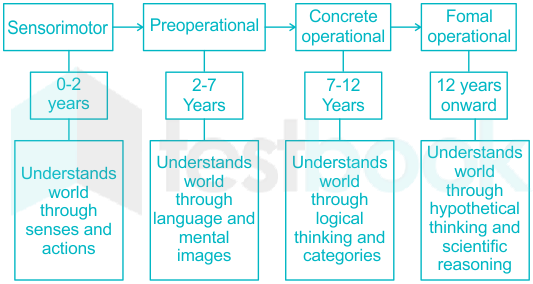
"Jean Piaget", a Swiss psychologist, is famous for his work on child development. He made a systematic study of cognitive development in his theory that is categorized in four stages.

Key Points

  • According to Piaget, the second stage of cognitive development is the 'pre-operations stage' which lasts around 2 to 6 or 7 years of age.
  • In this stage, the child faces problems with the concept of conservation and struggles with the idea of centration and irreversibility.

Characteristics of the Preoperational Period:

  • Egocentrism takes place.
  • Begin to think symbolically.
  • Develops the skills of language acquisition.
  • Begin to use words and pictures to represent objects.
  • Learns to compare objects through external characteristics.

Hence, it could be concluded that according to Piaget, the second stage of cognitive development is the pre-operational stage.

 Additional Information

Refer to the image for conceptual understanding of the characteristics of other stages of Piaget's theory: 

11

Which of the following is the most subjective method of educational psychology?

  1. ((a))

    Extrospection

  2. ((b))

    Introspection

  3. ((c))

    Observation

  4. ((d))

    Experimentation

Show Answer
Answer: ((b))

Introspection

Key Points Educational psychology extremely influences the principles of education. It applies to the psychological principles and techniques for human behavior in educational situations.

Main methods of Education Psychology:

  • Introspection
  • Observation
  • Experimental Method
  • Clinical Method
  • Developmental Method
  • Testing Method

Introspection Method:

  • Introspection means observing one's own behavior through self-analysis. This method is the most subjective in nature. The data of introspection method may not be  reliable and valid since the investigator may become subjective and biased when looks in to his own feelings.
  • It is most simple method which requires no laboratory and apparatus.
  • It is the oldest method of psychology and helps to improve thinking and performance.

​Observation Method:

  • It is very useful for the study of the behavior of person inside and outside the class.


Experimental Method

  • This method is for observing mental behavior in laboratory according to the scientific rules. It is free from subjectivity.


Extrospection Method

  • It is method of observation of things external to one's own mind, as opposed to introspection.

Hence, we can conclude that Introspection method is most subjective in nature.

12

Albert Bandura is associated with which of the following?

  1. ((a))

    Social learning theory

  2. ((b))

    Behavioural theory

  3. ((c))

    Cognitive development theory

  4. ((d))

    Psychosexual development 

Show Answer
Answer: ((a))

Social learning theory

'Albert Bandura', an American psychologist has propounded "Social Learning Theory". This theory is also called 'learning through imitation' as his theory emphasizes that:

  • learning takes place through indirect sources, like watching or hearing others.
  • cognitive and problem-solving skills can be learned by imitating and watching others.
  • new behaviors and experiences are acquired by observing others in the immediate environment.

The social learning theory of 'Albert Bandura' emphasizes that the principles of social learning consist of four steps (respectively) including:

AttentionIt refers to the process of paying attention to the model to observe in order to learn.
RetentionIt refers to the process of recalling the learned activity for later use.
ReproductionIt refers to the process of performing or reproducing the learned action.
MotivationIt refers to the process of motivating learners to repeat observational learning.


Hence, it could be concluded that Albert Bandura is associated with 'Social Learning Theory.

Additional Information

TheoryPropounderMain Idea
Behavioural theoryJ.B. Watson- It focuses on external observable behaviour. - This theory emphasizes that the environment is the prime factor in shaping an individual's behaviour.
Cognitive development theoryJean Piaget- It focuses on the internal mental process. - This theory emphasizes that learning is a process of thinking i.e. cognition for meaning-making.
Psychosexual development theorySigmund Freud- Personality gets well established during childhood, largely before the age of five years. - He proposed five stages of psychosexual development
13

Plateau in learning curve is caused due to 

  1. ((a))

    maturation

  2. ((b))

    motivation

  3. ((c))

    fatigue

  4. ((d))

    interest

Show Answer
Answer: ((c))

fatigue

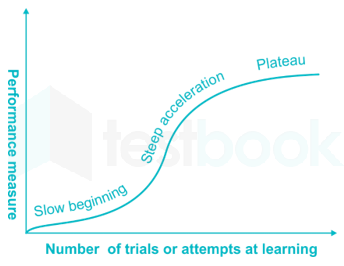
Learning Curve: The learning curve is a graphical representation that indicates the progress or lack of improvement in a given activity. There are several characteristics of the learning curve. Some of them are as follows: The learning progress at any stage is not always uniform. The last stage of the learning curve is called a plateau. The scope for learning is very low in the final stages of the curve. 

Important Points

The three stages of the learning curve are:

  • Slow beginning
  • Steep progress
  • Plateau.

  1. Slow beginning: In this phase, the learner gradually pacing to learn the concept. He/she has to start the learning of a given activity from scratch, his early progress will be slow. This is the beginning stage of learning, in which the learner is motivated to gain new information.
  2. Steep progress: In this phase, the learner successfully learned the concept.  In this stage, the learner steps accelerating in learning the concepts. After some time the learner gains a total understanding of the concept and reaches the boom stage of learning. and his/her learning improves swiftly.
  3. Plateau: The plateau effect is often seen in the pattern of development, indicating periods of no apparent improvement.
  • In this stage, learning plateau occurs, after gaining the mastery on the concept, the learner feels bore and want to learn new thing.
  • Once the curve hit a plateau when they are not willing to add new to their learning and the performance gets deteriorated. So the teacher should always introduce the same concept with innovative methods, this will overcome the boredom.
  • An example of the plateau effect is when someone's exercise fails to be as effective as in the past, or due to feeling fatigued because of a repetitive or similar concept.

Hence, we conclude that Plateau in the learning curve is caused due to fatigue.

14

Mirror drawing test is used to measured 

  1. ((a))

    rate of learning

  2. ((b))

    transfer of learning

  3. ((c))

    creativity

  4. ((d))

    interest

Show Answer
Answer: ((b))

transfer of learning

Bilateral transfer of learning occurs when there is the transfer of performance to one side of the body following training of the opposite side, eg. improved left-handed performance following right-handed training. You will verify the phenomenon by conducting a simple experiment as explained below.

Key Points

  • Problem: To demonstrate the phenomenon of bilateral transfer of learning.
  • Material Required: Mirror-drawing apparatus, stylus, stop watch, paper and pencil.

Procedure:

  • The following instructions are to be given to the participant, “Look at this mirror, you will see a star image.
  • The star image is a reflection of a pattern grooved on the wooden board and hidden by the screen. Take the stylus in your left hand (the experimenter will give the stylus to the participant and helps him/her to position it at the end of the nearest projection).
  • Now you will have to look into the mirror image and trace the star pattern with the stylus. Be careful about the stylus not touching the edges of the groove.
  • If you touch, it will be counted as an error. Try to do as speedily as possible.” After the participant traces the path once with the left hand, she/he is asked to trace the path again. Time taken and the number of errors committed are noted down.
  • In the same way, now the participant is asked to trace the star pattern with the right hand for 10 trials. In each of these trials, the number of errors committed and the amount of time taken in seconds to complete the pattern are noted down. A
  • gain the participant is asked to perform the same task in the same manner with the left hand, and the errors committed and time taken in seconds are noted down.
  • Compare the time taken in seconds and errors committed in the first trial with left hand with that of the second trial with left hand (after training with right hand for ten trials). Find out whether there is any transfer of training in the second trial with left hand and also if it is positive, negative or zero transfer.

Hence, it is clear that Mirror drawing test is used to measure transfer of learning.

15

Cloud picture test is used to measure which of the following?

  1. ((a))

    Intellignece

  2. ((b))

    personality

  3. ((c))

    Aptitude

  4. ((d))

    Interest

Show Answer
Answer: ((b))

personality

Cloud Picture Test is a psychometric test is used to measure the personality of an individual. This test is made by Williams Stern. It is design fantasy-stimuli which would avoid the disadvantages of the Rorschach Series. 

  • It consists series of three pictures that resemble clouds rather than ink-blots. 
  • Picture A offers the most distinct shades and forms.
  • Picture C is the vaguest,
  • Picture B occupies an intermediate position. There is no symmetry or other regularity in these pictures.
  • In this test, the respondents are shown pictures of the cloud and asked what cloud resembles.
  • The respondents observe the pictures of the cloud and respond to what kind of pictures he is seeing. This how the personality of an individual assesses.
  • Swiss psychiatrist Hermann Rorschach replace these cloud with ten inkblot test.

​Hence, we conclude that the Cloud Picture Test is used to measure personality.

16

What is the factor influencing physical development?

  1. ((a))

    Heredity

  2. ((b))

    Environment

  3. ((c))

    Sports and exercise

  4. ((d))

    All of the above 

Show Answer
Answer: ((d))

All of the above 

Physical development is regulated by a complex balance between the heredity/genetic constitution and the environmental factors, all interdependent. 

Key Points

Factors Influencing Physical Development

  • Heredity Factors: Heredity refers to the genetic constitution of an individual which is established during conception. It is the property of organic beings by which offsprings have the nature and characteristics of parents or ancestors. The height of a child depends more on heredity, while the weight, though also influenced Physical and Motor Development by heredity.
  • Environmental Factors: Though heredity and environment are closely inter-related and each human being at birth has a gene determined physical, mental, and biochemical potential. Environmental factors like nutrition, living standard, family surroundings, etc. This potential may not be reached because of environmental influences. Environment influences this potential only to a limited extent favorably or unfavorably.
  • Health Factors: The children are highly vulnerable to the negative health consequences associated with many environmental exposures. Health factors like, physical exercise, sports, games, etc. These factors influencing the physical development of a child. These factors also influence the growth of an individual. So school should provide physical exercises and games for child physical development.

Hence, we conclude that all are the factors influencing Physical Development.

17

Which of the following is correct formula to calculate IQ?

  1. ((a))

    MACA×100\frac{MA}{CA}\times 100

  2. ((b))

    CAMA\frac{CA}{MA}

  3. ((c))

    CAMA×100\frac{CA}{MA}\times 100

  4. ((d))

    MACA×100\frac{MA}{CA\times 100}

Show Answer
Answer: ((a))

MACA×100\frac{MA}{CA}\times 100

Intelligence Quotient is commonly known as IQ refers to the score of a standardized test that assesses and measures human intelligence.

  • The first test to measure intelligence was developed by Binet and Simon in 1905.
  • Terman in 1916 revised the test and devised the concept of Intelligence Quotient.
  • An individual’s Intelligence Quotient (IQ) is determined by the formula given below,

Intelligence;Quotient;(IQ)=Mental;Age;(MA);Chronological;Age;(CA)×100{\bf{Intelligence}};{\bf{Quotient}};\left( {{\bf{IQ}}} \right) = \frac{{{\bf{Mental}};{\bf{Age}};\left( {{\bf{MA}}} \right);}}{{{\bf{Chronological}};{\bf{Age}};\left( {{\bf{CA}}} \right)}} \times 100

  • Where, Mental Age is based on intellectual development.
  • Chronological Age is the number of years a person has lived.

Hence, it could be concluded that MA/CA × 100 is the correct formula to calculate IQ.

Additional Information

IQ RangeDescriptive Label
Above 130Very Superior Intelligence (gifted)
120 to 129Superior Intelligence
110 to 119High Average Intelligence
90 to 109Average Intelligence
80 to 89Low Average Intelligence
71 to 79Borderline Intellectual Functioning
55 to 70Mild Intellectual Disability
40 to 54Moderate Intellectual Disability
25 to 39Severe Intellectual Disability
Below 25Profound Intellectual Disability
18

Who among the following described 'reflective thinking'?

  1. ((a))

    Dewey

  2. ((b))

    Ross

  3. ((c))

    Woodworth

  4. ((d))

    Drever

Show Answer
Answer: ((a))

Dewey

John Dewey: The work of Dewey (1933) is considered as the beginning of the study and application of reflection.

  • For him, reflection is a kind of thinking, in the process of which one brings the subject to the forefront of the mind and gives serious thought to this.
  • It is a process of manipulation of knowledge and its reprocessing towards the set goal, and so, it is goal-directed.
  • One ‘thinks’ when in uncertainty or difficulty so as to solve the ‘perplexity’, and the process leads to testing through some action.
  • Dewey believed that effective education through reflection should aim at ‘making sense of the world’, and therefore, this is related to experience.
  • Learners are aware of and control their learning by active participation in reflective thinking.
  • In the reflective experience in which the environment is used as the object of reflection.

Key Points

Dewey’s concept of reflective thought and action, depicted comprises five phases: 

  • Disturbance and uncertainty
  • Intellectualization
  • Formation of Hypothesis
  • Reasoning
  • Hypothesis Testing.
<br>

Hence we conclude that John Dewey described 'reflective thinking'.

19

Which is not included in the levels of inductive reasoning?

  1. ((a))

    Observation

  2. ((b))

    Experiment

  3. ((c))

    Generalization

  4. ((d))

    Imagination

Show Answer
Answer: ((d))

Imagination

Inductive Reasoning is a way of proving a statement or generalizing a rule or principle by proving or showing that if a statement or a rule is true in one particular case, it will be true in cases, which appear in some serial order, and thus it may be applied generally to all such type of cases.

Important Points

The levels of inductive reasoning are below:

  • Generalization: Inductive reasoning starts from particular facts or special examples and instances one can formulate generalized principles and conclusions in this type of reasoning.
  • Observation: Inductive reasoning is called the 'Bottom-up' approach, moving from specific observations and measures to detect patterns and regularities, formulate some tentative hypotheses that can explore and end up developing general conclusions or theories.
  • Experimentation: Experimentation is an essential feature of inductive reasoning. Experiments are artificially created or contrived situations designed to make certain observations under strictly controlled conditions. The objective sometimes is to mimic nature. This allows the complexity of natural phenomena to be simplified for step by step study.

Hence, we conclude that 'Imagination' is not included in the level of Inductive reasoning.

20

Failure in retention and recall of learnt content is

  1. ((a))

    forgetting

  2. ((b))

    memory

  3. ((c))

    retention

  4. ((d))

    thinking

Show Answer
Answer: ((a))

forgetting

Forgetting: Forgetting is a failure to retrieve and retain information from long-term memory stores. Much of the information is lost but enough remains so that we have a sketchy record of our lives. Sometimes what we think is forgotten in real sense is not forgotten because it was never encoded and stored in the first place. 

Key Points

Causes of Forgetting:  Many students complain that they do not remember the contents after attending the class or forget after reading .the text. This happens due to :

  • Many times we forget as memory does not match events that had occurred. This happens due to the constructive processes i.e. during encoding, the to-be-remembered information, interference due to similar material.
  • Under-learning, some information does not reach short term memory from the sensory register.
  • Defective methods of remembering: Inadequate encoding and rehearsal, the information may not have been transferred from short term to long term memory.

Additional Information

  • Memory is the knowledge of a former state of mind after it has already once dropped from consciousness, or rather it is the knowledge of an event, or fact of which meantime we are not been thinking with the additional consciousness that we have thought or experienced before.
  • Retention is part of memory to retain the information for a longer period of life.
  • Thinking is the process of cognition that is related to memory.

Hence, we conclude that failure in retention and recall of learned content is forgetting.

21

Five-year-old Mohan has mental age of eight. What is his IQ?

  1. ((a))

    150

  2. ((b))

    160

  3. ((c))

    140

  4. ((d))

    135

Show Answer
Answer: ((b))

160

Intelligence Quotient is abbreviated as IQ. IQ is a measurement of a person’s intelligence and it is measured in number. The average IQ of a person is 100.

An individual’s Intelligence Quotient (IQ) is determined by the formula:

Intelligence;Quotient;(IQ)=Mental;Age;(MA);Chronological;Age;(CA)×100{\bf{Intelligence}};{\bf{Quotient}};\left( {{\bf{IQ}}} \right) = \frac{{{\bf{Mental}};{\bf{Age}};\left( {{\bf{MA}}} \right);}}{{{\bf{Chronological}};{\bf{Age}};\left( {{\bf{CA}}} \right)}} \times 100

where Mental Age is based on your intellectual development.

Chronological Age is the number of years a person has lived.

Given: CA = 5 years∴80=MA10×100∴80=MA10×100

MA = 8 years

IQ=85×100\therefore IQ = \frac{{{\bf{8}}}}{{5}} \times 100

IQ = 160

IQ RangeDescriptive Label
Above 130Very Superior Intelligence (gifted)
120 to 129Superior Intelligence
110 to 119High Average Intelligence
90 to 109Average Intelligence
80 to 89Low Average Intelligence
71to 79Borderline Intellectual Functioning
55 to 70Mild Mental Intellectual Disability
40 to 54Moderate Intellectual Disability
25 to 39Severe Intellectual Disability
Below 25Profound Intellectual Disability

Hence, the IQ of a child will be 160 and the child IQ will lie in above 130 IQ Range and having the Very Superior Intelligence (Gifted).

22

Which IQ range is called trainable IQ level of mentally retarded children?

  1. ((a))

    70 - 79

  2. ((b))

    50 - 69

  3. ((c))

    36 - 49

  4. ((d))

    35 and below

Show Answer
Answer: ((c))

36 - 49

Mental retardation, as a developmental disability, has attracted considerable public attention. Its general debilitating character has made it a distinct category of disability. Individuals with mental retardation, face considerable difficulty in their lives in adapting to the demands of day-to-day life.

Classification of Mental Retardation:

Based On IQ: There are mainly three methods of classification of mental retardation. They are medical, psychological, and educational. The psychological and educational classifications are more commonly and widely used than medical classifications. 

  • Educational Classification: This system uses the term educable, trainable, and custodial depending on the educational needs of retarded children.
  • The IQ ranges of educable mentally retarded (EMR), trainable mentally retarded (TMR), and the custodial mentally retarded (CMR) are given below:
  • | Levels of MR | IQ Range of MR | Educators | | --- | --- | --- | | Mild Retardation | 50-70 | Educable Mentally Retarded | | Moderate Retardation | 35-50 | Trainable Mentally Retarded | | Severe Retardation | 20-35 | Custodial Mentally Retarded | | Profound Retardation | Below 20 | Custodial Mentally Retarded) |

Important Points

  • Educable Mentally Retarded (EMR): The educable mentally retarded children are those who can be taught the basic academic subjects.
  • Trainable Mentally Retarded (TMR): The trainable mentally retarded are those children who can be taught functional academics with an emphasis on self-help and vocational skills.
  • Custodial Mentally Retarded (CMR): The custodial mentally retarded are those children who require constant and special care especially in a residential institution.

Hence, we conclude that the 35 – 50 IQ range is called a trainable IQ level of mentally retarded children. So the answer is 36-49.

23

Rorschach inkblot test is used to measured which of the following?

  1. ((a))

    Personality

  2. ((b))

    Intellignece

  3. ((c))

    Interest

  4. ((d))

    Aptitude 

Show Answer
Answer: ((a))

Personality

Rorschach inkblot Test: Hermann Rorschach, a Swiss psychiatrist, devised the Rorschach Inkblot Personality test in 1921. This test is most frequently used for the projective test

  • The test consists of a standard set of 10 cards with inkblots printed on them.
  • The Rorschach test is a measure of both intellectual and non-intellectual personality traits.
  • In the series of 10 cards five are achromatic, two cards are black and red, and the remaining three cards are polychromatic in combination of green, blue, orange and pink blots.
  • Conducted by the examiner to determine important aspects of each response into a coding system under four categories; Location, Determinant, Content, and Popularity.
  • It consists of the following categories of scoring the protocol:-
  • Total number of responses (R)
  • Human responses (H)
  • Animal responses (A)
  • Anatomical responses (At)
  • Sex responses (Sex)
  • Movement responses (M)
  • Rejection of images (Rej.)
  • Most typical responses (MT)
  • Typical responses (T)
  • Atypical responses (AT).
  • In the test, the subjects are asked to simply state whatever each inkblot looks like to them.
  • Responses are scored by the psychologists using predetermined categories, on key factors such as color and shape, movement.
  • These blots are frequently used for personality description, diagnosis of mental disorders, and for behaviour predictions.
  • The whole procedure of The Rorschach Test is a combined set of three components, viz., performance proper, inquiry, and scoring.

Hence, we conclude that Rorschach inkblot test is used to measured Personality traits.

24

Which of the following is not the cause of forgetting?

  1. ((a))

    Under-learning

  2. ((b))

    Desire to remember

  3. ((c))

    Mental conflict

  4. ((d))

    Defective methods of remembering

Show Answer
Answer: ((b))

Desire to remember

Forgetting: Forgetting is a failure to retrieve information from long-term memory stores. Much of the information is lost but enough remains so that we have a sketchy record of our lives. Sometimes what we think is forgotten in real sense is not forgotten because it was never encoded and stored in the first place. 

Causes of Forgetting:  Many students complain that they do not remember the contents after attending the class or forget after reading .the text. This happens due to :

  • Mental Conflict: Many times we forget as memory does not match events that had occurred. This happens due to the constructive processes i.e. during encoding, the to-be-remembered information, interference due to similar material.
  • Under-learning, some information does not reach short term memory from the sensory register.
  • Defective methods of remembering: Inadequate encoding and rehearsal, the information may not have been transferred from short term to long term memory.

NOTE: Desire to learn is helpful in remembering the information for the long term.

Hence, we conclude that the desire to remember is not the cause of forgetting.

25

The science which deals with the methods of collecting, classifying, presenting, comparing and interpreting numerical data is called.

  1. ((a))

    statistics

  2. ((b))

    mathematics

  3. ((c))

    geometry

  4. ((d))

    probability

Show Answer
Answer: ((a))

statistics

Statistics: In the singular sense, Statistics refers to what is called statistical methods which means the science which deals with the techniques for collection, classifying, presentation, analysis, and interpretation of statistical/numerical data information. In simple language, it means the subject of Statistics like any other subject such as Mathematics or Economics. 

  • This definition lays emphasis on five important aspects, which in fact, constitute the very scope of the subject called Statistics or Statistical Methods. These are:
  • Collection of Data: In any statistical inquiry, the collection of data is the first basic step. They form the foundation of statistical analysis, and therefore utmost care should be taken in collecting data in Primary and Secondary form.
  • Classification of Data: It follows editing. It involves arranging data according to some common characteristics.
  • Presentation of Data: Presented the data in the form of diagrams and graphs to facilitate the understanding of various trends as well as the process of comparison of various situations.
  • Analysis of Data: It is the most important step in any statistical inquiry. A major portion of this course in Statistics is devoted to the methods used for analyzing the collected data to derive some policy conclusions.
  • Interpretation of Data: It is the last but very crucial stage of a statistical inquiry or investigation. It is a job in itself that requires a high degree of aptitude, skill, and experience.

Additional Information

MathematicsIt is a science that involves dealing. with numbers, different kinds of calculations, measurement of shapes and structures, organization, and interpretation of data and establishing. the relationship among variables, etc.
ProbabilityProbability is the branch of mathematics. It is an occurrence of an event that is a number between 0 and 1, where, roughly speaking, 0 indicates the impossibility of the event, and 1 indicates certainty.
GeometryIt is a branch of Mathematics and dealing with spatial relationships.


Hence, we conclude that the science which deals with the methods of collecting, classifying, presenting, comparing, and interpreting numerical data is called Statistics.

26

Find the odd one out.

  1. ((a))

    16 - P.F.

  2. ((b))

    T.A.T.

  3. ((c))

    Raven's test

  4. ((d))

    Draw a man test

Show Answer
Answer: ((c))

Raven's test

Psychology test are used to measure the unique traits of an individual to know his ability, aptitude, contrast with their personality, intelligence, emotions etc. 

Key Points

Raven's Test:

  • It was intelligence test developed by John C raven in 1983.
  • It is non verbal test of inductive reasoning, designed to measure spearman  'g' factor or general intelligence.
  • It consists of 60 multiple choice items and can be administered on children from 5 year old toolder adults.
  • The test contains visual geometric designs with a missing piece.


16-PF

  • This test developed by the British Psychologist Cattell is based on 16 source traits of personality.
  • Cattell has used factor analysis to arrive at the 16 factors of personality.


TAT (Thematic Appreciation Test)

  • This test is used to measure the personality traits , developed by Morgan and Murray.
  • TAT consists of 30 black and white picture card depicting picture in ambiguous situations, plus one blank card.


Draw a man test

  • It is to measure personality traits, and developed by GoodEnough .
  • This test emphasizes on the child's ability to observe accurately and think conceptuallly.

​Thus, it can be concluded that Raven;s test is odd one out. It is used to measure the fluid intelligence.

27

The median of 7, 8, 9, 10, 11, 12 is

  1. ((a))

    9

  2. ((b))

    8

  3. ((c))

    10

  4. ((d))

    9.5

Show Answer
Answer: ((d))

9.5

The median of a set of numbers is the middle number in the set (after the numbers have been arranged from least to greatest) -- or, if there are an even number of data, the median is the average of the middle two numbers.

Example 1:

Find the median of the set : {3,10,36,255,79,24,5,8}

There are 8 numbers in the set, and they are arranged in ascending order. {3.5.8.10.24.36.79.255}

 find the average of the middle two numbers, 10 and 24.

= (10 + 24)/2 =17

Similarly, Example 2:

Find the median of the set: { 2,5,8,11,16,21,30 } 

There are 777 numbers in the set, and they are arranged in ascending order.  The middle number (the 44 th one in the list) is 11. The median is 11.

Key Points

In the given problem, arrange the observation in the ascending order. {7,8,9,10,11| and total number of observation is 6 , which is even.

3rd abd 4th observation are 9 and 10.

average of 9 and 10 is the median of the set.

(9+10)/2

=19/2

=9.510 + 242=342=111

28

Who has propounded the theory of insight?

  1. ((a))

    Thorndike

  2. ((b))

    Gestalt Psychologist

  3. ((c))

    Hegarty

  4. ((d))

    Skinner

Show Answer
Answer: ((b))

Gestalt Psychologist

The Gestalt theory of learning also named Learning by Insight is the contribution of German psychologists who were studying the nature of perception.

Key Points

  • Gestalt Theory of Learning (Learning by Wholes) or Learning by Insight states that perceptual phenomena are only experienced as wholes or Gestalts.
  • Translation of Gestalt is „configuration‟ or more simply „an organized whole in contrast to a collection of parts‟.
  • Gestalt psychologists consider the process of learning as a Gestalt – an organized whole.
  • A thing cannot be understood by the study of its constituent parts but only by the study of it as a totality, is a basic idea behind this theory.
  • Learning, according to Gestalt Theory, is not by random steps, not by trial and error, not by conditioning but by insight, introspection, and understanding.
  • The Gestaltians tend to place far more emphasis on the intrinsic organizing capacity in the brain of the individual and emphasis the dynamic interaction of the elements in the entire perceptual field.
  • Gestalt theory of learning essentially consists of problem-solving by understanding the relative position of the elements in the entire perspective or situation.

Additional Information

PsychologistTheory
E.L.ThorndikeTrial and Error Theory
B.F. SkinnerOperant Conditioning Theory


Hence, we conclude that the theory of insight is propounded by Gestalt Psychologist.

29

According to McDougall, every instinct is associated with 

  1. ((a))

    cognition

  2. ((b))

    emotion

  3. ((c))

    sensation

  4. ((d))

    thinking

Show Answer
Answer: ((b))

emotion

Emotions expressed by humans can be divided into two broad categories and are called positive and negative emotions. Examples of emotions include the following: Interest, enthusiasm, boredom, laughter, empathy, action, curiosity, anger, rebellion, irritation, etc.

According to William McDougall’s concept of emotions instincts and emotions were both innate patterns.

  • As per McDougall, the primary emotions were fear, disgust, wonder, anger, subjection, elation, tenderness. According to him, each instinctual tendency has a corresponding emotion.
  • William McDougall(2003) analyses an instinctive behavior, in three aspects:
  • Cognitive or (knowing or perceptive) aspect.
  • Affective or (feeling or emotional) aspect.
  • Conative or (doing or behavior) aspect.
  • The occurrence of some form of arousal in the emotion gives rise to a cognitive search for an explanation of arousal.
  • In the opinion of McDougall, feelings arise and are conditioned by the degrees of success and failure of one's own efforts, whereas emotions are aroused by some object or person deemed responsible for one’s success or failure in some particular situation.
  • Emotion is not just a feeling gone violent but itself a singular experience.

Hence, we conclude that According to McDougall, every instinct is associated with emotion.

30

Giving the meaning to sensation on the basis of past experience is called

  1. ((a))

    sensation

  2. ((b))

    perception

  3. ((c))

    motivation

  4. ((d))

    imagination

Show Answer
Answer: ((b))

perception

Perception is the process through which we interpret and organize the received information so as to produce our conscious experience of objects and their relationship.

  • We feel something in sensation when the stimulus is present and when the meaning is added to them it becomes perception.
  • In this process, physical energy; such as light, sound waves, heat; emanating from objects is transformed by the concerned sense organs into a code and transferred to and interpreted by the brain.
  • The line between the two terms sensation and perception, therefore, is somewhat arbitrary.
  • The sensation typically refers to the direct reception and transmission of messages, whereas perception refers to the active process of integrating and organizing these sensations.

SensationThe initial contact between organisms and their physical Sensation and Perception environment constructing knowledge out of raw materials is known as sensation.
ImaginationImagination is a primary creative act, a willed activity of spirit, a self-consciousness, a "self-realizing intuition.
MotivationMotivation is the way in which urges, desires, aspirations, and strivings or needs direct, control, or explain the behavior of human beings.


Hence, we conclude that giving the meaning to sensation on the basis of past experience is called Perception.

Hindi (30 questions)

31

निम्नलिखित में कौन सा विकल्प वाचन शिक्षण की विधि नहीं है? 

  1. ((a))

    ध्वनि साम्य विधि 

  2. ((b))

    अनुध्वनि विधि 

  3. ((c))

    व्याख्या विधि 

  4. ((d))

    समवेत पाठ विधि 

Show Answer
Answer: ((c))

व्याख्या विधि 

  • उपर्युक्त में से 'व्याख्या विधि' वाचन शिक्षण की विधि नहीं है बल्कि यह उच्च कक्षाओं के लिए शिक्षण की विधि है।
  • शेष विकल्प असंगत हैं।

अतः सही विकल्प 'व्याख्या विधि' है। 

अन्य विकल्प

'ध्वनि साम्य विधि', 'अनुध्वनि विधि' और 'समवेत पाठ विधि' ध्वनि वाचन (जोर से बोलकर पढ़ने) की विधियां हैं।

32

निम्नलिखित में अभिवृत्यात्मक उद्देश्य कौन सा है?

  1. ((a))

    स्वानुभूत विचारो व भावों को अभिव्यक्त करना 

  2. ((b))

    साहित्य का रसास्वादन करना 

  3. ((c))

    धैर्यपूर्वक सुनना 

  4. ((d))

    भाषा और साहित्य में रुचि 

Show Answer
Answer: ((a))

स्वानुभूत विचारो व भावों को अभिव्यक्त करना 

  • उपर्युक्त में से 'स्वानुभूत विचारो व भावों को अभिव्यक्त करना' अभिवृत्यात्मक उद्देश्य है।
  • इसमें छात्रों को कहानी सुनाना, यात्रा का वर्णन करना, निबंध लिखना, संवाद लिखने आदि की क्रियाएं करवाई जाती हैं जिससे छात्रों के अभिवृत्तियों का पता चलता है।
  • शेष विकल्प असंगत हैं।

अतः सही विकल्प 'स्वानुभूत विचारो व भावों को अभिव्यक्त करना' है।

33

हिन्दी साहित्य के इतिहास के संबंध में ‘मॉडर्न वरनाक्यूलर लिटरेचर ऑफ हिन्दोस्तान’ किसने लिखा है?

  1. ((a))

    जॉर्ज अब्राहम ग्रियर्सन 

  2. ((b))

    सुमित कुमार चटर्जी

  3. ((c))

    गार्सा द तासी 

  4. ((d))

    धीरेन्द्र वर्मा

Show Answer
Answer: ((a))

जॉर्ज अब्राहम ग्रियर्सन 

  • 'मॉडर्न वरनाक्यूलर लिटरेचर ऑफ हिन्दोस्तान’ 'जॉर्ज अब्राहम ग्रियर्सन' ने लिखा है।
  • यह किताब 1989 में लिखी गयी थी जिसमें पहली बार हिंदी साहित्य के काल विभाजन का प्रयास किया गया था।
  • इसमें हिंदी साहित्य के काल को दस अध्यायों में बाँटा गया था।
  • शेष विकल्प असंगत हैं।

अतः सही विकल्प 'जॉर्ज अब्राहम ग्रियर्सन' हैं।

34

निम्नलिखित पंक्ति किसकी है? “विरहनी बावरी सी भई ऊँची चढ़ि अपने भवन में टेरत हाय दई ले अंचरा मुख अँसुवन पोंछत उघरे गात सही।”

  1. ((a))

    सहजोबाई

  2. ((b))

    मीराबाई

  3. ((c))

    झीमा चारिणी

  4. ((d))

    दयाबाई

Show Answer
Answer: ((b))

मीराबाई

  • उपर्युक्त पंक्तियाँ 'मीराबाई' द्वारा रचित हैं।
  • इस पद में उन्होंने कृष्ण के प्रति अपनी विरह भावना को दर्शाया है।
  • मीराबाई कृष्णभक्त कवयित्री थी।
  • इनकी प्रसिद्ध रचनायें - 'गीतगोविन्द टीका, नरसी जी का मायरा, रागगोविन्द आदि हैं।
  • शेष विकल्प असंगत हैं।

अतः सही विकल्प 'मीराबाई' है।

35

हिन्दी का पहला पत्र कौन सा है?

  1. ((a))

    उदंत मार्तण्ड

  2. ((b))

    इतिहास तिमिरनाशक

  3. ((c))

    बनारस अखबार

  4. ((d))

    हरिश्चन्द्र मैगजीन 

Show Answer
Answer: ((a))

उदंत मार्तण्ड

  • हिन्दी का पहला पत्र 'उदंत मार्तण्ड' है।
  • इस पत्र का संपादन पंडित जुगल किशोर शुक्ल द्वारा 30 मई 1826 को कलकत्ता में हुआ था।
  • इसे हिंदी का पहला समाचार पत्र माना जाता है।
  • शेष विकल्प असंगत हैं।

अतः सही विकल्प 'उदंत मार्तण्ड' है।

अन्य विकल्प

- इतिहास तिमिरनाशक के संपादक राजा शिवप्रसाद सितारेहिंद थे।

- बनारस अखबार के संपादक - सन 1845 में राजा शिव प्रसाद ने ‘बनारस अख़बार’ निकाला था।

- हरिश्चन्द्र मैगजीन - यह एक मासिक पत्रिका थी। यह पत्रिका 15 अक्टूबर, 1873 को काशी से भारतेंदु हरिश्चंद्र ने प्रारम्भ की थी।

निर्देश: दिए गए गद्यांश को पढकर निम्नलिखित प्रश्नों के सही विकल्प छाँटिए।

धर्म पालन करने के मार्ग में सबसे अधिक बाधा चित्त की चंचलता, उद्देश्य की अस्थिरता और मन की निर्बलता से पड़ती है। मनुष्य के कर्तव्य मार्ग में एक ओर तो आत्मा के बुरे-भले कामों का ज्ञान दूसरी ओर आलस्य और स्वार्थपरता रहती है। बस मनुष्य इन्हीं दोनों के बीच में पड़ा रहा है। अंत में यदि उसका मन पक्का हुआ तो वह आत्मा की आज्ञा मानकर अपना धर्म पालन करता है, पर उसका मन दुविधा में पड़ा रहा है तो स्वार्थपरता करता है स्वार्थपरता उसे निश्चित ही घेरेगी और उसका चरित्र घृणा के योग्य हो जायेगा। इसलिए यह बहुत आवश्यक है कि आत्मा जिस बात को करने की प्रवृत्ति दे, उसे बिना स्वार्थ सोचे, झटपट कर डालना चाहिए। इस संसार में जितने बड़े-बड़े लोग हुए हैं सभी ने अपने कर्तव्य को सबसे श्रेष्ठ माना है, क्योंकि जितने कर्म उन्होंने किए उन सबने अपने कर्तव्य पर ध्यान देकर न्याय का बर्ताव किया। जिन जातियों में यह गुण पाया जाता है, वे ही संसार में उन्नति करती हैं और संसार में उनका नाम आदर से लिया जाता है। जो लोग स्वार्थी होकर अपने कर्तव्य पर ध्यान नहीं देते, वे संसार में लज्जित होते हैं और सब लोग उनसे घृणा करते हैं। कर्तव्य पालन और सत्यता में बड़ा घनिष्ठ संबंध है। जो मनुष्य अपना कर्तव्य पालन करता है, वह अपने कामों और वचनों में सत्यता का बर्ताव भी रखता है। सत्यता ही एक ऐसी वस्तु है जिससे इस संसार में मनुष्य अपने कार्यों में सफलता पा सकता है, क्योंक‍ि संसार में कोई काम झूठ बोलने से नहीं चल सकता । झूठ की उत्पति पाप, कुटिलता और कायरता से होती है। झूठ बोलना कई रूपों में दिख पड़ता है, जैसे चुप रहना, किसी बात को बढ़ाकर कहना, किसी बात को छिपाना, झूठ-मूठ दूसरों की हाँ में हाँ मिलाना आदि। कुछ ऐसे लोग भी होते हैं जो मुँह देखी बातें बनाया करते हैं, पर करते वहीं हैं जो उन्हें रुचता है। ऐसे लोग मन में समझाते हैं कि कैसे सबको मर्ख बनाकर हमने अपना काम कर लिया, पर वास्वत में वे अपने को ही मूर्ख बनाते हैं और अंत में उनकी पोल खुल जाने पर समाज के लोग उनसे घृणा करते हैं।

36

धर्म पालन करने में बाधा डालने वाली प्रवृत्तियाँ कौन- सी हैं?

  1. ((a))

    कमजोर मन, उद्देश्य का निश्चित न होना तथा चंचल मनोवृत्ति का होना 

  2. ((b))

    धर्म का ज्ञान न होना

  3. ((c))

    आलस्य की अधिकता

  4. ((d))

    जानकारी की कमी

Show Answer
Answer: ((a))

कमजोर मन, उद्देश्य का निश्चित न होना तथा चंचल मनोवृत्ति का होना 

धर्म पालन करने में बाधा डालने वाली प्रवृत्तियाँ 'कमजोर मन, उद्देश्य का निश्चित न होना तथा चंचल मनोवृत्ति का होना' है। यह गद्यांश की पंक्ति 'धर्म पालन करने के मार्ग में सबसे अधिक बाधा चित्त की चंचलता, उद्देश्य की अस्थिरता और मन की निर्बलता से पड़ती है।' से स्पष्ट होता है। शेष विकल्प असंगत हैं। अतः सही विकल्प 'कमजोर मन, उद्देश्य का निश्चित न होना तथा चंचल मनोवृत्ति का होना' है।

37

संसार के बड़े-बड़े लोगों ने सबसे श्रेष्ठ किसे माना है?

  1. ((a))

    उत्तम चरित्र को 

  2. ((b))

    सदाचार को

  3. ((c))

    परोपकार को

  4. ((d))

    अपने कर्तव्य को 

Show Answer
Answer: ((d))

अपने कर्तव्य को 

  • संसार के बड़े-बड़े लोगों ने सबसे श्रेष्ठ 'अपने कर्तव्य को' माना है।
  • गद्यांश की पंक्ति 'इस संसार में जितने बड़े-बड़े लोग हुए हैं सभी ने अपने कर्तव्य को सबसे श्रेष्ठ माना है' से स्पष्ट होता है।
  • अन्य विकल्प अनुपयुक्त हैं।
<br>

अतः सही विकल्प 'अपने कर्तव्य को' है।

निर्देश: दिए गए गद्यांश को पढकर निम्नलिखित प्रश्नों के सही विकल्प छाँटिए।

धर्म पालन करने के मार्ग में सबसे अधिक बाधा चित्त की चंचलता, उद्देश्य की अस्थिरता और मन की निर्बलता से पड़ती है। मनुष्य के कर्तव्य मार्ग में एक ओर तो आत्मा के बुरे-भले कामों का ज्ञान दूसरी ओर आलस्य और स्वार्थपरता रहती है। बस मनुष्य इन्हीं दोनों के बीच में पड़ा रहा है। अंत में यदि उसका मन पक्का हुआ तो वह आत्मा की आज्ञा मानकर अपना धर्म पालन करता है, पर उसका मन दुविधा में पड़ा रहा है तो स्वार्थपरता करता है स्वार्थपरता उसे निश्चित ही घेरेगी और उसका चरित्र घृणा के योग्य हो जायेगा। इसलिए यह ��हुत आवश्यक है कि आत्मा जिस बात को करने की प्रवृत्ति दे, उसे बिना स्वार्थ सोचे, झटपट कर डालना चाहिए। इस संसार में जितने बड़े-बड़े लोग हुए हैं सभी ने अपने कर्तव्य को सबसे श्रेष्ठ माना है, क्योंकि जितने कर्म उन्होंने किए उन सबने अपने कर्तव्य पर ध्यान देकर न्याय का बर्ताव किया। जिन जातियों में यह गुण पाया जाता है, वे ही संसार में उन्नति करती हैं और संसार में उनका नाम आदर से लिया जाता है। जो लोग स्वार्थी होकर अपने कर्तव्य पर ध्यान नहीं देते, वे संसार में लज्जित होते हैं और सब लोग उनसे घृणा करते हैं। कर्तव्य पालन और सत्यता में बड़ा घनिष्ठ संबंध है। जो मनुष्य अपना कर्तव्य पालन करता है, वह अपने कामों और वचनों में सत्यता का बर्ताव भी रखता है। सत्यता ही एक ऐसी वस्तु है जिससे इस संसार में मनुष्य अपने कार्यों में सफलता पा सकता है, क्योंक‍ि संसार में कोई काम झूठ बोलने से नहीं चल सकता । झूठ की उत्पति पाप, कुटिलता और कायरता से होती है। झूठ बोलना कई रूपों में दिख पड़ता है, जैसे चुप रहना, किसी बात को बढ़ाकर कहना, किसी बात को छिपाना, झूठ-मूठ दूसरों की हाँ में हाँ मिलाना आदि। कुछ ऐसे लोग भी होते हैं जो मुँह देखी बातें बनाया करते हैं, पर करते वहीं हैं जो उन्हें रुचता है। ऐसे लोग मन में समझाते हैं कि कैसे सबको मर्ख बनाकर हमने अपना काम कर लिया, पर वास्वत में वे अपने को ही मूर्ख बनाते हैं और अंत में उनकी पोल खुल जाने पर समाज के लोग उनसे घृणा करते हैं।

38

'निर्बलता’ शब्द में उपसर्ग और प्रत्यय का सही विकल्प क्या है?

  1. ((a))

    निर् + बल + ता

  2. ((b))

    निर + बल + ता

  3. ((c))

    निर + बलत + आ

  4. ((d))

    निर + बल + अता 

Show Answer
Answer: ((a))

निर् + बल + ता

  • ‘निर्बलता’ शब्द में उपसर्ग और प्रत्यय का सही विकल्प 'निर् + बल + ता' है।
  • इसमें 'निर्' उपसर्ग है, 'बल' मूल शब्द है, 'ता' प्रत्यय है।
  • शेष विकल्प त्रुटिपूर्ण हैं।
<br>

अतः सही विकल्प 'निर् + बल + ता' है।

विशेष

शब्दपरिभाषाउदाहरण
उपसर्गउपसर्ग उस अक्षर या अक्षर समूह को कहते हैं जो किसी शब्द के पहले जुड़कर उसके अर्थ में परिवर्तन लाता है।जैसे - प्र, सु, अति, अधि, अनु, नि प्र + हार = प्रहार
प्रत्ययशब्द के उपरांत जिस शब्द का प्रयोग किया जाता है वह प्रत्यय है।जैसे - ता, औना, अन, अत श्रो + ता = श्रोता
39

‘कायर’ की भाववाचक संज्ञा क्या है?

  1. ((a))

    अकायरता

  2. ((b))

    कायरत्व

  3. ((c))

    कायरपन

  4. ((d))

    कायरता

Show Answer
Answer: ((d))

कायरता

  • ‘कायर’ की भाववाचक संज्ञा 'कायरता' है।
  • शेष विकल्प असंगत हैं।
<br>

अतः सही विकल्प 'कायरता' है।

 विशेष

भाववाचक संज्ञा बनाना -
1. जातिवाचक संज्ञा से भाववाचक संज्ञा बनाना - दास = दासता, पंडित = पांडित्य, बंधु = बंधुत्व
2. सर्वनाम से भाववाचक संज्ञा बनाना - स्व = स्वत्व, सर्व = सर्वस्व, निज = निजत्व
3. विशेषण से भाववाचक संज्ञा बनाना - मीठा = मिठास, चतुर = चातुर्य , चतुराई, मधुर = माधुर्य , मधुरता
4. क्रिया से भाववाचक संज्ञा बनाना - खेलना = खेल, थकना = थकावट, लिखना = लेख
5. संज्ञा से भाववाचक बनाना - बाल = बालपन, देव = देवत्व, बालक = बालकपन
6. अव्यय से भाववाचक संज्ञा बनाना - परस्पर = पारस्पर्य, समीप = सामीप्य, निकट = नैकट्य, शाबाश = शाबाशी
40

‘अपना मतलब निकालने वाला’ के लिए उचित शब्द क्या है?

  1. ((a))

    स्वार्थी

  2. ((b))

    स्वार्थपरता 

  3. ((c))

    स्वार्थपरक

  4. ((d))

    कुटिल 

Show Answer
Answer: ((a))

स्वार्थी

  • ‘अपना मतलब निकालने वाला’ के लिए उचित शब्द 'स्वार्थी' है।
  • शेष विकल्प असंगत हैं।
<br>

अतः सही विकल्प 'स्वार्थी' है।

अन्य विकल्प - 

'कुटिल' का अर्थ 'टेढ़ा या चालबाज' होता है।

'स्वार्थपरता' का अर्थ 'खुदगर्जी' होता है।

'स्वार्थपरक' का अर्थ 'स्वार्थपरायण' होता है।

41

‘पंकज’ में कौन-सा समास है?

  1. ((a))

    द्वंद्व

  2. ((b))

    द्विगु

  3. ((c))

    कर्मधारय

  4. ((d))

    बहुव्रीहि

Show Answer
Answer: ((d))

बहुव्रीहि

‘पंकज’ में 'बहुव्रीहि समास' है क्योंकि इसका पहला और उत्तर पद प्रधान नहीं है जबकि इसका संयुक्त रूप या अन्य पद प्रधान है। शेष विकल्प अनुचित हैं। अतः सही विकल्प 'बहुव्रीहि' है।

अन्य विकल्प

समास - समास से तात्पर्य 'संक्षिप्तीकरण' से है। जब दो या दो से अधिक शब्दों के योग से जो छोटा शब्द बने उसे समास क���ते हैं। समास के माध्यम से कम शब्दों में अधिक अर्थ प्रकट किया जाता है। जैसे - रजा का पुत्र – राजपुत्र, समास के छःप्रकार हैं -
समास का नामपरिभाषाउदाहरण
तत्पुरुष समासजिस समास में उत्तरपद प्रधान हो तथा समास करने के उपरांत विभक्ति (कारक चिन्ह) का लोप हो।1. धर्म का ग्रन्थ = धर्मग्रन्थ 2. तुलसीदास द्वारा कृत = तुलसीदासकृत
अव्ययीभाव समासजिस समास में पहला पद (पूर्वपद) अव्यय तथा प्रधान हो'।1. जन्म से लेकर = आजन्म 2. मति के अनुसार = यथामति।
कर्मधारय समासजिस समास के दोनों शब्दों के बीच विशेषण-विशेष्य अथवा उपमान-उपमेय का सम्बन्ध हो,
पहचान: विग्रह करने पर दोनों पद के मध्य में 'है जो', 'के समान' आदि आते हैं।
1. कमल के समान नयन = कमलनयन 2. महान है जो देव = महादेव
द्विगु समासजिस समास में पूर्वपद (पहला पद) संख्यावाचक विशेषण हो।1. दो पहरों का समूह = दोपहर 2. तीनों लोकों का समाहार = त्रिलोक।
द्वंद्व समासजिस समास में दोनों पद प्रधान हो तथा विग्रह करने पर उनके बीच ‘तथा’, ‘या’, ‘अथवा’, ‘एवं’ या ‘और’ का प्रयोग होता हो ।1. अन्न और जल = अन्न-जल 2. अपना और पराया = अपना-पराया।
बहुव्रीहि समासजिस समास में दोनों पद प्रधान नहीं होते हैं और दोनों पद मिलकर किसी अन्य विशेष अर्थ की ओर संकेत कर रहे होते हैं।1. जो महान वीर है = महावीर अर्थात हनुमान 2. तीन आँखों वाला = त्रिलोचन अर्थात शिव
द्विगु समास और बहुव्रीहि समास में अंतर - द्विगु समास का पहला पद संख्यावाचक विशेषण होता है और दूसरा पद विशेष्य होता है जबकि बहुव्रीहि समास में समस्त पद ही विशेषण का कार्य करता है। जैसे दोपहर- दो पहरों का समूह (द्विगु समास), चतुर्भुज- चार है भुजाएँ जिसकी अर्थात विष्णु (बहुव्रीहि समास)।
42

अयोगवाह किसे कहा जाता है?

  1. ((a))

    महाप्राण को 

  2. ((b))

    अनुस्वार एवं विसर्ग को

  3. ((c))

    संयुक्त व्यंजन को 

  4. ((d))

    अल्पप्राण को 

Show Answer
Answer: ((b))

अनुस्वार एवं विसर्ग को

‘अयोगवाह’ 'अनुस्वार एवं विसर्ग को' कहा जाता है। अन्य विकल्प असंगत हैं। अतः सही विकल्प 'अनुस्वार एवं विसर्ग को' है। 

स्पष्टीकरण - 

अयोगवाह — अयोगवाह अनुस्वार (ं) और विसर्ग (ः) को कहते हैं क्योंकि यह ना तो स्वर के अंतर्गत आते हैं और ना ही व्यंजन के अन्तर्गत आते हैं। लेकिन यह स्वर के अंत में अवश्य लगते हैं।‘अं’ और ‘अः’ यह दो अयोगवाह हैं।


 अन्य विकल्प

वर्णपरिभाषाउदाहरण
महाप्राणजिन वर्णों के उच्चारण में वायु की पर्याप्त मात्रा होती है, जिसके कारण हकार-जैसी ध्वनि स्पष्ट दिखती है। वे महाप्राण कहलाते हैं। प्रत्येक वर्ग का दूसरा और चौथा वर्ण तथा समस्त ऊष्म वर्ण महाप्राण हैं।ख, घ; छ, झ; ठ, ढ; थ, ध; फ, भ और श, ष, स, ह।
संयुक्त व्यंजनजब एक स्वर रहित व्यंजन अन्य स्वर सहित व्यंजन से मिलता है, तब वह संयुक्त व्यंजन या संयुक्ताक्षर कहलाता हैं।क् + त = क्त = संयुक्त, स् + थ = स्थ = स्थान, स् + व = स्व = स्वाद, द् + ध = द्ध = शुद्ध।
अल्पप्राणजिन वर्णों के उच्चारण में वायु की सामान्य मात्रा रहती है और हकार जैसी ध्वनि बहुत ही कम होती है। वे अल्पप्राण कहलाते हैं। प्रत्येक वर्ग का पहला, तीसरा और पाँचवाँ वर्ण अल्पप्राण व्यंजन हैं।क, ग, ङ; ज, ञ; ट, ड, ण; त, द, न; प, ब, म,। अन्तःस्थ (य, र, ल, व ) भी अल्पप्राण ही हैं।
43

निम्नलिखित पंक्तियों में कौन सा रस प्रयुक्त है?

एक ओर अजरहिं लखि एक ओर मृगराय।

विकल बटोही बीच ही पर्यो मूरछा खाय॥

  1. ((a))

    रौद्र रस

  2. ((b))

    वीर रस 

  3. ((c))

    भयानक रस 

  4. ((d))

    करुण रस 

Show Answer
Answer: ((c))

भयानक रस 

उपर्युक्त पंक्तियों में 'भयानक रस' है क्योंकि इसमें 'भय' का भाव युक्त है। शेष विकल्प असंगत हैं। अतः सही विकल्प 'भयानक रस' है।

स्पष्टीकरण

  • उपर्युक्त दोहे में 'एक ओर अजगर और दूसरी ओर सिंह का देखकर व्याकुल होकर यात्री बीच में मूर्च्छित होकर गिर पड़ा।
  • यहाँ यात्री आश्रय है। अजगर और सिंह आलंबन है। अजगर की फुँकार और सिंह की गर्जना तथा उनकी भयंकर चेष्टाएँ उद्दीपन हैं।
  • यात्री का कांपना व मूर्छा अनुभाव हैं, व्याकुलता चिंता, डर आदि संचारी भाव हैं, इन सबसे पुष्ट होकर भय स्थायी भाव भयानक रस में परिणीत हुआ है।


अन्य विकल्प

रसस्थायी भावपरिभाषाउदाहरण
रौद्र रसक्रोधकिसी व्यक्ति के द्वारा क्रोध में किए गए अपमान आदि से उत्पन्न हुआ भाव।जैसे - अविरत बोले वचन कठोर, बेगी देखाउ मूढ नत आजू। उलतऊँ माहि जंह लग तवराजू।
वीरउत्साहउत्साह नामक स्थाई भाव जब विभावादी के संयोग से परिपक्व होकर रस रूप में परिणत हो।वीर तुम बढ़े चलो, धीर तुम बढ़े चलो। सामने पहाड़ हो सिंह की दहाड़ हो। तुम कभी रूको नहीं, तुम कभी झुको नहीं।
करुणशोककिसी प्रिय व्यक्ति के विरह से उत्पन्न होने वाली शोकावस्था।सोक विकल सब रोंवही रानी। रूपु सीलु बलु तेज बखानी। करहिं मिलाप अनेक प्रकार। परहिं भूमि तल बारहिं बारा।
44

‘से’ विभक्ति निम्न में से किस कारक के लिए प्रयुक्त होता है?

  1. ((a))

    कर्ता

  2. ((b))

    कर्म

  3. ((c))

    सम्प्रदान

  4. ((d))

    करण

Show Answer
Answer: ((d))

करण

  • ‘से’ विभक्ति उपर्युक्त में से 'करण' कारक के लिए प्रयुक्त होता है।
  • अन्य विकल्प असंगत हैं।
<br>

अतः सही विकल्प 'करण' है।

विशेष

परसर्ग - ये वे अक्षर हैं जो किसी शब्द के बाद आते हैं और कोई विशेषता लाते हैं। जैसे - का, की, रे, ने, द्वारा, से आदि।
कारक - कारक यानी कि किसी कार्य को करने वाला। जो कार्य को करने में भूमिका निभाता हो कारक कहलाता है।
विभक्तिकारकचिन्ह/ परसर्ग
प्रथमकर्ता कारकने
द्वितीयकर्म कारकको
तृतीयकरण कारकसे, के द्वारा
चतुर्थीसम्प्रदान कारकको, के लिए (देने का भाव)
पंचमीअपादान कारकसे, (अलग होने के लिए)
षष्ठीसंबंध कारकका, की, के, रा, री, रे
सप्तमीअधिकरण कारकमें, पर
अष्टमीसंबोधनहे ! ओ ! अरे !
45

‘उसने नहाकर भोजन किया’ – इस वाक्य में ‘नहाकर’ निम्नांकित में से किस क्रिया का उदाहरण है?

  1. ((a))

    संयुक्त क्रिया 

  2. ((b))

    प्रेरणार्थक क्रिया 

  3. ((c))

    द्विकर्मक क्रिया 

  4. ((d))

    पूर्वकालिक क्रिया 

Show Answer
Answer: ((d))

पूर्वकालिक क्रिया 

  • ‘उसने नहाकर भोजन किया’ इस वाक्य में ‘नहाकर’ शब्द 'पूर्वकालिक क्रिया’ का उदाहरण है।
  • शेष विकल्प असंगत हैं।
<br>

अतः सही विकल्प 'पूर्वकालिक क्रिया' है।

अन्य विकल्प

क्रियापरिभाषाउदाहरण
पूर्वकालिकमुख्य क्रिया से पहले होने वाली क्रिया को पूर्वकालिक क्रिया कहते हैं।पंकज पढ़कर सो गया।
संयुक्तजिन वाक्यों की एक से अधिक क्रियाएँ मिलकर एक ही कार्य पूर्ण करती हैं।माता जी बाजार से आ गई।
प्रेरणार्थकजहाँ कर्ता स्वयं कार्य न कर किसी अन्य को उसे करने के लिए प्रेरित करता है।पढ़ाना, पढ़वाना, जिताना, जितवाना आदि।
द्विकर्मकजिस सकर्मक क्रिया का अर्थ स्पष्ट करने के लिए वाक्य में दो कर्म प्रयुक्त होते हैं।शिक्षक ने विद्यार्थी को पुस्तक दी।
46

कौन-सा वाक्य शुद्ध है?

  1. ((a))

    खेतों में लम्बे-लम्बे घास उग आए।

  2. ((b))

    परशुराम के क्रोधाग्नि ने क्षत्रियों को जला दिया।

  3. ((c))

    गलियों को चौड़ा करना आवश्यक है।

  4. ((d))

    वृक्षों पर कोयल कूक रही है।

Show Answer
Answer: ((c))

गलियों को चौड़ा करना आवश्यक है।

शुद्ध वाक्य है - 'गलियों को चौड़ा करना आवश्यक है'।

Key Points

  • वाक्य में लिंग, वचन, पुरुष, काल, कारक आदि का क्रिया के साथ ठीक-ठीक मेल हो उसे शुद्ध वाक्य कहते है।
  • किसी वाक्यांश या वाक्य में शब्दों का सही क्रम वाक्य विन्यास कहलाता है।

अन्य वाक्य

अशुद्ध वाक्यशुद्ध वाक्य
खेतों में लम्बे-लम्बे घास उग आएखेतों में लम्बी - लम्बी घास उग आयी।
परशुराम के क्रोधाग्नि ने क्षत्रियों को जला दियापरशुराम की क्रोधाग्नि ने क्षत्रियों को जला दिया
वृक्षों पर कोयल कूक रही हैवृक्ष पर कोय��� कूक रही है।

Additional Informationवचन, कारक, क्रिया विशेषण व विशेषण संबंधी अशुद्धियाँ - 

अशुद्ध वाक्यशुद्ध वाक्य
तुम इसका दाम देते जाओ।तुम इसके दाम देते जाओ।
उन्हें दो रन मिल गया।उन्हें दो रन मिल गए।
उसने राम को पूछा।उसने राम से पूछा।
​बच्चों से गुस्सा करना व्यर्थ है।बच्चों पर गुस्सा करना व्यर्थ है।
लड़के अध्यापक को प्रश्न पूछते हैं।लड़के अध्यापक से प्रश्न करते हैं।
47

‘विद्यार्थी’ में कौन-सी संधि है?

  1. ((a))

    दीर्घ संधि 

  2. ((b))

    वृद्धि संधि 

  3. ((c))

    गुण संधि 

  4. ((d))

    यण संधि

Show Answer
Answer: ((a))

दीर्घ संधि 

'विद्यार्थी' में 'दीर्घ संधि' है। अन्य विकल्प अनुचित हैं। अतः सही विकल्प 'दीर्घ संधि' है।

दीर्घ स्वर संधि के नियमानुसार इसका विच्छेद 'विद्या + अर्थी = विद्यार्थी' है, नियम 'आ + अ = आ' है। 

विशेष

संधि - दो शब्दों के मेल से जो विकार (परिवर्तन) होता है उसे संधि कहते हैं।
संधि के तीन प्रकार हैं - 1. स्वर, 2. व्यंजन और 3. विसर्ग,


अन्य विकल्प

संधिपरिभाषाउदाहरण
दीर्घदो सवर्ण, ह्रस्व या दीर्घ, स्वरों के मेल होने पर दीर्घ स्वर बन जाता हैशिव + आलय (अ + आ) = शिवालय, गिरि + इन्द्र (इ + इ) = गिरीन्द्र।
गुणअ, आ के साथ इ, ई का मेल होने पर 'ए'; उ, ऊ का मेल होने पर 'ओ'; तथा ऋ का मेल होने पर 'अर्' हो जाता हैदेव + इन्द्र (अ + इ) = देवेन्द्र, देव + ऋषि (अ + ऋ) = देवर्षि।
वृद्धिअ, आ का मेल ए, ऐ के साथ होने पर 'ऐ' तथा ओ, औ के साथ होने पर 'औ' में परिवर्तित हो जाता हैएक + एक (अ + ए) = एकैक, परम + ओजस्वी (अ + ओ) = परमौजस्वी।
यणइ, ई, उ, ऊ या ऋ का मेल यदि असमान स्वर से हो तो इ, ई का 'य'; उ, ऊ का 'व' और ऋ का 'र' हो जाता हैयदि + अपि (इ + अ) = यद्यपि, अनु + एषण = अन्वेषण।
48

कानन का पर्यायवाची शब्द क्या है?

  1. ((a))

    पुष्प

  2. ((b))

    विहिप 

  3. ((c))

    वन

  4. ((d))

    उपर्युक्त में से कोई नहीं 

Show Answer
Answer: ((c))

वन

सही उत्तर 'वन' है।

Key Points

  • कानन का पर्यायवाची 'वन' है।
  • 'कानन' के अन्य पर्यायवाची 'अरण्य, जंगल, कान्तार, विपिन' हैं।
शब्दपरिभाषाउदाहरण
पर्यायवाचीएक ही अर्थ में प्रयुक्त होने वाले शब्द, जो बनावट में भले ही अलग हों। 'पर्यायवाची-शब्द' को 'समानार्थी-शब्द' भी कहा जाता है|आग - अनल, पावक, दहन, वह्नि, कृशानु, हुताशन आदि।

अन्य विकल्प

  • पुष्प के अन्य पर्यायवाची शब्द हैं 'फूल, सुमन, कुसुम, मंजरी'।
  • विहिप का कोई पर्यायवाची शब्द नहीं है (यह विश्व हिन्दू परिषद का संक्षेपण है)।
49

‘वाक्य विग्रह’ का क्या अर्थ है? 

  1. ((a))

    शब्दों को जोड़ना 

  2. ((b))

    वाक्य रचना करना 

  3. ((c))

    वाक्य खंडों को अलग-अलग करके उनका संबंध बताना 

  4. ((d))

    संधि और समास बताना 

Show Answer
Answer: ((c))

वाक्य खंडों को अलग-अलग करके उनका संबंध बताना 

  • ‘वाक्य विग्रह’ का अर्थ 'वाक्य खंडों को अलग-अलग करके उनका संबंध बताना' है।
  • शेष विकल्प अनुपयुक्त हैं।

अतः सही विकल्प 'वाक्य खंडों को अलग-अलग करके उनका संबंध बताना' है।

विशेष - 

समास - समास से तात्पर्य 'संक्षिप्तीकरण' से है। जब दो या दो से अधिक शब्दों के योग से जो छोटा शब्द बने उसे समास कहते हैं। समास के माध्यम से कम शब्दों में अधिक अर्थ प्रकट किया जाता है। जैसे - रजा का पुत्र – राजपुत्र
संधि - दो शब्दों के मेल से जो विकार (परिवर्तन) होता है उसे संधि कहते हैं। संधि के तीन प्रकार हैं - 1. स्वर, 2. व्यंजन और 3. विसर्ग
50

इन पंक्तियों में कौन सा अलंकार प्रयुक्त है?

बिनु पग चलै सुनै बिनु काना।

कर बिनु कर्म करै विधि नाना।।

  1. ((a))

    विभावना 

  2. ((b))

    विशेषोक्ति

  3. ((c))

    असंगति 

  4. ((d))

    दृष्टांत 

Show Answer
Answer: ((a))

विभावना 

जहाँ कारण के न होते हुए भी कार्य सिद्ध हो वहां विभावना अलंकार होता है। यहाँ भगवान के बारे में कहा जा रहा है कि वह बिना पैर के चलता है और बिना कानों के सुनता है। यहाँ कारण के आभाव में कार्य हो रहा है अर्थात यहाँ विभावना अलंकार है। अर्थात सही विकल्प 'विभावना' है।

अन्य विकल्प

अलंकारपरिभाषा
विशेषोक्तिसम्पूर्ण कारणों के होने पर भी फल का न कहना विशेषोक्ति अलंकार है। अर्थात जहाँ समस्त कारण होते हुए भी कार्य न हो।
असंगतिजहाँ कारण एक स्थान पर तथा कार्य दूसरे या अन्य स्थान पर घटित हो वहाँ असंगति अलंकार होता है। (साथ रहने वाली वस्तुओं को अलग - अलग कर देना ही असंगति है।)
दृष्टांतजहाँ उपमेय और उपमान तथा उनके साधारण धर्मों में बिंब प्रतिबिंब भाव होता है वहाँ दृष्टांत अलंकार की रचना होती है। जैसे- सुख-दुःख के मधुर मिलन से. यह जीवन हो परीपुरण. पिर घन में ओझल हो शशी. फिर शशी से ओझल हो घन।
51

सूफी संतों की छंद की शैली क्या है?

  1. ((a))

    मर्सिया

  2. ((b))

    मसनवी

  3. ((c))

    गजल

  4. ((d))

    तर्जुमा

Show Answer
Answer: ((b))

मसनवी

सूफी संतों की शैली 'मसनवी' है। जिस रचना के प्रारंभ में ईश वंदना, पैगंबर की स्तुति एवं शाहेवक्त की प्रशंसा की जाती है वह मसनवी शैली कहलाती है। शेष विकल्प असंगत हैं। अतः सही विकल्प 'मसनवी' है।

52

‘गुड़िया भीतर गुड़िया’ के रचनाकार कौन हैं?

  1. ((a))

    कृष्णा सोबती

  2. ((b))

    मैत्रेयी पुष्पा 

  3. ((c))

    प्रभा खेतान 

  4. ((d))

    उषा प्रियंवदा 

Show Answer
Answer: ((b))

मैत्रेयी पुष्पा 

  • ‘गुड़िया भीतर गुड़िया’ के रचनाकार 'मैत्रेयी पुष्पा' हैं।
  • यह उनकी आत्मकथा का दूसरा भाग है, इसका पहला भाग 'कस्तूरी कुण्डल बसै' है।
  • शेष विकल्प असंगत हैं।
<br>

अतः सही विकल्प 'मैत्रेयी पुष्पा' है।

अन्य विकल्प

कृष्णा सोबती - हिन्दी की आख्यायिका (फिक्शन) लेखिका थी।
प्रभा खेतान - हिन्दी भाषा की लब्ध प्रतिष्ठित उपन्यासकार, कवयित्री तथा नारीवादी चिंतक तथा समाज सेविका थीं।
उषा प्रियंवदा - उषा प्रियंवदा हिंदी साहित्कार हैं और इनके कथा साहित्य में छठे और सातवें दशक के शहरी परिवारों का संवेदनापूर्ण चित्रण मिलता है।
53

‘सौ अजान एक सुजान’ के रचनाकार का नाम क्या है?

  1. ((a))

    बदरीनारायण चौधरी

  2. ((b))

    बालकृष्ण भट्ट

  3. ((c))

    बालमुकुन्द गुप्त

  4. ((d))

    सरदार पूर्ण सिंह 

Show Answer
Answer: ((b))

बालकृष्ण भट्ट

  • सौ अजान एक सुजान’ के रचानाकार 'बालकृष्ण भट्ट' हैं।
  • पं. बालकृष्ण भट्ट हिंदी साहित्य के सफल पत्रकार, उपन्यासकार, नाटककार और निबंधकार थे।
  • इन्हे आज की गद्य प्रधान कविताओं का जनक माना जा सकता है।
  • वे ‘सौ अजान एक सुजान’ को एक प्रबंध - कल्पना मानते थे।
  • शेष विकल्प असंगत हैं।
<br>

अतः सही विकल्प 'बालकृष्ण भट्ट' है।

अन्य विकल्प

बदरीनारायण चौधरी - ये साहित्यकार थे और 'भारतेन्दु मण्डल' के उज्वलतम नक्षत्र थे।
बालमुकुम्द गुप्त - ये हिंदी साहित्य के निबंधकार थे।
सरदार पूर्ण सिंह - ये देशभक्त, शिक्षाविद, अध्यापक, वैज्ञानिक एवं लेखक थे। वे पंजाबी कवि थे और आधुनिक पंजाबी काव्य के संस्थापकों में उनकी गणना होती है।
54

गोस्वामी तुलसीदास का निधन वाराणसी के किस घाट पर हुआ?

  1. ((a))

    दशाश्वमेध घाट

  2. ((b))

    अस्सी घाट

  3. ((c))

    राम घाट

  4. ((d))

    मणिकर्णिका घाट

Show Answer
Answer: ((b))

अस्सी घाट

  • गोस्वामी तुलसीदास का निधन वाराणसी के 'अस्सी घाट' पर हुआ।
  • संवत 1680 ( सन् 1623 ई) में असी घाट पर वे परमधाम को सिधारे।
  • उनकी मृत्यु के सम्बन्ध में एक दोहा प्रचलित है -
<br>

"संवत सोलह सौ असी, असी गंग के तीर।

श्रावण शुक्ला सप्तमी, तुलसी तज्यो शरीर।।"

<br>

इस प्रकार सही विकल्प 'अस्सी घाट' है।

55

‘भक्तमाल’ के रचनाकार कौन हैं?

  1. ((a))

    नाभा दास 

  2. ((b))

    केशव दास 

  3. ((c))

    विष्णु दास 

  4. ((d))

    सुन्दर दास 

Show Answer
Answer: ((a))

नाभा दास 

"भक्तमाल" के रचनाकार "नाभादास" है। उपर्युक्त विकल्पों में से विकल्प (4) नाभादास सही है तथा अन्य विकल्प असंगत है।

Key Points 

  • भक्तमाल का रचना वर्ष 1585 ईस्वी है।
  • 'भक्तमाल' की रचना व्रजभाषा में हुई है। इसकी भाषा शैली प्रौढ़ एवं परिमार्जित है
  • भक्तमाल' में नाभादास ने छप्पय छंद में अपने पूर्ववर्ती अथवा समसामयिक लगभग दो सौ भक्तों का चरितगान किया है।

Additional Informationअन्य विकल्प:-

रचनाकाररचनाएं
केशवदासरसिकप्रिया, कविप्रिया, नखशिख, छंदमाला, रामचंद्रिका, वीरसिंहदेव चरित, रतनबावनी, विज्ञानगीता और जहाँगीर जसचंद्रिका।
विष्णु दासरुक्मिणी मंगल, स्वर्गारोहण, स्वर्गारोहण पर्व, स्नेहलीला, रामायण कथा है।
सुन्दर दास'ज्ञान समुद्र', 'सुंदर विलास', 'सर्वांगयोगप्रदीपिका', 'पंचेंद्रिय चरित्र', 'सुख समाधि', 'अद्भुत उपदेश', 'स्वप्न प्रबोध', 'वेद विचार', 'उक्त अनूप', 'ज्ञान झूलना' 'पंच प्रभाव' आदि।

Important Points  नाभादास (1570-1650) स्वामी अग्रदास जी के शिष्य हैं। इनके प्रसिद्ध ग्रंथ 'भक्तमाल' की टीका प्रियादास जी ने संवत्‌ 1769 में, सौ वर्ष बाद, लिखी थी। नाभादास की तीन कृतियाँ उपलब्ध हैं - 

  • भक्तमाल (1585)
  • अष्टयाम (1585)
  • रामभक्ति संबंधी स्फुट पद

'भक्तमाल' में लगभग दो सौ भक्तों का चरित्रगान है।  'अष्टयाम' ब्रजभाषा गद्य और पद्य दोनों में पृथक्‌-पृथक्‌ उपलब्ध है।

56

‘सुई’ का तत्सम रूप क्या है?

  1. ((a))

    सज्जा 

  2. ((b))

    सूची

  3. ((c))

    सलाई

  4. ((d))

    सरसों

Show Answer
Answer: ((b))

सूची

‘सुई’ का तत्सम रूप 'सूची' है। अन्य विकल्प अनुपयुक्त हैं।

  • अतः सही विकल्प 'सूची' है।

 Key Points

  • सज्जा तत्सम शब्द है तथा इसका तद्भव है 'साज'
  • सलाई का तत्सम 'शलाका' है।
  • सरसों का तत्सम 'ससर्प' है।

Additional Information

शब्दपरिभाषाउदाहरण
तत्सम शब्दऐसे शब्द जो संस्कृत से ज्यों - के - त्यों ले लिए गए हैं।आम्र, उष्ट्र, ऐश्वर्य, षष्ठी आदि।
अर्धतत्सम शब्दऐसे शब्द जो संस्कृत से थोड़ा परिवर्तित होकर हिंदी में आये हैं।कार्य से कारज, धैर्य से धीरज आदि।
तद्भव शब्दऐसे शब्द जो संस्कृत से हिंदी में आने पर उनका रूप बदल गया।आग, खीर, छत आदि।
57

‘परिसीमन’ का विलोम क्या है?

  1. ((a))

    ससीम 

  2. ((b))

    निरसीमन 

  3. ((c))

    असीमन

  4. ((d))

    ससीमन 

Show Answer
Answer: ((b))

निरसीमन 

  • ‘परिसीमन’ का विलोम 'निरसीमन' है।
  • 'परिसीमन' का अर्थ 'सीमा निश्चित करना' है।
  • शेष विकल्प त्रुटिपूर्ण हैं।

अतः सही विकल्प 'निरसीमन' है।

शब्दपरिभाषाउदाहरण
विलोमशब्द का उल्टा या विपरीत अर्थ बताने वाले शब्द को विलोम या विपरीतार्थक शब्द कहते हैं।रात - दिन बुद्धिमान - मूर्ख
58

‘धूसर’ शब्द का पर्याय क्या है?

  1. ((a))

    अश्व

  2. ((b))

    मेघ 

  3. ((c))

    गर्दभ

  4. ((d))

    अजा

Show Answer
Answer: ((c))

गर्दभ

‘धूसर’ शब्द का पर्याय 'गर्दभ' है। 'घूसर' के अन्य पर्यायवाची 'खर, धूसर, शीतलावाहन, चक्रीवान, गधा' आदि हैं। शेष विकल्प असंगत हैं। अतः सही विकल्प 'गर्दभ' है।

अन्य विकल्प

शब्दपर्यायवाची
मेघबादल, जलधर, पयोद, पयोधर, घन
अश्वहय, घोटक, सैंधव, तुरंग, रवि, पुत्र, बाजि, घोड़ा, तुरंगम, वाह
अजाछेरी, बकरी, छागी
<br>

विशेष

शब्दपरिभाषाउदाहरण
एकार्थी शब्दजो शब्द सामान्यत: हमेशा एक ही अर्थ में प्रयुक्त होते हैं।दिन, रात, धूप, लड़की, बालक, पहाड़, नदी आदि।
अनेकार्थी शब्दजो शब्द एक से अधिक अर्थ में प्रयुक्त होते हैं।अमृत, अलि, कर्ण, कक्षा, हरि, अज, सारंग, सूत, नयन आदि।
पर्यायवाची शब्दएक ही अर्थ में प्रयुक्त होने वाले शब्द , जो बनावट में भले ही अलग हों, पर्यायवाची शब्द कहलाते हैं। ‘ पर्यायवाची-शब्द' को 'समानार्थी-शब्द' भी कहा जाता है|आग - अनल, पावक, दहन, वह्नि, कृशानु, हुताशन आदि।
59

‘धूर्तो अर्थात् जीवों द्वारा होने वाला (दुख)’ – वाक्य के लिए कौन सा शब्द उपयुक्त है?

  1. ((a))

    आधिदैविक 

  2. ((b))

    आधिभौतिक

  3. ((c))

    आधिदैहिक

  4. ((d))

    आत्मघाती

Show Answer
Answer: ((b))

आधिभौतिक

‘धूर्तो अर्थात् जीवों द्वारा होने वाला (दुख)’ – वाक्य के लिए एक शब्द 'आधिभौतिक' है। 

Key Points

अन्य विकल्प

शब्दवाक्यांश
आधिदैविकदैव अथवा प्रकृति द्वारा होने वाले दुःख
आधिदैहिकदेह या शरीर द्वारा होने वाले दुःख
आत्मघातीऐसा कार्य जो स्वयं के लिए घातक हो
60

‘ऊँट की चोरी निहुरे निहुरे’ का अर्थ क्या है?

  1. ((a))

    जान जोखिम में डालना 

  2. ((b))

    बड़े काम छिपकर नहीं किए जा सकते 

  3. ((c))

    अत्यधिक प्रताड़ना की स्थिति में रहना

  4. ((d))

    एक का काम दूसरे को देना

Show Answer
Answer: ((b))

बड़े काम छिपकर नहीं किए जा सकते 

  • ‘ऊँट की चोरी निहुरे निहुरे’ का अर्थ 'बड़े काम छिपकर नहीं किए जा सकते' हैं।
  • शेष विकल्प असंगत हैं।
<br>

अतः सही विकल्प 'बड़े काम छिपकर नहीं किए जा सकते' है।

अन्य विकल्प

मुहावराअर्थ
जान हथेली पर रखनाजान जोखिम में डालना
उठते जूती, बैठते लातअत्यधिक प्रताड़ना की स्थिति में रहना
इसकी टोपी, उसके सरएक का काम दू���रे को देना

English (30 questions)

61

Direction: Choose the correct answer from the options given below:

Bees are kept in

  1. ((a))

    a pantry

  2. ((b))

    a nursery

  3. ((c))

    an apiary

  4. ((d))

    an aquarium

Show Answer
Answer: ((c))

an apiary

The correct answer is "an apiary".

Key Points

  • Let us explore the given options:
  • 'A pantry' is a small room or cupboard in which food, crockery, and cutlery are kept.
  • 'A nursery' is a place where young plants and trees are grown for sale or for planting elsewhere.
  • 'An apiary' is a place where bees are kept; a collection of beehives.
  • 'An aquarium' is a transparent tank of water in which live fish and other water creatures and plants are kept.
  • Hence, the correct answer is option 3.

Hinglish

  • आइए दिए गए विकल्पों का पता लगाएं:
  • 'A pantry' एक छोटा कमरा या अलमारी है जिसमें भोजन, क्रॉकरी और कटलरी रखी जाती है।
  • 'A nursery' एक ऐसा स्थान है जहां युवा पौधे और पेड़ बिक्री के लिए या कहीं और लगाने के लिए उगाए जाते हैं।
  • 'An apiary' वह स्थान है जहाँ मधुमक्खियाँ रखी जाती हैं; मधुमक्खियों का एक संग्रह।
  • 'An aquarium' पानी का एक पारदर्शी टैंक है जिसमें जीवित मछलियां और अन्य जल जीव और पौधे रखे जाते हैं।
  • अतः सही उत्तर विकल्प 3 है।
62

Direction: Choose the correct answer from the options given below:

The idiom 'green-eyed monster' means

  1. ((a))

    to be jealous

  2. ((b))

    to be sick

  3. ((c))

    to be angry

  4. ((d))

    to be blind

Show Answer
Answer: ((a))

to be jealous

The correct answer is "to be jealous".

<br>

Key Points  

  • Given Idiom: Green-eyed monster means jealousy personified.
  • Example: But let's push aside the green-eyed monster for a second, and take a pause.
  • From the given options, the first option is the most appropriate meaning of the given idiom.
  • Hence, the correct answer is option 1.

Mistake Points

  • We may think from the phrase "green-eyed monster" that it is all about to be blind, to be sick or to be jealous but the correct answer is option 1. So be careful while dealing with such questions. (हम "ग्रीन-आइड मॉन्स्टर" वाक्यांश से सोच सकते हैं कि यह सब अंधा होने, बीमार होने या ईर्ष्या करने वाला है लेकिन सही उत्तर विकल्प 1 है। इसलिए ऐसे प्रश्नों से निपटने में सावधानी बरतें।)

Hinglish

  • दिया हुआ मुहावरा: Green-eyed monster का अर्थ है ईर्ष्या का अवतार।
  • Example: But let's push aside the green-eyed monster for a second, and take a pause.
  • दिए गए विकल्पों में से पहला विकल्प दिए गए मुहावरे का सबसे उपयुक्त अर्थ है।
  • अतः सही उत्तर विकल्प 1 है।
63

Direction: Select the sentence in which the article has been wrongly used.

  1. ((a))

    He is a MA.

  2. ((b))

    Twelve inches make a foot.

  3. ((c))

    A pupil should obey his teacher.

  4. ((d))

    He is a European.

Show Answer
Answer: ((a))

He is a MA.

The correct answer is "He is a MA".

Key Points

  • The definite article 'the' is used before singular and plural nouns when the noun is specific or particular.
  • 'A' and 'an' are indefinite articles, which means that they refer to, or introduce, an unspecified noun. In other words, we use an indefinite article in front of a noun when we're not referring to a particular person, place, thing or idea, but we want to convey that we're talking about any person, place, thing or idea.
  • We use 'a' before a consonant sound, and we use 'an' before a vowel sound (here MA).
  • From the given options, in the first option, the article 'a' should be replaced by 'an' as we use 'an' before a vowel sound.
  • Hence, the sentence in which the article has been wrongly used is option 1.

Additional Information

  • There are three articles: a, an, and the. Articles are used before nouns or noun equivalents and are a type of adjective.


RULESCOUNT NOUNSNON-COUNT NOUNS
Specific identity not known (विशिष्ट पहचान ज्ञात नहीं)a, an(no article)
Specific identity is known (विशिष्ट पहचान ज्ञात है)thethe
All things or things in general (सामान्य तौर पर सभी चीजें)(no article)(no article)
<br>

Correct Sentence: He is an MA*.* 

Hinglish

  • Definite article 'the'  का प्रयोग एकवचन और बहुवचन संज्ञाओं से पहले किया जाता है जब संज्ञा विशिष्ट या विशेष होती है।
  • 'A' और 'An' indefinite articles हैं, जिसका अर्थ है कि वे एक अनिर्दिष्ट संज्ञा को संदर्भित करते हैं, या पेश करते हैं। दूसरे शब्दों में, जब हम किसी विशेष व्यक्ति, स्थान, चीज़ या विचार का उल्लेख नहीं कर रहे होते हैं, तो हम संज्ञा के सामने एक अनिश्चित लेख का उपयोग करते हैं, लेकिन हम यह बताना चाहते हैं कि हम किसी व्यक्ति, स्थान, चीज़ या विचार के बारे में बात कर रहे हैं।
  • हम consonant sound से पहले 'A' का उपयोग करते हैं, और हम vowel sound से पहले 'An' का उपयोग करते हैं (यहां MA)।
  • दिए गए विकल्पों में से, पहले विकल्प में, article 'a' को 'an' से प्रतिस्थापित किया जाना चाहिए क्योंकि हम vowel sound से पहले 'an' का उपयोग करते हैं।
  • अतः जिस वाक्य में article का गलत प्रयोग किया गया है वह विकल्प 1 है।
64

Direction: Pick out the correct question tag for the following:

People shouldn't drink and drive, _____

  1. ((a))

    should they?

  2. ((b))

    shouldn't they?

  3. ((c))

    isn't it?

  4. ((d))

    shall they?

Show Answer
Answer: ((a))

should they?

The correct answer is "​should they?"

Key Points

  • The given sentence is a negative sentence (shouldn't).
  • In negative sentences, a positive question tag is needed and in positive ones a negative.
  • The tense in the question tag cannot differ from the tense in the statement.
  • Hence, the correct answer is option 1.

Complete Sentence: People shouldn't drink and drive, should they?

Additional Information

  • When it comes to the form of question tags, you need to pay attention that a personal pronoun (‘he, she, it, we’, etc.) instead of a noun is used in almost every case. It has to refer to the subject of the sentence which is often a noun or the same personal pronoun. (जब प्रश्न टैग के रूप की बात आती है, तो आपको ध्यान देने की आवश्यकता है कि लगभग हर मामले में एक संज्ञा के बजाय एक व्यक्तिगत सर्वनाम ('वह, वह, यह, हम', आदि) का उपयोग किया जाता है। इसे वाक्य के विषय को संदर्भित करना होता है जो अक्सर एक संज्ञा या एक ही व्यक्तिगत सर्वनाम होता है।)
  • Question tags always appear at the end of the sentence and refer to the verb used in the clause before as well as the subject (which is a noun or a personal pronoun in most cases) of the corresponding statement. (प्रश्न टैग हमेशा वाक्य के अंत में दिखाई देते हैं और संबंधित कथन के पहले खंड में प्रयुक्त क्रिया के साथ-साथ विषय (जो ज्यादातर मामलों में एक संज्ञा या व्यक्तिगत सर्वनाम है) को संदर्भित करता है।)

Hinglish

  • दिया गया वाक्य एक नकारात्मक वाक्य है (shouldn't)।
  • नकारात्मक वाक्यों में, एक सकारात्मक question tag की आवश्यकता होती है और सकारात्मक में नकारात्मक
  • Question tag में काल कथन के काल से भिन्न नहीं हो सकता है।
  • अतः सही उत्तर विकल्प 1 है।
65

Direction: A sentence is divided into four parts (A), (B), (C) and (D). Point out the part that has an error:

(A You are learning English

(B) for the last one year

(C) but you show

(D) no improvement at all

  1. ((a))

    A

  2. ((b))

    B

  3. ((c))

    C

  4. ((d))

    D

Show Answer
Answer: ((a))

A

The correct answer is "A".

Key Points

  • The first option is in the present continuous tense (are + ing form of the verb) which is incorrect.
  • The present continuous tense should be replaced by the present perfect continuous tense as it shows that something started in the past and is continuing at the present time.
  • The present perfect continuous is formed using the construction has/have been + the present participle (root + -ing).
  • Hence, the option which contains an error is option 1.
<br>

Correct Sentence: You have been learning English for the last one year but you show no improvement at all.

<br>

Additional Information

  • The present perfect continuous is used to refer to an unspecified time between 'before now' and 'now'. (present perfect continuous का उपयोग 'before now' और 'now' के बीच एक अनिर्दिष्ट समय को संदर्भित करने के लिए किया जाता है।)
  • The speaker is thinking about something that started but perhaps did not finish in that period of time. (वक्ता किसी ऐसी चीज़ के बारे में सोच रहा है जो उस अवधि में शुरू हुई लेकिन शायद समाप्त नहीं हुई।)
  • He/she is interested in the process as well as the result, and this process may still be going on, or may have just finished. (वह प्रक्रिया के साथ-साथ परिणाम में भी रुचि रखता है, और यह प्रक्रिया अभी भी चल रही है, या अभी समाप्त हो सकती है।)

Hinglish

  • पहला विकल्प present continuous tense में है (are + ing form of the verb) जो गलत है।
  • Present continuous tense को present perfect continuous tense से प्रतिस्थापित किया जाना चाहिए क्योंकि यह दर्शाता है कि कुछ अतीत में शुरू हुआ और वर्तमान समय में जारी है।
  • Present perfect continuous का गठन has/have been + the present participle (root + -ing) कंस्ट्रक्शन का उपयोग करके किया गया है।
  • अतः जिस विकल्प में त्रुटि है वह विकल्प 1 है।

Directions: Read the given passage carefully and answer the questions that follow by selecting the most appropriate option.

Work expands so as to fill the time available for its completion. The general recognition of this fact is shown in the proverbial phrase, "It is the busiest man who has time to spare". Thus, an elderly lady at leisure can spend the entire day writing a postcard to her niece. An hour will be spent in finding the postcard, another hunting for spectacles, half an hour to search for the address, an hour and a quarter in composition and twenty minutes in deciding whether or not to take an umbrella when going to the pillar-box in the street. The total effort that would occupy a busy man for three minutes, all told, may in this fashion leave another person completely exhausted after a day of doubt, anxiety and toil.

66

What is the total time spent by the elderly lady in writing a postcard?

  1. ((a))

    Three minutes

  2. ((b))

    A full day

  3. ((c))

    Four hours and five minutes

  4. ((d))

    Half an hour

Show Answer
Answer: ((b))

A full day

The correct answer is "A full day".

Key Points

  • The third sentence of the passage says "Thus, an elderly lady at leisure can spend the entire day writing a postcard to her niece".
  • From this sentence of the passage, we can say that the total time spent by the elderly lady in writing a postcard is a full day.
  • Hence, the correct answer is **option 2.**​

Hinglish

  • Passage का तीसरा वाक्य कहता है, "Thus, an elderly lady at leisure can spend the entire day writing a postcard to her niece".
  • Passage के इस वाक्य से, हम कह सकते हैं कि वृद्ध महिला द्वारा पोस्टकार्ड लिखने में बिताया गया कुल समय एक पूरा दिन है।
  • अत: सही उत्तर विकल्प 2 है।

Important Points

  • ​Given below are the points, we should keep in mind while solving questions of reading comprehension(नीचे दिए गए बिंदु हैं, हमें रीडिंग कॉम्प्रिहेंशन के प्रश्नों को हल करते समय ध्यान में रखना चाहिए-)-
  • Identify the purpose of reading. Try to go through the question first then the passage so that you can just focus on the things you need to look in the passage.(पढ़ने के उद्देश्य को पहचानें। पहले प्रश्न को फिर गद्यांश को पढ़ने का प्रयास करें ताकि आप केवल उन चीजों पर ध्यान केंद्रित कर सकें जिनकी आपको गद्यांश में देखने की आवश्यकता है।)
  • Anticipate what may lie ahead. Look out for specific information in the passage.(अनुमान लगाएं कि आगे क्या हो सकता है। पैसेज में विशिष्ट जानकारी के लिए देखें।)
  • Read the passage quickly to get a general idea of meaning or to find specific information, e.g. figures or names.(अर्थ का सामान्य विचार प्राप्त करने या विशिष्ट जानकारी प्राप्त करने के लिए गद्यांश को शीघ्रता से पढ़ें, उदा। आंकड़े या नाम।)
67

What happens when the time to be spent on some work increases?

  1. ((a))

    The work is done smoothly.

  2. ((b))

    The work is done leisurely

  3. ((c))

    The work consumes all the time

  4. ((d))

    The work needs additional time

Show Answer
Answer: ((c))

The work consumes all the time

The correct answer is "The work consumes all the time".

Key Points

  • The first sentence of the passage says "Work expands so as to fill the time available for its completion".
  • From this sentence of the passage, we can say that when the time to be spent on some work increases, the work consumes all the time.
  • Hence, the correct answer is option 3​.

Hinglish

  • गद्यांश का पहला वाक्य कहता है, "Work expands so as to fill the time available for its completion".
  • गद्यांश के इस वाक्य से हम कह सकते हैं कि जब किसी काम में लगने वाला समय बढ़ता है तो काम में सारा समय लग जाता है।
  • अत: सही उत्तर विकल्प 3 है।
68

What does the expression 'pillar-box' stand for?

  1. ((a))

    A box attached to the pillar

  2. ((b))

    A box in the pillar

  3. ((c))

    Box office

  4. ((d))

    A pillar-type postbox

Show Answer
Answer: ((d))

A pillar-type postbox

The correct answer is "A pillar-type postbox".

Key Points

  • The fourth sentence of the passage says "An hour will be spent in finding the postcard, another hunting for spectacles, half an hour to search for the address, an hour and a quarter in composition and twenty minutes in deciding whether or not to take an umbrella when going to the pillar-box in the street". (Passage का चौथा वाक्य कहता है  "An hour will be spent in finding the postcard, another hunting for spectacles, half an hour to search for the address, an hour and a quarter in composition and twenty minutes in deciding whether or not to take an umbrella when going to the pillar-box in the street"
  • From this sentence of the passage, we can say that the expression 'pillar-box' stands for a pillar-type postbox.(परिच्छेद के इस वाक्य से, हम कह सकते हैं कि अभिव्यक्ति 'पिलर-बॉक्स' एक स्तंभ-प्रकार के पोस्टबॉक्स के लिए है।)
  • Hence, the correct answer is option 4​.(अत: सही उत्तर विकल्प 4 है।)
69

Who is the person likely to take more time to do work?

  1. ((a))

    A busy man

  2. ((b))

    An elderly person

  3. ((c))

    A man of leisure

  4. ((d))

    An exhausted person

Show Answer
Answer: ((c))

A man of leisure

The correct answer is "A man of leisure".

Key Points

  • The last sentence of the passage says "The total effort that would occupy a busy man for three minutes, all told, may in this fashion leave another person completely exhausted after a day of doubt, anxiety and toil". Passage का अंतिम वाक्य कहता है, "The total effort that would occupy a busy man for three minutes, all told, may in this fashion leave another person completely exhausted after a day of doubt, anxiety and toil"
  • From this sentence of the passage, we can say that the person likely to take more time to do work is a man of leisure.(passage के इस वाक्य से, हम कह सकते हैं कि जिस व्यक्ति को काम करने में अधिक समय लगने की संभावना है, वह फुरसत का आदमी है।)
  • Hence, the correct answer is option 3​.(अत: सही उत्तर विकल्प 3 है।)
70

Point out the most appropriate explanation of sentence, "Work expands so as to fill the time available for its completion".

  1. ((a))

    The more work there is to be done the more the time neeeded.

  2. ((b))

    Whatever time is available for a given amount of work, all of it will be used.

  3. ((c))

    If you have more time, you can do more work.

  4. ((d))

    If you have some important work to do, you should always have some additional time.

Show Answer
Answer: ((b))

Whatever time is available for a given amount of work, all of it will be used.

The correct answer is "Whatever time is available for a given amount of work, all of it will be used".

Key Points

  • The second sentence of the passage says The general recognition of this fact is shown in the proverbial phrase, "It is the busiest man who has time to spare" and the third sentence of the passage says "Thus, an elderly lady at leisure can spend the entire day writing a postcard to her niece". (Passage का दूसरा वाक्य कहता है कि*"It is the busiest man who has time to spare"* and the third sentence of the passage says "Thus, an elderly lady at leisure can spend the entire day writing a postcard to her niece".)
  • From these sentences of the passage, we can say that the most appropriate explanation of the sentence, "Work expands so as to fill the time available for its completion" is whatever time is available for a given amount of work, all of it will be used.(Passage के इन वाक्यों से, हम कह सकते हैं कि वाक्य की सबसे उपयुक्त व्याख्या, "कार्य का विस्तार होता है ताकि उसके पूरा होने के लिए उपलब्ध समय को पूरा किया जा सके" किसी दिए गए कार्य के लिए जो भी समय उपलब्ध है, वह सब होगा उपयोग किया गया।)
  • Hence, the correct answer is option 2​. (अत: सही उत्तर विकल्प 2 है।)
71

Direction: Choose the correct sentence.

  1. ((a))

    The committee were one on this point.

  2. ((b))

    The committee was one on this point.

  3. ((c))

    The committee was divided on this point.

  4. ((d))

    The committee have one on this point.

Show Answer
Answer: ((b))

The committee was one on this point.

The correct answer is "The committee was one on this point.".

Key Points

  • In all the given options the word 'committee" is a group noun. (दिए गए सभी विकल्पों में 'समिति' शब्द समूहवाचक संज्ञा है।)
  • Group nouns (e.g. committee, jury, army, team, family etc.) are followed by singular verbs when the group is thought of as a single unit. But with individual members of the group, the plural verb is used. (Group nouns (जैसे समिति, जूरी, सेना, टीम, परिवार इत्यादि) के बाद एकवचन क्रिया होती है जब समूह को एक इकाई के रूप में माना जाता है। लेकिन समूह के अलग-अलग सदस्यों के साथ बहुवचन क्रिया का प्रयोग किया जाता है।)
  • Therefore we can opt-out the first and Third options as they have used incorrect verb forms (were and was).(इसलिए हम पहले और तीसरे विकल्प को निकाल सकते हैं क्योंकि उन्होंने गलत क्रिया रूपों का उपयोग किया है (were और was)।
  • Only option 2 is correct because there is no disagreement between the committee and the singular verb 'was' is used. (केवल विकल्प 2 सही है क्योंकि समिति के बीच कोई असहमति नहीं है और एकवचन क्रिया 'was' का प्रयोग किया जाता है।)
  • Hence, the correct answer is option 2.(अत: सही उत्तर विकल्प 2 है।)

Correct Sentence: The committee was one on this point.

72

Direction: Which of the following is an example of simile?

  1. ((a))

    I wandered lonely as a cloud.

  2. ((b))

    Life is a dream

  3. ((c))

    Anxiety is sitting on her face

  4. ((d))

    A lie has no legs.

Show Answer
Answer: ((a))

I wandered lonely as a cloud.

The correct answer is "​I wandered lonely as a cloud".

Key Points

  • Simile means a figure of speech involving the comparison of one thing with another thing of a different kind, used to make a description more emphatic or vivid.
  • A simile uses the words "like" or "as" to draw a comparison.
  • From the given options, only in the first option the comparison of "wandered lonely" has been done with "cloud".
  • Hence, the correct answer is option 1.

Hinglish

  • Simile का अर्थ है भाषण की एक आकृति जिसमें एक चीज़ की तुलना दूसरी चीज़ से की जाती है, जिसका उपयोग किसी विवरण को अधिक सशक्त या विशद बनाने के लिए किया जाता है।
  • एक Simile तुलना करने के लिए "like" या "as" शब्दों का उपयोग करती है।
  • दिए गए विकल्पों में से केवल पहले विकल्प में "wandered lonely" की तुलना "cloud" से की गई है।
  • अत: सही उत्तर विकल्प 1 हैI
73

Select the option that expresses the given sentence in active voice.

The visitors were shown the newborn by the woman.

  1. ((a))

    The newborn was shown to the visitors by the woman.

  2. ((b))

    The woman has shown the newborn to the visitors.

  3. ((c))

    The woman showed the visitors the newborn.

  4. ((d))

    The woman might have shown the newborn.

Show Answer
Answer: ((c))

The woman showed the visitors the newborn.

The correct answer is "The woman showed the visitors the newborn".

  • In Active Voice, a sentence emphasizes subject performing an action.(Active voice में, एक वाक्य एक क्रिया करने वाले विषय पर जोर देता है।)
  • In Passive Voice, a sentence emphasizes the action or the object of the sentence.(Passive voice में, एक वाक्य वाक्य की क्रिया या वस्तु पर जोर देता है।)
  • The given sentence is in the passive voice and we have to convert this sentence into active voice.(दिया गया वाक्य passive voice में है और हमें इस वाक्य को active voice में बदलना है।
  • The passive format for simple past tense "were + V3 (shown)" is used in the given sentence.(दिए गए वाक्य में simple past tense के लिए passive format "were + V3 (shown)" का प्रयोग किया गया है।)
  • The active format for simple past tense (showed) should be used.(simple past tense के लिए active format (showed) का उपयोग किया जाना चाहिए।)
  • This is the active and passive voice rule for the simple past tense.(यह simple past tense के लिए active और passive voice का नियम है।)
  • Hence, the correct answer is option 3.(अतः सही उत्तर विकल्प 3 है।)
<br>

Verbs of passive format have a different set of tenses (*V3 - Past participle or Third form of the Verb) as given below in the table:(निष्क्रिय प्रारूप की क्रियाओं में काल का एक अलग सेट होता है (*V3 - Past participle or Third form of the Verb) जैसा कि नीचे table में दिया गया है:)

TENSEACTIVEPASSIVEPASSIVE CONVERSION
Present SimpleHe plays footballam/is/are + V3Football is played by him
Present ContinuousHe is playing footballam/is/are + being +V3Football is being played by him
Present PerfectHe has played footballHas/have + been+ V3Football has been played by him
Present Perfect ContinuousHe has been playing footballNot used and unusual.Not used and unusual
Past SimpleHe played footballWas/were + V3Football was played by him
Past ContinuousHe was playing footballWas/were + being + V3Football was being played by him
Past PerfectHe had played footballHad + been + V3Football had been played by him
Past Perfect ContinuousHe had been playing footballNot used and unusualNot used and unusual
Future SimpleHe will play footballWill + be + V3Football will be played by him
Future ContinuousHe will be playing footballNot used and unusualNot used and unusual
Future PerfectHe will have played footballWill have been + V3Football will have been played by him
Future Perfect ContinuousHe will have been playing footballNot used and unusualNot used and unusual
74

Direction: Select the antonym for the word 'adverse'.

  1. ((a))

    Hostile

  2. ((b))

    Friendly

  3. ((c))

    Inimical

  4. ((d))

    Unwilling

Show Answer
Answer: ((b))

Friendly

The correct answer is "Friendly".

Key Points

  • The word 'Adverse' means as opposed to one's interests.('Adverse' शब्द का अर्थ है किसी के हितों के विपरीत।)
  • The antonyms of the word 'Adverse' are "friendly, favourable, positive, supportive". ('प्रतिकूल' शब्द के विलोम शब्द "दोस्ताना, अनुकूल, सकारात्मक, सहायक" हैं।)
  • From the antonym of the given word, we can say that the word 'Friendly' is the opposite in meaning.(दिए गए शब्द के विलोम से हम कह सकते हैं कि 'Friendly' शब्द अर्थ में विपरीत है।)
  • The word 'Friendly' means kind and pleasant.('Friendly' शब्द का अर्थ दयालु और सुखद होता है।)

Hence, we can say that 'Friendly' is the opposite in meaning to the given word.(हम कह सकते हैं कि 'Friendly' शब्द अर्थ में विपरीत है।)

Let's see the meaning of other given options-(आइए अन्य दिए गए विकल्पों के अर्थ देखें)

WORDSMEANING
Hostileshowing or feeling opposition or dislike; unfriendly
(विरोध या नापसंद दिखाना या महसूस करना)
Inimicalunfriendly; hostile (विरोधी)
Unwillingnot ready, eager, or prepared to do something
(कुछ करने के लिए तैयार, उत्सुक या तैयार नहीं)


Additional Information

  • The synonyms of the word 'Adverse' are "hostile, inimical, negative, prejudicial, unfriendly". ('प्रतिकूल' शब्द के पर्यायवाची हैं- "शत्रुतापूर्ण, शत्रुतापूर्ण, नकारात्मक, पक्षपाती, अमित्र"।)
  • Example of 'Adverse' in a sentence:
  • This OT treatment is expected to minimize adverse and toxic reactions associated with Ni ions.
75

Direction: Fill in the blank with the correct word to complete the proverb:

Blood is _____ than water.

  1. ((a))

    thinner

  2. ((b))

    thicker

  3. ((c))

    purer

  4. ((d))

    precious

Show Answer
Answer: ((b))

thicker

The correct answer is "thicker".

Key Points

  • Let us explore the given options:
  • 'Thinner' means (of a liquid substance) not containing much solid; flowing freely.('पतला' का अर्थ है (एक तरल पदार्थ का) जिसमें अधिक ठोस न हो; स्वतंत्र रूप से बह रहा है।)
  • 'Thicker' means (of a liquid or a semi-liquid substance) relatively firm in 'consistency'; not flowing freely.('मोटा' का अर्थ है (एक तरल या अर्ध-तरल पदार्थ का) 'consistency' में अपेक्षाकृत दृढ़; स्वतंत्र रूप से नहीं बह रहा है।)
  • 'Purer' means not mixed or adulterated with any other substance or material.('शुद्ध' का अर्थ है किसी अन्य पदार्थ या सामग्री के साथ मिश्रित या मिलावटी नहीं।)
  • 'Precious' means of great value; not to be wasted or treated carelessly.('कीमती' का अर्थ है महान मूल्य; बर्बाद या लापरवाही से इलाज नहीं किया जाना चाहिए।)
  • Hence, the correct answer is option 2.(अत: सही उत्तर विकल्प 2 है।)


Complete Sentence: Blood is thicker than water.

Additional Information

  • Thicker is a comparative adjective. Comparative adjectives are used to compare one noun to another noun. In these instances, only two items are being compared.(मोटा एक तुलनात्मक विशेषण है। एक संज्ञा की दूसरी संज्ञा से तुलना करने के लिए तुलनात्मक विशेषणों का प्रयोग किया जाता है। इन उदाहरणों में, केवल दो वस्तुओं की तुलना की जा रही है।)

Directions: Read the given passage carefully and answer the questions that follow by selecting the most appropriate option.

Helicopters are very different from airplanes. They can do three things that airplanes cannot do. First, when airplanes move upward, they must also move forward, but helicopters can move straight up without moving ahead. Second, helicopters can fly backward, which airplanes cannot do. Third, helicopters can use their rotors to hover in the air, which is impossible for airplanes. Helicopters can perform actions that airplanes cannot, they are used for different tasks. Since helicopters can take off without moving forward, they do not need a runway for takeoff. They are used in congested areas where there is no room for airplanes or in isolated areas, which do not have airports. Because they can hover, they are used on fire-fighting missions to drop water on fires. They are used in logging operations to lift trees out of forests. Helicopters are used as air ambulances to airlift patients out of situations, which are difficult to reach by conventional ambulances. The police use helicopters to follow suspects on the ground or to search for cars on the ground. Of course, helicopters have military uses because of their design and capabilities.

76

The word 'congested' in the passage means

  1. ((a))

    the place is roomy

  2. ((b))

    the place has no space

  3. ((c))

    the place can be accessed by police vans

  4. ((d))

    the place has so much of smoke due to fire

Show Answer
Answer: ((b))

the place has no space

The correct answer is "the place has no space".

Key Points

  • The eighth sentence of the passage says "They are used in congested areas where there is no room for airplanes or in isolated areas, which do not have airports".(गद्यांश का आठवां वाक्य कहता है, "They are used in congested areas where there is no room for airplanes or in isolated areas, which do not have airports"।)
  • From this sentence of the passage, we can say that the word 'congested' in the passage means the place has no space.(गद्यांश के इस वाक्य से हम कह सकते हैं कि गद्यांश में 'भीड़' शब्द का अर्थ है कि स्थान में कोई स्थान नहीं है।)
  • Hence, the correct answer is option 2.(अत: सही उत्तर विकल्प 2 है।)​
77

A helicopter can hover while an airplane cannot, according to the passage, 'Hover' in the passage means

  1. ((a))

    stay at one place in the air

  2. ((b))

    move straight up in the air

  3. ((c))

    go backward in the air

  4. ((d))

    fly sideways

Show Answer
Answer: ((a))

stay at one place in the air

The correct answer is "stay at one place in the air".

Key Points

  • The fifth sentence of the passage says "Third, helicopters can use their rotors to hover in the air, which is impossible for airplanes".(Passage का पाँचवाँ वाक्य कहता है, "तीसरा, हेलीकॉप्टर हवा में मंडराने के लिए अपने रोटार का उपयोग कर सकते हैं, जो हवाई जहाज के लिए असंभव है"।
  • The word hover means to remain in one place in the air.(होवर शब्द का अर्थ है हवा में एक ही स्थान पर रहना।)
  • Therefore, 'Hover' in the passage means to stay at one place in the air.(अतः गद्यांश में 'होवर' का अर्थ है हवा में एक स्थान पर रहना।)
  • Hence, the correct answer is option 1​.(अत: सही उत्तर विकल्प 1 है।)
78

Point out the grammatical category of the word 'perform' in the passage.

  1. ((a))

    Noun

  2. ((b))

    Verb

  3. ((c))

    Adverb

  4. ((d))

    Helping verb

Show Answer
Answer: ((b))

Verb

The correct answer is "Verb".

Key Points

  • The sixth sentence of the passage says "Helicopters can perform actions that airplanes cannot, they are used for different tasks".
  • Let us explore the given options:
  • 'Noun' is a word (other than a pronoun) used to identify any of a class of people, places, or things ( common noun ), or to name a particular one of these ( proper noun ).
  • 'Verb' is a word used to describe an action, state, or occurrence, and forming the main part of the predicate of a sentence.
  • 'Adverb' is a word or phrase that modifies or qualifies an adjective, verb, or other adverb or a word group, expressing a relation of place, time, circumstance, manner, cause, degree, etc.
  • "Helping verb" are verbs that help the main verb in a sentence by extending its meaning.
  • Hence, the correct answer is option 2.

Hinglish

  • Passage का छठा वाक्य कहता है "Helicopters can perform actions that airplanes cannot, they are used for different tasks".
  • आइए दिए गए विकल्पों का पता लगाएं:
  • ​'Noun' एक शब्द (सर्वनाम के अलावा) है जो लोगों, स्थानों, या चीजों (सामान्य संज्ञा) के किसी भी वर्ग की पहचान करने के लिए प्रयोग किया जाता है, या इनमें से किसी एक विशेष (उचित संज्ञा) का नाम देने के लिए प्रयोग किया जाता है।
  • 'Verb' एक ऐसा शब्द है जिसका उपयोग किसी क्रिया, अवस्था या घटना का वर्णन करने और वाक्य के विधेय के मुख्य भाग को बनाने के लिए किया जाता है।
  • 'Adverb' एक शब्द या वाक्यांश है जो स्थान, समय, परिस्थिति, तरीके, कारण, डिग्री आदि के संबंध को व्यक्त करते हुए किसी विशेषण, क्रिया या अन्य क्रिया विशेषण या शब्द समूह को संशोधित या योग्य बनाता है।
  • "Helping verb" वे क्रियाएं हैं जो मुख्य क्रिया को उसके अर्थ का विस्तार करके एक वाक्य में मदद करती हैं।
  • अत: सही उत्तर विकल्प 2 है।
79

Why is a helicopter used as an ambulance?

  1. ((a))

    Its movement can be manoeuvred easily

  2. ((b))

    It crosses all difficulties of traffic

  3. ((c))

    It reaches the inaccessible places easily

  4. ((d))

    It can fire-fight

Show Answer
Answer: ((c))

It reaches the inaccessible places easily

The correct answer is "It reaches the inaccessible places easily".

Key Points

  • The third-last sentence of the passage says "Helicopters are used as air ambulances to airlift patients out of situations, which are difficult to reach by conventional ambulances". (Passage का तीसरा-अंतिम वाक्य कहता है, "Helicopters are used as air ambulances to airlift patients out of situations, which are difficult to reach by conventional ambulances")
  • From this sentence of the passage, we can say that a helicopter is used as an ambulance because it reaches the inaccessible places easily.(गद्यांश के इस वाक्य से हम कह सकते हैं कि हेलीकॉप्टर का उपयोग एम्बुलेंस के रूप में किया जाता है क्योंकि यह दुर्गम स्थानों तक आसानी से पहुँच जाता है।)
  • Hence, the correct answer is option 3​. (अत: सही उत्तर विकल्प 3 है।)
80

Point out the grammatical category of the word 'very' in the passage.

  1. ((a))

    Adverb

  2. ((b))

    Adjective

  3. ((c))

    Noun

  4. ((d))

    Verb

Show Answer
Answer: ((a))

Adverb

The correct answer is "adverb".

Key Points

  • The first sentence of the passage says "Helicopters are very different from airplanes".
  • Let us explore the given options:
  • 'Adverb' is a word or phrase that modifies or qualifies an adjective, verb, or other adverb or a word group, expressing a relation of place, time, circumstance, manner, cause, degree, etc.
  • 'Adjective' a word naming an attribute of a noun.
  • 'Noun' is a word (other than a pronoun) used to identify any of a class of people, places, or things ( common noun ), or to name a particular one of these ( proper noun ).
  • 'Verb' is a word used to describe an action, state, or occurrence, and forming the main part of the predicate of a sentence.
  • In the given sentence, the adverb 'very' is describing or modifying the adjective 'different'.
  • Hence, the correct answer is option 1.

Hinglish

  • Passage का पहला वाक्य कहता है "Helicopters are very different from airplanes".
  • आइए दिए गए विकल्पों का पता लगाएं:
  • ​'Adverb' एक शब्द या वाक्यांश है जो स्थान, समय, परिस्थिति, तरीके, कारण, डिग्री आदि के संबंध को व्यक्त करते हुए किसी विशेषण, क्रिया या अन्य क्रिया विशेषण या शब्द समूह को संशोधित या योग्य बनाता है।
  • 'Adjective' किसी संज्ञा के गुण का बोध कराने वाला शब्द है।
  • 'Noun' एक शब्द (सर्वनाम के अलावा) है जो लोगों, स्थानों, या चीजों (सामान्य संज्ञा) के किसी भी वर्ग की पहचान करने के लिए प्रयोग किया जाता है, या इनमें से किसी एक विशेष (उचित संज्ञा) का नाम देने के लिए प्रयोग किया जाता है।
  • 'Verb' एक ऐसा शब्द है जिसका उपयोग किसी क्रिया, अवस्था या घटना का वर्णन करने और वाक्य के विधेय के मुख्य भाग को बनाने के लिए किया जाता है।
  • दिए गए वाक्य में, क्रिया विशेषण(adverb) 'very' विशेषण 'different' का वर्णन या संशोधन कर रहा है।
  • अतः सही उत्तर विकल्प 1 है।
81

Direction: Given one-word substitution for the following:

The scientific study of insects

  1. ((a))

    Criminology

  2. ((b))

    Entomology

  3. ((c))

    Mycology

  4. ((d))

    Meteorology

Show Answer
Answer: ((b))

Entomology

The correct answer is "Entomology".

Key Points

  • Let us explore the given options:
  • 'Criminology' is the scientific study of crime as a social phenomenon, of criminals, and of penal treatment.
  • 'Entomology' is a branch of zoology dealing with the scientific study of insects.
  • 'Mycology' is the branch of biology concerned with the study of fungi, including their genetic and biochemical properties.
  • 'Meteorology' is the scientific study of the atmosphere that focuses on weather processes and forecasting.
  • Hence, the correct answer is option 2.

Additional Information

  • The Greek word 'entomon', meaning “notched,” refers to the segmented body plan of the insect. The zoological categories of genetics, taxonomy, morphology, physiology, behaviour, and ecology are included in this field of study.

Hinglish

  • आइए दिए गए विकल्पों का पता लगाएं:
  • 'Criminology' एक सामाजिक घटना के रूप में अपराध का, अपराधियों का, और दंडात्मक उपचार का वैज्ञानिक अध्ययन है।
  • 'Entomology' जंतु विज्ञान की एक शाखा है जो कीड़ों के वैज्ञानिक अध्ययन से संबंधित है।
  • 'Mycology' जीव विज्ञान की वह शाखा है जो कवक के अध्ययन से संबंधित है, जिसमें उनके आनुवंशिक और जैव रासायनिक गुण शामिल हैं।
  • 'Meteorology' वातावरण का वैज्ञानिक अध्ययन है जो मौसम प्रक्रियाओं और पूर्वानुमान पर केंद्रित है।
  • अत: सही उत्तर विकल्प 2 है।
82

Direction: Point out the correct direct speech for the following:

I asked why he was looking through the keyhole.

  1. ((a))

    Are you looking through the keyhole?" I said.

  2. ((b))

    "Do not look through the keyhole," I said.

  3. ((c))

    "Why are you looking through the keyhole?" I said.

  4. ((d))

    "You are looking through the keyhole", I said.

Show Answer
Answer: ((c))

"Why are you looking through the keyhole?" I said.

The correct answer is "Why are you looking through the keyhole?" I said.

Key Points

  • The given sentence is an indirect speech.
  • The basic rules for changing or converting indirect speech into direct speech:
  • ​Include comma and inverted commas; question mark.
  • The verb 'asked' should be changed into 'said'.
  • The past continuous tense "Subject + was + V1 + ing + Object" of indirect speech should be converted into the present continuous tense "Subject + are + V1 + ing  Object" in direct speech.
  • From the following rules, we get the correct sentence as option 3*.*

Additional Information

  • The following table will enable us to know how tense changes into Indirect speech:


Direct SpeechIndirect Speech
Present simple (Subject +V1st + Object)Past simple (Subject +V2 + Object)
Present continuous (Subject +is/am/are+V1 +ing+ Object)Past Continuous (Subject +was/were+V1 +ing+ Object)
Present perfect (Subject + has/have+V3+Object)Past perfect (Subject+had+V3+Object)
Past simple (Subject+V2+Object)Past perfect (Subject+had+V3+Object)
Past Continuous (Subject +was/were+V1 +ing+ Object)Past perfect continuous (Subject +had been+V1 +ing+ Object)
Future simple (Subject+ will/shall+V1+object)Present Conditional (Subject+ would+V1+object)
Future Continuous (Subject +will/shall+be+V1 +ing+ Object)Conditional Continuous (Subject +would+be+V1 +ing+ Object)

Hinglish

  • दिया गया वाक्य एक indirect speech है।
  • Indirect speech को direct speech में बदलने के लिए बुनियादी नियम:
  • Comma और  inverted commas शामिल करें; प्रश्न चिह्न।
  • क्रिया 'asked' को 'said' में बदल दिया जाना चाहिए।
  • Indirect speech के past continuous tense "Subject + was + V1 + ing + Object" को direct speech में present continuous tense  "Subject + are + V1 + ing  Object" में परिवर्तित किया जाना चाहिए।
  • निम्नलिखित नियमों से, हमें विकल्प 3 के रूप में सही वाक्य मिलता है।
83

Direction: Put the verbs in the brackets into the correct present tense:

My daughter never (write) to me so I never (know) what she (do).

  1. ((a))

    My daughter never wrote to me so I never knew what she do.

  2. ((b))

    My daughter never write to me so I never knew what she does.

  3. ((c))

    My daughter never writes to me so I never know what she is doing.

  4. ((d))

    My daughter never writes to me so I never knew what she does.

Show Answer
Answer: ((c))

My daughter never writes to me so I never know what she is doing.

The correct answer is "My daughter never writes to me so I never know what she is doing".

Key Points

  • In all the given options, the subject 'daughter' is singular so it will take only a singular verb.
  • Let us explore the given options:
  • In the first sentence, the past form of the verb 'wrote' and 'knew' are incorrectly used.
  • In the second sentence, the plural verb 'write' is incorrectly used and the past tense verb 'knew' is incorrect.
  • In the third sentence, the verb 'writes' is singular, the simple present verb 'know' and the present participle form of the verb  (doing) in the sentence are correct as it is in the present continuous tense.
  • In the fourth sentence, the verb tense (does) and the past tense form of the verb 'knew' in the sentence are incorrect.
  • Hence, the correct answer is option 3.

Correct Sentence: My daughter never writes to me so I never know what she is doing.

Additional Information

  • Present tense talks about something that is going on now (currently) or that is true now and at any time. In other words, we use present tense to describe an event in real-time, i.e. happening at that very moment. (वर्तमान काल किसी ऐसी चीज़ के बारे में बात करता है जो अभी (वर्तमान में) चल रही है या जो अभी और किसी भी समय सत्य है। दूसरे शब्दों में, हम वास्तविक समय में किसी घटना का वर्णन करने के लिए वर्तमान काल का उपयोग करते हैं, अर्थात उसी क्षण में हो रहा है।)
  • The present tense is of four types:
  • Simple present tense
  • Present continuous tense
  • Present perfect tense
  • Present perfect continuous tense

Hinglish

  • दिए गए सभी विकल्पों में, विषय 'daughterएकवचन है इसलिए यह केवल एकवचन क्रिया लेगा।
  • आइए दिए गए विकल्पों का पता लगाएं:
  • पहले वाक्य में, 'wrote' और 'knew'  क्रिया के past form का इस्तेमाल किया गया है जो गलत है।
  • दूसरे वाक्य में, बहुवचन क्रिया 'write' का गलत उपयोग किया गया है और भूत काल की क्रिया 'knew' गलत है।
  • तीसरे वाक्य में, क्रिया 'writes' एकवचन है, सरल वर्तमान क्रिया 'know' और वाक्य में क्रिया (doing) का present participle रूप सही है क्योंकि यह present continuous tense में है।
  • चौथे वाक्य में, क्रिया काल (does) और वाक्य में क्रिया 'knew' का past tense form गलत है।
  • अतः सही उत्तर विकल्प 3 है।
84

Direction: Pick out the correct synonym of the word.

Cantankerous

  1. ((a))

    Rash

  2. ((b))

    Quarrelsome

  3. ((c))

    Noisy

  4. ((d))

    Disrespectful

Show Answer
Answer: ((b))

Quarrelsome

The correct answer is "Quarrelsome".

Key Points   

  • The word 'Cantankerous​​' means bad-tempered, argumentative, and uncooperative.
  • The synonyms of the given word 'Cantankerous​​' are "quarrelsome, bad-tempered, irascible, irritable, grumpy".
  • The synonym of the given word 'Cantankerous​​' is 'Quarrelsome' since both have a similar meaning.
  • The word 'Quarrelsome' means given to or characterized by quarrelling.
  • Hence, the correct answer is 'Quarrelsome'.
  • ​​​Let's look at the meaning of the other given options-


WORDSMEANING
Rashacting or done without careful consideration of the possible consequences; impetuous
(संभावित परिणामों पर सावधानीपूर्वक विचार किए बिना कार्य करना या किया जाना; अविवेकी)
Noisymaking or given to making a lot of noise (बहुत शोर मचाना या देना)
Disrespectfulshowing a lack of respect or courtesy; impolite (सम्मान या शिष्टाचार की कमी दिखाना; असभ्य)


Additional Information

  • The antonyms of the given word 'Cantankerous​​​' are "amiable, good-humoured, good-natured, good-tempered".
  • Example of 'Cantankerous​​​' in a sentence:
  • He had abruptly dropped his leading man for cantankerous behaviour.

Hinglish

  • 'Cantankerous​​' ​​शब्द का अर्थ है बुरे स्वभाव वाला, तर्क करने वाला और असहयोगी।
  • दिए गए शब्द 'Cantankerous' के पर्यायवाची शब्द "quarrelsome, bad-tempered, irascible, irritable, grumpy" हैं।
  • दिए गए शब्द 'Cantankerous​​' का पर्यायवाची  'Quarrelsome'  है क्योंकि दोनों का अर्थ समान है।
  • 'Quarrelsome' शब्द का अर्थ है झगड़ा करने वाला।
  • इसलिए, सही उत्तर 'Quarrelsome' है।
  • दिए गए शब्द 'Cantankerous​​​' ​​के विलोम शब्द "amiable, good-humoured, good-natured, good-tempered" हैं।
85

Direction: Pick out the sentence that has a demonstrative adjective in it.

  1. ((a))

    It is a twenty-kilometre walk.

  2. ((b))

    This kind of question is often asked in examinations.

  3. ((c))

    Each of them received ten rupees.

  4. ((d))

    His written statement differs from his oral one.

Show Answer
Answer: ((b))

This kind of question is often asked in examinations.

The correct answer is "​This kind of question is often asked in examinations".

Key Points

  • Demonstrative adjectives are special adjectives or determiners used to identify or express the relative position of a noun in time or space.
  • The demonstrative adjective in a sentence will come just before a noun or pronoun and tell you which one it is specifically modifying.
  • Some common demonstrative adjectives are this, that, these, and those.
  • From the given options, "This" in the second sentence is a demonstrative adjective.
  • Hence, from the given options, the correct answer is option 2.

Hinglish

  • Demonstrative adjectives विशेष विशेषण या निर्धारक होते हैं जिनका उपयोग समय या स्थान में किसी संज्ञा की सापेक्ष स्थिति को पहचानने या व्यक्त करने के लिए किया जाता है।
  • Demonstrative adjective एक वाक्य में संज्ञा या सर्वनाम के ठीक पहले आएगा और आपको बताएगा कि यह किसमें विशेष रूप से संशोधन कर रहा है।
  • कुछ सामान्य demonstrative adjectives हैं this, that, these, and those.
  • दिए गए विकल्पों में से दूसरे वाक्य में "This" एक demonstrative adjective है।
  • अत: दिए गए विकल्पों में से सही उत्तर विकल्प 2 है।
86

Direction: To 'chew the cud' correctly means

  1. ((a))

    to contrive against someone

  2. ((b))

    to die on duty

  3. ((c))

    to meditate

  4. ((d))

    to inculcate virtues

Show Answer
Answer: ((c))

to meditate

The correct answer is "to meditate".

Key Points

  • The phrase "to chew the cud" means to ponder over; meditate.(मुहावरा "to chew the cud" का अर्थ है विचार करना; ध्यान)
  • Example(उदाहरण): It is a place where shooting parties come for lunch, where farmers meet to chew the cud.
  • Hence, the correct answer is option 3.(अतः सही उत्तर विकल्प 3 है।)

Additional Information

  • The first term, first recorded in 1382, transfers the appearance of a patiently ruminating cow to a person deep in thought. The variant was first recorded in 1696. (पहला कार्यकाल, पहली बार 1382 में दर्ज किया गया था, एक गहरी सोच वाले व्यक्ति को एक धैर्यपूर्वक जुगाली करने वाली गाय की उपस्थिति को स्थानांतरित करता है। संस्करण पहली बार 1696 में दर्ज किया गया था।)
87

Direction: Choose the correct answer from the given options. 

He was very much ashamed _____ his mischief.

  1. ((a))

    for

  2. ((b))

    of

  3. ((c))

    with 

  4. ((d))

    over

Show Answer
Answer: ((b))

of

The correct answer is "of".

Key Points

  • Let us explore the given options:
  • The preposition 'for' is used to specify the use of something.
  • The preposition 'of' is used to indicate relating to, belonging to.
  • The preposition 'with' means accompanied by (another person or thing).
  • The preposition 'over' means at a higher level or layer than.
  • Hence, the correct answer is option 2.

Complete Sentence: He was very much ashamed of his mischief.

Additional Information

  • A preposition is a word used to link nouns, pronouns, or phrases to other words within a sentence.(Preposition एक शब्द है जिसका उपयोग संज्ञा, सर्वनाम या वाक्यांशों को एक वाक्य के भीतर दूसरे शब्दों से जोड़ने के लिए किया जाता है।)
  • They act to connect the people, objects, time, and locations of a sentence.(वे एक वाक्य के लोगों, वस्तुओं, समय और स्थानों को जोड़ने का कार्य करते हैं।)
  • Prepositions are usually short words, and they are normally placed directly in front of nouns.(Prepositions आमतौर पर छोटे शब्द होते हैं, और उन्हें आम तौर पर सीधे संज्ञा के सामने रखा जाता है।)

Hinglish

  • आइए दिए गए विकल्पों का पता लगाएं :
  • कुछ के उपयोग को निर्दिष्ट करने के लिए 'for' का उपयोग किया जाता है।
  • से संबंधित, इंगित करने के लिए ' of ' प्रयोग किया जाता है।
  • पूर्वसर्ग 'with' का अर्थ है (किसी अन्य व्यक्ति या चीज) के साथ।
  • ' over ' का अर्थ उच्च स्तर या परत से अधिक होता है।
  • इसलिए , सही उत्तर विकल्प 2 है।
88

Direction: Choose the correct answer from the given options. 

______ he stood first, he would have gone to America.

  1. ((a))

    If

  2. ((b))

    Had

  3. ((c))

    Have

  4. ((d))

    Anyways

Show Answer
Answer: ((b))

Had

The correct answer is "Had".

Key Points

  • The given sentence is a type 3 conditional sentence.(दिया गया वाक्य type 3 conditional वाक्य है।)
  • In type 3 conditional sentence, the tense in the "if" clause is the past perfect, and the tense in the main clause is the perfect conditional or the perfect continuous conditional.(type 3 conditional वाक्य में, "if" clause past perfect है, और main clause में टेंस perfect conditional या perfect continuous conditional है।)
  • To make the 'if' clause in the past perfect tense we have to use the verb 'had'. The structure for the past perfect tense is had + [past participle]. (past perfect tense में 'if' क्लॉज बनाने के लिए हमें 'had' क्रिया का प्रयोग करना होगा। past perfect tense की संरचना में + [past participle] है।)
<br>

Hence, the complete sentence is: Had he stood first, he would have gone to America.

Additional Information

If clause (condition)Main clause (result)
If + past perfectperfect conditional or perfect continuous conditional
If this thing had happenedthat thing would have happened
89

Direction: Choose the correct answer from the given options. 

Of the sword and the pen, the _______ is more powerful.

  1. ((a))

    last one

  2. ((b))

    later

  3. ((c))

    latter

  4. ((d))

    last

Show Answer
Answer: ((c))

latter

The correct answer is "latter".

Key Points

  • Let us explore the given options:
  • 'Last one' means a person or thing that is last, in a group or set which consists more than two entities.('Last one' का अर्थ है एक व्यक्ति या चीज जो अंतिम है, एक समूह या सेट में जिसमें दो से अधिक इकाइयां होती हैं)
  • 'Later' means at a time in the near future; soon or afterward.('Later' में' का अर्थ निकट भविष्य में एक समय पर है; जल्दी या बाद में।)
  • 'Latter' means denoting the second or second mentioned of two people or things.('Latter' का अर्थ है दो लोगों या चीजों का दूसरा या दूसरा उल्लेख करना।)
  • 'Last' means coming after all others in time or order; final.('Last' का अर्थ है समय या क्रम में अन्य सभी के बाद आना; अंतिम।)
  • We know the proverb "The Pen is Mightier than the Sword" and in the given sentence the latter noun is 'pen'.(हम कहावत जानते हैं "कलम तलवार से ताकतवर है" और दिए गए वाक्य में latter noun 'कलम' है।)

Hence the correct sentence is: Of the sword and pen, the latter is more powerful.

90

Direction: Which prefix can be used with the following words?

behave, guide, use

  1. ((a))

    in

  2. ((b))

    dis

  3. ((c))

    mis

  4. ((d))

    re

Show Answer
Answer: ((c))

mis

The correct answer is "mis".

Key Points

  • Let us explore the given options:
  • When we use the prefix 'in' with the word 'behave it becomes inbehave which doesn't have any existence or meaning.(जब हम 'behave' शब्द के साथ 'in' उपसर्ग का प्रयोग करते हैं तो यह inbehave हो जाता है जिसका कोई अस्तित्व या अर्थ नहीं होता है।)
  • When we use the prefix 'dis' with the word 'behave it becomes disbehave which doesn't have any existence or meaning.(जब हम 'dis' उपसर्ग का प्रयोग 'behave' शब्द के साथ करते हैं तो यह disbehave हो जाता है जिसका कोई अस्तित्व या अर्थ नहीं होता है।)
  • When we use the prefix 'mis' with the word 'behave it becomes misbehave which means behave badly.(जब हम 'behave' शब्द के साथ उपसर्ग 'mis' का प्रयोग करते हैं तो यह गलत व्यवहार हो जाता है जिसका अर्थ है बुरा व्यवहार करना।)
  • When we use the prefix 're' with the word 'behave it becomes rebehave which doesn't have any existence or meaning.(जब हम 're' उपसर्ग का प्रयोग 'behave' शब्द के साथ करते हैं तो यह rebehave हो जाता है जिसका कोई अस्तित्व या अर्थ नहीं होता है।)
  • The other words when used with prefix 'mis', the word 'guide' becomes misguide means mislead and 'use' becomes misuse means use (something) in the wrong way or for the wrong purpose.(दूसरे शब्द जब उपसर्ग 'mis' के साथ प्रयोग किए जाते हैं, तो 'guide' शब्द गुमराह हो जाता है जिसका अर्थ है गुमराह करना और 'उपयोग' का दुरुपयोग हो जाता है जिसका अर्थ है गलत तरीके से या गलत उद्देश्य के लिए उपयोग (कुछ)।)
  • Hence, the correct answer is option 3.(अतः सही उत्तर विकल्प 3 है।)

Additional Information

  • 'in' means “in, on, or not".
  • 'dis' means “not, opposite of".
  • 'mis' means “wrong, wrongly".
  • 're' means “again".

Social Studies (60 questions)

91

Bhilai Steel Plant is located in 

  1. ((a))

    Chhattistgarh

  2. ((b))

    Jharkhand

  3. ((c))

    Madhya pradesh

  4. ((d))

    Odisha

Show Answer
Answer: ((a))

Chhattistgarh

The correct answer is Chhattisgarh.

Key Points

  • Bhilai Steel Plant
  • It is a major government-operated steel plant, was built in collaboration with the Soviet Union.
  • This plant was India's first and main producer of steel rails, also a major producer of wide steel plates and other steel products.
  • This plant was built during India’s Second Five-Year Plan (1956–61).
  • Bhilai plant is used for manufacturing rails and structural steel.
  • The first blast furnace of the plant inaugurated by the president of India, Dr. Rajendra Prasad, on 4 February 1959.
92

Which one of the following rocks is an example of sedimentary rock?

  1. ((a))

    Slate

  2. ((b))

    marble

  3. ((c))

    Shale

  4. ((d))

    Granite

Show Answer
Answer: ((c))

Shale

The correct answer is shale.

Key Points

  • Shale Rocks
  • Shale is of a group of fine-grained, laminated sedimentary rocks consisting of silt- and clay-sized particles.
  • Shale is the most abundant of the sedimentary rocks, accounting for roughly 70 per cent of this rock type in the crust of the Earth.
  • Shales are often found with layers of sandstone or limestone.
  • They typically form in environments where muds, silts, and other sediments were deposited by gentle transporting currents and became compacted.
  • Most shales occur in extensive sheets several metres thick, though some develop in lenticular formations.

Additional Information

  • Marble
  • Marble is a granular limestone or dolomite that has been recrystallized under the influence of heat, pressure, and aqueous solutions.
  • It is made of rock composed of calcium-magnesium carbonate.
  • Commercially, it includes all decorative calcium-rich rocks that can be polished, as well as certain serpentines.
  • Petrographically marbles are massive rather than thin-layered and consist of a mosaic of calcite grains that rarely show any traces of crystalline form under the microscope.
  • They are traversed by minute cracks that accord with the rhombohedral cleavage of calcite.
  • Slate Rocks
  • A slate is a fine-grained, clayey metamorphic rock that cleaves, or splits, readily into thin slabs having great tensile strength and durability.
  • Slate was formed under low-grade metamorphic conditions i.e, under relatively low temperature and pressure.
  • True slates do not, as a rule, split along the bedding plane but along planes of cleavage, which may intersect the bedding plane at high angles.
  • The original material was a fine clay, sometimes with sand or volcanic dust, usually in the form of sedimentary rock.
  • Granite
    • Granite is a coarse- or medium-grained intrusive igneous rock that is rich in quartz and feldspar.
  • It is the most common plutonic rock of the Earth’s crust, forming by the cooling of magma at depth.
  • Granites, depending on their mineralogy, can be predominantly white, pink, or grey in colour.
  • In reference to the coarse-grained structure of such a holocrystalline rock.
  • The word “granite” comes from the Latin granum, a grain.
  • Strictly speaking, granite is an igneous rock with a volume of between 20% and 60% and at least 35% of the total feldspar consisting of alkali feldspar.
93

The tail of a comet always points 

  1. ((a))

    towards the sun

  2. ((b))

    away from the sun

  3. ((c))

    towards north-east

  4. ((d))

    towards south-east

Show Answer
Answer: ((b))

away from the sun

The correct answer is Away from the Sun.

Important Points

  • Comets
  • Comets are frozen leftovers from the formation of the solar system composed of dust, rock and ices.
  • These icy objects, occasionally pushed by gravity into orbits bringing them closer to the Sun, become the so-called short-period comets.
  • The astronomer Gerard Kuiper gave a theory in 1951, a disc-like belt of icy bodies exists beyond Neptune, where a population of dark comets orbits the Sun in the realm of Pluto.
  • They range from a few miles to tens of miles wide, but as they orbit closer to the sun, they heat up and spew gases and dust into a glowing head that can be larger than a planet.

Key Points

  • The dust and gases form a tail that stretches always away from the Sun for millions of miles.
  • The tail actually has two parts – the dust tail and the ion tail.
  • These can extend for millions of miles.
  • The tail of the comet always points away from the sun no matter what the direction the comet travels because the solar wind always blows out from the sun.
  • There are likely billions of comets orbiting our Sun in the Kuiper Belt and even more distant Oort Cloud.
94

Which one of the following is associated with fault?

  1. ((a))

    Anticlinorium

  2. ((b))

    Strike valley

  3. ((c))

    Hogback

  4. ((d))

    Graben

Show Answer
Answer: ((d))

Graben

The correct answer is Graben.

Key Points

Graben:

  • A graben is a piece of Earth’s crust that is shifted downward in comparison to adjacent crust known as “horsts,” which are shifted upward.
  • Horst and graben, elongate fault blocks of the Earth’s crust that have been raised and lowered, respectively, relative to their surrounding areas as a direct effect of faulting.
  • Horsts and grabens may range in size from blocks a few centimetres wide to tens of kilometres wide, the vertical movement may be up to several thousand feet.

Additional Information

  • Anticlinorium
  • An anticlinorium is a large anticline on which minor folds are superimposed.
  • It is a fold that is convex upward.
  • Anticlines appear wider on the unmigrated seismic sections beyond their true position and cross through the reflections point.
  • It is an example of rocks, which were previously flat, but have been bent into an arch.
  • Strike valley:
  • Many longitudinal valleys follow the strike of the rock strata or significant geological fault lines.
  • Strike and dip is a measurement convention used to describe the orientation, or attitude, of a planar geologic feature.
  • A feature's strike is the azimuth of an imagined horizontal line across the plane, and its dip is the angle of inclination measured downward from the horizontal.
  • A valley eroded along a belt of weak strata and therefore followed their trend or strike.
  • Hogback Ridges
  • Hogback is a term in geomorphology applied to a long narrow ridge or series of hills.
  • Hogback Narrow, symmetric ridge, underlain and controlled by a resistant bed dipping at some 40° or more.
  • They are also favoured by the sheet wash and pediment erosion or semiarid climates.
95

Which one of the following is not a tropical desert?

  1. ((a))

    Atacama

  2. ((b))

    Arabian

  3. ((c))

    Gobi

  4. ((d))

    Kalahari

Show Answer
Answer: ((c))

Gobi

The correct answer is Gobi.

Key Points 

Gobi Desert

  • The Gobi is a great desert and semidesert region of Central Asia.
  • In Mongolian gobi, means a waterless place.
  • This desert stretches across huge portions of both Mongolia and China.
  • The Gobi occupies a vast arc of land 1,600 km long and 500 to 1,000 km wide, with an estimated area of 1,300,000 square km.

Additional Information

  • Atacama Desert
  • The Atacama Desert is situated in a cool, arid region.
  • It is in northern Chile.
  • The length of this desert is 1,000 to 1,100 km long from north to south.
  • It lies mainly between the south end of the Loa River and the mountains separating the Salado-Copiapó drainage basins
  • Along Chile’s northeastern frontier with Argentina and Bolivia extends the Atacama Plateau, which reaches elevations of 4,000 metres.
  • Kalahari Desert
  • The Kalahari Desert, a large basin-like plain of the interior plateau of Southern Africa.
  • It occupies almost all of Botswana, the eastern third of Namibia, and the northernmost part of Northern Cape province in South Africa.
  • Its area has been estimated at some 930,000 square kilometres.
  • It is everywhere is 900 metres or more above sea level.
  • Arabian Desert
  • The Arabian Desert, great desert region of extreme southwestern Asia that occupies almost the entire Arabian Peninsula.
  • It is the largest desert area on the continent covering an area of about 2,300,000 square km.
  • It is the second-largest desert on Earth, surpassed in size only by the Sahara.
96

Which Part of the Indian Constitution deals with Fundamental Rights?

  1. ((a))

    Part I

  2. ((b))

    Part II

  3. ((c))

    Part III

  4. ((d))

    Part IV

Show Answer
Answer: ((c))

Part III

The correct answer is Part III.

Important Points

  • Fundamental Rights- The Constitution offers all citizens, individually and collectively, some basic freedoms.
  • Article 12 to 35 contained in Part III of the Constitution deal with Fundamental Rights.
  • These are guaranteed in the Constitution in the form of six categories of Fundamental Rights.​

Key Points

Related RightsArticle
Rights to EqualityArticle 14-18
Right to FreedomArticle 19-22
Right against ExploitationArticle 23-24
Right to Freedom of ReligionArticle 25-28
Cultural and Educational RightsArticle 29-30
Right to Constitutional RemediesArticle 32

Additional Information

  • Part I-  Union and its Territory
  • Part II-  Citizenship
  • Part IV- Directive Principles of State Policy
97

Which one of the following Amendments of the Constitution of India deals with the issue of strengthening of the Panchayati Raj?

  1. ((a))

    42nd Amendment

  2. ((b))

    44th Amendment

  3. ((c))

    73rd Amendment

  4. ((d))

    86th Amendment

Show Answer
Answer: ((c))

73rd Amendment

The correct answer is the 73rd Amendment.

Important Points

  • The Constitution (73rd Amendment) Act, 1992 has added a new part IX consisting of the 11th Schedule to the Constitution.
  • The 73rd Amendment envisages the Gram Sabha as the foundation of the Panchayati Raj System to perform functions and powers entrusted to it by the State Legislatures.
  • The amendment provides for a three-tier Panchayat Raj System at the village, intermediate, and district levels.
  • Empowerment of Gram Sabha means strengthening of the Panchayat Raj Institution.

Additional Information

  • 42nd Amendment (1976)- Added three new words (socialist, secular, and integrity) in the Preamble.
  • It is known as ‘Mini-Constitution’.
  • Added Fundamental Duties by the citizens (new Part IV A).
  • Made the president bound by the advice of the cabinet.
  • Made the constitutional amendments beyond judicial scrutiny.
  • Raised the tenure of Lok Sabha and state legislative assemblies from 5 to 6 years.
  • 44th Amendment (1978)Restored the original term of the Lok Sabha and the state legislative assemblies (5years).
  • Replaced the term ‘internal disturbance’ with ‘armed rebellion’ in respect of national emergency.
  • Deleted the right to property from the list of Fundamental Rights and made it only a legal right.
  • 86th Amendment (2002)- Made elementary education a fundamental right. 
  • The newly-added Article 21-A declares that the State shall provide free and compulsory education to all children of the age of six to fourteen years in such manner as the state may determine.
98

The Office of the International Court of Justice is situated in

  1. ((a))

    New York

  2. ((b))

    London

  3. ((c))

    Hague

  4. ((d))

    Paris

Show Answer
Answer: ((c))

Hague

The correct answer is Hague.

Important Points

  • International Court of Justice- It is the principal judicial organ of the United Nations (UN).
  • It was established in June 1945.
  • Office- Hague, Netherlands.
  • Of the six principal organs of the United Nations, it is the only one not located in New York (USA).
  • The Court’s role is to settle, in accordance with international law, legal disputes submitted to it by States and to give advisory opinions on legal questions referred to it by authorized United Nations organs and specialized agencies.
  • Its official languages are English and French.
  • The Court is composed of 15 judges, who are elected for terms of office of nine years by the United Nations General Assembly and the Security Council.

Additional Information

International organizationsHeadquarters
United Nations OrganisationNew York
United Nations Children’s Emergency Fund (UNICEF)New York
United Nations Population Fund (UNFPA)New York
United Nations Security Council (UNSC)New York
International Monetary Fund (IMF)Washington DC
World Bank Group (WBG)Washington DC
World Health Organisation (WHO)Geneva
World Trade OrganisationGeneva
World Intellectual Property Organization (WIPO)Geneva
United Nations Educational Scientific and Cultural Organisation (UNESCO)Paris
Organization for Economic Cooperation and Development (OECD)Paris
United Nations Industrial Development Organization (UNIDO)Vienna
International Atomic Energy Agency (IAEA)Vienna
Organization of Petroleum Exporting Countries (OPEC)Vienna
International Maritime Organisation (IMO)London
99

Population control and family planning is listed in which "list" of the Indian Constitution?

  1. ((a))

    The State List

  2. ((b))

    The Union List

  3. ((c))

    The Concurrent List

  4. ((d))

    The Residual Subjects

Show Answer
Answer: ((c))

The Concurrent List

The correct answer is The Concurrent List.

Key Points

  • The Constitution of India has provided for a division of powers between the Central and state governments.
  • Under the Seventh Schedule, there are three lists – the Union, State, and Concurrent.
  • The Concurrent List includes subjects that give powers to both the Centre and state governments.
  • Subjects like Education including technical education, medical education and universities, population control and family planning, criminal law, prevention of cruelty to animals, protection of wildlife and animals, forests, etc.

Additional Information

  • The State List: The State List lists subjects under which the legislature of a State may make laws. Public order, police, public health, and sanitation; hospitals and dispensaries, betting, and gambling are some of the subjects that come under the state.
  • The Union List: The Union List has a range of subjects under which the Parliament may make laws. This includes defence, foreign affairs, railways, banking.
100

Which one of the following Directive Principles is related to the foreign policy?

  1. ((a))

    Article 48

  2. ((b))

    Article 49

  3. ((c))

    Article 50

  4. ((d))

    Article 51

Show Answer
Answer: ((d))

Article 51

The correct answer is Article 51.

Key Points

  • The subject of International Relations in the Constituent Assembly was addressed with deliberations on Article 51 under Directive Principles. This article provides that States shall endeavour to:
  • Promote international peace and security
  • Maintain just and honourable relations betw.een nations.
  • Foster respect for international law and treaty obligations in the dealings of organized peoples with one another.
  • Encourage settlement of international disputes by arbitration.

Additional Information

  • **Article 48:**The State shall endeavour to organize agriculture and animal husbandry on modern and scientific lines and shall, in particular, take steps for preserving and improving the breeds, and prohibiting the slaughter, of cows and calves and other milch and draught cattle
  • Article 49: It shall be the obligation of the State to protect every monument or place or object of artistic or historic interest, [declared by or under law made by Parliament]to be of national importance, from spoliation, disfigurement, destruction, removal, disposal or export, as the case may be.
  • Article 50: The State shall take steps to separate the judiciary from the executive in the public services of the State.
101

Inversion of temperature means

  1. ((a))

    decrease of temperature with height

  2. ((b))

    increase of temperature with height

  3. ((c))

    constant temperature with height

  4. ((d))

    fluctuating temperature with height

Show Answer
Answer: ((b))

increase of temperature with height

The correct answer is increase of temperature with height.

Important Points

  • Temperature Inversion- It is a reversal of the normal behaviour of temperature in the troposphere,
  • ​In which a layer of cool air at the surface is overlain by a layer of warmer air.
  • In the normal condition, air temperature decreases with height but under the Temperature inversion, temperature starts increasing with height rather than decreasing.

Additional Information

  • The temperature usually decreases with an increase in height in the troposphere at a rate of 1 degree for every 165 metre.
102

Which one of the following reservoirs is associate with Rihand Project?

  1. ((a))

    Gandhi Sagar

  2. ((b))

    Govind Ballabha Pant Sagar

  3. ((c))

    Jawahar Sagar

  4. ((d))

    Govind Sagar

Show Answer
Answer: ((b))

Govind Ballabha Pant Sagar

The correct answer is Govind Ballabha Pant Sagar.

Important Points

  • The reservoir of the Rihand Dam is called Govind Ballabh Pant Sagar.
  • It is the largest dam in India by volume.
  • The dam was constructed on the River Rihand (Tributary of the Son River)
  • It is located near Pipari village in Sonbhadra district of Uttar Pradesh.

Additional Information 

Reservoirs\DamRiverLocation
Gandhi Sagar DamChambal RiverNeemuch, Madhya Pradesh
Jawahar Sagar DamChambal RiverKota, Rajasthan
Govind Sagar ReservoirsSutlej RiverBilaspur, Himachal Pradesh
103

Shipki La is the famous mountain pass of ________.

  1. ((a))

    Jammu and Kashmir

  2. ((b))

    Uttarakhand

  3. ((c))

    Sikkim

  4. ((d))

    Himachal Pradesh

Show Answer
Answer: ((d))

Himachal Pradesh

The correct answer is Himachal Pradesh.

Important Points

  • The Shipki La Pass is located in the Himalayan Range in the state of Himachal Pradesh (Kinnaur).
  • It is a Second Border post-trade with Tibet (China) after Nathu La.
  • Sutlej River enters India (from Tibet) near this pass.

Additional Information

  • Chief Minister of Himachal Pradesh: Sukhvinder Singh Sukhu
  • Governor of Himachal Pradesh: Shri  Shiv Pratap Shukla
  • Fruit: Apple.
  • Tree: Deodar cedar.
  • Motto: Satyameva Jayate.
  • Bird: Western tragopan.
104

The teacher of Social Studies should have the knowledge of the subject matter as well as

  1. ((a))

    educational objectives

  2. ((b))

    teaching methods

  3. ((c))

    teaching technology

  4. ((d))

    None of the above

Show Answer
Answer: ((b))

teaching methods

The correct answer is teaching methods.

Key Points

  • Teacher performance is indeed the most important factor in the field of education.
  • Teaching methods
  • It is important that the teachers need to know different methods so that he/she can choose the one that makes teaching more comfortable and the learning process easier for the pupils.
  • It should be noted that although educational objectives are necessary, yet, those objectives can't be executed unless teaching method is known to the teacher. Consider a scenario where a social science teacher applies those methods which are more useful at primary level. In that case, knowing educational objectives will be of no use.
  • Important for ideal outcomes in the learning process.
  • Pupils should be given room to contribute as well, as this aids/facilitates better learning.
  • Every good teacher must be flexible and always seek new ways to communicate with the pupils irrespective of culture, religion, etc.

Additional Information

  • Subject knowledge plays an important role because high-quality teaching depends on the teacher's understanding of the subject they are teaching. 
  • It helps the teachers to sequence the concepts, develop factual knowledge necessary to each subject, and guiding their students into the different ways of knowing that subject.
  • Educational objectives state what the student will learn and be able to accomplish by the end of instruction.
  • It describes specific behavior that will lead to the desired goal. It is specific and measurable.
  • Teaching technology involves the mechanism of the instructional process in the classroom situation, levels of teaching, theories of teaching, principal teaching operations, and establishing relations between theories and teaching operations.
  • Teaching technology as a concept can be classified into four well-defined components and are manpower, methods, materials, and media.
  • It implies making use of a few devices such as programmed learning, team teaching, micro-teaching, personalized system of instruction, etc as materials, it comprises instructional materials, comprising programmed textbooks, manuals, guides, text, and other written/printed materials, which expose the learner to the contents of these sources of materials.
  • To conclude, the teacher of Social Studies should have knowledge of the subject matter as well as the teaching methods.
105

The most useful teaching material for Geography is

  1. ((a))

    calendar

  2. ((b))

    map

  3. ((c))

    flash card

  4. ((d))

    barometer

Show Answer
Answer: ((b))

map

Geography concerns the study of people and places. It involves the study of humans and how they adjust to their environment. Thus, this subject deals with an in-depth study of the way human beings relate to their environment as well as how they make use of it. At the school level, therefore, students learn about the man and his environment of which encompasses a mass of information.

Teaching Materials:  

  • These are the supplementary materials, which help the teacher to make his/her presentation concrete, effective, interesting, meaningful, and inspirational.
  • plays a vital role as they provide sensory experiences to the learners.
  • The primary aim of teaching materials is to provide the teachers with the layout of the course for teaching in the classroom.


It is difficult to make understand the geographical concepts with the help of mere verbal description but it is easier to understand than through the media of teaching materials. 

Some of the teaching materials are as follows:

  • Maps:
  • Maps are useful tools in the teaching and learning of Geography.
  • They are required in the study of most topics including position, relief, climate, natural vegetation, minerals, population distribution, towns, industries, and communications.
  • These maps give a realistic picture of the subject matter to the students as they also give a proper explanation of geographical facts and geographical factors.
  • The educational value of maps in the Geography room is that it makes the subject interesting and attractive as well as it facilitates the teachers.
  • Flashcards: These are often used as a learning drill to aid memorization. Moreover, it appeals to visual learners and can be used to stimulate kinaesthetic learners too. They are a great way to introduce learners to new vocabulary. Teachers can use them in the classroom to practice and revise vocabulary. These are a set of cards on which are items are written to be studied.
  • Calendar: It shows the dates, days, and months of one year. This can be used for primary school learners. It is used to teach time.
  • Barometer: It is an instrument used to measure air pressure. Hence, it can be used to teach the concept of air pressure.

Therefore, Maps are the most useful teaching material for Geography.

106

Ashtadhyayi was written by __________.

  1. ((a))

    Vedavyasa

  2. ((b))

    Panini

  3. ((c))

    Shukadeva

  4. ((d))

    Valmiki

Show Answer
Answer: ((b))

Panini

The correct answer is Panini.

  • Ashtadhyayi was written by  Indian grammarian Panini during the 6th to 5th century BCE.

Key Points

  • Ashtadhyayi sets the work standard for the Sanskrit language.
  • It sums up in 4,000 sutras that had evolved in the Vedic religion.
  • Panini divided his work into eight chapters, each of which is further divided into quarter chapters. Beyond defining the morphology and syntax of Sanskrit language, Ashtadhyayi distinguishes between usage in the spoken language and usage that is proper to the language of the sacred texts.

Additional Information

  • Vedavyasa: He is the author of Mahabharata.
  • Shukadeva: He is the main narrator of Bhagavata Purana.
  • Valmiki: He is the author of the epic Ramayana.
107

The Second Buddhist Council was held during the reign of __________.

  1. ((a))

    Udayabhadra

  2. ((b))

    Mahapadmananda

  3. ((c))

    Shishunaga

  4. ((d))

    Kalasoka

Show Answer
Answer: ((d))

Kalasoka

The correct answer is Kalasoka.

Key Points

  • Kalasoka convened the second Buddhist Council in Vaishali (383 BC).
  • Results of Council- Schism into Sthavira-Vadins and Mahasanghikas.


CouncilYearVenueKingPresided by
First Buddhist Council483 BCRajagrihaAjatshatruMhakasyapa Upali
Second Buddhist Council383 BCVaishaliKalasokaSabakami
Third Buddhist Council250 BCPataliputraAsokaMoggaliputta Tissa
Fourth Buddhist Council72 ADKundalavanaKanishkaVasumitra
Fifth Buddhist Council1871 ADMandalayMindonJagarbhivamsha and Samangalasama
Sixth Buddhist Council1954 ADKaba AyeBurmese governmentMahasi Sayadaw
108

Akbar constructed 'lbadat Khana' in _________.

  1. ((a))

    Agra

  2. ((b))

    Fatehpur Sikri

  3. ((c))

    Delhi

  4. ((d))

    Sikandara

Show Answer
Answer: ((b))

Fatehpur Sikri

The correct answer is Fatehpur Sikri.

Important Points

The Ibadat Khana (House of Worship)

  • It was a meeting house built in 1575 CE by the Mughal Emperor Akbar (1556–1605) at Fatehpur Sikri.
  • It was built to gather spiritual leaders of different religious grounds so as to conduct a discussion on the teachings of the respective religious leaders.
  • Akbar built a call of prayer in his eagerness to learn about different religions.
  • Akbar invited selected mystics, intellectuals, and theologians, and held discussions on religious and spiritual themes.
  • He invited scholars belonging to various religions such as Hinduism, Islam, Zoroastrianism, Christianity, and even atheists.
  • He conducted religious debates with these people.
  • They visited Ibadat Khana and discussed their religious belief with Akbar.
109

The Arya Samaj was founded in in the year `

  1. ((a))

    1865

  2. ((b))

    1870

  3. ((c))

    1875

  4. ((d))

    1880

Show Answer
Answer: ((c))

1875

The correct answer is 1875.

Key Points

  • Arya Samaj was founded in 1875 by Dayananda Sarasvati.
  • His aim was to reestablish the Vedas, the earliest Hindu scriptures, as revealed truth.
  • He rejected all later accretions to the Vedas as degenerate but, in his own interpretation, included much post-Vedic thought.
  • The Arya Samaj opposes worship of murtis (images), animal sacrifice, shraddha (rituals on behalf of ancestors), basing caste upon birth rather than upon merit, untouchability, child marriage, pilgrimages, priestly craft, and temple offerings.​
  • The first meeting establishing the Arya Samaj was held in Bombay (now Mumbai) on April 10, 1875.

Additional Information

  • Mool Shankar was the real name of Dayananda Sarasvati.
  • Virajanand Dandeesha was the guru of  Dayananda Saraswati.
  • Satyarth Prakash was written by him in 1875.
110

Who among the following was not associated with the Kakori Case?

  1. ((a))

    Ramprasad Bismil

  2. ((b))

    Rajendra Lahiri

  3. ((c))

    Ahfaqullah Khan

  4. ((d))

    Surya Sen

Show Answer
Answer: ((d))

Surya Sen

The correct answer is Surya Sen.

Key Points

  • Kakori Conspiracy was an armed robbery on August 9, 1925, of a train in Uttar Pradesh state, north-central India.
  • Onboard, the train was money that had been collected from various railway stations en route and that was to be deposited at Lucknow.
  • Ramprasad Bismil led a band of 10 revolutionary activists who stopped the train.
  • This robbery was carried out by 10 revolutionaries including Hindustan Republican Association's revolutionary Ram Prasad Bismil, Ashfaq Ullah Khan, Rajendra Lahiri, Keshav Chakraborty, Mukundi Lal, Banwari Lal.
  • The objectives of the Kakori Kand/Conspiracy were to:
  • Gain funds for the HRA by taking money from the British Administration through force.
  • Create a positive image of the HRA among Indians by attacking a high-profile British government target with minimum collateral damage.

Thus, we can say that Surya Sen was not associated with the kakori case.

Additional Information

  • Ramprasad Bismil was hanged in Gorakhpur, Ashfaqullah Khan in Faizabad, Rajindernath Lahiri in Gonda, and Roshan Singh in Allahabad.
111

Which one of the following is the most suitable teaching aid to show proportionate size and shape of continents?

  1. ((a))

    Physical map of the World

  2. ((b))

    Poster of the Earth

  3. ((c))

    Globe

  4. ((d))

    Political map of the World

Show Answer
Answer: ((c))

Globe

Teaching aids are materials used by the teacher to help students understand the concepts introduced during the lesson. It is difficult to make understand geographical concepts with the help of mere verbal description but it is easier to understand than through the media of teaching materials. 

Importance of Teaching aids:

  • develop conceptual thinking.
  • create an environment of interest for the students.
  • helps to increase the vocabulary of the students.
  • helps to make learning permanent.
  • provide direct experience to the students.

Key Points 

  • Globes are the exact figure or model of the earth.
  • It illustrates the correct shape, size, and location of various Continents, Countries, Oceans, Seas, and Cities on the earth.
  • The rotation and revolution of the earth can be very clearly shown by it along with the continents and oceans.

Hence, Globe is the most suitable teaching aid to show the proportionate size and shape of continents.

112

The suitable method of geography teaching is

  1. ((a))

    Discussion Method 

  2. ((b))

    Tour Method

  3. ((c))

    Story Method

  4. ((d))

    None of these

Show Answer
Answer: ((b))

Tour Method

The Tour method is the best approach to make learning alive by connecting it with real-life situations in geography teaching.

Key Points

The arrangement of educational tours for students in the school is very much important because: 

  • it makes students able to get knowledge because of their direct contact (with new environment/people/education institute).
  • it provides opportunities to bridge the gap between the theoretical and practical aspects of learning.
  • it introduces such concepts, ideas, and hands-on experiences that can't be provided in a classroom of Geography
  • it is about taking the students to a certain place where they can earn knowledge by direct contact with real situations.

Hence, it could be concluded that the arrangement of tours for students in geography Teaching is very much important because it makes students able to get knowledge because of their direct contact.

113

A universal language of the map can be understood by way of 

  1. ((a))

    Conventional symbols

  2. ((b))

    Sketch

  3. ((c))

    Alphabets

  4. ((d))

    Thematic maps

Show Answer
Answer: ((a))

Conventional symbols

Key Points

  • A universal language of the map can be understood by the way of the Conventional Symbol.
  • Conventional Symbols are widely accepted signs or sign systems that signify an idea or concept.
  • They represent different features on the map and are not to draw to scale. It is not possible to draw various features such as buildings, roads, bridges, railway lines, trees. So they can be shown by using letters, shades, color lines, pictures. With the use of this symbol map can be drawn easily.
  • There is an international agreement regarding these symbols to draw on the map.

​Thus, it can be concluded that A universal language of the map can be understood by way of Conventional Symbols.

114

U-shaped valley is formed by

  1. ((a))

    glacier

  2. ((b))

    river

  3. ((c))

    winds

  4. ((d))

    sea waves

Show Answer
Answer: ((a))

glacier

The Correct Answer is Glacier.

Key Points

  • U Shaped Valley is formed by Glacier.
  • Glacial Valley also called the glacial trough. stream valley that has been glaciated, usually to a  typical catenary, or U Shaped cross-section.
  • Glacial erosion produces U Shaped valleys are so shaped because the lower part of the U is far underwater, the visible walls of fjords may rise vertically for hundreds of feet from the water's edge, and close to the shore the water may be many hundreds of feet deep.
  • U Shaped valleys occur in many parts of the world and are characteristic features of mountain glaciation.
  • The common V-Shaped stream valley is converted to a U-Shaped valley because the U- Shape provides the least frictional resistance to the moving glacier.
  • Because a glacier has a much greater viscosity and cross-section than a river, its course has fewer and broader bends,  and thus, the valley becomes straighter and smoother.
  • The valley walls may be almost vertical and maybe striated by boulders dragged by the glacier, and the valley floor may be covered with till or moraines.

Additional Information

River:-

  • A river is a ribbon-like body of water that flows downhill from the force of gravity.
  • A river can be wide and deep, or shallow enough for a person to wade across.

Winds:-

  • Wind the movement of the air relative to the surface of the Earth. Winds play a significant role in determining and controlling climate and weather.
  • Winds occur because of horizontal and vertical differences in atmospheric pressure.

Sea Waves:-

  • The up and down movements of water in the sea are known as sea waves.
  • The lower part is called wave trough whereas, the upper part of the wave is called wave crest.
115

The capital of Australia is

  1. ((a))

    Sydney

  2. ((b))

    Canberra

  3. ((c))

    Melbourne

  4. ((d))

    Brishane

Show Answer
Answer: ((b))

Canberra

The correct answer is Canberra.

Important Points

Canberra:

  • It is the capital city of Australia.
  • A small squatters’ settlement of stockmen, called Canberry or Canbury, was made there as early as 1824.
  • This word is a derivation of an Aboriginal term meaning “meeting place”.
  • By 1836 the name had evolved to Canberra.
  • With the inauguration of the commonwealth in 1901, the site was chosen for the new capital in 1909, and the delineation of the ACT followed.
  • It was founded following the federation of the colonies of Australia as the seat of government for the new nation.
  • The city is located at the southeastern end of the Australian Capital Territory.


Where is Canberra | Location of Canberra in Australia Map

Additional Information

List of Countries and their capital cities:

https://blogmedia.testbook.com/blog/wp-content/uploads/2018/12/countries-and-capitals-2020-f15a90eb.pdf

116

Who is the founder of 'Din-i-Ilahi'?

  1. ((a))

    Muhammad Ghaznavi

  2. ((b))

    Humayun

  3. ((c))

    Akbar

  4. ((d))

    Sher Shah Suri

Show Answer
Answer: ((c))

Akbar

The correct answer is Akbar.

Key Points

  • Din-i Ilahi “the religion of God,” was a system of religious beliefs introduced by the Mughal emperor Akbar in 1582 CE.
  • His idea was to combine Islam and Hinduism into one faith, but also to add aspects of Christianity, Zoroastrianism and Jainism.
  • He founded an academy, the Ibadat Khana, “the House of Worship,” in 1575, where representatives of all major faiths could meet to discuss questions of theology.
  • Akbar was the 3rd Mughal emperor of India.
  • Akbar succeeded his father, Humayun, in 1556.
  • The 13-year-old Akbar was enthroned by Bairam Khan and was proclaimed Shahanshah.
  • Akbar was given the nickname 'the Great' because of his many accomplishments, among which, was his record of unbeaten military campaigns that established the Mughal rule in the Indian subcontinent.

Additional Information

  • Muhammad Ghaznavi:
  • Mahmud of Ghazni (971-1030) was the first sultan of the Ghaznavid dynasty in Afghanistan
  • Humayun:
  • He was, also called Naṣir al-Din Muḥammad, the second Mughal ruler of India, who was more an adventurer than a consolidator of his empire.
  • The son and successor of Babur, who had founded the Mughal dynasty, Humayun ruled from 1530 to 1540 and again from 1555 to 1556.
117

In whose reign did Hiuen Tsang come to India?

  1. ((a))

    Samudragupta

  2. ((b))

    Chandragupta Vikramaditya

  3. ((c))

    Harshavardhana

  4. ((d))

    Skandagupta

Show Answer
Answer: ((c))

Harshavardhana

The correct answer is Harshavardhan.

Key Points

Hiuen​ Tsang:

  • A Chinese Buddhist monk, scholar, traveller, and translator who travelled to India in the seventh century.
  • He described the interaction between Chinese Buddhism and Indian Buddhism during the early Tang dynasty.
  • He became famous for his seventeen-year overland journey to India.
  • He visited India during the reign of Harshavardhan who came to admire him for his deep devotion to Buddhism.

Additional Information

  • Other Foreign Travellers to India:
TravellerReign of
DeimachosBindusara
MegasthenesChandragupta Maurya
Fa-HienChandragupta II
Ibn BatutaMuhammad-Bin-Tughlaq
118

Who among the following emperors was called 'Qalandar'?

  1. ((a))

    Babur

  2. ((b))

    Humayun

  3. ((c))

    Akbar

  4. ((d))

    Shah Jahan

Show Answer
Answer: ((a))

Babur

The Correct Answer is Babur.

Key Points

  • Babur, original name Zahir al-Din Muhammad (Born- February 15, 1483, Died December 26, 1530), emperor and founder of the Mughal dynasty of northern India.
  • Babur was a descendant of the Mongol conqueror Genghis Khan and also of the Turkic conqueror Timur (Tamerlane).
  • Barbur's father, "Umar Shaykh Mirza, ruled the small principality of Fergana to the north of the Hindu Kush mountain range.
  • Babur was also known as 'Qalandar'.
  • Babur (AD 1526-1530) is known for defeating:
  • Ibrahim Lodhi in the First Battle of Panipat (AD 1526).
  • Rana Sanga (Sangram Singh) at battle of Khanwa.
  • Medini Rai of Chenderi at Battle of Chanderi (AD 1528).
  • Mahmud Lodi at Battle of Ghagra (AD 1529).

Additional Information

Humayun:-

  • Humayun, also called Nasir al-Din Muhammad's second Mughal ruler of India, was more an adventurer than a consolidator of his empire.

​​Akbar:-

  • Akbar, in full Abu al-Fath Jalal al-Din Muhammad Akbar, the greatest of the Mughal emperors of India.
  • He reigned from 1556 to 1605 and extended Mughal power over most of the Indian subcontinent.

Shah Jahan:- 

  • Shah Jahan also called Prince Khurram's original name Shihab al-Din Muhammad Khurram is a Mughal emperor of India who built the Taj Mahal. 
  • He was the third son of the Mughal Emperor Jahangir and the Rajput Princess Manmati.
  • Shah Jahan's reign was notable for successes against the Deccan states.
119

The Governor-General who partitioned Bengal was

  1. ((a))

    Curzon

  2. ((b))

    Canning

  3. ((c))

    Minto

  4. ((d))

    Mayo

Show Answer
Answer: ((a))

Curzon

The Correct Answer is Curzon.

Key Points

  • The Governor-General who partitioned Bengal was Lord Curzon.
  • Partition of Bengal, (1905), division of Bengal carried out by the British viceroy in India**, Lord Curzon,** despite strong Indian nationalist opposition.
  • It began a transformation of the Indian National Congress from a middle-class pressure group into a nationwide mass movement.

Additional Information

  • Bengal, Bihar, and Orissa had formed a single province of British India since 1765.
  • By 1900 the province had grown too large to handle under a single administration.
  • East Bengal, because of isolation and poor communications, had been neglected in favor of West Bengal and Bihar.
  • Curzon chose one of several schemes for the partition to unite Assam, which had been a part of the province until 1874, with 15 districts of east Bengal and thus forms a new province with a population of 31 million.
  • The capital was Dacca (now Dhaka, Bengal.), and the people were mainly Muslim.
  • The Hindus of West Bengal, who controlled most of Bengal's commerce and professional and rural life, complained that the Bengali nation would be split in two, making them a minority in a province including the whole of Bihar and Orissa.
  • Agitation against the partition included mass meeting, rural unrest, and a swadeshi (native) movement to boycott the import of British goods. The partition was carried through despite the agitation, and the extreme opposition went underground to form a terrorist movement.
  • In 1911, the year that the capital was shifted from Calcutta (now Kolkata) to Delhi, east and west Bengal were reunited;  Assam again became a chief commissionership while Bihar and Orissa were separated to form a new province.
  • The aim was to combine the appeasement of Bengali sentiment with administrative convenience.
  • The final division of Bengal at the partitioning of the subcontinent in 1947, which split Bengal into India in the West and East Pakistan (later Bangladesh) in the east, was accompanied by intense violence.
120

Kunwar Singh was the zamindar of which City/town?

  1. ((a))

    Barrackpore

  2. ((b))

    Jagdishpur

  3. ((c))

    Avadh

  4. ((d))

    Bithoor

Show Answer
Answer: ((b))

Jagdishpur

The Correct Answer is Jagdishpur.

Key Points

  • Kunwar Singh ( 1777- 1858) was a zamindar of Jagdishpur near Arrah in the state of Bihar.
  • Kunwar Singh (1777 – 26 April 1858) was a notable leader during the Indian Rebellion of 1857.
  • He belonged to a royal Ujjainiya (Panwar) Rajput house of Jagdispur, currently a part of Bhojpur district, Bihar.
  • He was the son of Raja Shahabzada Singh and Rani Panchratan Kunwar Devi Singh.
  • At the age of 80 years, during India's first war of Independence (1857-58), he assumed command of the soldiers who had revolted at Danapur on 5 July 1857.
  • He occupied Arrah which was relieved by major Eyre on 3rd  August.
  • In his last battle which was fought on 23 April 1858 near Jagdishpur, Kunwar Singh had a victory over the force led by Captain Le Grand.
121

How many Shuddha and Vikrita Swaras in total are there in Hindustani Sangeet ?

  1. ((a))

    12

  2. ((b))

    8

  3. ((c))

    7

  4. ((d))

    11

Show Answer
Answer: ((a))

12

The correct answer is 12.

  • Swara is a voice that pleases the heart of a listener. In a modem sense, seven voices of regular use in music, are called swaras.
  • These are seven main swaras and their places are also fixed.

Important Points

They are two kinds- Shuddha and Vikrita.

  • Shuddha Swaras: For practical purposes, seven major shrutis have been chosen from twenty-two shrutis that are known as Pure or Shuddha Swara. These are recited at their proper place.
  • The seven Swara is known as shadaj, rishabh, gandhar, madhyam, pancham, dhaiavat, and nishad. They are known by their abbreviated form as sa, re, ga, ma, pa, dha, ni.
  • Shudh swaras are of two kinds:
  • a) Chal Swara: Chal Swara means a swara that may move, so it may take a deviant form after leaving its fixed place There are five such swaras- re, ga, ma,dha, ni.
  • b) Achal Swara: Achal swaras are those swaras that remain fixed at their place. Achal means static or non-moveable. Sa and Pa are regarded as achal swaras.
  • In total there are seven Shrutis (Shuddha) Swaras in Hindustani Sangeet.
  • Vikrit Swaras: In these types of Swara each Swara has its definite place, but when it is placed by shifting its place, either upwards or downwards, it is called vikrit Swara. Five swaras belong to this category- re,ga, ma,dha, ni. These are of two kinds- Komal and Teevra.
  • Komal Swara: When a Swara is quote by bringing it a bit lower than its fixed place, there occurs some slowness, lightness or softness, so it is known as Komal Swara. Such swaras are - re,ga,dha,ni.
  • Teevra Swara: When a Swara is quote by shifting its place a bit upwards, it becomes teevra Swara. Such Swara is madhyam. Such Swara is used in raga Yaman.

Thus, in total there are twelve in a saptak, there are seven shudha and five vikrit swaras.

122

To which Gayaki is Char Taal used?

  1. ((a))

    Dhamar

  2. ((b))

    Taraana

  3. ((c))

    Dhrupad

  4. ((d))

    Khayal

Show Answer
Answer: ((c))

Dhrupad

The correct answer is Dhrupad.

  • Char Taal is used for Gayaki Dhrupad​.

Key Points

  • Dhrupad is a genre in Hindustani classical music from the Indian subcontinent.
  • It is the oldest style of major vocal styles associated with Hindustani classical music, Haveli Sangeet, and also related to the South Indian Carnatic tradition.
  • Sanskrit Brij language has been used in Dhrupad.

Additional Information

  • The word Dhrupad is derived from Dhruva, the steadfast evening star that moves through the galaxy, and Pada meaning poetry.
  • Traditionally, the dhrupad style of singing was performed with a tanpura and pakhawaj.
  • The lyrics sung in Dhrupad are in a medieval form of Hindi and typically heroic in theme, or praise of a particular deity.
  • It is a form of devotional music that traces its origin to the ancient text of Samveda.
  • One significant characteristic of Dhrupad is the emphasis on maintaining the purity of the Raga.
  • Hindustani classical music is primarily vocal-centric.
  • The primary vocal forms associated with Hindustani music are :
  • Khayal
  • Ghazal
  • Dhrupad
  • Dhammar
  • Tarana
  • Thumri.

Important Points

  • Padma Shri awardee and renowned Dhrupad vocalist Ramakant Gundecha passed away in Bhopal.
  • The earliest source that mentions a musical genre called Dhrupad is Ain-i-Akbari of Abu Fazl (1593).
  • Later works attribute much of the material to musicians in the court of Man Singh Tomar of Gwalior.
123

Who among the following is not a Tabla player?

  1. ((a))

    Pt. Kishan Maharaj

  2. ((b))

    Zakir Hussain

  3. ((c))

    Ram Das Sharma

  4. ((d))

    Ahmed Jan Thirakwa

Show Answer
Answer: ((c))

Ram Das Sharma

The Correct Answer is Ram Das Sharma.

  • Ram Das Sharma is not a Tabla player.

Key Points

  • Zakir Hussain:-
  • Ustad Zakir Hussain is the eldest son of tabla player Ustad Allah Rakha and an Indian tabla virtuoso, composer, percussionist, music producer, and film actor.
  • Pt. Kishan Maharaj:-
  • Pandit Kishan Maharaj was an Indian tabla player who belonged to the Benares Gharana of Hindustani classical music.
  • Ahmed Jan Thirakwa:-
  • Ustad Ahmed Jan Khan "Thirakwa" was an Indian tabla player, who was considered the most prominent tabla player of the 20th century.

Additional Information

  • Yuyutsu Ram Dass Sharma is a renowned Himalayan poet and translator.
  • He is a recipient of fellowships and grants from the Rockefeller Foundation, the Ireland Literature Exchange, the Trubar Foundation in Slovenia, the Institute for the Translation of Hebrew Literature, and the Foundation for the Production and Translation of Dutch Literature.
124

The First National Games were organized in _____________.

  1. ((a))

    Delhi

  2. ((b))

    Bombay

  3. ((c))

    Calcutta

  4. ((d))

    Madras

Show Answer
Answer: ((b))

Bombay

The Correct Answer is **Bombay.**​

Important Points

The first National Games of India were organized in Bombay (now known as Mumbai) in the year 1940.

  • This event heralded the beginning of a formal, national-level sporting event in India.
  • The National Games of India is a sporting event held in the country since 1940.
  • However, it's important to note that, it is modeled after the Olympic Games, comprising various disciplines in which sportsmen and sportswomen from different states participate against each other.

Additional Information

  • On a side note regarding the cities mentioned in the options - Delhi, Bombay (Mumbai), Calcutta (Kolkata), and Madras (Chennai) - these are all major Indian cities and have at various times hosted national and international sporting events.
  • However, with regard to the very first National Games, Bombay is the correct answer.
125

"Today India does not need Gita but needs a Football ground." this thought was given by which thinker?

  1. ((a))

    Radhakrishnan

  2. ((b))

    Swami Vivekananda

  3. ((c))

    Plato

  4. ((d))

    Rousseau

Show Answer
Answer: ((b))

Swami Vivekananda

The Correct Answer is Swami Vivekananda.

  • "Today India does not need Gita but needs a Football ground" thought is given by Swami Vivekananda.
  • Swamiji suggested becoming strong. When he told that a person will be "nearer to Heaven through football than through the study of the Gita", he did not mean that one does not need to read Bhagavad Gita.
  • Swami Vivekananda told—

First of all, our young men must be strong. Religion will come afterward. Be strong, my young friends; that is my advice to you. You will be nearer to Heaven through football than through the study of the Gita. These are bold words; but I have to say them, for I love you. I know where the shoe pinches. I have gained a little experience. You will understand the Gita better with your biceps, your muscles, a little stronger. You will understand the mighty genius and the mighty strength of Krishna better with a little strong blood in you. You will understand the Upanishads better and the glory of the Atman when your body stands firm upon your feet, and you feel like men. Thus we have to apply these to our needs.

Additional Information

Dr. Sarvepalli Radhakrishnan 

  • He was the first vice president of India and the second president of Independent India. On his birth anniversary on 5th September every year, there is Teacher's day celebrated in whole over India. He believes that Teachers should be the best minds in the country.

Plato:-

  • Plato was a Greek philosopher, who displays political events and intellectual events of his time in his writings which are read by the readers in this time and respect Plato's in important aspects.

Rousseau:- 

  • Rousseau is the swiss philosopher who writes political theories whose treatises and novels inspired the leaders of the French Revolution.
126

The progeny of nucleus seed is ____________.

  1. ((a))

    breeder seed

  2. ((b))

    foundation seed

  3. ((c))

    certified seed

  4. ((d))

    registered seed

Show Answer
Answer: ((a))

breeder seed

The correct answer is Breeder Seed.

Key Points

Breeder Seed

  • A breeder’s seed is an offspring of a nucleus seed.
  • A breeder is a person (qualified plant breeder) or organization that raises plants primary for breeding purposes.
  • While the nucleus seed is genetically pure; the Breeder seeds are produced by mutual multiplication of three different lines which are denoted by A line, B line, and R line.
  • A line is female, while B and R lines are male sterile.
  • The seeds from offsprings with the best and desired quality are selected and certified as Breeder seeds.
  • Such seeds are protected by legal rights called Breeder’s rights.
  • The Breeder seed is further multiplied into the foundation and certified seeds.
  • In our country, Breeder seeds are produced Indian Council of Agricultural Research, National Seeds Corporation, States Farms Corporation, and agricultural universities in India.

Additional Information

  • Foundation Seed
  • Foundation seed is the progeny of Breeder seed or is produced from foundation seed, which can be clearly traced to Breeder seed.
  • The foundation seed can even be produced from foundation seed during the production of Foundation Seed the minimum seed certification standard shall be the same for both foundation seed stage-I and II.
  • The production of foundation seed stages I and II shall be supervised and approved by the certification agency and be so handled as to maintain specific genetic identity and genetic purity and shall be required to conform to certification standards specified for the crop/variety being certified.
  • Certified Seed
  • A certified seed shall be the progeny of foundation seed and its products shall be so handled as to maintain specific genetic identity and purity according to the standards prescribed for the crop being certified.
  • Certified seed may be the progeny of certified seed provided this reproduction does not exceed three generations beyond the foundation seed stage-I.
  • Registered Seed
  • A registered seed shall be the progeny of the foundation seed that is so handled as to maintain its genetic identity and purity according to the standard specified for the particular crop being certified.
  • A purple color certificate is issued for this category of seed.
127

The Central Institute of Medicinal and Aromatic Plants is situated in ___________.

  1. ((a))

    Hyderabad

  2. ((b))

    New Delhi

  3. ((c))

    Bhopal

  4. ((d))

    Lucknow

Show Answer
Answer: ((d))

Lucknow

The correct answer is Lucknow.

Key Points

  • The Central Institute of Medicinal and Aromatic Plant is situated in Lucknow, Uttar Pradesh.
  • ​Central Institute of Medicinal and Aromatic Plants (CIMAP), is a frontier plant research laboratory of the Council of Scientific and Industrial Research (CSIR).
  • It was established originally as a Central Indian Medicinal Plants Organisation (CIMPO) in the year 1959.
  • It has a research headquarter at Lucknow and Research Centres at Bangalore, Hyderabad, Pantnagar, and Purara.
  • CIMAP has extended its wings overseas with scientific collaboration agreements with Malaysia.
  • CIMAP Research Centres are aptly situated in different agro-climatic zones of the country to facilitate multi-location field trials and research.

128

The most suitable fruit for marmalade making is

  1. ((a))

    banana

  2. ((b))

    jamun

  3. ((c))

    malta

  4. ((d))

    bael

Show Answer
Answer: ((c))

malta

The correct answer is malta.

  • The most suitable fruit for marmalade making is malta**.**
  • Hence option 3 is correct.

Important Points

  • Marmalade is a fruit preserve made from the juice and peel of citrus fruits boiled with sugar and water.
  • Citrus is the most typical choice of fruit for marmalade, though historically the term has often been used for non-citrus preserves.
  • The well-known version is made from bitter orange other preferred citrus fruit for marmalade production is :
  • Spanish Seville
  • Bitter orange
  • Citrus aurantium var.

Key Points

  • The Indian fruit known as a malta is called a blood orange in other places, like the United States.
  • It is high in vitamin C and can prevent scurvy.
  • The orange is the fruit of the citrus species Citrus × Sinensis in the family Rutaceae, native to China.

Hence, the most suitable fruit for marmalade making is malta.

129

The Central Food Technological Research Institute is situated in _____________.

  1. ((a))

    New Delhi

  2. ((b))

    Allahabad

  3. ((c))

    Mysore

  4. ((d))

    Lucknow

Show Answer
Answer: ((c))

Mysore

The correct answer is Mysore.

Key Points

  • CSIR−Central Food Technological Research Institute (CFTRI) is situated in Mysore, Karnataka.
  • It is a constituent laboratory of the Council of Scientific and Industrial Research, New Delhi which came into existence during 1950.
  • Food Technology being inter-disciplinary in nature the mandate or vision of the Institute is fulfilled through various R&D Departments and Support Departments along with its Resource Centres at Hyderabad, Lucknow, and Mumbai.
  • The institute has developed over 300 products, processes, and equipment types.
  • It holds several patents and has published findings in reputed journals.
  • The institute develops technologies to increase efficiency and reduce post-harvest losses, increase export, find new sources of food products, integrate human resources in food industries, reduce costs.

130

Which preservative is used in jelly making?

  1. ((a))

    Sugar

  2. ((b))

    Pectin 

  3. ((c))

    Sulphite

  4. ((d))

    Sulphur dioxide

Show Answer
Answer: ((a))

Sugar

The correct answer is Sugar.

Important Points

  • Jelly is a semi-transparent confection consisting of the strained juice of various fruits, singly or in combination, sweetened, boiled, slowly simmered, and congealed.

Additional Information

  • Pectin- It is a group of water-soluble carbohydrate substances found in cell walls and intracellular tissues of some plants. In the fruits of plants, Pectin helps keep the close walls of cells together.
  • Sulphite- Sulphites are natural minerals that have a long history of use in foods.
  • They are found naturally in some foods but they are used as food additives to protect microbial spoilage and preserve color.
  • Cordials, dried fruits, sausages, and wines are some of the foods that typically contain Sulphite.
  • Sulphur Dioxide (SO2)- It is an inorganic compound, a heavy, colorless, poisonous gas.
  • It is produced in huge quantities in intermediate steps of sulfuric acid manufacture.
131

'Community Development Programme' was started in the year _______.

  1. ((a))

    1952

  2. ((b))

    1955

  3. ((c))

    1957

  4. ((d))

    1960

Show Answer
Answer: ((a))

1952

The correct answer is 1952.

  • On October 2, 1952, The Community Development Program was launched in India, on the birthday of Mahatma Gandhi.
  • It was recommended by the Fiscal Commission (1949) and the Grow More Food Enquiry Committee (1952).
  • It was a multi-project programme with the aim of the overall development of villagers.
  • This programme consisted of agriculture, animal husbandry, irrigation, cooperation, public wealth, education, social education, communication, village industries, etc.
  • There are officials for each activity at the district level to plan execute and evaluate the programme up to the village level.

Key Points

  • Essential Features of Community Development Programme
  • It is a movement designed to promote better living for the community with active participation and/or initiative in the community.
  • The basic objective of Community Development in India is the development of the people of Destination Man.
  • Economic development, social justice, and democratic growth.
  • Objectives of the Community Development Programme
  • In India, the objective behind the community development programme is to develop the resources of the people numbering about 640 million who form the rural population. The elements of development
  • General: Farm, home, public service, and village community.
  • Specific: To bring improvement in the production of crops and animals, living conditions, health, and education of the people.
  • Elements that need change are People-men, women, and youth.
  • Change agents: The change agents are:
  • Voluntary local leaders-members of Panchayats, village and Block Advisory Committees, etc.
  • Professional community development workers- Village Level Workers, extension officers, block development officers, etc.
132

The Supreme Court of India enunciated the Doctrine of Basic Structure of the Constitution of India in _______.

  1. ((a))

    Shankari Prasad case

  2. ((b))

    Sajjan Singh Case

  3. ((c))

    Golaknath Case

  4. ((d))

    Kesavananda  Bharati Case

Show Answer
Answer: ((d))

Kesavananda  Bharati Case

Keshwananda Bharati Case formed the Basic Structure of the Constitution of India

Important Points

  • Keshwanand Bharati Case established the doctrine of the constitution that provides safeguards for the basic structure of the Indian Constitution from Parliamentary amendments.
  • The parliamentary amendments cannot alter the fundamental or the basic structure of the Indian Constitution.

Hence, we can conclude that the Supreme Court of India enunciated the Doctrine of Basic Structure of the Constitution in the Keshwanand Bharati Case.

Additional Information 

  • Keshwananda Bharati was the head of the Edneer Mutt in Kerala.
  • He filed a case challenging the Kerala government's attempts to acquire the Mutt's property.
  • He argued that this act of the government violated his fundamental right to property.
133

Under which Article of the Indian Constitution, the Governor has the power to reserve a Bill for the President's assent?

  1. ((a))

    Article 52

  2. ((b))

    Article 108

  3. ((c))

    Article 200

  4. ((d))

    Article 213

Show Answer
Answer: ((c))

Article 200

The correct answer is Article 200.

  • Article 200 of the Indian Constitution deals with the powers of the Governor with regard to assent given to bills passed by the State legislature and other powers of the Governor such as reserving the bill for the President’s consideration.

Key Points

  • Article 200 provides that when a Bill passed by the State Legislature, is presented to the Governor
  • The Governor shall declare - 
  • If in the opinion of the Governor, the Bill, if it became law, would so derogate from the powers of the High Court as to endanger its constitutional position, he shall not assent to but shall reserve it for the consideration of the President.
  • The Governor may, as soon as possible, return the Bill (other than a Money Bill) with a message for re-consideration by the State Legislature. But, if the Bill is again passed by the Legislature with or without amendment, the Governor shall not withhold assent therefrom (First Provision), or
  • That he reserves the Bill for the President's consideration, or
  • That he withholds assent therefrom, or
  • That he assents to the Bill, or
  • If the Governor reserves a Bill for President's consideration, the enactment of the Bill then depends on the assent or refusal of assent by the President.

Additional Information

  • Article 52: There shall be a President of India.
  • Article 108: The joint sitting of both Houses in certain cases.
  • Article 213: Power of Governor to promulgate Ordinances during recess of Legislature
134

The Vice President of India is elected by the members of an electoral college consists of _____________.

  1. ((a))

    all the members of the Council of States

  2. ((b))

    all the members of both the Houses of the Parliament

  3. ((c))

    elected members of both the Houses of the Parliament

  4. ((d))

    elected members of the Council of States

Show Answer
Answer: ((b))

all the members of both the Houses of the Parliament

The correct answer is all the members of both the Houses of Parliament.

  • Election of the Vice-President:
  • The election is in accordance with the system of proportional representation by means of the single transferred vote and the voting is by secret ballot.
  • The Vice-President is elected by an electoral college consisting of members of both Houses of Parliament, in accordance with the system of proportional representation by means of the single transferable vote and the voting in such election is by secret ballot.
  • The Electoral College to elect a person to the office of the Vice-President consists of all members of both Houses of Parliament.
  • The Vice-President shall hold office for a term of five years from the date on which he enters his office.

Additional Information

  • The Council of states is also known as Rajya Sabha. Thus, option 1 and option 4 will be incorrect.
135

Which country is not the member of SAARC?

  1. ((a))

    Bhutan

  2. ((b))

    Nepal

  3. ((c))

    Bangladesh

  4. ((d))

    Japan

Show Answer
Answer: ((d))

Japan

The correct answer is Japan.

  • The South Asian Association for Regional Cooperation (SAARC) is the regional intergovernmental organization and geopolitical union of states in South Asia.
  • Its member countries are Afghanistan, Bangladesh, Bhutan, India, the Maldives, Nepal, Pakistan, and Sri Lanka.
  • Thus, Japan is NOT a member of SAARC.
  • The Secretariat of the Association was set up in Kathmandu on 17th January 1987.

Key Points

  • SAARC: 
  • The objectives of the Association as outlined in the SAARC Charter 
  • To promote the welfare of the peoples of South Asia and to improve their quality of life.
  • To accelerate economic growth, social progress, and cultural development in the region and to provide all individuals with the opportunity to live in dignity and to realize their full potentials.
  • To promote and strengthen collective self-reliance among the countries of South Asia; to contribute to mutual trust, understanding, and appreciation of one another's problems.
  • To promote active collaboration and mutual assistance in the economic, social, cultural, technical, and scientific fields.
  • To strengthen cooperation with other developing countries.
  • To strengthen cooperation among themselves in international forums on matters of common interests.
  • To cooperate with international and regional organizations with similar aims and purposes.

Additional Information

  • SAARC was founded in Dhaka (Capital of Bangladesh) on 8th December 1985.
  • Its secretariat is based in Kathmandu, Nepal.
  • Secretary-General: Esala Ruwan Weerakoon
136

Saffron is obtained from ___________.

  1. ((a))

    bud 

  2. ((b))

    leaf

  3. ((c))

    flower stigma

  4. ((d))

    calyx

Show Answer
Answer: ((c))

flower stigma

The correct answer is flower stigma

Important Points

  • Flower stigma - It is the part of the pistil where pollen germinates.
  • Bud- It is a small lateral or terminal protuberance on the stem of a vascular plant that can develop into a flower or leaf.
  • The buds are produced from the meristem tissue.
  • In temperate climates, trees form rest buds that are resistant to cold in preparation for winter.
  • The flower buds are modified leaves.
  • Leaf- It is a green outgrowth from the stem of a vascular plant.
  • Leaves help in manufacturing food for plants during the photosynthesis process.
  • Botanically, leaves are an integral part of the stem system.
  • They are attached by a continuous vascular system to the rest of the plant so that the free exchange of nutrients, water, and end products of photosynthesis can be carried to its various parts.
  • Calyx - It is a group of sepals.

​Anatomy of Flower

137

How many ribs are there in human body?

  1. ((a))

    22

  2. ((b))

    26

  3. ((c))

    24

  4. ((d))

    28

Show Answer
Answer: ((c))

24

The correct answer is 24.

Important Points

  • Rib - The rib is attached to a thin flat bone for the vertebral column and sternum.
  • It has two vocal surfaces on its surface, therefore it is called bicephalic.
  • There are 12 pairs of ribs.
  • The first seven pairs of ribs are called true ribs.
  • Dorsal, The thoracic are attached to the vertebrae and the sternum is associated with the ventricle Hyaline cartilage help.
  • 8th, 9th, and 10thRib pairs do not articulate directly with Sternum but help join the seventh rib of hyaline cartilage, they are called

Vertebrocondral (false) ribs.

138

Which disease is prevented by TAB vaccine?

  1. ((a))

    Tuberculosis

  2. ((b))

    Diphtheria

  3. ((c))

    Typhoid

  4. ((d))

    Pertussis

Show Answer
Answer: ((c))

Typhoid

The correct answer is Typhoid.

Key Points

  • Typhoid- Caused by Bacteria (Salmonella typhi)
  • Most affected- Liver, spleen, and muscles.
  • Vaccine- TAB Vaccine.

Additional Information 

DiseaseCausedMost Affected
DiphtheriaBacteria (Corynebacterium diphtheriae)Throat and tonsils
PertussisBacteria (Bordetella pertussis)Upper respiratory system
TuberculosisBacteria (Mycobacterium tuberculosis)Lung
139

On which day is International Yoga Day celebrated?

  1. ((a))

    21st June

  2. ((b))

    20th June

  3. ((c))

    25th June

  4. ((d))

    28th June

Show Answer
Answer: ((a))

21st June

The correct answer is 21st June.

Important Points

  • The International Yoga Day has been celebrated annually on 21st June since 2015, following its inception in the United Nations General Assembly in 2014.
  • Yoga is a physical, mental, and spiritual practice that originated in India.
  • The Indian Prime Minister, Narendra Modi, in his UN address suggested the date of 21 June, as it is the longest day of the year in the Northern Hemisphere and shares a special significance in many parts of the world.

Additional Information

DatesDays
20th JuneWorld Refugee Day
25th JuneDay of the Seafarer
25th JuneWorld Vitiligo Day 2020
140

In which clothes is resin starch used?

  1. ((a))

    Woolen clothes

  2. ((b))

    Cotton clothes

  3. ((c))

    Silk clothes

  4. ((d))

    Nylon clothes

Show Answer
Answer: ((c))

Silk clothes

The correct answer is Silken Clothes.

Important Points

Resin starch:

  • Resins are any of the chemically modified natural resins or synthetic polymers that are physically similar, including thermoplastic materials such as polyvinyl, polystyrene, and polyethylene, as well as thermosetting materials such as polyesters, epoxies, and silicones.
  • Silk texture is known by different names in different parts of our country that are -  Paat in East India, Pattu in South India, and Resham in North India.
  • Silk is a fiber delivered from the cases of mulberry silkworm by means of a procedure called Sericulture.
  • The yarns delivered from the procedure of sericulture are utilized to weave an assortment of materials.
141

The Sports Day is celebrated on __________.

  1. ((a))

    25th August

  2. ((b))

    29th August

  3. ((c))

    30th August

  4. ((d))

    31st August

Show Answer
Answer: ((b))

29th August

The Correct Answer is 29th August.

Key Points

  • National Sports Day is celebrated on 29th August.
  • National Sports Day is celebrated to commemorate the birth anniversary of hockey legend Dhyan Chand Singh.
  • Dhyan Chand Singh is popularly known as the Wizard of Indian Hockey. He was born on 29 August 1905 in Allahabad, Uttar Pradesh.
  • He was regarded as a prodigy in the field of hockey. He has secured over 400 international goals and 1,000 goals in his entire career in 22 years during the period from 1926 to 1948.
  • Dhyan Chand is regarded as India's greatest hockey player ever. Under the leadership of Dhyan Chand, the Indian Hockey team has achieved several victories. He has led India into 3 Olympic gold medals in 1928,1932 and 1936.
  • National Sports Day is also known as the Rashtriya Khel Divas.
  • The main reason behind celebrating National Sports Day lies in championing the spirit of sportsmanship and propagating the message of various sports.
142

Who is the author of the most prominent book on Yoga, Yog Darshan?

  1. ((a))

    Maharishi Bharat

  2. ((b))

    Maharishi Narad

  3. ((c))

    Maharishi Patanjali

  4. ((d))

    Maharishi Devadatta

Show Answer
Answer: ((c))

Maharishi Patanjali

The Correct Answer is Maharishi Patanjali.

  • The author of the most prominent book on Yoga, Yog Darshan is Maharishi Patanjali.
  • Yog Darshan is very useful and important literature for devotees.

Additional Information

Some other books on Yoga - 

The Secret Power of YogaNischala Joy Devi
The Yoga Sutras Of PatanjaliSri Swami Satchidananda
The Heart Of Yoga: Developing A Personal PracticeSri Tirumalai Krishnamacharya
Yoga AnatomyLeslie Kaminoff
Light On YogaB.K.S. Iyengar
143

'Zein' protein is related to which crop?

  1. ((a))

    Paddy 

  2. ((b))

    Soybean

  3. ((c))

    Maize

  4. ((d))

    Oat

Show Answer
Answer: ((c))

Maize

The Correct Answer is Maize.

  • Zein is a class of prolamin proteins that are mainly present in maize.
  • It is the main storage protein found in the seeds of maize.
  • Zeins are stored in the rough endoplasmic reticulum (ER), derived protein bodies.
  • All the zein polypeptides are products of different structural genes. Most of the prolamin genes have a promoter element called the endosperm or prolamin box.
  • Whole over the world**, maize** is known as the queen of cereals because it has the highest genetic yield potential among the cereals.
  • Maize is the third most important food crop after rice and wheat in India.

Additional Information

Paddy:-

  • Paddy, also called rice paddy used to cultivate rice in southern and eastern Asia.

Soybean:-

  • Soya-bean is a native of East Asia, widely grown for its edible bean.
  • It is high in protein and a decent source of both carbs and fat.

Oat:-

  • The Oats, called the common oat, is a species of cereal grain.
  • They are mainly eaten as an ingredient in breakfast cereals, and in baked goods.
144

Which breed of cow is of dual purpose?

  1. ((a))

    Gir

  2. ((b))

    Jersey

  3. ((c))

    Sindhi

  4. ((d))

    Tharparkar

Show Answer
Answer: ((d))

Tharparkar

The correct answer is Tharparkar.

Key Points

  • Tharpakar Cow
  • It is originated in the Tharparkar district of southeast Sindh in Pakistan.
  • It is also known as the White Sindhi, Gray Sindhi, and Thari.
  • The Tharparkar cattle are dual-purpose animals.
  • They are used for both milk production and also for using as a draught animal.
  • The age of first calving ranges from 38-42 months and inter calving period from 430 to 460 days.

Additional Information

  • Gir Cow
  • The Gir cattle is an important dairy cattle breed of India, and they are best known for their milking prowess.
  • Sindhi Cow
  • This breed is also called Red Karachi and Sindhi.
  • This breed is mostly found in Karachi and Hyderabad district of Pakistan.
  • The milk yield of this type of cow ranges from 1100-2600 kgs.
  • It is widely used in crossbreeding programs.
  • The age of first calving ranges from 39-50 months and inter calving period from 425-540 days.
  • Jersey Cow
  • Jersey Cow is the smallest type of dairy type of cattle developed on the island of Jersey, U.K.
  • In India, this breed has adapted well and is widely used in crossbreeding with indigenous cows.
  • These types of cows are economical producers of milk with 5.3% fat and 15% SNF(Solid-not-fat).
145

India has been divided into how many Agro-climatic Zones?

  1. ((a))

    9

  2. ((b))

    12

  3. ((c))

    15

  4. ((d))

    22

Show Answer
Answer: ((c))

15

The correct answer is 15.

Key Points

Agro-Climatic Zones in India

  • In 1988 the Planning Commission came up with a growth strategy based on a holistic approach of area planning for long-term resource efficiency and sustainability.
  • During the late nineteen eighties, a consensus seemed to have been achieved on the primacy of topography for a regional division of India.
  • Based on this notion the Planning Commission proposed 15 agro-climatic zones, these have still existed wide variation in a geographical area, population density, soil types, and crops are grown.
  • To increase the degree of homogeneity in agro-climatic factors, these 15 zones were further sub-divided into 73 subzones based on more specific soil types, topography, climate, and cropping pattern characteristics.
  • A planning team was set up for each zone and each zone was sub-regionalized on the basis of factors intrinsically related to the character of the agricultural economy.
146

Who is the writer of Rajput Painting ?

  1. ((a))

    Ananda K. Coomaraswamy

  2. ((b))

    Rai Krishna Das

  3. ((c))

    Dr. Moti Chandra

  4. ((d))

    W. G. Archer

Show Answer
Answer: ((a))

Ananda K. Coomaraswamy

The correct answer is Ananda K. Coomaraswamy.

Key Points

Ananda K. Coomaraswamy is the writer of Rajput Painting.

  • It is an account of the Hindu paintings of Rajasthan and the Panjab Himalayas from the 16th to the 19th century described in their relation to contemporary thought with texts and translations.
  • Hence option 1 is correct.

Additional Information

  • Rajput painting, also known as Rajasthani Painting, is a style of Indian painting that developed and flourished during the 18th century in the royal courts of Rajasthan.
  • The most important themes around which Rajput Paintings of India revolve are:
  • Life of Lord Krishna
  • The Great epics of Ramayana
  • The Mahabharata
  • landscapes
  • Human beings.
  • Rajput paintings in India have also beautified the walls of palaces, interior chambers of the forts, Havelis, and the like.
147

Folk art is associated with _________.

  1. ((a))

    regional art

  2. ((b))

    painting

  3. ((c))

    modern art

  4. ((d))

    prehistorical art

Show Answer
Answer: ((a))

regional art

The correct answer is Regional art.

Key Points

  • Folk art, predominantly functional or utilitarian visual art created by hand (or with limited mechanical facilities) for use by the maker or a small circumscribed group and containing an element of retention—the prolonged survival of tradition.
  • Folk art is the creative expression of the human struggle toward civilization within a particular environment through the production of useful but aesthetic buildings and objects.

Additional Information

  • Folk art in India apparently has great potential in the international market because of its traditional aesthetic sensibility and authenticity. The rural folk paintings of India bear distinctive colorful designs, which are treated with religious and mystical motifs.
  • Some of the most famous folk paintings of India are the Madhubani paintings of Bihar, Patachitra paintings from the state of Odisha, the Nirmal paintings of Andhra Pradesh.
  • The regional dances of India, such as the Bhangra dance of Punjab, the Dandiya of Gujarat, the Bihu dance of Assam, etc, which project the cultural heritage of those regions, are prominent contenders in the field of Indian folk art.
148

Geometrical design is called _________.

  1. ((a))

    Geometrical forms

  2. ((b))

    The design made by geometrical forms

  3. ((c))

    The design made in square

  4. ((d))

    None of the above

Show Answer
Answer: ((b))

The design made by geometrical forms

The correct answer is The design made by geometrical forms.

Key Points

  • Geometrical design (GD) is a branch of computational geometry.
  • It deals with the construction and representation of free-form curves, surfaces, or volumes and is closely related to geometric modeling.
  • The geometric design is a fun trend that focuses on the simplistic beauty of mixing certain shapes, lines, and curves for creative results.
  • It's often used to create seamless patterns, abstract backgrounds, and cool photo effects.
  • Geometric models can be built for objects of any dimension in any geometric space.

Additional Information

  • To create a basic design
  • Select the Polygon Tool (U) or Custom Shape Tool (U) in Adobe Photoshop to begin arranging different shapes together.
  • Freestyle the arrangement by adding more shapes to the design, or test out common math theories found in our free tutorials.
  • When finished, right-click the shape layers to create a Smart Object to finalize your design.
149

Aipan is associated with which State? 

  1. ((a))

    Uttar Pradesh

  2. ((b))

    Madhya Pradesh

  3. ((c))

    Maharashtra

  4. ((d))

    Uttarakhand

Show Answer
Answer: ((d))

Uttarakhand

The correct answer is Uttarakhand.

Key Points

  • Aipan is ritualistic folk art, native to the Kumaon region of Uttarakhand.
  • It is drawn to commemorate auspicious occasions, festivals, and even rituals performed during the death of a person.
  • The art form is also known to offer protection against evil.
  • While earlier, the art form was found on the floors and walls of the houses, today it has marked its presence in many daily use objects or clothing pieces.
  • Hence option 4 is correct.

Additional Information

  • Aipan has multiple variations and modifications, known by different names in different states of India.
  • It is Alpana in Bengal, Arichan in Bihar, Bhuggul in Andhra Pradesh, Satiya in Gujrat, Chowk Pooran in Uttar Pradesh, Madne in Rajasthan, and Kolam in South India.
  • The sacred motifs of Aipan were traditionally painted at the entrance of a house, the courtyard, and at places of worship, but now the applications have diversified.

Important Points

  • Vimla Shah, an artist who practices Aipan in Nainital is passing on the legacy by teaching it to many others.
150

How many total numbers of Shrutees are there in Hindustani Sangeet?

  1. ((a))

    13

  2. ((b))

    22

  3. ((c))

    12

  4. ((d))

    09

Show Answer
Answer: ((b))

22

Key Points

  • The Indian Classical Music (both Hindustani and Carnatic) is based on the Tanpura, which produces the 1st 3 natural shrutis, Shadja (1st Harmonic), Gandhar (5th Harmonic), and Pancham (3rd Harmonic), at a ratio of 100:125:150.
  • The basic 7 Shrutis are called ‘Shuddha’ (in Sanskrit meaning pure) in Hindustani Classical Music.
  • They are produced at the same natural ratio as shown in the diagram with a 2-Step process.
  • Thus, the frequencies of the 1st Natural 7 Shrutis emerge as S=100 (taken for convenience), R=112.5, G=125, M =133.33, P=150, D=166.66, and N=187.5.
  • The 22 Shrutis can be seen as a sub-set of 7 natural Shrutis.

Hence, there are a total of 22 Shrutees in Hindustani Sangeet.

Additional Information

According to a shlok, 22 shrutis are divided between the seven svaras:

So, Sa, Ma & Pa have 4 shrutis each, Ga & Ni have 2 shrutis each, and Re & Dha have 3 shrutis each.

Here is a demonstration of the shuddh scale or bilawal thaat [see image below]:

  • If Sa is on the first shruti, then ideally shuddh Re should be on the 4th shruti,
  • shuddh Ga on the 3rd shruti,
  • shuddh Ma on the 2nd,
  • Pa on the 4th,
  • Dha on the 4th and
  • Ni on the 5th.
  • And the Taar Sa will come again on the 2nd shruti.

Attempt this paper under real exam conditions

Timed interface, section switching, instant scoring, and question-by-question analytics — free.

Start Timed Attempt