Official Paper

UPTET 2021 Paper 2 (Maths & Science) (Hindi / English / Sanskrit) (Previous Year Paper)

150 questions · 150 minutes · with answers · free

Child Development and Pedagogy (30 questions)

1

The main characteristic of basic instinct is that which is found only in

  1. ((a))

    human beings

  2. ((b))

    cats and rats

  3. ((c))

    all organisms and it is inborn and natural

  4. ((d))

    artists

Show Answer
Answer: ((c))

all organisms and it is inborn and natural

Basic Instinct is an inherited or innate psychological disposition which determines its possessor to perceive or pays attention to, objects of a certain class, to experience an emotional excitement of a particular quantity upon perceiving such objects, and to act in regard to it in a particular manner, or at least, to experience an impulsive to such an action.

Characteristics of Basic Instinct

  • The main characteristic of basic instinct is inborn and natural that is found in all living organisms.
  • No one can develop in their later stages, it is an inborn talent or ability to feel the things that may be going to happen or not in near future.
  • Instinct is a vibe, that can be negative and positive.
  • The instincts are dominated by the pleasure principle (the chief characteristic of psychic energy) and are inherited.
  • Basic instinct may undergo more or less serious failures to pass through certain stages of development called the fixation of the instinct.
  • These instincts drive the satisfaction of which is the prime intention of mental activity are essentially somatic needs.
  • These are basically connected with the preservation of self and of species, which may be considered as needs.
  • The aim of basic instinct is the preservation of the individual and the species.
  • The basic instinct cannot be localized to any region of the mind.

Hence, we can conclude that The main characteristic of basic instinct is that which is found in all organisms and it is inborn and natural.

2

The right to free and compulsory education for children between the age group of 6 - 14 has been included in the Indian Constitution as

  1. ((a))

    Article 26 

  2. ((b))

    Article 15

  3. ((c))

    Article 45

  4. ((d))

    Article 21A

Show Answer
Answer: ((d))

Article 21A

Fundamental Rights and Education: Fundamental Rights of citizens given in our Constitution have established the spirit of equality and have helped to preserve individual liberty. The following articles in the category of Fundamental Rights have a special bearing on education in India.

  • ARTICLE 21A - It grants the Right to Free and Compulsory Education to all the children the aged six to fourteen years in a manner as the State may, by law determine. Inserted by the 86th Amendment in December 2002, this Article has accorded education the status of right for ensuring quality in educational expansion at the elementary level.

Key Points

  • Insertion of Article 21A, making elementary education a fundamental right of all children between the age group of 6-14 years, Article 45 has been amended so as to restrict its scope to pre-primary education up to 6 years of age.

Additional Information

Other Articles:

  • ARTICLE 45: Directive Principles of the State Policy in Article 45 under Part IV of the Constitution states that “the State shall endeavor to provide, within a period of ten years from the commencement of this Constitution, for free and compulsory education for all children until they complete the age of fourteen years”.
  • ARTICLE l5 - This Article guarantees prohibition of discrimination on grounds of religion, race, caste, sex or place of birth by the State. It also ensures equality in educational opportunities in India.

 Hence, we conclude that Article 21 A  states that "the right to free and compulsory education for children between age group of 6 - 14.

3

Kretschmer has classified the persons in which one of the following main types?

  1. ((a))

    Asthenic

  2. ((b))

    Athletic

  3. ((c))

    Pyknic

  4. ((d))

    All of the above 

Show Answer
Answer: ((d))

All of the above 

Kretschmer was a German psychiatrist who on the basis of his observation of patients classified people into four types. He used the physical constitution and temperament for this purpose The four types he talked about included:

  • Pyknic type
  • Asthenic type
  • Athletic type
  • Dysplastic type

Let us briefly study each of these types:

TypePersonaliy Traits
Pyknic TypeSuch people are: - Short in height with heavily built body type. - Have short, thick neck. - Social and cheerful. - They are happy-go-lucky, they like to eat and sleep. - Kretschmer called them “cycloid” as they have high probability of falling prey to manic-depressive type of psychopathology.
Asthenic TypeSuch persons are: - Tall and thin with underdeveloped muscles. - Underweight and  Irritable. - Shirk away from responsibility. - Have the habit of day dreaming and are lost in the world of fantasy. - Temperament wise they are categorized as “schizoid” and may develop disorder of schizophrenia.
Athletic TypeSuch persons are: - Muscular types and have well built muscles. - Neither tall nor short. - Stable and calm nature. - Able to adjust themselves to changes in the environment.
Dyspalstic TypeSuch persons are: - Do not exhibit any of the characteristics mentioned above but are mix of all three types.


Hence, we conclude that all are the main types through which Kretschmer has classified the persons.

4

The purpose of TET is to measure which of the following?

  1. ((a))

    Intelligence

  2. ((b))

    Aptitude

  3. ((c))

    Attitude

  4. ((d))

    Values

Show Answer
Answer: ((b))

Aptitude

Teacher Eligibility Test (TET): Teacher Eligibility Test known as TET is an Indian entrance examination for teachers. The test is mandatory for getting teaching jobs in government schools from Class I to Class VIII.

  • The examination is divided into Paper-I (Primary) and Paper-II (Elementary).
  • TET was introduced by the Govt of India to improve standards in teaching. It is conducted by the Central and State governments in India.
  • The essential qualifications for a person to be eligible for appointment as a teacher in any of the schools referred to in clause (n) of section 2 of the RTE Act are that he/she should pass the Teacher Eligibility Test (TET) which will be conducted by the appropriate government by the guidelines framed by the NCTE.
  • A candidate has to score over 60% to clear the eligibility test.

Key Points

Purpose of TET

  • The main purpose of the Teacher Eligibility Test (TET) is to assess the candidate's aptitude for the profession.
  • Recruiting teachers by evaluating the aspiring candidates’ academic brilliance.
  • The main motto is to impart quality teaching.
  • Assess the teachers who have adequate teaching competency and a positive attitude towards teaching or not.

Hence, we conclude that the purpose of TET is to measure the aptitude for the profession.

5

Consolidation theory explains which of the following?

  1. ((a))

    Learning

  2. ((b))

    Memory

  3. ((c))

    Motivation

  4. ((d))

    Creativity

Show Answer
Answer: ((b))

Memory

Consolidation Theory of Memory: Memories are solidified in long-term stores over days, weeks, months, and years. This process is referred to as consolidation.

  • In this theory, an old concept that refers to how long term memory develops over time after initial acquisition.
  • From a cognitive neuroscience perspective, consolidation is conceived of as biological changes that underlie the long-term retention of learned information, and we can ask what brain structures and systems support this process.
  • One idea is that consolidation strengthens the associations between multiple stimulus inputs and activations of previously stored information.

Hence we conclude that the Consolidation theory explains the solidified long-term memory.

6

Who has given the concept of educational quotient for backward children?

  1. ((a))

    Gordon

  2. ((b))

    Schonell

  3. ((c))

    Burton Hall

  4. ((d))

    Cyril Burt

Show Answer
Answer: ((d))

Cyril Burt

Sir Cyril Burt, the distinguished psychologist, and educationist can be regarded as the pioneer investigator of the 'Educational quotient of the Backward Child'. His work on the Backward Child' is of prime importance.

  • In- his book 'The Backward Child,' Burt reported his study. In the beginning, before reporting his work, he thought it useful to clarify and distinguish the term 'backward' from some other related terms like 'dull' and 'retarded'.
  • Burt was the first who given the term 'Educationally quotient for backward children'.
  • Burt's view regarding the term 'backward' refers to the Educational Age in relation to the Chronological Age.
  • Children having an Educational Quotient of 85 or less could be regarded as Educationally Backward, according to his criterion.
  • He states: "Educationally backward in the technical sense all those who in the middle of their school career would be unable to do the work of the class next below that which is normal for their age".

Hence, we conclude that Cyril Burt has given the concept of educational quotient for backward children.

7

Which among the following is different from the characteristics of a good test?

  1. ((a))

    Reliability

  2. ((b))

    Validity

  3. ((c))

    Objectivity

  4. ((d))

    Aptitude

Show Answer
Answer: ((d))

Aptitude

Tests are devices to gather information through some specified tasks presented to individuals. We come across various types of tests in education e.g. oral, written and practical; group or individual; performance, etc. Sometimes 'examination' is also used to mean a device or a test. 

Key Points

Characteristics of Good Test: A good test should enable us to the achievement or ability accurately and economically. Here we take a good test - validity, reliability, and usability.

  • Validity: A test is said to be valid if it measures what it is supposed to measure. Cronbach defines validity as "the extent to which a test measures what it to measure".
  • Reliability: A test is reliable if it gives consistent results of measurement on its administration on different occasions. Pupils should score similar scores if the test is repeated. Its administration maybe after some gap of time and the condition is that pupils do not receive any further training of related test content.
  • Usability: Usability refers to practicability - ease, and economy in terms of energy, time, and money. Usability means a test should be: easy to construct; easy in administrating; easy in scoring; easy in interpreting; and economic in terms of money and time.
  • Objectivity: When a student's score on a test is based only on the student's answers and not on the personal biases of the scorer (or teacher), then the scoring is considered to be objective. This depends on the procedure of the scoring (and the type of item to be scored).

Hence, we conclude that aptitude is not a characteristic of a good test, it is a part of the personality.

8

Which of the following is not theory of intelligence?

  1. ((a))

    Two factor theory

  2. ((b))

    Unifactor theory

  3. ((c))

    Theory of regression

  4. ((d))

    Multifactor theory

Show Answer
Answer: ((c))

Theory of regression

Key Points

There are several theories of intelligence:

  • Unifactor Theory :
  • It was given by French psychologist Alfred Binet.
  • Binet is famous for developing first intelligence test and concept of mental age.
  • The theory emphasizes that we all have general factor of intelligence to apply in all task.
  • According to this theory, if a person is proficient in one area, he should be proficient in other areas as well.
  • Two factor theory:
  • Spearman proposed this theory in 1923.
  • According to this theory, intelligence consists of two factor 'g' and 's', where 'g' stands for the generalized factor and 's' stands for the specific factor.
  • As per him, the 'g' factor is responsible for different tasks which are common for all people while 's' factor is for abilities like musical, spatial, mechanical etc.
  • Multifactor Theory:
  • Multi-factor theory neglects the existence of 'g' factor and state that intelligence is not an expression of innumerable highly specific factor, nor is it the expression primarily of a general factor that pervades all mental activities.

Hence, we conclude that the Theory of regression is not the theory of intelligence. It is a part of statistical analysis.

9

Which one of the following is not ductless glands?

  1. ((a))

    Pituitary glands

  2. ((b))

    Adrenal glands

  3. ((c))

    Salivary glands

  4. ((d))

    Thyroid glands

Show Answer
Answer: ((c))

Salivary glands

The correct answer is Salivary Gland.

Key Points

Gland: A Gland is an organ which releases substances that perform a specific functions in the body. Gland are of two types:

  • Exocrine Gland are the gland that secrete their product into a duct. Salivary gland secretes the saliva into the salivary duct.
  • Endocrine Gland are the gland that  secrete their product directly into the blood. There are no duct in endocrine glands. Hyphothalamus gland, Pituitary gland, Adrenal Gland, Thyroid Gland etc.

Thus, Salivary Gland is not a ductless gland.

10

According to Piaget, the second stage of cognitive development is

  1. ((a))

    sensorimotor stage

  2. ((b))

    formal operational stage

  3. ((c))

    pre-operational stage

  4. ((d))

    concrete operational stage

Show Answer
Answer: ((c))

pre-operational stage

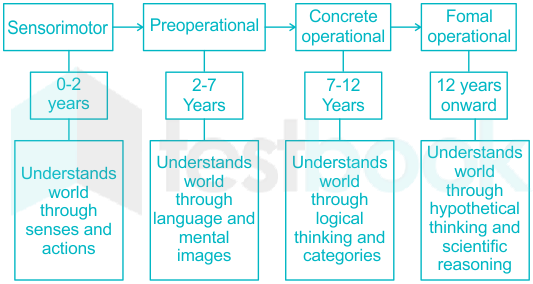
"Jean Piaget", a Swiss psychologist, is famous for his work on child development. He made a systematic study of cognitive development in his theory that is categorized in four stages.

Key Points

  • According to Piaget, the second stage of cognitive development is the 'pre-operations stage' which lasts around 2 to 6 or 7 years of age.
  • In this stage, the child faces problems with the concept of conservation and struggles with the idea of centration and irreversibility.

Characteristics of the Preoperational Period:

  • Egocentrism takes place.
  • Begin to think symbolically.
  • Develops the skills of language acquisition.
  • Begin to use words and pictures to represent objects.
  • Learns to compare objects through external characteristics.

Hence, it could be concluded that according to Piaget, the second stage of cognitive development is the pre-operational stage.

 Additional Information

Refer to the image for conceptual understanding of the characteristics of other stages of Piaget's theory: 

11

Which of the following is the most subjective method of educational psychology?

  1. ((a))

    Extrospection

  2. ((b))

    Introspection

  3. ((c))

    Observation

  4. ((d))

    Experimentation

Show Answer
Answer: ((b))

Introspection

Key Points Educational psychology extremely influences the principles of education. It applies to the psychological principles and techniques for human behavior in educational situations.

Main methods of Education Psychology:

  • Introspection
  • Observation
  • Experimental Method
  • Clinical Method
  • Developmental Method
  • Testing Method

Introspection Method:

  • Introspection means observing one's own behavior through self-analysis. This method is the most subjective in nature. The data of introspection method may not be  reliable and valid since the investigator may become subjective and biased when looks in to his own feelings.
  • It is most simple method which requires no laboratory and apparatus.
  • It is the oldest method of psychology and helps to improve thinking and performance.

​Observation Method:

  • It is very useful for the study of the behavior of person inside and outside the class.


Experimental Method

  • This method is for observing mental behavior in laboratory according to the scientific rules. It is free from subjectivity.


Extrospection Method

  • It is method of observation of things external to one's own mind, as opposed to introspection.

Hence, we can conclude that Introspection method is most subjective in nature.

12

Albert Bandura is associated with which of the following?

  1. ((a))

    Social learning theory

  2. ((b))

    Behavioural theory

  3. ((c))

    Cognitive development theory

  4. ((d))

    Psychosexual development 

Show Answer
Answer: ((a))

Social learning theory

'Albert Bandura', an American psychologist has propounded "Social Learning Theory". This theory is also called 'learning through imitation' as his theory emphasizes that:

  • learning takes place through indirect sources, like watching or hearing others.
  • cognitive and problem-solving skills can be learned by imitating and watching others.
  • new behaviors and experiences are acquired by observing others in the immediate environment.

The social learning theory of 'Albert Bandura' emphasizes that the principles of social learning consist of four steps (respectively) including:

AttentionIt refers to the process of paying attention to the model to observe in order to learn.
RetentionIt refers to the process of recalling the learned activity for later use.
ReproductionIt refers to the process of performing or reproducing the learned action.
MotivationIt refers to the process of motivating learners to repeat observational learning.


Hence, it could be concluded that Albert Bandura is associated with 'Social Learning Theory.

Additional Information

TheoryPropounderMain Idea
Behavioural theoryJ.B. Watson- It focuses on external observable behaviour. - This theory emphasizes that the environment is the prime factor in shaping an individual's behaviour.
Cognitive development theoryJean Piaget- It focuses on the internal mental process. - This theory emphasizes that learning is a process of thinking i.e. cognition for meaning-making.
Psychosexual development theorySigmund Freud- Personality gets well established during childhood, largely before the age of five years. - He proposed five stages of psychosexual development
13

Plateau in learning curve is caused due to 

  1. ((a))

    maturation

  2. ((b))

    motivation

  3. ((c))

    fatigue

  4. ((d))

    interest

Show Answer
Answer: ((c))

fatigue

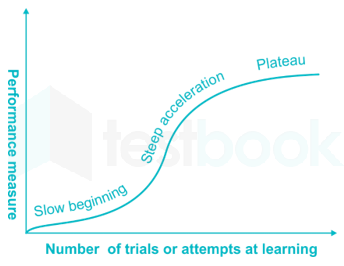
Learning Curve: The learning curve is a graphical representation that indicates the progress or lack of improvement in a given activity. There are several characteristics of the learning curve. Some of them are as follows: The learning progress at any stage is not always uniform. The last stage of the learning curve is called a plateau. The scope for learning is very low in the final stages of the curve. 

Important Points

The three stages of the learning curve are:

  • Slow beginning
  • Steep progress
  • Plateau.

  1. Slow beginning: In this phase, the learner gradually pacing to learn the concept. He/she has to start the learning of a given activity from scratch, his early progress will be slow. This is the beginning stage of learning, in which the learner is motivated to gain new information.
  2. Steep progress: In this phase, the learner successfully learned the concept.  In this stage, the learner steps accelerating in learning the concepts. After some time the learner gains a total understanding of the concept and reaches the boom stage of learning. and his/her learning improves swiftly.
  3. Plateau: The plateau effect is often seen in the pattern of development, indicating periods of no apparent improvement.
  • In this stage, learning plateau occurs, after gaining the mastery on the concept, the learner feels bore and want to learn new thing.
  • Once the curve hit a plateau when they are not willing to add new to their learning and the performance gets deteriorated. So the teacher should always introduce the same concept with innovative methods, this will overcome the boredom.
  • An example of the plateau effect is when someone's exercise fails to be as effective as in the past, or due to feeling fatigued because of a repetitive or similar concept.

Hence, we conclude that Plateau in the learning curve is caused due to fatigue.

14

Mirror drawing test is used to measured 

  1. ((a))

    rate of learning

  2. ((b))

    transfer of learning

  3. ((c))

    creativity

  4. ((d))

    interest

Show Answer
Answer: ((b))

transfer of learning

Bilateral transfer of learning occurs when there is the transfer of performance to one side of the body following training of the opposite side, eg. improved left-handed performance following right-handed training. You will verify the phenomenon by conducting a simple experiment as explained below.

Key Points

  • Problem: To demonstrate the phenomenon of bilateral transfer of learning.
  • Material Required: Mirror-drawing apparatus, stylus, stop watch, paper and pencil.

Procedure:

  • The following instructions are to be given to the participant, “Look at this mirror, you will see a star image.
  • The star image is a reflection of a pattern grooved on the wooden board and hidden by the screen. Take the stylus in your left hand (the experimenter will give the stylus to the participant and helps him/her to position it at the end of the nearest projection).
  • Now you will have to look into the mirror image and trace the star pattern with the stylus. Be careful about the stylus not touching the edges of the groove.
  • If you touch, it will be counted as an error. Try to do as speedily as possible.” After the participant traces the path once with the left hand, she/he is asked to trace the path again. Time taken and the number of errors committed are noted down.
  • In the same way, now the participant is asked to trace the star pattern with the right hand for 10 trials. In each of these trials, the number of errors committed and the amount of time taken in seconds to complete the pattern are noted down. A
  • gain the participant is asked to perform the same task in the same manner with the left hand, and the errors committed and time taken in seconds are noted down.
  • Compare the time taken in seconds and errors committed in the first trial with left hand with that of the second trial with left hand (after training with right hand for ten trials). Find out whether there is any transfer of training in the second trial with left hand and also if it is positive, negative or zero transfer.

Hence, it is clear that Mirror drawing test is used to measure transfer of learning.

15

Cloud picture test is used to measure which of the following?

  1. ((a))

    Intellignece

  2. ((b))

    personality

  3. ((c))

    Aptitude

  4. ((d))

    Interest

Show Answer
Answer: ((b))

personality

Cloud Picture Test is a psychometric test is used to measure the personality of an individual. This test is made by Williams Stern. It is design fantasy-stimuli which would avoid the disadvantages of the Rorschach Series. 

  • It consists series of three pictures that resemble clouds rather than ink-blots. 
  • Picture A offers the most distinct shades and forms.
  • Picture C is the vaguest,
  • Picture B occupies an intermediate position. There is no symmetry or other regularity in these pictures.
  • In this test, the respondents are shown pictures of the cloud and asked what cloud resembles.
  • The respondents observe the pictures of the cloud and respond to what kind of pictures he is seeing. This how the personality of an individual assesses.
  • Swiss psychiatrist Hermann Rorschach replace these cloud with ten inkblot test.

​Hence, we conclude that the Cloud Picture Test is used to measure personality.

16

What is the factor influencing physical development?

  1. ((a))

    Heredity

  2. ((b))

    Environment

  3. ((c))

    Sports and exercise

  4. ((d))

    All of the above 

Show Answer
Answer: ((d))

All of the above 

Physical development is regulated by a complex balance between the heredity/genetic constitution and the environmental factors, all interdependent. 

Key Points

Factors Influencing Physical Development

  • Heredity Factors: Heredity refers to the genetic constitution of an individual which is established during conception. It is the property of organic beings by which offsprings have the nature and characteristics of parents or ancestors. The height of a child depends more on heredity, while the weight, though also influenced Physical and Motor Development by heredity.
  • Environmental Factors: Though heredity and environment are closely inter-related and each human being at birth has a gene determined physical, mental, and biochemical potential. Environmental factors like nutrition, living standard, family surroundings, etc. This potential may not be reached because of environmental influences. Environment influences this potential only to a limited extent favorably or unfavorably.
  • Health Factors: The children are highly vulnerable to the negative health consequences associated with many environmental exposures. Health factors like, physical exercise, sports, games, etc. These factors influencing the physical development of a child. These factors also influence the growth of an individual. So school should provide physical exercises and games for child physical development.

Hence, we conclude that all are the factors influencing Physical Development.

17

Which of the following is correct formula to calculate IQ?

  1. ((a))

    MACA×100\frac{MA}{CA}\times 100

  2. ((b))

    CAMA\frac{CA}{MA}

  3. ((c))

    CAMA×100\frac{CA}{MA}\times 100

  4. ((d))

    MACA×100\frac{MA}{CA\times 100}

Show Answer
Answer: ((a))

MACA×100\frac{MA}{CA}\times 100

Intelligence Quotient is commonly known as IQ refers to the score of a standardized test that assesses and measures human intelligence.

  • The first test to measure intelligence was developed by Binet and Simon in 1905.
  • Terman in 1916 revised the test and devised the concept of Intelligence Quotient.
  • An individual’s Intelligence Quotient (IQ) is determined by the formula given below,

Intelligence;Quotient;(IQ)=Mental;Age;(MA);Chronological;Age;(CA)×100{\bf{Intelligence}};{\bf{Quotient}};\left( {{\bf{IQ}}} \right) = \frac{{{\bf{Mental}};{\bf{Age}};\left( {{\bf{MA}}} \right);}}{{{\bf{Chronological}};{\bf{Age}};\left( {{\bf{CA}}} \right)}} \times 100

  • Where, Mental Age is based on intellectual development.
  • Chronological Age is the number of years a person has lived.

Hence, it could be concluded that MA/CA × 100 is the correct formula to calculate IQ.

Additional Information

IQ RangeDescriptive Label
Above 130Very Superior Intelligence (gifted)
120 to 129Superior Intelligence
110 to 119High Average Intelligence
90 to 109Average Intelligence
80 to 89Low Average Intelligence
71 to 79Borderline Intellectual Functioning
55 to 70Mild Intellectual Disability
40 to 54Moderate Intellectual Disability
25 to 39Severe Intellectual Disability
Below 25Profound Intellectual Disability
18

Who among the following described 'reflective thinking'?

  1. ((a))

    Dewey

  2. ((b))

    Ross

  3. ((c))

    Woodworth

  4. ((d))

    Drever

Show Answer
Answer: ((a))

Dewey

John Dewey: The work of Dewey (1933) is considered as the beginning of the study and application of reflection.

  • For him, reflection is a kind of thinking, in the process of which one brings the subject to the forefront of the mind and gives serious thought to this.
  • It is a process of manipulation of knowledge and its reprocessing towards the set goal, and so, it is goal-directed.
  • One ‘thinks’ when in uncertainty or difficulty so as to solve the ‘perplexity’, and the process leads to testing through some action.
  • Dewey believed that effective education through reflection should aim at ‘making sense of the world’, and therefore, this is related to experience.
  • Learners are aware of and control their learning by active participation in reflective thinking.
  • In the reflective experience in which the environment is used as the object of reflection.

Key Points

Dewey’s concept of reflective thought and action, depicted comprises five phases: 

  • Disturbance and uncertainty
  • Intellectualization
  • Formation of Hypothesis
  • Reasoning
  • Hypothesis Testing.
<br>

Hence we conclude that John Dewey described 'reflective thinking'.

19

Which is not included in the levels of inductive reasoning?

  1. ((a))

    Observation

  2. ((b))

    Experiment

  3. ((c))

    Generalization

  4. ((d))

    Imagination

Show Answer
Answer: ((d))

Imagination

Inductive Reasoning is a way of proving a statement or generalizing a rule or principle by proving or showing that if a statement or a rule is true in one particular case, it will be true in cases, which appear in some serial order, and thus it may be applied generally to all such type of cases.

Important Points

The levels of inductive reasoning are below:

  • Generalization: Inductive reasoning starts from particular facts or special examples and instances one can formulate generalized principles and conclusions in this type of reasoning.
  • Observation: Inductive reasoning is called the 'Bottom-up' approach, moving from specific observations and measures to detect patterns and regularities, formulate some tentative hypotheses that can explore and end up developing general conclusions or theories.
  • Experimentation: Experimentation is an essential feature of inductive reasoning. Experiments are artificially created or contrived situations designed to make certain observations under strictly controlled conditions. The objective sometimes is to mimic nature. This allows the complexity of natural phenomena to be simplified for step by step study.

Hence, we conclude that 'Imagination' is not included in the level of Inductive reasoning.

20

Failure in retention and recall of learnt content is

  1. ((a))

    forgetting

  2. ((b))

    memory

  3. ((c))

    retention

  4. ((d))

    thinking

Show Answer
Answer: ((a))

forgetting

Forgetting: Forgetting is a failure to retrieve and retain information from long-term memory stores. Much of the information is lost but enough remains so that we have a sketchy record of our lives. Sometimes what we think is forgotten in real sense is not forgotten because it was never encoded and stored in the first place. 

Key Points

Causes of Forgetting:  Many students complain that they do not remember the contents after attending the class or forget after reading .the text. This happens due to :

  • Many times we forget as memory does not match events that had occurred. This happens due to the constructive processes i.e. during encoding, the to-be-remembered information, interference due to similar material.
  • Under-learning, some information does not reach short term memory from the sensory register.
  • Defective methods of remembering: Inadequate encoding and rehearsal, the information may not have been transferred from short term to long term memory.

Additional Information

  • Memory is the knowledge of a former state of mind after it has already once dropped from consciousness, or rather it is the knowledge of an event, or fact of which meantime we are not been thinking with the additional consciousness that we have thought or experienced before.
  • Retention is part of memory to retain the information for a longer period of life.
  • Thinking is the process of cognition that is related to memory.

Hence, we conclude that failure in retention and recall of learned content is forgetting.

21

Five-year-old Mohan has mental age of eight. What is his IQ?

  1. ((a))

    150

  2. ((b))

    160

  3. ((c))

    140

  4. ((d))

    135

Show Answer
Answer: ((b))

160

Intelligence Quotient is abbreviated as IQ. IQ is a measurement of a person’s intelligence and it is measured in number. The average IQ of a person is 100.

An individual’s Intelligence Quotient (IQ) is determined by the formula:

Intelligence;Quotient;(IQ)=Mental;Age;(MA);Chronological;Age;(CA)×100{\bf{Intelligence}};{\bf{Quotient}};\left( {{\bf{IQ}}} \right) = \frac{{{\bf{Mental}};{\bf{Age}};\left( {{\bf{MA}}} \right);}}{{{\bf{Chronological}};{\bf{Age}};\left( {{\bf{CA}}} \right)}} \times 100

where Mental Age is based on your intellectual development.

Chronological Age is the number of years a person has lived.

Given: CA = 5 years∴80=MA10×100∴80=MA10×100

MA = 8 years

IQ=85×100\therefore IQ = \frac{{{\bf{8}}}}{{5}} \times 100

IQ = 160

IQ RangeDescriptive Label
Above 130Very Superior Intelligence (gifted)
120 to 129Superior Intelligence
110 to 119High Average Intelligence
90 to 109Average Intelligence
80 to 89Low Average Intelligence
71to 79Borderline Intellectual Functioning
55 to 70Mild Mental Intellectual Disability
40 to 54Moderate Intellectual Disability
25 to 39Severe Intellectual Disability
Below 25Profound Intellectual Disability

Hence, the IQ of a child will be 160 and the child IQ will lie in above 130 IQ Range and having the Very Superior Intelligence (Gifted).

22

Which IQ range is called trainable IQ level of mentally retarded children?

  1. ((a))

    70 - 79

  2. ((b))

    50 - 69

  3. ((c))

    36 - 49

  4. ((d))

    35 and below

Show Answer
Answer: ((c))

36 - 49

Mental retardation, as a developmental disability, has attracted considerable public attention. Its general debilitating character has made it a distinct category of disability. Individuals with mental retardation, face considerable difficulty in their lives in adapting to the demands of day-to-day life.

Classification of Mental Retardation:

Based On IQ: There are mainly three methods of classification of mental retardation. They are medical, psychological, and educational. The psychological and educational classifications are more commonly and widely used than medical classifications. 

  • Educational Classification: This system uses the term educable, trainable, and custodial depending on the educational needs of retarded children.
  • The IQ ranges of educable mentally retarded (EMR), trainable mentally retarded (TMR), and the custodial mentally retarded (CMR) are given below:
  • | Levels of MR | IQ Range of MR | Educators | | --- | --- | --- | | Mild Retardation | 50-70 | Educable Mentally Retarded | | Moderate Retardation | 35-50 | Trainable Mentally Retarded | | Severe Retardation | 20-35 | Custodial Mentally Retarded | | Profound Retardation | Below 20 | Custodial Mentally Retarded) |

Important Points

  • Educable Mentally Retarded (EMR): The educable mentally retarded children are those who can be taught the basic academic subjects.
  • Trainable Mentally Retarded (TMR): The trainable mentally retarded are those children who can be taught functional academics with an emphasis on self-help and vocational skills.
  • Custodial Mentally Retarded (CMR): The custodial mentally retarded are those children who require constant and special care especially in a residential institution.

Hence, we conclude that the 35 – 50 IQ range is called a trainable IQ level of mentally retarded children. So the answer is 36-49.

23

Rorschach inkblot test is used to measured which of the following?

  1. ((a))

    Personality

  2. ((b))

    Intellignece

  3. ((c))

    Interest

  4. ((d))

    Aptitude 

Show Answer
Answer: ((a))

Personality

Rorschach inkblot Test: Hermann Rorschach, a Swiss psychiatrist, devised the Rorschach Inkblot Personality test in 1921. This test is most frequently used for the projective test

  • The test consists of a standard set of 10 cards with inkblots printed on them.
  • The Rorschach test is a measure of both intellectual and non-intellectual personality traits.
  • In the series of 10 cards five are achromatic, two cards are black and red, and the remaining three cards are polychromatic in combination of green, blue, orange and pink blots.
  • Conducted by the examiner to determine important aspects of each response into a coding system under four categories; Location, Determinant, Content, and Popularity.
  • It consists of the following categories of scoring the protocol:-
  • Total number of responses (R)
  • Human responses (H)
  • Animal responses (A)
  • Anatomical responses (At)
  • Sex responses (Sex)
  • Movement responses (M)
  • Rejection of images (Rej.)
  • Most typical responses (MT)
  • Typical responses (T)
  • Atypical responses (AT).
  • In the test, the subjects are asked to simply state whatever each inkblot looks like to them.
  • Responses are scored by the psychologists using predetermined categories, on key factors such as color and shape, movement.
  • These blots are frequently used for personality description, diagnosis of mental disorders, and for behaviour predictions.
  • The whole procedure of The Rorschach Test is a combined set of three components, viz., performance proper, inquiry, and scoring.

Hence, we conclude that Rorschach inkblot test is used to measured Personality traits.

24

Which of the following is not the cause of forgetting?

  1. ((a))

    Under-learning

  2. ((b))

    Desire to remember

  3. ((c))

    Mental conflict

  4. ((d))

    Defective methods of remembering

Show Answer
Answer: ((b))

Desire to remember

Forgetting: Forgetting is a failure to retrieve information from long-term memory stores. Much of the information is lost but enough remains so that we have a sketchy record of our lives. Sometimes what we think is forgotten in real sense is not forgotten because it was never encoded and stored in the first place. 

Causes of Forgetting:  Many students complain that they do not remember the contents after attending the class or forget after reading .the text. This happens due to :

  • Mental Conflict: Many times we forget as memory does not match events that had occurred. This happens due to the constructive processes i.e. during encoding, the to-be-remembered information, interference due to similar material.
  • Under-learning, some information does not reach short term memory from the sensory register.
  • Defective methods of remembering: Inadequate encoding and rehearsal, the information may not have been transferred from short term to long term memory.

NOTE: Desire to learn is helpful in remembering the information for the long term.

Hence, we conclude that the desire to remember is not the cause of forgetting.

25

The science which deals with the methods of collecting, classifying, presenting, comparing and interpreting numerical data is called.

  1. ((a))

    statistics

  2. ((b))

    mathematics

  3. ((c))

    geometry

  4. ((d))

    probability

Show Answer
Answer: ((a))

statistics

Statistics: In the singular sense, Statistics refers to what is called statistical methods which means the science which deals with the techniques for collection, classifying, presentation, analysis, and interpretation of statistical/numerical data information. In simple language, it means the subject of Statistics like any other subject such as Mathematics or Economics. 

  • This definition lays emphasis on five important aspects, which in fact, constitute the very scope of the subject called Statistics or Statistical Methods. These are:
  • Collection of Data: In any statistical inquiry, the collection of data is the first basic step. They form the foundation of statistical analysis, and therefore utmost care should be taken in collecting data in Primary and Secondary form.
  • Classification of Data: It follows editing. It involves arranging data according to some common characteristics.
  • Presentation of Data: Presented the data in the form of diagrams and graphs to facilitate the understanding of various trends as well as the process of comparison of various situations.
  • Analysis of Data: It is the most important step in any statistical inquiry. A major portion of this course in Statistics is devoted to the methods used for analyzing the collected data to derive some policy conclusions.
  • Interpretation of Data: It is the last but very crucial stage of a statistical inquiry or investigation. It is a job in itself that requires a high degree of aptitude, skill, and experience.

Additional Information

MathematicsIt is a science that involves dealing. with numbers, different kinds of calculations, measurement of shapes and structures, organization, and interpretation of data and establishing. the relationship among variables, etc.
ProbabilityProbability is the branch of mathematics. It is an occurrence of an event that is a number between 0 and 1, where, roughly speaking, 0 indicates the impossibility of the event, and 1 indicates certainty.
GeometryIt is a branch of Mathematics and dealing with spatial relationships.


Hence, we conclude that the science which deals with the methods of collecting, classifying, presenting, comparing, and interpreting numerical data is called Statistics.

26

Find the odd one out.

  1. ((a))

    16 - P.F.

  2. ((b))

    T.A.T.

  3. ((c))

    Raven's test

  4. ((d))

    Draw a man test

Show Answer
Answer: ((c))

Raven's test

Psychology test are used to measure the unique traits of an individual to know his ability, aptitude, contrast with their personality, intelligence, emotions etc. 

Key Points

Raven's Test:

  • It was intelligence test developed by John C raven in 1983.
  • It is non verbal test of inductive reasoning, designed to measure spearman  'g' factor or general intelligence.
  • It consists of 60 multiple choice items and can be administered on children from 5 year old toolder adults.
  • The test contains visual geometric designs with a missing piece.


16-PF

  • This test developed by the British Psychologist Cattell is based on 16 source traits of personality.
  • Cattell has used factor analysis to arrive at the 16 factors of personality.


TAT (Thematic Appreciation Test)

  • This test is used to measure the personality traits , developed by Morgan and Murray.
  • TAT consists of 30 black and white picture card depicting picture in ambiguous situations, plus one blank card.


Draw a man test

  • It is to measure personality traits, and developed by GoodEnough .
  • This test emphasizes on the child's ability to observe accurately and think conceptuallly.

​Thus, it can be concluded that Raven;s test is odd one out. It is used to measure the fluid intelligence.

27

The median of 7, 8, 9, 10, 11, 12 is

  1. ((a))

    9

  2. ((b))

    8

  3. ((c))

    10

  4. ((d))

    9.5

Show Answer
Answer: ((d))

9.5

The median of a set of numbers is the middle number in the set (after the numbers have been arranged from least to greatest) -- or, if there are an even number of data, the median is the average of the middle two numbers.

Example 1:

Find the median of the set : {3,10,36,255,79,24,5,8}

There are 8 numbers in the set, and they are arranged in ascending order. {3.5.8.10.24.36.79.255}

 find the average of the middle two numbers, 10 and 24.

= (10 + 24)/2 =17

Similarly, Example 2:

Find the median of the set: { 2,5,8,11,16,21,30 } 

There are 777 numbers in the set, and they are arranged in ascending order.  The middle number (the 44 th one in the list) is 11. The median is 11.

Key Points

In the given problem, arrange the observation in the ascending order. {7,8,9,10,11| and total number of observation is 6 , which is even.

3rd abd 4th observation are 9 and 10.

average of 9 and 10 is the median of the set.

(9+10)/2

=19/2

=9.510 + 242=342=111

28

Who has propounded the theory of insight?

  1. ((a))

    Thorndike

  2. ((b))

    Gestalt Psychologist

  3. ((c))

    Hegarty

  4. ((d))

    Skinner

Show Answer
Answer: ((b))

Gestalt Psychologist

The Gestalt theory of learning also named Learning by Insight is the contribution of German psychologists who were studying the nature of perception.

Key Points

  • Gestalt Theory of Learning (Learning by Wholes) or Learning by Insight states that perceptual phenomena are only experienced as wholes or Gestalts.
  • Translation of Gestalt is „configuration‟ or more simply „an organized whole in contrast to a collection of parts‟.
  • Gestalt psychologists consider the process of learning as a Gestalt – an organized whole.
  • A thing cannot be understood by the study of its constituent parts but only by the study of it as a totality, is a basic idea behind this theory.
  • Learning, according to Gestalt Theory, is not by random steps, not by trial and error, not by conditioning but by insight, introspection, and understanding.
  • The Gestaltians tend to place far more emphasis on the intrinsic organizing capacity in the brain of the individual and emphasis the dynamic interaction of the elements in the entire perceptual field.
  • Gestalt theory of learning essentially consists of problem-solving by understanding the relative position of the elements in the entire perspective or situation.

Additional Information

PsychologistTheory
E.L.ThorndikeTrial and Error Theory
B.F. SkinnerOperant Conditioning Theory


Hence, we conclude that the theory of insight is propounded by Gestalt Psychologist.

29

According to McDougall, every instinct is associated with 

  1. ((a))

    cognition

  2. ((b))

    emotion

  3. ((c))

    sensation

  4. ((d))

    thinking

Show Answer
Answer: ((b))

emotion

Emotions expressed by humans can be divided into two broad categories and are called positive and negative emotions. Examples of emotions include the following: Interest, enthusiasm, boredom, laughter, empathy, action, curiosity, anger, rebellion, irritation, etc.

According to William McDougall’s concept of emotions instincts and emotions were both innate patterns.

  • As per McDougall, the primary emotions were fear, disgust, wonder, anger, subjection, elation, tenderness. According to him, each instinctual tendency has a corresponding emotion.
  • William McDougall(2003) analyses an instinctive behavior, in three aspects:
  • Cognitive or (knowing or perceptive) aspect.
  • Affective or (feeling or emotional) aspect.
  • Conative or (doing or behavior) aspect.
  • The occurrence of some form of arousal in the emotion gives rise to a cognitive search for an explanation of arousal.
  • In the opinion of McDougall, feelings arise and are conditioned by the degrees of success and failure of one's own efforts, whereas emotions are aroused by some object or person deemed responsible for one’s success or failure in some particular situation.
  • Emotion is not just a feeling gone violent but itself a singular experience.

Hence, we conclude that According to McDougall, every instinct is associated with emotion.

30

Giving the meaning to sensation on the basis of past experience is called

  1. ((a))

    sensation

  2. ((b))

    perception

  3. ((c))

    motivation

  4. ((d))

    imagination

Show Answer
Answer: ((b))

perception

Perception is the process through which we interpret and organize the received information so as to produce our conscious experience of objects and their relationship.

  • We feel something in sensation when the stimulus is present and when the meaning is added to them it becomes perception.
  • In this process, physical energy; such as light, sound waves, heat; emanating from objects is transformed by the concerned sense organs into a code and transferred to and interpreted by the brain.
  • The line between the two terms sensation and perception, therefore, is somewhat arbitrary.
  • The sensation typically refers to the direct reception and transmission of messages, whereas perception refers to the active process of integrating and organizing these sensations.

SensationThe initial contact between organisms and their physical Sensation and Perception environment constructing knowledge out of raw materials is known as sensation.
ImaginationImagination is a primary creative act, a willed activity of spirit, a self-consciousness, a "self-realizing intuition.
MotivationMotivation is the way in which urges, desires, aspirations, and strivings or needs direct, control, or explain the behavior of human beings.


Hence, we conclude that giving the meaning to sensation on the basis of past experience is called Perception.

Hindi (30 questions)

31

निम्नलिखित में कौन सा विकल्प वाचन शिक्षण की विधि नहीं है? 

  1. ((a))

    ध्वनि साम्य विधि 

  2. ((b))

    अनुध्वनि विधि 

  3. ((c))

    व्याख्या विधि 

  4. ((d))

    समवेत पाठ विधि 

Show Answer
Answer: ((c))

व्याख्या विधि 

  • उपर्युक्त में से 'व्याख्या विधि' वाचन शिक्षण की विधि नहीं है बल्कि यह उच्च कक्षाओं के लिए शिक्षण की विधि है।
  • शेष विकल्प असंगत हैं।

अतः सही विकल्प 'व्याख्या विधि' है। 

अन्य विकल्प

'ध्वनि साम्य विधि', 'अनुध्वनि विधि' और 'समवेत पाठ विधि' ध्वनि वाचन (जोर से बोलकर पढ़ने) की विधियां हैं।

32

निम्नलिखित में अभिवृत्यात्मक उद्देश्य कौन सा है?

  1. ((a))

    स्वानुभूत विचारो व भावों को अभिव्यक्त करना 

  2. ((b))

    साहित्य का रसास्वादन करना 

  3. ((c))

    धैर्यपूर्वक सुनना 

  4. ((d))

    भाषा और साहित्य में रुचि 

Show Answer
Answer: ((a))

स्वानुभूत विचारो व भावों को अभिव्यक्त करना 

  • उपर्युक्त में से 'स्वानुभूत विचारो व भावों को अभिव्यक्त करना' अभिवृत्यात्मक उद्देश्य है।
  • इसमें छात्रों को कहानी सुनाना, यात्रा का वर्णन करना, निबंध लिखना, संवाद लिखने आदि की क्रियाएं करवाई जाती हैं जिससे छात्रों के अभिवृत्तियों का पता चलता है।
  • शेष विकल्प असंगत हैं।

अतः सही विकल्प 'स्वानुभूत विचारो व भावों को अभिव्यक्त करना' है।

33

हिन्दी साहित्य के इतिहास के संबंध में ‘मॉडर्न वरनाक्यूलर लिटरेचर ऑफ हिन्दोस्तान’ किसने लिखा है?

  1. ((a))

    जॉर्ज अब्राहम ग्रियर्सन 

  2. ((b))

    सुमित कुमार चटर्जी

  3. ((c))

    गार्सा द तासी 

  4. ((d))

    धीरेन्द्र वर्मा

Show Answer
Answer: ((a))

जॉर्ज अब्राहम ग्रियर्सन 

  • 'मॉडर्न वरनाक्यूलर लिटरेचर ऑफ हिन्दोस्तान’ 'जॉर्ज अब्राहम ग्रियर्सन' ने लिखा है।
  • यह किताब 1989 में लिखी गयी थी जिसमें पहली बार हिंदी साहित्य के काल विभाजन का प्रयास किया गया था।
  • इसमें हिंदी साहित्य के काल को दस अध्यायों में बाँटा गया था।
  • शेष विकल्प असंगत हैं।

अतः सही विकल्प 'जॉर्ज अब्राहम ग्रियर्सन' हैं।

34

निम्नलिखित पंक्ति किसकी है? “विरहनी बावरी सी भई ऊँची चढ़ि अपने भवन में टेरत हाय दई ले अंचरा मुख अँसुवन पोंछत उघरे गात सही।”

  1. ((a))

    सहजोबाई

  2. ((b))

    मीराबाई

  3. ((c))

    झीमा चारिणी

  4. ((d))

    दयाबाई

Show Answer
Answer: ((b))

मीराबाई

  • उपर्युक्त पंक्तियाँ 'मीराबाई' द्वारा रचित हैं।
  • इस पद में उन्होंने कृष्ण के प्रति अपनी विरह भावना को दर्शाया है।
  • मीराबाई कृष्णभक्त कवयित्री थी।
  • इनकी प्रसिद्ध रचनायें - 'गीतगोविन्द टीका, नरसी जी का मायरा, रागगोविन्द आदि हैं।
  • शेष विकल्प असंगत हैं।

अतः सही विकल्प 'मीराबाई' है।

35

हिन्दी का पहला पत्र कौन सा है?

  1. ((a))

    उदंत मार्तण्ड

  2. ((b))

    इतिहास तिमिरनाशक

  3. ((c))

    बनारस अखबार

  4. ((d))

    हरिश्चन्द्र मैगजीन 

Show Answer
Answer: ((a))

उदंत मार्तण्ड

  • हिन्दी का पहला पत्र 'उदंत मार्तण्ड' है।
  • इस पत्र का संपादन पंडित जुगल किशोर शुक्ल द्वारा 30 मई 1826 को कलकत्ता में हुआ था।
  • इसे हिंदी का पहला समाचार पत्र माना जाता है।
  • शेष विकल्प असंगत हैं।

अतः सही विकल्प 'उदंत मार्तण्ड' है।

अन्य विकल्प

- इतिहास तिमिरनाशक के संपादक राजा शिवप्रसाद सितारेहिंद थे।

- बनारस अखबार के संपादक - सन 1845 में राजा शिव प्रसाद ने ‘बनारस अख़बार’ निकाला था।

- हरिश्चन्द्र मैगजीन - यह एक मासिक पत्रिका थी। यह पत्रिका 15 अक्टूबर, 1873 को काशी से भारतेंदु हरिश्चंद्र ने प्रारम्भ की थी।

निर्देश: दिए गए गद्यांश को पढकर निम्नलिखित प्रश्नों के सही विकल्प छाँटिए।

धर्म पालन करने के मार्ग में सबसे अधिक बाधा चित्त की चंचलता, उद्देश्य की अस्थिरता और मन की निर्बलता से पड़ती है। मनुष्य के कर्तव्य मार्ग में एक ओर तो आत्मा के बुरे-भले कामों का ज्ञान दूसरी ओर आलस्य और स्वार्थपरता रहती है। बस मनुष्य इन्हीं दोनों के बीच में पड़ा रहा है। अंत में यदि उसका मन पक्का हुआ तो वह आत्मा की आज्ञा मानकर अपना धर्म पालन करता है, पर उसका मन दुविधा में पड़ा रहा है तो स्वार्थपरता करता है स्वार्थपरता उसे निश्चित ही घेरेगी और उसका चरित्र घृणा के योग्य हो जायेगा। इसलिए यह बहुत आवश्यक है कि आत्मा जिस बात को करने की प्रवृत्ति दे, उसे बिना स्वार्थ सोचे, झटपट कर डालना चाहिए। इस संसार में जितने बड़े-बड़े लोग हुए हैं सभी ने अपने कर्तव्य को सबसे श्रेष्ठ माना है, क्योंकि जितने कर्म उन्होंने किए उन सबने अपने कर्तव्य पर ध्यान देकर न्याय का बर्ताव किया। जिन जातियों में यह गुण पाया जाता है, वे ही संसार में उन्नति करती हैं और संसार में उनका नाम आदर से लिया जाता है। जो लोग स्वार्थी होकर अपने कर्तव्य पर ध्यान नहीं देते, वे संसार में लज्जित होते हैं और सब लोग उनसे घृणा करते हैं। कर्तव्य पालन और सत्यता में बड़ा घनिष्ठ संबंध है। जो मनुष्य अपना कर्तव्य पालन करता है, वह अपने कामों और वचनों में सत्यता का बर्ताव भी रखता है। सत्यता ही एक ऐसी वस्तु है जिससे इस संसार में मनुष्य अपने कार्यों में सफलता पा सकता है, क्योंक‍ि संसार में कोई काम झूठ बोलने से नहीं चल सकता । झूठ की उत्पति पाप, कुटिलता और कायरता से होती है। झूठ बोलना कई रूपों में दिख पड़ता है, जैसे चुप रहना, किसी बात को बढ़ाकर कहना, किसी बात को छिपाना, झूठ-मूठ दूसरों की हाँ में हाँ मिलाना आदि। कुछ ऐसे लोग भी होते हैं जो मुँह देखी बातें बनाया करते हैं, पर करते वहीं हैं जो उन्हें रुचता है। ऐसे लोग मन में समझाते हैं कि कैसे सबको मर्ख बनाकर हमने अपना काम कर लिया, पर वास्वत में वे अपने को ही मूर्ख बनाते हैं और अंत में उनकी पोल खुल जाने पर समाज के लोग उनसे घृणा करते हैं।

36

धर्म पालन करने में बाधा डालने वाली प्रवृत्तियाँ कौन- सी हैं?

  1. ((a))

    कमजोर मन, उद्देश्य का निश्चित न होना तथा चंचल मनोवृत्ति का होना 

  2. ((b))

    धर्म का ज्ञान न होना

  3. ((c))

    आलस्य की अधिकता

  4. ((d))

    जानकारी की कमी

Show Answer
Answer: ((a))

कमजोर मन, उद्देश्य का निश्चित न होना तथा चंचल मनोवृत्ति का होना 

धर्म पालन करने में बाधा डालने वाली प्रवृत्तियाँ 'कमजोर मन, उद्देश्य का निश्चित न होना तथा चंचल मनोवृत्ति का होना' है। यह गद्यांश की पंक्ति 'धर्म पालन करने के मार्ग में सबसे अधिक बाधा चित्त की चंचलता, उद्देश्य की अस्थिरता और मन की निर्बलता से पड़ती है।' से स्पष्ट होता है। शेष विकल्प असंगत हैं। अतः सही विकल्प 'कमजोर मन, उद्देश्य का निश्चित न होना तथा चंचल मनोवृत्ति का होना' है।

37

संसार के बड़े-बड़े लोगों ने सबसे श्रेष्ठ किसे माना है?

  1. ((a))

    उत्तम चरित्र को 

  2. ((b))

    सदाचार को

  3. ((c))

    परोपकार को

  4. ((d))

    अपने कर्तव्य को 

Show Answer
Answer: ((d))

अपने कर्तव्य को 

  • संसार के बड़े-बड़े लोगों ने सबसे श्रेष्ठ 'अपने कर्तव्य को' माना है।
  • गद्यांश की पंक्ति 'इस संसार में जितने बड़े-बड़े लोग हुए हैं सभी ने अपने कर्तव्य को सबसे श्रेष्ठ माना है' से स्पष्ट होता है।
  • अन्य विकल्प अनुपयुक्त हैं।
<br>

अतः सही विकल्प 'अपने कर्तव्य को' है।

38

'निर्बलता’ शब्द में उपसर्ग और प्रत्यय का सही विकल्प क्या है?

  1. ((a))

    निर् + बल + ता

  2. ((b))

    निर + बल + ता

  3. ((c))

    निर + बलत + आ

  4. ((d))

    निर + बल + अता 

Show Answer
Answer: ((a))

निर् + बल + ता

  • ‘निर्बलता’ शब्द में उपसर्ग और प्रत्यय का सही विकल्प 'निर् + बल + ता' है।
  • इसमें 'निर्' उपसर्ग है, 'बल' मूल शब्द है, 'ता' प्रत्यय है।
  • शेष विकल्प त्रुटिपूर्ण हैं।
<br>

अतः सही विकल्प 'निर् + बल + ता' है।

विशेष

शब्दपरिभाषाउदाहरण
उपसर्गउपसर्ग उस अक्षर या अक्षर समूह को कहते हैं जो किसी शब्द के पहले जुड़कर उसके अर्थ में परिवर्तन लाता है।जैसे - प्र, सु, अति, अधि, अनु, नि प्र + हार = प्रहार
प्रत्ययशब्द के उपरांत जिस शब्द का प्रयोग किया जाता है वह प्रत्यय है।जैसे - ता, औना, अन, अत श्रो + ता = श्रोता
39

‘कायर’ की भाववाचक संज्ञा क्या है?

  1. ((a))

    अकायरता

  2. ((b))

    कायरत्व

  3. ((c))

    कायरपन

  4. ((d))

    कायरता

Show Answer
Answer: ((d))

कायरता

  • ‘कायर’ की भाववाचक संज्ञा 'कायरता' है।
  • शेष विकल्प असंगत हैं।
<br>

अतः सही विकल्प 'कायरता' है।

 विशेष

भाववाचक संज्ञा बनाना -
1. जातिवाचक संज्ञा से भाववाचक संज्ञा बनाना - दास = दासता, पंडित = पांडित्य, बंधु = बंधुत्व
2. सर्वनाम से भाववाचक संज्ञा बनाना - स्व = स्वत्व, सर्व = सर्वस्व, निज = निजत्व
3. विशेषण से भाववाचक संज्ञा बनाना - मीठा = मिठास, चतुर = चातुर्य , चतुराई, मधुर = माधुर्य , मधुरता
4. क्रिया से भाववाचक संज्ञा बनाना - खेलना = खेल, थकना = थकावट, लिखना = लेख
5. संज्ञा से भाववाचक बनाना - बाल = बालपन, देव = देवत्व, बालक = बालकपन
6. अव्यय से भाववाचक संज्ञा बनाना - परस्पर = पारस्पर्य, समीप = सामीप्य, निकट = नैकट्य, शाबाश = शाबाशी
40

‘अपना मतलब निकालने वाला’ के लिए उचित शब्द क्या है?

  1. ((a))

    स्वार्थी

  2. ((b))

    स्वार्थपरता 

  3. ((c))

    स्वार्थपरक

  4. ((d))

    कुटिल 

Show Answer
Answer: ((a))

स्वार्थी

  • ‘अपना मतलब निकालने वाला’ के लिए उचित शब्द 'स्वार्थी' है।
  • शेष विकल्प असंगत हैं।
<br>

अतः सही विकल्प 'स्वार्थी' है।

अन्य विकल्प - 

'कुटिल' का अर्थ 'टेढ़ा या चालबाज' होता है।

'स्वार्थपरता' का अर्थ 'खुदगर्जी' होता है।

'स्वार्थपरक' का अर्थ 'स्वार्थपरायण' होता है।

41

‘पंकज’ में कौन-सा समास है?

  1. ((a))

    द्वंद्व

  2. ((b))

    द्विगु

  3. ((c))

    कर्मधारय

  4. ((d))

    बहुव्रीहि

Show Answer
Answer: ((d))

बहुव्रीहि

‘पंकज’ में 'बहुव्रीहि समास' है क्योंकि इसका पहला और उत्तर पद प्रधान नहीं है जबकि इसका संयुक्त रूप या अन्य पद प्रधान है। शेष विकल्प अनुचित हैं। अतः सही विकल्प 'बहुव्रीहि' है।

अन्य विकल्प

समास - समास से तात्पर्य 'संक्षिप्तीकरण' से है। जब दो या दो से अधिक शब्दों के योग से जो छोटा शब्द बने उसे समास कहते हैं। समास के माध्यम से कम शब्दों में अधिक अर्थ प्रकट किया जाता है। जैसे - रजा का पुत्र – राजपुत्र, समास के छःप्रकार हैं -
समास का नामपरिभाषाउदाहरण
तत्पुरुष समासजिस समास में उत्तरपद प्रधान हो तथा समास करने के उपरांत विभक्ति (कारक चिन्ह) का लोप हो।1. धर्म का ग्रन्थ = धर्मग्रन्थ 2. तुलसीदास द्वारा कृत = तुलसीदासकृत
अव्ययीभाव समासजिस समास में पहला पद (पूर्वपद) अव्यय तथा प्रधान हो'।1. जन्म से लेकर = आजन्म 2. मति के अनुसार = यथामति।
कर्मधारय समासजिस समास के दोनों शब्दों के बीच विशेषण-विशेष्य अथवा उपमान-उपमेय का सम्बन्ध हो,
पहचान: विग्रह करने पर दोनों पद के मध्य में 'है जो', 'के समान' आदि आते हैं।
1. कमल के समान नयन = कमलनयन 2. महान है जो देव = महादेव
द्विगु समासजिस समास में पूर्वपद (पहला पद) संख्यावाचक विशेषण हो।1. दो पहरों का समूह = दोपहर 2. तीनों लोकों का समाहार = त्रिलोक।
द्वंद्व समासजिस समास में दोनों पद प्रधान हो तथा विग्रह करने पर उनके बीच ‘तथा’, ‘या’, ‘अथवा’, ‘एवं’ या ‘और’ का प्रयोग होता हो ।1. अन्न और जल = अन्न-जल 2. अपना और पराया = अपना-पराया।
बहुव्रीहि समासजिस समास में दोनों पद प्रधान नहीं होते हैं और दोनों पद मिलकर किसी अन्य विशेष अर्थ की ओर संकेत कर रहे होते हैं।1. जो महान वीर है = महावीर अर्थात हनुमान 2. तीन आँखों वाला = त्रिलोचन अर्थात शिव
द्विगु समास और बहुव्रीहि समास में अंतर - द्विगु समास का पहला पद संख्यावाचक विशेषण होता है और दूसरा पद विशेष्य होता है जबकि बहुव्रीहि समास में समस्त पद ही विशेषण का कार्य करता है। जैसे दोपहर- दो पहरों का समूह (द्विगु समास), चतुर्भुज- चार है भुजाएँ जिसकी अर्थात विष्णु (बहुव्रीहि समास)।
42

अयोगवाह किसे कहा जाता है?

  1. ((a))

    महाप्राण को 

  2. ((b))

    अनुस्वार एवं विसर्ग को

  3. ((c))

    संयुक्त व्यंजन को 

  4. ((d))

    अल्पप्राण को 

Show Answer
Answer: ((b))

अनुस्वार एवं विसर्ग को

‘अयोगवाह’ 'अनुस्वार एवं विसर्ग को' कहा जाता है। अन्य विकल्प असंगत हैं। अतः सही विकल्प 'अनुस्वार एवं विसर्ग को' है। 

स्पष्टीकरण - 

अयोगवाह — अयोगवाह अनुस्वार (ं) और विसर्ग (ः) को कहते हैं क्योंकि यह ना तो स्वर के अंतर्गत आते हैं और ना ही व्यंजन के अन्तर्गत आते हैं। लेकिन यह स्वर के अंत में अवश्य लगते हैं।‘अं’ और ‘अः’ यह दो अयोगवाह हैं।


 अन्य विकल्प

वर्णपरिभाषाउदाहरण
महाप्राणजिन वर्णों के उच्चारण में वायु की पर्याप्त मात्रा होती है, जिसके कारण हकार-जैसी ध्वनि स्पष्ट दिखती है। वे महाप्राण कहलाते हैं। प्रत्येक वर्ग का दूसरा और चौथा वर्ण तथा समस्त ऊष्म वर्ण महाप्राण हैं।ख, घ; छ, झ; ठ, ढ; थ, ध; फ, भ और श, ष, स, ह।
संयुक्त व्यंजनजब एक स्वर रहित व्यंजन अन्य स्वर सहित व्यंजन से मिलता है, तब वह संयुक्त व्यंजन या सं��ुक्ताक्षर कहलाता हैं।क् + त = क्त = संयुक्त, स् + थ = स्थ = स्थान, स् + व = स्व = स्वाद, द् + ध = द्ध = शुद्ध।
अल्पप्राणजिन वर्णों के उच्चारण में वायु की सामान्य मात्रा रहती है और हकार जैसी ध्वनि बहुत ही कम होती है। वे अल्पप्राण कहलाते हैं। प्रत्येक वर्ग का पहला, तीसरा और पाँचवाँ वर्ण अल्पप्राण व्यंजन हैं।क, ग, ङ; ज, ञ; ट, ड, ण; त, द, न; प, ब, म,। अन्तःस्थ (य, र, ल, व ) भी अल्पप्राण ही हैं।
43

निम्नलिखित पंक्तियों में कौन सा रस प्रयुक्त है?

एक ओर अजरहिं लखि एक ओर मृगराय।

विकल बटोही बीच ही पर्यो मूरछा खाय॥

  1. ((a))

    रौद्र रस

  2. ((b))

    वीर रस 

  3. ((c))

    भयानक रस 

  4. ((d))

    करुण रस 

Show Answer
Answer: ((c))

भयानक रस 

उपर्युक्त पंक्तियों में 'भयानक रस' है क्योंकि इसमें 'भय' का भाव युक्त है। शेष विकल्प असंगत हैं। अतः सही विकल्प 'भयानक रस' है।

स्पष्टीकरण

  • उपर्युक्त दोहे में 'एक ओर अजगर और दूसरी ओर सिंह का देखकर व्याकुल होकर यात्री बीच में मूर्च्छित होकर गिर पड़ा।
  • यहाँ यात्री आश्रय है। अजगर और सिंह आलंबन है। अजगर की फुँकार और सिंह की गर्जना तथा उनकी भयंकर चेष्टाएँ उद्दीपन हैं।
  • यात्री का कांपना व मूर्छा अनुभाव हैं, व्याकुलता चिंता, डर आदि संचारी भाव हैं, इन सबसे पुष्ट होकर भय स्थायी भाव भयानक रस में परिणीत हुआ है।


अन्य विकल्प

रसस्थायी भावपरिभाषाउदाहरण
रौद्र रसक्रोधकिसी व्यक्ति के द्वारा क्रोध में किए गए अपमान आदि से उत्पन्न हुआ भाव।जैसे - अविरत बोले वचन कठोर, बेगी देखाउ मूढ नत आजू। उलतऊँ माहि जंह लग तवराजू।
वीरउत्साहउत्साह नामक स्थाई भाव जब विभावादी के संयोग से परिपक्व होकर रस रूप में परिणत हो।वीर तुम बढ़े चलो, धीर तुम बढ़े चलो। सामने पहाड़ हो सिंह की दहाड़ हो। तुम कभी रूको नहीं, तुम कभी झुको नहीं।
करुणशोककिसी प्रिय व्यक्ति के विरह से उत्पन्न होने वाली शोकावस्था।सोक विकल सब रोंवही रानी। रूपु सीलु बलु तेज बखानी। करहिं मिलाप अनेक प्रकार। परहिं भूमि तल बारहिं बारा।
44

‘से’ विभक्ति निम्न में से किस कारक के लिए प्रयुक्त होता है?

  1. ((a))

    कर्ता

  2. ((b))

    कर्म

  3. ((c))

    सम्प्रदान

  4. ((d))

    करण

Show Answer
Answer: ((d))

करण

  • ‘से’ विभक्ति उपर्युक्त में से 'करण' कारक के लिए प्रयुक्त होता है।
  • अन्य विकल्प असंगत हैं।
<br>

अतः सही विकल्प 'करण' है।

विशेष

परसर्ग - ये वे अक्षर हैं जो किसी शब्द के बाद आते हैं और कोई विशेषता लाते हैं। जैसे - का, की, रे, ने, द्वारा, से आदि।
कारक - कारक यानी कि किसी कार्य को करने वाला। जो कार्य को करने में भूमिका निभाता हो कारक कहलाता है।
विभक्तिकारकचिन्ह/ परसर्ग
प्रथमकर्ता कारकने
द्वितीयकर्म कारकको
तृतीयकरण कारकसे, के द्वारा
चतुर्थीसम्प्रदान कारकको, के लिए (देने का भाव)
पंचमीअपादान कारकसे, (अलग होने के लिए)
षष्ठीसंबंध कारकका, की, के, रा, री, रे
सप्तमीअधिकरण कारकमें, पर
अष्टमीसंबोधनहे ! ओ ! अरे !
45

‘उसने नहाकर भोजन किया’ – इस वाक्य में ‘नहाकर’ निम्नांकित में से किस क्रिया का उदाहरण है?

  1. ((a))

    संयुक्त क्रिया 

  2. ((b))

    प्रेरणार्थक क्रिया 

  3. ((c))

    द्विकर्मक क्रिया 

  4. ((d))

    पूर्वकालिक क्रिया 

Show Answer
Answer: ((d))

पूर्वकालिक क्रिया 

  • ‘उसने नहाकर भोजन किया’ इस वाक्य में ‘नहाकर’ शब्द 'पूर्वकालिक क्रिया’ का उदाहरण है।
  • शेष विकल्प असंगत हैं।
<br>

अतः सही विकल्प 'पूर्वकालिक क्रिया' है।

अन्य विकल्प

क्रियाप���िभाषाउदाहरण
पूर्वकालिकमुख्य क्रिया से पहले होने वाली क्रिया को पूर्वकालिक क्रिया कहते हैं।पंकज पढ़कर सो गया।
संयुक्तजिन वाक्यों की एक से अधिक क्रियाएँ मिलकर एक ही कार्य पूर्ण करती हैं।माता जी बाजार से आ गई।
प्रेरणार्थकजहाँ कर्ता स्वयं कार्य न कर किसी अन्य को उसे करने के लिए प्रेरित करता है।पढ़ाना, पढ़वाना, जिताना, जितवाना आदि।
द्विकर्मकजिस सकर्मक क्रिया का अर्थ स्पष्ट करने के लिए वाक्य में दो कर्म प्रयुक्त होते हैं।शिक्षक ने विद्यार्थी को पुस्तक दी।
46

कौन-सा वाक्य शुद्ध है?

  1. ((a))

    खेतों में लम्बे-लम्बे घास उग आए।

  2. ((b))

    परशुराम के क्रोधाग्नि ने क्षत्रियों को जला दिया।

  3. ((c))

    गलियों को चौड़ा करना आवश्यक है।

  4. ((d))

    वृक्षों पर कोयल कूक रही है।

Show Answer
Answer: ((c))

गलियों को चौड़ा करना आवश्यक है।

शुद्ध वाक्य है - 'गलियों को चौड़ा करना आवश्यक है'।

Key Points

  • वाक्य में लिंग, वचन, पुरुष, काल, कारक आदि का क्रिया के साथ ठीक-ठीक मेल हो उसे शुद्ध वाक्य कहते है।
  • किसी वाक्यांश या वाक्य में शब्दों का सही क्रम वाक्य विन्यास कहलाता है।

अन्य वाक्य

अशुद्ध वाक्यशुद्ध वाक्य
खेतों में लम्बे-लम्बे घास उग आएखेतों में लम्बी - लम्बी घास उग आयी।
परशुराम के क्रोधाग्नि ने क्षत्रियों को जला दियापरशुराम की क्रोधाग्नि ने क्षत्रियों को जला दिया
वृक्षों पर कोयल कूक रही हैवृक्ष पर कोयल कूक रही है।

Additional Informationवचन, कारक, क्रिया विशेषण व विशेषण संबंधी अशुद्धियाँ - 

अशुद्ध वाक्यशुद्ध वाक्य
तुम इसका दाम देते जाओ।तुम इसके दाम देते जाओ।
उन्हें दो रन मिल गया।उन्हें दो रन मिल गए।
उसने राम को पूछा।उसने राम से पूछा।
​बच्चों से गुस्सा करना व्यर्थ है।बच्चों पर गुस्सा करना व्यर्थ है।
लड़के अध्यापक को प्रश्न पूछते हैं।लड़के अध्यापक से प्रश्न करते हैं।
47

‘विद्यार्थी’ में कौन-सी संधि है?

  1. ((a))

    दीर्घ संधि 

  2. ((b))

    वृद्धि संधि 

  3. ((c))

    गुण संधि 

  4. ((d))

    यण संधि

Show Answer
Answer: ((a))

दीर्घ संधि 

'विद्यार्थी' में 'दीर्घ संधि' है। अन्य विकल्प अनुचित हैं। अतः सही विकल्प 'दीर्घ संधि' है।

दीर्घ स्वर संधि के नियमानुसार इसका विच्छेद 'विद्या + अर्थी = विद्यार्थी' है, नियम 'आ + अ = आ' है। 

विशेष

संधि - दो शब्दों के मेल से जो विकार (परिवर्तन) होता है उसे संधि कहते हैं।
संधि के तीन प्रकार हैं - 1. स्वर, 2. व्यंजन और 3. विसर्ग,


अन्य विकल्प

संधिपरिभाषाउदाहरण
दीर्घदो सवर्ण, ह्रस्व या दीर्घ, स्वरों के मेल होने पर दीर्घ स्वर बन जाता हैशिव + आलय (अ + आ) = शिवालय, गिरि + इन्द्र (इ + इ) = गिरीन्द्र।
गुणअ, आ के साथ इ, ई का मेल होने पर 'ए'; उ, ऊ का मेल होने पर 'ओ'; तथा ऋ का मेल होने पर 'अर्' हो जाता हैदेव + इन्द्र (अ + इ) = देवेन्द्र, देव + ऋषि (अ + ऋ) = देवर्षि।
वृद्धिअ, आ का मेल ए, ऐ के साथ होने पर 'ऐ' तथा ओ, औ के साथ होने पर 'औ' में परिवर्तित हो जाता हैएक + एक (अ + ए) = एकैक, परम + ओजस्वी (अ + ओ) = परमौजस्वी।
यणइ, ई, उ, ऊ या ऋ का मेल यदि असमान स्वर से हो तो इ, ई का 'य'; उ, ऊ का 'व' और ऋ का 'र' हो जाता हैयदि + अपि (इ + अ) = यद्यपि, अनु + एषण = अन्वेषण।
48

कानन का पर्यायवाची शब्द क्या है?

  1. ((a))

    पुष्प

  2. ((b))

    विहिप 

  3. ((c))

    वन

  4. ((d))

    उपर्युक्त में से कोई नहीं 

Show Answer
Answer: ((c))

वन

सही उत्तर 'वन' है।

Key Points

  • कानन का पर्यायवाची 'वन' है।
  • 'कानन' के अन्य पर्यायवाची 'अरण्य, जंगल, कान्तार, विपिन' हैं।
शब्दपरिभाषाउदाहरण
पर्यायवाचीएक ही अर्थ में प्रयुक्त होने वाले शब्द, जो बनावट में भले ही अलग हों। 'पर्यायवाची-शब्द' को 'समानार्थी-शब्द' भी कहा जाता है|आग - अनल, पावक, दहन, वह्नि, कृशानु, हुताशन आदि।

अन्य विकल्प

  • पुष्प के अन्य पर्यायवाची शब्द हैं 'फूल, सुमन, कुसुम, मंजरी'।
  • विहिप का कोई पर्यायवाची शब्द नहीं है (यह विश्व हिन्दू परिषद का संक्षेपण है)।
49

‘वाक्य विग्रह’ का क्या अर्थ है? 

  1. ((a))

    शब्दों को जोड़ना 

  2. ((b))

    वाक्य रचना करना 

  3. ((c))

    वाक्य खंडों को अलग-अलग करके उनका संबंध बताना 

  4. ((d))

    संधि और समास बताना 

Show Answer
Answer: ((c))

वाक्य खंडों को अलग-अलग करके उनका संबंध बताना 

  • ‘वाक्य विग्रह’ का अर्थ 'वाक्य खंडों को अलग-अलग करके उनका संबंध बताना' है।
  • शेष विकल्प अनुपयुक्त हैं।

अतः सही विकल्प 'वाक्य खंडों को अलग-अलग करके उनका संबंध बताना' है।

विशेष - 

समास - समास से तात्पर्य 'संक्षिप्तीकरण' से है। जब दो या दो से अधिक शब्दों के योग से जो छोटा शब्द बने उसे समास कहते हैं। समास के माध्यम से कम शब्दों में अधिक अर्थ प्रकट किया जाता है। जैसे - रजा का पुत्र – राजपुत्र
संधि - दो शब्दों के मेल से जो विकार (परिवर्तन) होता है उसे संधि कहते हैं। संधि के तीन प्रकार हैं - 1. स्वर, 2. व्यंजन और 3. विसर्ग
50

इन पंक्तियों में कौन सा अलंकार प्रयुक्त है?

बिनु पग चलै सुनै बिनु काना।

कर बिनु कर्म करै विधि नाना।।

  1. ((a))

    विभावना 

  2. ((b))

    विशेषोक्ति

  3. ((c))

    असंगति 

  4. ((d))

    दृष्टांत 

Show Answer
Answer: ((a))

विभावना 

जहाँ कारण के न होते हुए भी कार्य सिद्ध हो वहां विभावना अलंकार होता है। यहाँ भगवान के बारे में कहा जा रहा है कि वह बिना पैर के चलता है और बिना कानों के सुनता है। यहाँ कारण के आभाव में कार्य हो रहा है अर्थात यहाँ विभावना अलंकार है। अर्थात सही विकल्प 'विभावना' है।

अन्य विकल्प

अलंकारपरिभाषा
विशेषोक्तिसम्पूर्ण कारणों के होने पर भी फल का न कहना विशेषोक्ति अलंकार है। अर्थात जहाँ समस्त कारण होते हुए भी कार्य न हो।
असंगतिजहाँ कारण एक स्थान पर तथा कार्य दूसरे या अन्य स्थान पर घटित हो वहाँ असंगति अलंकार होता है। (साथ रहने वाली वस्तुओं को अलग - अलग कर देना ही असंगति है।)
दृष्टांतजहाँ उपमेय और उपमान तथा उनके साधारण धर्मों में बिंब प्रतिबिंब भाव होता है वहाँ दृष्टांत अलंकार की रचना होती है। जैसे- सुख-दुःख के मधुर मिलन से. यह जीवन हो परीपुरण. पिर घन में ओझल हो शशी. फिर शशी से ओझल हो घन।
51

सूफी संतों की छंद की शैली क्या है?

  1. ((a))

    मर्सिया

  2. ((b))

    मसनवी

  3. ((c))

    गजल

  4. ((d))

    तर्जुमा

Show Answer
Answer: ((b))

मसनवी

सूफी संतों की शैली 'मसनवी' है। जिस रचना के प्रारंभ में ईश वंदना, पैगंबर की स्तुति एवं शाहेवक्त की प्रशंसा की जाती है वह मसनवी शैली कहलाती है। शेष विकल्प असंगत हैं। अतः सही विकल्प 'मसनवी' है।

52

‘गुड़िया भीतर गुड़िया’ के रचनाकार कौन हैं?

  1. ((a))

    कृष्णा सोबती

  2. ((b))

    मैत्रेयी पुष्पा 

  3. ((c))

    प्रभा खेतान 

  4. ((d))

    उषा प्रियंवदा 

Show Answer
Answer: ((b))

मैत्रेयी पुष्पा 

  • ‘गुड़िया भीतर गुड़िया’ के रचनाकार 'मैत्रेयी पुष्पा' हैं।
  • यह उनकी आत्मकथा का दूसरा भाग है, इसका पहला भाग 'कस्तूरी कुण्डल बसै' है।
  • शेष विकल्प असंगत हैं।
<br>

अतः सही विकल्प 'मैत्रेयी पुष्पा' है।

अन्य विकल्प

कृष्णा सोबती - हिन्दी की आख्यायिका (फिक्शन) लेखिका थी।
प्रभा खेतान - हिन्दी भाषा की लब्ध प्रतिष्ठित उपन्यासकार, कवयित्री तथा नारीवादी चिंतक तथा समाज सेविका थीं।
उषा प्रियंवदा - उषा प्रियंवदा हिंदी साहित्कार हैं और इनके कथा साहित्य में छठे और सातवें दशक के शहरी परिवारों का संवेदनापूर्ण चित्रण मिलता है।
53

‘सौ अजान एक सुजान’ के रचनाकार का नाम क्या है?

  1. ((a))

    बदरीनारायण चौधरी

  2. ((b))

    बालकृष्ण भट्ट

  3. ((c))

    बालमुकुन्द गुप्त

  4. ((d))

    सरदार पूर्ण सिंह 

Show Answer
Answer: ((b))

बालकृष्ण भट्ट

  • सौ अजान एक सुजान’ के रचानाकार 'बालकृष्ण भट्ट' हैं।
  • पं. बालकृष्ण भट्ट हिंदी साहित्य के सफल पत्रकार, उपन्यासकार, नाटककार और निबंधकार थे।
  • इन्हे आज की गद्य प्रधान कविताओं का जनक माना जा सकता है।
  • वे ‘सौ अजान एक सुजान’ को एक प्रबंध - कल्पना मानते थे।
  • शेष विकल्प असंगत हैं।
<br>

अतः सही विकल्प 'बालकृष्ण भट्ट' है।

अन्य विकल्प

बदरीनारायण चौधरी - ये साहित्यकार थे और 'भारतेन्दु मण्डल' के उज्वलतम नक्षत्र थे।
बालमुकुम्द गुप्त - ये हिंदी साहित्य के निबंधकार थे।
सरदार पूर्ण सिंह - ये देशभक्त, शिक्षाविद, अध्यापक, वैज्ञानिक एवं लेखक थे। वे पंजाबी कवि थे और आधुनिक पंजाबी काव्य के संस्थापकों में उनकी गणना होती है।
54

गोस्वामी तुलसीदास का निधन वाराणसी के किस घाट पर हुआ?

  1. ((a))

    दशाश्वमेध घाट

  2. ((b))

    अस्सी घाट

  3. ((c))

    राम घाट

  4. ((d))

    मणिकर्णिका घाट

Show Answer
Answer: ((b))

अस्सी घाट

  • गोस्वामी तुलसीदास का निधन वाराणसी के 'अस्सी घाट' पर हुआ।
  • संवत 1680 ( सन् 1623 ई) में असी घाट पर वे परमधाम को सिधारे।
  • उनकी मृत्यु के सम्बन्ध में एक दोहा प्रचलित है -
<br>

"संवत सोलह सौ असी, असी गंग के तीर।

श्रावण शुक्ला सप्तमी, तुलसी तज्यो शरीर।।"

<br>

इस प्रकार सही विकल्प 'अस्सी घाट' है।

55

‘भक्तमाल’ के रचनाकार कौन हैं?

  1. ((a))

    नाभा दास 

  2. ((b))

    केशव दास 

  3. ((c))

    विष्णु दास 

  4. ((d))

    सुन्दर दास 

Show Answer
Answer: ((a))

नाभा दास 

"भक्तमाल" के रचनाकार "नाभादास" है। उपर्युक्त विकल्पों में से विकल्प (4) नाभादास सही है तथा अन्य विकल्प असंगत है।

Key Points 

  • भक्तमाल का रचना वर्ष 1585 ईस्वी है।
  • 'भक्तमाल' की रचना व्रजभाषा में हुई है। इसकी भाषा शैली प्रौढ़ एवं परिमार्जित है
  • भक्तमाल' में नाभादास ने छप्पय छंद में अपने पूर्ववर्ती अथवा समसामयिक लगभग दो सौ भक्तों का चरितगान किया है।

Additional Informationअन्य विकल्प:-

रचनाकाररचनाएं
केशवदासरसिकप्रिया, कविप्रिया, नखशिख, छंदमाला, रामचंद्रिका, वीरसिंहदेव चरित, रतनबावनी, विज्ञानगीता और जहाँगीर जसचंद्रिका।
विष्णु दासरुक्मिणी मंगल, स्वर्गारोहण, स्वर्गारोहण पर्व, स्नेहलीला, रामायण कथा है।
सुन्दर दास'ज्ञान समुद्र', 'सुंदर विलास', 'सर्वांगयोगप्रदीपिका', 'पंचेंद्रिय चरित्र', 'सुख समाधि', 'अद्भुत उपदेश', 'स्वप्न प्रबोध', 'वेद विचार', 'उक्त अनूप', 'ज्ञान झूलना' 'पंच प्रभाव' आदि।

Important Points  नाभादास (1570-1650) स्वामी अग्रदास जी के शिष्य हैं। इनके प्रसिद्ध ग्रंथ 'भक्तमाल' की टीका प्रियादास जी ने संवत्‌ 1769 में, सौ वर्ष बाद, लिखी थी। नाभादास की तीन कृतियाँ उपलब्ध हैं - 

  • भक्तमाल (1585)
  • अष्टयाम (1585)
  • रामभक्ति संबंधी स्फुट पद

'भक्तमाल' में लगभग दो सौ भक्तों का चरित्रगान है।  'अष्टयाम' ब्रजभाषा गद्य और पद्य दोनों में पृथक्‌-पृथक्‌ उपलब्ध है।

56

‘सुई’ का तत्सम रूप क्या है?

  1. ((a))

    सज्जा 

  2. ((b))

    सूची

  3. ((c))

    सलाई

  4. ((d))

    सरसों

Show Answer
Answer: ((b))

सूची

‘सुई’ का तत्सम रूप 'सूची' है। अन्य विकल्प अनुपयुक्त हैं।

  • अतः सही विकल्प 'सूची' है।

 Key Points

  • सज्जा तत्सम शब्द है तथा इसका तद्भव है 'साज'
  • सलाई का तत्सम 'शलाका' है।
  • सरसों का तत्सम 'ससर्प' है।

Additional Information

शब्दपरिभाषाउदाहरण
तत्सम शब्दऐसे शब्द जो संस्कृत से ज्यों - के - त्यों ले लिए गए हैं।आम्र, उष्ट्र, ऐश्वर्य, षष्ठी आदि।
अर्धतत्सम शब्दऐसे शब्द जो संस्कृत से थोड़ा परिवर्तित होकर हिंदी में आये हैं।कार्य से कारज, धैर्य से धीरज आदि।
तद्भव शब्दऐसे शब्द जो संस्कृत से हिंदी में आने पर उनका रूप बदल गया।आग, खीर, छत आदि।
57

‘परिसीमन’ का विलोम क्या है?

  1. ((a))

    ससीम 

  2. ((b))

    निरसीमन 

  3. ((c))

    असीमन

  4. ((d))

    ससीमन 

Show Answer
Answer: ((b))

निरसीमन 

  • ‘परिसीमन’ का विलोम 'निरसीमन' है।
  • 'परिसीमन' का अर्थ 'सीमा निश्चित करना' है।
  • शेष विकल्प त्रुटिपूर्ण हैं।

अतः सही विकल्प 'निरसीमन' है।

शब्दपरिभाषाउदाहरण
विलोमशब्द का उल्टा या विपरीत अर्थ बताने वाले शब्द को विलोम या विपरीतार्थक शब्द कहते हैं।रात - दिन बुद्धिमान - मूर्ख
58

‘धूसर’ शब्द का पर्याय क्या है?

  1. ((a))

    अश्व

  2. ((b))

    मेघ 

  3. ((c))

    गर्दभ

  4. ((d))

    अजा

Show Answer
Answer: ((c))

गर्दभ

‘धूसर’ शब्द का पर्याय 'गर्दभ' है। 'घूसर' के अन्य पर्यायवाची 'खर, धूसर, शीतलावाहन, चक्रीवान, गधा' आदि हैं। शेष विकल्प असंगत हैं। अतः सही विकल्प 'गर्दभ' है।

अन्य विकल्प

शब्दपर्यायवाची
मेघबादल, जलधर, पयोद, पयोधर, घन
अश्वहय, घोटक, सैंधव, तुरंग, रवि, पुत्र, बाजि, घोड़ा, तुरंगम, वाह
अजाछेरी, बकरी, छागी
<br>

विशेष

शब्दपरिभाषाउदाहरण
एकार्थी शब्दजो शब्द सामान्यत: हमेशा एक ही अर्थ में प्रयुक्त होते हैं।दिन, रात, धूप, लड़की, बालक, पहाड़, नदी आदि।
अनेकार्थी शब्दजो शब्द एक से अधिक अर्थ में प्रयुक्त होते हैं।अमृत, अलि, कर्ण, कक्षा, हरि, अज, सारंग, सूत, नयन आदि।
पर्यायवाची शब्दएक ही अर्थ में प्रयुक्त होने वाले शब्द , जो बनावट में भले ही अलग हों, पर्यायवाची शब्द कहलाते हैं। ‘ पर्यायवाची-शब्द' को 'समानार्थी-शब्द' भी कहा जाता है|आग - अनल, पावक, दहन, वह्नि, कृशानु, हुताशन आदि।
59

‘धूर्तो अर्थात् जीवों द्वारा होने वाला (दुख)’ – वाक्य के लिए कौन सा शब्द उपयुक्त है?

  1. ((a))

    आधिदैविक 

  2. ((b))

    आधिभौतिक

  3. ((c))

    आधिदैहिक

  4. ((d))

    आत्मघाती

Show Answer
Answer: ((b))

आधिभौतिक

‘धूर्तो अर्थात् जीवों द्वारा होने वाला (दुख)’ – वाक्य के लिए एक शब्द 'आधिभौतिक' है। 

Key Points

अन्य विकल्प

शब्दवाक्यांश
आधिदैविकदैव अथवा प्रकृति द्वारा होने वाले दुःख
आधिदैहिकदेह या शरीर द्वारा होने वाले दुःख
आत्मघातीऐसा कार्य जो स्वयं के लिए घातक हो
60

‘ऊँट की चोरी निहुरे निहुरे’ का अर्थ क्या है?

  1. ((a))

    जान जोखिम में डालना 

  2. ((b))

    बड़े काम छिपकर नहीं किए जा सकते 

  3. ((c))

    अत्यधिक प्रताड़ना की स्थिति में रहना

  4. ((d))

    एक का काम दूसरे को देना

Show Answer
Answer: ((b))

बड़े काम छिपकर नहीं किए जा सकते 

  • ‘ऊँट की चोरी निहुरे निहुरे’ का अर्थ 'बड़े काम छिपकर नहीं किए जा सकते' हैं।
  • शेष विकल्प असंगत हैं।
<br>

अतः सही विकल्प 'बड़े काम छिपकर नहीं किए जा सकते' है।

अन्य विकल्प

मुहावराअर्थ
जान हथेली पर रखनाजान जोखिम में डालना
उठते जूती, बैठते लातअत्यधिक प्रताड़ना की स्थिति में रहना
इसकी टोपी, उसके सरएक का काम दूसरे को देना

English (30 questions)

61

Direction: Choose the correct answer from the options given below:

Bees are kept in

  1. ((a))

    a pantry

  2. ((b))

    a nursery

  3. ((c))

    an apiary

  4. ((d))

    an aquarium

Show Answer
Answer: ((c))

an apiary

The correct answer is "an apiary".

Key Points

  • Let us explore the given options:
  • 'A pantry' is a small room or cupboard in which food, crockery, and cutlery are kept.
  • 'A nursery' is a place where young plants and trees are grown for sale or for planting elsewhere.
  • 'An apiary' is a place where bees are kept; a collection of beehives.
  • 'An aquarium' is a transparent tank of water in which live fish and other water creatures and plants are kept.
  • Hence, the correct answer is option 3.

Hinglish

  • आइए दिए गए विकल्पों का पता लगाएं:
  • 'A pantry' एक छोटा कमरा या अलमारी है जिसमें भोजन, क्रॉकरी और कटलरी रखी जाती है।
  • 'A nursery' एक ऐसा स्थान है जहां युवा पौधे और पेड़ बिक्री के लिए या कहीं और लगाने के लिए उगाए जाते हैं।
  • 'An apiary' वह स्थान है जहाँ मधुमक्खियाँ रखी जाती हैं; मधुमक्खियों का एक संग्रह।
  • 'An aquarium' पानी का एक पारदर्शी टैंक है जिसमें जीवित मछलियां और अन्य जल जीव और पौधे रखे जाते हैं।
  • अतः सही उत्तर विकल्प 3 है।
62

Direction: Choose the correct answer from the options given below:

The idiom 'green-eyed monster' means

  1. ((a))

    to be jealous

  2. ((b))

    to be sick

  3. ((c))

    to be angry

  4. ((d))

    to be blind

Show Answer
Answer: ((a))

to be jealous

The correct answer is "to be jealous".

<br>

Key Points  

  • Given Idiom: Green-eyed monster means jealousy personified.
  • Example: But let's push aside the green-eyed monster for a second, and take a pause.
  • From the given options, the first option is the most appropriate meaning of the given idiom.
  • Hence, the correct answer is option 1.

Mistake Points

  • We may think from the phrase "green-eyed monster" that it is all about to be blind, to be sick or to be jealous but the correct answer is option 1. So be careful while dealing with such questions. (हम "ग्रीन-आइड मॉन्स्टर" वाक्यांश से सोच सकते हैं कि यह सब अंधा होने, बीमार होने या ईर्ष्या करने वाला है लेकिन सही उत्तर विकल्प 1 है। इसलिए ऐसे प्रश्नों से निपटने में सावधानी बरतें।)

Hinglish

  • दिया हुआ मुहावरा: Green-eyed monster का अर्थ है ईर्ष्या का अवतार।
  • Example: But let's push aside the green-eyed monster for a second, and take a pause.
  • दिए गए विकल्पों में से पहला विकल्प दिए गए मुहावरे का सबसे उपयुक्त अर्थ है।
  • अतः सही उत्तर विकल्प 1 है।
63

Direction: Select the sentence in which the article has been wrongly used.

  1. ((a))

    He is a MA.

  2. ((b))

    Twelve inches make a foot.

  3. ((c))

    A pupil should obey his teacher.

  4. ((d))

    He is a European.

Show Answer
Answer: ((a))

He is a MA.

The correct answer is "He is a MA".

Key Points

  • The definite article 'the' is used before singular and plural nouns when the noun is specific or particular.
  • 'A' and 'an' are indefinite articles, which means that they refer to, or introduce, an unspecified noun. In other words, we use an indefinite article in front of a noun when we're not referring to a particular person, place, thing or idea, but we want to convey that we're talking about any person, place, thing or idea.
  • We use 'a' before a consonant sound, and we use 'an' before a vowel sound (here MA).
  • From the given options, in the first option, the article 'a' should be replaced by 'an' as we use 'an' before a vowel sound.
  • Hence, the sentence in which the article has been wrongly used is option 1.

Additional Information

  • There are three articles: a, an, and the. Articles are used before nouns or noun equivalents and are a type of adjective.


RULESCOUNT NOUNSNON-COUNT NOUNS
Specific identity not known (विशिष्ट पहचान ज्ञात नहीं)a, an(no article)
Specific identity is known (विशिष्ट पहचान ज्ञात है)thethe
All things or things in general (सामान्य तौर पर सभी चीजें)(no article)(no article)
<br>

Correct Sentence: He is an MA*.* 

Hinglish

  • Definite article 'the'  का प्रयोग एकवचन और बहुवचन संज्ञाओं से पहले किया जाता है जब संज्ञा विशिष्ट या विशेष होती है।
  • 'A' और 'An' indefinite articles हैं, जिसका अर्थ है कि वे एक अनिर्दिष्ट संज्ञा को संदर्भित करते हैं, या पेश करते हैं। दूसरे शब्दों में, जब हम किसी विशेष व्यक्ति, स्थान, चीज़ या विचार का उल्लेख नहीं कर रहे होते हैं, तो हम संज्ञा के सामने एक अनिश्चित लेख का उपयोग करते हैं, लेकिन हम यह बताना चाहते हैं कि हम किसी व्यक्ति, स्थान, चीज़ या विचार के बारे में बात कर रहे हैं।
  • हम consonant sound से पहले 'A' का उपयोग करते हैं, और हम vowel sound से पहले 'An' का उपयोग करते हैं (यहां MA)।
  • दिए गए विकल्पों में से, पहले विकल्प में, article 'a' को 'an' से प्रतिस्थापित किया जाना चाहिए क्योंकि हम vowel sound से पहले 'an' का उपयोग करते हैं।
  • अतः जिस वाक्य में article का गलत प्रयोग किया गया है वह विकल्प 1 है।
64

Direction: Pick out the correct question tag for the following:

People shouldn't drink and drive, _____

  1. ((a))

    should they?

  2. ((b))

    shouldn't they?

  3. ((c))

    isn't it?

  4. ((d))

    shall they?

Show Answer
Answer: ((a))

should they?

The correct answer is "​should they?"

Key Points

  • The given sentence is a negative sentence (shouldn't).
  • In negative sentences, a positive question tag is needed and in positive ones a negative.
  • The tense in the question tag cannot differ from the tense in the statement.
  • Hence, the correct answer is option 1.

Complete Sentence: People shouldn't drink and drive, should they?

Additional Information

  • When it comes to the form of question tags, you need to pay attention that a personal pronoun (‘he, she, it, we’, etc.) instead of a noun is used in almost every case. It has to refer to the subject of the sentence which is often a noun or the same personal pronoun. (जब प्रश्न टैग के रूप की बात आती है, तो आपको ध्यान देने की आवश्यकता है कि लगभग हर मामले में एक संज्ञा के बजाय एक व्यक्तिगत सर्वनाम ('वह, वह, यह, हम', आदि) का उपयोग किया जाता है। इसे वाक्य के विषय को संदर्भित करना होता है जो अक्सर एक संज्ञा या एक ही व्यक्तिगत सर्वनाम होता है।)
  • Question tags always appear at the end of the sentence and refer to the verb used in the clause before as well as the subject (which is a noun or a personal pronoun in most cases) of the corresponding statement. (प्रश्न टैग हमेशा वाक्य के अंत में दिखाई देते हैं और संबंधित कथन के पहले खंड में प्रयुक्त क्रिया के साथ-साथ विषय (जो ज्यादातर मामलों में एक संज्ञा या व्यक्तिगत सर्वनाम है) को संदर्भित करता है।)

Hinglish

  • दिया गया वाक्य एक नकारात्मक वाक्य है (shouldn't)।
  • नकारात्मक वाक्यों में, एक सकारात्मक question tag की आवश्यकता होती है और सकारात्मक में नकारात्मक
  • Question tag में काल कथन के काल से भिन्न नहीं हो सकता है।
  • अतः सही उत्तर विकल्प 1 है।
65

Direction: A sentence is divided into four parts (A), (B), (C) and (D). Point out the part that has an error:

(A You are learning English

(B) for the last one year

(C) but you show

(D) no improvement at all

  1. ((a))

    A

  2. ((b))

    B

  3. ((c))

    C

  4. ((d))

    D

Show Answer
Answer: ((a))

A

The correct answer is "A".

Key Points

  • The first option is in the present continuous tense (are + ing form of the verb) which is incorrect.
  • The present continuous tense should be replaced by the present perfect continuous tense as it shows that something started in the past and is continuing at the present time.
  • The present perfect continuous is formed using the construction has/have been + the present participle (root + -ing).
  • Hence, the option which contains an error is option 1.
<br>

Correct Sentence: You have been learning English for the last one year but you show no improvement at all.

<br>

Additional Information

  • The present perfect continuous is used to refer to an unspecified time between 'before now' and 'now'. (present perfect continuous का उपयोग 'before now' और 'now' के बीच एक अनिर्दिष्ट समय को संदर्भित करने के लिए किया जाता है।)
  • The speaker is thinking about something that started but perhaps did not finish in that period of time. (वक्ता किसी ऐसी चीज़ के बारे में सोच रहा है जो उस अवधि में शुरू हुई लेकिन शायद समाप्त नहीं हुई।)
  • He/she is interested in the process as well as the result, and this process may still be going on, or may have just finished. (वह प्रक्रिया के साथ-साथ परिणाम में भी रुचि रखता है, और यह प्रक्रिया अभी भी चल रही है, या अभी समाप्त हो सकती है।)

Hinglish

  • पहला विकल्प present continuous tense में है (are + ing form of the verb) जो गलत है।
  • Present continuous tense को present perfect continuous tense से प्रतिस्थापित किया जाना चाहिए क्योंकि यह दर्शाता है कि कुछ अतीत में शुरू हुआ और वर्तमान समय में जारी है।
  • Present perfect continuous का गठन has/have been + the present participle (root + -ing) कंस्ट्रक्शन का उपयोग करके किया गया है।
  • अतः जिस विकल्प में त्रुटि है वह विकल्प 1 है।

Directions: Read the given passage carefully and answer the questions that follow by selecting the most appropriate option.

Work expands so as to fill the time available for its completion. The general recognition of this fact is shown in the proverbial phrase, "It is the busiest man who has time to spare". Thus, an elderly lady at leisure can spend the entire day writing a postcard to her niece. An hour will be spent in finding the postcard, another hunting for spectacles, half an hour to search for the address, an hour and a quarter in composition and twenty minutes in deciding whether or not to take an umbrella when going to the pillar-box in the street. The total effort that would occupy a busy man for three minutes, all told, may in this fashion leave another person completely exhausted after a day of doubt, anxiety and toil.

66

What is the total time spent by the elderly lady in writing a postcard?

  1. ((a))

    Three minutes

  2. ((b))

    A full day

  3. ((c))

    Four hours and five minutes

  4. ((d))

    Half an hour

Show Answer
Answer: ((b))

A full day

The correct answer is "A full day".

Key Points

  • The third sentence of the passage says "Thus, an elderly lady at leisure can spend the entire day writing a postcard to her niece".
  • From this sentence of the passage, we can say that the total time spent by the elderly lady in writing a postcard is a full day.
  • Hence, the correct answer is **option 2.**​

Hinglish

  • Passage का तीसरा वाक्य कहता है, "Thus, an elderly lady at leisure can spend the entire day writing a postcard to her niece".
  • Passage के इस वाक्य से, हम कह सकते हैं कि वृद्ध महिला द्वारा पोस्टकार्ड लिखने में बिताया गया कुल समय एक पूरा दिन है।
  • अत: सही उत्तर विकल्प 2 है।

Important Points

  • ​Given below are the points, we should keep in mind while solving questions of reading comprehension(नीचे दिए गए बिंदु हैं, हमें रीडिंग कॉम्प्रिहेंशन के प्रश्नों को हल करते समय ध्यान में रखना चाहिए-)-
  • Identify the purpose of reading. Try to go through the question first then the passage so that you can just focus on the things you need to look in the passage.(पढ़ने के उद्देश्य को पहचानें। पहले प्रश्न को फिर गद्यांश को पढ़ने का प्रयास करें ताकि आप केवल उन चीजों पर ध्यान केंद्रित कर सकें जिनकी आपको गद्यांश में देखने की आवश्यकता है।)
  • Anticipate what may lie ahead. Look out for specific information in the passage.(अनुमान लगाएं कि आगे क्या हो सकता है। पैसेज में विशिष्ट जानकारी के लिए देखें।)
  • Read the passage quickly to get a general idea of meaning or to find specific information, e.g. figures or names.(अर्थ का सामान्य विचार प्राप्त करने या विशिष्ट जानकारी प्राप्त करने के लिए गद्यांश को शीघ्रता से पढ़ें, उदा। आंकड़े या नाम।)
67

What happens when the time to be spent on some work increases?

  1. ((a))

    The work is done smoothly.

  2. ((b))

    The work is done leisurely

  3. ((c))

    The work consumes all the time

  4. ((d))

    The work needs additional time

Show Answer
Answer: ((c))

The work consumes all the time

The correct answer is "The work consumes all the time".

Key Points

  • The first sentence of the passage says "Work expands so as to fill the time available for its completion".
  • From this sentence of the passage, we can say that when the time to be spent on some work increases, the work consumes all the time.
  • Hence, the correct answer is option 3​.

Hinglish

  • गद्यांश का पहला वाक्य कहता है, "Work expands so as to fill the time available for its completion".
  • गद्यांश के इस वाक्य से हम कह सकते हैं कि जब किसी काम में लगने वाला समय बढ़ता है तो काम में सारा समय लग जाता है।
  • अत: सही उत्तर विकल्प 3 है।
68

What does the expression 'pillar-box' stand for?

  1. ((a))

    A box attached to the pillar

  2. ((b))

    A box in the pillar

  3. ((c))

    Box office

  4. ((d))

    A pillar-type postbox

Show Answer
Answer: ((d))

A pillar-type postbox

The correct answer is "A pillar-type postbox".

Key Points

  • The fourth sentence of the passage says "An hour will be spent in finding the postcard, another hunting for spectacles, half an hour to search for the address, an hour and a quarter in composition and twenty minutes in deciding whether or not to take an umbrella when going to the pillar-box in the street". (Passage का चौथा वाक्य कहता है  "An hour will be spent in finding the postcard, another hunting for spectacles, half an hour to search for the address, an hour and a quarter in composition and twenty minutes in deciding whether or not to take an umbrella when going to the pillar-box in the street"
  • From this sentence of the passage, we can say that the expression 'pillar-box' stands for a pillar-type postbox.(परिच्छेद के इस वाक्य से, हम कह सकते हैं कि अभिव्यक्ति 'पिलर-बॉक्स' एक स्तंभ-प्रकार के पोस्टबॉक्स के लिए है।)
  • Hence, the correct answer is option 4​.(अत: सही उत्तर विकल्प 4 है।)
69

Who is the person likely to take more time to do work?

  1. ((a))

    A busy man

  2. ((b))

    An elderly person

  3. ((c))

    A man of leisure

  4. ((d))

    An exhausted person

Show Answer
Answer: ((c))

A man of leisure

The correct answer is "A man of leisure".

Key Points

  • The last sentence of the passage says "The total effort that would occupy a busy man for three minutes, all told, may in this fashion leave another person completely exhausted after a day of doubt, anxiety and toil". Passage का अंतिम वाक्य कहता है, "The total effort that would occupy a busy man for three minutes, all told, may in this fashion leave another person completely exhausted after a day of doubt, anxiety and toil"
  • From this sentence of the passage, we can say that the person likely to take more time to do work is a man of leisure.(passage के इस वाक्य से, हम कह सकते हैं कि जिस व्यक्ति को काम करने में अधिक समय लगने की संभावना है, वह फुरसत का आदमी है।)
  • Hence, the correct answer is option 3​.(अत: सही उत्तर विकल्प 3 है।)
70

Point out the most appropriate explanation of sentence, "Work expands so as to fill the time available for its completion".

  1. ((a))

    The more work there is to be done the more the time neeeded.

  2. ((b))

    Whatever time is available for a given amount of work, all of it will be used.

  3. ((c))

    If you have more time, you can do more work.

  4. ((d))

    If you have some important work to do, you should always have some additional time.

Show Answer
Answer: ((b))

Whatever time is available for a given amount of work, all of it will be used.

The correct answer is "Whatever time is available for a given amount of work, all of it will be used".

Key Points

  • The second sentence of the passage says The general recognition of this fact is shown in the proverbial phrase, "It is the busiest man who has time to spare" and the third sentence of the passage says "Thus, an elderly lady at leisure can spend the entire day writing a postcard to her niece". (Passage का दूसरा वाक्य कहता है कि*"It is the busiest man who has time to spare"* and the third sentence of the passage says "Thus, an elderly lady at leisure can spend the entire day writing a postcard to her niece".)
  • From these sentences of the passage, we can say that the most appropriate explanation of the sentence, "Work expands so as to fill the time available for its completion" is whatever time is available for a given amount of work, all of it will be used.(Passage के इन वाक्यों से, हम कह सकते हैं कि वाक्य की सबसे उपयुक्त व्याख्या, "कार्य का विस्तार होता है ताकि उसके पूरा होने के लिए उपलब्ध समय को पूरा किया जा सके" किसी दिए गए कार्य के लिए जो भी समय उपलब्ध है, वह सब होगा उपयोग किया गया।)
  • Hence, the correct answer is option 2​. (अत: सही उत्तर विकल्प 2 है।)
71

Direction: Choose the correct sentence.

  1. ((a))

    The committee were one on this point.

  2. ((b))

    The committee was one on this point.

  3. ((c))

    The committee was divided on this point.

  4. ((d))

    The committee have one on this point.

Show Answer
Answer: ((b))

The committee was one on this point.

The correct answer is "The committee was one on this point.".

Key Points

  • In all the given options the word 'committee" is a group noun. (दिए गए सभी विकल्पों में 'समिति' शब्द समूहवाचक संज्ञा है।)
  • Group nouns (e.g. committee, jury, army, team, family etc.) are followed by singular verbs when the group is thought of as a single unit. But with individual members of the group, the plural verb is used. (Group nouns (जैसे समिति, जूरी, सेना, टीम, परिवार इत्यादि) के बाद एकवचन क्रिया होती है जब समूह को एक इकाई के रूप में माना जाता है। लेकिन समूह के अलग-अलग सदस्यों के साथ बहुवचन क्रिया का प्रयोग किया जाता है।)
  • Therefore we can opt-out the first and Third options as they have used incorrect verb forms (were and was).(इसलिए हम पहले और तीसरे विकल्प को निकाल सकते हैं क्योंकि उन्होंने गलत क्रिया रूपों का उपयोग किया है (were और was)।
  • Only option 2 is correct because there is no disagreement between the committee and the singular verb 'was' is used. (केवल विकल्प 2 सही है क्योंकि समिति के बीच कोई असहमति नहीं है और एकवचन क्रिया 'was' का प्रयोग किया जाता है।)
  • Hence, the correct answer is option 2.(अत: सही उत्तर विकल्प 2 है।)

Correct Sentence: The committee was one on this point.

72

Direction: Which of the following is an example of simile?

  1. ((a))

    I wandered lonely as a cloud.

  2. ((b))

    Life is a dream

  3. ((c))

    Anxiety is sitting on her face

  4. ((d))

    A lie has no legs.

Show Answer
Answer: ((a))

I wandered lonely as a cloud.

The correct answer is "​I wandered lonely as a cloud".

Key Points

  • Simile means a figure of speech involving the comparison of one thing with another thing of a different kind, used to make a description more emphatic or vivid.
  • A simile uses the words "like" or "as" to draw a comparison.
  • From the given options, only in the first option the comparison of "wandered lonely" has been done with "cloud".
  • Hence, the correct answer is option 1.

Hinglish

  • Simile का अर्थ है भाषण की एक आकृति जिसमें एक चीज़ की तुलना दूसरी चीज़ से की जाती है, जिसका उपयोग किसी विवरण को अधिक सशक्त या विशद बनाने के लिए किया जाता है।
  • एक Simile तुलना करने के लिए "like" या "as" शब्दों का उपयोग करती है��
  • दिए गए विकल्पों में से केवल पहले विकल्प में "wandered lonely" की तुलना "cloud" से की गई है।
  • अत: सही उत्तर विकल्प 1 हैI
73

Select the option that expresses the given sentence in active voice.

The visitors were shown the newborn by the woman.

  1. ((a))

    The newborn was shown to the visitors by the woman.

  2. ((b))

    The woman has shown the newborn to the visitors.

  3. ((c))

    The woman showed the visitors the newborn.

  4. ((d))

    The woman might have shown the newborn.

Show Answer
Answer: ((c))

The woman showed the visitors the newborn.

The correct answer is "The woman showed the visitors the newborn".

  • In Active Voice, a sentence emphasizes subject performing an action.(Active voice में, एक वाक्य एक क्रिया करने वाले विषय पर जोर देता है।)
  • In Passive Voice, a sentence emphasizes the action or the object of the sentence.(Passive voice में, एक वाक्य वाक्य की क्रिया या वस्तु पर जोर देता है।)
  • The given sentence is in the passive voice and we have to convert this sentence into active voice.(दिया गया वाक्य passive voice में है और हमें इस वाक्य को active voice में बदलना है।
  • The passive format for simple past tense "were + V3 (shown)" is used in the given sentence.(दिए गए वाक्य में simple past tense के लिए passive format "were + V3 (shown)" का प्रयोग किया गया है।)
  • The active format for simple past tense (showed) should be used.(simple past tense के लिए active format (showed) का उपयोग किया जाना चाहिए।)
  • This is the active and passive voice rule for the simple past tense.(यह simple past tense के लिए active और passive voice का नियम है।)
  • Hence, the correct answer is option 3.(अतः सही उत्तर विकल्प 3 है।)
<br>

Verbs of passive format have a different set of tenses (*V3 - Past participle or Third form of the Verb) as given below in the table:(निष्क्रिय प्रारूप की क्रियाओं में काल का एक अलग सेट होता है (*V3 - Past participle or Third form of the Verb) जैसा कि नीचे table में दिया गया है:)

TENSEACTIVEPASSIVEPASSIVE CONVERSION
Present SimpleHe plays footballam/is/are + V3Football is played by him
Present ContinuousHe is playing footballam/is/are + being +V3Football is being played by him
Present PerfectHe has played footballHas/have + been+ V3Football has been played by him
Present Perfect ContinuousHe has been playing footballNot used and unusual.Not used and unusual
Past SimpleHe played footballWas/were + V3Football was played by him
Past ContinuousHe was playing footballWas/were + being + V3Football was being played by him
Past PerfectHe had played footballHad + been + V3Football had been played by him
Past Perfect ContinuousHe had been playing footballNot used and unusualNot used and unusual
Future SimpleHe will play footballWill + be + V3Football will be played by him
Future ContinuousHe will be playing footballNot used and unusualNot used and unusual
Future PerfectHe will have played footballWill have been + V3Football will have been played by him
Future Perfect ContinuousHe will have been playing footballNot used and unusualNot used and unusual
74

Direction: Select the antonym for the word 'adverse'.

  1. ((a))

    Hostile

  2. ((b))

    Friendly

  3. ((c))

    Inimical

  4. ((d))

    Unwilling

Show Answer
Answer: ((b))

Friendly

The correct answer is "Friendly".

Key Points

  • The word 'Adverse' means as opposed to one's interests.('Adverse' शब्द का अर्थ है किसी के हितों के विपरीत।)
  • The antonyms of the word 'Adverse' are "friendly, favourable, positive, supportive". ('प्रतिकूल' शब्द के विलोम शब्द "दोस्ताना, अनुकूल, सकारात्मक, सहायक" हैं।)
  • From the antonym of the given word, we can say that the word 'Friendly' is the opposite in meaning.(दिए गए शब्द के विलोम से हम कह सकते हैं कि 'Friendly' शब्द अर्थ में विपरीत है।)
  • The word 'Friendly' means kind and pleasant.('Friendly' शब्द का अर्थ दयालु और सुखद होता है।)

Hence, we can say that 'Friendly' is the opposite in meaning to the given word.(हम कह सकते हैं कि 'Friendly' शब्द अर्थ में विपरीत है।)

Let's see the meaning of other given options-(आइए अन्य दिए गए विकल्पों के अर्थ देखें)

WORDSMEANING
Hostileshowing or feeling opposition or dislike; unfriendly
(विरोध या नापसंद दिखाना या महसूस करना)
Inimicalunfriendly; hostile (विरोधी)
Unwillingnot ready, eager, or prepared to do something
(कुछ करने के लिए तैयार, उत्सुक या तैयार नहीं)


Additional Information

  • The synonyms of the word 'Adverse' are "hostile, inimical, negative, prejudicial, unfriendly". ('प्रतिकूल' शब्द के पर्यायवाची हैं- "शत्रुतापूर्ण, शत्रुतापूर्ण, नकारात्मक, पक्षपाती, अमित्र"।)
  • Example of 'Adverse' in a sentence:
  • This OT treatment is expected to minimize adverse and toxic reactions associated with Ni ions.
75

Direction: Fill in the blank with the correct word to complete the proverb:

Blood is _____ than water.

  1. ((a))

    thinner

  2. ((b))

    thicker

  3. ((c))

    purer

  4. ((d))

    precious

Show Answer
Answer: ((b))

thicker

The correct answer is "thicker".

Key Points

  • Let us explore the given options:
  • 'Thinner' means (of a liquid substance) not containing much solid; flowing freely.('पतला' का अर्थ है (एक तरल पदार्थ का) जिसमें अधिक ठोस न हो; स्वतंत्र रूप से बह रहा है।)
  • 'Thicker' means (of a liquid or a semi-liquid substance) relatively firm in 'consistency'; not flowing freely.('मोटा' का अर्थ है (एक तरल या अर्ध-तरल पदार्थ का) 'consistency' में अपेक्षाकृत दृढ़; स्वतंत्र रूप से नहीं बह रहा है।)
  • 'Purer' means not mixed or adulterated with any other substance or material.('शुद्ध' का अर्थ है किसी अन्य पदार्थ या सामग्री के साथ मिश्रित या मिलावटी नहीं।)
  • 'Precious' means of great value; not to be wasted or treated carelessly.('कीमती' का अर्थ है महान मूल्य; बर्बाद या लापरवाही से इलाज नहीं किया जाना चाहिए।)
  • Hence, the correct answer is option 2.(अत: सही उत्तर विकल्प 2 है।)


Complete Sentence: Blood is thicker than water.

Additional Information

  • Thicker is a comparative adjective. Comparative adjectives are used to compare one noun to another noun. In these instances, only two items are being compared.(मोटा एक तुलनात्मक विशेषण है। एक संज्ञा की दूसरी संज्ञा से तुलना करने के लिए तुलनात्मक विशेषणों का प्रयोग किया जाता है। इन उदाहरणों में, केवल दो वस्तुओं की तुलना की जा रही है।)

Directions: Read the given passage carefully and answer the questions that follow by selecting the most appropriate option.

Helicopters are very different from airplanes. They can do three things that airplanes cannot do. First, when airplanes move upward, they must also move forward, but helicopters can move straight up without moving ahead. Second, helicopters can fly backward, which airplanes cannot do. Third, helicopters can use their rotors to hover in the air, which is impossible for airplanes. Helicopters can perform actions that airplanes cannot, they are used for different tasks. Since helicopters can take off without moving forward, they do not need a runway for takeoff. They are used in congested areas where there is no room for airplanes or in isolated areas, which do not have airports. Because they can hover, they are used on fire-fighting missions to drop water on fires. They are used in logging operations to lift trees out of forests. Helicopters are used as air ambulances to airlift patients out of situations, which are difficult to reach by conventional ambulances. The police use helicopters to follow suspects on the ground or to search for cars on the ground. Of course, helicopters have military uses because of their design and capabilities.

76

The word 'congested' in the passage means

  1. ((a))

    the place is roomy

  2. ((b))

    the place has no space

  3. ((c))

    the place can be accessed by police vans

  4. ((d))

    the place has so much of smoke due to fire

Show Answer
Answer: ((b))

the place has no space

The correct answer is "the place has no space".

Key Points

  • The eighth sentence of the passage says "They are used in congested areas where there is no room for airplanes or in isolated areas, which do not have airports".(गद्यांश का आठवां वाक्य कहता है, "They are used in congested areas where there is no room for airplanes or in isolated areas, which do not have airports"।)
  • From this sentence of the passage, we can say that the word 'congested' in the passage means the place has no space.(गद्यांश के इस वाक्य से हम कह सकते हैं कि गद्यांश में 'भीड़' शब्द का अर्थ है कि स्थान में कोई स्थान नहीं है।)
  • Hence, the correct answer is option 2.(अत: सही उत्तर विकल्प 2 है।)​
77

A helicopter can hover while an airplane cannot, according to the passage, 'Hover' in the passage means

  1. ((a))

    stay at one place in the air

  2. ((b))

    move straight up in the air

  3. ((c))

    go backward in the air

  4. ((d))

    fly sideways

Show Answer
Answer: ((a))

stay at one place in the air

The correct answer is "stay at one place in the air".

Key Points

  • The fifth sentence of the passage says "Third, helicopters can use their rotors to hover in the air, which is impossible for airplanes".(Passage का पाँचवाँ वाक्य कहता है, "तीसरा, हेलीकॉप्टर हवा में मंडराने के लिए अपने रोटार का उपयोग कर सकते हैं, जो हवाई जहाज के लिए असंभव है"।
  • The word hover means to remain in one place in the air.(होवर शब्द का अर्थ है हवा में एक ही स्थान पर रहना।)
  • Therefore, 'Hover' in the passage means to stay at one place in the air.(अतः गद्यांश में 'होवर' का अर्थ है हवा में एक स्थान पर रहना।)
  • Hence, the correct answer is option 1​.(अत: सही उत्तर विकल्प 1 है।)
78

Point out the grammatical category of the word 'perform' in the passage.

  1. ((a))

    Noun

  2. ((b))

    Verb

  3. ((c))

    Adverb

  4. ((d))

    Helping verb

Show Answer
Answer: ((b))

Verb

The correct answer is "Verb".

Key Points

  • The sixth sentence of the passage says "Helicopters can perform actions that airplanes cannot, they are used for different tasks".
  • Let us explore the given options:
  • 'Noun' is a word (other than a pronoun) used to identify any of a class of people, places, or things ( common noun ), or to name a particular one of these ( proper noun ).
  • 'Verb' is a word used to describe an action, state, or occurrence, and forming the main part of the predicate of a sentence.
  • 'Adverb' is a word or phrase that modifies or qualifies an adjective, verb, or other adverb or a word group, expressing a relation of place, time, circumstance, manner, cause, degree, etc.
  • "Helping verb" are verbs that help the main verb in a sentence by extending its meaning.
  • Hence, the correct answer is option 2.

Hinglish

  • Passage का छठा वाक्य कहता है "Helicopters can perform actions that airplanes cannot, they are used for different tasks".
  • आइए दिए गए विकल्पों का पता लगाएं:
  • ​'Noun' एक शब्द (सर्वनाम के अलावा) है जो लोगों, स्थानों, या चीजों (सामान्य संज्ञा) के किसी भी वर्ग की पहचान करने के लिए प्रयोग किया जाता है, या इनमें से किसी एक विशेष (उचित संज्ञा) का नाम देने के लिए प्रयोग किया जाता है।
  • 'Verb' एक ऐसा शब्द है जिसका उपयोग किसी क्रिया, अवस्था या घटना का वर्णन करने और वाक्य के विधेय के मुख्य भाग को बनाने के लिए किया जाता है।
  • 'Adverb' एक शब्द या वाक्यांश है जो स्थान, समय, परिस्थिति, तरीके, कारण, डिग्री आदि के संबंध को व्यक्त करते हुए किसी विशेषण, क्रिया या अन्य क्रिया विशेषण या शब्द समूह को संशोधित या योग्य बनाता है।
  • "Helping verb" वे क्रियाएं हैं जो मुख्य क्रिया को उसके अर्थ का विस्तार करके एक वाक्य में मदद करती हैं।
  • अत: सही उत्तर विकल्प 2 है।
79

Why is a helicopter used as an ambulance?

  1. ((a))

    Its movement can be manoeuvred easily

  2. ((b))

    It crosses all difficulties of traffic

  3. ((c))

    It reaches the inaccessible places easily

  4. ((d))

    It can fire-fight

Show Answer
Answer: ((c))

It reaches the inaccessible places easily

The correct answer is "It reaches the inaccessible places easily".

Key Points

  • The third-last sentence of the passage says "Helicopters are used as air ambulances to airlift patients out of situations, which are difficult to reach by conventional ambulances". (Passage का तीसरा-अंतिम वाक्य कहता है, "Helicopters are used as air ambulances to airlift patients out of situations, which are difficult to reach by conventional ambulances")
  • From this sentence of the passage, we can say that a helicopter is used as an ambulance because it reaches the inaccessible places easily.(गद्यांश के इस वाक्य से हम कह सकते हैं कि हेलीकॉप्टर का उपयोग एम्बुलेंस के रूप में किया जाता है क्योंकि यह दुर्गम स्थानों तक आसानी से पहुँच जाता है।)
  • Hence, the correct answer is option 3​. (अत: सही उत्तर विकल्प 3 है।)
80

Point out the grammatical category of the word 'very' in the passage.

  1. ((a))

    Adverb

  2. ((b))

    Adjective

  3. ((c))

    Noun

  4. ((d))

    Verb

Show Answer
Answer: ((a))

Adverb

The correct answer is "adverb".

Key Points

  • The first sentence of the passage says "Helicopters are very different from airplanes".
  • Let us explore the given options:
  • 'Adverb' is a word or phrase that modifies or qualifies an adjective, verb, or other adverb or a word group, expressing a relation of place, time, circumstance, manner, cause, degree, etc.
  • 'Adjective' a word naming an attribute of a noun.
  • 'Noun' is a word (other than a pronoun) used to identify any of a class of people, places, or things ( common noun ), or to name a particular one of these ( proper noun ).
  • 'Verb' is a word used to describe an action, state, or occurrence, and forming the main part of the predicate of a sentence.
  • In the given sentence, the adverb 'very' is describing or modifying the adjective 'different'.
  • Hence, the correct answer is option 1.

Hinglish

  • Passage का पहला वाक्य कहता है "Helicopters are very different from airplanes".
  • आइए दिए गए विकल्पों का पता लगाएं:
  • ​'Adverb' एक शब्द या वाक्यांश है जो स्थान, समय, परिस्थिति, तरीके, कारण, डिग्री आदि के संबंध को व्यक्त करते हुए किसी विशेषण, क्रिया या अन्य क्रिया विशेषण या शब्द समूह को संशोधित या योग्य बनाता है।
  • 'Adjective' किसी संज्ञा के गुण का बोध कराने वाला शब्द है।
  • 'Noun' एक शब्द (सर्वनाम के अलावा) है जो लोगों, स्थानों, या चीजों (सामान्य संज्ञा) के किसी भी वर्ग की पहचान करने के लिए प्रयोग किया जाता है, या इनमें से किसी एक विशेष (उचित संज्ञा) का नाम देने के लिए प्रयोग किया जाता है।
  • 'Verb' एक ऐसा शब्द है जिसका उपयोग किसी क्रिया, अवस्था या घटना का वर्णन करने और वाक्य के विधेय के मुख्य भाग को बनाने के लिए किया जाता है।
  • दिए गए वाक्य में, क्रिया विशेषण(adverb) 'very' विशेषण 'different' का वर्णन या संशोधन कर रहा है।
  • अतः सही उत्तर विकल्प 1 है।
81

Direction: Given one-word substitution for the following:

The scientific study of insects

  1. ((a))

    Criminology

  2. ((b))

    Entomology

  3. ((c))

    Mycology

  4. ((d))

    Meteorology

Show Answer
Answer: ((b))

Entomology

The correct answer is "Entomology".

Key Points

  • Let us explore the given options:
  • 'Criminology' is the scientific study of crime as a social phenomenon, of criminals, and of penal treatment.
  • 'Entomology' is a branch of zoology dealing with the scientific study of insects.
  • 'Mycology' is the branch of biology concerned with the study of fungi, including their genetic and biochemical properties.
  • 'Meteorology' is the scientific study of the atmosphere that focuses on weather processes and forecasting.
  • Hence, the correct answer is option 2.

Additional Information

  • The Greek word 'entomon', meaning “notched,” refers to the segmented body plan of the insect. The zoological categories of genetics, taxonomy, morphology, physiology, behaviour, and ecology are included in this field of study.

Hinglish

  • आइए दिए गए विकल्पों का पता लगाएं:
  • 'Criminology' एक सामाजिक घटना के रूप में अपराध का, अपराधियों का, और दंडात्मक उपचार का वैज्ञानिक अध्ययन है।
  • 'Entomology' जंतु विज्ञान की एक शाखा है जो कीड़ों के वैज्ञानिक अध्ययन से संबंधित है।
  • 'Mycology' जीव विज्ञान की वह शाखा है जो कवक के अध्ययन से संबंधित है, जिसमें उनके आनुवंशिक और जैव रासायनिक गुण शामिल हैं।
  • 'Meteorology' वातावरण का वैज्ञानिक अध्ययन है जो मौसम प्रक्रियाओं और पूर्वानुमान पर केंद्रित है।
  • अत: सही उत्तर विकल्प 2 है।
82

Direction: Point out the correct direct speech for the following:

I asked why he was looking through the keyhole.

  1. ((a))

    Are you looking through the keyhole?" I said.

  2. ((b))

    "Do not look through the keyhole," I said.

  3. ((c))

    "Why are you looking through the keyhole?" I said.

  4. ((d))

    "You are looking through the keyhole", I said.

Show Answer
Answer: ((c))

"Why are you looking through the keyhole?" I said.

The correct answer is "Why are you looking through the keyhole?" I said.

Key Points

  • The given sentence is an indirect speech.
  • The basic rules for changing or converting indirect speech into direct speech:
  • ​Include comma and inverted commas; question mark.
  • The verb 'asked' should be changed into 'said'.
  • The past continuous tense "Subject + was + V1 + ing + Object" of indirect speech should be converted into the present continuous tense "Subject + are + V1 + ing  Object" in direct speech.
  • From the following rules, we get the correct sentence as option 3*.*

Additional Information

  • The following table will enable us to know how tense changes into Indirect speech:


Direct SpeechIndirect Speech
Present simple (Subject +V1st + Object)Past simple (Subject +V2 + Object)
Present continuous (Subject +is/am/are+V1 +ing+ Object)Past Continuous (Subject +was/were+V1 +ing+ Object)
Present perfect (Subject + has/have+V3+Object)Past perfect (Subject+had+V3+Object)
Past simple (Subject+V2+Object)Past perfect (Subject+had+V3+Object)
Past Continuous (Subject +was/were+V1 +ing+ Object)Past perfect continuous (Subject +had been+V1 +ing+ Object)
Future simple (Subject+ will/shall+V1+object)Present Conditional (Subject+ would+V1+object)
Future Continuous (Subject +will/shall+be+V1 +ing+ Object)Conditional Continuous (Subject +would+be+V1 +ing+ Object)

Hinglish

  • दिया गया वाक्य एक indirect speech है।
  • Indirect speech को direct speech में बदलने के लिए बुनियादी नियम:
  • Comma और  inverted commas शामिल करें; प्रश्न चिह्न।
  • क्रिया 'asked' को 'said' में बदल दिया जाना चाहिए।
  • Indirect speech के past continuous tense "Subject + was + V1 + ing + Object" को direct speech में present continuous tense  "Subject + are + V1 + ing  Object" में परिवर्तित किया जाना चाहिए।
  • निम्नलिखित नियमों से, हमें विकल्प 3 के रूप में सही वाक्य मिलता है।
83

Direction: Put the verbs in the brackets into the correct present tense:

My daughter never (write) to me so I never (know) what she (do).

  1. ((a))

    My daughter never wrote to me so I never knew what she do.

  2. ((b))

    My daughter never write to me so I never knew what she does.

  3. ((c))

    My daughter never writes to me so I never know what she is doing.

  4. ((d))

    My daughter never writes to me so I never knew what she does.

Show Answer
Answer: ((c))

My daughter never writes to me so I never know what she is doing.

The correct answer is "My daughter never writes to me so I never know what she is doing".

Key Points

  • In all the given options, the subject 'daughter' is singular so it will take only a singular verb.
  • Let us explore the given options:
  • In the first sentence, the past form of the verb 'wrote' and 'knew' are incorrectly used.
  • In the second sentence, the plural verb 'write' is incorrectly used and the past tense verb 'knew' is incorrect.
  • In the third sentence, the verb 'writes' is singular, the simple present verb 'know' and the present participle form of the verb  (doing) in the sentence are correct as it is in the present continuous tense.
  • In the fourth sentence, the verb tense (does) and the past tense form of the verb 'knew' in the sentence are incorrect.
  • Hence, the correct answer is option 3.

Correct Sentence: My daughter never writes to me so I never know what she is doing.

Additional Information

  • Present tense talks about something that is going on now (currently) or that is true now and at any time. In other words, we use present tense to describe an event in real-time, i.e. happening at that very moment. (वर्तमान काल किसी ऐसी चीज़ के बारे में बात करता है जो अभी (वर्तमान में) चल रही है या जो अभी और किसी भी समय सत्य है। दूसरे शब्दों में, हम वास्तविक समय में किसी घटना का वर्णन करने के लिए वर्तमान काल का उपयोग करते हैं, अर्थात उसी क्षण में हो रहा है।)
  • The present tense is of four types:
  • Simple present tense
  • Present continuous tense
  • Present perfect tense
  • Present perfect continuous tense

Hinglish

  • दिए गए सभी विकल्पों में, विषय 'daughterएकवचन है इसलिए यह केवल एकवचन क्रिया लेगा।
  • आइए दिए गए विकल्पों का पता लगाएं:
  • पहले वाक्य में, 'wrote' और 'knew'  क्रिया के past form का इस्तेमाल किया गया है जो गलत है।
  • दूसरे वाक्य में, बहुवचन क्रिया 'write' का गलत उपयोग किया गया है और भूत काल की क्रिया 'knew' गलत है।
  • तीसरे वाक्य में, क्रिया 'writes' एकवचन है, सरल वर्तमान क्रिया 'know' और वाक्य में क्रिया (doing) का present participle रूप सही है क्योंकि यह present continuous tense में है।
  • चौथे वाक्य में, क्रिया काल (does) और वाक्य में क्रिया 'knew' का past tense form गलत है।
  • अतः सही उत्तर विकल्प 3 है।
84

Direction: Pick out the correct synonym of the word.

Cantankerous

  1. ((a))

    Rash

  2. ((b))

    Quarrelsome

  3. ((c))

    Noisy

  4. ((d))

    Disrespectful

Show Answer
Answer: ((b))

Quarrelsome

The correct answer is "Quarrelsome".

Key Points   

  • The word 'Cantankerous​​' means bad-tempered, argumentative, and uncooperative.
  • The synonyms of the given word 'Cantankerous​​' are "quarrelsome, bad-tempered, irascible, irritable, grumpy".
  • The synonym of the given word 'Cantankerous​​' is 'Quarrelsome' since both have a similar meaning.
  • The word 'Quarrelsome' means given to or characterized by quarrelling.
  • Hence, the correct answer is 'Quarrelsome'.
  • ​​​Let's look at the meaning of the other given options-


WORDSMEANING
Rashacting or done without careful consideration of the possible consequences; impetuous
(संभावित परिणामों पर सावधानीपूर्वक विचार किए बिना कार्य करना या किया जाना; अविवेकी)
Noisymaking or given to making a lot of noise (बहुत शोर मचाना या देना)
Disrespectfulshowing a lack of respect or courtesy; impolite (सम्मान या शिष्टाचार की कमी दिखाना; असभ्य)


Additional Information

  • The antonyms of the given word 'Cantankerous​​​' are "amiable, good-humoured, good-natured, good-tempered".
  • Example of 'Cantankerous​​​' in a sentence:
  • He had abruptly dropped his leading man for cantankerous behaviour.

Hinglish

  • 'Cantankerous​​' ​​शब्द का अर्थ है बुरे स्वभाव वाला, तर्क करने वाला और असहयोगी।
  • दिए गए शब्द 'Cantankerous' के पर्यायवाची शब्द "quarrelsome, bad-tempered, irascible, irritable, grumpy" हैं।
  • दिए गए शब्द 'Cantankerous​​' का पर्यायवाची  'Quarrelsome'  है क्योंकि दोनों का अर्थ समान है।
  • 'Quarrelsome' शब्द का अर्थ है झगड़ा करने वाला।
  • इसलिए, सही उत्तर 'Quarrelsome' है।
  • दिए गए शब्द 'Cantankerous​​​' ​​के विलोम शब्द "amiable, good-humoured, good-natured, good-tempered" हैं।
85

Direction: Pick out the sentence that has a demonstrative adjective in it.

  1. ((a))

    It is a twenty-kilometre walk.

  2. ((b))

    This kind of question is often asked in examinations.

  3. ((c))

    Each of them received ten rupees.

  4. ((d))

    His written statement differs from his oral one.

Show Answer
Answer: ((b))

This kind of question is often asked in examinations.

The correct answer is "​This kind of question is often asked in examinations".

Key Points

  • Demonstrative adjectives are special adjectives or determiners used to identify or express the relative position of a noun in time or space.
  • The demonstrative adjective in a sentence will come just before a noun or pronoun and tell you which one it is specifically modifying.
  • Some common demonstrative adjectives are this, that, these, and those.
  • From the given options, "This" in the second sentence is a demonstrative adjective.
  • Hence, from the given options, the correct answer is option 2.

Hinglish

  • Demonstrative adjectives विशेष विशेषण या निर्धारक होते हैं जिनका उपयोग समय या स्थान में किसी संज्ञा की सापेक्ष स्थिति को पहचानने या व्यक्त करने के लिए किया जाता है।
  • Demonstrative adjective एक वाक्य में संज्ञा या सर्वनाम के ठीक पहले आएगा और आपको बताएगा कि यह किसमें विशेष रूप से संशोधन कर रहा है।
  • कुछ सामान्य demonstrative adjectives हैं this, that, these, and those.
  • दिए गए विकल्पों में से दूसरे वाक्य में "This" एक demonstrative adjective है।
  • अत: दिए गए विकल्पों में से सही उत्तर विकल्प 2 है।
86

Direction: To 'chew the cud' correctly means

  1. ((a))

    to contrive against someone

  2. ((b))

    to die on duty

  3. ((c))

    to meditate

  4. ((d))

    to inculcate virtues

Show Answer
Answer: ((c))

to meditate

The correct answer is "to meditate".

Key Points

  • The phrase "to chew the cud" means to ponder over; meditate.(मुहावरा "to chew the cud" का अर्थ है विचार करना; ध्यान)
  • Example(उदाहरण): It is a place where shooting parties come for lunch, where farmers meet to chew the cud.
  • Hence, the correct answer is option 3.(अतः सही उत्तर विकल्प 3 है।)

Additional Information

  • The first term, first recorded in 1382, transfers the appearance of a patiently ruminating cow to a person deep in thought. The variant was first recorded in 1696. (पहला कार्यकाल, पहली बार 1382 में दर्ज किया गया था, एक गहरी सोच वाले व्यक्ति को एक धैर्यपूर्वक जुगाली करने वाली गाय की उपस्थिति को स्थानांतरित करता है। संस्करण पहली बार 1696 में दर्ज किया गया था।)
87

Direction: Choose the correct answer from the given options. 

He was very much ashamed _____ his mischief.

  1. ((a))

    for

  2. ((b))

    of

  3. ((c))

    with 

  4. ((d))

    over

Show Answer
Answer: ((b))

of

The correct answer is "of".

Key Points

  • Let us explore the given options:
  • The preposition 'for' is used to specify the use of something.
  • The preposition 'of' is used to indicate relating to, belonging to.
  • The preposition 'with' means accompanied by (another person or thing).
  • The preposition 'over' means at a higher level or layer than.
  • Hence, the correct answer is option 2.

Complete Sentence: He was very much ashamed of his mischief.

Additional Information

  • A preposition is a word used to link nouns, pronouns, or phrases to other words within a sentence.(Preposition एक शब्द है जिसका उपयोग संज्ञा, सर्वनाम या वाक्यांशों को एक वाक्य के भीतर दूसरे शब्दों से जोड़ने के लिए किया जाता है।)
  • They act to connect the people, objects, time, and locations of a sentence.(वे एक वाक्य के लोगों, वस्तुओं, समय और स्थानों को जोड़ने का कार्य करते हैं।)
  • Prepositions are usually short words, and they are normally placed directly in front of nouns.(Prepositions आमतौर पर छोटे शब्द होते हैं, और उन्हें आम तौर पर सीधे संज्ञा के सामने रखा जाता है।)

Hinglish

  • आइए दिए गए विकल्पों का पता लगाएं :
  • कुछ के उपयोग को निर्दिष्ट करने के लिए 'for' का उपयोग किया जाता है।
  • से संबंधित, इंगित करने के लिए ' of ' प्रयोग किया जाता है।
  • पूर्वसर्ग 'with' का अर्थ है (किसी अन्य व्यक्ति या चीज) के साथ।
  • ' over ' का अर्थ उच्च स्तर या परत से अधिक होता है।
  • इसलिए , सही उत्तर विकल्प 2 है।
88

Direction: Choose the correct answer from the given options. 

______ he stood first, he would have gone to America.

  1. ((a))

    If

  2. ((b))

    Had

  3. ((c))

    Have

  4. ((d))

    Anyways

Show Answer
Answer: ((b))

Had

The correct answer is "Had".

Key Points

  • The given sentence is a type 3 conditional sentence.(दिया गया वाक्य type 3 conditional वाक्य है।)
  • In type 3 conditional sentence, the tense in the "if" clause is the past perfect, and the tense in the main clause is the perfect conditional or the perfect continuous conditional.(type 3 conditional वाक्य में, "if" clause past perfect है, और main clause में टेंस perfect conditional या perfect continuous conditional है।)
  • To make the 'if' clause in the past perfect tense we have to use the verb 'had'. The structure for the past perfect tense is had + [past participle]. (past perfect tense में 'if' क्लॉज बनाने के लिए हमें 'had' क्रिया का प्रयोग करना होगा। past perfect tense की संरचना में + [past participle] है।)
<br>

Hence, the complete sentence is: Had he stood first, he would have gone to America.

Additional Information

If clause (condition)Main clause (result)
If + past perfectperfect conditional or perfect continuous conditional
If this thing had happenedthat thing would have happened
89

Direction: Choose the correct answer from the given options. 

Of the sword and the pen, the _______ is more powerful.

  1. ((a))

    last one

  2. ((b))

    later

  3. ((c))

    latter

  4. ((d))

    last

Show Answer
Answer: ((c))

latter

The correct answer is "latter".

Key Points

  • Let us explore the given options:
  • 'Last one' means a person or thing that is last, in a group or set which consists more than two entities.('Last one' का अर्थ है एक व्यक्ति या चीज जो अंतिम है, एक समूह या सेट में जिसमें दो से अधिक इकाइयां होती हैं)
  • 'Later' means at a time in the near future; soon or afterward.('Later' में' का अर्थ निकट भविष्य में एक समय पर है; जल्दी या बाद में।)
  • 'Latter' means denoting the second or second mentioned of two people or things.('Latter' का अर्थ है दो लोगों या चीजों का दूसरा या दूसरा उल्लेख करना।)
  • 'Last' means coming after all others in time or order; final.('Last' का अर्थ है समय या क्रम में अन्य सभी के बाद आना; अंतिम।)
  • We know the proverb "The Pen is Mightier than the Sword" and in the given sentence the latter noun is 'pen'.(हम कहावत जानते हैं "कलम तलवार से ताकतवर है" और दिए गए वाक्य में latter noun 'कलम' है।)

Hence the correct sentence is: Of the sword and pen, the latter is more powerful.

90

Direction: Which prefix can be used with the following words?

behave, guide, use

  1. ((a))

    in

  2. ((b))

    dis

  3. ((c))

    mis

  4. ((d))

    re

Show Answer
Answer: ((c))

mis

The correct answer is "mis".

Key Points

  • Let us explore the given options:
  • When we use the prefix 'in' with the word 'behave it becomes inbehave which doesn't have any existence or meaning.(जब हम 'behave' शब्द के साथ 'in' उपसर्ग का प्रयोग करते हैं तो यह inbehave हो जाता है जिसका कोई अस्तित्व या अर्थ नहीं होता है।)
  • When we use the prefix 'dis' with the word 'behave it becomes disbehave which doesn't have any existence or meaning.(जब हम 'dis' उपसर्ग का प्रयोग 'behave' शब्द के साथ करते हैं तो यह disbehave हो जाता है जिसका कोई अस्तित्व या अर्थ नहीं होता है।)
  • When we use the prefix 'mis' with the word 'behave it becomes misbehave which means behave badly.(जब हम 'behave' शब्द के साथ उपसर्ग 'mis' का प्रयोग करते हैं तो यह गलत व्यवहार हो जाता है जिसका अर्थ है बुरा व्यवहार करना।)
  • When we use the prefix 're' with the word 'behave it becomes rebehave which doesn't have any existence or meaning.(जब हम 're' उपसर्ग का प्रयोग 'behave' शब्द के साथ करते हैं तो यह rebehave हो जाता है जिसका कोई अस्तित्व या अर्थ नहीं होता है।)
  • The other words when used with prefix 'mis', the word 'guide' becomes misguide means mislead and 'use' becomes misuse means use (something) in the wrong way or for the wrong purpose.(दूसरे शब्द जब उपसर्ग 'mis' के साथ प्रयोग किए जाते हैं, तो 'guide' शब्द गुमराह हो जाता है जिसका अर्थ है गुमराह करना और 'उपयोग' का दुरुपयोग हो जाता है जिसका अर्थ है गलत तरीके से या गलत उद्देश्य के लिए उपयोग (कुछ)।)
  • Hence, the correct answer is option 3.(अतः सही उत्तर विकल्प 3 है।)

Additional Information

  • 'in' means “in, on, or not".
  • 'dis' means “not, opposite of".
  • 'mis' means “wrong, wrongly".
  • 're' means “again".

Mathematics and Science (60 questions)

91

Sound waves consists of 20 compressions and 20 rarefactions in 10 m length. The wavelength of the waves is

  1. ((a))

    25 cm

  2. ((b))

    50 cm

  3. ((c))

    75 cm

  4. ((d))

    100 cm

Show Answer
Answer: ((b))

50 cm

The correct answer is 50 cm.

Important Points

  • Here given compression = 20 and rarefaction = 20.
  • So, it makes 20 waves and given length = 10 m = 1000 cm.
  • v = f λ
  • So, 20 × wavelength = 1000 cm.
  • wavelength=1000cm/20
  • Wavelength = 50 cm.


Key Points

  • A sound is a form of energy that is produced by the vibration of objects.
  • Vibrations are rapid to and fro motion of an object.
  • Compressions and rarefactions are produced because of the disturbance in the medium caused by sound waves.
  • Sound waves propagate because of compressions and rarefactions of the particles of the medium.
  • One compression and one rarefaction make one wavelength.
  • The length between the compression and rarefaction is called a wavelength.
92

If 43\dfrac{4}{3} and 32\dfrac{3}{2} be respectively the absolute refractive indices of water and glass, then the refractive index of glass relative to water is

  1. ((a))

    89\dfrac{8}{9}

  2. ((b))

    98\dfrac{9}{8}

  3. ((c))

    43\dfrac{4}{3}

  4. ((d))

    34\dfrac{3}{4}

Show Answer
Answer: ((b))

98\dfrac{9}{8}

The correct answer is 989 \over 8

  • Here given 4/3 and 3/2 is the absolute refractive index of water and glass respectively.
  • The refractive index of glass with respect to water = V(water)/V(glass).
  • V(vac.) / V(glass) = 3/2 -- (1)
  • V(vac.) / V(water) = 4/3 -- (2)

​By dividing (1) by (2) we will get the ratio V(water)/V(glass)

 3243=32×34=98 {{3 \over 2} \over {4 \over 3}} = \frac{3}{2} \times \frac{3}{4} = \frac{9}{8} = 989 \over 8

So, the reflective index of glass to water is

The correct option is 9898

Important Points

  • The refractive index of a medium is the ratio of the speed of light in a vacuum to the speed of light in the medium.
  • It has no units.
  • The Refractive index is also equal to the velocity of light c of a given wavelength in empty space divided by its velocity v in a substance, or n = c/v.

Key Points

  • The refractive index of water is 1.33.
  • Each pair of objects is identified by the refractive index
  • The greater value of the reflective index of a medium, the bending of light will be greater.
93

In household wiring, what is the colour of 'earth wire'?

  1. ((a))

    Red

  2. ((b))

    Green

  3. ((c))

    Black

  4. ((d))

    White

Show Answer
Answer: ((b))

Green

The correct answer is Green.

  • Green wire stands for grounding/ earthing in the electric circuit.
  • Earthing is used to protect circuits or devices from an electric shock. It does this by providing a path (a protective conductor) for a fault current to flow to earth.
  • Green wires are chiefly used for socket purposes. Example AC, geyser, TV, microwave, etc.
  • Normally, switches have only 2 wires i.e. neutral and phase.

Important Points

  • Red wire signifies the phase (live wire) in an electric circuit.
  • Sometimes used in switch legs and interconnection between smoke detectors that are hard-wired into the power system.
  • The black wire is used for power in all circuits.
  • It carries electricity from the breaker into the source.
  • White or Gray wire is neutral wire and takes unused electricity (current) which is sent back to the breakers or the main breaker panel.
94

Kirchhoff's current law is based on the conservation of

  1. ((a))

    energy

  2. ((b))

    momentum

  3. ((c))

    charge

  4. ((d))

    mass

Show Answer
Answer: ((c))

charge

The correct answer is charge.

Key Points

  • Kirchhoff’s Current Law (KCL) is Kirchhoff’s first law that deals with the conservation of charge entering and leaving a junction.
  • Σ IIN = Σ IOUT
  • To determine the amount or magnitude of the electrical current flowing around an electrical or electronic circuit.
  • KCL states that for a parallel path the total current entering a circuit's junction is exactly equal to the total current leaving the same junction.

Important Points

  • Kirchhoff’s Voltage Law (KVL) is Kirchhoff’s second law that deals with the conservation of energy around a closed circuit path.
  • KVL states that for a closed-loop series path the algebraic sum of all the voltages around any closed loop in a circuit is equal to zero.
  • The algebraic sum of all the potential differences around the loop must be equal to zero as ΣV = 0.
  • Momentum is a term used in physics to describe the quantity of motion of a moving body, measured as a product of its mass and velocity.
  • Newton's 2nd law of motion related to the momentum that is the rate of change of momentum in an object is directly proportional to the force applied, and the change in momentum will be in the direction of the applied force.
  • The law of conservation of mass states that matter cannot be created or destroyed in a chemical reaction.
  • For example, when wood burns, the mass of the soot, ashes, and gases, equals the original mass of the charcoal and the oxygen when it first reacted.
95

The decimal equivalent of the binary number (1101)2 is

  1. ((a))

    9

  2. ((b))

    11

  3. ((c))

    13

  4. ((d))

    15

Show Answer
Answer: ((c))

13

The correct answer is 13.

  • Step by step solution:
  • Step 1: Write down the binary number: 1101
  • Step 2: Multiply each digit of the binary number by the corresponding power of two: 1x23 + 1x22 + 0x21 + 1x20
  • Step 3: Solve the powers: 1x8 + 1x4 + 0x2 + 1x1 = 8 + 4 + 0 + 1
  • Step 4: Add up the numbers written above: 8 + 4 + 0 + 1 = 13

So, (1101)2 = (13)10

Key Points

  • (1101)2 = (?)(Binary to octal conversation)
  • Step 1: Write down the binary number (001101)2, Group all the digits in sets of three starting from the LSB (far right). Add zeros to the left of the last digit if there aren't enough digits to make a set of three. (001 101)
  • Step 2: Use the table below to convert each set of three into an octal digit. In this case, 001=1, 101=5.

So, the number 1101 in binary is equivalent to 15 in octal.

  • Table for binary to the octal conversation:
BINARYOCTAL
0000
0011
0102
0113
1004
1015
1106
1117
96

Silk farming is known as

  1. ((a))

    Epiculture

  2. ((b))

    Pisciculture

  3. ((c))

    Sericulture

  4. ((d))

    Agriculture

Show Answer
Answer: ((c))

Sericulture

The correct answer is Sericulture.

Key Points

  • The process of raising silkworms to produce silk is called sericulture or silk farming.
  • Sericulture is the production of raw silk by means of raising caterpillars (larvae), those of the domesticated silkworm.
  • Silk is a continuous filament within each cocoon.


Additional Information

ApicultureThe science and art of raising honey bees
PiscicultureFish farming
AgricultureFarming
SilvicultureCultivating forest trees
VermicultureEarthworms
PomologyFruits
97

All organisms belonging to the kingdom Protista are

  1. ((a))

    unicellular and eukaryotic

  2. ((b))

    unicellular and prokaryotic

  3. ((c))

    multicellular and prokaryotic

  4. ((d))

    multicellular and eukaryotic

Show Answer
Answer: ((a))

unicellular and eukaryotic

The correct answer is unicellular and eukaryotic.

  • Protista is green, golden, red, and brown unicellular algae large, single eukaryotic cell.
  • The nucleus is enclosed by a membrane.
  • It is composed of a single cell or a colony of similar cells.
  • Protists live in water, in moist terrestrial habitats, and as parasites and other symbionts in the bodies of multicellular eukaryotes.

Important Points

  • Whittaker proposed an elaborate five-kingdom classification – Monera, Protista, Fungi, Plantae, and Animalia.
  • Carl Woese proposed six-kingdom classification - Animalia, Plantae, Fungi, Protista, Archaea/Archaebacteria, and Bacteria/Eubacteria.
  • In the six-kingdom classification, Monera was divided into two parts Archaea and Eubacteria.


Additional Information

MONERA (EUBACTERIA & ARCHAEA)- Prokaryotic, unicellular organisms. - No cell nucleus nor any other membrane-bound organelles within their cells.
PROTISTA- Green, golden, red, and brown unicellular algae large, single eukaryotic cell. - The nucleus is enclosed by a membrane.
FUNGI- Multicellular, with a cell wall, organelles including a nucleus, but no chloroplasts. - They have no mechanisms for locomotion.
PLANTAE- Multicellular form with specialized eukaryotic cells. - Do not have their own means of locomotion.
ANIMALIA- Multicellular form with specialized eukaryotic cells. - They have their own means of locomotion.
98

Which of the following pigments is associated with the germination of seeds?

  1. ((a))

    Phytochrome

  2. ((b))

    Plastocyanin

  3. ((c))

    Chlorophyll

  4. ((d))

    Xanthophyll

Show Answer
Answer: ((a))

Phytochrome

The correct answer is Phytochrome.

  • Phytochrome is a blue-green plant pigment which regulates plant development, including seed germination, stem growth, leaf expansion, pigment synthesis, and flowering.

Important Points

Plastocyanin- Plastocyanin is a copper-containing protein that plays a role in the electron transport process associated with photosynthesis, found in a variety of plants.
Chlorophyll- Chlorophyll is a green photosynthetic pigment found in plants, algae, and cyanobacteria. - Chlorophyll absorbs mostly in the blue and to a lesser extent red portions of the electromagnetic spectrum, hence its intense green color. - This pigments involved in photosynthesis, the process by which light energy is converted to chemical energy
Xanthophyll- Xanthophylls are a class of oxygen-containing carotenoid pigments. - It responsible for the color like yellow, orange, and red hues of flowers, fruits, vegetables (corn, pepper, etc.), egg yolks, and feathers, shells. - It is a yellow accessory pigment of the leaves which absorbs the wavelength that chlorophyll cannot absorb.

Key Points

  • Phytochrome is responsible for the absorption of red and far-red light and it is involved in red-far red light interconversion.
  • Photoperiodism is the effect of duration of light and darkness on the growth, development and behaviour of organisms.
  • Compound florigen is synthesized in photoperiodism which is responsible for flowering of plants.
99

The tissue that connects one bone with the other is called

  1. ((a))

    adipose tissue

  2. ((b))

    cartilage

  3. ((c))

    epithelium

  4. ((d))

    ligament

Show Answer
Answer: ((d))

ligament

The correct answer is Ligament.

  • A Ligament is a fibrous connective tissue, which connects bone to another bone.

Important Points

Adipose tissue- Adipose tissue is a specialized connective tissue consisting of lipid-rich cells called adipocytes. - The main function of adipose tissue is to store energy in the form of lipids (fat). - There are three types of adipose tissue: white, brown, and beige adipose. - White adipose stores energy and helps to insulate the body. - Brown and beige adipose tissue burn energy and generate heat.
Cartilage- Cartilage is a flexible connective tissue that keeps joint motion fluid by coating the surfaces of the bones in joints and by cushioning bones against impact.
Epithelium- They form the covering of all body surfaces, line body cavities and hollow organs, and are the major tissue in glands. - Functions of epithelial cells include secretion, selective absorption, protection, transcellular transport, and sensing.

Key Points

  • There are 3 types of bone tissue:
  • Compact tissue: The harder, outer tissue of bones.
  • Cancellous tissue: The sponge-like tissue inside bones.
  • Subchondral tissue: The smooth tissue at the ends of bones, which is covered with another type of tissue called cartilage.
100

Viviparous germination of seeds occurs in

  1. ((a))

    mango

  2. ((b))

    rhizophora

  3. ((c))

    potato

  4. ((d))

    sugarcane

Show Answer
Answer: ((b))

rhizophora

The correct answer is Rhizophora.

  • Many mangrove species show some form of vivipary. Rhizophora is an example.
  • The ovum is fertilized while still on the parent tree and grows by a combination of photosynthesis and acquisition of nutrients from the parent.

Important Points

  • In viviparous germination, the seeds germinate while still attached to the parent plant.
  • The growth of the embryo continues until it pierces the seed coat, while still attached to the mother plant, without cessation of activity.

Key Points

  • Difference between germination and vivipary:
GerminationVivipary
The embryo of the seed becomes activated and begins to grow into a new plant.The germination of seed within the fruit, while it is still attached to the parent plant.
101

The SI unit of heat is

  1. ((a))

    joule

  2. ((b))

    erg

  3. ((c))

    calorie

  4. ((d))

    watt

Show Answer
Answer: ((a))

joule

The correct answer is joule.

  • The unit of heat in the SI system is Joule.
  • A unit of energy equal to the work done when a force of one newton acts through a distance of one meter.

Important Points

  • The other common units for heat are-
  • BTU (Btu) - British Thermal Unit - also known as a "heat unit" in the United States.
  • Calorie: The amount of heat required to raise the temperature of one gram of water 1oC.
  • Erg is a unit of energy.
  • It equal to the force of one dyne over a distance of one centimeter.
  • 1 erg = 10-7 joule.
  • Watt is a unit (SI) of power.
  • It is equal to one joule of work performed per second.
  • 1 horsepower = 746 watt

Key Points

  • 1 joule = 0.14 calorie = 9.478 x 10-4 Btu.
  • 4.184 joule of heat energy (or one calorie) is required to raise the temperature of a unit weight (1 g) of water from 0oC to 1oC, or from 32oF to 33.8oF.
  • 1 dyne = 0.00001 newton.
102

If P, F and A represent pressure, force and area respectively, then

  1. ((a))

    P=FAP = \dfrac{\vec{F}}{\vec{A}}

  2. ((b))

    P=FAP=\dfrac{F}{A}

  3. ((c))

    P=FA\vec{P}=\dfrac{\vec{F}}{A}

  4. ((d))

    P=FAP = \dfrac{\vec{F}}{A}

Show Answer
Answer: ((d))

P=FAP = \dfrac{\vec{F}}{A}

The correct answer is ​ P=FAP = \dfrac{\vec{F}}{A}

  • Pressure is defined as the force divided by the area perpendicular to the force over which the force is applied.
  • The SI unit for pressure is the pascal, 1 Pa = 1N/m2.

Key Points

  • A force has both magnitude and direction, therefore: Force is a vector quantity
  • Muscular force is being applied by a vendor when he is pushing the pushcart.
  • Opening a door is an example of a Contact force.
  • Magnet is an example of a Non-contact force.
103

If the momentum of a body increases from 10 units to 25 units in 5 sec, then the force acting on it is

  1. ((a))

    1 unit

  2. ((b))

    2 units

  3. ((c))

    3 units

  4. ((d))

    4 units

Show Answer
Answer: ((c))

3 units

Concept:

The correct answer is 3 units.

  • Newton's 2nd law of motion says the rate change of momentum is called force.
  • The equation for the change in momentum is F ×  t = m ×  Δv
  • If the momentum of a body increases from 10 units to 25 units in 5 seconds.
  • Then the change in the momentum is 25 – 10 = 15 units in time 5 seconds.
  • So the Force extract from this is 15/5 = 3 Newton.

Key Points

  • Momentum is a vector quantity that is the product of the mass (weight) of a particle and its velocity (speed).
  • SI unit: kilogram meter per second (kg⋅m/s).
  • A spinning object has angular momentum.
  • An object travelling with a velocity has linear momentum.
  • A change in momentum may result from an acceleration or a force or an impulse.
104

Mica is used in cooking utensils because it is

  1. ((a))

    good conductor of heat but bad conductor of electricity

  2. ((b))

    bad conductor of heat but good conductor of electricity

  3. ((c))

    good conductor of both heat and electricity

  4. ((d))

    bad conductor of both heat and electricity

Show Answer
Answer: ((a))

good conductor of heat but bad conductor of electricity

The correct answer is good conductor of heat but bad conductor of electricity.

  • Mica is a group of hydrous potassium, aluminum silicate minerals.
  • Micas are found in three major rock varieties—igneous, sedimentary, and metamorphic.
  • Mica is silicate minerals, known as sheet silicates because it forms in distinct layers.
  • Mica is one of the most important mineral ingredients in cosmetics, used widely to add shimmer and sparkle.

Important Points

  • Mica is a good conductor of heat but an electrical insulator.
  • Electricity needs charged particles (or quasi-particles) to conduct it.
  • Heat can be conducted with almost any quasi-particle.

Key Points

  • Diamond is one of the best conductors of heat.
  • Koderma, in Jharkhand, is the leading producer of mica.
105

The angle of dip at magnetic pole of earth is

  1. ((a))

    0° 

  2. ((b))

    45° 

  3. ((c))

    90° 

  4. ((d))

    135° 

Show Answer
Answer: ((c))

90° 

The correct answer is 90°.

  • The angles of dip at the poles and the equator respectively are 90°, 0°.
  • The magnetic poles are defined as the area where the dip is vertical.
  • The magnetic equator is where the dip or inclination is zero.
  • The Earth acts like a large spherical magnet.
  • It is surrounded by a magnetic field that changes with time and location.

Important Points

  • At the magnetic poles, a dip needle stands vertical (dip=90 degrees), the horizontal intensity is zero, and a compass does not show direction.
  • At the north magnetic pole, the north end of the dip needle is down.
  • At the south magnetic pole, the north end is up.
  • At the magnetic equator, the dip or inclination is zero.


Key Points

  • The axis of the dipole is offset from the axis of the Earth's rotation by approximately 11 degrees.
  • The lines of forces due to the earth's horizontal component of the magnetic field are parallel straight lines.
106

The source of oxygen liberated as byproduct during photosynthesis is 

  1. ((a))

    carbon dioxide

  2. ((b))

    water

  3. ((c))

    glucose

  4. ((d))

    chlorophyll

Show Answer
Answer: ((b))

water

The correct answer is water.

  • Photosynthesis uses carbon dioxide and water to assemble carbohydrate molecules (usually glucose) and releases oxygen into the air.
  • Carbon dioxide is the byproduct of respiration.
  • In this process, water and carbon dioxide react in the presence of sunlight to give off oxygen and form glucose molecules.
  • Photolysis of water is the source of oxygen liberated in photosynthesis.
  • The process is explained through the following equation:
  • 6 CO2 + 6 H2O + light → C6H12O6 + 6 O2

Where, CO2 is Carbon Dioxide

H2O is Water

C6H12O6 is Sugar 

O2 is Oxygen

Important Points

  • With the help of chlorophyll, plants obtain their nutrients and water from the soil, and sunlight provides solar energy for photosynthesis.
  • The proportion of carbon in their chemical makeup can rise on a particularly sunny day because more photosynthesis occurs.

Key Points

  • The fungus receives sugar from the plant—made by photosynthesis in the leaves and transported to the roots via the plant’s sap.
  • In places where there is no sunlight, organisms producing their food are called chemotrophs.
  • Those in the deep ocean, organisms get the energy from chemicals released by hydrothermal vents.
  • Bacteria can do photosynthesis.
107

The component of blood that prevents its clotting in intact blood vessels is

  1. ((a))

    antibody

  2. ((b))

    heparin

  3. ((c))

    thrombin

  4. ((d))

    haemoglobin

Show Answer
Answer: ((b))

heparin

The correct answer is heparin.

  • Heparin is an anticoagulant (blood thinner) that prevents the formation of blood clots.
  • It is also used before surgery to reduce the risk of blood clots.

Important Points

Antibody- An antibody, a protective protein (Y-shaped) produced by the immune system in response to the presence of a foreign substance, called an antigen. - also known as an immunoglobulin (Ig).
Thrombin- An enzyme that presides over the conversion of a substance called fibrinogen to fibrin, which promotes blood clotting.
Hemoglobin- It is a protein found in red blood cells. it gives blood its red color, and its job is to carry oxygen throughout your body. - Hemoglobin develops in cells in the bone marrow by erythrocytes.
108

Islets of Langerhans are present in

  1. ((a))

    stomach

  2. ((b))

    liver

  3. ((c))

    pancreas

  4. ((d))

    heart

Show Answer
Answer: ((c))

pancreas

The correct answer is pancreas.

  • Islets of Langerhans are islands of endocrine cells scattered throughout the pancreas.
  • The islets of Langerhans are a cluster of cells within the pancreas that are responsible for the production and release of hormones that regulate glucose levels.
  • These cells discovered by Dr. Paul Langerhans.
  • Pancreatic islets house three major cell types:
  • Alpha cells (A cells) secrete the hormone glucagon.
  • Beta cells (B cells) produce insulin.
  • Delta cells (D cells) secrete the hormone somatostatin, which is also produced by a number of other endocrine cells in the body.

Important Points

  • The stomach is the widest part of the digestive system. It not only digests food, it also stores it.
  • The stomach is a bean-shaped sack located behind the lower ribs.
  • The stomach secretes hydrochloric acids and enzymes that break down the food so that it can continue on its journey through the digestive system.
  • This process called peristalsis (mix the food with the acid and enzymes).
  • The human liver is the largest glandular organ of the human body and the second largest organ besides our skin.
  • Some of these important functions include supplying glucose to the brain, combating infections, and storing nutrients.
  • the liver detoxifies the harmful things we take in like alcohol and drugs.
  • The liver creates the blood that circulates in bodies. The liver starts producing blood before born.
  • The liver has the amazing ability to regenerate itself, making liver transplant possible.
  • Heart is a part of circulatory system and responsible for pumping oxygen-rich blood throughout our body.
  • An electrical system controls the rhythm of your heart. It’s called the cardiac conduction system.
  • Cardiac muscle is a special type of muscle tissue that's only found in your heart.
  • Coordinated contractions of cardiac muscle, which are controlled by special cells called pacemaker cells, allow for your heart to pump blood as a single functional unit.

Key Points

  • The first open-heart surgery occurred in 1893. It was performed by Daniel Hale Williams, who was one of the few black cardiologists in the United States at the time.
  • The first implantable pacemaker was used in 1958. Arne Larsson, who received the pacemaker, lived longer than the surgeon who implanted it.
109

Enzymes are chemically

  1. ((a))

    lipid

  2. ((b))

    acid

  3. ((c))

    carbohydrate

  4. ((d))

    protein

Show Answer
Answer: ((d))

protein

The correct answer is protein.

  • Enzymes are proteins.
  • They are high molecular weight compounds made up principally of chains of amino acids linked together by peptide bonds.
  • Enzymes can be denatured and precipitated with salts, solvents, and other reagents.
  • Enzymes function as organic catalysts. A catalyst is a chemical involved in, but not changed by a chemical reaction.
  • The enzyme speeds up the reaction by lowering the activation energy needed for the reaction to start.

Important Points

Lipid- Lipids are fats, waxes, oils, hormones, and certain components of cell membranes and function as energy-storage molecules and chemical messengers. - Organic compounds that are insoluble in water. - The three main types of lipids are triacylglycerols (also called triglycerides), phospholipids, and sterols.
Acid- An acid is a chemical species that donates protons or hydrogen ions and/or accepts electrons. - Human body fluids contain too much acid, it's known as acidosis. - Acidosis occurs when your kidneys and lungs can't keep your body's pH in balance. - Eleven amino acids can be produced within the body.
Carbohydrate- Carbohydrates are the sugars, starches and fibers found in fruits, grains, vegetables and milk products. - They're a source of energy for the body. - 3 types of carbohydrates: monosaccharides, disaccharides, and polysaccharides. - Monosaccharides: Aldose, Ketose, Pentose, Hexose. - Disaccharides: Lactose, maltose, and sucrose. - Polysaccharides: Starch, glycogen, cellulose, galactogen, chitin.
110

Which of the following acids is also a vitamin?

  1. ((a))

    Formic acid

  2. ((b))

    Ascorbic acid

  3. ((c))

    Maleic acid

  4. ((d))

    Palmitic acid

Show Answer
Answer: ((b))

Ascorbic acid

The correct answer is Ascorbic acid.

  • Vitamin C, also known as ascorbic acid or L-ascorbic acid.
  • The richest sources of ascorbic acid including Indian gooseberry, citrus fruits such as limes, oranges, and lemons, tomatoes, potatoes, papaya, green and red peppers, kiwifruit, strawberries, etc.
  • Deficiency of Vitamin C and iron often occur in anemia.

Important Points

  • Formic acid is also known as methanoic acid (HCOOH).
  • It is naturally found in ants.
  • It is made by the action of sulphuric acid upon sodium formate, which is produced from carbon monoxide and sodium hydroxide.
  • Maleic acid is a butanediol acid in which the double bond has a cis- (Z)-configuration.
  • It found in many fruits, including apricots, blackberries, blueberries, cherries, grapes, mirabelles, peaches, pears, plums, and quince
  • Maleic acid is present in the apple.
  • Palmitic Acid is a saturated long-chain fatty acid with a 16-carbon backbone.
  • It found naturally in palm oil and palm kernel oil, as well as in butter, cheese, milk, and meat.
  • The palmitic acid is attached to the alcohol form of vitamin A, called retinol, to make vitamin A stable in milk.
111

The monomer of natural rubber is

  1. ((a))

    Neoprene

  2. ((b))

    Isoprene

  3. ((c))

    Terylene

  4. ((d))

    Orlon

Show Answer
Answer: ((b))

Isoprene

The correct answer is Isoprene.

Key Points

  • The monomer (“one-part”) of natural rubber is isoprene.
  • The chemical name for natural rubber is polyisoprene.
  • Its IUPAC name of isoprene is 2-methyl but-1,3-diene.

Important Points

Neoprene- Synthetic rubber used everywhere from the clothing to medical to marine to automotive industries. - Produced from a combination of carbon, hydrogen, and chlorine polymers.
Terylene- It is a condensation polymer of ethylene glycol and terephthalic acid. - A synthetic polyester fiber.
Orlon- It is made from polymerized acrylonitrile (CH2 = CH – CN). - Orlon is also called PAN (Polyacrylonitrile).


Additional Information

  • An addition polymerization joins thousands of isoprene units together to form poly(isoprene) or natural rubber.
  • Vulcanization is a manufacturing process discovered by Charles Goodyear in 1839 to convert raw rubber into a tough useful product.
  • In this process, about 1 – 3% by weight of sulphur is added to raw rubber and the mixture is heated carefully.
112

Which compound has the highest boiling point?

  1. ((a))

    n-Pentane

  2. ((b))

    Isopentane

  3. ((c))

    Neopentane

  4. ((d))

    Isobutane

Show Answer
Answer: ((a))

n-Pentane

The correct answer is n-Pentane.

Key Points

  • The n-pentane melts higher than others because it can assume a rodlike shape in which adjacent molecules can pack closely together.
  • The long n-pentane molecules fit rather nearly together, they present the greatest intermolecular attraction.
  • The boiling point of n-pentane is 36°C.

Important Points

  • The surface area of the simple long chain compound will be more as compared to the branched-chain compound.
  • So, less temperature will be required for branched-chain compounds as compared to a simple long chain compound.
  • The boiling point of iso-pentane is 28°C, and the boiling point of neo-pentane is 10°C.
  • The boiling point of isobutane is -11.7°C.
  • **Iso-pentane, neo-pentane and Isobutane are branched-chain compounds.**​

Additional Information

  • Hydrocarbons with the same numbers of atoms but different shapes form different compounds called isomers.
113

The number of π-electrons in the molecules of aromatic compound is 

  1. ((a))

    4π 

  2. ((b))

    4n + 1

  3. ((c))

    4n + 2

  4. ((d))

    2n + 4

Show Answer
Answer: ((c))

4n + 2

The correct answer is 4π + 2.

Key Points

  • The pi-electron count is defined by the series of numbers generated from 4n+2 where n = zero or any positive integer (i.e, n = 0, 1, 2, etc.).
  • The most common case in six pi electrons (n = 1) is found for example in benzene, pyrrole, furan, and pyridine.
  • For a compound to be considered aromatic, it must be flat, cyclic, and conjugated and it must obey Huckel's rule.


Important Points

  • Huckel's Rule (4n+2 rule): To be aromatic, a molecule must have a certain number of pi electrons (electrons with pi bonds, or lone pairs within p orbitals) within a closed loop of parallel, adjacent p orbitals.
  • π bonds are simply the second bond made in a double bond. Any pure double bond is one sigma/σ and one pi/π bond.
114

Rutherford's alpha (α) particle scattering experiment resulted into the discovery of 

  1. ((a))

    proton

  2. ((b))

    nucleus in the atom

  3. ((c))

    electron

  4. ((d))

    atomic mass

Show Answer
Answer: ((b))

nucleus in the atom

The correct answer is the nucleus in the atom.

CONCEPT:

Rutherford Experiment: 

  • Rutherford with his co-workers initiated a series of groundbreaking experiments that completely changed the accepted model of the atom.
  • The very thin sheets of gold foil were bombarded with fast-moving alpha particles.
  • Bombardment of alpha particles on the gold foil showed that a very small percentage of alpha particles were deflected.
  • This experiment showed that 'The nuclear model of the atom consists of a small and dense positively charged interior surrounded by a cloud of electrons.'

Figure (A) The experimental setup for Rutherford's gold foil

Figure (B) The plum pudding model (top) says that all of the alpha particles should have been passed through the gold foil with no deflection or very little deflection. Rutherford found that a small percentage of alpha particles were deflected at large angles, which could be explained by an atom with a very small, dense, positively-charged nucleus at its center (bottom).

EXPLANATION:

  • Rutherford’s atomic model accounts for the positively charged central core of an atom.
  • So that positive charge is termed as the nucleus.

Important Points

  • Electron was discovered by J. J. Thomson in 1897 when he was studying the properties of cathode rays.
  • Proton was discovered by Ernest Rutherford.
  • By his experiment, nitrogen under alpha-particle bombardment ejects what appear to be hydrogen nuclei.
  • He had accepted the hydrogen nucleus as an elementary particle, naming its proton.
115

Which one of the following is not a heterogenous mixture?

  1. ((a))

    Air

  2. ((b))

    Milk

  3. ((c))

    Smoke

  4. ((d))

    Jelly

Show Answer
Answer: ((a))

Air

The correct answer is Air.

  • Air is a homogeneous mixture of gaseous substances like nitrogen, oxygen, and smaller amounts of other substances
  • Each layer of the Earth's atmosphere has a different density, each layer of air is its own homogeneous mixture.

Important Points

  • Whole milk is actually a heterogeneous mixture composed of globules of fat and protein dispersed in water.
  • Smoke is a heterogeneous mixture as smoke does not have uniform composition throughout.
  • Jelly is a mixture of fruit juice and sugar and it is a heterogeneous mixture.

Key Points

  • Mixing two solids, without melting them together, typically results in a heterogeneous mixture.
  • Heterogeneous mixtures are not uniform.
  • If two samples from different parts of the mixture, they will not have an identical composition.
  • Use a mechanical method to separate components of a heterogeneous mixture.
  • Examples include sand and sugar, salt and gravel, ice cubes in a drink, a mixture of oil and water.
  • Homogeneous mixtures appear uniform to the eye. They consist of a single phase.
  • Example: brass, bronze, steel, sterling silver, vodka, vinegar, and dishwashing liquid.
116

Which of the following is not a constituent of petroleum?

  1. ((a))

    Petrol

  2. ((b))

    Coke

  3. ((c))

    Paraffin wax

  4. ((d))

    Lubricating oil

Show Answer
Answer: ((b))

Coke

The correct answer is Coke.

Key Points

  • Coke is prepared by heating coal in the absence of air (destructive distillation).
  • It contains high carbon and few impurities.
  • Coke is used as a fuel and a reducing agent in smelting iron ore in a blast furnace.
  • Coke is one of the purest forms of carbon when impurities are removed.


Important Points

  • Petrol (also known as gasoline), is a product of petroleum, produced by distilling and refining petroleum.
  • Paraffin wax is a soft colorless solid derived from petroleum.
  • Lubricating oil is derived from the refining of petroleum crude oil, processed by solvent extraction or hydrogenation.
  • Petroleum is known as Liquid Gold or Black gold.
117

A metal M does not liberate hydrogen from acids but reacts with oxygen to give a black colour product. Identify M.

  1. ((a))

    Na

  2. ((b))

    Mg

  3. ((c))

    Cu

  4. ((d))

    Ca

Show Answer
Answer: ((c))

Cu

The correct answer is Cu.

  • Copper (Cu) does not liberate H2 when it reacts with acid.
  • Cu is least reactive than Hydrogen. So it cannot displace hydrogen from acid.
  • When Cu reacts with oxygen, it gives a black colour product, that is a Copper oxide.

2Cu + O2 ⇒ 2CuO

Important Points

  • Sodium (Na) metal dissolves readily in dilute sulphuric acid to form solutions containing the aquated Na+ ion with hydrogen gas.
  • 2Na(s) + H2SO4(aq) → 2Na+(aq) + SO42-(aq) + H2(g)
  • Magnesium (Mg) metal dissolves readily in dilute sulphuric acid to form solutions containing the aquated Mg2+ ion with hydrogen gas.
  • Mg(s) + H2SO4(aq) → Mg2+(aq) + SO42-(aq) + H2(g)
  • Calcium (Ca) metal dissolves readily in dilute or concentrated hydrochloric acid to form solutions containing the aquated Ca2+ ion with hydrogen gas.
  • Ca(s) + 2HCl(aq) → Ca2+(aq) + 2Cl-(aq) + H2(g)

Key Points

  • Sodium metal reacts rapidly with water to form a colorless solution of sodium hydroxide (NaOH) and hydrogen gas (H2).
  • 2Na(s) + 2H2O → 2NaOH(aq) + H2(g)
118

Which of the following has maximum number of atoms?

  1. ((a))

    16 g of N2

  2. ((b))

    16 g of CO2

  3. ((c))

    16 g of CH4

  4. ((d))

    16 g of O2

Show Answer
Answer: ((c))

16 g of CH4

The correct answer is 16 g of CH4

  • Find the mole number of each:

N2 = 16/28 = 0.5714

CO2 = 16/44 = 0.3636

CH4 = 16/16 = 1

O2 = 16/36 = 0.5

So, mol number of CH4 is maximum, so 16 g of CH4 has maximum number of atoms.

Important Points

  • One mole of a substance is equal to 6.022 × 10²³ units of that substance (such as atoms, molecules, or ions).
  • The number 6.022 × 10²³ is known as Avogadro's number or Avogadro's constant.
  • The concept of the mole can be used to convert between mass and number of particles.
119

In laboratory, ethylene and acetylene can be distinguished by

  1. ((a))

    Br2/H2O

  2. ((b))

    KMnO4/OH/H2O

  3. ((c))

    Tollens reagent

  4. ((d))

    Fehling solution

Show Answer
Answer: ((c))

Tollens reagent

The correct answer is Tollens reagent.

  • In the laboratory, ethylene and acetylene can be distinguished by Tollens reagent.
  • Tollens' reagent is a chemical reagent used to determine the presence of aldehyde, aromatic aldehyde, and alpha-hydroxy ketone functional groups.
  • The reagent consists of a solution of silver nitrate and ammonia.

Important Points

  • Fehling's solution is a deep blue alkaline solution that is used to identify the presence of aldehydes, groups that contain an aldehyde functional group or a ketone.
  • Fehling’s A containing blue color copper(II) sulfate.
  • Fehling’s B is a clear liquid containing potassium sodium tartrate (Rochelle salt) and a strong alkali (sodium hydroxide).

Ammonical silver nitrate solution(Tollen's reagent) is used to distinguish between ethene and ethyne.

Ethyne + tollens reagent --------> silver acetylide (white ppt) + NH3

<br>

Ethene + tollens reagent ---------> no reaction

  • Br2/H2O or Bromine water, also called Bromide bromate solution.
  • It is used to identify the alkene or alkane functional groups present in the compound.
  • Alkene groups react with bromine water in the dark condition and undergo an addition reaction, to give a decolourized solution.
  • Alkane doesn’t react with bromine water and the colour of the bromine water remains the same.
  • KMnO4/OH⊖/H2O or Potassium permanganate (purple color compound) is a strong oxidizing agent.
  • It is used for medication for dermatitis, for cleaning wounds, and general disinfection.

Key Points

  • The main difference between ethylene (H2C=CH2) and acetylene (C2H2) is that ethylene is an alkene whereas acetylene is an alkyne.
120

In which of the following compounds, the oxidation number of oxygen is +2?

  1. ((a))

    OF2

  2. ((b))

    Na2O

  3. ((c))

    NaO2

  4. ((d))

    NaO3

Show Answer
Answer: ((a))

OF2

The correct answer is OF2.

Key Points

  • Oxygen shows +ve oxidation states only in compounds with fluorine because fluorine is the only element more electronegative than oxygen.
  • In OF2, the oxidation state of O is +2.
  • OF2 pulls the bonded electrons towards itself and **leaving oxygen with a positive charge.**​

Important Points

  • The oxidation number is also called the oxidation state, the total number of electrons that an atom either gains or loses to form a chemical bond with another atom.
  • In Na2O oxidation state of Na is +1.
  • The oxidation number of a free element is always 0.
  • The oxidation number of a monatomic ion equals the charge of the ion.

Additional Information

  • The oxidation number of H is +1, but it is -1 when combined with less electronegative elements.
  • The oxidation number of O in compounds is usually -2, but it is -1 in peroxides.
  • The oxidation number of a Group 17 element in a binary compound is -1.
  • The sum of the oxidation numbers in a polyatomic ion is equal to the charge of the ion.
121

A company makes an advertisement of shares to collect a capital of Rs. 25 lacs. If the printed price of one share is Rs. 100, then find the number of shares circulated by the company.

  1. ((a))

    20000

  2. ((b))

    25000

  3. ((c))

    30000

  4. ((d))

    15000

Show Answer
Answer: ((b))

25000

Given:

The total price of shares = Rs. 2500000

Price of one share = Rs. 100

Concept used:

Number of shares = Total price of shares/Price of one share

Calculation:

The total price of shares = Rs. 2500000

Price of one share = Rs. 100

Number of shares = Total price of shares/Price of one share

⇒ Number of shares = 2500000/100 = Rs. 25000

The number of shares circulated by the company is 25000.

122

From a pack of 52 playing cards, a card is drawn at random. What is the probability that the card is a spade or an ace?

  1. ((a))

    413\dfrac{4}{13}

  2. ((b))

    613\dfrac{6}{13}

  3. ((c))

    813\dfrac{8}{13}

  4. ((d))

    25\dfrac{2}{5}

Show Answer
Answer: ((a))

413\dfrac{4}{13}

Given:

Total number of cards = 52

Formula used:

Probability = Number of favorable outcome/ Total number of outcome

Calculation:

Total number of the spade in a standard deck of card = 13

Total number of aces in a standard deck of card = 4

Number of an ace in spade = 1

Number of favorable outcome = 13 + 4 – 1 = 16

Total number of outcome = 52

Probability = Number of favorable outcome/ total number of outcome

⇒ Probability = 16/52 = 4/13

The probability that the card is a spade or an ace is 4/13.

123

In the given figure, ABCD is a cyclic quadrilateral. Then the ordered pair (x, y) is

  1. ((a))

    (15°, 25°)  

  2. ((b))

    (10°, 15°)  

  3. ((c))

    (15°, 35°)  

  4. ((d))

    (40°, 35°)  

Show Answer
Answer: ((a))

(15°, 25°)  

Given:

ABCD is a cyclic quadrilateral

∠ADC = 4y + 20°

∠ABC = 4x°

∠BAD = 3y – 5°

∠BCD = 7x + 5°

Concept used:

Sum of the opposite angle of a cyclic quadrilateral is 180°.

Calculation:

ABCD is a cyclic quadrilateral

∴ ∠ADC + ∠ABC = 180°

⇒ 4y + 20° + 4x° = 180°

⇒ x + y + 5° = 45°

⇒ x + y = 40°        ……(1)

And,

∠BAD + ∠BCD = 180°

⇒ 3y – 5° + 7x + 5° = 180°

⇒ 7x + 3y = 180°     …….(2)

Multiply 3 in equation (1) and subtract it in equation (2).

7x + 3y – 3x – 3y = 180° - 120°

⇒ 4x = 60°

⇒ x = 15°

Put value of x in equation (1)

x + y = 40°

⇒ 15° + y = 40°

⇒ y = 25°

The ordered pair (x, y) is (15°, 25°).

124

For what value of x, the mode of the following data is 27?

25, 26, 27, 23, 27, 26, 24, x, 27, 26, 25, 25

  1. ((a))

    27

  2. ((b))

    24

  3. ((c))

    25

  4. ((d))

    26

Show Answer
Answer: ((a))

27

Given:

25, 26, 27, 23, 27, 26, 24, x, 27, 26, 25, 25

Concept used:

The mode is the value that appears most often in a set of data values.

Calculation:

Following data is arranged in ascending order:

23, 24, 25, 25, 25, 26, 26, 26, 27, 27, 27, x.

The number of repetitions in data.

23 and 24 - 1 time

25 and 26 - 3 times

27 - 3 times

If Mode = 27

i.e., 27 appears most often (4 times) in given sets of data values.

x = 27

125

If x = 2, y = 1, z = -3 then x3 + y3 + z3 - 3xyz equals

  1. ((a))

    6

  2. ((b))

    2

  3. ((c))

    8

  4. ((d))

    0

Show Answer
Answer: ((d))

0

Given:

x = 2, y = 1, z = -3

Formula used:

x3 + y3 + z3 – 3xyz = (x + y + z)(x2 + y2 + z2 – xy – yz – zx)

Calculation:

x + y + z = 2 + 1 + (-3) = 3 – 3 = 0

If x + y + z = 0,

Then x3 + y3 + z3 – 3xyz = 0

∴ x3 + y3 + z3 – 3xyz = 0.

126

Jatin buys an article for 10% less than its value and sells it for 10% more than its value. His gain is

  1. ((a))

    20%

  2. ((b))

    2279%22 \dfrac{7}{9}\%

  3. ((c))

    2229%22 \dfrac{2}{9}\%

  4. ((d))

    None of the above

Show Answer
Answer: ((c))

2229%22 \dfrac{2}{9}\%

Given:

<br>

Jatin buys an article for 10% less than its value

<br>

sells it for 10% more than its value

<br>

Formula used:

<br>

Profit% = [(S.P – C.P)/C.P] × 100

<br>

Calculation:

<br>

Let original value be Rs. 10

<br>

He bought it at = Rs. 10 × (90/100) = Rs. 90

<br>

He sells it at = Rs. 10 × (110/100) = Rs. 110

<br>

Gain = Rs. 110 – Rs. 90 = Rs. 20

<br>

Gain% = (20/90) × 100%

<br>

⇒ 200/9% = 222922\frac{2}{9}%

<br>

∴ The gain percentage is 222922\frac{2}{9}%

127

If the roots of the equation x2 - px + 54 = 0 are in the ratio 2 ∶ 3, then the value of p is

  1. ((a))

    18

  2. ((b))

    51

  3. ((c))

    -21

  4. ((d))

    15

Show Answer
Answer: ((d))

15

Basic quadratic equation is ax2 + bx + c  where sum of roots =-b/a and product of roots = c/a

⇒ Here two roots be α and β which are 2x and 3x.

⇒ α × β = c/a  

⇒ α × β = 54

⇒ 6x2 = 54

⇒ x = 3 so α = 6 and β = 9

⇒ Now sum of roots = α + β = -b/a 

⇒ p = 15

128

The ratio of the heights of two right circular cones is 25 ∶ 64 and the ratio of their diameters is 4 ∶ 5. The ratio of their volumes is

  1. ((a))

    1 ∶ 3 

  2. ((b))

    1 ∶ 4

  3. ((c))

    5 ∶ 8

  4. ((d))

    1 ∶ 2

Show Answer
Answer: ((b))

1 ∶ 4

Given:  

The ratio of the heights of the two right circular cones and their diameters is given.

Formula used:

The volume of cone = 13πr2h\frac{1}{3}\pi {r^2}h

Calculation:

Here we have two cones with two different radius and height.

Let the radius and the height of the first cone be r1 and h1. Similarly the radius and the height of the second cone be r2 and h2.

Volume of the first cone be 13πr12h1\frac{1}{3}\pi {r_1}^2{h_1} and the volume of the second cone be 13πr22h2\frac{1}{3}\pi {r_2}^2{h_2}

⇒ r1 = 2 and r2 = 2.5, h1 = 25 and h2 = 64

⇒ placing the above value in the equation 13πr12h113πr22h2\frac{{\frac{1}{3}\pi {r_1}^2{h_1}}}{{\frac{1}{3}\pi {r_2}^2{h_2}}}

⇒ πr12h1πr22h2\frac{{\pi {r_1}^2{h_1}}}{{\pi {r_2}^2{h_2}}} = 4×256.25×64\frac{{4 \times 25}}{{6.25 \times 64}} = 14\frac{1}{4}

∴ Required ratio = 1: 4

129

If A = {x ∶ x is a letter in word BELOW}, B = {x ∶ x is a letter in word WOOL} and C = A – B, then the number of subsets of C is

  1. ((a))

    1

  2. ((b))

    2

  3. ((c))

    3

  4. ((d))

    4

Show Answer
Answer: ((d))

4

Given: 

A = {BELOW}, B = {WOOL}

Concept used:

If a set has “n” elements, then the number of subset of the given set is 2n

Calculation:

⇒ C = A – B

⇒ C = {B, E} taking out the common letters.

The subsets of C = 22 = 4

∴ The number of subsets of C is 4

130

The perimeter of a rhombus whose diagonals are 10 cm and 24 cm is

  1. ((a))

    120 cm

  2. ((b))

    34 cm

  3. ((c))

    68 cm

  4. ((d))

    52 cm

Show Answer
Answer: ((d))

52 cm

Given:

Diagonals BD = 24 and AC = 10.

Concept used: 

Rhombus has all four sides equal and their diagonals bisect each other at 90° 

Let both the diagonals meet at O,

OD = OB = 12 and AO = OC = 5

In Δ OCD use the Pythagoras theorem.

In Δ OCD, OD2 + OC2 = DC2 ,

122 + 52 = DC2

⇒ DC = 13

The perimeter of the Rhombus is 4a where a is the sides of the rhombus.

∴ Perimeter = 4 × 13 = 52 cm.

131

Which of the following statements is true?

  1. ((a))

    Different branches of Mathematics, viz., algebra, geometry, etc., are dependent on each other.

  2. ((b))

    Equations can be learnt without learning arithmetic.

  3. ((c))

    Congruence of triangles can be learnt without learning algebra.

  4. ((d))

    Statistics can be learnt without learning algebra.

Show Answer
Answer: ((a))

Different branches of Mathematics, viz., algebra, geometry, etc., are dependent on each other.

Mathematics is a branch of science which deals with counting, calculating, and studying numbers, shapes, and structures. 

Key Points

Note that:

  • The main branches of mathematics are algebra, number theory, geometry and arithmetic.
  • Based on these branches,  other branches have been discovered.
  • Before the advent of the modern age, the study of mathematics was very limited.
  • But over a period of time, mathematics has been developed as a vast and diverse topic.
  • Development in Math continues making large contributions to the field of technology.
  • Hence, it is better termed as the "Queen of Science".
  • So, if we solve a geometrical figure we used algebra for variables, arithmetic for arithmetical operation, numbers used for calculation, trigonometry used for angles etc.

Hence, we conclude that different branches of Mathematics, viz., algebra, geometry, etc., are dependent on each other.

132

Which among the following is a best pedagogical way to teach Mathematics?

  1. ((a))

    Motivate the learners to develop their existing capabilities

  2. ((b))

    Find the weakness and teach only those parts

  3. ((c))

    Find the gaps and address only them

  4. ((d))

    Teach every student with the same approach

Show Answer
Answer: ((a))

Motivate the learners to develop their existing capabilities

Mathematics is the study of numbers, shape, quantity, and patterns. The nature of mathematics is logical and it relies on logic and connects learning with learners' day-to-day life.

Key Points

  • Pedagogy refers to the set of principles that influence the approaches to the teaching-learning process. It consists of learning environment, teaching-learning arrangements, methods, general educational principles, etc.

Motivating the learners to develop their existing capabilities is the best pedagogical way to teach Mathematics as it will guide them to achieve a goal and will enable them to:

  • develop the skill of systematic reasoning.
  • develop mathematical and logical thinking.
  • initiate mathematical talk in the classroom.
  • guess-and-verify the solutions to problems.
  • assimilate a sound understanding of mathematics.
  • recognize and employ patterns of mathematical thought.

Hence, it is clear that motivating the learners to develop their existing capabilities is the best pedagogical way to teach Mathematics.

133

If A's salary is 25% more than that of B, then how much percent is B's salary less than that of A?

  1. ((a))

    25%

  2. ((b))

    18%

  3. ((c))

    20%

  4. ((d))

    15%

Show Answer
Answer: ((c))

20%

Solution:

Let the income of B be 100x.

∴ income of A = 125x

⇒ decrease in income of B = (125x) - 100x = 25x

⇒ percentage decrease in salary of B = {(25x)/(125x)} × 100 = 20%

∴ B's salary is 20% less than that of A.

134

The sum of two natural numbers is 8. Determine the numbers if the sum of their reciprocals is 815\dfrac{8}{15}.

  1. ((a))

    1, 7

  2. ((b))

    4, 4

  3. ((c))

    2, 6

  4. ((d))

    3, 5

Show Answer
Answer: ((d))

3, 5

Given Data:

Sum of two natural number is 8.

The sum of their reciprocals is 8/15.

Concept Used:

(a + b)2 = (a – b)2 + 4ab

Calculation:

Let the number be a and b.

a + b = 8  …(i)

1/a + 1/b = 8/15

⇒ (b + a)/ab = 8/15

⇒ 8/ab = 8/15

⇒ ab = 15

(a + b)2 = (a – b)2 + 4ab

⇒ 82 = (a – b)2 + 4 × 15

⇒ 64 = (a – b)2 + 60

⇒ (a – b)2 = 4

⇒ a – b = 2    ….(ii)

Adding (i) and (ii), 2a = 10

⇒ a = 5 and b = 3

∴ The two natural numbers are 5 and 3.

Shortcut:

Directly we can get the value from option 4, as a + b = 8 and ab = 15.

135

The expenditure of of a family in a month is given in the figure below:

If the difference of expenditure between education and travel Rs. 4,000, then what will be the total income of the family?

  1. ((a))

    Rs. 50,000

  2. ((b))

    Rs. 40,000

  3. ((c))

    Rs. 60,000

  4. ((d))

    Rs. 30,000

Show Answer
Answer: ((b))

Rs. 40,000

Given Data:

The difference in expenditure between education and travel Rs. 4,000.

Calculation:

The family spends all the money what they earned. So, 100% of the money is utilised.

The difference in expenditure between education and travel Rs. 4,000.

⇒ 25% of total income – 15% of total income = 10% of total income = 4000

⇒ 1% of total income = 400

⇒ 100% of total income = 40,000

Total income of the family = 40,000.

136

In a religious gathering, the ratio of number of ladies to that of gents was 3 ∶ 2 When 20 more gents joined, the ratio was reversed. The number of ladies was

  1. ((a))

    36

  2. ((b))

    40

  3. ((c))

    16

  4. ((d))

    24

Show Answer
Answer: ((d))

24

Given:

Ladies ∶ Gents = 3 ∶ 2

Concept used:

x/y = a/b

⇒ bx = ay

Calculation:

Let, the number of Ladies and Gents in the gathering be 3x and 2x respectively.

According to question,

3x/(2x + 20) = 2/3

⇒ 9x = 2 × (2x + 20)

⇒ 9x = 4x + 40

⇒ 5x = 40

⇒ x = 8

The number of ladies in gathering = 3x = 3 × 8 = 24

The number of ladies was 24.

137

For three non-zero real numbers a, b, c if a2=b3=c4=2a3b+5ck\dfrac{a}{2}=\dfrac{b}{3}=\dfrac{c}{4}=\dfrac{2a-3b+5c}{k} then the value of k is

  1. ((a))

    10

  2. ((b))

    15

  3. ((c))

    20

  4. ((d))

    25

Show Answer
Answer: ((b))

15

Given:

a2=;b3=;c4=2a;;3b;+;5ck\frac{{\rm{a}}}{2} = {\rm{;}}\frac{{\rm{b}}}{3} = {\rm{;}}\frac{{\rm{c}}}{4} = \frac{{2{\rm{a;}} - {\rm{;}}3{\rm{b;}} + {\rm{;}}5{\rm{c}}}}{{\rm{k}}}

Calculation:

Let, a2=;b3=;c4=2a;;3b;+;5ck=x\frac{{\rm{a}}}{2} = {\rm{;}}\frac{{\rm{b}}}{3} = {\rm{;}}\frac{{\rm{c}}}{4} = \frac{{2{\rm{a;}} - {\rm{;}}3{\rm{b;}} + {\rm{;}}5{\rm{c}}}}{{\rm{k}}} = {\rm{x}}

a/2 = x

⇒ a = 2x       .……(1)

b/3 = x

⇒ b = 3x          .…….(2)

c/4 = x

⇒ c = 4x           ……..(3)

2a;;3b;+;5ck=x\frac{{2{\rm{a;}} - {\rm{;}}3{\rm{b;}} + {\rm{;}}5{\rm{c}}}}{{\rm{k}}} = {\rm{x}}

⇒ 2a – 3b + 5c = kx

Using equation (1), (2) and (3)

⇒ (2 × 2x) – (3 × 3x) + (5 × 4x) = kx

⇒ 4x – 9x + 20x = kx

⇒ 15x = kx

⇒ k = 15

The value of k is 15.

138

If A and B be any two sets such that A Δ B = A, then A ∩ B is

  1. ((a))

    ϕ 

  2. ((b))

    A

  3. ((c))

    B

  4. ((d))

    A ∪ B

Show Answer
Answer: ((a))

ϕ 

Given:

A Δ B = A

Concept:

The Δ in set theory is the symmetric difference of two sets.

A Δ B = (A – B) ∪ (B – A)

Calculation:

A Δ B = A

(AB)(BA)=A \Rightarrow \left( {{\rm{A}} - {\rm{B}}} \right) \cup \left( {{\rm{B}} - {\rm{A}}} \right) = {\rm{A}}

(AB)(BA)=A \Rightarrow \left( {{\rm{A}} \cap {\rm{B'}}} \right) \cup \left( {{\rm{B}} \cap {\rm{A'}}} \right) = {\rm{A}}

(ABA)(BBA)=A \Rightarrow \left( {{\rm{A}} \cup {\rm{B}} \cap {\rm{A'}}} \right) \cap \left( {{\rm{B'}} \cup {\rm{B}} \cap {\rm{A'}}} \right) = {\rm{A}}

[(AA)B][(BB)A]=A \Rightarrow \left[ {\left( {{\rm{A}} \cap {\rm{A'}}} \right) \cup {\rm{B}}} \right] \cap \left[ {\left( {{\rm{B'}} \cup {\rm{B}}} \right) \cap {\rm{A'}}} \right] = {\rm{A}}

[B][UA]=A \Rightarrow \left[ {\emptyset \cup {\rm{B}}} \right] \cap \left[ {{\rm{U}} \cap {\rm{A'}}} \right] = {\rm{A}}

BA=A \Rightarrow {\rm{B}} \cap {\rm{A'}} = {\rm{A}}

BA=A \Rightarrow {\rm{B}} - {\rm{A}} = {\rm{A}}

AB= \Rightarrow {\rm{A}} \cap {\rm{B}} = \emptyset

AB=\therefore {\bf{A}} \cap {\bf{B}} = \emptyset

139

If the roots of the equation x2 - bx + c = 0 are two consecutive integers, then b2 - 4c is

  1. ((a))

    1

  2. ((b))

    -1

  3. ((c))

    0

  4. ((d))

    2

Show Answer
Answer: ((a))

1

Concept used:

General quadratic equation is ax2 + bx + c 

Then, Sum of the roots = -b/a

Product of the roots = c/a

Formula used:

(a + b)2 = a2 + b2 + 2ab

Calculation:

Let the roots of the equation be α and α + 1,

because as mentioned in the question we have two consecutive integers as the roots.

⇒ α + (α + 1) = b = sum of roots

⇒ 2α + 1 = b = sum of roots

⇒ Product of two roots = α × (α + 1) = c

⇒ Now b2 - 4c = (2α + 1)2 - 4 (α2 + α)

⇒ 4α2 + 1 + 4α - 4α2 - 4α = 1

140

The HCF and LCM of two numbers are 13 and 1989 respectively. If one of the numbers is 117, then the other number is

  1. ((a))

    222

  2. ((b))

    221

  3. ((c))

    223

  4. ((d))

    225

Show Answer
Answer: ((b))

221

Given:

HCF and LCM of two numbers are 13 and 1989 respectively

One of the numbers is 117

Concept used:

First number × Second number = HCF × LCM

Calculation:

Let the second number be m

⇒ 117 × m = 13 × 1989

⇒ m = 13×1989117\frac{{13 \times 1989}}{{117}}

⇒ m = 221

141

If a, a + 2, a + 4 are prime numbers, then the number of values of a is

  1. ((a))

    one

  2. ((b))

    two

  3. ((c))

    three

  4. ((d))

    more than three

Show Answer
Answer: ((a))

one

Given Data:

a, a + 2, a + 4 are prime numbers.

Concept Used:

3, 5, 7 are the only set of three prime numbers which are in arithmetic progression with common difference = 2

Calculation:

a, a + 2, a + 4, these three terms are in Arithmetic progression with common difference = 2.

Comparing a, a + 2, a + 4 with 3, 5, 7, we will get the value of a as 3

⇒ Number of possible values of a is 1 i.e. 3

The number of values of a is 1.

Mistake Points There is a difference between the value of 'a' and the number of values of 'a'

Here the value of a = 3 but the number of values that 'a' can have is 1 because only 1 value satisfies for a i.e 3

142

Find the biggest 4-digit number which is a perfect square.

  1. ((a))

    9999

  2. ((b))

    1899

  3. ((c))

    9000

  4. ((d))

    9801

Show Answer
Answer: ((d))

9801

Concept Used:

2-digit number × 2-digit number = 4-digit number.

To find the biggest 4-digit number which is a perfect square, we have to take the square of biggest 2-digit number.

Calculation:

2-digit biggest number = 99

992 = 9801

The biggest 4-digit number which is a perfect square = 9801.

143

When x13 + 1 is divided by x - 1, then what is the remainder?

  1. ((a))

    0

  2. ((b))

    1

  3. ((c))

    2

  4. ((d))

    -1

Show Answer
Answer: ((c))

2

Concept Used:

To find the remainder of f(x), we have to put the value of x from x – a = 0

Calculation:

x – 1 = 0 ⇒ x = 1

f(x) = x13 + 1

putting x = 1,

f(1) = 113 + 1 = 2

Remainder = 2

When x13 + 1 is divided by x - 1, the remainder is 2.

144

If A and B are non-empty subsets of a set C, then A ∪ (A ∩ B) is equal to

  1. ((a))

    A ∩ B

  2. ((b))

    A ∪ B

  3. ((c))

  4. ((d))

    B

Show Answer
Answer: ((c))

Calculation:

According to the question,

A is a non-empty subset = A ⊆ C

B is a non-empty subset = B ⊆ C

By Distributive property,

 A ∪ (A ∩ B)  = (A ⋃ A) ∩ (A ⋃ B) = A

145

The population of a village increases by 5% yearly. If at present the population of the village is 4410, then what was the population before two years?

  1. ((a))

    4420

  2. ((b))

    4430

  3. ((c))

    4440

  4. ((d))

    4000

Show Answer
Answer: ((d))

4000

Given Data:

Rate = r = 5% per annum

Present population = 4410

Calculation:

Let population of village 2 years ago be x

After the first year, the population = x × (100 + 5)/100 = 21x/20

After second year, the population (Present population) = (21x/20) × (100 + 5)/100 = (21x/20) × (21/20) = 441x/400 = 4410(Given)

⇒ x = 4410 × 400/441 = 4000

∴ The population before 2 years = 4000.


5% = 1/20

For the first year,              20 → 21

For the Second Year,         20 → 21

                                    ----------------------

                                         400 → 441

441 → 4410    (Given)

⇒ 400 → 4000

∴ The population before 2 years = 4000.

146

The number of observations in a survey is 40. If the mean of the first 10 observations is 4.5 and that of remaining is 3.5, then the mean of the whole survey is

  1. ((a))

    2.82

  2. ((b))

    3.80

  3. ((c))

    3.75

  4. ((d))

    4.25

Show Answer
Answer: ((c))

3.75

Formula Used:

 average = (sum of all observation)/ (number of observation)

Solution:

⇒ sum of all observation = 10 × 4.5 + 30 × 3.5 = 150

⇒ number of all observation = 40

⇒ average = 150/40

∴ average = 3.75

so, average = 3.75

147

A right circular cylinder of maximum volume is cut from a solid cube of edge 14 cm. The total surface of the cylinder is

  1. ((a))

    924 cm2

  2. ((b))

    1134 cm2

  3. ((c))

    2464 cm2

  4. ((d))

    616 cm2

Show Answer
Answer: ((a))

924 cm2

Given:

side of cube = 14 cm.

∵ cylinder is cut from cube 

∴ r = 14/2 = 7 cm, h = 14 cm

Formula used:

 If side of a cube is a

∴ total surface area = 6 × a2

If the radius of a cylinder is r and height is h -

∴ total surface area = 2 × π × r × (r + h)

Solution:

total surface area of cylinder = 2 × (22/7) × 7 × (7 + 14)

⇒ total surface area of cylinder = 924 cm2

148

There are 50 numbers. Each number is subtracted from 53 and the mean of the numbers so obtained is -3.5. The mean of the given numbers is

  1. ((a))

    49.5

  2. ((b))

    53.5

  3. ((c))

    46.5

  4. ((d))

    56.5

Show Answer
Answer: ((d))

56.5

Formula used:

average = (sum of all observation)/(number of observation)

Concept used:

If we add or subtract anything in the given data, it will happen in the average also.

Solution:

there are 50 number which is subtracted from 53 and their mean (average) is - 3.5

∴ mean of given numbers = 53 - (-3.5) = 56.5

149

Ten observations 5, 9, 14, 15, x + 1, 2x - 13, 28, 30, 32, 34 are written in ascending order. The median of the data is 24. Find the value of x.

  1. ((a))

    20

  2. ((b))

    19

  3. ((c))

    21

  4. ((d))

    16

Show Answer
Answer: ((a))

20

Formula Used:

If the total number of observation given is odd, then the formula to calculate the median is:

Median = {(n+1)/2}thterm

If the total number of observation is even, then the median formula is:

Median  = [(n/2)th term + {(n/2)+1}th]/2

Solution:

5, 9, 14, 15, x + 1, 2x - 13, 28, 30, 32, 34

∵ number of observation is even

∴ median = {(x + 1) + (2x - 13)}/2

⇒ 24 = (3x - 12)/2

⇒ 3x = 60

⇒ x = 20

∴ The value of x is 20

150

44 cows can graze a field in 9 days. How many less / more cows will graze the same field in 12 days?

  1. ((a))

    15 cows more

  2. ((b))

    11 cows more

  3. ((c))

    11 cows less

  4. ((d))

    15 cows less

Show Answer
Answer: ((c))

11 cows less

Formula Used:

  c1 × d1 = c2 × d2 

where c = number of cow and d = number of days

Given:

c1 = 44, d1 = 9 days, d2 = 12 days, c2 = x

∴ put these values in given formula:

⇒ 44 × 9 = 12 × x

⇒ x = 33

⇒ number of cows eating in 12 days is 33.

⇒ 11 cows less than the previous one

Attempt this paper under real exam conditions

Timed interface, section switching, instant scoring, and question-by-question analytics — free.

Start Timed Attempt