Official Paper

UPTET 2019 Paper 1 (Hindi / English / Sanskrit) (Previous Year Paper)

150 questions · 150 minutes · with answers · free

Child Development and Pedagogy (30 questions)

1

If a teacher finds a problematic child in the class, what should he does?

  1. ((a))

    Send the child back to home immediately

  2. ((b))

    Ignore the child

  3. ((c))

    Punish the child

  4. ((d))

    Provide counselling to the child

Show Answer
Answer: ((d))

Provide counselling to the child

Problematic children are those children who are difficult to raise or educate. They have a tendency to disrupt class as they are not self-controlled. Also, they are infamous for their anti-social behaviour.

  • Teacher have to tackle many problems associated with students as children with numerous problems of behaviour are found in every educational programme.

Key Points

In the above-mentioned situation, the teacher should provide counselling to the child as it will help the teacher to:

  • become more vigilant towards the child.
  • recognize the root of the child's problem.
  • better relate to child's unacceptable behaviour.
  • assist the child with proper guidance in the right way.

Hence it could be concluded that if a teacher finds a problematic child in the class, he should provide counselling to the child. 

NOTE: Remaining options are inappropriate in the context as they could lead to low self-esteem and anxiety in learners.

2

Co-curricular activities are mostly related to

  1. ((a))

    Mental development of students

  2. ((b))

    All round development of students

  3. ((c))

    Development of educational institutions

  4. ((d))

    Professional development of students

Show Answer
Answer: ((b))

All round development of students

Co-curricular activities refer to the activities that complement the classroom learning experiences of students, its organized inside or even outside of the school premises. The overall development of a child demands co-curricular activities to be included in the curriculum.

Key Points

Co-curricular activities are mostly related to the all-round development of students as co-curricular activities make learning meaningful by:

  • ensuring the overall development of learners.
  • providing a practical approach towards the topics.
  • making learners apply theoretical concepts practically.
  • stimulating interest in activities beyond routine classwork.

Additional Information

Co-curricular activities include:

  • Social welfare activities
  • Visiting parks and museums
  • Excursion and sports activities
  • Involvement in poster making and dramas
  • Participation In Science Clubs And Associations, etc.

Hence, it could be concluded that co-curricular activities are mostly related to all-round development of students.

3

Whom of the following has not propounded the learning theory ?

  1. ((a))

    Thorndike

  2. ((b))

    Skinner

  3. ((c))

    Kohler 

  4. ((d))

    B.S. Bloom

Show Answer
Answer: ((d))

B.S. Bloom

There are many learning theories in psychology that are related to different schools of psychology such as cognitive, humanistic, behavioristic, etc. These theories are propounded by eminent psychologists to provide a framework to understand different aspects of human behavior.

Key Points

Some of the famous learning theories include:

TheoryPropounderMain Idea
Trial and Error TheoryThorndikeThe theory emphasizes that learning is the result of associations forming between stimulus and responses.
Instrumental Learning Theory/ Theory of Operant ConditioningB. F. SkinnerTheory implies the idea that learning takes place through rewarding a certain behavior or withholding reward for undesirable behavior.
Insight Theory of LearningKohlerThe theory emphasizes that a sudden solution to the problem as insight doesn't rely on behavior or observation.
Socio-cultural TheoryLev VygotskyTheory implies the idea that interaction with society and environment plays a vital role in shaping the behaviour, action, and abilities of a child.
Classical Conditioning TheoryIvan PavlovThe theory emphasizes that behaviour is learnt by a repetitive association between the response and the stimulus.


Hint

B.S. Bloom has not propounded any learning theory rather he has proposed a taxonomy which is a set of three hierarchical models that refers to the classification of educational learning objectives.

Bloom's Taxonomy Identified Three Domains of Learning:

  1. Cognitive Domain: It involves knowledge and the development of intellectual skills. The six major categories of objectives which come under the cognitive domain are Knowledge, Comprehension, Application, Analysis, Synthesis, and Evaluation
  2. Affective Domain: It includes how we deal with things emotionally, such as feelings, values, appreciation, enthusiasms, motivations, and attitudes.
  3. Psychomotor Domain:  It includes physical movement, coordination, and use of the motor-skill areas.

Hence, it could be concluded that B.S. Bloom has not propounded any learning theory.

4

Meaning of stagnation in education is

  1. ((a))

    Retention of a child in a same class for more than one year

  2. ((b))

    Not going to school by the child

  3. ((c))

    Taking not admission in school by the child

  4. ((d))

    Leave the school by the child

Show Answer
Answer: ((a))

Retention of a child in a same class for more than one year

Stagnation stands for the retention of a child in a class for a period of more than one year. Gradually when a student takes more than one year to pass a class it is considered a case of stagnation.

Key Points

  • Stagnation is one of the most acute problems of tribal education. Absenteeism leads to stagnation and both naturally lead to wastage.
  • Formerly stagnation used to occur due to lower achievement in the examinations. It means those who fail to secure minimum marks in the class tests will not be sent for the terminal examination and such candidates will have to remain in the same standard for one more year.
  • But this practice is now stopped, whether a student secures minimum marks in the class tests or not he/she is eligible to sit for terminal examinations. At present minimum attendance is prescribed for students for promotion.

Hence, it could be concluded that retention of a child in a same class for more than one year is the meaning of stagnation in education.

5

In which of the following skill, testing of previous knowledge comes?

  1. ((a))

    Skill of demonstration 

  2. ((b))

    Skill of introduction

  3. ((c))

    Skill of stimulus variation

  4. ((d))

    Skill of closure

Show Answer
Answer: ((b))

Skill of introduction

Microteaching is a teacher training technique used to measure the attainment of teaching skills by the teaching of a small unit of content to the small group of students in a small amount of time.

  • Micro-teaching is one of the most influential innovations in teacher education. It emerged as a partial solution to some of the inadequacies of the traditional teacher-training program.
  • The concept underlying micro-teaching assumes that teaching consists of various skills. Teaching practice becomes effective only on the acquisition of specific skills.

Key Points

  • Testing of previous knowledge comes under the skill of introduction as in this skill:
  • the teacher tests the previous knowledge of the students by asking them questions.
  • the teacher connects the child with their own experiences by encouraging discovery learning.
  • the teacher tries to connect them with the new chapter by activating their previous knowledge.

Hence, it could be concluded that testing of previous knowledge comes under the skill of introduction. 

Additional Information

Other Skills of Microteaching:

  • Skill of writing instructional objectives
  • Skill of introduction a lesson
  • Skill of Blackboard writing
  • Skill of fluency in questioning
  • Skill of probing questioning
  • Skill of explaining
  • Skill of demonstration
  • Skill of reinforcement
  • Skill of Achieving closure
6

Which of the following theory is also known as Theory of Reinforcement ?

  1. ((a))

    Operant Conditioning Theory

  2. ((b))

    Stimulus Response Theory

  3. ((c))

    Classical Conditioning Theory

  4. ((d))

    Theory of Insight

Show Answer
Answer: ((a))

Operant Conditioning Theory

B. F. Skinner, an American psychologist, propounded the "Theory of Operant Conditioning" which is also known as "Theory of Reinforcement" and "Instrumental Conditioning  Theory".

  • This theory refers to the learning process where learning takes place through rewarding a certain behaviour or withholding reward for undesirable behaviour.
  • Skinner emphasizes that a person or animal tends to ‘repeat’ behaviour which has been ‘rewarded’ (positively reinforced), or tends to ‘stop’ which has been ‘punished’ (negatively reinforced).

SKINNER’S EXPERIMENT WITH RAT:         

  • Skinner developed a special apparatus known as skinner’s box.
  • This box has a grid floor, a system of light or sound produced at the time of delivery of a pellet of food, in the food cup, on the pressing of the lever.
  • Skinner placed a hungry rat in the box.
  • In this experiment, pressure on the bar in a certain way, by the rat could result in the production of a click and emergence of a food pellet.
  • The rat was rewarded for each proper pressing of the lever.
  • The rat repeated this process and ultimately learned to press the lever a desired by the experimenter.

Hence, it could be concluded that 'Operant Conditioning Theory' is also known as 'Theory of Reinforcement'

Additional Information

TheoryPropounderMain Idea
Theory of InsightWolfgang KohlerThe theory emphasizes that a sudden solution to the problem as insight doesn't rely on behaviour or observation.
Stimulus-Response TheoryE. L. ThorndikeThe theory implies the idea that learning is the result of association forming between stimulus and response.
Classical Conditioning TheoryIvan PavlovThe theory emphasizes that behaviour is learnt by a repetitive association between the response and the stimulus.
7

Which of the following stages is not the part of Bruner's Cognitive Development Theory ? 

  1. ((a))

    Enactive stage

  2. ((b))

    Iconic stage

  3. ((c))

    Intuitive stage

  4. ((d))

    Symbolic stage

Show Answer
Answer: ((c))

Intuitive stage

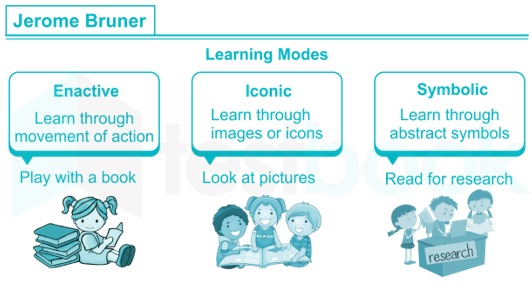
Jerome Bruner, an American psychologist has made crucial contributions in the field of human cognitive psychology.

He has identified three stages of cognitive representation which includes:

Enactive stage: 

  • It refers to the representation of knowledge through actions.
  • Learning by doing is the main principle
  • They learn by physical actions and storing things in memory

Iconic stage: 

  • It refers to the visual summarization of images.
  • The learner stores sensory images which are visual ones

Symbolic stage: 

  • It refers to the use of words and other symbols to describe experiences.
  • The experience stored in memory in the form of symbols i.e. language

Let's Have a Look:

Hence, it could be concluded that the intuitive stage is not part of Bruner's Cognitive Development Theory.

8

Morrison has described five steps in his teaching model at understanding level which are-

I. Presentation

II. Exploration

III. Organisation

IV. Assimilation

V. Recitation

The correct sequence is:

  1. ((a))

    I, II, III, IV, V

  2. ((b))

    II, I, IV, III, V

  3. ((c))

    IV, V, III, I, II

  4. ((d))

    II, I, III, IV, V

Show Answer
Answer: ((b))

II, I, IV, III, V

Professor H. C. Morrison (1871- 1945), (the University of Chicago) has described five steps in his teaching model at the understanding level which include:

Key Points

Steps of Morrison’s Teaching ModelDescription of steps
ExplorationIn this step, the teacher tries to know the student's‟ entry-level behavior (previous knowledge)
PresentationThe overview of the subject matter is given and the structure of the whole unit is discussed with the students.
AssimilationIn this step, the students study the subject matter deeply and try to relate the presented material to their internal selves.
OrganizationThe students present the acquired knowledge in a systematic manner without the help of a teacher.
RecitationThis step is related to the students' verbal expression of the subject manner which is learned by them. They revisit the whole content.


Hence, it could be concluded that the correct sequence of five steps in Morrison's teaching model at the understanding level is Exploration, Presentation, Assimilation, Organization, and Recitation.

9

Which of the following is not related with cognitive domain ?

  1. ((a))

    Knowledge 

  2. ((b))

    Application 

  3. ((c))

    Valuing 

  4. ((d))

    Understanding

Show Answer
Answer: ((c))

Valuing 

B.S. Bloom has proposed a taxonomy which is a set of three hierarchical models that refers to the classification of educational learning objectives.

Bloom's Taxonomy Identified Three Domains of Learning:

  1. Cognitive Domain: It involves knowledge and the development of intellectual skills.
  2. Affective Domain: It includes how we deal with things emotionally, such as feelings, values, appreciation, etc.
  3. Psychomotor Domain:  It includes physical movement, coordination, and use of the motor-skill areas.

Important Points

The cognitive domain involves mental skills which are categorized into six levels of learning that serve in the development of intellectual skills and acquisition power. 

The cognitive domains as per Bloom's taxonomy:

  • Remember: Retrieving the relevant knowledge from long-term memory.
  • Understand: Construct meaning from instructional messages, including oral, written, and graphic communication.
  • Apply: Carry out or use a procedure in a given situation.
  • Analyze: Break material into its constituent parts and determine how the parts relate to one another and to an overall structure or purpose.
  • Evaluate: Make judgments based on criteria or standards.
  • Create: Put elements together to form a coherent or functional whole; reorganizing elements into a new pattern or structure.

Hint

NOTE: Valuing is related to affective domain and it refers to the acceptance of behavior and commitment to it. One values certain behaviors not by desires but by commitment.

Hence, it could be concluded that valuing is not related with the cognitive domain.

10

Which of the following is not the curve of learning?

  1. ((a))

    Convex 

  2. ((b))

    Combination type

  3. ((c))

    Concave 

  4. ((d))

    Longitudinal 

Show Answer
Answer: ((d))

Longitudinal 

A learning curve visualizes changes in pupil overall performance over time. The line graph displays opportunities across the x-axis, and a measure of student performance along the y-axis.

  • A good learning curve which is also known as 'experience curve', reveals improvement in pupils' performance as opportunity count (i.e., exercise practice with a given knowledge component) increases.

Key Points

  • LEARNING CURVE was first defined by Hermann Ebbinghaus in 1885.
  • By learning curve, learners can relate his/her development through the method visually presented in the graph.
  • There are 3 varieties of the curve of learning i.e. concave curve, convex curve, and concave and convex curve/Combination type curve.

Let's Understand in Brief:

Concave curveIt is a slow initial improvement and learning increases with time. When the task is difficult we get such type of learning curve.
Convex curveIt depicts rapid initial improvement in learning that slows down with time. When the task is simple and the learner has previous practice on a similar task, we get this type of learning curve.
Combination type curveIt is the combination of the convex-concave curve that looks like the capital letter ‘S’. The curve takes a concave or convex shape, in the beginning, depending upon the nature of the task.


Hence, it could be concluded that longitudinal is not the curve of learning.

11

'Learning is any change in behaviour, resulting from behaviour' who said it ?

  1. ((a))

    Crow & Crow

  2. ((b))

    Guilford

  3. ((c))

    Woodworth

  4. ((d))

    Skinner

Show Answer
Answer: ((b))

Guilford

Learning is a comprehensive process that refers to a change in behavior, knowledge, and skills as a result of practice and experience.

  • It is difficult to give a precise definition of learning so every psychologist has different beliefs about the derivation of the word 'learning' and they have defined it in different ways.

Key Points

Some well-known definitions of learning are as follows:

PsychologistDefinition of learning
J.P. Guilford"Learning is any change in behaviour, resulting from behaviour."
Woodworth"Learning is the process of acquiring new knowledge and new responses."
B.F. Skinner"Learning is a process of progressive behaviour adaptation."
Crow & Crow"Learning is the acquisition of knowledge, habits, and attitudes. It involves new ways of doing things and it operates in an individual’s attempts to overcome obstacles or to readjust to new situations. It represents a progressive change in behaviour.


Hence, it could be concluded that the above-mentioned definition of learning is given by J.P. Guilford.

12

Match the List - A and List - B.

List – AList - B
a.BrunerI.Basic teaching model
b.AusubelII.Synectics teaching model
c.GlasserIII.Advance organiser teaching model
d.GordonIV.Concept attainment teaching model
V.Inquiry training model
  1. ((a))

    a - III, b - I, c - II, d - V

  2. ((b))

    a - IV, b - III, c - II, d - I

  3. ((c))

    a - IV, b - III, c - I, d - II

  4. ((d))

    a - I, b - II, c - III, d - V

Show Answer
Answer: ((c))

a - IV, b - III, c - I, d - II

A model of teaching is a plan, an instructional design to provide authentic experiences to students to facilitate learning. It can be used for effective teaching, development of instructional material, and development of curriculum.

  • There are different kinds of teaching models in fashion to facilitate effective learning such as 'Basic teaching model', 'Synectics teaching model', 'Advance organizer teaching model', etc.

Key Points

Let's Understand in Brief:

Teaching ModelPropounderMain Idea
Inductive Thinking ModelHilda TabaIt allows students to make generalizations about concepts in order to explore them further.
Concept Attainment teaching ModelJ. BrunerIt helps students in learning concepts and determining the attributes of the concept through analysis.
Advance Organizer teaching ModelD.P. AusubelIn this model, teachers play the role of lecturer or organizer of subject matter in presenting the information.
Synectics Teaching ModelWilliam GordenIt helps learners to see old problems, ideas, or products in a new, more creative light.
Basic Teaching ModelRobert GlaserIt provides an adequate conceptualization of teaching-learning process and explains relationship between teaching and learning.
Inquiry training modelRichard SuchmanIt helps students to establish facts, build concepts, and generate explanations. It gives training of inquiry to students.
<br>

Hence, it could be concluded that a - IV, b - III, c - I, d - II is correct in the context.

13

The first step of problem solving is

  1. ((a))

    Formulation of hypothesis

  2. ((b))

    Identification of problem

  3. ((c))

    Data collection

  4. ((d))

    Testing of hypothesis

Show Answer
Answer: ((b))

Identification of problem

There are different kinds of teaching-learning approach to facilitate effective learning and Problem-solving is one of them. It is a learner-centered approach that emphasizes learner's active involvement in the learning process.

  • In this approach, teachers create a problematic situation for students and then assist them in perceiving, defining, and stating the problems in a fear-free classroom environment.

Key Points

Steps involved in the problem-solving method:

  • Identification of problem
  • Accumulation of data.
  • Formulating a hypothesis.
  • Testing the hypothesis.
  • Making a generalization.

​Hence, it could be concluded that 'Identification of problem' is the first step of the problem-solving approach.


Aims of problem-solving method:

  • To develop divergent thinking among students.
  • To boost student's understanding of the concept.
  • To promote the use of critical and imaginative thinking.
  • To help students to gain the ability of scientific problem-solving.
  • To make students able to utilize creativity in the decision-making process.
14

Learning of children will be most effective when

  1. ((a))

    Teacher will lead the learning process and keep the children passive

  2. ((b))

    Development of cognitive, affective and psychomotor domain of children will take place

  3. ((c))

    Emphasis will be only on reading, writing and mathematical skills

  4. ((d))

    Teaching system will be autocratic

Show Answer
Answer: ((b))

Development of cognitive, affective and psychomotor domain of children will take place

Learning refers to the modification of behavioral patterns. It is a comprehensive process that refers to a change in behavior, knowledge, and skill as a result of practice and experience.

Key Points

  • Learning of children will be most effective when development of cognitive, affective, and psychomotor domains of children will take place.
  • These domains are proposed by Benjamin Bloom in his taxonomy. It is a set of three hierarchical models that refers to the classification of educational learning objectives.

Important Points 

Let's Understand these domains in the context of child's learning:

  • Cognitive domains: In this domain, a child deals with knowledge and hence, learns to create, evaluate, analyze, etc.
  • Affective domains: This domain comes into play when the child grows in emotional areas such as feelings, attitudes, etc.
  • Psychomotor domains: It is concerned with acquiring skills that require the integration of mental and physical movements.

Hence, it could be concluded that the learning of children will be most effective when development of cognitive, affective, and psychomotor domains of children will take place.

15

Which step is prominent in the syntax of teaching model of memory level and understanding level ? 

  1. ((a))

    Planning 

  2. ((b))

    Exploration 

  3. ((c))

    Generalization 

  4. ((d))

    Presentation

Show Answer
Answer: ((d))

Presentation

Teaching takes place at three levels progressively- memory level of teaching, understanding level of teaching, and reflective level of teaching. 

  • Teachers must keep in mind the developmental stage of the learners so that desired educational objectives can be achieved.

Important Points

Three identifiable levels of teaching-learning:

  • Memory level: It is that where simple processes of recall and recognition are insisted.
  • Understanding level: It is one where seeing of relationship or insight is stressed.
  • Reflective level: It is that where critical thinking or problem solving is the chief concern.

Key Points

Presentation step is prominent in the syntax of the teaching model of memory level and understanding level. It is the most important step as it gives the major status to the subject matter.

In the Presentation Step:

  • The teacher introduces new knowledge in an interactive manner before the learners.
  • The teacher tries to connect the previous knowledge of the learners with a new set of knowledge.
  • The teacher believes that when any topic is presented properly to the students they learn them in a coherent way.

Hence, it could be concluded that the presentation step is prominent in the syntax of the teaching model of memory level and understanding level.

16

Human development starts from 

  1. ((a))

    Stage of infancy

  2. ((b))

    Pre-childhood stage

  3. ((c))

    Pre-natal stage

  4. ((d))

    Post-childhood stage

Show Answer
Answer: ((c))

Pre-natal stage

Development refers to an increase in structure for better and enhanced functioning of organs. It is a wide and continuous process that starts from the pre-natal stage.

Key Points

In the pre-natal stage, baby develops inside the mother's womb and becomes a mature one by passing through three different stages of prenatal development.

The three stages of pre-natal development include:

  • Germinal period: First 2 weeks after conception.
  • Embryonic period: 8 weeks from conception.
  • Fetal Period: 9 weeks until birth or 38 to 40 weeks.

Hence it could be concluded that development starts from the pre-natal stage.​ 

Additional Information

Stage of infancy- It refers to the first year or the early period of a child's development in which the child grows rapidly after birth. - It is a crucial period of development in which the child learns to sit, crawl, stand, etc.
Pre-childhood stage- It refers to the time period from the age of 'Two to Seven years'. It is a very crucial period for child's overall development. - It is also known as the toy age, pregang age, and exploratory age, etc.
Post-childhood stage- It refers to the time period from the age of 'seven to twelve years'. The signs of puberty usually begin to appear in this stage. - It is also known as troublesome age, gang age, play age, etc.
17

'The Conditions of Learning' book is written by 

  1. ((a))

    I.P. Pavlov

  2. ((b))

    B.F. Skinner

  3. ((c))

    E.L. Thorndike

  4. ((d))

    R.M. Gagne

Show Answer
Answer: ((d))

R.M. Gagne

Key Points

Robert Mills Gange, an American educational psychologist. He had written a book named 'The Conditions of Learning'. 

  • In this book, he has proposed a hierarchy of learning in which learning tasks are organized in a hierarchy based on their complexity level.

This learning hierarchy is divided into eight intellectual levels and nine events of instruction. It implies the idea that:

  • there are different kinds of levels of learning which require different kinds of instruction.
  • an individual has to first master a lower intellectual level in order to acquire higher intellectual level skills.

Hence, it could be concluded that 'The Conditions of Learning' book is written by R.M. Gagne.

Additional Information

PsychologistsBooks
I.P. PavlovConditioned Reflexes
B.F. SkinnerVerbal behavior
E.L. ThorndikeAnimal Intelligence
18

 "Adolescence is the period of great stress, strain, storm and strike" is the statement of  

  1. ((a))

    Crow & Crow

  2. ((b))

    Stanley Hall

  3. ((c))

    Jersield 

  4. ((d))

    Simpson

Show Answer
Answer: ((b))

Stanley Hall

Childhood refers to the period of the human lifespan, ranging from birth to puberty. It consists of many developmental stages and 'adolescence' is one of them.

'Adolescence' comes from the Latin word 'Adolescere' which means 'to grow to become mature'. It a stage which lies between the age of '12 to 19 years'.

The above-mentioned statement is stated by Stanley Hall, father of scientific research in adolescence. He introduced the terms 'storm and stress' in 1904 in the context of adolescence.

According to Stanley Hall:

  • Adolescence is a turbulent time charged with conflict and mood swings.
  • The time period of transition from childhood and adolescence is of great stress.
  • Adolescence fails to think clearly and it creates great frustration and stress in their lives.

Hence, it could be concluded that "Adolescence is the period of great stress, strain, storm and strike" is the statement of Stanley Hall.

19

Total time taken in Indian Model of Micro Teaching is

  1. ((a))

    30 minute

  2. ((b))

    40 minute

  3. ((c))

    36 minute

  4. ((d))

    45 minute

Show Answer
Answer: ((c))

36 minute

Micro-teaching is defined as teaching in miniature where it is scaled down in size of the class time and task with focus on a specific teaching skill.

Key Points

  • The concept of micro-teaching is a training concept that can be applied at various pre-service and in-service stages in the professional development of teachers.
  • Microteaching sessions involve one student teacher, the class instructor (or school supervisor who provides feedback to the student-teacher), and a small group of peers.
  • These sessions allow student teachers to practice and polish their teaching techniques in a simulated environment before putting them into practice with students.
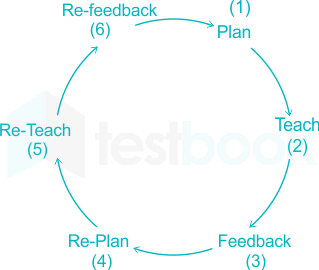
  • In the Indian model of micro-teaching, developed by NCERT the duration of Micro Teaching is as under:
  • Teach - 6 minutes
  • Feedback  - 6 minutes
  • Re-plan - 12 minutes
  • Re-teach - 6 minutes
  • Re-feedback - 6 minutes
  • Total - 36 minutes

There are six steps of micro-teaching which are as follows -

Hence, it could be concluded that total time taken in the Indian Model of Micro Teaching is 36 minutes.

20

 "Plateaus of learning are a characteristic feature of the learning process indicating a period where no improvement in performance is made". Who said this ? 

  1. ((a))

    Skinner 

  2. ((b))

    Hollingworth

  3. ((c))

    Gates and others

  4. ((d))

    Ross

Show Answer
Answer: ((d))

Ross

‘Plateaus’ are often seen in the pattern of development, indicating periods of no apparent improvement. Learning plateau is arrested growth in learning as it is a long flat and horizontal stretch in the learning curve which:

  • represents a stationary stage, where apparently no progress in learning is recorded.
  • represents a period in the learning process where no improvement occurs even with any number of practices.

Key Points

According to Lee Ross, "Plateaus of learning is a characteristic feature of the learning process indicating a period where no improvement in performance is made". Ross spoke about the learning capability of humans.

  • He stated that after someone starts learning about something, the advantage of knowledge is sharp which is much like the edges of the plateau.
  • Also after learning a tremendous amount, the quantity of learning becomes unchanged.
  • Here the advantage of knowledge is insignificant just like the tabletop of the plateau.

Hence, it could be concluded that the above-mentioned statement was stated by Ross.

21

Match the List - A and List - B.

Column – AColumn – B
a.Animal IntelligenceI.Gestalt
b.Schedule of reinforcementII.Piaget
c.Law of pragnanzIII.Thorndike
d.AdaptationIV.Skinner
  1. ((a))

    a - III, b - IV, c - I, d - II

  2. ((b))

    a - II, b - IV, c - III, d - I

  3. ((c))

    a - I, b - IV, c - III, d - II

  4. ((d))

    a - II, b - IV, c - I, d - III

Show Answer
Answer: ((a))

a - III, b - IV, c - I, d - II

There are many theories in psychology which are related to different schools of psychology such as cognitive, humanistic, behavioristic, gestalt, etc.

These theories are propounded by eminent psychologists to provide a framework to understand different aspects of human behavior.

Here option (1) is correct in the context:

  • Thorndike regarded adaptive changes in animal behavior as parallel to human learning. Animal Intelligence is a report of Thorndike's contribution to the comparative psychology of learning.
  • A Schedule of Reinforcement is modeled by Skinner.It states which behavior will be reinforced. In some cases, the behavior might be reinforced every time it occurs. And in some cases, the behavior might not be reinforced at all.
  • The Law of Pragnanz is one of the principles of Gestalt principles of perception. Pragnanz refers to that which is intuitively satisfying. More clearly this relates to fullness/completeness.
  • Piaget's Theory of Cognitive Development is primarily based on two biological tendencies: Organization & Adaptation. Adaptation is the technique by which humans connect the original experience with a new experience.

Hence, it could be concluded that all pairs are correctly matched in option (1).

22

"Development is a never-ending process'. This statement is related to which principle of development? 

  1. ((a))

    Principle of continuity

  2. ((b))

    Principle of integration

  3. ((c))

    Principle of interaction

  4. ((d))

    Principle of inter relationship 

Show Answer
Answer: ((a))

Principle of continuity

Development refers to an increase in structure for better and enhanced functioning of organs.

  • It is a wide and continuous process, thus there are some principles that need to be followed for a better understanding of the concept.

Key Points

  • The above-mentioned idea is associated with the "Principle of Continuity".
  • This principle defines that development is a continuous process from the womb to the tomb and continues gradually until reaching its maximum growth.

Important Points

  • Other principles of development include:
  • Development is cumulative.
  • Development is the process of interaction.
  • Development follows uniformity of pattern.
  • Development is predictable and sequential.
  • Development rate varies from person to person.
  • Development proceeds from general to specific.

Hence, it could be concluded that the above-mentioned process is related to the Principle of continuity.

23

Through which Amendment of Constitution education has become fundamental right ? 

  1. ((a))

    22nd Amendment

  2. ((b))

    25th Amendment

  3. ((c))

    86th Amendment

  4. ((d))

    52th Amendment

Show Answer
Answer: ((c))

86th Amendment

The 86th amendment to the Constitution of India in 2002 provided the right to education as a fundamental right.

  • A new article 21A was added which made the right to education a fundamental right for children between 6-14 years.
  • Changes in Article 45 of the Directive Principle of State Policies were made.
  • It made education for all children below 6 years a Directive Principle of State Policies(DPSP).

Hence, it could be concluded that through 86th Amendment of the Constitution education has become a fundamental right.

Additional Information

22nd Amendment- Created Meghalaya as an ‘autonomous state’ or ‘substate’ within the state of Assam with its own legislature and council of ministers.
25th Amendment- Curtailed the fundamental right to property and restricted the compensation in case the state takes over private property
52th Amendment- laid down the process by which legislators may be disqualified on grounds of defection and inserted the tenth schedule.
24

Instinct Theory of motivation was propounded by 

  1. ((a))

    William James

  2. ((b))

    Abraham Maslow

  3. ((c))

    McDougall

  4. ((d))

    Simpson

Show Answer
Answer: ((c))

McDougall

Instinct Theory of motivation was propounded by William McDougall. According to this theory, instinct drives all behaviors and McDougall saw instinct as purposive and goal-directed.

Key Points

In this theory, McDougall suggested that:

  • All organisms are born with natural biological tendencies that assist them to survive.
  • Every person has instincts in a greater or lesser degree that are prime determinants of behaviour.
  • Eg: Infants have an inborn rooting reflex that helps them in seeking out a nipple and obtaining nourishment.

Hence, it could be concluded that the 'Instinct Theory of motivation' was propounded by McDougall.

Additional Information

William JamesAn American psychologist who has described the pragmatism philosophy of education worldwide in detail.
Abraham MaslowPropounder of 'Maslow's Hierarchy of Needs' in which he has proposed a series of needs to be fulfilled in life.
SimpsonPropounder of 'Psychomotor domain' which includes physical movement, coordination and use of motor skills.
25

Which of the following stages of development is called as 'A unique stage of emotional development' by Cole and Bruce ?

  1. ((a))

    Adolescence

  2. ((b))

    Childhood 

  3. ((c))

    Infancy 

  4. ((d))

    Adulthood

Show Answer
Answer: ((b))

Childhood 

  • Development: It is a broad term that includes a series of qualitative and progressive changes. These qualitative changes lead to the enhancement of various abilities and enable one to function effectively.
  • Emotions: These are the feelings generated as an effect of experiences, or relationships of an individual with others. They are instinctive reactions that come naturally to all and contribute to the personal and social adjustments of an individual.

According to Cole and Bruce, childhood is a unique stage of emotional development.

  • Emotional development relies solely on the process of socialization and proceeds in a stepwise manner.
  • Basic emotions such as fear, disgust, happiness, sadness, surprise, anger, and interest, are present since birth.
  • During childhood, mood tantrums are pretty common.
  • Toddlers have a tendency to have fast temper swings. While their emotions may be very intense, these emotions additionally have a tendency to be pretty short-lived.
  • One might be stunned at how an infant can go from screaming hysterically about a toy at one second to sitting in the front of the TV quietly looking at a favorite show simply moments later.
  • Children at this age are very possessive and have difficulty in sharing.

Hence, it could be concluded that 'Childhood' is called 'A unique stage of emotional development' by Cole and Bruce.

26

Who gave the concept of multiple intelligence ? 

  1. ((a))

    Gardner 

  2. ((b))

    Spearman 

  3. ((c))

    Goleman 

  4. ((d))

    John Mayor

Show Answer
Answer: ((a))

Gardner 

Intelligence refers to the capacity to acquire and apply knowledge. It is the ability to solve problems, learn from experiences, and apply knowledge to deal with new situations.

  • There are many theories related to intelligence. These theories are propounded by eminent psychologists to provide a framework to understand different aspects of human intelligence.
  • The theory of Multiple Intelligence which consists of eight different kinds of intelligence is propounded by an American psychologist 'Howard Gardner'.

This theory emphasizes that:

  • intelligence is of several kinds rather than dominated by a general factor.
  • intelligence can't be tied to a single domain as each individual has his/her own abilities.
  • how cultures shape the potential of the human using Intelligence as a multi-dimensional set of complex abilities.

Important Points

The following table will provide a complete idea of Howard Gardener's 8 types of Intelligence.

Type of IntelligenceDescriptionExamples
Bodily-KinestheticControl their body movementsPlaying kickball, jumping rope.
Musical-RhythmicRecognize the varieties of music patternComposers and Musicians
Logical-MathematicalSolve mathematical problemsMath experts, Scientists, Lawyers
Verbal-LinguisticUse language for expressionPoets, Lawyers, Public speakers, and Language translators.
InterpersonalHave good communication and social skillsTeachers, Politicians, Sales-people
Intra-personalWork independentlyPsychologists, Social workers, Religious leaders
Visual-SpatialLearn by what they are seeing and observingPhotographers, Artists, Architects, Engineers, Surgeons
NaturalisticSatisfy their need naturallySailors, Gardeners, Chefs, and Farmers


Hence, it ould be concluded that 'Howard Gardner' has given the concept of multiple intelligence.

Additional Information

PsychologistTheoryMain Idea
Charles SpearmanTwo-factor theory of intelligenceS-factor is applicable in specific fields and changeable in nature while G-factor is a universal innate ability to perform all cognitive tasks effectively.
Daniel GolemanEmotional Intelligence TheoryIt conceptualizes emotional intelligence as a large range of dispositions and competences ranging from individual traits to learned abilities.
John MayorTheory of Emotional intelligenceEmotional intelligence is the ability to perceive emotions, to access and generate emotions, and to promote emotional and intellectual growth.
27

Dyslexia has difficulty in

  1. ((a))

    Speaking 

  2. ((b))

    Expressing 

  3. ((c))

    Reading/Spelling

  4. ((d))

    Standing

Show Answer
Answer: ((c))

Reading/Spelling

Learning disability refers to the neurological disorder that causes cognitive impairment. Dyslexia, dysgraphia, dyscalculia, etc are the example of learning disability.

Key Points

Dyslexia has difficulty in Reading/Spelling as dyslexia is the most common learning disability which makes learners:

  • confuse with the same shapes and sounds of alphabet.
  • unable to read, interpret, and understand letters and words.
  • bewilder in identifying and relating speech sounds with letters and words.

Hence, it could be concluded that Dyslexia has difficulty in Reading/Spelling.

Additional Information

Other Disabilities in Brief:

DysgraphiaIt is a deficiency that affects the ability to write coherently.
DyscalculiaIt is a disability which affects learner's ability to perform mathematical calculations.
DysphasiaA language disorder that affects communication skill and comprehension abilities.
DyspraxiaIt is a motor disorder that affects the coordination of tongue and lips to produce sounds.
AphasiaAn impairment of language that affects the ability to communicate.
DysarthriaA neurological disorder which leads to imprecise speech.
DystopiaAn imagined world in which people lead wretched and fearful life.
StutteringA speech disorder, affects the flow of the speech by repeating the same word again and again.
28

Which of the following is NOT the role of teacher in inclusive classroom?

  1. ((a))

    Teacher should devote extra time to teach learning disabled.

  2. ((b))

    Teacher should not pay attention to differently abled child.

  3. ((c))

    Make adequate seating arrangements according to the requirement of the child.

  4. ((d))

    Teacher should encourage the children.

Show Answer
Answer: ((b))

Teacher should not pay attention to differently abled child.

Inclusive Education refers to the inclusion of all children in the education system, regardless of their differences and disabilities.

  • It values the diversity, each child brings to the classroom and facilitates all with equal opportunities to learn and grow.

Key Points

Teachers are the implementers of education and are the most important resources in educational settings. They also play a vital role in an inclusive classroom by:

  • encouraging children to learn.
  • devoting extra time to teach the learning disabled.
  • paying attention to differently abled children.
  • fostering the potential of every child to grow and bloom.
  • addressing the diverse learning needs of every student.
  • making adequate seating arrangements according to the child's requirement.

Hence, it could be concluded that 'not paying attention to differently abled children' is not the role of the teacher in an inclusive classroom.​

29

In the class, questioning by students 

  1. ((a))

    should not be allowed.

  2. ((b))

    should be encouraged.

  3. ((c))

    should be discouraged.

  4. ((d))

    should be stopped.

Show Answer
Answer: ((b))

should be encouraged.

Questioning refers to the most effective strategy to arise curiosity and inquisitiveness too. Asking questions makes the classroom's ambiance more interactive.

<br>

Key Points

In the class, questioning by students should be encouraged as it could enhance their cognitive competencies in the following ways:

  • Questions inspire learners to look out for information that aligns with their pursuits and might consequently promote lifelong learning.
  • Asking questions allows learners to link between various pieces of information which can assist them in structuring essays and debates.
  • Questioning boosts their confidence-up, makes them able to put forth their views, and helps the children to make the best of their educational experiences.

Hence, it could be concluded that in the class, questioning by students should be encouraged.

30

Growth of a child is mainly related to

  1. ((a))

    Moral Development

  2. ((b))

    Social Development

  3. ((c))

    Physical Development

  4. ((d))

    Emotional Development

Show Answer
Answer: ((c))

Physical Development

The term growth and development are often used interchangeably with each other. Let's understand:

  • Growth: It refers to a quantitative change which results in an increase in height, weight, and length of the child.
  • Development: It refers to a qualitative change which results in an increase in structure for better and enhanced functioning of organs.

Key Points​ Growth of a child is mainly related to 'Physical Development' which refers to physical changes that occur in humans throughout life.

  • Growth talks about the quantitative changes, for instance, an increase in size and structure.
  • The child not only becomes larger in stature, but the size and structure of the internal organs and the brain also increases.
  • Physical growth goes on from birth onwards, in tissues, muscles, bones, height, weight, strength, brain, and in fact, in every physical aspect, function, or formation.

H ence, it could be concluded that the growth of a child is mainly related to  'Physical Development'.

Additional Information

Moral DevelopmentIt refers to the development of the ability to learn the difference between right and wrong.
Social DevelopmentIt refers to the development of social skills and values across the lifespan.
Emotional DevelopmentIt refers to the development of the ability to control and manage one's own emotions and as well as of others.

Hindi (30 questions)

31

‘घोसले में चिड़िया है’ में कौन-सा कारक है?

  1. ((a))

    अधिकरण कारक

  2. ((b))

    सम्बन्ध कारक

  3. ((c))

    अपादान कारक

  4. ((d))

    सम्प्रदान कारक

Show Answer
Answer: ((a))

अधिकरण कारक

‘घोसले में चिड़िया है’ वाक्य में 'अधिकरण' कारक है क्योंकि इसमें विभक्ति चिन्ह 'में' प्रयोग हुआ है। 'भीतर, ऊपर, अंदर, बीच' आदि शब्दों का प्रयोग इस कारक में किया जाता है। अन्य विकल्प अनुपयुक्त हैं। अतः सही विकल्प 'अधिकरण' है।

विकल्पों का स्पष्टीकरण

कारकपरिभाषाउदाहरण
अधिकरणशब्द के जिस रूप से क्रिया के आधार का ज्ञान हो, इसकी विभक्ति 'में' और 'पर' है।1. मोहन मैदान में खेल रहा है। 2. मनोज छत पर पढ़ रहा है।
सम्बन्धसंज्ञा या सर्वनाम के जिस रूप से किसी अन्य शब्द के साथ संबंध का बोध हो, इसकी विभक्ति 'का', 'की', और 'के' है।1. सीता का भाई आया है। 2. राम की किताब।
अपादानजब दो वस्तुओं के अलग होने का बोध को।पेड़ से पत्ता गिरा।
सम्प्रदानजब कोई वस्तु किसी को दी जाये वहां सम्प्रदान कारक होता है।राहुल ने रोहित को उपहार दिया।

निर्देश: निम्नलिखित गद्यांश पढ़कर उत्तर दीजिये।

गांधीवाद में राजनीतिक और अध्यात्मिक तत्त्वों का समन्वय मिलाता है। वही इस वाद की विशेषता है| आज संसार में जितने भी वाद प्रचलित है वह प्राय: राजनीतिक क्षेत्र में सीमित हो चुके है। आत्मा से उनका सम्बन्ध-विच्छेद होकर केवल बाह्य संसार तक उनका प्रसार रह गया है। मन की निर्मलता और ईश्वर निष्ठा से आत्मा को शुद्ध करना गांधीवाद की प्रथम आवश्यकता है। ऐसा करने से नि: स्वार्थ बुद्धि का विकास होता है और मनुष्य सच्चे अर्थों में जनसेवा के लिए तत्पर हो जाता है। गांधीवाद में साम्प्रदायिकता के लिए कोई स्थान नहीं है। ऐसी समस्या को हल करने के लिए गांधीजी ने अपने जीवन का बलिदान कर दिया था।

32

उपर्युक्त गद्यांश में गांधीवाद का आधार किसे बताया गया है?

  1. ((a))

    राजनितिक अध्यात्म और साम्प्रदायिकता को

  2. ((b))

    जनसेवा और अद्यात्म को

  3. ((c))

    राजनीतिक और आध्यात्मिक तत्व को

  4. ((d))

    ईश्वर निष्ठा और मन की निर्मलता को

Show Answer
Answer: ((c))

राजनीतिक और आध्यात्मिक तत्व को

गद्यांश में गांधीवाद का आधार 'राजनीतिक और अध्यात्मिक तत्व को' बताया गया है। गद्यांश की पंक्ति 'गांधीवाद में राजनीतिक और आध्यात्मिक तत्वों का समन्वय मिलाता है' से स्पष्ट होता है। अन्य विकल्प अनुपयुक्त हैं। अतः सही विकल्प 'राजनीतिक और आध्यात्मिक तत्व को' है।

33

उपर्युक्त गद्यांश के आधार पर बताइये की संसार के सारे वाद कहाँ तक सिमित हैं?

  1. ((a))

    धर्म तक

  2. ((b))

    साम्प्रदायिकता तक

  3. ((c))

    राजनितिक क्षेत्र तक

  4. ((d))

    आत्मा तक

Show Answer
Answer: ((c))

राजनितिक क्षेत्र तक

संसार के सारे वाद सिमित हैं 'राजनीतिक क्षेत्र तक'। गद्यांश की पंक्ति 'आज संसार में जितने भी वाद प्रचलित है वह प्राय: राजनितिक क्षेत्र में सीमित हो चुके हैं' से स्पष्ट होता है। अन्य विकल्प अनुचित हैं। अतः सही विकल्प 'राजनितिक क्षेत्र तक' है।

34

‘कनुप्रिया’ के रचनाकार कौन है ?

  1. ((a))

    नागार्जुन

  2. ((b))

    रांगेय राघव

  3. ((c))

    धर्मवीर भारती

  4. ((d))

    भगवतीचरण वर्मा

Show Answer
Answer: ((c))

धर्मवीर भारती

‘कनुप्रिया’ के रचनाकार 'धर्मवीर भारती' हैं। अन्य विकल्प अनुचित हैं। अतः सही विकल्प 'धर्मवीर भारती' हैं।

35

प्लुत स्वर कौन-सा है?

  1. ((a))

    ओम

  2. ((b))

    ओ३म्

  3. ((c))

    अउम

  4. ((d))

    ओम्

Show Answer
Answer: ((b))

ओ३म्

प्ल���त स्वर 'ओ३म्' है। अन्य विकल्प त्रुटिपूर्ण हैं। अतः सही विकल्प 'ओ३म्' है।

मात्रा के आधार पर स्वर के भेद
ह्रस्व स्वर (लघुस्वर) - जिन स्वरों के उच्चारण में कम समय लगता हैं। जैसे - अ, इ, उ।
दीर्घ स्वर (गुरू स्वर) - जिन स्वरों के उच्चारण में समय अधिक लगता हैं। जैसे - आ, ई, ऊ, ए, ऐ, ओ, औ
ह्रस्वार्द्ध स्वर - इन स्वरों के उच्चारण में ह्रस्व स्वर की अपेक्षा कम समय लगता हैं। जैसे - अऽ, एँ।
प्लूत स्वर- जिन स्वरों के उच्चारण में दीर्घ स्वरों से भी अधिक समय लगता हैं, उन्हे प्लूत स्वर कहते हैं। यह स्वर लेखन में नहीं हैं, यह किसी को पुकारने के काम आते हैं। जैसे - ॐ का ‘ओ’ स्वर
36

‘राम आम खाता है’ में वाच्य का कौन-सा रूप है?

  1. ((a))

    कर्तृवाच्य

  2. ((b))

    भाववाच्य

  3. ((c))

    कर्मवाच्य

  4. ((d))

    उभयवाच्य

Show Answer
Answer: ((a))

कर्तृवाच्य

‘राम आम खाता है’ वाच्य में 'कर्तृवाच्य' है क्योंकि यहाँ राम खाने का कार्य कर रहा है। अन्य विकल्प असंगत हैं। अतः सही विकल्प 'कर्तृवाच्य' है।

अन्य विकल्प

क्रिया के जिस रूप से यह ज्ञात हो कि वाक्य में क्रिया द्वारा बताए गए विषय में कर्ता, कर्म, अथवा भाव में से कौन प्रमुख है, उसे वाच्य कहते हैं। किसी वाक्य में कर्ता, कर्म या भाव की प्रधानता होगी।
वाक्यवाच्य
कर्तृवाच्यक्रिया के जिस रूप में कर्ता प्रधान हो, उसे कर्तृवाच्य कहते हैं। जैसे - रोहित क्रिकेट खेलता है।
कर्मवाच्यक्रिया के जिस रूप में कर्म प्रधान हो, उसे कर्मवाच्य कहते हैं। जैसे – रोगी को दवा दी गई।
भाववाच्यक्रिया के जिस रूप में न तो कर्ता की प्रधानता हो न कर्म की, बल्कि क्रिया का भाव ही प्रधान हो, वहाँ भाववाच्य होता है। जैसे - मोहन से टहला भी नहीं जाता।
37

निम्नलिखित दोहे में कौन-सा अलंकार है? 

रहिमन पानी रखिये बिन पानी सब सुन।

पानी गए न उबरे मोती मानस चुन।

  1. ((a))

    श्लेष

  2. ((b))

    रूपक

  3. ((c))

    उपमा

  4. ((d))

    उत्प्रेक्षा

Show Answer
Answer: ((a))

श्लेष

उपर्युक्त दोहे में 'श्लेष' अलंकार है। अन्य विकल्प असंगत हैं। अतः सही विकल्प 'श्लेष' है।

Key Points

अन्य विकल्प

श्लेष अलंकार - जब एक ही शब्द के विभिन्न अर्थ निकलते हों। जैसे –‘रहिमन पानी राखिए बिन पानी सब सून ‘पानी’ गए न ऊबरे मोती मानस चून’ यहाँ ‘पानी’ मोती के सन्दर्भ में ‘चमक’, मनुष्य के सन्दर्भ में ‘विनम्रता’ तथा ‘चून (आटा)’ के सन्दर्भ में ‘जल अर्थात पानी’ है।
रूपक अलंकार - जब उपमान और उपमेय में अभिन्नता या अभेद दिखाया जाए। जैसे - मैया मैं तो चन्द्र-खिलौना लैहों में चन्द्रमा और खिलौने में समानता न दिखाकर चन्द्र को ही खिलौना बोल दिया गया है।
उपमा अलंकार - जब दो भिन्न वस्तुओं में समानता दिखाई जाती है। जैसे – कर कमल-सा कोमल है।
उत्प्रेक्षा अलंकार - जहाँ उपमेय में उपमान के होने की संभावना का वर्णन होता हो। जैसे - मुख मानो चन्द्रमा है में मुख को चंद्रमा कहा जा रहा है।
38

निम्नलिखित में से कौन-सा शब्द शुद्ध है?

  1. ((a))

    अंक

  2. ((b))

    चांद

  3. ((c))

    अंगना

  4. ((d))

    आंख

Show Answer
Answer: ((a))

अंक

उपर्युक्त शब्दों में से शुद्ध शब्द 'अंक' है। अन्य विकल्प अनुचित हैं। अतः सही विकल्प 'अंक' है।

विकल्पों का स्पष्टीकरण

शुद्ध रूपअशुद्ध रूप
आँखआंख
चाँदचांद
आँगनअंगना
39

निम्न में से किस शब्द की वर्तनी सही है?

  1. ((a))

    सन्निधि

  2. ((b))

    सम्निधि

  3. ((c))

    सनिधि

  4. ((d))

    सन्निधी

Show Answer
Answer: ((a))

सन्निधि

दिए गए विकल्पों में 'सन्निधि' की वर्तनी शुद्ध है जिसका शाब्दिक अर्थ है 'आमने सामने की स्थिति, सन्निधान, समीपता, निकटता, पड़ोस'। अन्य विकल्प निरर्थक व त्रुटिपूर्ण हैं। अतः सही विकल्प 'सन्निधि' है।

अन्य शुद्ध-अशुद्ध शब्द

अशुद्ध वर्तनीशुद्ध वर्तनीअर्थ
खरोचखरोंचकिसी चीज़ के रगड़ जाने से या छिलने से बनने वाला चिह्न या निशान, खराश।
वरिष्टवरिष्ठज्येष्ठ, वरीय, श्रेष्ठ, पूज्य, सबसे बढ़कर, बड़ा।
यानियानीअर्थात, मतलब यह कि।
40

उपचारात्मक शिक्षण की सफलता किस बात पर निर्भर करती है?

  1. ((a))

    उपचारात्मक शिक्षण की सामग्री पर

  2. ((b))

    समय व अवधि पर

  3. ((c))

    भाषिक नियमो के ज्ञान पर

  4. ((d))

    समस्याओं के कारणों की सही पहचान पर

Show Answer
Answer: ((d))

समस्याओं के कारणों की सही पहचान पर

उपचारात्मक शिक्षण: एक बच्चा सीखने के दौरान जाने-अनजाने या कुछ वैकल्पिक अवधारणाओं के कारण गलतियाँ करता है। यह एक शिक्षक का काम है कि वह छात्रों की उन गलतियों का निदान करने तथा उपचार करने में मदद करें**।** इसी विधि को उपचारात्मक विधि कहते है।

उपचारात्मक शिक्षण से तात्पर्य बच्चों की शिक्षण संबंधी कमजोरियों/कठिनाइयों को दूर करते हुए शिक्षण करने से है। यह विद्यार्धियों की त्रुटियों का संसोधन करने से समबन्धित है। यह निदानात्मक शिक्षण से जुड़ा हुआ हैऔर विद्यार्थियों की शिक्षण संबंधी कमियों का सही अवलोकन करने में मदद करता है वहीं उपचारात्मक शिक्षण द्वारा उन कमियों और त्रुटियों को दूर करने का प्रयास किया जाता है।

Important Points

उपचारात्मक शिक्षण इसकी विशेषताएँ निम्नलिखित हैं:

  • इसका उपयोग भाषा कौशल में सुधार के लिए किया जा सकता है।
  • किसी विशेष समस्या क्षेत्र को ठीक करने के लिए, इसका उपयोग किया जा सकता है।
  • यह छात्रों द्वारा सामना की जाने वाली समस्याओं और चुनौतियों की पहचान के बाद किया जाता है।
  • एक शिक्षक को इस पद्धति को लागू करने के लिए छात्रों की गुण और कमजोरियों के बारे में अच्छी तरह से पता होना चाहिए।
  • यह एक व्यवस्थित प्रक्रिया है क्योंकि शिक्षक पहले छात्रों की समस्या का निदान करता है और फिर उपयुक्त उपचारात्मक तरीके लागू करता है।

अतः हम कह सकते है कि उपचारात्मक शिक्षण की सफलता समस्याओं के कारणों की सही पहचान पर निर्भर करती है।

निर्देश: दिए गए गद्यांश को पढ़कर प्रश्न के उत्तर दीजिये।

वरदन्त की पंगति कुंदकली अधराधर पल्लव लोचन की।

चपला चमके घन बिच जगै छवि मोतिन माल अमोलन की।।

घुंगरारी लटे लटके मुख ऊपर कुण्डल लाल कपोलन की।

निवछावर प्राण करे ‘तुलसी’ बलि जाऊं ललाइन बोलन की।।

41

उपरोक्त पद्य किस कवि का है ?

  1. ((a))

    कबीर

  2. ((b))

    सूरदास

  3. ((c))

    जायसी

  4. ((d))

    तुलसीदास

Show Answer
Answer: ((d))

तुलसीदास

उपर्युक्त पद्य 'तुलसीदास' कवि का है। ये पद्य तुलसीदास जी द्वारा रचित 'कवितावली' से लिया गया है। अन्य विकल्प असंगत हैं। अतः सही विकल्प 'तुलसीदास' है।

42

इस पद्यांश में कौन-सा रस है?

  1. ((a))

    शांत रस

  2. ((b))

    वात्सल्य रस

  3. ((c))

    करुण रस

  4. ((d))

    श्रृंगार रस

Show Answer
Answer: ((b))

वात्सल्य रस

उपर्युक्त पद्यांश में 'वात्सल्य रस' है। प्रस्तुत पंक्तियों में श्री राम जी के बाल सौंदर्य का वर्णन किया गया है। ये पद्यांश ‘तुलसीदास जी’ द्वारा रचित 'कवितावली' से लिया गया है। अन्य विकल्प असंगत हैं। अतः सही विकल्प 'वात्सल्य रस' है।

Additional Information

वात्सल्य रस (स्थायी भाव - वात्सल्यता (अनुराग) है) - माता का पुत्र के प्रति प्रेम, बड़ों का बच्चों के प्रति प्रेम, गुरुओं का शिष्य के प्रति प्रेम आदि स्नेह भाव वात्सल्य रस कहलाता है।
शांत रस (इसका स्थाई भाव निर्वेद है) - अनित्य और असार तथा परमात्मा के वास्तविक ज्ञान से विषयों के वैराग्य से उत्पन्न रस परिपक्व होकर शांति में परिणत हो। जैसे – मन रे तन कागद का पुतला। लागे बूंद बिनसि जाय छिन में, गरब करें क्या इतना।
करुण रस (स्थाई भाव शोक है) - किसी प्रिय व्यक्ति के विरह से उत्पन्न होने वाली शोकावस्था। जैसे – सोक विकल सब रोंवही रानी। रूपु सीलु बलु तेज बखानी। करहिं मिलाप अनेक प्रकार। परहिं भूमि तल बारहिं बारा।
श्रृंगार रस (इसका स्थाई भाव रति (प्रेम है) - जिस रस में नायक नायिका के प्रेम, मिलने, बिछुड़ने जैसी क्रियायों का वर्णन हो।
43

उच्चारण स्थान की दृष्टी से कौन-सा विकल्प शुद्ध है?

  1. ((a))

    ष – तालव्य

  2. ((b))

    स – दन्त्य

  3. ((c))

    श – मूर्धन्य

  4. ((d))

    च – कंठय

Show Answer
Answer: ((b))

स – दन्त्य

उच्चारण स्थान की दृष्टी से 'स – दन्त्य' विकल्प शुद्ध है। अन्य विकल्प त्रुटिपूर्ण हैं। अतः सही विकल्प 'स दन्त्य' है।

अन्य विकल्प -

तालव्य - च, छ, ज, झ, ञं, य, श

दन्त्य - त, थ, द, ध, न, ल, स

मूर्धन्य - ट, ठ, ड, ढ, ण, र, ष

कण्ठ्य - क, ख, ग, घ, ड़, अ, ाः

44

निम्नलिखित में कौन सा कथन अशुद्ध है?

  1. ((a))

    विसर्ग कंठय वर्ण है।

  2. ((b))

    हिन्दी में ज्ञ का उचारण परम्परा से भिन्न हो गया है।

  3. ((c))

    दो महाप्राण व्यंजनों का उच्चारण एक साथ हो सकता है।

  4. ((d))

    ‘क्ष’ संयुक्त व्यंजन है।

Show Answer
Answer: ((c))

दो महाप्राण व्यंजनों का उच्चारण एक साथ हो सकता है।

उपर्युक्त विकल्पों में से 'दो महाप्राण व्यंजनों का उच्चारण एक साथ हो सकता है।' कथन अशुद्ध है। अन्य विकल्प अनुपयुक्त हैं।

  • अतः सही विकल्प है 'दो महाप्राण व्यंजनों का उच्चारण एक साथ हो सकता है।'

Additional Information

अन्य विकल्प

दो महाप्राण व्यंजनों का उच्चारण एक साथ नहीं हो सकता; इसलिए उनके संयोग में पूर्व वर्ण अल्पप्राण ही रहता है। जैसे, रक्खा, अच्छा, पत्थर आदि।
वि���र्ग (:) कंठ्य वर्ण है। इसके उच्चारण में ह् के उच्चारण को एक झटका सा देकर श्वास को मुँह से एकदम छोड़ते हैं। अनुस्वार वा अनुनासिक के समान विसर्ग का उच्चारण भी किसी स्वर के पश्चात् होता है। यह हकार की अपेक्षा कुछ धीमा बोला जाता है; जैसे, दुःख, अंत:करण, छिः, हः।
हिंदी में ज्ञ का उच्चारण बहुधा 'ग्यँ' के सदृश होता है। महाराष्ट्र के लोग इसका उच्चारण 'द्न्यँ' के समान करते हैं। पर इसका शुद्ध उच्चारण प्राय: 'ज्यँ' के समान है।
‘क्ष’ एक संयुक्त व्यंजन है। यह 'क् + ष + अ = क्ष' से बना है। अन्य संयुक्त व्यंजन हैं - त् + र् + अ = त्र,  ज् + ञ + अ = ज्ञ , श्र - श् + र् + अ = श्र।
45

मेरे लड़के ने मेरी आज्ञा का पालन नही किया वाक्य में लड़के के विषय मे कौन सा विकल्प अशुद्ध है।

  1. ((a))

    एकवचन

  2. ((b))

    कर्ता

  3. ((c))

    पुल्लिंग

  4. ((d))

    बहुवचन

Show Answer
Answer: ((d))

बहुवचन

‘मेरे लड़के ने मेरी आज्ञा का पालन नही किया वाक्य में’ वाक्य में ‘लड़के’ के विषय में 'बहुवचन' विकल्प अशुद्ध है।

Key Points

अन्य विकल्प

अशुद्धशुद्धशुद्ध
कर्ता कारकवाक्य में जो शब्द काम करने वाले के अर्थ में आता है, इसकी विभक्ति ‘ने’ है।जैसे – मनोज ने पत्र लिखा, मोहन खाता है।
पुल्लिंगवे संज्ञा शब्द जो हमें पुरुष जाति के व्यक्ति, वस्तु आदि का बोध कराते हैं, वे पुल्लिंग शब्द कहलाते हैं।जैसे – लड़का, बैल, राजकुमार आदि।
एकवचनसंज्ञा के जिस रूप से एक व्यक्ति या एक वस्तु होने का ज्ञान हो, उसे एकवचन कहते है।जैसे- स्त्री, घोड़ा, नदी, रुपया, लड़का आदि।

Additional Information

अन्य शुद्ध-अशुद्ध वाक्य

अशुद्धशुद्ध
कोयल मीठा गाता है।कोयल मीठा गाती है।
ये बक्सा बहुत भारी है।यह बक्सा बहुत भारी है।
इस वर्ष गेहूँ का फ़सल अच्छा हुआ।इस वर्ष गेहूँ की फ़सल अच्छी हुई।
46

निम्नलिखित में से कौन-सा शब्द तद्भव है? 

  1. ((a))

    नाथ

  2. ((b))

    खेत

  3. ((c))

    त्रिकुटी

  4. ((d))

    प्रभु

Show Answer
Answer: ((b))

खेत

उपर्युक्त विकल्पों में से 'खेत' एक तद्भव शब्द है। 'खेत' का तत्सम शब्द 'क्षेत्र' है। अन्य विकल्प अनुचित हैं। अतः सही विकल्प 'खेत' है।

त्रिकुटी - वह स्थान जो दोनोँ भृकुटिओँ के बीच होता है।

Key Points

शब्दपरिभाषाउदाहरण
तत्सम शब्दऐसे शब्द जो संस्कृत से ज्यों - के - त्यों ले लिए गए हैं।आम्र, उष्ट्र, ऐश्वर्य, षष्ठी आदि।
अर्धतत्सम शब्दऐसे शब्द जो संस्कृत से थोड़ा परिवर्तित होकर हिंदी में आये हैं।कार्य से कारज, धैर्य से धीरज आदि।
तद्भव शब्दऐसे शब्द जो संस्कृत से हिंदी में आने पर उनका रूप बदल गया।आग, खीर, छत आदि।
47

निम्नलिखित में से कौन-सा शब्द देशज है?

  1. ((a))

    पतलून

  2. ((b))

    लाश

  3. ((c))

    धड़ाम

  4. ((d))

    औरत

Show Answer
Answer: ((c))

धड़ाम

उपर्युक्त विकल्पों में से 'धड़ाम' एक देशज शब्द है। अन्य विकल्पों के शब्द विदेशज हैं। अतः सही विकल्प 'धड़ाम' है।

अन्य विकल्प

विदेशजअर्थ
पतलून (पुर्तगाली)पैंट, सीधे पायँचों तथा जेबों वाला एक तरह का वस्त्र।
लाश (तुर्की)मृत प्राणी का शरीर, मृतदेह, शव, मुर्दा।
औरत (अरबी)महिला, नारी, स्त्री, पत्नी।


विशेष

देशज शब्द - ऐसे शब्द जो देश की अन्य या क्षेत्रीय भाषा से हिंदी में सम्मिलित हुए, जैसे – थैला, लोटा, टाँग, पगड़ी आदि।
विदेशज/आगत शब्द - अन्य देश की भाषा से आये हुए शब्द जो हिंदी भाषा में सम्मिलित हुए, जैसे – अदालत, ऑफिसर, बुखार, हज़म आदि।
48

‘छछूंदर के सर पर चमेली का तेल’ का क्या अर्थ है?

  1. ((a))

    योग्य व्यक्ति को अच्छी चीज देना।

  2. ((b))

    मिथ्या आडम्बर।

  3. ((c))

    अयोग्य व्यक्ति को अच्छी चीज देना।

  4. ((d))

    अधिक पाने का लालच करना।

Show Answer
Answer: ((c))

अयोग्य व्यक्ति को अच्छी चीज देना।

छछूंदर के सर पर चमेली का तेल का अर्थ 'अयोग्य व्यक्ति को अच्छी चीज देना' है। अन्य विकल्प अनुचित हैं। अतः सही विकल्प 'अयोग्य व्यक्ति को अच्छी चीज देना' है।

 अन्य महत्वपूर्ण लोकोक्ति

मुहावरेअर्थ
नौ दिन चले अढ़ाई कोस।बहुत ही मंद गति से काम होना। वाक्य प्रयोग: तुम्हारा तरीका नौ दिन चले अढ़ाई कोस वाला है।
नकेल हाथ में होना।वश में होना। वाक्य प्रयोग: सास अपने बहुत की नकेल हाथ में लेना चाहती है।
नाक कटना।बदनामी होना। वाक्य प्रयोग: मेरे बेटे के कारण तो मेरी नाक कट गई।
49

‘ऋग्वेद’ का सन्धि-विच्छेद क्या है?

  1. ((a))

    ऋग + वेद

  2. ((b))

    ऋक् + वेद

  3. ((c))

    ऋ + वेद

  4. ((d))

    ऋ + गवेद

Show Answer
Answer: ((b))

ऋक् + वेद

'ऋग्वेद’ का सन्धि-विच्छेद 'ऋक् + वेद' है, इसमें व्यंजन संधि है। अन्य विकल्प त्रुटिपूर्ण हैं। अतः सही विकल्प 'ऋक + वेद' है।

स्पष्टीकरण

  • व्यंजन संधि में यदि प्रथम वर्ण + घोष वर्ण (पंचम वर्ण को छोड़कर) आये तो प्रथम वर्ण अपने वर्ग के तृतीय वर्ण में रूपांतरित हो जाएगा। जैसे – वाक् + दान = वाग्दान, उत् + अय = उदय। व्यंजन संधि के नियम के अनुसार किसी भी वर्ग का पहला वर्ण (क, च, त आदि) + घोष वर्ण (तीसरा या चौथा वर्ण, स्वर तथा अन्तस्थ (य, र, ल, व) ) आये तो पहला वर्ण अपने वर्ग के तीसरे वर्ण में रूपांतरित हो जाता है।

विशेष

अघोषघोष
प्रथमद्वितीयतृतीयचतुर्थपंचमस्वर
अ आ
इ ई
उ ऊ
ए ऐ
श ष सय र ल व हओ औ
* अघोष/घोष + घोष – किसी घोष में बदलेंगे
* अघोष/घोष + अघोष – किसी अघोष में बदलेंगे
50

‘आपबीती’ शब्द में कौन सा समास है?

  1. ((a))

    तत्पुरुष समास

  2. ((b))

    द्वन्द्व समास

  3. ((c))

    कर्मधारय समास

  4. ((d))

    द्विगु समास

Show Answer
Answer: ((a))

तत्पुरुष समास

‘आपबीती’ शब्द में 'तत्पुरुष' समास है। 

  • इसका विग्रह 'आप पर बीती' है, यहाँ समास होने पर विभक्ति 'पर' का लोप होता है अर्थात यहाँ 'तत्पुरुष समास' है।
  • अन्य विकल्प असंगत हैं। अतः सही विकल्प 'तत्पुरुष' समास है।

Additional Information

अन्य विकल्प

तत्पुरुष समास - जिस समास में उत्तरपद प्रधान हो तथा समास करने के उपरांत विभक्ति (कारक चिन्ह) का लोप हो। जैसे – धर्म का ग्रन्थ = धर्मग्रन्थ, तुलसीदास द्वारा कृत = तुलसीदासकृत।
द्वंद्व समास - जिस समास में दोनों पद प्रधान हो तथा विग्रह करने पर उनके बीच ‘तथा’, ‘या’, ‘अथवा’, ‘एवं’ या ‘और’ का प्रयोग होता हो, जैसे – अन्न और जल - अन्न-जल, अपना और पराया - अपना-पराया।
कर्मधारय समास- जिस समास के दोनों शब्दों के बीच विशेषण-विशेष्य अथवा उपमान-उपमेय का सम्बन्ध हो, जैसे – कमल के समान नयन - कमलनयन, महान है जो देव - महादेव। पहचान: विग्रह करने पर दोनों पद के मध्य में 'है जो', 'के समान' आदि आते हैं।"
द्विगु समास- जिस समास में पूर्वपद (पहला पद) संख्यावाचक विशेषण हो, जैसे – दो पहरों का समूह - दोपहर, तीनों लोकों का समाहार - त्रिलोक।
51

कौन सा शब्द ‘प्रयोजन’ का समानार्थी नहीं है?

  1. ((a))

    उद्देश्य

  2. ((b))

    हेतु

  3. ((c))

    लक्ष्य

  4. ((d))

    नियोजन

Show Answer
Answer: ((d))

नियोजन

दिए गए विकल्पों में ‘नियोजन’ शब्द ‘प्रयोजन’ का समानार्थी नहीं है। ‘नियोजन’ का अर्थ ‘नियुक्त करना’ होता है। अन्य विकल्प ‘प्रयोजन’ के समानार्थी हैं। अतः सही विकल्प ‘नियोजन’ है।

विशेष

  • 'प्रयोजन' के अन्य समानार्थी शब्द हैं ‘ध्येय, मकसद, अभिप्राय’

अन्य पर्यायवाची शब्द

शब्दपर्यायवाची
आश्रमकुटी, स्तर, विहार, मठ, संघ, अखाड़ा ।
इच्छाअभिलाषा, अभिप्राय, चाह, कामना, ईप्सा, स्पृहा, ईहा, वांछा, लिप्सा, लालसा, मनोरथ, आकांक्षा, अभीष्ट।
ईहामनोकामना, अभिलाषा, इच्छा, आकांक्षा, कामना।
52

कौन सा शब्द ‘ऋजु’ का विलोम है?

  1. ((a))

    सीधा

  2. ((b))

    त्रिकोण

  3. ((c))

    सरल

  4. ((d))

    वक्र

Show Answer
Answer: ((d))

वक्र

‘ऋजु’ का विलोम शब्द 'वक्र' है। 'ऋजु' का अर्थ है 'सीधा, ईमानदार, सच्चा' तथा 'वक्र' का अर्थ है 'टेढ़ा, तिरछा, झुका हुआ, नत, कुटिल'। अतः सही विकल्प 'वक्र' है।

अन्य विकल्प

  • 'सीधा' का विलोम है 'उल्टा'
  • 'त्रिकोण' का विलोम है 'षट्कोण'
  • 'सरल' का विलोम है 'कठिन'। 
शब्दपरिभाषाउदाहरण
विलोम/विपरीतार्थकविपरीत (उल्टा) अर्थ बताने वाले शब्दों को विलोम शब्द कहते हैं।1. रात - दिन 2. सुख - दुःख
53

निम्नलिखित विकल्पों में किस विकल्प में विशेषण का निर्देश अशुद्ध है?

  1. ((a))

    छब्बीस – पूर्णांक बोधक

  2. ((b))

    दूसरा – क्रमवाचक

  3. ((c))

    ढाई – अपूर्णांक बोधक

  4. ((d))

    वह नौकर – कोई विशेषण नहीं है

Show Answer
Answer: ((d))

वह नौकर – कोई विशेषण नहीं है

उपर्युक्त विकल्पों में 'वह नौकर – कोई विशेषण नहीं है' में विशेषण का निर्देश अशुद्ध है। अन्य विकल्प अनुपयुक्त हैं। अतः सही विकल्प 'वह नौकर – कोई विशेषण नहीं है' है।

Additional Information

 विशेष

- विशेषण - जो शब्द संज्ञा या सर्वनाम शब्दों की विशेषता बताते हैं। - विशेष्य - जिसकी विशेषता बताई जाती है उसे विशेष्य कहते हैं। जैसे - खीरा (विशेष्य) कड़वा (विशेषण) है। - प्रविशेषण - जिन शब्दों से विशेषण की विशेषता का पता चलता है। जैसे - यह आम बहुत मीठा है। - उद्देश्य विशेषण - विशेष्य से पहले जो विशेषण लगते हैं। जैसे - सुंदर लडकी। - विधेय विशेषण - जो विशेष्य संज्ञा और सर्वनाम आदि के बाद प्रयुक्त होते हैं। जैसे - ये फल मीठे हैं। विशेषण के मुख्यतः आठ भेद हैं -
विशेषणपरिभाषाउदाहरण
गुणवाचक विशेषणवे शब्द जो संज्ञा या सर्वनाम के गुण, धर्म, स्वाभाव आदि का बोध कराये।बलशाली, पुराण, नया, तीक्ष्ण, कमजोर, मोटा, दुर्बल, पठारी आदि।
संख्यावाचक विशेषणऐसे शब्द जो संज्ञा या सर्वनाम की संख्या का बोध कराते हैं।दो, तीनों, चार गुना, प्रत्येक आदि।
परिमाणवाचक विशेषणऐसे शब्द जो संज्ञा या सर्वनाम की मात्रा का बोध कराते हैं।चार किलो, एक मीटर, दो लीटर, थोड़ा, बहुत आदि।
सार्वनामिक विशेषणवे सर्वनाम शब्द जो संज्ञा से पहले आयें और विशेषण की तरह उस संज्ञा शब्द की विशेषता बताएं।यह लड़की वही है जिसने मेरा पेन लिया था।
व्यक्तिवाचक विशेषणऐसे शब्द जो संज्ञा के भेद व्यक्तिवाचक संज्ञा से बने होते हैं एवं विशेषण शब्दों की रचना करते हैं।मुझे भारतीय खाना बहुत पसंद है।
प्रश्नवाचक विशेषणऐसे शब्द जिनका संज्ञा या सर्वनाम में जानने के लिए प्रयोग होता है।यह व्यक्ति कौन है ?
तुलनाबोधक विशेषणजब वस्तुओं के गुण - दोष की तुलना आपस में की जाये।वह राधा से भी ज्यादा सुरीला जाती है।
सम्बन्धवाचक विशेषणविशेषण शब्दों का प्रयोग करके किसी एक वस्तु या व्यक्ति का सम्बन्ध दूसरी वस्तु या व्यक्ति के साथ दर्शाया जाये।घर की बाहरी दीवार ख़राब हो रही है।
54

‘आप भला तो जग भला’ वाक्य में सर्वनाम के किस भेद का बोध होता है?

  1. ((a))

    सम्बन्ध वाचक सर्वनाम

  2. ((b))

    अनिश्चय वाचक सर्वनाम

  3. ((c))

    निजवाचक सर्वनाम

  4. ((d))

    प्रश्नवाचक सर्वनाम

Show Answer
Answer: ((c))

निजवाचक सर्वनाम

'आप भला तो जग भला।' यहाँ प्रयुक्त 'आप' निजवाचक सर्वनाम है।

आप भला तो जग भला-

  • यह एक लोकोक्ति है।
  • अर्थ- सभी अपने जैसे दिखाई देना।
  • उदाहरण-
  • साधु पुरुष को सभी लोग अच्छे ही दिखते हैं। सच कहा है, आप भला तो जग भला।

Key Pointsनिजवाचक सर्वनाम-

  • जिन शब्दों का प्रयोग वक्ता स्वयं के लिए करता है, वे निजवाचक सर्वनाम कहलाते हैं।
  • इसके अंतर्गत आप, स्वयं, खुद, स्वतः आदि।
  • उदाहरण-
  • आप कहाँ जा रहे है।

Important Pointsनिश्चयवाचक सर्वनाम-

  • जिन सर्वनाम शब्दों से किसी वस्तु, व्यक्ति या स्थान की निश्चितता का बोध हो वे शब्द निश्चयवाचक सर्वनाम कहलाते हैं।
  • उदाहरण-
  • यह कार मेरी है।

अनिश्चयवाचक सर्वनाम-

  • जिन सर्वनाम शब्दों से वस्तु, व्यक्ति, स्थान आदि की निश्चितता का बोध नही होता वे अनिश्चयवाचक सर्वनाम कहलाते हैं।
  • उदाहरण-
  • मुझे कुछ खाना है।

संबंधवाचक सर्वनाम-

  • जिन सर्वनाम शब्दों का प्रयोग किसी वस्तु या व्यक्ति का सम्बन्ध बताने के लिए किया जाए वे शब्द सम्बन्धवाचक सर्वनाम कहलाते हैं।
  • उदाहरण-
  • जैसी करनी वैसी भरनी।

Additional Informationसर्वनाम-

  • संज्ञा के स्थान पर प्रयुक्त होने वाले शब्दों को सर्वनाम कहा जाता है।
  • सर्वनाम के छः भेद हैं-
  • पुरुषवाचक सर्वनाम
  • निजवाचक सर्वनाम
  • निश्चयवाचक सर्वनाम
  • अनिश्चयवाचक सर्वनाम
  • प्रश्नवाचक सर्वनाम
  • सम्बन्धवाचक सर्वनाम
55

निम्न में से कौन सा शब्द पुल्लिंग है?

  1. ((a))

    सन्तान

  2. ((b))

    कढ़ी

  3. ((c))

    चील

  4. ((d))

    सरसों का खेत

Show Answer
Answer: ((d))

सरसों का खेत

उपर्युक्त विकल्पों में से 'सरसों का खेत' शब्द पुल्लिंग है। अन्य विकल्प स्त्रीलिंग हैं। 

  • पुल्लिंग-स्त्रीलिंग के कुछ विशेष वर्ग

Key Points

पुल्लिंग की पहचान

समूहवाचक संज्ञामण्डल, समाज, दल, समूह, वर्ग आदि।
भारी और बेडौल वस्तुएँजूता, रस्सा, लोटा ,पहाड़ आदि।

Additional Information

स्त्रीलिंग की पहचान

समूहवाचक संज्ञाभीड़, कमेटी, सेना, सभा, कक्षा आदि।
प्राणिवाचक संज्ञाधाय, सन्तान, सौतन आदि।

Additional Information

विशेष

संज्ञा शब्दों के जिस रूप से उसके पुरुष या स्त्री जाति होने का पता चलता है, उसे लिंग कहते है। जैसे –गाय-बैल, लड़का-लड़की, ग्वाला-ग्वालिन। लिंग के दो भेद हैं – (1) पुल्लिंग तथा (2) स्त्रीलिंग।
लिंगपरिभाषाउदाहरण
पुल्लिंगजिन शब्दों से पुरुष जाति का बोध होता है उन्हें पुल्लिंग शब्द कहते हैं ।जैसे - पिता, भाई, लड़का, पेड़, सिंह शिव, हनुमान, बैल आदि।
स्त्रीलिंगजिन शब्दों से स्त्री जाति का बोध होता है उन्हें स्त्रीलिंग शब्द कहते हैं ।जैसे - माता, बहन, यमुना, गंगा, कुरसी, छड़ी, नारी बुआ, लड़की, लक्ष्मी, गाय आदि।
56

प्रकाशन वर्ष की दृष्टी से डॉ. हरिवंश राय बच्चन की रचनाओं का सही अनुक्रम क्या है?

  1. ((a))

    मधुबाला, मधुशाला, निशा निमंत्रण, मधुकलश

  2. ((b))

    मधुशाला, मधुबाला, मधुकलश, निशा निमंत्रण

  3. ((c))

    मधुकलश, मधुबाला, मधुशाला, निशा निमंत्रण

  4. ((d))

    निशा निमंत्रण, मधुबाला, मधुकलश, मधुशाला

Show Answer
Answer: ((b))

मधुशाला, मधुबाला, मधुकलश, निशा निमंत्रण

प्रकाशन वर्ष की दृष्टी से डॉ. हरिवंश राय बच्चन की रचनाओं का सही अनुक्रम निम्नलिखित है -

1.      मधुशाला - 1935

2.      मधुबाला - 1936

3.      मधुकलश - 1937

4.      निशा निमंत्रण - 1938

इस प्रकार सही विकल्प 'मधुशाला, मधुबाला, मधुकलश, निशा निमंत्रण' है।

57

निम्नलिखित विकल्पों को सुमेल कीजिए।

I.हिन्दी साहित्य सम्मेलनA1893
II.काशी नगरी प्रचारिणी सभाB1918
III.राष्ट्रभाषा प्रचार समिति, वर्धाC1910
  1. ((a))

    I – C, II – A, III - B

  2. ((b))

    I – C, II – B, III - A

  3. ((c))

    I – A, II – B, III - C

  4. ((d))

    I – B, II – A, III - C

Show Answer
Answer: ((a))

I – C, II – A, III - B

सुमेल करने पर सही विकल्प 'I – C, II – A, III - B' है। सुमेल का विवरण निम्न प्रकार से है -

Important Points

विस्तृत विवरण

I.   हिन्दी साहित्य सम्मलेन           C 1910

II.  काशी नगरी प्रचारिणी सभा      A 1893

III.  राष्ट्रभाषा प्रचार समिति, वर्धा      B 1918

58

‘तुलसीदास’ के रचनाकार कौन है?

  1. ((a))

    डॉ. रामविलास शर्मा

  2. ((b))

    केशवदास

  3. ((c))

    महादेवी वर्मा

  4. ((d))

    सूर्यकान्त त्रिपाठी ‘निराला’

Show Answer
Answer: ((d))

सूर्यकान्त त्रिपाठी ‘निराला’

‘तुलसीदास’ के रचनाकार 'सूर्यकान्त त्रिपाठी ‘निराला हैं। अन्य विकल्प असंगत हैं। अतः सही विकल्प 'सूर्यकान्त त्रिपाठी ‘निराला’ है।

59

‘अन्या से अनन्या’ आत्मकथा किसकी है?

  1. ((a))

    उषा प्रियवंदा

  2. ((b))

    प्रभा खेतान

  3. ((c))

    मन्नू भंडारी

  4. ((d))

    सुषम वेदी

Show Answer
Answer: ((b))

प्रभा खेतान

  • ‘अन्या से अनन्या’ आत्मकथा 'प्रभा खेतान' की है। अन्य विकल्प अनुपयुक्त हैं। अतः सही विकल्प 'प्रभा खेतान' है।
  • इन्होने ‘सिमोन द बोउवा’ के विश्व प्रसिद्ध उपन्यास 'द सेकेंड सेक्स' का हिंदी में अनुवाद किया था।

Additional Information े

स्त्री विमर्श पर लिखने वाले प्रमुख रचनाकार- उषा प्रियवंदा, मन्नू भंडारी, प्रभा खेतान आदि।

स्त्री विमर्श पर महत्वपूर्ण रचनाएँ- 

  • उपनिवेश में स्त्री – प्रभा खेतान
  • हम सभ्य औरतें – मनीषा
  • औरत के लिए औरत – नासिरा शर्मा
  • खुली खिड़कियाँ – मैत्रेयी पुष्पा
60

‘प्रभु जी तुम चंदन हम पानी’ किसका वाक्य है?

  1. ((a))

    रैदास

  2. ((b))

    दादू

  3. ((c))

    कबीर

  4. ((d))

    नानक

Show Answer
Answer: ((a))

रैदास

‘प्रभु जी तुम चंदन हम पानी’ 'रैदास' का वाक्य है। यह संत रैदास (रविदास) द्वारा रचित 'पद' है। अन्य विकल्प अनुपयुक्त हैं। अतः सही विकल्प 'रैदास' है।

Key Points

अन्य विकल्प:

  • दादू दयाल : दादूदयाल (1544-1603 ई.) हिन्दी के भक्तिकाल में ज्ञानाश्रयी शाखा के प्रमुख सन्त कवि थे। इनके 52 पट्टशिष्य थे, जिनमें गरीबदास, सुंदरदास, रज्जब और बखना मुख्य हैं।
  • कबीर - संत कबीरदास हिंदी साहित्य के भक्ति काल के इकलौते ऐसे कवि हैं, जो आजीवन समाज और लोगों के बीच व्याप्त आडंबरों पर कुठाराघात करते रहे।
  • नानक - सिखों के प्रथम (आदि )गुरु हैं। इनके अनुयायी इन्हें नानक, नानक देव जी, बाबा नानक और नानकशाह नामों से सम्बोधित करते हैं। नानक अपने व्यक्तित्व में दार्शनिक, योगी, गृहस्थ, धर्मसुधारक, समाजसुधारक, कवि, देशभक्त और विश्वबन्धु - सभी के गुण समेटे हुए थे।

English (30 questions)

61

In which of the following sentences is the subject of verb a feminine gender noun ?

  1. ((a))

    All the female members have arrived.

  2. ((b))

    All the young men have arrived.

  3. ((c))

    All the male members have arrived.

  4. ((d))

    All the old men have arrived.

Show Answer
Answer: ((a))

All the female members have arrived.

The correct answer is Option 1) i.e. All the female members have arrived.

​Let's look at the explanation given below:

  • In the given options, the nouns are given in two forms: members and men.
  • 'Men' comes under the category of masculine gender noun.
  • In the 1st option, 'members' is preceded by 'female' denoting that it is a feminine gender noun.

Hinglish

  • दिए गए विकल्पों में **संज्ञा(nouns)**दो रूपों में दी गई है: सदस्य (members) और पुरुष(men)।
  • 'पुरुष' (Men) पुरुषवाचक संज्ञा की श्रेणी में आता है।
  • पहले विकल्प में, 'members' के आगे 'female' है जो यह दर्शाता है कि यह एक **स्त्रीलिंग संज्ञा (**feminine gender noun) है।
62

The method of teaching in which the teacher tries to establish a link between the foreign language word and the object without the interference of the learner's mother tongue is called 

  1. ((a))

    the direct method

  2. ((b))

    the bilingual method

  3. ((c))

    the structural method

  4. ((d))

    the grammar-translation method

Show Answer
Answer: ((a))

the direct method

The English language has achieved a prior place in the curriculum. The aim of teaching the English language is to help children to acquire practical commands of the English language. In the present era, English language teaching is facing several problems.

Methods of Teaching English:-

Direct Method: This method came into practice as a solution to the problems confronted by the teachers who used the Grammar-Translation Method in their classrooms. As the name suggests, this is a method of teaching English directly through English. It stresses the need for a direct association between experience and expression in the foreign language.

  • The Direct Method implies, makes use of a direct link between the words and objects of the Target Language, thus refusing the native language or the mother tongue to act as a mediation.
  • It enhances the conversations between the teachers and the learners to develop in the Target Language.
  • By including well-controlled grammar-based activities and by making the approach more inductive in nature, the method can be modified so as to meet the functional needs of the learners.
  • The learners have the opportunity to listen to complete meaningful dialogues in the correct accent and pronunciation.
  • To be precise, in the Direct Method, the emphasis is on the actual use of the Target Language and not just on memorizing paradigms or practicing forms.
  • The method necessitates a strict atmosphere, which means the conversation, discussion, or reading, whatever is used to teach the Target Language will be in the Target Language itself.
  • Oral communication skills are built up in a carefully graded progression organized around question-and-answer exchanges between teachers and students in small, intensive classes
  • There should be no memorization of word lists, verb declensions, etc.

Hence, we conclude that The method of teaching in which the teacher tries to establish a link between the foreign language word and the object without the interference of the learner's mother tongue is called Direct Method.


  • Grammar-Translation Method: It is a way of learning a language through a detailed study of its grammar. The learner then applied the rules of grammar in translating sentences and parts of text from the mother tongue into the target language and vice versa.
  • Structural Method: The Structural Approach is not a method of teaching. It is an approach to language teaching. The modern trend of having a systematic and scientific attitude towards language teaching has evolved the Structural Approach to language teaching.
  • Bilingual Method: Bilingual method is a modification of the Direct method and Grammar-translation method. Translation of the word or sentence is supplemented by the teacher explaining it in English in the Bilingual Method and explain things in English after using the mother tongue.
63

If you are testing your students' comprehension of written English, you are testing their understanding of what they have just

  1. ((a))

    written

  2. ((b))

    listened to

  3. ((c))

    read 

  4. ((d))

    spoken

Show Answer
Answer: ((a))

written

Comprehension for Testing Writing Skills: Writing comprehension has also been included in the writing test. The comprehension skills namely, recognition, inference, recreation, and reorganization have been tested through the comprehension test on writing.

  • The comprehension framed for testing writing skill was mainly based on the testing of the items and aspects of writing such: 
  • Vocabulary
  • Spelling
  • Grammar
  • Expression
  • Style
  • Comprehensibility skills for writing include understanding that writing is communicating messages or information.
  • Comprehension depends upon grasping word meanings, which involves grasping the relation between the words in sentences, between sentences in paragraphs, and between paragraphs in larger wholes.
  • Comprehending a text involves actively creating meaning by building relationships among ideas in a text, and between the text and one’s knowledge, beliefs, and experiences.
  • Writing about a text should enhance comprehension because it provides students with a tool for visibly and permanently recording, connecting, analyzing, personalizing, and manipulating key ideas in a text.

Hence, we conclude that If you are testing your students' comprehension of written English, you are testing their understanding of what they have just 'Written'.

64

Choose the correct sentence:

  1. ((a))

    Please listen to your teacher.

  2. ((b))

    Please listen towards your teacher.

  3. ((c))

    Please listen your teacher.

  4. ((d))

    Please listen of your teacher.

Show Answer
Answer: ((a))

Please listen to your teacher.

The correct answer is Please listen to your teacher.

Key Points

​Let's look at the explanation given below:

  • The verb 'listen' is always followed by the preposition 'to'.
  • The following structure has only been followed in the 1st option.

Hinglish

  • क्रिया 'listen' के बाद हमेशा 'to' पूर्वसर्ग (preposition) होता है।
  • निम्नलिखित संरचना का पालन केवल पहले विकल्प में किया गया है।
65

Find out the correct sentence / sentences:

  1. ((a))

    I don't believe him.

  2. ((b))

    I am not believing him.

  3. ((c))

    Both of the above

  4. ((d))

    None of the above

Show Answer
Answer: ((a))

I don't believe him.

The correct answer is I don't believe him.

Key Points

​Let's look at the explanation given below:

  • The simple present tense is used when an action is happening right now or when it happens regularly or unceasingly.
  • The structure: Subject + V1 + Object.
  • 'V1 + s/es' is used for singular nouns/pronouns (3rd person).
  • For example:
  • ​He plays badminton daily.
  • In the 1st option, we need a simple present verb as a general statement has been given here.
  • Option 3 is not the desired structure for the given verb.
  • Hence Option 1 is the correct answer.

Hinglish 

  • Simple present tense का उपयोग तब किया जाता है जब कोई क्रिया अभी हो रही हो या जब वह नियमित रूप से या निरंतर होती हो।
  • Structure: विषय + V1 + वस्तु।
  • 'V1 + s/es' एकवचन संज्ञा/सर्वनाम (3rd person) के लिए प्रयोग किया जाता है।
  • उदाहरण के लिए:
  • He plays badminton daily.
  • पहले विकल्प में, हमें एक simple present verb की आवश्यकता है क्योंकि यहाँ एक सामान्य कथन दिया गया है।
  • विकल्प 3 दी गई क्रिया के लिए desired structure नहीं है।
  • अतः विकल्प 1 सही उत्तर है।
66

Point out the sentence which is in past perfect tense.

  1. ((a))

    He studied many hours everyday

  2. ((b))

    We were listening to the radio all evening

  3. ((c))

    I had written my letter before he arrived

  4. ((d))

    It was getting darker

Show Answer
Answer: ((c))

I had written my letter before he arrived

The correct answer is Option 3) i.e. I had written my letter before he arrived.

Key Points

​If two actions take place in the past in succession, the structure is given below:

  • ​1st action- Past perfect tense i.e. Sub + had + V3 + Obj.
  • 2nd action- Simple past tense i.e. Sub+ V2 + Obj.​
  • For example:
  • The patient passed away before the surgeon arrived*.*

  • The patient had passed away before the surgeon arrived.

  • Of the given options, the 3rd option is the most appropriate choice as the 1st half of the sentence follows the desired structure.

Hinglish

यदि past में लगातार दो कार्य होते हैं, तो संरचना नीचे दी गई है:

  • पहली क्रिया- Past perfect tense यानी Sub + had+ V3 + Obj था।
  • दूसरी क्रिया- Simple past tense यानी Sub+ V2 + Obj.​
  • उदाहरण के लिए:
  • The patient passed away before the surgeon arrived*.*

  • The patient had passed away before the surgeon arrived.

  • दिए गए विकल्पों में से तीसरा विकल्प सबसे उपयुक्त विकल्प है क्योंकि वाक्य का 1st half वांछित संरचना का अनुसरण करता है।
67

Direction: Fill in the blanks with the correct article-

Neil Armstrong was _______ first man to walk on ______ moon.

  1. ((a))

    a, the

  2. ((b))

    the, the

  3. ((c))

    an, the

  4. ((d))

    an, a

Show Answer
Answer: ((b))

the, the

The correct answer is Option 2) i.e. the, the.

Key Points 

  • ​Articles are words that define a noun as specific or unspecific.
  • Indefinite articles- a, an.
  • Definite articles- the.
  • The definite article 'the' is used with the name of things that are unique or already mentioned before.
  • Whereas the article 'a' is used with the name of things that are not specific.
  • The article 'an' is used with the words having 1st letter as a vowel and having the sound of a vowel.
  • For example:
  • ​I met a person on my way to the office. The person turned out to be an old friend.
  • In the given 1st blank part of the sentence, the article 'the' will be used as 'first' is an ordinal number.
  • In the given 2nd blank part of the sentence, the article 'the' will be used as the 'moon' is a celestial body.

Correct Sentence: *"*Neil Armstrong was the first man to walk on the moon."

Hinglish

  • Indefinite articles- a, an.
  • Definite articles- the.
  • निश्चित लेख 'the' का प्रयोग उन चीजों के नाम के साथ किया जाता है जो unique हैं या पहले ही उल्लेख की जा चुकी हैं।
  • जबकि लेख 'a' का प्रयोग उन चीजों के नाम के साथ किया जाता है जो specific नहीं हैं।
  • लेख 'an' का प्रयोग उन शब्दों के साथ किया जाता है जिनमें vowel के रूप में पहला अक्षर होता है और स्वर की ध्वनि होती है।
  • उदाहरण के लिए:
  • ​I met a person on my way to the office. The person turned out to be an old friend.
  • 1st blank में 'the' का प्रयोग 'प्रथम' के रूप में किया जाएगा, यह एक ordinal number है।
  • 2nd blank में, 'the' का प्रयोग किया जाएगा क्योंकि 'moon' एक celestial body है।

Correct Sentence: *"*Neil Armstrong was the first man to walk on the moon."

68

Fill in the blank in the following sentence:

The teacher has been teaching for ______ hour.

  1. ((a))

    a

  2. ((b))

    two

  3. ((c))

    an

  4. ((d))

    three

Show Answer
Answer: ((c))

an

The correct answer is Option 3) i.e. an.


Key Points

  • ​Articles are words that define a noun as specific or unspecific. (ऐसे शब्द जो किसी संज्ञा को विशिष्ट या अविशिष्ट के रूप में परिभाषित करते हैं।)
  • Indefinite articles- a, an.
  • Definite articles- the.
  • The definite article 'the' is used with the name of things that are unique or already mentioned before.
  • Whereas the article 'a' is used with the name of things that are not specific.
  • The article 'an' is used with the words having 1st letter as a vowel and having the sound of a vowel.
  • For example:
  • ​I met a person on my way to the office. The person turned out to be an old friend.
  • Since the given noun 'hour' has the sound of a vowel, the article 'an' will be used here.

Correct Sentence: *"*The teacher has been teaching for an hour."

Hinglish

  • Indefinite articles- a, an.
  • Definite articles- the.
  • निश्चित लेख 'the' का प्रयोग उन चीजों के नाम के साथ किया जाता है जो unique हैं या पहले ही उल्लेख की जा चुकी हैं।
  • जबकि लेख 'a' का प्रयोग उन चीजों के नाम के साथ किया जाता है जो specific नहीं हैं।
  • लेख 'an' का प्रयोग उन शब्दों के साथ किया जाता है जिनमें vowel के रूप में पहला अक्षर होता है और स्वर की ध्वनि होती है।
  • उदाहरण के लिए:
  • ​I met a person on my way to the office. The person turned out to be an old friend.
  • चूंकि दी गई संज्ञा 'hour' में स्वर की ध्वनि है, इसलिए यहां 'an' पद का प्रयोग किया जाएगा।

Correct Sentence: *"*The teacher has been teaching for an hour."

69

Add the right suffix to pluralize the word

'Ox'.

  1. ((a))

    -en

  2. ((b))

    -ies

  3. ((c))

    -es

  4. ((d))

    -s

Show Answer
Answer: ((a))

-en

The correct answer is Option 1) i.e. -en.

​Let's look at the explanation given below:

  • We change the number of a noun by adding various suffixes with the singular noun.
  • The noun 'Ox' is made plural by adding the suffix 'en'.
  • Hence the final word will be- Oxen.

Hinglish

  • हम singular noun के साथ विभिन्न प्रत्यय(suffixes) जोड़कर संज्ञा की संख्या बदलते हैं।
  • प्रत्यय 'en' जोड़ने से संज्ञा 'ox' बहुवचन**(plural)** बन जाती है।
  • अत: अंतिम शब्द होगा- Oxen.
70

Direction: Change the word into a noun by adding one of the suffixes given below.

 'Grow'

  1. ((a))

    -ing

  2. ((b))

    -s

  3. ((c))

    -th

  4. ((d))

    -n

Show Answer
Answer: ((c))

-th

The correct answer is Option 3) i.e. -th.

Key Points 

  • ​Let's look at the explanation given below:
  • We convert a word into a noun by adding various suffixes with the main word.
  • The verb 'grow' is converted into a noun by adding the suffix 'th'.
  • Hence the final word will be- Growth.
  • Rest of the options denote various forms of the verb.

Hinglish

  • हम main word के साथ विभिन्न प्रत्यय(suffixes) जोड़कर किसी शब्द को noun में बदलते हैं।
  • क्रिया 'grow' प्रत्यय 'th' जोड़कर संज्ञा में परिवर्तित हो जाती है।
  • अत: अंतिम शब्द होगा- Growth.
  • शेष विकल्प क्रिया के विभिन्न रूपों को दर्शाते हैं।

Read the passage given below and answer the questions given below. Each question is followed by four answers only one of which is correct. You have to choose that correct answer. 

To forgive an injury is often considered to be a sign of weakness ; it is really a sign of strength. It is easy to allow oneself to be carried away by resentment and hate into an act of vengeance but it takes a strong character to restrain those natural passions. The man who forgives an injury proves himself to be superior of the man who wronged him, and puts the wrong- doer to shame. 

Forgiveness may even turn a foe into a friend. So mercy is the noblest form of revenge.

71

The word strength is a

  1. ((a))

    Common noun

  2. ((b))

    Abstract noun

  3. ((c))

    Material noun 

  4. ((d))

    Collective noun

Show Answer
Answer: ((b))

Abstract noun

The correct answer is Abstract noun.

​Let's look at the explanation given below:

  • Abstract nouns are nouns that express a quality or an idea/feeling/emotion such as integrity and honesty.
  • Hence 'strength' is an abstract noun.

The other definitions are given below:

  • common noun- generic name for a person, place, or thing in a class or group. (किसी वर्ग या समूह में किसी व्यक्ति, स्थान या वस्तु का सामान्य नाम)
  • material noun- a material or substance from which things are made such as silver, gold, iron, cotton, diamond and plastic. (एक सामग्री या पदार्थ जिससे चीजें बनाई जाती हैं जैसे चांदी, सोना, लोहा, कपास, हीरा और प्लास्टिक)
  • collective noun- names for a collection or a number of people or things. (एक संग्रह या कई लोगों या चीजों के नाम)

Hinglish

  • Abstract noun वे संज्ञा हैं जो किसी गुण या विचार/भावना/भावना जैसे सत्यनिष्ठा और ईमानदारी **(**integrity and honesty) को व्यक्त करती हैं।
  • इसलिए 'strength' एक Abstract noun है।
72

One who does not take revenge is

  1. ((a))

    a weak man

  2. ((b))

    a foolish man

  3. ((c))

    a strong man

  4. ((d))

    a foe

Show Answer
Answer: ((c))

a strong man

The correct answer is Option 3) i.e. a strong man.

​Let's look at the 1st line from the 1st paragraph given below:

  • "To forgive an injury is often considered to be a sign of weakness; it is really a sign of strength."
  • Upon the perusal of the given extract, it is obvious that One who does not take revenge is a strong man. (दिए गए उद्धरण के अवलोकन से यह स्पष्ट है कि जो बदला नहीं लेता वह एक strong man है)

Direction : Read the following poem and answer the questions set below it.

She dwelt among the untrodden ways

Reside the spring of Dove ;

A maid whom there were none to praise

And very few to love. 

A violet by mossy stone

Half-hidden from the eye !

Fair as star when only one

is shining in the sky

73

What is the meaning of the word 'untrodden'?

  1. ((a))

    Unexplored 

  2. ((b))

    Hidden 

  3. ((c))

    Explored 

  4. ((d))

    Explicit 

Show Answer
Answer: ((a))

Unexplored 

The correct answer is Option 1 i.e. 'Unexplored'

Explanation:

Let's see the meaning of the given words:

'Untrodden' means 'not having been walked on' (चलने में सक्षम नहीं)

'Unexplored' means 'not explored or investigated.' (अन्वेषण या जांच नहीं की गई)

'Hidden' means 'keep secret.' (गुप्त रखना)

Explored means 'investigate or discuss in detail ' (विस्तार से जांच करना या चर्चा करना)

'Explicit' means 'stated clearly or precisely.' (स्पष्ट रूप से या सटीक रूप से कहा गया)

Hence, according to the meaning of the given words Option 1 is correct.

74

Identify the correct figure of speech used in the second stanza.

  1. ((a))

    Metaphor 

  2. ((b))

    Alliteration 

  3. ((c))

    Pun 

  4. ((d))

    Simile

Show Answer
Answer: ((d))

Simile

The correct answer is Option 4 i.e. 'Simile'

Explanation: 

Let's see the meaning of the given words in the options:

  1. Metaphor: means 'a figure of speech in which a word or phrase is applied to something to which it is not literally applicable.' (भाषण की एक आकृति जिसमें कोई शब्द या वाक्यांश किसी ऐसी चीज़ पर लागू होता है, जिस पर वह शाब्दिक रूप से लागू नहीं होता है)
  2. Alliteration: means 'The occurrence of the same letter or sound at the beginning of adjacent or closely connected words.' (आसन्न या निकट से जुड़े शब्दों की शुरुआत में एक ही अक्षर या ध्वनि का होना।)
  3. Pun: means 'a joke exploiting the different meanings of a word or the fact that there are words of the same sound and different meanings.' (किसी शब्द के विभिन्न अर्थों का शोषण करने वाला मजाक या यह तथ्य कि एक ही ध्वनि और विभिन्न अर्थों के शब्द हैं)
  4. Simile means 'a figure of speech involving the comparison of one thing with another thing of a different kind.' (भाषण की एक आकृति जिसमें एक चीज की तुलना दूसरे प्रकार की दूसरी चीज से की जाती है।)

<br>

The second stanza is: (दूसरा श्लोक है)

A violet by a mossy stone

Half-hidden from the eye!

Fair as a star when only one

is shining in the sky

If you read it carefully you will get to know that stanza is simile based.(अगर आप इसे ध्यान से पढ़ेंगे तो आपको पता चलेगा कि श्लोक simile पर आधारित है।)

75

Which of the following sentence / sentences is / are correct?

(A) There is few hope of his recovery.

(B) He showed few concern for his nephew.

(C) He showed little mercy to the vanquished.

  1. ((a))

    Only (A)

  2. ((b))

    (A), (B) and (C)

  3. ((c))

    Only (C)

  4. ((d))

    None of the above

Show Answer
Answer: ((c))

Only (C)

The correct answer is Option 3) i.e. Only (C).

​Let's look at the explanation given below:

  • Both the adjectives 'few' and 'little' mean small in size, amount, or degree.
  • But the adjective 'few' is used for plural countable nouns whereas 'little' is used with uncountable nouns.
  • Example:
  • He has a few books left.
  • There is little milk left in the jar.
  • In the 1st two sentences, the adjective 'few' has been used inappropriately.
  • In the 3rd sentence, the adjective 'little' fits aptly to qualify the abstract noun 'mercy'.
  • Hence the 3rd option will be the most appropriate choice.

Hinglish

  • दोनों विशेषण 'few' और 'little' का अर्थ आकार, मात्रा या डिग्री में छोटा है।
  • लेकिन plural countable nouns के लिए विशेषण 'few' का प्रयोग किया जाता है जबकि 'little' का प्रयोग uncountable nouns के साथ किया जाता है।
  • उदाहरण:
  • He has a few books left.
  • There is little milk left in the jar.
  • पहले दो वाक्यों में, विशेषण 'few' का प्रयोग अनुचित रूप से किया गया है।
  • तीसरे वाक्य में, विशेषण 'little' abstract noun 'mercy' को योग्य बनाने के लिए उपयुक्त है।
  • अतः तीसरा विकल्प सबसे उपयुक्त विकल्प होगा।
76

Which of the following words is not a co-ordinating conjunction?

  1. ((a))

    and

  2. ((b))

    if

  3. ((c))

    but

  4. ((d))

    for

Show Answer
Answer: ((b))

if

The correct answer is Option 2) i.e. if.

​A coordinating conjunction is a word that joins two elements of equal grammatical rank and syntactic importance. (एक समन्वय संयोजन एक ऐसा शब्द है जो समान व्याकरणिक रैंक और वाक्यात्मक महत्व के दो तत्वों को जोड़ता है।)

  • They can join two verbs, two nouns, two adjectives, two phrases, or two independent clauses. (वे दो क्रियाओं, दो संज्ञाओं, दो विशेषणों, दो वाक्यांशों या दो स्वतंत्र उपवाक्यों को जोड़ सकते हैं।)
  • The seven(सात) coordinating conjunctions are:
  • for, and, nor, but, or, yet, and so.
  • Example: The children ran and jumped all over the playground.
  • Whereas 'if' is a subordinating conjunction that is used to join a subordinating clause to another clause or sentence. ('If' एक अधीनस्थ संयोजन है जिसका उपयोग किसी अधीनस्थ खंड को किसी अन्य खंड या वाक्य में जोड़ने के लिए किया जाता है।)
  • Example: If you work hard, you shall pass.
77

Fill in the blanks with appropriate prepositions:

His thirst ______ knowledge left him no leisure ______ anything else.

  1. ((a))

    by, by

  2. ((b))

    on, on

  3. ((c))

    at, at

  4. ((d))

    for, for

Show Answer
Answer: ((d))

for, for

The correct answer is Option 4) i.e. for, for.

​Let's look at the explanation given below:

  • by- identifying the agent performing an action. (कार्रवाई करने वाले एजेंट की पहचान करना)
  • on- physically in contact with and supported by (a surface). (शारीरिक रूप से संपर्क में और (एक सतह) द्वारा समर्थित)
  • at- expressing location or arrival in a particular place or position. (किसी विशेष स्थान या स्थिति में स्थान या आगमन व्यक्त करना)
  • for- used to indicate the place someone or something is going to or toward (उस स्थान को इंगित करने के लिए उपयोग किया जाता है जहां कोई या कुछ जा रहा है या जा रहा है)
  • In the 1st blank part of the given question, 'for' will be used as it acts as an agent. ('for' का प्रयोग किया जाएगा क्योंकि यह एक एजेंट के रूप में कार्य करता है।)
  • Only the 4th option has 'for' as the preposition for the 1st blank.

Correct Sentence: "His thirst for knowledge left him no leisure for anything else."

78

The word 'fast' in the sentence

'He is a fast writer' is

  1. ((a))

    a conjunction

  2. ((b))

    an adverb

  3. ((c))

    a noun

  4. ((d))

    an adjective

Show Answer
Answer: ((d))

an adjective

The correct answer is 'Adjective.'

Key Points

​Let's look at the explanation given below:

  • An adjective is a word naming an attribute of a noun, such as sweet, red, or technical. (एक विशेषण एक शब्द है जो किसी संज्ञा की विशेषता का नामकरण करता है, जैसे मीठा, लाल, या तकनीकी)
  • The noun 'writer' is qualified by the word 'fast'. (संज्ञा 'writer' 'fast' शब्द से योग्य है)
  • Hence the word 'fast' is an adjective. (इसलिए 'fast' शब्द एक विशेषण है।)
79

Which of the following is not a simple sentence ?

  1. ((a))

    I have a very costly book in my house.

  2. ((b))

    She reads what she likes.

  3. ((c))

    She does not know good manners.

  4. ((d))

    He is a man of great knowledge.

Show Answer
Answer: ((b))

She reads what she likes.

The correct answer is Option 2) i.e. She reads what she likes.

​Let's look at the explanation given below:

  • A simple sentence contains one independent clause.(एक साधारण वाक्य में एक स्वतंत्र उपवाक्य)
  • A compound sentence contains more than one independent clause. (संयुक्त वाक्य में एक से अधिक स्वतंत्र उपवाक्य होते हैं)
  • For example:
  • He plays football. (Simple)
  • He dances and sings as well. (Compound)
  • The 2nd option is a combination (संयोजन) of two sentences i.e. She reads and She likes.
  • Hence it isn't an example of a simple sentence.(साधारण वाक्य)
80

The sentence 'He will be playing the piano in the concert day after tomorrow' is in:

  1. ((a))

    Future Indefinite Tense

  2. ((b))

    Future Imperfect Tense

  3. ((c))

    Present Indefinite Tense

  4. ((d))

    Future Perfect Continuous Tense

Show Answer
Answer: ((b))

Future Imperfect Tense

The correct answer is Option 2) i.e. Future Imperfect Tense.

​Let's look at the structure of future imperfect tense given below: (आइए नीचे दिए गए future imperfect tense की संरचना को देखें)

  • Subject + shall/will + be + present participle + Object.
  • Example:
  • I will be watching a movie tomorrow.
  • The following structure has only been followed in the given question. (दिए गए प्रश्न में केवल निम्नलिखित संरचना का पालन किया गया है।
  • Hence 2nd option is the most appropriate choice. (अतः दूसरा विकल्प सबसे उपयुक्त विकल्प है।)
81

Which of the following alternatives is grammatically correct ?

  1. ((a))

    All these men are gentle.

  2. ((b))

    All these man are gentle.

  3. ((c))

    All this men are gentle.

  4. ((d))

    All these mans are gentle.

Show Answer
Answer: ((a))

All these men are gentle.

The correct answer is All these men are gentle.

Key Points

​Let's look at the explanation given below:

  • At the beginning, the determiner 'all' suggests that the noun, i.e., men, must be plural.
  • 'All' must be followed by the plural pronoun, i.e., these.
  • The plural noun must be followed by a plural auxiliary verb, i.e., are.
  • Now line up the rest part.
  • The following structure has only been followed in the 1st option.

Hinglish

  • निर्धारक 'all' का सुझाव है कि संज्ञा, यानी, पुरुष, बहुवचन होना चाहिए।
  • 'All' के बाद बहुवचन सर्वनाम होना चाहिए, यानी ये।
  • Plural noun के बाद बहुवचन सहायक क्रिया**(**plural auxiliary verb) होनी चाहिए, अर्थात 'are'
  • अब बाकी हिस्से को लाइन अप करें।
  • निम्नलिखित संरचना का पालन केवल पहले विकल्प में किया गया है।
82

Fill in the blank with appropriate preposition.

He came to me ______midnight.

  1. ((a))

    in

  2. ((b))

    on

  3. ((c))

    at

  4. ((d))

    upon

Show Answer
Answer: ((c))

at

The correct answer is Option 3) i.e. at.

​Let's look at the explanation given below:

  • in- expressing the situation of something that is or appears to be enclosed or surrounded by something else. (किसी चीज की स्थिति को व्यक्त करना जो किसी चीज से घिरी हुई या घिरी हुई प्रतीत होती है)
  • on- physically in contact with and supported by (a surface). (शारीरिक रूप से संपर्क में और (एक सतह) द्वारा समर्थित)
  • at- expressing location or arrival in a particular place, position or time. (किसी विशेष स्थान, स्थिति या समय में स्थान या आगमन व्यक्त करना)
  • upon- more formal term for on, especially in abstract senses. (on के लिए अधिक औपचारिक शब्द, विशेष रूप से अमूर्त अर्थों में)
  • Since the term 'midnight' denotes 12:00 a.m, the preposition 'at' will be used. (चूंकि 'midnight' शब्द 12:00 पूर्वाह्न को दर्शाता है, इसलिए पूर्वसर्ग(preposition) 'at' का उपयोग किया जाएगा।)

Correct Sentence: "He came to me at midnight."

83

Which of the following sentence does not have an adjective clause ?

  1. ((a))

    The man who is truthful is loved by all.

  2. ((b))

    I met him where he lived. 

  3. ((c))

    I love the man who is truthful.

  4. ((d))

    I met him in Prayagraj which is a holy city. 

Show Answer
Answer: ((b))

I met him where he lived. 

The correct answer is '2' i.e. I met him where he lived.

Key Points

  • An adjective clause is a dependent clause that describes or modifies a noun or pronoun in the sentence.
  • In option 1, "who is truthful" is an adjective clause modifying "The man."
  • In option 3, "who is truthful" is an adjective clause modifying "The man."
  • In option 4, "which is a holy city" is an adjective clause modifying "Prayagraj."
  • Option 2, "I met him where he lived," does not contain an adjective clause. Instead, "where he lived" is an adverb clause, explaining the location of the action.

Correct sentence explanation: Option 2 does not have an adjective clause because it contains an adverb clause instead.

Additional Information

  • Adjective Clauses:
  • Definition: A clause that modifies a noun or pronoun.
  • Examples:
  • "The man who is kind helped me."
  • "The book that I bought is interesting."
  • Adverb Clauses:
  • Definition: A clause that modifies a verb, adjective, or another adverb.
  • Examples:
  • "I will call you when I arrive."
  • "She sang as if she were a professional."
84

Direction: Fill in the blank with the most appropriate option.

He is junior______ me.

  1. ((a))

    than 

  2. ((b))

    with 

  3. ((c))

    from 

  4. ((d))

    to 

Show Answer
Answer: ((d))

to 

The correct answer is Option 4) i.e. to.

Key Points

  • The following adjectives are always followed by 'to' and not 'than': (निम्नलिखित विशेषण हमेशा 'to' के बाद आते हैं और 'than' नहीं)
  • E.g.-Junior, senior, superior, inferior, prior, anterior, posterior.
  • For example:
  • My sister is junior than me in studies*.*

  • My sister is junior to me in studies.

  • Of the given options, the 4th option i.e. 'to' is the most appropriate choice. (दिए गए विकल्पों में से चौथा विकल्प अर्थात 'to' सबसे उपयुक्त विकल्प है।)

Correct sentence- "He is junior to me."

85

Fill in the blank with correct conjunction: 

Either he is mad_______ he feigns madness.

  1. ((a))

    and

  2. ((b))

    nor

  3. ((c))

    so

  4. ((d))

    or

Show Answer
Answer: ((d))

or

The correct answer is option 4) i.e. or

Explanation:

  • 'Either..or' is the correct pair of correlative conjunction. ("Either..or" correlative conjunction का सही युग्म है)
  • Either...or is used when there is an unavoidable choice between alternatives. (Either...or का प्रयोग किया जाता है जब विकल्पों के बीच एक अपरिहार्य विकल्प होता है)
  • Example: It’s either black or grey. I can’t remember.

Some conjunctions always occur in pair:

  • Either..or, both...and, Neither...nor, are the correlative conjunctions that occur in pair. (जोड़ी में होने वाले correlative conjunctions) Example: He was both determined to beat the record and to win over the crowd.
  • So is a subordinating conjunction. It is to introduce clauses of result or decision.(यह परिणाम या निर्णय के खंड पेश करना है) Example: The acoustics are good, so every note is clear.
86

Which of the following sentences is in Passive voice ?

  1. ((a))

    Someone may steal the bicycle.

  2. ((b))

    Some boys were helping the wounded man.

  3. ((c))

    The teacher scolded him for being late.

  4. ((d))

    My watch was lost.

Show Answer
Answer: ((d))

My watch was lost.

The correct answer is Option 4)

Explanation:

  • If the subject is simply receiving the action, then the sentence is in passive voice. (यदि विषय केवल क्रिया प्राप्त कर रहा है, तो वाक्य passive voice में है।)

Since the 'watch' is receiving the action, therefore the sentence is in passive voice. (चूँकि 'watch' क्रिया प्राप्त कर रही है, इसलिए वाक्य passive voice में है।)

  • 'was/were + past participle' is used in passive voice.

Additional Information

If the subject is performing the action, then the sentence is in active voice. (यदि विषय क्रिया कर रहा है, तो वाक्य passive voice में है।)

Passive form of all the other sentences will be: (अन्य सभी वाक्यों का passive form होगा)

  • Someone may steal the bicycle. (active)

The bicycle may be stolen by someone. (passive)

  • Some boys were helping the wounded man. (active)

The wounded man was being helped by some boys. (passive)

  • The teacher scolded him for being late. (active)

He was scolded by the teacher for being late. (passive)

87

Which of the following alternatives is the correct passive voice form of the following sentence? 

'Do it'

  1. ((a))

    It be done

  2. ((b))

    It will be done

  3. ((c))

    It is done

  4. ((d))

    Let it be done

Show Answer
Answer: ((d))

Let it be done

The correct answer is Option 4

Explanation

While converting a sentence to passive voice:

  • Use the following syntax while changing the voice of an imperative sentence of given structure – (दिए गए ढांचे के एक अनिवार्य वाक्य की आवाज बदलते समय निम्नलिखित वाक्य रचना का प्रयोग करें)
  • An imperative sentence does not normally have a subject. It is used to express a command or request. (एक imperative sentence में आमतौर पर कोई विषय नहीं होता है। इसका उपयोग किसी आदेश या अनुरोध को व्यक्त करने के लिए किया जाता है।)
  • The imperative sentence in the passive voice takes the following form: (passive voice में अनिवार्य वाक्य निम्नलिखित रूप लेता है)

   Let + object + be + past participle​

  • When the active voice is in the negative, the passive voice takes the following form: (जब active voice नकारात्मक में होती है, तो passive voice निम्नलिखित रूप लेती है)

Let not + object + be + past participle

  • Example: Help him. (Active Voice)

                           Let him be helped. (Passive Voice)

Additional Information:

  • Sometimes we want to begin the sentence with you so that the emphasis is on the person addressed. (कभी-कभी हम आपके साथ वाक्य की शुरुआत करना चाहते हैं ताकि संबोधित व्यक्ति पर जोर दिया जा सके)

Example: Help him. (Active Voice)

                 You are requested to help him. (Passive Voice)

  • The passive form has to begin with you when the object of the verb in the active voice is not given. (जब active voice में क्रिया का उद्देश्य नहीं दिया जाता है तो passive voice आपके साथ शुरू होना चाहिए)

Example: Work hard. (No object) (Active Voice)

                 You are advised to work hard. (Passive Voice)​

Hence, the correct passive form is: Let it be done

88

Which of the following words is plural?

  1. ((a))

    Index 

  2. ((b))

    Analysis 

  3. ((c))

    Crisis

  4. ((d))

    Criteria 

Show Answer
Answer: ((d))

Criteria 

The correct answer is Option 4)

Explanation:

  • 'Criteria' is a plural(बहुवचन) form of 'criterion'
  • Criterion means a standard on which a judgment or decision may be based (एक standard जिस पर कोई निर्णय या निर्णय आधारित हो सकता है)

Example: Sound quality was the most important criterion in our testing.

                  The university's criteria for admission.

  • ​'Analysis' is a singular (एकवचन) noun, its plural form is 'analyses'
  • ​Analysis means a detailed examination of anything complex in order to understand its nature or to determine its essential features (किसी भी जटिल वस्तु की प्रकृति को समझने या उसके आवश्यक लक्षणों को निर्धारित करने के लिए उसकी विस्तृत परीक्षा)

Example: Doing a careful analysis of the problem.

  • ​'Crisis' is a singular (एकवचन) noun, its plural form is 'crises'
  • ​Crisis means a time of intense difficulty or danger. (तीव्र कठिनाई या खतरे का समय)

Example: She was dealing with a family crisis at the time.

  • ​'Index' is a singular(एकवचन) noun, its plural(बहुवचन) form is 'indices/ indexes'
  • ​Index means a list of items (such as topics or names) treated in a printed work that gives for each item the page number where it may be found.(एक सूची (जैसे विषय या नाम) एक मुद्रित कार्य में माना जाता है जो प्रत्येक आइटम के लिए पृष्ठ संख्या देता है जहां यह पाया जा सकता है।)

Example: Look up the recipe for potato soup in the index.

89

Which of the following nouns is in plural?

  1. ((a))

    news

  2. ((b))

    electronics 

  3. ((c))

    mice 

  4. ((d))

    billiards

Show Answer
Answer: ((c))

mice 

The correct answer is option 3) i.e. mice

Explanation:

  • Out of the given options, only 'mice' is the plural(बहुवचन) form of the noun 'mouse'.
  • Although other options look like plural forms, actually they are not used as plural nouns. (हालांकि अन्य विकल्प बहुवचन रूपों की तरह दिखते हैं, वास्तव में उनका उपयोग बहुवचन संज्ञा के रूप में नहीं किया जाता है)


  • Options other than option (3) i.e. mice, look like they are in plural form as in most of the cases, the plural form of a noun is made by adding 's' or 'es' in the noun. (विकल्प (3) यानि चूहों के अलावा अन्य विकल्प, ऐसा लगता है कि वे बहुवचन रूप में हैं क्योंकि अधिकांश मामलों में संज्ञा का बहुवचन रूप संज्ञा में 's' या 'es' जोड़कर बनता है।)
  • ​Examples: Chair-chairs; bench-benches, pen-pens, etc.
  • Let's look at all other options one by one-
  • Option 1) i.e. News: It is singular in nature and for its plurality, we use some determiners like a piece of news, two pieces of news, an article of news, two articles of news, etc. (यह प्रकृति में एकवचन है और इसकी बहुलता के लिए, हम कुछ निर्धारकों का उपयोग करते हैं जैसे समाचार का एक टुकड़ा, समाचार के दो टुकड़े, समाचार का एक लेख, समाचार के दो लेख आदि।)
  • Option 2) i.e. Electronics: It is subject and is always written as it is. (यह subject है और हमेशा जैसा है वैसा ही लिखा जाता है)
  • Option 4) i.e. Billiards: It is a game and it is always written as it is.​ (यह एक खेल है और इसे हमेशा जैसा है वैसा ही लिखा जाता है)
90

In the given sentence identify the gender of the word 'orphan'.

An orphan lived in the apartment.

  1. ((a))

    Masculine Gender

  2. ((b))

    Common Gender

  3. ((c))

    Feminine Gender

  4. ((d))

    Neuter Gender

Show Answer
Answer: ((b))

Common Gender

The correct answer is Option 2)

Explanation:

  • 'Orphan' is a common gender. ('अनाथ' एक सामान्य लिंग है।)
  • Orphan means a child whose parents are dead. (एक बच्चा जिसके माता-पिता मर चुके हैं)

Example: He was left an orphan as a small boy

Additional Information

  • Masculine gender: Masculine nouns are words for men and boys and male animals. Masculine nouns belong to the masculine gender. (पुल्लिंग संज्ञा पुरुषों और लड़कों और नर जानवरों के लिए शब्द हैं। पुल्लिंग संज्ञा पुल्लिंग लिंग से संबंधित है।)

Examples: actor, boy, wizard, emperor, etc.

  • Common gender: Many nouns are used for both males and females. We call these nouns common-gender nouns. (males और females दोनों के लिए कई संज्ञाओं का उपयोग किया जाता है। इन संज्ञाओं को हम सामान्य लिंगवाचक संज्ञा कहते हैं।)

Examples: pupils, accountants, etc.

  • Femining gender: Feminine nouns are words for women and girls and female animals. Feminine nouns belong to the feminine gender.(स्त्रैण संज्ञा महिलाओं और लड़कियों और मादा जानवरों के लिए शब्द हैं। स्त्रैण संज्ञा स्त्रीलिंग लिंग से संबंधित हैं।)

Examples: stewardness, headmistress, etc.

  • Neuter gender: Words for things that are neither male nor female are called neuter nouns. (नपुंसक संज्ञा कहलाते हैं जो शब्द न तो पुरुष हैं और न ही स्त्री हैं।)

Examples: mirror, fire, waterfall, etc.

Mathematics (30 questions)

91

The length of a rectangle is increased by 60%. By what percent would the width have to be decreased to maintain the same area?

  1. ((a))

    50%

  2. ((b))

    125%

  3. ((c))

    75.5%

  4. ((d))

    37.5%

Show Answer
Answer: ((d))

37.5%

Given:

length of a rectangle is increased by 60%

Formula used:

The area of the rectangle = Length × breadth

Calculation:

Let the length and breadth of the rectangle be x and y

The original area of the rectangle = xy

New length after increase = x + 60% of x = 1.6x

Let the new breadth after decrease to maintain the same area be p

New area = 1.6x × new breadth = 1.6xp

A/Q, Both areas should be the same, 

xy = 1.6xp

⇒ p = y/1.6

The difference in breadth = y - p = y - y/1.6 = 3y/8

Percentage decrease in breadth = (Decrease/Original breadth) × 100 

⇒ ([3y/8]/y) × 100 = 37.5%

Alternate Method

Let the length and width of the rectangle be 10 units each.

⇒ Initial area = 10 × 10 = 100 sq. units

now new length = 10 × 1.6 = 16 units

also area remains same in both cases

so, new width = 100/16 = 6.25 units

% decrease in width = [(10 - 6.25)/10] × 100 = 37.5%

92

The volume of a cube is numerically equal to sum of the length of its edges. The total surface area of cube in square units is

  1. ((a))

    12.4

  2. ((b))

    72.0

  3. ((c))

    64.5

  4. ((d))

    44.2

Show Answer
Answer: ((b))

72.0

Given:

The volume of a cube is numerically equal to the sum of the length of its edges

Formula Used:

The volume of cube = a3 and 

The total surface area of cube = 6a2;

where a is the edge of the cube

Concept used:

The total number of equal edges of the cube = 12

Calculation

Let the length of the edge of the cube be 'a' unit

Sum of the length of its edges = 12a

Now, A/Q

Sum of the length of its edges = Volume of the cube 

⇒ 12a = a3

⇒ a3 - 12a = 0

⇒ a(a2 - 12) = 0

⇒ a = 0, which is not possible, so a2 = 12

The total surface area of cube = 6a2 = 6 × 12 = 72 square units

93

Amit's salary in 2018 is Rs. 1,26,500. His salary for 2016 has risen annually by 10% and 15% respectively to reach 2018 salary figures. What was his salary in 2016?

  1. ((a))

    Rs. 95,000

  2. ((b))

    Rs. 1,25,000

  3. ((c))

    Rs. 1,15,000

  4. ((d))

    Rs. 1,00,000

Show Answer
Answer: ((d))

Rs. 1,00,000

Given: 

Amit's salary in 2018 is Rs. 1,26,500. His salary for 2016 has risen annually by 10% and 15% respectively to reach 2018 salary figures

Concept used:

Increase in salary = Original salary × (100 + increase%)/100 

Calculation:

Let the salary of Amit in 2016 was Rs. 'x'

⇒ x × {(100 + 10)/100} × {(100 + 15)/100} = 126500

⇒ x × 1.1 × 1.15 = 126500

⇒ x = 1,00,000

∴ The salary of Amit in 2016 was Rs. 1,00,000

In 2016, there is increase of 10% and then 15%

10% increase, Ratio = (10 : 11) × 20

15% increase, Ratio = (20 : 23) × 11

Now, New ratio when 10% increase = 200 : 220

New ratio when 15% increase = 220 : 253 

We made 220 same in both the ratios as increase was 10% and 15% respectively.

Given, in 2018, 253 unit = 1,26,500

∴ In 2016, 200 unit = (1,26,500/253) × 200 

∴ The salary of Amit in 2016 was Rs. 1,00,000

94

The HCF of two numbers is 6 and their LCM is 432. If one of the number is 48, the other number is

  1. ((a))

    52

  2. ((b))

    42

  3. ((c))

    27

  4. ((d))

    54

Show Answer
Answer: ((d))

54

Given

The HCF of two numbers is 6 and their LCM is 432.

Formula Used:

product of the numbers = LCM × HCF

Calculation:

Let the other number be 'x'

⇒ 6 × 432 = 48 × x

⇒ x = 54

∴ The other number is 54.

95

If third Friday is on 16th of month then what will be the date of fourth (4th) Tuesday of same month?

  1. ((a))

    20

  2. ((b))

    27

  3. ((c))

    22

  4. ((d))

    29

Show Answer
Answer: ((b))

27

Concept used:

Same day repeat after 7 days

Calculation:

3rd Friday is on 16th of the month

2nd Friday is on (16 - 7) = 9th of the month

1st Friday is on (9 - 7) = 2nd of the month

It means the month started from Thursday

Then, First Tuesday is on 6th of the month

4th Tuesday is on (6 + 21) = 27th of the month

∴ 4th Tuesday is on 27th of the month

96

How many vertices does a triangular prism have?

  1. ((a))

    4

  2. ((b))

    6

  3. ((c))

    5

  4. ((d))

    8

Show Answer
Answer: ((b))

6

Calculation:

The triangular prism has 2 triangular faces and 3 rectangular faces and has 6 corners.

97

What will be the loss percentage, if bananas purchased 6 for Rs. 10 and sold 4 for Rs. 6?

  1. ((a))

    10%

  2. ((b))

    5%

  3. ((c))

    6%

  4. ((d))

    20%

Show Answer
Answer: ((a))

10%

Given

bananas purchased 6 for Rs. 10 and sold 4 for Rs. 6

Formula Used:

Loss% = (C.P - S.P)/C.P × 100

Calculation:

Bananas purchased 6 for Rs. 10

Cost price of 1 banana = 10/6

And,  sold 4 for Rs. 6

⇒ Selling price of 1 banana = 6/4

⇒ loss% = [(10/6 - 6/4)/(10/6)] × 100

⇒ loss% = 10%

98

Which one is correct in the filling space?

1 gram = _______ 

A. 10-2 kg

B. 10-3 kg

C. 0.0001 kg

D. 1000 kg

  1. ((a))

    C

  2. ((b))

    A

  3. ((c))

    D

  4. ((d))

    B

Show Answer
Answer: ((d))

B

Concept used:

1 kg = 1000 grams

Calculation:

Checking options one by one

A. 10-2 kg = 10-2 × 1000 gram = 10 gram

B. 10-3 kg = 10-3 × 1000 gram = 1 gram

C. 0.0001 kg = 0.0001 × 1000 = 0.1 gram

D. 1000 kg = 1000000 gram

So option B is correct and B is option 4

Hence, option 4 is correct

99

(0.01)2 can write in the percentage form

A. 0.01%

B. 1/100

C. 10%

D. 1/100 %

  1. ((a))

    A, B

  2. ((b))

    B, C

  3. ((c))

    A, C

  4. ((d))

    A, D

Show Answer
Answer: ((d))

A, D

Calculation:

(0.01)2  = 0.0001

Checking option one by one

A. 0.01% = 0.01/100 = 0.0001

B. 1/100 = 0.01

C. 10% = 10/100 = 0.1

D. 1/100 % = (1/100)/100 = 0.0001

⇒ Percentage form = 0.01% and 1/100 % are equal to (0.01)2

Hence, A and D both are correct.

100

If difference and product of two numbers are 5 and 36 respectively, then find the difference of their reciprocals.

  1. ((a))

    5/36

  2. ((b))

    5/9

  3. ((c))

    31/36

  4. ((d))

    9/5

Show Answer
Answer: ((a))

5/36

Given:

The difference and product of the two numbers are 5 and 36 respectively

Concept used:

The reciprocal of a given number when multiplied by that number gives one as a product. For a real number n, reciprocal is 1/n

Formula Used:

1/a - 1/b = (b - a)/ab

Calculation:

Let the numbers be 'a' and 'b' respectively,

The reciprocal of a and b is 1/a and 1/b respectively

(b - a) = 5 and ab = 36      ----(Given)

Now, 1/a - 1/b = (b - a)/ab

⇒ 5/36

Confusion PointsDifference means, we have to subtract from a greater value to a smaller value.

The difference between the two numbers can not be negative.

101

If the length of a room is decreased by 10% and breadth is decreased by 20%, while height is increased by 5%, then what percentage changed in the volume of the room?

  1. ((a))

    24%

  2. ((b))

    24.4%

  3. ((c))

    24.2%

  4. ((d))

    24.6%

Show Answer
Answer: ((b))

24.4%

Given:

The length of a room is decreased by 10% and breadth is decreased by 20%, while height is increased by 5%

Formula used:

The volume of the Cuboidal room = Length × breadth × height

Concept used:

Increase in percentage = Original value(100 + Increase%)/100

Decrease in percentage = Original value(100 - Decrease%)/100

Calculation:

Let the length, breadth, and height be 10 units each.

Initial volume = 10 × 10 × 10 = 1000 cubic units

New length = 10 × 0.9 = 9 units

New breadth = 10 × 0.8 = 8 units

New height = 10 × 1.05 = 10.5 units

New volume = 9 × 8 × 10.5 = 756 cubic units

Percentage changed in the volume of the room = (Initial volume - New volume) × 100/Initial volume

⇒ % changed in the volume of the room = (1000 - 756) × 100/1000 = 24.4%

∴ The percentage change in the volume of the room is 24.4%

102

If length and breadth of a room is 15 m 17 cm and 9 m 2 cm respectively. What is the minimum number of square tiles which is fit for that?

  1. ((a))

    814

  2. ((b))

    841

  3. ((c))

    820

  4. ((d))

    840

Show Answer
Answer: ((a))

814

Given:

length and breadth of a room is 15 m 17 cm and 9 m 2 cm respectively

Formula used:

Area of the square = Side2

Number of square tiles = (Area of the room)/Area of square tiles

Concept used:

1 m = 100 cm

Calculation:

Length = 15 m 17 cm = (15 × 100 + 17) cm = 1517 cm

Breadth = 9 m 2 cm = (9 × 100 + 2) cm = 902 cm

So, the size of the square tiles will be the HCF of 1517 and 902

⇒ 1517 = 37 × 41 and 902 = 2 × 11 × 41

So, size of square tiles = 41 cm 

Area of square tiles = (41 × 41) sq. cm

Also area of the room = (1517 × 902) sq. cm

Number of square tiles = (Area of the room)/Area of square tiles

⇒ number of square tiles = (1517 × 902)/(41 × 41) = 814

∴ The Minimum number of square tiles is 814

103

Unit digit of the multiplication of (2153)167 is

  1. ((a))

    1

  2. ((b))

    7

  3. ((c))

    3

  4. ((d))

    9

Show Answer
Answer: ((b))

7

Given:

(2153)167

Concept Used

after multiplication by 3, the value of unit digit repeats after a periodicity of 4 , as it can be seen below

31 = 3

32 = 9

33 = 7

3= 1

35 = 3

Calculation:

(2153)167 = ((2153)4)41 ×  (2153)3

Unit digit of the multiplication of (2153)167 = 1 × 7 = 7

∴ Required unit digit is 7

104

If we increase 20% in the numerator and 25% in the denominator of a fraction then it is 3/5, then the original fraction is

  1. ((a))

    3/8

  2. ((b))

    8/5

  3. ((c))

    5/8

  4. ((d))

    8/3

Show Answer
Answer: ((c))

5/8

Concept used:

Fraction = Numerator/Denominator

Calculation:

Let the numerator and denominator of the fraction be x and y respectively

Original fraction = x/y

Numerator after 20% increase = x + 20% of x = 1.2x

Denominator after 25% increase = y + 25% of y = 1.25y

Now, According to Question.

1.2x/1.25y = 3/5

⇒ x/y = (3/5) × (1.25/1.2)

⇒ x/y = 5/8

∴ The original fraction is 5/8

105

The numbers divisible by 8 are

i. 5240

ii. 5220

iii. 97128

iv. 97124

  1. ((a))

    i and ii

  2. ((b))

    i, iii and iv

  3. ((c))

    ii and iii

  4. ((d))

    i and iii

Show Answer
Answer: ((d))

i and iii

Concept Used:  

A number is always divisible by 8 when its last three digits is divisible by 8

Calculation:

i. 5240

240/8 = 30 

∴ 5240 is divisible by 8

ii. 5220

220/8 ≈  2.7

∴ 5220 is not divisible by 8

iii. 97128

128/8 = 16

∴ 97128 is divisible by 8

iv. 97124

124/8 = 15.5

∴ 97124 is not divisible by 8

Hence, 5240 and 97128 i.e. i and iii are divisible by 8

106

Find Pythagorean triplet of which smallest number is 8.

  1. ((a))

    6, 8, 10

  2. ((b))

    8, 9, 10

  3. ((c))

    8, 15, 17

  4. ((d))

    8, 64, 512

Show Answer
Answer: ((c))

8, 15, 17

Concept Used:

A Pythagorean triplet consists of three positive integers a, b, and c, such that a2 + b2 = c2

Calculation:

In option 1:

6 is the smallest number hence this can never be true as 8 should be the smallest

In option 2:

82 + 92 ≠ 102

In option 3: 

⇒ 82 + 152 = 17is a Pythagorean triplet in which the smallest number is 8.

∴ 8, 15, 17 is the required Pythagorean triplet.

107

Find the value of Z for which the number 417Z8 is divisible by 9.

  1. ((a))

    3

  2. ((b))

    7

  3. ((c))

    6

  4. ((d))

    9

Show Answer
Answer: ((b))

7

Concept Used:

A number is divisible by 9 when the sum of its digits is also a multiple of 9

Calculation:

Given number is 417Z8

⇒ the sum of digits of given number = 20 + z; to be a multiple of 9, z should be 7

⇒ So, the number is 41778

∴ the value of Z = 7

108

If 2160 = 2a × 3b × 5c, then find the value of 3a × 2-b × 5-c

  1. ((a))

    1/2

  2. ((b))

    81/40

  3. ((c))

    0

  4. ((d))

    37/39

Show Answer
Answer: ((b))

81/40

Calculation:

2160 = 24 × 33 × 5

2160 = 24 × 33 × 5 =  2a × 3b × 5c

By comparing the power of 2, 3 and 5 we get

⇒ a = 4, b = 3, c = 1

So, the value of 3a × 2-b × 5-c

⇒ 34 × 2-(3) × 5-(1)

⇒ 81/40

109

Find using side figure; the value of x is

  1. ((a))

    0

  2. ((b))

    5

  3. ((c))

    1

  4. ((d))

    6

Show Answer
Answer: ((c))

1

The value opposite is cube of their opposite number

so, value of x = 13 = 1

110

Mode of distribution can be obtained from

  1. ((a))

    Histogram

  2. ((b))

    More than type ogives

  3. ((c))

    Less than type ogives

  4. ((d))

    Frequency polygon

Show Answer
Answer: ((a))

Histogram

Concept used:

The mode of a frequency distribution can be determined graphically from Histogram.

HISTOGRAM: Histogram is the graphical representation of a grouped frequency distribution in the exclusive form with continuous classes in the form of rectangles with class intervals as bases and the corresponding frequencies as heights

Solution:

From the above concept used the correct answer is Histogram

∴ The mode of a frequency distribution can be determined graphically from Histogram.

111

If a+bc=b+ca=c+ab=K\rm\dfrac{a+b}{c}=\dfrac{b+c}{a}=\dfrac{c+a}{b}=K, then the value of K is

  1. ((a))

    1

  2. ((b))

    1/2

  3. ((c))

    2

  4. ((d))

    3/2

Show Answer
Answer: ((c))

2

Calculation:

⇒ a + b = ck    ....(i)

⇒ b + c = ak    ....(ii)

⇒ c + a = bk    ....(iii)

Adding all the equation above, we get

⇒ 2(a + b + c) = k(a + b + c)

⇒ k = 2

112

The number of possible triangles with any three of the lengths 1.2 cm, 4.2 cm, 5.9 cm and 8.1 cm is

  1. ((a))

    One

  2. ((b))

    Three

  3. ((c))

    Two

  4. ((d))

    Four

Show Answer
Answer: ((a))

One

Concept Used

A triangle is only possible when the sum of its two sides is greater than its third sides. 

Possible combination with 4 lengths = 4C3 = 4 ways (3 is the number of sides of a triangle)

Calculation:

Let 1st three sides be 1.2 cm, 4.2 cm, 5.9 cm 

1.2 + 4.5 = 5.7 <  5.9

∴ Triangle is not possible with sides as 1.2 cm, 4.2 cm, 5.9 cm

Let 2nd three sides be 1.2 cm, 4.2 cm, 8.1 cm

 1.2 + 4.5 = 5.7 < 8.1

∴ Triangle is not possible with sides as 1.2 cm, 4.2 cm, 8.1 cm 

Let 3rd three sides be 1.2 cm, 5.9 cm, 8.1 cm

1.2 + 5.9 = 7.1 < 8.1

∴ Triangle is not possible with sides as 1.2 cm, 5.9 cm, 8.1 cm 

Let 4th three sides be 4.2 cm, 5.9 cm, 8.1 cm

4.2 + 5.9 = 10.1 > 8.1

Triangle is only possible with sides as 4.2 cm, 5.9 cm, 8.1 cm 

∴ Only 1 triangle is possible

113

The denominator of a fraction is 1 more than double the numerator. On adding 2 to the numerator and subtracting 3 from the denominator, we obtain 1. Find the original fraction.

  1. ((a))

    4/9

  2. ((b))

    2/5

  3. ((c))

    1/9

  4. ((d))

    1/3

Show Answer
Answer: ((a))

4/9

Given:

The denominator of a fraction is 1 more than double the numerator. On adding 2 to the numerator and subtracting 3 from the denominator, we obtain 1.

Calculation:

Let the original fraction be a/b

also, b = 2a + 1    ....(i)

⇒ (a + 2)/(b - 3) = 1 

⇒ a + 2 = b - 3

⇒ b = a + 5    ....(ii)

equating both the above equation, we get

⇒ a = 4 and b = 9

∴ required original fraction = 4/9

114

Simplify {(9) - (-8) + (24 ÷ 13 - 7)}

  1. ((a))

    5

  2. ((b))

    -8

  3. ((c))

    -5

  4. ((d))

    None of these

Show Answer
Answer: ((d))

None of these

Concept used:

Calculation:

Given expression is {(9) - (-8) + (24 ÷ 13 - 7)}

⇒ {9 + 8 + (24 ÷ 13 - 7)}

⇒ {17 + (24/13 - 7)}

⇒ {17 + (-67/13)}

⇒ {17 - 67/13}

⇒ 154/13

115

If HCF (a, 8) = 4 and LCM (a, 8) = 24, then 'a' is

  1. ((a))

    10

  2. ((b))

    14

  3. ((c))

    12

  4. ((d))

    8

Show Answer
Answer: ((c))

12

Given

HCF (a, 8) = 4 and LCM (a, 8) = 24

Formula Used:

Product of numbers = LCM × HCF

Calculation:

Let the other number be 'a'

⇒ 4 × 24 = 8 × a

⇒ a = 12

∴ The other number is 12.

116

Diagonal of a rectangular field is 17 metre and perimeter is 46 metre then area of the field will be

  1. ((a))

    112 m2

  2. ((b))

    132 m2

  3. ((c))

    120 m2

  4. ((d))

    289 m2

Show Answer
Answer: ((c))

120 m2

Given:

The diagonal of a rectangular field is 17 meter and the perimeter is 46 meter

Formula Used:

Diagonal of a rectangular field = (l2 + b2)1/2

Perimeter = 2 × (l + b)

l = length of the rectangular field and b = breadth of the rectangular field

Calculation:

Let the length and breadth of the rectangular field be 'l' m and 'b' m respectively

⇒ 2 × (l + b) = 46

⇒ (l + b) = 23

Also, (l2 + b2) = 289

⇒ (l + b)2 - 2 × l × b = 289

⇒ (23)2 - 2 × l × b = 289

⇒ 2 × l × b = 240

⇒ Area of the field = l × b = 120 m2

<sup>

Confusion Points</sup>Diagonal of the rectangular field is the extra data. There is no use of the diagonal of the rectangular field

Sometimes extra data is provided to confuse the students

117

On simplification {(2-1)}-1, the number will be

A. Prime number

B. Even number

C. Multiple of 2

  1. Odd number
  1. ((a))

    A, B, C

  2. ((b))

    A, C, D

  3. ((c))

    B, C, D

  4. ((d))

    A, B, D

Show Answer
Answer: ((a))

A, B, C

On simplification {(2-1)}-1

⇒ 2

∴ 2 is Prime number, Even number, and a Multiple of 2

But 2 is not an odd number.

Hence, Option A, B and C is correct

118

Which one is correct in the following statements?

  1. ((a))

    Sum of two prime numbers always prime number

  2. ((b))

    A composite number may be odd number

  3. ((c))

    Least prime number is 1.

  4. ((d))

    Even prime number does not exist

Show Answer
Answer: ((b))

A composite number may be odd number

To solve such type of questions, we should check each option with an example and if even 1 example proves the statement as wrong then the statement is considered wrong

Option 1:

Let the two prime numbers be 3 and 5

Now, 3 + 5 = 8 which is not prime number

Hence, option 1 is wrong 

Option 2 :

composite number is a positive integer that can be formed by multiplying two smaller positive integers. Equivalently, it is a positive integer that has at least one divisor other than 1 and itself for example 9, 15..etc being odd and composite

Hence, option 2 is correct

Additional Information

A prime number is a whole number greater than 1 

∴ The least prime number is not 1 

2 is an even prime number hence, an Even prime number does exist.

119

The difference between the interior and exterior angles of a regular polygon is 60°. The number of sides in the polygon is

  1. ((a))

    4

  2. ((b))

    6

  3. ((c))

    5

  4. ((d))

    7

Show Answer
Answer: ((b))

6

Given:

The difference between the interior and exterior angles of a regular polygon is 60°

Formula Used:

the sum of interior and exterior angle = 180°

Calculation:

Let the interior and exterior angle of the given polygon be 'x' and 'y' respectively

we know that x + y = 180°    ....(i)

also x -  y = 60°    ....(ii)

solving above equation we get

⇒ x = 120° , y = 60°

also, number of sides of polygon = 360°/y

⇒ number of sides of polygon = 360°/exterior angle = 360°/60° = 6

∴ The number of sides in the polygon is 6

120

The number of points present on a straight line is

  1. ((a))

    infinite

  2. ((b))

    2

  3. ((c))

    0

  4. ((d))

    1

Show Answer
Answer: ((a))

infinite

Line is a collection of infinite colinear point which don't have any endpoint.

So there are infinitely many points in a line.

∴ The number of points present on a straight line is infinite

Environmental Studies (30 questions)

121

Reservation for women in India is available in

  1. ((a))

    Lok Sabha

  2. ((b))

    Cabinet

  3. ((c))

    Vidhan Sabha

  4. ((d))

    Panchayati Raj Institutions

Show Answer
Answer: ((d))

Panchayati Raj Institutions

The correct answer is Panchayati Raj Institutions.

Key Points

  • Panchayati Raj is a system of rural local self-government.
  • 73rd and 74th Amendment Acts added two new parts to the Constitution of India. Part IX was titled “The Panchayats” (added by 73rd Amendment) and Part IXA was titled “The Municipalities” (added by 74th Amendment).
  • The Act provides for the reservation of not less than one-third of the total number of seats for women (including the number of seats reserved for the SCs and STs).

Important Points

  • Please note that the 73rd CAA mandates a 33.3% reservation for women in Panchayati Raj Institutions across the country.
  • But, this has been increased to 50% reservation in Andhra Pradesh, Chattisgarh, Gujarat, Himachal Pradesh, Jharkhand, Karnataka, Kerala, Maharashtra, Odisha, Rajasthan, Sikkim, Tripura, Uttarakhand, West Bengal, Madhya Pradesh, Assam, Bihar, Tamil Nadu and Telangana.

Mistake Points

Women's Reservation Bill:

  • The Women's Reservation Bill or The Constitution (108th Amendment) Bill, 9th March 2010, is a pending bill in the Parliament of India.
  • It proposes to amend the Constitution of India to reserve 1/3rd of all seats in the Lower house of Parliament of India, the Lok Sabha, and in all state legislative assemblies for women.
  • The Rajya Sabha passed the bill on 9 March 2010.
  • However, the Lok Sabha never voted on the bill.
  • The bill is still pending as it never went to the Lok Sabha.

Additional Information

Article 243D

  • It was also introduced through the 73rd CAA.
  • It provides that one-third of the total number of seats and offices of the Chairpersons in PRIs at each level shall be reserved for women to be allotted by rotation to different constituencies in a Panchayat.

Article 15 (3)

  • It empowers the State to make special provisions for women.
122

In order to be appointed as the Governor of a state, one must have attained the age of

  1. ((a))

    35 years

  2. ((b))

    50 years

  3. ((c))

    45 years

  4. ((d))

    30 years

Show Answer
Answer: ((a))

35 years

The correct answer is 35 years.

Key Points

  • The Governor of an Indian state generally holds office for a period of 5 years.
  • The Governor of the state is similar (not the same) to the President of the Union.
  • Article 157 and Article 158 of the Constitution of India specify eligibility requirements for the post of governor. They are as follows:

A governor must:

  • be a citizen of India.
  • be at least 35 years of age.
  • not be a member of either house of the parliament or the house of the state legislature.
  • not hold any office of profit.

Important Points

Minimum age requiredto become
25 YearsMember of Lok Sabha, Member of Legislative Assembly, Prime Minister of India, Chief Minister
30 YearsMember of Rajya Sabha, Member of Legislative Council
35 YearsPresident of India, Vice President of India, Governor of any State
21 YearsSarpanch
123

Choose the right Code after comparing List - I with List - II.

List - IList - II
a. Indian UnionA. Prime minister
b. StateB. Sarpanch
c. CorporationC. Governer
d. Village panchayatD. Mayor
  1. ((a))

    a-D, b-A, c-B, d-C

  2. ((b))

    a-A, b-C, c-D, d-B

  3. ((c))

    a-B, b-C, c-D, d-A

  4. ((d))

    a-C, b-D, c-A, d-B

Show Answer
Answer: ((b))

a-A, b-C, c-D, d-B

The correct answer is a-A, b-C, c-D, d-B.

Key Points

Prime Minister

  • The prime minister of India is the head of the union government and has the responsibility for executive power.
  • He is the chief adviser to the president of India and the head of the Union Council of Ministers.

Governor

  • Article 154 states that the executive power of the State shall be vested in the Governor.
  • He/She performs the same duties as of President, but for the state.
  • He can promulgate ordinances, grant pardons, appoints Chief Ministers and other Ministers, among other functions.

Sarpanch

  • He is the head of a panchayat.
  • He is elected by the village-level constitutional body of local self-government called the Gram Sabha.

Mayor

  • He is the head of a municipal corporation.
  • He is also the chairman of the municipal council as well as of the council executive committee.
124

When and where, Article 356 was used first?

  1. ((a))

    Bihar, 1958

  2. ((b))

    Jammu and Kashmir, 1956

  3. ((c))

    Kerala, 1959

  4. ((d))

    Madhya Pradesh, 1957

Show Answer
Answer: ((c))

Kerala, 1959

The correct answer is Kerala 1959.

Key Points

  • Article 356 of the Indian Constitution includes provisions in case of failure of constitutional machinery in State.
  • It is also known as President's Rule.
  • It confers a power upon the President to be exercised only where he is satisfied that a situation has arisen where the government of a State cannot be carried on in accordance with the provisions of the Constitution.
  • President’s Rule was imposed for the first time in Punjab in 1951.
  • A proclamation imposing President’s Rule must be approved by both the Houses of Parliament by a simple majority within two months from the date of its issue.
  • The President’s rule continues for six months and can be extended to for a maximum period of three years, with Parliamentary approval, every six months.

Important Points

  • However, out of the given options, Kerala, 1959 is the correct option.
  • The Vimochana Samaram was an anti-Communist backlash against the first elected state government in Kerala.
  • It was led by E. M. S. Namboodiripad of the Communist Party of India.
  • President’s Rule was imposed in Kerala in 1959.
  • It remained for 206 days.

Additional Information

The Constitution of India gives President extraordinary power to deal with three types of emergency.

Article 352 deals with National Emergency.

  • If the President is satisfied that an emergency exists due to the war, external aggression, or armed rebellion then he may declare a National Emergency in a whole country or any part of it.
  • The National Emergency was first declared in 1962 during Chinese aggression on the northeast frontier agency, the second time it was declared in 1971 during India and Pakistan war and for the third time it was declared in 1975 due to internal disturbances, so far National Emergency has been declared three times in India.

Article 356 deals with State Emergency.

  • It is Imposed when the President is satisfied that the State Government is not functioning properly i.e there is a failure of Constitutional machinery in a State.
  • It is also known as President's Rule.
  • The State Emergency was first imposed in Punjab in 1951 for the maximum number of days i.e more than three thousand days.
  • It was imposed a maximum number of times in Uttar Pradesh i.e 10 times.
  • When Congress was in power at the Center State Emergency was implemented 84 times which is more than 73 percent of all times.

Article 360 deals with Financial Emergency.

  • If the President is satisfied with the financial stability and credit of the country or any part of the country is threatened then he may declare Financial Emergency.
  • The Financial Emergency must be approved by the Parliament within one month of its proclamation and it will remain until the President revokes it.
  • India never faced Financial Emergency to date.
125

Which tax can be imposed by Nagar Nigam?

  1. ((a))

    Entertainment Tax

  2. ((b))

    Toll Tax

  3. ((c))

    House Tax

  4. ((d))

    All the above

Show Answer
Answer: ((d))

All the above

The correct answer is All of the above.

Key Points

  • Nagar Nigam is an Urban Local Body.
  • The 74th amendment made the provisions relating to urban local governments (Nagar palikas). The members of the Nagar Palika are elected representatives for a term of five years.

As per the Constitution of India, a Nagar Nigam or Municipal Corporation has the powers to impose the following taxes:

  1. House Tax (Property Tax): Article 243W read with 12th Schedule of the Constitution provides taxation on lands and buildings within the jurisdiction of the municipality as a function to be devolved to the municipalities. This allows municipal corporations to impose house tax or property tax.
  2. Toll Tax:

Article 243W read with Article 243X empowers municipalities to levy taxes on vehicles (other than motor vehicles) and boats. This provision allows municipal corporations to impose toll taxes within their jurisdictions. 3. Entertainment Tax: Article 243W read with Article 243X empowers municipalities to levy taxes on entertainments and amusements. This provision grants the power to municipal corporations to impose entertainment tax on things like movie tickets.

So in summary, as per the Constitution of India, a Nagar Nigam or Municipal Corporation can impose house tax, toll tax as well as entertainment tax. All the above mentioned taxes can be levied by a municipal body. This distribution of fiscal powers allows local governments to raise revenues to discharge functions entrusted to them under the Constitution.

126

Hamlet is associated with which settlement?

  1. ((a))

    Fragmented

  2. ((b))

    Linear 

  3. ((c))

    Rural 

  4. ((d))

    Urban

Show Answer
Answer: ((c))

Rural 

The correct answer is Rural

  • Hamlet is associated with the rural settlement.

Key Points

  • Rural settlements in India can broadly be put into four types:
  • Clustered, agglomerated, or nucleated
  • Semi-clustered or fragmented
  • Hamleted
  • Dispersed or isolated.

Important Points

  • A hamlet is made up of several dispersed homesteads occupied by people (generally hundreds in number) who are engaged in primary activities like farming, hunting, and fishing.
  • Usually, all settlers in a hamlet are centred around a single economic activity.
  • In the hamleted settlement, the hamlets are spread over the area with intervening fields and the main or central settlement is either absent or has a weak influence on adjoining areas.
  • Hamelted settlement is fragmented into several units physically separated from each other.
  • Generally, a large village is segmented by social and ethnic factors.
  • In India, such segmented villages are more frequently found in the middle and lower Ganga plain, Chhattisgarh, and lower valleys of the Himalayas.
127

Which is volcano mountain?

  1. ((a))

    Aravali 

  2. ((b))

    Appalachain

  3. ((c))

    Ural

  4. ((d))

    Kilimanjaro

Show Answer
Answer: ((d))

Kilimanjaro

The correct answer is Kilimanjaro.

  • **Volcanic Mountains are formed when molten rock (magma) deep within the earth, erupts, and piles upon the surface.**​

Key Points

Kilimanjaro

  • It is a dormant volcano in Tanzania.
  • It is Africa’s tallest mountain at about 5,895 meters.
  • This mountain once had three volcanic cones – Kibo, Shira, and Mawenzi.
  • In 1973, Mount Kilimanjaro National Park was established to protect the mountain above the tree line as well as the six forest corridors that extend downslope through the montane forest belt.
  • The park was designated a UNESCO World Heritage site in 1987.

Additional Information

Aravali 

  • It is a mountain range in Northwestern India.
  • The highest peak is Guru Shikhar at 1,722 meters.
  • The Aravallis act as a barrier between the fertile plains in the east and the sandy desert in the west.
  • The Aravalli is rich in biodiversity and provides habitat to 300 native plant species, 120 bird species, and many exclusive animals like the jackal and mongoose.

Appalachian

  • These are a system of mountains in eastern North America.
  • A distinctive feature of the system is the Great Appalachian Valley.

Ural

  • These are a mountain range in Russia.
  • The Urals are rich deposits oil and natural gas.
  • They also provide coal, iron, silver, gold, platinum, lead, etc.
  • It also represents the border between Europe and Asia.
128

Elephanta Island is located at

  1. ((a))

    Kutch Coast

  2. ((b))

    Mumbai Coast

  3. ((c))

    Goa Coast 

  4. ((d))

    Gunga Delta

Show Answer
Answer: ((b))

Mumbai Coast

The correct answer is Mumbai Coast.

  • Elephanta Island is located at Mumbai Coast.
  • It is an island of Mumbai, Maharastra.

Key Points

  • The island is mostly forest-covered and hosts Elephanta Caves which is a UNESCO Heritage site declared in 1987.
  • The caves were constructed about the mid-5th to 6th centuries AD. It contains rock cut stone sculptures that show a coalition of Hindu and Buddhist ideas and iconography.
  • The main cave is famous for its carvings to the glory of Shiva.
  • The Archaeological Survey of India, Aurangabad Circle maintains and manages the Elephanta Caves.
  • ASI is responsible for monitoring and stabilization of the rock face, construction of supports to the cave structures where pillars have collapsed, and consolidation of cave floors and construction of a parapet wall surrounding the site.
129

Monsoon forests are found where rainfall is

  1. ((a))

    70 - 200 cm

  2. ((b))

    50 - 150 cm

  3. ((c))

    150 - 200 cm

  4. ((d))

    70 - 100 cm

Show Answer
Answer: ((a))

70 - 200 cm

The correct answer is 70 - 200 cm.

  • Monsoon forests are found where rainfall is 70 -200 cm.
  • These are also called a tropical deciduous forest.

Key Points

Tropical Deciduous:

  • These are the most widespread forests in India.
  • They are also called the monsoon forests.
  • They spread over regions that receive rainfall between 70-200 cm.
  • On the basis of the availability of water, these forests are further divided into moist and dry deciduous.
  • The Moist deciduous forests are more pronounced in the regions which record rainfall between 100-200 cm.
  • Dry deciduous forest covers vast areas of the country, where rainfall ranges between 70 -100 cm.
  • As the dry season begins, the trees shed their leaves completely and the forest appears like a vast grassland with naked trees all around.
  • Tendu, palas, amaltas, bel, khair, axlewood, etc. are the common trees of these forests.

Additional Information

Type of ForestRainfall
Tropical Evergreenabove 200 cm
Tropical Deciduousbetween 100-200 cm
Dry Deciduousbetween 70 -100 cm
Tropical Thornless than 50 cm
Moist Deciduousbetween 100-200 cm
130

Karbi Anglong Plateau is an extension of

  1. ((a))

    Peninsular plateau

  2. ((b))

    Tibet

  3. ((c))

    Himalaya

  4. ((d))

    Shan plateau

Show Answer
Answer: ((a))

Peninsular plateau

The correct answer is Peninsular plateau.

Key Points

  • Karbi Anglong Plateau is an extension of the Peninsular plateau.
  • It is an extension of the Deccan plateau and thus a part of the Meghalaya plateau.
  • A plateau is a flat, elevated landform that rises sharply above the surrounding area on at least one side.
  • The relief pattern of the Karbi plateau widely varies from denuded plains to hills. Thus it can be divided into the following relief types:
  • Hills
  • Plateau
  • High plains
  • Foothills
  • Low plains and valleys
  • The Chenge-Arnam Plateau covers around 60% of Eastern Karbi Anglong and most of this part lies at a height of 450 m and 751m above the sea level.
  • The three tributaries of the river Brahmaputra i.e. Kalong, Kopili, and Dhansiri along with their feeder streams form the most important river system of Karbi Anglong.
131

Which is the example of sessile animal among following?

  1. ((a))

    Euplectella

  2. ((b))

    Chiton

  3. ((c))

    Leech

  4. ((d))

    Echinus

Show Answer
Answer: ((a))

Euplectella

The correct answer is Euplectella​.

  • Euplectella is an example of a sessile animal.

Key Points

Sessile animal:

  • Such animals are predominantly immobile. They lack the ability of self-locomotion.
  • They do not have to expend large amounts of energy to move through the water to get food.
  • Sessile species also depend on water flow during their reproductive cycles. These organisms may reproduce sexually by releasing eggs and sperm into the water or asexually through budding.
  • Examples- Corals, Mussels, etc.

Important Points

Euplectella:

  • Euplectella is a genus of sponges in the family Euplectellidae.
  • They are omnivores.
  • They are sessile animals.
  • They belong to the phylum Porifera.
  • Members of the phylum Porifera are commonly known as ‘sponges’.

Additional Information

  • Leeches are not sessile animals and move by crawling and attaching themselves by their suckers.
  • Chitons are a type of molluscs that are found primarily on rocks in a marine environment.
  • Echinus is a marine and benthonic ani­mal. They habitually live in hard or rocky bottoms.
132

Unit of protein molecule is 

  1. ((a))

    Glucose

  2. ((b))

    Amino acid 

  3. ((c))

    Fatty acid 

  4. ((d))

    Vitamin 

Show Answer
Answer: ((b))

Amino acid 

The correct answer is Amino acid

  • The unit of a protein molecule is Amino acid.
  • Amino Acids:
  • These are organic compounds that combine to form proteins.
  • These are needed for vital processes like the synthesis of hormones and neurotransmitters.
  • These are classified into three groups: Essential amino acids, Non-essential amino acids, Conditional amino acids.
  • Our body needs 20 different amino acids to grow and function properly. However, only nine amino acids are classified as essential. These are- histidine, isoleucine, leucine, lysine, methionine, phenylalanine, threonine, tryptophan, and valine.

Additional Information

  • Glucose:
  • It is a subcategory of carbohydrates.
  • It is a primary energy source for various tissues including the brain, and insulin maintains the circulating blood glucose concentration within narrow limits.
  • Fatty Acid:
  • It is a carboxylic acid with a long aliphatic chain.
  • It is an important component of lipids in plants, animals, and microorganisms.
  • It serves as energy for the muscles, heart, and other organs as building blocks for cell membranes and as energy storage for the body.
  • Vitamin:
  • It is an essential micronutrient which an organism needs for the proper functioning of its metabolism.
  • Vitamins help shore up (make strong) bones, heal wounds, and bolster your immune system. They also convert food into energy and repair cellular damage.
133

Which organelle is absent in plant cell?

  1. ((a))

    Cellulose cell wall 

  2. ((b))

    Vacuoles 

  3. ((c))

    Plastids

  4. ((d))

    Centrosome 

Show Answer
Answer: ((d))

Centrosome 

The correct answer is centrosome.

  • Plant cells are the basic unit of life in organisms of the kingdom Plantae. They have a true nucleus along with specialized structures called organelles that carry out certain specific functions.
  • Centrosome 
  • These are organelles that serve as the main microtubule-organizing centers for animal cells.
  • It helps in cell division and stimulates the changes in the shape of the cell membrane by phagocytosis.
  • They also maintain the chromosome number during cell division.
  • Plant cells lack centrosomes. Plant cells have a cell wall, chloroplasts, and other specialized plastids, and a large central vacuole.

Important Points

  • Plant cell walls are primarily made of cellulose. Cellulose fibers are long, linear polymers of hundreds of glucose molecules.

Additional Information

  • Vacuoles 
  • These are found in both animal and plant cells.
  • They might store food or any variety of nutrients a cell might need to survive.
  • They store waste products so the rest of the cell is protected from contamination.
  • Plastids
  • These are double-membrane organelle.
  • These are responsible for the manufacturing and storing of food.
  • There are different types of plastids with specialized functions. For example-Chloroplasts, Chromoplasts, Gerontoplasts, Leucoplasts, etc.
  • It is not present in animal cell.
134

Largest gland in human body is 

  1. ((a))

    Pancreas 

  2. ((b))

    Adrenal gland 

  3. ((c))

    Pituitary  gland 

  4. ((d))

    Liver 

Show Answer
Answer: ((d))

Liver 

The correct answer is Liver

  • The largest gland in the human body is the Liver.
  • Liver:
  • It helps in synthesizing proteins and producing biochemicals necessary for digestion and growth.
  • It filters the blood coming from the digestive tract, before passing it to the rest of the body.

Additional Information

  • Pancreas:
  • It has two main functions: an exocrine function that helps in digestion and an endocrine function that regulates blood sugar.
  • It plays an essential role in converting the food into fuel for the body's cells.
  • Adrenal glands: 
  • These glands produce hormones that help regulate your metabolism, immune system, blood pressure, response to stress, and other essential functions.
  • Pituitary gland: 
  • It plays a major role in regulating vital body functions.
  • It also controls the activity of most other hormone-secreting glands. Hence, it is referred to as the body's 'master gland'.
135

State bird of Uttar Pradesh is

  1. ((a))

    Sarus Crane 

  2. ((b))

    House Sparrow 

  3. ((c))

    Peacock

  4. ((d))

    Parrot

Show Answer
Answer: ((a))

Sarus Crane 

The correct answer is Sarus Crane

  • The state bird of Uttar Pradesh is Sarus Crane.
  • It is India’s only resident breeding crane.
  • There is an estimated population of over 13,000 Sarus Cranes in Uttar Pradesh.
  • Characteristics of Sarus Crane:
  • It is the tallest flying bird in the world.
  • It has a predominantly grey plumage with a naked redhead and upper neck and pale red legs.
  • They are found mostly in pairs or small groups of three or four.

Additional Information

  • The main threat to the Sarus crane in India is habitat loss and degradation due to draining the wetland and conversion of land for agriculture.
  • WWF-India played an instrumental role in setting up the Sarus Crane Conservation Committee in Uttar Pradesh. It also assists the state in developing projects to enhance Sarus crane conservation initiatives.
  • House Sparrow is the state bird of Bihar and Delhi.
136

In which of the following regions Reindeer are found ?

  1. ((a))

    Tundra

  2. ((b))

    Monsoon 

  3. ((c))

    Hot Desert 

  4. ((d))

    Taiga

Show Answer
Answer: ((a))

Tundra

The correct answer is Tundra.

  • The reindeer (Rangifer tarandus), is a species of deer with circumpolar distribution, native to Arctic, sub-Arctic, tundra, boreal, and mountainous regions of northern Europe, Siberia, and North America.
  • Reindeer live in areas of Arctic tundra (a cold treeless plain, frequently poorly drained) and the northern boreal forests that make up the southern edge of the tundra.

Key Points

  • The polar type of climate and vegetation is found mainly in the North of the Arctic Circle it is also called as Tundra region. The summers are cool and brief here.
  • Due to the extreme temperature, very fewer plants survive.
  • The environment can support only the lowest form of vegetation that is mosses lichens and sedges.
  • The people of the Tundra region live a semi-nomadic life.
  • In the Eurasian tundra are other nomadic tribes such as the Lapps of northern Finland and Scandinavia, the Samoyed of Siberia (from the Ural Mountains and the Yenisey basin), the Yakuts from the Lena basin, and the Koryaks and Chukchi of north-eastern Asia.
137

Which one of the following is not a temperate grassland ?

  1. ((a))

    Pampas

  2. ((b))

    Downs

  3. ((c))

    Campos

  4. ((d))

    Prairies

Show Answer
Answer: ((c))

Campos

The correct answer is Campos

Key Points

  • The Campos is not a temperate grassland. It belongs to the Sudan type of climate.
  • The Sudan or Savanna type of climate is a transitional type of climate found between equatorial forests and trade wind hot deserts.
  • Examples are Llanos, Campos, Kano, and Salisbury.
  • The temperate climate is found bordering the desert regions and in the interior of the continents.
  • In Eurasia, it is called SteppesPustaz in Hungary, Prairies in North America, Pampas in Argentina, Downs in Australia.

Additional Information

  • GRASSLANDS - 
  • Tropical grasslands: These occur on either side of the equator and extend to the tropics.
  • This vegetation grows in areas of moderate to the low amount of rainfall.
  • The grass can grow very tall, about 3 to 4 meters in height. Savannah grasslands of Africa are of this type.
  • Elephants, zebras, giraffes, deer, leopards are common in tropical grasslands.
  • Grasslands are known by different names in different regions.
  • Tropical Grasslands
  • East Africa- Savanna
  • Brazil- Campos
  • Venezuela- Llanos
  • Temperate Grasslands
  • Argentina- Pampas
  • N. America- Prairie
  • S. Africa- Veld
  • C. Asia- Steppe
  • Australia- Down
138

According to population size, the largest continent is 

  1. ((a))

    Europe 

  2. ((b))

    Asia

  3. ((c))

    North America

  4. ((d))

    Africa

Show Answer
Answer: ((b))

Asia

The correct answer is Asia.

Key Points

  • According to population size, the largest Continent is Asia.
  • The population of Asia is equivalent to 59.76% of the total world population.
  • The chronology of the Largest content in population size from highest to lowest is Asia, Africa, Europe, North America, South America, Australia, Antarctica.

Important Points

ContinentPopulation Prospects by 2050Population till May 2020
Asia5,351,916,3004,637,747,800
Africa1,850,475,7001,337,887,000
Europe700,676,200747,598,300
North America662,334,900591,693,100
South America509,254,300430,463,100
Australia49,423,70042,632,000
AntarcticaNo data availableNo fixed population

Additional Information

  • Pamir Plateau which is known as 'Roof of the World' situated in Central Asia.
  • Asia is separated from Africa by the Red Sea and Suez Canal.
  • Asia is separated from North America by Bering Strait.
  • Asia is the largest continent by size.
139

Where does Tharu tribe live in India?

  1. ((a))

    Thar Desert 

  2. ((b))

    Uttarakhand 

  3. ((c))

    Tarai region of Uttar Pradesh

  4. ((d))

    Jharkhand

Show Answer
Answer: ((c))

Tarai region of Uttar Pradesh

The correct answer is the Tarai region of Uttar Pradesh.

  • Tharu tribe lives in the Tarai region of Uttar Pradesh.

Key Points

  • Most of the population of the Tharu tribe are forest dwellers and some practice agriculture.
  • They speak dialects of Tharu which is a language of the Indo-Aryan subgroup.
  • The Terai region is a depositional landform and alluvial plains made by the river Ganga.
  • The other plains are Bhabar, Terai, Bhangar, and Khaddar stretching from North to south.
  • The eastern part of the Tarai region is known as the Duars in Bangladesh.

Additional Information

  • There are about 550 tribes in India. As per the 1951 census, 5.6% of the total population of the country was tribal.
  • According to Census 2011, the number of scheduled tribes in India is 10, 42, 81,034.
  • The Gond tribe comprises the largest tribal group of India with a population exceeding 12 million.
  • In the pristine islands of Andaman and Nicobar, live one of the oldest tribes of India, the Jarawa.
140

Bhilai Steel Plant is situated in ________.

  1. ((a))

    Madhya Pradesh

  2. ((b))

    Chhattisgarh

  3. ((c))

    Jharkhand

  4. ((d))

    Odisha

Show Answer
Answer: ((b))

Chhattisgarh

The correct option is Chhattisgarh.

  • Bhilai Steel Plant is situated in Chhattisgarh.
  • Bhilai is a city in the district of Durg.
  • The Bhilai Steel Plant (BSP) is India's first and main producer of steel rails.

Important Points

Steel PlantLocation
Rourkela Steel PlantOdisha
Bokaro Steel PlantJharkhand
Durgapur Steel PlantWest Bengal
Salem Steel PlantTamil Nadu
Tata SteelJamshedpur, Jharkhand
Visvesvaraya Steel Plant, BhadravatiKarnataka
<br>

Additional Information

  • The largest producer of steel in India is Tata Steel.
  • Tata Steel is followed by Steel Authority of India Ltd. in terms of production.
  • Bhilai And Bokaro Steel Plants were set up with Soviet collaboration.
141

The world's most problematic aquatic weed, also known as "Terror of Bengal" is

  1. ((a))

    Lantana camara

  2. ((b))

    Eichhornia crassipes (Water hyacinth)

  3. ((c))

    Parthenium hysterophorus (Congress grass)

  4. ((d))

    Cynodone dactylon (Doob grass)

Show Answer
Answer: ((b))

Eichhornia crassipes (Water hyacinth)

The correct answer is Eichhornia crassipes (Water hyacinth).

  • World's most problematic aquatic weed also known as the terror of Bengal is Eichhornia Crassipes.
  • This weed chokes ponds, lakes, and rivers resulting in an imbalance in the aquatic ecosystem.
  • It accelerates eutrophication.

Key Points

  • Eutrophication is the gradual increase in the biomass of phytoplankton resulting in 'algal blooms' due to increasing in the concentration of phosphorus, nitrogen, and other plant nutrients in an ageing aquatic ecosystem such as a lake.

Additional Information

  • Lantana camara is a flower-bearing shrub.
  • Parthenium hysterophorus is a flowering plant species.
142

The abiotic property of virus is

  1. ((a))

    It does not have the genetic material

  2. ((b))

    It cannot reproduce

  3. ((c))

    It does not have protein

  4. ((d))

    It can be crystallized

Show Answer
Answer: ((d))

It can be crystallized

The correct answer is It can be crystallized.

  • The ability to be crystallized is an abiotic property of the virus.
  • An organism with the presence of cell wall and plasma membrane along with the different intracellular organelles cannot be crystallized.
  • A genome of the virus contains either DNA or RNA but not both.

Additional Information

  • The genome of the virus may be linear or circular.
  • Viruses only replicate inside the host cell.
  • A complete virus particle is called a virion.
143

Plant hormone that help in the ripening of fruits is

  1. ((a))

    Auxin

  2. ((b))

    Cytokinin

  3. ((c))

    Gibberellins

  4. ((d))

    Ethylene

Show Answer
Answer: ((d))

Ethylene

The correct answer is Ethylene.

Key Points

Ethylene:

  • Ethylene plays a key role in the ripening of the fruit.​
  • ​Ethylene has been found as not harmful or toxic to humans.
  • Ethylene is a gas (C2H4) produced by plants and known as the “ripening hormone,”.
  • It stimulates fruit ripening.
  • Calcium carbide is also used in some countries for artificially ripening fruit.
  • When calcium carbide comes in contact with moisture, it produces acetylene gas.
  • Acetylene gas provides similar effects to the natural ripening agent, ethylene.

Additional Information

Plant HormonesFunctions
EthyleneIt is a natural plant hormone that helps in the ripening of fruits.
AuxinIt is the hormone that controls the growth of plants.
CytokininIt naturally works in coordination with auxins and helps in cell division and development.
Abscisic acidFound mostly near leaves, stems, and unripe fruit  and causes senescence
GibberellinsPresent in the meristems of apical buds and roots, young leaves, and embryo. Helps in the germination of seeds.
144

Free living, anaerobic, nitrogen (N2) fixing bacteria found in soil is

  1. ((a))

    Azotobacter

  2. ((b))

    Clostridium

  3. ((c))

    Rhizobium

  4. ((d))

    Vibrio

Show Answer
Answer: ((b))

Clostridium

The correct answer is Clostridium.

Concept:

The nitrogen cycle has four steps-

  • Nitrogen Fixation- Conversion of molecular nitrogen into the inorganic nitrogenous compound.
  • Ammonification- Conversion of the dead organic nitrogenous compound into ammonia.
  • Nitrification- Oxidation of ammonia into nitrates.
  • Denitrification- Nitrites or nitrates converts back into molecular free nitrogen.

Simplified nitrogen cycle (after [64]).... | Download Scientific Diagram

Key Points

​Clostridium

  • It is also a non-symbiotic, free-living nitrogen-fixing bacteria.​
  • Clostridium bacterial species are anaerobic, spore-forming Gram-positive.
  • It belongs to the phylum Firmicutes.

Additional Information

Azotobacter

  • It is a non-symbiotic nitrogen-fixing bacteria.
  • These are gram-negative, aerobic, free-living that play an important role in the nitrogen cycle
  • The first representative of the genus, Azotobacter chroococcum, was discovered and described in 1901 by Dutch microbiologist and botanist Martinus Beijerinck.​

Rhizobium

  • It is a symbiotic nitrogen-fixing bacteria.
  • Rhizobium is found in the nodules of legumes and is responsible for nitrogen fixation. This was discovered in 1886 by the German physiologists Heleriegal and Wilfarth.
  • Vibrio is a gram-negative, comma-shaped bacteria.
145

Which type of DNA is commonly found inside the cell?

  1. ((a))

    A - DNA

  2. ((b))

    B - DNA

  3. ((c))

    C - DNA

  4. ((d))

    Z - DNA

Show Answer
Answer: ((b))

B - DNA

The correct answer is B - DNA.

  • B - DNA type of DNA is commonly found inside the cell.
  • B-DNA has a structure of double helix, these two strands of the duplex are antiparallel and plectonemically coiled.

Additional Information

  • James Watson and Francis Crick discovered the DNA in 1950.
  • DNA is made of chemical building blocks of a phosphate group, a sugar group and one of four types of nitrogen bases called nucleotides.
  • The four types of nitrogen bases are:
  • Adenine (A)
  • Thymine (T)
  • Guanine (G)
  • Cytosine (C)
146

In 1853, India's first passenger train runs between?

  1. ((a))

    Bombay to Pune

  2. ((b))

    Calcutta to Alipur

  3. ((c))

    Bombay to Thane

  4. ((d))

    Calcutta to Damdam

Show Answer
Answer: ((c))

Bombay to Thane

The correct answer is Bombay to Thane.

  • India's first passenger train ran between Bori Bunder station of Bombay and Thane on 16th April 1853.

Key Points

  • The train was operated by three locomotives which were named Sahib, Sultan, and Sindh, and had a total of thirteen carriages.
  • Railways were brought to India during the period of Lord Dalhousie.

Additional Information

  • Some Important developments during the period of Lord Dalhousie:
  • Wood's educational dispatch or Wood's despatch was given in 1854.
  • Telegraph lines to connect Calcutta with Bombay, Madras and Peshawar were established.
  • Widow Remarriage Act was given in 1856.
  • The doctrine of lapse and annexation of Satara, Jaitpur, Sambalpur, Udaipur, Jhansi, Nagpur, and Avadh.
147

Asia's largest cattle fair is organised at

  1. ((a))

    Haridwar

  2. ((b))

    Pushkar

  3. ((c))

    Sonepur

  4. ((d))

    Nashik

Show Answer
Answer: ((c))

Sonepur

The correct answer is Sonepur.

Key Points

  • Asia's largest cattle fair is organised at Sonepur.
  • Sonepur Cattle Fair is held on Kartik Poornima (the full moon day) over the months of November and December in Sonepur, Bihar, on the confluence of river Ganges (Gandak).
  • It is also known as Harihar Kshetra Mela.

Additional Information

  • The buying and selling of cattle at Sonepur cattle fair has taken place for centuries and is spread across an area of 500 acres.
  • The largest human congregation, Kumbh Mela takes place at Haridwar, Ujjain and Nasik.
  • Pushkar is famous for the Pushkar camel Mela.
148

National Integration Council was established in the year

  1. ((a))

    1951

  2. ((b))

    1971

  3. ((c))

    1961

  4. ((d))

    1981

Show Answer
Answer: ((c))

1961

The correct answer is 1961.

  • National Integration Council was established in the year 1961.
  • Its first meeting took place in 1962.

Additional Information

  • The National Integration Council was established by the then Prime Minister Jawaharlal Nehru to address the problems of communalism and regionalism in India.
  • The National Integration Council is an extra-constitutional body.
  • The Prime Minister is the chairman of the council.
  • The function of the council is to examine the problem of national integration in every aspect and make necessary recommendations to deal with it.
149

In which of the following articles of Constitution, the Right to Equality are mentioned?

  1. ((a))

    Articles 19 - 22

  2. ((b))

    Articles 23 - 24

  3. ((c))

    Articles 14 - 18

  4. ((d))

    Articles 25 - 28

Show Answer
Answer: ((c))

Articles 14 - 18

The correct answer is Articles 14 - 18.

  • The Right to Equality is mentioned from Articles 14 to18.

Key Points

  • Article 14: The State shall not deny to any person equality before the law or the equal protection of the laws within the territory of India, on grounds of religion, race, caste, sex or place of birth.
  • Article 15: The State shall not discriminate against any citizen on grounds only of religion, race, caste, sex, place of birth or any of them.
  • Article 16: There shall be equality of opportunity for all citizens in matters relating to employment or appointment to any office under the State.
  • Article 17: Abolition of untouchability.
  • Article 18: Abolition of all titles except military and academic.

Additional Information

  • The Fundamental Rights are enshrined in Articles 12 to 35 in Part III of the Indian Constitution.
  • The Fundamental Rights are justifiable in nature.
  • Other articles include:
  • Article 19: Right to Freedom.
  • Article 20: Protection in respect of Conviction for Offences.
  • Article 21: Protection of Life and Personal Liberty.
  • Article 22: Safeguards against Arbitrary Arrest and Detention.
  • Articles 23-24: Right against Exploitation.
  • Articles 25-28: Right to Freedom of Religion.
  • Articles 29-30: Rights to minorities (cultural and educational rights).
  • Articles 32-35: Right to Constitutional Remedies
150

Which country has a flexible Constitution?

  1. ((a))

    India

  2. ((b))

    America

  3. ((c))

    China

  4. ((d))

    United Kingdom

Show Answer
Answer: ((d))

United Kingdom

The correct answer is the United Kingdom​.

  • The United Kingdom has a flexible Constitution.
  • It is so because the constitution of the United Kingdom is not codified and is unwritten.

Key Points

  • Some important federal features of the Indian Constitution-
  • Dual Polity- Union government and State government.
  • Written Constitution- It specifies the structure, powers and functions.
  • Division of Powers- The powers are divided between centre and state.
  • The supremacy of the Constitution- The constitution is the supreme law of the land.
  • Rigid Constitution- The Indian constitution is rigid to the extent and can be amended only by the joint action of the central and state government.
  • Independent judiciary
  • Bicameralism

Additional Information

  • Some important unitary features of the Indian Constitution-
  • Strong Centre- The division of powers is in favour of the centre.
  • States not indestructible- The states in India have no right to territorial integrity.
  • Single Constitution- States cannot form their own constitution.
  • Flexible Constitution- The constitution amendment is not as rigid as found in other federations.
  • Emergency provisions
  • Single Citizenship
  • Integrated Election Machinery

Attempt this paper under real exam conditions

Timed interface, section switching, instant scoring, and question-by-question analytics — free.

Start Timed Attempt