Official Paper

UPTET 2018 Paper 1 (Hindi / English / Sanskrit) (Previous Year Paper)

150 questions · 150 minutes · with answers · free

Child Development and Pedagogy (30 questions)

1

Backward exploration and means-end analysis are examples of which of the following?

  1. ((a))

    Algorithms

  2. ((b))

    Mental sets

  3. ((c))

    Heuristics

  4. ((d))

    functional fixedness

Show Answer
Answer: ((c))

Heuristics

Backward exploration and means-end analysis are examples of heuristics which is a mental shortcut that makes the process of problem-solving and decision making quick and efficient. These are the actual mental rules that allow people to function without frequently stopping to think about their next course of action.

 Let's understand backward exploration and means-end analysis further:

  • Backward explorations: It is a process in which we analyze the previous solutions of a problem, apply them to the problem and check which is the relevant one.
  • Means-end analysis: It is a problem-solving strategy that refers to envisioning the end or ultimate goal to determine the best strategy to achieve a goal by solving a problem.

Note: Other options have been explained here:

AlgorithmsA set of rules to be followed to perform a specific task.
Mental setsA tendency to approach solutions that have worked in the past.
Functional fixednessA cognitive bias that limits the use of an object in a particular way.


Hence both these are examples of heuristics, a set of mental rules to solve problems.

2

“Curves of learning give graphic representation of the amount, rate and limit of improvement brought about by practice.” Who said it?

  1. ((a))

    Ross

  2. ((b))

    Ebbinghaus

  3. ((c))

    Skinner

  4. ((d))

    M.L. Bigge

Show Answer
Answer: ((b))

Ebbinghaus

A German psychologist, Herman Ebbinghaus, who is best known for his work of "learning and forgetting curve".

Key Points

He said ''Curves of learning give graphic representation of the amount, rate and limit of improvement brought about by practice.

Let's know both types of the curve in brief:

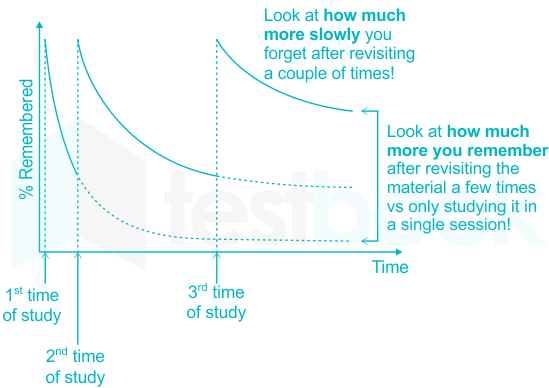
  • Learning curve: It depicts how an increase in learning comes from the frequency of repetition and rehearsal at regular intervals.
  • Forgetting curve: It depicts how quickly we forget information over time when there is no attempt to retain it.

It can be understood from the following diagram:

A close up of a mapDescription automatically generated

Additional Information

Lee RossA social psychologist who has studied attributional biases, the shortcomings in judgment, etc.
B. F. SkinnerAn American psychologist propounded the "Theory of Operant Conditioning" which refers to the learning process where learning takes place through reinforcement or punishment.
M. L. BiggeAccording to him “Learning may be considered as a change in insights, behavior, perception, motivation or a combination of these.”


Hence, we can conclude that the above statement is said by Ebbinghaus.

3

Which one is not included in Thorndike’s primary laws of learning from the following?

  1. ((a))

    law of exercise

  2. ((b))

    Law of effect

  3. ((c))

    Law of associative shifting

  4. ((d))

    Law of readiness

Show Answer
Answer: ((c))

Law of associative shifting

E. L. Thorndike, an American psychologist, the propounder of "Trial & Error Theory" has developed three primary laws and eight supplementary laws of learning that leads to development.

These primary laws are:

Law of exerciseIt is based on practice and drills to learn something for a long period.
Law of readinessIt refers to the degree of eagerness and inquisitiveness to learn something new.
Law of effectIt is based on motivation and reinforcement to make learning experience pleasant for learners.

Important Points

Thorndike's Supplementary law (also known as minor laws to education):

  • Law of Multiple Responding: It refers to different types of responses often occurs initially to a stimulus, then reaching to the correct response.
  • Law of Attitude, Disposition or States: It refers to the condition of a learner that influences learning.
  • Law of Partial or Piecemeal Activity of a situation: It refers to the tendency to respond to particular elements or features of a stimulus situation rather than on the whole to improve the result.
  • Law of Assimilation of response by Analogy: It is the tendency to respond automatically as responded in the past.
  • Law of Associative Shifting: Successfully applying the same response until a new situation comes (For example to apply the same formula in similar questions).
  • Law of Primacy: It refers to the idea that the first step matters the most.
  • The law of recency: It is the tendency which refers to the idea that the most recent task matters the most
  • Law of Intensity of Stimulus: The more strong the stimulus, the better the response.

Hence, we can conclude that the Law of associative shifting is not included in Thorndike’s primary laws of learning.

4

Conditioned response theory lays emphasis on the conditioning of 

  1. ((a))

    Behaviour

  2. ((b))

    Thinking

  3. ((c))

    Reasoning

  4. ((d))

    Motivation

Show Answer
Answer: ((a))

Behaviour

Conditioned Response Theory: It is known as 'Classical Conditioning Theory' propounded by Ivan Pavlov.

  • A conditioned response is a learned response to a stimulus that was previously neutral.
  • This theory emphasizes the conditioning of behavior by a repetitive association between the response and the stimulus.
  • Classical conditioning is one basic model of learning which was a landmark in the history of understanding behavior.
  • The term classical conditioning is defined as learning by association, whereby a neutral stimulus, under its occurrence in close time and space with a natural stimulus that gives rise to a natural response, becomes capable of eliciting that natural response, even in absence of the natural stimulus.
  • Classical conditioning is applicable only for reflexive and spontaneous responses, and not for voluntary responses.

Note: Other options have been explained here:

ThinkingA higher cognitive function that allows beings to produce thought.
ReasoningThe process of assigning meaning to our thoughts.
MotivationThe process that guides and motivates to achieve a goal.


Hence, we can conclude that the Conditioned response theory emphasizes the conditioning of Behaviour.

5

The other name of operant conditioning is

  1. ((a))

    Instrumental conditioning

  2. ((b))

    Classical conditioning

  3. ((c))

    Contiguous Conditioning 

  4. ((d))

    Trace conditioning

Show Answer
Answer: ((a))

Instrumental conditioning

B. F. Skinner, an American psychologist, propounded the "Theory of Operant Conditioning" which is also known as "Instrumental Conditioning Theory". This theory refers to the learning process where learning takes place through rewarding a certain behavior or withholding reward for undesirable behavior.

SKINNER’S EXPERIMENT WITH RAT         

  • Skinner developed a special apparatus known as a skinner’s box.
  • This box has a grid floor, a system of light, or sound produced at the time of delivery of a pellet of food, in the food cup, on the pressing of the lever.
  • Skinner placed a hungry rat in the box.
  • In this experiment, pressure on the bar in a certain way, by the rat could result in the production of a click and emergence of a food pellet.
  • The rat was rewarded for each proper pressing of the lever.
  • The rat repeated this process and ultimately learned to press the lever desired by the experimenter.

Note: Other conditioning theories have been explained here:

Classical conditioningPropounded by Ivan Pavlov, a Russian psychologist. The theory emphasizes that behavior is learned by a repetitive association between the response and the stimulus.
Contiguous conditioningDeveloped by Edwin Guthrie, states that a stimulus that causes a response to tend to cause the same response if the stimulus is experienced again.
Trace conditioningA type of classical Conditioning in which the unconditioned stimulus and conditioned stimulus are separated with an interval of time.


Hence, we can conclude that the other name of operant conditioning is Instrumental conditioning.

6

Which of the following is not a characteristic of learning?

  1. ((a))

    Learning is a relatively permanent change in behaviour 

  2. ((b))

    Learning is the growth of an organism

  3. ((c))

    Learning is directly observed

  4. ((d))

    Learning is a goal-directed process

Show Answer
Answer: ((c))

Learning is directly observed

Learning is a comprehensive process that refers to a change in behavior, knowledge, and skills as a result of practice and experience.

  • Learning refers to the modification of behavioral patterns as it modifies the behavior and personality of an individual.
  • Learning is an internal activity that leads to a change in behavior. It can't be directly observed.

Key Points

Characteristics of learning:

  • Learning is maturation.
  • Learning is an adjustment.
  • Learning is development.
  • Learning requires interaction.
  • Learning involves problems solving.
  • Learning leads to a change in behavior.
  • Learning is the growth of organisms.
  • Learning is purposeful and goal-oriented.
  • Learning starts with birth and proceeds up to death.
  • Learning is a relatively permanent behavior change.
  • Learning is the relationship between stimulus and response.

Hence, from the above-mentioned characteristics of learning it could be concluded that the statement 'Learning is directly observed' is not a characteristic of learning.

7

Kohler wanted to prove that learning is 

  1. ((a))

    An autonomous random activity 

  2. ((b))

    Cognitive operation

  3. ((c))

    a situation in which individuals are superior to animals

  4. ((d))

    The perception of different parts of the situation 

Show Answer
Answer: ((d))

The perception of different parts of the situation 

Wolfgang Kohler, a German psychologist, proposed the "Theory of Insight learning". He wants to prove that learning is a perception of different parts of the situation.

Key PointsKohler's theory of insight learning:

  • His theory explains thinking and differing mental processes and how they are influenced by internal and external factors to produce learning in individuals.
  • Insight learning is the abrupt realization of a problem's solution.
  • Insight learning is not the result of trial and error, responding to an environmental stimulus, or the result of observing someone else attempting the problem.
  • It is a completely cognitive experience that requires the ability to visualize the problem and the solution internally - in the mind's eye, so to speak - before initiating a behavioral response.
  • He stated that our perception is meaningful when we perceive them as wholes rather than the mere accumulation of sensations, images, or ideas.
  • He considered learning as a reorganization of the learner's perceptual or psychological world.
  • Kohler proposed that not all kinds of learning depend on trial-error or conditioning, we use our cognitive processes also to learn.

Thus, from the above-given explanation, we can conclude that Kohler wanted to prove that the perception of different parts of the situation 

Additional Information

Learning by Insight Kohler’s Experiment

  • In one experiment Kohler put the chimpanzee, sultan, inside a cage & a banana was hung from the roof of the cage. A box was placed inside the cage. The chimpanzee tried to reach the banana by jumping but could not succeed… Suddenly, he got an idea & used the box as a jumping platform by placing it just below the hanging banana.
8

From where to start in order to learn any new language?

  1. ((a))

    Formation of sentences

  2. ((b))

    Formation of words

  3. ((c))

    Association between letters and words

  4. ((d))

    None of the above

Show Answer
Answer: ((c))

Association between letters and words

Language learning is a result of deliberate and conscious effort for a better understanding of foundational skills of language learning. It refers to have a basic knowledge of grammatical rules and their use in communication.

  • To start a new language, one should learn the association between letters and words first.
  • When we learn a language by associating words with its letter, it becomes easy to learn the language efficiently and to keep in mind for a long period.
  • It helps children to link the unfamiliar word to their spoken knowledge.

A few steps to learn a new language:

  • Association between letters and words.
  • Set goals and deadlines.
  • Choose the appropriate method and content.
  • Use the language in daily life communication.
  • Listen to native speakers and work on pronunciation, etc.

By following these steps, one could learn a new language efficiently.

Hence, we can conclude that to learn any new language, one should start to make an association between letters and words.

9

From the following, which term defines the mathematics-related learning disability?

  1. ((a))

    Dyslexia

  2. ((b))

    Dyscalculia

  3. ((c))

    Dystopia

  4. ((d))

    None of the above

Show Answer
Answer: ((b))

Dyscalculia

Learning disability is an umbrella term that encompasses a variety of specific kinds of learning problems. It is a neurological disorder that affects the way one receives and processes information.

Important Points

Dyscalculia is a mathematics-related learning disability. It affects the ability to perform mathematical calculations and understanding of numbers.

  • Dyscalculic students cannot understand mathematical concepts like a number and its relations, operations, symbols, place value, etc.
  • hinders the learner's basic understanding of numbers.
  • affects learners' ability to perform mathematical calculations.
  • makes learners unable in identifying mathematical symbols like +, ×,>, etc.

Additional Information

Other disabilities in brief:

DyslexiaA learning disability that affects the ability to read and understand.
DystopiaAn imagined world in which people lead wretched and fearful Iives.
DysgraphiaA deficiency that affects the ability to write coherently.
DysphasiaA language disorder that affects communication skills and comprehension abilities.
StutteringA speech disorder, that affects the flow of the speech by repeating the same word again and again.
AphasiaImpairment of language that affects the ability to communicate.
ApraxiaA motor disorder that affects the coordination of the tongue and lips to produce sounds.
DysarthriaA neurological disorder that leads to imprecise speech.


Hence, we can conclude that Dyscalculia is a mathematics-related learning disability.

10

Which type(s) of students is/are included in inclusive class?

  1. ((a))

    General and specific students

  2. ((b))

    Only general students

  3. ((c))

    Only specific students

  4. ((d))

    Metalinguistic and gifted students

Show Answer
Answer: ((a))

General and specific students

Inclusive class is a part of 'inclusive education' that refers to the inclusion of all children in the education system, regardless of their differences and disabilities.

Key Points

  • It is about making school a place where both general and specific children can participate and learn.
  • Its Inclusive curriculum develops values to deal with diversity each child brings to the classroom and facilitate all with equal opportunities to learn and grow.
  • An inclusive classroom improves the quality and making provisions of education for all.
  • It provides a provision to include disabled children along with normal children in a regular classroom environment.
  • It refers to an education system that accommodates all children regardless of their physical, intellectual, social, emotional, linguistic, or other conditions.
  • It is a process where diversity in a group concerning any aspect is appreciated and in which everyone is recognized and respected for his/her worth.

Hence, we can conclude that both General and specific students are included in the Inclusive classrooms.

11

Successful inclusion needs

  1. ((a))

    No involvement of parents

  2. ((b))

    Segregation

  3. ((c))

    lack of capacity building

  4. ((d))

    Sensitization

Show Answer
Answer: ((d))

Sensitization

Inclusion is an umbrella term that refers to include every category of children, regardless of their differences and disabilities. Each child comes with their own characteristics, strengths, and limitations, so sensitization regarding their individual needs is needed to make inclusion successful.
Key Points

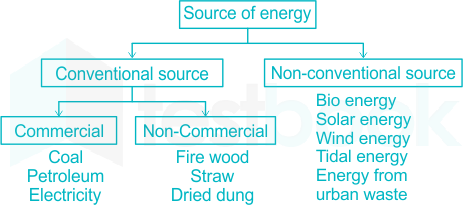
These are the key ingredients needed for successful inclusion:

  • Sensitization:  All teachers should be sensitized to issues related to students with special needs. Open and flexible school systems that understand disability sensitively is also a welcome initiative in this direction.
  • Teacher collaboration: A school can be a place where cooperation is valued rather than competition, among children and also among teachers. This creates a healthy learning environment.
  • Effective parental involvement: Parent involvement is to be increased in creating an inclusive learning environment.
  • Collaborative teaching models: Use of teaching methods that suit all children-  change in curriculum, teaching methods, and materials.
  • Use of multilingualism as a resource: Multilingual resources can be used to cater to the diverse needs of inclusive children.
  • Well constructed plan to achieve the goal of each student, etc.

Hence, we can conclude that Successful inclusion needs sensitization.

12

Which of the following is not the element of emotion?

  1. ((a))

    Physiological

  2. ((b))

    Cognitive

  3. ((c))

    Behavioural

  4. ((d))

    Sensory 

Show Answer
Answer: ((d))

Sensory 

Emotion is a mental state associated with fear, anger, love, etc. The emotional states of an individual are the combination of cognitive experience, physiological change, and behavioral changes. Together, these are known as the elements of emotion.

Key Points

Three elements of emotion are as follow:

  • Cognitive experience:  Emotions also involve cognitive processes such as memorials, perceptions, expectations, and interpretations. Our appraisal of an event plays an especially significant role in the meaning it has for us. Thinking of life events can produce emotions.
  • Physiological changes: Emotions involve the brain, nervous system, and hormones so that when you’re emotionally aroused the hormone secretion is more to give us instant energy. Each emotion has a specific characteristic of physiological aspects. Fear may cause blood pressure to rise, pupils to dilate, etc.
  • Behavioral changes: Emotions also involve behavioral reactions, both expressive and instrumental. Facial expressions such as smiles and frowns, as well as gestures and Lories of voice, all serve to communicate our feelings that may enhance our chances for survival. Overt expressions such as smiles, or frowns to reveal emotions.

Hence, we can conclude that Sensory is not an element of emotion, rather it refers to the use of senses to understand the physical world.

13

Which is the correct sequence of the cognitive domain?

  1. ((a))

    Evaluation-Application-Analysis-Synthesis- Comprehension – Knowledge

  2. ((b))

    Evaluation-Synthesis-Analysis-Application-Comprehension-Knowledge

  3. ((c))

    Knowledge-Application-Comprehension-Analysis-Synthesis-Evaluation

  4. ((d))

    Knowledge-Comprehension-Application-Analysis-Synthesis-Evaluation

Show Answer
Answer: ((d))

Knowledge-Comprehension-Application-Analysis-Synthesis-Evaluation

Cognitive development is an intellectual development that includes processes that people use to gain knowledge.

The correct sequence for cognitive development is

STEPEXPLANATION
1.KnowledgeCollect information and building basic knowledge.
2.ComprehensionTurn the collected data into useful information.
3.ApplicationWhere to implement the collected data.
4.AnalysisAnalysis of all the above steps and reframe them.
5.SynthesisTo collect the information from a known part of knowledge.
6.EvolutionCalculation and analysis of the whole learning process.
<br>

This sequence is given by B. S. Bloom.

Hence, we can conclude that the correct sequence of cognitive domain is Knowledge-Comprehension-Application-Analysis-Synthesis-Evaluation.

14

Which of the following is not a quality of effective teaching?

  1. ((a))

    Democratic

  2. ((b))

    Sympathetic

  3. ((c))

    Autocratic

  4. ((d))

    Desirable information provider

Show Answer
Answer: ((c))

Autocratic

An effective teacher is one who is more than just an expert in the academic field. Effective teaching happens when a teacher is successful in keeping the students actively involved in learning by providing a variety of learning experiences.

  • He/she must fulfill the following characteristics to produce the highest learning outcome.
  • In effective teaching, a teacher should never be an autocrat because autocracy leads to indiscipline in the class. Which is not an effective quality of teaching.

Important Points

Qualities of an effective Teacher:  An effective teacher possesses the following qualities. An effective teacher:  

  • Has mastery of the subject matter,
  • Is skillful and artistic in teaching methods and in guiding learning,
  • Treats each individual as unique and recognizes individual differences, (Democratic)
  • Encourages self-learning,
  • Keeps the students active and disciplined,
  • Is kind and sympathetic,
  • Provide desirable information to learners.
  • Plans her/his teaching carefully in advance but is not very rigid with the plan,
  • Is approachable and seeks the cooperation of the learners.

Additional Information

DemocraticTreat all the students equally and listen to them.
SympatheticUnderstand the emotions of students to connect them in a better way.
Desirable information providerIf students are already aware of that topic so they can provide only desirable information to save time.
Well ManneredTo behave properly in the classroom.


Hence, we can conclude that autocracy is not a quality of an effective teacher.

15

Expectancy theory of motivation has been given by

  1. ((a))

    Maslow

  2. ((b))

    Herzberg 

  3. ((c))

    Victor Vroom

  4. ((d))

    Skinner

Show Answer
Answer: ((c))

Victor Vroom

Expectancy theory of motivation is developed by Victor Vroom. It explains how a person selects behavior based on the outcome of previous efforts, What will be the change from resulting in those behaviors, etc.

The basic expectancy theory model emerged from the work of Edward Tolman and Kurt Lewin. However, Victor Vroom is generally credited with first applying the theory to motivation in the workplace. 

The Expectancy Theory of Motivation states that motivation depends on the desirability of the outcome as the theory explains that:

  • the concept of expectancy was originally developed around valency–instrumentality–expectancy.
  • valency stands for value, instrumentality is the belief that if we do one thing it will lead to another, and expectancy is the probability that action or effort will lead to an outcome.
PsychologistTheoryKey Points
Victor VroomExpectancy  theory of motivationIt is related to reward and expected performance.
MaslowTheory of HierarchyThis theory explains the needs at different levels
HerzbergTheory of Motivation-HygieneIt explains the Motivation and Hygiene factors in the workplace.
SkinnerTheory of Operant ConditioningThis theory explained the consequences which are associated with voluntary behavior.


Hence, we can conclude that the Expectancy theory of motivation has been given by Victor Vroom.

16

To Which family advance organizer model is related with?

  1. ((a))

    Social interaction

  2. ((b))

    Information Processing

  3. ((c))

    Personal

  4. ((d))

    Behaviour modification

Show Answer
Answer: ((b))

Information Processing

Model of teaching refers to a way of teaching students to learn facts, concepts, skills, analysis of values, and also to enable them to use the strategies suggested by each model and develop particular ways of thinking. 

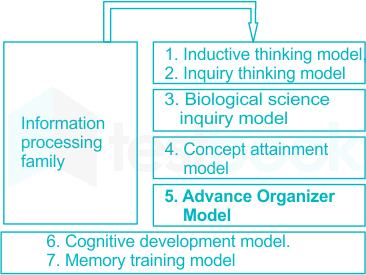
The organizer model is one among the teaching models that fall under the information processing model which explains the transformation of information verbally or visually in a structured framework.

  • This model is aimed at helping teachers organize and convey large amounts of information as meaningfully and as efficiently as possible.
  • According to this model, the teacher organizes the subject content and presents information through lectures, readings, and designing tasks for the learners to integrate what they have learned.
  • The learner's primary role is to master ideas and information.

Diagram:

Hence, we can conclude that the advance organizer model is related to information processing.

17

Which is useful in the transformation of skills?

  1. ((a))

    Linear programme

  2. ((b))

    Branching programme

  3. ((c))

    Skills transformation is a journey, not a destination

  4. ((d))

    preparation and acquisition

Show Answer
Answer: ((a))

Linear programme

The term 'programmed learning' refers to a procedure of self-instruction which uses an instructional sequence in which the content to be learned is presented in a series of small steps, arranged in a logical sequence.

  • To facilitate self-learning, programmed instruction materials are designed so as to give various kinds of intellectual, emotional, and psycho-motor experiences to the learner in a controlled situation through a variety of devices like booklets, machines, teachers, etc.

Key Points

  • B. F. Skinner, professor of psychology at Harvard University developed the programmed learning technique and introduced linear programmed learning.
  • Later on, in about 1955, Norman Crowder of the University of Chicago developed a branching program.
  • There are two types of programmed learning, one is linear and the other is branching.
  • Skinner is the originator of linear programming and Norman Crowder is the originator of branching programming.
  • Linear programming: In linear programming, all the learners read and respond to the same frames.
  • The sequence is linear in that there is a single path for all the learners to follow.
  • The learner is bound to proceed from one frame to the other sequentially and to complete the program.
  • It is useful in the transformation of skills as the learners learn new skills through this.
  • Branching programming: As the term itself indicates, a branching program provides more than one path to follow.
  • Like linear programming, if the learner responds to all the questions correctly, he/she proceeds from one step to another without any interruption.
  • On the other hand, if the learner makes an error or answers wrongly, he/she is directed to follow another path known as the supplementary path which gives him/her remedial instruction.
  • It is useful in achieving mastery in one skill as the frames will be kept on repeating until the learner learns them well.

Thus, it is clear that a linear program is useful in the transformation of skills.

18

Which is not the maxim of teaching from the following?

  1. ((a))

    From indefinite to definite

  2. ((b))

    From seen to unseen

  3. ((c))

    From simple to complex

  4. ((d))

    From deduction to induction

Show Answer
Answer: ((d))

From deduction to induction

Maxims of Teaching:

Maxims are nothing but simple guidelines or principles which help the teachers to make decisions and act accordingly during the teaching process. 

  • Simple to complex:
  • It is the psychology of a child that he wants the content in simplified form.
  • Therefore the teacher must move from simple facts and then take learners towards a little more difficult state.
  • Indefinite to definite:
  • The content to be taught in the class may be definite for teachers but may not be so for the learners.
  • Therefore the teaching style should be such that the learners are able to get direct knowledge which is possible only when they are familiarized with it.
  • From seen to unseen:
  • The students ranging from 6-14 years are at a perpetual level only. The child learns things easily which can be seen. So teaching should proceed from seen to unseen.
  • This maxim is usually used in teaching grammatical concepts like the meaning of sentences, Tenses, Direct and Indirect Speech, etc.

Additional Information

Others Main Maxims of Teaching: 

  • Known to Unknown
  • Concrete to Abstract
  • Direct to indirect
  • Particular to general
  • Analysis to Synthesis
  • Empirical to Rational
  • Psychological to Logical
  • Whole to Part

Hint

  • There is no maxim that supports deduction to induction because induction is related to drawing conclusions and Deductions is it's opposite. So, Deduction to induction cannot be a maxim for teaching.

Hence, we conclude that deduction and induction are the two methods of teaching not maxims of teaching.

19

The first step of microteaching cycle is

  1. ((a))

    teaching

  2. ((b))

    planning

  3. ((c))

    feedback

  4. ((d))

    introduction

Show Answer
Answer: ((b))

planning

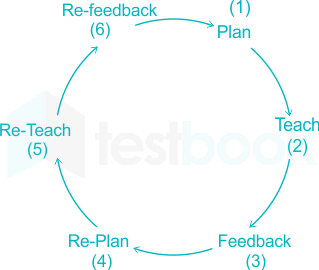
Microteaching is defined as microteaching in miniature where it is scaled down in size of the class time and task with focus on a specific teaching skill. The concept of microteaching is a training concept that can be applied at various pre-service and in-service stages in the professional development of teachers. There are six steps of micro-teaching which are as follows -


Diagram


Hence, we conclude that the first step of microteaching cycle is planning.

20

Which of the following is included in the teaching of understanding level?

  1. ((a))

    Application

  2. ((b))

    Comparison

  3. ((c))

    Abstraction

  4. ((d))

    Exploration

Show Answer
Answer: ((d))

Exploration

The activities of teaching and learning may be organized at various levels of abstraction ranging from the use and application of simple mental powers to the most complex ones.

Such organizations are distinguished and labeled as 'forms and levels of teaching. There are three identifiable levels of teaching and learning activities: Memory level, understanding level, and Reflective level. ​

Key Points

The activities of teaching and learning may be organized at various levels of abstraction, ranging from the use and application of simple mental powers (thoughtless) to the most complex ones (thoughtful).

Memory LevelUnderstanding LevelReflective Level
Least thoughtfulModerately thoughtfulMost thoughtful
Herbart is the main proponent.Morrison is the main proponent.Hunt is the main proponent.
Simple processes like recall, recognition, and retention are emphasizedIt includes exploration, presentation, assimilation, organization, and recitation. Exploration i.e., Trying to find or learn new things based on previous knowledge. Seeing relationships and patterns among facts, acquiring full mastery, comprehension, and insightIt includes comparison, application, and abstraction. Use of scientific method and the ability. To construct and reflect leading to independent problem-solving.
Structured and systematic presentation of factual materialStructured and meaningful sequential presentation of content leading to applicationUnstructured and problem-centered presentation leading to the creation of new ideas and critical thinking
The role of the teacher is dominant, without any care for understandingThe role of the teacher is dominant, providing knowledge with complete understandingA democratic and cooperative teacher who helps with reflective thinking and problem-solving
Motivation is extrinsicMotivation is extrinsicMotivation is intrinsic
Teacher-centred and encourages cramming and rote learningSubject-centred leading to meaningful learningLearner and problem-centered leading to discovery learning


Hence, we can conclude that the exploration is included in the teaching of the understanding level.

21

For educational reforms, effective decentralization is possible by

A) Greater involvement of cluster and block resource centres

B) Availability of local resource person

C) Resource and reference material for the use of teachers.

  1. ((a))

    A and B

  2. ((b))

    B and C

  3. ((c))

    A and C

  4. ((d))

    A, B and C

Show Answer
Answer: ((d))

A, B and C

Educational reform is a phenomenon whereby several plans and movements are executed in order to bring major improvements in the existing education system.

  • The main parties contributing to the success of educational reforms are first of all the local communities, including parents, school head,s, and teachers.

Decentralization of education reforms is possible by:-

  • Involvement of cluster and block resources for developing the infrastructure and basic needs.
  • Local resource person helps in generating the funds.
  • Resource and reference material are useful for teachers for creating an effective lesson plan and teach in the best possible way.

Hence, it becomes clear that for educational reforms, effective decentralization is possible by all the given points.

22

A student is reading, someone called him by name. By which sensation he (student) will respond from the following?

  1. ((a))

    Tactual sensation

  2. ((b))

    Auditory sensation

  3. ((c))

    Visual sensation

  4. ((d))

    Perceptual sensation

Show Answer
Answer: ((b))

Auditory sensation

Sensation: It refers to the process that enables the brain to perceive information through the five senses as senses are the organism's physiological capacity to perceive, recognize, feel, and understand something.

  • Calling someone by his name is an auditory sensation. Because he is hearing something, so it is a sensation of sound. Main sensations of the human body are as follows
SensationRelated body Part
Visual sensationRelated to Eyes
Auditory SensationRelated to Ears
Olfactory sensationRelated to Nose
Taste sensationRelated to Tongue
Tactual sensationRelated to Skin
<br>

Hence, if a student is reading, someone called him by name, ​Auditory sensation will be responsible.

23

What is the age of preoperational stage in Piaget theory?

  1. ((a))

    Birth to two years

  2. ((b))

    Two to seven years

  3. ((c))

    Four to eight years

  4. ((d))

    Five to eight years

Show Answer
Answer: ((b))

Two to seven years

Key Points

Jean Piaget’s Theory of Cognitive Development:

  • Jean Piaget observed his children and their process of making sense of the world around them and developed a model of how the mind processes new information encountered.
  • According to him, cognitive structures are the basic mental pattern people use to process any information.

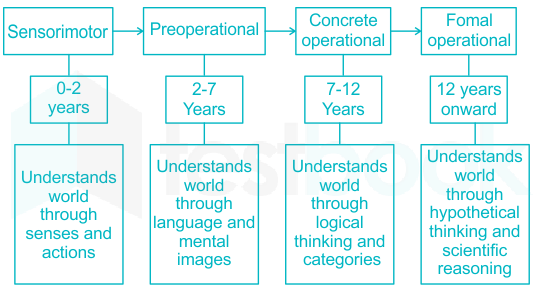
Piaget explained that children progress through four stages. The Four Stages of Cognitive Development are as follows:-

A screenshot of a social media post with text and people in the backgroundDescription automatically generated

Hence, from the above diagram, it becomes clear that the age of the preoperational stage in Piaget's theory is two to seven years.

24

Which of the following is not the characteristic of the intellectual development of later childhood?

  1. ((a))

    High interest in science fiction

  2. ((b))

    Increased logical power

  3. ((c))

    Operational planning of career 

  4. ((d))

    End of imaginary fears

Show Answer
Answer: ((c))

Operational planning of career 

Development is a process by which an individual grows and changes throughout the life cycle. The term development applies to the changes that have a direction and hold a definite relationship with what precedes it.

Later childhood is the time period from the age of 'seven to twelve years'. The signs of puberty usually begin to appear in this stage. It is also known as troublesome age, gang age, play age, etc.

Characteristics of the intellectual development of later childhood:

  • Use of analogies in explanation.
  • High Interest in science fiction.
  • End of imaginary fears.
  • Increased logical power.
  • Development of problem-solving skills.
  • Powers of perception and observation become keen.
  • Ability to exercise their own power of memory and imagination.
  • Ability to perform a variety of mental operations and thoughts using concrete concepts.

Hint

  • Operational planning of career is a characteristic of adolescence, in which career choices and interests become broader as teens think about the future more rationally and comprehensively.

Hence, the operational planning of a career is not the characteristic of the intellectual development of later childhood.

Additional Information

Piaget’s Stages of Cognitive Development

StageAge rangeWhat happens at this stage?
Sensorimotor0-2 years oldCoordination of senses with motor responses, sensory curiosity about the world. The language used for demands and cataloging. Object permanence is developed.
Preoperational2-7 years oldSymbolic thinking, use of proper syntax and grammar to express concepts. Imagination and intuition are strong, but complex abstract thoughts are still difficult. Conservation is developed.
Concrete Operational7-11 years oldConcepts attached to concrete situations. Time, space, and quaintly are understood and can be applied but not as independent concept.
Formal Operational11 years old and olderTheoretical, Hypothetical, and counterfactuals thinking. Abstract logic and reasoning. Strategy and planning become possible. Concepts learned in one context can be applied to another.
25

Which of the following psychologists is associated with ‘language development’?

  1. ((a))

    Binnet

  2. ((b))

    Chomsky

  3. ((c))

    Pavlov

  4. ((d))

    Maslow

Show Answer
Answer: ((b))

Chomsky

Noam Chomsky, known as the father of modern linguistics, has made a crucial contribution in the field of linguistics.

Key Points

Let's understand the Chomsky's view about language in brief:

  • Innate ability: He strongly believes that children born with an innate knowledge of grammar that serves as the basis for all language acquisition.
  • Generative grammar: According to Chomsky it refers to a finite set of rules to generate sentences and can be used to produce more sentences in that language.
  • Universal grammar: Chomsky's universal grammar suggests that all children have innate ability to acquire, understand and develop grammar.
  • Language Acquisition Device: Chomsky proposed that humans are equipped with a language acquisition device which enables a child to acquire and produce language.

Additional Information

A brief description of other psychologists:

Alfred BinetA French psychologist, known for developing first intelligence test and the concept of mental age.
Ivan PavlovThe  Russian Psychologist propounded ‘The Theory of Classical Conditioning’ which emphasizes that behaviour is learnt by a repetitive association between the response and the stimulus.
Abraham MaslowAn American psychologist, best known for creating "Maslow's Hierarchy of Needs", in which he has proposed a series of needs.


Hence, Noam Chomsky is associated with ‘language development'.

26

Thorndike proved his theory titled 

  1. ((a))

    trial and error learning

  2. ((b))

    sing learning

  3. ((c))

    cognitive learning

  4. ((d))

    space learning

Show Answer
Answer: ((a))

trial and error learning

E. L. Thorndike, an American psychologist, is known as the founder of modern educational psychology.

Key Points

  • He propounded 'Trial and Error Theory' which represents that learning is the result of associations forming between stimulus and responses.
  • "Mistakes teach individual" statement is based on 'Trial and Error Theory'.

Important Points

Based on Trial and Error Learning Theory, Thorndike gave certain laws of Learning:

  • Law of Readiness: It implies that if one is not ready to learn something, then one cannot learn effectively. Readiness comes from interest, maturity, need previous experiences, etc.
  • Law of Exercise: Repeated learning leads to effective learning however, the knowledge of results is an essential condition for it.
  • Law of Effect: It is one’s natural tendency to learn things that give happiness and satisfaction and avoid others.

Experiment:

  • Thorndike formulated his theory, based on his experiments conducted on his cat in the puzzle box.
  • The door of the box could be opened by pulling the strings inside the box. A fish was kept outside.
  • The cat was tried to come out of the box by squeezing, jumping, biting, etc.
  • As the experiment was repeated several times the wrong movements decreased and in the end, the cat was able to open the door in a single trail.

Hence, it becomes clear that Thorndike proved his theory titled trial and error learning.

27

Gang age is associated to ________ age group and delayed development is associated to ________.

  1. ((a))

    3-6 years and language

  2. ((b))

    8-10 years and socialization

  3. ((c))

    16-19 years and morality

  4. ((d))

    16-19 years and cognitive

Show Answer
Answer: ((b))

8-10 years and socialization

The development process passes through different stages. Each stage of development has certain distinct and specific characteristics.

The Stages of Development:-

StageAge RangeDescription of stage
InfancyBirth to 2 yearsExperiencing the world through senses and actions (looking, touching, mouthing)
Pre-schoolAbout 2 to 6 yearsRepresenting things with words and images but lacking logical reasoning
Middle ChildhoodAbout 6 to 8 yearsThinking Logically about concrete events, grasping concrete analogies, and performing arithmetical operations
Later childhoodAbout 8 to 10 yearsGang age (children love to cluster around their friends who have common interests), also called a pre-adolescence stage
AdolescenceAbout 11 to adulthoodAbstract reasoning, Egocentrism, Language development, conservation, mathematical transformations, abstract logic. Potential for moral reasoning


<br>


Key Points

Gang age:-

  • Gang age is the period of '8 to 10 years' termed as later childhood.
  • At this age, Children feel good to be around their friends and live an organized group life.
  • They develop a strong sense of loyalty to the gang. Childhood gangs help children to be socialized by making them learn to behave in a way that is socially acceptable with age peers.
  • At this age, children learn appropriate social attitudes such as how to like and enjoy social life and group activities.

Some ways in which Gang belonging leads to Improve Socialization:

  • Learn to play games and sports
  • Learn to accept and carry out responsibilities
  • Learn to compete with others
  • Learn to be loyal in the group

Hence, Gang age is associated to 8-10 year age group and delayed development is associated to socialization.

28

According to Piaget which of the following is the third stage of cognitive development? 

  1. ((a))

    Pre-operational stage

  2. ((b))

    Concrete operational stage 

  3. ((c))

    Formal operational stage

  4. ((d))

    Sensory-motor stage

Show Answer
Answer: ((b))

Concrete operational stage 

Jean Piaget’s Theory of Cognitive Development:

  • Jean Piaget observed his children and their process of making sense of the world around them and developed a model of how the mind processes new information encountered.
  • According to him, cognitive structures are the basic mental pattern people use to process any information.

Piaget explained that children progress through four stages. The Four Stages of Cognitive Development are as follows:-

A screenshot of a social media post with text and people in the backgroundDescription automatically generated

Hence, the third stage of cognitive development according to Piaget is the Concrete operational stage.

29

Which is not included in psychological factors that contribute to learning from the following?

  1. ((a))

    Motivation

  2. ((b))

    Interest

  3. ((c))

    Learning desire

  4. ((d))

    Nature of content

Show Answer
Answer: ((d))

Nature of content

Psychological factors are the elements of one's personality that limit or enhance the ways that one learns and thinks.

Key Points

Some Psychological actors that Contribute to Learning:

  • Readiness and willingness
  • Positive Atmospheric conditions
  • Motivation and Interest
  • Learning desire
  • Physical health
  • Ability and Maturation

Piaget’s Stages of Cognitive Development

StageAge rangeWhat happens at this stage?
Sensorimotor0-2 years oldCoordination of senses with motor responses, sensory curiosity about the world. The language used for demands and cataloging. Object permanence is developed.
Preoperational2-7 years oldSymbolic thinking, use of proper syntax, and grammar to express concepts. Imagination and intuition are strong, but complex abstract thoughts are still difficult. Conservation is developed.
Concrete Operational7-11 years oldConcepts attached to concrete situations. Time, space, and quaintly are understood and can be applied but not as independent concepts.
Formal Operational11 years old and olderTheoretical, Hypothetical, and counterfactual thinking. Abstract logic and reasoning. Strategy and planning become possible. Concepts learned in one context can be applied to another.


Note: The nature of content also influences learning but it is not among the psychological factors that contribute to learning. 

Hence, it becomes clear that the nature of the content is not included in psychological factors that contribute to learning.

30

Which of the following is social value?

  1. ((a))

    Primary goal

  2. ((b))

    Instinct

  3. ((c))

    Altruism

  4. ((d))

    Aggression need

Show Answer
Answer: ((c))

Altruism

Social values are an important part of the culture of the society for the stability of social order and provide the general guidelines for social conduct.

Key Points

Some social values are written below:

  • Altruism
  • Patriotism
  • Sacrifice
  • Honesty
  • Discipline
  • Rationality
  • Cooperation
  • Decency
  • Civilization
  • Respect for human dignity, etc.

These social values guide our behavior and make us socially acceptable.

NOTE: Primary goal, instinct, and aggression need do not come under social values.

Hence, it becomes clear that Altruism is a social value.

Hindi (30 questions)

निर्देश: दिए गए गद्यांश को पढ़कर निम्नलिखित प्रश्नों के सही विकल्प छाँटिए।

स्पष्टता, आत्म-विश्वास, विषय की अच्छी पकड़ और प्रभावशाली भाषा में अपने विचारों और भावनाओं को व्यक्त करना ही सम्प्रेषण-कला है, जो निरंतर अभ्यास से निखारी जा सकती है। एक दिन में कोई अच्छा वक्ता नहीं बन सकता तथा भाषा पर अनायास ही किसी की पकड़ नहीं हो पाती। इसी अभ्यास से स्वामी विवेकानंद ने जिस सम्प्रेषण-कला का विकास किया था, उसने विश्वधर्म-सम्मेलन में लाखों अमेरिका-निवासियों को चकित और मोहित कर दिया था।

31

सम्प्रेषण-कला क्या नहीं है?

  1. ((a))

    अलंकरण

  2. ((b))

    आत्म-विश्वास

  3. ((c))

    प्रभावशाली भाषा

  4. ((d))

    विचारों और भावनाओं को व्यक्त करना

Show Answer
Answer: ((a))

अलंकरण

सम्प्रेषण-कला 'अलंकरण' नहीं है।

गद्यांश की प्रथम पंक्ति "स्पष्टता, आत्म-विश्वास, विषय की अच्छी पकड़ और प्रभावशाली भाषा में अपने विचारों और भावनाओं को व्यक्त करना ही सम्प्रेषण-कला है", से स्पष्ट होता है।

अन्य विकल्प अनुचित हैं।

अतः सही विकल्प 'अलंकरण' है।

32

सम्प्रेषण - कला का विकास किससे होता है?

  1. ((a))

    अभ्यास

  2. ((b))

    भाषण

  3. ((c))

    अनायास

  4. ((d))

    विषय की अच्छी पकड़

Show Answer
Answer: ((a))

अभ्यास

सम्प्रेषण-कला का विकास 'अभ्यास' से होता है।

गद्यांश की पंक्ति "जो निरंतर अभ्यास से निखारी जा सकती है।" से स्पष्ट है।

अन्य विकल्प अनुचित हैं।

अतः सही विकल्प 'अभ्यास' है।

33

निम्न में संयुक्त व्यंजन कौन-सा नहीं है?

  1. ((a))

  2. ((b))

    क्ष

  3. ((c))

    त्र

  4. ((d))

    ज्ञ

Show Answer
Answer: ((a))

उपर्युक्त में से 'य' संयुक्त व्यंजन नहीं है।

जबकि 'य' एक अंतःस्थ व्यंजन है। अतः सही विकल्प 'य' है।

अन्य विकल्प संयुक्त व्यंजन हैं

  • क् + ष = क्ष
  • त् + र् = त्र
  • ज् + ञ = ज्ञ
34

‘मृत्युंजय’ पद में कौन-सा समास है?

  1. ((a))

    ‍द्विगु

  2. ((b))

    कर्मधारय

  3. ((c))

    बहुव्रीहि

  4. ((d))

    द्वंद्व

Show Answer
Answer: ((c))

बहुव्रीहि

‘मृत्युंजय’ पद में 'बहुव्रीहि' समास है। 'मृत्युंजय' का समास विग्रह 'मृत्यु को जीतने वाला' अर्थात शिव है। अन्य विकल्प असंगत हैं। अतः सही विकल्प 'बहुव्रीहि' है।

विशेष

समास - समास से तात्पर्य 'संक्षिप्तीकरण' से है। जब दो या दो से अधिक शब्दों के योग से जो छोटा शब्द बने उसे समास कहते हैं। समास के माध्यम से कम शब्दों में अधिक अर्थ प्रकट किया जाता है। जैसे – राजा का पुत्र = राजपुत्र।
समास के कुल छः प्रकार हैं
समास का नामपरिभाषाउदाहरण
तत्पुरुष समासजिस समास में उत्तरपद प्रधान हो तथा समास करने के उपरांत विभक्ति (कारक चिन्ह) का लोप हो।धर्म का ग्रन्थ = धर्मग्रन्थ। तुलसीदास द्वारा कृत = तुलसीदासकृत।
अव्ययीभाव समासजिस समास में पहला पद (पूर्वपद) अव्यय तथा प्रधान हो।जन्म से लेकर = आजन्म। मति के अनुसार = यथामति।
कर्मधारय समासजिस समास के दोनों शब्दों के बीच विशेषण-विशेष्य अथवा उपमान-उपमेय का सम्बन्ध हो। पहचान: विग्रह करने पर दोनों पद के मध्य में 'है जो', 'के समान' आदि आते हैं।कमल के समान नयन = कमलनयन। महान है जो देव = महादेव।
द्विगु समासजिस समास में पूर्वपद (पहला पद) संख्यावाचक विशेषण हो।दो पहरों का समूह = दोपहर। तीनों लोको का समाहार = त्रिलोक।
द्वंद्व समासजिस समास में दोनों पद प्रधान हो तथा विग्रह करने पर उनके बीच ‘तथा’, ‘या’, ‘अथवा’, ‘एवं’ या ‘और’ का प्रयोग होता हो।अन्न और जल = अन्नजल। अपना और पराया = अपना-पराया।
बहुव्रीहि समासजिस समास में दोनों पद प्रधान नहीं होते हैं और दोनों पद मिलकर किसी अन्य विशेष अर्थ की ओर संकेत कर रहे होते हैं।जो महान वीर है = महावीर अर्थात हनुमान। तीन आँखों वाला = त्रिलोचन अर्थात शिव।
द्विगु तथा बहुव्रीहि समास में अंतर : द्विगु समास का पहला पद संख्यावाचक विशेषण होता है और दूसरा पद विशेष्य होता है जबकि बहुव्रीहि समास में समस्त पद ही विशेषण का कार्य करता है। जैसे – दोपहर- दो पहरों का समूह (द्विगु समास), चतुर्भुज- चार है भुजाएँ जिसकी अर्थात विष्णु (बहुव्रीहि समास)।
35

‘अलंकार‘ में किस उपसर्ग का प्रयोग है?

  1. ((a))

    अल्

  2. ((b))

    अल

  3. ((c))

    अलन्

  4. ((d))

    अलम्

Show Answer
Answer: ((d))

अलम्

‘अलंकार‘ में 'अलम्' उपसर्ग का प्रयोग किया गया है।

  • 'अलम्' का अर्थ 'पर्याप्त' होता है। अन्य विकल्प अनुचित हैं। अतः सही विकल्प 'अलम्' है।

 Key Points

शब्दपरिभाषाउदाहरण
उपसर्गवे शब्दांश या अव्यय, जो किसी शब्द के आरंभ में जुड़कर उसके अर्थ में (मूल शब्द के अर्थ में) विशेषता ला दे या उसका अर्थ ही बदल दे।प्रसिद्ध, अभिमान, विनाश, उपकार। इनमें कमशः 'प्र', 'अभि', 'वि' और 'उप' उपसर्ग हैं।
36

यह पुस्तक किसकी है? में रेखांकित शब्द का पद-परिचय दीजिए।

  1. ((a))

    सार्वनामिक विशेषण (पुस्तक विशेष्य), एकवचन, स्त्रीलिंग

  2. ((b))

    सर्वनाम, एकवचन, स्त्रीलिंग

  3. ((c))

    गुणवाचक विशेषण (पुस्तक विशेष्य), एकवचन

  4. ((d))

    सम्बोधन अव्यय

Show Answer
Answer: ((a))

सार्वनामिक विशेषण (पुस्तक विशेष्य), एकवचन, स्त्रीलिंग

यह पुस्तक किसकी है? रेखांकित शब्द में 'सार्वनामिक विशेषण (पुस्तक विशेष्य), एकवचन, स्त्रीलिंग' है।

अन्य विकल्प गलत हैं। 

अतः सही विकल्प 'सार्वनामिक विशेषण (पुस्तक विशेष्य), एकवचन, स्त्रीलिंग' है।

स्पष्टीकरण - 

विकल्पपरिभाषाउदाहरण
सार्वनामिक विशेषणऐसे सर्वनाम शब्द जो संज्ञा से पहले लगकर उस संज्ञा शब्द की विशेषण की तरह विशेषता बताते हैं, वे शब्द सार्वनामिक विशेषण कहलाते हैं।‘उस’ पेन को यहाँ रख दो। यहाँ ‘उस’ सार्वनामिक विशेषण है तथा पेन ‘विशेष्य (विशेषण जिस शब्द की विशेषता बताए)’।
सर्वनामवह शब्द जो संज्ञा के बदले में आए उसे सर्वनाम कहते हैं।मैं, तुम, हम, वह, आप, उसका, उसकी आदि।
गुणवाचक विशेषणजो शब्द किसी संज्ञा या सर्वनाम का गुण, दोष, आकार-प्रकार रंग रूप गंध आदि बताते हैं, वे शब्द गुणवाचक विशेषण कहलाते है।सुंदर, बलवान, बुरा, लाल, लम्बा।
सम्बोधन अव्ययऐसे शब्द जिनके स्वरुप में लिंग, वचन, काल आदि के प्रभाव से कोई विकार नहीं होता।रे!, अरे!, अजी!, हे!
37

‘विश्लेषण’ शब्द का विलोम क्या होगा?

  1. ((a))

    विवेचन

  2. ((b))

    संश्लेषण

  3. ((c))

    व्याख्या

  4. ((d))

    विभाजित

Show Answer
Answer: ((b))

संश्लेषण

‘विश्लेषण’ शब्द का विलोम 'संश्लेषण' होगा। अन्य विकल्प अनुपयुक्त हैं। अतः यही विकल्प 'संश्लेषण' है।

अन्य विकल्प - 

विलोम/विपरीतार्थक - विपरीत (उल्टा) अर्थ बताने वाले शब्दों को विलोम शब्द कहते हैं। जैसे –आना – जाना, अवनि – अम्बर
शब्दविलोम
विश्लेषण (छानबीन करना, अलग करना)संश्लेषण (जोड़ना, मिलाना)
विभाजित (बांटा हुआ)अविभाजित (न बांटा हुआ)
<br>

विशेष - 

शब्दअर्थ
विवेचनअच्छे-बुरे का विचार करने की क्रिया।
व्याख्याकिसी कठिन वाक्य, पद आदि के अर्थ का स्पष्टीकरण।
38

जिनका उच्चारण ऊपर के दाँतों पर जीभ लगाने से होता है, उसे क्या कहते है?

  1. ((a))

    कंठ्य

  2. ((b))

    दन्त्य

  3. ((c))

    मूर्धन्य

  4. ((d))

    अनुनासिक

Show Answer
Answer: ((b))

दन्त्य

जिनका उच्चारण ऊपर के दाँतों पर जीभ लगाने से होता है, उसे 'दन्त्य' कहते है। दन्त्य के अंतर्गत त वर्ग - त, थ, द, न और ल तथा स आते हैं। अन्य विकल्प अनुचित हैं। अतः सही विकल्प 'दन्त्य' है।

अन्य विकल्प


वर्णपरिभाषाउदाहरण
कंठ्यवे वर्ण जिनका उच्चारण कंठ से होता है, कंठ्य वर्ण कहलाते हैं।क, ख, ग, घ, ङ।
मूर्धन्यवे वर्ण जिनका उच्चारण मूर्धा से होता है। मूर्धा - मुँह के अंदर का तालु और ऊपर के दाँतों के पीछे सिर की तरफ़ का भाग जिसे जीभ का अगला भाग ट्, ठ्, ड्, ढ्, और ण वर्ण का उच्चारण करते समय उलटकर छूता है।ट, ठ, ड, ढ, ण, ड़, ढ़, ष।
अनुनासिकजिस वर्ण का उच्चारण करते समय वायु मुँह और नाक से निकले।न, ण, म आदि।
39

निम्नलिखित में से ‘ऊष्म व्यंजन’ कौन-से हैं?

  1. ((a))

    श-ष-स

  2. ((b))

    अ-ब-स

  3. ((c))

    च-छ-ज

  4. ((d))

    य-र-ल

Show Answer
Answer: ((a))

श-ष-स

उपर्युक्त विकल्पों में से ‘ऊष्म व्यंजन’ 'श-ष-स' हैं।

ऊष्म व्यंजन के उच्चारण से मुखंगों के घर्षण से ऊष्मा उत्पन्न होती है। ये महाप्राण व्यंजन भी कहलाते हैं।

अन्य विकल्प अनुपयुक्त हैं।

अतः सही विकल्प 'श-ष-स' है।

Key Points 

व्यंजन के तीन भेद हैं -
स्पर्श व्यंजन ‘क’ से ‘म’ तक 25 वर्ण मुख के विभिन्न भागों में जिह्वा के स्पर्श से बोले जाते है । इसलिए इन्हे स्पर्श व्यंजन कहते है ।
अंतःस्थ व्यंजन- ‘य,र,ल,व’- ये चार ऐसे वर्ण हें, जिनके अन्दर स्वर छिपे है, अतः इन्हें अंतःस्थ व्यंजन कहते है ।
ऊष्म व्यंजन ‘श, ष, स’ – इन चार वर्णों के उच्चारण में मुख से विशेष प्रकार की गर्म (ऊष्म) वायु निकलती है, इसलिए इन्हें ऊष्म व्यंजन कहते है। इनके उच्चारण में श्वास की प्रबलता रहती है ।
40

‘अत्यधिक’ का विलोम क्या है?

  1. ((a))

    अत्यल्प

  2. ((b))

    आधुनिक

  3. ((c))

    अनधिगत

  4. ((d))

    अनधीन

Show Answer
Answer: ((a))

अत्यल्प

‘अत्यधिक’ का विलोम 'अत्यल्प' है। 'अत्यधिक' का अर्थ 'बहुत अधिक' तथा 'अत्यल्प' का अर्थ 'बहुत कम' होता है। अतः सही विकल्प 'अत्यल्प' है।

Key Points 

शब्दपरिभाषाउदाहरण
विलोम / विपरीतार्थकविपरीत अर्थ बताने वाले शब्दों को विलोम (उल्टा) शब्द कहते हैं।रात – दिन सुख – दुःख

Additional Information

अन्य विकल्प

शब्दअर्थविलोम
अनधिगतजो जाना हुआ न हो, अज्ञातज्ञात
अनधीनअनधीन, स्वतंत्रअधीन
आधुनिकआजकल का, वर्तमान काल का, नये ज़माने काप्राचीन
41

‘ऋत’ का विलोम क्या है?

  1. ((a))

    अनृत

  2. ((b))

    वक्र

  3. ((c))

    विकीर्ण

  4. ((d))

    अनैक्य

Show Answer
Answer: ((a))

अनृत

‘ऋत’ का विलोम 'अनृत' है। 'ऋत’ का अर्थ 'सत्य' होता है और 'अनृत' का अर्थ 'झूठ' होता है। अन्य विकल्प अनुपयुक्त हैं। अतः सही विकल्प 'अनृत' है।

शब्दपरिभाषाउदाहरण
विलोम / विपरीतार्थकविपरीत अर्थ बताने वाले शब्दों को विलोम (उल्टा) शब्द कहते हैं।रात – दिन सुख – दुःख


अन्य विकल्प

शब्दअर्थविलोम
वक्रटेढ़ा, तिरछासरल, ऋजु
विकीर्णफैलाया हुआ, छितराया हुआसंकीर्ण
अनैक्यएकता का अभाव, अनेकताऐक्य
42

‘संकल्प’ शब्द में उपसर्ग बताइए।

  1. ((a))

    सम्

  2. ((b))

    सक्

  3. ((c))

    सन्

  4. ((d))

    सन्क

Show Answer
Answer: ((a))

सम्

‘संकल्प’ शब्द में 'सम्' उपसर्ग का प्रयोग हुआ है। 'सम्' उपसर्ग से बनने वाले अन्य शब्द हैं - संस्कृत, संस्कार, संगीत, संहार आदि हैं। अन्य विकल्प गलत हैं। अतः सही विकल्प 'सम्' है।

 Key Points

उपसर्गप्रत्यय
उपसर्ग उस अक्षर या अक्षर समूह को कहते हैं जो किसी शब्द के पहले जुड़कर उसके अर्थ में परिवर्तन लाता है।शब्द के उपरांत जिस शब्द का प्रयोग किया जाता है वह प्रत्यय है।
जैसे - प्र, सु, अति, अधि, अनु, नि प्र + हार = प्रहारजैसे - ता, औना, अन, अत श्रो + ता = श्रोता
43

"मुझसे खड़ा भी हुआ नहीं जाता" वाक्य का वाच्य क्या है?

  1. ((a))

    भाववाच्य

  2. ((b))

    कर्मवाच्य

  3. ((c))

    कर्तृवाच्य

  4. ((d))

    अन्य

Show Answer
Answer: ((a))

भाववाच्य

"मुझसे खड़ा भी हुआ नहीं जाता" वाक्य में 'भाववाच्य' है। अन्य विकल्प असंगत हैं। अतः सही विकल्प 'भाववाच्य' है।

स्पष्टीकरण

  • क्रिया के जिस रूप में न तो कर्ता की प्रधानता हो न कर्म की, बल्कि क्रिया का भाव ही प्रधान हो, वहाँ भाववाच्य होता है।
  • उपर्युक्त वाक्य में 'खड़ा भी नहीं हुआ जाता' में क्रिया के भाव का बोध होता है इसीलिए यह भाववाच्य है।

विशेष

वाच्य - क्रिया के जिस रूप से यह ज्ञात हो कि वाक्य में क्रिया द्वारा बताए गए विषय में कर्ता, कर्म, अथवा भाव में से कौन प्रमुख है, उसे वाच्य कहते हैं। किसी वाक्य में कर्ता, कर्म या भाव की प्रधानता होगी।
वाक्यवाच्य
1. रोहित क्रिकेट खेलता है।कर्तृ वाच्य
2. रोहित द्वारा क्रिकेट खेला जाता है।कर्म वाच्य
3. रोहित से क्रिकेट खेला जाता है।भाव वाच्य
44

तद्भव और उसके तत्सम का कौन-सा मेल गलत है?

  1. ((a))

    लौंग-लवंग

  2. ((b))

    आंत -अंत्र

  3. ((c))

    लुनाई-लावण्यता

  4. ((d))

    आयसु-आदेश

Show Answer
Answer: ((b))

आंत -अंत्र

तद्भव और उसके तत्सम का 'आंत-अंत्र' मेल गलत है। अन्य विकल्प अनुचित हैं। अतः सही विकल्प 'आंत-अंत्र' है।

 Key Points

'आंत-अंत्र' का सही रूप आंत (तद्भव) - आंत्र  (तत्सम) है। अन्य सभी विकल्पों में तत्सम - तद्भव का सही युग्म है।

 Additional Information

शब्दपरिभाषाउदाहरण
तत्सम शब्दऐसे शब्द जो संस्कृत से ज्यों - के - त्यों ले लिए गए हैं।आम्र, उष्ट्र, ऐश्वर्य, षष्ठी आदि।
अर्धतत्सम शब्दऐसे शब्द जो संस्कृत से थोड़ा परिवर्तित होकर हिंदी में आये हैं।कार्य से कारज, धैर्य से धीरज आदि।
तद्भव शब्दऐसे शब्द जो संस्कृत से हिंदी में आने पर उनका रूप बदल गया।आग, खीर, छत आदि।
45

लेखक और उसकी रचना का कोन-सा जोड़ा गलत है?

  1. ((a))

    संस्कृति के चार अध्याय- रामधारी सिंह ‘दिनकर’

  2. ((b))

    रसज्ञ – रंजन – आचार्य महावीर प्रसाद द्विवेदी

  3. ((c))

    स्कन्दगुप्त – लक्ष्मीनारायण मिश्र

  4. ((d))

    अशोक के फूल- आचार्य हजारी प्रसाद द्विवेदी

Show Answer
Answer: ((c))

स्कन्दगुप्त – लक्ष्मीनारायण मिश्र

'स्कन्दगुप्त – लक्ष्मीनारायण मिश्र' का जोड़ा गलत है क्योंकि 'स्कंदगुप्त' 'जयशंकर प्रसाद' का प्रसिद्द नाटक है।

अन्य विकल्पों के जोड़ों का मेल सही है।

अतः सही विकल्प 'स्कन्दगुप्त – लक्ष्मीनारायण मिश्र' है।

रचनारचना के विषय में
संस्कृति के चार अध्यायइस पुस्तक में रामधारी सिंह दिनकर जी ने भारत के संस्कृतिक इतिहास को चार भागों में बाँटकर उसे लिखने का प्रयत्न किया है।
रसग्य – रंजनआचार्य महावीर प्रसाद द्विवेदी जी द्वारा रचित यह पुस्तक 1920 ई. में प्रकाशित हुई थी
अशोक के फूलनिबन्ध में हजारी प्रसाद द्विवेदी जी ने 'अशोक के फूल' की सांस्कृतिक परम्परा की खोज करते हुए उसकी महत्ता प्रतिपादित की है।
स्कन्दगुप्तस्कन्दगुप्त नाटक भारत के प्रसिद्ध साहित्यकार जयशंकर प्रसाद की प्रमुख रचनाओं में से एक है। इस नाटक में इतिहास प्रसिद्ध स्कन्दगुप्त को नायक बनाया गया है।
46

कवि और उसकी रचना का कौन-सा जोड़ा सही नहीं है।

  1. ((a))

    शिवराज भूषण-भूषण

  2. ((b))

    शब्द रसायन-देव

  3. ((c))

    परिमल-सूर्यकांत त्रिपाठी ‘निराला’

  4. ((d))

    उध्दव शतक – भारतेंदु हरीश्र्चंद्र

Show Answer
Answer: ((d))

उध्दव शतक – भारतेंदु हरीश्र्चंद्र

“उद्धव शतक भारतेंदु हरिश्चंद्र” का जोड़ा सही नहीं है। ‘उद्धव शतक’ के रचनाकार जगन्नाथदास ‘रत्नाकर’ हैं। 'उद्धव-शतक' दूतकाव्य की भ्रमरगीत परम्परा में रचित है। इसका प्रकाशन 1931 ई. में हुआ। अन्य विकल्पों के जोड़े सही हैं। अतः सही विकल्प ‘उद्धव शतक भारतेंदु हरिश्चंद्र’ है

विशेष

भारतेंदु हरिश्चंद्र की काव्य कृतियाँ ‘प्रेम-माधुरी, उत्‍तरार्द्ध-भक्‍तमाल, वर्षा-विनोद’ आदि हैं।

अ���्य विकल्प

·        शिवराज भूषण - ‘शिवराज भूषण’ ‘भूषण’ द्वारा रचित एक विशालकाय ग्रन्थ है जिसमें 385 पद्य हैं। इसमें शिवाजी के शौर्य, पराक्रम आदि का ओजपूर्ण वर्णन है।

·        ‘शब्द रसायन’ देवदत्त शास्त्री जी द्वारा रचित है।

·        ‘परिमल’ ‘सूर्यकांत त्रिपाठी ‘निराला’ जीद्वारा रचित है।

47

लेखक और उसकी कृति के युग्म में कौन-सा युग्म गलत है?

  1. ((a))

    वोल्गा से गंगा- राहुल सांकृत्यायन

  2. ((b))

    सूरज का सातवाँ घोड़ा- धर्मवीर भारती

  3. ((c))

    आर्यों का आदि देश- डॉ सम्पूर्णानन्द 

  4. ((d))

    दर्शन दिग्दर्शन – रामचंद्र शुक्ल

Show Answer
Answer: ((d))

दर्शन दिग्दर्शन – रामचंद्र शुक्ल

‘दर्शन दिग्दर्शन – रामचंद्र शुक्ल’ युग्म सही नहीं है, इसकी रचना राहुल सांकृत्यायन ने की थी। अतः सही विकल्प ‘दर्शन दिग्दर्शन रामचंद्र शुक्ल’ है।

विशेष

रामचंद्र शुक्ल की काव्य कृतियाँ ‘हिन्दी साहित्य का इतिहास, रस मीमांसा, चिंतामणि’ आदि हैं।

अन्य विकल्प

वोल्गा से गंगा  - हिंदी साहित्य के महापण्डित राहुल सांकृत्यायन की रचना है जिसमें 6000 ई. पू. से 1942 तक मानव समाज के ऐतिहासिक, आर्थिक, राजनीतिक आधारों का 20 कहानियों के रूप में पूर्ण चित्रण किया गया है।

सूरज का सातवाँ घोड़ा – यह धर्मवीर भारती का प्रसिद्ध उपन्यास है। धर्मवीर भारती की इस लघु औपन्यासिक रचना में हितोपदेश और पंचतंत्रवाली शैली में 7 दोपहरी में कही गई कहानियों के रूप में एक उपन्यास निर्मित किया गया है।

आर्यों का आदि देश  - डॉ सम्पूर्णानन्द की रचना है।

48

विराम-चिह्न की दृष्टि से कौन-सा वाक्य अशुद्ध है?

  1. ((a))

    वह ईमानदार, परिश्रमी, कर्मठ और मृदुभाषी है।

  2. ((b))

    उसके पास धन-वैभव, नौकर-चाकर आदि सभी कुछ था।

  3. ((c))

    हाँ मेरा यही विचार है।

  4. ((d))

    आप हमारे घर आना चाहते हैं, तो आइए; ठहरना चाहते हैं, तो ठहरिये।

Show Answer
Answer: ((c))

हाँ मेरा यही विचार है।

दिए गए विकल्पों में ‘हाँ मेरा यही विचार है’ विराम चिह्न की दृष्टि से अशुद्ध है।

  • यहाँ ‘हाँ’ के बाद ‘,’ अल्प विराम चिह्न का प्रयोग होना चाहिए।
  • अर्थात ‘हाँ, मेरा यही विचार है’ विराम चिह्न की दृष्टि से शुद्ध है।

Key Points

  • विराम चिह्न  – भाषा के लिखित रूप में विशेष स्थानों पर रुकने का संकेत करने वाले चिह्नों को विराम चिह्न कहते हैं।
49

कौन-सा शब्द भिन्न अर्थ और प्रकृति का है?

  1. ((a))

    चिरंतन

  2. ((b))

    शाश्वत

  3. ((c))

    सनातन

  4. ((d))

    अधुनातन

Show Answer
Answer: ((d))

अधुनातन

दिए गए विकल्पों में ‘अधुनातन’ शब्द भिन्न अर्थ और प्रकृति का है। अधुनातन शब्द का अर्थ ‘आजकल का’ या 'आधुनिक' है। अतः सही विकल्प ‘अधुनातन’ है।

विस्तृत विवरण

  • चिरंतन अर्थात ‘बहुत दिनों से चला आता रहनेवाला, पुरातन’
  • शाश्वत अर्थात ‘सदा रहनेवाला’
  • सनातन अर्थात 'हमेशा बना रहने वाला, जिसका आदि है ना अंत है’
  • अधुनातन अर्थात ‘आजकल का, आधुनिक, अब का, हाल का’
50

कौन सा विकल्प ‘अर्वाचीन’ शब्द का विलोम है?

  1. ((a))

    प्राचीन

  2. ((b))

    अद्यतन

  3. ((c))

    सनातन

  4. ((d))

    अधुनातन

Show Answer
Answer: ((a))

प्राचीन

‘अर्वाचीन’ अर्थात ‘आधुनिक, नया’ अतः इसका विलोम ‘प्राचीन (पुराना, पूर्व काल से सम्बंधित)’ होगा। अतः सही विकल्प ‘प्राचीन’ है।

अन्य विकल्प

  • अद्यतन अर्थात ‘आज का, आज से सबंधित, चालू, ताज़ा’
  • सनातन अर्थात 'हमेशा बना रहने वाला, जिसका आदि है ना अंत है’
  • अधुनातन अर्थात ‘आजकल का, आधुनिक, अब का, हाल का’


शब्दविलोम
अद्यतनअनद्यतन
सनातनअधुनातन
अधुनातनपुरातन


विशेष - 

शब्दपरिभाषाउदाहरण
विलोम/विपरीतार्थकविपरीत (उल्टा) अर्थ बताने वाले शब्दों को विलोम शब्द कहते हैं।1. रात - दिन 2. सुख - दुःख
51

व्याकरण की दृष्टि से कौन-सा शब्द अशुद्ध है?

  1. ((a))

    वरिहणी

  2. ((b))

    गृहिणी

  3. ((c))

    विभीषण

  4. ((d))

    जगद्गुरु

Show Answer
Answer: ((a))

वरिहणी

दिए गए विकल्पों में ‘वरिहणी’ की वर्तनी अशुद्ध है। वरिहणी की शुद्ध वर्तनी ‘विरहिणी’ है अर्थात ‘प्रिय या पति से बिछुड़ी हुई नायिका, वियोगिनी’। अन्य विकल्पों की वर्तनी शुद्ध है। अतः सही विकल्प वरिहणी है।

अन्य विकल्प

  • गृहिणी अर्थात ‘घर पर रहने वाली  विवाहित स्त्री, पत्नी’
  • विभीषण अर्थात ‘अत्यंत भीषण, देशद्रोही, रावण का भाई’
  • जगद्गुरु अर्थात व्यक्ति जो संसार में गुरु या श्रेष्ठ माना जाए’
52

निम्न में से कौन-सा युग्म गलत है?

  1. ((a))

    लुटिया डूबना- सारा काम चौपट होना

  2. ((b))

    सब्ज बाग दिखलाना - हरा-भरा करना

  3. ((c))

    मुट्ठी गरम करना- रिश्वत देना

  4. ((d))

    माई का लाल- साहसी व्यक्ति

Show Answer
Answer: ((b))

सब्ज बाग दिखलाना - हरा-भरा करना

सही विकल्प ‘सब्ज बाग दिखलाना - हरा-भरा करना’ है।

Key Points

दिए गए विकल्पों में अशुद्ध युग्म ‘सब्ज बाग दिखलाना - हरा-भरा करना’ है।

‘सब्ज बाग दिखलाना’ मुहावरे का सही अर्थ है ‘झूठी आशा देना’।

अन्य विकल्प युग्म की दृष्टि से सही हैं।

वाक्य प्रयोग- मनीष ने लोगो को विदेश भेजने का सब्ज बाग दिखाया और उनसे पैसे लेकर फरार हो गया।

53

निम्नलिखित दोहे में कौन-सा अलंकार है?

मेरी भव बाधा हरी, राधा नागरि सोय।

जातन की झाँईं परै, स्याम हरित दुति होय॥

  1. ((a))

    अन्योक्ति

  2. ((b))

    यमक

  3. ((c))

    श्लेष

  4. ((d))

    रूपक

Show Answer
Answer: ((c))

श्लेष

उपर्युक्त दोहे में श्लेष अलंकार का प्रयोग हुआ है। अतः सही विकल्प ‘श्लेष अलंकार’ है।

Key Points

स्पष्टीकरण - 

  • श्लेष अलंकार अर्थात जब एक ही शब्द के विभिन्न अर्थ निकलते हों।
  • ​जैसे – ‘रहिमन पानी राखिए बिन पानी सब सून ‘पानी’ गए न ऊबरे मोती मानस चून’ यहाँ ‘पानी’ मोती के सन्दर्भ में ‘चमक’, मनुष्य के सन्दर्भ में ‘विनम्रता’ तथा ‘चून (आटा)’ के सन्दर्भ में ‘जल अर्थात पानी’ है।
  • उपर्युक्त पद्य में राधा जी के पीले शरीर की छाया नीले कृष्ण पर पड़ने से वे हरे लगने लगते है।
  • दूसरा अर्थ है कि राधा की छाया पड़ने से कृष्ण हरित (प्रसन्न) हो उठते हैं।

Important Points

अन्य विकल्प

अलंकारपरिभाषाउदाहरण
अन्योक्तिजहाँ उपमान के बहाने उपमेय का वर्णन किया जाय या कोई बात सीधे न कहकर किसी के सहारे की जाय।"नहिं पराग नहिं मधुर मधु, नहिं विकास इहिकाल, अली कली ही सौं बंध्यो, आगे कौन हवाल।" यहाँ कवि बिहारी ने भौंरे को लक्ष्यकर महाराज जयसिंह को उनकी यथार्थ स्थिति का बोधा कराया है, जो अपनी छोटी रानी के प्रेमपास में जकड़े रहने के कारण अपने राजकीय दायित्व को भूल गए थे।
यमकजहाँ एक ही शब्द जितनी बार आए उतने ही अलग-अलग अर्थ दे।काली ‘घटा’ का घमंड ‘घटा’।
रूपकजब उपमान और उपमेय में अभिन्नता या अभेद दिखाया जाए।"मैया मैं तो चन्द्र-खिलौना लैहों" में चन्द्रमा और खिलौने में समानता न दिखाकर चन्द्र को ही खिलौना बोल दिया गया है।
54

‘गौशाला’ में कौन-सा समास है?

  1. ((a))

    तत्पुरुष

  2. ((b))

    द्वंद्व

  3. ((c))

    बहुव्रीहि

  4. ((d))

    द्विगु

Show Answer
Answer: ((a))

तत्पुरुष

‘गौशाला’ शब्द का विग्रह करने पर ‘गाय की शाला’ होता है जहाँ उत्तरपद प्रधान है तथा समास विग्रह के बाद ‘की’ विभक्ति का लोप होता है अर्थात यहाँ तत्पुरुष समास है। ​तत्पुरुष समास अर्थात जिस समास में उत्तरपद प्रधान हो तथा समास करने के उपरांत विभक्ति (कारक चिन्ह) का लोप हो। जैसे – धर्म का ग्रन्थ = धर्मग्रन्थ, तुलसीदास द्वारा कृत = तुलसीदासकृत। अतः सही विकल्प ‘तत्पुरुष’ है।

अन्य विकल्प

द्वंद्व समासजिस समास में दोनों पद प्रधान हो तथा विग्रह करने पर उनके बीच ‘तथा’, ‘या’, ‘अथवा’, ‘एवं’ या ‘और’ का प्रयोग होता हो ।अन्न और जल = अन्न-जल अपना और पराया = अपना-पराया।
बहुव्रीहि समासजिस समास में दोनों पद प्रधान नहीं होते हैं और दोनों पद मिलकर किसी अन्य विशेष अर्थ की ओर संकेत कर रहे होते हैं।जो महान वीर है = महावीर अर्थात हनुमान तीन आँखों वाला = त्रिलोचन अर्थात शिव
द्विगु समासजिस समास में पूर्वपद (पहला पद) संख्यावाचक विशेषण हो।दो पहरों का समूह = दोपहर तीनों लोकों का समाहार = त्रिलोक।
55

‘देशभक्ति’ में कौन-सा समास है?

  1. ((a))

    द्वंद्व

  2. ((b))

    कर्मधारय

  3. ((c))

    तत्पुरुष

  4. ((d))

    द्विगु

Show Answer
Answer: ((c))

तत्पुरुष

'देशभक्ति' में 'तत्पुरुष' समास है। अन्य विकल्प असंगत हैं। अतः सही विकल्प 'तत्पुरुष' है। 

Key Points 

स्पष्टीकरण - 

'देशभक्ति' का समास विग्रह 'देश के लिए भक्ति' होगा। 'देशभक्ति' में सम्प्रदान कारक छिपा हुआ है। 

इसमें कारक की चतुर्थी विभक्ति 'के लिए' है। इसीलिए 'देशभक्ति' में 'सम्प्रदान तत्पुरुष समास' है। 

Additional Information 

विशेष

समास - समास से तात्पर्य 'संक्षिप्तीकरण' से है। जब दो या दो से अधिक शब्दों के योग से जो छोटा शब्द बने उसे समास कहते हैं। समास के माध्यम से कम शब्दों में अधिक अर्थ प्रकट किया जाता है। जैसे - रजा का पुत्र – राजपुत्र, समास के छःप्रकार हैं -
समास का नामपरिभाषाउदाहरण
तत्पुरुष समासजिस समास में उत्तरपद प्रधान हो तथा समास करने के उपरांत विभक्ति (कारक चिन्ह) का लोप हो।धर्म का ग्रन्थ = धर्मग्रन्थ तुलसीदास द्वारा कृत = तुलसीदासकृत
अव्ययीभाव समासजिस समास में पहला पद (पूर्वपद) अव्यय तथा प्रधान हो'।जन्म से लेकर = आजन्म मति के अनुसार = यथामति।
कर्मधारय समासजिस समास के दोनों शब्दों के बीच विशेषण-विशेष्य अथवा उपमान-उपमेय का सम्बन्ध हो, पहचान: विग्रह करने पर दोनों पद के मध्य में 'है जो', 'के समान' आदि आते हैं।कमल के समान नयन = कमलनयन महान है जो देव = महादेव
द्विगु समासजिस समास में पूर्वपद (पहला पद) संख्यावाचक विशेषण हो।दो पहरों का समूह = दोपहर तीनों लोकों का समाहार = त्रिलोक।
द्वंद्व समासजिस समास में दोनों पद प्रधान हो तथा विग्रह करने पर उनके बीच ‘तथा’, ‘या’, ‘अथवा’, ‘एवं’ या ‘और’ का प्रयोग होता हो ।अन्न और जल = अन्न-जल अपना और पराया = अपना-पराया।
बहुव्रीहि समासजिस समास में दोनों पद प्रधान नहीं होते हैं और दोनों पद मिलकर किसी अन्य विशेष अर्थ की ओर संकेत कर रहे होते हैं।जो महान वीर है = महावीर अर्थात हनुमान तीन आँखों वाला = त्रिलोचन अर्थात शिव
द्विगु समास और बहुव्रीहि समास में अंतर - द्विगु समास का पहला पद संख्यावाचक विशेषण होता है और दूसरा पद विशेष्य होता है जबकि बहुव्रीहि समास में समस्त पद ही विशेषण का कार्य करता है। जैसे दोपहर- दो पहरों का समूह (द्विगु समास), चतुर्भुज- चार है भुजाएँ जिसकी अर्थात विष्णु (बहुव्रीहि समास)।
56

‘प्रागैतिहासिक’ में किस उपसर्ग का प्रयोग है?

  1. ((a))

    प्राक्

  2. ((b))

    प्राग

  3. ((c))

    प्रा

  4. ((d))

    प्रागैति

Show Answer
Answer: ((a))

प्राक्

‘प्रागैतिहासिक’ का संधि विच्छेद ‘प्राक् + ऐतिहासिक’ है तथा यहाँ व्यंजन संधि है। अन्य विकल्प असंगत हैं। अतः सही विकल्प ‘प्राक्’ है।

  • कुछ अव्यय भी उपसर्ग का काम करते हैं, यहाँ प्राक् उपसर्ग ही है।

 Key Points

  • व्यंजन संधि में यदि प्रथम वर्ण + घोष वर्ण पंचम वर्ण को छोड़कर आये तो प्रथम वर्ण अपने वर्ग के तृतीय वर्ण में रूपांतरित हो जाएगा। जैसे – वाक् + दान = वाग्दान, उत् + अय = उदय। ​व्यंजन संधि के नियम के अनुसार किसी भी वर्ग का पहला वर्ण (क, च, त आदि) + घोष वर्ण (तीसरा या चौथा वर्ण, स्वर तथा अन्तस्थ (य, र, ल, व) ) आये तो पहला वर्ण अपने वर्ग के तीसरे वर्ण में रूपांतरित हो जाता है।
  • व्यंजन संधि के अनुसार ‘प्राक्’ उपसर्ग प्रयुक्त हुआ है जिसका अर्थ पहले या सामने होता है।

 Additional Information

उपसर्गप्रत्यय
उपसर्ग उस अक्षर या अक्षर समूह को कहते हैं जो किसी शब्द के पहले जुड़कर उसके अर्थ में परिवर्तन लाता है।शब्द के उपरांत जिस शब्द का प्रयोग किया जाता है वह प्रत्यय है।
जैसे - प्र, सु, अति, अधि, अनु, नि प्र + हार = प्रहारजैसे - ता, औना, अन, अत श्रो + ता = श्रोता

Additional Information

अघोषघोष
प्रथमद्वितीयतृतीयचतुर्थपंचमस्वर
अ आ
इ ई
उ ऊ
ए ऐ
श ष सय र ल व हओ औ
* अघोष/घोष + घोष – किसी घोष में बदलेंगे
* अघोष/घोष + अघोष – किसी अघोष में बदलेंगे
57

‘तुलसीदास’ किसकी कविता है?

  1. ((a))

    मुक्तिबोध

  2. ((b))

    अज्ञेय

  3. ((c))

    हरिवंशराय बच्चन

  4. ((d))

    सूर्यकांत त्रिपाठी ‘निराला’

Show Answer
Answer: ((d))

सूर्यकांत त्रिपाठी ‘निराला’

‘तुलसीदास’ कविता सूर्यकांत त्रिपाठी ‘निराला’ द्वारा रचित है। अन्य विकल्प असंगत हैं। अतः सही विकल्प सूर्यकांत त्रिपाठी ‘निराला’ है। 

विशेष

  • सूर्यकांत त्रिपाठी ‘निराला’ जी की अन्य रचनायें 'अनामिका, गीत कुञ्ज, अप्सरा, सखी, चयन, महाभारत' आदि हैं। 

अन्य विकल्प

  • मुक्तिबोध की रचनाएँ ‘साहित्य की डायरी, भारत : इतिहास और संस्कृति’ आदि हैं।
  • अज्ञेय की रचनाएँ ‘नदी की द्वीप, शेखर: एक जीवनी’ आदि हैं।
  • हरिवंशराय बच्चन की रचनाएँ ‘मधुशाला, सतरंगिनी’ आदि हैं।
58

‘निस्तेज’ का संधि-विच्छेद क्या है?

  1. ((a))

    नी + स्तेज

  2. ((b))

    नी + तेज

  3. ((c))

    निः + तेज

  4. ((d))

    निस् + तेज

Show Answer
Answer: ((c))

निः + तेज

दिए गए विकल्पों में ‘निस्तेज’ शब्द का संधि विच्छेद ‘निः + तेज’ है तथा यहाँ विसर्ग संधि है। अतः सही विकल्प ‘निः + तेज’ है।

स्पष्टीकरण

  • विसर्ग संधि में यदि विसर्ग के बाद ‘त, श या स’ हो तो विसर्ग के बदले ‘श या स्’ हो जाता है। जैसे – निः + संतान = निस्संतान, निः + तेज़ = निस्तेज।

विशेष

संधि - दो शब्दों के मेल से जो विकार (परिवर्तन) होता है उसे संधि कहते हैं। संधि के तीन प्रकार हैं - 1. स्वर, 2. व्यंजन और 3. विसर्ग,
संधिपरिभाषाउदाहरण
स्वरस्वर वर्ण के साथ स्वर वर्ण के मेल से विकार उत्पन्न होता है।विद्या + अर्थी = विद्यार्थी महा + ईश = महेश
व्यंजनएक व्यंजन से दूसरे व्यंजन या स्वर के मेल से विकार उत्पन्न होता है।अहम् + कार = अहंकार उत् + लास = उल्लास
विसर्गविसर्ग के साथ स्वर या व्यंजन के मेल से विकार उत्पन्न होता है।दुः + आत्मा = दुरात्मा निः + कपट = निष्कपट
59

‘वैदेही वनवास’ किसकी रचना है?

  1. ((a))

    अयोध्या सिंह उपाध्याय ‘हरिऔध’

  2. ((b))

    रामधारी सिंह ‘दिनकर’

  3. ((c))

    मैथिलीशण गुप्त

  4. ((d))

    श्रीधर पाठक

Show Answer
Answer: ((a))

अयोध्या सिंह उपाध्याय ‘हरिऔध’

‘वैदेही वनवास’ कविता कोश के रचयिता अयोध्या सिंह उपाध्याय ‘हरिऔध’ हैं। ‘वैदेही वनवास’ कविता कोश भारतीय काव्य का विशालतम और अव्यवसायिक संकलन है जिसमें हिन्दी उर्दू, भोजपुरी, अवधी, राजस्थानी आदि पचास से अधिक भाषाओं का काव्य है। अतः सही विकल्प अयोध्या सिंह उपाध्याय ‘हरिऔध’ है।

अन्य विकल्प

  • रामधारी सिंह ‘दिनकर’ की रचनाएँ ‘रश्मिरथी, उर्वशी’ आदि हैं।
  • मैथिलीशण गुप्त की रचनाएँ ‘पंचवटी, यशोधरा’ आदि हैं।
  • श्रीधर पाठक की रचनाएँ ‘जगत सचाई-सार, 'मनोविनोद’ आदि हैं।
60

निम्न में से पुल्लिंग शब्द का चयन कीजिए।

  1. ((a))

    पहिया

  2. ((b))

    लिखावट

  3. ((c))

    पखावज

  4. ((d))

    मझधार

Show Answer
Answer: ((a))

पहिया

दिए गए विकल्पों में ‘पहिया’ शब्द पुल्लिंग है जिसका अर्थ है ‘चक्का’। 'पहिया' शब्द का प्रयोग पुल्लिंग में किया जाता है, जैसे - 'गाड़ी का पहिया घिस गया है। ('पहिया घिस गयी है' अनुपयुक्त होगा)। अन्य विकल्प स्त्रीलिंग हैं। अतः सही विकल्प ‘पहिया’ है।

अन्य विकल्प

  • लिखावट अर्थात ‘लिखने का ढंग’
  • पखावज अर्थात ‘मृदंग के आकार का छोटा बाजा’
  • मझधार अर्थात ‘नदी आदि की बीच की धारा’
लिंगपरिभाषाउदाहरण
पुल्लिंगजिन शब्दों से पुरुष जाति का बोध होता है उन्हें पुल्लिंग शब्द कहते हैं ।जैसे - पिता, भाई, लड़का, पेड़, सिंह शिव, हनुमान, बैल आदि ।
स्त्रीलिंगजिन शब्दों से स्त्री जाति का बोध होता है उन्हें स्त्रीलिंग शब्द कहते हैं ।जैसे - माता, बहन, यमुना, गंगा, कुरसी, छड़ी, नारी बुआ, लड़की, लक्ष्मी, गाय आदि ।

English (30 questions)

61

Which of the following words is ‘plural’?

  1. ((a))

    Dog

  2. ((b))

    Fox

  3. ((c))

    Goat

  4. ((d))

    Mice

Show Answer
Answer: ((d))

Mice

The correct answer is 'Mice'.

  • Look at the following points-
  • 'Mice' is the plural form of 'Mouse.
  • Example-  Mice has nibbled all the cheese away.

                                    Mice have nibbled all the cheese away.

Note- [Since the subject i.e. 'mice' is plural hence the verb will be placed in plural form]

  • Dog, Fox, and Goat are in the singular form.
  • Hence, the correct option is 4 and therefore the answer.

Hinglish

  • 'Mice' 'Mouse' का बहुवचन रूप है।
  • ​Example-  Mice has nibbled all the cheese away.

<br>

                 Mice have nibbled all the cheese away.

Note- [चूंकि subject यानि 'mice' plural है इसलिए क्रिया को plural form में रखा जाएगा]

  • Dog, Fox, and Goat singular form में हैं।
  • अत: सही विकल्प 4 है और इसलिए उत्तर है।
62

Which of the following words is regarded as singular?

  1. ((a))

    Dogs

  2. ((b))

    Mathematics

  3. ((c))

    Cats

  4. ((d))

    Cars

Show Answer
Answer: ((b))

Mathematics

The correct answer is option 2

Key Points

  • Let's look at the following points- 
  • There are certain Noun which looks like Plural but there are actually in the Singular form and followed by Singular form of Verb
  • List of such Nouns are- Statics, Ethics, News, Politics, Economics, Measles, Mumps, Innings, Billiards, Darts, etc.
  • Example- The news delivered by this channel are not correct.

                                     The news delivered by this channel is not correct.

  • Other given options are in Plural form; thus the correct option is 2 and therefore the answer.'

Hinglish

  • आइए निम्नलिखित बिंदुओं पर नजर डालते हैं-
  • कुछ संज्ञाएं हैं जो बहुवचन की तरह दिखती हैं लेकिन वास्तव में एकवचन रूप में होती हैं और इसके बाद क्रिया का एकवचन रूप होता है।
  • ऐसी संज्ञाओं की सूची हैं- Statics, Ethics, News, Politics, Economics, Measles, Mumps, Innings, Billiards, Darts, etc.
  • ​Example- The news delivered by this channel are not correct.

                                                 The news delivered by this channel is not correct.

63

Which of the following sentence is in active voice?

  1. ((a))

    He was asked to keep quiet

  2. ((b))

    A house was bought for fifty lacs.

  3. ((c))

    I requested him to come in time

  4. ((d))

    He was hit badly

Show Answer
Answer: ((c))

I requested him to come in time

The correct answer is option 3.

Key Points

  • Active voice means that a sentence has a subject that acts upon its verb; it follows the given structure-
  • 'Subject + Verb + Object'.
  • The given sentence "I requested him to come in time" represents that there is a subject i.e. 'I' which acts upon its verb i.e. 'requested'. It follows the above structure.
  • From the above explanation it can be concluded that the correct answer is "Option 3".
  • Passive voice means that a subject is a recipient of a verb's action; The structure of the Passive voice-
  • Subject (Object of Active voice)+ Helping Verb+ Main Verb + By + Object (Subject of Active voice)
  • Now, look at the following points-
  • ​​Among all the given options, the only 3rd denotes the correct format of active voice; Subject (I) + Verb (Requested) + Object (him)
  • All other options are given with the Helping verb and Third form of Main Verb
  • Thus, the correct option is 3rd and therefore the answer.​

Hinglish

  • Active voice का अर्थ है कि एक वाक्य में एक विषय होता है जो उसकी क्रिया पर कार्य करता है; यह दी गई संरचना का अनुसरण करता है-
  • 'विषय + क्रिया + वस्तु'।**('**Subject + Verb + Object')

  • Passive voice का अर्थ है कि एक subject verb के action का प्राप्तकर्ता है; Passive voice की संरचना-
  • विषय (सक्रिय आवाज का उद्देश्य)+ सहायक क्रिया + मुख्य क्रिया + द्वारा + वस्तु (सक्रिय आवाज का विषय) (​Subject (Object of Active voice)+ Helping Verb+ Main Verb + By + Object (Subject of Active voice)
  • अब, निम्नलिखित कारणों को देखें-
  • दिए गए सभी विकल्पों में से केवल तीसरा विकल्प active voice के सही प्रारूप को दर्शाता है; विषय (I) + क्रिया (Requested) + वस्तु (him)
  • अन्य सभी विकल्प सहायक क्रिया और मुख्य क्रिया के तीसरे रूप के साथ दिए गए हैंI
  • इस प्रकार, सही विकल्प तीसरा है और इसलिए उत्तर है।​
64

Which of the following sentence is in passive voice?

  1. ((a))

    Please mind your business

  2. ((b))

    I kept quiet throughout the meeting

  3. ((c))

    He was assisted by a group of students

  4. ((d))

    They came late and lost the match

Show Answer
Answer: ((c))

He was assisted by a group of students

The correct answer is option 3

  • Whenever we change a sentence from active to the passive form we use the order -
  • Subject (Object of Active voice)+ Helping Verb + Past Participle + by + Object (Subject of Active Voice)
  • The verb in the Passive form is changed to its past participle.
  • In option 3rd, the verb used is 'assisted' which is a past participle of 'assist'; 'He' is an object while 'group of students' is the subject.
  • Thus, option 3 is the correct option and therefore the answer.

Hinglish

  • जब भी हम किसी वाक्य को active से passive form में बदलते हैं तो हम क्रम का उपयोग करते हैं -
  • Subject (Active voice का object)+ Helping Verb+ Past Participle + by + Object (Subject of Active Voice)
  • Passive voice में क्रिया को past participle में बदल दिया जाता है।
  • विकल्प 3 में, प्रयुक्त क्रिया 'assisted' है जो 'assist' का past participle है; 'He' एक object है जबकि 'group of students' subject है।
  • इस प्रकार, विकल्प 3 सही विकल्प है और इसलिए उत्तर है।
65

“That is the man the police was seeking”

In the above sentence, what is the status of the two the’s as underlined above?

  1. ((a))

    Verb 

  2. ((b))

    Noun

  3. ((c))

    Conjunction 

  4. ((d))

    Definite article

Show Answer
Answer: ((d))

Definite article

The correct answer is option 4, i.e., Definite article

Key Points

  • 'A' and 'An' both are indefinite articles used for a singular person/thing, while 'The' is a definite article.
  • 'The' is used in front of a noun when we believe the listener/reader knows exactly what we are referring to or Use to refer to something which has already been mentioned.
  • E.g., There's a position available in my team. Job will involve some international travel. 

                                    There's a position available in my team. The job will involve some international travel.

  • Here, in the given context, 'man' and 'police' are the two subject/ Nouns for which definite article 'the' has been used.
  • Thus, option 4 is correct and, therefore, the answer.

Hinglish

  • 'A' and 'An' दोनों indefinite articles हैं जिनका उपयोग किसी एक व्यक्ति/वस्तु के लिए किया जाता है, जबकि 'The' एक definite article है।
  • संज्ञा के सामने 'The' का प्रयोग तब किया जाता है जब हम मानते हैं कि श्रोता/पाठक ठीक-ठीक जानता है कि हम क्या कह रहे हैं या किसी ऐसी चीज का उल्लेख करने के लिए उपयोग करें जिसका पहले ही उल्लेख किया जा चुका है।
  • E.g., There's a position available in my team. Job will involve some international travel. 

                                    There's a position available in my team. The job will involve some international travel.

  • यहाँ दिए गए सन्दर्भ में 'पुरुष' और 'पुलिस' दो विषय/ संज्ञा हैं जिनके लिए निश्चित लेख 'द' का प्रयोग किया गया है।
  • इस प्रकार, विकल्प 4 सही है।
66

“These students are most disobedient”, In the above sentence, point out the gender of the word ‘students’.

  1. ((a))

    Feminine gender

  2. ((b))

    Common gender

  3. ((c))

    Masculine gender

  4. ((d))

    None of the above

Show Answer
Answer: ((b))

Common gender

The correct answer is option 2 i.e. Common gender

Key Points

  • Let's look at the following points-
  • Nouns that stand for both Males and Females, they are called common gender. (जिन संज्ञाओं से नर और मादा दोनों का बोध होता है)
  • List of Common Noun- teacher, student, cousin, parent, etc.
  • Hence, in the given sentence 'Students' is a Common Gender.
  • Now, look at the following points-
  • Feminine gender- A noun that shows female subtype, is known as feminine gender.(जिस संज्ञा से स्त्री के उपप्रकार का पता चलता है, उसे feminine gender कहते हैं।)
  • For example: queen, woman, girl, mother, vixen, etc.
  • Masculine gender- A noun that shows male subtype is known as masculine gender. (एक संज्ञा जो पुरुष उपप्रकार को दर्शाती है उसे masculine gender के रूप में जाना जाता है)
  • For example: man, boy, father, cock, bull, fox, etc.
  • Neuter gender- Some nouns are neither male nor female; they fall under the neuter gender.(कुछ संज्ञाएं न तो नर हैं और न ही स्त्री; वे neuter gender के अंतर्गत आते हैं।)
  • For example: table, hair, city, etc
67

In the sentence ‘He was going along the road’, point out the tense.

  1. ((a))

    Present perfect

  2. ((b))

    Past perfect

  3. ((c))

    Past continuous

  4. ((d))

    Future indefinite 

Show Answer
Answer: ((c))

Past continuous

The correct answer is option 3 i.e. Past continuous

Key Points

  • The correct tense used here is past continuous because 'was going' is the verb.
  • The past continuous (also called past progressive) is a verb tense which is used to show that an ongoing past action
  • The past continuous is formed using was/were + present participle.
  • For e.g.- He was constantly talking.
  • Hence, the given sentence denotes the 'Past Continuous Tense'.

Hinglish

  • यहाँ प्रयुक्त सही tense  past continuous है क्योंकि 'जा रहा था' क्रिया है।
  • The past continuous  (जिसे past progressive भी कहा जाता है) एक क्रिया काल है जिसका उपयोग चल रही पिछली क्रिया को दिखाने के लिए किया जाता है।
  • Past continuous का गठन was/were + present participle  का उपयोग करके किया गया है।
  • For e.g.- He was constantly talking.
  • अत: दिया गया वाक्य 'Past Continuous Tense' का द्योतक है।
68

Language learning starts from-

  1. ((a))

    writing

  2. ((b))

    reading 

  3. ((c))

    listening

  4. ((d))

    speaking

Show Answer
Answer: ((c))

listening

The correct answer is option 3 i.e. listening

Key Points

  • Language learning is the process of learning to speak and understand a foreign language. It helps children to acquire practical commands of language.
  • Language learning is a result of deliberate and conscious effort for a better understanding of foundational skills of language learning. It starts with 'listening' as:
  • listening is one of the most important skills to promote active communication.
  • listening is the ability to accurately identify the sounds of speech to interpret messages.
  • first, we listen in order to assimilate information or to access messages through the spoken word.
  • Hence, it could be concluded that language learning starts from 'listening'

NOTE: 'Writing', 'reading', and 'speaking' are also useful for learning a language but not more than listening.

69

What is the main purpose of poetry recitation in a language classroom?

  1. ((a))

    To know the historical background of the poem

  2. ((b))

    To enjoy and appreciate the poem

  3. ((c))

    To give their opinions about poem

  4. ((d))

    To become aware of the poet and his/her work

Show Answer
Answer: ((b))

To enjoy and appreciate the poem

The correct answer is option 2 i.e To enjoy and appreciate the poem

Key Points

  • The main purpose of poetry recitation in a language classroom is to enjoy and appreciate the poem by reciting it loud.
  • The key step in learning any language is to read, understand and appreciate the beauty of the language through its literary works.
  • Poetry is one of the most important literary works in any language and it is always a must to read enjoy and appreciate it to learn the language.
  • Thus the correct answer is option 2.
70

Fill in the blanks with the correct article:

Yesterday I saw __________ European riding on _________ elephant.

  1. ((a))

    the, the

  2. ((b))

    a, an

  3. ((c))

    a, a

  4. ((d))

    a, the

Show Answer
Answer: ((b))

a, an

The correct answer is option 2 i.e. a, an

Key Points

  • 'A' and 'An' both are indefinite articles used for a singular person/thing while 'The' is a definite article.
  • 'A' is used before words which make a consonant sound and 'an' is used before words which make a vowel-like 'a', 'e', 'i', 'o', 'u', sound.
  • For e.g.- I would like to go see a movie.

                                  We are looking for an apartment.

  • Here in the sentence, it's 'a European' because European makes a 'yu' sound not a 'u' or an 'e'.
  • 'An elephant' is correct as it makes 'a' sound.

The correct solution- Yesterday I saw a European riding on an elephant.

Hinglish

  • 'A' और 'an' दोनों indefinite articles हैं जिनका उपयोग किसी एक व्यक्ति/वस्तु के लिए किया जाता है जबकि 'The' एक definite article है।
  • व्यंजन ध्वनि बनाने वाले शब्दों से पहले 'a' का प्रयोग किया जाता है और 'a', 'e', 'i', 'o', 'u', ध्वनि जैसे स्वर बनाने वाले शब्दों से पहले 'an' का प्रयोग किया जाता है।
  • उदाहरण के लिए - I would like to go see a movie.

                            We are looking for an apartment.

  • यहां वाक्य में, यह 'a European' है क्योंकि यूरोपीय 'yu' ध्वनि बनाता है न कि 'u' या 'e'।
  • 'An elephant' सही है क्योंकि यह 'a' ध्वनि करता है।
71

Choose the correct sentences.

  1. ((a))

    Please describe about the story.

  2. ((b))

    Please describe the story.

  3. ((c))

    Please describe of the story.

  4. ((d))

    Please describe to the story.

Show Answer
Answer: ((b))

Please describe the story.

The correct answer is option is 2


  • Here, 'describe' means give an account in words of or to elaborate something.
  • 'About' is inappropriate in the above sentence, 'about the story' is not grammatically correct since it will talk about a singular aspect, but here we are talking about the story as a whole.
  • Hence, option 2 is correct and therefore the answer.

The correct solution: Please describe the story.

Hinglish

  • यहाँ, 'describe' का अर्थ है किसी बात को शब्दों में बयां करना या विस्तृत करना।
  • उपरोक्त वाक्य में 'about' अनुचित है, 'about the story' व्याकरणिक रूप से सही नहीं है क्योंकि यह एकवचन पहलू के बारे में बात करेगा, लेकिन यहां हम पूरी कहानी के बारे में बात कर रहे हैं।
  • इसलिए, विकल्प 2 सही है और इसलिए उत्तर है।
72

Fill in the blank with a correct preposition:

A prisoner was accused ________ murder.

  1. ((a))

    of 

  2. ((b))

    for

  3. ((c))

    to 

  4. ((d))

    off 

Show Answer
Answer: ((a))

of 

The correct answer is option 1 i.e. of 

Key Points

  • 'of' is the correct preposition for the blank because it expresses the relationship between a part and a whole, here it forms a relationship between the prisoner and murder.
  • Look at the following points-
  • 'for' is wrong because it means in support of or in favour of. 
  • For eg: I've waited at that station for five hours.
  • 'to' means expressing motion in the direction of.
  • For eg:  She told him to stop.
  • 'off' means away from the place in question. 
  • For eg: Thank you for getting me off the hook.

The correct sentence-  A prisoner was accused of murder.

Hinglish

  • 'of' रिक्त स्थान के लिए सही पूर्वसर्ग है क्योंकि यह एक हिस्से और एक पूरे के बीच के संबंध को व्यक्त करता है, यहां यह कैदी और हत्या के बीच संबंध बनाता है।
  • निम्नलिखित बिंदुओं को देखें-
  • 'for' गलत है क्योंकि इसका अर्थ समर्थन या पक्ष में है।
  • For eg: I've waited at that station for five hours.
  • 'to'  दिशा की गति को व्यक्त करता है।
  • For eg:  She told him to stop.
  • ''off'  का अर्थ है विचाराधीन स्थान से दूर।
  • For eg: Thank you for getting me off the hook.
73

The antonym of ‘innocent’ is

  1. ((a))

    clever

  2. ((b))

    ignorant

  3. ((c))

    active

  4. ((d))

    guilty 

Show Answer
Answer: ((d))

guilty 

The correct answer is guilty.

Key Points

  • Let's look at the meaning of the given word and the correct option.
  • Innocent- not guilty of a crime or offence
  • Guilty- means responsible for a specified wrongdoing
  • Hence from the given meanings, we find that both the words i.e. Innocent and Guilty express the opposite meanings

Additional Information 

  • Let's look at the meanings of the other given words.
  • Clever- Quick to understand, learn and devise or apply ideas.
  • Ignorant- Lacking knowledge or awareness.
  • Active- Engaging or ready to engage in physically energetic pursuits.

Hinglish

  • आइए दिए गए शब्द का अर्थ और सही विकल्प देखें।
  • Innocent- अपराध या अपराध का दोषी नहीं।
  • Guilty- एक निर्दिष्ट गलत काम के लिए जिम्मेदार।
  • Clever- विचारों को समझने, सीखने और तैयार करने या लागू करने के लिए त्वरित।
  • Ignorant- ज्ञान या जागरूकता की कमी।
  • Active- शारीरिक रूप से ऊर्जावान गतिविधियों में संलग्न या संलग्न होने के लिए तैयार।
74

The synonym of ‘significant’ is

  1. ((a))

    prominent 

  2. ((b))

    magnificent

  3. ((c))

    efficient 

  4. ((d))

    important 

Show Answer
Answer: ((d))

important 

The correct answer is important.

Key Points

  • Let's look at the meaning of the given word and the correct answer. 
  • Significant- means of great significance or value.(बहुत महत्व या मूल्य का साधन)
  • Important- having great value or influence; very necessary.(महान मूल्य या प्रभाव होना; अति आवश्यक)
  • Hence, from the given meanings, we find that both the words Significant and Important have similar meanings.
  • Let's look at the meaning of the other given options.
  • Prominent- Projecting from something; famous.(किसी चीज से प्रोजेक्ट करना; प्रसिद्ध)
  • Magnificent- Impressively beautiful, elaborate, or extravagant; striking.(प्रभावशाली रूप से सुंदर, विस्तृत, या असाधारण)
  • Efficient- Achieving maximum productivity with minimum wasted effort or expense.(न्यूनतम व्यर्थ प्रयास या व्यय के साथ अधिकतम उत्पादकता प्राप्त करना)

SIGNIFICANT Synonym: 190+ Synonyms For Significant With Useful Examples - 7  E S L

The correct answer is option 4, i.e., Important

75

Which one of the following words can be made plural by adding a suffix ‘en’?

  1. ((a))

    Box

  2. ((b))

    Tax 

  3. ((c))

    Max

  4. ((d))

    Ox 

Show Answer
Answer: ((d))

Ox 

The correct answer is option 4 i.e. Ox 

Key Points

  • Some words are made plural by adding a suffix 'en', 'er', 'es', 'ren', etc.
  • For e.g.- Children, Biases, Quizzes, Women, etc
  • The word that can be made plural by adding a suffix ‘en’ is 'Ox' which becomes 'Oxen'.
  • The plural of the following words are:
  • Box- 'boxes'
  • Tax-'Taxes'
  • Max -'Maxes'

Hinglish

  • कुछ शब्द प्रत्यय 'en', 'er', 'es', 'ren', आदि जोड़कर बहुवचन बनते हैं।
  • उदाहरण के लिए- Children, Biases, Quizzes, Women,आदि
  • जिस शब्द में प्रत्यय 'en' जोड़कर बहुवचन बनाया जा सकता है, वह 'Ox' है जो 'Oxen' बन जाता है।
  • निम्नलिखित शब्दों का बहुवचन है:
  • Box- 'boxes'
  • Tax-'Taxes'
  • Max -'Maxes'
76

Choose the correct pronoun to complete the following sentence.

This dress is __________ and that one is mine.

  1. ((a))

    our book

  2. ((b))

    yours 

  3. ((c))

    your

  4. ((d))

    your book

Show Answer
Answer: ((b))

yours 

The correct solution is option 2 i.e yours

Key Points

  • Reading the sentence we find that the blank requires a possessive pronoun. 
  • Out of the given options only yours is an absolute possessive pronoun.
  • The possessive pronouns are mine, yours, his, hers, ours, and theirs.
  • In the sentence, it shows the possession of the dress.
  • Thus the correct answer is option 2 yours.
<br>

Hence, the correct answer is, This dress is yours ​and that one is mine.

Hinglish

  • वाक्य को पढ़कर हम पाते हैं कि रिक्त स्थान के लिए एक possessive pronoun की आवश्यकता होती है।
  • दिए गए विकल्पों में से केवल yours एक पूर्ण possessive pronoun है।
  • Possessive pronouns mine, yours, his, hers, ours, and theirs.
  • वाक्य में, यह dress के possession को दर्शाता है।
  • इस प्रकार सही उत्तर विकल्प 2 'yours' है।
77

Change the following sentence into passive voice:

Have the girls asked this question?

  1. ((a))

    This question have asked by girls

  2. ((b))

    Has this question been asked by the girls?

  3. ((c))

    Has this question asked by the girls?

  4. ((d))

    Have this question asked by the girls?

Show Answer
Answer: ((b))

Has this question been asked by the girls?

The correct answer is option 2 i.e. Has this question been asked by the girls?

Key Points

  • Whenever we change from active to the passive form we use the general order as 'Object+ Auxiliary verb + Past participle + by + Subject'.
  • Here, the verb used is 'have' which is used for 'girls', in passive voice it is changed to 'has' for the singular object 'question'.
  • In an interrogative sentence, the verbs like Has, Have, Had, Will, Shall, Can, May etc. do not change their position at the beginning of the sentence while changing the sentence from Active to Passive voice.
  • For e.g.- Had she finished the assignment? [Active voice]

​                         Had the work been finished by him? [Passive voice]

The correct solution- Has this question been asked by the girls?

Hinglish

  • जब भी हम active से passive voice में बदलते हैं तो हम सामान्य क्रम का उपयोग 'Object+ Auxiliary verb + Past participle + by + Subject' के रूप में करते हैं।
  • यहाँ प्रयुक्त क्रिया 'have' है जिसका प्रयोग 'girls' के लिए किया जाता है, निष्क्रिय स्वर में इसे एकवचन वस्तु 'question' के लिए 'has' में बदल दिया जाता है।
  • एक interrogative sentence में, क्रियाएँ जैसे है, Has, Have, Had, Will, Shall, Can, May आदि, वाक्य की शुरुआत में सक्रिय से निष्क्रिय आवाज में बदलते समय अपनी स्थिति नहीं बदलती हैं।
  • For e.g.- Had she finished the assignment? [Active voice]

               ​Had the work been finished by him? [Passive voice]

Direction: Read the passage given below and answer the question that follow it.

Yesterday, two brave children of Gangapur were awarded the Brave Hearts Award. They have exhibited a great spirit of selflessness and courage. Harsh, a twelve-year-old boy, saved a little girl from drowning in the river that flows along his village. Garima has been awarded for her presence of mind.

78

Which kind of noun is Gangapur?

  1. ((a))

    Common noun

  2. ((b))

    Collective noun

  3. ((c))

    Material noun

  4. ((d))

    Proper noun

Show Answer
Answer: ((d))

Proper noun

The correct answer is Option 4 i.e Proper noun

Key Points

  • Reading the above passage we find that Gangapur is the name of a place. 
  • A proper noun is the name of a person, place or thing. (proper noun किसी व्यक्ति, स्थान या वस्तु के नाम को कहते हैं।)
  • So, 'Gangapur' is the name of a place, therefore, it is a proper noun.
  • Thus the correct answer is option 4 i.e Gangapur.

Additional Information

  • A common noun is a word used for a class of person, place or thing.(common noun वह शब्द है जो किसी व्यक्ति, स्थान या वस्तु के वर्ग के लिए प्रयोग किया जाता है।)
  • Example: My favourite newspaper (common noun) is the Washington Post.
  • A collective noun is words to describe groups.(collective noun समूह का वर्णन करने वाले शब्द हैं।) 
  • ExampleOur class(collective noun)  took a field trip to the natural history museum.
  • Material nouns are materials or substances out of which things are made.(material noun वे पदार्थ या पदार्थ होते हैं जिनसे वस्तुओं का निर्माण होता है।)
  • Example: The bat is made of wood from a tree. (wood- material noun).
79

Which part of speech is the word ‘brave’?

  1. ((a))

    Noun

  2. ((b))

    Pronoun

  3. ((c))

    Adjective

  4. ((d))

    Preposition

Show Answer
Answer: ((c))

Adjective

The correct answer is Option 3 i.e Adjective

Key Points

  • Reading the passage we find that the word brave is something that defines the children.(brave, children को परिभाषित करता है।) 
  • An adjective is a word defining a noun or giving more attributes to it. (विशेषण वह शब्द है जो किसी संज्ञा को परिभाषित करता है या उसे अधिक विशेषता देता है।)
  • ExampleOn her birthday, Brenda received an antique(adjective) vase filled with fragrant
  • Brave is an adjective as it is describing the noun children. (brave एक विशेषण है क्योंकि यह संज्ञा 'children' का वर्णन कर रहा है।)
  • Thus the correct answer is option 3 i.e adjective.

Additional Information 

  • A noun is a word (other than a pronoun) used to identify any of a class of people, places, or things. (एक noun एक शब्द है (सर्वनाम के अलावा) किसी भी वर्ग के लोगों, स्थानों या चीजों की पहचान करने के लिए प्रयोग किया जाता है।)
  • ExampleMy favourite newspaper (common noun) is the Washington Post (proper noun).
  • A preposition is a word governing, and usually preceding, a noun or pronoun and expressing a relation to another word or element in the clause. (एक preposition एक शब्द है जो शासन करता है, और आमतौर पर पूर्ववर्ती, एक संज्ञा या सर्वनाम और खंड में किसी अन्य शब्द या तत्व के संबंध को व्यक्त करता है)
  • Example: He sat on the chair.
  • A pronoun makes up a small subcategory of nouns. The distinguishing characteristic of pronouns is that they can be substituted for other nouns. (एक pronoun संज्ञाओं की एक छोटी उपश्रेणी बनाता है। सर्वनामों की विशिष्ट विशेषता यह है कि उन्हें अन्य संज्ञाओं के लिए substitute किया जा सकता है।)
  • ExampleSarah has always loved fashion. She announced that she wants to go to fashion school.
80

Which of the following words is a material noun?

  1. ((a))

    Cow

  2. ((b))

    Gold

  3. ((c))

    Air

  4. ((d))

    Class

Show Answer
Answer: ((b))

Gold

The correct answer is option 2 i.e Gold

Key Points

  • Gold is a material noun because gold is a material.(सोना एक material noun है क्योंकि सोना एक पदार्थ है।)
  • Material nouns are materials or substances out of which things are made.(द्रव्यवाचक संज्ञा वे पदार्थ या पदार्थ होते हैं जिनसे वस्तुओं का निर्माण होता है।)
  • Cows and air are not materials and class is not something you can make something of. (Cows और air कोई सामग्री नहीं हैं और class कोई ऐसी चीज नहीं है जिससे आप कुछ बना सकते हैं।)
  • Thus, the correct answer is Gold.
81

Which of the following words is an abstract noun?

  1. ((a))

    Connection

  2. ((b))

    Boy

  3. ((c))

    Woman

  4. ((d))

    Plough

Show Answer
Answer: ((a))

Connection

The correct answer is option 1 i.e Connection

Key Points

  • An abstract noun is a noun denoting an idea, quality, or state rather than a concrete object.(एक abstract noun एक ठोस वस्तु के बजाय एक विचार, गुणवत्ता या स्थिति को दर्शाती है।)
  • Here the word 'connection' is not a concrete object that one can touch or see.('connection' कोई ठोस वस्तु नहीं है जिसे कोई छू या देख सकता है।)
  • Therefore, it is an abstract noun.
  • Whereas the other options boywomanplough are things that you can actually see and touch. (जबकि अन्य विकल्प boy, woman, plough ऐसी चीजें हैं जिन्हें आप वास्तव में देख और छू सकते हैं।)
  • Thus, the correct answer is option 1 i.e Connection.
82

Which kind of noun is ‘adversity’?

  1. ((a))

    Common noun

  2. ((b))

    Proper noun

  3. ((c))

    Abstract noun

  4. ((d))

    Collective noun

Show Answer
Answer: ((c))

Abstract noun

The correct answer is option 3 i.e Abstract noun

Key Points

  • An abstract noun is a noun denoting an idea, quality, or state rather than a concrete object which you cannot touch, see or feel. (एक abstract noun एक ऐसी संज्ञा है जो एक ठोस वस्तु के बजाय एक विचार, गुणवत्ता या स्थिति को दर्शाती है जिसे आप छू, देख या महसूस नहीं कर सकते।)
  • The given word adversity is a state in which someone is, a situation which can only be experienced. (दिया गया शब्द adversity वह अवस्था है जिसमें कोई व्यक्ति होता है, एक ऐसी स्थिति जिसे केवल अनुभव किया जा सकता है।)
  • Therefore the word adversity is an abstract noun.

Additional Information

  • A common noun is a word used for a class of person, place or thing. (common noun वह शब्द है जो किसी व्यक्ति, स्थान या वस्तु के वर्ग के लिए प्रयोग किया जाता है।)
  • A proper noun is the name of a person, place or thing.(proper noun किसी व्यक्ति, स्थान या वस्तु के नाम को कहते हैं।)
  • ExampleMy favourite newspaper (common noun) is the Washington Post (proper noun).
  • A collective noun is words to describe groups.(collective noun समूह का वर्णन करने वाले शब्द हैं।) 
  • Example: Our class(collective noun)  took a field trip to the natural history museum.
83

Which part of speech is kind word ‘hard’ in the sentence ‘He is working hard’?

  1. ((a))

    Adverb 

  2. ((b))

    Conjunction

  3. ((c))

    Preposition

  4. ((d))

    Noun

Show Answer
Answer: ((a))

Adverb 

The correct solution is option 1.

Key Points

  • An adverb is a word group expressing a relation of place, time, circumstance, manner, cause, degree, etc.
  • In the sentence, it is expressing his degree of work. Working is a verb which is modified by the word 'hard'. Thus, it is an adverb.
  • A conjunction is a word used to connect clauses or sentences or coordinate words in the same clause.
  • A preposition is a word governing, and usually preceding, a noun or pronoun and expressing a relation to another word or element in the clause.
  • A noun is a word (other than a pronoun) used to identify any class of people, places, or things.

Hinglish

  • Adverb एक शब्द समूह है जो स्थान, समय, परिस्थिति, ढंग, कारण, डिग्री आदि के संबंध को व्यक्त करता है।
  • वाक्य में, यह अपने काम की डिग्री व्यक्त कर रहा है। Working एक क्रिया है जिसे 'hard' शब्द modify करता है। इस प्रकार, यह एक क्रिया विशेषण(adverb) है।
  • Conjunction एक शब्द है जिसका उपयोग खंड या वाक्यों को जोड़ने या एक ही खंड में शब्दों को समन्वयित करने के लिए किया जाता है।
  • Preposition एक शब्द है जो शासन करता है, और आमतौर पर पूर्ववर्ती, एक संज्ञा या सर्वनाम और खंड में किसी अन्य शब्द या तत्व के संबंध को व्यक्त करता है।
  • Noun (सर्वनाम के अलावा) किसी भी वर्ग के लोगों, स्थानों या चीजों की पहचान करने के लिए प्रयोग किया जाता है।
84

Which of the following sentences has a ‘conjunction’?

  1. ((a))

    She is awfully busy

  2. ((b))

    I am nobody for you

  3. ((c))

    She is poor but she is by nature hospitable.

  4. ((d))

    My grandfather is not well.

Show Answer
Answer: ((c))

She is poor but she is by nature hospitable.

The correct answer is option 3 i.e She is poor but she is by nature hospitable. 

Key Points

  • A conjunction is a word used to connect clauses or sentences or to coordinate words in the same clause. (एक conjunction एक शब्द है जिसका उपयोग खंड या वाक्यों को जोड़ने या एक ही खंड में शब्दों को समन्वयित करने के लिए किया जाता है।)
  • The word but is a conjunction that is used to join two different sentences. (but शब्द एक conjunction है जिसका प्रयोग दो अलग-अलग वाक्यों को जोड़ने के लिए किया जाता है।)
  • Thus the sentence is option 3 has the word but and therefore is the sentence with a conjunction. (इस प्रकार वाक्य विकल्प 3 में शब्द है 'but' और इसलिए एक conjunction के साथ वाक्य है।)
  • Therefore the correct answer is option 3 i.e She is poor but she is by nature hospitable.
85

Point out the sentence which is in present perfect tense.

  1. ((a))

    I shall go to Jaunpur tomorrow.

  2. ((b))

    She is very intelligent

  3. ((c))

    Your sister visited us yesterday.

  4. ((d))

    I have finished my work.

Show Answer
Answer: ((d))

I have finished my work.

The correct answer is option 4 i.e I have finished my homework

Key Points

  • Present perfect tense has a verb 'have/has + past participle of the verb'. (Present perfect tense में एक क्रिया होती है 'have/has + past participle of the verb'.)
  • In option 4, we find that 'finished' is the past participle of the word finish (विकल्प 4 में, हम पाते हैं कि 'finished' शब्द 'finish' का past participle है)
  • Also, it is preceded by 'have' so it is in the present perfect tense. (इसके अलावा, यह 'have' से पहले है, इसलिए यह present perfect tense में है।)
  • Thus the correct answer is option 4 i.e I have finished my homework.
86

Select the word which is incorrectly spelt.

  1. ((a))

    Desiccation

  2. ((b))

    Descendant

  3. ((c))

    Derogatary

  4. ((d))

    Dermatitis

Show Answer
Answer: ((c))

Derogatary

The correct answer is option 3 i.e Derogatary

Key Points

  • The misspelt word(गलत वर्तनी वाला शब्द) is 'Derogatary'.
  • The correct word is 'Derogatory' which means showing a critical or disrespectful attitude.(एक आलोचनात्मक या अपमानजनक रवैया दिखाना)
  • 'Desiccation' means the removal of moisture from something.(किसी चीज से नमी हटाना)
  • 'Descendant' means a person, plant, or animal that is descended from a particular ancestor.(एक व्यक्ति, पौधा या जानवर जो किसी विशेष पूर्वज का वंशज है)
  • 'Dermatitis' is a medical condition related to skin.(त्वचा से संबंधित एक चिकित्सा स्थिति)
  • Thus the wrongly spelt word is Derogatary and therefore it is the correct answer.
87

Which of the following sentences has a transitive verb?

  1. ((a))

    She walks in the morning daily.

  2. ((b))

    He is running very fast.

  3. ((c))

    She writes well

  4. ((d))

    I killed a snake last night

Show Answer
Answer: ((d))

I killed a snake last night

The correct answer is I killed a snake last night

Key Points

  • A transitive verb is a verb that can take a direct object.
  • In other words, the action of a transitive verb is done to someone or something.
  • Killed is a transitive verb because when you ask a question 'killed what?' the answer is a snake.
  • In the other given sentences, the verb does not take a direct object.
  • Hence they do not contain a transitive verb.
  • Thus the correct answer is option 4 i.e I killed a snake last night.

Hinglish

  • Transitive verb एक क्रिया है जो प्रत्यक्ष वस्तु ले सकती है।
  • दूसरे शब्दों में सकर्मक क्रिया की क्रिया किसी को या किसी वस्तु से की जाती है।
  • Killed एक transitive verb है क्योंकि जब आप एक प्रश्न पूछते हैं 'killed what?' जवाब एक snake है।
  • अन्य दिए गए वाक्यों में, क्रिया प्रत्यक्ष वस्तु नहीं लेती है।
  • इसलिए उनमें transitive verb नहीं है।
  • इस प्रकार सही उत्तर विकल्प 4 है अर्थात  I killed a snake last night.
88

Which of the following sentences is negative?

  1. ((a))

    I come from a rich family.

  2. ((b))

    You can do all this in no time

  3. ((c))

    He does not listen to me

  4. ((d))

    They are very gentle people.

Show Answer
Answer: ((c))

He does not listen to me

The correct answer is option 3 i.e He does not listen to me

Key Points

  • A sentence is negative when it contains a negative word in it and expresses a negative idea. (एक वाक्य नकारात्म�� होता है जब उसमें एक नकारात्मक शब्द होता है और एक नकारात्मक विचार व्यक्त करता है।)
  • In the given options only option 3 has a negative word i.e not in it. (दिए गए विकल्पों में केवल विकल्प 3 में एक negative शब्द है अर्थात उसमें नहीं है।)
  • Also, the sentence expresses a negative idea. (साथ ही, वाक्य एक नकारात्मक विचार व्यक्त करता है।)
  • Thus the correct answer here is option 3 as the sentence here is negative. (अतः यहाँ सही उत्तर विकल्प 3 है क्योंकि यहाँ वाक्य नकारात्मक है।)
89

Which of the following sentence is exclamatory?

  1. ((a))

    What a piece of work is man!

  2. ((b))

    What do you know about ancient India?

  3. ((c))

    Which is your favourite book?

  4. ((d))

    His cruelty knew no bounds.

Show Answer
Answer: ((a))

What a piece of work is man!

The correct answer is option 1 i.e What a piece of work is man!

Key Points

  • An exclamatory sentence is a sentence that expresses emotion and ends with an exclamation mark. (exclamatory sentence एक ऐसा वाक्य है जो भावना व्यक्त करता है और exclamation mark के साथ समाप्त होता है।)
  • Out of the given options, the first sentence expresses emotion and at the same time ends with an exclamation mark. (पहला वाक्य भावना व्यक्त करता है और साथ ही exclamation mark के साथ समाप्त होता है।)
  • Therefore the correct answer is option 1.

Additional InformationThere are four main types of sentences:

  • Simple or Declarative Sentence - These sentences are used to state information. (इन वाक्यों का उपयोग जानकारी बताने के लिए किया जाता है)
  • E.g: Research on the topic suggests that grammar is essential to success.
  • Command or Imperative Sentence - These sentences give commands or make requests. (ये वाक्य आदेश देते हैं या अनुरोध करते हैं)
  • E.g: Open the window.
  • Question or Interrogative Sentence - These sentences ask questions. (ये वाक्य प्रश्न पूछते हैं।)
  • E.g: Did you complete the assignment?
  • Exclamatory Sentence -  These sentences express emotion and, as such, end with an exclamation mark. (ये वाक्य भावना व्यक्त करते हैं और जैसे, exclamation mark के साथ समाप्त होते हैं।)
  • E.g: She is going to fall!
90

Point out the complex sentence.

  1. ((a))

    They are very wise people

  2. ((b))

    You know me well

  3. ((c))

    She does not sing

  4. ((d))

    One who does not love one’s country is a wretched person

Show Answer
Answer: ((d))

One who does not love one’s country is a wretched person

The correct answer is Option 4 i.e One who does not love one’s country is a wretched person

Key Points

  • A complex sentence contains an independent clause(which is independent) and a subordinate clause( which depends on the independent clause).
  • A subordinate clause is a clause, typically introduced by a conjunction, that forms part of and is dependent on the main clause
  • Example: ‘when it rang’ in ‘she answered the phone when it rang’.
  • An independent/main clause is a clause that can form a complete sentence standing alone, having a subject and a predicate.
  • Example: 'While Fern was in school, Wilbur was shut up inside his yard'. The main clause - Wilbur was shut up.
  • In the given sentence there is an independent clause i.e One who does not love one's country.
  • And a subordinate clause i.e is a wretched person.
  • Since the sentence contains both the clauses it is a complex sentence.
  • Thus the correct answer is option 4.

Hinglish

  • एक complex sentence में एक independent clause (जो स्वतंत्र है) और एक subordinate clause (जो स्वतंत्र खंड पर निर्भर करता है) होता है।
  • एक subordinate clause एक खंड है, जिसे आमतौर पर एक conjunction द्वारा पेश किया जाता है, जो मुख्य खंड का हिस्सा होता है और उस पर निर्भर होता है
  • Example: ‘when it rang’ in ‘she answered the phone when it rang’.
  • एक independent/main clause एक ऐसा खंड है जो एक विषय और एक विधेय के साथ अकेले खड़े होकर एक पूर्ण वाक्य बना सकता है।
  • Example: 'While Fern was in school, Wilbur was shut up inside his yard'. The main clause - Wilbur was shut up.
  • दिए गए वाक्य में एक independent clause है अर्थात One who does not love one's country.
  • और एक subordinate clause अर्थात is a wretched person.
  • चूँकि वाक्य में दोनों clauses हैं इसलिए यह एक complex sentence है।
  • इस प्रकार सही उत्तर विकल्प 4 है।

Mathematics (30 questions)

91

If it is Friday on 4/8/2017, then what will be the day after 61 days?

  1. ((a))

    Tuesday

  2. ((b))

    Wednesday

  3. ((c))

    Thursday

  4. ((d))

    Friday

Show Answer
Answer: ((b))

Wednesday

GIVEN:

Day on 4/8/2017 = Friday

Number of days = 61

CALCULATION:

7 days = 1 week 

61 days = 61/7 weeks = 8 weeks and 5 days

So after 8 weeks its Friday again

Now,

5 days after Friday = Wednesday

∴ Day after 61 days from 4/8/2017 is Wednesday

92

In the given figure

AB ∥ CD, then the value of y° – x° is

  1. ((a))

    10°

  2. ((b))

    20°

  3. ((c))

    30°

  4. ((d))

    40°

Show Answer
Answer: ((a))

10°

Concept∶

Angles on one side of a line are always equal to 180 degrees.

PQ is a line.

∠PRA + ∠ART = 180°

110° + ∠ART = 180°

∠ART = 70°

Concept∶ Alternate Interior Angles are a pair of angles on the inner side of each of those two lines but on opposite sides of the transverse line and Alternate Interior Angles are equal.

Here AB ∥ CD and PQ is transverse line.

∠RTU = y° = ∠ART = 70°

Also, AB ∥ CD and MN is transverse line.

∠BSU = ∠SUT = 120°

Here MN is a line.

∠MSB + ∠BSU = 180°

x° + 120° = 180°

x° = 60°

∴ y° – x° = 70° – 60° = 10°

93

If by selling an article for Rs. 390, a shopkeeper gains 20% then the cost price of the article is

  1. ((a))

    Rs. 321

  2. ((b))

    Rs. 323

  3. ((c))

    Rs. 324

  4. ((d))

    Rs. 325

Show Answer
Answer: ((d))

Rs. 325

Solution∶

The selling price of the article = Rs. 390

Gain/Profit percentage = 20%

Formula∶

Profit percentage = (Selling price – Cost price)/Cost price × 100

20 = {(390 – Cost price)/Cost price} × 100

20 × Cost price = 39000 – (100 × Cost price)

120 × Cost price = 39000

Cost price = 39000/120 = Rs. 325

∴ The Cost price of the article is Rs. 325

Cost price = (390× 100)/120 = Rs. 325

94

If the population of a town has increased from 60000 to 65000, then the increases in population (in percent) is

  1. ((a))

    79137\frac{9}{{13}}

  2. ((b))

    8138\frac{1}{3}

  3. ((c))

    7147\frac{1}{4}

  4. ((d))

    8198\frac{1}{9}

Show Answer
Answer: ((b))

8138\frac{1}{3}

GIVEN:

Initial Population = 60000

Final Population = 65000

FORMULAE USED:

Increase in population = {(Initial Population - Final Population) × 100}/Initial Population

CALCULATION:

Increase in population = (65000 - 60000) × 100/60000 = 5000/60000

Increase in population = 25/3% = 8138\frac{1}{3}

95

40 persons consume 200 kg of rice in 30 days. In how many days will 30 persons consume 500 kg of rice?

  1. ((a))

    120

  2. ((b))

    80

  3. ((c))

    90

  4. ((d))

    100

Show Answer
Answer: ((d))

100

GIVEN:

Number of person = 40

Quantity of Rice = 200 kg

CALCULATION:

Assuming Average diet per person = constant

Per Person Per Day Consumption = 200 kg/ (40 person × 30 day) = 1/6 kg

Days for which 500 kg of rice will last = 500 Kg / (1/6kg × 30 person)

∴ Days for which 500 kg of rice will last = 100 days

96

In a rhombus, the lengths of diagonals are 16 cm and 12 cm. The side of the rhombus is

  1. ((a))

    7 cm

  2. ((b))

    8 cm

  3. ((c))

    9 cm

  4. ((d))

    10 cm

Show Answer
Answer: ((d))

10 cm

GIVEN:

Diagonal1 = 16 cm and

Diagonal2​ = 12 cm

Concept∶ Diagonals of a rhombus bisect each other at right angles. Also, all four sides of the rhombus are equal.

Calculation:

In Rhombus ABCD,

AC = 16 cm, BD = 12 cm

In ΔBEC,

BE = BD/2 = 12/2 = 6 cm

EC = AC/2 = 16/2 = 8 cm

Using Pythagoras Theorem,

BC2 = BE2 + EC2

BC2 = 62 + 82 = 36 + 64 = 100

BC = 10 cm 

∴ Side of the rhombus is 10 cm

97

In the given figure, PAQ is the tangent of the circle at point A and ABCD is a cyclic quadrilateral.

If ∠CAQ = 70°, then ∠ABC is

  1. ((a))

    70°

  2. ((b))

    80°

  3. ((c))

    110°

  4. ((d))

    90°

Show Answer
Answer: ((c))

110°

Concept∶ Angles on one side of a line always is always equal to 180°.

PQ is a line.

∠PAC + ∠CAQ = 180°

∠PAC + 70° = 180°

∠PAC = 110°

Concept∶ The alternate segment theorem or the tangent-chord theorem states that in any circle, the angle between a tangent and a chord through the point of contact is equal to the angle in the alternate segment.

PQ is a tangent. ∠PAC is the angle between the tangent (PQ) and a chord (AC) through the point of contact. ∠ABC is the angle in the alternate segment.

∠ABC = ∠PAC = 110°

98

If the cost price of 8 pens is the same as the selling price of 6 pens, then the gain percent is

  1. ((a))

    1112%11\frac{1}{2}\%

  2. ((b))

    1312%13\frac{1}{2}\%

  3. ((c))

    3313%33\frac{1}{3}\%

  4. ((d))

    25%

Show Answer
Answer: ((c))

3313%33\frac{1}{3}\%

Solution∶

Let the cost price of a pen be x.

The cost price of 6 pens = 6x

Selling price of 6 pens = Cost price of 8 pens = 8x

Gain = Selling price of 6 pens – Cost price of 6 pens = 8x – 6x = 2x

Gain percentage = (Gain/Cost price) × 100

= 2x/6x × 100 = 100/3 = 3313%33\frac{1}{3}\%

Gain percentage = {(8x – 6x)/6x} × 100 = 100/3 = 3313%33\frac{1}{3}\%

99

Which of the following rational numbers does not lie between 3/5 and 4/5?

  1. ((a))

    19/30

  2. ((b))

    2/3

  3. ((c))

    7/10

  4. ((d))

    16/30

Show Answer
Answer: ((d))

16/30

Calculation:

Taking all the fractions,

3/5, 4/5, 19/30, 2/3, 7/10, 16/30

Taking LCM of the denominator

LCM of (5, 5, 30, 3, 10 and 30) = 30

Converting all the denominators to 30

3/5 can be written as 18/30

4/5 can be written as 24/30

19/30 can be written as 19/30

2/3 can be written as 20/30

7/10 can be written as 21/30

16/30 can be written as 16/30

Representing this on the number line

So,

∴ 16/30 does not lie between 3/5 and 4/5.

100

If the price of 3 pens, 2 pencils and 4 erasers is Rs. 92 and the price of 8 pencils and 16 erasers is Rs. 68, then the price of 24 pens is

  1. ((a))

    Rs. 625

  2. ((b))

    Rs. 500

  3. ((c))

    Rs. 675

  4. ((d))

    Rs. 600

Show Answer
Answer: ((d))

Rs. 600

GIVEN:

3 pens + 2 pencils + 4 erasers = Rs. 92      ----(1)

8 pencils + 16 erasers = Rs. 68      ----(2)

CALCULATION:

Equation (2) can be written as

2 pencils + 4 erasers = Rs. 17

Substituting this value in equation (1)

3 pens + 17 = 92

3 pens = 75

1 pen = Rs. 25

∴ 24 pens = 24 × 25 = Rs. 600

101

We cannot construct a triangle if we are given

  1. ((a))

    two angles and one side

  2. ((b))

    only three sides

  3. ((c))

    only three angles

  4. ((d))

    two sides and included angle

Show Answer
Answer: ((c))

only three angles

Option 1: Two angles and one side - Here, we can construct a triangle by constructing a line of given length and then by constructing two lines at given angles. Both lines will cut at a common point to give the third point of the triangle.

Option 2: Only three sides - Here, we can construct a triangle by first drawing any of given lines, then we can draw two arcs of length equal to the remaining two sides. The point of intersection of two arcs will give the third required point to draw the triangle.

Option 3: Only three angles - Here, we cannot draw a triangle of fixed size. Please don't get confused of similar triangles as we need to draw a particular triangle.

Option 4: Two sides and included angle - Here, we can draw a triangle by first drawing any of the given two lines. Then, we can draw the second line at the given angle and length. Now, we can join both ends to get the required triangle.

102

If the length and breadth of a rectangular plot are increased by 50% and 20% respectively, then how many times will its new area be from the original area?

  1. ((a))

    1451\frac{4}{5}

  2. ((b))

    1151\frac{1}{5}

  3. ((c))

    4/5

  4. ((d))

    1/5

Show Answer
Answer: ((a))

1451\frac{4}{5}

GIVEN:

New Length = 1.5L

New Breadth = 1.2B

FORMULAE USED:

Area = Length × Breadth

CALCULATION:

Original Area = L × B

New Area = 1.5L × 1.2B = 1.8 LB

∴ Times Increase = 1.8 LB/LB = 1451\frac{4}{5}

103

The temperature of a normal human body is 37°C. In Fahrenheit scale, this temperature is

  1. ((a))

    98.4 °F

  2. ((b))

    98.6 °F

  3. ((c))

    98 °F

  4. ((d))

    98.8 °F

Show Answer
Answer: ((b))

98.6 °F

GIVEN:

Human Body Temperature = 37 °C

FORMULAE USED:

(°C × 9/5) + 32 = °F

CALCULATION:

(37°C × 9/5) + 32 = (66.6 + 32)°F = 98.6°F

∴ The temperature of a normal human body is 37 °C in Fahrenheit scale is 98.6 °F

104

If 12 + 22 + …. + 92 = 285, then the value of (0.11)2 + (0.22)2 + … + (0.99)2 is

  1. ((a))

    2.4485

  2. ((b))

    0.24485

  3. ((c))

    3.4485

  4. ((d))

    0.34485

Show Answer
Answer: ((c))

3.4485

12 + 22 + …. + 92 = 285

Multiplying each term of the above equation by 0.112

(0.112 × 12) + (0.112 × 22) + …. + (0.112 × 92) = (0.112 × 285)

(0.11)2 + (0.222) + …. + (0.992) = 0.0121 × 285 = 3.4485

105

A sum of money at simple interest doubles in 10 years. In how many years, at the same rate, will it be tripled?

  1. ((a))

    30 years

  2. ((b))

    25 years

  3. ((c))

    20 years

  4. ((d))

    15 years

Show Answer
Answer: ((c))

20 years

Given:

Amount = 2P

Time = 10 years

Formula used:

SI = (PRT/100) 

Amount = (PRT/100) + P

Calculation:

Amount = (PRT/100) + P

2P = (PR/10) + P 

⇒ P = (PR/10) 

⇒ R = 10%

According to the question, Amount = 3P

3P = (10PT/100) + P 

⇒ 2P = (PT/10)

⇒ T = 20 years

 ∴ Time taken to triple the amount is 20 years.

Shortcut TrickInterest = 2P - P = P = 100% of principle

Time = 10 year

Hence, rate = Interest/Time = 100/10 = 10%

New interest = 3P - P = 2P = 200% of principle

∴ Time = Interest/Rate = 200/10 = 20 Years

106

In a circular park of diameter 80 m, there is a square-shaped playground of maximum area. The area of the playground is

  1. ((a))

    6400 m2

  2. ((b))

    1600 m2

  3. ((c))

    3200 m2

  4. ((d))

    12800 m2

Show Answer
Answer: ((c))

3200 m2

Area of the square inside a circle will be maximum when the diameter of the circle is equal to the diagonal of the square.

Diameter of the circular park = 80 m

In square ABCD,

Let the side of the square-shaped playground be a.

Diagonal of the square-shaped playground = a √2

For the area of square-shaped playground to be maximum.

Diagonal of the square-shaped playground = Diameter of the circular park

a√2 = 80

a = 80/√2

Area of the square-shaped playground = a2 = (80/√2)2 = 6400/2 = 3200 m2

107

In an examination of 240 marks, a student scored 52 marks. In pie-chart, the corresponding angel is

  1. ((a))

    75°

  2. ((b))

    78°

  3. ((c))

    63°

  4. ((d))

    64° 

Show Answer
Answer: ((b))

78°

GIVEN:

Maximum marks = 240

Marks obtained = 52

CONCEPT:

Total angle of a pie chart is 360°.

CALCULATION:

Total marks in the examination are 240.

Corresponding angle in the pie chart for 240 marks = 360°

Corresponding angle in the pie chart for 1 mark = 360/240

Corresponding angle in the pie chart when a student scored 52 marks = (360/240) × 52 = 78°

108

If P% of P is 36, then P is equal to

  1. ((a))

    3600

  2. ((b))

    60

  3. ((c))

    15 

  4. ((d))

    600

Show Answer
Answer: ((b))

60

Calculation:

If P% of P is 36

⇒ (P/100) × P = 36

⇒ P2 = 36 × 100

⇒ P = √3600

⇒ P = 60

∴ The value of P is 60

109

If 2352 = 2x × 3y × 7z, then the value of x + y + z is

  1. ((a))

    5

  2. ((b))

    7

  3. ((c))

    8

  4. ((d))

    9

Show Answer
Answer: ((b))

7

Calculation:

22352
21176
2588
2294
3147
749
77
1


Factors of 2352 = 24 × 31 × 72

Compare:

2352 = 2x × 3y × 7z

⇒ 2x × 3y × 7z = 24 × 31 × 72

⇒ x = 4, y = 1, z = 2

According to question:

x + y + z = 4 + 1 + 2 = 7

∴ The value of x + y + z is 7

110

The number of even divisors of 100 will be

  1. ((a))

    6

  2. ((b))

    5

  3. ((c))

    7

  4. ((d))

    8

Show Answer
Answer: ((a))

6

To find the number of even divisors of 100

First write the divisors of 100

Divisors of 100 = 1, 2, 4, 5, 10, 20, 25, 50, 100

Even divisors of 100 = 2, 4, 10, 20, 50 and 100

∴ the number of even divisors of 100 = 6

111

How many cubes of side 3 cm can be separated from a cube of side 15 cm?

  1. ((a))

    25

  2. ((b))

    27

  3. ((c))

    125

  4. ((d))

    144

Show Answer
Answer: ((c))

125

Given:

Side of small cube = 3 cm

Side of the larger cube = 15 cm

Formula used:

The volume of the cube = Side3

Total number of cube = Volume of the big cube/Volume of the small cube

Calculation:

Let the number of small cubes required to be n

∴ n = volume of big cube/volume of small cube

The volume of small cube = 33 = 27

The volume of the big cube = 153 = 3375

n = volume of big cube/volume of small cube

⇒ n = 3375/27 = 125

∴ The number of cubes separated is 125

112

If 31989 is divided by 7, then the remainder is

  1. ((a))

    7

  2. ((b))

    6

  3. ((c))

    8

  4. ((d))

    0

Show Answer
Answer: ((b))

6

Calculation:

When, 3/7; remainder = 3

32 = 9/7; remainder = 2

33 = 27/7; remainder = 6 or -1      ----(1)

Power in the question is 1989, so,

⇒ 1989/3 = 663

From the equation(1) above,

⇒ 31989 = (33)663 ;

remainder = (-1)663 = -1 or 6 

Looking at options 

∴ Remainder = 6

113

The sum of the interior angles of a polygon is 2160°. The number of sides of the polygon is

  1. ((a))

    12

  2. ((b))

    13

  3. ((c))

    14

  4. ((d))

    15

Show Answer
Answer: ((c))

14

GIVEN:

Sum of interior angles = 2160°

FORMULAE USED:

Sum of interior angles = (n ×180º) - 360º

CALCULATION:

⇒ 2160° = (n ×180º) - 360º

⇒ n ×180º = 2520

⇒ n = 2520/180 = 14

∴ The number of sides of the polygon is 14.

Alternate MethodThe sum of the interior angles of a polygon = (n − 2) × 180° 

<br>

⇒ 2160 = 180n - 360

⇒ 2160 + 360 = 180n

⇒ 2520 = 180n

⇒ n = 2520/180 = 14

∴ The number of sides of the polygon is 14.

114

The least non-negative prime integer is

  1. ((a))

    0

  2. ((b))

    1

  3. ((c))

    2

  4. ((d))

    3

Show Answer
Answer: ((c))

2

Integer∶ An integer is a number that has no fractional part and it can be positive, negative or zero.

Prime Number∶ A prime number is a positive integer greater than one, that can only be exactly divided by the positive integer 1 and itself without leaving a remainder.

∴ The least non-negative prime integer is 2.

115

(112+1112+111+12+111112)\left( {1\frac{1}{2} + 11\frac{1}{2} + 111 + \frac{1}{2} + 1111\frac{1}{2}} \right) is equal to

  1. ((a))

    1236

  2. ((b))

    1233

  3. ((c))

    1263

  4. ((d))

    1239

Show Answer
Answer: ((a))

1236

(112+1112+11112+111112)\left( {1\frac{1}{2} + 11\frac{1}{2} + 111\frac{1}{2} + 1111\frac{1}{2}} \right)  = 4/2 + (1 + 11 + 111 + 1111)

⇒ 2 + ( 1 + 10 + 1 + 100 + 10 + 1 + 1000 + 100 + 10 +1)

⇒ 2 + (4 + 30 + 200 + 1000) = 1234 + 2 = 1236

∴ the required answer = 1236

116

If a × b = a2 + b2 – ab for all the natural numbers a and b, then the value of 9 × 10 is

  1. ((a))

    90

  2. ((b))

    91

  3. ((c))

    181

  4. ((d))

    182

Show Answer
Answer: ((b))

91

Given∶ a × b = a2 + b2 – ab, for all the natural numbers a and b.

Here a = 9, b = 10

9 × 10 = 92 + 102 – 9 × 10

9 × 10 = 81 + 100 – 90 = 91

117

If x and y are non-zero real numbers, then x2 + xy + y2

  1. ((a))

    is always negative

  2. ((b))

    takes the value zero for some x and y

  3. ((c))

    is always positive

  4. ((d))

    takes both positive and negative values

Show Answer
Answer: ((c))

is always positive

GIVEN:

x and y are non-zero real numbers

CALCULATION:

x2 is always positive whether x is negative or positive.

y2 is always positive whether y is negative or positive.

xy can be positive or negative depending upon x and y.

But x2 + y2 is always greater than xy.

Therefore x2 + y2 + xy is always positive.

118

The number at the place of * in the adjoining figure

will be

  1. ((a))

    8

  2. ((b))

    9

  3. ((c))

    10

  4. ((d))

    11

Show Answer
Answer: ((d))

11

The required number is 11.

119

If for any two natural numbers a and b, ab = 125, then ba is

  1. ((a))

    241

  2. ((b))

    242

  3. ((c))

    243

  4. ((d))

    247

Show Answer
Answer: ((c))

243

GIVEN:

ab = 125

CALCULATION:

⇒ ab = 53

So,

a = 5 and b = 3

According to Question

⇒ ba = 35 = 3 × 3 × 3 × 3 × 3

∴ ba = 243

120

The least number, divisible by all the natural numbers from 1 to 10, is

  1. ((a))

    5040

  2. ((b))

    2520

  3. ((c))

    1000

  4. ((d))

    100

Show Answer
Answer: ((b))

2520

CONCEPT: 

We need to find LCM of all natural numbers from 1 to 10

CALCULATION:

⇒ 1 = 1

⇒ 2 = 2 × 1

⇒ 3 = 3 × 1

⇒ 4 = 2 × 2

⇒ 5 = 5 × 1

⇒ 6 = 2 × 3

⇒ 7 = 7 × 1

⇒ 8 = 2 × 2 × 2

⇒ 9 = 3 × 3

⇒ 10 = 2 × 5

So, LCM of these numbers = 1 × 2 × 2 × 2 × 3 × 3 × 5 × 7 = 2520

∴ The least number, divisible by all the natural numbers from 1 to 10 = 2520

Environmental Studies (30 questions)

121

Who among the following is the present Chairperson of the National Commission for Women?

  1. ((a))

    Girija Vyas

  2. ((b))

    Rekha Sharma

  3. ((c))

    Malini Bhattacharya

  4. ((d))

    Yasmeen Abrar

Show Answer
Answer: ((b))

Rekha Sharma

Key Points

National Commission for Women:

  • It is also one of the significant statutory bodies established by the Government of India.
  • It was established in 31 January 1992 under the provisions of the National Commission for Women Act, 1990.
  • The Central Government took the initiative to establish this Commission by keeping in view the provisions of India’s constitution to strengthen the women in the country through addressing plights, suppressions, and other types of violence they use to face.
  • National Commission for Women also takes the initiatives for the overall development of the women community in the whole countr.​

Important Points

  • The main aim of the National Commission for Women is to raise the concern for the women and to represent itself for their rights.
  • This Commission takes into account the issues and concerns of the women's community and advises for the authentic solution of all the problems they face.
  • This Commission takes into consideration many common issues associated with women and their repression from dowry to religious or political factors and most importantly their equal representation in the job market and other exploitations.
  • Ms. Rekha Sharma is the current Chairperson of the National Commission for Women.
  • She took over Lalitha Kumaramangalam as the new Chairperson in September 2018.

Thus, Rekha Sharma is the present Chairperson of the National Commission for Women.

Additional Information

  • First chairperson: Jayanti Patnaik.
  • Girija Vyas: 5th chairperson of NCW.
  • Malini Bhattacharya: Indian politician of Communist party of India.
  • Yasmeen Abrar: Once assumed charge of Acting chairperson of NCW.
122

The joint sitting of the Lok Sabha and the Rajya Sabha of states is summoned by whom?

  1. ((a))

    The President

  2. ((b))

    The speaker of the Lok Sabha

  3. ((c))

    The Parliament

  4. ((d))

    The Chairman of the Rajya Sabha

Show Answer
Answer: ((a))

The President

Key Points

Joint Sitting:

  • Joint session (Article 108) refers to the meeting of both houses of parliament to consider bills together.
  • Article 108: Article 108 of the Indian Constitution of India provides for Joint sitting of both the Houses.
  • In India Concurrence of both houses are required to pass any bill and if an ordinary bill has been rejected by any house of the parliament and if more than six months have elapsed from the date of the reception of the bill the President summon a joint session presided over by Speaker for purpose of passing the bill.
  • It must be noted here that the provision of joint sitting is applicable to ordinary bills or financial bills only and not to money bills or Constitutional amendment bills.
  • The joint sitting of the Parliament is called by the President and is presided over by the Speaker or, in his absence, by the Deputy Speaker of the Lok Sabha or in his absence, the Deputy-Chairman of the Rajya Sabha.
  • In the case of a money bill, the Lok Sabha has overriding powers, while a Constitutional amendment bill must be passed by each House separately.
  • The Chairman doesn't preside over the joint session at any means/cost.
  • Summons to members: The Secretary-General shall issue summons to each member specifying the time and place for a joint sitting.
  • Time of sitting: The duration and adjournment of the joint sitting shall be determined by the Speaker.
  • Quorum: The quorum to constitute a joint sitting shall be one-tenth of the total number of members of the Houses.
  • Procedure: The procedures of joint sessions are subject to modifications and variations as the Speaker may consider necessary or appropriate.

Thus, the joint sitting of the Lok Sabha and the Rajya Sabha of states is summoned by the president.

123

Which part of the Constitution has the provisions for Panchayati Raj System?

  1. ((a))

    IX

  2. ((b))

    VI

  3. ((c))

    III

  4. ((d))

    IV

Show Answer
Answer: ((a))

IX

Key Points

Panchayati Raj

  • Panchayati Raj is the system of local self-government of villages in rural India as opposed to urban and suburban municipalities.
  • It consisted of the Panchayati Raj institutions through which the self-government of villages is realized.
  • Part IX of the Indian Constitution is the section of the Constitution relating to the Panchayats.
  • The Panchayats must include members of Scheduled Castes and Scheduled Tribes in the same proportion as in the general population.
  • One-third of all seats and chairperson posts must be reserved for women, in some states half of all seats and chairperson posts.
  • The modern Panchayati Raj system was introduced in India by the 73rd constitutional amendment in 1992 and added as an Eleventh Schedule of the Constitution.
  • The Panchayati Raj now functions as a system of governance in which gram panchayats are the basic units of local administration.

Thus, Part IX of the Constitution has the provisions for Panchayati Raj System.

Additional Information

Parts of the Indian constitution are as follows-

| Part | Heading | Articles | | --- | --- | --- | | Part I | Union & Its Territory | 1-4 | | Part II | Citizenship | 5-11 | | Part III | Fundamental Rights | 12-35 | | Part IV | Directive Principles of the State Policy | 36-51 | | Part IV A | Fundamental Duties | 51A | | Part V | The Union | 52-151 | | Part VI | The States | 152-237 | | Part VII | Note: 7th Amendment Act, 1956 repealed Part 7 | - | | Part VIII | The Union Territories | 239-242 | | Part IX | The Panchayats | 243-243O | | Part IX-A | The Municipalities | 243P-243ZG | | Part IX B | Co-operative Societies | 243ZH-243ZT | | Part X | Scheduled and Tribal Areas | 244-244A | | Part XI | The relation between Union & States | 245-263 | | Part XII | Finance, Property, Contracts, and Suits | 264-300A | | Part XIII | Trade, Commerce, and Intercourse within the territory of India | 301-307 | | Part XIV | Services under the Union and States | 308-323 | | Part XIV A | Tribunals | 323A-323B | | Part XV | Elections | 324-329A | | Part XVI | Special Provisions relating to certain classes | 330-342 | | Part XVII | Official Languages | 343-351 | | Part XVIII | Emergency Provisions | 352-360 | | Part XIX | Miscellaneous | 361-367 | | Part XX | Amendment of the Constitution | 368 | | Part XXI | Temporary, Transitional and Special Provisions | 369-392 | | Part XXII | Short title, Commencement, Authoritative Text in
Hindi and Repeals | 393-395 |
PartHeadingArticlesPart IUnion & Its Territory1-4Part IICitizenship5-11Part IIIFundamental Rights12-35Part IVDirective Principles of the State Policy36-51Part IV AFundamental Duties51APart VThe Union52-151Part VIThe States152-237Part VIINote: 7th Amendment Act, 1956 repealed Part 7-Part VIIIThe Union Territories239-242Part IXThe Panchayats243-243OPart IX-AThe Municipalities243P-243ZGPart IX BCo-operative Societies243ZH-243ZTPart XScheduled and Tribal Areas244-244APart XIThe relation between Union & States245-263Part XIIFinance, Property, Contracts, and Suits264-300APart XIIITrade, Commerce, and Intercourse within the territory of India301-307Part XIVServices under the Union and States308-323Part XIV ATribunals323A-323BPart XVElections324-329APart XVISpecial Provisions relating to certain classes330-342Part XVIIOfficial Languages343-351Part XVIIIEmergency Provisions352-360Part XIXMiscellaneous361-367Part XXAmendment of the Constitution368Part XXITemporary, Transitional and Special Provisions369-392Part XXIIShort title, Commencement, Authoritative Text in
Hindi and Repeals
393-395
PartHeadingArticles
Part IUnion & Its Territory1-4
Part IICitizenship5-11
Part IIIFundamental Rights12-35
Part IVDirective Principles of the State Policy36-51
Part IV AFundamental Duties51A
Part VThe Union52-151
Part VIThe States152-237
Part VIINote: 7th Amendment Act, 1956 repealed Part 7-
Part VIIIThe Union Territories239-242
Part IXThe Panchayats243-243O
Part IX-AThe Municipalities243P-243ZG
Part IX BCo-operative Societies243ZH-243ZT
Part XScheduled and Tribal Areas244-244A
Part XIThe relation between Union & States245-263
Part XIIFinance, Property, Contracts, and Suits264-300A
Part XIIITrade, Commerce, and Intercourse within the territory of India301-307
Part XIVServices under the Union and States308-323
Part XIV ATribunals323A-323B
Part XVElections324-329A
Part XVISpecial Provisions relating to certain classes330-342
Part XVIIOfficial Languages343-351
Part XVIIIEmergency Provisions352-360
Part XIXMiscellaneous361-367
Part XXAmendment of the Constitution368
Part XXITemporary, Transitional and Special Provisions369-392
Part XXIIShort title, Commencement, Authoritative Text in
Hindi and Repeals
393-395
124

74th Amendment of the Constitution is related to

  1. ((a))

    Rural Local Self-Government

  2. ((b))

    Urban Local Self-Government

  3. ((c))

    Powers of the president

  4. ((d))

    Powers of the Parliament

Show Answer
Answer: ((b))

Urban Local Self-Government

The correct answer is Urban Local Self-Government.

  • 74th Constitutional Amendment Act, 1992 is related to the Urban Local Self Government. It is also known as Nagarpalika Act for giving constitutional status to the municipalities and brought them under the justifiable part of the constitution.
  • The Act is aimed at strengthening effective democracy at the grass-root level by providing a framework for the structure and mandate of urban local bodies.

Key Points

  • The 73rd Amendment envisages the Gram Sabha as the foundation of the Panchayat Raj System to perform functions and powers entrusted to it by the State Legislatures.
  • The constitution 74th Amendment Act 1992, relating to Municipalities (Urban local Government) was passed by the parliament in 1992.
  • 101th Amendment Act is related to the introduction of Goods and Service Tax.
  • 103rd Amendment Act is providing Reservation to Economically Weaker Section of the Society.

Additional Information

Some important Amendments in the Constitution:

Amendment ActDescription
71st Amendment Act- It was made in 1992. - It included Manipuri, Konkani, and Nepalese language in the 8th Schedule.
42nd Amendment Act- It was made in 1976. - It is also known as the Mini Constitution of India. - Fundamental Duties were also added. - It added 'SOCIALIST, SECULAR and INTEGRITY' in the Preamble.
44th Amendment Act- The Amendment aimed to undo several changes that had been made to the Constitution by the 42nd Amendment which had been enacted by the Indira Gandhi-led Indian National Congress during the Emergency.
61st Amendment Act- Reduce the age of voting from 21 to 18.
125

Which of the following gases soluble in rainwater causes acidic?

  1. ((a))

    Hydrogen peroxide

  2. ((b))

    Nitrogen monoxide

  3. ((c))

    Carbon dioxide

  4. ((d))

    Sulphur dioxide

Show Answer
Answer: ((d))

Sulphur dioxide

The correct option is Sulphur dioxide

Key Points

  • Sulphur dioxide is a colourless gas.
  • After getting mixed with rainwater it forms harmful compounds like sulphuric acid, sulfurous acid, etc.
  • Acid rain is also responsible for causing damage to Taj Mahal and turning it in yellow colour.

Additional Information

Hydrogen peroxideAn unstable antiseptic liquid used on the skin to prevent infection of minor cuts, burns, etc.
Nitrogen monoxideA colourless gas that is formed by the oxidation of nitrogen and reacts immediately with oxygen.
Carbon dioxideAn odourless gas of atmosphere that people and animals breath out and trees breath in.
126

‘Rule of Law’ concept has been taken in the Indian Constitution from-

  1. ((a))

    USA

  2. ((b))

    England

  3. ((c))

    Switzerland

  4. ((d))

    Ireland

Show Answer
Answer: ((b))

England

Key Points

Rule of law:

  • The concept was propounded by Albert Venn Dicey.
  • Equality before Law provided under Article 14, is an element of this concept.
  • Following are the important aspects of this concept:
  • No one shall be punished except for the breach of law.
  • Equal subjection of the citizens of a country before the law of the land.
  • It describes the Fundamental Rights of the citizens as the source of the constitution and not vice i.e. fundamental rights are supreme.
  • The Rule of Law is a set of principles, or ideals, for ensuring an orderly and just society. It is 'One act for all and one judiciary for all'.
  • The rule of law is fundamental to international peace and security and political stability, to achieve economic and social progress and development, and to protect people’s rights and fundamental freedoms.
  • The Constitution of India intended for India to be a country governed by the rule of law.
  • It provides that the constitution shall be the supreme power in the land and the legislative and the executive derive their authority from the constitution.
  • The concept of 'Rule of Law' has been taken in the Indian Constitution from England.
  • Rule of Law is a basic and fundamental necessity for a well-organized country.

Thus, the ‘Rule of Law’ concept has been taken in the Indian Constitution from England.

Additional Information

CountryFeatures
United States of America- Fundamental rights. - Preamble. - Independence of the judiciary. - Judicial review. - Impeachment of the president. - Post of vice-president.
Soviet Union/USSR (now, Russia)- Fundamental Duties under Article 51-A. - Five Year Planning.
Japan- Procedure Established by law.
Britain(UK)- Parliamentary form of government. - Rule of Law. - Single Citizenship. - Writs. - Institution of Speaker and his role. - Bicameralism.
Australia- Freedom of trade and commerce within the country and between the states. - Concurrent list. - Joint-sitting of the two Houses of Parliament.
127

Who carries out the notification for the election of the Lok Sabha?

  1. ((a))

    Election Commission of India

  2. ((b))

    The President

  3. ((c))

    Home Ministry

  4. ((d))

    Lok Sabha Secretariat

Show Answer
Answer: ((a))

Election Commission of India

The correct option is the Election Commission of India.

Key Points

  • The Election Commission of India carries out the notification for the election of the Lok Sabha.
  • It is an autonomous constitutional body established on 25 Jan 1950.
  • The election commission is responsible for administering election processes in India according to the rules and regulations mentioned in the Constitution.
  • The body administers elections to the Lok Sabha, Rajya Sabha, and State Legislative Assemblies in India, and the offices of the President and Vice President in the country.
  • Article 324 to 329 of the constitution deals with powers, function, tenure, eligibility, etc of the commission and the member.
  • Part XV of the Indian constitution deals with elections and establishes a commission for these matters.
  • The election commission at present is a three-member body with one chief election commissioner and two election commissioners.

Additional Information

  • Shri Sukumar Sen was the first chief election commissioner of India.
  • Mr. Rajiv Kumar is the present Chief Election Commissioner of India.
128

The first hour of business of the Lok Sabha is known as____________.

  1. ((a))

    Public hour

  2. ((b))

    Privileges hour

  3. ((c))

    Zero hour

  4. ((d))

    Question hour

Show Answer
Answer: ((d))

Question hour

The correct answer is Option 4 i.e Question Hour,

  • The first hour(11 am to 12 noon) of the Lok Sabha is known as the Question Hour.
  • It is an important session that is devoted to questions that Members of Parliament raise on every aspect of administration, working strategies including policies.
  • The concerned Minister is obliged to answer those questions, either orally or in writing, depending on the type of question, and to plan the policies effectively in the future.


Question Hour

  • The first hour of every parliamentary sitting is slotted for this. During this time, the members ask questions and the ministers usually give answers.
  • The questions are of three kinds, namely, starred, unstarred and short notice.
  • A starred question (distinguished by an asterisk) requires an oral answer and hence supplementary questions can follow.
  • An unstarred question, on the other hand, requires a written answer and hence, supplementary questions cannot follow.
  • A short notice question is one that is asked by giving a notice of fewer than ten days. It is answered orally.
  • In addition to the ministers, the questions can also be asked to the private members.

Key Points

Note: Zero Hour refers to the time immediately following the question hour. It begins around 12 noon which is why it is called Zero Hour. It is considered as an Informal procedure to raise issues of importance during its time period.

  • Zero Hour 
  • ​Unlike the question hour, the zero-hours is not mentioned in the Rules of Procedure.
  • Thus it is an informal device available to the members of the Parliament to raise matters without any prior notice.
  • The zero hour starts immediately after the question hour and lasts until the agenda for the day (i.e., regular business of the House) is taken up.
  • In other words, the time gap between the question hour and the agenda is known as zero hours.
  • It is an Indian innovation in the field of parliamentary procedures and has been in existence since 1962.

Mistake Points

  • The first hour of every parliamentary sitting is slotted for Question Hour.
  • During this time, the members ask questions and the ministers usually give answers
129

What is rainwater harvesting?

  1. ((a))

    Collection and storage of used water

  2. ((b))

    Collection and storage of rainwater

  3. ((c))

    Distribution of water

  4. ((d))

    None of the above

Show Answer
Answer: ((b))

Collection and storage of rainwater

Key Points

  • Rainwater harvesting is a method of collecting and storing rainwater in tanks for different purposes and for future needs as well.
  • Surface runoff harvesting and rooftop rainwater harvesting are the methods of rainwater harvesting.
  • Collecting and storing rainwater before it is lost as surface runoff promotes both water and energy conservation and Improves the quality and quantity of groundwater.


Advantages of Rain Water Harvesting:

  • Provides self-sufficiency to your water supply
  • Reduces the cost for pumping of groundwater
  • Provides high-quality water, soft and low in minerals
  • Improves the quality of groundwater through dilution when recharged to groundwater
  • Reduces soil erosion in urban areas
  • The rooftop rainwater harvesting is less expensive
  • Rainwater harvesting systems are simple which can be adopted by individuals
  • Rooftop rainwater harvesting systems are easy to construct, operate and maintain
  • In hilly terrains, rainwater harvesting is preferred
<br>

Need for Rooftop Rain Water Harvesting:

  • To meet the ever-increasing demand for water
  • To reduce the runoff which chokes storm drains
  • To avoid flooding of roads
  • To augment the groundwater storage and control decline of water levels
  • To reduce groundwater pollution
  • To improve the quality of groundwater
  • To reduce the soil erosion
  • To supplement the domestic water requirement during summer, drought etc.
130

Indian Rhinoceros is protected in

  1. ((a))

    Corbett National Park

  2. ((b))

    Kaziranga National Park

  3. ((c))

    Bandipur National Park

  4. ((d))

    Gir National Park

Show Answer
Answer: ((b))

Kaziranga National Park

  • The Indian or one-horned rhinoceros is a rhinoceros species which are listed as an endangered species of animal in the Red List of IUCN.
  • These species of rhinoceros are protected in **Assam's Kaziranga National Park which is a World Heritage Site and the home of the two-thirds of the world's great one-horned rhinoceroses.**​

Key Points

  • ​Kaziranga National Park is located in Assam.
  • Kaziranga National Park is one of India’s oldest reserve areas.
  • It is located in Golaghat and Nagaon, in the Karbi Anglong district of Assam in northeast India.
  • The park is administered by the forest department of the Assam State Government.
  • Kaziranga national park is famous for being the world's largest habitat for the great one-horned rhinos.
  • It was declared a World Heritage Site by UNESCO in 1985.

Additional Information

IUCNStands for International Union for Conservation of Nature and Natural Resources.
Corbett National Parkit is situated in Uttarakhand and is known to protect the endangered Bengal tiger.
Bandipur National Parkit is a famous tiger reserve, situated in Karnataka.
Gir National ParkBest known as the home of Asiatic Lions, situated in Gujrat.
131

Which of the following series is true about energy flow in an ecosystem?

  1. ((a))

    Producers → Decomposers → Consumers

  2. ((b))

    Decomposers → Consumers → Producers

  3. ((c))

    Producers → Consumers → Decomposers

  4. ((d))

    Consumers → Producers → Decomposers

Show Answer
Answer: ((c))

Producers → Consumers → Decomposers

The correct option is 'Producers → Consumers → Decomposers'

Key Points

A food chain is a series of the organism that shows the feeding pattern of living things in an ecosystem. In a food chain organisms are organized in a series called a trophic level.

These levels are:

ProducersThese organisms make their own food through photosynthesis. Eg- plants, algae.
ConsumersIt consists of three types of organisms which include herbivores, carnivores, omnivores.
HerbivoresThese organisms are primary consumers of the ecosystem that eat only grasses and plants. Eg- Rabbit, deer, etc.
CarnivoresThese organisms are secondary consumers of the ecosystem that eat meats whether it is of live animals or dead ones. Eg- Tiger, lion, etc.
OmnivoresThese organisms could also be considered as secondary consumers that eat both plants and meats. Eg- Beer, pig, etc.
DecomposersAn organism that breaks down dead materials or waste products through decomposition. Eg- bacteria, fungi, etc.


A diagram showing energy flow in the ecosystem: 

Diagram

132

Greenhouse gas, which is present in the highest quantity in the atmosphere, is

  1. ((a))

    Propane

  2. ((b))

    Ethane

  3. ((c))

    Carbon dioxide

  4. ((d))

    Methane

Show Answer
Answer: ((c))

Carbon dioxide

The Correct option is Carbon dioxide

Greenhouse Effect:

  • Solar energy trapped by the earth atmosphere and radiate slowly so as to cover our earth with a warm blanket.
  • This is the natural process of the greenhouse effect on earth to maintain its temperature and makes the earth perfect for life.

Greenhouse gases are carbon dioxide, other greenhouse gases are methane, water vapour, nitrous oxide, CFCs and ozone. 

Values of radiation absorbed by the greenhouse gases are as follow:

GasValue of absorption in percentage
Ozone10.2 %
Methane16.3 %
Carbon Dioxide56.4 %
Nitro Oxide5.4 %

Key Points

  • Greenhouse gas is a gas that causes the greenhouse effect, by absorbing infrared radiation and release heat in all directions.
  • It is a natural process that warms the earth's surface and makes it comfortable to live in.
  • The most common greenhouse gases are water vapour, methane, carbon dioxide, nitrous oxide, CFCs, in which Carbon dioxide is present in the highest quantity in the atmosphere because of his relative stability in the atmosphere.

Additional Information

  • Propane: A flammable gas used for cooking and heating.
  • Ethane: A flammable gas present in natural gas and petroleum.
  • Methane: A flammable gas used as fuel for produce heat.
133

Plants are green due to the presence of which pigment?

  1. ((a))

    Carotenoid

  2. ((b))

    Lycopene

  3. ((c))

    Anthocyanin

  4. ((d))

    Chlorophyll

Show Answer
Answer: ((d))

Chlorophyll

Key Points

Chlorophyll:

  • Chlorophyll is a pigment present in all green plants and a few other organisms.
  • It is required for photosynthesis, which is the process by which light energy is converted into chemical energy.
  • The chlorophyll pigment is responsible for the green colouration in plants.
  • Besides plants, chlorophyll is found in all photosynthetic organisms such as cyanobacteria.
  • Chlorophyll exists in several forms but chlorophyll a and chlorophyll b are the most common.

Thus, plants are green due to the presence of chlorophyll pigment.

Additional Information

CarotenoidThese are yellow, orange, or red pigments that give plant colours. Eg- autumn leaves.
LycopeneA pink or red pigment that gives plant colours. Eg- Tomato, watermelon, etc.
AnthocyaninA blue or violet pigment that gives plant colours. Eg- BlackBerry, plums, etc.
134

Human activities that cause climate change on the earth include

  1. ((a))

    Burning of forests

  2. ((b))

    Agricultural activities

  3. ((c))

    Use of aerosol cans

  4. ((d))

    All of the above

Show Answer
Answer: ((d))

All of the above

Key Points

​Climate change:

  • The type of climate we experience now might be prevailing over the last 10,000 years with minor and occasionally wide fluctuations.
  • The planet earth has witnessed many variations in climate since the beginning.
  • The causes of climate change are many, population increase, natural phenomenon, terrestrial causes, biodiversity loss alongwith global warming.
  • Human activities cause climate change by affecting the Earth’s atmosphere.
  • CO2 which is responsible for man-made global warming is highly produced by human activities.

Important Points

  • Manmade or anthropogenic causes are the most significant effect of climate change.
  • The increasing trend in the concentration of greenhouse gases in the atmosphere is likely to cause global warming.

Some human activities that cause climate change:

  • Burning of forests.
  • Agricultural activities.
  • Use of aerosol cans.
  • Burning of fossil fuels.
  • Cement manufacturing.
  • Urbanization.
  • Deforestation, etc.

Thus, human activities that cause climate change on the earth include all the above.

135

‘The Queen of Herbs’ is the most sacred herb of India. This medicinal plant has importance in Hindu mythology and has the scientific name Ocimum Sanctum. What is it commonly called?

  1. ((a))

    Tulsi

  2. ((b))

    Rosemary

  3. ((c))

    Thyme

  4. ((d))

    Coriander

Show Answer
Answer: ((a))

Tulsi

Key PointsTulsi:

  • Tulsi is known as ‘The Queen of Herbs’ and is the most sacred herb of India.
  • The scientific name of Tulsi is Ocimum Sanctum.
  • It is an ayurvedic, antiseptic and is known to strengthen immunity.
  • The scientific name of Tulsi is Ocimum sanctum.
  • It belongs to the family Lamiaceae.
  • Due to the presence of compounds like camphene, eugenol, and cineole, tulsi cures viral, bacterial, and fungal infections of the respiratory system.
  • It can cure various respiratory disorders like bronchitis & tuberculosis.
  • Tulsi's active ingredients show anti-inflammatory properties and also play a role in the modulation of both cellular and humoral immunity.
  • Tulsi plant has medicinal values due to the presence of the following Phenols and Flavonoids.
  • It is important in Hindu mythology because of they believe that it provides lifelong happiness.

Thus, the Tulsi is called ‘The Queen of Herbs’  and is the most sacred herb of India. 

Additional Information

RosemaryA plant with narrow leaves and is used for improving digestion.
ThymeA plant with small leaves and sweet smell used in cooking.
CorianderThe leaves and seeds of this plant are used in cooking to flavour food.
136

Which crop belonging to the family Euphorbiaceae is known for producing biodiesel?

  1. ((a))

    Jatropha

  2. ((b))

    Candlenut tree

  3. ((c))

    Copperleaf

  4. ((d))

    Sarpagandha

Show Answer
Answer: ((a))

Jatropha

The correct answer is Jatropha.

Key Points

Biodiesel:

  • Biodiesel is an alternative fuel similar to conventional or ‘fossil’ diesel.
  • Biodiesel is a vegetable oil or animal fat-based diesel fuel. It is used in diesel engines in place of conventional diesel fuel.
  • Biodiesel can be produced from straight vegetable oil, animal oil/fats, tallow, and waste cooking oil.

Explanation:

  • The process used to convert these oils to Biodiesel is called transesterification.
  • Jatropha is a Flowering plant. Its stems are used for basket making and Oil from Jatropha is converted into biodiesel.
  • While Malaysia uses Palm Oil, the US uses Soyabean and European nations use sunflower seeds for the production of biodiesel, the Indian government preferred to use the Jatropha plant for the production of biodiesel.

Additional Information

  • In December 2009, the Union government launched the National Biodiesel Mission (NBM) identifying Jatropha as the most suitable tree-borne oilseed for biodiesel production to help achieve a proposed biodiesel blend of 20 percent with conventional diesel by 2017.
Candlenut treeA large tropical tree with oily seeds that are used to make candles.
CopperleafAn ornamental or houseplant of spurge family.
SarpgandhaA medical plant used for the treatment of paranoia and schizophrenia.
137

The water that is safe to drink is called

  1. ((a))

    Potable water

  2. ((b))

    Distilled water

  3. ((c))

    Freshwater

  4. ((d))

    Tap water

Show Answer
Answer: ((a))

Potable water

Key Points

  • The water that is safe to drink is called potable water.
  • It is suitable for human consumption or to make food.
  • The potable water which is drinkable, as well as safe, maintain good health and physical activity level.

Additional Information

Distilled waterWater that has been boiled into vapour and condensed back into liquid.
FreshwaterNatural freshwater that is not salty.
Tap waterWater that comes through the pipe of a tap.
138

The Bhopal Gas Tragedy of 1984 was due to the leakage of which of the following gases?

  1. ((a))

    Methyl isocyanate

  2. ((b))

    Nitrous oxide

  3. ((c))

    Methane

  4. ((d))

    Carbon monoxide

Show Answer
Answer: ((a))

Methyl isocyanate

Key Points

Bhopal Gas Tragedy: 

  • It happened on December 3, 1984.
  • It was happened due to leakage of Methyl Isocyanate (CH3NCO) from the pesticide plant of Union Carbide (now Dow Chemicals), an MNC, in Madhya Pradesh capital Bhopal.
  • It is estimated that about 40 tonnes of gas and other chemicals leaked from the Union Carbide factory.
  • Methyl isocyanate is an extremely toxic gas and if its concentration in the air touches 21ppm (parts per million).
  • It can cause death within minutes of inhaling the gas.
  • that led to the death of 4000 people and affected the life of Lakh of people.

Additional Information

Nitrous oxideA colourless gas also called laughing gas used as an anaesthetic in surgery.
MethaneFlammable gas is used as fuel to produce heat.
Carbon MonoxideCarbon monoxide is a colourless, odourless, and tasteless flammable gas that is slightly less dense than air
139

The World Environment Day falls on

  1. ((a))

    2nd December

  2. ((b))

    16th September 

  3. ((c))

    5th June

  4. ((d))

    11th July

Show Answer
Answer: ((c))

5th June

Key PointsWorld Environment Day:

  • The World Environment Day falls on 5 June every year.
  • It is celebrated since 1974 for raising worldwide awareness and action to protect the environment from growing concerns such as the depletion of the ozone layer, toxic chemicals, desertification and global warming.
  • Every year the official celebration of World Environment Day is hosted by different countries, in 2019 it has been hosted by China with a theme of " Beat Air Pollution" or "Air Pollution".
  • The theme of World Environment Day-2021 is 'Ecosystem Restoration' with the slogan Reimagine, Recreate and Restore as this year marks the beginning of the United Nations Decade on Ecosystem Restoration.
  • Pakistan will host the World Environment Day event this year.

Thus, World Environment Day falls on 5th June.

Additional Information

  • 2nd December: World Computer Literacy Day.
  • 11th July: World Population Day
  • 16th September: World Ozone Day.
  • 11th July: World Population Day
140

M.S. Swaminathan was

  1. ((a))

    A journalist

  2. ((b))

    An agricultural scientist

  3. ((c))

    An ecologist

  4. ((d))

    An ornithologist

Show Answer
Answer: ((b))

An agricultural scientist

The correct answer is An agricultural scientist. 

Key Points

M.S. Swaminathan:

  • Mr. M.S Swaminathan is renowned for his leading role in India's Green Revolution.
  • Swaminathan started a program under which high yield varieties of wheat and rice seedlings were planted in the fields of poor farmers. This program is also called Green Revolution.
  • He helped to introduce Mexican semidwarf wheat plants to Indian fields and helped to bring about greater acceptance of modern farming methods.
  • From 1972 to 1979,  he was director-general of the Indian Council of Agricultural Research, and he was principal secretary of the Indian ministry of agriculture and irrigation from 1979 to 1980.
  • Swaminathan served as the director-general of the International Rice Research Institute (1982–88).
  • He was president of the International Union for Conservation of Nature and Natural Resources (1984–90).

Note: Green Revolution is the first initiative of Norman Ernest Borlaug' across the world.

Important Points 

  • Journalist: A person who collects, writes and disseminates news.
  • Ecologist: A person who studies the interaction of human and their environment.
  • Ornithologist: A person who studies all aspects of birds.

Additional Information

RevolutionPurpose
Golden RevolutionRelated with Overall Horticulture, Honey, Fruit Production
Blue RevolutionRelated with Fish Production
Grey RevolutionRelated with Fertilizers
White RevolutionRelated with Dairy, Milk Production
Yellow RevolutionRelated with Oil Seed Production
Pink RevolutionRelated with Meat and Poultry Production
Black Revolution
Related with Petroleum Production
141

Where is Wildlife Institute of India (WII) located?

  1. ((a))

    New Delhi

  2. ((b))

    Coimbatore

  3. ((c))

    Ahmedabad

  4. ((d))

    Dehradun

Show Answer
Answer: ((d))

Dehradun

The correct answer is Dehradun.

Key Points

  • Wildlife Institute of India is located in Dehradun, Uttarakhand.
  • It was established in 1982 as an autonomous institute of the Ministry of Environment, Forest and Climate Change.
  • It is an international institution that offers a training program and academic courses in wildlife research, wildlife forensics, climate change, habitat ecology, etc.

Additional Information

  • It is chaired by the Union Minister for Environment & Forests, Government of India.
  • There are 49 members in the body.
142

During photosynthesis, which of the following is absorbed by green plants?

  1. ((a))

    Helium

  2. ((b))

    Nitrogen

  3. ((c))

    Carbon dioxide

  4. ((d))

    Oxygen

Show Answer
Answer: ((c))

Carbon dioxide

Key Points

  • Plants prepare their food by the process called photosynthesis.
  • During photosynthesis, plants trap solar energy or light energy with the help of chloroplast present in the green leaves and convert it into Chemical energy
  • A pigment called chlorophyll is present in the chloroplasts which is required in trapping sunlight
  • Plants utilize Carbon dioxide and Water for the synthesis of carbohydrates during photosynthesis, oxygen is liberated as a side product
  • This gaseous exchange occurs through the stomata present on the leaf surface

These events can be demonstrated by the following equation:

6CO2(Carbon dioxide)+6H2O(Water)ChlorophyllSunlightC6H12O6(Carbohydrates)+6O2(Oxygen)\rm \underset{(Carbon\ dioxide)}{6CO_2} + \underset{(Water)}{6H_2 O} \xrightarrow[Chlorophyll]{Sunlight} \underset{(Carbohydrates)}{C_6H_{12}O_6} + \underset{(Oxygen)}{6O_2}

Thus, during photosynthesis, carbon dioxide is absorbed by green plants.

Additional Information

HeliumA very light colourless gas used to fill objects like balloon.
NitrogenA colourless and tasteless gas accounts for 78% of the atmosphere.
OxygenA life-giving gas, used by living things to breathe.
143

The organisms which feed on the waste products are called

  1. ((a))

    Detritivores

  2. ((b))

    Carnivores

  3. ((c))

    Herbivores

  4. ((d))

    Chemovores

Show Answer
Answer: ((a))

Detritivores

The correct answer is Detritivores.

  • Detritus food chain is the type of food chain that starts with dead organic matter.

Two types of food chains are found in nature-

  1. Grazing Food Chain -
  • The consumers start with the food chain, utilising the plant as their food, which constitutes the grazing food chain.
  1. Detritus Food Chain - 
  • It starts from dead organic matter of decaying animals and plant bodies consumed by the microorganisms and then to detritus feeding organisms called detritivores or decomposers and to other predators.

Key Points

  • This dead organic matter gets decomposed by microorganisms.
  • The organisms which feed on dead organic matter are known as detritivores as well as decomposers which in turn are eaten by the predators.
  • Example-
  • Dead organic wastes → Microorganisms → Decomposers
  • In this representation, the food chain starts with the dead organic wastes.
  • These wastes are consumed by microorganisms.
  • These microorganisms are consumed by other detritivore organisms like snails, earthworms, etc.

Additional Information

CarnivoresThese organisms are secondary consumers of the ecosystem that eat meats whether it is of live animals or dead ones. Eg- Tiger, lion, etc.
HerbivoresThese organisms are primary consumers of the ecosystem that eat only grasses and plants. Eg- Rabbit, deer, etc.
144

What type of energy is derived from heated groundwater?

  1. ((a))

    Hydroelectric energy

  2. ((b))

    Solar energy

  3. ((c))

    Geothermal energy

  4. ((d))

    Nuclear energy

Show Answer
Answer: ((c))

Geothermal energy

The two major sources of energy can be classified under:

  • Conventional Sources
  • Non-Conventional Sources

  • Conventional sources of energy are those energies that have been predominantly in use for the better part of civilization.
  • Non-conventional sources of energy are the up and coming energy sources.​

Key Points

  • Geothermal energy is a type of energy that is derived from heated groundwater.
  • It is produced by geothermal plants by using heat from deep inside the earth to generate steam that activates the generator by rotating the turbine to produce electricity.
  • It’s a renewable energy source, meaning it’s inexhaustible to humans.
  • It’s also a green source of energy, meaning it does not emit greenhouse gasses that are hazardous to humans and health.
  • This thermal energy is contained in the rock and fluids beneath Earth’s crust.
  • It can be found from the shallow ground to several miles below the surface, and even farther down to the extremely hot molten rock called magma.

Additional Information

Hydroelectric energyIt is derived from the falling water. It refers to the conversion of energy from flowing water into electricity.
Solar energyIt is derived from the solar radiation that is converted by solar panels to generate electricity.
Nuclear energyIt is derived from nuclear fission or the fusion of radioactive elements to produce electricity.
145

Shola grasslands are found in

  1. ((a))

    The Western Ghats

  2. ((b))

    The Eastern Ghats

  3. ((c))

    The Himalayas

  4. ((d))

    The Vindhyas

Show Answer
Answer: ((a))

The Western Ghats

  • The Shola grasslands are tropical mountain forests found in the Southern part of Western Ghats of South India.
  • Consists of dwarf trees growing 25-30 feet in high attitudes region.
  • Provide shelter to endemic and endangered plants and animals.
  • Important in keeping water cycles alive.
  • Consume most of the rain throughout the monsoons and then release it slowly to meet the needs of the population of South India.

Key Points

  • Shola forests are the local name for patches of stunted tropical mountain forest found in valleys amid rolling grassland in the higher mountain regions of South India, largely in Kerala.
  • These patches of shola forest are found mainly in the valleys and are usually separated from one another by undulating montane grassland.
  • The shola and grassland together form the shola-grassland complex or mosaic.
146

In India, pelicans breed in

  1. ((a))

    Nelapattu

  2. ((b))

    Koonthankulam

  3. ((c))

    Kokka Bellur

  4. ((d))

    All of the above

Show Answer
Answer: ((d))

All of the above

Key Points

  • Pelican is a type of large waterbird with a long throat and a bag of skin under its long beak for storing food.
  • Pelican are found in large colonies and breeds in southern Asia and across India.
  • Assumed to the symbols of resourcefulness and social responsibility because they are highly social and reliant upon their groups.
  • Spot-billed pelicans or grey pelican species to breed in Nelapattu, Kokre bellur, Koothankulam and Uppalapadu village of Andhra Pradesh.

​Thus, In India, pelicans breed in Nelapattu, Koonthankulam and Kokka Bellur.

Pismo Pelican* | Sea birds, Beautiful birds, Pet birds

Additional Information 

Kolleru Lake Bird Sanctuary

  • Kolleru Bird Sanctuary is located in the state of Andhra Pradesh between Krishna and Godavari deltas.
  • The lake is one of the largest freshwater lakes in India and listed under the Ramsar Convention wetland of international importance.
  • Kolleru Lake was declared as a bird sanctuary and visited by two million birds including grey pelicans, glossy ibises, painted storks and Asian openbill.

Pulicat Lake Bird Sanctuary

  • Pulicat Lake Bird Sanctuary at the border of Andhra Pradesh and Tamil Nadu state is most noted for the greater flamingos and spot-billed pelicans.
  • The lake sanctuary is the second largest brackish water ecosystem in India after Chilka lake and attracts hundreds of thousands of birds every year.
147

‘Minamata disease’ was caused by eating fish which have high levels of

  1. ((a))

    Arsenic

  2. ((b))

    Mercury

  3. ((c))

    Cadmium

  4. ((d))

    All of the above

Show Answer
Answer: ((b))

Mercury

The correct answer is Mercury poisoning.

Key Points

  • Minamata disease, sometimes referred to as Chisso-Minamata disease, is a neurological syndrome caused by severe mercury poisoning.
  • It is methylmercury (MeHg) poisoning that occurred in humans who ingested fish and shellfish contaminated by MeHg discharged in wastewater.
  • Symptoms include ataxia, numbness in the hands and feet, general muscle weakness, narrowing of the field of vision, and damage to hearing and speech.

Additional Information

  • Itai-Itai, which literally translates to ‘it hurts, it hurts’ is the name given to cadmium poisoning.
  • The disease Itai-Itai is caused by Cadmium.
  • This name was given to the disease by the locals of Toyama Prefecture of Japan in 1912.
  • This disease was recognized as the Four Big Pollution Diseases of Japan.
  • Cadmium is a naturally occurring toxic heavy metal.
  • It is an extremely toxic industrial and environmental pollutant classified as a human carcinogen.
  • It is used in the manufacturing of NiCd rechargeable batteries.
148

Maximum ozone depletion has been observed in which of the following?

  1. ((a))

    The North Pole

  2. ((b))

    The South Pole

  3. ((c))

    The Equator

  4. ((d))

    None of the above

Show Answer
Answer: ((b))

The South Pole

Concept:

Ozone Layer: 

  • Ozone (O3) is a molecule formed by three atoms of oxygen. Ozone is a deadly poison.
  • Ozone is found in the stratosphere layer of the atmosphere.
  • However, at the higher levels of the atmosphere, ozone performs an essential function. It shields the surface of the earth from ultraviolet (UV) radiation from the Sun.
  • This radiation is highly damaging to organisms, for example, it is known to cause skin cancer in human beings or can split the DNA.
  • It is a pale blue gas with a distinctively pungent smell.
  • Ozone is an excellent oxidizing agent as it breaks down into oxygen gas and nascent oxygen. { O3 → O2 + [O] }
  • It is an allotrope of oxygen that is much less stable than the diatomic allotrope O2, breaking down in the lower atmosphere to O2 or di-oxygen

Its depletion:

  • The amount of ozone in the atmosphere began to drop sharply in the 1980s.
  • This decrease has been linked to synthetic chemicals like chlorofluorocarbons (CFCs) which are used as refrigerants and in fire extinguishers.
  • The government bans those products which contain CFCs.
  • Ozone is thermodynamically unstable and decomposes to molecular oxygen. Thus, a dynamic equilibrium exists between the production and decomposition of ozone molecules

Explanation:​.

  • In recent years, there have been reports of the depletion of this protective ozone layer because of the presence of certain chemicals in the stratosphere.
  • The main reason for ozone layer depletion is believed to be the release of chlorofluorocarbon compounds (CFCs), also known as Freons.
  • These compounds are non-reactive, non-flammable, non-toxic organic molecules and therefore used in refrigerators, air conditioners, in the production of plastic foam and by the electronic industry for cleaning computer parts etc.
  • Once CFCs are released in the atmosphere, they mix with the normal atmospheric gases and eventually reach the stratosphere. Hence option 3 is correct.
  • In the 1980s, for the first time, atmospheric scientists working in Antarctica reported about the depletion of the ozone layer commonly known as the ozone hole over the South Pole.

ozone depletion | Facts, Effects, & Solutions | Britannica

149

Who among the following was the first Chief Justice of India?

  1. ((a))

    M. Patanjali Sastri

  2. ((b))

    Mehr Chand Mahajan

  3. ((c))

    Hiralal. J. Kania

  4. ((d))

    S.R. Das

Show Answer
Answer: ((c))

Hiralal. J. Kania

The Chief Justice refers to the head of the judiciary and the Supreme Court of India. Chief Justice heads administrative functions and sets the agenda for the court's meetings. Hiralal J. Kania had been appointed as the first Chief Justice of India in 1950.

Additional information:

  • Nuthalapati Venkata Ramana (N.V. Ramana) 48th and current Chief Justice of India.
  • Sharad Arvind Bobde: 47th and current Chief Justice of India.
  • M. Patanjali Sastri: 2nd Chief Justice of India.
  • Mehr Chand Mahajan: 3rd Chief Justice of India.
  • S.R. Das: 5th Chief Justice of India.

Additional Information

The Chief Justice of the Supreme Court

  • First Chief Justice of India - Harilal J. Kania.
  • Current Chief Justice of India - Dhananjaya Y. Chandrachud
  • First woman Judge of India - Fathima Beevi.
  • Longest Serving Chief Justice of India - Y. V. Chandrachood.
  • Shortest Serving Chief Justice of India - Kamal Narain Singh.
  • Supreme Court stands at the apex of the 'Judicial System of India'.
  • It is the ultimate interpreter of the Constitution and the laws of the land.
  • Supreme Court was inaugurated on 28th January 1950.
  • Article 124 - Establishment and Constitution of the Supreme Court.
  • At present, the Supreme Court consists of 34 judges (one Chief Justice of India and 33 judges).
  • The senior-most judge of the Supreme Court is appointed by the President as the Chief Justice of India.
  • The judges of the Supreme Court are appointed by the President after consultation with the Chief Justice.
  • The Oath of affirmation to the judges of the Supreme Court is administered by the President.
  • A judge of the Supreme Court holds the office till he attains the age of 65 years.
  • A judge of the Supreme Court may resign his office by writing to the President.
  • The tenure of the Supreme court has not fixed.
  • New Delhi is the permanent seat of the Supreme Court.
150

The ‘Red Data Book’ is related to

  1. ((a))

    Pollution in rivers

  2. ((b))

    Decreasing underground water level

  3. ((c))

    Animals near extinction

  4. ((d))

    Air pollution

Show Answer
Answer: ((c))

Animals near extinction

Important Points

  • The Red Data Book is the state document established for documenting rare and endangered species of animals, plants.
  • It also deals with fungi as well as some local subspecies that exist within the territory of the state or country.
  • This book provides central information for studies and monitoring programs on rare and endangered species and their habits.
  • The International Union for Conservation of Nature (IUCN) Red List was founded in 1964.

Key Points

  • The Green databook is a small pocket-sized book subjected to environmental data of more than 200 economies.
  • It is based on world development indicators like agriculture, forestry, biodiversity, pollution, and sanitation.
  • The Blue databook is related to species that are stabilized from endangered species to somewhat better.
  • Carbon Black World Data Book is an essential resource for anyone involved in the carbon black industry.
  • The Yellow data book extension of the Red book, Which provides the CD contains data.

Attempt this paper under real exam conditions

Timed interface, section switching, instant scoring, and question-by-question analytics — free.

Start Timed Attempt