Official Paper

UPTET 2017 Paper 1 (Hindi / English / Sanskrit) (Previous Year Paper)

150 questions · 150 minutes · with answers · free

Child Development and Pedagogy (30 questions)

1

The period of learning, where no improvement in performance is made, is called 

  1. ((a))

    learning curve 

  2. ((b))

    plateau of learning

  3. ((c))

    memory 

  4. ((d))

    attention 

Show Answer
Answer: ((b))

plateau of learning

Learning Curve: A learning curve visualizes changes in pupil overall performance over time. The line graph displays opportunities across the x-axis, and a measure of student performance along the y-axis.

Learning Plateau-

  • If the learner arrives at a plateau in his learning process, imperfect linguistic items, rules, and subsystems will become relatively permanently incorporated into the learning system of a second language learner, in spite of further experience, explanation, or instruction.
  • The period of learning, where no improvement in performance is made,
  • A learning plateau occurs when you stop learning quickly. It's easy to make quick progress early on, when you learn more, you naturally slow down. Because of this, learning plateau frequently occurs when learners reach an intermediate level of learning.

Following are the cause of plateau of learning-

  • Overgeneralization of the linguistic material of the target
  • Strategies of communication
  • limit of motivation
  • Physiological limit
  • Limit of knowledge
  • lack of confidence
  • doing the same things all the time

The period of learning, where no improvement in performance is made, is called a plateau of learning.


2

The formula for calculating IQ is

  1. ((a))

    Mental age X Chronological age

  2. ((b))

    Chronological age/Mental age

  3. ((c))

    Mental age/Chronological age× 100

  4. ((d))

    Chronological age + Mental age

Show Answer
Answer: ((c))

Mental age/Chronological age× 100

Intelligence refers to a set of different cognitive abilities to think rationally, act purposefully, resolve problems, and deal with the demands of the environment.

Key Points

An individual’s Intelligence Quotient (IQ) is determined by the formula given below,

Intelligence;Quotient;(IQ)=Mental;Age;(MA);Chronological;Age;(CA)×100{\bf{Intelligence}};{\bf{Quotient}};\left( {{\bf{IQ}}} \right) = \frac{{{\bf{Mental}};{\bf{Age}};\left( {{\bf{MA}}} \right);}}{{{\bf{Chronological}};{\bf{Age}};\left( {{\bf{CA}}} \right)}} \times 100

Where, Mental Age is based on intellectual development.

Chronological Age is the number of years a person has lived.

The below table shows classification of IQ:

Development disabilityIQ Range
Mild50-70
Moderate35-50
Severe20-35
Profound20 and below
3

Who has propounded the law of trial and error of learning?

  1. ((a))

    Kohler

  2. ((b))

    Pavlov

  3. ((c))

    Thorndike

  4. ((d))

    Gestalt

Show Answer
Answer: ((c))

Thorndike

Learning By Trial And Error**:** The connections between stimuli and responses are formed through random trial and error.

Key Points

  • The law of trial and error was formulated after Thorndike’s experiment on a hungry cat imprisoned in a cage.
  • When the cat could press the lever of the cage through several trials, it would get food as the reward.
  • Thorndike also emphasized the significance of other factors like the readiness of learners, and goal-oriented learning endeavors, for learning.
  • Thorndike also propounded "Trial & Error Theory" has developed three primary laws of learning that leads to development.

These primary laws are:

Law of exerciseIt is based on practice and drills to learn something for a long period.
Law of readinessIt refers to the degree of eagerness and inquisitiveness to learn something new.
Law of effectIt is based on motivation and reinforcement to make the learning experience pleasant.


Hence, Thorndike propounded the law of trial and error of learning.
Additional Information

  • The Theory of Classical Conditioning was propounded by ‘Ivan Pavlov’.
  • 'Wolfgang Kohler', a German psychologist, has proposed the ‘Theory of Insight’. This theory advocates a sudden solution to the problem as insight doesn't rely on behaviour or observation.
4

In a normal zygote, the number of chromosomes in pair is

  1. ((a))

    22

  2. ((b))

    23

  3. ((c))

    24

  4. ((d))

    None of the above

Show Answer
Answer: ((b))

23

Chromosomes are microscopic filamentous structures that contain an individual’s genetic material. This genetic material serves as the “instruction manual” for the body, containing the “directions” the body needs to form and function properly. Human cells have a total of 46 chromosomes, which are arranged into 23 pairs.

  • Due to this, the gamete contains two X chromosomes rather than one. When such an egg containing XX is fertilized by sperm containing Y, an XXY zygote is formed that develops into a Klinefelter male.
  • This first cell in which the male genes are joined with the female is called the Zygote. The zygote looks like an unfertilized egg.
  • When an egg and sperm are united during fertilization, the resulting in the normal zygote has 23 pairs of homologous chromosomes, one pair from the egg and one from the sperm.

Hence, we can conclude that In a normal zygote, the number of chromosomes in pairs is 23.

5

Operant conditioning theory is Propounded by

  1. ((a))

    Hull

  2. ((b))

    Thorndike

  3. ((c))

    Hegarty 

  4. ((d))

    Skinner 

Show Answer
Answer: ((d))

Skinner 

Educational psychology is the systematic study of the development of the individual within the educational setting. It helps the teacher to foster the harmonious overall development of the student.

Theories of Educational Psychology:

Theories of Educational PsychologyProponents
Operant Conditioning- B.F. Skinner (1948) conducted a series of experiments with animals, put forward his theory of Operant Conditioning for learning, which involves not only simple responses but also, for learning, the most difficult and complex series of responses. - The theory of Operant Conditioning advocates the emitting of the desired response and its proper management through suitable reinforcement. - The learner responds in a certain way to produce the reinforcing stimulus. - The subsequent reinforcement gradually conditions the learner to emit the desired response and thus learn the desired act.
Stimulus- response- The famous Psychologist, Edward L. Thorndike, (1874-1949) was the initiator of this theory which was based on the findings of his experiments on chickens, rats, and cats. - With the help of these experiments, he tried to evolve certain laws and propagated his theory of connectionism or trial and error learning. - Tries to explain the process of learning carefully based on actual experiments performed.
Drive Reduction Theory- Hull developed a version of behaviorism in which the stimulus (S) affects the organism (O) and the resulting response (R) depends upon characteristics of both O and S. - In other words, Hull was interested in studying intervening variables that affected behavior such as initial drive, incentives, inhibitors, and prior training (habit strength).


Hence, we can conclude that Operant conditioning theory is Propounded by Skinner.

6

Kohler is associated with which of the following?

  1. ((a))

    Theory of motivation

  2. ((b))

    Theory of development

  3. ((c))

    Theory of personality

  4. ((d))

    Theory of learning 

Show Answer
Answer: ((d))

Theory of learning 

There are many learning theories in psychology that are related to different schools of psychology such as cognitive, humanistic, behavioristic, etc.

  • These theories are propounded by eminent psychologists to provide a framework to understand different aspects of human behavior.
  • Wolfgang Kohler, a German psychologist, is associated with the 'Theory of Learning', which he called the ‘Theory of Insightful learning’.
  • In his theory, he has proposed the term ‘Insight’ that doesn't take place with trial & error, rather than it is a sudden reorganization of experience.

As per ‘Theory of Insightful learning’:

  • The solution to a problem arrives ‘all of a sudden’ flash of insight when a person is struggling.
  • Insight enhances an individual's ability to perceive and understand something or someone instinctively.
  • Insight doesn't rely on behavior or observation, it is the sudden realization of a problem's solution using intuition.

Kohler demonstrated the following experiment based on insight:

  • He kept chimpanzees in a closed room where food was kept out of their reach, and items like boxes, stick was there.
  • The chimpanzee would roam inside the room to reach the food.
  • They would ‘suddenly’ stand on a box and use the stick to bring food close to them.
  • It should be noted that it was not the result of trial and error instead, the chimpanzee suddenly came up with the idea to use boxes and stick.

Hence, it could be concluded that Kohler is associated with the 'Theory of learning'.

7

Fluid mosaic model of intelligence was proposed by

  1. ((a))

    Cattell

  2. ((b))

    Thorndike

  3. ((c))

    Vernon

  4. ((d))

    Skinner

Show Answer
Answer: ((a))

Cattell

Intelligence is the ability to undertake activities that are characterized by difficulty, complexity, abstractness, economy, adaptiveness to a goal, social value, and the emergence of originals, and to maintain such activities under conditions that demand a concentration of energy and resistance to emotional forces.

Fluid Mosaic Model of Intelligence: The fluid mosaic model of intelligence was proposed by Raymond B. Cattell.

  • Cattell defined fluid intelligence as the ability to perceive relationships independent of previous specific practice or instruction concerning those relationships.
  • "Fluid intelligence is the ability to think and reason abstractly and solve problems. This ability is considered independent of learning, experience, and education. Examples of the use of fluid intelligence include solving puzzles and coming up with problem-solving strategies.
  • Fluid intelligence is the capacity to reason and solve new problems. There is no influence from any knowledge from past experiences, rather the person innovates new logical methods to resolve the problem.
  • Fluid intelligence peaks in adolescence and begins to decline progressively beginning around age 30 or 40.

Hence it is clear that Fluid mosaic model of intelligence was proposed by Cattel.

8

Brainstorming model of teaching is used to improve which of the following?

  1. ((a))

    Understanding

  2. ((b))

    Application

  3. ((c))

    Creativity

  4. ((d))

    Problem solving

Show Answer
Answer: ((c))

Creativity

The teaching method is a way to put theory in practice with the help of principles, pedagogy, and management strategies. It helps the teachers to plan and present the lesson coherently.

Key Points 

The brainstorming method is developed by Alex F. Osborn. It is the oldest and best-known technique for stimulating creative thinking. It is the most fruitful exercise to solve complex and critical problems.

  • In Brainstorming, many creative minds work together and apply their diverse thinking patterns to achieve the same learning goals. Ideas are generated spontaneously by the learners.
  • It is a teaching-learning process in which the student is the active role player. The teacher gives one problem or topic to the entire class and allots time.
  • Within the given time, the student must create ideas. The role of the teacher in this method is just to consider all the ideas and arise conclusions based on the healthy discussion.

Important Points  Characteristics of Brainstorming Process:

  • Quantity is more important than quality as in each time span, how many questions are prepared by the child based on the topic is considered.
  • Associating different ideas to come up with a new one as in this process thought arising in the mind of the learner is noted down for further discussion and use.
  • Generation of unusual ideas as it just demands the active participation of the child in the learning process by making them think and note the ideas in his own style.

Hence, it could be concluded that the Brainstorming model of teaching is used to improve creativity.

9

Goleman is associated with which of the following?

  1. ((a))

    Social intelligence

  2. ((b))

    Emotional intelligence

  3. ((c))

    Spiritual intelligence

  4. ((d))

    General intelligence

Show Answer
Answer: ((b))

Emotional intelligence

Emotional Intelligence refers to our emotions have a mind of their own, one which can hold views quite independently of our rational mind.

Theory of Emotional Intelligence:

  • In the early 1990s, Daniel Goleman became aware of Salovey and Mayer’s work and eventually led into the study in his book “Emotional Intelligence”.
  • Goleman has tried to make a distinction between emotional intelligence and emotional competencies. It is referred to in relation to emotions. The merging of emotion and intelligence as a cognitive ability under the caption of ‘Emotional intelligence’.
  • Emotional intelligence determines our potential for learning practical skills based on the five elements: self-awareness, motivation, self-regulation, empathy, and adeptness in relationships.
  • Emotional intelligence involves striking a balance between emotion and reason in which neither is completely in control.
  • Emotionally intelligent people know when it is right to control their emotions and when it is right to be controlled by them.
  • Emotional intelligence also involves the ability to read other people’s emotions correctly.

Hence Goleman is associated with emotional intelligence theory.

10

Find the odd one out

  1. ((a))

    Theory of learning to learn

  2. ((b))

    Theory of identical elements

  3. ((c))

    Drive reduction theory

  4. ((d))

    Theory of generalization

Show Answer
Answer: ((c))

Drive reduction theory

Motivation is defined as an inner state of need or desire. That state of desire creates a movement or activity towards satisfying that desire. It depends to some degree upon whether we look at the internal forces or the resultant external behaviors.

  • Drive reduction theory of Motivation that adequately explains how behavior is channelized by primary drives. However, it does not adequately explain behaviors that have goals to maintain or increase arousal. For example, it may not help in explaining the behavior of an adolescent who enjoys a roller coaster ride or rides his/ her bike at full speed.

Learning: Learning is the total of an individual’s life experience acquitted through the socialization process. It exceeds a mere acquisition of factual information or mastering of skills, as it also includes the total of an individual’s life experience which are relatively permanent in nature and have survived values for him.

Theories of learning:

  • Theory of generalization: When conditioning has occurred or when the conditioned response to a stimulus has been acquired, then other similar stimuli can also elicit the same response. This is known as stimulus generalization. In Pavlov’s experience, the dog gave CR (salivation) to a slightly different bell also.
  • Theory of identical elements: Thorndike by proposing the theory of identical elements took the stand that resemblance and similarity between situations has a considerable effect on the amount and kind of transfer of learning that can be carried over from one situation to the other.

Hence, we can conclude that Drive reduction theory is a theory of Motivation and the rest falls under the learning theories.

11

The lowest level of cognitive achievement is

  1. ((a))

    knowledge

  2. ((b))

    understanding

  3. ((c))

    application

  4. ((d))

    analysis

Show Answer
Answer: ((a))

knowledge

Cognitive achievement of children is enhanced through social interaction with other people, particularly those who are more skilled.

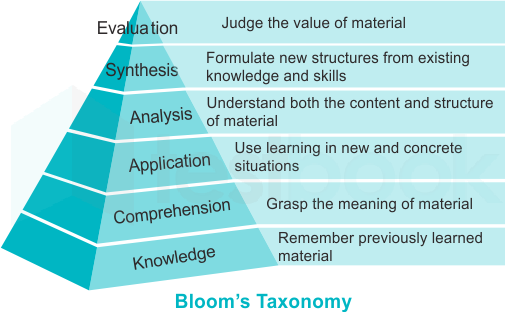
Benjamin Bloom’s taxonomy is a hierarchical organization of cognitive objectives. Bloom classifies learning objectives into three domains, cognitive, affective, and sensory domain.

  1. Cognitive Domain: mental skills
  2. Affective Domain: growth in feelings or emotional areas
  3. Psychomotor Domain: manual or physical skills

The cognitive domain involves six categories of learning that serve in the development of intellectual skills.

  • The lowest level of cognitive achievement is knowledge.

Hence, it becomes clear that the lowest level of cognitive achievement is knowledge.

12

A boy who can ride a cycle is going to drive a motorbike. This is an example of-

  1. ((a))

    horizontal transfer of learning

  2. ((b))

    vertical transfer of learning

  3. ((c))

    bilateral transfer of learning

  4. ((d))

    no transfer of learning

Show Answer
Answer: ((b))

vertical transfer of learning

Transfer of learning: It refers to the influence of learning one task on the learning of another. Transfer of learning is considered to be the basis of curriculum development as it provides a foundation for the arrangement of the sequence of skills to be learned. This transfer could either be lateral and vertical, positive and negative, and near transfer and far transfer. 

  • Transfer of learning occurs when learning in one context or with one set of materials impacts performance in other contexts or with other related materials'.
  • The vertical transfer is the acquisition of new responses contingent on the learning of prerequisite, subordinate capabilities. This transfer generally occurs when learning events occur in a hierarchy and is based on Gagne's Hierarchy of Learning. This means we cannot learn at a particular level on the hierarchy unless we have the prerequisite knowledge or skills, which serve the bases for the future learning task.
Vertical TransferAcquisition of new responses contingent on the learning of prerequisite, subordinate capabilities.For example, the learning of riding a bicycle is helpful while learning to ride a scooter later and learning of driving a Motorbike,
Lateral/Horizontal  TransferUnderstanding and skills acquired by learners are required to be utilized in learning situations outside the learning environmentsFor example,  experiences of driving scooter during Motorcycle driving,

Hence it is clear that A boy who can ride a cycle is going to drive a motorbike. This is an example of a vertical transfer of learning.
13

Which of the following is not the cause of plateau of learning?

  1. ((a))

    Limit of motivation 

  2. ((b))

    Non-cooperation of school

  3. ((c))

    Physiological limit

  4. ((d))

    Limit of knowledge 

Show Answer
Answer: ((b))

Non-cooperation of school

Learning Plateau-

  • If the learner arrives at a plateau in his learning process, imperfect linguistic items, rules, and subsystems will become relatively permanently incorporated into the learning system of a second language learner, in spite of further experience, explanation, or instruction.
  • A learning plateau occurs when you stop learning quickly. It's easy to make quick progress early on, when you learn more, you naturally slow down. Because of this, learning plateau frequently occurs when learners reach an intermediate level of learning.
Key Points

Following are the cause of plateau of learning-

  • Overgeneralization of the linguistic material of the target
  • Strategies of communication
  • limit of motivation
  • Physiological limit
  • Limit of knowledge
  • lack of confidence
  • doing the same things all the time

Hence it is clear that the non-cooperation of school is not a cause of learning plateau.

14

"Learning is the modification of behaviour through experience and training". This statement was given by

  1. ((a))

    Gates and others

  2. ((b))

    Morgan and Gilliland

  3. ((c))

    Skinner

  4. ((d))

    Cronbach

Show Answer
Answer: ((a))

Gates and others

Learning: Learning is the total of an individual’s life experience acquitted through the socialization process. It exceeds a mere acquisition of factual information or mastering of skills, as it also includes the total of an individual’s life experience which are relatively permanent in nature and have survived values for him.

  • Learning is not acquired by birth, but it is the process of acquiring competence by using hereditary resources.
  • Temporary behavior change is not learning.

Important Points

Let us have a look at the definitions of learning given by various psychologists/educationists: 

  • Gates and others: "Learning is the modification of behavior through experience and training".
  • Crow and Crow defined learning as the process of acquisition of knowledge, habits, and attitudes.
  • B.F Skinner defined the learning process by which a response is strengthened or extinguished through the reinforcement or punishment of a behavior.

Hence, we can conclude that the statement "Learning is the modification of behavior through experience and training" was given by Gates and others.

15

Stanford-Binet Test’ measures

  1. ((a))

    personality

  2. ((b))

    reading efficiency

  3. ((c))

    intelligence

  4. ((d))

    None of the above

Show Answer
Answer: ((c))

intelligence

Intelligence is the ability to undertake activities that are characterized by difficulty, complexity, abstractness, economy, adaptiveness to a goal, social value, and the emergence of originals, and to maintain such activities under conditions that demand a concentration of energy and resistance to emotional forces.

Stanford-Binet Test

  • Need to measure intelligence arise to trap individual differences in the general mental ability for a variety of purposes, such as academic classification, occupational counseling, and personnel selection. Intelligence tests can be defined as a test to evaluate the general level of cognitive functions and intellectual ability.
  • In 1911, the Binet-Simon scale was revised for the third time. More items were added to extend the scale up to the age group of 16 years. The American version of the Binet-Simon test was developed by Terman and Merrill at Stanford University in 1916. It is known as the Stanford-Binet Intelligence scale.
  • The Stanford-Binet Intelligence Scale, Form L-M, was different from its predecessor in that it included a deviation intelligence quotient with a normative mean of 100 and a standard deviation of 16. This version also included the 142 most pertinent items from the two previous forms of the test.
  • The four main areas assessed were verbal reasoning, abstract/visual reasoning, quantitative reasoning, and short-term memory.
  • The latest version of the test, the Stanford- Binet Intelligence Scales–Fifth Edition (SB5) differs significantly from the SB4 with regard to theoretical structure, as the SB5 adheres rather strictly to the Cattell-Horn-Carroll (CHC) cognitive theory and the SB4 adheres to a less strict psychometric design.

Hence it is clear that the Stanford-Binet Test’ measures intelligence.

16

Who has classified introvert personality and extrovert personality?

  1. ((a))

    Freud

  2. ((b))

    Jung

  3. ((c))

    Munn

  4. ((d))

    Allport

Show Answer
Answer: ((b))

Jung

Personality: Personality also refers to the pattern of thoughts, feelings, social adjustments, and behaviours consistently exhibited over time that strongly influences one's expectations, self-perceptions, values, and attitudes.

  • Personality is psychophysical that includes mental and physical aspects and both explain total personality.
  • Personality theories are attempts to understanding both the characteristics and the way of development of personality.

Key Points

JUNG Classification of Personality

  • His personality theory is known as an analytic theory or analytical psychology.
  • Carl Jung suggested that all human beings share certain unconscious ideas because we are all human and were created from similar evolutionary circumstances and common ancestors.
  • The unconscious that we all share is called the collective unconscious.
  • Each individual has his own self-actualization. Jung expressed libido in a very comprehensive way, he equated libido as life energy.
  • In light of libido, Jung proposed two types of personalities— extroverts and introverts.
  • The persons in whom life energy (libido) flows inward are known as introvert while, persons whom the life energy flows outward are termed as an extrovert.
  • In other words, the extraversion orients a person toward the external world while the introversion drives a person toward the inner, subjective world.
  • According to Jung introvert and extrovert function under four aspects-sensations, feelings, thinking, and intuition.

Additional Information

FREUD:

  • The first modern theory of personality was developed by Sigmund Freud (1923) that is known as the psychoanalytic or psychodynamic theory of personality.
  • According to Freud, our most behaviour is caused by thoughts, ideas, and wishes that are created in a person‘s brain.
  • These are not easily accessible by the conscious part of the mind but the unconscious mind.
  • According to him, the mind could be divided into three abstract categories- the id, the ego, and the superego.

ALLPORT:

  • Gordon Allport (1897-1967) was the first personality theorist who adapted the trait theory of personality.
  • The trait theory is one of the most important and largest fields of personality psychology.
  • According to this theory, personality is a composition of broad traits.

MUNN:

  • Personality may be defined as the characteristics, and integration of an individual’s, structure, attitudes, capacities, abilities, and aptitudes

From the above, we can conclude that Carl Jung classified introverted and extroverted personalities.

17

The factors affecting the social development of children are

  1. ((a))

    economic elements

  2. ((b))

    social-environmental elements

  3. ((c))

    physical elements

  4. ((d))

    hereditary elements

Show Answer
Answer: ((b))

social-environmental elements

Social development refers to the development of an individual in such a way as s/he becomes a useful member of society. Social development is the process of learning to conform to group standards.

Key Points

Factors Affecting Social development:

Some of the factors which have a bearing on the level of social development are the social-environmental elements:

  1. The social development of a child is regulated by the culture and society in which he/she lives. That is why children coming from different cultures, have different styles of social responses.
  2. Family: The family is the most important primary agency for the socialization of the child. Consciously or unconsciously, the child imitates the behavior of the parents and other members in the family and thus picks up many good or bad social characteristics.
  3. The parent-child relationships, the language used by the parents, the educational level of the parents, and the socio-economic status of the parents, and availability of leisure to spent with the parents, number of members in the family are the other factors influence the social development of the child.
  4. Peer Group: The peer group satisfies many needs of child-like acceptance, achievement, affection, approval, belongingness, fame, recognition, etc. A good company of peers especially in the pre-primary classes is of great help in learning good qualities. Through peer group interaction, the child understands how to cooperate, how to lead and follow, to think for a common cause, and adjust to challenging social situations.
  5. The school: A lot of school-related factors influence the socialization of the child. The interpersonal relationship in the school, its tradition, values, and ideals maintained by the institution, the curricular and co-curricular activities, the social qualities and behavior of the teachers and school mates, etc. have a great role in the socialization of the child.

Thus it becomes clear that the factors affecting the social development of children are social-environmental elements.

18

Which of the following is a primary law of physical development?

  1. ((a))

    Law of difference from mental development

  2. ((b))

    Law of irregular development

  3. ((c))

    Law of rapid growth 

  4. ((d))

    law of relation from imagination and emotional development

Show Answer
Answer: ((c))

Law of rapid growth 

Development refers to the process by which an individual's potentialities unfold and appear as new abilities, qualities, and characteristics. 

Physical development is the process that starts in human infancy and continues into late adolescence concentrating on gross and fine motor skills as well as puberty. 

  • It means growing control over muscles and physical coordination.

Law of Rapid growth:

  • Physical growth includes the attainment of full height and appropriate weight and an increase in the size of all organs (except lymphatic tissue, which decreases in size). Growth from birth to adolescence happens in two definite phases:
  • Phase 1 i.e. from birth to 1-2 years: In this phase, rapid growth takes place, even if the rate of growth diminishes over that period.
  • Phase 2 i.e. from about 2 years-puberty): In this phase, growth happens in relatively constant annual increments.
  • Puberty is the process of attaining physical maturation from child to adult.

Additional Information

  1. Law of difference from mental development: Mental development is an important aspect of growth, embracing various mental abilities. It starts from birth, and as the child develops with time his/her mental reactions also change.
  2. Law of irregular development: When development occurs unexpectedly and exhibits an unusual pattern of behavior, emotion, or thought, it's called irregular development.
  3. Law of relation to imagination and emotional development:
  • Imagination: Imagination is an essential component of childhood, helping children learn many important lifelong skills. 
  • Fine motor skills come into play with pretend money and coins, play food, dressing dolls with clothes, and playing with small cars or figurines
  • Emotional- As the child grows, the emotional responses become less diffuse, less random, and more differentiated, and can be aroused by a wide variety of stimuli. 
  • The commonly found emotional patterns in babyhood are anger, fear, curiosity, joy, and affection.

Hence, we can conclude that the Law of rapid growth is primary law of Physical development.

19

Which of the following is not the theory of development?

  1. ((a))

    Theory of conditioned reflex

  2. ((b))

    Theory of continuous growth

  3. ((c))

    Theory of interrelation

  4. ((d))

    Theory of uniform pattern

Show Answer
Answer: ((a))

Theory of conditioned reflex

Development is a broad term that includes a series of qualitative and progressive changes.

  • These qualitative changes lead to the enhancement of various abilities and enable one to function effectively.
  • The changes rely on the quantitative changes brought about by growth.

THEORY OF DEVELOPMENT:

  • Theory of continuous growth-
  • Development is a continuous process that begins at conception and ends with life.
  • The rate of developmental changes and the pace of the process may become slow or might gain momentum at certain times but it never ceases completely provided the environment is conducive for development.
  • Theory of Interrelation-
  • ‘All the domains of development and learning—physical, social and emotional, and cognitive—are important, and they are closely interrelated’.
  • Development in one domain is accompanied and greatly influenced by that which occurs in the other domains.
  • For example, day-to-day activities of children such as playing, studying, or socializing with peers involve activity in multiple areas or domains.
  • Theory of Uniform pattern-
  • ​The changes brought about by the process of development follow a sequential order.
  • This sequence or order is generally the same for all. In the words of Anita Woolfolk, infants sit before they walk, babble before they talk, and see the world through their own eyes before they can begin to imagine how others see it’.
  • A sequence is also observed in the stage-wise progression of development.
  • A child undergoing a normal course of growth and development would pass through infancy, middle and late childhood, adolescence, adulthood, and finally to old age.

Additional Information

THEORY OF CONDITIONED REFLEX:

  • The term conditioned reflex was coined by, Ivan Petrovich Pavlov. It is used to denote the criterion measure of a behavioral element of learning, that is, a new association between the signal and the consequential event referred to as the conditioned stimulus and unconditioned stimulus, respectively.

From the above, we can conclude that the Theory of conditioned reflex is not a Theory of development.

20

“Development results in new characteristics and new abilities.” This statement is given by

  1. ((a))

    Gesell

  2. ((b))

    Hurlock

  3. ((c))

    Meredith

  4. ((d))

    Douglas and Holland

Show Answer
Answer: ((b))

Hurlock

DEVELOPMENT:

  • It can be defined as a progressive series of orderly, coherent changes leading towards the goal of maturity
  • According to Hurlock, 1964 “Development is not limited to the growing layer. Instead, it consists of a progressive series of changes towards the goal of maturity. Development results in new characteristics and new abilities on the part of the individual”.
  • It means qualitative changes that are directed towards maturation.
  • Development is considered as a function of or a product of maturation and learning.
  • The development follows an observable pattern that can be predicted.

Additional Information

  • Arnold Gesell develops the Gesell developmental Schedules to assesses behavior in the areas of adaptive, gross motor, fine motor, language, and personal-social development.
  • Douglas and Holland stated that the term environment is used to describe, in the aggregate, all the external forces, influences, and conditions, which affect the life, nature, behavior, and the growth, development, and maturity of living organisms.

Hence, we can conclude that "Development results in new characteristics and new abilities.” This statement is given by Hurlock.

21

Instincts are classified in fourteen types  by

  1. ((a))

    Drever

  2. ((b))

    McDougall

  3. ((c))

    Thorndike

  4. ((d))

    Woodworth

Show Answer
Answer: ((b))

McDougall

Instincts are goal-directed and innate behavior that is not due to learning or experience.

McDougall tried to explain behavior in terms of a few distinct inherited tendencies which he called instincts.

  • For him, instinct and emotion are always unified.
  • Emotion is the conscious aspect of an instinctive activity.
  • An instinct is an innate disposition that makes the organism sensitive to objects and disposes it to appropriate action.
  • He states that "An instinct determines it's possessor to perceive and to pay attention to objects of a certain class, to experience emotional excitement of a particular quality upon perceiving such an object and to act in regard to it in a particular manner or at least to experience an impulse to action”.
  • Further, he feels that an instinctive action is an outcome of, "A distinctly mental process, one which is incapable of being described in purely mechanical terms because it is a psychophysical process involving psychical as well as physical changes and like every other mental process.
  • It stated three aspects, the cognitive, the affective, and the conative aspects; every instance of instinctive behavior involves knowing of something or object, a feeling in regard to it, and a striving toward or away from the object”

Additional Information

  • Thorndike divided intelligent activity into three types :
  • Social Intelligence or the ability to understand and deal with persons;
  • Concrete intelligence or ability to understand and deal with things, as in skilled trades and scientific appliances and
  • Abstracts intelligence, or the ability to understand and deal with verbal and mathematical symbols
  • According to Woodworth, Both behavior and consciousness were the subject matter of psychology. His 'Dynamic Psychology' (1918) tried to explain behavior by merging theories of motivation, perception, learning, and thinking, also his book 'Psychology' (1921) became a standard textbook.
  • Drever emphasized the element of satisfyingness in interest. To him, interest is a feeling of worthwhileness passing into satisfyingness.

Hence, it's clear that McDougall classified instincts into fourteen types

22

“Attention is the concentration of consciousness upon one object rather than upon another.” This statement is given by

  1. ((a))

    Dumville

  2. ((b))

    Ross

  3. ((c))

    Munn

  4. ((d))

    McDougall

Show Answer
Answer: ((a))

Dumville

Attention refers to the active processing of specific information present in the environment by an individual.

  • ‘Attention is the concentration of consciousness upon one subject rather than upon another’ Dumville (1938)
  • It allows us to 'tune out' information, sensations, and perceptions that are not relevant at the moment and instead focus energy on the information that is important.
  • Attention is the most consequential of all the tasks the human brain performs.
  • Perceiving, thinking, learning, deciding, and acting deliberately, all depend on attention.
  • Attention is the means by which one actively processes a limited amount of information from the enormous amount of information available through one‟s senses, stored memories, and other cognitive processes.

Additional Information

  • Attention refers to the processing or selection of some information at the expense of other information (Pashler, 1998).
  • Ross (1951): Attention is the process of getting an object or thought clearly before the mind.
  • Morgan & Gilliland (1942): Attention is being keenly alive to some specific factor in our environment.
  • McDougall states that emotions are the conscious concomitants of instinctive impulses at work.
  • Norman L. Munn (1972) defined personality as the most characteristics, integration of an individual’s, structure, attitudes, capacities, abilities, and aptitudes

From the above, it's clear that the statement “Attention is the concentration of consciousness upon one object rather than upon another" is given by Dumville.

23

Which is not included in primary law of learning?

  1. ((a))

    Law of readiness

  2. ((b))

    Law of exercise

  3. ((c))

    Law of multiple response

  4. ((d))

    Law of effect

Show Answer
Answer: ((c))

Law of multiple response

The pioneer of educational psychology E. L. Thorndike formulated three laws of learning.

  • Thorndike also propounded "Trial & Error Theory" has developed three primary laws of learning that leads to development.

Key Points These primary laws are:

Law of exerciseIt is based on practice and drills to learn something for a long period.
Law of readinessIt refers to the degree of eagerness and inquisitiveness to learn something new.
Law of effectIt is based on motivation and reinforcement to make the learning experience pleasant.


Hence, it becomes clear that the Law of multiple responses is not included in the primary law of learning.

24

Which test is propounded by Dr. S. Jalota in Hindi for the children of 12 to 16 years?

  1. ((a))

    Non-verbal intelligence test

  2. ((b))

    General mental ability test

  3. ((c))

    Army alpha test

  4. ((d))

    Picture drawing test

Show Answer
Answer: ((b))

General mental ability test

Intelligence is an umbrella term used to describe a property of the mind that encompasses many related abilities, such as the capacities to reason. From various meanings of intelligence, it could be concluded that intelligence means the ability of an individual to solve the problems that have been received from general learning, experience, schools, and the environment. 

Verbal Intelligence Test

  • Verbal tests use written language for their items and therefore, require the examinees to be literate.
  • Most of the widely used mental ability tests, to some degree, depend on language and include tasks presented in verbal terms. S-B test, General Mental Ability Test (GMAT), and Army Alpha Test include the tasks testing the vocabulary by identifying the meaning synonym, antonym, completion of the sentences, etc. The tests in which this type of items is included are called the verbal tests

General Mental Ability Test (GMAT) :

  • It is defined as the ability to understand and interpret verbal information, the ability to recognize and process numbers and information stated in tabular/ graphical format, ability to think broadside, and construct logical connections between unassociated concepts.
  • Dr. S.S. Jalota propounded this test in Hindi to measure intelligence.
  • By this test, we can measure the intelligence of a group and classify intelligent, average, and dull categories.

Additional Information

Army Alpha Test:

  • First administered to nearly two million new recruits in World War I, and the Otis Group Intelligence Scale were forerunners of many other group tests that are administered economically and quickly to large numbers and were thus effective for use in schools and industry.
  • Standardized group tests are administered for college and graduate school entrance, and for a number of civil service positions.

Non-verbal Intelligence Test:

  • Tests, which require no reading and writing activity on the part of the subjects, are described as non-verbal tests such as Progressive Matrices, Pinter General Ability Test, Picture drawing test.
  • The children's mental ability can be tested by means of pictures.
  • This type of test consists of all the items in pictorial form.
  • They are valuable for better diagnosis of cases that scoreless on verbal tests.
  • It is better to use terms as 'pictorial' or 'no reading rather than Non-verbal.

Picture drawing test:

  • Through this, we can analyze different areas of a person's subconscious, for instance, fears, dreams, and main personality traits in general.
  • However, Projective personality tests, specifically, evaluate how a person responds to particular situations through a drawing.

Hence, it's clear that GMAT was propounded by Dr. S.S Jalota in Hindi.

25

Who propounded the two-factor theory of intelligence?

  1. ((a))

    Thorndike

  2. ((b))

    Spearman

  3. ((c))

    Vernon

  4. ((d))

    Stern

Show Answer
Answer: ((b))

Spearman

Intelligence has been defined as the total of everything you know, as the ability to learn or profit from experience, as the ability to solve problems, or as the ability to cope with the demands of the environment.

Key Points The two-factor theory of intelligence: Charles Spearman proposed his theory in the year 1923.

  • According to his theory, intelligence consists of two factors: ‘g’ and ‘s’, where ‘g’ stands for generalized factor and ‘s’ stands for the specific factor.
  • As per him, the ‘g’ factor is responsible for different tasks which are common for all people while the ‘s’ factor is for abilities like musical, spatial, mechanical, etc.
  • S-factor is applicable in specific fields and changeable in nature while G-factor is a universal innate ability to perform all cognitive tasks effectively.
ProponentsDescription of work
E. L. ThorndikeMultifactor theory of intelligence.
William SternThe psychological methods of testing intelligence
Philip E. VernonHierarchical Theory of Intelligence


Hence, we can conclude that Charles Spearman proposed the two-factor theory of intelligence.

26

Which of the following pairs is not true?

  1. ((a))

    Strimulus-response theory of learining-Thorndike

  2. ((b))

    Operant conditioning theory of learning - B F, Skinner

  3. ((c))

    Classical theory of learning - pavlov

  4. ((d))

    Holistic theory of learning - Hull

Show Answer
Answer: ((d))

Holistic theory of learning - Hull

Learning is the sum total of an individual’s life experience acquitted through the socialization process. It exceeds a mere acquisition of factual information or mastering of skills, as it also includes the total of an individual’s life experience which are relatively permanent in nature and have survived values for him.

  • | Learning Theories | Proponents | | --- | --- | | Holistic Theory of learning | - The holistic approach is the totality of something much greater than the sum of its parts and their functioning.​ - The theory of multiple intelligences builds a strong basis for the concept of a comprehensive learning plan in universities which can improve student’s academic achievement. In this competitive era, a holistic approach towards developing intelligence is much needed to enhance student’s learning. | | Stimulus-response theory of learning | - The famous Psychologist, Edward L. Thorndike, (1874-1949) was the initiator of this theory which was based on the findings of his experiments on chickens, rats, and cats. - With the help of these experiments, he tried to evolve certain laws and propagated his theory of connectionism or trial and error learning. - Tries to explain the process of learning carefully based on actual experiments performed. - Connectionism is a learning theory that is based on the concept of bonds shaped between stimulus and response i.e., natural connections between Situations (S) and Responses (R) are formed and strengthened. - S-R bonds are formed which are considered as physical conditions. - This theory of learning is related to conditioning that utilizes the concept of association of connection. | | Classical Conditioning | - Russian Psychologist IVAN PAVLOV (1849-1936), who advocated the Theory of Classical Conditioning, considers learning as habit formation and is based on the principle of association and substitution. - It is simply a stimulus-response type of learning, wherein a place of natural stimulus like food water, sex, etc, an artificial stimulus like the sound of the bell, the sight of the light of a definite color, etc can evoke a natural response. - The Conditioning Theory of learning put forward by Watson and Pavlov involves the conditioning of respondent behavior through a process of stimulus association and substation. | | Operant Conditioning | - ​B.F. Skinner (1948) conducted a series of experiments with animals, put forward his theory of Operant Conditioning for learning, which involves not only simple responses but also, for learning, the most difficult and complex series of responses. - The theory of Operant Conditioning advocates the emitting of the desired response and its proper management through suitable reinforcement. - The learner responds in a certain way to produce the reinforcing stimulus. - The subsequent reinforcement gradually conditions the learner to emit the desired response and thus learn the desired act. |


  • Clark L. Hull (1884-1952), a teacher in the universities of Wisconsin and Yale, is credited with putting forth a systematic mathematical and scientific theory of human behavior based on conditioning and connectionism of the earlier behaviorists. He built his theory on a logical structure of postulates and theorems.

Hence, we conclude that the Holistic theory of learning is not propounded by Hull.

27

Whose name is associated with 'Father of the Eugenics’?

  1. ((a))

    Crow and Crow 

  2. ((b))

    Galton

  3. ((c))

    Ross

  4. ((d))

    Woodworth 

Show Answer
Answer: ((b))

Galton

The term 'Eugenes' in Greek means good in stock; hereditarily endowed with noble qualities. 'Eugenics' is the study of the agencies under social control that may improve or impair the racial qualities of future generations either physically or mentally.

  • The word 'eugenics' was initially proposed and defined by a Victorian scientist, Sir Francis Galton (1822—1911). He is the 'Father of the Eugenics'.
  • A cousin of Charles Darwin, he was greatly influenced by Darwin's theory of evolution.
  • He defined eugenics to mean 'the science of improving the inherited stock of a population, not only by judicious matings but by all other means' the word eugenics come fi-om the Greek word EU -good, genesis creation or birth.
  • It is a polar opposite to the word 'euthanasia' EU - good than those - dead.
  • Eugenics might be formulated as 'science applied to the qualitative improvement of the set of human genes to be transmitted to the next generation.
  • This definition could be extended to cover methods for regulating population numbers as well as trying to improve the genetic composition of the next generation.

Hence, we can conclude that Francis Galton is the 'father of eugenics'.

28

Who described different types of personality based on glands?

  1. ((a))

    Kretschmer

  2. ((b))

    Jung

  3. ((c))

    Cannon

  4. ((d))

    Spranger

Show Answer
Answer: ((c))

Cannon

Psychologically speaking personality is all that a person is. It includes everything about the person, his physical, emotional, social, mental, and spiritual makeup. The term personality signifies something deeper than more appearance or outward behavior. 

Factors Influencing Personality: The following factors influence the development of the personality of an individual. There are various glands in our body. These glands are cell structures. They are important for the individual’s physical and mental health and development. They secrete different substances which are responsible for this development.

Key Points

Cannon described different types of personality based on glands.

There are two types of glands:

  1. The Duct Glands
  2. The Ductless Glands.

The Duct Glands :

  • The duct glands secrete their fluids through ducts and channels.
  • These glands help in the digestive process.
  • If the digestion is proper, then the individual becomes healthy.

The Ductless Glands:

  • The ductless or endocrine glands exercise a great influence on the development of the various parts of the body and their activities' emotional stability and temperament.
  • The hormones secreted by these glands play a vital role in the making of personality.
  • The three important ductless glands are:
Ductless GlandsDescription
Thyroid Glands- They give alertness and smartness to the individual. - In case the thyroid gland is underactive or destroyed by disease, the individual becomes sluggish, dull, slow, forgetful, and stupid. - His physical, as well as intellectual growth, remain stunted and he becomes ugly. - He may have Goitre trouble also. - If it is overactive, the individual loses emotions. - He becomes restless and irritable. - His physical height tends to be extraordinary.
Adrenal Glands- These are small glands each lying on the surface of each kidney. - They secrete a chemical called Adrenalin. - Normal activity stimulates the muscles and increases strength. - It’s under activity that makes the individual emotionally weak.
Pituitary Glands- These glands are situated at the base of the brain and in the middle of the head. - It is a growth gland. - It is responsible for the uniform growth of the body, i.e. bones, muscles, and limbs. - It promotes general health also. - Its overactivity leads to abnormal growth of the body. - It's under activity that produces dwarf with normal intelligence
Gonads- These are sex glands. - They affect emotional stability and help the general development of the individual.


Hence, from the above, we can conclude that Cannon described different types of personalities based on glands.

Confusion Points 

  • Kretschmer described personality on the basis of different body types.
  • Kretschmer was a German psychiatrist who on the basis of his observation of patients classified people into four types. He used the physical constitution and temperament for this purpose The four types he talked about included: (i) Pyknik type (ii)Asthenic type (iii)Athletic type (iv) Dysplastic type.
29

"Creativity is a mental process to express the original outcomes.” This statement is given by

  1. ((a))

    Cole and Bruce

  2. ((b))

    Drevahal

  3. ((c))

    Dehan 

  4. ((d))

    Crow and Crow

Show Answer
Answer: ((d))

Crow and Crow

Creativity is the phenomenon whereby imaginative and original ideas are turned into reality. It relates to divergent thinking that refers to a way of solving problems by more than one approach.

The above-mentioned statement is given by 'Crow and Crow' as:

  • It is the ability possesses by the people who are creative, persistent, and imaginative.
  • Creativity is a cognitive ability to produce something original by offering a fresh perspective.
  • It is related to divergent thinking which refers to a way of solving problems by more than one approach.
  • It is goal-directed thinking which is unusual, novel, and useful and includes brainstorming and out of the box thinking in it

Hence, it could be concluded that the above-mentioned statement is given by 'Crow and Crow'.


Additional Information

Characteristics of Creative Children:

  • Perceive relation between impossible things.
  • Think quickly and solve problems in a novel way.
  • Convert imaginative and original ideas into reality.
  • Try new things and risk failure in executing innovative ideas.
  • Use divergent and out of the box thinking in different situations.

Important Points

Cole and BruceCreativity is the ability to understand, express, and appreciate the human mind as a fundamental product.
DehanCreativity is a new idea that has value in solving a problem, or an object that is new or useful.
30

The tendency of 'Feeling of Revolt' is concerned with which of the following ages?

  1. ((a))

    Childhood

  2. ((b))

    Infancy 

  3. ((c))

    Early adolescence

  4. ((d))

    Middle adolescence

Show Answer
Answer: ((c))

Early adolescence

Childhood refers to the period of the human lifespan, ranging from birth to puberty. It consists of many developmental stages and 'adolescence' is one of them.

  • 'Adolescence' comes from the Latin word 'Adolescere' which means 'to grow to become mature'. It is a stage which lies between the age of '10 to 19 years'.

It is divided into three parts:

  1. Early adolescence: age 10-13 years
  2. Middle adolescence: age 14-16 years
  3. Late adolescence: age 17-19 years

Key Points

The tendency of Feeling of Revolt is concerned with 'early adolescence' as:

  • It is a turbulent time charged with conflict and mood swings.
  • The time period of transition from childhood and adolescence is of great stress.
  • Adolescents fail to think clearly and it creates great frustration and stress in their lives.
  • It is a transitional stage when a child develops physically and psychologically into an adult.
  • It is a stage of storm and stress in which children are in conflict with their parents, are moody, and tend to spend more time with peers.

 Hence, it could be concluded that the tendency of Feeling of Revolt is concerned with 'early adolescence'.

Additional Information

Childhood- It refers to the time period from the age of 'Two to Seven years'. It is a very crucial period for child's overall development. - It is also known as the toy age, pregang age, and exploratory age, etc.
Infancy- It refers to the first year or the early period of a child's development in which the child grows rapidly after birth. - It is a crucial period of development in which the child learns to sit, crawl, stand, etc.
<br>

Hindi (30 questions)

निर्देश: दिए गए गद्यांश को पढ़कर निम्नलिखित प्रश्नों के सही विकल्प छांटिए।

आदिम आर्य घुमक्कड़ ही थे। यहाँ से वहां वे घुमते ही रहते थे। घूमते भटकते ही वे भारत पहुँचे थे। यदि घुमक्कड़ी का बना उन्होंने न धारण किया होता, यदि वे एक स्थान पर ही रहते, तो आज भारत में उनके वंशज न होते। भगवान बुद्ध घुमक्कड़ थे। भगवान महावीर घुमक्कड़ थे। वर्षा-ऋतु के कुछ महीनों को छोड़कर एक स्थान पर रहना बुद्ध के वश का नहीं था। 35 वर्ष की आयु में उन्होंने बुद्धत्व प्राप्त किया। 35 वर्ष से 80 वर्ष की आयु तक जब उनकी मृत्यु हुई, 45 वर्ष तक वे निरंतर घूमते ही रहे। अपने आपको समाज सेवा और धर्म प्रचार में लगाये रहे। अपने शिष्यों से उन्होंने कहा था ‘चरथ भिक्खवे चारिक’ हे भिक्षुओ। घुमक्कड़ी करो यद्यपि बुद्ध कभी भारत के बहार नहीं गए, किन्तु उनके शिष्यों ने उनके वचनों को सर आँखों पर लिया और पूर्व में जापान, उत्तर में मंगोलिया, पश्चिम में मकदूनिया और दक्षिण में बाली द्वीप तक धावा मारा। श्रावण महावीर ने स्वच्छन्द विचरण के लिएय अपने वस्त्रो तक को त्याग दिया। दिशाओं को उन्होंने अपना अम्बर बना लिया, वैशाली में जन्म लिया, पावा में शारीर त्याग किया। जीवनपर्यन्त घूमते रहे। मानव के कल्याण के लिए मानवो के राह प्रदर्शन के लिए और शंकराचार्य बारह वर्ष की अवस्था में संन्यास लेकर कभी केरल, कभी मिथिला, कभी कश्मीर और कभी बद्रिकाश्रम में घुमते रहे। कन्याकुमारी से लेकर हिमालय तक समस्त भारत को अपना कर्मक्षेत्र समझा। सांस्कृतिक एकता के लिए, समन्वय के लिए, श्रुति धर्म की रक्षा के लिए शंकराचार्य के प्रयत्नों से ही वैदिक धर्म का उत्थान हो सका।

31

‘घुमक्कड़’ शब्द में कौन-सा प्रत्यय है?

  1. ((a))

    अक्कड़

  2. ((b))

  3. ((c))

    अड़

  4. ((d))

    कड़

Show Answer
Answer: ((a))

अक्कड़

‘घुमक्कड़’ शब्द में 'अक्कड़' प्रत्यय है।

'अक्कड़' प्रत्यय से बनने वाले अन्य शब्द - भुलक्कड़, पियक्कड़, कुदककड़ आदि हैं।

शेष विकल्प त्रुटिपूर्ण हैं।

अतः सही विकल्प 'अक्कड़' है।

| शब्द | परिभाषा | उदाहरण | | --- | --- | --- | | प्रत्यय | शब्द के उपरांत जिस शब्द का प्रयोग किया जाता है वह प्रत्यय है। | जैसे - ता, औना, अन, अत श्रो + ता = श्रोता |शब्दपरिभाषाउदाहरणप्रत्ययशब्द के उपरांत जिस शब्द का प्रयोग किया जाता है वह प्रत्यय है।जैसे - ता, औना, अन, अत श्रो + ता = श्रोता
शब्दपरिभाषाउदाहरण
प्रत्ययशब्द के उपरांत जिस शब्द का प्रयोग किया जाता है वह प्रत्यय है।जैसे - ता, औना, अन, अत श्रो + ता = श्रोता

निर्देश: दिए गए गद्यांश को पढ़कर निम्नलिखित प्रश्नों के सही विकल्प छांटिए।

आदिम आर्य घुमक्कड़ ही थे। यहाँ से वहां वे घुमते ही रहते थे। घूमते भटकते ही वे भारत पहुँचे थे। यदि घुमक्कड़ी का बना उन्होंने न धारण किया होता, यदि वे एक स्थान पर ही रहते, तो आज भारत में उनके वंशज न होते। भगवान बुद्ध घुमक्कड़ थे। भगवान महावीर घुमक्कड़ थे। वर्षा-ऋतु के कुछ महीनों को छोड़कर एक स्थान पर रहना बुद्ध के वश का नहीं था। 35 वर्ष की आयु में उन्होंने बुद्धत्व प्राप्त किया। 35 वर्ष से 80 वर्ष की आयु तक जब उनकी मृत्यु हुई, 45 वर्ष तक वे निरंतर घूमते ही रहे। अपने आपको समाज सेवा और धर्म प्रचार में लगाये रहे। अपने शिष्यों से उन्होंने कहा था ‘चरथ भिक्खवे चारिक’ हे भिक्षुओ। घुमक्कड़ी करो यद्यपि बुद्ध कभी भारत के बहार नहीं गए, किन्तु उनके शिष्यों ने उनके वचनों को सर आँखों पर लिया और पूर्व में जापान, उत्तर में मंगोलिया, पश्चिम में मकदूनिया और दक्षिण में बाली द्वीप तक धावा मारा। श्रावण महावीर ने स्वच्छन्द विचरण के लिएय अपने वस्त्रो तक को त्याग दिया। दिशाओं को उन्होंने अपना अम्बर बना लिया, वैशाली में जन्म लिया, पावा में शारीर त्याग किया। जीवनपर्यन्त ��ूमते रहे। मानव के कल्याण के लिए मानवो के राह प्रदर्शन के लिए और शंकराचार्य बारह वर्ष की अवस्था में संन्यास लेकर कभी केरल, कभी मिथिला, कभी कश्मीर और कभी बद्रिकाश्रम में घुमते रहे। कन्याकुमारी से लेकर हिमालय तक समस्त भारत को अपना कर्मक्षेत्र समझा। सांस्कृतिक एकता के लिए, समन्वय के लिए, श्रुति धर्म की रक्षा के लिए शंकराचार्य के प्रयत्नों से ही वैदिक धर्म का उत्थान हो सका।

32

महावीर स्वामी का जन्म कहाँ हुआ था?

  1. ((a))

    पावापुरी

  2. ((b))

    वैशाली

  3. ((c))

    कुशीनगर

  4. ((d))

    पारसौली

Show Answer
Answer: ((b))

वैशाली

  • महावीर स्वामी का जन्म 'वैशाली' में हुआ था।
  • भगवान महावीर स्वामी जैन धर्म के चौंबीसवें तीर्थंकर हैं व इनका जन्म कुंडलग्राम, वैशाली के निकट हुआ था।
  • अन्य विकल्प असंगत हैं।

अतः सही विकल्प 'वैशाली' है।

33

‘स्वच्छंद’ में कौन-सी संधि है?

  1. ((a))

    विसर्ग

  2. ((b))

    दीर्घ

  3. ((c))

    गुण

  4. ((d))

    व्यंजन

Show Answer
Answer: ((d))

व्यंजन

‘स्वछन्द’ में व्यंजन संधि है तथा इसका संधि विच्छेद 'स्व + छंद' है। शेष विकल्प असंगत हैं। व्यंजन संधि अर्थात एक व्यंजन से दूसरे व्यंजन या स्वर के मेल से विकार उत्पन्न होता है, जैसे - अहम् + कार = अहंकार, उत् + लास = उल्लास। अतः सही विकल्प 'व्यंजन' है।

स्पष्टीकरण

स्वर के बाद यदि छ् वर्ण आ जाए तो छ् से पहले च् वर्ण बढ़ा दिया जाता है । जैसे - (अ + छ = अच्छ) स्व + छंद = स्वच्छंद, (आ + छ = आच्छ) आ + छादन = आच्छादन आदि।

अन्य विकल्प

संधिपरिभाषाउदाहरण
विसर्गविसर्ग के साथ स्वर या व्यंजन के मेल से विकार उत्पन्न होता है।दुः + आत्मा =दुरात्मा, निः + कपट =निष्कपट।
दीर्घदो सवर्ण, ह्रस्व या दीर्घ, स्वरों के मेल होने पर दीर्घ स्वर बन जाता है।शिव + आलय (अ + आ) = शिवालय, गिरि + इन्द्र (इ + इ) = गिरीन्द्र।
गुणअ, आ के साथ इ, ई का मेल होने पर 'ए'; उ, ऊ का मेल होने पर 'ओ'; तथा ऋ का मेल होने पर 'अर्' हो जाता है।देव + इन्द्र (अ + इ) = देवेन्द्र, देव + ऋषि (अ + ऋ) = देवर्षि।

निर्देश: दिए गए गद्यांश को पढ़कर निम्नलिखित प्रश्नों के सही विकल्प छांटिए।

आदिम आर्य घुमक्कड़ ही थे। यहाँ से वहां वे घुमते ही रहते थे। घूमते भटकते ही वे भारत पहुँचे थे। यदि घुमक्कड़ी का बना उन्होंने न धारण किया होता, यदि वे एक स्थान पर ही रहते, तो आज भारत में उनके वंशज न होते। भगवान बुद्ध घुमक्कड़ थे। भगवान महावीर घुमक्कड़ थे। वर्षा-ऋतु के कुछ महीनों को छोड़कर एक स्थान पर रहना बुद्ध के वश का नहीं था। 35 वर्ष की आयु में उन्होंने बुद्धत्व प्राप्त किया। 35 वर्ष से 80 वर्ष की आयु तक जब उनकी मृत्यु हुई, 45 वर्ष तक वे निरंतर घूमते ही रहे। अपने आपको समाज सेवा और धर्म प्रचार में लगाये रहे। अपने शिष्यों से उन्होंने कहा था ‘चरथ भिक्खवे चारिक’ हे भिक्षुओ। घुमक्कड़ी करो यद्यपि ब��द्ध कभी भारत के बहार नहीं गए, किन्तु उनके शिष्यों ने उनके वचनों को सर आँखों पर लिया और पूर्व में जापान, उत्तर में मंगोलिया, पश्चिम में मकदूनिया और दक्षिण में बाली द्वीप तक धावा मारा। श्रावण महावीर ने स्वच्छन्द विचरण के लिएय अपने वस्त्रो तक को त्याग दिया। दिशाओं को उन्होंने अपना अम्बर बना लिया, वैशाली में जन्म लिया, पावा में शारीर त्याग किया। जीवनपर्यन्त घूमते रहे। मानव के कल्याण के लिए मानवो के राह प्रदर्शन के लिए और शंकराचार्य बारह वर्ष की अवस्था में संन्यास लेकर कभी केरल, कभी मिथिला, कभी कश्मीर और कभी बद्रिकाश्रम में घुमते रहे। कन्याकुमारी से लेकर हिमालय तक समस्त भारत को अपना कर्मक्षेत्र समझा। सांस्कृतिक एकता के लिए, समन्वय के लिए, श्रुति धर्म की रक्षा के लिए शंकराचार्य के प्रयत्नों से ही वैदिक धर्म का उत्थान हो सका।

34

महात्मा बुद्ध ने जब बुद्धत्व प्राप्त किया तब उनकी अवस्था कितनी थी?

  1. ((a))

    12 वर्ष

  2. ((b))

    35 वर्ष

  3. ((c))

    45 वर्ष

  4. ((d))

    80 वर्ष

Show Answer
Answer: ((b))

35 वर्ष

  • महात्मा बुद्ध ने जब बुद्धत्व प्राप्त किया तब उनकी अवस्था '35 वर्ष' थी।
  • गद्यांश की पंक्ति '35 वर्ष की आयु में उन्होंने बुद्धत्व प्राप्त किया' से स्पष्ट है।
  • अन्य विकल्प गलत हैं।

अतः सही विकल्प '35 वर्ष' है।

35

‘श्रुति धर्म’ का क्या अर्थ है?

  1. ((a))

    जैन धर्म

  2. ((b))

    बौद्ध धर्म

  3. ((c))

    मुस्लिम धर्म

  4. ((d))

    वैदिक धर्म

Show Answer
Answer: ((d))

वैदिक धर्म

  • गद्यांश के अनुसार ‘श्रुति धर्म’ का अर्थ 'वैदिक धर्म' है।
  • शेष विकल्प असंगत हैं।

अतः सही विकल्प 'वैदिक धर्म' है।

<br>

विशेष -

  • वैदिक संस्कृति में लिखे चार वेद सनातन धर्म की धार्मिक किताबें हैं।
  • हिन्दू मान्यता के अनुसार ऋग्वेद और अन्य वेदों के मंत्र ईश्वर द्वारा ऋषियों को दिए गए थे।
  • इसलिए वेदों को 'श्रुति' (यानि, 'जो सुना गया है') कहा जाता है।
36

‘निमिष’ शब्द का पर्याय क्या है?

  1. ((a))

    प्रकाश

  2. ((b))

    छिद्र

  3. ((c))

    पूर्ण

  4. ((d))

    क्षण

Show Answer
Answer: ((d))

क्षण

  • ‘निमिष’ शब्द का पर्याय 'क्षण' है। शेष विकल्प अनुपयुक्त हैं। अतः सही विकल्प 'क्षण' है।
  • 'निमिष' शब्द के अन्य पर्यायवाची शब्द 'पलक, बरौनी' हैं।

Key Points

  • प्रकाश के पर्यायवाची शब्द हैं ‘ज्योति, चमक, प्रभा, छवि’।
  • छिद्र के पर्यायवाची शब्द हैं ‘सूराख, रंध्र’।
  • पूर्ण के पर्यायवाची शब्द हैं ‘सम, सर्व, अखिल, सम्पूर्ण’।

Additional Information

शब्दपरिभाषाउदाहरण
पर्यायवाची शब्दएक ही अर्थ में प्रयुक्त होने वाले शब्द , जो बनावट में भले ही अलग हों, पर्यायवाची शब्द कहलाते हैं। ‘ पर्यायवाची-शब्द' को 'समानार्थी-शब्द' भी कहा जाता है|जैसे -आग - अनल, पावक, दहन, वह्नि, कृशानु, हुताशन आदि।
37

‘मुझसे उठा नही गया’ वाक्य में कौन सा वाच्य है?

  1. ((a))

    कर्तुवाच्य

  2. ((b))

    कर्मवाच्य

  3. ((c))

    भाववाच्य

  4. ((d))

    उपर्युक्त में से कोई नहीं

Show Answer
Answer: ((c))

भाववाच्य

  • ‘मुझसे उठा नहीं गया’ वाक्य में 'भाववाच्य' है क्योंकि यहाँ भाव की प्रधानता है।
  • शेष विकल्प असंगत हैं।

अतः सही विकल्प 'भाववाच्य' है।

वाच्य - क्रिया के जिस रूप से यह ज्ञात हो कि वाक्य में क्रिया द्वारा बताए गए विषय में कर्ता, कर्म, अथवा भाव में से कौन प्रमुख है, उसे वाच्य कहते हैं।
वाच्यवाक्य
कर्तृ वाच्य - जहाँ क्रिया का संबंध सीधा कर्ता से हो तथा क्रिया का लिंग तथा वचन कर्ता के अनुसार ही उसे कर्तृ वाच्य कहते हैं।1. रोहित क्रिकेट खेलता है।
कर्म वाच्य - जहाँ क्रिया का संबंध सीधा कर्म से हो तथा क्रिया का लिंग तथा वचन कर्म के अनुसार हो, उसे कर्म वाच्य कहते हैं।2. रोहित द्वारा क्रिकेट खेला जाता है।
भाव वाच्य - जहाँ कर्ता और कर्म की नहीं बल्कि भाव की प्रधानता हो, उस वाक्य को भाव वाच्य कहते हैं।3. रोहित से क्रिकेट खेला जाता है।
38

'जिसकी पूर्व से कोई आशा न हो’ के लिए एक शब्द कौन सा है?

  1. ((a))

    प्रत्याशा

  2. ((b))

    अप्रत्याशित

  3. ((c))

    अपरिमेय

  4. ((d))

    अनाहूत

Show Answer
Answer: ((b))

अप्रत्याशित

जिसकी पूर्व से कोई आशा न हो के लिए एक शब्द 'अप्रत्याशित' है। शेष विकल्प असंगत हैं। अतः सही विकल्प 'अप्रत्याशित' है।

अन्य विकल्प

शब्दवाक्यांश
प्रत्याशाजिसकी आशा की गयी हो
अपरिमेयजिसकी माप न संभव हो
अनाहूतजो बिना बुलाये आया हो


39

कौन सा शब्द ‘गोधूम’ का तद्भव है?

  1. ((a))

    गेहूँ

  2. ((b))

    गाय

  3. ((c))

    गोबर

  4. ((d))

    गोधन

Show Answer
Answer: ((a))

गेहूँ

‘गोधूम’ शब्द का तद्भव 'गेहूँ' है। शेष विकल्प असंगत है। अतः सही विकल्प 'गेहूँ' है।

Key Points

तत्समतद्भव
गौगाय
गोमयगोबर

Additional Information

| शब्द | परिभाषा | उदाहरण | | --- | --- | --- | | तत्सम शब्द | ऐसे शब्द जो संस्कृत से ज्यों - के - त्यों ले लिए गए हैं। | आम्र, उष्ट्र, ऐश्वर्य, षष्ठी आदि। | | अर्द्धतत्सम शब्द | ऐसे शब्द जो संस्कृत से थोड़ा परिवर्तित होकर हिंदी में आये हैं। | कार्य से कारज, धैर्य से धीरज आदि। | | तद्भव शब्द | ऐसे शब्द जो संस्कृत से हिंदी में आने पर उनका रूप बदल गया। | आग, खीर, छत आदि। |शब्दपरिभाषाउदाहरणतत्सम शब्दऐसे शब्द जो संस्कृत से ज्यों - के - त्यों ले लिए गए हैं।आम्र, उष्ट्र, ऐश्वर्य, षष्ठी आदि।अर्द्धतत्सम शब्दऐसे शब्द जो संस्कृत से थोड़ा परिवर्तित होकर हिंदी में आये हैं।कार्य से कारज, धैर्य से धीरज आदि।तद्भव शब्दऐसे शब्द जो संस्कृत से हिंदी में आने पर उनका रूप बदल गया।आग, खीर, छत आदि।
शब्दपरिभाषाउदाहरण
तत्सम शब्दऐसे शब्द जो संस्कृत से ज्यों - के - त्यों ले लिए गए हैं।आम्र, उष्ट्र, ऐश्वर्य, षष्ठी आदि।
अर्द्धतत्सम शब्दऐसे शब्द जो संस्कृत से थोड़ा परिवर्तित होकर हिंदी में आये हैं।कार्य से कारज, धैर्य से धीरज आदि।
तद्भव शब्दऐसे शब्द जो संस्कृत से हिंदी में आने पर उनका रूप बदल गया।आग, खीर, छत आदि।
40

‘निष्कपट’ शब्द का सन्धि-विच्छेद क्या है?

  1. ((a))

    नि: + कपट

  2. ((b))

    निष् + कपट

  3. ((c))

    नि + कपट

  4. ((d))

    निश + कपट

Show Answer
Answer: ((a))

नि: + कपट

दिए गए विकल्पों में ‘निष्कपट’ शब्द का संधि विच्छेद ‘निः + कपट’ है तथा यहाँ विसर्ग संधि है। अतः सही विकल्प ‘निः + कपट’ है।

स्पष्टीकरण

  • विसर्ग संधि में यदि विसर्ग से पहले इ, और बाद में क, ख, ट, ठ, प, में से कोई वर्ण हो तो विसर्ग का हो जाता है। जैसे- निः + कलंक = निष्कलंक, चतुः + पाद = चतुष्पाद।

विशेष

अघोषघोष
प्रथमद्वितीयतृतीयचतुर्थपंचमस्वर
अ आ
इ ई
उ ऊ
ए ऐ
श ष सय र ल व हओ औ
* अघोष/घोष + घोष – किसी घोष में बदलेंगे
* अघोष/घोष + अघोष – किसी अघोष में बदलेंगे
41

निम्न में से किस शब्द की वर्तनी सही है?

  1. ((a))

    अनुग्रहित

  2. ((b))

    अनुगृहीत

  3. ((c))

    अनग्रहित

  4. ((d))

    अनूग्रहित

Show Answer
Answer: ((b))

अनुगृहीत

'अनुगृहीत' शब्द की वर्तनी शुद्ध है।

  • शेष विकल्प त्रुटिपूर्ण हैं।
  • 'अनुगृहीत' का अर्थ 'उपकृत, कृतज्ञ' एहसानमंद' होता है।
  • अनुगृहीत का अर्थ - उपकृत, एहसानमंद, कृतज्ञ।

अतः सही विकल्प 'अनुगृहीत' है।

Additional Information

वर्तनीलिखने की रीति को वर्तनी कहते हैं। ‘वर्तनी’ शब्द का अर्थ उच्चारित होने वाले शब्द के लेखन  में प्रयोग होने वाले लिपि चिह्नों के व्यवस्थित रूप को वर्तनी कहा जाता है।
42

‘अपेक्षा’ का विशेषण रूप क्या है?

  1. ((a))

    सापेक्ष

  2. ((b))

    उपेक्षा

  3. ((c))

    निरपेक्ष

  4. ((d))

    अपेक्षित

Show Answer
Answer: ((d))

अपेक्षित

‘अपेक्षा’ का विशेषण रूप 'अपेक्षित' है। 'अपेक्षा' भाववाचक संज्ञा है और स्त्रीलिंग शब्द है। अन्य विकल्प असंगत हैं। अतः सही विकल्प 'अपेक्षित' है। 

स्पष्टीकरण

  • इसमें 'इत' प्रत्यय जोड़कर इसे 'अपेक्षित' बनाया गया है।
  • 'उपेक्षा' और 'अपेक्षा' एक दूसरे के विपरीतार्थक शब्द हैं।


विशेषण - जो शब्द संज्ञा या सर्वनाम शब्दों की विशेषता बताते हैं।
विशेष्य - जिसकी विशेषता बताई जाती है उसे विशेष्य कहते हैं। जैसे - खीरा (विशेष्य) कड़वा (विशेषण) है।
प्रविशेषण - जिन शब्दों से विशेषण की विशेषता का पता चलता है। जैसे - यह आम बहुत मीठा है।
उद्देश्य विशेषण - विशेष्य से पहले जो विशेषण लगते हैं। जैसे - सुंदर लडकी।
विधेय विशेषण - जो विशेष्य संज्ञा और सर्वनाम आदि के बाद प्रयुक्त होते हैं। जैसे - ये फल मीठे हैं।
विशेषण के मुख्यतः आठ भेद हैं -
विशेषणपरिभाषाउदाहरण
गुणवाचक विशेषणवे शब्द जो संज्ञा या सर्वनाम के गुण, धर्म, स्वाभाव आदि का बोध कराये।बलशाली, पुराण, नया, तीक्ष्ण, कमजोर, मोटा, दुर्बल, पठारी आदि।
संख्यावाचक विशेषणऐसे शब्द जो संज्ञा या सर्वनाम की संख्या का बोध कराते हैं।दो, तीनों, चार गुना, प्रत्येक आदि।
परिमाणवाचक विशेषणऐसे शब्द जो संज्ञा या सर्वनाम की मात्रा का बोध कराते हैं।चार किलो, एक मीटर, दो लीटर, थोड़ा, बहुत आदि।
सार्वनामिक विशेषणवे सर्वनाम शब्द जो संज्ञा से पहले आयें और विशेषण की तरह उस संज्ञा शब्द की विशेषता बताएं।यह लड़की वही है जिसने मेरा पेन लिया था।
व्यक्तिवाचक विशेषणऐसे शब्द जो संज्ञा के भेद व्यक्तिवाचक संज्ञा से बने होते हैं एवं विशेषण शब्दों की रचना करते हैं।मुझे भारतीय खाना बहुत पसंद है।
प्रश्नवाचक विशेषणऐसे शब्द जिनका संज्ञा या सर्वनाम में जानने के लिए प्रयोग होता है।यह व्यक्ति कौन है ?
तुलनाबोधक विशेषणजब वस्तुओं के गुण - दोष की तुलना आपस में की जाये।वह राधा से भी ज्यादा सुरीला जाती है।
सम्बन्धवाचक विशेषणविशेषण शब्दों का प्रयोग करके किसी एक वस्तु या व्यक्ति का सम्बन्ध दूसरी वस्तु या व्यक्ति के साथ दर्शाया जाये।घर की बाहरी दीवार ख़राब हो रही है।
43

‘श’ ध्वनि का उच्चारण स्थान क्या है?

  1. ((a))

    दंत

  2. ((b))

    मूर्द्धा

  3. ((c))

    तालु

  4. ((d))

    दंतालू

Show Answer
Answer: ((c))

तालु

  • ‘श’ ध्वनि का उच्चारण स्थान 'तालु' है।
  • इसके आलावा तालु 'च, छ, ज, झ, ञ, य' का भी उच्चारण स्थान है।
  • मूर्द्धा से 'ट, ठ, ड, ढ ण, ड़, एवं ढ़' का उच्चारण होता है।
  • दंत से 'त, थ,द, ध, न,स' का उच्चारण होता है।
  • शेष विकल्प असंगत हैं।

अतः सही विकल्प 'तालु' है।

44

‘अत्यंत’ शब्द में प्रयुक्त उपसर्ग ज्ञात करें।

  1. ((a))

    अत

  2. ((b))

  3. ((c))

    अत्य

  4. ((d))

    अति

Show Answer
Answer: ((d))

अति

  • ‘अत्यंत’ शब्द में प्रयुक्त उपसर्ग 'अति' है।
  • इसमें 'अंत' मूल शब्द है।
  • अति उपसर्ग से बनने वाले अन्य शब्द 'अत्यधिक , अतिशय , अतिरिक्त , अत्यल्प , अतिक्रमण , अतिवृष्टि , अतिशीघ्र , अत्याचार , अत्युक्ति , अत्युत्तम , अत्यावश्यक, अतिकाल , अतिरेक' आदि हैं।
  • शेष विकल्प असंगत हैं।

अतः सही विकल्प 'अति' है।

| शब्द | परिभाषा | उदाहरण | | --- | --- | --- | | उपसर्ग | उपसर्ग उस अक्षर या अक्षर समूह को कहते हैं जो किसी शब्द के पहले जुड़कर उसके अर्थ में परिवर्तन लाता है। | जैसे - प्र, सु, अति, अधि, अनु, नि प्र + हार = प्रहार | | प्रत्यय | शब्द के उपरांत जिस शब्द का प्रयोग किया जाता है वह प्रत्यय है। | जैसे - ता, औना, अन, अत श्रो + ता = श्रोता |शब्दपरिभाषाउदाहरणउपसर्गउपसर्ग उस अक्षर या अक्षर समूह को कहते हैं जो किसी शब्द के पहले जुड़कर उसके अर्थ में परिवर्तन लाता है।जैसे - प्र, सु, अति, अधि, अनु, नि प्र + हार = प्रहारप्रत्ययशब्द के उपरांत जिस शब्द का प्रयोग किया जाता है वह प्रत्यय है।जैसे - ता, औना, अन, अत श्रो + ता = श्रोता
शब्दपरिभाषाउदाहरण
उपसर्गउपसर्ग उस अक्षर या अक्षर समूह को कहते हैं जो किसी शब्द के पहले जुड़कर उसके अर्थ में परिवर्तन लाता है।जैसे - प्र, सु, अति, अधि, अनु, नि प्र + हार = प्रहार
प्रत्ययशब्द के उपरांत जिस शब्द का प्रयोग किया जाता है वह प्रत्यय है।जैसे - ता, औना, अन, अत श्रो + ता = श्रोता
45

‘उपत्यका’ का क्या अर्थ है?

  1. ((a))

    सूर्य जिस पर्वत के पीछे से निकलता है

  2. ((b))

    प्राणियों के पेट का एक अंग

  3. ((c))

    पर्वत का शिखर

  4. ((d))

    पर्वत के पास की भूमि

Show Answer
Answer: ((d))

पर्वत के पास की भूमि

‘उपत्यका’ का अर्थ 'पर्वत के पास की भूमि' है। शेष विकल्प अनुपयुक्त हैं। अतः सही विकल्प 'पर्वत के पास की भूमि' है।

Key Points 

अन्य विकल्प

उदयाचलसूर्य जिस पर्वत के पीछे से निकलता है
अंकुशहाथी हाँकने का छोटा भाला
उर्वराऐसी जमीन जो अच्छी उत्पादक हो
46

‘ड्.’ का उच्चारण स्थान ज्ञात करें。

  1. ((a))

    नासिक्य

  2. ((b))

    कंठोष्ठ्य

  3. ((c))

    मूर्धन्य

  4. ((d))

    कंठतालव्य

Show Answer
Answer: ((c))

मूर्धन्य

  • ‘ड्.’ का उच्चारण स्थान 'नासिक्य' है। अतः सही विकल्प 'नासिक्य' है।

Important Points

  • 'नासिक्य' से 'ड, ञं, ण, न, म' का उच्चारण होता है क्योंकि इनके उच्चारण में श्वासवायु नाक से होकर निकलती है।
  • यह अंतिम व्यंजन वर्ण होते है।

Additional Information 

कंठौष्ठ से 'ओ, औ' का उच्चारण होता है।
मूर्धन्य से 'ऋ, ट वर्ग (ट, ठ, ड, ढ, ण), र , ष =८ (आठ) वर्ण' का उच्चारण होता है।
कंठतालव्य से 'ए, ऐ' का उच्चारण होता है।
47

‘चार गज मलमल’ में कौन-सा विशेषण है?

  1. ((a))

    संख्यावाचक

  2. ((b))

    गुणवाचक

  3. ((c))

    परिमाणबोधक

  4. ((d))

    सार्वनामिक

Show Answer
Answer: ((c))

परिमाणबोधक

‘चार गज मलमल’ में 'परिमाणबोधक' विशेषण है। इसमें गज की निश्चित संख्या 'चार' बताई गयी है इस प्रकार निश्चित परिमाणवाचक विशेषण है। शेष विकल्प असंगत हैं। अतः सही विकल्प 'परिमाणबोधक' है।

Key Points

अन्य विकल्प

विशेषणपरिभाषाउदाहरण
गुणवाचक विशेषणवे शब्द जो संज्ञा या सर्वनाम के गुण, धर्म, स्वाभाव आदि का बोध कराये।बलशाली, पुराण, नया, तीक्ष्ण, कमजोर, मोटा, दुर्बल, पठारी आदि।
संख्यावाचक विशेषणऐसे शब्द जो संज्ञा या सर्वनाम की संख्या का बोध कराते हैं।दो, तीनों, चार गुना, प्रत्येक आदि।
सार्वनामिक विशेषणवे सर्वनाम शब्द जो संज्ञा से पहले आयें और विशेषण की तरह उस संज्ञा शब्द की विशेषता बताएं।यह लड़की वही है जिसने मेरा पेन लिया था।

Additional Information

विशेष

विषयपरिभाषाउदाहरण
विशेषणजो शब्द संज्ञा या सर्वनाम शब्दों की विशेषता बताते हैं।जैसे – अच्छा लड़का, दुबला आदमी आदि।
विशेष्यजिसकी विशेषता बताई जाती है उसे विशेष्य कहते हैं।जैसे - खीरा (विशेष्य) कड़वा (विशेषण) है।
प्रविशेषणजिन शब्दों से विशेषण की विशेषता का पता चलता है।यह आम बहुत मीठा है।
उद्देश्य विशेषणविशेष्य से पहले जो विशेषण लगते हैं।जैसे - सुंदर लडकी।
विधेय विशेषणजो विशेष्य संज्ञा और सर्वनाम आदि के बाद प्रयुक्त होते हैं।जैसे - ये फल मीठे हैं।
48

‘सीस’ का तत्सम रूप क्या है?

  1. ((a))

    शीशा

  2. ((b))

    शीर्ष

  3. ((c))

    सिरा

  4. ((d))

    शीर्षक

Show Answer
Answer: ((b))

शीर्ष

‘सीस’ का तत्सम रूप 'शीर्ष' है।

शेष विकल्प अनुपयुक्त हैं।

अतः सही विकल्प 'शीर्ष' है।

Additional Information

शब्दपरिभाषाउदाहरण
तत्सम शब्दऐसे शब्द जो संस्कृत से ज्यों - के - त्यों ले लिए गए हैं।आम्र, उष्ट्र, ऐश्वर्य, षष्ठी आदि।
अर्धतत्सम शब्दऐसे शब्द जो संस्कृत से थोड़ा परिवर्तित होकर हिंदी में आये हैं।कार्य से कारज, धैर्य से धीरज आदि।
तद्भव शब्दऐसे शब्द जो संस्कृत से हिंदी में आने पर उनका रूप बदल गया।आग, खीर, छत आदि।
49

‘चौराहा’ शब्द में कौन सा समास है?

  1. ((a))

    कर्मधारय

  2. ((b))

    द्वंद्व

  3. ((c))

    द्विगु

  4. ((d))

    अव्ययीभाव

Show Answer
Answer: ((c))

द्विगु

‘चौराहा’ शब्द में 'द्विगु' समास है क्योंकि इसका पहला पद संख्यावाचक है। शेष विकल्प असंगत हैं। अतः सही विकल्प 'द्विगु' है।

स्पष्टीकरण

समास का नामपरिभाषाउदाहरण
अव्ययीभाव समासजिस समास में पहला पद (पूर्वपद) अव्यय तथा प्रधान हो'।जन्म से लेकर = आजन्म मति के अनुसार = यथामति।
कर्मधारय समासजिस समास के दोनों शब्दों के बीच विशेषण-विशेष्य अथवा उपमान-उपमेय का सम्बन्ध हो। पहचान: विग्रह करने पर दोनों पद के मध्य में 'है जो', 'के समान' आदि आते हैं।कमल के समान नयन = कमलनयन महान है जो देव = महादेव
द्विगु समासजिस समास में पूर्वपद (पहला पद) संख्यावाचक विशेषण हो।दो पहरों का समूह = दोपहर तीनों लोकों का समाहार = त्रिलोक।
द्वंद्व समासजिस समास में दोनों पद प्रधान हो तथा विग्रह करने पर उनके बीच ‘तथा’, ‘या’, ‘अथवा’, ‘एवं’ या ‘और’ का प्रयोग होता हो।अन्न और जल = अन्न-जल अपना और पराया = अपना-पराया।
50

‘आँख की किरकिरी होना’ का क्या अर्थ है?

  1. ((a))

    अप्रिय लगना

  2. ((b))

    धोखा देना

  3. ((c))

    कष्टदायक होना

  4. ((d))

    बहुत प्रिय होना

Show Answer
Answer: ((a))

अप्रिय लगना

‘आँख की किरकिरी होना’ का अर्थ 'अप्रिय लगना' है। शेष विकल्प असंगत हैं। अतः सही विकल्प 'अप्रिय लगना' है।

अन्य विकल्प

मुहावराअर्थ
आँखों में धूल झोंकनाधोखा देना
आँखों का ताराबहुत प्रिय होना
कलेजा फटनाकष्टदायक
51

निम्नलिखित में मौखिक अभिव्यक्ति का क्या रूप है?

  1. ((a))

    शुद्ध वर्तनी

  2. ((b))

    सुलेख

  3. ((c))

    श्रुतलेख

  4. ((d))

    आशु भाषण

Show Answer
Answer: ((d))

आशु भाषण

मौखिक कौशल- मनुष्य जब अपने विचारो को दुसरो के समक्ष रखने के लिए भाषा का बोलकर प्रयोग करता है तो उसे मौखिक अभिव्यक्त कहा जाता है

आशु भाषण- इसमें भाषणकर्ता को भाषण के ठीक पहले ही भाषण का विषय दिया जाता है और भाषणकर्ता को तुरंत ही सोच - विचार करके बोलना पड़ता है। इसकी विशेषता निम्न है-

  • मौखिक अभिव्यक्ति का रूप 'आशु भाषण' है।
  • इसके लिए धैर्य, विविध विषयो का ज्ञान, तुरंत सोचने की क्षमता की आवश्यक है।
  • यह भाषा में पारंगत होने के किया जाता है।

अतः 'आशु भाषण' मौखिक अभिव्यक्ति का रूप है।

52

हिन्दी भाषा में कितनी बोलियाँ है?

  1. ((a))

    15

  2. ((b))

    25

  3. ((c))

    18

  4. ((d))

    22

Show Answer
Answer: ((c))

18

हिन्दी भाषा में 18 बोलियाँ है। सही विकल्प '18' है।

 Key Points

हिंदी को पांच उपभाषाओं में विभक्त किया गया है -
1. पूर्वी हिंदी - बघेली, छत्तीसगढ़ी, अवधी
2. पश्चिमी हिंदी - ब्रजभाषा, खड़ी बोली, बुंदेलखंडी, कन्नौजी, बंगारू
3. बिहारी हिंदी - मैथिलि, मगही, भोजपुरी
4. राजस्थानी हिंदी - मालवी, मेवाती, मारवाड़ी, जयपुरी
5. पहाड़ी हिंदी - कुमाउँनी, गढ़वाली
6. दक्खिनी हिंदी

Confusion Points

  1. संविधान कि आठवीं अनुसूची में कुल 22 भाषाएँ सम्मिलित हैं।
  2. हिन्दी साहित्य में जिन 22 बोलियों की आप कर रहे हैं वो 22 बोलियों नही 22 भाषाएँ हैं।
  3. उन 22 भाषाओँ में :- हिन्दी, गुजराती जैसी भाषाएँ आती है।
  4. परन्तु यहाँ सिर्फ हिन्दी भाषा की बात हो रही है, जिसमे  हिन्दी की पाँच उपभाषाएँ, 18 बोलियाँ हैं।
53

भारतेन्दु युग में निकलने वाली पत्रिका-युग्म ज्ञात करें।

  1. ((a))

    कविवचन सुधा-हिन्दी प्रदीप

  2. ((b))

    सरस्वती-माधुरी

  3. ((c))

    कल्पना-ज्ञानोदय

  4. ((d))

    नवनीत-कादम्बिनी

Show Answer
Answer: ((a))

कविवचन सुधा-हिन्दी प्रदीप

  • भारतेन्दु युग में निकलने वाली पत्रिका-युग्म 'कविवचन सुधा-हिन्दी प्रदीप' है।
  • यह 1968 में भारतेन्दु हरिश्चंद्र द्वारा प्रकाशित हुई थी।
  • अन्य विकल्प असंगत हैं।

अतः सही विकल्प 'कविवचन सुधा-हिन्दी प्रदीप' है।

54

‘तदभव’ पत्रिका के संपादक का क्या नाम है?

  1. ((a))

    लीलाधर जुगाड़ी

  2. ((b))

    विश्वनाथ प्रसाद तिवारी

  3. ((c))

    हरे प्रकाश उपाध्याय

  4. ((d))

    अखिलेश

Show Answer
Answer: ((d))

अखिलेश

  • ‘तद्भव’ पत्रिका के संपादक का नाम 'अखिलेश' है।
  • यह मासिक पत्रिका थी जो लखनऊ में प्रकाशित हुई थी।
  • शेष विकल्प असंगत हैं।

अतः सही विकल्प 'अखिलेश' है।

55

‘बारह बरस लौ कुकर जीवे, अरु तेरह लौ जिए सियार।” यह पंक्ति किसकी है ?

  1. ((a))

    विद्यापति

  2. ((b))

    चंद बरदाई

  3. ((c))

    नरपति नाल्ह

  4. ((d))

    जगनिक

Show Answer
Answer: ((d))

जगनिक

‘बारह बरस लौ कुकर जीवे, अरु तेरह लौ जिए सियार।” यह पंक्ति 'जगनिक' की है। यह कि 'परमाल रासो' से ली गयी है। यह आल्हा छंद में रचित वीरों में उत्साह जगाने वाला है। अतः सही विकल्प 'जगनिक' है।

अन्य विकल्प

विद्यापति की रचनायें - कीर्तिकला, कीर्तिपताका, पदावली
चंदबरदाई की रचना - पृथ्वीराज रासो
नरपति नाल्ह की रचना - बीसल देव रासो
56

निम्नलिखित में से किस देश में हिन्दी भाषा का प्रयोग लिखने एवं बोलने में किया जाता है?

  1. ((a))

    ऑस्ट्रेलिया

  2. ((b))

    दक्षिण अमेरिका

  3. ((c))

    पाकिस्तान

  4. ((d))

    मॉरीशस

Show Answer
Answer: ((d))

मॉरीशस

'मॉरीशस'

में हिन्दी भाषा का प्रयोग लिखने एवं बोलने में किया जाता है।

राजभाषाअंग्रेजी
बोलने में प्रयोगहिंदी
लिखने में प्रयोगहिंदी


अतः मॉरीशस  में हिन्दी भाषा का प्रयोग लिखने एवं बोलने में किया जाता है।

Key Points

ऑस्ट्रेलियाऑस्ट्रेलियन इंग्लिस
दक्षिण अमेरिका-अमरीकी-आदिवासी -नादेने -एस्कीमो-आलेउता
पाकिस्तान-ऊर्दु -पाकिस्तानी इंग्लिस
57

‘सूरसागर’ किस भाषा की रचना है?

  1. ((a))

    अवधी 

  2. ((b))

    बुन्देली

  3. ((c))

    ब्रज

  4. ((d))

    छत्तीसगढ़ी

Show Answer
Answer: ((c))

ब्रज

  • ‘सूरसागर’ 'ब्रज' भाषा की रचना है।
  • यह 'सूरदास' द्वारा रचित कृष्ण भक्ति से युक्त पदों का संग्रह है।
  • शेष विकल्प असंगत हैं।

अतः सही विकल्प 'ब्रज' है।

विशेष

कृष्णकाव्य की मुख्य भाषा ब्रज है और रामकाव्य की मुख्य भाषा अवधी है।

58

‘वीरों का कैसा हो वसंत’ कविता किसने लिखी है?

  1. ((a))

    सुमित्रा कुमारी चौहान

  2. ((b))

    सुभद्रा कुमारी चौहान

  3. ((c))

    माखनलाल चतुर्वेदी

  4. ((d))

    रामधारी सिंह ‘दिनकर’ 

Show Answer
Answer: ((b))

सुभद्रा कुमारी चौहान

सही उत्तर है - सुभद्रा कुमारी चौहान 

  • ‘वीरो का कैसा हो वसंत’ कविता 'सुभद्रा कुमारी चौहान' ने लिखी है।
  • सुभद्रा कुमारी चौहान वीर रस की एकमात्र कवयित्री हैं।

Key Points

  • सुभद्रा कुमारी चौहान वीर रास कि कवियित्री हैं।
  • स्वतंत्रता आंदोलन में कई बार वे जेल भी गयी हैं।
  • इनकी सबसे प्रसिद्द रचना है झाँसी की रानी।

Additional Information

लेखिका परिचय:


  • जन्म: 26  अगस्त 1904
  • मृत्यु: 15  फरवरी 1948
  • कहानी संग्रह: बिखरे मोती, उन्मादिनी, सीधे सादे चित्र।
  • कविता संग्रह: मुकुल, त्रिधारा।
  • बाल साहित्य: झाँसी की रानी, कदम्ब का पेड़, सभा का खेल।
59

निम्नलिखित में से कौन-सी व्याकरण और वर्तनी से शुद्ध भाषा कहलाती है?

  1. ((a))

    साहित्यिक भाषा

  2. ((b))

    प्रांजल भाषा

  3. ((c))

    व्याकरणिक भाषा

  4. ((d))

    मानक भाषा

Show Answer
Answer: ((d))

मानक भाषा

उपर्युक्त में से 'मानक भाषा' व्याकरण और वर्तनी से शुद्ध भाषा कहलाती है।

अन्य विकल्प असंगत हैं।

अतः सही विकल्प 'मानक भाषा' है।

60

निम्नलिखित में से कौन-सा रासो ‘आल्हाखण्ड’ के नाम से प्रसिद्ध है?

  1. ((a))

    पृथ्वीराज रासो

  2. ((b))

    खुमान रासो

  3. ((c))

    परमाल रासो

  4. ((d))

    बीसलदेव रासो

Show Answer
Answer: ((c))

परमाल रासो

  • उपर्युक्त में से 'परमाल रासो' ‘आल्हाखण्ड’ के नाम से प्रसिद्द है।
  • यह जगनिक द्वारा आल्हा छंद और वीर रस युक्त काव्य है।

अतः सही विकल्प 'परमाल रासो' है।

अन्य विकल्प

काव्यरचयिता
पृथ्वीराज रासोचंदबरदाई
खुमान रासोदलपत विजय
बीसलदेव रासोनरपति नाल्ह

English (30 questions)

Directions: Read the given passage carefully and answer the questions that follow by selecting the most appropriate option.

Antarctica is an icy continent in the South Pole. It is covered by permanently frozen ground, is surrounded by water, and is about 1.5 times longer than in the United States. The world's largest desert is in Antarctica. 98% of the land is covered with a continental ice sheet; the remaining 2% of the land is barren rock. Antarctica has about 87% of the world's ice. The South Pole is the coldest, windiest, and driest place on Earth. The coldest temperature ever recorded on Earth was at the South Pole; it reached as low as -128.6 oF or -88.0 oC. On average, most of Antarctica gets less than 2 inches of snow each year. Although scientific expeditions visit Antarctica, there are no permanent human residents. This is because of the extreme weather, which includes freezing temperatures, strong winds, and blizzards. There are about 4000 seasonal visitors to Antarctica. Antarctica hasn't always been located at the South Pole. It has drifted, like the other continents, and has ranged from the Equator during the Cambrian period, about 500 million years ago to the South Pole. During the time of the dinosaurs, Antarctica was more temperate and hosed dinosaurs and many other life-forms. Now there is very little indigenous life.

61

The word 'icy' in the passage is a/an

  1. ((a))

    noun

  2. ((b))

    adjective

  3. ((c))

    adverb

  4. ((d))

    homonym of 'ice'

Show Answer
Answer: ((b))

adjective

The correct answer is Option 2) i.e. adjective.

Key Points

  • noun- a word used to identify any of a class of people, places, or things.(लोगों, स्थानों या चीजों के किसी वर्ग की पहचान करने के लिए उपयोग किया जाने वाला शब्द)
  • adjective- a word naming an attribute of a noun, such as sweet, red, or technical.(एक संज्ञा की विशेषता का नाम देने वाला शब्द, जैसे sweet, red, or technical)
  • adverb- a word or phrase that modifies or qualifies an adjective, verb, or other adverb or a word group(एक शब्द या वाक्यांश जो किसी विशेषण, क्रिया, या अन्य क्रिया विशेषण या शब्द समूह को संशोधित या योग्य बनाता है)
  • homonym- each of two or more words having the same spelling or pronunciation but different meanings(एक ही वर्तनी या उच्चारण वाले दो या दो से अधिक शब्दों में से प्रत्येक लेकिन अलग-अलग अर्थ)
  • The word 'icy' qualifies the noun 'continent', hence it is an adjective. (शब्द 'icy' संज्ञा 'continent' को योग्य बनाता है, इसलिए यह एक विशेषण (adjective) है।)
<br>

Thus, the correct answer is adjective.

62

The word 'desert' in the passaage is an

  1. ((a))

    noun 

  2. ((b))

    pronoun

  3. ((c))

    verb

  4. ((d))

    verbal

Show Answer
Answer: ((a))

noun 

The correct answer is Option 1) i.e. noun.

​Let's look at the definitions given below:

  • noun- a word used to identify any of a class of people, places, or things.(लोगों, स्थानों या चीजों के किसी वर्ग की पहचान करने के लिए उपयोग किया जाने वाला शब्द)
  • pronoun- a word that can function as a noun phrase used by itself.(एक शब्द जो स्वयं द्वारा प्रयुक्त संज्ञा वाक्यांश के रूप में कार्य कर सकता है)
  • verb- a word used to describe an action, state, or occurrence, and forming the main part of the predicate of a sentence(किसी क्रिया, अवस्था या घटना का वर्णन करने और वाक्य के विधेय का मुख्य भाग बनाने के लिए प्रयुक्त शब्द)
  • verbal- relating to or derived from a verb.(क्रिया से संबंधित)
  • 'Desert' is a name for arid land with sparse vegetation, a very warm climate, and receiving less than 25 cm of rain. ('Desert' विरल वनस्पति, बहुत गर्म जलवायु और 25 सेमी से कम वर्षा प्राप्त करने वाली शुष्क भूमि का नाम है।)
  • Hence it is an example of a noun. (संज्ञा)
63

The word 'windiest' in the passage is a

  1. ((a))

    second form of verb

  2. ((b))

    superlative form of adjective

  3. ((c))

    superlative form of adverb

  4. ((d))

    positive form of noun

Show Answer
Answer: ((b))

superlative form of adjective

The correct answer is Option 2) i.e. superlative form of adjective.

​Let's look at the explanation given below:

  • The adjective 'windy' means characterized by or exposed to strong winds. (विशेषण 'windy' जिसका अर्थ है तेज हवाओं की विशेषता या उजागर)
  • The word 'windiest' is the superlative form of the adjective 'windy'. ('windiest' शब्द विशेषण 'windy' का superlative form है)
  • Hence the 2nd option(दूसरा विकल्प) is the apt choice here.
64

Has Antarctica always been fixed in the South Pole?

  1. ((a))

    Yes

  2. ((b))

    No

  3. ((c))

    May be

  4. ((d))

    Not given in the passage

Show Answer
Answer: ((b))

No

The correct answer is Option 2) i.e. No.

Key Points

​Let's look at the 3rd last and 4th last lines from the given paragraph:

  • "Antarctica hasn't always been located at the South Pole. It has drifted, like the other continents, and has ranged from the Equator during the Cambrian period, about 500 million years ago to the South Pole."
  • Upon the perusal of the given extract, it is obvious that Antarctica hasn't always been fixed in the South Pole.

Hinglish

आइए दिए गए पैराग्राफ से तीसरी आखिरी और चौथी आखिरी पंक्तियों को देखें:

  • "Antarctica hasn't always been located at the South Pole. It has drifted, like the other continents, and has ranged from the Equator during the Cambrian period, about 500 million years ago to the South Pole."
  • दिए गए extract के अवलोकन पर, यह स्पष्ट है कि अंटार्कटिका हमेशा दक्षिणी ध्रुव में स्थिर नहीं रहा है।
65

Who are the earliest known inhabitants of Antarctica?

  1. ((a))

    American scientists

  2. ((b))

    Indian scientists

  3. ((c))

    Dinosaurs

  4. ((d))

    It has always been a desert

Show Answer
Answer: ((c))

Dinosaurs

The correct answer is Option 3) i.e. Dinosaurs.

Key Points

​Let's look at the last line from the given paragraph:

  • "During the time of the dinosaurs, Antarctica was more temperate and hosed dinosaurs and many other life-forms. Now there is very little indigenous life."
  • Upon the perusal of the given extract, it is obvious that Dinosaurs are the earliest known inhabitants of Antarctica.

Hinglish

आइए दिए गए पैराग्राफ की अंतिम पंक्ति को देखें:

  • During the time of the dinosaurs, Antarctica was more temperate and hosed dinosaurs and many other life-forms. Now there is very little indigenous life."
  • दिए गए extract के अवलोकन पर, यह स्पष्ट है कि डायनासोर अंटार्कटिका के सबसे पहले ज्ञात निवासी हैं।

Directions: Read the given passage carefully and answer the questions that follow by selecting the most appropriate option.

The first thing which a scholar should bear in mind is that a book ought not to be read for mere amusement. Half-educated persons read for amusement, and are not to be blamed for it; they are incapable of appreciating the deeper qualities that belong to really great literature. But a young man who has passed through a course of University training should discipline himself at an early day never to read for mere amusement. And once the habit of discipline has been formed, he will find it impossible to read for mere amusement. He will then impatiently throw down any book from which he cannot obtain intellectual food, any book which does not make an appeal to the higher emotions and to his intellect. But on the other, the habit of reading for amusement become with thousands of people exactly the same kind of habit as wine-drinking or opium-smoking; it is like a narcotic, something that helps to pass the time, something that keeps up a perpetual condition of dreaming, something that eventually results in destroying all capacity for thought, giving exercise only to the surface parts of the mind and leaving the deeper springs of feelings and the higher faculties of perception unemployed.

66

The writer believes that half-educated persons are not able to

  1. ((a))

    enjoy wine-drinking

  2. ((b))

    enjoy dreaming

  3. ((c))

    think properly

  4. ((d))

    appreciate hidden qualities of admirable literature

Show Answer
Answer: ((d))

appreciate hidden qualities of admirable literature

The correct answer is Option 4) i.e. appreciate the hidden qualities of admirable literature.

Key Points

​Let's look at the 2nd line from the given paragraph:

  • "Half-educated persons read for amusement, and are not to be blamed for it; they are incapable of appreciating the deeper qualities that belong to really great literature."
  • Upon the perusal of the given extract, it is obvious that half-educated persons are not able to appreciate the hidden qualities of admirable literature.

Hinglishआइए दिए गए पैराग्राफ से दूसरी पंक्ति को देखें:

  • "Half-educated persons read for amusement, and are not to be blamed for it; they are incapable of appreciating the deeper qualities that belong to really great literature."
  • दिए गए उद्धरण के अवलोकन से स्पष्ट है कि अर्द्धशिक्षित व्यक्ति प्रशंसनीय साहित्य के छिपे हुए गुणों की सराहना नहीं कर पाते हैं।
67

The word 'narcotic' in the passage means

  1. ((a))

    great literature 

  2. ((b))

    intoxicant

  3. ((c))

    cheap books

  4. ((d))

    intellectual exercise

Show Answer
Answer: ((b))

intoxicant

The correct answer is Option 2) i.e. intoxicant.

​Let's look at the definitions given below:

  • narcotic- an addictive drug affecting mood or behavior, especially an illegal one. (मनोदशा या व्यवहार को प्रभावित करने वाली एक नशे की लत दवा, विशेष रूप से एक अवैध)
  • intoxicant- a substance such as alcohol that produces feelings of pleasure or happiness in a person.(शराब जैसा पदार्थ जो किसी व्यक्ति में खुशी या खुशी की भावना पैदा करता है)
  • Hence the given word 'narcotic' denotes an intoxicant in the passage.(इसलिए दिया गया शब्द 'narcotic' एक intoxicant को दर्शाता है।)
68

The phrase 'the higher faculties' in the passage means

  1. ((a))

    different departments in the University

  2. ((b))

    different ways of enjoying things

  3. ((c))

    mental powers of a high order for understanding great literature

  4. ((d))

    superficial part of the mind

Show Answer
Answer: ((c))

mental powers of a high order for understanding great literature

The correct answer is Option 3) i.e. mental powers of a high order for understanding great literature.

Key Points

​Let's look at the last line from the paragraph given below:

  • "It is like a narcotic, something that helps to pass the time, something that keeps up a perpetual condition of dreaming, something that eventually results in destroying all capacity for thought, giving exercise only to the surface parts of the mind and leaving the deeper springs of feelings and the higher faculties of perception unemployed."
  • Upon the perusal of the given extract, it is obvious that the word faculty here means an inherent mental or physical power.
  • Hence the given phrase 'the higher faculties' denotes mental powers of a high order for understanding great literature.

Hinglishआइए नीचे दिए गए पैराग्राफ की अंतिम पंक्ति को देखें:

  • "It is like a narcotic, something that helps to pass the time, something that keeps up a perpetual condition of dreaming, something that eventually results in destroying all capacity for thought, giving exercise only to the surface parts of the mind and leaving the deeper springs of feelings and the higher faculties of perception unemployed."
  • दिए गए उद्धरण के अवलोकन से यह स्पष्ट होता है कि यहाँ faculty शब्द का अर्थ एक अंतर्निहित मानसिक या शारीरिक शक्ति है।
  • इसलिए दिया गया वाक्यांश 'the higher faculties' महान साहित्य को समझने के लिए एक उच्च क्रम की मानसिक शक्तियों को दर्शाता है।
69

The word 'eventually' in the passage means

  1. ((a))

    after some time

  2. ((b))

    at last

  3. ((c))

    never 

  4. ((d))

    initially

Show Answer
Answer: ((b))

at last

The correct answer is Option 2) i.e. at last.

​Let's look at the definitions given below:

  • eventually- in the end, especially after a long delay, dispute, or series of problems.(अंत में, विशेष रूप से एक लंबी देरी, विवाद या समस्याओं की श्रृंखला के बाद)
  • Hence the given word 'eventually' means 'at last' in the given passage. (अत: दिए गए गद्यांश में दिए गए शब्द 'eventually' का अर्थ 'at last' है।)
70

The word 'unemployed' in the passage means

  1. ((a))

    jobless

  2. ((b))

    in search of employment

  3. ((c))

    not working

  4. ((d))

    unused

Show Answer
Answer: ((d))

unused

The correct answer is Option 4) i.e. unused.

Key Points

​Let's look at the last line from the paragraph given below:

  • "It is like a narcotic, something that helps to pass the time, something that keeps up a perpetual condition of dreaming, something that eventually results in destroying all capacity for thought, giving exercise only to the surface parts of the mind and leaving the deeper springs of feelings and the higher faculties of perception unemployed."
  • Upon the perusal of the given extract, it is obvious that the inherent mental or physical power hasn't been utilized to its potential.
  • Hence the given phrase the 4th option i.e. unused is the correct choice here.
<br>

Hinglish 

आइए नीचे दिए गए पैराग्राफ की अंतिम पंक्ति को देखें:

  • "It is like a narcotic, something that helps to pass the time, something that keeps up a perpetual condition of dreaming, something that eventually results in destroying all capacity for thought, giving exercise only to the surface parts of the mind and leaving the deeper springs of feelings and the higher faculties of perception unemployed."
  • दिए गए उद्धरण के अवलोकन पर, यह स्पष्ट है कि अंतर्निहित मानसिक या शारीरिक शक्ति का उसकी क्षमता के अनुसार उपयोग नहीं किया गया है।
  • इसलिए दिया गया वाक्यांश चौ��ा विकल्प यानी अप्रयुक्त यहां सही विकल्प है।
71

Directions: Which of the following is a correct expression?

  1. ((a))

    As cheerful as a lark

  2. ((b))

    As busy as a bat

  3. ((c))

    As cunning as a dog

  4. ((d))

    As happy as a donkey 

Show Answer
Answer: ((a))

As cheerful as a lark

The correct answer is Option 1) i.e. As cheerful as a lark.

Let's look at the meaning of the marked option.

  • As cheerful as a lark: Very happy sometimes with the extra connotations of being carefree or unaware of grimmer realities.(कभी-कभी लापरवाह होने या गंभीर वास्तविकताओं से अनजान होने के अतिरिक्त अर्थों से बहुत खुश होते हैं)
  • Example: ​
  • ​​She's as cheerful as a lark with her ten dollar pay raise.

Let's look at the meanings of the other corrected expressions: 

  • As busy as a bee- very busy and active.(बहुत व्यस्त और सक्रिय)
  • As cunning as a fox- crafty and shrewd, esp. in deception; sly.(चालाक और चतुर)
  • as happy as a bunny- a contented, satisfied person or animal.(संतुष्ट व्यक्ति या जानवर)
72

Directions: The sentence, "This is the house in which I was born", is

  1. ((a))

    a simple sentence

  2. ((b))

    a compound sentence

  3. ((c))

    a complex sentence

  4. ((d))

    a compound-complex sentence

Show Answer
Answer: ((c))

a complex sentence

The correct answer is a complex sentence.

Key Points​Let's look at the explanation given below:

  • A simple sentence contains one independent clause. (एक simple वाक्य में एक independent clause होता है।)
  • A complex Sentence has one independent and at least one dependent Clause. (एक complex वाक्य में एक स्वतंत्र और कम से कम एक dependent clause होता है।)
  • A compound sentence is a sentence with at least two independent clauses and no dependent clauses. (एक compound वाक्य एक वाक्य है जिसमें कम से कम दो independent clause होते हैं और कोई dependent clause नहीं होता है।)
  • For example:
  • He plays football. (Simple)
  • You will lose the game if you don't try harder. (Complex)
  • He dances and sings as well. (Compound)
  • The sentence given has two clauses(one independent and one dependent Clause) - "This is the house" and "I was born" which are joined by a relative pronoun "which". (दिए गए वाक्य में दो clauses हैं (one independent and one dependent Clause) - "This is the house" और "I was born" जो एक relative pronoun "which" से जुड़ते हैं।)
  • Hence it is an example of a complex sentence.
73

Directions: Which of the following words is a preposition?

  1. ((a))

    Beyond 

  2. ((b))

    And

  3. ((c))

    Yet

  4. ((d))

    Now

Show Answer
Answer: ((a))

Beyond 

The correct answer is Option 1) i.e. Beyond.

Let's look at the meaning of the marked option.

  • Beyond: at or to the further side of. (पर या उसके आगे की ओर)
  • Example: ​
  • ​​He pointed to a spot beyond the concealing trees.
  • The word 'beyond' acts primarily as a preposition.('beyond' शब्द मुख्य रूप से एक preposition के रूप में कार्य करता है।)

Let's look at the meanings of the other given options: 

  • and- used to connect words of the same part of speech, clauses, or sentences, that are to be taken jointly. (Conjunction)(भाषण, खंड, या वाक्य के एक ही भाग के शब्दों को जोड़ने के लिए प्रयोग किया जाता है, जिन्हें संयुक्त रूप से लिया जाना है)
  • yet- but at the same time; but nevertheless. (Conjunction)(लेकिन फिर भी)
  • now- at the present time or moment. (Adverb)(वर्तमान समय या क्षण में)
74

Directions: Which of the following words is an adverb?

  1. ((a))

    Apace

  2. ((b))

    Face

  3. ((c))

    Meek

  4. ((d))

    Fury

Show Answer
Answer: ((a))

Apace

The correct answer is 'Apace'.

Key Points

Let's look at the meaning of the marked option.

  • Apace: swiftly; quickly.(तेजी से; जल्दी जल्दी)
  • Example: ​
  • ​The project is coming on apace.
  • The word 'apace' acts primarily as an adverb. (वह शब्द 'apace' मुख्य रूप से एक adverb के रूप में कार्य करता है।)

Additional Information

Let's look at the meanings of the other given options: 

  • Face- confront and deal with or accept. (verb)(सामना करना और व्यवहार करना या स्वीकार करना)
  • Meek- quiet, gentle, and easily imposed on; submissive. (adjective)(शांत, सौम्य, और आसानी से थोपा गया; विनम्र)
  • Fury- extreme strength or violence in an action or a natural phenomenon. (noun)(किसी क्रिया या प्राकृतिक घटना में अत्यधिक शक्ति या हिंसा)
75

Directions: Join the following sentences to make a simple sentence:

The coffee isn't too strong. It won't keep us awake.

  1. ((a))

    The coffee isn't too strong to keep us awake.

  2. ((b))

    The coffee isn't too strong and will not keep us awake

  3. ((c))

    The coffee isn't too strong so it won't keep us awake.

  4. ((d))

    The coffee isn't too strong so as to keep us awake.

Show Answer
Answer: ((a))

The coffee isn't too strong to keep us awake.

The correct answer is Option 1) i.e. The coffee isn't too strong to keep us awake.

​Let's look at the explanation given below:

  • The 1st sentence tells us about the nature of the coffee. (पहला वाक्य हमें कॉफी की प्रकृति के बारे में बताता है।)
  • The 2nd sentence represents a conclusion based on the 1st sentence.(दूसरा वाक्य पहले वाक्य के आधार पर निष्कर्ष का प्रतिनिधित्व करता है।)
  • In the given scenario, the conjunction 'too...to' is the correct choice.(दिए गए scenario में, conjunction 'to...to' सही विकल्प है)
  • Hence the 1st option(पहला विकल्प) is the correct choice here.

Mistake Points

  • The 3rd option isn't a correct choice here because of the 'too...to' formation in the 1st option. (पहले विकल्प में 'to...to' बनने के कारण तीसरा विकल्प यहां सही विकल्प नहीं है।)
76

Directions: Fill in the blank with a suitable pronoun:

My son and my daughter are very fond of _____.

  1. ((a))

    herself

  2. ((b))

    each other

  3. ((c))

    themselves

  4. ((d))

    himself

Show Answer
Answer: ((b))

each other

The correct answer is Option 2) i.e. each other.

​Let's look at the explanation given below:

  • Since two people are being talked about in the sentence, 1st and the 4th option aren't correct.
  • The pronoun 'each other' is used for two people whereas 'themselves' is used for more than two people.
  • Hence the 2nd option is the correct choice here.

Correct Sentence: *"*My son and my daughter are very fond of each other."

Hinglish

  • चूँकि वाक्य में दो लोगों के बारे में बात की जा रही है, पहला और चौथा विकल्प सही नहीं है।
  • Pronoun 'each other' का प्रयोग दो लोगों के लिए किया जाता है जबकि 'themselves' दो से अधिक लोगों के लिए प्रयोग किया जाता है।
  • अतः यहाँ दूसरा विकल्प सही विकल्प है।

सही वाक्य: *"*My son and my daughter are very fond of each other."

77

Directions: Give one word for 'one who hates mankind'.

  1. ((a))

    Nazist 

  2. ((b))

    Fascist

  3. ((c))

    Misanthrope

  4. ((d))

    Sadist

Show Answer
Answer: ((c))

Misanthrope

The correct answer is Option 3) i.e. Misanthrope.

Let's look at the meaning of the marked option.

  • Misanthrope: a person who dislikes humankind and avoids human society.(एक व्यक्ति जो मानव जाति को नापसंद करता है और मानव समाज से बचता है)
  • Example: ​
  • ​​Scrooge wasn't the mean-spirited misanthrope most of us believe him to be.

Let's look at the meanings of the other given options: 

  • nazist- adhering to or resembling Nazism. (नाज़ीवाद का पालन करना या उससे मिलता-जुलता)
  • fascist- a tendency toward or actual exercise of strong autocratic or dictatorial control. (मजबूत निरंकुश या तानाशाही नियंत्रण की ओर या वास्तविक अभ्यास की प्रवृत्ति)
  • sadist- a person who derives pleasure from inflicting pain or humiliation. (एक व्यक्ति जो दर्द या अपमान करने से खुशी प्राप्त करता है)
78

Transform the following sentence into a simple sentence ending with 'book':

Let the book be given to me.

  1. ((a))

    Give me the book.

  2. ((b))

    Give the book.

  3. ((c))

    Please transfer the book.

  4. ((d))

    Can you give the book?

Show Answer
Answer: ((a))

Give me the book.

The correct answer is 'Give me the book.'

Key Points

Let's look at the steps to change the sentence from passive to active voice:

  • We need to follow these instructions while changing the voice of an imperative sentence.
  • The word 'Let' needs to be replaced by the 1st form of the verb, i.e., give.
  • The objective case of the pronoun needs to be used now. (me)
  • At last, line up the remaining part.

Following these steps, we finally get - "Give me the book."

Hinglish

  • एक imperative sentence की आवाज बदलते समय हमें इन निर्देशों का पालन करने की आवश्यकता है।
  • शब्द 'let' को क्रिया के पहले रूप से प्रतिस्थापित करने की आवश्यकता है, अर्थात देना।
  • सर्वनाम के objective case का अब उपयोग करने की आवश्यकता है। (me)
  • अंत में, शेष भाग को पंक्तिबद्ध करें।

इन चरणों का पालन करते हुए, हमें अंत में मिलता है - "Give me the book."

79

Transform the following sentence into a direct sentence:

I asked Sheela if I might know her father.

  1. ((a))

    I said to Sheela, "May I know your father?"

  2. ((b))

    I told Sheela, "May I know your father?"

  3. ((c))

    I asked Sheela, "Can I know your father?"

  4. ((d))

    I questioned Sheela, "Will I know your father?"

Show Answer
Answer: ((a))

I said to Sheela, "May I know your father?"

The correct answer is I said to Sheela, "May I know your father?"

 Let's look at the steps to change the sentence from indirect to direct speech:

  • When the indirect speech is in the interrogative form, we follow the steps given below:
  • The reporting verb 'asked' is replaced by 'said to'.
  • The connector 'if' is replaced by the comma and inverted commas.
  • The modal verb 'might' is replaced by 'may' followed by the 1st form of the verb, i.e., know.
  • The pronoun 'her' is replaced by 'your'.
  • At last, line up the remaining part.

Following these steps, we finally get - "I said to Sheela, "May I know your father?"

Hinglish

  • जब indirect speech, interrogative के रूप में होता है, तो हम नीचे दिए गए चरणों का पालन करते हैं:
  • रिपोर्टिंग क्रिया 'asked' को 'said to' से बदल दिया गया है।
  • कनेक्टर 'if' को कॉमा और inverted कॉमा से बदल दिया जाता है।
  • modal verb 'might' को 'may' से बदल दिया जाता है और उसके बाद क्रिया का पहला रूप होता है, यानी, know
  • सर्वनाम 'her' को 'your' से बदल दिया जाता है।
  • अंत में, शेष भाग को पंक्तिबद्ध करें।

इन चरणों का पालन करते हुए, हमें अंत में मिलता है - "I said to Sheela, "May I know your father?"

80

Directions: Fill in the blank to complete the following sentence:

The Ministers are responsible _____ the Chief Minister of their State for their work.

  1. ((a))

    for

  2. ((b))

    to 

  3. ((c))

    of 

  4. ((d))

    towards

Show Answer
Answer: ((b))

to 

The correct answer is Option 2) i.e. to.

The adjective 'responsible' is mainly followed by two prepositions given below:

  • responsible for- to have control and authority over something/someone and the duty of taking care of it/him/her. (किसी चीज़ पर नियंत्रण और अधिकार होना और उसकी देखभाल करने का कर्तव्य)
  • responsible to- to be controlled or answerable/accountable to someone or something.(किसी को या किसी चीज़ के लिए नियंत्रित या जवाबदेह / जवाबदेह होना)
  • The given sentence conveys that the Ministers are answerable to the Chief Minister for their work. (मंत्री अपने काम के लिए मुख्यमंत्री के प्रति जवाबदेह होते हैं)
  • Hence the 2nd option i.e. 'to' will be the most appropriate choice here.
<br>

Correct sentence: "The Ministers are responsible to the Chief Minister of their State for their work."

81

Directions: Complete the following sentence with correct conjunction:

____ he had not paid his bill, his electricity was cut off.

  1. ((a))

    But 

  2. ((b))

    Either

  3. ((c))

    Unless

  4. ((d))

    As

Show Answer
Answer: ((d))

As

The correct answer is option 4) i.e. As.

Key Points

 ​Let's have a look at the meanings of the conjunctions*:*

  • but- used to introduce a phrase or clause contrasting with what has already been mentioned. (जो पहले ही उल्लेख किया गया है उसके विपरीत एक वाक्यांश या खंड का परिचय देने के लिए उपयोग किया जाता है)
  • either- used before the first of two given alternatives (the other being introduced by ‘or’).(दिए गए दो विकल्पों में से पहले के पहले प्रयोग किया जाता है)
  • unless- except if. (सिवाय अगर)
  • as- used to indicate that something happens during the time when something else is taking place.(उस दौरान कुछ होता है जब कुछ और हो रहा होता है)
  • As the sentence conveys that the electricity was cut off because of not paying the bill, 'as' is the correct choice here.

Correct Sentence: "As he had not paid his bill, his electricity was cut off."

 'Unless/until' are never followed by 'not'. ('unless/until' के बाद 'not' का पालन न किया जाए।)

82

Direction: Choose the correct figure of speech in the following sentence:

Death lays his icy hands on kings.

  1. ((a))

    Metaphor

  2. ((b))

    Personification

  3. ((c))

    Apostrophe

  4. ((d))

    Simile

Show Answer
Answer: ((b))

Personification

The correct answer is Option 2) i.e. Personification​.

Key Points

Let's look at the meaning of the marked option.

  • Personification: the act of giving a human quality or characteristic to something which is not human. (किसी ऐसी चीज को मानवीय गुण या विशेषता देने की क्रिया जो मानव नहीं है)
  • Example: ​
  • ​​Lightning danced across the sky.
  • In the given sentence, death has been treated as an apathetic human being, hence personification​ has been used here. (मृत्यु को एक उदासीन मनुष्य के रूप में माना गया है, इसलिए यहाँ व्यक्तित्व का उपयोग किया गया है)

Additional Information

Let's look at the meanings of the other figures of speech:

  • metaphor- an expression that describes a person or object by referring to something that is considered to possess similar characteristics.(एक अभिव्यक्ति जो किसी व्यक्ति या वस्तु का ��र्णन किसी ऐसी चीज के संदर्भ में करती है जिसे समान विशेषताओं वाला माना जाता है)
  • E.g: a heart of stone, a shining star, etc.
  • apostrophe- when a character in a literary work speaks to an object, an idea, or someone who doesn't exist as if it is a living person.(जब किसी साहित्यिक कृति में कोई पात्र किसी वस्तु, विचार, या किसी ऐसे व्यक्ति से बात करता है जो अस्तित्व में नहीं है जैसे कि वह एक जीवित व्यक्ति है)
  • E.g: Feet, don't fail me now.
  • simile- an expression comparing one thing with another, always including the words "as" or "like".(एक चीज़ की दूसरे के साथ तुलना करने वाली अभिव्यक्ति, जिसमें हमेशा "as" या "like" शब्द शामिल होते हैं)
  • E.g: as sly as a fox, as busy as a bee, etc.
83

Directions: Give the one word for the following sentence.

The study of population is known as

  1. ((a))

    Ecology

  2. ((b))

    Astronomy

  3. ((c))

    Demography

  4. ((d))

    Genealogy

Show Answer
Answer: ((c))

Demography

The correct answer is Option 3) i.e. Demography.

Let's look at the meaning of the marked option.

  • Demography: the study of changes in the number of births, marriages, deaths, etc. in a particular area.(किसी विशेष क्षेत्र में जन्म, विवाह, मृत्यु आदि की संख्या में परिवर्तन का अध्ययन)
  • Example: ​
  • ​​The increase in the number of young people leaving to work in the cities has had a dramatic impact on the demography of the villages.

Let's look at the meanings of the other given options: 

  • ecology- the relationships between the air, land, water, animals, plants, etc., usually of a particular area, or the scientific study of this.(आमतौर पर किसी विशेष क्षेत्र की हवा, जमीन, पानी, जानवरों, पौधों आदि के बीच संबंध, या इसका वैज्ञानिक अध्ययन)
  • astronomy- the scientific study of the universe and of objects that exist naturally in space, such as the moon, the sun, planets, and stars.(ब्रह्मांड और अंतरिक्ष में प्राकृतिक रूप से मौजूद वस्तुओं का वैज्ञानिक अध्ययन, जैसे कि चंद्रमा, सूर्य, ग्रह और तारे)
  • genealogy- the study of the history of the past and present members of a family or families(किसी परिवार या परिवार के अतीत और वर्तमान के सदस्यों के इतिहास का अध्ययन)
84

Out of the four alternatives given for the idioms/phrase, choose the one which best expresses the meaning of the given idiom/phrase.

A bird in hand is worth two in a bush

  1. ((a))

    To catch two birds with your hands

  2. ((b))

    To be dissatisfied with what you have

  3. ((c))

    It is better to be satisfied with what you have than to try to get what is not yours.

  4. ((d))

    To trap birds in bushes

Show Answer
Answer: ((c))

It is better to be satisfied with what you have than to try to get what is not yours.

The correct answer is Option 3) i.e. It is better to be satisfied with what you have than to try to get what is not yours.

Let's look at the meaning of the highlighted word:

  • A bird in hand is worth two in a bush: the things we already have are more valuable than the things we only hope to get. (जो चीजें हमारे पास पहले से हैं, वे उन चीजों से अधिक मूल्यवान हैं जिन्हें हम केवल पाने की आशा करते हैं)
  • ​Example: ​He may not jump to the temptation of getting two apples from you, as he knows that a bird in the hand is worth two in the bush.
85

Directions: Which of the following sounds is not associated with the sound of a bell?

  1. ((a))

    Chime 

  2. ((b))

    Jingle

  3. ((c))

    Ring 

  4. ((d))

    Dang

Show Answer
Answer: ((d))

Dang

The correct answer is Option 4) i.e. Dang.

Let's look at the meaning of the marked option.

  • Dang: used to express anger.(क्रोध व्यक्त करने के लिए)
  • Example: ​
  • ​​Dang, I broke the glass!
  • The word 'dang' rather expresses human emotion than a word for sound.(शब्द 'dang' ध्वनि के लिए एक शब्द के बजाय मान���ीय भावना को व्यक्त करता है)

Let's look at the meanings of the other given options: 

  • chime- to make a clear ringing sound.(एक स्पष्ट बजने वाली ध्वनि बनाने के लिए)
  • jingle- to make a repeated gentle ringing sound.(बार-बार कोमल बजने वाली ध्वनि बनाने के लिए)
  • ring- to (cause to) make the sound of a bell.((कारण) घंटी की आवाज करना)
86

Directions: Fill in the blank with the correct preposition:

Are you sorry _____ what you have done?

  1. ((a))

    with 

  2. ((b))

    for

  3. ((c))

    by 

  4. ((d))

    over

Show Answer
Answer: ((b))

for

The correct answer is Option 2) i.e. for.

 There are some verbs/nouns/adjectives which are followed by fixed preposition given below:(कुछ क्रिया / संज्ञा / विशेषण हैं जिनके बाद नीचे दिए गए निश्चित पूर्वसर्ग हैं)

  • ​Exonerate from, refrain from, suspicious of, interested in, inured to, accused of, sorry for, respite from, vexed at, etc.
  • For example:
  • ​After spending some time on the island they became inured to the hardships.
  • Hence according to the rule given above, 'for' will be the most appropriate choice.(अतः ऊपर दिए गए नियम के अनुसार 'for (के लिए)' सर्वाधिक उपयुक्त विकल्प होगा)

Correct Sentence: *"*Are you sorry for what you have done?"

87

Which word has a meaning similar to 'Attenuate'?

  1. ((a))

    Repent

  2. ((b))

    Force

  3. ((c))

    Divide

  4. ((d))

    Make thin

Show Answer
Answer: ((d))

Make thin

The correct answer is Make thin.

Key Points

Let's look at the meaning of the marked option.

  • Attenuate: reduced in force, effect, or physical thickness.(बल, प्रभाव, या भौतिक मोटाई में कमी)
  • Example: ​​​The doctrines of Christianity became very attenuate and distorted.

Additional Information Let's look at the meanings of the other given options: 

  • Repent- feel or express sincere regret or remorse about one's wrongdoing or sin.(किसी के गलत काम या पाप के बारे में गंभीर खेद या पछतावा महसूस करना या व्यक्त करना)
  • Force- strength or energy as an attribute of physical action or movement.(शारीरिक क्रिया या गति के गुण के रूप में शक्ति या ऊर्जा)
  • Divide- separate or be separated into parts.(अलग या भागों में विभाजित होना)
88

Directions: Pick out the compound sentence.

  1. ((a))

    To add to their troubles, the servant ran away.

  2. ((b))

    Having no money with me, I could not give the beggar anything.

  3. ((c))

    I loved him because he was my friend.

  4. ((d))

    The servant ran away and added to their troubles.

Show Answer
Answer: ((d))

The servant ran away and added to their troubles.

The correct answer is Option 4) i.e. The servant ran away and added to their troubles.

​Let's look at the explanation given below:

  • A simple sentence contains one independent clause. (एक साधारण वाक्य में एक स्वतंत्र उपवाक्य होता है।)
  • A compound sentence contains more than one independent clause. (संयुक्त वाक्य में एक से अधिक स्वतंत्र उपवाक्य होते हैं)
  • A compound sentence contains one independent clause and at least one dependent clause. (यौगिक वाक्य में एक स्वतंत्र उपवाक्य और कम से कम एक आश्रित उपवाक्य होता है।)
  • For example:
  • He plays football. (Simple)
  • He dances and sings as well. (Compound)
  • You will lose the game if you don't try harder. (Complex)
  • The 4th option is a combination of two sentences which are joined by **and (**चौथा विकल्प दो वाक्यों का एक संयोजन है जो 'and' से जुड़ते हैं) i.e. The servant ran away and he added to their troubles.
  • Hence it is an example of a compund sentence.
89

Directions: Select the most appropriate preposition to complete the following the sentence:

Why are you always so suspicious ______ me.

  1. ((a))

    to

  2. ((b))

    with

  3. ((c))

    of 

  4. ((d))

    for

Show Answer
Answer: ((c))

of 

The correct answer is Option 3) i.e. of.

Key Points

  • There are some verbs/nouns/adjectives which are followed by fixed preposition given below: (कुछ क्रिया / संज्ञा / विशेषण हैं जिनके बाद नीचे दिए गए निश्चित पूर्वसर्ग हैं)
  • ​Exonerate from, refrain from, suspicious of, interested in, inured to, accused of, a predilection for, a respite from, vexed at, etc.
  • For example:
  • ​After spending some time on the island they became inured to the hardships.
  • suspicioushaving or showing a cautious distrust of someone or something. (किसी को या किसी चीज का सतर्क अविश्वास होना या दिखाना।)
  • Hence according to the rule given above, 'of' will be the most appropriate choice.(अतः ऊपर दिए गए नियम के अनुसार 'का'(of) सर्वाधिक उपयुक्त विकल्प होगा।)

Correct Sentence: *"*Why are you always so suspicious of me."

90

Choose the correct form of the tense.

The Headmaster _____ to speak to you.

  1. ((a))

    wants

  2. ((b))

    is wanting

  3. ((c))

    was wanting

  4. ((d))

    None of the above

Show Answer
Answer: ((a))

wants

The correct answer is option 1) i.e. wants.


 Key Points

The simple present tense is used when an action is happening right now, or when it happens regularly or unceasingly.

  • The structure is given below:
  • Subject + V1 + object.
  • The verb will take 's/es' if the given noun/pronoun (3rd person) is singular.
  • For example:
  • He plays badminton daily.
  • Certain verbs used only in the simple present tense are given below:
  • ​see, think, know, possess, like, want, desire, hate, seem, imagine, etc.
  • Example: My brother owns a car.
  • Hence according to the rule given above, the 1st option i.e. wants is the most appropriate choice here.

Correct Sentence: "The Headmaster wants to speak to you."

Hinglish

  • सरल वर्तमान काल का उपयोग तब किया जाता है जब कोई क्रिया अभी हो रही हो, या जब वह नियमित रूप से या निरंतर होती हो।
  • संरचना नीचे दी गई है:
  • विषय + V1 + वस्तु।
  • यदि दी गई संज्ञा/सर्वनाम (तीसरा व्यक्ति) एकवचन है, तो क्रिया 's/es' लेगी।
  • For example:
  • He plays badminton daily.
  • केवल सरल वर्तमान काल में प्रयुक्त होने वाली कुछ क्रियाएं नीचे दी गई हैं
  • see, think, know, possess, like, want, desire, hate, seem, imagine, etc.
  • Example: My brother owns a car.
  • इसलिए ऊपर दिए गए नियम के अनुसार यहां पहला विकल्प यानी wants है सबसे उपयुक्त विकल्प है।

सही वाक्य:"The Headmaster wants to speak to you."

Mathematics (30 questions)

91

If 24 is 2/3 of 3/4 of a number, then what will be 1/4 of that number?

  1. ((a))

    8

  2. ((b))

    12

  3. ((c))

    10

  4. ((d))

    32

Show Answer
Answer: ((b))

12

Let the number be N.

(2/3) of (3/4) of N = 24

⇒ (2/3) × (3/4) × N = 24

⇒ N = 48

⇒ 1/4 of N = 1/4 × 48 = 12

∴ The required number is 12

92

The square root of 7 + 2√10 is

  1. ((a))

    (√6 + 1)

  2. ((b))

    (√3 + 2)

  3. ((c))

    (√2 + √5)

  4. ((d))

    (2 + √5)

Show Answer
Answer: ((c))

(√2 + √5)

Formula: (a + b)2 = a2 + b2 + 2ab

7 + 2√10 = 2 + 5 + 2√(2 × 5) = (√2)2 + (√5)2 + 2√(2 × 5) = (√2 + √5)2

Square root of 7 + 2√10 = Square root of (√2 + √5)2 = (√2 + √5)

93

The most important person, related to the method of ‘Analysis of Variance’ in Statistics, was

  1. ((a))

    R. A. Fisher

  2. ((b))

    Gauss

  3. ((c))

    Laplace

  4. ((d))

    Newton

Show Answer
Answer: ((a))

R. A. Fisher

The analysis of variance focuses on variability. It involves the calculation of several measures of variability, all of which comes down to one or another version of the measure of variability such as the sum of squared deviations or mean sum of squared deviations.

 Key Points

  • The statistical technique, known as “Analysis of Variance”, commonly referred to by the acronym ANOVA was developed by Professor R. A. Fisher in 1920.
  • Analysis of variance (ANOVA) is a collection of statistical models and their associated estimation procedures used to analyze the differences among means in a sample.
  • It is the method used to compare the means of more than two populations simultaneously.
  • According to Professor R. A. Fisher, Analysis of Variance (ANOVA) is "Separation of variance ascribable to one group of causes from the variance ascribable to another group".

Thus, it is concluded that The most important person, related to the method of 'Analysis of Variance' in Statistics, was R.A. Fisher.

94

If 3/5th part of 60% of a number is 36, then that number is

  1. ((a))

    100

  2. ((b))

    75

  3. ((c))

    80

  4. ((d))

    90

Show Answer
Answer: ((a))

100

Calculation:

Let the number be N.

3/5th part of 60% of N = 36

3/5 × 60/100 × N = 36

3/5 × 3/5 × N = 36

N = 25 × 4 = 100

∴ The number N is 100

95

π is a/an

  1. ((a))

    rational number

  2. ((b))

    irrational number

  3. ((c))

    prime number

  4. ((d))

    integer

Show Answer
Answer: ((b))

irrational number

π = (3.14159265359...) is an irrational number as it can not be expressed in the form of p/q, where p and q are integers and q ≠ 0

Additional Information

Rational Number: A rational number is a number that can be expressed in the form of p/q where p and q are integers and q ≠ 0.

Example:

6 = 6/1 =12/2

0.5 = 5/10 = ½

-0.675 = -675/1000 = 27/40

10/3 = 3.333…

Irrational Number: A irrational number is a number that cannot be expressed in the form of p/q where p and q are integers and q ≠ 0

Example:

π = (3.14159265359...)

√2, √3

Prime Number∶ A prime number is a positive integer greater than one, that can only be exactly divided by the positive integer 1 and itself without leaving a remainder.

Example: 2, 3, 5, 7

Integer∶ An integer is a number that has no fractional part and it can be positive, negative or zero.

Example: -1, 0, 1, 2, 3

96

If a/3 = b/4 = c/7, then the value of a;+;b;+;cc\frac{{a; + ;b; + ;c}}{c} is:

  1. ((a))

    √2

  2. ((b))

    7

  3. ((c))

    2

  4. ((d))

    1/√7

Show Answer
Answer: ((c))

2

Calculation:

Suppose a/3 = b/4 = c/7 = k

⇒ a = 3k, b = 4k, c = 7k

;a;+;b;+;cc=;3k;+;4k;+;7k7k=;14k7k=2 \Rightarrow{\rm{;}}\frac{{a; + ;b; + ;c}}{c} = ;\frac{{3k; + ;4k; + ;7k}}{{7k}} = ;\frac{{14k}}{{7k}} = 2

97

The digit of unit place in (378 × 236 × 459 × 312) will be

  1. ((a))

    6

  2. ((b))

    8

  3. ((c))

    2

  4. ((d))

    4

Show Answer
Answer: ((d))

4

We can find the digit of unit place in (378 × 236 × 459 × 312) by multiplying the unit digit of 378, 236, 459, and 312.

Unit Digit of 378 is 8.

Unit Digit of 236 is 6.

Unit Digit of 459 is 9.

Unit Digit of 312 is 2.

⇒ (8 × 6 × 9 × 2) = 864

⇒ Digit of unit place in (378 × 236 × 459 × 312) is 4.

98

The HCF and LCM of two numbers are 12 and 72 respectively. If the sum of these numbers is 60, then one of the numbers will be

  1. ((a))

    12

  2. ((b))

    24

  3. ((c))

    60

  4. ((d))

    72

Show Answer
Answer: ((b))

24

Let the two numbers be a and b.

We know that,

Multiplication of two numbers = Multiplication of HCF and LCM of two numbers

a × b = 12 × 72 = 864

a + b = 60

Formula: (a + b)2 = a2 + b2 + 2ab

(60)2 = a2 + b2 + 2 × 864

a2 + b2 = 1872

Formula: (a - b)2 = a2 + b2 - 2ab

(a - b)2 = 1872 – 2 × 864 = 144

a – b = 12

a + b = 60

⇒ a = 36, b = 24

99

A teacher wrote on the blackboard:

Find 29 × 4.

A student copied it on her notebook as 27 × 4 and solved it as follows:

2    27  ×4      108\underline{\dfrac{\begin{matrix} {} & 2 \ \ \ \ \\ {} & 27 \ \ \\ \times & 4 \end{matrix}}{ \ \ \ \ \ \ 108}}

The teacher should

  1. ((a))

    give 0 mark to the student

  2. ((b))

    ask her/him to be attentive in the class and give 0 mark

  3. ((c))

    give 2 marks out of 5 marks to the students

  4. ((d))

    try to ascertain the reason of wrongly copying the question by the student and give her full 5 marks for the correct process.

Show Answer
Answer: ((d))

try to ascertain the reason of wrongly copying the question by the student and give her full 5 marks for the correct process.

Error:- An error is something that is considered to be incorrect or wrong.

Role of Errors in Mathematics: Error analysis in mathematics teaching strives to identify the nature of errors a learner may commit in dealing with a particular type of assignment. 

Key Points

The following should be noted:

  • Errors are necessary for the learning process to give insight into children's thinking.
  • It helps the teacher to be aware of their learning styles, to cater for them according to their needs, hence, they are the rich source of information about children's learning.
  • In the above situation, the teacher tries to ascertain the reason for wrongly copying the question by the student and give her full 5 marks for the correct process.
  • Children’s errors should be accepted as a feature of motivation for teachers because they can guide the teacher in planning her classes.
  • It is considered a part of the teaching-learning process as it helps to understand a child.
  • They give ideas about how children construct Mathematics concepts.
  • Student’s errors help teachers to take various pedagogy methods as the teacher uses different pedagogy according to the need of students.

Thus it is clear that in the above situation the teacher should try to ascertain the reason of wrongly copying the question by the student and give her full 5 marks for the correct process.

100

If the cost price of an article is 3/2 of its selling price, then the profit or loss percent is

  1. ((a))

    3313%33\frac{1}{3}\%  Profit

  2. ((b))

    3313%33\frac{1}{3}\%  Loss

  3. ((c))

    3318%33\frac{1}{8}\%  Loss

  4. ((d))

    3318%33\frac{1}{8}\%  Profit

Show Answer
Answer: ((b))

3313%33\frac{1}{3}\%  Loss

Given:

 the cost price of an article is 3/2

Formula used:

Loss percentage = {Loss/ (cost price of the article)} × 100

Calculation:

Let the cost price of the article be x.

The cost price of the article = 3/2 × (selling price of the article)

x = 3/2 × (selling price of the article)

The selling price of the article = 2x/3

Loss = cost price of the article - selling price of the article

= x – 2x/3 = x/3

Loss percentage = {Loss/ (cost price of the article)} × 100

= {(x/3)/x} × 100 = 100/3 

Loss=3313%\therefore Loss = 33\frac{1}{3}\%

Alternate Method

The cost price of an article is 3/2 of its selling price

Means, If S.P is Rs.2, then C.P = Rs. 3

Loss% = [(C.P - S.P)/C.P] × 100

⇒ Loss% = [(3 - 2)/3] × 100 = 1/3 × 100

Loss=3313%\therefore Loss = 33\frac{1}{3}\%

101

The total area of four walls of a room is 660 m2 and the length is twice its width. If the height of the room is 11 m, then the area of its ceiling is

  1. ((a))

    200 m2

  2. ((b))

    150 m2

  3. ((c))

    100 m2

  4. ((d))

    75 m2

Show Answer
Answer: ((a))

200 m2

Given:

The total area of four walls of a room is 660 m2

Height of the room = 11 m

Formula used:

Area of the four wall = 2 (l + b)h

Area of the Ceiling = l × b

Where, l → length, b → breadth, h → height

Calculation:

Let the width of the room be x.

⇒ Length of the room = 2x

Area of the four wall = 2 (l + b)h

⇒ 660 = 2(2x + x) × 11

⇒ 30 = 3x

⇒ x = 10

⇒ Width of the room = x = 10

⇒ Length of the room = 2x = 2 × 10 = 20

Area of the ceiling = l × b = 20 × 10 = 200 m2

∴ The area of the ceiling is 200 m2

102

If 604 _ 6 is divisible by 11, then the integer in the blank space is

  1. ((a))

    1

  2. ((b))

    3

  3. ((c))

    7

  4. ((d))

    5

Show Answer
Answer: ((d))

5

Concept used:

For any number to be divisible by 11. The difference of the sum of alternate digits should be zero or multiple of 11

Calculation:

For 604x6 to be divisible by 11.

(6 + 4 + 6) – (0 + x) = 0, (6 + 4 + 6) – (0 + x) = 11

16 – x = 0, 16 – x = 11

x = 16, x = 5

Blank in the given number only for a digit, we cannot take x = 16.

⇒ Required digit = 5

103

Who was the self-taught Indian mathematical genius in the 20th century?

  1. ((a))

    Aryabhatta

  2. ((b))

    Sridharacharya

  3. ((c))

    Srinivasa Ramanujan

  4. ((d))

    Harish Chandra

Show Answer
Answer: ((c))

Srinivasa Ramanujan

The development of scientific thought in modern India can be attributed to the scientists of this period. 

Key Points

  • Srinivasa Aiyangar Ramanujan better known as Srinivasa Iyengar Ramanujan, one of India’s greatest mathematical genius, was born at Erode in Tamil Nadu on 22 December 1887.
  • As a self-taught mathematician, it is astonishing how much the man achieved, turning into one of the most significant groundbreakers in history, much like Newton and Einstein.
  • His love of mathematics was unusual. Numbers seemed to draw him by a strange magnetism.
  • He started working and developing his own ideas in mathematics. He used to write his ideas and results and make notes on his findings.
  • This mathematical genius is proof that India indeed is the birthplace and source of great mathematical ideas.

Thus, it is concluded that Srinivasa Ramanujan was the self-taught Indian mathematical genius in the 20th century.

Hint

  • Aryabhatta was a fifth-century mathematician, astronomer, astrologer, and physicist. He was a pioneer in the field of mathematics. At the age of 23, he wrote Aryabhattiya, which is a summary of mathematics of his time.
  • Sridharacharya has given the quadratic formula.
  • Harish-Chandra made several attempts to get into algebraic geometry or number theory. He has built a fundamental theory of representations of Lie groups and Lie algebras.
104

Twice the larger of two numbers is three more than five times the smaller and the sum of four times the larger and three times the smaller is 71. What are the numbers?

  1. ((a))

    43, 8

  2. ((b))

    11, 9

  3. ((c))

    14, 5

  4. ((d))

    17, 1

Show Answer
Answer: ((c))

14, 5

Calculation:

Let the larger number be a and the smaller number be b.

2a = 5b + 3

2a – 5b = 3        ----(1)

4a + 3b = 71        ----(2)

Multiply the equation (1) by 2 and then subtract the equation (1) from equation (2),

4a – 10b = 6

4a – 4a + 3b – (-10b) = 71 – 6

3b + 10b = 65

13b = 65

b = 5

Using equation (1),

2a – 5 × 5 = 3

2a = 25 + 3 = 28

a = 14

∴ The numbers are 14 and 5.

105

A cube of side 5 cm is painted on all its faces. If it is sliced into 1 cm3 cube, how many 1 cm3 cube will have exactly one of their faces painted?

  1. ((a))

    142

  2. ((b))

    27

  3. ((c))

    42

  4. ((d))

    54

Show Answer
Answer: ((d))

54

Smaller Cubes with 3 face painted (smaller cubes on the corner of the bigger cube) = 4

Smaller Cubes with 2 face painted (smaller cubes on edge of bigger cube) = 12

Smaller Cubes with 1 exactly face painted (smaller cubes on the face of the bigger cube) = 9

Since a cube has 6 faces, the total number of Smaller Cubes with 1 exactly face painted

 = 9 × 6 = 54

106

Which measures of central tendency get affected if the extreme observations on both the ends of a data arranged in descending order are removed?

  1. ((a))

    Mean and median

  2. ((b))

    Mean, median and mode

  3. ((c))

    Mean and mode

  4. ((d))

    Mode and median

Show Answer
Answer: ((c))

Mean and mode

Mean = {(Sum of all the observations)/(Number of observations)}

If we remove the extreme values that sum of observations and the total number of observations will change. Hence, the mean will also change.

A mode is that observation of any dataset which occurs the most. So, if the extreme value of those values which occurs mostly than mode can affect it, they are removed.

Median is the mid-value of any dataset of observations. So, if the extreme values are removed then the mid-value remains the same. Hence the median will not change.

107

Every digit of a natural number is either 3 or 4. The number is divisible by both 3 and 4. What is the smallest such number?

  1. ((a))

    333

  2. ((b))

    444

  3. ((c))

    44

  4. ((d))

    4444

Show Answer
Answer: ((b))

444

Concept used:

Divisibility rule for 3: If the sum of digits of any given number should be divisible by 3 then the given number also be divisible by 3.

Divisibility rule for 4: If the last two digits of any given number are divisible by 4 then the given number also be divisible by 4.

From the given options,

333 → 3 + 3 + 3 = 9, 9 is divisible by 3 so,

333 divisible by 3 but 333 does not divisible by 4 because the last two digits of 333 that is 33 are not divisible by 4.

444 → 4 + 4 + 4 = 12, 12 is divisible by 3 so,

444 divisible by 3 and 444 are also divisible by 4 because the last two digits of 444 that is 44 are divisible by 4.

44 → 4 + 4 = 8, 8 is not divisible by 3 so,

44 is not divisible by 3 but 44 is divisible by 4 because the last two digits of 44 that is 44 are divisible by 4.

4444 → 4 + 4 + 4 + 4 = 16, 16 is not divisible by 3 so,

4444 is not divisible by 3 but 4444 is divisible by 4 because the last two digits of 44 that is 44 are divisible by 4.

∴ The required number is 444.

108

Find the sum of all the interior angles of a pentagon.

  1. ((a))

    450°

  2. ((b))

    180°

  3. ((c))

    360°

  4. ((d))

    540°

Show Answer
Answer: ((d))

540°

We know that,

Sum of all the interior angles of a polygon = (n – 2) × 180°, where n is the number of side in the polygon.

In pentagon, n = 5

⇒ Sum of all the interior angles of a pentagon = (5 – 2) × 180°= 3 × 180°

 = 540°

109

4/7 of a pole is in the mud. When 1/3 of it is pulled out, an 8 meters long piece of the pole still remains in the mud. What is the total length of the pole?

  1. ((a))

    21 meters

  2. ((b))

    25 meters

  3. ((c))

    30 meters

  4. ((d))

    12 meters

Show Answer
Answer: ((a))

21 meters

Let the length of the pole be L.

Initially part of the length of the pole in mud = 4/7 × L = 4L/7

When 1/3 of 4L/7 is pulled out of the mud then the length of the pole pulled out of the mud

= {(1/3) × (4L/7)} = 4L/21

Part of the length of the pole remaining in the mud = (4L/7) – (4L/21) = 8L/21

According to the question,

8L/21 = 8

L = 21 m

110

A and B can do a piece of work in 12 days, B and C in 15 days, C and A in 20 days. How long would A take separately to do the same work?

  1. ((a))

    10 days

  2. ((b))

    20 days

  3. ((c))

    30 days

  4. ((d))

    40 days

Show Answer
Answer: ((c))

30 days

One day work of A and B = 1/12

One day work of B and C = 1/15

One day work of C and A = 1/20

One day work of (A + B), (B + C) and (C + A) = 1/12 + 1/15 + 1/20

= 12/60 = 1/5

One day work of (A + B + C) = (1/2) × (1/5) = 1/10

One day work of A = One day work of (A + B + C) - One day work of (B + C)

= 1/10 – 1/15 = 2/60 = 1/30

∴ A takes 30 days alone to do the same work.

Alternate Method:

Efficiency of (A + B) = 5

Efficiency of (B + C) = 4

Efficiency of (C + A) = 3

Efficiency of (A + B + C) = {(1/2){Efficiency of (A + B) + Efficiency of (B + C) + Efficiency of (C + A)}]

= {(1/2)(5 + 4 + 3)} = 12/2 = 6

Efficiency of A = Efficiency of (A + B + C) - Efficiency of (B + C) = 6 – 4 = 2

Number of days taken by A alone to complete the work = 60/2 = 30 days.

111

D, E and F are respectively the midpoints of the sides of ΔABC. Which of the following is true?

  1. ((a))

    Area of ΔDEF = Area of ΔABC

  2. ((b))

    Area of ΔDEF = 1/2 Area of ΔABC

  3. ((c))

    Area of ΔDEF = 1/3 Area of ΔABC

  4. ((d))

    Area of ΔDEF = 1/4 Area of ΔABC

Show Answer
Answer: ((d))

Area of ΔDEF = 1/4 Area of ΔABC

We know that,

Area of ΔDEF = Area of ΔAFE = Area of ΔBFD = Area of ΔCDE = 1/4 of Area of ΔABC

⇒ Area of ΔDEF = 1/4 of Area of ΔABC

112

If the difference and the product of two numbers are 5 and 36 respectively, then their reciprocals differ by

  1. ((a))

    5/36

  2. ((b))

    31/36

  3. ((c))

    5/9

  4. ((d))

    9/5

Show Answer
Answer: ((a))

5/36

Given:

Difference = 5

Product = 36

Concept used:

The reciprocal of a number is 1 divided by the number.

The reciprocal of n = 1/n

Calculation:

Let the two numbers be a and b.

Reciprocal of a and b is 1/a and 1/b respectively

a – b = 5

ab = 36

{(1/b) – (1/a)} = (a – b)/ab = 5/36

113

A two-digit number is such that the product of its digits is 6. If 9 is added to the number, the digits are reversed. The number is

  1. ((a))

    16

  2. ((b))

    35

  3. ((c))

    43

  4. ((d))

    23

Show Answer
Answer: ((d))

23

It is given after 9 is added to the number, the digits are reversed.

In option 1: 16 + 9 = 25 (Not reversed)

In option 2: 35 + 9 = 44 (Not reversed)

In option 3: 43 + 9 = 52 (Not reversed)

In option 1: 23 + 9 = 32 (Reversed)

∴ The number is 23.

Formula used:

(a + b)2 = a2 + b2 + 2ab

(a – b)2 = a2 + b2 – 2ab

Calculation:

Let unit digit and tenth digit of two-digit number be a and b respectively.

⇒ Two-digit number = 10b + a

ab = 6      ----(1)

A/Q,

10b + a + 9 = 10a + b      ----(Digit got reversed)

⇒ 9a – 9b = 9

⇒ a – b = 1      ----(2)

As we know, (a – b)2 = a2 + b2 – 2ab

⇒ (1)2 = a2 + b2 – (2 × 6)

⇒ a2 + b2 = 1 + 12 = 13      ----(3)

As we know, (a + b)2 = a2 + b2 + 2ab

⇒ (a + b)2 = 13 + (2 × 6) = 25

⇒ a + b = 5

⇒ a – b = 1

⇒ a = (5 + 1)/2 = 3

⇒ b = 5 – 3 = 2

⇒ Two-digit number = 10b + a = (10 × 2 + 3) = 23

114

The height of a rectangle in a histogram shows

  1. ((a))

    frequency of the class

  2. ((b))

    width of the class

  3. ((c))

    upper limit of the class

  4. ((d))

    lower limit of the class

Show Answer
Answer: ((a))

frequency of the class

A histogram refers to a graphical representation that displays the data by way of bars to show the frequency of numerical data. In this question, the height of a rectangle in a histogram shows the frequency of the class.

Explanation:

The bars in a histogram has two important characteristics. These are height and width. The height of the rectangle represents the number of times the values within an interval occurred. The width represents the length of the interval covered by the bar. It is the same for all bars.

115

In a constructivist classroom, teachers should NOT do which of the following?

  1. ((a))

    Allow students to develop their own strategies to solve questions

  2. ((b))

    Ask students to rote memorize

  3. ((c))

    Create situations for exploration

  4. ((d))

    Allow students to construct meanings for mathematical tool

Show Answer
Answer: ((b))

Ask students to rote memorize

A constructivist classroom is based on the belief that learning occurs as learners are actively involved in a process of meaning and knowledge construction rather than passively receiving information. Constructivist teaching fosters critical thinking and creates motivated and independent learners

A constructivist classroom is Learner-centered. Teacher as a facilitator – students construct knowledge through critical thinking, manipulatives, primary resources, and hands-on activities.

Asking students for rote learning is a memorization technique based on repetition which was used in the old-school classroom and is not part of a constructive classroom.

∴ A teacher should not ask students to rote memorize

116

The difference between two complementary angles is 40°. The angles are

  1. ((a))

    65°, 35°

  2. ((b))

    70°, 30°

  3. ((c))

    25°, 65°

  4. ((d))

    70°, 110°

Show Answer
Answer: ((c))

25°, 65°

Calculation:

Let the two angles be A and B.

We know that,

Sum of two complementary angle = 90°

∠A + ∠B = 90°

∠A – ∠B = 40°

⇒ ∠A = 65°, ∠B = 25°

117

When 121012 is divided by 12, the remainder is

  1. ((a))

    0

  2. ((b))

    2

  3. ((c))

    3

  4. ((d))

    4

Show Answer
Answer: ((d))

4

Remainder = 4

118

Which of the following should be assessed in a student?

  1. ((a))

    Mathematical communication

  2. ((b))

    Capacity to memorize without understanding

  3. ((c))

    Capacity to listen to teacher

  4. ((d))

    Attitude of not asking questions even if the concept is not understood.

Show Answer
Answer: ((a))

Mathematical communication

Assessment is a part of the evaluation process that is done to measure the knowledge, skills, and aptitude in a specified field.

  • It is mainly to identify the areas for improvement in the learning process and it can be used to determine how students are learning, what's difficulties they are facing, so that if there a need, the teacher can adjust their teaching methodologies.

Key Points

  • Mathematical communication means the ability of students to explain daily life situations in the context of mathematical language i.e., using numbers, mathematical symbols, formulas in their life to solve real-world problems.
  • For example, using the statistical data to explain the variation in the population of flora and fauna in various geographical areas.
  • Assessment will be more relevant if it includes both formal and informal modes of mathematical communication such as the use of formal mathematical formulas to solve the problems in classroom activities (formal) and using mathematical knowledge while making paintings and sculptures (informal).
  • When a teacher includes mathematical communication in assessment then the teacher will get to know the attributes of a child's personality in-depth such as the values of honesty, precision, and accuracy in his life.
  • It also helps to know that how able are children to use and tackle real-life problems and also how much they are capable of using formal knowledge of mathematics in informal ways.

Thus, it is clear that while teaching mathematics, it is important to assess mathematical communication in a student.

Hint

  • It is not important to assess the capacity to memorize without understanding as while teaching mathematics emphasis should be on developing contextual understanding and not just memorizing the formulas.
  • The capacity to listen to the teacher does not need to be assessed as if the teacher is able to present his thoughts in an effective and interesting manner then the students will automatically listen to him.
  • The attitude of not asking questions even if the concept is not understood is not needed to be assessed but it is required to be corrected as the teacher should encourage the students to ask questions so that their doubts can be resolved.
119

The difference between the maximum and minimum observations is called

  1. ((a))

    frequency

  2. ((b))

    class size

  3. ((c))

    range

  4. ((d))

    mean

Show Answer
Answer: ((c))

range

In statistics, if we have a set of observations expressed in numbers (for example, lengths of sticks in meters, weights of students in kilograms), then the difference between maximum and minimum is called range.

120

The smallest prime number is

  1. ((a))

    2

  2. ((b))

    3

  3. ((c))

    5

  4. ((d))

    7

Show Answer
Answer: ((a))

2

Prime Number∶ A prime number is a positive integer greater than one, that can only be exactly divided by the positive integer 1 and itself without leaving a remainder.

Integer∶ An integer is a number that has no fractional part and it can be positive, negative or zero.

∴ The smallest prime number is 2.

Whole Number: A whole number is an integer which is zero or greater than zero.

Natural Numbers: Natural numbers are all the whole numbers except the zero.

Environmental Studies (30 questions)

121

‘AGMARK’ is related to

  1. ((a))

    quality

  2. ((b))

    packaging

  3. ((c))

    processing

  4. ((d))

    production

Show Answer
Answer: ((a))

quality

Concept:

  • Every food product in India has numerous logos and symbols on its packaging.
  • These logo's and symbols help the user to identify the quality and composition of the product.
  • In some cases, certain logos or marks are necessary for selling food products in India.

Explanation:

Agmark:

  • It is a certification mark employed on agricultural products in India.
  • It is the quality mark provided under The Agricultural Produce (Grading and Marking) Act, 1937.
  • The Act stipulates the conditions which govern the use of standards and lays down the procedure for grading, marking and packing of agricultural produce.
  • AGMARK is the acronym for Agricultural Marketing.
  • An Agmark symbol is usually found on the packets of rice, flour, pulses, biscuits, oil etc.

ISI:

  • It stands for the Indian Standards Institute.
  • Indian Standards Institute, a body set up when India gained Independence.
  • It creates standards needed for orderly commercial growth and maintaining quality in industrial production.
  • The Bureau of Indian Standards (BIS), which then took over ISI.
  • But the term “ISI mark" continues to be used to mean that a certain product conforms to the quality standards set up by the government.
  • The ISI mark is found on products like electrical appliances like switches, electric motors, wiring cables, heaters, kitchen appliances, etc.

Hallmark:

  • BIS Hallmarks are official marks used in many countries.
  • It is used as a guarantee of purity or fineness of precious metal articles.
  • It provides a certificate of standardization in India for gold jewellery.
  • The Indian government-enforced mandatory hallmarking of gold jewellery and artefacts from June 16, 2021.

ISO:

  • ISO stands for International Organization for Standardization.
  • As the name implies it’s an independent international organisation that develops International Standards.
  • There are various standards under ISO such as ISO 9001 and ISO 14001 etc.
  • The aim of getting an ISO certification depends on the ISO standard.
  • An ISO certification is usually issued to an institution, organisation or any registered body.​

Thus, one must look for the Agmark logo on a biscuit packet.

122

The problem of water pollution with arsenic is maximum in

  1. ((a))

    Uttar Pradesh

  2. ((b))

    Madhya Pradesh

  3. ((c))

    Bihar

  4. ((d))

    West Bengal

Show Answer
Answer: ((d))

West Bengal

Key Points

  • Water pollution is one of the most serious environmental problems.
  • It occurs when water is contaminated by such substances as human and animal wastes, toxic industrial chemicals, agricultural residues, oil, and heat.
  • One of the causes of water pollutions is groundwater contamination which poses a serious risk to human health.

Groundwater Contamination:

  • It is caused by the introduction of chemicals to the ground all the way down into groundwater.
  • Arsenic is a toxic element that has no apparent beneficial health effects for humans. Most waters in the world have natural arsenic concentrations of less than 0.01 mg/litre. It is introduced into soil and groundwater during weathering of rocks and minerals followed by subsequent leaching and runoff.
  • Arsenic groundwater contamination has far-reaching consequences including its ingestion through the food chain. Arsenic poisoning leads to potentially fatal diseases like skin and internal cancers.


Hence, it can be concluded that in large parts of Eastern India, the groundwater is contaminated by Arsenic.

  • Arsenic is a toxic chemical that contaminates groundwater.
  • Arsenic contamination of groundwater has become a serious problem in 9 out of 20 districts of West Bengal.
  • It causes skin cancer and other serious health issues.
123

The Wildlife Protection Act was passed in

  1. ((a))

    1960

  2. ((b))

    1962

  3. ((c))

    1972

  4. ((d))

    1975

Show Answer
Answer: ((c))

1972

The wildlife protection act was enacted on 9 September 1972 by the parliament of India to protect the animal from being hunted and for the protection of all species of plants.

Other important Environment and biodiversity act Passed by the Indian government:

  1. Biological diversity act 2002
  2. Environment protection act 1986
  3. Air(prevention and control of pollution) Act 1981.
  4. Forest conservation act 1980
  5. Water prevention and control of pollution Act 1974.
124

The process of curd production from milk is known as

  1. ((a))

    photosynthesis

  2. ((b))

    distillation

  3. ((c))

    fermentation

  4. ((d))

    sterilization

Show Answer
Answer: ((c))

fermentation

Key PointsCurd:

  • Milk is converted into curd or yoghurt by the process of fermentation.
  • Milk consists of globular proteins called casein.
  • The curd forms because of the chemical reaction between the lactic acid bacteria and casein.
  • During fermentation, the bacteria use enzymes to produce energy (ATP) from lactose.
  • The byproduct of ATP production is lactic acid. Acid has less pH value.
  • Lactic acid acts on the globular proteins present in the milk and denatures them.
  • Thus giving a thick texture to the milk due to the coagulation of the proteins.
  • Curd may contain a wide variety of bacteria like Lactobacillus acidophilus, Lactococcus lactis, Lactococcus lactis cremoris, etc.

Thus, the process of curd production from milk is known as fermentation.

Additional Information

PhotosynthesisIt is the process by which green plants prepare their own food absorbing carbon dioxide, water, and minerals in the presence of sunlight.
DistillationIt is the process of refining or purifying a liquid by using selective boiling and condensation.
SterilizationThe process in which we eliminate, remove or deactivate all the forms of biological agents like bacteria, viruses and other small microorganisms.
125

Fundamental Duties are adopted from the Constitution of which country?

  1. ((a))

    Germany

  2. ((b))

    United Kingdom

  3. ((c))

    USA

  4. ((d))

    USSR

Show Answer
Answer: ((d))

USSR

Key Points

Fundamental Duties:

  • The idea of Fundamental Duties is inspired by the Constitution of Russia.
  • These were incorporated in Part IV-A of the Constitution by the 42nd Constitutional Amendment Act, 1976 on the recommendations of the Swaran Singh Committee.

Important Points

The Soviet Constitution (USSR, now Russia) gave the idea of:

  • Fundamental duties of all the citizens
  • The ideal of justice on social, economic and political basics in the Preamble of the constitution.

Thus, Fundamental Duties are adopted from the Constitution of USSR.

Additional Information

Another part of the constitution is adopted from:

 US: Ideas taken from the US are:

  • Written Constitution
  • Impeachment of the President
  • Supreme Court.
  • Provision of States
  • Functions of President and Vice-President
  • Removal of Supreme Court and High Court judges
  • Fundamental Rights
  • Judicial review
  • Independence of Judiciary
  • The preamble of the Constitution

Ireland: Ideas taken from Ireland are:

  • Concept of Directive Principles of State Policy (Ireland had borrowed it from Spain)
  • The nomination of members to Rajya Sabha by the President
  • Method of election of President

USSR: Ideas taken from USSR are:

  • Fundamental duties
  • The ideal of justice (social, economic, and political) in the Preamble
  • Five-Year Plans
126

The Polestar is

  1. ((a))

    North star

  2. ((b))

    South star

  3. ((c))

    East star

  4. ((d))

    West star

Show Answer
Answer: ((a))

North star

Explanation:

Star: It is a big ball of fire and emits its own light. Sun is also a star. Stars are generally very distinct from earth, therefore, appears very small.

Important Points

Earth is rotating around its axis continuously and If there were a star located where the axis of rotation of the Earth meets the sky, that star appears to be stationary.

Key Points

Pole Star:

  • There is a star called a pole star, which is situated in the direction of the earth’s axis.
  • Pole star is always situated in the North direction of the earth’s axis.
  • It does not appear to move as it is located on the axis of the earth.

Thus, the correct position of the pole star.

Additional Information

Other famous stars which are visible from Earth are as follows:

  1. Polaris- Also known as the Northern Star, Pole star, lodestar and guiding Star.
  2. Sirius- Also known as the dog Star, big dog.
  3. Alpha Centauri system- Also known as Rigel Kent, Toilman and is the brightest star in the southern constellation.
  4. Vega- It is a bright blue star in the northern hemisphere.
  5. Pleiades- Also known as the seven sisters.
127

‘Project Tiger’ was started in India in

  1. ((a))

    1972

  2. ((b))

    1973

  3. ((c))

    1981

  4. ((d))

    1985

Show Answer
Answer: ((b))

1973

Key Points

Project Tiger:

  • The Government of India launched “Project Tiger” on 1st April 1973 to promote the conservation of the tigers only.
  • ‘Project Tiger’ is a Centrally Sponsored Scheme of the Ministry of Environment, Forests and Climate Change.
  • Project Tiger has been converted into a statutory authority i.e: National Tiger Conservation Authority (NTCA) through Wild Life (Protection) Amendment Act, 2006.
  • It was started during the tenure of prime minister Indira Gandhi.
  • NTCA, being the nodal agency, addresses the ecological as well as administrative concerns for conserving tigers.
  • The objectives of NTCA are:
  • Fostering accountability of Center-State in management of Tiger Reserves.
  • Addressing livelihood interests of local people in areas surrounding Tiger Reserves.
  • It conducts the country level assessment of the status of the tiger, co-predators, prey and habitat once in four years, using the refined methodology, as approved by the Tiger Task Force.

Thus, ‘Project Tiger’ was started in India in 1973.

<br>

Additional Information

  1. Bengal Tiger is also the national animal of India.
  2. Ganga River dolphin is the National aquatic animal of India.
128

The Valley of Flowers is located in

  1. ((a))

    Jammu & Kashmir

  2. ((b))

    Himachal Pradesh

  3. ((c))

    Sikkim

  4. ((d))

    Uttarakhand

Show Answer
Answer: ((d))

Uttarakhand

The correct answer is Uttarakhand.

Explanation:

  • The Valley of Flowers is situated in the Chamoli-Pithoragarh districts of Uttarakhand.
  • It is known for the large meadows of alpine flora.
  • It is a low lying Himalayan valley and has an alpine temperate climate
  • The climate is favourable for the growth of a number of ornamental flowers, hence the name.
  • This region got known to the world as late as the 1930s by the British.
  • It is also home to a large number of wild animals such as Asiatic black bear, red fox etc
  • It has been declared as a world heritage site by UNESCO.
  • This region has a great degree of endemism and a large number of species are threatened due to ongoing human activities.

Additional Information

  • Chamoli lies in an earthquake-prone zone in the Himalayan belt.
  • Chief Minsiter of Uttrakahand: Pushkar Singh Dhami
  • Governor: Gurmit Singh
129

How many bones are present in an adult human being?

  1. ((a))

    305

  2. ((b))

    275

  3. ((c))

    206

  4. ((d))

    175

Show Answer
Answer: ((c))

206

The correct answer is 206.

 Key Points

  • The body's internal structure is the Human skeleton.
  • This is made up of 300 bones at birth-this number falls by adulthood to 206 bones as certain bones have fused. In the skeleton, the bone mass reaches maximum density around age 30.
  • Bones are connected to other bones by long fibrous straps called ligaments.
  • Tendons connect muscle to bone.
  • Ligaments and Tendons both are made of collagen.
  • Many factors work together to ensure the strength and health of bones. Bone density relies on:
  • A steady supply of dietary calcium
  • Adequate vitamin D from sunshine and food
  • A healthy diet with plenty of vitamins and minerals
  • Various hormones including parathyroid hormone, growth hormone, calcitonin, oestrogen, and testosterone
  • Regular weight-bearing exercise.

Additional Information 

The human skeleton is made up of 206 bones, including bones of the:

  • The femur (the thigh bone) is the largest bone in the human body whereas the stapes (bone of ear) is the smallest bone of the body.
  • Skull: including the jaw bone
  • Spine: cervical, thoracic and lumbar vertebrae, sacrum, and tailbone (coccyx)
  • Chest: ribs and breastbone (sternum)
  • Arms: the shoulder blade (scapula), collar bone (clavicle), humerus, radius, and ulna
  • Hands: wrist bones (carpals), metacarpals, and phalanges
  • Pelvis: hip bones
  • Legs: the thigh bone (femur), the kneecap (patella), shin bone (tibia) and fibula
  • Feet: tarsals, metatarsals, and phalanges.
130

The Headquarters of Greenpeace International is located in

  1. ((a))

    New York

  2. ((b))

    Sydney

  3. ((c))

    Amsterdam

  4. ((d))

    Nagasaki

Show Answer
Answer: ((c))

Amsterdam

The correct answer is Amsterdam.

Key Points

  • Greenpeace is a global network of independent national and regional Greenpeace organizations (NROs) and Greenpeace International as a coordinating organization.
  • It has its office in 39 countries.
  • Headquarters- Amsterdam, Netherlands.
  • Greenpeace International’s role within the Greenpeace network includes the following-
  • Facilitating the setting of the long-term global campaign program at a strategic level.
  • Coordinating the campaigns carried out by NROs to make sure they are consistent and contribute to the global campaign program etc.

Additional Information

Other important worldwide Environmental bodies:

BodyEstablished in
World Nature Organization (WNO)2014
United Nations Environment Program1972
International Union for the conservation of nature (IUCN)1948
Inter-Governmental Panel Of Climate Change1988
Global Environment Facility1991
131

During light phase of photosynthesis, _________ is oxidized and _________ is reduced.

  1. ((a))

    water, NADP

  2. ((b))

    NADPH2, CO2

  3. ((c))

    CO2, water

  4. ((d))

    CO2, NADPH2

Show Answer
Answer: ((a))

water, NADP

Key Points

  • Plants prepare their food by the process called photosynthesis.
  • During photosynthesis, plants trap solar energy or light energy with the help of chloroplast present in the green leaves and convert it into Chemical energy.
  • A pigment called chlorophyll is present in the chloroplasts which is required in trapping sunlight.
  • Plants utilize Carbon dioxide and Water for the synthesis of carbohydrates during photosynthesis, oxygen is liberated as a side product.
  • This gaseous exchange occurs through the stomata present on the leaf surface.
  • In this reaction water gets oxidised and NADP gets reduced.

These events can be demonstrated by the following equation:

6CO2(Carbon dioxide)+6H2O(Water)ChlorophyllSunlightC6H12O6(Carbohydrates)+6O2(Oxygen)\rm \underset{(Carbon\ dioxide)}{6CO_2} + \underset{(Water)}{6H_2 O} \xrightarrow[Chlorophyll]{Sunlight} \underset{(Carbohydrates)}{C_6H_{12}O_6} + \underset{(Oxygen)}{6O_2}

Important Points

  • Three major events taking place in the light reaction of photosynthesis are -
  • Photolysis of water - water splits into hydrogen and oxygen.
  • Formation of ATP and NADPH/NADPH2
  • Photophosphorylation - Utilizing light energy to convert ADP to ATP.
  • In a series of reactions, the energy is converted into ATP and NADPH.
  • Water is split in the process, releasing oxygen as a by-product of the reaction.

Thus, during the light phase of photosynthesis, water is oxidized and NADP is reduced.

Additional Information

  • Oxidation: In any reaction, if oxygen is added or hydrogen is removed or any element loses the electron then such type of reaction is known as an oxidation reaction.
  • Reduction: In any reaction, if hydrogen is added or oxygen is removed or any element gains the electron then such type of reaction is known as reduction reaction.
132

What is not true for LPG?

  1. ((a))

    It is a clean fuel

  2. ((b))

    It has a high calorific value

  3. ((c))

    It burns with a blue flame

  4. ((d))

    It is methane emitting

Show Answer
Answer: ((d))

It is methane emitting

The correct answer is It is methane emitting.

Key Points

  • Cooking gas is also called LPG (Liquified Petroleum Gas).
  • Liquefied petroleum gas (LPG) is a colourless odourless liquid which readily evaporates into a gas.
  • LPG (cooking gas) is a mixture of  Butane and propane.
  • LPG (cooking gas) is a flammable mixture of hydrocarbon gases that include propane, butane, isobutene, and mixtures of the three LPG gases.
  • On liquefaction, petroleum gas changes into a liquid which is called liquefied Petroleum Gas (LPG).
  • The main constituent of LPG is butane though it contains smaller amounts of ethane and propane also.
  • LPG (cooking gas) is stored in steel vessels ranging from small BBQ gas bottles to larger gas cylinders and tanks.
  • When a valve provided in the cylinder is opened with the help of a regulator; due to a decrease in pressure, LPG changes into a vapour.
  • This vapour flows to the burners through a rubber tubing attached to the regulator.
  • They are commonly used for generating heat for the home.
  • For example- heating, hot water, cooking including boilers, etc.

Important Points 

Characteristic of LPG:

  • It is a clean fuel
  • It has a high calorific value
  • It burns with a blue flame
  • It is composed of propane and butane.
  • It is easily transported in a cylinder or tanks.
  • It is a good substitute for petrol in spark-ignition engines.

Mistake Points

  • Natural gas is composed of methane.
  • LPG is not a natural gas so it can’t be methane emitting.
133

The Origin of Species is a work of

  1. ((a))

    Aristotle

  2. ((b))

    Charles Darwin

  3. ((c))

    Mendel

  4. ((d))

    Robert Hooke

Show Answer
Answer: ((b))

Charles Darwin

Key Points 

Origin of Species by Natural Selection: 

  • It was written by Charles Darwin.
  • It was a groundbreaking scientific work by British naturalist Charles Darwin.
  • It was originally published in 1859.
  • Darwin, through his theory, argued, that organisms gradually evolve through a process he called “natural selection.”
  • In natural selection, organisms with genetic variations that are better suited to their environment have an advantage over the organisms of the same species that lack the variation.
  • And thus, the better-suited organism or specie, are in turn more likely to survive and more likely to give their features to future generations than the other.
  • And such, the cycle of natural selection of the specie is carried out during the course of evolution.

Important Points 

Charles Darwin:

  • Charles Darwin was born in 1809 in Shrewsbury, England.
  • Darwin proposed a theory of evolution called natural selection in the year 1859.
  • According to it those populations which are a better fit (reproductively fit) in an environment will be selected by nature and will survive more.
  • Darwin's theory of natural selection is popularly known as 'Darwinism'.
  • English naturalist Charles Darwin developed the idea of natural selection after a five-year voyage to study plants, animals, and fossils in South America and on islands in the Pacific.
  • Darwin conducted a sea voyage in a sailing ship called H.M.S Beagle as a part of his experiments on the theory of evolution.
  • Charles Darwin became almost universally thought of as the "Father of Evolution".
  • Darwin's process of natural selection has four components:
  • Variation
  • Inheritance
  • High rate of population growth
  • Differential survival and reproduction
  • Charles Darwin died in 1882 at the age of seventy-three.

Thus, Charles Darwin wrote 'Origin of Species'.

Additional Information

Other important theories of human evolution:

  1. Lamarckism: It is also known as the "Theory of inheritance of acquired characters" and was proposed by Jean Baptiste de Lamarck.
  2. Mutation Theory of Evolution: It is also known as "Species and Varieties, Their Origin by Mutation" and was proposed by Hugo De Vries.
AristotleA Greek philosopher has suggested the inductive and deductive approaches to education.
Gregor MendelThe father of genetics has propounded the theory of inheritance based on his experiments on pea plants.
Robert HookeA natural philosopher has described a mechanistic model of human memory.
134

The Tropic of Capricorn is

  1. ((a))

    22½ ° N

  2. ((b))

    23½ ° N

  3. ((c))

    23½ ° S

  4. ((d))

    23° S

Show Answer
Answer: ((c))

23½ ° S

Key Points

  • The Equator:
  • It is an imaginary line on the surface of the Earth at the same distance from the North Pole and the South Pole.
  • It divides the Earth into the Northern and Southern Hemispheres.
  • On the northern side of this line are the Tropic of Cancer at 23½ ° and the Tropic of Capricorn at 23½ ° on the southern side.
  • The equator passes through the land or waters of 14 countries.​

Additional Information

  • The Tropic of Capricorn:
  • It is an imaginary line drawn from the west to the east, at 23° 23 '22" parallel to the equator in the southern hemisphere.
  • The area to the north of the Tropic of Capricorn and south of the Tropic of Cancer is called the "tropical region".​
  • The Tropic of Cancer:
  • It is a latitude line drawn from west to east at 23.5 degrees in the Northern Hemisphere, parallel to the equator on the globe.
  • It is the northernmost latitude line of the Earth, on which the sun shines vertically in the afternoon.
  • The Arctic Circle:
  • The position of the Arctic Circle is 66° 33′46.6 ″ north of the equator.
  • Its latitude depends on the axial tilt of the Earth

Explanation:

Tropic of Capricorn is 23.5°S above the equator in the Southern hemisphere of Earth where the sun is directly overhead at noon on December 21.

Diagram showing Other important lines:

135

The head office of the International Court of Justice is situated at

  1. ((a))

    Geneva

  2. ((b))

    Hague

  3. ((c))

    New York

  4. ((d))

    Paris

Show Answer
Answer: ((b))

Hague

The correct answer is The Hague.

Key Points

  • The headquarters of the International Court of Justice is located at The Hague.
  • Joan Donoghue is the president of the International Court of Justice.
  • The International Court of Justice was established in June 1945 by the Charter of the United Nations and began work in April 1946.
  • Dalveer Bhandari is the current Indian member of the International Court of Justice.

Important Points

  • The International Court of Justice is composed of 15 judges elected to nine-year terms of office by the United Nations General Assembly and the Security Council. These organs vote simultaneously but separately.
  • In order to be elected, a candidate must receive an absolute majority of the votes in both bodies. This sometimes makes it necessary for a number of rounds of voting to be held.
  • In order to ensure a degree of continuity, one-third of the Court is elected every three years. Judges are eligible for re-election. Should a judge die or resign during his or her term of office, a special election is held as soon as possible to choose a judge to fill the unexpired part of the term.
  • The Court may not include more than one national of the same State. Moreover, the Court as a whole must represent the main forms of civilization and the principal legal systems of the world.
  • Once elected, a Member of the Court is a delegate neither of the government of his own country nor of that of any other State.

Additional Information

  • The headquarters of the United Nations is in New York City.
  • Geneva is the headquarters of the World Trade Organisation.
136

The Constituent Assembly adopted our National Anthem on

  1. ((a))

    20th January 1950

  2. ((b))

    24th January 1950

  3. ((c))

    21st May 1949

  4. ((d))

    13th November 1949

Show Answer
Answer: ((b))

24th January 1950

  • The National Anthem of India was adopted by the constituent assembly on 24th January 1950.
  • It was first sung on 27 December 1911 in the Kolkata session of INC( Indian National Congress).
  • Composed by: Poet Rabindranath Tagore.

Key Points

  • The National Flag of the Indian Union was adopted on 22 July 1947.
  • The National Anthem of the Indian Union was adopted on 24 January 1950.
  • The Constitution was passed and adopted by the assembly on 26 November 1949.

Additional Information 

Important facts about the Constituent Assembly

  • In 1934, M N Roy first proposed the idea of a constituent assembly.
  • The demand was taken up by the Congress Party in 1935 as an official demand.
  • The British accepted this in the August Offer of 1940.
  • Under the Cabinet Mission plan of 1946, elections were held for the formation of the constituent assembly.
  • The members of this assembly were elected indirectly, that is by the members of the provincial assemblies by the method of a single transferable vote of proportional representation
  • The constituent assembly was formed for the purpose of writing a constitution for independent India
  • Initially, the number of members was 389.
  • After partition, some of the members went to Pakistan and the number came down to 299.
  • Out of this, 229 were from the British provinces and 70 were nominated from the princely states.
  • Dr Sachchidananda Sinha was the first temporary chairman of the Constituent Assembly.
  • Later, Dr Rajendra Prasad was elected as the President and its Vice President was Harendra Coomar Mookerjee.
  • The assembly first met on 9 December 1946.
  • On 13 December 1946, Jawaharlal Nehru moved the ‘Objective Resolution.
  • The National Flag of the Union was adopted on 22 July 1947
  • On 24 January 1950, ‘Jana Gana Mana’ was adopted as the national anthem
  • The final document had 22 parts, 395 articles and 8 schedules.
  • The assembly had met for 11 sessions
  • The last session was held during 14 – 26 November 1949.
  • The constitution was passed and adopted by the assembly on 26 November 1949.
  • The constitution came into force on 26 January 1950 (which is celebrated as Republic Day).
137

Where is Pushkar Fair held

  1. ((a))

    Jaipur

  2. ((b))

    Udaipur

  3. ((c))

    Jodhpur

  4. ((d))

    Ajmer

Show Answer
Answer: ((d))

Ajmer

Key Points

Pushkar Fair:

  • Pushkar fair is one of India's biggest cattle (camel) fair.
  • Pushkar fair is also known as Pushkar Camel Fair or locally Kartik Fair.
  • It is an annual fair that is also known as Kartik Mela or Pushkar ka Mela.
  • It is held in the Pushkar city of Ajmer district of Rajasthan.
  • The Pushkar fair is one of the largest camel, horse, and cattle fairs in India.
  • Apart from the cattle trade, it is an important pilgrimage for Hindus to Pushkar Lake.
  • Cultural events and competitions at this fair include Matka bust, longest moustache, contest, bridal contest, camel race, and others.

​Thus, the Pushkar Fair is held at Ajmer.

Additional Information

Other important fairs of India:

FairCity
Sonepur MelaSonepur Bihar
Hemis Gompa fairLadakh
Kolayat Fair/Kapil Muni fairBikaner Rajasthan
Chandrabhaga MelaBhubaneswar Orissa
Gangasagar MelaBay of Bengal, West Bengal.
138

Which of the following ultraviolet rays is more dangerous?

  1. ((a))

    UV-A

  2. ((b))

    UV-B

  3. ((c))

    UV-C

  4. ((d))

    None of the above

Show Answer
Answer: ((c))

UV-C

Explanation:

  • UV-C Rays are most dangerous because they penetrate the second layer of skin and causes skin cancer.
  • The three types of UV rays and their effects are as follows:

  • E = hν [ν = frequency]
  • E ∝ ν
  • From this equation, you can see that as wavelength increases, the frequency of the wave decreases.
  • The energy associated with a wave is directly proportional to its frequency.
  • Hence, the higher the frequency, the shorter the wavelength and the higher the energy of the wave.
  • Hence, UV C having a wavelength of 100nm has the highest damaging effect, i.e. more dangerous, when compared to UV A.

  • Although UV C is more dangerous they do not pass through the Earth's atmosphere.
  • It is completely absorbed by the ozone layer.
  • UVC radiation can cause severe burns of the skin and eye injuries (photokeratitis).
  • These changes occur rapidly when coming in contact with UV C when compared to UV A.
139

Which of the following is not an abiotic component of the biosphere?

  1. ((a))

    Protein

  2. ((b))

    Soil

  3. ((c))

    Fungi

  4. ((d))

    Phosphorus

Show Answer
Answer: ((c))

Fungi

  • Biosphere refers to the narrow zone between the lithosphere, atmosphere, and hydrosphere where life exists.
  • The biosphere consists of living organisms both plants and animals.
  • Here, the physical environment (lithosphere, atmosphere, and hydrosphere) interacts with each other and supports life.
  • It is also known as the ecosphere

Key Points

Components of an ecosystem:

Biotic Components: 

  • It includes producers, consumers and decomposers.
  • All living things have a direct or indirect influence on other organisms in an environment.
  • Example: plants, animals, humans, fungi, microorganisms etc.

Abiotic components: 

  • All the inorganic components of the ecosystem, non-living physical and chemical composition of nature are abiotic components.
  • Example: land, stones, soil, phosphorus, protein, water, humus (organic waste), air etc.

The abiotic components of the biosphere include:

  • Inorganic substances such as oxygen, carbon dioxide, nitrogen, and water.
  • Organic components like proteins, fats, and carbohydrates, which connect abiotic and biotic elements.
  • Climatic factors, which are divided into atmospheric and edaphic factors.

In summary, the abiotic elements of the biosphere consist of inorganic substances, organic components, and climatic factors.

Important Points

  • Fungi or fungus is a living organism which is found in the form of yeast moulds and mushrooms.
  • It is a separate Kingdom of living things different from plants and animals. 

 Thus, fungi is not an abiotic component of the biosphere.

140

‘Gir Lion Project’ is situated in

  1. ((a))

    Gujarat

  2. ((b))

    Maharashtra

  3. ((c))

    Uttar Pradesh

  4. ((d))

    Madhya Pradesh

Show Answer
Answer: ((a))

Gujarat

Key Points

Gir National Park:-

  • Gir National Park and Wildlife Sanctuary, also known as Sasan Gir, is a forest and wildlife sanctuary near Talala Gir in Gujarat, India.
  • It is located 43 km (27 mi) north-east of Somnath, 65 km (40 mi) south-east of Junagadh and 60 km (37 mi) south-west of Amreli.
  • It was established in 1965, with a total area of 1,412 km2 (545 sq mi), of which 258 km2(100 sq mi) is fully protected as a national park and 1,153 km2 (445 sq mi) as a wildlife sanctuary.
  • It is part of the Khathiar-Gir dry deciduous forests ecoregion.

Gir National Park is known for its Asiatic Lions.

Important Points

Facts about Gir National Park

  • It is located in the Gujarat state of India.
  • It was established in 1965 with a total area of 1,412 km2 of which 258 km2 is fully protected as a national park and 1,153 km2 as a wildlife sanctuary.
  • As per the 14th Asiatic Lion Census 2015, the population of Asiatic Lions was 523.
  • Nawab of Junagadh established the sanctuary considering the drastic decline in Lions’ population due to hunting.
  • It is the only area in Asia where Asiatic lions occur and is considered one of the most important protected areas in Asia because of its biodiversity.
  • The seven major perennial rivers in the Gir region are -
  • Hiran, Shetrunji, Datardi, Shinoda, Machhundri, Godavari and Raval.

Additional Information

The following National parks are most famous in India:

Famous National ParksLocationProminent animal
Jim Corbett National ParkUttarakhandRoyal Bengal Tiger
Kaziranga National ParkAssamOne-horned rhinoceros
Gir National ParkGujaratAsiatic lion
Sunderbans National ParkWest BengalRoyal Bengal Tiger
Sariska National ParkRajasthanRoyal Bengal Tiger
Kanha National ParkMadhya PradeshSwamp deer
Ranthambore National ParkRajasthanTiger
Bandipur National ParkKarnatakaTiger
Tadoba Andhari National ParkMaharashtraTiger
Namdapha National ParkArunachal PradeshLeopard, Clouded leopard, Tiger
Manas National ParkAssamPygmy Hog, Water buffalo
Dachigam National ParkJammu & KashmirKashmir stag
Hemis National ParkJammu & KashmirSnow leopard
Periyar National ParkKeralaElephant
141

WWF stands for

  1. ((a))

    World Wide Fund

  2. ((b))

    World War Fund

  3. ((c))

    World Wildlife Fund

  4. ((d))

    World Watch Fund

Show Answer
Answer: ((c))

World Wildlife Fund

The correct answer is the World Wildlife Fund. 

Key Points

  • World Wildlife Fund is an international non-government organization established in 1961 and headquartered at Gland, Switzerland.
  • It aims at Preservation and reduction of human impact on the environment.
  • It is the world's largest conservative organization.
  • Its Prime objective is to conserve the world's biological diversity, ensuring the use of renewable resources and promoting the reduction of pollution and wasteful consumption.
  • Its logo is a giant panda named after Chi-Chi.

Important Points

  • It publishes various reports like the living planet report.
  • It is also responsible for the organization of earth hour.
  • The living planet report is published biennially since 1998.
142

The river Ganga rises from

  1. ((a))

    Aravalli range

  2. ((b))

    Ladakh glacier

  3. ((c))

    Gangotri glacier

  4. ((d))

    Milap glacier

Show Answer
Answer: ((c))

Gangotri glacier

Ganga originates from the Gangotri glacier in the Western Himalayan Range in Uttarakhand.

  • ​Gangotri glacier
  • ​Gangotri Glacier is located in Uttarkashi District, Uttarakhand, India in a region bordering Tibet.
  • This glacier, one of the primary sources of the Ganges, is one of the largest in the Himalayas with an estimated volume of over 27 cubic kilometres.

Additional Information

  • Milam Glacier
  • Milam Glacier is a major glacier of the Kumaon Himalaya.
  • It is located in the tehsil of Munsiyari, part of the Pithoragarh district of Uttarakhand, India, about 15 kilometres northeast of Nanda Devi.
  • It ranges in elevation from about 5,500 meters to about 3,870 meters at its snout.
  • The river Gori Ganga has its source here.
143

Which of the following agencies is primarily concerned with the measurement of pollution in India?

  1. ((a))

    Green Tribunal

  2. ((b))

    Central Pollution Control Board

  3. ((c))

    Central Water Commission

  4. ((d))

    Survey of India

Show Answer
Answer: ((b))

Central Pollution Control Board

Key Points

  • The Central Pollution Control Board (CPCB) is a statutory organization constituted in September 1974 under the Water Prevention and Control of Pollution Act, 1974.
  • Further, CPCB was entrusted with the powers and functions under the Air Prevention and Control of Pollution Act, 1981.
  • The Central Pollution Control Board is led by its chairman; this chairman is appointed by the Central Government.
  • This entire board comes under Central Government.
  • According to Section-3, the Central Pollution Control Board can have a maximum of five officials nominated by the Central Government and not more than five persons nominated by the Central Government from amongst the members of State Boards.
  • The Central Pollution Control Board is the apex organization in the country in the field of pollution control.
  • It is a technical wing of the Ministry of Environment and Forest. It comes under the Government of India.
  • It is a government organisation that comes under the Ministry of Environment, Forest and Climate change. It promotes the cleanliness of streams and wells to control water pollution.
  • Prakash Javadekar is the current union minister of Environmental, Forest and Climate change.

Thus, Central Pollution Control Board is primarily concerned with the measurement of pollution in India.

Additional Information

NameEstablished inHeadquarterObjective
National biodiversity authority2003ChennaiImplementation of Biodiversity Act 2002.
National Tiger conservation authority2005DelhiCreate an environment for Tiger conservation.
Animal welfare board of India1962ChennaiTo implement and promote animal welfare laws.
Forest Survey of India1981Dehradun, UttrakhandTo monitor the periodic change in land and forest resources.
National Green TribunalEnacted in 2010Principal place of sitting: DelhiDisposal of cases related to Environment.
Central Water CommissionEnacted in 1952New DelhiAn organisation in the field of water resources.
Survey of India1767DehradunAn agency in the charge of surveying.
144

‘Cotopaxi’ is an active volcano situated in

  1. ((a))

    Sicily

  2. ((b))

    Hawaii

  3. ((c))

    Andes

  4. ((d))

    Rockies

Show Answer
Answer: ((c))

Andes

  • A volcano is an opening in the earth's crust.
  • Through it gasses, molten rocks material. ash. stream, etc are emitted outward in the course of an eruption.

​​Volcanoes are also classified as:

  • Active volcanoes: An active volcano is a volcano that has had at least one eruption during the past 10,000 years.
  • Dormant volcanoes: A dormant volcano is an active volcano that is not erupting but is supposed to erupt again.
  • Extinct volcanoes: An extinct volcano has not had an eruption for at least 10,000 years and is not expected to erupt again in a comparable time scale in the future.

Important Points

  • Cotopaxi volcano is situated in the Andes Mountains.
  • It erupted from August 2015 to January 2016.
  • It is the world's largest Mountain range running along with South America and passes through Colombia, Ecuador, Peru, Bolivia, Argentina and Chile.

Thus, ‘Cotopaxi’ is an active volcano situated in Andes.

Additional Information

Other most active volcanoes in India:

NameState
Barren IslandAndaman islands
NarcondamAndaman islands
BaratangAndaman Islands
Deccan trapsMaharashtra
Dhinodhar HillsGujarat
Dhosi HillsHaryana
Tosham hillsHaryana
145

Tsangpo river of Tibet, in India, is known as

  1. ((a))

    Ganga

  2. ((b))

    Yamuna

  3. ((c))

    Brahmaputra

  4. ((d))

    Indus

Show Answer
Answer: ((c))

Brahmaputra

Key PointsTsangpo:

  • The Brahmaputra River is one of the last largely free-flowing rivers emanating from the Tibetan Plateau.
  • Brahmaputra river originated from the Chemayungdung glacier of the Kailash range near the Mansarovar lake.
  • Yarlung Zangbo is the Tibetan name for the upper course of Brahmaputra.
  • The Yarlung Zangbo also called Yarlung Tsangpo.
  • The Yarlung Tsangpo is the deepest canyon created by the Brahmaputra in Tibet.
  • In Tibet, Brahmaputra is known by the name Tsangpo.
  • In Bangladesh, Brahmaputra is known by the name Jamuna.
  • Major tributaries of Brahmaputra are the Subansiri, Kameng, Manas, Lohit, Tista, and Sankosh.
  • The river Brahmaputra empties into the Bay of Bengal.
  • The Brahmaputra is also known as the 'red river'.
  • The tributaries of the Brahmaputra river are Teesta River, Lohit, Danba Qu, Subansiri River.​

​Thus, the Tsangpo river of Tibet, in India, is known as the Brahmaputra.

Additional Information

Other major rivers in India:

RiverOriginFlow lengthPercentage of irrigated area of India
GangasGangotri, UK2525 miles26.5 %
BrahmaputraHimalayan glaciers in Tibet1800 miles6 %
GodavariBrahmagiri mountain1465 miles9.7 %
IndusTibetan Plateau1980 miles5%
YamunaYamunotri glacier1376miles7 %
146

In a food chain of the grassland ecosystem, the top consumers are

  1. ((a))

    herbivorous

  2. ((b))

    carnivorous

  3. ((c))

    bacteria

  4. ((d))

    either carnivorous or herbivorous

Show Answer
Answer: ((b))

carnivorous

Explanation:

Feeding relation in the natural surrounding:

Food chain: 

  • A food chain shows the feeding relationship between different organisms in a particular environment and/or habitat.
  • A food chain shows how energy is passed from the sun to producers, from producers to consumers, and from consumers to decomposes such as fungi.
  • They also show how animals depend on other organisms for food.

Key Points

Tropic level: 

  • Based on the source of their nutrition or food, organisms occupy a specific place in the food chain that is known as their trophic level.
  • Producers belong to the first trophic level, herbivores (primary consumer) to the second and carnivores (secondary consumer) to the third. The important point to note is that the amount of energy decreases at successive trophic levels.

Important Points

  • Primary producers are at first tropic level - They produce food on their own with the help of photosynthesis. Ex- plants, trees.
  • Primary Consumers are the herbivores animals, whose nutrition is directly based on plant products. Ex- Cow, deer, grasshoppers, small insects etc.
  • Secondary consumers are carnivorous animals Like- small birds, wolfs etc.
  • Tertiary Consumers are also carnivorous but they feed on secondary consumers.

So, In a food chain of the grassland ecosystem, the top consumers are carnivores.

Additional Information

  • Producers: Such species that producers their own food from nature. Eg plant, grass.
  • Herbivores: Only consume green vegetables and plants they are totally dependent on the earth. Eg- goat, rabbit.
  • Carnivorous: They mainly consume secondary consumers such as rabbits, got etc. Eg- lion, tiger.
  • Omnivores: These consumers eat both plants and meats. Eg- beer, pig.
  • Decomposer: An organism that breaks down dead materials or waste products through decomposition. Eg- bacteria, fungi.
147

The main atmospheric layer near the surface of the earth is

  1. ((a))

    stratosphere

  2. ((b))

    troposphere

  3. ((c))

    mesosphere

  4. ((d))

    ionosphere

Show Answer
Answer: ((b))

troposphere

The correct answer is Troposphere.

  • Weather is the state of the atmosphere which refers to the day-to-day temperature and precipitation activity.
  • For example, the degree to which it is hot or cold, wet or dry, calm or stormy, clear or cloudy.

Key Points

Troposphere: 

  • It is the lowest layer of the atmosphere - in which we live.
  • It contains most of our weather - clouds, rain, snow.
  • The lowest part of the Troposphere is called the boundary layer and the topmost part is called the tropopause.

Additional Information

About Layers of the Atmosphere:

Stratosphere:

  • This layer extends upwards from the tropopause to about 50 km.
  • It contains much of the ozone in the atmosphere.
  • The temperature in Stratosphere is highest over the summer pole and lowest over the winter pole.

Mesosphere:

  • Above the stratosphere is the mesosphere. It extends upward to a height of about 85 km above our planet. Most meteors burn up in the mesosphere.
  • The coldest temperature in the Earth's atmosphere, about -90 °C is found near the top of this layer.

Thermosphere: 

  • This layer is found above Mesopause from 85 to 800 km.
  • This the warmest layer of the atmosphere. Aurora and satellites occur in this layer.

Exosphere​:

  • ​This is the outermost layer of the atmosphere.
  • It contains mainly oxygen and hydrogen atoms they are so few that they rarely collide.
  • They follow ballistic trajectories under the influence of gravity, and some of them escape directly into space.

Ionosphere​:

  • The ionosphere is a very active part of the atmosphere, and it grows and shrinks depending on the energy it absorbs from the Sun.
  • The name ionosphere comes from the fact that gases in these layers are excited by solar radiation to form ions, which have an electrical charge.
  • It overlaps the mesosphere, thermosphere, and exosphere.

148

The number of permanent members of the UN Security Council is:

  1. ((a))

    3

  2. ((b))

    4

  3. ((c))

    5

  4. ((d))

    6

Show Answer
Answer: ((c))

5

United Nations Organization (UNO):

  • The UNO was formed on 24 October 1945.
  • It was founded in San Francisco, USA.
  • The headquarters were shifted to New York in 1946.
  • At present, 193 countries are members of the UN.
  • South Sudan is the latest and the 193rd member to join the UN in 2011.

Key Points

Organs of the UNO:

  • The United Nations (UN) has six main organs.
  • They are:
  • The General Assembly,
  • The Security Council,
  • The Economic and Social Council,
  • The Trusteeship Council,
  • The Secretariat and
  • The International Court of Justice.

Important PointsThe Security Council:

  • The Security Council has primary responsibility for the maintenance of international peace and security
  • UN security council is part of the United Nations, aimed at maintaining peace and security. It is consists of 15 members in which 5 are permanent while the other 10 are non-permanent members.
  • The permanent members are China, Russian Federation, France, the USA and the United Kingdom.

​Thus, the number of permanent members of the UN Security Council is 5.

Additional Information

  • The Headquarters of the UN is in New York, USA.
  • Founded on 24 October 1945.
149

Sariska National Park is situated in

  1. ((a))

    West Bengal

  2. ((b))

    Gujarat

  3. ((c))

    Rajasthan

  4. ((d))

    Assam

Show Answer
Answer: ((c))

Rajasthan

Key PointsSariska Tiger Reserve

  • Sariska Tiger Reserve is a tiger reserve in Alwar district, Rajasthan, India.
  • It stretches over an area of 881 km2 (340 sq mi) comprising scrub-thorn arid forests, dry deciduous forests, grasslands, and rocky hills.
  • It was given the status of a tiger reserve making it a part of India's Project Tiger in 1978.
  • It is the first reserve in the world with successfully relocated tigers.
  • It is established in 1955 under the state government of Rajasthan for the conservation of tigers.

​Thus, Sariska National Park is situated in Rajasthan.

Additional Information

Other National Parks in Rajasthan:

  1. Ranthambore National Park
  2. Keoladeo National Park (Bird century)
  3. Desert National Park
  4. Darrah National Park
  5. Sariska National Park.
150

The main source of energy in an ecosystem is

  1. ((a))

    ATP

  2. ((b))

    sunlight

  3. ((c))

    DNA

  4. ((d))

    RNA

Show Answer
Answer: ((b))

sunlight

Key Points

  • An ecosystem is the basic ecological unit in which living organisms interact among themselves and with their surrounding physical environment.
  • Except for the deep sea hydro-thermal ecosystem, the sun (sunlight) is the only source of energy for all ecosystems on earth.
  • Out of the total incident solar radiation, only 50% of it is photosynthetically active radiation (PAR).
  • Plants capture only 2-10 per cent of the PAR and this small amount of energy sustains the entire living world. So, there is the unidirectional flow of energy from the sun to producers and then to consumers.
  • The energy is transferred in an ecosystem in the form of food which is degraded and lose a major part of food energy as heat during metabolic activities, this can be explained by Lindeman’s 10 per cent law which says only 10% of energy is transferred from one trophic level to the next higher trophic level.

​Thus, the main source of energy in an ecosystem is the sun.


Additional Information

ATP - Adenosine triphosphateIt is a complex organic chemical that helps in keep going many living cell processes like muscle contraction by providing the required energy.
DNA - Deoxyribonucleic AcidIt is a long linear polymer, having a double helix shape, which is responsible for the transmission of genetic information.
RNA - Ribonucleic AcidIt is also a nucleic acid molecule that is almost similar to DNA except for the fact that it contains ribose instead of deoxyribose.

Attempt this paper under real exam conditions

Timed interface, section switching, instant scoring, and question-by-question analytics — free.

Start Timed Attempt