Official Paper

UPSSSC PET Official Paper (Held On: 07 Sept, 2025 Shift 2) (Previous Year Paper)

100 questions · 120 minutes · with answers · free

Full Test (100 questions)

1

Ninth Five Year Plan focused on

  1. ((a))

    Growth with economic justice

  2. ((b))

    Growth with education and employment

  3. ((c))

    Growth with employment

  4. ((d))

    Growth with social justice and equality

  5. ((e))

    None of the above

Show Answer
Answer: ((d))

Growth with social justice and equality

The correct answer is Growth with social justice and equality.

Key Points

  • The Ninth Five-Year Plan (1997-2002) emphasized Growth with social justice and equality, aiming to reduce disparities across various sections of society.
  • It focused on empowering disadvantaged groups such as Scheduled Castes, Scheduled Tribes, women, and other weaker sections of society to achieve equitable development.
  • The plan sought to combine economic growth with human development by prioritizing education, healthcare, and employment generation.
  • This plan was heavily influenced by the concept of inclusive development, ensuring that marginalized groups were not left behind in economic progress.
  • Strategies were implemented to decentralize governance and promote people's participation in development processes through Panchayati Raj institutions.

Additional Information

  • First Five-Year Plan (1951-1956): Addressed refugee rehabilitation, agricultural development (irrigation, dams), and inflation control, based on the Harrod-Domar model.
  • Second Five-Year Plan (1956-1961): Emphasized rapid industrialization, particularly heavy industries (steel, machinery) and capital goods, under Mahalanobis's model.
  • Third Five-Year Plan (1961-1966): Aimed for food self-sufficiency and increased agricultural output.
  • Fourth Five-Year Plan (1969-1974): Focused on growth with stability and achieving self-reliance.
  • Fifth Five-Year Plan (1974-1978): Targeted poverty alleviation ("Garibi Hatao"), employment, and justice.
  • Sixth Five-Year Plan (1980-1985): Introduced economic liberalization, focusing on technological self-reliance and employment.
  • Eighth Five-Year Plan (1992-1997): Centered on infrastructure development and human resource development after major economic reforms.
  • Tenth Five-Year Plan (2002-2007): Focused on inclusive growth, aiming to reduce poverty and improve quality of life.
2

Vinay is taller than Hansika, Hansika is taller than Abhay, Aalok is taller than Ashok and Ashok is taller than Vinay. Who is the shortest in the group?

  1. ((a))

    Ashok

  2. ((b))

    Hansika

  3. ((c))

    Aalok

  4. ((d))

    Abhay

  5. ((e))

    None of the above

Show Answer
Answer: ((d))

Abhay

According to the question:

1) Vinay is taller than Hansika.

2) Hansika is taller than Abhay.

Vinay > Hansika > Abhay

3) Aalok is taller than Ashok and Ashok is taller than Vinay.

Alok > Ashok > Vinay > Hansika > Abhay

Thus, Abhay is shortest in the group.

Hence, "Option 4" is the correct answer.

3

On December 20, 2024 the Government of India signed a $500 million loan agreement with which international organization to support green and sustainable infrastructure projects ?

  1. ((a))

    International Monetary Fund (IMF)

  2. ((b))

    Asian Infrastructure Investment Bank (AIIB)

  3. ((c))

    World Bank

  4. ((d))

    Asian Development Bank (ADB)

  5. ((e))

    None of the above

Show Answer
Answer: ((d))

Asian Development Bank (ADB)

The correct answer is Asian Development Bank (ADB).

Key Points

  • The Government of India signed a $500 million loan agreement with the Asian Development Bank (ADB) on December 20, 2024.
  • The loan is aimed at supporting the development of green and sustainable infrastructure projects in India.
  • This agreement aligns with India’s commitment to achieving sustainable development goals and reducing its carbon footprint.
  • ADB has been a key partner in financing infrastructure projects in India, particularly in areas such as renewable energy, urban infrastructure, and transportation.
  • The funds will contribute to projects that promote clean energy, energy efficiency, and low-carbon development, thus bolstering India’s efforts to combat climate change.

Additional Information

  • International Monetary Fund (IMF):
  • The IMF is an international organization established in 1944 to promote global monetary cooperation, secure financial stability, facilitate international trade, and reduce poverty.
  • It provides financial assistance and policy advice to countries facing economic challenges.
  • The IMF primarily focuses on economic stabilization and monetary reforms rather than funding specific infrastructure projects like ADB.
  • India has historically engaged with the IMF for balance-of-payments support, but its role is distinct from institutions like ADB that focus on development financing.
  • Asian Infrastructure Investment Bank (AIIB):
  • The AIIB is a multilateral development bank established in 2016, headquartered in Beijing, China.
  • Its primary focus is on financing infrastructure projects in Asia, including energy, transportation, water supply, and urban development.
  • India is one of the founding members and largest borrowers of AIIB.
  • While AIIB also supports sustainable and green projects, it was not involved in this specific $500 million loan agreement with India.
  • World Bank:
  • The World Bank is a global financial institution that provides loans and grants to governments for development projects aimed at reducing poverty and promoting sustainable development.
  • It focuses on a wide range of sectors, including education, health, agriculture, and infrastructure.
  • Although the World Bank supports green initiatives, the specific loan agreement in this case was signed with ADB, which has a more regional focus.
4

The number of whole numbers between 437 and 487 is

  1. ((a))

    50

  2. ((b))

    51

  3. ((c))

    49

  4. ((d))

    48

  5. ((e))

    None of the above

Show Answer
Answer: ((c))

49

Given:

Two whole numbers = 437 and 487

Formula used:

Number of whole numbers between a and b = b − a − 1

Calculation:

⇒ 487 − 437 − 1

⇒ 50 − 1

⇒ 49

∴ The number of whole numbers between 437 and 487 is 49.

5

GATT stands for

  1. ((a))

    General Agreement on Tariffs and Trade

  2. ((b))

    General Agreement on Tax and Trade

  3. ((c))

    General Agreement on Trade and Terms

  4. ((d))

    General Agreement on Tariffs and Tax

  5. ((e))

    None of the above

Show Answer
Answer: ((a))

General Agreement on Tariffs and Trade

The correct answer is General Agreement on Tariffs and Trade.

Key Points

  • General Agreement on Tariffs and Trade (GATT) was established in 1947 as a multilateral agreement to promote international trade by reducing trade barriers like tariffs and quotas.
  • The GATT aimed to create a predictable and stable environment for global trade, benefiting participating nations by fostering economic cooperation.
  • It functioned as the primary framework for international trade negotiations and dispute resolution until it was replaced by the World Trade Organization (WTO) in 1995.
  • GATT was instrumental in reducing average tariff levels worldwide through a series of trade negotiations known as "rounds," including the Uruguay Round, which led to the creation of the WTO.
  • As of its replacement, the principles and agreements under GATT were integrated into the WTO framework, ensuring continuity in trade liberalization and dispute settlement mechanisms.

Additional Information

  • Key Principles & Goals of WTO:
  • Non-Discrimination: Most-Favored-Nation (MFN) and National Treatment rules ensure fair, equal treatment.
  • Progressive Liberalization: Gradually reducing trade barriers over time.
  • Fair Competition: Promoting open markets, not protectionism.
  • Transparency: Requiring members to make trade rules clear and public.
  • Support for Developing Nations: Providing special consideration and technical help.

​Direction : The table given below shows production of Shirt Company by 6 units P, Q, R, S, Tand U in one hour. Refer the table and answer the questions given below.

Production UnitTotal ShirtsBlack : White
P522510 ∶ 9
Q31509 ∶ 5
R56257 ∶ 8
S38254 ∶ 13
T48754 ∶ 9
U495011 ∶ 7

Note: These units produce shirts in only two colors i.e. Black and White.

6

The number of white shirts produced in unit U is how much percent less than the number of black shirts produced in unit P?

  1. ((a))

    40%

  2. ((b))

    50%

  3. ((c))

    30%

  4. ((d))

    65%

  5. ((e))

    None of the above

Show Answer
Answer: ((c))

30%

Given:

Total shirts produced by unit P = 5225

Ratio of Black : White in P = 10 : 9

Total shirts produced by unit U = 4950

Ratio of Black : White in U = 11 : 7

Formula used:

Part value = (Ratio part / Sum of ratio) × Total

Percent less = (Difference / Original) × 100

Calculation:

Black shirts in unit P:

Sum of ratio = 10 + 9 = 19

⇒ Black shirts in P = (10 / 19) × 5225 = 2750

White shirts in unit U:

Sum of ratio = 11 + 7 = 18

⇒ White shirts in U = (7 / 18) × 4950 = 1925

Difference = 2750 − 1925 = 825

Percentage less = (825 / 2750) × 100 = 30%

∴ The number of white shirts produced in unit U is 30% less than the number of black shirts produced in unit P.

7

For which unit the difference between number of black shirts and white shirts is maximum ?

  1. ((a))

    S

  2. ((b))

    Q

  3. ((c))

    P

  4. ((d))

    R

  5. ((e))

    None of the above

Show Answer
Answer: ((a))

S

Given:

Production data of units P, Q, R, S, T and U

Each unit produces only Black and White shirts

Formula used:

Black shirts = (Black ratio / Total ratio) × Total shirts

White shirts = (White ratio / Total ratio) × Total shirts

Difference = |Black − White|

Calculation:

Unit P:

Black = (10/19) × 5225 = 2750

White = (9/19) × 5225 = 2475

Difference = 2750 − 2475 = 275

Unit Q:

Black = (9/14) × 3150 = 2025

White = (5/14) × 3150 = 1125

Difference = 2025 − 1125 = 900

Unit R:

Black = (7/15) × 5625 = 2625

White = (8/15) × 5625 = 3000

Difference = 3000 − 2625 = 375

Unit S:

Black = (4/17) × 3825 = 900

White = (13/17) × 3825 = 2925

Difference = 2925 − 900 = 2025

Unit T:

Black = (4/13) × 4875 = 1500

White = (9/13) × 4875 = 3375

Difference = 3375 − 1500 = 1875

Unit U:

Black = (11/18) × 4950 = 3025

White = (7/18) × 4950 = 1925

Difference = 3025 − 1925 = 1100

Comparison of differences:

P = 275, Q = 900, R = 375, S = 2025, T = 1875, U = 1100

∴ The maximum difference is in unit S.

8

What is the ratio of number of black shirts produced by units Q and U together to the number of white shirts produced by units P and Q together?

  1. ((a))

    101 ∶ 72

  2. ((b))

    111 ∶ 72

  3. ((c))

    101 ∶ 73

  4. ((d))

    72 ∶ 111

  5. ((e))

    None of the above

Show Answer
Answer: ((a))

101 ∶ 72

Given:

Unit Q total shirts = 3150, Black : White = 9 : 5

Unit U total shirts = 4950, Black : White = 11 : 7

Unit P total shirts = 5225, Black : White = 10 : 9

Formula used:

Part value = (Ratio part / Sum of ratio) × Total

Calculation:

Black shirts:

Black in Q = (9 / 14) × 3150 = 2025

Black in U = (11 / 18) × 4950 = 3025

Total black (Q + U) = 2025 + 3025 = 5050

White shirts:

White in P = (9 / 19) × 5225 = 2475

White in Q = (5 / 14) × 3150 = 1125

Total white (P + Q) = 2475 + 1125 = 3600

Required Ratio: Black (Q + U) : White (P + Q)

⇒ 5050 : 3600

⇒ 101 : 72

∴ The required ratio is 101 : 72.

9

What is the average number of black shirts produced in unit Q, R and S?

  1. ((a))

    1700

  2. ((b))

    1850

  3. ((c))

    1500

  4. ((d))

    1650

  5. ((e))

    None of the above

Show Answer
Answer: ((b))

1850

Given:

Unit Q total shirts = 3150, Black : White = 9 : 5

Unit R total shirts = 5625, Black : White = 7 : 8

Unit S total shirts = 3825, Black : White = 4 : 13

Formula used:

Black shirts = (Black ratio / Sum of ratio) × Total shirts

Average = (Sum of values) ÷ Number of values

Calculation:

Unit Q: Black shirts = (9 / 14) × 3150 = 2025

Unit R: Black shirts = (7 / 15) × 5625 = 2625

Unit S: Black shirts = (4 / 17) × 3825 = 900

Average black shirts: (2025 + 2625 + 900) ÷ 3

⇒ 5550 ÷ 3 = 1850

∴ The average number of black shirts produced in units Q, R and S is 1850.

10

The number of black shirts produced by units S and T together is what percent of total number of shirts produced by units S and T together?

  1. ((a))

    600/11%

  2. ((b))

    700/19%

  3. ((c))

    800/11%

  4. ((d))

    800/29%

  5. ((e))

    None of the above

Show Answer
Answer: ((d))

800/29%

Given:

Unit S total shirts = 3825, Black : White = 4 : 13

Unit T total shirts = 4875, Black : White = 4 : 9

Formula used:

Black shirts = (Black ratio / Sum of ratio) × Total shirts

Percentage = (Part / Whole) × 100

Calculation:

Unit S: Black shirts in S = (4 / 17) × 3825 = 900

Unit T: Black shirts in T = (4 / 13) × 4875 = 1500

Total black shirts (S + T) = 900 + 1500 = 2400

Total shirts (S + T) = 3825 + 4875 = 8700

Required percentage = (2400 / 8700) × 100 = 800/29%

∴ The number of black shirts produced by units S and T together is 800/29% of the total shirts produced by units S and T together.

11

A bill proposed by a minister is called as 

  1. ((a))

    Minister's bill

  2. ((b))

    Government bill

  3. ((c))

    Private member's bill

  4. ((d))

    Non-money bill

  5. ((e))

    None of the above

Show Answer
Answer: ((b))

Government bill

The correct answer is Government bill.

Key Points

  • A Government bill is a draft of a legislative proposal introduced in the legislature by a minister or a member of the government.
  • These bills represent the policies and legislative agenda of the ruling government and are generally backed by the necessary majority in the legislature.
  • Government bills are categorized into two types—Money Bills and Non-Money Bills, depending on their content.
  • They are given priority in the legislative process as compared to Private Members' Bills.
  • Examples of Government bills include the annual Union Budget, bills proposing economic reforms, and bills related to national security and welfare schemes.

Additional Information

  • Minister's Bill
  • There is no such specific term as "Minister's bill" in legislative procedures.
  • However, government bills are often introduced by ministers, as they are part of the government.
  • Since ministers are representatives of the ruling government, any bill introduced by them is referred to as a Government Bill.
  • Private Member's Bill
  • A Private Member's Bill is introduced by a member of the legislature who is not a minister, i.e., a member of the opposition or a backbencher of the ruling party.
  • These bills reflect individual initiatives or specific issues raised by non-ministerial members.
  • Private Members' Bills are rarely passed as they often lack the support of the ruling government.
  • For example, the Women's Reservation Bill was introduced as a Private Member's Bill.
  • Non-Money Bill
  • A Non-Money Bill refers to any legislative bill that does not deal with financial matters such as taxation, borrowing, or expenditure.
  • Such bills include social, economic, and administrative legislation that does not directly affect the Consolidated Fund of India.
  • Examples include bills related to education, employment, or environmental protection.
12

How many Tirthankaras are there in the Jain religious tradition?

  1. ((a))

    14

  2. ((b))

    24

  3. ((c))

    12

  4. ((d))

    22

  5. ((e))

    None of the above

Show Answer
Answer: ((b))

24

The correct answer is 24.

Key Points

  • Jainism recognizes 24 Tirthankaras (spiritual teachers) who have attained enlightenment and guide others toward liberation.
  • The first Tirthankara is Rishabhanatha (Adinatha), who is considered the founder of Jainism.
  • The 24th and last Tirthankara is Mahavira, who lived in the 6th century BCE and is one of the most well-known figures in Jainism.
  • Each Tirthankara is believed to have achieved Kevala Jnana (absolute knowledge) and serves as a role model for spiritual seekers.
  • The teachings of the 24 Tirthankaras emphasize non-violence (Ahimsa), truthfulness, and detachment from material possessions.

Additional Information

  • Jainism and Tirthankaras:
  • Jainism is one of the oldest religions in India and emphasizes spiritual purification through ethical conduct, meditation, and self-discipline.
  • The concept of Tirthankaras is central to Jainism; these enlightened beings help establish the fourfold community of monks, nuns, laymen, and laywomen.
  • The sacred texts of Jainism, known as Agamas, contain the teachings of Tirthankaras, particularly Mahavira.
13

Which of the following person received the Dronacharya Award 2024 in the Regular Category for Hockey?

  1. ((a))

    Baljeet Singh

  2. ((b))

    Sandeep Sangwan

  3. ((c))

    Harendra Singh

  4. ((d))

    Dhanraj Pillay

Show Answer
Answer: ((b))

Sandeep Sangwan

The correct answer is Sandeep Sangwan.

Key Points

  • Sandeep Sangwan was awarded the Dronacharya Award 2024 in the Regular Category for his exceptional contribution to Indian hockey.
  • The Dronacharya Award is one of the most prestigious coaching honors in India, recognizing outstanding coaches who produce medal-winning athletes at international events.
  • Sandeep Sangwan is known for his significant role in mentoring and developing young hockey talent in India.
  • Under his guidance, several players have achieved notable success at both national and international levels, enhancing India's stature in the sport.
  • The Dronacharya Award includes a bronze statue of Dronacharya, a certificate, a ceremonial dress, and a cash prize.

Additional Information

  • Baljeet Singh:
  • Baljeet Singh is a known hockey figure, but there is no record of him receiving the Dronacharya Award in 2024.
  • He has contributed to hockey in other capacities, such as coaching or mentoring at regional levels.
  • Harendra Singh:
  • Harendra Singh is a former Indian hockey player and an acclaimed coach.
  • He has previously coached both the Indian men's and women's national hockey teams, achieving significant success in tournaments like the Junior Hockey World Cup.
  • Though a prominent name in Indian hockey, he was not awarded the Dronacharya Award in 2024.
  • Dhanraj Pillay:
  • Dhanraj Pillay is an iconic former Indian hockey player, known for his exceptional skills and leadership on the field.
  • He has represented India in four Olympic Games, World Cups, and Champions Trophy tournaments.
  • While he has won several accolades, including the Rajiv Gandhi Khel Ratna Award, he was not considered for the Dronacharya Award in 2024.
  • Dronacharya Award:
  • The Dronacharya Award was instituted in 1985 by the Government of India to honor coaches for their outstanding work in sports coaching.
  • It is named after Dronacharya, the legendary guru of archery from the Indian epic Mahabharata.
  • The award recognizes the efforts of coaches who have consistently trained athletes to achieve success at international events like the Olympics, Asian Games, and World Championships.
14

Sundarbans are famous for which type of forests ?

  1. ((a))

    Mangrove

  2. ((b))

    Evergreen

  3. ((c))

    Alpine

  4. ((d))

    Temperate

  5. ((e))

    None of the above

Show Answer
Answer: ((a))

Mangrove

The correct answer is Mangrove.

Key Points

  • The Sundarbans is the largest mangrove forest in the world, spreading across India and Bangladesh.
  • Mangrove forests in the Sundarbans thrive in the coastal intertidal zones, where saltwater and freshwater mix.
  • The region is home to a variety of flora and fauna, including the famous Royal Bengal Tiger, crocodiles, and numerous fish species.
  • Mangroves in the Sundarbans play a critical role in protecting coastal areas from erosion, storm surges, and tsunamis.
  • They act as a vital carbon sink, helping in mitigating climate change effects by absorbing carbon dioxide from the atmosphere.

Additional Information

  • Evergreen Forests
  • Evergreen forests are dense and remain green throughout the year due to the presence of trees that do not shed their leaves seasonally.
  • These forests are typically found in tropical regions with high rainfall, such as the Western Ghats in India and the Amazon Rainforest.
  • They are characterized by a wide variety of trees like mahogany, rosewood, and rubber.
  • Alpine Forests
  • Alpine forests are found in high-altitude regions, usually above 2,500 meters, such as the Himalayan range.
  • These forests consist of coniferous trees like pine, fir, and spruce, adapted to cold climates and lower oxygen levels.
  • Alpine vegetation is sparse and generally transitions into alpine meadows at higher elevations.
  • Temperate Forests
  • Temperate forests are located in regions with moderate climate, such as parts of Europe, North America, and Asia.
  • They are broadly classified into temperate deciduous forests and temperate coniferous forests, depending on the type of trees present.
  • These forests are home to trees like oak, maple, and beech, and they experience distinct seasonal changes.
15

Which University led the preparation of the 2024 Global Water Monitor Report ?

  1. ((a))

    Indian Institute of Science

  2. ((b))

    The Australian National University

  3. ((c))

    Harvard University

  4. ((d))

    University of Oxford

  5. ((e))

    None of the above

Show Answer
Answer: ((b))

The Australian National University

The correct answer is The Australian National University.

Key Points

  • The Australian National University (ANU) is one of the leading global institutions in water research and monitoring systems.
  • ANU collaborated with prominent global stakeholders to prepare the 2024 Global Water Monitor Report, which focuses on hydrology, water security, and climate impact on water systems.
  • The report emphasizes the impact of climate change on global water resources, highlighting areas prone to water scarcity and flood risks.
  • ANU’s research team includes experts in climate science, hydrology, and policy development, ensuring a comprehensive approach to water monitoring.
  • The Global Water Monitor Report serves as a critical tool for policymakers, researchers, and governments worldwide to address water challenges effectively.

Additional Information

  • Indian Institute of Science (IISc):
  • Located in Bengaluru, IISc is India’s premier institute for advanced scientific and technological research.
  • It has significant contributions in environmental science and water resource management but was not involved in the preparation of the 2024 Global Water Monitor Report.
  • Key focus areas at IISc include sustainable water management, climate modeling, and urban water systems.
  • Harvard University:
  • Harvard University, based in the United States, is a world-renowned institution known for its research in various fields, including environmental science and policy.
  • Although Harvard has programs focusing on water sustainability and global challenges, it did not lead the preparation of the 2024 Global Water Monitor Report.
  • Harvard’s Water Program emphasizes the intersection of water, health, and climate change.
  • University of Oxford:
  • Oxford University, based in the United Kingdom, is a leader in global environmental research, including water resource management.
  • The university’s Environmental Change Institute focuses on global water challenges, including flooding, droughts, and governance.
16

The percentage form of the decimal 0.12 is

  1. ((a))

    1.2%

  2. ((b))

    120%

  3. ((c))

    12%

  4. ((d))

    0.12%

  5. ((e))

    None of the above

Show Answer
Answer: ((c))

12%

Given:

Decimal number = 0.12

Formula used:

Percentage = Decimal × 100

Calculation:

⇒ 0.12 × 100

⇒ 12

∴ The percentage form of 0.12 is 12%.

17

Find the odd one from the following.

  1. ((a))

    Lily

  2. ((b))

    Lotus

  3. ((c))

    Rose

  4. ((d))

    Grapes

  5. ((e))

    None of the above

Show Answer
Answer: ((d))

Grapes

The logic followed here is:

Option 1) Lily → Type of flower

Option 2) Lotus → Type of flower

Option 3) Rose → Type of flower

Option 4) Grapes → Type of fruits

Hence, "Option 4" is the correct answer.

18

The capital of Norway is

  1. ((a))

    Podgorica

  2. ((b))

    Oslo

  3. ((c))

    Windhoek

  4. ((d))

    Manila

  5. ((e))

    None of the above

Show Answer
Answer: ((b))

Oslo

The correct answer is Oslo.

Key Points

  • Oslo is the capital city of Norway, located on the southern coast at the head of the Oslofjord.
  • The city serves as the economic, cultural, and political hub of Norway.
  • It is known for its green spaces and museums, such as the Viking Ship Museum, which houses well-preserved Viking ships.
  • Oslo is one of the fastest-growing cities in Europe and is ranked high in terms of quality of life and sustainability.
  • The city is also known for being the home of the Nobel Peace Prize ceremony, held annually in the Oslo City Hall.

Additional Information

  • Podgorica
  • Podgorica is the capital and largest city of Montenegro, located in the southeastern part of Europe.
  • The city is known for its modern architecture and proximity to scenic landscapes, such as Lake Skadar and the Dinaric Alps.
  • It serves as the administrative and economic hub of Montenegro.
  • Windhoek
  • Windhoek is the capital and largest city of Namibia, located in southern Africa.
  • The city is situated in the central part of the country, surrounded by the Khomas Highland plateau.
  • It is known for its colonial German architecture, such as the Christuskirche, and its role as Namibia’s political and economic center.
  • Manila
  • Manila is the capital city of the Philippines, situated on the eastern shore of Manila Bay.
  • The city is known for its rich history, being a prominent center for trade and politics during the Spanish colonial period.
  • Manila is home to landmarks such as the Intramuros, a walled city dating back to the Spanish era, and Rizal Park, a historical urban park.
19

What is the literal meaning of the word 'Upanishad' ?

  1. ((a))

    Secret rituals

  2. ((b))

    To sit near someone

  3. ((c))

    Sacred verses

  4. ((d))

    Teachings of God

  5. ((e))

    None of the above

Show Answer
Answer: ((b))

To sit near someone

The correct answer is To sit near someone.

Key Points

  • The literal meaning of the word 'Upanishad' is “to sit near someone,” which signifies the tradition of disciples sitting near their teacher to learn spiritual knowledge.
  • The term originates from the Sanskrit words "upa" (near), "ni" (down), and "shad" (to sit), denoting the act of receiving knowledge while seated close to the teacher.
  • Upanishads are ancient Indian texts that form the philosophical core of Hinduism and discuss profound spiritual truths and metaphysical concepts.
  • These texts emphasize self-realization, the nature of ultimate reality (Brahman), and the relationship between the individual soul (Atman) and the universal soul.
  • The Upanishads are considered the concluding part of the Vedas, commonly referred to as Vedanta, and contain teachings aimed at attaining liberation (Moksha).

Additional Information

  • Core Concepts:
  • Brahman & Ātman: The universe is a manifestation of Brahman (the Supreme Reality), and the true Self within each person (Ātman) is one with Brahman.
  • Moksha (Liberation): Freedom from samsara (birth, death, rebirth) by realizing the unity of Ātman and Brahman, leading to eternal peace and joy.
  • Karma: The universal law where every action (karma) dictates future experiences and destiny.
  • Maya (Illusion): The world of appearances, which obscures the true nature of reality and keeps people bound to illusion.
20

India's Mars Orbiter Mission (MOM) was launched in

  1. ((a))

    2013

  2. ((b))

    2015

  3. ((c))

    2011

  4. ((d))

    2017

  5. ((e))

    None of the above

Show Answer
Answer: ((a))

2013

The correct answer is 2013.

Key Points

  • India's Mars Orbiter Mission (MOM), also known as Mangalyaan, was launched on 5th November 2013 by the Indian Space Research Organisation (ISRO).
  • The mission was launched aboard the Polar Satellite Launch Vehicle (PSLV-C25) from Satish Dhawan Space Centre, Sriharikota.
  • Mangalyaan was India's first interplanetary mission and made India the fourth space agency to reach Mars after NASA, the Soviet Space Program, and the European Space Agency.
  • The orbiter entered Mars' orbit on 24th September 2014, successfully completing its journey of 300 days.
  • Mangalyaan aimed to study the Martian atmosphere, monitor methane levels, and explore surface features using scientific payloads such as the Mars Colour Camera (MCC).

Additional Information

  • The Mars Orbiter Mission was primarily designed to demonstrate ISRO's capability to design, plan, and execute interplanetary missions.
  • The mission cost was remarkably low at approximately ₹450 crore (USD 74 million), making it one of the most cost-effective Mars missions globally.
  • Mangalyaan represents India’s technological progress and contributes to global space exploration research.
  • Its success positioned India as a key player in space exploration.
21

At the time of the First Five Year Plan (1951-56) India was faced with three problems. They were

  1. ((a))

    Food, shelter and clothing

  2. ((b))

    Inflation, shelter and food

  3. ((c))

    Food, unemployment and shelter

  4. ((d))

    Influx of refugees, severe food shortage

  5. ((e))

    None of the above

Show Answer
Answer: ((d))

Influx of refugees, severe food shortage

The correct answer is Influx of refugees, severe food shortage.

Key Points

  • During the First Five-Year Plan (1951–56), India faced significant challenges post-independence, including the influx of refugees due to the partition of India in 1947.
  • There was a severe food shortage in the country, exacerbated by the partition, which divided agricultural land and resources.
  • The plan focused on agriculture and irrigation development to address food shortages and ensure food security.
  • Influx of refugees led to a major social and economic crisis, requiring immediate relief and rehabilitation measures.
  • To manage these challenges, the government prioritized community development programs and large-scale investments in irrigation and power projects.

Additional Information

  • First Five-Year Plan (1951-1956): Addressed refugee rehabilitation, agricultural development (irrigation, dams), and inflation control, based on the Harrod-Domar model.
  • Second Five-Year Plan (1956-1961): Emphasized rapid industrialization, particularly heavy industries (steel, machinery) and capital goods, under Mahalanobis's model.
  • Third Five-Year Plan (1961-1966): Aimed for food self-sufficiency and increased agricultural output.
  • Fourth Five-Year Plan (1969-1974): Focused on growth with stability and achieving self-reliance.
  • Fifth Five-Year Plan (1974-1978): Targeted poverty alleviation ("Garibi Hatao"), employment, and justice.
  • Sixth Five-Year Plan (1980-1985): Introduced economic liberalization, focusing on technological self-reliance and employment.
  • Eighth Five-Year Plan (1992-1997): Centered on infrastructure development and human resource development after major economic reforms.
  • Tenth Five-Year Plan (2002-2007): Focused on inclusive growth, aiming to reduce poverty and improve quality of life.

22

The playing area in boxing is called

  1. ((a))

    Field

  2. ((b))

    Ring

  3. ((c))

    Court

  4. ((d))

    Mat

  5. ((e))

    None of the above

Show Answer
Answer: ((b))

Ring

The correct answer is Ring.

Key Points

  • The playing area in boxing is called a ring.
  • Despite the name, the boxing ring is square in shape and enclosed by ropes.
  • The standard dimensions of a boxing ring range from 16 feet to 24 feet on each side, with a height of about 4 feet.
  • The ring is designed to ensure safety and provide a clear boundary for the fighters, as well as to facilitate better viewing for spectators.
  • It is typically constructed using a raised platform covered with padding and canvas to prevent injuries during falls or strikes.

Additional Information

  • Field
  • A field typically refers to a large open area used in sports like football, cricket, or hockey.
  • It is usually a flat grassy area or artificial turf, designed for outdoor sports.
  • Unlike the boxing ring, a field does not have boundaries defined by ropes or raised platforms.
  • Court
  • A court is a playing area used in sports like basketball, tennis, or badminton.
  • Courts are generally rectangular and have specific markings for the sport being played.
  • Unlike a boxing ring, courts are not enclosed by ropes and are not raised platforms.
  • Mat
  • A mat is commonly used in sports like wrestling, judo, or gymnastics.
  • It provides a cushioned surface to minimize injuries during falls or throws.
  • While mats are used in combat sports, they differ from boxing rings, which are raised and enclosed by ropes.
23

The famous statue known as the "Dancing Girl" of the Indus Valley Civilization was discovered at which site?

  1. ((a))

    Kot-Diji

  2. ((b))

    Mohenjodaro

  3. ((c))

    Ropar

  4. ((d))

    Kalibangan

  5. ((e))

    None of the above

Show Answer
Answer: ((b))

Mohenjodaro

The correct answer is Mohenjodaro.

Key Points

  • The "Dancing Girl" is a world-famous bronze sculpture from the Indus Valley Civilization, discovered in 1926 at Mohenjodaro (modern-day Pakistan).
  • This artifact is about 4,500 years old and is considered one of the earliest known examples of metal casting in human history.
  • The statue is approximately 10.5 cm tall and depicts a young girl standing confidently with one hand on her hip and the other resting by her side.
  • The sculpture reflects advanced metallurgical skills of the Indus Valley people and provides insights into their artistic and cultural sophistication.
  • The "Dancing Girl" is interpreted as a representation of a female performer or dancer, symbolizing grace, poise, and a deep cultural appreciation for the arts during the Harappan period.

Additional Information

  • Kot-Diji
  • Kot-Diji is an important pre-Harappan archaeological site located in Sindh, Pakistan.
  • The site is known for the Kot-Diji culture, which predates the mature Indus Valley Civilization.
  • Artifacts discovered here include pottery, tools, and evidence of early settlement patterns, but no iconic statues like the "Dancing Girl."
  • Ropar
  • Ropar (modern-day Rupnagar in Punjab, India) is a significant Harappan site discovered in the 1950s.
  • The site revealed burial practices with pottery and ornaments but did not yield any artifacts comparable to the "Dancing Girl."
  • It is known for showcasing the transition from the Harappan to the later Vedic period.
  • Kalibangan
  • Kalibangan, located in Rajasthan, India, is another prominent Indus Valley site.
  • It is known for its unique fire altars, which suggest ritualistic practices, and evidence of plowed agricultural fields.
  • No bronze sculptures like the "Dancing Girl" have been discovered at Kalibangan.
24

The amount of light entering the human eye is controlled by

  1. ((a))

    Ciliary muscles

  2. ((b))

    Cornea

  3. ((c))

    Pupil

  4. ((d))

    Iris

  5. ((e))

    None of the above

Show Answer
Answer: ((d))

Iris

The correct answer is Iris.

Key Points

  • The iris is a circular structure in the eye that controls the size of the pupil and, consequently, the amount of light entering the eye.
  • It contains a pigmented layer that gives the eye its color and muscles that adjust the pupil size in response to changes in light intensity.
  • When exposed to bright light, the iris causes the pupil to constrict, reducing the amount of light entering the eye.
  • In low light conditions, the iris relaxes to allow the pupil to dilate, increasing the amount of light that enters the eye.
  • This regulation of light is essential for proper vision and protects the retina from damage due to excessive light exposure.

Additional Information

  • Ciliary Muscles:
  • The ciliary muscles are responsible for changing the shape of the lens to focus light onto the retina.
  • They play a crucial role in the process of accommodation, allowing the eye to focus on objects at varying distances.
  • However, they do not control the amount of light entering the eye.
  • Cornea:
  • The cornea is the transparent, dome-shaped outermost layer of the eye that helps focus incoming light onto the lens.
  • It provides most of the eye’s refractive power but does not regulate the amount of light entering the eye.
  • Pupil:
  • The pupil is the black circular opening in the center of the iris through which light enters the eye.
25

Which desert is considered the driest place on Earth ?

  1. ((a))

    Atacama

  2. ((b))

    Sahara

  3. ((c))

    Gobi

  4. ((d))

    Kalahari

  5. ((e))

    None of the above

Show Answer
Answer: ((a))

Atacama

The correct answer is Atacama.

Key Points

  • The Atacama Desert is located in northern Chile and is widely recognized as the driest nonpolar desert on Earth.
  • It experiences an average annual rainfall of less than 15 mm, with some areas receiving no rainfall for several decades.
  • Its extreme dryness is attributed to a combination of factors, including the Andes Mountains blocking moisture from the Amazon and the cold Humboldt Current preventing evaporation off the Pacific Ocean.
  • The desert spans approximately 105,000 square kilometers and is characterized by salt flats, sand dunes, and rugged terrain.
  • Despite its aridity, the Atacama Desert is home to unique flora and fauna, including specially adapted plants and animals that thrive in such harsh conditions.

Additional Information

  • Sahara Desert:
  • The Sahara Desert, located in North Africa, is the largest hot desert in the world, spanning over 9 million square kilometers.
  • It is characterized by vast stretches of sand dunes, rocky plateaus, and occasional oases.
  • The Sahara receives an average annual rainfall of around 76 mm, making it extremely arid but not as dry as the Atacama.
  • Its ecosystems include desert-adapted plants such as date palms and acacia, as well as animals like camels and desert foxes.
  • Gobi Desert:
  • Located in northern China and southern Mongolia, the Gobi Desert is a cold desert, known for its harsh winters and relatively low rainfall.
  • It spans approximately 1.3 million square kilometers and is characterized by rocky terrain, gravel plains, and sparse vegetation.
  • Unlike other deserts, the Gobi experiences temperature extremes, ranging from -40°C in winter to 45°C in summer.
  • Its unique wildlife includes snow leopards, Bactrian camels, and Gobi bears.
  • Kalahari Desert:
  • The Kalahari Desert, located in southern Africa, spans parts of Botswana, Namibia, and South Africa.
  • It is technically a semi-arid sandy savanna, receiving an average annual rainfall of 100 to 500 mm.
  • The region is rich in biodiversity, home to wildlife such as lions, giraffes, and meerkats.
  • Unlike the Atacama, the Kalahari supports more vegetation due to its relatively higher rainfall.
26

National Girl Child Day 2025 is observed on which of the following date?

  1. ((a))

    24th January

  2. ((b))

    8th March

  3. ((c))

    11th October

  4. ((d))

    25th December

  5. ((e))

    None of the above

Show Answer
Answer: ((a))

24th January

The correct answer is 24th January.

Key Points

  • National Girl Child Day is observed annually on 24th January in India.
  • This day was first initiated by the Ministry of Women and Child Development in 2008 to spread awareness about the rights, education, and health of girl children.
  • The objective of National Girl Child Day is to highlight the inequalities faced by girls in society and promote gender equality.
  • The day serves as a reminder to eliminate discrimination, empower young girls, and provide equal opportunities in all spheres of life.
  • Various campaigns, workshops, and awareness programs are conducted on this day to address issues like female infanticide, child marriage, and access to education for girls.

Additional Information

  • January 1 – New Year's Day and Global Family Day.
  • January 4 – World Braille Day.
  • January 9 – Pravasi Bharatiya Divas.
  • January 12 – National Youth Day.
  • January 13 – Lohri.
  • January 14 – Makar Sankranti, Pongal, and Magh Bihu.
  • January 15 – Indian Army Day
27

The LCM and HCF of 2 numbers are 120 and 6 respectively. If one of the number is 30, find the other.

  1. ((a))

    33

  2. ((b))

    24

  3. ((c))

    27

  4. ((d))

    18

  5. ((e))

    None of the above

Show Answer
Answer: ((b))

24

Given:

LCM of two numbers = 120

HCF of two numbers = 6

One number = 30

Formula used:

Product of two numbers = LCM × HCF

Calculation:

Product of two numbers = 120 × 6 = 720

Let the other number = x

⇒ 30 × x = 720

⇒ x = 720 ÷ 30

⇒ x = 24

∴ The other number is 24.

28

What does the term Tipitaka or Tripitaka refer to in Buddhism?

  1. ((a))

    Three sacred viharas of Buddha

  2. ((b))

    Three baskets/ collections, contains Buddhist teachings

  3. ((c))

    Three incarnation of Buddha

  4. ((d))

    Three first followers of Buddha

  5. ((e))

    None of the above

Show Answer
Answer: ((b))

Three baskets/ collections, contains Buddhist teachings

The correct answer is Three baskets/collections, contains Buddhist teachings.

Key Points

  • The term Tipitaka (or Tripitaka) translates to "Three Baskets" in Pali and Sanskrit.
  • Tipitaka refers to the three core collections of Buddhist scriptures that serve as the foundation of Buddhist teachings.
  • The three baskets include:
  • Vinaya Pitaka: This contains texts related to monastic discipline, rules, and ethical conduct for monks and nuns.
  • Sutta Pitaka: It consists of discourses attributed to the Buddha, covering philosophical teachings and guidance for lay followers and monks.
  • Abhidhamma Pitaka: This includes detailed, systematic analysis of Buddhist teachings, focusing on metaphysical and psychological concepts.
  • The Tipitaka is regarded as the oldest and most authoritative scripture in Theravāda Buddhism.
  • It was initially passed down orally and later written in Pali during the Fourth Buddhist Council in Sri Lanka around 29 BCE.

Additional Information

  • Core Teachings & Concepts:
  • Four Noble Truths: The foundational framework: Life involves suffering (dukkha); craving and attachment cause suffering; suffering can cease; the Eightfold Path leads to cessation.
  • Noble Eightfold Path: The practical guide to liberation, focusing on balance and moderation (the Middle Way).
  • Wisdom: Right Understanding, Right Thought
  • Ethical Conduct: Right Speech, Right Action, Right Livelihood
  • Mental Discipline: Right Effort, Right Mindfulness, Right Concentration (Meditation)
  • Nirvana: The ultimate goal, a state of liberation from greed, hatred, ignorance, and the cycle of rebirth (samsara).
  • Karma: The law of cause and effect, where wholesome actions lead to positive outcomes and unwholesome actions to suffering.
  • Samsara: The continuous cycle of death and rebirth, driven by karma, which humans seek to escape.
29

Who won the women's singles title at the 2025 Wimbledon Tennis Championships ?

  1. ((a))

    Amanda Anisimova

  2. ((b))

    Ashleigh Barty

  3. ((c))

    Iga Swiatek

  4. ((d))

    Karolina Pliskova

  5. ((e))

    None of the above

Show Answer
Answer: ((c))

Iga Swiatek

The correct answer is Iga Swiatek.

Key Points

  • Iga Swiatek is a professional tennis player from Poland and has been one of the dominant players in women's tennis since her debut.
  • Swiatek has won multiple Grand Slam titles, including the French Open in 2020, 2022, and 2023, establishing her as one of the top players on clay courts.
  • In 2025, Swiatek claimed victory in the women's singles at Wimbledon, showcasing her versatility across different court surfaces.
  • She became the first Polish player to win the Wimbledon singles title, further solidifying her position in tennis history.
  • Swiatek is known for her aggressive playing style, incredible athleticism, and mental resilience, which have contributed to her success at Grand Slam tournaments.

Additional Information

  • Amanda Anisimova:
  • Amanda Anisimova is an American tennis player known for her powerful baseline game and strong performances at Grand Slam tournaments.
  • She reached the semifinals of the French Open in 2019, marking her as a rising star in tennis.
  • Anisimova has yet to win a Grand Slam title as of 2025, but she continues to be a competitive force on the tour.
  • Ashleigh Barty:
  • Ashleigh Barty is a former world No. 1 tennis player from Australia and a three-time Grand Slam champion.
  • She won Wimbledon in 2021, marking her dominance on grass courts.
  • Barty retired from professional tennis in March 2022, focusing on other pursuits outside sports.
  • Karolina Pliskova:
  • Karolina Pliskova is a Czech professional tennis player known for her powerful serve and aggressive baseline play.
  • She reached the Wimbledon final in 2021 but lost to Ashleigh Barty.
30

What is density of population?

  1. ((a))

    Number of population in one area

  2. ((b))

    Number of persons engaged in one work

  3. ((c))

    A ratio of the number of persons per sq. km of land area

  4. ((d))

    Persons ​were lived in limited area of land

  5. ((e))

    None of the above

Show Answer
Answer: ((c))

A ratio of the number of persons per sq. km of land area

The correct answer is A ratio of the number of persons per sq. km of land area.

Key Points

  • Population density is defined as the number of people living per unit area, typically represented as the number of persons per square kilometer.
  • It is calculated using the formula: Population Density = Total Population / Total Land Area.
  • Population density provides insights into the distribution of population across a geographic region and helps in urban planning, resource allocation, and infrastructure development.
  • Regions with high population density, such as urban cities, often face challenges like overpopulation, congestion, and strain on resources.
  • As per the latest data (2023), India’s population density is approximately 464 persons per square kilometer, with states like Bihar and West Bengal having the highest densities.

Additional Information

  • Core Population Characteristics
  • Population Size: The total number of individuals in a specific area at a given time.
  • Population Density: The number of individuals per unit area or volume (e.g., people per square kilometer).
  • Population Composition/Structure: The breakdown of the population by specific characteristics such as age, sex, race, education, or occupation.
  • Population Distribution: The spatial arrangement of individuals (e.g., clumped, uniform, or random in biology; urban vs. rural in human geography).
31

What is the main source of groundwater recharge ?

  1. ((a))

    Snowmelt

  2. ((b))

    Ocean currents

  3. ((c))

    River water

  4. ((d))

    Rainwater infiltration

  5. ((e))

    None of the above

Show Answer
Answer: ((d))

Rainwater infiltration

The correct answer is Rainwater infiltration.

Key Points

  • Rainwater infiltration is the primary source of groundwater recharge, where rainwater percolates through soil and rocks, reaching underground aquifers.
  • Groundwater recharge occurs when precipitation exceeds surface runoff and evaporation, allowing water to seep through permeable layers of soil and bedrock.
  • The amount of groundwater recharge depends on factors like soil type, vegetation cover, land slope, and intensity of rainfall.
  • Rainwater harvesting systems can enhance groundwater recharge by directing rainwater into recharge wells or pits.
  • Proper management of rainwater infiltration is critical to sustaining groundwater levels, especially in areas prone to water scarcity.

Additional Information

  • Snowmelt
  • Snowmelt contributes to surface water sources such as rivers and streams, which can indirectly recharge groundwater in some areas.
  • It plays a significant role in water supply systems in regions with high snowfall, such as the Himalayas or the Alps.
  • However, its contribution to groundwater recharge is limited compared to direct rainwater infiltration.
  • Ocean currents
  • Ocean currents are large-scale movements of seawater driven by factors like wind, temperature, salinity differences, and Earth's rotation.
  • They play a crucial role in regulating global climate and distributing heat but do not contribute to groundwater recharge.
  • These currents are part of the hydrosphere and have no direct interaction with underground aquifers.
  • River water
  • River water can contribute to groundwater recharge in areas where rivers lose water to the surrounding aquifers (referred to as "losing streams").
  • This process is more localized and depends on the geological conditions of the riverbed.
  • However, river water recharge is secondary compared to rainwater infiltration, which is more widespread.
32

Which of the following are mentioned as common mineral acid that are very corrosive in their concentrated form?

  1. ((a))

    Acetic acid, citric acid, tartaric acid

  2. ((b))

    Carbonic acid, phosphoric acid, boric acid

  3. ((c))

    Sulphuric acid, hydrochloric acid, nitric acid

  4. ((d))

    Formic acid, lactic acid, malic acid

  5. ((e))

    None of the above

Show Answer
Answer: ((c))

Sulphuric acid, hydrochloric acid, nitric acid

The correct answer is Sulphuric acid, hydrochloric acid, nitric acid.

Key Points

  • Sulphuric acid (H2SO4), hydrochloric acid (HCl), and nitric acid (HNO3) are mineral acids that are highly corrosive in their concentrated form.
  • These acids are widely used in chemical industries for various purposes such as manufacturing fertilizers, dyes, explosives, and pharmaceuticals.
  • Sulphuric acid is known as the "king of chemicals" due to its extensive industrial applications, including battery production and petroleum refining.
  • Hydrochloric acid is a strong acid commonly used in cleaning processes, metal pickling, and the production of organic compounds.
  • Nitric acid is used in the production of explosives, fertilizers (such as ammonium nitrate), and as a strong oxidizing agent in laboratories.

Additional Information

  • Acetic acid, citric acid, tartaric acid (Option 1):
  • These are organic acids primarily found in natural sources and are used in food and beverage industries.
  • Acetic acid is a key component of vinegar and is used as a food preservative.
  • Citric acid, found in citrus fruits, is used in food flavoring and as a preservative.
  • Tartaric acid is commonly used in baking and as a stabilizer in food products.
  • Unlike mineral acids, these organic acids are generally less corrosive and milder.
  • Carbonic acid, phosphoric acid, boric acid (Option 2):
  • These acids are weaker compared to the concentrated forms of mineral acids.
  • Carbonic acid is formed when carbon dioxide dissolves in water and is responsible for the fizz in carbonated drinks.
  • Phosphoric acid is used in the food industry (e.g., cola beverages) and in fertilizers.
  • Boric acid is used as an antiseptic and in the manufacture of glass and ceramics.
  • Formic acid, lactic acid, malic acid (Option 4):
  • These are organic acids and are primarily found in biological systems.
  • Formic acid is found in ant venom and is used in leather processing.
  • Lactic acid is produced in muscles during anaerobic respiration and is used in food fermentation processes.
  • Malic acid is found in apples and is used as a flavor enhancer in food products.

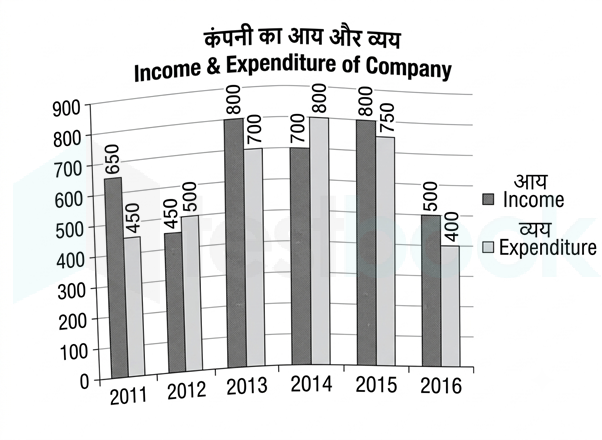
Direction : Study the graph and answer the questions given below. The bar graph shows the income and expenditure of a company from 2011 to 2016 (in crore Rs.).

33

By what percent total income from 2011 to 2013 is less than total expenditure from 2013 to 2015?

  1. ((a))

    154915 \frac{4}{9}%

  2. ((b))

    255925 \frac{5}{9}%

  3. ((c))

    155915 \frac{5}{9}%

  4. ((d))

    254925 \frac{4}{9}%

  5. ((e))

    None of the above

Show Answer
Answer: ((c))

155915 \frac{5}{9}%

Given:

From the bar graph (values in crore Rs.)

Income: 2011 = 650, 2012 = 450, 2013 = 800

Expenditure: 2013 = 700, 2014 = 800, 2015 = 750

Formula used:

Percentage less = (Difference / Reference value) × 100

Calculation:

Total income from 2011 to 2013

⇒ 650 + 450 + 800 = 1900

Total expenditure from 2013 to 2015

⇒ 700 + 800 + 750 = 2250

Difference = 2250 − 1900 = 350

Percentage by which income is less = (350 / 2250) × 100 = 155915 \frac{5}{9}%

∴ Total income from 2011 to 2013 is 155915 \frac{5}{9}% less than total expenditure from 2013 to 2015.

34

If the profit of the company increased by 25% and income increased by 20% in 2017 than 2016, what is the expenditure (in crore Rs.) of the company in 2017?

  1. ((a))

    475

  2. ((b))

    550

  3. ((c))

    425

  4. ((d))

    450

  5. ((e))

    None of the above

Show Answer
Answer: ((a))

475

Given:

Income in 2016 = 500 crore

Expenditure in 2016 = 400 crore

Profit in 2016 = 500 − 400 = 100 crore

In 2017: Income increased by 20%

Profit increased by 25%

Formula used:

New value = Old value × (1 + percentage / 100)

Expenditure = Income − Profit

Calculation:

Income in 2017 = 500 × (1 + 20/100)

⇒ 500 × 1.2 = 600

Profit in 2017 = 100 × (1 + 25/100)

⇒ 100 × 1.25 = 125

Expenditure in 2017 = 600 − 125 = 475

∴ The expenditure of the company in 2017 is 475 crore rupees.

35

What is the overall profit (in crore Rs.) is earned by the company from 2013 to 2015 ?

  1. ((a))

    200

  2. ((b))

    100

  3. ((c))

    150

  4. ((d))

    50

  5. ((e))

    None of the above

Show Answer
Answer: ((d))

50

Given:

2013 → Income = 800, Expenditure = 700

2014 → Income = 700, Expenditure = 800

2015 → Income = 800, Expenditure = 750

Formula used:

Profit / Loss = Income − Expenditure

Calculation:

Profit in 2013 = 800 − 700 = 100

Loss in 2014 = 700 − 800 = −100

Profit in 2015 = 800 − 750 = 50

Overall profit from 2013 to 2015 = 100 − 100 + 50 = 50

∴ The overall profit earned by the company from 2013 to 2015 is 50 crore rupees.

36

The profit earned by the company in 2016 is what percentage more than profit earned by the company in 2015?

  1. ((a))

    50%

  2. ((b))

    150%

  3. ((c))

    200%

  4. ((d))

    100%

  5. ((e))

    None of the above

Show Answer
Answer: ((d))

100%

Given:

Income in 2015 = 800 crore 

Expenditure in 2015 = 750 crore  

Income in 2016 = 500 crore 

Expenditure in 2016 = 400 crore 

Formula used:

Profit = Income − Expenditure

Percentage more = (Difference / Original profit) × 100

Calculation:

Profit in 2015 = 800 − 750 = 50

Profit in 2016 = 500 − 400 = 100

Difference in profit = 100 − 50 = 50

Percentage more = (50 / 50) × 100 = 100%

∴ The profit earned by the company in 2016 is 100% more than the profit earned in 2015.

37

What is the average profit (in crore Rs.) earned by the company in odd years among the given years?

  1. ((a))

    150

  2. ((b))

    116.66

  3. ((c))

    126.66

  4. ((d))

    100

  5. ((e))

    None of the above

Show Answer
Answer: ((b))

116.66

Given:

Odd years among given years = 2011, 2013, 2015

From the bar graph (values in crore Rs.)

2011 → Income = 650, Expenditure = 450

2013 → Income = 800, Expenditure = 700

2015 → Income = 800, Expenditure = 750

Formula used:

Profit = Income − Expenditure

Average profit = (Sum of profits) ÷ Number of years

Calculation:

Profit in 2011 = 650 − 450 = 200

Profit in 2013 = 800 − 700 = 100

Profit in 2015 = 800 − 750 = 50

Total profit in odd years = 200 + 100 + 50 = 350

Average profit = 350 ÷ 3 = 116.66

∴ The average profit earned by the company in odd years is 116.66 crore rupees.

38

The chemical reaction between quicklime and water to form slaked lime is characterized by

  1. ((a))

    A change in colors

  2. ((b))

    The formation of a precipitates

  3. ((c))

    A decrease in temperature

  4. ((d))

    A rise in temperature

  5. ((e))

    None of the above

Show Answer
Answer: ((d))

A rise in temperature

The correct answer is A rise in temperature.

Key Points

  • The reaction between quicklime (calcium oxide, CaO) and water (H2O) is an exothermic reaction, meaning it releases a significant amount of heat.
  • The chemical equation for the reaction is: CaO + H2O → Ca(OH)2 + Heat. Here, calcium hydroxide (slaked lime) is formed as the product.
  • The release of heat during this reaction causes the temperature to rise significantly, which is a key characteristic of this process.
  • This reaction is widely used in construction, particularly in preparing lime mortar, as the heat generation helps in setting and hardening.
  • Because of the heat produced, the reaction is considered hazardous if not handled properly, as it can cause burns or other safety issues.

Additional Information

  • Quicklime (CaO) is an important industrial chemical used in various applications such as construction, agriculture, and chemical processes.
  • Its reaction with water to form slaked lime (Ca(OH)2) is a fundamental chemical process that demonstrates the principles of exothermic reactions.
39

Which Mauryan official is credited with constructing the Sudarshan Lake as mentioned in the Girnar Rock Inscription of Rudradaman ?

  1. ((a))

    Pushyagupta

  2. ((b))

    Bhadrabahu

  3. ((c))

    Tushaspha

  4. ((d))

    Chanakya

  5. ((e))

    None of the above

Show Answer
Answer: ((a))

Pushyagupta

The correct answer is Pushyagupta.

Key Points

  • The Sudarshan Lake was originally constructed by Pushyagupta, a provincial governor (Vaishya) of the Mauryan Empire during the reign of Chandragupta Maurya.
  • The lake is mentioned in the Girnar Rock Inscription, attributed to Rudradaman I, a ruler of the Western Kshatrapas.
  • This irrigation lake played a vital role in supporting agriculture and water management in the region of Junagadh (modern-day Gujarat).
  • Rudradaman I later repaired and expanded the lake in 150 CE after it was damaged due to natural calamities.
  • The Sudarshan Lake highlights the Mauryan Empire’s advanced knowledge of engineering and water resource management systems.

Additional Information

  • Bhadrabahu:
  • Bhadrabahu was a Jain monk and spiritual leader during the Mauryan period.
  • He is known for his association with Chandragupta Maurya and is believed to have influenced the emperor to embrace Jainism.
  • Bhadrabahu is not connected with the construction of Sudarshan Lake or any engineering projects.
  • Tushaspha:
  • Tushaspha was a Greek or Persian officer in the Mauryan administration, serving as a provincial governor under Chandragupta Maurya.
  • He is known for his administrative contributions but is not associated with the Sudarshan Lake.
  • Chanakya:
  • Chanakya, also known as Kautilya or Vishnugupta, was the chief advisor and mentor of Chandragupta Maurya.
  • He is famous for his treatise, Arthashastra, which provides insights into economics, politics, and statecraft.
  • While Chanakya played a pivotal role in establishing the Mauryan Empire, he is not related to the construction of Sudarshan Lake.
40

The perimeter of a rectangle is 13 cm, and its width is 2342 \frac{3}{4}cm. Its length is

  1. ((a))

    3143 \frac{1}{4} cm

  2. ((b))

    1341 \frac{3}{4} cm

  3. ((c))

    3343 \frac{3}{4} cm

  4. ((d))

    5125 \frac{1}{2} cm

  5. ((e))

    None of the above

Show Answer
Answer: ((c))

3343 \frac{3}{4} cm

Given:

Perimeter of rectangle = 13 cm

Width = 2342 \frac{3}{4} cm = 11/4 cm

Formula used:

Perimeter of rectangle = 2 × (Length + Width)

Calculation:

⇒ 2 × (L + 11/4) = 13

⇒ L + 11/4 = 13/2

⇒ L = 13/2 − 11/4

⇒ L = (26 − 11)/4

⇒ L = 15/4

⇒ L = 3343 \frac{3}{4} cm

∴ The length of the rectangle is 3343 \frac{3}{4} cm.

41

Wage Employment Programme in India is also known as

  1. ((a))

    Swarna Jayanti Gram Swarozgar Yojana

  2. ((b))

    National Social Assistance Programme

  3. ((c))

    Sampoorna Grameen Rozgar Yojana

  4. ((d))

    Swarna Jayanti Shahari Rozgar Yojana

  5. ((e))

    None of the above

Show Answer
Answer: ((c))

Sampoorna Grameen Rozgar Yojana

The correct answer is Sampoorna Grameen Rozgar Yojana.

Key Points

  • The Sampoorna Grameen Rozgar Yojana (SGRY) was launched on 25th September 2001 by the Government of India.
  • It aimed to provide additional wage employment and food security in rural areas while also creating durable community, social, and economic infrastructure.
  • The scheme was implemented through the Panchayati Raj Institutions (PRIs) for ensuring effective decentralized governance.
  • Under this program, wages were paid in the form of both cash and food grains, making it unique in its approach.
  • The scheme was later subsumed into the Mahatma Gandhi National Rural Employment Guarantee Act (MGNREGA) in 2006.

Additional Information

  • Swarna Jayanti Gram Swarozgar Yojana (SGSY):
  • Launched in April 1999, SGSY aimed to provide self-employment opportunities to the rural poor through the formation of self-help groups (SHGs).
  • It combined several existing schemes like Integrated Rural Development Programme (IRDP) and Training of Rural Youth for Self Employment (TRYSEM).
  • The focus was on promoting micro-enterprises and providing training, credit, and subsidies for economic activities.
  • This scheme was restructured as the National Rural Livelihoods Mission (NRLM) in 2011.
  • National Social Assistance Programme (NSAP):
  • Launched on 15th August 1995, NSAP is aimed at providing financial assistance to elderly, widows, and persons with disabilities belonging to below-poverty-line (BPL) households.
  • It includes schemes like Indira Gandhi National Old Age Pension Scheme (IGNOAPS) and National Family Benefit Scheme (NFBS).
  • It is a social security program providing direct cash transfers to vulnerable sections of society.
  • Swarna Jayanti Shahari Rozgar Yojana (SJSRY):
  • Launched in 1997, this scheme aimed to provide gainful employment to the urban unemployed and underemployed poor through self-employment and wage employment.
  • It had two sub-schemes: the Urban Self-Employment Programme (USEP) and the Urban Wage Employment Programme (UWEP).
  • The scheme was replaced by the National Urban Livelihoods Mission (NULM) in 2013.
42

Where was the National Conference on "Good Governance" held on January 30-31, 2025?

  1. ((a))

    Bhopal, Madhya Pradesh

  2. ((b))

    Gandhinagar, Gujarat

  3. ((c))

    Jaipur, Rajasthan

  4. ((d))

    Lucknow, Uttar Pradesh

  5. ((e))

    None of the above

Show Answer
Answer: ((b))

Gandhinagar, Gujarat

The correct answer is Gandhinagar, Gujarat.

Key Points

  • The National Conference on "Good Governance" was held in Gandhinagar, Gujarat on January 30-31, 2025, aiming to promote efficient and transparent governance practices.
  • The conference focused on the importance of technology-enabled governance to enhance public service delivery and strengthen citizen trust.
  • It brought together policymakers, bureaucrats, and stakeholders from across the nation to discuss innovative governance models.
  • Key topics included digital transformation, ethical leadership, accountability, and people-centric administration.
  • The event emphasized the role of Gujarat in pioneering governance reforms and its contribution to India's development goals.

Additional Information

  • Bhopal, Madhya Pradesh
  • Bhopal is known for hosting prominent events and conferences, especially those related to environmental conservation and urban development.
  • It is home to the National Green Tribunal (NGT) Central Zone Bench, emphasizing the city's focus on sustainable governance.
  • Madhya Pradesh has been actively working towards improving governance through digital initiatives like Samadhan Online for grievance redressal.
  • Jaipur, Rajasthan
  • Jaipur is a hub for cultural and administrative activities, often hosting conferences on heritage conservation and tourism governance.
  • The Rajasthan government has implemented i-FMS (Integrated Financial Management System), showcasing its commitment to digital governance.
  • The city has hosted events related to local governance reforms, including e-Governance initiatives to simplify processes.
  • Lucknow, Uttar Pradesh
  • Lucknow is the administrative capital of Uttar Pradesh and frequently organizes conferences on rural development and governance.
  • The state government has introduced schemes like UP Lok Kalyan Sankalp Patra to ensure effective governance at grassroots levels.
  • Digital platforms like Jansunwai Portal have been launched to enhance transparency and citizen participation in governance.
43

The first South Asian Games held in which country?

  1. ((a))

    Laos

  2. ((b))

    Sri Lanka

  3. ((c))

    Indonesia

  4. ((d))

    Nepal

  5. ((e))

    None of the above

Show Answer
Answer: ((d))

Nepal

The correct answer is Nepal.

Key Points

  • The first-ever South Asian Games were held in Kathmandu, Nepal, in 1984.
  • Initially known as the South Asian Federation Games, the event was later renamed as the South Asian Games.
  • A total of seven nations participated in the inaugural event: Bangladesh, Bhutan, India, Maldives, Nepal, Pakistan, and Sri Lanka.
  • The games are governed by the South Asia Olympic Council and are considered an important regional multi-sport event.
  • The event promotes cooperation, goodwill, and friendly relations among the South Asian nations through sports.

Additional Information

  • Laos
  • Laos is a Southeast Asian country and is not a part of South Asia. It has never hosted the South Asian Games as it is not a member of the South Asia Olympic Council.
  • However, Laos has participated in regional sporting events such as the Southeast Asian Games.
  • Sri Lanka
  • Sri Lanka is a founding member of the South Asian Federation Games (now South Asian Games).
  • Sri Lanka hosted the South Asian Games for the first time in 1991 (the 5th edition) in Colombo.
  • Indonesia
  • Indonesia is not a South Asian country; it is part of Southeast Asia and does not participate in the South Asian Games.
  • Indonesia is more prominently known for hosting the Asian Games, a continent-wide multi-sport event, on several occasions.
44

The last British Viceroy in India was

  1. ((a))

    Rajgopalachari

  2. ((b))

    Ripon

  3. ((c))

    Lord Mountbatten

  4. ((d))

    Canning

  5. ((e))

    None of the above

Show Answer
Answer: ((c))

Lord Mountbatten

The correct answer is Lord Mountbatten.

Key Points

  • Lord Louis Mountbatten served as the last British Viceroy of India from February 1947 to August 1947.
  • He was tasked with overseeing the transition of British India to independence, which resulted in the partition of India and Pakistan.
  • Mountbatten played a crucial role in expediting the timeline for India's independence from June 1948 to August 15, 1947, to prevent further communal violence.
  • After India's independence, he became the first Governor-General of independent India and served in this role until June 1948.
  • His tenure marked one of the most significant transitions in Indian history, ending over 200 years of British colonial rule.

Additional Information

  • Rajgopalachari:
  • Chakravarti Rajagopalachari, commonly known as Rajaji, was the first and last Indian Governor-General of India.
  • He succeeded Lord Mountbatten as Governor-General in 1948 and served until 1950, after which the post was abolished, and India became a republic.
  • Rajaji was an Indian politician, independence activist, and a close associate of Mahatma Gandhi.
  • Ripon:
  • Lord Ripon served as the Viceroy of India from 1880 to 1884.
  • He is remembered for his liberal policies and reforms, including the introduction of the Ilbert Bill and the establishment of local self-governments in India.
  • Lord Ripon is often referred to as the "Father of Local Self-Government in India."
  • Canning:
  • Lord Canning was the first Viceroy of India, serving from 1858 to 1862, following the dissolution of the East India Company's rule and the establishment of British Crown rule in India.
  • He played a key role in the aftermath of the Revolt of 1857 and enacted significant reforms, including the introduction of the Indian Penal Code in 1860.

निर्देश : निम्नलिखित गद्यांश को पढ़कर पूछे गए प्रश्नों के उत्तर दीजिए ।

हिंदी साहित्य में ग्रामांचलिकता की प्रवृत्ति स्वातंत्र्योत्तर काल में पनप उठी है । महात्मा गाँधीजी के 'देहात की ओर चलो' इस नारे के अनुकरण पर ग्रामांचलिक साहित्य का आंदोलन शुरू हुआ । ग्रामीण लोगों का प्रबोधन करके उनमें चेतना जगाने का काम ग्रामांचलिक लेखकों ने किया है । वहाँ के जन-जीवन की समस्याओं को लोगों के सामने रखने का उद्देश्य ग्रामांचलिक साहित्यकारों में रहा है।

ग्रामांचलिक साहित्य का प्रारंभ सन् 1950 के पश्चात् अधिक गति से शुरू हुआ । ग्रामीण जीवन को सही अर्थ में मुखरित करने का सफल प्रयास प्रेमचंद ने किया। अपनी कहानियों और उपन्यासों के माध्यम से इन्होंने ग्रामीण जीवन का मर्मस्पर्शी चित्रण किया है । प्रेमचंद के पूर्व काल में सेठ बाँकेमल के 'घराऊ घटना’-1883, 'वसंत मालती' - 1899, 'अधखिला फूल' - 1907, 'भोजपुरी की ठगी' - 1912, 'राधाकांत' और 'अरण्यक' - 1915, मन्नन द्विवेदी द्वारा लिखित 'रामलाल' 1914, शिवपूजन सहाय द्वारा लिखित 'देहाती दुनिया' - 1925 आदि उपन्यासों में प्रारंभिक स्तर पर ग्रामांचलिकता के दर्शन होते हैं। प्रेमचंद के 'रंगभूमि', 'गोदान', 'प्रेमाश्रम' आदि उपन्यासों में ग्रामीण जीवन, पीड़ित ग्रामीणों में उभरने वाली चेतना के दर्शन होते हैं । इनके उपन्यासों में नई सामाजिक, आर्थिक व्यवस्था और परंपरागत ग्राम व्यवस्था के संक्रमण कालीन संदर्भ स्पष्ट रूप से उभरकर सामने आए हैं। जयशंकर प्रसाद के 'तितली' में ग्राम जीवन की प्रवृत्तियों की ओर इशारा किया है । इसके बाद उदयशंकर भट्ट, अमृतलाल नागर, रांगेय राघव, देवेंद्र सत्यार्थी आदि इसी लीक पर चलते रहे, जिन्होंने ग्रामांचलिकता की मध्य स्थिति को अपनाया ।

हिंदी साहित्य में आंचलिकता के उन्नायक उपन्यासकार फणीश्वरनाथ 'रेणु' रहे हैं। उनके द्वारा लिखा गया पहला आँचलिक उपन्यास 'मैला आँचल' - 1954, हिंदी का शुद्ध आँचलिक उपन्यास माना जाता है। इसके बाद आँचलिकता अधिक मात्रा में प��पती गई। आँचलिक साहित्य विविध रूपों में समृद्ध होता गया । इसका श्रेय शैलेश मटियानी, रांगेय राघव, | रामदरश मिश्र, राही मासूम रजा, हिमांशु जोशी, भैरवप्रसाद गुप्त, जगदंबाप्रसाद, जगदीश गुप्त, अमृतलाल नागर, श्याम परमार, शिव प्रसाद सिंह, विवेकी राय आदि को दिया जा सकता है। सन् 1960 के पश्चात् ग्रामांचलिक धारा अधिक बलवती बनी । इसमें कविता, कहानी, उपन्यास, निबंध, रिपोर्ताज, रेखाचित्र आदि को यथावत स्थान प्राप्त हुआ ।

45

किस उपन्यासकार द्वारा लिखा गया पहला आँचलिक उपन्यास 'मैला आँचल' - 1954, हिन्दी का शुद्ध आँचलिक उपन्यास माना जाता है ?

  1. ((a))

    भैरवप्रसाद गुप्त

  2. ((b))

    जगदंबाप्रसाद

  3. ((c))

    फणीश्वरनाथ 'रेणु'

  4. ((d))

    रांगेय राघव

  5. ((e))

    उपर्युक्त में से कोई नहीं

Show Answer
Answer: ((c))

फणीश्वरनाथ 'रेणु'

सही उत्तर है- फणीश्वरनाथ 'रेणु'

Key Pointsव्याख्या-

  • प्रश्न में स्वयं उल्लेख है कि "हिंदी साहित्य में आंचलिकता के उन्नायक उपन्यासकार फणीश्वरनाथ 'रेणु' रहे हैं।
  • उनके द्वारा लिखा गया पहला आँचलिक उपन्यास 'मैला आँचल' - 1954, हिंदी का शुद्ध आँचलिक उपन्यास माना जाता है।"

Important Points

  • यह कथन पूर्णतः सही है।
  • 'मैला आँचल' (1954) फणीश्वरनाथ 'रेणु' द्वारा लिखित है और हिंदी साहित्य में इसे पहला शुद्ध आंचलिक उपन्यास माना जाता है।
  • यह बिहार के पूर्णिया जिले के ग्रामीण अंचल (मेरीगंज) की पृष्ठभूमि पर आधारित है, जिसमें स्थानीय बोली, लोक-संस्कृति, ग्रामीण जीवन की समस्याएँ और स्वतंत्रता के बाद का परिवेश जीवंत रूप से चित्रित है।
  • अन्य विकल्प (भैरवप्रसाद गुप्त, जगदंबाप्रसाद, रांगेय राघव आदि) आंचलिक साहित्य के महत्वपूर्ण लेखक हैं, लेकिन 'मैला आँचल' इनमें से किसी का नहीं है।
  • रेणु को ही आंचलिक उपन्यास की परंपरा का प्रवर्तक/उन्नायक माना जाता है।

निर्देश : निम्नलिखित गद्यांश को पढ़कर पूछे गए प्रश्नों के उत्तर दीजिए ।

हिंदी साहित्य में ग्रामांचलिकता की प्रवृत्ति स्वातंत्र्योत्तर काल में पनप उठी है । महात्मा गाँधीजी के 'देहात की ओर चलो' इस नारे के अनुकरण पर ग्रामांचलिक साहित्य का आंदोलन शुरू हुआ । ग्रामीण लोगों का प्रबोधन करके उनमें चेतना जगाने का काम ग्रामांचलिक लेखकों ने किया है । वहाँ के जन-जीवन की समस्याओं को लोगों के सामने रखने का उद्देश्य ग्रामांचलिक साहित्यकारों में रहा है।

ग्रामांचलिक साहित्य का प्रारंभ सन् 1950 के पश्चात् अधिक गति से शुरू हुआ । ग्रामीण जीवन को सही अर्थ में मुखरित करने का सफल प्रयास प्रेमचंद ने किया। अपनी कहानियों और उपन्यासों के माध्यम से इन्होंने ग्रामीण जीवन का मर्मस्पर्शी चित्रण किया है । प्रेमचंद के पूर्व काल में सेठ बाँकेमल के 'घराऊ घटना’-1883, 'वसंत मालती' - 1899, 'अधखिला फूल' - 1907, 'भोजपुरी की ठगी' - 1912, 'राधाकांत' और 'अरण्यक' - 1915, मन्नन द्विवे��ी द्वारा लिखित 'रामलाल' 1914, शिवपूजन सहाय द्वारा लिखित 'देहाती दुनिया' - 1925 आदि उपन्यासों में प्रारंभिक स्तर पर ग्रामांचलिकता के दर्शन होते हैं। प्रेमचंद के 'रंगभूमि', 'गोदान', 'प्रेमाश्रम' आदि उपन्यासों में ग्रामीण जीवन, पीड़ित ग्रामीणों में उभरने वाली चेतना के दर्शन होते हैं । इनके उपन्यासों में नई सामाजिक, आर्थिक व्यवस्था और परंपरागत ग्राम व्यवस्था के संक्रमण कालीन संदर्भ स्पष्ट रूप से उभरकर सामने आए हैं। जयशंकर प्रसाद के 'तितली' में ग्राम जीवन की प्रवृत्तियों की ओर इशारा किया है । इसके बाद उदयशंकर भट्ट, अमृतलाल नागर, रांगेय राघव, देवेंद्र सत्यार्थी आदि इसी लीक पर चलते रहे, जिन्होंने ग्रामांचलिकता की मध्य स्थिति को अपनाया ।

हिंदी साहित्य में आंचलिकता के उन्नायक उपन्यासकार फणीश्वरनाथ 'रेणु' रहे हैं। उनके द्वारा लिखा गया पहला आँचलिक उपन्यास 'मैला आँचल' - 1954, हिंदी का शुद्ध आँचलिक उपन्यास माना जाता है। इसके बाद आँचलिकता अधिक मात्रा में पनपती गई। आँचलिक साहित्य विविध रूपों में समृद्ध होता गया । इसका श्रेय शैलेश मटियानी, रांगेय राघव, | रामदरश मिश्र, राही मासूम रजा, हिमांशु जोशी, भैरवप्रसाद गुप्त, जगदंबाप्रसाद, जगदीश गुप्त, अमृतलाल नागर, श्याम परमार, शिव प्रसाद सिंह, विवेकी राय आदि को दिया जा सकता है। सन् 1960 के पश्चात् ग्रामांचलिक धारा अधिक बलवती बनी । इसमें कविता, कहानी, उपन्यास, निबंध, रिपोर्ताज, रेखाचित्र आदि को यथावत स्थान प्राप्त हुआ ।

46

किस उपन्यासकार के प्रमुख उपन्यास 'रंगभूमि', 'गोदान', 'प्रेमाश्रम' आदि उपन्यासों में ग्रामीण जीवन, पीड़ित ग्रामीणों `में उभरने वाली चेतना के दर्शन होते हैं ? -

  1. ((a))

    कमलेश्वर

  2. ((b))

    प्रेमचंद

  3. ((c))

    जयशंकर प्रसाद

  4. ((d))

    यशपाल

  5. ((e))

    उपर्युक्त में से कोई नहीं

Show Answer
Answer: ((b))

प्रेमचंद

सही उत्तर है- प्रेमचंद

Key Pointsव्याख्या:

  • प्रश्न में उल्लिखित प्रमुख उपन्यास 'रंगभूमि', 'गोदान', 'प्रेमाश्रम' मुंशी प्रेमचंद द्वारा लिखित हैं। इन उपन्यासों में प्रेमचंद ने ग्रामीण जीवन का मर्मस्पर्शी चित्रण किया है, विशेष रूप से पीड़ित ग्रामीणों (किसानों) में उभरने वाली चेतना, जमींदारी प्रथा, शोषण, सामाजिक-आर्थिक संक्रमण और नई व्यवस्था के प्रभाव को स्पष्ट रूप से दर्शाया है।
  • प्रेमाश्रम (1922): प्रेमचंद का किसान जीवन पर पहला प्रमुख उपन्यास, जिसमें अवध के किसान आंदोलनों का संदर्भ है।
  • रंगभूमि (1925): पूंजीवाद, नौकरशाही और ग्रामीण जनसंघर्ष का चित्रण, सूरदास जैसे पात्र के माध्यम से ग्रामीण पीड़ा और प्रतिरोध।
  • गोदान (1936): प्रेमचंद की अंतिम और सर्वश्रेष्ठ कृति मानी जाती है, जिसमें होरी जैसे किसान का जीवन, गरीबी, शोषण और ग्रामीण चेतना का जीवंत चित्रण है।

Important Points

  • ये सभी रचनाएँ प्रेमचंद की ग्रामांचलिक/ग्रामीण यथार्थवादी धारा की प्रतिनिधि हैं।

Additional Informationअन्य विकल्प:

  • कमलेश्वर: नई कहानी आंदोलन के प्रमुख लेखक, ग्रामीण चित्रण है लेकिन ये उपन्यास उनके नहीं।
  • जयशंकर प्रसाद: छायावादी कवि/नाटककार, 'तितली' में ग्राम जीवन का इशारा है लेकिन ये उपन्यास उनके नहीं।
  • यशपाल: प्रगतिवादी लेखक, सामाजिक उपन्यास लिखे लेकिन ये विशिष्ट उपन्यास उनके नहीं।

निर्देश : निम्नलिखित गद्यांश को पढ़कर पूछे गए प्रश्नों के उत्तर दीजिए ।

हिंदी साहित्य में ग्रामांचलिकता की प्रवृत्ति स्वातंत्र्योत्तर काल में पनप उठी है । महात्मा गाँधीजी के 'देहात की ओर चलो' इस नारे के अनुकरण पर ग्रामांचलिक साहित्य का आंदोलन शुरू हुआ । ग्रामीण लोगों का प्रबोधन करके उनमें चेतना जगाने का काम ग्रामांचलिक लेखकों ने किया है । वहाँ के जन-जीवन की समस्याओं को लोगों के सामने रखने का उद्देश्य ग्रामांचलिक साहित्यकारों में रहा है।

ग्रामांचलिक साहित्य का प्रारंभ सन् 1950 के पश्चात् अधिक गति से शुरू हुआ । ग्रामीण जीवन को सही अर्थ में मुखरित करने का सफल प्रयास प्रेमचंद ने किया। अपनी कहानियों और उपन्यासों के माध्यम से इन्होंने ग्रामीण जीवन का मर्मस्पर्शी चित्रण किया है । प्रेमचंद के पूर्व काल में सेठ बाँकेमल के 'घराऊ घटना’-1883, 'वसंत मालती' - 1899, 'अधखिला फूल' - 1907, 'भोजपुरी की ठगी' - 1912, 'राधाकांत' और 'अरण्यक' - 1915, मन्नन द्विवेदी द्वारा लिखित 'रामलाल' 1914, शिवपूजन सहाय द्वारा लिखित 'देहाती दुनिया' - 1925 आदि उपन्यासों में प्रारंभिक स्तर पर ग्रामांचलिकता के दर्शन होते हैं। प्रेमचंद के 'रंगभूमि', 'गोदान', 'प्रेमाश्रम' आदि उपन्यासों में ग्रामीण जीवन, पीड़ित ग्रामीणों में उभरने वाली चेतना के दर्शन होते हैं । इनके उपन्यासों में नई सामाजिक, आर्थिक व्यवस्था और परंपरागत ग्राम व्यवस्था के संक्रमण कालीन संदर्भ स्पष्ट रूप से उभरकर सामने आए हैं। जयशंकर प्रसाद के 'तितली' में ग्राम जीवन की प्रवृत्तियों की ओर इशारा किया है । इसके बाद उदयशंकर भट्ट, अमृतलाल नागर, रांगेय राघव, देवेंद्र सत्यार्थी आदि इसी लीक पर चलते रहे, जिन्होंने ग्रामांचलिकता की मध्य स्थिति को अपनाया ।

हिंदी साहित्य में आंचलिकता के उन्नायक उपन्यासकार फणीश्वरनाथ 'रेणु' रहे हैं। उनके द्वारा लिखा गया पहला आँचलिक उपन्यास 'मैला आँचल' - 1954, हिंदी का शुद्ध आँचलिक उपन्यास माना जाता है। इसके बाद आँचलिकता अधिक मात्रा में पनपती गई। आँचलिक साहित्य विविध रूपों में समृद्ध होता गया । इसका श्रेय शैलेश मटियानी, रांगेय राघव, | रामदरश मिश्र, राही मासूम रजा, हिमांशु जोशी, भैरवप्रसाद गुप्त, जगदंबाप्रसाद, जगदीश गुप्त, अमृतलाल नागर, श्याम परमार, शिव प्रसाद सिंह, विवेकी राय आदि को दिया जा सकता है। सन् 1960 के पश्चात् ग्रामांचलिक धारा अधिक बलवती बनी । इसमें कविता, कहानी, उपन्यास, निबंध, रिपोर्ताज, रेखाचित्र आदि को यथावत स्थान प्राप्त हुआ ।

47

किसने 'देहात की ओर चलो' इस नारे के अनुकरण पर ग्रामांचलिक साहित्य का आंदोलन शुरू किया ?

  1. ((a))

    दयानंद सरस्वती

  2. ((b))

    महात्मा फुले

  3. ((c))

    महात्मा गाँधी

  4. ((d))

    जवाहरलाल नेहरू

  5. ((e))

    उपर्युक्त में से कोई नहीं

Show Answer
Answer: ((c))

महात्मा गाँधी

सही उत्तर है- महात्मा गाँधी

Key Pointsव्याख्या:

  • प्रश्न में दिए गए संदर्भ के अनुसार ही, "महात्मा गाँधीजी के 'देहात की ओर चलो' इस नारे के अनुकरण पर ग्रामांचलिक साहित्य का आंदोलन शुरू हुआ"।
  • यह नारा महात्मा गांधी द्वारा दिया गया था, जिसमें उन्होंने स्वतंत्रता संग्राम के दौरान और स्वदेशी आंदोलन में ग्रामीण भारत (देहात/गाँव) की ओर ध्यान केंद्रित करने, ग्रामीणों के उत्थान, ग्राम स्वराज और देहाती जीवन की महत्ता पर जोर दिया। गांधीजी ने बार-बार "गाँवों की ओर चलो" या "देहात की ओर" जैसी भावना व्यक्त की, विशेष रूप से खादी, ग्रामोद्योग और ग्रामीण विकास के संदर्भ में।
  • हिंदी साहित्य में ग्रामांचलिक/आंचलिक धारा (विशेषकर स्वातंत्र्योत्तर काल में) इसी नारे से प्रेरित होकर पनपी, जहाँ लेखकों ने ग्रामीण जीवन, किसानों की पीड़ा और चेतना को केंद्र में रखा।

Additional Informationअन्य विकल्प:

  • दयानंद सरस्वती: "वेदों की ओर लौटो" (Back to Vedas) का नारा दिया।
  • महात्मा फुले: दलित/शोषित वर्गों के उत्थान पर कार्य, लेकिन यह नारा उनका नहीं।
  • जवाहरलाल नेहरू: आधुनिक भारत के निर्माण पर जोर, लेकिन "देहात की ओर चलो" उनका नहीं।
48

शिवपूजन सहाय द्वारा लिखित _______ 1925 आदि उपन्यासों में प्रारंभिक स्तर पर ग्रामांचलिकता के दर्शन होते हैं ।

  1. ((a))

    देहाती दुनिया

  2. ((b))

    अरण्यक

  3. ((c))

    घराऊ घटना

  4. ((d))

    रामलाल

  5. ((e))

    उपर्युक्त में से कोई नहीं

Show Answer
Answer: ((a))

देहाती दुनिया

सही उत्तर- देहाती दुनिया

Key Points

  • गद्यांश में स्पष्ट रूप से उल्लेख है कि शिवपूजन सहाय द्वारा लिखित 'देहाती दुनिया' (1925) में प्रारंभिक स्तर पर ग्रामांचलिकता के दर्शन होते हैं।
  • यह उपन्यास ग्रामीण जीवन के चित्रण के कारण ग्रामांचलिक साहित्य की आरंभिक कृतियों में गिना जाता है।
  • अतः दिए गए विकल्पों में सही उत्तर देहाती दुनिया है।

अन्य विकल्प:

  • अरण्यक: यह कृति सेठ बाँकेमल से संबंधित है, शिवपूजन सहाय से नहीं।
  • घराऊ घटना: यह भी सेठ बाँकेमल की रचना है।
  • रामलाल: यह मन्नन द्विवेदी द्वारा लिखित उपन्यास है।
  • उपर्युक्त में से कोई नहीं: यह विकल्प गलत है क्योंकि सही उत्तर विकल्प 1 में उपलब्ध है।
49

ग्रामांचलिक साहित्य का प्रारंभ सन् _______ के पश्चात् अधिक गति से शुरू हुआ ।

  1. ((a))

    1950

  2. ((b))

    1952

  3. ((c))

    1945

  4. ((d))

    1954

  5. ((e))

    उपर्युक्त में से कोई नहीं

Show Answer
Answer: ((a))

1950

सही उत्तर- 1950

Key Points

  • गद्यांश में स्पष्ट रूप से उल्लेख है कि ग्रामांचलिक साहित्य का प्रारंभ सन् 1950 के पश्चात् अधिक गति से शुरू हुआ
  • स्वातंत्र्योत्तर काल में ग्राम जीवन की समस्याओं और चेतना को प्रमुखता से साहित्य में स्थान मिला।
  • अतः दिए गए विकल्पों में सही उत्तर 1950 है।

अन्य विकल्प:

  • 1952, 1945, 1954: इन वर्षों का उल्लेख ग्रामांचलिक साहित्य के प्रारंभ के संदर्भ में गद्यांश में नहीं किया गया है।
  • उपर्युक्त में से कोई नहीं: यह विकल्प गलत है क्योंकि सही उत्तर विकल्प 1 में दिया गया है।

निर्देश : निम्नलिखित गद्यांश को पढ़कर पूछे गए प्रश्नों के उत्तर दीजिए ।

आज हिंदी भाषा जिस रूप में बोली और समझी जाती है वह खड़ी बोली का ही साहित्यिक भाषा रूप है, जिसका विकास मुख्यत: उन्नीसवीं शताब्दी में हुआ । खड़ी बोली का प्राचीन रूप दसवीं शताब्दी से मिलता है किन्तु चौदहवीं शताब्दी के प्रारंभ में अमीर खुसरो ने पहली बार खड़ी बोली में कविता की रचना की । मध्यकाल तक खड़ी बोली मुख्यतः बोलचाल की भाषा के रूप में ही प्रचलित थी । उस युग में ब्रजभाषा और अवधी काव्य की भाषा थी । ब्रजभाषा को सूरदास ने, अवधी को तुलसीदास ने और मैथिली को विद्यापति ने सिंचित और पल्लवित किया । उस समय फारसी राजदरबार में राजकाज की भाषा हुआ करती थी । अत: इन्हीं कारणों से खड़ी बोली उपेक्षित-सी रही, लेकिन समस्त उत्तर भारत में जनसंपर्क की यही एकमात्र सशक्त भाषा थी ।

19 वीं और 20 वीं शताब्दी में जब ज्ञान-विज्ञान का प्रसार हुआ तो खड़ी बोली सहज रूप से सर्वग्राह्य भाषा के रूप में तथा जनसंपर्क की भाषा के रूप में उभर कर सामने आई क्योंकि यही सबसे अधिक व्यापक थी ।

संसार में अंग्रेजी व चीनी भाषा के बाद हिंदी बोलने वालों की संख्या सर्वाधिक है । मुद्रण के आविष्कार, भारत में अंग्रेजी गद्य साहित्य के प्रसार, राजनीतिक जागरूकता के उद्भव, पत्र-पत्रिकाओं के प्रकाशन, जनसाधारण तक पहुँचने की आवश्यकता आदि कारणों ने खड़ी बोली से विकसित हिंदी को सम्पूर्ण भारत की सर्वाधिक प्रयोग की जाने वाली जनसम्पर्क की भाषा के रूप में स्थापित कर दिया । इसी अवधि में भारतेन्दु हरिश्चंद्र महावीर प्रसाद द्विवेदी और प्रेमचन्द आदि ने हिंदी गद्य को निखारने व परिष्कृत करने में योगदान दिया । जन समुदायों को संबोधित करने के लिए गाँधी, तिलक, दयानन्द सरस्वती आदि राजनैतिक और धार्मिक नेताओं ने हिंदी का प्रयोग किया ।

सन् 1949 ई. में संविधान में देश की राजभाषा के रूप में स्वीकृत होने के पश्चात् इसने अब एक राष्ट्रीय तथा अन्तर्राष्ट्रीय स्थान प्राप्त कर लिया है । देश के अधिकतर राज्यों में शासन और शिक्षा की भाषा हिंदी है। पंजाब, गुजरात और महाराष्ट्र ने इसे द्वितीय भाषा के रूप में मान्यता दी है ।

50

सन् _______ ई. में संविधान में देश की राजभाषा के रूप में स्वीकृत होने के पश्चात् इसने अब एक राष्ट्रीय तथा अंतर्राष्ट्रीय स्थान प्राप्त कर लिया है।

  1. ((a))

    1948

  2. ((b))

    1949

  3. ((c))

    1947

  4. ((d))

    1952

  5. ((e))

    उपर्युक्त में से कोई नहीं

Show Answer
Answer: ((b))

1949

सही उत्तर- 1949

Key Points

  • गद्यांश में स्पष्ट रूप से उल्लेख है कि सन् 1949 ई. में संविधान में हिंदी को देश की राजभाषा के रूप में स्वीकृत किया गया।
  • राजभाषा के रूप में स्वीकृति मिलने के बाद हिंदी को राष्ट्रीय तथा अंतर्राष्ट्रीय स्तर पर पहचान प्राप्त हुई।
  • अतः दिए गए विकल्पों में सही उत्तर विकल्प 2 (1949) है।

अन्य विकल्प:

  • 1948: गद्यांश में इस वर्ष का उल्लेख नहीं है।
  • 1947: यह भारत की स्वतंत्रता का वर्ष है, राजभाषा स्वीकृति का नहीं।
  • 1952: यह वर्ष गद्यांश के अनुसार सही नहीं है।
  • उपर्युक्त में से कोई नहीं: यह विकल्प भी गलत है क्योंकि सही उत्तर 1949 उपलब्ध है।
51

संसार में अंग्रेजी व _______ भाषा के बाद हिन्दी बोलने वालों की संख्या सर्वाधिक है ।

  1. ((a))

    ग्रीक

  2. ((b))

    रुसी

  3. ((c))

    फ्रेंच

  4. ((d))

    चीनी

  5. ((e))

    उपर्युक्त में से कोई नहीं

Show Answer
Answer: ((d))

चीनी

सही उत्तर- चीनी

Key Points

  • गद्यांश में स्पष्ट रूप से उल्लेख है कि संसार में अंग्रेजी व चीनी भाषा के बाद हिंदी बोलने वालों की संख्या सर्वाधिक है।
  • अतः रिक्त स्थान में चीनी शब्द उपयुक्त है।
  • इसलिए सही उत्तर विकल्प 4 (चीनी) है।

अन्य विकल्प:

  • ग्रीक: गद्यांश में इसका उल्लेख नहीं है।
  • रूसी: यह भी गद्यांश के अनुसार सही नहीं है।
  • फ्रेंच: इसका भी संदर्भ नहीं दिया गया है।
  • उपर्युक्त में से कोई नहीं: यह विकल्प गलत है क्योंकि सही उत्तर उपलब्ध है।
52

मुख्यतः खड़ी बोली का विकास किस शताब्दी में हुआ ?

  1. ((a))

    चौदहवीं

  2. ((b))

    पंद्रहवीं

  3. ((c))

    उन्नीसवीं

  4. ((d))

    आठरहवीं

  5. ((e))

    उपर्युक्त में से कोई नहीं

Show Answer
Answer: ((c))

उन्नीसवीं

सही उत्तर- उन्नीसवीं

Key Points

  • गद्यांश में स्पष्ट रूप से उल्लेख है कि खड़ी बोली का साहित्यिक भाषा रूप का विकास मुख्यतः उन्नीसवीं शताब्दी में हुआ।
  • यद्यपि इसका प्राचीन रूप दसवीं शताब्दी से मिलता है, परन्तु व्यापक विकास उन्नीसवीं शताब्दी में हुआ।
  • अतः सही उत्तर विकल्प 3 (उन्नीसवीं) है।

अन्य विकल्प:

  • चौदहवीं: इस शताब्दी में अमीर खुसरो ने रचना की, पर विकास मुख्यतः नहीं हुआ।
  • पंद्रहवीं: गद्यांश में इसका उल्लेख नहीं है।
  • आठरहवीं: यह भी सही नहीं है।
  • उपर्युक्त में से कोई नहीं: यह विकल्प गलत है क्योंकि सही उत्तर उपलब्ध है।

निर्देश : निम्नलिखित गद्यांश को पढ़कर पूछे गए प्रश्नों के उत्तर दीजिए ।

आज हिंदी भाषा जिस रूप में बोली और समझी जाती है वह खड़ी बोली का ही साहित्यिक भाषा रूप है, जिसका विकास मुख्यत: उन्नीसवीं शताब्दी में हुआ । खड़ी बोली का प्राचीन रूप दसवीं शताब्दी से मिलता है किन्तु चौदहवीं शताब्दी के प्रारंभ में अमीर खुसरो ने पहली बार खड़ी बोली में कविता की रचना की । मध्यकाल तक खड़ी बोली मुख्यतः बोलचाल की भाषा के रूप में ही प्रचलित थी । उस युग में ब्रजभाषा और अवधी काव्य की भाषा थी । ब्रजभाषा को सूरदास ने, अवधी को तुलसीदास ने और मैथिली को विद्यापति ने सिंचित और पल्लवित किया । उस समय फारसी राजदरबार में राजकाज की भाषा हुआ करती थी । अत: इन्हीं कारणों से खड़ी बोली उपेक्षित-सी रही, लेकिन समस्त उत्तर भारत में जनसंपर्क की यही एकमात्र सशक्त भाषा थी ।

19 वीं और 20 वीं शताब्दी में ���ब ज्ञान-विज्ञान का प्रसार हुआ तो खड़ी बोली सहज रूप से सर्वग्राह्य भाषा के रूप में तथा जनसंपर्क की भाषा के रूप में उभर कर सामने आई क्योंकि यही सबसे अधिक व्यापक थी ।

संसार में अंग्रेजी व चीनी भाषा के बाद हिंदी बोलने वालों की संख्या सर्वाधिक है । मुद्रण के आविष्कार, भारत में अंग्रेजी गद्य साहित्य के प्रसार, राजनीतिक जागरूकता के उद्भव, पत्र-पत्रिकाओं के प्रकाशन, जनसाधारण तक पहुँचने की आवश्यकता आदि कारणों ने खड़ी बोली से विकसित हिंदी को सम्पूर्ण भारत की सर्वाधिक प्रयोग की जाने वाली जनसम्पर्क की भाषा के रूप में स्थापित कर दिया । इसी अवधि में भारतेन्दु हरिश्चंद्र महावीर प्रसाद द्विवेदी और प्रेमचन्द आदि ने हिंदी गद्य को निखारने व परिष्कृत करने में योगदान दिया । जन समुदायों को संबोधित करने के लिए गाँधी, तिलक, दयानन्द सरस्वती आदि राजनैतिक और धार्मिक नेताओं ने हिंदी का प्रयोग किया ।

सन् 1949 ई. में संविधान में देश की राजभाषा के रूप में स्वीकृत होने के पश्चात् इसने अब एक राष्ट्रीय तथा अन्तर्राष्ट्रीय स्थान प्राप्त कर लिया है । देश के अधिकतर राज्यों में शासन और शिक्षा की भाषा हिंदी है। पंजाब, गुजरात और महाराष्ट्र ने इसे द्वितीय भाषा के रूप में मान्यता दी है ।

53

ब्रजभाषा को सूरदास जी ने, अवधी को तुलसीदास जी ने और मैथिली को किसने सिंचित और पल्लवित किया ?

  1. ((a))

    घनानंद

  2. ((b))

    विद्यापति

  3. ((c))

    सरला दास

  4. ((d))

    रसखान

  5. ((e))

    उपर्युक्त में से कोई नहीं

Show Answer
Answer: ((b))

विद्यापति

सही उत्तर- विद्यापति

Key Points

  • गद्यांश में स्पष्ट उल्लेख है कि ब्रजभाषा को सूरदास ने, अवधी को तुलसीदास ने और मैथिली को विद्यापति ने सिंचित और पल्लवित किया।
  • अतः दिए गए विकल्पों में सही उत्तर विकल्प 2 (विद्यापति) है।

अन्य विकल्प:

  • घनानंद: गद्यांश में इनका उल्लेख इस संदर्भ में नहीं है।
  • सरला दास: यह उत्तर गद्यांश के अनुसार सही नहीं है।
  • रसखान: इनका भी उल्लेख इस संदर्भ में नहीं किया गया है।
  • उपर्युक्त में से कोई नहीं: यह विकल्प गलत है क्योंकि सही उत्तर उपलब्ध है।

निर्देश : निम्नलिखित गद्यांश को पढ़कर पूछे गए प्रश्नों के उत्तर दीजिए ।

आज हिंदी भाषा जिस रूप में बोली और समझी जाती है वह खड़ी बोली का ही साहित्यिक भाषा रूप है, जिसका विकास मुख्यत: उन्नीसवीं शताब्दी में हुआ । खड़ी बोली का प्राचीन रूप दसवीं शताब्दी से मिलता है किन्तु चौदहवीं शताब्दी के प्रारंभ में अमीर खुसरो ने पहली बार खड़ी बोली में कविता की रचना की । मध्यकाल तक खड़ी बोली मुख्यतः बोलचाल की भाषा के रूप में ही प्रचलित थी । उस युग में ब्रजभाषा और अवधी काव्य की भाषा थी । ब्रजभाषा को सूरदास ने, अवधी को तुलसीदास ने और मैथिली को विद्यापति ने सिंचित और पल्लवित किया । उस समय फारसी राजदरबार में राजकाज की भाषा हुआ करती थी । अत: इन्हीं कारणों से खड़ी बोली उपेक्षित-सी रही, लेकिन समस्त उत्तर भारत में जनसंपर्क की यही एकमात्र सशक्त भाषा थी ।

19 वीं और 20 वीं शताब्दी में जब ज्ञान-विज्ञान का प्रसार हुआ तो खड़ी बोली सहज रूप से सर्वग्राह्य भाषा के रूप में तथा जनसंपर्क की भाषा के रूप में उभर कर सामने आई क्योंकि यही सबसे अधिक व्यापक थी ।

संसार में अंग्रेजी व चीनी भाषा के बाद हिंदी बोलने वालों की संख्या सर्वाधिक है । मुद्रण के आविष्कार, भारत में अंग्रेजी गद्य साहित्य के प्रसार, राजनीतिक जागरूकता के उद्भव, पत्र-पत्रिकाओं के प्रकाशन, जनसाधारण तक पहुँचने की आवश्यकता आदि कारणों ने खड़ी बोली से विकसित हिंदी को सम्पूर्ण भारत की सर्वाधिक प्रयोग की जाने वाली जनसम्पर्क की भाषा के रूप में स्थापित कर दिया । इसी अवधि में भारतेन्दु हरिश्चंद्र महावीर प्रसाद द्विवेदी और प्रेमचन्द आदि ने हिंदी गद्य को निखारने व परिष्कृत करने में योगदान दिया । जन समुदायों को संबोधित करने के लिए गाँधी, तिलक, दयानन्द सरस्वती आदि राजनैतिक और धार्मिक नेताओं ने हिंदी का प्रयोग किया ।

सन् 1949 ई. में संविधान में देश की राजभाषा के रूप में स्वीकृत होने के पश्चात् इसने अब एक राष्ट्रीय तथा अन्तर्राष्ट्रीय स्थान प्राप्त कर लिया ह��� । देश के अधिकतर राज्यों में शासन और शिक्षा की भाषा हिंदी है। पंजाब, गुजरात और महाराष्ट्र ने इसे द्वितीय भाषा के रूप में मान्यता दी है ।

54

किस कवि ने चौदहवीं शताब्दी के प्रारंभ में खड़ी बोली में कविता की रचना की ?

  1. ((a))

    अमीर खुसरो

  2. ((b))

    सरला दास

  3. ((c))

    विध्यति

  4. ((d))

    दूर्जट

  5. ((e))

    उपर्युक्त में से कोई नहीं

Show Answer
Answer: ((a))

अमीर खुसरो

सही उत्तर- अमीर खुसरो

Key Points

  • गद्यांश में स्पष्ट रूप से उल्लेख है कि चौदहवीं शताब्दी के प्रारंभ में अमीर खुसरो ने पहली बार खड़ी बोली में कविता की रचना की।
  • अतः सही उत्तर विकल्प 1 (अमीर खुसरो) है।

अन्य विकल्प:

  • सरला दास: गद्यांश के अनुसार सही नहीं है।
  • विद्यापति: इन्होंने मैथिली को सिंचित और पल्लवित किया, खड़ी बोली में प्रारंभिक रचना नहीं की।
  • दूर्जट: इनका उल्लेख इस संदर्भ में नहीं है।
  • उपर्युक्त में से कोई नहीं: यह विकल्प गलत है क्योंकि सही उत्तर उपलब्ध है।
55

'नाच' तद्भव शब्द है, उसका तत्सम शब्द _______ है |

  1. ((a))

    दस

  2. ((b))

    नव

  3. ((c))

    नृत्य

  4. ((d))

    नेह

  5. ((e))

    उपर्युक्त में से कोई नहीं

Show Answer
Answer: ((c))

नृत्य

सही उत्तर है**- नृत्य**। 

Key Points

  • तत्सम (तत् + सम = उसके समान) आधुनिक भारतीय भाषाओं में प्रयुक्त ऐसे शब्द जिनको संस्कृत से बिना कोई रूप बदले ले लिया गया है।
  • तद्भव शब्द वे शब्द जो संस्कृत से हिन्दी में आये परन्तु धीरे-धीरे परिवर्तित हो गये।
  • जैसे - दधि से दही क्षेत्र से खेत हस्ती से हाथी कंटक से काँटा सर्प से साँप आदि।

अन्य विकल्प :

तत्सम  शब्दतद्भव शब्द
दशदस
नवनौ
स्नेहनेह

Additional Informationअन्य उदाहरण:

तत्सम  शब्दतद्भव शब्द
अनार्यअनाड़ी
अगम्यअचरज
अक्षरअच्छर
अग्निआग
आमलकआँवला
अमूल्यअमोल
आश्विनआसोज
56

'जो अनुकरण करने योग्य हो' उसे ______ कहते हैं ।

  1. ((a))

    अनुकरणीय

  2. ((b))

    अकथनीय

  3. ((c))

    अज्ञेय

  4. ((d))

    अभूतपूर्व

  5. ((e))

    उपर्युक्त में से कोई नहीं

Show Answer
Answer: ((a))

अनुकरणीय

सही उत्तर है**- अनुकरणीय**।

Key Points

  • अनुकरणीय' का अर्थ है - नकल करने योग्य।
  • वाक्यांश शब्दों का वह समूह है जो वाक्य का हिस्सा तो होता हैलेकिन अपने आप में पूर्ण अर्थ नहीं देता।
  • इसमें कर्ता और क्रिया का अभाव होता है और यह संज्ञाविशेषण या क्रियाविशेषण की तरह कार्य करता है।

अन्य विकल्प :

वाक्यांशशब्द
जिसे शब्दों में न कहा जा सकेअकथनीय
जिसे जाना न जा सकेअज्ञेय
जो पहले घटित न हुआ हो"अभूतपूर्व


Additional Informationवाक्यांश के अन्य उदहारण :

वाक्यांशशब्द
जो पढ़ा-लिखा न होअनपढ़
जिसका कोई शत्रु न होअजातशत्रु
जो कम जानता होअल्पज्ञ
जो बहुत बोलता होवाचाल
जो सब कुछ जानता होसर्वज्ञ
जो कभी न मरेअमर
57

'इंटरनेट क्रांति' निबंध में इंटरनेट के बारे में चर्चा की है, इंटरनेट का अर्थ _______ है ।

  1. ((a))

    संबंध

  2. ((b))

    नजरिया

  3. ((c))

    अंतर्जाल

  4. ((d))

    जानकारी

  5. ((e))

    उपर्युक्त में से कोई नहीं

Show Answer
Answer: ((c))

अंतर्जाल

सही उत्तर है - अंतर्जाल

Key Points

  • इंटरनेट दुनिया भर के कंप्यूटरों और अन्य इलेक्ट्रॉनिक उपकरणों का एक विशाल वैश्विक नेटवर्क है, जो उन्हें आपस में जोड़ता है
  • जो उन्हें आपस में जोड़ता है और सूचनाओं (जैसे टेक्स्ट, इमेज, वीडियो) और सेवाओं के आदान-प्रदान की सुविधा देता है
  • अंतरजाल का अर्थ - भिन्न भिन्न कंप्यूटर से बना हुआ एक बहुत बड़ा सम्बंध है।
  • इसमें दुनिया के अलग अलग कोने में स्थित कम्प्यूटर www के माध्यम से जुड़े रहते हैं।

Additional Informationअन्य विकल्पं :

  • संबंध का अर्थ - है दो या अधिक व्यक्तियोंवस्तुओंया विचारों के बीच का एक ऐसा अटूट बंधनरिश्ताया जुड़ाव जो उन्हें परस्पर जोड़ता है।
  • नजरिया का अर्थ - किसी व्यक्तिवस्तु या परिस्थिति को देखने का विशेष दृष्टिकोणसोचविचारधारा या दृष्टिकोण है।
  • जानकारी का अर्थ - किसी तथ्य वस्तु घटना या व्यक्ति के संबंध में डेटा (आँकड़ों) के प्रसंस्करण और व्यवस्था के बाद प्राप्त अर्थपूर्ण ज्ञान है।
58

'अविष्कार' एक अशुद्ध शब्द है, निम्नलिखित शब्दों में से सही शब्द का चयन कीजिए ।

  1. ((a))

    आविष्कार 

  2. ((b))

    अविश्कार

  3. ((c))

    अवीष्कार

  4. ((d))

    आविष्कर

  5. ((e))

    उपर्युक्त में से कोई नहीं

Show Answer
Answer: ((a))

आविष्कार 

सही उत्तर है - आविष्कार 

Key Points

  • आविष्कार काअर्थ - किसी नई जानकारी के पाये जाने या पता करने की क्रिया का नाम है।
  • इस क्रिया में कुछ ऐसी जानकारी प्राप्त होती है जिसको रचनात्मक अन्तर्दृष्टि देकर उपयोगी बना दिया जाता है।

अन्य शुद्ध अशुद्ध शब्द :

अशुद्ध शब्दशुद्ध शब्द
कृप्याकृपया
कवियत्रीकवयित्री
गीनतीगिनती
जितेन्द्रियजितेंद्रिय
दिपावलीदीपावली
पत्निपत्नी
प्रर्दशनप्रदर्शन
59

'अभिनेता' पुल्लिंग शब्द है, उसका स्त्रीलिंग रूप _______ है |

  1. ((a))

    अबिनेत्री

  2. ((b))

    अभिनय

  3. ((c))

    अभिनेत्री 

  4. ((d))

    अभिनेती

  5. ((e))

    उपर्युक्त में से कोई नहीं

Show Answer
Answer: ((c))

अभिनेत्री 

सही उत्तर है - अभिनेत्री। 

Key Points

  • हिंदी में "लिंग" शब्द का अर्थ संदर्भ के अनुसार अलग-अलग होता है। व्याकरण में, संज्ञा के जिस रूप से स्त्री या पुरुष जाति का पता चले, उसे लिंग कहते हैं।
  • जिसके मुख्य दो भेद हैं:  पुल्लिंग, स्त्रीलिंग।
  • संस्कृत में तीन लिंग होते हैं ।

लिंग के अन्य उदाहरण :

पुल्लिंगस्त्रीलिंग
दादादादी
गायकगायिका
पितामाता
नरनारी
मोरमोरनी
नौकरनौकरानी
वरवधू
बैलगाय
बेटाबेटी
60

______ writ is issued when the court finds that a particular office holder is not doing legal duty and thereby is infringing on the right of an individual.

  1. ((a))

    Quo Warranto

  2. ((b))

    Habeas corpus

  3. ((c))

    Certiorari

  4. ((d))

    Mandamus

  5. ((e))

    None of the above

Show Answer
Answer: ((d))

Mandamus

The correct answer is Mandamus.

Key Points

  • Mandamus is a Latin term that translates to "We Command" and is one of the five writs issued by the courts in India.
  • This writ is issued by a higher court (Supreme Court or High Court) to a lower court, tribunal, or public authority to perform its public duty or to rectify an action that violates legal rights.
  • The writ of Mandamus is primarily used to ensure that public officials or authorities perform their legal duties and do not infringe upon the rights of individuals.
  • It cannot be issued against private individuals or organizations; it is applicable only to public offices, institutions, or statutory bodies.
  • The purpose of Mandamus is to enforce the rule of law and ensure accountability in governance.

Additional Information

  • Quo Warranto:
  • This writ is issued to inquire into the legality of a claim made by a person to a public office.
  • It aims to prevent an unauthorized person from holding a public office and ensures that the office is occupied by someone legally entitled to it.
  • The court verifies whether the person has the legal authority to hold the position, and if not, they are removed.
  • Habeas Corpus:
  • Habeas Corpus translates to "You may have the body" and is issued to ensure the protection of personal liberty.
  • This writ is used when a person is unlawfully detained, and the court orders the authority to produce the detained person and justify the detention.
  • It safeguards individual freedom and prevents arbitrary arrests or wrongful imprisonment.
  • Certiorari:
  • Certiorari means "To be certified" and is issued by a higher court to a lower court or tribunal to transfer a case or quash an order.
  • This writ is invoked when a lower court or tribunal exceeds its jurisdiction or violates the principles of natural justice.
  • The objective is to correct errors in the lower court's decision-making process.
61

Indian Home Rule Society in London was founded by

  1. ((a))

    Shyamji Krishna Varma

  2. ((b))

    Sardar Singh Rana

  3. ((c))

    Krishna Swami lyer

  4. ((d))

    Madan Lal Dhingra

  5. ((e))

    None of the above

Show Answer
Answer: ((a))

Shyamji Krishna Varma

The correct answer is Shyamji Krishna Varma.

Key Points

  • Shyamji Krishna Varma was an Indian freedom fighter, lawyer, and journalist who founded the Indian Home Rule Society in London in 1905.
  • The Indian Home Rule Society was established to promote the cause of self-rule for India and to gather support from Indians living in England.
  • Shyamji Krishna Varma was a staunch advocate of Swaraj (self-rule) and used this society to encourage political activism among Indians abroad.
  • He was influenced by nationalist leaders like Dadabhai Naoroji and Bal Gangadhar Tilak, and his efforts laid the foundation for revolutionary activities abroad.
  • Shyamji Krishna Varma also founded the India House in London, which served as a base for Indian student activists and revolutionaries.

Additional Information

  • Sardar Singh Rana:
  • Sardar Singh Rana was a close associate of Shyamji Krishna Varma and supported him in revolutionary activities.
  • He played a key role in organizing funds and spreading awareness about India's freedom struggle abroad.
  • Although significant, he was not the founder of the Indian Home Rule Society but was instrumental in its operations.
  • Krishna Swami Iyer:
  • Krishna Swami Iyer was a lawyer and public figure involved in India's freedom movement.
  • He contributed to nationalist causes but was not directly associated with the establishment of the Indian Home Rule Society.
  • Madan Lal Dhingra:
  • Madan Lal Dhingra was a revolutionary freedom fighter who was influenced by Shyamji Krishna Varma and his activities at India House.
  • Dhingra is renowned for assassinating Sir William Hutt Curzon Wyllie in 1909 in London as an act of protest against British colonial rule.
62

International Tiger Day is observed on

  1. ((a))

    July 29

  2. ((b))

    December 1

  3. ((c))

    March 26

  4. ((d))

    October 13

  5. ((e))

    None of the above

Show Answer
Answer: ((a))

July 29

The correct answer is July 29.

Key Points

  • International Tiger Day is celebrated globally on July 29 every year to raise awareness about tiger conservation.
  • The day was first established in 2010 at the Saint Petersburg Tiger Summit in Russia, where leaders committed to doubling the tiger population by 2022 under the TX2 initiative.
  • Tigers are classified as endangered species, and their population has been declining due to poaching, habitat loss, and human-wildlife conflicts.
  • India is home to approximately 70% of the world’s tiger population, and initiatives like Project Tiger have played a crucial role in increasing the tiger population over the years.
  • Efforts on International Tiger Day include campaigns, educational programs, and the promotion of global cooperation to ensure the conservation of these majestic animals.

Additional Information

  • Tiger Conservation
  • Tigers are considered an indicator species, meaning their health reflects the health of ecosystems where they live.
  • Conservation initiatives like Project Tiger in India and the Global Tiger Recovery Program aim to restore tiger habitats and ensure their long-term survival.
  • Community participation, stricter anti-poaching laws, and transboundary cooperation are crucial for tiger conservation.
63

The splitting of light into its component colours is called

  1. ((a))

    Reflection

  2. ((b))

    Diffraction

  3. ((c))

    Refraction

  4. ((d))

    Dispersion

  5. ((e))

    None of the above

Show Answer
Answer: ((d))

Dispersion

The correct answer is Dispersion.

Key Points

  • Dispersion is the phenomenon in which light splits into its constituent colors (spectrum) when it passes through a medium such as a prism.
  • This occurs because different colors of light have different wavelengths and travel at different speeds in a medium, causing them to refract (bend) at different angles.
  • The order of colors in the spectrum created by dispersion is known as VIBGYOR: Violet, Indigo, Blue, Green, Yellow, Orange, and Red.
  • The angle of dispersion is maximum for violet light and minimum for red light due to their respective wavelengths, making violet bend the most and red the least.
  • Dispersion is most commonly demonstrated using a glass prism, where white light splits into a rainbow-like spectrum of colors.

Additional Information

  • Reflection:
  • Reflection is the phenomenon where light bounces back from a surface without passing through it.
  • The angle of incidence (incoming light) is equal to the angle of reflection, as per the law of reflection.
  • Reflection can be of two types: regular reflection (on smooth surfaces) and diffuse reflection (on rough surfaces).
  • Examples include the reflection of light from a mirror or a shiny surface.
  • Diffraction:
  • Diffraction is the bending of light waves around obstacles or the spreading of light when it passes through a narrow aperture.
  • It becomes significant when the size of the obstacle or aperture is comparable to the wavelength of light.
  • Diffraction patterns can be observed as a series of bright and dark fringes due to constructive and destructive interference.
  • This phenomenon is commonly used in diffraction gratings for spectroscopy.
  • Refraction:
  • Refraction is the bending of light as it passes from one medium to another with a different refractive index.
  • The speed of light changes when it moves between mediums, causing it to bend toward or away from the normal line.
  • The extent of bending is governed by Snell’s Law: n1 sin θ1 = n2 sin θ2, where n is the refractive index.
  • Examples include the apparent bending of a straw in a glass of water and the formation of rainbows.
64

Which Indian city has issued India's first Certified Green Municipal Bond?

  1. ((a))

    Ranchi

  2. ((b))

    Ghaziabad

  3. ((c))

    Prayagraj

  4. ((d))

    Gandhinagar

  5. ((e))

    None of the above

Show Answer
Answer: ((b))

Ghaziabad

The correct answer is Ghaziabad.

Key Points

  • Ghaziabad, a city in Uttar Pradesh, issued India’s first Certified Green Municipal Bond in March 2023.
  • The bond was floated to raise funds for sustainable and eco-friendly projects, particularly for a sewage treatment plant.
  • It was certified by the Climate Bonds Standard Board, ensuring compliance with global norms for environmentally sustainable bonds.
  • Ghaziabad’s green municipal bond was oversubscribed, reflecting strong investor confidence in sustainable infrastructure projects.
  • This initiative strengthens India’s commitment to promoting green financing and sustainable urban development.

Additional Information

  • Ranchi:
  • Ranchi is the capital city of Jharkhand and known for its rich mineral resources and scenic beauty.
  • It is not associated with India’s first Certified Green Municipal Bond but plays a significant role in industrial and resource-based development.
  • Prayagraj:
  • Prayagraj, formerly known as Allahabad, is a prominent cultural and historical city in Uttar Pradesh.
  • The city is famous for hosting the Kumbh Mela, but it has not issued any Certified Green Municipal Bonds.
  • Gandhinagar:
  • Gandhinagar is the capital city of Gujarat and a well-planned city known for its green spaces and administrative importance.
  • Although the city has undertaken various sustainable initiatives, it has not issued India’s first Certified Green Municipal Bond.
65

On January 1, 2025 which new district was announced by the Gujarat government, " carved out of Banaskantha district ?

  1. ((a))

    Dholavira-Abu

  2. ((b))

    Vav-Tharad

  3. ((c))

    Patan-Sidhpur

  4. ((d))

    Deesa-Palanpur

  5. ((e))

    None of the above

Show Answer
Answer: ((b))

Vav-Tharad

The correct answer is Vav-Tharad.

Key Points

  • On January 1, 2025, the Gujarat government announced the creation of a new district, Vav-Tharad, carved out of Banaskantha district.
  • The Vav-Tharad district has been formed to ensure better governance and administration for the people residing in the region.
  • Vav and Tharad are prominent talukas in Banaskantha, known for their agricultural activities and proximity to the Rajasthan border.
  • The creation of new districts like Vav-Tharad aims to enhance the delivery of public services and infrastructure development in remote areas.
  • Gujarat has consistently restructured its administrative divisions to improve accessibility to government services and promote regional development.

Additional Information

  • Dholavira-Abu
  • Dholavira is an important archaeological site of the Indus Valley Civilization, located in Gujarat's Rann of Kutch.
  • Mount Abu, on the other hand, is a hill station in Rajasthan, making this combination geographically incompatible as a district.
  • Dholavira was declared a UNESCO World Heritage Site in 2021, highlighting its historical significance.
  • Patan-Sidhpur
  • Patan and Sidhpur are towns in Gujarat but are part of the Patan district.
  • Patan is famous for its historic Rani Ki Vav (Stepwell), which is also a UNESCO World Heritage Site.
  • Sidhpur is known for its religious and cultural significance, especially for rituals related to Hindu ancestral offerings.
  • No announcements have been made regarding the creation of a district combining Patan and Sidhpur.
  • Deesa-Palanpur
  • Deesa and Palanpur are two significant towns in Banaskantha district, Gujarat.
  • While Palanpur serves as the district headquarters of Banaskantha, Deesa is known for its agricultural produce and airbase.
66

Kakrapar Atomic Power Station is located in which State ?

  1. ((a))

    Uttar Pradesh

  2. ((b))

    Haryana

  3. ((c))

    Gujarat

  4. ((d))

    Punjab

  5. ((e))

    None of the above

Show Answer
Answer: ((c))

Gujarat

The correct answer is Gujarat.

Key Points

  • Kakrapar Atomic Power Station (KAPS) is located near the city of Surat in the state of Gujarat, India.
  • It is operated by the Nuclear Power Corporation of India Limited (NPCIL), a public sector enterprise under the Department of Atomic Energy.
  • KAPS houses two pressurized heavy water reactors (PHWRs) with a capacity of 220 MW each and a newly commissioned 700 MW reactor (Unit 3).
  • The station is a part of India's nuclear power program, which aims to enhance energy production through sustainable and clean nuclear energy.
  • Kakrapar Unit-3, a 700 MW PHWR, is a significant milestone as it is the first indigenously designed and developed 700 MW PHWR in India.

Additional Information

  • Uttar Pradesh
  • Uttar Pradesh does not house the Kakrapar Atomic Power Station; however, it is home to the Narora Atomic Power Station (NAPS) located in Bulandshahr district.
  • NAPS operates two PHWRs of 220 MW each and plays a vital role in nuclear power generation in northern India.
  • Haryana
  • Haryana is home to the Gorakhpur Haryana Anu Vidyut Pariyojana (GHAVP), a nuclear power project under construction in Fatehabad district.
  • Once completed, GHAVP will consist of two PHWRs with a capacity of 700 MW each.
  • Punjab
  • Punjab does not currently have any nuclear power stations. However, the state has a strong focus on renewable energy sources such as solar and biomass for electricity generation.
67

If 12 = 1, 112 = 121, then 1112 = ?

  1. ((a))

    1234321

  2. ((b))

    123321

  3. ((c))

    12321

  4. ((d))

    12343210

  5. ((e))

    None of the above

Show Answer
Answer: ((c))

12321

Given:

12 = 1

112 = 121

Calculation:

12 ⇒ 1

112 ⇒ 121

1112 ⇒ 12321

∴ 1112 = 12321.

68

A potential difference of 250 volts is applied across a resistance of 500 ohms in an electric iron. Calculate heat energy produced in joules in 10 seconds.

  1. ((a))

    125

  2. ((b))

    500

  3. ((c))

    250

  4. ((d))

    1250

  5. ((e))

    None of the above

Show Answer
Answer: ((d))

1250

The correct answer is 1250 joules.

Key Points

  • Heat energy produced in a resistor can be calculated using the formula H = V² × t / R, where H is heat energy, V is the potential difference, t is time, and R is resistance.
  • In this case, V = 250 volts, R = 500 ohms, and t = 10 seconds.
  • Substitute the values into the formula: H = (250² × 10) / 500 = (62500 × 10) / 500 = 125000 / 500 = 1250 joules.
  • The correct heat energy produced in the electric iron is therefore 1250 joules.
  • This calculation follows the principles of Joule’s Law of Heating, which states that the heat produced in a resistor is proportional to the square of the current, resistance, and time.

Additional Information

  • Option 1: 125 joules
  • This option is incorrect because it does not match the calculated heat energy using the formula H = V² × t / R.
  • The value of 125 joules might result from an incorrect substitution or calculation of the formula.
  • Option 2: 500 joules
  • This option is also incorrect because the actual heat energy produced in the given scenario is higher.
  • 500 joules could represent a calculation error or misunderstanding of the formula.
  • Option 3: 250 joules
  • This option is not correct because the heat energy calculated using the given values does not match this number.
  • It might arise due to confusion between the direct potential difference and the formula application.
  • Concept of Heat Energy
  • Heat energy in electrical circuits is governed by Joule's Law of Heating, which relates the heat produced to the square of the voltage, time, and resistance.
  • This principle is widely used in household and industrial devices such as electric irons, heaters, and resistive elements.
  • Understanding this concept is essential for solving problems related to electrical power and energy consumption.
69

Who was known as 'Rajaji' ?

  1. ((a))

    Rajendra Prasad

  2. ((b))

    Jawaharlal Nehru

  3. ((c))

    C. Rajagopalachari

  4. ((d))

    Subhash Chandra Bose

  5. ((e))

    None of the above

Show Answer
Answer: ((c))

C. Rajagopalachari

The correct answer is C. Rajagopalachari.

Key Points

  • C. Rajagopalachari, commonly referred to as 'Rajaji,' was an Indian statesman, lawyer, and writer, and a close associate of Mahatma Gandhi.
  • He was the last Governor-General of India (1948-1950) after India gained independence. He was the only Indian to hold this position.
  • Rajaji played a crucial role in the freedom movement and was instrumental in founding the Swatantra Party in 1959, which opposed the socialist policies of the Congress.
  • He was awarded the Bharat Ratna, India’s highest civilian honor, in 1954 for his contributions to the nation.
  • As a writer, Rajaji translated the Mahabharata and the Ramayana into Tamil and English, making these epics accessible to a larger audience.

Additional Information

  • Rajendra Prasad
  • Rajendra Prasad was the first President of India, serving from 1950 to 1962.
  • He was an important leader in the Indian freedom struggle and a prominent member of the Indian National Congress.
  • Prasad was a close associate of Mahatma Gandhi and played a significant role in movements like the Non-Cooperation Movement and the Quit India Movement.
  • He was honored with the Bharat Ratna in 1962.
  • Jawaharlal Nehru
  • Jawaharlal Nehru was the first Prime Minister of India and a key figure in the Indian independence movement.
  • He is considered the architect of modern India, emphasizing industrialization, secularism, and democracy.
  • Nehru was a strong advocate for scientific temper and education, which led to the establishment of institutions like IITs and AIIMS.
  • He authored books such as The Discovery of India and Glimpses of World History.
  • Subhash Chandra Bose
  • Subhash Chandra Bose, popularly known as Netaji, was a prominent freedom fighter and the founder of the Indian National Army (INA).
  • He gave the famous slogan "Give me blood, and I will give you freedom."
  • He disagreed with Gandhi’s methods of non-violence and believed in armed struggle to achieve independence.
  • Bose is remembered for his efforts to seek international support for India’s independence during World War II.
70

_______ were not the part of original Constitution of India instead added in 1976 by 42nd Amendment Act on the recommendation of Sardar Swaran Singh Committee.

  1. ((a))

    Fundamental Duties

  2. ((b))

    Directive Principles

  3. ((c))

    Fundamental Rights

  4. ((d))

    Freedom of Speech and Expression

  5. ((e))

    None of the above

Show Answer
Answer: ((a))

Fundamental Duties

The correct answer is Fundamental Duties.

Key Points

  • Fundamental Duties were not part of the original Constitution of India and were added in 1976 by the 42nd Amendment Act.
  • The duties were introduced based on the recommendations of the Sardar Swaran Singh Committee, which was constituted by the government for constitutional review.
  • Initially, there were 10 Fundamental Duties listed under Article 51A of the Constitution. Later, the 86th Amendment Act, 2002, added the 11th duty.
  • These duties are applicable to all Indian citizens and aim to promote a sense of patriotism and uphold the spirit of national integrity.
  • The Fundamental Duties include respecting the Constitution, the National Flag, and the National Anthem, protecting public property, safeguarding the environment, and promoting harmony.
  • Though non-justiciable in nature, these duties serve as moral obligations for every citizen to strengthen the socio-political fabric of the nation.

Additional Information

  • Directive Principles of State Policy (DPSP):
  • Directive Principles are enshrined in Part IV of the Constitution under Articles 36 to 51.
  • These principles are guidelines for the State to formulate policies and laws to achieve socio-economic justice and ensure welfare for its citizens.
  • They are non-justiciable, meaning they cannot be enforced by courts, but they are fundamental in the governance of the country.
  • Examples include provisions for adequate livelihood, equal pay for equal work, promotion of education, and protection of the environment.
  • Fundamental Rights:
  • Fundamental Rights are guaranteed under Part III of the Constitution, spanning Articles 12 to 35.
  • These rights are justiciable, meaning citizens can approach courts for enforcement in case of violation.
  • Examples include the Right to Equality, Right to Freedom, Right against Exploitation, Right to Freedom of Religion, and Cultural and Educational Rights.
  • They are essential for safeguarding individual freedoms and ensuring equality in the country.
  • Freedom of Speech and Expression:
  • Freedom of Speech and Expression is guaranteed under Article 19(1)(a) of the Constitution.
  • It allows citizens to express their opinions freely without fear of censorship, subject to reasonable restrictions like public order and morality.
  • This fundamental right is pivotal for democracy, enabling individuals to voice concerns and participate in governance.
71

The Organization of Petroleum Exporting Countries (OPEC) is headquartered in

  1. ((a))

    Vienna

  2. ((b))

    Brussels

  3. ((c))

    Riyadh

  4. ((d))

    Abu Dhabi

  5. ((e))

    None of the above

Show Answer
Answer: ((a))

Vienna

The correct answer is Vienna.

Key Points

  • The Organization of Petroleum Exporting Countries (OPEC) is headquartered in Vienna, Austria.
  • It was established on 14 September 1960, in Baghdad, Iraq, by five founding members: Iran, Iraq, Kuwait, Saudi Arabia, and Venezuela.
  • Vienna became the headquarters in 1965, and OPEC has played a significant role in global oil production and price regulation since then.
  • OPEC’s primary objective is to coordinate and unify petroleum policies among its member countries to stabilize oil markets and ensure a regular supply to consumers.
  • As of 2023, OPEC has 13 member countries, primarily from the Middle East, Africa, and South America.

Additional Information

  • Brussels
  • Brussels is the capital of Belgium and the headquarters of the European Union (EU).
  • It is also home to NATO (North Atlantic Treaty Organization) and several other international organizations.
  • However, it is not related to OPEC or oil production policies.
  • Riyadh
  • Riyadh is the capital of Saudi Arabia, one of the leading oil-producing countries and a key member of OPEC.
  • While Saudi Arabia plays a dominant role in OPEC’s decisions, the organization’s headquarters is not located in Riyadh.
  • Abu Dhabi
  • Abu Dhabi is the capital of the United Arab Emirates (UAE), which is another significant oil-producing country and a member of OPEC.
  • Despite its importance in the oil industry, OPEC’s headquarters is not situated in Abu Dhabi.
  • About OPEC
  • OPEC’s mission includes ensuring the stabilization of oil prices and protecting the interests of both producers and consumers.
  • The organization holds regular meetings to set production quotas that influence global oil prices.
  • OPEC works closely with non-member countries, such as Russia, in agreements known as OPEC+ to regulate oil production.
72

Which is the longest river in India?

  1. ((a))

    Brahmaputra

  2. ((b))

    Godavari

  3. ((c))

    Yamuna

  4. ((d))

    Ganga

  5. ((e))

    None of the above

Show Answer
Answer: ((d))

Ganga

The correct answer is Ganga.

Key Points

  • The Ganga, also known as the Ganges, is the longest river in India, spanning a length of approximately 2,525 km.
  • It originates from the Gangotri Glacier in Uttarakhand, at an elevation of about 3,892 meters, and flows through the northern plains of India.
  • The Ganga passes through several states, including Uttarakhand, Uttar Pradesh, Bihar, Jharkhand, and West Bengal, before emptying into the Bay of Bengal.
  • The Ganga River is considered sacred in Hinduism and is worshipped as the goddess Ganga Ma.
  • It is an essential source of irrigation, drinking water, and transportation, supporting millions of people in India.
  • The Ganga Basin is the largest river basin in India, covering an area of approximately 1.08 million square kilometers.

Additional Information

  • Brahmaputra:
  • The Brahmaputra is one of the major rivers in India but is not the longest.
  • It originates from the Angsi Glacier in Tibet and flows through China, India, and Bangladesh before emptying into the Bay of Bengal.
  • Its total length is approximately 2,900 km, but only about 916 km flows through India.
  • The Brahmaputra is known for its high sediment load and devastating floods during the monsoon season.
  • Godavari:
  • The Godavari is the second-longest river in India, with a length of approximately 1,465 km.
  • It is also referred to as the ‘Dakshin Ganga’ or the Ganga of the South.
  • The river originates from Trimbakeshwar in Maharashtra and flows through Maharashtra, Telangana, Andhra Pradesh, Chhattisgarh, and Odisha before merging into the Bay of Bengal.
  • It is a vital source of irrigation and drinking water in southern India.
  • Yamuna:
  • The Yamuna is a major tributary of the Ganga but is not the longest river in India.
  • It originates from the Yamunotri Glacier in Uttarakhand and flows through several states, including Haryana, Uttar Pradesh, and Delhi, before merging with the Ganga at Prayagraj.
  • The Yamuna is approximately 1,376 km long.
  • It plays a crucial role in the water supply and irrigation in northern India.

Important Points

  • The rivers are classified into:
  • Himalayan rivers (e.g., Ganga, Yamuna, Brahmaputra) and
  • Peninsular rivers (e.g., Godavari, Krishna, Kaveri).

Direction : Read the following information carefully and answer the questions.

The given below paragraphs shows the total number of purple, green and grey colour balloons manufactured on three different days i.e. Monday, Tuesday and Wednesday.

Monday: The ratio of the total number of purple to green colour balloons manufactured is 3 ∶ 4 and the ratio of the total number of purple to grey colour balloons manufactured is 3 ∶∶ 2 and the sum of the total number of purple, green and grey colour balloons manufactured is 450.

Tuesday: The total number of purple colour balloons manufactured is 37.5% more than the total number of grey colour balloons manufactured and the ratio of the total number of green to grey colour balloons manufactured is 9 ∶ 8. The total number of purple colour balloons manufactured is 40 more than the total number of green colour balloons manufactured.

Wednesday: The total number of purple colour balloons manufactured is 5/11th of the total number of green colour balloons manufactured and the total number of purple and grey colour balloons manufactured is 150 and 240 respectively.

73

Find the approximate average number of grey colour balloons manufactured on Monday, Tuesday and Wednesday together.

  1. ((a))

    192

  2. ((b))

    105

  3. ((c))

    181

  4. ((d))

    167

  5. ((e))

    None of the above

Show Answer
Answer: ((d))

167

Given:

Balloons manufactured on three days: Monday, Tuesday and Wednesday

Colours involved: Purple (P), Green (G) and Grey (Gr)

Formula used:

Average = (Sum of values) ÷ Number of values

Calculation:

Monday:

P : G = 3 : 4

P : Gr = 3 : 2

Combined ratio P : G : Gr = 3 : 4 : 2

Total balloons = 450

⇒ Sum of ratio = 3 + 4 + 2 = 9

⇒ 1 part = 450 ÷ 9 = 50

⇒ Grey balloons on Monday = 2 × 50 = 100

Tuesday:

P is 37.5% more than Grey

⇒ 37.5% = 3/8

⇒ P = (11/8) × Gr

G : Gr = 9 : 8

⇒ Combined ratio P : G : Gr = 11 : 9 : 8

Given P is 40 more than G

⇒ 11y − 9y = 40

⇒ 2y = 40

⇒ y = 20

⇒ Grey balloons on Tuesday = 8 × 20 = 160

Wednesday:

Given total number of grey balloons manufactured = 240

⇒ Grey balloons on Wednesday = 240

Average grey balloons:

⇒ (100 + 160 + 240) ÷ 3

⇒ 500 ÷ 3

⇒ 166.67 ≈ 167

∴ The approximate average number of grey colour balloons manufactured is 167.

74

If the total number of balloons manufactured on Thursday is 25% less than that of on Wednesday and the ratio of the total I number of purple, green and grey colour balloons manufactured on Thursday is 4 ∶ 3 ∶ 2 respectively, then find the total number of purple colour balloons manufactured on Thursday.

  1. ((a))

    260

  2. ((b))

    240

  3. ((c))

    280

  4. ((d))

    220

  5. ((e))

    None of the above

Show Answer
Answer: ((b))

240

Given:

On Wednesday:

Purple balloons = 150

Grey balloons = 240

Purple is 5/11 of Green

On Thursday, Total balloons are 25% less than Wednesday

Ratio of Purple : Green : Grey = 4 : 3 : 2

Formula used:

Part value = (Ratio part / Sum of ratio) × Total

Reduced value = Original × (1 − percentage / 100)

Calculation:

Wednesday: P = 5/11 of G

⇒ G = (11/5) × 150

⇒ G = 330

Total balloons on Wednesday

⇒ 150 + 330 + 240 = 720

Thursday: Total balloons on Thursday

⇒ 25% less than 720

⇒ 720 × 3/4 = 540

Sum of ratio = 4 + 3 + 2 = 9

Purple balloons on Thursday = (4 / 9) × 540 = 240

∴ The total number of purple colour balloons manufactured on Thursday is 240.

75

Find the ratio of the total number of green colour balloons manufactured on Wednesday to the total number of purple colour balloons manufactured on Monday.

  1. ((a))

    8 ∶ 13

  2. ((b))

    7 ∶ 9

  3. ((c))

    6 ∶ 1

  4. ((d))

    11 ∶ 5

  5. ((e))

    None of the above

Show Answer
Answer: ((d))

11 ∶ 5

Given:

Monday: Purple : Green : Grey = 3 : 4 : 2

Total balloons on Monday = 450

Wednesday: Purple balloons = 150

Purple is 5/11 of Green

Formula used:

Part value = (Ratio part / Sum of ratio) × Total

Ratio = Quantity1 : Quantity2

Calculation:

Green balloons on Wednesday:

P = 5/11 of G

⇒ G = (11/5) × 150

⇒ G = 330

Purple balloons on Monday:

Sum of ratio = 3 + 4 + 2 = 9

⇒ 1 part = 450 ÷ 9 = 50

⇒ Purple balloons on Monday = 3 × 50 = 150

Required Ratio:

Green (Wednesday) : Purple (Monday)

⇒ 330 : 150

⇒ 11 : 5

∴ The required ratio is 11 : 5.

76

Find the difference between the total number of balloons manufactured on Tuesday and the total number of grey colour balloons manufactured on Monday.

  1. ((a))

    460

  2. ((b))

    510

  3. ((c))

    290

  4. ((d))

    300

  5. ((e))

    None of the above

Show Answer
Answer: ((a))

460

Given:

Data from previous information

Monday: Total balloons = 450

Ratio P : G : Grey = 3 : 4 : 2

Tuesday: P is 37.5% more than Grey

G : Grey = 9 : 8

P is 40 more than G

Formula used:

Part value = (Ratio part / Sum of ratio) × Total

Difference = Larger value − Smaller value

Calculation:

Grey balloons on Monday:

Sum of ratio = 3 + 4 + 2 = 9

⇒ 1 part = 450 ÷ 9 = 50

⇒ Grey on Monday = 2 × 50 = 100

Total balloons on Tuesday:

P is 37.5% more than Grey

⇒ 37.5% = 3/8

⇒ P : Grey = 11 : 8

Given G : Grey = 9 : 8

⇒ P : G : Grey = 11 : 9 : 8

Given P − G = 40

⇒ 11y − 9y = 40

⇒ 2y = 40

⇒ y = 20

Total balloons on Tuesday

⇒ (11 + 9 + 8) × 20 = 28 × 20 = 560

Required Difference = 560 − 100 = 460

∴ The required difference is 460 balloons.

77

The total number of grey colour balloons manufactured on Wednesday is what percentage of the total number of green 50 and grey colour balloons manufactured on Monday?

  1. ((a))

    50%

  2. ((b))

    70%

  3. ((c))

    80%

  4. ((d))

    40%

  5. ((e))

    None of the above

Show Answer
Answer: ((c))

80%

Given:

Wednesday: Total number of grey colour balloons = 240

Monday: Total balloons = 450

Ratio of Purple : Green : Grey = 3 : 4 : 2

Formula used:

Part value = (Ratio part / Sum of ratio) × Total

Percentage = (Part / Whole) × 100

Calculation:

Green and Grey balloons on Monday:

Sum of ratio = 3 + 4 + 2 = 9

⇒ 1 part = 450 ÷ 9 = 50

⇒ Green balloons = 4 × 50 = 200

⇒ Grey balloons = 2 × 50 = 100

⇒ Total (Green + Grey) on Monday = 200 + 100 = 300

Required percentage = (240 / 300) × 100 = 80%

∴ The grey balloons manufactured on Wednesday are 80% of the total green and grey balloons manufactured on Monday.

78

Indian Constitution starts with 

  1. ((a))

    Directive Principles

  2. ((b))

    Citizenship

  3. ((c))

    Fundamental Rights

  4. ((d))

    Preamble

  5. ((e))

    None of the above

Show Answer
Answer: ((d))

Preamble

The correct answer is Preamble.

Key Points

  • The Preamble is the introductory statement to the Indian Constitution, highlighting its philosophy and objectives.
  • It serves as the guiding principle for the interpretation of the Constitution and outlines the goals of justice, liberty, equality, and fraternity.
  • The Preamble declares India to be a sovereign, socialist, secular, democratic republic, ensuring the dignity of the individual and the unity and integrity of the nation.
  • The Preamble was amended only once, through the 42nd Amendment Act of 1976, which added the terms "socialist", "secular", and "integrity".
  • Although not legally enforceable, the Preamble is considered a key component in understanding the spirit of the Constitution.

Additional Information

  • Directive Principles of State Policy (Option 1)
  • The Directive Principles of State Policy (DPSPs) are enshrined in Part IV of the Constitution (Articles 36-51).
  • DPSPs aim to establish social and economic democracy by guiding the state in policy-making.
  • These principles are non-justiciable, meaning they cannot be enforced by courts.
  • They include provisions for promoting welfare, equitable distribution of resources, and international peace and security.
  • Citizenship (Option 2)
  • Citizenship is addressed under Part II (Articles 5-11) of the Indian Constitution.
  • It defines who are considered citizens of India at the time of commencement of the Constitution.
  • Provisions for acquiring and terminating citizenship are governed by the Citizenship Act of 1955.
  • India does not allow dual citizenship; individuals must choose between Indian citizenship and foreign nationality.
  • Fundamental Rights (Option 3)
  • Fundamental Rights are enshrined in Part III (Articles 12-35) of the Constitution.
  • They guarantee basic rights such as the right to equality, freedom, protection against exploitation, freedom of religion, cultural and educational rights, and constitutional remedies.
  • These rights are enforceable by courts and are considered essential for individual freedom and dignity.
  • Some rights can be suspended during a national emergency, as per Article 359.
  • The Importance of the Preamble
  • The Preamble serves as the soul of the Constitution, reflecting the aspirations and ideals of the framers.
  • It has been referred to by courts in landmark cases such as Kesavananda Bharati v. State of Kerala (1973), where the Supreme Court asserted that the Preamble is part of the Constitution.
  • It acts as a guide in interpreting ambiguous constitutional provisions and ensuring adherence to its underlying principles.
79

Aguada Fort is located in which State?

  1. ((a))

    Maharashtra

  2. ((b))

    Kerala

  3. ((c))

    Goa

  4. ((d))

    Tamil Nadu

  5. ((e))

    None of the above

Show Answer
Answer: ((c))

Goa

The correct answer is Goa.

Key Points

  • Aguada Fort is situated in the state of Goa, India, near the Sinquerim Beach.
  • The fort was built by the Portuguese in 1612 to guard against Dutch and Maratha invasions.
  • It was named "Aguada," derived from the Portuguese word for water, as it had a freshwater spring used to replenish ships.
  • The fort includes a large water reservoir, a lighthouse built in 1864, and strategic bastions, making it an architectural marvel.
  • Aguada Fort served as an important reference point for ships in the Arabian Sea and remains a popular tourist destination today.

Additional Information

  • Maharashtra:
  • Maharashtra is known for several historic forts, including Raigad Fort, Shivneri Fort, and Sindhudurg Fort.
  • Raigad Fort served as the capital of the Maratha Empire under Chhatrapati Shivaji Maharaj.
  • Sindhudurg Fort, built by Shivaji Maharaj, is located on an island in the Arabian Sea and is a prominent tourist attraction.
  • Kerala:
  • Kerala is home to forts such as Bekal Fort and St. Angelo Fort.
  • Bekal Fort is one of the largest forts in Kerala, offering stunning views of the Arabian Sea.
  • St. Angelo Fort is located in Kannur and was built by the Portuguese in 1505.
  • Tamil Nadu:
  • Tamil Nadu is famous for forts like Vellore Fort and Gingee Fort.
  • Vellore Fort is a large 16th-century fort built during the Vijayanagara Empire and houses a temple, mosque, and church within its premises.
  • Gingee Fort, also known as "Troy of the East," is a historic fort constructed by the Chola dynasty.
80

Pointing to a man, a lady said "His mother is the only daughter of my mother". How is the lady related to the man?

  1. ((a))

    Daughter

  2. ((b))

    Sister

  3. ((c))

    Mother

  4. ((d))

    Aunt

  5. ((e))

    None of the above

Show Answer
Answer: ((c))

Mother

Given Statement : Pointing to a man, a lady said "His mother is the only daughter of my mother".

Thus, the lady is man's mother.

Hence, "Option 3" is the correct answer.

81

Hindusthan Republican Association was founded in the year

  1. ((a))

    1921

  2. ((b))

    1934

  3. ((c))

    1922

  4. ((d))

    1924

  5. ((e))

    None of the above

Show Answer
Answer: ((d))

1924

The correct answer is 1924.

Key Points

  • The Hindusthan Republican Association (HRA) was founded in the year 1924 by a group of young revolutionaries.
  • The organization was primarily established in Kanpur, Uttar Pradesh with the aim of overthrowing British colonial rule.
  • The founding members of the HRA included Sachindra Nath Sanyal, Ram Prasad Bismil, Jogesh Chandra Chatterjee, and Chandrashekhar Azad.
  • The HRA's manifesto titled "The Revolutionary" aimed to propagate its ideology and mobilize support against British imperialism.
  • The association later reorganized itself and was renamed the Hindustan Socialist Republican Association (HSRA) in 1928, shifting its focus toward socialism.

Additional Information

  • The Hindusthan Republican Association was a revolutionary organization in India aimed at securing independence through armed resistance.
  • Its members were influenced by both Indian nationalist ideals and global revolutionary movements, striving to achieve freedom from British colonial rule.
  • The association played a vital role in inspiring future revolutionary groups and individuals in the Indian independence movement.
82

Who assumed charge as the Managing Director and Chief Executive Officer of Punjab National Bank on January 16, 2025 ?

  1. ((a))

    Ashok Chandra

  2. ((b))

    S. S. Mallikarjuna Rao

  3. ((c))

    Atul Kumar Goel

  4. ((d))

    Sanjiv Chadha

  5. ((e))

    None of the above

Show Answer
Answer: ((a))

Ashok Chandra

The correct answer is Ashok Chandra.

Key Points

  • Ashok Chandra assumed charge as MD & CEO of Punjab National Bank on 16 January 2025.
  • His appointment was approved by the Appointments Committee of the Cabinet (ACC).
  • He had 33+ years of banking experience, previously serving as Executive Director at Canara Bank.

Additional Information

  • S. S. Mallikarjuna Rao – Served as MD & CEO of PNB during 2019–2022.
  • Atul Kumar Goel – Was MD & CEO of PNB from Feb 2022 to Dec 2024 before superannuation.
  • Sanjiv Chadha – Former MD & CEO of UCO Bank; not associated with PNB leadership in 2025.

Important Points

  • PNB is India's second-largest public sector bank, established in 1894.
  • It offers a wide range of financial services, including retail banking, corporate banking, and treasury operations.
  • PNB merged with Oriental Bank of Commerce and United Bank of India in April 2020, making it a major player in India's banking sector.

Direction : Read the following passage and answer the  questions by choosing the right option.

The Journey of a River

Rivers begin their journey high in the mountains, where melting snow or rainwater gathers to form small streams. These streams flow downhill, joining with others to become larger rivers. As the river travels, it shapes the land around it, carving valleys and creating habitats for many plants and animals.

Along the way, rivers provide water for people, animals and crops. Towns and cities often develop near rivers because they offer a reliable water source and an easy way to transport goods. However, rivers can also flood, especially after heavy rains, which can damage homes and farms.

Many rivers eventually flow into oceans or seas, completing their long journey. To protect rivers, people must avoid polluting them with waste and chemicals. Keeping rivers clean helps ensure they continue to support life and benefit future generations.

83

How can people help protect rivers?

  1. ((a))

    Avoid using river water

  2. ((b))

    Stop planting trees

  3. ((c))

    Build more dams

  4. ((d))

    Avoid polluting them

  5. ((e))

    None of the above

Show Answer
Answer: ((d))

Avoid polluting them

The correct answer is 'Option 4'.


Key Points

  • Protecting rivers:
  • The passage states that people must avoid polluting rivers with waste and chemicals in order to protect them.
  • Keeping rivers clean helps ensure they continue to support life and benefit future generations.

Therefore, the correct answer is Option 4.


Additional Information

  • Option 1: Incorrect, as avoiding use of river water is not suggested in the passage.
  • Option 2: Incorrect, since stopping planting trees is not a protective action for rivers.
  • Option 3: Incorrect, as building more dams is not mentioned as a way to protect rivers.
  • Option 5: Incorrect, as Option 4 is the correct answer.
84

What happens when many small streams come together?

  1. ((a))

    They become a waterfall

  2. ((b))

    They form a larger river 

  3. ((c))

    They dry up

  4. ((d))

    They flow into the sea

  5. ((e))

    None of the above

Show Answer
Answer: ((b))

They form a larger river 

The correct answer is 'Option 2'.


Key Points

  • Formation of a larger river:
  • The passage states that melting snow or rainwater gathers to form small streams, and these streams flow downhill, joining with others to become larger rivers.
  • This process is how rivers increase in size as they travel from the mountains toward the sea.

Therefore, the correct answer is Option 2.


Additional Information

  • Option 1: Incorrect, as the passage does not mention small streams becoming a waterfall.
  • Option 3: Incorrect, since the streams do not dry up when they join together.
  • Option 4: Incorrect, because streams first combine to form rivers, not flow directly into the sea.
  • Option 5: Incorrect, as Option 2 is the correct answer.
85

Choose the opposite word (antonym) to the given word.

Remote

  1. ((a))

    Isolated

  2. ((b))

    Near 

  3. ((c))

    Faraway

  4. ((d))

    Distant

  5. ((e))

    None of the above

Show Answer
Answer: ((b))

Near 

The correct answer is: Option 2.

Key Points

  • The word "Remote" means something that is far away in distance, time, or relation. It can also mean being distant or aloof. (दूरस्थ)
  • Example: The small village was located in a remote part of the mountains.
  • "Near" is the opposite of "Remote" and refers to something that is close in distance, time, or relation. (निकट)
  • Example: The school is near my house, so I walk there every morning.
  • Hence, the opposite of "Remote" is "Near."

Therefore, the correct answer is: Option 2.

Additional Information

Here are the other options explained along with their Hindi meanings and example sentences:

  • Isolated (अलग-थलग): Refers to being far away from other places or people; secluded.
  • Example: The cabin is in an isolated area, surrounded by forest.
  • Faraway (दूरस्थ): Refers to being distant, either in space or time.
  • Example: The faraway mountains were barely visible through the fog.
  • Distant (दूर): Refers to being far off in space or time, or emotionally detached.
  • Example: The distant sound of the train could be heard from the station.
  • None of the above (इनमें से कोई नहीं): Indicates that none of the provided options are correct.
86

Choose the right answer from the five options given below to frame meaningful sentence.

the / steps / old / man / fell / the / down

  1. ((a))

    The old man fell down the steps. 

  2. ((b))

    The old man fell the steps down. 

  3. ((c))

    The old steps fell the man down. 

  4. ((d))

    The old steps down fell the man. 

  5. ((e))

    None of the above

Show Answer
Answer: ((a))

The old man fell down the steps. 

The correct answer is Option (1) i.e. The old man fell down the steps.

Key Points

  • The sentence begins with the subject "The old man," which is correctly placed at the start of the sentence in Option 1.
  • The verb "fell down" follows the subject, maintaining proper grammatical structure.
  • The phrase "the steps" logically completes the sentence, indicating where the action took place.
  • Option 1 maintains a clear and meaningful structure, unlike other options which distort the word order.

Therefore, the correct answer is Option (1).

Additional Information

  • Option 2: "The old man fell the steps down" is incorrect because "fell" is a transitive verb and does not require "the steps" as a direct object.
  • Option 3: "The old steps fell the man down" is illogical and changes the meaning of the sentence.
  • Option 4: "The old steps down fell the man" is grammatically incorrect and lacks clarity.
  • Option 5: "None of the above" is incorrect as Option 1 provides the correct sentence.
87

Fill in the blank with the correct option.

My brother _______ very hard at the moment, because some of his colleagues are off sick.

  1. ((a))

    work

  2. ((b))

    is working

  3. ((c))

    works

  4. ((d))

    working

  5. ((e))

    None of the above

Show Answer
Answer: ((b))

is working

The correct answer is 'is working'.


Key Points

  • The verb "is working" is the present continuous tense form of the verb "work."
  • The sentence describes an ongoing action happening right now ("at the moment"), so the present continuous tense "is working" is required.
  • Options 1, 3, and 4 are grammatically incorrect in this context.

Therefore, the correct answer is Option 2.


Complete Sentence: "My brother is working very hard at the moment, because some of his colleagues are off sick."


Additional Information

  • Option 1: "work" is incorrect because it is the base form and does not align with the present continuous tense required here.
  • Option 3: "works" is incorrect because it is the simple present tense, which describes habitual actions rather than ongoing actions.
  • Option 4: "working" is incorrect because it is missing the auxiliary verb "is" to form the present continuous tense.
  • Option 5: "None of the above" is incorrect because the correct answer is present in the options.
88

What will be the angle between the hands of clock at 7:10 ?

  1. ((a))

    155°

  2. ((b))

    170°

  3. ((c))

    185°

  4. ((d))

    165°

  5. ((e))

    None of the above

Show Answer
Answer: ((a))

155°

Given time: 7 : 10

Angle traced = 11/2 × Number of Minutes - 30 × Number of Hours

Angle traced = 11/2 × 10 - 30 × 7

Angle traced = 155°

Hence, "Option 1" is the correct answer.

<br>

Additional Information Movement of Hour head

12 hr = 360º

1 hr = 30º

60 min = 30º

1 min = 0.5º

Movement of Minute head       

1 hr =  360º

60 min = 360º

1 min = 6º   

5 min = 30º     

Movement of Seconds head       

1 min =  360º

60 sec = 360º

1 sec = 6º   

5 sec = 30º

Gapping between hour head and minute head

​55 min = 60 min       

1 min = 60/55

89

The definition of 'State' is provided under _______ of the Indian Constitution.

  1. ((a))

    Article 12

  2. ((b))

    Article 14

  3. ((c))

    Article 13

  4. ((d))

    Article 15

  5. ((e))

    None of the above

Show Answer
Answer: ((a))

Article 12

The correct answer is Article 12.

Key Points

  • Article 12 of the Indian Constitution defines the term "State" for the purpose of Part III (Fundamental Rights).
  • The definition includes the Government and Parliament of India, the Government and Legislature of each State, and all local or other authorities within the territory of India or under the control of the Government of India.
  • It establishes that laws made by these authorities and their actions are subject to judicial review under the framework of fundamental rights.
  • Article 12 is significant as it determines which entities can be held accountable for the violation of fundamental rights.
  • Judiciary has also broadened the scope of "State" to include instrumentalities and agencies of the government, such as public sector undertakings and other statutory bodies.

Additional Information

  • Article 14:
  • Article 14 guarantees the Right to Equality to all persons within the territory of India.
  • It ensures equality before the law and equal protection of the laws.
  • This Article prohibits discrimination on grounds of religion, race, caste, sex, or place of birth.
  • It forms the foundation for various laws ensuring social justice and equality in India.
  • Article 13:
  • Article 13 declares that all laws inconsistent with or in derogation of Fundamental Rights shall be void.
  • It includes both pre-constitutional and post-constitutional laws under its purview.
  • This Article also empowers the judiciary to review laws to ensure they do not violate fundamental rights.
  • It plays a critical role in ensuring the supremacy of the Constitution.
  • Article 15:
  • Article 15 prohibits discrimination on grounds of religion, race, caste, sex, or place of birth.
  • It allows the State to make special provisions for women, children, and socially and educationally backward classes of citizens, including Scheduled Castes and Scheduled Tribes.
  • It forms the basis for affirmative action and reservation policies in India.
90

Putul Nach is a puppet form of which Indian State ?

  1. ((a))

    Assam

  2. ((b))

    West Bengal

  3. ((c))

    Odisha

  4. ((d))

    Kerala

  5. ((e))

    None of the above

Show Answer
Answer: ((b))

West Bengal

The correct answer is West Bengal.

Key Points

  • Putul Nach is a traditional puppet dance form of the Indian state of West Bengal.
  • It is a form of string puppetry where puppets are manipulated using strings tied to their bodies and controlled by a puppeteer.
  • The themes of Putul Nach performances often include stories from Indian epics like the Ramayana and Mahabharata, as well as local folklore and social messages.
  • The puppets used in Putul Nach are typically crafted from wood, painted, and adorned with traditional attire to represent different characters.
  • This art form is a significant part of West Bengal's cultural heritage and is performed during festivals, fairs, and other traditional gatherings.

Additional Information

  • Assam (Option 1):
  • Assam is known for its own traditional dance forms like Bihu and Sattriya, but it does not have a notable puppet art form like Putul Nach.
  • Bihu is the most popular dance form in Assam, performed during the Bihu festival to celebrate the Assamese New Year.
  • Odisha (Option 3):
  • Odisha is famous for its Ravanachhaya, a unique shadow puppetry tradition that is distinct from string puppetry like Putul Nach.
  • Ravanachhaya uses leather puppets to create intricate shadow performances, often depicting scenes from the Ramayana.
  • Kerala (Option 4):
  • Kerala is home to Tholpavakoothu, a traditional shadow puppetry form that narrates stories from the Ramayana.
  • Tholpavakoothu is performed in temple premises as part of religious rituals and is accompanied by music and dialogues.
  • About Puppet Art in India:
  • India has a rich tradition of puppetry with various forms such as string puppetry, shadow puppetry, rod puppetry, and glove puppetry.
  • Each region of India has its unique puppet forms, reflecting the cultural and artistic diversity of the country.
  • Puppetry is not only a form of entertainment but also a medium for storytelling, educating, and spreading awareness about social and cultural issues.
91

A Federal State is best characterized by

  1. ((a))

    One-party rule

  2. ((b))

    Rule by military

  3. ((c))

    Total power in the capital

  4. ((d))

    Power shared between central and local governments

  5. ((e))

    None of the above

Show Answer
Answer: ((d))

Power shared between central and local governments

The correct answer is Power shared between central and local governments.

Key Points

  • A federal state is characterized by a system where power is shared between the central government and local/state governments, ensuring autonomy at multiple levels of governance.
  • This form of governance promotes decentralization, allowing different levels of government to legislate and manage resources within their jurisdiction.
  • Federal states often have a constitution that clearly defines the division of powers and responsibilities between the central and state or regional governments.
  • Examples of federal states include the United States, India, Canada, and Australia, where governance is distributed across various tiers.
  • The primary advantage of federalism is that it accommodates diverse needs and cultures within a nation while maintaining unity and ensuring efficient administration.

Additional Information

  • One-party rule
  • One-party rule refers to a political system where a single political party dominates governance without opposition or competition.
  • Such systems are often associated with authoritarian regimes, where political pluralism and democratic practices are limited.
  • Examples include China under the Communist Party and North Korea under the Workers' Party of Korea.
  • This form of governance does not align with federal principles as it centralizes power rather than distributing it across multiple levels.
  • Rule by military
  • Military rule occurs when the armed forces control the government, often following a coup d'état or during periods of political instability.
  • Such regimes typically lack democratic institutions and operate under centralized authority, with little or no power-sharing.
  • Examples of military rule can be observed in Myanmar and certain historical periods in Pakistan.
  • This form of governance contrasts sharply with federalism, which emphasizes decentralization and democracy.
  • Total power in the capital
  • Systems where total power is concentrated in the capital are often unitary states rather than federal ones.
  • In a unitary system, the central government retains supreme authority, and local administrations function primarily as extensions of the central authority.
  • Examples include the United Kingdom and France, where the central government holds significant control over decision-making.
  • This model is distinct from federalism, which allows regional autonomy and shared governance.

Direction : The bar graph given below shows the number of male and female participants in City Marathon in five years 2021, 2022, 2023, 2024 and 2025.

92

What is the difference between average male participants in marathon and average female participants in marathon ?

  1. ((a))

    660

  2. ((b))

    550

  3. ((c))

    450

  4. ((d))

    350

  5. ((e))

    None of the above

Show Answer
Answer: ((b))

550

Formula used:

Average = (Sum of values) ÷ Number of values

Calculation:

Average male participants:

⇒ Total males = 1800 + 2150 + 1700 + 2300 + 1450

⇒ Total males = 9400

⇒ Average males = 9400 ÷ 5 = 1880

Average female participants:

⇒ Total females = 1250 + 1150 + 1800 + 900 + 1550

⇒ Total females = 6650

⇒ Average females = 6650 ÷ 5 = 1330

Difference between averages = 1880 − 1330 = 550

∴ The difference between average male and average female participants is 550.

93

Find the total number of participants in marathon in 2026, if the total participants i increased by 25% in 2026 over the average of participants in 2024 and 2025.

  1. ((a))

    3700

  2. ((b))

    3775

  3. ((c))

    3800

  4. ((d))

    3875

  5. ((e))

    None of the above

Show Answer
Answer: ((d))

3875

Given:

From the bar graph

Participants in 2024: Male = 2300, Female = 900

Total participants in 2024 = 2300 + 900 = 3200

Participants in 2025: Male = 1450, Female = 1550

Total participants in 2025 = 1450 + 1550 = 3000

Total participants in 2026 increased by 25% over the average of 2024 and 2025

Formula used:

Average = (Value1 + Value2) / 2

Increased value = Average × (1 + Percentage / 100)

Calculation:

Average participants of 2024 and 2025

⇒ (3200 + 3000) / 2

⇒ 6200 / 2

⇒ 3100

Increase by 25%

⇒ 3100 × (1 + 25/100)

⇒ 3100 × 1.25

⇒ 3875

∴ The total number of participants in marathon in 2026 is 3875.

94

In which year maximum people participated in marathon?

  1. ((a))

    2022

  2. ((b))

    2021

  3. ((c))

    2025

  4. ((d))

    2023

  5. ((e))

    None of the above

Show Answer
Answer: ((d))

2023

Given:

Number of male and female participants in marathon from 2021 to 2025

Formula used:

Total participants in a year = Male + Female

Calculation:

2021: 1800 + 1250 = 3050

2022: 2150 + 1150 = 3300

2023: 1700 + 1800 = 3500

2024: 2300 + 900 = 3200

2025: 1450 + 1550 = 3000

Maximum participants = 3500

Year = 2023

∴ Maximum people participated in the marathon in the year 2023.

95

What is the difference between the percentage of female participants in marathon in 2021 and percentage of male participants in marathon in 2023 ? (Find approx. value)

  1. ((a))

    7.6%

  2. ((b))

    6.7%

  3. ((c))

    4.5%

  4. ((d))

    5.4%

  5. ((e))

    None of the above

Show Answer
Answer: ((a))

7.6%

Given:

From the bar graph

Year 2021: Male = 1800, Female = 1250

Total = 1800 + 1250 = 3050

Year 2023: Male = 1700, Female = 1800

Total = 1700 + 1800 = 3500

Formula used:

Percentage = (Part / Total) × 100

Calculation:

Female percentage in 2021:

⇒ (1250 / 3050) × 100

⇒ 40.98%

Male percentage in 2023:

⇒ (1700 / 3500) × 100

⇒ 48.57%

Difference:

⇒ 48.57% - 40.98%

⇒ 7.59% ≈ 7.6%

∴ The approximate difference is 7.6%.

96

Find the ratio of average number of males participated in marathon in 2022, 2023, 2024 to average number of female participated in 2021, 2022 and 2023.

  1. ((a))

    28 ∶ 41

  2. ((b))

    41 ∶ 28

  3. ((c))

    48 ∶ 51

  4. ((d))

    51 ∶ 48

  5. ((e))

    None of the above

Show Answer
Answer: ((b))

41 ∶ 28

Given:

Male participants: 2022 = 2150, 2023 = 1700, 2024 = 2300

Female participants: 2021 = 1250, 2022 = 1150, 2023 = 1800

Formula used:

Average = (Sum of values) ÷ Number of values

Ratio = Average1 : Average2

Calculation:

Average males (2022, 2023, 2024):

⇒ Total = 2150 + 1700 + 2300 = 6150

⇒ Average = 6150 ÷ 3 = 2050

Average females (2021, 2022, 2023):

⇒ Total = 1250 + 1150 + 1800 = 4200

⇒ Average = 4200 ÷ 3 = 1400

Required Ratio = 2050 : 1400

⇒ 205 : 140

⇒ 41 : 28

∴ The required ratio is 41 : 28.

97

Which country is the host of 6th BIMSTEC (Bay of Bengal Initiative for Multi-Sectoral Technical and Economic Co-operation) Summit?

  1. ((a))

    India

  2. ((b))

    Thailand

  3. ((c))

    Sri Lanka

  4. ((d))

    Myanmar

  5. ((e))

    None of the above

Show Answer
Answer: ((b))

Thailand

The correct answer is Thailand.

Key Points

  • The 6th BIMSTEC Summit was hosted by Thailand.
  • The summit was held in Bangkok, Thailand.
  • Thailand is a founding member of BIMSTEC and often plays a coordinating role.
  • Thailand's active participation aligns with its "Look West" policy to enhance partnerships with South Asian nations.

Additional Information

  • India – BIMSTEC headquarters is located in Dhaka, Bangladesh, but India is a major driving force, especially in connectivity and security sectors.
  • Sri Lanka – Actively involved in BIMSTEC cooperation on maritime security and disaster management.
  • Myanmar – Acts as the land bridge between South and Southeast Asia within BIMSTEC.

Important Points

  • BIMSTEC was established in 1997 and comprises seven countries (Bangladesh, Bhutan, India, Myanmar, Nepal, Sri Lanka, and Thailand) from South Asia and Southeast Asia.
  • Its primary focus is on fostering collaboration in 14 priority sectors, including trade, investment, transport, energy, and climate change.
  • The organization aims to harness the potential of the Bay of Bengal region for sustainable development and regional integration.
98

The first President of the Independent India was

  1. ((a))

    Dr. Sarvapalli Radhakrishnan

  2. ((b))

    Pandit Jawaharlal Nehru

  3. ((c))

    Dr. Rajendra Prasad

  4. ((d))

    Motilal Nehru

  5. ((e))

    None of the above

Show Answer
Answer: ((c))

Dr. Rajendra Prasad

The correct answer is Dr. Rajendra Prasad.

Key Points

  • Dr. Rajendra Prasad was the first President of independent India and served from January 26, 1950, to May 13, 1962.
  • He was the only President to have served two full terms in office, a distinction that remains unmatched to date.
  • Dr. Rajendra Prasad was a prominent leader in the Indian independence movement and a close associate of Mahatma Gandhi.
  • He played a key role in drafting India’s Constitution and was elected as the President of the Constituent Assembly.
  • Dr. Prasad was a recipient of the Bharat Ratna, India’s highest civilian award, in 1962 for his exceptional contribution to the nation.

Additional Information

  • Dr. Sarvapalli Radhakrishnan
  • Dr. Sarvapalli Radhakrishnan was the second President of India, serving from 1962 to 1967.
  • He was a distinguished scholar, philosopher, and teacher, and his birthday, September 5, is celebrated as Teachers’ Day in India.
  • Before becoming President, he served as the first Vice-President of India from 1952 to 1962.
  • He was also India’s ambassador to the Soviet Union and an advocate for education and philosophy worldwide.
  • Pandit Jawaharlal Nehru
  • Pandit Jawaharlal Nehru was the first Prime Minister of independent India and served from 1947 to 1964.
  • He was a central figure in Indian politics both before and after independence and a close ally of Mahatma Gandhi during the freedom struggle.
  • Nehru is known for his vision of modern India, emphasizing industrialization, education, and secularism.
  • He authored several books, including "The Discovery of India", which provides a detailed account of India’s rich culture and history.
  • Motilal Nehru
  • Motilal Nehru was a prominent lawyer, politician, and father of Jawaharlal Nehru.
  • He was a founding member of the Swaraj Party and a key figure in the Indian independence movement.
  • Motilal Nehru served as the President of the Indian National Congress twice, in 1919 and 1928.
  • He played a significant role in advocating for self-rule and reforms in British India.
99

_______ enforces the code of conduct among members of Parliament.

  1. ((a))

    Discipline Committee

  2. ((b))

    Committee on Privileges

  3. ((c))

    Committee on Petitions

  4. ((d))

    Ethics Committee

  5. ((e))

    None of the above

Show Answer
Answer: ((d))

Ethics Committee

The correct answer is Ethics Committee.

Key Points

  • The Ethics Committee is a parliamentary committee responsible for enforcing the code of conduct among members of Parliament in India.
  • It was constituted to ensure that members of Parliament adhere to ethical standards and maintain decorum in parliamentary proceedings.
  • The committee investigates complaints regarding unethical behavior, improper conduct, or violations of the code of ethics by MPs.
  • It has the authority to recommend disciplinary actions, including censure or suspension, based on the severity of misconduct.
  • The Ethics Committee works towards promoting transparency, accountability, and integrity in parliamentary functioning.

Additional Information

  • Discipline Committee:
  • It is not a recognized parliamentary committee in India.
  • Disciplinary matters involving MPs are handled by other committees such as the Ethics Committee or the Committee on Privileges.
  • However, organizations or institutions may have their own discipline committees for internal matters.
  • Committee on Privileges:
  • This committee examines breaches of parliamentary privileges and investigates complaints where privileges of MPs are violated.
  • It ensures that MPs can perform their parliamentary duties without obstruction or interference.
  • While it deals with privileges, it does not enforce ethical conduct or behavior directly.
  • Committee on Petitions:
  • This committee is responsible for examining petitions submitted to Parliament by citizens or interest groups.
  • It addresses public grievances and issues raised through these petitions.
  • The committee does not deal with the ethical conduct of MPs.
100

The age of Ram is twice the age of Shyam and half the age of Sohan, Shyam is elder than Mohan. Who is the eldest?

  1. ((a))

    Ram

  2. ((b))

    Mohan

  3. ((c))

    Sohan

  4. ((d))

    Shyam

  5. ((e))

    None of the above

Show Answer
Answer: ((c))

Sohan

According to the question:

1) Shyam is elder than Mohan.

Shyam > Mohan

2) The age of Ram is twice the age of Shyam and half the age of Sohan

Sohan > Ram > Shyam > Mohan

Thus, Sohan is the eldest.

Hence, "Option 3" is the correct answer.

Attempt this paper under real exam conditions

Timed interface, section switching, instant scoring, and question-by-question analytics — free.

Start Timed Attempt