1
_______ is not found in almost all plants cells.
- ((a))
Centriole
- ((b))
A large central vacuole
- ((c))
70 S Ribosome
- ((d))
80 S Ribosome
Show Answer
Answer: ((a))
Centriole
The correct answer is Centriole.
Explanation :
- Centrioles are present in animal cells and absent in plant cells.
- They are the microtubules organizing regions which organize the position of mitotic spindles during cell division.
- Plants have a rigid cell wall that can itself organize the spindle forming microtubules during cell division.

Key Points
- Structure of Centriole :
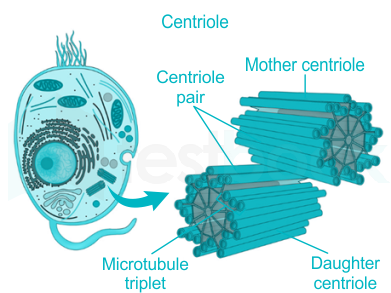
- A centriole is a barrel-shaped structure located in the cytoplasm of animal cells.
- A pair of centrioles make the organelle centrosome.
- The centrioles appear as 2 cylinders at right angles to each other.
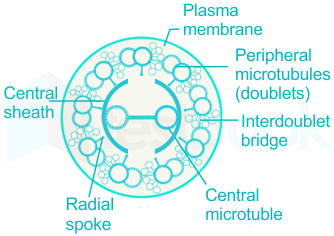
- The wall of the centriole is made of 9 triplets fibres arranged around a central axis.
- Each fibre consists of 3 sub-fibres or sub-tubules lying parallel to each other.
- It looks like a cart-wheel structure with a central rod or hub radiating 9 spokes, each of which is connected to a fibre.
- Functions of Centriole :
- They are involved in mitosis for formation of spindle fibers.
- Spindle fibres attach to the kinetochore discs present at the centromere and help in the movement of chromatids during chromatid separation.
- They also form the mitotic apparatus during mitosis or meiosis.
- In primitive flagellates, they function as basal bodies for the flagella.

Additional Information
- A large central vacuole :
- The vacuole is the membrane-bound space found in the cytoplasm of plant cell.
- The membrane of the vacuole is known as tonoplast.
- It contains water, sap, excretory product and other materials not useful for the cell.
- 70 S Ribosome :
- Ribosomes are very important cellular component that are used for synthesis of proteins from RNA.
- The 70S ribosome consists of 2 subunits - 50S and 30S, which take part in the translation process.
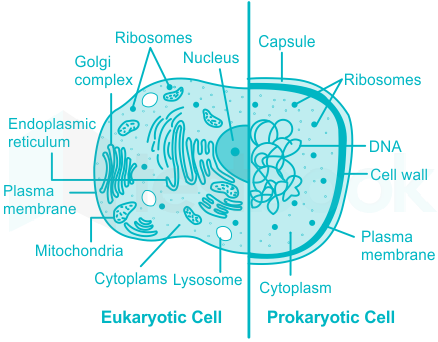
- 70S ribosomes are mostly found in prokaryotic cells, but are also present in the chloroplast in plant cell.
- This is supported by the 'Endosymbiotic Theory' that proposes that chloroplasts and mitochondria are remnants of primitive prokaryotic cells that became a part of plant cell to perform specific functions.
- These cells have later evolved as the cell organelles to perform photosynthesis and respiration.
- 80 S Ribosome :
- Plant cells have three distinct ribosome species; 80 S ribosomes in their cytosol, 70 S-like ribosomes in their chloroplasts and mitochondria.
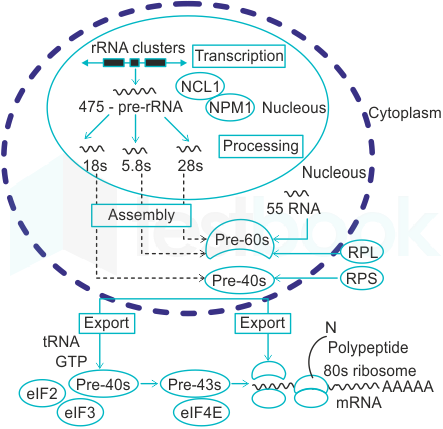
- Eukaryotic ribosomes are 80S ribosomes that consists of 2 subunits- 60S and 40S.