Official Paper

UP TGT Biology 2016 Official Paper (Previous Year Paper)

125 questions · 120 minutes · with answers · free

Biology (125 questions)

1

Evolution is best defined as

  1. ((a))

    Aquisition of desired characters

  2. ((b))

    Descent with modifications

  3. ((c))

    Struggle for existence

  4. ((d))

    Like begets like

Show Answer
Answer: ((b))

Descent with modifications

Key Points

  • The theory of evolution was described by Charles Darwin as descent with modification by natural selection.
  • 'Descent with modification' explains how existing life forms can have a common ancestor as well as show variations.
  • These variations were inheritable in nature i.e., they can be passed on from one generation to another.
  • Some of these inheritable variations would enhance the survivability of some, enabling them to leave more progeny.
  • These progenies would also survive better and hence give rise to new life forms.

Additional Information

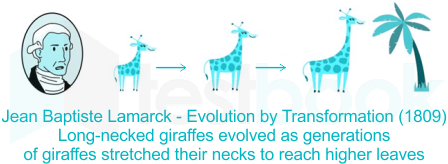
  • Inheritance of acquired characters was proposed by Lamarck, which states that physical characteristics of an organism acquired by use and disuse in a lifetime can be passed on to the next generation.
  • The concept of struggle for existence refers to the competition for the available resources that are required for survival. Darwin suggested that there is a continuous struggle for existence in which only the fittest would survive.
  • 'Like begets like' is a phrase that refers to the similarity of offspring with the parents due to inheritable characters.
2

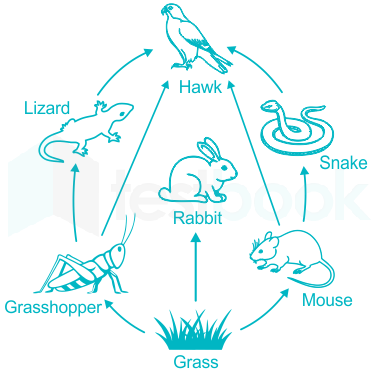
In a food web hyenas and vultures are

  1. ((a))

    Primary consumers

  2. ((b))

    Predators

  3. ((c))

    Scavengers

  4. ((d))

    Decomposers

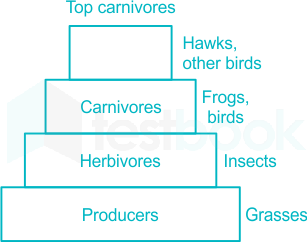
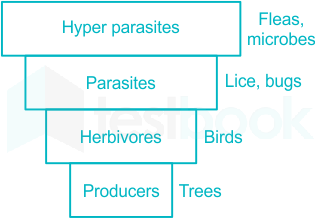
Show Answer
Answer: ((c))

Scavengers

Key Points

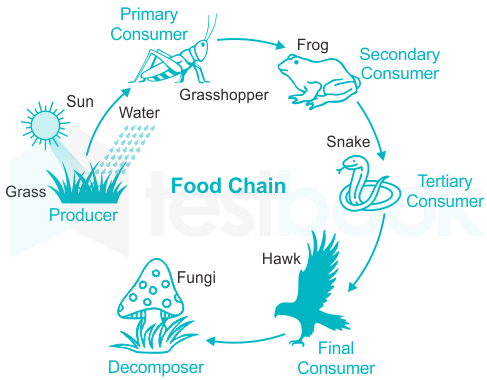
  • Food chain - is a linear sequence of flow of energy takes place between different organisms that are related to each other by the food they consume.

  • Food web - is an interconnection of different food chains in an ecosystem.

  • Both food chains and food webs outline who eats whom in an ecosystem.
  • The organisms are classified into different categories according to their feeding order.
  • Producers - synthesize food from solar energy. This covers all photosynthesizing plants and algae.
  • Primary consumers - come immediately after producers and comprise herbivores that feed on the producers directly.
  • Secondary consumers - feed on primary consumers and hence comprise of carnivores.
  • Decomposers - break down dead, decaying organisms into simpler inorganic substances. E.g. - Fungi.

Important Points

  • Scavengers - are carnivorous organisms that feed on the dead and decaying flesh of an animal.
  • They differ from other carnivores because they do not hunt.
  • Examples - Vultures, Hyenas, Jackals, Crows.

Additional Information

  • There are two main types of food chains:
  • Grazing - These food chains start with the producers and are the major system of energy flow in aquatic ecosystems.
  • Detritus - The starting point is dead organic matter from other food chains and is the major energy flow system in terrestrial ecosystems.
3

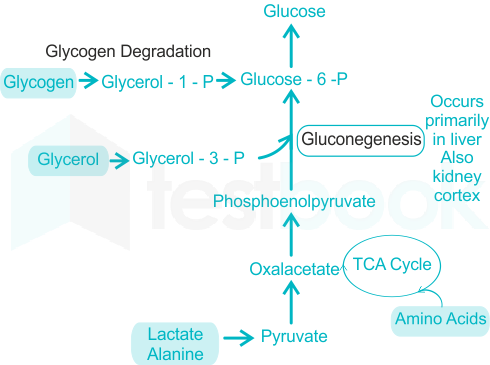
The equation - lactate, alanine, glycerol→ glucose, represents which of the following ?

  1. ((a))

    Glycolysis

  2. ((b))

    Glycogenolysis

  3. ((c))

    Gluconeogenesis

  4. ((d))

    Both glycolysis and glycogenolysis

Show Answer
Answer: ((c))

Gluconeogenesis

Key Points

  • Gluconeogenesis is the process by which glucose is synthesized from non-sugar precursors like lactate, pyruvate, alanine and glycerol.
  • Functionally, the process is antagonistic to the process of glycolysis where glucose is broken down to form products like pyruvate, alanine, etc.
  • It mainly occurs in the liver after long periods of fasting when alternative sources of glucose are required.

Important Points

  • Both alanine and pyruvate are converted to pyruvate.
  • Pyruvate enters the mitochondria and is converted to oxaloacetate (OAA).
  • OAA may enters the TCA cycle to form malate, which can be transported back to cytoplasm.
  • Malate is converted to OAA which is then decarboxylated and phosphorylated by the PEP carboxykinase.
  • Phosphoenol pyruvate (PEP) enters the gluconeogenic cycle, which is reverse glycolysis to yield glucose-6-phosphate.
  • Glycerol is released into the plasma by the adipose tissues and is taken up by the liver.
  • Glycerol is converted to dihydoxyacetone phosphate (DHAP) which enters the gluconeogenic pathway.

Additional Information

  • Glycolysis - is the process by which glucose is utilized by the cell for energy production. It takes place in the cytoplasm.
  • Glycogenolysis - is the specific biochemical pathway by which glycogen in the liver cells is broken down into glucose.
4

The first and the final moult in the larva of Ascaris occurs in the

  1. ((a))

    Lungs

  2. ((b))

    Liver

  3. ((c))

    Stomach

  4. ((d))

    Intestine

Show Answer
Answer: ((d))

Intestine

Key Points

  • Ascaris is an endo-parasitic nematode that causes Ascariasis.
  • It is found in the intestine of infected humans.
  • Infection is caused by ingestion of infective eggs from contaminated soil.
  • The larvae hatch and penetrate into the intestinal mucosa.
  • They are then carried to the liver and from there to the heart and lungs.
  • The larvae enlarge and rupture in the alveoli.
  • They get coughed up and then swallowed.
  • They reach the small intestine and mature thereby moulting.
  • Moulting is the process of shedding the outer layer or covering when a replacement layer is formed.

5

Earliest evidences of social life are attributed to

  1. ((a))

    Cro-magnon men

  2. ((b))

    Neanderthal man

  3. ((c))

    Peking man

  4. ((d))

    Java man

Show Answer
Answer: ((b))

Neanderthal man

Key Points


  • The earliest evidence of social life among early humans is typically attributed to Neanderthal man.
  • Neanderthals, belonging to the species Homo neanderthalensis, are known for their relatively complex social structures and behaviors, which included caring for the sick and elderly, burying their dead, and possibly engaging in rituals, all indicating a form of social life.
  • Cro-Magnon men (early modern humans) also exhibited advanced social structures, but they appear later in the archaeological record compared to Neanderthals.
  • ‘Cro-Magnon Man’ is the name given to the early humans who existed 40,000-10,000 years ago.
  • The name came from the five skeletons that were found from a rock shelter in France, which was known by the same name.
  • They have been recently renamed as Early Modern Human because it was found after much research that they do not have significant differences from modern humans.
  • They are our immediate ancestor hominin who were in the process of developing the modern human behaviours.
  • The physical differences between Cro-Magnons and modern humans are key to the change in lifestyle from long-distance hunting to sedentism, which requires them to live in groups and thus have a social life.
  • They are also known to have used modern tools and had burial rituals.

Additional Information

  • Java man – refers to an extinct hominin of the species Homo erectus that was discovered from Java. The thighbones discovered indicated their upright posture.
  • Peking man – refers to Homo erectus fossils that were found from Zhoukoudian site of China. They lived about 2 million – 250,000 years ago.
6

Of the following which is not a vestigeal organ?

  1. ((a))

    Wisdom tooth

  2. ((b))

    Appendix

  3. ((c))

    Tail bone

  4. ((d))

    Bones

Show Answer
Answer: ((d))

Bones

Concept:

A vestigeal organ refers to those organs or parts of the body that have lost their functions or just retain minor ones. They were functional in our ancestors because of some necessity that has become non-existent over time.

Key Points

  • Wisdom tooth - is the 3rd molar in our dentition which has become vestigeal because of change in our diet. It is believed that it was present in our ancestors to help them chew raw, course food better.
  • Appendix - is a finger-like pouch attached to the large intestine and is believed to have been used for digestion in our ancestors with a more herbivorous diet.
  • Tail bone - is a bone at the end of the spine and is thought to be the remnant of a pre-existing tail. It is also known as coccyx.
  • Bones - are not vestigeal as they form the skeletal structure of our body and is required for support and movement.
7

Which of the animal does not have an alimentary canal ?

  1. ((a))

    Fasciola

  2. ((b))

    Ascaris

  3. ((c))

    Ancylostoma

  4. ((d))

    Taenia

Show Answer
Answer: ((d))

Taenia

Concept:

  • Alimentary canal is a hollow tubular organ that helps in the digestion of ingested food.
  • It may be of two types:
  • Complete alimentary canal – has 2 separate openings, mouth for ingestion and anus for egestion.
  • Incomplete alimentary canal – has only one opening which functions for both ingestion and egestion.

Key Points

  • Taenia refers to a genus of tapeworms belonging to phylum Platyhelminthes.
  • In some organisms like Taenia, the alimentary canal is absent altogether.
  • Taenia is an endoparasite in which digestion takes place by absorbing the nutrients from the host directly through their body surface.

Additional Information

  • Fasciola – or liver fluke has an incomplete alimentary canal with a single ventral mouth.
  • Ascaris – or roundworm has a complete alimentary canal with an anterior mouth and posterior anus.
  • Ancylostoma – or hookworm has a complete muscular alimentary canal.
8

CAM plants at night produce

  1. ((a))

    PEP

  2. ((b))

    Pyruvic acid

  3. ((c))

    Malic acid

  4. ((d))

    Citric acid

Show Answer
Answer: ((c))

Malic acid

Key Points

  • Crassulacean Acid Metabolism or CAM is a pathway for carbon fixation that is found in some plants.
  • It is so-called because it was first found in the Crassulaceae family plants.
  • It is a special adaptation for conserving water in xeric plants (that are found in dry conditions).
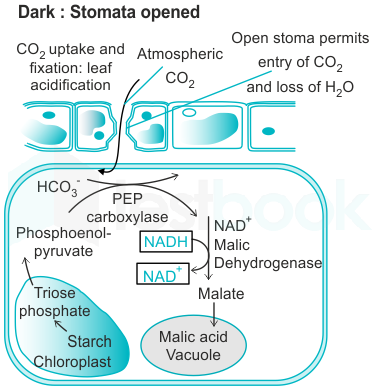
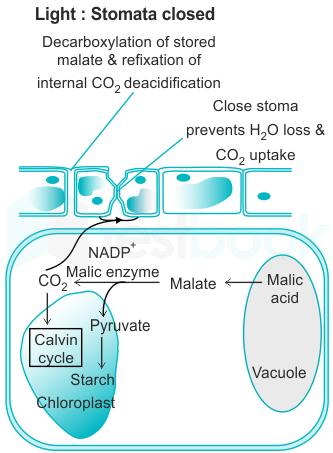
  • In this process, the stomata open only at night and remain closed during the day.
  • At night, the CO2 is converted into malic acid which is stored in the vacuole.
  • During daytime as the atmospheric CO2 is absent, the malic acid is transported out of the vacuole and converted to pyruvate and CO2. This CO2 then takes part in the Calvin-Benson cycle in the chloroplast.

9

Chromatids joined together by duplicated but unseparated centromere are called

  1. ((a))

    Sister chromatids

  2. ((b))

    Homologs

  3. ((c))

    Bivalents

  4. ((d))

    Alleles

Show Answer
Answer: ((a))

Sister chromatids

Concept:

  • Cell cycle comprises of 2 phases:
  • M-phase - represents the actual cell division phase where mitosis occurs.
  • Interphase - represents the time in between two M-phases and lasts for more than 95% of the cell cycle.
  • During Interphase, the amount of DNA is doubled by the process of DNA replication without increasing the number of chromosomes in a cell.

Important Points

  • Sister chromatids are identical copies of the same chromosome and are formed by DNA replication during interphase.
  • They are held together by a structure called centromere.
  • They can be distinctly observed during Metaphase when the condensation of chromosome is completed.
  • The sister chromatids separate by moving towards opposite ends of a dividing cell.
  • By the end of divisional phase two daughter cells are formed with same amount of DNA as the parent cell.

Additional Information

  • Homologs - Homologous chromosomes refer to the pair of chromosomes where one comes from the mother and another from the father. They are similar in size, centromere position and gene loci.
  • Bivalents - refer to the replicated homologous chromosomes, where an exchange of DNA takes place among two non-sister chromatids by forming a synapse.
  • Alleles - refer to the variant forms of a gene, out of which an individual inherits two alleles for a particular gene. The interaction between the two allelic forms determine the phenotype associated with that gene.
10

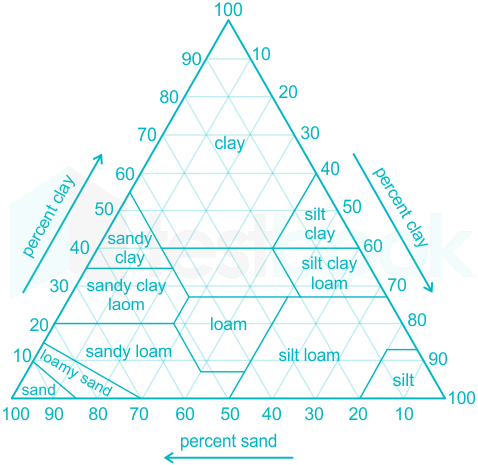
In loam soil, the proportion of soil particles is

  1. ((a))

    80% sand + 20% clay or silt or both

  2. ((b))

    70% sand + 30% clay or silt or both

  3. ((c))

    60% sand + 40% clay or silt or both

  4. ((d))

    50% sand + 50% clay or silt or both

Show Answer
Answer: ((d))

50% sand + 50% clay or silt or both

Key Points

  • Soil is composed of soil particles that are of 3 major types depending on their sizes:
  • Sand - are the largest particles.
  • Silt - are intermediate in size.
  • Clay - are the smallest particles.
  • The different proportions of these soil particles give different textures to the soil.
  • Soil is categorized into different types based on their textures. The main types include sandy, silty, clay and loamy soil.
  • From the given figure we can see that loamy soil is composed of about 50% sand and 50% of silt and/or clay.

11

Which of the following is flying fish ?

  1. ((a))

    Shark

  2. ((b))

    Chimera

  3. ((c))

    Latimaria

  4. ((d))

    Exocoetus

Show Answer
Answer: ((d))

Exocoetus

Key Points

  • Exocoetus is a genus that belongs to the family Exocoetidae.
  • They are called flying fish because they can jump out of the water surface and remain airborne for some time.
  • They have a torpedo-like body shape that helps them to break water surface with high speed.
  • They also have large wing-like pectoral fins that help them in gliding and being airborne.
  • This 'flying' ability helps them to escape the predators that follow them.

Additional Information

  • Sharks - are a group of cartilaginous fishes that are found all over the world.
  • Chimera - are cartilaginous fishes that are also called ghost sharks. and are related to sharks and rays.
  • Latimeria - is the genus with the only living species of coelacanth, found along the coasts of the Indian Ocean.
12

Of the following which animal exhibits retrogressive metamorphosis ?

  1. ((a))

    Amphioxus

  2. ((b))

    Herdmania

  3. ((c))

    Balanoglossus

  4. ((d))

    Doliolum

Show Answer
Answer: ((b))

Herdmania

Key Points

  • Metamorphosis – is the process by which an animal undergoes a rapid change in form and structure after birth to form an adult that is significantly different from its juvenile stages.
  • Retrogressive metamorphosis – refers to the type of metamorphosis that involves degenerative changes, meaning the juvenile phase lose some advanced characters in the process of development to become an adult with more primitive characters.
  • It is found in Urochordates like Herdmania, where larva shows chordate characters that are lost during development into the adult.

Important Points

  • Changes involved during retrogressive metamorphosis:
  • Free-swimming active larva changes into sedentary inactive adult.
  • Larval tail with caudal fins shortens and disappears.
  • Nerve cord and notochord break down and are consumed by phagocytes.
  • Adhesive papillae disappear.
  • Larval sense organs, ocellus and otolith, are lost.
  • Sensory vesicles changes into adult cerebral ganglion.
13

Which type of joints are found in the pectoral and pelvic girdle of frog from the following ?

  1. ((a))

    Hinge

  2. ((b))

    Pivot

  3. ((c))

    Saddle

  4. ((d))

    Ball and Socket

Show Answer
Answer: ((d))

Ball and Socket

Key Points

  • Pectoral and pelvic girdles represent the shoulder and hip joints respectively.
  • These joints usually have a ball and socket type of joint to allow for a range of movement.
  • These joints have a rounded ball-like bone end that fits into a cup-like end of another bone.

Important Points

  • Both the pectoral and pelvic girdles in a frog have 2 equal halves called ‘ossa innominata’ and consist of 3 bones each.
  • The pelvic girdle has a depression called acetabulum at the junction of the ilium, ischium, and pubis bones. The head femur of the hind limb articulates into the acetabulum and forms a ball and socket structure.
  • The pectoral girdle has a concavity called glenoid cavity formed at the junction of the scapule and coracoid bones. The head of lumerus of the forelimb articulates into the cavity and forms the ball and socket joint.

Additional Information

  • The joints are divided into 3 classes:
  • Fibrous Joint - are held together by fibrous connective tissue and do not show any movement. E.g.- Skull bones.
  • Cartilaginous Joint - where the bones are connected by cartilages and allow little movement. E.g.- Joints between vertebrae.
  • Synovial Joint - with fluid-filled cavity in between the bones that allows maximum movement. E.g.- Knees, shoulders.
  • Synovial Joints are again of the following 6 types:
  • Hinge - is found in elbow.
  • Pivot - is found in first and second vertebrae of neck.
  • Saddle - is found in the thumb joint.
  • Ball and Socket - is found in shoulder and hip joints and allows maximum flexibility.
  • Condyloid/Ellipsoidal - is found in the joints of wrist and fingers.
  • Planar/Gliding - is found in the carpal bones in hand.
14

The blood of Pheritima is red due to the presence of

  1. ((a))

    Iron salts

  2. ((b))

    Pigment cells

  3. ((c))

    Intercellular hemoglobin

  4. ((d))

    Intracellular hemoglobin

Show Answer
Answer: ((c))

Intercellular hemoglobin

Key Points

  • Pheretima is a genus of earthworms that belong to the phylum Annelida.
  • The blood of Pheretima is red in colour due to the presence of haemoglobin, which is an iron-containing pigment.
  • It differs from vertebrate blood because haemoglobin is not contained in the corpuscles, rather present dissolved in the plasma.
  • It is called intercellular haemoglobin as it is present between the cells (corpuscles) in the plasma.
  • The blood corpuscles are colourless and produced in the blood glands along with haemoglobin.
  • Blood glands are located in the 4th, 5th and 6th segments.

Additional Information

  • In vertebrates like humans, haemoglobin is present in the erythrocytes in the blood and hence called intracellular haemoglobin.
  • It serves the function of binding oxygen molecules and transporting them to the tissues.
  • Haemocyanin is a copper-containing respiratory pigment that helps in transporting oxygen in arthropods and molluscs and turns blue on oxygenation.
15

Genophore is the name of

  1. ((a))

    DNA of Eukaryotes

  2. ((b))

    DNA of Bacteria

  3. ((c))

    Genes of Drosophila

  4. ((d))

    Genes of Neurospora

Show Answer
Answer: ((b))

DNA of Bacteria

Key Points

  • Genophore is the term used for prokaryotic (bacterial) DNA.
  • The term ‘prokaryotic chromosome’, although used, is misleading because it does not contain chromatin.
  • Bacterial DNA is condensed by the process of supercoiling only and not formation of chromatin.
  • Genophores are usually circular in structure, rarely linear.
  • They are much smaller in size than Eukaryotic chromosome.
  • They are present in the nucleoid region of the cell.

Additional Information

  • Prokaryotic cells do not have a true nucleus and membrane-bound organelles.
  • The genetic material is present in a specific region of the cell called nucleoid.
  • They have a cell wall and may also have an additional layer called capsule.
  • They may have pili or fimbriae that help them to attach to surfaces.
  • They also have flagella to help them in locomotion.
  • They have 70s type of ribosome.
  • Some bacterial cells also have an extra-chromosomal DNA called plasmids that contain antibiotic resistance genes.
16

Elaters of Marchantia are

  1. ((a))

    Haploid and hygroscopic

  2. ((b))

    Diploid and hygroscopic

  3. ((c))

    Haploid and non-hygroscopic

  4. ((d))

    Diploid and non-hygroscopic

Show Answer
Answer: ((b))

Diploid and hygroscopic

Key Points

  • Marchantia is a liverwort that is considered to be one of the most primitive bryophytes.
  • It is a heterothallic plant with the antheridiophore and archegoniophore on different thalli.
  • They reproduce sexually to form the sporophyte.
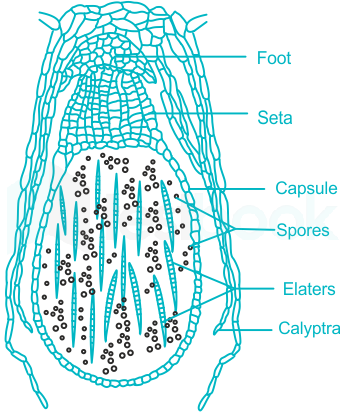
  • The zygote develops to form the sporophyte which is differentiated into:
  • Foot - It is the basal swollen part that helps in anchoring and gives nutrition to the sporophyte.
  • Seta - It is the stalk that connects the foot to the capsule.
  • Capsule - It is an enlarged oval structure with a single jacket layer, which encloses the sporogenous tissue in young sporophytes.
  • The sporogenous tissue differentiates into:
  • Spore mother cells - undergo meiosis to form the haploid spore tetrad.
  • Elater mother cells - give rise to diploid and sterile elaters.

Important Points

  • Elaters are specialized structures of liverworts that help in spore dispersal.
  • They are tubular, non-sporogenous cells with spiral wall thickenings and are found inside the capsules.
  • They are hygroscopic in nature, meaning they respond to the changes in moisture content.
  • The movement of elaters loosens the spore mass and leads to the scattering of spores in the air.
  • They are sterile diploid cells that are produced in the sporophyte along with the spores.
  • Elaters are diploid because they are formed by differentiation and without any further division.
  • On the other hand, spores are formed after meiosis and thus become haploid.

Additional Information

  • Elaters are absent in mosses.
  • Elaters present in hornworts are called pseudo-elaters because they are functionally similar but structurally different from that of the liverworts.
17

In the origin of species by Darwin the concept of competition was taken from which of the following ?

  1. ((a))

    A. Wallace

  2. ((b))

    H. Spencer

  3. ((c))

    H. de Vries

  4. ((d))

    T. R Malthus

Show Answer
Answer: ((d))

T. R Malthus

Key Points

  • Thomas Robert Malthus was an English economist who proposed the famous Malthusian theory of population growth.
  • According to this theory, a population grows exponentially while the resources to sustain that population remains linear, resulting in a calamity that reduces back the population.
  • Darwin wrote the book 'On the Origin of Species' in which he explained the theory of evolution by natural selection as 'descent with modification'.
  • The Malthusian theory influenced Darwin’s theory of evolution where he stated that there exists a ‘struggle for existence’ in nature and ‘survival of the fittest’ takes place.
  • ‘Struggle for existence’ refers to the competition for available resources required for survival.

Additional Information

  • A. R. Wallace -
  • Alfred Russel Wallace was also a naturalist, biologist and geographer.
  • He worked with Charles Darwin on the theory of evolution.
  • His contributions are not just in science but also in socialism and spiritualism.
  • H. Spencer
  • Herbert Spencer was a philosopher, anthropologist, biologist who is known for his hypothesis on social Darwinism.
  • He stated that social evolution takes place much like biological evolution where the same principles of natural selection and ‘survival of the fittest’ can be applied.
  • H. de Vries – 
  • Hugo de Vries was a botanist and geneticist, known for his mutation theory of evolution.
  • He suggested that speciation (evolution of species) occurs due to sudden large changes in traits rather than small gradual changes, as was previously suggested by Darwin.
18

Cleavage in frog is

  1. ((a))

    Holoblastic and equal

  2. ((b))

    Holoblastic and unequal

  3. ((c))

    Meroblastic and superficial

  4. ((d))

    Meroblastic and discoidal

Show Answer
Answer: ((b))

Holoblastic and unequal

Key Points

  • Cleavage refers to the series of mitotic divisions that divides an embryo after fertilization.
  • The egg cytoplasm is divided into smaller nucleated cells called blastomeres.
  • 16-64 blastomeres form the morula stage.
  • Cleavage is mainly of 2 types:
  • Holoblastic – is a complete cleavage where the cleavage furrow goes all the way through the egg due to less amount of yolk.
  • Meroblastic – is an incomplete cleavage where the furrow does not go through the complete egg due to high amount of yolk.

Important Points

  • The first division starts at the animal pole and moves towards the vegetal pole of the egg.
  • The egg yolk in a frog is concentrated in the vegetal hemisphere which causes the second division to start at the animal pole before the first furrow goes through the vegetal hemisphere.
  • The first two divisions are at right angles to each other, while the third is equatorial.
  • However, the furrow is slightly displaced from the equator because of the vegetally placed yolk.
  • This results in an unequal frog embryo with 4 small blastomeres (micromeres) and 4 large blastomeres (macromeres).

Additional Information

HoloblasticMeroblastic
Complete cleavage of egg into blastomeresIncomplete cleavage of egg into unequal blastomeres
Cleavage furrow goes all the way through the eggCleavage furrow does not go all the way though
Occurs in eggs with less amount of yolkOccurs in eggs with high amount of yolk
Occurs in isolecithal and mesolecithal eggsOccurs in telolecithal and centrolecithal eggs
Gives rise to radial, bilateral, spiral and rotational cleavageGives rise to discoidal and superficial cleavage
Example - Amphibians, mammalsExample - Birds
19

Soil water, absorbed by plants, is called

  1. ((a))

    Cresard

  2. ((b))

    Holard

  3. ((c))

    Echard

  4. ((d))

    Fullard

Show Answer
Answer: ((a))

Cresard

Key Points

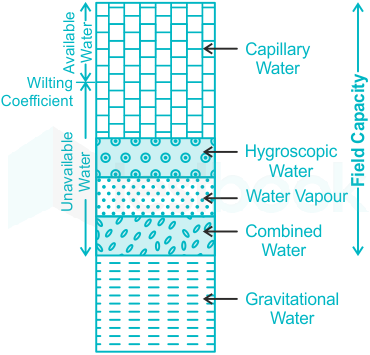
  • The given terms are in relation to the various forms in which water is available in the soil.
  • Hollard – is the total water content present in the soil.
  • Chresard is the amount of water available for the plants in the soil.
  • It is also called growth water or available water.
  • It contains about 75% of capillary water because plant roots cannot absorb water from capillaries less than 0.2µm in diameter.
  • Echard – is the part of Hollard that is unavailable for the plants. It consists of hygroscopic water, chemically combined water, water vapour and 25% of capillary water.

Additional Information

The soil water can be of the following types:

  • Gravitational water – reaches the water table after rainfall due to gravity. It is not available to plants but can be obtained mechanically by pumps, etc.
  • Hygroscopic water – is the thin film of water that is held together by soil particles and is also not available for plants.
  • Chemically combined water – refers to the water molecules bound to chemical substances present in the soil.
  • Capillary water – is present in the narrow pores between the soil particles and is the only available water for plant absorption.
20

Who described the annual recurrence of Rusts of wheat in India ?

  1. ((a))

    B.B. Mundukur

  2. ((b))

    K.C. Mehta

  3. ((c))

    R.S. Singh

  4. ((d))

    E.J. Butler

Show Answer
Answer: ((b))

K.C. Mehta

Key Points

  • K. C. Mehta – 
  • Karam Chand Mehta is known for his contribution to plant pathology.
  • He worked on the recurrence of wheat rusts in the plainlands of India.
  • He found that though the rust spores were killed by the summer heat, new spores were blown in from the hills causing fresh infections every year.
  • B. B. Mundkar – 
  • Balchandra Bhavanishankar Mundkur was an Indian mycologist and plant pathologist.
  • He founded the Indian Phytopathological Society.
  • R. S. Singh – 
  • He is the author of many books on plant pathology and plant diseases.
  • E. J. Butler – 
  • Sir Edwin John Butler was an Irish mycologist and plant pathologist who became the Imperial Mycologist in India.
  • He is noted for identifying 150 species of plant pathogenic fungi.

Additional Information

  • Wheat rust is a fungal disease caused by Puccinia species.
  • They are recognised by rusty-coloured pustules on the plant surface.
  • There are 3 types of rusts:
  • Leaf rust – caused by P. recondita, is also called brown rust.
  • Stem rust – caused by P. graminis, is also called black rust.
  • Stripe rust – caused by P. striiformis, is also called yellow rust.
21

Plakea stage is found in life cycle of

  1. ((a))

    Chlamydomonas

  2. ((b))

    Volvox

  3. ((c))

    Ulothrix

  4. ((d))

    Spirogyra

Show Answer
Answer: ((b))

Volvox

Key Points

  • Volvox is a green alga that belongs to the class Chlorophyceae.
  • It forms colonies on the surface of fresh-water ponds or lakes.
  • The thallus, called coenobium, is characteristically hollow, spherical or oval, and has a fixed number of cells that is specific to the species.
  • The cells are arranged in a single layer on the periphery, whereas the central part remains mucilaginous.
  • The colony is polarized as the anterior cells have larger eyespots and the posterior cells reproduce on maturity.
  • Both asexual and sexual reproduction takes place in Volvox.

Important Points

  • The plakea stage is found during asexual reproduction in Volvox colonies.
  • During asexual reproduction, the posterior reproductive cells enlarge many times to become gonidia.
  • These gonidia become rounded from the pyriform cells, have increased pyrenoids, lose the flagella and eyespots.
  • The gonidia are pushed to the centre and the first division takes place longitudinally with respect to the coenobium.
  • The second longitudinal division is at right angle to the first and results in the 4-celled stage.
  • The third longitudinal division results in the 8-celled plakea stage with 4 central cells and 4 peripheral cells.
  • The plakea stage looks like a curved plate with the concave side facing the exterior.
  • From here the 16-celled stage is formed as a hollow sphere with an opening called phialopore towards the exterior.
  • The cells keep dividing until the characteristic number of that species, with the pointed ends of each cell directed inwardly.
  • After this, inversion of the colony takes place such that the pointed ends of the cells become outwardly.
  • The inversion starts with a constriction opposite the phialopore such that the cells get pushed out of the phialopore and form a spherical colony.
  • These are known as the daughter colonies that may later separate from the parent colonies.

22

Rhizophore is found in

  1. ((a))

    Marsilea

  2. ((b))

    Equisetum

  3. ((c))

    Lycopodium

  4. ((d))

    Selaginella

Show Answer
Answer: ((d))

Selaginella

Key Points

  • Selaginella is a pteridophyte that is commonly known as spike-moss.
  • Rhizophore is a distinctive morphological feature of Selaginella.
  • It is defined as a leafless structure that arises at the point of branching and grows downwards.
  • They branch out at the tip when they come in contact with hard surface.
  • The morphology of rhizophore is quite unique because it is considered as both stem and root.

Additional Information

  • The root-like features of rhizophore:
  • It is positively geotropic.
  • The anatomy is similar to a root.
  • The apex of rhizophore shows a root cap-like structure.
  • Auxin transport in rhizophore is similar to that of root.
  • The stem-like features are:
  • Root hairs are absent.
  • Rhizophore arises exogenously whereas root arises endogenously.
  • Under controlled conditions, it can be induced to grow into a shoot.
23

Which is not true about glycolysis ?

  1. ((a))

    Occurs only in aerobic organisms

  2. ((b))

    Occurs in all organisms

  3. ((c))

    Occurs in the cytoplasm

  4. ((d))

    Glucose is partially oxidized

Show Answer
Answer: ((a))

Occurs only in aerobic organisms

Key Points

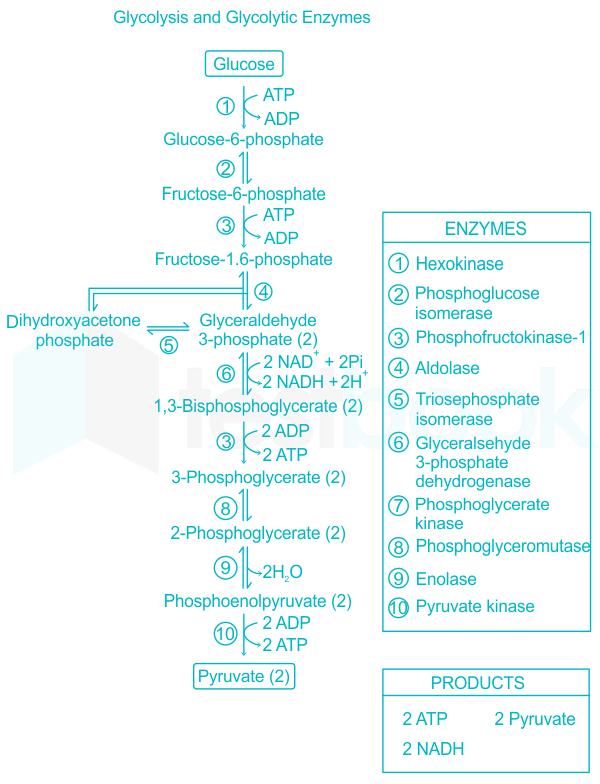
  • Glycolysis is a metabolic pathway by which glucose is converted into pyruvate, which acts as a precursor for for other reactions.
  • It is also known as the Embden-Meyerhof-Parnas (EMP) pathway.
  • It takes place in the cytoplasm of the cell.
  • The pathway involves partial oxidation of one 6-carbon glucose molecule to form two 3-carbon pyruvate molecules, which may then be utilized in the TCA cycle or anaerobic respiratory processes.
  • It can take place in both aerobic and anaerobic conditions.

Mistake Points

  • The glycolysis process itself does not require oxygen.
  • But it is a vital process for cellular respiration.
  • Hence, it takes place in both aerobic and anaerobic organisms.

Important Points

  • The glycolytic pathway consists of 10 steps of enzymatic reactions, which can be divided into 2 phases - 
  • Preparatory or Investment phase - 2 ATP molecules are utilized in this phase.
  • Pay-off phase - 4 ATP, 2 NADH and 2 pyruvate molecules are produced in this phase.
  • Phosphofructokinase is the rate-limiting enzyme of the pathway, meaning it determines the rate at which glycolytic reactions take place.
  • Under aerobic conditions, the pyruvate enters the mitochondria for oxidative phosphorylation.
  • Under anaerobic conditions, the pyruvate stays in the cytoplasm and gets converted to lactate or ethanol.

24

In Palaemon, the statocyst are present within which appendage ?

  1. ((a))

    Antennule

  2. ((b))

    Antenna

  3. ((c))

    Mandible

  4. ((d))

    Maxilla

Show Answer
Answer: ((a))

Antennule

Key Points

  • Palaemon is a genus of shrimp that belongs to the phylum Arthropoda.
  • There are 19 pairs of appendages: first 5 are cephalic, next 8 are thoracic and the rest 6 are abdominal.
  • These appendages are typically found on each segment of the body.
  • Each of the first two segments have a pair of antennae or feelers.
  • The first antenna is known as the antennule which lies behind the compound eye.
  • The statocyst is present is the antennule appendage.

Important Points

  • A statocyst is a sensory organ containing statolith and sensory hairs.
  • The statolith is made up of calcareous bodies, which are grainy structures that lie centrally in the statocyst.
  • The sensory hairs line up the statocyst.
  • It is found in some aquatic invertebrates like shrimps.
  • It helps the organism in balance and orientation with respect to gravity.
  • The statocyst lies at the base of each of the two antennules.
  • In prawns, the statocyst is present in the precoxa of the antennule.

Additional Information

  • The various appendages of Palaemon are:
  • 2 pairs of antennae - First antenna or antennule and second antenna.
  • 1 pair of mandible - used for crushing food.
  • 2 pairs of jaws - First maxilla or maxillula and second maxilla.
  • 3 pairs of maxillipedes - The first two are flat and the third is elongated.
  • 5 pairs of walking legs - The first two have pincers and are called chelate legs and are used for defence.
  • 6 pairs of abdominal appendages - are called pleopods or swimmerets and are used for swimming.
25

A Nucleosome consists of

  1. ((a))

    RNA + Histone

  2. ((b))

    RNA + Histone + Non Histone

  3. ((c))

    DNA + Histone

  4. ((d))

    DNA + Histone + Non Histone

Show Answer
Answer: ((c))

DNA + Histone

Key Points

  • The nucleosome model was proposed by Roger Kornberg for the DNA packaging in eukaryotic chromosome.
  • Under electron microscopes, chromosomes were found to look like 'beads on a string' because of the series of spherical particles connected by a fine filaments.
  • These 'beads' were termed as nucleosomes.
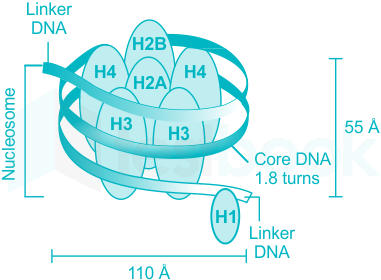
  • Nucleosome is a complex of DNA and Histone proteins to condense the DNA into smaller volume inside the nucleus.

Important Points

  • Histones are positively charged, basic proteins which are rich in Lysine and Arginine residues.
  • The histones H2A, H2B, H3 and H4 are involved in the nucleosome structure, while the H1 protein acts like a linker molecule between two nucleosomes.
  • 2 molecules of H3 and H4 form a core of tetramer (as a pair of dimers).
  • This (H3)2.(H4)2 tetramer is associated with 2 independent dimers of H2A-H2B.
  • DNA being negatively charged, wraps around the histone octamer and forms the nucleosome.
  • DNA enters and leaves the same side and the two turns are sealed by the H1 protein.
  • A nucleosome contains about 200bp of DNA, out of which 146bp is involved in the coiling of octamers and the rest is associated with the linker molecule.
  • It forms the 11nm wide interphase fibre.

Additional Information

  • Nucleosomes are the first level of DNA condensation involved in DNA packaging.
  • Nucleosomes are further condensed into the 30nm solenoid which is again organized into the tightly packed metaphase chromosomes.
  • Non-histone proteins (NHP) can also bind to DNA and are present in the nucleus, but they do not play any role in nucleosome formation.
  • NHPs may have various functions related to higher level of DNA packaging.
26

If human blood mixed with an anticoagulant is centrifuged, which of the following will settle first at the bottom of the centrifuge tube ?

  1. ((a))

    Erythrocytes

  2. ((b))

    Leucocytes

  3. ((c))

    Platelets

  4. ((d))

    Plasma

Show Answer
Answer: ((a))

Erythrocytes

Key Points

  • Centrifugation is a method by which particles of different sizes and densities present in a solution can be separated by spinning them at high speed.
  • This is achieved by spinning the solution around an axis to create a centrifugal force, that helps in sedimentation of the particles according to their size, shape or density.
  • Anticoagulants or blood thinners are chemical substances that prevent the blood from clotting by preventing the synthesis or function of various clotting factors of blood.
  • Anticoagulants are used in the laboratory so that human blood does not clot outside the human body.

Important Points

  • The process by which different components of the blood are separated is known as blood fractionation.
  • In this process, the blood sample is first mixed with an anticoagulant to prevent blood clots.
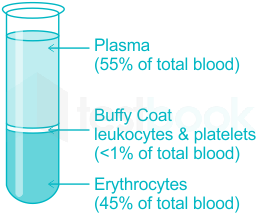
  • The solution is then centrifuged such that 3 distinct layers are formed.
  • The red blood cells or erythrocytes settle at the bottom, the white blood cells or leukocytes form the middle layer along with the platelets and the plasma remains at the top.
  • This separation happens due to the difference of densities of the components.
  • Erythrocytes settle at the bottom because they have denser cytoplasm due to the iron molecules of haemoglobin, which is present in the erythrocytes.
  • The middle layer of leukocytes and platelets is greyish in colour and is called buffy coat.

Additional Information

  • Erythrocytes - or red blood cells (RBCs) are the haemoglobin-containing cells in blood that transports oxygen and carbon dioxide to and from tissues.
  • Leukocytes - or white blood cells (WBCs) are the cellular component of blood responsible for carrying out immune functions in our body.
  • Platelets - or thrombocytes are another blood component that plays vital role in blood clotting and thus preventing loss of blood from damaged blood vessels by plugging it with a clot.
  • Plasma - is the liquid component of blood that contains all the other blood components along with salts and enzymes. It helps in transporting nutrients, hormones or waste substances from one part of body to another.
27

The 'cohort' of Bentham-Hooker is equivalent to present day

  1. ((a))

    Class

  2. ((b))

    Order

  3. ((c))

    Family

  4. ((d))

    None

Show Answer
Answer: ((b))

Order

Key Points

  • George Bentham and Joseph Dalton Hooker proposed the natural system of classification in the book 'Genera Plantarum'.
  • This system of classification is based on the morphological and anatomical features and the affinities between them.

Important Points

  • They divided the plant kingdom into 2 divisions:
  • Cryptogamia - included the non-flowering plants.
  • Phanerogamia - included the flowering plants and was further divided into classes.
  • These classes included Dicotyledons and monocotyledons.
  • Dicotyledons were categorized into Series and then into Cohorts.
  • Cohorts were further categorized into orders.
  • According to the present-day classifications, the cohorts represent Order and the orders represent the Family.
  • Example -Presently, Malvaceae is a family under order Malvales. But in Bentham-Hooker classification, Malvaceae was an order under the cohort Malvales.

28

The principal function of ______ is packaging of materials to deliver to the intra-cellular targets or to secrete outside the cell.

  1. ((a))

    Lysosome

  2. ((b))

    Golgi apparatus

  3. ((c))

    Rough endoplasmic reticulum

  4. ((d))

    Smooth endoplasmic reticulum

Show Answer
Answer: ((b))

Golgi apparatus

Key Points

  • Golgi apparatus is named after its discoverer Camillo Golgi.
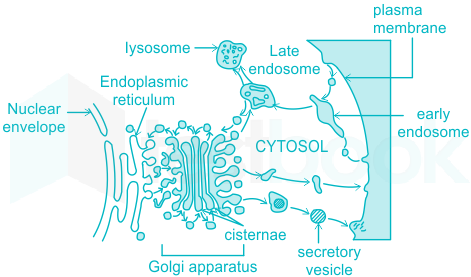
  • The Golgi apparatus is a membrane-bound organelle in the cell that acts as a factory for processing, packaging and transport of proteins.
  • In plant cells, Golgi apparatus is termed as dictyosomes.
  • It consists of flattened sac-like structures called cisternae and the associated vesicles.
  • Usually 3-8 parallel sacs are stacked upon each other.
  • It is a polarized structure with a forming face or the cis-face and a maturing face or the trans-face.
  • The cis-face is convex and towards the nucleus and it receives the proteins from the Endoplasmic Reticulum(ER).
  • The proteins move through the Golgi apparatus and get modified and sorted for transport to their destination.
  • The proteins then exit from the trans-face and are carried by the secretory vesicles.
  • The proteins are delivered to the intra-cellular targets or secreted outside the cell.

Additional Information

  • Lysosome - is known as the suicidal bag of the cell because it helps in digestion or breaking down of macromolecules or foreign particles.
  • Rough Endoplasmic Reticulum - contains ribosomes on their surface that helps in protein synthesis.
  • Smooth Endoplasmic Reticulum - helps in carbohydrate metabolism.
29

Dissociation curve of Haemoglobin is

  1. ((a))

    Hyperbolic

  2. ((b))

    Straight line

  3. ((c))

    Parabolic

  4. ((d))

    Sigmoid

Show Answer
Answer: ((d))

Sigmoid

Key Points

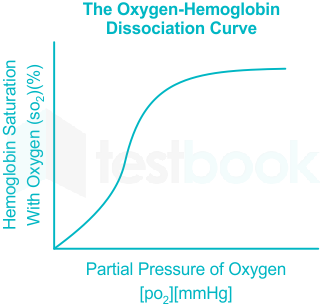
  • Oxygen Dissociation Curve (OCD) is the sigmoid curve obtained by plotting percentage saturation of haemoglobin with O2 against the partial pressure of O2.
  • Haemoglobin is the red-coloured iron-containing pigment present in the RBCs.
  • When O2 binds with haemoglobin, it is called oxyhaemoglobin.
  • Binding of O2 with haemoglobin is related to the partial pressure of oxygen.
  • Partial pressure refers to the pressure contributed by an ideal gas in a mixture of gases.
  • Partial pressure is represented as pO2 for oxygen and pCO2 for carbon dioxide.
  • The S-shaped curve that is formed is known as sigmoid curve.

Important Points

  • The factors that affect this binding are: partial pressure of O2partial pressure of CO2, hydrogen ion concentration and temperature.
  • The ODC is useful in studying the effects of these factors on the oxygen-binding of haemoglobin.
  • In the alveoli, pO2 is high, pCO2 is low, H+ concentration is less and temperature is low and this favours the formation of oxy-haemoglobin.
  • In the tissues, the conditions are reversed such that dissociation of oxygen from haemoglobin becomes favourable.​

Additional Information

  • CURVE SHIFT TO LEFT -
  • This indicates increase in affinity between oxygen and Hb.
  • Due to increase in pH.
  • Due to decreased temperature.
  • Due to decrease in carbon dioxide.
  • CURVE SHIFT TO RIGHT -
  • This indicates decrease in affinity between oxygen and Hb.
  • Due to decrease in pH.
  • Due to increased temperature.
  • Due to increase in carbon dioxide.
30

Ctenidium of Unio are of which type ?

  1. ((a))

    Protobranch

  2. ((b))

    Fillibranch

  3. ((c))

    Eulamellibranch

  4. ((d))

    Septobranch

Show Answer
Answer: ((c))

Eulamellibranch

Key Points

  • Unio is a freshwater bivalve mussel that belongs to the phylum Mollusca.
  • As they have aquatic habitat, respiration occurs through gills known as ctenidium.
  • The ctenidium is present in the mantle cavity which also protects it on both sides of the body.
  • The mantle also prevents the clogging of ctenidium with silt and allows water current to pass in and out.
  • The ctenidia divide the mantle cavity on each side into two chambers: infra-branchial chamber and supra-branchial chamber.
  • Ctenidia refers to the elongated pair of gills present one on each side of the body.
  • Each ctenidium is made up of two gill plates or laminae which are derived from the folding of the ctenidium.
  • Each gill plate consists of two lamellae or flaps which are made up of parallel gill filaments.
  • The space between two lamellae is divided by the interlamellar junctions into compartments called water tubes.
  • The adjacent gill filaments are joined by interfilamentar junctions that contain small apertures called ostia.

Important Points

  • During respiration, the water moves in through the inhalant siphon into the infra-branchial chamber, from where it passes into the water tubes through the ostia.
  • From the water tubes, the water is passed to the supra-branchial chamber and then released out through the exhalant siphon.

Additional Information

  • Protobranch – is a small, leaf-like, primitive type of ctenidia.
  • Fillibranch – W-shaped gill filaments hang downwards into the mantle cavity, but the terminal ends bend upwards.
  • Eulamellibranch – is the most advanced type of ctenidium in which W-shaped filaments have lateral cross-partitions to create water-filled cavities.
  • Septobranch – are present transversely across mantle cavity to form a partition.
31

Endothelium is related to

  1. ((a))

    Innermost integument of ovule

  2. ((b))

    Innermost wall of anther

  3. ((c))

    Nuclear endosperm

  4. ((d))

    Microspore

Show Answer
Answer: ((a))

Innermost integument of ovule

Key Points

  • The ovule is the plant structure that develops into seed after fertilization.
  • The ovule consists of the nucellus, integuments, micropyle and funicle.
  • The integuments are the tissue layer that later develops into seed coat.
  • The small opening in the integument called micropyle allows the pollen tube to enter the embryo sac where the male gametes are discharged.
  • The ovule is attached to the base by the funiculus.

Important Points

  • The endothelium is an additional layer of cells, formed after differentiation from the inner integument of ovule.
  • It is sometimes referred to as the 'integumentary tapetum'.
  • After fertilization, the endothelium separates from the integument.
  • Without fertilization, the endothelium proliferates to form a 'pseudo-embryo'.
  • These pseudo-embryos are often found in parthenocarpic fruits.
  • It is found in the plants of Solanaceae family. E.g. - Tomato.

32

T.H. Morgan used which of the following for most of his work on genetics?

  1. ((a))

    Drosophila

  2. ((b))

    Neospora

  3. ((c))

    Pisum

  4. ((d))

    Oenothera

Show Answer
Answer: ((a))

Drosophila

Key Points

  • Thomas Hunt Morgan was an American biologist and embryologist who is known for his contribution towards genetics.
  • Morgan's experiments verified the chromosomal theory of inheritance as suggested by Sutton and Boveri.
  • Sutton and Boveri had suggested that pairing and separation of a pair of chromosome would lead to the segregation of the pair of alleles that they carried.
  • Morgan experimented with Drosophila to establish that the basis of variation was caused by sexual reproduction.
  • He further showed that when 2 genes in a dihybrid cross were located on the same chromosome, the proportion of parental gene combinations were much higher than the non-parental type. This was attributed to linkage of genes.
  • Morgan found some genes to be tightly linked and some to be loosely linked.
  • He received the Nobel Prize for Physiology or Medicine in 1933 for his discovery of 'hereditary transmission mechanisms in Drosophila'.

Important Points

  • Drosophila melanogaster or fruit-fly was used as a model organism because of the following reasons:
  • Their size (3mm) is small enough to keep millions in a laboratory, but not so small that cannot be seen without a microscope.
  • They can be grown on simple synthetic media in the laboratory.
  • They complete their life cycles in about 2 weeks, which allows to study multiple generations.
  • A single mating produces a large number of offspring.
  • Male and female individuals are morphologically distinct.
  • Many of the hereditary variations can be studied under low power microscopes.
  • About 75% of the genes causing diseases in humans are also found in Drosophila.
33

Purkinje fibres are found in

  1. ((a))

    Lungs

  2. ((b))

    Brain

  3. ((c))

    Heart

  4. ((d))

    Liver

Show Answer
Answer: ((c))

Heart

Key Points

  • Purkinje fibres are a specialized network of cells present in the heart that help in conducting electrical impulses.
  • They are specialized myocardial cells and differ from normal myocardial cells.
  • These fibres help in rapid conduction of cardiac impulses along the endocardium of the ventricles.
  • They lack transverse tubules and have fewer myofibrils because of their primary role in rapid conduction of impulses.
  • They also contain higher amount of glycogen which can be anaerobically metabolized.
  • The heart is made up of cardiac muscles capable of excitability and conductivity.
  • When stimulated, these causes depolarization of electric potential called cardiac impulses, which are then conducted along the muscle fibres.

Important Points

  • The conducting system of heart comprises of:
  • SA Node – The sino-atrial node is also called the pacemaker as it is the first to begin the cardiac impulses and thus determine the rate of heartbeat. It lies in the right wall of the right auricle.
  • AV Node – The atrio-ventricular node is also called as the pacesetter and lies in the right auricle near the junction of inter-auricular and inter-ventricular septum. It is stimulated by the contraction initiated by the SA node.
  • Bundle of His – It is also called AV bundle as it arises from the AV node and come down into the inter-ventricular septum. It divides into two branches that move along the two sides of the septum. The walls of the ventricles receive the impulses through a network of specialized fibres called Purkinje fibres, which bring about synchronous contraction of the ventricles.
  • The human heart is called myogenic or autorhythmic as the cardiac muscles contract on their own without any external electric impulse.

Additional Information

  • Purkinje fibres are named after its discoverer Jan Evangelista Purkinje, who significantly contributed towards the field of physiology.
34

Botryoidal tissue is the characteristic feature of which of the following animal ?

  1. ((a))

    Pheretima

  2. ((b))

    Nereis 

  3. ((c))

    Hirudinaria

  4. ((d))

    Aphrodite

Show Answer
Answer: ((c))

Hirudinaria

Key Points

  • Hirudinaria is a genus of leeches that belong to the phylum Annelida.
  • Botryoidal tissue is a characteristic tissue present in leeches that forms a part of its body wall.
  • It is made up of vascularized cells containing a dark-brown pigment.
  • It is composed of two types of cells - granular cells and endothelial-like cells.
  • Botryoidal tissue is found to be secretory in function.

Additional Information

  • The other layers that make up the body wall of Hirudinaria are:
  • Cuticle - It is the outermost protective covering with perforations through which epidermal secretions take place.
  • Epidermis - It forms the epidermal glands like the slime glands, sucker glands, prostomial glands and clitellar glands. It also secretes the mucus that covers the entire body.
  • Dermis - The epidermal glands are sunken into this layer, which is composed of connective tissue.
  • Muscular Layer - It comprises of various types of muscles like circular, longitudinal and oblique muscles, along with the characteristic muscle fibres having outer striated cortex or myoplasm and an inner unmodified medulla or sarcoplasm.
35

In Aurelia the exhalent water current returns through

  1. ((a))

    Perradii and interradii

  2. ((b))

    Perradii and adradii

  3. ((c))

    Perradii and ring canal

  4. ((d))

    Interradii and adradii

Show Answer
Answer: ((a))

Perradii and interradii

Key Points

  • Aurelia is a genus of jelly fish that belongs to the phylum Cnidaria under under kingdom Animalia.
  • It is characteristically gelatinous and umbrella-like with a circular body outline.
  • The convex side is called exumbrellar surface and the concave side is called subumbrellar surface.
  • The subumbrellar side has the oral arms that lead to the mouth.
  • The ridges of the oral arms contain the nematocysts, which is a characteristic feature of this phylum.
  • There are 4 major body axis known as perradii, along which the edges of mouth and oral arms lie.
  • The 4 interradii are placed exactly midway between two perradii.
  • Between each perradii and interradii there is adradii, which are 8 in number.
  • Adradii are unbranched canals, while perradii and interradii are branched canals.

Important Points

  • Perradii, interradii and adradii together form the radial canals which originate from the gastric pouches and join the circular or ring canal on the margin.
  • The circulation of water takes place through the gastro-vascular canal system due to beating of cilia in its lining.
  • The inhalant water enter through mouth into the gastric pouches and then into the circular canal through the adradial canal system.
  • From the circular canal, the exhalant water returns through perradial and interradial canals into the stomach.
  • From there water moves into the gullet and finally exits through the basal grooves of oral arms via gastro-oral canals.
  • The separate pathways for inhalant and exhalant water prevents the mixing of water currents that enter or leave.
  • This circulation of water helps in nutrition, respiration, excretion and reproduction.

36

The lethal genes are largely recessive. Hence they produce the effect in the _______ state.

  1. ((a))

    hemizygous

  2. ((b))

    heterozygous

  3. ((c))

    homozygous

  4. ((d))

    None of the above

Show Answer
Answer: ((c))

homozygous

Key Points

  • Genes are the units of heredity, meaning they are specific sequences of nucleotides in the DNA that are responsible for a particular character trait.
  • Genes are located at specific site on the chromosome.
  • Each gene consists of two or more variant forms known as alleles or allelomorphs.
  • These alleles are located on the same genetic locus of a chromosome and are responsible for the expression of the phenotypic trait associated with that particular gene.
  • An individual inherits a pair of alleles for a gene, one from each parent.
  • The alleles are mainly of two types – dominant and recessive.
  • When an individual has two same types of alleles, it is called a homozygous condition. It can be homozygous dominant with two dominant alleles or homozygous recessive with two recessive alleles.
  • With two dissimilar alleles it is called heterozygous condition, where one allele is dominant and the other recessive. In such cases only the dominant allele is expressed over the recessive.

Important Points

  • Lethal genes or lethal alleles are the genes that lead to the death of the organism.
  • They arise due to mutations in essential genes that are required for survival.
  • Most of the lethal genes are expressed in recessive condition which occurs in homozygous state only.
  • Lethal genes were discovered by L. Cuenot in mice for coat colour and by E. Baur in Snapdragon plants for variegated leaves.
  • In mice it was shown that yellow coat colour, which is a dominant trait, was only found in heterozygotes and yellow:grey colour had a 2:1 ratio instead of 3:1. This proved that the homozygous dominant forms were lethal.
  • Some recessive lethal genes have a dominant phenotypic effect but are recessive lethals. E.g., Gene for yellow coat colour in mice.
  • Many lethal genes are recessive in both phenotypic as well as lethal effects. E.g., Gene producing albino seedlings in barley.

37

Which of the following has upright pyramid ?

  1. ((a))

    Biomass

  2. ((b))

    Number

  3. ((c))

    Energy

  4. ((d))

    All of the above

Show Answer
Answer: ((c))

Energy

Key Points

  • Ecological pyramids are graphical representations of trophic systems in an ecosystem.
  • Trophic system refers to the system in which energy flows from one trophic level to another.
  • Trophic level is the specific place in the food chain that is occupied by an organism based on their source of food.
  • In an ecosystem, we find unidirectional flow of energy from Sun to producers to consumers.
  • Ecosystems need a constant supply of energy to synthesize the molecules required in order to counteract the universal tendency of increasing disorderliness.
  • In a grazing food chain, the energy trapped by the producer is passed on to the consumer or leads to death, which starts the detritus food chain and the energy is passed on to the decomposer.
  • according to Lindeman's 10% Law, only 10% of the energy in a trophic level is transferred to the next, so that there can only be a limited number of trophic levels in each ecological pyramid.
  • Shape of pyramid can be upright (base broader than top), inverted (top broader than base) or variable.


Important PointsEcological pyramids are mainly of 3 types:

  • Pyramid of Number -
  • It is based on the number of individuals in each trophic level.
  • It is upright in grassland ecosystem, while inverted in parasitic ecosystem and variable in forest ecosystem.
  • Pyramid of Biomass
  • It is based on the quantitative biomass of organisms present in unit area (standing crop), for each trophic level.
  • It is usually upright, but can be inverted in pond ecosystem.
  • Pyramid of Energy -
  • It is always upright because of the 10% Law, meaning energy keeps decreasing at successive trophic levels.
38

The chief function of pedicellariae of star fish is

  1. ((a))

    Cleansing

  2. ((b))

    Respiration

  3. ((c))

    Capturing

  4. ((d))

    Defence

Show Answer
Answer: ((a))

Cleansing

Key Points

  • Starfish or sea stars belong to the phylum Echinodermata.
  • Morphologically they have an oral surface and an aboral surface.
  • The oral surface, facing towards the substratum, consists of:
  • Mouth - It is a pentagonal aperture called actinosome angled towards the five arms. It is protected by the peristome and oral spines.
  • Ambulacral grooves and spines - The mouth radiates into grooves that run into the arms and are called ambulacral grooves. These grooves are protected by the movable ambulacral spines which are calcareous in nature.
  • Tube feet - or podia are a unique feature of echinoderms and are provided with suckers. They are mainly used for attachment and locomotion.
  • Sense organs - The tip of each arm has a tentacle with olfactory and tactile functions and there are 5 eye-spots at the base of each tentacle.
  • The aboral surface, facing upwards, consists of:
  • Anus - is a minute aperture at the centre of the surface.
  • Madreporite - is an asymmetrical, sieve-like plate located at the base of any two arms, which leads to the water vascular system.
  • Spines - or tubercles cover the entire surface and have calcareous plates or ossicles supporting them which remain embedded in the integument.
  • Papulae - or gills are tiny retractile projections from the dermal pores present between the ossicles. They are respiratory and excretory in function.
  • Pedicellariae - are modified spine-like jaws that cover the entire surface.

Important Points

  • The pedicellariae are used to clean the debris from the surface and keep other organisms from setting on it.
  • The pedicellaria consists of a flexible stalk.
  • The stalk consists of 3 calcareous plates - one basal and two jaw-like valves.
  • The valves have serrations opposing each other and are articulated with the basal plate.
  • Starfish may have 2 types of pedicellariae:
  • Straight-type - It is a simple pedicellariae in which the valves are almost parallel to each other and attached to the base. The valves are closed with the help of 2 pairs of adductor muscles and opened with 2 pairs of abductor muscles.
  • Crossed-type - The valves cross each other at the base such that the basal plate remains enclosed. They are closed and opened with 2 pairs of adductor muscles and 1 pair of abductor muscle respectively.
  • Some sessile pedicellariae are also found that bear no stalk.

39

The tail of the sperm is made from which of the following ?

  1. ((a))

    Microtubule

  2. ((b))

    Microfilament

  3. ((c))

    Spindle tubule

  4. ((d))

    Centriole

Show Answer
Answer: ((a))

Microtubule

Mistake Points

  • Please note that the answer in this solution differs from the official answer key.
  • The answer has been explained in this solution.

Key Points

  • The sperm is the male gametic cell that is optimized for motility.
  • It can be divided into:
  • Head - contains the DNA in a condensed nucleus.
  • Mid-piece - contains mitochondria that gives energy for movement.
  • Tail - is the whip-like flagellum that helps in propelling the sperm towards the egg.
  • The tail can also be divided into the principal piece and the terminal piece.
  • The tail is made of an axoneme structure and dynein motor proteins.
  • The axoneme consists of 9 peripheral microtubule doublets surrounding a central pair of microtubules.
  • This is known as the 9+2 configuration.
  • Each of the microtubule doublets consist of a complete microtubule paired with a partially completed microtubule.
  • The complete microtubule has 13 subunits or protofilaments and is called A tubule.
  • The partially completed microtubule has 10-11 protofilaments and is called B tubule.
  • There are radial spokes that radiate from the A tubule inwards towards the central microtubule pair.
  • The dynein proteins project out from the sides of the A tubule in the form of 2 arms - outer and inner.
  • Dynein are motor proteins that work in the presence of ATP.

Additional Information

  • Centrioles are present in the neck region of sperm that connects the head to the tail.
  • Centrioles are also made up of microtubules but with a different arrangement.
  • Centrioles are made of 9 microtubule triplets on the periphery, attached by radial spokes to the central axis.
  • They do not have the central pair of microtubules like in axonemes.
  • Thus they have 9+0 arrangement.
40

Which of the following is a degradable pollutant ?

  1. ((a))

    Mercury

  2. ((b))

    Trace metals

  3. ((c))

    Steel

  4. ((d))

    Domestic sewage

Show Answer
Answer: ((d))

Domestic sewage

Important Points

  • Pollution is the unwanted change in the physical, chemical or biological aspects of the environment which is harmful to living things directly or indirectly.
  • The harmful substances that cause pollution are known as pollutants.
  • Pollutants are broadly classified into:
  • Degradable – are the pollutants that can be broken down into simple harmless substances by natural processes, usually by microbial action. Example – Sewage, domestic wastes, agricultural wastes, paper, cloth etc.
  • Non-degradable – are those that cannot be broken down by natural processes and are toxic or harmful when they accumulate. Example – Plastics, insecticides, pesticides, mercury, steel, heavy metals, synthetic fibres etc.

Additional Information

  • Different types of pollution:
  • Air pollution – It is caused by harmful gases like CO, CH4, CO2, nitrogen oxides released by burning of fuels, vehicular pollution or volcanic eruptions. These gases may produce smog, acid rain, greenhouse effect or directly cause respiratory illnesses.
  • Water pollution – It is caused by various chemicals that are introduced into the water bodies by agricultural run-offs, sewage drainage, oil leakage from tankers or even direct garbage disposals. It affects aquatic life directly and other non-aquatic life forms that depend on aquatic life for food. This contaminates water, leading to various human diseases and also reduces amount of drinkable water available.
  • Land pollution – It is caused by household or industrial wastes that is dumped in landfills. It may contain organic wastes, medical wastes or even hazardous industrial wastes.
  • Noise pollution – It is caused by increased levels of noise in the environment due to factors like airplanes, ships, vehicles and heavy machinery. It induces stress-related problems in humans along with elevated blood pressure. It also disturbs the normal functioning of many animals by interfering with their communication or navigation systems.
41

Motile cells with flagella are altogether absent in

  1. ((a))

    Cyanophyceae

  2. ((b))

    Phaeophyceae

  3. ((c))

    Chlorophyceae

  4. ((d))

    Bacillariophyceae

Show Answer
Answer: ((a))

Cyanophyceae

Key Points

  • Motility of a cell refers to its ability to move through a medium.
  • This is usually achieved with the help of specialized structures of the cell like flagella.
  • Flagella are hair-like structures protruding from the cell surface and has the primary function of locomotion.
  • It is present in both prokaryotic and eukaryotic motile cells but differ in structure.

Important Points

  • Cyanophyceae or blue-green algae are currently reclassified as cyanobacteria as they are prokaryotic in nature.
  • This group of organisms is known for the absence of flagella for movement.
  • Motility in some species is found to be of ‘gliding’ or ‘twitching’ movement.
  • Gliding movement takes place along the direction of its long axis and involves direct contact with a surface and a mucilage secretion.
  • Organisms of Cyanophyceae usually form colonies or filaments where some cells acquire the role of heterocysts for nitrogen-fixation.

Additional Information

  • Phaeophyceae - have motile zoospores and gametes with two dissimilar flagella.
  • Chlorophyceae - or green algae have flagellated colonial cells with mostly two flagella per cell.
  • Bacillariophyceae - refer to the diatoms which were previously called golden algae. Their male gametes may have flagella.
42

A cavity formed by disintegration of protoxylem tracheid in equisetum is

  1. ((a))

    Air chamber

  2. ((b))

    Valecular canal

  3. ((c))

    Central cavity

  4. ((d))

    Carinal canal

Show Answer
Answer: ((d))

Carinal canal

Key Points

  • Equisetum is a pteridophyte and is commonly called horsetail.
  • The anatomy of the Equisetum stem is as given in the figure:
  • The wavy outline shows the ridges and grooves.
  • Outermost layer is epidermis which contains sunken stomata.
  • Cortex is parenchymatous with patches of chlorenchyma and sclerenchyma.
  • Cortex can be divided into outer and inner cortex.
  • Vallecular canal is the large air canal present in the cortex below each groove.
  • Then comes the endodermis that covers the vascular bundles and the pith.
  • Vascular bundles are present below the ridges, alternating the vallecular canals.
  • Therefore, the number of ridges and vascular bundles are equal, and similarly the number of grooves and vallecular canals are equal.
  • Carinal canal is the water-filled cavity present in each vascular bundle.
  • The ring of vascular bundles surround the central pith cavity.

Horsetails

Important Points

  • Carinal canals are formed from protoxylem during elongation of internodes.
  • The protoxylem disintegrates during the process of internode elongation to give rise to the carinal canals.
  • They function as water-conducting channels.
  • They are positioned radially opposite to the ridges(carina) and derive the name from it.
  • They are arranged on the inner side of the vascular bundle.
43

Of the following which is the phenolic hormone ?

  1. ((a))

    Adrenaline

  2. ((b))

    Testosterone

  3. ((c))

    Parathormone

  4. ((d))

    Prolactin

Show Answer
Answer: ((a))

Adrenaline

Key Points

  • Hormones refer to a group of signalling molecules present in an organism that helps in regulating various metabolic functions related to growth, physiology and behaviour.
  • They are usually secreted by the endocrine glands in human body and released into the bloodstream, which then carries it to the specific target organ of the body.
  • Phenols are a group of organic compounds that contain a hydroxyl group (-OH) attached to such a carbon atom that forms a part of an aromatic ring.

Important Points

  • Phenols are widely used in industry for various purposes, but it is also available from natural sources.
  • Phenolic natural compounds include tyrosine, serotonin and adrenaline (epinephrine).
  • Adrenaline is a hormone secreted by the adrenal glands and is responsible for the ‘fight or flight’ response of our body.
  • Adrenaline is derived from the amino acid tyrosine, which is also a phenolic compound.

Additional Information

  • Testosterone – is the male sex hormone produced in the testis that helps in developing secondary sexual characters in males.
  • Parathormone – is produced by the parathyroid gland and controls calcium concentration in serum. It stimulates the release of calcium from bones into the blood, absorption of calcium by the intestines and conservation of calcium in the kidneys.
  • Prolactin – is secreted by the pituitary gland and stimulates milk production in mammals during pregnancy and after childbirth.
44

Which of the following statements is true regarding the nauplius larva ?

  1. ((a))

    Both antennules and antennae are biramous.

  2. ((b))

    Only antennules are biramous.

  3. ((c))

    Only mandibles are biramous.

  4. ((d))

    Both antennae and mandibles are biramous.

Show Answer
Answer: ((d))

Both antennae and mandibles are biramous.

Key Points

  • Nauplius larva refers to a larval stage of crustaceans.
  • Crustaceans belong to the phylum Arthropoda and have the characteristic feature of a chitinous exoskeleton.
  • As the hard exoskeleton does not allow growth, the organism undergoes repeated moulting to become an adult.
  • The hard exoskeleton is shed multiple types to allow for the next developmental stage of the organism.
  • Hence, there are multiple successive larval stages for a crustacean.

Important Points

  • Nauplius is the first larval stage that is found in all crustaceans.
  • They may sometimes hatch from the egg or pass into the egg.
  • It is characterized as a free-swimming, oval-shaped larva with an unsegmented body.
  • It has a large cephalothorax and an abdomen.
  • There is a single median eye called the ‘naupliar eye’ present in the head region.
  • There are 3 pairs of appendages:
  • Antennules – are the first pair of appendages and is un-jointed.
  • Antennae – are the second pair of appendages that help in swimming and are biramous, meaning they divide to form two branches.
  • Mandibles – are the last pair of appendages, are biramous and also help in swimming.

Additional Information

The various other crustacean larval stages are:

  • Metanauplius
  • Cypris
  • Protozoea
  • Zoea
  • Metazoea
  • Mysis
  • Megalopa
  • Alima
  • Phyllosoma
45

Consider the following statements.

  1. Saliva acts as a lubricant.
  2. Salivary amylase converts starch into glucose.
  3. The pH of saliva is about 3.43.4.
  4. Chloride ions are essential for the activity of salivary amylase.

Of these statements :

  1. ((a))

    1 and 4 are correct

  2. ((b))

    2 and 3 are correct

  3. ((c))

    3 and 4 are correct

  4. ((d))

    1 and 2 are correct

Show Answer
Answer: ((a))

1 and 4 are correct

Mistake Points

  • In these types of questions, we need to assess the given statements first and then choose the correct/incorrect (whichever is asked in the question) combination of the statements from the given options.

Key Points

  • Statement 1- Saliva acts as a lubricant: TRUE
  • One of the primary functions of saliva is to lubricate the food as well as the mouth (buccal cavity).
  • Saliva consists of mucus that helps in masticating the food in the buccal cavity and then binding the masticated food into a bolus.
  • The bolus is lubricated by saliva so that it can easily slip through the oesophagus without damaging the mucosal layer.
  • Statement 2- Salivary amylase converts starch into glucose: FALSE
  • Starch is a complex carbohydrate formed as a polymer of glucose molecules.
  • Saliva contains the enzyme amylase that acts on starch to cleave the polymer into smaller carbohydrates.
  • Amylase acts on starch to form dextrin, which is then broken down into disaccharides like maltose.
  • Glucose is generated from maltose by the action of a different enzyme called maltase.
  • So, we can say that salivary amylase converts starch to maltose, but not glucose.
  • Statement 3- The pH of saliva is about 3.4: FALSE
  • The pH of saliva is near neutral.
  • It ranges from 6.2-7.6 and the average normal pH is 6.7.
  • The pH is maintained by eliminating the carbohydrates which can be metabolized by bacteria and also the acids formed by bacterial activity.
  • Statement 4- Chloride ions are essential for the activity of salivary amylase: TRUE
  • Chloride ions help in increasing the reactivity of the enzyme amylase.
  • Transport of chloride ions across the epithelial membrane also drives saliva secretion process.

Additional Information

  • Some other functions of saliva:
  • Removing food debris from buccal cavity and preventing dental plaques.
  • Protecting against teeth demineralization.
  • Lubricating teeth to prevent dental wear.
  • Preventing infections by antimicrobial activity of lysozyme.
  • Solubilizing the food so that taste stimuli are carried to the taste receptors.
  • It also starts the anticipatory phase of digestion that prepares the body to metabolize the ingested food efficiently.
46

Pila is adapted to lead ________ life.

  1. ((a))

    Aerial

  2. ((b))

    Aquatic

  3. ((c))

    Amphibious

  4. ((d))

    Benthic

Show Answer
Answer: ((c))

Amphibious

Key Points

  • Pila is a genus of snails belonging to the phylum Mollusca.
  • They are freshwater snails that can also live on the land and hence are called amphibious.
  • In order to get oxygen from water as well as from air when on land, they require a double mode of respiration.
  • They have gills for aquatic respiration and pulmonary sac for aerial respiration.
  • They come out of water to respire when the oxygen concentration in water decreases.

Important Points

Aquatic respiration by gills:

  • The ctenidium is present in the right chamber of the mantle cavity or branchial cavity.
  • The gill is of monopectinate type, meaning the triangular lamellae are arranged parallelly in a single row along the central axis of the gill.
  • The basal ends of the lamellae are attached to the mantle wall epithelium, while the other ends hang free in the mantle cavity.
  • The size of the lamellae gradually increases towards the centre.
  • The oxygen-carrying water current moves into the mantle through the left siphon.
  • As the water flows over the gills, exchange of gases take place with the blood vessels of the gills.
  • The water is then expelled out of the mantle cavity through the right siphon.
  • The respiratory siphons are formed by fleshy projections over the feet called nuchal lobes.

Aerial respiration by pulmonary sac:

  • Osphradium is the comb-like organ that helps them to estimate oxygen concentration in water.
  • The pulmonary sac is present in the left chamber of the mantle cavity, which is also called pulmonary cavity.
  • The pneumostome or the opening to the pulmonary chamber is guarded by two valves.
  • Aerial respiration while in water:
  • While still in the water, it can come to the surface to respire.
  • The left nuchal lobe is expanded and rolled up to form the respiratory tube.
  • The end of the tube moves above the water surface to suck in air from atmosphere.
  • The other end comes into the pneumostome of the pulmonary chamber.
  • After the gaseous exchange, the expelled air moves out through the respiratory tube.
  • During this respiration process, the branchial chamber remains separated from the pulmonary chamber.
  • Aerial respiration when on land:
  • They come to land during dry seasons, when the water levels are very low.
  • During this time, the entire pulmonary sac fills up with atmospheric air.
  • They do not use the siphons or respiratory tube.

Additional Information

  • Pila is found mostly in the tropical and sub-tropical habitats, which have extreme seasonal variations
  • They are adapted for aestivation (summer-sleep) during dry, summer season.
  • During aestivation, they respire minimally with the air stored in the pulmonary sac.
  • The shell remains completely closed by the operculum.
  • The respiratory pigment is haemocyanin.
47

Which fungi can detect copper in traces and used in bio-assays ?

  1. ((a))

    Penicillium notatum

  2. ((b))

    Sachromyces cerevasiae

  3. ((c))

    Aspergillus niger

  4. ((d))

    None of the above

Show Answer
Answer: ((c))

Aspergillus niger

Key Points

  • Bioassay refers to the assessment methods that utilize living organisms to detect the presence and potential toxicity of chemical substances.
  • These methods are often used to screen potential hazardous chemicals in contaminated soil, water and food.
  • It helps us to determine the level of pollution at a certain place.
  • It also shows that even essential micronutrients show toxicity when present in higher concentrations.
  • Microbial organisms like bacteria and fungi can be used in bioassays.
  • In bioassay methods, the effect of the toxicity on the living organism is studied.

Important Points

  • Several fungi are often used to detect metal ions from a medium.
  • One such example is Aspergillus niger that helps in detection of copper in trace amount.
  • Several experiments have shown that copper ions are taken up by the fungal cells and accumulated in the cytoplasm.
  • This results in cytotoxicity of the fungal cell and reduces the pathogenicity of the fungus.
  • This implies that copper ions can used in antifungal treatment therapies.
  • This is also supported by the ancient tradition of keeping water in copper vessels, which was believed to be healthier for consumption.
  • This has been scientifically proved as copper contact surfaces and nanoparticles kill the fungal spores of various species.
  • It can also result in DNA fragmentation and cell membrane damage that leads to cell lysis.
  • Metal ions can also bind to enzymes and proteins, causing cell damage in microbes.
  • These properties can be utilized in pharmacological purposes.
48

The angiosperms were developed in

  1. ((a))

    Palaeozoic era

  2. ((b))

    Mesozoic era

  3. ((c))

    Coenozoic era

  4. ((d))

    Archaeozoic era

Show Answer
Answer: ((c))

Coenozoic era

Key Points

  • Geological time refers to that period of Earth's history which can be studied geologically from the rocks.
  • Geological time scale is how that timeframe is sub-divided like a calendar for our understanding.
  • The fossils that are found in the rock strata helps in establishing the timeline for appearance or disappearance of species.
  • It also helps us in studying the timelines of biological evolution of different species.
  • It is divided into eons, eras, periods and epochs.

Important Points

  • Angiosperms are the flowering plants that evolved relatively recent on the geological time scale.
  • Among the angiosperms, the dicots originated first and then the monocots, which have more advanced evolutionary features.
  • The fossil records show that the earliest appearance of the angiosperms happen during the Cretaceous period, which is about 140-65 million years ago and comes in the Mesozoic era.
  • But the angiosperms developed and diversified during the Coenozoic era.
  • The earliest angiosperms were more herbaceous similar to the present-day families like Ranunculaceae.
  • Later on these gave way to the woody plants that led to the formation of forests and grasslands.
  • The development of flowers in angiosperms required pollination to take place in order to avoid self-pollination and fertilization.
  • This led to the co-evolution of insects and other organisms that would help in pollinating the angiosperms.

49

About 80% of the glomerular filtrate is reabsorbed in the

  1. ((a))

    Proximal convoluted tubules

  2. ((b))

    Distal convoluted tubules

  3. ((c))

    Descending limb of loop of Henle

  4. ((d))

    Ascending limb of loop of Henle

Show Answer
Answer: ((a))

Proximal convoluted tubules

Key Points

  • The mammalian kidney consists of numerous tubular structures called nephrons.
  • Each nephron has 2 parts:
  • Glomerulus - is a tuft of capillaries that takes part in the first step of urine formation, i.e. glomerular filtration.
  • Renal Tubule - starts with the Bowman's capsule, continues as proximal convoluted tubule(PCT), Henle's loop and the distal convoluted tubule(DCT).
  • The glomerulus together with Bowman's capsule is called malpighian or renal corpuscle.
  • Glomerulus:
  • It helps in filtration of blood through 3 layers of cells - endothelium of glomerular blood vessels, epithelium of Bowman's capsule and the basement membrane between the two layers.
  • The epithelial cells of Bowman's capsule are called podocytes.
  • Podocytes are intricately arranged such that there are minute pores in between, which are called filtration slits or slit pores.
  • Proximal Convoluted Tubule:
  • It helps in maintaining the pH and ionic balance of the body fluids.
  • ​Loop of Henle:
  • The loop of Henle has two limbs - the descending limb and the ascending limb.
  • As the glomerular filtrate moves in opposite directions along the two limbs of Henle's Loop, it gives rise to a counter-current mechanism, which is responsible for concentrating the urine.
  • Minimum reabsorption takes place.
  • It plays important role in maintenance of high osmolarity of medullary interstitial fluid.
  • It helps in concentrating the urine so that water is conserved in the body.
  • Distal Convoluted Tubule:
  • There is conditional reabsorption of water and Na+.
  • It helps in maintaining the pH and sodium-potassium balance in blood.

Important Points

Urine formation involves 3 major processes:

  • Glomerular Filtration - The glomerular capillary blood pressure causes the filtration of blood through the 3 layers. It is also called ultrafiltration because blood is finely filtered through the podocytes such that all plasma contents except proteins pass onto the lumen of Bowman's capsule.
  • Reabsorption - The GFR is about 4.5 times that of the urine output, suggesting that almost 99% of the filtrate is reabsorbed by the renal tubules by active or passive mechanisms.
  • PCT - actively reabsorbs all of glucose, 75% of amino acids & Vitamin C, 90% of bicarbonate (HCO3-), 70% of Na+, 75% of K+ and huge amount of Ca2+ from the glomerular filtrate. This makes for the reabsorption of almost 80% of the total glomerular filtrate.
  • Ascending Limb of Henle's Loop - actively reabsorbs about 25% of K+ and some Cl-, while some Na+ is reabsorbed by diffusion.
  • DCT & Collecting Tubules - reabsorb some Na+ from filtrate in exchange of K+ from interstitial fluid.
  • Secretion - The tubular cells secrete substances like H+, K+ and ammonia into the filtrate. It is an important step because it helps in maintaining ionic balance of body fluids.

Additional Information

  • Renal plasma flow - is the amount of plasma (blood) that passes through the glomerulus of all the nephrons in both the kidneys per minute.
  • Cardiac output - is the amount of blood pumped by the heart in a minute.

Cardiac output = Stroke volume (Blood pumped by each ventricle per minute) × Heart Rate

  • About 1000-1200ml of blood or 650ml of blood plasma is the renal plasma flow, which is one-fifth of the cardiac output.
  • Glomerular Filtration Rate (GFR) - is the amount of blood filtered out of the glomerulus and is clinically used to diagnose kidney diseases.
  • The GFR for a healthy individual is about 125ml/min or 180L per day.
  • Urine output - is the amount of urine excreted from the body per day and is about 1.5L on an average.
50

Of the insects which takes its food after liquefying ?

  1. ((a))

    House fly

  2. ((b))

    Mosquito

  3. ((c))

    Cockroach

  4. ((d))

    Honey bee

Show Answer
Answer: ((a))

House fly

Key Points

  • The scientific name of house fly is Musca domestica and it belongs to the phylum Arthropoda.
  • Houseflies are general feeders, meaning they feed on any organic matter, starting from food items to fecal matter.
  • They typically have sponging mouth parts, meaning they absorb the food particles in liquid form like a sponge.
  • In order for the sponging mouth parts to work, the solid foods are liquefied by saliva before uptake.
  • These organisms cannot bite or chew their food as they have lost their maxillae and mandibles which are essential for the process.

Important Points

  • The mouthparts include a proboscis, epipharynx, hypopharynx, labium and a pair of maxillary palps on the side of the proboscis.
  • The proboscis is divided into:
  1. Rostrum -
  • It is the basal part and encloses the pharynx and salivary duct.
  • Though maxillae are absent, the maxillary palps are present on the rostrum.
  1. Haustellum -
  • It is the middle part of proboscis and proximal part of labium, bearing a median groove on the dorsal side.
  • It encloses the food canal formed by the labrum-epipharynx and the salivary canal of hypopharynx.
  1. Labellum -
  • It is the terminal part of the proboscis that is made up of 2 lobes called labella.
  • The preoral opening is present between the two labella.
  • It also comprises of grooves covered by semicircular chitinous rings that make them look like a trachea and hence called pseudotrachea.
  • All pseudotracheae converge into the preoral opening to take in the liquefied food.
  • The haustellum and labellum are modified labium.
  • The mechanism of food intake involves the haustellum and labella being thrust out from underneath the rostrum such that the labella get pressed against the food.
  • Saliva is released from the labella onto the food to dissolve or liquefy it.
  • This liquefied food then enters the pseudotracheae by the capillary action and then pass through the food channel into the oesophagus.

Additional Information

  • Houseflies are responsible for transmitting a number of diseases and are often indicative of unhygienic conditions.
  • Mosquitoes are also common carriers of human diseases like malaria, dengue and yellow fever.
  • Cockroach is common in most households and buildings and spread a lot of bacterial diseases.
  • Honey-bee is a beneficial insect for humans because they help in pollinating flowers and can be commercially grown for honey.
51

Which of the following is called amber ?

  1. ((a))

    AUG

  2. ((b))

    UAA

  3. ((c))

    UAG

  4. ((d))

    UGA

Show Answer
Answer: ((c))

UAG

Key Points

  • Central dogma of molecular biology states that flow of genetic information takes place from DNA to RNA to proteins.
  • Transcription of DNA to RNA is based on the complementarity of their strands.
  • However, no such complementarity exists between the RNA and the proteins for translation to take place.
  • Evidences show that changes in nucleic acids also caused changes in the amino acids of the proteins.
  • This suggested the existence of a Genetic Code that directs the synthesis of amino acids that form the proteins.
  • It was George Gamow who suggested that if the 4 nitrogen bases of nucleic acids have to code for the 20 non-essential amino acids produced in the body, the code should constitute a combination of bases.
  • The nitrogen bases include Adenine (A), Guanine (G), Cytosine (C) and Uracil (U) for an RNA.
  • A permutation combination of 2 bases would give: 42 = 16 amino acids only. Thus, it has to be a combination of 3 bases giving: 43 = 64 codons.
  • Thus it was concluded that 64 codons would code for the 20 amino acids with some codons being signal codons too.

Image result for genetic code for methionine

Important Points

  • The salient features of the genetic code are:
  • Triplet codon - Each codon is a triplet of any 3 bases. 61 of the codons code for amino acids and 3 codons act as STOP codons.
  • Start codon - The codon AUG acts as a START codon or Initiator codon as well as codes for Methionine(Met).
  • Unambiguous & Specific - One codon codes for only one amino acid.
  • Degenerate - Some amino acids are coded by more than one codon.
  • Contiguous - The codon in mRNA is read in a continuous manner without any punctuation.
  • Universal - A codon codes for a specific amino acid for all organisms. Exception - Some mitochondrial codons and some protozoans.
  • The 3 stop codons are:
  • UAG - Amber
  • UGA - Opal
  • UAA - Ochre
52

Which of the following is a primary air pollutant ?

  1. ((a))

    Ozone in troposphere

  2. ((b))

    Dioxides of carbon, sulphur and nitrogen

  3. ((c))

    Ozone in stratosphere

  4. ((d))

    SO3

Show Answer
Answer: ((b))

Dioxides of carbon, sulphur and nitrogen

Key Points

  • Pollution is the unwanted change in the physical, chemical or biological aspects of the environment which is harmful to living things directly or indirectly.
  • The harmful substances that cause pollution are known as pollutants.
  • Pollutants can be of two types based on their source:
  • Primary Pollutants - are the pollutants that come directly from a source. Example - Carbon dioxide, Carbon monoxide, oxides of nitrogen, sulphur dioxide.
  • Secondary Pollutants - are the pollutants that are not directly emitted from the source but are caused by other primary pollutants. Example - Photochemical oxidants like ozone, sulphur trioxides.
  • Ground-level ozone or tropospheric ozone is formed when hydrocarbons combine with nitrogen oxides in the presence of sunlight.
  • Atmospheric sulphur trioxide (SO3) is an intermediate which is formed when sulphur dioxide (SO2) reacts with water droplets in the air to form sulphuric acid. And this in turn causes acid rain.

Mistake Points

  • Ozone is not a pollutant when present in the stratosphere because it is formed naturally to protect us from the UV radiation.
  • Ozone in the troposphere or near ground-level is a secondary pollutant and is a major cause of urban smog.
  • Sulphur dioxide is a primary pollutant but sulphur trioxide (SO3) is a secondary pollutant that causes acid rain.

Additional Information

Different types of pollution:

  • Air pollution -
  • It is caused by harmful gases like CO, CH4, CO2, nitrogen oxides released by burning of fuels, vehicular pollution or volcanic eruptions.
  • These gases may produce smog, acid rain, greenhouse effect or directly cause respiratory illnesses.
  • Water pollution -
  • It is caused by various chemicals that are introduced into the water bodies by agricultural run-offs, sewage drainage, oil leakage from tankers or even direct garbage disposals.
  • It affects aquatic life directly and other non-aquatic life forms that depend on aquatic life for food.
  • This contaminates water, leading to various human diseases and also reduces amount of drinkable water available.
  • Land pollution -
  • It is caused by household or industrial wastes that is dumped in landfills.
  • It may contain organic wastes, medical wastes or even hazardous industrial wastes.
  • Noise pollution -
  • It is caused by increased levels of noise in the environment due to factors like airplanes, ships, vehicles and heavy machinery.
  • It induces stress-related problems in humans along with elevated blood pressure.
  • It also disturbs the normal functioning of many animals by interfering with their communication or navigation systems.
53

"Isaphgol" is obtained from

  1. ((a))

    Strychnos nuxvomica

  2. ((b))

    Plantago ovata

  3. ((c))

    Erythroxylum coca

  4. ((d))

    Digitalis purpuria

Show Answer
Answer: ((b))

Plantago ovata

Key Points

  • Plantago ovata is a medicinal plant that belongs to the family Plantaginaceae.
  • It is an annual herb that is widely grown in India.
  • Isaphgol is the common name for the plant as well as their seeds and husks that are used in dried forms or decoctions.
  • It is traditionally used for various medicinal purposes.
  • The most common use of Isaphgol is as a laxative for constipation and for chronic diarrhea.
  • It has the following features:
  • Colour - Light Brownish.
  • Odour - Faint to none.
  • Taste - Bland, mucilaginous.
  • Major Constituents - Hydrocolloids as mucilage.
  • Pharmacological properties - Demulcent, anti-diarrheal, anti-constipation, hypocholestrolemic and hypoglycemic.
  • Uses - For medicinal purposes, as laxative, gelling agent and as stabilizer in ice-cream industry.

Additional Information

  • Strychnos nux-vomica - is a tree whose seeds contain 'strychnine' which was previously used for medicinal purposes, but is now used as pesticide.
  • Erythroxylum coca - The leaves of this plant are the source of the drug 'cocaine'.
  • Digitalis purpurea - or fox-glove is also a plant of Plantaginaceae family and is the source of the cardiac glycoside 'digitalis', which is used to treat heart rhythms.
54

Calyptra in Marchantia developed from

  1. ((a))

    Base of archegonium

  2. ((b))

    Tissue of archegoniophore

  3. ((c))

    The amphithecium

  4. ((d))

    Wall of the venter

Show Answer
Answer: ((d))

Wall of the venter

Key Points

  • Marchantia is a bryophyte which is commonly known as liverwort.
  • It is a heterothallic plant with the antheridiophore and archegoniophore on different thalli.
  • The antheridiophore and archegoniophore bear the antheridia and archegonia respectively.
  • The archegonium is a flask-shaped structure with a swollen venter near the base and an elongated neck.
  • The venter is surrounded by jacket cells and contains a large egg cell and venter canal cell.
  • The neck consists of neck canal cells enclosed by the neck cells.
  • Archegonia are placed upright on the archegoniophore for fertilization to take place.
  • After fertilization the archegonia is reversed from acropetal to basipetal arrangement such that a thick tissue called perichaetium flanks the archegonial row.

Important Points

  • The zygote develops to form the sporophyte which is differentiated into:
  • Foot - It is the basal swollen part that helps in anchoring and gives nutrition to the sporophyte.
  • Seta - It is the stalk that connects the foot to the capsule.
  • Capsule - It is an enlarged oval structure with a single jacket layer, which encloses the sporogenous tissue in young sporophytes.
  • The sporogenous tissue differentiates into:
  • Spore mother cells - undergo meiosis to form the haploid spore tetrad.
  • Elater mother cells - give rise to diploid and sterile elaters.
  • During sporophyte development, the cells of venter wall gives rise to the calyptra.
  • Calyptra is a 2-3 layered covering that protects the developing sporophyte.
  • Perigynium or pseudoperianth is a collar-like outgrowth outside calyptra that arises from the basal part of archegonium.
  • Towards maturity of sporophyte, the seta elongates to push out the capsule through the calyptra, perigynium and perichaetium.

55

Solute potential (ψs) is always

  1. ((a))

    Negative

  2. ((b))

    Positive

  3. ((c))

    Zero

  4. ((d))

    One

Show Answer
Answer: ((a))

Negative

Key Points

  • Water potential is the potential energy of water in a given system and is denoted by (Ψ).

      Ψwater = Ψs + Ψp + Ψg + Ψm

where, Ψs = Solute potential

Ψp = Pressure potential

Ψg = Gravity potential

Ψm = Matric potential

  • All the components given above influence the water potential of a system.

Important Points

  • Solute potential represents the component of water potential that is due to the presence of solute molecules.
  • Water tends to move from a system of higher water potential (hypotonic solution) to that of lower water potential (hypertonic solution).
  • Solute potential or osmotic potential is the potential of water molecules to move from a hypotonic solution to a hypertonic solution across a semi-permeable membrane.
  • It always has negative value because solutes lower the water potential of the system.
  • Solutes get dissolved in water by binding to water via hydrogen bonds.
  • Some of the energy is tied to the H-bonds between water and solute molecules and are not available to work in the system.
  • Hence, the solute potential is reduced, which eventually also reduces the water potential.
  • As pure water has no solute molecule, its solute potential is zero and for every other solution it is negative.

Additional Information

  • Solute potential plays an important role in maintaining the soil-plant-atmosphere continuum.
  • This refers to the pathway by which water moves from soil through plant cells and transpired from leaves.
  • This movement of water depends on the solute potential of soil water (Ψsoil), root water (Ψroot), stem water (Ψstem), leaf water (Ψleaf) and water in the atmosphere (Ψatmosphere).
  • The condition that drives transpiration in plants is:

Ψsoil > Ψroot > Ψstem > Ψleaf > Ψatmosphere

  • Water moves from soil to plant roots via osmosis and hence, solute potential is also called osmotic potential.
56

Sapwood is also known as

  1. ((a))

    Secondary xylem

  2. ((b))

    Duramen

  3. ((c))

    Alburnum

  4. ((d))

    Phelloderm

Show Answer
Answer: ((c))

Alburnum

Key Points

  • Growth in plants takes place in two ways:
  • Primary growth - It is the main form of growth in a plant that mostly occurs due to activity of apical meristems.
  • Secondary growth - This is found in most dicot plants exhibiting an increase in girth.
  • Secondary growth is caused by 2 lateral meristems:
  • Vascular Cambium - It is responsible for forming secondary xylem and secondary phloem.
  • Cork Cambium - It forms the periderm (bark) towards the outer periphery in older plants.
  • In dicot stems, a continuous cambial ring is formed by the intrafascicular and interfascicular cambium.
  • The cambial ring becomes active and starts to cut off cells on both sides of the ring to produce:
  • Secondary Xylem - It is formed towards the inner side as a compact mass due to the higher activity of cambium on the inner side.
  • Secondary Phloem - It is formed towards the periphery and gradually gets crushed due to increased formation of secondary xylem.

Important Points

  • The secondary xylem is distinguished into 2 forms:
  • Heartwood - It is the greater part of secondary xylem formed towards the inner side.
  • Sapwood - It is formed from secondary xylem towards the periphery and is located between the bark and heartwood.
SapwoodHeartwood
It is also called alburnumIt is also called duramen
It is light brownish in colourIt is dark brown in colour
It is located towards the peripheryIt is located towards the inner side of wood
It consists of living cellsIt consists of dead elements with lignified walls
The tracheary elements are not plugged by tylosesThe tracheary elements are often plugged by tyloses
It conducts water and mineralsIt gives mechanical support to the stem
It is less durable and susceptible to pathogensIt is more durable because of deposition of aromatic substances
57

'Orchil', a blue dye is obtained from

  1. ((a))

    Cetraria icelandica

  2. ((b))

    Ramalina fastigiata

  3. ((c))

    Cladonia rangifera

  4. ((d))

    Evernia prunastri

Show Answer
Answer: ((d))

Evernia prunastri

Mistake Points

  • Please note that the official answer key shows option 1 as the correct answer.
  • But it has been changed to option 4 here because Cetraria does not produce orchil dye.
  • Also, Cetraria lichen gives a yellow-coloured dye.

Key Points

  • Orchil or Archil is a blue-violet coloured dye that is obtained from some lichens by fermentation.
  • The lichens that yield this dye are called orchil lichens.
  • Examples of orchil lichens:
  • Roccella tinctoria - It is the most commonly used orchil lichen.
  • Evernia prunastris - It is a lesser known lichen that is used to obtain orchil dye.

Important Points

  • Evernia prunastri is a fruticose lichen which is also known as oak moss.
  • It grows in the mountains of the Northern hemisphere.
  • It is a sage-coloured lichen that gives a bluish-purple dye when left to soak in water and ammonia.
  • It has been used since ancient times for dyeing wool and silk fabrics.

Additional Information

  • Cetraria islandica -
  • It is also known as Iceland moss.
  • It has an upright moss-like growth habit.
  • It is used as food supplement for cattle and sheep.
  • It yields a yellow-brown dye and also contains the lichen starch called lichenin.
  • Ramalina fastigiata -
  • It is a fruticose lichen which is commonly found on tree trunks or branches.
  • It is used for biomonitoring air pollution.
  • Cladonia rangifera -
  • ​It is commonly called reindeer moss or lichen.
  • Reindeer moss is so called because it is a source of food for reindeer during winter in Scandinavian countries.
58

In pea, aestivation of petals is

  1. ((a))

    Valvate

  2. ((b))

    Vexillary

  3. ((c))

    Twisted

  4. ((d))

    None

Show Answer
Answer: ((b))

Vexillary

Important Points

  • Aestivation is the mode of arrangement of petals in a floral bud with respect to the other petals of the same flower.
  • Aestivation can also refer to the arrangement of sepals in a floral bud, which can be different from the aestivation of petals.

Key Points

  • Aestivation is of 4 major types:
  • Valvate - The petals of a whorl touch each other at the margins without overlapping. Example - Calotropis.
  • Twisted - The margin of one petal overlaps with the margin of the next and so on. Example - China rose.
  • Imbricate - The margins of the petals overlap each other but in a random order. Example - Cassia.
  • Vexillary - This is also called papilionaceous type and consists of 5 petals of different shapes and sizes. The largest petal (called standard) overlaps 2 lateral petals (wings), which in turn overlap the other 2 smallest anterior petals (keel). Example - Pea.

Additional Information

  • Pea or Pisum sativum is a leguminous plant that belongs to the family Fabaceae.
  • Some of the reproductive features of P. sativum are:
  • Inflorescence - Racemose.
  • Flower - Bisexual and zygomorphic.
  • Calyx - 5 Sepals, gamosepalous with imbricate aestivation.
  • Corolla - 5 petals, polypetalous with vexillary aestivation.
  • Androecium - 10 stamens, diadelphous; anther dithecous.
  • Gynoecium - Monocarpellary, superior unilocular ovary.
  • Fruit - Legume.
  • Seed - Non-endospermic.
59

Of the following which gas produces green house effect ?

  1. ((a))

    CO2

  2. ((b))

    SO2

  3. ((c))

    NO2

  4. ((d))

    O3

Show Answer
Answer: ((a))

CO2

Key Points

  • greenhouse is a glass building that provides optimum temperature for plants to grow in cold climates. The glass traps the heat inside to keep it warm.
  • Carbon dioxide acts in a very similar way for our atmosphere in trapping the heat and thus known as a greenhouse gas.
  • The CO2 present in the atmosphere absorbs the infrared radiation and re-emits the heat back to the surface.
  • 50% of the heat is lost to space and rest 50% comes back to the Earth's surface.
  • This keeps the average temperature of Earth inhabitable.
  • This phenomenon is called greenhouse effect.

Important Points

  • The primary greenhouse gases include water vapour, carbon dioxide (CO2), methane (CH4) and nitrous oxide (N2O).
  • Various human activities like burning of fossil fuels has led to a significant increase of greenhouse gases in the atmosphere over the past two centuries.
  • This has in turn led to the global warming which is a global concern for life on Earth.
  • Global warming causes increase in global average temperature, melting of polar ice, increase of sea-level, etc.

Additional Information

  • SO2 - Sulphur dioxide is a toxic gas produced by burning of sulphur-containing materials and naturally from volcanic eruptions.
  • NO2 - Nitrogen dioxide is also a by-product of burning of fuels and also production of fertilizers.
  • O3 - Ozone present in the atmosphere protects us from UV radiation by absorbing it. It can also act as a secondary greenhouse gas.
60

Neopilina is a connecting link between

  1. ((a))

    Annelida and mollusca

  2. ((b))

    Annelida and arthropoda

  3. ((c))

    Echinodermata and chordata

  4. ((d))

    Protochordata and euchordata

Show Answer
Answer: ((a))

Annelida and mollusca

Key Points 

  • The 5-kingdom classification of Whittaker places the organisms under Monera, Protista, Fungi, Plantae and Animalia.
  • Kingdom Animalia is further divided into 11 phyla, which are in order of evolution, meaning they are placed from the most primitive to the most advanced.
  • The phyla are: 
  • Porifera ⇒ Coelenterata (Cnidaria) ⇒ Ctenophora ⇒ Platyhelminthes ⇒ Aschelminthes ⇒ Annelida ⇒ Arthropoda ⇒ Mollusca ⇒ Echinodermata ⇒ Hemichordata ⇒ Chordata.

Important Points

  • A connecting link is such an organism which has the transitional characters of two taxonomical groups between which it forms the link.
  • Neopilina is a modern monoplacophoran genus that is considered to be a connecting link between the phyla Annelida and Mollusca.
  • It is placed under the phylum Mollusca and is the most primitive species of this phylum.
  • It is named as 'new Pilina', after the extinct monoplacophore species Pilina that lived about 400 million years ago.
  • Neopilina shows features from Annelida as well as Mollusca.
  • It has trochophore larva like Annelida.
  • It shows the presence of a flat muscular foot like in Mollusca.

Additional Information

SpeciesConnecting Links
NeopilinaAnnelida and Mollusca
PeripatusAnnelida and Arthropoda
PlatypusReptiles and Mammals
LungfishFishes and Amphibians
ChimaeraCartilaginous and Bony fishes
ArcheopteryxReptiles and Birds
61

Rho (ρ) factors involved in transcription of DNA to RNA molecule is a

  1. ((a))

    Nucleoside

  2. ((b))

    Metallic ion

  3. ((c))

    Hormone

  4. ((d))

    Protein

Show Answer
Answer: ((d))

Protein

Key Points

  • Transcription is the process of copying the genetic information from one strand of DNA onto the RNA.
  • It takes place with the help of the enzyme RNA polymerase (RNA pol).
  • It takes place at a defined region of DNA that is known as the transcription unit.
  • A transcriptional unit can be recognized by the following:
  • Template strand - It acts as the template for RNA pol to act on and has 3'→5' polarity.
  • Coding strand - It has 5'→3' polarity and is used as a reference strand for denoting upstream or downstream of a gene.
  • Structural gene - It contains the nucleotide sequence that actually codes for the required RNA.
  • Promoter - It is the nucleotide sequence that acts as a binding site for RNA pol enzyme.
  • Terminator - It is the nucleotide sequence that defines the end of transcription by binding the Rho (ρ) factor.
  • The promoter is located upstream of the gene, while the terminator is located downstream of the gene.
  • Upstream and downstream indicate towards the 5'-end and the 3'-end of coding strand respectively.

Important Points

Basic steps of prokaryotic transcription:

  • Initiation -
  • RNA pol enzyme binds at the promoter site of DNA with the help of sigma (σ) factor and initiates transcription.
  • Elongation -
  • The sigma factor is released and RNA pol moves along the DNA to untwist the DNA double helix.
  • RNA pol uses nucleoside triphosphates for polymerization of RNA that remains bound to the DNA in the transcription bubble.
  • Some of the newly synthesized RNA is released from the enzyme as a single strand.
  • Only a part of the RNA remains bound as DNA-RNA hybrid.
  • Termination -
  • It is carried out by the Rho protein that binds to the terminator site.
  • When the Rho protein comes across the RNA pol enzyme, the RNA is unwound from the DNA.
  • The nascent RNA is released along with the enzyme.
  • The DNA double helix reforms and Rho protein dissociates, terminating the transcription process.

62

Some organisms can tolerate and thrive in a wide range of temperature, they are called

  1. ((a))

    Stenothermal

  2. ((b))

    Homeothermal

  3. ((c))

    Poikilothermal

  4. ((d))

    Eurythermal

Show Answer
Answer: ((d))

Eurythermal

Key Points

  • Ecology studies the interactions of organisms between each other and with the environment.
  • The environment faces seasonal and annual variations that helps in forming biomes.
  • The localized variations in a biome further leads to the formation of different habitats.
  • The habitat comprises of various abiotic and biotic components that also act as factors for causing the variations.
  • The abiotic factors include - temperature, water, light and soil.
  • The biotic factors include the organisms present in that habitat and their interactions.

Important Points

  • Temperature is an important abiotic component because it affects the enzyme kinetics in organisms and hence regulate various metabolic activities.
  • Organisms are divided into 2 groups based on temperature component:
  • Eurythermal - Organisms that can tolerate and thrive in a wide range of temperatures. E.g. - Dog, Cat, Man.
  • Stenothermal - Organisms that are restricted to a narrow range of temperatures. E.g. - Penguin, Crocodile.
  • Homeostasis is the regulation of internal environment relative to the external environment such that the physiological processes can continue at optimum and constant rate.
  • Organisms can also be categorized according to their response towards such abiotic factors like temperature.
  • Homeothermal - These are the warm-blooded organisms that maintain their body temperature at an constant optimum range at which physiological processes can continue even when the environment changes. For example, when external temperature is more than internal temperature, humans sweat to decrease the body temperature by evaporative cooling. On the other hand, when external temperature is less than body temperature, we shiver to generate heat and thus increase our internal temperature.
  • Poikilothermal - These are the cold-blooded organisms that cannot maintain homeostasis and their body temperature changes with environment temperature. Example - All reptiles.

Additional Information

  • Water is also an important abiotic factor affecting organisms with its pH and chemical composition.
  • Water bodies mainly differ in their salinity levels.
  • Organisms are divided into:
  • Euryhaline - Organisms that can tolerate a wide range of salinities. E.g. - Molly fish.
  • Stenohaline - Organisms that are restricted to a narrow range of salinities. E.g. - Goldfish.
63

Tubules connecting two cisternae of endoplasmic reticulum located at two opposite ends of a plasmodesmata are called as

  1. ((a))

    Microtubules

  2. ((b))

    Desmotubules

  3. ((c))

    Microfilaments

  4. ((d))

    None of the above

Show Answer
Answer: ((b))

Desmotubules

Key Points

  • Plant cells have cell walls around their plasma membranes for rigidity and support.
  • Plant cell walls have plasmodesmata through which intercellular connections are maintained.
  • Plasmodesmata are cell junctions in plants which form fine cytoplasmic channels between cells.
  • These channels are about 20-40 nm in diameter.
  • Desmotubule is a narrow cylindrical structure that runs through the centre of the plasmodesmata.
  • Desmotubules are continuous with the endoplasmic reticula of adjoining cells.
  • There is a cytosolic annulus between the inner wall of plasmodesmata and desmotubule through which molecules can pass.

Additional Information

  • These plasmodesmata connections allow free movement of small metabolites and growth hormones between plant cells.
  • They help in intercellular transport of RNA and proteins.
  • They have a dynamic structure to selectively allow transport of some macromolecules.
  • These are very important in the movement of proteins from companion cells to sieve elements of the phloem.
  • The symplast pathway involves movement of molecules through the plasmodesmata.
  • The symplast pathway is vital for the cells with casparian strips.
64

"The system resulting from the integration of the all living and non-living factors of the environment" is called as

  1. ((a))

    Ecosystem

  2. ((b))

    Succession

  3. ((c))

    Ecotone

  4. ((d))

    Community

Show Answer
Answer: ((a))

Ecosystem

Key Points

  • Ecosystem is defined as a functional system comprising organisms of a given area interacting with the physical environment and also among themselves.
  • This interaction allows flow of energy, leading to a clearly defined trophic structure, biodiversity and nutrient cycles.
  • The various components of an ecosystem can be broadly divided into:
  • Abiotic components - include the non-living components of the environment present in that ecosystem. They can be climatic conditions as well as chemical substances present in the environment.
  • Biotic components - include all the living forms in that ecosystem. They can be autotrophic or heterotrophic in their mode of nutrition.

Important Points

  • Ecosystems can be broadly classified into 3 types:
  • Natural - These ecosystems are formed gradually due to natural forces in the environment. They are usually complete with producers, consumers and decomposers. It is the most commonly found ecosystem.
  • Artificial - They are man-made ecosystems where the components are introduced and controlled by us as per our need. Example - Crop fields, aquarium.
  • Incomplete - This is a special type of ecosystem where producers are absent. Example - Caves and depths of the ocean.
  • Natural ecosystems are further classified into:
  • Terrestrial - This includes all land ecosystems like grasslands, deserts and forests.
  • Aquatic - This includes marine ecosystems like sea and ocean. It also includes freshwater ecosystems like ponds, lakes and rivers.

Additional Information

  • Succession -
  • Ecological succession is the gradual change in the species composition of a given area caused due to successive colonization of different plant communities.
  • Every ecosystem we see is actually in one or the other succession stages called seral stages.
  • Whether it starts from a dry (xeric) area or from a wet (hydric) area, succession always leads to a forest community.
  • The species that first colonizes an area is called pioneer species and the last stage of succession is called climax community, which shows great biodiversity.
  • Ecotone -
  • It is the transitional area between two different ecosystems caused due to sudden changes in the environment.
  • For example, mangroves are an ecotone between terrestrial and marine ecosystems.
  • They include species that are highly adaptive to colonize the transitional area.
  • They may also include species that are common to both the ecosystems surrounding the ecotone.
  • Community -
  • An ecological community is defined as an assemblage of two or more species populations in a particular area.
  • These communities interact with the environment, which keeps constantly changing.
  • As a result, the environment causes change in the communities as well as gets modified by the communities.
  • This interaction is the basis for ecological succession.
65

Of the following which larval stage of Fasciola does not produces several larvae ?

  1. ((a))

    Sporocyst

  2. ((b))

    Secondary redia

  3. ((c))

    Primary redia

  4. ((d))

    Cercaria

Show Answer
Answer: ((d))

Cercaria

Key Points

  • Fasciola is a parasite that belongs to the phylum Platyhelminthes under Animalia kingdom.
  • It is commonly known as liver fluke as it infects the livers of mammals including humans.
  • The life cycle of Fasciola involves a primary host (mammals) and an intermediate host (molluscs).
  • They may form 7 different development stages: egg, miracidium, sporocyst, redia, cercaria, metacercaria and adult fluke.
  • The larval stages in sequence are:

Miracidium ⇒ Sporocyst ⇒ Redia ⇒ Cercaria ⇒ Metacercaria

Important Points

  • Miracidium -
  • It is the first larval stage that comes from the fertilized egg.
  • It is covered by cilia and epidermal plates.
  • Internally it contains an apical gland, a pair of penetration glands, 2 eye spots, 2 flame cells, a rudimentary gut and several germ cells.
  • It infects the mollusc host (snail) and loses most of its body parts.
  • The germ cells grow and divide to form germ balls inside the host.
  • Sporocyst -
  • It is the second larval stage that develops from miracidium inside the host.
  • It is a non-feeding stage that depends on the host for nutrition.
  • It is a sac-like structure covered with cuticle.
  • One sporocyst gives rise to 5-6 redia.
  • Redia -
  • It comes out of the sporocyst by rupturing the sporocyst wall.
  • The germ cells give rise to a number of daughter redia that develops into cercaria.
  • Cercaria -
  • It is a free-living stage produced from redia.
  • It is considered as a young fluke of sexual generation.
  • Only rudiments of reproductive germ cells remain.
  • It contains cystogenous glands to form a cyst for the future larva.
  • Metacercaria -
  • It is the last larval stage and is infective for the final host (sheep).
  • It is the juvenile form of Fasciola.
  • It is formed by the encystation of cercaria.
  • Thus, one cercaria larva produces only one metacercaria larva.
66

An insect that produces shellac is

  1. ((a))

    Apis indica

  2. ((b))

    Bombyx mori

  3. ((c))

    Laccifera lacca

  4. ((d))

    Dictyolopium coccus

Show Answer
Answer: ((c))

Laccifera lacca

Key Points

  • Laccifer lacca is commonly called the Indian lac insect and belongs to the phylum Arthropoda.
  • It is found in tropical and subtropical regions and widely exploited in India.
  • It is a type of scale insect, who have a hard covering around their body that is formed by their own secretions.
  • The females usually produce the bulk of the resin that forms a coating around the twig of dwelling.
  • The insects live as parasites, feeding on the plant sap.
  • Shellac or lac is the resin secreted by these insects by certain abdominal glands.
  • The secretion starts after settling on a twig and starts hardening around the twig.
  • Some of the features of Shellac include:
  • Colour - Amber to reddish.
  • Texture - Hard, brittle, resinous.
  • Odour - Odourless when cold, characteristic smell on heating.
  • Pharmaceutical use - As a coating for medicine tablets.
  • Uses - As ingredient for colours, abrasives, sealing wax, glazes, nail polish, hair spray and furniture polish.

Additional Information

  • Apis indica - is the Indian honey bee, which is widely cultivated (apiculture) to produce honey and bee-wax.
  • Bombyx mori - is the domesticated silk moth that is used in silk production or sericulture.
  • Dactylopius coccus - is a scale insect that produces carminic acid, from which we derive the carmine red dye.
67

Wheel organ is present in which of the following animal ?

  1. ((a))

    Amphioxus

  2. ((b))

    Herdmania

  3. ((c))

    Balanoglossus

  4. ((d))

    Doliolum

Show Answer
Answer: ((a))

Amphioxus

Key Points

  • Amphioxus or lancelet belongs to the sub-phylum Cephalochordata.
  • They are marine animals with slender, fish-like bodies.
  • They have some distinct features:
  • Notochord extends from head to tail.
  • Notochord is persistent throughout life.
  • Nerve cord is dorsal and hollow.
  • They live in shallow waters and are ciliary feeders.
  • They depend on planktonic microorganisms that enter through a water current into the mouth.

Important Points

  • The mouth leads to the space called buccal cavity or vestibule, which is enclosed by oral hood.
  • The margins of oral hood is lined by oral cirri bearing sensory papillae.
  • The oral cirri remain converged inward such that it forms a sieve to prevent entry of large particles into vestibule.
  • The main parts of the buccal cavity include:
  • Wheel Organ - or Muller's organ represents 6-8 pairs of finger-like folds of oral hood epithelium with ciliated grooves and ridges in each.
  • Velum - It is the circular, membranous structure at the posterior end of buccal cavity with a central enterostome leading into the pharynx.
  • The velum has velar tentacles that act as sphincters to open or close the mouth.
  • The mid-dorsal groove of wheel organ is called Hatschek's groove that ends in a depression called Hatschek's pit in the roof of buccal cavity.
  • The wheel organ produces a vortex of water to put food particles into the mouth.
  • Some leftover food particles get mixed with the mucus secreted by the Hatschek's groove to pass it to the pharynx.

68

Chalazogamy fertilization occurs in

  1. ((a))

    Hibiscus

  2. ((b))

    Delphinium

  3. ((c))

    Casuarina

  4. ((d))

    Morus

Show Answer
Answer: ((c))

Casuarina

Key Points

  • Casuarina is an evergreen tree that belongs to the family Casuarinaceae.
  • Although it resembles conifers in having pine-like needles. but it is actually an angiosperm and thus undergo double fertilization.
  • Double fertilization is an unique reproductive process in angiosperms where two fertilization processes occur for each embryo.
  • The reproduction process is divided into 3 events:
  • Pre-fertilization - It includes elaborative processes like gametogenesis in male and female organs, pollination and pollen-pistil interactions.
  • Fertilization - It occurs by double fertilization process to produce a diploid zygote and a triploid endosperm.
  • Post-fertilization - It includes the development of embryo along with the endosperm to form the seed.

Important Points

  • In an angiosperm, each pollen has two male gametes and are carried to the pistil by various pollinating agents.
  • The pollen lands on the stigma and there is a chemical interaction between the pollen and the stigma to determine self-compatibility.
  • When the compatible pollens are recognized, the pollen tube grows towards the ovule carrying the male gametes.
  • Depending on the entry position of the pollen tube into the ovule, the fertilization process is divided into 3 types:
  • Porogamy - The pollen tube enters the ovule and the embryo sac through the micropylar end and is the most common type. E.g.- Lily.
  • Chalazogamy - The pollen tube enters the ovule from the chalazal end but enters the embryo sac from the micropylar end. E.g.- Casuarina.
  • Mesogamy - The pollen tube enters through the funiculus or integuments but the entry into embryo sac is through micropylar end. E.g.- Cucurbita.

69

Quinine used in the treatment of malarial fever is obtained from __________.

  1. ((a))

    Bark of Cinchona

  2. ((b))

    Root of Rauvolfia

  3. ((c))

    Seeds of Ricinus comunis

  4. ((d))

    Atropa belladona

Show Answer
Answer: ((a))

Bark of Cinchona

Key Points

  • Cinchona is a flowering plant of the family Rubiaceae.
  • It is native to the Andes of South America.
  • The bark is used for medicinal purposes.
  • The bark is dried to obtain alkaloids like quinine.
  • The features of Cinchona bark are:
  • Colour - Yellowish to brownish.
  • Odour - Slight and distinctive.
  • Taste - Highly bitter and astringent.
  • Major Constituents - Quinine, Hydroquinine, Cinchonine.
  • Pharmacological Properties - Antimalarial, antipyretic, stomachic, anti-inflammatory, anti-obesity, antioxidant, anti-cancer.
  • Uses - Quinine is used in treatment of malaria, increasing appetite,  Quinidine is used to prevent arhythmias.

Additional Information

  • Root of Rauvolfia - It contains 'reserpine' which is an anti-psychotic and anti-hypertensive drug used to treat hypertension.
  • Seeds of Ricinus communis - These are castor beans that yield castor oil, but is also the source of a toxin called 'ricin' which is released when chewed and swallowed.
  • Atropa belladona - It is a medicinal herb that yields 'atropine', which can be toxic as well as hallucinogenic.
70

The D-cells and D2F-cells of pancreas respectively secrete

  1. ((a))

    Pancreatic polypeptide and somatostatin

  2. ((b))

    Pancreatic somatostatin and polypeptide

  3. ((c))

    Insulin and somatostatin

  4. ((d))

    Glucagon and somatostatin

Show Answer
Answer: ((b))

Pancreatic somatostatin and polypeptide

Key Points

  • The adult pancreas contains islets of Langerhans which act as endocrine tissue.
  • The islets of Langerhans are named after the German physicist Paul Langerhans who first described them in 1869.
  • They are clusters of endocrine cells that comprise less than 2% of the entire pancreas.
  • The adult pancreas has about 1 million islets, with each islet having 3000 cells.

Important Points

  • The islets are composed of 4 cell types:
  • A (alpha) cells - are located on the periphery, constitute about 10% of islet cell mass and secrete glucagon.
  • B (beta) cells - are located centrally within the islet, constitute about 70% of islet and secrete insulin.
  • D cells - are evenly distributed within the islet, constitute about 5% of islet cell mass and secrete somatostatin.
  • F cells - constitute about 15% of islet cell mass and secrete pancreatic polypeptide (PP).
  • The D2 cells specifically secrete vasoactive intestinal peptide (VIP) which is also a polypeptide.
  • Thus, the D2 and F cells together secrete the polypeptides.

Additional Information

  • The functions of pancreatic hormones and polypeptides are as follows:
  • Insulin - It regulates carbohydrates, fats and protein metabolism by promoting uptake of glucose and amino acids by cells and inhibiting breakdown of fats.
  • Glucagon - It is antagonistic to insulin in function as it favours release of glucose from liver and fatty acids from fat tissues.
  • Somatostatin - It inhibits gastrointestinal, endocrine and pancreatic secretions.
  • PP - It inhibits exocrine secretion of pancreas.
  • VIP - It induces smooth muscle relaxation in the digestive tract and controls secretion of water and salts during digestion.
71

Power of regeneration in sponges is due to

  1. ((a))

    Theocytes

  2. ((b))

    Amoebocytes

  3. ((c))

    Archeocytes

  4. ((d))

    Scleroblasts

Show Answer
Answer: ((b))

Amoebocytes

Key Points

  • Sponges refer to the primitive multicellular animals that belong to the phylum Porifera.
  • They are found in aquatic habitats and have the power of regeneration.
  • They do not have tissue-level organization, instead are made up of different cell types.
  • Cell types:
  • Pinacocytes - They are flat, polygonal cells that form the surface of the body.
  • Porocytes - They are tubular cells that connects the epidermis to the spongocoel.
  • Choanocytes - These are specialized flagellated cells present on the inner surface of the body.
  • Amoebocytes - They are amoeboid cells that can transform into other cell types and are essential for the sponges.

Important Points

  • Sponges regenerate with the help of the amoebocytes.
  • Process:
  • At the dissociated stage, the amoebocytes and flagellated choanocytes show movement towards each other.
  • The amoebocytes continue to make contact with adjacent cells to form small aggregates.
  • Gradually the aggregates meet other cells and grow in size.
  • Within the aggregate, the cells lose their identity and become homogeneous by the process of de-differentiation.
  • Then, the peripheral cells start forming pinacocytes.
  • This is followed by the appearance of flagellated cells, formation of spicules and canal systems.
  • Only amoebocytes have the ability to transform into other types of cells.
  • Other de-differentiated cells return to their original forms.

Additional Information

  • Amoebocytes may form other cell types like:
  • Thesocytes - They store reserve food materials.
  • Scleroblasts - They form the skeletal elements like spicules.
72

Which species of Paramecium has symbiotic algae zoochlorella ?

  1. ((a))

    Caudatum

  2. ((b))

    Aurelia

  3. ((c))

    Multimicronucleatum

  4. ((d))

    Bursaria

Show Answer
Answer: ((d))

Bursaria

Key Points

  • Paramecium bursaria is a ciliated protozoan that belongs to the kingdom Protista.
  • They are among the most primitive single-celled eukaryotes.
  • It is the only species that has a symbiotic association with an alga.
  • Zoochlorella or Chlorella is a green algae that lives in the cytoplasm of P. bursaria.
  • The Paramecium often looks green due to the hundreds of zoochlorella inside them.
  • The algae are present within individual vacuoles called perialgal vacuole membrane (PVM).
  • The algae can utilize the carbon dioxide in the cell to provide oxygen and photosynthetic products to the host under light.

Additional Information

  • This symbiotic association also supports the endosymbiotic theory.
  • It is considered as a precursor to the endosymbiosis of prokaryotic cells into eukaryotes as organelles.
  • The endosymbiosis of alga here makes them function as an organelle for photosynthesis.
73

Who introduced the term 'Bryophyta' for the first time ?

  1. ((a))

    Eichler

  2. ((b))

    Braun

  3. ((c))

    Schimper

  4. ((d))

    Schuster

Show Answer
Answer: ((b))

Braun

Key Points

  • Eichler -
  • August Wilhelm Eichler was a German botanist who is known for his natural system of plant classification.
  • His classification was the first system to use a phylogenetic system.
  • Braun -
  • Alexander Braun was a German botanist who worked on primitive plants, especially cryptogams.
  • He was the first to use the term 'Bryophyta' in 1864.
  • He also contributed towards the cell theory.
  • Schimper -
  • He was also a botanist and phytogeographer, who worked with Braun.
  • He had separated Bryophyta as a group of liverworts and mosses apart from algae and fungi in 1879.
  • He was the first to divide the continents into floral regions.

Additional Information

  • Braun had included algae, fungi, lichens and mosses together in a group.
  • Bryophyta was first classified into two groups called Hepaticae and Musci by Eichler in 1883.
  • These groups were later recognised as classes by Engler in 1892.
74

The chloroplast of Euglena is composed of

  1. ((a))

    Chlorophyll 'a'

  2. ((b))

    Chlorophyll 'b'

  3. ((c))

    Chlorophyll 'a' and 'b'

  4. ((d))

    Chlorophyll a, b and β-carotene

Show Answer
Answer: ((d))

Chlorophyll a, b and β-carotene

Key Points

  • Euglena refers to a genus of single-celled eukaryotic organisms that belong to the kingdom Protista.
  • It features some of both plant and animal characters.
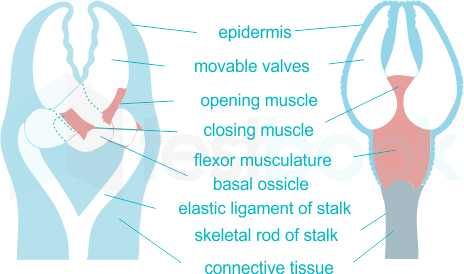
  • It has an elongated, spindle-shaped body that is covered by a pellicle.
  • It consists of flagella for locomotion.
  • The cell also contains a nucleus, chloroplasts, a contractile vacuole and an eye spot.
  • They lack cell wall but the pellicle provides rigidity as well as flexibility to change shape.
  • They are photosynthetic but most species can also feed heterotrophically.

Important Points

  • Euglena contains chloroplasts or chromatophores that bear the pigments.
  • They contain the green pigment chlorophylls a and b as well as β-carotene pigment.
  • The chloroplasts are slender, elongated and band-like structures present in the endoplasm of cell.
  • They are arranged in a radiating manner from the center of the cell.
  • Each chloroplast consists of a thin central pyrenophore that is enclosed by a pyrenoid.

75

Homology indicates

  1. ((a))

    Common ancestry

  2. ((b))

    Divergent evolution

  3. ((c))

    Both 

  4. ((d))

    None

Show Answer
Answer: ((c))

Both 

Key Points

  • The theory of evolution by natural selection was proposed by Charles Darwin.
  • It stated that all life forms arise due to natural selection of small inheritable changes that increase the survivability of a species.
  • Darwin also defined evolution as descent with modification, meaning we have evolved from our ancestors through inheritable variations of characteristics.
  • The evidences for evolution include:
  • Paleontological Evidence - Study of fossils have revealed that different life forms existed in different geological time-periods and similarities exist between existing and pre-existing life forms.
  • Anthropogenic Evidence - Overuse of pesticides and herbicides have resulted in natural selection of resistant varieties in much lesser time.
  • Comparative Anatomy & Morphology - Homology and analogy are based on comparisons between structure and functions of organs that show evolutionary adaptations in nature.

Important Points

  • Homology means -
  • Similar structures that differ in their functions are known as homologous organs.
  • Example - Forelimbs of whale, bat, cheetah and human.
  • All of them have humerus, radius, ulna, carpels, metacarpels and phalanges.
  • Whales use forelimbs for swimming, bats for flying, cheetah for running and humans for grasping.
  • Homology indicates divergent evolution -
  • The same structure evolved in different directions.
  • This shows evolutionary adaptations due to varying needs.
  • It also indicates common ancestry
  • The functions diverged from a common ancestor.
  • Example - Thorns of Bougainvillea and tendrils of Cucurbita are both modified branches.

Additional Information

  • Analogy refers to the similarity of functions of different structures.
  • It indicates convergent evolution.
  • Example - Sweet potato and potato are root and stem modifications respectively but both function as storage organ.
76

Which of the following does not happen in the prophase I of meiosis ?

  1. ((a))

    Condensation of chromosomes

  2. ((b))

    Pairing of homologs

  3. ((c))

    Chiasma formation

  4. ((d))

    Segregation

Show Answer
Answer: ((d))

Segregation

Key Points

  • Meiosis is a reductional division in which one parental cell gives 4 daughter cells, each with half the number chromosomes.
  • It takes place in the germ cells of an organism.
  • It comprises of one interphase followed by two nuclear divisions:
  • Meiosis I - It is reductional division.
  • Meiosis II - It is equational division like mitosis.
  • Meiosis I consists of 4 phases - Prophase I, Metaphase I, Anaphase I and Telophase I.
  • Segregation takes place in the Anaphase I.

Important Points

  • Prophase I -
  • Leptotene - The nucleus is distinct and the condensation of chromosomes start but still look thread-like.
  • Zygotene - Pairing or synapsis of homologous chromosomes take place to form bivalents and synaptonemal complex can be observed.
  • Pachytene - Further condensation of chromosomes, and chiasmata formation for crossing over between non-sister chromatids of homologous chromosomes.
  • Diplotene - Bivalents are distinct and chiasmata of two homologs start moving towards the terminal ends of chromosomes.
  • Diakinesis - Terminalization of chiasmata is completed, nuclear membrane disappears and spindle formation begins.
  • Metaphase I -
  • The bivalents arrange themselves at the equator.
  • The chromosomes point towards the opposite poles .
  • The centromeres remain attached to the spindle fibers.
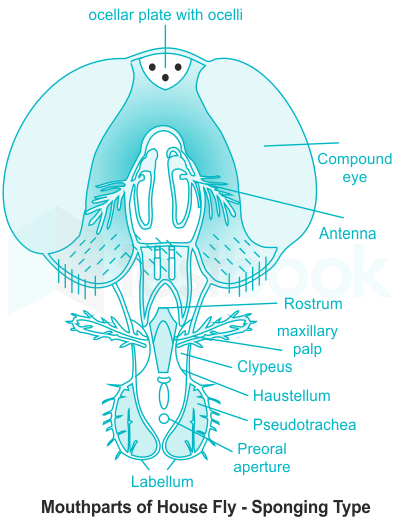
  • The chromosomes have maximum condensation.
  • Anaphase I -
  • Separation or segregation of chromosomes take place as homologs move towards opposite poles.
  • Each tetrad is divided into two dyads.
  • This results in reduction of chromosome number and is called disjunction.
  • Telophase I -
  • Formation of daughter nucleus with nuclear membrane and nucleolus.
77

Gametangial copulation is common in

  1. ((a))

    Ascomycetes

  2. ((b))

    Zygomycetes

  3. ((c))

    Basidiomycetes

  4. ((d))

    Deuteromycetes

Show Answer
Answer: ((b))

Zygomycetes

Key Points

  • Reproduction in fungi can be:
  • Vegetative - It takes place by the processes of fission, budding and fragmentation.
  • Asexual - This takes place by the formation of spores from a single individual.
  • Sexual - It involves the formation and fusion of gametes.
  • Sexual reproduction is common in all groups of fungi except Deuteromycetes.
  • Different methods of sexual reproduction are:
  • Planogametic copulation - It involves fusion of 2 gametes from opposite strains to form a diploid zygote. E.g. - Synchytrium.
  • Gametangial contact - In this process, the male gametangia transfers the male nucleus into the female gametangia. E.g. - Albugo.
  • Gametangial copulation - It involves the fusion of the entire contents of 2 gametangia to form a common cell called zygote or zygospore. E.g. - Rhizopus.
  • Spermatization - It involves formation of single-celled, spore-like non-motile cells called spermatia, which migrate to the receptive structures to form a dikaryotic stage. E.g. - Puccinia.
  • Somatogamy - Lack of formation of gametes results in anastomoses between the hyphae, and fusion of the somatic cells to form dikaryotic cells. E.g. - Agaricus.

Important Points

  • Zygomycetes -
  • They form zygospores by gametangial copulation.
  • Zygospores are thick-walled spores.
  • It is formed when 2 sexually compatible hyphae or gametangia fuse together.
  • Zygospores germinate under suitable conditions to produce a single vertical hyphae.

Additional Information

  • Ascomycetes - They form ascospores in sac-like structures called asci.
  • Basidiomycetes - They form basidiospores in club-shaped structures called basidia.
  • Deuteromycetes - They are called 'fungi imperfecti' because they do not have any sexual mode of reproduction.
78

Which of the following tissues in cycas ovule is haploid ?

  1. ((a))

    Integument

  2. ((b))

    Nucellus

  3. ((c))

    Endosperm

  4. ((d))

    None of the above

Show Answer
Answer: ((c))

Endosperm

Key Points

  • Cycas is a gymnosperm genus that belongs to the order Cycadales.
  • It is a dioecious plant, where male and female cones are borne on separate plants.
  • True female cones or strobili are absent in Cycas and female reproductive organs are present in the form of megasporophylls.
  • Each megasporophyll contains 2 or more ovules arranged in 2 pinnate rows.

Important Points

  • The ovules are green when young and bright reddish on maturity.
  • Ovules are orthotropous, unitegmic and short-stalked.
  • The integument is thick and covers the ovule from all sides except micropyle.
  • Inside the nucellus, one cell differentiates into the megaspore mother cell (MMC).
  • The MMC undergoes meiotic divisions to form a linear tetrad of haploid megaspores.
  • The 3 megaspores towards the micropyle degenerate.
  • The lowermost functional megaspore becomes the embryo sac cell.
  • It undergoes free nuclear divisions followed by wall formation to form the cellular endosperm (female gametophyte).
  • Unlike angiosperms, here the endosperm is formed before fertilization and is haploid.

79

Homologous structures found in some species have no clear function. These are called

  1. ((a))

    Degenerate organs

  2. ((b))

    Dormant organs

  3. ((c))

    Dwarf organs

  4. ((d))

    Vestigial organs

Show Answer
Answer: ((d))

Vestigial organs

Key Points

  • Homologous structures refer to the similar structures that differ in functions.
  • Example -
  • Forelimbs of whale, bat, cheetah and human are made of humerus, radius, ulna, carpels, metacarpels and phalanges.
  • Whales use forelimbs for swimming, bats for flying, cheetah for running and humans for grasping.
  • The structures have evolved from a common ancestor.
  • They show divergent evolution, meaning that the adaptations evolved in different directions due to varying needs.
  • Example - Thorns of Bougainvillea and tendrils of Cucurbita both evolved from branches by modification into thorns for protection and tendrils for support.

Important Points

  • Vestigial organs refer to those structures that do not have a defined function in some species.
  • These structures are often found to be completely functional in some other species.
  • Examples -
  • Wisdom teeth and vermiform appendix in human.
  • Pelvic bone of snake.
  • It indicates that they might have a common ancestor from which they diverged through evolution.
  • Thus, vestigial organs are also homologous structures.
  • They also provide evidence of biological evolution.

Additional Information

  • Analogous structures refer to different structures that perform similar functions.
  • It indicates convergent evolution, directed towards a common need.
  • Examples -
  • Sweet potato and potato are root and stem modifications respectively but both function as storage organ.
  • Wings of birds are made of bones and feathers while wings of butterfly are membranous, but both are used for flying.
80

Chloroplasts contain maximum quantity of

  1. ((a))

    RUBP carboxylase

  2. ((b))

    Hexokinase

  3. ((c))

    Pyruvate carboxylase

  4. ((d))

    None of these

Show Answer
Answer: ((a))

RUBP carboxylase

Key Points

  • Chloroplast is a cell organelle that acts as the site of photosynthesis.
  • It is a type of plastid that contains the green pigment chlorophyll.
  • Photosynthesis takes place in 2 phases:
  • Light reaction - The protons and electrons, produced from the splitting of water into oxygen, are transferred through thylakoid membrane to produce energy.
  • Dark reaction - The energy produced in the light reactions is utilized to convert CO2 into carbohydrates by the Calvin-Benson Cycle occurring in the chloroplast stroma.
  • Calvin Cycle phases:
  • Carboxylation - It is the first step of Calvin cycle where RUBP carboxylase enzyme plays a vital role.
  • Reduction - The 3-phosphoglycerate undergoes reduction using the ATP from the light reactions.
  • Regeneration - The RUBP molecules are regenerated in the chloroplast for the next cycles.

Important Points

  • RUBP carboxylase is the enzyme that catalyzes the carboxylation of Ribulose 1,5- bisphosphate (RUBP).
  • It forms 3-phosphoglycerate (3-PGA) in the presence of CO2 and H2O.
  • It is the most abundant enzyme in the chloroplast.

Additional Information

  • Hexokinase - It is glycolytic enzyme and hence it is present in the cytoplasm.
  • Pyruvate carboxylase - It is a mitochondrial enzyme that takes part in gluconeogenesis to convert pyruvate into oxaloacetate.
81

Actinostele is found in

  1. ((a))

    Lycopodium annotinum

  2. ((b))

    Lycopodium cernuum

  3. ((c))

    Lycopodium seratum

  4. ((d))

    Lycopodium volubile

Show Answer
Answer: ((c))

Lycopodium seratum

Key Points

  • Stele is defined as the central cylindrical core of a plant root or stem consisting of vascular tissue with or without pith.
  • The presence of stele has been extensively studied in pteridophytes.
  • Major types of stele:
  • Protostele - It is the simplest form of stele with central xylem surrounded by phloem and without pith. E.g. - Lycopodium.
  • Siphonostele - It is the type of stele where central pith is present and vascular tissue is in the form of a continuous hollow cylinder. E.g. - Selaginella.
  • Solenostele - It is similar to siphonostele but the vascular cylinder is dissected at places by leaf gaps, from where leaf traces originate.
  • Dictyostele - It consists of overlapping leaf gaps such that the vascular tissue is dissected into separate strands called meristeles. E.g. - Pteris.
  • Eustele - It is a modified siphonostele consisting of a ring of vascular bundles situated on the periphery of the pith. E.g. - Gymnosperms and angiosperms.
  • Types of protostele:
  • Haplostele - It has a smooth core of xylem surrounded by uniform layer of phloem.
  • Actinostele - The xylem core is star-shaped due to the radiating ribs and phloem is in patches between the radiating arms.
  • Plectostele - The xylem is in separate parallel patches with the phloem in between them.
  • Mixed Protostele - The xylem is scattered in irregular patches embedded in the ground tissue.

Important Points

  • Lycopodium annotinum - Plectostele
  • Lycopodium cernuum - Mixed protostele
  • Lycopodium seratum - Actinostele
  • Lycopodium volubile - Plectostele

82

The phenomenon of double fertilization was first observed by

  1. ((a))

    S.G Nawaschin

  2. ((b))

    E. Strasburger

  3. ((c))

    Joseph Kolreuter

  4. ((d))

    G.B Amici

Show Answer
Answer: ((a))

S.G Nawaschin

Key Points

  • S..G. Nawaschin -
  • Sergei Nawaschin was a Russian biologist who discovered double fertilization.
  • He observed double fertilization in Lilium martagon and Fritillaria tenella.
  • E. Strasburger -
  • Eduard Strasburger was a botanist who discovered mitosis in plants.
  • He significantly contributed to plant cell biology.
  • Joseph Kolreuter -
  • He was a German botanist who pioneered the study of fertilization in plants.
  • He was the first to observe self-incompatibility in plants.
  • G. B. Amici -
  • Giovanni Battista Amici was an Italian botanist and astronomer.
  • He was the first to observe the pollen tube in plants.

Additional Information

  • Double fertilization is a unique fertilization mechanism observed in angiosperms.
  • A single pollen contains 2 male gametes which take part in a single zygote formation process.
  • One male gamete fuses with the egg cell by the process of syngamy to produce a diploid embryo.
  • The second male gamete fuses with the polar nuclei of central cell by the process of triple fusion to produce a triploid endosperm.
  • The endosperm provides nutrition to the developing embryo.
83

In scoliodon, the work of ampullae of lorenzini is

  1. ((a))

    Mechano receptor

  2. ((b))

    Thermo receptor

  3. ((c))

    Rheo receptor

  4. ((d))

    Photo receptor

Show Answer
Answer: ((b))

Thermo receptor

Mistake Points

  • Please note that the ampullae of Lorenzini are commonly referred to as electroreceptors but here it is not mentioned in the options.
  • They can also be called thermoreceptors due to the thermo-sensitivity of the electrical sensors.
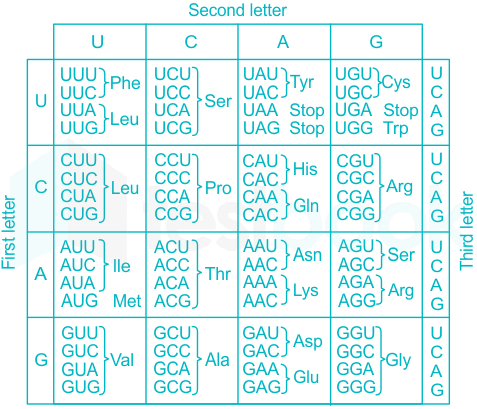
Key Points

  • Scoliodon is a genus of elasmobranch that belongs to the class Chondrichthyes under Chordata phylum.
  • Ampullae of Lorenzini are sensory organs present in elasmobranchs like Scoliodon.
  • They were initially recognized as electroreceptors but were later found to act as thermoreceptors.
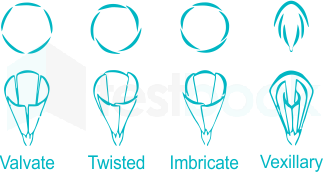
  • These consist of small capsules embedded in the skin and are filled with a highly conductive gel.
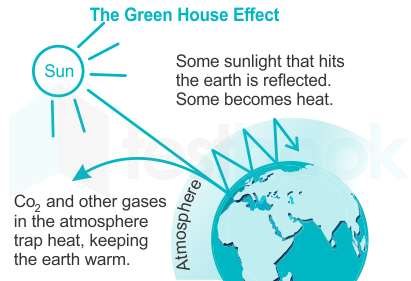
  • They open on to the surface by a gel-filled canal.
  • This canal leads to a patch of sensory epithelial cells.
  • These organs are found to be highly sensitive to cooling.
  • Studies show that the receptors have steady temperature-dependent activities at 0-30ºC.
  • Rapid cooling results in increase of discharge frequency, while rapid warming causes discharge inhibition.

Additional Information

  • Mechanoreceptor - These are a type of somatosensory receptors that respond to mechanical stimuli like touch or pressure. E.g.- Touch receptor on skin.
  • Rheoreceptor - These are a type of receptors present in aquatic animals that respond to water currents.
  • Photoreceptor - These are neuroepithelial cells that specifically respond to light. E.g.- Cells of retina in our eyes.
84

Which of the following is not true regarding the blood vascular system of cockroach ?

  1. ((a))

    Its blood is called hemolymph

  2. ((b))

    Heart has 13 chambers

  3. ((c))

    Respiratory pigment absent in blood

  4. ((d))

    Pulsatile vesicles absent

Show Answer
Answer: ((d))

Pulsatile vesicles absent

Key Points

  • Cockroach is an insect that belongs to the phylum Arthropoda.
  • The blood vascular system of cockroaches is of open-type.
  • This means that blood flows through open cavities and not through vessels.

Important Points

The given statements can be analyzed as follows:

  • Its blood is called hemolymph: TRUE​
  • Blood comes in direct contact with the tissues while flowing through the hemocoel.
  • Thus blood acts as both blood as well as lymph and hence called 'hemolymph'.
  • Heart has 13 chambers: TRUE
  • ​The heart is a narrow, elongated tube lying along the mid-dorsal line of thorax and abdomen.
  • It has 13 funnel-shaped chambers which are segmentally arranged.
  • Respiratory pigment absent in blood: TRUE
  • ​The hemolymph is colorless due to lack of respiratory pigments.
  • Thus, it does not take part in respiration.
  • It consists of suspended nucleated cells called hemocytes.
  • Pulsatile vesicles absent: NOT TRUE
  • ​Pulsatile vesicles are also known as lymphatic hearts.
  • They are specialized structures for circulating coelomic fluid.
  • Cockroaches have an accessory pulsatile vesicle at the base of each antenna.
  • It is responsible for supplying hemolymph to certain appendages.

85

Electroneutrality of blood is maintained by the

  1. ((a))

    Hamburger's phenomenon

  2. ((b))

    Hering-Breuer's reflex

  3. ((c))

    Haldane effect

  4. ((d))

    Pneumotaxis centre

Show Answer
Answer: ((a))

Hamburger's phenomenon

Key Points 

  • Electroneutrality is the condition of any solution where the sum of positive electric charges on ions is equal to the sum of negative electric charges.
  • Blood consists of plasma which is an aqueous solution and maintains electroneutrality.
  • According to the electroneutrality principle, plasma has to be electrically neutral and sum of its anions should be equal to sum of cations.
  • This is maintained by the Hamburger's phenomenon or the chloride shift.

Important Points

  • The blood haemoglobin is responsible for the transport of both O2 and CO2.
  • About 70% of CO2 from the tissues is transported in the form of bicarbonates of sodium and potassium.
  • About 7% of CO2 is transported in the form of carbonic acid (H2CO3) which is formed inside the RBCs.
  • The carbonic acid dissociates into hydrogen (H+) and bicarbonate (HCO3-) ions.
  • The bicarbonate ions diffuse into the plasma, making it more negatively charged.
  • To maintain electroneutrality, equal amount of chloride (Cl-) ions diffuse into the RBCs from the plasma.
  • This chloride shift takes place with the help of a carrier protein of the RBC membrane which shuttles these 2 ions in opposite directions.

Additional Information

  • Hering-Breuer's Reflex -
  • Also known as inflation reflex, it is the longest known lung reflex.
  • The pulmonary stretch receptors in the airways sends a signal to the medulla through vagus nerve to inhibit inspiration.
  • It is a reflex triggered to prevent overinflation of the lungs.
  • Haldane Effect -
  • It refers to the displacement of CO2 from the blood due to O2 binding with haemoglobin.
  • Pneumotaxic Centre -
  • It is a neural centre located in the pons region of the brain.
  • It is one of the respiratory rhythm centres that controls our breathing.
86

Of the following who discovered polytene chromosome ?

  1. ((a))

    E.G Balbiani

  2. ((b))

    J.M. Mitchison

  3. ((c))

    R. Von Hertwig

  4. ((d))

    Daniel Mazid

Show Answer
Answer: ((a))

E.G Balbiani

Key Points

  • E. G. Balbiani -
  • He was a French embryologist and microbiologist who is known for his discovery of sexual organ development in Chironomus.
  • He also identified large chromosome puffs called polytene chromosomes from salivary glands of Chironomus larvae.
  • J. M. Mitchison -
  • He was a British zoologist who significantly contributed towards molecular cell biology.
  • His major works were on cell cycle.
  • R. von Hertwig -
  • Richard von Hertwig was a German biologist who is known for the development of germ-layer theory.
  • He also contributed towards the study of protozoans.

Additional Information

  • Polytene chromosomes are amplified forms of interphase chromosomes that are found in salivary glands of insects.
  • They are formed from duplication of chromatids without segregation.
  • The newly formed chromatids remain attached length-wise and form polytene chromosomes.
87

World Environment Day is celebrated every year on which day ?

  1. ((a))

    June 5

  2. ((b))

    September 21

  3. ((c))

    October 1

  4. ((d))

    December 10

Show Answer
Answer: ((a))

June 5

Key Points

  • June 5 -
  • It is celebrated as the World Environment Day.
  • It was announced by the United Nations in 1972 and the first celebrated took place in 1974.
  • It is aimed at creating awareness about the environment and encourage its protection.
  • September 21 -
  • It is celebrated as the International Day of Peace.
  • It was first observed by the UN General Assembly in 1981.
  • It is aimed at encouraging peace among nations.
  • In 2001, UN has also declared this day as a day of non-violence and cease-fire.
  • October 1 -
  • It is celebrated as the International Day of Older Persons.
  • It was decided by the UN under a resolution in 1990.
  • It aims at raising the concerns of older people to promote the development of the society.
  • December 10 -
  • It is celebrated as the Human Rights Day.
  • It is recognized under the Universal Declaration of Human Rights as adopted by the UN in 1948.
  • It is celebrated to recognize the fundamental rights of all human beings and their need for freedom.

Additional Information

  • World Environment Day was hosted by India in 2011 on the theme "Forests - Nature At Your Service".
88

Which of the following pairs is not correctly matched ?

  1. ((a))

    Monosaccharide - fructose

  2. ((b))

    Polysaccharide - cellulose

  3. ((c))

    Disaccharide - galactose

  4. ((d))

    Starch - mixture of amylose and amylopectin

Show Answer
Answer: ((c))

Disaccharide - galactose

Key Points

  • ​Carbohydrates are often divided into 3 major groups:
  • Monosaccharide - These are simple sugars that cannot be broken down any further by hydrolysis. Example - Glucose.
  • Disaccharide - It consists of 2 monosaccharides joined by a glycosidic linkage. Example - Sucrose (Glucose + Fructose).
  • Polysaccharide - These are polymeric carbohydrates formed by more than 2 monosaccharide units. Example - Cellulose.

Important Points

  • Monosaccharide - Fructose: CORRECT
  • Fructose, glucose and galactose are the 3 major monosaccharides.
  • Polysaccharide - Cellulose: CORRECT
  • Cellulose is a polysaccharide composed of glucose units.
  • Disaccharide - Galactose: INCORRECT
  • Galactose is a monosaccharide.
  • Starch - Mixture of Amylose and Amylopectin: CORRECT
  • Starch is a polysaccharide composed of amylose and amylopectin, which are themselves polymers of glucose.

Additional Information

  • Carbohydrates are the most abundant biomolecules on Earth.
  • They are composed of molecules containing carbon (C), hydrogen (H) and oxygen (O) atoms.
  • They are important constituents of all living organisms as they act as energy source, structural components and nucleic acid composition.
89

In which of the following plants root nodules are not formed by Rhizobium ?

  1. ((a))

    Cajanus cajan

  2. ((b))

    Cicer arietinum

  3. ((c))

    Glycine max

  4. ((d))

    Casuarina glauca

Show Answer
Answer: ((d))

Casuarina glauca

Key Points

  • Rhizobium is a genus of soil bacteria that forms symbiotic association with the roots of leguminous plants.
  • They form root nodules in their host plants to fix atmospheric nitrogen.
  • The bacteria convert the atmospheric nitrogen into ammonia that can be utilized by the plant.
  • The legume roots secrete some compounds into the rhizosphere under nitrogen-limiting conditions.
  • These compounds activate the nod genes of bacteria that are responsible for nodule formation.
  • The bacteria infect the roots to establish symbiosis.

Important Points

  • Cajanus cajan - It is commonly known as pigeon pea, which is a leguminous plant belonging to family Fabaceae.
  • Cicer arietinum - It is commonly called chickpea, which is also a legume of family Fabaceae.
  • Glycine max - It is commonly called soybean, which is legume species of Fabaceae family.
  • Casuarina glauca -
  • It is commonly called as river-oak and belongs to the family Casuarinaceae.
  • It is not a leguminous plant and thus does not have root nodules formed.
90

Indian subcontinent is included in

  1. ((a))

    Palearctic region

  2. ((b))

    Oriental region

  3. ((c))

    Neotropical region

  4. ((d))

    Nearctic region

Show Answer
Answer: ((b))

Oriental region

Key Points

  • The oriental region is a part of the zoogeographic regions of the world.
  • Zoogeography refers to the geographic distribution of animal life or fauna.
  • The concept was originated by naturalists like A. R. Wallace in the 19th century.
  • The faunal regions are mostly described on the basis of vertebrate fauna, including invertebrates only at times.
  • It was also shown as evidence of continental drift and how migration of species took place from their centers of origin.
  • Each region more or less coincides with a major continental land mass separated by oceans, deserts or mountain ranges.

Important Points

  • There are 7 zoogeographic regions:
  • Palearctic - comprises Europe and Asia from north of the tropics.
  • Ethiopian - comprises of Africa south of the Sahara desert and parts of southern Arabia.
  • Oriental - includes tropical Asia and associated continental islands.
  • Nearctic - consists of North America except for tropical Mexico.
  • Neotropical - comprises South and Central America including Mexico.
  • Australian - covers Australia and New Guinea.
  • Antarctic - essentially covers the Antarctica continent.
  • The Indian subcontinent is covered in the Oriental region of tropical Asia.
91

The mouth parts of male mosquito do not have

  1. ((a))

    Maxillae and mandible

  2. ((b))

    Labium and labrum

  3. ((c))

    Maxillary palps and labellum

  4. ((d))

    Antenna and hypopharynx

Show Answer
Answer: ((a))

Maxillae and mandible

Key Points

  • Mosquitoes are dipteran insects that belong to the phylum Arthropoda.
  • They typically have piercing and sucking type mouthparts so that they can pierce through the vertebrate skin and then suck blood.
  • The mouthparts of a male and female are slightly different and has evolved around their feeding habit.
  • Female mosquitoes feed on blood and thus have a more needle-like proboscis to suck blood and less hairy antennae.
  • The female mosquitoes are effective carriers of many diseases like malaria, dengue, etc.
  • The male mosquitoes feed on plant sap only and so their proboscis is less needle-like and antennae are more hairy.
  • As the male mosquitoes can not bite, they do not spread any diseases.

Important Points

  • The mouthparts of a male mosquito include:
  • Labium - It is modified to form a fleshy tube called proboscis that has the labial groove, which encloses all the other mouthparts.
  • Labrum-epipharynx - It is formed by the fusion of the labrum and epipharynx and forms the food canal with its ventral groove.
  • Hypopharynx - It is modified to form a long stylet that forms the food canal and has salivary ducts opening at the tip.
  • Maxillary palps - These are long, hairy, pointed at the tips and extend beyond the proboscis.
  • The labial palps are modified to form lobes called labella at the tip of proboscis and bear tactile bristles.
  • The maxillae and mandibles are greatly reduced or completely absent in male mosquitoes.

Mistake Points

  • Maxillae and mandibles are  reduced or absent in male mosquitoes, but are present in female mosquitoes.
92

On the basis of number and position of flagella, vibrio cholerae is

  1. ((a))

    Atrichous

  2. ((b))

    Amphitrichous

  3. ((c))

    Monotrichous

  4. ((d))

    Cephalotrichous

Show Answer
Answer: ((c))

Monotrichous

Key Points

  • Flagella are hair-like structures protruding from the cell surface and has the primary function of locomotion.
  • It is present in both prokaryotic and eukaryotic motile cells but differ in structure.
  • Bacterial flagella is made up of flagellin protein.
  • It has 3 major structural elements:
  • Basal body - remains enclosed in the cell envelope and functions like rotary motor.
  • Hook - is the attachment of the filament to the basal body near the cell surface.
  • Filament - is the helical structure that rotates clockwise or anti-clockwise to work like a propeller.

Important Points

  • On the basis of number and position of flagella, bacteria can be divided into:
  • Atrichous - do not have any flagella. Example - Lactobacillus.
  • Monotrichous - have a single polar flagella. Example - Vibrio cholerae.
  • Amphitrichous - have a single flagella at each end. Example - Campylobacter.
  • Lophotrichous - have a tuft of flagella at one end. Example - Spirillum.
  • Peritrichous - have numerous flagella distributed all over the body. Example - Salmonella.

93

'Leaf curl of papaya' disease is caused by

  1. ((a))

    Fungus

  2. ((b))

    Virus

  3. ((c))

    Bacteria

  4. ((d))

    Mycoplasma

Show Answer
Answer: ((b))

Virus

Key Points

  • 'Leaf curl of papaya' refers to a viral disease of Carica papaya leaves.
  • Cause - Papaya leaf curl virus (PaLCuV).
  • Symptoms -
  • Downward or inward curling of leaves.
  • Reduction of leaf lamina.
  • Thickening of leaf veins.
  • Leathery, brittle and distorted leaves.
  • Twisted or deformed petioles.
  • Stunted plant growth.
  • Compromised flower and fruit development.
  • Transmission - by the whitefly Bemisia tabaci.
  • Alternative hosts for the virus are tobacco and tomato plants.

Additional Information

  • Other viral plant diseases:
  • ​Tobacco mosaic disease - Tobacco mosaic virus (TMV)
  • Some bacterial diseases of plants are:
  • Crown gall - Agrobacterium tumefaciens
  • Common blight of beans - Xanthomonas campestris
  • Soft rot - Erwinia carotovora
  • Some fungal plant diseases are:
  • Late blight of potato - Phytophthora infestans
  • Black rust of wheat - Puccinia graminis
  • Loose smut of wheat - Ustilago nuda
94

"Nurse cells" are found in

  1. ((a))

    Riccia 

  2. ((b))

    Merchantia

  3. ((c))

    Funaria

  4. ((d))

    None

Show Answer
Answer: ((a))

Riccia 

Key Points

  • Riccia belongs to the Marchantiales family of Bryophyta.
  • The male and female gamete-bearing structures are called antheridium and archegonium respectively.
  • Sexual reproduction is of oogamous type, meaning it takes place by fusion of motile male and non-motile female gametes.
  • Fertilization results in the formation of a diploid zygote which develops into a sporophyte.

Important PointsStructure of sporophyte:

  • The sporophyte develops from the zygote.
  • The venter cells divide to form calyptra that encloses the developing sporophyte.
  • The zygote divides to form a mass of 20-40 cells which differentiates into:
  • Peripheral cell layer
  • Amphithecium - It forms the jacket layer of sporophyte.
  • Endothecium - It divides to form the sporogenous tissue called archesporium.
  • The archesporial cells differentiate into:
  • Spore mother cells - They contain thick, dense cytoplasm and undergo meiotic divisions to form haploid spore tetrad.
  • Nurse cells - These are sterile, nutritive cells containing watery vacuolated cytoplasm.
  • Later, the nurse cells, amphithecium and inner layer of venter degenerate to form a nutritive viscous fluid.
  • The mature sporophyte, called sporogonium, remains attached to the gametophyte.
  • The spores are released only when the venter wall and gametophytic tissue degenerate.
95

The disease 'citrus canker' is caused by

  1. ((a))

    Fungi

  2. ((b))

    Virus

  3. ((c))

    Bacteria

  4. ((d))

    Deficiency of calcium

Show Answer
Answer: ((c))

Bacteria

Key Points

  • Citrus canker is a plant disease that affects the citrus species.
  • Cause - Bacterium Xanthomonas.
  • Symptoms -
  • Brown spotting or lesions on leaves.
  • The lesions develop a water-soaked margin with a yellow ring around it.
  • Blemishes or blisters on the fruit rind.
  • Leaf and fruit drop in premature stage.
  • Fruits affected by citrus canker are safe to consume but becomes less appealing.

Additional Information

  • Some other bacterial diseases of plants are:
  • Crown gall - Agrobacterium tumefaciens
  • Common blight of beans - Xanthomonas campestris
  • Soft rot - Erwinia carotovora
  • Some fungal plant diseases are:
  • Late blight of potato - Phytophthora infestans
  • Black rust of wheat - Puccinia graminis
  • Loose smut of wheat - Ustilago nuda
  • Some viral plant diseases:
  • Tobacco mosaic disease - Tobacco mosaic virus (TMV)
96

Which one of the following belongs to the group 'Embryophyta' ?

  1. ((a))

    Algae

  2. ((b))

    Bryophyta

  3. ((c))

    Fungi

  4. ((d))

    Lichens

Show Answer
Answer: ((b))

Bryophyta

Key Points

  • Embryophyta refers to a broad group of plants that includes all land plants.
  • It comprises of the bryophytes, pteridophytes, gymnosperms and angiosperms.
  • It is based on a phylogenetically derived classification of plants.

Important Points

  • The colonization of land by green plants required simultaneous evolution of some adaptive features.
  • The formerly aquatic plants needed to survive and reproduce on land in the absence or scarcity of a water medium.
  • One such vital adaptation was the evolution of the embryo and sporophyte formation.
  • The sporophyte is a distinct diploid plant body that evolved only in land plants.
  • The sporophyte develops from the zygote due to delayed meiosis of zygote.
  • The immature sporophyte is termed as embryo, which may remain attached to the gametophytic plant body for some time.
  • The sporophyte forms spore-producing regions called sporangium which contains sporogenous tissue.
  • Sporogenous tissue matures into cells that undergo meiosis to finally produce haploid spores.
  • This separate sporophytic generation was advantageous in land plants because:
  • In absence of sporophyte, one zygote produces 4 spores while, one sporophyte from one zygote can produce millions of spores.
  • Increase in reproductive success leads to increased chances of genetic variation.
  • The diploidy of sporophyte also increases genetic variability, ensuring its evolutionary success.

97

The coenosarc of Obelia is

  1. ((a))

    Tubular and non-living

  2. ((b))

    Tubular and living

  3. ((c))

    Rod like and non-living

  4. ((d))

    Rod like and living

Show Answer
Answer: ((b))

Tubular and living

Key Points

  • Obelia is a genus of hydrozoans that belong to the phylum Cnidaria.
  • They are commonly called sea-fur.
  • They are marine invertebrates that have both polyp and medusa stages in their life cycles.
  • The polyp is the sessile and asexual stage, while medusa is the free-swimming, sexual stage.
  • They form small hydroid colonies on rocks or large seaweeds in the form of fur-like growth.

Important Points

  • Coenosarc -
  • It is the inner, tubular, living tissue of Obelia colony.
  • It encloses a canal called gastrovascular cavity.
  • It is surrounded externally by perisarc.
  • Perisarc -
  • It is the yellow-brown, non-living chitinous layer of Obelia.
  • It protects the colony and acts as an exoskeleton.
  • It contains annuli that allows some limited movements.

Additional Information

  • Obelia colonies consist of:
  • Hydrorhiza - It is root-like stolon that branches horizontally.
  • Hydrocaulus - It is a stem-like structure that emerges from the hydrorhiza and branches vertically.
  • The branches emerging from the hydrocaulus terminate in zooids.
  • They are trimorphic:
  • Hydranths or polyps - These are nutritive zooids.
  • Blastostyles or gonangia - These are reproductive zooids that produce medusae.
  • Medusa - It is the free-swimming zooid that escapes the sedentary polyps.
98

In a typical test cross, a plant showing a dominant phenotype is crossed with a plant showing__________ phenotype.

  1. ((a))

    recessive

  2. ((b))

    dominant

  3. ((c))

    Any of the two

  4. ((d))

    None

Show Answer
Answer: ((a))

recessive

Key Points

  • Test cross -
  • It is a genetic cross of an organism with a dominant phenotype with an organism having recessive phenotype.
  • It is performed in order to determine the unknown genotype of an organism.
  • It helps us to know whether the dominant phenotype has a homozygous or heterozygous genotype.
  • Homozygous - It is the condition in which the pair of alleles determining a phenotype is identical, either both dominant or both recessive.
  • Heterozygous - It is the condition where 2 different types of alleles are present, one dominant and one recessive.
  • Genotype - It is the allelic constitution of a gene determining a particular character.
  • Phenotype - It is the expressed character.
  • Mendel had chosen 7 traits for his experiments on garden pea, from which he observed these genetic crosses.
  • Each of these traits had 2 distinct phenotypic characters - one dominant and one recessive.

Explanation:

  • For example, let us take the trait of stem height with the phenotypes of tall and dwarf plants.
  • The tall plants can be homozygous (TT) or heterozygous (Tt), while the dwarf plants are always homozygous recessive (tt).
  • To determine the genotype of a tall plant, we would perform a test cross with a dwarf plant.
  • The test cross may have 2 outcomes:
  • Case 1 - If the unknown tall plant is homozygous (TT), it would produce all tall plants (Tt).
  • Case 2 - If the unknown tall plant is heterozygous (Tt), would produce tall : dwarf plants in 1:1 ratio.

Additional Information

  • Back cross -
  • It is the genetic cross between F1 generation and either of the parent.
  • It is performed to obtain an offspring with more phenotypic similarity with its parents.
  • It is mostly used for horticultural purposes and animal breeding.
99

The presence of bone is an unique character of

  1. ((a))

    Hemichordata

  2. ((b))

    Urochordata

  3. ((c))

    Cephalochordata

  4. ((d))

    Vertebrata

Show Answer
Answer: ((d))

Vertebrata

Key Points

  • The 5-kingdom classification of Whittaker places the organisms under Monera, Protista, Fungi, Plantae and Animalia.
  • Kingdom Animalia is further divided into 11 phyla, which are in order of evolution, meaning they are placed from the most primitive to the most advanced.
  • The phyla are: 
  • Porifera ⇒ Coelenterata (Cnidaria) ⇒ Ctenophora ⇒ Platyhelminthes ⇒ Aschelminthes ⇒ Annelida ⇒ Arthropoda ⇒ Mollusca ⇒ Echinodermata ⇒ Hemichordata ⇒ Chordata.
  • The phylum Chordata is characterized by the presence of notochord.
  • Chordata are further classified into 3 sub-phyla:
  • Urochordata - Notochord is present only in larval tail. E.g. - Ascidia.
  • Cephalochordata - Notochord is persistent throughout life. E.g. - Amphioxus.
  • Vertebrata - Notochord is present during embryonic stage, but later replaced by cartilaginous or bony vertebral column in adults.

Important Points

  • Presence of bones is an unique character of Vertebrata.
  • Bones form the endoskeletal structures of most of the vertebrates.
  • The vertebral column encloses the spinal cord as a protective structure.
  • The bony skull is also a special feature to protect the brain from external injury.
  • The bony endoskeleton gives support to the vertebrate bodies while protecting the internal organs.
100

In which form the nitrogenous waste is discarded by the nephridia of Nereis ?

  1. ((a))

    Ammonia

  2. ((b))

    Urea

  3. ((c))

    Uric acid

  4. ((d))

    Guanine

Show Answer
Answer: ((a))

Ammonia

Key Points

  • Nitrogenous wastes are the main waste products that are discarded from the body by the process of excretion.
  • The main forms of nitrogenous waste are Ammonia, Urea and Uric acid.
  • Based on the form of nitrogenous waste, there are 3 types of excretion:
  • Ammonotelism - Excretion is in the form of Ammonia.
  • Ureotelism - Excretion is in the form of Urea.
  • Uricotelism - Excretion is in the form of Uric acid
CharactersAmmonotelismUreotelismUricotelism
1. Type of WasteAmmoniaUreaUric Acid
2. OccurrenceProtozoans, sponges, coelenterates, annelids, crustaceans, echinoderms, bony fishesMammals, cartilaginous fishes, amphibiansTerrestrial reptiles, birds, insects
3. Water LossAbout 300-500ml of water is required to expel 1gm of ammoniaAbout 50ml of water is required to expel 1gm ureaAbout 10ml of water is required to expel 1gm of uric acid
4. AdvantageFormation needs less energyNeeds less water for removalHigh water conservation


Important Points

  • Nereis is a polychaete worm that belongs to the phylum Annelida.
  • It has ammonotelic mode of excretion.
  • The excretory system consists of nephridia that are metamerically arranged.
  • Each segment has a pair of nephridia, except some of the anterior and posterior segments.
  • A nephridium is a curved body with a narrow neck and consists of syncytial mass of connective tissue.
  • It consists of a coiled nephridial tubule that opens by nephrostome (anteriorly) and nephridiopore (posteriorly).
  • Physiology of excretion:
  • Nephridia collect waste from coelomic fluid and blood by diffusion.
  • The cilia of nephridial tubules cause the liquid waste to pass out through nephridiopores.
  • The tubules reabsorb the useful substances by selective reabsorption process.
101

Which of the following is essential for fruit ripening ?

  1. ((a))

    Auxin

  2. ((b))

    Cytokinin

  3. ((c))

    Ethylene

  4. ((d))

    Abscisic acid

Show Answer
Answer: ((c))

Ethylene

Key Points

The following are plant growth regulators or phytohormones that control various developmental as well as physiological functions of a plant:

  • Auxin -
  • It helps in cell elongation, growth and differentiation.
  • It is present mainly at the root and shoot apices.
  • It is responsible for the phenomenon of apical dominance, where the apical buds inhibit growth of lateral buds.
  • It results in increasing the height of a plant due to apical dominance.
  • It can also initiate root growth in stem cuttings.
  • It may also promote flowering and prevent early fruit drop.
  • Cytokinin -
  • It is mainly associated with cell division and is present in regions of rapid cell division.
  • It helps to overcome apical dominance and promote lateral shoot growth.
  • Ethylene -
  • It is a gaseous phytohormone produced in the tissues undergoing senescence.
  • It helps in fruit ripening and other senescence-related activities.
  • It breaks seed and bud dormancy to initiate germination in some species.
  • It also induces leaf epinasty under stress conditions.
  • The triple response of ethylene includes reducing rate of elongation, increasing lateral expansion and swelling of region below hook in seedlings.
  • Abscisic acid -
  • As the name suggests, it helps in abscission and dormancy.
  • It inhibits plant growth, metabolism and seed germination.
  • It also plays an important role in closure of stomata under stress conditions.
102

Botanical name of rosewood is

  1. ((a))

    Dalbergia latifolia

  2. ((b))

    Santalam album

  3. ((c))

    Rosa indica

  4. ((d))

    Bombax cieba

Show Answer
Answer: ((a))

Dalbergia latifolia

The correct answer is Dalbergia latifolia.

Key Points

Dalbergia latifolia:

  • It is commonly called rosewood, Indian rosewood, or Bombay blackwood.
  • It is an economically important deciduous tree that gives high-quality timber.
  • It is one of the most valued timbers in India for its dark color, durability, and close-grained wood.
  • According to IUCN, it is marked as vulnerable due to its overexploitation.

Santalum album:

  • It is commonly called sandal or sandalwood.
  • It is an evergreen tree that grows in the plains and foothills of peninsular India.
  • It is widely popular for various medicinal purposes.
  • It is also used for oil extraction and as an offering in religious rituals.
  • It is also stated as vulnerable on IUCN Red List.

Rosa Indica:

  • It is commonly called a rose.
  • It is a shrub that is globally cultivated.
  • It is used as an ornamental plant in gardens as well as for decorations.
  • It is also used for extracting rose oil, which is used for various purposes.

Bombax ceiba:

  • It is commonly known as a cotton tree or silk cotton tree.
  • It is a lofty deciduous tree with large red flowers during the months of January-March.
  • Silk cotton is extracted from the fruits and is used as stuffing for pillows and quilts.
  • Exudates from the bark are used for medicinal purposes.
  • Timber is used for making match-sticks and coffins.
103

Which is a Lichen ?

  1. ((a))

    Turf moss

  2. ((b))

    Bog moss

  3. ((c))

    Iceland moss

  4. ((d))

    Peat moss

Show Answer
Answer: ((c))

Iceland moss

Key Points

  • Turf moss -
  • It is bryophyte species called Rhytidiadelphous squarrosus.
  • They are often often on golf courses.
  • Bog moss -
  • It is also called peat moss and belongs to the genus Sphagnum.
  • This bryophyte is so named because it grows in swamps or bogs.
  • It also helps in peat formation.
  • Its uses ranges from packing material to surgical dressings.
  • Iceland moss -
  • It is actually a lichen named Cetraria islandica.
  • It is called 'moss' because of its moss-like growth habit.
  • Peat moss -
  • It usually refers to the dried form of bog moss or Sphagnum moss.
  • It has been widely used in gardening for increasing soil nutrients.

Important Points

  • Habit - Iceland moss is a fruticose lichen with upright thallus.
  • Habitat - alpine regions of Northern hemisphere and the lava slopes of Iceland.
  • Colour - may vary from greyish to brownish.
  • Major constituents - glycerol and lichenin, which is a lichen starch.
  • Uses - food supplement for cattle, soap industry.
  • It is an important source of food for reindeer, moose, etc.
104

A monocot showing anomalous secondary growth in stem is

  1. ((a))

    Musa

  2. ((b))

    Dracaena

  3. ((c))

    Leptadenia

  4. ((d))

    Adena

Show Answer
Answer: ((b))

Dracaena

Key Points

  • Vascular bundles comprise of xylem and phloem tissues that help in transport of food and water in a plant.
  • Secondary growth in plants results from the cambium tissue that is present between the xylem and phloem.
  • The secondary growth leads to thickening of  the stem.
  • Depending on the presence or absence of cambium, vascular bundles can be of 2 types:
  • Open - Cambium is present between xylem and phloem and secondary xylem and phloem tissues are formed.
  • Closed - Cambium is not present and secondary xylem and phloem tissues are not formed.
  • Monocots have a closed vascular bundle and thus they show much less stem thickening compared to some dicots.
  • Some monocot members of Liliaceae show anomalous secondary growth of stem.

Important Points

  • Dracaena is a monocotyledonous genus of trees and shrubs that belongs to the family Liliaceae.
  • Vascular bundles in monocots are usually scattered in the ground tissue forming an atactostele.
  • The young stem of Dracaena is a typical monocot stem with the following anatomical features:
  • Epidermis - It is the outermost layer of parenchymatous cells that is covered by a thick cuticle.
  • Hypodermis - It is a layer of sclerenchymatous cells lying just below the epidermis.
  • Ground Tissue - It consists of undifferentiated parenchyma cells and is not divisible into cortex and pith.
  • Vascular Bundle - It is amphivasal closed type that lies scattered on the ground tissue.
  • Amphivasal vascular bundle - Central phloem strand surrounded by the xylem tissue.

Secondary growth in Dracaena:

  • Extrastellar cambium in the cortex -
  • The cambium appears in the parenchymatous layer outside the outermost vascular bundle.
  • These meristematic tissues are formed cells in the region which have ceased to elongate.
  • It is called secondary thickening meristem (STM).
  • Abnormal cambium activity -
  • In normal condition, xylem is formed on the inner side and phloem on the outer side.
  • Here, the cambium produces large number of tissues on the inner side first and later some scanty tissues on the outer side.
  • The outer tissues are parenchymatous.
  • The inner tissue differentiate into radially arranged parenchyma and oval-shaped vascular bundles.
  • The parenchymatous part develops into lignified conjunctive tissue.
  • The vascular bundles develop into amphivasal type.

105

Common rock pigeon does not build nest on

  1. ((a))

    Fissure of rocks

  2. ((b))

    Forts 

  3. ((c))

    Houses

  4. ((d))

    Trees

Show Answer
Answer: ((d))

Trees

Key Points

  • Rock pigeon is the common name of Columba that belongs to class Aves under phylum Chordata.
  • Habitat - Urban or suburban, farmlands; native habitat includes rocky cliffs.
  • Description -
  • They have a chunky body with sharply pointed wings.
  • They are mostly grey in colour, but can be found in other colours.
  • They have black beaks with fleshy bases, red eyes and pinkish feet.
  • Behavior -
  • They are fast fliers and usually found in flocks.
  • They usually forage on the ground.
  • Diet - involves seeds and grains on the ground.

Important Points

  • Nesting -
  • In natural habitat, they nest on sheltered cliff-ledges or fissures of rocks.
  • In man-made habitats, they nest in nooks and crannies of houses and other buildings like forts.
  • They do not nest on trees as they might have evolved out of it to avoid competition or adapt to the man-made habitats.
  • The nesting materials are brought by the males with which it is build by the females.
  • The nests are usually reused by adding materials every time.
106

One of the following acids is not produced by Aspergillus niger

  1. ((a))

    Citric Acid

  2. ((b))

    Gluconic Acid

  3. ((c))

    Gallic Acid

  4. ((d))

    Oxalic Acid

Show Answer
Answer: ((c))

Gallic Acid

Key Points

  • Aspergillus niger is a fungus commonly called black mold.
  • It is a filamentous fungus that is naturally found on left over fruits and vegetables.
  • It is also widely used for industries for the production of various enzymes and other compounds.
  • It is an important source of industrial citric acid.
  • Gluconic acid and oxalic acid can also be produced by A. niger on selective medium.
  • These organic acids are produced by submerged fermentation using different carbohydrate sources like molasses.
  • Citric acid is widely used in food industry for its pleasant taste and its high solubility.

Additional Information

  • Some other industrial organic acids and their sources:
  • Acetic acid - Acetobacter aceti
  • Butyric acid - Clostridium butyricum
  • Lactic acid - Lactobacillus
107

Girdled leaf traces are characteristic of

  1. ((a))

    Cycas

  2. ((b))

    Pinus

  3. ((c))

    Lycopodium

  4. ((d))

    Selaginella

Show Answer
Answer: ((a))

Cycas

Key Points

  • Cycas is a gymnosperm genus that belongs to the order Cycadales.
  • The stem of Cycas resembles internally the stem of a dicot plant.
  • Girdled leaf traces are a unique characteristic feature of Cycas.
  • Leaf traces are connections between the vascular tissue of leaves and the central vascular cylinder of young stems.

Important Points

  • The leaf traces are scattered in the cortex.
  • Usually there are 4 leaf traces:
  • 2 Direct traces - They originate from the vascular cylinder in front of the leaf base.
  • 2 Girdled traces - They originate from the vascular cylinder present opposite to the direct traces.
  • All the traces proceed together but soon move in opposite directions.
  • They enter the leaf base by going around or girdling around the vascular cylinder.
  • The girdled leaf traces remain attached to other leaf traces in the cortex.
  • As they enter the petiole, the leaf trace bundles subdivide to form several petiole bundles.

108

In a microsporangium, tapetum is generally __________ layered.

  1. ((a))

    One

  2. ((b))

    Two

  3. ((c))

    Three

  4. ((d))

    Four

Show Answer
Answer: ((a))

One

Key Points

  • In angiosperms, the male reproductive organs are called stamens which consists of anthers.
  • Anthers are usually bilobed and dithecous.
  • Anthers consist of 4 microsporangia organized into 2 theca.
  • These microsporangia are microspore-bearing structures that develop into pollen sacs.
  • At maturity, the septum between 2 microsporangia disintegrates and the theca opens by a longitudinal slit.

Important Points

  • A cross-section of anther shows the following:
  • Outer anther wall - consists of several wall layers that are mainly protective in function.
  • Inner sporogenous tissue - develop into microspore or pollen mother cells (PMC), which may undergo meiosis to form microspores.
  • The anther wall layers can be broadly divided into 4 layers:
  • Epidermis - It is the outermost cell layer of the anther.
  • Endothecium - It lies just inside the epidermis and consists of enlarged cells with secondary wall thickenings that help in anther dehiscence.
  • Middle layers - They are additional cell layers between endothecium and tapetum that are present in some species.
  • Tapetum - It is the innermost cell layer containing metabolically active cells that surrounds the developing microspores.
  • The tapetum typically consists of a single layer of cells that are nutritive in function.
  • The other wall layers are protective in function.

109

Of the following which classical example was used by Lamarck to prove his Theory of Acquired Characters and Inheritance ?

  1. ((a))

    Goat

  2. ((b))

    Giraffe

  3. ((c))

    Horse

  4. ((d))

    Elephant

Show Answer
Answer: ((b))

Giraffe

Key Points

  • Jean-Baptiste Lamarck was a French biologist who was one of the first to propose biological evolution.
  • His theory is called Lamarckism and is based on two basic principles:
  • Inheritance of acquired characters
  • Use and disuse of organs during the lifetime of an organism.
  • He proposed that changes in environment necessitates new needs in organism.
  • This leads to new uses of pre-existing features or disuse of pre-existing features, causing a physical change in the features.
  • He also stated that these changes were then acquired by the offspring in the next generation.

Important Points

  • The theory was explained with the example of giraffe.
  • It was stated the giraffe ancestors stretched their necks to reach out to the leaves on higher branches of a tree.
  • This ones with longer neck were more successful in getting food and produced offspring with longer necks.
  • This theory formed the early basis of biological evolution and also influenced Darwin's theory.
  • It was rejected later in the mid-twentieth century because of lack of experimental proof.

110

The cell organelles of eukaryotic cells are moved by

  1. ((a))

    Actin filaments only

  2. ((b))

    Microtubules only

  3. ((c))

    Both actin filaments and microtubules

  4. ((d))

    Both cilia and flagella

Show Answer
Answer: ((c))

Both actin filaments and microtubules

Key Points

  • The membrane-bound organelles are a characteristic feature of eukaryotic cells.
  • These organelles are moved as a result of cytoplasmic streaming which is driven by cytoskeletal elements.
  • The cytoskeleton consists of a network of protein filaments present throughout the cytoplasm.
  • They play important role in forming structural framework of the cell.
  • They also help in cell movement and internal movement of cellular structures.
  • They have the ability to get reorganized as the cell changes shape or moves.

Important Points

  • The cytoskeleton comprises of 3 major protein filaments - actin filaments, intermediate filaments and microtubules.
  • Actin filaments:
  • They constitute the microfilaments and can be present in globular (G-actin) or filamentous (F-actin) forms.
  • They function in the presence of ATP to form the polar filamentous structures.
  • They provide the track for vesicle and organelle movement inside the cell.
  • They take part in cytokinesis during cell division and muscle contraction in animals.
  • Microtubules:
  • These are formed by α-tubulin and β-tubulin proteins.
  • These proteins form 13 polymerized dimers called protofilaments.
  • These protofilaments are arranged in a ring-like structure to form the hollow structure of microtubules.
  • They are the structural elements of cilia, flagella and centrioles.
  • They help in chromosome movement to opposite poles during cell division.
  • They provide the track along which vesicles and cellular organelles move through the cell.
  • Intermediate filaments:
  • They are made of several strands of fibrous proteins that remain bound together.
  • They are of intermediate size between actin filaments and microtubules.
  • They have no role in cell movement.
  • They maintain the shape of the cell and hold the organelles in place.
  • It is made of proteins like Keratin that strengthens hair and nails.
  • Actin and microtubules form a network of proteins that create a rail-like track for organelle movement.
  • The organelles are bound to the cytoskeletal proteins which move along the tracks.
  • This movement is ATP-dependent and takes place gradually in a step-wise manner.
111

Uromastix is commonly known as

  1. ((a))

    Girgit

  2. ((b))

    Spiny tailed lizard

  3. ((c))

    Flying lizard

  4. ((d))

    Wall lizard

Show Answer
Answer: ((b))

Spiny tailed lizard

Key Points

  • Girgit -
  • It is the Hindi name for chameleons.
  • These are reptiles that are found to be in a range of colours.
  • Many species have the ability to change body colour to blend in with the environment.
  • Spiny-tailed lizard -
  • It is the common name for Uromastyx.
  • It is a reptile commonly found in the rocky and desert regions of Africa and Asia.
  • They have a stout tail with protective spines.
  • They are mostly herbivorous as adults.
  • Flying lizard -
  • It is the common name for the genus of reptiles called Draco.
  • They are also called flying dragons or gliding lizards.
  • They have membranes that can be extended like wings that help in gliding movement.
  • Wall lizard -
  • It refers to any lizard of Podarcis genus.
  • Their preferred habitat are rocks, boulders and walls.
  • It is widely distributed through Europe.
112

Which of the following statement is incorrect about viruses ?

  1. ((a))

    Viruses are obligately parasite.

  2. ((b))

    Non-cellular organism replicating inside the living cell.

  3. ((c))

    Viruses are saprophytic.

  4. ((d))

    Viruses are composed of protein covering surrounding nucleic acid.

Show Answer
Answer: ((c))

Viruses are saprophytic.

Key Points

  • Viruses are obligate parasites: CORRECT
  • Obligate parasites are organisms that cannot complete their life cycle without depending on the host organism.
  • Viruses have to depend on their hosts because they lack the metabolic machinery to generate energy or synthesize proteins on their own.
  • Viruses are non-cellular organisms replicating inside the living cells: CORRECT
  • Viruses are called non-cellular organisms due to the lack of cellular structure.
  • Viruses replicate only when inside a living cell as they have to depend on their cellular machinery for the protein synthesis.
  • Viruses are saprophytic: INCORRECT
  • Viruses do not have enough cellular organization to carry out any metabolic activity.
  • They cannot even collect or utilize their own energy.
  • They do not have any mode of nutrition as they do not feed.
  • Viruses are composed of protein-covering surrounding the nucleic acid: CORRECT
  • Viruses are made up of nucleic acids DNA or RNA, which can be single or double-stranded.
  • They have a protein-covering called capsid that encloses the nucleic acid.
  • Some viruses may even have an outer envelope made of lipids.

Additional Information

  • Viruses infect host cell by injecting its genetic material into the host cell.
  • The DNA or RNA is duplicated in the host cell.
  • The virus particles are assembled in the cell by enclosing the nucleic acid with protein capsid.
  • The newly formed virus particles are then released from the cell to infect other cells.
113

________ is a synthetic auxin.

  1. ((a))

    Indole acetic acid

  2. ((b))

    Indole butyric acid

  3. ((c))

    Naphthalene acetic acid

  4. ((d))

    None

Show Answer
Answer: ((c))

Naphthalene acetic acid

Key Points

  • Auxin refers to a group of plant hormones that regulate plant growth by cell elongation and differentiation.
  • Auxins are predominantly represented by Indole acetic acid (IAA).
  • IAA is mainly biosynthesized from the amino acid tryptophan.
  • Major physiological functions of auxin:
  • Apical dominance - that inhibits lateral growth and allows the plant to grow in height.
  • Initiate root growth in stem cuttings.
  • Initiate root formation in callus during plant tissue culture.
  • Promote flowering and prevent early fruit drop.
  • Affect phototropism and gravitropism.

Important Points

  • Based on their origin, auxins can be divided into:
  • Natural Auxins - They occur naturally in the plant and affect physiological functions. E.g. - IAA, Indole butyric acid (IBA).
  • Synthetic Auxins  - These are synthetically-derived chemical compounds that resemble IAA in biological activity. E.g. - Naphthalene acetic acid (NAA), 2,4-Dichlorophenoxy acetic acid (2,4-D).
  • NAA is used as a rooting agent, meaning to initiate root formation during vegetative propagation of plants from stem or leaf cuttings.
  • It is also used in plant tissue culture to form roots and shoots from a callus.
  • It can also be used for fruit thinning, fruit setting and controlling fruit drop.
  • Synthetic auxins like NAA is widely used for horticultural practices.
  • Some synthetic auxins are used as selective weedicides and defoliating agents.


114

Quadriflagellate condition of zoospore is found in

  1. ((a))

    Ulothrix

  2. ((b))

    Spirogyra

  3. ((c))

    Volvox

  4. ((d))

    Nostoc

Show Answer
Answer: ((a))

Ulothrix

Key Points

  • Ulothrix is a filamentous algae that belongs to the division Chlorophyta.
  • Each cell contains a distinct nucleus, a central vacuole and a chloroplast with pyrenoid.
  • The filaments are unbranched and have a specialized cell for attachment called holdfast.
  • They have different modes of reproduction:
  • Vegetative - by fragmentation.
  • Asexual - by aplanospores and zoospores.
  • Sexual - by biflagellate gametes.

Important Points

  • Flagella are hair-like structures protruding from the cell surface and has the primary function of locomotion.
  • They are important for the motility of a cell.
  • In Ulothrix, the asexual, as well as the sexual spores, can be flagellated.
  • The zoospores that are formed by asexual reproduction are motile and quadriflagellate spores, meaning having 4 flagella.
  • But the aplanospores are non-motile and resting spores.
  • All cells of Ulothrix filament, except the holdfast, can produce zoospores.
  • The protoplast may develop into a single zoospore or undergo division to produce multiple zoospores.

115

The ovuliferous scale of Pinus is a part of

  1. ((a))

    Megasporophyll

  2. ((b))

    Microsporophyll

  3. ((c))

    Ovule

  4. ((d))

    Dwarf shoot

Show Answer
Answer: ((a))

Megasporophyll

Key Points

  • Pinus is a gymnosperm that belongs to the division Coniferophyta.
  • It has a sporophytic plant body that is differentiated into root, stem and needle-like leaves.
  • There are 2 types of branches - long shoot and dwarf shoot.
  • The leaves are also of 2 types:
  • Foliage - are large, needle-like and present at the apex of dwarf shoots only.
  • Scaly - are thin, brown, scale-like that is present on both long and dwarf shoots.
  • It is a monoecious plant, i.e., the male and female cones or strobili are present on the same plant, but on different branches.
  • The male and female cones bear the microsporophylls and megasporophylls respectively.

Important Points

  • The female cone is an ovoid structure that becomes more cylindrical on maturity.
  • Megasporophylls are arranged spirally on the cone axis.
  • Each megasporophyll consists of 2 types of scales:
  • Bract scales - These are dry, membranous scales with fringes on upper end.
  • Ovuliferous scales - These are triangular, woody, stout scales present on upper surface of each bract scale.
  • Ovuliferous scales bear 2 sessile and naked ovules at their base (as seen in the figure).

What is the 'wing' of pinus seed derived from? - Quora

116

Which of the following era is called age of mammal ?

  1. ((a))

    Proterozoic era

  2. ((b))

    Paleozoic era

  3. ((c))

    Mesozoic era

  4. ((d))

    Cenozoic era

Show Answer
Answer: ((d))

Cenozoic era

Key Points

  • Geological time refers to that period of Earth's history which can be studied geologically from the rocks.
  • Geological time scale is how that timeframe is sub-divided like a calendar for our understanding.
  • The fossils that are found in the rock strata helps in establishing the timeline for appearance or disappearance of species.
  • It also helps us in studying the timelines of biological evolution of different species.
  • It is divided into eons, eras, periods and epochs.

Important Points

  • The cenozoic era is known as the 'Age of Mammals'.
  • This era indicates the period from 65 million years ago to present day.
  • Many significant changes occurred during this era:
  • Mammals became a more prominent life form.
  • Flowering plants diversified to form the present day Angiosperms.
  • Humans evolved.
  • Climatic zones became sharply differentiated.
  • Some of the great mountain ranges were formed like the Himalayas and the Alps.
  • The diversification of mammals is largely owed to the continental shifts of landmasses that allowed migration and evolution of species.
117

Process of gastrulation in frog is more complicated than in Amphioxus due to presence of

  1. ((a))

    Passive micromere

  2. ((b))

    Passive macromere

  3. ((c))

    Passive mesomere

  4. ((d))

    Passive epimere

Show Answer
Answer: ((b))

Passive macromere

Key Points

  • Frog belongs to the sub-phylum Vertebrata, while Amphioxus belongs to the sub-phylum Cephalochordata.
  • They both belong to the Chordata phylum and show similar embryological development.
  • However the process of gastrulation is more complex in frog than Amphioxus.
  • The amount of egg yolk differs in frog and Amphioxus.
  • Amphioxus has microlecithal eggs, whereas frog egg is mesolecithal, meaning it has more amount of yolk and it is unevenly distributed in the embryo.

Important Points

  • The cleavage in frog is holoblastic and unequal resulting in 4 small blastomeres (micromeres) and 4 large blastomeres (macromeres).
  • The micromeres form the roof of the blastocoel and macromeres from the floor of the blastocoel.
  • The process of gastrulation becomes complicated because it is impossible for the large mass of macromeres to invaginate inwards from the vegetal pole.
  • Instead, invagination begins from the future dorsal side and only involves the smaller marginal cells.
  • The embryo gets differentiated into ectoderm, mesoderm and endoderm.
  • The animal pole indicates the future ectoderm, vegetal pole is the endoderm and the intermediate zone between them is the mesoderm.
  • Gastrulation begins with the formation of groove on dorsal side from the marginal cells of the endodermal zone.
  • These cells change their shape to form flask-like 'bottle cells' with long, narrow necks.
  • This opening of the groove later forms the blastopore, that develops into the archenteron.
  • The bottle cells are passively carried along to the tip of archenteron.
  • The large yolky macromeres later move slowly towards the archenteron floor.
  • Thus, the macromeres are passive in function in the process of gastrulation.
118

Asexual spores are generally not found in

  1. ((a))

    Agaricus

  2. ((b))

    Pythium

  3. ((c))

    Albugo

  4. ((d))

    Rhizopus

Show Answer
Answer: ((a))

Agaricus

Key Points

  • Reproduction in fungi can be:
  • Vegetative - It takes place by the processes of fission, budding and fragmentation.
  • Asexual - This takes place by the formation of spores from a single individual.
  • Sexual - It involves the formation and fusion of gametes.
  • Asexual spores can be produced endogenously inside a sporangia or exogenously on the terminal end of sporophores.
  • Endogenous spores can be:
  • Zoospores - These are motile and flagellated.
  • Aplanospores - These are non-motile and without flagella.
  • Exogenous spores are conidia that are formed on conidiophores.

Important Points

  • Agaricus -
  • Asexual spores are usually not formed.
  • Reproduction takes place by vegetative and sexual modes.
  • Sexual reproduction takes place without gamete formation by a process called somatogamy.
  • Somatogamy - Anastomoses take place between the hyphae and the somatic cells fuse to form dikaryotic cells.
  • Pythium - Asexual reproduction is by formation of motile zoospores.
  • Albugo - Asexual reproduction is by conidia, conidiosporangia or zoosporangia.
  • Rhizopus - Asexual reproduction id by sporangiospores.
119

Morphologically Entamoeba histolytica occurs in how many distinct forms ?

  1. ((a))

    2

  2. ((b))

    3

  3. ((c))

    4

  4. ((d))

    5

Show Answer
Answer: ((b))

3

Key Points

  • Entamoeba histolytica is a parasitic protozoan that belongs to the phylum Protista.
  • It is the causative organism for amoebiasis or amoebic dysentery.
  • It lives in the mucosal and submucosal layers of the human large intestine.
  • The parasite exists in 3 distinct morphological forms - Trophozoite, Pre-cyst, and Cyst.

Important Points

  • Trophozoite:
  • It is also called the feeding or free-moving stage.
  • It is the invasive form of the parasite that lives in the mucosa and sub-mucosa of the large intestine.
  • It is variable in shape because of the amoeboid structure.
  • It consists of a distinct nucleus with nuclear striations radiating out from the centrally located endosome.
  • It shows movement with the help of pseudopodia.
  • It feeds by phagocytosis or pinocytosis and uses the food vacuole for intracellular digestion.
  • Food vacuole contains RBCs being digested.
  • Pre-cyst:
  • It is the intermediate stage between trophozoite and cyst.
  • It is formed in the lumen of the large intestine.
  • It is smaller than the trophozoite stage and has blunt pseudopodia.
  • No RBCs in the endoplasm because food vacuole is thrust out.
  • Cyst:
  • It is the infective stage that is non-feeding and found in the intestinal lumen.
  • It becomes round and develops a retractile cyst wall that is resistant to digestion by enzymes.
  • It contains glycogen mass and chromatoidal bars as storage of food and ribosomes respectively.
  • It becomes quadrinucleated on maturity and becomes infective.

120

The cause of cerebral malaria is

  1. ((a))

    Plasmodium vivax

  2. ((b))

    Plasmodium falciparum

  3. ((c))

    Plasmodium malariae

  4. ((d))

    Plasmodium ovale

Show Answer
Answer: ((b))

Plasmodium falciparum

Key Points

  • Malaria is a disease caused by the protozoan Plasmodium.
  • The severity of the disease depends on the species of Plasmodium.
  • Cerebral malaria refers to a neurological complication arising due to Plasmodium infection.
  • It is the most severe pathological effect of malaria and is often fatal.
  • It causes the brain to swell and may lead to permanent brain damage.
  • It was the first death caused by parasitic origin in the world.
  • Common symptoms:
  • Fever
  • Headache
  • Delirium
  • Coma
  • Seizures
  • Multiple organ failures
  • Treatment:
  • Intravenous drugs of quinine, artemisinin, artesunate.
  • Chloroquine has been discontinued due to resistance development.

Additional Information

  • Plasmodium vivax - causes benign tertian (recurring) malaria.
  • Plasmodium falciparum - causes cerebral malaria and is the deadliest species.
  • Plasmodium malariae - causes quartan and sub-clinical malaria.
  • Plasmodium ovale - causes mild tertian malaria.
121

Morphological dimorphism found in thallus of

  1. ((a))

    Chlamydomonas

  2. ((b))

    Ulothrix

  3. ((c))

    Oedogonium

  4. ((d))

    Ectocarpus

Show Answer
Answer: ((c))

Oedogonium

Key Points

  • Oedogonium is a genus of filamentous algae that belongs to the class Chlorophyceae.
  • The filaments are usually unbranched with cylindrical cells.
  • These are the vegetative cells that can be broader at one end.
  • It has a unique cellular division, each of which produces a cap cell and a distinct apical ring at its end.
  • Reproduction takes place by 3 modes:
  • Vegetative - by fragmentation.
  • Asexual - by formation of zoospores, akinetes and aplanospores.
  • Sexual - by formation of oospores from zygote.

Important Points

  • Sexual reproduction is typically of oogamous type.
  • It shows sexual dimorphism, meaning the male and female gametes are morphologically different.
  • The gamete-producing organs are called gametangia.
  • The male and female gametangia are called antheridia and oogonia respectively.
  • Depending on the position of the gametangia, Oedogonium is divided into:
  • Macrandous - Both antheridia and oogonia are borne on normal sized filament.
  • Nannandrous - Oogonium is produced in normal filament but antheridia is produced in smaller, dwarf filament called nannandria.
  • The antherozoids reach the oogonium via water medium and fertilize it to form a diploid zygote.
  • The zygote then develops into an oospore.
122

In Lichen, sexual reproduction is performed by

  1. ((a))

    Fungi only

  2. ((b))

    Algae only

  3. ((c))

    Algae and fungi both

  4. ((d))

    Neither algae nor fungi

Show Answer
Answer: ((a))

Fungi only

Key Points

  • A lichen is a symbiotic association between a fungi and an algae.
  • The fungal component is called mycobiont and the algal component is called photobiont.
  • The photobiont performs the photosynthetic functions, however the mycobiont is the more conspicuous component.
  • Reproduction in lichens can be asexual as well as sexual reproduction.

Important Points

  • Sexual reproduction is performed only by the fungal component of lichen.
  • The process of reproduction depends on the class of fungi that forms that lichen:
  • Ascolichen - These are formed by Ascomycetes fungi and hence, form fruiting bodies called apothecia or perithecia.
  • Basidiolichen - These are formed by Basidiomycetes fungi and form fruiting bodies like basidia.
  • The reproductive organs of Ascolichen are:
  • Spermogonium - It is the flask-shaped male structure that bears the spermatia at the tips of fertile hyphae that protrude from the cavity through the ostiole.
  • Carpogonium - It is the female structure that consists of a lower ascogonium and an upper trichogyne.
  • Spermatia get disseminated and sticks to the trichogyne, which later withers out.
  • The ascogonium produces ascogenous hyphae that forms asci at their ends.
  • After fertilization, all the structures get covered by hyphae, leading to the formation of fruiting bodies.
  • The ascospores germinate on suitable substratum and produces new hyphae.
  • The hyphae grow into lichens when they get associated with suitable algal component.

Additional Information

  • Asexual reproduction in lichens can be performed by both fungi and algae.
  • Some types of asexual reproduction:
  • Soredium - These arise from clusters of algal cells surrounded by fungal hyphae in specialized areas called soralia and are easily disseminated by wind or water currents.
  • Isidium - These are stalked outgrowths on upper thallus surface consisting of both fungal and algal components, which may perform vegetative propagation.
  • Lobules - These are dorsiventral outgrowths on the thallus margin that act as organs of reproduction.
123

Inverted cortical vascular bundle is found in

  1. ((a))

    Boerhaavia

  2. ((b))

    Nyctanthes

  3. ((c))

    Amaranthus

  4. ((d))

    Dracaena

Show Answer
Answer: ((b))

Nyctanthes

Key Points

  • Vascular bundles comprise of xylem and phloem tissues that help in transport of food and water in a plant.
  • They are usually arranged as a vascular ring towards the center near the pith.
  • The cortical vascular bundles help in transport along the voluminous cortex of stems.
  • Each vascular bundles is arranged such that the phloem is towards the periphery and the xylem is towards the center.
  • Inverted cortical bundle refers to a vascular bundle present in the cortex and has the xylem towards the periphery.

Important Points

  • Nyctanthes is a flowering plant that belongs to the family Oleaceae.
  • The transverse section of Nyctanthes stem is square in outline with slightly bulging corners.
  • The anatomical features from periphery inwards are:
  • Epidermis - It is a single layer of rectangular cells with a cuticle covering.
  • Cortex - It is made up of collenchyma, which is thickest at the corners, and followed by parenchyma tissue.
  • Cortical Bundles - These are the vascular bundles present in the cortex.
  • Endodermis - It is the ill-developed, innermost layer of cortex.
  • Pericycle - It forms sclerenchymatous patches.
  • Vascular System - This is the arrangement of the main vascular bundles that consists of primary and secondary xylem and phloem.
  • Pith - It is the parenchymatous tissue in the center.
  • The cortical bundles are:
  • There are 4 vascular bundles with one in each corner.
  • They are inverted bundles, meaning the xylem faces towards the periphery.
  • They are conjoint, collateral, open and exarch.
  • On maturity they may show secondary growth.
  • They are leaf trace bundles and never directly connected to the axial vascular ring.

Additional Information

  • Other families having cortical bundles:
  • Casuarinaceae - Casuarina
  • Umbelliferae - Eryngium
  • Plumbaginaceae - Plumbago
124

In which of the following families, the calyx is modified into a pappus ?

  1. ((a))

    Cruciferae

  2. ((b))

    Malvaceae

  3. ((c))

    Compositae

  4. ((d))

    Solanaceae

Show Answer
Answer: ((c))

Compositae

Mistake Points

  • Compositae is alternatively called Asteraceae.

Key Points

  • The pappus is a modified appendage of a flower that helps in the wind-dispersal of its seeds.
  • In Compositae or Asteraceae family the inflorescences are arranged such as to resemble a flower.
  • The flowers or florets are typically arranged together as a head.
  • Petals join at the margins forming a tubular sympetalous corolla.
  • The floral tips form a teeth-like shape at the apex.
  • Other floral parts are attached on top of the ovary.
  • The calyx is highly modified to form the pappus.

Important Points

  • The pappus consists of one or more dry scales, hair-like bristles or small pointed structures called awns.
  • In some species, the scales join at their margins to form a crown on top of the ovary.

125

Which of the following is known as 'Reindeer moss' ?

  1. ((a))

    Lobaria pulmonaria

  2. ((b))

    Ramalina fraxinia

  3. ((c))

    Cladonia rangifera

  4. ((d))

    Parmelia

Show Answer
Answer: ((c))

Cladonia rangifera

Mistake Points

  • Reindeer moss is actually not a type of moss but a lichen.

Key Points

  • A lichen is a symbiotic association between a fungi and an algae.
  • The fungal component is called mycobiont and the algal component is called photobiont.
  • The photobiont is the photosynthetic part of a lichen.
  • Lichens are named as the scientific name of the mycobiont as they are the more prominent component.
  • Hence, reindeer moss is named on the fungus Cladonia rangifera that belongs to the Ascomycota division of Fungi kingdom.
  • The photobiont for reindeer moss is the green-algae Trebouxia.

Important Points

  • Reindeer moss is so called because it is a source of food for reindeer during winter in Scandinavian countries.
  • It has an erect, branched habit and forms a moss-like mat over the ground.
  • It has a special property of collecting and retaining water, which makes it ideal for many purposes.
  • It is widely used for decorative purposes like moss-walls and other flower decorations.
  • It is also traditionally used in medicinal purposes by the native people.

Additional Information

  • Lobaria pulmonaria - It is a foliose lichen, commonly called lung lichen, that is used for making dye, tanning leather and making infusions and extracts.
  • Ramalina fraxinia - It is a fruticose lichen which is commonly called cartilage lichen.
  • Parmelia - It is a foliose lichen that is used for biomonitoring pollution and acid rain.

Attempt this paper under real exam conditions

Timed interface, section switching, instant scoring, and question-by-question analytics — free.

Start Timed Attempt