Official Paper

UGC NET Paper 2: Political Science 22nd Nov 2021 Shift 2 (Previous Year Paper)

100 questions · 120 minutes · with answers · free

Full Test (100 questions)

1

Who gave the concept of 'Gaia'?

  1. ((a))

    Rachel Carson

  2. ((b))

    Vandana Shiva

  3. ((c))

    James Lovelock

  4. ((d))

    Fritjof Capra

Show Answer
Answer: ((c))

James Lovelock

The Gaia is named after the ancient Greek goddess of the Earth.

Key Points

  • Gaia is the ancestral mother of all life in greek mythology.
  • The Gaia hypothesis is named after the Greek goddess Gaia.
  • It was developed principally by British chemist James E. Lovelock and American biologist Lynn Margulis in the early 1970s.
  • The Gaia hypothesis is a model of the Earth's living and nonliving aspects as a complex interacting system that can be conceived of as a single entity.
  • The Gaia hypothesis argues that living species interact with their inorganic surroundings on Earth to generate a synergistic and self-regulating complex system that serves to preserve and perpetuate the circumstances for life on the planet.
  • The Gaia hypothesis was criticized for being teleological and contrary to natural selection principles.

Thus, James Lovelock gave the concept of 'Gaia'.

2

'Imperialism is the highest stage of capitalism'. Whose statement is this?

  1. ((a))

    V. I. Lenin

  2. ((b))

    Joseph Stalin

  3. ((c))

    Karl Marx

  4. ((d))

    Georg Lukacs

Show Answer
Answer: ((a))

V. I. Lenin

J. A. Hobson, a British liberal economist, was the originator of the new imperialism's economic interpretation.

Key Points

  • In his essay, Imperialism, a Study, he emphasized the role of such motivations as patriotism, generosity, and the spirit of adventure in advancing the imperialist cause.
  • Marxist thinkers were getting more involved in the anti-imperialist movement.
  • In 1917, Lenin in his work Imperialism, the Highest Stage of Capitalism, was the most influential Marxist study.
  • Hobson's and Lenin's frameworks of analysis, as well as their respective conclusions, are vastly different.
  • While Hobson perceived the new imperialism as serving the interests of a few capitalist groups and felt that imperialism could be eradicated by social reforms while the capitalist system remained intact.
  • But for Lenin argued that imperialism was so deeply ingrained in the structure and routine operation of modern capitalism that Lenin considered only the revolutionary overthrow of capitalism.
  • He further argued that the replacement of Socialism could free the world of imperialism.

Thus,   V. I. Lenin makes the statement  Imperialism is the highest stage of capitalism. 

Additional Information

  • Some of the Impotant Works of Lenin: 
  • What Is To Be Done?
  • Two Tactics of Social Democracy in the Democratic Revolution
  • Imperialism, the Highest Stage of Capitalism
  • The State and Revolution
3

Who amongst the following is a positive liberalist?

  1. ((a))

    H. J. Laski

  2. ((b))

    Milton Friedman

  3. ((c))

    Robert Nozick

  4. ((d))

    Herbert Spencer

Show Answer
Answer: ((a))

H. J. Laski

Liberalism is a political theory that considers the protection and enhancement of individual liberty to be the basic problem of politics. 

Key Points

  • Liberals generally believe that government is required to protect individuals from harm caused by others but they also acknowledge that government can be a threat to liberty in and of itself.
  • Laws, judges, and police officers are necessary to protect an individual's life and liberty but their coercive power can be used against an individual.
  • The debate among liberals over whether the government should promote rather than merely safeguard individual liberty.
  • Positivist Liberals believe that the state should have three main objects:
  • the State should ensure the well-being of the individuals
  • It should bring about the well-being of the state in their associated capacity
  • It should promote the civilisation of making.
  • Major thinkers of Positive Liberalism are T.H. Green, L.T. Hobhouse, Harold Laski and R. H. Tawney.


Thus, H. J. Laski is a positive liberalist.

4

Will Kymlica is the pioneer of which rights?

  1. ((a))

    Political Rights

  2. ((b))

    Legal Rights

  3. ((c))

    Natural Rights

  4. ((d))

    Cultural Rights

Show Answer
Answer: ((d))

Cultural Rights

William Kymlicka is a Canadian political philosopher best known for his contributions to multiculturalism.

Key Points

  • William Kymlicka concerted effort to defend and develop the liberal understanding of rights, the individual, and society.
  • In his study Liberalism, Community, and Culture address questions of citizenship and multiculturalism by responding to communitarian's concerns about cultural membership.
  • He reinterprets the liberal past to demonstrate that respect for minority rights is compatible with liberal equality.
  • William Kymlicka in his Multicultural Citizenship: A Liberal Theory of Minority Rightsargues that group-specific rights are compatible with liberalism and are especially acceptable.
  • He defines three such group-specific rights:
  • ​Special group representation rights
  • Self-government rights
  • Polyethnic rights
  • Kymlicka maintains his long-held position in Multicultural Citizenship that cultural membership must be brought within the scope of liberal justice.

Thus, Will Kymlica is the pioneer of Cultural Rights.

Additional Information

  • Works of  William Kymlicka:
  • Immigration, Multiculturalism, and the Welfare State
  • Politics in the Vernacular: Nationalism, Multiculturalism, Citizenship
  • Multicultural Citizenship: A Liberal Theory of Minority Rights
  • Liberalism, Community, and Culture
  • Multicultural Odysseys
5

Who has given the concept of Fiduciary Trust?

  1. ((a))

    Hobbes

  2. ((b))

    Locke

  3. ((c))

    John Rawls

  4. ((d))

    John Stuart Mill

Show Answer
Answer: ((b))

Locke

John Locke was an English philosopher who is considered the Father of Liberalism.

Key Points

  • Locke postulates its known social contract theory.
  • He regarded humans as ration actors rather than driven by passion.
  • John Locke's Two Treatises of Governance, written in the early 1680s shortly after the Glorious Revolution.
  • In his work famous assertion by Locke is that all governance is fiduciary, or founded on trust.
  • Trust is as important to Locke's social contract theory as absolute power is to Hobbes.
  • Trust like other intangibles is difficult to grasp and define.

Thus, Locke has given the concept of Fiduciary Trust.

Additional Information

  • Some Works of John Locks: 
  • A Letter Concerning Toleration,1689
  • Two Treatises of Government, 1689
  • An Essay Concerning Human Understanding, 1689
6

Karl Popper attacked the historicism of:

  1. ((a))

    Plato and Aristotle

  2. ((b))

    Plato and Hegel

  3. ((c))

    Plato and Machiavelli

  4. ((d))

    Machiavelli and Marx

Show Answer
Answer: ((b))

Plato and Hegel

Historicism is the belief that all knowledge and cognition are conditioned by history. 

Key Points

  • Historicism refers to a philosophical viewpoint held by a variety of intellectuals from several fields, including philosophy, history, law, and economics in Europe during the eighteenth and nineteenth centuries.
  • Karl Popper defined historicism as an approach to the social sciences that assumes that historical prediction is their primary goal.
  • The goal can be achieved by discovering the rhythms, patterns, laws, or trends that underpin the evolution of history.
  • Karl Popper in his work The Open Society and Its Enemies criticised Hegel, Plato and Marx as enemies of the open society.
  • He argues that the historicist perspective by stating that history follows an inevitable and deterministic pattern abdicates each human being's democratic obligation to make his or her own free contributions to society's growth, leading to totalitarianism.

Thus, Karl Popper attacked the historicism of Plato and Hegel.

Additional Information

  • Historicism posed a challenge to the progressive view of history.
  • Historicism emphasized the necessity of constructing individual historical contexts and emphasized the unique diversity of historical situations.
  • Historicism contended for the historical context of knowledge and reason challenging the notions of rationality and truth.
7

Who is the author of Emilé?

  1. ((a))

    Hobbes

  2. ((b))

    Locke

  3. ((c))

    Rousseau

  4. ((d))

    Plato

Show Answer
Answer: ((c))

Rousseau

Jean-Jacques Rousseau was a French philosopher and citizen of the Republic of Geneva. 

Key Points

  • His political ideology inspired the Enlightenment's spread across Europe, as well as features of the French Revolution and the genesis of modern political, economic, and educational thought
  • His idea is also contrary to various enlightenment and progressive idea which was happening during the transition in Europe.
  • He criticised science and human reasons for corrupting the influence of society or culture on individuals.
  • In his book, Emile argued, "Everything is good when it springs from the hands of our creator; everything denigrated when springs the hands of man".
  • His Discourse on Inequality and The Social Contract are seminal works in the field of political and social theory.
  • Work of Rousseau:-   
  • Discourse on the Origins of Inequality (1755)
  • The Social Contract (1762)
  • The New Eloise (1761) and
  • Émile; or, On Education (1762)
  • Confessions (1782–1789)
8

"Political power grows out of the barrel of a gun.", whose statement is this?

  1. ((a))

    Stalin

  2. ((b))

    Mao Zedong

  3. ((c))

    Machiavelli

  4. ((d))

    Hobbes

Show Answer
Answer: ((b))

Mao Zedong

Mao Zedong known as Chairman Mao was the founder of the People's Republic of China (PRC) and was chairman of the Chinese Communist Party until 1976.

Key Points

  • Mao type of communism known as Maoism encompasses his theories, military operations, and political programs.
  • Mao Zedong says that "Political power grows out of the barrel of a gun" during the Chinese Communist Party emergency meeting on August 7, 1927.
  • Mao used the phrase a second time on November 6, 1938, during his closing statement to the CCP's sixth Central Committee's sixth Plenary Session.
  • It means that the principle of the Party commands the gun but the gun must never be allowed to command the Party.
  • In 1960, a portion of the 1938 lecture was selected and published as "Problems of War and Strategy" in Mao's Selected Works.

Thus, Mao Zedong said this statement "Political power grows out of the barrel of a gun."

Additional Information

  • Works of Mao: 
  • On Guerrilla Warfare, 1937
  • On Practice, 1937
  • On Contradiction, 1937
  • On Protracted War, 1938
9

Vinayak Damodar Savarkar established ________________.

  1. ((a))

    India House

  2. ((b))

    Azad Hind Fauj

  3. ((c))

    Abhinav Bharat

  4. ((d))

    Samagra Savarkar Vangmaya

Show Answer
Answer: ((c))

Abhinav Bharat

Vinayak Damodar Savarkar was an Indian nationalist, politician, lawyer, and writer who fought for independence.

Key Points

  • He was a prominent member of the Hindu Mahasabha.
  • Savarkar joined the Hindu Mahasabha and popularized Chandranath Basu's word Hindutva to build a collective Hindu identity as an essence of Bharat.
  • Savarkar was an atheist who practised Hindu philosophy pragmatically.
  • In 1904, Vinayak Damodar Savarkar and his brother Ganesh Damodar Savarkar created the Abhinav Bharat Organization (Young India Society).
  • It is an Indian Independence secret society.
  • It was founded as Mitra Mela in Nasik when he was a student at Fergusson College in Pune.
  • It was the group developed to encompass several hundred revolutionaries and political activists with branches in many regions of India.
  • The Savarkar brothers were convicted and imprisoned after they carried out a few assassinations of British officials.
  • In 1952, the society was formally abolished.

Thus, Vinayak Damodar Savarkar established Abhinav Bharat.

10

In the opinion of Vivekananda, the problems of India could not be solved, except by

  1. ((a))

    Assigning sole priority to the political objectives

  2. ((b))

    Expanding the social basis of nationalism

  3. ((c))

    Supporting the Varnashrama system

  4. ((d))

    Not focusing on cultural and educational issues

Show Answer
Answer: ((b))

Expanding the social basis of nationalism

The correct answer is Expanding the social basis of nationalism.

Important Points

  • Swami Vivekananda believed that the problems of India could only be solved by expanding the social basis of nationalism. For him, true national progress required the involvement and upliftment of all segments of society.
  • He emphasized the importance of broadening the reach and inclusivity of nationalism, rather than focusing solely on political objectives or traditional social structures.
  • According to Vivekananda, including marginalized communities and promoting social reforms were crucial for creating a united and strong nation.
  • He did not believe that focusing only on political objectives would resolve India's issues. Political freedom was important, but it needed to be complemented by social and cultural reforms to be effective.

Additional Information

  • Swami Vivekananda emphasized the importance of education and cultural upliftment. He believed that education and a revival of India's spiritual and cultural strengths were key to solving its problems.
  • He criticized the rigid caste system that hindered social mobility and unity, and advocated for a more flexible and socially equitable approach.
  • Vivekananda's perspective was that true national progress required a united effort from all segments of society, ensuring sustainable progress and development.
11

Who among the following has written the book titled Kautilya: The Arthashastra?

  1. ((a))

    R. S. Sharma

  2. ((b))

    L. N. Rangarajan

  3. ((c))

    Hermann Kulke and Dietmar Rothemund

  4. ((d))

    J. C. Heesterman

Show Answer
Answer: ((b))

L. N. Rangarajan

The Arthashastra is a Sanskrit-written ancient Indian treatise on statecraft, economic administration, and military strategy.

Key Points

  • It was written by Kautilya or Vishnugupta or Chanakya a scholar at Takshashila and the teacher and guardian of Emperor Chandragupta Maurya.
  • R. Shamasastry rediscovered it in 1904 and published it in 1909.
  • In 1915, the first English translation was published.
  • ​The Arthastra is described by Roger Boesche as a book of political realism.
  • L. N. Rangarajan has written the book titled Kautilya: The Arthashastra.

***Thus, L. N. Rangarajan has written the book titled *Kautilya: The Arthashastra.

Additional Information

  • It analyses how the political world does work but does not very often state how it ought to work.
  • The central argument of Arthastra is how to operate an efficient and robust economy in the state.
  • It also gives an overview of the entire legal and bureaucratic framework for administering a kingdom, as well as a wealth of descriptive cultural detail on topics like mineralogy, mining and metals, agriculture, animal husbandry, medicine, and wildlife use.
  • The Arthastra also addresses questions of welfare
12

 "The mind, therefore, had to be de-colonized first before it could be made more responsive to freedom". Who among the following made this statement?

  1. ((a))

    Mahatma Gandhi

  2. ((b))

    B. R. Ambedkar

  3. ((c))

    Bal Gangadhar Tilak

  4. ((d))

    Swami Vivekanand

Show Answer
Answer: ((d))

Swami Vivekanand

Swami Vivekananda has made the statement "The mind, therefore, had to be de-colonized first before it could be made more responsive to freedom".

Important Points 

Swami Vivekananda's philosophy emphasized the deep interconnection between spiritual or religious beliefs and material or economic conditions. He believed that neglecting the well-being and upliftment of the masses was a grave mistake, equating it to the greatest sin. This perspective reflects his understanding of the holistic nature of human existence, where physical, mental, and spiritual aspects are all interconnected.

Vivekananda observed that in many societies, including India during his time, the political landscape was often dominated by a select group of elites who were disconnected from the realities faced by the general population. This lack of meaningful engagement with the masses led to policies and actions that often did not address the root causes of social and economic challenges. As a result, widespread poverty, ignorance, and suffering persisted.

He argued that this disconnect between the ruling elite and the masses was a primary reason for societal stagnation and decline. Vivekananda believed that true progress and transformation could only occur when the needs of the masses were prioritized. This included ensuring that people had access to adequate food, healthcare, and education.

For Vivekananda, the salvation and revitalization of India, or any society, lay in the empowerment and upliftment of the masses. He advocated for a more inclusive and compassionate approach to governance and societal development, where policies and actions were guided by a genuine concern for the well-being of all segments of society.

13

Who considered democracy as a type of society in which political elites are recruited from different social strata on the basis of individual merit?

  1. ((a))

    C. W. Mills

  2. ((b))

    S. R. Maheshwari

  3. ((c))

    T. B. Bottomore

  4. ((d))

    Robert Michels

Show Answer
Answer: ((c))

T. B. Bottomore

Elite theory is a state theory that attempts to define and explain power dynamics in modern society

Key Points

  • According to the Elite theory, a small group of people, mostly from the economic elite and policy-making networks, has the most power which is independent of democratic elections.
  • It was the Italian economists Vilfredo Pareto (1902–1903) and Gaetano Mosca (1939) who coined the word elites in the early twentieth century.
  • Bottomore examines the main theories of elites from Mosca and Pareto to modern theorists.
  • Examines the characteristics of particular elites in relation to the upper classes and class structures in other industrially advanced societies and developing countries.
  • He also examines the chances for more equitable forms of society in which democracy is becoming the ideology of choice.
  • He considered that democracy is a type of society in which political elites are recruited from different social strata on the basis of individual merit.

Thus, T. B. Bottomore considered democracy as a type of society in which political elites are recruited from different social strata on the basis of individual merit.

14

Who among the following supported the 'New Social Movements'?

  1. ((a))

    Upper Classes

  2. ((b))

    Middle Classes

  3. ((c))

    New Middle Classes

  4. ((d))

    Lower Classes

Show Answer
Answer: ((c))

New Middle Classes

New social movements assert that the post-industrial economy ushered in a new generation of social movements separate from those that arose during the industrial economy.

Key Points

  • Social and cultural concerns are given more weight in these emerging social movements than economic or political reasons.
  • Actors in New social movements are from a new middle class, rather than the lower classes.
  • NSMs are loosely organized social networks of supporters rather than members that are often local in nature.
  • NSMs serve as a platform for collective action in civil society or the cultural realm.
  • It is frequently regarded as anti-authoritarian.

Thus, New Middle Classes supported the New Social Movements. 

Additional Information

  • NSMs are usually focused on a single topic or a small number of concerns related to a larger theme.
  • Non-materialistic movements existed in the industrial era, and materialistic movements continue in the post-industrial economy
15

Apart from low income, the third world is also identified by the presence of:

A. Social inequalities

B. Economic prosperity

C. Human and economic poverty

D. Gender inequalities

Choose the correct answer from the options given below:

  1. ((a))

    A and B only

  2. ((b))

    B, C and D only

  3. ((c))

    B and D only

  4. ((d))

    A, C and D only

Show Answer
Answer: ((d))

A, C and D only

​The term 'Third World' refers to a collection of countries that share similar characteristics.

Key Points

  • The first world is made up of developed capitalist countries.
  • The socialist countries are referred to as the "second world" countries.
  • The third world consists of Asia, Africa, and Latin America's undeveloped countries.
  • Third-world countries are weak economically and have a colonial history.
  • There are also differences in social formations among third-world countries ranging from tribal societies to capitalist societies.
  • The third world is not a worthless category because it aids us in grouping countries that emerged as a result of resistance to colonial dominance.
  • Social inequalities and gender inequalities are widely seen in third-world countries.

Thus, Apart from low income, the third world is also identified by the presence of human and economic poverty, social inequalities and gender inequalities.

16

Which of the following aspects were part of Woodrow Wilson's 'Fourteen Points' regarding new approach to international diplomacy?

A. Economic barriers for trade be imposed

B. Polish state is not given free access to sea

C. Open covenants of peace, openly arrived at

D. A free, open-minded and impartial adjustment of all colonial claims

Choose the correct answer from the options given below:

  1. ((a))

    A and B only

  2. ((b))

    B and C only

  3. ((c))

    C and D only

  4. ((d))

    A and D only

Show Answer
Answer: ((c))

C and D only

During World War I, President Woodrow Wilson issued the Fourteen Points a manifesto outlining his suggestions for a postwar peace settlement.

Key Points

  • Wilsonian idealism is a form of foreign policy advice.
  • He was a supporter of the League of Nations which aimed to help the world community avoid conflicts and put an end to hostile actions.
  • Wilsonianism is a type of liberalism known as liberal internationalism.
  • In January 1918, he offered his famous Fourteen Points as a foundation for ending International War I and achieving world peace.
  • Some of Woodrow Wilson's Fourteen Points are mentioned below: 
  • The diplomacy between them would be open to the public.
  • All nations would be able to use the waters for unfettered navigation.
  • There would be no boundaries between countries in terms of economics.
  • All nations should refrain from engaging in an arms race.
  • Claims about colonies should be made in a fair and impartial manner.
  • Self-determination and independence for the Balkan states should also be guaranteed.
  • It is necessary to establish an autonomous Poland.
  • Russia's lost areas are being restored.
  • The Austro-Hungarian Empire's numerous ethnic groups must be granted the freedom of self-determination.
  • To mediate international disputes a broad organization of nations must be formed.

Thus, Open covenants of peace were openly arrived at and a free, open-minded and impartial adjustment of all colonial claims are aspects were part of Woodrow Wilson's 'Fourteen Points' regarding a new approach to international diplomacy.

17

What were the essentials of the 'Glasnost' policy of Mikhail Gorbachev?

A. Promotion of the principle of freedom to criticize

B. End of the leading role of the 'Communist party'

C. Loosening of control on media and publishing

D. Creation of an executive presidency

Choose the correct answer from the options given below:

  1. ((a))

    A and B only

  2. ((b))

    A and C only

  3. ((c))

    A and D only

  4. ((d))

    B and D only

Show Answer
Answer: ((b))

A and C only

In 1986, Soviet General Secretary Mikhail Gorbachev and his advisers coined the terms glasnost and perestroika as political slogans.

Key Points

  • In Russian, the word glasnost denotes openness or transparency.
  • The purpose was to encourage a more open debate of economic and social issues, as well as some criticism of government programs and officials.
  • The administration steadily expanded press, assembly, and association freedoms.
  • Official censorship of opposition voices grew more acceptable.
  • The government also offered more details about its operations.
  • Soviet officials began this program in the hopes of improving the Soviet economy through more open public debate and constructive criticism of government actions.
  • They also anticipated that with more independence, corrupt or inefficient officials would be uncovered and punished.

Thus, the Promotion of the principle of freedom to criticize and loosening of control on media and publishing are the essentials of the 'Glasnost' policy of Mikhail Gorbachev.**

18

Which of the following statements are true about the UN peace-keeping?

A. Its provisions are not explicitly given in the UN Charter

B. It is the sole prerogative of the Secretary-General of the UN

C. It has undergone quantitative and qualitative changes in the post-cold war period

D. India and America have jointly sponsored it

Choose the correct answer from the options given below:

  1. ((a))

    B and C only

  2. ((b))

    A and D only

  3. ((c))

    A and C only

  4. ((d))

    C and D only

Show Answer
Answer: ((c))

A and C only

UN peacekeeping operations are police and peacebuilding operations carried out by the UN to restore order and stability to war-torn countries.

Key Points

  • To define it more clearly have always been hampered by its unusual character.
  • Peacekeeping is not stated in the United Nations Charter.
  • The United Nations Security Council is empowered by the UN Charter to take collective action to safeguard international peace and security.
  • The UN Security Council is responsible for deploying peacekeepers in conflict zones to ensure stability and security.
  • Peacekeepers from the United Nations guarantee that peace agreements and accords are implemented in conflict zones.
  • They provide assistance through confidence-building measures, electoral support, law and order improvements, and social development that will result in beneficial economic changes.

Thus,  Its provisions are not explicitly given in the UN Charter and it has undergone quantitative and qualitative changes in the post-cold war period are true about the UN peace-keeping.

19

Which of the following agreements have been concluded by India with its neighbours in the past seven years?

A. Indo-Nepal Power Trade Agreement

B. Afghanistan-India Friendship Dam

C. Chittagong Port in Bangladesh

D. Building of Parliament in the Maldives

Choose the correct answer from the options given below:

  1. ((a))

    A and B only

  2. ((b))

    B and C only

  3. ((c))

    C and D only

  4. ((d))

    A and D only

Show Answer
Answer: ((a))

A and B only

India's neighbours are Afghanistan, Bhutan, Bangladesh, China, Pakistan, Burma, Sri Lanka, the Maldives, Bhutan, and Nepal.

Key Points

  • Salma Dam was the previous name for the Afghan-India Friendship Dam.
  • It is a hydroelectric and irrigation dam project in western Afghanistan.
  • On June 4, 2016, Indian Prime Minister Narendra Modi and former Afghan President Ashraf Ghani jointly inaugurated the dam.
  • On October 21, 2014, India and Nepal inked an agreement on "Electric Power Trade, Cross-Border Transmission Interconnection, and Grid Connectivity."

Thus, Indo-Nepal Power Trade Agreement and Afghanistan-India Friendship Dam agreements have been concluded by India with its neighbours in the past seven years.

Additional Information

  • The People's Majlis' was constructed with the help of the Pakistani government.
  • ​Bangladesh's Prime Minister has offered India the use of the Chittagong Port as a North-East India connectivity solution.
20

Which of the following disputes are related to India and Pakistan?

A. Siachen Dispute

B. Sir Creek Dispute

C. Kalapani Dispute

D. Dahagram Dispute

Choose the correct answer from the options given below:

  1. ((a))

    A and B only

  2. ((b))

    B and C only

  3. ((c))

    C and D only

  4. ((d))

    A and D only

Show Answer
Answer: ((a))

A and B only

History of India-Pakistan relations can be discribe as unfriendly, strained, and conflictual interactions, and even major wars. 

Key Points

  • India and Pakistan have linguistic, cultural, physical, and economic ties, their relationship has been complicated by a series of historical and political events.
  • The Jammu and Kashmir conflict and multiple military confrontations between the two countries have all shaped Indo-Pak ties.
  • Relations between the two countries have deteriorated steadily since the early 1980s.
  • Particularly after the Siachen conflict, the intensification of the Kashmir insurgency in 1989, Indian and Pakistani nuclear tests in 1998, the 1999 Kargil War and the 2001 Indian Parliament attack.
  • The Shimla Agreement of 1972 didn't determine the boundary between India and Pakistan in the Siachen area.
  • Sir Creek is a tidal estuary in the desolate marshlands of the Indus River Delta between India and Pakistan in the Gujarat region.

Thus, Siachen and Sir Creek disputes are related between India and Pakistan.

Additional Information

  • Dahagram Dispute: The Dahagram–Angarpota and Berubari enclaves treaty between Pakistan and India in 1954 resolve the dispute.
  • Kalapani Dispute: This is a dispute between India and Nepal.
21

Which among the following countries are members of the BIMSTEC?

A. Japan and South Korea

B. India and Sri Lanka

C. Thailand and Myanmar

D. China and Pakistan

Choose the correct answer from the options given below:

  1. ((a))

    A and B only

  2. ((b))

    C and D only

  3. ((c))

    B and C only

  4. ((d))

    A and D only

Show Answer
Answer: ((c))

B and C only

BIMSTEC Stand for the Bay of Bengal Initiative for Multi-Sectoral Technical and Economic Cooperation is a multinational regional organization.

Key Points

  • BIMSTEC stands for Bay of Bengal Initiative for Multi-Sectoral Technical and Economic Cooperation.
  • The Bangkok Declaration established this sub-regional organization in 1997.
  • Its members live along the Bay of Bengal's shoreline and neighbouring places, forming a contiguous regional unity.
  • There is a total of Seven Member states which are mentioned below: 
  1. Bangladesh
  2. Bhutan
  3. India
  4. Nepal
  5. Myanmar
  6. Thailand
  7. Sri Lanka
  • It was started by four Bangladesh, India, Sri Lanka, and Thailand then Myanmar joined in 1997.
  • Later on, Nepal and Bhutan were admitted in 2004.

Thus,  Thailand and Myanmar countries are members of the BIMSTEC.

22

For which purpose was the Cabinet Mission sent to India?

A. To establish a national government

B. To workout a constitutional arrangement for the transfer of power

C. To suppress the intensity of the national movement

D. A Constituent Assembly to be elected by Provincial Assemblies through proportional representation

Choose the correct answer from the options given below:

  1. ((a))

    A, B and C only

  2. ((b))

    B, C and D only

  3. ((c))

    A, B and D only

  4. ((d))

    A and D only

Show Answer
Answer: ((c))

A, B and D only

The Cabinet Mission was established by Clement Atlee. 

Key Points

  • The plan recommended the following for the Constitution:
  • There should be a Union of India, encompassing both British India and the States.
  • The Union should comprise an Executive and a Legislature made up of members from British India and the states.
  • All subjects other than Union subjects, as well as all residuary powers, should be transferred to the Provinces.
  • To reach a consensus with Indian leaders on the creation of an Indian constitution.
  • Its purpose is to establish the Constituent Assembly of India.
  • To establish Provincial assemblies were to elect a constituent assembly through proportional representation (voting in three groups: general, Muslims, and Sikhs).

Thus, the Purpose was the Cabinet Mission sent to India is to establish a national government, to work out a constitutional arrangement for the transfer of power and a constituent assembly to be elected by Provincial Assemblies through proportional representation are purpose was the Cabinet Mission sent to India.

23

Which one of the following is NOT a factor for reforms in the Indian judicial system?

  1. ((a))

    The slowness and inaccessibility of the judicial process

  2. ((b))

    The antiquated nature of court procedure and management practices

  3. ((c))

    Flaws in procedural law

  4. ((d))

    Public Interest Litigation

Show Answer
Answer: ((d))

Public Interest Litigation

India has a single judicial system that is fully integrated.

Key Points

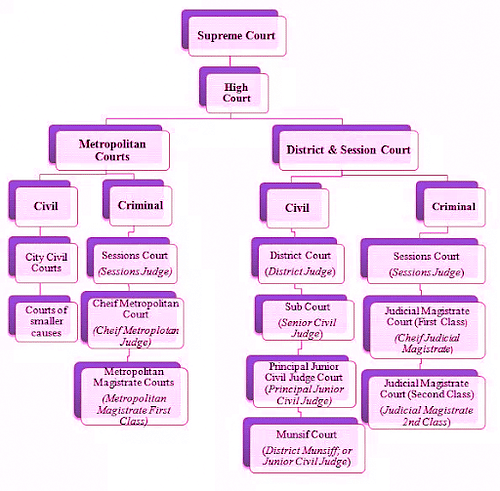
  • India's judicial system is organized in a pyramidal structure with the Supreme Court (SC) at the apex.
  • The Supreme Court is above the high courts, which are followed by the district and subordinate courts.
  • The lesser courts work directly under the supervision of the higher courts.
  • Some restiveness of the Indian people with their judicial system is based on five factors:
  • The slowness and inaccessibility of the judicial process.
  • The antiquated nature of court procedure and management practices.
  • Flaws in procedural law, lack of effective control of court proceedings and availability.
  • The lowered standard of conduct, character and competence of the legal profession.
  • Hyperactivism of the judiciary by encroaching into jurisdiction.

Thus, Public Interest Litigation is NOT a factor for reforms in the Indian judicial system.

Additional Information

24

Which Article of the Constitution of India lays down that the President cannot act without the aid and advice of the Council of Ministers?

  1. ((a))

    Article 75

  2. ((b))

    Article 74(1)

  3. ((c))

    Artice 73

  4. ((d))

    ​Artice 72

Show Answer
Answer: ((b))

Article 74(1)

Part V of the Indian Constitution deals with the Union, the President, the Vice-President, the Council of Ministers chaired by the Prime Minister, and the Attorney General. 

Key Points

  • According to Article 74(1) of the Constitution, there shall be a Council of Ministers, led by the Prime Minister, to assist and advise the President, who shall act in accordance with such advice in the performance of his powers.
  • According to Article 74 (2), No court shall investigate whether or not Ministers gave the President any advice, and if so, what kind of advice.
  • Article 75 deals with Ministerial appointments, tenure, responsibilities, qualifications, oaths, salaries, and allowances.
  • According to Article 75, The President appoints the Prime Minister, and the President appoints the other Ministers on the Prime Minister's suggestion.
  • After the 91st Amendment Act of 2003, The entire number of ministers in the COM, including the Prime Minister, must not exceed 15% of the Lok Sabha's total strength.

Thus, Article 74(1) of the Constitution of India lays down that the President cannot act without the aid and advice of the Council of Ministers.

25

Which one of the following statements about Social Action Groups is NOT correct?

  1. ((a))

    They are micro action groups

  2. ((b))

    They work for enhancement of technical capacities of urban agencies

  3. ((c))

    They work for the cause of the poor and the suppressed sections

  4. ((d))

    They take up concerns for human, animal or environmental protection

Show Answer
Answer: ((b))

They work for enhancement of technical capacities of urban agencies

Social activity has always been a feature of the evolution of human society.

Key Points

  • There has hardly ever been a period in human history when people have not banded together to protest injustice, seek redress for grievances, or change inequitable social, economic, and political structures.
  • The ensuing struggles did not always succeed but they were essential demonstrations of impoverished people's efforts to guarantee a more compassionate society.

Characteristics of Social action groups: 

  • It concerted effort aimed at altering social, economic, or political structures and their modes of operation to improve social and economic well-being, particularly among the poor, and to establish a just social, economic, and political order.
  • The goals of social action groups might be quite radical.
  • Social action can be directed against global, universal issues such as environmental protection and conservation through action, as well as more localized issues such as crime and the sale of alcoholic beverages.
  • Social action groups rise voices against the wrongful use of village community resources by dominant individuals or groups, exploitation of labour, the punishment of a wrongdoer, illegal tree felling, and so on.
  • The geographical region of social action groups and the number of people involved can be very large or very small.
  • The impetus for social action may originate without or with only a partial sharing of the aims or techniques with those who are being mobilized.
  • Social action is not non-political.

Thus, it is not true that the Social Action Groups work for the enhancement of the technical capacities of urban agencies.

26

The VIII Five Year Plan did NOT aim at

  1. ((a))

    An effective system of plan monitoring and evaluation

  2. ((b))

    Dismantling the planning process in stages

  3. ((c))

    Annual plan budget strategy for implementing various schemes of the government

  4. ((d))

    Systemic improvements during the plan period

Show Answer
Answer: ((b))

Dismantling the planning process in stages

The Indian economy was built on the concept of planning from 1947 to 2017.

Key Points

  • The Narendra Modi-led NDA administration abolished the Five-Year Plans in 2015.
  • The VIII Five Year Plan was implemented under the leadership of P.V. Narasimha Rao, it lasted from 1992 to 1997.
  • The New Economic Policy of India was launched by the Narasimha Rao government during this plan.
  • The development of human resources, such as employment, education, and public health, was given primary.
  • The goal of this plan was to gradually open up the Indian economy in order to reduce the country's growing deficit and foreign debt.
  • Universalization of primary education and total illiteracy eradication.
  • This strategy worked and was implemented.

Thus, The VIII Five Year Plan did NOT aim at  Dismantling the planning process in stages.

27

Which one of the following tribal movements took place in post-independence India?

  1. ((a))

    The Santhal Rebellion

  2. ((b))

    The Bodo Movement

  3. ((c))

    The Birsa Munda Rebellion

  4. ((d))

    The Kol Rebellion

Show Answer
Answer: ((b))

The Bodo Movement

India's diverse tribal communities rose against the British's forcible and disastrous incursions into their lives and territories.

Key Points

  • Before the Independence tribal movements can be categorised between their types: 
  • ​Reactionary movement
  • Conservative movement
  • Revolutionary movement
  • There are different causes associated with the particular movement but some general causes behind their movement are mentioned below: 
  • ​The shift in economic activities
  • Influx of Non-tribals
  • Introduction of Money lenders
  • restrictions of use of forest products and access.
  • Some of the tribal movements taken in Pre-Independence and Post- Independence India are mentioned in the table:
Pre-1947YearLocationLeader
Chaur Rebellion1768MidnapurJagannath Singh
Pahariya Sadar's Rebellion1778ChhotanagpurRaja Jagganath
Kol Rebellion1795ChhotanagpurBir Budha Bhagat, Joa Bhagat, Sui Munda
Mizo Movement1810Mizoram------
Tarapur Rebellion1842Baster--------
Khond Rebellion1850OdishaChief Bisoi
Santhal Revolt1855ChotanagpurSidhu & kaulu
Naga Movement1879NagalandTikendraji Singh
Munda Rebellion1899ChotanagpurBirsa Munda
Bodo Movement1987AssamUpendranath Brahma
Dongria Kondha Movement2008Odisha---------


Thus, The Bodo Movement was the tribal movement that took place in post-independence India.

28

When did the first labour agitation occur in India?

  1. ((a))

    1875

  2. ((b))

    1890

  3. ((c))

    1900

  4. ((d))

    1921

Show Answer
Answer: ((a))

1875

The trade union movement in India began in the second half of the nineteenth century after the expansion of the Industrial base. 

Key Points

  • Early labour leaders such as Bengal's Sasipada Banerjee and Mumbai's N. M. Lokhande led labour campaigns to improve the working class's socioeconomic situation.
  • In March 1862, India's first-ever labour agitation occurred when 1200 railway workers at Howrah Station requested an eight-hour workweek.
  • Sasipada Banerjee formed the Working Men's Club in 1870. He also published in the Bharat Shramjeevi periodical.
  • The origins of labour movements may be traced back to the 1860s but India's first labour protest occurred in Bombay in 1875.
  • In 1875, S.S Bengalee was in charge of organizing the event and his primarily concerned with the situation of workers, particularly women and children.

Thus, In 1875, the first labour agitation occur in India. 

Additional Information

  • M.N Lokhande founded the Bombay Mill Hands Association in 1890, which was India's first organized labour union.
  • In 1897, the Amalgamated Society of Railway Servants of India was established.
  • On 31 October 1920, the first trade union the All Indian Trade Union Congress (AITUC) formed which worked as an Indian association was presided by Lala Lajpat Rai in Bombay (1920), and Diwan Chaman Lal was the first General Secretary.
29

Frederick Herzberg is famous for which one of the following theories?

  1. ((a))

    Human Relations Theory

  2. ((b))

    Bureaucratic Theory

  3. ((c))

    Leadership Theory

  4. ((d))

    Motivation Theory

Show Answer
Answer: ((d))

Motivation Theory

Frederick Herzberg is an American psychologist who has questioned management beliefs and practices. 

Key Points

  • He has researched the issue of human motivation at work.
  • Major works: 
  • Work and the Nature of Man (1966)
  • The Motivation to Work (1959)
  • The Managerial Choice: To be Efficient and to be Human (1976)
  • Herzberg's motivation theory is based on the work experience of over 200 engineers.
  • The study's main goal was to see if different types of characteristics were responsible for job satisfaction.
  • In 1959, After the study, Frederick Herzberg proposed his Two Factor Theory or Hygiene or Motivation.
  • He proposed that two types of influences influence motivation and that they do so in different ways:
  • Hygiene considerations: Individuals will be dissatisfied if they regard hygiene aspects to be inadequate or inequitable, but they will not be greatly motivated if these factors are viewed as adequate or good. Extrinsic hygiene variables include things like wage or remuneration, job security, and working circumstances.
  • Motivation: Intrinsic reasons such as a sense of accomplishment, acknowledgement, responsibility, and personal growth are prime factors behind the Motivation.

Thus,  Frederick Herzberg is famous for the Motivation Theory.

30

Which one of the following is a redressal mechanism of grievances?

  1. ((a))

    Administrative Reforms Commission

  2. ((b))

    Right to Information

  3. ((c))

    Management of Resources

  4. ((d))

    Right to Education

Show Answer
Answer: ((b))

Right to Information

Citizens elect the government and hold it accountable in a democracy.

Key Points

  • The grievance redressal system acts as a tool for monitoring efficiency and effectiveness.
  • There are different grievances at different levels of government in India.
  • Centre Government are: 
  • Department of Administrative Reforms and Public Grievances (DARPG)
  • Directorate of Public Grievances
  • Lokpal was established under the Lokpal and Lokayuktas Act 2013 to investigate corruption against public functionaries.
  • Different tribunals can also address the grievance such as Central Administrative Tribunal, Railway Claims Tribunal, Debt Recovery Tribunal etc.
  • Some other Citizens Grievance Redressal Mechanisms are mentioned below: 
  • ​Right to Information Act
  • Citizens Charter
  • Gram Sabha
  • Senior Citizen Act
  • Hostels Act

Thus, the Right to Information is a redressal mechanism of grievances.

Additional Information

  • In 2005, the RTI Act was passed which allows citizens to ask the government any questions, acquire information, obtain government records, and inspect government operations.
  • This act aims to empower citizens while simultaneously promoting transparency and accountability in government operations.
31

Who was the chairman of the 'Health Survey and Development Committee' appointed in 1943 in India?

  1. ((a))

    Sir Walpole

  2. ((b))

    Sir Joseph Bhore

  3. ((c))

    Lord Macaulay

  4. ((d))

    Veerappa Moily

Show Answer
Answer: ((b))

Sir Joseph Bhore

In 1943, the Health Survey & Development Committee was established.

Key Points

  • The government recognized the importance of public health and established the Health Survey and Development Committee.
  • The committee was tasked with conducting an assessment of the country's health conditions and health organizations.
  • The committee was led by Joseph William Bhore who also served as the committee's chairman.
  • The report contained detailed proposals for improving India's healthcare system.​
  • Some of the major recommendations are mentioned below: 
  • All administrative levels must integrate preventive and curative services.
  • The establishment of Primary Health Care Centers in two stages.
  • Significant modifications in the medical education system.

Thus, Sir Joseph Bhore was the chairman of the 'Health Survey and Development Committee appointed in 1943 in India. 

Additional Information

  • Lord Macaulay: He related to the India Education system, he delivered his 'Minute on Indian Education' he argued that English should be the medium of education.
  • Veerappa Moily: He was the chairman of the Second Administrative Reforms Commission (ARC) was established on August 31, 2005.
32

Who among the following are postmodernist thinkers?

A. Michel Foucault

B. Levi Strauss

C. Jean Francois Lyotard

D. John Rawls

Choose the correct answer from the options given below:

  1. ((a))

    A and B only

  2. ((b))

    B and C only

  3. ((c))

    A and C only

  4. ((d))

    C and D only

Show Answer
Answer: ((c))

A and C only

Postmodernism is an intellectual position or method of discourse that dates back to the 17th century against the  Enlightenment. 

Key Points

  • It was a method of literary criticism and debate that discussed the nature of literary texts, meaning, author and reader, writing, and reading.
  • Postmodernism denies the existence of objectively rational knowledge.
  • Postmodernism denies the existence of unmediated reality or objectively rational knowledge, claiming that all interpretations are reliant on the viewpoint.
  • Scholars of Post-Modernism: Jacques Derrida, Michel Foucault, Jean-François Lyotard, Richard Rorty, Jean Baudrillard, Fredric Jameson, Douglas Kellner.
  • Lyotard his book The Postmodern Condition, define postmodernism as scepticism towards metanarratives.

Thus, Michel Foucault and Jean Francois Lyotard are postmodernist thinkers. 

Additional Information

  • Postmodernists are sceptical of explanations that claim to be valid for all groups, cultures, traditions, or races, and instead, focus on the relative truths of each individual.
33

Shallow Ecologists believed in

A. Health and prosperity of people

B. Antigrowth

C. Sustainable growth

D. Ecocentrism

Choose the correct answer from the options given below:

  1. ((a))

    A and C only

  2. ((b))

    B and C only

  3. ((c))

    C and D only

  4. ((d))

    B and D only

Show Answer
Answer: ((a))

A and C only

The correct answer is A and C only. Naess was a Norwegian philosopher who coined the term deep ecology and make the distinction between Shallow Ecology.

Key Points

  • He illustrates the contrast between the two forms of ecologism by placing humans at the centre of the environmental catastrophe.
  • He believes that rising anthropocentrism has caused humans to become estranged from nature.
  • Basic Tenets of Shallow ecology: 
  • It rejects ecocentrism and biocentrism.
  • The anthropocentric worldview is not always flawed.
  • Nature is only valuable in the context of human needs.
  • Climate change is undesirable from this standpoint since it will affect human interests.
  • The harm done to other living things would have a negative impact on humans.

Thus, Shallow Ecologists believed in the health and prosperity of people and sustainable growth.

Additional Information

  • Deep ecologism holds that human's connection with nature should be drastically altered.
34

Who among the following has dubbed Marxism as a totalitarian doctrine?

A. Karl Popper

B. Isaiah Berlin

C. Hannah Arendt

D. Antonio Gramsci

Choose the correct answer from the options given below:

  1. ((a))

    A and B only

  2. ((b))

    B and C only

  3. ((c))

    C and D only

  4. ((d))

    A and C only

Show Answer
Answer: ((d))

A and C only

Totalitarianism is a type of government and political system that forbids all opposition parties, criminalizes individual and collective opposition to the state. 

Key Points

  • Its claims, and maintains a high level of control and regulation over both public and private life.
  • It is thought to be the most comprehensive and ultimate form of authoritarianism.
  • It can be traced back to Plato, Georg Wilhelm Friedrich Hegel's vision of the state, and Karl Marx's political philosophy.
  • Karl Popper in his works The Poverty of Historicism and The Open Society and its Enemies studies Totalitarianism.
  • Popper broadens his critique of totalitarianism by criticizing significant figures in Western philosophy including Plato, Hegel, and Marx.
  • The Origins of Totalitarianism by Hannah Arendt is a seminal work in the history of totalitarianism theory.
  • Arendt argues that her languages were essentially continuous with those of interwar Marxism.
  • It was based on a novel genealogy of Marxist ideas of totalitarianism.

Thus, Karl Popper and Hannah Arendt have dubbed Marxism as a totalitarian doctrine.

35

The behavioural approaches to the study of politics are :

A. Empirical in nature

B. Focused on facts

C. Focused on a scientific view of the political reality

D. Focused on philosophy

Choose the correct answer from the options given below:

  1. ((a))

    A and C only

  2. ((b))

    A, B and D only

  3. ((c))

    A, B and C only

  4. ((d))

    B, C and D only

Show Answer
Answer: ((c))

A, B and C only

In the 1930s, Behavioralism is a political science paradigm that arose in the United States. 

Key Points

  • The work of University of Chicago professor Charles Merriam is typically credited with establishing the foundations of behavioralism.
  • Behaviouralism is a political science method that aims to provide a quantitative, objective approach to analyzing and predicting political behaviour.
  • Individuals' behaviour, actions, and acts are the focus of behaviouralists.
  • Behaviouralism emphasizes the careful investigation of all forms of political behaviour.
  • Behavioralism was an attempt to apply natural science approaches to human behavior.
  • It focused on facts of the Social world.

Thus, The behavioural approaches to the study of politics are empirical in nature, focused on facts and focused on a scientific view of the political reality. 

Additional Information

  • It began in 1908 with the publishing of two political scientists' publications, Graham Wallas's work Human Nature in Politics and Arthur Bentley's book The Process of Government.
36

Robert Packenham has outlined the important roles of the assemblies of Afro-Asian and Latin American countries as:

A. Legitimate function

B. Safety-valve function

C. Administrative overview

D. Judicial activities

Choose the correct answer from the options given below:

  1. ((a))

    A, B and C only

  2. ((b))

    B, C and D only

  3. ((c))

    A, B and D only

  4. ((d))

    B and C only

Show Answer
Answer: ((a))

A, B and C only

Robert Packenham has outlined the important roles of the assemblies of Afro-Asian and Latin American countries as:

A. Legitimate function

B. Safety-valve function

C. Administrative overview

37

Which of the following are provided for by the 74th  Constitutional Amendment in respect of Municipal Corporation?

A. Seats to be filled by direct elections on the basis of wards

B. Reservation of seats for Scheduled castes and Scheduled tribe

C. Reservation of seats for backward classes

D. One-third reservation of seats for women

Choose the correct answer from the options given below:

  1. ((a))

    A, B and C only

  2. ((b))

    A, B and D only

  3. ((c))

    B, C and D only

  4. ((d))

    A, C and D only

Show Answer
Answer: ((b))

A, B and D only

The 74th Constitutional Amendment Act went into effect giving Urban Local Bodies (ULB) the authority to carry out the 18 responsibilities mentioned in the 12th Schedule.

Key Points

  • The 74th Constitutional Amendment Act has a number of notable features:
  • ​Municipalities are divided into three categories.
  • Nagar Panchayat
  • Municipal council
  • Municipal corporation
  • All members of a municipality must be directly elected by the residents of the municipality.
  • Each municipal region will be divided into territorial constituencies known as wards for this purpose.
  • In every municipality, seats for SC and ST are reserved in proportion to their population.
  • There is also a provision for women to be allocated 1/3 of the total number of seats.
  • The state legislature has the authority to adopt any provision for backward-class reservation in municipalities at any level.

Thus,  Seats to be filled by direct elections on the basis of wards, reservation of seats for Scheduled castes and Scheduled tribe and one-third reservation of seats for women  are provided for by the 74th  Constitutional Amendment in respect of Municipal Corporation.

Additional Information

  • Article 243 T deals with seat reservations in municipal governments.
  • Article 243 S of the constitution and makeup of ward committees.
38

Match List I with List II 

List IList II
AuthorBooks
A.E. F. Schumacherl.The Silent Spring
B.James LovelockII.The Turning Point
C.F. CapraIII.Gaia: A New Look at Life on Earth
D.Rachel CarsonIV.Small is Beautiful: A Study of Economics as if People Mattered

Choose the correct answer from the options given below:

  1. ((a))

    A - III, B - II, C - I, D - IV

  2. ((b))

    A - II, B - III, C - I, D - IV

  3. ((c))

    A - IV, B - III, C - II, D - I

  4. ((d))

    A - I, B - II, C - IV, D - III

Show Answer
Answer: ((c))

A - IV, B - III, C - II, D - I

Key Points

AuthorBooks
E. F. Schumacher- E. F. Schumacher was a German-British statistician and economist. - His book Small Is Beautiful: A Study of Economics As If People Mattered was published in 1973.
James Lovelock- James Lovelock is a British environmentalist. - He is best known for presenting the Gaia hypothesis. - Gaia: A New Look at Life on Earth was published in1979.
F. Capra- Fritjof Capra deep ecologist who was born in Austria. - Capra is the author of The Tao of Physics.
Rachel Carson- Rachel Louise Carson her seminal book Silent Spring (1962). - The fundamental point of Carson's thesis is that pesticides are harmful to the ecosystem.


Thus, A - IV, B - III, C - II, D - I are correct matching.

39

Match List I with List II 

List IList I
A.Howard Warrenderl.Vindication of the Rights of Woman: with Strictures on Political and Moral Subjects
B.Edmund BurkeII.The Political Theory of Possessive Individualism: Hobbes to Locke
C.Mary WollstonecraftIII.Reflections on the Revolution in France
D.C. B. MacphersonIV.The Political Philosophy of Hobbes: His Theory of Obligation

Choose the correct answer from the options given below:

  1. ((a))

    A - II, B - I, C - III, D - IV

  2. ((b))

    A - IV, B - III, C - I, D - II

  3. ((c))

    A - I, B - II, C - III, D - IV

  4. ((d))

    A - III, B - II, C - IV, D - I

Show Answer
Answer: ((b))

A - IV, B - III, C - I, D - II

Key Points

List IList II
Howard Warrender- The Political Philosophy of Hobbes: His Theory of Obligation written by Howard Warrender. - In his work, he examines Hobbes's system of obligation.
Edmund Burke- Reflections on the Revolution in France is a political treatise written by Edmund Burke. - It was published in November 1790. - He disregarded similarities between the French Revolution and the uprising in England in 1688.
Mary Wollstonecraft- One of the oldest works of feminist philosophy was A Vindication of the Rights of Woman: with Strictures on Political and Moral Subjects written by Mary Wollstonecraft. - It contains a response from Wollstonecraft to political and educational philosophers of the eighteenth century who disagreed with the idea that women should obtain a sensible education.
C. B. Macpherson- The Political Theory of Possessive Individualism: Hobbes to Locke is written by C.B. Macpherson. - He argues that the "possessive quality" of the individualism that underpins classical liberalism—"its vision of the individual as fundamentally the proprietor of his own person or capacities, owing nothing to society for them"


Thus, A - IV, B - III, C - I, D - II are correct matching.

40

Match List I with List II 

List IList II
A.42nd Amendmentl.1978
B.44th AmendmentII.1963
C.15th AmendmentIII.1975
D.38th AmendmentIV.1976

Choose the correct answer from the options given below:

  1. ((a))

    A - II, B - III, C - I, D - IV

  2. ((b))

    A - II, B - IV, C - III, D - I

  3. ((c))

    A - IV, B - I, C - II, D - III

  4. ((d))

    A - I, B - II, C - IV, D - III

Show Answer
Answer: ((c))

A - IV, B - I, C - II, D - III

Key Points

List IList II
42nd Amendment- It was put in place amid a state of internal emergency. - Parliament passed it on November 11, 1976. - This amendment is also known as a mini-constitution.
44th Amendment- The 44th Amendment of the Indian constitution happened in 1978. - This amendment had done mainly to alter the 42nd Amendment.
15th Amendment- In 1963, the 15th Amendment of the Indian constitution was done. - It deals with the Judicial system of India. - It enabled the High Courts to issue the writs.
38th Amendment- It was done in 1975 during the emergency period. - It alters the executive power in terms of issuing the Ordinances and issues multiple proclamations of national emergency.


Thus, A-IV, B - I, C - II, D - III are the correct pairs.

41

Arrange the following events of Indian Foreign Policy in order of their occurrence

A. Lahore Bus Diplomacy

B. Look East Policy

C. Gujral Doctrine

D. Pokhran-II Nuclear Explosion

Choose the correct answer from the options given below

  1. ((a))

    A, B, D, C

  2. ((b))

    C, D, A, B

  3. ((c))

    D, C, B, A

  4. ((d))

    B, C, D, A

Show Answer
Answer: ((d))

B, C, D, A

India's foreign policy is built on the values of peaceful coexistence, friendship, and cooperation. 

Key Points

  • The Indian government, led by former Prime Minister Narasimha Rao, adopted the Look East Policy in 1991.
  • The goal was to strengthen political, economic, and security ties with Southeast Asian nations. India aspired to act as a counterweight to China in Southeast Asia after the Cold War ended.
  • Inder Kumar Gujral, the Foreign Minister of the Deve Gowda government, introduced the Gujral theory in December 1996.
  • The Gujral Doctrine is a collection of five principles designed to guide India's foreign policy toward its immediate neighbors.
  • In 1998, India conducted the Pokhran-II tests, which consisted of five nuclear bomb test explosions at the Indian Army's Pokhran Test Range.
  • Indian Prime Minister Atal Bihari Vajpayee came in Lahore by bus in 1999.

So, Look East Policy⇒ Gujral Doctrine⇒  Pokhran-II Nuclear⇒ Explosion Lahore Bus Diplomacy are events of Indian Foreign Policy in order of their occurrence.

42

Arrange the formation of the following Indian states in a chronological order

A. Haryana

B. Telangana

C. Uttarakhand

D. Jharkhand

Choose the correct answer from the options given below

  1. ((a))

    A, B, C, D

  2. ((b))

    C, B, D, A

  3. ((c))

    B, C, A, D

  4. ((d))

    A, C, D, B

Show Answer
Answer: ((d))

A, C, D, B

Article 1(1) of the Indian Constitution deals with India, that is Bharat, shall be a Union of States.

Key Points

  • The Dhar panel which was created to look into the matter recommended that reorganization be based on administrative rather than linguistic principles.
  • The JVP commission was formed which also condemned the use of linguistic factors to establish states.
  • The government responded by appointing the Fazl Ali committee which approved linguistic foundation as one of the four fundamental factors for forming states.
  • The report was adopted by the government which then passed the state reorganization act and the 7th amendment.
  • The formation of the following Indian states in a chronological order are 
  • 1953 : Andhra Pradesh
  • 1960 : Gujarat
  • 1966 : Haryana
  • 2000 : Chhatisgarh
  • 2000 : Uttarakhand
  • 2000 : Jharkhand
  • 2014 : Telangana

Thus, Haryana⇒ Uttarakhand⇒ Jharkhand⇒ Telangana are correct chronological order formation of Indian states.

43

Arrange the following administrative reforms Committees/Commissions in a chronological order

A. First Administrative Reform Commission

B. Gopalaswamy Ayyangar Committee

C. Gorwala Committee

D. Satish Chandra Committee

Choose the correct answer from the options given below

  1. ((a))

    B, C, A, D

  2. ((b))

    A, B, C, D

  3. ((c))

    D, A, B, C

  4. ((d))

    C, D, A, B

Show Answer
Answer: ((a))

B, C, A, D

​The administration is a body that ensures that services are delivered in a way that meets the demands of citizens.

Key Points

  • The administrative structure was required for India's socioeconomic progress.
  • India needed to establish a Commission to assist the public administration in reforming and functioning successfully.
  • The Commission was established to aid in the efficient operation of the public administration by making proposals to restructure and reorganize the administrative system.
  • Administrative reforms were required, and numerous commissions and committees were constituted, including the following:
Commissions and CommitteesRecommondation
Gopal Swami Ayyangar Committee (1949)- It suggested the establishment of bureaus such as the bureau of trade and industry
Gorwala Committee (1951)- It was established to bring reforms to the country by monitoring the planning and growth of the administrative structure.
First Administrative Reform Commission (1966)- It published 20 reports containing 537  recommendations.
Satish Chandra Committee (1989)- It was formed to promote improvements in Civil Services Examination.

Thus,  Gopalaswamy Ayyangar Committee⇒ Gorwala Committee First⇒ Administrative Reform Commission⇒ Satish Chandra Committee are administrative reforms Committees/Commissions in a chronological order.

44

Arrange the 'Evolutionary Phases of Public Administration' in ascending order

A. Principles of Administration

B. Politics-Administration Dichotomy

C. Era of Challenge

D. Crisis of Identity

E. Public Policy Perspective

Choose the correct answer from the options given below

  1. ((a))

    A, B, C, D, E

  2. ((b))

    B, A, C, D, E

  3. ((c))

    C, A, B, E, D

  4. ((d))

    D, B, E, A, C

Show Answer
Answer: ((b))

B, A, C, D, E

In 1887, Woodrow Wilson is credited for establishing public administration as an autonomous and distinct field of study.

Key Points

  • It is necessary to research the discipline's evolution in order to comprehend its current status as a field of inquiry.
  • The development of Public Administration as an academic field can be discussed through the following five successive phases:
  • Phase I: The Politics/Administration Dichotomy (1887-1926)
  • Phase II: The Principles of Administration (1927-1937)
  • Phase III: Criticism and Challenges (1938-1950)
  • Phase IV: Crisis of Identity (1950-1970)
  • Phase V:  Public Administration as an Independent Discipline (1970 Onwards)

Thus, Politics-Administration Dichotomy⇒ Principles of Administration Era of Challenge⇒  Crisis of Identity⇒ Public Policy Perspective are in ascending order as evolutionary Phases of Public Administration.

45

Arrange the following in the ascending order of their establishment

A. 14th Finance Commission of India

B. Union Public Service Commission

C. Central Vigilance Commission

D. NITI Aayog

Choose the correct answer from the options given below

  1. ((a))

    A, B, C, D

  2. ((b))

    B, C, A, D

  3. ((c))

    C, B, A, D

  4. ((d))

    D, B, C, A

Show Answer
Answer: ((b))

B, C, A, D

In democracy, Insitutions plays important role in divilery social justice, economic justice.   

Key Points

  • According to Article 312 of the Indian Constitution, the Union and the States have the right to form one or more All India services.
  • It was founded in 1926 during colonial period as ICS but later after the independence its transform as UPSC.
  • The Central Vigilance Commission is the apex vigilance institution.
  • The CVC was established by the government in February 1964 after the recommendations of Shri K. Santhanam's Committee on Prevention of Corruption.
  • In 2013, the 14th Finance Commission was established.
  • In 2015, the Planning Commission was replaced by Niti ayyog with focus on a "Bottom-Up".

Thus,  Union Public Service Commission⇒ Central Vigilance Commission⇒ 14th Finance Commission of India⇒ NITI Aayog are ascending order of their establishment.

Read the given passage and answer the questions that follow

In summary, an increasing readiness by the UN to intervene within states in order to promote internal justice for individuals would indicate a movement towards global governance and away from unconditional sovereignty. There have been some signs of movement in this direction, but principles of state sovereignty and non-intervention remain important. There is no clear consensus on those points. There is still some support for the view that Article 2(7) of the UN Charter should be interpreted strictly; that there can be no intervention within a state without the express consent of the government of that state. This position is probably most frequently seen in the arguments favoured by the government of the People's Republic of China. Others believe that intervention within a country to promote human rights is only justifiable on the basis of a threat to international peace and security. Evidence of a threat to international peace and security could be the appearance of significant numbers of refugees or the judgement that other states might intervene militarily. Some Liberals argue that this condition is flexible enough to justify intervention to defend human rights whenever it seems prudent.

There is also some support for a stronger position. In September 1999, UN Secretary-General Kofi Annan declared that individual sovereignty may be as important as national sovereignty.

46

​On what basis is the UN ready to intervene in the matters of a state?

  1. ((a))

    To end the conflict

  2. ((b))

    To create international cooperation

  3. ((c))

    To promote internal justice

  4. ((d))

    To facilitate great powers

Show Answer
Answer: ((c))

To promote internal justice

The correct answer is To promote internal justice.

Key Points

  • According to the Summary " an increasing readiness by the UN to intervene within states in order to promote internal justice.
  • ​UN's new responsibility is to establish global governance.
47

​In the matter of state intervention, the UN should adhere to provisions related to which aspect?

  1. ((a))

    Domestic jurisdiction

  2. ((b))

    Social equality

  3. ((c))

    Political independence

  4. ((d))

    Economic cooperation

Show Answer
Answer: ((c))

Political independence

Political independence is the correct answer. 

Key Points

  • According to the summary, the UN should adhere to provisions related to the Political independence aspect.
  • As the summary pointed out the principles of state sovereignty and non-intervention remain important which are related to Political independence.
48

​Under what condition can the UN intervene in state affairs?

  1. ((a))

    To establish democracy

  2. ((b))

    To tackle problem of non-traditional threats

  3. ((c))

    On the basis of the express consent of the state's government

  4. ((d))

    On the recommendation of major powers

Show Answer
Answer: ((c))

On the basis of the express consent of the state's government

The correct answer is On the basis of the express consent of the state's government.

Key Points

  • There is no agreement between states on the UN intervention in state affairs because of multiple interpretations.
  • According to the passage, "There is still some support for the view that Article 2(7) of the UN Charter should be interpreted strictly; that there can be no intervention within a state without the express consent of the government of that state."
  • Thus, the UN intervene in state affairs On the basis of the express consent of the state's government.
49

Which one of the following countries has no provision for Judicial Review?

  1. ((a))

    United States of America

  2. ((b))

    United Kingdom

  3. ((c))

    Switzerland

  4. ((d))

    India

Show Answer
Answer: ((b))

United Kingdom

Judicial review is the ability of a country's courts to check the activities of the legislative, executive, and administrative branches of the government to work in accordance with the constitution

Key Points

  • In this sense, the existence of a written constitution is required for the institution of judicial review.
  • Marbury v. Madison (1803) was the first case of Judicial review in the USA.
  • The Supreme Court of the United States had the capacity to nullify legislation enacted by Congress.
  • Judicial review is about checking the validity of Law or Action in accordance with the constitutions.
  • A. V. Dicey's English constitutional theory does not recognize a separate system of administrative courts to review judgments made by public organizations.
  • In the United Kingdom, the idea of Parliamentary sovereignty forbids judicial scrutiny of basic legislation.
  • In English law, judicial review is limited to official and public body decisions, as well as delegated legislation.

​Thus, the United Kingdom has no provision for Judicial Review.

50

Which one of the following is NOT the basic feature of Post-Modernism?

  1. ((a))

    It believes in deconstruction

  2. ((b))

    It is concerned with the concept of feminity

  3. ((c))

    It challenges the accepted theory of International Relations

  4. ((d))

    It is incredulity towards metanarrative

Show Answer
Answer: ((b))

It is concerned with the concept of feminity

In the mid-twentieth century, postmodernism arose as a reaction to modernism.

Key Points

  • Postmodernism is an intellectual position or method of discourse that dates back to the 17th century and contradicts worldviews connected with Enlightenment rationality.
  • Postmodernism denies the existence of objectively rational knowledge.
  • Scholars of Post-Modernism: Jacques Derrida, Michel Foucault, Jean-François Lyotard, Richard Rorty, Jean Baudrillard, Fredric Jameson, Douglas Kellner.
  • Lyotard his book The Postmodern Condition, define postmodernism as scepticism towards metanarratives.
  • Deconstruction and post-structuralism are two schools of thought that are frequently associated with postmodernism.
  • Since the 1980s, postmodern international relations have been an element of international relations studies.
  • Post modern Schools in international relations theory mainly criticised the dominant theories as to the Status Quo.

Thus, It is concerned with the concept of feminity is NOT the basic feature of Post-Modernism.

51

In 1954, India signed the Panchsheel agreement with which neighboring state?

  1. ((a))

    Nepal

  2. ((b))

    Sri Lanka

  3. ((c))

    China

  4. ((d))

    Pakistan

Show Answer
Answer: ((c))

China

The Panchsheel Agreement is a set of principles governing inter-state relations.

Key Points

  • The Agreement on Trade and Intercourse between the Tibet Region of China and India provided the foundation for the Panchsheel Agreement.
  • They were initially codified in 1954 as part of an agreement between India and China.
  • The Panchsheel Agreement laid the groundwork for India's relations with China.
  • The Panchsheel Agreement's Five Principles are as follows:
  • ​Mutual respect for the territorial integrity and sovereignty of each other
  • Non-aggression pact
  • Mutual non-interference in one another's private lives
  • Mutual benefit and equality
  • Coexistence that is peaceful
  • The five principles were later revised into a ten-point statement presented in April 1955 during the historic Asian-African Conference in Bandung, Indonesia.​

​Thus, In 1954, India signed the Panchsheel agreement with China.

52

"Conflict is not warfare, but is only an appearance of difference - difference of opinions, of interests not only between employer and employee but also between managers, between directors or wherever differences appear". Who made this statement?

  1. ((a))

    Chester Barnard

  2. ((b))

    Rensis Likert

  3. ((c))

    Mary P. Follett

  4. ((d))

    Douglas McGregor

Show Answer
Answer: ((c))

Mary P. Follett

Mary Parker Follett was credited for the first research conducted on industrial groupings.

Key Points

  • She developed ideas of human association and organization.
  • She impacted students at scientific management institutions such as Fayol, Urwick, and Oliver Sheldon.
  • Major Works: 
  • The Speaker of the House of Representatives (1896)
  • The New State (1920)
  • Creative Experience (1924)
  • Dynamic Administration: The Collected Works of Mary Parker Follett (1941)
  • She argued that Conflicts are beneficial for both parties and promote the idea of constructive conflict.
  • According to Follett, Conflict is neither good nor bad and it must be studied without emotion or ethical preconceptions.
  • She argued that conflicts should be considered as a regular process in every organization's activity by which socially beneficial differences register themselves for the enrichment of all concerned.
  • She further asserts that "Conflict is not warfare, but is only an appearance of difference - a difference of opinions, of interests not only between employer and employee but also between managers, between directors or wherever differences appear".
  • Conflict is unavoidable rather than judging it as a negative one should endeavour to capitalize on it.

Thus, Mary P. Follett said that "Conflict is not warfare, but is only an appearance of difference - a difference of opinions, of interests not only between employer and employee but also between managers, between directors or wherever differences appear".

53

Indian Institute of Public Administration was set up to serve as a "Think Tank" to the Government of India, in which year?

  1. ((a))

    January, 1950

  2. ((b))

    February, 1951

  3. ((c))

    April, 1953

  4. ((d))

    March, 1954

Show Answer
Answer: ((d))

March, 1954

Indian Institute of Public Administration is an autonomous research and training organization under the Ministry of Personnel of the Government of India. 

Key Points

  • It's located on Mahatma Gandhi Marg in New Delhi.
  • It was established by Jawahar Lal Nehru in March 1954 based on the recommendation of Paul H. Appleby.
  • It is recognised under the Societies Act of 1860.
  • Jawahar Lal Nehru served as the Society's first President.
  • The Institute was created to give government employees the subject knowledge, functional skills, and behavioural competencies they need to manage governance activities.
  • Technical management capabilities, human skills for coordinating duties, and conceptual abilities for leadership roles in the formation and implementation of public policy are all taught at the institute.
  • Its main operations are Training, Research, Advisory and Consultancy Services, and Information Dissemination and Exchange.

Thus, the Indian Institute of Public Administration was set up to serve as a "Think Tank" for the Government of India, in March 1954.

54

Gandhi's concept of Swadeshi was impacted by:

A. His deep ethical-spiritual conviction

B. His understanding of the economic condition of the people, especially at the grassroots

C. Influence of Ruskin's book, 'Unto This Last'

D. His focus on truth and understanding of Jainism

Choose the correct answer from the options given below:

  1. ((a))

    A, B, C and D

  2. ((b))

    B, C and D only

  3. ((c))

    A, B and C only

  4. ((d))

    C and D only

Show Answer
Answer: ((c))

A, B and C only

In Gandhian philosophy, the concept of Swadeshi refers to local self-reliance and the application of local knowledge and abilities.

Key Points

  • Gandhi's concept of swadeshi emphasizes the value of indigenous abilities and their productivity.
  • Swadeshi is most commonly associated with Gandhi's employment of a protectionist strategy against the British mercantile practices.
  • Swadeshi signifies relying on one's own resources.
  • It was a means of achieving self-reliance and self-governance (swaraj).
  • His spiritual politics not only internalize the core of material production and labour, but also demonstrates his ability to think pragmatically.
  • He was an ardent champion of village life and the economy took precedence over city life and modernism.
  • Swadeshi is also influenced by Ruskin's book, 'Unto This Last'.

***Thus, Gandhi's concept of Swadeshi was impacted by his deep ethical-spiritual conviction, his understanding of the economic condition of the people, especially at the grassroots and the influence of Ruskin's book, *'Unto This Last'.

55

Which of the following statements are true about the concept of 'Total Revolution' of Jayprakash Narayan?

A. It can be traced to his note on Total Revolution in his book, Prison Diary

B. It can be traced to the crumbling Indian polity under the burden of corruption, the rise of authoritarianism, social discrimination, etc

C. His quest for a moral society as the basis of democracy was the guiding force behind his total revolution

D. His concept of total revolution was based on his support for political centralization and economic decentralization

Choose the correct answer from the options given below:

  1. ((a))

    A, B, C and D

  2. ((b))

    A, C and D only

  3. ((c))

    A, B and D only

  4. ((d))

    A, B and C only

Show Answer
Answer: ((d))

A, B and C only

Jayaprakash Narayan, also known as JP or Lok Nayak was an Indian independence campaigner, theoretician, socialist, and political leader. 

Key Points

  • JP stated in his prison diary that Total Revolution is a combination of seven revolutions, namely, political, social, economic, cultural, ideological or intellectual, educational, and spiritual.
  • It is founded on Gandhi's main tenets and envisions a nonviolent approach to changing society through nonviolent means.
  • It is founded on Gandhi's main tenets and envisions a nonviolent approach to changing society through nonviolent means.
  • According to JP, pervasive corruption in all sectors of life is one of the key causes of India's lack of growth.
  • The main themes are Moral values, decentralization of economic and political power, and insistence on nonviolent tactics to attain good aims.
  • He urged people to reconsider their views and attitudes regarding India's democratic functioning.
  • He wanted to eradicate corruption from India's political and social life.
  • JP wished to establish situations in which individuals living in poverty might obtain the bare essentials of existence.

Thus, It can be traced to his note on Total Revolution in his book, Prison Diary and it can be traced to the crumbling Indian polity under the burden of corruption, the rise of authoritarianism, social discrimination, etc and his quest for a moral society as the basis of democracy was the guiding force behind his total revolution are true about the concept of 'Total Revolution' of Jayprakash Narayan.

56

The economic implications of globalization, liberalization and privatization in India are:

A. Substantial reduction in government spending

B. Transformation of the whole process of planning

C. Introduction of a pattern of indicative planning

D. Retention of traditional sectoral planning

Choose the correct answer from the options given below:

  1. ((a))

    A, B, C and D only

  2. ((b))

    A, B and C only

  3. ((c))

    B, C and D only

  4. ((d))

    C and D only

Show Answer
Answer: ((b))

A, B and C only

​During the first four decades after the First Five Year Plan in 1951, India pursued a policy of planning for its industrialization. 

Key Points

  • In 1991, the Indian government began a significant economic reform program with the goal of transitioning the Indian economy from a planned to a market-oriented framework.
  • These economic reforms can be classified into three categories:
  • Liberalisation
  • Privatisation
  • Globalisation
  • In order to achieve this, the administration made a number of policy initiatives aimed at encouraging fiscal discipline, privatization of public sector enterprises, financial market liberalization and foreign investment.
  • The major policy changes which are called economic reforms are
  • Abolition of licensing
  • The easing of the rigors of MRTP and FERA
  • Transformation of the whole process of planning
  • Government controls on private sector activities have been significantly reduced
  • Automatic approvals of foreign technology agreements and 51 percent foreign equity
  • Social cost-sharing measures, such as reforming the public distribution system (PDS) and establishing a national renewable fund (NRF).

Thus, The economic implications of globalization, liberalization and privatization in India are substantial reduction in government spending, transformation of the whole process of planning and Introduction of a pattern of indicative planning.

57

Match List I with List II 

List IList II
A.Gail Omvedtl.Periyar: The Social Scientist
B.K. VeermaniII.Periyar: Father of the Tamil Race
C.N. VelusamyIII.Periyar and his Ideologies
D.M. D. GopalakrishnanIV.Dalit visions: The Anti Caste Movement and the Conduction of an Indian Identity

Choose the correct answer from the options given below:

  1. ((a))

    A - I, B - II, C - III, D - IV

  2. ((b))

    A - III, B - I, C - II, D - IV

  3. ((c))

    A - IV, B - III, C - I, D - II

  4. ((d))

    A - II, B - I, C - IV, D - III

Show Answer
Answer: ((c))

A - IV, B - III, C - I, D - II

According to the Varnasrama, Dalits are the last of the castes.

Key Points

List IList II
Gail Omvedt- Gail Omvedt has written Dalit visions: The Anti Caste Movement and the Conduction of an Indian Identity. - He examined and criticized the sensibility that views the Vedas as the founding texts of Indian culture and unearths the core of Indian civilization inside the Aryan legacy.
K. Veermani- Periyar and his Ideologies is written by K. Veermani. - K. Veermani highlight the Periyar life and his viewpoint about Hinduism and Brahmin hegemony.
N. Velusamy- N. Velusamy has written Periyar: The Social Scientist. - This book highlighted on life and work of E.V. Ramaswami Naicker.
M. D. Gopalakrishnan- Periyar: Father of the Tamil Race highlight different views of Periyar about women's rights, socialism, and service through agitations, etc. - It was written by M. D. Gopalakrishnan.


Thus, A - IV, B - III, C - I, D - II is correct matching.

58

Match List I with List II 

List IList II
Conferences/MovementsYear
A.Lake Success conferencel.1992
B.Stockholm conferenceII.1972
C.Chipko movementIII.1949
D.Rio-Earth conferenceIV.1973

Choose the correct answer from the options given below:

  1. ((a))

    A - I, B -IV , C - II, D - III

  2. ((b))

    A - II, B - III, C - I, D - IV

  3. ((c))

    A - III, B - II, C - IV, D - I

  4. ((d))

    A - IV, B - I, C - II, D - III

Show Answer
Answer: ((c))

A - III, B - II, C - IV, D - I

Key Points  

Conferences/MovementsYear and Facts
Lake Success conference- Lake Success conference was organised in 1949. - It was related to the environment. - UNESCO organised it.
Stockholm conference- United Nations Conference on the Human Environment (UNCED) was the first international statement on environmental protection. - It was held in Stockholm, Sweden in 1972. - The gathering adopted a Declaration that outlines 26 environmental and development themes.
Chipko movement- Chipko movement is related to the protection of trees in the Himalayan region. - It was a nonviolent agitation that began in the Chamoli district of Uttar Pradesh (now Uttarakhand) in 1973.
Rio-Earth conference- The United Nations Conference on Environment and Development (UNCED). - It is also known as Rio de Janeiro Earth Summit, Rio Summit, Rio Conference, and Earth Summit. - In 1992 it was organised and 172 countries were represented with 116 sending their leaders of state or government.


ThusA - III, B - II, C - IV, D - I are correct matching.

59

Match List I with List II 

List IList II
A.A. G. Frankl.Glasnost
B.Karl W. DeutschII.Systems Theory
C.Mikhail GorbachevIII.Communication Theory
D.Morton KaplanIV.Dependency Theory

Choose the correct answer from the options given below:

  1. ((a))

    A - I, B - II, C - III, D - IV

  2. ((b))

    A - IV, B - III, C - I, D - II

  3. ((c))

    A - III, B - IV, C - II, D - I

  4. ((d))

    A - II, B - I, C - IV, D - III

Show Answer
Answer: ((b))

A - IV, B - III, C - I, D - II

Key Points

List IList II
A. G. Frank- Dependency is a set of ideas or frameworks for studying persistent economic dependency and underdevelopment in some countries/regions and the social, cultural, economic, and foreign policy consequences. - Scholars of dependency are divided into three camps: a moderate form led by Raul Prebisch, a radical or Marxist-Leninist version led by Andre Gunder Frank, and a more comprehensive World Systems theory led by Immanuel Wallerstein.
Karl W. Deutsch- The fundamental notions of communication theory were taken from the field of power engineering. - In his book "The Nerves of Government," Karl Deutsch draws a tight parallel between communications engineering and power engineering the latter dealing with the transmission of power and the former with the transmission of information.
Mikhail Gorbachev- Gorbachev implemented the principles of glasnost (openness) and perestroika (restructuring). - It was an open policy in the Soviet Union where people could openly express their thoughts.
Morton Kaplan- Scholars such as Kaplan, Easton, Almond, Apter, and Deutsch have proposed the systems approach as one of the modern methodologies in Political Science. - They have defined a system as a set of interactions, interrelations, and patterned behaviour among individuals and institutions, a set of structures performing their respective functions, and one that seeks to achieve a specific goal.


Therefore, A - IV, B - III, C - I, D - II is correct matching.

60

Match List I with List II 

List IList II
A.Chinal.Kalapani Dispute
B.BangladeshII.Galwan Incident
C.PakistanIII.Land Boundary Agreement
D.NepalIV.Baglihar Hydro Project

Choose the correct answer from the options given below:

  1. ((a))

    A - I, B - III, C - II, D - IV

  2. ((b))

    A - III, B - II, C - IV, D - I

  3. ((c))

    A - II, B - III, C - IV, D - I

  4. ((d))

    A - II, B - I, C - III, D - IV

Show Answer
Answer: ((c))

A - II, B - III, C - IV, D - I

The correct answer is Option 3.

Key Points

List IList II
China- The standoff in Ladakh's Galway Valley happened between India and China. - The Line of Actual Control is not well defined and China and India disagree over where it should be resulting in frequent border violations.
Bangladesh- In an attempt to resolve unresolved disputes following Bangladesh's independence. - India and Bangladesh signed the 1974 Land Boundary Agreement. - A Land Boundary Agreement (LBA) was drafted in 1974 stating that 111 Indian enclaves in Bangladesh and 51 Bangladeshi enclaves in India needed to be exchanged.
Pakistan- Baglihar Dam is a run-of-the-river hydroelectric generating project on the Chenab River in the Ramban region of Jammu and Kashmir. - Pakistan argued that the design parameters of the Baglihar project Violation of the Indus Water Treaty of 1960.
Nepal- India and Nepal have a land dispute over the Kalapani - Limpiyadhura - Lipulekh trijunction between. - Kalapani is a valley in Uttarakhand's Pithoragarh district that is managed by India. - In 1816, the Kingdom of Nepal and British India signed the Treaty of Sugauli which established the Kali River as Nepal's western border with India.

Therefore, A - II, B - III, C - IV, D - I are the correct pair.

61

Arrange the phases of evolution of Liberalism in ascending order

A. Positive Liberalism

B. Egalitarianism

C. Negative Liberalism

D. Libertarianism

Choose the correct answer from the options given below

  1. ((a))

    A, B, C, D

  2. ((b))

    D, C, A, B

  3. ((c))

    C, A, B, D

  4. ((d))

    C, B, A, D

Show Answer
Answer: ((c))

C, A, B, D

Liberalism is a concept that is far too fluid and dynamic to be defined precisely.

Key Points

  • As Alabaster argued Liberalism should not be understood as a fixed absolute phrase, as a collection of unchangeable moral and political principles belt as a distinct historical movement of ideas in the modern era that began with the Renaissance and Reformation.
  • Negative liberalism has a similar connotation to classical liberalism which was propounded by John Lock and Adam Smith, which view the state as a minimal state in the early 19th century.
  • In the late 19th century heavily criticism from the Socialists and Marxists liberalism as the middle-class ideology and the increasing gap between rich and poor become the reason of change the Negative liberalism to Positive Liberalism.
  • Egalitarian liberalism was propounded by Rawls in the 1980s in which he tries to reconcile liberal individuals with the principles of redistribution.
  • Libertarianism evolved as a response to Egalitarianism which draws inspiration from Locke.

Thus,  Negative Liberalism⇒ Positive Liberalism⇒ Egalitarianism⇒ Libertarianism is the phases of the evolution of Liberalism in ascending order.

62

Arrange the following international events in order of their occurrence

A. Bolshevik Revolution

B. Treaty of Versailles

C. Nazi-Germany Soviet Non-Aggression Pact

D. Lenin's 'Socialism in one country'

Choose the correct answer from the options given below

  1. ((a))

    A, C, D, B

  2. ((b))

    A, B, D, C

  3. ((c))

    B, D, C, A

  4. ((d))

    C, B, A, D

Show Answer
Answer: ((b))

A, B, D, C

International Events change the course of history. 

Key Points

  • On 1917, leftist rebels led by Bolshevik Party leader Vladimir Lenin conducted a practically bloodless coup d'état against the Duma's interim government.
  • On June 28, 1919, the Treaty of Versailles was signed in the Hall of Mirrors at the Palace of Versailles in france.
  • This treaty ended the World War I and outline the condition of peace between Germany and the allied forces.
  • After the failure of Socialism in the European countries the USSR adopted the policy of Socialism in one country in 1928.
  • Its adopted to strengthen socialism within the country rather than globally.
  • In 1939, Nazi-Germany Soviet Non-Aggression Pact signed before the brouk out of World War II.
  • It was reached agreement between German-SOviet not to initiate military action against each other for the following ten years.

Thus, Bolshevik Revolution⇒ Treaty of Versailles⇒ Lenin's 'Socialism in one country'⇒ Nazi-Germany Soviet Non-Aggression Pact are international events in correct order of their occurrence.

63

Given below are two statements, one is labelled as Assertion A and the other is labelled as Reason R 

Assertion A: Every thinker was a child of his age

Reason R: Mary Wollstonecraft argued in the Vindication of Rights of Woman that women should be entitled to the same rights and privileges as men and should be given access to education

In light of the above statements, choose the most appropriate answer from the options given below

  1. ((a))

    Both A and R are correct and R is the correct explanation of A

  2. ((b))

    Both A and R are correct but R is NOT the correct explanation of A

  3. ((c))

    A is correct but R is not correct

  4. ((d))

    A is not correct but R is correct

Show Answer
Answer: ((b))

Both A and R are correct but R is NOT the correct explanation of A

The correct answer is Both A and R are correct but R is NOT the correct explanation of A

Key PointsAssertion A: Every thinker was a child of his age.


Key Point:

  • The assertion suggests that intellectual figures and their ideas cannot be divorced from the context of their time. This means that societal norms, prevailing ideologies, technological advancements, economic conditions, and political climates of a particular era shape the thoughts and theories of thinkers living during that time.

Additional Information:

  • This concept can be traced back to the idea of "Zeitgeist," a German term meaning "spirit of the age," which implies that each epoch has a unique cultural, intellectual, or political climate that shapes the thinking and culture of that period.
  • Philosophers like Hegel and later sociologists like Karl Marx emphasized the influence of material and social conditions on human thought and culture, arguing that one's consciousness and ideas are products of their societal structures.


Reason R: Mary Wollstonecraft argued in the Vindication of Rights of Woman that women should be entitled to the same rights and privileges as men and should be given access to education.​

Key Point:

  • Mary Wollstonecraft’s advocacy for women's rights was profoundly revolutionary during her time and reflected the emerging Enlightenment ideals that emphasized reason, individualism, and universal rights. Her arguments highlighted an acute awareness of and reaction to the gender inequalities of the 18th century.

Additional Information:

  • Wollstonecraft's work was one of the earliest expressions of feminist thought and was directly influenced by the Enlightenment philosophy of her contemporaries, like Jean-Jacques Rousseau, although she critiqued some of his views on women’s roles. Her work shows how thinkers not only absorb but also challenge and reinterpret the ideas of their age.

 Both A and R are correct but R is NOT the correct explanation of A

64

Given below are two statements

Statement I: Hobbes's theory of obligation is physical because the subjects obeyed the sovereign out of fear of punishment

Statement II: Laws of Nature of Hobbes were not mere pieces of advice about the prudent pursuit of self-interest, but were moral laws which dictated duties, and were obligatory because they were commanded by God

In light of the above statements, choose the most appropriate answer from the options given below

  1. ((a))

    Both Statement I and Statement II are correct

  2. ((b))

    Both Statement I and Statement II are incorrect

  3. ((c))

    Statement I is correct but Statement II is incorrect

  4. ((d))

    Statement I is incorrect but Statement II is correct

Show Answer
Answer: ((a))

Both Statement I and Statement II are correct

Howard Warrender's book Political Philosophy of Hobbes gives a new perspective on Hobbes's theory of obligation. 

Key PointsStatement I: Hobbes's theory of obligation is physical because the subjects obeyed the sovereign out of fear of punishment.

  • In his Theory of obligation, Hobbes gives three reasons why one should obey the sovereign?
  • The first reason is purely prudential thought that people would be punished if they disobeyed the sovereign.
  • In Hobbes's social contract all individuals surrendered their all power through a contract to the third party.

Thus, Statement I is correct. 

Statement II: Laws of Nature of Hobbes were not mere pieces of advice about the prudent pursuit of self-interest, but were moral laws which dictated duties, and were obligatory because they were commanded by God. 

  • In this theory of obligation, Hobbes also tasks about the moral consideration that must honour their contracts.
  • Hobbes, offered a religious argument to assert that the civil laws and the law of nature were one, and the both were to be obeyed since they implied God's command.

So, Statement II is correct.

Therefore, Both Statement I and Statement II are correct.

65

Given below are two statements

Statement I: Social structure, values and attitudes have been impacted by the process of globalization

Statement II: Globalization has noticeably impacted cultural identity and social harmony among various social groups

In light of the above statements, choose the most appropriate answer from the options given below

  1. ((a))

    Both Statement I and Statement II are correct

  2. ((b))

    Both Statement I and Statement II are incorrect

  3. ((c))

    Statement I is correct but Statement II is incorrect

  4. ((d))

    Statement I is incorrect but Statement II is correct

Show Answer
Answer: ((a))

Both Statement I and Statement II are correct

Globalization is a phenomenon that has a dualistic structure, although the primary is economic and its have repercussion on society. 

Key PointsStatement I: Social structure, values and attitudes have been impacted by the process of globalization.

  • India has a society that is multilingual, multiethnic, and multicultural.
  • It affects social institutions, values, attitudes, and the social structure.

So, Statement I is correct. 

Statement II: Globalization has noticeably impacted cultural identity and social harmony among various social groups. 

  • The Indian social structure is highly stratified, with numerous enclaves of various types and strata.
  • Enclaves separate several groups, such as the caste-Dalits, men-women, castes, organized-unorganized, formal-informal, etc.
  • Cultural identity and social cohesion between various socioeconomic groupings have experienced significant effects of globalization.

Thus, Statement II is correct. 

Therefore, Both Statement I and Statement II are correct.

66

​What is the general feeling among some sections regarding the basis of UN intervention?

  1. ((a))

    Human Rights violations

  2. ((b))

    Economic failure

  3. ((c))

    Large scale violence

  4. ((d))

    Problem of drug trafficking

Show Answer
Answer: ((a))

Human Rights violations

The correct answer is Human Rights violations.

Key Points

  • In Passage, it mentioned that disagreement about the interpretation of Article 2.
  • Some section argues that it legitimises the UN intervention to promote human rights is only justifiable on the basis of a threat to international peace and security.
  • Thus, Human Rights violations are the general feeling among some sections regarding the basis of UN intervention.
67

​UN's new responsibility is to establish which kind of international system?

  1. ((a))

    More democratic UN

  2. ((b))

    Provide global governance

  3. ((c))

    Strengthening UN finances

  4. ((d))

    Regulating the social sector

Show Answer
Answer: ((b))

Provide global governance

The correct answer is Provide global governance.

Key Points

  • According to the Summary " an increasing readiness by the UN to intervene within states in order to promote internal justice for individuals would indicate a movement towards global governance."
  • ​UN's new responsibility is to establish global governance.

Read the given passage and answer the questions that follow

Since the 1960s, dependency theory generalized from the Latin American experience, applying it to the rest of the world. Wallerstein (1974, 1980, 1989) advocated his theory of a world economic system which consisted of concentric rings-the 'core' countries of the West, a 'semi-periphery' and the 'periphery'-a differentiation made possible by history. The core states industrialized first and acquired a decisive advantage over the rest of the world. Peripheral states are those that cater to the needs of the core and are wilfully prevented from developing higher industrial skills. The semi-periphery is the middle category of states that can move in either direction, and may include one-time core states that have lost their states. The whole system reflects an international division of labour. A basic nature of this system is the transference of surplus from the periphery to the core. P. P. Rey (1971, 1973), a French sociologist, added to the idea of dualism by advancing a more refined notion of the 'articulation of modes of production'. He argued that underdevelopment in certain areas of the world was largely due to the nature of indigenous society. In the West, feudalism led to capitalism because of the attitude of the feudal upper class. In the rest of the world, which had not experienced European feudalism, the integration of a society into the world economy through trade and investment results in a strengthening of the existing governing classes, reinforcing their resistance to the extension of capitalism. Caporaso and Behrour (1981) stated: 'dependency refers to a structural condition in which a healthy integrated system cannot complete its economic cycle except by an exclusive (or limited) reliance on an external complement'.

68

​Dependency as an integrated system relies on:

  1. ((a))

    Historical factors

  2. ((b))

    External contributory factors

  3. ((c))

    Internal milieu

  4. ((d))

    Regional condition

Show Answer
Answer: ((b))

External contributory factors

The correct answer is External contributory factors.

Key Points

  • According to Caporaso and Behrour, "dependency refers to a structural condition in which a healthy integrated system cannot complete its economic cycle except by an exclusive (or limited) reliance on an external complement".
  • He talks about the External contributory factors.
69

Which one of the following components is NOT essential in the political culture?

  1. ((a))

    Values

  2. ((b))

    Beliefs

  3. ((c))

    Emotional attitudes

  4. ((d))

    Corruption

Show Answer
Answer: ((d))

Corruption

Political culture refers to the population's common beliefs and normative judgments about its political system. 

Key Points

  • Political culture refers to how people see the political system as a whole and their conviction in its legitimacy.
  • According to Gabriel Almond, It is "the specific pattern of orientations toward political activities in which every political system is entrenched".
  • According to  Lucian Pye, Political culture is the collection of fundamental beliefs, attitudes, and knowledge that underpins the political process.
  • The foundations of political culture are the beliefs, views, and emotions of citizens toward their type of government.
  • In the framework of established Western democracies, political culture has received the most attention.

Thus, Corruption is NOT an essential component of the political culture.

Additional Information

  • The Civic Culture by American political scientists Gabriel Almond and Sydney Verba'sgroundbreaking study used data from surveys performed in the United States, the United Kingdom, West Germany, Italy, and Mexico to determine the political culture in which liberal democracy is most likely to emerge and consolidate.
70

Which one of the following is NOT a proponent of the Systems theory of International Relations?

  1. ((a))

    Morton Kaplan

  2. ((b))

    C. W. Manning

  3. ((c))

    Kenneth Boulding

  4. ((d))

    Karl W. Deutsch

Show Answer
Answer: ((b))

C. W. Manning

The correct answer is C. W. Manning.

Important Points

  • Morton Kaplan: He is one of the main proponents of the Systems theory of International Relations. His work contributed significantly to the development of the theory.
  • Kenneth Boulding: Another key figure in Systems theory, Boulding's contributions include the concept of "System of Systems," which has been influential in the study of International Relations.
  • Karl W. Deutsch: Known for his work on systems theory and cybernetics in the context of political science and International Relations.
  • C. W. Manning: He is not primarily associated with the Systems theory of International Relations. His work is more aligned with international law and the theory of international society.

Additional Information

  • Systems theory in International Relations seeks to understand international interactions as a complex system of interdependent actors and structures.
  • Proponents like Morton Kaplan and Kenneth Boulding applied concepts from systems theory and cybernetics to the study of global politics, enhancing our understanding of international stability and change.
  • Karl W. Deutsch's research emphasized communication and control mechanisms in political systems, contributing to the broader understanding of how international systems operate.
71

Which of the following states of India have the same number of representatives in the Lok Sabha?

  1. ((a))

    Chandigarh, Delhi and Puducherry

  2. ((b))

    Manipur, Meghalaya and Himachal Pradesh

  3. ((c))

    Arunachal Pradesh, Goa and Tripura

  4. ((d))

    Uttarakhand, Nagaland and Haryana

Show Answer
Answer: ((c))

Arunachal Pradesh, Goa and Tripura

The first Lok Sabha was duly formed on 17 April 1952 after General Elections which were held from 25 October 1951 to 21 February 1952.

Key Points

  • Article 81 of the Indian Constitution deals with the composition of the Lok Sabha.
  • The Indian Lok Sabha can have a maximum of 552 members.
  • The maximum strength of the House envisaged by the Constitution is 552, which is made up of the election of up to 530 members to represent the States, up to 20 members to represent the Union Territories, and not more than two members of the Anglo-Indian Community to be nominated by the Hon'ble President

Confusion Points

  • After coming into effect of The Constitution (One Hundred and Fourth Amendment) Act, 2019, the provision of special representation of the Anglo-Indian community in the House of the People by nomination has not been extended further.

Important Points

  • Seats in Lok Sabha are divided State-by-state.
  • The people of the states directly elect the representatives of the states in the Lok Sabha from territorial constituencies.
  • After the 61st Constitutional Amendment Act of 1988, the Voting franchise's age was reduced from 21 years old to 18 years.
  • The population census of 1971 determines how many seats are allocated to each state and UT.
Name of StateNo. of Constituencies
Arunachal Pradesh2
Goa2
Manipur2
Meghalaya2
Tripura2

Thus, Arunachal Pradesh, Goa, and Tripura states of India have the same number of representatives in the Lok Sabha.

72

Patrick Dunleavy has enumerated which of the three key components of New Public Management (NPM)?

  1. ((a))

    Disaggregation, competition and incentivisation

  2. ((b))

    Centralization, power and authority

  3. ((c))

    Bureaucratisation, rigidity and timidity

  4. ((d))

    Conservation, displacement of goals and conflict

Show Answer
Answer: ((a))

Disaggregation, competition and incentivisation

New Public Management (NPM) incorporate a variety of private-sector management techniques and practices. 

Key Points

  • It marriage of public choice theory and Neo-Taylorism.
  • NPM is a management strategy that focuses on applying flexibility, transparency, minimum government, de-bureaucratization, decentralization, the market orientation of public services, and privatization to establish an administration.
  • The transition from traditional public administration to New Public Management is a paradigm change.
  • NPM creates a citizen-centric administration.
  • Patrick Dunleavy in his article, New Public Management is Dead – Long Live Digital-Era Governance.
  • He claims that the organizational paradigm of contemporary public administration has become outdated.
  • In his view, NPM has three characteristics 
  • Disaggregation
  • Competition
  • Incentivisation

Thus, Patrick Dunleavy has enumerated the three key components of New Public Management  are disaggregation, competition and incentivisation

73

Which of the following are the seminal works of Frederick W. Taylor?

A. Piece-Rate System

B. On the Art of Cutting Metals

C. Constructive conflict

D. Shop Management

Choose the correct answer from the options given below:

  1. ((a))

    A and C only

  2. ((b))

    C and D only

  3. ((c))

    A, B and D only

  4. ((d))

    B, C and D only

Show Answer
Answer: ((c))

A, B and D only

Frederick Winslow Taylor, an American engineer, suggested scientific approaches to boost the efficiency of shop floors at major factories. 

Key Points

  • His Scientific Management philosophy is based on the idea that an organization works like a machine.
  • Individual labor duties were treated as gears in a machine.
  • Specific tasks were scrutinized in detail and categorized.
  • Taylor studies emplyoess at Midvale Steel with sample size of 2,000-employee company and Bethlehem Iron where sample size was 4,000-employee company.
  • Major Frederick W. Taylor are : 
  • A Piece-Rate System, 1895
  • Shop Management, 1903
  • Art of Cutting Metals, 1906
  • Time and Motion Study, 1911
  • The Principles of Scientific Management, 1911

Thus, The seminal works of Frederick W. Taylor are Piece-Rate System, On the Art of Cutting Metals and Shop Management.

Additional Information

  • Taylor, Four key scientific management principles are 
  • ​The creation of true science
  • Scientific workmen selection
  • Scientific workmen education and development
  • Intimate and cordial interaction between management and workers.
74

The essence of the "Hawthorne Experiments" conducted by Elton Mayo, lies in which of the following?

A. Great Illumination Experiment

B. Art of Cutting Metals

C. Human Attitudes and Sentiments

D. Bank Wiring Experiment

Choose the correct answer from the options given below:

  1. ((a))

    A, B and C only

  2. ((b))

    A and C only

  3. ((c))

    A, C and D only

  4. ((d))

    B and D only

Show Answer
Answer: ((c))

A, C and D only

The classical school undervalued the socio-psychological part of an organization and ignored the human side. 

Key Points

  • Between 1924 and 1927, George Elton Mayo was in charge of a number of human behaviour experiments at the General Electric Company's Hawthorne Works in Chicago.
  • Mayo stressed the human or emotional, component of employees in a company.
  • It's a Neo-classical theory.
  • It embraced efficiency and productivity as organizational ideas as well as management's responsibility in production.
  • There are four different experiments performed under Hawthorne Experiments:
  • Great Illumination Experiment
  • Human Attitude
  • Bank Wiring Experiment

Thus, The essence of the "Hawthorne Experiments" conducted by Elton Mayo, lies in the Great Illumination Experiment, Human Aatitude and Bank Wiring Experiment.

Additional Information

  • Works: 
  • The Human Problems of an Industrialized Civilization,1933
  • The Social Problems of an Industrial Civilization, 2007.
75

Which of the following institutes and bodies have an important role to play in policy planning?

A. Indian Statistical Institute

B. National Council of Applied Economic Research

C. Comptroller and Auditor General

D. Council of Scientific and Industrial Research

Choose the correct answer from the options given below:

  1. ((a))

    A, B and D only

  2. ((b))

    B and C only

  3. ((c))

    C and D only

  4. ((d))

    B and D only

Show Answer
Answer: ((a))

A, B and D only

According to Hil, Policy, is the product of political influence, establishing and imposing boundaries to what the state does.

Key Points

  • According to political scientists, Policy formulation is best described as a process rather than a "one-time event."
  • It also entails the active participation of non-political organizations, private players, civil society organizations, and other stakeholders.
  • The process of policy formulation entails the negotiation, bargaining, and accommodation of a wide range of interests culminating in the creation of a policy through the legitimization process.
  • According to the Institute's Memorandum of Association, the ISI Council is the highest policy-making body.
  • The Institute's membership and the formal awarding of degrees and diplomas are likewise decided by the Council.
  • National Council of Applied Economic Research is India's oldest and largest independent non-profit economic policy research centre.
  • NCAER has evolved in tandem with the economy in order to better grasp India's rapid economic and social transformation.
  • The Council of Scientific and Industrial Research one of function is to advise on the development of R&D programs and the laboratory's future activities in light of the plan, national priorities, and opportunity areas.

Thus, the Indian Statistical Institut, National Council of Applied Economic Research and Council of Scientific and Industrial Research are the institutes and bodies that have an important role to play in policy planning.

76

Match List I with List II 

List IList II
The International Economic InstitutionsFunctions
A.International Monetary Fundl.To provide loans to promote the growth of private enterprises in developing countries.
B.International Finance CorporationII.To act as lender of last resort to keep debtor countries from collapsing.
C.International Development AssociationIII.Encourages the flow of private equity to developing countries.
D.Multilateral Guarantee AgencyIV.Provides interest-free loans to the poorest countries.

Choose the correct answer from the options given below:

  1. ((a))

    A - II, B - I, C - III, D - IV

  2. ((b))

    A - II, B - III, C - IV, D - I

  3. ((c))

    A - II, B - I, C - IV, D - III

  4. ((d))

    A - I, B - II, C - III, D - IV

Show Answer
Answer: ((c))

A - II, B - I, C - IV, D - III

Key Points

The International Economic InstitutionsFunctions
International Monetary Fund- ​The International Monetary Fund (IMF) is a membership-based institution with 190 member nations. - It acts as a lender of last resort to keep debtor countries from collapsing.
International Finance Corporation- The International Finance Corporation is a global financial organization that supports the growth of the private sector in developing nations. - To provide loans to promote the growth of private enterprises in developing countries.
International Development Association- International Development Association is part of the World Bank. - Low-income nations can borrow money from the International Development Association at zero or very low-interest rates.
Multilateral Guarantee Agency- Multilateral Guarantee Agency is a development organization that makes up the World Bank Group. - It encourages the flow of private equity to developing countries.


Therefore, A - II, B - I, C - IV, D - III is correct pair.

77

Match List I with List II 

List IList II
A.Frederick Taylorl.Functions of the Executive
B.Peter DruckerII.Mental Revolution
C.Chester BernardIII.Management by Objectives
D.Abraham MaslowIV.Motivation

Choose the correct answer from the options given below:

  1. ((a))

    A - IV, B - III, C - II, D - I

  2. ((b))

    A - I, B - II, C - III, D - IV

  3. ((c))

    A - II, B - III, C - I, D - IV

  4. ((d))

    A - III, B - I, C - IV, D - II

Show Answer
Answer: ((c))

A - II, B - III, C - I, D - IV

Key Points

List IList II
Frederick Taylor- F.W. Taylor, Taylor is also known as the Father of Scientific Management. - Its major goal is to increase economic efficiency, particularly worker productivity. - He argued that to increase productivity there should be cohesion between workers and supervisors, which he described as a mental revolution.
Peter Drucker- In his book 'The Practice of Management,' Peter Drucker defined MBO for the first time in 1954. - Management by Objectives (MBO) is a method of defining and agreeing on goals inside an organization so that both management and staff are on the same page.
Chester Bernard- Chester I. Barnard wrote The Functions of the Executive where he gives a theory of collaboration and organization as well as a study of the functions and methods of operation of executives in formal organizations. - He was both a humanist and a behaviourist.
Abraham Maslow- **Maslow's in his article A Theory of Human Motivation,1943. - He was concerned with what motivates individuals and aspirations. - He argued that "When lesser needs are met, a human attempts to fulfil a higher need".


Thus, A - II, B - III, C - I, D - IV is correct pair.

78

Match List I with List II 

List IList II
A.E-Governancel.73th Amendment Act
B.Panchayati RajII.NeGP
C.Redressal of GrievancesIII.2009
D.Right to EducationIV.Ombudsman

Choose the correct answer from the options given below:

  1. ((a))

    A - I, B - II, C - III, D - IV

  2. ((b))

    A - II, B - I, C - IV, D - III

  3. ((c))

    A - III, B - IV, C - I, D - II

  4. ((d))

    A - IV, B - III, C - II, D - I

Show Answer
Answer: ((b))

A - II, B - I, C - IV, D - III

Key Points 

List IList II
E-Governance- In India, e-Government has progressed from the computerization of government departments to programs that encompass the finer elements of governance, such as citizen centricity, service orientation, and transparency. - National e-Governance Plan (NeGP) provides a comprehensive look at e-Government efforts across the country.
Panchayati Raj- Panchayati Raj refers to a system of rural local self-government and development. - It was constitutionalized by the 73rd Constitutional Amendment Act of 1992.
Redressal of Grievances- The grievance redressal mechanism is a crucial cog in the wheel of government. - The Scandinavian institution of Ombudsman was founded in Sweden in 1809. - Lokpal and Lokayukta ombudsman institutions were established by the government.
Right to Education- In 2002, the 86th amendment to India's constitution designated education as a fundamental right in Part III of the Constitution. - In 2009, the Right to Education Act (RTE) established free and compulsory education for children. - The right to education is a fundamental right for children aged 6 to 14.


Thus, A - II, B - I, C - IV, D - III are correct matching.

79

Who gave the concept of 'semi-periphery' in dependency theory?

  1. ((a))

    A. G. Frank

  2. ((b))

    Samir Amin

  3. ((c))

    Immanuel Wallerstein

  4. ((d))

    Raul Prebisch

Show Answer
Answer: ((c))

Immanuel Wallerstein

The correct answer is Immanuel Wallerstein.

Key Points 

  • ​According to Wallerstein, the world economic system consisted of concentric rings-the 'core' countries of the West, a 'semi-periphery' and the 'periphery'-a differentiation made possible by history.
  • The concept of 'semi-periphery' in dependency theory is given by Immanuel Wallerstein.
80

'Articulation of mode of production' explains

  1. ((a))

    Emergence of the semi-periphery

  2. ((b))

    Passage from feudalism to capitalism in the West

  3. ((c))

    Loss of states of countries in the core

  4. ((d))

    Under-development in certain areas of the world

Show Answer
Answer: ((d))

Under-development in certain areas of the world

'Articulation of mode of production' explains Under-development in certain areas of the world. 

Key Points

  • P. P. Rey a French sociologist, added to the idea of dualism by advancing a more refined notion of the 'articulation of modes of production.
  • He argued that underdevelopment in certain areas of the world was largely due to the nature of indigenous society.
81

​The integration of non-European countries in the world economy results in

  1. ((a))

    Strengthening their resistance to expansion of capitalism

  2. ((b))

    Weakening of the ruling elite

  3. ((c))

    Strengthening of feudalism

  4. ((d))

    Stregthening of the semi-periphery

Show Answer
Answer: ((a))

Strengthening their resistance to expansion of capitalism

​The integration of non-European countries in the world economy results in Strengthening their resistance to the expansion of capitalism.

Key Points

  • According to the passage, the integration of society into the world economy through trade and investment results in a strengthening of the existing governing classes, reinforcing their resistance to the extension of capitalism.
  • Thus, ​the integration of non-European countries in the world economy results in Strengthening their resistance to the expansion of capitalism.
82

Which Prime Minister pursued the foreign policy of extending non-reciprocal concessions to neighbouring states?

  1. ((a))

    V. P. Singh

  2. ((b))

    Inder Kumar Gujral

  3. ((c))

    P. V. Narasimha Rao

  4. ((d))

    Manmohan Singh

Show Answer
Answer: ((b))

Inder Kumar Gujral

Inder Kumar Gujral served as India's 12th Prime Minister.

Key Points

  • IK Gujral is best known for two major contributions to Indian foreign policy:
  • Gujral ideology
  • Declined to sign the Comprehensive Test Ban Treaty (CTBT) in October 1996
  • The Gujral Doctrine is a collection of five principles designed to guide India's foreign policy toward its immediate neighbours.
  • These five principles stem from the conviction that India's stature and power are inextricably linked to the quality of its foreign relations.
  • ​India does not demand reciprocity from its neighbours Bangladesh, Bhutan, the Maldives, Nepal, and Sri Lanka, but instead gives and accommodates what it can in good faith and trust.
  • No country in South Asia should allow its territory to be used against the interests of another in the region.
  • No country should meddle in another's domestic affairs.
  • The geographical integrity and sovereignty of each South Asian country must be respected.
  • All of their disagreements should be resolved through peaceful bilateral dialogue.

Thus, Inder Kumar Gujral Prime Minister pursued the foreign policy of extending non-reciprocal concessions to neighbouring states.

83

Which one of the following is NOT a feature of India's 'Nuclear Doctrine'?

  1. ((a))

    Minimum credible deterrence

  2. ((b))

    No use against friendly countries

  3. ((c))

    No first use

  4. ((d))

    Not against a state having conventional weapons only

Show Answer
Answer: ((b))

No use against friendly countries

India's first nuclear explosion occurred in May 1974 with the code name Smiling Buddha. 

Key Points

  • The world community was outraged by the subcontinent's nuclear tests, and sanctions were imposed on both India and Pakistan, which were later lifted.
  • India's Nuclear Doctrine was established in 2003, and the following are the characteristics of India's Nuclear Doctrine:
  • India's nuclear doctrine is based on the premise of "No First Use."
  • Nuclear weapons will only be deployed in response to a nuclear strike on Indian territory or Indian forces anywhere
  • India requires a Minimum credible deterrence to be built and maintained.
  • If a country attacks India with a nuclear missile, the retaliation will be so enormous and devastating that the opponent will suffer unacceptably severe damage and will be unable to recover.
  • The country's political leadership will have the authority to use nuclear weapons against the adversary.
  • Nuclear weapons shall not be utilized against countries that do not have nuclear weapons.
  • If India or its security forces are subjected to a chemical or biological attack, India will consider retaliating with a nuclear strike.
  • India will continue to support the global drive to build a nuclear-free world and will promote the concept of nuclear disarmament without discrimination.
  • Continued rigorous controls on the export of nuclear and missile-related materials and technologies.
  • Participation in the discussions on the fissile material Cutoff Treaty and adherence to the nuclear test ban.

Thus, No use against friendly countries is NOT a feature of India's 'Nuclear Doctrine'.

84

Which one of the following orders falls under the "zone of indifference" propounded by Chester Barnard?

  1. ((a))

    Those which will be clearly unacceptable

  2. ((b))

    Those which are unquestionably acceptable

  3. ((c))

    Those which are on neutral line i.e. either just acceptable or just unacceptable

  4. ((d))

    Order that fails intentionally in an obligation

Show Answer
Answer: ((b))

Those which are unquestionably acceptable

Chester Barnard made significant contributions to management theory and organizational research.

Key Points

  • His only work The Functions of the Executive published in 1938 which theory of organization and the roles of executives in organizations.
  • Chester Barnard criticises the classical theories of organization.
  • Barnard proposes the zone of indifference as the human state that animates authority relationships and cooperation in modern organizations.
  • Chester Barnard employed a notion known as the Zone of Indifference to substantiate Authority.
  • Individuals in the organization have both a Zone of Indifference and a Zone of Denial.
  • The psychological state of being obedient or disobedient is referred to as the Zone of Indifference or Denial.
  • The individual who is indifferent to the authority's merit complies with the authority while in the Zone of Indifference.

Thus, Those who are unquestionably acceptable fall under the "zone of indifference" propounded by Chester Barnard.

Additional Information

  • According to Barnard, Acceptance of Authority command depends on Four Factors: 
  • ​It should be understandable.
  • It should be in line with the organization's objectives.
  • It should be in line with the individual's personal objectives.
  • It must be done within one's physical and mental capabilities.
85

Which one of the following committees was appointed to review the civil service examination system?

  1. ((a))

    Santhanam Committee

  2. ((b))

    Ashok Mehta Committee

  3. ((c))

    Satish Chandra Committee

  4. ((d))

    L. M. Singhvi Committee

Show Answer
Answer: ((c))

Satish Chandra Committee

The recruitment procedure has undergone numerous revisions to match the administration's changing needs.

Key Points

  • To provide recommendations on various elements of recruitment, several commissions and committees were formed.
  • These recommendations related to Civil services are mentioned below: 
  • ​Report on Public Administration by A.D. Gorwala, 1951.
  • Report on the Public Services (Qualifications for Recruitment) Committee by Dr A. Ramaswami Mudaliar, 1956.
  • Report on Indian and State Administrative Services and Problems of District Administration by V.T. Krishnamachari, 1962.
  • ARC’s Report on Personnel Administration,1969.
  • Report of the Committee on Recruitment Policy and Selection Methods by D.S. Kothari, 1976.
  • Report of the Committee to Review the Scheme of the Civil Services Examination by Satish Chandra, 1989.
  • Report of the Civil Services Examination Review Committee by Yoginder K. Alagh, 2001.
  • Report of the Committee on Civil Service Reforms by Hota, 2004.

Thus, Satish Chandra Committee was appointed to review the civil service examination system.

Additional Information

  • Santhanam Committee:  Anti-corruption committee by Lal Bahadur Sastri in 1962.
  • Ashok Mehta Committee: Committee on Panchayati Raj Institutions, aimed at revitalizing and strengthening the country's ailing Panchayati raj system by the Janata Government in 1977.
  • L. M. Singhvi Committee: In 1986, the Rajiv Gandhi government formed a committee under the chairmanship of L.M.Singhvi to draft a concept paper on "Revitalization of Panchayati Raj Institutions for Democracy and Development."
86

Which of the following books are NOT written by Confucius?

A. Books of Changes

B. Books of Rites

C. Books of Songs

D. Books of Summers and Winters

Choose the correct answer from the options given below:

  1. ((a))

    A and C only

  2. ((b))

    B and D only

  3. ((c))

    D only

  4. ((d))

    A and D only

Show Answer
Answer: ((c))

D only

Confusion Points

  • Confucius is traditionally associated with the "Books of Changes" (I Ching), "Books of Rites" (Liji), and "Books of Songs" (Shijing), although he did not write these books is believed to have edited or compiled them.
  • "Books of Summers and Winters" is not a recognized work in Confucian literature and hence is not associated with him.
  • The option (B. Books of Rites) is not correct as the "Books of Rites" is indeed associated with Confucius.
  • Therefore, only option (D) is not associated with Confucius.

As per the official answer key, B and D are the correct options. Hence, we have modified the answer based on the authentic data. 

Confucius was a Chinese philosopher from 551–479 BC. 

Key Points

  • He was concentrating on human morals and appropriate behaviour.
  • Confucius' political philosophy is also based on his view that a ruler should learn self-discipline, lead by example, and treat his subjects with love and compassion.
  • His greatest concern was his belief that the governmental institutions of his day had entirely failed.
  • The Confucian scriptures, particularly the "Five Classics" and "Four Books," are at the heart of the Confucian tradition.
  • Four Books: 
  • The Great Learning
  • Analects
  • Mencius
  • The Doctrine of the Mean
  • Five Classics: 
  • ​Book of Documents
  • Book of Odes
  • Book of Rites
  • Book of Changes
  • Spring and Autumn Annals

Thus, Books of Songs, and Books of Summers and Winters are NOT written by Confucius.

87

John Rawls believed in:

A. Difference principle

B. Entitlement principle

C. Egalitarianism

D. Libertarianism

Choose the correct answer from the options given below:

  1. ((a))

    A and B only

  2. ((b))

    B and C only

  3. ((c))

    C and D only

  4. ((d))

    A and C only

Show Answer
Answer: ((d))

A and C only

Rawls in his book, Justice as Fairness and A Theory of Justice discusses his theory of Justice. 

Key Points

  • John Rawls states in his theory of pure procedural justice his principles of just allocation of social goods.
  • The first principle guarantees everyone's civil liberties while the second principle is similar to positive discrimination.
  • According to Rawls, principles of justice are : 
  • Each person has the same indefeasible claim to a fully adequate scheme of equal basic liberties a scheme which is compatible with the same scheme of liberties for all.
  • Fair Equality of Opportunity and Difference Principle
  • The Difference Principle is the second principle, which asserts that any disparity allowed in society should only be allowed if it benefits society's most vulnerable members.
  • His Theory of justice as fairness describes a society of free citizens holding equal basic rights and cooperating within an egalitarian economic system.

***Thus, John Rawls believed in the difference principle and egalitarianism.***​

Additional Information

  • Robert Nozick criticises Rawl's theory of justice as end-state or patterned justice.
88

Arrange chronologically, the texts of Plato in ascending order

A. Apology

B. Republic

C. Laws

D. Statesman

Choose the correct answer from the options given below

  1. ((a))

    B, A, C, D

  2. ((b))

    B, D, C, A

  3. ((c))

    A, B, D, C

  4. ((d))

    C, B, D, A

Show Answer
Answer: ((c))

A, B, D, C

Plato lived between 427 and 347 BC and was a well-known western philosopher. 

Key Points

  • He was a student of Socrates and later founded the Academy.
  • The Republic is his best work, and the Theory of Forms is his most well-known notion.
  • According to the Theory of Forms, ideal forms are unchanging and genuine but the experience is changeable and illusory.
  • The collection of Plato's works includes 35 dialogues and 13 letters while contemporary scholarship casts doubt on the authenticity of at least some of these.
  • The dialogues may be divided into early, middle and later periods:
  • Early works include: 
  • Churntide
  • Republic (Book 1)
  • Middle works Include: 
  • Lute
  • Meno
  • Apology
  • Republic (Finished) (386 BC)
  • The later period works: 
  • Statesmen (360 BC)
  • Laws (347 BC)
  • Theaetetus
  • Sophist

Thus, Apology⇒ Republic⇒ Statesman⇒  Laws is the text of Plato in ascending order.

89

Arrange the following in an ascending order

A. Civil disobedience movement by Gandhi

B. Non-Corporation movement by Gandhi

C. Satyagrah at Champaran by Gandhi

D. Establishment of Sabarmati Ashram

Choose the correct answer from the options given below

  1. ((a))

    D, C, B, A

  2. ((b))

    A, B, C, D

  3. ((c))

    D, A, B, C

  4. ((d))

    C, D, A, B

Show Answer
Answer: ((a))

D, C, B, A

Gandhi's entry into the Indian Independence movement was marked a mass movement. 

Key Points

  • The original ashram was founded in May 1915 at the Kocharab Bungalow by Gandhi's friend and lawyer Jivanlal Desai.
  • In 1917, the first Satyagraha movement led by Mahatma Gandhi took place in the Champaran district of Bihar.
  • The Indian National Congress (INC) under the leadership of Mahatma Gandhi initiated the Non-Cooperation Movement on September 5, 1920.
  • In 1930, The Civil Disobedience Movement was led by Mahatma Gandhi.
  • It started with Gandhi's Dandi March from Sabarmati Ashram to Dandi village.

Thus, the Establishment of Sabarmati Ashram⇒ Satyagrah at Champaran by Gandhi⇒ Non-Corporation movement by Gandhi⇒ Civil disobedience movement by Gandhi.

90

Arrange in chronological order, the following constitutions in order of their year of framing

A. Constitution of Switzerland 

B. Constitution of America 

C. Constitution of India 

D. Constitution of Canada 

Choose the correct answer from the options given below

  1. ((a))

    A, B, C, D

  2. ((b))

    B, C, D, A

  3. ((c))

    C, B, D, A

  4. ((d))

    D, A, C, B

Show Answer
Answer: ((b))

B, C, D, A

Constitution 

Key Points

  • The United States Constitution is the world's longest surviving written charter of government.
  • United States Constitution was adopted in 1789.
  • The Constitution of Switzerland was adopted in 1999 which established the Swiss Confederation as a 26-cantonal federal republic.
  • The Constitution of India was adopted in 1949 and has been revised 105 times.
  • The Canadian constitution was patriated in 1982 when the British parliament approved the Canada Act 1982.

Thus, the Constitution of America⇒ Constitution of India⇒ Constitution of Canada⇒ Constitution of Switzerland⇒ is in correct chronological order in order of their year of framing.

91

Where was the first UN International Conference on Environment held?

  1. ((a))

    Rio de Janeiro

  2. ((b))

    Copenhagen

  3. ((c))

    Stockholm

  4. ((d))

    Cairo

Show Answer
Answer: ((c))

Stockholm

Sweden hosted the inaugural United Nations International Conference on Environment.

Key Points

  • United Nations Conference on the Human Environment was the first international statement on environmental protection held in Stockholm, Sweden from June 5–16, 1972.
  • The gathering adopted a Declaration that outlines 26 environmental and development themes.
  • The UNCHE, also known as the Stockholm Conference established a link between environmental conservation and long-term development.
  • The Action Plan was divided into three sections:
  • Global Environmental Assessment
  • Environmental management activities
  • International measures to support national and international assessment and management operations.
  • The Stockholm Conference included delegates from 113 countries and nearly 400 non-governmental organizations.

Thus, The first UN International Conference on Environment was held in Stockholm.

92

Which one of the following is NOT a basic principle of Hans J. Morgenthau's Theory of Realism in International Relations?

  1. ((a))

    Politics is governed by universal moral values

  2. ((b))

    Politics is rooted in human nature

  3. ((c))

    National interest is always defined in terms of power

  4. ((d))

    Politics is an autonomous sphere of activity

Show Answer
Answer: ((a))

Politics is governed by universal moral values

Politics is governed by universal moral values, and is NOT a basic principle of Hans J. Morgenthau's Theory of Realism in International Relations.

Important PointsPrinciples of Hans J. Morgenthau's Theory of Realism in International Relations:

  • Politics is governed by Objective Laws that have roots in Human Nature
  • Facts of Human Nature
  • National Interest defined in terms of National Power
  • Interest is always Dynamic
  • Abstract Moral Principles cannot be applied to Politics
  • Prudence as the Guide
93

India has the Kalapani territorial dispute with which country?

  1. ((a))

    Indonesia

  2. ((b))

    Nepal

  3. ((c))

    Singapore

  4. ((d))

    Malaysia

Show Answer
Answer: ((b))

Nepal

Kalapani is a valley in Uttarakhand that is managed by India as part of the Pithoragarh district.

Key Points

  • The border between India and Nepal is marked by the Kali River in the Kalapani region.
  • In 1816, the Kingdom of Nepal and British India signed the Treaty of Sugauli, which established the Kali River as Nepal's western border with India.
  • The disagreement about the river's source resulted in border conflicts between India and Nepal with each country publishing maps to support their claims.
  • According to Nepal, The Kalapani originates at its source, which is located near Limpiyadhura, at a higher elevation east of the Kali river.
  • According to the Indian government, the border begins at Kalapani, which is also where the river begins.
  • Nepal claims ownership of a landmass located high in the mountains to the east of the entire stretch from Limpiadora downwards.

Thus, India has the Kalapani territorial dispute with Nepal.

94

Which one of the following fundamental rights are provided, to both citizens and non-citizens?

  1. ((a))

    Right to equal opportunities

  2. ((b))

    Right to freedom

  3. ((c))

    Cultural and educational rights

  4. ((d))

    Right to equality

Show Answer
Answer: ((d))

Right to equality

Fundamental Rights safeguard people's freedom from government encroachment.

Key Points

  • These rights limit executive (government) despotism and legislative abuse of authority.
  • Fundamental Rights are available to both citizens and non-citizens except for the enemy are mentioned in the table:
ArticleProvisions
Article 14Equality before the law and equal protection of laws.
Article 20Protection in respect of conviction for offences.
Article 21Protection of life and personal liberty.
Article 21ARight to elementary education.
Article 22Protection against arrest and detention in certain cases.
Article 23Prohibition of traffic in human beings and forced labour.
Article 24Prohibition of employment of children in factories etc.
Article 25Freedom of conscience and free profession, practice and propagation of religion.
Article 26Freedom to manage religious affairs.
Article 27Freedom from payment of taxes for the promotion of any religion.
Article 28Freedom from attending religious instruction or worship in certain educational institutions.


Thus, the Right to equality fundamental rights are provided, to both citizens and non-citizens.

95

Given below are two statements, one is labelled as Assertion A and the other is labelled as Reason R

Assertion A: The Mountbatten Plan was announced on May 13, 1947

Reason R: On July 18, 1947, the British Parliament ratified the Mountbatten Plan as the 'Independence of India Act, 1947'

In light of the above statements, choose the correct answer from the options given below

  1. ((a))

    Both A and R are true and R is the correct explanation of A

  2. ((b))

    Both A and R are true but R is NOT the correct explanation of A

  3. ((c))

    A is true but R is false

  4. ((d))

    A is false but R is true

Show Answer
Answer: ((d))

A is false but R is true

  • Lord Mountbatten was the last viceroy of India. He released a plan known as the Indian Independence Act 1947 on June 3, 1947.
  • He was selected as the final viceroy of India to set a pace to the procedure of the handing of the power by the British prime minister of that time, Clement Atlee.
  • According to this act, the parliament of the united kingdom divided British India into India and Pakistan. On July 18, 1947, the act was given the royal agreement and Pakistan (consisting of today’s Bangladesh) and India (consisting of today’s India) came into action on 15th August of the year 1947.
  • The leaders of the Indian national congress, the Sikh community, and the Muslim League agreed with lord Mountbatten on his plan named 3 June plan.

Hence, first statement i.e. Assertion statement is wrong but second statement is correct.

96

​According to Wallerstein in the world economic system reflects:

  1. ((a))

    Unequal distribution of resources

  2. ((b))

    Historically emergent inequalities

  3. ((c))

    International division of labour

  4. ((d))

    Nature of indigenous society

Show Answer
Answer: ((c))

International division of labour

The correct answer is the International division of labour.

Key Points

  • ​According to Wallerstein, the world economic system consisted of concentric rings-the 'core' countries of the West, a 'semi-periphery' and the 'periphery'-a differentiation made possible by history.
  • According to passage the whole system reflects an international division of labour.
97

Nehru's idea of nationalism was based on:

A. Militant nationalism

B. Strong faith in cultural pluralism

C. Right to self-determination

D. Synthetic universalism propounded by Rabindranath Tagore

Choose the correct answer from the options given below:

  1. ((a))

    A, B and C only

  2. ((b))

    B, C and D only

  3. ((c))

    A, C and D only

  4. ((d))

    A, B, C and D

Show Answer
Answer: ((b))

B, C and D only

Nehru was a superb patriot despite the fact that he didn't have a theory of nationalism.

Key Points

  • He deals with individual liberty, national liberty, patriotism, nationalism, socialism, democracy, internationalism, secularism, and humanism.
  • Nationalism was a noble phase of self-aggrandizement for him.
  • He believed in the objectivity of India's essential unity.
  • His thought of synthetic universalism was influenced by Rabindranath Tagore.
  • The concept of cultural pluralism and synthesis did really influence him.
  • He writes: "Nationalism is essentially a group memory of past achievements, traditions, and experiences, and nationalism is stronger today than it has ever been".
  • Nationalism has resurfaced and dominated the scene, and people have sought solace and strength in their old customs.
  • He argued that "The rediscovery of the past and/or the nation has been one of the most astonishing developments of our time."

Thus, Nehru's idea of nationalism was based on a strong faith in cultural pluralism, the right to self-determination and synthetic universalism propounded by Rabindranath Tagore.

98

MGNREGA 2009 aimed at improving the purchasing power of rural people. The 'focus of the scheme' is enumerated in which of the following areas?

A. Water conservation; Water harvesting

B. Renovation of the traditional water bodies

C. Land development; Flood control

D. Rural connectivity to provide all-weather access

Choose the correct answer from the options given below:

  1. ((a))

    A, B and C only

  2. ((b))

    A, B, C and D

  3. ((c))

    A and B only

  4. ((d))

    B and C only

Show Answer
Answer: ((a))

A, B and C only

The Indian government created the Mahatma Gandhi National Rural Employment Guarantee Act (MGNREGA) to alleviate rural poverty. 

Key Points

  • The Indian employment scheme was launched in 2005 and renamed MGNREGA in 2009.
  • It intends to guarantee the 'right to work' in rural India.
  • It graduated the adult members of rural households are promised 100 days of work per year.
  • The promise is that if the government is unable to provide a job to a qualified candidate within 15 days then get unemployment insurance.
  • The policy's focus of the scheme are: 
  • Social protection
  • The creation of long-term assets (such as water security, soil conservation, and increased land productivity) through manual labour performed by workers.
  • Employment of disadvantaged workers such as women, SC, and ST
  • Inclusive growth in rural India impacts livelihood security and democratic empowerment.

Thus, MGNREGA 2009 aimed at improving the purchasing power of rural people. The 'focus of the scheme' is enumerated in areas such as Water conservation; Water harvesting, renovation of the traditional water bodies, land development and flood control.

99

Given below are two statements

Statement I: The 2nd Administrative Reforms Commission in its Seventh Report entitled "Capacity Building for Conflict Resolution" dealt with illegal immigration into the North East and drew attention towards having a multi-purpose national identity card for citizens

Statement II: Lokvani is a public-private partnership project at Sitapur District in Uttar Pradesh which was initiated in December, 2009

In light of the above statements, choose the correct answer from the options given below

  1. ((a))

    Both Statement I and Statement II are true

  2. ((b))

    Both Statement I and Statement II are false

  3. ((c))

    Statement I is true but Statement II is false

  4. ((d))

    Statement I is false but Statement II is true

Show Answer
Answer: ((c))

Statement I is true but Statement II is false

The ARC Reports are the publications of the Administrative Reforms Commission. 

Key PointsStatement I: The 2nd Administrative Reforms Commission in its Seventh Report entitled "Capacity Building for Conflict Resolution" dealt with illegal immigration into the North East and drew attention towards having a multi-purpose national identity card for citizens.

  • In 2005, the 2nd Arc report was published and it contains the 15 reports covering subjects like RTI, local governance, ethics in government, terrorism, public administration, e-governance, and financial management.
  • Its 7th report deals with Capacity Building for Conflict Resolution dealt with illegal immigration into the North East.
  • It advocated a multi-purpose national identity card for citizens.

Thus, Statement I is true.

Statement II: Lokvani is a public-private partnership project in Sitapur District in Uttar Pradesh which was initiated in December 2009.

  • In November 2004, Lokvani was Initiated.
  • It is a public-private partnership project in the Sitapur district of Uttar Pradesh.
  • Its goal is to offer a single-window, self-sustaining e-Government solution for managing complaints, maintaining property records, and offering a variety of critical services.

 So, Statement II is false. 

Therefore, Statement I is true but Statement II is false.

100

According to Nicolas Henry which of the following are the fundamental A's of New Public Management?

A. Agility

B. Alertness, Accountability

C. Alignment, Adaptability

D. Authority

Choose the correct answer from the options given below:

  1. ((a))

    A and D only

  2. ((b))

    B and C only

  3. ((c))

    A, B and C only

  4. ((d))

    A and C only

Show Answer
Answer: ((c))

A, B and C only

New Public Management Perspective  question the size, role, and structure of the public sector.

Key Points

  • The New Public Management Perspective specifies a set of reform initiatives for organizing and providing services to citizens using market principles.
  • The government has encroached on far too many sectors that could easily be handled by the private sector.
  • Bureaucracy was seen as too cumbersome, unresponsive, inefficient, ineffective, and incapable of withstanding competition.
  • Nicholas Henry in his book entitled Public Administration and Public Affairs given the fundamental 5A's of New Public Management which are mentioned below: 
  • Alertness
  • Agility
  • Adaptability
  • Alignment
  • Accountability

Thus, According to Nicolas Henry which of the following are the fundamental A's of New Public Management are agility, alertness,accountability, alignment and adaptability.

Attempt this paper under real exam conditions

Timed interface, section switching, instant scoring, and question-by-question analytics — free.

Start Timed Attempt