Official Paper

UGC NET Paper 2: Education 21st June 2019 (Previous Year Paper)

100 questions · 120 minutes · with answers · free

Full Test (100 questions)

1

In Flanders Interaction Analysis Categories (FIAC) which of the following are related to Indirect Teacher Talk (ITT)

a) Lecturing

b) Giving directions

c) Acceptance of feelings

d) Criticizing or justifying authority by the teacher

e) Praising or encouraging

f) Using student ideas in his/her talk by the teacher

Select the correct answer from the following options.

  1. ((a))

    (a), (b) and (c)

  2. ((b))

    (c), (e) and (f)

  3. ((c))

    (d), (e) and (f)

  4. ((d))

    (b), (c) and (d)

Show Answer
Answer: ((b))

(c), (e) and (f)

Flanders Interaction Analysis Categories System (FIACS)

  • This (FIACS) technique was developed by Dr. Ned A. Flander.
  • It is an observation technique that records classroom interaction in ten categories.
  • This system measures only the verbal behavior of teachers.
  • Interaction analysis is primarily concerned with analyzing the influence patterns of the teacher and distinguishes those acts of the teacher which increases pupils' freedom of action from those acts that decrease it.

Description of Categories:

In the Flanders ten category system, all the events that occur in the classroom are classified into three major sections:

  1. Teacher-talk,
  2. Student-talk,
  3. Silence or confusion.

These sections are subdivided in order to make the total pattern of teacher pupil interaction more meaningful.

1) Teacher talk is divided into two sub-heads viz., indirect influence, and direct influence.

  1. Indirect influence consists of four observation categories :
  2. accepting feeling;
  3. praising or encouraging;
  4. accepting ideas, and
  5. asking questions.
  6. Direct influence is divided into three categories;
  7. lecturing
  8. giving directions,
  9. criticizing or justifying authority.
  1. Student talk consists of only two categories;
  1. responding to teacher, and
  2. initiating talk, and
  1. the last category which is silence or confusion used to handle anything else that is not the teacher or student talk.

Hence, In Flanders Interaction Analysis Categories (FIAC) 

  • Acceptance of feelings
  • Praising or encouraging
  • Using student ideas in his/her talk by the teacher

These are related to Indirect Teacher Talk (ITT)
2

In Sankhya the equilibrium of the three gunas is called

  1. ((a))

    Purusa

  2. ((b))

    Mahat

  3. ((c))

    Prakriti

  4. ((d))

    Subtle essences

Show Answer
Answer: ((c))

Prakriti

Sankhya 

  • The Sāṁkhya Philosophy is regarded as dualistic realism.
  • It is dualistic because it holds the doctrine of two ultimate realities; Prakṛti and Purusas.
  • It maintains the plurality of Purusas (self) and the existence of matter, hence, treated as pluralistic.
  • It is realism because they viewed that both matter and spirit are equally real.
  • The Sāṁkhya school expresses that the self (Purusa) and the non-self (Prakriti) are radically different from each other, as like, subject and object. As a subject can never be the object, similarly, an object can never be the subject.

Gunas of Prakriti 

  • Prakriti means nature or source.
  • Prakriti is the principle of the matter.
  • The Sāṁkhya Philosophy advocates three Gunas of Prakṛti. These are; Sattva, rajas, and tamas.
  • Prakriti is a state of equilibrium of the three Gunas.
  • The word ‘guna’ is understood here as quality or attribute.

i) Sattva:

  • Sattva is that element of Prakṛti which is of the nature of pleasure, light (laghu), and bright or illuminating (prakāsaka).
  • The tendency towards conscious manifestation in the senses, the mind, and the intellect; the luminosity of light and the power of reflection in a mirror or crystal are all due to the operation of the element of Sattva in the constitution of things.
  • For example, blazing up a fire, upward curse of vapor, etc. Sattva is believed to be white.

ii) Rajas:

  • Rajas are the principle of activity in things. Its color is red.
  • It is active because of its mobility and stimulation.
  • It is also the nature of pain. For example, on account of rajas, the fire spread; the wind blows; the mind becomes restless, etc.

iii) Tamas:

  • Tamas is the principle of passivity and negativity in things. Its color is black.
  • It is opposed to the Sattva guna because it is heavy, laziness, drowsiness.
  • It produces ignorance and darkness and leads to confusion and bewilderment.

Therefore, Prakriti is the equilibrium of the three Gunas in Sankhya.

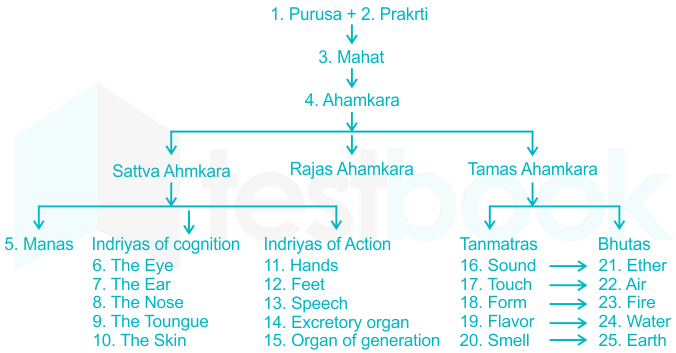
Samkhya Theory of Evolution:

Sāmkhya: The Indian Philosophy – Cooking Cosmos


SUBTLE ESSENCE 

  • In Sankhya Sattva means Essence.
  • Sattva is the highest of the three Gunas.
  • Ahamkara in its tamas aspect evolves into the 5 subtle essences (tanmatras): the essences of sight, smell, taste, touch and sound.
  • Ahamkara in its rajasa aspect plays its part in both.
  • The 5 subtle essences evolve into the five gross elements of earth, water, light, air, and ether by a predomination of tamas (mahabhutas).

Mahat:

  • Mahat is the first product of evolution.
  • It is cosmic in its nature. Besides this fact, it has a psychological aspect in which it is called intellect or buddhi.
  • Here, it is important to mention that buddhi should not be understood as the same as consciousness. The reason is buddhi is material whereas consciousness is eternal.
  • An important function of buddhi is to take decisions which is a part of the memory act. This helps to distinguish between the known and the knower.
  • Sattva is predominately found as an attribute of buddhi.
  • Buddhi helps to identify the soul or the ātman which differs from all physical objects and their qualities.
3

In terms of Buddhist philosophy, which of the following is contributive to right knowledge (Pragya)?

  1. ((a))

    Right faith and right resolve

  2. ((b))

    Right resolve and right speech

  3. ((c))

    Right thought and right concentration

  4. ((d))

    Right living and right effort

Show Answer
Answer: ((a))

Right faith and right resolve

Buddhist philosophy is a Philosophy that spreads in India after the death, which is parinirvana, of the Buddha.

  • It is philosophical investigations and systems of inquiry.
  • Philosophical reasoning and meditation are the two core of this Philosophy.
  • As the teachings of the Buddha were not meant to be taken on faith alone, but to be confirmed by a logical analysis of the world.
  • Pragya in Buddhist terminology means Wisdom, intelligence, or understanding. in simpler terms, it is an understanding of the true nature of the phenomenon.

The core of Buddhism is the Buddha’s teaching on the Four Noble Truths. In fact, his very first sermon consisted of them only. They also prove to be a summary of the Buddha’s teachings, both from the point of view of doctrine and also from the point of view of the practice. They may be described in simple terms as follows:

  1. The Truth of Misery (Dukkha)
  2. The Truth of the Cause (Samudaya)
  3. The Truth of Cessation (Nirodha)
  4. The Truth of the Path (Marga)

​The Truth of the Path is generally described as the noble eightfold path.

  1. Right Faith or Right view (samyak-dristi): It consists of the grasp and acceptance of the four noble truths, rejection of the fault doctrines, and avoidance of immorality resulting from covetousness, lying, violence, etc.

  2. Right Resolve or Right aspiration (Samyak-Sankalpa): Right resolve is the decision in the mind of what is to be practically followed. As far as practice is concerned, the right faith remains impractical, for it doesn’t become part of the active mind. It is the duty of the right resolve to make the mind active in that way. It implies thought on renunciation, thought on friendship and goodwill, and thoughts on non-harming. 

  3. Right Speech (samyak-vac): It inspires one to speak truth primarily, and to speak gentle and soothing words for the benefit and wellbeing of others. It also promulgates one to avoid falsehood, slander, harsh words, and gossip.

  4. Right Conduct (samyak-karma): This noble truth asks the practitioner (sadhaka) to abstain from wrong actions. This contains the famous “Pancha-Sila” – the five vows for desisting from killing, stealing, sensuality, lying, and intoxication.  

  5. Right Livelihood (samyak ajiva): Right Livelihood refers to earning one’s everyday living by honest means. This rule tells the practitioner (sadhaka) that even for the sake of maintaining one’s life one should not take to forbidden means, but work in consistency with good determination. It consists of the avoidance of luxurious life and the acceptance of occupations that do not involve cruelty and injury to other living beings. The Buddha exhorts to avoid occupations like sale of alcohol, making and selling weapons, the profession of the soldier, butcher, fisherman, etc. 

  6. Right Effort (samyak vyayama): It includes the effort to avoid the rise of evil and false ideas in the mind, the effort to overcome evil and evil tendencies, the effort to acquire positive values like attention, energy, tranquility, equanimity, and concentration, and the effort to maintain the right conditions for a meritorious life.

  7. Right Awareness (samyak smrti): It represents the awareness of the body (breathing positions, movements, impurities of the body, etc.), awareness of sensations (attentive to the feelings of oneself and of the other), awareness of thought and the awareness of the internal functions of the mind. 

  8. Right Concentration (samyak samadhi):  The practice of one-pointed contemplation leads the seeker to go beyond all sensations of pain and pleasure, and finally to full enlightenment. It happens on four levels.

  1. Through intense meditation, the seeker concentrates the mind on truth and thereby enjoys great bliss.
  2. The seeker enters into supreme internal peace and tranquility.
  3. The seeker becomes detached even from the inner bliss and tranquility.
  4. The seeker is liberated even from this sensation of bliss and tranquility.

Important Points 

  • The first two of the eight-fold path, namely, right faith and right resolve, are together called Prajna, because they are related to consciousness and knowledge.
  • The third, fourth, and fifth, namely, right speech, right conduct, and right livelihood, are collectively known as Sila because they deal with the correct and morally right way of living.
  • The last three, namely, right effort, right awareness, and right concentration are collectively known as Samadhi, because they deal with meditation and contemplation.

Hence, Right faith and Right Resolve are contributing to the right knowledge.

4

The focus of concern of sociology of education, in classical approach has been on

  1. ((a))

    class conflict resolution

  2. ((b))

    political freedom

  3. ((c))

    social construction of relaity

  4. ((d))

    resources and social networks

Show Answer
Answer: ((a))

class conflict resolution

Sociology of Education

  • The sociology of education is related to the study of how public institutions and individual experiences affect education and its outcomes.
  • It is primarily concerned with the public schooling systems of modern industrial societies, including the expansion of higher, further, adult, and continuing education.
  • Education is a means of overcoming handicaps, achieving greater equality, and acquiring wealth and status for all.
  • It is a  diverse and vibrant subfield that features theory and research focused on how education as a social institution is affected by and affects other social institutions.
  • It is concerned with how the social structure overall, and how various social forces shape the policies, practices, and outcomes of schooling.

Education serves several functions for society.

(a) socialization

(b) social integration

(c) social placement

(d) social and cultural innovation

The focus of concern of sociology of education, in the classical approach, has been on class conflict resolution.

  • Class conflict is a class struggle and class warfare.
  • It is the political tension and economic antagonism.
  • It exists in society consequent to socio-economic competition among the social classes or between rich and poor.
  • Class struggle happens when the rich pay the workers to make things for them to sell.
  • The workers have no say in their pay or what things they make since they cannot live without a job or money.
  • ​One of the most powerful sociological explanations of social conflict is that of Karl Marx, who posited a class struggle between proletariat and bourgeoisie

​Therefore, the focus of concern of sociology of education, in the classical approach, has been on class conflict resolution.

Additional Information

Political freedom

  • Political freedom is freedom from oppression or coercion.
  • The absence of disabling conditions for an individual and the fulfillment of enabling conditions, or the absence of life conditions of compulsion, e.g. economic compulsion, in a society.
  • It involves the ability of a nation's citizens to participate freely in the political process.
  • It involves both the freedom of the majority to influence and guide.

The social construction of reality

  • The social construction of reality stands for the proposition that human interactions with the world and with each other are mediated to an extent found nowhere else in nature.
  • Sociologists Peter Berger and Thomas Luckmann wrote a book called The Social Construction of Reality
  • Society is created by humans and human interaction, which is called Habituation.

Resources and social networks

  • Social resources are resources embedded in one's social network and social ties.
  • A social network is a sociological concept for a set of social relations between network elements that interact and which are in particular individuals.
5

Who among the following Indian thinkers has contributed towards the concept of integral education?

  1. ((a))

    Sri Aurobindo

  2. ((b))

    Swami Vivekananda

  3. ((c))

    Mahatma Gandhi

  4. ((d))

    Gijubhai Badheka

Show Answer
Answer: ((a))

Sri Aurobindo

Integral Education was given by Sri Aurobindo. It was based on the belief that the education of a human being should begin at birth and continue throughout his life. Also, he strongly believed that education to be complete must have five principal aspects, the physical, the vital, the mental, the psychic, and the spiritual.

  • An Integral Approach to education means that we include multiple perspectives.
  • It seeks to understand the subjective experience of others and to find value in them.
  • It gives an effective tool to transform ourselves, serve others, and create a multidimensional curriculum.
  • Integral education attempts to discover how the many partial truths of educational philosophies and methods inform and complement each other in a coherent way.
  • His concept of true education is integral education, which concerns five principal 'activities of the human being: the physical, the vital, the mental, the psychic, and the spiritual.
  • Such a scheme of education not only helps the evolution of an individual but also helps the evolution of the nation and finally humanity.
  • Based on his philosophy of education, he advocated three cardinal principles of education, which govern the process of education. There are:
  • Nothing can be taught or improved from outside. According to the Mother, "Fundamentally the only thing you must do assiduously is to teach them to know themselves, and to choose their own destiny, the way they want to follow".
  • The mind has to be consulted in its growth. The aim of education is to help the growing soul draw out its best.
  • The educational process must emphasize "from near to the far, from that is to that which shall be".

Additional Information

Gijubhai Badheka:

  • Gijubhai, a great thinker from Gujarat, was a great pioneer in the field of pre-school education in India and advocated child-centered education.
  • According to Gijubhai, a child is a complete person who has intellect, emotions, mind, and understanding, strengths and weaknesses, likes, and dislikes.'
  • It is very important to understand the emotions of the child and create an atmosphere where children learn from each other through play, stories, and songs without the fear of formal examinations and gradations.
  • He preferred the word 'Mandir' to 'school' (like Bal Mandir, Kishore Mandir, Vinay Mandir instead of the primary, middle, and high school) just to indicate that it is a place where the child would not be beaten, insulted, or jeered at.
  • Gijubhai was emphatic in saying that instead of imposing adult ideas on children they must be given an opportunity to learn something by doing playing according to their age and interest.
  • He rejected the artificial, harsh, unsympathetic methods of education, which repressed all-natural inclinations. Education, according to him, should be a process of development into a rational, harmoniously balanced, useful, natural life.

Swami Vivekananda:

  • Vivekananda considers education as part of human life.
  • The main aim of education according to him is the development of a strong moral character and not merely the feeding of information to the brain.
  • Education should enable one to realize one's self. Before that, it should create self-confidence.

Mahatma Gandhi:

  • According to Gandhiji, education means 'an all-round drawing out of the best in the child and man-body, mind and spirit'. Hence, he believed in the total development of the human personality through education.
  • Education does not mean literacy alone, it is a quest for truth and non-violence; training of body and mind and leading to an awakening of one's soul.
  • By introducing craft, he tried to remove the gap between manual and intellectual labor, the educated and uneducated mass, and promote the dignity of labor, social solidarity, and national integration.
  • He also desired that ideals of democratic citizenship be inculcated in the children and regarded the school as a democratic society where they would learn citizenship, knowledge, skills, and values like co-operation, love, sympathy, fellow-feeling, equality.
  • Gandhiji's vision of the democratic society is "Sarvodaya Samaj" characteristics of which are social justice, peace, non-violence, and modem humanism.
6

In the following two sets, Set I mentions the suggested interventions of the Kothari Commission in respect of Teacher Education, Set II provides the concerned target stage/group:

Set-I (Interventions)Set-II (Target Stage/Group)
(a) Two-year training course(i) In-service training of staff
(b) One-year training course having 230 working days(ii) Unqualified teachers
(c) Organization of summer institutes(iii) Primary level (Pre-Service Training)
(d) Correspondence courses and study leave(iv) Secondary level (Pre-Service Training)

 Match the two sets and answer from the codes given below:

  1. ((a))

    (a) - (iii), (b) - (iv), (c) - (i), (d) - (ii)

  2. ((b))

    (a) - (iv), (b) - (iii), (c) - (ii), (d) - (i)

  3. ((c))

    (a) - (ii), (b) - (i), (c) - (iii), (d) - (iv)

  4. ((d))

    (a) - (i), (b) - (ii), (c) - (iv), (d) - (iii)

Show Answer
Answer: ((a))

(a) - (iii), (b) - (iv), (c) - (i), (d) - (ii)

Kothari Commission (1964-66):

  • It was set up under the Chairmanship of Dr. D. S. Kothari to formulate a coherent education policy for India.
  • According to this Commission, education was intended to increase productivity, develop social and national unity, consolidate democracy, modernize the country, and develop social, moral, and spiritual values.
  • The Commission identified the three important facets that would bring about the desired educational resolution, they are: 
  1. an internal transformation so as to relate it to the life needs and aspirations of the nation;
  2. qualitative improvement so that the standards achieved are adequate and become internationally comparable; and
  3. expansion of educational facilities broadly on the basis of manpower needs with an emphasis on equalization of education opportunities.
  • The Commission urged that professional preparation of teachers was the key for qualitative improvement of education and recommended measures like: 
  • Removing the Isolation of Teacher Training: In order to make the professional preparation of teachers effective, teacher education must be brought into the mainstream of the academic life of the universities on the one hand and of school life and educational developments on the other.
  • Improving Professional Education: The essence of a program of teacher education is 'quality' and in its absence, teacher education becomes, not only a financial waste but a source of the overall deterioration in educational standards. A program of the highest importance, therefore, is to improve the quality of teacher education.
  • Duration of Training Course: The duration of the professional courses should be two years for primary teachers who have completed the secondary school course. It should be one year for the graduate students, but the number of working days in a year should be increased to 230.
  • Improving the Quality of Training Institutions: Early steps should be taken to improve training institutions for teachers.
  • Correspondence courses and liberal concessions for study leave should be made available to unqualified teachers in primary schools to improve their qualifications.
  • Expansion of Training Facilities: The training facilities should be expanded on a priority basis. The objective should be to ensure that every teacher in a primary or a secondary school is either already trained at the time of his appointment or receives such training within three years, of his appointment.
  • In-Service Education of School Teachers. 
  1. A large-scale and coordinated program of in-service education for teachers should be organized by universities, training institutions, and teachers organizations for teachers at all levels. The target should be that every teacher receives at least two or three months of in-service education every five years of his service.
  2. The program of summer institutes for the in-service training of secondary school teachers should be extended, with systematic follow-up and active collaboration among the agencies concerned.
  • Professional Preparation or Teachers in Higher Education
  • Standards in Teacher Education

Therefore, the correct match is:


Set-I (Interventions)Set-II (Target Stage/Group)
(a) Two-year training coursePrimary level (Pre-Service Training)
(b) One-year training course having 230 working daysSecondary level (Pre-Service Training)
(c) Organization of summer institutesIn-service training of staff
(d) Correspondence courses and study leaveUnqualified teachers
7

A teacher is faced with the problem of choosing the appropriate teaching method for the transaction of a course content. Which branch of philosophy will most appropriately describe his/her predicament?

  1. ((a))

    Metaphysics

  2. ((b))

    Epistemology

  3. ((c))

    Axiology

  4. ((d))

    Logic

Show Answer
Answer: ((b))

Epistemology

Metaphysics

  • Metaphysics is Derived from the Greek meta ta physika, after the things of nature.
  • It is a study of those which cannot be reached through objective studies of material reality.
  • It also examines the fundamental nature of reality, including the relationship between mind and matter, between substance and attribute, and between potentiality and actuality.
  • Metaphysics by establishing knowledge, truths, and values, as ontological realities provide a base for educational thought, whose nature must be understood to understand its place in educational matters.

Epistemology

  • The branch of philosophy that deals with knowledge and examines the nature of knowledge, the processes through which we acquire knowledge, and the value of knowledge is known as Epistemology.
  • It also focuses on acquiring skills in learners to discover or construct knowledge.
  • Epistemology concerns the nature and justification of knowledge. So, it also helps in selecting an appropriate teaching method for the transaction of knowledge.

Axiology

  • Axiology is considered the study of principles and values.
  • According to this branch of philosophy, education is more than just about knowledge but also about the quality of life.

Logic

  • Logic is the branch of philosophy that deals with organizational reasoning.
  • Students of logic learn how to think in a structurally sound manner.

Therefore, the teacher should consult the branch of philosophy called Epistemology.

8

The principle of 'the child, the school and education itself are shaped largely by social and cultural forces' was enunciated by

  1. ((a))

    reconstructionism

  2. ((b))

    existentialism

  3. ((c))

    pragmatism

  4. ((d))

    perennialism

Show Answer
Answer: ((a))

reconstructionism

Theodore Brameld the founder of Social Reconstructionism.

  • Social Reconstructionism a method of education that has the purpose to teach through culture and change it.
  • It is based on the assumption that a student can gain first-hand experience in studying real social problems and controversial issues.
  • The curriculum proposed in this reflects democratic ideals and emphasizes civic education.
  • This education helps students to think in critical terms and expose their assumptions and practices.

EXISTENTIALISM

  • Existentialism is a form of philosophical inquiry that explores the nature of existence by emphasizing the experience of the human subject.
  • It is also the investigation of the meaning of Being.
  • The existentialist is in opposition to any doctrine that views human beings as the manifestation of an infinite substance.

PRAGMATISM

  • Pragmatism is a philosophy that considers words and thought as tools and instruments for prediction, problem-solving, and action.
  • It rejects the idea that the function of thought is to describe, represent, or mirror reality.

​P​ERENNIALISM 

  • A teacher-centered educational philosophy that focuses on everlasting ideas and universal truths.
  • The focus of education should be the ideas that have lasted for centuries because it believes that the ideas are as relevant and meaningful today as they were when written.

Therefore, Reconstruction enunciated the principal of the child, the school, and education itself are shaped largely by social and cultural forces.

9

"Educational practice void of dreams, dissent and pronouncement is neutral and accomodating." In terms of this statement, the focus of concern in education should be on

  1. ((a))

    Developing neutrality

  2. ((b))

    Promoting impersonal engagement in learning process

  3. ((c))

    Ensuring deeper personal engagement of learners

  4. ((d))

    Teachers' role to be that of a spectator

Show Answer
Answer: ((c))

Ensuring deeper personal engagement of learners

Critical Pedagogy was inspired by Brazilian education Paulo Freire. Paulo Freire wrote that "Educators who are mesmerized by the neoliberal pragmatic discourse are not educating in the full sense of the concept. When these educators accept the notion that what is important is the acquisition of facts without the educational background to critically analyze these facts, they produce a type of training that reduces students to narrow technical professionals. It is worth saying that an educational practice void of dreams, dissent, and pronouncements is neutral and accommodating."

  • This educational practice was informed by the stimulus of epistemological curiosity.  The learner needs to keep open his eyes to be aware and maintain his natural curiosity to discover.
  • According to this Pedagogy, it is believed that education is beneficial only if the information is critically received by the informed and not simply accepted as given by the learner.
  • What is important in education is that the acquisition of facts has to be done with the ability to critically analyze the facts.
  • It is worth saying that an educational practice void of dreams, dissent, and pronouncements is neutral and accommodating which means the main focus of education should be Ensuring deeper personal engagement of learners.

Hence, “Education practice void of dreams, dissent, and pronouncement is neutral and accommodating.” In terms of this statement, the focus of concern in education should be on Ensuring deeper personal engagement of learners this can be done by using the suitable method of teaching by learners by connecting the topic taught in class with real-life and using the field of interest of learners.

10

Who defined democracy as a form of government of the people, for the people and by the people?

  1. ((a))

    Mahatma Gandhi

  2. ((b))

    Abraham Lincoln

  3. ((c))

    John F. Kennedy

  4. ((d))

    George Washington

Show Answer
Answer: ((b))

Abraham Lincoln

The Correct Answer is Abraham Lincoln.

  • The words of Abraham Lincoln to recall the soldiers who sacrificed their life for the "government of the people, by the people, for the people, shall not perish from the world" were spoken in Gettysburg, but these words also apply to the countless soldiers who died for the sake of democracy in the next 150 years.
  • Democracy is a type of conflict management between nations, much as diplomacy is a form of conflict management within states.
  • Therefore, they typically lead to a balance between opposing opinions and different assumed needs.
  • This is definitely the case where a decision involves consensus within and within the Member States.

Additional Information

  • A government-owned by the people is called democracy. In a democracy, a single person has the right to vote when the citizen turns 18 on how the country is to be operated, thereby separating it from a monarchy or a dictatorship. One person who is a king or a tyrant has all the power in a dictatorship.
11

In which of the following areas is the contribution of Savitribai Phule highly acclaimed?

  1. ((a))

    Upliftment of Scheduled Castes

  2. ((b))

    Resettlement of poor people

  3. ((c))

    Education of women

  4. ((d))

    Education of the slum children

Show Answer
Answer: ((c))

Education of women

The Correct Answer is Education of women.

  • Savitribai Phule was an Indian social reformer.
  • She is known to be India's first female teacher. Together with her partner, Jyotirao Phule, she played an important role in improving women's rights in India.
  • She is considered to be the mother of Indian Feminism. Phule and her husband founded one of the first Indian girl's schools in Pune, Bhide Wada, in 1848.
  • She sought to eradicate injustice and unequal treatment of people on the grounds of caste and gender.
  • It is considered to be an influential figure in the social change movement in Maharashtra.

Additional Information

  • Savitribai Phule published Kavya Phule in 1854 and Bavan Kashi Subodh Ratnakar in 1892, as well as a poem entitled "Go, Get Education" in which she urged those who were marginalised to free themselves from education.
  • In 2015, in her honour, the University of Pune was renamed Savitribai Phule Pune University.
  • On 3 January 2017, the Google search engine celebrated the 186th anniversary of the birth of Savitribai Phule with a Google Doodle.
12

In the following sets, Set I mentions various commissions on education and Set - II indicated chief recommendations:

Set-I
(Commissions)
Set-II
(Recommendations)
(a) Secondary Education Commission (1952 – 53)(i) Establishment of ‘School Complex’ with a nodal school
(b) Education Commission (1964 – 66)(ii) Improving quality of pre-service and in-service Teacher Education
(c) National Commission of Teacher – I (1980)(iii) Establishment of Extension Services Department
(d) High-powered Commission on Teacher Education (2012)(iv) Provision of in-service training of specified short period and its linkage with career promotion.
<br>

Match the two sets and give your answer from the options given below:

  1. ((a))

    (a) - (i), (b) - (ii), (c) - (iii), (d) - (iv)

  2. ((b))

    (a) - (ii), (b) - (iii), (c) - (iv), (d) - (i)

  3. ((c))

    (a) - (iii), (b) - (i), (c) - (iv), (d) - (ii)

  4. ((d))

    (a) - (iv), (b) - (iii), (c) - (ii), (d) - (i)

Show Answer
Answer: ((c))

(a) - (iii), (b) - (i), (c) - (iv), (d) - (ii)

1) Secondary Education Commission (1952 – 53)

  • The Secondary Education Commission was also known as Mudaliar Commission.
  • It was appointed by the government of India for their Resolution to bring changes in the present education system.
  • The Secondary Education Commission by Resolution dated 23rd September 1952, under the Chairmanship of Dr. A. Lakshmanaswami Mudaliar,
  • Dr. A. Lakshmanswami Mudaliar was the Vice-Chancellor of Madras University.
  • Objectives of Secondary Education.
  • Secondary education should provide the learner with opportunities to acquire the necessary knowledge, skills, and attitudes for the development of the self and the nation.
  • Recommendations of the Secondary Education Commission (1952-53)
  • Establishment of the Extension Services Department: It suggested to end intermediate college and merge class 11 with secondary schools and class 12 with B.A. Commission divided secondary education into two parts. Degree course should be for three years.

2) Education Commission (1964 – 66)

  • Kothari Commission also is known as the Education Commission
  • The Education Commission is a global initiative encouraging greater progress on Sustainable Development
  • Kothari Commission was an ad-hoc committee set up by the Government of India.
  • It was formed under the Chairmanship of Daulat Singh Kothari.
  • Kothari Commission was formed on 14 July 1964.
  • National Education Commission is known as Kothari Commission.
  • This commission was set up to examine all aspects of the educational sector in India, to evolve a general pattern of education, and to advise guidelines and policies for the development of education in India.
  • The objective of the Kothari Commission is: The objectives, as recommended by the commission were increasing productivity; promoting social and national integration; education and modernization, and developing social, moral, and spiritual values.
  • Recommendations of the Education Commission (1964 – 66)
  • Establishment of ‘School Complex’ with a nodal school
  • Free and Compulsory Education:
  • Status, Emoluments, and Education of Teachers.
  • Development of Languages.
  • Equalization of Educational Opportunity.
  • Identification of Talent
  • Work-experience and National Service.

3) National Commission of Teacher – I (1980)

  • In National Commission on Teachers – I (for school teachers), a four-year training course after senior secondary, or preferably a 5-year course leading to graduation and training is recommended.
  • Training curriculum for elementary teachers should emphasize the mastering of language and communication skills.
  • This commission also suggested that the practice teaching should be replaced by the word “Internship”.
  • Recommendations of the National Commission of Teacher – I (1980)
  • Provision of in-service training of specified short period and its linkage with career promotion.

4) High-powered Commission on Teacher Education (2012)

  • A high-powered Commission on Teacher Education (2012) was constituted by the Supreme court of India.
  • The members of the commission included eminent educationists like Goverdhan Mehta, M. Anandakrishnan, R. Govinda, Mrinal Miri, A.K.S. Sharma and Poonam Batra.
  • The commission, chaired by Justice J.S. Verma, tabled its report in August 2012.
  • It acknowledged that teacher education is a subject of great national importance.
  • The commission has underlined the need to establish a national-level academic body that can continually review teacher education programs.
  • It looked into the development of resources, both human and material, required to run these programs
  • Recommendations of the High-powered Commission on Teacher Education (2012)
  • Improving the quality of pre-service and in-service Teacher Education

Therefore, option 3 is correct.

13

Which of the following is said to be the immediate knowledge in Jain philosophy?

  1. ((a))

    Perceptual knowledge

  2. ((b))

    Inferential knowledge

  3. ((c))

    Knowledge derived from authority

  4. ((d))

    Clairvoyance

Show Answer
Answer: ((d))

Clairvoyance

JAINISM

  • Jainism was founded about the 6th century BCE by Vardhamana Mahavira.
  • Jainism makes a distinction between Jivas and Ajivas. Therefore, it is dualism.
  • It is also pluralism in that it recognizes an infinite number of animate and inanimate substances.
  • It is also metaphysical realism. They also hold that every atom has a soul but it is not Jiva, because they do not have sense organs. The soul is both permanent and changing.
  • Based on extension, Jainism divides substance into two classes, those that are extended in space and those that are not.
  • Although Jainism recognizes souls, it rejects the notion of an ultimate, universal soul.
  • Jain philosophy deals with reality, cosmology, epistemology, and Vitalism.
  • Knowledge by direct perception, internal or external, which is regarded by many schools as immediate knowledge, is regarded as mediated by Jainism since the sense and mind (things other than the soul itself) play a role in it.
  • Jainism speaks of such perceptual knowledge as relatively immediate and as distinct from absolutely immediate knowledge, which the soul has in virtue of that consciousness attained by freeing itself from all the karmic obstacles.
  • We may call the absolutely immediate knowledge ‘supra-sensual, non-conceptual, non-perceptual, intuitive knowledge (kevala-jnana)’. So, knowledge is not something external to be grasped and possessed by the soul but is a state of the soul itself.
  • Immediate knowledge is divided into Avadhi, Manahparyaya, and Kevala; and mediate knowledge into Mati and Shruta.

Avadhi (Clairvoyance):

  • When a person is partially freed from the influences of the karmas, he acquires the power of knowing objects which have forms but are too distant, or minute, or obscure to be observed by the senses or mind.
  • Such immediate knowledge is limited, and is therefore called avadhijnana.

Manahparyaya (Telepathy):

  • Manahparyaya is direct knowledge of the thoughts of others.
  • When a person has overcome hatred, jealousy, etc. (which create obstacles that stand in the way of 3 knowing other minds), he can have direct access to the present and past thoughts of others. This knowledge is called manah-paryaya (entering a mind).
  • In both Avadhi and Manahparyaya, the soul has direct knowledge unaided by the senses or the mind. Hence they are called immediate, though limited.

Kevala (Omniscience):

  • When all karmas that obstruct knowledge are completely removed from the soul, there arises in it the absolute knowledge or omniscience. This is called Kevalajnana.
  • It is unlimited and absolute knowledge.

These three are extraordinary or extra-sensory perceptions that are immediate. But in addition to these, there are two kinds of ordinary knowledge possessed by an average person. They are called mati and sruta.

Mati (Sensuous Cognition):

  • Matijnana is known as sensory comprehension. Here, sense organs and the mind are the essential aid for cognition.
  • Ordinarily, mati means any kind of knowledge which we can obtain through the senses or through manas.
  • Jains give an account of the process by which mati takes place, in the following way.
  • At first there is only a sensation, and it is not yet known what it means. This primary state of consciousness is called avagraha (sensation).
  • Then arises query. This questioning state of the mind is called iha (speculation).
  • Then comes a definite judgment. This is called avaya (removal of doubt).
  • Then what is ascertained is retained in the mind. This is called dharana (retention)

Srutajnana:

  • Sruta is knowledge obtained from authority.
  • This is usually interpreted as knowledge obtained from what is heard from others.
  • This includes all kinds of knowledge derived from spoken or written authority.
  • As the understanding of any authority is dependent on the perception of sounds or written letters, sruta is said to be preceded by mati.

These two kinds of ordinary knowledge (namely, mati and sruta), as well as the lowest kind of immediate extraordinary knowledge (namely, avadhi), are not absolutely free from chances of error. But the two higher kinds of immediate extra-sensory knowledge (manahparyaya and kevala) are never liable to any error. 

Additional Information

PERCEPTUAL KNOWLEDGE

  • Perceptual knowledge consists of the knowledge of the perceptible features of the world around us.
  • It is the knowledge that is grounded in our perceptual experience.

INFERENTIAL KNOWLEDGE

  • Inferential knowledge represents knowledge as formal logic.
  • Inferential knowledge is used to derive more facts.

KNOWLEDGE DERIVED FROM AUTHORITY

  • The most common method of acquiring knowledge is through authority.
  • The method involves accepting new ideas because some authority figure states that they are true.

Hence, Clairvoyance is said to be the immediate knowledge in Jain philosophy.

14

Who among the following thinkers propagated the idea of education of the most talented?

  1. ((a))

    Emanuel Kant

  2. ((b))

    John Paul Sartre

  3. ((c))

    Plato

  4. ((d))

    More than one of the above

Show Answer
Answer: ((c))

Plato

The ancient Greek philosopher Plato was a student of Socrates and a teacher of Aristotle. His writings explored justice, beauty, and equality.

  • Education for Plato was one of the great things in life.
  • The main function of education according to Plato is not to put knowledge into the soul, but to bring out the latent talents in the soul.
  • Plato’s theory of education was to ban individualism, give up incompe­tence and immaturity.
  • Plato propagated the idea of mast talented.

Additional Information

Emmanuel Kant:

  • Kant separates education into two as moral and physical education.
  • For him, physical education is the only common way to feed and care comparing human with animals.
  • Physical and moral education teach us how a person lives as an independent existence. Instruction makes a person worthy as an individual.
  • The basic aim of education to Kant has to provide fulfilling person ownself being committed to the moral law. The person should effort being an autonomous individual acting to the moral law. That's why Kant defends that a person should need to get used to discipline and task in an appropriate time.

John-Paul Sartre:

  • Jean-Paul Sartre is well known as a philosopher who emphasizes the individual and who both grounds himself in and defends individual freedom. As a result, Sartrean philosophy has often been cited as a possible grounding for 'progressive' student-centered education.
  • Sartre's theory of existentialism states that “existence precedes essence”, that is only by existing and acting a certain way do we give meaning to our lives. According to him, there is no fixed design for how a human being should be and no God to give us a purpose.
  • Existentialism in education is a teaching and learning philosophy that focuses on the student's freedom and agency to choose their future. Existentialist educators believe there is no god or higher power guiding their students.

Aristotle:

  • Aristotle's definition of education is the same as that of his teachers, that is, “the creation of a sound mind in a sound body”. Thus to him the aim of education was the welfare of the individuals so as to bring happiness in their lives.
  • He believed that virtue lies in the attainment of happiness or goodness.
  • Aristotle believed the purpose of the school was to develop and exercise students' potential for reasoning, form ethical character, and provide a skill and knowledge base.
  • He thought the purpose of schooling was to develop dispositions and habits that exercise reason and forming a human's ethos.
15

Below are given the steps involved in policy formulation

(a) Planning of policy implementation

(b) Making a policy decision

(c) Evaluation of policy option

(d) Analysis of the existing situation

(e) Subsequent policy cycles

(f) Generation of policy options

(g) Policy impact assessment

Arrange them in a logical order and answer the question from the options given below:

  1. ((a))

    (a), (b), (c), (g), (f), (e) and (d)

  2. ((b))

    (g), (f), (e), (d), (c), (b) and (a)

  3. ((c))

    (d), (f), (c), (b), (a), (g) and (e)

  4. ((d))

    (a), (b), (c), (d), (e), (f) and (g)

Show Answer
Answer: ((c))

(d), (f), (c), (b), (a), (g) and (e)

Policy

  • A policy is a deliberate system of principles to guide decisions and achieve rational outcomes.
  • A policy is a statement of intent and is implemented as a procedure or protocol.
  • Policies are generally adopted by a governance body within an organization
  • The policy is a law, regulation, procedure, administrative action, incentive, or voluntary practice of governments and other institutions.
  • Policy decisions are frequently reflected in resource allocations
  • Policy development involves identifying a need, gathering information, drafting, consulting, and review.

What is the policy used for?

  • A policy is a set of rules or guidelines for your organization and employees to follow in or to achieve a specific goal
  • An effective policy should outline what employees must do or not do, directions, limits, principles, and guidance for decision making.
  • Policies set some parameters for decision-making but leave room for flexibility.
  • They show the “why” behind an action.

Stages in policy development

  • Identify need- In anticipation of need mean need which could be felt in the future and In response to need which could be made on in response to a consultation paper
  • Identify who will take lead responsibility -Delegate responsibility to an individual, working group, sub-committee, or staff members, according to the expertise required
  • Gather information- information relating to the policy topic or concern area.
  • Consult with appropriate stakeholders- It is best when people who are affected are consulted are supportive and have the opportunity to consider and discuss the potential implications of the policy.
  • Finalize/approve policy- the Management Committee is responsible for all policies and procedures within the organization.
  • Consider whether procedures are required-  Procedure includes clear guidance regarding how the policy will be implemented and by whom.
  • Implement-  It involves the decision like how the policy is communicated and to whom, Is training required.
  • Monitor, review, revise- Monitoring the implementation and results of the policy include assess usage and responses.

 Therefore, the steps involved in policy formulation:

  1. Analysis of the existing situation
  2. Generation of policy options
  3. Evaluation of policy option
  4. Making a policy decision
  5. Planning of policy implementation
  6. Policy impact assessment
  7. Subsequent policy cycles
16

Which of the following statements is related to the 'Human Capital Theory'?

  1. ((a))

    It is useful for describing behaviour when two parties have access to different information

  2. ((b))

    It is the aggregate stock of competencies, knowledge, social and personal attributes

  3. ((c))

    It is education that raises wages simple because education level is a signal of workers ability

  4. ((d))

    It holds a prominent position in a variety of management literatures

Show Answer
Answer: ((b))

It is the aggregate stock of competencies, knowledge, social and personal attributes

The human capital theory was initially developed in the United States and Europe in the 1950s. Later, this theory was applied to undeveloped countries. Human Capital refers to the productive capacities of Human beings as income producing agents in the economy and may be defined as the ‘stock of skills and productive knowledge embodied in people.

  • Human capital is aggregate 'the knowledge, skills, competencies, and attributes in individuals that facilitate the creation of personal, social, and economic well-being' with the social.
  • Human capital formation rests on the proposition that people enhance their capabilities as producers and consumers by investing in themselves through schooling, health, on the job training, searching for information about job opportunities, and investing in migration
  • The advocates of this theory though that it is not only the physical capital stock, i.e., labor, which is important but also human capital stock, such as education, which is critical to the growth and development of a nation.
  • They argued that when people become more and more educated, they become more productive. There is a close relationship between the number of years of schooling and the income level of a person. In other words, increasing the level of schooling would lead to higher earning.

NOTE:

  • The human capital theory is not describing any kind of behavior of parties.
  • According to signaling theory holds a prominent position in a variety of management, entrepreneurship, and human resource management.

Hence, we can conclude that 'Human Capital Theory' is the aggregate stock of competencies, knowledge, social, and personal attributes.

17

Below are given some general steps for undertaking cost benefit analysis:

(a) Describing quantitatively the inputs and outputs of the programme/project

(b) Estimating the social and benefits of the inputs and outputs of the programme/projects

(c) Comparing the benefits and costs

(d) Specifying the programme/project clearly

What will be the appropriate sequence in this regard? Choose your answer from the options given below:

  1. ((a))

    (a), (b), (c) and (d)

  2. ((b))

    (d), (a), (b) and (c)

  3. ((c))

    (c), (d), (a) and (b)

  4. ((d))

    (b), (c), (d) and (a)

Show Answer
Answer: ((b))

(d), (a), (b) and (c)

Cost-Benefit Analysis (CBA)

  • It is a technique that is used to appraise and evaluate projects.
  • The basic idea in CBA is quite simple:
  • first, identify the costs and benefits of a project and
  • then measure them incomparable units (say in terms of money, and expressed in a single currency).
  • Compare the benefits and the costs.
  • If the benefits exceed the costs, the project should be accepted as resource allocation will be efficient.
  • If, on the other hand, costs exceed benefits, then reject the project.
  • The desirability or feasibility of projects, whether in the private or public sector are adjudged on the basis of criteria that are rooted in the concept of profits.
  • Profitability is contingent upon the likely costs that the project entails, and the likely returns that it generates.
  • The two sectors, public and private, however, may differ (sometimes widely) on the explicit recognition of the prices at which the value of output and the cost of inputs are to be evaluated.
  • While the analysis of projects in the private sector generally incorporates the direct and financial costs and benefits only, the analysis of public sector projects attempts to encompass the indirect and non-financial costs also.

Hence, Specifying the programme/project clearly → Describing quantitatively the inputs and outputs of the programme/project → Estimating the social and benefits of the inputs and outputs of the programme/projects → Comparing the benefits and costs.

18

Identify the specific features associated with macro-level financing from the list given below:

(a) Total economy-based concept

(b) Unceasing chain of activity

(c) Addressing a large entity

(d) Time frame specified

(e) Having direct effect on an individual

(f) Minimum scope for risk

(g) Stressing needs of an individual

Choose your answer from the options given below:

  1. ((a))

    (a), (c), (d) and (f)

  2. ((b))

    (b), (d), (f) and (g)

  3. ((c))

    (c), (e), (f) and (g)

  4. ((d))

    (d), (e), (f) and (g)

Show Answer
Answer: ((a))

(a), (c), (d) and (f)

Macro financing

  • Macro finance is a whole economy based concept.
  • It is not framed for any particular group instead to grow the economy at a national level.
  • A macro-finance involves a large entity like governments, big corporations, banks, and some big private lenders.
  • In microfinance, the money involved is in a small amount.
  • A macro-finance is a broad concept and focuses on the whole nation.
  • A macro-finance is for a specific time period like 2 years or 3 years. It means it has a predefined tenure.
  • A macro-finance has a direct effect on the whole economy which indirectly affects the whole population.
  • There is no risk at all because the main aim is to give benefit the economy.

The following are features associated with macro-level financing:

  • Total economy-based concept
  • Addressing a large entity
  • Time frame specified
  • The minimum scope for risk

Hence, It is a total economy based concept that addressing a large entity within the time frame with minimum scope for risk.

19

From the following list, identify those which are relevant for the theory of rational choice:

(a) Aggregation of social behaviour

(b) Random behaviour

(c) Determinants of behaviour

(d) Prediction of behaviour

(e) Study of interest groups

(f) Behaviour problems associated with information

Indicate your answer from the codes. Select the correct option:

  1. ((a))

    (a), (b), (c) and (d)

  2. ((b))

    (a), (c), (d) and (e)

  3. ((c))

    (b), (c), (d) and (f)

  4. ((d))

    (a), (b), (d) and (f)

Show Answer
Answer: ((b))

(a), (c), (d) and (e)

Rational choice theory

  • The rational choice theory states that individuals use rational calculations to make rational choices and achieve outcomes that are in their own personal objectives.
  • Rational choice theory is based on the premise of individual self-interested utility maximization.
  • Rational choice theory is expected to result in outcomes that provide people with the greatest benefit and satisfaction.
  • It is generally used for understanding and often formally modeling social and economic behavior.
  • Individuals use their self-interests to make choices that will provide them with the greatest benefit.
  • Rational choice theory is the most serious attempt to fully acknowledge the normativity that is crucial to intentional explanation, and the subjective meanings that play their indispensable role in behavioral and attitudinal rationality.
  • It is assumed that individuals weigh their options and make the choice they think will serve them best.

​The following are relevant for the theory of rational choice:

  • Aggregation of social behavior.
  • Study of interest groups.
  • Prediction of behavior.
  • Determinants of behavior.

Therefore, Rational choice theory is relevant to the aggregation of social behavior,  studying the interest group, prediction of their behavior, and determination of behavior.

20

Which of the following statements most appropriately describes the concept of political modernization?

  1. ((a))

    Political changes are necessary for the achievements of a specific objective

  2. ((b))

    A general process of change in the political sphere is closely related to other areas of society

  3. ((c))

    A political system's capacity to solve problems to initiate new policies etc.

  4. ((d))

    Ability to learn better and how to perform political functions

Show Answer
Answer: ((b))

A general process of change in the political sphere is closely related to other areas of society

Political modernization 

  • Political modernization is modernization in the political field.
  • It promotes modernization phenomena.
  • Modernization refers to a model of a progressive transition from a 'pre-modern' or 'traditional' to 'modern' society.
  • So, the theory of Political modernization is based on the modernization phenomenon.
  • It is a field-based theory of modernization theories.
  • It involves modernizations as the transition from political politics to modern politics and from autocratic politics to democratic politics.
  • The concept of 'political modernization' is one of the key notions in the policy arrangements approach.
  • It is a process that is based upon the rational utilization of resources aiming at the establishment of modern society.

Therefore, A general process of change in the political sphere is closely related to other areas of society most appropriately describes the concept of political modernization​​.

21

In the following two sets of information, Set-I lists the agents of political socialization, while Set-II narrates their roles: 

Set-I (Agents)Set-II (Roles)
(a) Family(i) Provides opportunity for understanding democratic processes
(b) School(ii) A source of political information and also an instrument for shaping political values and beliefs
(c) Peer Group(iii) Perpetuates values that support authorities
(d) Mass Media(iv) Influences teenagers lifestyle and attitude development

 Match the two sets and indicate your answer from the options given below:

  1. ((a))

    (a) - (i), (b) - (ii), (c) - (iii), (d) - (iv)

  2. ((b))

    (a) - (ii), (b) - (iii), (c) - (iv), (d) - (i)

  3. ((c))

    (a) - (iii), (b) - (i), (c) - (iv), (d) - (ii)

  4. ((d))

    (a) - (iv), (b) - (iii), (c) - (ii), (d) - (i)

Show Answer
Answer: ((c))

(a) - (iii), (b) - (i), (c) - (iv), (d) - (ii)

Family

  • Family is a unit of the system, which is Universal.
  • Family have a hierarchical structure based on the age and sex of the members
  • Family has a set of rules, follow certain values and belief systems.
  • Family perpetuates values that support authorities.

School

  • Primary role of School is to socialize children.
  • School formulate reasonable objectives and provide students with a proper learning environment.
  • Provides an opportunity for understanding democratic processes.

Peer Group

  • Provide perspective outside of the individual's viewpoints.
  • Also are social referents for teaching.
  • Influences the teenager's lifestyle and attitude development.

Mass Media

  • Primarily Mass Media inform, educate, and entertain people.
  • Help in organizing public opinion.
  • A source of political information and also an instrument for shaping political values and beliefs.

Therefore, option 3 is correct.

22

Which of the following features of social and emotional development characterize the stage of childhood?

(a) Tendency of withdrawal from parents

(b) Intense self-awareness

(C) Less control over emotions

(d) Curiosity

(e) Fear and worry

(f) Conflict in motivation

Select your answer from the codes given below:

  1. ((a))

    (a), (b) and (c)

  2. ((b))

    (b), (c) and (d)

  3. ((c))

    (c), (d) and (f)

  4. ((d))

    (a), (d) and (e)

Show Answer
Answer: ((d))

(a), (d) and (e)

Social-emotional development

  • A specific domain of child development.
  • It is a gradual, integrative process through which children acquire the capacity to understand, experience, express, and manage emotions and to develop meaningful relationships with others.
  • Social and emotional development means how children start to understand who they are, what they are feeling, and what to expect when interacting with others.
  • The development makes the child able to form and sustain positive relationships.
  • The development makes the child able to experience, manage, and express emotions.
  • The development makes the child able to explore and engage with the environment.
  • This development leads to the development of a child’s self-confidence, empathy.
  • The ability to develop meaningful and lasting friendships and partnerships, and a sense of importance and value to those around him/her.
  • Children’s social and emotional development also influences all other areas of development.

Social-Emotional Experiences of Early Childhood

  • Temper tantrums are quite common in childhood.
  • They tend to have rapid mood swings.
  • While their emotions can be very intense, these feelings also tend to be quite short-lived.
  • Children at this age can be very possessive and have difficulty sharing.
  • child spend most of their time with family and close friends to spending a large chunk of the day.
  • Children have a tendency to withdrawal from parents
  • Children at this stage are naturally Curious.
  • They experience fear and worry.

Help Kids Develop Social and Emotional Skills

  • Model Appropriate Behaviors - As Observation plays a vital role in how young children learn new things. Model appropriate behavior in front of children.
  • Reinforce Good Behavior - Appreciation is the best tool to use, so, offer praise when children demonstrate good social behaviors.
  • Teach Empathy - Empathy is an essential element of emotional development, to boost empathy and build emotional intelligence by encouraging their children to think about how other people feel.
  • Teach Cooperation - When given the opportunity to interact and play with other children is one of the best ways to teach them how to relate and cooperate with others.

Therefore, the tendency of withdrawal from parents, Curiosity, and  Fear and worry are the features of social and emotional development characterize the stage of childhood.

23

In the following two sets of information, Set-I mentions the stages of cognitive development as given by Piaget and Set-II specified the distinctive cognitive features:

Set-I (Stage of cognitive development)Set-II (Distinctive Cognitive Features)
(a) Sensory-motor stage(i) Hypothesis making and hypothesis testing
(b) Pre-operational stage(ii) Transductive reasoning
(c) Concrete operational stage(iii) Object permanence
(d) Formal operational stage(iv) Reversibility concept
(v) Arguing a case with evidence collected

 Match the two sets and indicate your answer from the options given below:

  1. ((a))

    (a) - (iii), (b) - (ii), (c) - (iv), (d) - (i)

  2. ((b))

    (a) - (i), (b) - (ii), (c) - (iii), (d) - (v)

  3. ((c))

    (a) - (v), (b) - (iv), (c) - (iii), (d) - (ii)

  4. ((d))

    (a) - (iv), (b) - (iii), (c) - (ii), (d) - (i)

Show Answer
Answer: ((a))

(a) - (iii), (b) - (ii), (c) - (iv), (d) - (i)

Jean Piaget, a Swiss psychologist, has made a systematic study of cognitive development in his theory that is categorized into four stages. 

  • He observed his children and their process of making sense of the world around them and developed a model of how the mind processes new information encountered.

Key Points

Let's understand the Four Stages of Cognitive Development:

StagesDevelopment
Sensorimotor (0 to 2 years)- In this stage, infants progressively develop object permanence - It is one of the most important accomplishments of this stage. - A significant achievement the child makes towards the end of the stage is that the child graduates from trying out everything through actions alone and becomes capable of ‘representational thought’. - The child becomes capable of representing things mentally.
Pre-operational (2 to 7 years)- Pre-operational thinking tends to involve ‘transductive reasoning’. - The preoperational child reasons from one specific to another specific event, as opposed to inductive and deductive reasoning - Thinking is egocentric and doesn’t consider other’s viewpoints.
Concrete Operational (7 to 12 years)- In the concrete operational stage, the children tend to develop "reversibility concept' - This ability of reversibility helps the concrete-operational child in understanding the conservation tasks. - Ability to think logically about objects and events
Formal Operational (12 years to older)- Abstract and scientific thinking - Capable of hypothetical and deductive reasoning - It is the most crucial stage where mental capabilities can be developed to the maximum level. - Ability to think abstractly, metacognition, and problem-solving.


Hence, we can conclude that the correct match is (a) - (iii), (b) - (ii), (c) - (iv), (d) - (i).

24

In the technique of Person Central counselling, the 'congruence' is related to

  1. ((a))

    unconditional positive regard

  2. ((b))

    matching between facial expression and words

  3. ((c))

    empathy towards the client

  4. ((d))

    reflexive acts

Show Answer
Answer: ((b))

matching between facial expression and words

Carl Rogers was a humanist who proposed Person Central Counselling. He proposed the same believing that clients would be better helped if they were encouraged to focus on their current subjective understanding. A counselor should be warm, genuine, and understanding in order for the client's condition to improve. This approach is called client-centered or person-centered because  Carl Roger wanted the focus on the person’s subjective view of the world

Congruence in Counseling

  • Congruence is also called genuineness.
  • It is used by counselors with the aim to let the client experience them as they really are.
  • The therapist does not have a facade.
  • Internal and external experiences are the same, which means what is experienced is expressed also. The facial expression matches with words spoken by the counselor.

Therefore In the technique of Person Central counseling, the 'congruence' is related to the matching between facial expression and words

25

Identify the characteristics of psychological behaviour according to the cognitive field theory of learning and motivation:

(a) An overt purposive act

(b) Reinforcement contingent response

(c) An attitudinal shift

(d) Behaviour with longer latency

(e) A change in the perceived value of an object

(f) Behaviour showing associative shifting

(g) A new relationship established between two or more events.

Select from the options to given your answer:

  1. ((a))

    (a), (c), (e) and (g)

  2. ((b))

    (a), (b), (c) and (d)

  3. ((c))

    (d), (e), (f) and (g)

  4. ((d))

    (b), (c), (d) and (e)

Show Answer
Answer: ((a))

(a), (c), (e) and (g)

Kurt Lewin was a German Psychologist who gave Field theory of learning.

Field

  • The field is a psychological concept.
  • Every individual has its own field of perception.
  • The field consists of a person and his psychological environment.
<br>

Some characteristics identified by Kurt Lewin are:

  • For Kurt, individual behavior was not a product of past events or future expectation but was a function of the interaction between the individual and their current psychological environment or field
  • He argued that to understand an individual’s behavior, it was necessary that one should view the present situation as being maintained by certain conditions or forces
  • Behavior consists of many different interactions. He believed individuals have dynamic thoughts, forces, and emotions that shifted their behavior to reflect their present state.
  • Behavior does depend on current facts and events and how an individual sees them.
<br>

Therefore, individual psychological behavior according to Field theory has the following characteristics:

  • Is an overt purposive act
  • An attitudinal shift
  • A change in the perceived value of an object
  • A new relationship established between two or more events.
26

In terms of personality dynamics, which of the following statements best explain the nature and character of one's personality?

(a) Human behaviour does not occur randomly

(b) Human personality represents an integration of traits

(c) Personality is that which permits a prediction of what a person will do

(d) Man's behaviour is conditioned by his individual racial history and aspiration

(e) In personality formation, creative self of a person gives meaning to life.

Select the answer from the options given below:

  1. ((a))

    (a), (d) and (e)

  2. ((b))

    (b), (c) and (d)

  3. ((c))

    (a), (b) and (c)

  4. ((d))

    (c), (d) and (e)

Show Answer
Answer: ((a))

(a), (d) and (e)

Personality Dynamics are the mechanisms by which personality is expressed. Each individual has a different personality which is formed throughout life.

The nature and character of one's personality are following;

  • Motivations, personality is influenced by motivations. Motivations are the underlying reasons or causing factors that drive the person to act in certain ways.
  • Humans are able to distinguish how their experiences or previous knowledge affects their future decisions, actions, and reactions and accordingly they build their behavior. Therefore, Human behavior does not occur randomly.
  • The beliefs, traditions, and even the language that the person holds greatly shaped his personality.
  • The previous knowledge that the person holds is largely determined by the culture in which the person belongs. So, Man's behavior is conditioned by his individual racial history and aspiration
  • Personality is not something innate to the individual. Personality is not solely determined by genetics and personality could change over time. It is up to one's creative self how he or she gives meaning to life.

Therefore option 1 is correct.

27

Which of the following represent ICT integrated strategy?

(a) Flipped teaching-learning

(b) Blended teaching-learning

(c) Edusat-based teaching-learning

(d) Video conferencing

(e) Collaborative teaching-learning

(f) Peer tutoring

Indicate your answer from the codes given below:

  1. ((a))

    (b), (c) and (d)

  2. ((b))

    (b), (c) and (e)

  3. ((c))

    (a), (b) and (d)

  4. ((d))

    (a), (b), (c) and (d)

Show Answer
Answer: ((d))

(a), (b), (c) and (d)

**Information and Communication Technologies (**ICT)

  • IT includes all communication technologies, including the internet, wireless networks, cell phones, computers, software,video-conferencing, social networking, and other media applications and services.
  • ICT is also the mode of education that uses information and communications technology to support, enhance, and optimize the delivery of information.
  • Worldwide research has shown that ICT can lead to improved student learning and better teaching methods.
  • ICT integration is defined as the use of ICT to introduce, reinforce, supplement and extend skills

When ITC is integrated into classrooms the following represent ICT integrated strategy:

  • Flipped teaching-learning- It is an instructional strategy and is learning focused on student engagement and active learning, it also gives the teacher an opportunity to deal with mixed levels, student difficulties, and differentiated learning preferences during the in-class time.
  • Blended teaching-learning- Blended learning is a method of education that combines online educational materials and opportunities for interaction online with traditional place-based classroom methods.​
  • Edusat-based teaching-learning -It is a satellite fully dedicated to the cause of education. It can provide an audiovisual medium & interactive, multimedia facility. It has enhanced distance education
  • Video con ferencing- Video conferencing involves using the web to connect a virtual classroom.

​Therefore, (a), (b), (c) and (d) is correct.

28

Which one of the following correctly defines a reflex behaviour?

  1. ((a))

    Response appears again and again as a result of the following consequences

  2. ((b))

    A known stimulus elicits a response definitively

  3. ((c))

    An unknown or unknowable stimulus is an occasion for a response

  4. ((d))

    Response is withheld after the stimulus appears

Show Answer
Answer: ((b))

A known stimulus elicits a response definitively

Reflex behavior

  • Innate behavior is a reflex action.
  • It is an involuntary and rapid response to a stimulus or cue.
  • It is a nearly instantaneous movement in response to a stimulus.
  • A reflex is a product of neural pathways called reflex arcs which act on an impulse before reaching the brain.
  • Reflexes protect the body from harm.
  • In simple words, an act of simple segments of behavior that occur as direct and immediate responses to particular stimuli.
  • Involuntary motor responses to various stimuli in the environment are known as Reflex movements.
  • Some examples of reflex movements or actions are closing of the eyelid, Yawning, jerking of hands when a pointed thing is pinched, etc.
  • These movements are the lowest level of psychomotor behavior.

​Note:

  • The response appears again and again as a result of the following consequences happen in Operant conditioning.
  • The response is withheld after the stimulus appears to happen in Response inhibition.

Therefore, a known stimulus elicits a response that definitively correctly defines a reflex behavior.

29

The purpose of ICT integration is for

  1. ((a))

    optimising learning outcomes

  2. ((b))

    enhancing students involvement in learning

  3. ((c))

    promoting concerns for economy in use of resources

  4. ((d))

    reducing workload of teachers in terms of transactional hours

Show Answer
Answer: ((a))

optimising learning outcomes

ICT is a broad and comprehensive term, which comprises information technology and communication technology. Information technology includes radio, television, computer and internet, teleconferencing, and mobile technology. All these information technologies are powered by mainly two types of communication technologies. These are satellite-based communication and terrestrial-based communication.

  • ICT integration: Integrating ICT in the classroom is a challenging task for any teacher today. Operational knowledge of ICT alone cannot help you to use ICT in the classroom. You must have fundamental ideas about the systematic ways (how and when) to integrate ICT in the classroom.
  • ICT integration is broadly defined as a process of using any ICT tools (including information resources on the web, multimedia programs in CD-ROMs) to optimizing learning outcomes

Important Points

The purpose of ICT integration in Education: 

  • The integration of ICT tools can be used to aid the teacher’s presentation and performance. Hand-outs, overhead projector(OHP) slides, models, etc. can be used to capture and retain the learner’s attention.
  • ICT can be used extensively to help the learner make the sense of the tasks assigned and optimizing learning outcomes worksheets, informative and communicative tools of ICT need to be available to the learners on an individual basis or in a small group.
  • ICT may be of great use in achieving various objectives of the teaching-learning process.
  • It provides correct information in a comprehensive manner with different examples.
  • It helps learners to broaden their information base.
  • It makes the teachers qualitative and competitive in enhancing students learning.
  • ICT provides variety in the presentation of content, which helps learners to learn according to their own pace. It helps in better understanding and long retention of information.

Hence, we can the purpose of ICT integration is for optimizing learning outcomes.

30

Assertion (A): Teacher education curriculum has to give enough space to learners for developing their own logical thinking and problem solving ability.

Reason (R): The learners today need considerable freedom to explore, enquire, and investigate.

  1. ((a))

    Both (A) and (R) are true and (R) is the correct explanation of (A)

  2. ((b))

    Both (A) and (R) are true and (R) is not the correct explanation of (A)

  3. ((c))

    (A) is true, but (R) is false

  4. ((d))

    (A) is false but (R) is true

Show Answer
Answer: ((a))

Both (A) and (R) are true and (R) is the correct explanation of (A)

Teacher Education

  • Teacher Education programs produce teachers, who in turn educate generations of pupils and students.
  • Teachers who transform the knowledge and skills acquired in school, college, or university during the rest of their lives and work.
  • It is an education program which has the policies, procedures, and provision designed to equip teachers with the knowledge, attitudes, behaviors, and skills a teacher require to perform tasks effectively in the classroom, school, and wider community.
  • Experiential learning is the primary part of the Teacher education program.
  • An internship gives hands-on experience to student-teacher for experiential learning.

Curriculum

  • A curriculum is the combination of instructional practices, learning experiences, and students' performance assessments that are designed to bring out and evaluate the target learning outcomes of a particular course.
  • So, Curriculum is a guide for teachers and evaluators
  • It includes the lessons and academic content taught in a school or in a course or program.
  • A curriculum is a totality of student experiences that occur in the educational process.
  • It refers to a planned sequence of instruction, or to a view of the student's experiences in terms of the educator's or school's instructional goals.
  • Curriculum implies transactional as well as evaluation strategies.
  • Curriculum means a relevant set of learning experiences.
  • The curriculum has to be in consonance with the objectives of education.

Problem-solving

  • Problem-solving consists of using generic or specific methods in an orderly manner to find solutions to problems.
  • Problem-solving includes the ability to understand how emotions affect decision making.
  • Problem-solving is the act of defining a problem, determining the cause, identifying, prioritizing, and selecting alternatives for a solution.
  • Problem-solving is a process developed early in life.
  • Problem-solving starts with identifying the issue, coming up with solutions, implementing those solutions, and evaluating their effectiveness.

Logical thinking

  • The word "logic" comes from the Greek word meaning "reason."
  • Logical thinking is the act of analyzing a situation and coming up with a sensible solution.
  • Similar to critical thinking, logical thinking requires the use of reasoning skills to identify a problem objectively, which will lead to making a rational conclusion about how to proceed.
  • Logical thinking is the process in which one uses reasoning consistently to come to a conclusion.

Key Points

Therefore, the teacher education curriculum has to give enough space to learners for developing their own logical thinking and problem-solving ability. As the ability to Explore, enquire, and investigate are the skills developed by logical thinking and problem-solving skills. these abilities are prerequisites for logical thinking and problem-solving.

Hence, we can conclude that Both (A) and (R) are true and (R) is the correct explanation of (A).

31

Which of the following statements correctly describes the process of adjustment?

(a) Adjustment is a two-directional process

(b) During the process of adjustment the instances of conflict and frustration may be perceived in both normal and abnormal personalities

(c) Adjustment involves conformity to norms

(d) Adjustment depends more on positive rather than negative reinforcement

(e) Collective unconscious plays a significant role in an individual's adjustment

Indicate your answer from the options given below:

  1. ((a))

    (b), (c) and (d)

  2. ((b))

    (c), (d) and (e)

  3. ((c))

    (a), (b) and (e)

  4. ((d))

    (a), (d) and (e)

Show Answer
Answer: ((c))

(a), (b) and (e)

All of our behavior conscious or unconscious, voluntary or automatic, planned or unplanned, wise or foolish represents our attempts to meet our needs. 'Throughout life, our physiological and psychological needs are continually being aroused and we engage in behavior that reduces or satisfies the needs. This constant cycle of needs arousal and their satisfaction, in a broad sense, is the process of adjustment.

Adjustment process

  • It is a two-way process between the individual, his characteristic needs, desires, and competencies on the one hand and the situation in which an individual finds himself and the demands of that situation, on the other.
  • The psychodynamic perspective believes that intrapsychic conflict causes unconscious anxiety which leads to a break down of the adjustment process
  • The adjustment process involves four parts:
  1. a need or motive in the form of a strong persistent stimulus,
  2. nonfulfillment of this need
  3. activity, or behavior accompanied by problem-solving.
  4. a response that removes or reduces the initiating.

​The following describes the process of adjustment:

  • Adjustment is a two-directional process
  • During the process of adjustment, the instances of conflict and frustration may be perceived in both normal and abnormal personalities
  • The collective unconscious plays a significant role in an individual's adjustment

​During the process of adjustment, the instances of conflict and frustration may be perceived in both normal and abnormal personalities and Adjustment depends more on positive rather than negative reinforcement.

therefore, option 3 is correct.

32

Which of the following is directly related to quality enhancement of teacher education programme?

  1. ((a))

    Excursions, tours and trips

  2. ((b))

    Study of ICT by the pupil teachers

  3. ((c))

    Emphasis on internship session with in built feedback

  4. ((d))

    Specialized talks on various topics

Show Answer
Answer: ((c))

Emphasis on internship session with in built feedback

Teacher Education

  • Teacher Education programs produce teachers, who in turn educate generations of pupils and students.
  • Teachers who transform the knowledge and skills acquired in school, college, or university during the rest of their lives and work.
  • It is an education program which has the policies, procedures, and provision designed to equip teachers with the knowledge, attitudes, behaviors, and skills a teacher require to perform tasks effectively in the classroom, school, and wider community.
  • Experiential learning is the primary part of the Teacher education program.
  • An internship gives hands-on experience to student-teacher for experiential learning.

Therefore, Emphasis on internship session with inbuilt feedback  is directly related to quality enhancement of teacher education program

33

Assertion (A): Emotionally intelligent children are found to be good in problem solving.

Reason (R) : Emotional intelligence implies the capacity to integrate and manage the emotion.

In the light of the above statements choose the correct option:

  1. ((a))

    Both (A) and (R) are correct and (R) is the correct explanation of (A)

  2. ((b))

    Both (A) and (R) are correct and (R) is not the correct explanation of (A)

  3. ((c))

    (A) is true, but (R) is false

  4. ((d))

    (A) is false, but (R) is true

Show Answer
Answer: ((a))

Both (A) and (R) are correct and (R) is the correct explanation of (A)

Emotion intelligence

  • Emotional intelligence is known as emotional quotient or EQ.
  • It is the ability to understand, use, and manage own emotions in positive ways to relieve stress, communicate effectively, empathize with others, overcome challenges, and defuse conflict.
  • Emotional intelligence helps to build stronger relationships, succeed at school and work, and achieve career and personal goals.
  • It also helps to connect with own feelings, turn intention into action, and make informed decisions about what matters most.

Key Points

Emotional intelligence is commonly defined by four attributes:

  • Self-management – When one is able to control impulsive feelings and behaviors, manage emotions in healthy ways.
  • Self-awareness – When one is able to recognize their own emotions and how they affect their thoughts and behavior.
  • Social awareness – When one has and use empathy. So, they understand the emotions, needs, and concerns of other people.
  • Relationship management –When one is able to develop and maintain good relationships, communicate clearly, inspire, and influence others.

Emotional intelligence affects:

  • performance at school or work
  • physical health
  • mental health
  • relationships
  • social intelligence

The link between emotional intelligence and problem-solving ability :

  • It has been researched that there is a close association between emotion and cognition.
  • Also, The hallmarks of emotionally intelligent Children are empathy, social skills, adaptability, problem-solving skills, flexibility, and assertiveness.
  • Problem-solving consists of using generic or specific methods in an orderly manner to find solutions to problems.
  • Problem-solving includes the ability to understand how emotions affect decision-making.
  • This trait is much more about one's ability to solve a problem and not let it affect them.
  • Importantly it includes the ability to work through the problem in a calm and undressed manner.

So, emotional intelligence implies the capacity to integrate and manage emotion.

Conclusion:

  • Emotionally intelligent children are found to be good in problem-solving because emotional intelligence implies the capacity to integrate and manage emotion. Hence, we can conclude that both assertion and reason are correct. Also, the reason is the correct explanation of the assertion.
34

According to Bruner discovery approach is a must for learning with components of which of the following?

  1. ((a))

    Activation, maintenance and direction

  2. ((b))

    Stimulus situation, response and reinforcement

  3. ((c))

    Assimilation, accomodation and adaptation

  4. ((d))

    Self-motivation, beliefs, self-control and self-reaction

Show Answer
Answer: ((a))

Activation, maintenance and direction

Bruner advocated the discovery learning approach. The learner should be presented with a problem situation and motivated to seek an alternative solution. Therefore, instruction based on Bruner's theory is learner-centered placing learners as active participants.

Key Points

Discovery Learning was introduced by Jerome Bruner. It is considered a constructivist based approach to education. It is also referred to as problem-based learning and experiential learning.

  • ​Discovery Learning is a method of Inquiry-Based Instruction.
  • This theory encourages learners to use past experiences and knowledge to form new experiences and knowledge.
  • The learner is encouraged to use their intuition, imagination, and creativity, and search for new information to discover facts, correlations, and new truths.
  • The concept of discovery learning implies that students construct their own knowledge for themselves, Learner is considered active and constructor of their own knowledge.
  • Teacher guidance where the emphasis is on building upon students’ reasoning and connecting to their experiences. Teachers give direction and make sure the learning is maintained.

Therefore, Activation, maintenance, and direction are must components for Discovery Learning.

Additional Information

Stimulus situation, response, and reinforcement: Associated with operant conditioning theory given by B.F Skinner.

Assimilation, accommodation, and adaptation:

  • Piaget believed that there are two basic ways that we can adapt to new experiences and information: assimilation and accommodation.
  • Adaptation involves two sub processes: assimilation and accommodation. Assimilation is the application of previous concepts to new concepts. An example is a child who refers to a whale as a “fish.” Accommodation is the altering of previous concepts in the face of new information.
35

In developing seven 'multiple intelligences', Gardner made some important observations. Identify such observations from the list given below:

(a) Intelligence is not entirely genetic

(b) Intelligence is a part of acquired behaviour

(c) Intelligence is not fixed at birth

(d)There is little or no hope for developing intelligence

(e) Intelligence can be nurtured and grown

Give your answer by selecting from the options given below:

  1. ((a))

    (a), (b) and (d)

  2. ((b))

    (a), (c) and (e)

  3. ((c))

    (c), (d) and (e)

  4. ((d))

    (a), (d) and (e)

Show Answer
Answer: ((b))

(a), (c) and (e)

Howard Gardner in his book "Frames of Mind" , 1938 proposed The theory of multiple intelligence.  In this theory Gardner broadens the definition of intelligence and outlines several distinct types of intellectual competencies.

Key Points

As Gardner gave a broader conception of intelligence, so to broaden the notion of intelligence, he introduced eight different types of intelligence consisting of :

  1. Logical/Mathematical intelligence
  2. Linguistic intelligence
  3. Musical intelligence
  4. Spatial intelligence
  5. Bodily-Kinesthetic intelligence
  6. Naturalist intelligence
  7. Interpersonal intelligence
  8. Intra-personal intelligence

Howard Gardner proposed his theory on some assumptions, such as:

  • We may all have this intelligence, but our profile of this intelligence may differ individually based on genetics or experience, Intelligence is not entirely genetic
  • People are not born with all of the intelligence they will ever have.
  • There is no one single type of intelligence, sometimes known as “g” for general intelligence, that only focuses on cognitive abilities. so he gave eight types of intelligence.
  • Intelligence can be nurtured and grown through the interaction between society and the individual.

Therefore option 2 is correct i.e

  • Intelligence is not entirely genetic
  • Intelligence is not fixed at birth
  • Intelligence can be nurtured and grown
36

Which of the following sequences correctly reflects Kolb's experimental teaching learning?

  1. ((a))

    Think, do, feel and watch

  2. ((b))

    Watch, feel, do and think

  3. ((c))

    Do, watch, feel and think

  4. ((d))

    Feel, watch, think and do

Show Answer
Answer: ((d))

Feel, watch, think and do

Kolb's learning theory (1984) sets out four distinct learning styles, which are based on a four-stage learning cycle.

  • Kolb explains that different people naturally prefer a certain single different learning style. Various factors influence a person's preferred style.  For example, social environment, educational experiences, or the basic cognitive structure of the individual.
  • Whatever influences the choice of style, the learning style preference itself is actually the product of two pairs of variables, or two separate 'choices that we make, which Kolb presented as lines of an axis, each with 'conflicting' modes at either end.
  • A typical presentation of Kolb's two continuums is that the east-west axis is called the Processing Continuum (how we approach a task), and the north-south axis is called the Perception Continuum (our emotional response, or how we think or feel about it).

Kolb's Learning Styles

  • Kolb believed that we cannot perform both variables on a single axis at the same time (e.g., think and feel). Our learning style is a product of these two-choice decisions.
  • It's often easier to see the construction of Kolb's learning styles in terms of a two-by-two matrix. Each learning style represents a combination of two preferred styles.
  • The matrix also highlights Kolb's terminology for the four learning styles; diverging, assimilating, and converging, accommodating:
Active Experimentation (Doing)Reflective Observation (Watching)
Concrete Experience (Feeling)Accommodating (CE/AE)Diverging (CE/RO)
Abstract Conceptualization (Thinking)Converging (AC/AE)Assimilating (AC/RO)

Hence, we can conclude that sequences correctly reflect Kolb's experimental teaching-learning is "Feel, watch, think and do.

37

From the list given below, identify the contextual factors which tend to affect teacher development in India:

(a) Teacher's ability level is low

(b) Teachers lack a sense of ownership with schools

(c) The schools are lacking in adequate ICT support

(d) Teachers commitment to the teaching profession is doubtful

(e) The modern society is averse to teacher status

(f) There is little or no scope for capacity building for teachers

Indicate your answer from the options given below:

  1. ((a))

    (a), (b) and (c)

  2. ((b))

    (b), (c) and (d)

  3. ((c))

    (c), (e) and (f)

  4. ((d))

    (a), (d) and (e)

Show Answer
Answer: ((c))

(c), (e) and (f)

Teacher development can be viewed as teachers learning, rather than as others getting teachers to change. In learning, the teachers were developing their beliefs and ideas, developing their classroom practice, and attending to their feelings associated with changing.

  • Teacher development is simply is teacher learning.
  • In learning, the teacher is developing their beliefs and ideas regarding their classroom practices and attending their own feelings linked with the change.
  • It is also important for effective professional development and leadership critical for growing ​professionally.

The following Factors affect teacher development in India

The schools are lacking in adequate ICT support:

  • The factors affecting ICT integration are determined as for teachers, school, and system level.
  • Lack of ICT skills, low motivation for using new technologies, and lack of confidence and inappropriate teacher-training constitute a barrier for teachers to teaching-learning processes of ICT.
  • As for the school, the barriers are lack of ICT infrastructure, poor quality and inadequate maintenance of hardware, limited access to ICT equipment, lack of appropriate training software.
  • Lack of project experiences, which are required for systematic planning, and absence of viewpoint, concerning ICT mainstreaming into schools strategies, are important barriers for schools.

Modern society is averse to teacher status:

  • In modern society, people prefer the job of an engineer, doctor, or lawyer as these professions are considered the highest-paid and respectful jobs in society. the job of teaching has not acquired the place which it should have. That's why modern society is averse to teacher status.

There is little or no scope for capacity building for teachers:

  • In order to improve the quality of education, the capacity building of teachers has to receive top priority.
  • Once the teacher entered the service s/he involved in teaching and learning. S/he does not get time for self-learning.

Note:

The following factors do not affect the teacher's development directly as these are the individual skills and inability that affect the personal development in the education system.

  • The teacher's ability level is low
  • Teachers lack a sense of ownership with schools
  • Teachers commitment to the teaching profession is doubtful

Therefore, option 3 is correct.

Featured snippet from the webTeacher development can be viewed as teachers learning, rather than as others getting teachers to change. In learning, the teachers were developing their beliefs and ideas, developing their classroom practice, and attending to their feelings associated with changing.

38

For identifying the training needs of in-service teachers, which of the following strategies is most appropriate?

  1. ((a))

    Using strength, weakness, opportunity and challenge analysis

  2. ((b))

    Using 'can do-will do' analysis

  3. ((c))

    Using interaction analysis

  4. ((d))

    Using 'action research' cycle

Show Answer
Answer: ((b))

Using 'can do-will do' analysis

In-service Teacher training

  • It is the education a teacher receives after he has entered the teaching profession.
  • It includes all the programs-educational social or others, in which the teacher takes a vital part.
  • It is a continuous process, coextensive with teaching.
  • In-service training is most essential for the professional growth of the teacher.

SWOC (Strengths, Weaknesses, Opportunities, and Challenges) Analysis

  • A SWOC analysis is a strategic planning tool that can be used during the curriculum assessment and review process to make informed decisions based upon collective input from multiple stakeholders.
  • Within the context of curriculum development, a SWOC analysis can be used as a powerful framework to discuss and clearly identify the strengths, weaknesses, opportunities, and challenges related to an existing degree program or major.
  • The objective of conducting a SWOC analysis (in conjunction with other curriculum assessment tools) is to develop key areas of focus for improving the curriculum.
  • The SWOC analysis is particularly effective when conducted in collaborative group settings at the early stages of the curriculum assessment process (e.g. faculty retreats, student, alumni, and/or future employer focus groups).

Can do- will do analysis

  • The Can Do – Will Do is a tool that is used to better understand others.
  • It helps to identify the most effective strategies and developing the most appropriate tools for improving performance.
  • It consists of six attributes that help define whether a person can and will do a particular job. Three factors refer to whether an employee Can Do the job and three influence whether an employee Will Do the job. Only two factors, knowledge, and skills can be easily changed.

Interaction Analysis

  • Interaction Analysis is a system for describing and analyzing teacher-pupil verbal interaction.
  • Interaction Analysis is used to help quantify teacher verbal behavior.
  • The system is also be used to study the relationship between teaching style and pupil achievement.

Action research cycle

  • Action research is a systematic inquiry.
  • It Follows specific steps that insures quality data collection and analysis, outcomes.
  • Action research is also iterative, meaning it is an ongoing cycle.
  • It helps in finding the solutions to the problems in the field of education.

Hence, We can conclude, the Can Do – Will Do analysis is a strategy that can be used to better understand the teacher and identifying the training needs of the in-service teacher because It affects the teacher’s ability and willingness to teach.

39

The four 'D' model of dream, discover, design and deliver will be the best fit with which of the following models of teacher education?

  1. ((a))

    Concept attainment model

  2. ((b))

    Competency based model

  3. ((c))

    Inquiry oriented teacher education model

  4. ((d))

    Jurisprudence model

Show Answer
Answer: ((b))

Competency based model

Teacher Education

  • Teacher Education programs produce teachers, who in turn educate generations of pupils and students.
  • Teachers who transform the knowledge and skills acquired in school, college, or university during the rest of their lives and work.
  • It is an education program which has the policies, procedures, and provision designed to equip teachers with the knowledge, attitudes, behaviors, and skills a teacher require to perform tasks effectively in the classroom, school, and wider community.
  • The 4-D's
  • DISCOVERY: It involves Identification and appreciation of what works.
  • DREAM: It involves Imagining what might be.
  • DESIGN: It involves Developing systems, structures leveraging the best of what was and what might be.
  • DESTINY: It involves Implementing or delivering the proposed design.

Competency-Based Model:

  • A competency model is a guideline developed by a Human Resource department that sets out the specific skills, knowledge, and behavioral requirements that enable an employee to perform their job successfully.

Hence, From the above-explained points, we can conclude that The four ‘D’ model of a dream, discover, design, and deliver the best fit with the competency-based model of teacher education. It enables the student teacher to make decisions by exploring and discovering. The 4 -D's help in creating an environment of proving, exploring, and discovering one's abilities.

Additional Information

Concept Attainment model:

  • The Concept Attainment model is an instructional strategy founded on the works of Jerome Bruner.
  • Built on the principle of concept formation, the Concept Attainment model promotes student learning through a process of structured inquiry.
  • The model helps students to understand and learn concepts by identifying attributes or key features through a process of analysis, comparison, and contrasting examples.
  • Two sets of examples are used in this strategy – Yes (examples that have attributes of the concept) and No (examples that do not have attributes of the concept) examples.

Inquiry oriented teacher education model:

  • The inquiry is the systematic, intentional study of one's own professional practice. It is a stance, a way of learning about teaching and from teaching, and genuine inquiry is conceptualized as a transformative force for teacher development, student learning, and school change.
  • The conceptual scholarship on inquiry-oriented teacher education is extensive, and over the last 25 years, a growing number of teacher education programs around the world are describing themselves as inquiry-oriented.

​The jurisprudence model used principally in analyses of individual values regarding domestic laws helps to explain these beliefs.

40

Which of the following components of pre-service teacher education programme has greater scope for experiential learning?

  1. ((a))

    Pedagogy courses through use of discussions

  2. ((b))

    Foundation courses through critical exposure

  3. ((c))

    Reflective reading based on great thinkers work

  4. ((d))

    Internship through school attachment

Show Answer
Answer: ((d))

Internship through school attachment

An individual who wishes to be a teacher needs to be trained not only initially but also from time to time so that he/she will keep himself abreast. Teacher education, therefore, is perceived as a continuous process which consists of three distinct and closely interrelated consecutive stage. These stages are as follow:

  • Pre-service training
  • Induction
  • Inservice training

Pre-service training:

  • Pre-service education of teacher Is education specially designed for teachers before they enter into service as a teacher
  • It consists of combined or alternative studies of the theory and practice of teaching with elements of psychology, educational philosophy, and sociology of education and some helpful instruction about teaching of certain specific subjects.
  • This part of training is carried out with a view to developing in him/her a basic insight into the professional and some key skills required for various teaching-learning tasks.
  • Practice teaching is the most vital and crucial ingredient of this training. Training pertaining to teaching is generally carried out in three phases.
  1. The first is the knowledge acquisition phase in which trainees are told that teaching consists of a large number of skills.
  2. The next phase is the skills acquisition phase in which the trainees initially develop various skills such as introducing a lesson, questioning, probing, illustration, bringing in stimulus variation, achieving closure, etc. Trainees generally acquire these skills in simulated situations in which one of the trainees plays the role of a teacher while others play the role of pupils. Each teaching session is followed by a feedback session in which practitioners are given the required suggestions for improvement both by the supervisor as well as the peer group who act as pupils. This mode of picking up that skill is continued till every trainee gets sufficient mastery in them.
  3. The skills acquisition phase is followed by the skills transfer phase which puts the trainees in a classroom situation. Which is takes place in the schools during the internship programs.

Experiential learning

  • Experiential learning is a learning process based on experience.
  • It is learning through reflection on doing.
  • Hands-on learning is a form of experiential learning

So, to provide student teacher experiential learning Internship through school attachment is the best possible method.

Therefore, option 4 is correct.

41

Which of the following generic features can be associated with the approach of Jurgen Habermas?

(a) Personalized approach for modifying teacher behaviour

(b) Emancipatory reflection

(c) Modes of discovering knowledge

(d) Ethical and moral concerns

(e) Hypothetical deduction

Indicate your answer from the options given below:

  1. ((a))

    (a), (b) and (d)

  2. ((b))

    (c), (d) and (e)

  3. ((c))

    (b), (c) and (e)

  4. ((d))

    (e), (a) and (c)

Show Answer
Answer: ((c))

(b), (c) and (e)

Jurgen Habermas

  • Jurgen Habermas is a German philosopher and sociologist in the tradition of critical theory and pragmatism.
  • Habermas's theory of communicative action.
  • The theory is based on the idea that social order ultimately depends on the capacity of actors to recognize the intersubjective validity of the different claims on which social cooperation depends.
  • Habermas differentiates three primary generic cognitive areas in which human interest generates knowledge.
  1. Work Knowledge - The way one controls and manipulates one's environment.
  2. Practical knowledge- it is the human social interaction or 'communicative action'.
  3. Emancipatory knowledge- It is the 'self-knowledge' or self-reflection.

​The following generic features can be associated with the approach of Jurgen Habermas are:

  • Emancipatory reflectionEmancipatory reflection facilitates transformative action that is free from taken-for-granted assumptions and oppressive forces that limit them and their practice.
  • Modes of discovering knowledge- The methods used to learn or understand the existing knowledge.
  • Hypothetical deductionHypothetical-deductive reasoning involves starting with a general theory of all possible factors that might affect an outcome and forming a hypothesis.

Therefore, option 3 is correct.

42

Which of the following factors affect curriculum change?

(a) Socio-cultural context

(b) Political concerns

(c) National priorities

(d) Religious affiliation

(e) Stakeholder's needs and aspirations

Indicate your answer from the options given below:

  1. ((a))

    (b), (d) and (c)

  2. ((b))

    (a), (c) and (e)

  3. ((c))

    (c), (a) and (d)

  4. ((d))

    (d), (b) and (a)

Show Answer
Answer: ((b))

(a), (c) and (e)

A curriculum is the combination of instructional practices, learning experiences, and students' performance assessments that are designed to bring out and evaluate the target learning outcomes of a particular course. 

Curriculum change

  • the curriculum in our country has evolved and caused socio-educational changes.
  • It has been in tune with the changing aims and priorities of education since the turn of the century. For example, the aim of education in the early twentieth century was rigorous intellectual training. However, towards the second and third decades of the twentieth century, the scope of the school curriculum, which was purely academic in nature, was broadened by incorporating non -academic and vocational aspects in curriculum.
  • Even now, at the beginning of the twenty-first century, the scope has been further widened by incorporating newer areas of study. Hence curricular inputs should be in consonance with the changing social needs and should be relevant to the times. They should keep in focus the vision of the future.
  • Curriculum changes must strengthen gender equality, promote special education, harness the potential of ICT and make learners aware of global trends and issues
  • Good understanding of change and a clear conception of the curriculum are necessary conditions for the improved implementation of the new curriculum into practice.

The following factors affect curriculum change:

  • Socio-cultural contextSocio-cultural context refers to the idea that language, rather than existing in isolation, is closely linked to the culture and society in which it is used.
  • National priorities-  The objective is prioritized by the national authorities.
  • Stakeholder's needs and aspirations-  A stakeholder is a member or group of members that have an interest in a company or institute or project and can either affect or be affected by it. so, their need and aspiration are considered which planning change.

Therefore, option 2 is correct.

43

"Nobody plans to fail but failure results from a failure to plan"

The connotative meaning of this may be more appropriately given by which of the following related areas of curriculum development?

  1. ((a))

    Not spelling out needs and related issue

  2. ((b))

    Lack of recruitment and training of facilitators

  3. ((c))

    Lack in reporting resources

  4. ((d))

    Not mentioning intended outcomes in advance

Show Answer
Answer: ((a))

Not spelling out needs and related issue

​Benjamin Franklin said "By failing to prepare, you are preparing to fail" and later Winston Churchill modified that, rather famously, to "Failing to plan is planning to fail"

  • Proper planning is fundamental to success.
  • Identification of failure to meet the plan and fast re-planning is vital.
  • Not spelling out needs and the related issue will eventually lead to failure because without identifying the needs of developing the curriculum any developed curriculum will be an unsuccessful plan and it will incomplete the plan.

Therefore, option 1 is correct.

44

Which of the following set of activities will be considered most relevant for developing curricular framework in writing skill?

  1. ((a))

    Construct, Reflect, Communicate, Construct and Assess

  2. ((b))

    Plan, Assess, Build and Resconstruct

  3. ((c))

    Plan, Construct, Communicate, Reflect and Assess

  4. ((d))

    Formulate, Construct, Prepare and Reflect

Show Answer
Answer: ((c))

Plan, Construct, Communicate, Reflect and Assess

Curriculum Framework

  • A curriculum framework is an organized plan or set of standards or learning outcomes that define the content to be learned.
  • It is presented in clear terms, definable standards of what the student should know and be able to do.
  • A curriculum framework is part of an outcome-based education or standards-based education reform design.
  • It is a supportive structure to help schools to plan and develop their own curricula.

writing skill

  • Writing skills are an important part of communication.
  • Writing skills helps in communicating a message with clarity and ease to a far larger audience than through face-to-face

The following set of activities will be considered most relevant for developing a curricular framework in writing skills:

  • Plan -A plan is typically any diagram or list of steps with details of timing and resources, used to achieve an objective to do something.
  • Construct- Construct means to build or form by putting together parts in a framework.
  • Communicate- It is the act of conveying meanings from one entity or group to another through the use of mutually understood signs through writing, symbols.
  • ReflectReflection is an integral part of the learning process.
  • Assess- Assessing students learning, the outcome of the learning process.

Therefore, The correct set of activities that will be considered most relevant for developing a curricular framework in writing skill is Plan → Construct → Communicate → Reflect → Assess.

45

Which of the following is to be placed at the peak of the 'curriculum triangle' while effecting a change?

  1. ((a))

    Instructional objective change

  2. ((b))

    Learning experiences change

  3. ((c))

    Time perspective change

  4. ((d))

    Evaluation of learning outcomes

Show Answer
Answer: ((a))

Instructional objective change

A curriculum is the combination of instructional practices, learning experiences, and students' performance assessments that are designed to bring out and evaluate the target learning outcomes of a particular course. 

​Curriculum triangle

The Curriculum-Instruction-Assessment (CIA) triad model. | Download  Scientific Diagram

  • The instructional objective change should be placed at the peak of the ‘curriculum triangle’
  • As effecting a change as instructional decision directly affect the learning of the students.
  • Then comes the Learning experiences change these changes affected by the choice of materials, pacing, and sequences of activities, to ways of reinforcing pupil's learning.
  • After that comes Evaluation of learning outcomes which have means of assessing whatever the students have learned.

therefore, option 1 is correct.

46

In ensuring sustainable curriculum change and improvement, whose role is crucial in the Indian context?

(a) Role of students feedback

(b) Role of teachers feedback

(c) Role of parents reactions

(d) Role of educational authorities

(e) Role of public in general

Give your answer from the following option:

  1. ((a))

    (a), (d) and (e)

  2. ((b))

    (a), (b) and (d)

  3. ((c))

    (a), (c) and (e)

  4. ((d))

    (c), (d) and (e)

Show Answer
Answer: ((b))

(a), (b) and (d)

A curriculum is the combination of instructional practices, learning experiences, and students' performance assessments that are designed to bring out and evaluate the target learning outcomes of a particular course. 

Curriculum development requires the input of different stakeholders such as teachers, school heads, parents, community members, students, district administrators, and school boards.

Role of Students and teachers:

  • The role of the teachers involves defining different course components that are considered relevant, in line with the latest technological development in the education sector.
  • In addition to developing the curriculum, teachers help in executing the curriculum development findings.
  • Teachers continuously contribute to the development of school curriculums by developing periodic course teaching plans and giving consideration to the special needs of the students. Therefore, having a good curriculum without the input of teachers cannot help in achieving the learning objectives and goals.
  • Although modern technology is quickly finding its root into the education system, teachers still remain at the center of the student’s learning progress.
  • In other words, technology must be integrated into the curriculum but it cannot provide a perfect substitute for the roles played by teachers in curriculum development and the general learning process.
  • Students, through experience from their own education, are able to give advice on student resources and facilities and are in a favorable position to judge other aspects of curricula, such as the balance and relevance of course content and assessment.

​Role of educational authorities:

  • The other important group of stakeholders educational authorities.
  • Their role in curriculum implementation cannot be underestimated since they are the people who monitor the implementation of the curriculum. In addition, they employ teachers.
  • Furthermore, they are responsible for purchasing learning materials which is an essential requirement in curriculum implementation.
  • In other words, educational authorities may influence the extent to which the school curriculum is implemented by regulating the release of the necessary learning resources.
  • The school administrators may get information from teachers, students, and even the community regarding the success of the curriculum implementation process.
  • In addition, they can also employ the services of professionals to evaluate the performance of the curriculum.

In ensuring sustainable curriculum change and improvement, in the Indian context following role is crucial:

  • Role of students feedback
  • Role of teachers feedback
  • Role of educational authorities

Because all the three students, teachers, and education authorities are directly affected and affect the education system.

Therefore, option 2 is correct.

47

In a school set up, emphasis is laid on giving a message that teacher alone is the knowledge resource. This is called

  1. ((a))

    an explicit curriculum

  2. ((b))

    hidden curriculum

  3. ((c))

    teacher-directed curriculum

  4. ((d))

    learner-centred curriculum

Show Answer
Answer: ((b))

hidden curriculum

A school curriculum is a complete set of organized experiences in the school. It includes aims, objectives, teaching content, teaching strategies, and all teaching-learning aids to cater totality of student's experiences that occur in the educational process.

Hidden Curriculum: A hidden Curriculum is an unintended or unnoticed curriculum. School, college, or university organization does not consciously plan and design such a curriculum. Therefore, it is an unintended curriculum. But curricular inputs are implicitly provided to the learner by the organization through various means.

  • Students learn a lot from the social environment of the classroom and the school. A teacher during his course of interaction with students provides instructional inputs, which might not be planned and designed by her earlier.
  • In a school setup, the emphasis is laid on giving a hidden message through the hidden curriculum.
  • Through various non-verbal behavior like gestures and postures, eye contact, appreciation of student behavior by nodding, the teacher conveys many things.
  • A teacher praises a group of students who are sincere in their academic study and ignores those who are not. A hidden curriculum also includes the value system of the school and its teachers.
  • Hence, a hidden curriculum is as important as the overt curriculum. Educational institutions like school or college must be very conscious of the implicit curricular inputs imparted to the students.

Additional Information

Explicit CurriculumOvert or explicit curriculum is designed keeping into account the goals and objectives of the education and system and is evaluated in terms of these intended goals and objectives.
Teacher-directed curriculumTeacher-centered curriculum refers to a body of assumptions about the purposes of education, beliefs about knowledge, learners, and learning observable in teacher behaviors and classroom practices.
Learner-centered curriculumIn the Learner-centered curriculum approach, students choose what they will learn, how they will learn, and how they will assess their own learning.


Hence, we can conclude that In a school setup, the emphasis is laid on giving a message that the teacher alone is the knowledge resource. This is called the hidden curriculum.

48

For curriculum development at the college/university level which of the following reflects the intentions of UGC?

(a) Curriculum should be linked with life situations

(b) Curriculum should be changed every year, if not possible, every three years

(c) Curriculum should be content centric

(d) Choicebased credit system should from part of university curriculum

(e) Semesterized curriculum provides more of meaningful engagement of the learnest

Given your answer from the options given below:

  1. ((a))

    (a), (b) and (c)

  2. ((b))

    (b), (c) and (d)

  3. ((c))

    (c), (d) and (e)

  4. ((d))

    (b), (d) and (e)

Show Answer
Answer: ((d))

(b), (d) and (e)

A curriculum is the combination of instructional practices, learning experiences, and students' performance assessments that are designed to bring out and evaluate the target learning outcomes of a particular course. 

UGC 

The University Grants Commission of India, UGC, is set up by the Government of India in accordance with the UGC Act 1956. University Grant Commission comes under the Ministry of Education of India. Since ancient times to the modern world, the Higher Education System has always been remarkable in our country, India. UGC  is in charge of coordination, determination, and maintenance of standards of higher education. Its headquarters are in New Delhi and has six regional centers in Pune, Bhopal, Kolkata, Hyderabad, Guwahati, and Bangalore.

Responsibilities and Function of UGC India are:

  • Determining and maintaining standards of teaching, examination, and research in universities.
  • Framing regulations on minimum standards of education.
  • Monitoring developments in the field of collegiate and university education; disbursing grants to the universities and colleges.
  • Serving as a vital link between the Union and state governments and institutions of higher learning.
  • Granting temporary or permanent affiliation to colleges and recognized educational institutions.
  • Advising the Central and State governments on the measures necessary for the improvement of university education.

​For curriculum development at the college/university level the guideline of UGC are:

  • The curriculum should be changed every year, if not possible, every three years.
  • A choice-based credit system should form part of the university curriculum.
  • A Semesterized curriculum provides a more meaningful engagement of the learner.

Therefore, option 4 is correct.

49

From the list given below, identify the statements which appropriately describe the main characteristics of steps in scientific method:

(A) Identifying and defining the problem

(b) Defining the population and sampling procedure

(c) Selecting a sample

(d) Formulating hypothesis

(e) Collecting, organizing and analysing of data

(f) Fixing the framework for data analysis

(g) Formulating conclusions

(h) Verification, rejection or modification of the hypothesis

Indicate your answer from the codes given below:

  1. ((a))

    (b), (c), (d), (e) and (f)

  2. ((b))

    (a), (d), (e), (g) and (h)

  3. ((c))

    (c), (d), (e), (g) and (h)

  4. ((d))

    (a), (b), (c), (d) and (e)

Show Answer
Answer: ((b))

(a), (d), (e), (g) and (h)

The scientific method,  since at least the 17th century, is an empirical method of acquiring knowledge for the development of science. It involves careful observation, applying rigorous skepticism about what is observed, given that cognitive assumptions can distort how one interprets the observation.

The scientific method consists of the following step:​


1.13 The Scientific Method | Nutrition Flexbook

Step 1: Research question - which includes Identifying and defining the research  problem

Step 2: Hypothesis- In this step the researcher formulates a hypothesis.

Step 3- Experiment- In this step, a number of processes are done like  Collecting, organizing, and analysis of data.

Step 4- Result/ Draw conclusion-  On the basis of the above step conclusions are formulated.

Step 5- Hypothesis checked - In this step Verification, rejection, or modification of the hypothesis is done.

Step 6- Report Result-  This is the last step in which a written report is prepared.

Therefore, option 2 correctly describes step followed in the scientific method

50

In randomly constituted two groups-experimental and control, a researcher obtains the following results after using a parametric 't' test:

Value of t = 3 for N = 300

On the basis of this evidence which decision in respect of substantive research hypothesis and the null hypothesis will be justified?

  1. ((a))

    Accepting the null hypothesis and accepting the research hypothesis

  2. ((b))

    Rejecting the null hypothesis and rejecting the research hypothesis

  3. ((c))

    Accepting the null hypothesis and rejecting the research hypothesis

  4. ((d))

    Rejecting the null hypothesis and accepting the research hypothesis

Show Answer
Answer: ((d))

Rejecting the null hypothesis and accepting the research hypothesis

The t-test

  • A t-test is a type of statistical test that is used to compare the means of two groups.
  • It is used for testing the significance of the difference between the means of two small samples.
  • There are two types of statistical inference: parametric and nonparametric methods.
  • Parametric methods refer to a statistical technique in which one defines the probability distribution of probability variables and makes inferences about the parameters of the distribution. In cases in which the probability distribution cannot be defined, nonparametric methods are employed.
  • T-tests are a type of parametric method; they can be used when the samples satisfy the conditions of normality, equal variance, and independence.
  • It is a two-tailed test.
  • If the absolute value of the t-value is greater than the critical value, you reject the null hypothesis.
  • If the absolute value of the t-value is less than the critical value, you accept the null hypothesis.
  • A critical value is a line on a graph that splits the graph into sections.

​Critical values in the given question with the t value = 3 and N = 300:

We will check for the degree of freedom (df) 0.95, and the significance level (α\alpha) is 0.05.

Critical values for two-tailed t-test: ±cdft,d-1 (1-α/2)

Critical region: (-∞, -1.985] ∪ [1.985, ∞)

Decision: The t-score belongs to the critical region, so we reject H₀ and accept H₁.

51

Which of the following statement explains the immediate concern with reference to the modern scenario?

  1. ((a))

    Evaluating the curricular content at global level

  2. ((b))

    Designing curriculum according to each student

  3. ((c))

    Reconsidering the dimensions of already designed curriculum

  4. ((d))

    Keeping the theoretical curricular part at minimum level

Show Answer
Answer: ((a))

Evaluating the curricular content at global level

A curriculum is the combination of instructional practices, learning experiences, and students' performance assessments that are designed to bring out and evaluate the target learning outcomes of a particular course. 

The term “evaluation” generally applies to the process of making a value judgment. In education, the term “evaluation” is used in reference to operations associated with curricula, programs, interventions, methods of teaching, and organizational factors. Curriculum evaluation aims to examine the impact of the implemented curriculum on student (learning) achievement so that the official curriculum can be revised if necessary and to review teaching and learning processes in the classroom. Curriculum evaluation establishes:

  • Specific strengths and weaknesses of a curriculum and its implementation;
  • Critical information for strategic changes and policy decisions;
  • Inputs needed for improved learning and teaching;
  • Indicators for monitoring.

Therefore, In a modern scenario where everything is globalized, a country cannot survive by only connecting to its own culture and knowledge they received as heritage. Thus, evaluation of their existing curriculum content at a global level is an immediate concern with reference to the modern scenario.

Note:

Designing a curriculum according to each student: Students must be kept at the center while designing the curriculum but it is not the foremost concern from the given options.

Reconsidering the dimensions of the already designed curriculum: evaluating the existing curriculum with respect to the global aspect is prior to reconsidering the dimensions of the already designed curriculum because evaluating the curriculum will disclose the important points that need to be reconsidered.

Keeping the theoretical curricular part at a minimum level: The theoretical part is the concern of the teacher at the school level. Therefore, it is not as important as evaluating curriculum.

52

A school teacher plans a research study to find out the relationship between level of aspiration and socio-economic status of students parents. Which type of research design will be appropriate for this study?

  1. ((a))

    Experimental research design

  2. ((b))

    Descriptive research design

  3. ((c))

    Non-experimental research design

  4. ((d))

    Historical research design

Show Answer
Answer: ((c))

Non-experimental research design

Research design

  • The research design is an overall strategy that the researcher chooses to integrate the different components of the study in a coherent and logical way.
  • By this, the researcher ensures he or she will be able to effectively address the research problem.
  • it constitutes the blueprint for the collection, measurement, and analysis of data.
  • It involves an overall strategy utilized to carry out research that defines a succinct and logical plan to tackle established research questions through the collection, interpretation, analysis, and discussion of data.

Historical research design

  • The purpose of a historical research design is to collect, verify, and synthesize evidence from the past to establish facts that defend or refute a hypothesis.
  • Describes what occurred in the past.

Experimental research design

  • Experimental research design is centrally concerned with constructing research that is high in causal internal validity.
  • Randomized experimental designs provide the highest levels of causal validity
  • Quasi‐experimental designs have a number of potential threats to their causal validity.
  • Experimental research design is determined by the way the researcher assigns subjects to different conditions and groups.

Descriptive research design​

  • Descriptive research aims to accurately and systematically describe a population, situation, or phenomenon.
  • It can answer what, where, when, and how questions, but not why questions.
  • descriptive research design can use a wide variety of research methods to investigate one or more variables.

Non-experimental research design​

  • Non-experimental research is a study when a researcher cannot control, manipulate, or alter the predictor variable or subjects.
  • The researcher relies on interpretation, observation, or interactions to come to a conclusion.
  • Non-experimental research is research that lacks the manipulation of an independent variable.
  • Researchers conducting non-experimental research simply measure variables as they naturally occur.

We can conclude that the researcher will use a Non-Experimental research design because the variables like level of aspiration and socio-economic status of students' parents cannot be controlled or manipulated.

53

Which of the following statement best explain the concept of the curriculum?

(a) Curriculum is a handbook for setting question paper

(b) Curriculum means a relevant set of learning experiences

(c) Curriculum has to be in consonance with the objectives of education

(d) Curriculum is a network of techniques

(e) Curriculum implies transactional as well as evaluation strategies

(f) Curriculum is a guide for teachers and evaluators

Indicate your answer from the options given below:

  1. ((a))

    (b), (d), (e) and (f)

  2. ((b))

    (c), (d), (e) and (f)

  3. ((c))

    (b), (c), (e) and (f)

  4. ((d))

    (a), (d), (e) and (f)

Show Answer
Answer: ((c))

(b), (c), (e) and (f)

A curriculum is the combination of instructional practices, learning experiences, and students' performance assessments that are designed to bring out and evaluate the target learning outcomes of a particular course. So, Curriculum is a guide for teachers and evaluators

There are six important aspects of a curriculum that explain the concept of the curriculum itself.

  • The overall curriculum gamut revolves around design, developments, evolving an appropriate delivery strategy, and finally undertaking Learning outcomes and system and course evaluation process. These are not detachable, having linkages and chaining process.
  • A curriculum is a planned activity undertaken in an educational institution. It is a planned all learning outcome of an institution, otherwise called “thinking before doing.”
  • Any curriculum has four basics, viz; social forces, knowledge of human development as provided by the accepted theory/theories, the nature of learning, and the nature of knowledge and cognition.
  • The goals/purposes of a curriculum are reflected in the set of educational objectives that accompany it. These objectives are the end and the given curriculum is a means to achieve them. Hence the curriculum has to be in consonance with the objectives of education.
  • A curriculum facilitates the planning of instruction by teachers. You are expected to understand the social force that operates in society, various stages of human development, and their peculiar characteristics. You should also understand the factors that influence the process of learning and the nature of knowledge and cognition. Due to the intimate knowledge of children, and also how various educational objectives can be attained by children, teachers can plan a set of learning experiences that flow from a given curriculum. The quality and relevance of learning experiences determine the effectiveness of curriculum implementation. Hence, ​Curriculum means a relevant set of learning experiences.
  • The teacher plans the same set of learning experiences for all students in the class. However learners differ in terms of the learning experiences, and their level and quality of participation, due to individual differences and variation in their social backgrounds Due to this, every learner has an actual curriculum that is different from the actual curricula of other learners in the same class.
  • Due to the gap between the intended curriculum and the transacted curriculum as reflected by the individual learner’s actual learning, the teacher’s role assumes critical importance. A teacher should not only provide flexible arrangements but also meaningful alternatives in learning. These demand professional decisions from teachers in terms of the objectives, bases, and criteria of the given curriculum. Hence, Curriculum implies transactional as well as evaluation strategies.
54

In CIPP model of curriculum, which one of the following is based on interactive modes of relationships?

  1. ((a))

    Context

  2. ((b))

    Input

  3. ((c))

    Process

  4. ((d))

    Product

Show Answer
Answer: ((c))

Process

CIPP model is an evaluation model for curriculum evaluation given by Stufflebeam in 1983 which includes four elements: C- Context, I- Input, P- Process and P- Product. This model can be effectively used for evaluating the quality of education at school.

  • Context includes the goals, objectives, history, and background of the school,
  • Inputs refer to material, time, physical and human resources needed for the effective working of the school.
  • Process includes all the teaching and learning processes and
  • Product focuses on the quality of teaching-learning and its usefulness and the potentials that benefit society

Hence, In the CIPP model of curriculum, the process is based on interactive modes of relationships because this stage includes the teaching-learning process that emphasizes on the Interaction between learner and facilitator.

Implementation of CIPP Model for Quality Evaluation at School Level: A Case  Study

55

A researcher given two tests- one in English language and another in Mathematics. He/She finds the mean and standard deviation of each of the two groups n = 100, as follows:

EnglishMathematics
Mean5060
Standard deviation1012


Assuming the curve for the two distributions overlapping, how many students in English language are below the mean of those in Mathematics?

  1. ((a))

    34

  2. ((b))

    84

  3. ((c))

    16

  4. ((d))

    32

Show Answer
Answer: ((b))

84

The curve for the two distributions is

We know that One standard deviation, or one sigma, plotted above or below the average value on that normal distribution curve, would define a region that includes 68 percent of all the data points. Two sigmas above or below would include about 95 percent of the data, and three sigmas would include 99.7 percent. This can be understood by the graph given below:

Explained: Sigma | MIT News | Massachusetts Institute of Technology

Therefore, the value between the means of English and Mathematics is µ + 1σ\sigma = 34.1 %

The number of students in the shaded region given in the above graph = Percentage of the shaded region100×total number of students (n){Percentage\ of\ the\ shaded\ region \over 100} \times total\ number\ of\ students\ (n)

⇒ the number of students in the shaded region = 34.1100×100{34.1 \over100} \times 100

⇒ the number of students in the shaded region = 34.1 ≈ 34 (No. of students is discrete value)

Important Points

We need to find the number of students in the English language below the mean of those in Mathematics i.e the portion below the mean of mathematics.

⇒ 50% + 34 = 50 + 34 = 84

Hence 84 students in English language are below the mean of those in Mathematics.

56

A teacher-researcher has obtained data from a questionnaire used for teachers and headteachers in the form of a contingency table of 3 × 3 for anxiety and awareness levels. Which statistical test will indicate whether the two variables are interdependent?

  1. ((a))

    Wilcoxon signed rank test

  2. ((b))

    Spearman's rank difference method of correlation

  3. ((c))

    Eta coefficient

  4. ((d))

    Chi-square test

Show Answer
Answer: ((d))

Chi-square test

Chi-square test:

  • The Chi-Square Test of Independence determines whether there is an association between categorical variables (i.e., whether the variables are independent or related).
  • For example, in the given question Interdependence of two variables anxiety and awareness levels can be tested using this test.
  • It is a nonparametric test.
  • This test is applied to a complex contingency table with several classes and as such is a very useful test in research work.
  • Testing the significance of the association between two attributes i.e anxiety and awareness levels.

Additional Information

Wilcoxon signed-rank test:

  • The Wilcoxon signed-rank test is a popular, nonparametric substitute for the t-test.
  • It assumes that the data follow the symmetric distribution
  • It is used when there are two nominal variables and one measurement variable.

Spearman's rank difference method of correlation:

  • Spearman's Rank correlation coefficient is a technique that can be used to summarise the strength and direction (negative or positive) of a relationship between two variables.
  • The result will always be between 1 and minus 1.

Eta coefficient:

  • An Eta Coefficient test is a method for determining the strength of association between a categorical variable (e.g., sex, occupation, ethnicity), typically the independent variable, and a scale- or interval-level variable (e.g., income, weight, test score), typically the dependent variable.
57

In a testing survey of class X students with N = 500, their mean was observed as 80 and standard deviation as 8. Assuming of distribution of their scores, how many students would be below the score of a student getting 88?

  1. ((a))

    171

  2. ((b))

    421

  3. ((c))

    84

  4. ((d))

    16

Show Answer
Answer: ((b))

421

We have given,

N = 500,

M = 80

σσ = 8

X = 88 ( ∵ We have to find the number of students below the score of the student getting 88)

We need to find the standard score (Z-score) (

Important Points z-score tells you how many standard deviations you are away from the mean)

z score=XMσz\ score = \frac {X - M} {σ}

z score=88808z\ score = \frac {88 - 80} {8}

z score=88=1σz\ score = \frac {8} {8} = 1 σ

We need to locate the value of 1 σ from sigma normal distribution

⇒ 1 σ = 34.13

⇒ 50% + 34.13% = 84.13%

Required number of students = 84.13100×500\frac {84.13}{100} \times 500

Required number of students = 421 approx

58

In a research study, the effect of three independent variables such as gender, socioeconomic status of the family and locus of control on scholastic performance in social studies was to be ascertained. The dependnent variable was measured using an interval scale. Which of the following statistical techniques will be considered appropriate for this data?

  1. ((a))

    'F ' test

  2. ((b))

    't ' test

  3. ((c))

    'T ' test

  4. ((d))

    'H ' test

Show Answer
Answer: ((a))

'F ' test

Research is a process of systematic inquiry. The process includes a collection of data; documentation of critical information; and analysis and interpretation of that data/information, in accordance with suitable methodologies set by specific professional fields and academic disciplines.

At the stage of data analysis, various tests are conducted to measure the variables. Some of the tests are:

Non-Parametric TestsParametric Tests
Statistical tests that are not based on a normal distribution of data or on any other assumption are known as distribution-free tests or non-parametric tests. The data is generally ranked or grouped.Parametric tests normally involve data expressed in absolute numbers or values rather than ranks. Parametric tests are useful as these tests are most powerful for testing the significance or trustworthiness of the computed sample statistics.
Examples include the Chi-square test, Spearman’s rank correlation coefficient, Mann-Whitney U test, Kruskal-Wallis H test, etc.Examples include the Student’s t-test, F-test, ANOVA, etc. Z-test, t-test, and F-test are the most commonly used parametric tests.
In this, the statistics are based on the ranks of observations and do not depend on any distribution of the population.However, their use is based upon certain assumptions. These assumptions are based on the nature of the population distribution and on the way the type of scale is used to quantify the data measures.

F test

  • F test was named in honor of Sir Ronald Fisher.
  • It is simply a ratio of two variances.
  • Variances are a measure of dispersion, or how far the data are scattered from the mean.
  • An F-test is any statistical test in which the test statistic has an F-distribution under the null hypothesis.
  • It is most often used when comparing statistical models that have been fitted to a data set, in order to identify the model that best fits the population from which the data were sampled.
  • The F-test makes it possible to determine whether the sample means differ from one another (between-group variance) to a greater extent than the test scores differ from their own sample means (within-group variance).

Additional Information

T-test

  • The t-test tells you how significant the differences between groups are; In other words it lets you know if those differences (measured in means) could have happened by chance.
  • ​The t-test is any statistical hypothesis test in which the test statistic follows a Student's t-distribution under the null hypothesis.

​H test

  • The H test is used when the assumptions for ANOVA aren’t met.
  • It is sometimes called the one-way ANOVA on ranks, as the ranks of the data values are used in the test rather than the actual data points.
  • The test determines whether the medians of two or more groups are different.

Therefore, The researcher will use the F test.​

59

A researcher intends to study the adjustment problems of students who are slum dwellers. What should be the sampling procedure used for such a study?

  1. ((a))

    Simple random sampling

  2. ((b))

    Stratified random sampling

  3. ((c))

    Systematic sampling

  4. ((d))

    Cluster sampling

Show Answer
Answer: ((d))

Cluster sampling

Research is a process of systematic inquiry. The process includes a collection of data; documentation of critical information; and analysis and interpretation of that data/information, in accordance with suitable methodologies set by specific professional fields and academic disciplines.​​

Important Points

Sampling in research is the process of selection of units (e.g. people, organization) from a population of interest so that studying the sample may fairly generate results back to the population from which they were chosen. The objective of sampling is to derive the desired information about the population at the minimum cost or with the maximum reliability.

Blalock (1960) indicated that most sampling methods could be classified into two categories: Non-probability sampling methods and Probability sampling methods.

Non- probability Sampling MethodProbability Sampling Method
- It is one in which there is no way of assessing the probability of the element or group of elements, of the population being included in the sample. - Non-probability sampling methods are those that provide no basis for estimating how closely the characteristics of the sample approximate the parameters of the population from which the sample had been obtained. This is because the non-probability samples do not use the techniques of random sampling. - Important techniques of non-probability sampling methods are Haphazard, Accidental, or Convenience Sampling, Quota Sampling,  Purposive sampling, Snowball sampling.- Probability sampling methods are those that clearly specify the probability or likelihood of inclusion of each element or individual in the sample. - These are free of bias in selecting sample units. - They help in the estimation of sampling errors and evaluate sample results in terms of their precision, accuracy and efficiency, and hence, the conclusions reached from such samples are worth generalization and comparable to the similar populations to which they belong. - Major probability sampling methods are simple random sampling, stratified random sampling, and Cluster sampling, and Systematic sampling.

Simple random sampling

  • A simple random sample is a subset of individuals chosen from a larger set.
  • Each individual is chosen randomly and entirely by chance, such that each individual has the same probability

Stratified random sampling

  • Stratified sampling is a method of sampling from a population that can be partitioned into subpopulations.
  • When subpopulations within an overall population vary, it could be advantageous to sample each subpopulation independently.

Systematic sampling

  • Systematic sampling is the selection of Participants from an ordered sampling frame.
  • The most common form of systematic sampling is an equiprobability method.

Key Points

Cluster sampling

  • Cluster sampling is a sampling used when in a statistical population there are mutually homogeneous yet internally heterogeneous groups.
  • In this sampling plan, the total population is divided into these groups and a simple random sample of the groups is selected.
  • The researcher divides the population into separate groups, called clusters.
  • So, in the question student is a homogenous group, and a slum dweller student forms an internal heterogeneous group.

​Therefore, study the adjustment problems of students who slum dwellers cluster sampling is most appropriate.

60

Which of the following represents the distinctive feature of qualitative research?

  1. ((a))

    Perspective based, inductive and meaning giving

  2. ((b))

    Hypothesis based, deductive and testing

  3. ((c))

    Deductive cum inductive based approach and generalization

  4. ((d))

    Deductive inquiry with focus and hypotheses being tested

Show Answer
Answer: ((a))

Perspective based, inductive and meaning giving

Research is a systematic inquiry towards understanding a complex social phenomenon or a process. Based on the research problem, the selection of research methods by the researcher may vary. There are two types of research on the basis of a process i.e Quantitative research and Qualitative research.

Qualitative research:

  • The objective is to explore a phenomenon to gain understanding by diving deeper into the problem.
  • The quality of data rather than quantity is given importance.
  • Used qualitative methods of data collection such as interviews, focus groups, observation, etc.
  • It is spiral in nature.
  • The researcher starts with observation and ends with a theoretical position based on the facts, data, and his/her perception.
  • It moves from specific to theory. Therefore, it is inductive in nature.
  • A subject is studied in depth.
  • The conclusions are descriptive rather than predictive.
  • Believes in the interpretivism paradigm and disregards the positivist assumptions and statistical data analysis.
  • The behavioral aspect of people is studied. (thoughts, beliefs, attitude, values, etc)
61

What is the distinctive feature of case study research?

  1. ((a))

    Arriving at generalizations

  2. ((b))

    Presenting a detailed case history

  3. ((c))

    Developing an in-depth understanding of the case

  4. ((d))

    Helping solve the problem of the case

Show Answer
Answer: ((c))

Developing an in-depth understanding of the case

Research is a systematic way of investigation, a process of discovering new knowledge. Research is also considered as searching for and gathering information, usually to answer a particular question. Each research study has its own specific purpose

Case study method

  • A case study is a deep, detailed, and intensive study of a social unit;
  • It is a method of qualitative research;
  • It preserves wholeness of the units i.e. it is an approach that views any social unit as a whole.
  • It helps to collect detailed information about the unit of study and gives clues to new ideas and further research.
  • As a tool of analysis, it helps to ascertain a number and variety of traits, qualities, and habits confined to a particular instance.
  • The Case Study method shows the way to deepen our perception and sharpen insights to understand biographies.

​Hence, Developing an in-depth understanding of the case is the distinctive feature of case study research.

62

A teacher organizes and reorganizes the presentation in a discussion session being conducted by her/him. This will be placed at which stage of the teaching act?

  1. ((a))

    Preactive preparation stage

  2. ((b))

    Preactive planning stage

  3. ((c))

    Interactive stage

  4. ((d))

    Post active stage

Show Answer
Answer: ((c))

Interactive stage

The teaching process takes the learner along with herself/himself in order to stimulate, promote, and endorse learning.

The teaching-learning process takes place in three phases:


In the first phase:

​Pre-active preparation stage

  • Before beginning actual teaching the instructor must be aware of the teaching objectives to be achieved at the end of the process.
  • The aims are fixed keeping in mind the level (interest, capability, aptitude, psychology, background, etc.) of learners, content, and expectations (of teacher, learner & society), etc.

​Pre-active planning stage

  • After fixing the goals, the next level is analyzing the content. The analysis of the content should be done accordingly since the aims are clear and the matter is organized, the teacher must prepare strategies to accompany the teaching and make it more interesting and creative. Efforts should be made to make the learning experience of the learner as effective as possible.
  • This stage includes documentation of the plan.
  • Deliverables and requirements are defined and a schedule is created.

In the second phase

Important Points

Interactive stage 

  • This phase includes the execution of the plan.
  • The interactive process occurs between teachers and learners wherein the teacher presents new content by linking it with previous knowledge of learners.
  • The teacher provides pupils verbal stimulation of various kinds, makes an explanation, asks questions, listens to learner’s response, provides guidance, and presents the content and material that is prepared in the first phase of the teaching.
  • In this learning experiences are provided to students through suitable modes.
  • As instruction is the complex process by which learners are provided with a deliberately designed environment to interact with, keeping in focus pre-specified objective of bringing about specific desirable changes.
  • So, according to the need, the teacher organizes and reorganizes the presentation.

In the third phase:

  • This phase is an acid test for a teacher because evaluation begins to check how far the teacher has been successful in achieving the objectives and bringing out the desired behavioral changes in the learners.
  • This is the winding up of the teaching process or in other words, it is the beginning of a new, better, and modified teaching process of the same content and plans the whole process (re-teaching) to improve the techniques.

Key Points

Discussion method

  • Discussion methods are a variety of forums for the open-ended, collaborative exchange of ideas among a teacher and students.
  • The purpose is to further students thinking, learning, problem-solving, understanding, or literary appreciation.
  • It is a primary teaching method that allows you to stimulate critical thinking in students.

Hence, we can conclude when a teacher organizes and reorganizes the presentation in a discussion session being conducted by her/him. This will be placed at the interactive stage of the teaching act.

63

A teacher develops an achievement test with items saturated with high difficulty value and widely divergent content domain. This may be called an example of

  1. ((a))

    placement type of assessment

  2. ((b))

    formative assessment

  3. ((c))

    diagnostic assessment

  4. ((d))

    summative assessment

Show Answer
Answer: ((c))

diagnostic assessment

Assessment

  • The systematic process of documenting and using empirical data on the knowledge, skill, attitudes, and beliefs to refine programs and improve student learning is known as assessment.
  • Assessment's primary objective is to develop a deep understanding of what students know, understand and can do with their knowledge.
  • Basically, it aims to Collect information systematically to judge student's characteristics.
  • Assessment is used to make inferences about the learning and development of students.
  • It involves the process of defining, selecting, designing, collecting, analyzing, interpreting by using the information achieved from the assessment.
  • It is done with the aim to increase students' learning and development.

Formative assessment

  • It is also known as assessment for learning.
  • It includes diagnostic testing, a range of formal and informal assessment procedures.
  • These assessments are conducted by teachers during the learning process in order to modify teaching and learning activities to improve student attainment.
  • Therefore, it helps students identify their strengths and weaknesses and target areas that need work.

Summative assessment

  • Summative assessment is known as assessment of learning.
  • It is the assessment of participants where the focus is on the outcome of a program.
  • This contrasts with formative assessment, which summarizes the participants' development at a particular time.
  • it is used to evaluate student learning at the end of an instructional unit by comparing it against some standard or benchmark.

Diagnostic assessment

  • Diagnostic assessments are known as pre-assessments.
  • It provides instructors with information about student's prior knowledge and misconceptions.
  • It is used before beginning a learning activity.
  • Diagnostic assessment is a form of pre-assessment that allows a teacher to determine students' individual strengths, weaknesses, knowledge, and skills prior to instruction.
  • So, in this test, a teacher develops an achievement test with items like high difficulty level and widely divergent content to test his level of achievement.

Placement type assessment

  • Placement assessment is known as a pre-assessment or initial assessment.
  • It is conducted prior to instruction or intervention to establish a baseline from which individual student growth can be measured.
  • This type of assessment is used to know what the student's skill level is about the subject.
  • Its primary aim is to place students into a course, course level, or academic program.

Therefore option 2 is correct.

64

Which of the following is the main assumption of Charles Galloway system of observation?

  1. ((a))

    Verbal training should be enriched

  2. ((b))

    Verbal communication is the adequate base of teaching-learning process

  3. ((c))

    Non-verbal events do not matter much in the classroom

  4. ((d))

    Non-verbal communication can be more effective during interaction in the classroom

Show Answer
Answer: ((d))

Non-verbal communication can be more effective during interaction in the classroom

In the category system, teacher behaviour is first divided into various units. A behaviour unit is then classified into categories. In this system, at regular intervals of the observation period the category is observed. The Charles Galloway System of Interaction Analysis represents a good example of the category interaction analysis. This system of Interaction Analysis was developed by Charles Galloway in the form of a teachers’ training technique. It is basically a category type system involving categorization of all sets of possible verbal and non-verbal behaviour of a teacher in the classroom while interacting with the students. 

Assumptions of Charles Galloway System:

  • Non-verbal communication of a teacher do, has a significant role in classroom interaction.
  • As one cannot see when he/she behaves, so, feedback is necessary for the behaviour.
  • The non-verbal cues are important, as they can reinforce and can motivate a student.
  • Non-verbal communication can be more effective during interaction in the classroom.
  • Becoming aware of his non-verbal events occurring around us, one can achieve a better understanding of himself.
  • Training of teachers enhances the aspect of non-verbal communication in teachers.
  • The system is based upon the theory of modification of the teacher’s behaviour.

Hence, Non-verbal communication can be more effective during interaction in the classroom is the main assumption of Charles Galloway system of observation.

65

In which of the programmed instructional design, the sequence of frames follows a demonstrate, prompt and release pattern?

  1. ((a))

    Linear programmes

  2. ((b))

    Branching programmes

  3. ((c))

    Mathetic programmes

  4. ((d))

    Computer assisted learning and teaching programmes

Show Answer
Answer: ((c))

Mathetic programmes

Instructional Design

  • Instructional Design is the systematic development of instructional specifications.
  • It is used to ensure the quality of instruction.
  • It is the entire process of analysis of learning needs and goals and the development of a delivery system.

Programmed Instruction

  • Programmed Instruction was developed by B. F. Skinner.
  • It is an educational technique which is characterized by self-paced, self-administered instruction,

Linear programs

  • In this program, the content is divided into a sequence of small and unchanged steps, where learners respond at their own pace and are immediately provided with the results.

Branching programs

  • It was introduced by Norman Crowder.
  • In this program, learners have to address a situation or a problem through a set of alternative answers.
  • The learner will move forward or go back to the remedial study based on whether they answered correctly or not.

Mathetics Programs

  • It was introduced by Thomas F. Gilbert.
  • It is based on reinforcement theory to analyze and construct repertoires.
  • Also based on connectivist theory of learning.
  • It is a reverse chaining approach
  • It uses principles of chaining, discrimination, and generalization.
  • Chaining happens when a learner learns which becomes the stimulus for or starting the next piece of information, the second event starts the third event and so the learning goes in a chain.
  • These stages are demonstrated, promote, release.

​Computer-assisted learning and teaching programs

  • ​​Computer-assisted instruction is an interactive instructional technique whereby a computer is used to present the instructional material.
  • CAL uses a combination of text, graphics, sound, and video in enhancing the learning process.

Hence, In Mathetics programmed instructional design, the sequence of frames follows a demonstrate, prompt and release pattern.

66

For the use of 'online libraries' in an effective manner, which of the following poses a potential threat to quality?

  1. ((a))

    Non-availability of online repositories

  2. ((b))

    Non-availability of E-portfolios

  3. ((c))

    Need of qualified librarian

  4. ((d))

    Lack of technical skill of the user

Show Answer
Answer: ((d))

Lack of technical skill of the user

ONLINE LIBRARY

An online library or the digital library is an online database of digital objects which include text, still images, audio, video, digital documents, or media. 

  • Digital libraries can vary immensely in size and scope.
  • It can be maintained by individuals or organizations.
  • In it, digital content may be stored locally, or accessed remotely via computer networks.
  • These information retrieval systems are able to exchange information with each other.

​Some essential features of an Online Library are:

  • No physical
  • No boundary
  • Around the clock availability
  • Multiple access
  • Information retrieval
  • Easily accessible


​The potential threat to quality is the lack of technical skill of the user, while using an Online library a student chooses whether to use depending on what resources are most available. Students have to be able to access and have some technical skills to use the online digital that is available on the online library. Convenient Hours, Access from Anywhere, Multiple Users are some benefits but the threat which if the user has a lack of technical skill he/she would not be able to take benefits of it.

E-portfolios 

  • Digital student records are evolving in ways that more fully document student achievements.

​Online repositories

  • A digital repository is a collection of online.


Librarian

  • ​The Librarian is a person trained in library science and responsible for the running of the Library.

​Therefore, the lack of technical skill of the user poses a potential threat to quality.

67

Which one of the following explains the meaning of digital culture?

  1. ((a))

    The way computer and mobile are used

  2. ((b))

    The way people live, work, play and learn with ICT

  3. ((c))

    The way people interact with smart technology

  4. ((d))

    The way students learn from technology

Show Answer
Answer: ((b))

The way people live, work, play and learn with ICT

Digital culture:

  • Digital culture is a concept that describes how technology and the internet are shaping the way that we interact as humans.
  • It’s the way that we behave, think, and communicate within society.
  • Digital culture is the product of the endless persuasive technology around us and the result of disruptive technological innovation.
  • It’s applicable to multiple topics but it comes down to one overarching theme; the relationship between humans and technology.

Hence, the meaning of digital culture is the way people live, work, play, and learn with ICT.

68

The concept of reflective journal in teacher education is supposed to be based on the idea of

  1. ((a))

    providing reflection on curriculum and curricular activities

  2. ((b))

    providing more reflective space for quality learning

  3. ((c))

    providing more opportunities to use technology

  4. ((d))

    ensuring quality enhancement in colleges of education

Show Answer
Answer: ((b))

providing more reflective space for quality learning

Reflective journal

  • when writing about and reflecting on their own thoughts it is called a reflective journal.​
  • It involves the act of reflecting on thoughts, ideas, feelings, and learning.
  • The whole process encourages the development of metacognitive skills by helping in self-evaluation and sort what one knows from what one doesn't know.
  • The process of examining one's own thoughts and feelings is particularly helpful for students who are learning new concepts or beginning to grapple with complex issues that go beyond right and wrong answers.

​Reflective journal in teacher education

  • In a reflective journal, teachers put their thoughts, ideas, feelings, and reflections
  • After observing what is actually happening in the classroom and school, teachers keep notes.
  • Through these notes, the teacher makes different reflections, which provide them with a critical analysis of what they do in class and help them discover alternative steps to develop reflective practice.
  • It also provides a more reflective space for quality learning.

Therefore, option 2 is correct.

69

If a teacher is to be evaluated for his/her teaching by the learners, which specific group of the learners should be selected from the class?

  1. ((a))

    Those who have dropped out

  2. ((b))

    Those who are good achievers and regular in the class

  3. ((c))

    Those who are good achievers but are irregular in the class

  4. ((d))

    Those who asses the personality of teachers

Show Answer
Answer: ((b))

Those who are good achievers and regular in the class

Evaluation

  • Evaluation is a systematic determination of a subject's merit, worth, and significance, using criteria governed by a set of standards.

​Teacher Evaluation

  • Teacher evaluation is a formal process a school uses to review and rate teachers' performance and effectiveness in the classroom.
  • The findings are then used to provide feedback to teachers and guide their professional development.
  • Those who are good achievers and regular in the class are to be selected to evaluate teaching because they are regular in class can only be a reliable source for evaluating teaching.

Evaluations help teachers:

  • To align their goals with the school’s vision.
  • As an improvement, they can engage in professional learning programs
  • Help teacher to upgrade their skills.
  • Monitor th e students’ learning more effectively.

**Therefore, option 2 is correct.

70

At semester end, a teacher wants to assess the learning outcomes of his/her students, Which of the following test formats will be considered appropriate in this regard?

  1. ((a))

    Portfolio assessment

  2. ((b))

    Formative assessment

  3. ((c))

    Performance assessment

  4. ((d))

    Summative assessment

Show Answer
Answer: ((d))

Summative assessment

Assessment

  • The systematic process of documenting and using empirical data on the knowledge, skill, attitudes, and beliefs to refine programs and improve student learning is known as assessment.
  • Assessment's primary objective is to develop a deep understanding of what students know, understand and can do with their knowledge.
  • Basically, it aims to Collect information systematically to judge student's characteristics.
  • Assessment is used to make inferences about the learning and development of students.
  • It involves the process of defining, selecting, designing, collecting, analyzing, interpreting by using the information achieved from the assessment.
  • It is done with the aim to increase students' learning and development.

Portfolio assessment

  • Portfolio Assessment is based on the systematic collection of learner work like written assignments, drafts, artwork which represents the learner's developmental progress.
  • The samples are selected according to the work experiences and documents related to outcomes being assessed.
  • It addresses and supports the progress of learners toward achieving academic goals, including their efficacy.

​Formative assessment

  • It is also known as assessment for learning.
  • It includes diagnostic testing, a range of formal and informal assessment procedures.
  • These assessments are conducted by teachers during the learning process in order to modify teaching and learning activities to improve student attainment.
  • Therefore, it helps students identify their strengths and weaknesses and target areas that need work.

​Performance assessment

  • Performance assessment is known as alternative or authentic assessment.
  • It is a form of testing that requires students to perform a task rather than select an answer from a ready-made list.

Summative assessment

  • Summative assessment is known as assessment of learning.
  • It is the assessment of participants where the focus is on the outcome of a program.
  • This contrasts with formative assessment, which summarizes the participants' development at a particular time.
  • It is used to evaluate student learning at the end** of an instructional unit by comparing it against some standard or benchmark.**

Therefore, At semester end, a teacher will use summative assessment to assess the learning outcomes of his/her students.**​

71

The constructivist approach to 'instructional design' will lay stress on which of the following action words?

  1. ((a))

    Control, observe and mesaure

  2. ((b))

    Explore, enquire and interpret

  3. ((c))

    Collect, analyse and predict

  4. ((d))

    Describe, depict and develop

Show Answer
Answer: ((b))

Explore, enquire and interpret

Instructional Design

  • Instructional Design is the systematic development of instructional specifications.
  • It is used to ensure the quality of instruction.
  • It is the entire process of analysis of learning needs and goals and the development of a delivery system.

Constructivism

  • It is a learning theory.
  • The learners always at the center.
  • Based on the idea that the learner constructs knowledge rather than passively absorbing it.
  • According to this theory, knowledge is a function of one's prior experiences, mental structures, and beliefs that are used to interpret objects and events.

According to the characteristics of Constructivist theory the action words will be stressed on will be:

  • Explore- it involves activities to become familiar with by testing or experimenting.
  • Enquire - it involves activities to investigate.
  • Interpret-it involves an activity in which learners explain the meaning.

In all activities, the learner is at the center as it gives the learner opportunity to construct their own knowledge by exploring, enquiring, and interpreting.

Therefore, option 2 is correct.

72

A teacher presents information by accessing from E-learning portals while displaying confidence in the domain of concerned knowledge. This may involve which of the following?

  1. ((a))

    Non-observance of ethicality

  2. ((b))

    Inappropriate information coverage

  3. ((c))

    Lack of harmony and relevance

  4. ((d))

    Lack of technical skill

Show Answer
Answer: ((a))

Non-observance of ethicality

E-Learning

A learning framework along with the electronic assets and dependent on formalized education known as e-Learning. E-learning has gained much popularity nowadays because of flexibility, better value for money, and customized experience.     

Some characteristics feature of e-learning are

  • Collaborating Various Learning Tools
  • student informational feedback is easy to manage
  • User-Generated content to support Formal learning.
  • Empowering learner to absorb personal accomplishment
  • Promoting self-initiated learning
  • Providing multiple channels of acquiring knowledge
  • Assisting teacher with a high degree of coverages to deliver the content regularly

​E-Learning portals 

Elearning portals are flexible, online learning locations, usually separate from the learning management environment.

Important Points

When a teacher presents information by accessing E-learning portals. it is nonethical because it could be considered plagiarism on the part of the teacher which will be a failure to observe the ethical rules, which may be violated. So, the correct answer is Non-observance of ethicality.

73

Which among the following is the main objective of assessment?

  1. ((a))

    Collect information systematically to judge students characteristics

  2. ((b))

    To find out the weakness of teaching-learning system

  3. ((c))

    To relate various collected information about students

  4. ((d))

    To obtain data about learning difficulties

Show Answer
Answer: ((a))

Collect information systematically to judge students characteristics

Assessment

  • The systematic process of documenting and using empirical data on the knowledge, skill, attitudes, and beliefs to refine programs and improve student learning is known as assessment.
  • Assessment's primary objective is to develop a deep understanding of what students know, understand and can do with their knowledge.
  • The purpose of assessment is to gather relevant information about student performance or progress or to determine student interests to make judgments about their learning process. Hence, it aims to Collect information systematically to judge student's characteristics.
  • Assessment is used to make inferences about the learning and development of students.
  • It involves the process of defining, selecting, designing, collecting, analyzing, interpreting by using the information achieved from the assessment.
  • It is done with the aim to increase students' learning and development.

​There are 3 types of assessment:

  1. Assessment for Learning.
  2. Assessment of Learning.
  3. Assessment as Learning.

Therefore option 1 is correct.

74

In which of the following modes of testing, a student is given optimum scope for displaying his/her accomplishment?

  1. ((a))

    Speed test

  2. ((b))

    Power test

  3. ((c))

    Accuracy test

  4. ((d))

    Standard test

Show Answer
Answer: ((b))

Power test

Test

  • A test refers to a tool, technique, or method.
  • It is used to measure students' knowledge or their ability to complete a particular task.
  • Testing can be considered as a form of assessment.
  • Tests should have validity and reliability.

Psychological tests can be classified by the ways in which (1) they are constructed, scored, and administered and (2) in terms of behavior or the characteristics they are designed to assess. Speed Test and Power test are examples of psychological tests.

​Speed test

  • Speed tests primarily used to assess how quickly a test taker is able to complete the items within a set time period.
  • The main objective of these tests is to measure the test taker's ability to process information quickly and accurately.
  • A speed test has a fixed time limit at which point everyone taking the test must stop.
  • A speed test consists of a set of items having a more or less uniform level of difficulty.

Important Points

Power test

  • Contrary to the speed test, a power test usually refers to a measurement tool that is applied without a relevant time limit.
  • The test tacker has a very long time, or even unlimited time, to solve each of the items.
  • The test takers can usually attempt all of them.
  • A power test contains more difficult items and the set of its constituent items are arranged in increasing order of difficulty. Therefore, it gives the optimum scope for displaying accomplishment.

Additional Information

Accuracy test

  • Accuracy tests assess how to correct test-takers' use of the language system is, including their use of grammar, pronunciation, and vocabulary.
  • Accuracy is often compared to fluency at the level of speaking or writing.​

​Standard test

  • A standardized test is administered and scored in a consistent, or standard manner.
  • It also allows comparisons to be made among schools in regards to student achievement which helps in ensuring accountability for teachers, and has the ability to inform instruction for educators.

Hence, we can conclude that in the Power test students are given the optimum scope for displaying his/her accomplishment.

75

Which of the following will form the basis for self-evaluation for a student teacher?

(a) Students level of participation

(b) Satisfaction of parent about students progress

(c) Students performance in the test

(d) Student-teacher perception about himself/herself

(e) Peer group feedback

(f) Feedback from mentor

Select your answer from the codes given below:

  1. ((a))

    (a), (b) and (c)

  2. ((b))

    (a), (c) and (b)

  3. ((c))

    (a), (d) and (f)

  4. ((d))

    (a), (c) and (d)

Show Answer
Answer: ((d))

(a), (c) and (d)

Self Evaluation 

  • Self-evaluation is the process of examining your own performance.
  • It involves one being aware of their strengths and weaknesses and being aware of how they affect their tasks.
  • Self-evaluation is an essential part of performance evaluation because it gives an opportunity to assess one's achievement.

Following will form the basis for self-evaluation for a student-teacher:

  • Students' level of participation: when a student performs in activities or learning task it is a direct indication that they are actively engaged in the learning process for both the teacher ad student.
  • Student performance in the test: Student performance in the test gives detailed details about their achievement which will also in return tells how much the teacher is able to achieve through his or her teaching.
  • Student-teacher perception about himself/herself: one's perception of themselves affects their self-awareness of strengths and weaknesses.

Therefore we can conclude that option 4 is correct

76

Which of the following are examples of the application of ET to open and distance learning courses?

(a) Modular instructional materials

(b) Personal contact programs

(c) Massive open online courses (MOOC)

(d) Edusat-based interactions

(e) Model lectures by an eminent scholar

(f) Visits to archives

Select your answer from the codes given below:

  1. ((a))

    (a), (c) and (d)

  2. ((b))

    (a), (b) and (c)

  3. ((c))

    (b), (c) and (e)

  4. ((d))

    (d), (e) and (f)

Show Answer
Answer: ((a))

(a), (c) and (d)

Education Technology 

  • It is a field of study that investigates the process of analyzing, designing, developing, implementing, and evaluating the instructional environment and learning materials in order to improve teaching and learning.
  • It is the combined use of computer hardware, software, and educational theory and practice to facilitate learning.
  • It creates, uses, and manages technological processes and educational resources to help improve user academic performance.

Modular instructional material

  • The pure lecture method can be replaced by modules for independent study and individualized instruction generally used in Distance learning.
  • A module is a form of individualized instruction that allows students to use a self-contained package of learning activities.
  • A learning module contains activities intended to help students understand certain lessons.
  • The material involves a well-defined topic that contains the elements of instructions, specific objectives, teaching-learning activities, and evaluation using criteria-referenced measurement.

Massive open online courses (MOOC):

  • Massive open online courses (MOOCs) are one of the most prominent trends in higher education in recent years.
  • The term ‘MOOCs’ represents open access, global, self-directed, free, video-based instructional content, videos, problem sets, and forums released through an online platform to high volume participants.
  • MOOCs (Massive Open Online Courses) provides a new way of learning, which is open, participatory, distributed, and lifelong.
  • MOOC involves the use of ICT to make education accessible to students located in remote areas or are unable to reach conventional classrooms.
  • The word “massive” here means that there is no limit on the number of learners who can enroll in the course.
  • The word “open” means that there are no mandatory requirements for the learner to enroll in this course.
  • These courses are fully online and delivered through the internet. These courses are highly multimedia enriched interactive online courses that offer a unique opportunity to the learners to learn these courses as per their convenience.
  • The basic philosophy of MOOCs is 3A's i.e., Anytime, Anyone, Anywhere.
  • MOOCs are a flexible and open form of self-directed, online learning designed for mass participation.

EDUSAT based interactions

  • India gave importance to distance learning by launching satellite called EDUSAT and making it available to all concerned institutions and departments to utilize it for educational purposes.
  • National education bodies like National Council of Education Research and Training (NCERT), All India Council for Technical Education, University Grants Commission, IGNOU, State level Educational Councils and many others taken advantage of the EDUSAT facility and launched distance learning programs from secondary education at school level to higher education at undergraduate / postgraduate level.
  • The programs are of two types. In the case of direct live transmissions, all the connected Centers work in two-way interactive modes where the receivers directly interact with the expert and get clarified immediately. They use Satellite Interactive Terminal (SITs) that cost around (USD 6000 approximately).
  • In case of Receive Only Terminal (ROTs) the users receive the transmission but not are able to interact with the experts and costing around USD 1500 per terminal.

Note: Personal contact programs, Model lectures by an eminent scholar, and Visits to archives are examples of face to face learning.

77

Which of the following are the essential features of a module?

(a) It is self-sufficient

(b) Attending contact classes

(c) Self-learning

(d) Self-evaluation

(e) Statements of learning outcomes

(f) Submission of project work

Choose your answer from the codes given below:

  1. ((a))

    (a), (b), (d) and (f)

  2. ((b))

    (a), (c), (d) and (f)

  3. ((c))

    (b), (c), (d) and (e)

  4. ((d))

    (a), (c), (d) and (e)

Show Answer
Answer: ((d))

(a), (c), (d) and (e)

A module is a portion of a curriculum. As it is based on a limited number of objectives that the learner is expected to achieve and the school is expected to be able to assess and certify. It is an autonomous portion of the curriculum.

Some essential features of a module are:

  • A module aims at developing a clearly identifiable and certifiable portion of the curriculum, expressed in terms of competence objectives.
  • The module is decided according to the interest of the learner.
  • The module should permit students to work independently of a teacher. so, promote Self-learning.
  • The module should connect to the knowledge and interest of the teacher.
  • The module is self-sufficient as it has materials and facilities that are easy to obtain.
  • It is Self-evaluating. It follows the formative evaluation. In a module, there are questions at the end of each topic.
  • It includes statements of learning outcomes, Learning outcomes are statements of what skills, knowledge, or learning a student will have once they have completed the module.

​​Therefore, the essential features of the module are:

  • It is self-sufficient
  • Self-learning
  • Self-evaluation
  • Statements of learning outcomes
78

Below are given the two sets, Set-I lists the models of instructional design and Set-II contains their explanations:


Set-I (Models)Set-II (Explanations)
(a) ADDIE(i) It starts with instructional goals and ends with summative evaluation
(b) ASSURE(ii) Catering for the specific needs of every learner rather than using general resources
(c) Gagne(iii) A process that offers a step-by-step framework to assess training and educational material
(d) Dick and Carey(iv) Emphasis on information processing of mental events and learning outcome


Match the two sets and indicate your answer from the options given below:

  1. ((a))

    (a) - (i), (b) - (iii) c - (ii), (d) - (iv)

  2. ((b))

    (a) - (iii), (b) -(ii), (c) - (iv), (d) - (i)

  3. ((c))

    (a) - (iv), (b) - (i), (c) - (iii), (d)- (ii)

  4. ((d))

    (a) - (ii), (b) - (iv), (c) - (i), (d) - (iii)

Show Answer
Answer: ((b))

(a) - (iii), (b) -(ii), (c) - (iv), (d) - (i)

Instructional design is a systematic plan adopted for enhancing experiences and human learning. The process of instructional designing includes and road step of analyzing the learner's profiles listing instructional objectives, goals, development of materials, planning of intervention to facilitate transfer and execution of generating the process is transacted.

  • There are many instructional design models, which are used for the preparation of the software i.e., print, video, audio, or multimedia programmes and learning objects.
  • Most of the current instructional design models are spin-offs or variations of the ADDIE approach.
  • Other models include the Dick & Carey, Gagne, ASSURE, and Kemp ID models, etc

ADDIE:

  • The ADDIE approach is a systematic approach to the instructional design process.
  • The ADDIE is traditionally used by instructional designers and training developers.
  • It provides instructional designers with a framework in order to make sure that their instructional products are effective and that their creative processes are as efficient as they can possibly be.
  • Evaluation is essential after each step.
  • Analyze: Define the needs and constraints
  • Design: Specify learning activities, assess and choose methods and media
  • Develop: Begin production, formative evaluation, and revise
  • Implement: Put the plan into action
  • Evaluate: Evaluate the plan from all levels for the next implementation
  • The five phases (ADDIE)—Analysis, Design, Development, Implementation, and Evaluation—represent a dynamic, flexible guideline for building effective training and performance support tools.

ASSURE:

  • The ASSURE is an instructional design approach that helps organize thoughts and create a product for use in the classroom.
  • The implementation piece of the project will probably not take place until after you have taught your lessons, implemented the performance task, and evaluated the success of the project.
  • ASSURE is a strategy to assure, ensure, and make learning enduring for each learner according to the individual's needs.
  • Analyze Learners
  • State Objectives
  • Select Media, Methods, and materials
  • Utilize media and materials
  • Require Participation
  • Evaluate and Revise

Gagne:

  • Robert M. Gagne described the nine steps of instruction that can be best implemented for designing the learning steps.
  • Gagne's model of instructional design is based on the information processing model of the mental events that occur when adults are presented with various stimuli and focuses on the learning outcomes and how to arrange specific instructional events to achieve those outcomes.
  • Gagne Termed these steps, as instructional events, This linear model is like connecting blocks - one leading to the other.
  • The steps are 
  1. Gain Attention,
  2. Inform the learner of the objectives,
  3. Stimulate recall of prior learning,
  4. Present the learning material,
  5. Provide guidance for learning,
  6. Elicit performance,
  7. Provide reinforcement,
  8. Assess performance, and
  9. Enhancing retention and transfer.

​​Dick and Carey:

  • The Dick and Carey (1978) model is the most widely used and cited model in instructional design.
  • the first step is to assess needs to identify the goal(s). Identification of instructional goals as a means to decide what the teacher/ designer is trying to achieve before the beginning of the instructional design process is very important in this model.
  • The next two steps are parallel: Conduct instructional analysis and analyze learners and contexts. The former determines the skills involved in reaching a goal and identify the tasks to be performed (procedural analysis) and mental operations used by a person. The latter determines the prospective learner’s knowledge, skills, personality, and environment.
  • The next step is to write performance objectives in specific measurable and achievable terms. This is followed by the development of appropriate instruments for the assessment of the objectives.
  • The criterion-referenced test items generated for each of the objectives help to diagnose an individual’s acquisition of learning during the process of a lesson and are useful in the formative and summative evaluation of the instructional systems itself.
  • The next step, named to develop an instructional strategy is to select instructional methods (teacher-led, cooperative learning, demonstrations, discussion, etc.) to match the objectives.
  • The next step – develop and select instructional materials emphasize appropriate choice of printed and/ or other materials to support instruction. This step also recommends identification and use of already existing materials, and development of new ones whenever required.
  • The next step is to design and conduct a formative evaluation of instruction to provide data for revision and improvement of instructional materials and the overall process of instruction. The authors recommend a variety of methods including interviews and small group discussions for the purpose of formative evaluation.
  • The ‘revise instruction’ step in the model is actually a supplement to the formative evaluation stage and continuously collects data during the tryout process to facilitate decision making and revision.
  • The last step in the model is the design and conduct of summative evaluation that checks the effectiveness of the system as a whole and is holistic in nature. This is mostly conducted at the end after a long gap of time.
  • Hence, it starts with instructional goals and ends with summative evaluation.

​Thus, the correct match is:

Set-I (Models)Set-II (Explanations)
(a) ADDIEA process that offers a step-by-step framework to assess training and educational material
(b) ASSURECatering for the specific needs of every learner rather than using general resources
(c) GagneEmphasis on information processing of mental events and learning outcome
(d) Dick and CareyIt starts with instructional goals and ends with summative evaluation
79

Five E's instructional model of constructivism has been developed on the basis of which of the following theoretical basis of learning?

  1. ((a))

    Learning emerges from the sequence of events in a class

  2. ((b))

    Learning occurs through the search for epistemological structure of understanding

  3. ((c))

    Learning is contingent upto the socio-emotional environment in the class

  4. ((d))

    Learning is perceived as a change in behaviour as a result of teacher motivation

Show Answer
Answer: ((b))

Learning occurs through the search for epistemological structure of understanding

Constructivism:

  • The philosophy about learning, that proposes learners need to build their own understanding of new ideas, has been labeled constructivism.
  • Scholars such as Jean Piaget, Eleanor Duckworth, George Hein, and Howard Gardener have explored these ideas in-depth.
  • The Biological Science Curriculum Study (BSCS), a team whose Principal Investigator is Roger Bybee developed an instructional model for constructivism, called the "Five Es".

This learning approach as it relates to science can be summarized as follows:

  • Learning something new, or attempting to understand something familiar in greater depth, is not a linear process.
  • In trying to make sense of things we use both our prior experience and the first-hand knowledge gained from new explorations.
  • Initially, our curiosity about a science topic is stirred, as we are stimulated by some intriguing phenomena, such as a rainbow, we've noticed. We poke, probe, inquire about, and explore this phenomenon until it becomes less mysterious.
  • As we begin to investigate new ideas we can put together bits and pieces of prior explorations that seem to fit our understanding of the phenomena under present investigation.
  • It is a continuous and very individual process.

A convenient format to view constructivism has been defined by the Biological Science Curriculum Study (BSCS). In these models, the process is explained by employing five "E"'s. They are:

Engage

  • In the stage Engage, the students first encounter and identify the instructional task.
  • Here they make connections between past and present learning experiences, lay the organizational groundwork for the activities ahead, and stimulate their involvement in the anticipation of these activities.

Explore

  • In the Exploration stage, the students have the opportunity to get directly involved with phenomena and materials.
  • Involving themselves in these activities they develop a grounding of experience with the phenomenon.
  • As they work together in teams, students build a base of common experience which assists them in the process of sharing and communicating.

Explain

  • The third stage, Explain, is the point at which the learner begins to put the abstract experience through which she/he has gone /into a communicable form.
  • The language provides motivation for sequencing events into a logical format.
  • Communication occurs between peers, the facilitator, or within the learner himself. Working in groups, learners support each other's understanding as they articulate their observations, ideas, questions, and hypotheses.
  • The language provides a tool for communicable labels. These labels, applied to elements of abstract exploration, 3 give the learner a means of sharing these explorations.

Elaborate

  • In stage four, Elaborate, the students expand on the concepts they have learned, make connections to other related concepts, and apply their understandings to the world around them.
  • For example, while exploring light phenomena, a learner constructs an understanding of the path light travels through space

Evaluate

  • Evaluate, the fifth "E", is an on-going diagnostic process that allows the teacher to determine if the learner has attained an understanding of concepts and knowledge.
  • Evaluation and assessment can occur at all points along the continuum of the instructional process.

Hence, Five E's instructional model of constructivism has been developed on the basis of the fact that Learning occurs through the search for the epistemological structure of understanding.

80

Which of the following are the characteristics features of e-learning?

(a) Empowering learner to absorb personal accomplishment

(b) Promoting self-initiated learning

(c) Enhancing cognitive flexibility

(d) Providing multiple channels of acquiring knowledge

(e) Nurturing experience-based learning

(f) Assisting teacher with high degree of coverages to deliver the content regularly

Choose your answer from the codes given below:

  1. ((a))

    (b), (c), (a) and (d)

  2. ((b))

    (c), (a), (e) and (b)

  3. ((c))

    (d), (e), (b) and (c)

  4. ((d))

    (a), (b), (d) and (f)

Show Answer
Answer: ((d))

(a), (b), (d) and (f)

E-Learning is defined as the use of networked information and communication technology in teaching and learning. The network being the Internet or intranet is the most important aspect of the educational communication process, and its access and usability decide the kinds of interactions and teaching that may happen in e-learning. ​    

Some characteristics feature of e-learning are:

  1. Uses inclusive language.
  • The language used within your training materials can have a significant impact on how your messages are heard and considered.
  • In learner-centered eLearning, the content speaks directly to the learner as an individual rather than addressing the learning audience as a group.
  • Inclusive language helps create the feeling of a personalized learning experience and generates an emotional connection with the content.

2) Provides self-reflection opportunities

  • The modern learner wants to know how the information relates to and benefits them directly.
  • Learner-centered eLearning provides opportunities for learners to relate content to their role or personal situation through thought-provoking self-reflective learning checks.
  • These are particularly powerful when interspersed within a scenario at pivotal moments to provoke learners to think about how they would handle the situation. Hence, empowers learner to absorb personal accomplishment
  1. Allows user-friendly, easy navigation.
  • Learner-centered eLearning is easy to use and enables learners to take control and find what they need quickly.
  • Learners should be able to navigate the course intuitively through course design that implements sound user experience principles.

4) Includes relevant, relatable, real-life scenarios.

  • Meaningful content is the key to learner-centered eLearning to engage and hold attention.
  • Immersive scenarios that place learners in a relatable situation they must then problem-solve to a successful outcome can be effective. Hence, promotes self-initiated learning.

5) Enables personalization.

  • Personalization is another key feature of learner-centered eLearning.
  • Personalization can involve allowing learners to customize the learning experience by selecting a visual theme or accommodating individual comfort and accessibility by enabling learners to control volume and screen text font sizes.
  • Personalization can be taken further by capturing a learner’s name during registration and using it throughout the course or by streaming specific content to an individual.
  1. Responds to individual needs.
  • Pre-testing is an effective method for allowing eLearning to respond to individual needs based on existing competencies.
  • The pre-test assessment can consist of a series of questions linked to course topics and allow learners to skip topics linked to correctly answered questions.
  1. Connects through multi-sensory interaction.
  • A true learner-centered design is a multi-sensory experience.
  • Engaging learners through visual, auditory, and kinesthetic methods simultaneously immerse the learners in the educational content to ensure learning is remembered.
  • Challenging interactive activities should be provided throughout to prompt learners to think critically about the application of skills and knowledge.

8) Various resources.

  • It enables teachers to use a variety of e-resources to deliver a high quality of content.
  • It provides multiple channels like web links, applications, and online platforms for learners to acquire knowledge.

Therefore, the characteristics features of e-learning are:

  • Empowering learner to absorb personal accomplishment
  • Promoting self-initiated learning
  • Providing multiple channels of acquiring knowledge
  • Assisting teacher with a high degree of coverages to deliver the content regularly
81

As per the principle of span of control, how many teachers can be effectively supervised by a teacher-supervisor?

  1. ((a))

    Any number of teachers

  2. ((b))

    4 - 6 teachers

  3. ((c))

    6 - 10 teachers

  4. ((d))

    Maximum 15 teachers

Show Answer
Answer: ((b))

4 - 6 teachers

Span of control

  • It refers to how relations are structured between leaders and subordinates in an organization.
  • A wide span of control exists when a manager oversees many subordinates. Each employee holding a position of authority is responsible for at least 5 others i.e the span of control is at least 5.
  • a narrow span of control exists when a manager oversees few subordinates.  Each employee holding a position of authority is responsible for at least 2 others i.e the span of control is at least 2.
  • While a simple concept, a span of control has widespread implications for the study of organizations.
  • According to Graicunas, a manager can effectively supervise 6 subordinates or 222 relationships.
  • The number of subordinates at a higher level should be 5 or 6.

​Hence, As per the principle of span of control, 4-6 teachers can be effectively supervised by a teacher-supervisor.

82

Which one of the following statement represents the theory given by Elton Mayo?

  1. ((a))

    Men can work tirelessly like machines

  2. ((b))

    Given a chance, no man wants to work

  3. ((c))

    Enhance relation with people in the organization to improve productivity

  4. ((d))

    High wages ensure larger output

Show Answer
Answer: ((c))

Enhance relation with people in the organization to improve productivity

Human relations theory:

  • Elton Mayo is known as the father of human relations theory.
  • It is a school of organizational thought which focuses on worker satisfaction, informal workplace organizations, and a means of influencing employee productivity.
  • The human relations management theory is a researched belief that people desire to be part of a supportive team that facilitates development and growth.
83

Which of the following set of traits is most appropriate for effective leadership?

  1. ((a))

    Knowledge, vision and Relationship

  2. ((b))

    Achievement drive, self-confidence and charisma

  3. ((c))

    Cognitive ability, emotional maturity and flexibility 

  4. ((d))

    Creativity, honesty and knowledge of the task

Show Answer
Answer: ((b))

Achievement drive, self-confidence and charisma

Progressive employers seek to become the employer of choice as a means to secure a competitive advantage in the marketplace for attracting, retaining, and promoting top talent." Effective leadership helps a person to become an employer of choice and differentiates a good employer from an average one.

Traits of Effective Leaders:

Integrity/dependability/drive.

  • This characteristic includes endurance and enthusiasm.
  • It means that the individual is willing and able to exert energy to achieve a goal, and can be depended upon to do so.

Self-confidence.

  • Someone with a noticeable bearing or presence who has the ability to influence others and pursue goals will be a good leader.
  • This person needs to have strong beliefs and be decisive—traits associated with self-confidence.

Desire to influence others.

  • This desire is frequently seen as a willingness to accept authority. In other words, this person is happy to be in authority and does not shirk responsibility.
  • They can use the authority to build trusting relationships and influence others.
  • They have great charisma. Charisma refers to a powerful personal quality that some people have to attract and influence other people.

Ethical and moral character.

  • To be an effective leader, one must be honest and have a good moral character.

Intelligence.

  • This relates to the ability to follow and interpret the vision and mission of the organization.
  • It also incorporates smart decision-making and effective communicating because a leader needs to synthesize, interpret, and communicate information to be successful.

Relevant knowledge.

  • Going beyond intelligence, an effective leader must also have relevant knowledge for the role.
  • This includes technical, theoretical, and conceptual knowledge.
  • The person must have the ability to conceptualize.
  • He or she must know the entire operation well enough to lead the team.

Hence, Achievement drive, self-confidence, and charisma is the most appropriate set of trait for effective leadership.

84

From the list of the statements given below, identify the main characteristics which are related with leader-member exchange theory:

(a) Views leadership as a process

(b) Focuses on the vertical dyadic relationship

(c) Explains the effects of leadership on members, teams and organisations

(d) Cares for the development of privileged groups in the workplace

(e) Points out what strengthens and weakens the leadership dynamics

(f) Assesses how values affect the group dynamics

Select your answer from the codes given below:

  1. ((a))

    (f), (e), (d) and (c)

  2. ((b))

    (a), (b), (c) and (e)

  3. ((c))

    (b), (c), (d) and (e)

  4. ((d))

    (c), (d), (e) and (f)

Show Answer
Answer: ((b))

(a), (b), (c) and (e)

The Leader-Member Exchange Theory first emerged in the 1970s.

  • It focuses on the relationship that develops between managers and members of their teams.
  • It is also known as the vertical dyad linkage theory. The theory views leadership as consisting of a number of dyadic relationships linking the leader with a follower.
  • The quality of the relationship is reflected by the degree of mutual trust, loyalty, support, respect, and obligation.
  • The theory states that all relationships between managers and subordinates go through three stages.
  1. Role taking: When a new member joins the organization, the leader assesses the talent and abilities of the member and offers them opportunities to demonstrate their capabilities.
  2. Role making: An informal and unstructured negotiation on work-related factors takes place between the leader and the member. A member who is similar to the leader is more likely to succeed. A betrayal by the member at this stage may result in him being relegated to the out-group
  • The LMX 7 scale assesses the degree to which leaders and followers have mutual respect for each other’s capabilities, feel a deepening sense of mutual trust, and have a sense of strong obligation to one another. Taken together, these dimensions determine the extent to which followers will be part of the leader’s in-group or out-group.
  • In-group followers tend to function as assistants or advisers and to have higher quality personalized exchanges with the leader than do out-group followers. These exchanges typically involve a leader’s emphasis on assignments to interesting tasks, the delegation of important responsibilities, information sharing, and participation in the leader’s decisions, as well as special benefits, such as personal support and support and favorable work schedules.

Strengths of LMX Theory

  • LMX theory is an exceptional theory of leadership as unlike the other theories, it concentrates and talks about specific relationships between the leader and each subordinate.
  • LMX Theory focuses our attention on the significance of communication in leadership. Communication is a medium through which leaders and subordinates develop, grow, and maintain beneficial exchanges. When this communication is accompanied by features such as mutual trust, respect, and devotion, it leads to effective leadership.
  • LMX Theory is very much valid and practical in its approach.
85

In the following two sets of information, Set-I lists the style of leadership on the managerial grid, while Set-II enumerates their characteristics:


Set-I (Styles of leadership)Set-II (Characteristics)
(a) Impoverished leadership(i) Automatic-workers have to complete the task, nothing else
(b) Country club leadership(ii)  Compromises made to achieve acceptable performance
(c) Task-oriented leadership(iii) Laissez-faire-minimal concern for both the workers and the task
(d) Team leadership(iv) Focuses on creating safe, comfortable working environment, minimal conflict
(e) Middle of the road leadership(v) Staff/workers closely involved in decision-making and feel valued


Match the two sets and give your answer from the codes given below:

  1. ((a))

    (a) - (i), (b) - (ii), (c) - (iii), (d) - (iv), (e) - (v)

  2. ((b))

    (a) - (ii), (b) - (i), (c) - (iv), (d) - (v), (e) - (iii)

  3. ((c))

    (a) - (iii), (b) - (iv), (c) - (i), (d) - (v), (e) - (ii)

  4. ((d))

    (a) - (iv), (b) - (iii), (c) - (ii), (d) - (i), (e) - (v)

Show Answer
Answer: ((c))

(a) - (iii), (b) - (iv), (c) - (i), (d) - (v), (e) - (ii)

Leadership is the art of motivating a group of people to act toward achieving a common goal. In a business setting, this can mean directing workers and colleagues with a strategy to meet the company's needs. 

The Managerial Grid Model

  • It helps Managers to analyze their leadership styles through a technique known as grid training.
  • It was developed by R. R. Blake and J. S. Mouton.
  • The two dimensions of leadership, viz. concern for people on the ‘vertical’ axis and concern for production on the ‘horizontal’ axis have been demonstrated by R. R. Blake and J. S. Mouton in the form of Managerial Grid Model.
  • Managerial Grid Model is based on two behavioral dimensions:
  1. Concern for people: This is the degree to which a leader considers the needs of team members, their interests, and areas of personal development when deciding how best to accomplish a task.
  2. Concern for production: This is the degree to which a leader emphasizes concrete objectives, organizational efficiency, and high productivity when deciding how best to accomplish a task.

Managerial Grid

1. Country Club Style Leadership High People and Low Production

  • It is most concerned about the needs and the feelings of members of his or her team.
  • S/He pays much attention to the security and comfort of the employees. S/He hopes that this will increase performance.
  • S/He is almost incapable of employing the more punitive, coercive, and legitimate powers. The organization will end up to be a friendly atmosphere but not necessarily very productive.
  • The boss mainly uses reward power to preserve discipline and to support his subordinates in accomplishing their goals.
  • Employees in this type of work environment go about their day working at their own pace on projects that they enjoy and with coworkers that they are attracted to.

2. Produce or Perish Leadership- High Production and Low People

  • It is characterized by a concern for production as the only goal.
  • Employees are viewed as obstacles to performance results unless obedience to the manager’s wishes is explicitly granted.
  • In this style, the manager is authoritarian or compliance. A task-oriented manager, he has a high concern for production and a low concern for people.
  • S/He finds employee needs unimportant and simply a means to an end. S/He provides his employees with money and expects performance back.
  • There is little or no allowance for cooperation or collaboration. S/He pressures his employees through rules and punishments to achieve the company goals.
  • This type of leader is very autocratic, has strict work rules, policies and procedures, and views punishment as the most effective means to motivate employees.

3. Impoverished Leadership-Low Production and Low People:

  • It is a delegate-and-disappear management style and a lazy approach.
  • The manager shows a low concern for both people and production.
  • He or she avoids getting into trouble. His main concern is not to be held responsible for any mistakes.
  • This leader is mostly ineffective. He or she has neither a high regard for creating systems for getting the job done nor for creating a work environment that is satisfying and motivating.
  • A result is a place of disorganization, dissatisfaction, and disharmony.

4. Middle-Of-The-Road Leadership-Medium Production and Medium People

  • It is a kind of realistic medium without ambition. It is a balanced and compromised style.
  • The manager tries to balance the competing goals of the company and the needs of the workers.
  • The manager gives some concern to both people and production, hoping to achieve acceptable performance. He believes this is the most anyone can do.
  • Consequently, compromises occur where neither the production nor the people’s needs are fully met.
  • The supervisor views it as the most practical management technique. It is also an outcome when production and people issues are seen as in conflict.
  • The defining characteristic of this style “is not to seek the best position for both production and people… but to find the position that is in between both, about halfway.”
  • When dealing with subordinates, the (5,5) manager prefers relaxed and shared conversations – these allow’ him to slay popularly. Group membership is also enjoyed as committees allow’ the supervisor to spread the responsibility for decision-making.

5. Team Leadership-High Production and High People

  • the manager pays high concern to both people and production. Motivation is high.
  • The manager encourages teamwork and commitment among employees.
  • This style emphasizes making employees feel part of the company-family and involving them in understanding the organizational purpose and determining production needs. This method relies heavily on making employees feel they are constructive parts of the company.
  • The manager strives for sound and imaginative opinions, letting others partake in the decision-making process.
  • He is not afraid to use ideas that are divergent from his own, but rather focuses on the value of the ideas.
  • Emotions and thoughts are used to solve .problems through teamwork because this supervisor is concerned with arriving only at the best possible solutions.
  • This creates a team environment based on trust and respect which leads to high satisfaction and high satisfaction and motivation and, as a result, high production.
86

Which one of the following statements gives the meaning of quality circle?

  1. ((a))

    Parents and teachers voluntarily coming forward to help school in management

  2. ((b))

    Teachers forming a team to help school in management

  3. ((c))

    Alumni coming forward to help school in management

  4. ((d))

    Students of the school voluntarily coming forward under the guidance of teachers to help school in management

Show Answer
Answer: ((d))

Students of the school voluntarily coming forward under the guidance of teachers to help school in management

A Quality Circle is a volunteer group composed of members who meet to talk about workplace and service improvements and make presentations to their management with their ideas.

  • These are related especially to the quality of output or services in order to improve the performance of the student-teachers and motivate and enrich the work of student-teachers.
  • This group carries on continuously as a part of organization-wide control activities, self, and mutual developments, and control and improvement within the workplace utilizing quality control techniques with all the members participating.
  • Generally, six to twelve volunteers from the same work area make up a circle. The members receive training in problem-solving, statistical quality control, and group processes.
  • Quality Circle generally recommends solutions for quality and services which may be implemented by the management. Thus, Quality Circle is not merely a Suggestion system or a quality control group but extends beyond that because its activities are more comprehensive.

Hence, Students of the school voluntarily coming forward under the guidance of teachers to help the school in management gives the meaning of the quality circle.

87

Identify the main objectives of Quality Council of India (QCI) from the statements given below:

(a) To lead nationwide quality movement through national quality campaign

(b) To evolve suitable performances appraisal systems

(c) To develop capacities for implementing and institutionalizing continuous quality improvement

(d) To develop, establish and operate national accreditation programmes

(e) To collaborate with other stakeholders of higher education

(f) To build capacities in the areas of regulation, conformity assessment and accreditation.

Select your answer from the codes given below:

  1. ((a))

    (c), (d), (e) and (f)

  2. ((b))

    (b), (c), (d) and (e)

  3. ((c))

    (a), (c), (d) and (f)

  4. ((d))

    (b), (d), (e) and (f)

Show Answer
Answer: ((c))

(a), (c), (d) and (f)

Quality Council of India (QCI)

  • The Quality Council of India (QCI) is a pioneering experiment of the Government of India in setting up organizations in partnership with the Indian industry.
  • The Mission of QCI is to lead a nationwide quality movement in India by involving all stakeholders for emphasis on adherence to quality standards in all spheres of activities primarily for promoting and protecting the interests of the nation and its citizens.

Main Objectives

  • To lead a nationwide quality movement in the country through National Quality Campaign aimed at creating awareness amongst citizens, empowering them to demand quality in all spheres of activities, and promoting and protecting their well being by encouraging manufacturers and suppliers of goods and service providers to adopt of and adherence to quality standards and tools.
  • To develop apropos capacities at the level of Governments, Institutions, and enterprises for implementing & institutionalizing continuous quality improvement.
  • To develop, establish & operate National Accreditation programs in accordance with the relevant international standards & guides for the conformity assessment bodies certifying products, personnel, management systems, carrying out inspection testing, calibration & medical laboratories, proficiency testing providers, reference material producers & test facilities adhering to OECD Principles of Good Laboratory Practices and such other areas of organized activities that have a significant bearing in improving the quality of life and well being of the citizens of India.
  • To develop, establish and operate National Accreditation Programmes for various service sectors such as education, healthcare, environment protection, governance, social sectors, infrastructure sector, vocational training, etc., to site a few, as may be required, based on national/ international standards and guidelines and where such standards are not available, to develop accreditation standards to support accreditation programs.
  • To build capacities in the areas of regulation, conformity assessment, and accreditation to overcome TBT/SPS constraints;
  • To encourage the development & application of a third-party assessment model for use in government, regulators, organizations, and society.
  • To promote quality competitiveness of India’s enterprises especially MSMEs through the adoption of and adherence to quality management standards and quality tools.
  • Promoting the establishment of quality improvement and benchmarking center, as a repository of best international/national practices and their dissemination among the industry in all the sectors.
  • To encourage industrial/applied research and development in the field of quality and dissemination of its result in relevant publication and trade journals;
  • To build capacities including the development of appropriate quality accreditation mechanism for other emerging areas that have a significant bearing in improving the quality of life and well being of the citizens of India such as food sector, oil & gas, forestry, agriculture /animal husbandry, warehouse, pharmacy, etc. or as the need may arise from time to time.
  • To facilitate effective functioning of a National Information & Enquiry Services on standards & quality including an appeal mechanism to deal with unresolved complaints.
  • To develop and operate an appeal mechanism to deal with unresolved complaints;

Read the passage and answer the questions given below. 

Self-management was conceived as a cycle of management that called for schools to determine goals, formulate policies, make annual plans, allocate resources, implement plans of learning and teaching, and evaluate outcomes. Noteworthy features were plans based on programmes that were defined by the normal patterns of work in the school, most of which were areas of the curriculum. There were clearly defined roles for different groups. The 'Policy group' was normally the governing body, such as a school council, that set goals, formulate policies, approve budgets and share in the conduct of programme evaluations. 'Programme Teams', formed mostly of teachers, were also involved in each of these activities but were mainly responsible for preparing programme plans and programme budgets. Programmes were implemented in the normal day-to-day work of the school. These teams played a major role in the evaluation of programmes.

88

According to the passage, self-management originated as

  1. ((a))

    determining of goals

  2. ((b))

    a guide to policy

  3. ((c))

    annual plan

  4. ((d))

    a cycle of management

Show Answer
Answer: ((d))

a cycle of management

The correct answer is 'a cycle of management'.

Key Points

  • The answer can be found in the first line of the passage i.e., Self-management was conceived as a cycle of management that called for schools to determine goals, formulate policies, make annual plans, allocate resources, implement plans of learning and teaching, and evaluate outcomes.
  • Conceived means to form or devise (a plan or idea) in the mind.
89

Distinctive features of self-management were conceived as

  1. ((a))

    normal pattern of work

  2. ((b))

    areas of curriculum

  3. ((c))

    patterns of work in the area of the curriculum

  4. ((d))

    programmes in the school

Show Answer
Answer: ((c))

patterns of work in the area of the curriculum

The correct answer is 'patterns of work in the area of the curriculum'.

Key Points

The answer can be found in the second line of the passage, i.e., Noteworthy features were plans based on programmes that were defined by the normal patterns of work in the school, most of which were areas of the curriculum.

90

In self-management

  1. ((a))

    roles were different for each person

  2. ((b))

    goals were set clearly

  3. ((c))

    policies were formulated by others

  4. ((d))

    goals were set in a participative manner

Show Answer
Answer: ((b))

goals were set clearly

The correct answer is 'goals were set clearly'.

Key Points

  • The first line mentions that goals were determined. So, we can say that goals were set clearly.
  • Option 1 is incorrect because the third line mentions that roles were different for different groups and not for each person.
  • Option 3 is incorrect because the fourth line mentions that the 'Policy group' formulated policies. So, they were not formed by others.
  • Option 4 is also incorrect because nowhere in the passage is it written or that the goals were set in a participative manner.
91

In programme teams, there were mostly

  1. ((a))

    policy makers

  2. ((b))

    teachers

  3. ((c))

    principals

  4. ((d))

    students

Show Answer
Answer: ((b))

teachers

The correct answer is 'teacher'. 

Key Points

The answer can be found in the third line from the last i.e., ​'Programme Teams', formed mostly of teachers, were also involved in each of these activities but were mainly responsible for preparing programme plans and programme budgets.

92

Programmes were implemented by teachers

  1. ((a))

    in usual situations

  2. ((b))

    in different situations

  3. ((c))

    any situations

  4. ((d))

    in specified situation

Show Answer
Answer: ((a))

in usual situations

The correct answer is 'in usual situations'. 

Key Points

  • Consider the second and third sentences from the last:
  • Programme Teams', formed mostly of teachers, were also involved in each of these activities but were mainly responsible for preparing programme plans and programme budgets. This sentence talks about how Programme Teams were formed, mostly, of teachers.
  • Programmes were implemented in the normal day-to-day work of the school. This sentence mentions that the programmes were implemented in 'normal day-to-day work of the school'. 'Normal day-to-day' means usual.
  • So we can say that the programmes were implemented by teachers in usual situations.
93

As mandated by an Act of Parliament, what are various objectives of the Rehabilitation Council of India (RCI)?

(a) To conduct a survey on facilities available for technical education

(b) To regulate and monitor services given to persons with disability

(c) To achieve planned and coordinated development of teacher education system

(d) To standardise syllabi

(e) To maintain a Central Rehabilitation Register of all qualified professionals and personnel

(f) To lead nationwide quality movement

Select your answer from the codes given below:

  1. ((a))

    (b), (d) and (e)

  2. ((b))

    (a), (b) and (c)

  3. ((c))

    (c), (d) and (f)

  4. ((d))

    (d), (e) and (f)

Show Answer
Answer: ((a))

(b), (d) and (e)

The Rehabilitation Council of India(RCI)

  • It was set up as a registered society in 1986.
  • On September 1992 the RCI Act was enacted by Parliament and it became a Statutory Body on 22 June 1993.
  • The Act was amended by Parliament in 2000 to make it more broad-based.
  • The mandate given to RCI is to regulate and monitor services given to persons with a disability, to standardise syllabi and to maintain a Central Rehabilitation Register of all qualified professionals and personnel working in the field of Rehabilitation and Special Education.
  • The Act also prescribes punitive action against unqualified persons delivering services to persons with disability.

​Objectives:

  • To regulate the training policies and programmes in the field of rehabilitation of persons with disabilities
  • To bring about the standardization of training courses for professionals dealing with persons with disabilities
  • To prescribe minimum standards of education and training of various categories of professionals/ personnel dealing with people with disabilities
  • To regulate these standards in all training institutions uniformly throughout the country
  • To recognize institutions/ organizations/ universities running master's degree/ bachelor's degree/ P.G.Diploma/ Diploma/ Certificate courses in the field of rehabilitation of persons with disabilities
  • To recognize degree/diploma/certificate awarded by foreign universities/ institutions on a reciprocal basis
  • To promote research in Rehabilitation and Special Education
  • To maintain the Central Rehabilitation Register for registration of professionals/ personnel
  • To collect information on a regular basis on education and training in the field of rehabilitation of people with disabilities from institutions in India and abroad
  • To encourage continuing education in the field of rehabilitation and special education by way of collaboration with organizations working in the field of disability.
  • To recognize Vocational Rehabilitation Centres as manpower development centres
  • To register vocational instructors and other personnel working in the Vocational Rehabilitation Centres
  • To recognize the national institutes and apex institutions on disability as manpower development centres
  • To register personnel working in national institutes and apex institutions on disability under the Ministry of Social Justice & Empowerment
94

As per National Sample Survey, what percentage of our population is counted as disabled?

  1. ((a))

    8 percent

  2. ((b))

    2.8 percent

  3. ((c))

    4 percent

  4. ((d))

    2.2 percent

Show Answer
Answer: ((d))

2.2 percent

The Correct Answer is 2.2 percent.

  • As per the National Sample Survey, 2.2 percent of our population is counted as disabled.
  • The National Statistical Office (NSO) survey found that the average number of people with disabilities in the population was 2.2% between July 2018 and December 2018 in the region.
  • The NSO, a wing of the Ministry of Statistics and Policy Implementation, conducted a Survey of People with Disabilities between July 2018 and December 2018 as part of the 76th round of the National Sample Survey (NSS).
  • Previously, the survey on the same subject was performed by the NSO during the 58th round (July-December 2002).
  • The prevalence of disabilities among males was 2.4%, while the prevalence among females was 1.9%.

Additional Information

  • The key purpose of the study was to approximate measures of the frequency and prevalence of impairment, cause, age at onset, services accessible to people with disabilities, challenges encountered by them in accessing/using public buildings/public transport, availability of regular care, out-of-pocket costs due to disability, etc.
95

Which of the following can be positive strength for normal children in inclusive classrooms?

  1. ((a))

    Mental development becomes faster.

  2. ((b))

    Social skills develop easily.

  3. ((c))

    Motor skills develop easily.

  4. ((d))

    Collaborative skills develop easily.

Show Answer
Answer: ((b))

Social skills develop easily.

Inclusive Education:

  • It refers to an education system that accommodates all children regardless of their physical, intellectual, social, emotional, linguistic, or other conditions.
  • It provides a provision to include disabled children along with normal children in a regular classroom environment.

An inclusive classroom refers to an education system that includes children regardless of physical, intellectual, social, linguistic, or other differently-abled conditions.

  • In an inclusive classroom with diverse learners, cooperative learning, and peer-tutoring is actively promoted to facilitate peer-acceptance.
  • Cooperative learning: It refers to a heterogeneous group where students work collaboratively to achieve learning outcomes. It develops critical thinking, brainstorming, communication, and life long learning skills.
  • Peer tutoring: It refers to the learning process where fellow students teach each other. In this strategy, a higher-performing student is paired with a lower performing student to teach specific skills.
  • An inclusive classroom is not limited to children with a disability but also gifted children, economically disadvantaged children, children from remote populations, children belonging to ethnic, linguistic, or cultural minorities, or children from other marginalized groups.

Therefore, Social skills development can become a positive strength for normal children in inclusive classrooms.

96

One of the main features of inclusive classroom is

  1. ((a))

    teacher organizes the classroom with the scope of heterogeneity in the classroom.

  2. ((b))

    teacher takes special care of disabled children.

  3. ((c))

    teacher seeks the support of specialists to help the slow learners.

  4. ((d))

    teacher shows sympathy to disabled children.

Show Answer
Answer: ((a))

teacher organizes the classroom with the scope of heterogeneity in the classroom.

Key Points

  • Inclusive Education refers to the inclusion of all children in the education system, regardless of their differences and disabilities. Inclusive education welcomes and celebrates diversity.
  • Heterogeneity refers to a group which includes all individuals with different abilities, interests, educational level, skills, cultural backgrounds, beliefs, values, sexes, ages, ethnicities, etc.

Important Points

The main feature of inclusive education is that teacher organizes the classroom with the scope of heterogeneity in the classroom as:

  • It values the diversity, each child brings to the classroom and facilitates all with equal opportunities to learn and grow.
  • Inclusive education improves the quality and making provisions of education for all.
  • It provides a provision to include disabled children along with normal children in a regular classroom environment.
  • It refers to an education system that accommodates all children regardless of their physical, intellectual, social, emotional, linguistic, or other conditions.
  • It is a process where diversity in a group with respect to any aspect is appreciated and in which everyone is recognized and respected for his/her worth.
  • It is an effort to make sure that diverse learners – those with disabilities, different languages and cultures, different homes and family lives, different interests and ways of learning - are taught using teaching-learning strategies adapted to individual learning needs.
  • It is a process that allows every individual to feel accepted, valued, and safe. An inclusive community consciously evolves to meet the changing needs of its members.

Therefore, we can conclude that one of the main features of an inclusive classroom is the teacher organizes the classroom with the scope of heterogeneity in the classroom.

97

In terms of Shewhart cycle, Set – I gives its stages, while Set-II specifies related actions:

Set-I (Stages of cycle)Set-II (Related actions)
(a) Plan(i) Chalk out a change or test
(b) Do(ii)  Observe the effects of the change or test
(c) Check(iii) Improve change or test with new knowledge
(d) Act(iv) Carry out the change or test

 Match the two sets and indicate your answer from the options given below

  1. ((a))

    (a) - (i), (b) - (ii), (c) - (iii), (d) - (iv)

  2. ((b))

    (a) - (i), (b) - (iv), (c) - (ii), (d) - (iii)

  3. ((c))

    (a) - (ii), (b) - (iii), (c) - (iv), (d) - (i)

  4. ((d))

    (a) - (ii), (b) - (i), (c) - (iii), (d) - (iv)

Show Answer
Answer: ((b))

(a) - (i), (b) - (iv), (c) - (ii), (d) - (iii)

The Plan-Do-Check-Act (PDCA) Cycle, a collaborative professional development approach that is also referred to as the Deming Cycle, is a popular tool often used in the teaching improvement process.

  • In the PDCA Cycle, a group of teachers meets as a team to set goals and to collaboratively design a lesson. Once the lesson is crafted one or more of the teachers in the group teach the lesson, while the other group members observe the lesson, occasionally acting as students.
  • The PDCA Cycle encourages teachers to be methodical in their lesson planning and to discuss and refine their teaching for subsequent improvement of future lessons.
  • The Plan-do-check-act Procedure
  • Plan: Recognize an opportunity and plan a change.
  • Do: Test the change. Carry out a small-scale study.
  • Check: Review the test, analyze the results, and identify what you’ve learned.
  • Act: Take action based on what you learned in the study step.
  • If the change did not work, go through the cycle again with a different plan. If you were successful, incorporate what you learned from the test into wider changes. Use what you learned to plan new improvements, beginning the cycle again.

Hence, the correct match is:

Set-I (Stages of cycle)Set-II (Related actions)
(a) Plan(i) Chalk out a change or test
(b) Do(ii) Carry out the change or test
(c) Check(iii) Observe the effects of the change or test
(d) Act(iv) Improve change or test with new knowledge
98

Which one of the following statements clearly articulates the meaning of unit cost?

  1. ((a))

    Total expenditure by the institution

  2. ((b))

    Total expenditure divided by total number of teachers

  3. ((c))

    Total expenditure divided by total number of students

  4. ((d))

    Total income - total expenditure of the school

Show Answer
Answer: ((c))

Total expenditure divided by total number of students

The Correct Answer is Total expenditure divided by the total number of students.

Key Points

  • The cost analysis of the education sector is a very valuable method for improving the facilities of educational institutions.
  • The fundamental unit used to measure the expense is the unit cost, which indicates the gross investment divided by the total number of students.
  • The unit cost is the overall cost paid by a business to manufacture, store and sell one unit of a single good or service.
  • Unit cost is synonymous with the cost of products delivered and the cost of sales.
  • This accounting measure covers both fixed and indirect costs involved with the manufacture of a good or service.
  • Unit expense is a primary cost measure in the company's operating study.
  • Identifying and measuring the unit costs of a business is a simple way to check if a company manufactures a commodity efficiently.
  • Fixed costs are manufacturing costs that do not depend on the amount of the units produced. Examples include leasing, insurance, and machinery.
  • Variable costs differ based on the production level made.
99

Which among the following areas as listed below gets high weightage in NAAC ratings of educational institution?

  1. ((a))

    Curriculum

  2. ((b))

    Research

  3. ((c))

    Teaching

  4. ((d))

    Innovation

Show Answer
Answer: ((c))

Teaching

Teaching and learning is one of the areas that receive the highest weightage in NAAC ratings of educational institutions.

  • In fact, teaching and learning is one of the seven criteria that NAAC uses to evaluate an institution, and it has a total weightage of 1000 points out of the total 4000 points.

Key Points

Teaching and Learning is considered as one of the most important areas in NAAC ratings as it is the primary function of any educational institution.

  • The main objective of this criterion is to assess the quality of teaching and learning processes in an institution.
  • The evaluation under this criterion is done based on the following aspects:
  • Teaching-learning process and its effectiveness: This aspect evaluates the quality of teaching and learning practices, including the methods used, the relevance of the curriculum, and the effectiveness of the pedagogical practices.
  • Student performance and learning outcomes: This aspect assesses the overall academic performance of students, including their achievement in exams, employability, and further studies.
  • Curriculum design and development: This aspect evaluates the design and development of the curriculum, including its relevance to the needs of students and the industry.
  • Faculty quality and development: This aspect evaluates the quality of faculty members, including their qualifications, teaching experience, research contributions, and professional development activities.
  • The total weightage of Teaching and Learning in NAAC ratings is 1000 points, which is the highest among all the criteria.
  • The evaluation under this criterion is done through various methods, including classroom observations, student feedback, faculty feedback, and analysis of student performance data.

In conclusion, Teaching and Learning is a critical area that receives significant weightage in NAAC ratings of educational institutions, as it reflects the overall quality of an institution's academic processes and outcomes. A strong emphasis on this criterion can lead to improved student performance and better overall outcomes for the institution.

Additional Information Weightage of the other criteria in NAAC ratings of educational institutions.

  • Curriculum Design and Development: This criterion evaluates the design and development of the curriculum, including its relevance to the needs of students and the industry. The weightage of this criterion is 200 points.
  • Research, Consultancy, and Extension: This criterion evaluates the research, consultancy, and extension activities of the institution. The weightage of this criterion is 300 points.
  • Infrastructure and Learning Resources: This criterion evaluates the infrastructure and learning resources of the institution, including facilities like classrooms, libraries, laboratories, and IT infrastructure. The weightage of this criterion is 400 points.
  • Student Support and Progression: This criterion evaluates the institution's efforts to provide support to students in various aspects like admissions, scholarships, placements, and counseling services. The weightage of this criterion is 400 points.
  • Governance, Leadership, and Management: This criterion evaluates the governance, leadership, and management of the institution, including its policies, financial management, and decision-making processes. The weightage of this criterion is 200 points.
  • Innovations and Best Practices: This criterion evaluates the institution's efforts to adopt and implement innovative practices in various areas like teaching-learning, research, and administration. The weightage of this criterion is 300 points.
100

While teaching a teacher quite often observes that a student is having learning difficulties in comprehension, coupled with lack of concentration and showing symptoms of being hyperactive. For such a case what will be the most plausible cause?

  1. ((a))

    Paraplegia

  2. ((b))

    Quadriplegia

  3. ((c))

    Spina bifida

  4. ((d))

    Tourette syndrome

Show Answer
Answer: ((c))

Spina bifida

Spina bifida:

  • Spina bifida is a congenital malformation that affects the brain, nerves, and spinal cord.
  • It can make walking or daily activities hard to do without help.
  • The disease can have mild or severe forms. Each person with the condition faces different challenges and may require different treatments. The mild form is more common and does not need treatment. Most people with this type do not realize.
  • In its more severe form there can be other issues:
  • Fluid buildup in the brain causing seizures
  • intellectual disability
  • sight problems, or
  • Scoliosis: Curvature of the spine
  • Motor problems: the ability to move, use tools, read and write
  • Students may have difficulty with concentration and as a result, may struggle to keep pace in class. They may appear fidgety and impulsive and struggle to organize themselves. They need additional support during instruction and in planning tasks.

Hence, While teaching, a teacher quite often observes that a student is having learning difficulties in comprehension, coupled with a lack of concentration and showing symptoms of being hyperactive. For such a case Spina bifida will be the most plausible cause.

<br>

Additional Information

  • Paraplegia is the loss of sensation and movement in the legs and in parts of the trunk usually resulting from an injury to the nerves below the neck.
  • Quadriplegia (also called tetraplegia) is the paralysis of all four limbs (from the neck down) resulting from an injury to the spinal cord on the neck.
  • Tourette syndrome is a condition that affects the brain and nerves, causing people to make repeated movements and sounds, also known as motor and vocal tics, that they cannot control.

Attempt this paper under real exam conditions

Timed interface, section switching, instant scoring, and question-by-question analytics — free.

Start Timed Attempt