Given below are two statements
Statement I: Asamavyapti corresponds to the Universal Affirmative proposition.
Statement II: Samavyapti corresponds to the Universal Negative proposition.
In light of the above statements, choose the correct answer from the options given below
- ((a))
Both Statement I and Statement II are false
- ((b))
Both Statement I and Statement II are true
- ((c))
Statement I is false but Statement II is true
- ((d))
Statement I is true but Statement II is false
Show Answer
Both Statement I and Statement II are true
The categorical proposition, in syllogistic or traditional logic, is a proposition or statement, in which the predicate is, without qualification, affirmed or denied of all or part of the subject.

Key PointsStatement I: Asamavyapti corresponds to the Universal Affirmative proposition.
- A universal affirmative proposition (to which, following the practice of medieval logicians, referred to by the letter “A“) is of the form; All S is P; representing the subject and predicate terms respectively by the letters “S” and “P.”
- Such a proposition asserts that every member of the class designated by the subject term is also included in the class designated by the predicate term.
- Thus, it distributes its subject term but not its predicate term.
Hence statement I is true.
Statement II: Samavyapti corresponds to the Universal Negative proposition.
- A universal negative proposition (or “E“) is of the form; No S are P.
- This proposition asserts that nothing is a member both of the class designated by the subject term and of the class designated by the predicate terms.
- Since it reports that every member of each class is excluded from the other, this proposition distributes both its subject term and its predicate term.
Hence statement II is also true.
Therefore, Both Statement I and Statement II are true

Additional Information
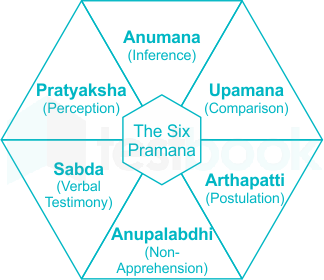
- According to the Nyaya theory of knowledge, inference is one of the sources of true knowledge.
- The inference is defined as that cognition that presupposes some other cognition.
- It is mediate and indirect and arises through a mark, the middle-term (linga or hetu) which is invariably connected with the ‘major term’ (Sadhya).
- It is knowledge (mana) that arises after (anu) other knowledge.
- Invariable concomitance(vyapti) is the nerve of inference.
- The presence of the middle term in the minor term is called paksadharmata.
- The invariable association of the middle term with the major term is called vyapti.
- A vyapti between terms of unequal extensions, such as smoke and fire is called asamavyapti
- A vyapti between two terms of equal extension is called samavyapti.





![Classical Square of Opposition MCQ [Free PDF] - Objective Question Answer for Classical Square of Opposition Quiz - Download Now!](https://storage.googleapis.com/tb-img/production/20/06/F1_A.A._Madhu_19.05.20_D1.png)