Official Paper

UGC NET Paper 1: Held on 2nd Mar 2023 Shift 1 (Previous Year Paper)

50 questions · 60 minutes · with answers · free

Paper 1 (50 questions)

1

Given below are two statements:

Statement I: SWAYAM is a program initiated by Government of India and designed to achieve the six cardinal principles of education policy.

Statement II: SWAYAM has been developed cooperatively by Ministry of Human Resource Development (now Ministry of Education) and All India Council for Technical Education with the help of Infosys.

In light of the above statements, choose the correct answer from the options given below:

  1. ((a))

    Both Statement I and Statement II are true.

  2. ((b))

    Both Statement I and Statement II are false. 

  3. ((c))

    Statement I is true but Statement II is false. 

  4. ((d))

    Statement I is false but Statement II is true.

Show Answer
Answer: ((b))

Both Statement I and Statement II are false. 

The correct answer is Both Statement I and Statement II are false. 

Important PointsStatement I: SWAYAM is a program initiated by Government of India and designed to achieve the three cardinal principles of education policy.

  • This statement is  not correct.
  • SWAYAM (Study Webs of Active Learning for Young Aspiring Minds) is indeed a program initiated by the Government of India.
  • It's an integrated platform for online courses, covering school (from class 9th to 12th), undergraduate, postgraduate, engineering, law and other professional courses.
  • However, the second part of the statement is not accurate.
  • SWAYAM is designed to achieve three cardinal principles of Education Policy viz., access, equity and quality.
  • The objective is to take the best teaching-learning resources to all, including the most disadvantaged, and to bridge the gap in terms of quality between the country's urban and rural areas.

Statement II: SWAYAM has been developed cooperatively by Ministry of Human Resource Development (now Ministry of Education) and All India Council for Technical Education with the help of Infosys.

  • This statement is false.
  • SWAYAM is a programme designed by the Ministry of Human Resource Development (MHRD, now Ministry of Education), Government of India and coordinated by the National Institute of Technical Teachers' Training and Research.
  • The technical aspect of SWAYAM has been handled by Microsoft and not Infosys. All India Council for Technical Education (AICTE) is one of the national coordinators for the content generation for the courses in SWAYAM, especially for the technical courses.

2

Which of the following is said to occur without reinforcement of particular responses and seems to involve changes in the ways information is processed?

  1. ((a))

    Passive learning

  2. ((b))

    Active learning

  3. ((c))

    Latent learning

  4. ((d))

    Insight learning

Show Answer
Answer: ((c))

Latent learning

Learning is a process through which individuals acquire, modify, or reinforce knowledge, skills, behaviors, or attitudes through study, experience, or teaching. 

Key Points

  • Latent learning is a type of learning that occurs without any obvious reinforcement or immediate demonstration of the learned behavior.
  • It involves changes in the ways information is processed and can become apparent later when there is a reason to demonstrate it.
  • This concept was introduced by Edward Tolman, who showed that animals could learn about their environment even without rewards, and this learning would only be demonstrated when it was necessary or beneficial to do so.

Therefore, the correct answer is latent learning.

Additional Information

  • Passive Learning: This traditional style of learning involves students receiving knowledge without active participation or engagement.
  • Insight Learning: This type of learning occurs when an individual suddenly realizes how to solve a problem.
  • Active Learning: This is a learning process where students actively engage with the material, participate in the class, and collaborate with each other in learning.

The following table shows the Income and Expenditure (in million Rs.) of five companies A-E in the year 2021. The percent profit or loss of a company is given by:

(Profit/Loss) % = [(Income - Expenditure)/ Expenditure] × 100

Based on the data in the table, answer the questions.

Company wise Income and Expenditure in the year 2021

CompanyIncome (in million Rs.)Expenditure (in million Rs.)
A3545
B5040
C4045
D4030
E5045
3

Company ________ earned the maximum percentage profit in the year 2021.

  1. ((a))

    A

  2. ((b))

    B

  3. ((c))

    C

  4. ((d))

    D

Show Answer
Answer: ((d))

D

The percent profit or loss of a company is given by:

(Profit/Loss) % = [(Income - Expenditure)/ Expenditure] × 100

We can use this formula to calculate the percentage profit for each company:

  • For Company A: [(35 - 45) / 45] × 100 = -22.22%. This is a loss, as the value is negative.
  • For Company B: [(50 - 40) / 40] × 100 = 25%
  • For Company C: [(40 - 45) / 45] × 100 = -11.11%. This is a loss, as the value is negative.
  • For Company D: [(40 - 30) / 30] × 100 = 33.33%
  • For Company E: [(50 - 45) / 45] × 100 = 11.11%

From these calculations, we can see that Company D earned the maximum percentage profit in the year 2021.

4

The companies A and B together had a percentage profit/loss of _______.

  1. ((a))

    12% loss

  2. ((b))

    10% profit

  3. ((c))

    10% loss

  4. ((d))

    There was no loss or profit

Show Answer
Answer: ((d))

There was no loss or profit

To find the combined percentage profit/loss for Companies A and B, we first need to find their combined income and expenditure.

  • Combined income of A and B = Income of A + Income of B = 35 + 50 = 85 million Rs.
  • Combined expenditure of A and B = Expenditure of A + Expenditure of B = 45 + 40 = 85 million Rs.

We can then use the formula for calculating percentage profit or loss:

(Profit/Loss)% = [(Income - Expenditure)/Expenditure] x 100

For Companies A and B together, this becomes:

Combined (Profit/Loss)% = [(85 - 85)/85] x 100 = 0%

This implies that there was no loss or profit for Companies A and B combined.

5

In 2021, the approximate percentage of profit/loss of all the five companies taken together was ______.

  1. ((a))

    5% profit

  2. ((b))

    4% loss

  3. ((c))

    7% loss

  4. ((d))

    10% profit

Show Answer
Answer: ((a))

5% profit

To find the combined percentage profit/loss for all five companies, we first need to find their combined income and expenditure.

  • Combined income of A, B, C, D, and E = Income of A + Income of B + Income of C + Income of D + Income of E = 35 + 50 + 40 + 40 + 50 = 215 million Rs.
  • Combined expenditure of A, B, C, D, and E = Expenditure of A + Expenditure of B + Expenditure of C + Expenditure of D + Expenditure of E = 45 + 40 + 45 + 30 + 45 = 205 million Rs.

We can then use the formula for calculating percentage profit or loss:

(Profit/Loss)% = [(Income - Expenditure)/Expenditure] x 100

For all five companies together, this becomes:

Combined (Profit/Loss)% = [(215 - 205)/205] x 100 = (10/205) x 100 ≈ 4.88% ≈ 5% (rounded to the nearest whole number)

Therefore, the approximate percentage of profit for all the five companies taken together in 2021 was about 5%.

6

If the income of Company D in 2021 was 10% more than its income in 2020 and the company had earned a profit of 20% in 2020, then its expenditure (in million Rs.) in 2020 was approximately _______

  1. ((a))

    28.28

  2. ((b))

    30.30

  3. ((c))

    32.32

  4. ((d))

    34.34

Show Answer
Answer: ((b))

30.30

Let's denote the income of Company D in 2020 as I. Given that the income in 2021 is 10% more than its income in 2020, we can write the income in 2021 as I + 0.10I = 1.10I. From the data provided, we know that the income of Company D in 2021 is 40 million Rs. Therefore, we can solve the following equation for I:

1.10I = 40

which gives us 

I = 40 / 1.10 ≈ 36.36 million Rs.

So, the income of Company D in 2020 was approximately 36.36 million Rs.

The company earned a profit of 20% in 2020, so its expenditure E can be found from the equation:

Profit = Income - Expenditure

We can rewrite this equation using the definition of percentage profit:

0.20 = (I - E) / E

Substituting I = 36.36, we get:

0.20 = (36.36 - E) / E

Solving for E gives us approximately 30.30 million Rs. 

So, the expenditure of Company D in 2020 was approximately 30.30 million Rs.

7

For Company E, if the expenditure had increased by 20% in the year 2021 from the year 2020 and the company had earned a profit of 10% in 2020, then the company's income (in million Rs.) in 2020 was ________.

  1. ((a))

    37.25

  2. ((b))

    38.50

  3. ((c))

    41.25

  4. ((d))

    42.75

Show Answer
Answer: ((c))

41.25

Let's denote the expenditure of Company E in 2020 as E. Given that the expenditure in 2021 is 20% more than its expenditure in 2020, we can write the expenditure in 2021 as E + 0.20E = 1.20E. From the data provided, we know that the expenditure of Company E in 2021 is 45 million Rs. Therefore, we can solve the following equation for E:

1.20E = 45

which gives us 

E = 45 / 1.20 ≈ 37.5 million Rs.

So, the expenditure of Company E in 2020 was approximately 37.5 million Rs.

The company earned a profit of 10% in 2020, so its income I can be found from the equation:

Profit = Income - Expenditure

We can rewrite this equation using the definition of percentage profit:

0.10 = (I - E) / E

Substituting E = 37.5, we get:

0.10 = (I - 37.5) / 37.5

Solving for I gives us approximately 41.25 million Rs. 

So, the income of Company E in 2020 was approximately 41.25 million Rs.

8

Given below are two statements:

Statement I: In formative evaluation, the overall performance of the students are reported to parents at the end of the year.

Statement II: In summative evaluation, the teacher clarifies the doubts of students in the class itself.

In light of the above statements, choose the correct answer from the options given below:

  1. ((a))

    Both Statement I and Statement II are true.

  2. ((b))

    Both Statement I and Statement II are false. 

  3. ((c))

    Statement I is true but Statement II is false.

  4. ((d))

    Statement I is false but Statement II is true.

Show Answer
Answer: ((b))

Both Statement I and Statement II are false. 

The correct answer is Both Statement I and Statement II are false. 

Important PointsStatement I: In formative evaluation, the overall performance of the students is reported to parents at the end of the year.

  • Formative evaluation is a type of assessment that monitors student learning during the process of instruction, rather than at the end.
  • It involves feedback that is both diagnostic and remedial in nature.
  • In other words, formative evaluation is used by teachers to understand where students are in their learning process, identify gaps in understanding, and modify teaching strategies accordingly.
  • It includes things like quizzes, informal checks for understanding, and constructive feedback on assignments.
  • Formative evaluation is not typically used to report overall performance to parents at the end of the year.
  • This is typically done through summative evaluations. Instead, formative evaluations are ongoing and used throughout the course or term to adjust instruction and improve student learning in real-time.
  • Therefore, Statement I is false.

Statement II: In summative evaluation, the teacher clarifies the doubts of students in the class itself.

  • Summative evaluation is a type of assessment that evaluates student learning at the end of an instructional unit by comparing it against some standard or benchmark.
  • Summative assessments are high stakes, which means they have a high point value.
  • Examples of summative assessments include midterm exams, final project, final report, etc.
  • While it's important for a teacher to clarify doubts and misconceptions, it isn't a characteristic specific to summative evaluation.
  • Summative evaluations are designed to evaluate a student's mastery of content, usually for the purpose of assigning a grade or determining whether the student has met certain standards or benchmarks.
  • They are generally not used to address individual student misunderstandings during the instructional process, as this falls more in line with formative assessments.
  • Therefore, Statement II is also false
9

According to Brown and Ciufflectelli Parker, which of the following are the elements of cooperative learning?

A. Individual Accountability

B. Demonstration

C. Brainstorming

D. Group processing

E. Social skills

Choose the correct answer from the options given below:

  1. ((a))

    B, C and E only

  2. ((b))

    A, D and E only

  3. ((c))

    B and D only

  4. ((d))

    C and D only

Show Answer
Answer: ((b))

A, D and E only

The correct answer is A,D and E only.

Important Points

According to Brown and Ciuffetelli Parker, the elements of cooperative learning . 

  • However, based on research in the field, particularly from educational researchers Johnson, Johnson, and Holubec, the essential elements of cooperative learning include:
  1. Positive Interdependence: This means that the group members rely on each other and understand that everyone's success is linked. They need each other to achieve the goal.
  2. Individual Accountability: Each member of the group is responsible for their own learning and work, and contributes to the group's success.
  3. Promotive Interaction: Group members support and help each other in achieving the group's goals.
  4. Group Processing: The group reflects on its progress and determines how to improve.
  5. Social Skills: Group members learn to effectively collaborate, communicate, and resolve conflicts, among other social skills.

From these elements, options A, C, and E (Individual Accountability, Group Processing, and Social Skills) are part of cooperative learning

10

Given below are two statements:

Statement I: Good teaching is formal in nature. 

Statement II: There is no difference between teaching and training.

<br>

In light of the above statements, choose the most appropriate answer from the options given below:

  1. ((a))

    Both Statement I and Statement II are correct.

  2. ((b))

    Both Statement I and Statement II are incorrect.

  3. ((c))

    Statement I is correct but Statement II is incorrect.

  4. ((d))

    Statement I is incorrect but Statement II is correct.

Show Answer
Answer: ((b))

Both Statement I and Statement II are incorrect.

The correct answer is Both Statement I and Statement II are incorrect.

Key PointsStatement I: Good teaching is formal in nature.

  • This statement is overly simplistic and doesn't capture the full range of what good teaching can be.
  • Good teaching is not strictly formal.
  • It can take on many forms, including formal and informal.
  • While formal teaching typically occurs in classrooms and follows a set curriculum, good teaching also often involves informal elements, such as discussions, group work, and experiential learning. Good teaching is adaptable, catering to the diverse learning styles and needs of different students.
  • It also encourages active engagement, fosters curiosity, and promotes critical thinking—elements often associated with more informal teaching methods.
  • Therefore, the assertion that good teaching is only formal in nature is not accurate.

Statement II: There is no difference between teaching and training.

  • This statement is incorrect.
  • While teaching and training both involve the process of facilitating learning, they have different goals and contexts.
  • Teaching is a more general term that often refers to the sharing of knowledge and helping students to develop understanding in a broad array of topics.
  • It is usually associated with academia and is often designed to help students think critically, solve problems, and develop intellectual curiosity.
  • Training, on the other hand, is often more specific and goal-oriented.
  • It is usually used in the context of preparing someone for a specific job or task, often through the development of specific skills.
  • Training tends to be more practical, focusing on the application of skills rather than on theoretical knowledge.

Therefore, the statement that there is no difference between teaching and training is incorrect. They are related concepts with significant overlap, but they are not identical

11

In inductive approach theory is generated out of

  1. ((a))

    Simple observation

  2. ((b))

    Research done

  3. ((c))

    Field notes

  4. ((d))

    Another theory

Show Answer
Answer: ((b))

Research done

The correct answer is Research done

Important PointsThe inductive approach in research involves collecting data and using it to form a theory.

  • The process typically starts with observations or data collection, and as patterns emerge, these observations are used to develop broader generalizations or theories.
  • So, a theory is generated from the research done, including observations, experiments, surveys, etc.

Here's how the other options fit into this:

Simple Observation:

  • This can be part of an inductive approach as it's often the first step in gathering data.
  • But it's not the whole process - these observations are used to generate a broader theory.

Field Notes:

  • Like observations, field notes (recordings of the researcher's observations, feelings, reflections, and insights while "in the field" doing primary research) are a part of the data collection process, but not the entirety of it.

Another Theory:

  • This would be more common in a deductive approach, which starts with a theory and then seeks to confirm it through research.
  • In inductive research, you're starting with the data and building up to a theory
12

Given below are two statements:

Statement I: The double blind procedure is an effective solution to the issue of experimenter bias in research.

Statement II: The problem of experimenter bias can also be solved by non-verbal cuing of the participants.

In light of the above statements, choose the correct answer from the options given below:

  1. ((a))

    Both Statement I and Statement II are true.

  2. ((b))

    Both Statement I and Statement II are false. 

  3. ((c))

    Statement I is true but Statement II is false. 

  4. ((d))

    Statement I is false but Statement II is true.

Show Answer
Answer: ((c))

Statement I is true but Statement II is false. 

The correct answer is Statement I is true but Statement II is false. 

Key Points

Statement I: "The double blind procedure is an effective solution to the issue of experimenter bias in research."

  • This statement is true.
  • In a double-blind study, neither the participants nor the researchers know who is in the control group and who is in the experimental group.
  • This helps to eliminate both participant and experimenter bias. Participant bias might occur if individuals alter their behavior due to their awareness of being observed or knowing the experiment's purpose.
  • Experimenter bias can happen when researchers unconsciously influence participants or interpret results based on their expectations or hypotheses.

Statement II: "The problem of experimenter bias can also be solved by non-verbal cuing of the participants."

  • This statement is false.
  • Non-verbal cuing from the researcher can actually contribute to experimenter bias rather than solve it.
  • Experimenter bias refers to the researcher unintentionally affecting the results of a study due to their expectations or beliefs.
  • Non-verbal cues, such as body language, facial expressions, or gestures, can subtly influence participants' behavior or responses, thus skewing the results.
  • This phenomenon is sometimes referred to as the "Clever Hans effect," after a horse that appeared to respond to complex questions but was actually reacting to unintentional cues from its trainer
13

A certain principal amount in 2 years at some simple interest becomes Rs. 10,000 and the same principal amount on the same rate of simple interest becomes Rs. 11,000 in 3 years. Find the principal and rate of interest.

  1. ((a))

    Rs. 9,200 and 14%

  2. ((b))

    Rs. 8,500 and 13.5%

  3. ((c))

    Rs. 9,000 and 13%

  4. ((d))

    Rs. 8,000 and 12.5%

Show Answer
Answer: ((d))

Rs. 8,000 and 12.5%

Concept used:

• Simple interest is always calculated on principal not on amount

• (P × t × r)/100 = simple interest, where P = principal, r = rate of interest and t = times

Calculation:

At simple interest in 2 years amount = 10000 and in 3 years amount = 11000

So, simple interest in each year (11000 - 10000) = 1000

So, the principal will be 10,000 - (2 × 1000) = 8000

Now, (8000 × 1 × r)/100  = 1000   … [as we see in 1 year interest is 1000]

⇒ r = (1000 × 100)/8000 = 100/8 = 12.5%

∴ The correct answer is option 4

14

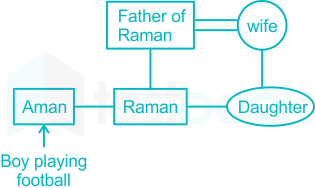
Raman said to Aman, "That boy playing football there is the younger of the two brothers of the daughter of my father's wife". How is the boy playing football related to Raman?

  1. ((a))

    Cousin

  2. ((b))

    Brother-in-law

  3. ((c))

    Son

  4. ((d))

    Brother

Show Answer
Answer: ((d))

Brother

Family chart:

According to the information, Family tree is as follows;

Hence, the boy who is playing football, is brother of Raman.

15

"Although I am very happy to win the lottery, I am also a little worried. The last time I had won a lottery, my pocket was picked the next morning." Which logical fallacy is committed in the above argument?

  1. ((a))

    Post hoc

  2. ((b))

    Hasty generalisation

  3. ((c))

    Red herring

  4. ((d))

    False alternative

Show Answer
Answer: ((a))

Post hoc

The correct answer is Post hoc.

Key PointsThe phrase "post hoc" is short for "post hoc ergo propter hoc", a Latin phrase which means "after this, therefore because of this."

  • This is a type of logical fallacy where one event is assumed to be the cause of a later event simply because it occurred earlier.

In the provided statement: "Although I am very happy to win the lottery, I am also a little worried.

  • The last time I had won a lottery, my pocket was picked the next morning," the speaker commits the post hoc fallacy by assuming that winning the lottery directly led to their pocket being picked.
  • Just because the speaker's pocket was picked after they won the lottery does not mean that winning the lottery was the cause of the pocket being picked.
  • The two events could be entirely unrelated, and without additional evidence, it is fallacious to assume that one caused the other.

Therefore, labeling this as a post hoc fallacy is correct because the speaker is making a causal assumption based on the sequence of events, not based on any demonstrated cause-and-effect relationship.

16

Which of the following statements are logically equivalent?

A. All aeroplanes are polluting vehicles.

B. No polluting vehicles are aeroplanes.

C. All non-polluting vehicles are non-aeroplanes.

D. No aeroplanes are non-polluting vehicles.

Choose the correct answer from the options given below:

  1. ((a))

    B and C only

  2. ((b))

    B and D only

  3. ((c))

    A and D only

  4. ((d))

    A, C and D only

Show Answer
Answer: ((d))

A, C and D only

The correct answer is A, C and D only

Important PointsIn logic, a statement and its contrapositive are considered logically equivalent. The contrapositive of a statement is formed by negating both the hypothesis and the conclusion, and then swapping the order.

A. "All aeroplanes are polluting vehicles." This is a general statement of the form: If it's an aeroplane, then it's a polluting vehicle.

C. "All non-polluting vehicles are non-aeroplanes." This is the contrapositive of Statement A.

  • It negates both parts of the original statement and reverses their order. So, if it's not a polluting vehicle, then it's not an aeroplane.
  • Both A and C convey the same information, but from different perspectives. Hence, they are logically equivalent.

D. "No aeroplanes are non-polluting vehicles." This statement is saying the same thing as Statement A, but in a different format.

  • It's stating that there are no aeroplanes that aren't also polluting vehicles, which is just another way of saying all aeroplanes are polluting vehicles. Hence, it's logically equivalent to Statement A and Statement C.
17

If the statement- "All aeroplanes are polluting vehicles', is given as true, then which of the following statements can be immediately inferred to be true?

  1. ((a))

    No aeroplanes are polluting vehicle

  2. ((b))

    Some aeroplanes are polluting vehicles.

  3. ((c))

    Some aeroplanes are not polluting vehicles.

  4. ((d))

    No polluting vehicles are aeroplanes.

Show Answer
Answer: ((b))

Some aeroplanes are polluting vehicles.

The correct answer is Some aeroplanes are polluting vehicles.

Important PointsIf the statement "All aeroplanes are polluting vehicles" is true, then it can be immediately inferred that "Some aeroplanes are polluting vehicles" is also true.

Here's the reasoning:

  • The statement "All aeroplanes are polluting vehicles" asserts that every single aeroplane is a polluting vehicle.
  • If this is the case, then it must also be true that "some" aeroplanes are polluting vehicles, because "some" would include any subset of the total group of aeroplanes, even the entire group.
  • In other words, if all aeroplanes are polluting vehicles, then any subset of aeroplanes (which is what "some" refers to) would also have to be polluting vehicles.

So if the statement "All aeroplanes are polluting vehicles" is true, then the statement "Some aeroplanes are polluting vehicles" is also necessarily true.

18

Given below are two statements:

Statement I: You can read from and write to RAM, whereas you can read from ROM but you can't write to ROM.

Statement II: CD-RW stands for Compact Disc-Re-writable and can be written to and modified many times, whereas CD-R stands for compact Disc-Recordable and R here indicates that the disc is recordable once only.

In light of the above statements, choose the correct answer from the options given below:

  1. ((a))

    Both Statement I and Statement II are true.

  2. ((b))

    Both Statement I and Statement II are false.

  3. ((c))

    Statement I is true but Statement II is false.

  4. ((d))

    Statement I is false but Statement II is true.

Show Answer
Answer: ((a))

Both Statement I and Statement II are true.

Both Statement I and Statement II are indeed true.

Important Points

Statement I: RAM (Random Access Memory) is a type of computer memory that can be read from and written to in any order.

  • This is where your computer temporarily stores data it's currently working with.
  • On the other hand, ROM (Read-Only Memory) is a type of non-volatile memory that can only be read and not written to.
  • ROM often contains firmware or software that boots up the computer and performs diagnostics.

Statement II: CD-RW stands for Compact Disc ReWritable, which means you can erase and rewrite data onto it multiple times.

  • CD-R stands for Compact Disc Recordable, meaning you can write data onto the disc once and read many times, but you can't erase and rewrite new data onto it.

Therefore, the correct answer is: Both Statement I and Statement II are true.

19

Wind farms are

  1. ((a))

    Places where winds blow at a speed of more than 5 m/s

  2. ((b))

    Potential places of wind energy generation.

  3. ((c))

    Places where winds help in good farming practices.

  4. ((d))

    Large concentrations of wind generators producing electricity.

Show Answer
Answer: ((d))

Large concentrations of wind generators producing electricity.

The correct answer is Large concentrations of wind generators producing electricity.

Important Points

Wind energy is a form of renewable energy, meaning it doesn't deplete natural resources like coal or natural gas.

  • It utilizes the kinetic energy from the wind to generate electricity.
  • The main component of a wind farm is the wind turbine.
  • Each wind turbine consists of a tower, usually made of steel, with a set of blades attached to the top.
  • As the wind blows, it turns the blades, which are connected to a generator inside the turbine.
  • The generator then converts the mechanical energy from the turning blades into electrical energy.

The electricity produced by each turbine in a wind farm is collected and sent through transmission and distribution lines to homes, businesses, and industries.

  • The number of turbines in a wind farm can range from a few to several hundred, depending on the capacity of the turbines and the size of the wind farm.
  • Wind farms can be located on land (onshore wind farms) or at sea (offshore wind farms).
  • Offshore wind farms often have higher output because wind speeds over the ocean are typically faster and more consistent than over land.

Wind energy is considered clean because it doesn't emit harmful greenhouse gases. However, the planning and placement of wind farms require careful consideration due to potential impacts on local wildlife and landscapes.

20

Match List I with List II

List I (Pollution Source)List II (Category)
A.SewageI.Thermal Pollution
B.Agriculture fertilizersII.Sediments
C.Land ErosionIII.Oxygen demanding waste
D.Power PlantsIV.Plants Nutrients
<br>

Choose the correct answer from the options given below:

  1. ((a))

    A - III, B - IV, C - I, D - II

  2. ((b))

    A - III, B - IV, C - II, D - I

  3. ((c))

    A - II, B - I, C - III, D - IV

  4. ((d))

    A - II, B - I, C - IV, D - III

Show Answer
Answer: ((b))

A - III, B - IV, C - II, D - I

The correct answer is A - III, B - IV, C - II, D - I

Important Points

List I (Pollution Source)List II (Category)ExplanationRemarks
A. SewageIII. Oxygen demanding wasteSewage often contains organic materials that are broken down by bacteria, which consume oxygen in the process. This creates a demand for oxygen, hence the category "oxygen demanding waste".Correct Match
B. Agriculture fertilizersIV. Plants NutrientsAgricultural fertilizers are rich in plant nutrients such as nitrogen and phosphorus. When these fertilizers run off into water bodies, they can cause excessive growth of plants and algae.Correct Match
C. Land ErosionII. SedimentsLand erosion, especially from activities like deforestation and construction, can lead to an increase in sediments in water bodies. These sediments can block light from reaching aquatic plants and disturb habitats.Correct Match
D. Power PlantsI. Thermal PollutionPower plants, especially those that use water as a cooling agent, can increase the temperature of water bodies. This is known as thermal pollution, which can decrease oxygen levels and harm aquatic life.
21

Given below are two statements:

Statement I: According to ancient Hindu system of Education an aspect of education which is emphasized by the upholders of education in democratic society is that education should be free as far as practicable.

Statement II: According to ancient Hindu system of education an aspect of education which is emphasized by the upholders of education in democratic society is that education should be compulsory as far as practicable.

In light of the above statements, choose the most appropriate answer from the options given below:

  1. ((a))

    Both Statement I and Statement II are correct.

  2. ((b))

    Both Statement I and Statement II are incorrect.

  3. ((c))

    Statement I is correct but Statement II is incorrect.

  4. ((d))

    Statement I is incorrect but Statement II is correct.

Show Answer
Answer: ((a))

Both Statement I and Statement II are correct.

The correct answer is Both Statement I and Statement II are correct.

Important Points

Statement I: According to ancient Hindu system of Education an aspect of education which is emphasized by the upholders of education in democratic society is that education should be free as far as practicable.

  • In the ancient Hindu system of education (Gurukula system), it was the norm for the teacher or 'guru' to provide education free of charge.
  • Students would live with their guru and would often contribute to the household through chores or services.
  • The guru, in turn, would impart knowledge and skills, often tailored to the abilities and interests of the individual student.
  • This was a form of free education, but it wasn't exactly the same as modern notions of free education, which often refer to state-funded schooling that is available to all children irrespective of their background or means.

Statement II: According to ancient Hindu system of education an aspect of education which is emphasized by the upholders of education in democratic society is that education should be compulsory as far as practicable.

  • In the ancient Hindu system, education was highly valued and generally expected for boys.
  • However, it was not 'compulsory' in the modern sense of being enforced by law.
  • In many democratic societies today, education is seen as a basic right, and there are laws requiring children to attend school up to a certain age.
  • This concept of compulsory education is aimed at ensuring all children, regardless of their background or circumstances, receive at least a basic level of education.

So while the ancient Hindu system of education shares certain principles with modern democratic ideals of education – such as a focus on individual learning and the importance of education for all – the concepts of 'free' and 'compulsory' education have different connotations and applications in the different contexts.

22

According to NEP 2020, the first vertical of Higher Education Commission of India (HECI) will be the 

  1. ((a))

    National Accreditation Council (NAC)

  2. ((b))

    National Higher Education Regulatory Council (NHERC)

  3. ((c))

    General Education Council (GEC)

  4. ((d))

    Higher Education Grants Council (HEGC)

Show Answer
Answer: ((b))

National Higher Education Regulatory Council (NHERC)

The correct answer is National Higher Education Regulatory Council (NHERC).

Important PointsThe National Education Policy (NEP) 2020 proposed the creation of a Higher Education Commission of India (HECI) as a single overarching umbrella body for higher education.

  • This new regulatory body would replace the existing separate regulatory institutions in the higher education sector to improve coordination and maintain standards.
  • The HECI is set to have four independent verticals, namely:
  1. National Higher Education Regulatory Council (NHERC)
  2. General Education Council (GEC)
  3. Higher Education Grants Council (HEGC)
  4. National Accreditation Council (NAC)

Each of these verticals has specific roles and responsibilities, from regulation, to setting standards, to funding, to accreditation.

  • According to NEP 2020, the first vertical of the HECI will be the National Higher Education Regulatory Council (NHERC).
  • This council will be the primary regulator for higher education in India, including teacher education, excluding medical and legal education.
  • This implies that all other bodies, like UGC and AICTE, would cease to be regulatory bodies and would only be responsible for standards setting and providing grants.

Therefore, the correct answer would be the "National Higher Education Regulatory Council (NHERC)".

23

A conceptual hypothesis is drawn from the implications of a

  1. ((a))

    Prediction

  2. ((b))

    Theory

  3. ((c))

    Spurious relation

  4. ((d))

    Time-order

Show Answer
Answer: ((b))

Theory

The correct answer is Theory.

Important Points

A conceptual hypothesis is a predictive statement connecting two or more variables based on the propositions of a theory. In scientific research, a hypothesis is generated from a theory and proposes a relationship between variables that can be tested.

Theory:

Theories provide a broad explanation for patterns observed in nature, and from these patterns, we can derive hypotheses.

Additional Information

Prediction:

  • Predictions are specific statements about what we would expect to observe if our hypothesis is correct.
  • They are typically derived from the hypothesis, not the other way around.

Spurious Relation:

  • This is a relationship between two variables that appears causal but can be explained by a third factor.
  • This is not the source of a conceptual hypothesis.

Time-order:

  • This is a necessary condition for determining cause and effect in non-experimental designs, indicating that the cause must precede the effect in time.
  • Although this is an important principle in hypothesis testing, it is not where hypotheses originate from.

Therefore, a conceptual hypothesis is most closely drawn from the implications of a theory.

24

When a sampled individual is observed over a pre- determined period of time in structured observation, it is called

  1. ((a))

    Focus sampling

  2. ((b))

    Observed sampling

  3. ((c))

    Random sampling

  4. ((d))

    Purposive sampling

Show Answer
Answer: ((a))

Focus sampling

The correct answer is Focus sampling

Important PointsFocus sampling is not a standard term used in most fields of research.

  • However, depending on context, it might refer to a method of observation in which a researcher focuses on specific behaviors or events of interest within a defined period of time.
  • This approach is usually used in fields like ethology, the study of animal behavior, where it can help provide detailed insights into specific behaviors or phenomena.

In the scenario you've provided, if "focus sampling" is meant to denote an in-depth, time-specific observation of an individual or a small group, then it could fit your description.

  • The researcher would focus on this "sample" over a pre-determined period of time, carefully recording relevant behaviors or events as they occur.
  • Again, it's important to note that this is an inferred interpretation, as "focus sampling" is not a commonly recognized term across different research disciplines. The definition and application may vary depending on the specific context or field of study.
25

The arrival of interactive communication technologies has been described as

  1. ((a))

    The first media age

  2. ((b))

    The second media age

  3. ((c))

    Post-media age

  4. ((d))

    Post-technology age

Show Answer
Answer: ((b))

The second media age

The correct answer is The second media age

Important PointsThe term "The Second Media Age" comes from the book "The Second Media Age" by Mark Poster.

  • This term is used to describe the era of digital, interactive communication technologies that followed the "first media age," which was characterized by traditional mass media like television, radio, and print.
  • In the first media age, communication was largely one-way. Media outlets broadcasted or published information, and audiences passively consumed that information.

In contrast, the second media age, with the advent of the internet and digital technologies, enables two-way or multi-way communication. Audiences are no longer just passive consumers of content; they can also produce and distribute their own content, interact with other users, and directly engage with media outlets.

  • This shift has dramatically transformed how we communicate, access information, and participate in social and political life.
  • Interactive communication technologies like social media platforms, blogs, and online forums exemplify the second media age.
  • They have facilitated user-generated content, peer-to-peer sharing, and interactive dialogue, leading to a more participatory culture in media and communications.
26

A cool medium has the features of:

A High definition

B. High participation

C. It provides small amount of information

D. Tends not to be supplemented by hot media

E. Supplanted by hot media

Choose the correct answer from the options given below

  1. ((a))

    A, B and C only

  2. ((b))

    B, C and E only

  3. ((c))

    C and D only

  4. ((d))

    B, D and E only

Show Answer
Answer: ((c))

C and D only

The correct answer is C and D only

Important Points

The concept of "cool" and "hot" media comes from Marshall McLuhan, a Canadian philosopher whose work on media theory remains influential.

In McLuhan's view:

  • Hot media are high-definition communication methods that engage one single sense completely.
  • They are densely packed with information, requiring less cognitive engagement or participation from the audience because they provide a more complete sensory experience.
  • Examples of hot media are radio, lectures, photographs, print, and movies.
  • Cool media, on the other hand, are low-definition communication methods that require active participation from the audience to fill in the gaps.
  • They provide less information, leaving room for the audience to engage and participate more actively in the interpretation of the media content. Examples of cool media include television, cartoons, seminars, and phone conversations.

So, based on these definitions:

  • C. It provides a small amount of information: This statement is true. Cool media are characterized by their low-definition nature, meaning they deliver less complete information and require more cognitive involvement from the audience to fill in the gaps.
  • D. Tends not to be supplemented by hot media: This statement is also true. Cool media are more interactive and require more user participation. They don't generally need to be supplemented by hot media, which are less interactive and provide more complete sensory experience.

The other options are not characteristics of cool media according to McLuhan's definitions. Therefore, the correct answer would be "C and D only."

27

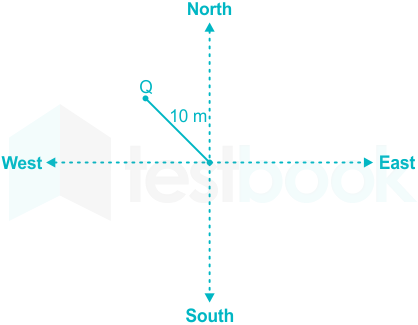
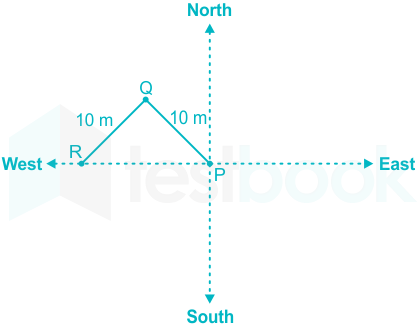
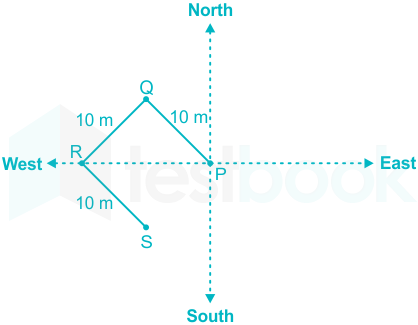
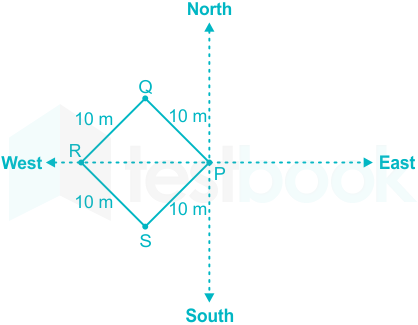
A girl starts from a point P and walks 10 meters in the North-West direction and reaches the point Q. She then turns to her left and walks 10 meters to a point R which is directly west ward to point P. She again turned to her left and walks 10 meters and reaches a point S which is directly southward to point Q. From the point S she turns towards point P and walks 10 meters. What is the shape of the geometrical figure PQRS?

  1. ((a))

    Rhombus

  2. ((b))

    Rectangle

  3. ((c))

    Square

  4. ((d))

    Parallelogram

Show Answer
Answer: ((c))

Square

According to the given direction, 

  • A girl starts from a point P and walks 10 meters in the North-West direction and reaches the point Q

  • She then turns to her left and walks 10 meters to a point R which is directly west ward to point P.

  • She again turned to her left and walks 10 meters and reaches a point S which is directly southward to point Q.

  • From the point S she turns towards point P and walks 10 meters.

So, the above directions make a "square" shaped as all the sides have equal length.

Hence, the shape of the geometrical figure PQRS is "square".

Mistake PointsSquares and rhombuses are parallelograms, in which opposing sides are equal and parallel. The primary difference is that a square has all equal sides and all equal angles (90 degrees), while a rhombus only requires that all sides are equal in length.

Therefore, if you have a shape that is a square and also looks like a rhombus, it is both! But it's probably most accurate to call it a square because that term gives more information about the shape – it tells you that all sides are equal and all angles are 90 degrees. For rhombus diagonals should be bisect each other. But from the question, we can not determine that.

28

What number should replace question mark (?) in the series given below:

15, 15, 22.5, 45, 112.5, 337.5, ?

  1. ((a))

    1181.25

  2. ((b))

    1350

  3. ((c))

    1518.75

  4. ((d))

    562.5

Show Answer
Answer: ((a))

1181.25

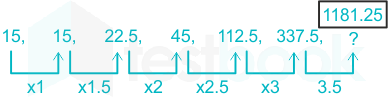
Given: 15, 15, 22.5, 45, 112.5, 337.5, ?

Logic: Each number in the sequence is obtained by multiplying the previous number by a consecutive increasing factor, as 1, 1.5, 2, 2.5 and so on.

The above logic is shown as follows;

Hence, the missing term will be "1181.25".

29

In ICT, which one of the following pairs of acronym and its expansion is incompatible?

  1. ((a))

    ISP - Internet Service Provider

  2. ((b))

    URL-Uniform Resource Locator

  3. ((c))

    Blog - weB LOGIC

  4. ((d))

    VPN - Virtual Private Network

Show Answer
Answer: ((c))

Blog - weB LOGIC

The correct answer is Blog - weB LOGIC.

Important PointsBlog - weB LOGIC

  • The term "Blog" actually stands for "weblog.
  • " It's a combination of the words "web" and "log" and is used to describe a website that contains regularly updated content, often in the form of personal commentary, news updates, or other information depending on the specific blog.

Key Points

ISP -

  • Internet Service Provider: An Internet Service Provider is a company that provides access to the Internet.
  • This can be done via various mediums such as fiber, wireless, DSL, or dial-up among others. Examples of ISPs include Comcast, AT&T, and Verizon in the United States.

URL -

  • Uniform Resource Locator:
  • A URL is essentially the address of a specific web page or file on the Internet. It usually includes the protocol (http or https), the domain name (like www.google.com), and often a path to a specific page or file.

VPN -

  • Virtual Private Network:
  • A VPN is a technology that allows for a secure and encrypted connection over a less secure network, such as the internet.
  • The VPN provides privacy by hiding your internet activity from your ISP and government, and it also encrypts all the data between you and the VPN server, which can protect your data from hackers.
30

Using the Ribbon in MS-WORD software, the Word count command/ feature displays the number of words as well as the number of _____ in the current document.

A. Lines

B. Characters

C. Paragraph

Choose the correct answer from the options given below:

  1. ((a))

    A and B only

  2. ((b))

    A and C only

  3. ((c))

    B and C only

  4. ((d))

    A, B and C

Show Answer
Answer: ((d))

A, B and C

The correct answer is A, B and C

Important PointsIn Microsoft Word, the Word Count feature provides a variety of statistics about the document. Here's what each one represents:

A. Lines:

  • This is the total number of lines in the document.
  • If a paragraph wraps onto a second or third line, those are each counted as separate lines.

B. Characters:

  • This gives two numbers - the number of characters including spaces, and the number of characters excluding spaces.
  • Each letter, number, punctuation mark, space, or other symbol is counted as one character.

C. Paragraphs:

  • This is the total number of paragraphs in the document.
  • In Microsoft Word, a paragraph is defined by a return - in other words, whenever you press Enter, you're creating a new paragraph.

So when you select Word Count in Microsoft Word (usually found under the Tools menu or in the Review tab depending on the version), it will display a dialog box with all of these statistics about your document.

31

The 'Loss and Damage' funding in the context of climate change impacts was agreed upon by the international community at

  1. ((a))

    COP 25

  2. ((b))

    COP 26

  3. ((c))

    COP 21

  4. ((d))

    COP 27

Show Answer
Answer: ((d))

COP 27

The correct answer is COP 27

Important Points

  • The concept of 'Loss and Damage' was formally recognized at the 27th Conference of Parties (COP27)  under the Warsaw International Mechanism for Loss and Damage associated with Climate Change Impacts (WIM).
  • It was established as a third pillar of climate action, alongside mitigation (reducing greenhouse gas emissions) and adaptation (making changes to lessen the impact of climate change).

The purpose of the 'Loss and Damage' pillar is to address the impacts of climate change that can't be avoided through mitigation or adaptation.

  • This could include extreme weather events, such as hurricanes or droughts, or slow-onset events like sea-level rise or desertification.
  • The idea is that richer countries, which have historically contributed more to climate change, should provide financial support to help poorer countries deal with these unavoidable impacts.
  • However, the issue of how 'Loss and Damage' should be funded has been a contentious one.
  • Developing countries have argued for additional funding, while developed countries have often been reluctant to commit to new funds.
  • The specifics of any agreements made after 2021 would provide more details on how this issue is being addressed.
32

In ethnographic research, the researcher involves himself in a _______ over a period of time.

  1. ((a))

    philosophical disourse

  2. ((b))

    political campaign

  3. ((c))

    financial transaction

  4. ((d))

    social setting

Show Answer
Answer: ((d))

social setting

The correct answer is social setting

Important Points

Social setting

  • Ethnography is a qualitative research method where researchers observe and/or interact with a study’s participants in their real-life environment.
  • Often used in the social sciences, such as anthropology or sociology, the purpose is to provide a detailed, in-depth description of everyday life and practice.
  • This is accomplished by immersing oneself in the social setting being studied for a prolonged period, potentially involving direct participation in the setting, rather than merely observing from the outside.

Additional Information

  • Ethnography is a type of qualitative research where the focus is on understanding the culture, behaviors, interactions, and social phenomena of a group or community.
  • To carry out ethnographic research, the researcher often immerses themselves in the community or "social setting" to observe and engage directly.
  • The term "ethnography" originates from anthropology, where it was used to describe the comprehensive, descriptive study of cultures.
  • Modern ethnography has expanded to be interdisciplinary, used in fields like sociology, education, design, and market research.
33

One of the features of broadcast communication is that it is

  1. ((a))

    Static for the audience

  2. ((b))

    Hidden from the audience

  3. ((c))

    High-brow for the audience

  4. ((d))

    Live for the audience

Show Answer
Answer: ((d))

Live for the audience

The correct answer is Live for the audience

Important PointsOne characteristic of broadcast communication is that it can be "live for the audience."

  • Broadcast communication refers to the dissemination of information, news, entertainment, and other content to a broad audience through various electronic methods,
  • Such as television, radio, or the internet. One of the key features of broadcast communication is the capability to transmit information in real time or "live."
  • Live broadcasting is particularly effective for events that are significant to a wide audience and best experienced in the moment, such as sports events, live news updates, awards shows, political events, and more.
  • This aspect of immediacy can bring an audience together at the same time, fostering a collective experience even though individuals may be in different locations.
  • It's important to note that not all broadcast communication is live.
  • Broadcasters also record and produce content to be aired at scheduled times, which can also reach a broad audience but doesn't carry the same sense of real-time immediacy as live broadcasting
34

Which of the following directly affect or influence the listening skills of the students?

A. Student protocol

B. Administrative interest

C. Speed of the speech

D. Timing of the speech

E. The regional accent

Choose the correct answer from the options given below:

  1. ((a))

    A, B and C only

  2. ((b))

    B, C and D only

  3. ((c))

    C, D and E only

  4. ((d))

    A, D and E only

Show Answer
Answer: ((c))

C, D and E only

The correct answer is C, D and E only

Important PointsC. Speed of the speech: The pace at which information is delivered can greatly affect the listener's ability to process and comprehend that information.

  • If the speech is too fast, students may have difficulty keeping up and miss important points.

D. Timing of the speech: If students are tired or not mentally prepared for the speech, their ability to listen effectively can be compromised.

  • For instance, if the speech is given first thing in the morning when students are still waking up, or late in the afternoon when they may be fatigued, it may impact their listening skills.

E. The regional accent: Accents can sometimes create barriers to effective listening.

  • If the speaker has a strong regional accent that students are not familiar with, it may take more effort for them to understand what's being said, potentially affecting their ability to listen effectively.

Additional Information

A. Student protocol:

  • This doesn't directly influence listening skills. It might affect behavior or etiquette in a learning environment, but not the cognitive process of listening itself.

B. Administrative interest:

  • While administrative policies or attitudes can influence many aspects of a learning environment, they don't directly impact the cognitive process of listening.

So, the direct factors that can influence the listening skills of students among the given options are the speed of the speech, timing of the speech, and the regional accent.

35

Which of the following propositions are so related that they cannot both be false, although they may both be true?

A. Some cars are polluting vehicles.

B. Some cars are not polluting vehicles.

C. All cars are polluting vehicles.

D. No cars are polluting vehicles.

Choose the correct answer from the options given below:

  1. ((a))

    C and D only

  2. ((b))

    A and B only

  3. ((c))

    B and C only

  4. ((d))

    A and C only

Show Answer
Answer: ((b))

A and B only

The correct answer is A and B only

Important Points

A. Some cars are polluting vehicles.

B. Some cars are not polluting vehicles.

  • If we say that both A and B are false, then we would be saying that no cars are polluting vehicles and also that no cars are non-polluting vehicles
  • Which contradicts the existence of cars itself because every car must either be a polluting vehicle or a non-polluting vehicle. Therefore, A and B cannot both be false.
  • However, both can be true if there are some cars that are polluting vehicles and some cars that are not polluting vehicles.


Additional Information

C. All cars are polluting vehicles.

D. No cars are polluting vehicles.

  • If we consider statements C and D, they contradict each other directly. If all cars are polluting vehicles, then it can't be true that no cars are polluting vehicles, and vice versa.
  • Therefore, they can't both be true, but they can both be false if some cars are polluting vehicles and some are not, which brings us back to the truth of both A and B.

So, the pair that cannot both be false, although they may both be true, are A and B.

36

According to classical Indian School of logic (Nyaya) which of the following arguments involves the fallacy of ashrayasiddha?

  1. ((a))

    The sky-lotus is fragrant, because it is a lotus, like the lotus of a lake.

  2. ((b))

    Sound is not eternal because it is produced.

  3. ((c))

    Sound is eternal because it is produced.

  4. ((d))

    Sound is eternal because it is audible.

Show Answer
Answer: ((a))

The sky-lotus is fragrant, because it is a lotus, like the lotus of a lake.

The correct answer is The sky-lotus is fragrant, because it is a lotus, like the lotus of a lake.

Important Points

In the classical Indian School of logic, the fallacy of ashrayasiddha refers to a faulty argument that assumes a connection between two unrelated things.

  • Out of the two arguments you provided, the first argument involves the fallacy of ashrayasiddha:

"The sky-lotus is fragrant because it is a lotus, like the lotus of a lake."

  • This argument assumes that just because the sky-lotus shares the same name as the lotus of a lake, it possesses the same qualities, such as fragrance.
  • However, the argument fails to provide any valid reasoning or evidence to establish a necessary connection between being a lotus and being fragrant.

The second argument, "Sound is not eternal because it is produced," does not involve the fallacy of ashrayasiddha.

  • It presents a causal relationship between the production of sound and its non-eternality.
  • The argument implies that since sound is a product or an effect, it is not eternal.
  • This is a valid argument based on the understanding that what is produced or has a cause has a beginning and an end.

It's worth noting that while these arguments are evaluated using classical Indian logic, there may be variations in interpretations and analyses within the Nyaya tradition.

37

Which of the following are overwhelming evidence of climate change?

A. In Alaska, Western Canada and Eastern Russia average temperatures have increased by over 4°C during past 50 years.

B. Tropical regions have warmed much faster than rest of the world.

C. Mount Kilimanjaro has lost 85% of its famous ice cap since 1915.

D. Over the last century the average global temperature has climbed 0.6 °C.

Choose the correct answer from the options given below:

  1. ((a))

    A, B and C only

  2. ((b))

    A, C and D only

  3. ((c))

    B, C and D only

  4. ((d))

    B and C only

Show Answer
Answer: ((b))

A, C and D only

The correct answer is A, C and D only

Important PointsA. In Alaska, Western Canada, and Eastern Russia, average temperatures have increased by over 4°C during the past 50 years:

  • This statement is true and it is a significant evidence of climate change.
  • The Arctic region, which includes Alaska, Western Canada, and Eastern Russia, is warming at more than twice the global average rate, a phenomenon known as Arctic amplification.
  • This rapid warming has led to a reduction in sea ice, thawing of permafrost, and shifts in ecosystems and traditional ways of life for indigenous peoples.

B. Tropical regions have warmed much faster than rest of the world:

  • This statement is generally incorrect.
  • Although tropical regions are experiencing warming and impacts of climate change, the rate of warming is not faster than the rest of the world, particularly the polar regions. In fact, the rate of temperature increase in the Arctic is the fastest.

C. Mount Kilimanjaro has lost 85% of its famous ice cap since 1915:

  • This statement is true and is another evidence of climate change. Rising temperatures are causing glaciers and ice caps all over the world to melt at unprecedented rates.
  • This not only alters the landscapes but also affects water supplies, since many rivers are fed by meltwater from glaciers.

D. Over the last century, the average global temperature has climbed 0.6 °C:

  • This statement is true and is a strong evidence of climate change.
  • According to the Intergovernmental Panel on Climate Change (IPCC), the global average temperature has risen by approximately 1.0°C from pre-industrial levels until now, and much of this warming has occurred in the past few decades.
  • This increase in global temperature is causing shifts in weather patterns, rising sea levels, and increased frequency and intensity of extreme weather events.

So, the correct answer is A, C, and D only.

38

In a certain code language TROUBLE is written as ETLRBOU. How PROBLEM will be written in that language?

  1. ((a))

    MPEROLB

  2. ((b))

    MPELROB

  3. ((c))

    MPERLOB

  4. ((d))

    MEPLROB

Show Answer
Answer: ((c))

MPERLOB

Logic: The given alphabets in the word are written in a certain pattern.

TROUBLE is written as ETLRBOU:

Similarly, PROBLEM will be written as:

Hence, the correct answer is "MPERLOB".

39

A photograph occupies 10 MB of storage. A memory stick with 4GB capacity can store approximately ________ such photographs.

  1. ((a))

    300

  2. ((b))

    400

  3. ((c))

    500

  4. ((d))

    450

Show Answer
Answer: ((b))

400

The correct answer is 400

Important Points

First, we need to convert gigabytes (GB) to megabytes (MB) because the size of the photograph is given in MB. We know that:

1 GB = 1024 MB

So, if the memory stick has a capacity of 4GB, that's:

4 GB = 4 * 1024 MB = 4096 MB

The size of one photograph is 10 MB. So, to find out how many such photographs a 4GB memory stick can store, we divide the total memory stick capacity by the size of one photograph:

4096 MB / 10 MB/photo = 409.6 photos

Since we can't have a fraction of a photograph, we round down to the nearest whole number. So, a 4GB memory stick can store approximately 409 photographs of size 10 MB each.

40

Which of the following statements are correct?

Most web browsers:

A. Have a HOME page.

B. Have the ability to store user's favourite websites /pages.

C. Keep a history of the websites visited by the users.

D. Give the ability to go backward and forward to websites opened.

E. Provide the user with access to Internet

Choose the correct answer from the options given below:

  1. ((a))

    D and E only

  2. ((b))

    A, C and D only

  3. ((c))

    A, C and E only

  4. ((d))

    A, B, C and D only

Show Answer
Answer: ((d))

A, B, C and D only

The correct answer is A, B, C and D only

Important PointsA. Have a HOME page:

  • Most web browsers allow users to set a specific webpage as their "home" page.
  • This is the first page that appears when you open the browser.

B. Have the ability to store user's favorite websites/pages:

  • This is usually done through a feature called "bookmarks" or "favorites." Users can save the URLs of their favorite websites for quick access later.

C. Keep a history of the websites visited by the users:

  • Browsers typically maintain a history of the sites that you've visited, which can be viewed and searched through.
  • This can be manually cleared by the user and also set to automatically clear after a certain period of time.

D. Give the ability to go backward and forward to websites opened:

  • These are basic navigation features of a web browser.
  • You can use the "back" and "forward" buttons to navigate between pages you've recently visited.
41

Given below are two statements, one is labelled as Assertion (A) and the other is labelled as Reason (R).

Assertion (A): Many human activities increase both the severity and frequency of floods.

Reason (R): Paved roads and parking lots increase water infiltration into the soil and slow down the rate of run off in streams and lakes..

In light of the above statements, choose the correct answer from the options given below:

  1. ((a))

    Both (A) and (R) are true and (R) is the correct explanation of (A).

  2. ((b))

    Both (A) and (R) are true but (R) is NOT the correct explanation of (A).

  3. ((c))

    (A) is true but (R) is false.

  4. ((d))

    (A) is false but (R) is true.

Show Answer
Answer: ((c))

(A) is true but (R) is false.

The correct answer is (A) is true but (R) is false.

Important Points

Assertion (A): Many human activities increase both the severity and frequency of floods.

  • This is true.
  • Human activities such as deforestation, urban development, and changes in land use can all increase the risk of flooding.
  • Deforestation, for instance, removes trees that would normally absorb rainwater, while urban development often replaces permeable soil with impermeable surfaces, preventing water from being absorbed and increasing runoff.
  • Changes in land use can alter natural waterways, making areas more prone to flooding.

Reason (R): Paved roads and parking lots increase water infiltration into the soil and slow down the rate of runoff in streams and lakes.

  • This is false. Paved roads and parking lots, being impermeable surfaces, actually decrease water infiltration into the soil.
  • When rain falls on an impermeable surface like a road or parking lot, it cannot be absorbed into the ground and instead runs off into nearby streams and rivers.
  • This can increase the volume of water in these water bodies, potentially leading to higher water levels and increased risk of flooding.
  • So, contrary to what the statement suggests, paving more areas can contribute to faster and higher runoff, thereby increasing the risk of flooding.
42

Given below are two statements:

Statement I: The power elites by controlling the communication media extend their hegemonic rule further is a statement of myth.

Statement II: Through communication media, they always plan to win over the common publics and continue to overlord them.

In light of the above statements, choose the correct answer from the options given below:

  1. ((a))

    Both Statement I and Statement II are true.

  2. ((b))

    Both Statement I and Statement II are false.

  3. ((c))

    Statement I is true but Statement II is false.

  4. ((d))

    Statement I is false but Statement II is true.

Show Answer
Answer: ((d))

Statement I is false but Statement II is true.

The correct answer  is Statement I is false but Statement II is true.

Important Points

Statement I: "The power elites by controlling the communication media extend their hegemonic rule further is a statement of myth."

  • This statement is arguably false, depending on how you interpret "myth."
  • The idea of powerful elites controlling communication media to extend their influence or maintain societal status is not unfounded, and it's a topic of substantial debate in media studies and sociology.
  • For example, the Propaganda Model by Edward S. Herman and Noam Chomsky posits that media act in the interests of the powerful societal elites due to various economic and political pressures.
  • However, it's important to note that the degree and nature of this control can vary widely between different societies and media systems.

Statement II: "Through communication media, they always plan to win over the common publics and continue to overlord them."

  • This statement might be considered true to some extent but is overly generalized.
  • It suggests that media is consistently and deliberately used by powerful elites to manipulate public opinion and maintain control.
  • While there are certainly historical and contemporary examples of media being used for such purposes, it's overly simplistic to say this is always the case.
  • Media systems vary greatly in their independence and the diversity of voices they represent. Also, audiences aren't simply passive recipients of media messages; they interpret and respond to media content in diverse ways.

So in conclusion, the correct answer could indeed be "Statement I is false but Statement II is true," but with the understanding that these issues are more nuanced and complex than these statements might suggest.

43

Which of the following Universities threw all University examinations open to girls in 1883?

  1. ((a))

    Allahabad University

  2. ((b))

    Bombay University

  3. ((c))

    Delhi University

  4. ((d))

    University of Madras

Show Answer
Answer: ((b))

Bombay University

The correct answer is Bombay University.

Important Points

  • Bombay University (now the University of Mumbai) was the first university in India to allow women to participate in university examinations.
  • In 1883, the university made a groundbreaking decision to open all university examinations to women, providing them with the opportunity to pursue higher education on an equal footing with men.
  • This decision represented a significant step forward in the progress of women's education in India.
  • It paved the way for women to gain access to higher education and the professions, which had previously been predominantly male domains.
  • It should be noted that while the other universities listed—Allahabad University, Delhi University, and the University of Madras—also played important roles in promoting women's education, Bombay University was the one that made the specific change in 1883.
44

Given below are two statements:

Statement I: Xuan Zang visited India and became a student of Takshashila University.

Statement II: Xuan Zang visited India and became a student of Yogashastra.

In light of the above statements, choose the most appropriate answer from the options given below:

  1. ((a))

    Both Statement I and Statement II are correct. 

  2. ((b))

    Both Statement I and Statement II are incorrect.

  3. ((c))

    Statement I is correct but Statement II is incorrect.

  4. ((d))

    Statement I is incorrect but Statement II is correct.

Show Answer
Answer: ((d))

Statement I is incorrect but Statement II is correct.

The correct answer is Statement I is incorrect but Statement II is correct.

Important PointsStatement I: Xuan Zang visited India and became a student of Takshashila University.

  • This statement is incorrect.
  • Xuan Zang, the famous Chinese Buddhist monk, scholar, traveller, and translator who travelled to India in the 7th Century AD, is well-known for his studies at Nalanda University in Bihar, not Takshashila University.
  • Takshashila (located in modern-day Pakistan) was indeed an important centre of learning in ancient times, but it had declined and was no longer functioning as an educational institution by the time Xuan Zang visited India.

Statement II: Xuan Zang visited India and became a student of Yogashastra.

  • This statement is correct.
  • During his stay at Nalanda University, Xuan Zang studied a number of subjects under the guidance of various scholars.
  • These included Yogashastra (the science of Yoga), which was an important part of his studies due to his interest in Buddhism.
  • Xuan Zang's detailed accounts of his travels and studies in India have provided valuable insights into the life, culture, and educational systems of India during his time.
45

Given below are two statements:

Statement I: According to National Education Policy document, the teacher must be the locus of basic reforms in the country's educational reforms.

Statement II: Historically marginalised or the disadvantaged student sections of the society should get paid quality education irrespective of their place of residence.

In light of the above statements, choose the correct answer from the options given below:

  1. ((a))

    Both Statement I and Statement II are true.

  2. ((b))

    Both Statement I and Statement II are false. 

  3. ((c))

    Statement I is true but Statement II is false.

  4. ((d))

    Statement I is false but Statement II is true.

Show Answer
Answer: ((a))

Both Statement I and Statement II are true.

The correct answer is Both Statement I and Statement II are true.

Important PointsStatement I: According to National Education Policy document, the teacher must be the locus of basic reforms in the country's educational reforms.

  • This statement is true.
  • The National Education Policy (NEP) 2020 indeed emphasizes the central role of teachers in shaping the education system.
  • The policy proposes several measures to enhance the recruitment, training, and working conditions of teachers to improve educational outcomes.
  • It acknowledges that to make significant progress in education, reforms need to focus on empowering teachers and improving their professional competence, working conditions, and motivation.

Statement II: Historically marginalized or the disadvantaged student sections of the society should get paid quality education irrespective of their place of residence.

  • This statement is actually true as well, contrary to what is suggested.
  • The NEP 2020 explicitly states that efforts will be made to incentivize the merit of students belonging to SC, ST, OBC, and other SEDGs.
  • The policy emphasizes that no child should be left behind and makes provisions for financial support for students who may need it.
  • This includes scholarships, free textbooks, uniforms, etc., especially for students from socio-economically disadvantaged backgrounds.
  • The policy also places significant emphasis on ensuring equitable and inclusive education for all, and it proposes measures to reduce the social, regional, and gender gaps in educational attainment.
  • This includes ensuring quality education for students in both urban and rural areas.

Hence, both Statement I and Statement II are actually true according to the National Education Policy 2020.

Read the passage and answer the questions.

Indian rulers, particularly the Pala and Sena rulers of Bengal, and the Pallava and Chola rulers of south India, tried to encourage the trade with China.

The Chola ruler, Rajendra 1, sent a naval expedition against Malaya and neighbouring countries to overcome their interference in the trade with China.

There is evidence to show that there were many shipyards in south India, Orissa and Bengal engaged in the construction of ships. Such, shipyards were also located on the west coast including Gujarat. Thus, growth of India's foreign trade in the area was based on a strong naval tradition, including ship building and a strong navy, and the skill and enterprise of its traders. The Chinese trade was very favourable to the countries engaged in it, so much so that in the thirteenth century, the Chinese government tried to restrict the export of gold and silver from China. Indian ships gradually gave way to the Arabs and the Chinese whose ships were bigger and faster. We are told that the Chinese ships were several storeys high and carried 600 passengers apart from 400 soldiers. An important factor in the growth of the Chinese ships was the use of a primitive Mariner's compass an invention which later travelled from China to the West.

46

Which among the following factors played an important role in India's trade with China?

A. Ship building in India

B. Strong navy

C. Skill and enterprise of the traders.

Choose the most appropriate answer from the options given below:

  1. ((a))

    A and B only

  2. ((b))

    B and C only

  3. ((c))

    A and C only

  4. ((d))

    A, B and C

Show Answer
Answer: ((d))

A, B and C

The correct answer is 'A, B and C'.

Key Points

  • The passage highlights that "the growth of India's foreign trade in the area was based on a strong naval tradition, including ship building and a strong navy, and the skill and enterprise of its traders."
  • This emphasizes that shipbuilding in India, the presence of a robust navy, and the skills of the traders were all vital elements that played a role in India's trade with China.
  • Without these factors, the trade may not have flourished to the extent that it did, signifying their importance in the development and progression of trade relations.

Therefore, the correct answer is Option 4.

47

Indian rulers from which of the following regions tried to encourage trade with China?

A. Bengal

B. Gujarat

C. South India

Choose the correct answer from the options given below:

  1. ((a))

    A and B only

  2. ((b))

    B and C only

  3. ((c))

    A and C only

  4. ((d))

    A, B and C

Show Answer
Answer: ((c))

A and C only

The correct answer is 'A and C only'.

Key Points

  • The passage states, "Indian rulers, particularly the Pala and Sena rulers of Bengal, and the Pallava and Chola rulers of south India, tried to encourage the trade with China."
  • This sentence highlights that rulers from both Bengal (the Pala and Sena rulers) and South India (the Pallava and Chola rulers) were invested in promoting trade with China.
  • There's no mention of Gujarat's rulers playing any role in encouraging trade with China, although Gujarat is mentioned as a location for shipyards.

Therefore, the correct answer is Option 3.

48

Shipyards in India were located at

A. Bengal

B. Orissa

C. South India

D. Gujarat

Choose the most appropriate answer from the options given below:

  1. ((a))

    A, B and C only

  2. ((b))

    A and C only

  3. ((c))

    A, C and D only

  4. ((d))

    A, B, C and D

Show Answer
Answer: ((d))

A, B, C and D

The correct answer is 'A, B, C and D'.

Key Points

  • The passage clearly states that "there were many shipyards in south India, Orissa and Bengal engaged in the construction of ships. Such shipyards were also located on the west coast including Gujarat."
  • The passage mentions each of these regions as a place where shipyards were located and functioning.
  • These shipyards contributed to the strong naval tradition in India and supported the growth of India's foreign trade by providing the necessary infrastructure for ship building.

Therefore, the correct answer is Option 4.

49

The naval expedition against Malaya was sent by a

  1. ((a))

    Pala ruler 

  2. ((b))

    Sena ruler

  3. ((c))

    Pallava ruler

  4. ((d))

    Chola ruler

Show Answer
Answer: ((d))

Chola ruler

The correct answer is 'Chola ruler'

Key Points

  • The passage states, "The Chola ruler, Rajendra 1, sent a naval expedition against Malaya and neighbouring countries to overcome their interference in the trade with China."
  • This indicates that it was a Chola ruler who led the naval expedition against Malaya, not any other ruler.
  • The Chola dynasty was one of the long-ruling dynasties in South India, and this excerpt specifies Rajendra I, a prominent Chola ruler.
  • His aim was to suppress the interference these countries were causing in the trade between India and China, emphasizing the importance that this trade held.

Therefore, the correct answer is Option 4.

50

Given below are two statements:

Statement I: Trade between India and China always occured in the Chinese ships as these were always better than the Indian ships.

Statement II: Malaya was located in Kerala.

In light of the above statements, choose the most appropriate answer from the options given below:

  1. ((a))

    Both Statement I and Statement II are correct.

  2. ((b))

    Both Statement I and Statement II are incorrect.

  3. ((c))

    Statement I is correct but Statement II is incorrect.

  4. ((d))

    Statement I is incorrect but Statement II is correct.

Show Answer
Answer: ((b))

Both Statement I and Statement II are incorrect.

The correct answer is 'Both Statement I and Statement II are incorrect.'

Key Points

  • Statement I is contradicted by the passage, which says, "Indian ships gradually gave way to the Arabs and the Chinese whose ships were bigger and faster." This suggests that initially, Indian ships were involved in trade but eventually gave way to others.
  • Statement II is also incorrect because the passage does not mention that Malaya was located in Kerala. In fact, historically, Malaya refers to what is now Peninsular Malaysia, not any part of India.
  • The passage never asserts that the trade between India and China only occurred in Chinese ships or that Malaya was in Kerala.

Therefore, the correct answer is Option 2.

Attempt this paper under real exam conditions

Timed interface, section switching, instant scoring, and question-by-question analytics — free.

Start Timed Attempt