Official Paper

UGC NET Paper 1: Held on 29th Nov 2021 Shift 2 (Previous Year Paper)

50 questions · 60 minutes · with answers · free

Paper 1 (50 questions)

Study the given table carefully and answer the questions that follow:

The given table has the number of candidates who appeared and qualified for an university entrance examination (in thousands) in 5 different years. (A - Appeared, Q - Qualified).

YearBScBAMScMA
AQAQAQAQ
20163.41.26.42.32.81.34.82.4
20173.61.86.62.52.41.14.72.3
20184.22.17.22.82.21.24.62.5
20194.82.36.82.62.51.24.92.7
20203.81.97.43.22.61.35.23.2
1

What is the average of the difference between total number of candidates who Appeared and the Qualified candidates for the stream B.Sc. for 2016-2020?

  1. ((a))

    2100

  2. ((b))

    2120

  3. ((c))

    2135

  4. ((d))

    2125

Show Answer
Answer: ((a))

2100

Given:

Total number of candidates appeared for B.Sc = 3.4 + 3.6 + 4.2 + 4.8 + 3.8 = 19.8

Total number of candidates qualified for B.Sc = 1.2 + 1.8 + 2.1 + 2.3 + 1.9 = 9.3

Concept:

Average = sum of observation/ No. of observation

Calculation:

⇒ Average: Total number of candidates appeared for B.Sc = (3.4 + 3.6 + 4.2 + 4.8 + 3.8)/5 = 19.8/5 = 3.96

⇒ Average of Total number of candidates qualified for B.Sc = (1.2 + 1.8 + 2.1 + 2.3 + 1.9)/5 = 9.3/5 = 1.86

⇒ Difference of Averages of Appeared to qualified = 3.96 - 1.86 = 2.1

And,

⇒ 2.1 × 1000 = 2100

2

For which year, the difference between non-Qualified candidates of B.Sc. and B.A. is minimum?

  1. ((a))

    2016

  2. ((b))

    2017

  3. ((c))

    2018

  4. ((d))

    2019

Show Answer
Answer: ((d))

2019

Calculation:

Non-Qualified = Appeareed - Qualified

YearB.Sc(Non qualified)B.A(Non qualified)Difference
20162.24.11.9
20171.84.12.3
20182.14.42.3
20192.54.21.7
20201.94.22.3


So we can clearly see the difference between non-Qualified candidates of B.Sc and B. A was minimum in 2019.

3

Find out the difference between the average of Qualified candidates (2016 - 2020) of M.Sc. and the average of Qualified candidates (2016 - 2020) of MA?

  1. ((a))

    1350

  2. ((b))

    1375

  3. ((c))

    1400

  4. ((d))

    1425

Show Answer
Answer: ((c))

1400

Concept:

Average = sum of observation/ No. of observation

Non-Qualified = Appeareed - Qualified

Calculation:


YearM.Sc(Non qualified)M.A(Non qualified)
20161.32.4
20171.12.3
20181.22.5
20191.22.7
20201.33.2

⇒ Average of total number of candidates qualified for M.Sc = (1.3 + 1.1 + 1.2 + 1.2 + 1.3)/5 = 6.1/5 = 1.22

⇒ Average of total number of candidates qualified for MA = ( 2.4 + 2.3 + 2.5 + 2.7 + 3.2 )/5 = 13.1/5 = 2.62

⇒ Difference of Averages of Appeared to qualified = 2.62 - 1.22 = 1.4

And,

⇒ 1.4 × 1000 = 1400

4

Find out the difference between the total number of students who qualified for graduate level examination (B.Sc + B.A.) and post graduate level (MSc + MA) examination during 2016 - 2020.

  1. ((a))

    3400

  2. ((b))

    3500

  3. ((c))

    3600

  4. ((d))

    3700

Show Answer
Answer: ((b))

3500

Given:

The total number of students who qualified for graduate-level examination (B.Sc + B.A.) = 1.2 + 1.8 + 2.1 + 2.3 + 1.9 + 2.3 + 2.5 + 2.8 + 2.6 + 3.2 = 22.7

The total number of students who qualified for post graduate level (MSc + MA) = 1.3 + 1.1 + 1.2 + 1.2 + 1.3 + 2.4 + 2.3 + 2.5 + 2.7 + 3.2 = 19.2

Calculation:

The difference between the total number of students who qualified for graduate level examination (B.Sc + B.A.) and post graduate level (MSc + MA) examination during 2016 - 2020 = 22.7 - 19.2 = 3.5

And 3.5 × 1000 = 3500

5

Find out the difference between non-qualified candidates from the years 2018 and 2019 (for all categories)

  1. ((a))

    550

  2. ((b))

    560

  3. ((c))

    575

  4. ((d))

    600

Show Answer
Answer: ((d))

600

Given:

Sum of non qualified candidates from the year 2018 = 2.1 + 4.4 + 1.0 + 2.1 = 9.6

Sum of non qualified candidates from the year 2019 = 2.5 + 4.2 + 1.3 + 2.2 = 10.2 

Calculation:

 the difference between non-qualified candidates from the years 2018 and 2019 (for all categories) = 10.2 - 9.6 = 0.6 = 600 candidates

6

Match List I with List II

List IList II
ICT Tool for TeachingPurpose
A.Google ClassroomI.Assessment of learning
B.Google MeetII.Synchronous interaction
C.Google QuizIII.Access to course content
D.Google JamboardIV.Collaborative tasks

Choose the correct answer from the options given below:

  1. ((a))

    A - III, B - II, C - I, D - IV

  2. ((b))

    A - II, B - I, C - IV, D - III

  3. ((c))

    A - I, B - IV, C - III, D - II

  4. ((d))

    A - IV, B - III, C - II, D - I

Show Answer
Answer: ((a))

A - III, B - II, C - I, D - IV

ICT tools for teaching and learning include everything from digital infrastructures like printers, computers, software, internet. 

Key Points

ICT Tool for TeachingPurpose
Google Classroom- Google Classroom is a Learning Management System (LMS) for instructors created by Google. - This app serves as a central hub for communicating with students, asking questions, and completing tasks. - Google Classroom assists digital learners with online learning.
Google Meet- Google developed google meet for Conferences between masses. - Through Google Meet teachers can synchronous interaction with the learner.
Google Quiz- The quiz may be graded automatically using Google Forms. - It may also be used to make quizzes that can be easily added to Google Classroom. - It is useful for teachers to assess the learning outcome.
Google Jamboard- Jamboard is a Google-developed digital interactive whiteboard. - Draw with a stylus but erase with your finger, exactly like a whiteboard. - Users using student tablets have access to a set of rich editing tools that they can use to collaborate with other students or educators.

Therefore, A-III, B - II, C - I, and D - IV are the correct options. 

Additional Information

  • ICT enables the instructor to rapidly and simply create and alter resources.
  • Interactive whiteboards have become crucial teaching aids because they offer access to a large range of information in multiple formats.
  • ICT tools help to high-quality courses by increasing student motivation, connecting students to a variety of knowledge sources, and supporting active in-class.
7

The term "File drawer problem" is related to 

  1. ((a))

    Ethnography

  2. ((b))

    Experimentation

  3. ((c))

    Meta analysis

  4. ((d))

    Case history

Show Answer
Answer: ((c))

Meta analysis

The file drawer problem is a subset of publication biases, which is a larger topic.

Key Points

  • The file drawer problem is based on the idea that statistically non-significant results are less likely to be published in primary research and meta-analytic reviews.
  • It would be of no significance if research was randomly removed from a meta-analysis.
  • It occurs when the nature of the bias is that studies which fail to reject the null hypothesis are less likely to be published.
  • The file drawer problem refers to the reality that many scientific results particularly bad ones go unpublished.
  • This is a concern since it leads to prejudice in the media. Now, a group of psychologists from Belgium has chosen to take a position.

Therefore, The term "File drawer problem" is related to Meta-analysis.

Additional Information

  • The fact is that a considerable proportion of all studies that have not available for assessment.
8

Debriefing involves several activities following the collection of data :

A. Explanation of any deception

B. Explaining the superiority of the present research

C. Description of the purpose of the study

D. Post-study follow-up medical or psychological attention

E. Publication of the finding of the research in a journal

Choose the correct answer from the options given below:

  1. ((a))

    A, B and C only

  2. ((b))

    A, C and D only

  3. ((c))

    B, C and D only

  4. ((d))

    C, D and E only

Show Answer
Answer: ((b))

A, C and D only

Debriefing is the process of telling participants about the study's goals after they've completed it.

Key Points

  • Researchers identify any deceptions that happened during this process and explain why deceit was necessary.
  • The debriefing step is especially critical for research designs involving deception or inadequate disclosure.
  • The debriefing offers participants a thorough explanation of the hypothesis being tested, deception procedures, and the reason(s) why deception was necessary.
  • Debriefing is usually done at the end of a participant's participation in a study.

Thus, Debriefing involves several activities that are an Explanation of any deception and description of the purpose of the study and post-study follow-up medical or psychological attention. 

Additional Information

  • In research, deception is defined as the researcher's purposeful choice to create a deliberate misconception in participants about an important aspect of the experiment.
  • The demands of human subject research will sometimes necessitate the researcher to deceive participants in order to obtain valid responses.
9

Given below are two statements, one is labelled as Assertion A and the other is labelled as Reason R

Assertion A: One of the important aims of research is the development of a theory.

Reason R: Both facts and theory are important for doing the research.

In light of the above statements, choose the most appropriate answer from the options given below

  1. ((a))

    Both A and R are correct and R is the correct explanation of A.

  2. ((b))

    Both A and R are correct but R is NOT the correct explanation of A.

  3. ((c))

    A is correct but R is not correct.

  4. ((d))

    A is not correct but R is correct.

Show Answer
Answer: ((b))

Both A and R are correct but R is NOT the correct explanation of A.

Theories are descriptions of natural or social phenomena, events, or behaviors. 

Key Points

Assertion A: One of the important aims of research is the development of a theory.

  • A scientific theory is a set of constructs and propositions that together give a logical, systematic, and cohesive explanation of a phenomenon.
  • Theories are commonly used to aid in the formulation of a research question, the selection of relevant data, the interpretation of the data, and the formulation of explanations.
  • Aim of research discovery of new knowledge that can be either the development of new concepts or theories.

Thus, Assertion A is correct. 

Reason R: Both facts and theory are important for doing the research.

  • A fact is an observation that is known or proven to be correct.
  • A fact is an experimentally verified observation while a theory is a description of the relationship between facts.
  • If facts or empirically verified observations were gathered at random.

So, the Reason is correct but is not the correct explanation of A. 

Therefore, Both A and R are correct but R is NOT the correct explanation of A. 

Additional Information

  • The term "theory" refers to a broad concept that provides an explanation for existent phenomena.
  • Research is a method of adding to and expanding the existing body of knowledge.
10

Characteristics of good measurement are

A. Reliability

B. Accuracy

C. Objectivity

D. Validity

E. Practicability

Choose the correct answer from the options given below:

  1. ((a))

    A, B, and C only

  2. ((b))

    A, C, and D only

  3. ((c))

    B, C, and D only

  4. ((d))

    A, D, and E only

Show Answer
Answer: ((a))

A, B, and C only

The correct response is A, B, and C only.

Key PointsReliability:

  • Definition: Reliability refers to the consistency of a measurement tool. A reliable measurement gives the same result under consistent conditions.
  • Importance: It ensures that the measurement is stable and repeatable over time.

Accuracy:

  • Definition: Accuracy refers to how close a measured value is to the true value or the standard.
  • Importance: Accurate measurements reflect the true value of the variable being measured, which is crucial for validity.

Objectivity:

  • Definition: Objectivity means that the measurement is free from personal biases or subjective influences.
  • Importance: Objective measurements are based on observable phenomena and are independent of the observer’s personal feelings.

Additional Information

  • A good measurement is reliable, meaning it consistently produces the same results under consistent conditions. It is valid, accurately measuring what it is intended to measure, and accurate, closely reflecting the true value.
  • Objectivity ensures it is free from personal biases, maintaining fairness. Practicability means it is easy to administer and interpret, making it user-friendly and feasible to implement. These characteristics ensure the measurement is effective, reliable, and meaningful.
11

The communication between two or more persons who are subordinates working under the same person is an example of :

  1. ((a))

    Lateral communication

  2. ((b))

    Upward communication

  3. ((c))

    Diagonal communication

  4. ((d))

    Downward communication

Show Answer
Answer: ((a))

Lateral communication

Allen Louis defined Communication as the transfer of information from one person to another whether or not it elicits confidence.

Key Points

  • Latitudinal communication refers to communication between personnel on the same organizational level.
  • Horizontal communication is another name for it.
  • It is vital to review the activities assigned to numerous subordinates who have the same job.
  • examples of lateral communication are telephone conversations, memoranda, letters, e-mails, gossip, casual chats, meetings, videoconferencing, and teleconferencing.

Therefore, The communication between two or more persons who are subordinates working under the same person is an example of Lateral communication.

Additional Information

  • Diagonal communication: communication that traverses all organisational units and hierarchical levels.
  • Upward communication: communication that moves from the bottom to the top, or from a lower hierarchical level to a higher level.
  • Downward communication: it moves from the top to the bottom.
12

The communication which happens outside the realm of interpersonal communication is called 

  1. ((a))

    Interpersonal communication

  2. ((b))

    Intrapersonal communication

  3. ((c))

    Mass communication

  4. ((d))

    Upward communication

Show Answer
Answer: ((c))

Mass communication

Mass communication is the process of messages to the masses. 

Key Points

  • Mass communication is the process of conveying a message to a large group of anonymous and heterogeneous people.
  • A huge group of anonymous and diverse people might be thought of as either the general public or a part of the general public.
  • Examples of mass communication channels, Broadcast television, radio, social media, print, etc.
  • The message is usually provided by a professional communicator who frequently represents an organization.
  • In contrast to interpersonal communication, mass communication feedback is typically delayed and indirect.

Therefore, The communication which happens outside the realm of interpersonal communication is called Mass communication.

Additional Information

  • Intrapersonal communication refers to how we communicate with our inner selves.
  • Upward communication is defined as a communication process in which a message is transferred in the hierarchy.
  • Interpersonal communication refers to when the exchange of messages between two individuals.
13

Chatting on WhatsApp is an example of

  1. ((a))

    Synchronous communication

  2. ((b))

    Asynchronous communication

  3. ((c))

    Non-verbal communication

  4. ((d))

    Friendly communication

Show Answer
Answer: ((a))

Synchronous communication

simple sense whenever you've participated in a conference call or any phone call or a video conference is synchronous communication. 

Key Points

  • Synchronous communications occur when two or more parties communicate in real-time.
  • A term used to describe communication between two or more people that occurs at the same time.
  • It is distinguished by the presence of all communicants in the communications process at the same time, though not necessarily in the same place.
  • examples of synchronous electronic communication are telephone conversations and instant messaging software such as Telegram, Wechat, Whatsapp, etc.

Therefore, Chatting on WhatsApp is an example of Synchronous communication.

Additional Information

  • Asynchronous communication refers to any form of communication in which one person sends information and the recipients must wait a certain amount of time to process it and respond.
  • Examples of Asynchronous communication are Ring Central messages, email exchanges, or messaging through a project management platform like Trello or Asana.
14

Given below are two statements

Statement I: Power of a statistical test refers to its ability to reject the null hypothesis when it is incorrect

Statement II: The value of standard deviation of a sample indicates its homogeneity/heterogeneity.

In light of the above statements, choose the correct answer from the options given below

  1. ((a))

    Both Statement I and Statement II are true

  2. ((b))

    Both Statement I and Statement II are false

  3. ((c))

    Statement I is true but Statement II is false

  4. ((d))

    Statement I is false but Statement II is true

Show Answer
Answer: ((a))

Both Statement I and Statement II are true

The researcher makes inferences about the population from which the sample. 

Key PointsStatement I: The power of a statistical test refers to its ability to reject the null hypothesis when it is incorrect.

  • A formal way to select between two interpretations of a statistical relationship in a sample is null hypothesis testing.
  • The null hypothesis (H0) is one possibility.
  • This is the assumption that there is no relationship in the population and that the sample association reflects solely sampling error.
  • The likelihood of rejecting the null hypothesis when it is incorrect, or the probability of avoiding a type II mistake, is the power of a test.
  • The power of a study can also be conceived of as the possibility that it will identify a deviation from the null hypothesis if one exists.

Therefore, Statement I is true. 

Statement II: The value of the standard deviation of a sample indicates its homogeneity/heterogeneity.

  • The standard deviation is a measurement of a set of values dispersion or spread.
  • In statistics, heterogeneity means that your populations, samples, or outcomes are all diverse.
  • It is the polar opposite of homogeneity, which implies that the population, data, and outcomes are identical.
  • the value of the standard deviation of a sample indicates its homogeneity/heterogeneity.

So, Statement II is true. 

Hence, Both Statement I and Statement II are true. 

Additional Information

  • Alternative hypothesis (H1): This is the assumption that there is a relationship in the population and that the sample relationship represents that relationship.
15

In communication, the cross-cultural barrier refers to

  1. ((a))

    physcial entities.

  2. ((b))

    sincerity of speaker.

  3. ((c))

    perceptions of people.

  4. ((d))

    general human values.

Show Answer
Answer: ((c))

perceptions of people.

A communication barrier is anything that prevents us from receiving and understanding the messages. 

Key Points

  • A cross-cultural barrier occurs when communication takes place between two people from different cultural backgrounds.
  • It is based on a comprehension of how members of the group interact orally, and nonverbally, as well as knowledge of the other culture's values, and perspectives.
  • Diverse modes of communication and disparities in communication style can produce variety among civilizations.
  • People from various cultures and historical periods communicate in different ways and think in different ways.

Therefore, In communication, the cross-cultural barrier refers to the Perceptions of people.

Additional Information

  • Sources of Cultural Barriers are Language (Semantic), cultural norms, values, beliefs, stereotypes, body language and gestures.
  • Cross-cultural communication barriers such as anxiety, uncertainty, stereotyping, and ethnocentrism.
16

Given below are two statements, one is labelled as Assertion A and the other is labelled as Reason R:

Assertion A: The classroom communication is a transactional process.

Reason R: Quality of questions asked determines the quality of learning.

In light of the above statements, choose the correct answer from the options given below:

  1. ((a))

    ​Both A and R are true and R is the correct explanation of A

  2. ((b))

    Both A and R are true but R is NOT the correct explanation of A

  3. ((c))

    A is true but R is false

  4. ((d))

    A is false but R is true

Show Answer
Answer: ((b))

Both A and R are true but R is NOT the correct explanation of A

Communication in the classroom is critical for learners to learn well. 

Important Points

Assertion A: Classroom communication is a transactional process.

  • Communication in the classroom is a transactional activity.
  • It is a transactional model means it involves both giving and receiving.
  • The teacher imparts knowledge and shares information, and the students receive it thus classroom communication is a transactional activity.

Thus, Assertion (A) is true. 

Reason R: The quality of questions asked determines the quality of learning.

  • Questions that are well-crafted lead to new discoveries, stimulate discussion, and encourage a thorough examination of the subject matter.
  • Questions are frequently used to elicit past information, improve comprehension, and develop critical-thinking abilities.
  • Teachers ask questions to assist students to discover what they've learned by thoroughly investigating the subject matter.

So, Reason (R) is true but does not explain A. 

Therefore, Both A and R are true but R is NOT the correct explanation of A.

Additional Information

  • There are three types of classroom communication: vocal, nonverbal, and written.
  • Classroom discourse refers to the language that teachers and students use in the classroom to interact with one another.
17

Water in a river flows at 15 km/hr and a man who runs his boat at a speed of 25 km/hr in still water, takes 7 hours to go a certain distance upstream and then return to the starting point. Total distance covered by the man is

  1. ((a))

    62 Km

  2. ((b))

    112 Km

  3. ((c))

    92 Km

  4. ((d))

    56 Km

Show Answer
Answer: ((b))

112 Km

Given:

speed of water = 15 km/hr

Speed of boat = 25 km/hr

Time = 7 hours

Concept:

Upstream speed = Speed of boat - Speed of stream/water

Downstream Speed = Speed of boat + Speed of Stream/water

Speed = Distance/time

Calculation:

Time taken in downstream + time taken in upstream = 7 hours

⇒ Distance/Upstream + Distance/Downstream = 7 hours

⇒ D/40 + D/10 = 7

⇒ D = 7 × 40/5 = 56 km

total distance = 56+56 (upstream+downstream)

Total distance =112 km

18

Match List I with List II 

List IList II
Network Security TechniqueImplementation Technique
A.Symmetric encryptionI.Public and private key
B.Asymmetric encryptionII.Digital signature
C.AuthenticationIII.Secret key
D.Denial of Service AvoidanceIV.Email filter

Choose the correct answer from the options given below:

  1. ((a))

    A - II, B - I, C - III, D - IV

  2. ((b))

    A - I, B - III, C - IV, D - II

  3. ((c))

    A - III, B - I, C - II, D - IV

  4. ((d))

    A - II, B - I, C - IV, D - III

Show Answer
Answer: ((c))

A - III, B - I, C - II, D - IV

Key Points

Network security refers to the security tools, tactics, and policies that are used to monitor, prevent, and respond to unauthorized network intrusions while also protecting digital assets such as network traffic. 

Important Points 

Network Security TechniqueImplementation Technique
- Symmetric encryption is a type of encryption in which the same key is used to encrypt and decrypt data. - Both the sender and the recipient have identical copies of the key that they keep private and do not share with anyone.Secret key The implementation techniques of Network security techniques are with the Secret key tool.
- Asymmetric encryption is a cryptographic algorithm. - To generate a key pair, this algorithm employs a key generation protocol (a type of mathematical function). - Both keys are mathematically linked to one another. - The relationship between the keys varies depending on the algorithm. - The algorithm is essentially a combination of two functions encryption and decryption.The public and private key Asymmetric encryption uses two keys — a public key (that anyone can access) to encrypt information and a private key to decrypt information.
- Authentication is the process of identifying users who request access to a system, network, or device. - Access control often determines user identity according to credentials like username and password. - Other authentication technologies like biometrics and authentication apps are also used to authenticate user identity.Digital signatures function similarly to electronic "fingerprints." - The digital signature, which takes the form of a coded message, securely associates a signer with a document in a recorded transaction. - To provide the highest levels of security and universal acceptance, digital signatures use a standard, accepted format known as Public Key Infrastructure (PKI). - They are an electronic signature implementation of a specific signature technology (eSignature).
A denial of service (DoS) attack is a cyber-attack on a single computer or website with the goal of denying services to intended users. Their goal is to disrupt an organization's network operations by denying users access.Email filter
A DoS attack can be prevented by filtering emails from malicious attackers and IP addresses.


Additional Information

  • Network security is the defense that is used to protect against ever-increasing cybercrime.
  • Network security encompasses both hardware and software technologies and is intended to respond to a wide range of potential threats to your network.

 Therefore, the correct answer is A - III, B - I, C - II, D - IV

19

Which of the following are the main goals of the Convention on Biological Diversity's (CBD's)?

A. Protection of water resources

B. The conservation of biological diversity

C. Promotion of shifting agriculture

D. The sustainable use of biological components

E. Fair and equitable sharing of benefits arising from genetic resources

Choose the correct answer from the options given below:

  1. ((a))

    A, B and C only

  2. ((b))

    A, C, and E only

  3. ((c))

    B, D and E only

  4. ((d))

    A, D and E only

Show Answer
Answer: ((c))

B, D and E only

Key Points

The Convention on Biological Diversity (CBD) is an international legal instrument that has been ratified by 196 countries for "the conservation of biological diversity, the sustainable use of its components, and the fair and equitable sharing of the benefits arising from the utilization of genetic resources."

Important Points Its overarching goal is to encourage actions that will lead to a more sustainable future.

Key Points The Convention has three main goals:

  1. The conservation of biodiversity;
  2. Sustainable use of the components of biodiversity; and
  3. Sharing the benefits arising from the commercial and other utilization of genetic resources in a fair and equitable way.

Additional Information

  • The Secretariat of the Convention on Biological Diversity (SCBD) is based in Montreal, Canada.
  • Its main function is to assist governments in the implementation of the CBD and its programs of work, organize meetings, draft documents, coordinate with other international organizations and collect and spread information. The Executive Secretary is the head of the Secretariat.
  • The Convention on Biological Diversity addresses biodiversity on all levels, including ecosystems, species, and genetic resources. It also includes biotechnology, such as the Cartagena Protocol on Biosafety.

Therefore, the correct answer is B, D and E only.

20

Given below are two statements

Statement I: National Commission of Higher Education and Research (NCHER) is the apex regulatory body for Higher Education in India

Statement II: The Independent Regulatory Authority for Higher Education will not be dealing with entry regulatory functions of AICTE, MCl and BCl, as recommended by the National Knowledge Commission

In light of the above statements, choose the most appropriate answer from the options given below:

  1. ((a))

    Both Statement I and Statement II are correct

  2. ((b))

    Both Statement I and Statement II are incorrect

  3. ((c))

    Statement I is correct but Statement II is incorrect

  4. ((d))

    Statement I is incorrect but Statement II is correct

Show Answer
Answer: ((b))

Both Statement I and Statement II are incorrect

 Key PointsStatement I: National Commission of Higher Education and Research (NCHER) is the apex regulatory body for Higher Education in India.

  • Presently, higher education is regulated by the University Grants Commission (UGC) and 14 professional councils such as the All India Council of Technical Education (AICTE) and the Medical Council of India (MCI).
  • The National Commission of Higher education and Research (NCHER) which was recommended by the Yash Pal committee as an Independent apex regulatory body for higher education has not been established as the Higher Education & Research Bill, 2011 was withdrawn from the Parliament.

Hence, this statement I is incorrect.

Statement II: The Independent Regulatory Authority for Higher Education will not be dealing with entry regulatory functions of AICTE, MCI, and BCl, as recommended by the National Knowledge Commission

  • The entry regulatory functions of the AICTE, the MCI and the BCI would be performed by the IRAHE, so their role would be limited to that of professional associations.
  • These professional associations could conduct nationwide examinations to provide licenses for those wishing to enter the profession.

Hence, this statement II is incorrect.

Therefore, the correct answer is Both Statements I and Statement II are incorrect.

21

Following are some statements regarding software copyright. Choose the correct statements.

A. Use of a product key supplied with original software

B. Sign a licence agreement

C. Use of holograms on original packaging

D. Use of dongles to prevent illegal use.

Choose the correct answer from the options given below:

  1. ((a))

    A, B and C only

  2. ((b))

    B, C and D only

  3. ((c))

    B and C only

  4. ((d))

    A, B, C and D

Show Answer
Answer: ((d))

A, B, C and D

The legal protection for code intended to be read by a machine is known as software copyright. It is used by software developers and owners to prevent people from stealing their intellectual property or using it in ways they haven't agreed to.

Important Points Some of the important statements regarding software copyright-

  • Use of a product key supplied with the original software
  • Sign a license agreement
  • Use of holograms on the original packaging
  • Use of dongles to prevent illegal use.
  • Copyright for computer programs prohibits its copying of program structure and design.
  • The graphics, sounds, and appearance of a computer program also may be protected as audiovisual work.
  • Copyright restrictions also apply to works created or published in a foreign country.

Additional Information

The Copyright Law protects the Intellectual Property Rights (IPR) of computer software in India. As a result, the provisions of the Indian Copyright Act 1957 protect the copyright of computer software.

Therefore, the correct statements regarding software copyright are A, B, C, and D.

22

Given below are two statements

Statement I: Summer smog is primarily associated with photochemical formation of ozone and other pollutants

Statement II: The Great Smog of London disaster, is a classic example of summer smog

In light of the above statements, choose the correct answer from the options given below

  1. ((a))

    Both Statement I and Statement II are true

  2. ((b))

    Both Statement I and Statement II are false

  3. ((c))

    Statement I is true but Statement II is false

  4. ((d))

    Statement I is false but Statement II is true

Show Answer
Answer: ((c))

Statement I is true but Statement II is false

Smog is a specific type of air pollution. It is a mixture of harmful pollutants (often visible relatively low to the ground as a yellow-brown haze) introduced into the atmosphere by both natural and human-caused processes.

Key PointsStatement I: Summer smog is primarily associated with the photochemical formation of ozone and other pollutants

  • Summer smog is a type of air pollution that occurs in built-up urban areas and the surrounding countryside during hot weather.
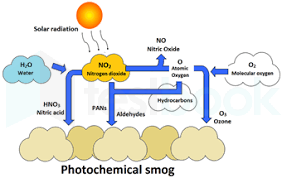
  • It is formed when nitrogen dioxide, which is primarily caused by industrial and road traffic pollution, reacts with hydrocarbons in sunlight to produce ozone, which can then be mixed with particles and thus leading to the formation of smog.

Hence this statement I is correct.

Statement II: The Great Smog of London disaster, is a classic example of summer smog.

  • The Great Smog of London was a deadly smog that engulfed London for five days (December 5–9) in 1952, caused by a combination of industrial pollution and high-pressure weather conditions.
  • A period of unusually cold weather, combined with an anticyclone and windless conditions, collected airborne pollutants—mostly arising from the use of coal—to form a thick layer of smog over the city whereas Summer Smog is formed when nitrogen dioxide, largely the result of industrial and road traffic pollution, reacts with hydrocarbons in sunlight to form ozone, which can then be mixed with particles.

Hence, this statement is incorrect.


Additional Information 

![Solved] Photochemical smog in urban areas is known to cause A. Resp](https://storage.googleapis.com/tb-img/production/22/04/6232d9370d8c871e00580213_16491513534671.png)

Process showing the formation of Photochemical smog.

Smog is composed of many chemicals, including nitrogen oxides (NOx), sulphur dioxide (SOx), carbon monoxide (CO), and volatile organic compounds (VOCs), but particulate matter (PM) and ground-level ozone are the two main components (O3).

Therefore, Statement I is true but Statement II is false.

23

Given below are two statements

Statement I: In waste water treatment systems, most of the large floating materials are removed in the screen chamber

Statement II: Colloidal and dissolved organic content of waste water are removed in the grit chamber

In light of the above statements, choose the most appropriate answer from the options given below

  1. ((a))

    Both Statement I and Statement II are correct

  2. ((b))

    Both Statement I and Statement II are incorrect

  3. ((c))

    Statement I is correct but Statement II is incorrect

  4. ((d))

    Statement I is incorrect but Statement II is correct

Show Answer
Answer: ((c))

Statement I is correct but Statement II is incorrect

The wastewater treatment system collects grey drains from kitchens, showers, and washbasins, as well as black drains from toilets, and then combines them with washing drains. 

Key Points Statement I: In wastewater treatment systems, most of the large floating materials are removed in the screen chamber.

  • The first unit operation in a wastewater treatment plant is screening.
  • This is used for coarse screening to remove larger particles of floating and suspended matter.
  • A set of inclined parallel bars fixed at a certain distance apart in a channel accomplishes this.
  • The opening of the screen can be circular or rectangular. A rack is a screen made up of parallel bars or rods. The screens are used to keep rags and large objects from damaging or clogging pumps, valves, pipelines, and other appurtenances.

Hence, the statement I is correct.

Statement II: Colloidal and dissolved organic content of wastewater are removed in the grit chamber.

  • A grit chamber is a long, narrow, or circular tank in a primary sewage treatment plant that is designed to reduce the velocity of the sewage flow in order to remove girt materials such as sand, ash and clinkers, eggshells, bone chips, and other inorganic material.
  • Whereas the organic content of wastewater is removed in the Primary settling process.

Hence, statement II is incorrect.

Important Points

  • Effluents from wastewater treatment are all classified as nonhazardous drains because they do not contain any oil or gas.
  • The particles are then mixed and reduced to small sizes by the package.
  • The main goal is to complete a number of tasks before heading out to sea.

Additional Information Process of Wastewater treatment plan is as follows

Design of Sewage Treatment Plant MCQ [Free PDF] - Objective Question Answer  for Design of Sewage Treatment Plant Quiz - Download Now!


Therefore, the correct answer is Statement I is correct but Statement II is incorrect.

24

Which one of the following Articles of the Indian Constitution talks about our duty to protect the environment?

  1. ((a))

    Article 51 A(a)

  2. ((b))

    Article 51 A(c)

  3. ((c))

    Article 51 A(e)

  4. ((d))

    Article 51 A(g)

Show Answer
Answer: ((d))

Article 51 A(g)

The Environment (Protection) Act, 1986 defines environment as “environment includes water, air and land, and the interrelationship which exists among and between air, water and land, and human beings, other living creatures, plants, micro-organism, and property."

Key Points

  • The chapter on fundamental duties of the Indian Constitution clearly imposes a duty on every citizen to protect the environment.
  • Article 51-A (g), says that “It shall be the duty of every citizen of India to protect and improve the natural environment including forests, lakes, rivers, and wildlife and to have compassion for living creatures.”
  • The Constitution of India under part III guarantees fundamental rights which are essential for the development of every individual and to which a person is inherently entitled by virtue of being human alone.
  • Right to the environment is also a right without which the development of an individual and realization of his or her full potential shall not be possible.

Additional Information

  • Article 51 A(a)- 51A. of the  Fundamental duties states that it shall be the duty of every citizen of India (a) to abide by the Constitution and respect its ideals and institutions, the National Flag and the National Anthem.
  • Article 51 A(c)- Of the Fundamental duties states that it is a fundamental duty to uphold and protect the sovereignty, unity, and integrity of India.
  • Article 51A(e)- The 51 A(e) states that to promote harmony and the spirit of common brotherhood amongst all the people of India transcending religious, linguistic, and regional or sectional diversities.

Therefore, Article 51 A(g) of the Indian Constitution talks about our duty to protect the environment.

25

Arrange the following naturally occurring Uranium isotopes in the correct sequence as per the proportion of occurrence

A. U-234

B. U-235

C. U-238

Choose the correct answer from the options given below

  1. ((a))

    A, B, C

  2. ((b))

    B, C, A

  3. ((c))

    C, B, A

  4. ((d))

    C, A, B

Show Answer
Answer: ((c))

C, B, A

Uranium, with the atomic number 92, is a silvery-white metallic chemical element in the periodic table. It is denoted by the chemical symbol U. A uranium atom contains 92 protons and 92 electrons, with 6 of them being valence electrons

Key Points

  • Uranium 238 accounts for 99.3 percent of natural uranium and has the longest lifetime: 4.5 billion years or roughly the age of the Earth.
  • It is not particularly radioactive.
  • Through this plutonium, U-238 contributes to the operation of reactors and the generation of electricity.
  • This impressive potential of fission energy is largely untapped.
  • Uranium 235 is the only fissile nucleus found in natural uranium and is used as a nuclear fuel in reactors and as a nuclear weapon explosive.
  • This extremely rare isotope, which occurs at a concentration of 0.7 percent in natural uranium, is thus a highly strategic and sought-after material.
  • Uranium 234 is the uranium-238's first long-lived descendant.
  • These nuclei are present in natural uranium samples in the unchanging proportions of the uranium-238 radioactive equilibrium.

Important PointsIn nature, uranium is found as uranium-238 (99.2739–99.2752%), uranium-235 (0.7198–0.7202%), and a very small amount of uranium-234 (0.0050–0.0059%.

Therefore, the correct statements are C, B, and A.

26

How many Indian languages have been declared endangered by UNESCO?

  1. ((a))

    47

  2. ((b))

    87

  3. ((c))

    117

  4. ((d))

    197

Show Answer
Answer: ((d))

197

The UNESCO Atlas of World Languages in Danger 2010 includes a list of approximately 2,500 endangered languages from around the world. 

Key Points

  • According to UNESCO, 197 languages in India are endangered, of which 81 are vulnerable, 63 are definitely endangered, six are severely endangered, 42 are critically endangered, and five are already extinct.
  • Andaman and Nicobar, an Indian union territory, tops the list with 11 critically endangered languages, most of which are tribal dialects. Manipur has the most endangered languages, with seven, followed by Himachal Pradesh, which has four.

Additional Information

  • The World Atlas of Languages (WAL) is an online platform that reflects the global linguistic diversity landscape's dynamism and depth.
  • It provides accurate, reliable, up-to-date, and robust language data for the entire world.
  • The World Atlas of Languages is able to capture linguistic diversity shifts quickly by leveraging scientific and technological progress and drawing on data provided by trusted providers such as national governments, academia, and language communities.

Therefore,197 Indian languages have been declared endangered by UNESCO.

27

The major objective of value education in institutions is

  1. ((a))

    value for society.

  2. ((b))

    developing responsible and good citizens.

  3. ((c))

    developing ideal teachers.

  4. ((d))

    acquainting students with the value of education.

Show Answer
Answer: ((b))

developing responsible and good citizens.

Value education can be explained as an educational process or function that aids in the development of a human's individual personality. It's a method of assigning moral values to one another.

Key Points 

 The major objectives of value education are-

  • To improve the integral growth of people.
  • Developing responsible and good citizens.
  • Developing a democratic way to improve the level of thinking.
  • Building professionalism towards the work is counted in the professional values of people.

Additional Information The Important elements of the value education Program.

Value Education MCQ [Free PDF] - Objective Question Answer for Value  Education Quiz - Download Now!

Therefore, the major objective of value education in institutions is to develop responsible and good citizens.

28

Which among the following are the main thrusts of the NEP-2020 regarding institutional restructuring and consolidation?

A. A rigid separation of discipline, with early specialization and streaming of students into narrow areas of study

B. Developing a spectrum of institutions with a focus on research only

C. To establish stage-wise mechanism for granting graded autonomy to colleges

D. Developing vibrant communities of scholars, breaking down harmful silos, enable students in disciplines including artistic, creative and sports

E. to end the fragmentation by transforming higher education institutions into large multidisciplinary universities

Choose the correct answer from the options given below:

  1. ((a))

    A, B and C only

  2. ((b))

    B, C and D only

  3. ((c))

    C, D and E only

  4. ((d))

    A, D and E only

Show Answer
Answer: ((c))

C, D and E only

The Ministry of Education announced the National Education Policy (NEP) 2020. aims to modernize the Indian education system to meet the demands of the twenty-first century.

Key Points The main thrusts of NEP are-

  1. To establish a stage-wise mechanism for granting graded autonomy to colleges.
  2. Developing vibrant communities of scholars, breaking down harmful silos, enable students in disciplines including artistic, creative, and sports.
  3. To end the fragmentation by transforming higher education institutions into large multidisciplinary universities.
  4. Curtailing Dropout Rates and Ensuring Universal Access to Education at All Levels.
  5. Curriculum and Pedagogy in Schools: Learning Should be Holistic, Integrated, Enjoyable, and Engaging.
  6. Reduce curriculum content to enhance essential learning and critical thinking.


Additional Information

  • The new policy aims to improve literacy and numeracy outcomes in primary schools, reduce dropout rates in middle and secondary schools, and implement a multidisciplinary approach in higher education.
  • The policy focuses on early childhood care, curriculum and pedagogy restructuring, assessment and exam reform, and investing in teacher training and broadening their evaluation.
  • Though the NEP 2020 aims to bring about a holistic change in India's education system, its success is dependent on the will and manner in which it is implemented.

Therefore, the correct answer is C, D, and E only.

29

Match List I with List II 

List IList II
A.University Education CommissionI.Dr. L. Mudaliyar
B.Secondary Education CommissionII.Dr. Radha Krishnan
C.Education CommissionIII.Dr. Sam Pitroda
D.National Knowledge CommissionIV.Dr. D.S. Kothari

Choose the correct answer from the options given below:

  1. ((a))

    A - III, B - I, C - IV, D - II

  2. ((b))

    A - II, B - I, C - IV, D - III

  3. ((c))

    A - IV, B - III, C - II, D - I

  4. ((d))

    A - I, B - II, C - III, D - IV

Show Answer
Answer: ((b))

A - II, B - I, C - IV, D - III

Key Points

Education Commission in India after the IndependenceChairman of Education Commission
University Education Commission - University Education Commission (1948-49) was the first Commission on education after Independence. Its major emphasis was on higher education but it also touched upon the issues related to school education. - The Radhakrishnan Commission on University Education defined the vital tasks of higher education.Dr. Radha Krishnan The Commission was appointed under the chairmanship of Dr. S. Radhakrishan, a great visionary of the modern era
Secondary Education Commission - The Secondary Education Commission presented its report in 1953 which had recommendations on almost all aspects of secondary education. The major recommendations of the Commission were - Installation of higher secondary system; diversified courses. - Three language formula; emphasis on education and vocational guidance; - Improvement in methods of teaching, textbooks, and system of examination; - Improvement in building and equipment.Dr. L. Mudaliyar A separate education commission was appointed under the chairmanship of Dr. Lakshamanaswami Mudaliyar in 1952 to address the issues related to school education.
Education Commission The Commission was most comprehensive in nature, it reviewed almost all aspects of the education system without limiting itself to any one particular aspect, unlike the Commissions that came before and after it. Two of the unique features of the Report are: 1. its comprehensive approach to educational reconstruction; 2. and its attempt to project a blueprint of a national system of education for India.Dr. D.S. Kothari Drawing on Nehru’s Mission and articulating most of his key themes, the Kothari Commission (1964-66) was set up under the Chairmanship of Dr. D. S. Kothari to formulate a coherent education policy for India.
National Knowledge Commission - To encounter educational challenges in the 21st century, the National Knowledge Commission (NKC) was appointed. - It is not exactly an education commission as its role was to propose the framework for quality, access, and equity in higher education. - NKC has submitted recommendations on areas such as the Right to Education, libraries, language, translation, portals, and knowledge networks.Dr. Sam Pitroda National Knowledge Commission (NKC) was constituted in June 2005 by the Prime Minister Dr. Manmohan Singh, under the Chairmanship of Mr. Sam Pitroda, to prepare a blueprint for reform of our knowledge-related institutions and infrastructure which would enable India to meet the challenges of the future. 


Additional Information University Education Commission​

  • ​The aims of the university should be to produce able citizens who can take up national responsibilities successfully in various fields.
  • The university has to produce able administrators and suitable workers in various occupations and industries. It has to provide leadership in various walks of life in the best interest of the nation.

 Therefore, the correct match is A - II, B - I, C - IV, D - III

30

Which model is designed to provide students with a cognitive structure for comprehending material presented through lectures, readings and other media?

  1. ((a))

    Inductive thinking

  2. ((b))

    Mnemonics

  3. ((c))

    Scientific inquiry

  4. ((d))

    Advance organisers

Show Answer
Answer: ((d))

Advance organisers

A teaching model is a strategy or instructional design that enables students to have real learning experiences.

Key Points

  • The advanced Organizer teaching Model is developed by D.P. Ausubel.
  • In this model, the teacher maintains control of the intellectual structure by relating learning content to organizers and assisting students in distinguishing new material from previously learned material.
  • This model is designed to strengthen students’ cognitive structure.
  • Advance organizers serve to remind pupils of what they already know while also assisting them in organizing the fresh knowledge they'll be receiving.
  • Ausubel's idea of an advance organizer focuses on what a student already knows to the new content to be learned and thus increases retention.

Thus, the Advance organizers model is designed to provide students with a cognitive structure for comprehending material presented through lectures, readings, and other media.

Additional Information

  • Mnemonic is a learning strategy that improves information retention or retrieval in human memory for greater understanding.
  • Ausubel proposed three phases of activity under the advance organizer model: 
  • Phase I: the presentation of the advance organizer
  • Phase II: presentation of the learning task or learning material.
  • Phase III: strengthening of cognitive organization.
31

Given below are two statements

Statement I: Two subcontrary propositions cannot both be false.

Statement II: Two subcontrary propositions must both be true.

In light of the above statements, choose the most appropriate answer from the options given below

  1. ((a))

    Both Statement I and Statement II are correct

  2. ((b))

    Both Statement I and Statement II are incorrect

  3. ((c))

    Statement I is correct but Statement II is incorrect

  4. ((d))

    Statement I is incorrect but Statement II is correct

Show Answer
Answer: ((c))

Statement I is correct but Statement II is incorrect

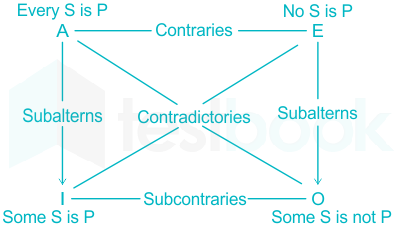
The square of opposition: Contraries, contraries, sub-contraries, subalterns, and superalterns are four ways propositions can be challenged. 

Key Points


![Solved] According to traditional square of opposition, if two propos](https://storage.googleapis.com/tb-img/production/20/06/F1_A.A._Madhu_19.05.20_D1.png)

Statement I: Two subcontrary propositions cannot both be false. 

  • I and O propositions are sub-contrary.
  • When two propositions have the same subject and predicate terms but are of different quality, one affirms and the other denies.
  • It is impossible for both to be false.

Thus, Statement I is correct. 

Statement II: Two subcontrary propositions must both be true.

  • If two statements cannot both be untrue while being true.
  • it is possible that the corresponding I and O propositions are both can be true.
  • For example, “some nations are democracies,” and “some nations are not democracies.”

So, Statement II is incorrect. 

Therefore, Statement I is correct but Statement II is incorrect.

Additional Information

  • Rules of  Contradictory: The truth of one implies the falsity of the other, and conversely.
  • Rule of Contrary: Propositions are contrary when they cannot both be true.
  • Rule of Subaltern:  the truth of the first implies the truth of the second but not conversely.

Read the given passage and answer the questions that follow:

There is no such thing as memory in the sense of something that can be seen, touched or weighed. Memory is an abstraction referring to a set of skills rather than to an object. Neither is there a single standard for judging a good or poor memory. There are a number of different ways in which a person may have a 'good' memory.

Memory is generally viewed as consisting of three stages (1) Acquisition refers to learning the material; (2) Storage refers to keeping the material in the brain until it is needed; and (3) Retrieval refers to getting the material back out when it is needed. These three stages may be viewed the 4 R's of Remembering, Recording, Retaining and Retrieving.

Memory consists of at least two different processes: short-term memory and long-term memory. Short-term memory has a limited capacity and rapid forgetting rate. Its capacity can be increased by chunking, or grouping separate bits of information into larger chunks. Long-term memory has a virtually unlimited capacity.

One measure of memory is recall. In aided recall, cues help to produce information. A second measure of memory is recognition in which one must be able to identify it when it is presented. In a third measure of memory, relearning, the difference between how long it took to learn the material the first time and how long it takes to learn it again indicated how much one can remember.

There are several explanations of why we forget. Passive-decay theory says that learning causes a physical 'trace' in the brain that decays with time. Repression theory says that we purposely push unpleasent memories into unconscious mind. Systematic-distortion theory says that our memories may be distracted by our values and interests. Inference theory says that forgetting is due to problems in retrieving the information, and that we can remember almost anything, if given right cues.

32

What are the constituent elements of memory in the order presented by the author?

  1. ((a))

    Store - Acquire - Retrieve

  2. ((b))

    Acquire - Retrieve - Store

  3. ((c))

    Acquire - Store - Retrieve

  4. ((d))

    Recall - Retrieve - Recognize

Show Answer
Answer: ((c))

Acquire - Store - Retrieve

The correct answer is 'Acquire - Store - Retrieve'.

Key Points

  • Let's refer to the passage:
  • Memory is generally viewed as consisting of three stages (1) Acquisition refers to learning the material; (2) Storage refers to keeping the material in the brain until it is needed; and (3) Retrieval refers to getting the material back out when it is needed.
  • ​From the above-mentioned line, it is evident that the author has presented the constituent elements of memory in the order of  Acquire - Store - Retrieve.

​Thus, it is clear that option 3 is the correct answer.

33

Memory is not a sensory experience because it is a/an

  1. ((a))

    Concrete skill

  2. ((b))

    Value

  3. ((c))

    Hybrid skill

  4. ((d))

    Absence of single standard for judging the quality of memory

Show Answer
Answer: ((c))

Hybrid skill

The correct answer is 'Hybrid Skill'.

Key Points

  • Let's refer to the passage: 
  • There is no such thing as memory in the sense of something that can be seen, touched or weighed.
  • Memory is an abstraction referring to a set of skills rather than to an object.
  • ​From the above-mentioned lines, it is evident that memory is not a sensory experience because it is a hybrid skill.

​Thus, option 3 is the correct answer.

34

"Systematic-distortion theory" offers an explanation for

  1. ((a))

    Remembering

  2. ((b))

    Acquiring

  3. ((c))

    Forgetting

  4. ((d))

    Retrieving

Show Answer
Answer: ((c))

Forgetting

The correct answer is 'Forgetting'.

Key Points

  • Let's refer to the passage:
  • There are several explanations of why we forget.
  • Passive-decay theory says that learning causes a physical 'trace' in the brain that decays with time.
  • Repression theory says that we purposely push unpleasant memories into unconscious mind.
  • Systematic-distortion theory says that our memories may be distracted by our values and interests.
  • From the above-mentioned lines, it is evident that Systematic-distortion theory offers an explanation for forgetting.

​Thus, option 3 is the right answer.

35

This text can be taken as an answer to which one of the following questions?

  1. ((a))

    How can we measure memory?

  2. ((b))

    Why do we forget?

  3. ((c))

    What is memory?

  4. ((d))

    What are the types of memory?

Show Answer
Answer: ((c))

What is memory?

The correct answer is 'What is memory?'

Key Points

  • The first paragraph introduces the topic of memory and attempts to define it.
  • The second and third paragraphs discuss the various stages and processes of memory respectively.
  • The fourth paragraph explains the different ways to measure memory and the last paragraph offers several theories as to why we forget.
  • From the above points, it is evident that the given passage gives detailed information on memory.
  • Therefore, this text can be taken as an answer to the question 'What is memory?'

It is clear that option 3 is the right answer.

36

"Have you stopped stealing from your parents?" Which one of the following fallacies is committed in this argument?

  1. ((a))

    Appeal to Ignorance

  2. ((b))

    Appeal to Pity

  3. ((c))

    Complex Question

  4. ((d))

    Begging the Question

Show Answer
Answer: ((c))

Complex Question

Complex questions appear to be gimmicks rather than arguments.

Key Points

  • A complex question is a fallacy in which the answer to one question assumes that the answer to another question has already been supplied.
  • The presupposition is a notion that is assumed to be acceptable to the respondent.
  • loaded question is a type of entrapment in judicial proceedings or discussions where a premise includes an admission of wrongdoing.
  • It could also be a different form of the proposition that comprises logical connectives in such a way that it has several components.
  • For example, "Have you quit beating your wife?"

​Therefore, "Have you stopped stealing from your parents?", Complex Question fallacies are committed in this argument. 

Additional Information

  • An appeal to pity is a fallacy in which someone uses his opponent's feelings of sympathy or guilt to gain support for an argument or concept.
  • The appeal to ignorance is a fallacy based on the idea that if a proposition can't be proven incorrect, it must be true or wrong if it can't be demonstrated true.
  • The Begging of the question fallacy arises when the premises of an argument presuppose rather than support the conclusion's veracity.
37

Which of the following statements are true with reference to Vyāpti (concomitance) according to the Nyāya system?

A. It expresses-the relation between two individuals objects only

B. It expresses the relation between the classes of individuals

C. It can be said to exist between two things if they are related as cause and effect.

D. It can be said to exist between two things if they are related as species and genus

Choose the correct answer from the options given below:

  1. ((a))

    A, C and D only

  2. ((b))

    C and D only

  3. ((c))

    B and C only

  4. ((d))

    B, C and D only

Show Answer
Answer: ((a))

A, C and D only

Vyapti is the non-presence of middle term (hetu) in the locus of the non-existence of the major term (sadhya). 

Key Points

  • Nyāya school considers knowledge of vyapti to be the cause of successful inference.
  • They believe that vyapti is the reason's unconditional uniform relation to the predicate and that the predicate is pervaded by a condition.
  • Vyāpti implies a correlation between two facts, pervaded (vyāpti) and pervades (vāpaka).
  • Vyāpti is defined as an invariable unconditional and universal relation between the middle term and major term.
  • It refers to the inextricable connection between hetu and sadhya
  • It is one of the means of knowledge and is regarded as the logical ground of inference.
  • No conclusion can be drawn without vyapti's knowledge.
  • It is considered the logical ground of inference which is one of the means to knowledge. No conclusion can be inferred without the knowledge of vyapti.
  • Vyapti guarantees the truth of the conclusion. It signifies the relation of invariable concomitance between "hetu" and "sadhya".
  • It is of two kinds. Vyapti between terms of unequal extension is called "asamavyavyapti" or "visamavyapti", and vyapti between equal extensions is called "samavyapti"

Therefore,  A, C and D are the correct statements. 

Additional Information

  • According to the Nyāya school, true knowledge is derived through perception (pratyaksa), inference (anumana), comparison (upamana), and testimony (sabda).
38

Given below are two statements

Statement I: The advance organiser model is designed to strengthen students' cognitive structures - their knowledge of a particular subject at any given time and how well organised, clear and stable that knowledge is.

Statement II: Cognitive structure has nothing to do with what kind of knowledge of a field is in our minds, how much of it is there, and how well it is organised.

In light of the above statements, choose the most appropriate answer from the options given below

  1. ((a))

    Both Statement I and Statement II are correct

  2. ((b))

    Both Statement I and Statement II are incorrect

  3. ((c))

    Statement I is correct but Statement II is incorrect

  4. ((d))

    Statement I is incorrect but Statement II is correct

Show Answer
Answer: ((c))

Statement I is correct but Statement II is incorrect

D.P. Ausubel proposed the Advance Organizer teaching Model. 

Key PointsStatement I: The Advance organizer model is designed to strengthen students' cognitive structures - their knowledge of a particular subject at any given time and how well organized, clear and stable that knowledge is.

  • A teaching model is a strategy or instructional design that enables students to have real learning experiences.
  • This model is designed to strengthen students’ cognitive structure.
  • The teacher maintains control of the intellectual structure by relating learning content to organizers.
  • It makes the cognitive structure concrete and helps the students in grasping new knowledge.

Thus, Statement I is correct. 

Statement II: Cognitive structure has nothing to do with what kind of knowledge of a field is in our minds, how much of it is there, and how well it is organized.

  • A psychological concept that accounts for a type of human understanding is cognitive structure.
  • Cognitive structures include schema and mental models.
  • Experiences are given meaning and organization by a cognitive structure that governs both the processing of incoming knowledge and the recall of previously stored knowledge.

So, Statement II is incorrect. 

Additional Information

 Characteristics of advanced organizer model: 

  • To improve students' abstract thinking abilities.
  • To assist students in gaining a thorough understanding
  • To make connections between prior and current knowledge
  • To compare concepts, generalizations, and known and unknown
39

The theory of meaningful verbal learning deals with which of the following concerns?

A. How knowledge (curriculum content) is organised.

B. How the mind works to process new information (learning)

C. How teachers can apply ideas about curriculum and learning when they present new material to students (instruction)

D. How the students provide responses to critical questions (questions response)

E. How the institution has established a language lab (infrastructure)

Choose the correct answer from the options given below:

  1. ((a))

    A, B and C only

  2. ((b))

    A, B and D only

  3. ((c))

    A, B and E only

  4. ((d))

    C, D and E only

Show Answer
Answer: ((a))

A, B and C only

Meaningful verbal learning correlates to idea acquisition.

Key Points

  • David Ausubel, an educational psychologist, presents the Advance Organizer Model.
  • Three issues are addressed in this theory of meaningful linguistic learning:-
  • How knowledge (curriculum content) is organized;
  • How the mind works to process new information (learning);
  • How a teacher can apply these ideas about curriculum and learning when they present new material to students (instruction).
  • This model is intended to improve the cognitive structure of students.

Therefore, A, B, and C are correct. 

Additional Information

  • The idea behind meaningful learning is that utilize it to build connections with other things learned before.
40

Given below are two statements

Statement I: The average of all prime numbers between 30 and 50 is 38.9.

Statement II: The average of the first 15 natural numbers is 150.

In light of the above statements, choose the correct answer from the options given below

  1. ((a))

    Both Statement I and Statement II are true

  2. ((b))

    Both Statement I and Statement II are false

  3. ((c))

    Statement I is true but Statement II is false

  4. ((d))

    Statement I is false but Statement II is true

Show Answer
Answer: ((b))

Both Statement I and Statement II are false

Shortcut Trick

Prime numbers between 30 and 50 are 31, 37, 41, 43, 47. Sum = 199. Average = 199 ÷ 5 = 39.8 (not 38.9).

Average of first n natural numbers = (n + 1) ÷ 2.

For n = 15, Average = (15 + 1) ÷ 2 = 8 (not 150).

Both statements are clearly incorrect.

∴ The correct answer is Both Statement I and Statement II are false.

Alternate Method

Given: Statement I (Prime numbers 30-50) and Statement II (First 15 natural numbers).

Formula Used: Average = Sum of observations ÷ Number of observations.

Analysis of Statement I:

⇒ Prime numbers between 30 and 50 = {31, 37, 41, 43, 47}

⇒ Total count = 5

⇒ Sum = 31 + 37 + 41 + 43 + 47 = 199

⇒ Average = 199 ÷ 5 = 39.8

⇒ 39.8 ≠ 38.9, so Statement I is false.

Analysis of Statement II:

⇒ First 15 natural numbers = {1, 2, 3, ..., 15}

⇒ Sum = [n × (n + 1)] ÷ 2 = [15 × 16] ÷ 2 = 120

⇒ Average = 120 ÷ 15 = 8

⇒ 8 ≠ 150, so Statement II is false.

∴ The correct answer is Both Statement I and Statement II are false.

Additional Information

Prime Numbers

Numbers greater than 1 with exactly two factors: 1 and itself. 2 is the only even prime number.

Sum of First n Natural Numbers

The sum is calculated using Sn = [n(n + 1)] ÷ 2. For n = 15, Sum = 120.

Average of AP Series

For a series in Arithmetic Progression (like natural numbers), Average = (First term + Last term) ÷ 2.

41

Which one of the following is not a measure of memory?

  1. ((a))

    Relearning

  2. ((b))

    Record

  3. ((c))

    Recognize

  4. ((d))

    Recall

Show Answer
Answer: ((b))

Record

The correct answer is  'Record'.

Key Points

  • Let's refer to the passage: 
  • One measure of memory is recall. In aided recall, cues help to produce information.
  • A second measure of memory is recognition in which one must be able to identify it when it is presented.
  • In a third measure of memory, relearning, the difference between how long it took to learn the material the first time and how long it takes to learn it again indicated how much one can remember.
  • ​From the above-mentioned lines, it is evident that Recording is not a measure of memory.

​Thus, it is clear option 2 is the correct answer.

42

What is Phishing?

  1. ((a))

    It uses networks to search out computers

  2. ((b))

    Someone sends legitimate-looking emails to users

  3. ((c))

    Re-directs the user to a fake website

  4. ((d))

    A key logging software

Show Answer
Answer: ((b))

Someone sends legitimate-looking emails to users

Email is the most used method of communication. 

Key Points

  • Phishing assaults occur when a person sends a fake message that appears to come from a trusted source.
  • Phishing is a frequent sort of cyberattack.
  • Phishing begins with a phony email or another kind of communication intended to entice a victim
  • Phishing Emails look lucrative and eye-catching or attention-grabbing are intended to grab people's attention right away.
  • The message is designed to appear as if it came from a known sender.

Therefore, Phishing is someone sends legitimate-looking emails to users. 

Additional Information

  • Malware is a file or program that infects, investigates, steals, or performs nearly any action that an attacker desires.
  • Malware is often supplied over a network.
43

When a sum of money was distributed to 10 boys instead of 15 boys, each boy got Rs. 50 more. What was the sum? 

  1. ((a))

    1000 Rs.

  2. ((b))

    1500 Rs.

  3. ((c))

    1200 Rs.

  4. ((d))

    1250 Rs.

Show Answer
Answer: ((b))

1500 Rs.

Given:

Sum of money to be distributed to 15 boys but distributed to 10 boys and each boy gets Rs 50 more.

Calculation:

Let the amount distributed to boys be x Rs.

When the amount was distributed to 10 boys

∴ The amount received by each boy = x/14​

When the amount was distributed to 15 boys

∴ The amount received by each boy= x/15​

According to the question,

⇒ x/10 - x/15 = 50

⇒ x = 50 × 30 

⇒ x = Rs 1500

44

Given below are two statements

Statement I: The single discount equivalent to a series discount of 10%, 20% and 30% is 40%

Statement II: The single discount equivalent to a series discount of 15%, 25% and 30% is 50% 

In light of the above statements, choose the correct answer from the options given below

  1. ((a))

    Both Statement I and Statement II are true

  2. ((b))

    Both Statement I and Statement II are false

  3. ((c))

    Statement I is true but Statement II is false

  4. ((d))

    Statement I is false but Statement II is true

Show Answer
Answer: ((b))

Both Statement I and Statement II are false

Given:

Series of discount in Statement I = 10%, 20% and 30%

Series of discount in Statement II = 15%, 25% and 30%

Formula Used:

Total discount = [x + y - (xy/100)]%

Calculation:

Statement I: The single discount equivalent to a series discount of 10%, 20% and 30% is 40%

Single equivalent discount for 10% and 20% is

⇒ [10 + 20 - (10 × 20)/100]%

⇒ (30 - 200/100)% = (30 - 2)% = 28%

Now, single equivalent discount for 28% and 30% is

⇒ [28 + 30 - (28 × 30)/100]%

⇒ (58 - 8.4)% = 49.6%

Hence, Statement I is false.

Statement II: The single discount equivalent to a series discount of 15%, 25% and 30% is 50% 

Single equivalent discount for 15% and 25% is

⇒ [15 + 25 - (15 × 25)/100]%

⇒ (40 - 375/100)% = (40 - 3.75)% = 36.25%

Now, single equivalent discount for 36.25% and 30% is

⇒ [36.25 + 30 - (36.25 × 30)/100]%

⇒ (66.25 - 10.87)% = 55.38%

Hence, Statement II is false.

∴ Both Statement I and Statement II are false.

45

Find the missing term in the following series 

2, 5, 10, 17, 26, ?

  1. ((a))

    35

  2. ((b))

    36

  3. ((c))

    37

  4. ((d))

    38

Show Answer
Answer: ((c))

37

Given:

Series = 2, 5, 10, 17, 26, ?

Calculation:

The pattern of the given series is:

⇒ 2 + 3 = 5

⇒ 5 + 5 = 10 

⇒ 10 + 7 = 17

⇒ 17 + 9 = 26

⇒ 26 + 11 = 37

Here, the pattern followed in the given series is the addition of odd numbers.

∴ The correct answer is 37.

46

Which one of the following options describes a valid deductive argument with all the premises and the conclusion as True?

  1. ((a))

    Probable Argument

  2. ((b))

    Improbable Argument

  3. ((c))

    Unsound Argument

  4. ((d))

    Sound Argument

Show Answer
Answer: ((d))

Sound Argument

A deductive argument is an argument that is intended by the arguer to be deductively valid. 

Key Points

  • A valid argument with true premises is defined as a sound argument.
  • The argument is sound if the premises are correct the conclusion must be correct as well.
  • A deductive argument's soundness refers to both the truth of its premises and the quality of its logic.
  • When a deductive argument is sound, it includes the following elements:
  • It is valid, and
  • It has all true premises.
  • A deductive argument is considered to be valid if and only if it is written in such a way that it is impossible for the premises to be true while the conclusion remains false.

Therefore, Sound Argument describes a valid deductive argument with all the premises and the conclusion as True. 

Additional Information

  • Probability arguments go from one or more probable premises to only probable conclusions.
47

Which Operating System is used by the Apple computer systems (an American technology company)? 

  1. ((a))

    Linux

  2. ((b))

    Windows

  3. ((c))

    Solaris

  4. ((d))

    Mac

Show Answer
Answer: ((d))

Mac

An operating system is a software program that manages and operates computing devices.

Key Points

  • Mac OS is a powerful operating system that offers similar features and services to Windows and Linux.
  • The Macintosh Operating System (Mac OS) is an operating system developed by Apple Inc.
  • It is a graphical user interface-based operating system that was first published in 1984.
  • Apple is an American-based company located in California.
  • Mac OS is meant to run on Apple computers and does not support the x86 architecture by default.
  • Mac OS has multiple versions available such as Macintosh 128k, Mac OS 7, Mac OS X, and Mac Mountain Lion.

Therefore, Mac is used by the Apple computer systems (an American technology company).

Additional Information

  • Microsoft Windows, usually known as Windows or Windows OS, is a personal computer operating system developed by Microsoft Corporation.
  • Linux is a collection of open-source Unix-like operating systems based on Linus Torvalds' Linux kernel which was launched on September 17, 1991.
  • Oracle Solaris is also an operating system.
48

Given below are two statements regarding Denial of Service attacks

Statement I: It is an attempt at preventing users from accessing part of a network, notably internet servers.

Statement II: It can be mitigated by using email filters.

In light of the above statements, choose the correct answer from the options given below

  1. ((a))

    Both Statement I and Statement II are true

  2. ((b))

    Both Statement I and Statement II are false

  3. ((c))

    Statement I is true but Statement II is false

  4. ((d))

    Statement I is false but Statement II is true

Show Answer
Answer: ((a))

Both Statement I and Statement II are true

A denial-of-service (DoS) attack is a type of cyber attack in which a malicious actor attempts to make a computer or other device unavailable to its intended users by interfering with its normal operation. 

Important PointsStatement I: It is an attempt at preventing users from accessing part of a network, notably internet servers.

  • A denial-of-service (DoS) attack is a type of security threat in which an attacker prevents legitimate users from accessing computer systems, networks, services, or other information technology (IT) resources.
  • DoS attacks simply exploit vulnerabilities in the target system or service, causing it to crash. In these attacks, input is sent that exploits bugs in the target, causing the system to crash or become severely destabilized, preventing it from being accessed or used.

Hence statement I is true.

Statement II: It can be mitigated by using email filters.

  • DoS attacks typically work by burdening or flooding a targeted machine with requests until normal traffic cannot be processed, resulting in a denial of service to additional users.
  • A DoS attack is identified by the use of a single computer to launch the attack.
  • DoS attacks can be mitigated by using email filters, filter requests, filtering incoming traffics, and also blocking IP addresses from known attackers.

Hence, this statement II is correct.

Additional Information

  • The Distributed Denial of Service (DDoS) attack is another type of DoS attack. When multiple systems orchestrate a synchronized.
  • DoS attack against a single target, this is referred to as a DDoS attack.
  • The main difference is that instead of being attacked from a single location, the target is attacked from multiple locations at the same time.

Therefore, both Statements 1 and 2 are true.

49

When a teacher presents the most general ideas of the discipline first, followed by a gradual increase in detail and specificity, it is known as

  1. ((a))

    progressive differentiation

  2. ((b))

    inductive thinking

  3. ((c))

    cooperative learning

  4. ((d))

    jurisprudential inquiry

Show Answer
Answer: ((a))

progressive differentiation

Carol Tomlinson coined the phrase differentiated instruction in the late 1990s.

Key Points

  • Tomlinson defines it as "a way of thinking about teaching that proposes that... we teach with an eye on the learner."
  • Progressive differentiation is a method of meaningful learning in which students increase the degree of elaboration of an idea as their knowledge of it grows.
  • Individual students are given specific steps to take in order to take control of their learning experience through differentiated instruction.
  • The role of the teacher is to introduce the subject and then increase the depth and specificity.
  • According to research, Differentiated instruction appears to be helpful for students who are academic achievers as well as those who have learning issues or even substantial disabilities.

Therefore, a teacher presents the most general ideas of the discipline first, followed by a gradual increase in detail and specificity, it is known as Progressive differentiation.

Additional Information

  • Differentiated instruction is the process of gaining a better knowledge of how each student learns best and then adjusting training to fit those requirements.
  • Cooperative learning is the process of dividing a class of students into small groups so that they can work together to learn a new idea.
50

Given below are two statements, one is labeled as Assertion A and the other is labeled as Reason R

Assertion A: According to the Nyãya system, when one observes smoke at a particular locus, one could infer that the same locus has the presence of fire too.

Reason R: Fire causes smoke, and is always accompanied by smoke.

In light of the above statements, choose the correct answer from the options given below

  1. ((a))

    Both A and R are true and R is the correct explanation of A 

  2. ((b))

    Both A and R are true but R is NOT the correct explanation of A

  3. ((c))

    A is true but R is false

  4. ((d))

    A is false but R is true

Show Answer
Answer: ((c))

A is true but R is false

Nyaya, one of the six systems of Indian philosophy is important for its analysis of logic and epistemology.

Key PointsAssertion A: According to the Nyãya system, when one observes smoke at a particular locus, one could infer that the same locus has the presence of fire too.

  • Knowledge of an object is gained from prior knowledge of a sign or mark in an inference.
  • three sentences make up an inference: the major premise, minor premise, and conclusion.
  • In Nyaya Philosophy, major, minor, and medium terms are variously referred to as'sadhya,' 'paksa,' and 'hetu.'
  • An example will clarify the above analysis.
  • Major Premise: All things which have smoke have a fire.
  • Minor Premise: This hill has smoke
  • Conclusion: Therefore, this hill has fire
  • He relates his previous knowledge that wherever there is smoke, there is fire, e.g., in the kitchen, in a lamp, etc., which is a universal truth, by witnessing the smoke.
  • Then he asserts that because the hill is smoky, it must be on fire.

Therefore, Assertion A is true. 

Reason R: Fire causes smoke, and is always accompanied by smoke.

  • They believed that while a cause produces an effect, the effect and the cause are not the same.
  • As a result, a new product emerges that was not previously available due to the cause.
  • As a result, each impact is a unique product that was not previously discovered in the cause.

Thus, Reason R is false. 

Hence, A is true but R is false.

Attempt this paper under real exam conditions

Timed interface, section switching, instant scoring, and question-by-question analytics — free.

Start Timed Attempt