Official Paper

UGC NET Paper 1: Held on 26th Nov 2021 Shift 1 (Previous Year Paper)

50 questions · 60 minutes · with answers · free

Paper 1 (50 questions)

1

Given below are two statements

Statement I : According to Piaget, the ability to solve conservation problems depends on having an understanding of three basic aspects of reasoning : identity, compensation, and reversibility.

Statement II : The stage of classification does not depend on a student's ability to focus on a single characteristic of objects in a set and group the objects according to that characteristic.

In light of the above statements, choose the most appropriate answer from the options given below

  1. ((a))

    Both Statement I and Statement II are correct

  2. ((b))

    Both Statement I and Statement II are incorrect

  3. ((c))

    Statement I is correct but Statement II is incorrect

  4. ((d))

    Statement I is incorrect but Statement II is correct

Show Answer
Answer: ((c))

Statement I is correct but Statement II is incorrect

Jean Piaget used the idea of conservation in a set of experiments geared at studying children's ability to think and reason. 

Key PointsStatement I: According to Piaget, the ability to solve conservation problems depends on having an understanding of three basic aspects of reasoning: identity, compensation, and reversibility.

Piaget realized that maturing children progressively master different types of conservation as they reason about their world. 

  • With mastery of identity: The student realizes that material remains the same if nothing is added to or subtracted from the material.
  • With mastery of compensation: The student realizes that changes in one dimension can be offset by changes in another.
  • With mastery of reversibility: The student realizes that a change may be canceled out by mentally reversing the steps and returning to the origin.

Hence statement I is correct.

Statement II: The stage of classification does not depend on a student's ability to focus on a single characteristic of objects in a set and group the objects according to that characteristic.

Stage of Classification:

  • Students will develop an understanding that objects and materials have characteristics or properties.
  • Students will be able to recognize similarities between the properties of certain objects and materials and will be able to group the objects based on these similarities.
  • Students are introduced to the idea that objects and materials have certain “properties” or “characteristics” that can be used to describe them.

Hence statement II is incorrect.

Therefore we can conclude that Statement I is correct, while Statement II is incorrect.

2

According to Urie Bronfenbrenner's biological model of human development, the microsystem constitutes _______.

A. Immediate family

B. School

C. Beliefs

D. Customs

E. Neighbourhood

Choose the correct answer from the options given below :

  1. ((a))

    A, B and C only

  2. ((b))

    A, C and E only

  3. ((c))

    A, B and E only

  4. ((d))

    C, D and E only

Show Answer
Answer: ((c))

A, B and E only

Bronfenbrenner's theory suggests that the microsystem is the smallest and most immediate environment in which children live.

Key Points 

  • The microsystem is the first level of Bronfenbrenner's theory, and are the things that have direct contact with the child in their immediate environment, such as parents, siblings, teachers, and school peers.
  • Bronfenbrenner's ecological systems theory views child development as a complex system of relationships affected by multiple levels of the surrounding environment, from immediate settings of family and school to broad cultural values, laws, and customs.
  • Bronfenbrenner divided the person's environment into five different systems: the microsystem, the mesosystem, the exosystem, the macrosystem, and the chronosystem.
  • ​Bronfenbrenner's ecological systems theory has implications for educational practice.

Hence, according to Urie Bronfenbrenner's biological model of human development, the microsystem constitutes family, school, customs, and Neighbourhood

Therefore options A, B, and E is correct.

3

Which one of the following is an important characteristic of the researchers involved in qualitative study?

  1. ((a))

    Non-partisan

  2. ((b))

    Reflexivity

  3. ((c))

    Transparency

  4. ((d))

    Enthusiasm

Show Answer
Answer: ((b))

Reflexivity

Qualitative research is research using methods such as participant observation or case studies that result in a narrative, descriptive account of a setting or practice.

Key PointsCharacteristics of Qualitative Study:

  • Real-World Setting- In qualitative research methods like observation method, ethnographic research, focus groups, and one-to-one interviews, the behavior of the participants of the study is observed, and the conclusion is drawn based on their answers and their behavior.
  • Flexible- Qualitative research is flexible. It can change at any stage of the research and based on the change, the course of research might also get changed.
  • Reflexivity- In qualitative research, the researchers share everything about themselves like their background and their purpose of research with the participants.
  • Complex Reasoning- An essential characteristic of the qualitative research method is that it is beneficial for complex reasoning.
  • Continuous- The analysis of data in qualitative research does not take place at the end of the completion of the research process.

Hence, reflexivity is an important characteristic of a qualitative study.

4

Some of the types of hypothesis are as follows :

A. Descriptive

B. Null

C. Confounding

D. Intervening

E. Explanatory (Causal)

Choose the correct answer from the options given below :

  1. ((a))

    A, B and C only

  2. ((b))

    B, C and D only

  3. ((c))

    A, B and D only

  4. ((d))

    A, B and E only

Show Answer
Answer: ((d))

A, B and E only

A hypothesis is an assumption, an idea that is proposed for the sake of argument so that it can be tested to see if it might be true. In the scientific method, the hypothesis is constructed before any applicable research has been done, apart from a basic background review.

Key PointsTypes of Hypothesis:

  • Descriptive- It shows how a researcher is intellectual and committed to a particular outcome. The relationship between the variables can also predict its nature.
  • Null- It provides a statement that is contrary to the hypothesis. It’s a negative statement, and there is no relationship between independent and dependent variables.
  • Explanatory (Casual)-  Causal hypothesis proposes a cause and effect interaction between two or more variables.

Hence, Descriptive, Null, and Causal hypotheses are a few types of hypotheses.

Therefore options A, B, and E are correct.

Additional Information 

  • An intervening variable is a hypothetical variable used to explain causal links between other variables. Intervening variables cannot be observed in an experiment (that's why they are hypothetical). For example, there is an association between being poor and having a shorter life span.
  • Confounding variables are those that affect other variables in a way that produces spurious or distorted associations between two variables. They confound the "true" relationship between two variables.
5

The communication among persons working at different levels who have no direct reporting relationship is called :

  1. ((a))

    Intrapersonal communication

  2. ((b))

    Upward communication

  3. ((c))

    Horizontal communication

  4. ((d))

    Diagonal communication

Show Answer
Answer: ((d))

Diagonal communication

​Communication is the act of giving, receiving, and sharing information -- in other words, talking or writing, and listening or reading.

Key PointsDiagonal or crosswise communication

  • It takes place when people working at the same level interact with those working at a higher or lower level of organizational hierarchy and across the boundaries of their reporting relationships.
  • Diagonal communication is a sort of hybrid between vertical and horizontal communication.
  • In this the flow of information among persons at different levels, who have no direct reporting relationships.

Hence The communication among persons working at different levels who have no direct reporting relationship is called Diagonal communication.

Additional Information

Upward communication:

  • The function of upward communication is to send information, suggestions, complaints, and grievances of the lower-level workers to the managers above.
  • It is more participative in nature.

Lateral or horizontal communication:

  • This type of communication can be seen taking place between persons operating at the same level or working under the same executive.
  • Functional managers operating at the same level, in different departments, through their communication, present a good example of lateral communication.
  • The main use of this dimension of communication is to maintain coordination and review activities assigned to various subordinates.

Intrapersonal communication

  • It is the process by which an individual communicates within themselves, acting as both sender and receiver of messages, and encompasses the use of unspoken words to consciously engage in self-talk and inner speech.
6

Marshall Mcluhan's name is associated with the assertion :

  1. ((a))

    The message is the medium

  2. ((b))

    The medium is the message

  3. ((c))

    The message determines the medium accurately

  4. ((d))

    A message is a message

Show Answer
Answer: ((b))

The medium is the message

Media theories are concepts and models that can be used to describe media and its impact on society, culture, and economics. Media is any tool or outlet of communication.

 Key PointsHerbert Marshall McLuhan, a communication theorist propounded the effects of mass media on thought and behavior.

  • According to McLuhan, the characteristics and properties of a medium have a greater influence on individuals and society than the actual content it carries.
  • He argued that different media formats, such as print, television, radio, or the internet, shape our perception and understanding of information in unique ways.
  • The medium itself, with its inherent qualities and biases, becomes an influential factor in shaping our thoughts, behaviors, and social interactions.

Medium is the message:

  • "The medium is the message" is a phrase coined by the Canadian communication theorist Marshall McLuhan and the name of the first chapter in his Understanding Media.
  • By which he means that the important thing about media is not the messages they carry but the way the medium itself affects human consciousness and society at large.
  • In other words, owning a TV that we watch is more significant than anything we watch on it.

Additional Information

  • Joshua Meyrowitz originated the term medium theory in his 1985 book, No Sense of Place, as a unifying label for the body of work from various mid-20th-century scholars who explored how the different characteristics of different media motivate unique forms of interaction.
  • McLuhan's theory: McLuhan proposes that a communication medium itself, not the messages it carries, should be the primary focus of study. He showed that artifacts as media affect any society by their characteristics or content.
7

Given below are two statements, one is labelled as Assertion A and the other is labelled as Reason R

Assertion A : In a classroom communication, teachers should acknowledge and take into account students' views.

Reason R : In a classroom, the probability of message reception can be enhanced by establishing a viewpoint.

In light of the above statements, choose the correct answer from the options given below:

  1. ((a))

    Both A and R are true and R is the correct explanation of A

  2. ((b))

    Both A and R are true but R is NOT the correct explanation of A

  3. ((c))

    A is true but R is false

  4. ((d))

    A is false but R is true

Show Answer
Answer: ((a))

Both A and R are true and R is the correct explanation of A

Key Points

Assertion A: In classroom communication, teachers should acknowledge and take into account students' views.

  • Classroom discourse is an interaction between teachers and learners and between learners and learners.
  • Communication skills are most vital for interactions with students because the act of teaching itself requires them.
  • In this role, he is responsible for comprehending and breaking down complex information, conveying this information clearly to the students (both verbally and in written resources), presenting it in a manner that sustains their attention, and listening to and resolving their questions or problems.
  • Studies have found that the success of students is directly related to interactive, engaging teaching environments formed by able teachers.

Hence In classroom communication, teachers should acknowledge and take into account students' views.

​Hence Assertion A is correct.

Reason R: In a classroom, the probability of message reception can be enhanced by establishing a viewpoint.

  • A constructivist view of classroom teaching focuses on students not as passive recipients but as active participants in the process of acquiring knowledge.
  • Teachers holding this view emphasize facilitating student inquiry, prefer to give students the chance to develop solutions to problems on their own, and allow students to play an active role in instructional activities
  • It aids them in developing their own point of view.
  • It will help learners in developing a thought process and coming forward with new innovative ideas.
  • Thus In a classroom, the probability of message reception can be enhanced by establishing a viewpoint.

Hence Reason R is correct

Therefore we conclude that Both A and R are true and R is the correct explanation of A.

8

How many terms are there in the series

168, 175, 182, ____, 266

  1. ((a))

    13

  2. ((b))

    14

  3. ((c))

    15

  4. ((d))

    16

Show Answer
Answer: ((c))

15

Given:

The given series: 168, 175, 182, ____, 266

Formula used:

In an arithmetic progression, the nth term (an) = a + (n - 1) d

Where, a = First term

n = Number of terms

an = nth term

d = Common difference

Calculation:

In the given series, the first term = 168

The common difference = 175 - 168 = 182 - 175 = 7

Let, the number of terms in the series = n

The nth term of the series = 266

Therefore, 168 + (n - 1) 7 = 266

⇒ 168 + 7n - 7 = 266

⇒ 7n = 266 - 168 + 7

⇒ 7n = 105

⇒ n = 105/7 = 15

∴ There are 15 terms in the given series.

9

The average of ten number is 7. If each number is multiplied by 11, then the average of the new set of numbers is :

  1. ((a))

    82

  2. ((b))

    72

  3. ((c))

    78

  4. ((d))

    77

Show Answer
Answer: ((d))

77

Given:

Total numbers = 10

The average of ten numbers = 7

Concept used:

Average = Sum of the terms/Number of the terms

Calculation:

The sum of ten numbers = 7 × 10 = 70

According to the question, each number is multiplied by 11.

The sum of the new set = 70 × 11 = 770

The average of the new set = 770/10 = 77

∴ The average of the new set of numbers is 77

10

Which of the following fractions is the smallest?

  1. ((a))

    6580\frac {65}{80}

  2. ((b))

    1116\frac {11}{16}

  3. ((c))

    58\frac 5 8

  4. ((d))

    2940\frac {29}{40}

Show Answer
Answer: ((c))

58\frac 5 8

Given:

There are four fractions: 5/8, 11/16, 29/40, and 65/80

Calculation:

Prime factors of 8 = 2 × 2 × 2

Prime factors of 16 = 2 × 2 × 2 × 2

Prime factors of 40 = 2 × 2 × 2 × 5

Prime factors of 80 = 2 × 2 × 2 × 2 × 5

LCM of 8, 16, 40, and 80 = 2 × 2 × 2 × 2 × 5 = 80

5/8 × 80 = 50

11/16 × 80 = 55

29/40 × 80 = 58

65/80 × 80 = 65

Here, 50 < 55 < 58 < 65

∴ The smallest fraction is 5/8

11

A total of 324 coins of 20 paise and 25 paise make a sum of ₹71. The number of 20 paise coins is

  1. ((a))

    144

  2. ((b))

    124

  3. ((c))

    200

  4. ((d))

    125

Show Answer
Answer: ((c))

200

Given:

The total number of coins = 324

The sum of the coins = ₹ 71

Concept used:

1 paise = 1/100 rupee

Calculation:

20 paise = 20/100 rupee = ₹ 0.2

25 paise = 25/100 rupee = ₹ 0.25

Let, the total number of 20 paise = x

Then, the total number of 25 paise = 324 - x

So, 0.2x + 0.25 (324 - x) = 71

⇒ 0.2x + 81 - 0.25x = 71

⇒ 0.25x - 0.2x = 81 - 71

⇒ 0.05x = 10

⇒ x = 10/0.05 = 200

∴ The number of 20 paise = 200

∴ The number of 20 paise coins is 200.

12

Match List I with List II

List IList II
Steps in InferenceStatements
A.Thesis (Pratijña̅)I.Because of smoke
B.Reason (Hetu)II.Wherever there is smoke, there is fire, as in the kitchen
C.Example (Uda̅harana)III.The mountain has fire
D.Application (Upanaya)IV.The mountain also has smoke accompanied by fire, like the kitchen

Choose the correct answer from the options given below :

  1. ((a))

    A - III, B - II, C - I, D - IV

  2. ((b))

    A - III, B - IV, C - II, D - I

  3. ((c))

    A - II, B - I, C - III, D - IV

  4. ((d))

    A - III, B - I, C - II, D - IV

Show Answer
Answer: ((d))

A - III, B - I, C - II, D - IV

Anumana Inference occupies a central place in the Hindu school of logic (Nyaya). This school worked out a syllogism in the form of an argument that goes through five stages:

  • the proposition (pratijna, literally “promise”),
  • the ground (hetu),
  • the illustration (udaharana),
  • the application (upanaya), and
  • the conclusion (nigamana).

Key Points 

Steps in InferenceStatement
Thesis (Pratijña̅)- The Sanskrit origin word Pratijna means 'promise, vow or declaration. - It is the thesis to be established, which makes a statement. It means that through which something is proved. - For example, The mountain has fire.
Reason (Hetu)- Hetu refers to "reason" for a conclusion. - So in the above example, thesis or Pratijna was made The mountain has fire, has hetu or reason that it is  Because of smoke.
Example (Uda̅harana)- After forming pratijna and hetu comes Uda̅harana. - Uda̅harana means the illustration. - For the thesis or Pratijna made  as- The mountain has fire has hetu or reason that it is because of smoke Uda̅harana eventually gives the illustration to prove hetu that Wherever there is smoke, there is fire, as in the kitchen.
Application (Upanaya)- After forming pratijna, hetu ,Uda̅harana. comes Upanaya. - Upanaya means the application. - For the given above example thesis or Pratijna i.e, The mountain has fire. - It has hetu or reason that it is  because of smoke and consequently there is an illustration or to prove hetu that Wherever there is smoke, there is fire, as in the kitchen. - Upanaya states application of the illustration or Uda̅harana  that The mountain also has smoke accompanied by fire, like the kitchen.

Therefore the correct matching code is A-III, B - I, C - II, D - IV

13

Given below are two statements

Statement I : Small amount of atmospheric Nitrogen dioxide NO2 is produced from polluting sources

Statement II : Most of the atmospheric NO2 is produced due to photochemical reactions in the atmosphere

In light of the above statements, choose the most appropriate answer from the options given below

  1. ((a))

    Both Statement I and Statement II are correct

  2. ((b))

    Both Statement I and Statement II are incorrect

  3. ((c))

    Statement I is correct but Statement II is incorrect

  4. ((d))

    Statement I is incorrect but Statement II is correct

Show Answer
Answer: ((a))

Both Statement I and Statement II are correct

Key Points

Statement I: Small amount of atmospheric Nitrogen dioxide NO2 is produced from polluting sources

Nitrogen Dioxide (NO2) Pollution:

  • Nitrogen Dioxide (NO2) ​is one of a group of highly reactive gases known as oxides of nitrogen or nitrogen oxides (NOx).
  • Other nitrogen oxides include nitrous acid and nitric acid. NO2 is used as the indicator for the larger group of nitrogen oxides.
  • Nitrogen Dioxide (NO2) pollutes the air mainly as a result of road traffic and energy production.
  • NO2 primarily gets in the air from the burning of fuel.
  • NO2 forms from emissions from cars, trucks and buses, power plants, and off-road equipment.

Hence Statement I is correct

Statement II: Most of the atmospheric NO2 is produced due to photochemical reactions in the atmosphere

Photochemical reactions in the atmosphere:

  • Photochemical reactions take place in the atmosphere by the absorption of solar radiation in the ultraviolet region.
  • Absorption of photons by chemical species gives rise to electronically excited molecules, which can bring about certain reactions.
  • Photochemical smog is a mixture of pollutants that are formed when nitrogen oxides and volatile organic compounds (VOCs) react to sunlight, creating a brown haze above cities.
  • Photochemical smog appears to be initiated by nitrogen oxides that are emitted into the air as pollutants mainly from internal combustion engines.

Hence Statement II is correct

Therefore we conclude that Both Statement I and Statement II are correct

14

Which of the following water-borne diseases may be caused by viruses, bacteria, and protozoa?

  1. ((a))

    Cholera

  2. ((b))

    Hepatitis

  3. ((c))

    Typhoid

  4. ((d))

    Diarrhea

Show Answer
Answer: ((d))

Diarrhea

Waterborne diseases are conditions (meaning adverse effects on human health, such as death, disability, illness, or disorders) caused by pathogenic micro-organisms that are transmitted in water.

Important Points

Diarrhoea

  • It is an infection caused by a host of bacterial, viral, and parasitic organisms, most of which are spread by feces-contaminated water.
  • Rotavirus and Escherichia coli are the two most common etiological agents of moderate-to-severe diarrhea.
  • Diarrhoeal disease is the second leading cause of death in children under five years old.
  • Infection is spread through contaminated food or drinking-water, or from person to person as a result of poor hygiene.
  • Interventions to prevent diarrhea, including safe drinking water, use of improved sanitation, and handwashing with soap can reduce disease risk.

Hence diarrhea is a water-borne disease that may be caused by viruses, bacteria, and protozoa.

Additional Information

Typhoid fever

  • It is a life-threatening infection caused by the bacterium Salmonella Typhi. It is usually spread through contaminated food or water.
  • A new typhoid conjugate vaccine with longer-lasting immunity was prequalified by WHO in December 2017.

Hepatitis

  • It is an inflammation of the liver that is caused by a variety of infectious viruses and noninfectious agents leading to a range of health problems, some of which can be fatal.
  • There are five main strains of the hepatitis virus, referred to as types A, B, C, D, and E.

Cholera

  • It is an acute diarrhoeal infection caused by ingestion of food or water contaminated with the bacterium Vibrio cholerae.
15

United Nations Environmental Program (UNEP) was the result of deliberations held during

  1. ((a))

    Human Environmental Conference at Stockholm in 1972

  2. ((b))

    Earth Summit at Rio de Janeiro in 1992

  3. ((c))

    Montreal Protocol 1987

  4. ((d))

    Kyoto Protocol 1997

Show Answer
Answer: ((a))

Human Environmental Conference at Stockholm in 1972

The United Nations Environment Programme is responsible for coordinating responses to environmental issues within the United Nations system.

Important Points

Human Environmental Conference at Stockholm in 1972:

  • ​The United Nations Conference on the Human Environment was held in Stockholm, Sweden, from June 5–16 in 1972.
  • The United Nations Environment Programme, or UNEP, was created as a result of this conference.
  • The Stockholm Declaration contained 26 principles, placed environmental issues at the forefront of international concerns, and marked the start of a dialogue between industrialized and developing countries.

Hence United Nations Environmental Program (UNEP) was the result of deliberations held during the Human Environmental Conference in Stockholm in 1972.

Additional Information

The Montreal Protocol

  • It is an international treaty designed to protect the ozone layer by phasing out the production of numerous substances that are responsible for ozone depletion.
  • It was agreed on 16 September 1987 and entered into force on 1 January 1989.

Earth Summit at Rio de Janeiro in 1992:

  • It was a major United Nations conference held in Rio de Janeiro from June 3 to June 14, 1992.
  • The Earth Summit resulted in the following documents:
  • Rio Declaration on Environment and Development
  • Agenda 21
  • Forest Principles
  • Moreover, important legally binding agreements (Rio Convention) were opened for signature for  
  • Convention on Biological Diversity
  • Framework Convention on Climate Change (UNFCCC)

Kyoto Protocol

  • It was an international treaty that extended the 1992 United Nations Framework Convention on Climate Change that commits state parties to reduce greenhouse gas emissions, based on the scientific consensus that global warming is occurring and that human-made CO₂ emissions are driving it.
16

Which of the following state has maximum installed wind power as per Ministry of Renewable Energy (MNRE's) latest report?

  1. ((a))

    Andhra Pradesh

  2. ((b))

    Karnataka

  3. ((c))

    Tamil Nadu

  4. ((d))

    Maharashtra

Show Answer
Answer: ((c))

Tamil Nadu

India’s commitments under the 2015 Paris Agreement are to reduce greenhouse gas emissions intensity by 33 to 35 percent below 2005 levels and to achieve 40 percent of installed electric power capacity from non-fossil sources by 2030.

India now has the 4th largest wind power capacity in the world.

Key Points

MNRE's latest report on wind energy:

  • As per the latest report by the National Institute of Wind Energy (NIWE) under the ministry of renewable energy a recent assessment indicates a gross wind power potential exists in seven windy States namely Gujrat, Maharashtra, Rajasthan Madhya Pradesh  Karnataka, and Andhra Pradesh.
  • The state of Tamil Nadu has the highest installed wind capacity in India. It is home to 25 percent of the nation’s wind power capacity.
  • After Tamil Nadu, the largest market in the country for wind power is Gujarat.
  • It is followed by the state of Maharashtra has about 5 GW of wind projects, which is 13% of India’s total installed wind power capacity.

Hence Tamil Nadu has maximum installed wind power as per MNRE's latest report.

17

INFLIBNET Centre, which is an autonomous Inter-University Centre of the University Grants Commission, maintains

  1. ((a))

    Swayam Prabha

  2. ((b))

    e-Pathshala

  3. ((c))

    e-Gyankosh

  4. ((d))

    Shodhganga

Show Answer
Answer: ((d))

Shodhganga

Information and Library Network ( INFLIBNET) Centre is an organization that promotes and facilitates libraries and information resources for Indian further education.

Key PointsINFLIBNET Centre, which is an autonomous Inter-University Centre of the University Grants Commission, maintains Shodhganga.

  • Shodhganga is a digital repository of electronic theses and dissertations (ETDs) submitted by research scholars from universities across India.
  • It serves as a platform for preserving, accessing, and sharing the scholarly work produced by researchers in various disciplines.
  • INFLIBNET Centre manages and maintains Shodhganga to promote open access to research and facilitate the dissemination of knowledge generated within the Indian academic community.
  • Shodhganga is the name coined to denote the digital repository of Indian Electronic Theses and Dissertations set-up by the INFLIBNET Centre.
  • The Shodhganga is set up using an open-source digital repository software called DSpace developed by MIT
  • Shodhganga stands for the reservoir of Indian intellectual output stored in a repository hosted and maintained by the INFLIBNET Centre.

Hence, INFLIBNET Centre, which is an autonomous Inter-University Centre of the University Grants Commission, maintains Shodhganga.

Additional Information

  • SWAYAM Prabha is an initiative of the Ministry of Human Resources Development to provide 34 High-Quality Educational Channels through DTH (Direct to Home) across the length and breadth of the country on a 24X7 basis.
  • ePathshala is a joint initiative of the Ministry of Education, Govt. of India, and the National Council of Educational Research and Training (NCERT), has been developed for showcasing and disseminating all educational e-resources including textbooks, audio, video, periodicals, and a variety of other print and non-print materials for Students, Teachers, Parents, researchers, and educators.
  • e-Gyankosh is a national repository for storing the digital learning resources developed by Open and Distance Learning Institutions in the country.
18

Which among the following are non-parametric statistics?

A. t-test

B. F-test

C. Spearman's rank order correlation

D. Mann-Whitney-Wilcoxon test

E. Kendall coefficient of concordance

Choose the correct answer from the options given below :

  1. ((a))

    A, B and C only

  2. ((b))

    B, C and D only

  3. ((c))

    B, D and E only

  4. ((d))

    C, D and E only

Show Answer
Answer: ((d))

C, D and E only

In statistics,  the parametric test relies on statistical distributions in data whereas nonparametric do not depend on any distribution. Non-parametric does not make any assumptions and measures the central tendency with the median value

Key Points

​​​Nonparametric tests are methods of statistical analysis that do not require a distribution to meet the assumptions necessary to be analyzed.

They are sometimes referred to as distribution-free tests. Following are the non-parametric tests

  • Spearman's Rank Correlation: 
  • In statistics, Spearman's rank correlation coefficient, named after Charles Spearman, is a nonparametric measure of rank correlation.
  • It assesses how well the relationship between two variables can be described using a monotonic function.
  • Mann-Whitney-Wilcoxon test: 
  • The Mann-Whitney U test is a nonparametric version of the independent samples t-test.
  • The test primarily deals with two independent samples that contain ordinal data.
  • Kendall coefficient of concordance: 
  • Kendall's W, also known as Kendall's coefficient of concordance, is a non-parametric statistic.
  • It is a normalization of the statistic of the Friedman test and can be used for assessing agreement among raters.

Hence, the nonparametric tests include Spearman's rank-order correlation, Mann-Whitney-Wilcoxon test, and Kendall's coefficient of concordance.

Therefore, options C, D, and E are correct.

Additional Information

T-TestF-test
- The T-test is a univariate hypothesis test, that is applied when the standard deviation is not known and the sample size is small. - T-statistic follows Student t-distribution, under the null hypothesis.- The F-Test is a way that we compare the model that we have calculated to the overall mean of the data. - F-test is a statistical test, that determines the equality of the variances of the two normal populations.
19

_______ messages have more or less same meaning for the audience.

  1. ((a))

    Denotative

  2. ((b))

    Complex

  3. ((c))

    Connotative

  4. ((d))

    Abstract

Show Answer
Answer: ((a))

Denotative

A message is defined as information conveyed by words (in speech or writing), and/or other signs and symbols. A message (verbal or nonverbal, or both) is the content of the communication process. 

Important Points

Denotative Message:

  • Denotative messages generally have the same basic meaning for the audience.
  • The denotative meaning of a message refers to its literal or dictionary definition. It represents the explicit, objective, and commonly understood interpretation of words or symbols.
  • Denotation is generally defined as literal or dictionary meanings of a word in contrast to its connotative or associated meanings.
  • To give an example, the denotation for blue is the color blue.
  • For example, The girl was blue. You mean the girl was quite literally the color blue.

Hence denotation messages have more or less the same meaning for the audience.

Additional Information

Connotation message:

  • It is created when you mean something else, something that might be initially hidden. The connotative meaning of a word is based on implication or shared emotional association with a word.
  • Connotation is the use of a word to suggest a different association than its literal meaning, which is known as denotation.
  • For example, blue is a color, but it is also a word used to describe a feeling of sadness, as in: “She's feeling blue.”

Abstract Messages:

  • Abstract terms refer to ideas or concepts; they have no physical referents.
  • Examples of abstract terms include love, success, freedom, good, moral, and democracy.

Complex  messages:

  • It has many different parts and is therefore often difficult to understand.
  • For example, gravity will never be the same, is the advertising tagline of nike footwear.
20

Which one of the following is an example of a technological barrier in communication?

  1. ((a))

    Physical locations of communicators

  2. ((b))

    Low bandwidth of internet

  3. ((c))

    Personal attitude towards technology

  4. ((d))

    Complexity of ideas

Show Answer
Answer: ((b))

Low bandwidth of internet

A communication barrier is anything that comes in the way of receiving and understanding messages that one sends to another to convey his ideas, thoughts, or any other kind of information.

Important Points

  • Technical communication is a term that encompasses the strategies used to convey complex information about technical services, products, systems, or processes to targeted audiences.
  • There are several technological barriers to communication. Some are obvious like poor internet or obsolete hardware. But others like language barriers aren’t as easy to identify but are equally potent.
  • For example Low bandwidth of the internet. This slowing down of the internet is eventually a barrier to communication while sending an email or messages for communication.

Therefore low bandwidth of internet is an example of a technological barrier to communication.

Additional Information

  • Physical barriers to communication can be defined as an element or a physical factor that acts as a distraction to hinder the flow of communication. Example Physical locations of communicators.
  • Perceptual barriers are internal biases that influence how we perceive other people, ideas, or events. For example Personal attitude towards technology.
  • The language barrier is a figurative phrase used primarily to refer to linguistic barriers to communication. For Example.Use of technical and Complex words or jargon, where someone communicates using specific terms that are highly technical and subject-specific
21

Given below are two statements

Statement I : The compound interest on ₹280 for 18 months at 10% per annum is ₹44.3.

Statement II : At 5.6% rate of simple interest, a certain sum will be doubled in 15 years

In light of the above statements, choose the correct answer from the options given below

  1. ((a))

    Both Statement I and Statement II are true

  2. ((b))

    Both Statement I and Statement II are false

  3. ((c))

    Statement I is true but Statement II is false

  4. ((d))

    Statement I is false but Statement II is true

Show Answer
Answer: ((b))

Both Statement I and Statement II are false

Given:

There are two statements in the given question.

Formula used:

Compound interest = {P (1 + r/100)n} - P

Where, P = The sum of money

r = Rate of ineterest

n = Total time

Simple interest = (p × r × t)/100

Where, P = The sum of money

r = Rate of ineterest

t = Total time

Calculation:

In statement I,

The sum of money = ₹ 280

Time = 18 months = 1 year 6 months

Rate of interest = 10% per annum = 10/2% per half-yearly = 5% per half yearly

The given compound interest = ₹ 44.3

The compound interest = Compound interest for 1 year + Compound interest for 6 months

The compound interest = {280 (1 + 10/100) (1 + 5/100)} - P

= (280 × 11/10 × 21/20) - 280

= 323.4 - 280

= 43.4

Hence, the statement I is false.

In statement II,

The rate of interest = 5.6%

Total time = 15 years

Let, the sum of money = x

The money becomes in 15 years = 2 × x = 2x

Then, the simple interest will be = 2x - x = x

The simple interest = (x × 5.6 × 15)/100

= (x × 56 × 15)/(100 × 10)

= 21x/25

Hence, the statement II is false.

Therefore, both Statement I and Statement II are false.

22

Identify the fallacy committed in the argument :

Some birds are not beautiful creatures.

All dogs are beautiful creatures.

Therefore, no dogs are birds.

  1. ((a))

    Fallacy of the Undistributed Middle Term

  2. ((b))

    Fallacy of the Illicit Process of Major Term

  3. ((c))

    Fallacy of the Illicit Process of Minor Term

  4. ((d))

    Fallacy of Exclusive Premises

Show Answer
Answer: ((b))

Fallacy of the Illicit Process of Major Term

A fallacy is the use of invalid or otherwise faulty reasoning, or "wrong moves", in the construction of an argument, which may appear stronger than it really is if the fallacy is not spotted.

Important Points

 Illicit major Fallacy

  • It is a formal fallacy committed in a categorical syllogism that is invalid because its major term is undistributed in the major premise but distributed in the conclusion.
  • This fallacy has the following argument form:
  • Some birds are not beautiful creatures.
  • All dogs are beautiful creatures.
  • Therefore, no dogs are birds
  • The major term is the predicate of the conclusion

In our example, the major term is “birds”, because it is the term that appears in the major premise (first premise) as the predicate and in the conclusion.

Therefore the fallacy committed in the argument is the Fallacy of the Illicit Process of Major Term.

Additional Information

The fallacy of the undistributed middle

  • It is a formal fallacy that is committed when the middle term in a categorical syllogism is not distributed in either the minor premise or the major premise.
  • In this example, distribution is marked in boldface:
  • All Z is B
  • All Y is B
  • Therefore, all Y is Z
  • B is the common term between the two premises (the middle term) but is never distributed, so this syllogism is invalid. B would be distributed by introducing a premise that states either All B is Z, or Some B is

Illicit minor Fallacy

  • It is a formal fallacy committed in a categorical syllogism that is invalid because its minor term is undistributed in the minor premise but distributed in the conclusion.
  • This fallacy has the following argument form:
  • All A are B
  • All A is C.
  • Therefore, all C is B.

The fallacy of exclusive premises

  • It is a syllogistic fallacy committed in a categorical syllogism that is invalid because both of its premises are negative
  • Example
  • No cats are dogs.
  • Some dogs are not pets.
  • Therefore, some pets are not cats.
23

Match List I with List II

List IList II
A.Indian Institute of Advanced StudyI.Noida, UP
B.Indian Biological Sciences and Research InstituteII.Shimla, HP
C.Indian Institute of Soil ScienceIII.Bhopal, MP
D.Indian Institute of Sugarcane ResearchIV.Lucknow, UP

Choose the correct answer from the options given below :

  1. ((a))

    A - II, B - I, C - III, D - IV

  2. ((b))

    A - III, B - IV, C - II, D - I

  3. ((c))

    A - IV, B - III, C - II, D - I

  4. ((d))

    A - I, B - IV, C - II, D - III

Show Answer
Answer: ((a))

A - II, B - I, C - III, D - IV

Key Points

InstituteImportant information
Indian Institute of Advanced Study- It is a research institute based in Shimla, HP. - It was set up by the Ministry of Education, Government of India in 1964 and started functioning on 20 October 1965.
Indian Biological Sciences and Research Institute- IBRI-Indian Biological Sciences and Research Institute is formerly known as Indian Biosciences and Research Institute is located in ,NOIDA, UP
Indian Institute of Soil Science- It is an autonomous institute for higher learning, established under the umbrella of the Indian Council of Agricultural Research by the Ministry of Agriculture, Government of India for advanced research in the field of soil sciences located in Bhopal, MP
Indian Institute of Sugarcane Research- It is an autonomous institute of higher learning, under the umbrella of the Indian Council of Agricultural Research by the Ministry of Agriculture, Government of India for advanced research in sugarcane agriculture located in Lucknow, UP

Therefore we conclude that the correct matching code is A-II, B - I, C - III, D - IV

24

Which region of brain is involved in our ability to learn new information, particularly if it is verbal?

  1. ((a))

    Cerebrum

  2. ((b))

    Hippocampus

  3. ((c))

    Pons

  4. ((d))

    Thalamus

Show Answer
Answer: ((b))

Hippocampus

The brain is one of the largest and most complex organs in the human body.

Important Points

  • The region of the brain primarily involved in learning new information, particularly if it is verbal, is the hippocampus.
  • The hippocampus is a small, seahorse-shaped structure located deep within the brain, specifically in the medial temporal lobe.
  • It plays a crucial role in the formation and consolidation of new memories, including verbal information.

Key Points

The main parts of the brain are:

  • The cerebrum: is the largest part of the brain and is composed of the right and left hemispheres.
  • Cerebellum: is located under the cerebrum.
  • Brainstem: acts as a relay center connecting the cerebrum and cerebellum to the spinal cord.
  • The midbrain is the smallest region of the brain and is located almost centrally within the cranial cavity.
  • It is found buried within the cerebrum and contains the thalamus, hypothalamus, amygdala, and hippocampus.
  • The hippocampus projects information to cortical regions that give memories meaning and connect them to other bits of information.
  • In addition, it also plays a main role in memory consolidation: the process of transferring new learning into long-term memory.

Hence, the Hippocampus region is involved in our ability to learn new information, particularly if it is verbal.

Additional Information

  • The pons is the largest part of the brainstem, located above the medulla and below the midbrain.
  • It is a group of nerves that function as a connection between the cerebrum and cerebellum.
  • The thalamus is a small structure within the brain located just above the brain stem between the cerebral cortex and the midbrain and has extensive nerve connections to both.
  • The primary function of the thalamus is to relay motor and sensory signals to the cerebral cortex.
  • It also regulates sleep, alertness, and wakefulness.
25

Given below are two statements, one is labelled as Assertion A and the other is labelled as Reason R

Assertion A : According to Naiya̅yikas, the fallacy of Savyabhica̅ra occurs when the middle term leads to different opposite conclusions.

Reason R : When the middle term is irregular, it is distributively not related to the major term.

In light of the above statements, choose the correct answer from the options given below

  1. ((a))

    Both A and R are true and R is the correct explanation of A

  2. ((b))

    Both A and R are true but R is NOT the correct explanation of A

  3. ((c))

    A is true but R is false

  4. ((d))

    A is false but R is true

Show Answer
Answer: ((a))

Both A and R are true and R is the correct explanation of A

Key Points

Assertion A: According to Naiya̅yikas, the fallacy of Savyabhica̅ra occurs when the middle term leads to different opposite conclusions.

Fallacy of Savyabhica̅ra

  • According to the Nyāya system of religious philosophy, there are five kinds of hetvābhāsas which mean invalid reasonings. of which the first is savyabhicāra.
  • Savyabhicāra literally means ‘irregular middle’.
  • Here the middle term of the syllogism is irregular.
  • Fallacies occur when there is inconsistency in the minor, middle, and major terms.
  • The non-logical reasoning results in erroneous conclusions and fallacies.
  • It is the first kind of inferential fallacy.
  • Here one is led to no one single conclusion, but to different opposite conclusions.
  • This is the fallacy of irregular hetu. This fallacy arises when the middle term violates its second condition.

Hence Assertion A is correct.

Reason R: When the middle term is irregular, it is distributively not related to the major term.

  • Savyabhicāra is the fallacy of irregular middle term.
  • When A middle term is not uniformly but irregularly related to the major term. It is a defective hetu.
  • To illustrate it can be denoted as follows:
  • All bipeds are rational.
  • Swans are bipeds.
  • Hence swans are rational.
  • The Middle term is the one that appears in both premises. Here it is "Biped".
  • The predicate of the conclusion is called the major term here it is rational.
  • Since the middle term ‘biped’ is not uniformly related to the major term ‘rational,’ the conclusion is inferred to be not correct

Hence Reason R is correct.

Therefore we conclude that Both A and R are true and R is the correct explanation of A.

26

The number of characters in 8 bit ASCII code (American Standard Code for Information Interchange) is

  1. ((a))

    64

  2. ((b))

    128

  3. ((c))

    256

  4. ((d))

    512

Show Answer
Answer: ((c))

256

ASCII stands for American Standard Code for Information Interchange,

Key Points

ASCII is a character encoding standard for electronic communication. ASCII codes represent text in computers, telecommunications equipment, and other devices

  • The original ASCII was a 7-bit character set (128 possible characters)
  • Currently used ASCII is an 8-bit code. That is, it uses eight bits to represent a letter or a punctuation mark.
  • Character sets used today are generally 8-bit sets with 256 different characters, effectively doubling the ASCII set.

Additional Information

  • ASCII was originally developed for basic computers and printers. It uses a 7-bit code to represent characters.
  • As more computers began to work with 8-bit groups of data, ASCII was written as 8 bits. The most significant bit was sometimes used as a parity bit to perform a parity check (a form of error checking). Other computers set the most significant bit to 0.
  • So ASCII represents 128 characters (the equivalent of 7 bits) with 8 bits rather than 256.

For example, the ASCII code for lower case z is 122 and is shown below:

Parity Bit/Eighth Bit6432168421
01111010

Extended ASCII

It is possible to use the most significant bit of an 8-bit byte to allow ASCII to represent 256 characters. This is known as extended ASCII. There are different versions of extended ASCII in use.

27

The Post Office protocol is

  1. ((a))

    Protocol used for transfer of files from one computer to another computer

  2. ((b))

    Protocol used to handle email attachments

  3. ((c))

    Protocol used when receiving emails from the email server

  4. ((d))

    Protocol used for sending emails

Show Answer
Answer: ((c))

Protocol used when receiving emails from the email server

The POP protocol stands for Post Office Protocol. 

Key Points

Post Office Protocol

  • It is the primary protocol behind email communication.
  • Post Office Protocol (POP) is a type of computer networking and Internet standard protocol that extracts and retrieves email from a remote mail server for access by the host machine.
  • POP works through a supporting email software client that integrates POP for connecting to the remote email server and downloading email messages to the recipient’s computer machine.
  • POP uses the TCP/IP protocol stack for network connection and works with Simple Mail Transfer Protocol (SMTP) for end-to-end email communication, where POP pulls messages and SMTP pushes them to the server.
  • As of 2012, Post Office Protocol is in its third version known as POP 3, and is commonly used in most email client/server communication architecture.

Hence the Post Office Protocol is a protocol used when receiving emails from the email server.

Additional Information

  • FTP, the File Transfer Protocol, enables users to transfer files between computers.
  • The Simple Mail Transfer Protocol (SMTP) is an internet standard communication protocol for electronic mail transmission. SMTP is a protocol used to transfer e-mail messages and attachments.
  • SMTP is,  Protocol used for sending emails.
28

Given below are two statements regarding the Router

Statement I : It enables data packets to be routed between different networks.

Statement II : It works in the Data Link Layer.

In light of the above statements, choose the correct answer from the options given below

  1. ((a))

    Both Statement I and Statement II are true

  2. ((b))

    Both Statement I and Statement II are false

  3. ((c))

    Statement I is true but Statement II is false

  4. ((d))

    Statement I is false but Statement II is true

Show Answer
Answer: ((c))

Statement I is true but Statement II is false

Key PointsStatement I: It enables data packets to be routed between different networks.

Router

  • It is a physical or virtual internetworking device that is designed to receive, analyze, and forward data packets between computer networks.
  • It examines a destination IP address of a given data packet, and it uses the headers and forwarding tables to decide the best way to transfer the packets.
  • IP provides the necessary addressing and routing mechanisms to ensure that data packets can be properly transmitted and delivered across networks.

Hence, Statement I is correct.

Statement II: It works in the Data Link Layer.

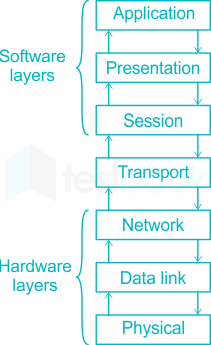
  • A router works on the third layer which is the Network layer of the OSI model, and it is based on the IP address of a computer
  • It is responsible for retrieving email messages from a mail server and is typically used by email client applications to download messages from the server to the client device.​
  • OSI stands for Open Systems Interconnection.
  • It has 7 layers that work collaboratively to transmit the data from one person to another across the globe.
  • Note that the data link layer is the 2nd layer in the OSI model

Hence, Statement II is incorrect.

Thus we conclude that Statement I is true but Statement II is false.


Open system interconnections

Open system interconnections Model.

29

CBCS is

  1. ((a))

    Criteria Based Choice System

  2. ((b))

    Choice Based Credit System

  3. ((c))

    Criteria Based Creditable Scores

  4. ((d))

    Credit Based Choice Scores

Show Answer
Answer: ((b))

Choice Based Credit System

The Choice Based Credit System (CBCS) is an educational model that offers students to opt for courses & subjects of their choice - core, elective courses, open or global electives & skill-based courses.

The Choice Based Credit System (CBCS)

  • It was introduced by the University Grants Commission (UGC)
  • Unlike the traditional marking-based system, the CBCS grading pattern is based on earned credits every semester.
  • The primary objective behind this thoughtful CBCS scheme is to encourage students to be all-rounders by taking their skills a notch higher.
  • CBCS system offers three types of course choices to the Students- Core, Elective, and Foundation.
  • Core Course: 
  • Students need to choose a core subject compulsorily to complete the credit requirement.
  • Elective Course: 
  • These subjects have more generic content and aim to increase the students' skills. They expose the student to subjects that are not in their curriculum. Students get the freedom to opt for the subjects of their personal interest.
  • Foundation: 
  • Also referred to as ‘Ability Enhancement Courses’, the foundation courses offer value-based subjects that lead to knowledge enhancement. Such value-based subjects can help students grab excellent career opportunities in the long run.

Hence CBCS Choice Based Credit System.

30

Given below are two statements

Statement I : Policy action and implementation plans require sound database systems at the regional level only.

Statement II : The statistical system should ensure its impeccability with data architecture, security, quality, cleaning and integration.

In light of the above statements, choose the most appropriate answer from the options given below

  1. ((a))

    Statement I is incorrect but Statement II is correct

  2. ((b))

    Both Statement I and Statement II are correct

  3. ((c))

    Both Statement I and Statement II are incorrect

  4. ((d))

    Statement I is correct but Statement II is incorrect

Show Answer
Answer: ((a))

Statement I is incorrect but Statement II is correct

 Key PointsStatement I: Policy action and implementation plans require sound database systems at the regional level only.​

Policymaking process:

The five steps of the policymaking process as per the work of Harold Lasswell are

  • Agenda Setting
  • Policy Formation
  • Decision Making
  • Policy Implementation and
  • Policy Evaluation which is the 1950s
  • In the Policy Implementation stage, government rolls out the policy, and through public administration tools public officials for the distribution of government resources in whatever form they take.
  • So in the Policy Implementation stage, the data is collected at all the organizational levels possible, not limited to the regional level

Hence Statement I is incorrect.

Statement II: The statistical system should ensure its impeccability with data architecture, security, quality, cleaning, and integration.

  • All good databases should begin with valuable metadata and data.
  • It should maintain 
  • Data integrity refers to how accurate and consistent the data in a database is. Databases with lots of missing information and incorrect information are said to have low data integrity.
  • Data independence refers to the separation between data and the application (or applications) in which it is being used which allows you to update the data in your without having to recompile the entire database.
  • Data Redundancy refers to having the exact same data at different places in the database. Data redundancy Increases the size of the database, creates Integrity problems, decreases efficiency, and leads to anomalies. Data should be stored so that It Is not repeated In multiple tables.
  • Data security refers to how well the data in the database is protected from crashes, hacks, and accidental deletion
  • Only a Good statistical system can ensure the database collected for policy formulation and implementation must reflect impeccability with data architecture, security, quality, cleaning, and integration.

Hence Statement II is correct.

Therefore we conclude that Statement I is incorrect but Statement II is correct.

31

Given below are two statements

Statement I : Truth and Falsehood are predicates of Arguments

Statement II : Validity and Invalidity are predicates of Statements

In light of the above statements, choose the most appropriate answer from the options given below

  1. ((a))

    Both Statement I and Statement II are correct

  2. ((b))

    Both Statement I and Statement II are incorrect

  3. ((c))

    Statement I is correct but Statement II is incorrect

  4. ((d))

    Statement I is incorrect but Statement II is correct

Show Answer
Answer: ((b))

Both Statement I and Statement II are incorrect

Key Points

Statement I: Truth and Falsehood are predicates of Arguments

Argument:

  • An argument is a group of statements including one or more premises and one and only one conclusion.
  • A premise is a statement in an argument that provides reason or support for the conclusion. There can be one or many premises in a single argument.
  • A conclusion is a statement in an argument that indicates what the arguer is trying to convince the reader/listener. What is the argument trying to prove? There can be only one conclusion in a single argument.
  • Validity and invalidity apply only to arguments, not statements.
  • True and false apply only to statements, not arguments.
  • A valid argument is valid if and only if it is necessary that if all of the premises are true, then the conclusion is true; if all the premises are true, then the conclusion must be true; it is impossible that all the premises are true and the conclusion is false.
  • Invalid Argument is not valid.  We can test for invalidity by assuming that all the premises are true and seeing whether it is still possible for the conclusion to be false.  If this is possible, the argument is invalid.
  • While the truth value of individual statements within an argument is relevant to assessing the overall validity or soundness of the argument, truth and falsehood are properties of statements themselves.

Hence statement I is incorrect.

Statement II: Validity and Invalidity are predicates of Statements

Statement:

  • A statement is a sentence that is either true or false, such as "The cat is on the mat."
  • True and false apply only to statements, not arguments.
  • Validity and invalidity apply only to arguments, not statements.
  • An argument is considered valid when the conclusion logically follows from the premises, regardless of whether the premises or conclusion are true or false.
  • Invalidity, on the other hand, means that the conclusion does not logically follow from the premises.

Hence statement II is incorrect.

Therefore we conclude that Both Statements I and Statement II are incorrect.

32

In order to transform the regulatory system of Higher Education, the NEP proposes to set up HECI (Higher Education Commission of India). Which of the following are verticals of HECI?

A. NHERC

B. NAS

C. HEGC

D. NCIVE

E. NAC

Choose the correct answer from the options given below :

  1. ((a))

    A, B and C only

  2. ((b))

    B, C and E only

  3. ((c))

    A, C and E only

  4. ((d))

    C, D and E only

Show Answer
Answer: ((c))

A, C and E only

The Higher Education Council of India (HECI) acts as a single regulator for higher education institutions across the country. as per The New Education Policy (NEP) 2020.

Key Points

The Higher Education Council of India (HECI) would have multiple verticals to fulfill various roles.

  1. The first vertical of HECI will be the National Higher Education Regulatory Council (NHERC) which will function as the common, single point regulator for the higher education sector including teacher education excluding medical and legal education.
  2. The second vertical of HECI will be a ‘meta-accrediting body’, called the National Accreditation Council (NAC). Accreditation of institutions will be based primarily on basic norms, public self-disclosure, good governance, and outcomes, and it will be carried out by an independent ecosystem of accrediting institutions supervised and overseen by NAC.
  3. The third vertical of HECI will be the Higher Education Grants Council (HEGC), which will carry out funding and financing of colleges and varsities.
  4. The fourth vertical of HECI will be the General Education Council (GEC), which will frame expected learning outcomes for higher education programs, also referred to as ‘graduate attributes.

Additional Information

  • A National Higher Education Qualification Framework (NHEQF) will be formulated by the GEC.
  • The functioning of all the independent verticals for Regulation (NHERC), Accreditation (NAC), Funding (HEGC), and Academic Standard Setting (GEC) and the overarching autonomous umbrella body (HECI) itself will be based on transparent public disclosure, and use technology extensively to reduce the human interface to ensure efficiency and transparency in their work.

Therefore we conclude that the correct answer is A, C, and E only

33

Given below are two statements

Statement I: Exploration is particularly useful when researchers lack a clear idea of the problems they will meet during the study.

Statement II: Through exploration, researchers develop concepts more clearly, establish priorities, develop operational definitions, and improve the final research design.

In light of the above statements, choose the correct answer from the options given below

  1. ((a))

    Both Statement I and Statement II are true

  2. ((b))

    Both Statement I and Statement II are false

  3. ((c))

    Statement I is true but Statement II is false

  4. ((d))

    Statement I is false but Statement II is true

Show Answer
Answer: ((a))

Both Statement I and Statement II are true

 Key PointsStatement I: Exploration is particularly useful when researchers lack a clear idea of the problems they will meet during the study.

  • Exploratory research is often conducted because a problem has not been clearly defined as yet, or its real scope is as yet unclear.
  • It allows the researcher to familiarize him/herself with the problem or concept to be studied, and perhaps generate hypotheses to be tested.
  • It is the initial research, before more conclusive research is undertaken.
  • Exploratory research helps determine the best research design, data collection method, and selection of subjects, and sometimes it even concludes that the problem does not exist.

Hence statement I is correct.

Statement II : Through exploration, researchers develop concepts more clearly, establish priorities, develop operational definitions, and improve the final research design.

  • Exploratory research can be quite informal, relying on secondary research such as reviewing available literature
  • It can also be based on qualitative approaches such as informal discussions with consumers, employees, management, or competitors, through in-depth interviews, focus groups, projective methods, case studies, or pilot studies.
  • The results of exploratory research are not usually useful for decision-making by themselves, but they can provide significant insight into a given situation.
  • In other words, the results can neither be generalized; they are not representative of the whole population being studied.

Hence statement II is correct.

Hence, both statement I and statement II are correct.

34

Survey research is based on which of the following?

  1. ((a))

    Constructivism

  2. ((b))

    Interpretivism

  3. ((c))

    Positivism

  4. ((d))

    Hermeneutics

Show Answer
Answer: ((c))

Positivism

Survey Research is defined as the process of conducting research using surveys that researchers send to survey respondents. The data collected from surveys is then statistically analyzed to draw meaningful research conclusions.

Key PointsPositivism:

  • Positivism is a theory that states all authentic knowledge can be verified through scientific methods such as observation, experiments, and logical proof.
  • Positivism refers to an approach to the study of society through scientific methods.
  • In research, positivists prefer quantitative methods such as structured questionnaires, social surveys, and official statistics.
  • Moreover, positivists consider the social sciences to be as scientific as the natural sciences.
  • The scientific methods they use in research involve generating theories and hypotheses based on survey research.

Hence, survey research is based on the concept of positivism.

Additional Information 

  • Interpretivism- Interpretivism is a more qualitative approach to social research. Interpretivism is of the view that individuals are complex and intricate people, not just puppets reacting to external social forces.
  • Constructivism- Constructivism accepts reality as a construct of the human mind, therefore reality is perceived to be subjective.
  • **Hermeneutics-**Hermeneutic research emphasizes subjective interpretations in the research of meanings of texts, art, culture, social phenomena, and thinking.
35

If 'All men are mortal' is given as True, then which of the following options can be validly inferred from it?

A. 'No men is mortal' is False

B. 'Some men are mortal' is True

C. 'Some men are not mortal' is True

D. 'Some men are not mortal' is False

E. 'Some men are mortal' is False

Choose the correct answer from the options given below :

  1. ((a))

    A, B and C only

  2. ((b))

    A, B and D only

  3. ((c))

    A, B, C and D only

  4. ((d))

    B, C, D and E only

Show Answer
Answer: ((b))

A, B and D only

Modern logic accepts the Boolean interpretation of categorical propositions. This interpretation has the following consequences: 

Because A and E propositions have no existential import, sub-alternation is not valid.

Because A and E propositions have no existential import, super-alternation is not valid.

Key Points

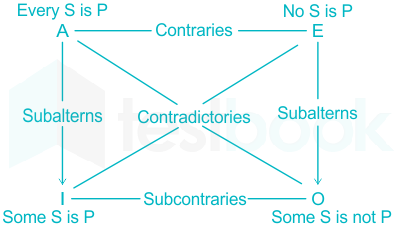
![Solved] According to traditional square of opposition, if two propos](https://storage.googleapis.com/tb-img/production/20/06/F1_A.A._Madhu_19.05.20_D1.png)

According to Boolean interpretation, the universal statement A is written as the conditional of the following type:

For any x, if x is S then x is P.

Let us take examples of universal propositions A and E with their modern interpretation:

  1. “All men are mammals” would mean “for any x, if x is a man then x is a mammal”
  2. “All unicorns are mammals” would mean “for any x, if x is a unicorn then x is a mammal”

We see that none of these conditional statements make any assertion concerning the existence of members of a class.

  • According to Boolean interpretation unlike “all” in universal propositions, the word “some” in an I proposition makes the claim that there is a membership in the subject class.
  • “Some” is interpreted to mean “at least one.” Therefore if particular propositions are true then the subject class is not empty because particular propositions are analyzed in conjunction with an existential claim.
  • For example, “Some roses are beautiful” would mean “There is at least one x such that x is a rose and x is beautiful” However, we should note that in the Boolean interpretation there is no claim to membership in the subject class of universal propositions.

If “unicorn” is the subject and there are no members in the subject class (subject being empty) then both the propositions “No S is P” as well as “All S is P” can be true.

Also, If there are no unicorns, then I proposition, “Some unicorns are horned creatures” and O proposition, “Some unicorns are not horned creatures” are both false.

Similarly, If 'All men are mortal' is given as True, then valid inferences are

 'No men is mortal' is False

 'Some men are mortal' is True 

'Some men are not mortal' is False

Hence statements A, B and D only are correct.

36

The number of Sustainable Development Goals is

  1. ((a))

    13

  2. ((b))

    15

  3. ((c))

    17

  4. ((d))

    19

Show Answer
Answer: ((c))

17

The Sustainable Development Goals (SDGs), also known as the Global Goals, were adopted by the United Nations in 2015 as a universal call to action to end poverty, protect the planet, and ensure that by 2030 all people enjoy peace and prosperity.

Key Points

 Sustainable Development Goals (SDGs)

  • The SDGs were set up in 2015 by the United Nations General Assembly (UN-GA) and are intended to be achieved by 2030.
  • They are included in a UNGA Resolution called the 2030 Agenda or what is colloquially known as Agenda 2030.
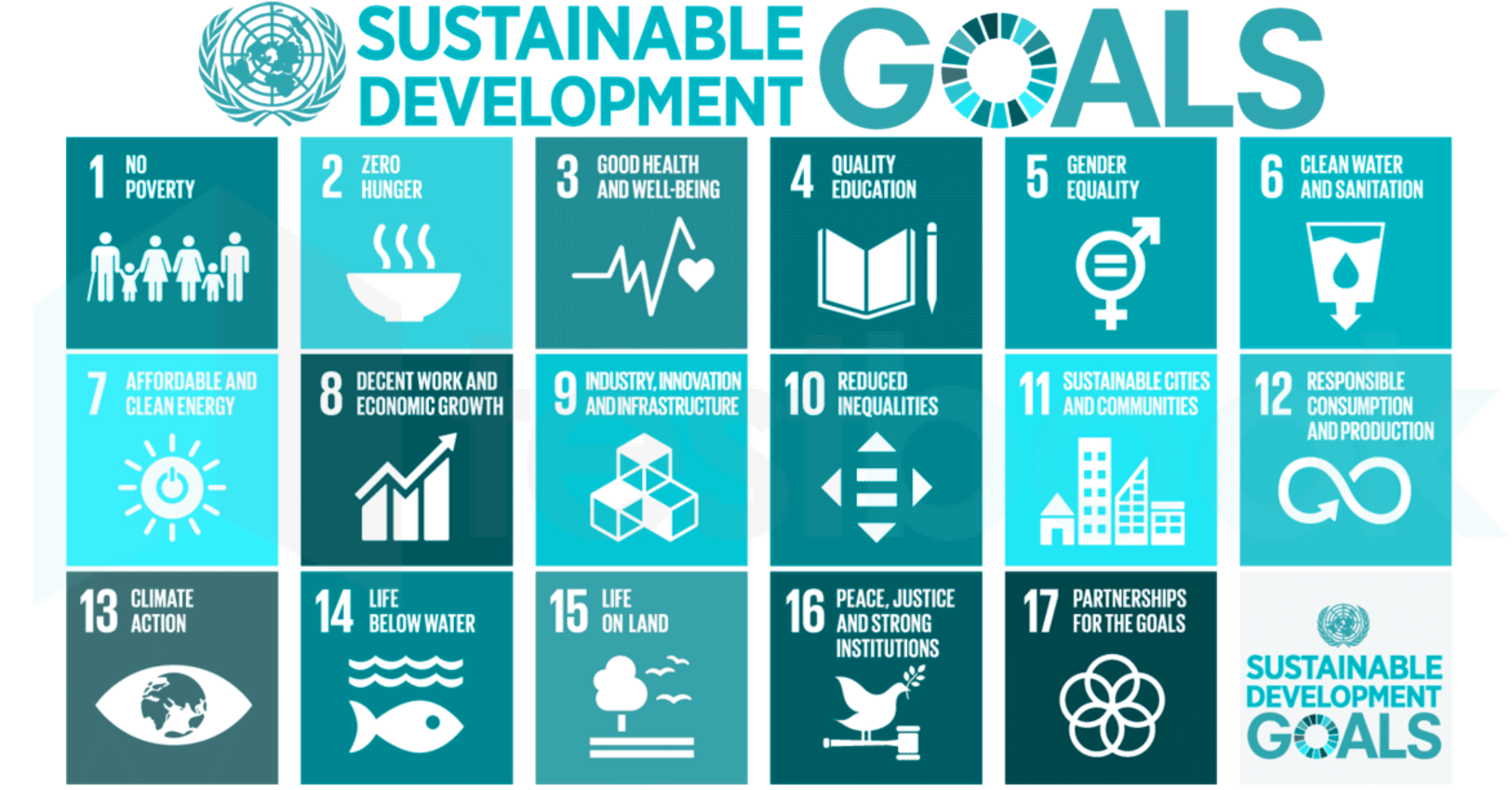
  • These or Global Goals are a collection of 17 interlinked global goals designed to be a "blueprint to achieve a better and more sustainable future for all".
  • The SDGs were developed in the Post-2015
  • Development Agenda as the future global development framework to succeed in the Millennium Development Goals which ended in 2015.

![Solved] World Literacy Day falls on](https://storage.googleapis.com/tb-img/production/20/11/F1_Alka_Anil_06.11.20_D2.png)

Hence the number of Sustainable Development Goals is 17.

Read the passage carefully and answer the questions that follows

Leadership studies are an emergent discipline, and the concept of leadership will continue to change. Leadership lore is defined as an influence relationship among leaders and followers who want real change and outcomes that reflect their shared purpose. Leadership involves influence. It occurs among people; those people who intentionally desire significant changes, and the changes reflect purpose shared by the leaders and their followers.

Influence means that the relationship among people is not passive; however, also part of this definition is that influence is multidirectional. It does not use orders or threats to make somebody do something. The basic cultural values in America make it easiest to think of leadership as something a leader does to a follower. However, leadership has an effect in both directions. In most organizations, superiors influence subordinates, but subordinates also influence superiors. The people involved in the relationship want real and important changes-leadership involves creating change, not maintaining what normally happens. In addition, the changes sought are not dictated by leaders, but reflect purposes that leaders and followers share. Moreover, change is toward an outcome that the leaders and follower both want; a desired future or shared purpose that motivates them toward this more preferable outcome. An important aspect of leadership is influencing others to come together around a common vision. Thus, leadership involves the influence of people to bring about change toward a desirable future

37

"Leadership studies are an emerging discipline", means :

  1. ((a))

    Leadership studies are an established field

  2. ((b))

    Leadership studies are a valid field of research

  3. ((c))

    Leadership studies is an evolving domain of scholarship

  4. ((d))

    Leadership studies is an elaborate field

Show Answer
Answer: ((c))

Leadership studies is an evolving domain of scholarship

The correct answer is 'Leadership studies is an evolving domain of scholarship'

Key Points

Let's look at the excerpt from the passage: 

Leadership studies are an emergent discipline, and the concept of leadership will continue to change. ​

  • In the given statement, the author says 'Leadership studies are an emergent discipline' which means that Leadership studies are an evolving domain of scholarship'

Thus, option 3 is the correct answer.

38

What variables are used for defining leadership?

  1. ((a))

    Power to affect relationship and desire for change in the true sense of the team

  2. ((b))

    Power to get things done quickly by influence

  3. ((c))

    Power to change and control

  4. ((d))

    Power to effect and desire for mandated change

Show Answer
Answer: ((a))

Power to affect relationship and desire for change in the true sense of the team

The correct answer is 'Power to affect relationships and desire for change in the true sense of the team.'

Key Points

Let's look at the excerpt from the passage: 

*'The leadership role is defined as an influence relationship between leaders and followers who want real change and outcomes that reflect their shared purpose. Leadership involves influence. It occurs among people; those people who intentionally desire significant changes, and the changes reflect the purpose shared by the leaders and their followers.'*​

  • In the given statement, the author has defined leadership as an influence relationship between leaders and followers. Further, he has described followers as the people who desire real change.

Hence variables that are used for defining leadership are the Power to affect relationships and the desire for change in the true sense of the team.

Thus, option 1 is the correct answer.

39

What is the main theme of this passage?

  1. ((a))

    Explanation of leadership construct

  2. ((b))

    Argument about leadership

  3. ((c))

    Models of leadership

  4. ((d))

    Pros and cons of leadership

Show Answer
Answer: ((a))

Explanation of leadership construct

The correct answer is 'Explanation of the leadership construct'

Key Points

Let's look at the excerpt from the passage: 

'The leadership role is defined as an influence relationship between leaders and followers who want real change and outcomes that reflect their shared purpose. Leadership involves influence. It occurs among people; those people who intentionally desire significant changes, and the changes reflect the purpose shared by the leaders and their followers.'​

  • In the given passage, the author has defined leadership and he has tried to explain the characteristics and various aspects of leaders.

Hence the main theme of this passage revolves around the leadership constructs.

Thus, option 1 is the correct answer.

40

What should be the outcome of leadership actions?

  1. ((a))

    Movement towards the vision of the leader

  2. ((b))

    Movement towards common vision of the leader and the followers

  3. ((c))

    Movement towards the vision of the majority

  4. ((d))

    Strengthening of the authority of leaders

Show Answer
Answer: ((b))

Movement towards common vision of the leader and the followers

The correct answer is 'Movement towards a common vision of the leader and the followers'

Key Points

Let's look at the excerpt from the passage: 

'change is toward an outcome that the leaders and followers both want; a desired future or shared purpose that motivates them toward this more preferable outcome.'​

  • In the given passage, the author has defined leadership and he has tried to explain the characteristics and various aspects of leaders. He has also explained the possible outcomes of leadership actions. He referred to it as a change towards an outcome that the leaders and followers both want; a desired future or shared purpose.

Hence the outcome of leadership actions is a movement towards a common vision of the leader and the followers.

Thus, option 2 is the correct answer.

41

The concept of leadership discussed in this passage is

  1. ((a))

    Verticle-topdown

  2. ((b))

    Horizontal

  3. ((c))

    Individualistic

  4. ((d))

    Exceptional

Show Answer
Answer: ((b))

Horizontal

The correct answer is 'Horizontal'

Key Points

Let's look at the excerpt from the passage: 

'leadership has an effect in both directions. In most organizations, superiors influence subordinates, but subordinates also influence superiors.'​

  • In the given passage, the author has stated that in an organization, effective leadership influences the directions that impact both superiors and subordinates. Thus it is horizontal in nature.

Hence the concept of leadership discussed in this passage is horizontal.

Thus, option 2 is the correct answer.

42

mooKIT platform uses _______, an open source content management system.

  1. ((a))

    DRUPAL

  2. ((b))

    JOOMLA

  3. ((c))

    SAKAI

  4. ((d))

    Moodle

Show Answer
Answer: ((a))

DRUPAL

A content management system is a software application or a set of tools and capabilities, that allows you to create, manage and deliver content via digital channels.

Key Points mooKIT: mooKIT is a lightweight MOOC management system conceived, designed, and developed at IIT Kanpur targeting developing nations.

  • The mooKIT platform takes advantage of Drupal's flexibility to offer a wide range of features and functionality.
  • For example, the platform can be used to create websites, intranets, and e-commerce applications. It can also be used to manage content, users, and permissions.
  • The mooKIT platform is also scalable, meaning that it can be used to create websites of any size. The platform is also secure, meaning that it is protected from common security threats.
  • mooKIT, an open-source MOOC management software, has been used in more than 60 courses so far in India and abroad.
  • mooKIT is a system that instructors, learners, and system administrators find easy to work with - designed for “Internet Novices”.
  • Its unique architecture makes it highly customizable and cost-effective at any scale.
  • The CMS component is operable using the Drupal content management framework.
  • Drupal is a free and open-source software package that enables users to organize and upload content to a database or server.

Hence, the mooKIT platform uses DRUPAL which is an open-source content management system.

Additional Information

  • Joomla sometimes abbreviated as J!, is a free and open-source content management system for publishing web content on websites.
  • Sakai is an educational software platform designed to support teaching, research, and collaboration. Sakai facilitates document distribution, discussion, live chat, assignment uploads, and online testing.
  • Moodle is a free and open-source learning management system written in PHP and distributed under the GNU General Public License.
43

Match List I with List II

List IList II
I/O deviceData transfer rate
A.DiskI.50 bps
B.MouseII.1 Mbps
C.Laser printerIII.120 bps
D.KeyboardIV.100 Mbps

Choose the correct answer from the options given below :

  1. ((a))

    A - I, B - II, C - III, D - IV

  2. ((b))

    A - II, B - I, C - III, D - IV

  3. ((c))

    A - IV, B - III, C - II, D - I

  4. ((d))

    A - IV, B - II, C - I, D - III

Show Answer
Answer: ((c))

A - IV, B - III, C - II, D - I

Key Points

I/O deviceData transfer rate
Disc- An optical data storage device that is round, flat, and ridged that is written to using a laser. An example of a disc is a Blu-ray, CD, and DVD. - Its data transfer rate is 100 bps.
Mouse- The mouse is a hand-held input device that is used to move the cursor or pointer across the screen - Its data transfer rate is 120 Mbps.
Laser printer- A laser printer is a non-impact printer that uses a laser beam to print the characters. - Its data transfer rate is 1 Mbps
Keyboard- The keyboard is a basic input device that is used to enter data into a computer or any other electronic device by pressing keys. - Its data transfer rate is 50 bps.

Therefore the correct matching code is A-IV, B - III, C - II, D - I

44

Global Citizenship Education promotes

  1. ((a))

    common international laws for global citizenship.

  2. ((b))

    issues pertaining to citizenship across countries involving VISA.

  3. ((c))

    international public relations.

  4. ((d))

    more peaceful, tolerant, including, secure and sustainable societies.

Show Answer
Answer: ((d))

more peaceful, tolerant, including, secure and sustainable societies.

Global Citizenship Education (GCED) is UNESCO’s initiative.

Key Points

  • GCED works by empowering learners of all ages to understand that these are global, not local issues and to become active promoters of more peaceful, tolerant, inclusive, secure, and sustainable societies.
  • GCED is a strategic area of UNESCO’s Education Sector program and builds on the work of Peace and Human Rights Education.
  • It aims to instil in learners the values, attitudes, and behaviours that support responsible global citizenship: creativity, innovation, and commitment to peace, human rights, and sustainable development.
  • UNESCO’s work in this area is grounded in its own Constitution which aims to ‘build peace in the minds of men and women,’ the Universal Declaration of Human Rights, the Education 2030 Agenda, and the Framework for Action, notably Target 4.7 of the Sustainable Development Agenda.

Hence Global Citizenship Education promotes more peaceful, tolerant, including, secure and sustainable societies.

Study the table carefully and answer the questions that follow

In the following table, total Exports and Imports of 5 countries over 4 years (in Rs Crore) is given. Study the table carefully and answer the given questions. (I-import, E-export)

Year2017201820192020
CountryIEIEIEIE
P2530243228362232
Q2826263129372634
R2432282532362834
S2228182816212332
T2631163312232128
45

Find out the difference between the average export and average import for the country P.

  1. ((a))

    8.25

  2. ((b))

    7.75

  3. ((c))

    8.50

  4. ((d))

    7.25

Show Answer
Answer: ((b))

7.75

Given:

There is the total number of exports and Imports of five countries over four years (in Rs Crore) is given in the table.

Concept used:

Average = The sum of the terms/Total number of terms

Calculation:

The average export for country P = (30 + 32 + 36 + 32)/4 = 130/4 = 32.5

The average import for country P = (25 + 24 + 28 + 22)/4 = 99/4 = 24.75

The difference = 32.5 - 24.75 = 7.75 (in Rs Crore)

∴ The difference between the average export and average import for the country P is 7.75

46

Which country has the maximum percentage of profit increase from 2019 to 2020?

(Profit = Export - Import)

  1. ((a))

    P

  2. ((b))

    Q

  3. ((c))

    R

  4. ((d))

    S

Show Answer
Answer: ((d))

S

Given: 

There is the total number of exports and Imports of five countries over four years (in Rs Crore) is given in the table.

Concept used:

(Profit = Export - Import)

Calculation:

The profit of country P in 2019 = 36 - 28 = 8

The profit of country P in 2020 = 32 - 22 = 10

The profit of country P increases from 2019 to 2020 = 10 - 8 = 2

The percentage of profit of country P from 2019 to 2020 = (2/8) × 100 = 25%

The profit of country Q in 2019 = 37 - 29 = 8

The profit of country Q in 2020 = 34 - 26 = 8

The profit of country Q increases from 2019 to 2020 = 8 - 8 = 0

The percentage of profit of country Q from 2019 to 2020 = (0/8) × 100 = 0%

The profit of country R in 2019 = 36 - 32 = 4

The profit of country R in 2020 = 34 - 28 = 6

The profit of country R increases from 2019 to 2020 = 6 - 4 = 2

The percentage of profit of country R from 2019 to 2020 = (2/4) × 100 = 50%

The profit of country S in 2019 = 21 - 16 = 5

The profit of country S in 2020 = 32 - 23 = 9

The profit of country S increases from 2019 to 2020 = 9 - 5 = 4

The percentage of profit of country S from 2019 to 2020 = (4/5) × 100 = 80%

The profit of country T in 2019 = 23 - 12 = 9

The profit of country T in 2020 = 28 - 21 = 7

Here, the profit has been decreased from 2019 to 2020 of country T.

Hence, the percentage of profit of country S is greater than other country.

∴ The country S has the maximum percentage of profit increase from 2019 to 2020.

47

Which year has the maximum export?

  1. ((a))

    2017

  2. ((b))

    2018

  3. ((c))

    2019

  4. ((d))

    2020

Show Answer
Answer: ((d))

2020

Given: 

There is the total number of exports and Imports of five countries over four years (in Rs Crore) is given in the table.

Calculation:

The total number of export in 2017 = 30 + 26 + 32 + 28 + 31 = 147

The total number of export in 2018 = 32 + 31 + 25 + 28 + 33 = 149

The total number of export in 2019 = 36 + 37 + 36 + 21 + 23 = 153

The total number of export in 2020 = 32 + 34 + 34 + 32 + 28 = 160

∴ The year 2020 has the maximum export.

48

Which year has the minimum average import?

  1. ((a))

    2017

  2. ((b))

    2018

  3. ((c))

    2019

  4. ((d))

    2020

Show Answer
Answer: ((b))

2018

Given:  

There is the total number of exports and Imports of five countries over four years (in Rs Crore) is given in the table.

Concept used:

Average = The sum of the terms/Total number of terms

Calculation:

The average import in 2017 = (25 + 28 + 24 + 22 + 26)/5 = 125/5 = 25

The average import in 2018 = (24 + 26 + 28 + 18 + 16)/5 = 112/5 = 22.4

The average import in 2019 = (28 + 29 + 32 + 16 + 12)/5 = 117/5 = 23.4

The average import in 2020 = (22 + 26 + 28 + 23 + 21)/5 = 120/5 = 24

∴ The year 2018 has the minimum average import.

49

Find out the ratio of export done by country S and T during 2017-2020.

  1. ((a))

    109115\frac {109}{115}

  2. ((b))

    111115\frac {111}{115}

  3. ((c))

    108117\frac{108}{117}

  4. ((d))

    107117\frac{107}{117}

Show Answer
Answer: ((a))

109115\frac {109}{115}

Given: 

There is the total number of exports and Imports of five countries over four years (in Rs Crore) is given in the table.

Calculation:

The total export of country S during 2017-2020 = 28 + 28 + 21 + 32 = 109

The total export of country T during 2017-2020 = 31 + 33 + 23 + 28 = 115

The total export of country S during 2017-2020/The total export of country T during 2017-2020 = 109/115

∴ The ratio of export done by country S and T during 2017-2020 is 109/115

50

Following are some statements regarding File Transfer Protocol (FTP). Choose the correct statements

A. It is used to access the world wide web (www)

B. It is used to download data from file servers

C. It is used for very small files

D. Files are transferred from one device to another

Choose the correct answer from the options given below :

  1. ((a))

    A and B only

  2. ((b))

    A and C only

  3. ((c))

    B and D only

  4. ((d))

    B and C only

Show Answer
Answer: ((c))

B and D only

File transfer protocol (FTP) is a standard internet protocol provided by TCP/IP used for transmitting the files from one host to another.

Key Points

FTP is mainly used for transferring the web page files from their creator to the computer that acts as a server for other computers on the internet.

  • It is also used for downloading files to computers from other servers.
  • FTP serves two operations, i.e., to send and receive large files on a network. However, the size limit of the file is 2GB which can be sent.
  • FTP and e-mail are all part of the Internet but are not part of the World Wide Web.
  • The Hyper-Text Transfer Protocol (HTTP) is the method used to transfer Web pages to your computer.

Hence we conclude that the correct answer is B and D only.

Additional Information

  • A web browser (commonly referred to as a browser) is a software user agent for accessing the information on the World Wide Web.
  • A file that is less than HDFS block size(64MB/128MB) is termed a small file.
  • Namenode stores all files metadata in memory, so to store lots of small files,namenode has to maintain its metadata, for file metadata, it occupies 150 bytes so in the case of million files it would cost around 3GB of memory.

Attempt this paper under real exam conditions

Timed interface, section switching, instant scoring, and question-by-question analytics — free.

Start Timed Attempt