Official Paper

UGC NET Paper 1: Held on 24th Nov 2021 Shift 1 (Previous Year Paper)

50 questions · 60 minutes · with answers · free

Paper 1 (50 questions)

Study the given table carefully and answer the questions that follow.

Number (N) of candidates (in lakhs) appearing for a University Entrance examination from four different states (A, B, C, D) and the percentage (P) of candidates clearing the same over the years are provided in the table below

StateABCD
YearNP(%)NP(%)NP(%)NP(%)
20162.31321.64422.60463.329
20172.02441.72412.45363.132
20181.98392.02372.20332.931
20191.85282.10432.50422.734
20202.20331.90462.55303.035
1

Find out the total number of students who have cleared the entrance exam from 2016 to 2020 in State A.

  1. ((a))

    355460

  2. ((b))

    364420

  3. ((c))

    360890

  4. ((d))

    358660

Show Answer
Answer: ((b))

364420

Given:

There are the number of candidates (in lakhs) appearing for a University Entrance examination for state A and the percentage (P) of candidates who have cleared the exam.

Calculation:

For state A,

The number of candidates appearing in 2016 = 2.31 (in lakhs) = 2.31 × 100000 = 231000

The percentage of clearing candidates in 2016 = 32%

The number of candidates who cleared the exam in 2016 = 231000 × (32/100) = 73920

The number of candidates appearing in 2017 = 2.02 (in lakhs) = 2.02 × 100000 = 202000

The percentage of clearing candidates in 2017 = 44%

The number of candidates who cleared the exam in 2017 = 202000 × (44/100) = 88880

The number of candidates appearing in 2018 = 1.98 (in lakhs) = 1.98 × 100000 = 198000

The percentage of clearing candidates in 2018 = 39%

The number of candidates who cleared the exam in 2018 = 198000 × (39/100) = 77220

The number of candidates appearing in 2019 = 2.31 (in lakhs) = 1.85 × 100000 = 185000

The percentage of clearing candidates in 2019 = 28%

The number of candidates who cleared the exam in 2019 = 185000 × (28/100) = 51800

The number of candidates appearing in 2020 = 2.31 (in lakhs) = 2.20 × 100000 = 220000

The percentage of clearing candidates in 2020 = 33%

The number of candidates who cleared the exam in 2020 = 220000 × (33/100) = 72600

The total number of candidates who cleared the entrance exam = 73920 + 88880 + 77220 + 51800 + 72600 = 364420

∴ The total number of students who have cleared the entrance exam from 2016 to 2020 in State A is 364420


2

Find out the average number of students who qualified in 2020 (from all states).

  1. ((a))

    84550

  2. ((b))

    86770

  3. ((c))

    85375

  4. ((d))

    84580

Show Answer
Answer: ((c))

85375

Given: 

There are the number of candidates (in lakhs) appearing for a University Entrance examination from four different states (A, B, C, D) and the percentage of candidates clearing the same in 2020.

Concept used:

Average = The sum of the terms/Total number of terms

Calculation:

For state A,

The number of students appearing in 2020 = 2.31 (in lakhs) = 2.20 × 100000 = 220000

The percentage of clearing students in 2020 = 33%

The number of students who cleared the exam in 2020 = 220000 × (33/100) = 72600

For state B,

The number of students appearing in 2020 = 1.90 (in lakhs) = 1.90 × 100000 = 190000

The percentage of clearing students in 2020 = 46%

The number of students who cleared the exam in 2020 = 190000 × (46/100) = 87400

For state C,

The number of students appearing in 2020 = 2.55 (in lakhs) = 2.55 × 100000 = 255000

The percentage of clearing students in 2020 = 30%

The number of students who cleared the exam in 2020 = 255000 × (30/100) = 76500

For state D,

The number of students appearing in 2020 = 2.31 (in lakhs) = 3.0 × 100000 = 300000

The percentage of clearing students in 2020 = 35%

∴ The number of students who cleared the exam in 2020 = 300000 × (35/100) = 105000

The average number of qualified students in 2020 from all states = (72600 + 87400 + 76500 + 105000)/4

= 341500/4

= 85375

∴ The average number of students who qualified in 2020 (from all states) is 85375

3

In which year did the highest number of candidates clear the entrance exam from State B?

  1. ((a))

    2019

  2. ((b))

    2020

  3. ((c))

    2016

  4. ((d))

    2018

Show Answer
Answer: ((a))

2019

Given:

There are the number of candidates (in lakhs) appearing for a University Entrance examination from state B and the percentage of candidates clearing the same.

Calculation:

From state B,

The total number of candidates who appeared in 2016 = 1.64 (in lakhs) = 1.64 × 100000 = 164000

The percentage of qualified candidates in 2016 = 42%

The number of qualified candidates in 2016 = 164000 × (42/100) = 68880

The total number of candidates who appeared in 2017 = 1.72 (in lakhs) = 1.72 × 100000 = 172000

The percentage of qualified candidates in 2017 = 41%

The number of qualified candidates in 2017 = 172000 × (41/100) = 70520

The total number of candidates who appeared in 2018 = 2.02 (in lakhs) = 2.02 × 100000 = 202000

The percentage of qualified candidates in 2018 = 37%

The number of qualified candidates in 2018 = 202000 × (37/100) = 74740

The total number of candidates who appeared in 2019 = 2.10 (in lakhs) = 2.10 × 100000 = 210000

The percentage of qualified candidates in 2019 = 43%

The number of qualified candidates in 2019 = 210000 × (43/100) = 90300

The total number of candidates who appeared in 2020 = 1.90 (in lakhs) = 1.90 × 100000 = 190000

The percentage of qualified candidates in 2020 = 46%

The number of qualified candidates in 2020 = 190000 × (46/100) = 87400

Hence, the number of qualified candidates in 2019 from state B is greater than other years.

∴ The highest number of candidates cleared the entrance exam from State B in 2019

4

Find out the difference between the total number of students who qualified in 2017 and the total number of students who qualified in 2018 (from all states):

  1. ((a))

    31750

  2. ((b))

    31880

  3. ((c))

    32220

  4. ((d))

    32340

Show Answer
Answer: ((d))

32340

Given: 


There are the number of candidates (in lakhs) appearing for a University Entrance examination from four different states (A, B, C, D) and the percentage of candidates clearing the same in 2017 and 2018.

Calculation:

In the year 2017,

The total number of students who appeared from the state A = 2.02 (in lakhs) = 2.02 × 100000 = 202000

The percentage of qualified students from the state A = 44%

The number of qualified students from state A = 202000 × (44/100) = 88880

The total number of students who appeared from the state B = 1.72 (in lakhs) = 1.72 × 100000 = 172000

The percentage of qualified students from the state B = 41%

The number of qualified students from state B = 172000 × (41/100) = 70520

The total number of students who appeared from the state C = 2.45 (in lakhs) = 2.45 × 100000 = 245000

The percentage of qualified students from the state C = 36%

The number of qualified students from state C = 245000 × (36/100) = 88200

The total number of students who appeared from the state D = 3.1 (in lakhs) = 3.1 × 100000 = 310000

The percentage of qualified students from the state D = 32%

The number of qualified students from state D =310000 × (32/100) = 99200

In the year 2018,

The total number of students who appeared from the state A = 1.98 (in lakhs) = 1.98 × 100000 = 198000

The percentage of qualified students from the state A = 39%

The number of qualified students from state A = 198000 × (39/100) = 77220

The total number of students who appeared from the state B = 2.02 (in lakhs) = 2.02 × 100000 = 202000

The percentage of qualified students from the state B = 37%

The number of qualified students from state B = 202000 × (37/100) = 74740

The total number of students who appeared from the state C = 2.20 (in lakhs) = 2.20 × 100000 = 220000

The percentage of qualified students from the state C = 33%

The number of qualified students from state C = 220000 × (33/100) = 72600

The total number of students who appeared from the state D = 2.9 (in lakhs) = 2.9 × 100000 = 290000

The percentage of qualified students from the state D = 31%

The number of qualified students from state D = 290000 × (31/100) = 89900

∴ The total number of students who qualified in 2017 = 88880 + 70520 + 88200 + 99200 = 346800

∴ The total number of students who qualified in 2019 = 77220 + 74740 + 72600 + 89900 = 314460

The difference = 346800 - 314460 = 32340

∴ The difference between the total number of students who qualified in 2017 and the total number of students who qualified in 2018 (from all states) is 32340

5

Find out the average number of non‐qualified candidates in 2019 (from all states).

  1. ((a))

    135320

  2. ((b))

    144025

  3. ((c))

    137270

  4. ((d))

    139870

Show Answer
Answer: ((b))

144025

Given:

There are the number of candidates (in lakhs) appearing for a University Entrance examination from four different states (A, B, C, D) and the percentage of candidates clearing the same in 2019.

Total number of states = 4

Concept used:

Average = The sum of the terms/Total number of terms

Calculation:

In the year 2019,

The number of candidates who appeared for the entrance examination from state A = 1.85 (in lakhs) = 185000

The percentage of candidates who cleared the examination from state A = 28%

The number of qualified candidates from state A = 185000 × (28/100) = 51800

The number of non-qualified candidates from state A = 185000 - 51800 = 133200

The number of candidates who appeared for the entrance examination from state B = 2.10 (in lakhs) = 2.10 × 100000 = 210000

The percentage of candidates who cleared the examination from state B = 43%

The number of qualified candidates from state B = 210000 × (43/100) = 90300

The number of non-qualified candidates from state B = 210000 - 90300 = 119700

The number of candidates who appeared for the entrance examination from state C = 2.50 (in lakhs) = 2.50 × 100000 = 250000

The percentage of candidates who cleared the examination from state C = 42% 

The number of qualified candidates from state C = 250000 × (42/100) = 105000

The number of non-qualified candidates from state C = 250000 - 105000 = 145000

The number of candidates who appeared for the entrance examination from state D = 2.7 (in lakhs) = 2.7 × 100000 = 270000

The percentage of candidates who cleared the examination from state D = 34%

The number of qualified candidates from state D = 270000 × (34/100) = 91800

The number of non-qualified candidates from state D = 270000 - 91800 = 178200

The average = (133200 + 119700 + 145000 + 178200)/4

= 576100/4

= 144025

∴ The average number of non‐qualified candidates in 2019 (from all states) is 144025

6

What is the name for the technique which uses images that are often more evocative than words, and more precise and potent in triggering a wide range of associations and thinking?

  1. ((a))

    Brainstorming

  2. ((b))

    Story boarding

  3. ((c))

    Synectics

  4. ((d))

    Mind‐mapping

Show Answer
Answer: ((d))

Mind‐mapping

A mind map is a graphic that is used to visually arrange information in a hierarchy while also demonstrating relationships between parts of the whole.

Key Points

  • A mind map is a form of graphic organizer in which ideas and concepts are visually organized using a diagram.
  • The major idea or notion is placed in the diagram's center and related ideas are added radially around it.
  • Mind maps are used to assist organize information so that it is easier to comprehend.
  • It uses images that are often more evocative than words.
  • It is more precise and potent in triggering a wide range of associations and thinking.
  • Other ideas branch out from the key ideas, which are linked directly to the central concept.

​Thus, Mind‐mapping is the name for the technique which uses images that are often more evocative than words, and more precise and potent in triggering a wide range of associations and thinking. 

Additional Information

  • Storyboarding: 
  • A storyboard is a visual representation of a film or animation and is made up of a series of graphics that depict everything that will happen in the final result.
  • ​Synectics: 
  • ​Synectics is a problem-solving method that emphasizes the development of creative thinking in small groups of people with varying backgrounds and skills.
  • Brainstorming: 
  • Brainstorming is a technique for generating ideas and sharing information in order to solve a specific commercial or technical problem in which participants are encouraged to think freely.​
7

The satellite used for the transmission and telecast of SWAYAMPRABHA is called

  1. ((a))

    EDUSAT Satellite

  2. ((b))

    GSAT‐15 Satellite

  3. ((c))

    GSAT‐3 Satellite

  4. ((d))

    SP‐EDU‐15 Satellite

Show Answer
Answer: ((b))

GSAT‐15 Satellite

SWAYAM Prabha is a Ministry of Human Resources Development (Ministry of Education) project. 

Key Points

  • This project distributes 40 high-quality educational channels via DTH (Direct to Home) across the country.
  • All DD Free Dish and Dish TV subscribers can receive the Swayam Prabha DTH channels.
  • It is broadcast various educational programs 24 hours a day, seven days a week.
  • It includes curriculum-based course content in a variety of subjects.
  • This is primarily intended to make high-quality instructional resources available in distant places where internet connection is still limited.
  • The GSAT-15 satellite is used by the DTH networks to broadcast their programming.

Thus, The satellite used for the transmission and telecast of SWAYAMPRABHA is called GSAT‐15 Satellite.

Additional Information

  • SWAYAM is an acronym that stands for Study Webs of Active-Learning for Young Aspiring Minds.
  • NPTEL, IITs, UGC, CEC, IGNOU, NCERT, and NIOS provide the content.
  • The web portal is maintained by the INFLIBNET Centre.
8

Given below are two statements

Statement I: Personal competencies determine how we manage ourselves

Statement II: Social competencies determine how we handle relationships

In light of the above statements, choose the most appropriate answer from the options given below

  1. ((a))

    Both Statement I and Statement II are correct

  2. ((b))

    Both Statement I and Statement II are incorrect

  3. ((c))

    Statement I is correct but Statement II is incorrect

  4. ((d))

    Statement I is incorrect but Statement II is correct

Show Answer
Answer: ((a))

Both Statement I and Statement II are correct

​Emotional intelligence is defined as the ability to recognize, comprehend, and successfully use emotions as a source of human energy, information, connection, and influence.

Key PointsStatement I: Personal competencies determine how we manage ourselves. 

  • The way we govern ourselves is determined by our personal competencies.
  • According to Daniel Goleman**, Emotional self-awareness, accurate self-awareness, and self-confidence are all self-awareness competencies.**
  • Self-Awareness: The ability to effectively perceive and understand your emotions as they occur, as well as your overall inclinations for responding to various persons and situations.

So, Statement I is correct.

Statement II: Social competencies determine how we handle relationships. 

  • The way we manage relationships is determined by our social competencies.
  • It includes:
  • Social awareness — being aware of the feelings, needs, and concerns of others.
  • Social skills/relationship management — the capacity to elicit desired reactions from others.

Thus, Statement II is correct.

Therefore, Both Statement I and Statement II are correct.

9

An extraneous variable is also known as

  1. ((a))

    Artifact

  2. ((b))

    Dependent variable

  3. ((c))

    Intervener

  4. ((d))

    Contiguous factor

Show Answer
Answer: ((a))

Artifact

Key Points 

Extraneous variable:

  • An extraneous variable is any variable that is not the independent variable or the dependent variable, but that can affect the results of an experiment.
  • It is also known as a confounding variable or an artifact.
  • For example, let's say you are conducting an experiment to test the effects of a new drug on blood pressure. The independent variable is the drug, and the dependent variable is blood pressure. However, other variables could also affect blood pressure, such as age, gender, and diet. These are extraneous variables.
  • If you do not control for these extraneous variables, you may not be able to determine whether the drug is actually effective
  • . For example, if you only test the drug on young men, you may find that it lowers blood pressure. However, this may not be because of the drug, but because young men tend to have lower blood pressure than older men or women.

There are a number of ways to control for extraneous variables.

  • One way is to randomly assign participants to the experimental and control groups. This will help ensure that the two groups are similar regarding extraneous variables.
  • Another way to control for extraneous variables is to use a statistical technique called "analysis of covariance" (ANCOVA). ANCOVA can help to adjust for the effects of extraneous variables on the dependent variable.
  • It is important to control for extraneous variables in order to get accurate results from an experiment. If you do not control for extraneous variables, you may reach incorrect conclusions about the relationship between the independent and dependent variables.

Here are some examples of extraneous variables:

  • Participant variables: These are variables that are specific to the individual participant, such as age, gender, race, education level, and health status.
  • Environmental variables: These are variables that are related to the environment in which the experiment is conducted, such as noise level, temperature, and lighting.
  • Methodological variables: These are variables related to how the experiment is conducted, such as the order in which the participants are tested or the way in which the data is collected.


Therefore, An extraneous variable is also known as Artifact.

10

Which of the following are advantages of observation as a tool of data collection?

A. Observation takes place only in natural settings

B. Observation methods demand the active participation of subjects in the programme

C. Observations are known for directness

D. Artificiality can be minimised in observational studies

E. Recording devices can be used in observational studies for accuracy

Choose the correct answer from the options given below:

  1. ((a))

    A, B and C only

  2. ((b))

    B, C and D only

  3. ((c))

    C, D and E only

  4. ((d))

    A, B and E only

Show Answer
Answer: ((c))

C, D and E only

 Key PointsObservation:

  • Observation is a data collection method that involves watching and recording the behaviour of people or things in their natural settings.
  • It is a versatile method that can collect data on various phenomena, from human behaviour to animal behaviour to the physical environment.
  • There are two main types of observation: structured and unstructured.
  • Structured observation involves using a pre-determined set of categories or codes to record the subjects' behaviour.
  • Unstructured observation, on the other hand, involves simply watching and recording the subjects' behaviour without preconceived notions about what to look for.
  • Observation can be a very effective data collection method, but it is essential to know its limitations.
  • One limitation of observation is that it can be time-consuming and labour-intensive. Another rule is that the observer's presence can sometimes influence the subjects' behaviour.
  • Despite these limitations, observation can be a valuable tool for researchers interested in understanding human behaviour in its natural setting.

Here are some of the advantages of observation as a data collection method:

  • Directness: Observations are known for honesty. This means that the observer can collect data directly from the source without relying on self-reports or other data collection forms.
  • Artifice can be minimized: Observation can reduce deception in research. This means the observer can collect data naturally without interfering with the subjects' behaviour.
  • Recording devices can be used: Recording devices can be used to increase the accuracy of observational data collection. This means that the observer can record the subjects' behaviour, which can be helpful for later analysis.

Here are some of the disadvantages of observation as a data collection method:

  • Time-consuming: Observation can be time-consuming and labour-intensive. This is because the observer needs to spend a lot of time watching and recording the subjects' behaviour.
  • Subjectivity: The observer's presence can sometimes influence the subjects' behaviour. This means that the observer needs to be careful not to bias the data by influencing the subjects' behaviour.
  • Ethical considerations: There are ethical considerations that need to be taken into account when using observation as a data collection method. For example, the observer must ensure that the observation process does not harm the subjects.

Overall, observation is a versatile and valuable data collection method. However, it is essential to be aware of its limitations and take steps to mitigations.

<br>

The correct answer is 3) C, D and E only.

11

Match List I with List II

List IList II
Thinking Hat SystemConcepts and Ideas
A.White HatI.Judgment and caution‐the logical negative
B.Red HatII.Data gathering‐facts, figures, information needs and gaps
C.Black HatIII.Provocations, alternatives and creativity‐proposals
D.Green HatIV.Intuition and emotions

Choose the correct answer from the options given below:

  1. ((a))

    A ‐ III , B ‐ II , C ‐ IV , D ‐ I

  2. ((b))

    A ‐ II , B ‐ IV , C ‐ I , D ‐ III

  3. ((c))

    A ‐ IV , B ‐ I , C ‐ III , D ‐ II

  4. ((d))

    A ‐ I , B ‐ III , C ‐ II , D ‐ IV

Show Answer
Answer: ((b))

A ‐ II , B ‐ IV , C ‐ I , D ‐ III

Six Thinking Hats is a method of looking at a problem from a number of angles while remaining clear and conflict-free. 

Key Points

Thinking Hat SystemConcepts and Ideas
White Hat- The white hat denotes the collection of information. - Thought process: data gathering, facts, figures, information needs and gaps. - The white hat is the complete antithesis of the red hat.
Red Hat- Feelings, intuition, and emotions are all part of the thought process. - The red hat allows everyone in the group to communicate their thoughts without having to give a reason.
Black Hat- Someone who thinks with a critical eye is known as a black hat thinker. - This person is exceptionally good at seeing potential dangers. - It's usually a good idea to include a black hat thinker in the project planning process.
Green Hat- The green hat represents new ideas, creativity, and alternative solutions. - The green hat represents creative thinking.

Therefore, A ‐ II , B ‐ IV , C ‐ I , D ‐ III is correct matching.

12

Which of the following are in the "Six Thinking Hats System", a form of parallel thinking?

A. Brown Hat

B. White Hat

C. Violet Hat

D. Red Hat

E. Black Hat

Choose the correct answer from the options given below:

  1. ((a))

    A, B and C only

  2. ((b))

    B, C and D only

  3. ((c))

    C, D and E only

  4. ((d))

    B, D and E only

Show Answer
Answer: ((d))

B, D and E only

Edward de Bono, a Maltese physician, psychologist, and philosopher, developed the Six Thinking Hats method.

Key Points

  • He utilized it in his consulting work with government entities but he also wanted it to be a tool for everyday problem-solving.
  • It was first published in his 1985 book of the same name which has been altered multiple times since then.
  • De Bono is also credited with inventing lateral thinking a method of tackling issues in unexpected and creative ways.
  • Six Thinking Hats is a similar tool for understanding and exploring different ways of thinking.
  • ​Parallel thinking is another name for six thinking hats.
  • There are six various colors of hats: white, red, black, yellow, green, and blue.
  • Each hue represents a particular way of thinking.

​Therefore, the "Six Thinking Hats System", is a form of parallel thinking White Hat, Red Hat, and Black Hat.

Additional Information

  • The six thinking hats is a tool that divides different ways of thinking into six hats: logic, emotion, caution, optimism, creativity, and control in order to increase the productivity of creative thought.
  • Each person, or team, wears a hat to ensure that all points of view and styles are represented.
13

The characteristics of a normal distribution curve are:

A. It reflects an asymmetrical distribution

B. It is bell‐shaped

C. It does not show standard deviations

D. The mean, mode and median coincide at the centre of the distribution

E. The curve is based on an infinite number of observations

Choose the correct answer from the options given below:

  1. ((a))

    A, B and C only

  2. ((b))

    B, C and D only

  3. ((c))

    C, D and E only

  4. ((d))

    B, D and E only

Show Answer
Answer: ((d))

B, D and E only

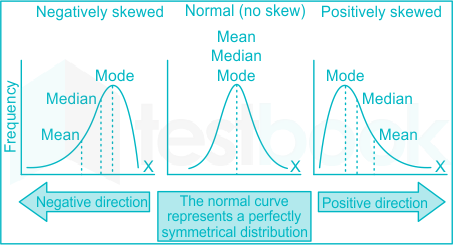
The normal distribution is a symmetrical continuous probability distribution on both sides of the mean, with the right side of the center mirroring the left.

Key Points

  • The whole area under the normal distribution curve equals one and the area under the curve reflects probability.
  • In a normal distribution, most continuous data values cluster around the mean, and the further a value is from the mean, the less likely it is to occur.
  • Normal distributions are continuous and asymptotic, meaning that their tails approach but never touch the x-axis.
  • The mean, median, and mode of a completely normal distribution will all be the same value.
  • The probability density graph of the normal distribution resembles a bell which is commonly referred to as the bell curve.

![Solved] A normal probability curve is](https://storage.googleapis.com/tb-img/production/20/11/F1_Priya_Shraddha_24.11.2020_D4.png)

Thus, the characteristics of a normal distribution curve are bell‐shaped, mean, mode, and median coincide at the center of the distribution and the curve is based on an infinite number of observations.

14

Given below are two statements

Statement I: A variable measured at the nominal level can be used in higher‐level statistics if it is converted into another form.

Statement II: The result of the conversion process is called dummy variable.

In light of the above statements, choose the correct answer from the options given below

  1. ((a))

    Both Statement I and Statement II are true

  2. ((b))

    Both Statement I and Statement II are false

  3. ((c))

    Statement I is true but Statement II is false

  4. ((d))

    Statement I is false but Statement II is true

Show Answer
Answer: ((a))

Both Statement I and Statement II are true

Nominal Measurement Labels are used to represent data recorded at the nominal level of measurement. 

Key PointsStatement I: A variable measured at the nominal level can be used in higher‐level statistics if it is converted into another form.

  • A variable measured on a nominal scale has no discernible evaluative distinction.
  • Higher-level variables can always be translated to lower-level variables, but not vice versa
  • The nominal level can be used in higher‐level statistics if it is converted into another form of grouping observations.
  • A nominal scale cannot be transformed into an ordinal or interval scale.

​So, Statement I is true.

Statement II: The result of the conversion process is called a dummy variable.

  • The result of the conversion process in which categorical data is transformed into numerical variables representing each category is indeed called a dummy variable.
  • These variables typically take the values 1 or 0 to indicate the presence or absence of a particular category.
  • For example, if you have a variable representing the color of a car, with possible values "red", "blue", and "green", you could convert this into dummy variables:
  • Red_car: 1 for red cars, 0 for other colors
  • Blue_car: 1 for blue cars, 0 for other colors
  • Green_car: 1 for green cars, 0 for other colors
<br>

This conversion process allows you to use categorical data in quantitative models like regression analysis.

​Thus, Statement II is true.

Therefore, Both Statement I and Statement II are true.

15

Match List I with List II

List IList II
Types of DesignCharacteristics
A.Solomon Four Group DesignI.It is a cross‐sectional design
B.Post‐test only Control Group DesignII.Contains an additional set of control and experimental groups
C.One‐shot Case StudyIII.Omits the pre‐tested groups altogether
D.Correlational DesignIV.Observation of a single group at one point of time to observe the change

Choose the correct answer from the options given below:

  1. ((a))

    A ‐ I , B ‐ II , C ‐ III , D ‐ IV

  2. ((b))

    A ‐ II , B ‐ III , C ‐ IV , D ‐ I

  3. ((c))

    A ‐ III , B ‐ IV , C ‐ I , D ‐ II

  4. ((d))

    A ‐ IV , B ‐ I , C ‐ II , D ‐ III

Show Answer
Answer: ((b))

A ‐ II , B ‐ III , C ‐ IV , D ‐ I

A Research Design is essentially a structural framework for a researcher's use of numerous research methods and procedures.

Key Points

Types of DesignCharacteristics
Solomon Four Group Design- The Solomon four-group design is a research method that aims to account for the impact of pretesting on posttest outcomes. - This design allows for the control of any potential contemporaneous effects that may arise between pre-and post-testing. - To establish the influence of the independent variable or treatment variable, the dependent variable is measured for the two groups after treatment and then compared.
Post‐test only Control Group Design- The posttest-only control group design is a study in which at least two groups are used, one of which does not receive any treatment or intervention. - If the pre-test is removed from this design, it becomes a post-test only control group design. - The control group is the group that does not receive the treatment or intervention of interest.
One‐shot Case Study- A study design in which a single group is observed after receiving some event, treatment, or intervention on a single occasion. - It's a flawed design because there's no control group to compare against; any changes observed are simply assumed to be due to the event.
Correlational Design- Correlational investigations are designed to see if there are differences in a population's traits when exposed to a naturalistic event of interest. - There are three basic types of correlational studies that are used cohort, cross-sectional, and case-control studies. - Cross-sectional studies are a type of cohort study in which just one comparison of exposed and unexposed subjects is made.

Therefore, A ‐ II , B ‐ III , C ‐ IV , D ‐ I are correct matching.

16

The dynamics of classroom interaction can be effectively managed through

  1. ((a))

    Verbosity

  2. ((b))

    Language complexity

  3. ((c))

    Interpreting perceived meanings

  4. ((d))

    Repetitive symbolism

Show Answer
Answer: ((c))

Interpreting perceived meanings

Classroom dynamics are referred to as the interaction between students and teachers in a classroom community. 

Key Points

  • Classroom management's function when planning training exercises, consider using scripts to increase both perception and understanding of classroom circumstances.
  • The goal of researching classroom dynamics is to learn how to create a healthy learning environment in which students feel at ease speaking with one another and with the teacher.
  • The engagement of everyone in the classroom is a key component of good classroom dynamics.
  • Teachers' knowledge structures allow teachers to ascribe meaning to their perceptions of events and project these interpretations onto future states of the classroom situation.
  • It plays a large role in determining which events and situations require action.
  • Teachers more aware of general expert-novice patterns in the perception and interpretation of classroom events can aid in the development of their classroom management expertise.

Therefore, the dynamics of classroom interaction can be effectively managed through Interpreting perceived meanings.

Additional Information

  • Authoritarian teacher: This teacher places high importance on obedience, instructs students on what to do and what not to do, and enforces strict restrictions.
  • Laissez-faire teacher: Students are encouraged to think for themselves, avoid inhibitions, and not value conformity in this classroom with a laissez-faire teacher.
17

Which of the following are myths about communication?

A. Good communicators are born, not made.

B. Stage fright is not a communication apprehension.

C. Communication skills have nothing to do with relationships.

D. Communication has its own barriers.

E. Practice leads to the right habits of communication.

Choose the correct answer from the options given below:

  1. ((a))

    A, B and C only

  2. ((b))

    B, C and D only

  3. ((c))

    C, D and E only

  4. ((d))

    A, D and E only

Show Answer
Answer: ((a))

A, B and C only

Communication between two or more people that is effective is defined as communication in which the intended message is appropriately encoded and delivered through the appropriate channel. received. 

Key Points

Richard Gallagher's book How to Tell Anyone Anything: Breakthrough Techniques for Handling Difficult Conversations mentioned the core of good interpersonal communication skills.

  • Many people believe that good communicators are born rather than made, however, this is a myth.
  • In actuality, anyone can be an excellent communicator on a personal level.
  • The term communication apprehension is sometimes associated with stage fright, yet this reaction is not always associated with delivering a speech on a stage or in front of a big crowd.
  • Every interpersonal relationship is considered to be built on communication.
  • In reality, good communication is essential for a happy and long-lasting relationship.

Thus, Good communicators are born, not made, communication skills have nothing to do with relationships, stage fright is not a communication apprehension are myths about communication. 

Additional Information

The four modes of communication: 

  • Verbal communication: The most common kind of communication is verbal communication. It entails the exchange of information using spoken words or sign language.
  • Nonverbal communication: Nonverbal communication is the use of gestures, tone of voice, body language, and facial expressions to communicate your thoughts and feelings without using words.
  • Written communication: Writing, typing, or printing are all examples of written communication.
  • Visual communication: 

Graphs, charts, pictures, maps, and logos are used in visual communication to convey information.

18

Given below are two statements:

Statement I: One's perceptions and beliefs are the basis of generalisation in communication.

Statement II: Generalisations of the environment developed through experiences.

In light of the above statements, choose the correct answer from the options given below:

  1. ((a))

    Both Statement I and Statement II are true

  2. ((b))

    Both Statement I and Statement II are false

  3. ((c))

    Statement I is true but Statement II is false

  4. ((d))

    Statement I is false but Statement II is true

Show Answer
Answer: ((a))

Both Statement I and Statement II are true

A broad statement or notion applied to a group of people or objects is known as a generalization. 

Key PointsStatement I: One's perceptions and beliefs are the basis of generalisation in communication. 

  • Generalisation simply applies a universal fact to everyone or everything in a group.
  • Information is processed, interpreted, selected, and organized by perception.
  • The impact of perception on the communication process is all about how different people interpret the same message differently.
  • The language of generalization is ubiquitous in everyday conversation, is found in every language and conveys rich meanings, influencing motivation and transmitting stereotyped beliefs about social categories.

So, Statement I is true.

Statement II: Generalisations of the environment developed through experiences.

  • Environments that encourage social engagement may reduce the ability to generalize from relevant past experiences.
  • Past scenarios that appear to be more similar to current circumstances may also contribute to habitual behaviour that appears maladaptive in light of more recent experiences.
  • The exception is when the current environment causes multiple, incompatible, or just incorrect past experiences to be generalized.

​Thus, Statement II is true. 

Therefore, Both Statement I and Statement II are true.

19

According to Robbins et al, the sequence of barriers to effective communication in an organisation is

A. Language

B. Emotions

C. Selective perception

D. Information load

E. Filtering

Choose the correct answer from the options given below

  1. ((a))

    A, B, D, E, C

  2. ((b))

    B, C, D, A, E

  3. ((c))

    D, A, E, C, B

  4. ((d))

    E, C, D, B, A

Show Answer
Answer: ((d))

E, C, D, B, A

A communication barrier is anything that prevents someone from receiving and comprehending signals sent to them to communicate their ideas, thoughts, or any other type of information. 

Key Points

According to Robbins et al, the sequence of barriers to effective communication in an organization is.

  • Filtering 
  • ​Filtering is when information is distorted or withheld in order to control a person's reactions.
  • Example of filtering: A manager hiding a division's dismal sales data from a superior.
  • Selective perception
  • ​Filtering what we see and hear to suit our own needs is referred to as selective perception.
  • This is a procedure that is frequently unnoticed.
  • Information load
  • ​Information overload occurs when the demand for information processing on an individual's time to execute interactions.
  • Internal calculations exceed the supply or capacity of time available for such processing.
  • Emotions
  • ​When a receiver is emotionally distressed, he or she is more likely to ignore or misrepresent what the sender is saying.
  • A sender who is emotionally distraught may be unable to adequately communicate his or her thoughts or sentiments.
  • Language
  • ​Words might have diverse meanings for different individuals, or they can have no meaning at all.
  • For example, the Use of acronyms, buzzwords, jargon which can be frequently have their own that are understandable to insiders but incomprehensible to outsiders.

​Therefore, According to Robbins et al, the sequence of barriers to effective communication in an organisation is Filtering⇒ Selective perception⇒ Information load⇒ Emotions⇒ Language.

20

Match List I with List II

List IList II
Elements of Effective CommunicationDescription
A.Common frame of referenceI.Communications with people of similar background
B.CongruenceII.Use of understandable language
C.Language relevanceIII.Messages of common interest between encoder and decoder
D.Compatible environmentIV.Compatibility between the receiver and the sender

Choose the correct answer from the options given below:

  1. ((a))

    A ‐ III, B ‐ IV, C ‐ I, D ‐ II

  2. ((b))

    A ‐ IV, B ‐ III, C ‐ II, D ‐ I

  3. ((c))

    A ‐ I, B ‐ II, C ‐ III, D ‐ IV

  4. ((d))

    A ‐ II, B ‐ III, C ‐ IV, D ‐ I

Show Answer
Answer: ((b))

A ‐ IV, B ‐ III, C ‐ II, D ‐ I

​Effective communication is a two-way information-sharing procedure in which one person sends an easy-to-understand message to the other.

Key Points 

Elements of Effective CommunicationDescription
Common frame of reference- A frame of reference is a set of ideas and attitudes that we employ to filter perceptions and provide meaning to them. - Beliefs, schemas, preferences, values, culture, and other biases in knowledge and judgment can all be part of the frame. - It creates compatibility between the receiver and the sender
Congruence- Congruence occurs when you are in agreement or concord; when both words and actions are in sync. - It is a message of common interest between encoder and decoder. - Congruent communication allows you to express your message more successfully, minimizes the chances of it being misconstrued, and establishes huge trust with those you contact subconsciously.
Language relevance- Language is an essential component of human interaction. - Language allows us to communicate our thoughts, feelings, and ideas with others. - For effective communication, render must use understandable language.
Compatible environment- Time, noise, place, climate, bad illumination, long-distance barriers, and visual noise are all obstacles to efficient communication. - The environmental variables of a communication interaction are referred to as physical context. - Our communication is influenced by the size, layout, temperature, and illumination of a room.


Therefore, A ‐ IV, B ‐ III, C ‐ II, D ‐ I are correct matching.

21

What number comes next in this sequence?

6, 4, 2.5, 1.5, ?

  1. ((a))

    1

  2. ((b))

    0.5

  3. ((c))

    ‐0.5

  4. ((d))

    ‐1

Show Answer
Answer: ((a))

1

Given:

The given sequence: 6, 4, 2.5, 1.5, ?

Calculation:

The logic is,

6 - 2 = 4

4 - 1.5 = 2.5

2.5 - 1 = 1.5

1.5 - 0.5 = 1

∴ The next term of the sequence is 1

22

How tall is a tree that is 6 meters shorter than a wall that is seven times higher than the tree?

  1. ((a))

    7 meters

  2. ((b))

    2 meters

  3. ((c))

    1.25 meters

  4. ((d))

    1 meters

Show Answer
Answer: ((d))

1 meters

Given:

The tree is 6 meters shorter than the wall.

The wall is 7 times higher than the tree.

Calculation:

Let, the height of the tree = x

Therefore, x + 6 = 7 × x

⇒ 7x - x = 6

⇒ 6x = 6

⇒ x = 6/6 = 1

∴ The tree is 1 meter tall.

23

If the selling price of ₹ 24 results in a discount of 20% on the list price, what selling price would result in a 30% discount on list price?

  1. ((a))

    21

  2. ((b))

    27

  3. ((c))

    20

  4. ((d))

    18

Show Answer
Answer: ((a))

21

Given:

Selling price = ₹ 24

Initial discount = 20%

Final discount = 30%

Formula used:

L.P. = S.P./(100 - Discount%) × 100

Discount = (Discount%/100) × L.P.

S.P. = L.P. - Discount

Where, L.P. = List price

S.P. = Selling price

Calculation:

The list price = 24/(100 - 20) × 100

= 24/80 × 100

= ₹ 30

The final discount = 30/100 × 30 = ₹ 9

The final selling price = 30 - 9 = ₹ 21

∴ The selling price ₹ 21 results in a 30% discount on list price.

24

Given below are two statements

Statement I: The number 89325324 is divisible by 66.

Statement II: The set of natural numbers is also called the set of whole numbers.

In light of the above statements, choose the correct answer from the options given below

  1. ((a))

    Both Statement I and Statement II are true

  2. ((b))

    Both Statement I and Statement II are false

  3. ((c))

    Statement I is true but Statement II is false

  4. ((d))

    Statement I is false but Statement II is true

Show Answer
Answer: ((c))

Statement I is true but Statement II is false

Given:

There are two statements in the given question.

Concept used:

Divisibility rule of 6: A number is considered to be divisible by 6 if it is divisible by both 2 and 3.

Divisibility rule of 11: If the difference between the sums of the alternative digits of a given number is either 0 or divisible by 11, the number is divisible by 11.

Natural numbers: All the counting number is known as a natural number.

Whole numbers: All the natural numbers including zero is known as the whole number.

Calculation:

In statement I,

The given number = 89325324

The number will be divisible by 66 if the number is divisible by 6 and 11.

Here, the unit digit of the number = 4 (even number)

The sum of the digits = 8 + 9 + 3 + 2 + 5 + 3 + 2 + 4 = 36 (divisible by 3)

As, the number is divisible by 2 and 3, it is also divisible by 6.

The difference between the sums of the alternative digits = (8 + 3 + 5 + 2) - (9 + 2 + 3 + 4) = 18 - 18 = 0

Hence, the number is divisible by 11.

So, the number 89325324 is divisible by 66.

Therefore, the statement I is true.

In statement II,

The natural number are: 1, 2, 3, 4, 5, .....

The whole numbers are: 0, 1, 2, 3, 4, 5, .....

So, the zero (0) is a whole number but not a natural number.

Hence, the set of natural numbers is not called the set of whole numbers.

So, the statement II is false.

Therefore, Statement I is true but Statement II is false.

25

Which of the following statements are correct?

A. If A's speed is more than B's speed, then to travel the same distance, A will take more time than B

B. Two speeds, 1500 m/min and 90 km/hr are equal

C. By walking at a speed of 18 km/hr, the distance covered in 2 minutes and 30 seconds is 750 meters

Choose the correct answer from the options given below

  1. ((a))

    A and B only

  2. ((b))

    B and C only

  3. ((c))

    A and C only

  4. ((d))

    C only

Show Answer
Answer: ((b))

B and C only

Given:

There are three statements given in the question.

Formula used:

Speed = Distance/Time

Distance = Speed × Time

1 km = 1000 meters

1 hour = 3600 seconds

Calculation:

In statement A,

A's speed is greater than B's speed

We know that Speed = Distance/Time

Then, if the distance is constant then the speed is inversely proportional to the time.

According to the question, the distance is the same for A and B.

Then, A will take less time than B.

Hence, statement A is not correct.

In statement B,

Speed 1 = 1500 m/min

Speed 2 = 90 km/hr = (90 × 1000)/60 m/min = 1500 m/min

Then, the two speeds are equal.

Hence, statement B is correct.

In statement C,

Speed = 18 km/hr = (18 × 1000)/3600 m/s = 5 m/s

2 minutes 30 seconds = (2 × 60) + 30 = 150 seconds

Distance covered in 2 minutes 30 seconds = 5 × 150 = 750 meters

Hence, statement C is correct.

Therefore, statements B and C are correct.

26

Match List I with List II

List IList II
A.System SoftwareI.Library Management System
B.Application SoftwareII.Firewall
C.Security SoftwareIII.Compiler
D.Embedded SoftwareIV.Automatic fridge

Choose the correct answer from the options given below:

  1. ((a))

    A ‐ I, B ‐ III, C ‐ IV, D ‐ II

  2. ((b))

    A ‐ II, B ‐ IV, C ‐ I, D ‐ III

  3. ((c))

    A ‐ III, B ‐ IV, C ‐ I, D ‐ II

  4. ((d))

    A ‐ III, B ‐ I, C ‐ II, D ‐ IV

Show Answer
Answer: ((d))

A ‐ III, B ‐ I, C ‐ II, D ‐ IV

Software is a set of instructions, data, or programs used to control computers and perform certain activities. 

Key Points

types of softwareImportant information
System Software- System software is a sort of computer program that manages the hardware and applications on a computer. - The system software is the interface between the hardware and the user applications. - Examples of system software are Operating systemsCompilers, Interpreters, Assemblers, etc.
Application Software- An application is a computer software package that performs a specified function directly for an end-user or, in some situations, for another application. - An application can be a single program or a collection of programs. - For example Microsoft Word, spreadsheets, VLC media player, Firefox or Google Chrome, and Library Management System.
Security Software- Any sort of software that secures and protects a computer, network, or other computing-enabled device is known as security software. - It controls access, protects data, protects the system from viruses and Internet-based intrusions, and guards against other system-level security threats. - Examples of Security Software: Firewalls, Antivirus, Anti-Spyware, Anti-Malware, etc.
Embedded software- Embedded software is code that runs on custom-built special-purpose hardware that is intended to do a specific, well-defined task repeatedly. - For example, Bluetooth, Automatic fridge, etc.
27

Given below are two statements

Statement I: DVDs use a single spiral 'track' to store data working from the centre to the edge.

Statement II: DVDs are Read‐only devices

In light of the above statements, choose the correct answer from the options given below

  1. ((a))

    Both Statement I and Statement II are true

  2. ((b))

    Both Statement I and Statement II are false

  3. ((c))

    Statement I is true but Statement II is false

  4. ((d))

    Statement I is false but Statement II is true

Show Answer
Answer: ((c))

Statement I is true but Statement II is false

DVDs have the same diameter and thickness as CDs and are created with similar materials and production techniques.

Key Points

Statement I: DVDs use a single spiral 'track' to store data working from the centre to the edge.

  • DVDs have the same diameter and thickness as CDs and are created with similar materials and production techniques.
  • A DVD is made up of many layers of plastic with a total thickness of roughly 1.2 millimetres.
  • Injection moulding polycarbonate plastic is used to construct each layer.
  • This procedure results in a disc with microscopic bumps arranged as a single, continuous, and extraordinarily long data spiral track.

Thus, Statement I is true.

Statement II: DVDs are Read‐only devices.

  • A read-only digital versatile disc (DVD) with read-only memory (DVD-ROM) is often used for storing huge software applications.
  • A DVD-ROM or DVD-RAM drive on a personal computer is used to read a DVD-ROM disc.
  • Data is stored on DVD-RAM, while movies and supplemental music are presented on DVD-ROM.

So, Statement II is false. 

Therefore, Statement I is true but Statement II is false.

28

Which of the following statements are true?

A. Simplex data transmission is in two‐directions only

B. Half‐duplex data transmission is in both directions but not at the same time

C. Full‐duplex data transmission is in both directions simultaneously

D. Serial data transmission is when data is sent, 8 bit at a time, over a single wire

E. Parallel data transmission is when one bit of data is sent down over a single wire

Choose the correct answer from the options given below:

  1. ((a))

    A, B and C only

  2. ((b))

    C, D and E only

  3. ((c))

    C and D only

  4. ((d))

    B and C only

Show Answer
Answer: ((d))

B and C only

Data Transmission mode in the direction of information flow between two communication devices. 

Key Points

  • t's is also known as Directional Mode or Data Communication.
  • It determines the direction of information flow in a computer network from one point to another.
  • There are three types of transmission modes:
  • Simplex Mode
  • Half-Duplex Mode
  • Full-Duplex Mode
  • Simplex Mode:  The communication in Simplex mode is unidirectional, like on a one-way street. On a link, only one of the two devices can send, while the other can only receive.
  • Half-Duplex Mode: In half-duplex transmission, communication between the sender and receiver occurs in both directions, but only one at a time. for example walkie-talkies
  • Full-Duplex Mode: The full-duplex transmission mode works similarly to a two-way street, allowing traffic to flow in both directions at the same time. for example telephone conversation

Thus, Half‐duplex data transmission is in both directions but not at the same time and  Full‐duplex data transmission is in both directions simultaneously are true statements.

29

In agricultural regions, groundwater can have significant concentrations of which pollutant?

  1. ((a))

    Lead

  2. ((b))

    Cadmium

  3. ((c))

    Selenium

  4. ((d))

    Nitrate

Show Answer
Answer: ((d))

Nitrate

The pollution of groundwater in urbanized areas is frequently compounded by a variety of human activities. 

Key Points

  • Groundwater pollution is a serious issue that is exacerbated when storage capacity is reduced.
  • Fertilizer and pesticide use results in chemical runoff from agricultural fields into surface waters and percolation into groundwater.
  • It is the leading source of water quality degradation in agricultural regions.
  • In agricultural areas, nitrate poisoning of groundwater is a problem.
  • High amounts of manganese, iron, arsenic, iodide, and ammonium in groundwater are primarily caused by the reductive dissolution of iron/manganese oxide.
  • Excessive levels of nitrate in groundwater are primarily due to sewage and industrial wastewater leakage.

Thus, In agricultural regions, groundwater can have significant concentrations of Nitrate pollutants. 

Additional Information

  • Contamination from septic tank waste can cause diseases including hepatitis and dysentery.
  • Toxins that have leached into well water supplies may cause poisoning.
  • Exposure to polluted water can also have long-term consequences such as certain types of cancer.
30

Which of the following types of power plants provide electricity consistently running 24 hrs per day, 7 days a week?

  1. ((a))

    Geothermal

  2. ((b))

    Solar

  3. ((c))

    Wind

  4. ((d))

    Hydro

Show Answer
Answer: ((a))

Geothermal

Geothermal energy is heat derived from the earth's subsurface. 

Key Points

  • Geothermal energy is heat that exists within the earth's crust.
  • The geothermal energy is carried to the Earth's surface via water and/or steam.
  • Geothermal energy can be used for heating and cooling or for generating clean electricity.
  • The key benefits are that it is not affected by weather and has extremely high capacity factors.
  • Regardless of weather conditions, geothermal power plants provide electricity regularly 24 hours a day, seven days a week.
  • Geothermal power facilities have a small footprint, requiring less land per GWh than coal, wind, or solar PV with a central station.

Thus, Geothermal is power plants provide electricity consistently running 24 hrs per day, 7 days a week

Additional Information

  • The pace of energy extraction can be balanced with the natural heat recharge rate of a reservoir with good reservoir management.
  • Geothermal power plants use less water than most conventional production technologies over the lifetime of their energy output.
31

Which of the following are Central Universities?

A. Dr. Babasaheb Ambedkar Open University

B. Jamia Millia Islamia

C. Panjab University

D. Punjabi University

E. University of Mumbai

Choose the correct answer from the options given below:

  1. ((a))

    A and B only

  2. ((b))

    B and C only

  3. ((c))

    C and E only

  4. ((d))

    C and D only

Show Answer
Answer: ((b))

B and C only

In India, central universities are public universities that were formed by an Act of Parliament and are overseen by the Ministry of Education's Department of Higher Education.

Key Points

The University Grants Commission (UGC) is empowered by the University Grants Commission Act 1956 and recognizes universities in India in general.

Jamia Millia Islamia:

  • Located in New Delhi, Jamia Millia Islamia is a Central University established in 1920.
  • It offers undergraduate, postgraduate, and research programs in various fields such as engineering, humanities, social sciences, law, and education.
  • The university has a diverse student population and is known for its focus on research and innovation.

Panjab University:

  • Located in Chandigarh, Punjab University is a Central University established in 1882.
  • It offers undergraduate, postgraduate, and research programs in various fields such as science, engineering, humanities, law, and business.
  • The university is known for its strong academic reputation and research output.

Additional Information

  • Dr. Babasaheb Ambedkar Open University is not a Central University as it is a state open university located in Gujarat.
  • Punjabi University is not a Central University as it is a state university located in Punjab.
  • The University of Mumbai, also known as Mumbai University, is a public state university located in Mumbai, Maharashtra, India.
32

What is Ethernet?

  1. ((a))

    A protocol used by many wired LAN's.

  2. ((b))

    A protocol used for address translation

  3. ((c))

    A security protocol

  4. ((d))

    A collision‐detection protocol

Show Answer
Answer: ((a))

A protocol used by many wired LAN's.

A local area network (LAN) is a group of computers and other electronic devices that share a limited space, such as a room, office, or building.

Key Points

  • Ethernet is the most widely utilized technology in wired local area networks (LANs).
  • The most extensively used LAN technology is Ethernet which is defined by IEEE standards 802.3.
  • The IEEE 802.3 standard is a network protocol that governs how data is carried over a local area network.
  • Ethernet is widely used because it is simple to comprehend, install, and maintain, and it provides for low-cost network deployment.
  • It was originally commercially available in 1980 and was standardized as IEEE 802.3 in 1983.

Thus,  Ethernet is a protocol used by many wired LANs.

Additional Information

The use of Ethernet is mentioned below: 

  • To connect Computers and devices.
  • To connect devices such as a router, hub, switch, or gateway.
  • Network interface cards in the devices
33

Match List I with List II

List IList II
A.Lay down standards of legal educationI.NCTE
B.Maintaining the quality of technical educationII.AICTE
C.Maintenance of standards in teacher educationIII.NMC
D.Access to quality and affordable medical educationIV.BCI

Choose the correct answer from the options given below:

  1. ((a))

    ​A ‐ IV, B ‐ II, C ‐ I, D ‐ III

  2. ((b))

    A ‐ I, B ‐ II, C ‐ IV, D ‐ III

  3. ((c))

    A ‐ II, B ‐ III, C ‐ IV, D ‐ I

  4. ((d))

    A ‐ III, B ‐ IV, C ‐ I, D ‐ II

Show Answer
Answer: ((a))

​A ‐ IV, B ‐ II, C ‐ I, D ‐ III

Education is mentioned in the Constitution's Concurrent List. 

Key Points

Apex level bodiesImportance
NCTE- The National Council for Teacher Education (NCTE), was founded in 1993 by the National Council for Teacher Education Act. - The establishment of NCTE is only for the goal of improving the Indian educational system. - It is currently dealing with concerns linked to the maintenance of teacher education standards and the prevention of substandard educational establishments.
AICTE- The All India Council for Technical Education (AICTE) is a national-level apex advisory body that was founded in November 1945 with - Its the goal of conducting a study of technical education facilities. - It is part of the Department of Higher Education and was given statutory status in 1987 by an Act of Parliament.
NMC- The National Medical Commission (NMC) was established by an act of Parliament called the National Medical Commission Act, 2019. - It abolished the Board of Governors in supersession of the Medical Council of India - The National Medical Commission's goals are to improve access to high-quality, affordable medical education.
BCI- The Advocates Act 1961 empowers the Bar Council of India (BCI) to create regulations to carry out its functions. - The Bar Council of India Rules may specify who is eligible to be enrolled as an advocate for a specific class or category of people. - It Lays down guidelines for the standards of professional conduct and etiquette to be observed by advocates.

Therefore, ​A ‐ IV, B ‐ II, C ‐ I, D ‐ III is the correct matching.

34

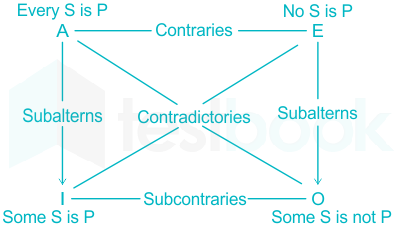
Name the fallacy committed in the argument below

"All men who understand women are potentially perfect husbands.

All potentially perfect husbands are men of infinite patience.

Therefore, some men of infinite patience are men who understand women."

  1. ((a))

    Illicit major

  2. ((b))

    Undistributed middle

  3. ((c))

    Existential fallacy

  4. ((d))

    Exclusive premises

Show Answer
Answer: ((c))

Existential fallacy

Logical fallacies are reasoning errors that are based on flawed logic.

Key Points

  • The existential fallacy is an incorrect inference from non-existential premises to an existential conclusion.
  • An existential proposition claims or suggests the existence of something.
  • In Aristotelian terms logic, the existential error is commonly said to be committed by inferring from All S are P to some S are P.
  • When we construct a conclusion that assumes existence from premises that do not entail it, we commit the existential fallacy.
  • For Example, 
  • All men who understand women are potentially perfect husbands.
  • All potentially perfect husbands are men of infinite patience.
  • Therefore, some men of infinite patience are men who understand women.
  • The consequent is clearly not existential, since it asserts that some men of infinite patience are men.

Thus, The fallacy committed in the argument is the Existential fallacy.

Additional Information

  • Illicit major: When the major word is not dispersed in the premiss but is distributed in the conclusion, this is known as the Illicit Major Fallacy.
  • Undistributed middle: The undistributed middle is a deductive logical fallacy in which a syllogism's middle term is not distributed in at least one of the premises.
  • Exclusive premises: The exclusive premises fallacy is a formal error that occurs in a categorical syllogism that is erroneous because both premises are negative.
35

The middle term of the inference is related to the major term neither as a cause nor as an effect but because they are uniformly related to each other in our experience, is known as

  1. ((a))

    Purvavat

  2. ((b))

    Sheshavat

  3. ((c))

    Samanyatodrshta

  4. ((d))

    Pakshdharmata

Show Answer
Answer: ((c))

Samanyatodrshta

The Nyaya logicians categorize inferences in a variety of ways.

Key Points

  • Inferences are categorized into two sorts based on the factor for which the inference is intended:svarthanumana and pararthaanumara.
  • The three forms of inferences according to the nature of vyapti are Purvavat, sesavat, and Samanyatodrshta.
  • This inference is founded on the relationship of co-existence rather than causal knowledge.
  • The presence of one can be deduced from the presence of the other based on the relationship of coexistence.
  • Example of Samanyatodrsta inference: The presence of the jasmine flower can be inferred from the smell of the flower.

​Thus, The middle term of the inference is related to the major term neither as a cause nor as an effect but because they are uniformly related to each other in our experience, is known as Samanyatodrshta.

Additional Information

  • Purvavat inference occurs when the unperceived result is inferred from the seen cause.
  • A case of sesavat inference occurs when the unperceived cause is inferred from the seen result.
  • Pakshadharmata is the parameter for hetu which means the presence of Hetu in Paksha.
36

Which of the following Green House bases were the target gases whose emission was to be covered under the first commitment period of the Kyoto protocol?

A. SO2

B. CO2

C. N2O

D. NH3

E. CH4

Choose the correct answer from the options given below:

  1. ((a))

    A, B, C and D only

  2. ((b))

    A, B and C only

  3. ((c))

    B, C, D and E only

  4. ((d))

    B, C and E only

Show Answer
Answer: ((d))

B, C and E only

The Kyoto Protocol was signed on December 11, 1997, and became effective on February 16, 2005.

Key Points


  • It obligated state parties to reduce greenhouse gas emissions and reached a scientific consensus on the role of the United Nations in climate change.
  • It was held in Kyoto, a prefecture in Japan's Kasai area.
  • According to Article 2 of the UNFCCC (1992), Greenhouse gases should be reduced to a level that would preclude dangerous anthropogenic influence.
  • Green House bases were the target gases whose emission was to be covered under the first commitment period of the Kyoto protocol are following: 
  • ​Carbon dioxide (C02)
  • Methane (CH4)
  • Nitrous oxide (N20)
  • Hydrofluorocarbons (HFCs)
  • Sulphur hexafluoride (SF6)
  • ​Perfluorocarbons (PFCs)

​Thus, Green House bases were the target gases whose emission was to be covered under the first commitment period of the Kyoto protocol are N2O, CH4  CO2 

Additional Information

  • In 1992, countries from all over the world gathered in Rio for the UNFCCC (United Nations Framework Convention on Climate Change) to address climate change and the way forward.
  • In 1997, the Kyoto Protocol was signed as an international convention to extend the United Nations Framework Convention on Climate Change (1992).
37

In India, according to Niti Ayog's SDG Index (2019‐2020), which is the best performing state on SDG‐9 (Industry, Innovation and Infrastructure)?

  1. ((a))

    Kerala

  2. ((b))

    Gujrat

  3. ((c))

    Karnataka

  4. ((d))

    Telangana

Show Answer
Answer: ((a))

Kerala

The SDG India Index 2020–21 which has cross-sectoral relevance across policy, civil society, industry, and academia is also available on an online dashboard.

Key Points

  • The NITI Aayog developed its index in 2018 to track the country's progress toward its goals using data-driven analysis.
  • The NITI Aayog's dual goal is to oversee the country's adoption and monitoring of the SDGs, as well as to encourage competitive and cooperative federalism among States and UTs.
  • Niti Ayog's SDG Index encourages states and union territories to compete in achieving them.
  • The index represents the articulation of the global dimension of the 2030 Agenda's Global Goals while being sensitive to national priorities.
  • According to Niti Ayog's SDG Index (2019‐2020), Kerala with a score of 75 is the best-performing state on SDG‐9.

Thus, In India, according to Niti Ayog's SDG Index (2019‐2020), Kerala is the best-performing state on SDG‐9 (Industry, Innovation, and Infrastructure).

Additional Information

  • The 2030 Agenda for Sustainable Development was endorsed by the United Nations General Assembly in 2015.
  • According to the NITI Aayog's SDG India Index 2020-21, Gujarat ranks first among all states in terms of attaining the sustainable development goals (SDGs) of excellent health and well-being (SDG 3), industry, innovation, and infrastructure (SDG 9).
38

Identify the correct sequence of wind energy potential at 100 m above ground level in decreasing order

A. Karnataka

B. Andhra Pradesh

C. Gujarat

D. Tamil Nadu

E. Andaman and Nicobar Islands

Choose the correct answer from the options given below

  1. ((a))

    A > B > C > E > D

  2. ((b))

    D > C > A > B > E

  3. ((c))

    C > A > B > D > E

  4. ((d))

    C > E > B > D > A

Show Answer
Answer: ((c))

C > A > B > D > E

wind power or wind energy is the use of wind turbines to generate electricity. 

Key Points

  • India's government has set a lofty goal of generating 175 gigawatts (GW) of renewable energy by 2022.
  • States have already increased their installed solar and wind-powered capacity in order to meet the aim.
  • In recent years, India has seen a considerable increase in wind energy generation.
  • The coastal states of Gujarat, Andhra Pradesh, Tamil Nadu, Maharashtra, Rajasthan, and Karnataka have the highest wind potential in India.
  • Kashmir is an exception to coastal locations because of its high altitude, strong wind velocity, and high wind density.
StateEstimated potential (GW)
above ground level 100 m
Andhra Pradesh44.229
Gujarat84.431
Karnataka55.857
Tamil Nadu33.8
Andaman and Nicobar Islands8.43

Therefore,  wind energy potential at 100 m above ground level is in decreasing order in India, Gujarat⇒ Karnataka⇒ Andhra Pradesh⇒ Tamil Nadu⇒ Andaman, and the Nicobar Islands.

Additional Information

  • The National Institute of Wind Energy (NIWE) is responsible for wind resource assessments throughout India.
  • NIWE used modern modeling techniques and repeated the study in accordance with MNRE guidelines and regulations, estimating the wind power potential at 100 meters to be 302,251 MW.
39

The first education commission in Independant India is:

  1. ((a))

    Secondary Education Commission

  2. ((b))

    The Education Commission

  3. ((c))

    University Education Commission

  4. ((d))

    National Knowledge Commission

Show Answer
Answer: ((c))

University Education Commission

The University Education Commission has appointed Radhakrishnan as its chairman. 

Key Points

  • The Radhakrishnan Committee's recommendations aided in shaping India's educational system.
  • It was the first education commission appointed after independent India.
  • Dr. S. Radhakrishnan is a distinguished scholar and former Vice-Chancellor of Banaras University.
  • The Commission's 1949 Report examined the state of university education in newly independent India and made recommendations for its development.
  • On August 15, 1947, Radhakrishnan was asked to chair the University Education Commission.

Thus, The first education commission in Independent India is University Education Commission. 

Additional Information

  • Secondary Education Commission: 
  • Dr. A Laxman Swami Mudaliar was appointed Chairman of the Secondary Education Commission by the Union Government of India in 1952. Its goal is to make recommendations about how to improve it.
  • The Education Commission: 
  • The Education Commission is a worldwide project aimed at accelerating progress on SDG 4: ensuring inclusive and high-quality education and fostering lifelong learning for all.
  • National Knowledge Commission:
  • ​Sam Pitroda served as the committee's chairman. Based on the recommendations of the National Knowledge Council, India built e-governance and the National Portal of India.
40

Gender Parity Index in higher education in India is:

  1. ((a))

    1

  2. ((b))

    1.1

  3. ((c))

    0.99

  4. ((d))

    0.98

Show Answer
Answer: ((a))

1

The Gender Parity Index is the number of females divided by the number of boys enrolled in a specific educational stage.

Key Points

  • The gender parity index in primary education is calculated by dividing the number of female pupils enrolled in primary school by the number of male students.
  • The outcome is referred to as a gender parity score.
  • A GPI of 1 shows gender parity between males and females.
  • In general, a value less than 1 suggests a male-female difference while a value greater than 1 implies a female-female disparity.
  • In Higher Education, the Gender Parity Index (GPI) for 2019-20 is 1.01, up from 1.00 in 2018-19, showing that females of eligible age groups have better access to higher education than boys

​Thus, Gender Parity Index in higher education in India is 1. 

Additional Information

  • In India, the Gender Parity Index (GPI) at the primary school level was 0.95 in the fiscal year 2019.
  • It was lower than the previous fiscal year's figure.
41

University of the ancient period which has been declared by UNESCO as a heritage site is:

A. Mithila

B. Vallabhi

C. Pushpagiri

D. Takshashila

E. Nalanda

Choose the correct answer from the options given below:

  1. ((a))

    A and B only

  2. ((b))

    B and C only

  3. ((c))

    C and D only

  4. ((d))

    D and E only

Show Answer
Answer: ((d))

D and E only

A World Heritage Site is a location that has been designated by UNESCO for its cultural or natural value.

Key Points

  • The United Nations Educational, Scientific, and Cultural Organization (UNESCO) aims to promote the identification, protection, and preservation of cultural and natural heritage that is of exceptional significance to people around the world.
  • This is codified in the Convention for the Protection of the World Cultural and Natural Heritage, which was adopted by UNESCO in 1972.
  • Takshashila was a well-known center of study, particularly Buddhist religious teachings.
  • It is a significant archaeological site that was designated as a World Heritage Site by UNESCO in 1980.
  • UNESCO also designated the ruins of the ancient Nalanda University, which date back to the third century BC, as a World Heritage Site on January 9, 2009.

Thus, the University of the ancient period has been declared by UNESCO a heritage site in Takshashila and  Nalanda. ​

Additional Information

  • There are 38 world heritage sites in India, with 30 cultural properties, seven natural properties, and one combined site.
  • The international World Heritage Programme, supervised by the UNESCO World Heritage Committee keeps track of World Heritage Sites.​

Confusion Points

  • ​Takshashila was an ancient Indian city that is currently located in Pakistan's northwestern corner.
42

What is the World Wide Web (www)?

  1. ((a))

    Collection of webpages stored on websites

  2. ((b))

    Interconnected networks

  3. ((c))

    Hypertext processor

  4. ((d))

    Web browser

Show Answer
Answer: ((a))

Collection of webpages stored on websites

The World Wide Web (WWW), also known as the Web. 

Key Points

  • It is a collection of websites or web pages maintained on web servers and accessible via the internet by local computers.
  • Websites or web pages are collections of many web pages.
  • Text pages, digital photos, audio, and videos, among other things, can be found on these websites.
  • Users can access the content of these sites through the internet utilizing devices such as computers, laptops, and cell phones from anywhere on the globe.
  • The WWW in conjunction with the internet allows you to retrieve and display text and media on your device.

Thus,  the World Wide Web (www) is a collection of web pages stored on websites.

Additional Information

  • A Web browser was created in the United States by Marc Andreessen.
  • Hypertext or hypermedia links are electronic connections that link similar bits of information to offer a user quick access to them.
  • Hypertext allows a user to select a word or phrase from a document and then go to other papers that contain further information on that word or phrase.
43

Match List I with List II

List IList II
A.If 'A' is TrueI.'E' is True; 'O' is True
B.If 'E' is TrueII.'O' is False; 'E' is False
C.If 'I' is FalseIII.'A' is False; 'I' is False
D.If 'O' is FalseIV.'E' is False; 'I' is True

Choose the correct answer from the options given below:

  1. ((a))

    A ‐ IV, B ‐ II, C ‐ III, D ‐ I 

  2. ((b))

    ​A ‐ III, B ‐ I, C ‐ II, D ‐ IV

  3. ((c))

    ​A ‐ II, B ‐ III, C ‐ I, D ‐ IV

  4. ((d))

    ​A ‐ I, B ‐ II, C ‐ III, D ‐ IV

Show Answer
Answer: ((c))

​A ‐ II, B ‐ III, C ‐ I, D ‐ IV

The square of opposition is a diagram used in categorical logic to depict the logical relationship that exists between particular propositions based on their form.

Key Points 

NameFormTitle
AAll\Every S is PUniversal Affirmative
ENo S is PUniversal Negative
ISome S is PParticular Affirmative
OSome S is not PParticular Negative


Rule of Square of Opposition

Types of Square of OppositionRules
ContradictoryA and O, E, and I propositions are contradictory. If One is True the other will be false definitely. If One is False the other will be True definitely.
Sub-contraryI and E propositions are subcontrary. It is always between Particulars. It is the opposite of the Contrary. Both Statements can't be False at the same time but both can be True. If One is False the other will be true definitely. If One is True the other will be Doubtful.
SubalternationA and I, E and O propositions are Subalternation. ​ Between Universal and Particulars. If Universal is True Particular will be False definitely. If Universal is False Particular will be True Doubtful. If Particular is False Universal will be False definitely. If Particular is True Universal will be Doubtful.


Therefore, ​A ‐ II, B ‐ III, C ‐ I, D ‐ IV is correct matching.

Read the given passage and answer the following questions.

Despite the fact that social security programmes in India are not responses to structural adjustment but have a long history of their own. Social expenditure in India is nevertheless particularly vulnerable to budget cuts. The social sector is a major spending area of the government, comprising poverty reduction interventions, health, education, nutrition, social assistance and social welfare. Most departments of government are in some way responsible for spending under this broad head.

The sector is highly divisible, thus facilitating incremental and piecemeal reductions in real expenditure. It has a weak political constituency, dominated by technical‐expert persons, which the mass of evaluative research that has historically been critical of state interventionism has further weakened. Such work has been put to uses other than those originally intended ‐ not to reform the sector but as justification to abolish major components of it entirely. However, since 1991, social sector expenditure has not declined as much as had been anticipated. Despite, or because of, its departmental pervasiveness, it is an extremely‐perhaps uncuttable‐low proportion of GNP: 2.4 per cent as compared with 6.5 per cent in Malaysia, 12.2 per cent in Botswana and 15‐25 per cent in OECD countries. Even though social sector expenditure is also flawed by spatial patchiness, conflicting time trends in expenditure levels and composition and patterns specific to each component of welfare, cuts have been widely resisted and certain Indian states have increased their current debt in order to protect social expenditure. There is, fortunately, and necessarily, speculative literature predicting, sometimes with illustrations drawn from elsewhere, the likely outcomes of cuts in various types of social expenditure. But it is far too early for these to be evidence of the actual impact on social welfare is a long‐term project of several decades.

44

Social security programmes in India encounter the issue of

  1. ((a))

    Direct implementation

  2. ((b))

    Indirect implementation

  3. ((c))

    Increased government intervention

  4. ((d))

    Structural rearrangement

Show Answer
Answer: ((d))

Structural rearrangement

The correct answer is 'Structural rearrangement.'

Key Points

Let's look at the excerpt from the passage: ​ 

*"The fact that social security programs in India are not responses to structural adjustment but have a long history of their own. Social expenditure in India is nevertheless particularly vulnerable to budget cuts.**"***​

  • In the given statement, the author suggests that social security programs in India are not responses to structural adjustment.
  • Hence it is evident that the Social security programs in India encounter the issue of Structural rearrangement.

Thus, option 4 is the correct answer.

45

The government spending on poverty reduction programmes suffers from

  1. ((a))

    High demand from prospective beneficiaries

  2. ((b))

    Too many divisible allocations

  3. ((c))

    Down‐sized expenditure in real terms

  4. ((d))

    Several social welfare programmes competing for funds

Show Answer
Answer: ((c))

Down‐sized expenditure in real terms

The correct answer is 'Down‐sized expenditure in real terms.'

Key Points

Let's look at the excerpt from the passage: ​ 

*"The social sector is a major spending area of the government, comprising poverty reduction interventions, health, education, nutrition, social assistance, and social welfare. Most departments of government are in some way responsible for spending under this broadhead. The sector is highly divisible, thus facilitating incremental and piecemeal reductions in real expenditure."*​

  • In the given statement, the author suggests that the social sector is a major spending area of the government, comprising poverty reduction interventions, health, etc,
  • Hence it is evident from the above lines that the social sector is highly divisible, the government spending on poverty reduction programs suffers from down‐sized expenditure in real terms."

Thus, option 3 is the correct answer.

46

The expert evaluation reports are used to

  1. ((a))

    Reform the social welfare sector

  2. ((b))

    Support the government spending on social sector

  3. ((c))

    Strengthen the political constituency of social security

  4. ((d))

    Justify banishing the social security system

Show Answer
Answer: ((d))

Justify banishing the social security system

The correct answer is 'justify banishing the social security system.'

Key Points

Let's look at the excerpt from the passage: ​ 

*"It has a weak political constituency, dominated by technical‐expert persons, which the mass of evaluative research that has historically been critical of state interventionism has further weakened. Such work has been put to uses other than those originally intended ‐ not to reform the sector but as justification to abolish major components of it entirely."*​

  • In the given statement, the author suggests that a mass of evaluative research reports has been put to uses other than those originally intended ‐ not to reform the sector but as justification to abolish major components of it entirely.
  • Hence it is evident from the above lines that the expert evaluation reports are used to justify banishing the social security system*"*

Thus, option 4 is the correct answer.

47

The social sector in India is experiencing

  1. ((a))

    A vast amount of speculative literature

  2. ((b))

    Upward revision of budget allocations in a few specific areas

  3. ((c))

    Increased current debt account by certain states to protect their social security measures

  4. ((d))

    Change in composition and patterns of social welfare

Show Answer
Answer: ((c))

Increased current debt account by certain states to protect their social security measures

The correct answer is 'Increased current debt account by certain states to protect their social security measures.'

Key Points

Let's look at the excerpt from the passage: ​ 

*"**Even though social sector expenditure is also flawed by spatial patchiness, conflicting time trends in expenditure levels and composition and patterns specific to each component of welfare, cuts have been widely resisted and **certain Indian states have increased their current debt in order to protect social expenditure."*​

  • In the given statement, the author has suggested even though social sector expenditure is flawed cuts have been widely resisted and certain Indian states have increased their current debt in order to protect social expenditure.
  • Hence it is evident from the above lines that the social sector in India is experiencing Increased current debt accounts by certain states to protect their social security measures.
  • Thus, option 3 is the correct answer.
48

The gist of the passage is that

  1. ((a))

    The social security system in India should be strengthened

  2. ((b))

    The social welfare system must be abandoned

  3. ((c))

    In actuality, diversification funds to areas other than social welfare are justifiable

  4. ((d))

    There is no evidence as to the utility of social welfare measures in India

Show Answer
Answer: ((a))

The social security system in India should be strengthened

The correct answer is 'The social security system in India should be strengthened.'

Key Points

  • ​In the given passage, the author has suggested that social security programs in India need structure rearrangement.
  • He also mentioned that the sector is highly divisible, thus facilitating incremental and piecemeal reductions in real expenditure.
  • It is evident from the passage that the social sector in India is experiencing increased current debt accounts by certain states to protect their social security measures.
  • Therefore the gist of the passage is that the social security system in India should be strengthened.
  • Thus, option 1 is the correct answer.
49

Match List I with List II

List IList II
A.AshrayāsiddhaI.Sound is eternal because it is visible
B.SvarupāsiddhaII.All real are momentory; sound is real; sound is momentory
C.VyapyatvasiddhaIII.All objects are eternal because they are knowable
D.AnupasamhariIV.Sky lotus is fragrant because it belongs to the class of lotus

Choose the correct answer from the options given below:

  1. ((a))

    A ‐ III, B ‐ II, C ‐ IV, D ‐ I

  2. ((b))

    A ‐ II, B ‐ IV, C ‐ I, D ‐ III

  3. ((c))

    ​A ‐ IV, B ‐ I, C ‐ II, D ‐ III

  4. ((d))

    A ‐ I, B ‐ III, C ‐ II, D ‐ IV

Show Answer
Answer: ((c))

​A ‐ IV, B ‐ I, C ‐ II, D ‐ III

In Indian logic, a fallacy is known as hetvabhasa, which literally means hetu or a reason that looks to be correct but is not.

Key Points

List IList II
Ashrayāsiddha- Ashrayāsiddha is the unproven middle term. - This error happens when the middle term is incorrectly assumed in any of the premises rendering the conclusion unprovable. - For example, Sky lotus is fragrant because it belongs to the class of lotus
Svarupāsiddha- Svarupsiddha-hetvabhasa refers to something that does not exist. - It denotes a hetu that cannot be proven by its very nature. - For example, Sound is eternal because it is visible.
Vyapyatvasiddha- Vyāpyatvāsiddhi is a Sanskrit consisting of the terms vyāpyatva and asiddhi. - It occurs due to vyapti being conditional. - For example, All real are momentory; sound is real; sound is momentory
Anupasamhari- When the middle term is non-exclusive this happens. - As a result, the minor word encompasses everything and leaves no room for sapaksa or vipaksa. - For example, All objects are eternal because they are knowable

Therefore,​ A ‐ IV, B ‐ I, C ‐ II, D ‐ III are correct matching.

50

Pick the correct option to represent the given argument

All artists are egoists

Some artists are paupers

Therefore, some paupers are egoists

Choose the correct answer from the options given below

  1. ((a))

    A II ‐ I figure

  2. ((b))

    A II ‐ II figure

  3. ((c))

    A II ‐ III figure

  4. ((d))

    A II ‐ IV figure

Show Answer
Answer: ((c))

A II ‐ III figure

A syllogism consists of three categorical propositions and contains three terms each of which appears in propositions. 

Key Points

Mood depends upon the type of propositions (A, E, I, O).

PropositionsFromExample
AAll S is PAll artists are egoists
ENo S are PNo artists are egoist
ISome S are PSome artists are paupers
OSome S are not PSome artists are not paupers

Valid Forms: There are 15 combinations of mood and figure that are valid from the Boolean standpoint.

FigureMood
First FigureAAA,EAE,AII,EIO
Second FigureEAE,AEE,EIO,AOO
Third FigureIAI, AII, OAO, EIO
Fourth figureAEE,IAI,EIO

For example, 

  • All artists are egoists (A )
  • Some artists are paupers (I)
  • Therefore, some paupers are egoists (I)
  • Based on the above chart mood of argument is AII.

Thus, the Mood of the argument is AII. 

  • The figure depends on the arrangement of the middle term in the proposition.
  • There are four types of figures in syllogism which are mentioned below:
First figureSecond figureThird figureFourth figure
M-PP-MM-PP-M
S-MS-MM-SM-P
S-PS-PS-PS-P

Whereas M is Middle Term, S is Subject, and P stands for Predicate. 

  • All artists are egoists, whereas artists are Predicate and egoists are middle term.
  • Some artists are paupers, whereas artists are Middle term and paupers are Predicate.
  • Based on the position of the middle term in the argument this belongs to the Second and Third Figures.

Therefore, the A-II ‐ III figure is correct.

Attempt this paper under real exam conditions

Timed interface, section switching, instant scoring, and question-by-question analytics — free.

Start Timed Attempt