Official Paper

UGC NET Paper 1: Held on 22th Oct 2022 Shift 2 (Previous Year Paper)

50 questions · 60 minutes · with answers · free

Paper 1 (50 questions)

1

For a student of communication, reading includes the skills of

  1. ((a))

    Observation and analysis

  2. ((b))

    De-contextualisation

  3. ((c))

    Understanding for others

  4. ((d))

    Passive viewing of visual media

Show Answer
Answer: ((a))

Observation and analysis

The correct answer is  Observation and analysis.

Important Points

Observation and analysis.

  • Reading is an important skill for students of communication as it helps them to develop critical thinking and analysis skills.
  • By reading, students can observe and analyze different forms of communication,
  • such as written texts, speeches, and visual media.
  • Through reading, students can also develop their knowledge and understanding of different communication contexts, audiences, and purposes.

Option 2) De-contextualisation 

  • is not a skill that is typically associated with reading.
  • De-contextualization refers to the process of removing something from its original context, which is not a desirable outcome of reading for communication students.

Option 3) Understanding others

  • is a desirable outcome of the reading,
  • but it is not a specific skill that is unique to communication students. Understanding others involves empathy and the ability to put oneself in someone else's shoes,
  • which is an important skill for anyone, not just communication students.

Option 4) Passive viewing of visual media

  • is not a skill that is typically associated with reading.
  • While visual media may be a form of communication that is read or interpreted, passive viewing does not require any active engagement or analysis.

2

Normally mass media operate in

  1. ((a))

    Personal Sphere

  2. ((b))

    Political Sphere

  3. ((c))

    Economic Sphere

  4. ((d))

    Public Sphere

Show Answer
Answer: ((d))

Public Sphere

The correct answer is Public Sphere.

Important Points 

Mass media refers to media technologies used to disseminate information to a wide audience.

  • The key function of mass media is to communicate various messages through television, movies, advertising, radio, the internet, magazines, and newspapers.
  • Over the years, the impact of mass communication has increased drastically because of the improvements made.

The main characteristics of mass media, and they are as follows:

  • it can appeal to a wide target audience;
  • it communicates a public message;
  • there’s a distance between a source of information and those who obtain it;
  • it can be transmitted through various channels, such as TV, the internet, radio, and newspapers;
  • it has a heterogeneous audience;
  • news or information communicated through TV, radio, and print media can’t receive feedback.
  • It is a part of Public Sphere.

 Additional Information

  • Print media: It can range from billboards to coupons and is one of the easiest and oldest ways to reach the masses.
  • Originally, print media referred to newspapers, which were the primary sources of information. Further, this type of media expanded to journals, books, and magazines.
  • Outdoor media: Ambient marketing is an excellent example of modern outdoor media.
  • Brands use unusual locations and items to promote their products.
  • Broadcasting media: With the help of an electronic broadcasting medium, audio and video content is distributed to a dispersed audience.
  • Television, radio, video, and games appeal to heterogeneous audiences, people who differ in age, background, views, goals, and interests.
  • Digital media: There are around 4.66 billion active internet users worldwide in 2021, which means that the world is dependent on digital media.
  • Today, brands promote their goods and services through sites, YouTube, podcasts, and more. Besides, companies often implement Instagram marketing and Facebook advertising to pitch their products.​
3

In mass communication, the audiences are:

(A) Well-defined

(B) Anonymous

(C) Homogeneous

(D) Heterogeneous

(E) Scattered

Choose the correct answer from the options given below:

  1. ((a))

    A, B, C Only

  2. ((b))

    B, C, D Only

  3. ((c))

    B, D, E Only

  4. ((d))

    C, D, E Only

Show Answer
Answer: ((c))

B, D, E Only

The correct answer is  B, D, E Only - the audiences are often anonymous, heterogeneous, and scattered.

Important Points 

  • Mass communication is the process of conveying a message to a large group of anonymous and heterogeneous people.
  • A huge group of anonymous and diverse people might be thought of as either the general public or a part of the general public.
  • Examples of mass communication channels, Broadcast television, radio, social media, print, etc.

Anonymous:  Audiences in mass communication are often large, and the sender of the message may not know who the audience members are.  This is because many forms of mass communication, such as television, radio, and newspapers, are one-to-many communication channels where the sender broadcasts a message to a large and diverse audience.

  • Heterogeneous: The audience for mass communication is often made up of people from different demographic groups, geographic locations, and cultural backgrounds. They have diverse interests, values, and preferences.
  • Scattered: The audiences of Mass Communication are not organized in a certain area rather they are highly scattered in different geographical areas. The receivers of messages of mass communication may stay in any place in the country and even any place in the world.

Therefore the correct answer is B, D, E Only -

Additional Information 

Characteristics of mass communication:

  • Wide and Vast Area
  • Heterogeneous Audience
  • Distance between Source and Destination
  • No Question of Discrimination
  • Professional Communication
  • Absence of Feedback
  • Intermediary Channels
  • Use of Specialists
  • Self-defined Audience
  • Rapid Means of Communication
4

Which of the following can be used to overcome communication barriers in an organization?

A) Unlimited use of grapevine.

(B) Sectionalised and preferred feedback

(C) Action-oriented communication

(D) Proper use of language

(E) Inter-personal relations

Choose the correct answer from the options given below:

  1. ((a))

    A, B, C Only

  2. ((b))

    B, C, D Only

  3. ((c))

    C, D, E Only

  4. ((d))

    A, D, E Only

Show Answer
Answer: ((c))

C, D, E Only

The correct answer is C, D, E Only -

Important Points

Action-oriented communication, proper use of language, and interpersonal relations can be used to overcome communication barriers in an organization. 

Action-oriented communication:

  • This involves communicating with a specific purpose or goal in mind and focusing on taking action to achieve that goal.
  • By using action-oriented communication, individuals in an organization can ensure that their messages are clear, concise, and relevant to the situation at hand.
  • This can help to overcome barriers such as misunderstandings, lack of clarity, and ambiguity.

Proper use of language:

  • Effective communication requires the use of language that is appropriate to the situation, audience, and purpose.
  • Using clear and simple language, avoiding jargon or technical terms, and being mindful of cultural differences can help to ensure that messages are understood and interpreted correctly.

Interpersonal relations:

  • Good relationships between people in an organization can help to facilitate communication and overcome barriers such as distrust, conflict, or resistance to change.
  • Building strong interpersonal relationships involves developing trust, respect, and empathy for others, as well as active listening and effective feedback.

Additional Information

Communication is the act of successfully conveying or exchanging ideas and feelings, whether orally, in writing, or by some other means. 

  • Effective communication is the process of exchanging words in order to ensure clarity and purpose.
  • Communication barriers are anything that prevents a message from being understood.
5

Given below are two statements :

Statement I: The conventional electronic medium of television suffers from the 'master-slave' architecture.

Statement II: Computer-based communication technologies promote individualism and creativity.

In light of the above statements, choose the correct answer from the options given below:

  1. ((a))

    Both Statement I and Statement II are true

  2. ((b))

    Both Statement I and Statement II are false

  3. ((c))

    Statement I is true but Statement II is false

  4. ((d))

    Statement I is false but Statement II is true

Show Answer
Answer: ((a))

Both Statement I and Statement II are true

The correct answer is  Both Statement I and Statement II are true. 

Important Points

Statement I: The conventional electronic medium of television suffers from the 'master-slave' architecture.

  • This statement is true because television is a one-way communication medium where the sender (master) broadcasts a message to a large and passive audience (slaves) who have limited control over the content or timing of the message.
  • This can create a hierarchical and top-down structure of communication that limits interaction, feedback, and participation.

Statement II: Computer-based communication technologies promote individualism and creativity.

  • This statement is also true because computer-based communication technologies, such as email, social media, and online forums, allow for more decentralized and participatory forms of communication that encourage individual expression, collaboration, and creativity.
  • These technologies provide more opportunities for interaction, feedback, and customization than traditional mass media, which can foster a more democratic and bottom-up approach to communication.

Therefore, both statements are true and are not contradictory. Statement I highlights a limitation of the traditional mass media while Statement II highlights a potential benefit of computer-based communication technologies

6

In a coding scheme the word 'STATEMENT is written as 'TNEMETATS'. In the same coding scheme, how the word 'POLITICAL' shall be coded?

  1. ((a))

    LAICTIOLP

  2. ((b))

    LACITILOP

  3. ((c))

    LACTIILOP

  4. ((d))

    LACTILIOP

Show Answer
Answer: ((b))

LACITILOP

The logic followed here is,

The first letter of the word moves last and the second letter of the word moves second last, and so on.

Similarly,

<br>

Hence, the word POLITICAL is written as LACITILOP.

7

In the number 455 is divided in the ratio of 4 ∶ 3, then the two parts of 455 shall be respectively?

  1. ((a))

    260, 195

  2. ((b))

    250, 205

  3. ((c))

    265, 190

  4. ((d))

    255, 200

Show Answer
Answer: ((a))

260, 195

Solution:

To divide 455 in the ratio of 4:3, we need to find the two parts that add up to 455 and are in the ratio of 4:3.

Let the two parts be 4x and 3x. Then, the sum of the two parts is 4x + 3x = 7x, which should be equal to 455.

⇒ 7x = 455

⇒ x = 65

Therefore, the two parts are 4x = 4 × 65 = 260 and 3x = 3 × 65 = 195.

Hence, the two parts are 260 and 195.

8

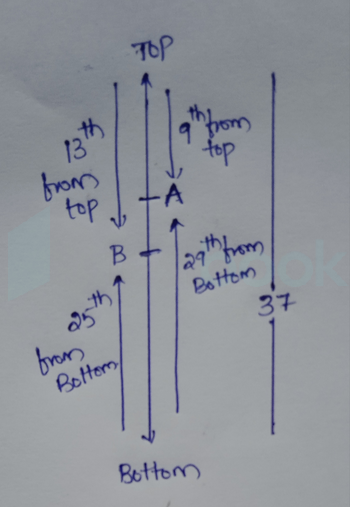
Two students A and B are ranked 9th and 13th respectively from the top in a class of 37 students. What will be their ranks (A & B respectively) from bottom in the class?

  1. ((a))

    25, 29

  2. ((b))

    24, 28

  3. ((c))

    29, 25

  4. ((d))

    28, 24

Show Answer
Answer: ((c))

29, 25

Given:

Two students A and B are ranked 9th and 13th respectively from the top in a class of 37 students.

Formula used:

Total = {( The rank of A from top) + ( the rank of A from bottom) - 1}

The Rank of A from the Bottom:

37 = 9 + The rank of A from the Bottom - 1

The rank of A from the bottom is = 37 - 9 + 1 

The rank of A from the bottom is = 29.

The Rank of B from the Bottom:

37 = 13 + The rank of B from the bottom - 1

The rank of B from the bottom = 37 - 13 + 1

The rank of B from the bottom = 25.

Hence, the Ranks of A and B from the bottom are 29 and 25.

9

After getting two successive discounts. a shirt with a list price of Rs. 150 is available at Rs.105. If the second discount is 12.5%. find the first discount?

  1. ((a))

    15%

  2. ((b))

    20%

  3. ((c))

    25%

  4. ((d))

    17%

Show Answer
Answer: ((b))

20%

Shortcut Trick

Effective Selling Price after first discount = Final SP ÷ (1 − Second Discount %)

Second discount = 12.5% = 1/8. So, Price after 1st discount = 105 × (8/7) = ₹120.

First discount = List Price − Intermediate Price = 150 − 120 = ₹30.

First discount % = (30/150) × 100 = 20%.

∴ The correct answer is 20%.

Alternate Method

Given: List Price (MP) = ₹150, Final SP = ₹105, D2 = 12.5%.

Formula: Final SP = MP × (1 − D1/100) × (1 − D2/100)

⇒ 105 = 150 × (1 − D1/100) × (1 − 12.5/100)

⇒ 105 = 150 × (1 − D1/100) × (87.5/100)

⇒ 105 = 150 × (1 − D1/100) × (7/8)

⇒ 105 ÷ 150 = (1 − D1/100) × (7/8)

⇒ 0.7 = (1 − D1/100) × 0.875

⇒ (1 − D1/100) = 0.7 ÷ 0.875 = 0.8

⇒ D1/100 = 1 − 0.8 = 0.2

⇒ D1 = 20%

∴ The correct answer is 20%.

Additional Information

Successive Discount Formula

The single equivalent discount for two successive discounts a% and b% is given by [a + b − (ab/100)]%.

Marked Price and Selling Price Relationship

Selling Price = Marked Price × (100 − Discount%)/100. Discount is always calculated on the Marked Price.

Fraction Equivalents

Using fractions like 12.5% = 1/8 or 20% = 1/5 simplifies multi-step discount calculations significantly.

10

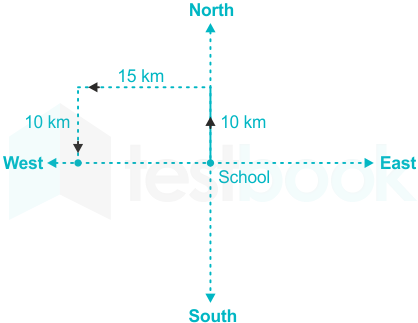
A boy goes 10 km in the north direction from his school. From there he turns left and goes 15 km, and again turns left and goes 10 km. How far is the boy from his school and in which direction from school?

  1. ((a))

    10 km and in North Direction

  2. ((b))

    15 km and in South Direction

  3. ((c))

    10 km and in West Direction

  4. ((d))

    15 km and in West Direction

Show Answer
Answer: ((d))

15 km and in West Direction

As per the given information, 

<br>

The boy is within 15km of distance from school and is in the WEST direction.

11

Arrange the following terms chronologically according to the time these were first introduced.

(A) Principle of common but differentiated responsibility.

(B) Sustainable Development

(C) Nationally Determined Contributions

(D) Clean Development Mechanism

Choose the correct answer from the options given below:

  1. ((a))

    A, B, C, D

  2. ((b))

    B, A, C, D

  3. ((c))

    B, A, D, C

  4. ((d))

    A, B, D, C

Show Answer
Answer: ((c))

B, A, D, C

The correct answer is  B, A, D, C

 Important Points

  • Sustainable Development:
  • Development that meets the needs of the present without compromising the ability of future generations to meet their own needs.
  • The concept of sustainable development was first introduced in 1987
  • in the report of the World Commission on Environment and Development, also known as the Brundtland Commission.
  • Principle of common but differentiated responsibility:
  • This principle was first introduced in the United Nations Framework Convention on Climate Change (UNFCCC) in 1992.
  • It recognizes that all countries share a common responsibility to address global environmental problems,
  • but also acknowledges that developed countries should take the lead in reducing greenhouse gas emissions and providing financial and technological support to developing countries.
  • Clean Development Mechanism:
  • The Clean Development Mechanism (CDM) was established under the Kyoto Protocol in 2005.
  • It allows developed countries to earn carbon credits by investing in emission reduction projects in developing countries.
  • Nationally Determined Contributions:
  • This term was introduced in the context of the Paris Agreement,
  • which was adopted in 2015.
  • Nationally Determined Contributions (NDCs) are the pledges made by individual countries to reduce their greenhouse gas emissions and adapt to the impacts of climate change.

Therefore, the correct chronological order is B, A, D, C Sustainable Development, Principle of common but differentiated responsibility, Clean Development Mechanism, Nationally Determined Contributions.

12

Identify the nuclear disasters among the following:

(A) Love cannal

(B) Fukushima

(C) Kyshtym

(D) Chernobyl

Choose the most appropriate answer from the options given below:

  1. ((a))

    A, B and C Only

  2. ((b))

    B, C and D Only

  3. ((c))

    A, B and D Only

  4. ((d))

    D Only

Show Answer
Answer: ((b))

B, C and D Only

The correct answer is  B, C, and D only.

 Important PointsNuclear Disasters: The main drawback of nuclear energy is the possibility of nuclear disasters. These occur in nuclear power plants. The consequences of such disasters can be extremely serious. A few of these nuclear disasters include

Love Canal is not a nuclear disaster, but a chemical disaster caused by toxic waste disposal.

  • Fukushima and Chornobyl are two of the most well-known nuclear disasters in history.
  • Kyshtym is another nuclear disaster that occurred in the Soviet Union in 1957.

​Therefore the correct answer is Option 2)  B, C, and D only.

<br>

Key Points 

Love Canal:

  • Love Canal is not a nuclear disaster.
  • It was a chemical disaster that occurred in the late 1970s in Niagara Falls, New York.
  • A company called Hooker Chemicals dumped toxic waste in an abandoned canal in the 1940s and 1950s.
  • The waste contained over 80 different chemicals, including benzene, dioxin, and PCBs.

​Fukushima:

  • Fukushima is a nuclear disaster that occurred in March 2011.
  • An earthquake and a tsunami hit the Fukushima Daiichi nuclear power plant, causing meltdowns in three of the six reactors.
  • The disaster released radioactive material into the environment, leading to the evacuation of over 100,000 people.
  • It is considered the second-worst nuclear disaster after Chornobyl.

Kyshtym:

  • Kyshtym is a nuclear disaster that occurred in September 1957 in the Soviet Union.
  • It was caused by a chemical explosion at the Mayak nuclear plant, which released radioactive material into the environment.
  • The disaster contaminated an area of 15,000 square kilometers, and thousands of people were affected.
  • It is considered the third-worst nuclear disaster after Chornobyl and Fukushima.

Chornobyl:

  • Chornobyl is a nuclear disaster that occurred in April 1986 in the Soviet Union (now Ukraine).
  • It was caused by a reactor explosion at the Chornobyl nuclear power plant, which released large amounts of radioactive material into the environment.
  • The disaster led to the evacuation of over 100,000 people, and the death toll is estimated to be between 4,000 and 93,000, depending on the source.
13

Match List I with List II:

List IList II
(A)Pathogens(I)Thorium
(B)Inorganic Chemicals(II)Plastics
(C)Organic Chemicals(III)Bacteria
(D)Radioactive Material(IV)Heavy Metals
<br>

Choose the correct answer from the options given below:

  1. ((a))

    (A) - (I), (B) - (II), (C) - (III), (D) - (IV) 

  2. ((b))

    (A) - (II), (B) - (IV), (C) - (III), (D) - (I)

  3. ((c))

    (A) - (III), (B) - (IV), (C) - (I), (D) - (II)

  4. ((d))

    (A) - (III), (B) - (IV), (C) - (II), (D) - (I)

Show Answer
Answer: ((d))

(A) - (III), (B) - (IV), (C) - (II), (D) - (I)

the correct answer is (A) - (III), (B) - (IV), (C) - (II), (D) - (I),

Important Points

where Pathogens match with Bacteria, Inorganic Chemicals match with Heavy Metals, Organic Chemicals match with Plastics, and Radioactive Material match with Thorium.

TopicDefinition/meaning
(A) Pathogens- Microorganisms that cause diseases - Pathogens are microorganisms such as bacteria, viruses, fungi, and parasites that can cause diseases in humans, animals, and plants. - Salmonella, E. coli, HIV
(B) Inorganic Chemicals- Chemical compounds that don't contain carbon atoms - Heavy metals such as lead, mercury, and cadmium are examples of inorganic chemicals. They are used in batteries, paints, and pesticides - Lead, mercury, and cadmium are used in batteries, paints, and pesticides
(C) Organic Chemicals- Chemical compounds that contain carbon atoms - Plastics, which are made of polymers, are an example of organic chemicals. Polyethylene and PVC are common types of plastic that are used in packaging, construction, and clothing. - However, some organic chemicals such as pesticides and solvents can also have harmful effects on human health and the environment. - Polyethylene, PVC, used in packaging, construction, and clothing
(D) Radioactive Material- Substances that emit radiation - such as alpha particles, beta particles, and gamma rays. - They include elements such as uranium, plutonium, and thorium, as well as their isotopes and compounds. The correct match for radioactive materials is (I) Thorium, which is a naturally occurring radioactive element that can be found in rocks, soil, and minerals. - Uranium, and plutonium, used in nuclear reactors and X-ray machines


Additional Information 

Pathogens: Pathogens are microorganisms, such as bacteria, viruses, fungi, or parasites, that can cause diseases in living organisms. They can be transmitted through direct contact, contaminated food or water, or through the air. Examples of pathogens include the influenza virus, Salmonella bacteria, and malaria parasites.

Inorganic Chemicals: Inorganic chemicals refer to compounds that do not contain carbon bonded to hydrogen. They can include elements like metals (e.g., mercury, lead) and non-metals (e.g., arsenic, chlorine). Inorganic chemicals can be found naturally in the environment or may be produced as a result of human activities. Some inorganic chemicals can be toxic and harmful to living organisms if ingested, inhaled, or exposed to in excessive amounts.

Organic Chemicals: Organic chemicals are compounds that contain carbon bonded to hydrogen, often in combination with other elements such as oxygen, nitrogen, or chlorine. They can include a wide range of substances, such as solvents, pesticides, plastics, and pharmaceuticals. Organic chemicals can be found in various products and environments, and their impacts on living organisms can vary widely depending on the specific compound and exposure levels.

Radioactive Material: Radioactive materials are substances that emit radiation due to their unstable atomic nuclei. This radiation can be in the form of alpha particles, beta particles, or gamma rays. Radioactive materials can be naturally occurring (e.g., uranium, radon) or human-made (e.g., radioactive isotopes used in medical treatments or nuclear power generation). Exposure to radioactive materials can pose significant health risks, including increased risk of cancer and other radiation-related illnesses.

14

Given below are two statements: One is labelled as Assertion A and the other is labelled as Reason R.

Assertion (A): Energy of most cyclones dissipates fast after landfall.

Reasons (R): Surface roughness of land areas is higher than that of oceans.

In the light of the above statements, choose the most appropriate answer from the options given below :

  1. ((a))

    Both (A) and (R) are true and (R) is the correct explanation of (A)

  2. ((b))

    Both (A) and (R) are true but (R) is NOT the correct explanation of (A)

  3. ((c))

    (A) is correct but (R) is not correct

  4. ((d))

    (A) is not correct but (R) is correct.

Show Answer
Answer: ((a))

Both (A) and (R) are true and (R) is the correct explanation of (A)

The correct answer is  Both (A) and (R) are true and (R) is the correct explanation of (A).

Key Points 

Assertion (A): Energy of most cyclones dissipates fast after landfall.​

  • States that the energy of most cyclones dissipates fast after landfall.
  • This is true because cyclones depend on the warm, moist air over the oceans as a source of energy.
  • When they make landfall, they lose their source of energy and gradually dissipate.

Reasons (R): Surface roughness of land areas is higher than that of oceans.​

  • Land areas are typically characterized by diverse geological features such as mountains, hills, valleys, canyons, and plateaus.
  • These features contribute to the unevenness and ruggedness of the land's surface, resulting in higher roughness compared to the relatively smoother and more uniform ocean surfaces.

Therefore, both statements A and R are true, and statement R is the correct explanation for statement A.

Important Points Tropical Cyclones

  • Tropical cyclones are violent storms that originate over oceans in tropical areas and move over to the coastal areas bringing about large-scale destruction due to violent winds (squalls), very heavy rainfall (torrential rainfall), and storm surge.
  • They are irregular wind movements involving the closed circulation of air around a low-pressure center.

Conditions Favourable for Tropical Cyclone Formation

  • Large sea surface with a temperature higher than 27° C,
  • The presence of the Coriolis force is enough to create a cyclonic vortex,
  • Small variations in the vertical wind speed,
  • A pre-existing weak low-pressure area or low-level-cyclonic circulation,
  • Upper divergence above the sea level system.
15

Given below are two statements :

Statement I: Kothari Commission recommended a national system of education based on a structure of 10 + 2 + 3.

Statement II: National Knowledge Commission was constituted in June 2005 by the erstwhile Prime Minister Dr. Manmohan Singh.

In the light of the above statements, choose the correct answer from the options given below:

  1. ((a))

    Both Statement I and Statement II are true

  2. ((b))

    Both Statement I and Statement II are false

  3. ((c))

    Statement I is true but Statement II is false

  4. ((d))

    Statement I is false but Statement II is true

Show Answer
Answer: ((a))

Both Statement I and Statement II are true

The correct answer isBoth Statement I and Statement II are true.

Important Points

  • Statement I is true
  • Because the Kothari Commission was an education commission set up by the Government of India in 1964
  • To examine all aspects of the educational sector in India and make recommendations for its improvement.
  • In order to increase the enrollment percentage, it recommended free and compulsory education for children of the age group 6 to 14 years.
  • A new pattern of the educational structure was recommended by the Kothari Commission which was commonly known as 10+2+3. According to it, the structure of education in the country should be as follows,
  • Pre-school stage: Here education should be for 1 to 3 years
  • Primary education stage: The 7 to 8 years of primary education are to be divided into 4 or 5 years of the lower primary stage and 3 or 2 years of the higher primary stage.
  • Lower secondary education stage: 3 or 2 years of general education or 1 to 3 years of vocational education.
  • Higher secondary education stage: 2 years of general education or 1 to 3 years of vocational education.
  • Higher education stage:3 years or more for the first-degree course followed by courses of varying durations for the second or research degrees.
  • One of its major recommendations was the adoption of a national system of education based on a 10+2+3 structure, which was subsequently implemented in the country.

Statement II is also true

  • Because the National Knowledge Commission (NKC) was constituted in June 2005
  • by the then Prime Minister of India, Dr. Manmohan Singh.
  • It was an Indian think-tank charged with considering possible policies that might sharpen India's comparative advantage in the knowledge-intensive service sectors.
  • The NKC was established to provide recommendations for improving the knowledge-related infrastructure and competitiveness of India.

Therefore, both statements I and II are true, and the correct answer is option 1) Both Statements I and Statement II are true.

16

Who among the following were prominent women vedic scholars?

(A) Maitreyi

(B) Viswambhara

(C) Apala

(D) Gargi

(E) Lopamudra

Choose the correct answer from the options given below:

  1. ((a))

    A, D, E Only

  2. ((b))

    A, C, D Only

  3. ((c))

    A, C, D, E Only

  4. ((d))

    A, B, C, D, E

Show Answer
Answer: ((d))

A, B, C, D, E

The correct answer is indeed  A, B, C, D, E.

Key Points 

In the Vedic period, women enjoyed a privileged place in society. The wife was the mistress of the household and she had authority over the slaves. Women participated with their husbands in all the religious ceremonies. In the Vedas, a few women scholars are mentioned like Gargi, Maitreyi, VIswambhara, and Apala. Ghosha, Lopamudra, Sakata, and Nivavari.

  • Maitreyi was a philosopher and scholar who lived during the Vedic period
  • and was considered to be one of the most learned women of her time.
  • She is known for her intellectual debates with her husband, Yajnavalkya, and her deep understanding of the Upanishads.
  • Gargi was the daughter of sage Vachaknu and Vedic prophetess renowned philosopher and scholar who is mentioned in the Brihadaranyaka Upanishad, one of the oldest Vedic texts.
  • She is known for her intellectual debates with the sage Yajnavalkya and her contributions to the field of philosophy.
  • ​Lopamudra was a famous female sage and scholar mentioned in the Rigveda.
  • She was the wife of the sage Agastya and is known for her contributions to the field of Vedic literature
  • Viswambhara was a female scholar mentioned in Rigveda and is known for her contributions to the field of medicine.
  • She is said to have cured a king of a serious illness using her knowledge of herbs and natural remedies.
  • Apala was also a Vedic scholar and is mentioned in the Rigveda.
  • She is known for her contributions to the field of mathematics and
  • is said to have invented a method for extracting square roots.

Therefore, the correct answer is  A, B, C, D, E

17

The objectives of All India Council of Technical Education (AICTE) are:

(A) Promotion of quality in technical education

(B) Funding salary of teachers in engineering colleges. 

(C) Planning and coordinating development of technical education system.

(D) Promoting continuous and open learning in technical education

(E) Regulation and maintenance of norms and standards

Choose the correct answer from the options given below:

  1. ((a))

    A, D, E Only

  2. ((b))

    A, B, E Only

  3. ((c))

    A, C, E Only

  4. ((d))

    A, C, D Only

Show Answer
Answer: ((c))

A, C, E Only

The correct answer is A, C, E Only.

Key Points 

The All India Council of Technical Education (AICTE) was established in 1945 as a national-level apex advisory body to regulate and promote technical education in India. Its main objectives are:

  • Promotion of Quality in Technical Education.
  • Planning and Coordinated Development of Technical Education System.
  • Regulations and Maintenance ofNorms and Standards.

A) Promotion of quality in technical education

C) Planning and coordinating the development of a technical education system

E) Regulation and maintenance of norms and standards

  • Option B is incorrect because AICTE does not fund the salaries of teachers in engineering colleges. This is the responsibility of individual colleges and institutions.
  • Option D is incorrect because although AICTE does promote continuous and open learning in technical education, it is not one of its main objectives.

Therefore, the correct answer is  A, C, E Only.

Additional Information  All India Council for Technical Education (AICTE)

  • The All India Council for Technical Education (AICTE) is a statutory body, and a national-level council for technical education, under the Department of Higher Education.
  • It was established in November 1945 first as an advisory body and later on in 1987 given statutory status by an Act of Parliament.
  • AICTE is responsible for the proper planning and coordinated development of the technical education and management education system in India.
18

Given below are two statements:

Statement I: National Education Policy 2020 recommends the abolition of the system of affiliation of colleges in the higher education system.

Statement II: National Education Policy 2020 recommends strengthening and empowering the Central Advisory Board of Education (CABE).

In light of the above statements, choose the correct answer from the options given below:

  1. ((a))

    Both Statement I and Statement II are true

  2. ((b))

    Both Statement I and Statement II are false

  3. ((c))

    Statement I is true but Statement II is false

  4. ((d))

    Statement I is false but Statement II is true

Show Answer
Answer: ((a))

Both Statement I and Statement II are true

The correct answer is  Both Statement I and Statement II are true.

Key Points

The National Education Policy 2020 (NEP 2020) is a policy document that outlines the vision and roadmap for the development of education in India.

Two of its key recommendations are:

Statement I: NEP 2020 recommends the abolition of the system of affiliation of colleges in the higher education system.

  • This statement is true. NEP 2020 recommends phasing out the system of affiliating colleges to universities over the next 15 years and replacing
  • it with a system of autonomous degree-granting colleges.
  • This is intended to promote academic and administrative autonomy and improve the quality of education in colleges.

Statement II: NEP 2020 recommends strengthening and empowering the Central Advisory Board of Education (CABE).

  • This statement is also true.
  • NEP 2020 recommends that CABE be strengthened and empowered as the highest-level advisory body in education in India.
  • This is intended to ensure better coordination and coherence in education policy and planning, and to facilitate the participation of all stakeholders in the policymaking process.

Therefore, the correct answer is  Both Statements I and Statement II are true

Additional Information the National Education Policy 2020 proposed various reforms in school education as well as higher education including technical education that has to be adopted by all educational institutions.  It has replaced the 34-year-old national education policy formulated in 1986.

NEP 2020 is based on 5 Pillars and these are- Access, Equity, Quality, Affordability, and Accountability.

  • Access- all children, irrespective of caste, creed, location, or gender should have access to elementary education of comparable quality.
  • Equity- offering individualized support to students.
  • Quality- deliver Quality education to all the students.
  • Affordability- Free and compulsory education for 3-18 years students.
  • Accountability- It is the collection of policies and procedures used to hold schools and districts accountable for improving educational outcomes for all students and forcing and facilitating needed improvements
19

A teacher teaches in a scaled-down situation of teaching. Which of the following terms can be used for this type of teaching?

  1. ((a))

    Macro teaching

  2. ((b))

    Sampling teaching

  3. ((c))

    Cooperative teaching

  4. ((d))

    Micro teaching

Show Answer
Answer: ((d))

Micro teaching

The correct answer is  Micro teaching.

Important Points

Microteaching is a teacher training technique that involves a scaled-down version of the teaching experience

Micro-teaching is a technique or strategy used in teacher training which helps in acquiring specific classroom competencies through practice, feedback, and repetition until the specified teaching behavior is achieved. It is related to teaching strategy which helps the teacher to develop core skills of teaching. 

  • It is a scaled-down process in terms of class size, length of the lesson, teaching duration, and teaching complexity, and at the same time receiving effective feedback.
  • In this technique, the student-teacher is required to teach a small group of students for up to 15-20 minutes, focusing on a particular aspect of teaching. E.g. Skill of set induction, Skill Questioning, Skill Blackboard Writing, etc.
  • Microteaching was invented by D.W. Allen in 1961 at Stanford University.
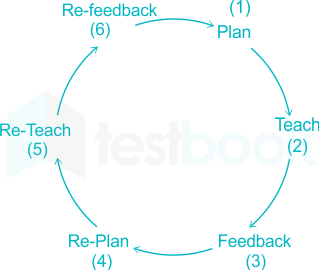
  • According to D.W. Allen following are the six steps in microteaching:


F1 Arya Nikhil 31-12-19 D2 (1)

On the other hand, Macro teaching involves the teaching of large groups of students, such as in a lecture or seminar, while Sampling teaching and Cooperative teaching are not recognized terms in the context of scaled-down teaching situations

Therefore the correct answer is micro-teaching

20

"The universe must be spherical in form since all the constituent parts of the universe, stars and planets, etc. are spherical in form." Which fallacy is committed in the above argument?

  1. ((a))

    Begging the Question

  2. ((b))

    Fallacy of Composition

  3. ((c))

    Fallacy of Accident

  4. ((d))

    Hasty Generalisation

Show Answer
Answer: ((b))

Fallacy of Composition

the correct option is Fallacy of Composition

Important Points

A fallacy is the use of invalid or otherwise faulty reasoning or wrong moves in the construction of an argument. A fallacious argument may be deceptive by appearing to be better than it really is.

The fallacy is of two types:

  • Formal fallacy: A defect or error traceable to the very structure or form of the argument.
  • Informal fallacy: A defect that can be detected only by examining the content of the argument.

In the given argument, the fallacy of composition or Part-to-Whole Fallacy is committed when the conclusion is drawn that the universe must be spherical since all its constituent parts like stars and planets are spherical.

  • While it may be true that most celestial objects are spherical, it does not necessarily mean that the universe as a whole is spherical.

The fallacy of composition

  • It​ consists in treating a distributed characteristic as if it were a collective.
  • It occurs when one makes the mistake of attributing to a group (or a whole) some characteristic that is true only of its individual members (or its parts), and then makes inferences based on that mistake.

Therefore, the argument commits the fallacy of composition by assuming that the properties of individual parts of the universe can be extended to the universe as a whole.

Additional Information

  • The fallacy of accident occurs when an uncharacteristic specific instance is claimed to logically follow from a generalization that does not properly apply to that instance.
  • The fallacy of converse accident is an informal fallacy that can occur in a statistical syllogism when a rule that applies only to an exceptional case is wrongly applied to all cases in general.
  • Hasty Generalisation: Hasty generalizations relate to conclusions reached based on insufficient knowledge or when a logical path is reversed in any circumstance.
  • Begging the Question ) is a logical fallacy where the premise on which the conclusion is based, is already assumed to be true. This allows one to make an argument without sufficient evidence.
21

Given below are two statements :

Statement I : In classical logic, the universal proposition implies the truth of its corresponding particular proposition.

Statement II : Two propositions that cannot both be true and cannot both be false are called contraries.

In the light of the above statements, choose the correct answer from the options given below:

  1. ((a))

    Both Statement I and Statement II are true

  2. ((b))

    Both Statement I and Statement II are false

  3. ((c))

    Statement I is true but Statement II is false

  4. ((d))

    Statement I is false but Statement II is true

Show Answer
Answer: ((c))

Statement I is true but Statement II is false

The correct answer is Statement I is true but Statement II is false.

Important Points 

Statement I is true

  • because in classical logic, a universal proposition, which asserts something about all members of a class, implies the truth of its corresponding particular proposition,
  • which asserts something about some members of the same class.
  • For example, the universal proposition "All dogs are mammals" implies the particular proposition "Some dogs are mammals".

Statement II is false

  • "Two propositions that cannot both be true and cannot both be false are called contraries." This is a definition or description of contraries. It states that contraries are pairs of propositions that cannot have both true or both false truth values. This statement is generally true.
  • "This statement is false." This is a self-referential statement that refers to itself. If we assume the statement is true, then it implies that it is false, which leads to a contradiction. If we assume the statement is false, then it implies that it is true, which again leads to a contradiction.
  • Therefore, this statement is a paradox and cannot be consistently assigned a truth value.
  • Since the second part of the statement leads to a contradiction, the whole statement is false.

Therefore, the correct answer is Statement I is true but Statement II is false.

Additional Information 

The standard form of a categorical proposition has the same subject term and predicate term but may differ from each other in quality or quantity or both. The such difference has been called opposition. The term opposition is used when there is no apparent disagreement between the propositions.

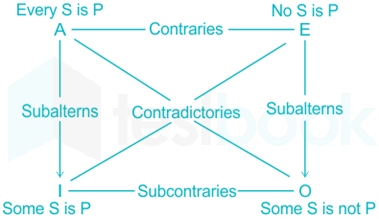
The square, traditionally conceived, looks like this:

5ff4159b41350a6208da8282 16315171115252

Types of Opposition:

  1. Contradictories: The standard form of a categorical proposition that has the same subject and predicate term but differs from each other in both quantity and quality. Two propositions are contradictory if one is denial or negation of the other if they can’t be true or can’t be both false.

Example: All philosophers are fallible. Socrates is not fallible

  1. Contraries: These are propositions that cannot both be true, but can both be false.

For example: A proposition: All S are P (universal affirmative), E proposition: No S are P (universal negative)

  1. Sub-contraries: If a particular proposition has the same subject and predicate terms but differing in quality, one affirming the other denying. Two propositions are said to be sub-contraries if they can’t both be false although both may be true.

Example: Some cars are vehicles. Some cars are not vehicles.

  1. Subalternation: It is the opposition between a universal proposition and its corresponding particular proposition. In the corresponding proposition, the universal proposition is called the superaltern, and the particular proposition is called the subaltern. These propositions have the same subject and predicate terms and agree on quality. Both are affirming or both denying but differ in quantity. One universal and the other particular.

Example: No hens are birds. Some hens are not birds

22

Which IT project in India is the main provider of ICT infrastructure for creating a knowledge society with the aim to ushering in a knowledge revolution in the country?

  1. ((a))

    NKN

  2. ((b))

    UIDAI

  3. ((c))

    National Informatics Network

  4. ((d))

    Megh Raj (GI Cloud)

Show Answer
Answer: ((a))

NKN

The correct answer is  NKN

Important Points 

National Knowledge Network(NKN):

  • It is a state of Art Pan India network and a revolutionary step in the creation of a knowledge society without territorial barriers.
  • It was established in March 2010 with the approval of the Cabinet Committee of Infrastructure.
  • Its purpose is to serve the Nation's quest for building high-quality Institutions with required research facilities and to create a talented pool of highly trained professionals.
  • NKN is a state-of-the-art multi-gigabit pan-India network that facilitates the development and deployment of advanced applications and services requiring high-speed data transfer,
  • grid computing, and other advanced networking capabilities. It is aimed at connecting academic institutions, R&D labs, libraries, and information centers across the country and providing access to digital resources, tools, and services for knowledge creation, dissemination, and utilization

Therefore **the correct answer is  NKN  IT project in India is the main provider of ICT infrastructure for creating a knowledge society with the aim of ushering in a knowledge revolution in the country

Additional Information 

Here are brief explanations of the other options:

 UIDAI:

  • UIDAI stands for Unique Identification Authority of India.
  • It is a government agency responsible for implementing and managing the Aadhaar program,
  • which is a biometric-based identification system that assigns a unique 12-digit number to every resident of India.
  • Aadhaar is used for various purposes such as identity verification, financial transactions, and access to government services.

National Informatics Network:

  • National Informatics Network (NIC) is a premier information technology organization of the Government of India.
  • It provides e-governance support to the government at all levels, including policy planning, implementation, and monitoring.
  • NIC has played a key role in the development and implementation of various e-governance initiatives such as e-courts, e-procurement, and digital India.

Megh Raj (GI Cloud):

  • Megh Raj is a government initiative aimed at promoting the adoption of cloud computing in the public sector.
  • It stands for "Meghalya - Rajasthan - Jharkhand Cloud" and is part of the larger National Cloud initiative.
  • Megh Raj aims to provide a common platform for all government departments and agencies to host and share their data and applications securely on the cloud.
  • This would lead to better utilization of IT resources and cost savings for the government
23

Amar's college uses a form to collect data from new students. The data is used to create information that can be used by the college. Which of the following statements are true about information?

(A) Information is raw facts and figures that have not been given meaning. 

(B) Information can be produced by processing raw data.

(C) Information is automatically encrypted when it is produced.

(D) Information is raw facts and figures that have been given a context.

Choose the correct answer from the options given below:

  1. ((a))

    A and C Only

  2. ((b))

    A and B Only

  3. ((c))

    B and D Only

  4. ((d))

    ​C and D Only

Show Answer
Answer: ((c))

B and D Only

B and D Only is the correct answer

Important Points

  • (A) Information is raw facts and figures that have not been given meaning.
  • Information is not solely limited to raw facts and figures that have not been given meaning. In fact, information is derived from data that has been processed, organized, or interpreted in a way that provides it with significance, context, and understanding.
  • Raw data, on its own, may lack meaning, but once it is processed and given context, it can be considered as information.

Therefore, this statement is incorrect.

  • (B) This statement is true. Raw data becomes useful only when it is processed and transformed into meaningful information.
  • Information can be produced by processing raw data, and this process involves various techniques such as sorting, filtering, aggregating and
  • analyzing data to derive insights and make informed decisions.
  • (C) The statement "Information is automatically encrypted when it is produced" is incorrect.
  • Encryption is a separate process applied to information to protect it from unauthorized access.
  • Information itself does not automatically come encrypted.

(D) The statement "Information is raw facts and figures that have been given a context" is correct.

  • Information can be defined as data that has been processed, organized, or presented in a way that is meaningful and useful to someone.
  • This processing can involve various activities such as filtering, analyzing, and structuring the data. Context can certainly play a role in shaping how information is interpreted and understood, but it is not an inherent characteristic of information itself. This is correct

Therefore,  B and D Only is the correct answer.

Additional Information

DataInformation
DefinitionRaw facts and figures that have no meaning or contextData that has been processed, organized, and given context, meaning, and relevance
CharacteristicsUnprocessed, unorganized, and lacking context or relevanceProcessed, organized, and meaningful
PurposeTo collect, store, and retrieve informationTo aid in decision-making and provide insight
FormatTypically stored in a structured or unstructured formatPresented in a structured and organized format
ExamplesNumbers, text, images, and sounds, among othersReports, dashboards, and visualizations, among others
24

Identify the correct ascending order of the following numbers under A-D represented in different bases:

(A) (11101011)2 (Base - 2 binary number)

(B) (564)8 (Base - 8 Octal number)

(C) (614)10 (Base - 10 decimal number)

(D) (489)16 (Base - 16 hexadecimal number)

Choose the correct answer from the options given below:

  1. ((a))

    A, C, D, B

  2. ((b))

    D, C, B, A

  3. ((c))

    B, C, A, D

  4. ((d))

    A, B, C, D

Show Answer
Answer: ((d))

A, B, C, D

The correct answer is A, B, C, D.**

Important Points 

To convert the numbers to base 10 (decimal), we can use the following formulas:

For binary to decimal:

  • (a0 × 2^0) + (a1 × 2^1) + (a2 × 2^2) + ... + (an × 2^n),
  • where ai is the ith digit from the right.

For octal to decimal:

  • (a0 × 8^0) + (a1 × 8^1) + (a2 × 8^2) + ... + (an × 8^n),
  • where ai is the ith digit from the right.

For hexadecimal to decimal:

  • (a0 × 16^0) + (a1 × 16^1) + (a2 × 16^2) + ... + (an × 16^n),
  • where ai is the ith digit from the right.
  • Letters A-F represents decimal values 10-15.

Key Points

Using these formulas, we can convert the given numbers to decimal form and then arrange them in ascending order:​

So in this case, we first convert each number to decimal:

  • (11101011)2 = (1 × 2^0) + (1 × 2^1) + (0 × 2^2) + (1 × 2^3) + (0 × 2^4) + (1 × 2^5) + (1 × 2^6) + (1 × 2^7) = 235
  • (564)8 = (4 × 8^0) + (6 × 8^1) + (5 × 8^2) = 4 + 48 + 320 = 372
  • (614)10 = 614
  • (489)16 = (9 × 16^0) + (8 × 16^1) + (4 × 16^2) = 9 + 128 + 1024 = 1161

Then we compare them and arrange them in ascending order:

  • (11101011)2< (564)8<(614)10<(489)16

So the correct answer is  A, B, C, D.

25

Which of the following pesticides is expected to persist in the environment for a longer period as compared to others?

  1. ((a))

    Dieldrin

  2. ((b))

    Parathion

  3. ((c))

    Malathion

  4. ((d))

    Carbaryl

Show Answer
Answer: ((a))

Dieldrin

The correct answer is  Dieldrin.

Important Points 

  • Pesticides are chemical compounds used to combat pests such as insects, rodents (like rats), fungi, and parasitic plants (weeds).
  • The pesticide consists of the word 'pest' (a destructive insect or another animal that attacks crops, food, livestock, etc) thus meaning, any substance or a mixture of substances whose aim is to destroy or control the impact of any pest.

Dieldrin is an organochlorine pesticide that was widely used in the past for controlling agricultural pests. It has been banned in most countries due to its harmful effects on the environment and human health.

  • A synthetic organochlorine pesticide(Organochlorine pesticides are chlorinated hydrocarbons used broadly in agriculture and mosquito control. They can be analyzed by Electron Capture Detector.)

Dieldrin:

  • that was widely used in the past but has now been banned in many countries due to its harmful effects on the environment and human health.
  • Known to persist in the environment for a long time (up to 15 years) and can accumulate in the Fatty tissues  of animals, leading to biomagnification in food chains.
  • Dieldrin is highly toxic to a wide range of organisms, including birds, fish, and mammals, and has been linked to reproductive and neurological problems in humans.

In contrast, the other pesticides listed (Parathion, Malathion, and Carbaryl) are organophosphate or carbamate pesticides that are relatively less persistent in the environment and break down more quickly.

Therefore, Dieldrin is expected to persist in the environment for a longer period compared to the other pesticides listed.

Additional Information 

Parathion:

  • An organophosphate insecticide that is still used in some parts of the world despite being banned in many countries due to its high toxicity and harmful effects on human health and the environment.
  • Parathion has a relatively short half-life in soil and water, but its breakdown products (including paraoxon) can persist in the environment and remain toxic for a long time.
  • Highly toxic to insects, birds, and mammals, including humans, and can cause a range of health effects such as nausea, headaches, and respiratory problems.
  • This remains for a lesser period of time as compared to Diledrin.

Malathion:

  • An organophosphate insecticide that is commonly used in agriculture and public health programs to control pests such as mosquitoes and fruit flies.
  • Malathion has a relatively short half-life in the environment (a few days to a few weeks) and breaks down rapidly in soil, water, and sunlight.
  • While it is less toxic to humans than many other pesticides, exposure to high levels of malathion can cause a range of health effects such as skin irritation, headaches, and dizziness.

Carbaryl:

  • A carbamate insecticide that is widely used in agriculture and pest control programs to control a range of pests such as insects, mites, and ticks.
  • Carbaryl has a relatively short half-life in the environment (a few days to a few weeks) and breaks down rapidly in soil, water, and sunlight.
  • While it is less toxic to humans than many other pesticides, exposure to high levels of carbaryl can cause a range of health effects such as nausea, vomiting, and respiratory problems.
26

Given below are two statements:

Statement I: Understanding the concept of sustainable development is the prerequisite for developing the values needed for it.

Statement II: Sustainable development is defined as development that meets the needs of the present generation without compromising the ability of future generations to meet their own need.

In light of the above statements. choose the correct answer from the options given below:

  1. ((a))

    Both Statement I and Statement II are true

  2. ((b))

    Both Statement I and Statement II are false

  3. ((c))

    Statement I is true but Statement II is false

  4. ((d))

    Statement I is false but Statement II is true

Show Answer
Answer: ((a))

Both Statement I and Statement II are true

The correct answer is  Both Statement I and Statement II are true.

 Key Points

Statement I

  • States that understanding the concept of sustainable development is a prerequisite for developing the values needed for it.
  • This statement is true because sustainable development is not just a goal,
  • but also a mindset and a way of thinking about development that takes into account the needs of the present and future generations while preserving the natural resources and ecosystem.

Statement II

  • Defines sustainable development
  • As development that meets the needs of the present generation without compromising the ability of future generations to meet their own needs.
  • This definition is widely accepted and is the cornerstone of sustainable development

therefore the correct answer is option 1) Both Statement I and Statement II are true.

Important Points

  • Sustainable development was developed for the first time in the Brundtland Commission Report in 1987.
  • The Brundtland Report was published by the United Nations World Commission on Environment and Development in 1987.
  • Sustainable Development Goals (SDGs):
  • To bring sustainable development into the mainstream United Nations (UN) launched the 2030 Agenda for Sustainable Development and SDGs.
  • This universal, integrated, and transformative agenda aims to spur actions that will end poverty and build a more sustainable world over the next 15 years.
  • There are 17 goals and 169 targets specific targets to be achieved by 2030. Reaching the goals requires action on all fronts – governments, businesses, civil society, and people everywhere all have a role to play.
  • SDGs are not legally binding.

The following table shows the details about the number of different categories of vehicles sold (in thousands) in a city over the years 2017 - 2021. Based on the data in the table, answer the question:

Year - wise Sale of Vehicles (in thousands)

YearVechile Category
HCVLCVCarJeepTwo - Wheeler
201752128464306680
201890120484344672
2019144158496420808
2020162186560482822
2021214224532470884
<br>

HCV : Heavy Commercial Vehicle : LCV : Light Commercial Vehicle

27

In which year, the number of LCVs sold was approximately 25% of the number of two-wheelers sold?

  1. ((a))

    2020

  2. ((b))

    2018

  3. ((c))

    2017

  4. ((d))

    2021

Show Answer
Answer: ((d))

2021

Calculation:

Year 2017: 25% of two-wheelers sold = 0.25 × 680 = 170 thousand

LCVs sold in 2017 = 128 thousand

Year 2018: 25% of two-wheelers sold = 0.25 × 672 = 168 thousand

LCVs sold in 2018 = 120 thousand

Year 2019: 25% of two-wheelers sold = 0.25 × 808 = 202 thousand

LCVs sold in 2019 = 158 thousand

Year 2020: 25% of two-wheelers sold = 0.25 ×  822 = 205.5 thousand

LCVs sold in 2020 = 186 thousand

Year 2021: 25% of two-wheelers sold = 0.25 ×  884 = 221 thousand

LCVs sold in 2021 = 224 thousand

From the above calculations, we can see that the number of LCVs sold was closest to 25% of the number of two-wheelers sold in the year 2021.

28

If the percentage increase in the sale of HCVs in 2022 over 2021 is expected to be same as in 2021 over 2020. then approximately how many HCVs (in thousands) will be sold in 2022?

  1. ((a))

    278

  2. ((b))

    282

  3. ((c))

    288

  4. ((d))

    266

Show Answer
Answer: ((b))

282

The percentage increase in the sale of HCVs from 2020 to 2021 can be calculated as:

((Number of HCVs sold in 2021 - Number of HCVs sold in 2020) / Number of HCVs sold in 2020)) × 100%

⇒ ((214 - 162) / 162) ×  100%

⇒ 32.09%

If we assume that the percentage increase in the sale of HCVs in 2022 over 2021 will also be 32.10%, then we can estimate the number of HCVs sold in 2022 as follows: 

Number of HCVs sold in 2022 = Number of HCVs sold in 2021 + (32.10% of Number of HCVs sold in 2021)

⇒ 214 + (0.3209 × 214)

⇒ 282.67 thousand ~ 282 thousand 

Therefore, based on this assumption, we can estimate that approximately 282 thousand HCVs will be sold in 2022.

29

The number of HCVs sold in 2020 was approximately what percent of the total number of vehicles sold in 2019?

  1. ((a))

    8%

  2. ((b))

    10%

  3. ((c))

    7%

  4. ((d))

    9%

Show Answer
Answer: ((a))

8%

Formula Used:

Percentage = (Number of HCVs sold in 2020 / Total number of vehicles sold in 2019) × 100 

Calculation:

The number of HCVs sold in 2020 is 162 thousand, and the total number of vehicles sold in 2019 is the sum of the sales of all categories of vehicles:

Total number of vehicles sold in 2019 = 144 + 158 + 496 + 420 + 808 = 2026 thousand

Substituting these values in the formula, we get:

Percentage = (162 / 2026) * 100 = 7.99% ~ 8%

Therefore, the number of HCVs sold in 2020 was approximately 8% of the total number of vehicles sold in 2019.

30

The sale of two-wheelers as a percentage of the sale of total number of vehicles was highest in the year

  1. ((a))

    2021

  2. ((b))

    2018

  3. ((c))

    2017

  4. ((d))

    2019

Show Answer
Answer: ((d))

2019

Formula Used: 

Percentage of two-wheelers = (Number of two-wheelers sold / Total number of vehicles sold) * 100

Calculation:

For 2017:

⇒ (680 / 1630) ×  100 = 38.65%

For 2018:

⇒ (672 / 1710) × 100 = 39.29%

For 2019:

⇒ (808 / 2026) × 100 = 39.88%

For 2020:

⇒ (822 / 2212) × 100 = 37.16%

For 2021:

⇒ (884 / 2324) × 100 = 38.04%

Therefore, the sale of two-wheelers as a percentage of the sale of total number of vehicles was highest in the year 2019.

31

The percentage increase in the sales in the year 2020 over the previous year was maximum for which of the following categories of vehicles?

  1. ((a))

    Car

  2. ((b))

    HCV

  3. ((c))

    Jeep

  4. ((d))

    LCV

Show Answer
Answer: ((d))

LCV

Calculation:

The percentage increase in sales for each category of vehicles is:

HCV: ((162-144)/144) x 100 = 12.5%

LCV: ((186-158)/158) x 100 = 17.72%

Car: ((560-496)/496) x 100 = 12.90%

Jeep: ((482-420)/420) x 100 = 14.76%

Two-wheeler: ((822-808)/808) x 100 = 1.73%

From the above calculations, we can see that LCVs had the maximum percentage increase in sales in the year 2020 over the previous year with 17.72%.

32

Which of the following type of questions cannot easily be auto-graded by LMS softwares?

  1. ((a))

    Multiple Choice Question

  2. ((b))

    True-False Question

  3. ((c))

    Subjective Question

  4. ((d))

    Matching Question

Show Answer
Answer: ((c))

Subjective Question

The correct answer is Subjective Questions

Important Points 

A learning management system (LMS) is software that is specifically designed to create, distribute, and manage educational content delivery.

Auto grading is the process of using computer algorithms to grade assessments automatically. It is a useful feature in LMS that can save instructors a lot of time and effort by grading objective questions automatically

  • Subjective Questions cannot easily be auto-graded by LMS software.
  • Subjective questions require a student to provide a written answer that is not easily quantifiable or graded using an algorithm.
  • These types of questions typically require human intervention and judgment to grade effectively.
  • In contrast, multiple-choice, true-false, and matching questions can be easily graded automatically by LMS software

Therefore, the correct answer is Subjective Questions

Key Points  There are several different question types from which to choose when setting up an exam in Learning Management System (LMS) 

Following the table is a discussion on how to organize the questions in your course’s Question Library, 

Question TypeDescription
Multiple Choice (MC)- Learners select the best answer. - It is easy to create simple low-level recall questions. Auto graded. Options can be randomized - Difficult to create challenging questions. Without e-proctoring, learners can cheat fairly easily. If using “All of the Above” or “None of the Above” as options, the options should not be randomized - Works best if you create a Question Pool by selecting a subset of questions from the Question Library.
[:30]
0- These can be open-ended, short paragraphs, or longer essay-style questions. - Easy to create. More challenging questions can be asked. More difficult for learners to cheat/copy. - Auto grading is not possible, although an answer key is available. Students do not have time to polish their responses. - A rubric would help with marking. Useful for Math or Science as students can solve problems on paper, take a picture, and upload the image in the question response. - [10:00-30:00]
Short Answer (SA)- Space is provided for text. - Easy to create. More challenging questions can be asked. Can auto-grade. Part marks are possible. - Auto grading is more challenging. Learners need to have the correct spelling. - Good for 1-2 sentence responses. - [2:00]
Ordering (ORD)- Learners place a sequence of events in order. - Easy to create. Can be auto-graded. Options can be randomized - There has to be one linear sequence. - Good for lower-level skills, and knowledge. - [:30 per response]
Arithmetic (2+2)- Basic arithmetic questions. - Easy to create. Can be auto-graded. Arithmetic symbols are embedded in the software. Supports unique question generation using variables. - It may take students time to orient themselves to the function of inserting symbols. - Good for basic arithmetic problems. - [varies]
33

Match List I with List II:

List I (Methodology of Teaching)List II (Teachers support system)
(A)Video through LMS and face to face discussions(I)Traditional
(B)Use of Talk and Chalk and Sharing of notes(II)Modern
(C)Case-study discussions(III)ICT based
(D)Use of projector in class for delivering presentation(IV)Hybrid or Blended
<br>

Choose the correct answer from the options given below:

  1. ((a))

    (A) - (III), (B) - (I), (C) - (II), (D) - (IV)

  2. ((b))

    (A) - (II), (B) - (I), (C) - (III), (D) - (IV)

  3. ((c))

    (A) - (I), (B) - (IV), (C) - (II), (D) - (III)

  4. ((d))

    (A) - (IV), (B) - (I), (C) - (II), (D) - (III)

Show Answer
Answer: ((d))

(A) - (IV), (B) - (I), (C) - (II), (D) - (III)

The correct answer is (A) - (IV) (B) - (I) (C) - (II) (D) - (III)

Important Points List I contain various methodologies of teaching, while List II contains the teachers' support system for these methodologies.

  • A. Video through LMS and face-to-face discussions - (IV) Hybrid or Blended
  • This methodology of teaching involves the use of digital video content in a Learning Management System (LMS) and face-to-face discussions between the teacher and students.
  • This is a hybrid or blended approach that involves teachers using both traditional and modern teaching methodologies to deliver content in class.
  • B. Use of Talk and Chalk and Sharing of notes - (I) Traditional This methodology of teaching
  • involves the teacher delivering lectures using a chalkboard or whiteboard and sharing notes with students.
  • This is a traditional teacher support system where the teacher is responsible for delivering the content and providing support to students who need it.
  • C. Case-study discussions - (II) Modern
  • This methodology of teaching involves analyzing real-world case studies to help students develop their critical thinking and problem-solving skills.
  • This is a modern teacher support system that requires the latest ICT-based technologies like laptops, tablets, and online databases that can be used to access relevant case studies.
  • D. Use of projector in class for delivering a presentation - (III)
  • ICT-based This methodology of teaching involves using a projector in the classroom to deliver presentations.
  • This is an ICT-based teacher support system that requires teachers to support students with modern technologies like projectors,
  • LMS platforms and other digital tools can be used to deliver multimedia content.

Hence, the correct answer is  (A) - (IV), (B) - (I), (C) - (II), (D) - (III).

34

The major advantages of an online Survey are:

(A) It provides strong control over data gathering process.

(B) The identified respondent always fills the questionnaire. 

(C) It is normally inexpensive.

(D) It facilitates the speedy collection of data.

(E) It can be conducted from the researcher's location.

Choose the correct answer from the options given below:

  1. ((a))

    A, B, C Only

  2. ((b))

    B, C, D Only

  3. ((c))

    C, D, E Only

  4. ((d))

    A, B, E Only

Show Answer
Answer: ((c))

C, D, E Only

The correct answer is C, D, E Only.

Important Points

The major advantages of an online survey are:

  • (C) It is normally inexpensive: Online surveys are generally less expensive than traditional surveys, as they do not require printing, postage, or hiring of surveyors.
  • (D) It facilitates the speedy collection of data: Online surveys can be conducted quickly and efficiently, as they do not require time for mailing, data entry, or manual processing.
  • (E) It can be conducted from the researcher's location: Online surveys can be conducted from anywhere, making it easy for researchers to collect data without being physically present in the location of the respondents.

Therefore,  C, D, E Only is the correct answer. Others are incorrect as they do not include all the correct advantages and includes advantage A, which is not necessarily a major advantage of online surveys

35

Given below are two statements :

Statement I : Visual ethnnography as a recent branch of research is dependent upon photo-elicitation to a large extent.

Statement II : The visual research has not helped in empowering the marginalised people.

In the light of the above statements, choose the correct answer from the options given below:

  1. ((a))

    Both Statement I and Statement II are true

  2. ((b))

    Both Statement I and Statement II are false

  3. ((c))

    Statement I is true but Statement II is false

  4. ((d))

    Statement I is false but Statement II is true

Show Answer
Answer: ((c))

Statement I is true but Statement II is false

The correct answer is Statement I is true but Statement II is false.

Important Points

Statement I:

  • Visual ethnography is a recent branch of research that uses visual methods, such as photography and film, to document and understand cultures and social phenomena.
  • Photo-elicitation, which involves using photographs as prompts to elicit responses from participants, is often used in visual ethnography to help researchers gain insights into participants' experiences and perspectives.
  • Therefore, Statement I is true.

Statement II:

  • The statement that visual research has not helped in empowering marginalized people is a broad and contentious claim that requires more context and evidence to support.
  • While it is true that visual research can have limitations and challenges, such as issues related to power dynamics and representation, there are also examples of visual research that have had a positive impact on marginalized communities.
  • Therefore, Statement II is false.

Hence, the correct answer is Statement I is true but Statement II is false

36

Match List I with List II:

List I (Types of case)List II (Description)
(A)Critical case(I)Provides an opportunity to analyse a previously inaccessible phenomenon.
(B)Unique case(II)Based on a well-developed theory
(C)Representative case(III)Normally selected for clinical studies.
(D)Revelatory case(IV)Related to common place situation
<br>

Choose the correct answer from the options given below:

  1. ((a))

    (A) - (I), (B) - (II), (C) - (III), (D) - (IV) 

  2. ((b))

    (A) - (III), (B) - (IV), (C) - (I), (D) - (II)

  3. ((c))

    (A) - (IV), (B) - (I), (C) - (II), (D) - (III)

  4. ((d))

    (A) - (II), (B) - (III), (C) - (IV), (D) - (I)

Show Answer
Answer: ((d))

(A) - (II), (B) - (III), (C) - (IV), (D) - (I)

The correct match of List I with List II is:  (A) - (II), (B) - (III), (C) - (IV), (D) - (I)

Key Points

Types of caseDescription
CriticalA critical case provides a unique opportunity to analyze a previously inaccessible phenomenon and offers insight into underlying causes. It is based on well developed theory.
UniqueA unique case involves a rare or unusual situation that can provide valuable information for research. Normally selected for clinical studies.
RepresentativeA representative case is selected for its similarity to other cases. Related to common place situation.
RevelatoryA revelatory case involves a common situation that reveals unexpected or significant findings, often through close examination or analysis. Provides an opportunity to analyse a previously inaccessible phenomenon.
37

If some men are violent is given as false which of the following could be immediately inferred from it?

(A) 'No men are violent' is undetermined

(B) 'Some men are not violent' is true

(C) 'No men are violent' is true

(D) 'All men are violent' is false

Choose the correct answer from the options given below:

  1. ((a))

    B, C, D Only

  2. ((b))

    A, B, D Only

  3. ((c))

    A and D Only

  4. ((d))

    A and C Only

Show Answer
Answer: ((a))

B, C, D Only

the correct answer is A, B, D Only.

Important Points 

The given statement "If some men are violent" being false means that it is not true that some men are violent.

In other words, it can be inferred that none of the men are violent. Based on this, we can evaluate each option:

Option A) 'No men are violent is undetermined:

  • This option is not a valid inference.
  • The given statement does not provide enough information to conclude that no men are violent,
  • as it only negates the possibility that some men are violent.

Option B) 'Some men are not violent'

  • is true: This option is a valid inference.
  • If it is not true that some men are violent,
  • then it must be true that some men are not violent.

Option C) 'No men are violent' is true:

  • This option is not a valid inference.
  • The given statement only negates the possibility that some men are violent,
  • but it does not provide enough information to conclude that no men are violent.

Option D) 'All men are violent' is false:

  • This option is a valid inference.
  • If it is not true that some men are violent,
  • then it cannot be true that all men are violent.

Therefore, the correct answer is  A, B, D Only.

It is important to note that while option B is a valid inference, it is not the only valid inference that can be made from the given statement being false. Option D is also a valid inference

38

Match List I with List II:

List I (Type of Inference)List II (Description)
(A)Sārtha anumana(I)Middle term is always and only negatively related to the Major term.
(B)Parārth anumāna(II)The terms agree only in presence, there being no instance of their agreement in absence
(C)Kevalānvayi anumāna(III)No formal statement of the different members of inference
(D)Kevalavyatireki anumāna(IV)Presented in language and has to be done only to convince others
<br>

Choose the correct answer from the options given below:

  1. ((a))

    (A) - (II), (B) - (I), (C) - (III), (D) - (IV) 

  2. ((b))

    (A) - (III), (B) - (IV), (C) - (I), (D) - (II)

  3. ((c))

    (A) - (III), (B) - (IV), (C) - (II), (D) - (I)

  4. ((d))

    (A) - (IV), (B) - (III), (C) - (II), (D) - (I)

Show Answer
Answer: ((c))

(A) - (III), (B) - (IV), (C) - (II), (D) - (I)

The correct answer is (A) - (III), (B) - (IV), (C) - (II), (D) - (I)

Important Points 

Anumāna

  • Anumana (inference) is one of the most important contributions of the Nyaya. It can be of two types: inference for oneself, and inference for others.
  • Inference can also be classified into 3 types: Purvavat (inferring an unperceived effect from a perceived cause), Sheshavat (inferring an unperceived cause from a perceived effect), and Samanyatodrishta (when inference is not based on causation but on the uniformity of co-existence).
Type of InferenceDescription
Sārtha anumana- No formal statement of the different members of the inference - A person sees smoke (liṅga) and infers fire (sādhya) because of past experience without formally stating the premise, "where there is smoke there is fire".
Parārth anumāna- Presented in language and has to be done only to convince others - A person presents an argument in a debate to convince the audience of a certain conclusion.
Kevalānvayi anumāna- The terms agree only in presence, there is no instance of their agreement in the absence - When one sees a sprout (liṅga) and concludes that there is a seed (sādhya) because there is no instance where a sprout exists without a seed.
Kevalavyatireki anumāna- The middle term is always and only negatively related to the Major term - If someone observes that all dogs (major term) bark (predicate), and then observes that their neighbor's cat does not bark (minor term), they can infer that the neighbor's cat is not a dog.


Key Points 

  • Saratha Anumana: Saratha anumana refers to inference with five-membered syllogism. It involves five components: pratijna (proposition), hetu (reason), udaharana (example), upanaya (application), and nigamana (conclusion). This type of inference follows a complete syllogistic structure.
  • Partha Anumana: Partha anumana is another term for saratha anumana. Both terms refer to the same type of inference as described above.
  • Kevalanvayi Anumana: Kevalanvayi anumana, also known as positive concomitance, is a type of inference that relies on the principle of agreement. It involves establishing a universal affirmative relationship between two terms or ideas based on their invariable concomitance.
  • Kevalavyatireki Anumana: Kevalavyatireki anumana, also known as negative concomitance, is a type of inference that relies on the principle of difference. It involves establishing a universal negative relationship between two terms or ideas based on their invariable non-concomitance.
39

Which of the following are essential characteristics of the middle term according to classical Indian Logicians:

(A) It must be present in minor term

(B) It must be present in all positive instances in which the major term is present.

(C) It must be absent in all negative instances in which the major term is absent.

(D) It must be in compatible with the minor term.

Choose the correct answer from the options given below :

  1. ((a))

    A, B only

  2. ((b))

    B, C only

  3. ((c))

    A, B, C only

  4. ((d))

    A, B, C, D only

Show Answer
Answer: ((c))

A, B, C only

The correct answer is  A, B, C only.

Important Points 

  • In Indian logic, the inference is known as “Anumāna.”
  • It is knowledge (mānā) that arises after (anu) other knowledge.
  • Thus the literal meaning of anumāna is the knowledge that comes after some other knowledge.
  • In Indian logic, the presence of the middle term in the minor term is called Paksha - dharmita.

The essential characteristics of the middle term according to classical Indian Logicians are:

  • (A) It must be present in the minor term.
  • (B) It must be present in all positive instances in which the major term is present.
  • (C) It must be absent in all negative instances in which the major term is absent.

Therefore, the correct answer is option 3) A, B, C only. Option D is incorrect because there is no such characteristic as "compatibility" between the middle and minor terms in classical Indian logic.

Key Points 

There are five characteristics of the middle term

  • The first is Paksadharmata, or it's being the character of the Paksa.
  • The middle term must be related to the minor term,
  • e.g. the hill is smoky(S is M).
  • The second is Sapaksasattva or its presence in all positive instances in which the major exists.
  • The middle must be distributively related to the major,
  • e.g. all smoky objects are fiery. (M is P)
  • The third is Vipaksasa̅ttva, or its absence in all negative instances in which the major is absent,
  • e.g. whatever is not fiery is not smoky (No not-P is M)
  • The fourth is aba̅dhitavisayatva, or the uncontradicted ness of its object.
  • The middle term must not aim at establishing such absurd and contradictory objects as the coolness of fire or the squareness of a circle.
  • The fifth character of the middle is asatpratipaksatva or the absence of counteracting reasons leading to a contradictory conclusion.

These five characteristics, or at least four of them, must be found in the middle term of a valid inference.

Therefore, the correct answer is option 3) A, B, C only.

40

Which of the following best describes a computer worm?

  1. ((a))

    Malware that does not replicate itself but spreads through social engineering.

  2. ((b))

    Malware that replicates by attaching itself to a word processing document.

  3. ((c))

    Malware that replicates by attaching itself to an executable programme.

  4. ((d))

    Malware that replicates itself as stand alone software.

Show Answer
Answer: ((d))

Malware that replicates itself as stand alone software.

The correct answer is  Malware that replicates itself as stand-alone software.

Important Points

A computer worm is a type of malicious software that can spread and replicate itself without requiring a host program or user intervention.

  • Worms use network connections to search for vulnerable devices and systems to infect, and they can spread rapidly across networks, causing damage and disruption.
  • Once a worm infects a system, it can use various methods to spread itself, such as exploiting software vulnerabilities, using social engineering techniques, or scanning networks for other vulnerable devices to infect.
  • Unlike viruses, worms do not need to attach themselves to a host file or program, and they can execute and spread independently.

Worms can cause a wide range of problems for affected systems, including:

  • Slowing down network connections
  • Consuming system resources and degrading performance
  • Deleting or modifying files and data
  • Creating backdoors for attackers to exploit
  • Spreading additional malware or other threats
  • Disrupting critical services or applications

To protect against worms and other types of malware, it is essential to keep systems and software up-to-date with the latest security patches, use antivirus software and firewalls, and practice safe computing practices such as avoiding suspicious email attachments and downloading software only from trusted sources.

Additional Information 

  • Self-Replication: Computer worms have the ability to create copies of themselves without user intervention or the need for a host program.
  • Network Propagation: Unlike viruses that spread through infected files, worms exploit network vulnerabilities or security weaknesses to propagate across interconnected systems. They can target various communication protocols, such as email, instant messaging, file sharing, or network services.
  • Unwanted Activity: Worms are designed to perform various unwanted or malicious activities. These activities can include compromising system security, stealing sensitive information, launching distributed denial-of-service (DDoS) attacks, creating backdoors for unauthorized access, or installing additional malware.
  • Rapid Spread: Worms can spread quickly and efficiently through networks, as they can autonomously scan for vulnerable systems and initiate the infection process. This rapid spread can lead to widespread damage or disruption within a short period.
  • Payloads: Worms can carry payloads, which are additional malicious components or functionalities. These payloads can vary and may include data destruction, unauthorized data alteration, or the installation of other malware.
41

Consider the following spreadsheet:

ABC
143
252
37
489
59
6
<br>

If the formula = $A3 + B2 in cell C4 is copied to cell C5, then what is the value in cell C5?

  1. ((a))

    9

  2. ((b))

    8

  3. ((c))

    17

  4. ((d))

    16

Show Answer
Answer: ((b))

8

The correct answer is: 8

This problem tests your understanding of Excel (or similar spreadsheet) cell references — specifically how relative, absolute and mixed references behave when a formula is copied to another cell. When a formula containing mixed and relative references is moved one row down, the row parts of relative references change while the fixed parts remain constant. Applying these rules to the formula = $A3 + B2 (originally in C4) gives the value in C5 as 8.

Key Points

  • Data in the sheet (important cells):
  • A1 = 4, A2 = 5, A3 = 7, A4 = 8, A5 = 9
  • B1 = 3, B2 = 2, B3 = (blank)
  • C4 contains the original formula: = $A3 + B2 and C4 currently shows 9 (given).
  • Meaning of the references in = $A3 + B2:
  • $A3 is a mixed reference: the column A is fixed (because of the $ before A) while the row 3 is relative (no $ before 3).
  • B2 is a relative reference: both column and row will change when the formula is copied to another cell.
  • What happens when the formula in C4 is copied to C5 (one row down):
  • Copying one row down increments any relative row numbers by +1.
  • A3row3becomesrow4,columnAstaysfixedbecomesA3 → row 3 becomes row 4, column A stays fixed → becomes A4. So it refers to cell A4 (value = 8).
  • B2 → row 2 becomes row 3 and column stays B → becomes B3. B3 is blank (no entry).
  • Evaluate the copied formula in C5:
  • Formula in C5 becomes = $A4 + B3.
  • $A4 = 8; B3 is blank, treated as 0 in arithmetic operations.
  • So, = 8 + 0 = 8

Additional Information

  • Relative vs Absolute vs Mixed:
  • Relative (e.g., B2): both column and row change when copied (shift by the same offset as the copy).
  • Absolute (e.g., AA3): neither column nor row change when copied.
  • Mixed (e.g., A3orAA3 or A3): one part is fixed, the other changes. Use mixed references to lock either the column or the row.
  • Blank cells in Excel:
  • Blanks are treated as zero in arithmetic formulas (e.g., =8 + (blank) evaluates to 8).
  • If you want to treat blanks differently, use functions like IF, ISBLANK, or N().
  • Handy tip:
  • Press F4 while editing a cell reference to toggle between relative, absolute and mixed forms (Excel shortcut).
  • When copying formulas, visualize the row/column offset to predict how references will shift.

42

Where do the important aspects of learning including analysis, application. creativity and evaluation take place as per the traditional model of classroom teaching?

  1. ((a))

    Outside class

  2. ((b))

    Inside class

  3. ((c))

    During summative assessment

  4. ((d))

    On rote learning

Show Answer
Answer: ((b))

Inside class

***The correct option is *inside the class.

Important Points

The important aspects of learning including analysis, application, creativity, and evaluation take place inside the class.

  • In this traditional model, the teacher delivers the content through lectures and demonstrations, and the students are expected to learn and apply this content during class time.
  • The teacher provides guidance and support to help students understand and apply the material, and the students engage in activities such as problem-solving, discussion, and group work to develop their analytical, creative, and evaluative skills.
  • Evaluation, including assessment and feedback, also commonly occurs within the classroom environment through various methods such as quizzes, tests, and class participation.
  • While some aspects of learning may extend beyond the classroom, such as homework assignments or projects, the foundational elements of analysis, application, creativity, and evaluation typically take place during in-class learning activities.

Hence, the important aspects of learning including analysis, application, creativity, and evaluation take place inside the class.

43

Operational definitions have

  1. ((a))

    Limited meaning

  2. ((b))

    Extensive meaning

  3. ((c))

    Sectoral meaning

  4. ((d))

    Universal meaning

Show Answer
Answer: ((b))

Extensive meaning

The correct answer is  Extensive meaning.

Key Points

Operational definitions specify the procedures or operations used to measure or manipulate a concept or term.

  • Operational definitions are often used in scientific research to ensure consistency and accuracy across different studies.
  • An example of an operational definition would be defining "hunger" as the number of hours since the last meal, or the level of glucose in the bloodstream.
  • Another example would be defining "intelligence" as performance on a standardized IQ test, or as the ability to solve complex problems.
  • Operational definitions are useful because they provide a clear and specific explanation of a concept or term, rather than a vague or subjective one.
  • Operational definitions have an extensive meaning because they provide a detailed and specific explanation of a concept or term,
  • They allow researchers to communicate their methods and findings clearly, and to ensure that their results are replicable and reliable.

Therefore the correct answer is Extensi**ve meaning.

Additional Information

Types of definition:

  1. Lexical definition:
  • A lexical definition is used to report the meaning that a word already has in a language.
  • Dictionary definitions are all examples of lexical definitions.
  • It also serves the purpose of eliminating ambiguity.
  1. Stipulative definition:
  • A stipulative definition assigns a meaning to a word for the first time.
  • It may involve either coining of a new word or giving a new meaning to an old word.
  • For Example Selfy, Emojis, and other words that we use in online chat like frnd, gud 9it, plz, etc.
  1. Precising definition:
  • The purpose of a précising definition is to reduce the vagueness of a word, once the vagueness has been reduced, one can decide the applicability of the word to a specific situation.
  • The word “poor” is vague
  1. Persuasive definition:
  • A definition put forward to resolve a dispute by influencing attitude or stirring emotion is called a persuasive definition.
  • The objective of a persuasive definition is to influence the attitude of the reader or listener.
  • Such definitions may be used with considerable effectiveness in political speeches and editorial columns.
44

The ratio level of measurement has

  1. ((a))

    A constant odd number

  2. ((b))

    A true zero point

  3. ((c))

    Unique applications

  4. ((d))

    Limited use in Physical Sciences

Show Answer
Answer: ((b))

A true zero point

The correct answer is  A true zero point.

Important Points

The ratio level of measurement is the highest level of measurement in which data are measured on a scale with equal intervals between units and a true zero point.

  • Measuring scales are used to define and categorize variables.
  • There are four different scales of measurement Ordinal scale, Nominal scale, Interval scale, and Ratio scale.
  • Ratio scales have all four scales of measurement represented by attributes. 
  • The ratio scale allows for the addition, subtraction, division, and multiplication of data.
  • Ratio scales have a real zero point which sets them apart from interval scales.
  • The data has no value point if the number is 0.
  • A true zero point is a point where the absence of the attribute being measured is represented by the value zero. This means that there is a complete absence of the attribute being measured at the zero point.
  • It has a true zero point, which allows for meaningful comparisons and arithmetic operations.
  • Examples of ratio-level measurements include height, weight, length, distance, time, and temperature (in Kelvin).

Additional Information

Levels of measurement, also called scales of measurement, tell you how precisely variables are recorded. In scientific research, a variable is anything that can take on different values across your data set (e.g., height or test scores).

There are 4 levels of measurement:

  • Nominal: the data can only be categorized
  • Ordinal: the data can be categorized and ranked
  • Interval: the data can be categorized, ranked, and evenly spaced
  • Ratio: the data can be categorized, ranked, evenly spaced, and has a natural zero.


F1 Pratiksha Shetty Anil 22.02.21 D2

Read the passage and answer questions from question.

A very important policy that governments can undertake to boost development is to provide public goods that contribute to economic growth and prosperity. One such public good is the economic infrastructure, including a physical infrastructure of roads. railroads. airports. utilities. ports. and the like. which are necessary to allow trade and exchange: and such economic institutions as financial and monetary systems, which permit people to make payments and investments easily. A social infrastructure too public health and sanitation, education. urban planning can encourage growth and development by allowing citizens to focus their efforts on economic activity in a productive way. In contrast, if the Government does not build and maintain roads and schools. impedes normal banking operations, allows prices to spiral out of control. and fails to control diseases and social problems, it is hard to imagine how the economy can develop. Another critical function for government is to ensure the security of property. After all, economic growth requires everyone, from farmers to factory owners to invest in improving their ability to produce. and such improvements are unlikely to be made if property rights are not safe. Secure property. rights - which people in developed countries take for granted - mean that a property owner can be confident that his or her material goods will not be seized arbitrarily. A commitment to protect private property is not necessarily something that benefits only the rich: in most poor societies. the principal property owners are farmers.

45

The Government's policy for economic progress should include

  1. ((a))

    Coercing people to pay taxes.

  2. ((b))

    Development of physical infrastructure.

  3. ((c))

    ​Control of trade.

  4. ((d))

    Withdrawal from Social Sector.

Show Answer
Answer: ((b))

Development of physical infrastructure.

The correct answer is "Development of physical infrastructure".

Key Points 

  • Let's consider the following statements from the passage.​
  • A very important policy that governments can undertake to boost development is to provide public goods that contribute to economic growth and prosperity. One such public good is the economic infrastructure, including a physical infrastructure of roads. railroads. airports. utilities. ports. and the like.
  • From the above statement, it is clear that the Government's policy for economic progress should include development of physical infrastructure.

Therefore, the correct answer is Option 2.

46

Investment in Social infrastructure will enable people to become

  1. ((a))

    Active investors

  2. ((b))

    Socially controlled

  3. ((c))

    Economically productive

  4. ((d))

    Conscious of Government Commitment.

Show Answer
Answer: ((c))

Economically productive

The correct answer is "Economically productive"

Key Points

  • Let's consider the following statement from the above passage.
  • social infrastructure too public health and sanitation, education. urban planning can encourage growth and development by allowing citizens to focus their efforts on economic activity in a productive way
  • From the above statement the passage it is clear that Investment in Social infrastructure will enable people to become "Economically productive"

Therefore, the correct answer is Option 3.

47

To ensure economic development, the government should provide

  1. ((a))

    Security to property

  2. ((b))

    Opportunity to sell property

  3. ((c))

    Help for factory owners to secure property.

  4. ((d))

    Scope to take the right to property for granted.

Show Answer
Answer: ((a))

Security to property

The correct answer is "Security to property"

Key Points

  • Let's consider the following statement from the above passage.
  • Another critical function for government is to ensure the security of property. After all, economic growth requires everyone, from farmers to factory owners to invest in improving their ability to produce. and such improvements are unlikely to be made if property rights are not safe. Secure property.
  • From the above statement it is clear that the government should provide security to the property to ensure economic development, the government should provide.

Therefore, the correct answer is Option 1.

48

Protection to private property will benefit

  1. ((a))

    The government 

  2. ((b))

    The factory owners only

  3. ((c))

    The rich people only

  4. ((d))

    The poor farmers also

Show Answer
Answer: ((d))

The poor farmers also

The correct answer is "The poor farmers also".

Key Points

  • Let's consider the following statements from the above passage.
  • A commitment to protect private property is not necessarily something that benefits only the rich: in most poor societies. the principal property owners are farmers.
  • From the above statement it is clear that the protection to private property will benefit the poor farmers also.

Therefore, the correct answer is Option 4.

49

The passage focuses on the need for

  1. ((a))

    Support to the factory owners

  2. ((b))

    Securing property rights of farmers

  3. ((c))

    Government investment in infrastructure development

  4. ((d))

    Price control

Show Answer
Answer: ((c))

Government investment in infrastructure development

The correct answer is "Government investment in infrastructure development"

Key Points

  • The passage focuses on the need for the "Government investment in infrastructure development"
  • The passage discusses the role of governments in promoting economic growth and development by providing public goods, such as economic infrastructure (roads, railroads, airports, utilities, etc.) and social infrastructure (health, education, urban planning). It argues that these investments are crucial in creating an enabling environment for trade, exchange, and investment. It also mentions the importance of protecting property rights, as this is seen as necessary for encouraging investment and economic activity. The overall focus of the passage is on the role of the government in providing public goods and establishing supportive conditions for economic growth and development.

Therefore, the correct answer is Option 3.

50

In which of the following teaching models. the learner is mostly self directed and is responsible for his or her own learning?

  1. ((a))

    Andragogical model

  2. ((b))

    Pedagogy model

  3. ((c))

    Flip - classroom model

  4. ((d))

    Reflective teaching model

Show Answer
Answer: ((a))

Andragogical model

The correct answer is  the Andragogy model.

Important Points 

Andragogy is a teaching model that is based on the concept of adult learning.

  • In this model, learners are mostly self-directed and take responsibility for their own learning.
  • The teacher acts as a facilitator or guide, rather than an authoritarian figure.

There are 6 main characteristics of adult learners according to Malcolm Knowles (1980) who was one of the pioneers in this field.

  • Adult learning is self-directed/autonomous
  • Adult learning utilizes knowledge & life experiences
  • Adult learning is goal-oriented
  • Adult learning is relevancy-oriented
  • Adult learning highlights the practicality
  • Adult learning encourages collaboration

On the other hand, the Pedagogy model is based on the concept of child-centered learning, where the teacher plays a central role in planning and delivering instruction.

thus the Andragogy teaching model is the learner is mostly self-directed and is responsible for his or her own learning

Additional Information 

The Basic Teaching Models are:

PedagogyAndragogy
It means the art and science of teaching children. It is the methods and practices used in teaching children.Andragogy stands for 'adult education'. Malcolm Knowles who introduced andragogy describes it as 'the art and science of helping adults to learn'.
The teacher is responsible for the learning, thus, dominating the teaching-learning process.The teacher acts as a facilitator or a guide and helps the learner only when needed or asked to do so.
The methods of instruction used are the direct methods of teaching such as the lecture method, the demonstration method, etc.The methods employed are mostly learner-centered and group study methods such as role-playing, simulations, problem-solving, group discussions, etc.
Motivation is extrinsic i.e. competing for grades.Motivation is intrinsic and is driven by self-efficacy and need fulfillment.
The curriculum is standardized and fixed based on social needs.The curriculum is flexible and application-based, closer to real life.
Evaluation is controlled and managed by the teacher.A method of self-evaluation is employed followed by observation.

Attempt this paper under real exam conditions

Timed interface, section switching, instant scoring, and question-by-question analytics — free.

Start Timed Attempt