Official Paper

UGC NET Paper 1: Held on 22nd Nov 2021 Shift 1 (Previous Year Paper)

50 questions · 60 minutes · with answers · free

Paper 1 (50 questions)

The following table embodies the details about the enrollment of students in five different activities namely Swimming, Singing, Drawing, Dancing and Handicraft in a School during the session 2020-21. A total number of 3000 students including 1750 girls have been enrolled in various activities in the school. Based on the data in the table, answer the questions:

Activity-wise Enrollment of Students

ActivityPercentage (%) of students enrolled (Out of 3000)Percentage (%) of Girls enrolled (Out of 1750)
Swimming16%14%
Singing21%28%
Drawing14%16%
Dancing24%20%
Handicraft25%22%
1

What is the total number of girls enrolled in Swimming and Drawing taken together?

  1. ((a))

    505

  2. ((b))

    515

  3. ((c))

    525

  4. ((d))

    535

Show Answer
Answer: ((c))

525

Total girls in swimming = 14%

Total girls in drawing = 16%

Total number of girl enrolled in activities = 1750

The total number of girls in swimming and drawing = (14 +16)% of 1750 

⇒ 30% of 1750 

⇒ 525 

∴ Option 3 is correct.

2

What is the approximate percentage (%) of boys in the school?

  1. ((a))

    42%

  2. ((b))

    28%

  3. ((c))

    34%

  4. ((d))

    50%

Show Answer
Answer: ((a))

42%

Total number of students in school = 3000

Total number of girls in school = 1750

Total number of boys in school = 1250

% of boys = 1250 × 100/3000 = 41.666 ≈ 42%

∴ Option 1 is correct.

3

How many boys are enrolled in Singing and Handicraft taken together?

  1. ((a))

    485

  2. ((b))

    505

  3. ((c))

    420

  4. ((d))

    585

Show Answer
Answer: ((b))

505

The total number of boys enrolled in activities in singing and handicrafts = (Total number of students enrolled in singing and handicraft) - (total number of girls enrolled in singing and handicrafts) 

⇒ (21 + 25)% of 3000 - (28 + 22)% of 1750 

⇒ 46% of 3000 - 50% 0f 1750 

⇒ 1380 - 875

⇒ 505

∴ Option 2 is correct.

4

Which of the following is designated as key behaviour of effectiveness of teaching as evident from researches?

  1. ((a))

    Using only students' ideas.

  2. ((b))

    Structuring

  3. ((c))

    Teacher's task-orientation

  4. ((d))

    Teacher affect

Show Answer
Answer: ((c))

Teacher's task-orientation

Effective teaching is a process in which teacher teaches and realizes the objectives of the lesson on the one hand, and children learn in a spirit of joy creatively, .on the other hand. Children are further motivated and impressed upon even to learn of their own.

Key Points

  • There are a number of teaching behaviours which are required to perform teaching tasks in classrooms because of varied situational factors.
  • But there are certain behaviours which are generic in nature and lay the foundation for effective teaching.
  • Let us focus our attention on such behaviours and identify which are indicative of effective teaching.
  • These behaviours are:
  • Clarity
  • Variety
  • Task orientation
  • Engagement in learning task

Important Points

Task orientation: Research studies reveal that task oriented activity brings better results and the output is certainly more.

  • Philosophically and psychologically action or work oriented behaviours are the potential source for one's growth and development.
  • Psychologically speaking, such behaviours help bring out best in an individual.
  • Karma Yoga is based on this proposition that action brings out one's faculties of mind and spirit.
  • Task orientation involves the following behaviours:
  • Goal directed
  • Action directed
  • Achievement/completion
  • In-built motivation
  • Need fulfilment
  • Relaxation

Therefore, the correct answer is teacher task orientation.

5

Identify the indirect teaching strategies from the following list :

(A) Gaining attention, informing the learner of the objective and presenting the stimulus material

(B) Concept building through examples and non-examples

(C) Explaining, exemplification and practice

(D) Problem based presentation with pair-share technique

(E) Encouraging students to use references from their own experiences

Choose the correct answer from the options given below :

  1. ((a))

    (B), (D) and (E)

  2. ((b))

    (A), (B) and (C)

  3. ((c))

    (B), (C) and (D)

  4. ((d))

    (C), (D) and (E)

Show Answer
Answer: ((a))

(B), (D) and (E)

The correct answer is: "(B), (D), and (E)"

Key Points

  • Indirect Teaching Strategies:
  • Indirect teaching strategies are learner-centered methods that encourage students to construct knowledge through exploration, discussion, and personal experiences, rather than direct instruction.
  • These strategies focus on fostering critical thinking, problem-solving, and self-directed learning.
  • Why (B), (D), and (E) are correct:
  • (B) Concept building through examples and non-examples: This strategy allows learners to explore concepts by analyzing patterns, identifying key characteristics, and differentiating between examples and non-examples, promoting understanding through discovery and inference.
  • (D) Problem-based presentation with pair-share technique: Problem-based learning encourages students to collaboratively solve problems, engage in discussions, and actively participate in the learning process. The pair-share technique adds peer interaction, further enhancing critical thinking.
  • (E) Encouraging students to use references from their own experiences: This strategy promotes personal connection to the content, making learning more meaningful and engaging for the student. It supports reflection and the application of prior knowledge to new situations.

Additional Information

  • Explanation of other options:
  • (A) Gaining attention, informing the learner of the objective, and presenting the stimulus material: This is a direct teaching strategy focused on structured instruction. It involves teacher-led activities aimed at explicitly delivering content, which is the opposite of indirect teaching.
  • (C) Explaining, exemplification, and practice: These are also examples of direct teaching strategies where the teacher provides information and models processes, followed by guided and independent practice. This approach does not align with the exploratory and student-driven nature of indirect teaching.
6

Match List I with List II:

List IList II
Modalities of TeachingImplementation
(A)Instruction(I)One way imposition of ideas from the teacher to the students
(B)Training(II)Associative presentation of ideas from teacher to students
(C)Conditioning(III)Disciplined drill conducted by teacher
(D)Indoctrination(IV)Active interchange of ideas between teacher and students

 Choose the correct answer from the options given below:

  1. ((a))

    (A) - (II), (B) - (I), (C) - (IV), (D) - (III)

  2. ((b))

    (A) - (I), (B) - (II), (C) - (III), (D) - (IV)

  3. ((c))

    (A) - (IV), (B) - (III), (C) - (II), (D) - (I)

  4. ((d))

    (A) - (III), (B) - (IV), (C) - (I), (D) - (II)

Show Answer
Answer: ((c))

(A) - (IV), (B) - (III), (C) - (II), (D) - (I)

The four widely accepted learning modalities (or modes) are known by the acronym VARK: Visual, Auditory, Reading/Writing, and Kinesthetic

Key Points

Modalities of TeachingImplementation
InstructionInstruction is one way as the teacher provides the procedure to do something. If the teacher is providing step-by-step instruction to complete a task solving a mathematical problem in a class, it is an example of instruction. Active interchange of ideas between teacher and students.
TrainingThe term “training” is usually used to refer to an act of practical rather than a theoretical nature, although it involves a substantial amount of theoretical matters in it. As we know, training cannot be carried out in the absence of theoretical aspects. However, as the focus of training is mainly laid on preparing the learner for a specific task, job or profession, the process is named as training. Like disciplined drill conducted by teacher.
ConditioningConditioning is a form of learning in which either a given stimulus (or signal) becomes increasingly effective in evoking a response or a response occurs with increasing regularity in a well-specified and stable environment. The type of reinforcement used will determine the outcome. Associative presentation of ideas from teacher to students
IndoctrinationIndoctrination is not just the promotion of certain beliefs in our students; it's an effort to change their beliefs and instil a fear or reluctance to consider conflicting evidence. One way imposition of ideas from the teacher to the students

Therefore, the correct answer are (A) - (IV), (B) - (III), (C) - (II), (D) - (I)

7

Given below are two statements :

Statement I : Computer based testing promotes objectivity in assessment processes.

Statement II : Choice-based credit system in Indian Higher Education is a new entry.

In the light of the above statements, Choose the most appropriate answer from the options given below:

  1. ((a))

    Both Statement I and Statement II are correct.

  2. ((b))

    Both Statement I and Statement II are incorrect.

  3. ((c))

    Statement I is correct but Statement II is incorrect.

  4. ((d))

    Statement I is incorrect but Statement II is correct.

Show Answer
Answer: ((a))

Both Statement I and Statement II are correct.

Important Points  

Statement I : Computer based testing promotes objectivity in assessment processes.

  • Computer-based testing, also known as CBT testing, refers to administering assessments using computers rather than paper and pencil.
  • A similar test can be administered online via the internet or a computer-aided facility.
  • Organizations typically administer this test or examination to evaluate or analyse a candidate's performance, skill, or capability.
  • The CBT online test simplifies teacher evaluation by incorporating features such as multiple-choice questions, descriptive answers, analytics-based questionnaires, and so on.
  • Based on the test mapping and final results, the faculty can be confident in the students' knowledge level.
  • CBT test promotes objectivity in the assessment processes.

Hence statement I is correct.

Statement II : Choice-based credit system in Indian Higher Education is a new entry.

  • Students can choose from the prescribed courses core, elective or minor, or soft skill courses under the University Grants Commission's CBCS programme, which was introduced in the 2015-16 session to replace the traditional marks system.
  • The system allows a student to select an elective paper from any discipline, providing greater study flexibility.
  • As CBCS is comparatively a new system introduced in the year 2015-06.

Hence statement II is correct.

Therefore, the correct answer is both Statement I and Statement II are correct.

8

Given below are two statements: One is labeled as Assertion A and the other is labeled as Reason R.

Assertion (A) : Teaching support system whether traditional or modern is purportedly put in place for effecting economy and ensuring quality in teaching-learning transactions.

Reason (R) : Learning outcomes in order to be congruent with stipulated instructional goals need scaffolds to begin with.

In the light of the above statements, Choose the most appropriate answer from the options given below:

  1. ((a))

    Both (A) and (R) are correct and (R) is the correct explanation of (A).

  2. ((b))

    Both (A) and (R) are correct but (R) is NOT the correct explanation of (A).

  3. ((c))

    (A) is correct but (R) is not correct.

  4. ((d))

    (A) is not correct but (R) is correct.

Show Answer
Answer: ((a))

Both (A) and (R) are correct and (R) is the correct explanation of (A).

Important Points 

Assertion (A) : Teaching support system whether traditional or modern is purportedly put in place for effecting economy and ensuring quality in teaching-learning transactions.

  • The changing teaching support system if important because Traditional teaching methods appear to be becoming obsolete as technology advances.
  • This is not entirely correct. A teaching support system assists teachers in developing their capacity in situations where both methods can be used concurrently.
  • While mobile learning and e-learning are trendy terms, there is no doubt that they have the potential to completely replace traditional methods of teaching.
  • Lecture and dialogue methods are important for developing critical thinking, the attitude of reflection, and inquiry.
  • At the same time, ICTs have played an important role in keeping up with the ever-changing world and gaining knowledge about it.
  • The teaching support system assists and guides teachers in using the best combination of methods to teach relevant topics.

Hence the assertion is correct.

Reason (R) : Learning outcomes in order to be congruent with stipulated instructional goals need scaffolds to begin with.

  • As technology advances, traditional teaching methods appear to be becoming obsolete.
  • This isn't entirely accurate. In situations where both methods can be used concurrently, a teaching support system assists teachers in developing their capacity.
  • While mobile learning and e-learning are fashionable terms, there is no doubt that they have the potential to completely replace traditional teaching methods.
  • Lecture and dialogue methods are important for developing critical thinking, a reflective attitude, and an inquiry mindset.
  • Simultaneously, ICTs have played an important role in keeping up with and learning about the ever-changing world.
  • The teaching support system assists and guides teachers in selecting the best methods for teaching relevant topics.

Therefore, Both (A) and (R) are correct and (R) is the correct explanation of (A).

9

In which method of research an independent variable is manipulated with an intent to observe concomitant changes in dependent variable?

  1. ((a))

    ExPost Facto method

  2. ((b))

    Case study method

  3. ((c))

    Descriptive survey method

  4. ((d))

    Experimental method

Show Answer
Answer: ((d))

Experimental method

Experimental research is a study that strictly adheres to a scientific research design.

Key Points

  • Experimental research consists of a hypothesis, a variable that the researcher can manipulate, and variables that can be measured, calculated, and compared.
  • Most importantly, experimental research is carried out in a controlled setting.
  • The researcher gathers data, and the findings will either support or refute the hypothesis.
  • This research method is known as hypothesis testing or deductive research.

Important Points

  • The aim of experimental research is to find a relationship between two variables: the dependent variable and the independent variable.
  • A correlation between a specific aspect of an entity and the variable being studied is either supported or rejected after an experimental research study is completed.

Thus In an experimental method of research an independent variable is manipulated with an intent to observe concomitant changes in dependent variable.


Additional Information

  • Ex-post facto research: In ex-post facto research, the researcher can not directly manipulate the independent variable/s (that is, the cause) as he or she predicts the cause on basis of the dependent variable (that is, the effect).
  • Case study Methods is a technique for narrowing down a very broad field of research into a single easily researched topic. The case study research design is also useful for determining whether scientific theories and models work in practice.
  • Descriptive Research Method is a type of research design that seeks information in order to describe a phenomenon, situation, or population in a systematic manner.
  • It specifically assists in answering the what, when, where, and how questions about the research problem, rather than the why.
10

The number of girls enrolled in Dancing forms what percent (%) of the total number of students in the School? (Round-off to two digits)?

  1. ((a))

    9.32%

  2. ((b))

    10.67%

  3. ((c))

    11.67%

  4. ((d))

    14.67%

Show Answer
Answer: ((c))

11.67%

Total number of girls enrolled in activities = 1750

Total girls enrolled in dancing = 20%

Total girls enrolled in dancing = 1750 × 20/100 = 350

% of the total number of students in school to the number of girls enrolled in dancing = 350 × 100/3000 = 11.666 ≈ 11.67

∴ Option 3 is correct.

11

What is the ratio of the number of girls enrolled in Swimming to the number of boys enrolled in Swimming?

  1. ((a))

    59 ∶ 49

  2. ((b))

    23 ∶ 29

  3. ((c))

    33 ∶ 43

  4. ((d))

    49 ∶ 47

Show Answer
Answer: ((d))

49 ∶ 47

Number of girls enrolled in swimming = 1750 × 14/100 = 245

Number of students enrolled in swimming = 3000 × 16/100 = 480

Number of boys enrolled in swimming = 480 - 245 = 235

Number of girls enrolled in swimming :Number of boys enrolled in swimming  = 245 : 235

⇒ 49 : 47

∴ Option 4 is correct.

12

Identify the features of empirico-inductive paradigm of research

(A) Research is concerned with the process rather than simply with outcomes or products

(B) Based on logical positivist philosophy which assumes a single objective reality

(C) Researchers are concerned with what are called 'participant perspectives'

(D) Attempts to establish universal context free generalizations

Choose the most appropriate answer from the options given below:

  1. ((a))

    (A) and (B) only

  2. ((b))

    (B) and (C) only

  3. ((c))

    (C) and (D) only

  4. ((d))

    (A) and (C) only

Show Answer
Answer: ((d))

(A) and (C) only

In an empirico-inductive paradigm, the researcher collects empirical data (empirico) from specific cases to generalize (inductive) its research finding.

Key Points

  • ​Empirico‐inductive paradigm in the research focuses on meaning giving subjective perspective to depict reality.
  • Empirical research makes use of quantitative and qualitative data gathering methods which may include surveys, experiments, and methods of observation.
  • ​Empirico‐inductive paradigm in the research is concerned with the process rather than simply with outcomes or products.
  • ​Empirico‐inductive paradigm in the research is concerned with what are called ‘participant perspectives’
  • In an empirico-inductive paradigm, the researcher collects empirical data (empirico) from specific cases to generalize (inductive) its research finding.
  • Empirical research makes use of quantitative and qualitative data gathering methods which may include surveys, experiments, and methods of observation

Therefore statement A and C are the characteristics of empirico‐inductive paradigm of research.

13

Why do we communicate?

(A) For social interaction.

(B) For happiness sake.

(C) For messages to be understood.

(D) For sharing of experience.

(E) For protection of traditions.

Choose the correct answer from the options given below :

  1. ((a))

    (A), (C), (E) only

  2. ((b))

    (B), (C), (D) only

  3. ((c))

    (A), (C), (D) only

  4. ((d))

    (A), (B), (E) only

Show Answer
Answer: ((c))

(A), (C), (D) only

Communication in the form of interaction that takes place through symbols. The symbols may be gestural, pictural, plastic, verbal, or any other which operate as stimuli to behavior that would be evoked by the symbol itself in the special conditions of the persons who respond.

Key Points 

We communicate to fulfill the following actions-

  • We communicate to persuade.
  • For messages to be understood.
  • For sharing of experience.
  • For social interaction.
  • We communicate in order to give or provide information.
  • We communicate to express our emotions like courage or fear, joy or sorrow, satisfaction or disappointment with appropriate gestures and words.
  • We communicate seeking information.

Therefore, the correct answer is (A), (C), and (D) only.

14

Match List I and List II

List IList II
Sampling MethodsProcedure involved
(A)Simple Random Sampling(I)The first member is used as an informant to identify other. The process goes on like this
(B)Stratified Random Sampling(II)The units are chosen intact on the basis of their settings
(C)Cluster Sampling(III)The units are chosen from defined groups/levels randomly
(D)Snowball sampling(IV)The units are chosen by giving equal and independent chance to each

Choose the correct answer from the options given below:

  1. ((a))

    (A) - (I), (B) - (II), (C) - (III), (D) - (IV) 

  2. ((b))

    (A) - (IV), (B) - (III), (C) - (II), (D) - (I)

  3. ((c))

    (A) - (III), (B) - (IV), (C) - (I), (D) - (II)

  4. ((d))

    (A) - (II), (B) - (I), (C) - (IV), (D) - (III)

Show Answer
Answer: ((b))

(A) - (IV), (B) - (III), (C) - (II), (D) - (I)

Important Points 

Sampling MethodsProcedure involved
Simple Random SamplingEvery element or member of the population has a known and equal chance of being selected. The units are chosen by giving equal and independent chance to each.
Stratified Random SamplingIn case, the population is heterogeneous, the population can be divided into different strata. The population within a stratum is homogenous with respect to the characteristics under study. The units are chosen from defined groups/levels randomly.
Cluster SamplingSimple and stratified sampling is adopted in situations when the population is size is small and the units are identifiable. The units are chosen intact on the basis of their settings.
Snowball samplingIn this kind of sampling, the information is may be selected from a few individuals and they may identify other people for the purpose of gathering information. They may also become part of the sample. It creates a network of sample elements. The first member is used as an informant to identify other. The process goes on like this

Therefore, the correct answer is (A) - (IV), (B) - (III), (C) - (II), (D) - (I)

15

Given below are two statements:

Statement I: Action Research is used primarily to improve a given situation by a practitioner.

Statement II : Applied research is directed at exploring applicability of principles already established.

In the light of the above statements, Choose the most appropriate answer from the options given below:

  1. ((a))

    Both Statement I and Statement II are correct.

  2. ((b))

    Both Statement I and Statement II are incorrect.

  3. ((c))

    Statement I is correct but Statement II is incorrect.

  4. ((d))

    Statement I is incorrect but Statement II is correct.

Show Answer
Answer: ((a))

Both Statement I and Statement II are correct.

Key Points

Statement I: Action Research is used primarily to improve a given situation by a practitioner.

Action research

  • The term was first suggested by Kurt Lewin .
  • It involves a systematic process of examining the evidence.
  • Action research is different than other forms of research as there is less concern for the universality of findings, and more value is placed on the relevance of the findings to the researcher and the local collaborators.
  • Action research is also called Participatory Action Research (PAR). This concerns an individual method of action research.
  • Action Research is used primarily to improve a given situation by a practitioner.
  • Example of Action Research: Using music to stimulate creative writing

Hence Statement I is correct.

Statement II : Applied research is directed at exploring the applicability of principles already established.

Applied research

  • It refers to scientific study and research that seeks to solve practical problems.
  • This type of research plays an important role in solving everyday problems that often have an impact on life, work, health, and overall well-being.
  • For instance, an organization may carry out applied research in order to measure the effectiveness of its recruitment practices or of its organizational structure.

Hence Statement II is correct.

Therefore we conclude that both Statement I and Statement II are correct.

16

Given below are two statements : One is labeled as Assertion A and the other is labeled as Reason R.

Assertion (A): A research thesis has to follow a prescribed format and style of referencing.

Reasons (R): This ensures the observance of research ethics.

In the light of the above statements, Choose the most appropriate answer from the options given below:

  1. ((a))

    Both (A) and (R) are correct and (R) is the correct explanation of (A).

  2. ((b))

    Both (A) and (R) are correct but (R) is NOT the correct explanation of (A).

  3. ((c))

    (A) is correct but (R) is not correct.

  4. ((d))

    (A) is not correct but (R) is correct.

Show Answer
Answer: ((c))

(A) is correct but (R) is not correct.

Important Points 

Assertion (A): A research thesis has to follow a prescribed format and style of referencing.

  • A research thesis has to follow a prescribed format and style of referencing.
  • First, a thesis provides direction to help the writer keep their paper organized.
  • Second, having a well-crafted thesis statement helps the reader understand the main idea of the essay.
  • The thesis statement sets the reader up for the rest of the essay.
  • Specifying the preferred formatting and writing style of a journal ensures that all submissions will be consistent and that the published journal content will be equally consistent in order to facilitate the global citation of that content.

Hence assertion is correct.

Reasons (R): This ensures the observance of research ethics.

  • Researchers face an array of ethical requirements.
  • They must meet professional, institutional, and federal standards for conducting research with human participants, often supervise students they also teach, and have to sort out authorship issues, just to name a few.
  • Research ethics are important for a number of reasons. They promote the aims of the research, such as expanding knowledge.
  • They support the values required for collaborative work, such as mutual respect and fairness. This is essential because scientific research depends on collaboration between researchers and groups.

Five principles for research ethics

  • Discuss intellectual property frankly
  • Be conscious of multiple roles
  • Follow informed-consent rules
  • Respect confidentiality and privacy
  • Tap into ethics resources.

Based on the above information we can conclude that a research thesis does not ensure the observance of research ethics. 

Hence reason is incorrect.

Therefore (A) is correct but (R) is not correct.

17

When in a classroom communication, a teacher shows ability of creativity, correlation and analysis, it belongs to which category of skills?

  1. ((a))

    Thinking skills

  2. ((b))

    Expression skills

  3. ((c))

    Media utilization skills

  4. ((d))

    Human skills

Show Answer
Answer: ((a))

Thinking skills

Teacher performance is the most crucial input in the field of education. The teachers are responsible for teaching a particular subject or a portion of the prescribed content.

Key Points The role of a teacher is to keep the students always motivated and help and guide them in learning.

  • Some qualities of a good teacher include skills in communication, listening, collaboration, adaptability, empathy, and patience.
  • Other characteristics of effective teaching include an engaging classroom presence, value in real-world learning, exchange of best practices, expression skills, questioning and probing skills, media utilization skills, and a lifelong love of learning.

Important Points 

  • When in classroom communication, a teacher shows the ability of creativity, correlation, and analysis, it belongs to which category of Thinking skills
  • Such skill sets are comprised of different types of cognition; information processing, enquiry, creative thinking and reasoning.

Hence the correct answer is thinking skills.

18

Which of the following is an example of physical barrier to communication?

  1. ((a))

    Cultural disparity

  2. ((b))

    Inattention

  3. ((c))

    Verbalism

  4. ((d))

    Ill health

Show Answer
Answer: ((d))

Ill health

A communication barrier prevents one from receiving and comprehending messages sent to another to convey ideas, thoughts, or any other type of information.

 Key Points

  • These various communication barriers obstruct or interfere with the message that someone is attempting to send.
  • There are numerous impediments to effective communication that can arise.
  • This occurs because the sender's message may not be understood exactly as intended.

Important Points

Barriers to effective communication can be linguistic, psychological, emotional, physical, or cultural in nature.

  • Physical barriers- They are the most visible impediments to effective communication.
  • In theory, these barriers are mostly easily removable.
  • They include noise, closed doors, faulty communication equipment, closed cabins, etc. In a large office, physical separation between employees and faulty equipment can create significant barriers to effective communication.
  • If the receiver has hearing problems, is ill, or the speaker has speech disabilities, then communication will not be effective. It will distort the message.

Additional InformationAlthough the barriers to effective communication may be different for different situations, the following are some of the main barriers:

  1. Linguistic Barriers
  2. Psychological Barriers
  3. Emotional Barriers
  4. Physical Barriers
  5. Cultural Barriers
  6. Organizational Structure Barriers
  7. Attitude Barriers
  8. Perception Barriers
  9. Physiological Barriers
  10. Technological barriers
  11. Socio-religious barriers

Therefore, an example of a physical barrier to communication is ill health.

19

Match List I with List II

List IList II
Types of communicationFunction served
(A)Mass communication(I)Corridor discussion
(B)Intrapersonal communication(II)Classroom Teaching
(C)Group communication(III)For communicates with oneself
(D)Interpersonal communication(IV)For mechanical message transmission

Choose the correct answer from the options given below:

  1. ((a))

    (A) - (IV), (B) - (III), (C) - (II), (D) - (I)

  2. ((b))

    (A) - (I), (B) - (II), (C) - (III), (D) - (IV)

  3. ((c))

    (A) - (II), (B) - (III), (C) - (IV), (D) - (I)

  4. ((d))

    (A) - (III), (B) - (II), (C) - (I), (D) - (IV)

Show Answer
Answer: ((a))

(A) - (IV), (B) - (III), (C) - (II), (D) - (I)

Important Points 

Types of communicationFunction served
Mass communicationMass communication is for mechanical message transmission. The process of creating, sending, receiving, and analyzing messages for large audiences via verbal and written media is known as mass communication (or communications).
Intrapersonal communicationIntrapersonal communication is for communicating with oneself. Communication within an individual almost at all times, including talking to oneself, listening to oneself, and relating one to oneself. it includes individual reflection, meditation, contemplation and even praying to God.
Group communicationClassroom Teaching is an example of group communication. Group communication is a type of communication that takes place in groups of people, in an organization, between employers and employees, and among employees in teams/groups or among people, in general, to discuss a topic or communicate a message.
Interpersonal communication.Corridor discussion is an example of Interpersonal communication. Also termed dyadic communication. Universal form of face-to-face to routine communication between two people both sending and receiving messages. May be formal or informal, verbal or non-verbal.

Therefore, the correct answer is (A) - (IV), (B) - (III), (C) - (II), (D) - (I)

20

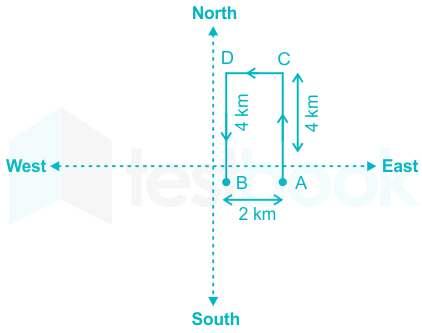
Smita rode her scooty Northwards, then turned left and then again rode to her left 4 km. She found herself exactly 2 km West of her starting point. How far did she ride Northward initially?

  1. ((a))

    2 km

  2. ((b))

    4 km

  3. ((c))

    5 km

  4. ((d))

    6 km

Show Answer
Answer: ((b))

4 km

We have drawn the figure according to the information given in the question,

(Let the turning points as shown in the figure)

Sunita started from A and her journey ends at B.

Initial Northward Journey AC = BD = 4 km

Hence, 4 km is the correct answer.

21

Given below are two statements: One is labeled as Assertion A and the other is labeled as Reason R.

Assertion (A): A man pulls a loaded truck by his hair which becomes news.

Reasons (R): Unusual things make news called oddity and generate public interest.

In the light of the above statements, Choose the most appropriate answer from the options given below :

  1. ((a))

    Both (A) and (R) are correct and (R) is the correct explanation of (A).

  2. ((b))

    Both (A) and (R) are correct but (R) is NOT the correct explanation of (A).

  3. ((c))

    (A) is correct but (R) is not correct.

  4. ((d))

    (A) is not correct but (R) is correct.

Show Answer
Answer: ((a))

Both (A) and (R) are correct and (R) is the correct explanation of (A).

Important Points 

Assertion (A): A man pulls a loaded truck by his hair which becomes news.

  • A news report is a report on a current event.
  • NEWS is defined as a development that occurred within the last 24 hours that was unknown to the public and is of widespread interest to the public, as well as something that piques the interest of listeners.
  • A news report tends to provide answers to six questions like when, where, what, why, who, and how.

Hence assertion is true, a man pulling a loaded truck by his hair can become news.

Reasons (R): Unusual things make news called oddity and generate public interest.

  • Facts are always more interesting when they are odd or strange.
  • The greater the degree of strangeness in a story, the greater its news value.

Therefore, the correct answer is Both (A) and (R) are correct and (R) is the correct explanation of (A).

22

If a 30 meter ladder is placed against a 15 metre wall such that it just reaches the top of the wall, the angle of elevation of the wall is:

  1. ((a))

    45°

  2. ((b))

    30°

  3. ((c))

    60°

  4. ((d))

    50°

Show Answer
Answer: ((b))

30°

Given:

Ladder's length = 30m

Wall's height = 15m

Concept used:

In trigonometry,

In right angled triangle,

Sin θ = perpendicular/hypotenuse

Calculation:

Here, perpendicular = Wall's height = 15m

Hypotenuse = Ladder's length = 30m

Sin θ = perpendicular/hypotenuse

⇒  Sin θ = 15/30 = 1/2

⇒  Sin θ = sin 30º

⇒ θ = 30º

∴ Option 2 is correct.

23

A 108 meter long train moving at a speed of 50 km/hr crosses a 112 meters long train coming from the opposite direction in 6 seconds. The speed of the second train is:

  1. ((a))

    48 km/h

  2. ((b))

    54 km/h

  3. ((c))

    66 km/h

  4. ((d))

    82 km/h

Show Answer
Answer: ((d))

82 km/h

Given:

Length of first train = 108 m

Length of second train = 112 m

Speed of first train = 50 km/hr = 50 × 5/18 = 250/18 m/sec

Formula used:

Distance = speed × time

Calculation:

Let the speed of the second train = x m/sec

Distance travelled = 108 + 112 = 220 m

Time = Distance/Speed

⇒ 220/(250/18 + x) = 6     

⇒ 250 + x = 660

x = 410/18 m/sec

or x = (410/18) × (18/5) km/hr

x = 82 km/hr

∴ The speed of the second train is 82 km/h

∴ Option 4 s correct.

24

Three men, four women and six children can complete a work in seven days. A woman does double the work a man does and a child does half the work a man does. How many women alone can complete this work in 7 days?

  1. ((a))

    7

  2. ((b))

    8

  3. ((c))

    9

  4. ((d))

    12

Show Answer
Answer: ((a))

7

Given:

⇒ 3 men, 4 women and 6 children can complete the work in 7 days.

A woman does double the work a man does.

A child does half the work a man does.

Calculation:

⇒ 2 men = 1 woman

⇒ 1 man = 1/2 woman

⇒ 3 men = 3/2 woman

Again, 2 children = 1 man = 1/2 woman

⇒ 1 children = 1/2 man = 1/4 woman

⇒ 6 children = 6/4 woman = 3/2 woman

Now, 3 men, 4 women and 6 children

⇒ 3/2 + 4 + 3/2 = 7 woman

∴ 7 woman can complete the work.

∴ Option 1 is correct.

25

The profit earned by selling a chair for Rs. 752 is 1.2 times the loss incurred when the same chair was sold for Rs. 400. What is the cost price of the chair?

  1. ((a))

    Rs. 540

  2. ((b))

    Rs. 592

  3. ((c))

    Rs. 560

  4. ((d))

    Rs. 640

Show Answer
Answer: ((c))

Rs. 560

Given:

The profit earned by selling a chair for Rs. 752 = 1.2 times the loss incurred.

Selling price of chair = Rs.400

Calculation:

Let cost price of chair = x

⇒ 752 - x = 1.2 × (x - 400)

⇒ 752 - x = 12/10 × (x - 400)

⇒ 7520 - 10x = 12x - 4800

⇒ 22x = 7520 + 4800 = 12320

x = 560 

∴ Option 3 is correct.

26

Identify the correct order of following computer memory types ranked from slowest to fastest in terms of access time.

(A) Cache

(B) CDROM

(C) Hard Disk

(D) RAM

(E) Register

Choose the correct answer from the options given below :

  1. ((a))

    (C), (B), (A), (D), (E)

  2. ((b))

    (E), (A), (D), (C), (B)

  3. ((c))

    (B), (C), (D), (A), (E)

  4. ((d))

    (D), (A), (E), (B), (C)

Show Answer
Answer: ((c))

(B), (C), (D), (A), (E)

Key Points

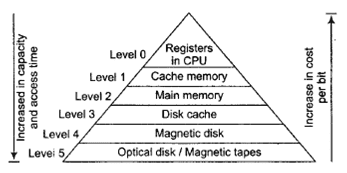
Memory Hierarchy

  • It is a feature in computer system design that helps to organise memory such that access time is reduced.
  • In a computer system, the memory hierarchy design primarily consists of several storage devices.
  • Increase in storage capacity leads to faster access time as followed in diagram

image001

Types of Memory:

Register:

  • It s a fast memory used to accept, store, and transfer data and instructions that are being used immediately by the CPU.
  • A Register can also be considered as a group of flip-flops with each flip-flop capable of storing one bit of information.

Cache memory

  • It is a high-speed memory, which is small in size but faster than the main memory (RAM).
  • The CPU can access it more quickly than the primary memory.

RAM

  • iI ts the main memory in a computer.
  • It retains its state for data bits or holds data as long as it receives the power.

Hard disk

  • It is also known as a hard drive or fixed disk.
  • It is rigid magnetic disc that stores data.
  • HDDs can go anywhere from 250GB to 20TB.
  • It is located within a drive unit A hard drive can fit a lot more data on a disk - this means more information can be read on a single revolution of the drive​.
  • A hard drive spins MUCH faster - a typical hard drive will spin between 5200 and 15000 RPM, while a CD will spin between 200 and 500 RPM and a DVD 1530 RPM.
  • Therefore Hard Disc is Faster than CD ROM.

Compact disc:

  • A Compact disc read-only memory (CD-ROM) is a storage device that can be read but not written to.
  • The data Capacity of a standard size CD ROM is 650 - 700 MB.

Therefore we conclude that the correct Sequence of  computer memory types ranked from slowest to fastest in terms of access time is  CDROM<HardDisc<RAM<Cache<Register

Therefore we conclude that the correct sequenec is (B), (C), (D), (A), (E)

27

Given below are two statements:

Statement I: CPU executes software directly from secondary memory.

Statement II: A software is termed as Open Source Software if it can be downloaded from the Internet.

In the light of the above statements, Choose the correct answer from the options given below:

  1. ((a))

    Both Statement I and Statement II are true.

  2. ((b))

    Both Statement I and Statement II are false.

  3. ((c))

    Statement I is true but Statement II is false.

  4. ((d))

    Statement I is false but Statement II is true.

Show Answer
Answer: ((b))

Both Statement I and Statement II are false.

Key Points

Statement I: CPU executes software directly from secondary memory.

How does CPU Executes Software?

  • The Primary Memory or Main Memory or Internal Memory is the main memory of the device/computer where the processing data exist and the secondary memory of a device/computer is an auxiliary memory that stores the data permanently
  • The CPU executes a program that is stored as a sequence of machine language instructions in the main memory or primary memory.
  • It does this by repeatedly reading, or fetching, an instruction from memory and then carrying out, or executing, that instruction.

Hence  Statement I is false.

Statement II: A software is termed as Open Source Software if it can be downloaded from the Internet.

Open-source software (OSS) :

  • It refers to the computer software whose source is open means the general public can access and use it.
  • It is released through a license that makes its source code legally available to end-users.
  • It is software that is distributed with its source code, making it available for use, modification, and distribution with its original rights.
  • It is available in source code form without additional cost.

Hence statement II is false.

Therefore we conclude that both Statement I and Statement II are false.

28

Which of the following statements about wikis are True?

(A) Wiki pages can be locked by moderators to prevent vandlism.

(B) Every change that is made to a wiki page is logged and can be viewed in a history list.

(C) A wiki is designed to allow people to collaborate easily.

Choose the correct answer from the options given below :

  1. ((a))

    (A) and (B) only

  2. ((b))

    (B) and (C) only

  3. ((c))

    (A) and (C) only

  4. ((d))

    (A), (B) and (C)

Show Answer
Answer: ((d))

(A), (B) and (C)

Key Points

Wiki Pages:

  • It is a site that is designed for groups of people to quickly capture and share ideas by creating simple pages and linking them together.
  • It is wiki is a web page with an open-editing system designed to allow people to collaborate easily.
  • It is an interactive, modifiable, and collaborative website, the contents of which can be edited via web browser; only those granted access can modify site content.
  • Wikis are social networking tools characterised by a high degree of connectivity, providing users the means to collaboratively develop web content.
  • Though its an open editing webpage but In some circumstances, pages may need to be protected from modification by certain groups of editors.
  • They can be locked by moderators to prevent vandalism.
  • In wiki pages, anyone can edit nearly any page and improve articles immediately.
  • When one edit a Wiki page, he can either log in or complete this task anonymously.
  • If one is not logged in, all the edits are, much more transparently, publicly associated with your IP address at the time of that edit.

Therefore we conclude that the correct answer is (A), (B) and (C).

29

Match List I with List II

List IList II
(Digital Initiatives in Higher Education)(Purpose)
(A)SWAYAM(I)Online store and access of academic awards namely degrees, mark-sheets etc.
(B)SWAYAM PRABHA(II)Store and access personal e-documents irrespective of physical location.
(C)Digilocker(III)MOOCs for high-quality education anywhere and anytime.
(D)NAD(IV)Free DTH channel for high-quality education.

Choose the correct answer from the options given below:

  1. ((a))

    (A) - (III), (B) - (IV), (C) - (II), (D) - (I)

  2. ((b))

    (A) - (IV), (B) - (III), (C) - (I), (D) - (II)

  3. ((c))

    (A) - (IV), (B) - (III), (C) - (II), (D) - (I)

  4. ((d))

    (A) - (II), (B) - (I), (C) - (III), (D) - (IV)

Show Answer
Answer: ((a))

(A) - (III), (B) - (IV), (C) - (II), (D) - (I)

(Digital Initiatives in Higher Education)(Purpose)
SWAYAMSWAYAM is a programme launched by the Government of India to achieve the three cardinal principles of Education Policy: access, equity, and quality. SWAYAM offers online certification courses in a variety of subjects, with exams held each semester in the Computer Based Mode or in a hybrid mode that combines CBT and paper pen mode. MOOCs for high-quality education anywhere and anytime.
SWAYAM PRABHASWAYAM Prabha is a Ministry of Human Resources Development initiative to provide 34 High-Quality Educational Channels via DTH (Direct to Home) across the country 24 hours a day, seven days a week. Free DTH channel for high-quality education. The DTH channels broadcast their programming via the GSAT-15 satellite.
DigilockerDigiLocker is an Indian digitization online service provided by the Government of India's Ministry of Electronics and Information Technology (MeitY) as part of its Digital India initiative. Store and access personal e-documents irrespective of physical location.
NADDigi Locker and NAD are initiatives of the Ministries of Electronics and Information Technology (MeitY) and Education (MoE). Online store and access to academic awards namely degrees, mark sheets, etc. The National Academic Depository (NAD) concept arose from a Ministry of Education initiative to provide a 24X7 online depository for academic institutions to store and publish their academic awards. The digital depository not only allows for easy access and retrieval of academic awards but also validates and guarantees their authenticity and safe storage.

Therefore, the correct answer is (A) - (III), (B) - (IV), (C) - (II), (D) - (I)

30

The waste component of waste categorized as 'Trash' consists of

(A) Paper, Cardboard cartons

(B) Animal wastes

(C) Industrial process wastes

(D) Vegetable wastes

(E) Wood

Choose the correct answer from the options given below :

  1. ((a))

    (A) and (E) only

  2. ((b))

    (A), (C) and (E) only

  3. ((c))

    (A), (C), (D) and (E) only

  4. ((d))

    (A), (B), (D) and (E) only

Show Answer
Answer: ((a))

(A) and (E) only

Key Points

Municipal solid waste (MSW) Or Trash::

  • MSW term is generally used to describe most of the non-hazardous solid waste from a city, town or village that requires routine collection and transport to a processing or disposal site,
  • MSW is also called as trash or garbage. In general, domestic waste and MSW are used as synonyms.
  • Sources of MSW include private homes, commercial establishments and institutions, as well as industrial facilities.
  • However, MSW does not include wastes from industrial processes, construction and demolition debris, sewage sludge, mining waste or agricultural wastes
  • Municipal solid waste under Trash collects:
  • Wet Garbage or wet Waste  as Food waste (like vegetable and meat material, leftover food, eggshells etc,
  • Dry Garbage or Dry waste as Paper, plastic, tetra-pack, plastic cans, newspaper, glass bottles, cardboard boxes, aluminum foil, meta items, wood pieces, etc.,

Therefore we conclude that the correct answer is (A) and (E) only.

31

With reference to Nyāya philosophy, which of the following statements is true?

  1. ((a))

    The linga or the middle term is not the Karana or operative cause of inference.

  2. ((b))

    The middle term may be a thing of the present but not of the past or the future.

  3. ((c))

    The middle term can function in an inference when past or future.

  4. ((d))

    The middle term can lead to the conclusion apart from the knowledge of Nyāya or the universal relation between it and the major term.

Show Answer
Answer: ((a))

The linga or the middle term is not the Karana or operative cause of inference.

Indian Logic (Means of Knowledge): 

  • The systems of Indian philosophy are mainly divided into two groups – the heterodox (nāstika) and orthodox (āstika).
  • Those systems of philosophy which do not accept the validity of Veda are called the heterodox systems or nāstikas
  • Those which accept the validity of Veda are called the orthodox systems or āstikas.
  • Cārvāka, Jainism and Buddhism are nāstika or heterodox systems.
  • The orthodox systems are: Vaisheshika, Nyaya, Samkhya, Yoga, Purva-Mimamsa, and Uttar-Mimamsa​

Key Points

Nyaya:

  • The Nyāya school is founded by the sage Gotama, who is not confused as Gautama Buddha.
  • It professes that there are four independent pramānas (sources of valid knowledge).
  • These are; perception, inference, comparison, and verbal testimony or sabda.
  • The Nyāya Philosophy upholds astkāryavāda which states that effect is not the same as the cause.
  • The effect is a new creation or a new bringing of its existence.
  • The effect did not exist in the material cause prior to its production.
  • Its ultimate concern is to bring an end to human suffering, which results from ignorance of reality.
  • It is based on the principle that human suffering results from mistakes/defects produced by activity under wrong knowledge.
  • Liberation is brought about through the right knowledge.

Hence, option 1 is the correct answer.

32

Given below are two statements:

Statement I: According to Nya̅ya philosophy an argument proceeds only on those issues that are completely unknown.

Statement II : According to Nya̅ya philosophy an argument does not proceed on those issues that are well established.

In the light of the above statements, Choose the most appropriate answer from the options given below:

  1. ((a))

    Both Statement I and Statement II are correct.

  2. ((b))

    Both Statement I and Statement II are incorrect.

  3. ((c))

    Statement I is correct but Statement II is incorrect.

  4. ((d))

    Statement I is incorrect but Statement II is correct.

Show Answer
Answer: ((d))

Statement I is incorrect but Statement II is correct.

Key Points 

Statement I: According to Nya̅ya philosophy an argument proceeds only on those issues that are completely unknown.

The Nyāya School

  • It was is founded by the sage Goutama, who is not confused as Gautama Buddha.
  • The word nyāya literally means that by which the mind is led to a conclusion. We are led to conclusions by reason and by argument
  • Nyāya means correct thinking with proper arguments and valid reasoning. Thus, Nyāya philosophy is known as tarkashāstra (the science of reasoning); pramānashāstra (the science of logic and epistemology); hetuvidyā (the science of causes); vādavidyā (the science of debate); and anviksiki (the science of critical study).
  • In everyday experience, one uses any or a combination of these four methods to gain knowledge.
  • Suppose we see billowing smoke on the hill. This is visual perception and we know there is smoke on the hill. We infer that the smoke is caused by fire and conclude that there is a fire on the hill. This is knowledge by inference based on the information available.
  • In Nya̅ya philosophy an argument can't proceed for those issues that are completely unknown.

​Hence Statement I is incorrect.

Statement II : According to Nya̅ya philosophy an argument does not proceed on those issues that are well established.

Nyāya theory of universals ​:

  • The Nyāya theory of universals is unambiguously realistic and its realism is evident from the way a universal (sāmānya or jāti) is defined.
  • A universal is defined as an entity that is eternal and inseparably inherent in many entities"
  • For example existence of Humanity in human beings.
  • The Nyāya-Vaiśeṣika explains the theory of universals from its pluralistic and realistic standpoint.
  • They do not accept the universals at the cost of the particulars. The particulars are there, and they are united under the roof of the highest universal existence.
  • Therefore as we see with Universals According to Nya̅ya philosophy an argument does not proceed on those issues that are well established.

Hence Statement II is correct.

Therefore we conclude that the correct answer is Statement I is incorrect but Statement II is correct.

33

Given below are two statements:

Statement I : Mimāmsakas and Vedāntins agree with the Naiyāyikas that the syllogism consists of five members or propositions.

Statement II : Mimāmsakas and Vedantins agree with the Naiyāyikas that the syllogism is necessary only for parārthānuma̅na or demonstrate inference and not for svārthānumāna or inference for oneself.

In the light of the above statements, Choose the most appropriate answer from the options given below:

  1. ((a))

    Both Statement I and Statement II are correct.

  2. ((b))

    Both Statement I and Statement II are incorrect.

  3. ((c))

    Statement I is correct but Statement II is incorrect.

  4. ((d))

    Statement I is incorrect but Statement II is correct.

Show Answer
Answer: ((d))

Statement I is incorrect but Statement II is correct.

Key Points

Statement I: Mimāmsakas and Vedāntins agree with the Naiyāyikas that the syllogism consists of five members or propositions.

  • Mimamsa, (Sanskrit: “Reflection” or “Critical Investigation”) is one of the six systems (darshans) of Indian philosophy.
  • Mimamsa, probably the earliest of the six, is fundamental to Vedanta, another of the six systems, and has deeply influenced the formulation of Hindu law (see Indian law).
  • Nyaya syllogism consists of five members or propositions where four propositions are considered as premises and the fifth one is the conclusion

The following is a typical Nyaya syllogism:

  1. Socrates is mortal (Pratijna).
  2. Because he is a man (hetu).
  3. Whoever is a man is a mortal, e .g Pythagoras (Udaharana).
  4. Socrates is a man who is invariably a mortal (upanaya).
  5. Therefore Socrates is mortal (nigamana).

Hence, the statement I is incorrect.


Statement II: Mimāmsakas and Vedantins agree with the Naiyāyikas that the syllogism is necessary only for parārthānuma̅na or demonstrate inference and not for svārthānumāna or inference for oneself.

  • The aim of Mimamsa is to give rules for the interpretation of the Vedas, the earliest scriptures of Hinduism, and to provide a philosophical justification for the observance of Vedic rituals.
  • Because Mimamsa is concerned with the earlier parts of the Vedas (called the Karmakanda), it is also referred to as Purva-Mimamsa (“Prior Study”) or Karma-Mimamsa (“Study of Actions”).
  • Vedanta, which deals with the later portion of Vedic literature called the Upanishads, is called Uttara-Mimamsa (“Posterior Study”) or Jnana-Mimamsa (“Study of Knowledge”).

Hence, Statement I is incorrect but Statement II is correct.

34

"Whoever thrusts a knife into another person should be arrested. Surgeons thrust a knife into another person when operating. Therefore surgeons should be arrested'.

Which fallacy is committed in the following argument?

  1. ((a))

    Hasty generalization

  2. ((b))

    Fallacy of accident

  3. ((c))

    Red Herring

  4. ((d))

    Appeal to unqualified authority

Show Answer
Answer: ((b))

Fallacy of accident

Logical fallacies are flawed, deceptive, or false arguments that can be demonstrated incorrectly through reasoning. Fallacies are classified into two types:

  1. A formal fallacy is an argument that contains a flawed premise and conclusion.
  2. An informal fallacy is an error in the argument's form, content, or context.

Important Points

The fallacy of accident-

  • The accident fallacy is a logical fallacy, which is defined as a reasoning error that weakens an argument by applying a generalization to a situation where it does not apply.
  • e.g., “‘Thou shalt not kill;’ therefore, you should not fight for your country or control weeds in your garden.”
  • The premise is a generalization that refers to the unlawful or unjustified killing of humans, and this meaning is misinterpreted in the conclusion to refer to different specific examples than those denoted in the premise.

Therefore in the given example, "Whoever thrusts a knife into another person should be arrested. Surgeons thrust a knife into another person when operating. Therefore surgeons should be arrested." the fallacy committed is, "The fallacy of accident"

Additional Information

Appeal to unqualified authority

  • This is only a fallacy when the person presenting themselves as authorities has no special qualifications or is biassed in some way, or when only one authority is cited on an issue where there is significant disagreement among authorities (such as philosophy or religion)
  • Advertisers frequently take advantage of this fallacy.
  • An invalid authority is a famous musician claiming that Sparkle toothpaste prevents cavities better than others.

Red Herring

  • A red herring is a logical fallacy in which irrelevant information is presented alongside relevant information in order to divert attention away from the relevant information.
  • This could be done either intentionally or unintentionally. A red herring is a device that is frequently used in film, television, and literature.

Hasty generalization

  • The arguer bases a claim about an entire group on an insufficient sample size.
35

Given below are two statements :

Statement I: A formal fallacy is one that may be identified through mere inspection of the form or structure of an argument.

Statement II : Formal fallacies are found only in deductive arguments that have identifiable forms.

In the light of the above statements, Choose the correct answer from the options given below :

  1. ((a))

    Both Statement I and Statement II are true.

  2. ((b))

    Both Statement I and Statement II are false.

  3. ((c))

    Statement I is true but Statement II is false.

  4. ((d))

    Statement I is false but Statement II is true.

Show Answer
Answer: ((a))

Both Statement I and Statement II are true.

Key Points 

Statement I: A formal fallacy is one that may be identified through mere inspection of the form or structure of an argument.

Formal fallacy:

  • ​It is defined as a deductive argument that is invalid.
  • The argument itself could have true premises, but still have a false conclusion.
  • Thus, a formal fallacy is a fallacy where deduction goes wrong and is no longer a logical process.
  • In this, the conclusions do not follow from the premises.
  • Formal fallacies are identified by critically examining the structure of the argument exclusive of the individual statements.
  • Example:
  • Premise: All Arabs are Muslims.
  • Premise: All Iranians are Muslims.
  • Conclusion: All Iranians are Arabs.

Hence Statement I is true.

Statement II : Formal fallacies are found only in deductive arguments that have identifiable forms.

Formal fallacies

  • These are found only in deductive arguments with identifiable forms. One of the things which makes them appear reasonable is the fact that they look like and mimic valid logical arguments, but are in fact invalid
  • Here is an example:
  • Premise: All humans are mammals.
  • Premise: All cats are mammals.
  • Conclusion: All humans are cats.
  • Both premises in this argument are true, but the conclusion is false.

Hence Statement II is true.

Therefore we conclude that Both Statement I and Statement II are true.

36

The next number P in the sequence of binary numbers 0, 10, 100, 110, P ............., is:

  1. ((a))

    111

  2. ((b))

    1000

  3. ((c))

    1010

  4. ((d))

    1001

Show Answer
Answer: ((b))

1000

Key Points 

Arrange the binary number in Four number groups from right to left add zero's if needed.  

  • 0-0000
  • 1-0001
  • 2-0010
  • 3-0011
  • 4-0100
  • 5-0101
  • 6-0110
  • 7-0111
  • 8-1000
  • 9-1001
  • A-1010
  • B-1011
  • C-1100
  • D-1101
  • E-1110
  • F-1111
  • The next number in the series is 0, 10, 100, 110, 1000
  • Option 2 is correct.
37

Under Sustainable Development Goal 12- Sustainable Consumption and Production, one of the targets is to reduce per capita food waste at the retail and consumer levels by:

  1. ((a))

    3/4

  2. ((b))

    1/2

  3. ((c))

    1/3

  4. ((d))

    1/4

Show Answer
Answer: ((b))

1/2

The Correct answer is 1/2.

Key Points

 Sustainable Development Goals:

  • The Sustainable Development Goals or Global Goals are a collection of 17 interlinked global goals designed to be a "blueprint to achieve a better and more sustainable future for all".
  • The SDGs were set up in 2015 by the United Nations General Assembly and are intended to be achieved by 2030.
  • The full title of Target 12.3 is: By 2030, halve per capita global food waste at the retail and consumer levels and reduce food losses along production and supply chains, including post-harvest losses."
  • Indicator 12.3.1.a: Food Loss Index which focuses on losses from production to consumption level.
  • Indicator 12.3.1.b: Food Waste Index this indicator is a proposal under development.
38

Small hydro power potential in India is estimated approximately as

  1. ((a))

    ∼  60 MW

  2. ((b))

    ∼ 100 MW

  3. ((c))

    ∼ 10 GW

  4. ((d))

    ∼ 20 GW

Show Answer
Answer: ((d))

∼ 20 GW

The correct answer is ∼ 20 GW

Key Points

  • Till the Independence (1947), the country had an installed capacity of 1362 MW, which included 508 MW hydropower projects, mainly small and medium.
  • As per MNRE, the estimated potential of small hydro power plant is 20 GW across the country.

Important Points

Hydropower potential in India :

  • The Govt. of India targets for achieving 175 GW by the year 2022.
  • The target comprises of 100 GW of solar power, 60 GW of wind power, 10 GW of biomass power, and 5 GW of small hydropower (SHP).
  • The Ministry of New and Renewable Energy (MNRE) has been entrusted with the overall responsibility of development of RE including the small hydro sector in India
  • Hydropower projects are classified as large and small hydro projects based on their sizes.
  • Different countries have different size criteria to classify small hydropower project capacity ranging from 10MW to 50 MW.
  • In India, hydropower plants of 25MW or below capacity are classified as small hydropower plants, which have further been classified into micro (100kW or below), mini (101kW-2MW), and small hydro (2-25MW) segments.
39

The global environmental issue of Ozone depletion is due to the emission of:

(A) Sulphur dioxide

(B) Chlorinated hydrocarbons

(C) Methane

(D) Carbone dixoide

Choose the most appropriate answer from the options given below:

  1. ((a))

    (A) and (B) only

  2. ((b))

    (B) only

  3. ((c))

    (B) and (D) only

  4. ((d))

    (A), (B) and (C) only

Show Answer
Answer: ((b))

(B) only

Key Points

Ozone layer Depletion:

  • The ozone layer sits in the stratosphere between 15 km and 30 km above the earth.
  • It absorbs most of the sun's ultraviolet radiation (UV-B), limiting the amount of this radiation that reaches the surface of the Earth.
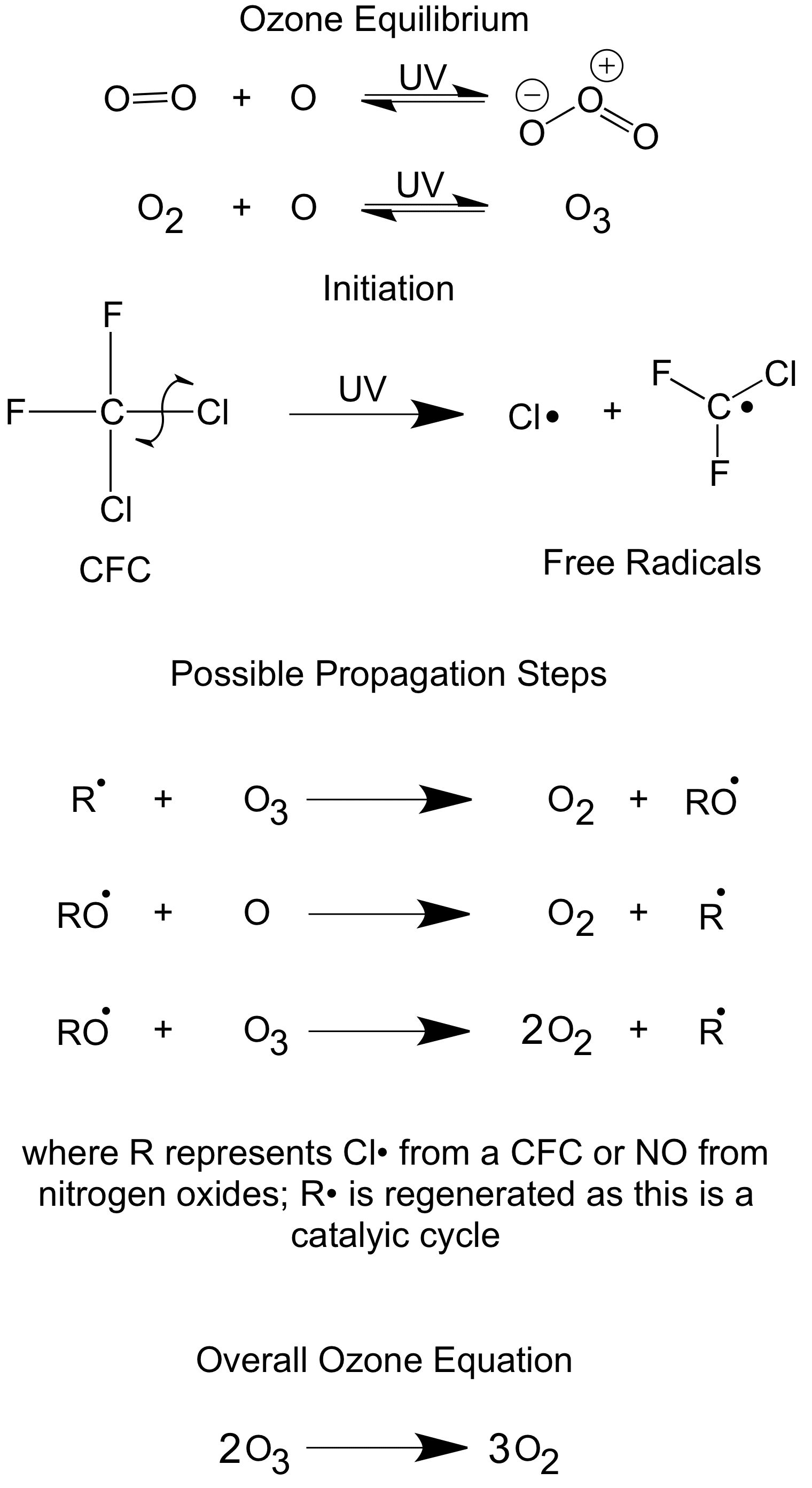
  • The term ozone depletion means that the destruction of O3 exceeds the creation of O3. When present together in the stratosphere, chlorine (Cl) and ozone quickly react to produce chlorine oxide. Bromine can also act as a catalyst to destroy stratospheric ozone.
  • A Level Radical Reactions CFCs and the Ozone Layer
  • Researchers found evidence that linked the depletion of the ozone layer to the presence of chlorofluorocarbons (CFCs) and other halogen-source gases in the stratosphere.
  • Ozone-depleting substances (ODS) are synthetic chemicals, which were used around the world in a wide range of industrial and consumer applications.
  • The main use of these substances were in refrigeration and air conditioning equipment and in fire extinguishers.
  • Ozone layer depleting substances include:
  • Chlorofluorocarbons (CFCs), hydrochlorofluorocarbons (HCFCs), halons, carbon tetrachloride, methyl chloroform and methyl bromide.

​Therefore we conclude that the correct answer is (B) only

Confusion Points

  • Methane and carbon di oxide are gases present in the atmosphere and called greenhouse gas.
  • Sulphur dioxide causes acid rain after mixing with rain water.
40

Which of the following natural disasters are classified as topographic?

  1. ((a))

    uproar

  2. ((b))

    Avalanche

  3. ((c))

    storm

  4. ((d))

    flood

Show Answer
Answer: ((b))

Avalanche

The correct answer is Avalanche.

A natural disaster can be defined as:“A major event brought about by the natural processes of the Earth that causes widespread destruction to the environment and loss of life.”

Key Points

Natural disasters can be grouped into different categories based on specific criteria like Topographic Disasters, and Hydrological Disasters. Meteorological Disasters, Space Disasters etc

  • Topographic Disasters:
  • The disasters that take place due to changes in the arrangement of natural and artificial physical features of a region are called topographical disasters.
  • It includes Landslides, earthquakes, volcanoes, Avalanche.
  • Avalanches are masses of snow, ice, and rocks that fall rapidly down a mountainside.
  • Hence avalanches are classified as topographic as natural disasters.

Additional Information

  • Meteorological disasters:
  • These include Hazards caused by meteorological (i.e., weather) phenomena, particularly those related to temperature and wind, are known as meteorological hazards
  • It includes Heat waves, cold waves, Storms, cyclones, hurricanes
  • Hydrological Disasters.:
  • ​Hazards caused by hydrological (water) processes are known as hydrological hazards. Floods, droughts, mudslides, and tsunamis are examples of natural disasters.
41

The NEP-2020 proposes to prepare which of the curriculum frameworks?

(A) National Curriculum Framework for School Education

(B) National Curriculum Framework for Adult Education

(C) National Curriculum Framework for Teacher Education

(D) National Curriculum Framework for Technical Education

(E) National Curriculum Framework for Vocational Education

Choose the correct answer from the options given below :

  1. ((a))

    (A), (C), (E) only

  2. ((b))

    (B), (C), (D) only

  3. ((c))

    (A), (B), (C) only

  4. ((d))

    (C), (D), (E) only

Show Answer
Answer: ((c))

(A), (B), (C) only

Key Points

National education policy Key initiatives:

  • The NEP 2020 is is the first education policy of the 21st century and replaces the thirty-four year old National Policy on Education (NPE), 1986.
  • It aims to devise four National Curriculum Frameworks (NCFs), for which a comprehensive strategy has been worked out jointly by the Ministry of Education (MoE) and National Council of Educational Research and Training (NCERT) which are as follow:
  • National Curriculum Framework for Early Childhood Care and Education (NCFECCE)
  • National Curriculum Framework for School Education (NCFSE)
  • National Curriculum Framework for Teacher Education (NCFTE)
  • National Curriculum Framework for Adult Education (NCFAE)

Additional Information

National Vocational Education Qualifications Framework (NVEQF)

  • The process of development of a National Vocational Education Qualifications Framework (NVEQF)  is presently underway.
  • The NVEQF would set common principles and guidelines for a nationally recognized qualification system, covering schools, vocational education institutes

Therefore we conclude that the correct answer is (A), (B), (C) only

42

Which of the following values is related to self-transcendance?

  1. ((a))

    Security value

  2. ((b))

    Value of Universalism

  3. ((c))

    Value of freedom

  4. ((d))

    Value of conformity

Show Answer
Answer: ((b))

Value of Universalism

The correct answer is Value of Universalism

Key Points

Self-transcendent:

  • The Theory of Basic Human Values is a theory of cross-cultural psychology and universal values that was developed by Shalom H. Schwartz.
  • The theory extends previous cross-cultural communication frameworks such as Hofstede's cultural dimensions theory.
  • "The Theory of Basic Human Values"  recognizes ten universal values and puts self-transcendent in two categories 
  • Benevolence means Preserving and enhancing the welfare of those with whom one is in frequent personal contact (the ‘in-group’).
  • Universalism means Understanding, appreciation, tolerance, and protection for the welfare of all people and for nature.

Hence the value of Universalism is related to self-transcendance.

Additional Information

Theory of Basic Human Values :

  • The Theory of Basic Human Values which defines 10 values are Conformity, Tradition, Security, Power, Achievement, Hedonism, Stimulation, Self-Direction, Universalism, Benevolence.
  • Values: Schwartz theory of basic values | ANU
  • It defines the Value of Conformity means as values related to  Conformity Restraint of actions, inclinations, and impulses likely to upset or harm others and violate social expectations or norms.
  • It defines Security value as values related to Safety, harmony, and stability of society, of relationships, and of self.
43

Who among the following was the first Chairman of UGC?

  1. ((a))

    Sh Humayun Kabir

  2. ((b))

    Sh C.D. Deshmukh

  3. ((c))

    Sh M. Moolgaokar

  4. ((d))

    Moolchand Sharma

Show Answer
Answer: ((b))

Sh C.D. Deshmukh

The correct answer is Sh C.D. Deshmukh.

 Important Points

The University Grants Commission of India

  • The UGC was first formed in 1945 to oversee the work of the three Central Universities of Aligarh, Banaras and Delhi. Its responsibility was extended in 1947 to cover all Indian universities.
  • It was made a statutory body under by the Department of Higher Education, Ministry of Education, Government of India in accordance with the UGC Act 1956
  • It is charged with coordination, determination, and maintenance of standards of higher education

After getting statutory status the first Chairman of UGC was Sir Chintaman Dwarakanath Deshmukh.

Additional Information

  • Sh.Humayun Kabir was the 3rd Minister of Education of Independent India
  • Sh Sumant Moolgaokar was an Indian industrialist, known as the architect of Tata Motors. He was the chief executive of Tata Engineering and Locomotive Company (TELCO)
  • Prof. (Dr.) Mool Chand Sharma, was a  distinguished member of Law Commission and the Founder and Vice-Chancellor of the Central University of Haryana.
44

NEP-2020 proposes to establish which of the following new bodies?

(A) SSSA

(B) PARAKH

(C) IITI

(D) NITI

(E) NTA

Choose the correct answer from the options given below:

  1. ((a))

    (A), (C), (D) only

  2. ((b))

    (B), (C), (E) only

  3. ((c))

    (A), (B), (C) only

  4. ((d))

    (B), (C), (D) only

Show Answer
Answer: ((c))

(A), (B), (C) only

Key Points

National Education Policy 2020 (NEP 2020) features:

  • The NEP 2020 is the first education policy of the 21st century and replaces the National Policy on Education (NPE), 1986.
  • It aims to Ensure Universal Access at All Levels of schooling from pre-primary school to Grade 12;
  • Ensuring quality early childhood care and education for all children between 3-6 years;
  • New Curricular and Pedagogical Structure (5+3+3+4);
  • Setting up of a new National Assessment Centre, PARAKH (Performance Assessment, Review, and Analysis of Knowledge for Holistic Development);
  • NEP recommends setting an Indian Institute of Translation and Interpretation (IITI), National Institute (or Institutes) for Pali, Persian and Prakrit, strengthening of Sanskrit and all language departments in HEIs,  and use mother tongue/local language as a medium of instruction in more HEI programs.
  • Setting up of State School Standards Authority (SSSA) for  Transparent public self-disclosure of all the basic regulatory information, as laid down by the SSSA, will be used extensively for public oversight and accountability.

Therefore we conclude that NEP-2020 proposes to establish SSSA, PARAKH, and IITI.

Additional Information

National Testing Agency

  • It is an Indian government agency that has been approved by the Union Council of Ministers and established in November 2017 to conduct entrance examinations for educational institutions

NITI Aayog:

  • It is the apex and advisory and nonstatutory public policy think tank of the Government of India.
  • It replaced the erstwhile Planning Commission on 1st January 2015
  • It's emphasis is on the ‘Bottom–Up’ approach to envisage the vision of Maximum Governance, Minimum Government, echoing the spirit of ‘Cooperative Federalism

Therefore we conclude that the correct answer is (A), (B), (C) only

45

Which of the following is an apex advisory and non statutory body?

  1. ((a))

    NITI Aayog

  2. ((b))

    NCTE

  3. ((c))

    AICTE

  4. ((d))

    MCl

Show Answer
Answer: ((a))

NITI Aayog

The correct answer is NITI Aayog.

Important Points

  • NITI Aayog:
  • It is the apex and advisory and nonstatutory public policy think tank of the Government of India.
  • It replaced the erstwhile Planning Commission on 1st January 2015
  • It's emphasis is on the ‘Bottom–Up’ approach to envisage the vision of Maximum Governance, Minimum Government, echoing the spirit of ‘Cooperative Federalism.

Hence Niti aayog is an apex advisory and non statutory body.

Additional Information

  • National Council for Teacher Education
  • It is a statutory body of Indian government set up under the National Council for Teacher Education Act, 1993 in 1995 is to formally oversee standards, procedures and processes in the Indian education system
  • All India Council for Technical Education
  • It is a statutory body, and a national-level council for technical education, under the Department of Higher Education set up in 1945
  • Medical Council of India
  • it was a statutory body for establishing uniform and high standards of medical education in India until its dissolution on 25 September 2020 when it was replaced by National Medical Commission.

Read the passage carefully and answer the question that follow:

As the world is becoming increasingly interconnected, Global Citizenship Education (GCED), a response to contemporary global challenges, will be provided to empower learners to become aware of and understand global issues and to become active promoters of more peaceful, tolerant, inclusive, secure and sustainable societies. As a part of holistic education, students at all HEls will be provided with opportunities for internships with local industry, businesses, artists, crafts person etc. as well as research internship with faculty and researchers at their own or other HEls/research institutions, so that students may actively engage with the practical side of their learning and, as a by-product, further improve their employability. India will be promoted as a global study destination providing premium education at affordable costs thereby helping to restore its role as a Vishwa Guru. An international students office at each HEI hosting foreign students will be set up to coordinate all matters relating to welcoming and supporting students arriving from abroad. Research training colloboration and faculty/student exchanges with high quality foreign institution will be facilitated, and relevant mutually beneficial MOU with foreign countries will be signed. High Performing Indian Universities will be encouraged to set up campuses in other countries, and similarly, selected universities e.g. those from top 100 universities in the world will be facilitated to operate in India. A legislative framework facilitating such entry will be put in place and such universities will be given special dispensation regarding regulatory, governance and content norms on par wth other autonomous institutions of India. Furthermore, research collaboration and student exhanges between Indian institutions and global institutions will be promoted through special efforts. Credits acquired in foreign universities will be permitted, where appropriate as per the requirements of each HEl, to be counted for the award of a degree.


46

New National Education Policy is grounded in the assumptions that :

(A) There is increasing interconnectedness among nations at the global level.

(B) Technical knowledge should replace traditional models of learning.

(C) HEls must focus on promotion of desirable ethical values.

(D) There is need for changes in legislative framework to facilitiate free exchange of academic ideas and achievements.

Choose the correct answer from the options given below:

  1. ((a))

    (A), (B) and (D) only

  2. ((b))

    (A) and (C) only

  3. ((c))

    (A), (C) and (D) only

  4. ((d))

    (C) and (D) only

Show Answer
Answer: ((c))

(A), (C) and (D) only

The correct answer is "(A), (C) and (D) only".

Key Points

  • Let us explore the statements given in the question.
  • In line 1 of the passage: "As the world is becoming increasingly interconnected, Global Citizenship Education (GCED), a response to contemporary global challenges" justifies the statement (A).
  • In the passage, there is nowhere mentioned that the traditional models of learning should be replaced by the technical knowledge which makes statement (B) incorrect.
  • From line 3 and 4 of the passage: "learners to become aware of and understand global issues and to become active promoters of more peaceful, tolerant, inclusive, secure and sustainable societies", we can contemplate that an emphasis has been made on the ethical values given in bold in the above sentence and the HEIs are expected to focus on the same.
  • A legislative framework facilitating such entry will be put in place and such universities will be given special dispensation regarding regulatory, governance and content norms on par with other autonomous institutions of India, makes the statement (D) accurate.
  • Thus, from the above explanation it is clear that statements (A), (C) and (D) are correct with reference to the passage.
  • Hence, the correct answer is option 3)  (A), (C) and (D) only.
47

Given below are two statements :

Statement I : National Education Policy is framed with an objective of saving national HEls from competition at the global level.

Statement II : National Education Policy is framed with an objective of encouraging exchange of knowledge and expertise both at local and global level.

In the light of the above statements, Choose the most appropriate answer from the options given below:

  1. ((a))

    Both Statement I and Statement II are correct.

  2. ((b))

    Both Statement I and Statement II are incorrect.

  3. ((c))

    Statement I is correct but Statement II is incorrect

  4. ((d))

    Statement (I) is incorrect but Statement II is correct.

Show Answer
Answer: ((d))

Statement (I) is incorrect but Statement II is correct.

The correct answer is option 4).

Key Points

  • Let us explore the given statements and see whether they are in line with the passage or not.
  • Statement I implies that the National education policy is made to prevent the HEIs from global level competition.
  • Whereas, from the passage, we can find that "India will be promoted as a global study destination providing premium education" and "Research training collaboration and faculty/student exchanges with high quality foreign institution will be facilitated". It discusses the steps taken to encourage the HEIs to compete on global level, thus statement I is incorrect.
  • "selected universities e.g. those from top 100 universities in the world will be facilitated to operate in India", this line implies that the exchange of knowledge at local level is also facilitated by the National education policy.
  • ​It can be inferred from the above explanation that the exchange of knowledge at both local and global level is encouraged by the National education policy, therefore, the statement II is correctly stated.
  • Hence, the correct answer is option 4) Statement (I) is incorrect but Statement (II) is correct.
48

Which of the following statements most appropriately represent one of the chief concerns regarding higher education?

  1. ((a))

    It argues for only local production and of knowledge and its implementation.

  2. ((b))

    It emphasizes only upon implementation of foreign higher education models in India.

  3. ((c))

    It argues for mutual exchange of knowledge and learning among national and international institutions of higher education.

  4. ((d))

    It argues for practical learning alone for employability putting social issues aside.

Show Answer
Answer: ((c))

It argues for mutual exchange of knowledge and learning among national and international institutions of higher education.

The correct answer is "It argues for mutual exchange of knowledge and learning among national and international institutions of higher education".

Key Points

  • The course of action regarding the exchange of knowledge at both local and global level for the higher education institutions is discussed in the passage.
  • In the line "Furthermore, research collaboration and student exchanges between Indian institutions and global institutions will be promoted through special efforts".
  • Thus, the research collaboration and student exchanges between the Indian and global institutions will lead to the exchange of knowledge and learning on global platform.
  • Hence, the correct answer is option 3).
49

Holistic education at HEls is aimed at :

(A) Research internship with researchers and faculty at different HEls.

(B) Recyling of traditional knowledge systems.

(C) Providing opportunities for internships at local level.

(D) Keeping social sciences and natural sciences within distinct spheres of teaching and learning.

Choose the correct answer from the options given below:

  1. ((a))

    (B) and (D) only

  2. ((b))

    (A) and (C) only

  3. ((c))

    (A) and (D) only

  4. ((d))

    (C) and (D) only

Show Answer
Answer: ((b))

(A) and (C) only

The correct answer is "(A) and (C) only".

Key Points

  • Refer to the line " As a part of holistic education, students at all HEls will be provided with opportunities for internships with local industry, businesses, artists, crafts person etc. as well as research internship with faculty and researchers at their own or other HEls/research institutions, so that students may actively engage with the practical side of their learning and, as a by-product, further improve their employability"
  • From the bold part in the above given line of the passage, it can be inferred that statements (A) and (C) as given in the passage is correct.
  • While statements (B) and (D) are nowhere mentioned in the passage, thus in context of the passage they are deemed to be incorrect.
  • Hence, the correct answer is option 2) (A) and (C) only.

Additional Information

  • Holistic means relating to or concerned with wholes or with complete systems rather than with the analysis of, treatment of, or dissection into parts.
  • Internship means a period of time during which a student or a recent graduate gets practical experience in a job.
50

Given below are two statements :

Statement I : National Education Policy envisages learning as a process of inculcating values of tolerance, inclusion and sustainability.

Statement II : National Education Policy lays stress on employability of learners in businesses and industries.

In the light of the above statements, Choose the most appropriate answer from the options given below:

  1. ((a))

    Both Statement I and Statement II are correct.

  2. ((b))

    Both Statement I and Statement II are incorrect.

  3. ((c))

    Statement I is correct but Statement II is incorrect

  4. ((d))

    Statement I is incorrect but Statement II is correct.

Show Answer
Answer: ((a))

Both Statement I and Statement II are correct.

The correct answer is "option 1".

Key Points

  • Lets explore the meaning of the given sentences and check whether they are in line with the given passage or not.
  • Refer to the following lines from the passage:
  1. To empower learners to become aware of and understand global issues and to become active promoters of more peaceful, tolerant, inclusive, secure and sustainable societies.
  2. Students at all HEls will be provided with opportunities for internships with local industry, businesses, artists, crafts person etc. as well as research internship with faculty and researchers at their own or other HEls/research institutions, so that students may actively engage with the practical side of their learning and, as a by-product, further improve their employability.
  • From sentence 1 given above, the statement I in the question can be proved correct while sentence 2 confirms the accuracy of statement II.
  • Hence, **the correct answer is option 1) Both statement I and II are correct.**​

Additional Information

  • Tolerance means the ability to keep going despite difficulties.
  • Sustainability means meeting our own needs without compromising the ability of future generations to meet their own needs.
  • Employability means the quality of being suitable for paid work.

Attempt this paper under real exam conditions

Timed interface, section switching, instant scoring, and question-by-question analytics — free.

Start Timed Attempt