
Official Paper

UGC NET Paper 1: Held on 22nd Feb 2023 Shift 2 (Previous Year Paper)

50 questions · 60 minutes · with answers · free

Paper 1 (50 questions)

The following table shows population of five villages A-E and percentage distribution of males (M), females (F) and transgenders (T) among them. Based on the data in the table, answer the questions.

Village - wise Distribution of Population

VillageTotal PopluationDistribution (%)
MFT
A12,00046%(-)22%
B16,000(-)33%27%
C18,00032%36%(-)
D24,00036%(-)20%
E25,000(-)30%25%
<br>

Note: In table (-) denotes missing value (%), which is to be computed whenever required.

1

Transgender population in Village - A is ______ % of the female population in Village - B.

  1. ((a))

    75

  2. ((b))

    50

  3. ((c))

    33.33

  4. ((d))

    66.66

Show Answer
Answer: ((b))

50

Given:

Population(T in Village A) = 22% of 12,000

Population(F in Village B) = 33% of 16,000

Concept used: 

Required Percentage = (Transgender population in Village A / Female population in Village B) × 100

Calculation:

Population(T in Village A) = 22% × 12,000

⇒ 2640

Population(F in Village B) = 33% × 16,000

⇒ 5280

⇒ Required Percentage = 26405280×100\dfrac{2640}{5280} \times 100 = 50%

∴ The transgender population in Village - A is 50% of the female population in Village - B.

2

Find the difference between male population in Village - E and female population in Village - D.

  1. ((a))

    890

  2. ((b))

    830

  3. ((c))

    690

  4. ((d))

    610

Show Answer
Answer: ((c))

690

Calculation:

Male population in Village - E = 25000 × (1 - 0.3 - 0.25) = 11250

Female population in Village - D = 24000 × (1 - 0.36 - 0.2) = 10560

⇒ Required Difference = 11250 - 10560 = 690

∴ The difference between male population in Village - E and female population in Village - D is 690.

3

Total number of females in Villages B and D together is ______% more than the number of males in Village - C.

  1. ((a))

    275 

  2. ((b))

    225

  3. ((c))

    125

  4. ((d))

    175

Show Answer
Answer: ((d))

175

Calculation:

Total number of females in Villages B and D together = (0.33 × 16000) + (0.44 × 24000) = 15840

Number of males in Village - C = 0.32 × 18000 = 5760

Percentage more = ((Total number of females in Villages B and D together - Number of males in Village C) / Number of males in Village C) × 100

⇒ ((15,840 - 5,760) ÷ 5,760) × 100

⇒ (10,080 ÷ 5,760) × 100

⇒ 175 %

∴ Total number of females in Villages B and D together is 175% more than the number of males in Village - C.

4

Which of the following does not come under primary laws

of learning?

  1. ((a))

    Law of effect

  2. ((b))

    Law of Readiness

  3. ((c))

    Law of Multiple response

  4. ((d))

    Law of exercise

Show Answer
Answer: ((c))

Law of Multiple response

Key Points The primary laws of learning are:

Law of Effect -

  • Behavior that is followed by a satisfying consequence is more likely to be repeated.

Law of Readiness -

  • An organism is more likely to learn something if it is ready to learn it.

Law of Exercise -

  • The more something is practiced, the stronger the connection between the stimulus and the response becomes.

The law of multiple response

  • This is not a primary law of learning. It is a secondary law of learning that states that organisms tend to learn multiple responses to the same stimulus.
  • For example, a dog that has been trained to sit on command may also learn to lie down or roll over on command.

Here is a table that summarizes the primary laws of learning:

LawDescription
Law of EffectBehavior that is followed by a satisfying consequence is more likely to be repeated.
Law of ReadinessAn organism is more likely to learn something if it is ready to learn it.
Law of ExerciseThe more something is practiced, the stronger the connection between the stimulus and the response becomes.


Hence, the correct answer is 3) Law of Multiple Response.

5

Find the ratio of population of transgenders in Village - C to population of males in Village - B.

  1. ((a))

    9 ∶ 10

  2. ((b))

    7 ∶ 8

  3. ((c))

    3 ∶ 4

  4. ((d))

    27 ∶ 32

Show Answer
Answer: ((a))

9 ∶ 10

Calculation:

Population of transgenders in Village - C = 18000 × (1 - 0.32 - 0.36) = 5760

Population of males in Village - B = 16000 × (1 - 0.33 - 0.27) = 6400

⇒ Required Ratio = 5760 : 6400 = 9 : 10

∴ The ratio of population of transgenders in Village - C to population of males in Village - B is 9 : 10

6

Students participating in online classes are taught by an instructor. Following the lesson, the instructor intends to incorporate reading materials (e-content, Power point presentation, etc.) that can be viewed by the students. What option would instructor choose?

  1. ((a))

    Content creation tools

  2. ((b))

    Networking tools

  3. ((c))

    Learning Management System (LMS)

  4. ((d))

    Links of the websites

Show Answer
Answer: ((c))

Learning Management System (LMS)

Key PointsLearning Management System (LMS): 

  • A Learning Management System (LMS) is a software platform that facilitates the management and delivery of educational materials and resources in online learning environments.
  • It provides a centralized hub where instructors can organize and share various learning materials, including reading materials such as e-content, PowerPoint presentations, and other resources.
  • Using an LMS, the instructor can upload and organize the reading materials, making them easily accessible to students.
  • Students can then view and access the materials within the LMS, either during or after the online class session.
  • LMS platforms often have features that allow instructors to track student engagement with the materials, such as monitoring when students access and view the content.

Additional Information

  • Content creation tools (option 1) are typically used by instructors to create the learning materials themselves, rather than organizing and sharing them with students.
  • Networking tools (option 2) are more focused on facilitating communication and collaboration among students or instructors, rather than specifically delivering reading materials.
  • Links of websites (option 4) can be shared, but using an LMS provides a more organized and controlled environment for managing and delivering the reading materials.


Therefore, the most appropriate option for the instructor to choose in this scenario would be a Learning Management System (LMS).

7

In ADDIE model of instructional design framework, the letters I and E in the acronym ADDIE pertain to

  1. ((a))

    Identification and Evaluation

  2. ((b))

    Implementation and Evaluation

  3. ((c))

    Identifications and Examination

  4. ((d))

    Implementation and Examination

Show Answer
Answer: ((b))

Implementation and Evaluation

Key Points ADDIE model:

  • The ADDIE model is a five-step instructional design model that stands for Analyze, Design, Develop, Implement, and Evaluate.
  • The I and E in the acronym refer to the Implementation and Evaluation phases.

A more detailed explanation of the Implementation and Evaluation phases of the ADDIE model:

Implementation

  • The implementation phase is where the instructional materials are delivered to the learners.
  • This may involve face-to-face instruction, online learning, or a combination of both. The instructional designer must ensure that the materials are delivered in a way that is effective for the learners.
  • This may involve providing training to instructors, creating user guides, or developing support materials.

Evaluation

  • The evaluation phase is where the effectiveness of the instructional materials is assessed.
  • This may involve collecting data on learner performance, satisfaction, and retention. The instructional designer must use this data to decide the instructional materials.
  • This may involve changing the materials, providing additional support to learners, or discontinuing the materials altogether.
  • The evaluation phase is an important part of the ADDIE model because it allows for continuous improvement of the instructional materials.
  • By collecting data on learner performance, satisfaction, and retention, the instructional designer can identify areas where the materials can be improved.
  • This allows for developing more effective instructional materials, which can lead to improved learner outcomes.


Here are the other options and why they are incorrect:

  • Identification is not a phase in the ADDIE model.
  • Examination is not a phase in the ADDIE model. It is a synonym for evaluation, which is already a phase in the model.


 In ADDIE model of instructional design framework, the letters I and E in the acronym ADDIE pertain to Implementation and Evaluation.

8

What is the difference between number of males and females in Village - A?

  1. ((a))

    480

  2. ((b))

    1920

  3. ((c))

    1120

  4. ((d))

    1680

Show Answer
Answer: ((d))

1680

Calculation:

Males in Village A = 0.46 × 12000 = 5520

Females in Village A = (1 - 0.46 - 0.22) × 12000 = 3840

⇒ Required Difference = 5520 - 3840 = 1680

∴ The difference between number of males and females in Village - A is 1680.

9

Given below are two statements:

Statement I: Project method is best associated with the Philosophy of John Dewey.

Statement II: The strength of Project method lies in social participation.

In the light of the above statements, choose the most appropriate answer from the options given below:

  1. ((a))

    Both Statement I and Statement II are correct.

  2. ((b))

    Both Statement I and Statement II are incorrect.

  3. ((c))

    Statement I is correct but Statement II is incorrect.

  4. ((d))

    Statement I is incorrect but Statement II is correct.

Show Answer
Answer: ((a))

Both Statement I and Statement II are correct.

Key Points 

Statement I states that the Project method is best associated with the Philosophy of John Dewey.

  • John Dewey, an influential educational philosopher, emphasized the importance of hands-on, experiential learning through active engagement and problem-solving.
  • The Project method aligns with Dewey's philosophy, involving students working on meaningful projects that encourage inquiry, collaboration, and reflection.

This statement is true.

Statement II states that the strength of the Project method lies in social participation.

  • The project method often incorporates group work and encourages students to work together to complete projects.
  • It emphasizes social interaction, cooperation, and learning through shared experiences.
  • Social participation allows students to develop interpersonal skills, learn from one another, and engage in meaningful discussions and collaboration.


Therefore, Statement I and Statement II are correct in describing the association of the Project method with John Dewey's philosophy and the importance of social participation in the strength of the method.

10

For Undergraduate educational programmes, courses on SWAYAM Platform have been developed by:

A. NPTEL

B. IIM Ahmedabad

C. AICTE

D. CEC

E. IIM Bangalore

F. UGC

Choose the most appropriate answer from the options given below:

  1. ((a))

    A, C, D and E Only

  2. ((b))

    B, D, and F Only

  3. ((c))

    A, D, E and F Only

  4. ((d))

    C, E and F Only

Show Answer
Answer: ((a))

A, C, D and E Only

Key Points 

**SWAYAM:**​

  • SWAYAM (Study Webs of Active-Learning for Young Aspiring Minds) is an Indian government initiative to provide free online courses to students and working professionals.
  • It is a Massive Open Online Course (MOOC) platform that offers courses in a variety of subjects, including engineering, science, humanities, and management.

For Undergraduate educational programmes, courses on the SWAYAM (Study Webs of Active Learning for Young Aspiring Minds) platform have been developed by NPTEL, AICTE, CEC, and IIM Bangalore.

  • A. NPTEL (National Programme on Technology Enhanced Learning) is a joint initiative of the IITs and IISc, which develops and offers online courses in various disciplines.
  • C. AICTE (All India Council for Technical Education) is a statutory body responsible for the planning, coordination, and development of technical education in India. AICTE has developed courses for the SWAYAM platform.
  • D. CEC (Consortium for Educational Communication) is an inter-university center under the University Grants Commission (UGC) that develops educational content and resources. CEC has also contributed to the development of courses on the SWAYAM platform.
  • E. IIM Bangalore (Indian Institute of Management Bangalore) is one of the premier management institutes in India. It has developed courses specifically for the SWAYAM platform.


Therefore, the courses on the SWAYAM platform for Undergraduate educational programmes have been developed by NPTEL, AICTE, CEC, and IIM Bangalore. Option 1, which includes A, C, D, and E, correctly identifies the organizations involved in developing these courses.

11

While reading research paper or research reports, often one comes across the abbreviation 'viz', which means

  1. ((a))

    for example

  2. ((b))

    namely

  3. ((c))

    against 

  4. ((d))

    refer to

Show Answer
Answer: ((b))

namely

Key Points The abbreviation 'viz':

  • The abbreviation 'viz' is derived from the Latin term "videlicet," which translates to "namely" or "that is to say" in English.
  • When 'viz' is used in research papers or research reports, it is indicating that the following information or examples are specific instances or specific details that illustrate or clarify the previous statement.
  • It is used to introduce more specific or precise information, providing further clarification or elaboration on a particular point.


Hence, the correct answer is: 2) namely.

12

A student submits Ph.D. thesis in a university. Upon scrutiny, it is found that his/her thesis has a similarity content of 35%. This would fall in which of the following categories of plagiarism according to UGC regulations?

  1. ((a))

    Level 0

  2. ((b))

    Level 1

  3. ((c))

    Level 2

  4. ((d))

    Level 3

Show Answer
Answer: ((b))

Level 1

Key Points Plagiarism:

  • Plagiarism is the act of using someone else's work without giving them credit. It can be intentional or unintentional, but it is always considered academic misconduct. Plagiarism can take many forms, including:
  • Direct copying: This is the most obvious form of plagiarism. It involves copying someone else's work word-for-word without giving them credit.
  • Paraphrasing: This is a more subtle form of plagiarism. It involves changing the words of someone else's work, but still using their ideas without giving them credit.
  • Citing sources incorrectly: This form of plagiarism occurs when you do not cite your sources properly. This can happen if you do not include the author, title, or publication date of a source, or if you do not include a page number for a quote.
<br>

According to the UGC regulations, plagiarism is classified into four levels:

  • Level 0: 
  • Similarities up to 10% are considered minor similarities and are not penalized.
  • Level 1:
  •  Similarities above 10% to 40% are considered to be Level 1 plagiarism. Students found guilty of Level 1 plagiarism will be asked to withdraw their thesis and will not be allowed to publish any work for a minimum period of one year.
  • Level 2: 
  • Similarities above 40% to 60% are considered to be Level 2 plagiarism.
  • Students found guilty of Level 2 plagiarism will be asked to withdraw their thesis and will not be allowed to publish any work for a minimum period of two years.
  • They will also be denied a right to one annual increment in case of academician. They also shall not be allowed to supervise any UG, PG, Master's, M. Phil., or Ph. D. Students/ scholar for three years.
  • Level 3: 
  • ​​Similarities above 60% are considered to be Level 3 plagiarism.
  • Students found guilty of Level 3 plagiarism will be asked to withdraw their thesis and will not be allowed to publish any work for a minimum period of three years.
  • They will also be denied a right to two successive annual increments. They also shall not be allowed to be a supervisor to any new Master's, M. Phil., Ph. D. Students/ scholar for three years.


In the case of the student in the question, the similarity content of 35% falls into Level 1 plagiarism. Therefore, the student will be asked to withdraw their thesis and will not be allowed to publish any work for a minimum period of one year.

13

The part of research paper that gives an overview of the field to be investigated and the investigator's hypotheses about the research outcome, is called

  1. ((a))

    Abstract

  2. ((b))

    Introduction

  3. ((c))

    Results

  4. ((d))

    Method

Show Answer
Answer: ((b))

Introduction

Key Points 

The part of a research paper that gives an overview of the field to be investigated and the investigator's hypotheses about the research outcome is called the Introduction.

The introduction is the first part of a research paper and it serves several purposes. It should:

  • Grab the reader's attention. The introduction should be interesting and engaging so that the reader will want to continue reading.
  • Provide background information on the topic. The introduction should provide the reader with enough background information so that they can understand the research question and the findings.
  • State the research question. The introduction should clearly state the research question that the paper will address.
  • Discuss the significance of the research question. The introduction should explain why the research question is important and why it is worth studying.
  • State the hypotheses. If the paper is a hypothesis-driven study, the introduction should state the hypotheses that will be tested.
  • Provide an overview of the methods that will be used. The introduction should provide a brief overview of the methods that will be used to collect and analyze the data.

The introduction is an important part of a research paper because it sets the stage for the rest of the paper. It provides the reader with the information they need to understand the research question, the findings, and the implications of the study.

Additional Information Abstract:

  • The abstract is a concise summary of the entire research paper. It typically appears at the beginning of the paper, providing a brief overview of the research question, methods, results, and conclusions. The abstract serves as a quick glimpse into the study's key aspects and findings, allowing readers to determine if the paper is relevant to their interests before delving into the full paper.

Results:

  • The Results section presents the findings of the research study. It typically includes a detailed description of the data collected, the statistical analyses performed, and the outcomes or results of those analyses. This section often includes tables, graphs, or figures to visually represent the data. The Results section provides an objective presentation of the research findings without interpretation or discussion.

Method:

  • The Method section describes the methodology and procedures employed in the research study. It outlines how the research was conducted, including details about the study design, participants or subjects, data collection methods, instruments or measures used, and data analysis techniques. The Method section is crucial for other researchers to understand how the study was carried out and to assess the reliability and validity of the research.
14

A study in which a group of participants is observed and measured over a period of time, refers to

  1. ((a))

    Longitudinal Research

  2. ((b))

    Archival Research

  3. ((c))

    Cross - sectional Research

  4. ((d))

    Correlational Research

Show Answer
Answer: ((a))

Longitudinal Research

Key Points Longitudinal Research:

  • Longitudinal Research is a study design in which a group of participants is observed and measured over an extended period of time.
  • In this type of research, data is collected at multiple points in time, allowing researchers to examine changes, patterns, and relationships that occur within the same group of participants over time.
  • The main characteristic of longitudinal research is the longitudinal or time-based nature of the data collection.
  • Researchers may collect data from the same participants at regular intervals, such as months or years apart, to track their development, behaviors, or outcomes over time.
  • This design enables researchers to analyze trends, identify patterns of change, and investigate the impact of various factors on participants' development or outcomes.
  • Longitudinal research is particularly useful for studying long-term processes, developmental changes, or the effects of interventions over time.
  • It allows researchers to examine the stability or variability of variables within individuals and explore the direction and magnitude of relationships between variables across time.

In contrast, other types of research designs include:

  • Archival Research: In this design, researchers analyze existing records, documents, or data sets to answer research questions. Archival research relies on previously collected data that was not specifically collected for the current study.
  • Cross-sectional Research: Cross-sectional research involves collecting data from a group of participants at a single point in time. It provides a snapshot or a "cross-section" of the population at a specific moment and allows for comparisons between different groups or variables at that time.
  • Correlational Research: Correlational research examines the relationship between variables without manipulating them. It seeks to determine the extent to which variables are related or co-vary with each other, without establishing causality.


Hence, Longitudinal Research refers to a study design in which a group of participants is observed and measured over a period of time, enabling the analysis of changes, patterns, and relationships over time within the same group.

15

Given below are two statements:

Statement I : In case of qualitative phenomena, we have data on the basis of presence or absence of an attribute or more than one attribute.

Statement II : With such data as mentioned in Statement I above the sampling distribution may take the form of a Binomial probability distribution.

In the light of the above statements, choose the correct answer from the options given below:

  1. ((a))

    Both Statement I and Statement II are true.

  2. ((b))

    Both Statement I and Statement II are false.

  3. ((c))

    Statement I is true but Statement II is false. 

  4. ((d))

    Statement I is false but Statement II is true.

Show Answer
Answer: ((a))

Both Statement I and Statement II are true.

Key Points


Statement I : In case of qualitative phenomena, we have data on the basis of presence or absence of an attribute or more than one attribute.

  • Statement I is true because qualitative phenomena are those that can be described in terms of quality, rather than quantity.
  • For example, whether or not a person has a certain disease is a qualitative phenomenon. In such cases, we can only have data on the presence or absence of the attribute.

Statement II : With such data as mentioned in Statement I above the sampling distribution may take the form of a Binomial probability distribution.

  • Statement II is true because the sampling distribution of a Binomial probability distribution is a discrete probability distribution that describes the probability of obtaining a certain number of successes in a fixed number of trials, where each trial has only two possible outcomes, success or failure.
  • This is the case for qualitative phenomena, where each trial is the observation of a single individual and the two possible outcomes are "has the attribute" and "does not have the attribute."


Therefore, the correct answer is (1). Both Statement I and Statement II are true.

16

Given below are two statements:

Statement I : Communication, culture and power are inter - related.

Statement II : Socio - cultural values when communicated do not have any weightage of power.

In the light of the above statements, choose the correct answer from the options given below:

  1. ((a))

    Both Statement I and Statement II are true. 

  2. ((b))

    Both Statement I and Statement II are false.

  3. ((c))

    Statement I is true but Statement II is false. 

  4. ((d))

    Statement I is false but Statement II is true.

Show Answer
Answer: ((c))

Statement I is true but Statement II is false. 

Key Points 

Statement I: Communication, culture, and power are all inter-related.

  • Communication is the process of exchanging information, culture is the shared beliefs, values, and practices of a group of people, and power is the ability to influence others.
  • These three concepts are all interconnected. For example, the way that we communicate can be influenced by our culture, and our power can be used to influence the way that others communicate.

This Statement is True.

Statement II: Socio-cultural values when communicated do have weightage of power.

  • The way that we communicate socio-cultural values can be used to reinforce or challenge power structures.
  • For example, a dominant group may use communication to promote their own values and beliefs, while a marginalized group may use communication to challenge the dominant group's values and beliefs.

This statement is false.

Therefore, The correct answer is 3) Statement I is true but Statement II is false.

17

Every society, because of communication, reflects a sense of ______ to most extent.

  1. ((a))

    Commonality

  2. ((b))

    Doubt

  3. ((c))

    Indifference

  4. ((d))

    Animus

Show Answer
Answer: ((a))

Commonality

Key Points The answer is Commonality.

Communication:

  • It is the process of exchanging information between two or more parties. It is a fundamental part of human society, and it is through communication that we share our thoughts, feelings, and experiences.
  • Communication allows us to build relationships, create communities, and solve problems.
  • In every society, communication reflects a sense of commonality. We share a common language, a common culture, and a common set of values.
  • This commonality allows us to understand each other, to cooperate, and to work together to achieve common goals.

Here are some examples of how communication reflects a sense of commonality in society:

  • We use the same language. This allows us to communicate with each other and share our thoughts and feelings.
  • We share a common culture. This includes our shared history, traditions, and values.
  • We have a common set of goals. This includes things like economic prosperity, social justice, and environmental protection.

Doubt, indifference, and animus are all negative emotions that can divide people and prevent them from communicating effectively. In contrast, commonality is a positive emotion that can unite people and promote communication.

  • Doubt: While communication can foster understanding and unity, it can also lead to doubt. In societies where there is a lack of trust or where misinformation is prevalent, communication may sow seeds of doubt among individuals. Disinformation, conflicting messages, or the spread of rumors can undermine people's confidence in the information they receive and in each other, leading to a sense of doubt.
  • Indifference: Communication can also reflect a sense of indifference in a society. When there is a lack of meaningful engagement, apathy, or disinterest in communication, it can result in a feeling of indifference. In such cases, people may not actively participate in communication processes or may not prioritize effective communication, leading to a diminished sense of connection or shared purpose.
  • Animus: In certain cases, communication can reflect animus, which refers to hostility, antagonism, or ill will. In societies where there are deep divisions, conflicts, or prejudices, communication can be used as a tool to perpetuate or express animosity. Negative communication patterns, such as hate speech, discriminatory language, or inflammatory rhetoric, can foster an atmosphere of animus within a society.
18

On the negative side, communicative language is used to :

A. Extend democratic debates

B. Suppress truth

C. Divide the society

D. Permeate ethnocentrism

E. Support global peace efforts

Choose the correct answer from the options given below:

  1. ((a))

    A, B, C Only

  2. ((b))

    B, C, D Only

  3. ((c))

    C, D, E Only

  4. ((d))

    A, C, E Only

Show Answer
Answer: ((b))

B, C, D Only

Key Points 

The correct answer is 2) B, C, D Only.

  • Communicative language can be used in a negative way to suppress truth, divide society, and permeate ethnocentrism. It can also be used to support global peace efforts, but this is not listed as an option.

Here are some examples of how communicative language can be used in a negative way:

  • Suppressing truth: Communicative language can be used to spread misinformation and propaganda. This can be done by using biased language, making false claims, or using logical fallacies.
  • Dividing society: Communicative language can be used to promote hatred and division. This can be done by using inflammatory language, scapegoating, or dehumanizing the other side.
  • Permeating ethnocentrism: Communicative language can be used to promote the belief that one's own culture is superior to others. This can be done by using ethnocentric language, making generalizations about other cultures, or dismissing the experiences of others.

It is important to be aware of the negative ways that communicative language can be used. We should all strive to use language in a way that is truthful, respectful, and inclusive.

19

A shopkeeper purchases a packet of 60 pens at Rs.10 per pen. He sells a part of the packet at a profit of 40%. On the remaining part, he bears a loss of 20%. If his overall profit on the whole packet is 20%, find the number of pens he sold at profit.

  1. ((a))

    40

  2. ((b))

    30

  3. ((c))

    20

  4. ((d))

    35

Show Answer
Answer: ((a))

40

Given:

A shopkeeper purchases a packet of 60 pens 

Calculation;

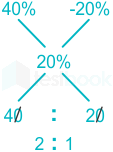
So, the ratio of number of pens sold at 40% to the number of pens sold at -20% = 2 : 1

So, the number of pens sold at 40% profit is = 60 × 23\frac{2}{3} = 40 pens

∴ The correct answer is 40

20

If SEARCH is coded as 214673 and CHART is coded as 73465, then what will be the code for TEACHER?

  1. ((a))

    5147316

  2. ((b))

    5174136

  3. ((c))

    5143716

  4. ((d))

    5413716

Show Answer
Answer: ((a))

5147316

Logic: Alphabets of given words coded as certain digits.

SEARCH is coded as 214673.

So, 2 is the code for 'S', 1 is code for 'E' and so on.

CHART is coded as 73465;

Here, 7 is code for 'C', 3 is code for 'H' and so on.

Similarly, the logic will be followed in the word 'TEACHER'.

21

If the statement 'All cricketers are rich persons' is given as true which of the following statements can be inferred to be false?

A. No cricketers are rich persons.

B. Some cricketers are rich persons.

C. Some cricketers are not rich persons.

D. Some rich persons are cricketers.

Choose the correct answer from the options given below:

  1. ((a))

    B and C Only

  2. ((b))

    A and C Only

  3. ((c))

    B and D Only

  4. ((d))

    A, B and C Only

Show Answer
Answer: ((b))

A and C Only

Key Points 

  • If the statement "All cricketers are rich persons" is given as true, it means that every cricketer is a rich person. Based on this information, the following statements can be inferred:

A. No cricketers are rich persons.

  • This statement is false because it contradicts the given information.
  • If all cricketers are rich persons, then it implies that there are cricketers who are rich.

B. Some cricketers are rich persons.

  • This statement is true because it is consistent with the given information.
  • If all cricketers are rich persons, then it implies that there are cricketers who are indeed rich.

C. Some cricketers are not rich persons.

  • This statement is false because it contradicts the given information.
  • If all cricketers are rich persons, then it implies that there are no cricketers who are not rich.

D. Some rich persons are cricketers.

  • This statement cannot be inferred from the given information. While it is possible that some rich persons are cricketers, it is not necessarily implied by the statement "All cricketers are rich persons."


Therefore, the correct answer is option 2) A and C Only.

22

Which of the following propositions are so related that they cannot both be true, although they both may be false?

A. All football players are rich persons.

B. No football players are rich persons.

C. Some football players are rich persons.

D. Some football players are not rich persons.

Choose the correct answer from the options given below:

  1. ((a))

    A and B Only

  2. ((b))

    A and D Only 

  3. ((c))

    C and D Only 

  4. ((d))

    B and C Only

Show Answer
Answer: ((a))

A and B Only

Key Points

Statements A and B are contradictory statements. This means that they cannot both be true, although they both may be false.

  • A. All football players are rich people.
  • Statement A is a universal statement. This means that it makes a statement about all football players. The statement says that all football players are rich persons.
  • B. No football players are rich persons.
  • Statement B is an existential statement. This means that it makes a statement about the existence of football players. The statement says that there exist no football players who are rich persons.
  • A universal statement and an existential statement cannot both be true. This is because if all football players are rich persons, then it cannot be the case that there exist no football players who are rich persons.
  • For example, if all football players are rich persons, then it cannot be the case that there is a football player who is not rich. This is a contradiction.
  • C. Some football players are rich persons.
  • Statement C is a particular statement. This means that it makes a statement about some football players, but not all football players. The statement says that some football players are rich persons.
  • D. Some football players are not rich persons.
  • Statement D is also a particular statement. This means that it makes a statement about some football players, but not all football players. The statement says that some football players are not rich persons.
  • Particular statements can both be false. For example, it is possible that no football players are rich persons. In this case, statement C would be false, and statement D would also be false.
  • However, particular statements can also both be true. For example, it is possible that some football players are rich persons and some football players are not rich persons. In this case, both statement C and statement D would be true.


Therefore, the only two statements that cannot both be true are A and B. So the answer is (1).

23

A batsman scored 98 runs in his 17th match. As a result his average runs per match increased by 2.5. What was his average before playing 17th match?

  1. ((a))

    55.5

  2. ((b))

    60.5

  3. ((c))

    58.5

  4. ((d))

    61.5

Show Answer
Answer: ((a))

55.5

Shortcut Trick

If the average increases, the score in the new match provides the old average plus the extra runs required to increase the average for all matches.

Total extra runs needed to increase the average of 17 matches by 2.5 = 17 × 2.5 = 42.5 runs.

Old Average = Score in 17th match − Total extra runs

Old Average = 98 − 42.5 = 55.5

∴ The correct answer is 55.5 runs.

Alternate Method

Given:

Runs scored in the 17th match = 98 runs

Increase in average = 2.5 runs

Formula Used:

Average = Total Runs ÷ Number of Matches

Breakdown of 17th Match Score (98 runs)

Old Average (x)

Increase (17 × 2.5)

Total Runs in 17th Match = 98

Calculations:

⇒ Let the average before the 17th match be x.

⇒ Total runs scored in 16 matches = 16x

⇒ Total runs after playing 17 matches = 16x + 98

⇒ New average after the 17th match = x + 2.5

⇒ So, (16x + 98) ÷ 17 = x + 2.5

⇒ 16x + 98 = 17 × (x + 2.5)

⇒ 16x + 98 = 17x + 42.5

⇒ 17x − 16x = 98 − 42.5

⇒ x = 55.5

∴ The correct answer is 55.5 runs.

Additional Information

New Average Formula

When a new value is added to a group: New Value = Old Average + (Total Number of Entities × Increase in Average).

Combined Average

The combined average of two independent groups is given by (N1A1 + N2A2) ÷ (N1 + N2), where N is the number of items and A is the respective average of the groups.

Weighted Average

Used when different values contribute differently to the final average: W.A. = (w1x1 + w2x2 + ... + wnxn) ÷ (w1 + w2 + ... + wn).

24

There are two numbers such that the sum of twice the first number and thrice the 2nd number is 39. Also the sum of thrice the first number and twice the 2nd number is 36. The largest of the two numbers is?

  1. ((a))

    21

  2. ((b))

    15

  3. ((c))

    9

  4. ((d))

    6

Show Answer
Answer: ((c))

9

Calculation:

Let's set up the equations based on the given information:

Equation 1: 2A + 3B = 39

Equation 2: 3A + 2B = 36

We can solve this system of equations by either substitution or elimination method.

Let's solve it using the elimination method.

Multiplying Equation 1 by 2 and Equation 2 by 3 to eliminate the A term:

Equation 1 (multiplied by 2):

4A + 6B = 78 Equation 2

(multiplied by 3): 9A + 6B = 108

Subtracting Equation 1 from Equation 2 to eliminate the B term:

⇒ (9A + 6B) - (4A + 6B) = 108 - 78

⇒ 5A = 30

⇒ A = 30 / 5

⇒ A = 6

Substituting the value of A back into Equation 1:

⇒ 2A + 3B = 39

⇒ 2(6) + 3B = 39

⇒ 12 + 3B = 39

⇒ 3B = 39 - 12

⇒  3B = 27

⇒ B = 27 / 3

⇒ B = 9

Therefore, the two numbers are A = 6 and B = 9.

The largest of the two numbers is 9.

So the answer is: 9

25

Modern communication technology has converted words into

A. A tool of equality

B. Time

C. A tool of unwarranted peace

D. Money

E. Power

Choose the correct answer from the options given below:

  1. ((a))

    A, B, C Only

  2. ((b))

    B, C, D Only

  3. ((c))

    C, D, E Only

  4. ((d))

    B, D, E Only

Show Answer
Answer: ((d))

B, D, E Only

Key Points 

The correct answer is: B, D, E Only

Modern communication technology has transformed words into tools of time, money, and power.

  • B. Time:
  • Communication technology allows for instant and rapid communication, enabling people to exchange information and ideas more efficiently, saving time compared to traditional forms of communication.
  • D. Money:
  • Communication technology has also transformed words into tools of economic transactions and commerce. With online platforms, digital payments, and e-commerce, communication technology has facilitated financial transactions and turned words into a means of conducting business and generating wealth.
  • E. Power:
  • Communication technology has given individuals and groups the power to disseminate information, influence public opinion, and shape narratives. Through social media, online platforms, and digital media, words can be used to mobilize and exert influence, thereby granting power to those who can effectively utilize communication technology.
26

Given below are two statements:

Statement I : The semantic code in communication deals with character and characterisation.

Statement II : Roland Barthes describes this code as the voice of the person.

In the light of the above statements, choose the correct answer from the options given below:

  1. ((a))

    Both Statement I and Statement II are true. 

  2. ((b))

    Both Statement I and Statement II are false. 

  3. ((c))

    Statement I is true but Statement II is false.

  4. ((d))

    Statement I is false but statement II is true.

Show Answer
Answer: ((a))

Both Statement I and Statement II are true. 

Key Points Statement I : The semantic code in communication deals with character and characterisation.

  • The semantic code in communication deals with the meaning of words and phrases.
  • This includes the meaning of words in isolation, as well as the meaning of words in context.
  • Character and characterization are both important aspects of meaning, and so the semantic code plays a role in both.

Hence, Statement I is true.

Statement II : Roland Barthes describes this code as the voice of the person.

  • Roland Barthes was a French semiotician who developed a number of theories about the nature of meaning.
  • One of his most important concepts was the "proiaretic code," which he also referred to as the "voice of the person."
  • The proiaretic code is concerned with the way that characters are presented in a narrative.
  • It includes things like the characters' names, their physical appearance, their speech patterns, and their actions. All of these things contribute to the way that readers or viewers understand the characters, and so the proiaretic code is an important part of the semantic code.

Statement II is also true. 

In conclusion, both Statement I and Statement II are true. The semantic code deals with the meaning of words and phrases, and character and characterization are both important aspects of meaning. Roland Barthes described the proiaretic code, which is concerned with the way that characters are presented in a narrative, as the "voice of the person."

27

Water level of a river increases and decreases by 10% on alternate days in the rainy season. What shall be the increase or decrease in the water level at the end of second day, as compared to the initial water level?

  1. ((a))

    1% of increase

  2. ((b))

    1% decrease

  3. ((c))

    1.5% increase 

  4. ((d))

    1.5% decrease

Show Answer
Answer: ((b))

1% decrease

Concept used:

10% = 1/10

Calculation:

BeforeAfter
1st day 10% increase1011
2nd day 10% decrease109
Net10099


So, at the end of the second day net decrease% = (100 - 99)/100 × 100 = 1% 

∴ The correct answer is 1% decrease

28

"Today on average we can look forward to a longer life span than the generation before us. It is obvious that it has been possible only and only because of the millions of dedicated doctors who have ensured our good health". Identify the fallacy committee in the above argument from the following options?

  1. ((a))

    Hasty Generation

  2. ((b))

    False Cause

  3. ((c))

    Slippery slope

  4. ((d))

    Appeal to unqualified authority

Show Answer
Answer: ((b))

False Cause

Key Points 

The fallacy committed in the argument is false cause.

  • The argument assumes that the only reason why we have longer lifespans today is because of the millions of dedicated doctors.
  • However, there are many other factors that have contributed to this, such as improved sanitation, nutrition, and lifestyle.
  • To say that the only reason for longer lifespans is doctors is a  false cause.

Here are the other fallacies and their explanations:

Hasty generalization:

  • This is a fallacy where a conclusion is made about a whole group based on a small sample of evidence.

Slippery slope: 

  • This is a fallacy where a person argues that if one event happens, it will lead to a series of other events that will eventually lead to a negative outcome.

Appeal to unqualified authority:

  • This is a fallacy where an argument is made based on the opinion of someone who is not an expert on the topic.
29

Given below are two Statements:

Statement I : According to classical Indian school of Logic, namely, Nyaya, we ascertain the relation of universal concomitance between x and y by perceiving that in all cases the presence of x is accompanied by presence of y, and not perceiving any instances to the contrary.

Statement II : Classical Indian materialists argue that universal relation between two events cannot be established, there being always a room for doubt about the unobserved cases.

In the light of the above statements, choose the correct answer from the options given below:

  1. ((a))

    Both Statement I and Statement II are true

  2. ((b))

    Both Statement I and Statement II are false

  3. ((c))

    Statement I is true but Statement II is false

  4. ((d))

    Statement I is false but statement II is true

Show Answer
Answer: ((a))

Both Statement I and Statement II are true

Key Points 

Statement I: According to the classical Indian school of Logic, namely, Nyaya, we ascertain the relation of universal concomitance between x and y by perceiving that in all cases the presence of x is accompanied by the presence of y, and not perceiving any instances to the contrary.

  • The Nyaya school of Logic emphasizes the process of inference based on perception and observation.
  • According to Nyaya, the relation of universal concomitance between two entities, x and y, is established by perceiving that whenever x is present, y is also present, and there are no instances observed where x is present and y is absent.
  • In other words, through repeated observation and induction, Nyaya asserts that if x is always accompanied by y and there are no counterexamples, a universal relation of concomitance can be inferred.

Statement II: Classical Indian materialists argue that a universal relation between two events cannot be established because there is always room for doubt about unobserved cases.

  • Classical Indian materialists, also known as Lokayatas or Charvakas, hold a different perspective from the Nyaya school of Logic.
  • They reject the idea of establishing universal relations based on inference or observation alone.
  • They argue that it is not possible to establish a universal relation between two events because there is always a possibility of unobserved cases that may challenge the assumed universal relation.
  • According to the materialists, doubt exists due to the limitation of our knowledge and the potential for new or unobserved instances that may provide counterexamples to the assumed universal relation.

When examining these statements, it becomes clear that both of them hold valid perspectives within the classical Indian philosophical traditions.

  • Statement I represents the viewpoint of Nyaya, which relies on empirical observation and induction to establish universal relations.
  • Statement II represents the viewpoint of classical Indian materialists, who emphasize the inherent uncertainty and limitations of our knowledge.


Therefore, both Statement I and Statement II are true because they accurately represent different philosophical perspectives within the classical Indian traditions of logic and metaphysics.

30

Which of the following propositions are logically equivalent?

A. No dogs are aggressive animals.

B. No aggressive animals are dogs.

C. All dogs are non-aggressive.

D. Some dogs are not aggressive animals.

Choose the correct answer from the options given below:

  1. ((a))

    C and D Only

  2. ((b))

    A and D Only 

  3. ((c))

    A, B and C Only 

  4. ((d))

    B and D Only

Show Answer
Answer: ((c))

A, B and C Only 

Key Points 

Proposition A: "No dogs are aggressive animals."

  • This proposition states that there is no overlap between the category of dogs and the category of aggressive animals.
  • It implies that if an animal is aggressive, it cannot be a dog. Conversely, if an animal is a dog, it cannot be aggressive.
  • This proposition denies the existence of any aggressive dogs.

Proposition B: "No aggressive animals are dogs."

  • This proposition conveys the same meaning as proposition A but in a different order. It states that if an animal is aggressive, it cannot be a dog.
  • It also denies the existence of any aggressive dogs.

Proposition C: "All dogs are non-aggressive."

  • This proposition states that every dog falls into the category of non-aggressive animals. It implies that aggression is not a characteristic or attribute of dogs.
  • This proposition affirms the absence of aggression in all dogs.

All three propositions A, B, and C express the same concept: there is no intersection between the category of dogs and the category of aggressive animals. They describe the relationship between dogs and aggression in different ways, but the meaning remains consistent.

  • On the other hand, proposition D, "Some dogs are not aggressive animals," is not logically equivalent to propositions A, B, and C. This proposition allows for the possibility that there are dogs that are not aggressive animals, but it does not exclude the possibility that there are dogs that are aggressive animals as well.
  • Proposition D does not make a definitive claim about the overall relationship between dogs and aggression, unlike propositions A, B, and C.


Therefore, the correct answer is option 3) A, B, and C Only, as these propositions are logically equivalent in expressing the absence of aggressive dogs.

31

Which of the following applications A - C are built on top of open-source digital platforms?

A. Aadhar

B. Adobe Reader

C. COWIN

Choose the correct answer from the options given below:

  1. ((a))

    A, B and C

  2. ((b))

    A and B Only 

  3. ((c))

    B and C Only

  4. ((d))

    A and C Only

Show Answer
Answer: ((d))

A and C Only

Key Points

 Open-source digital platform:

  • An open-source digital platform is a software platform that is developed and distributed under an open-source license. This means that the source code for the platform is freely available for anyone to inspect, modify, and redistribute.

The following applications A - C are built on top of open-source digital platforms

A. Aadhar:

  • Aadhaar is built on top of an open-source digital platform. The Unique Identification Authority of India (UIDAI) has made available the Aadhaar Authentication APIs and other technical specifications as open-source for developers to build applications and services that leverage the Aadhaar system.

C. COWIN:

  • CoWIN (COVID-19 Vaccine Intelligence Network) is built on top of an open-source digital platform. CoWIN is a digital platform developed by the Government of India for the registration, scheduling, and administration of COVID-19 vaccinations. The CoWIN APIs have been made available as open-source to facilitate integration and development of compatible applications and services.

B. Adobe Reader:

  • Adobe Reader is not built on top of an open-source digital platform. Adobe Reader is a proprietary software developed by Adobe Systems for viewing, printing, and annotating PDF (Portable Document Format) files. It is not based on an open-source platform.

Therefore, the correct answer is option 4) A and C Only.

Additional Information Here are some more details about the open-source digital platforms that Aadhaar and COWIN are built on:

  • Hadoop is a software framework for distributed storage and processing of large data sets. It is an open-source project that is managed by the Apache Software Foundation.
  • Spring Boot is an open-source micro framework for Java. It makes it easy to create stand-alone, production-grade Spring applications that you can "just run."
32

Given below are two statements:

Statement I : IBM was the most valuable worldwide IT brand in 2022.

Statement II : TCS and Infosys were the second and the third most valuable Indian brands respectively in the IT services sector globally in 2022.

In the light of the above statements, choose the correct answer from the options given below:

  1. ((a))

    Both Statement I and Statement II are true

  2. ((b))

    Both Statement I and Statement II are false

  3. ((c))

    Statement I is true but Statement II is false

  4. ((d))

    Statement I is false but statement II is true

Show Answer
Answer: ((d))

Statement I is false but statement II is true

Key Points 

Statement I: IBM was the most valuable worldwide IT brand in 2022.

  • This statement is false. According to the Brandirectory IT Services 25 2023 Ranking, Accenture was the most valuable worldwide IT brand in 2022, with a brand value of US$39.867 billion.
  • IBM was ranked fourth, with a brand value of US$11.577 billion.

Statement II: TCS and Infosys were the second and the third most valuable Indian brands respectively in the IT services sector globally in 2022.

  • This statement is true. According to the Brandirectory IT Services 25 2023 Ranking, TCS was ranked second, with a brand value of US$17.194 billion. Infosys was ranked third, with a brand value of US$13.010 billion.

Therefore, the correct answer is 4) Statement I is false but statement II is true.

Key Points IBM

  • Founded in 1911, IBM is a global technology company that provides a wide range of products and services, including hardware, software, and consulting.
  • IBM has a strong presence in the IT services market, and is one of the leading providers of consulting, systems integration, and application development services.
  • IBM is also a major player in the cloud computing market, and offers a wide range of cloud services, including Infrastructure as a Service (IaaS), Platform as a Service (PaaS), and Software as a Service (SaaS).
  • IBM has a global workforce of over 350,000 employees, and operates in over 175 countries.

TCS

  • Founded in 1968, TCS is a global IT services company headquartered in India.
  • TCS is one of the largest IT services companies in the world, with a global workforce of over 450,000 employees.
  • TCS provides a wide range of IT services, including consulting, systems integration, application development, and business process outsourcing.
  • TCS has a strong focus on innovation, and has developed a number of proprietary technologies, including the TCS NxtGen platform.
  • TCS is a publicly traded company, and is listed on the Bombay Stock Exchange and the National Stock Exchange of India.

Infosys

  • Founded in 1981, Infosys is a global IT services company headquartered in India.
  • Infosys is one of the largest IT services companies in the world, with a global workforce of over 300,000 employees.
  • Infosys provides a wide range of IT services, including consulting, systems integration, application development, and business process outsourcing.
  • Infosys has a strong focus on innovation, and has developed a number of proprietary technologies, including the Infosys Finacle suite of financial software.
  • Infosys is a publicly traded company, and is listed on the Bombay Stock Exchange and the National Stock Exchange of India.
33

In India, the term "Public Key Infrastructure" is used in the context of

  1. ((a))

    Digital security infrastructure

  2. ((b))

    Food security infrastructure

  3. ((c))

    Health care and education infrastructure

  4. ((d))

    Telecommunication and transportation infrastructure

Show Answer
Answer: ((a))

Digital security infrastructure

Key Points The correct answer is 1) Digital security infrastructure.


Public Key Infrastructure:

  • Public Key Infrastructure (PKI) is a system of digital certificates, certificate authorities (CAs), and other registration authorities (RAs) that together verify and authenticate the validity of digital signatures.
  • PKI is used to secure a wide range of electronic transactions, including online banking, e-commerce, and government services.

In India, PKI is used to support a number of digital security initiatives, including:

  • Digital Signatures: Digital signatures are used to authenticate the identity of the sender of an electronic message and to ensure that the message has not been tampered with.
  • E-Government: PKI is used to provide secure access to government services online. For example, citizens can use PKI to file taxes, apply for government benefits, and renew driver's licenses.
  • E-Commerce: PKI is used to protect online transactions between businesses and consumers. For example, businesses can use PKI to accept credit card payments and to protect customer data.
  • PKI is an important part of the digital security infrastructure in India. It helps to protect citizens, businesses, and government agencies from a variety of cyber threats.

The other options are incorrect:

  • 2) Food security infrastructure: This is not a term that is used in India.
  • 3) Health care and education infrastructure: These are both important infrastructure sectors in India, but they are not related to PKI.
  • 4) Telecommunication and transportation infrastructure: These are also important infrastructure sectors in India, but they are not related to PKI.
34

Which of the following statements (A - C) are correct with reference to "Software as a Service (SaaS)" in cloud computing?

A. SaaS users can access their data from any Internet- Connected computer on mobile device.

B. A web-based email service such as Outlook, Hotmail or Yahoo! Mail is a form of SaaS.

C. SaaS buyers can customize the user interface to change the look and feel of the software, as well as modify specific areas, such as a data fields.

Choose the correct answer from the options given below:

  1. ((a))

    A and B Only

  2. ((b))

    A and C Only

  3. ((c))

    B and C Only

  4. ((d))

    A, B and C

Show Answer
Answer: ((d))

A, B and C

Key Points SaaS:

  • SaaS stands for Software as a Service. It is a software delivery model in which software is licensed on a subscription basis and is centrally hosted.
  • SaaS is also known as on-demand, web-based, or web-hosted software. SaaS is considered to be part of cloud computing, along with several other as a service business models. SaaS apps are typically accessed by web browser users (a thin client).

All three statements are correct with reference to "Software as a Service (SaaS)" in cloud computing.

SaaS users can access their data from any Internet- ​Connected computer on a mobile device.

  • SaaS applications are hosted on remote servers, so users can access them from any device with an internet connection. SaaS applications are ideal for businesses and organizations with remote employees or customers.

A web-based email service such as Outlook, Hotmail or Yahoo! Mail is a form of SaaS.

  • SaaS is a software delivery model in which software is licensed on a subscription basis and is centrally hosted. Web-based email services are a type of SaaS application.

SaaS buyers can customize the user interface to change the look and feel of the software and modify specific areas, such as a data field.

  • SaaS applications typically offer a limited degree of customization. This allows users to tailor the application to their specific needs.

Here are some of the benefits of using SaaS:

Cost-effectiveness: SaaS applications are typically more cost-effective than traditional software licenses. This is because users only pay for the software they use.

Scalability: SaaS applications are scalable, meaning that they can be easily increased or decreased in size to meet the needs of the business.

Ease of use: SaaS applications are typically easy to use and manage. This is because they are hosted on remote servers and are accessed via a web browser.

Security: SaaS applications are typically more secure than traditional software applications. This is because they are hosted in secure data centres and are managed by experienced professionals.

Overall, SaaS offers many benefits, making it a popular choice for businesses and organizations of all sizes.

Hence, the correct answer is 4) A, B, and C.

35

Which of the following communication technologies A - C are considered as short - range devices / technologies ?

A. CCTV

B. RFID

C. WLAN

Choose the correct answer from the options given below:

  1. ((a))

    A and B Only

  2. ((b))

    A and C Only

  3. ((c))

    B and C Only

  4. ((d))

    A, B and C

Show Answer
Answer: ((d))

A, B and C

Key Points 

CCTV, RFID, and WLAN are short-range devices or technologies.

  • CCTV, or closed-circuit television is a system that uses cameras to transmit a signal to a monitor or recorder. CCTV systems are often used for security purposes, such as monitoring public areas or businesses.
  • RFID, or radio-frequency identification is a technology that uses radio waves to identify and track objects. RFID tags are small, electronic devices that can be attached to objects. When an RFID tag is within range of an RFID reader, the reader can read the tag's unique identifier. RFID tags are often used in inventory management, logistics, and access control systems.
  • WLAN, or wireless local area network, is a type of network that uses radio waves to connect devices within a limited area. WLANs are often used in homes, businesses, and schools.

All of these technologies have a limited range of operation, typically no more than a few hundred meters. This makes them ideal for use in applications where a wired connection is not possible or practical.

Here are some of the benefits of using short-range devices and technologies:

  • Ease of installation and setup: Short-range devices and technologies are typically easy to install and set up. This can save time and money, especially when compared to wired solutions.
  • Flexibility: Short-range devices and technologies can be used in a variety of applications. This makes them a versatile solution for businesses and organizations of all sizes.
  • Security: Short-range devices and technologies can be more secure than wired solutions. This is because they are less susceptible to interference and hacking.

Overall, short-range devices and technologies offer a number of benefits that make them a popular choice for a variety of applications.

The correct answer is 4) A, B, and C.

36

National Solar Mission, one of the missions of National Action Plan on Climate Change (NAPCC) was launched in the year ______

  1. ((a))

    2009

  2. ((b))

    2010

  3. ((c))

    2011

  4. ((d))

    2012

Show Answer
Answer: ((b))

2010

The correct answer is 2010.

In News

  • The Union Minister for New & Renewable Energy and Power has informed that the targets set under the National Solar Mission were achieved in 2023.

Key Points The National Solar Mission (NSM):

  • The National Solar Mission (NSM) is a government of India initiative with active participation from states to promote sustainable development by addressing energy security challenges.
  • The mission is one of the National Action Plan on Climate Change (NAPCC) policies.
  • The NSM was launched on January 11, 2010, by the then Prime Minister of India, Dr. Manmohan Singh.
  • Hence, the National Solar Mission was launched in 2010.
37

The advantages of biodiesel over conventional petro diesel are:

A. Biodiesel produces significantly lesser CO2 and SO2.

B. It is non-renewable.

C. It has higher octane number.

D. It can be used in any ratio with petro-diesel.

E. It has lower flash point.

Choose the most appropriate answer from the options given below:

  1. ((a))

    A, B and C Only

  2. ((b))

    B, C and D Only

  3. ((c))

     A, C and D Only

  4. ((d))

    C, D and E Only

Show Answer
Answer: ((c))

 A, C and D Only

Key Points

Biodiesel:

  • Biodiesel is a renewable, biodegradable, and clean-burning fuel made from renewable resources such as vegetable oils, animal fats, or recycled cooking oils.
  • It is produced through a process called transesterification, where the oils or fats are chemically reacted with an alcohol (usually methanol) in the presence of a catalyst.
  • This reaction converts the oils or fats into fatty acid methyl esters (FAME), which are the main component of biodiesel.

Conventional Petro Diesel:

  • Conventional petro diesel, also known as petroleum diesel or fossil diesel, is derived from crude oil through a refining process.
  • It is a non-renewable fuel and primarily consists of hydrocarbons. Petro diesel is a mixture of various hydrocarbon compounds, including alkanes, cycloalkanes, and aromatic hydrocarbons.


Advantages of biodiesel over conventional petrol diesel are:

  • Biodiesel produces significantly lesser CO2 (carbon dioxide) and SO2 (sulfur dioxide) emissions. Biodiesel is considered a cleaner fuel compared to petro diesel, as it has lower carbon emissions and virtually eliminates sulfur emissions.
  • Biodiesel has a higher octane number, which indicates its better combustion properties and can lead to improved engine performance.
  • Biodiesel can be used in any ratio with petrol diesel, making it a flexible fuel option. It can be blended with petrol diesel in various proportions, such as B20 (20% biodiesel, 80% petrol diesel), B50, or even higher biodiesel blends, depending on the requirements and availability.


Option B is incorrect because biodiesel is actually renewable, not non-renewable.

Option E is incorrect because biodiesel generally has a higher flash point, which means it is less prone to ignite compared to petro diesel.

Therefore, the correct answer is option 3) A, C, and D Only.

38

Which of the following names of technology platforms has been mentioned in NEP-2020 through which online training of teachers will be encouraged?

A. SWAYAM

B. AYUSH

C. PARAKH

D. DIKSHA

E. NIT

Choose the correct answer from the options given below:

  1. ((a))

    B and C Only

  2. ((b))

    A and D Only

  3. ((c))

    A, C and D Only

  4. ((d))

    A, B and E Only

Show Answer
Answer: ((b))

A and D Only

Key Points 

The correct answer is 2) A and D Only.

  • The National Education Policy (NEP) 2020 encourages the use of technology platforms such as SWAYAM and DIKSHA for online training of teachers.
  • SWAYAM is a Massive Open Online Courses (MOOC) platform that offers free courses on a variety of subjects, including education.
  • DIKSHA is a digital learning platform that provides teachers with access to resources such as videos, audios, and lesson plans.


AYUSH, PARAKH, and NIT are not technology platforms mentioned in NEP-2020.

  • AYUSH is a ministry of the Government of India that is responsible for the development and promotion of traditional Indian medicine.
  • PARAKH is a program that aims to improve the quality of education in government schools in India.
  • NIT is a national institute of technology.

Here are some of the benefits of using technology platforms for online training of teachers:

  • It can help teachers to stay up-to-date on the latest teaching methods and research.
  • It can provide teachers with access to a wide range of resources, such as videos, audios, and lesson plans.
  • It can help teachers to collaborate with each other and share ideas.
  • It can help teachers to develop their own online courses.

Overall, the use of technology platforms for online training of teachers can be a valuable tool for improving the quality of education.

39

Out of different oxides of nitrogen which of the following are considered as Air Pollutants and known as NOX?

A. NO (Nitric Oxide)

B. NO2 (Nitrogen dioxide)

C. NO3 (Nitrogen trioxide)

D. N2O (Nitrous oxide)

Choose the correct answer from the options given below.

  1. ((a))

    A and B Only

  2. ((b))

    B and C Only

  3. ((c))

    C and D Only

  4. ((d))

    A, B and D Only

Show Answer
Answer: ((a))

A and B Only

Key Points 

NO (nitric oxide) and NO2 (nitrogen dioxide) are the two main oxides of nitrogen that are considered as air pollutants

NO and NO2:

  • NO and NO2 are formed when fuel is burned at high temperatures.
  • NO is a reddish-brown gas that is a major component of smog.
  • NO2 is a brown gas that is a major component of acid rain.
  • Both NO and NO2 can irritate the lungs and cause respiratory problems.

The main sources of NO and NO2 emissions are:

  • Power plants
  • Vehicles
  • Industrial processes
  • Construction sites
  • Wood burning

NO and NO2 can be reduced by using cleaner fuels, installing pollution control devices, and reducing emissions from vehicles.

Here are some of the harmful effects of NOx air pollutants:

  • Respiratory problems: 
  • NOx can irritate the lungs and cause respiratory problems like asthma, bronchitis, and pneumonia.
  • Heart disease: 
  • NOx can increase the risk of heart disease by increasing inflammation and narrowing the arteries.
  • Cancer: 
  • NOx can increase the risk of cancer by damaging DNA.
  • Smog:
  •  NOx is a major component of smog, which can cause respiratory problems, heart disease, and cancer.
  • Acid rain: 
  • NOx can react with atmospheric water vapour to form nitric acid, which can fall to Earth as acid rain. Acid rain can damage trees, lakes, and other ecosystems.


Hence, The correct answer is 1) A and B Only.

40

Given below are two statements:

Statement I : UGC is a central government organization established by as Act of Parliament in 1956.

Statement II : UGC has established five regional centres in order to ensure proper functioning.

In the light of the above statements, choose the most appropriate answer from the options given below:

  1. ((a))

    Both Statement I and Statement II are correct.

  2. ((b))

    Both Statement I and Statement II are incorrect.

  3. ((c))

    Statement I is correct but Statement II is incorrect.

  4. ((d))

    Statement I is incorrect but statement II is correct.

Show Answer
Answer: ((b))

Both Statement I and Statement II are incorrect.

Key Points

Statement I : UGC is a central government organization

established by as Act of Parliament in 1956. 

  • The University Grants Commission (UGC) came into existence on 28th December 1953 and became a statutory Organization of the Government of India by an Act of Parliament in 1956.
  • The UGC is responsible for coordinating, maintaining and determining standards of university education in India.

This statement I is incorrect.

Statement II: UGC has established five regional centres in order to ensure proper functioning.

  • Statement II is also incorrect because the UGC has established six regional centres in order to ensure proper functioning.
  • The regional centres are located in Pune, Bhopal, Kolkata, Hyderabad, Guwahati and Bangalore.
  • The regional centres are responsible for implementing UGC policies and programs in their respective regions.

Hence, the correct answer is 1) Both Statement I and Statement II are incorrect.

Here are some additional information about the UGC:

  • The UGC has a three-tier structure: the UGC headquarters in New Delhi, the regional centres, and the affiliated universities and colleges.
  • The UGC is headed by a chairman who is appointed by the President of India.
  • The UGC has a governing body consisting of the chairman, the vice-chancellors of 20 universities, and five members appointed by the government.

The UGC's functions include:

  • Coordinating the development of university education in India
  • Maintaining and determining standards of university education
  • Providing financial assistance to universities and colleges
  • Promoting research in universities and colleges
  • Advising the government on matters relating to university education
41

Ministry of Environment and Forests, Govt. of India with the help of centre for Environment Education (CEE), launched a National Environmental Awareness campaign (NEAC) in 1986 to increase awareness about the environment in various target groups in the country.

  1. ((a))

    Chennai

  2. ((b))

    Ahmedabad

  3. ((c))

    Delhi

  4. ((d))

    Hyderabad

Show Answer
Answer: ((b))

Ahmedabad

Key Points The National Environmental Awareness Campaign:

  • The National Environmental Awareness Campaign (NEAC) was launched in Ahmedabad, Gujarat, India in 1986 by the Government of India's Ministry of Environment and Forests (MoEF) with the help of the Centre for Environment Education (CEE).
  • The NEAC is a multi-media campaign that uses traditional and non-traditional communication methods to spread environmental messages. It is one of the most important environmental campaigns in India and has been instrumental in raising awareness about environmental issues among the general public.
  • The NEAC has been conducted every year since 1986, with a different national theme each year. The themes are chosen to reflect the most pressing environmental issues of the time. For example, the theme for the 2023 campaign is "Climate Action for a Sustainable Future."
  • The NEAC is a collaborative effort between the MoEF, CEE, and a network of partners across India. These partners include NGOs, schools, colleges, universities, research institutes, women and youth organizations, and government departments.
  • The NEAC provides financial assistance to these partners to help them conduct awareness-raising and action-oriented activities.
  • The NEAC has been very successful in raising awareness about environmental issues in India. It has helped to create a more informed and engaged public, and has contributed to a number of positive environmental outcomes.
  • For example, the NEAC has been credited with helping to reduce air pollution in Delhi, and with increasing the number of people who recycle and compost.
  • The NEAC is an important part of India's environmental governance. It is a powerful tool for raising awareness about environmental issues and for promoting sustainable development.


The correct answer is Ahmedabad.

42

What is the correct sequence of steps in Risk assessment related to environmental hazards?

A. Risk characterization

B. Exposure assessment

C. Hazard Identification

D. Risk Management

Choose the correct answer from the options given below:

  1. ((a))

    C, B, A, D

  2. ((b))

    C. A, B, D

  3. ((c))

    A, C, B, D

  4. ((d))

    B, C, D, A

Show Answer
Answer: ((a))

C, B, A, D

Key PointsRisk assessment: 

  • Risk assessment is a systematic process of evaluating potential risks associated with a particular activity, situation, or substance.
  • It involves identifying hazards, analyzing their potential consequences, and assessing the likelihood of those consequences occurring.
  • Risk assessment aims to provide a comprehensive understanding of the risks involved so that appropriate measures can be taken to manage or mitigate those risks effectively.

The process of risk assessment typically involves the following steps:

  • Hazard Identification: This step involves identifying and recognizing potential hazards or sources of harm that could lead to adverse consequences. Hazards can include physical, chemical, biological, or environmental factors.
  • Exposure Assessment: In this step, the potential pathways and routes of exposure to the hazards are evaluated. It involves assessing how individuals or populations may come into contact with the hazards and estimating exposure level, frequency, and duration.
  • Risk Characterization: Risk characterization combines the information gathered from hazard identification and exposure assessment to evaluate the potential risks. It involves assessing the likelihood of adverse effects occurring and the severity or magnitude of those effects.
  • Risk Communication: Effective communication of the risk assessment findings is crucial to ensure that relevant stakeholders, decision-makers, and the public are informed about the risks involved. This step involves presenting the assessment results clearly and understandably.
  • Risk Management: Based on the risk assessment findings, appropriate risk management strategies can be developed and implemented. Risk management aims to reduce, eliminate, or control the identified risks through regulations, guidelines, safety protocols, or mitigation plans.

Risk assessment is utilized in various fields, including environmental health, occupational safety, public health, and product safety. It helps inform decision-making processes, prioritize actions, and promote the protection of human health, the environment, and other valuable resources.

The correct sequence of steps in risk assessment related to environmental hazards is C, B, A, D.

43

In 1904, Curzon was the moving force behind the enactment of the Indian University Act which intended to introduce radical changes into which of the following universities:

A. Calcutta

B. Bombay

C. Madras

D. Punjab (in Lahore)

E. Allahabad

Choose the most appropriate answer from the options given below:

  1. ((a))

    A, B and C Only

  2. ((b))

    C, D and E Only

  3. ((c))

    A, C, D and E Only

  4. ((d))

    A, B, C, D and E

Show Answer
Answer: ((d))

A, B, C, D and E

Key PointsThe Indian University Act of 1904: 

  • The Indian University Act of 1904 was a significant legislative initiative introduced under the influence of Lord Curzon, who served as the Viceroy of India at that time.
  • The Act aimed to introduce substantial changes in multiple universities across India. Here's an explanation of the universities affected by the Act:

Calcutta University:

  • The Act brought about reforms in Calcutta University, which is one of the oldest and most prestigious educational institutions in India.
  • It was established in 1857 and is located in Kolkata (formerly Calcutta). The Act likely intended to modernize the university's structure and governance to align it with the changing educational landscape.

Bombay University:

  • The Act also intended to bring significant changes to Bombay University, which is another renowned institution in India.
  • Established in 1857, Bombay University is now known as the University of Mumbai. The Act aimed to introduce reforms to enhance the university's functioning and adapt it to the evolving educational requirements.

Madras University:

  • Madras University, now known as the University of Madras, was established in 1857. The Act sought to introduce transformative measures in this university as well.
  • The reforms were likely aimed at improving the quality of education, streamlining administrative processes, and modernizing the curriculum.

Punjab University (in Lahore):

  • The Act also had implications for Punjab University, which was located in Lahore (now in Pakistan).
  • in 1882, Punjab University was a prominent educational institution in the region. The Act aimed to bring about changes in the university's structure, curriculum, and administration to align it with the educational reforms introduced through the Act.

Allahabad University:

  • Allahabad University, established in 1887, was another university affected by the Indian University Act of 1904.
  • The Act likely aimed to introduce reforms in Allahabad University to enhance its academic standards, governance, and overall functioning.


Therefore, the Act introduced radical changes in universities including Calcutta, Bombay, Madras, Punjab (in Lahore), and Allahabad.

44

Which of the following is an important archaeological site declared by UNESCO as a world Heritage site in 1980?

  1. ((a))

    Takshshila

  2. ((b))

    Mithila 

  3. ((c))

    Vallabhi

  4. ((d))

    Nalanda

Show Answer
Answer: ((a))

Takshshila

Key Points 

The answer is 1) Takshshila

Takshshila/Taxila:

  • Taxila was designated a UNESCO World Heritage Site in 1980 in particular for the ruins of the four settlement sites, which “reveal the pattern of urban evolution on the Indian subcontinent through more than five centuries”.
  • Taxila was an important center of learning and trade during the Gandhara period, from the 6th century BCE to the 5th century CE.
  • It was a major center of Buddhist learning, and was home to several important monasteries and stupas.
  • Taxila was also a major center of trade, and was located on the Silk Road, a network of trade routes that connected China and the Mediterranean Sea.
  • The ruins of Taxila are well-preserved, and provide a unique glimpse into the history of the Gandhara region.
  • The site includes the ruins of temples, monasteries, stupas, and other buildings. The site is also home to several Gandharan sculptures, some of the finest examples of Buddhist art.

Additional Information

2) Mithila:

  • Mithila is a region in India and Nepal, and is known for its distinctive art and culture.
  • However, no archaeological site in Mithila has been designated as a UNESCO World Heritage Site.

3) Vallabhi:

  • Vallabhi was an important city in Gujarat, India, during the Gupta period (3rd to 6th centuries CE).
  • However, there is no archaeological site in Vallabhi that has been designated as a UNESCO World Heritage Site.

4) Nalanda: 

  • Nalanda was an important center of learning during the Pala period (8th to 12th centuries CE).
  • However, Nalanda was not designated as a UNESCO World Heritage Site until 1994.
45

Which one of the following has contributed maximum in sea level rise so far in the context of climate change?

  1. ((a))

    Melting of Antarctic Ice-sheets

  2. ((b))

    Melting of Glaciers

  3. ((c))

    Thermal expansion of oceanic waters

  4. ((d))

    Melting of Greenland Ice sheets

Show Answer
Answer: ((c))

Thermal expansion of oceanic waters

Key Points 

Among the options listed, the maximum contribution to sea level rise so far in the context of climate change has been due to the thermal expansion of oceanic waters.

Thermal expansion of oceanic waters:

  • When the Earth's atmosphere warms due to increased greenhouse gas emissions, it leads to an increase in the temperature of the oceans.
  • As the water heats up, it expands, resulting in the expansion of the volume of the oceanic waters. This thermal expansion of the oceans has been a significant driver of global sea level rise.

Melting of Antarctic Ice-sheets:

  • The melting of Antarctic ice sheets refers to the gradual melting and disintegration of the vast ice sheets covering the continent of Antarctica.
  • As global temperatures rise, the ice sheets experience increased melting and calving of icebergs into the ocean. This melting contributes to the rise in sea levels worldwide.
  • While the melting of Antarctic ice sheets has contributed to sea level rise, its contribution is currently smaller than other factors such as thermal expansion of oceanic waters.

Melting of Glaciers:

Glaciers are large bodies of ice that form over many years in areas where snowfall exceeds snowmelt. Glaciers worldwide are melting at an accelerated rate as temperatures rise.

The meltwater from glaciers flows into the ocean, contributing to sea level rise. While the melting of glaciers has a noticeable impact on sea level rise, it is still not the largest contributor compared to other factors like the thermal expansion of oceanic waters.

Melting of Greenland Ice Sheets:

  • The Greenland Ice Sheet is the second-largest ice sheet in the world, after the Antarctic Ice Sheet. Similar to the melting of Antarctic ice sheets, the melting of Greenland ice sheets is also driven by rising global temperatures.
  • As the ice sheets melt, they contribute to the rise in sea levels. The melting of Greenland ice sheets has been a significant contributor to sea level rise, but its contribution is still smaller compared to the thermal expansion of oceanic waters.

Read the following passage and answer the questions.

Gordon Childe used the term urban revolution to describe the change in society marked by the emergence of the first cities some 5500 years ago. The areas that first witnessed this profound social economic change were:

  • Mesopotamia - the valleys of the Tigris and Euphrates rivers.
  • The lower Nile valley.
  • The plains of the river Indus.

Later, urban civilisations developed around the Mediterranean, in the Yellow River valley of China, in South East Asia and in the Americas. Thus the first cities mainly emerged in areas that are now considered to be LICS.

The catalyst for this period of rapid change was the Neolithic Revolution, which occurred about 8000 BCE. This was when sedentary agriculture, based on the domestication of animals and cereal farming, steadily replaced a nomadic way of life. As farming advanced, irrigation techniques were developed. Other major advances that followed were the ox-drawn plough, the wheeled cart, the sailing boat and metallurgy. However, arguably the most important development was the invention of writing in about 4000 BCE, for it was in the millennium after this that some of the villages on the alluvial plains between the Tigris and Euphrates rivers increased in size and changed in function so as to merit the classification of urban.

Considerably later than the first cities, trading centres began to develop, The Minoan civilization cities of Knossos and Phaistos, which flourished in Crete during the first half of the second millennium BCE, derived their wealth from maritime trade. Next it was the turn of the Greeks and then the Romans to develop urban and trading systems on a scale larger than ever before.

46

Arrange the following places where urban centres developed, in correct chronological order.

A. Greece

B. Crete

C. Rome

D. The plains of river Indus

Choose the correct answer from the options given below:

  1. ((a))

    D, B, A, C

  2. ((b))

    D, C, B, A 

  3. ((c))

    A, D, B, C

  4. ((d))

    A, D, C, B

Show Answer
Answer: ((a))

D, B, A, C

The correct answer is 'The plains of river Indus, Crete, Greece, Rome'.

Key Points

  • The plains of the river Indus, represented by D, are one of the earliest regions mentioned in the passage where urbanisation occurred.
  • The Minoan civilization cities of Crete, represented by B, flourished after the first cities but before Greece and Rome, as indicated in the passage: "The Minoan civilization cities of Knossos and Phaistos, which flourished in Crete during the first half of the second millennium BCE."
  • Greece, represented by A, is mentioned next in the passage as having developed urban and trading systems, following Crete: "Next it was the turn of the Greeks."
  • Rome, represented by C, is the last in the sequence, with the passage stating that the Romans developed urban and trading systems after the Greeks.

Therefore, the correct answer is Option 1.

47

Given below are two statements:

Statement I : Urban centres in China developed before they developed in the plains of Indus river.

Statement II : Trading centres developed much later than the first cities.

In the light of the above statements, choose the correct answer from the options given below:

  1. ((a))

    Both Statement I and Statement II are true.

  2. ((b))

    Both Statement I and Statement II are false.

  3. ((c))

    Statement I is true but Statement II is false. 

  4. ((d))

    Statement I is false but statement II is true.

Show Answer
Answer: ((d))

Statement I is false but statement II is true.

The correct answer is 'Statement I is false but statement II is true.'

Key Points

  • Statement I is false because the passage states that the first cities emerged in Mesopotamia, the lower Nile valley, and the plains of the river Indus, before they did in China: "Later, urban civilisations developed around the Mediterranean, in the Yellow River valley of China."
  • Statement II is true because the passage indicates that trading centres developed much later than the first cities: "Considerably later than the first cities, trading centres began to develop."
  • Each statement is independently verifiable from the information provided in the passage.
  • The false statement I and the true statement II make Option 4 the correct choice.

Therefore, the correct answer is Option 4.

48

Based on the information given in the passage, arrange the following events in correct chronological order.

A. Emergence of the first cities

B. Neolithic Revolution

C. Invention of writing

D. The Minoan civilization cities which flourished in Crete

Choose the correct answer from the options given below:

  1. ((a))

    A, B, C, D

  2. ((b))

    B, C, D, A

  3. ((c))

    C, A, B, D

  4. ((d))

    B, A, C, D

Show Answer
Answer: ((d))

B, A, C, D

The correct answer is 'B, A, C, D'.

Key Points

  • The Neolithic Revolution, represented by B, occurred around 8000 BCE. This is the earliest event in the options, marking the start of the sequence. The passage states: "The catalyst for this period of rapid change was the Neolithic Revolution, which occurred about 8000 BCE."
  • The emergence of the first cities, represented by A, came after the Neolithic Revolution. The first cities arose about 5500 years ago, as mentioned in the passage: "Gordon Childe used the term urban revolution to describe the change in society marked by the emergence of the first cities some 5500 years ago."
  • The invention of writing, represented by C, occurred around 4000 BCE. This is mentioned in the passage where it says: "arguably the most important development was the invention of writing in about 4000 BCE."
  • Lastly, the flourishing of the Minoan civilization cities in Crete, represented by D, took place during the first half of the second millennium BCE. This is stated in the passage as: "The Minoan civilization cities of Knossos and Phaistos, which flourished in Crete during the first half of the second millennium BCE."

Therefore, the correct answer is Option 4.

49

The term LICs in the passage most likely represents

  1. ((a))

    Lower Indo - China

  2. ((b))

    Later Indus and China

  3. ((c))

    Low Income Countries 

  4. ((d))

    Laos Indian and China

Show Answer
Answer: ((c))

Low Income Countries 

The correct answer is 'Low Income Countries'.

Key Points

  • The context in which the term LICs is used in the passage is regarding the geographic areas where the first cities emerged. These areas are currently considered LICs.
  • LICs is a common abbreviation for Low-Income Countries. This is the only option that makes sense within the context provided by the passage.
  • The mention of LICs is not connected to any specific countries or regions, which makes the other options unlikely.
  • The passage states: "Thus the first cities mainly emerged in areas that are now considered to be LICs."

Therefore, the correct answer is Option 3.

50

Which major development led to the transformation of villages in the plains between Euphrates and Tigris, into urban centres?

  1. ((a))

    The Emergence of wheeled cart

  2. ((b))

    Neolithic Revolution.

  3. ((c))

    Metallurgy

  4. ((d))

    Invention of Writing

Show Answer
Answer: ((d))

Invention of Writing

The correct answer is 'Invention of Writing'.

Key Points

  • The passage identifies the invention of writing as a major development that led to the transformation of villages in the plains between the Euphrates and Tigris rivers into urban centres.
  • The invention of writing is stated to have occurred around 4000 BCE, which fits the timeline for the emergence of the first cities after the Neolithic Revolution.
  • It is specifically mentioned in the passage: "However, arguably the most important development was the invention of writing in about 4000 BCE."
  • The passage further states: "it was in the millennium after this that some of the villages on the alluvial plains between the Tigris and Euphrates rivers increased in size and changed in function so as to merit the classification of urban."

Therefore, the correct answer is Option 4.

Attempt this paper under real exam conditions

Timed interface, section switching, instant scoring, and question-by-question analytics — free.

Start Timed Attempt