Official Paper

UGC NET Paper 1: Held on 14th Oct 2022 Shift 2 (Previous Year Paper)

50 questions · 60 minutes · with answers · free

Paper 1 (50 questions)

1

Which of the following developmental areas of individual differences will be effected, if a child opts for frequent outbursts and throws tantrums?

  1. ((a))

    Social

  2. ((b))

    Mental

  3. ((c))

    Emotional

  4. ((d))

    Physical

Show Answer
Answer: ((c))

Emotional

Emotional Development areas of individual differences will be affected if a child opts for frequent outbursts and throws tantrums.

Key PointsWhen Child opts for frequent out bursts and throws tantrums?

  • A young child's frustration with their constraints or rage over not getting their way are expressed through tantrums.
  • Maybe the child is struggling to understand something or completing a task.
  • Perhaps the kid lacks the words to adequately convey his or her feelings.
  • An outburst brought on by frustration could turn into a rage tantrum.
  • The child's tolerance for frustration is likely to be lower and a tantrum more likely if he or she is hungry, tired, sick, or has to make a transition.
  • All of these covered under the emotional development.

Important Points

Emotional Differences:

  • One differs from the other in the instance of emotions.
  • There are people who experience emotional loss and people who do not.
  • It has been noticed that when someone manages his emotions, other people become irritated very rapidly.
  • On the other side, someone can manage their emotions with tolerance and patience.
  • Sometimes, hearing the sobering realities can cause one to begin wiping away tears.

2

Match List I with List II

List IList II
Types of LearningMeaning
A.Factual LearningI.This Learning is used to organize information in logical structure
B.Association LearningII.This Learning is used to develop personality and think coherently
C.Conceptual LearningIII.This Learning is used to organize sequence of activities to achieve a goal
D.Procedural LearningIV.This Learning is used to connect with Learning information more deeply and accurately

Choose the correct answer from the options given below.

  1. ((a))

    A - II, B - IV, C - I, D - III

  2. ((b))

    A - II, B - I, C - III, D - IV

  3. ((c))

    A - II, B - III, C - IV, D - I

  4. ((d))

    A - III, B - I, C - IV, D - II

Show Answer
Answer: ((c))

A - II, B - III, C - IV, D - I

The correct answer is A - II, B - III, C - IV, D - I

Key Points

  • Learning is defined as "a process that leads to change, occurs as a result of experience, and enhances the potential for increased performance and future learning.
  • The learner's behaviour, attitude, or degree of knowledge may change.
Type of LearningMeaning
Factual Learning- Factual learning stresses gathering and storing information so that it can be retrieved whenever needed. - An area of study has factual material that must be mastered as well as a conceptual framework or structure that contains and incorporates the material. - This Learning is used to develop personality and think coherently - Typically, the teacher's priorities determine what is covered in a given course and what is learnt. The bias of the teacher may be factual, in which case the dissemination and acquisition of knowledge based on facts. - It is of utmost importance; alternatively, it may be conceptual, in which case the knowledge based on facts is secondary to and serves a broader understanding of the more important patterns and relationships that define the subject area. - A conceptual emphasis has a second component that is extremely significant: it motivates factual knowledge to serve a purpose beyond its own.
Associated Learning- Associative learning is the process of learning how two different stimuli are related to one another. The stimuli can be anything from real things and occurrences to more abstract ideas like time, place, context, or categories. - Associative learning can take many different forms, and the brain areas that facilitate the learning and expression of these learned actions depend on the type of knowledge that is learnt and the type of response that is made. - This Learning is used to organize sequence of activities to achieve a goal - There are a number of structures that have been identified as the crucial sites of plasticity underlying particular varieties of associative memory.
Conceptual Learning- Conceptual learning focuses the types of activities one may accomplish with the information they have gathered. - A concept learning task involves having a human classify items after being presented a series of sample objects and their associated class labels. - The learner condenses what they have seen into an example to make it easier to understand. Then, the following examples incorporate this condensed version of the previously learned material. - Learning occurs throughout many domains, therefore concepts can be learned in simple or sophisticated ways. When a notion is challenging, the learner is less likely to be able to simplify it and is thus less likely to retain the information. - The process is known as learning from examples colloquially. The majority of concept learning theories ignore summarising or overt abstraction of any type in favour of the storage of examples.
Procedural Learning- Procedure memory is a type of implicit memory that facilitates the completion of specific activities without the user being aware of their previous experiences. - The majority of the time, procedural memory operates below the level of conscious awareness and directs the actions we take. - Procedural memory is developed through procedural learning, which is repeatedly performing a challenging activity until the necessary brain networks are engaged and the activity is produced automatically. - Any physical skill or cognitive activity must be developed through implicit procedural learning. - This Learning is used to organize information in logical structure

The following table shows the percentage (9%) of colleges offering the four IT courses on Python, Java, Multimedia and Al in four Indian States A-D, in a certain year. The table also persents the percetage-wise distribution of the number of Colleges in the four states. The total number of Colleges in the four states is 4000. Based on the data in the table, answer the questions 1-5.

State-wise Percentage of Colleges offering IT Courses

State% of Colleges offering% Distribution of Number of Colleges
PythonJavaMultimediaAl
A86%74%59%56%35%
B80%92%82%84%15%
C74%88%84%86%20%
D68%64%68%70%30%
3

The number of Colleges offering the Python course is more than 460 in

  1. ((a))

    All the four states

  2. ((b))

    Only three states

  3. ((c))

    Only two states

  4. ((d))

    Only one state

Show Answer
Answer: ((a))

All the four states

Calculation:

The percentage is a way of comparing the quantities.

Let the 20 number is x% of y.

Then, the relation between x and y can be given as,

x100×y=20\dfrac{x}{100}\times y=20

According to the question,

Total colleges in 4 states is 4000

The number of colleges offering Python course in state A,

4000×35100×86100=1204\Rightarrow 4000\times\dfrac{35}{100}\times\dfrac{86}{100}=1204

The number of colleges offering Python course in state B,

4000×15100×80100=480\Rightarrow 4000\times\dfrac{15}{100}\times\dfrac{80}{100}=480

The number of colleges offering Python course in state C,

4000×20100×74100=592\Rightarrow 4000\times\dfrac{20}{100}\times\dfrac{74}{100}=592

The number of colleges offering Python course in state D,

4000×30100×68100=816\Rightarrow 4000\times\dfrac{30}{100}\times\dfrac{68}{100}=816

So, the number of colleges offering the Python course in all the 4 states is more than 460. 

Hence, the correct option is 1.

4

The total number of Colleges offering Al in all the four states is

  1. ((a))

    2784

  2. ((b))

    2816

  3. ((c))

    2864

  4. ((d))

    2952

Show Answer
Answer: ((b))

2816

Given:-

There are total 4000 colleges in all 4 states.

Formula Used:

⇒ (P / 100) × Number = X

Here, P = Percentage of number

X = Value of percentage number

Calculation:

The number of colleges offering Al course in state A,

4000×35100×56100=784⇒ 4000\times\dfrac{35}{100}\times\dfrac{56}{100}=784

The number of colleges offering Al course in state B,

4000×15100×84100=504⇒ 4000\times\dfrac{15}{100}\times\dfrac{84}{100}=504

The number of colleges offering Al course in state C,

4000×20100×86100=688⇒ 4000\times\dfrac{20}{100}\times\dfrac{86}{100}=688

The number of colleges offering Al course in state D,

4000×30100×70100=840⇒ 4000\times\dfrac{30}{100}\times\dfrac{70}{100}=840

So, the total number of colleges who offers, the Al course in all 4 states, 

⇒ 784 + 504 + 688 + 840 = 2816

Thus, the total number of colleges who offers, the Al course in all 4 states is 2816.

Hence, the correct option is 2.

5

If M and N represent the total number of Colleges offering Python and Java, respectively, in all the four states, then M - N =

  1. ((a))

    64

  2. ((b))

    96

  3. ((c))

    48

  4. ((d))

    32

Show Answer
Answer: ((d))

32

Given:-

There are total 4000 colleges in all 4 states.

Formula Used:

⇒ (P / 100) × Number = X

Here, P = Percentage of number

X = Value of percentage number

Calculation:

The number of colleges offering Python courses in state A,

4000×35100×86100=1204⇒ 4000×\dfrac{35}{100}×\dfrac{86}{100}=1204

The number of colleges offering Python courses in state B,

4000×15100×80100=480⇒ 4000×\dfrac{15}{100}×\dfrac{80}{100}=480

The number of colleges offering Python courses in state C,

4000×20100×74100=592⇒ 4000×\dfrac{20}{100}×\dfrac{74}{100}=592

The number of colleges offering Python courses in state D,

4000×30100×68100=816⇒ 4000×\dfrac{30}{100}×\dfrac{68}{100}=816

So, the total number of colleges that offers, Python course in all 4 states, 

⇒ M = 1204 + 480 + 592 + 816

⇒ M = 3092

The number of colleges offering Java courses in state A,

4000×35100×74100=1036⇒ 4000×\dfrac{35}{100}×\dfrac{74}{100}=1036

The number of colleges offering Java courses in state B,

4000×15100×92100=552⇒ 4000×\dfrac{15}{100}×\dfrac{92}{100}=552

The number of colleges offering Java courses in state C,

4000×20100×88100=704⇒ 4000×\dfrac{20}{100}×\dfrac{88}{100}=704

The number of colleges offering Java courses in state D,

4000×30100×64100=768⇒ 4000×\dfrac{30}{100}×\dfrac{64}{100}=768

So, the total number of colleges that offers, Java ​course in all 4 states, 

⇒ N = 1036 + 552 + 704 + 768

⇒ N = 3060

Thus, the required difference,

⇒ M - N = 3092 - 3060

⇒ M - N = 32

Thus, the value of M - N is 32.

Hence, the correct option is 4.

6

Ratio of the number of Colleges offering Multimedia in State C to that of State D is

  1. ((a))

    2 : 3

  2. ((b))

    11 : 13

  3. ((c))

    14 : 17

  4. ((d))

    13 : 16

Show Answer
Answer: ((c))

14 : 17

Given:-

In 4 states, total number of colleges = 4000

Colleges offering multimedia courses in state C = 20% of 84% of 4000

Colleges offering multimedia courses in state D = 30% of 68% of 4000

Formula used:

Percentage = (Part / Whole) × 100%

Calculation:

The number of colleges offering the multimedia courses in state C,

4000×20100×84100=672⇒ 4000×\dfrac{20}{100}×\dfrac{84}{100}=672

The number of colleges offering the multimedia courses in state D,

4000×30100×68100=816⇒ 4000×\dfrac{30}{100}×\dfrac{68}{100}=816

So, the ratio of the number of Colleges offering Multimedia in State C to that of State D,

⇒ 672 : 816 = 14 : 17

Thus, the required ratio is 14 : 17.

Hence, the correct option is 3.

7

Number of Colleges offering Java in State B is ______ % of the number of Colleges offering Al in State C.

  1. ((a))

    78.15

  2. ((b))

    80.23

  3. ((c))

    82.25

  4. ((d))

    84.52

Show Answer
Answer: ((b))

80.23

Given:-

Total number of colleges in 4 states = 4000

Formula Used:

Percentage = (Part / Whole) × 100%

Calculation:

The number of colleges offering Java courses in state B,

4000×15100×92100=552⇒ 4000×\dfrac{15}{100}×\dfrac{92}{100}=552

The number of colleges offering Al course in state C,

4000×20100×86100=688⇒ 4000×\dfrac{20}{100}×\dfrac{86}{100}=688

Let the number of Colleges offering Java in State B is x% of the number of Colleges offering Al in State C. Thus,

x=552688×100⇒ x=\dfrac{552}{688}×{100}

x = 80.23%

So, the number of Colleges offering Java in State B is 80.23% of the number of Colleges offering Al in State C.

Hence, the correct option is 2.

8

Which of the following is outside the Teacher-Centric Method?

  1. ((a))

    Demonstration

  2. ((b))

    Team teaching

  3. ((c))

    Inquiry approach

  4. ((d))

    Lecture method

Show Answer
Answer: ((c))

Inquiry approach

Inquiry approach is not a Teacher-Centric Method.

Key PointsInquiry approach: 

  • The goal of the inquiry technique is to pique learner's interest in a topic.
  • With this approach, the learner must challenge the veracity and accuracy of the information gleaned.
  • Students must make meaning of what they have learned in order to understand the significance of this approach.
  • According to Beyer B.K, it is one method to make sense of our experiences is through inquiry.
  • It demands critical thinking because it asks students to interpret their experiences.
  • It is something outside the Teacher-Centric Method.

It can be explained that the inquiry method emphasizes four main aspects, namely,

  1. process oriented-not content,
  2. emphasis on concept-not facts,
  3. student-centered, and
  4. non-passive learning.

Important PointsTeacher-Centric Method:

  • It is the more conventional method, in which the teacher adopts the familiar position of a classroom lecturer and imparts knowledge to the students, who are expected to listen passively.
  • This approach works best when the teacher can make the lesson engaging; otherwise, students might become bored, let their thoughts wander, and miss important details.

Additional Information

  1. Demonstration: the practice of demonstrating to someone how something is done or operates.
  2. Team teaching: Team teaching is when two or more instructors collaborate to organize, carry out, and assess the educational activities for one and the same group of students.
  3. Lecture method: The lecture method, also referred to as the transmissive method, is based on vertical learning; in this approach, the teacher possesses all of the information, or "know-how," which they pass on to the students.
9

Which aspect indicates to be the most relevant in decision making process according to Kohlberg's theory of moral development?

  1. ((a))

    The age of the Child

  2. ((b))

    Knowledge of Law

  3. ((c))

    Influence of friends and Siblings

  4. ((d))

    How the child arrives at Conclusion

Show Answer
Answer: ((d))

How the child arrives at Conclusion

How the child arrives at the conclusion indicates to be the most relevant in the decision-making process according to Kohlberg's theory of moral development.

Key Points

  • The core of Kohlberg's theory is the process of deciding whether a behaviour is right or incorrect.
  • Hence, rather than what one decides or does, the theoretical focus is on how one chooses to respond to a moral issue.
  • According to Kohlberg, humans go through these stages in a specific order, and moral development is related to cognitive development.
  • Preconventional, conventional, and post-conventional are the three levels of moral thinking.
  • People progress through each stage of moral development one at a time and in a specific order; nevertheless, some people may not make it to the last stage.
  • He also came to the conclusion that every civilization follows the same order of stages.
  • Among the different aspects, how a child arrives at a conclusion is the most relevant in the decision-making process. Because this stage helps in developing the cognitive ability of the child.
  • At the age of a child a child is very small and its cognitive ability is not well developed that's why it is not considered relevant in decision making.
  • Knowledge of the law, gives the child a political perspective.
  • It helps in developing the process of mental thinking in the child than decision-making.
  • The influence of friends and siblings gives societal perspective to the child in shaking its thinking.
  • How a child arrives at the conclusion helps a child to actually develop his decision-making process.
  • Through different process child understand different dimension and by the process of evaluation, child develop its decision making process.

Hence, The correct answer is How the child arrives at Conclusion.

10

Which among the following are the MOOCs, Platforms?

A. Google Meet

B. Coursera

C. Zoom

D. Future Learn

E. Turnitin

Choose the correct answer from the options given below:

  1. ((a))

    A, D and E only

  2. ((b))

    B, D and E only

  3. ((c))

    B and D only

  4. ((d))

    C and D only

Show Answer
Answer: ((c))

B and D only

Coursera and Future Learn are the MOOCs platforms. 

A free web-based distance learning programme for big groups of students who are spread out geographically is called a massive open online course (MOOC). A MOOC could be less structured or be modelled after a college or university course.

Key Points

MOOCs PlatformsCharacteristics
Coursera- The massive open online course provider Coursera Inc. - It was established in the United States in 2012 by professors of computer science at Stanford University, Andrew Ng and Daphne Koller. - Coursera offers online courses, certifications, and degrees in a range of areas in collaboration with universities and other organisations.
Future Learn- A British digital education portal called Future Learn was established in December 2012. - The Open University and SEEK Ltd. both own a portion of the business. - It is a learning platform for micro credentials, degrees, Massive Open Online Courses, and Expert Track.

Hence, the correct answer is B and D only

Additional Information

 Zoom: 

  • Zoom Video Communications is a company that develops proprietary video telephony software known as Zoom, styled as zoom, or Zoom Meetings.
  • The free plan has a 40-minute time limit and supports up to 100 concurrent users. Users can choose to upgrade by signing up for a premium plan.

Google Meet: 

  • A video communication tool called Google Meet was created by Google.
  • It and Google Chat together make up the two apps that take the place of Google Hangouts. In late 2022,
  • it took the place of the consumer-facing Google Duo, with the Duo mobile app being rebranded Meet and the old Meet app scheduled for discontinuation.

Turnitin:  

  • The American firm Turnitin, LLC, a division of Advance Publications, operates the Turnitin (stylized as turnitin) online plagiarism detection tool.
  • It was established in 1998 and offers licences to colleges and high schools.
  • These institutions utilise the software as a service (SaaS) website to verify submitted works against its database and the content of other websites in an effort to detect plagiarism.
  • Findings can be used in formative assessment to help students learn to prevent plagiarism and improve their writing, as well as to identify similarities with existing sources.
11

One of the aims of qualitative data analysis is to

  1. ((a))

    Expand the Selected text or material

  2. ((b))

    Analyse the researcher's credentials

  3. ((c))

    Describe a phenomenon

  4. ((d))

    Focus on binary dissection

Show Answer
Answer: ((c))

Describe a phenomenon

Aims of qualitative data analysis is to describe a phenomena.

Key Points Qualitative data analysis

The process of gathering, analysing, and interpreting qualitative data

  • Non-numeric, conceptual information, and user feedback
  • In order to identify themes and patterns, respond to research questions, and decide what steps need to be taken to improve a product or website is known as qualitative data analysis (QDA). There are five steps involved in qualitative data analysis:

1. Get your data ready and organised.

Gather your notes, documents, and other resources, and print your transcripts. Mark the source, any demographic data you may have gathered, and any other details that would facilitate data analysis.

2. Examine and investigate the data.

To understand what is contained in your data, you will need to read it—probably more than once—a few times. 

3. Produce the first codes.

Utilize anything that will help you make a connection with your facts, such as highlighters, sticky notes, concept maps, or comments in the margins.

4. Examine the codes, make revisions, and then group them into themes.

Determine recurrent topics, terminology, viewpoints, and beliefs.

5. Provide themes in a logical order.

In order to best convey the story of your statistics, take into account your audience, the goal of the study, and the appropriate content to present.

Therefore, The correct answer is Describe a phenomenon.

12

Virtual ethnography is located in a/an

  1. ((a))

    Natural environment

  2. ((b))

    Technical environment

  3. ((c))

    Political environment

  4. ((d))

    Economic environment

Show Answer
Answer: ((b))

Technical environment

Virtual ethnography is located in a/an Technical environment.

Important Points

  • Technical environment: The term "technological environment" describes how output, production processes, equipment usage, and product quality have changed over time. It encompasses force associated with technological advancements in production as well as product and scientific advancements.

Key Points Different type of environment.

  • Natural environment: The non-human-made conditions and surroundings in which both living and non-living things coexist on Earth are referred to as the "natural environment." The term "natural environment" generally refers to a distinct elements: ecological systems that function naturally (such as soil, vegetation and so on).
  • Political environment: Political conditions such as the nation's overall stability and peace, as well as the approach taken by the elected government towards business, are all included in the political environment. The decisions made by a stable political system can support local firms and draw in foreign investors.
  • Economic environment: The phrase "economic environment" refers to all the external economic elements that have an impact on how customers and businesses make purchases and, consequently, how well a company performs. These elements, which can be either large-scale (macro) or small-scale, are frequently outside of a company's control (micro).

Hence, The correct answer is Technical environment.

Additional Information

A study strategy for examining social interactions that occur in virtual worlds is virtual ethnography. These exchanges frequently take place online on websites like newsgroups, chat rooms, and discussion forums. While conducting ethnographic market research online, the phrase "virtual ethnography" is often used.

13

The major ethical aspects of survey based research are:

A. Protection of Participants from any kind of harm.

B. Publicise the engagement of participants

C. Distinguish between different Strata of People.

D. Not to affect individual Privacy.

E. Use individual Privacy for Private Profit.

Choose the correct answer from the options given below:

  1. ((a))

    A, B and C only

  2. ((b))

    B, C and D only

  3. ((c))

    A, C and E only

  4. ((d))

    A and D only

Show Answer
Answer: ((d))

A and D only

Participants in surveys must willingly consent after being advised of the hazards. For instance, protecting respondents' privacy and confidentiality can increase their trust in you. What data is being gathered, stored, and used might also be included in the informed consent process.

Key PointsConfidentiality and informed consent are two crucial ethical principles to follow when conducting a survey. All legal obligations for data protection should always be followed, as well as the respondent's right to secrecy.

In questionnaire research, there are some particular ethical issues to take into account. Below is a brief summary.

  • Confidentiality: It's crucial to maintain privacy. A participant's confidence has been violated if a researcher makes a promise of confidentiality but later fails to maintain participant information, particularly personal data, safely preserved and handled.
  • Informed approval: If informed consent is not obtained, a participant may consent to do a survey without fully knowing its purpose or what will happen to the responses they provide.
  • Anonymity: Even if a researcher has the best of intentions, they have violated ethical standards if they improperly separate personally identifying information from survey responses or, even worse, keep that information in a way that makes it accessible to snoopers.
  • Pressure and Persuasion: If participants feel excessively persuaded, cajoled, or coerced into participating in a survey, there are ethical issues with research.
  • not disclosing interests. In order for survey results to be accurate, sponsors who are financing the study should always be disclosed in the publication of the survey results.
  • Not disclosing interests: In order for survey results to be understood in context, they should always be released alongside a statement outlining any potential conflicts of interest by sponsors financing the research.

Hence , the correct answer is A and D only.

14

Which of the following are advantages of content analysis?

It is a :

A. Transparent research method

B. Non-reactive method

C. Flexible method

D. Method that does not need a coding manual

E. Method that is free of any kind of framework

Choose the correct answer from the options given below.

  1. ((a))

    A, B and C only

  2. ((b))

    B, C and D only

  3. ((c))

    C, D and E only

  4. ((d))

    A, D and E only

Show Answer
Answer: ((a))

A, B and C only

Content analysis is a research method used to analyze qualitative data by systematically categorizing and interpreting the content of the communication. This method involves identifying patterns, themes, or biases in text, audio, video, or other forms of communication to conclude the underlying message or meaning. Content analysis is widely used in social sciences, marketing, media studies, and other fields to study different aspects of communication, such as attitudes, values, beliefs, and behaviours.

Key Points

The advantages of content analysis are:

  • Transparent research method: Content analysis allows for transparency in research by providing a systematic approach to data analysis that other researchers can replicate.
  • Non-reactive method: Content analysis is a non-reactive method that does not require direct interaction with the participants, thus avoiding any potential biases caused by social desirability.
  • Flexible method: Content analysis is a flexible method that can be applied to a wide range of data sources, including written, oral, and visual communication.

Other Advantages are

  • Directly examines communication using text
  • Allows for both qualitative and quantitative analysis
  • Provides valuable historical and cultural insights over time
  • Allows a closeness to data
  • Coded form of the text can be statistically analyzed
  • Unobtrusive means of analyzing interactions
  • Provides insight into complex models of human thought and language use
  • When done well, is considered a relatively “exact” research method
  • Content analysis is a readily-understood and an inexpensive research method
  • A more powerful tool when combined with other research methods such as interviews, observation, and use of archival records. It is very useful for analyzing historical material, especially for documenting trends over time.

Additional Information

  • The method that does not need a coding manual: This is false. Content analysis requires a coding manual that provides guidelines for systematically categorising and interpreting data.
  • The method that is free of any framework: This statement is untrue. Content analysis requires a framework or a set of categories to guide the analysis process.

Hence, the Transparent research method, Non-reactive method, and Flexible method are advantages of content analysis.

15

Given below are two statements

Statement I: Positivism Says that Sciences need not be free from Speculative and metaphysical approaches

Statement II: Positivism is Suitable for natural Sciences

In light of the above statements, choose the most appropriate answer from the options given below

  1. ((a))

    Both Statement I and Statement II are correct

  2. ((b))

    Both Statement I and Statement II are incorrect

  3. ((c))

    Statement I is correct but Statement II is incorrect

  4. ((d))

    Statement I is incorrect but Statement II is correct

Show Answer
Answer: ((d))

Statement I is incorrect but Statement II is correct

The positivist approach has frequently appeared in the history of western philosophy, Auguste Comte was the first to express contemporary positivism. Positivism is an empiricist philosophical system that maintains that all true knowledge is either true by definition or positive.  facts that were ascertained a posteriori from sensory experience by reason and logic.  

Key Points Statement I: Positivism Says that Sciences need not be free from Speculative and metaphysical approaches

  • Facts that were ascertained a posteriori from sensory experience by reason and logic.
  • Theology, metaphysics, intuition, and introspection are regarded as unreliable or meaningless forms of knowledge.
  • Positivists only evaluate laws based on their methods of creation, not on considerations of justice or humanity.
  • This involves the idea that when judges rule on matters that don't obviously come under a legal rule, they create new law.

Hence statement I is incorrect.

Statement II: Positivism is Suitable for Natural Sciences.

  • According to his school of sociological positivism, society functions in accordance with fundamental laws just like the physical universe.
  • Following Comte, positivist schools emerged in a variety of disciplines, including logic, psychology, economics, historiography, and others.
  • Positivism generally aimed to bring scientific approaches to the topics they studied.
  • Positivism emerged at the turn of the 20th century.

Hence Statement II is correct

Therefore, We can draw a conclusion from the above discussion that Statement I is incorrect but Statement II is correct.

16

Media messages consist of various layers of

  1. ((a))

    Rationalisation

  2. ((b))

    Complex resistance

  3. ((c))

    Polymorphic meaning

  4. ((d))

    Restrictive rituals

Show Answer
Answer: ((c))

Polymorphic meaning

Media messages consist of various layers of Polymorphic meaning.

Key Points

Media message is an expansion of the Short Messaging Service (SMS) protocol that establishes a method for sending and receiving wireless communications that not only contain text but also photos, music, and video snippets extremely instantly.  

  • The core tenet of "the medium is the message" is that the medium through which information is transmitted has a significant impact on how that information is perceived.
  • Nowadays, we undoubtedly see this with the Internet in how we obtain our news as opposed to how we did with paper.
  • The real force that a media message uses to either change or reinforce audience or individual beliefs is known as media impact. The social learning theory's overarching meaning is as follows.

Polymorphic meaning is the quality of allowing an entity, such as a variable, function, or object, to take more than one form.

  • It especially refers to the ability to give something a varied meaning or usage in various circumstances.
  • An individual may have distinct characteristics at the same time. Like a man, he is a father, a husband, and an employee at the same tim

Hence, The correct answer is Polymorphic meaning.

Additional Information Rationalism:

  • According to the theory of communicative rationality, the potential for certain kinds of reason is inherent in communication itself.
  • Building from this, Habermas has tried to formalize that potential in explicit terms.
17

A source of Communicative inefficiency is

  1. ((a))

    Desire for Personal gratification

  2. ((b))

    Implications of familiar relations

  3. ((c))

    Peer Pressure

  4. ((d))

    Limited Knowledge

Show Answer
Answer: ((d))

Limited Knowledge

Limited Knowledge is a source of Communicative inefficiency.

Communicative inefficiency refers to a breakdown in communication where the intended meaning of a message is not accurately conveyed or understood by the recipient.

Key Points

Limited Knowledge in communication:

  • Without prior knowledge of the topic, communication barriers are certain to arise when we start a conversation.
  • In actuality, many salespeople lack the information or are unable to explain many finished words or ideas simply due to lack of knowledge.
  • Information use in organizations is restricted by a number of factors, including a lack of time spent gathering guidance, reluctance to share, fear of exposure, etc.
  • When trustworthy and pertinent information is not shared among decision makers, knowledge disavowal takes place.

Hence it can be concluded that Limited Knowledge is a source of Communicative inefficiency.

Additional Information

  • Desire for Personal gratification: The pleasurable emotional response of happiness following the accomplishment of a wish or objective is known as gratification. It is also recognized as a reaction resulting from the satisfaction of social needs like affiliation, socializing, receiving approval from others, and reciprocal acknowledgment.
  • Implications of familiar relations: Family ties offer tools that can aid in stress management, encourage healthier habits, and boost self-esteem, all of which contribute to greater wellbeing.
  • Peer Pressure: When someone act in a way because he/she want to be accepted and valued by his/her peers, this is known as peer pressure or influence.
18

Which of the following are elements of congenial classroom atmosphere?

A. Creating a conducive atmosphere

B. Engaging in individual efforts

C. Supportive team work

D. Negotiable movement inside the classroom

E. Immersive listening

Choose the correct answer from the options given below:

  1. ((a))

    A, B and E

  2. ((b))

    A, C and E

  3. ((c))

    B, C and D

  4. ((d))

    C. D and E

Show Answer
Answer: ((b))

A, C and E

congenial classroom is one where all pupils are accepted, where they are all acknowledged as important, and where they are recognized. The instructors try to consider their students as more than just academic tools. A congenial classroom atmosphere promotes a positive learning experience for students

Important Points 

The following are some essential elements of a congenial classroom atmosphere:

  • Accessibility to resources
  • Dissuading biases
  • Inclusive setting
  • Instructional techniques
  • Knowledge of sociolinguistics
  • Supportive ambiance
  • Acceptance and tolerance

Key Points 

These are the following ways that help in building of congenial classroom atmosphere,

  • Creating a conducive atmosphere: A positive and productive learning environment in the classroom is mostly defined by respect for one another and tolerance. Moreover, the classroom environment should be conducive to learning, which includes proper lighting, temperature, cleanliness, and comfortable seating arrangements.
  • Supportive teamwork: A successful team is built on open and honest communication. It doesn't matter if it's done digitally or in person; it helps us develop the interpersonal skills required for successful teamwork. Sharing opinions, knowledge, and experience enables everyone to stay informed and current.
  • Immersive listening: Teachers should actively listen to their students, paying attention to their ideas and concerns and responding respectfully and engagingly.

Hence, A, C, and E are essential elements of a congenial classroom atmosphere.

Engaging in individual efforts, and Negotiable movement inside the classroom are not the essentials in to make the classroom environment a friendly classroom.

19

Which of the following can be categorized as non-verbal communication?

A. Pleasant Voice

B. Postures

C. Gestures

D. Facial expressions

E. Vociferous greetings

Choose the correct answer from the options given below:

  1. ((a))

    A, B and C only

  2. ((b))

    B. C and E only

  3. ((c))

    C, D and E only

  4. ((d))

    B. C and D only

Show Answer
Answer: ((d))

B. C and D only

A  nonverbal platform, such as eye contact, facial expressions, gestures, posture, the usage of items, and body language, is used to convey messages or signals. It makes use of kinesics, distance, physical environments/appearance, voice, and touch in addition to social cues.

Key Points

  • Encoding and decoding are conscious and unconscious processes used in nonverbal communication. Encoding is the capacity to convey feelings in a way that the recipient can understand them with accuracy (s).
  • The capacity to take this encoded emotion and appropriately translate its meanings to what the sender intended is known as "decoding," also known as "nonverbal sensitivity."
  • The process of creating information, such as facial expressions, gestures, and postures, is known as encoding. We might assume that universal signals are used while encoding information.
  • Decoding is the process of interpreting data from sensations that have been received and encoded by the encoder. Information is decoded using any prior knowledge of certain sense impressions.

Types:

  1. Kinesics or body movements including facial expressions and eye contact;
  2. Vocalics or paralanguage that includes volume, rate, pitch, and timbre;
  3. Personal appearance;
  4. Our physical environment and the artifacts or objects that compose it;
  5. Proxemics or personal space;
  6. Haptics or touch;
  7. Chronemics or time.

Hence, The correct answer is  B,C and D Only .

Additional Information

Verbal communication 

  • Verbal communication is defined as communication to express our views, information, and ideas in the form of sound and words.
  • The spoken part usually involves face-to-face communication. Communication through radio, television, or mobile phones is also called verbal communication.
  • The Message Being Communicated Is Directly Or Indirectly Related To An Object
  • We Use Concepts To Communicate Messages
  • The Content Should Be Understood By Both The Sender And Receiver
  • Cultural Factors Influence The Content Of Messages
  • While Communicating Emotions And Feelings, A Sender’s State Of Mind Influences The Content Of Messages
20

Given below are two statements

Statement I: Most of the time, communication is loaded with power value.

Statement II: Those who do not have the power of communication always seek to possess it.

In light of the above statements, choose the most appropriate answer from the options given below.

  1. ((a))

    Both Statement I and Statement II are correct

  2. ((b))

    Both Statement I and Statement II are incorrect

  3. ((c))

    Statement I is correct but Statement II is incorrect

  4. ((d))

    Statement I is incorrect but Statement II is correct

Show Answer
Answer: ((a))

Both Statement I and Statement II are correct

The transfer of information is the standard definition of communication. The phrase can either be used to describe the message itself or the area of research known as communication studies that focus on these transmissions.

Key Points

Statement I: Most of the time, communication is loaded with power value.

  • Communication is loaded with power value because it clearly send message to receiver in bold terms.
  • Communication helps to interpret the information in better way
  • Communication is crucial for self-expression.
  • Also, it meets one's necessities.

So, Statement I is correct. 

Statement II: Those who do not have the power of communication always seek to possess it.

  • Effective communication is necessary for career advancement.
  • Effective communication skills can make your personal life easier and improve your interactions with others by facilitating mutual understanding.
  • Several factors can influence how well a business communicates.
  • It: Increases employee happiness, engagement, and morale. fosters dedication and loyalty among employees by assisting them in understanding the terms and circumstances of their employment.

So, Statement II is correct. 

Therefore, We can draw a conclusion from the above discussion that Statement I and II is correct.

21

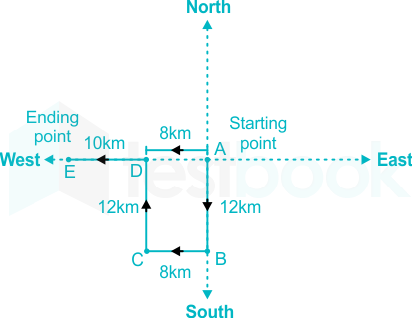
One day a man left his home for a morning walk and went 12 km southwards. He then turned right and walked 8 km. Again turned right and walked 12 km, turned left and walked 10 km. How many Killometers the man has to walk to reach straight to his home?

  1. ((a))

    22 km

  2. ((b))

    18 km

  3. ((c))

    20 km

  4. ((d))

    24 km

Show Answer
Answer: ((b))

18 km

As per the given question,

One day a man left his home for a morning walk and went 12 km southwards. He then turned right and walked 8 km. Again turned right and walked 12 km, turned left and walked 10 km.

Thus, the following diagram can be drawn: 

Distance between EA = ED + DA

= 10 + 8

= 18 km

Clearly, the man has to walk '18 km' to reach straight to his home.

Hence, the correct answer is "18 km".

22

The price of a jewel, passing three hands, rises on the whole by 65%. If the first and second sellers earned 20% and 25% profit respectively, find percentage profit earned by the third seller.

  1. ((a))

    10%

  2. ((b))

    15%

  3. ((c))

    16%

  4. ((d))

    12 %

Show Answer
Answer: ((a))

10%

Given:

Total rice in the price of a jewel = 65%

Profit earned by first seller = 20%

Profit earned by second seller = 25%

Formula used:

Profit%=SPCPCP×100\rm Profit\% = \dfrac{SP - CP}{CP} × 100

Where, SP = selling price, CP = cost Price

Calculation:

Let the original price of the jewel = Rs. x

Also, let the profit earned by the third seller = P%

According to the question,

⇒ (100 + P)% of 125% of 120% of x = 165% of x

⇒ [(100 + P)/100]% × (125/100) × (120/100) × x = 165% × x

⇒ 100 + P = [(165 × 100 × 100) / (125 × 120)]

⇒ 100 + P = 110 

⇒ P = 10% 

So, the percentage profit earned by the third seller is 10%.

Hence, the correct option is 1.

23

In an examination 42% students failed in Mathematics and 52% failed in Science. If 17% failed in both the subjects, find the Percentage of those Who Passed in both the subjects.

  1. ((a))

    23%

  2. ((b))

    25%

  3. ((c))

    27%

  4. ((d))

    30%

Show Answer
Answer: ((a))

23%

Shortcut Trick

Total Failed percentage = (Failed in Math + Failed in Science) − Failed in both

Total Failed % = (42 + 52) − 17 = 77%

Passed in both subjects % = 100% − Total Failed %

Passed in both % = 100% − 77% = 23%

∴ The correct answer is 23%.

Alternate Method

Given:

Students failed in Mathematics n(M) = 42%

Students failed in Science n(S) = 52%

Students failed in both subjects n(M ∩ S) = 17%

Formula Used:

n(M ∪ S) = n(M) + n(S) − n(M ∩ S)

Percentage of students Passed in both = 100% − n(M ∪ S)

Calculations:

⇒ Only failed in Mathematics = 42% − 17% = 25%

⇒ Only failed in Science = 52% − 17% = 35%

⇒ Total failed in at least one subject = 25% + 35% + 17% = 77%

⇒ Percentage of students Passed in both = 100% − 77%

⇒ Percentage of students Passed in both = 23%

∴ The correct answer is 23%.

Additional Information

Venn Diagram for Two Sets

For any two sets A and B, n(A ∪ B) = n(A) + n(B) − n(A ∩ B). This represents elements in at least one set.

De Morgan's First Law

The percentage of those who passed in both is equivalent to the complement of the union of failures: (A ∪ B)c = 100% − n(A ∪ B).

Mutual Exclusivity

If two events are mutually exclusive, n(A ∩ B) = 0, meaning no student can fail in both subjects simultaneously.

24

A 729 ml of a mixture contains milk and water in the ratio of 7 : 2. How much more water is to be added to get a new mixture containing milk and water in the ratio of 7 : 3?

  1. ((a))

    81 ml

  2. ((b))

    90 ml

  3. ((c))

    85 ml

  4. ((d))

    75 ml

Show Answer
Answer: ((a))

81 ml

Concept Used:

The ratio is the relation among two or more numbers, which tells how much one number is bigger than the others.

To solve the questions based on ratio, we use to assume a variable for the shared part among quantities.

Calculation:

Let the amount of milk is 7x while the amount of water is 2x in the mixture. Now, we have a total of 729 mL of the mixture. Thus,

⇒ 7x + 2x = 729 

⇒ 9x = 729

⇒ x = 729/9

⇒ x = 81 

Thus, the amount of milk

⇒ 7x = 7 × 81

⇒ 7x = 567 mL 

Amount of water

⇒ 2x = 2 × 81

⇒ 2x = 162 mL

Now, the new mixture has a ratio of 7:3.

For this, the amount of milk will be 7x and the amount of water is 3x.

Here, the quantity of milk is the same while the quantity of water is increasing. This increased quantity is,

⇒ 3x − 2x = x

⇒ 3x − 2x = 81 mL

So, a total of 81 mL water needs to be added to get a new mixture containing milk and water in the ratio of 7 : 3.

Hence, the correct option is 1.

25

Where is Chanakya said to have composed his Arthashastra?

  1. ((a))

    Sarnatha

  2. ((b))

    Takshashila

  3. ((c))

    Nalanda

  4. ((d))

    Vikramshila

Show Answer
Answer: ((b))

Takshashila

Chanakya composed his Arthashastra in Takshashila. Ancient India has differenet educational places which are known for their philosophical discussion and developed the different courses of thinking. Some of them are discussed below:

Key Points

PlaceDescription
Sarnath- Sarnath is a location near the confluence of the Varuna and Ganges rivers in Uttar Pradesh, India, 10 kilometres to the northeast of Varanasi. - The Buddhist Sangha was founded at the deer park in Sarnath, where Gautama Buddha gave his first teachings on the Dhamma and where Kondanna attained enlightenment. - The four-headed lion from the third century BC that previously stood atop the Ashoka Pillar is the most well-known artefact in the Sarnath Archaeological Museum.
Takshashila- Nonetheless, Taxila is most known for the remains of multiple villages, the earliest of which date to around 1000 BCE. - It is also well-known for having a number of Buddhist temples, such as the Mohra Muradu monastery, the Jaulian monastery, and the Dharmarajika stupa.
Nalanda- One of the thirty-eight districts that make up the Indian state of Bihar is the Nalanda district. - The district's administrative centre is located in Bihar Sharif. The historic Nalanda Mahavihara, a UNESCO World Heritage site, is located in the districts. - Nalanda is situated in southern Bihar's Magadh area.
Vikramshila- Together with Nalanda and Odantapuri, Vikramashila was one of the three most significant Buddhist monasteries in India during the Pala Dynasty. - Antichak hamlet, in the Bihar district of Bhagalpur, now stands where it once did. - Found in the eighth century as a result of what was thought to be a decrease in the calibre of study at Nalanda. - The university had been demolished by Bhaktiyar Khilji in the 12th century.

Hence, Takshashila is the correct answer.

26

Match List I with List II

List IList II
Name of the
Subject
Domain and Subject Matter
A.KavyaI.Agriculture, trade, commerce, animal husbandry
B.AniviksikiII.Etymology
C.VartaIII.Logic
D.NtruktaIV.Imaginative and creative literature

Choose the correct answer from the options given below.

  1. ((a))

    A - II, B - III, C - IV, D - I

  2. ((b))

    A - IV, B - III, C - I, D - II

  3. ((c))

    A - III, B - IV, C - II, D - I

  4. ((d))

    A - II, B - IV, C - I, D - III

Show Answer
Answer: ((b))

A - IV, B - III, C - I, D - II

The correct  is (A) - (IV), (B) - (III), (C) - (I), (D) - (II)

Important Points 

From an individual perspective the basic human values which are at the core of what it means to be a human need to be developed. 

There are five  core universal values:

  • Truth (Satya),
  • Righteous conduct (Dharma)
  • Peace (Shanti)
  • Love (Prem)
  • Non-violence (Ahimsa)

These 5 universal values specifically mentioned in NEP 2020, are “Truth, Peace, Non-violence, Love, Righteous conduct”

  • These values promote the fundamental goodness of human beings and society at large.
  • These are of a ‘unifying nature’ and cut across individuals’ social, cultural, religious, and sectarian interests. Such values are considered to be universal, timeless, and eternal applying to all human beings.
  • There is considerable evidence to suggest that these human values have stood the test of time and are essential for living in harmony with self, each other, and nature

Each value is related to a different area of human personality, but all of these areas are interdependent and interconnected.

  • For example, when individuals pursue the value of truth, they engage in intellectual inquiry and reflection, which can lead to personal and collective growth.
  • This growth can in turn contribute to emotional and spiritual well-being, as well as physical health and vitality.
  • Similarly, when individuals commit to non-violence, they engage in a process of personal transformation and growth, which can lead to greater compassion, wisdom, and understanding.
  • This growth can in turn contribute to greater emotional stability and positive relationships with others, as well as a sense of inner peace and tranquility.
  • Thus, the Core Universal Values and Areas Related to Human Personality are all interconnected and mutually reinforcing, contributing to the holistic development of individuals and societies.​

Key Points 

The table highlights the interconnectedness between the Core Universal Values and the Areas Related to Human Personality.

Core Universal ValueArea Related to Human PersonalityExplanation
TruthIntellectualThe value of truth is related to intellectual development and understanding. When individuals are committed to seeking and speaking the truth, they are engaging in intellectual inquiry and reflection, which can lead to personal and collective growth.
Righteous ConductPhysicalRighteous conduct is related to physical health and well-being. When individuals act with integrity and in accordance with their moral and ethical principles, they are likely to experience a sense of inner harmony and balance, which can contribute to physical health and vitality.
PeaceEmotionalThe value of peace is related to emotional health and well-being. When individuals cultivate inner peace and tranquility, they are likely to experience greater emotional stability, resilience, and positive relationships with others.
Non-violenceSpiritualNon-violence is related to spiritual growth and development. When individuals commit to non-violence as a way of life, they are engaging in a process of personal transformation and growth, which can lead to greater compassion, wisdom, and understanding.
27

"Considering the Speech given by the School Principal today, I would conclude that he is not a good Public Speaker." Identify the informal fallacy committed in the above argument.

  1. ((a))

    Slippery Slope

  2. ((b))

    Ad hominem

  3. ((c))

    Appeal to force

  4. ((d))

    Hasty Generalisation

Show Answer
Answer: ((d))

Hasty Generalisation

A fallacy is the use of flawed or otherwise flawed thinking in the development of an argument, which, if ignored, may appear to be well-reasoned. The Aristotelian De Sophisticis Elenchis is credited with introducing the phrase into Western intellectual heritage.

Key PointsDifferent fallacies are discussed below: 

Hasty Generalisation

  • The over-generalization error is another name for the fallacy of Hasty generalisation.
  • A hasty generalization is a fallacy in which a conclusion that is reached is not logically justified by sufficient or unbiased evidence.
  • It's also called an insufficient sample, a converse accident, a faulty generalization, a biased generalization, jumping to a conclusion, secundum quid, and a neglect of qualifications.
  • In essence, it is asserting that the proof is insufficient. In essence, you can't assert something is true if you can only provide one or two examples to support it.
  • Here ,the statement Considering the Speech given by the School Principal today, I would conclude that he is not a good Public Speaker." Identify the informal fallacy committed in the above argument. so Hasty Generalisation is a conclusion fallacy.

From the above points, the Correct answer is  Hasty Generalisation.

Additional Information

  • Slippery Slope: In terms of logic, critical thinking, political rhetoric, and case law, a slippery slope argument is one in which one side contends that a relatively little first step results in a series of connected actions that eventually have a big outcome.
  • Ad Hominem: Normally, when someone uses this term, they are referring to a rhetorical tactic where they attack the person making the argument rather than dealing with the actual argument's points of contention.
  • Appeal to force: This argument attempts to persuade the listener to accept a viewpoint by using force, the threat of force, or some other negative response. When facts or persuasive arguments fall short of persuading a reader, it frequently occurs as a last option.
28

Find the next term in the series given below.

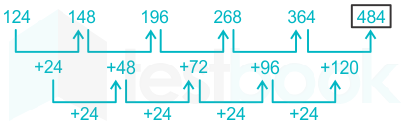
124, 148, 196, 268, 364, ?

  1. ((a))

    484

  2. ((b))

    584

  3. ((c))

    464

  4. ((d))

    268

Show Answer
Answer: ((a))

484

Given: 124, 148, 196, 268, 364, ?

The logic follows here is:

Hence, the correct answer is "484".

Read the following passage and answer questions 46 to 50:

Gandhi's speech in Banaras in February 1916 was, at one level, merely a statement of fact namely, that Indian nationalism was an elite phenomenon, a creation of lawyers and doctors and landlords. But, at another level, it was a statement of intent-the first public announcement of the returning expatriate's own desire to make Indian nationalism more properly representative of the Indian people. In the last month of that year, Gandhi was presented with an opportunity to put his precepts into practice. At a meeting held in Lucknow in December 1916, he was approached by a peasant from Champaran in Bihar. The peasant told him about the harsh treatment of peasants by British Indigo planters. Gandhi was to spend most of 1917 in Champaran. He was seeking to obtain for the peasants security of tenure as well as the freedom to cultivate the crops of their choice. In 1918, Gandhi was involved in two campaigns in his home State of Gujarat. First, he intervened in a labor dispute in Ahmedabad to better the conditions of textile mill workers. Then he joined peasants in Kheda for remission of taxes on peasants following the failure of their harvest. These initiatives marked Gandhi as a nationalist with sympathy for the poor. These were local struggles. During the World War I, the British had instituted press censorship and permitted detention without trial. The Rowlatt committee recommended the continuation of these tough measures. Gandhiji's call for a countrywide campaign brought life to standstill in north and west India.

29

Which was the Statement of fact in the Speech of Mahatma Gandhi at Banaras?

  1. ((a))

    Lawyers, doctors and landlords sided with the British.

  2. ((b))

    The Indian nationalism was elitist

  3. ((c))

    Nationalism was of another level in India

  4. ((d))

    The existing Indian nationalism was highly effective

Show Answer
Answer: ((b))

The Indian nationalism was elitist

The correct answer is "The Indian nationalism was elitist".

Key Points

  • Refer to the line:," Gandhi's speech in Banaras in February 1916 was, at one level, merely a statement of fact namely, that Indian nationalism was an elite phenomenon, a creation of lawyers and doctors and landlords. "
  • From the above statement of the passage it is clear that the passage suggests that "The Indian nationalism was elitist"  was the Statement of fact in the Speech of Mahatma Gandhi at Banaras

Therefore the correct answer is Option 2.

30

Gandhiji's speech expressed the intention of

  1. ((a))

    Making Indian nationalism more representative

  2. ((b))

    Announcing the desire of expatriates to become politically active

  3. ((c))

    Criticising the activities of Indian nationalists

  4. ((d))

    Launching a new nationalist movement

Show Answer
Answer: ((a))

Making Indian nationalism more representative

The correct answer is "Making Indian nationalism more representative".

Key Points

  • Refer to the line: But, at another level, it was a statement of intent-the first public announcement of the returning expatriate's own desire to make Indian nationalism more properly representative of the Indian people.
  • From the above passage, it is clear that the intention of the Gandhiji's speech is  to"Make Indian nationalism more representative".

Therefore the correct answer is Option 1.

31

Gandhiji could put his precept into practice during

  1. ((a))

    The Lucknow meeting

  2. ((b))

    The talks with landlords

  3. ((c))

    The Champaran campaign

  4. ((d))

    The interaction with nationalist leaders

Show Answer
Answer: ((c))

The Champaran campaign

The correct answer is "The Champaran campaign'.

Key Points

  • Let's refer to the following lines from the passage: 
  • In the last month of that year, Gandhi was presented with an opportunity to put his precepts into practice. At a meeting held in Lucknow in December 1916, he was approached by a peasant from Champaran in Bihar. The peasant told him about the harsh treatment of peasants by British Indigo planters. Gandhi was to spend most of 1917 in Champaran. He was seeking to obtain for the peasants security of tenure as well as the freedom to cultivate the crops of their choice. In 1918, Gandhi was involved in two campaigns in his home State of Gujarat. First, he intervened in a labor dispute in Ahmedabad to better the conditions of textile mill workers.
  • From the highlighted part of the above lines it is clear that Gandhiji could put his precept into practice during the Champaran campaign.

Therefore, the correct answer is Option 3.

32

Which issue propelled Gandhiji to the national stage for a wider movement?

  1. ((a))

    Labour dispute of textile mill workers in Ahmedabad

  2. ((b))

    Agitation peasants in Kheda

  3. ((c))

    The revolt against British Indigo planters

  4. ((d))

    The Rowlatt Act

Show Answer
Answer: ((d))

The Rowlatt Act

The correct answer is "The Rowlatt Act"

Key Points

  • Refer to the last lines of the passage: The Rowlatt committee recommended the continuation of these tough measures. Gandhiji's call for a countrywide campaign brought life to standstill in north and west India.
  • The issue of "The Rowlatt act" propelled Gandhiji to the national stage for a wider movement.

Therefore, the correct answer is "The Rowlatt Act"

33

The main intent of the passage is to describe

  1. ((a))

    The British atrocities in India

  2. ((b))

    The different facets of Indian national movement

  3. ((c))

    The various campaigns against the British in India

  4. ((d))

    The emergence of Gandhiji as a representative national leader

Show Answer
Answer: ((d))

The emergence of Gandhiji as a representative national leader

The correct answer is "The emergence of Gandhiji as a representative national leader"

Key Points

  • The main intent of the passage is to describe " The emergence of Gandhiji as a representative national leader".
  • The passage talks about the various steps taken by Gandhiji for spreading the feeling of the nationalism among masses, his participation in various movements against British and many movements and satyagraha started by him to challenge the british authority in various parts of the country. The passage portrays the emergence of Gandhiji as a representative national leader.

Therefore the correct answer is Option 4.

34

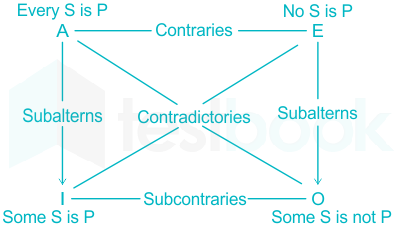
Which of the following statements are logically equivalent?

A. No P is S

B. Some S are non-P

C. Some non-P are not non-S

D. Some P are not S

Choose the correct answer from the options given below:

  1. ((a))

    B and C only

  2. ((b))

    C and D only

  3. ((c))

    B, C and D only

  4. ((d))

    A, B, C and D

Show Answer
Answer: ((c))

B, C and D only

Modern logic accepts the Boolean interpretation of categorical propositions. This interpretation has the following consequences: 

Because A and E propositions have no existential import, sub-alternation is not valid.

Because A and E propositions have no existential import, super-alternation is not valid.

Key Points

![Solved] According to traditional square of opposition, if two propos](https://storage.googleapis.com/tb-img/production/20/06/F1_A.A._Madhu_19.05.20_D1.png)

According to Boolean interpretation, the universal statement A is written as the conditional of the following type:

For any x, if x is S then x is P.

Let us take examples of universal propositions A and E with their modern interpretation:

  1. “All men are mammals” would mean “for any x, if x is a man then x is a mammal”
  2. “All unicorns are mammals” would mean “for any x, if x is a unicorn then x is a mammal”

We see that none of these conditional statements make any assertion concerning the existence of members of a class.

  • According to Boolean interpretation unlike “all” in universal propositions, the word “some” in an I proposition makes the claim that there is a membership in the subject class.
  • “Some” is interpreted to mean “at least one.” Therefore if particular propositions are true then the subject class is not empty because particular propositions are analyzed in conjunction with an existential claim.
  • For example, “Some roses are beautiful” would mean “There is at least one x such that x is a rose and x is beautiful” However, we should note that in the Boolean interpretation there is no claim to membership in the subject class of universal propositions.

If “unicorn” is the subject and there are no members in the subject class (subject being empty) then both the propositions “No S is P” as well as “All S is P” can be true.

Also, If there are no unicorns, then I proposition, “Some unicorns are horned creatures” and O proposition, “Some unicorns are not horned creatures” are both false.

Similarly, If 'All men are mortal' is given as True, then valid inferences are

 'Some S are non-P' is False

 'Some non-P are not non-S' is True 

'Some S are non-P' is False

Hence statements B, C and D only are correct.

35

Which of the following is true regarding Inductive argument?

  1. ((a))

    If all the premises are true, the conclusion must be true.

  2. ((b))

    It claims to support its conclusion only with some degree of probability

  3. ((c))

    It claims to Support its conclusion conclusively

  4. ((d))

    Conclusion is completely contained already in the premises

Show Answer
Answer: ((b))

It claims to support its conclusion only with some degree of probability

An inductive argument attempts to expand specific premises into a wider generalization, making it a form of bottom-up logic.

Key Points

Inductive Argument:

  • An inductive argument is a type of reasoning that uses specific observations, examples, or experiences to support a conclusion that may be probable but not certain.
  • In an inductive argument, the premises provide evidence to support the conclusion, but the conclusion does not necessarily follow logical necessity.
  • Inductive arguments do not claim that the conclusion necessarily follows from the premises.
  • Instead, they claim to support their conclusions only with some degree of probability based on the evidence or examples provided.

For example, 

Premise: All the tigers I saw on my safari trip to South Africa were orange.

Conclusion: Therefore, all tigers are orange.

There is a certain probability that all tigers are orange but the sample or patter the speaker experienced are orange, he/she doesn't experience all tigers in the world.

Hence the correct option regarding the Inductive argument is: It claims to support its conclusion only with some degree of probability.

Additional Information

  • If all the premises are true, the conclusion must be true. It Is incorrect because the truth of the premises does not guarantee the truth of the conclusion in an inductive argument. The conclusion is inferred from the premises but is not necessarily true, even if all the premises are true.
  • It claims to support its conclusion conclusively: It is incorrect because inductive arguments do not claim to support their conclusion conclusively. The conclusion is always open to revision or modification based on new evidence or examples.
  • The conclusion is completely contained in the premises: It is incorrect because inductive arguments do not contain the conclusion already in the premises. The conclusion is inferred from the premises and not necessarily contained in them.
36

When inference is based not on causation but on uniformity of co-existence, what is it called as per Classical Indian School of Logic?

  1. ((a))

    KevalanvayiKeval\overline{a}nvayi

  2. ((b))

    SamanyatodrstaS\overline{a}m\overline{a}nyatodrsta

  3. ((c))

    PurvavatP\overline{u}rvavat

  4. ((d))

    Seşavat

Show Answer
Answer: ((b))

SamanyatodrstaS\overline{a}m\overline{a}nyatodrsta

The correct answer is Sāmānyatodṛṣṭa

Key Points

Sāmānyatodṛṣṭa (when inference is not based on causation but on uniformity of co-existence)

  • Sâmânyatodta inference : When an inference is based not on causation but on uniformity of co-existence,it is called sâmânyatodta,e.g. when we infer cloven hoofs of an animal by its horns.
  • According to another interpretation, a pûrvavat inference is based on previous experience of universal concomitance between two things, a seavat is inference by elimination, and a sâmânyatodta is inference by analogy.


Important Points

Kevalâvyatireki inference:

When vyapti between middle and the major is derived from uniform agreement in absence alone, it is called kevalâvyatireki inference. In this inference hetu is only negatively related to the sadhya.

For example,

What is not different from other elements has no smell;

The earth has smell

  • Therefore the earth is different from other elements.
  • Kevalânvayi inference corresponds to Mill’s Method of Agreement, kevalâvyatireki inference corresponds to his Method of Difference and anvayavyatireki inference corresponds to his Joint Method of Agreement and Difference or the Method of Double Agreement.

Pûrvavat inference: 

When we infer an unperceived effect from a perceived cause we have pûrvavat inference. g. we see the dark clouds in the sky in the morning and infer future rain from the dark clouds.

Seavat inference :

When we infer an unperceived cause from a perceived effect we have seavat inference, e. g. when we infer previous rain from the swift muddy current of the river.

37

MIDI is associated with the storage of music files. MIDI is an acronym for ______.

  1. ((a))

    Musical Interactive Digital Interface

  2. ((b))

    Musical Instructions Device Interpreter

  3. ((c))

    Mask Iterative Display Instance

  4. ((d))

    Musical Instrument Digital Interface

Show Answer
Answer: ((d))

Musical Instrument Digital Interface

MIDI is associated with the storage of music files. MIDI is an acronym for Musical Instrument Digital Interface.

Key Points

  • A wide range of electronic musical instruments, computers, and associated audio devices can be connected via the technological standard known as MIDI to play, edit, and record music.
  • MIDI also describes a communications protocol, digital interface, and electrical connectors.
  • The MIDI protocol can handle up to 16 separate MIDI channels.
  • Each channel has a unique status, including information about the selected instrument, the notes being played, and other characteristics like volume and panoramic.
  • Using different MIDI channels, you can designate a separate instrument for each MIDI channel.

Hence MIDI is an acronym for Musical Instrument Digital Interface.

38

Which of following is true regarding Classical Indian School of Logic?

A. It is deductive

B. It is inductive

C. It is formal

D. It is material

E. It always leads from universal to particular only

Choose the correct answer from the options given below:

  1. ((a))

    A, B, C and D only

  2. ((b))

    B and C only

  3. ((c))

    A and D only

  4. ((d))

    A, B, C, D and E

Show Answer
Answer: ((a))

A, B, C and D only

Key Points

  1. Deductive (A): Classical Indian logic includes deductive reasoning, particularly in the Nyaya school, which emphasizes formal logic and reasoning.
  2. Inductive (B): While less emphasized compared to deductive logic, some aspects of inductive reasoning can be found in Classical Indian logic, particularly in the context of empirical and inferential knowledge.
  3. Formal (C): Classical Indian logic is highly formalized, especially in the Nyaya school, which deals with the structure of arguments and syllogisms.
  4. Material (D): This term can be interpreted in different ways, but in the context of Indian logic, it can refer to the content and substance of arguments, which is also a consideration in Indian logical theories.
  5. Always leads from universal to particular only (E): This statement is too restrictive. While Classical Indian logic does include movement from universal to particular, it also accommodates other forms of inference.

Based on this analysis, the correct answer would be: A, B, C, and D only

This includes all the elements that are characteristic of Classical Indian logic and excludes the overly restrictive statement (E).

39

Mohit has sent an email to Bobby, Danny and Ashok as shown below:

From: [email protected] To: [email protected] Cc: [email protected] Bcc: [email protected]
Subject: Important update
Dear Colleague, Please note that tomorrow's meeting has been cancelled. Regards Mohit

Which of the following statements is Correct?

  1. ((a))

    Bobby and Danny are aware that Ashok received the email

  2. ((b))

    Danny is aware that Ashok and Bobby received the email

  3. ((c))

    Ashok is aware that Bobby and Danny received the email

  4. ((d))

    All recipients are aware that the others received the email.

Show Answer
Answer: ((c))

Ashok is aware that Bobby and Danny received the email

An email is a vital form of business communication that is quick, affordable, available, and simple to duplicate. Businesses can gain a lot from using email since it offers quick and easy means to send many types of electronic data.

Important Points Important features of e-mail are discussed below:

  • Bcc stands for blind carbon copy, which is similar to Cc except that the recipients' email addresses are not visible in the message header when it is received, so those listed in the To or Cc fields won't be aware that a copy was sent to their address.
  • When copying people in an email, we can use Cc for public and Bcc for private copies.
  • The email's other recipients cannot see any recipients listed on the Bcc line, but the recipient in the Bcc can see all other receivers.

Key PointsMohit has sent an email to Bobby, Danny and Ashok as shown below:

In the above pattern, the following matters are true

  • Mohit is aware that Bobby, Danny, and Ashoke received the email
  • Ashok is aware that Bobby and Danny received the email
  • Bobby is aware that Danny received the email and vise versa
  • Bobby and Danny are not aware that Ashok received the email

Hence, it is only true from the options that Ashok is aware that Bobby and Danny received the email.

40

Which of the following are web search engines?

A. DuckDuckGo

B. Google

C. Yahoo search

D. Bing

E. Pinterest

Choose the correct answer from the options given below:

  1. ((a))

    B, C and D only

  2. ((b))

    A, B, C and D only

  3. ((c))

    B and E only

  4. ((d))

    A, C, D and E only

Show Answer
Answer: ((b))

A, B, C and D only

A software programme developed specifically to do web searches is known as a search engine. They carry out a methodical search of the World Wide Web for specific data that is specified in a text web search query. Search engine results pages, as they are commonly known, are typically how the search results are displayed.

Key Points

Web search enginesCharacteristics
DuckDuckGo- Internet search engine DuckDuckGo places a strong emphasis on guarding users' privacy and avoiding the filter bubble of tailored search results. - DuckDuckGo excludes results from content farms from its search results - It uses various APIs of other websites to show quick results to queries and for traditional links it uses the help of its partners (mainly Bing) and its own crawler. - Because of its anonymity, it is impossible to know how many people use DuckDuckGo.
Google- Online advertising, search engine technology, cloud computing, computer software, quantum computing, e-commerce, artificial intelligence, and consumer electronics are the main areas of interest for Google LLC, an American multinational technology firm.
Yahoo search- The term "Yahoo Search" originally referred to a Yahoo!-provided interface that routed requests to a searchable index of pages enhanced with its directory of websites. - The user was shown the results using the Yahoo! brand. At first, Yahoo! didn't perform any of the real site crawling or data storage. - Until 2004, when Yahoo! Search became independent, Inktomi and Google operated the searchable index. Microsoft and Yahoo! established a partnership on July 29, 2009, under which Bing would start running Yahoo! Search.
Bing- Microsoft The Bing search engine is one that Microsoft owns and runs. - The MSN Search, Windows Live Search, and subsequently Live Search search engines from Microsoft served as the foundation for this service. Web, video, picture, and map search solutions are just a few of the search services that Bing offers.

Hence, the correct answer is A, B, C and D only

Additional Information

 Pinterest:

Pinterest is an American social media platform and image-sharing platform that lets users create pin boards using photographs, videos, and, to a lesser extent, animated GIFs to save and organised information online.

41

Given below are two statements

Statement I: ROM is temporary memory that can be written to or read from and the contents of the memory can be changed.

Statement II: RAM is permanent memory that can only be read from and contents of memory cannot be changed.

In light of the above statements, choose the most appropriate answer from the options given below

  1. ((a))

    Both Statement I and Statement II are correct

  2. ((b))

    Both Statement I and Statement II are incorrect

  3. ((c))

    Statement I is correct but Statement II is incorrect

  4. ((d))

    Statement I is incorrect but Statement II is correct

Show Answer
Answer: ((b))

Both Statement I and Statement II are incorrect

The correct answer is Both Statement I and Statement II are incorrect.

Key Points

Statement I: ROM is a temporary memory that can be written to or read from and the contents of the memory can be changed.

  • A type of non-volatile memory used in computers and other electronic devices is read-only memory (ROM).
  • After the memory device is manufactured, the data contained in the ROM cannot be electronically manipulated.
  • Firmware, often known as read-only memory, is helpful for holding software that isn't frequently modified during the life of the system.
  • ROM contains special internal electronic fuses that can be programmed for a specific interconnection pattern (information).
  • The binary information stored in the chip is specified by the designer and then embedded in the unit at the time of manufacturing to form the required interconnection pattern (information).
  • Once the pattern (information) is established, it stays within the unit even when the power is turned off.
  • So, it is a non-volatile memory as it holds the information even when the power is turned off, or you shut down your computer.
  • As plug-in cartridges with ROM, software applications (like video games) for programmable devices can be sold.

Hence, Statement I is incorrect.

Statement II: RAM is permanent memory that can only be read from and contents of memory cannot be changed.

  • The hardware in a computing device called RAM (Random Access Memory) stores the operating system (OS), application programme, and data that are currently in use so that the processor of the device can access them rapidly.
  • The primary memory of a computer is RAM.
  • A random-access memory device allows data items to be read or written in virtually the same amount of time regardless of the location of the data inside the memory.
  • RAM is a temporary memory bank where your computer stores data it needs to retrieve quickly.
  • RAM keeps data easily accessible so your processor can quickly find it without having to go into long-term storage to complete immediate processing tasks.

Hence, Statement II is incorrect. 

  • Therefore, We can draw a conclusion from the above discussion that Statement I and II is Incorrect.
42

Match List I with List II

List IList II
(Statement)(Value)
A.The number of bits that make up a byteI.5
B.Base-10 (denary) value of the binary number: 001111II.8
C.Number of minutes to upload a 75 megabyte file at 2 Megabits per second upload speedIII.10
D.If there are 2 bytes in a Kilobyte then what is the Value of P?IV.15

Choose the correct answer from the options given below.

  1. ((a))

    A - I, B - II, C - III, D - IV

  2. ((b))

    A - II, B - IV, C - I, D - III

  3. ((c))

    A - III, B - IV, C - I, D - II

  4. ((d))

    A - II, B - I, C - IV, D - III

Show Answer
Answer: ((b))

A - II, B - IV, C - I, D - III

Simple binary counting uses only the values 1 and 0 and is useful for various later-discussed reasons. Base 2 is another name for binary.

Key Points

  • The number of bits that make up a byte - is 8.
  • Base-10 (denary) value of the binary number: 001111 - 15
  • Number of minutes to upload a 75-megabyte file at 2 Megabits per second upload speed - 5
  • If there are 2 bytes in a Kilobyte, then what is the Value of P- 10

Hence A-II, B - IV, C - I, and D - III is correct.

Important Points

Statement(Value)
The number of bits that make up a byte- Bits are usually assembled into a group of eight to form a byte. - A bit can hold only one of two values: 0 or 1, - A byte contains enough information to store a single ASCII character, like "h".
Base-10 (denary) value of the binary number: 001111025+024+123+122+121+120 = 032+016+18+14+12+11 = 0+0+8+4+2+1 = 1510
Number of minutes to upload a 75 megabyte file at 2 Megabits per second upload speedFile size = 75 megabyte Uploading speed = 2 Mbps Total time required = about 5 minute 14 sec
If there are 2 bytes in a Kilobyte then what is the Value of P?- A kilobyte is approximately 1,000 bytes (specifically, 2 to the 10th power (P) or, in decimal form, 1,024 bytes). - When there are 2 bytes in a Kilobyte then the Value of P is 10.
43

The period of Sendai framework for disaster risk reduction is

  1. ((a))

    2015 - 2030

  2. ((b))

    2020 - 2040

  3. ((c))

    2015 - 2025

  4. ((d))

    2020 - 2030

Show Answer
Answer: ((a))

2015 - 2030

The period of Sendai framework for disaster risk reduction is 2015- 2030.

Key Points Sendai framework

  • The Sendai Framework for Disaster Risk Reduction 2015–2030 (Sendai Framework) was the first significant agreement of the post–2015 development agenda and offers Member States specific actions to safeguard development gains from disaster risk.
  • The Paris Agreement on Climate Change, the Addis Ababa Action Agenda on Finance for Development, the New Urban Agenda, and finally the Sustainable Development Goals all complement each other under the Sendai Framework.
  • Following the 2015 Third UN World Conference on Disaster Risk Reduction (WCDRR), the UN General Assembly approved it. It calls for:
  • a significant decrease in disaster risk, losses to lives, livelihoods, and health, as well as to the financial, physical, social, cultural, and environmental assets of individuals, enterprises, and communities
  • The Hyogo Framework for Action (HFA) 2005-2015: Strengthening the Resilience of Countries and Communities to Disasters is being replaced by the Sendai Framework. It is the result of stakeholder discussions that were started in March 2012 and intergovernmental negotiations that were sponsored by the UNDRR at the UN General Assembly's request and held from July 2014 to March 2015.

Additional Information

  • The governing authority for disaster management in India is called the National Disaster Management Authority (NDMA), which is presided over by the Prime Minister of India.
  • The Disaster Management Act of 2005 requires the establishment of NDMA and the development of a supportive environment for institutional mechanisms at the State and District levels.
44

Given below are two statements

Statement I: The concentration of Volatile Organic Chemicals is generally 100-1000 times higher in surface water than underground water.

Statement II: The most common method of treatment of Volatile Organic Chemicals is to aerate them to the atmosphere.

In light of the above statements, choose the correct answer from the options given below:

  1. ((a))

    Both Statement I and Statement II are true.

  2. ((b))

    Both Statement I and Statement II are false.

  3. ((c))

    Statement I is true but Statement II is false.

  4. ((d))

    Statement I is false but Statement II is true.

Show Answer
Answer: ((d))

Statement I is false but Statement II is true.

The correct answer is Statement I is false but Statement II is true.

Key PointsStatement I: Concentration of Volatile Organic Chemicals is generally 100-1000 times higher in surface water than underground water.

  • Volatile organic compounds (VOCs) are emitted as gases from certain solids or liquids.
  • VOCs include a variety of chemicals, some of which may have short- and long-term adverse health effects.
  • Concentrations of many VOCs are consistently higher indoors (up to ten times higher) than outdoors. VOCs are emitted by a wide array of products numbering in the thousands.
  • Organic chemicals are widely used as ingredients in household products.
  • Paints, varnishes and wax all contain organic solvents, as do many cleaning, disinfecting, cosmetic, degreasing and hobby products. Fuels are made up of organic chemicals.
  • All of these products can release organic compounds while you are using them, and, to some degree, when they are stored.

Hence, Statement I is False.

Statement II: The most common method of treatment of Volatile Organic Chemicals is to aerate them to atmosphere.

  • Volatile organic compounds (VOC) are important sources of environmental pollution. Several commonly used techniques for the treatment of VOC are reviewed. Recovery techniques can be classified into absorption, adsorption, condensation and membrane separation.
  • In order to select the best technology for purification of volatile organic compounds (VOCs) one must consider the volume, concentration of VOCs, air temperature and humidity, the solvents present, permitted emissions limits and the possible presence of dust and other contaminants.
  • Among the recovery methods, the absorption method has mature technology and low investment, andcan deal with high flow rate and medium and high concentration of room temperature waste gas.
  • Theadsorption method has a good purification effect, but secondary pollution, adsorbent poisoning and otherproblems may occur.
  • In non-recovery technologies, the biodegradation method has low operation and management costs. Themain drawback is that the purification effect is highly influenced by temperature and humidity. Thereaction conditions of the photocatalytic method are mild.

Hence,Statement II is true

45

Pyrolysis helps in addressing the Problem of

  1. ((a))

    Air Pollution

  2. ((b))

    Water Pollution

  3. ((c))

    Municipal Solid Wastes

  4. ((d))

    Electronic Wastes

Show Answer
Answer: ((c))

Municipal Solid Wastes

Pyrolysis helps in addressing the Problem of Municipal Solid Waste.

Key PointsPyrolysis:

  • Pyrolysis is the process of burning a substance in the absence of oxygen or in a controlled atmosphere of oxygen.
  • This process takes place at temperatures ranging from 500 to 600 degrees Celsius.
  • Rotary kilns, rotary hearth furnaces, and fluidized bed furnaces are the most common pyrolysis reactors.
  • To maintain the required high temperature, the process requires an external heat source.
  • It is a viable substitute for incineration. The resulting gas and liquid can be utilized as fuel.
  • Carbonaceous wastes such as firewood, coconut, palm waste, corn combs, cashew shell, rice husk paddy straw, and saw dust are pyrolyzed to produce charcoal, as well as tar, methyl alcohol, acetic acid, acetone, and a fuel gas.

Municipal Solid Wastes:

  • Municipal solid waste is a category of waste made up of common objects that are dumped by the general public and is often referred to as trash, garbage, or rubbish in the United States and the United Kingdom.
  • In a garbage disposal, the term "garbage" can also apply particularly to food waste; the two are occasionally collected separately. MSW is produced by businesses, hospitals, schools, and residences (EPA, 2019).
  • Pyrolysis is a municipal solid waste.
  • Glass, food scraps, metals, textiles, wood, plastics, and paper make up the biomass waste category known as MSW.
  • Open dumping and landfilling are the two approaches that are most frequently utilised to handle MSW.

Hence, the correct answer is Municipal Solid Wastes.

Additional Information

  • The thermal degradation of materials at high temperatures, frequently in an inert atmosphere, is the pyrolysis process.
  • A change in chemical composition is involved.
  • The word was created from the Greek words pyro, which means "fire," "heat," "fever," and lysis, which means "separating."
46

Given below are two statements

Statement I: Acute exposure to a chemical is a long-term continuous exposure to that chemical

Statement II: Chronic exposure to a chemical is a short-term exposure to that chemical

In light of the above statements, choose the most appropriate answer from the options given below

  1. ((a))

    Both Statement I and Statement II are correct

  2. ((b))

    Both Statement I and Statement II are incorrect

  3. ((c))

    Statement I is correct but Statement II is incorrect

  4. ((d))

    Statement I is incorrect but Statement II is correct

Show Answer
Answer: ((b))

Both Statement I and Statement II are incorrect

The correct answer is Both Statement I and Statement II are incorrect.

Key Points

  • The various chemical exposure that can harm a person is known as exposure pathways.
  • Ingestion, skin contact, and inhalation are the three main exposure routes. Breathing or inhaling into the lungs is known as inhalation.

Statement I: Acute exposure to a chemical is long-term continuous exposure to that chemical.

  • Acute means small so acute exposure to chemicals is always short-term.
  • Acute exposure to chemicals does not affect the body in the long run.
  • Its effects can be decreased and do not lead to huge damage.
  • However acute exposure but in a large quantity leads to heavy damage to a person or property.

Hence Statement I is incorrect.

Statement II: Chronic exposure to a chemical is short-term exposure to that chemical

  • Chronic exposure to chemicals is related to the long term.
  • Even a small amount of chemical exposure in the long run severally damages health and property.
  • Chronic exposure leads to the deterioration of the whole body.
  • It acts as a slow poison.

Hence Statement II is also incorrect.

Therefore, We can draw a conclusion from the above discussion that statements I and II both are incorrect.

47

Community Colleges are supposed to offer courses that are a mix of

  1. ((a))

    Fine Arts and Life Skills

  2. ((b))

    School and College Education

  3. ((c))

    Technical and Traditional Skills

  4. ((d))

    Knowledge, Technical and Soft Skills

Show Answer
Answer: ((d))

Knowledge, Technical and Soft Skills

Community Colleges are supposed to offer courses that are a mix of Knowledge, Technical and Soft Skills.

Key Points

Community College:

  • A community college is a type of higher education facility in India that strives to give students from nearby areas access to career-focused education.
  • It is a system that offers education above the secondary level and below the degree level in a variety of traditional and skill-oriented courses.
  • Community college is usually a 2-year college that offers general education to the students such as math, history before transferring to a four-year university or going for a job.
  • As the name suggests, these are local colleges that provide post-secondary education at an affordable cost and are open to everyone.
  • Usually, when a student enters a traditional university, they are required to take 2 years of general education before proceeding to their specialization.
  • So, many students prefer to actually pursue their general education at such educational institutions and then pursue their remaining 2 years at the traditional university.
  • There are fewer student jobs and groups at a community college.
  • In contrast, there are many more chances available at a university, including participating in research and various student organisations.

The process of understanding what is a community college involves knowing the types of courses offered by them. Listed below are the type of courses offered by Community Colleges.

  • Certificate
  • Diploma
  • Advance Diploma/ Associate Degree

Basis:

  • Community colleges are much cheaper as compared to traditional four-year universities.
  • Admission is generally open to almost everyone i.e. any high school graduate might get admission. The admission requirements are a lot less strict than universities.
  • The number of students being less in community colleges, the class size is less which allows for one to one interaction.
  • These colleges offer associate degrees which the students can typically complete in or under two years. Basically, community colleges offer fewer course options than universities

Thus, the correct answer is Knowledge, Technical and Soft Skills.

48

Given below are two statements

Statement I: To address the problem of climate change it is essential for the world to have 'Net Zero' carbon emissions by the year 2050.

Statement II: There is zero carbon emission associated with the production of gray hydrogen.

In light of the above statements, choose the correct answer from the options given below:

  1. ((a))

    Both Statement I and Statement II are true.

  2. ((b))

    Both Statement I and Statement II are false.

  3. ((c))

    Statement I is true but Statement II is false.

  4. ((d))

    Statement I is false but Statement II is true.

Show Answer
Answer: ((c))

Statement I is true but Statement II is false.

The correct answer is Statement I is true but Statement II is false.

Key Points

  • Long-term changes in temperature and weather patterns are referred to as climate change.
  • These changes may be organic, but since the 1800s, human activity has been the primary cause of climate change.
  • This is primarily because burning fossil fuels, such as coal, oil, and gas, release gases that trap heat.
  • To mitigate the impact of Climate change UNFCCC is taking different steps in its annual meeting known as COP (Conference of Parties) to tackle the issue of Climate Change.
  • In this meeting, several decisions were taken. Among the different decisions, the most important decision is to tackle carbon emissions.

Important Points

Statement I: To address problem of climate change it is essential for the world to have 'Net Zero' carbon emissions by the year 2050.

  • As per United Nations, the Planet has already warmed by 1.1°C since the late 1800s, and emissions are still rising.
  • Emissions must be cut by 45% by 2030 and reach net zero by 2050.
  • The Target is decided in Paris COP.
  • Paris Agreement's set goal of limiting global warming to 1.5°C which can only be achieved if countries have 'Net Zero' carbon emissions by the year 2050.

Hence Statement I is correct.

Statement II: There is zero carbon emission associated with the production of gray-hydrogen.

  • Zero Carbon emission is not associated with grey Hydrogen.
  • Zero carbon refers to a product or service that emits no carbon dioxide (for example, a wind farm generating electricity, or a battery deploying electricity).
  • With steam methane reformation, grey hydrogen can be produced from natural gas, or methane, without releasing any greenhouse gases into the atmosphere.
  • The IPCC states that net-zero emissions are reached when human removals of greenhouse gases from the atmosphere balance human emissions over a predetermined time period.

Hence Statement II is incorrect

Therefore, We can draw a conclusion from the above discussion that Statement I is correct but Statement II is Incorrect.

Additional Information

  • UNFCCC- In order to counteract "dangerous human interference with the climate system," the United Nations Framework Convention on Climate Change formed an international environmental treaty that included stabilising greenhouse gas concentrations in the atmosphere.
  • COP- The Conference of Parties (COP) is the principal organisation responsible for making decisions under the United Nations Framework Convention on Climate Change (UNFCCC). In order to control greenhouse gas emissions and safeguard the planet from the dangers of climate change, the UNFCCC was established in 1994.
49

The acronym 'SANKALP', introduced by the Ministry of Skill Development and Entrepreneurship, stands for:

  1. ((a))

    Skill Awareness and Knowledge Assessment of Livelihood Promotion

  2. ((b))

    Skill Addition and Knowledge Assessment of Livelihood Promotion

  3. ((c))

    Skill Acquisition and Knowledge Awareness of Livelihood Promotion

  4. ((d))

    Skill Attainment and Knowledge Awareness of Livelihood Promotion

Show Answer
Answer: ((c))

Skill Acquisition and Knowledge Awareness of Livelihood Promotion

SANKALP stands for Skill Acquisition and Knowledge Awareness of Livelihood Promotion.

Key Points About Sankalp

  • A programme of the Ministry of Skill Development called Skill Acquisition and Knowledge Awareness for Livelihood Promotion ("SANKALP") receives loan support from the World Bank.
  • It seeks to increase the quality and quantity of short-term skill training by bolstering institutions, enhancing market connectedness, and incorporating disadvantaged groups into society.
  • SANKALP was introduced on January 19th, 2018, and it will exist till March 2023.
  • The Outcomes Framework and Disbursement Linked Indicators (DLIs) approved by MSDE and the World Bank are used to measure the project's outcomemes
  • The Ministry of Skill Development and Entrepreneurship (MSDE) was set up in November 2014 to drive the ‘Skill India’ agenda - to converge existing skill training initiatives and to combine scale and quality of skilling efforts.
  • The MSDE launched the National Skill Development Mission (NSDM) to create an end-to-end implementation framework that provides opportunities for quality short and long-term Skill Development (SD), leading to productive employment and career progression that meets the aspirations of trainees.
  • NSDM has identified seven sub-missions in crucial areas which require immediate attention.
  • The identified sub missions include: (i) Institutional Training, (ii) Infrastructure, (iii) Convergence, (iv) Trainers, (v) Overseas Employment, (vi) Sustainable Livelihoods and (vii) Leveraging Public Infrastructure.

Major Initiatives:

1.Mahatma Gandhi National Fellowship (MGNF)

  • MGNF has been launched to support the District administration in improving skill development program delivery as well as developing a cadre of committed and competent development leaders. As a pilot, 75 fellows will be deputed in 75 districts
  • The contract signing with IIM-Bangalore was done on 9th October 2019. Further, Fellow will be awarded a Certificate in Public Policy and Management from IIM-Bangalore upon completion of the fellowship program.

2**.Award for Excellence in District Skill Development Planning (DSDP Award):**

  • To promote decentralised planning, District Skill Development Plan (DSDP) Award have been constituted by the Ministry under SANKALP.
  • The award was launched in FY 2018-19, wherein districts across all States/ UTs were invited to participate.
  • Out of the 700+ districts in the country, 225 districts participated by submitting their DSDPs to MSDE. The DSDPs thus submitted were evaluated and out of these 225 districts, 25 districts were shortlisted through evaluation by designated committees.

3.SANKALP Regional Workshop:

  • Acknowledged as the Lighthouse Event by The World Bank, SANKALP regional workshop acts as a platform wherein States/ UTs exchange their experiences in Skill Ecosystem.
  • The workshops promotes awareness about SANKALP and various initiatives being undertaken. The group of participating States represents different Geographic region of the country to bring in heterogeneity to the group. Till date four regional workshops have been held with participation from 22 States/ UTs.

4.SANKALP Best Practices Portal

  • MSDE with support from World Bank has developed and launched a portal to capture best practices in Skill Development.
  • MSDE has requested States to submit their Best Practice on the portal in form of videos, case studies, testimonials and photographs showcasing the emerging best practices and innovations in skill development. Further, MSDE is now augmenting the portal through NICSI Empaneled vendor.

5.Thematic Workshops

  • To build the capacity of the District Skill Committee (DSC) members and the district functionary, thematic workshops are planned under SANKALP.
  • These workshops cover different themes like district skill planning, mobilization, counselling, M&E, etc.

Hence, the correct answer is Skill Acquisition and Knowledge Awareness of Livelihood Promotion.

50

The major terms of reference for the National Knowledge Commission were

A. Challenge developed countries in Knowledge creation

B. Westernise the Indian educational system

C. Promote creation of Knowledge in science and technology laboratories

D. Promote Knowledge applications in agriculture and industry

E. Build excellence in education system to meet the challenges of the twenty-first century

Choose the correct answer from the options given below:

  1. ((a))

    A, B and C only

  2. ((b))

    B, C and D only

  3. ((c))

    C. D and E only

  4. ((d))

    A, B and E only

Show Answer
Answer: ((c))

C. D and E only

In order to strengthen India's competitive advantage in knowledge-intensive service industries, the National Knowledge Commission, an Indian think tank, was tasked with examining potential policy options. Manmohan Singh, the then-prime minister of India, established it on June 13, 2005.

Key Points

  • National Knowledge Commission
  • It was an Indian think-tank charged with considering possible policies that might sharpen India's comparative advantage in the knowledge-intensive service sectors.
  • It was constituted on 13 June 2005, by the then Prime Minister of India, Manmohan Singh.

Objectives :

The overall task before the National Knowledge Commission is to take steps that will give India the ‘knowledge edge’ in the coming decades, i.e. to ensure that our country becomes a leader in the creation, application and dissemination of knowledge. 

  • Creation of new knowledge
  • Application of knowledge
  • Dissemination of knowledge

​Focus Areas:

  • Access to Knowledge
  • Knowledge Concepts
  • Knowledge Creation
  • Knowledge Application
  • Knowledge Services

Concepts :

 Education is a potent force for any developing state. It encourages individuals to

  • Think independently
  • Make better-informed decisions
  • Keep abreast of important issues and trends at the local and national level
  • Question existing socio-economic arrangements in a manner that leads to innovation, change and development.

 Major objective of the commission:

a. Promote the creation of Knowledge in science and technology laboratories

b. Promote Knowledge applications in agriculture and industry

c. Build excellence in the education system to meet the challenges of the twenty-first century

Hence ,the correct answer is C. D and E only.

Additional Information The five main pillars of the NKC mandate are ACCESS, CONCEPTS, CREATION, APPLICATIONS, and SERVICES. From these angles, NKC create a knowledge society, paying special attention to access to knowledge.

Attempt this paper under real exam conditions

Timed interface, section switching, instant scoring, and question-by-question analytics — free.

Start Timed Attempt