Official Paper

UGC NET Paper 1: Held On 14th June 2023 Shift 2 (Previous Year Paper)

50 questions · 60 minutes · with answers · free

Paper 1 (50 questions)

Man is the only animal that laughs and weeps, for he is the only animal that is struck with the difference between what things are and what they ought to be. We weep at what exceeds our expectations in serious matters; we laugh at what disappoints our expectations in trifles. We shed tears from sympathy with real and necessary distress; as we burst into laughter from want of sympathy with that which is unreasonable and unnecessary. Tears are the natural and involuntary response of the mind overcome by some sudden and violent emotions. Laughter is the same sort of convulsive and involuntary movement, occasioned by mere surprise or contrast.

The serious is the stress which the mind lays upon the expectations of a given order of events and the weight attached to them. When this stress is increased beyond its usual intensity and strains the feelings by the violent opposition of good and bad, it becomes the tragic. The ludicrous is the unexpected relaxing of this stress below its usual intensity, by an abrupt transposition of ideas that takes the mind by surprise and startles it into lively sense of pleasure.

1

The author implies that animals lack the ability to 

  1. ((a))

    Perceive emotional changes in humans

  2. ((b))

    laugh or weep 

  3. ((c))

    evoke sorrow or laughter in humans 

  4. ((d))

    respond strongly to external stimuli 

Show Answer
Answer: ((b))

laugh or weep 

The correct answer is "laugh or weep"

Key Points 

  • This is the 1st line of the 1st paragraph:
  • Man is the only animal that laughs and weeps, for he is the only animal that is struck with the difference between what things are and what they ought to be
  • The passage specifically states, "Man is the only animal that laughs and weeps."
  • It highlights laughter and weeping as unique human characteristics, setting humans apart from other animals in this regard.

Hence, the correct option is "option 2"

2

According to the passage which of the following is not true is case of tears and laughter?

  1. ((a))

    They are both involuntary reaction

  2. ((b))

    They are both the result of violent emotions

  3. ((c))

    They are both natural emotions.

  4. ((d))

    They are both reaction to expperences of the world

Show Answer
Answer: ((b))

They are both the result of violent emotions

The correct answer is "They are both involuntary reaction"

Key Points 

  • "They are both the result of violent emotions" is not true in the case of tears and laughter.
  • The passage describes tears as "the natural and involuntary response of the mind overcome by some sudden and violent emotions." However, it does not categorize laughter as a result of violent emotions.
  • Instead, it refers to laughter as "the same sort of convulsive and involuntary movement, occasioned by mere surprise or contrast."

Hence, the correct option is "option 2"

3

It can be inferred from the passage that the "ludicrous" is most nearly opposite to the 

  1. ((a))

    Serious

  2. ((b))

    Surprise

  3. ((c))

    Pleasure

  4. ((d))

    Unexpected

Show Answer
Answer: ((a))

Serious

The correct answer is "Serious"

Key Points 

  • Ludicrous- something that is so absurd, ridiculous, or laughably unreasonable that it is difficult to take seriously.
  • Example- "The idea that elephants can fly is ludicrous and contradicts everything we know about physics and biology."
  • It can be inferred from the passage that the "ludicrous" is most nearly opposite to the word "serious."
  • "Ludicrous" in the passage refers to a state of affairs or ideas that are unexpectedly humorous or absurd, contrasting with the usual serious expectations.

Hence, the correct option is "option 1"

Additional Information

  • Look at the meanings of the other words:
  • Surprise-  The feeling or state of being amazed, astonished, or taken aback by something unexpected or unusual
  • Pleasure- A feeling of enjoyment, happiness, or satisfaction derived from a positive experience, activity, or something that brings delight.
  • Unexpected- not expected or foreseen
4

The author develops the passage primarly by 

  1. ((a))

    Disproving a theory 

  2. ((b))

    Citing authorities 

  3. ((c))

    Presenting counter example 

  4. ((d))

    Defining terms 

Show Answer
Answer: ((d))

Defining terms 

The correct answer is "Defining terms"

Key Points 

  • Let's look at the following points.
  • The majority of the passage is focused on defining and explaining various concepts related to human emotions and behavior.
  • The author discusses the differences between humans and animals concerning laughter and weeping, the nature of tears and laughter as involuntary responses to certain emotions or situations, and the distinction between the serious and the tragic, as well as the ludicrous.
  • Through this process of defining terms and concepts, the author provides insights into human emotional responses and reactions.

Hence, the correct option is "option 4"

5

We shed tears when 

A. Something is tragic

B. Something is ludicrous

C. Something is surprising

D. Seriousness exceeds our expectations

Choose the correct answer from the options given below:

  1. ((a))

    C & D only

  2. ((b))

    A & B only

  3. ((c))

    A & D only

  4. ((d))

    A, B & D only

Show Answer
Answer: ((c))

A & D only

The correct answer is "A & D only"

Key Points 

  • A. Something is tragic:
  • The passage mentions that tears are shed when the stress on the mind is increased beyond its usual intensity and strains the feelings by the violent opposition of good and bad, which becomes the tragic.
  • So, when faced with a tragic event, we may shed tears in response.
  • D. Seriousness exceeds our expectations:
  • The passage explicitly states, "We weep at what exceeds our expectations in serious matters."
  • This means that when something serious happens that is beyond what we expected, we may also respond with tears.

Hence, the correct option is "option 3"

The following table shows the Income (in Rs. lakh) and percentage (%) profit of a company over the six years from 2017 to 2022. Based on the data in the table, answer the questions that follow.

Year-wise Income and Profit of a Company

YearIncome (in Rs. Lakh)Profit (%)
20171207.5
201816015
201913022.5
202017017.5
202119020
202215027.5
6

If the percentage profit in 2021 was 25% instead of 20% than what would have been the expenditure in that year? 

  1. ((a))

    Rs. 130 lakh

  2. ((b))

    Rs. 148 lakh

  3. ((c))

    Rs. 120 lakh

  4. ((d))

    Rs. 152 lakh

Show Answer
Answer: ((d))

Rs. 152 lakh

Profit% = ((Income - Expenditure)/Expenditure × 100)

Rearranging the formula to solve for expenditure gives:

Expenditure = Income/(1 + Profit%)

If the profit percentage in 2021 was 25% instead of 20%, we can use this formula to find the expenditure. 

Expenditure = 190/(1 + 25/100) = 152 lakh

So, the expenditure in 2021 would have been Rs. 152 lakh if the profit percentage was 25%. The correct answer is 4) Rs. 152 lakh.

7

The positive increase in percent profit in comparison to the previous year was minimum in the year 

  1. ((a))

    2018

  2. ((b))

    2020

  3. ((c))

    2021

  4. ((d))

    2022

Show Answer
Answer: ((c))

2021

Calculation:

In 2018 = 15 - 7.5 = 7.5%

In 2019 = 22.5 - 15 = 7.5%

In 2020 = 17.5 - 22.5 = -5%

In 2021 = 20 - 17.5 = 2.5%

In 2022 = 27.5 - 20 = 7.5%

Greater the difference, the greater the profit % increase.

From the calculation, in 2021, a positive increase in percent profit was minimum.

∴ The positive increase in percent profit in comparison to the previous year was minimum in the year 2021.

8

Approximately what was the average expenditure during the year from 2017 to 2022?

  1. ((a))

    Rs. 110 lakh

  2. ((b))

    Rs. 130 lakh

  3. ((c))

    Rs. 120 lakh

  4. ((d))

    Rs. 140 lakh

Show Answer
Answer: ((b))

Rs. 130 lakh

Concept used:

Average = Sum of observation / Number of observations

Expenditure = Income - Profit

Calculation:

Expenditure in 2017 = 120 lakhs × 100/(100 + 7.5) = 111.6 lakhs ∼ 112 lakhs

Similarly,

Expenditure in 2018 = 160 lakhs × 100/(100 + 15) = 139.13 lakhs ∼  139 lakhs

Expenditure in 2019 = 130 lakhs × 100/(100 + 22.5) = 106.12 lakhs ∼ 106 lakhs

Expenditure in 2020 = 170 lakhs × 100/(100 + 17.5) = 144.68 lakhs ∼ 145 lakhs

Expenditure in 2021 = 190 lakhs × 100/(100 + 20) = 158.33 lakhs ∼ 158 lakhs

Expenditure in 2022 = 150 lakhs × 100/(100 + 27.5) = 117.64 lakhs ∼ 118 lakhs

Total Expenditure = 112 + 139 + 106 + 144 + 158 + 118 = 777 lakhs

Average Expenditure = 7776\dfrac{777}{6}  lakhs ∼ 130 lakhs

∴ The average expenditure during the year from 2017 to 2022 approximately is 130 lakh.

9

Approximately what was the expenditure in 2018?  

  1. ((a))

    Rs. 120 lakh

  2. ((b))

    Rs. 160 lakh

  3. ((c))

    Rs. 140 lakh

  4. ((d))

    Rs. 180 lakh

Show Answer
Answer: ((c))

Rs. 140 lakh

Concept used:

Expenditure = Income - Profit

Calculation:

Expenditure in 2018 = 160,00,000 / (1 + 0.15) = 139,13,000 ∼ 140 lakhs

∴ The expenditure in 2018 was approximately 140 lakh.​

10

The median income of the company in the six years from 2017 to 2022 was 

  1. ((a))

    Rs. 155 lakh

  2. ((b))

    Rs. 150 lakh

  3. ((c))

    Rs. 160 lakh

  4. ((d))

    Rs. 153.33 lakh

Show Answer
Answer: ((a))

Rs. 155 lakh

Calculation:

The income values in ascending order are: 120, 130, 150, 160, 170, 190

Since we have six values, the middle value will be the average of the third and fourth values.

Middle value = (150 + 160) ÷ 2 = 155

∴ The median income of the company in the six years from 2017 to 2022 was 155 lakh rupees.

11

The average of 5 consecutive odd numbers in descending order is 95. Find the fourth number in the descending order. 

  1. ((a))

    95

  2. ((b))

    97

  3. ((c))

    99

  4. ((d))

    93

Show Answer
Answer: ((d))

93

Shortcut Trick

For an odd number of terms in an Arithmetic Progression, the Average is always the middle term.

In this set of 5 numbers, the 3rd number is the middle term, so 3rd number = 95.

Since the consecutive odd numbers are in descending order, we subtract 2 to find the next term.

4th number = 3rd number − 2 = 95 − 2 = 93.

∴ The correct answer is 93.

Alternate Method

Given: Average of 5 consecutive odd numbers in descending order = 95.

Formula: Average = (Sum of observations) ÷ (Total number of observations)

⇒ Let the five consecutive odd numbers in descending order be x, (x − 2), (x − 4), (x − 6), and (x − 8).

⇒ Average = [x + (x − 2) + (x − 4) + (x − 6) + (x − 8)] ÷ 5 = 95

⇒ (5x − 20) ÷ 5 = 95

⇒ x − 4 = 95

⇒ x = 99 (This is the 1st number)

⇒ The 4th number in the sequence is (x − 6).

⇒ 4th number = 99 − 6 = 93.

∴ The correct answer is 93.

Additional Information

Average of an Arithmetic Progression

For any sequence in AP, Average = (First Term + Last Term) ÷ 2. If the number of terms 'n' is odd, the average is exactly the [(n+1)/2]th term.

Consecutive Odd/Even Numbers

The difference between any two consecutive odd or consecutive even numbers is always 2.

Sum of n Consecutive Odd Numbers

The sum of the first 'n' consecutive odd numbers starting from 1 is n2.

12

Which of the following statements are so related that they can neither both be true nor can they be false together? 

A. No saints are materialists.

B. All saints are materialists.

C. Some saints are not materialists.

D. Some saints are materialists. 

Choose the correct answer from the options given below:

  1. ((a))

    A & C only

  2. ((b))

    B & D only

  3. ((c))

    A & D only

  4. ((d))

    C & D only

Show Answer
Answer: ((c))

A & D only

Key Points

  • Statements A and D are logically contradictory.
  • This means that they cannot both be true at the same time. If statement A is true, then statement D must be false. And if statement D is true, then statement A must be false.
  • Statements B and C are not logically contradictory.
  • This means that they could both be true at the same time. For example, it is possible that some saints are materialists, while others are not.

Therefore, the only statements that are logically contradictory are statements A and D.

13

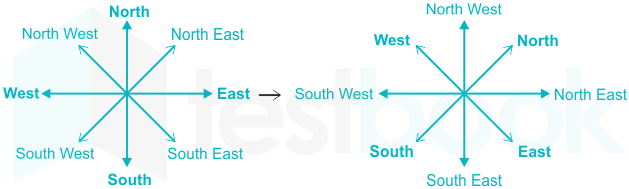
If South-east becomes east and North west becomes West and all other directions are changed in the same manner, then what will be the direction for north? 

  1. ((a))

    South-west 

  2. ((b))

    North-west 

  3. ((c))

    South-east 

  4. ((d))

    North-east

Show Answer
Answer: ((b))

North-west 

he change in directions is represented as follows,

Therefore, North becomes North-west.

14

The coming together of computing, telecommunication and media in a digital environment is technically known as 

  1. ((a))

    Integration 

  2. ((b))

    Amalgamation 

  3. ((c))

    Merger 

  4. ((d))

    Convergence 

Show Answer
Answer: ((d))

Convergence 

Key Points Convergence:

  • Convergence is the merging of two or more technologies or industries into a single entity.
  • In the context of computing, telecommunication, and media, convergence refers to the integration of these three industries into a single, digital ecosystem.
  • This convergence has been driven by a number of factors, including the digitization of content, the development of new technologies, and the increasing demand for convergence services.
  • The digitization of content has made it possible to distribute content across different platforms, such as computers, televisions, and mobile devices.
  • This has led to the development of new technologies, such as streaming media and video on demand, that allow users to access content on demand.
  • The increasing demand for convergence services has also driven the convergence of computing, telecommunication, and media.
  • Users now want to be able to access content and services from any device, anywhere, at any time. This has led to the development of new services, such as cloud computing and mobile broadband, that make it possible to do this.
  • The convergence of computing, telecommunication, and media has had a significant impact on the way we live and work.
  • It has made it possible to access information and services from anywhere in the world, and it has changed the way we communicate with each other.


Therefore, The coming together of computing, telecommunication, and media in a digital environment is technically known as convergence.

15

Given below are two statements:

Statement I: The concentration Chlorofluorocarbons (CFCs) in the atmosphere has increased in the past few years.

**Statement II:**CFCs already present in the atmosphere will persist for many years.

In the light of the above statements. choose the correct answer from the options given below

  1. ((a))

    Both Statement I and Statement II are true. 

  2. ((b))

    Both Statement I and Statement II are false. 

  3. ((c))

    Statement I is true but Statement II is false.  

  4. ((d))

    Statement I is false but Statement II is true, 

Show Answer
Answer: ((a))

Both Statement I and Statement II are true. 

Key Points 

Statement I: The concentration of Chlorofluorocarbons (CFCs) in the atmosphere has increased in the past few years.

Statement II:CFCs already present in the atmosphere will persist for many years.

  • Chlorofluorocarbons (CFCs) are a group of chemicals that were used as refrigerants, aerosol propellants, and solvents.
  • They are also known to deplete the ozone layer. The ozone layer is a layer of gas in the Earth's atmosphere that protects us from harmful ultraviolet radiation from the sun.
  • The concentration of CFCs in the atmosphere has increased in the past few years because they are not easily broken down by natural processes. CFCs can persist in the atmosphere for many years, up to 100 years or more.
  • Statement I is true because the concentration of CFCs in the atmosphere has increased in the past few years.
  • Statement II is also true because CFCs already present in the atmosphere will persist for many years.

Hence, the correct answer is 1) Both Statement I and Statement II are true.

Additional Information

  • The increase in the concentration of CFCs in the atmosphere is a major cause of ozone depletion.
  • Ozone depletion can lead to an increase in the amount of ultraviolet radiation that reaches the Earth's surface.
  • This can have a number of negative health effects, including skin cancer, cataracts, and immune system suppression.
  • The Montreal Protocol is an international treaty that was signed in 1987 to protect the ozone layer.
  • The treaty calls for the phase-out of the production and use of CFCs.
  • The Montreal Protocol has been very successful in reducing the production and use of CFCs. However, the ozone layer will not recover completely for many years.
16

Which of the following are the requirements of good teaching?

A. Responsive human environment to foster exploration

B. Appropriate responsiveness to the child and the group

C. Knowledge of subject matter

D. Maintaining interpersonal relationship

E. Strict adherence to a rigid teaching plan.

Choose the correct answer from the options given below:

  1. ((a))

    A, C & E only

  2. ((b))

    A, B, C & D only

  3. ((c))

    B, D & E only

  4. ((d))

    C & E only

Show Answer
Answer: ((b))

A, B, C & D only

Key Points 

The requirements of good teaching are:

  • Knowledge of subject matter: 
  • A good teacher must have a deep understanding of the subject matter that they are teaching.
  • This means that they must be able to explain the concepts clearly and to answer the students' questions.
  • Appropriate responsiveness to the child and the group: 
  • A good teacher must be able to adapt their teaching style to the needs of the individual students and the group as a whole.
  • This means that they must be able to motivate the students, to challenge them, and to help them to learn.
  • Responsive human environment to foster exploration
  • A good teacher must create a responsive human environment that fosters exploration.
  • This means that they must create a classroom where students feel safe to ask questions, to make mistakes, and to take risks.
  • Maintaining interpersonal relationship:
  •  A good teacher must be able to maintain interpersonal relationships with the students.
  • This means that they must be able to build trust, to create a sense of community, and to help the students to feel valued.
  • Strict adherence to a rigid teaching plan is not a requirement of good teaching.
  • In fact, a rigid teaching plan can actually be counterproductive. A good teacher must be flexible and adaptable, and they must be able to adjust their teaching style to the needs of the students.


Therefore, the correct answer is 2) A, B, C & D only.

17

Given below are two statements:

Statement I: Because of technological strides in recent times, words and times as related to communication have become money.

Statement II: The technological convergence has contributed to the control of mass communication by a few corporates.

In the light of the above statements. choose the correct answer from the options given below

  1. ((a))

    Both Statement I and Statement II are true 

  2. ((b))

    Both Statement I and Statement II are false 

  3. ((c))

    Statement I is true but Statement II is false 

  4. ((d))

    Statement I is false but Statement II is true 

Show Answer
Answer: ((a))

Both Statement I and Statement II are true 

Key Points Statement I: Because of technological strides in recent times, words and times as related to communication have become money.

  • Statement I is true because technological strides in recent times have made it possible to communicate more easily and quickly than ever before.
  • This has led to an increase in the value of words and time as related to communication.
  • For example, a company that can reach a large audience with a single advertisement can now charge a premium for that advertisement.

Statement II: The technological convergence has contributed to the control of mass communication by a few corporates.

  • Statement II is also true because technological convergence has led to the consolidation of the mass communication industry.
  • This means that a few large corporations now control most of the media, which gives them a great deal of power to shape public opinion.

Therefore, both statements are true.

Here are some examples of how technological strides have made words and time as related to communication more valuable:

  • The rise of social media has made it possible for people to connect with each other and share information in real time. This has led to an increase in the value of "likes" and "shares," which can be used to measure the reach of a message.
  • The growth of online advertising has made it possible to target ads to specific audiences with great precision. This has led to an increase in the value of "eyeballs," which is a measure of the number of people who see an ad.
  • The development of new technologies, such as artificial intelligence and machine learning, is making it possible to analyze large amounts of data in real time. This is giving companies a better understanding of their customers and their needs, which can be used to create more effective marketing campaigns.

Here are some examples of how technological convergence has led to the consolidation of the mass communication industry:

  • The merger of AOL and Time Warner in 2000 created a media giant that owns a wide range of assets, including television networks, cable channels, magazines, and websites.
  • The acquisition of CBS by Viacom in 2019 created another media giant that owns a similar range of assets.
  • The purchase of Disney by 21st Century Fox in 2019 created a third media giant that owns a even wider range of assets.
  • The consolidation of the mass communication industry has given these large corporations a great deal of power to shape public opinion. For example, they can decide what news stories are covered and how they are presented. They can also influence the way people think about certain issues.


Therefore, both statements are true and they are both related to the impact of technology on mass communication.

18

Methane (CH4)

A. is a green house gas

B. is a polycyclic Aromatic Hydrocarbon

C. is a component in determining Air quality Index (AQI)

D. helps in formation of Ozone

E. is a Volatile Organic Compound (VOC)

Choose the correct answer from the options given below:

  1. ((a))

    A, B & C only

  2. ((b))

    A, D & E only

  3. ((c))

    A & E only

  4. ((d))

    C, D & E only

Show Answer
Answer: ((b))

A, D & E only

Key PointsMethane (CH4):

  • Methane (CH4) is a chemical compound and a colorless, odorless gas. It is the simplest hydrocarbon, consisting of one carbon atom and four hydrogen atoms, arranged in a tetrahedral structure.
  • Methane is a flammable gas and one of the primary components of natural gas, which is a fossil fuel widely used for various purposes, including heating, cooking, and electricity generation.
  • A. Methane (CH4) is a greenhouse gas.
  • It is known to trap heat in the Earth's atmosphere and contributes to global warming and climate change.
  • D. Methane (CH4) helps in the formation of ozone.
  • It is one of the precursors of tropospheric ozone, which can have both positive and negative effects on the environment.
  • E. Methane (CH4) is a volatile organic compound (VOC).
  • VOCs are organic chemicals that can easily evaporate into the air and can have various environmental and health effects.
  • B. Methane (CH4) is not a polycyclic aromatic hydrocarbon (PAH).
  • PAHs are a group of organic compounds that consist of multiple fused aromatic rings, and they are different from methane, which is a simple hydrocarbon with only one carbon atom and four hydrogen atoms.
  • C. Methane (CH4) is not a component used in determining the Air Quality Index (AQI).
  • AQI is a measure of air quality that takes into account various pollutants such as particulate matter (PM2.5 and PM10), nitrogen dioxide (NO2), sulfur dioxide (SO2), ozone (O3), carbon monoxide (CO), and others. Methane is not one of the specific pollutants considered in the calculation of AQI.


Hence based on the above the correct option is option 2: A,D and E only.

19

Which of the following components are part of the central processing unit (CPU) of the Von Neumann model for a computer system?

A. Arithmetic Logic Unit (ALU)

B. Hard Disk Drive (HDD)

C. Memory Address Register (MAR)

D. Solid State Drive (SSD)

E. Control Unit (CU)

Choose the correct answer from the options given below:

  1. ((a))

    A & E only

  2. ((b))

    B, C & D only

  3. ((c))

    A & C only

  4. ((d))

    A, C & E only

Show Answer
Answer: ((d))

A, C & E only

Key Points

 Von Neumann model for a computer system:

  • The Von Neumann model, also known as the Von Neumann architecture or the Princeton architecture, is a theoretical framework for computer architecture proposed by mathematician and computer scientist John von Neumann in the late 1940s.
  • It forms the basis for most modern computers and describes the organization and functioning of a computer system.

In the Von Neumann model for a computer system, the central processing unit (CPU) consists of the following components:

  • A. Arithmetic Logic Unit (ALU):
  • This component performs arithmetic and logical operations, such as addition, subtraction, multiplication, and comparison.
  • C. Memory Address Register (MAR): 
  • The MAR stores the address of the memory location that the CPU is currently accessing.
  • E. Control Unit (CU):
  • This component is responsible for managing and coordinating the operations of the CPU. It fetches instructions from memory, decodes them, and controls the execution of instructions.

The other options, B, and D, are not part of the CPU in the Von Neumann model:

  • B. Hard Disk Drive (HDD): This is a storage device used for long-term data storage.
  • D. Solid State Drive (SSD): Similar to an HDD, an SSD is a storage device, but it uses solid-state memory instead of spinning disks.

Therefore, the correct components that are part of the CPU in the Von Neumann model are the Arithmetic Logic Unit (ALU), Memory Address Register (MAR) and the Control Unit (CU).

20

The graphical representation of a frequency distribution is called 

  1. ((a))

    Bar chart 

  2. ((b))

    Line chart 

  3. ((c))

    Histogram 

  4. ((d))

    Pie chart

Show Answer
Answer: ((c))

Histogram 

Key Points 

The graphical representation of a frequency distribution is called a histogram.

Histogram:

  • A histogram is a bar graph that shows the distribution of data in a frequency table.
  • The bars in a histogram are usually of equal width and are placed next to each other.
  • The height of each bar represents the frequency of the corresponding value in the frequency table.

Additional Information Bar chart: 

  • A bar chart is a graph that shows the comparison of different categories of data.
  • The bars in a bar chart are usually of different widths and are placed next to each other.
  • The height of each bar represents the value of the corresponding category in the data set.

Line chart: 

  • A line chart is a graph that shows the changes in data over time. The lines in a line chart are usually connected and are placed next to each other.
  • The height of each line represents the value of the corresponding data point in the data set.

Pie chart: 

  • A pie chart is a graph that shows the parts of a whole.
  • The slices of the pie chart are usually of different sizes and are placed next to each other.
  • The size of each slice represents the proportion of the corresponding part of the whole in the data set.
21

If the statements "No saints are materialists" is given as false which of the following statements could be immediately inferred to be true? 

A. All saints are materialists.

B. Some saints are materialists.

C. Some saints are not materialists.

D. All materialists are saints.

Choose the correct answer from the options given below:

  1. ((a))

    A & D only

  2. ((b))

    B only

  3. ((c))

    C & D only

  4. ((d))

    A & B only

Show Answer
Answer: ((b))

B only

Key Points 

  • The statement "No saints are materialists" is the negation of the statement "Some saints are materialists."
  • So, if the first statement is false, then the second statement must be true.
  • The other statements are not necessarily true.
  • For example, the statement "All saints are materialists" could be false, even if the statement "No saints are materialists" is false.
  • This is because the negation of a statement does not imply the negation of the negation of the statement.


Therefore, the only statement that can be immediately inferred to be true is "Some saints are materialists."

22

To calculate gross pay. hours are multiplied by the hourly rate. What MS.EXCELL formula would you put in cell C4 and then you are able to copy that cell down to the rest of the column C? 

ABC
1Hourly Rate (in Rs.)12.75
2
3NameHoursGross pay
4Arjun26
5Rishi37
6Ishan36
7Ajay28
8Arun30
9Nitin30
  1. ((a))

    =B1*BB4

  2. ((b))

    =$B1*B4

  3. ((c))

    =B1*B4

  4. ((d))

    =BB1*B4

Show Answer
Answer: ((d))

=BB1*B4

Key Points The correct answer is 4, =BB1*B4.

The formula in cell C4 should be: =B$1*B4

  • This formula will multiply the value in cell B1, which is the hourly rate, by the value in cell B4, which is the number of hours worked.
  • The dollar sign ($) in front of the column letter in the formula tells Excel to lock that column reference, so that it will not change when the formula is copied down the column.
  • The other formulas are incorrect. Formula 1, =B1$B4, will not work because the dollar sign in front of the row number in the formula will cause the formula to change when it is copied down the column.
  • Formula 2, =$B1B4, will work, but it is not the most efficient formula because it does not lock the column reference for the hourly rate.
  • Formula 3, =B1*B4, will not work because it does not lock the row or column references in the formula.


Therefore, the correct formula to calculate gross pay in Excel is =BB1*B4.

23

Some of the major recommendations of the Kothari commission on Higher education are:

A. Avoid introducing new courses

B. Select teachers at the national level

C. Restrict the expansion of higher education

D. Provide autonomy to the universities

E. Abolish the continuous evaluation system

Choose the correct answer from the options given below:

  1. ((a))

    A, B, C only

  2. ((b))

    B, D, E only

  3. ((c))

    B, C, D only

  4. ((d))

    A, D,  E only

Show Answer
Answer: ((c))

B, C, D only

Key PointsKothari commission: 

  • The Kothari Commission, officially known as the Education Commission (1964-66), was established in India to review and recommend improvements in the education system, including higher education.

​​Some of the major recommendations of the Kothari Commission on Higher Education are as follows:

  • Select teachers at the national level:
  • The commission recommended the creation of a national level system for the selection and appointment of teachers to ensure the recruitment of qualified and competent faculty members.
  • Restrict the expansion of higher education:
  • The commission recognized the need for expanding higher education but also emphasized the importance of maintaining quality and ensuring proper infrastructure and resources.
  • It recommended a balanced approach to limit the expansion of higher education institutions while focusing on quality improvement.
  • Provide autonomy to the universities:
  • The commission advocated for granting greater autonomy to universities, allowing them to have more control over their academic and administrative affairs.
  • This was seen as a way to encourage innovation, academic freedom, and effective decision-making within the universities.

The options A, and E are not among the major recommendations of the Kothari Commission.

  • A. Avoid introducing new courses: This recommendation is not associated with the Kothari Commission. The commission actually emphasized the need for introducing new courses and programs that were more relevant to the changing societal needs and emerging fields of study.
  • E. Abolish the continuous evaluation system: This recommendation is not associated with the Kothari Commission. The commission recognized the importance of continuous evaluation as an effective assessment method to provide timely feedback and assess students' progress.


Therefore, the correct answer is option 3) B, C, D only

24

Given below are two statements: one is labelled as Assertion A and other is labelled as Reason R

Assertion A: Children are much more vulnerable than adults to environmental toxins.

Reason R: For each kilogram of body weight, children drink more water, eat more food and breathe more air than adults.

In the light of the above statements. Choose the correct answer from the options given below:

  1. ((a))

    Both A and R are true and R is the correct explanation of A 

  2. ((b))

    Both A and R are true and R is NOT the correct explanation of A 

  3. ((c))

    A is true but R is false 

  4. ((d))

    A is false but R is true 

Show Answer
Answer: ((a))

Both A and R are true and R is the correct explanation of A 

Key Points

 Assertion A: Children are much more vulnerable than adults to environmental toxins.

  • This is because children have a higher metabolic rate than adults, meaning that they process toxins more quickly.
  • They also have a larger surface area to volume ratio, which means that they absorb toxins more easily.
  • Additionally, their immune systems are not as developed as adults, which makes them more susceptible to the harmful effects of toxins.

Reason R: For each kilogram of body weight, children drink more water, eat more food and breathe more air than adults.

  • This means that they are exposed to more toxins through these routes.
  • For example, children who drink contaminated water are more likely to develop health problems than adults who drink the same water.


Therefore, both statements are true and reason R is the correct explanation of assertion A.

25

Which of the following commissions suggested the establishment of National Universities in India? 

  1. ((a))

    Kothari commission 

  2. ((b))

    Radhakrishnan commission 

  3. ((c))

    Knowledge commission 

  4. ((d))

    Planning commission 

Show Answer
Answer: ((c))

Knowledge commission 

The correct answer is Knowledge Commission.

Key Points

  • The National Knowledge Commission (NKC) is a high-level advisory body to the Prime Minister of India, which was established in 2005 to devise and guide reforms to help India’s transformation into a strong and vibrant knowledge economy.
  • The five key areas that the commission focuses on are education, science and technology, agriculture, industry, and e-governance.
  • The Commission seeks to form working groups within each of these focus areas in order to develop concrete reform proposals that are to be presented directly to the Prime Minister.
  • This task involves working in close collaboration with Central and State governments, professionals, academics, scientists, regulatory bodies, national think-tanks, industry representatives, civil society organizations, etc.
  • The time frame for these activities is three years, from 2nd October, 2005 to 2nd October, 2008.
26

Find the number that can replace question mark (?) in the series given below: 

5, 9, 3, 11, 1, 13, -1?

  1. ((a))

    -13

  2. ((b))

    -12

  3. ((c))

    10

  4. ((d))

    15

Show Answer
Answer: ((d))

15

The pattern followed here is,

Hence, the correct answer is "15".

27

In which of the following sampling methods. the sample is also known as an accidental sample and a haphazard sample? 

  1. ((a))

    Purposive sampling 

  2. ((b))

    Quota sampling  

  3. ((c))

    Stratified random sampling 

  4. ((d))

    Convenience sampling 

Show Answer
Answer: ((d))

Convenience sampling 

Key Points Convenience sampling:

  • Convenience sampling is a non-probability sampling method in which the sample is selected based on convenience.
  • This means that the researcher selects the sample based on who is available or who is easy to access.
  • Convenience sampling is often used when it is not possible to use a more rigorous sampling method, such as random sampling. However, convenience sampling is not without its drawbacks.
  • The sample may not be representative of the population, and the results of the study may not be generalizable.

Hence, the sampling method that is also known as an accidental sample and a haphazard sample is convenience sampling.

Additional Information Purposive sampling: 

  • Purposive sampling is a non-probability sampling method in which the sample is selected based on the researcher's judgment.
  • The researcher selects the sample based on who they believe will provide the most information about the research question.

Quota sampling:

  • Quota sampling is a non-probability sampling method in which the sample is selected to represent different subgroups of the population.
  • The researcher sets quotas for each subgroup, and then selects participants until the quotas are met.

Stratified random sampling:

  • Stratified random sampling is a probability sampling method in which the population is divided into strata, and then a random sample is selected from each stratum.
  • This ensures that the sample is representative of the population.
28

Arrange the stages of Piaget's theory of cognitive development in ascending order?

A. Concrete operational stage

B. Pre-operational stage

C. Sensorimotor stage

D. Formal operation stage

Choose the correct answer from the options given below:

  1. ((a))

    B, C, D, A

  2. ((b))

    C, B, A, D

  3. ((c))

    A, B, C, D

  4. ((d))

    D, C, A, B

Show Answer
Answer: ((b))

C, B, A, D

Key Points 

The correct order of the stages of Piaget's theory of cognitive development is:

  • Sensorimotor stage (birth to 2 years old)
  • Preoperational stage (2 to 7 years old)
  • Concrete operational stage (7 to 11 years old)
  • Formal operational stage (11 years old and up)

Piaget's theory of cognitive development:

  • Piaget's theory of cognitive development is a stage theory that describes how children's thinking changes as they grow.
  • The theory proposes that children pass through four stages of cognitive development, each with its own unique features.
  • The sensorimotor stage is the first stage of cognitive development.
  • In this stage, infants learn about the world through their senses and motor skills.
  • They learn to coordinate their actions with their perceptions, and they begin to develop object permanence, which is the understanding that objects exist even when they are not visible.
  • The preoperational stage is the second stage of cognitive development.
  • In this stage, children begin to use language and symbols to represent their thoughts.
  • They also become more egocentric, which means that they have difficulty seeing things from other people's perspectives.
  • The concrete operational stage is the third stage of cognitive development.
  • In this stage, children become less egocentric and they begin to think more logically.
  • They also develop the ability to conserve, which means that they understand that the amount of a substance stays the same even if its appearance changes.
  • The formal operational stage is the fourth and final stage of cognitive development.
  • In this stage, adolescents and adults are able to think abstractly and hypothetically. They can also think about possibilities and make plans for the future.


Hence C, B, A, and D is the correct order.

29

Match List I with List II.

LIST I (Ancient field of study)LIST II (Meaning)
A.SikshaI.Metre
B.NiruktaII.Phonetics
C.KalpaIII.Etymology
D.ChhandasIV.Religious Practices
<br>

Choose the correct answer from the options given below:

  1. ((a))

    A - III, B - II, C - IV, D - I

  2. ((b))

    A - I, B - II, C - IV, D - III

  3. ((c))

    A - II, B - III, C - IV, D - I

  4. ((d))

    A - IV, B - III, C - II, D - I

Show Answer
Answer: ((c))

A - II, B - III, C - IV, D - I

List IList II
Siksha- Phonetics - Siksha is an ancient field of study related to the phonetics and pronunciation of Vedic texts.
Nirukta- Etymology - Nirukta is an ancient field of study concerned with etymology, the interpretation, and explanation of Vedic words and terms.
Kalpa- Religious Practices - Kalpa is an ancient field of study that deals with the ritualistic and religious practices mentioned in the Vedic texts.
Chhandas- . Metre - Chhandas is an ancient field of study focused on the Vedic poetic meters and prosody.

Therefore, the correct matching is A - II, B - III, C - IV, D - I, which corresponds to option 3.

30

Which of the following are codes of reception in communication? 

A. Bystander

B. Dominant

C. Negotiated

D. Oppositional

E. Channel

Choose the correct answer from the options given below:

  1. ((a))

    A, B, C only

  2. ((b))

    B, C, D only

  3. ((c))

    C, D, E only

  4. ((d))

    A, D, E only

Show Answer
Answer: ((b))

B, C, D only

Key PointsCodes of reception: 

  • Codes of reception in communication refer to different ways in which individuals interpret and understand messages or information.
  • The codes of reception in communication are as follows:

B. Dominant - This code refers to the interpretation of a message from the perspective of the dominant or mainstream cultural norms and values. It is the most commonly accepted or understood interpretation.

C. Negotiated - This code involves a mix of acceptance and resistance to the dominant message. The audience negotiates the meaning and may accept some parts while rejecting or modifying others.

D. Oppositional - This code involves a complete rejection or opposition to the dominant message. The audience interprets the message in a way that challenges or goes against the prevailing cultural norms.

Therefore, the correct answer is: B, C, D only

A. Bystander:

  • ​This term refers to someone who is present at an event but is not directly involved or engaged in the communication process. It is not specifically a code of reception.​ ​​

E. Channel:

  • ​This term refers to the medium or pathway through which communication occurs, such as face-to-face interaction, written text, or electronic platforms. It is not a specific code of reception.


Therefore, the correct answer is 2) B, C, D only, as these options represent codes of reception in communication.

31

Which assessment will be given to learners during the course of instructions rather than after it is completed? 

  1. ((a))

    Diagnostic assessment 

  2. ((b))

    Formative assessment 

  3. ((c))

    Summative assessment 

  4. ((d))

    Placement assessment 

Show Answer
Answer: ((b))

Formative assessment 

Key PointsFormative assessment: 

  • Formative assessment is the type of assessment that is given to learners during the course of instructions rather than after it is completed.
  • It is used to provide feedback to learners on their progress and to help them to identify areas where they need more help.

Here are the 4 types of assessment and their descriptions:

Diagnostic assessment: 

  • This type of assessment is given at the beginning of a learning activity to assess learners' prior knowledge and skills.
  • It is used to identify any gaps in learners' knowledge or skills so that the learning activity can be tailored to their needs.

Formative assessment: 

  • This type of assessment is given during the course of a learning activity to provide feedback to learners on their progress.
  • It is used to help learners to identify areas where they need more help and to adjust their learning accordingly.

Summative assessment:

  • This type of assessment is given at the end of a learning activity to assess learners' mastery of the content.
  • It is used to determine whether learners have met the learning objectives of the activity.

Placement assessment: 

  • This type of assessment is given to learners to determine their level of knowledge or skills in a particular subject.
  • It is used to place learners in the appropriate learning group or to identify any gaps in their knowledge or skills so that they can be given additional support.


Therefore, the answer is 2) Formative assessment.

32

Which one of the following is not a National Action Plan on climate change? 

  1. ((a))

    National Solar Mission 

  2. ((b))

    National Mission on Indian Ocean 

  3. ((c))

    National Mission for Green India 

  4. ((d))

    National Water Mission 

Show Answer
Answer: ((b))

National Mission on Indian Ocean 

Key PointsThe National Action Plan on Climate Change (NAPCC): 

  • The National Action Plan on Climate Change (NAPCC) is a set of eight national missions that aim to mitigate and adapt to climate change.
  • The NAPCC was launched in 2008 by the Government of India.
  • The eight missions under the NAPCC are:
    1. National Solar Mission
    1. National Mission for Enhanced Energy Efficiency
    1. National Mission on Sustainable Habitat
    1. National Mission for Sustainable Agriculture
    1. National Mission for Strategic Knowledge on Climate Change
    1. National Adaptation Mission for Indian Agriculture
    1. National Water Mission
    1. National Mission for Sustainable Himalayan Ecosystem
  • The NMO is not included in the NAPCC because it is not specifically focused on climate change.
  • The NMO aims to promote the development of the Indian Ocean region and to address issues such as maritime security and disaster management.


Therefore, the answer is 2) National Mission on Indian Ocean.

33

Match List I with List II.

LIST I (Knowledge Dimension)LIST II (Meaning)
A.FactualI.How to do something, methods of inquiry and criteria for using skills
B.ConceptualII.The basic elements students must know to be acquainted with a discipline
C.ProceduralIII.Knowledge of cognition and one's own cognition
D.MetacognitiveIV.The inter-relationships among the basic elements within a larger structure to function together.
<br>

Choose the correct answer from the options given below:

  1. ((a))

    A - IV, B - III, C - II, D - I

  2. ((b))

    A - II, B - IV, C - I, D - III

  3. ((c))

    A - III, B - I, C - IV, D - II

  4. ((d))

    A - I, B - III, C - II, D - IV

Show Answer
Answer: ((b))

A - II, B - IV, C - I, D - III

LIST ILIST II
Factual- The basic elements students must know to be acquainted with a discipline
Conceptual- The inter-relationships among the basic elements within a larger structure to function together
Procedural- How to do something, methods of inquiry and criteria for using skills
Metacognitive- Knowledge of cognition and one's own cognition

Factual knowledge: This is the basic information that students need to know in order to be acquainted with a discipline. For example, in mathematics, factual knowledge might include the basic rules of arithmetic, the properties of shapes, and the definitions of mathematical terms.

Conceptual knowledge: This is the understanding of how the basic elements of a discipline fit together. For example, in mathematics, conceptual knowledge might include the understanding of how addition and subtraction are related, the concept of a function, and the different types of geometric shapes.

Procedural knowledge: This is the knowledge of how to do something, including methods of inquiry and criteria for using skills. For example, in mathematics, procedural knowledge might include the ability to solve equations, the ability to construct proofs, and the ability to use a calculator.

Metacognitive knowledge: This is the knowledge of cognition and one's own cognition. This includes the ability to plan, monitor, and evaluate one's own learning. For example, in mathematics, metacognitive knowledge might include the ability to set goals for one's learning, to track one's progress, and to identify one's own strengths and weaknesses.

So, the correct answer is option 2) A - II, B - VI, C - I, D - III.

34

From the fourth five year plan onwards. the focus on technical education was to 

  1. ((a))

    Improve its quality and standard 

  2. ((b))

    Encourage its unrestricted expansion in public sector  

  3. ((c))

    Weed out non-performing institutions 

  4. ((d))

    Restrict the entry of private players into the field 

Show Answer
Answer: ((a))

Improve its quality and standard 

Key Points 

  • The focus on technical education from the fourth five year plan onwards was to improve its quality and standard.
  • This was done through a number of initiatives, including:
  • The establishment of new technical institutions, including the Indian Institutes of Technology (IITs) and the National Institutes of Technology (NITs).
  • The introduction of new courses and programs, such as the Bachelor of Engineering (B.E.) and the Master of Engineering (M.E.) degrees.
  • The improvement of the quality of teaching and learning, through the introduction of new teaching methods and the provision of more resources to technical institutions.

Additional Information

  • Encourage its unrestricted expansion in public sector is not correct because the focus was on improving the quality of technical education, not on its expansion.
  • Weed out non-performing institutions is not correct because the focus was on improving all technical institutions, not just those that were not performing well.
  • Restrict the entry of private players into the field is not correct because the focus was on increasing the availability of technical education, not on restricting it.
35

The question of whether the results of a study can be generalized beyond the specific research context. relates to 

  1. ((a))

    Measurement validity 

  2. ((b))

    Internal validity 

  3. ((c))

    External validity

  4. ((d))

    Ecological validity 

Show Answer
Answer: ((c))

External validity

Key Points

 The question of whether the results of a study can be generalized beyond the specific research context relates to external validity.

External validity:

  • External validity is the extent to which the results of a study can be generalized to other populations, settings, and times.
  • It is important to consider external validity when interpreting the results of a study, as it helps to determine whether the results are applicable to other situations.

Additional Information

  • Measurement validity is the extent to which a measurement instrument accurately measures what it is supposed to measure.
  • Internal validity is the extent to which the results of a study can be attributed to the independent variable and not to other factors.
  • Ecological validity is the extent to which the results of a study can be generalized to real-world settings.
36

Arrange the following steps pertaining to quantitative research in correct order: 

A. Analyse data

B. Hypothesis

C. Process data

D. Findings

E. Research Design

Choose the correct answer from the options given below:

  1. ((a))

    B, C, D, E, A

  2. ((b))

    B, E, C, A, D

  3. ((c))

    C, D, A, B, E

  4. ((d))

    E, B, C, A, D

Show Answer
Answer: ((b))

B, E, C, A, D

Key Points 

The correct order of the steps pertaining to quantitative research is as follows:\

  • Hypothesis (B): In quantitative research, the first step is to formulate a hypothesis. A hypothesis is a testable statement that predicts the relationship between variables. It helps in guiding the research and providing a clear focus for data collection and analysis.
  • Research Design (E): After formulating the hypothesis, the next step is to plan the research study, which involves deciding on the research design. The research design outlines the overall approach and strategy for conducting the study, including selecting the research method, defining the research objectives, and determining the sample size and data collection techniques.
  • Data Collection: In this step, the researcher collects data. This can be done through surveys, experiments, or other methods.
  • Data Processing: In this step, the researcher cleans and prepares the data for analysis. This includes removing any errors from the data and coding the data.
  • Data Analysis: In this step, the researcher analyzes the data to test the hypothesis. This can be done using statistical methods.
  • Findings: The findings are the results of the data analysis. These findings are then interpreted by the researcher.


Therefore, the correct answer is 2) B, E, C, A, D

37

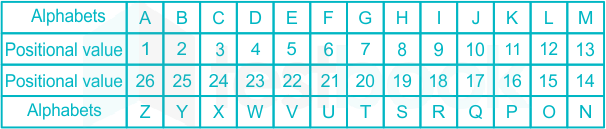
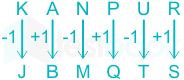
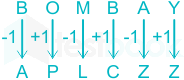
In a certain coding language 'KANPUR' is coded as 'JBMQTS'. How 'BOMBAY' will be coded in that language? 

  1. ((a))

    ALPCZZ

  2. ((b))

    APLCZZ

  3. ((c))

    APCLZZ

  4. ((d))

    APLZCZ

Show Answer
Answer: ((b))

APLCZZ

The logic followed here is:

Logic → (-1) and (+1) has been done in the positional value to get the corresponding letter.

Let's check as per the logic,

KANPUR: JBMQTS

Similarly,

BOMBAY: ?

Hence, the correct answer is "APLCZZ".

38

Given below are two statements:

Statement I: Compared to word processors, simple text-editors such as Notepad and Emacs have limited editing features.

Statement II: Files created with simple text editors cannot be opened with word processors.

In the light of the above statements. choose the correct answer from the options given below

  1. ((a))

    Both Statement I and Statement II are true.

  2. ((b))

    Both Statement I and Statement II are false. 

  3. ((c))

    Statement I is true but Statement II is false.  

  4. ((d))

    Statement I is false but Statement II is true, 

Show Answer
Answer: ((c))

Statement I is true but Statement II is false.  

Key Points

 The correct answer is 3, Statement I is true but Statement II is false.

Statement I: Compared to word processors, simple text-editors such as Notepad and Emacs have limited editing features.

  • Statement I is true because simple text editors, such as Notepad and Emacs, are designed for basic text editing tasks, such as creating and editing text files.
  • They do not have the same features as word processors, such as the ability to format text, insert images, or create tables.

Statement II: Files created with simple text editors cannot be opened with word processors.

  • Statement II is false because files created with simple text editors can be opened with word processors.
  • Word processors will simply ignore any formatting that is not supported.

Therefore, Statement I is true but Statement II is false.

Here are some additional details about simple text editors and word processors:

  • Simple text editors: 
  • Simple text editors are designed for basic text editing tasks, such as creating and editing text files.
  • They do not have the same features as word processors, such as the ability to format text, insert images, or create tables.
  • Some examples of simple text editors include Notepad, Emacs, and Sublime Text.
  • Word processors: 
  • Word processors are designed for creating documents that contain text, images, tables, and other formatting.
  • They have a wider range of features than simple text editors, and they are typically used for creating professional documents, such as reports, letters, and presentations.
  • Some examples of word processors include Microsoft Word, Google Docs, and LibreOffice Writer.
39

Given below are two statements: 

Statement I: (67)10 = (10100111)2

Statement II: (11010110)2 = (214)10

In the light of the above statements. choose the correct answer from the options given below

  1. ((a))

    Both Statement I and Statement II are true.

  2. ((b))

    Both Statement I and Statement II are false.

  3. ((c))

    Statement I is true but Statement II is false.

  4. ((d))

    Statement I is false but Statement II is true.

Show Answer
Answer: ((d))

Statement I is false but Statement II is true.

Key PointsThe correct answer statement I is false but Statement II is true.  

Statement I: (67)10 = (10100111)2, this statement is false

(67)10 = (1000011)2

Step-by-step solution

Step 1: Divide (67)10 successively by 2 until the quotient is 0:

  • 67/2 = 33, remainder is 1
  • 33/2 = 16, remainder is 1
  • 16/2 = 8, remainder is 0
  • 8/2 = 4, remainder is 0
  • 4/2 = 2, remainder is 0
  • 2/2 = 1, remainder is 0
  • 1/2 = 0, remainder is 1

Step 2: Read from the bottom (MSB) to the top (LSB) as 1000011.

Statement II: (11010110)2 = (214)10

  • Statement II is also true because the binary representation of 214 is 11010110. This can be verified by converting 214 to binary using the same steps as above.

Therefore, statement I is false but Statement II is true.

40

Which of the following are features of mass communication? 

A. Structured institutional system

B. Complex process of reproduction

C. Commodification of messages

D. Personalized way of communication

E. Space- time constraint

  1. ((a))

    A, B, C only

  2. ((b))

    B, C, D only

  3. ((c))

    C, D, E only

  4. ((d))

    B, D, E only

Show Answer
Answer: ((a))

A, B, C only

The correct answer is 1, A, B, and C only.

Key Points

  • Mass communication is a process of sending messages to a large audience through a mass medium, such as television, radio, or the internet. It is characterized by the following features:
  • Structured institutional system:
  • Mass communication is typically carried out by large, well-organized institutions, such as news organizations, advertising agencies, or social media platforms.
  • Complex process of reproduction:
  •  Mass communication messages are often reproduced many times, through different media channels and formats.
  • Commodification of messages: 
  • Mass communication messages are often treated as commodities, which are bought and sold by media organizations.
  • Space-time constraint: 
  • Mass communication messages can reach a large audience over a wide geographical area and in a short period of time.
  • The features of personalized way of communication and space-time constraint are not features of mass communication.
  • Personalized way of communication is a feature of interpersonal communication, which is a type of communication that takes place between two or more people who know each other.
  • Space-time constraint is not a feature of mass communication because mass communication messages can reach a large audience over a wide geographical area and in a short period of time.

Therefore, the only features that are characteristic of mass communication are structured institutional system, complex process of reproduction, and commodification of messages.

41

An article is sold at a certain price by selling the article at 2/3 (two third) of that price. there is a loss of 10%. Find the gain percent at its original price. 

  1. ((a))

    35%

  2. ((b))

    25%

  3. ((c))

    33%

  4. ((d))

    30%

Show Answer
Answer: ((a))

35%

Given:

Article sold at 2/3 of original price.

Loss = 10%

Calculation:

According to question,

Loss = 10%

Let CP be 10 and SP be 9

Now, original SP,

⇒ 2/3 × x = 9

⇒ x = 27/2

Gain = 27/2 - 10 = 7/2

Gain % = 7/20 × 100 = 35%

∴ The correct answer is 35%.

42

Which of the following affects the downloading speed of a web page the least? 

  1. ((a))

    Number of hyperlink in the web page 

  2. ((b))

    Number and size of images in the web page  

  3. ((c))

    Processing power of the server computer that stores the web page 

  4. ((d))

    The bandwidth of Internet connection which is used to access the web page 

Show Answer
Answer: ((a))

Number of hyperlink in the web page 

The number of hyperlinks in a web page has the least effect on the downloading speed of the web page compared to the other factors listed. Hyperlinks are mostly text-based and do not require significant bandwidth to load, unlike images, server processing power, or internet connection bandwidth.

Key PointsNumber of Hyperlinks in the Web Page:

  • Hyperlinks are simply pointers to other pages or resources on the internet.
  • They are usually small pieces of text or simple buttons.
  • Because they are mostly text-based, they don't take up much space or require a lot of data to load.
  • So, even if a web page has many hyperlinks, they don't significantly slow down the downloading speed.

Additional InformationNumber and Size of Images in the Web Page:

  • Images are much larger files compared to text. They can range from a few kilobytes (KB) to several megabytes (MB).
  • The larger and more numerous the images on a web page, the more time it takes to download them all, which slows down the overall loading speed of the page.

Processing Power of the Server Computer that Stores the Web Page:

  • The server is a computer that sends the web page to your browser when you request it.
  • If the server is slow or too busy because it doesn’t have enough processing power, it can take longer to respond and send the data, affecting the downloading speed of the web page.

The Bandwidth of Internet Connection which is Used to Access the Web Page:

  • Bandwidth is the amount of data that can be transmitted over your internet connection in a given amount of time.
  • If your internet connection has low bandwidth, it will take longer to download data-heavy content like images, videos, or other multimedia elements, slowing down the loading speed of the web page.

The hyperlinks are small and don’t require a lot of data to be downloaded, so they have the least impact on how quickly a web page loads.

43

Which of the following universities were established in the year 1916?

A. Delhi University

B. Banaras University

C. Mysore University

D. S. N. D. T women University

Choose the correct answer from the options given below:

  1. ((a))

    A, B & C only

  2. ((b))

    A & D only

  3. ((c))

    A & C only

  4. ((d))

    B, C & D only

Show Answer
Answer: ((d))

B, C & D only

Key Points 

Among the given options, the universities established in the year 1916 are:

  • Delhi University:
  • Delhi University was established in 1922 by an Act of the Imperial Legislative Council. It is one of the oldest and largest universities in India.
  • Mysore University: 
  • Mysore University was established in 1916 by an Act of the Mysore State Legislature. It is one of the oldest and most prestigious universities in India.
  • Banaras University: 
  • Banaras Hindu University was established in 1916 by an Act of the Government of India. However, it was formally inaugurated in 1917.
  • S. N. D. T women University:  
  • ​D. S. N. D. T Women's University: Shreemati Nathibai Damodar Thackersey Women's University, commonly known as SNDT Women's University was established in 1916


Therefore, the correct answer is option 4) B, C & D only

44

The term 'Correlation’ in mass communication refers to the function of 

  1. ((a))

    Information gathering 

  2. ((b))

    Socialization 

  3. ((c))

    Interpretation 

  4. ((d))

    Investigation  

Show Answer
Answer: ((c))

Interpretation 

Key PointsInterpretation:  

  • In the context of mass communication, the term "correlation" refers to the function of interpretation.
  • When we talk about correlation in mass communication, we are referring to the process of analyzing and interpreting the relationships between different variables or factors within a communication context.
  • Correlation involves studying how different elements or factors within mass communication interact with each other and influence one another.
  • It seeks to identify patterns, connections, and relationships between various aspects of communication such as media content, audience response, message effectiveness, and societal impact.
  • For example, in the field of media research, correlation analysis can be used to examine the relationship between media exposure and public opinion.
  • By analyzing the data and looking for correlations, researchers can understand how media messages influence public attitudes and behaviours.
  • Interpreting correlations requires careful analysis of data and consideration of various factors that may affect the observed relationships.
  • It involves determining the strength and direction of the relationship between variables and drawing meaningful conclusions based on the findings.

Hence, the term correlation in mass communication refers to the function of interpretation.

Additional InformationInformation gathering: The information gathering function of mass communication refers to the collection of information about current events and issues.

Socialization: The socialization function of mass communication refers to the process of teaching people about the norms and values of society.

Investigation: The investigation function of mass communication refers to the process of uncovering facts and information about current events and issues.

45

Which of the following are physical parameters to decide the water quality? 

A. pH

B. Temperature

C. Total Surpended Solids (TSS)

D. Hardness

E. Conductivity 

Choose the correct answer from the options given below:

  1. ((a))

    A, B, C, D only

  2. ((b))

    A, B, D, E only

  3. ((c))

    C, D, E only

  4. ((d))

    B, C, E only

Show Answer
Answer: ((d))

B, C, E only

Key Points 

The physical parameters used to decide the water quality are:

  • Temperature (B):
  • Temperature is an important physical parameter that affects various chemical and biological processes in water.
  • It is measured in degrees Celsius (°C) and can influence the solubility of gases, the rate of chemical reactions, and the growth of aquatic organisms.
  • Extreme temperatures can be harmful to aquatic life, and rapid temperature changes may indicate pollution or other disturbances.
  • Total Suspended Solids (TSS) (C):
  • TSS refers to the concentration of solid particles, both organic and inorganic, that are suspended in water.
  • These particles can include silt, clay, algae, and other debris.
  • High TSS levels can cause water to become cloudy and reduce light penetration, affecting aquatic plants and animals. TSS is measured in milligrams per liter (mg/L) or parts per million (ppm).
  • Conductivity (E):
  • Conductivity is a measure of the ability of water to conduct an electrical current.
  • It is related to the concentration of dissolved ions in the water, such as salts and minerals.
  • Pure water has low conductivity, but as the concentration of dissolved ions increases, conductivity also increases.
  • High conductivity levels may indicate the presence of pollutants or dissolved substances in water.
  • These physical parameters are essential in assessing water quality as they provide valuable information about the condition of water bodies and potential environmental impacts.
  • Monitoring these parameters helps in identifying pollution sources, understanding ecological health, and implementing appropriate management strategies to protect and improve water quality.


Therefore, the correct answer is option B, C, E only.

46

Which among the following is NOT a characteristic of the closed ended questions in survey research? 

  1. ((a))

    They allow unusual responses that the survey researcher may not have contemplated. 

  2. ((b))

    They are easy for interviewers and/or respondents to complete.  

  3. ((c))

    They reduce the possibility of variability in the recording of answers. 

  4. ((d))

    There is loss of spontaneity in respondents answers, 

Show Answer
Answer: ((a))

They allow unusual responses that the survey researcher may not have contemplated. 

Key PointsClosed ended questions:

  • Closed-ended questions in survey research are designed to provide respondents with a set of predetermined response options to choose from.
  • They typically do not allow for open or unusual responses. Instead, they offer a limited number of response choices, such as multiple-choice options or Likert scale ratings.

Here are the characteristics of closed-ended questions in survey research:

  • They are easy for interviewers and/or respondents to complete.
  • They reduce the possibility of variability in the recording of answers.
  • Closed-ended questions limit respondents' ability to provide detailed or nuanced responses. The predetermined response options may not fully capture their thoughts or opinions, leading to a loss of spontaneity in their answers.
  • They allow for easy tabulation and analysis of data.
  • They can be used to compare responses across different groups of respondents.

However, closed-ended questions can also have some drawbacks, such as:

  • They can limit the range of responses that respondents can provide.
  • They can be leading, which means that they can influence the way that respondents answer the question.
  • They can be less informative than open-ended questions, which allow respondents to provide more detailed answers.


Hence option 1 is not a characteristic of closed-ended questions in survey research.

47

According to Nyaya (Classical Indian School of logic) the fallacy of irregular middle is called :

  1. ((a))

    Anaikantika 

  2. ((b))

    Asiddha 

  3. ((c))

    Satpratipaksa 

  4. ((d))

    Badhita 

Show Answer
Answer: ((a))

Anaikantika 

Key Points

Anaikantika:

  • In Nyaya (Classical Indian School of logic), the fallacy of irregular middle is called Anaikantika.
  • It is a type of fallacy in which the middle term does not relate to both the minor and major terms in the same way.
  • This means that the middle term does not apply to both the subject and predicate of the conclusion.
  • For example, the statement "All cats are animals, all dogs are animals, therefore all cats are dogs" is a fallacy of irregular middle. The middle term, "animals," does not relate to both the minor term, "cats," and the major term, "dogs," in the same way. Animals are a broader category than cats, and they also include dogs. Therefore, the statement "all cats are dogs" is not logically valid.

The other options are incorrect.

  • Asiddha means "unproved" or "unestablished
  • Satpratipaksa means "contradiction.
  • Badhita means "refuted." These terms are not used to refer to the fallacy of irregular middle in Nyaya.
<br>

According to Nyaya (Classical Indian School of logic), the fallacy of irregular middle is called "Anaikantika".

48

Given below are two statements:

Statement I: Mentimeter is a tool used for creating interactive videos in education.

Statement II: Kahoot is a tool used for assessment in education.

In the light of the above statements. choose the correct answer from the options given below

  1. ((a))

    Both Statement I and Statement II are true 

  2. ((b))

    Both Statement I and Statement II are false 

  3. ((c))

    Statement I is true but Statement II is false 

  4. ((d))

    Statement I is false but Statement II is true 

Show Answer
Answer: ((d))

Statement I is false but Statement II is true 

Key Points

Statement I: Mentimeter is a tool used for creating interactive videos in education.

  • Statement I is false because Mentimeter is a tool used for creating interactive presentations, not videos.
  • It allows users to create presentations that include polls, quizzes, and other interactive elements.
  • These presentations can be used in a variety of educational settings, such as classrooms, online courses, and corporate training.

Statement II: Kahoot is a tool used for assessment in education.

  • Statement II is true because Kahoot is a tool used for assessment in education.
  • It allows users to create quizzes and games that can be played by students on their smartphones or tablets.
  • Kahoot is a popular tool for formative assessment, as it allows teachers to quickly assess student understanding of a particular topic.

Therefore, Statement I is false but Statement II is true.

Here are some additional details about Mentimeter and Kahoot:

  • Mentimeter: Mentimeter is a tool used for creating interactive presentations. It allows users to create presentations that include polls, quizzes, and other interactive elements. These presentations can be used in a variety of educational settings, such as classrooms, online courses, and corporate training.
  • Kahoot: Kahoot is a tool used for assessment in education. It allows users to create quizzes and games that can be played by students on their smartphones or tablets. Kahoot is a popular tool for formative assessment, as it allows teachers to quickly assess student understanding of a particular topic.

49

Which of the following statements is logically equivalent to the statement- "No saints are materialists"? 

  1. ((a))

    No materialists are saints. 

  2. ((b))

    Some materialists are saints. 

  3. ((c))

    All non- materialists are non- saints. 

  4. ((d))

    Some non- materialists are non-saints. 

Show Answer
Answer: ((a))

No materialists are saints. 

Key Points

  • The statement "No saints are materialists" is a universal negative statement. This means that it is making a claim about all saints, and it is saying that no saints are materialists.
  • The logically equivalent statement is "All non-materialists are saints." This statement is also a universal negative statement, and it is saying that all non-materialists are saints.

The other statements are not logically equivalent to the original statement.

  • Statement 1 ("No materialists are saints") is the converse of the original statement, and logically equivalent. The statement "No saints are materialists" is logically equivalent to the statement "No materialists are saints." This is because the two statements mean the same thing.
  • Statement 2 ("Some materialists are saints") is the contrapositive of the original statement, but it is not logically equivalent. The contrapositive is always true if the original statement is true, but it is not the only logically equivalent statement.
  • Statement 3 ("All non- materialists are non- saints") is not logically equivalent to the original statement. This statement is saying that all non-materialists are not saints, while the original statement is saying that no saints are materialists. These two statements are not the same.
  • Statement 4 ("Some non- materialists are non-saints") is not logically equivalent to the original statement. This statement is saying that some non-materialists are not saints, while the original statement is saying that no saints are materialists. These two statements are not the same.

Therefore, the only logically equivalent statement to the statement "No saints are materialists" is "No materialists are saints. "

50

"The most effective way to increase government revenue would be to raise the corporate income tax, since opinion polls show wide spread support for this approach”. Which of the following fallacies is committed in the above statement? 

  1. ((a))

    Appeal to emotion 

  2. ((b))

    Slippery slope 

  3. ((c))

    Appeal to inappropriate authority 

  4. ((d))

    Appeal to Majority 

Show Answer
Answer: ((d))

Appeal to Majority 

Key Points

 The fallacy committed in the above statement is appeal to majority.

Appeal to Majority:

  • Appeal to majority is a logical fallacy that occurs when someone argues that something is true or right simply because it is popular or widely accepted.
  • In the above statement, the arguer is suggesting that raising the corporate income tax is the most effective way to increase government revenue because opinion polls show widespread support for this approach.
  • However, just because a majority of people support an idea does not mean that it is the best idea. There may be other, more effective ways to increase government revenue that are not as popular.

Additional Information

  • Appeal to emotion: This fallacy occurs when someone tries to persuade someone by appealing to their emotions rather than their reason. The statement does not appeal to emotion.
  • Slippery slope: This fallacy occurs when someone argues that if one event happens, it will inevitably lead to a series of other events, even if there is no evidence to support this claim. The statement does not argue that raising the corporate income tax will lead to a series of other events.
  • Appeal to inappropriate authority: This fallacy occurs when someone tries to persuade someone by citing an authority figure who is not actually an expert on the topic at hand. The statement does not cite an authority figure.

Attempt this paper under real exam conditions

Timed interface, section switching, instant scoring, and question-by-question analytics — free.

Start Timed Attempt