Official Paper

UGC NET Paper 1: Held on 12th Nov 2020 Shift 1 (Previous Year Paper)

50 questions · 60 minutes · with answers · free

Paper 1 (50 questions)

1

Which of the following is correct with respect to the size of the storage units?

  1. ((a))

    Terabyte < Petabyte < Exabyte < Zettabyte

  2. ((b))

     Petabyte < Exabyte < Zettabyte < Terabyte

  3. ((c))

    Exabyte < Zettabyte < Terabyte < Petabyte

  4. ((d))

    Zettabyte < Exabyte < Petabyte < Terabyte

Show Answer
Answer: ((a))

Terabyte < Petabyte < Exabyte < Zettabyte

The correct solution is "Terabyte< Petabyte< Exabyte< Zettabyte "

CPU consists of Memory or storage units that can store instructions, data, and intermediate results. This unit supplies information to other units of the computer when needed. It is also known as an internal storage unit or the main memory or primary storage or Random Access Memory (RAM).

Key Points

  • Storage capacity is expressed in terms of Bytes. The data is represented as binary digits. (0s and1s).
  • Hierarchy is as follows:
  • Bit< Nibble< Byte< KB< MB< GB< TB< PB< XB< ZB< YB

 where KB stands for kilobyte

  • MB stands for megabyte
  • GB stands for gigabyte
  • TB stands for terabyte
  • PB stands for petabyte
  • XB stands for exabyte
  • ZB stands for zetabyte
  • YB stands for yottabyte

Additional Information

    4 bit           = 1 Nibble

    8 bit           = 1 byte

   1024 byte   = 1 KB

   1024 KB     = 1MB

   1024 MB    =  1GB

   1024 GB    =  1TB

   1024 TB     =  1PB

   1024 PB     =   1XB

   1024 XB     =   1ZB

   1024 ZB     =   1YB

2

Given below are two statements. One labelled as Assertion (A) and the other as Reason (R):

Assertion (A): An Intranet is a private network for sharing computing resources and information within an organization

Reason (R): Intranet is a private version of the Internet.

In light of the above two statements, choose the correct answer from the options given below

  1. ((a))

     Both A) and R) are true and R) is the correct explanation of A)

  2. ((b))

    Both A) and R) are true but R) is not the correct explanation of A)

  3. ((c))

    A) is true but R) is false

  4. ((d))

    A)is false but R) is true

Show Answer
Answer: ((b))

Both A) and R) are true but R) is not the correct explanation of A)

An intranet is a computer network for sharing information, collaboration tools, operational systems and other computing services within an organization.

Internet is a vast network that connects computers all over the world. Through internet people can share information and communicate from anywhere with an internet connection.

Key Points

  • An intranet is a private network contained within an enterprise that is used to securely share company information and computing resources among the employees. An intranet can also be used to facilitate working in groups and teleconferences.
  • An intranet is a private network that can only be accessed by authorized users. Some intranets are limited to a specific local area network (LAN), while others can be accessed from remote locations over the internet. Local intranets are generally the most secure since they can only be accessed from within the network. For example, a business may create an intranet to allow employees to securely share messages and files with each other.

The difference between the internet and an intranet are:

INTERNETINTRANET
A global system of interconnected computer networks that use the internet protocol to link devices worldwide.A private network that is contained within an enterprise to share information among the employees
A public networkA private network
Anyone can access the informationOnly authorized users can access the information
It is less secureIt is more secure.

Additional Information

 In the above question, both the statements are correct because An intranet is a private network that can only be accessed by authorized users. The prefix "Intra" means internal and therefore implies an intranet is designed for internal communications, whereas Inter (internet) means "between" or "among". Since there is only one Internet, the word internet is capitalized and Intranet is considered as a private version of internet.

3

E-commerce involves buying and selling of:

  1. ((a))

    International goods

  2. ((b))

    Electronic goods

  3. ((c))

     Products related to computers

  4. ((d))

    Products and services over the Internet

Show Answer
Answer: ((d))

Products and services over the Internet

  • E-commerce refers to the process of buying or selling products or services over the Internet. Online shopping is becoming increasingly popular because of the speed and ease of use for customers.
  • E-business activities such as selling online can be directed at consumers or other businesses.
  • Business to Consumer (B2C) involves the online sales of goods, services and provision of information directly to consumers.
  • Business to Business (B2B) refers to the online exchange of products, services, or information between businesses.
  • Selling online can help the business reach new markets and increase sales and revenue gains.
  • If anyone is interested in selling to other businesses, one can use the Internet to find sales leads, announce calls for tender, and offer products for sale (either through own website or through an e-marketplace site). Searching for products and services online can save time and money by allowing them to find the best prices without having to do all the legwork. One can use the Internet to find new suppliers, post buying requests, or search for products and services.
  • The benefits of effective B2B e-commerce include lower costs associated with selecting suppliers, establishing prices, ordering, and finalizing transactions. Online trading networks can also be used to support efficient information exchange between buyers and sellers.
4

Which of the following devices allows a user to copy an external document and save it in electronic form onto a computer?

  1. ((a))

    Spammer

  2. ((b))

    Scanner

  3. ((c))

    Printer

  4. ((d))

    Plotter

Show Answer
Answer: ((b))

Scanner

The correct answer is "Scanner"

Key Points

  1. Spammer - is a person or organization that sends irrelevant or unsolicited messages over the internet, typically to a large number of users, for the purposes of advertising, phishing, spreading malware, or for any prohibited purpose. For example, unsolicited commercial email messages sent in bulk, often using a purchased (or stolen) mailing list that includes your address. Counterfeit messages that look like they were sent by reliable sources and attempt to trick you into supplying your personal information.
  2. Scanner- is an input device that optically scans images, printed text, handwriting or an object and converts it to a digital image. Commonly used in offices are variations of the desktop flatbed scanner which means they have a flat scanning surface, where the document is placed on a glass window for scanning. Document scanning and imaging can greatly reduce the amount of time to work on the important stuff.
  3. Printer- A printer is an output device that prints paper documents. This includes text documents, images, or a combination of both. The two most important type of printers is inkjet printers and laser printers. In order to print a document, the electronic data must be sent from the computer to the printer. An inkjet printer uses ink, is suitable for low volume printing, and is the traditional choice of home users, while a laser printer uses toner, is ideal for high volume printing, is mostly utilized in office settings.
  4. Plotter- A plotter is a computer hardware device much like a printer that is used for printing vector graphics. Instead of toner, plotters use a pen, pencil, marker, or another writing tool to draw multiple, continuous lines onto the paper rather than a series of dots like a traditional printer.
5

From the following list. Identify the sources of solid waste:

i) Residential areas

ii) Oceans

iii) Institutional areas

iv) Agriculture

v) Dust storms

Select the correct answer from the options given below:

  1. ((a))

    i), ii) and iii)

  2. ((b))

    ii), iii) and iv)

  3. ((c))

    iii), iv) and v)

  4. ((d))

    i), iii) and iv)

Show Answer
Answer: ((d))

i), iii) and iv)

The correct solution is - i), iii) and iv)

Solid waste refers to means any garbage or refuses or any discarded material resulting from industrial, commercial, mining and agricultural operations and from community activities.

Key Points

There are different ways of classifying solid waste. The most common category is biodegradable and non-biodegradable solid waste.

  • Biodegradable solid waste- are those that can be broken down (decomposed) into their constituent elements by bacteria and other microorganisms. Food waste, manures and waste from producing crops are biodegradable solid waste.
  • Non-biodegradable solid waste- also sometimes called inorganic solid wastes) are those that do not decompose by microbial action. These wastes include plastic containers, scrap metal, food and drink cans and plastic bags.

Additional Information

Various sources of solid waste are:

  1. Residential: Residences and home where people live are some of the major sources of solid waste. The garbage from these places include food wastes, plastics, paper, glass, leather, cardboard, metals, ashes, and special wastes like bulky household items like electronics, tires, batteries, and used oil.
  2. Industrial: Industries is known to be one of the biggest contributors to solid waste. They include light and heavy manufacturing industries, construction sites, fabrication plants, canning plants, power and chemical plants. These industries produce waste in the form of housekeeping wastes, food wastes, packaging wastes as well as other hazardous wastes.
  3. Institutional: The institutional centres like schools, colleges, prisons, military and other government centres also produce solid waste. some of the common solid wastes obtained from these places include glass, rubber waste, food wastes, wood, paper, metals, cardboard materials, etc.
  4. Construction and demolition areas: They also contribute to the solid waste problem. Construction sites include new construction sites for buildings and roads, road repair sites, building renovation sites and building demolition sites. Some of the solid wastes produced in these places include steel materials, concrete, wood, plastics, rubber, copper wires, dirt and glass.
  5. Agriculture: Crop farms, orchards, dairies, vineyards and feedlots are also sources of solid wastes. Among the wastes, they can produce include agricultural wastes, spoiled food, pesticide containers and other hazardous materials.
6

Which of the following statements represents mangrove characteristics as a safety hedge?

  1. ((a))

    The mangrove trees are tall with dense canopies

  2. ((b))

    The mangrove trees provide both food and medicines

  3. ((c))

    The mangrove swamps separate the human settlement from the sea

  4. ((d))

    The mangrove trees protect vulnerable coastlines as they hold soil together

Show Answer
Answer: ((d))

The mangrove trees protect vulnerable coastlines as they hold soil together

The 2004 Tsunami made people realize that mangroves can serve as a reliable safety hedge against coastal calamities. 

Key Points

  • The mangroves provide both food and medicines that people need after any natural disaster.
  • The mangrove trees do not get uprooted by storms and tides because of their extensive roots.
  • Mangroves are varied in size from shrubs to tall trees.
  • Mangrove forests stabilize the coastline, reducing erosion from storm surges, currents, waves, and tides.
  • They contain a complex salt filtration system and complex root system to cope with saltwater immersion and wave action.
  • Mangrove plants grow in waterlogged soils and capable of tolerating salinity ranging from 2% to 90%.
  • Mangroves may contribute to reducing the loss of life and damage to property from storms and cyclones as they reduce the impacts of waves, storm surges, and high winds.
  • Mangroves are salt-tolerant trees, also called halophytes, and are adapted to live in harsh coastal conditions.
  • They are adapted to the low oxygen conditions of waterlogged mud.
  • Mangrove wetlands are characterized by such qualities as a humid climate, saline environment, waterlogged soil, or muddy soil.
  • The root system of mangroves also makes these forests attractive to fish and other organisms seeking food and shelter from predators.

Important PointsA stable coastline:

  • Mangrove roots collect the silt and sediment that tides carry in and rivers carry out towards the sea. By holding the soil in place, the trees stabilize shorelines against erosion.
  • Seedlings that take root on sandbars help stabilize the sandbars over time and may eventually create small islands.
  • The exponential reduction of wave height in mangroves can be explained by the dense network of trunks, branches, and above-ground roots of the mangrove trees, increasing bed roughness, causing more friction, and creating more wave energy.

Hence, we may conclude that statements that represent mangrove characteristics as a safety hedge are as follows

7

Identify the sources of soil pollution from the following list:

i) Industrial effluents

ii) Eutrophication

iii) Unscientific disposal of nuclear waste

iv) Off-shore oil drilling

v) Improper management of septic systems

Choose the correct answer from the options given below:

  1. ((a))

    i), ii) and iii)

  2. ((b))

    ii), iii) and iv)

  3. ((c))

    i), iii) and v)

  4. ((d))

    ii), iv) and v)

Show Answer
Answer: ((c))

i), iii) and v)

Pollution is the introduction of harmful materials into the environment.

  • These harmful materials are called pollutants.
  • Pollutants can be natural, such as volcanic ash.
  • They can also be created by human activity, such as trash or runoff produced by factories.
  • Pollutants damage the quality of air, water, and land.

Soil pollution is defined as the presence of toxic chemicals (pollutants or contaminants) in soil, in high enough concentrations to pose a risk to human health and/or the ecosystem.

  • Soil pollution is the removal of useful substances from the soil or the addition of harmful substances to it.
  • Garbage, cotton clothes, newspapers, trees waste, are the causes of soil pollution. Plastic, glasses, metal objects, are also caused by soil pollution.
  • Soil pollution is defined as the presence of toxic chemicals (pollutants or contaminants) in soil, in high enough concentrations to pose a risk to human health and/or the ecosystem.

Soil pollution is mostly caused by mindless activities such as:

  • Industrial waste.
  • Deforestation.
  • Excessive use of fertilizers and pesticides.
  • Garbage pollution.
  • Climate change.
  • Loss of soil fertility.
  • Agricultural sources. Agricultural practices such as the use of non-organic products in crop and livestock production lead to soil pollution.
  • Industrial sources.
  • Urban waste.
  • Sewer sludge.
  • Mining and Smelting sources.
  • Nuclear waste.

Eutrophication is when the environment becomes enriched with nutrients.

  • This can be a problem in marine habitats such as lakes as it can cause algal blooms.
  • Some algae even produce toxins that are harmful to higher forms of life.
  • This can cause problems along the food chain and affect any animal that feeds on them.

Onshore drilling is the practice of drilling deep under the surface of the earth, whereas offshore drilling involves drilling underneath the seabed.

Hence, we may say that offshore drilling doesn't affect soil whereas Eutrophication consists of marine water pollution, not soil pollution.

So that we can go with option 3 that says that the sources of soil pollution are as follows:

i) Industrial effluents

iii) Unscientific disposal of nuclear waste

v) Improper management of septic systems

8

Which of the following statements about the Volatile Organic Compounds (VOCs) are

correct?

i) They cause acid rain

ii) They may cause cancer

iii) They play an important role in the formation of photochemical smog

Select the correct answer from the options given below:

  1. ((a))

    i) and ii)

  2. ((b))

    ii) and iii)

  3. ((c))

    i) and iii)

  4. ((d))

    i), ii), iii)

Show Answer
Answer: ((b))

ii) and iii)

Volatile organic compounds are compounds that have a high vapour pressure and low water solubility. Many Volatile organic compounds are human-made chemicals that are used and produced in the manufacture of paints, pharmaceuticals, and refrigerants. Volatile organic compounds are typically industrial solvents or by-products by chlorination in water treatment, such as chloroform. Volatile organic compounds are often components of petroleum fuels, hydraulic fluids, paint thinners and dry cleaning agents.

Key Points

  • Volatile organic compounds are gases that are emitted into the air from products or processes. Some are harmful in themselves, including some that cause cancer. In addition, they can react with other gases and form other air pollutants.
  • The more reactive volatile organic compounds combine with nitrogen oxides in photochemical reactions in the atmosphere to form ground-level ozone, a major component of smog. Volatile organic compounds are also precursor pollutant to the secondary formation of fine particulate matter. (PM 2.5)
  • When Volatile organic compounds react with nitrogen oxides and create ozone molecules, they also create fine particulates.
  • Also, the gases emitted by volatile organic compounds when are emitted into the air, some are harmful by themselves and some can cause cancer as well.
  • The presence of volatile organic compounds plays an important role in the formation of ground-level ozone, photochemical oxidants, and smog episodes, and they are harmful to the ecosystem. Aromatic volatile organic compounds have a high photochemical ozone creation potential. Hence, the 2nd option is the correct answer.

Additional Information

  • Photochemical smog is a mixture of pollutants which includes particulates, nitrogen oxides, ozone, unreacted hydrocarbons, etc. The smog often has a brown haze due to the presence of nitrogen dioxide. It causes painful eyes.
  • Acid rain- rainfall made so acidic by atmospheric pollution that it causes environmental harm, chiefly to forests and lakes. The main cause of acid rain is industrial burning of coal and other fossil fuels, the waste gases which contain acids sulphur and nitrogen oxides which combine with atmospheric water to form acids.
9

Which of the following was the central aim of the Paris Agreement?

  1. ((a))

    To reduce the CFCs emissions

  2. ((b))

    To strengthen the global response to the threat of climate change

  3. ((c))

    To address biological diversity issues

  4. ((d))

    To address the problem of ozone layer depletion

Show Answer
Answer: ((b))

To strengthen the global response to the threat of climate change

Paris Agreement:

  • The Paris Agreement (French: L'accord de Paris) is a legally binding international treaty on climate change United Nations Framework Convention on Climate Change (UNFCCC) to combat climate change.
  • It was adopted by 196 Parties at COP 21 in Paris, on 12 December 2015 and entered into force on 4 November 2016.
  • As of February 2020, all UNFCCC members have signed the agreement, 189 have become a party to it, and the only significant emitters which are not parties are Iran and Turkey.

Goals of the Paris Agreement:

  • Limit global warming to well below 2, preferably to 1.5 degrees Celsius, compared to pre-industrial levels.
  • Reach global peaking of greenhouse gas emissions as soon as possible to achieve a climate-neutral world by mid-century.

  • It was a legally binding treaty on climate change and the central aim of this agreement was to strengthen the global response to the threat of climate change.
  • The objective of the Paris agreement is to decrease global warming below 2-degree Celsius over the pre-industrial level and put efforts to minimize the temperature increase by 1.5 degrees.
  • This agreement is the leading light in this climate change process as it is the first time where all the countries have come together for a common cause and to combat climate change.
  • This agreement also aims at global goal adaptation to reduce climate change and minimizing damage and loss caused to the environment.

Thus, the main aim of the Paris agreement is to strengthen the global response to the threat of climate change.

10

The ancient Indian University famous for specialized study in ‘Hinayana' was

  1. ((a))

    Nadia University.

  2. ((b))

    Nalanda University.

  3. ((c))

    Valabhi University.

  4. ((d))

    Vikramsila University.

Show Answer
Answer: ((c))

Valabhi University.

Valabhi University was a famous ancient university and the main center of Buddhist learning which is presently in the western part of India, located in Bhavnagar district of Gujarat. This university was specialized and famous for the study of Hinayana between 600 CE and 1200 CE.

  • Maitraka empire was the capital of Valabhi and Bhattarka, the king of the Maitraka empire founded this university.
  • This university was also a center of many religious studies and also included other subjects like Theology, Varta (Business and Agriculture), Arthasastra, Medical Science, and Nithya Shastra (Law).
  • Sthiramati and Gumati were two known students of this University.
  • Many Chinese travelers visited Valabhi and a few of them were Yijing and Xuanzang.
  • It was renowned for religious tolerance and mental freedom.

There are many references that show that many students belonging to the Brahmical family preferred to study at Valabhi University.

Buddhist Schools of Thoughts:

  1. At first, there may have been a unified vision of what Buddha had taught but, in time, disagreements over what constituted the “true teaching” resulted in fragmentation and the establishment of three main schools:
  • Theravada Buddhism (The School of the Elders)
  • Mahayana Buddhism (The Great Vehicle)
  • Vajrayana Buddhism (The Way of the Diamond)
  1. Theravada Buddhism is considered the oldest and claims to maintain Buddha's original vision and teachings. Mahayana Buddhism is said to have split off from Theravada in the belief that it was too self-centered and had lost the true vision; this school also claims it holds to the Buddha's original teaching.
  2. All three schools maintain a belief in the Four Noble Truths and Eightfold Path as preached by the Buddha but differ – sometimes significantly – in how they choose to follow that path.
  3. The Theravada school is sometimes referred to as Hinayana (“little vehicle”) by Mahayana Buddhists, but it should be noted that this is considered an insult by Theravada Buddhists in that it suggests their school is not as important as Mahayana.
11

Identify the non-conventional learning programmes:

i) Gerontology

ii) Psychology

iii) Ethical hacking

iv) Anthropology

v) Pet Groomers

Choose the correct answer from the options given below

  1. ((a))

    i), ii) and iii)

  2. ((b))

    ii), iii) and iv)

  3. ((c))

    iii) iv) and v)

  4. ((d))

    i), iii) and v)

Show Answer
Answer: ((d))

i), iii) and v)

The non-conventional learning program is a program that involves teaching-learning activities that are offered apart from on-campus. This education system was started by P.H Coombs and Ahmed who had worked on non-formal education for poor children.

  • This type of education program has fixed classroom time but does not have any fixed curriculum.
  • It helps an individual to get employment by learning such cost-effective activities.
  • Non-conventional learning program includes tea tasting, pet groomers, gerontology, Gandhian thoughts, ethical hacking, spa management, carpet technology, and museology.

1. Gerontology:

  • Gerontologists focus on studying the aging process, while geriatricians treat illnesses and diseases that commonly affect individuals as they age, such as diabetes and dementia.
  • Physicians who specialize in caring for aging and elderly adults must have a medical degree with additional qualifications in geriatrics.
  1. Ethical Hacking - National Institute of ethical hacking:
  • Ethical hacking is the art of securing Digital liabilities like website, network, server, operating system, and other of an organization.
  • An Ethical hacker is an expert who uses his skills and knowledge to secure the digital assets like a web application, networks, and server security, and to penetrate into the existing security to find the vulnerabilities and loopholes so that crucial data of that organization is not leaked out by the attackers.
  • They also try to develop more secure policies for the assets to prevent them from the ongoing cyber-attacks which are developing day by day.
  • At the Indian Institute of Ethical Hacking, in order to develop these skills, train learners to develop these skills, followed by the advance techniques which are used by both white hat and black hat hacker so that one can understand the methodology as well as psychology to provide better security for an organization.

3. Pet Groomers:

  • Pet grooming refers to both the hygienic care and cleaning of a Pet, as well as a process by which a pet's physical appearance is enhanced for showing or other types of competition.
  • A pet groomer (or simply "groomer") is a person who earns their living grooming pets.

Therefore, option 4 is the correct answer.

Conventional learning program:

  • It is referred to as conventional education within a brick and mortar classroom facility.
  • Traditional teaching methods are used where students learn through listening and observation.
  • Teacher-centered learning takes place in the classroom.
  • The method of evaluation is traditional i.e written exams at the end of the session.
  • Psychology and anthropology is an example of such a course.
12

Identify Key result areas of the Skill Acquisition and Knowledge Awareness for Livelihood Promotion (SANKALP) project:

i) Institutional strengthening

ii) Promotion of handicraft and carpet sector skills

iii) Quality Assurance

iv) Inclusion

v) Overseas Employment through an agency

vi) Expanding skills through Public-Private Partnership (PPPs)

Choose the correct answer from the options given below:

  1. ((a))

    i), ii), iii) and iv)

  2. ((b))

    i), iii), iv) and v)

  3. ((c))

    ii), iv), v) and vi)

  4. ((d))

    i), iii), iv) and vi)

Show Answer
Answer: ((d))

i), iii), iv) and vi)

Skills Acquisition and Knowledge Awareness for Livelihood Promotion (SANKALP) project is a centrally sponsored scheme of the Ministry of Skill Development & Entrepreneurship (MSDE). It is an outcome-focused scheme marking a shift in the government’s implementation strategy in vocational education and training from inputs to the output.

Objective

  • The Objective of the project is to enhance institutional mechanisms for skills development and increase access to quality and market-relevant training for the workforce.
  • SANKALP aims to implement the mandate of the National Skill Development Mission (NSDM), which was launched on 15th July by the Ministry of Skill Development & Entrepreneurship.

Important Points 

The scheme is only applicable to the people of India, and in order to start vocational training, the candidate needs to be 18 years old.

Under SANKALP four key result areas have been identified as follows:

SANKALPA four result areasInstitutional StrengtheningQuality AssurancePublic-Private Partnerships (PPPs)Inclusion
FeaturesStrengthening institutional mechanisms at national and state levels to guide planning, delivery, and monitoring of market-relevant training.Improving the quality of skill development programs through building a pool of quality trainers, developing model curriculum, content, standardizing assessment, and certification.Expanding skills training through private-public partnerships (PPPs) by joint funding of innovative skill development projects for better outcomes.Providing access to skill training opportunities to the disadvantaged sections. Creating industry-led and demand-driven skill training capacity.

Additional Information

  • A Public-private partnership (PPP) is often defined as a long-term contract between a private party and a government agency for providing a public asset or service, in which the private party bears significant risk and management responsibility.

Hence, we may say from the above discussion that **key result areas of the Skill Acquisition and Knowledge Awareness for Livelihood Promotion (SANKALP) project are Institutional strengthening, Quality Assurance, Inclusion, **Expanding skills through Public-Private partnerships (PPPs).

13

Identify reform-related areas of governance listed by the NITI Aayog in the Three Year Action Agenda (2017-18 to 2019 - 20) exclusively:

i) Environmental

ii) Civil Services

iii) Electoral

iv) Corruption related

v) Information and Communication Technology

Choose the correct answer from the options given below:

  1. ((a))

    i), ii) and iii)

  2. ((b))

    ii), iii) and iv)

  3. ((c))

    iii), iv) and v)

  4. ((d))

    i), iv) and v)

Show Answer
Answer: ((b))

ii), iii) and iv)

In 2015, National Institute for Transforming India also known as NITI Ayog came into existence as the think tank of the government. NITI Ayog was advised to prepare a 15-year vision, 7-year strategy, and 3-year agenda by the Prime Minister’s office. The three-year action agenda aims to cover all the aspects of our economy.

Below are the reform-related areas of governance listed by the NITI Aayog in the Three Year Action Agenda (2017-18 to 2019 - 20) exclusively:

1. Civil Service Reform

  • Civil service is the backbone of the government. It needs to be empowered to make quick decisions and implement them. Sustained high levels of performance can only be achieved if performance is objectively measured with high performance rewarded and poor performance reprimanded.
  • Institutionalize goal setting and tracking for each department. Each Ministry and government agency should set outcome-based goals with a clear timeline.
  • Implement an HR system for government employees that would incorporate all HR-related requirements such as performance appraisal, training, leave, and disciplinary proceedings.
  • E-governance and paperless governance ranking for ministries at central and state levels.
  • Outsource service delivery where possible. We should reduce dependence on government administrative machinery wherever possible.
  • Longer tenure of Secretaries.
  • The platform, Pro-Active Governance and Timely Implementation (PRAGATI) launched by the Prime Minister, has led to significant improvement in monitoring and implementation of major infrastructure projects.

2. Electoral Reform

  • All elections in India should happen in a free, fair, and synchronized manner so as to cause minimum ‘campaign mode’ disruption to governance.
  • We may begin work towards switching to a synchronized two-phase election from the 2024 election to the Lok Sabha. This would require a maximum one-time curtailment or extension of some state assemblies.

3. Corruption Related Reforms

  • Speeding up decision-making on corruption cases
  • On average, it takes more than 8 years to finalize a major vigilance case from the date of occurrence of irregularity.
  • The major delays come from the delay in detection, preliminary inquiries for First Stage Advice, in the appointment of the inquiry officer, and submission of their report. Procedural reforms for reducing these delays are important.
  • For the All-India Services, the provision of completing the disciplinary proceedings in a time-bound manner has been introduced through subordinate legislation in January 2017.
  • Curbing Black Money
  • Structural changes to reduce flows of black money will involve keeping tax levels moderate and tax administration simple and transparent, and reforms in real estate transactions, including seeding of Aadhar and moderate stamp duties.
  • Cases of corruption among tax officials must be prosecuted and disposed of swiftly since without instilling honesty among officials in this area we cannot curb the generation of black money.
  • Minimizing discretionary powers of officers
  • The need for clear tax laws to minimize the tax officers ’ discretionary powers. Similar actions are required in every aspect of government enforcement.​

Reforms in the field of environment and Information and Communication Technology is not mentioned exclusively listed by the NITI Aayog in the Three Year Action Agenda (2017-18 to 2019 - 20).

Therefore, option 2 is the correct answer.

14

In the context of value education, which of the following stages will be considered a relatively advanced stage?

  1. ((a))

    Value collection through imitation.

  2. ((b))

    Value assessment through inner evaluation.

  3. ((c))

    Value clarification through exposure.

  4. ((d))

    Value consolidation through integration.

Show Answer
Answer: ((d))

Value consolidation through integration.

Value education is a method by which an individual is taught moral values. Value education is important for an individual as it helps him lifelong in different ways.

  • Value education helps an individual to become more responsible and sensible.
  • It also helps an individual to stay positive and motivated throughout his life.
  • The basic purpose of value education is to guide an individual so that he lives with the right attitude and develops his overall character.

The stages of value-education include

List IList II
Stages of value developmentExemplification of value formation
A. Stage I - Value collection- Values education from the perspective of inculcation see values as socially or culturally accepted standards or rules of behavior. - Valuing is therefore considered a process of the student identifying with and accepting the standards or norms of the important individuals and institutions within his society. - Thus Value collection refers to observing and imitating the adult behaviors, particularly parents
B. Stage II - Value assessment- Value assessment refers to choosing and imbibing the value one cherishes - The very purpose and main function is the development of an all-round and well-balanced personality of the students, and also to develop all dimensions of the human intellect so that our children can help make our nation more democratic, cohesive, socially responsible, culturally rich, and intellectually competitive nation.
C. Stage III - Value clarification- Values clarification is an on-going process of the development of defining what one values (what one believes to be most important and what one cares for most), and how one acts on those values in daily life. - Values clarification is the process of defining one's values by finding out gaps in values preached and practice
D. Stage IV - Value consolidation- Value consolidation in the literal sense means the action or process of combining a number of things into a single more effective or coherent whole. - At this stage, the predictability of human behavior is assured. - Value consolidation through integration is relatively an advanced stage.

Therefore, option 4 is the correct answer.

Read the following passage carefully and answer the questions that follow.

Two paradoxes inform and problematize every discursive and practical employment of "human rights". The first is substantive and directly political: it concerns the relation between "the human" and "the political", and belongs to the domain of political ethics in general. The other is more nearly epistemological and moral: it addresses the issue of how one understands and practices the relationship between idea and actuality. or moral universality and cultural relativity. Each stems from the fact that human rights would cobble together two kinds of concepts and practical relations that are not innately fnendly and treats them as one. ignoring the inherent absence of complimentarity in their relationship. Thus. the discourse of human rights synthesizes and occludes paradoxical features of the origins. history and character of human rights as an idea and a practice. making it far from self-evident as a conceptual "thing" or guide to moral and political practice. Paradox has always marked the invocation of human rights. Since their discursive inception. the initial paradoxes have not been solved so much as layered by new iterations of them - namely. that initiated in the UDHR (Universal Declaration of Human Rights). which identifies governments as the promissories for enforcement of human rights. Joining the paradoxes 1s an overarching feature that articulates human nights as a trans-political phenomenon besides being a political phenomenon designed to uplift all human societies. Sub questions

15

The first important area of human rights paradox is concerned with. 

  1. ((a))

    Problematization

  2. ((b))

    Discursive employment

  3. ((c))

    Human practice

  4. ((d))

    Political ethics

Show Answer
Answer: ((d))

Political ethics

The correct answer is 'Political ethics'.

Key Points

  • The main idea of the passage is to highlight the paradox of human rights and how introduction of UDHR (Universal Declaration of Human Rights) has added another layer on the existing paradox.
  • In the 2nd line of the passage author talks about the first aspect of the paradox which is as follows,

               'The first is substantive and directly political: it concerns the relation between "the human" and "the political", and belongs to the

               domain of political ethics in general.'

Additional Information

Political Ethics is defined as the practice of making moral judgement about political actions and agents.

16

The epistemological paradox of human rights refers to the understanding of

  1. ((a))

    Human aspects of rights

  2. ((b))

    Moral degradation

  3. ((c))

     Cultural dimension of human rights

  4. ((d))

    Political relations

Show Answer
Answer: ((c))

 Cultural dimension of human rights

The correct answer is 'cultural dimension of human rights'.

Key Points

  • The word epistemological involves exploring the distinction between justified beliefs and opinions.
  • The author have stated in the essay that, 'The other is more nearly epistemological and moral: it addresses the issue of how one understands and practices the relationship between idea and actuality. or moral universality and cultural relativity;'
  • It means that the epistemological paradox involves the lack of understanding the cultural relativity or in other words there is a gap between understanding humans and human culture.
  • When this understanding is clear then we can talk about the human rights.
  • However, that's not the case and that's why it's an epistemological paradox.

Hence, with all the detailed points in mind we can conclude that option (3) i.e cultural dimension of human rights is the correct answer.

17

What is ignored in comprehending two paradoxes of human rights?

  1. ((a))

     Innate friendliness of paradoxes

  2. ((b))

    Absence of complimentarity

  3. ((c))

    Relationship between idea and actuality

  4. ((d))

    Morality issues

Show Answer
Answer: ((b))

Absence of complimentarity

The correct answer is 'Absence of complimentary'.

Key Points

  • The author believes that human rights brings together two paradoxical features namely, political and epistemological.
  • But in this process, the incompatibility of these two features is ignored.
  • As author said, 'two kinds of concepts and practical relations that are not innately friendly and treats them as one. ignoring the inherent absence of complimentary in their relationship.'

Thus, we can infer from the above given points that the correct answer is option (2), i.e 'Absence of complimentary'.

18

What is added to the existing paradoxes of human nights?

  1. ((a))

    Iteration of UDHR

  2. ((b))

    Universality of human rights

  3. ((c))

    Invocation of human nights

  4. ((d))

    Political phenomenon across borders

Show Answer
Answer: ((a))

Iteration of UDHR

The correct answer is 'iteration of UDHR'.

Key Points

  • Let's discuss some important terminology:
  • Iteration means repetition of the same process
  • UDHR is the Universal Declaration of Human Rights. It is considered to be a milestone as it declares fundamental human rights to be universally protected.
  • In the final sentences of the passage, author talks about how the existing paradoxes of human nature are now layered with similar paradoxes in the name of UDHR.
  • 'the initial paradoxes have not been solved so much as layered by new iterations of them - namely. that initiated in the UDHR (Universal Declaration of Human Rights)'.

It's clear from the above given points that the correct answer is 'iteration of UDHR'.

Additional Information

  • United Nations was established in June 1945 after the traumatic events of World War II.
  • **UDHR(**Universal Declaration of Human Rights) contains 30 rights and freedom that belongs to every human being.
  • In 1948 United Nations member announced these rights which involves rights such as freedom from torture, right to life, free speech, privacy etc.
19

What is missing in the discourse of human rights?

  1. ((a))

     Self evidence as a concept

  2. ((b))

    Paradoxical features

  3. ((c))

    Exclusion of human nights features

  4. ((d))

    Synthesis of concept and practice

Show Answer
Answer: ((a))

 Self evidence as a concept

The correct answer is 'self evidence as a concept'.

  • The author believes that human rights brings together two paradoxical features namely, political and moral.
  • In this process, the incompatibility of these two features is ignored.
  • Thus, it doesn't help as a self-evident conceptual guide to moral and political practice.
  • Author states his view in the following lines,

                'the discourse of human rights synthesizes and occludes paradoxical features of the origins. history and character of human rights as an idea and a                     practice. making it far from self-evident as a conceptual "thing" or guide to moral and political practice'.

From the above given points we can clearly see that the correct answer is option (1) i.e 'self evidence as a concept'.

Additional Information

Let's look at the meanings of some difficult words:

WORDSMEANINGSSENTENCES
ParadoxSituation or a statements that contains contradictory facts or characteristicsIt's a saddening paradox that world hunger and food wastage are problems of the same world.
SynthesizesCombination of two elements so that they make a wholeFindings from multiple surveys were synthesized to prepare the final report.
OccludesTo close or block offThese cosmetic products occludes the pores of the skin
20

The modality of 'teaching' has to be differentiated from 'training' or 'instructing' in terms of which of the following learning outcomes?

  1. ((a))

    Disciplined and patterned behaviour

  2. ((b))

    Critical and creative thinking

  3. ((c))

    Frirm and durable association of ideas

  4. ((d))

    Quick feedback

Show Answer
Answer: ((b))

Critical and creative thinking

The modality of 'teaching' has to be differentiated from 'training' or 'instructing' in terms of Critical and creative thinking.

BaseTeachingTraining
Philosophy- Theoretical or abstract- Practical and concrete
Aim- Ensure learning through understanding of the topic- Hands-on experience, knowledge by doing
Context- Enrich the mind and seeks to impart new knowledge- It enhances the knowledge with the help of tools and techniques
Time- Long time required- Mainly short duration
Resources- self-initiated and provided- Provided resources
Outcome- It fills mind- Shapes habit
Domain- Extensive domain with limited knowledge- Intensive information about a limited domain
Thinking- Critical thinking ability develops- Creative thinking ability develops
Pursuit- The pursuit of knowledge, learning to know- The pursuit of ability, learning to do
21

When the 'test data' tell us about a student's level of proficiency in a defined area, the procedure of evaluation is called

  1. ((a))

    Formative evaluation

  2. ((b))

    Summative evaluation

  3. ((c))

    Norm-referenced testing

  4. ((d))

    Criterion-referenced testing

Show Answer
Answer: ((d))

Criterion-referenced testing

Test data

  • Test data is data that has been specifically identified for use in tests, typically of a computer program.
  • Some data may be used in a confirmatory way, typically to verify that a given set of input to a given function produces some expected result.
  • Test data is the Input feed for Testing the Application.
  • Test Data helps the developers to find the problem during fixes.
  • Test Data may be used in a confirmatory way, typically to verify that a given set of input to a given function produces some expected result.

Formative evaluation

  • Formative assessment is also known as assessment for learning.
  • It Includes diagnostic testing.
  • It is a range of formal and informal assessment procedures conducted by teachers during the learning process in order to modify teaching and learning activities to improve student attainment.
  • They are often ungraded and informal.
  • Their aim is to provide both the students and instructor with a gauge of where their level of understanding is at the current moment.

Summative evaluation

  • Summative evaluation is done at the end of a course of instruction to know to what extent the objectives previously fixed have been accomplished.
  • it is the evaluation of pupils' achievement at the end of a course.
  • The main objective of the summative evaluation is to assign grades to the pupils.
  • Summative assessment, summative evaluation, or assessment of learning is the assessment of participants where the focus is on the outcome of a program.
  • This contrasts with formative assessment, which summarizes the participants' development at a particular time.

Norm-referenced testing

  • A norm-referenced test is a type of test, assessment, or evaluation that yields an estimate of the position of the tested individual in a predefined population, with respect to the trait being measured.
  • Assigning scores on such tests may be described as relative grading, marking on a curve, or grading on a curve.
  • Norm-referenced tests report whether test takers performed better or worse than a hypothetical average student, which is determined by comparing scores against the performance results of a statistically selected group of test-takers, typically of the same age or grade level, who have already taken the exam.

Criterion-referenced testing

  • A criterion-referenced test is a style of test that uses test scores to generate a statement about the behavior that can be expected of a person with that score.
  • Most tests and quizzes that are written by school teachers can be considered criterion-referenced tests.
  • A criterion-referenced test is designed to measure a student's academic performance against some standard or criteria.
  • This standard or criteria is predetermined before students begin the test.

Therefore, When the 'test data' tell us about a student's level of proficiency in a defined area, the procedure of evaluation is called Criterion-referenced testing.

22

Which of the given learner characteristics are associated with field-dependent (holistic/visual) learning style?

i) Focusing on facts and principles

ii) Relating concepts to personal experience

iii) Formal interaction with teacher related to tasks at hand

iv) Preferring to compete rather than cooperate

v) Preferring to cooperate rather than compete

vi) Perceiving global aspects of concepts and materials

Choose the correct answer from the options given below:

  1. ((a))

    i), ii) and iii)

  2. ((b))

    ii), iii) and v)

  3. ((c))

    ii), v) and vi)

  4. ((d))

    iv), v) and vi)

Show Answer
Answer: ((c))

ii), v) and vi)

Filed-dependent (holistic/visual) learning style:

  1. A field study is a general method for collecting data about users, user needs, and product requirements that involves observation and interviewing.
  2. Data are collected about task flows, inefficiencies, and the organizational and physical environments of users.
  3. Investigators in field studies observe users as they work, taking notes on particular activities, and often asking questions of the users.
  4. Observation may be either direct, where the investigator is actually present during the task, or indirect, where the task is viewed by some other means like a video recorder set up in an office.
  5. The method is useful early in product development to gather user requirements.
  6. It is also useful for studying currently executed tasks and processes.
  7. A field study refers to research that is undertaken in the real world, where the confines of a laboratory setting are abandoned in favor of a natural setting.
  8. This form of research generally prohibits the direct manipulation of the environment by the researcher.

Learner characteristics with field-dependent (holistic/visual) learning style

  • They rely on the whole perceptual field
  • Perceiving global aspects of concepts and materials
  • Search for information from facial ideas
  • They are more strongly interested in people
  • They have a greater sensitivity to others with higher developed social skills
  • There is more dependence on authority
  • It tends to prefer situations that require direct communication with others.
  • There is a relative inability to distinguish detail from other information around it.
  • Relating concepts to personal experience
  • Preferring to cooperate rather than compete
  • They prefer to learn in the existing structure.

Therefore, ii), v) and vi) are correct options.

23

Identify the qualitative research designs from the list given below:

i) Exploring common experiences of individuals to develop a theory

ii) Controlling. manipulating. observing and measuring the effect

iii) Exploring the shared culture of a group of people

iv) Exploring individual stories to describe the lives of people

v) Extending generalizations from sample to population

Select the correct answer from the following options:

  1. ((a))

     i), iii) and iv)

  2. ((b))

     i), ii) and iii)

  3. ((c))

     ii), iii) and v)

  4. ((d))

     ii). iv) and v)

Show Answer
Answer: ((a))

 i), iii) and iv)

Qualitative research

  • It is grounded in the assumption that individuals construct social reality in the form of meanings and interpretations, and that these constructions tend to be transitory and situational.
  • Qualitative research typically involves qualitative data, i.e., data obtained through methods such as interviews, on-site observations, and focus groups that are in narrative rather than numerical form. Such data are analyzed by looking for themes and patterns.
  • It involves reading, re-reading, and exploring the data.
  • Qualitative research is defined as a market research method that focuses on obtaining data through open-ended and conversational communication. This method is not only about “what” people think but also “why” they think so.

Qualitative Research Designs:

  • Qualitative research methods are designed in a manner that helps reveal the behaviour and perception of a target audience with reference to a particular topic.
  • The results of qualitative methods are more descriptive and the inferences can be drawn quite easily from the data that is obtained.
  • There are different types of qualitative research methods like an in-depth interview, focus groups, ethnographic research, content analysis, case study research that are usually used.
  • Qualitative research designs aim at exploring experiences, culture, stories, ideologies, etc. to understand social and behavioural sciences.
  • Qualitative research focuses on understanding a research query as a humanistic or idealistic approach.

Thus, option 1 is the correct answer.

Additional Information

Features of Qualitative research

  • Mainly for exploratory purposes and to generate hypotheses.
  • The usual purpose is to generate a range and variety of data.
  • The methods of inquiry are informal and flexible.
  • The researcher usually starts with only a broad indication of the information objectives of the project, but with a clear understanding of the overall purpose of the research.
  • The researcher usually works from a list of the topics to be covered, but the course of each ‘interview’ will be influenced by the respondent.
  • Probability sample techniques are used in data collection.
  • Data gathering to take place with top-down systematic evidence.
  • Data collection with bottom-up empirical evidence is considered critical in this research. The aim of bottom-up studies, in contrast, is rather to give an accurate empirical description and explanation of the interactions and problem-solving strategies of actors involved in policy delivery. Many of the bottom-up studies do not go beyond providing descriptive accounts of a large amount of discretion available to implementers.
  • Based on small numbers of respondents who take part individually or in small groups.
  • It cannot be known how true the findings are of the population from which the respondents are drawn.
  • Data collection is usually handled by research professionals.
  • Use of standardized research tools.
  • A qualitative project cannot be repeated exactly, because every data collection event in a project is different.
  • The findings can rarely be expressed in statistical form Analysis and conclusion rely heavily on the researcher’s perceptions and interpretation skills
24

Which of the following shows the correct sequence in undertaking Action Research based studies?

  1. ((a))

    Planning, Acting on the plan, Observing and Reflecting

  2. ((b))

     Acting on the plan, Observing, Planning and Reflecting

  3. ((c))

    Reflecting, Planning, Acting on the plan and Observing

  4. ((d))

     Acting on the plan, Reflecting, Planning and Observing

Show Answer
Answer: ((a))

Planning, Acting on the plan, Observing and Reflecting

Research is a systematic way of investigation, a process of discovering new knowledge. Research is also considered as searching for and gathering information, usually to answer a particular question. Each research study has its own specific purpose.

Action Research: It refers to the application of research to educational problems in a particular classroom setting. Its primary aim is to improve practice.

The Cycle of Action Research:

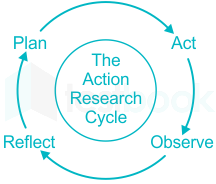
Action Research achieves its goal by using a ‘cyclic research process’, where each cycle is made up of four phases - Plan, Act (implementing plans), Observe (systematically) and Reflect. It is a continuous cycle one can circle back to earlier phases within a cycle (e.g., cycle back and forth between reflection and planning).


  1. Plan: An understanding of the problem is developed and plans are made to make a change in the existing or current set up. For example, a teacher notices that an existing teaching strategy is not yielding the optimum results and plans to introduce a new teaching strategy to overcome this.
  2. Act:  The changes which are planned are implemented or carried out in this phase. For example, the new teaching strategy that has been planned is introduced in this phase.
  3. Observe: The impact of the change implemented earlier is observed by the researcher. The researcher collects, records and obtains evidence about the success of actions. For example, the impact of the new teaching strategy on the students’ performance is observed.
  4. Reflect: The data and results from the previous phase are reflected upon. The researcher reflects on the results and considers strategies for improvement and future planning begins. For example, the teachers reflect on the impact of the new teaching strategy and if the impact was positive then it becomes part of the teaching strategy or else the cycle is repeated.


Hence, it can be concluded that the phases plan, act, observe, and reflect, is the correct sequence in undertaking Action Research-based studies.

25

Communication skills of students can be improved by

a) Asking general questions

b) Exposure to new technology

c) Fostering critical thinking

d) Discriminant use of vocabulary

e) Limited listening

Choose the most appropriate answer from the options given below:

  1. ((a))

    a), b) and c)

  2. ((b))

    b), c) and d)

  3. ((c))

    c),  d) and e)

  4. ((d))

    a), d) and e)

Show Answer
Answer: ((a))

a), b) and c)

A classroom environment relies heavily on the quality of communication. As an instructor, taking steps towards improving the communication skills of your students will contribute positively to your classroom climate.

Students with effective communication skills will be more likely to contribute to class discussions, will be more productive members in group projects, and will ultimately gain more from their experience in class.

The Path to Improving Student Communication Skills:

  • Watch Films That Model Conversation Skills.
  • Use of Technology.
  • Reinforce Active Listening.
  • Offer Group Presentations and Assignments.
  • Ask Open-Ended Questions.
  • Use Tasks and Activities That Foster Critical Thinking.
  • Offer Reflective Learning Opportunities.

Important Points

The following steps can be implemented to improve your students' communication skills, with the intent of strengthening the classroom experience.

Steps for Improving Student Communication Skills.

  1. Establish the ground rules and norms for class discussion.
  2. By setting the standards for class participation, your students will be more likely to understand their role in the discussion.
  3. Specific elements, such as when should a speaker raise their hand, and aspects such as the tone for the classroom environment will help your students understand how communication works within the classroom.
  4. Look for responses from the entire classroom, and be willing to take the time for them to emerge.
  5. Assign frequent opportunities for small group discussions.
  6. The more often students work together to contribute to the larger discussion, the more comfortable they will become within the classroom environment, increasing their willingness to communicate.
  7. Adopt a policy of openness with your students.
  8. When you make a change to the class structure or give an assignment, be open with your students about your intentions, and seek their feedback.
  9. By treating them with respect and openness, you will help foster an environment of trust with your students, increasing their likelihood of open communication.

Hence, we may say that the Communication skills of students can be improved by

a) Asking general questions

b) Exposure to new technology

c) Fostering critical thinking

But the following options d) Discriminant use of vocabulary and e) Limited listening are incorrect because to learn speaking in communication skills, the need is to work on vocabulary and attentive listening.

26

The next number in the given series is

196, 384, 736, ____

  1. ((a))

    1344

  2. ((b))

    1244

  3. ((c))

    1634

  4. ((d))

    1544

Show Answer
Answer: ((a))

1344

The pattern followed here is :

Alternate Method100 × 2 - 4 = 196

100 × 4 - 16 = 384

100 × 8 - 64 = 736

100 × 16 - 256 = 1344

Hence, "1344" is the correct answer.

27

Find the missing letters in the series:

BCA, YZX, EFD, ______, HIG

  1. ((a))

    UVW

  2. ((b))

    VWU

  3. ((c))

    WVU

  4. ((d))

    VUW

Show Answer
Answer: ((b))

VWU

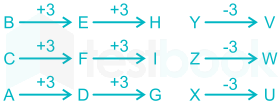
The pattern followed here is:

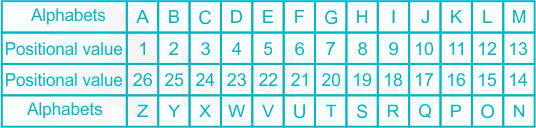
According to the alphabetical positions of the letters,

Note: The series is divided into two parts. Letters at odd position and letters at even position.

Hence, ‘VWU’ is the correct answer.

28

"Everyone believes that there is a soul. Therefore, you should also believe it." This inference commits which kind of fallacy?

  1. ((a))

    Ad hominem

  2. ((b))

    Ad populum

  3. ((c))

    Fallacy of Accident

  4. ((d))

    Fallacy of Ambiguity

Show Answer
Answer: ((b))

Ad populum

Argumentum ad populum:

  • It is an informal fallacy that is also known as appeal to the people.
  • It is a fallacy that states that a proposition must be true because most of people believe it to be true.
  • It is often summed up as "If many believe so, it is so".
  • The fallacy is also known as appeal to the majority, appeal to popularity, appeal to the masses, common belief fallacy, or argument from consensus.
  • In the above statement, "Everyone believes that there is a soul. Therefore, you should also believe it.". It is an Ad Populum Fallacy as it states that everyone believes so you should also believe.

1. Ad hominem:

  • This fallacy is also known as an argument against the person.
  • In this fallacy the focus shifts from a person to his/her character.
  • For example, Ram teaches you to speak the truth but his son lies.

2. Fallacy of Accident:

  • This fallacy misapplies a general rule to a particular situation.
  • For example,
  • Cutting people with knives is a crime,
  • Surgeon cut people with knives,
  • Surgeons are criminals.

3. Fallacies of Ambiguity:

  • It includes confusion over meaning, precisely over the members referred to the term used in the argument.
  • An individual gets confused between two meanings of the term.
  • For example, the bark was painful, it could mean a bark of the dog communicating pain or a tree's bark was rough.
29

The term Plotter is best described as

  1. ((a))

    an input device to produce good quality graphics

  2. ((b))

    an output device to produce drawings and graphics

  3. ((c))

    a fast storage device for storing good quality graphics

  4. ((d))

    a multipurpose device for taking inputs as well as outputs

Show Answer
Answer: ((b))

an output device to produce drawings and graphics

Plotter:

  • A plotter is a graphics printer that draws images with ink pens.
  • Plotters actually draw point-to-point lines directly from vector graphics files.
  • The plotter was the first computer output device that could print graphics as well as accommodate full-size engineering and architectural drawings.
  • There are two main types of plotters – drum and flatbed plotters.
  • Drum plotters (also called roller plotters) spin the paperback and forth on a cylindrical drum while the ink pens move left and right. By combining these two directions, lines can be drawn in any direction.
  • Flatbed plotters have a large horizontal surface on which the paper is placed. A traveling bar draws lines on the paper as it moves across the surface.

Therefore, the term Plotter is best described as an output device to produce drawings and graphics.

30

Which of the following is indicative of innovations in evaluation system at present?

  1. ((a))

    Semesterization system

  2. ((b))

    Project based evaluation system

  3. ((c))

    Choice based credit system

  4. ((d))

    Objective based evaluation system

Show Answer
Answer: ((c))

Choice based credit system

Key Points Evaluation

  • Evaluation is a systematic determination of a subject's merit, worth and significance, using criteria governed by a set of standards.
  • The primary purpose of evaluation, in addition to gaining insight into prior or existing initiatives, is to enable reflection and assist in the identification of future change.
  • The evaluation provides a systematic method to study a program, practice, intervention, or initiative to understand how well it achieves its goals.
  • Evaluations help determine what works well and what could be improved in a program or initiative.

Semesterization system

  • A semester system divides the academic year into two sessions: fall and spring.
  • Through the semester system, students are continuously assessed and it is better for concentration and learning.
  • Each session is approximately 15 weeks long with a winter break in between the fall and spring session and a summer break after the spring session.
  • Each semester you can take four to six classes depending on how many credits each class is.
  • It facilitates a better understanding of the subject.
  • More emphasis is laid on class interaction because of constant engagement between teachers and students.

Project-based evaluation system

  • Project-based assessment is a method of educating and cultivating skills in people by making them work in real-life scenarios, solving real problems.
  • It is a highly practically-driven method that companies are aggressively using for hiring and reskilling, upskilling their employees.
  • Project-based assessments are an alternative to tests that allow students to engage with their learning in more concrete ways.
  • Instead of merely studying theory, a hands-on project asks students to apply what they've learned to an in-depth exploration of a top.

Choice-based credit system

  • The CBCS provides an opportunity for the students to choose courses from the prescribed courses comprising a core, elective/minor, or skill-based courses.
  • The courses can be evaluated following the grading system, which is considered to be better than the conventional marks system.
  • It is the ratio of total credit points secured by a student in various courses registered in a semester and the total course credits taken during that semester.
  • It shall be expressed up to two decimal places. Semester: Each semester will consist of 15-18 weeks of academic work equivalent to 90 actual teaching days.
  • The CBCS grading system follows a credit system that is attached to the course components offered to students.
  • A credit system for higher education measures various parameters like- Student performance, Learning outcomes, and Entrepreneurship skills.

​Objective-based evaluation system

  • Objectives-based evaluation refers to a class of evaluation approaches that centers on the specification of objectives and the measurement of outcomes.
  • Ralph Tyler, often noted as the father of educational evaluation has been credited with being a principal proponent of objectives-based evaluation approaches.
  • objective evaluation criteria are that few subjects are ever totally objective.
  • The more students are encouraged to think creatively, the more subjective factors will be introduced into classwork.

Therefore, a Choice-based credit system is indicative of innovations in the evaluation system at present

31

A researcher reports his/her research finding to the research audience in shuch a way that his/her personal views are necessarily getting supported. This would involves issues relating to

  1. ((a))

    Technical aberration

  2. ((b))

    Research ethics

  3. ((c))

    Scientific rigour

  4. ((d))

    Personal predilection

Show Answer
Answer: ((b))

Research ethics

A researcher reports his/her research finding to the research audience in such a way that his/her personal views are necessarily getting supported. This would involves issues relating to Research ethics.

Research ethics

  • Research ethics govern the standards of conduct for scientific researchers.
  • It is important to adhere to ethical principles in order to protect the dignity, rights, and welfare of research participants.
  • Ethical issues occur when a given decision, scenario, or activity creates a conflict with a society's moral principles.
  • These conflicts are sometimes legally dangerous since some of the alternatives to solve the issue might breach a particular law.
  • Researchers face ethical challenges in all stages of the study, from design to reporting. These include anonymity, confidentiality, informed consent, researchers' potential impact on the participants, and vice versa.

TopicDescription
Technical aberration- It is a departure from what is normal, usual, or expected, typically an unwelcome one. - a characteristic that deviates from the normal type.
Scientific rigor- It is associated with being open to the data, scrupulously adhering to a specific philosophical perspective, and thoroughness in collecting data. - Scientific rigor means implementing the highest standards and best practices of the scientific method and applying those to one’s research. - It is all about discovering the truth. - Scientific rigor involves minimizing bias in subject selection and data analysis.
Personal predilection- Predilection means an attitude of mind that predisposes one to favor something. - Predilection implies a strong liking deriving from one's temperament or experience. - It is the power or right to decide or act according to one's own judgment; freedom of judgment or choice

As per the definition of Personal predilection, supporting personal view is rightly justified. However in a research context, personal opinion, bianess totally comes under the issue of Research ethics.

32

Given below are two statements one is labelled Assertion (A) and the other is labelled Reason (R)

Assertion (A): Depending upon the classroom situation some media of communication are more effective than others.

Reason (R): Selection of a medium is directly related to the nature of the message for students

In the light of the above choose the correct answer from the options given below:

  1. ((a))

    Both (A) and (R) are true and (R) is the correct explanation of A)

  2. ((b))

    Both (A) and (R) are true but (R) is not the correct explanation of (A)

  3. ((c))

    (A)  is true but (R) is false

  4. ((d))

    (A)  is false but (R) is true

Show Answer
Answer: ((a))

Both (A) and (R) are true and (R) is the correct explanation of A)

Classroom communication

  • Communication within the classroom is important in order for students to learn effectively and should be put in place from an early stage of learning.
  • Classroom communication exists in three categories: verbal, nonverbal, and written.

Key Points

Media in classroom communication

  • Media helps to explain complex ideas. Media can be used in direct instruction, active learning teaching strategies, and student projects.
  • Many media sources (feature films, music videos, visualizations, news stories) have very high production quality capable of showcasing complex ideas in a short period of time. This helps develop quantitative reasoning.
  • The use of media in the classroom enables students to see concepts and new examples when they are watching television, listening to music, or are at the movies with friends
  • Popular media (films, music, YouTube) are a familiar medium to students that helps gain attention and maintain student interest in the theories and concepts under discussion.
  • Students can experience worlds beyond their own, especially if the media is sharply different from their local environment.
  • In the selection of the instructional media, Romiszowski(1997) says that the main categories of factors that may influence the choice of media are:
  1. Task factors- the type of objectives, and hence the type of learning activities that should be provided for the learner.
  2. Learner factors- some learners may learn better from certain media than from others.
  3. Economics/availability factors- this may limit the choice in practice

Important Points

Conclusion:

  • We can bring the media into the classroom through visuals, sounds, smells, and tastes. Because our brains rely heavily on stimulus from the outside for learning, this is just one of the reasons that teaching with media is brain-friendly.
  • In instructor-led classrooms, teachers step away from being a “sage on the stage” and become a “guide on the side” – a facilitator of learning. But at the same time as said by Romiszowski, ‘same media cannot be used for all kind of learners.
  • Some learners may learn better from certain media than from others, and it should be selected keeping in mind the learning activity provided for the learners.

Hence, both the statements are true and statement R is a true explanation of statement A. So, option (1) is correct.

33

Application of ICT in research is relevant in which of the following stages?

i) Survey of related studies

ii) Data collection in the field

iii) Data Analysis

iv) Writing the thesis

v) Indexing the references

Choose the most appropriate option from those given below:

  1. ((a))

    ii) iv) and v)

  2. ((b))

    i), iii) and v)

  3. ((c))

    i), ii) and iv)

  4. ((d))

    ii), iii) and iv)

Show Answer
Answer: ((b))

i), iii) and v)

Information Technology (IT) and Information and Communication Technology (ICT) are very often interchangeably used in the context of modern technology infrastructure. ICT is a broad and comprehensive term, which comprises information technology and communication technology. Information technology includes radio, television, computer and the Internet, teleconferencing, and mobile.

  1. Over the past decade, there has been a significant increase in the scope of ICT to be employed in the fields of education and research.
  2. Information and Communication Technology has done so much to remove from the researcher the constraints of speed, cost, and distance.
  3. On the whole, information and communication technology has led to improvements in research.
  4. New avenues for scientific exploration have opened. The amount of data that can be analyzed has been expanded, as has the complexity of analyses. And researchers can collaborate more widely and efficiently.
  5. Though the use of ICT can be employed in every stage of the research process, the scope for employing ICT support is relatively more in the stages of Survey, Data Analysis, and Indexing The References.
  6. Surveying the sample audience can be done through the use of ICT. Google forms, emails, social networking sites, etc. can be used to obtain information from our sample audience. Surveying through the help of ICT saves time, cost, and helps us reach a comparatively larger sample audience.
  7. Analyzing data with computers is among the most widespread uses of information and communication technology in research.
  8. Computer hardware for these purposes comes in all sizes, ranging from personal computers to microprocessors dedicated to specific instrumentational tasks, large mainframe computers serving a university campus or research facility, and supercomputers. Computer software ranges from general-purpose programs that compute numeric functions or conduct statistical analysis to specialized applications of all sorts.
  9. citation index is an ordered list of cited articles along with a list of citing articles. The cited article is identified as the reference and the citing article as the source. The index is prepared to utilize the association of ideas existing between the cited and the citing articles, as the fact is that whenever a recent paper cites a previous paper there always exists a relation of ideas, between the two papers. Citation indexing provides subject access to bibliographic records in an indirect but powerful manner.
  10. ICT helps to identify appropriate information sources so that their contribution can be acknowledged and plagiarism can be avoided.

Thus, (i), (iii) and (v) is the correct answer.

34

63% of employees in a company are female. If the number of male employees is 111, then the total number of employees is

  1. ((a))

    270

  2. ((b))

    290

  3. ((c))

    300

  4. ((d))

    310

Show Answer
Answer: ((c))

300

Given: 

The number of male employees = 111

The number of female employees = 63% of total employees 

Calculations:

Let the total number of employees be 'x'

The number of male employees = (100 - 63)% of x

⇒ 111 = 37% of x 

⇒ 111 = (37/100) × x

⇒ x = 111 × 100/37

⇒ x = 300

∴ The total number of employees in a company is 300

35

"God is great because he does great things." This inference commits which kind of fallcy?

  1. ((a))

    Ad populum

  2. ((b))

    Fallacy of Composition

  3. ((c))

    Fallacy of Division

  4. ((d))

    Petition Principii

Show Answer
Answer: ((d))

Petition Principii

A fallacy is the use of invalid or otherwise faulty reasoning or 'wrong moves' in the construction of an argument.

Fallacies are generally of 2 types :

  • Formal Fallacy refers to arguments that have an invalid structure or form,
  • Informal fallacy refers to the arguments that have incorrect or irrelevant premises.

Key Points

The fallacy given in the above question is an informal fallacy which is explained below:

Ad Poplulum or Argumentum ad Populum (Appeal to the people):

  • It is a fallacious argument that concludes that a proposition must be true because many or most people believe it.
  • Often concisely encapsulated as: 'if many believe so, it is so
  • "For example, This girl should come first because she is cute and beautiful. In this case we are using emotions which are irrelevant to the thesis being considered in the argument.

The fallacy of composition:

  • It arises when one infers that something is true of the whole from the fact that it is true of some part of the whole.
  • In simple words, what's true of the parts must be true of the whole.
  • For example, I can buy paper, pen, pencil, etc. so I can buy everything. Another example could be " This tire is made of rubber, therefore the vehicle of which it is a part of also made of rubber."

Fallacy of Division:

  • It is a fallacy of induction that occurs when someone assumes that what is true of a whole, must be true of the parts.
  • For example, Mobile is expensive and worthy, it's every spare part is expensive and worthy. Another example could be: Water is made of hydrogen and oxygen. And the water is liquid. Therefore, Hydrogen and oxygen are liquid too.

Petition Principii (Begging the question):

  • This Fallacy is also known as a circular argument and it occurs when the premises presume, openly or covertly, the very conclusion that is to be demonstrated.
  • It is any form of argument where the conclusion is assumed in any one of the premises.
  • For example, Murder us always morally wrong, therefore abortion is morally wrong. Another example could be: "Paranormal activity is real because I have experienced it". In the above question, "God is great because he does great things" is a form of circular argument.

The correct answer is Petition Principii.

36

Which of the following potential factors affecting teaching are related to instructional facilities and learning environment?

i) Praise and encouragement by teachers

ii) Non-availability of textbooks/reading materials for use

iii) Proactive moves in the interactive processes

iv) Shortage of highly qualified teachers

v) Availability of smart classes

Choose the correct answer from the following options:

  1. ((a))

    i), ii) and iii)

  2. ((b))

    ii), iii), and v)

  3. ((c))

    i), iv) and v)

  4. ((d))

    iii), iv) and v)

Show Answer
Answer: ((b))

ii), iii), and v)

The quality and nature of a learner become effective on learning as well as the learning environment and learning materials also influence the process of learning.

The major factors which affect learning are as follows,

  • Factors associated with learner
  • Factors associated with the learning environment

Important Points

The factors affecting teaching are related to instructional facilities and the learning environment:

  • Method of learning: Proactive moves in the interactive processes, learning by doing, direct interaction, etc.
  • Mode of learning: online or offline mode
  • Learning support materials: availability or non-availability of textbooks/reading materials for use
  • Feedback system: information given to the learner or teacher about the learner's performance relative to learning goals or outcomes.
  • Infrastructural facility: availability of important instruments and facilities also the availability of smart classes
  • The environment at the institution: noise-free and suitable for education

Therefore, ii), iii), and v) are the correct answer here.

Confusion Points

  • Shortage of highly qualified teachers: it is a factor related to the factor of teaching. It comes under the personal qualification of the teacher that can affect the formal nature of the teaching.
  • Praise and encouragement by teachers are a part of the learning environment but it is not a factor that affects teaching.
37

For effective communication inside a classroom, a teacher should embark upon

  1. ((a))

    ideological leanings.

  2. ((b))

    innuendos.

  3. ((c))

    issuing attention commands.

  4. ((d))

    listener analysis.

Show Answer
Answer: ((d))

listener analysis.

Communication Skills:

Communication is a two-way exchange of information, i.e., giving and receiving. Speaking and writing to someone are examples of giving information. Reading and listening to someone are examples of receiving information.

  • Listening: It is an essential skill that facilitates the acquiring of all other skills. It is the process of making meaning out of the spoken language. It involves receiving the sounds of the language, processing sounds into words, assigning meaning to the words, and interpreting the speaker’s message.
  • The importance of active listening also branches into social-emotional development.
  • Active listening promotes mindful thinking, which can reduce anxiety and depression in students.
  • It can also help students build relationships because as they engage themselves in conversation, their peers are more likely to view them as open and interested.
  • And finally, practicing active listening can promote empathy—a skill that can enrich a student’s life both in and outside of the classroom.

Therefore, for effective communication inside a classroom, a teacher should embark upon Listener analysis.

Additional Information

  • Innuendos:  
  • Innuendos are hints or intimations about a person or thing.
  • While communicating in a classroom a teacher should provide hints relating to the topic so that the student can easily understand the concept.
  • Ideological leanings, Innuendos, and Issuing attention commands may not contribute towards effective communication inside the classroom.

Therefore, option 4 is the correct answer.

Data in respect of demand and production of computers of five companies A - E are shown in the figure. Based on the data, answer questions that follow:

38

The ratio of the number of companies having more production than demand to that of companies having more demand than production is

  1. ((a))

    3 : 2

  2. ((b))

    1 : 4

  3. ((c))

    4 : 1

  4. ((d))

    2 : 3

Show Answer
Answer: ((d))

2 : 3

Calculations:

The demand of company A = 2000

The production of company A = 1000

∴ Demand for computers is more than the production.

The demand of company B = 300

The production of company B = 900

∴ Demand for computers is less than the production.

The demand of company C = 1250

The production of company C = 500

∴ Demand for computers is more than the production.

The demand of company D = 600

The production of company D = 1350

∴ Demand for computers is less than the production.

The demand of company E = 1650

The production of company E = 1100

∴ Demand for computers is more than the production.

∴ The ratio of the number of companies having more production than demand to that of companies having more demand than production is 2 ∶ 3 

Alternate Method

CompanyDemand (D)Production (P)Relation between D and P
A20001000D > P
B300900D < P
C1250500D > P
D6001350D < P
E16501100D > P

Number of companies in which more production than demand = 2 (B, D)

Number of companies in which more demand than production = 3 (A, C, E)

The required ratio = 2 ∶ 3 

 The ratio of the number of companies having more production than demand to that of companies having more demand than production is 2 ∶ 3

39

Which company has minimum demand to production ratio?

  1. ((a))

    B

  2. ((b))

    C

  3. ((c))

    D

  4. ((d))

    E

Show Answer
Answer: ((a))

B

The production of company A = 1000

The demand of company A = 2000

The ratio of demand to production = 2000 ∶ 1000 ⇒ 2 : 1

The Production of company B = 900

The demand of company B = 300

The ratio of demand to production = 300 ∶ 900 ⇒ 1 : 3

The production of company C = 500

The demand of company C = 1250

The ratio of demand to production = 1250 ∶ 500 ⇒ 5 ∶ 2

The production of company D = 1350

The demand of company D = 600

The ratio of demand to production= 600 ∶ 1350 ⇒ 4 : 9

The production of company E = 1100

The demand of company E = 1650

The ratio of demand to production = 1650 ∶ 1100 ⇒ 3 : 2

∴ The demand to production ratio is minimum in company B

40

The difference between average demand and average production of computers of all companies combined together is

  1. ((a))

    950

  2. ((b))

    190

  3. ((c))

    180

  4. ((d))

    850

Show Answer
Answer: ((b))

190

The production of computers of company A = 1000

The production of computers of company B = 900

The production of computers of company C = 500

The production of computers of company D = 1350

The production of computers of company E = 1100

The total production of computers in all companies = 1000 + 900 + 500 + 1350 + 1100

The average production of computers in all companies = (1000 + 900 + 500 + 1350 + 1110)/5 = 4850/5 = 970

The demand for computers of company A = 2000

The demand for computers of company B = 300

The demand for computers of company C = 1250

The demand for computers of company D = 600

The demand for computers of company E = 1650

The total  demand for computers of all company = 2000 + 300 + 1250 + 600 + 1650

The average production of computers in all companies = (2000 + 300 + 1250 + 600 + 1650)/5 = 5800/5 = 1160

The difference between average demand and average production of computers of all companies combined together = 1160 - 970 = 190

∴ The difference between average demand and average production of computers of all companies combined together is 190

Alternate Method

CompanyDemand (D)Production (P)
A20001000
B300900
C1250500
D6001350
E16501100
Total2000 + 300 + 1250 + 600 + 1650 = 58001000 + 900 + 500 + 1350 + 1100 = 4850


Average of Demand = 5800/5 = 1160

Average of Production = 4850/5 = 970

Required difference = 1160 – 970 = 190 

∴ The difference between average demand and average production of computers of all companies combined together is 190

41

The demand for computers is less than the production of computers in how many companies?

  1. ((a))

    4

  2. ((b))

    3

  3. ((c))

    1

  4. ((d))

    2

Show Answer
Answer: ((d))

2

∴ Demand for computers is more.

The demand of company B = 300

The production of company B = 900

∴ Demand for computers is less than the production.

The demand of company C = 1250

The production of company C = 500

∴ Demand for computers is more.

The demand of company D = 600

The production of company D = 1350

∴ Demand for computers is less than the production.

The demand of company E = 1650

The production of company E = 1100

∴ Demand for computers is more.

**∴ The demand for computers is less than the production of computers in how many companies is 2.**Number of companies in which demand less than production = 2 (B, D)

∴ The demand for computers is less than the production of computers in how many companies is 2.

42

The demand for computers of Company D is more than that of the demand for the computers of Company B by

  1. ((a))

    1.5 times

  2. ((b))

    2 times

  3. ((c))

    2.5 times

  4. ((d))

    3 times

Show Answer
Answer: ((b))

2 times

The demand for computers of company D = 600

The demand for computers of company B = 300

The demand for computers company D is more than B by = 600 - 300 = 300

Hence, the 600 = 2 × 300

∴ The demand for computers of Company D is more than that of the demand for the computers of Company B by 2 times.

43

Structured classroom communication can be categorized as

  1. ((a))

    Inter- personal communication

  2. ((b))

    Vertical communication

  3. ((c))

    Group communication

  4. ((d))

    Cross-purpose communication

Show Answer
Answer: ((c))

Group communication

Structured communication:

  • Structured communication is a term used across a variety of disciplines to describe frameworks for interaction between individuals or machines. Although these frameworks are primarily designed to reduce ambiguity, increased efficiency is often cited as a secondary benefit.
  • A structured classroom often translates to a safe classroom, one where students can enjoy themselves and focus on learning. In a structured learning environment, students are more likely to thrive and experience personal and academic growth.
  • Structural communication was developed in the 1960s by John G. Bennett and his research team to simulate the structure and quality of a small group tutorial through automated means.
  • It provides access to high-level learning for many students without much supervision. Communication consists of both information and structure.
  • In structural communication, information is provided that participants have to organize in explicit ways.
  • Structural Communication is an instructional approach that provides a simulated dialogue between an author of instructional materials and the students. It has been called "an interactive technique for communicating understanding"
  • The technique was designed to encourage creative thinking in learners, allowing them to develop an understanding of a topic, not simply to memorize facts.

  • Having a clear structure for communicating helps us in two ways: it allows us to organize and remember our ideas, and it makes it easier for our listener to follow and stay focused.
  • It is the framework for interaction between individuals. It proved versatile in dealing with a wide range of numbers of people from a single individual to many hundreds. So, from this, we can conclude that it is a kind of group communication. Hence, option (3) is correct.

  • Vertical communication: Vertical communication is a type of flow of information between members of the organization who are on different levels of its hierarchy. It can be used both in a downward and upward direction.
  • Cross-purpose communication: If two or more people are at cross purposes, they do not understand each other because they are talking about different subjects without realizing this.
  • Interpersonal communication is the process of exchange of information, ideas, and feelings between two or more people through verbal or non-verbal methods. It often includes a face-to-face exchange of information, in a form of voice, facial expressions, body language, and gestures.
44

Vinod's mother-in-law is the mother of Amit's mother-in-law. How is Vinod related to Amit?

  1. ((a))

    Vinod is brother of Amit

  2. ((b))

    Vinod is father of Amit

  3. ((c))

    Vinod is uncle of Amit

  4. ((d))

    Vinod is father-in-law of Amit

Show Answer
Answer: ((d))

Vinod is father-in-law of Amit

According to given conditions,

Vinod is father -in-law of Amit.

Hence, ‘Vinod is father -in-law of Amit’ is the correct answer.

45

In a certain code, FISH is written as EHRG. The code for JUNGLE will be

  1. ((a))

    ITNFKD

  2. ((b))

    KVOHMF

  3. ((c))

    ITMFKD

  4. ((d))

    TIMFKD

Show Answer
Answer: ((c))

ITMFKD

The pattern followed here is:

According to the alphabetical positions of the letters,

Similarly,

Hence, ‘ITMFKD’ is the correct answer.

46

Anil's participation in the classroom is indifferent. His parents do not find him to be active either. But his performance in examinations ranges from being good to outstanding. Therefore, he must be studying privately in a clandestine way. This is an example of which kind of Pramana?

  1. ((a))

    Upamana (Comparison)

  2. ((b))

    Anumana (Inference)

  3. ((c))

    Anupalabdhi (Non-apprehension)

  4. ((d))

     Arthapatti (Implication)

Show Answer
Answer: ((d))

 Arthapatti (Implication)

The correct answer is "Arthapatti"( Implication)

Nyaya philosophy relies on several pramanas that is a means of obtaining true knowledge as its epistemology. Pramanas literally means proof and means of knowledge. In Indian logic, pramanas are the means which can lead to knowledge and serve as one of the core concepts in Indian epistemology.

Key Points

According to Vedic philosophy, there are 6 types of Pramanas:

  • Pratyaksha Pramana ( Perception) - we mean the knowledge-based through perception**. It can be direct or indirect to any person.**
  • Direct perception- It takes place through our sensory organs directly like nose (smell), skin (touch), eyes (see), ears (sound) and tongue (taste).
  • Indirect perception- The knowledge happens based upon memory. For example, we all know how an apple looks like, this knowledge gets feed into out memory so whenever we see red coloured and round shaped fruit, we can easily associate it with
  • Anumana (Inference) -here the knowledge is gained not through any sense organs but through anumana or inference. we assume knowledge of what we don't see from what we see. For example, we can assume the physical or emotional pain when we see someone crying.
  • Upamana (comparison) - It is a kind of knowledge we get by the assumption of similarity between two different types of knowledge. For example a person knows a four-legged animal which barks is called a dog. therefore he goes to a jungle and sees a similar-looking animal he can relate that its a wild dog which also has four legs and barks.
  • Arthapatti (Assumption) or implication)- By arthapatti we understand the knowledge which we get through the relationship and implications. It includes supposition, belief and presumption. For example: if a healthy person says he does not sleep at night, with this supposition, belief and presumption, we can think that he sleeps during the day. Without assumption, it is difficult to explain how a man can be healthy without sleeping.
  • Anupalabdhi (Apprehension and non-apprehension): It is basically based on the apprehension of a non-existing thing which is based on non-perception. For example: if there are no students in the class, as we cannot see any student in the class at that moment we conclude that there are no students in the class.
  • Shabda (word or verbal testimony)- This is mainly through verbal indication. We get a lot of knowledge through verbal statements, symbols, texts or words, We either say this or write, Verbal statement must have a valid cause for its information to be true. Earlier in Indian philosophy Vedas were considered to be the most reliable source of knowledge.

In the above question, the correct answer is Arthapatti (assumption) because here we get an idea through implications that Anil is not so good at studies but still manages to score well that means he must be studying privately.

47

The distinction between purvavat and sesavat is made with reference to which of the following pramanas?

  1. ((a))

     Anumana (Inference)

  2. ((b))

     Pratyaksa (Perception)

  3. ((c))

    Comparison (Upamana)

  4. ((d))

    Abhava (Absence)

Show Answer
Answer: ((a))

 Anumana (Inference)

Theory of knowledge in Nyaya philosophy

  • Knowledge, according to Nyaya, reveals both the subject and the object which are quite distinct from itself.
  • Pramana is a valid means of knowledge. ' Nyaya accepts four valid means of knowledge viz. perception (pratyaksha), inference (anumana), testimony (shabda), and comparison (upmana).

Key Points

Anumāna

  • Anumana (inference) is one of the most important contributions of the Nyaya. It can be of two types: inference for oneself, and inference for others.
  • Inference can also be classified into 3 types: Purvavat (inferring an unperceived effect from a perceived cause), Sheshavat (inferring an unperceived cause from a perceived effect), and Samanyatodrishta (when inference is not based on causation but on the uniformity of co-existence).

Purvavat and sesavat 

  • A purvavat inference is that in which we infer the unperceived effect from a perceived cause.
  • The inference of future rain from the appearance of dark heavy clouds in the sky is an example of purvavat.
  • A sesavat inference is that in which we infer the unperceived cause from a perceived effect.
  • The inference of past rain from the swift muddy current of the river is an example of sesavat

Important Points

Pratyakṣa (perception) occupies the foremost position in the Nyaya epistemology. Perception can be of two types*,* laukika (ordinary) and alaukika (extraordinary).

Upamāna (उपमान) means comparison and analogy

Śabda (शब्द) means relying on word, a testimony of past or present reliable experts.

Conclusion:

Nyaya philosophy represents a unique definition of logic in Indian philosophy**. Anumana** is a valid source of knowledge. Inference occupies a central place in the Hindu school of logic (Nyaya). It is classified in various ways. One such classification of Anumana is purvavat, sesavat, and Samanyatodrishta. So, from the above discussion, we conclude that option (1) is correct.

48

Match List I with List I

List IList II
(Key Terms used in 
Research
(Description of Terms)
a) Hypothesisi) Techniques used for collection of facts and information
b) Sampleii) Devices for arriving at conclusions
c) Research Designiii) A tentative statement indicating a potential solution to the problem of the study
d) Research Tooliv) A subset drawn from a defined set
v) Conceptual framework for conducting research
<br>

Select the correct answer from the options given below:

  1. ((a))

    a) - i), b) - ii), c) - iii), d) - iv)

  2. ((b))

    a) - ii), b ) - iii), c) - iv), d) - v)

  3. ((c))

    a) - i), b) - ii), c) - iv), d) - iii)

  4. ((d))

    a) - iii), b ) - iv), c) - v), d) - i)

Show Answer
Answer: ((d))

a) - iii), b ) - iv), c) - v), d) - i)

(Key terms used in 
Research
(Description of Terms)
Hypothesis- The word hypothesis consists of two words, where ‘hypo’ means tentative or subject to verification and ‘thesis’ implies a statement about the solution of a problem. - One of the primary functions of a hypothesis is to state a specific relation between two or more variables in such a manner that it is possible to empirically test them.
Sample- Sampling is the selection of a subset (a statistical sample) of individuals from within a statistical population to estimate characteristics of the whole population. - Statisticians attempt for the samples to represent the population in question. - There are two types of sampling, probability sampling, and non-probability sampling. - It is a subset drawn from a larger set to represent it.
Research Design- The research design is an overall strategy that the researcher chooses to integrate the different components of the study in a coherent and logical way. - By this, the researcher ensures he or she will be able to effectively address the research problem. - it constitutes the blueprint for the collection, measurement, and analysis of data. - It involves an overall strategy utilized to carry out research that defines a succinct and logical plan to tackle established research questions through the collection, interpretation, analysis, and discussion of data.
Research Tool- Research tools are devices using which data are collected in Research - It becomes the means of a collection of data for the study - It should be reliable and accurate - Research tool can be varied based on the method of research used - For example, observation forms, interview schedules, questionnaires, and interview guides, etc.
49

The concept of entropy as used in communication is related to

  1. ((a))

    Virtual reality

  2. ((b))

    Marketplace

  3. ((c))

    Order

  4. ((d))

    Communicative language

Show Answer
Answer: ((c))

Order

Entropy in Communication:

  • The entropy was originally created by Shannon as part of his theory of communication, in which a data communication system is composed of three elements: a source of data, a communication channel, and a receiver.
  • In Shannon's theory, the "fundamental problem of communication" – as expressed by Shannon – is for the receiver to be able to identify what data was generated by the source, based on the signal it receives through the channel.
  • Shannon considered various ways to encode, compress, and transmit messages from a data source, and proved in his famous source coding theorem that the entropy represents an absolute mathematical limit on how well data from the source can be losslessly compressed onto a perfectly noiseless channel
  • In information theory, the entropy of a random variable is the average level of "information", "surprise", or "uncertainty" inherent in the variable's possible outcomes.
  • Entropy refers to messages which convey highly unpredictable information to the receiver.

Important Points

Conclusion:

  • The encode-decode model of communication implies that in order to improve communication two influencing factors should be managed: noise (physical and semantic) should be reduced and capacity (sender-receiver and channel) should be increased.
  • In addition, to more effectively transmit a message there should be an appropriate balance between so-called entropy and redundancy.
  • Entropy refers to the message that conveys unpredictable information to the receiver. So here entropy is related to the order or sequence in which the message is transferred through a channel to the receiver. Hence, option (3) is correct.
50

Which sentence cannot fit into the AEIO framework?

  1. ((a))

    No salt has iodine

  2. ((b))

    The salt on the table has iodine

  3. ((c))

    All salt has iodine

  4. ((d))

    Some salt has iodine

Show Answer
Answer: ((b))

The salt on the table has iodine

The Correct Answer is "The salt on the table has iodine"

The AEIO framework is related to the logical reasoning section which generally denotes the following:

  • A stands for All
  • E stands for No
  • I stands for some
  • O stands for Some not

Key Points

NAMESTATEMENTQUANTITYQUALITY
AAll S is PUniversalAffirmative
ENo S is PUniversalNegative
ISome S is PParticularAffirmative
OSome S is not PParticularNegative


Additional Information

S denotes "subject" and P denotes "predicate"

  • Statements beginning with 'All' are denoted by "A" universal affirmative statements.
  • For example: All men are mortal, in which men is the subject and mortal is the predicate. All saints are noble, All singers are dancers, etc.
  • Statements beginning with 'No' are denoted by "E" and are Universal negative statements.
  • For example: No men are mortal, No singers are dancers, No saints are noble. etc.
  • Statements beginning with 'Some' are denoted by "I" and are particular affirmative statements.
  • For example: Some men are mortal, some singers are dancers, some saints are noble, etc.
  • Statements Comprising 'some not' are denoted by "O" and are particular negative statements.
  • For example: Some men are not mortal, some singers are not dancers, some saints are not noble.

In the above question, we are being asked to point out which sentence does not belong to AEIO Framework and clearly, it is OPTION 2 which is "The salt on the table has iodine" which does not have A, E, I, O in its statement.

Attempt this paper under real exam conditions

Timed interface, section switching, instant scoring, and question-by-question analytics — free.

Start Timed Attempt