Official Paper

UGC NET Paper 1: Held on 11th July 2022 Shift 2 (Previous Year Paper)

50 questions · 60 minutes · with answers · free

Paper 1 (50 questions)

The following table shows the number of persons (in Thousands) who got affected by 'COVID-19' pandemic in five different cities (A-E) of India and also presents the ratio of affected male to female in them. Based on the data in the table, answer the questions:

City-wise Persons Affected by COVID-19

CityNumber of Affected (in Thousands)Ratio of Affected
Male ∶ Female
A645 ∶ 3
B545 ∶ 4
C163 ∶ 1
D487 ∶ 5
E272 ∶ 1
1

Number of male persons affected by 'COVID-19' in City 'B' is what percent more or less than that of number of male persons from City 'A' who were affected by 'COVID-19'?

  1. ((a))

    25% less

  2. ((b))

    30% less

  3. ((c))

    25% more

  4. ((d))

    20% less

Show Answer
Answer: ((a))

25% less

Given

Total patients in city A = 64

Ratio of male: female = 5: 3

Total patients in city B = 54

Ratio of male: female = 5: 4

Solution

Let the number of males and females in city A = 5x and 3x

⇒ 5x + 3x = 64

⇒ 8x = 64

⇒ x = 8

∴ 5x = 40(Males of city A)

Let the number of males and females in city B = 5y and 4y

⇒ 5y + 4y = 54

⇒ 9y = 54

⇒ y = 6

∴ 5y = 30(Males of city B)

⇒ (40 - 30)/40 = 25%

∴ City 'B' males is 25% less than the number of male persons from City 'A

2

Find the average number of females who were affected by 'COVID- 19' in all the five cities.

  1. ((a))

    14200

  2. ((b))

    12600

  3. ((c))

    16200

  4. ((d))

    12200

Show Answer
Answer: ((c))

16200

Solution

Number of females patient in city A = 3/8 × 64 = 24

Number of females patient in city B = 4/9 × 54 = 24

Number of females patient in city C = 1/4 × 16 = 4

Number of females patient in city D = 5/12 × 48 = 20

Number of females patient in city E = 1/3 × 27 = 9

The total females = 24 + 24 + 4 + 20 + 9 = 81

Since the number given is in thousands = 81000

Average = 81000/5

⇒ 16200

3

In the context of City 'D', if out of total affected males, 1623%16 \frac{2}{3} \% are in the age group of 21-25 years, 3313%33 \frac{1}{3} \% are in the age group of 26-30 years and rest are in the age group above 30 years, then find the total number of males from City 'D' who are affected by 'COVID-19' having age of 21-30 years:

  1. ((a))

    16000

  2. ((b))

    14000

  3. ((c))

    12000

  4. ((d))

    18000

Show Answer
Answer: ((b))

14000

Solution

The number of male patients in CIty D = 7/12 × 48 = 28000

The age group of 21-25 years =  1623%16 \frac{2}{3} \% 

The age group of 26-30 years =  3313%33 \frac{1}{3} \% 

Males affected by 'COVID-19' having age of 21-30 years:

⇒  1623%16 \frac{2}{3} \% +  3313%33 \frac{1}{3} \%  = 50%

⇒ 50% 0f 28000 = 14000

4

What is the difference between total number of males in cities 'B', 'C' and 'E' together and total number of females in Cities 'A', 'C' and 'D' together who are affected by 'COVID-19'?

  1. ((a))

    15000

  2. ((b))

    13000

  3. ((c))

    12000

  4. ((d))

    14000

Show Answer
Answer: ((c))

12000

Solution

Number of females patient in city A = 3/8 × 64 = 24000

Number of females patient in city C = 1/4 × 16 = 4000

Number of females patient in city D = 5/12 × 48 = 20000

Total female = 24000 + 4000 + 20000 = 48000

Number of males patient in city B = 5/9 × 54 = 30000

Number of males patient in city C = 3/4 × 16 = 12000

Number of males patient in city E = 2/3 × 27 = 18000

Total male = 30000 + 12000 + 18000 = 60000

∴ DIfference =  60000 -  48000 = 12000.

5

What is the ratio of number of females in City 'B' and number of females in City 'D' who are affected by 'COVID-19?

  1. ((a))

    2 ∶ 5

  2. ((b))

    4 ∶ 5

  3. ((c))

    5 ∶ 6

  4. ((d))

    6 ∶ 5

Show Answer
Answer: ((d))

6 ∶ 5

Solution

Number of females patient in city B = 4/9 × 54 = 24

Number of females patient in city D = 5/12 × 48 = 20

∴ the ratio will be 6: 5.

6

Match List I with List II

List IList II
National CoordinatorMandate for development of MOOCs for SWAYAM
(A)UGC-CEC(I)Engineering Technical Courses
(B)NPTEL(II)Certificate Courses
(C)AICTE(III)UG and PG level non-technical courses
(D)IGNOU(IV)Self-paced and lifelong learning courses

Choose the correct answer from the options given below:

  1. ((a))

    (A) - (IV), (B) - (I), (C) - (II), (D) - (III)

  2. ((b))

    (A) - (III), (B) - (I), (C) - (IV), (D) - (II)

  3. ((c))

    (A) - (III), (B) - (I), (C) - (II), (D) - (IV)

  4. ((d))

    (A) - (III), (B) - (IV), (C) - (I), (D) - (II)

Show Answer
Answer: ((b))

(A) - (III), (B) - (I), (C) - (IV), (D) - (II)

SWAYAM, which stands for "Study Webs of Active-Learning for Young Aspiring Minds. 

Confusion PointsNational Coordinators:

In order to ensure best quality content are produced and delivered, nine National Coordinators have been appointed. ​They are

  • ​AICTE for self-paced and international courses
  • NPTEL for engineering,
  • UGC for non technical post-graduation education,
  • CEC for under-graduate education,
  • NCERT & NIOS for school education,
  • IGNOU for out of the school students,
  • IIMB for management studies and
  • NITTTR for Teacher Training programme.

Key Points

National CoordinatorMandate for development of MOOCs for SWAYAM
UGC-CEC- University Grants Commission (UGC) Works as a National coordinator by MHRD for non-technical post-graduate education. - CEC concerned for under-graduate education, - It is concerned with providing education to the UG and PG level students.
NPTEL- The MHRD has designated National Programme on Technology Enhanced Learning (NPTEL) as the national coordinator for courses in the engineering sector. - It was established in 2003.
AICTE- All India Council for Technical Education (AICTE) is a statutory organisation and national council for technical education. - The MHRD has designated the All India Council for Technical Education (AICTE) as the national coordinator for self-paced and overseas courses.
IGNOU- IGNOU (Indira Gandhi National Open University) is a central university established in 1985. - The MHRD has designated IGNOU (Indira Gandhi National Open University) as the nation's coordinator for out-of-school students. - IGNOU provides numerous certificate courses to its users.

Therefore, (A) - (III), (B) - (I), (C) - (IV), (D) - (II) is correct matching.

7

Which will you rate as a good 21st century teacher?

(A) Teacher A: Makes notes from various books and shares the xerox copy of notes to the students to learn on their own.

(B) Teacher B: Uses presentation tools and explains the concepts followed by discussion.

(C) Teacher C: Makes notes and writes the information on board and tells students to copy and rote-learn.

(D) Teacher D: Uses presentation embedded with graphic, videos and animation to explain the concept and discusses with students.

(E) Teacher E: Provides good quality videos before the class and discusses them in classroom.

​Choose the correct answer from the options given below:

  1. ((a))

    (D) and (E) only

  2. ((b))

    (A) and (B) only

  3. ((c))

    (B), (C) and (D) only

  4. ((d))

    (B), (D) and (E) only

Show Answer
Answer: ((d))

(B), (D) and (E) only

Teaching resources have a lot of facets such as supplies, support, or assistance. 

Key Points

Qualities of a good 21st century teacher:

  • They possess a thorough understanding of each of their individual topics and be able to relate it to real world problems and viewpoints.
  • Recognize and keep up of current global events, topics, and debates while assisting students in comprehending them through everyday encounters.
  • They are able to implement technology in the classroom
  • An vital quality of a teacher in the twenty-first century is the capacity to accept change.

Important Points

  • The characteristics of a student are evolving in the current environment is digital and tech-savvy.
  • If pupils are taught to utilise visual aids, it is simple for them to retain the material.
  • Sensory items or images that initiate, excite or promote learning in students.
  • A complete example of conceptual thinking is provided by visual aids.
  • Students are drawn into an engaging environment thanks to visual assistance.

Thus,  the correct answer from the options are (B), (D) and (E) only. 

Additional Information

  • Students' vocabulary can be increased with the aid of visuals.
  • The use of visual aids by the teacher allows for persistent learning.
8

Given below are two statements ∶ One is labelled as Assertion (A) and the other is labelled as Reason (R) :

Assertion (A): Flipped classroom is a learner-centric effective model for ICT enabled teaching-learning or blended learning.

Reason (R): Students learn concepts through videos and in classroom, teacher-guided discussions and problem solving is done in face-to-face mode.

In the light of the above statements, choose the most appropriate answer from the options given below :

  1. ((a))

    Both A and R are true and R is the correct explanation of A

  2. ((b))

    Both A and R are true but R is NOT the correct explanation of A

  3. ((c))

    A is true but R is false

  4. ((d))

    A is false but R is true

Show Answer
Answer: ((a))

Both A and R are true and R is the correct explanation of A

A flipped classroom is a teaching method.

Key Points

Assertion (A): The flipped classroom is a learner-centric effective model for ICT-enabled teaching-learning or blended learning.

  • A flipped classroom is a teaching method and form of blended learning.
  • It that involves assigning texts to students to finish at home and having them work on real-world problems in class.
  • The flipped classroom purposefully changes education to a learner-centred paradigm

So, A is true

Reason (R): Students learn concepts through videos and in classroom, teacher-guided discussions and problem-solving is done in face-to-face mode.

  • Students actively engage with subjects in the classroom while also watching online lectures, participating in online conversations, or problem-solving is done in face-to-face at home under the supervision of a mentor.
  • Students are frequently first exposed to new ideas outside of school.
  • It's common knowledge that a video lecture should be between eight and twelve minutes long.

Hence, R are true and R is the correct explanation of A. 

Therefore, Both A and R are true and R is the correct explanation of A

9

As per copyright laws, 'Fair-use' allows the limited use of copyright works for

  1. ((a))

    Commercial use

  2. ((b))

    Educational purpose

  3. ((c))

    Making videos

  4. ((d))

    Making paid online course

Show Answer
Answer: ((b))

Educational purpose

A copyright is a sort of intellectual property that grants its owner the sole authority to reproduce, transmit, adapt, exhibit, and perform a creative work. 

Key Points

  • The creative work could take the form of something musical, artistic, educational, or literary.
  • A creative work's original expression of a concept is what copyright is meant to protect, not the idea itself.
  • Copyrights may be given under public law, in which case they are referred regarded as "territorial rights."
  • Fair use is actually assessed on a case-by-case basis, thus there are no clear-cut guidelines.
  • Copyright law does provide four criteria that must be taken into account when determining whether a usage qualifies as fair use.
  • A party may use a copyrighted work for legitimate purposes such as criticism, commentary, news reporting, teaching, scholarship, or research.

So, As per copyright laws, 'Fair-use' allows the limited use of copyrighted works for Educational purposes. 

Additional Information

  • In India, Section 13 of the Copyright Act of 1957 deals with literary works, theatrical works, musical works, creative works, cinematograph films, and sound recordings
10

How many modules of e-content in four quadrant format are to be made for covering the syllabi for one MOOC of 4 credits? 

  1. ((a))

    20-30 modules

  2. ((b))

    30-35 modules

  3. ((c))

    35-40 modules

  4. ((d))

    40-50 modules

Show Answer
Answer: ((c))

35-40 modules

​SWAYAM is a MOOC platform in India. 

Key Points

  • SWAYAM programme with the goal of achieving the three guiding principles of education policy: access, equity, and quality.
  • The goal of this initiative is to make the best teaching and learning tools available to everyone, even the most disadvantaged.
  • It provides an online course in four quadrant format as follows: 
  • Quadrant-I is e-Tutorial
  • Quadrant-II is e-Content
  • Quadrant-III is Web Resources
  • Quadrant-IV is Self-Assessment
  • Approximately 20 hours of video lectures and reading modules could be included in a four-credit course and each course may have up to 40 Modules.

So, 35-40 modules of e-content in four quadrant format are to be made for covering the syllabi for one MOOC of 4 credits.

Additional Information

  • SWAYAM stands for "Study Webs of Active-Learning for Young Aspiring Minds,"
11

When it comes to data arrangement, qualitative research - must guard against the error of

  1. ((a))

    Segregation

  2. ((b))

    Reduction

  3. ((c))

    Expansion

  4. ((d))

    Control

Show Answer
Answer: ((a))

Segregation

Qualitative research is to collect and analyse non-numerical (descriptive) data. 

Key Points

  • It deals with people's attitudes, beliefs, and motivations in relation to their social reality.
  • Some of the methods to collect data in Qualitative research are In-depth interviews, focus groups, or observations.
  • It is helpful in collecting data in rich context and detail.
  • In Qualitative research data arrangement must guard against the error of segregation.
  • Some of the tools for qualitative data analysis such as MAXQDA, Quirkos, MonkeyLearn, and Qualtrics.

Thus, When it comes to data arrangement, qualitative research - must guard against the error of Segregation. 

Additional Information

  • It is especially helpful for academics who wish to comprehend the meaning that individuals attribute to their experiences or who want to identify the fundamental causes of people's conduct.
  • Examples of qualitative approaches are Ethnography, grounded theory, discourse analysis, and interpretative phenomenological analysis.
12

Which of the following are advantages of personal interviews for research data?

(A) Personal appearance does not influence the respondent.

(B) Training the field staff is inexpensive.

(C) The method is flexible.

(D) It permits greater depth.

(E) The identity of the respondent can be controlled.

Choose the correct answer from the options given below :

  1. ((a))

    (A), (B), (C) only

  2. ((b))

    (A), (C), (D) only

  3. ((c))

    (B), (D), (E) only

  4. ((d))

    (B), (C), (D) only

Show Answer
Answer: ((c))

(B), (D), (E) only

Data collection is the systematic process of obtaining observations or measurements.

Key Points

  • An interview is a dialogue where questions are posed to gather data.
  • Some of advantages of personal interviews for research data are mentioned below: 
  • Personal interviews typically produce a high percentage of returns, particularly when compared to surveys.
  • The interview method can be used to provide an almost perfect sample of the general population.
  • Compared to information obtained through other methods, information obtained through interviews is probably more accurate.
  • The interviewer has some control over who will respond to their questions.
  • Training the field staff is inexpensive.

Thus, the correct answer from the options are (B), (D), (E) only. 

Additional Information

  • Some of the Limitations of personal interviews are
  • ​The interviewing process places a significant demand on resources such as money, time, and effort.
  • The effectiveness of interviews depends on the skill and thorough training of interviewers.
  • The interviewer's immediate presence may over-stimulate the respondent
13

Which one of the following is parent organization of SCOPUS?

  1. ((a))

    American Chemical Society

  2. ((b))

    Thomson Reuters

  3. ((c))

    Springer

  4. ((d))

    Elsevier

Show Answer
Answer: ((d))

Elsevier

A citation index is a type of bibliographic index that enables users to quickly identify which later works cite which previous articles.

Key Points

  • SCOPUS is an abstract database and database that was established in 2004.
  • Elsevier is the parent organization of SCOPUS.
  • It contains around 34,346 peer-reviewed journals.
  • Elsevier SCOPUS contains articles from Life sciences, social sciences, physical sciences, and health sciences.
  • It encompasses three different sources: trade journals, book series, and journals.
  • The h-Index, CiteScore, SJR (SCImago Journal Rank), and SNIP numerical quality measures are used to evaluate each journal included in the Scopus database.

Thus, Elsevier is the parent organization of SCOPUS. 

Additional Information

  • American Chemical Society is a scientific organisation with roots in the United States that promotes chemistry-related research.
  • Springer Publishing Company focuses on the subjects of nursing, gerontology, psychology, social work, counselling, public health, and rehabilitation.
  • Thomson Reuters is a Canadian multinational media Giant.
14

Given below are two statements:

Statement I: Multivariate studies demand larger samples than univariate studies.

Statement II: Multivariate studies do not analyse the data sets involving several responses.

In the light of the above statements, choose the correct answer from the options given below:

  1. ((a))

    Both Statement I and Statement II are true

  2. ((b))

    Both Statement I and Statement II are false

  3. ((c))

    Statement I is true but Statement II is false

  4. ((d))

    Statement I is false but Statement II is true

Show Answer
Answer: ((c))

Statement I is true but Statement II is false

Research data analysis is a procedure used by researchers to turn data into a narrative and then analyse it to draw conclusions.

Key Points

Statement I: Multivariate studies demand larger samples than univariate studies.

  • Univariate analysis is the simplest type of data analysis of one variable.
  • Whereas, Multivariate analysis is the analysis of many variables.
  • There are numerous variables or observations for each unit or person.
  • So, Multivariate studies demand larger samples.

So, Statement I is True. 

Statement II: Multivariate studies do not analyse the data sets involving several responses.

  • The foundation of multivariate analysis is the simultaneous observation and analysis of multiple statistical result variables.
  • The technique is used in design and analysis to carry out trade studies across various dimensions while accounting for the effects of all variables on the relevant responses.

Thus, Statement II is false.

15

An effectively communicative teacher will ensure

  1. ((a))

    Uniformity in learning

  2. ((b))

    Student-learning outcomes

  3. ((c))

    Changes in personal ideals

  4. ((d))

    Cultural integration

Show Answer
Answer: ((b))

Student-learning outcomes

Effective communication is an exchange of ideas, opinions, knowledge and facts in order to ensure that the message is received and understood. 

Key Points

  • Teachers must be skilled at responding to queries both verbally and in writing.
  • A teacher's communication abilities are crucial for delivering instruction to students
  • The sender and the receiver are both delighted when we communicate successfully.
  • A teacher's communication abilities play a substantial effect in the academic success of the pupils.
  • So, A teacher must use effective communication techniques.

Therefore, An effectively communicative teacher will ensure Student-learning outcomes. 

Additional Information

  • In teaching, all aspects of communication are used such as listening, speaking, reading, presenting, and writing.
  • A teacher's inability to effectively communicate with pupils could prevent them from learning and hinder their academic success.
16

In the context of Research Methodology, what does the word Ontology refer to?

  1. ((a))

    Concepts and categories, their properties and relationships

  2. ((b))

    Research papers and journals and their citation

  3. ((c))

    Cancers, diseases and their treatments

  4. ((d))

    A word indexing method

Show Answer
Answer: ((a))

Concepts and categories, their properties and relationships

The character of research is defined by an all-encompassing system of interrelated practice and thought called ontology, epistemology, and methodology.

Key Points

  • Research Methodology is a system of general principles or rules from which individual methods or procedures may be deduced to understand a given field.
  • Ontology deals with issues like how categories of entities are formed and which of these entities are the most basic.
  • In the context of research methodology, ontology refers to the branch of philosophy that deals with the nature of existence or reality. It is concerned with questions such as "What is the nature of reality?", "What kinds of things exist?" and "How do we know what exists?"
  • In research methodology, ontology is important because it underpins the researcher's assumptions about the nature of the world, influencing the research questions, methodology, and methods. For example, a researcher who believes that reality is objective and can be measured through empirical observation will adopt a different approach to research than one who believes that reality is subjective and can only be understood through interpretation.
  • Ontologists frequently seek to understand what the highest types or categories are and how they combine to establish a system of classification that includes all entities.
  • It categories as Substances, properties, relations, states of affairs, and occurrences.

Thus, In the context of Research Methodology, the word Ontology refer to Concepts and categories, their properties and relationships.  

Additional Information

  • Epistemology deals with the nature, history, and boundaries of knowledge as well as the rationality of belief and other related topics.
17

In terms of communication, a photograph is considered as a/an

  1. ((a))

    Balanced text

  2. ((b))

    Complex text

  3. ((c))

    Open text

  4. ((d))

    Closed text

Show Answer
Answer: ((c))

Open text

Interpretation is a process by which people interpret their surroundings, including the events, people, actions, and texts they come into contact with. 

Key Points

  • Photography is a form of visual representation that emphasises the act of seeing to place a subject in its environment.
  • In a communication process, a photograph is utilised as a persuasion tool since it manages the reviewer's emotions.
  • Interpretation is a process by which people interpret their surroundings, including the events, people, actions, and texts they come into contact with.
  • An open text is a text that allows for numerous or moderated interpretations by the readers in a semiotic.
  • A crucial procedure is involved in the creation of an image when it comes to connecting with its viewers.

Thus, In terms of communication, a photograph is considered as an Open text. 

Additional Information

  • A closed text directs the reader to the intended meaning.
  • Aesthetic texts (foregrounding form) are typically more open whereas informational writings (foregrounding content) are typically more closed.
18

In communication, interpretation of the message depends upon

(A) Transmission speed

(B) Type of channel

(C) Order of information

(D) Content character

Choose the most appropriate answer from the options given below:

  1. ((a))

    (A) and (B) only

  2. ((b))

    (B) and (C) only

  3. ((c))

    (C) and (D) only

  4. ((d))

    (A) and (D) only

Show Answer
Answer: ((c))

(C) and (D) only

Communication is the transfer of information from the Sender to the Receiver. 

Key Points

  • Communication models are conceptual depictions of the communication process.
  • In many of the various models, the same fundamental ideas—such as sender, receiver, message, channel, signal, encoding, decoding, noise, feedback, and context.
  • A message's decoding determines how well a recipient can comprehend and interpret it.
  • Interpretation is a process by which people interpret their surroundings, including the events, people, actions, and texts they come into contact with.
  • This sense-making depends heavily on context (Order of information) and contextual resources (Content character).

Thus, the most appropriate answer from the options are (C) and (D) only. 

Additional Information

  • Communication models seek to give a concise overview of their key elements and how they work together.
  • A common theme among them is the notion that a source uses a coding scheme to convey information as a message.
19

Given below are two statements:

Statement I: Lack of vocabulary can be a serious deficiency in communication.

Statement II: One's vocabulary need not be too complex or simple for communication.

In the light of the above statements, choose the correct answer from the options given below:

  1. ((a))

    Both Statement I and Statement II are true

  2. ((b))

    Both Statement I and Statement II are false

  3. ((c))

    Statement I is true but Statement II is false

  4. ((d))

    Statement I is false but Statement II is true

Show Answer
Answer: ((a))

Both Statement I and Statement II are true

vocabulary is significant because it forms the foundation of all languages. 

Key PointsStatement I: Lack of vocabulary can be a serious deficiency in communication.

  • ​The vocabulary used in communicating is crucial.
  • It helps us to convey our ideas, thoughts, exchange knowledge, comprehend others, and strengthen interpersonal bonds.
  • Communication difficulties are caused by a lack of vocabulary.

Thus, Statement I is true

Statement II: One's vocabulary need not be too complex or simple for communication.

  • It can help to explain thoughts more effectively by using several words.
  • Vocabulary need not be too complex or simple for communication.
  • for example, people use “quintessential” instead of “essential”.

So, Statement II is true. 

Therefore, Both Statement I and Statement II are true

20

A person deposited some money at a simple interest rate for 3 years. Had he deposited the money at 2% higher rate, it would have fetched Rs. 360 more. Find the amount of the money deposited.

  1. ((a))

    5000

  2. ((b))

    4600

  3. ((c))

    6000

  4. ((d))

    6100

Show Answer
Answer: ((c))

6000

Shortcut Trick

Extra interest is generated directly due to the extra rate for the given time.

Total extra interest % = Time × Extra rate % = 3 × 2% = 6%

This 6% of the principal corresponds to Rs. 360.

Principal (100%) = (360 ÷ 6) × 100 = 6000

∴ The correct answer is ₹6000.

Alternate Method

Given:

Time (T) = 3 years

Increase in Rate (ΔR) = 2%

Increase in Simple Interest (ΔSI) = Rs. 360

Formula Used:

SI = (P × R × T) ÷ 100

Principal

  • 2% of P Year 1

  • 2% of P Year 2

  • 2% of P Year 3

Total Extra Interest = 6% of P = Rs. 360

Calculations:

⇒ Let the principal be P and the original rate be R%.

⇒ SI1 = (P × R × 3) ÷ 100

⇒ SI2 = (P × (R + 2) × 3) ÷ 100

⇒ According to the question, SI2 − SI1 = 360

⇒ [(P × (R + 2) × 3) ÷ 100] − [(P × R × 3) ÷ 100] = 360

⇒ [3P(R + 2) − 3PR] ÷ 100 = 360

⇒ (3PR + 6P − 3PR) ÷ 100 = 360

⇒ 6P ÷ 100 = 360

⇒ P = (360 × 100) ÷ 6

⇒ P = 60 × 100 = 6000

∴ The correct answer is ₹6000.

Additional Information

Direct Formula for Difference in SI

When rate increases by ΔR%, the extra interest generated is directly proportional to Principal and Time: ΔSI = (P × ΔR × T) ÷ 100.

Compound Interest (CI)

Unlike Simple Interest, Compound Interest is calculated on the initial principal and also on the accumulated interest of previous periods: A = P(1 + R/100)T.

Difference Between CI and SI for 2 Years

For a 2-year period, the difference between Compound Interest and Simple Interest on a certain sum is calculated as: D = P(R/100)2.

21

A man takes 6 hours 30 minutes in going by a cycle and coming back by scooter. He would have lost 2 hrs. and 10 minutes by going on cycle both ways. How long would it take him to go by scooter both ways?

  1. ((a))

    4 hrs., 20 minutes

  2. ((b))

    8 hrs., 40 minutes

  3. ((c))

    13 hrs.

  4. ((d))

    5 hrs., 20 minutes

Show Answer
Answer: ((a))

4 hrs., 20 minutes

Given

Time taken (cycle + scooter) = 6 hours 30 minutes

Time lost (cycle) = 2 hrs. and 10 minutes

Solution

Let the time taken in going only by scooter be x hrs. Then, time taken for one way by cycle:

⇒ 6121\over2 - x = (13/2 - x)hrs

Total time taken for going on cycle both ways:

⇒ 6 hrs 30min + 2 hrs 10min = 8 hrs 40 min

∴ 2[13/2 - x] = 8232\over 3

⇒ 13 - 2x = 26/3

⇒ 2x = 13 - 26/3

⇒ 2x = (39 - 26)/3

⇒ 2x = 13/3 or 4 hr 20 min

∴ It will take  4 hr 20 min to go on a scooter both ways.

22

Which of the following Fallacy involves defective Induction?

  1. ((a))

    Fallacy of Composition

  2. ((b))

    Fallacy of Division

  3. ((c))

    The Argument from Ignorance

  4. ((d))

    Irrelevant Conclusion

Show Answer
Answer: ((c))

The Argument from Ignorance

The fallacy is a flaw in the argument. 

Key Points

  • Defective induction fallacies occur when the premises are insufficient to support the conclusion and, while they may be relevant, are insufficient on their own.
  • There are different types of Defective induction fallacies : 
  • Ad Ignorantiam or Appeal to Ignorance
  • Ad Verecundiam or Appeal to Inappropriate Authority
  • False Cause
  • Converse Accident or Hasty Generalization
  • Anecdotal Evidence
  • Argument from ignorance is a mistakes in informal logic.
  • It makes the claim that a proposition is either true or false depending on whether it has been demonstrated to be untrue or true.
  • For Example, There is no compelling evidence that UFOs are not visiting the Earth; therefore, UFOs exist, and there is intelligent life elsewhere in the Universe

Therefore, The Argument from the Ignorance Fallacy involves defective Induction. 

Additional Information

  • Fallacy of composition occurs when a person assumes that something is true of the whole because it is true of a particular component of the whole.
  • An irrelevant conclusion is an informal fallacy of giving an argument that may or may not be logically acceptable and sound but fails to address the subject in question.
  • The fallacy of division happens when someone assumes that something that holds true for the whole must also hold true for all or some of its pieces.
23

Match List I with List II:

List IList II
Communication CodesDescription
(A)Operation(I)Collective perception
(B)Natural(II)Rules of appearance
(C)Ideological(III)Practices of production
(D)Presentational(IV)Realistic

Choose the correct answer from the options given below:

  1. ((a))

    (A) - (II), (B) - (III), (C) - (IV), (D) - (I)

  2. ((b))

    (A) - (IV), (B) - (I), (C) - (II), (D) - (III)

  3. ((c))

    (A) - (I), (B) - (II), (C) - (III), (D) - (IV)

  4. ((d))

    (A) - (III), (B) - (IV), (C) - (I), (D) - (II)

Show Answer
Answer: ((d))

(A) - (III), (B) - (IV), (C) - (I), (D) - (II)

A code is a collection of societal norms, modern sub-codes, and motifs that are used to convey meaning in semiotics. 

Key Points 

Communication CodesDescription
Operation- It expanded on the notion that the existence of communication norms or conventions is necessary for the creation and comprehension of texts. - Codes create a framework within which signs make sense since the meaning of a sign depends on the code within which it is positioned.
Natural- Natural semantics codes are realistic in nature. - The audience to those present at the time the speech is delivered limits the range of communication.
Ideological- Recognizing that the coding system occasionally has an ideological component. - Defining societal acceptability levels, and reflecting contemporary views and opinions. - It is a Collective perception.
Presentational- This involves the usage of various signaling codes as well as regulatory codes meant to regulate behavior. - The use of presentational codes by the human body through gestures, clothes, and facial expressions.


Therefore, (A) - (III), (B) - (IV), (C) - (I), (D) - (II) is correct matching.

24

Find the missing term in the sequence given below:

1, 4, 27, 16, ?, 36, 343

  1. ((a))

    64

  2. ((b))

    51

  3. ((c))

    52

  4. ((d))

    125

Show Answer
Answer: ((d))

125

Solution

In the given series,

the pattern is an alternative cube and square of the first few natural numbers.

⇒ 13 + 22 + 33 + 42 + 53

The missing term is 125.

25

What is the average of first 40 natural numbers?

  1. ((a))

    20

  2. ((b))

    21

  3. ((c))

    21.5

  4. ((d))

    20.5

Show Answer
Answer: ((d))

20.5

Given:

Average of first 40 numbers

Formula Used:

When an even number of terms is given, 

Average = [(n/2)th + (n/2 +1)th]/2

Solution

Here, n = 40

n/2 = 20

⇒ Average of first 40 natural numbers = (20 + 21)/2

⇒ 20.5

The correct option is 4.

26

In classical square of opposition if 'Some S is P ' is given as false then which of the following could be immediately inferred from it?

(A) 'All S is P' is false

(B) 'All S is P' is undetermined

(C) 'No S is P' is undetermined

(D) 'No S is P' is true

(E) 'Some S is not P' is true

Choose the correct answer from the options given below :

  1. ((a))

    (B), (D), (E) only

  2. ((b))

    (A), (C), (E) only

  3. ((c))

    (B), (C), (E) only

  4. ((d))

    (A), (D), (E) only

Show Answer
Answer: ((d))

(A), (D), (E) only

The square of opposition is a diagram used in categorical logic to depict the logical relationship. 

Key Points 

Classical Square of Opposition MCQ [Free PDF] - Objective Question Answer  for Classical Square of Opposition Quiz - Download Now!

Relationships between Propositions:

TypesCharacteristics
Contradictory- A and O, E, and I propositions are contradictory. - The truth of an assertion of the form All S are P implies the falsity of the corresponding proposition of the type. Some S are not P.
Contrary- A and E propositions are contrary. - Propositions are contrary when they cannot both be true.
Sub-contrary- I and E propositions are subcontrary. - Propositions are subcontrary when it is impossible for both to be false.
Subalternation- A and I, E and O propositions are Subalternation. - The subalternation relation exists between a proposition and the equivalent I proposition. - the falsity of an I or O assertion implies, respectively, the falsity of the corresponding A or E proposition.


  • Now, 'Some S is P ' as false then, A is False (Subalternation ), E is True (Contradictory) and O is (Sub-contrary) True.
  • So, 'All S is P' is false, 'No S is P' is true, and 'Some S is not P' is true.

Therefore,  the correct answer from the options is (A), (D), and (E) only.

27

After getting two successive discounts, a shirt with a list price of Rs.150 is available at Rs.105. If the value of second discount is 12.5%, what is the value of the first discount?

  1. ((a))

    25%

  2. ((b))

    20%

  3. ((c))

    20.5%

  4. ((d))

    15.5%

Show Answer
Answer: ((b))

20%

Given

One discount = 12.5%

Marked price = 150

Selling price = 105

Formula

S.P = M.P(100 - d1)/100 × (100 - d2)/100

Solution

Let the value of the discount be d2.

⇒ 105 = 150 × 87.5/100 × (100 - d2)/100

⇒ (100 - d2) = (105 × 100 × 100)/(150 × 87.5)

⇒ (100 - d2) = 80

⇒ d2 = 20%

28

Given below are two statements :

Statement I: Analogical reasoning is based on a likeness drawn between two or more entities in one or more respects.

Statement II: There could be argumentative as well as nonargumentative uses of analogy.

In the light of the above statements, choose the correct answer from the options given below:

  1. ((a))

    Both Statement I and Statement II are true

  2. ((b))

    Both Statement I and Statement II are false

  3. ((c))

    Statement I is true but Statement II is false

  4. ((d))

    Statement I is false but Statement II is true

Show Answer
Answer: ((a))

Both Statement I and Statement II are true

Analogies are the human mind and the thought processes of some nonhuman species. 

Key Points

Statement I: Analogical reasoning is based on a likeness drawn between two or more entities in one or more respects.

  • Analogical reasoning is finding a shared relational structure between two instances, exemplars, or domains as the foundation.
  • The fundamental premise of analogical reasoning is that there are likely to be further parallels when there are significant similarities between situations.
  • One of the most prevalent ways that people attempt to comprehend the world and make decisions is via the use of analogies.

Hence, Statement I is true

Statement II: There could be argumentative as well as nonargumentative uses of analogy.

  • Argument by analogy is a certain form of thinking based on the assumption that two or more things are similar in one regard.
  • For example, Capitalists are like vampires is nonargumentative use of analogy.
  • Whereas, "There might be life on Europa because it has an atmosphere that contains oxygen just like the Earth". is an example of an Argument by analogy.

So, Statement II is true 

Therefore, Both Statement I and Statement II are true

29

In which of the following means of knowledge a hitherto unseen object is known through cognition of its similarity in some respects with an already seen object when one comes across that hitherto unseen object?

  1. ((a))

    Perception (Prātyakṣa)

  2. ((b))

    Non-Cognition (Unupalabdhi)

  3. ((c))

    Comparison (Upmāna)

  4. ((d))

    Postulation (Arthāpatti)

Show Answer
Answer: ((c))

Comparison (Upmāna)

Pramana literally translates as evidence and means of knowing. 

Key Points

  • Pramana is the way that can lead to knowledge.
  • It is a theory of knowledge that includes one or more trustworthy and legitimate ways for people to get the truth and the correct information.
  • There are Six types of Pramana: 
  • Pratyakṣa (perception)
  • Anumāṇa (inference)
  • Upamāṇa (comparison and analogy)
  • Arthāpatti (postulation, derivation from circumstances)
  • Anupalabdhi (non-perception, negative/cognitive proof)
  • Śabda (word, testimony of past or present reliable experts)

Thus, Comparison (Upmāna) means of knowledge a hitherto unseen object is known through the cognition of its similarity in some respects with an already seen object when one comes across that hitherto unseen object. 

Additional Information

  • Upamāṇa is a way of knowledge through the Identification of similarities that reveals the relationship between the two.
  • It also refers to learning about a new object by comparing it to something you already know.
30

According to Classical Indian School of Logic (Nyāya) which of the following conditions must be fullfilled by a true middle term (hetu)?

(A) It must be found in minor term (pakṣa).

(B) It must be found in all similar instances.

(C) It should not be found anywhere where major term (sādhya) is absent.

(D) The minor term in which it is said to exist should not be impossible.

Choose the most appropriate answer from the options given below:

  1. ((a))

    (A), (C), (D) only

  2. ((b))

    (A), (B), (D) only

  3. ((c))

    (A), (B), (C), (D) only

  4. ((d))

    (A), (B), (C) only

Show Answer
Answer: ((c))

(A), (B), (C), (D) only

Gautama wrote Nyaya-sutras in the second century BCE. 

Key Points

  • According to Nyaya, four means of valid knowledge are admitted: perception, inference, comparison, and verbal testimony.
  • Hetu is the equivalent of the middle term.
  • It also goes by the names "linga," "mark," and "sign."
  • For example, ​
  • Major Premise: All things which have smoke have a fire.
  • Minor Premise: This hill has smoke
  • Conclusion: Therefore, this hill has a fire.
  • Here ‘smoke’ is the middle term, ‘hill’ is the minor term and  ‘fire’ is the major term.
  • It is discovered twice, first in relation to sdhya and subsequently to paksa.
  • Finally, it aids in the establishment of sdhya in paksa.
  • Smoke is referred to as "hetu" on the inference made above.

Therefore, the most appropriate answer from the options (A), (B), (C), (D) only.

Additional Information

  • Any anumna (inference) must have a "vypti" relationship between Hetu and Sdhya.
  • An invariable, unconditional, and the universal relationship between the major term and the middle term of an inferential argument is known as vypti.
31

With respect to information technology, which statement best describes 'Cache Memory'?

  1. ((a))

    USB memory connected to a Computer to increase its storage space.

  2. ((b))

    An area of memory that contains settings for operating the computer.

  3. ((c))

    An area of the hard disk that is used when there is insufficient RAM.

  4. ((d))

    High-speed memory that is included in devices to improve response time.

Show Answer
Answer: ((d))

High-speed memory that is included in devices to improve response time.

The correct answer is high-speed memory that is included in devices to improve response time.

Key Points

  • Cache memory, also called cache, is a supplementary memory system that temporarily stores frequently used instructions and data for quicker processing by a computer's central processing unit (CPU). The cache augments and is an extension of, a computer’s main memory.
  • Both main memory and cache are internal random-access memories (RAMs) that use semiconductor-based transistor circuits. The cache holds a copy of only the most frequently used information or program codes stored in the main memory.
  • The smaller capacity of the cache reduces the time required to locate data within it and provide it to the CPU for processing.
  • Cache memory is a high-speed memory, which is small but faster than the main memory (RAM). The CPU can access it more quickly than the primary memory. So, it is used to synchronize with high-speed CPU and to improve its performance, and time.

Additional Information

Levels of memory:

  • Level 1 or Register – It is a type of memory in which data is stored and accepted that is immediately stored in the CPU. The most used register is the accumulator, Program counter, address register, etc.
  • Level 2 or Cache memory – It is the fastest memory that has faster access time where data is temporarily stored for faster access.
  • Level 3 or Main Memory – It is the memory on which the computer works currently. It is small and once power is off data no longer stays in this memory.
  • Level 4 or Secondary Memory – It is external memory that is not as fast as main memory but data stays permanently in this memory.
32

Given below are two statements: One is labelled as Assertion (A) and the other is labelled as Reason (R) :

Assertion (A): E-Governance is regarded as the ICT-enabled system in achieving Good Governance.

Reason (R): Empathy is one of the desirable characteristics of e-Governance.

In the light of the above statements, choose the correct answer from the options given below:

  1. ((a))

    Both (A) and (R) are true and (R) is the correct explanation of (A)

  2. ((b))

    Both (A) and (R) are true but (R) is NOT the correct explanation of (A)

  3. ((c))

    (A) is true but (R) is false

  4. ((d))

    (A) is false but (R) is true

Show Answer
Answer: ((c))

(A) is true but (R) is false

The correct answer is (A) is true but (R) is false.

Key Points

Assertion (A): E-Governance is regarded as the ICT-enabled system in achieving Good Governance is true because-

  • e-Governance can be defined as the application of information and communication technology (ICT) for providing government services, exchanging information, and transactions, and integrating previously existing services and information portals.
  • The “e” in e-Governance stands for ‘electronic’.
  • e-Governance The use of IT to improve the government's ability to address society's needs. It includes publishing policy and program-related information to transact with citizens.
  • It extends beyond the provision of online services and covers the use of IT for strategic planning and reaching the government’s development goals.
  • Reasons for Opting for e-Governance Better service delivery to citizens. Ushering in transparency and accountability.
  • Empowering people through information. Improve efficiency within Government i.e. between center-state or inter-state. Improve interface with business and industry.

Reason (R): Empathy is one of the desirable characteristics of e-Governance is false because-

  • Empathy is not the desirable element in this perspective, but by Reducing inequality using e-governance tools, everyone can gather information and empower themselves.
  • In this globalized world, knowledge is power, and means of e-governance empower us by providing relevant information at minimal cost, effort, and time.

That is why the correct answer is (A) is true but (R) is false.

33

If you have a storage device with a capacity of 16 gigabytes, then how many 32 kilobytes files can you fit in that device? (1KB = 1024 bytes)

  1. ((a))

    218

  2. ((b))

    219

  3. ((c))

    220

  4. ((d))

    214

Show Answer
Answer: ((b))

219

The correct answer is 2^19.

Key Points

  • In computer memory, capacity is calculated as follows: For example, 1 byte is 8bits worth of data, One KB (that’s Kilobytes if you are interested in the specifics) is 1024 bytes, One MB is 1024 Kilobytes, One GB is 1024 Megabytes.
  • Here if you have a storage device with a capacity of 16 gigabytes, then how much amount got if transferred in kilobytes, first convert into MB is- 16GB×1024MB= 16384(1GB=1024 MB) MB,
  • After converting into KB that is 16384MB × 1024KB= 16777216KB.
  • 16777216KB then how many 32 kilobytes of files can you fit in that device- that will be 16777216÷32 = 524288 which is equivalent to 2^19= 524288.

Additional Information

  • A gigabyte (GB) is a unit of data storage capacity that is roughly equivalent to 1 billion bytes. In decimal notation (base 10), a gigabyte is exactly 1 billion bytes. In binary notation (base 2), a gigabyte is equal to 230 bytes, or 1,073,741,824 bytes. Giga comes from a Greek word meaning giant. Werner Buchholz is credited with coining the term byte in 1956 while helping design IBM's 7030 Stretch, the first transistorized supercomputer.
34

In the history of computing, Moore's Law says that the number of Integrated Circuit (IC) Chips in a Computer doubles every two years, which implies that computers become twice as powerful every two years. According to Moore's Law, how many years from now will Computers be 32 times more powerful as they are now?

  1. ((a))

    5 years

  2. ((b))

    10 years

  3. ((c))

    12 years

  4. ((d))

    8 years

Show Answer
Answer: ((b))

10 years

The correct answer is 10 years.

Important Points

  • Moore's Law states that the number of transistors on a microchip doubles every two years. The law claims that we can expect the speed and capability of our computers to increase every two years because of this, yet we will pay less for them.
  • Another tenet of Moore's Law asserts that this growth is exponential. The law is attributed to Gordon Moore, the co-founder and former CEO of Intel.

Key Points 

  • Moore’s Law predicts: Moore’s Law is an observation that the number of transistors in a computer chip doubles every two years or so. As the number of transistors increases, so does processing power. The law also states that, as the number of transistors increases, the cost per transistor falls.
  • So not only will the processing power of computer chips grow exponentially, but the cost per transistor will also decline exponentially. For example, in 1993, the Intel Pentium processor had 3.1M transistors. Two years later, the new version of the same processor had 5.5M transistors. By 2003, the number of transistors had jumped to 55M.
  • For the past five decades, Moore’s Law has accurately predicted developments in computer technology. In the 55 years since Moore first made his prediction, processors have gone from 3,500 transistors per chip to close to 50B. But this law will likely hit a wall eventually. At a certain point, transistors will become so small that the effects of quantum physics will prevent them from functioning properly.
  • When Moore’s Law comes to an end, the equation for Moore's Law: Moore did not make an equation for his prediction, but it is easy to create one.
  • One of the simplest is: Future Processing Power = Current Processing Power ⋅ 2n, in which n = the number of years to develop a new microprocessor divided by 2.
  • Let us do a quick example. In 1972, the Intel 8008 had 3,500 transistors. What is the expected number of transistors in 10 years (1982)? Future Processing Power = 3,500 ⋅ 25.
  • After doing the calculation, we see that: Future Processing Power 3500×32 = 112,000 which is 32 times more powerful after 10 years, In 1982, Intel released the 286 processor, which featured 134,000 transistors — only slightly more than.
35

Which of the statements given below are correct?

An Integrated Circuit (IC) is a collection of several circuits (transistors) packed on a single chip. The invention of ICs in the history of computing led to:

(A) increased reliability of computers.

(B) reduced cost of computers (because they could be mass manufactured).

(C) reduced size of computers.

Choose the correct answer from the options given below:

  1. ((a))

    (A) and (B) only

  2. ((b))

    (B) and (C) only

  3. ((c))

    (A) and (C) only

  4. ((d))

    (A), (B) and (C)

Show Answer
Answer: ((d))

(A), (B) and (C)

The correct answer is (A), (B), and (C)

Important Points

  • An integrated circuit (IC) is an assembly of electronic components in which hundreds to millions of transistors, resistors, and capacitors are interconnected and built up on a thin substrate of semiconductor material (usually silicon) to form a small chip or wafer. Integrated circuits are the building blocks for most electronic devices and equipment.

Key Points

  • The entire physical size of an IC is extremely small than that of a discrete circuit. The weight of an IC is very less as compared to entire discrete circuits.
  • The large transistor size shrunk down to make electronic circuits on a flat piece of material (silicon is the most widely used material for IC). This propelled the processing power and simultaneously reduced the size of the computer.
  • It is more reliable. Because of their smaller size, it has lower power consumption.
  • It can easily replace but it can hardly repair, in case of failure. Because of the absence of parasitic and capacitance effects, it has increased operating speed. Temperature differences between components of a circuit are small.
  • It has suitable for small signal operations. The reduction in power consumption is achieved due to the extremely small size of the IC.
  • The cost is low because the chips, with all their components, are printed as a unit by photolithography rather than being constructed one transistor at a time. Furthermore, packaged ICs use much less material than discrete circuits.
36

Which one of the following is a chemical treatment process of wastewater treatment?

  1. ((a))

    Sedimentation

  2. ((b))

    Neutralization

  3. ((c))

    Aeration

  4. ((d))

    Adsorption

Show Answer
Answer: ((b))

Neutralization

The correct answer is Neutralization.

Important Points

  • A wastewater treatment plant is a facility that treats wastewater from industrial sources. Water is passed through huge sedimentation tanks where solid wastes such as feces settle down.
  • Then the water is filtered by passing through a layer of sand and gravel to remove various pollutants. Then the water is put in a chlorination tank where chlorine is added to the water to remove bacteria and viruses.

Key Points

  • Chemicals are used during wastewater treatment in an array of processes to expedite disinfection. These chemical processes, which induce chemical reactions, are called chemical unit processes and are used alongside biological and physical cleaning processes to achieve various water standards.
  • Specialized chemicals such as chlorine, hydrogen peroxide, sodium chlorite, and sodium hypochlorite (bleach) act as agents that disinfect, sanitize, and assist in the purification of wastewater at treatment facilities.
  • There are several distinct chemical unit processes, including chemical coagulation, chemical precipitation, chemical oxidation, and advanced oxidation, ion exchange, and chemical neutralization and stabilization, which can be applied to wastewater during cleaning.
  • Neutralization involves the addition of chemicals to adjust the pH of the wastewater. This involves the addition of acids (to lower pH) or alkalis (to raise pH) depending on the initial pH of the influent.

Additional Information

  • Aeration is the process by which air is circulated through, mixed with, or dissolved in a liquid or substance. Aeration brings water and air into close contact to remove dissolved gases and oxidize dissolved metals, including iron, hydrogen sulfide, and volatile organic chemicals (VOCs).
  • This process is typically the first major process at drinking water treatment plants and occurs in the secondary treatment processes of activated sludge treatment in wastewater treatment plants. An evenly distributed oxygen supply in an aeration system is essential for effective wastewater treatment for fostering microbial growth.
  • Adsorption is the capability of all solid substances to attract to their surfaces molecules of gases or solutions with which they are in contact. Solids that are used to adsorb gases or dissolved substances are called adsorbents; the adsorbed molecules are usually referred to collectively as the adsorbate. An example of an excellent adsorbent is the charcoal used in gas masks to remove poisons or impurities from a stream of air.
37

The virus responsible for the spread of COVID-19 is

  1. ((a))

    SARS COV 19

  2. ((b))

    SARS COV II

  3. ((c))

    CORONA 19

  4. ((d))

    SARS COV I

Show Answer
Answer: ((b))

SARS COV II

The correct answer is SARS-COV II.

Key Points

  • Coronaviruses are a large family of viruses which may cause illness in animals or humans. In humans, several coronaviruses are known to cause respiratory infections ranging from the common cold to more severe diseases such as Middle East Respiratory Syndrome (MERS) and severe acute respiratory syndrome (SARS). The most recently discovered coronavirus causes coronavirus disease COVID-19.
  • Coronavirus disease (COVID-19) is an infectious disease caused by the SARS-CoV-2 virus.
  • COVID-19 is the infectious disease caused by the most recently discovered coronavirus. This new virus and disease were unknown before the outbreak began in Wuhan, China, in December 2019.
  • COVID-19 The most common symptoms of COVID-19 are fever, tiredness, and dry cough. Some patients may have aches and pains, nasal congestion, runny nose, sore throat, or diarrhea. These symptoms are usually mild and begin gradually.
  • Some people become infected but do not develop any symptoms and don't feel unwell. Most people (about 80%) recover from the disease without needing special treatment. Around 1 out of every 6 people who get COVID-19 becomes seriously ill and develops difficulty breathing.
  • Older people, and those with underlying medical problems like high blood pressure, heart problems, or diabetes, are more likely to develop serious illnesses. People with fever, cough, and difficulty breathing should seek medical attention.
  • The disease can spread from person to person through small droplets from the nose or mouth which are spread when a person with COVID-19 coughs or exhales. These droplets land on objects and surfaces around the person.
  • Other people then catch COVID-19 by touching these objects or surfaces, then touching their eyes, nose, or mouth. People can also catch COVID-19 if they breathe in droplets from a person with COVID-19 who coughs out or exhales droplets. Therefore, it is important to stay more than 1 meter (3 feet) away from a person who is sick.
38

'Gobardhan' scheme aimed at Cattle and other biodegradable waste in rural India is being implemented by Department of Drinking Water and Sanitation in collaboration with the following organisations:

(A) Ministry of New and Renewable Energy

(B) Ministry of Petroleum and Natural Gas

(C) Department of Rural Development

(D) Ministry of Enviroment, Forest and Climate change

(E) Department of Animal Husbandry and Dairying

Choose the correct answer from the options given below :

  1. ((a))

    (A), (B), (C), (D) only

  2. ((b))

    (A), (C), (D), (E) only

  3. ((c))

    (A), (B), (C), (E) only

  4. ((d))

    (B), (C), (D), (E) only

Show Answer
Answer: ((c))

(A), (B), (C), (E) only

The correct answer is (A), (B), (C), (E) only.

Important Points

  • GOBARDHAN was launched to ensure cleanliness in villages by converting bio-waste including cattle waste, kitchen leftovers, crop residue, and market waste to improve the lives of villagers. This will provide economic and resource benefits to farmers and households.
  • Department of Drinking Water and Sanitation is working with concerned Departments/ Ministries/ State Governments, public and private sector institutions, and village communities to give this the shape of ‘Jan Andolan’ so that community collective action on GOBARDHAN is achieved.

Key Points

  • GOBARdhan scheme is being pursued as a national program priority under Swachh Bharat Mission Grameen-Phase II.
  • GOBARdhan aims to support villages in effectively managing their cattle and biodegradable waste.
  • Department of Drinking Water and Sanitation is working with the Ministry of New and Renewable Energy, Ministry of Petroleum and Natural Gas, Department of Animal Husbandry and Dairying, Department of Agriculture, Cooperation and Farmers Welfare, Department of Agricultural Research and Education, Department of Rural Development, state governments, public and private sector institutions, and village communities to give this a shape of “Jan Andolan” so that community collective action on GOBARdhan is achieved.
  • It is expected to promote community awareness and ownership and help villages manage cattle, agro residues, and other biodegradable waste.
  • Department of Drinking Water and Sanitation supports every district with technical assistance and financial support of up to Rs. 50 lakh per district to achieve safe management of cattle and biodegradable waste, help villages convert their waste into wealth, improve environmental sanitation, and curb vector-borne diseases.
39

Hurricanes are tropical cyclone with surface wind speeds in excess of about

  1. ((a))

    119 km/hour

  2. ((b))

    71 km/hour

  3. ((c))

    51 km/hour

  4. ((d))

    47 km/hour

Show Answer
Answer: ((a))

119 km/hour

The correct answer is 119km/hour.

Important Points

  • Tropical Cyclone: A warm-core non-frontal synoptic-scale cyclone, originating over tropical or subtropical waters, with organized deep convection and a closed surface wind circulation about a well-defined center. Once formed, a tropical cyclone is maintained by the extraction of heat energy from the ocean at high temperatures and heat export at the low temperatures of the upper troposphere. In this, they differ from extratropical cyclones, which derive their energy from horizontal temperature contrasts in the atmosphere (baroclinic effects).

Key Points

  • A hurricane is a tropical cyclone that has maximum sustained surface winds of 74 mph or 1mil = 1.609km (74×1.609=119km/hour) or greater (64 knots or greater).
  • Tropical cyclones are warm-core low-pressure systems associated with a spiral inflow of mass at the bottom level and a spiral outflow at the top level. They always form over oceans where sea surface temperature, also air temperatures are greater than 26°C.
  • The air accumulates large amounts of sensible and latent heat as it spirals toward the center. It receives this heat from the sea and the exchange can occur rapidly, because of the large amount of spray thrown into the air by the wind. The energy of the tropical cyclone is thus derived from the massive liberation of the latent heat of condensation.
  • A Tropical cyclone is defined as a non-frontal, synoptic-scale cyclone developing over tropical and sub-tropical waters at any level and having an organized circulation. In other parts of the world, these are referred to as hurricanes, typhoons, or simply tropical cyclones depending on the region.
  • In the North Atlantic, Eastern North Pacific, and South Pacific Ocean, they are called "hurricanes". In the bay of Bengal, Arabian Sea, and Western South Indian Ocean, the name is "cyclonic". In the eastern part of the Southern Indian Ocean, it is "willy-willy", and in the Western North Pacific Ocean, they are called "typhoons".
40

Given below are two statements : One is labelled as Assertion (A) and the other is labelled as Reason (R):

Assertion (A): Photochemical smog causes eye irritation.

Reason (R): Photochemical smog has ozone as one of its constituents.

In the light of the above statements, choose the most appropriate answer from the options given below:

  1. ((a))

    Both (A) and (R) are correct and (R) is the correct explanation of (A)

  2. ((b))

    Both (A) and (R) are correct but (R) is NOT the correct explanation of (A)

  3. ((c))

    (A) is correct but (R) is not correct

  4. ((d))

    (A) is not correct but (R) is correct

Show Answer
Answer: ((a))

Both (A) and (R) are correct and (R) is the correct explanation of (A)

The correct answer is Both (A) and (R) are correct but (R) is the correct explanation of (A).

Important Points

  • Photochemical smog is a type of smog produced when ultraviolet light from the sun reacts with nitrogen oxides in the atmosphere. It is visible as a brown haze, and is most prominent during the morning and afternoon, especially in densely populated, warm cities. Cities that experience this smog daily include Los Angeles, Sydney, Mexico City, Beijing, and many more.

Key Points Assertion (A): Photochemical smog causes eye irritation.

  • Photochemical smog results from a photochemical reaction between ultraviolet radiation and the pollutants present in the air.
  • The high concentration of photochemical smog in the atmosphere causes irritation in the eyes, headache, throat dryness, and chest pain along with multiple respiratory ailments.
  • The major undesirable components of photochemical smog are nitrogen dioxide (NO2), ozone (O3), PAN (peroxyacetylnitrate), and chemical compounds that contain the –CHO group (aldehydes). PAN and aldehydes can cause eye irritation and plant damage if their concentrations are sufficiently high.
  • The primary route of exposure to nitrogen oxides is inhalation, but exposure by any route can cause systemic effects. Nitrogen oxides are irritating to the eyes, skin, nose, mucous membranes, and respiratory tract. Thus, the statement ‘photochemical smog irritates eyes’ is true.

Reason (R): Photochemical smog has ozone as one of its constituents.

  • Photochemical smog is the chemical reaction of sunlight, nitrogen oxides, and volatile organic compounds in the atmosphere, which leaves airborne particles and ground-level ozone.
  • Photochemical smog is a brownish-gray haze caused by the action of solar ultraviolet radiation on the atmosphere polluted with hydrocarbons and oxides of nitrogen.
  • It contains anthropogenic air pollutants, mainly ozone, nitric acid, and organic compounds, which are trapped near the ground by temperature inversion.
  • Being an irritant to the eyes, nose, throat, and lungs, ozone is known to particularly affect asthmatics and people with respiratory problems.

Furthermore, (R) is the correct explanation of (A) because it's the ozone in the photochemical smog that can cause eye irritation along with other respiratory issues.

41

Given below are two statements:

Statement I: Value education is knowledge based and information oriented.

Statement II: Value education is essential for holistic development of students.

In the light of the above statements, choose the most appropriate answer from the options given below:

  1. ((a))

    Both Statement I and Statement II are correct

  2. ((b))

    Both Statement I and Statement II are incorrect

  3. ((c))

    Statement I is correct but Statement II is incorrect

  4. ((d))

    Statement I is incorrect but Statement II is correct

Show Answer
Answer: ((d))

Statement I is incorrect but Statement II is correct

The correct answer is Statement I is incorrect but Statement II is correct.

Important Points

  • Value-based education emphasizes the personality development of individuals to shape their future and tackle difficult situations with ease. It molds the children so they get attuned to changing scenarios while handling their social, moral, and democratic duties efficiently.
  • The importance of value education can be understood through its benefits as it develops physical and emotional aspects, teaches mannerisms and develops a sense of brotherhood, instills a spirit of patriotism as well as develops religious tolerance in students.

Key Points

Statement I: Value education is knowledge-based and information oriented is incorrect, because-

  • Value education also helps students to become more and more responsible and sensible. It helps them to understand the perspective of life in a better way and lead a successful life as a responsible citizen. It also helps students to develop strong relationships with family and friends.
  • The very purpose and main function of education is the development of an all-round and well-balanced personality of the students. If more emphasis is laid on knowledge-based and information-oriented education only the intellect will develop.

Thus Value education is knowledge-based and information oriented is incorrect.

Statement II: Value education is essential for the holistic development of students, correct because-

  • For the development of a holistic personality value education becomes vital.
  • To ensure a holistic approach to a child’s personality development in terms of physical, mental, emotional, and spiritual aspects.
  • Inculcation of patriotic spirit as well as the values of a good citizen, helping students understand the importance of brotherhood at social national, and international levels,
  • Developing good manners and responsibility and cooperativeness, Promoting the spirit of curiosity and inquisitiveness toward the orthodox norms, and Teaching students about how to make sound decisions based on moral principles.
  • Promoting a democratic way of thinking and living, Imparting to students the significance of tolerance and respect towards different cultures and religious faiths.
42

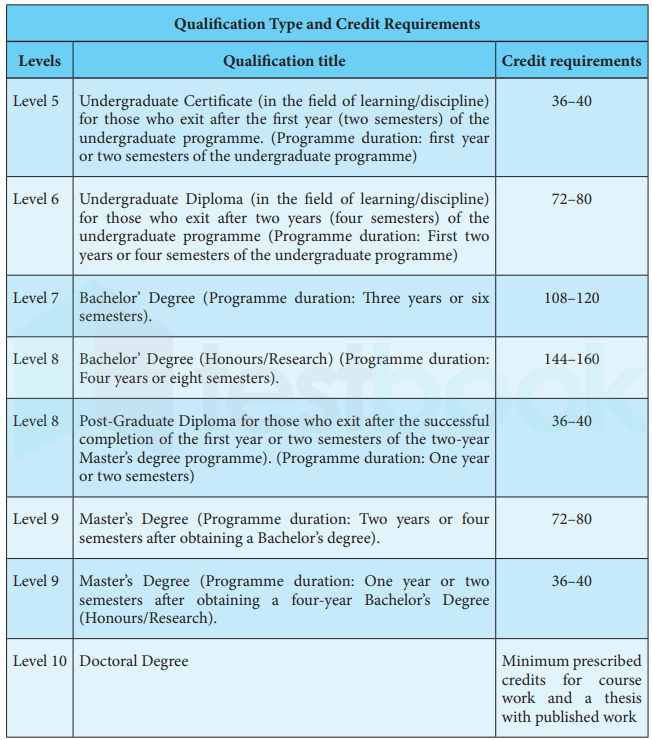
As per UGC guidelines (2021) for Multiple Entry and Exit in Academic programmes, the Academic Qualification Level 6 corresponds to

  1. ((a))

    B.A./B.Sc. (Hons/Research) degree

  2. ((b))

    Masters degree

  3. ((c))

    PG Diploma

  4. ((d))

    Diploma

Show Answer
Answer: ((d))

Diploma

The correct answer is Diploma.

Key Points

  • To enable multiple entry and exit points in the academic programs, qualifications such as certificates, diplomas, and degrees are organized in a series of levels in ascending order from level 5 to level 10. Level 5 represents a certificate and level 10 represents a research degree.
  • The four-year undergraduate program may comprise courses under many categories. Some of these include disciplinary/interdisciplinary major (40-56 credits), disciplinary/interdisciplinary minor (20-28 credits), vocational studies (12-18 credits),  field projects/internship/apprenticeship/community engagement, and service (24- 32 credits).
  • Entry 2. The entry requirement for Level 6 is a certificate obtained after completing the first year (two semesters) of the undergraduate program.
  • A program of study leading to the second year of the Bachelor’s degree is open to those who have met the entrance requirements, including specified levels of attainment, in the program admission regulations.
  • Admission to a program of study is based on the evaluation of documentary evidence (including the academic record) of the applicant’s ability to undertake and complete a Bachelor’s degree program.
  • Exit 2: At the end of the 2nd year, if a student exits, a diploma shall be awarded (Level 6). A diploma requires 72-80 credits from levels 5 to 6, with 36-40 credits at level 6.

Additional Information 

43

In ancient times some of the most prosperous civilizations, which were strong knowledge based societies, included

(A) India

(B) Egypt

(C) Japan

(D) Germany

(E) Greece

Choose the correct answer from the options given below:

  1. ((a))

    (A), (B), (C), (E) only

  2. ((b))

    (A), (B), (E) only

  3. ((c))

    (A), (C), (E) only

  4. ((d))

    (A), (B), (C), (D) only

Show Answer
Answer: ((b))

(A), (B), (E) only

The correct answer is (A), (B), (E) only.

Key Points

In ancient times some of the most prosperous civilizations, which were strong knowledge-based societies- 

  • The Greek civilization, which flourished from 1200 BCE to 323 BCE, is probably the most influential in the world. the Greeks were quite ahead of their times and other civilizations.
  • Their indelible contribution in the fields like language, typography, philosophy, architecture, history, science, astronomy, and art made this civilization not just influential but also respected.
  • The civilization can also be credited for the current system of music notations and for inventing the first Alphabet with vowels. The Greeks gave democracy to the world and used theatre as an art and communication medium. The Greek civilization nurtured philosophers and thinkers and promoted the arts and humanities.
  • One of the earliest and largest civilizations of the world, the Indus Valley Civilization flourished in the Bronze Age. This civilization was a developed one and already had drainage systems and planned cities. Quite developed in metallurgy and handicrafts, evidence also suggests that these people were already using standardized weights.
  • The Egyptian Civilization was culturally the richest civilization that ever existed. The civilization made great strides in quarrying, surveying, and architecture resulting in one of the most amazing masterpieces that man has ever seen the pyramids.
  • They also promoted scribes and thinkers which goes to show that it was an intellectually evolved civilization. They also practiced organized agriculture.
44

During British rule in India who among the following observed that: "The Indian Universities turn out only a discontented horde of office seekers, whom we educated for places which are not in existence for them to fill".

  1. ((a))

    Curzon

  2. ((b))

    Annie Besant

  3. ((c))

    Dalhousie

  4. ((d))

    Macauley

Show Answer
Answer: ((a))

Curzon

The correct answer is Curzon.

Key Points

  • The Indian Universities Act was announced in the year 1904 by Lord Curzon in an attempt to upgrade and take the Indian Education system to another level.
  • It started with a round table conference at Simla in September 1901 which was summoned by Lord Curzon.
  • All of India's educational ministers were called to this meeting. After a lot of discussions later, a commission was appointed on 27th January 1902 which was led by Sir Thomas Raleigh to inquire into the condition and prospects of universities in India.
  • The provisions of this act were: Universities were given the right to teach and the right to conduct examinations. Thus, the scope of universities increased.
  • Universities had the right to make provisions for the promotion of study and research, to appoint university professors and lecturers, to set up university laboratories and libraries, and to undertake instructions from students.
  • The Indian Universities Act made it clear that the number of students in a university should not be less than fifty or more than a hundred.
  • Until this moment, the number of seats in the Senate of the Universities was not fixed and the Government used to make life-long nominations. But when the act was introduced, the number of nominations was fixed. The minimum number was fifty and the maximum number was a hundred. Their term was determined for five years.
  • The Indian Universities Act introduced the principle of election in the constitution of the Senate. According to this Act, 20 members are to be elected in the Universities of Madras, Calcutta, and Bombay, and 15 members in other Universities.

Additional Information

  • Lord Curzon, in full George Nathaniel Curzon, Marquess Curzon, also called (1898–1911) Baron Curzon of Kedleston or (1911–21) Earl Curzon of Kedleston, (born January 11, 1859, Kedleston Hall, Derbyshire, England-died March 20, 1925, London), British statesman, viceroy of India (1898–1905), and foreign secretary (1919–24) who during his terms in the office played a major role in British policy-making.
  • Curzon is best known for his illustrious career as Viceroy of India (1899 to 1905), and his expertise in Asian affairs was an important influence on his time as Foreign Secretary.

Read the following passage and answer the questions:

In a very long historical perspective, political development has followed the same general pattern: the forms of political organisation employed by different groups of human beings have varied, and those forms that were more successful - meaning those that could generate greater military and economic power - displaced those that were less successful. At this high level of abstraction, it is hard to see how political development could have proceeded in any other way. What is more important, however, is to understand the ways political evolution differs from human evolution in three ways. First, in political evolution, the units of selection are rules and their embodiments as institutions, rather than genes of human evolution. Although human biology facilitates the formulation and following of rules, it does not determine their content, and that content can vary enormously. Rules are the basis for institutions that confer advantages on those societies employing them and are selected through the interaction of human agents over less advantageous ones. Second, in human societies, variation among institutions can be planned and deliberated, as opposed to random. Human beings can rarely plan for unintended consequences and missing information, but the fact that they can plan means that the variance in institutional forms they create is more likely to produce adaptive solutions than simple randomness. However, we can accept the argument that institutional evolution is not dependent on the ability of human beings to design successful institutions: random variation and the principle of selection by themselves can produce an adaptive evolutionary outcome. The third way political development differs from human evolution is that the selected characteristics institutions in one case, genes in the other - are transmitted culturally rather than genetically. This represents both an advantage and a disadvantage with respect to the adaptability of the system. Cultural traits, whether norms, customs, laws, beliefs or values, can at least in theory be altered on the fly within the space of a single generation, as in the spread of literacy among the Danish Peasantry in the sixteenth century.

45

Historically, the successful forms of political development were based on

  1. ((a))

    General patterns of human evolution

  2. ((b))

    Variations in political organisations

  3. ((c))

    Groups of people with aspirational goals

  4. ((d))

    Military and economic power

Show Answer
Answer: ((d))

Military and economic power

The correct answer is "Military and economic power".

Key Points

  • Let's refer to following statement from the passage:
  • In a very long historical perspective, political development has followed the same general pattern: the forms of political organisation employed by different groups of human beings have varied, and those forms that were more successful - meaning those that could generate greater military and economic power - displaced those that were less successful.
  • The highlighted part in the above excerpt clearly states that the successful forms of political development were based on military and economic power.

Therefore, the correct answer is option 4.

46

The foremost stage of political evolution contained

  1. ((a))

    Biological determination of norms

  2. ((b))

    Selection of political groups

  3. ((c))

    Institutionalisation of rules

  4. ((d))

    Understanding of political evolution

Show Answer
Answer: ((c))

Institutionalisation of rules

The correct answer is "Institutionalisation of rules".

Key Points

  • Let's refer to the given statement from the passage:
  • First, in political evolution, the units of selection are rules and their embodiments as institutions, rather than genes of human evolution.
  • From the above mentioned statement, it is clear that the foremost stage of political evolution is the institutionalisation of rules.

Therefore, option 3 is the correct answer.

47

The variance in planned political institutions features

  1. ((a))

    Simple randomness of selection

  2. ((b))

    Adaptive solutions

  3. ((c))

    Unintended consequences

  4. ((d))

    Absence of information

Show Answer
Answer: ((b))

Adaptive solutions

The correct answer is "Adaptive solutions".

Key Points

  • Let's consider the below-mentioned statements from the passage: 
  • Second, in human societies, variation among institutions can be planned and deliberated, as opposed to random.
  • Human beings can rarely plan for unintended consequences and missing information, but the fact that they can plan means that the variance in institutional forms they create is more likely to produce adaptive solutions than simple randomness.
  • The highlighted part of the above-mentioned statement clearly exemplifies that the variance in planned political institutions features adaptive solutions.

Therefore, the correct answer is option 2.

48

The transmission of select characteristics of political development is basically

  1. ((a))

    Cultural

  2. ((b))

    Biological

  3. ((c))

    Rhetorical

  4. ((d))

    Unsocial

Show Answer
Answer: ((a))

Cultural

The correct answer is "Cultural".

Key Points

  • Let's consider this statement from the passage:
  • The third way political development differs from human evolution is that the selected characteristics institutions in one case, genes in the other - are transmitted culturally rather than genetically.
  • Thus, it is evident from the abovementioned statement that the transmission of select characteristics of political development is basically cultural.

​Hence, the correct answer is option 1.

49

The inference to be drawn from the passage is that

  1. ((a))

    People design their political evolution.

  2. ((b))

    Political evolution is the replica of human evolution.

  3. ((c))

    Rule based institutions are indispensable to society.

  4. ((d))

    Cultural traits cannot be organismic to political evolution.

Show Answer
Answer: ((a))

People design their political evolution.

The correct answer is "People design their political evolution.".

Key Points

  • The passage talks about how political development has, for a very long time, followed the same general pattern.
  • Different human societies have used a variety of political organizational structures.
  • Political evolution diverges from human evolution in three ways: institutionalization, planned variance, and cultural traits.
  • These variations are employed by human beings.
  • Therefore, it can be inferred that people design their political evolution.

​Therefore, the correct answer is option 1.

Additional Information

  • Option 2 is incorrect because the whole passage deliberates upon how political evolution is different from human evolution.
  • Option 3 is incorrect because there are certain rule institutions that are indispensable to society.
  • Option 4 is incorrect because cultural traits form an essential part of political evolution. Let's consider the following statement from the passage:
  • ​The third way political development differs from human evolution is that the selected characteristics institutions in one case, genes in the other - are transmitted culturally rather than genetically. This represents both an advantage and a disadvantage with respect to the adaptability of the system.
50

Identify the organisations/bodies which regulate Professional Education in the country.

(A) Indian Council for Agriculture Research

(B) Council for Scientific and Industrial Research

(C) National Council for Vocational Education and Training

(D) National Council for Teacher Education

(E) Council of Architecture

Choose the correct answer from the options given below :

  1. ((a))

    (A), (C), (D), (E) only

  2. ((b))

    (A), (B), (C), (D) only

  3. ((c))

    (B), (C), (D), (E) only

  4. ((d))

    (A), (C), (D) only

Show Answer
Answer: ((a))

(A), (C), (D), (E) only

The correct answer is (A), (C), (D), (E) only.

Important Points

  • An educational process or program that develops individuals to acquire special competencies for professional practice. Learn more in Active Learning, Deliberate Practice, and Educational Technology in Professional Education: Practices and Implications.
  • Professional education is formal specialized training about a particular profession in which learners are taught the central concepts, principles, and techniques, and how these are applied in real practice, and the learners also acquire the necessary competencies needed for proper practice and behavior.

Key Points

  • Professional development is learning to earn or maintain professional credentials such as academic degrees to formal coursework, attending conferences, and informal learning opportunities situated in practice. It has been described as intensive and collaborative, ideally incorporating an evaluative stage.
  • Professional councils are responsible for the recognition of courses, the promotion of professional institutions, and providing grants to undergraduate programs and various awards.
  • The statutory professional councils are the
  • All India Council of Technical Education (AICTE),
  • National Council for Vocational Education and Training,
  • Medical Council of India (MCI),
  • Indian Council for Agricultural Research (ICAR),
  • National Council for Teacher Education (NCTE)
  • Dental Council of India (DCI).
  • Other professional institutes are the Pharmacy Council of India (PCI), Indian Nursing Council (INC), Bar Council of India (BCI), Central Council of Homeopathy (CCH), Central Council for Indian Medicine (CCIM), Council of Architecture, Rehabilitation Council, National Council for Rural Institutes (NCRI), State Councils of Higher Education (SCHE).

Attempt this paper under real exam conditions

Timed interface, section switching, instant scoring, and question-by-question analytics — free.

Start Timed Attempt