Official Paper

UGC NET Official Paper 1: Held On - 4th Sept 2024 Shift 2 (Previous Year Paper)

50 questions · 60 minutes · with answers · free

Paper 1 (50 questions)

The following Table - I shows the sales (in Rs. crore) of Ice - cream in India during the six years from 2018 to 2023 and Table - II shows the percentage market share of various companies in the sale of Ice - cream in the year 2020. Based on the data in the tables, answer the questions that follow.

Table - I: Year - wise Sale Details of Ice - Cream (in Rs. crore).

YearIce - Cream Sale (in Rs. Crore)
20187500
20198200
20208500
20218000
20228500
20239500


Table - II: Company - wise Percentage Market share in the Ice - Cream Sale in 2020

CompanyAmulWadilalBaskin RobbinsWarnaKwalityOthers
Percent Share28%13%10%6%35%8%
1

If the percentage market share of companies remains the same in 2021 as that in 2020, then what is the increase/decrease in the turnover of Amul from 2020 to 2021 ?

  1. ((a))

    Rs. 175 crore increase

  2. ((b))

    Rs. 140 crore decrease

  3. ((c))

    Rs. 175 crore decrease

  4. ((d))

    Rs. 140 crore increase

Show Answer
Answer: ((b))

Rs. 140 crore decrease

Given:

Total Ice Cream Sale in 2020 = 8500 crore

Total Ice Cream Sale in 2021 = 8000 crore

Amul's Market Share = 28%

Formula used:

Amul's turnover = Total Ice Cream Sale × Market Share (%) / 100

Change in turnover = Turnover in 2021 - Turnover in 2020

Calculations:

Amul's turnover in 2020 = 8500 × 28 / 100

⇒ Amul's turnover in 2020 = 2380 crore

Amul's turnover in 2021 = 8000 × 28 / 100

⇒ Amul's turnover in 2021 = 2240 crore

Change in turnover = 2240 - 2380

⇒ Change in turnover = -140 crore

∴ The decrease in Amul's turnover from 2020 to 2021 is 140 crore.

2

What is the difference between the sales of Amul and Warna in 2020? (in Rs. crore)

  1. ((a))

    1804

  2. ((b))

    2380

  3. ((c))

    1870

  4. ((d))

    1760

Show Answer
Answer: ((c))

1870

Given:

Total Ice Cream Sale in 2020 = 8500 crore

Amul's Market Share = 28%

Warna's Market Share = 6%

Formula used:

Company's turnover = Total Ice Cream Sale × Market Share (%) / 100

Difference = Turnover of Amul - Turnover of Warna

Calculations:

Amul's turnover in 2020 = 8500 × 28 / 100

⇒ Amul's turnover = 2380 crore

Warna's turnover in 2020 = 8500 × 6 / 100

⇒ Warna's turnover = 510 crore

Difference = 2380 - 510

⇒ Difference = 1870 crore

∴ The difference between the sales of Amul and Warna in 2020 is 1870 crore.

3

The market share of companies in 2023 is same as in 2020. In 2024, the ice - cream sale increases by 10% but the market share of Amul falls to 23 %. What is the percentage change in the turnover of Amul from 2023 to 2024 ?

  1. ((a))

    9.64% increase

  2. ((b))

    9.64 % decrease

  3. ((c))

    17.86 % increase

  4. ((d))

    17.86 % decrease

Show Answer
Answer: ((b))

9.64 % decrease

Given:

Total Ice Cream Sale in 2023 = 9500 crore

Amul's Market Share in 2023 = 28%

Total Ice Cream Sale in 2024 = 9500 + (9500 × 10 / 100)

Amul's Market Share in 2024 = 23%

Formula used:

Company's turnover = Total Ice Cream Sale × Market Share (%) / 100

Percentage change in turnover = ((Turnover in 2024 - Turnover in 2023) / Turnover in 2023) × 100

Calculations:

Total Ice Cream Sale in 2024 = 9500 + (9500 × 10 / 100)

⇒ Total Ice Cream Sale in 2024 = 9500 + 950

⇒ Total Ice Cream Sale in 2024 = 10450 crore

Amul's turnover in 2023 = 9500 × 28 / 100

⇒ Amul's turnover in 2023 = 2660 crore

Amul's turnover in 2024 = 10450 × 23 / 100

⇒ Amul's turnover in 2024 = 2403.5 crore

Percentage change in turnover = ((2403.5 - 2660) / 2660) × 100

⇒ Percentage change in turnover = (-256.5 / 2660) × 100

⇒ Percentage change in turnover = -9.64%

∴ The percentage change in the turnover of Amul from 2023 to 2024 is -9.64%. i.e Decrease 9.64%.

4

What is the average annual rate of increase in the Ice - Cream sale in 2023 in comparison to the year 2018 ?

  1. ((a))

    5.33 %

  2. ((b))

    26.67 %

  3. ((c))

    6.67 %

  4. ((d))

    10 %

Show Answer
Answer: ((a))

5.33 %

Given:

Ice Cream Sale in 2018 = 7500 crore

Ice Cream Sale in 2023 = 9500 crore

Number of years = 2023 - 2018 = 5 years

Formula used:

Average annual rate of increase = ((Final Value - Initial Value) / (Initial Value × Number of Years)) × 100

Calculations:

Average annual rate of increase = ((9500 - 7500) / (7500 × 5)) × 100

⇒ Average annual rate of increase = (2000 / 37500) × 100

⇒ Average annual rate of increase = 5.33%

∴ The average annual rate of increase in the Ice Cream sale from 2018 to 2023 is 5.33%.

5

If the sale of Wadilal increases by 38 % from 2020 to 2023, and the percent sale of other companies accordingly stands reduced then what would be the market share of Wadilal in 2023?

  1. ((a))

    17.5 %

  2. ((b))

    18 %

  3. ((c))

    16.94 %

  4. ((d))

    16.05 %

Show Answer
Answer: ((d))

16.05 %

Given:

Total Ice-Cream sales in 2020 = ₹8500 crore

Wadilal's market share in 2020 = 13%

Increase in Wadilal’s sales from 2020 to 2023 = 38%

Total Ice-Cream sales in 2023 = ₹9500 crore

Formula used:

Wadilal’s sales in 2020 = Total Sales × Market Share in 2020

Wadilal’s sales in 2023 = Wadilal’s sales in 2020 × (1 + Increase Percentage)

Market share of Wadilal in 2023 = (Wadilal's sales in 2023 / Total Ice-Cream Sales in 2023) × 100

Calculation:

Wadilal's sales in 2020 = 8500 × (13 / 100)

⇒ Wadilal's sales in 2020 = 1105 crore

Wadilal's sales in 2023 = 1105 × (1 + 38 / 100)

⇒ Wadilal's sales in 2023 = 1105 × 1.38

⇒ Wadilal's sales in 2023 = 1524.9 crore

Market share of Wadilal in 2023 = (1524.9 / 9500) × 100

⇒ Market share of Wadilal in 2023 ≈ 16.05%

∴ The market share of Wadilal in 2023 would be approximately 16.05%.

6

Which of the following propositions is contrary to the proposition. "All cows are herbivores"?

  1. ((a))

    All herbivores are cows.

  2. ((b))

    Some cows are herbivores.

  3. ((c))

    Some cows are not herbivores.

  4. ((d))

    No cows are herbivores.

Show Answer
Answer: ((d))

No cows are herbivores.

The correct answer is 'No cows are herbivores.'

Key Points

  • Contrary Propositions:
  • In logic, a proposition is contrary to another if it directly opposes it. For the statement "All cows are herbivores," the contrary proposition would be one that completely denies the original statement.
  • The statement "No cows are herbivores" directly contradicts "All cows are herbivores," making it the correct answer as a contrary proposition.
  • This proposition asserts that none of the cows are herbivores, which is the exact opposite of saying all cows are herbivores.

Additional Information

  • Other Options Explained:
  • All herbivores are cows: This statement does not oppose the original proposition; instead, it suggests a different relationship. It implies that only cows are herbivores, which is not contrary to the original statement.
  • Some cows are herbivores: This is a sub-altern proposition and not contrary. It suggests that at least some cows are herbivores, which is consistent with the idea that all cows are herbivores.
  • Some cows are not herbivores: This is a contradictory proposition, meaning it directly denies the universality of the original statement. However, it does not completely deny the proposition as a whole, unlike the correct answer.
7

The period of time when a communication network becomes inoperative, is referred to as:

  1. ((a))

    Time fit

  2. ((b))

    Uptime

  3. ((c))

    Downtime

  4. ((d))

    Loadtime

Show Answer
Answer: ((c))

Downtime

The correct answer is 'Downtime'

Key Points

  • Downtime:
  • Downtime refers to the period when a system, network, or machine is not operational or cannot perform its primary function.
  • In the context of a communication network, downtime indicates that the network is inoperative, and communication services are unavailable to users.
  • Downtime can occur due to maintenance, upgrades, hardware failures, software issues, or unforeseen events such as power outages.

Additional Information

  • Time fit:
  • Time fit is not a standard term used in network operations or IT. It may be confused with terms related to scheduling or fitting activities within a timeframe.
  • It does not relate to the period when a communication network is inoperative.
  • Uptime:
  • Uptime refers to the period when a system, network, or machine is operational and performing its intended functions.
  • High uptime is desirable as it indicates reliability and availability of services.
  • This term is the opposite of downtime.
  • Loadtime:
  • Loadtime refers to the time taken for a system, application, or webpage to load and become ready for use.
  • It is commonly used in the context of web performance to measure how quickly a page loads.
  • It is not related to the operability of a communication network.
8

Arrange the steps of the cycle of self regulated learning in logical order?

(A) Setting goals

(B) Regulating learning

(C) Enacting Tactics and Strategies

(D) Analysing the task

(E) Devising plans

Choose the correct answer from the options given below:

  1. ((a))

    (E), (D), (B), (A), (C)

  2. ((b))

    (B), (C), (E), (D), (A)

  3. ((c))

    (D), (A), (E), (C), (B) 

  4. ((d))

    (A), (E), (C), (B), (D)

Show Answer
Answer: ((c))

(D), (A), (E), (C), (B) 

The correct answer is 'Analyzing the task, Setting goals, Devising plans, Enacting Tactics and Strategies, Regulating learning'

Key Points

  • Cycle of Self-Regulated Learning:
  • Self-regulated learning refers to the process where individuals take control of their own learning, by setting goals, monitoring progress, and adjusting strategies as needed.
  • This cycle is crucial for effective learning and involves several key steps that need to be followed in a logical order.
  • Steps in Logical Order:
  • Analyzing the task: The first step involves understanding and breaking down the task at hand. It includes identifying what needs to be learned or accomplished.
  • Setting goals: Once the task is understood, specific and achievable goals are set. These goals provide direction and purpose for the learning process.
  • Devising plans: After setting goals, the next step is to devise a detailed plan on how to achieve these goals. This includes selecting appropriate strategies and resources.
  • Enacting Tactics and Strategies: This step involves implementing the plans and applying the chosen strategies to work towards the goals.
  • Regulating learning: The final step is to monitor and regulate the learning process. This includes self-assessment, reflection, and making necessary adjustments to strategies and plans.

Additional Information

  • Explanation of Other Options:
  • Option 1 (E), (D), (B), (A), (C): This option incorrectly suggests devising plans before analyzing the task, and regulating learning before setting goals and enacting strategies, which disrupts the logical flow of the learning cycle.
  • Option 2 (B), (C), (E), (D), (A): This option starts with regulating learning and enacting strategies, which should logically come after setting goals and devising plans, making the sequence incorrect.
  • Option 4 (A), (E), (C), (B), (D): This option places setting goals at the beginning but incorrectly positions analyzing the task at the end, disrupting the logical order of the learning cycle.
9

Identify the non - parametric tests used in statistical analysis.

(A) Chi - square test

(B) U - test

(C) H - test

(D) t - test

Choose the correct answer from the options given below:

  1. ((a))

    (A) and (B) Only

  2. ((b))

    (A), (B) and (C) Only

  3. ((c))

    (C) and (D) Only 

  4. ((d))

    (A) and (D) Only

Show Answer
Answer: ((b))

(A), (B) and (C) Only

The correct answer is '(A), (B) and (C) Only'.

Note: We have modified the options to make this a correct question.

Key Points

  • The Chi-square test (A) is used to examine the association between categorical variables.
  • The Chi-square test does not require assumptions about the distribution of the data, making it a non-parametric test.
  • The U-test (B), also known as the Mann-Whitney U test, is used to compare differences between two independent groups.
  • The Mann-Whitney U test is a non-parametric test, meaning it does not assume that the data follows a normal distribution.
  • The H-test (C), also known as the Kruskal-Wallis H test, is used for comparing more than two independent groups.
  • The Kruskal-Wallis H test is a non-parametric test and does not require the assumption of normal distribution.
  • The t-test (D) is used to compare the means of two groups and assumes the data is normally distributed.
  • The t-test is a parametric test, and it requires the assumption that the distribution of the data is normal.
10

Find the next term in the series.....

2Z5, 7Y7, 14X9, 23W11, 34V13, (?)

  1. ((a))

    27U24

  2. ((b))

    45U15

  3. ((c))

    47U15

  4. ((d))

    47U14

Show Answer
Answer: ((c))

47U15

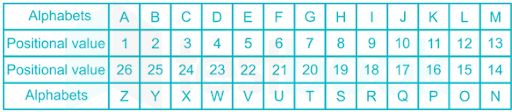
The following table consists of English alphabets and their positional values: 

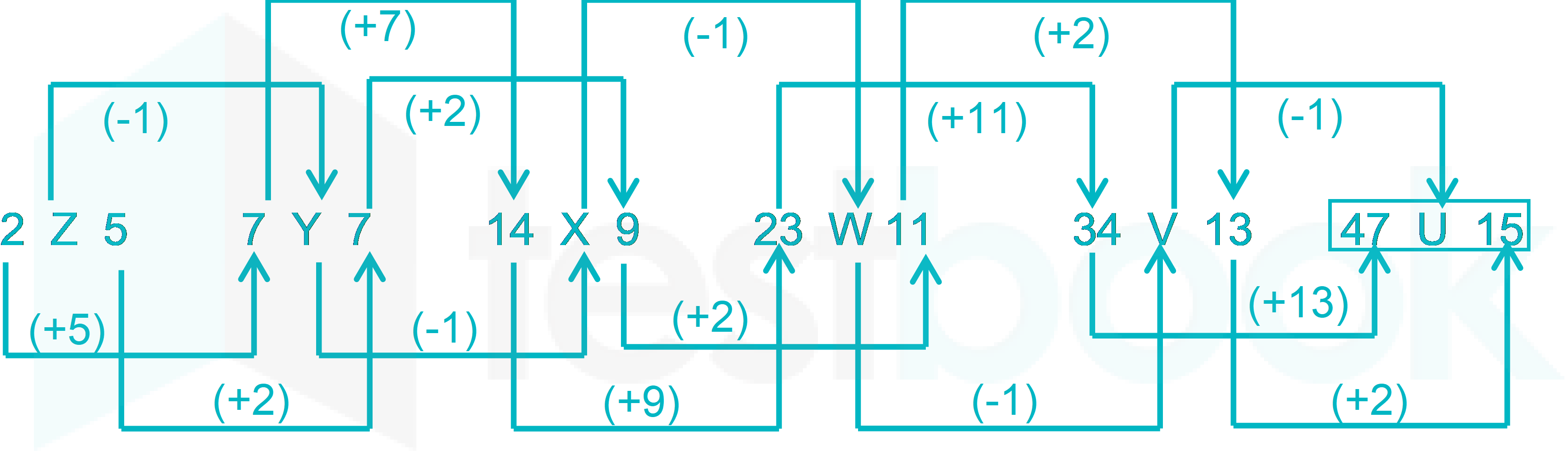
The pattern followed here is:

So, "47U15" will come in place of ?

Hence, option 3 is the correct answer.

11

Identify the continuous variables.

(A) Number of tails obtained in hundred tosses of a coin

(B) Weight of students in a school

(C) Marks scored by students in an objective type examination

(D) Height of plants in an agricultural field

Choose the correct answer from the options given below:

  1. ((a))

    (A) and (B) Only

  2. ((b))

    (C) and (D) Only

  3. ((c))

    (A) and (C) Only 

  4. ((d))

    (B) and (D) Only

Show Answer
Answer: ((d))

(B) and (D) Only

The correct answer is '(B) and (D) Only'

Key Points

  • Continuous Variables:
  • Continuous variables are variables that can take any value within a given range. They are not restricted to defined separate values but can occupy any value over a continuous range.
  • Examples include height, weight, temperature, and time. These variables can be measured to any level of precision and often require the use of instruments for measurement.
  • Weight of students in a school (B):
  • Weight is a continuous variable because it can take any value within a range. For example, a student's weight can be 45.5 kg, 45.55 kg, or 45.555 kg, and so on.
  • Height of plants in an agricultural field (D):
  • Height is also a continuous variable as it can take any value within a range. For instance, the height of a plant can be 150.2 cm, 150.25 cm, or 150.255 cm, and so forth.

Additional Information

  • Number of tails obtained in hundred tosses of a coin (A):
  • This is a discrete variable because it can only take specific values (0, 1, 2, ..., 100). It counts the number of occurrences and is not continuous.
  • Marks scored by students in an objective type examination (C):
  • This is also a discrete variable because marks are typically whole numbers (e.g., 0, 1, 2, ..., 100) and cannot take fractional values in most examination systems.
12

In a biology class, a teacher wants to conduct a formative assessment to gauge students understanding of cell structure and function. Which of the following tools would be most effective for creating interactive quizzes with immediate feedback?

(A) Google forms

(B) Adobe Illustrator

(C) Kahoot

(D) Audacity

(E) Camtasia

Choose the correct answer from the options given below:

  1. ((a))

    (B), (C) and (E) Only

  2. ((b))

    (A), (C), (D) and (E) Only

  3. ((c))

    (A) and (C) Only

  4. ((d))

    (B), (D) and (E) Only

Show Answer
Answer: ((c))

(A) and (C) Only

The correct answer is '(A) and (C) Only'

Key Points

  • Interactive quizzes with immediate feedback:
  • Interactive quizzes are an effective tool for formative assessment, allowing teachers to gauge student understanding in real-time.
  • Immediate feedback helps students recognize their mistakes and understand the correct answers promptly, aiding in better learning and retention.
  • Google Forms:
  • Google Forms is a versatile tool that allows teachers to create quizzes with multiple question types, including multiple choice, short answer, and dropdown.
  • It provides the option to give immediate feedback for each question, which can help students understand their mistakes right away.
  • Google Forms integrates well with Google Classroom, making it easy for teachers to distribute quizzes and collect responses.
  • Kahoot:
  • Kahoot is an interactive game-based learning platform that engages students through quizzes, discussions, and surveys.
  • It provides immediate feedback and allows for live participation, making it an excellent tool for formative assessments in a classroom setting.
  • The competitive and fun nature of Kahoot can increase student engagement and motivation.

Additional Information

  • Adobe Illustrator:
  • Adobe Illustrator is a graphic design tool primarily used for creating vector graphics, logos, and illustrations.It is not suitable for creating interactive quizzes or providing immediate feedback in an educational setting.
  • Audacity:
  • Audacity is an open-source audio editing software used for recording and editing audio files.
  • While useful for creating audio content, it does not support interactive quizzes or immediate feedback mechanisms.
  • Camtasia:
  • Camtasia is a screen recording and video editing software used to create video tutorials and presentations.
  • Though it can be used to create educational videos, it does not offer interactive quiz functionalities or immediate feedback options.
13

Match List - I with List - II.

List - I
(Computer Terms)
List - II
(Purpose)
(A)Motherboard(I)Stores the date, time and system configuration for BIOS
(B)BIOS(II)Allows processor and other hardware to function and communicate with each other
(C)CMOS(III)Transfer the contents of web pages into a web browser for viewing
(D)HTTP(IV)Initializes and tests the system hardware components and loads an OS when a computer is turned on


Choose the correct answer from the options given below:

  1. ((a))

    (A) - (II), (B) - (I), (C) - (IV), (D) - (III)

  2. ((b))

    (A) - (III), (B) - (IV), (C) - (I), (D) - (II)

  3. ((c))

    (A) - (II), (B) - (IV), (C) - (I), (D) - (III)

  4. ((d))

    (A) - (IV), (B) - (III), (C) - (II), (D) - (I)

Show Answer
Answer: ((c))

(A) - (II), (B) - (IV), (C) - (I), (D) - (III)

The correct answer is (A) - (II), (B) - (IV), (C) - (I), (D) - (III)

Key Points

  • Computer Terms and Their Purposes:
  • Motherboard (II): The motherboard is the main circuit board of a computer that allows the processor and other hardware components to communicate and function together. It houses the CPU, memory, and essential connectors for other peripherals.
  • BIOS (IV): The Basic Input/Output System (BIOS) initializes and tests the system hardware components during the startup process and loads the operating system when a computer is turned on. It is a critical firmware that ensures the boot process runs smoothly.
  • CMOS (I): The CMOS (Complementary Metal-Oxide-Semiconductor) stores important system information such as the date, time, and system configuration settings for the BIOS. It is powered by a small battery to retain settings even when the computer is turned off.
  • HTTP (III): HyperText Transfer Protocol (HTTP) is used for transferring the contents of web pages into a web browser for viewing. It is the foundation of data communication for the World Wide Web.

Additional Information

  • Other Options Explanation:
  • Option 1: Incorrect because it mismatches the roles; for example, CMOS (C) is incorrectly paired with (IV) which is the purpose of BIOS (B).
  • Option 2: Incorrect because it incorrectly assigns the purposes; for example, Motherboard (A) is paired with (III), which is the purpose of HTTP (D).
  • Option 4: Incorrect because it misassigns the functions; for example, BIOS (B) is paired with (III), which is related to HTTP (D).
14

When the content that we have previously learned interferes with the recall of something newly learned then the interference is:

  1. ((a))

    Retroactive Inhibition

  2. ((b))

    Proactive Inhibition

  3. ((c))

    Attention Inhibition

  4. ((d))

    Response Inhibition

Show Answer
Answer: ((b))

Proactive Inhibition

The correct answer is 'Proactive Inhibition'

Key Points

  • Proactive Inhibition:
  • Proactive inhibition occurs when previously learned information interferes with the ability to learn and recall new information.
  • This type of interference happens because old memories disrupt the formation of new ones.
  • For example, if you have learned to drive a manual car and then try to learn to drive an automatic car, the habits from driving the manual car might interfere with learning to drive the automatic car.

Additional Information

  • Retroactive Inhibition:
  • Retroactive inhibition is the opposite of proactive inhibition. It occurs when new information interferes with the recall of previously learned information.
  • An example is learning a new phone number, which might make it harder to remember an old phone number.
  • Attention Inhibition:
  • Attention inhibition refers to the ability to tune out irrelevant stimuli or information to focus on the task at hand.
  • It plays a crucial role in attention control and cognitive processes.
  • Response Inhibition:
  • Response inhibition is the ability to suppress inappropriate or unwanted behaviors or responses.
  • This is an essential executive function that helps in self-control and impulse management.
15

Three successive discounts of 15%, 20% and 40% on the marked price of an item are equivalent to a single discount of:

  1. ((a))

    75 %

  2. ((b))

    40.8 %

  3. ((c))

    59.2 %

  4. ((d))

    67.5 %

Show Answer
Answer: ((c))

59.2 %

Given:

Successive discounts = 15%, 20%, 40%

Formula used:

Equivalent single discount = 100 - [(100 - Discount 1) × (100 - Discount 2) × (100 - Discount 3) / 10000]

Calculations:

Equivalent single discount = 100 - [(100 - 15) × (100 - 20) × (100 - 40) / 10000]

⇒ Equivalent single discount = 100 - [85 × 80 × 60 / 10000]

⇒ Equivalent single discount = 100 - [408000 / 10000]

⇒ Equivalent single discount = 100 - 40.8

⇒ Equivalent single discount = 59.2%

∴ The equivalent single discount is 59.2%.

16

If (L)M represents a number L in base - M number system, then which of the following numbers are equivalent to (19)16?

(A) (11001)2

(B) (201)3

(C) (121)4

(D) (101)5

(E) (25)10

Choose the correct answer from the options given below :

  1. ((a))

    (A), (C) and (E) Only

  2. ((b))

    (B) and (D) Only

  3. ((c))

    (A), (B) and (D) Only

  4. ((d))

    (A), (B), (C), (D) and (E)

Show Answer
Answer: ((a))

(A), (C) and (E) Only

The correct answer is '(A), (C) and (E) Only'

Key Points

  • Understanding Base Conversion:
  • Base conversion involves changing a number from one base system to another. A number in base M means it is expressed using digits from 0 to M-1.
  • The number (19)16 represents 19 in decimal (base 10) since 16 is the base.
  • We need to convert 19 from decimal to the other given bases to check equivalence.
  • First, convert (19)16 to decimal:

In base 16 (hexadecimal), each place value is a power of 16 

(19)16  = 1 * 161 + 9 * 160

= 1 * 16 + 9 * 1

= 16 + 9 = 25

  • Now let's convert each option to decimal and check if it equals 25:
  • A) (11001)2 = 1* 24+ 1* 23 + 022+ 021 + 1*20

= 16 + 8 + 0 + 0 + 1

= 25

  • B) (201)3= 2* 32 + 0* 31 + 130 = 29 + 03 + 11

= 18 + 0 + 1

= 19

  • C) (121)4 = 142 + 241 + 140 = 116 + 24 + 11

= 16 + 8 + 1

= 25

  • D) (101)5= 152 + 051+ 150= 125 + 05 + 11

= 25 + 0 + 1

= 26

  • E) (25)10 = 25

Additional Information

  • Base Conversion Process:
  • To convert from decimal to another base, repeatedly divide the number by the base and record the remainders. The remainders, read in reverse order, give the number in the new base.
  • Example for base 2: 19 / 2 = 9 remainder 1, 9 / 2 = 4 remainder 1, 4 / 2 = 2 remainder 0, 2 / 2 = 1 remainder 0, 1 / 2 = 0 remainder 1. Reading the remainders in reverse gives 11001.
17

Which of the following represents the epistemological orientation of qualitative research?

  1. ((a))

    Deductivism

  2. ((b))

    Positivism

  3. ((c))

    Objectivism 

  4. ((d))

    Interpretivism

Show Answer
Answer: ((d))

Interpretivism

The correct answer is 'Interpretivism.'

Key Points

  • Interpretivism:
  • Interpretivism is an epistemological orientation that emphasizes understanding the subjective meaning of social phenomena.
  • It focuses on the ways in which individuals interpret and make sense of their social world.
  • Researchers using this approach often engage in qualitative methods such as interviews, focus groups, and participant observation.
  • Interpretivism aims to explore the depth, complexity, and richness of human experiences and social contexts.

Additional Information

  • Deductivism:
  • Deductivism is a logical process in which conclusions are drawn from general principles or premises.
  • It is primarily associated with quantitative research rather than qualitative research.
  • In deductivism, hypotheses are tested through empirical observation and experimentation.
  • Positivism:
  • Positivism is an epistemological stance that relies on observable, measurable facts to form knowledge.
  • It emphasizes objectivity and the use of scientific methods in research.
  • Qualitative research, which focuses on subjective experiences, is not typically aligned with positivist principles.
  • Objectivism:
  • Objectivism in epistemology refers to the belief that knowledge is based on objective reality and facts.
  • It often aligns with quantitative research methods that seek to eliminate researcher bias and subjectivity.
  • Qualitative research, in contrast, acknowledges and explores the influence of researcher perspectives and interpretations.
18

Which of the following are biogas?

(A) Marsh Gas

(B) Swamp Gas

(C) Producer Gas

(D) Compost Gas

(E) Flue Gas

Choose the correct answer from the options given below:

  1. ((a))

    (A), (B) and (D) Only

  2. ((b))

    (B), (C) and (E) Only

  3. ((c))

    (A), (C) and (E) Only

  4. ((d))

    (C), (D) and (E) Only

Show Answer
Answer: ((a))

(A), (B) and (D) Only

The correct answer is 'Marsh Gas, Swamp Gas, and Compost Gas'

Key Points

  • Biogas:
  • Biogas is a type of biofuel that is naturally produced from the decomposition of organic waste. When organic matter, such as food scraps and animal waste, breaks down in an anaerobic environment (an environment absent of oxygen), it releases a blend of gases, primarily methane and carbon dioxide.
  • Common sources of biogas include animal manure, municipal waste, plant material, sewage, green waste, and food waste.
  • Biogas can be used for various applications, such as generating electricity, heating, or as a fuel for vehicles.
  • Marsh Gas:
  • Marsh gas, predominantly methane, is produced in wetlands through the anaerobic decomposition of plant material by microorganisms.
  • It is considered a type of biogas as it is generated from organic materials in the absence of oxygen.
  • Swamp Gas:
  • Similar to marsh gas, swamp gas mainly consists of methane and is produced in swamps and wetlands through the anaerobic digestion of organic matter.
  • It is also classified as biogas for the same reasons as marsh gas.
  • Compost Gas:
  • Compost gas is generated from the anaerobic decomposition of organic waste materials in compost heaps.
  • This gas is rich in methane and is thus considered biogas.

Additional Information

  • Producer Gas:
  • Producer gas is a mixture of carbon monoxide, hydrogen, and nitrogen generated by the gasification of carbonaceous materials, such as coal or biomass, in a controlled environment.
  • It is not classified as biogas because it is produced through a different process involving partial combustion rather than anaerobic digestion.
  • Flue Gas:
  • Flue gas is the gas that exits to the atmosphere via a flue, which is a pipe or channel for conveying exhaust gases from a furnace, fireplace, boiler, or steam generator.
  • It is composed mainly of nitrogen, carbon dioxide, water vapor, and excess oxygen. It is not biogas as it results from the combustion of fuels rather than anaerobic decomposition.
19

In many studies that span a long period of time, participants in the study may leave. This constitutes which of the following threats to internal validity?

  1. ((a))

    Testing

  2. ((b))

    Instrumentation

  3. ((c))

    Mortality

  4. ((d))

    Maturation

Show Answer
Answer: ((c))

Mortality

The correct answer is 'Mortality'

Key Points

  • Mortality:
  • In research studies, especially longitudinal studies that span a long period of time, participants may drop out of the study. This phenomenon is referred to as "mortality" or "attrition".
  • Mortality can threaten the internal validity of a study because the loss of participants can lead to biased results, particularly if the dropouts differ significantly from those who remain in the study.
  • Researchers need to account for this potential threat by using strategies such as follow-up with participants, using statistical methods to handle missing data, or designing the study in such a way that minimizes dropout.

Additional Information

  • Testing:
  • Testing effects refer to changes in participants' performance due to repeated testing rather than the experimental manipulation itself. This can be a threat to internal validity if it influences the study outcomes.
  • Instrumentation:
  • Instrumentation refers to changes in the measurement tools or procedures over time. For example, if different tools are used to measure outcomes at different points in time, it can introduce bias and affect internal validity.
  • Maturation:
  • Maturation refers to the natural changes that occur in participants over time, such as aging or gaining experience, which can affect the outcomes of a study independent of the experimental treatment.
20

Which of the following come under the category of stand-alone professional universities?

(A) Universities of Journalism

(B) Law Universities

(C) Health Science Universities

(D) Technical Universities

(E) Homeopathy Universities

Choose the correct answer from the options given below:

  1. ((a))

    (A), (B), (C) Only

  2. ((b))

    (A), (B), (D) Only

  3. ((c))

    (C), (D), (E) Only

  4. ((d))

    (B), (C), (D) Only

Show Answer
Answer: ((d))

(B), (C), (D) Only

The correct answer is '(B), (C), (D) Only'.

Key Points

  • Stand-alone professional universities:
  • These universities are specialized institutions that focus on specific professional fields of study.
  • They are independent and not part of broader university systems, concentrating solely on their professional discipline.
  • Examples include Law Universities, Health Science Universities, and Technical Universities, which provide focused education and training in their respective domains.

Additional Information

  • Universities of Journalism:
  • While they provide specialized education in the field of journalism, they are not typically classified as stand-alone professional universities in the same sense as those focused on law, health sciences, or technical education.
  • They often exist as part of larger institutions or as dedicated schools within broader university systems.
  • Homeopathy Universities:
  • These universities specialize in homeopathy and related health sciences but are often smaller and less commonly recognized as stand-alone professional universities compared to broader health science institutions.
  • They focus on a niche area within health sciences, and their classification can vary based on regional education systems and recognition.
21

Identify the correct order of the following information about a research article, according to the APA style of writing journal article references.

(A) Volume number

(B) Year of publication

(C) DOI

(D) Title of article

(E) Name of journal

Choose the correct answer from the options given below:

  1. ((a))

    (C), (D), (B), (A), (E)

  2. ((b))

    (B), (D), (E), (A), (C) 

  3. ((c))

    (D), (E), (A), (B), (C) 

  4. ((d))

    (D), (E), (C), (A), (B)

Show Answer
Answer: ((b))

(B), (D), (E), (A), (C) 

The correct answer is '(B), (D), (E), (A), (C)'

Key Points

  • APA Style of Writing Research Paper References in a Journal:
  • APA (American Psychological Association) style is commonly used for citing sources in psychology, education, and other social sciences.
  • In the context of journal references, APA style has a specific format that must be followed to ensure clarity and consistency.
  • APA Style Journal Article Reference Order:
  • Year of publication (B): The year is placed in parentheses immediately after the author's name(s).
  • Title of article (D): The title of the article follows the year of publication. Only the first word of the title, the first word after a colon or dash, and proper nouns are capitalized.
  • Name of journal (E): The journal name is italicized and in title case (all major words capitalized).
  • Volume number (A): The volume number follows the journal name, italicized as well.
  • DOI (C): The Digital Object Identifier (DOI) is placed at the end of the reference, providing a permanent link to the article.
  • For example: Smith, J. A., & Doe, R. B. (2020). The impact of social media on communication. Journal of Communication Studies, 34(2), 123-145. https://doi.org/10.1007/s12345-020-00123-4
22

Which one of the following is an example of natural climate forcing? 

  1. ((a))

    Green House Gases

  2. ((b))

    Volcanic erruptions

  3. ((c))

    Land use changes

  4. ((d))

    Tropospheric aerosols

Show Answer
Answer: ((b))

Volcanic erruptions

The correct answer is 'Volcanic eruptions'

Key Points

  • Volcanic eruptions:
  • Volcanic eruptions are a natural climate forcing factor because they can inject large quantities of ash and sulfur dioxide (SO2) into the atmosphere, which can lead to temporary cooling of the Earth's surface.
  • The sulfur dioxide converts into sulfate aerosols, which reflect sunlight away from the Earth, leading to a cooling effect. This can last for months to a few years, depending on the scale of the eruption.
  • Examples include the eruption of Mount Pinatubo in 1991, which led to a significant but temporary decrease in global temperatures.

Additional Information

  • Greenhouse gases:
  • Greenhouse gases such as carbon dioxide (CO2), methane (CH4), and nitrous oxide (N2O) are primarily associated with human activities like burning fossil fuels, deforestation, and agriculture.
  • While they are significant drivers of climate change, they are not considered natural climate forcing factors because their current concentrations are largely influenced by anthropogenic activities.
  • Land use changes:
  • Land use changes, including deforestation, urbanization, and agriculture, significantly impact the climate by altering the Earth's surface and its ability to absorb or reflect sunlight.
  • These changes are largely driven by human activities and are not considered natural climate forcing factors.
  • Tropospheric aerosols:
  • Tropospheric aerosols, which include dust, soot, and other particulate matter, can influence the climate by scattering and absorbing sunlight and by affecting cloud formation.
  • While some aerosols are of natural origin (e.g., sea salt, volcanic ash), many are produced by human activities such as industrial processes and combustion of fossil fuels, making them not purely natural climate forcing factors.
23

In Kyoto protocol, how much target was fixed for the reduction of concentration of Green House Gases (GHGs) below 1990 level, during first commitment period 2008 - 12 by state parties?

  1. ((a))

    1.0 %

  2. ((b))

    5.2 %

  3. ((c))

    10.4 %

  4. ((d))

    20.0 %

Show Answer
Answer: ((b))

5.2 %

The correct answer is '5.2%'

Key Points

  • Kyoto Protocol:
  • The Kyoto Protocol is an international treaty that commits state parties to reduce greenhouse gas emissions, based on the premise that global warming exists and human-made CO2 emissions have caused it.
  • It was adopted on December 11, 1997, and entered into force on February 16, 2005.
  • The Protocol is based on the principles of the United Nations Framework Convention on Climate Change (UNFCCC), which was adopted in 1992.
  • First Commitment Period (2008-2012):
  • During the first commitment period, 37 industrialized countries and the European Community committed to reducing greenhouse gas emissions to an average of 5.2% below 1990 levels.
  • This target was set to be achieved over the period from 2008 to 2012.
  • The target covers six greenhouse gases: carbon dioxide (CO2), methane (CH4), nitrous oxide (N2O), hydrofluorocarbons (HFCs), perfluorocarbons (PFCs), and sulfur hexafluoride (SF6).

Additional Information

  • Incorrect Options Analysis:
  • 1.0%: This figure is significantly lower than the actual target set by the Kyoto Protocol, which was aimed at a more substantial reduction to effectively combat climate change.
  • 10.4%: This figure is higher than the agreed-upon target. Although ambitious, it does not reflect the consensus reached by the participating countries during the negotiations.
  • 20.0%: This is an even more ambitious target that exceeds the actual commitment made under the Kyoto Protocol. While higher reductions are beneficial, they were not the agreed goal for the first commitment period.
24

Match List - I with List - II.

List - I
(Commission/Committee)
List - II
(Chairperson)
(A)University Education Commission (1948 - 49)(I)D. S. Kothari
(B)Sanskrit Commission(II)K. L. Shirmali
(C)Education Commission (1964 - 66)(III)S. Radhakrishna
(D)Committee on Higher Education for Rural Areas (1954)(IV)Suniti Kumar Chatterji


Choose the correct answer from the options given below:

  1. ((a))

    (A) - (1), (B) - (II), (C) - (III), (D) - (IV)

  2. ((b))

    (A) - (II), (B) - (III), (C) - (IV), (D) - (I)

  3. ((c))

    (A) - (III), (B) - (IV), (C) - (I), (D) - (II)

  4. ((d))

    (A) - (IV), (B) - (I), (C) - (II), (D) - (III)

Show Answer
Answer: ((c))

(A) - (III), (B) - (IV), (C) - (I), (D) - (II)

The correct answer is '(A) - (III), (B) - (IV), (C) - (I), (D) - (II)'

Key Points

  • University Education Commission (1948 - 49):
  • Chaired by Dr. S. Radhakrishna, the commission focused on the development of higher education in India post-independence.
  • The commission's report laid the groundwork for the establishment of University Grants Commission (UGC) and emphasized the importance of creating a standard of excellence in higher education.
  • Sanskrit Commission:
  • Chaired by Suniti Kumar Chatterji, the commission aimed at promoting and preserving the Sanskrit language.
  • The commission's recommendations were focused on integrating Sanskrit education more effectively into the Indian education system.
  • Education Commission (1964 - 66):
  • Also known as the Kothari Commission, it was chaired by D. S. Kothari and was tasked with examining all aspects of the educational sector in India.
  • The commission proposed the 10+2+3 structure of education and stressed the importance of science and technology education.
  • Committee on Higher Education for Rural Areas (1954):
  • Chaired by K. L. Shirmali, this committee focused on making higher education accessible to rural populations.
  • The committee's recommendations included the establishment of rural universities and colleges to address the educational needs of rural youth.

Additional Information

  • Incorrect options and their explanations:
  • Option 1: Incorrect because it mismatches the chairpersons with the commissions/committees they led.
  • Option 2: Incorrect as it incorrectly assigns the chairpersons to the wrong commissions/committees.
  • Option 4: Incorrect because it does not correctly align the chairpersons with their respective commissions/committees.
25

Which one of the following is considered to be the finest particulate matter?

  1. ((a))

    ​Fine mode particles

  2. ((b))

    Neucleation mode particles

  3. ((c))

    Aitken mode particles

  4. ((d))

    Accumulation mode particles

Show Answer
Answer: ((b))

Neucleation mode particles

The correct answer is 'Neucleation mode particles'

Key Points

  • Neucleation mode particles:
  • Neucleation mode particles are the finest particulate matter, typically less than 0.1 micrometers (100 nanometers) in diameter.
  • These particles are formed from gas-to-particle conversion processes, such as condensation of vapors or chemical reactions in the atmosphere.
  • Due to their small size, they can penetrate deep into the lungs and even enter the bloodstream, posing significant health risks.
  • Neucleation mode particles are often found in urban environments, particularly from vehicle emissions and industrial processes.

Additional Information

  • Fine mode particles:
  • Fine mode particles are typically between 0.1 and 2.5 micrometers in diameter.
  • They are formed from combustion processes, such as burning fossil fuels, and can affect human health and visibility.
  • Aitken mode particles:
  • Aitken mode particles are a subcategory of fine particles, usually between 0.01 and 0.1 micrometers in diameter.
  • They are named after the scientist John Aitken and are primarily formed through the nucleation process.
  • Accumulation mode particles:
  • Accumulation mode particles range from 0.1 to 1 micrometer in diameter.
  • They are formed from coagulation of smaller particles and condensation of gases, and they tend to accumulate in the atmosphere due to their longer residence time.
26

Anna sits at her kitchen table and is able to think about what she needs to buy from the grocery stores. She is using her ability to:

  1. ((a))

    Recognise

  2. ((b))

    Recite

  3. ((c))

    Recall

  4. ((d))

    Memorize

Show Answer
Answer: ((c))

Recall

The correct answer is 'Recall'

Key Points

  • Recall:
  • Recall is the mental process of retrieving information from the past. It is a basic cognitive function that allows individuals to bring previously learned information into conscious awareness.
  • When Anna thinks about what she needs to buy from the grocery store, she is retrieving information from her memory about items she has previously noted or thought about.
  • This ability to recall information is crucial for everyday tasks and decision-making, enabling individuals to use past knowledge to inform present actions.

Additional Information

  • Recognise:
  • Recognition is identifying something as familiar, often based on previous encounters or knowledge. Unlike recall, it involves perceiving something and realizing it has been seen or heard before.
  • Recognition would be used if Anna were at the store and saw an item she needed, prompting her memory that she needed to buy it.
  • Recite:
  • Recite refers to repeating information aloud from memory, often verbatim. It is commonly used in the context of memorized information, like poetry or speeches.
  • Recitation is not applicable in Anna's context as she is not verbally repeating a list of items but rather thinking about them.
  • Memorize:
  • Memorization is the process of committing information to memory for future recall. It involves learning material so that it can be retrieved when needed.
  • While Anna may have memorized her grocery list at some point, the act she is currently performing is recalling that information, not memorizing it.
27

A cartoon is of: 

  1. ((a))

    High definition

  2. ((b))

    Low definition

  3. ((c))

    Neutral definition

  4. ((d))

    Negative definition

Show Answer
Answer: ((b))

Low definition

The correct answer is 'Low definition'.

Key Points

  • Low definition:
  • In general, the term "low definition" refers to a lower quality or resolution of visual content.
  • Cartoons are often produced with simpler, less detailed artwork compared to high-definition content like live-action films or sophisticated animations. This simplicity in design can be considered as low definition.
  • Low definition in cartoons can also refer to the traditional animation style, where the focus is on storytelling and character design rather than ultra-high resolution graphics.

Additional Information

  • High definition:
  • High definition refers to higher resolution and more detailed visual content. While some modern cartoons are produced in high definition, traditionally, cartoons are not associated with high-definition visuals.
  • High definition visuals are more common in contemporary animated movies and series aiming for a more realistic or visually impressive experience.
  • Neutral definition:
  • The term "neutral definition" is not commonly used in the context of visual content quality and does not accurately describe the quality of cartoons.
  • Neutral definition might imply an average or standard quality, but it is not a standard term in animation or visual media.
  • Negative definition:
  • Negative definition is not a recognized term in the context of visual quality. It does not provide any meaningful description of the quality of a cartoon.
  • Using the term negative definition could imply a poor or undesirable quality, but it is not a standard way to describe visual content.
28

In a certain coding language, if the word 'TREND' is coded as 'QUBQA', then the word 'STRAY' will be coded as.

  1. ((a))

    PVPDV

  2. ((b))

    PWPDW 

  3. ((c))

    PWODV 

  4. ((d))

    QWPEW

Show Answer
Answer: ((c))

PWODV 

The logic followed here is:

'TREND' is coded as 'QUBQA'

Similarly,

'STRAY' will be coded as

Hence, "Option 3" is the correct answer.

29

Identify the sequence of words A - E that correctly fills the blanks in the following paragraph:

_______ is small amount of memory located on the CPU itself. _______ is a form of ROM that is commonly used in embedded devices such as washing machines, smart phones, etc. _______ is mainly used in a PC to store the tiny OS called the BIOS. _______ is a storage allocation scheme in which secondary memory can be addressed as though it were part of the main memory. _______ is a type of very fast memory that is used to

temporarily hold data about currently running programs.

(A) ROM

(B) RAM

(C) Cache memory

(D) Flash memory

(E) Virtual memory

Choose the correct answer from the options given below:

  1. ((a))

    (D), (C), (A), (E), (B)

  2. ((b))

    (C), (D), (A), (E), (B)

  3. ((c))

    (C), (D), (B), (E), (A)

  4. ((d))

    (B), (D), (A), (C), (E)

Show Answer
Answer: ((b))

(C), (D), (A), (E), (B)

The correct answer is '(C), (D), (A), (E), (B)'

Key Points

  • Cache memory:
  • Cache memory is a small amount of memory located on the CPU itself.
  • It is used to store frequently accessed data and instructions to speed up processing.
  • Cache memory is much faster than main memory (RAM).
  • Flash memory:
  • Flash memory is a form of ROM commonly used in embedded devices such as washing machines, smartphones, etc.
  • It is non-volatile, meaning it retains data even when the power is turned off.
  • Flash memory is used for storage and transfer of data in portable devices.
  • ROM:
  • ROM (Read-Only Memory) is mainly used in a PC to store the tiny OS called the BIOS.
  • It is non-volatile and contains the firmware, which is essential for booting up the computer.
  • ROM is not meant for frequent updates or changes.
  • Virtual memory:
  • Virtual memory is a storage allocation scheme in which secondary memory can be addressed as though it were part of the main memory.
  • It allows the execution of processes that may not be completely in the main memory.
  • Virtual memory uses both hardware and software to enable a computer to compensate for physical memory shortages.
  • RAM:
  • RAM (Random Access Memory) is a type of very fast memory used to temporarily hold data about currently running programs.
  • It is volatile, meaning data is lost when the power is turned off.
  • RAM is critical for providing the workspace for the CPU and improving the overall speed of a computer.

Additional Information

  • Incorrect Options Overview:
  • Option 1 (D), (C), (A), (E), (B) – Flash memory is not located on the CPU itself.
  • Option 3 (C), (D), (B), (E), (A) – RAM is not used to store the tiny OS called the BIOS.
  • Option 4 (B), (D), (A), (C), (E) – RAM is not a small amount of memory located on the CPU itself.
30

Which of the following statements are logically equivalent ?

(A) All cows are herbivores.

(B) All herbivores are cows.

(C) Some herbivores are cows.

(D) No cows are non - herbivores.

Choose the correct answer from the options given below:

  1. ((a))

    (A) and (B) Only

  2. ((b))

    (B) and (D) Only 

  3. ((c))

    (B) and (C) Only 

  4. ((d))

    (A) and (D) Only

Show Answer
Answer: ((d))

(A) and (D) Only

The correct answer is '(A) and (D) Only'

Key Points

  • Logical Equivalence:
  • Logical equivalence in statements means that the statements are either both true or both false under the same conditions.
  • Statements (A) "All cows are herbivores" and (D) "No cows are non-herbivores" are logically equivalent because they express the same idea. If all cows are herbivores, then it is impossible for any cow to be a non-herbivore.

Additional Information

  • Explanation of Other Options:
  • Option 1: (A) and (B) Only:
  • These statements are not logically equivalent. (A) states that all cows are herbivores, while (B) states that all herbivores are cows. These statements do not convey the same meaning and can have different truth values.
  • Option 2: (B) and (D) Only:
  • (B) and (D) are not logically equivalent. (B) suggests that every herbivore is a cow, which is not the same as (D) which states no cows are non-herbivores.
  • Option 3: (B) and (C) Only:
  • (B) and (C) are not logically equivalent either. (B) implies that all herbivores are cows, whereas (C) only states that some herbivores are cows. These statements do not share the same logical meaning.
31

Identify the public sector universities from the following that have the highest number of collaboration with foreign universities.

(A) Indian Institute of Technology, Kanpur

(B) Indian Institute of Science, Bengaluru

(C) Pondicherry University, Pondicherry

(D) North - Eastern Hill University, Shillong

(E) Gujarat Vidyapeeth, Gujarat

Choose the correct answer from the options given below:

  1. ((a))

    (A), (B), (C) Only

  2. ((b))

    (B), (C), (D) Only 

  3. ((c))

    (C), (D), (E) Only 

  4. ((d))

    (A), (D), (E) Only

Show Answer
Answer: ((a))

(A), (B), (C) Only

The correct answer is (A), (B), (C) Only

Key Points

  • Indian Institute of Technology, Kanpur:
  • Indian Institute of Technology (IIT) Kanpur is known for its extensive collaborations with foreign universities.
  • It has numerous MoUs (Memoranda of Understanding) with prestigious institutions across the world for academic and research collaboration.
  • Indian Institute of Science, Bengaluru:
  • Indian Institute of Science (IISc) Bengaluru is another top public sector university with a significant number of international collaborations.
  • IISc collaborates with leading global universities and research institutions for joint research projects, student and faculty exchange programs, and more.
  • Pondicherry University, Pondicherry:
  • Pondicherry University has also established collaborations with several foreign universities for various academic and research initiatives.
  • These collaborations facilitate student and faculty exchange, joint research, and other academic activities.

Additional Information

  • North - Eastern Hill University, Shillong:
  • While North-Eastern Hill University (NEHU) does have some international collaborations, it does not have as many as the top three universities mentioned above.
  • NEHU is more regionally focused and has fewer global partnerships compared to IIT Kanpur, IISc Bengaluru, and Pondicherry University.
  • Gujarat Vidyapeeth, Gujarat:
  • Gujarat Vidyapeeth, founded by Mahatma Gandhi, primarily focuses on regional and national education and development.
  • It has limited international collaborations compared to the other institutions listed.
32

Which of the following concepts are related to mass communication?

(A) Global village

(B) Medium is the message

(C) The extension of man

(D) Pop culture prophet

Choose the correct answer from the options given below:

  1. ((a))

    (A), (D) Only

  2. ((b))

    (A), (B) and (C) Only 

  3. ((c))

    (B), (C) and (D) Only

  4. ((d))

    (A) and (B) Only

Show Answer
Answer: ((b))

(A), (B) and (C) Only 

The correct answer is '(A), (B) and (C) Only '

Key Points

  • Global village:
  • The term "Global village" was coined by Marshall McLuhan.
  • It refers to the world being interconnected by electronic communication, making it seem smaller and more accessible.
  • This concept is fundamental to mass communication as it highlights how media can connect people globally.
  • Medium is the message:
  • This phrase is also associated with Marshall McLuhan.
  • It suggests that the medium through which a message is communicated influences how the message is perceived.
  • Understanding this concept is crucial for mass communication professionals to effectively convey messages.
  • The extension of man:
  • Another idea by Marshall McLuhan, which states that media extend our senses and capabilities.
  • For example, television extends our sense of sight and hearing.
  • This concept helps in understanding the impact of different media on human perception and interaction.

Additional Information

  • Pop culture prophet:
  • This term is not directly related to the fundamental concepts of mass communication.
  • It may refer to individuals or entities that predict or influence popular culture trends.
  • While it intersects with mass communication, it is not a core concept like the others mentioned.
  • Option 1 - (A), (D) Only:
  • This option is incorrect as it includes "Pop culture prophet," which is not a fundamental concept of mass communication.
  • Option 3 - (B), (C) and (D) Only:
  • This option is incorrect because it includes "Pop culture prophet" and excludes "Global village."
  • Option 4 - (A) and (B) Only:
  • This option is incorrect as it excludes "The extension of man," a key concept in mass communication.
33

The National Education Policy 2020 recommended moving towards.

  1. ((a))

    Suburban Universities

  2. ((b))

    Single discipline Universities

  3. ((c))

    Multi - disciplinary Universities

  4. ((d))

    Specialised Universities

Show Answer
Answer: ((c))

Multi - disciplinary Universities

The correct answer is 'Multi-disciplinary Universities'

Key Points

  • National Education Policy 2020:
  • The National Education Policy (NEP) 2020 aims to overhaul the Indian education system and make it more holistic, flexible, multidisciplinary, aligned to the needs of the 21st century, and aimed at bringing out the unique capabilities of each student.
  • One of the significant recommendations of NEP 2020 is the establishment of multi-disciplinary universities.
  • Multi-disciplinary universities are designed to offer a broad range of subjects and integrated learning experiences, preparing students for a complex, interconnected world.
  • The policy envisions that by 2040, all higher education institutions (HEIs) should become multidisciplinary institutions, with each of them having 3,000 or more students.

Additional Information

  • Suburban Universities:
  • These are universities located in suburban areas. While the location of universities can play a role in accessibility and community engagement, it is not the specific focus of NEP 2020's recommendations.
  • Single Discipline Universities:
  • These universities focus on a single field of study. NEP 2020 emphasizes multidisciplinary education to provide a more holistic learning experience, thus moving away from single discipline institutions.
  • Specialised Universities:
  • These institutions focus on specialized fields or subjects. While specialized universities can offer deep expertise in certain areas, the NEP 2020 advocates for broader, multidisciplinary learning environments.
34

Many websites require the following to be completed :

This is an example of which data issue?

  1. ((a))

    Accuracy

  2. ((b))

    Matching

  3. ((c))

    Quality 

  4. ((d))

    Security

Show Answer
Answer: ((d))

Security

The correct answer is 'Security'

Key Points

  • Security:
  • Security in the context of websites refers to the measures taken to protect data from unauthorized access and to ensure the integrity and confidentiality of information.
  • Many websites require users to complete certain steps, such as creating strong passwords, enabling two-factor authentication, and providing secure information to protect user data.
  • Ensuring security helps prevent data breaches, identity theft, and other cyber threats that could compromise sensitive information.

Additional Information

  • Accuracy:
  • Accuracy refers to the correctness and precision of data. It ensures that the data is free from errors and accurately represents real-world scenarios.
  • While accuracy is important, it is not directly related to the requirement of completing certain steps on websites for security purposes.
  • Matching:
  • Matching involves comparing data from different sources to ensure consistency and coherence.
  • This process is crucial for data integration and quality assurance but does not directly address the security requirements of websites.
  • Quality:
  • Quality in data management refers to the overall condition of data, ensuring it is complete, reliable, and suitable for its intended use.
  • Data quality encompasses various factors, including accuracy, consistency, and timeliness, but it does not specifically pertain to security measures on websites.
35

A person travels from X to Y at a speed of 30 km/hr and returns from Y to X by increasing his speed by 50%. His average speed during the journey is:

  1. ((a))

    37.5 km/hr 

  2. ((b))

    37 km/hr

  3. ((c))

    36 km/hr

  4. ((d))

    38 km/hr

Show Answer
Answer: ((c))

36 km/hr

Given:

Speed from X to Y = 30 km/hr

Increased speed from Y to X = 30 + (30 × 50/100)

Formula used:

Average speed = (2 × Speed 1 × Speed 2) / (Speed 1 + Speed 2)

Calculations:

Increased speed from Y to X = 30 + 15

⇒ Increased speed = 45 km/hr

Average speed = (2 × 30 × 45) / (30 + 45)

⇒ Average speed = 2700 / 75

⇒ Average speed = 36 km/hr

∴ The average speed during the journey is 36 km/hr.

36

The contents of Swayamprabha Channel - 11 with the theme of 'Social Sciences and Humanities' are provided by:

  1. ((a))

    CEC, New Delhi

  2. ((b))

    IGNOU, New Delhi 

  3. ((c))

    IIT, Delhi

  4. ((d))

    IIT, Madras

Show Answer
Answer: ((b))

IGNOU, New Delhi 

The correct answer is 'IGNOU, New Delhi'.

Key Points

  • IGNOU, New Delhi:
  • The Swayamprabha Channel - 11 is dedicated to the theme of 'Social Sciences and Humanities'.
  • IGNOU (Indira Gandhi National Open University), New Delhi, is responsible for providing the content for this channel.
  • IGNOU is a renowned institution offering distance education and has a vast repository of resources in social sciences and humanities.

Additional Information

  • CEC, New Delhi:
  • The Consortium for Educational Communication (CEC), New Delhi, provides content for other Swayamprabha channels, specifically those focusing on higher education and undergraduate courses.
  • CEC is a part of the University Grants Commission (UGC) and collaborates with various educational institutions to produce quality educational content.
  • IIT, Delhi:
  • Indian Institute of Technology (IIT), Delhi, is known for its contributions to technical and engineering education.
  • While IIT Delhi provides content for certain technical and engineering channels under Swayamprabha, it is not responsible for the Social Sciences and Humanities channel.
  • IIT, Madras:
  • IIT Madras, another premier engineering institute, contributes to channels focused on engineering, technology, and science.
  • Similar to IIT Delhi, IIT Madras does not provide content for the Social Sciences and Humanities channel.
37

15 men working 8 hours per day complete a piece of work in 18 days. To complete the same work in 6 days, working 12 hours a day, the number of men required will be:

  1. ((a))

    26 men

  2. ((b))

    24 men

  3. ((c))

    28 men

  4. ((d))

    30 men

Show Answer
Answer: ((d))

30 men

Given:

Men = 15

Hours per day = 8

Days = 18

Required days = 6

Required hours per day = 12

Formula used:

Work = Men × Hours per day × Days

To find required men: Required men = WorkRequired hours per day×Required days\dfrac{\text{Work}}{\text{Required hours per day} × \text{Required days}}

Calculations:

Work = 15 × 8 × 18

⇒ Work = 2160 man-hours

Required men = 216012×6\dfrac{2160}{12 × 6}

⇒ Required men = 216072\dfrac{2160}{72}

⇒ Required men = 30

∴ The number of men required is 30.

38

As a mode of communication, drama has four forms from the western perspective. They are:

(A) Tragedy

(B) Comedy

(C) Serious drama

(D) Melodrama

(E) Character drama

Choose the correct answer from the options given below:

  1. ((a))

    (A), (B), (C), (D) Only

  2. ((b))

    (B), (C), (E) Only

  3. ((c))

    (A), (C), (D), (E) Only

  4. ((d))

    (A), (B), (D), (E) Only

Show Answer
Answer: ((a))

(A), (B), (C), (D) Only

The correct answer is '(A), (B), (C), (D) Only'

Key Points

  • Forms of drama from the western perspective:
  • Tragedy: A form of drama that presents a serious subject matter and typically ends in disaster for the main characters. It evokes emotions of pity and fear in the audience.
  • Comedy: This form of drama aims to entertain and amuse the audience, often through humor, and usually ends happily. It explores human foibles and societal norms in a lighthearted manner.
  • Serious drama: Also known as "drama" in a general sense, it deals with serious themes and issues, and although it may have lighter moments, it does not fit strictly into the categories of tragedy or comedy.
  • Melodrama: A dramatic form characterized by exaggerated plot and characters, often with clear distinctions between good and evil, and designed to appeal to the emotions of the audience.

Additional Information

  • Character drama:
  • This term is not commonly recognized as one of the traditional forms of western drama. While character-driven narratives are crucial to drama, "character drama" is not a distinct category in the classical sense.
  • Incorrect options explained:
  • (B), (C), (E) Only: This option excludes Tragedy and Melodrama, both of which are key forms of western drama.
  • (A), (C), (D), (E) Only: This option excludes Comedy, which is a fundamental form of western drama.
  • (A), (B), (D), (E) Only: This option excludes Serious drama, which is a significant category in western dramatic traditions.
39

Identify the fallacy committed in the statement given below:

"People who lack arrogance are intelligent because intelligent people do not have arrogance"

  1. ((a))

    Equivocation

  2. ((b))

    Fallacy of division

  3. ((c))

    Begging the question

  4. ((d))

    Fallacy of composition

Show Answer
Answer: ((c))

Begging the question

The correct answer is 'Begging the question'

Key Points

  • Begging the question:
  • Begging the question is a logical fallacy where the conclusion of an argument is assumed in the premise.
  • In the given statement, "People who lack arrogance are intelligent because intelligent people do not have arrogance," the conclusion that people who lack arrogance are intelligent is assumed in the premise that intelligent people do not have arrogance.
  • This creates a circular argument where the premise and conclusion support each other without any external evidence.

Additional Information

  • Equivocation:
  • Equivocation is a fallacy where a word is used with different meanings in different parts of an argument, leading to a misleading conclusion.
  • In the given statement, there is no use of a word with multiple meanings, so this fallacy does not apply.
  • Fallacy of division:
  • This fallacy occurs when one assumes that what is true of the whole must also be true of its parts.
  • For example, assuming that because a team is excellent, each member of the team must also be excellent.
  • The given statement does not make such an assumption, so this fallacy is not applicable.
  • Fallacy of composition:
  • This fallacy is the opposite of the fallacy of division, where one assumes that what is true of the parts must also be true of the whole.
  • For example, assuming that because each part of a machine is light, the entire machine must be light.
  • The given statement does not make such an assumption, so this fallacy is not applicable.
40

The first foreign university to set up its campus at GIFT City, Gujarat, is:

  1. ((a))

    London University, Britain

  2. ((b))

    Queen's University, Ireland

  3. ((c))

    Deakin University, Australia

  4. ((d))

    Moscow University, Russia

Show Answer
Answer: ((c))

Deakin University, Australia

The correct answer is 'Deakin University, Australia'

Key Points

  • Deakin University, Australia:
  • Deakin University is the first foreign university to set up its campus at GIFT City, Gujarat.
  • GIFT City (Gujarat International Finance Tec-City) is India’s first operational smart city and International Financial Services Centre (IFSC).
  • Establishing a campus here marks a significant step in the internationalization of education in India, providing students with global exposure and opportunities without having to leave the country.
  • Deakin University is renowned for its innovation in education and research, and its presence in GIFT City is expected to enhance the educational landscape in India.

Additional Information

  • London University, Britain:
  • London University is a prestigious institution but has not set up a campus in GIFT City, Gujarat.
  • It is known for its high academic standards and a wide range of undergraduate and postgraduate courses.
  • Queen's University, Ireland:
  • Queen's University is another well-regarded institution, particularly known for its research output and educational quality.
  • However, it has not established a campus in GIFT City, Gujarat.
  • Moscow University, Russia:
  • Moscow University is one of the leading institutions in Russia, renowned for its contributions to science and education.
  • It also has not opened a campus in GIFT City, Gujarat.
41

Which of the following propositions cannot both be false, though they can both be true?

(A) All cows are herbivores.

(B) No cows are herbivores.

(C) Some cows are herbivores.

(D) some cows are not herbivores.

Choose the correct answer from the options given below:

  1. ((a))

    (A) and (D) Only

  2. ((b))

    (C) and (D) Only

  3. ((c))

    (B) and (C) Only

  4. ((d))

    (A) and (C) Only

Show Answer
Answer: ((b))

(C) and (D) Only

The correct answer is '(C) and (D) Only'

Key Points

  • Understanding the Propositions:
  • The propositions are statements about the dietary habits of cows that can be true or false.
  • We need to identify which propositions cannot both be false simultaneously, although they can both be true.
  • Analysis of Propositions:
  • (A) All cows are herbivores - This statement means every cow is a herbivore.
  • (B) No cows are herbivores - This statement means no cow is a herbivore.
  • (C) Some cows are herbivores - This statement means at least one cow is a herbivore.
  • (D) Some cows are not herbivores - This statement means at least one cow is not a herbivore.
  • Explanation of Correct Answer:
  • (C) Some cows are herbivores and (D) Some cows are not herbivores cannot both be false. If (C) is false, it means no cows are herbivores, which makes (D) true because some cows would not be herbivores. Similarly, if (D) is false, it means all cows are herbivores, which makes (C) true because some cows would indeed be herbivores.
  • These two statements can also both be true if there are both herbivorous and non-herbivorous cows.

Additional Information

  • Incorrect Options Explained:
  • (A) and (D): These can both be false. If (A) is false, not all cows are herbivores, and (D) being false would mean all cows are herbivores, which is contradictory.
  • (B) and (C): These can both be false. If (B) is false, some cows are herbivores, and (C) being false means no cows are herbivores, which is contradictory.
  • (A) and (C): These can both be false. If (A) is false, not all cows are herbivores, and (C) being false means no cows are herbivores, which is contradictory.
42

According to classical Indian Philosophy the source of knowledge based on cognition of an object, similar to another one which is already known to the cognizer is known as:

  1. ((a))

    Sabda

  2. ((b))

    Pratyaksa

  3. ((c))

    Anumāna 

  4. ((d))

    Upamana

Show Answer
Answer: ((d))

Upamana

The correct answer is 'Upamana'

Key Points

  • Upamana (Comparison):
  • Upamana, or comparison, is a source of knowledge in classical Indian philosophy where the cognition of an unknown object is derived based on its similarity to another known object.
  • It involves recognizing a new object by comparing it with a familiar one and understanding its characteristics through this comparison.
  • For example, knowing what a wild ox looks like by comparing it to a domestic ox that one has already seen.

Additional Information

  • Sabda (Verbal Testimony):
  • Sabda refers to knowledge gained through verbal testimony, usually from a reliable source or authoritative texts like the Vedas.
  • It relies on the trustworthiness of the speaker or the written word for its validity.
  • Pratyaksa (Perception):
  • Pratyaksa is direct perception through the senses and is considered the primary means of knowledge in many Indian philosophical systems.
  • It involves seeing, hearing, touching, tasting, or smelling an object directly.
  • Anumāna (Inference):
  • Anumāna is the process of deriving knowledge through logical reasoning and inference.
  • It involves drawing conclusions based on premises and is akin to deductive reasoning.
  • For instance, seeing smoke and inferring the presence of fire.
43

Identify the correct chronological sequence of the following:

(A) Launch of Twitter

(B) Launch of Facebook

(C) Appearance of social network sites

(D) Launch of Sputnik

(E) 'War of the worlds' broadcast

Choose the correct answer from the options given below:

  1. ((a))

    (A), (C), (B), (E), (D)

  2. ((b))

    (E), (D), (C), (B), (A)

  3. ((c))

    (B), (E), (D), (A), (C) 

  4. ((d))

    (C), (B), (A), (D), (E)

Show Answer
Answer: ((b))

(E), (D), (C), (B), (A)

The correct answer is '(E), (D), (C), (B), (A)'

Key Points

  • Launch of Twitter:
  • Twitter was launched in March 2006. It is a social networking service where users post and interact with messages known as "tweets."
  • Launch of Facebook:
  • Facebook was launched in February 2004. It is a social networking website that allows users to connect with friends and family online.
  • Appearance of social network sites:
  • The concept of social networking sites appeared in the late 1990s, with platforms like Six Degrees (1997), which allowed users to create profiles and list friends.
  • Launch of Sputnik:
  • Sputnik was launched on October 4, 1957. It was the first artificial Earth satellite, marking the start of the space age.
  • 'War of the Worlds' broadcast:
  • The 'War of the Worlds' radio broadcast aired on October 30, 1938. It was a dramatization of H.G. Wells' novel, which caused public panic as many listeners believed it to be real.

Additional Information

  • Option 1:
  • This sequence is incorrect because it places the launch of Twitter and Facebook before the appearance of social network sites, which is not accurate.
  • Option 3:
  • This option incorrectly sequences the events by placing the launch of Twitter before the launch of Sputnik and the 'War of the Worlds' broadcast.
  • Option 4:
  • This option is incorrect because it places the appearance of social network sites before the launch of Sputnik and the 'War of the Worlds' broadcast.
44

Which of the following electronic technologies is the key technology for making the fourth generation electronic computer?

  1. ((a))

    Transistor based

  2. ((b))

    Integrated Circuit (IC) based

  3. ((c))

    Vacuum Tube based

  4. ((d))

    Microprocessor based

Show Answer
Answer: ((d))

Microprocessor based

The correct answer is 'Microprocessor based'

Key Points

  • Microprocessor based technology:
  • The fourth generation of electronic computers is characterized by the use of microprocessors.
  • A microprocessor is a single integrated circuit that contains the functions of a central processing unit (CPU) of a computer.
  • This technology enabled the development of personal computers (PCs) and significantly reduced the size and cost of computers.
  • The Intel 4004, released in 1971, was the first commercially available microprocessor.
  • Microprocessors led to the creation of more powerful and efficient computers, revolutionizing computing and making it accessible to the general public.

Additional Information

  • Transistor based technology:
  • Transistors were the key technology for the second generation of electronic computers (1956-1963).
  • Transistors replaced vacuum tubes, making computers smaller, faster, and more reliable.
  • Integrated Circuit (IC) based technology:
  • ICs were the fundamental technology for the third generation of electronic computers (1964-1971).
  • ICs combined multiple transistors into a single chip, further reducing size and cost while increasing reliability.
  • Vacuum Tube based technology:
  • Vacuum tubes were used in the first generation of electronic computers (1940s-1956).
  • These computers were large, expensive, and consumed a lot of power, but they were the first to perform electronic computation.
45

Which of the following are true about Pyrolysis?

(A) It produces less air pollution than complete incineration.

(B) It is done in the presence of oxygen.

(C) Instead of oxidation a complex series of decomposition and other chemical reactions take place.

(D) Pyrolysis many times generates useful materials.

(E) Pyrolysis is a high temperature thermal process, an alternative to incineration.

Choose the correct answer from the options given below:

  1. ((a))

    (A), (B), (C) and (D) Only

  2. ((b))

    (A), (C), (D) and (E) Only 

  3. ((c))

    (B), (C), (D) and (E) Only

  4. ((d))

    (A), (B) and (E) Only

Show Answer
Answer: ((b))

(A), (C), (D) and (E) Only 

The correct answer is '(A), (C), (D) and (E) Only'.

Key Points

  • Pyrolysis:
  • Pyrolysis is a high-temperature thermal decomposition process that occurs in the absence of oxygen.
  • This process involves a complex series of chemical reactions, including decomposition, rather than simple oxidation.
  • Compared to complete incineration, pyrolysis produces less air pollution because it limits the release of harmful gases.
  • Pyrolysis often results in the production of useful materials such as biochar, bio-oil, and syngas, which can be utilized in various applications.
  • It serves as an alternative to incineration for waste management and energy production, offering a more environmentally friendly option.

Additional Information

  • Incorrect Options:
  • (B) "It is done in the presence of oxygen" is incorrect because pyrolysis explicitly occurs in the absence of oxygen to prevent combustion.
  • Option 1 includes (B) which is incorrect, therefore it cannot be the right answer.
  • Option 3 includes (B) as well, making it incorrect for the same reason.
  • Option 4 includes only (A), (B), and (E), but (B) is incorrect, thus ruling out this option.

Read the following passage and answer the questions given below:

Santiniketan attempted to produce a culture, which was Bengali/Indian in its construction and approach yet significant to the modern world. In 1912, Rabindranath established an institution called Ashram - Sammilani. It was a body of elected students with teachers in - charge to look after the functioning of the school. Students' Unions are primarily concerned with student interest; they - or any other union, for that matter - are formed to protect their rights against the authority's misuse of power. There was a court run by the elected student body. Whenever there was a complaint of any serious offence, the court had its session with the accused in some quiet place after dinner. The Sammilani met twice a month- once on new - moon nights, the other on full - moon nights. During Rabindranath's long stay at Silaidaha among the villagers he realised that only self - sufficiency, self - rule and self - respect could free our rural population from their weakness, poverty and sense of inferiority; that it was society that should rule, not the state imported from Europe. Sriniketan - Visva - Bharati's rural development/reconstruction programme started in 1922. Rabindranath applied the principles of the co - operative movement to Sriniketan; and as we know he applied it everywhere - equal respect for everybody, equal participation, equal distribution of material and spiritual wealth.

46

Aim of Ashram - Sammilani was :

  1. ((a))

    To function as a typical student union

  2. ((b))

    To talk about the student's rights

  3. ((c))

    To look after the functioning of the school with a body of elected students and teachers in - charge

  4. ((d))

    To manage the financial situation of the institution

Show Answer
Answer: ((c))

To look after the functioning of the school with a body of elected students and teachers in - charge

The correct answer is: Option 3.

Key Points

  • Explanation: The passage describes the aim of Ashram - Sammilani, which was established by Rabindranath Tagore.
  • According to the passage, the institution was a body of elected students with teachers in charge to oversee the functioning of the school.
  • This indicates that the primary purpose of Ashram - Sammilani was to manage and ensure the smooth operation of the school through collaborative efforts of students and teachers.
  • In summary, option 3 accurately reflects the aim of Ashram - Sammilani as described in the passage, which was to oversee the functioning of the school through a collaborative effort of elected students and teachers. Options 1, 2, and 4 do not align with the specific purpose mentioned in the passage.

Additional Information

  • To function as a typical student union: While the Ashram - Sammilani resembles a student union in some ways, its specific aim, according to the passage, was to look after the school's functioning, not just to act as a typical student union.
  • To talk about the student's rights: Although student unions often discuss student rights, the passage does not suggest that this was the main goal of the Ashram - Sammilani. Instead, it was focused on the overall functioning of the school.
  • To manage the financial situation of the institution: The passage does not mention financial management as one of the responsibilities or aims of the Ashram - Sammilani.
47

How often did the Ashram - Sammilani meet?

  1. ((a))

    Once a year

  2. ((b))

    Twice a month

  3. ((c))

    Weekly

  4. ((d))

    Monthly

Show Answer
Answer: ((b))

Twice a month

The correct answer is: Option 2.

Key Points

  • Explanation: The passage mentions that the Sammilani met twice a month.
  • Specifically, it states that the meetings occurred once on new-moon nights and the other on full-moon nights.
  • In summary, option 2 correctly identifies the frequency of the Ashram - Sammilani meetings as described in the passage, which is twice a month.

Additional Information

  • Once a year: This option does not fit the passage, which clearly indicates that the meetings happened more frequently.
  • Weekly: The passage specifies that the meetings were twice a month, not weekly.
  • Monthly: While the meetings might have occurred approximately monthly, the passage is more specific in saying they met twice a month.
48

What did Rabindranath Tagore realize while he stayed in Silaidaha?

  1. ((a))

    Only education can uplift the society.

  2. ((b))

    Society should rule, not the state imported from Europe. 

  3. ((c))

    Industrialization is the major key to prosperity.

  4. ((d))

    Traditional model of governance is the best approach.

Show Answer
Answer: ((b))

Society should rule, not the state imported from Europe. 

The correct answer is: Option 2.

Key Points

  • Explanation: The passage explains that during Rabindranath Tagore's stay at Silaidaha, he realized that self-sufficiency, self-rule, and self-respect were crucial for freeing the rural population from weakness, poverty, and inferiority.
  • He believed that society, rather than a state system imported from Europe, should govern.
  • In summary, option 2 accurately captures Tagore's realization that society should rule instead of a state system imported from Europe, as described in the passage. The other options do not align with the specific insights Rabindranath Tagore gained during his stay at Silaidaha.

Additional Information

  • Only education can uplift the society: The passage does not mention education as the sole factor that Tagore realized was necessary for societal upliftment during his stay at Silaidaha.
  • Industrialization is the major key to prosperity: There is no mention of industrialization being a focus for Tagore in the context provided by the passage.
  • Traditional model of governance is the best approach: The passage emphasizes the need for society to rule itself rather than adopting a traditional or European model of state governance.
49

What principles did Rabindranath Tagore apply to Sriniketan's rural development program ? 

  1. ((a))

    Centralized governance

  2. ((b))

    Industrial growth

  3. ((c))

    Equal respect, participation and distribution of wealth

  4. ((d))

    Personal growth over community welfare

Show Answer
Answer: ((c))

Equal respect, participation and distribution of wealth

The correct answer is: Option 3.

Key Points

  • Explanation: The passage states that Rabindranath Tagore applied the principles of the co-operative movement to Sriniketan.
  • These principles include equal respect for everybody, equal participation, and equal distribution of material and spiritual wealth.
  • In summary, option 3 correctly identifies the principles Rabindranath Tagore applied to Sriniketan’s rural development program as described in the passage – equal respect, participation, and distribution of wealth.

Additional Information

  • Centralized governance: The passage does not mention that Tagore advocated for centralized governance. In fact, it emphasizes the opposite – society should rule itself, not through a state system imported from Europe.
  • Industrial growth: Industrial growth is not mentioned as one of the principles Tagore applied to Sriniketan's rural development program.
  • Personal growth over community welfare: Tagore's approach was about community welfare through equal participation and respect, rather than prioritizing personal growth over community interests.
50

Main aim of Santiniketan can be stated as :

  1. ((a))

    To spread the culture of Kolkata

  2. ((b))

    To completely ignore the western influences

  3. ((c))

    To emphasize on a culture that was Bengali/Indian yet significant to the modern world 

  4. ((d))

    To focus only on the traditional folk culture

Show Answer
Answer: ((c))

To emphasize on a culture that was Bengali/Indian yet significant to the modern world 

The correct answer is: Option 3.

Key Points

  • Explanation: The passage states that Santiniketan aimed to produce a culture that was Bengali/Indian in its construction and approach, yet significant to the modern world.
  • This goal was to blend traditional Bengali/Indian cultural elements with relevance to contemporary global contexts.
  • In summary, option 3 accurately captures the main aim of Santiniketan as described in the passage — to emphasize a culture that was Bengali/Indian yet significant to the modern world.

Additional Information

  • To spread the culture of Kolkata: The passage makes no mention of spreading the culture of Kolkata specifically. It focuses on a broader cultural approach that is Bengali/Indian.
  • To completely ignore the western influences: The passage does not indicate an aim to completely ignore Western influences. The goal was to integrate Bengali/Indian culture in a way that is significant to the modern world, which may include some Western elements.
  • To focus only on the traditional folk culture: While traditional elements are important, the passage emphasizes the significance of creating a culture that is relevant to the modern world, not solely focused on traditional folk culture.

Attempt this paper under real exam conditions

Timed interface, section switching, instant scoring, and question-by-question analytics — free.

Start Timed Attempt