Official Paper

UGC NET Official Paper 1: Held On - 25th June 2019 Shift 2 (Previous Year Paper)

50 questions · 60 minutes · with answers · free

Paper 1 (50 questions)

1

If proposition ‘Students are serious’ is taken to be false then which of the following propositions can be true?

(a) All students are serious

(b) All students are not serious

(c) Some students are not serious

(d) Some serious ones are not students

Select the correct answer from the options given below.

  1. ((a))

    (a) only

  2. ((b))

    (b) and (d)

  3. ((c))

    (d) only

  4. ((d))

    (b) and (c)

Show Answer
Answer: ((d))

(b) and (c)

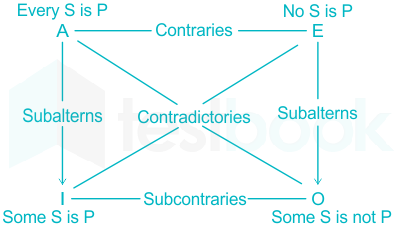
‘Students are serious’ is taken to be false Means that “Students are not Serious”.

  1. All students are serious → False (Students are serious is taken as false)

  2. All students are not serious → True (Clearly given in statement that students are serious is false)

  3. Some students are not serious → True (If there are some students who are serious then the given proposition ‘Students are serious’ is false)

  4. Some serious ones are not students → False (As we don’t have any information regarding other persons)
Classical Square of Opposition - 4 Basic Categorical Propositions

Hence, (b) and (c) can be true.

2

The proposition ‘All birds are cows’ is equivalent to which of the following propositions?

a) Some cows are birds

b) Some cows are not non-birds

c) Some birds are cows

d) Many birds are cows

  1. ((a))

    a only

  2. ((b))

    c and d

  3. ((c))

    a, b, c and d

  4. ((d))

    d only

Show Answer
Answer: ((a))

a only

According to given condition,

a) Some cows are birds → True (As all Birds are Cows,Some Cows will be Birds)

b) Some cows are not non-birds → False (This can be possible but not definite)

c) Some birds are cows → False (All birds are cows)

d) Many birds are cows → False (All birds are cows)

Hence, Some cows are birds is the correct answer.

3

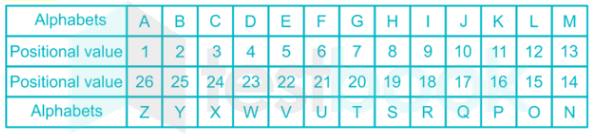
If E = 5 and HOTEL = 12, how will you code BALM?

  1. ((a))

    28

  2. ((b))

    26

  3. ((c))

    16

  4. ((d))

    7

Show Answer
Answer: ((d))

7

E = 5 = Position value of E in alphabetical series

Logic is as follows: Add the position value of given word and divide the total value by number of alphabets in the give word

HOTEL = 8 + 15 + 20 + 5 + 12 = 60

Number of alphabets in “HOTEL” = 5

Code for HOTEL = 60 ÷ 5 = 12

Similarly, BALM = 2 + 1 + 12 + 13 = 28

Number of alphabets in “BALM” = 4

Code for BALM = 28 ÷ 4 = 7

Hence, code for BALM is 7. s

4

Given below are two premises with four conclusions drawn from them. Which of the following conclusions could be validity drawn from the premises?

Premises:

a) Some rings are bells

b) No ring is ornament

Conclusions:

  1. ((a))

    All bells are ornaments

  2. ((b))

    Some ornaments are not bells

  3. ((c))

    No ring is bell

  4. ((d))

    All bells are not ornaments

Show Answer
Answer: ((d))

All bells are not ornaments

Minimum possible figure

Conclusions:

  1. All bells are ornaments → False (Part of bells which is rings is never ornament so given conclusion is not possible)

  2. Some ornaments are not bells → False (It is possible but not definite)

  3. No ring is bell → False (It is given that some rings are bells)

  4. All bells are not ornaments → True ((Part of bells which is rings is never ornament so some part of bells is never ornament)

Hence, all bells are not ornaments can be drawn from the given premises.

Directions: Read the passage and answer the questions based on it.

Indian organisations have traditionally not considered their human resource as a means of distinct competitive advantage. Rather, people management has been a big challenge for the Indian business head. This situation is undergoing rapid change today; because as Indian organisations are recognising the need for professional human resource management, simultaneously there is a growing demand for trained human resource professionals. At most universities, business schools have begun to offer specialised, customised courses to train the human resource professional. Increasingly, organisations are encouraging line managers to handle human resource responsibilities.

Ancient India was known for its occupation based hierarchy. The ancient Indian text, the Arthashastra refers to the job description of a supervisor and performance linked pay for artisans.

It was only after the 1850 that formal industrial organisations emerged in India. But it was only after India became an independent country in 1947 that significant improvement was witnessed in the personnel management policy of business organisations.

After independence, when a mixed economy was encouraged as the Indian growth model, industrial organisations were broadly classified into public sector and private sector. Since the public sector units were the recipients of large investments and became the biggest employers, their approach towards personnel management receive a lot of attention. The goal of a socialistic society enshrined within the constitution of India implied that the protection of human resource became a significant objective. Many constitutional provisions were created in order to protect workers. Organisations gad to appoint welfare officers to take care of all personnel.

The next phase of development saw the rise of the trade unions, and manager unions in the Indian business organization. This further boosted the growth of personnel offices in most organisations.

5

 The hierachy system in ancient India was based on

  1. ((a))

    The job one performed

  2. ((b))

    The family one belonged to

  3. ((c))

    The place one lived in

  4. ((d))

    The year of birth

Show Answer
Answer: ((a))

The job one performed

Explanation

The correct answer is option 1 i.e. 'The job one performed.'

  • The passage speaks of the development of the Indian industrial sectors.
  • In the second paragraph, it is mentioned that as per the ancient Indian text of 'Arthashashtra,' occupation was based on a hierarchy of job descriptions for the supervisors and performance-based pay for artisans.
  • This indicates that hierarchies existed with respect to the jobs performed.

Therefore, Option 1 is the appropriate response.

6

More and more organisations are encouraging their line managers to handle

  1. ((a))

    the whole organisation

  2. ((b))

    the responsibilities of human resource

  3. ((c))

    the offices of juniors

  4. ((d))

    the public relations

Show Answer
Answer: ((b))

the responsibilities of human resource

Explanation

The correct answer is option 2 i.e. 'the responsibilities of human resources.'

  • The entire first paragraph speaks of the usefulness of human resources.
  • Most of the sentences in the paragraph refer to the increasing responsibilities of the management to include human resources.
  • Some of them are: "Indian organisations are recognizing the need for professional human resource management"; "..there is a growing demand for trained human resource professionals."; "organisations are encouraging line managers to handle human resource responsibilities."
  • The last of the sentences directly mentions the line managers responsibility towards handling human resources.
<br>

Therefore, organizations are encouraging managers to handle responsibilities of human resource.

7

The competitive advantages of human resource has NOT been

  1. ((a))

    recognized in the past

  2. ((b))

    realized in the future

  3. ((c))

    ignored in the present

  4. ((d))

    planned for the future

Show Answer
Answer: ((a))

recognized in the past

Explanation

The correct answer is option 1 i.e. 'recognized in the past.'

  • The passage speaks of the development of personnel management over the years. Human resources is a part of it.
  • The very first sentence of the passage speaks of human resources not being 'considered' in the past for competitive advantage.
  • The sentence reads, "Indian organisations have traditionally not considered their human resource as a means of distinct competitive advantage."
  • Here, one must not get confused by the word 'recognized' being used in the options. It acts as an alternative to the word 'considered' in the original sentence.

  • ​Also, the other option that do not mention 'in the past' as the root, can be eliminated first, as the question clearly refers to 'has not been', which is speaking about the human resources in past tense. Therefore, options with roots 'in the future' or 'in the present' can be discarded.

Therefore, the competitive advantages of human resource has not been recognized in the past.

8

Significant improvement was seen in the personnel management policy of business organisations after

  1. ((a))

    1850

  2. ((b))

    1857

  3. ((c))

    1940

  4. ((d))

     1947

Show Answer
Answer: ((d))

 1947

Explanation

The correct answer is option 4 i.e. '1947.'

  • The second paragraph directly mentions the option 1947 in one of its statement.
  • It is as follows: "..it was only after India became an independent country in 1947 that significant improvement was witnessed in the personnel management policy of business organisations."
  • The only other option viable in this case is option 1, as it is mentioned in the passage. However, the significant change took place only after 1850, when more industrial organizations started to emerge in India.
  • It does not mention the improvement taking place in 1850, rather it mentions 1947 as the year after 1850, where improvements became more prominent.
<br>

Therefore, 1947 was significant for the personnel management policy of business organisations.

9

Personnel offices in many organisations witnessed an increase because of

  1. ((a))

    independence of India

  2. ((b))

    industrial development

  3. ((c))

    the rise of trade and manager unions

  4. ((d))

    worker-friendly policies

Show Answer
Answer: ((c))

the rise of trade and manager unions

Explanation

The correct answer is option 3 i.e. 'the rise of trade and manager unions.'

  • Many reasons have been mentioned about the increase and development of personnel management in the Indian industries.
  • Ranging fro increase in large investments of public sectors, to the human resource initiatives; a lot of contributors have been mentioned.
  • However, with respect to this question, the most recent development has been mentioned - Personnel offices.
  • As per the last line of the passage, it is clearly mentioned; the "rise of the trade unions, and manager unions in the Indian business organization further boosted the growth of personnel offices in most organisations."
<br>

Therefore, the option 3 is the most appropriate response for the given statement.

10

The fishbowl draw is a method of drawing a/an:

  1. ((a))

    Independent sample

  2. ((b))

    Structured sample

  3. ((c))

    Non-random sample

  4. ((d))

    Random sample

Show Answer
Answer: ((d))

Random sample

Although every researcher wants to be able to generalize the research findings to the wider population, such a study will require much more time, money and effort. For this reason, we select a sample i.e. a smaller representation of the larger whole (population), so that we can generalize our findings from the sample for the population.

Sampling: The concept of sampling involves selecting a portion (sample) from a bigger group (the sampling population). There are three methods of sampling in research:

  1. Random/Probability Sampling
  2. Non-random/Non-probability Sampling
  3. ‘Mixed’ Sampling


Types of Random Sampling

Random/Probability Sampling: In this type, each element in the population has an equal and independent chance of selection in the sample. Equal implies that the probability of selection of each element in the population is the same. Independence means that the choice of one element is not dependent upon the choice of another element in the sampling. Its types are:

  1. Simple Random Sampling (SRS): It is the most popular of the probability sampling methods. The idea of randomization implies that sample selection is independent of human judgment. There are three most commonly used methods of drawing a random sample:
  2. The Fishbowl Draw – If the total population is small, each element can be numbered using separate slips of paper and put into a fishbowl/ container and shuffled and each slip is randomly picked out one- by- one. It is a commonly used method in lotteries, therefore it is also called the lottery method.
  3. Using a Computer Program – some computer programs are designed to select random samples.
  4. A table of randomly generated numbers

​Hence, The fishbowl draw is a method of drawing a random sampling.

11

Which of the following research types has the potential for enhancing teaching competencies?

  1. ((a))

    Fundamental research

  2. ((b))

    Applied research

  3. ((c))

    Impact assessment research

  4. ((d))

    Action research

Show Answer
Answer: ((d))

Action research

Research is a systematic way of investigation or a process of discovering new knowledge. It is used for gathering information to answer a particular question. Researches have been classified into various categories depending upon its various approach, purpose and nature.

Types of Research

Fundamental Research: It is also called pure or basic research. “Gathering knowledge for knowledge’s sake is termed ‘pure’ or ‘basic’ research.” It is concerned with generalizations and with the formulation of a theory. It aims at the discovery of some basic truths and laws and is not immediately concerned with direct field applications.

  1. Applied Research:
  • It is also called field research. It is that type of research work the results of which find direct application in the field. Fundamental research may propound a theory or discover a law, but applied research is concerned with the testing of such theories or laws in the actual field setting. It is almost always done on the basis of basic research.
  1. Action Research:
  • Action research is similar to applied research, but the only difference is that applied research is carried out on a larger sample resulting in more universally applicable findings whereas,
  • Action research is conducted on the immediately available small sample to solve the immediate problem for the same group.
  • It refers to an extensive range of evaluative, investigative and analytical methods of research designed to diagnose the problems in educational institutes and help teachers gain practical implementation of solutions and work more efficiently.
  • It is undertaken by educational practitioners or teachers to make better decisions and engage in better teaching practices and enhancing teaching competencies.
  • A teacher conducts action research to improve his/her own teaching. Similarly, a school administrator conducts action research to improve his administrative behaviour.
  • Many educational practitioners see in action research one of the most promising avenues for teacher growth, professional improvement and the development of a better system of education.

NOTE:

Impact Assessment Research is a means of measuring the effectiveness of organisational activities and judging the significance of changes brought about by those activities.

Hence, it is obvious from the given points that action research has the potential for enhancing teaching competencies.

12

A questionnaire that offers no scope for any respondent’s own view is called:

  1. ((a))

    Closed-ended

  2. ((b))

    Schedule

  3. ((c))

    Open-ended

  4. ((d))

    Unstructured

Show Answer
Answer: ((a))

Closed-ended

A questionnaire is the most widely used tool in research for data collection. It contains a series of questions concerning the particular problem being studied. It is a self-administered tool to collect information regarding any events, phenomenon, practices or attitudes of an individual or an institution.

Types of Questionnaires:

Closed-ended/Fixed-response QuestionnaireOpen-ended Questionnaire
It consists of statements of questions with a fixed number of options or choices (Yes/No). The respondent is asked to check the option or response that best fits him.It consists of questions that can have unexpected answers as they allow the respondents to express their feelings without restriction.
It offers no scope for the views and opinions of the respondents rather the ideas or choices of the researchers are imposed on the respondents leading to bias in responses by forcing the respondent through the given options.It allows the respondent to express an opinion spontaneously without being influenced by the researcher and thus avoiding the bias that may result from suggesting responses to individuals.
These questions provide ‘quantitative’ information (in terms of numbers, frequencies and percentages) that can be counted. Thus, these are mostly employed in quantitative research.These questions give ‘qualitative’ information regarding what respondents actually mean. Thus, these are mostly employed in qualitative research.
These are best suited for large-scale surveys and best used when categories are discrete, distinct and relatively few in number .These are useful when there are too many potential response categories.
These are also called a structured questionnaire as the questions are asked in a standardized and predetermined order.Since there is no specific systematic sequence being followed, they are also known as unstructured questionnaire.
These are consistent and easier to answer, code, analyse statistically.Because respondents have the freedom to say whatever they like, analysis is much more difficult and time-consuming.
For example, ‘Have you ever taken a course in sociology? (Yes/No)’ and rating scales.For example, ‘In your opinion, what could be the causes of absenteeism?’.


NOTE:

Schedule: It is a set of questions which are asked and filled in by an interviewer in a face to face situation with a person or group of persons. The only difference between a questionnaire and a schedule is that the latter is filled in by the interviewer himself.

Hence, it is clear from the given points that a close-ended questionnaire offers no scope for any respondent’s own view.

13

A workshop is meant for:

  1. ((a))

    Hands-on experience

  2. ((b))

    Listening to scholarly lectures

  3. ((c))

    Learning with interaction

  4. ((d))

    Discussing one’s own work

Show Answer
Answer: ((a))

Hands-on experience

Educational practitioners are engaged in various professional activities to add to their strengths and competencies in a formal setting. These are planned activities with clear objectives and implemented systematically. These activities can include doing research, seminars and workshops, writing articles, reviews, journals, etc.

Workshop:

  • A workshop comprises a small, selected group of teachers or experts drawn from actual working situations or related experts who theorise on the activities.
  • Workshops are interactive sessions or small events, usually, a day or two long, dedicated to discussing on practical work, on a specific topic in which a group of people engage in brainstorming, problem-solving and knowledge-sharing.
  • An ideal workshop has a specific, action-oriented purpose that seeks to generate some concrete answers to prevailing problems.
  • Workshops are organised to develop certain skills and hands-on experience to the participants.

NOTE:

Seminar: A seminar is a small group discussion in a formal setting with a clear agenda. A speaker presents a theme or a set of papers and it is discussed by all the participants. The chairperson of the seminar guides, directs, coordinates and organises the discussion systematically to optimize time and resources.

Hence, it can be concluded from the given points that a workshop is meant for hands-on experience.

14

In research, reliability is that quality of a measurement procedure which provides:

  1. ((a))

    repeatability and accuracy

  2. ((b))

    punctuality and accuracy

  3. ((c))

    accuracy and speed

  4. ((d))

    speed and repeatability

Show Answer
Answer: ((a))

repeatability and accuracy

Research is concerned with gathering information from sources to seek answers to the research questions. A variety of research tools and instruments are made use of for this purpose. The concepts of reliability and validity are both central to the development of such measurement tools.

Reliability:

  • One of the most important criteria for the quality of measurement is the reliability of the measuring instrument.
  • Reliability means consistency with which an instrument yields similar results.
  • It concerns the extent to which a measurement of a phenomenon provides stable and accurate results. Reliability is concerned with consistency and replicability or with repeatability over time.
  • A test is seen as being reliable when it can be used by a number of different researchers under stable conditions, with consistent results and the results not varying. It is important to remember that reliability is not measured, it is estimated.
  • For instance, if a test is constructed to measure a particular trait such as neuroticism, then each time it is administered, it should yield the same results.


Validity: A measuring instrument possesses validity when it actually measures what it claims to measure. For example, if a test is designed to measure aptitude, then it must measure aptitude and not personality, intelligence or any other traits.

NOTE:

There is a relationship between validity and reliability. Any instrument can be reliable but not valid, however, it cannot be valid if it is not reliable. In other words, if an instrument is valid, it must be reliable.

Hence, it is clear that reliability is that quality of a measurement procedure which provides repeatability and accuracy.

15

Learning objectives mean

  1. ((a))

    learning experience

  2. ((b))

    concise outcomes

  3. ((c))

    academic achievement

  4. ((d))

    intended learning outcomes

Show Answer
Answer: ((d))

intended learning outcomes

Clearly and precisely stated learning goals and outcomes are the key components of a good learning experience or course of study. The terms learning objectives and learning outcomes are often used interchangeably and they are all related to the teaching and learning that is expected to take place in the classroom.

Intended Learning Outcomes

  • The difference between objectives and outcomes lies in the emphasis on who will be performing the activities.
  • Learning objectives describe what an instructor or program aims to do; i.e., “This course will expose students to the major communication technologies used in the education field.”
  • A learning outcome is described in observable and measurable terms regarding what a student can do as a result of completing a course; i.e., “After this course, students will be able to explain the differences between the various communication media and identify the strengths and limitations of various media.”
  • Learning outcomes are student-centred, as they focus on the knowledge and skills that students can demonstrate (not on what instructors aim to teach students).
  • An effective learning outcome involves the structuring of two parts, a verb, and an object.
  • Bloom's revised taxonomy provides a framework for transforming objectives into intended learning outcomes. The taxonomy organizes these verbs or cognitive processes on a scale of lower-order to higher-order thinking skills.
Revised Bloom’s Taxonomy of the Cognitive Domain (2001)
Cognitive LevelSample verbs for Learning Outcomes
RememberingDefine, Identify, Name, Recognize, List, Recall
UnderstandingCalculate, Explain, Categorize, Contrast, Describe, Interpret, Discuss, Illustrate, Summarize, Compare, Summarize, Restate, Outline, Infer
ApplyingDemonstrate, Illustrate, Execute, Implement, Solve
AnalyzingDistinguish, Examine, Organize, Differentiate, Relate, Discriminate
EvaluatingCheck, Rate, Monitor, Verify, Judge, Critique
CreatingCompose, Design, Hypothesize, Plan, Formulate, Combine, Create, Generate, Produce, Invent
  • Format for intended learning outcomes statements:
  1. Students will be able to + verb (desired action or performance) + object (knowledge) + optional modifiers (performance criteria/conditions). The conditional statement may be necessary if learners are expected to perform under specific conditions or contexts
  2. For example, students will be able to explain the characteristics of the synchronous communication medium and its uses.

Hence, it can be concluded from the given points that learning objectives mean the intended learning outcomes.

16

Brainstorming as a method can be used for:

  1. ((a))

    Out-of-box thinking

  2. ((b))

    Coherent thinking

  3. ((c))

    Generating new ideas in the area of interest

  4. ((d))

    Critical thinking

Show Answer
Answer: ((c))

Generating new ideas in the area of interest

A teacher's task in the classroom is not limited to the teaching of a particular subject. He/she must be able to develop thinking and problem-solving ability in students along with the ability to understand the underlying meanings. There are various teaching techniques used by the teachers for this purpose and brainstorming is also one such technique.

Brainstorming:

  • Brainstorming is a group activity to generate a large number of ideas to find out the solution to a problem.
  • The term ‘Brainstorm’ means using the brain to storm a creative problem and to do so in commando fashion, with each stormer audaciously attacking the same objective**.**
  • In a brainstorming session, a group of people sits around a table to brainstorm regarding a specific area of interest. Each participant presents new and innovative ideas that comes to his/her mind.
  • No member of the group is allowed any criticism on the idea put forward by another member.
  • The objective underlying this is that of freeing a person from the usual inhibitions that operate to block his/her creative process.
  • This technique can be of great help to the teachers in developing problem-solving attitude among students and also in stimulating their imaginative and creative powers.


Steps of Conducting Brainstorming Session:

  1. Sensing the problem or challenge
  2. Fact-finding
  3. Group Discussion
  4. Evaluation of ideas
  5. Planning for Implementation


NOTE:

Critical Thinking: It is an ability to analyze information and experiences objectively. It is the careful determination of whether we should accept, reject or suspend judgment about a claim and the degree of confidence with which we accept or reject it.

Hence, it is clear that the brainstorming method can be used for generating new ideas in the area of interest.

17

For optimising self-learning which of the following motivational principles will be most helpful?

  1. ((a))

    Using reward and punishment

  2. ((b))

    Creating scope for fulfilling relatedness need

  3. ((c))

    Providing scope for satisfying the need for competence 

  4. ((d))

    Promoting concerns for meeting status needs

Show Answer
Answer: ((c))

Providing scope for satisfying the need for competence 

The concept of motivation concerns what moves people to act, think and develop. Self-determination and motivation are closely linked.

Key Points

Self-determination Theory (SDT):

  • This theory was propounded by Edward Deci & Richard Ryan, (1985).
  • This is a popular theory that focuses on students’ interest in learning and the value they place on education.
  • Self-determination is an individual’s ability to make choices and manage one’s own life. It has a huge impact on the motivation level of an individual.
  • Self-determination means the individual, “engaging in an activity ‘with a full sense of wanting, choosing and personal endorsement’” (Deci 1992).
  • This theory makes two assumptions - the need for growth is what drives behaviour, and the intrinsic motivation in an individual.
  • According to this theory, there are three categories of needs:
  1. Competence: It involves understanding how to master challenging tasks and achieve outcomes. It refers to the need to experience opportunities to exercise, expand and express one’s capacities. Thus, it helps in improving self-learning.
  2. Connection or Relatedness: It involves developing a sense of belonging or connection with others in a group.
  3. Autonomy: It involves feeling in control of our actions and goals.
  • According to SDT, students who feel that their learning is self-determined, experience their studying as a self-chosen act that reflects their individual goals and values. Experiencing self-determination in learning involves a sense of willingness.
  • Motivation is seen as a continuum between self-determined and non-self-determined behaviours where,
  • Self-determined behaviours are intrinsically driven that is done due to enjoyment, interest and inherent satisfaction for the action itself.
  • Non-self-determined behaviours are performed only because they must be done.

Hint

  • Operant conditioning which was developed by B.F.Skinner is a way of learning through rewards and punishments. These are used by the teacher as an appreciation and remedial measure for his/her students.
  • Status or Prestige needs are part of the Esteem needs which comes under the Maslow’s hierarchy of needs.  Esteem presents the typical human desire to be accepted and valued by others. It may include the need for respect from others, a need for status, recognition, fame, prestige, and attention.

Hence, it is clear that the motivational principle of satisfying the need for competence will be most helpful for optimising self-learning.

18

A pilot study is also called a:

  1. ((a))

    descriptive study

  2. ((b))

    feasibility study

  3. ((c))

    correlation study

  4. ((d))

    explanatory study

Show Answer
Answer: ((b))

feasibility study

Planning a research process includes a series of interdependent steps consisting of formulation of a research problem, review of literature, development of a conceptual framework, the research design, pilot study, collecting data, etc. All of these steps help in meeting varied purposes and might even overlap.

Pilot/Feasibility Study: The term ‘pilot studies’ refers to a mini version of a full-scale study.

It refers to either a trial run of the major research study or the specific pre-testing of a particular research instrument such as a questionnaire or interview schedule. Such studies should be conducted using participants who closely resemble the targeted study population.

Reasons for conducting Pilot Studies:

  • Pilot studies are valuable in situations where very little is known about the research topic or when executing unique research instruments.
  • The major objective is to discover problems before the actual study or give a prior warning about where the main research project could fail.
  • It helps in collecting preliminary data and determining whether proposed methods or instruments are adequate or inappropriate.
  • It enables to convince the funding bodies that the main study is feasible and worth funding.
  • A researcher can then use this information to take corrective action to improve the research process and thus increase the likelihood of success of the main study.

Hence, it can be concluded from the given points that a pilot study is also called a feasibility study.

  • Descriptive Study: It describes a situation, an event, an institution as it exists at the time of the study. It answers the questions who, what, where, when, and how much.
  • Correlational Study: It examines the relationship between variables or events but in no way implies that one causes changes in the other. Here the researcher investigates the extent to which variations in one variable corresponds the extent with variations to another variable.
  • Explanatory/Causal Study: They go beyond description and attempts to explain the reasons for the phenomenon that the descriptive study only observed. It is more interested in understanding, explaining, predicting, and controlling relationships between variables.
19

In experimental research-based studies the observations derived from which of the following variables are considered for statistical analysis?

  1. ((a))

    Independent variable

  2. ((b))

    Dependent variable

  3. ((c))

    Moderator variable

  4. ((d))

    Control variable

Show Answer
Answer: ((b))

Dependent variable

Research is a systematic inquiry towards understanding a complex social phenomenon or a process. Based on the research problem, the selection of research methods by the researcher may vary.

Experimental Research:

  • It is a systematic and scientific approach to research on establishing causal relationships.
  • It investigates a hypothesis through experiments in a controlled environment where a variable is manipulated by the researcher and its impact is observed on the dependent variable.
  • It requires two variables:
  1. Independent Variable: This is the variable that is directly controlled or manipulated to examine its effect on the dependent variable.
  2. Dependent Variable: It is that factor that varies as the experimenter introduces, removes, or varies the independent variable.
  • In other words, X (independent variable) causes Y (dependent variable).
  • The observations derived from the dependent variable are considered for statistical analyses and the results are generalized to the larger population**.**
  • For example, a study to determine the effects of a new teaching strategy on the learning outcome of students. In this, the teaching strategy is the independent variable and the learning outcome of students is the dependent variable.


NOTE:

  • Moderator Variable: It refers to a variable that can strengthen, diminish, negate, or otherwise alter the association between independent and dependent variables. e.g., gender, age, income, education, etc.
  • Control Variable:  It is those independent variables that are not part of the research study, but they have an influence on the dependent variable that cannot be overlooked.


Hence, in experimental research, the observations derived from the dependent variable is considered for statistical analysis.

20

Which of the following is a characteristic of interpersonal communication?

  1. ((a))

    It is both focused and unfocused

  2. ((b))

    It is not participation friendly

  3. ((c))

    It is philosophical

  4. ((d))

    It is metaphorical

Show Answer
Answer: ((a))

It is both focused and unfocused

Communication is a two-way process in which participants not only exchange ideas and information but also share mutual understanding. It has to take into consideration the idea of mutuality and commonness, an exchange, a shared environment, a social relationship among the participants and the existence of a common need, urges, aim or goal.

Interpersonal Communication: It is direct, participatory and face-to-face communication between two people. It is personal, intimate and allows for maximum interaction and exchange in word and gestures. It requires certain skills to interact effectively with others such as the knowledge of social norms, etiquette, willingness to listen, and respect for one another, willingness to share about oneself, etc.

For example, talking to your friends or family, teacher and student interaction, etc. The interactions in this type of communication can be focused and unfocused.

  1. Focused Interactions: According to Goffman, for focused interaction, there is a need for a direct, person to person communication. It occurs when people effectively sustain for a time in a conversation, a board game, or any joint task in a close face-to-face circle. It reveals the following characteristics:
  • A single visual and cognitive focus of attention
  • An openness to verbal communication
  • A “we” feeling of solidarity
  • A ritual of opening, closings, entrances, and exits.
  1. Unfocused Interactions: It is that communication which occurs when people are present in the same setting but they are not engaged in direct or face to face communication., for example, sitting in a waiting room, standing in a queue, two strangers checking out each other’s clothing, manners, etc. It consists of:
  • Rules concerning spacing, movement, positioning, listening, self-presentation
  • Unlike focused interactions, there is no closure, intense focus of attention, or face-to-face obligations.
  • Rules for sustaining public order without creating a situation that requires focused interaction.


Hence, it can be said that focused and unfocused interactions are the characteristics of interpersonal communication.

21

Gatekeeping by Media to ensure what audience consume is indicative of:

  1. ((a))

    The audience voice is Media Programming

  2. ((b))

    Media control on society

  3. ((c))

    Feedback received by the media

  4. ((d))

    Media role in-creating culture

Show Answer
Answer: ((b))

Media control on society

The term ‘medium’ in Latin means the one in the middle which refers to a certain mediator in communication. Mass media refers to those institutions through which specialized groups, using means such as press, radio, television, films, etc. disseminate the symbolic content to many, heterogeneous and widespread recipients.

Gatekeeping in Mass Media:

  • The Gatekeeping model of communication was designed by Bruce Westley and Malcolm MacLean.
  • Mass media gathers information from all around and have the power to decide which news to publish, broadcast or telecast since every form of media has to define its content.
  • The gatekeeping model assumes that messages in mass communication pass through different checkpoints called 'gatekeepers' before they are received by the audience/learners.
  • It is the process through which information is filtered for dissemination, whether for publication, broadcasting, the Internet or some other mode of communication. A news report in a newspaper or on a television channel is filtered or controlled at a different level by a reporter, sub-editor, news editor or the editor.
  • Gatekeeping is an information control process for ensuring what audience consume by selecting, adding, withholding, displaying, channelling, shaping, manipulating, repeating, integrating, disregarding and deleting of information. Mass media institutions hold a major role in the control of public information.
  • Since the gatekeepers of society are in complete control of all information received by the public, they are therefore also in control of how the public perceives the rest of society’s reaction to news stories.
  • For example, the 2016 U.S. Presidential election is a prime example of how the mass media institutions appeared to have attempted to control public opinion by manipulating the coverage of the election campaign.


Hence, it is clear that gatekeeping by media to ensure what audience consume is indicative of its control on the society.

22

Rohan gave three-fifth of the amount he had, to Sahil, Rohan now has 2000 rupee. How much did he give to Sahil?

  1. ((a))

    1200 rupees

  2. ((b))

    2000 rupees

  3. ((c))

    3000 rupees

  4. ((d))

    5000 rupees

Show Answer
Answer: ((c))

3000 rupees

Given:

Rohan gave three-fifth of the amount to Sahil

Calculation:

Let the amount Rohan had be x

According to the question,

Rohan gave 3/5 of amount to Sahil

Amount given to Sahil = 3x/5

Remaining amount = x - 3x/5 = 2x/5

Now,

⇒ 2x/5 = 2000

⇒ x = Rs. 5000

∴ Amount given to Sahil = 5000 × (3/5) = Rs. 3000

23

40% of the employees in a factory are workers. All the remaining employees are executives. The annual income of each worker is Rs. 39,000. The annual income of each executive is Rs. 42,000. What is the average annual income of all employees in the factory together?

  1. ((a))

    Rs. 40,500

  2. ((b))

    Rs. 40,800

  3. ((c))

    Rs. 41,000

  4. ((d))

    Rs. 41,500

Show Answer
Answer: ((b))

Rs. 40,800

Given:

40% of the employees in a factory are workers

Annual income of each worker is Rs. 39,000

Annual income of each executive is Rs. 42,000

Formula Used:

Average = (Sum of all the observations)/(Total number of observations)

Calculation:

Let the number of employees in the company be 100x

Number of workers = (40/100) × 100x = 40x

Annual income of each worker is Rs. 39,000

Annual income of all workers = 40x × 39000 = Rs. 1560000x

According to the question,

Number of executives = (60/100) × 100x = 60x 

Annual income of each executive is Rs. 42,000

Annual income of all executives = 60x × 42000 = Rs. 2520000x

Total income of all employees = 1560000x + 2520000x = 4080000x

∴ required average annual income of all the employees = 4080000x/100x = Rs. 40800

24

We listen attentively to and favourably interpret messages which boost our self-image and reject or misinterpret messages which threaten that image. This is called:

  1. ((a))

    communication selectivity

  2. ((b))

    change resistance

  3. ((c))

    image rationalization

  4. ((d))

    communication distortion

Show Answer
Answer: ((a))

communication selectivity

Barriers are any obstacles or difficulties that come in the way of communication. They may be in the form of physical, mechanical, psychological, cultural or linguistic.

Barriers to Communication:

  1. Self-image:
  • It is the way an individual looks at himself or the picture that one has of oneself.
  • Our self-image makes us always defend our point of view, to interpret messages in the way we wish to interpret them and to see ‘reality’ according to our preconceived notions.
  • Communication selectivity occurs when we tend to listen attentively to and interpret favourably those messages which give a boost to our self-image and reject or misinterpret messages which threaten that same image.
  • We are selective, not only concerning the sending and receiving of messages but also to the extent we remember them.
  • For instance, we retain only that information that is pleasant to us or reinforces our ego and forgets details that are unpleasant or humiliating.
  1. Resistance to Change: Individuals resist change in any form except where they are convinced it is to their benefit. We hear with focused attention any communication that reinforces our beliefs and our self-image.
  2. Defensiveness and Fear: More often than not, one tends to ‘rationalize’ the mistakes one makes, the attitudes and opinions one holds so close. Fear has a great potential in determining what the individual will perceive, think and do. It also gives rise to slow and narrow thinking which selects and distorts communication. For example, during a written examination, a nervous or anxious candidate might misread the instructions and misunderstand the questions asked.
  3. Linguistic and Cultural Barriers: When the same language is made use of in a different culture, it takes on another colour and meaning. This is equally true of non-verbal language, for example, the touching of an elder’s feet is a mark of respect m North India, but not quite so acceptable in other cultures.


Hence, listening attentively and favourably to messages which boost our self-image and rejecting messages which threaten that image is called communication selectivity.

25

Sameer walks a certain distance and rides back taking a total time of 40 minutes. He could walk both ways in 60 minutes. How long would it take for him to ride both ways?

  1. ((a))

    15 min

  2. ((b))

    20 min

  3. ((c))

    28 min

  4. ((d))

    30 min

Show Answer
Answer: ((b))

20 min

According to the question,

Sameer walked both ways in 60 minutes

Sameer walked one way in (60/2) = 30 minutes

Now, 

Sameer walks a certain distance and rides back taking a total time of 40 minutes

⇒ Time taken by Sameer to ride one way = 40 - 30 = 10 minutes

∴ time taken by Sameer to write both ways = 2 × 10 = 20 minutes

26

Assertion (A): The ‘arts’ have grown out of the fundamental desire and need to communicate.

Reason (R): Language is inseparable from the culture which is its very source of sustenance and fundamental to communication.

Choose the correct option:

  1. ((a))

    Both A and R are true and R is the correct explanation of A

  2. ((b))

    Both A and R are true but R is not the correct explanation of A

  3. ((c))

    A is true but R is false

  4. ((d))

    A is false but R is true

Show Answer
Answer: ((b))

Both A and R are true but R is not the correct explanation of A

Communication not only entails using good language and speaking clearly but also reaching to the receiver or making the receiver understand what you want to communicate.

Assertion (A):

Arts and culture speak on behalf of us. They are part of nonverbal communication. They describe us, they define our society from which we belong. The ‘arts’ have grown out of the fundamental desire and need to express oneself and connect.

So, A is true.

Reason (R):

The relationship between language and culture is deeply rooted and both are inseparable. Language embodies and expresses a community’s culture. The meaning of the non-verbal messages in language changes in the context of culture. Language cannot be separated from the culture is its very source of sustenance and fundamental to communication.

So, R is true but it is not an explanation of A.

Hence, it can be concluded that both A and R are true but R is not the correct explanation of A.

27

At, what percentage above the cost price must an article be marked so as to gain 8% after allowing a customer a discount of 10%?

  1. ((a))

    18%

  2. ((b))

    20%

  3. ((c))

    28%

  4. ((d))

    10.8%

Show Answer
Answer: ((b))

20%

Given:

Gain = 8%

Discount allowed = 10%

Formula Used:

MP = SP/(100 - discount%) × 100

Calculation:

Let the cost price of article be 100x

According to the question,

Profit of 8% is earned 

⇒ SP = 100x + (8/100) × 100x = 108x

Discount of 10% is allowed

MP = (108x/90) × 100 = 120x

⇒ (120x - 100x)/100x × 100 = 20%

∴ MP is marked 20% above the CP

Direction: Consider the following table that shows percentage profit earned by company ABC and company XYZ during the year 2011-2016. Answer the question based on the data contained in the table

YearPercent profit earned by company ABCPercent profit earned by company XYZ
20115055
20127060
20135045
20144050
20156050
20168075
28

If the amount of profit earned by company XYZ in 2012 was Rs. 9 Lakh, what was the total investment?

  1. ((a))

    12,00,000

  2. ((b))

    15,00,000

  3. ((c))

    16,00,000

  4. ((d))

    18,00,000

Show Answer
Answer: ((b))

15,00,000

From the given table we can say that 

Profit earned by company XYZ = 60%

Now, 

Investment = (900000/60) × 100 = 1500000

∴ total investment made by company XYZ in 2012 is Rs. 1500000

29

If the income of company ABC in 2013 and that in 2015 were equal and the amount invested in 2013 was Rs. 8,00,000 what was the income in 2015?

  1. ((a))

    7,50,000

  2. ((b))

    9,00,000

  3. ((c))

    10,50,000

  4. ((d))

    12,00,000

Show Answer
Answer: ((d))

12,00,000

Let the total investment of company ABC in 2013 and 2015 be 100x and 100y respectively 

Income = Investment + Profit 

In 2013,

Income = 100x + (50/100) × 100x = 150x

According to question,

100x = Rs. 800000

⇒ 150x = 1200000

Now, 

Income of company ABC in 2013 and that in 2015 are equal

∴ 1200000 is the income in 2015.

30

If the profit earned by company ABC in the year 2015 was Rs. 6,60,000, what was the total income of the company in that year?

  1. ((a))

    11,000,00

  2. ((b))

    14,300,00

  3. ((c))

    17,600,00

  4. ((d))

    20,900,00

Show Answer
Answer: ((c))

17,600,00

Let the investment of company ABC in 2015 be 100x 

Income = Investment + Profit 

Income = 100x + (60/100) × 100x = 160x 

⇒ Profit = 60x 

According to the question,

60x = 6,60,000

⇒ x = 11000

⇒ 160x = 160 × 11000 = 1760000

∴ income of company ABC in 2015 was Rs. 17,600,00

31

If each of the companies ABC and XYZ invested Rs. 20 lakh in 2014, what was the average profit earned by the two companies?

  1. ((a))

    Rs. 8 lakh

  2. ((b))

    Rs. 10 lakh

  3. ((c))

    Rs. 9 lakh

  4. ((d))

    Rs. 12 lakh

Show Answer
Answer: ((c))

Rs. 9 lakh

Amount invested by ABC and XYZ in 2014 = Rs. 2000000 each

Profit earned by ABC in 2014 = (40/100) × 2000000 = Rs. 800000

Profit earned by XYZ in 2014 = (50/100) × 2000000 = Rs. 1000000

∴ required average = (800000 + 1000000)/2 = Rs. 900000

32

If the amounts invested by the two companies in 2015 were equal, what was the ratio of the total income of company ABC to that of company XYZ in 2015

  1. ((a))

    5 : 6

  2. ((b))

    6 : 5

  3. ((c))

    15 : 16

  4. ((d))

    16 : 15

Show Answer
Answer: ((d))

16 : 15

Let the amount invested by two in 2015 be 100x

Income = Investment + Profit 

Income of ABC in 2015 = 100x + (60/100) × 100 = 160x 

Income of XYZ in 2015 = 100x + (50/100) × 100x = 150x 

∴ required ratio = 160 : 150 = 16 : 15

33

Computer uses which number system to store data and perform calculations

  1. ((a))

    Binary

  2. ((b))

    Octal

  3. ((c))

    Decimal

  4. ((d))

    Hexadecimal

Show Answer
Answer: ((a))

Binary

A number system includes the number of independent digits used in the number system (the base), the place values of the different digits constituting the number and the maximum numbers that can be written with the given number of digits.

The Binary Number System:

  • A computer system uses bits (binary digits) to denote values. It uses the binary number system to store data.
  • Each digit (0 or 1) is a bit thus the binary number 10110110 is a binary number having 8 bits.
  • The binary number system with only two independent digits, 0 and 1, is a base-2 number system. All larger binary numbers are represented in terms of ‘0’ and ‘1’.
  • A binary number can easily be converted to a decimal by multiplying each digit by a power of 2.

NOTE:

  • The decimal number system has a base of 10 as it has 10 independent digits, i.e. 0, 1, 2, 3, 4, 5, 6, 7, 8 and 9.
  • The hexadecimal number system uses 16 symbols (base 16) which includes numbers from 0 to 9 and letter A to F. A nibble is one digit of a hexadecimal value which represents 4 bits.
  • The octal number system use base 8. Octal numbers are written using digits 0 through 7.


Hence, it is clear from the given points that a computer uses the binary number system to store data and perform calculations.

34

Which of the following is considered as a secondary air pollutant?

  1. ((a))

    Nitric oxide

  2. ((b))

    Ozone

  3. ((c))

    Sulphur dioxide

  4. ((d))

    Carbon monoxide

Show Answer
Answer: ((b))

Ozone

Air pollutants are substances that are present in the atmosphere at levels which can potentially negatively impact human health or the environment. These pollutants may arise from natural sources or anthropogenic activities. They are categorized into primary and secondary.

Primary Pollutants:

  • Air pollutants that are emitted directly into the atmosphere in a harmful form are called primary pollutants.
  • The effects of primary pollutants are of concern as they can be harmful to humans, animals and plants.
  • For example, car exhausts, coal and natural gas power plants, carbon monoxide (CO), nitrogen oxide, sulphur dioxide, toxic metals such as lead, volatile organic compounds (methane, propane, etc.)

Secondary Pollutants:

  • These pollutants are not emitted directly from a source (like vehicles or power plants) instead, these pollutants are formed by reactions involving primary pollutants and other constituents within the atmosphere.
  • The phenomena of photochemical smog (seen in high-density cities) is a result of the interactions of primary pollutants with other molecules in the air such as molecular oxygen, water and hydrocarbons.
  • Surface Ozone, that is, ozone in the troposphere layer of the atmosphere is a photochemical pollutant formed in the atmosphere during complex chemical reactions between a motor vehicle and other emissions in combination with sunlight.
  • Surface ozone is formed when nitrogen oxide, carbon monoxide and other volatile organic compounds combine in the presence of sunlight.
  • Exposure to ozone induces effects on health and the environment, causing respiratory difficulties and damage to vegetation and ecosystems.
  • Secondary pollutants are very sensitive to weather patterns.

Hence, it is obvious from the given points that ozone is considered as a secondary air pollutant.

35

Amongst the following, which is better suited for the dumping of nuclear waste?

  1. ((a))

    Salt mines

  2. ((b))

    Deserts

  3. ((c))

    Forests

  4. ((d))

    Oceans

Show Answer
Answer: ((a))

Salt mines

Nuclear energy is one of the ways of producing electricity. It is generated by splitting atoms to release the energy held at the core, or nucleus, of those atoms. But however useful the nuclear energy might be, the nuclear waste generated by it surpasses its benefits.

Key Points

Nuclear Waste Disposal:

  • Nuclear waste is dangerous for thousands of years and requires long-term solutions that shield it from human and other living things.
  • Most nuclear waste comes from nuclear power plants as well as the residuals of radioactive materials used by industry, medicine, agriculture, etc.
  • Their potential hazard of nuclear waste makes its disposal difficult. The choice of waste treatment is influenced by its radioactivity level and decay time.
  • Nuclear decay releases smaller particles - protons, neutrons and electrons - that can tear through tissue and damage genetic material, leading to cancers and birth defects.
  • Because of these adverse effects, nuclear waste must be treated carefully. Low-level waste (such as tools that have been contaminated with radiation) emits very low levels of radiation that are on par with the radiation we absorb daily from the sun.
  • High-level waste such as spent nuclear fuel and its byproducts are searing hot and requires years of cooling plus thick metal shielding to prevent radioactivity release.
  • One of the most promising nuclear waster disposal methods is geological formations or underground salt deposits/mines that will act as a barrier by providing needed isolation as water cannot pass through these deposits and thus releasing hazardous chemicals into human contact.
  • Salt formations exhibit low porosity and are impenetrable to gases and liquids. Therefore, a natural geologic barrier function is guaranteed over very long periods in a salt mine.

NOTE:

Forests, oceans and deserts are ecosystems that have a sensitive natural balance and cannot be disturbed with radioactive nuclear wastes that can cause long-term adverse effects.

Hence, it is obvious from the given points that salt mines are better suited for the dumping of nuclear waste.

36

Below are given two columns. Column – A presents the stream of courses and column – B presents the name of courses. Match the two columns.

Column A (Stream)Column B (Name of courses)
1)Professionali)Engineering Architecture
2)Academicii)Carpentering, Sewing
3)Technicaliii)Medicine, Law
4)Skill basediv)Arts, Commerce
<br>

Choose your answer from the options given below:

  1. ((a))

    1-iii, 2-ii, 3-I, 4-iv

  2. ((b))

    1-ii, 2-iii, 3-iv, 4-i

  3. ((c))

    1-I, 2-ii, 3-iii, 4-iv

  4. ((d))

    1-iii, 2-iv, 3-I, 4-ii

Show Answer
Answer: ((d))

1-iii, 2-iv, 3-I, 4-ii

The Indian higher education system has undergone significant growth in the post-independent era by establishing several Universities, technical and research institutions and professional/non-professional colleges all over the country to disseminate knowledge and to provide easy access to higher education to the common Indian.

In this present era, professional, academic, technical and skill-based education has become an integral part of our general education system.

  1. Professional Education: Numerous professional courses are available at the undergraduate and postgraduate levels. The several disciplines in which these courses are offered include Medical & Pharmacy, Computer Science, Law Courses, Teaching, etc.
  2. Academic Education: There are a plethora of graduate degree courses you can opt for after 12th. There are many degree courses that will deliver great knowledge and better career opportunities. These include subjects from Science, Commerce and Arts field and have several sub-categories under them.
  3. Technical Education: In India, there is a rapid increase in the demand of engineers and other technically qualified professionals because of the booming IT industry. In India, technical education is imparted at various levels such as craftsmanship, diploma, degree, post-graduate and research in specialized fields, catering to various aspects of technological development and economic progress. The several disciplines in which these courses are offered include mechanical and electrical engineering, electronics and telecommunication, architecture, etc.
  4. Skill-based Education: Skills are the driving forces of economic growth and development for any nation. Presently, there is a huge demand for skilled workforces such as carpentry, sewing, wiring, tailoring, welding, plumbing, weaving, metalwork, embroidery, etc.
<br>

Hence, it can be concluded that the streams of courses professional, technical, academic and skill-based relate to medical & law, engineering & architecture, science, commerce & arts, and carpentry & sewing, respectively.

37

Which of the following statements explains the concept of gross enrolment ratio?

  1. ((a))

    Total number of students divided by the total population

  2. ((b))

    Total number of enrolled students of a particular age group divided by the total population of that age group

  3. ((c))

    Total number of student divided by the total number of children not admitted to the institution

  4. ((d))

    Total number of students not admitted to the institution divided by the total number children of that age-group

Show Answer
Answer: ((b))

Total number of enrolled students of a particular age group divided by the total population of that age group

The educational planners, teachers, researchers and administrators may frequently need to evaluate various indicators of education using the data on school education. These indicators may include indicators of demography, access, school-age population, intake rate, gross, net and age-specific enrolment ratios, etc.

Gross Enrolment Ratio (GER):

  • The number of students enrolled in a given level of education, regardless of age, expressed as a percentage of the official school-age population corresponding to the same level of education.
  • It is calculated by dividing the number of students enrolled in a given level of education regardless of age by the population of the age-group which corresponds to the given level of education and multiply the result by 100.
  • High GER indicates a high degree of participation, regardless of age.
  • For example, GER for Primary School would be as shown below,
<br>

GERPRI=Entrolment;in;primary;levelPopulation;of;official;agegroup;fro;primary;level;×100;;{\rm{GE}}{{\rm{R}}_{{\rm{PRI}}}} = \frac{{{\rm{Entrolment;in;primary;level}}}}{{{\rm{Population;of;official;age}} - {\rm{group;fro;primary;level;}}}} \times 100;;

<br>

NOTE: Net Enrolment Ratio (NER): Total number of students in the theoretical age group for a given level of education enrolled in that level, expressed as a percentage of the total population in that age group.

Hence, it can be concluded that the gross enrolment ratio is the total number of enrolled students of a particular age group divided by the total population of that age group.

38

Which of the following are features of the Paris Agreement?

a) The agreement focuses on mitigation measures for environmental pollution

b) The agreement recognizes the principles of equity and common but differentiated responsibilities.

c) Paris agreement pertains to 2020 climate actions.

  1. ((a))

    a and b only

  2. ((b))

    a, b and c

  3. ((c))

    b and c only

  4. ((d))

    a and c only

Show Answer
Answer: ((c))

b and c only

Climate change is a reality and the rise in temperature is a wake-up call for everyone to leave behind the prejudices about the scientific realities of climate change. Various initiatives have been launched and international agreements have been signed for the said purpose.

The Paris Agreement:

  • The Paris Agreement on Climate Change shows the strong commitment of the international community to address the issue of Climate Change.
  • On 12th December 2015, parties to the UNFCCC reached a landmark agreement to combat climate change and to accelerate the actions and investments needed for a sustainable low carbon future.
  • The Paris Agreement, for the first time, brings all nations together to combat climate change with enhanced support to assist developing countries to do so.
  • The Paris Agreement guides pre-2020 action and sets out implementation details.
  • Its central aim is to strengthen the global response to the threat of climate change by keeping a global temperature rise this century well below 2 degrees Celsius above pre-industrial levels and to pursue efforts to limit the temperature increase even further to 1.5 degrees Celsius.
  • To reach these goals, appropriate financial aid, a new technology framework, and an enhanced capacity-building framework will be put in place, thus supporting action by developing countries and the most vulnerable countries.
  • Common but differentiated responsibilities and respective capabilities” (CBDRRC) is the most significant guiding principle in the international climate change regime and inherited by the Paris Agreement 24 years later.
  • The principle of common but differentiated responsibilities (CBDR) acknowledges that climate change is a universal problem that all countries must address, but also that the individual capabilities of each country should guide the extent of such efforts and thus simultaneously address inequalities.
  • So, The Paris Agreement must enshrine core equity principles like Common But Differentiated Responsibility and Respective Capabilities.

Hence, from the above-mentioned points, it can be concluded that the Paris agreement pertains to 2020 climate actions and recognizes the principles of equity and common but differentiated responsibilities.

39

Which discipline has the highest percentage of enrolment in the higher education of India?

  1. ((a))

    Arts

  2. ((b))

    Science

  3. ((c))

    Commerce

  4. ((d))

    Technology and Engineering

Show Answer
Answer: ((a))

Arts

Higher learning refers to education beyond the level of post higher secondary education. Institutions for the training of highly skilled individuals in the field of medicine, law, science, technology, economics, etc. are referred to as higher educational institutions.

Programme-wise Enrolment:

According to MHRD’s All India Survey on Higher Education (2015-2016),

  • Out of a total of 10 programmes, Bachelor of Arts (B.A.) had 98.9 lakh students enrolled in it which is the highest enrolment.
  • Bachelor of Science (B.Sc.) had 42.9 lakh students enrolled in total.
  • 38.6 lakh students were enrolled in B.Com.
  • B.Tech. had 21.8 lakh enrolled students.
  • Bachelor of Engineering (B.E.) had 20 lakh students.
  • Master of Arts (M.A.) had 15.3 lakh number of students enrolled.
  • B.A. (Hons) had 13.8 lakh students.
  • M.Sc. had a total number of 6.3 lakh students.
  • MBA had a total number of 5.5 lakh students.
  • B.Ed. had a total of 5.3 lakh students.

Hence, from the given points, it can be concluded that Arts has the highest percentage of enrolment in higher education in India.

40

Which of the following is an address that specifies the location of a web page?

  1. ((a))

    URL

  2. ((b))

    DNS

  3. ((c))

    HTML

  4. ((d))

    HTTP

Show Answer
Answer: ((a))

URL

A web page is a document available on the World Wide Web (www). A web page can contain information including text, graphics, audio, video and hyperlinks. A collection of these linked web pages is known as a website. A Uniform Resource Locator (URL) is associated with each web page.

Uniform Resource Locator (URL):

  • A URL is a unique address that specifies the location of a web page. It can be entered into an Internet browser to display the desired web page.
  • The URL contains three parts: the network protocol, the hostname or address and the file location.
  • A protocol consists of a standardized name of a protocol followed by a colon and two forward slashes (://).
  • The host immediately comes after the protocol definition, represented by its hostname, as found in the DNS or by its IP address.
  • The file part of a URL defines the location of resources on the server. Resources are files that can be documents, graphics or plain text files.
  • A URL is represented as follows: Protocol://domain_name/directory/resource, where the protocol is can be Http:// stands for Hypertext Transfer Protocol, Https:// represents a secure Hypertext Transfer Protocol, Ftp:// represents file transfer protocol, etc.
  • For instance, for a website, http://www.xyz.com/welcome/main.html is the URL for that web page. Here, the protocol is Http, the domain name is www.xyz.com, the directory is welcome and the file main.html is stored under the directory welcome.

NOTE:

Domain Name System (DNS):

  • A DNS translates the IP address to a domain name, also provide a hierarchical naming system so that information can be arranged. The DNS also consists of a distributed database system for storing domain names and searches for the corresponding IP address when someone searches a domain name.
  • For example, .com (for company), .edu (for education), .gov (for government, .net (network provider), .org (for non-commercial organisations), .in (for India), etc.


HyperText Markup Language (HTML):

  • It describes how a browser should display text on a screen. Servers use HTML to build the user interface to applications. It provides functionalities such as text and paragraph, formatting of texts, images, linking to other documents and webpages, creation of tables, forms and image maps, etc.


HyperText Transfer Protocol (HTTP):

  • This is the foundation for data communication for the World Wide Web (i.e. internet) since 1990. It is used for communicating between a web client and a web server. Clients are often browsers (Chrome, Safari), but they can be any type of program or device and servers are most often computers in the cloud.


Hence, it can be concluded from the given points that a URL is an address that specifies the location of a web page.

41

Which of the following indicate the pillars of learning contained in the UNESCO Report, 1996, “Learning the Treasure Within”,

a) Learning to know

b) Learning to be

c) Learning to do

d) Learning to understand

e) Learning to live together

  1. ((a))

    a, b, c and d

  2. ((b))

    a, c, d and e

  3. ((c))

    b, c, d and e

  4. ((d))

    a, b, c, and e

Show Answer
Answer: ((d))

a, b, c, and e

In 1996, UNESCO published - Learning: The Treasure Within, the Report to UNESCO of the International Commission on Education for the Twenty-first Century, chaired by Jacques Delors, former European Commission President, proposed an integrated vision for education.

With the special emphasis on lifelong learning, the report is based on four key pillars underlying education and life:

  1. Learning to know: It includes ‘Learning to learn’ which is an essential learning skill inherent to basic education, which allows individuals to benefit from educational

opportunities that arise throughout life. It allows for a combination of a broad general education with the possibility of working in-depth on a subject.

  1. Learning to do: It emphasizes the acquisition of vocational skills necessary for practising a profession or trade. In addition to that, the focus was also on the development of the ability to adapt to a variety of unforeseeable situations such as working in teams which have not been given due attention in education.
  2. Learning to be: It emphasized the development of the human potential to its

fullest. Everyone needs to focus on exercising greater independence and judgment combined with a stronger sense of personal responsibility for the attainment of common goals.

  1. Learning to live together: It refers to the development of an understanding of others, their history, traditions and spirituality. It helps in the recognition of our growing interdependence and a common analysis of the risks and challenges of the future to help people to manage the inevitable conflicts intelligently and peacefully.


Hence, it is clear from the given points that the four pillars mentioned in the UNESCO Report, “Learning the Treasure Within” are Learning to Know, Learning to be, Learning to learn and Learning to live together.

42

Which of the following hardware was used by the first generation computers?

  1. ((a))

    Transistors

  2. ((b))

    Vacuum tubes

  3. ((c))

    VLSI

  4. ((d))

    Integrated circuits

Show Answer
Answer: ((b))

Vacuum tubes

The computer has evolved from a large-sized simple calculating machine to a much smaller machine capable of multiple functionalities. Each generation of computer is designed based on the hardware technology used leading to better, cheaper and powerful computers that are faster and efficient than their predecessors.

Generation of Computers based on Hardware
GenerationDescription
1st Generation (1940 – 1956)- used vacuum tubes for circuitry and magnetic drums for memory - very expensive, large in size, slow in processing and had less storage capacity - used machine level language for programming
2nd Generation (1956 – 1963)- transistors were used instead of vacuum tube - smaller, faster, cheaper, more energy-efficient, and more reliable than the previous generation - High-level programming languages were also being developed such as COBOL, FORTRAN
3rd Generation (1964 – 1971)- used Integrated Circuit(IC) consisting of the capacity of 300 transistors - small in size, low cost, large memory and high processing speed - known as minicomputers
4th Generation (1972 – 2010)- used VLSI (Very Large Scale Integration) - became possible to place CPU on a single chip - known as microcomputers
5th Generation (2010 – to date)- based on artificial intelligence - portable, superior processing speed, and network connectivity - the aim is to develop devices that will respond to natural language inputs and be capable of learning

Hence, it can be concluded from the table that vacuum tubes were used by the first generation computers.

43

Which of the following mobile payment application is developed by the National Payments Corporation of India based on UPI?

  1. ((a))

    MYGOV

  2. ((b))

    BHIM

  3. ((c))

    UMANG

  4. ((d))

    PhonePe

Show Answer
Answer: ((b))

BHIM

Nowadays financial transactions are carried out on computers or mobile phones. Information and communication technology (ICT) has entered and made huge progress in the banks wherein now the banks have started to conduct bank transactions electronically known as E-Banking.

Bharat Interface For Money (BHIM):

  • There has been a continuous demand for digital transactions in India.
  • Unified Payments Interface (UPI) is an instant payment system developed by the National Payments Corporation of India (NPCI), an RBI regulated entity.
  • UPI is built over the IMPS (Immediate Payment Service) infrastructure and allows you to instantly transfer money between any two parties' bank accounts.
  • It led to the development of the BHIM by the National Payments Corporation of India (NPCI).
  • BHIM is a mobile payment application that can be used by anyone who has a bank account with a linked mobile number and was launched by the Prime Minister Narendra Modi on 30 December 2016.


NOTE:

  • MyGov is a platform to build a partnership between Citizens and Government with the help of technology for growth and development of India. Through this platform, the Government aims to encourage Citizen Participation towards Good Governance by seeking their ideas and suggestions.
  • UMANG (Unified Mobile Application for New-age Governance) is developed by the Ministry of Electronics and Information Technology (MeitY) and National e-Governance Division (NeGD) to drive Mobile Governance in India. UMANG provides a single platform for all Indian Citizens to access pan India e-Gov services.
  • The start-up PhonePe is a UPI-based app, launched in December 2015 by three of the former Flipkart executives to provide a cashless and seamless payment experience.
<br>

Hence, it can be concluded from the given points that BHIM is a mobile payment application is developed by the National Payments Corporation of India based on UPI.

44

A teacher while offering feedback in a classroom transaction utters ‘No, you are incorrect’. This will be called which type of feedback?

  1. ((a))

    Positive

  2. ((b))

    Negative

  3. ((c))

    Confirmatory

  4. ((d))

    Corrective

Show Answer
Answer: ((b))

Negative

Assessment of the child’s abilities can only be done through feedback. It helps us to know whether the child has learnt what you have taught and whether your teaching is effective. Giving and receiving feedback is a difficult undertaking as it requires the ability to deal with the feelings that arise.

Different Kinds of Feedback:

  1. Positive Feedback:
  • Feedback is said to be positive when it is given promptly and with interest in it. It provides effective support to the learner and fosters a motivation to continue the behaviour or learning. It helps learners to be more confident, participative and open.
  1. Negative Feedback:
  • In the case of negative feedback, there is always some resistance and some degree of unwillingness in its acceptance.
  • It is not almost always accepted. Students might show resistance because they want to hear always only good news and resist bad and unpleasant news.
  • It creates fear, a sense of humiliation and frustration.
  • For example, “No, you are incorrect” is negative feedback as it provides a negative response to the activity being done.
  1. Corrective Feedback:
  • It is any reaction of the teacher which clearly transforms,  disapprovingly refers to or demands of improvement of the learner’s behaviour. It includes guidance towards correct response.
  1. Confirmatory Feedback:
  • Here, the recipient of the information simply acknowledges the receipt of the information, however, that doesn’t mean he/she has understood it.

Hence, it can be concluded from the given points that the given statement is a negative type of feedback.

45

What is meant by the term RAM?

  1. ((a))

    Memory which can only be read

  2. ((b))

    Memory which can only be written to

  3. ((c))

    Memory which is used for permanent storage

  4. ((d))

    Memory which can be both read and written to

Show Answer
Answer: ((d))

Memory which can be both read and written to

Memory in a computer system is required for storage and retrieval of the instructions and data. A system uses a variety of devices for storing these instructions and data that are required for its operation.

Random Access Memory (RAM):

  • It stores data that the computer needs to use temporarily. So it is faster than the secondary storage devices. It is a volatile memory i.e. the data disappear from it when the power is off.
  • It is known as the Read-Write Memory. i.e. the user can write information into RAM and read information from it.
  • It is called random access since any memory location can be accessed randomly for reading and writing. The access time is the same for each memory location.
  • It usually called the “temporary” memory, which means that when the system is shut down, the memory is lost.
  • There are two important types of RAMs:
  1. Static RAM (SRAM): The word static indicates that the memory retains its contents as long as power is being supplied. However, data is lost when the power gets down due to volatile nature.
  2. Dynamic RAM (DRAM): DRAM, unlike SRAM, must be refreshed continuously in order to maintain the data.


NOTE:

A Read-Only Memory (ROM) is a non-volatile memory, i.e., the information stored in it is not lost even if the power supply goes off. Thus, a Read-Only Memory (ROM) is one in which information is stored permanently. Unlike RAM, the information from ROM can only be READ and it is not possible to WRITE fresh information to it. A ROM chip’s contents are set before the chip is placed in the system.

Hence, it can be concluded that RAM is a computer memory which can be both read and written to.

46

Indian government’s target for the share of renewable energy in the total installed capacity of electric power in India by the year 2030 is

  1. ((a))

    20%

  2. ((b))

    30%

  3. ((c))

    40%

  4. ((d))

    50%

Show Answer
Answer: ((d))

50%

Indian government’s target for the share of renewable energy in the total installed capacity of electric power in India by the year 2030 is 50%.

Key Points 

  • India has set a target to reduce the carbon intensity of the nation’s economy by less than 45% by the end of the decade, achieve 50 percent cumulative electric power installed by 2030 from renewables, and achieve net-zero carbon emissions by 2070.
  • Low-carbon technologies could create a market worth up to $80 billion in India by 2030.

Additional Information

  • As of Feb 2023, Renewable energy sources, including large hydropower, have a combined installed capacity of 174.53 GW.
47

When the subject and predicate of both the premises is the same but they differ in quality as well as quantity, it is known as:

  1. ((a))

    Superaltern

  2. ((b))

    Contraries

  3. ((c))

    Contradictories

  4. ((d))

    Subaltern

Show Answer
Answer: ((c))

Contradictories

The standard form of categorical proposition having the same subject term and predicate term but may differ from each other in quality or quantity or both. Such differing has been called opposition. The term opposition is used when there is no apparent disagreement between the propositions.

Types of Opposition:

  1. Contradictories: The standard form of a categorical proposition that has the same subject and predicate term but differs from each other in both quantity and quality. Two propositions are contradictories if one is denial or negation of the other if they can’t be true or can’t be both false.

Example:

  1. All republics are grateful.
  2. Some republics are not grateful.
  3. Contraries: Two propositions are said to be contraries if they can’t both be true, and the truth of one entails of the truth of the other. i.e. both can’t be true and both can’t be false. If either of these propositions is true, then the other must be false.

Example:

  1. All artists are dreamers.
  2. No artist is dreamer
  3. Sub-contraries: If a particular proposition having the same subject and predicate terms but differing in quality, one affirming the other denying. Two propositions are said to be sub-contraries if they can’t both be false although both may be true.

Example:

  1. Some cars are vehicles.
  2. Some cars are not vehicles.
  3. Subalternation: It is the opposition between a universal proposition and its corresponding particular proposition. In the corresponding proposition, the universal proposition is called superaltern and the particular proposition is called subaltern. These propositions have the same subject and predicate term and agree in quality. Both are affirming or both denying but differ in quantity. On universal and the other particular.

Example:

  1. No hens are birds
  2. Some hens are not birds
  3. The square of opposition: There are four ways in which propositions may be opposed as contradictories, contraries, sub-contraries, subalterns and superaltern. These are represented using a diagram called the square of opposition.

Hence, it is clear that when the subject and predicate of both the premises is the same but they differ in quality as well as quantity, it is known as contradictories.

48

Identify the reasoning in the following argument:

‘Method of teaching in the classroom can be compared to the architectural plan of a building’.

  1. ((a))

    Analogical

  2. ((b))

    Hypothetical

  3. ((c))

    Inductive

  4. ((d))

    Deductive

Show Answer
Answer: ((a))

Analogical

Reasoning refers to the process by which an individual reaches a conclusion and how they believe the conclusion to be true. The various kinds of reasoning are:

Analogical Reasoning:

  • When two objects or systems are compared to find out the similarity between them it is called analogy. Any reasoning that depends on analogy is called analogical reasoning.
  • Analogies are comparisons and the conclusion is based on inductive reasoning (prevalence).
  • The given example, method of teaching in the classroom can be compared to the architectural plan of a building is an analogy.
  1. Hypothetical Reasoning: It explores different alternative solutions to determine which step solves a particular problem. It starts by assuming a series of possible solutions. The solutions that we assume need not be true, thus the reasoning is termed hypothetical.
  2. Deductive Reasoning: It is based on logic i.e. reasoning out to get a valid inference. If there is a general reality, it is considered to hold valid for the specific situation too. For example, consider the two statements: All dogs have four legs (general statement) and Naren has a dog (Specific). From this, one can conclude that Naren’s dog also has four legs. The two arguments presented are called premises, and one draws a conclusion assuming the premises are true.
  3. Inductive Reasoning: It uses a set of specific observations to reach an overarching conclusion. It is the opposite of deductive reasoning. For example, consider the two statements: Most dogs have four legs and Naren has a dog, and conclude that Naren’s dog has four legs, then it is inductive reasoning.

Hence, it is clear from the above points that the given argument is an example of analogical reasoning.

49

Generally, who is the visitor of central universities of India?

  1. ((a))

    Prime Minister of India

  2. ((b))

    Minister, MHRD

  3. ((c))

    President of India

  4. ((d))

    UGC Chairman

Show Answer
Answer: ((c))

President of India

The Higher Education sector of India has witnessed a tremendous increase in the number of Universities and colleges since independence. Higher Education is the shared responsibility of both the Centre and the States.

Central Universities in India:

In India, "University" means a University established under a Central Act, a Provincial Act or a State Act and includes any such institution recognised by the University Grants Commission (UGC) in accordance with the regulations made in this regard under the UGC Act, 1956.

  • The Central Government provides grants to the UGC and establishes Central Universities/Institutions of National Importance in the country.
  • The establishment of the Central Universities was influenced by the federal character of the state polity and the need to promote national integration and achievement in quality and performance comparable to international standards.
  • As of 1 June 2020, the list of central universities published by the UGC lists 54 central universities.
  • The President of India is the visitor of the central universities and has the power to appoint the VC.
  • The President can nominate some members to the Executive Committee/Board of Management/Court/Selection Committees of the University in terms of the various statutes and provisions laid down in the University Act.
  • The Ministry of Human Resources and Development or MHRD helps the President to appoint Vice Chancellors, Court Nominees, and Selection Committee Nominees.

Hence, it can be concluded from the given points that the President of India is a visitor of central universities of India.

50

The long term effect of cutting down of trees in large areas of rain forests is

  1. ((a))

    increased rainfall in those areas

  2. ((b))

    decreased rainfall in those areas

  3. ((c))

    increase in wind speeds in those areas

  4. ((d))

    increased rate of soil erosion in those areas

Show Answer
Answer: ((b))

decreased rainfall in those areas

Forests play many important ecological roles. From helping to mitigate climate change to providing homes for many species of plants and animals, providing food, medicine and livelihoods for people around the globe, however, these essential ecological powerhouses are currently at risk.

Rain Forests:

  • Rainforests are the world's most oldest living ecosystems. An ecosystem is not just the plants, but also the birds, mammals, reptiles, fish, amphibians, bacteria and even the non-living elements like soil, water and air.
  • Rainforests produce, store, and filter water, protecting against soil erosion, floods and drought.
  • Deforestation is endangering rainforests worldwide, driven by logging, mining, agriculture, and ranching.
  • Before humans started destroying the rainforests, they covered 15% of the Earth's land area, today, they cover only 6%.
  • Rainforests influence the carbon cycle (green plants take up carbon dioxide for photosynthesis, a process during which oxygen is released into the air) and also have a profound effect on rainfall.
  • When trees are cut down in a forest, it eliminates or decreases the amount of transpiration, which means that the amount of rainfall in that area will decrease.

Hence, it can be concluded that the long term effect of cutting down of trees in large areas of rain forests is decreased rainfall in those areas.

Attempt this paper under real exam conditions

Timed interface, section switching, instant scoring, and question-by-question analytics — free.

Start Timed Attempt