Official Paper

SSC MTS 2024 Official Paper (Held On: 09 Oct, 2024 Shift 1) (Previous Year Paper)

90 questions · 90 minutes · with answers · free

Session 1 (40 questions)

1

A person sold an article and got a loss of 9%. If he sold it for ₹51 more he would gain 8%. Find the C.P

  1. ((a))

    Rs.400

  2. ((b))

    Rs.250

  3. ((c))

    Rs.350

  4. ((d))

    Rs.300

Show Answer
Answer: ((d))

Rs.300

Given:

A person sold an article and got a loss of 9%.

If he sold it for ₹51 more, he would gain 8%.

Calculations:

Let the Cost Price (C.P) be x.

Selling Price (S.P) at 9% loss = x - 0.09x = 0.91x

Selling Price (S.P) at 8% gain = x + 0.08x = 1.08x

According to the question:

1.08x - 0.91x = 51

1.08x - 0.91x = 51

0.17x = 51

x = 51 / 0.17

x = 300

∴ The Cost Price (C.P) is ₹300.

2

A commodity is made of two metals, A and B, which cost ₹35 per kg and ₹40 per kg, respectively, in the ratio of 2 : 3. What is the cost (in ₹) of 12 kilograms of this commodity?

  1. ((a))

    228

  2. ((b))

    152

  3. ((c))

    456

  4. ((d))

    38

Show Answer
Answer: ((c))

456

Given:

Cost of metal A = ₹35 per kg

Cost of metal B = ₹40 per kg

Ratio of metal A to metal B = 2:3

Total weight of the commodity = 12 kg

Formula Used:

Cost of the commodity = (Weight of A × Cost of A) + (Weight of B × Cost of B)

Calculation:

Let the weight of metal A be 2x kg and the weight of metal B be 3x kg.

Total weight = 2x + 3x = 5x

12 kg = 5x

⇒ x = 12 / 5

⇒ x = 2.4 kg

Weight of metal A = 2 × 2.4 = 4.8 kg

Weight of metal B = 3 × 2.4 = 7.2 kg

Cost of metal A = 4.8 × 35

⇒ Cost of metal A = ₹168

Cost of metal B = 7.2 × 40

⇒ Cost of metal B = ₹288

Total cost of the commodity = 168 + 288 = ₹456

The cost of 12 kilograms of this commodity is ₹456.

3

In a company, if 40 workers can make 50 bags in 4 days, then how many bags will 24 workers will make in 8 days?

  1. ((a))

    60

  2. ((b))

    40

  3. ((c))

    54

  4. ((d))

    45

Show Answer
Answer: ((a))

60

Given:

40 workers can make 50 bags in 4 days.

Formula Used:

Number of bags produced is directly proportional to the number of workers and the number of days.

Number of bags = ( Workers × Days / Workers for known bags × Days for known bags ) × Known number of bags

Calculation:

Let the number of bags produced by 24 workers in 8 days be x.

Given, 40 workers can make 50 bags in 4 days.

Using the formula:

Number of bags = ( (24 × 8) / (40 × 4) ) × 50

⇒ x = (192 / 160) × 50

⇒ x = 1.2 × 50

⇒ x = 60

Therefore, the number of bags produced by 24 workers in 8 days is 60.

4

A chemist prepares 100 grams of medicine by mixing two ingredients X and Y. The rate of X is ₹1,500 per 100 grams and that of Y is ₹50 per 10 grams. X and Y are mixed in such a way that the cost of the resulting medicine is ₹13 per gram. What is the quantity of X (in grams) in the medicine?

  1. ((a))

    10

  2. ((b))

    30

  3. ((c))

    80

  4. ((d))

    20

Show Answer
Answer: ((c))

80

Given:

Total weight of the medicine = 100 grams

Rate of X = ₹1,500 per 100 grams

Rate of Y = ₹50 per 10 grams

Cost of the resulting medicine = ₹13 per gram

Formula Used:

Cost of the resulting medicine = (Cost of X × Quantity of X + Cost of Y × Quantity of Y) / Total weight of the medicine

Calculation:

Let the quantity of X be x grams.

Then, the quantity of Y will be 100 - x grams.

Cost of X = ₹1,500 per 100 grams = ₹15 per gram

Cost of Y = ₹50 per 10 grams = ₹5 per gram

Total cost of the resulting medicine = ₹13 per gram × 100 grams = ₹1,300

According to the formula:

⇒ 15x + 5(100 - x) = 1,300

⇒ 15x + 500 - 5x = 1,300

⇒ 10x + 500 = 1,300

⇒ 10x = 800

⇒ x = 80

The quantity of X in the medicine is 80 grams.

5

The radius of a solid right circular cone is 65 cm and its height is 72 cm. The total surface area (in cm2) of the cone is (use π = 22/7):

  1. ((a))

    380121738012\frac{1}{7}

  2. ((b))

    430513743051\frac{3}{7}

  3. ((c))

    330942733094\frac{2}{7}

  4. ((d))

    430845743084\frac{5}{7}

Show Answer
Answer: ((c))

330942733094\frac{2}{7}

Given:

Radius of the cone (r) = 65 cm

Height of the cone (h) = 72 cm

Formula Used:

Slant height (l) of the cone: l = √(r2 + h2)

Curved surface area (CSA) of the cone: CSA = π r l

Total surface area (TSA) of the cone: TSA = π r (r + l)

Calculation:

First, calculate the slant height (l):

⇒ l = √(652 + 722)

⇒ l = √(4225 + 5184)

⇒ l = √(9409)

⇒ l = 97 cm

Total surface area (TSA) = π r (r + l)

⇒ TSA = (22/7) × 65 × (65 + 97)

⇒ TSA = (22/7) × 65 × 162

⇒ TSA = (22/7) × 10530 = 231660/7

⇒ TSA = 330942733094\frac{2}{7} cm2

∴ Total surface area of the cone is 330942733094\frac{2}{7} cm2.

6

Find the LCM of 1/7, 2/5, and 3/15.

  1. ((a))

    6

  2. ((b))

    4

  3. ((c))

    5

  4. ((d))

    3

Show Answer
Answer: ((a))

6

Given:

Fractions: 1/7, 2/5, and 3/15

Formula Used:

LCM of fractions = LCM of numerators / HCF of denominators

Calculation:

Numerators: 1, 2, 3

Denominators: 7, 5, 15

LCM of numerators (1, 2, 3)

LCM(1, 2, 3) = 6

HCF of denominators (7, 5, 15)

HCF(7, 5, 15) = 1

LCM of fractions

LCM = 6 / 1 = 6

∴ The correct answer is option 1.

7

The cost price of an article is 76% of its marked price. Find the gain percentage after allowing a discount of 5%.

  1. ((a))

    27.5%

  2. ((b))

    25%

  3. ((c))

    24%

  4. ((d))

    22.5%

Show Answer
Answer: ((b))

25%

Given:

Cost price (CP) of an article = 76% of its marked price (MP).

Discount allowed = 5%.

Formula Used:

Gain percentage = (Selling Price (SP) - Cost Price (CP)) / Cost Price (CP) × 100

Selling Price (SP) = Marked Price (MP) - Discount

Calculation:

Let the marked price (MP) be 100.

CP = 76% of MP = 76

Discount = 5% of 100 = 5

SP = MP - Discount

SP = 100 - 5

SP = 95

Gain = SP - CP

Gain = 95 - 76

Gain = 19

Gain percentage = (19/76) × 100

Gain percentage = 1900/76

Gain percentage = 25%

∴ The correct answer is 25%.

8

Two vendors calculate their profit percentage on the cost price and selling price, respectively. What will be the difference between the profits (in ₹) if both the vendors declare a profit of 28% on the goods sold for ₹3,200?

  1. ((a))

    196

  2. ((b))

    700

  3. ((c))

    548

  4. ((d))

    896

Show Answer
Answer: ((a))

196

Given:

Cost price (C.P.) = x

Selling price (S.P.) = ₹3,200

Profit percentage for both vendors = 28%

Formula used:

Profit percentage on Cost Price (C.P.) = (Profit percentage × Cost Price) / 100

Profit percentage on Selling Price (S.P.) = (Profit percentage × Selling Price) / 100

Calculation:

For Vendor A (Profit based on Cost Price):

Let the cost price of the goods be x.

According to Vendor A, profit is 28% of the cost price.

Profit for Vendor A = (28 × x) / 100

Since the selling price is ₹3,200, we know:

Selling Price (S.P.) = Cost Price (C.P.) + Profit

3,200 = x + (28 × x) / 100

3,20,000 = 100x + 28x

3,20,000 = 128x

x = 3,20,000 / 128

x = ₹2,500

Now, the profit for Vendor A = (28 × 2,500) / 100 = ₹700

For Vendor B (Profit based on Selling Price):

Vendor B calculates the profit as 28% of the selling price.

Profit for Vendor B = (28 × 3,200) / 100 = ₹896

Difference in profits:

Difference = Profit of Vendor B - Profit of Vendor A

Difference = 896 - 700 = ₹196

Therefore, the difference between the profits is ₹196.

9

In 2016, the price of a refrigerator increased by 5%, and in 2017, it decreased by 5%. At the end of the year 2017, its price was ₹47,880. What was its price at the beginning of the year 2016?

  1. ((a))

    ₹48,000

  2. ((b))

    ₹46,000

  3. ((c))

    ₹48,560

  4. ((d))

    ₹54,050

Show Answer
Answer: ((a))

₹48,000

Given:

Price at the end of 2017 = ₹47,880

Price increase in 2016 = 5%

Price decrease in 2017 = 5%

Calculation:

Let the price at the beginning of 2016 be ₹P.

Price after 5% increase in 2016 = P × 1.05

Price after 5% decrease in 2017 = (P × 1.05) × 0.95

Given that the price at the end of 2017 is ₹47,880:

(P × 1.05) × 0.95 = 47,880

⇒ P × 1.05 × 0.95 = 47,880

⇒ P × 0.9975 = 47,880

⇒ P = 47,880 / 0.9975

⇒ P = 48,000

∴ The price at the beginning of the year 2016 was ₹48,000.

10

The average of four girls' age is 12 years. The ages of three of them are 7, 12 and 13 years. Find the age of the fourth girl.

  1. ((a))

    16 years

  2. ((b))

    14 years

  3. ((c))

    17 years

  4. ((d))

    15 years

Show Answer
Answer: ((a))

16 years

Given:

The average age of four girls = 12 years.

Ages of three girls = 7 years, 12 years, 13 years.

Formula Used:

Average age = (Sum of ages of all girls) / Number of girls

Calculation:

Let the age of the fourth girl be x years.

Total number of girls = 4

Average age of four girls = 12

Sum of ages of four girls = 12 × 4

Sum of ages of four girls = 48

Ages of three girls = 7 + 12 + 13

Sum of ages of three girls = 32

Age of the fourth girl = Sum of ages of four girls - Sum of ages of three girls

Age of the fourth girl = 48 - 32

Age of the fourth girl = 16 years

The age of the fourth girl is 16 years.

11

Find the simple interest (in ₹) on ₹2500 as a sum borrowed at 7% per year rate of interest for 3 years.

  1. ((a))

    465

  2. ((b))

    485

  3. ((c))

    565

  4. ((d))

    525

Show Answer
Answer: ((d))

525

Given:

Principal (P) = ₹2500

Rate of Interest (R) = 7% per year

Time (T) = 3 years

Formula Used:

Simple Interest (SI) = (P × R × T) / 100

Calculation:

SI = (2500 × 7 × 3) / 100

⇒ SI = (52500) / 100

⇒ SI = 525

The simple interest on ₹2500 at 7% per year for 3 years is ₹525.

12

The area of a rectangular park of length 15 m and breadth 12 m is:

  1. ((a))

    54 m²

  2. ((b))

    180 m²

  3. ((c))

    144 m²

  4. ((d))

    170 m²

Show Answer
Answer: ((b))

180 m²

Given:

Length of the rectangular park = 15 m

Breadth of the rectangular park = 12 m

Formula Used:

Area of a rectangle = Length × Breadth

Calculation:

Area = 15 m × 12 m

⇒ Area = 180 m²

The area of the rectangular park is 180 m².

13

Study the following table and answer the question that follows. 

CityPopulationMen : Women
Chandigarh10901 : 1
Kalka9003 : 1
Ludhiana15103 : 2
Ambala20152 : 3
Jalandhar15004 : 3

What is the average population of all the cities taken together?

  1. ((a))

    1402

  2. ((b))

    1403

  3. ((c))

    1401

  4. ((d))

    1404

Show Answer
Answer: ((b))

1403

Given:

Population of Chandigarh = 1090

Population of Kalka = 900

Population of Ludhiana = 1510

Population of Ambala = 2015

Population of Jalandhar = 1500

Formula Used:

Average population = (Sum of populations of all cities) / (Number of cities)

Calculation:

Sum of populations of all cities = 1090 + 900 + 1510 + 2015 + 1500

Sum of populations of all cities = 7015

Number of cities = 5

Average population = 7015 / 5

∴ Average population = 1403

14

At a certain rate of simple interest, a sum becomes ₹9,430 in 3 years and ₹11,070 in 7 years. Find the sum.

  1. ((a))

    ₹8,200

  2. ((b))

    ₹8,000

  3. ((c))

    ₹8,350

  4. ((d))

    ₹7,800

Show Answer
Answer: ((a))

₹8,200

Given:

Amount after 3 years = ₹9,430

Amount after 7 years = ₹11,070

Formula Used:

Simple Interest (SI) = P × R × T / 100

Amount = Principal (P) + Simple Interest (SI)

Calculation:

Let the principal amount be P.

Amount after 3 years: ₹9,430

Amount after 7 years: ₹11,070

Simple Interest for 4 years (7 years - 3 years):

₹11,070 - ₹9,430 = ₹1,640

Simple Interest for 1 year:

₹1,640 / 4 = ₹410

Simple Interest for 3 years:

₹410 × 3 = ₹1,230

Principal (P):

₹9,430 - ₹1,230 = ₹8,200

The sum is ₹8,200.

15

In an office, the data of employees in four different categories from three different cities B, C and D is given below in bar graph.

<br>

In which category is the difference between the numbers of employees from any two different cities maximum?

  1. ((a))

    2

  2. ((b))

    1

  3. ((c))

    3

  4. ((d))

    4

Show Answer
Answer: ((a))

2

Calculation:

From the given data, we observe the following:

Category 1: B = 1600, C = 2500, D = 2000

B - C = 2500 - 1600 = 900

B - D = 2000 - 1600 = 400

C - D = 2500 - 2000 = 500

Category 2: B = 1750, C = 3000, D = 1800

B - C = 3000 - 1750 = 1250

B - D = 1800 - 1750 = 50

C - D = 3000 - 1800 = 1200

Category 3: B = 1800, C = 2750, D = 2250

B - C = 2750 - 1800 = 950

B - D = 2250 - 1800 = 450

C - D = 2750 - 2250 = 500

Category 4: B = 2000, C = 2400, D = 2000

B - C = 2400 - 2000 = 400

B - D = 2000 - 2000 = 0

C - D = 2400 - 2000 = 400

Conclusion:

The maximum difference between the number of employees from any two different cities is 1250 in Category 2 (between City C and City B).

The difference between the number of employees from two different cities is maximum in Category 2.

16

Find the simple interest (in ₹) on ₹2500 as a sum borrowed at 9% per year rate of interest for 4 years.

  1. ((a))

    900

  2. ((b))

    860

  3. ((c))

    840

  4. ((d))

    940

Show Answer
Answer: ((a))

900

Shortcut Trick

Effective Simple Interest rate = R × T

⇒ Effective rate = 9% × 4 = 36%

Simple Interest = 36% of Principal

⇒ SI = (36 ÷ 100) × 2500 = 36 × 25 = 900

∴ The correct answer is ₹900.

Alternate Method

Given:

Principal (P) = ₹2500

Rate (R) = 9% per annum

Time (T) = 4 years

Formula Used:

Simple Interest (SI) = (P × R × T) ÷ 100

Calculations:

⇒ SI = (2500 × 9 × 4) ÷ 100

⇒ SI = 2500 × 36 ÷ 100

⇒ SI = 25 × 36

⇒ SI = 900

∴ The correct answer is ₹900.

Additional Information

Amount Formula

Amount (A) = Principal + Simple Interest = P × (1 + RT ÷ 100)

Compound Interest (CI)

When interest is compounded annually, Amount = P × (1 + R ÷ 100)T. CI = Amount − Principal.

Difference between CI and SI (for 2 years)

Difference = P × (R ÷ 100)2. This trick is extremely useful in direct competitive exam questions.

17

A car can cover 275 km in 5 hours. If its speed is reduced by 5 km/h, then how much time will the car take to cover a distance of 300 km?

  1. ((a))

    5 hr 30 min

  2. ((b))

    6 hr

  3. ((c))

    5 hr

  4. ((d))

    4 hr 30 min

Show Answer
Answer: ((b))

6 hr

Given:

Distance covered by the car in 5 hours = 275 km

Distance to cover = 300 km

Speed reduction = 5 km/h

Formula Used:

Time = Distance / Speed

Calculation:

Initial speed of the car = 275 km / 5 hr = 55 km/h

New speed = 55 km/h - 5 km/h = 50 km/h

Time to cover 300 km at 50 km/h

Time = 300 km / 50 km/h

Time = 6 hours

The car will take 6 hours to cover a distance of 300 km at the reduced speed.

18

ABCDEF is a regular hexagon, and m(AD)=12cmm(\overline{AD}) = 12 cm. What is the area (in cm²) of the given hexagon?

  1. ((a))

    216√3

  2. ((b))

    54√3

  3. ((c))

    108√3

  4. ((d))

    162√3

Show Answer
Answer: ((b))

54√3

Given:

ABCDEF is a regular hexagon, and m(AD)=12cmm(\overline{AD}) = 12 cm

Formula Used:

Area of a regular hexagon = 332×side2\frac{3√3}{2} \times \text{side}^2

Calculation:

In a regular hexagon, the distance between two opposite vertices (like A and D) is twice the side length.

So, if AD = 12 cm, then the side length of the hexagon is 12 / 2 = 6 cm.

Area of hexagon = 332×62\frac{3√3}{2} \times 6^2

⇒ Area of hexagon = 332×36\frac{3√3}{2} \times 36

⇒ Area of hexagon = 54√3 cm²

The area of the given hexagon is 54√3 cm².

19

A cyclist covers a distance of 2.5 km in 4 minutes 10 seconds. How long will he take to cover a distance of 6 km at the same speed?

  1. ((a))

    11 minutes

  2. ((b))

    12 minutes

  3. ((c))

    9 minutes

  4. ((d))

    10 minutes

Show Answer
Answer: ((d))

10 minutes

Given:

Distance covered = 2.5 km

Time taken = 4 minutes 10 seconds = 4 + 10/60 = 4 + 1/6 = 25/6 minutes

New distance = 6 km

Formula Used:

Time = Distance / Speed

Calculation:

Speed = Distance / Time

Speed = 2.5 / (25/6)

Speed = 2.5 × 6 / 25

Speed = 15 / 25

Speed = 3 / 5 km/min

Time to cover 6 km = Distance / Speed

Time to cover 6 km = 6 / (3/5)

Time to cover 6 km = 6 × 5 / 3

Time to cover 6 km = 30 / 3

Time to cover 6 km = 10 minutes

Therefore, the correct answer is option 4.

20

The average weight of a family of five members (in kg) whose weights are 40 kg, 49 kg, 56 kg, 71 kg and 39 kg is:

  1. ((a))

    52

  2. ((b))

    53

  3. ((c))

    51

  4. ((d))

    50

Show Answer
Answer: ((c))

51

Given:

Weights of family members: 40 kg, 49 kg, 56 kg, 71 kg, 39 kg

Formula Used:

Average weight = (Sum of weights) / (Number of family members)

Calculation:

Sum of weights = 40 + 49 + 56 + 71 + 39

Sum of weights = 255

Number of family members = 5

Average weight = 255 / 5

∴ Average weight = 51 kg

21

In a certain code language, 'nothing to hide' is written as 'tg mk sa' and 'hide and seek' is written as 'mk wd lq'. How will 'hide' be written in that language?

  1. ((a))

    tg

  2. ((b))

    mk

  3. ((c))

    wd

  4. ((d))

    lq

Show Answer
Answer: ((b))

mk

According to the given information,

Thus, according to the given codes the code 'mk' is for the word 'hide'.

Hence, the correct answer is "Option 2".

22

In the following number-pairs, the second number is obtained by applying certain mathematical operations to the first number. Select the set in which the numbers are related in the same way as are the numbers of the following sets.

<br>

(NOTE: Operations should be performed on the whole numbers, without breaking down the numbers into their constituent digits. E.g. 13 – Operations on 13 such as adding/subtracting/multiplying to 13 can be performed. Breaking down 13 into 1 and 3 and then performing mathematical operations on 1 and 3 is not allowed.)

16, 80

22, 110

  1. ((a))

    15, 20

  2. ((b))

    17, 32

  3. ((c))

    25, 125

  4. ((d))

    21, 33

Show Answer
Answer: ((c))

25, 125

The logic followed here is:

Given:

16, 80

16 × 5 = 80

80 = 80 (LHS = RHS)

And,

22, 110

22 × 5 = 110

110 = 110 (LHS = RHS)

So, checking each option one by one:

Option 1) 15, 20

15 × 5 = 20

75 ≠ 20 (LHS ≠ RHS)

Option 2) 17, 32

17 × 5 = 32

85 ≠ 32 (LHS ≠ RHS)

Option 3) 25, 125

25 × 5 = 125

125 = 125 (LHS = RHS)

Option 4) 21, 33

21 × 5 = 33

105 ≠ 33 (LHS ≠ RHS)

Thus, out of all the options, '25, 125' follows the same logic as given.

Hence, "Option 3" is the correct answer.

23

Select the figure from the given options that will replace the question mark (?) in the figure given below to complete the pattern

  1. ((a))

  2. ((b))

  3. ((c))

  4. ((d))

Show Answer
Answer: ((c))

The figure which when put in place of '?' will logically complete the pattern is shown below:

Thus, option Figure 3 will logically complete the pattern given.

Hence, "Option 3" is the correct answer.

24

In a certain code language, 'rivers trees grass' is coded as '22 44 66' and 'trees clouds birds' is coded as '44 99 88'. How is 'trees' coded in the given language?

  1. ((a))

    44

  2. ((b))

    22

  3. ((c))

    88

  4. ((d))

    66

Show Answer
Answer: ((a))

44

According to the given information,

Thus, according to the given codes the code '44' is for the word 'trees'.

Hence, the correct answer is "Option 1".

25

AE10 is related to CG20 in a certain way. In the same way, KO20 is related to MQ30. To which of the following is CG30 related, following the same logic?

  1. ((a))

    EF40

  2. ((b))

    EI45

  3. ((c))

    GI45

  4. ((d))

    EI40

Show Answer
Answer: ((d))

EI40

The logic followed here is:

AE10 is related to CG20

And,

KO20 is related to MQ30

Similarly,

CG30 is related to

Hence, "Option 4" is the correct answer.

26

A, B, C, P, X, Y and Z are sitting around a circular table facing the centre (but not necessarily in the same order). Y sits third to the left of A. B sits second to the left of C. Z sits to the immediate left of B. P sits third to the left of Z. A is not an immediate neighbour of C. Who sits third to the left of Y?

  1. ((a))

    X

  2. ((b))

    B

  3. ((c))

    Y

  4. ((d))

    Z

Show Answer
Answer: ((a))

X

Given: A, B, C, P, X, Y and Z are sitting around a circular table facing the centre.

1) B sits second to the left of C.

2) Z sits to the immediate left of B.

3) P sits third to the left of Z.

  1. A is not an immediate neighbour of C.

5) Y sits third to the left of A.

After positioning A and Y only one position is left which will be occupied by the only person left i.e. X.

Thus, according to the final arrangement, X sits third to the left of Y.

Hence, "Option 1" is the correct answer.

27

Select the correct mirror image of the given figure when the mirror is placed at MN as shown below.

  1. ((a))

  2. ((b))

  3. ((c))

  4. ((d))

Show Answer
Answer: ((d))

The correct mirror image of the given figure when the mirror is placed at MN is as shown below:

Here. option figure 4 shows the mirror image of the given figure.

Hence, the correct answer is "Option 4".

28

What will come in place of the question mark (?) in the following equation if '+' and '−' are interchanged and '×' and '÷' are interchanged?

12 ÷ 3 − 8 + 16 × 4 = ?

  1. ((a))

    48

  2. ((b))

    44

  3. ((c))

    40

  4. ((d))

    42

Show Answer
Answer: ((c))

40

Given: 12 ÷ 3 − 8 + 16 × 4 = ?

According to the question, after ‘+’ and ‘-’ are interchanged and ‘×’ and ‘÷’ are interchanged:

12 ÷ 3 − 8 + 16 × 4 = ? ⇒ 12 × 3 + 8 - 16 ÷ 4 = ?

⇒ 12 × 3 + 8 - 16 ÷ 4 = ?

⇒ 12 × 3 + 8 - 4 = ?

36 + 8 - 4 = ?

44 - 4 = ?

⇒ 40 = ?

Hence, "Option 3" is the correct answer.

29

What should come in place of question mark (?) in the given series based on the English alphabetical order?

AYF, FUI, KQL, PMO, ?

  1. ((a))

    VIQ

  2. ((b))

    VIR

  3. ((c))

    UJR

  4. ((d))

    UIR

Show Answer
Answer: ((d))

UIR

The logic followed here is:

Hence, "Option 4" is the correct answer.

30

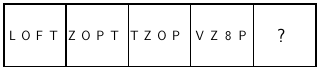
Select the figure from among the given options that can replace the question mark (?) in the following series.

  1. ((a))

  2. ((b))

  3. ((c))

  4. ((d))

Show Answer
Answer: ((c))

The logic followed here is:

  1. First box series ⇒ 

The first and third element are replaced by new element.

No specific pattern is followed, randomly are replaced by new elements i.e. either letter or digit.

No change in rest of the elements.

  1. Second box series ⇒

All the elements shift anticlockwise.

Thus, the final series is:

Hence, "Option 3" is the correct answer.

31

DKNF is related to YFIA in a certain way based on the English alphabetical order. In the same way, QYCR is related to LTXM. To which of the following is PEVM related, following the same logic?

  1. ((a))

    KZQH

  2. ((b))

    KZPG

  3. ((c))

    IYPG

  4. ((d))

    IYQH

Show Answer
Answer: ((a))

KZQH

The logic followed here is:

DKNF is related to YFIA

And,

QYCR is related to LTXM

Similarly,

PEVM is related to

Hence, "Option 1" is the correct answer.

32

Read the given statements and conclusions carefully. Assuming that the information given in the statements is true, even if it appears to be at variance with commonly known facts, decide which of the given conclusions logically follow(s) from the statements.

Statements

All kurtas are sarees.

All sarees are blouse.

Conclusions:

(I) All kurtas are blouse.

(II) No blouse is a saree.

  1. ((a))

    Both conclusions I and II follow

  2. ((b))

    Only conclusion II follows

  3. ((c))

    Neither conclusion I nor II follow

  4. ((d))

    Only conclusion I follows

Show Answer
Answer: ((d))

Only conclusion I follows

The least possible Venn diagram for the given statements is as shown below :

Conclusions:

(I) All kurtas are blouse → Follow (As all kurtas are sarees and all sarees are blouse. As whole kurtas comes in sarees which whole comes in blouse, therefore it is true.)

(II) No blouse is a saree → Does not follow (As all sarees are blouse. As whole saree comes in blouse, therefore it is false.)

∴ Here, Only conclusion I follows.​

Hence, the correct answer is "Option 4"

33

In a certain code language, 'BEST' is coded as '4982' and 'STEM' is coded as '6489'. What is the code for 'B' in that language?

  1. ((a))

    2

  2. ((b))

    4

  3. ((c))

    6

  4. ((d))

    8

Show Answer
Answer: ((a))

2

The logic followed here is:

'BEST' is coded as '4982'

'STEM' is coded as '6489'

Thus, code for 'B' is '2'.

Hence, "Option 1" is the correct answer.

34

Read the given statements and conclusions carefully. Assuming that the information given in the statements is true, even if it appears to be at variance with commonly known facts, decide which of the given conclusions logically follow(s) from the statement(s).

<br>

Statements: All planets are stars. All stars are galaxies.

Conclusion (I): All stars are planets.

Conclusion (II): All planets are galaxies.

  1. ((a))

    Both conclusions I and II follow

  2. ((b))

    Neither conclusion I nor II follows

  3. ((c))

    Only conclusion I follows

  4. ((d))

    Only conclusion II follows

Show Answer
Answer: ((d))

Only conclusion II follows

The least possible Venn diagram for the given statements is as shown below :

Conclusions:

(I) All stars are planets → Does not follow (As all planets are stars. So it is possible but not definite.)

(II) All planets are galaxies → Follow (As all planets are stars and all stars are galaxies. As whole planets comes in stars which whole comes in galaxies, therefore it is true.)

∴ Here, Only conclusion II follows.​

Hence, the correct answer is "Option 4"

35

In a certain code language, 'HAVE' is coded as '2648' and 'VOLT' is coded as '3961'. What is the code for 'V' in the given language?

  1. ((a))

    3

  2. ((b))

    6

  3. ((c))

    1

  4. ((d))

    4

Show Answer
Answer: ((b))

6

The logic followed here is:

'HAVE' is coded as '2648'

'VOLT' is coded as '3961'

Thus, code for 'V' is '6'.

Hence, "Option 2" is the correct answer.

36

Five girls P, Q, R, S and T sit around a circular table facing towards the centre (not necessarily in the same order). Only one girl sits between S and T. P sits to the immediate left of R. P is not an immediate neighbour of S.

Who sits third to the right of T?

  1. ((a))

    P

  2. ((b))

    R

  3. ((c))

    Q

  4. ((d))

    S

Show Answer
Answer: ((d))

S

Given: Five girls P, Q, R, S and T sit around a circular table facing towards the centre.

1) P sits to the immediate left of R.

2) P is not an immediate neighbour of S.

3) Only one girl sits between S and T.

After positioning S and T only one position is left which will be occupied by the only person left i.e. Q.

Thus, according to the final arrangement, S sits third to the right of T.

Hence, "Option 4" is the correct answer.

37

Which two numbers should be interchanged to make the given equation correct?

(24 + 14 - 6) ÷ 2 + 18 × 3 - 20 = 40

(Note: Interchange should be done of entire number and not individual digits of a given number)

  1. ((a))

    20 and 14

  2. ((b))

    2 and 3

  3. ((c))

    20 and 24

  4. ((d))

    14 and 18

Show Answer
Answer: ((d))

14 and 18

Given : (24 + 14 - 6) ÷ 2 + 18 × 3 - 20 = 40

According to the question, after interchanging the numbers :

Option 1) 20 and 14

(24 + 14 - 6) ÷ 2 + 18 × 3 - 20 = 40 ⇒ (24 + 20 - 6) ÷ 2 + 18 × 3 - 14 = 40

⇒ (24 + 20 - 6) ÷ 2 + 18 × 3 - 14 = 40

⇒ (44 - 6) ÷ 2 + 18 × 3 - 14 = 40

38 ÷ 2 + 18 × 3 - 14 = 40

⇒ 19 + 18 × 3 - 14 = 40

⇒ 19 + 54 - 14 = 40

⇒ 73 - 14 = 40

⇒ 59 ≠ 40 (LHS ≠ RHS)

Option  2) 2 and 3

(24 + 14 - 6) ÷ 2 + 18 × 3 - 20 = 40 ⇒ (24 + 14 - 6) ÷ 3 + 18 × 2 - 20 = 40

⇒ (24 + 14 - 6) ÷ 3 + 18 × 2 - 20 = 40

⇒ (38 - 6) ÷ 3 + 18 × 2 - 20 = 40

⇒ 32 ÷ 3 + 18 × 2 - 20 = 40

⇒ 10.67 + 18 × 2 - 20 = 40

⇒ 10.67 + 36 - 20 = 40

⇒ 46.67 - 20 = 40

⇒26.67 ≠ 40 (LHS ≠ RHS)

Option  3) 20 and 24

(24 + 14 - 6) ÷ 2 + 18 × 3 - 20 = 40 ⇒ (20 + 14 - 6) ÷ 2 + 18 × 3 - 24 = 40

⇒ (20 + 14 - 6) ÷ 2 + 18 × 3 - 24 = 40

⇒ (34 - 6) ÷ 2 + 18 × 3 - 24 = 40

⇒ 28 ÷ 2 + 18 × 3 - 24 = 40

⇒ 14 + 18 × 3 - 24 = 40

⇒ 14 + 54 - 24 = 40

68 - 24 = 40

⇒ 44 ≠ 40 (LHS ≠ RHS)

Option  4) 14 and 18

(24 + 14 - 6) ÷ 2 + 18 × 3 - 20 = 40 ⇒ (24 + 18 - 6) ÷ 2 + 14 × 3 - 20 = 40

⇒ (24 + 18 - 6) ÷ 2 + 14 × 3 - 20 = 40

⇒ (42 - 6) ÷ 2 + 14 × 3 - 20 = 40

⇒ 36 ÷ 2 + 14 × 3 - 20 = 40

⇒ 18 + 14 × 3 - 20 = 40

⇒ 18 + 42 - 20 = 40

60 - 20 = 40

⇒ 40 = 40 (LHS = RHS)

Hence, "Option 4" is the correct answer.

38

Select the number from among the given options that can replace the question mark (?) in the following series.

23, ?, 89, 177, 353, 705

  1. ((a))

    45

  2. ((b))

    47

  3. ((c))

    49

  4. ((d))

    42

Show Answer
Answer: ((a))

45

The logic followed here is:

Hence, "Option 1" is the correct answer.

39

Identify the figure given in the options which when put in place of ? will logically complete the series.

  1. ((a))

  2. ((b))

  3. ((c))

  4. ((d))

Show Answer
Answer: ((a))

The logic followed here is:

  1. Top elements ⇒ The letter element shift to the opposite side subsequently in the order of English alphabetic series.

  2. Second box series ⇒ The letter element shift to the opposite side subsequently in the order of English alphabetic series.

Thus, the final series is:

Hence, "Option 1" is the correct answer.

40

122 is related to 145 following a certain logic. Following the same logic, 37 is related to 50. To which of the following is 82 related, following the same logic?

<br>

(NOTE: Operations should be performed on the whole numbers, without breaking down the numbers into its constituent digits. Eg. 13 - Operations on 13 such as adding / subtracting / multiplying, etc. to 13 can be performed. Breaking down 13 into 1 and 3 and then performing mathematical operations on 1 and 3 is not allowed.)

  1. ((a))

    98

  2. ((b))

    89

  3. ((c))

    101

  4. ((d))

    96

Show Answer
Answer: ((c))

101

The logic followed here is:

122 is related to 145

√(122 - 1) + 1 = √(145 - 1)

√(121) + 1 = √(144)

11 + 1 = 12

12 = 12 (LHS = RHS)

And,

37 is related to 50

√(37 - 1) + 1 = √(50 - 1)

√(36) + 1 = √(49)

6 + 1 = 7

7 = 7 (LHS = RHS)

Similarly,

82 is related to

√(82 - 1) + 1 = √(? - 1)

√(81) + 1 = √(? - 1)

(9 + 1)2 = ? - 1

102 + 1 = ?

100 + 1 = ?

101 = ?

Hence, "Option 3" is the correct answer.

Session 2 (50 questions)

41

Who among the following is known for his/her books ‘The Algebra of Infinite Justice’, ‘Kashmir: The Case for Freedom’ and ‘Capitalism: A Ghost Story’?

  1. ((a))

    Jhumpa Lahiri

  2. ((b))

    Salman Rushdie

  3. ((c))

    Arundhati Roy

  4. ((d))

    Amitav Ghosh

Show Answer
Answer: ((c))

Arundhati Roy

The correct answer is Arundhati Roy.

Key Points

  • Arundhati Roy:
  • Arundhati Roy is an Indian author best known for her novel "The God of Small Things," which won the 1997 Man Booker Prize.
  • She is also a prominent political activist involved in human rights and environmental causes.
  • "The Algebra of Infinite Justice" is a collection of essays that critically examine the United States' response to the 9/11 attacks.
  • "Kashmir: The Case for Freedom" is a political essay where she has written about the kashmir issue.
  • "Capitalism: A Ghost Story" critiques the effects of globalization and capitalism in India.

Additional Information

  • Jhumpa Lahiri:
  • Jhumpa Lahiri is an American author of Indian origin known for her short stories and novels.
  • She won the Pulitzer Prize for Fiction in 2000 for her short story collection "Interpreter of Maladies."
  • Her works often explore themes of identity, displacement, and cultural adaptation, particularly among Indian immigrants in the United States.
  • She has also written the novel “The Namesake” and “Unaccustomed Earth”.
  • In recent years she has been writing in the italian language.
  • Salman Rushdie:
  • Salman Rushdie is a British-American novelist and essayist of Indian origin.
  • He is known for his controversial novel "The Satanic Verses," which led to a fatwa calling for his assassination.
  • His works often blend magical realism with historical and political commentary.
  • His other famous books include “Midnight’s Children” and “Grimus”.
  • He is known for his unique writing style.
  • Amitav Ghosh:
  • Amitav Ghosh is an Indian author known for his historical fiction and non-fiction works.
  • His works often explore themes of colonialism, climate change, and the history of the Indian Ocean region.
  • He is the author of "The Shadow Lines," "The Glass Palace," and "The Ibis Trilogy."
  • He has written non fiction works that discuss the climate crisis.
  • He is known for his very detailed and well researched books.
42

Few renowned artists of ________ dance style in India are Roshan Kumari, Shovana Narayan, Maya Rao and Kumudini Lakhia.

  1. ((a))

    Chhau

  2. ((b))

    Manipuri

  3. ((c))

    Odissi

  4. ((d))

    Kathak

Show Answer
Answer: ((d))

Kathak

The correct answer is Kathak.

Key Points

  • Kathak:
  • Kathak is a major classical dance form originating from northern India.
  • It is characterized by intricate footwork, rapid spins (chakkars), and expressive gestures.
  • The word "Kathak" is derived from the Sanskrit word "katha," meaning "story," and story-telling is a key element of the dance.
  • Roshan Kumari, Shovana Narayan, Maya Rao, and Kumudini Lakhia are indeed renowned exponents of Kathak, contributing significantly to its evolution and popularization.
  • Kathak has strong Hindu and Muslim influences, and has evolved through both temple and court traditions.

Additional Information

  • Chhau:
  • Chhau is a semi-classical dance form with martial, tribal, and folk traditions.
  • It originates from the eastern Indian states of Odisha, Jharkhand, and West Bengal.
  • Chhau dances are characterized by vigorous movements, acrobatic leaps, and the use of masks in some styles.
  • The dance often depicts episodes from epics like the Mahabharata and Ramayana, as well as local legends.
  • There are three main styles of Chhau, named after the location where they are performed: Purulia Chhau, Seraikella Chhau, and Mayurbhanj Chhau.
  • Manipuri:
  • Manipuri is a classical dance form originating from the northeastern Indian state of Manipur.
  • It is known for its graceful and fluid movements, particularly the raslila, which depicts the love story of Radha and Krishna.
  • Manipuri dance uses distinctive cylindrical skirts (called 'kumil') and veils.
  • The dance emphasizes gentle swaying movements and subtle hand gestures.
  • The dance form is deeply rooted in the Vaishnavism tradition.
  • Odissi:
  • Odissi is a classical dance form originating from the eastern Indian state of Odisha.
  • It is characterized by its tribhangi (three-bend) posture, graceful movements, and expressive facial expressions.
  • Odissi dance is deeply rooted in the temple traditions of Odisha, and many of its movements are inspired by sculptures found in ancient temples.
  • The dance involves expressions of divine and human love.
  • Odissi was reconstructed in the mid 20th century, after a period of decline.
43

Moti Masjid in Agra fort was constructed by which of the following Mughal Emperors?

  1. ((a))

    Aurangzeb

  2. ((b))

    Jahangir

  3. ((c))

    Akbar

  4. ((d))

    Shahjahan

Show Answer
Answer: ((d))

Shahjahan

The correct answer is Shahjahan.

Key Points

  • Shahjahan:
  • Shahjahan reigned during the peak of Mughal architectural splendor.
  • He commissioned the Moti Masjid (Pearl Mosque) within the Agra Fort, known for its pristine white marble construction.
  • His most iconic creation is the Taj Mahal, a testament to his love for his wife, Mumtaz Mahal.
  • He also significantly redesigned the Agra Fort, adding numerous marble structures.
  • Shahjahan built the Jama Masjid in Delhi, another architectural masterpiece.

Additional Information

  • Aurangzeb:
  • Aurangzeb's reign saw a decline in Mughal architectural patronage.
  • While he did construct the Badshahi Mosque in Lahore, his focus shifted more towards military campaigns and expanding the empire.
  • His architectural style was less ornate than that of Shah Jahan.
  • Aurangzeb's rule is often characterized by its strict adherence to Islamic law.
  • His rule expanded the Mughal empires territory to its largest size.
  • Jahangir:
  • Jahangir was known for his love of art and gardens.
  • He continued the construction of Akbar's tomb in Sikandra.
  • He significantly contributed to the development of Mughal painting.
  • Jahangir also designed many beautiful gardens.
  • His rule was known for relative peace, and prosperity.
  • Akbar:
  • Akbar's architectural style blended Persian and Indian influences.
  • He built the Agra Fort, although Shahjahan later modified it extensively.
  • He also constructed the city of Fatehpur Sikri, including the Buland Darwaza and Panch Mahal.
  • He was known for his religious tolerance.
  • Akbar's rule consolidated the Mughal Empire.
44

To get relief from constipation, which of the following is prescribed to be eaten in large amount?

  1. ((a))

    Protein

  2. ((b))

    Meat

  3. ((c))

    Fish

  4. ((d))

    Fibre

Show Answer
Answer: ((d))

Fibre

The correct answer is Fibre.

Key Points

  • Fibre:
  • Dietary fibre, also known as roughage, is the indigestible portion of plant foods.
  • It adds bulk to the stool, making it easier to pass through the digestive system.
  • Fibre absorbs water, which softens the stool and prevents constipation.
  • Consuming a high-fibre diet is a primary recommendation for relieving and preventing constipation.
  • Good sources of fibre include fruits, vegetables, whole grains, and legumes.

Additional Information

  • Protein:
  • Protein is essential for building and repairing tissues.
  • While protein is a vital nutrient, it does not directly contribute to relieving constipation.
  • Excessive protein intake, especially without sufficient fibre, can worsen constipation.
  • Protein is found in foods like meat, poultry, fish, eggs, and dairy.
  • Protein is broken down into amino acids.
  • Meat:
  • Meat is a source of protein and iron.
  • However, it is generally low in fibre, which can contribute to constipation.
  • Processed meats often contain high amounts of sodium and unhealthy fats.
  • Red meat is also known to take longer to digest.
  • A diet high in meat and low in fibre can exacerbate constipation.
  • Fish:
  • Fish is a good source of protein and omega-3 fatty acids.
  • Like meat, fish is low in fibre and does not directly relieve constipation.
  • Omega-3 fatty acids have anti-inflammatory properties, but they do not have a significant impact on bowel movements.
  • Fish is a lean source of protein.
  • Some fish contain high levels of vitamin D.
45

Where was the Intercontinental Football Cup 2023 organised?

  1. ((a))

    Chandigarh

  2. ((b))

    Bhubaneswar

  3. ((c))

    Jalpaiguri

  4. ((d))

    Dispur

Show Answer
Answer: ((b))

Bhubaneswar

The correct answer is Bhubaneswar.

Key Points

  • Location: Bhubaneswar, the capital city of Odisha, India, hosted the Intercontinental Football Cup 2023. The city is known for its rich cultural heritage and has emerged as a major sports hub in recent years.
  • Venue: The matches were held at the Kalinga Stadium, a world-class sports facility that has hosted numerous international events, including hockey tournaments and football matches. The stadium is equipped with modern amenities and has a seating capacity of over 15,000 spectators.
  • Significance: The Intercontinental Football Cup is a prestigious tournament that brings together clubs from different continents to compete. It serves as a platform for cultural exchange and promotes football at a global level.
  • Participants: The 2023 edition featured teams from Asia, Africa, Europe, and South America, showcasing a diverse range of playing styles and strategies.
  • Organizers: The tournament was organized by the All India Football Federation (AIFF) in collaboration with the Odisha government and the Asian Football Confederation (AFC).
46

In 1974, classical singer Naina Devi was awarded the Padma Shri for her contribution to which of the following singing styles?

  1. ((a))

    Thumri

  2. ((b))

    Tappa

  3. ((c))

    Kajari

  4. ((d))

    Dadra

Show Answer
Answer: ((a))

Thumri

The correct answer is Thumri.

Key Points

  • Thumri:
  • Thumri is a semi-classical vocal genre originating from the Uttar Pradesh region of India.
  • It is characterized by its lyrical and romantic nature, often expressing themes of love and devotion.
  • Thumri emphasizes emotional expression and improvisation, with a focus on conveying the mood of the lyrics.
  • Naina Devi was a renowned exponent of Thumri, known for her expressive and evocative renditions.
  • Thumri often uses Braj Bhasha, a dialect of Hindi, for its lyrics.

Additional Information

  • Tappa:
  • Tappa is a semi-classical vocal genre that originated in the Punjab region of India.
  • It is characterized by its fast-paced and intricate melodic patterns.
  • Tappa songs often express themes of love and longing.
  • It is known for its quick turns and complex ornamentation.
  • Tappa requires great skill and vocal agility.
  • Kajari:
  • Kajari is a semi-classical vocal genre associated with the monsoon season in northern India.
  • It is characterized by its folk-like melodies and lyrics that celebrate the beauty of nature and the joys of the rainy season.
  • Kajari songs often express themes of love, longing, and separation.
  • It is traditionally performed during the Hindu month of Shravan.
  • Kajari is very popular in the regions of Uttar Pradesh and Bihar.
  • Dadra:
  • Dadra is a light classical vocal genre that is closely related to Thumri.
  • It is characterized by its lighter and more playful mood compared to Thumri.
  • Dadra songs often feature themes of love and romance, but in a more lighthearted manner.
  • It is known for its rhythmic variations and improvisations.
  • Dadra is often performed with a faster tempo than Thumri.
47

What is the chemical formula for the compound commonly known as 'laughing gas'?

  1. ((a))

    NO

  2. ((b))

    N2O3

  3. ((c))

    N2O

  4. ((d))

    NO2

Show Answer
Answer: ((c))

N2O

The correct answer is N2O.

Key Points

  • N2O (Nitrous Oxide):
  • Nitrous oxide is commonly known as 'laughing gas' due to its euphoric effects when inhaled.
  • It is a colorless, non-flammable gas with a slightly sweet odor and taste.
  • It is used in medical and dental procedures as an anesthetic and analgesic.
  • It is also used as a propellant in aerosol cans and as an oxidizer in rocket motors.
  • In high concentrations, it can cause asphyxiation.

Additional Information

  • NO (Nitric Oxide):
  • Nitric oxide is a free radical that plays a crucial role in various biological processes.
  • It is a signaling molecule involved in vasodilation, neurotransmission, and immune response.
  • It is also a pollutant produced by combustion processes.
  • It is a colorless gas.
  • It is used in some medical treatments.
  • N2O3 (Dinitrogen Trioxide):
  • Dinitrogen trioxide is an unstable oxide of nitrogen.
  • It is a dark blue liquid or solid that decomposes at room temperature.
  • It is an intermediate in the production of nitric acid.
  • It is a strong oxidizing agent.
  • It is very toxic.
  • NO2 (Nitrogen Dioxide):
  • Nitrogen dioxide is a reddish-brown gas with a pungent, irritating odor.
  • It is a major air pollutant produced by combustion processes, particularly from vehicles.
  • It contributes to the formation of smog and acid rain.
  • It can cause respiratory problems.
  • It is a strong oxidizing agent.
48

In which of the following religions was the agriculture prohibited for its followers?

  1. ((a))

    Buddhism

  2. ((b))

    Vaishnavism

  3. ((c))

    Shaivism

  4. ((d))

    Jainism

Show Answer
Answer: ((d))

Jainism

The correct answer is Jainism.

Key Points

  • Jainism:
  • Jainism strongly emphasizes the principle of Ahimsa (non-violence) towards all living beings.
  • Agriculture is often prohibited for strict Jain followers because it inevitably involves harming living organisms, such as insects and microorganisms in the soil.
  • Jains believe that even unintentional harm carries karmic consequences.
  • This is why many Jains traditionally pursue occupations such as trade and commerce.
  • Jain monks and nuns especially adhere to strict rules to avoid causing any harm.

Additional Information

  • Buddhism:
  • Buddhism emphasizes the Middle Way, avoiding extremes of asceticism and indulgence.
  • While Buddhism promotes compassion for all living beings, it does not strictly prohibit agriculture.
  • Buddhist monks and nuns often rely on alms from lay followers, which may include agricultural produce.
  • Buddhist teachings focus on achieving enlightenment through meditation and ethical conduct.
  • Buddhism has varying views on different occupations, but agriculture is not universally prohibited.
  • Vaishnavism:
  • Vaishnavism is a Hindu tradition that centers on the worship of Vishnu or his avatars, such as Krishna and Rama.
  • Vaishnavism encourages a devotional path to spiritual liberation.
  • Agriculture is a common occupation among Vaishnavas, and agricultural produce is often offered as prasad (sacred food).
  • Vaishnavism emphasizes vegetarianism and non-violence, but agriculture is not prohibited.
  • Many Vaishnavas believe that offering the product of their labor to god is a part of their devotional practice.
  • Shaivism:
  • Shaivism is a Hindu tradition that centers on the worship of Shiva.
  • Like Vaishnavism, Shaivism does not prohibit agriculture.
  • Shaivites engage in various occupations, including agriculture, and often offer agricultural produce in their rituals.
  • Shaivism emphasizes asceticism and yogic practices, but it does not impose a general prohibition on agriculture.
  • Shaivism has a diverse range of practices and philosophies.
49

According to National Multidimensional Poverty Index 2023 (A Progress Review), which state has the highest proportion of multidimensionally poor people (Headcount Ratio)?

  1. ((a))

    Rajasthan

  2. ((b))

    Bihar

  3. ((c))

    Odisha

  4. ((d))

    Jharkhand

Show Answer
Answer: ((b))

Bihar

The correct answer is Bihar.

Key Points National Multidimensional Poverty Index (MPI) 2023:

  • The National MPI 2023, titled "A Progress Review," was released by NITI Aayog.
  • It is based on the National Family Health Survey-5 (NFHS-5) data.
  • The index measures poverty across three dimensions: health, education, and standard of living.
  • These dimensions are further broken down into 12 indicators, including nutrition, child and adolescent mortality, years of schooling, school attendance, cooking fuel, sanitation, drinking water, electricity, housing, assets, and bank accounts
50

Who was the Viceroy of India when the Indian Arms Act, 1878, was passed?

  1. ((a))

    Lord Curzon

  2. ((b))

    Lord Ripon

  3. ((c))

    Lord Dufferin

  4. ((d))

    Lord Lytton

Show Answer
Answer: ((d))

Lord Lytton

The correct answer is Lord Lytton.

Key Points

  • Lord Lytton:
  • Lord Lytton served as the Viceroy of India from 1876 to 1880.
  • He was responsible for enacting the Indian Arms Act of 1878, which restricted Indians from possessing firearms.
  • This act was highly controversial and seen as discriminatory, fueling anti-British sentiment.
  • His administration was also marked by the disastrous handling of the Great Famine of 1876-1878.
  • He was also the viceroy during the second Anglo-Afghan war.

Additional Information

  • Lord Curzon:
  • Lord Curzon served as the Viceroy of India from 1899 to 1905.
  • He is known for his policies of centralization and efficiency, but also for his divisive actions, such as the partition of Bengal in 1905.
  • He implemented reforms in education, agriculture, and archaeology.
  • He was known for his interest in preserving ancient monuments.
  • His rule was a time of increased nationalism.
  • Lord Ripon:
  • Lord Ripon served as the Viceroy of India from 1880 to 1884.
  • He is remembered for his liberal policies, including the repeal of the Vernacular Press Act and the introduction of local self-government.
  • He attempted to pass the Ilbert Bill, which aimed to remove racial jurisdiction disparities in the courts.
  • His rule is often viewed as a time of progressive reform.
  • He is considered one of the most popular viceroys.
  • Lord Dufferin:
  • Lord Dufferin served as the Viceroy of India from 1884 to 1888.
  • His tenure saw the annexation of Upper Burma in 1885.
  • The Indian National Congress was founded during his viceroyalty in 1885.
  • His rule was a time of increased British expansion.
  • His rule was a time of increased political organization by Indians.
51

According to Economic Survey 2023-24, which of the following states is the largest wheat producing state of India?

  1. ((a))

    Assam

  2. ((b))

    Uttar Pradesh

  3. ((c))

    West Bengal

  4. ((d))

    Bihar

Show Answer
Answer: ((b))

Uttar Pradesh

The correct answer is Uttar Pradesh.

Key Points

  • Uttar Pradesh is consistently the largest wheat-producing state in India.
  • The state's fertile Gangetic plains and favorable climate conditions are ideal for wheat cultivation.
  • Uttar Pradesh contributes significantly to India's overall wheat production, ensuring food security.
  • The Economic Survey 2023-24 confirms Uttar Pradesh's leading position in wheat production.
  • The state has a very large agricultural workforce.
52

Which Article deals with the provisions in case of failure of the constitutional machinery in the State?

  1. ((a))

    Article 356

  2. ((b))

    Article 448

  3. ((c))

    Article 395

  4. ((d))

    Article 342

Show Answer
Answer: ((a))

Article 356

The correct answer is Article 356.

Key Points

  • Article 356:
  • Article 356 of the Indian Constitution deals with the provisions in case of failure of the constitutional machinery in a state.
  • It empowers the President of India to impose President's Rule in a state if the Governor reports that the state government cannot function according to the Constitution.
  • This article is often referred to as "President's Rule" or "State Emergency."
  • The President's Rule results in the suspension of the state government, and the state comes under the direct control of the central government.
  • This article has been a subject of much debate and controversy regarding its use and misuse.

Additional Information

  • Article 448:
  • Article 448 does not exist within the Indian Constitution.
  • The Indian Constitution contains 448 articles, but those articles are within parts and schedules, and also some are deleted.
  • Therefore 448 is not related to any specific legal provision.
  • The last article in the constitution is 395.
  • Any number higher than that is not a valid article number.
  • Article 395:
  • Article 395 deals with the repeal of the Indian Independence Act, 1947, and the Government of India Act, 1935.
  • It signifies the transition from British rule to the establishment of the Indian Constitution.
  • This article effectively abolished the legal framework of the colonial era.
  • It is the final article of the indian constitution.
  • This Article is important for the legal history of India.
  • Article 342:
  • Article 342 deals with the specification of Scheduled Tribes.
  • It empowers the President to specify the tribes or tribal communities that shall be deemed to be Scheduled Tribes in relation to that state or union territory.
  • It is crucial for the implementation of affirmative action policies for Scheduled Tribes.
  • This article allows for the protection of tribal communities.
  • The list of scheduled tribes can be modified by parliament.
53

Who among the following was the top run-scorer for India at the 1983 Cricket World Cup final with 38 runs?

  1. ((a))

     Kapil Dev

  2. ((b))

     Mohinder Amarnath

  3. ((c))

    Sandeep Patil

  4. ((d))

    Krishnamachari Srikkanth

Show Answer
Answer: ((d))

Krishnamachari Srikkanth

The correct answer is Krishnamachari Srikkanth.

Key Points

  • Krishnamachari Srikkanth:
  • Krishnamachari Srikkanth was the highest run-scorer for India in the 1983 World Cup final, scoring 38 runs.
  • He played an aggressive opening innings, providing a crucial start for India against a formidable West Indies bowling attack.
  • His innings included 7 fours and 1 six.
  • He played a very important role in setting the tone for India's batting.
  • His aggressive style of batting was a key part of his play.

Additional Information

  • Kapil Dev:
  • Kapil Dev, the captain of the Indian team, played a crucial role in the victory, but his contribution in the final was more significant with his captaincy and fielding than his batting.
  • He scored 15 runs in the final.
  • His famous catch of Viv Richards was a turning point in the match.
  • He led the team with great determination and inspired them to victory.
  • His contribution to the 1983 world cup tournament was immense.
  • Mohinder Amarnath:
  • Mohinder Amarnath was named the Man of the Match in the final for his all-round performance.
  • He scored 26 runs and took 3 wickets.
  • He played a steady innings, contributing to India's total.
  • His bowling was very effective, and he took key wickets.
  • He was known for his calm and composed demeanor under pressure.
  • Sandeep Patil:
  • Sandeep Patil played a brief innings in the final.
  • He scored 27 runs.
  • He attempted to accelerate the scoring rate.
  • He was known for his aggressive batting style.
  • He played a supporting role in the middle order.
54

The Indian Constitution has adopted the parliamentary form of Government from ________.

  1. ((a))

    USA

  2. ((b))

    Russia

  3. ((c))

    Britain

  4. ((d))

    France

Show Answer
Answer: ((c))

Britain

The correct answer is Britain.

Key Points

  • Parliamentary System Origin:
  • The parliamentary system of government originated in Britain.
  • It is characterized by the fusion of the executive and legislative branches of government.
  • The head of government, the Prime Minister, is chosen from the legislature (Parliament).

Additional Information

  • Indian Adoption:
  • India adopted the parliamentary system from Britain due to its historical association and familiarity with the system.
  • The British had established a parliamentary framework in India through various acts prior to independence.
  • The framers of the Indian Constitution found the parliamentary system suitable for India's diverse population and democratic aspirations.
  • The system allows for greater accountability of the executive to the legislature.
55

According to average rainfall in India, the Ladakh Union Territory is located in ________.

  1. ((a))

    areas of inadequate rainfall

  2. ((b))

    areas of low rainfall

  3. ((c))

    areas of high rainfall

  4. ((d))

    areas of medium rainfall

Show Answer
Answer: ((a))

areas of inadequate rainfall

The correct answer is areas of inadequate rainfall.

Key Points

  • "Low Rainfall" as a Classification:
  • Indian meteorological classifications typically use terms like "low rainfall" to categorize regions with specific precipitation ranges.
  • Ladakh's consistently very low annual precipitation fits squarely within these established classifications for arid or semi-arid regions.
  • Geographically, the term accurately reflects the region's position in the rain shadow of the Himalayas.
  • "Inadequate Rainfall" as a Contextual Term:
  • "Inadequate rainfall" is more of a contextual term, implying that the rainfall is insufficient for a particular purpose (e.g., agriculture, water supply).
  • While Ladakh's rainfall is indeed inadequate for many purposes, the primary classification is based on the measured precipitation levels.
  • Ladakh's terrain is such that even if the rainfall was higher, traditional agriculture would have limited success.
  • The term inadequate can also be a subjective term.
  • Ladakh's Specific Situation:
  • Ladakh's unique geography and climate make it an area of consistently low rainfall, not just a place where rainfall is sometimes inadequate.
  • The region is a cold desert.
56

Due to the popularity of Indian clothes in Britain, a law was passed to ban Indian clothes. Which of the following was that law?

  1. ((a))

    Muslin act

  2. ((b))

    Calso act

  3. ((c))

    Textile act

  4. ((d))

    Calico Act

Show Answer
Answer: ((d))

Calico Act

The correct answer is Calico Act.

Key Points

  • Calico Act:
  • The Calico Acts were a series of English laws passed between 1700 and 1721.
  • They were designed to protect the British wool and silk industries from the competition of imported cotton textiles, particularly calico, from India.
  • Calico was a type of cotton fabric, often printed with intricate designs, that had become immensely popular in Britain.
  • The acts initially banned the import of finished calico and later extended to prohibit the wearing of calico.
  • These acts demonstrate the economic impact of Indian textiles on the British market during that period.

Additional Information

  • Muslin act:
  • There is no historically recognized "Muslin Act" in the context of British laws against Indian textiles.
  • Muslin, another fine cotton fabric from India, was also popular, and its trade was affected by the general restrictions on Indian textiles.
  • Muslin was a very high quality fabric.
  • Muslin was desired by the wealthy.
  • The trade in Muslin was very profitable.
  • Calso act:
  • "Calso Act" is not a recognized historical term related to British laws or Indian textiles.
  • It is likely a misspelling or an incorrect term.
  • There are no historical records of this act.
  • It is important to use accurate historical names.
  • Historical accuracy is very important.
  • Textile act:
  • While there were numerous acts related to textiles in British history, "Textile Act" is too general a term.
  • The specific laws that targeted Indian textiles were the Calico Acts.
  • The term textile act does not refer to one specific law.
  • Many laws relating to textiles occurred during the industrial revolution.
  • The Calico acts predated the industrial revolution.
57

Anorexia nervosa is an eating disorder in teenagers. Here body weight:

  1. ((a))

    does not change

  2. ((b))

    increases slightly

  3. ((c))

    loses drastically

  4. ((d))

    increases drastically

Show Answer
Answer: ((c))

loses drastically

The correct answer is loses drastically.

Key Points

  • Anorexia Nervosa:
  • Anorexia nervosa is a serious eating disorder characterized by an intense fear of gaining weight, a distorted body image, and persistent behavior that interferes with weight gain.
  • Individuals with anorexia nervosa severely restrict their food intake, often leading to drastic weight loss.
  • They may also engage in excessive exercise or use purging behaviors (such as vomiting or laxative abuse) to control their weight.
  • This disorder can have severe physical and psychological consequences.
  • It is a mental health condition with a high mortality rate.

Additional Information

  • does not change:
  • In anorexia nervosa, body weight does not remain stable.
  • The core feature of the disorder is a drive for thinness, leading to weight loss.
  • If a persons weight does not change, then they do not have anorexia nervosa.
  • Weight change is a key diagnostic factor.
  • This answer is the opposite of the reality of the disorder.
  • increases slightly:
  • Slight weight gain is not characteristic of anorexia nervosa.
  • The disorder is defined by a fear of weight gain and behaviors aimed at preventing it.
  • Any weight gain causes severe distress to a person with anorexia nervosa.
  • This answer is contrary to the defining characteristics of the illness.
  • Weight gain is what people with this illness fear.
  • increases drastically:
  • Drastic weight gain is not associated with anorexia nervosa.
  • The disorder leads to significant weight loss due to severe food restriction.
  • Drastic weight increase is associated with other eating disorders.
  • This is the opposite of the effect of anorexia nervosa.
58

Carbon dioxide plays a vital role in changing the earth’s climate, leading to a critical condition known as ________.

  1. ((a))

    Temperature Convection

  2. ((b))

    Ozone Depletion

  3. ((c))

    Thermal Conduction

  4. ((d))

    Greenhouse Effect

Show Answer
Answer: ((d))

Greenhouse Effect

The correct answer is Greenhouse Effect.

Key Points

Greenhouse Effect:

  • The greenhouse effect is a natural process where certain gases in the Earth's atmosphere trap heat from the sun
  • Carbon dioxide (CO2) is a major greenhouse gas, and increased concentrations due to human activities enhance this effect.
  • This leads to a rise in global temperatures, contributing to climate change.
  • The greenhouse effect is essential for maintaining a habitable temperature on Earth, but excess greenhouse gases cause global warming.
  • The greenhouse effect is a major environmental concern.

Additional Information

  • Temperature Convection:
  • Temperature convection is a process of heat transfer through the movement of fluids (liquids or gases).
  • It occurs when warmer, less dense fluid rises, and cooler, denser fluid sinks.
  • While convection plays a role in atmospheric circulation and climate patterns, it is not the primary term for the overall climate change phenomenon caused by CO2.
  • Convection is a heat transfer process.
  • This process occurs in the atmosphere and oceans.
  • Convection is part of weather patterns.
  • Ozone Depletion:
  • Ozone depletion refers to the thinning of the ozone layer in the Earth's stratosphere.
  • The ozone layer protects the Earth from harmful ultraviolet (UV) radiation from the sun.
  • Chlorofluorocarbons (CFCs) and other chemicals are primarily responsible for ozone depletion, not carbon dioxide.
  • Ozone depletion is a separate environmental issue from the greenhouse effect.
  • Ozone depletion has a direct effect on the amount of UV radiation reaching the earths surface.
  • Thermal Conduction:
  • Thermal conduction is the process of heat transfer through direct contact between molecules.
  • It occurs when heat energy is transferred from a warmer object to a cooler one.
  • While conduction is a fundamental heat transfer mechanism, it is not the primary process by which CO2 affects the Earth's climate.
  • Conduction is most efficient in solid materials.
  • Conduction is heat transfer without the movement of the material itself.
  • Conduction occurs in the earths crust.
59

'Navroz' is celebrated as the new year by which of the following communities?

  1. ((a))

    Christian

  2. ((b))

    Buddhist

  3. ((c))

    Parsi

  4. ((d))

    Sikh

Show Answer
Answer: ((c))

Parsi

The correct answer is Parsi.

Key Points

  • Parsi:
  • Navroz, also known as Nowruz, is the Persian New Year, celebrated by the Parsi community, who are followers of Zoroastrianism.
  • It marks the first day of spring and the renewal of nature.
  • Parsis celebrate Navroz with traditional rituals, including prayers, feasts, and the setting of a special table called the Haft-sin.
  • It is a time for family gatherings and the exchange of gifts.
  • Navroz has pre-Islamic roots, and is a very old celebration.

Additional Information

  • Christian:
  • Christians celebrate the New Year on January 1st, according to the Gregorian calendar.
  • Different Christian denominations may have other significant dates related to religious observances, but January 1st is the widely recognized New Year's Day.
  • Christian celebrations often include church services, family gatherings, and festive meals.
  • The date of Easter is also a very important date for Christians.
  • The celebration of christmas is also a major holiday.
  • Buddhist:
  • Buddhists observe various New Year celebrations depending on their cultural and regional traditions.
  • In Theravada Buddhist countries like Thailand, Myanmar, and Sri Lanka, the New Year (Songkran) is typically celebrated in April.
  • In Tibetan Buddhism, Losar is the New Year, which usually falls in February or March.
  • Buddhist New Year celebrations often involve temple visits, prayers, and community festivities.
  • Buddhist celebrations often reflect the local culture.
  • Sikh:
  • Sikhs celebrate Vaisakhi as their New Year, which usually falls on April 13th or 14th.
  • Vaisakhi also commemorates the formation of the Khalsa Panth by Guru Gobind Singh in 1699.
  • Sikh celebrations include visits to gurdwaras, kirtan (devotional singing), and community gatherings.
  • Vaisakhi is a very important religious holiday.
  • The celebration is often a very festive occasion.
60

Odissi Guru, _______ received the first Utkal Pratibha Samman 2023 at Bhubaneswar.

  1. ((a))

    Ratikant Mohapatra

  2. ((b))

    Hema Rajagopalan

  3. ((c))

    Vidhya Subramanian

  4. ((d))

    Sailaja

Show Answer
Answer: ((a))

Ratikant Mohapatra

The correct answer is Ratikant Mohapatra.

Key Points

  • Ratikant Mohapatra:
  • Ratikant Mohapatra is a renowned Odissi dancer and choreographer.
  • He is the son of the legendary Odissi Guru, Kelucharan Mohapatra.
  • He is the director of Srjan, an Odissi dance institution founded by his father.
  • He has made significant contributions to the preservation and promotion of Odissi dance.
  • He received the first Utkal Pratibha Samman 2023 at Bhubaneswar for his contributions to Odissi.

Additional Information

  • Hema Rajagopalan:
  • Hema Rajagopalan is a renowned Bharatanatyam dancer and choreographer.
  • She is the founder of Natya Dance Theatre in Chicago.
  • She has extensively trained many students in Bharatanatyam.
  • She has choreographed many dance productions.
  • She has contributed to the promotion of Bharatanatyam in the United States.
  • Vidhya Subramanian:
  • Vidhya Subramanian is a respected Bharatanatyam dancer and guru.
  • She is known for her precise technique and expressive abhinaya.
  • She has performed and conducted workshops in India and abroad.
  • She is a dedicated teacher of Bharatanatyam.
  • She has contributed to many Bharatanatyam productions.
  • Sailaja:
  • Sailaja is a Kuchipudi dancer.
  • She is known for her graceful movements and expressive performances.
  • She has performed extensively in India and abroad.
  • She is dedicated to the preservation and promotion of Kuchipudi dance.
  • She has trained many Kuchipudi Dancers.
61

Which of the followings is NOT one of the government accounts of India?

  1. ((a))

    Public Accounts of India

  2. ((b))

    Consolidated Funds of India

  3. ((c))

    General Provident Fund

  4. ((d))

    Contingency Fund of India

Show Answer
Answer: ((c))

General Provident Fund

The correct answer is General Provident Fund.

Key Points

  • General Provident Fund:
  • The General Provident Fund (GPF) is a savings scheme for government employees.
  • It is a contributory provident fund where employees contribute a portion of their salary, and the government pays interest on the accumulated amount.
  • While the government manages the GPF, it is not considered one of the core government accounts like the Consolidated Fund, Contingency Fund, or Public Accounts.
  • It is a fund for government employees retirement.
  • The money in the GPF belongs to the individual government employees.

Additional Information

  • Public Accounts of India:
  • The Public Accounts of India is where funds that do not belong to the government are kept.
  • These include funds from small savings, provident funds, and other deposits.
  • The government acts as a banker for these funds.
  • The government does not have direct control over these funds.
  • The funds are refundable to the depositor.
  • Consolidated Fund of India:
  • The Consolidated Fund of India is the most important government account.
  • All government revenues, loans, and expenditures are routed through this fund.
  • No money can be withdrawn from this fund without parliamentary approval.
  • It is the primary source of funds for the government's operations.
  • It is created by article 266 of the constitution.
  • Contingency Fund of India:
  • The Contingency Fund of India is used for unforeseen expenditures.
  • It is at the disposal of the President of India.
  • It is used for emergency situations.
  • It is created by article 267 of the constitution.
  • Parliamentary approval is sought after the expenditure
62

To mark the 75 years of Indo-Lanka Diplomatic Relations, External Affairs Minister Jaishankar inaugurated the 'Geoffrey Bawa: It is Essential To be There' Exhibition in March 2023. Who was Geoffrey Bawa?

  1. ((a))

    Sri Lankan Architect

  2. ((b))

    Indian Poet

  3. ((c))

    Sri Lankan Poet

  4. ((d))

    Indian Architect

Show Answer
Answer: ((a))

Sri Lankan Architect

The correct answer is Sri Lankan Architect.

Key Points

  • Geoffrey Bawa's Profession:
  • Geoffrey Bawa was a highly influential Sri Lankan architect.
  • He is considered one of the most important and influential Asian architects of the 20th century.
  • Architectural Style:
  • He is known for his unique architectural style, which blends modern architectural concepts with traditional Sri Lankan design elements.
  • His work emphasized the integration of buildings with their natural surroundings.
  • He was a pioneer of what is known as "tropical modernism."
  • His designs focused on creating harmonious relationships between indoor and outdoor spaces.
  • Key Contributions:
  • Bawa's work significantly impacted the development of architecture in Sri Lanka and the broader region.
  • He designed numerous iconic buildings, including hotels, residences, and public spaces.
  • His designs often incorporated courtyards, verandas, and water features.
  • His work often used local materials.
  • His work was known for its attention to detail.
63

Based on the Tendulkar committee, the National poverty line was defined as which of the following?

i. ₹816 per capita per month for rural areas

ii. ₹1,000 per capita per month for urban areas.

  1. ((a))

    Only ii is correct

  2. ((b))

    Both i and ii are correct

  3. ((c))

    Both i and ii are incorrect

  4. ((d))

    Only i is correct

Show Answer
Answer: ((b))

Both i and ii are correct

The correct answer is Both i and ii are correct.

Key Points

  • Tendulkar Committee Background:
  • The Tendulkar Committee was constituted by the Planning Commission of India in 2005.
  • It was chaired by economist Suresh Tendulkar.
  • The committee was tasked with reviewing the methodology for estimating poverty in India.
  • Methodology Shift:
  • The committee moved away from the calorie-based approach used in previous poverty estimations.
  • It adopted a consumption expenditure-based approach.
  • This approach considered expenditures on various items, including food, education, and health.
  • Poverty Line Definition:
  • The committee defined the poverty line based on the monthly per capita consumption expenditure (MPCE).
  • It established the poverty line at ₹816 per capita per month for rural areas.
  • It established the poverty line at ₹1,000 per capita per month for urban areas.
  • The committee aimed to create a more uniform poverty line.
  • The committee included expenditure on health and education in the calculations.
  • The committee's report was submitted in 2009.
  • The committee's report was controversial, and was debated.
  • The committee's report was an important step in poverty measurement in India.
  • The data used by the tendulkar committee was based on NSSO data.
  • NSSO stands for National Sample Survey Office.
  • The tendulkar committee's report helped to create a better understanding of poverty in India.
  • The tendulkar committee's methodology was used for several years.
  • The tendulkar committee's methodology was later reviewed by the Rangarajan committee.
  • The Rangarajan committee proposed a higher poverty line.
  • The tendulkar committee's report highlighted the differences between rural and urban poverty.
  • The tendulkar committee's work was an important part of Indian economic history.
  • The tendulkar committee's report helped to inform government policies on poverty reduction.
  • The committee's methodology was designed to be more inclusive.
64

Amer Fort was built with red sandstone and white marble by which ruler in the 16th century?

  1. ((a))

    Raja Jai Singh

  2. ((b))

    Raja Udai Singh

  3. ((c))

    Raja Amar Singh

  4. ((d))

    Raja Man Singh I

Show Answer
Answer: ((d))

Raja Man Singh I

The correct answer is Raja Man Singh I.

Key Points

  • Raja Man Singh I:
  • Raja Man Singh I was the ruler of Amer (now Jaipur) in the 16th century.
  • He is credited with the major construction of Amer Fort, using red sandstone and white marble.
  • He was a trusted general in the Mughal emperor Akbar's army.
  • His reign saw significant expansion and development of the Amer kingdom.
  • The fort's architecture reflects a blend of Rajput and Mughal styles.

Additional Information

  • Raja Jai Singh:
  • Raja Jai Singh II, also known as Sawai Jai Singh, was the founder of the city of Jaipur.
  • He is known for building the City Palace and Jantar Mantar in Jaipur.
  • He was a skilled astronomer and city planner.
  • He lived in the 18th century, much later than the primary construction period of Amer Fort.
  • He was known for his diplomatic skills.
  • Raja Udai Singh:
  • Raja Udai Singh II was the founder of the city of Udaipur.
  • He is known for building the City Palace in Udaipur.
  • He lived in the 16th century, but his focus was on establishing Udaipur.
  • He played a key role in the history of Mewar.
  • He was the father of Maharana Pratap.
  • Raja Amar Singh:
  • Raja Amar Singh I was the ruler of Mewar.
  • He was known for his resistance against the Mughal Empire.
  • He lived in the 17th century.
  • He was the son of Maharana Pratap.
  • His rule was marked by conflict with the Mughal empire.
65

In 2023, Congress MP Shashi Tharoor has been named as the chairperson of the Parliamentary Committee on ____________:

  1. ((a))

    Chemicals and Fertilisers

  2. ((b))

    Housing and Urban Affairs

  3. ((c))

    Finance and Health

  4. ((d))

    External Affairs

Show Answer
Answer: ((a))

Chemicals and Fertilisers

The correct answer is Chemicals and Fertilisers.

Key Points

  • Role of the Committee: The Parliamentary Standing Committee on Information Technology oversees matters related to the development and regulation of IT, telecommunications, and digital infrastructure in India.
  • Shashi Tharoor's Background: Shashi Tharoor is a seasoned politician, author, and former international diplomat. He has served as the Under-Secretary-General of the United Nations and has extensive experience in global affairs and technology-related issues.
  • Committee's Responsibilities: The committee examines bills, policies, and issues related to IT, cybersecurity, data protection, and the digital economy. It also reviews the functioning of the Ministry of Electronics and Information Technology (MeitY).
  • Importance of IT in India: India is one of the fastest-growing digital economies in the world, making the committee's role crucial in shaping policies that impact millions of citizens and businesses.
  • Previous Work: The committee has previously addressed issues such as data privacy, internet governance, and the regulation of social media platforms.
  • Shashi Tharoor's Expertise: Tharoor's deep understanding of global technology trends and his advocacy for digital literacy make him a suitable choice for this role.
  • Global Perspective: His international experience allows him to bring a global perspective to India's IT policies, ensuring they align with global standards.
  • Focus Areas: Under Tharoor's leadership, the committee is expected to focus on strengthening cybersecurity, promoting digital inclusion, and fostering innovation in the IT sector.
  • Challenges: The committee faces challenges such as addressing the digital divide, ensuring data sovereignty, and regulating emerging technologies like artificial intelligence and blockchain.
66

Select the most appropriate ANTONYM of the given word.

Hollow

  1. ((a))

    Crafty

  2. ((b))

    Spurious

  3. ((c))

    Worthwhile

  4. ((d))

    Arched

Show Answer
Answer: ((c))

Worthwhile

The correct answer is: Option 3.

Key Points

  • The word "Hollow" means having a hole or empty space inside, lacking in real value or substance. (खोखला)
  • Example: The tree trunk was hollow and provided a shelter for small animals.
  • "Worthwhile" refers to something that is valuable, meaningful, or deserving of time and effort. (मूल्यवान)
  • Example: Volunteering at the community center is a worthwhile activity.
  • Hence, we can infer that the opposite of 'Hollow' is 'Worthwhile'.

Therefore, the correct answer is: Option 3.

Additional Information

Here are the other options explained along with their Hindi meanings and example sentences:

  • Crafty (चालाक): Clever at achieving one's aims by indirect or deceitful methods.
  • Example: The crafty fox tricked the other animals in the forest.
  • Spurious (नकली): Not being what it purports to be; false or fake.
  • Example: He was arrested for selling spurious medicines.
  • Arched (मेहराबदार): Having the form of an arch; curved.
  • Example: The ancient bridge had arched supports.
67

Select the INCORRECTLY spelt word.

  1. ((a))

    Parallel

  2. ((b))

    Mediterranean

  3. ((c))

    Miscellaneous

  4. ((d))

    Peculair

Show Answer
Answer: ((d))

Peculair

The correct answer is: Option 4.

Key Points

  • The incorrect spelling is 'Peculair'.
  • The correct spelling should be 'Peculiar'.
  • The word "Peculiar" means strange or odd; unusual. (अजीब)
  • Example: She had a peculiar habit of collecting old newspapers.

Therefore, the correct answer is: Option 4.

Additional Information

Here are the other options explained along with their Hindi meanings and example sentences:

  • Parallel (समानांतर): Extending in the same direction and at the same distance apart.
  • Example: The two roads are parallel to each other.
  • Mediterranean (भूमध्यसागरीय): Refers to the region or the sea surrounded by Southern Europe, North Africa, and the Middle East.
  • Example: They planned a vacation to the Mediterranean coast.
  • Miscellaneous (विविध): Consisting of various kinds or types.
  • Example: The drawer was filled with miscellaneous items.
68

Select the most appropriate option to fill in the blank.

<br>

Personally, Ramesh was __________ to his villagers than his elder brother.

  1. ((a))

    most helpful

  2. ((b))

    more helpful

  3. ((c))

    helped

  4. ((d))

    helpfuller

Show Answer
Answer: ((b))

more helpful

The correct answer is 'more helpful'.


Key Points

  • The comparative form "more helpful" is used to compare the helpfulness of Ramesh to his elder brother.
  • Option 1 "most helpful" is incorrect because it denotes the superlative degree, not a comparison between two individuals.
  • Option 3 "helped" is incorrect because it is the past tense form of the verb "help" and does not fit the sentence structure.
  • Option 4 "helpfuller" is grammatically incorrect as it is not a proper comparative form.

Therefore, the correct answer is Option 2.


Complete Sentence: "Personally, Ramesh was more helpful to his villagers than his elder brother."

69

Select the most appropriate option to fill in the blanks.

Kiara was born in India but she went to ______ university in ______ United Kingdom.

  1. ((a))

    a; No article required

  2. ((b))

    the; No article required

  3. ((c))

    No article required; the

  4. ((d))

    a; the

Show Answer
Answer: ((d))

a; the

The correct answer is 'a; the'.


Key Points

  • The article "a" is used before the word "university" because "university" starts with a consonant sound.
  • The article "the" is used before "United Kingdom" because it is a specific name of a country that includes the word "United."
  • Options 1, 2, and 3 are grammatically incorrect in this context.

Therefore, the correct answer is Option 4.


Complete Sentence: "Kiara was born in India but she went to a university in the United Kingdom."

70

Parts of the following sentence have been given as options. Select the option that contains an error.

My son, who is a cricketer too, is a M.A. from Delhi University.

  1. ((a))

    from Delhi University

  2. ((b))

    is a M.A.

  3. ((c))

    a cricketer too

  4. ((d))

    My son, who is

Show Answer
Answer: ((b))

is a M.A.

The correct answer is Option 2.


Key Points

  • The primary issue in the sentence is the use of "is a M.A.".
  • The correct usage should be "is an M.A." as M.A. starts with a vowel sound.
  • The correct phrase should be "is an M.A. from Delhi University," ensuring grammatical correctness and clarity.
  • Therefore, the correct answer is Option 2.


Correct Sentence: "My son, who is a cricketer too, is an M.A. from Delhi University."

71

Select the INCORRECTLY spelt word.

  1. ((a))

    Until

  2. ((b))

    Weired

  3. ((c))

    Vacuum

  4. ((d))

    Separate

Show Answer
Answer: ((b))

Weired

The correct answer is: Option 2.

Key Points

  • The word "Weired" is incorrectly spelt and should be "Weird".
  • "Weird" means something that is very strange or unusual. (अजीब)
  • Example: She had a weird feeling that she was being watched.

Therefore, the correct answer is: Option 2.

Additional Information

Here are the other options explained along with their Hindi meanings and example sentences:

  • Until (तब तक): Up to the point in time or the event mentioned.
  • Example: We will wait here until the rain stops.
  • Vacuum (निर्वात ): A space entirely devoid of matter.
  • Example: The room was so quiet, it felt like a vacuum.
  • Separate (अलग): To set or keep apart.
  • Example: Please separate the recyclable items from the trash.
72

The following sentence has been split into four parts. Identify the part that contains a grammatical error.

Jack probably/ strained his back/ as the box was/ too heavier.

  1. ((a))

    as the box was

  2. ((b))

    strained his back

  3. ((c))

    too heavier.

  4. ((d))

    Jack probably

Show Answer
Answer: ((c))

too heavier.

The correct answer is Option 3.


Key Points

  • The primary issue in the sentence is the incorrect comparative adjective "heavier" following the adverb "too."
  • When using the word "too," the correct form should be "too heavy," not "too heavier."
  • Comparative adjectives like "heavier" are used to compare two things, whereas "too" implies an excessive degree.
  • Thus, the error is located in part 3 of the sentence.


Correct Sentence: "Jack probably strained his back as the box was too heavy."

73

Select the most appropriate synonym of the given word.

Inanimate

  1. ((a))

    Cartoon

  2. ((b))

    Lifeless

  3. ((c))

    Inhumane

  4. ((d))

    Imitate

Show Answer
Answer: ((b))

Lifeless

The correct answer is: Option 2 i.e. Lifeless.

Key Points

  • The word "Inanimate" means something that is not alive, especially not in the manner of animals and humans. It refers to objects that do not possess life. (निर्जीव)
  • Example: The rocks and stones are inanimate objects that you can find in nature.
  • "Lifeless" refers to something that lacks life or is without vitality. It is often used to describe something that is dead or lacks the qualities associated with living beings. (निर्जीव)
  • Example: The abandoned house had a lifeless appearance, with no signs of activity or habitation.
  • Hence, we can infer that the synonym of "Inanimate" is "Lifeless".

Therefore, the correct answer is: Option 2 i.e. Lifeless.

Additional Information

Here are the other options explained along with their Hindi meanings and example sentences:

  • Cartoon (कार्टून): A simple drawing showing the features of its subjects in a humorously exaggerated way.
  • Example: The newspaper features a cartoon that makes fun of the current political situation.
  • Inhumane (अमानवीय): Lacking compassion and mercy; cruel and barbaric.
  • Example: The inhumane treatment of animals in the circus was condemned by animal rights activists.
  • Imitate (नकल करना): To take or follow as a model; to copy someone or something.
  • Example: Children often imitate their parents' behavior and mannerisms.
74

Select the most appropriate meaning of the given idiom.

Knuckle down

  1. ((a))

    To crush someone to the extent that they cannot get up

  2. ((b))

    To start working or studying hard

  3. ((c))

    To engage in street fighting

  4. ((d))

    To make others do their share of hard work using power

Show Answer
Answer: ((b))

To start working or studying hard

The correct answer is: Option 2.

Key Points

  • The idiom "knuckle down" means to start working or studying hard. (कड़ी मेहनत करना शुरू करना)
  • Example: With the exams approaching, it's time to knuckle down and start studying seriously.

Therefore, the correct answer is: Option 2.

75

Select the most appropriate synonym of the word 'Plain' from the given sentence.

Mr. Das believes and follows the principle of simple living and high thinking.

  1. ((a))

    Simple

  2. ((b))

    High

  3. ((c))

    principle

  4. ((d))

    believes

Show Answer
Answer: ((a))

Simple

The correct answer is: Simple.

Key Points

  • The word "Plain" means something that is simple and not elaborate or complicated. (सरल)
  • Example: Her dress was plain but elegant.
  • "Simple" refers to something that is easy to understand or not complicated, straightforward. (सरल)
  • Example: The instructions were simple and easy to follow.
  • Hence, we can infer that the synonym of 'plain' is 'simple'.

Therefore, the correct answer is: Simple.

Additional Information

Here are the other options explained along with their Hindi meanings and example sentences:

  • High (उच्च): Great in rank, status, or quality.
  • Example: He holds a high position in the company.
  • Principle (सिद्धांत ): A fundamental truth or proposition that serves as the foundation for a system of belief or behavior.
  • Example: He is a man of principle and always stands by his values.
  • Believes (विश्वास करना): Accept (something) as true; feel sure of the truth of.
  • Example: She believes in hard work and dedication.
76

Select the option that can be used as a one-word substitute for the underlined group of words.

<br>

Because the politician’s speech was high-flown and pretentious, it gained popularity.

  1. ((a))

    bombastic

  2. ((b))

    austere

  3. ((c))

    schematising

  4. ((d))

    mnemonic

Show Answer
Answer: ((a))

bombastic

The correct answer is: Option 1 i.e. bombastic.

Key Points

  • The word "bombastic" means high-sounding but with little meaning; inflated. (आडंबरपूर्ण)
  • Example: His bombastic speech was full of grandiose promises that he could never keep.

Therefore, the correct answer is: Option 1 i.e. bombastic.

Additional Information

Here are the other options explained along with their Hindi meanings and example sentences:

  • Austere (कठोर): Having an extremely plain and simple style or appearance.
  • Example: The room was decorated in a very austere style, with no frills or embellishments.
  • Schematising (योजना बनाना): Arranging or organizing according to a scheme or a plan.
  • Example: He spent hours schematising the new project to ensure everything was in place.
  • Mnemonic (स्मृति सहायक): A device that assists in remembering something.
  • Example: The mnemonic "HOMES" helps people remember the Great Lakes: Huron, Ontario, Michigan, Erie, and Superior.
77

Select the option that can be used as a one-word substitute for the given group of words.

<br>

A person who eats too much

  1. ((a))

    Fatalist

  2. ((b))

    Sycophant

  3. ((c))

    Misogamist

  4. ((d))

    Glutton

Show Answer
Answer: ((d))

Glutton

The correct answer is: Option 4.

Key Points

  • The word "Glutton" means a person who eats too much; someone who tends to overeat excessively. (पेटू)
  • Example: John is a glutton; he always finishes his meals and then asks for more.

Therefore, the correct answer is: Option 4.

Additional Information

Here are the other options explained along with their Hindi meanings and example sentences:

  • Fatalist (नियतिवादी): A person who believes that all events are predetermined and therefore inevitable.
  • Example: Being a fatalist, she believes that everything that happens is meant to be.
  • Sycophant (चापलूस): A person who acts obsequiously toward someone important in order to gain advantage; a flatterer.
  • Example: He is such a sycophant, always praising the boss's ideas no matter how bad they are.
  • Misogamist (विवाह विरोधी): A person who hates marriage.
  • Example: As a misogamist, he has never considered getting married.
78

Select the most appropriate idiom that can substitute the underlined segment in the given sentence.

The comedian's jokes were so funny that the audience was laughing uncontrollably.

  1. ((a))

    on the ball

  2. ((b))

    as easy as pie

  3. ((c))

    in stitches

  4. ((d))

    in bits and pieces

Show Answer
Answer: ((c))

in stitches

The correct answer is: Option 3.

Key Points

  • The phrase "in stitches" means laughing uncontrollably or hysterically. (हँसी से लोटपोट होना)
  • Example: The movie was so hilarious that we were all in stitches by the end of it.

Therefore, the correct answer is: Option 3.

Additional Information

Here are the other options explained along with their Hindi meanings and example sentences:

  • On the ball (चौकस और कुशल): Being alert and efficient.
  • Example: The new employee is always on the ball, completing tasks ahead of schedule.
  • As easy as pie (बहुत आसान): Very easy to do.
  • Example: Solving this puzzle was as easy as pie for him.
  • In bits and pieces (टुकड़ों में): In small, separate stages.
  • Example: The old book was falling apart in bits and pieces.
79

Select the most appropriate meaning of the underlined word in the given sentence.

Exclusion of someone from a common group harms the human society.

  1. ((a))

    Prohibition

  2. ((b))

    Submission

  3. ((c))

    Admission

  4. ((d))

    Inclination

Show Answer
Answer: ((a))

Prohibition

The correct answer is: Prohibition.

Key Points

  • The word "exclusion" means the act of preventing someone from participating in an activity or from being a part of a group. (बहिष्कार)
  • Example: The exclusion of women from the club caused a lot of controversies.
  • "Prohibition" refers to the act of officially not allowing something to be done. (निषेध)
  • Example: The prohibition of smoking in public places has improved air quality.

Therefore, the correct answer is: Option 1 i.e. Prohibition.

Additional Information

Here are the other options explained along with their Hindi meanings and example sentences:

  • Submission (आत्मसमर्पण): The action of accepting or yielding to a superior force or to the will or authority of another person.
  • Example: His submission to the company's rules earned him a promotion.
  • Admission (प्रवेश): The process or fact of entering or being allowed to enter a place or organization.
  • Example: Her admission to the university was a moment of great joy for her family.
  • Inclination (रुझान): A person's natural tendency or urge to act or feel in a particular way.
  • Example: He has an inclination towards helping those in need.
80

Select the option that can be used as one-word substitute for the given group of words.

One who performs daring gymnastic feats

  1. ((a))

    Addict

  2. ((b))

    Acrobat

  3. ((c))

    Adonis

  4. ((d))

    Advocate

Show Answer
Answer: ((b))

Acrobat

The correct answer is: Option 2.

Key Points

  • The word "Acrobat" refers to a person who performs daring gymnastic feats, typically involving balancing, jumping, and other physical activities. (कलाबाज)
  • Example: The acrobat amazed the audience with his stunning somersaults and tightrope walking.

Therefore, the correct answer is: Option 2.

Additional Information

Here are the other options explained along with their Hindi meanings and example sentences:

  • Addict (आदी): A person who is addicted to a particular substance, typically an illegal drug.
  • Example: He is an addict who needs professional help to overcome his addiction.
  • Adonis (सुंदर पुरुष ): A very handsome young man.
  • Example: He was often compared to an Adonis because of his striking good looks.
  • Advocate (वकील): A person who publicly supports or recommends a particular cause or policy.
  • Example: She is a strong advocate for women's rights.
81

Select the most appropriate meaning of the given idiom.

The gift of the gab

  1. ((a))

    Just at the last moment

  2. ((b))

    Life full of quarrels

  3. ((c))

    Impossible

  4. ((d))

    The ability to speak easily and confidently

Show Answer
Answer: ((d))

The ability to speak easily and confidently

The correct answer is: Option 4.

Key Points

  • The idiom "The gift of the gab" means the ability to speak easily and confidently, especially in a way that makes people listen to you and believe you. (बातूनी और प्रभावशाली तरीके से बोलने की क्षमता)
  • Example: He may not be the best businessman, but he certainly has the gift of the gab and can charm anyone.

Therefore, the correct answer is: Option 4.

Additional Information

Here are the other options explained along with their Hindi meanings and example sentences:

  • Just at the last moment (आखिरी पल में): Something happening right before it is too late.
  • Example: She submitted her assignment just at the last moment.
  • Life full of quarrels (झगड़ों से भरा जीवन): A life filled with frequent arguments and conflicts.
  • Example: Their marriage was a life full of quarrels and disagreements.
  • Impossible (असंभव): Something that cannot happen or be done.
  • Example: It's impossible to finish this project in one day.
82

The given sentence is divided into four segments. Select the option that has the segment with a grammatical error.

She forbade / him not / to enter that / room.

  1. ((a))

    she forbade

  2. ((b))

    to enter that

  3. ((c))

    him not

  4. ((d))

    room

Show Answer
Answer: ((c))

him not

The correct answer is Option 3.


Key Points

  • The primary issue in the sentence is the use of the word "not" with the verb "forbade."
  • The verb "forbade" already implies a negative action, so the word "not" is redundant and incorrect.
  • The correct phrase should be "forbade him to enter," ensuring grammatical correctness and clarity.
  • Thus, the error is located in part 3 of the sentence.

Correct Sentence: "She forbade him to enter that room."

83

Select the most appropriate option to fill in the blank.

<br>

As technology evolves, consumers increasingly _______________ products with enhanced features and greater efficiency.

  1. ((a))

    demand

  2. ((b))

    might demand

  3. ((c))

    has demanded

  4. ((d))

    were demanding

Show Answer
Answer: ((a))

demand

The correct answer is 'demand'.


Key Points

  • The context tells us that with technological advancement, customers are progressively seeking products offering improved features and higher efficiency.
  • The verb "demand" is the base form of the verb, which is appropriate here because the sentence describes a general trend or habit.
  • "Demand" is plural here (referring to consumers), so the verb form is "demand." The plural noun "consumers" correctly aligns with the plural verb "demand," making it grammatically accurate.

Therefore, the correct answer is Option 1.


Complete Sentence: "As technology evolves, consumers increasingly demand products with enhanced features and greater efficiency."


Additional Information

  • Option 2: "might demand" indicates a possibility rather than a trend, making it less suitable for this sentence.
  • Option 3: "has demanded" suggests a completed action, which does not fit the ongoing nature of the trend described.
  • Option 4: "were demanding" is in the past continuous tense, which does not match the context of an evolving trend.
84

Select the most appropriate meaning of the underlined word.

There are so many flies on the food.

  1. ((a))

    To hover up in the sky

  2. ((b))

    Various types of bacteria

  3. ((c))

    To move from one place to another

  4. ((d))

    Insects with wings

Show Answer
Answer: ((d))

Insects with wings

The correct answer is: Option 4 i.e. Insects with wings.

Key Points

  • The word "flies" refers to small insects with wings. (मक्खियाँ)
  • Example: There were several flies buzzing around the picnic area.
  • "Insects with wings" means small creatures that can fly using their wings. (पंख वाले कीड़े)
  • Example: Butterflies, flies, and bees are all insects with wings.

Therefore, the correct answer is: Option 4.

85

Select the INCORRECTLY spelt word.

  1. ((a))

    apparently

  2. ((b))

    committee

  3. ((c))

    foreign

  4. ((d))

    interupt

Show Answer
Answer: ((d))

interupt

The correct answer is: Option 4.

Key Points

  • "Interupt" is the incorrect spelling of the word. The correct spelling is "interrupt".
  • The word "interrupt" means to stop the continuous progress of an activity or process; to break the continuity. (बाधित करना)
  • Example: Please do not interrupt me while I am speaking.

Therefore, the correct answer is: Option 4.

Additional Information

Here are the other options explained along with their Hindi meanings and example sentences:

  • Apparently (प्रकट रूप से): As far as one knows or can see.
  • Example: Apparently, she didn't notice the mistake in the report.
  • Committee (समिति): A group of people appointed for a specific function.
  • Example: The committee will meet tomorrow to discuss the new project.
  • Foreign (विदेशी): From or in a country that is not one's own.
  • Example: He enjoys learning about foreign cultures.

In the following passage, some words have been deleted. Read the passage carefully and select the most appropriate option to fill in each blank.

The  standard of living of any country means the average  (1) ______ share of the goods and services which the country produces. A country's standard of living, therefore, (2) ______ first and foremost on its capacity to produce wealth. 'Wealth', in this sense, is not money, for we do not live (3) ______ money but on things that money (4) ______ buy; 'goods' such as food and clothing and 'services' such as transport and entertainment. A country's capacity to produce wealth depends upon many factors, most of  which have an effect on one another. Wealth depends to a great extent  (5) ______ a country's natural resources, such as coal, gold and other minerals, water supply and so on.

86

Select the most appropriate option to fill in blank no. 1

  1. ((a))

    persons

  2. ((b))

    person’s

  3. ((c))

    persons’

  4. ((d))

    person

Show Answer
Answer: ((c))

persons’

The correct answer is Option 3: 'persons’'.


Key Points

  • The term "persons’ share" indicates the average amount of goods and services accessible to each individual in the country, which aligns with the context of standard of living.
  • The possessive form "persons’" correctly denotes the share belonging to individuals collectively.
  • Other options ("persons", "person’s", and "person") do not fit grammatically or contextually within the sentence.

Therefore, the correct answer is 'Option 3'.

87

Select the most appropriate option to fill in blank no. 2

  1. ((a))

    depended

  2. ((b))

    depends

  3. ((c))

    depending

  4. ((d))

    dependent

Show Answer
Answer: ((b))

depends

The correct answer is Option 2: 'depends'.


Key Points

  • The sentence requires the present tense form of the verb to indicate an ongoing condition that affects the standard of living.
  • "Depends" is the correct present tense form that fits grammatically in the context of the sentence.
  • Other options ("depended", "depending", and "dependent") do not fit correctly within the sentence structure.

Therefore, the correct answer is 'Option 2'.

88

Select the most appropriate option to fill in blank no. 3

  1. ((a))

    into

  2. ((b))

    by

  3. ((c))

    in

  4. ((d))

    on

Show Answer
Answer: ((d))

on

The correct answer is 'on'.


Key Points

  • The preposition "on" is used to indicate the basis or foundation of something, which fits the context of the sentence.
  • The phrase "live on" is a common expression meaning to depend on or be sustained by something.
  • Other options ("into", "by", and "in") do not fit correctly with the expression "live on" in this context.

Therefore, the correct answer is 'Option 4'.

89

Select the most appropriate option to fill in blank 4

  1. ((a))

    ought

  2. ((b))

    can

  3. ((c))

    must

  4. ((d))

    should

Show Answer
Answer: ((b))

can

The correct answer is 'can'.


Key Points

  • The context of the sentence requires a modal verb that indicates the ability or possibility.
  • "Can" is the most appropriate option as it denotes the ability to buy goods and services.
  • Other options ("ought", "must", and "should") imply obligation or necessity, which do not fit the context of indicating what money is able to purchase.

Therefore, the correct answer is 'Option 2'.

90

Select the most appropriate option to fill in blank 5

  1. ((a))

    over

  2. ((b))

    upon

  3. ((c))

    with

  4. ((d))

    in

Show Answer
Answer: ((b))

upon

The correct answer is 'upon'.


Key Points

  • The preposition "upon" is used to indicate dependence or reliance, which fits the context of the sentence.
  • The phrase "depends upon" is a common expression meaning to be influenced or determined by.
  • Other options ("over", "with", and "in") do not fit correctly with the expression "depends upon" in this context.

Therefore, the correct answer is 'Option 2'.

Attempt this paper under real exam conditions

Timed interface, section switching, instant scoring, and question-by-question analytics — free.

Start Timed Attempt