Official Paper

SSC MTS 2024 Official Paper (Held On: 07 Oct, 2024 Shift 3) (Previous Year Paper)

90 questions · 90 minutes · with answers · free

Session 1 (40 questions)

1

The price of 24 movie tickets is ₹768. How much (in ₹) will 32 movie tickets cost? [Assume that all tickets here are equally priced]

  1. ((a))

    1040

  2. ((b))

    1056

  3. ((c))

    992

  4. ((d))

    1024

Show Answer
Answer: ((d))

1024

Given:

The price of 24 movie tickets is ₹768.

Formula used:

Cost per ticket = Total Cost / Number of Tickets

Total cost for 32 tickets = Cost per ticket x Number of Tickets

Calculation:

Cost per ticket = ₹768 / 24

⇒ Cost per ticket = ₹32

Total cost for 32 tickets = ₹32 x 32

⇒ Total cost for 32 tickets = ₹1024

∴ The correct answer is option (4).

2

Find the simple interest (in ₹) on ₹3000 as a sum borrowed at 4% per year rate of interest for 3 years.

  1. ((a))

    300

  2. ((b))

    320

  3. ((c))

    360 

  4. ((d))

    400

Show Answer
Answer: ((c))

360 

Shortcut Trick

Total Interest % = Rate × Time

⇒ 4% × 3 = 12%

Simple Interest = 12% of ₹3000

⇒ 12 × 30 = ₹360

∴ The correct answer is ₹360.

Alternate Method

Given:

Principal (P) = ₹3000

Rate (R) = 4% per annum

Time (T) = 3 years

Formula Used:

Simple Interest (SI) = (P × R × T) ÷ 100

Calculations:

⇒ SI = (3000 × 4 × 3) ÷ 100

⇒ SI = 30 × 4 × 3

⇒ SI = 120 × 3

⇒ SI = ₹360

∴ The correct answer is ₹360.

Additional Information

Amount in Simple Interest

The total money returned after the time period is called the Amount. Amount = Principal + Simple Interest.

SI vs CI Difference

For the first year, Simple Interest and Compound Interest are equal if the interest is compounded annually.

Rate of Interest

If the rate is given per 6 months (half-yearly), multiply the time by 2 and divide the annual rate by 2 for calculations.

3

Area of the base of a right circular cone is 308 cm² and its height is 7√2 cm. Find its curved surface area (in cm²). (Use π = 227\frac{22}{7} )

  1. ((a))

    3083308\sqrt{3}

  2. ((b))

    3203320\sqrt{3}

  3. ((c))

    3082308\sqrt{2}

  4. ((d))

    3255325\sqrt{5}

Show Answer
Answer: ((c))

3082308\sqrt{2}

Given:

Area of the base of a right circular cone (A) = 308 cm2

Height (h) = 7√2 cm

Formula used:

Area of the base (A) = πr2

Curved surface area (CSA) = πrl

Where,

r = radius of the base

l = slant height

l = √(r2 + h2)

Calculation:

πr2 = 308

⇒ (22/7)r2 = 308

⇒ r2 = (308 × 7) / 22

⇒ r2 = 98 ⇒ r = 7√2

Now, l = √(r2 + h2)

⇒ l = √(98 + 98)

⇒ l = √196 ⇒ l = 14

Curved surface area (CSA) = πrl

⇒ CSA = (22/7) × 7√2 × 14

⇒ CSA = 22 × 2 × √2

⇒ CSA = 308√2

∴ The correct answer is option (3).

4

(The following bar chart shows the income and expenditure (in lakhs) of five companies (P, Q, R, S, T) in the year 2020. The percentage profit or loss of a company is given by:

\(\text{(Profit or loss) %} = \frac{I - E}{E} \times 100 , ; , \text{where } I = \text{income, } E = \text{expenditure} \)

<br>

"If the income of company R in 2020 was 10% more than its income in 2019 and the company had earned a profit of 30% in 2019, then its approximate expenditure in 2019 (in lakhs) was:

  1. ((a))

    ₹61.54 

  2. ((b))

    ₹51.23

  3. ((c))

    ₹58.37

  4. ((d))

    ₹63.14

Show Answer
Answer: ((a))

₹61.54 

Given:

Income of company R in 2020 = ₹88 lakhs

Income of company R in 2019 = ₹88 / 1.10

Profit in 2019 = 30%

Formula used:

(Profit or loss) % = (I - E) / E × 100

Where, I = income, E = expenditure

Calculations:

Income of company R in 2019 = ₹88 / 1.10 = ₹80 lakhs

30 = (80 - E) / E × 100

⇒ 30E = 8000 - 100E

⇒ 130E = 8000

⇒ E = 8000/130

⇒ E ≈ ₹61.54 lakhs

∴ The correct answer is option 1 (₹61.54 lakhs).

5

A man spends 12% of his income on food, 18% on children's education, and 70% of the remaining on house rent. What percentage of his income is he left with?

  1. ((a))

    21%

  2. ((b))

    30%

  3. ((c))

    20%

  4. ((d))

    28%

Show Answer
Answer: ((a))

21%

Given:

A man spends 12% of his income on food, 18% on children's education, and 70% of the remaining on house rent.

Formula used:

Total income = 100%

Remaining income after food and children's education = 100% - 12% - 18%

Remaining income after house rent = Remaining income × (1 - 70%)

Calculations:

Remaining income after food and children's education = 100% - 12% - 18%

⇒ 100% - 30% = 70%

Remaining income after house rent = 70% × (1 - 0.70)

⇒ 70% × 0.30

⇒ 21%

∴ The correct answer is option (1).

6

A man bought a bullock and a cart for ₹10,400. He sold the bullock at a gain of 30% and the cart at a loss of 20%, thereby gaining 2% on the whole. Find the cost of the bullock.

  1. ((a))

    ₹5,650

  2. ((b))

    ₹4,576

  3. ((c))

    ₹5,400

  4. ((d))

    ₹4,600

Show Answer
Answer: ((b))

₹4,576

Given:

A man bought a bullock and a cart for ₹10,400.

Gain on bullock = 30%

Loss on cart =  20%

Formula used:

Total cost price (C.P.) = ₹10,400

Total selling price (S.P.) = C.P. + 2% of C.P.

If the cost price of the bullock is B, then the cost price of the cart is ₹(10400 - B).

Selling price of the bullock = B + 30% of B = 1.3B

Selling price of the cart = (10400 - B) - 20% of (10400 - B) = 0.8(10400 - B)

Calculations:

Total S.P. = 1.3B + 0.8(10400 - B)

Total S.P. = 10,400 + 2% of 10,400 = 10,400 + 208 = 10,608

⇒ 1.3B + 0.8(10400 - B) = 10,608

⇒ 0.5B + 8320 = 10,608

⇒ 0.5B = 2288

⇒ B = 4576

Therefore, the cost of the bullock is ₹4,576.

7

The below table shows the population of men and women (in ratio) for five cities. Study the below table carefully and answer the question that follows.

CityPopulationMen : Women
Kanpur45005:4
Bangalore15474:3
Pune18185:1
Mumbai15473:4
Jabalpur10894:5

What is the difference between the total number of men of Mumbai and Pune together and number of women in Jabalpur and Bangalore together?

  1. ((a))

    760

  2. ((b))

    747

  3. ((c))

    572

  4. ((d))

    910

Show Answer
Answer: ((d))

910

Given:

Population of Mumbai = 1547, Men : Women = 3:4

Population of Pune = 1818, Men : Women = 5:1

Population of Jabalpur = 1089, Men : Women = 4:5

Population of Bangalore = 1547, Men : Women = 4:3

Formula used:

Number of Men = (Total Population) × (Ratio of Men / Total Ratio)

Number of Women = (Total Population) × (Ratio of Women / Total Ratio)

Calculations:

Men in Mumbai:

Number of Men = 1547 × (3/7)

⇒ Number of Men in Mumbai = 1547 × (3/7) = 663

Men in Pune:

Number of Men = 1818 × (5/6)

⇒ Number of Men in Pune = 1818 × (5/6) = 1515

Total Men in Mumbai and Pune:

Total Men = 663 + 1515 = 2178

Women in Jabalpur:

Number of Women = 1089 × (5/9)

⇒ Number of Women in Jabalpur = 1089 × (5/9) = 605

Women in Bangalore:

Number of Women = 1547 × (3/7)

⇒ Number of Women in Bangalore = 1547 × (3/7) = 663

Total Women in Jabalpur and Bangalore:

Total Women = 605 + 663 = 1268

Difference:

⇒ Difference = Total Men - Total Women

⇒ Difference = 2178 - 1268 = 910

∴ The correct answer is option (4).

8

A dishonest shopkeeper promises to sell his goods at cost price. However, he uses a weight that actually weighs 49% less than what is written on it. Find his profit percentage.

  1. ((a))

    9645196 \frac{4}{51}%

  2. ((b))

    9885198 \frac{8}{51}%

  3. ((c))

    9755197 \frac{5}{51}%

  4. ((d))

    9545195 \frac{4}{51}%

Show Answer
Answer: ((a))

9645196 \frac{4}{51}%

Given:

Weight used = 49% less than actual

Actual weight = 100%

Used weight = 100% - 49% = 51%

Formula used:

Profit% = Extra gainCost Price×100\frac{\text{Extra gain}}{\text{Cost Price}} × 100

Calculation:

Let the actual cost price of 100g goods be ₹100.

Shopkeeper uses 51g but charges for 100g.

Cost price of 51g = ₹51

Selling price = ₹100

⇒ Profit = 100 - 51 = ₹49

⇒ Profit% = 4951×100\frac{49}{51} × 100

⇒ Profit% = 9645196 \frac{4}{51}%

∴ The shopkeeper’s profit percentage is 9645196 \frac{4}{51}%.

Shortcut Trick

Profit percent = (True weight – False weight)/False weight × 100

49% less weight = 49% of 1000 gm

⇒ 49% of 1000 = 490 gm

Means he gave 510 gm instead of 1000 gm

∴ Profit percent = (490/510) × 100

= 9645196 \frac{4}{51}%

9

Find the simple interest (in ₹) on ₹3500 on a sum borrowed at 3% per year rate of interest for 2 years.

  1. ((a))

    210

  2. ((b))

    180

  3. ((c))

    250

  4. ((d))

    170

Show Answer
Answer: ((a))

210

Given:

Principal (P) = ₹3500

Rate (r) = 3% per year

Time (t) = 2 years

Formula used:

Simple Interest (SI) = P×r×t100\frac{P \times r \times t}{100}

Calculations:

SI = 3500×3×2100\frac{3500 \times 3 \times 2}{100}

⇒ SI = 21000100\frac{21000}{100}

⇒ SI = ₹210

∴ The correct answer is option 1.

10

A cylindrical water tank which is open on the top side has a height h meters and a diameter 21 m. The cost of plastering the tank is ₹1,36,125 at the rate of ₹275/m², then find the height of the tank. (π = 227\frac{22}{7} )

  1. ((a))

    2.25 m

  2. ((b))

    5.5 m

  3. ((c))

    7.5 m

  4. ((d))

    4.5 m

Show Answer
Answer: ((a))

2.25 m

Given:

Diameter of the tank= 21 meters

Cost of plastering = ₹1,36,125

Rate of plastering = ₹275/m²

Formula used:

Cost of plastering = (Curved Surface area + tank bottom area) × Rate

Calculation:

Cost of plastering = (Curved Surface area + tank bottom area) × Rate

⇒ ₹1,36,125 = (πdh + πr2)× ₹275

⇒ (πdh + πr2) = ₹1,36,125 / ₹275

⇒ (πdh + πr2) = 495 m²

⇒ (22/7) × 21 × h + (22/7) × 21/2 × 21/2 = 495

⇒ 66h + 346.5 = 495

⇒ h = (495 - 346.5) / 66

⇒ h = 2.25 meters

∴ The correct answer is option (1).

11

A person has to cover a distance of 8 km in 1 hour. If he covers one-fourth of the distance in one-third of the total time, then what should his speed (in km/h) be to cover the remaining distance in the remaining time so that the person reaches the destination exactly on time?

  1. ((a))

    6

  2. ((b))

    8

  3. ((c))

    9

  4. ((d))

    7

Show Answer
Answer: ((c))

9

Given:

Total distance = 8 km

Total time = 1 hour

Formula used:

Speed = Distance / Time

Calculations:

Distance covered in one-third of the time:

One-fourth of 8 km = 8/4 = 2 km

Time taken to cover 2 km:

One-third of 1 hour = 1/3 hour

Speed for the first part:

Speed = Distance / Time

⇒ Speed = 2 km / (1/3) hour = 6 km/h

Remaining distance:

Total distance - Distance covered = 8 km - 2 km = 6 km

Remaining time:

Total time - Time taken = 1 hour - 1/3 hour = 2/3 hour

Required speed to cover the remaining distance:

Speed = Distance / Time

⇒ Speed = 6 km / (2/3) hour

⇒ Speed = 9 km/h

∴ The correct answer is option (3).

12

A closed cylindrical tank of height 280 cm and base radius 70 cm is to be made from a metal sheet. The required sheet for the same, in m² is:

  1. ((a))

    15.4

  2. ((b))

    14.4

  3. ((c))

    13.8

  4. ((d))

    12.8

Show Answer
Answer: ((a))

15.4

Given:

h = 280 cm = 2.8 m

r = 70 cm = 0.7 m

Formula used:

Surface area of a closed cylinder = 2πr(h + r)

Calculation:

Surface area = 2πr(h + r)

⇒ Surface area = 2 × 22/7 × 0.7 × (2.8 + 0.7)

⇒ Surface area = 2 × 22/7 × 2.45

⇒ Surface area = 15.4 m2

∴ The correct answer is option 1.

13

2 kg of copper at ₹15 per kg is mixed with 3 kg of zinc at ₹20 per kg. Find the average price of the mixture

  1. ((a))

    ₹18.5

  2. ((b))

    ₹18 

  3. ((c))

    ₹17

  4. ((d))

    ₹17.5

Show Answer
Answer: ((b))

₹18 

Given:

2 kg of copper at ₹15 per kg

3 kg of zinc at ₹20 per kg

Formula used:

Average price of the mixture = (Quantity of Copper×Price of Copper)+(Quantity of Zinc×Price of Zinc)Total Quantity\dfrac{(Quantity\ of\ Copper \times Price\ of\ Copper) + (Quantity\ of\ Zinc \times Price\ of\ Zinc)}{Total\ Quantity}

Calculation:

Average price of the mixture = (2×15)+(3×20)2+3\dfrac{(2 \times 15) + (3 \times 20)}{2 + 3}

⇒ Average price of the mixture = 30+605\dfrac{30 + 60}{5}

⇒ Average price of the mixture = 905\dfrac{90}{5}  = 18

∴ The correct answer is option (2).

14

How many kilograms of tea, costing ₹250 per kg must be mixed with 25 kg of tea costing ₹400 per kg so that there may be a profit of 10% on selling the mixture at ₹330 per kg?

  1. ((a))

    45 kg

  2. ((b))

    40 kg

  3. ((c))

    60kg

  4. ((d))

    50 kg

Show Answer
Answer: ((d))

50 kg

Shortcut Trick

Selling Price (SP) of mixture = ₹330, Profit = 10%

Cost Price (CP) of mixture = 330 × (100 ÷ 110) = ₹300 per kg

Using Alligation: (400 − 300) : (300 − 250) = 100 : 50 = 2 : 1

Ratio of Tea 1 to Tea 2 is 2 : 1. Given Tea 2 = 25 kg (1 unit)

⇒ Tea 1 = 2 × 25 = 50 kg

∴ The correct answer is 50 kg.

Alternate Method

Given:

CP of Tea 1 = ₹250/kg, CP of Tea 2 = ₹400/kg

Quantity of Tea 2 = 25 kg, SP of mixture = ₹330/kg, Profit = 10%

Formula Used:

CP = [SP ÷ (100 + Profit%)] × 100

Calculations:

⇒ Mean CP of mixture = [330 ÷ (100 + 10)] × 100

⇒ Mean CP = [330 ÷ 110] × 100 = ₹300/kg

⇒ By Rule of Alligation:

⇒ (Quantity of Tea 1) ÷ (Quantity of Tea 2) = (CP of Tea 2 − Mean CP) ÷ (Mean CP − CP of Tea 1)

⇒ (Quantity of Tea 1) ÷ 25 = (400 − 300) ÷ (300 − 250)

⇒ (Quantity of Tea 1) ÷ 25 = 100 ÷ 50

⇒ (Quantity of Tea 1) ÷ 25 = 2

⇒ Quantity of Tea 1 = 25 × 2 = 50 kg

∴ The correct answer is 50 kg.

Additional Information

Rule of Alligation

It is used to find the ratio in which two ingredients at given prices must be mixed to produce a mixture at a specific price. Ratio = (Higher Price − Mean Price) : (Mean Price − Lower Price).

Profit and Loss on Mixture

Always perform alligation on Cost Price. If Selling Price and Profit% are given, first calculate the CP of the mixture using CP = SP × 100 / (100 + P%).

15

In view of Diwali, Rajeev, an electronics shop owner, offers a discount scheme to her customers that on buying 15 decorative bulbs, they get 5 decorative bulbs free. What is the effective percentage discount given by Rajeev to her customers?

  1. ((a))

    25%

  2. ((b))

    33%

  3. ((c))

    30%

  4. ((d))

    29%

Show Answer
Answer: ((a))

25%

Given:

Number of decorative bulbs purchased = 15

Number of free decorative bulbs = 5

Formula used:

Effective percentage discount = Number of free bulbsTotal bulbs received×100\dfrac{\text{Number of free bulbs}}{\text{Total bulbs received}} \times 100

Calculation:

Total bulbs received = 15 + 5 = 20

Effective percentage discount = 520×100\dfrac{5}{20} \times 100

⇒ Effective percentage discount = 0.25 × 100

⇒ Effective percentage discount = 25%

∴ The correct answer is option (1).

16

The mean of the first 8 odd natural numbers is:

  1. ((a))

  2. ((b))

    7

  3. ((c))

    6

  4. ((d))

    5

Show Answer
Answer: ((a))

Given:

The first 8 odd natural numbers are: 1, 3, 5, 7, 9, 11, 13, 15

Formula used:

Mean = (Sum of all numbers) / (Number of numbers)

Calculation:

Sum of the first 8 odd natural numbers = 1 + 3 + 5 + 7 + 9 + 11 + 13 + 15

⇒ Sum = 64

Number of numbers = 8

⇒ Mean = 64 / 8

⇒ Mean = 8

∴ The correct answer is option 1.

Alternate Method

Formula used:

Mean = Sum of first n odd numbersn\dfrac{\text{Sum of first n odd numbers}}{n}

Sum of first n odd numbers = n2

Calculations:

⇒ Mean = 828\dfrac{8^2}{8}

⇒ Mean = 8

∴ The mean of the first 8 odd natural numbers is 8.

17

The average weight of a family of five members (in kg) whose weights are 40 kg, 49 kg, 56 kg, 66 kg, and 37 kg is:

  1. ((a))

    51.6

  2. ((b))

    49.6 

  3. ((c))

    48.6

  4. ((d))

    50.6

Show Answer
Answer: ((b))

49.6 

Given:

The weights of the family members are 40 kg, 49 kg, 56 kg, 66 kg, and 37 kg.

Formula used:

Average weight = (Sum of weights) / (Number of members)

Calculation:

Sum of weights = 40 + 49 + 56 + 66 + 37

⇒ Sum of weights = 248

Number of members = 5

Average weight = 248 / 5

⇒ Average weight = 49.6 kg

∴ The correct answer is option 2.

18

A man covers the first half of the journey at the speed of 60 km/h and the remaining at the speed of 84 km/h. What is his average speed (in km/h)?

  1. ((a))

    70 

  2. ((b))

    60

  3. ((c))

    65

  4. ((d))

    75

Show Answer
Answer: ((a))

70 

Given:

A man covers the first half of the journey at the speed of 60 km/h and the remaining at the speed of 84 km/h.

Formula used:

Average speed = 2×S1×S2S1+S2\dfrac{2 \times S_1 \times S_2}{S_1 + S_2}

Where, S1S_1 = speed for the first half, S2S_2 = speed for the second half

Calculations:

Average speed = 2×60×8460+84\dfrac{2 \times 60 \times 84}{60 + 84}

⇒ Average speed = 2×60×84144\dfrac{2 \times 60 \times 84}{144}

⇒ Average speed = 70 km/h

∴ The correct answer is option (1).

19

Find the greatest number that exactly divides 12, 24 and 40.

  1. ((a))

    3

  2. ((b))

    40

  3. ((c))

  4. ((d))

    2

Show Answer
Answer: ((c))

Given:

Numbers: 12, 24, 40

Formula used:

Greatest number that exactly divides all three numbers is the HCF.

Calculation:

Prime factors of 12 = 22 × 3

Prime factors of 24 = 23 × 3

Prime factors of 40 = 23 × 5

Common prime factors = 22

Lowest power of common prime factor = 22

⇒ HCF = 4

∴ The correct answer is option (3).

20

A person borrows ₹18,000 for 4 years at 10% per annum simple interest. He lends it to another person at 15% per annum for 3 years. What is the gain in the whole transaction?

  1. ((a))

    900

  2. ((b))

    450

  3. ((c))

    375

  4. ((d))

    225

Show Answer
Answer: ((a))

900

Given:

Principal (P) = ₹18,000

Rate of interest (borrowed) = 10% p.a.

Rate of interest (lent) = 15% p.a.

Formula used:

Simple Interest (SI) = P×R×T100\frac{P \times R \times T}{100}

Gain = Interest received - Interest paid

Calculation:

Interest paid:

⇒ SI = 18,000×4×10100\frac{18,000 \times 4 \times 10}{100}

⇒ SI = ₹7200

Interest received:

⇒ SI = 18,000×15×3100\frac{18,000 \times 15 \times 3}{100}

⇒ SI = ₹8100

Gain:

⇒ Gain = ₹8100 - ₹7200

⇒ Gain = ₹900

∴ The gain in the transaction is ₹900.

21

HPML is related to MURQ in a certain way based on the English alphabetical order. In the same way, CJGF is related to HOLK. To which of the following is RZWV related, following the same logic?

  1. ((a))

    WEBA 

  2. ((b))

    ABWE

  3. ((c))

    ABEW

  4. ((d))

    WEAB

Show Answer
Answer: ((a))

WEBA 

The logic followed here is:

HPML is related to MURQ

And,

CJGF is related to HOLK

Similarly,

RZWV related to

Hence, "Option 1" is the correct answer.

22

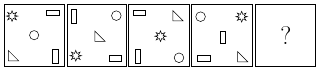
Identify the figure shown in the options that when put in place of the question mark (?) will logically complete the series.

  1. ((a))

  2. ((b))

  3. ((c))

  4. ((d))

Show Answer
Answer: ((c))

The figure that will come next in the following figure series is shown below:

All shapes rotate according to the arrow in the figure below.

Hence, ‘option 3’ is the correct answer.

23

Read the given statements and conclusions carefully. Assuming that the information given in the statements is true, even if it appears to be at variance with commonly known facts, decide which of the given conclusions logically follow(s) from the statements.

Statements:

A. No caps are hats.

B. Some hats are helmets.

Conclusions:

  1. All helmets are caps.
  2. Some helmets are hats.
  1. ((a))

    Only conclusion I follows.

  2. ((b))

    Only conclusion II follows.

  3. ((c))

    Both the conclusions follow.

  4. ((d))

    None of the conclusions follow.

Show Answer
Answer: ((b))

Only conclusion II follows.

The least possible Venn Diagram is as follows:

Conclusions:

1.All helmets are caps → False (because Some helmets are hats and no hats are caps so all helmets are caps is not possible)

2.Some helmets are hats → True (because Some hats are helmets so some helmets are also hats)

So, Only conclusion II follows.

Hence, The correct answer is "option (2)".

24

Which figure should replace the question mark (?) if the following series were to be continued?

  1. ((a))

  2. ((b))

  3. ((c))

  4. ((d))

Show Answer
Answer: ((d))

The figure that will come next in the following figure series is shown below:

All shapes rotate according to the arrow in the figure below.

Hence, ‘option 4’ is the correct answer.

25

In a certain code language, ‘find the key’ is written as ‘so hd sm’ and ‘key to success’ is written as ‘gj so la’. How is ‘key’ written in the given language?

  1. ((a))

    gi

  2. ((b))

    la

  3. ((c))

    sm

  4. ((d))

    so

Show Answer
Answer: ((d))

so

The above-given codes can be shown with the help of the following diagram:

So, from the diagram, it is clear that 'key' is coded as 'so'

Hence, "Option (4)" is the correct answer.

26

Select the correct mirror image of the given figure when the mirror is placed at MN as shown below.

  1. ((a))

  2. ((b))

  3. ((c))

  4. ((d))

Show Answer
Answer: ((c))

The correct mirror image of the given figure is:

Hence, the correct answer is "Option 3".

27

In the following number-pairs, the second number is obtained by applying certain mathematical operations to the first number. Select the set in which the numbers are related in the same way as are the numbers of the following sets.

(Note: Operations should be performed on the whole numbers, without breaking down the numbers into their constituent digits. E.g., 13 – Operations on 13 such as adding/subtracting/multiplying to 13 can be performed. Breaking down 13 into 1 and 3 and then performing mathematical operations on 1 and 3 is not allowed.)

27, 109

31, 125

  1. ((a))

    35, 144

  2. ((b))

    36, 145

  3. ((c))

    35, 145 

  4. ((d))

    36, 144

Show Answer
Answer: ((b))

36, 145

The logic follows here:

1st number × 4 + 1 = 2nd number.

Given:

27, 109

⇒ 27 × 4 + 1 = 108 + 1 = 109 = 2nd number.

And,

31, 125

⇒ 31 × 4 + 1 = 124 + 1 = 125 = 2nd number.

Similary, In option (2) : 36, 145

⇒ 36 × 4 + 1 = 144 + 1 = 145 = 2nd number.

Hence, the correct answer is "Option (2)".

28

What will come in the place of the question mark (?) in the following equation, if ‘+’ and ‘-’ are interchanged and ‘×’ and ‘÷’ are interchanged?

2 ÷ 70 × 2 − 30 + 30 = ?

  1. ((a))

    69

  2. ((b))

    68

  3. ((c))

    70 

  4. ((d))

    66

Show Answer
Answer: ((c))

70 

BODMAS Table: 

Given equation: 2 ÷ 70 × 2 − 30 + 30 = ?

Now, if ‘+’ and ‘-’ are interchanged and ‘×’ and ‘÷’ are interchanged, then:

⇒ 2 × 70 ÷ 2 + 30 - 30 = ?

⇒ 2 × 35 + 30 - 30 = ?

⇒ 70 + 30 - 30 = ?

100 - 30 = ?

= 70

Hence, the correct answer is "Option 3".

29

Select the number from among the given options that can replace the question mark (?) in the following series.

[6/5], [3/2], [9/5], [21/10], [12/5], ?

  1. ((a))

    5/2

  2. ((b))

    27/10 

  3. ((c))

    29/10

  4. ((d))

    9/2

Show Answer
Answer: ((b))

27/10 

Given:

[6/5], [3/2], [9/5], [21/10], [12/5], ?

Convert into decimal

1.2, 1.5, 1.8, 2.1, 2.4, ?

The logic follows here:

⇒ 2.7 convert in fraction '27/10'

Hence, the correct answer is "Option (2)".

30

In a certain code language, ‘All men fight’ is coded as ‘AO EI UH’ and ‘men shave everyday’ is coded as ‘MN TP EI’. How is ‘men’ coded in that code language?

  1. ((a))

    UH

  2. ((b))

    TP

  3. ((c))

    EI 

  4. ((d))

    AO

Show Answer
Answer: ((c))

EI 

The above-given codes can be shown with the help of the following diagram:

So, from the diagram, it is clear that 'men' is coded as 'EI'

Hence, "Option (3)" is the correct answer.

31

In a certain code language, ‘CURD’ is coded as ‘2436’ and ‘DOGS’ is coded as ‘3719’. What is the code for ‘D’ in the given code language?

  1. ((a))

    1

  2. ((b))

    2

  3. ((c))

    3

  4. ((d))

    6

Show Answer
Answer: ((c))

3

Given, ‘CURD’ is coded as ‘2436’ and ‘DOGS’ is coded as ‘3719’

By comparing both the code languages, D is common in both the words and 3 is common in both codes.

Hence, the correct answer is "Option (3)".

32

A square sheet of paper is folded along the dotted line successively along the directions shown and is then punched in the last. How would the paper look when unfolded?

  1. ((a))

  2. ((b))

  3. ((c))

  4. ((d))

Show Answer
Answer: ((d))

The image obtained when the paper is unfolded is,

Hence, 'option 4' is the correct answer.

33

What should come in place of the question mark (?) in the given series based on the English alphabetical order?

<br>

ABC, EFG, IJK, MNO, ?

  1. ((a))

    QRS

  2. ((b))

    STU

  3. ((c))

    TUV

  4. ((d))

    UVW

Show Answer
Answer: ((a))

QRS

The pattern followed is,

Hence, “QRS” completes the series.

34

Eight friends, J, K, L, M, N, O, P, and Q are sitting around a round table facing the centre (but not necessarily in the same order). K is an immediate neighbour of both Q and M. N is an immediate neighbour of both P and J. L is sitting immediately right to J. K is sitting at the immediate left of Q and is second to the right of O.

Who is sitting to the immediate right of M?

  1. ((a))

    P

  2. ((b))

    O

  3. ((c))

    J

  4. ((d))

    K

Show Answer
Answer: ((d))

K

Given:

Eight friends, J, K, L, M, N, O, P, and Q are sitting around a round table facing the centre

  1. K is sitting at the immediate left of Q and is second to the right of O.

2) K is an immediate neighbour of both Q and M.

3) N is an immediate neighbour of both P and J. L is sitting immediately right to J.

So, "K" is sitting to the immediate right of M

Hence, the correct answer is "Option (4)".

35

Which two numbers should be interchanged to make the given equation correct?

52 + 44 − 38 ÷ 2 + 13 × 4 − 26 = 97

(Note: Interchange should be done of entire number and not individual digits of a given number)

  1. ((a))

    44 and 38

  2. ((b))

    38 and 26

  3. ((c))

    44 and 26

  4. ((d))

    52 and 38

Show Answer
Answer: ((b))

38 and 26

Given equation: 52 + 44 − 38 ÷ 2 + 13 × 4 − 26 = 97

BODMAS Table: 

Let's check each option one by one.

Option 1) 44 and 38

⇒ 52 + 38 − 44 ÷ 2 + 13 × 4 − 26 = 97

⇒ 52 + 38 − 22 + 13 × 4 − 26 = 97

⇒ 52 + 38 − 22 + 52 − 26 = 97

⇒ 142 − 22 − 26 = 97

⇒ 94 ≠ 97 ⇒ LHS ≠ RHS

Option 2) 38 and 26

⇒ 52 + 44 − 26 ÷ 2 + 13 × 4 − 38 = 97

⇒ 52 + 44 − 13 + 13 × 4 − 38 = 97

⇒ 52 + 44 − 13 + 52 − 38 = 97

⇒ 148 - 13 - 38 = 97

⇒ 97 = 97 ⇒ LHS = RHS

Option 3) 44 and 26

⇒ 52 + 26 − 38 ÷ 2 + 13 × 4 − 44 = 97

⇒ 52 + 26 − 19 + 13 × 4 − 44 = 97

⇒ 52 + 26 − 19 + 52 − 44 = 97

⇒ 52 + 26 − 19 + 52 − 44 = 97

⇒ 130 − 19 − 44 = 97

⇒ 67 ≠ 97 ⇒ LHS ≠ RHS

Option 4) 52 and 38

⇒ 38 + 44 − 52 ÷ 2 + 13 × 4 − 26 = 97

⇒ 38 + 44 − 26 + 13 × 4 − 26 = 97

⇒ 38 + 44 − 26 + 52 − 26 = 97

⇒ 38 + 44 − 26 + 52 − 26 = 97

⇒ 138 − 26 − 26 = 97

⇒ 82 ≠ 97⇒ LHS ≠ RHS

Hence, the correct answer is "Option 2".

36

49 is related to 96 following a certain logic. Following the same logic, 54 is related to 106. To which of the following is 36 related following the same logic?

NOTE: Operations should be performed on the whole numbers, without breaking down the numbers into its constituent digits. Eg. 13 - Operations on 13 such as adding/subtracting/multiplying etc. to 13 can be performed. Breaking down 13 into 1 and 3 and then performing mathematical operations on 1 and 3 is not allowed.

  1. ((a))

    78

  2. ((b))

    62

  3. ((c))

    70

  4. ((d))

    58

Show Answer
Answer: ((c))

70

The logic follows here:

(1st number - 1) × 2 = 2nd number.

Given:

49 is related to 96

⇒ (49 - 1) × 2 = 48 × 2 = 96 = 2nd number.

And,

54 is related to 106

⇒ (54 - 1) × 2 = 53 × 2 = 106 = 2nd number.

Similary, 36 related to

⇒ (36 - 1) × 2 = 35 × 2 = 70 = 2nd number.

Hence, the correct answer is "Option (3)".

37

Read the given statement(s) and conclusions carefully. Assuming that the information given in the statements is true, even if it appears to be at variance with commonly known facts, decide which of the given conclusions logically follow(s) from the statement(s).

Statements: Some cakes are sweets. All sweets are fruits.

Conclusions:

(I) Some fruits are sweets.

(II) All cakes are fruits.

  1. ((a))

    Neither conclusion (I) nor (II) follows.

  2. ((b))

    Both conclusions (I) and (II) follow.

  3. ((c))

    Only conclusion (I) follows.

  4. ((d))

    Only conclusion (II) follows.

Show Answer
Answer: ((c))

Only conclusion (I) follows.

The least possible diagram is:

I. Some fruits are sweets → True (because All sweets are fruits so, defiantly some fruits are also sweets)

II. All cakes are fruits → False (because no direct relationship is given between cakes and fruits so it may be possible but not defined)

So, Only conclusion (I) follows.

Hence, the correct answer is "Option (3)".

38

In a certain code language, 'HOME' is coded as '7519' and 'MUST' is coded as '6782'. What is the code for 'M' in that language?

  1. ((a))

    7

  2. ((b))

    6

  3. ((c))

    1

  4. ((d))

    2

Show Answer
Answer: ((a))

7

Given, 'HOME' is coded as '7519' and 'MUST' is coded as '6782'

By comparing both the code languages, M is common in both the words and 7 is common in both codes.

Hence, the correct answer is "Option (1)".

39

A, B, C, D, E, F, and G are sitting around a circular table facing the centre (but not necessarily in the same order). C sits second to the left of E, who is third to the left of A. G sits third to the right of B, who is not an immediate neighbour of F. D sits second to the right of B.

How many people sit between D and A when counted from the left of D?

  1. ((a))

    One

  2. ((b))

    Two

  3. ((c))

    Three

  4. ((d))

    Four

Show Answer
Answer: ((d))

Four

Given:

A, B, C, D, E, F, and G are sitting around a circular table facing the centre.

  1. C sits second to the left of E, who is third to the left of A.

  1. G sits third to the right of B, who is not an immediate neighbour of F. D sits second to the right of B.

Only 'F' is remaining. So, the final arrangement is:

So, 'four' people sit between D and A when counted from the left of D.

Hence, the correct answer is "Option (4)".

40

NGMI is related to LEKG in a certain way based on the English alphabetical order. In the same way, QJPL is related to OHNJ. To which of the following is TMSO related following the same logic?

  1. ((a))

    KRMQ

  2. ((b))

    KEQM

  3. ((c))

    RKMQ

  4. ((d))

    RKQM

Show Answer
Answer: ((d))

RKQM

The logic followed here is:

NGMI is related to LEKG

And,

QJPL is related to OHNJ

Similarly,

TMSO related to

Hence, "Option 4" is the correct answer.

Session 2 (50 questions)

41

According to Labour and Employment Statistics 2022, match the states in the first column with their rate of unemployment in the year 2020-21 given in the second column.

StatePercentage
i) Keralaa) 6.3%
ii) Goab) 10.1%
iii) Haryanac) 6.9%
iv) Uttarakhandd) 10.5%
  1. ((a))

    i) a, ii) c, iii) d, iv) b

  2. ((b))

    i) d, ii) b, iii) c, iv) a

  3. ((c))

    i) d, ii) c, iii) b, iv) a

  4. ((d))

    i) b, ii) d, iii) a, iv) c

Show Answer
Answer: ((d))

i) b, ii) d, iii) a, iv) c

The correct answer is i) b, ii) d, iii) a, iv) c.

Key Points

  • Kerala had an unemployment rate of 10.1% in the year 2020-21, reflecting high joblessness in the state.
  • Goa experienced an unemployment rate of 10.5% during the same period, indicating significant employment challenges.
  • Haryana had a lower unemployment rate of 6.3%, which was comparatively better among the listed states.
  • Uttarakhand had an unemployment rate of 6.9%, positioning it in the mid-range among the states mentioned.

Additional Information

  • The Labour and Employment Statistics report is a vital source of information on the employment and unemployment scenario in India, providing insights into the economic health of the states.
  • Unemployment rate is defined as the percentage of the labor force that is jobless and actively seeking employment.
  • The Labour Force Participation Rate (LFPR) measures the proportion of the working-age population that is either working or actively looking for work.
  • The National Sample Survey Office (NSSO) conducts periodic surveys to gather data on employment and unemployment, which is crucial for policy-making and economic planning.
  • Covid-19 pandemic has significantly impacted employment rates across states, exacerbating joblessness and altering economic dynamics.
42

What was the percentage increase in the disbursal of 'Pradhan Mantri Mudra Yojana' (PMMY) loans in the first quarter of FY 2023-24 compared to the same quarter in the previous year, if the disbursal reached ₹81,597 crore, up from ₹62,650 crore?

  1. ((a))

    23%

  2. ((b))

    .27%

  3. ((c))

    15%

  4. ((d))

    20%

Show Answer
Answer: ((b))

.27%

The correct answer is option 2.

  • Actual calculation gives ≈ 30.24%, but exact value is not in options.
  • In such MCQs, nearest approximate value is selected.
  • Among given options (23%, 27%, 15%, 20%), 27% is closest to 30.24%.
  • Hence, for exam purpose, the accepted answer is 27% (Option 2).
43

In which of the following years was the 'Quit India Movement' launched?

  1. ((a))

    1942

  2. ((b))

    1935

  3. ((c))

    1920

  4. ((d))

    1919

Show Answer
Answer: ((a))

1942

The correct answer is 1942.

Key Points

  • The Quit India Movement was launched by Mahatma Gandhi on 8 August 1942, during World War II, demanding an end to British rule in India.
  • Gandhi delivered the iconic "Do or Die" speech at the Gowalia Tank Maidan in Bombay (now Mumbai).
  • The movement is also known as the August Kranti or August Movement.
  • The British responded with mass arrests and repression, detaining many leaders of the Indian National Congress without trial.

Additional Information

  • World War II Context
  • The Quit India Movement occurred during the turbulent times of World War II, when British resources were stretched thin.
  • India's contribution to the British war effort was significant, which led to increasing demands for self-rule.
  • Arrest of Leaders
  • Following the launch of the movement, the British arrested nearly all leaders of the Indian National Congress, including Gandhi, Nehru, and Patel.
  • This led to a leaderless movement, which saw widespread but uncoordinated protests across the country.
  • Public Response
  • Despite the lack of central leadership, the movement saw massive public participation, including strikes, protests, and acts of civil disobedience.
  • The British government responded with severe repression, including police violence, mass detentions, and press censorship.
  • Impact on Independence
  • Though the Quit India Movement was ultimately suppressed, it significantly intensified the Indian struggle for independence.
  • It demonstrated the Indian population's unified demand for freedom, which played a crucial role in the eventual British decision to leave India in 1947.
44

In the case of reptiles, their heart is not properly divided in to four chambers i.e., it consists of two auricles and an incompletely divided ventricle. Which of the following is an example of a reptile having a four-chambered heart?

  1. ((a))

    Snake

  2. ((b))

    Turtles

  3. ((c))

    Crocodiles

  4. ((d))

    Lizard

Show Answer
Answer: ((c))

Crocodiles

The correct answer is Crocodiles.

Key Points

  • Crocodiles are unique among reptiles for having a fully divided four-chambered heart, similar to that of birds and mammals.
  • This four-chambered heart includes two atria and two ventricles, ensuring complete separation of oxygenated and deoxygenated blood.
  • The structure allows crocodiles to maintain a high metabolic rate, which is beneficial for their predatory lifestyle.
  • The presence of a four-chambered heart in crocodiles is an evolutionary adaptation that supports their amphibious mode of life, allowing efficient respiration both in water and on land.

Additional Information

  • Reptilian Heart Structure:
  • Most reptiles typically have a three-chambered heart consisting of two atria and one ventricle, with some degree of ventricular septation.
  • This partial separation allows for the mixing of oxygenated and deoxygenated blood, which is sufficient for their metabolic needs.
  • Double Circulation:
  • Double circulation refers to the separation of oxygenated and deoxygenated blood within the heart, which is a feature seen in crocodiles and is characteristic of a four-chambered heart.
  • This system allows for more efficient oxygen delivery to the body tissues.
  • Evolutionary Significance:
  • The fully divided heart in crocodiles is considered an advanced evolutionary trait, providing a physiological advantage in terms of metabolic efficiency and thermoregulation.
  • This adaptation is also seen in birds, which share a common ancestor with crocodiles.
  • Comparison with Mammals and Birds:
  • Both mammals and birds possess a four-chambered heart, which evolved independently in these groups.
  • The presence of a four-chambered heart in crocodiles is a case of convergent evolution, where similar traits evolve independently in different lineages.
45

Who among the following founded the Saluva dynasty of Vijayanagara empire?

  1. ((a))

    Rama Deva Raya

  2. ((b))

    Narasimha Deva Raya

  3. ((c))

    Bukka Raya I

  4. ((d))

    Krishnadeva Raya

Show Answer
Answer: ((b))

Narasimha Deva Raya

The correct answer is Narasimha Deva Raya.

Key Points

  • Narasimha Deva Raya founded the Saluva dynasty of the Vijayanagara Empire.
  • The Saluva dynasty was established around the late 15th century.
  • Narasimha Deva Raya was a key figure in stabilizing the empire during a period of internal strife and external threats.
  • He was succeeded by his son, Immadi Narasimha, who continued the legacy of the Saluva dynasty.

Additional Information

  • Vijayanagara Empire
  • The Vijayanagara Empire was established in 1336 AD by Harihara I and Bukka Raya I of the Sangama dynasty.
  • The empire is known for its patronage of art, architecture, and literature, as well as its military prowess.
  • It played a crucial role in resisting the invasions of the Deccan Sultanates and preserving Hindu culture in South India.
  • Saluva Dynasty
  • The Saluva dynasty was the second ruling dynasty of the Vijayanagara Empire, succeeding the Sangama dynasty.
  • It marked a period of transition and consolidation within the empire.
  • Krishnadeva Raya
  • Krishnadeva Raya, a ruler from the Tuluva dynasty, is often considered the greatest ruler of the Vijayanagara Empire.
  • He reigned from 1509 to 1529 and expanded the empire to its zenith.
  • Decline of Vijayanagara Empire
  • The empire eventually declined after the Battle of Talikota in 1565, where it suffered a massive defeat against the combined forces of the Deccan Sultanates.
  • This marked the end of the dominance of the Vijayanagara Empire in South India.
46

Which of the following dance forms is primarily associated with Eastern India states like Odisha, Jharkhand, and West Bengal?

  1. ((a))

    Bharatanatyam

  2. ((b))

    Kuchipudi

  3. ((c))

    Chhau 

  4. ((d))

    Kathak

Show Answer
Answer: ((c))

Chhau 

The correct answer is Chhau.

Key Points

  • Chhau is a traditional dance form primarily associated with the Eastern Indian states of Odisha, Jharkhand, and West Bengal.
  • This dance form is known for its vigorous martial movements and graceful choreography.
  • Chhau incorporates elements of martial arts, acrobatics, and storytelling from Indian mythology.
  • It is performed during major festivals such as Chaitra Parva and Durga Puja.

Additional Information

  • Types of Chhau:
  • Seraikella Chhau from Jharkhand
  • Purulia Chhau from West Bengal
  • Mayurbhanj Chhau from Odisha
  • Costumes and Masks:
  • Chhau dancers often wear colorful costumes and intricate masks.
  • The masks are particularly prominent in Purulia Chhau, adding to the visual storytelling.
  • Musical Instruments:
  • Traditional instruments like dhol (drum), shehnai (wind instrument), and dhamsa (large drum) accompany the dance.
  • UNESCO Recognition:
  • In 2010, Chhau dance was inscribed in the UNESCO Representative List of the Intangible Cultural Heritage of Humanity.
47

Which Articles of the Constitution of India provide for a parliamentary form of government at the Centre?

  1. ((a))

    Articles 74 and 75 

  2. ((b))

    Articles 71 and 72

  3. ((c))

    Articles 79 and 80

  4. ((d))

    Articles 76 and 77

Show Answer
Answer: ((a))

Articles 74 and 75 

The correct answer is Articles 74 and 75.

Key Points

  • Article 74 of the Indian Constitution states that there shall be a Council of Ministers with the Prime Minister at the head to aid and advise the President.
  • Article 75 specifies that the Prime Minister shall be appointed by the President, and the other Ministers shall be appointed by the President on the advice of the Prime Minister.
  • These articles collectively establish the framework for the parliamentary system of government in India, where the executive authority is derived from and accountable to the legislature.
  • The Council of Ministers, including the Prime Minister, is collectively responsible to the Lok Sabha, the lower house of Parliament.

Additional Information

  • Parliamentary System of Government:
  • In a parliamentary system, the executive branch derives its legitimacy from the legislature and is accountable to it.
  • The head of state is different from the head of government.
  • Collective Responsibility:
  • The principle that the executive (Council of Ministers) is collectively responsible to the legislature (Lok Sabha).
  • If the Lok Sabha passes a vote of no-confidence, the entire Council of Ministers must resign.
  • President's Role:
  • The President of India acts on the aid and advice of the Council of Ministers headed by the Prime Minister.
  • This ensures that the real executive power is vested in the elected representatives of the people.
  • Prime Minister's Role:
  • The Prime Minister is the head of the government and leads the executive branch.
  • Plays a critical role in formulating and executing policies, and in maintaining the support of the majority in the Lok Sabha.
48

Which of the following crops is grown in the Kharif season in India?

  1. ((a))

    Mustard

  2. ((b))

    Cucumber

  3. ((c))

    Soybean

  4. ((d))

    Barley

Show Answer
Answer: ((c))

Soybean

The correct answer is 3) Soybean.

Key Points

  • Soybean is a significant Kharif crop grown in India.
  • Kharif season crops are typically sown at the beginning of the monsoon season, which usually starts in June.
  • Soybeans is mainly cultivated in the states of Madhya Pradesh, Maharashtra, Rajasthan, and Andhra Pradesh.
  • It is sown with the onset of the monsoon and harvested in September-October.

Additional Information

  • Kharif Crops:
  • Kharif crops are also known as monsoon crops as they depend on the southwest monsoon rains.
  • Other examples of Kharif crops include rice, maize, millets (bajra and jowar), cotton, groundnut, and pulses like moong and urad.
  • Rabi Crops:
  • Rabi crops are sown in winter from October to December and harvested in summer from April to June.
  • Examples include wheat, barley, mustard, sesame, and peas.
  • Climate and Soil:
  • Soyabean requires warm and humid conditions with temperatures ranging between 20°C to 30°C.
  • Well-drained loamy or clayey soils are ideal for soybean cultivation.
  • Economic Significance:
  • Soybean is a crucial crop for its oil and protein content, playing a vital role in the food and agriculture industry.
  • India is one of the largest producers of soyabean in the world, contributing significantly to the agricultural GDP.
49

Samrat Choudhary and Vijay Kumar Sinha became the Deputy Chief Minister of _______________ on 28 January 2024.

  1. ((a))

    Odisha

  2. ((b))

    West Bengal

  3. ((c))

    Bihar 

  4. ((d))

    Jharkhand

Show Answer
Answer: ((c))

Bihar 

The correct answer is Bihar.

Key Points

  • Samrat Choudhary and Vijay Kumar Sinha were appointed as the Deputy Chief Ministers of Bihar on 28 January 2024.
  • This appointment marks a significant political event in the state of Bihar, influencing the political dynamics of the region.
  • Both leaders have previously held significant positions within the state government and their elevation to Deputy Chief Ministers is seen as a strategic move by their party.
  • The political climate in Bihar is known for its dynamic nature, with frequent changes in leadership and policy direction.
  • The appointment is expected to impact the administration and governance, bringing new initiatives and policies to the forefront.

Additional Information

  • Bihar Political Structure:
  • Bihar has a bicameral legislature consisting of the Vidhan Sabha (Legislative Assembly) and the Vidhan Parishad (Legislative Council).
  • The Chief Minister is the head of the government, while the Governor is the ceremonial head of state.
  • Deputy Chief Ministers play a crucial role in assisting the Chief Minister in governance and policy implementation.
  • Samrat Choudhary:
  • He has held various significant positions in the Bihar state government.
  • Known for his administrative capabilities and political influence in the region.
  • Vijay Kumar Sinha:
  • He has served in different capacities in the state government, bringing experience and leadership to his new role.
  • Instrumental in various legislative and policy-making processes within the state.
  • Bihar's Political Landscape:
  • Bihar has a vibrant and competitive political environment with multiple parties vying for power.
  • The state has seen frequent changes in leadership and coalition governments.
  • Policies and governance in Bihar are significantly influenced by caste dynamics and regional affiliations.
50

Which of the following is the autobiography of Bhishma Sahni?

  1. ((a))

    Aaj ke Ateet 

  2. ((b))

    Aatma Parichaya

  3. ((c))

    Aarhdkatha

  4. ((d))

    Pankhhin

Show Answer
Answer: ((a))

Aaj ke Ateet 

The correct answer is Aaj ke Ateet.

Key Points

  • Aaj ke Ateet is the autobiography of Bhishma Sahni, a renowned Indian writer and playwright.
  • Bhishma Sahni is widely celebrated for his contributions to Hindi literature, particularly for his novel Tamas, which depicts the violence and trauma of the partition of India.
  • Aaj ke Ateet translates to "Today's Past", offering a personal and historical insight into Sahni's life experiences.
  • The autobiography sheds light on Sahni's literary journey, his ideological beliefs, and his engagement with the socio-political issues of his time.
  • It is a significant work that helps readers understand the life and thoughts of one of India's literary stalwarts.

Additional Information

  • Bhishma Sahni:
  • Born on August 8, 1915, in Rawalpindi, now in Pakistan.
  • He was a prominent Hindi writer, playwright, and actor, contributing significantly to Indian literature.
  • His notable works include Tamas, Basanti, and Jharokhe.
  • He was awarded the Sahitya Akademi Award in 1975 and the Padma Bhushan in 1998.
  • Tamas:
  • A novel by Bhishma Sahni published in 1974, based on the partition of India in 1947.
  • It was adapted into a television series directed by Govind Nihalani in 1986.
  • The novel explores the communal violence and human suffering during the partition.
  • Hindi Literature:
  • It encompasses a rich tradition of poetry, fiction, and drama.
  • Key figures include Premchand, Harivansh Rai Bachchan, and Mahadevi Verma.
  • It addresses various themes such as social issues, patriotism, and human emotions.
  • Autobiography:
  • A literary genre where an individual writes about their own life.
  • Provides personal insight and historical context.
  • Famous autobiographies include The Diary of a Young Girl by Anne Frank and Long Walk to Freedom by Nelson Mandela.
51

In which year was the Multi-dimensional Poverty Index launched in India?

  1. ((a))

    2021

  2. ((b))

    2022

  3. ((c))

    2020

  4. ((d))

    2023

Show Answer
Answer: ((a))

2021

The correct answer is 2021.

Key Points

  • The Multi-dimensional Poverty Index (MPI) was launched in India in 2021 to measure poverty in a holistic way beyond income-based assessments.
  • The MPI considers multiple deprivations at the household level in education, health, and living standards.
  • It is developed by the Oxford Poverty and Human Development Initiative (OPHI) and the United Nations Development Programme (UNDP).
  • The Indian version of MPI is aligned with the global MPI methodology but tailored to India's socio-economic context.
  • The launch of MPI in 2021 was part of India's efforts to achieve the Sustainable Development Goals (SDGs), particularly SDG 1: No Poverty.

Additional Information

  • Multi-dimensional Poverty Index (MPI):
  • The MPI identifies multiple deprivations at the household and individual level in health, education, and standard of living.
  • It uses 10 indicators to measure poverty in three dimensions: education, health, and living standards.
  • Sustainable Development Goals (SDGs):
  • The SDGs are a collection of 17 global goals set by the United Nations General Assembly in 2015 for the year 2030.
  • They cover a broad range of social, economic, and environmental development issues.
  • Oxford Poverty and Human Development Initiative (OPHI):
  • OPHI is a research center within the Oxford Department of International Development at the University of Oxford.
  • It aims to build and advance a more systematic methodological and economic framework for reducing multidimensional poverty.
  • United Nations Development Programme (UNDP):
  • UNDP works in nearly 170 countries and territories, helping to achieve the eradication of poverty, and the reduction of inequalities and exclusion.
  • It helps countries to develop policies, leadership skills, partnering abilities, and institutional capabilities.
52

Valabhi type of Nagara temples are generally __________ in shape, with a roof that rises into a vaulted chamber.

  1. ((a))

    square

  2. ((b))

    triangular

  3. ((c))

    circular

  4. ((d))

    rectangular 

Show Answer
Answer: ((d))

rectangular 

The correct answer is option 4.

Key Points

  • Valabhi type of Nagara temples are characterized by their rectangular shape.
  • These temples feature a roof that rises into a vaulted chamber.
  • The architectural style is distinct within the Nagara temple architecture, which is prominent in northern India.
  • The Valabhi type is one of several sub-styles within the broader Nagara architecture, each having unique structural elements.

Additional Information

  • Nagara Architecture:
  • A prominent temple architecture style in northern India characterized by its beehive-shaped tower called Shikhara.
  • Often built on a raised platform called Jagati.
  • Sub-Styles of Nagara:
  • Rekha-Prasad: Features a linear tower.
  • Phamsana: Characterized by a broader base and shorter height.
  • Valabhi: Recognized by its rectangular shape with a vaulted roof.
  • Temple Components:
  • Garbhagriha: The innermost sanctum where the deity resides.
  • Mandapa: The entrance hall.
  • Regional Variations:
  • The Nagara style varies significantly across different regions in terms of structural design and ornamentation.
53

Who was the chairman of the drafting committee of the Constituent Assembly of India?

  1. ((a))

    Bhimrao Ambedkar 

  2. ((b))

    Vallabhbhai Patel

  3. ((c))

    Rajendra Prasad

  4. ((d))

    JB Kripalani

Show Answer
Answer: ((a))

Bhimrao Ambedkar 

The correct answer is Bhimrao Ambedkar.

Key Points

  • Dr. Bhimrao Ramji Ambedkar was appointed as the Chairman of the Drafting Committee of the Indian Constituent Assembly.
  • He played a pivotal role in the framing of the Indian Constitution, which was adopted on 26th January 1950.
  • Ambedkar is often referred to as the "Father of the Indian Constitution" due to his significant contributions.
  • The Drafting Committee was formed on 29th August 1947 and had a total of seven members.

Additional Information

  • Constituent Assembly of India:
  • It was established to draft the Constitution of India.
  • The Assembly held its first meeting on 9th December 1946.
  • Dr. Rajendra Prasad was elected as the President of the Assembly.
  • Drafting Committee:
  • Besides Dr. Ambedkar, other prominent members included Alladi Krishnaswami Ayyar and K. M. Munshi.
  • The Committee's task was to prepare a draft Constitution for India.
  • Adoption of the Constitution:
  • The Constitution was adopted on 26th November 1949 and came into effect on 26th January 1950.
  • This day is celebrated as Republic Day in India.
  • Fundamental Rights:
  • One of the key features of the Constitution, providing essential rights to all citizens.
  • These include the right to equality, freedom, against exploitation, freedom of religion, cultural and educational rights, and the right to constitutional remedies.
54

The Durg-Bastar-Chandrapur iron ore belt lies in which of the following groups of states?

  1. ((a))

    Karnataka - Goa

  2. ((b))

    Chhattisgarh - Maharashtra

  3. ((c))

    Odisha - Jharkhand 

  4. ((d))

    Madhya Pradesh - Gujarat

Show Answer
Answer: ((b))

Chhattisgarh - Maharashtra

The correct answer is Chhattisgarh - Maharashtra.

Key Points

  • The Durg-Bastar-Chandrapur belt is one of the major iron ore belts in India.
  • This belt primarily spans across the states of Chhattisgarh and Maharashtra.
  • It is known for having rich deposits of high-grade hematite iron ore.
  • Prominent mines in this region include Bailadila in Chhattisgarh and the mines in the Chandrapur district of Maharashtra.

Additional Information

  • Hematite Iron Ore:
  • Hematite ore is the most important industrial iron ore in terms of the quantity used.
  • It has a high iron content, typically around 70% iron.
  • This ore is primarily used in the production of steel.
  • Iron Ore Mining in India:
  • India is one of the leading producers of iron ore in the world.
  • The major iron ore belts in India are Odisha-Jharkhand, Durg-Bastar-Chandrapur, Bellary-Chitradurga-Chikmagalur-Tumkur in Karnataka, and Maharashtra-Goa.
  • Economic Importance:
  • Iron ore mining contributes significantly to the economy, especially in terms of exports and employment generation.
  • It plays a crucial role in the industrial development of a country.
  • Environmental Impact:
  • Iron ore mining can have significant environmental impacts, including deforestation, soil erosion, and pollution.
  • Efforts are made to mitigate these impacts through sustainable mining practices and rehabilitation of mined areas.
55

Which team won the Ultimate Kho-Kho League Season 2 event?

  1. ((a))

    Chennai Quick Guns

  2. ((b))

    Gujarat Giants 

  3. ((c))

    Telugu Yoddhas

  4. ((d))

    Mumbai Khiladis

Show Answer
Answer: ((b))

Gujarat Giants 

The correct answer is Gujarat Giants.

Key Points

  • The Gujarat Giants won the Ultimate Kho-Kho League Season 2 event.
  • The Ultimate Kho-Kho League is a professional Kho-Kho league in India.
  • The league aims to revive and promote the traditional Indian sport of Kho-Kho.
  • The second season featured teams from various regions, competing at a high level.
  • The Gujarat Giants emerged as the champions through their excellent performance.

Additional Information

  • Kho-Kho:
  • Kho-Kho is a traditional Indian sport, known for its fast-paced and strategic gameplay.
  • It involves two teams of twelve players each, with nine players on the field and three substitutes.
  • The game is played on a rectangular field, where players chase and tag out opponents.
  • It requires agility, speed, and teamwork.
  • Ultimate Kho-Kho League:
  • The league was launched to professionalize Kho-Kho and bring it to a larger audience.
  • It features franchise-based teams representing different regions of India.
  • The matches are broadcasted on various sports channels, increasing the sport's visibility.
  • The league has helped in nurturing and identifying new talent in Kho-Kho.
  • Franchise System:
  • Similar to other sports leagues, the Ultimate Kho-Kho League follows a franchise model.
  • Teams are owned by various stakeholders, including celebrities and business entities.
  • This model helps in generating revenue and marketing the sport effectively.
  • Promotion of Indigenous Sports:
  • The league is part of a broader initiative to promote indigenous sports in India.
  • Other traditional games like Kabaddi have also seen a resurgence through professional leagues.
  • These efforts are crucial for preserving cultural heritage and providing opportunities for athletes.
56

Article ________ A supplements the 11th fundamental duty of the Indian Constitution?

  1. ((a))

    28

  2. ((b))

    46

  3. ((c))

    21 

  4. ((d))

    33

Show Answer
Answer: ((c))

21 

The correct answer is Article 21

Key Points

  • The 11th fundamental duty under Article 51A of the Indian Constitution was added by the 86th Constitutional Amendment Act in 2002.
  • It mandates parents or guardians to provide opportunities for education to their child or ward between the age of 6 and 14 years.
  • This amendment also led to the incorporation of Article 21A, which guarantees the right to education for children in the specified age group.
  • Article 51A lists the fundamental duties of Indian citizens, intending to promote a sense of discipline and commitment among them.

Additional Information

  • Fundamental Duties:
  • These duties are outlined in Part IVA (Article 51A) of the Indian Constitution.
  • Initially, there were 10 fundamental duties, but the 86th Amendment added the 11th duty.
  • The concept of fundamental duties is inspired by the Constitution of Russia (erstwhile Soviet Union).
  • These duties are non-justiciable, meaning they are not enforceable by law but are considered essential for citizens.
  • 86th Constitutional Amendment Act, 2002:
  • This amendment made three significant changes: introducing Article 21A, adding the 11th fundamental duty, and modifying Article 45.
  • Article 21A makes education a fundamental right for children aged 6 to 14 years.
  • Article 45 was revised to focus on early childhood care and education for children below the age of six years.
  • Right to Education Act, 2009:
  • This Act operationalizes Article 21A of the Constitution.
  • It mandates free and compulsory education for children aged 6 to 14 years.
  • The Act sets norms and standards for schools, ensuring a child-friendly and inclusive learning environment.
  • Directive Principles of State Policy:
  • These principles are enshrined in Part IV of the Indian Constitution.
  • They guide the state in formulating and implementing policies and laws.
  • Although non-justiciable, these principles are fundamental in the governance of the country.
57

A person having stunted growth and discoloured hair is most probably suffering from ________________.

  1. ((a))

    Protein Deficiency

  2. ((b))

    Lipid Deficiency

  3. ((c))

    Glucose Deficiency

  4. ((d))

    Vitamin A Deficiency

Show Answer
Answer: ((a))

Protein Deficiency

The correct answer is Protein Deficiency.

Key Points

  • Protein deficiency can lead to stunted growth in children as protein is essential for the development and repair of body tissues.
  • Discoloured hair, particularly a reddish-orange tinge, is a common symptom of severe protein deficiency, commonly referred to as Kwashiorkor.
  • Kwashiorkor is more prevalent in areas with limited access to protein-rich foods, such as certain regions in Africa, Central America, and South Asia.
  • Other symptoms of protein deficiency may include muscle wasting, edema, and an enlarged abdomen.
  • A diet rich in legumes, nuts, dairy products, meat, and fish can help prevent protein deficiency.

Additional Information

  • Kwashiorkor:
  • A severe form of malnutrition caused by an inadequate intake of protein.
  • Common in children in developing countries where diets are high in carbohydrates but low in protein.
  • Symptoms include edema, irritability, ulcerating dermatoses, and an enlarged liver.
  • Marasmus:
  • Another form of severe malnutrition caused by an overall lack of calories and protein.
  • Characterized by severe wasting of body fat and muscle, leading to a "skin and bones" appearance.
  • Common among children in regions with food scarcity.
  • Essential Amino Acids:
  • Amino acids that the body cannot synthesize on its own and must be obtained from the diet.
  • There are nine essential amino acids: histidine, isoleucine, leucine, lysine, methionine, phenylalanine, threonine, tryptophan, and valine.
  • They are crucial for protein synthesis and other metabolic processes.
  • Protein-Rich Foods:
  • Foods high in protein include meat, fish, eggs, dairy products, legumes, nuts, and seeds.
  • Incorporating a variety of these foods can help ensure adequate protein intake.
  • Plant-based proteins can be combined to provide all essential amino acids, such as rice and beans.
58

Who among the following was the chief guest of India's first Republic Day in 1950?

  1. ((a))

    Rana Abdul Hamid

  2. ((b))

    Georgy Zhukov

  3. ((c))

    Sukarno 

  4. ((d))

    Queen Elizabeth

Show Answer
Answer: ((c))

Sukarno 

The correct answer is Sukarno.

Key Points

  • Sukarno was the first President of Indonesia and a prominent leader in the struggle for Indonesian independence from Dutch colonial rule.
  • He was invited as the chief guest for India's first Republic Day on 26th January 1950.
  • Sukarno's presence symbolized the solidarity and friendship between India and Indonesia, both of which were newly independent nations at the time.
  • His attendance at the Republic Day celebration marked a significant moment in post-colonial international relations.
  • The selection of Sukarno highlighted the importance of fostering diplomatic ties with countries in the Asian region.

Additional Information

  • Republic Day of India:
  • It marks the date on which the Constitution of India came into effect on 26th January 1950, making India a sovereign, democratic, and republic state.
  • The day is celebrated with a grand parade in New Delhi, showcasing India's cultural diversity and military prowess.
  • Sukarno's Contribution to Indonesia:
  • Sukarno played a pivotal role in the Indonesian National Revolution and became the first President of Indonesia, serving from 1945 to 1967.
  • He was a key figure in the fight against Dutch colonial rule and led Indonesia's struggle for independence.
  • India-Indonesia Relations:
  • India and Indonesia share historical and cultural ties, with both countries being part of the Non-Aligned Movement during the Cold War.
  • The bilateral relations have strengthened over the years with cooperation in various fields such as trade, defense, and cultural exchange.
  • Significance of Chief Guests at Republic Day:
  • Inviting a chief guest from another country is a tradition that underscores India's diplomatic outreach and international relations.
  • The chief guest is usually a head of state or government, symbolizing the importance of the relationship between India and the guest's country.
59

Who among the following was the first Indian representative in modern Olympics?

  1. ((a))

    Milkha Singh

  2. ((b))

    KD Jadhav

  3. ((c))

    Nilima Ghose

  4. ((d))

    Norman Pritchard 

Show Answer
Answer: ((d))

Norman Pritchard 

The correct answer is Norman Pritchard.

Key Points

  • Norman Pritchard was the first Indian representative at the modern Olympics.
  • He participated in the 1900 Paris Olympics.
  • Pritchard competed in athletics, specifically in sprinting events.
  • He won two silver medals in the 200 meters and 200 meters hurdles events.
  • Pritchard's participation marked India's debut in the Olympic Games.

Additional Information

  • Milkha Singh:
  • Also known as the "Flying Sikh," Milkha Singh was a renowned Indian sprinter.
  • He represented India in the 1956, 1960, and 1964 Olympics.
  • Milkha Singh's most notable Olympic performance was in the 400 meters final at the 1960 Rome Olympics, where he finished fourth.
  • KD Jadhav:
  • Khashaba Dadasaheb Jadhav was the first Indian athlete to win an individual Olympic medal.
  • He won a bronze medal in wrestling at the 1952 Helsinki Olympics.
  • Nilima Ghose:
  • Nilima Ghose was the first Indian woman to participate in the Olympics.
  • She competed in the 1952 Helsinki Olympics in athletics.
  • Olympic Games:
  • The modern Olympic Games are an international multi-sport event occurring every four years.
  • The Games are governed by the International Olympic Committee (IOC).
  • The first modern Olympics were held in Athens, Greece, in 1896.
60

Which of the following was the first Regional Rural Bank of India?

  1. ((a))

    Utkars Bank

  2. ((b))

    Vishwas Bank

  3. ((c))

    Prathma Bank

  4. ((d))

    Bardham Bank

Show Answer
Answer: ((c))

Prathma Bank

The correct answer is Prathma Bank.

Key Points

  • Prathma Bank was the first Regional Rural Bank (RRB) established in India.
  • It was set up on 2nd October 1975, under the provisions of the RRB Act, 1976.
  • Prathma Bank was sponsored by Syndicate Bank, one of the leading public sector banks.
  • The bank operates primarily in the rural areas of Uttar Pradesh, with a focus on providing credit and financial services to the agrarian and rural sectors.

Additional Information

  • Regional Rural Banks (RRBs)
  • RRBs were established to provide sufficient banking and credit facilities for agriculture and other rural sectors.
  • They were created with a view to include rural areas into the economic mainstream by providing financial services.
  • The RRB Act, 1976, which governs RRBs, aims to develop the rural economy by providing financial aid to small farmers, artisans, and agricultural laborers.
  • Syndicate Bank
  • Syndicate Bank was a major public sector bank in India before its merger with Canara Bank in 2020.
  • It played a significant role in the establishment of the first RRB, Prathma Bank.
  • RRB Act, 1976
  • This act provides the legal framework for the establishment and functioning of RRBs in India.
  • It mandates that RRBs should be jointly owned by the Central Government, the State Government, and the sponsoring public sector bank.
  • Current Status of RRBs
  • As of now, there are several RRBs operating across various states, contributing significantly to rural development and financial inclusion.
  • These banks have been instrumental in the implementation of various government schemes aimed at rural and agricultural development.
61

The elements that are liquid at room temperature (25°C) are:

  1. ((a))

    bromine and chlorine

  2. ((b))

    helium and mercury

  3. ((c))

    bromine and mercury

  4. ((d))

    helium and chlorine

Show Answer
Answer: ((c))

bromine and mercury

The correct answer is bromine and mercury.

Key Points

  • Bromine (Br) and mercury (Hg) are the only two elements that are liquid at room temperature (25ºC).
  • Bromine is a reddish-brown liquid and is the only non-metallic element that is liquid at room temperature.
  • Mercury is a silvery liquid metal, known for its unique property of being liquid at room temperature.
  • Both elements have significant industrial and scientific applications due to their unique physical properties.

Additional Information

  • Melting and Boiling Points: Bromine melts at -7.2°C and boils at 58.8°C, while mercury melts at -38.83°C and boils at 356.7°C.
  • Density: Bromine has a density of 3.1028 g/cm³, and mercury has a density of 13.534 g/cm³, making it one of the densest liquids.
  • Toxicity: Both bromine and mercury are toxic and require careful handling. Mercury exposure can lead to mercury poisoning, while bromine can cause burns and respiratory issues.
  • Uses of Bromine: Bromine is used in flame retardants, water purification, and as a reactant in organic synthesis.
  • Uses of Mercury: Mercury is used in thermometers, barometers, fluorescent lamps, and amalgams for dental fillings, though its use has decreased due to toxicity concerns.
62

Maitrak dynasty was founded in which part of India?

  1. ((a))

    Northern

  2. ((b))

    Western

  3. ((c))

    Eastern

  4. ((d))

    Southern

Show Answer
Answer: ((b))

Western

The correct answer is Western.

Key Points

  • The Maitrak dynasty was founded in the region of Western India.
  • It primarily ruled over the area of present-day Gujarat.
  • The capital of the Maitrak dynasty was at Vallabhi, which is located in the Saurashtra region of Gujarat.
  • The Maitrakas were known for their contributions to art, culture, and learning during their reign.

Additional Information

  • Vallabhi University:
  • The Maitrak dynasty established Vallabhi University, which became a renowned center of learning in ancient India.
  • It was known for its studies in Buddhism, Jainism, and other Indian philosophies.
  • Founder of Maitrak Dynasty:
  • The Maitrak dynasty was founded by Senapati Bhatarka in the late 5th century.
  • He was a general under the Gupta Empire before establishing his own kingdom.
  • Religious Influence:
  • The Maitrakas were patrons of both Hinduism and Buddhism.
  • They built several temples and stupas, promoting religious harmony.
  • End of the Dynasty:
  • The Maitrak dynasty came to an end in the 8th century due to invasions by the Arabs.
  • The last ruler of the dynasty was Siladitya VI.
63

Sonu Nigam was awarded the Padma Shri in 2022 for which of the following fields?

  1. ((a))

    Sports

  2. ((b))

    Civil Service

  3. ((c))

    Public Affairs

  4. ((d))

    Art 

Show Answer
Answer: ((d))

Art 

The correct answer is Art.

Key Points

  • Sonu Nigam is a renowned Indian playback singer, live performer, composer, and actor who has sung in multiple languages, including Hindi, Kannada, and Bengali.
  • He was awarded the Padma Shri in 2022, which is the fourth highest civilian award in India, for his contributions to the field of Art.
  • Sonu Nigam has received numerous accolades for his singing, including National Film Awards, Filmfare Awards, and state awards.
  • His versatile voice has made him one of the most popular and respected playback singers in the Indian music industry.

Additional Information

  • Padma Awards:
  • The Padma Awards are one of the highest civilian honors in India, instituted in 1954. They are announced annually on Republic Day.
  • The awards are given in three categories: Padma Vibhushan (for exceptional and distinguished service), Padma Bhushan (distinguished service of a high order), and Padma Shri (distinguished service).
  • Playback Singing:
  • Playback singing is the recording of songs by singers for use in films, where the actors lip-sync to the pre-recorded tracks.
  • It is a common practice in Indian cinema, with playback singers often gaining significant popularity.
  • National Film Awards:
  • The National Film Awards is the most prominent film award ceremony in India, established in 1954. It is administered by the Directorate of Film Festivals, an organization set up by the Ministry of Information and Broadcasting.
  • These awards aim to encourage the production of films of high aesthetic and technical standard and educational and cultural value.
  • Versatility in Singing:
  • Versatile singers, like Sonu Nigam, are known for their ability to sing in various genres and languages, showcasing their adaptability and talent.
  • This versatility contributes significantly to their popularity and longevity in the music industry.
64

For transporting water from one place to another, some man-made structures used to distribute water to a place far away are known as:

  1. ((a))

    aquifuge

  2. ((b))

    aquiclude

  3. ((c))

    aqueducts

  4. ((d))

    aquifer

Show Answer
Answer: ((c))

aqueducts

The correct answer is aqueducts.

Key Points

  • Aqueducts are man-made structures designed for transporting water from one location to another.
  • They have been used since ancient times, with famous examples such as the Roman aqueducts that supplied water to cities and towns.
  • Aqueducts can be constructed as bridges across valleys or as tunnels through hills, depending on the terrain.
  • They are often built from durable materials such as stone, concrete, and steel to ensure long-term functionality and stability.

Additional Information

  • History of Aqueducts:
  • The concept of aqueducts dates back to ancient civilizations, including the Greeks, Egyptians, and Romans.
  • The Roman aqueducts are among the most renowned, with some still in use today, showcasing their advanced engineering techniques.
  • Purpose of Aqueducts:
  • Aqueducts were primarily built to supply water for drinking, irrigation, and public baths.
  • They also played a crucial role in maintaining sanitation and public health in ancient cities.
  • Modern Aqueducts:
  • In contemporary times, aqueducts continue to be essential for urban water supply systems.
  • Modern engineering advancements have allowed for more efficient and large-scale aqueduct projects.
  • Famous Examples:
  • The Pont du Gard in France is an iconic Roman aqueduct bridge.
  • The California Aqueduct in the United States is a major infrastructure project that transports water across the state.
65

Which of the following awards is NOT sponsored by the Madhya Pradesh government?

  1. ((a))

    Tagore Ratna

  2. ((b))

    Devi Ahilyabai Award

  3. ((c))

    Kabirra Kumar Samman

  4. ((d))

    Tulsidas Samman

Show Answer
Answer: ((a))

Tagore Ratna

The correct answer is Tagore Ratna.

Key Points

  • Tagore Ratna is not sponsored by the Madhya Pradesh government.
  • It is an award that typically relates to the legacy of Rabindranath Tagore.
  • The Madhya Pradesh government sponsors awards such as the Devi Ahilyabai Award, Kabirra Kumar Samman, and Tulsidas Samman.
  • These awards are generally given to individuals who have made significant contributions in various fields such as literature, arts, and social work.

Additional Information

  • Devi Ahilyabai Award:
  • This award is given by the Madhya Pradesh government to honor women who have made significant contributions to society.
  • It is named after Devi Ahilyabai Holkar, the queen of the Maratha Malwa kingdom.
  • Kabirra Kumar Samman:
  • This award is presented by the Madhya Pradesh government to recognize contributions in the field of folk music and arts.
  • It is named after the famous poet-saint Kabir.
  • Tulsidas Samman:
  • This award honors individuals who have made significant contributions to literature, particularly in the context of Hindi literature.
  • It is named after Tulsidas, the acclaimed poet and author of the Ramcharitmanas.
  • Madhya Pradesh Government Awards:
  • The Madhya Pradesh government sponsors various awards to recognize achievements in fields like literature, arts, and social work.
  • These awards aim to encourage and promote cultural and social contributions in the state.
66

The following sentence has been split into four segments. Identify the segment that contains a grammatical error.

<br>

Despite the challenges / they ultimate achieved / their goal of launching / their startup.

  1. ((a))

    Despite the challenges

  2. ((b))

    their goal of launching

  3. ((c))

    they ultimate achieved

  4. ((d))

    their startup

Show Answer
Answer: ((c))

they ultimate achieved

The correct answer is Option 3.


Key Points

  • The primary issue in the sentence is the incorrect usage of the word 'ultimate'.
  • 'achieved' is a verb, and hence, the word that must modify it should be an adverb.
  • 'ultimate' is an adjective, and hence, it must be replaced by an adverb.
  • "ultimately" (adverb) must replace 'ultimate' to make the sentence grammatically correct.


Correct Sentence: "Despite the challenges, they ultimately achieved their goal of launching their startup."

67

Select the most appropriate option that can substitute the underlined word(s) in the given sentence.

<br>

Monik said that it is mandatory that each student pay his/her tuition fees every month.

  1. ((a))

    each student paids

  2. ((b))

    each student pays

  3. ((c))

    each student paid

  4. ((d))

    each students pay

Show Answer
Answer: ((b))

each student pays

The correct answer is: each student pays.


Key Points

  • The subject of the sentence is "each student," which is singular and requires a singular verb.
  • The correct singular form of the verb "pay" in the present tense is "pays."
  • The construction "it is mandatory that" indicates a general rule or obligation, hence the present tense verb "pays" is appropriate.
  • Other options do not fit the grammatical context:
  • Paids: Incorrect because "paids" is not a valid form of the verb "pay."
  • Paid: Incorrect as it is the past tense form and does not fit the present obligation context.
  • Students pay: Incorrect because "each student" is singular, not plural.

Therefore, the correct answer is Option 2.


Correct Sentence: "Monik said that it is mandatory that each student pays his/her tuition fees every month."

68

Select the most appropriate option that can substitute the underlined segment in the given sentence.

Once the seminar was over, the host gave up the certificates to the active participants.

  1. ((a))

    brought about

  2. ((b))

    came by

  3. ((c))

    gave away

  4. ((d))

    put across

Show Answer
Answer: ((c))

gave away

The correct answer is: gave away.

Key Points

  • The word "gave up" typically means to stop doing something; to surrender or relinquish. (छोड़ देना)
  • Example: He gave up smoking after his doctor advised him to quit for his health.
  • "gave away" means to distribute something for free; to hand something out. (बांटना)
  • Example: The charity organization gave away blankets to the homeless during the winter.
  • Hence, we can infer that the correct substitution for 'gave up' in the given sentence is 'gave away'.

Therefore, the correct answer is: Option 3 i.e. 'gave away'.

Additional Information

Here are the other options explained along with their Hindi meanings and example sentences:

  • brought about (लाना): To cause something to happen.
  • Example: The new policy brought about significant changes in the company.
  • came by (मिलना): To obtain or acquire something.
  • Example: It's unclear how he came by such valuable information.
  • put across (बताना): To communicate an idea or message clearly.
  • Example: She put across her point of view very convincingly.
69

Rectify the error in the given sentence by selecting the correct spelling from the options provided.

<br>

The nights of King Arthur were known for their chivalry.

  1. ((a))

    knights

  2. ((b))

    naughts

  3. ((c))

    knots

  4. ((d))

    nites

Show Answer
Answer: ((a))

knights

The correct answer is: knights.

Key Points

  • The word "nights" refers to the period of darkness between sunset and sunrise. (रातें)
  • Example: The summer nights are warm and pleasant.
  • "Knights" refers to medieval warriors who were often of noble birth and were known for their chivalry. (योद्धा)
  • Example: The knights of the round table were loyal to King Arthur.
  • Hence, the sentence should correctly use "knights" instead of "nights".

Therefore, the correct answer is: Option 1 i.e. knights.

Additional Information

Here are the other options explained along with their Hindi meanings and example sentences:

  • Naughts (शून्य): Refers to the digit zero or nothing.
  • Example: All his efforts came to naught in the end.
  • Knots (गांठें): Refers to fastening or tying a piece of string, rope, or something similar.
  • Example: She tied the knots tightly to secure the package.
  • Nites (रातें): A colloquial or informal way of spelling "nights."
  • Example: We spent many nites chatting by the campfire.
70

In the following sentence the underlined part contains an error. Alternatives to the underlined part are given as options. Select the correct alternative.

I want to buy the less expensive bike, but with the best mileage.

  1. ((a))

    least

  2. ((b))

    little

  3. ((c))

    lesser

  4. ((d))

    most less

Show Answer
Answer: ((a))

least

The correct answer is Option 1.


Key Points

  • The primary issue in the sentence is the use of the comparative adjective "less" instead of the superlative adjective "least."
  • When comparing more than two items, the superlative form is required.
  • The correct phrase should be "the least expensive bike," ensuring grammatical correctness and clarity.
  • Thus, the error is located in the underlined part of the sentence.

Therefore, the correct answer is Option 1.


Correct Sentence: "I want to buy the least expensive bike, but with the best mileage."

71

Select the most appropriate option to fill in the blank.

<br>

The teacher asked us to ________ the main idea of the passage in the exam.

  1. ((a))

    conclusion

  2. ((b))

    summarise

  3. ((c))

    underestimate

  4. ((d))

    plagiarise

Show Answer
Answer: ((b))

summarise

The correct answer is: summarise.

Key Points

  • The word "summarise" means to give a brief statement of the main points of something. (सारांश प्रस्तुत करना)
  • Example: The teacher asked us to summarise the main idea of the passage in the exam.
  • The context tells us that in the exam, the teacher requested we sum up the passage's key points.

Therefore, the correct answer is: Option 2.

Additional Information

Here are the other options explained along with their Hindi meanings and example sentences:

  • Conclusion (निष्कर्ष): The end or finish of an event, process, or text.
  • Example: In conclusion, the study shows a significant improvement in patient care.
  • Underestimate (कम आंकना): To estimate something to be smaller or less important than it actually is.
  • Example: Do not underestimate the power of a kind word.
  • Plagiarise (साहित्यिक चोरी करना): To take someone else's work or ideas and pass them off as one's own.
  • Example: It's important not to plagiarise when writing research papers.
72

The following sentence has been split into four parts. Identify the part that contains a grammatical error.

The youngest employees are chosen by the organisation to manage the fieldwork.

  1. ((a))

    The youngest employees

  2. ((b))

    organisation to

  3. ((c))

    manage the fieldwork

  4. ((d))

    are chosen by the

Show Answer
Answer: ((a))

The youngest employees

The correct answer is Option 1.


Key Points

  • The primary issue in the sentence is the use of the superlative adjective "youngest."
  • Since "employees" is plural, it would be more appropriate to use a comparative adjective like "younger."
  • Superlative adjectives are typically used when comparing one entity to all others in a group, which is not the context here.

The correct phrase should be "The younger employees," ensuring grammatical correctness and clarity.


Correct Sentence: "The younger employees are chosen by the organisation to manage the fieldwork."

73

Select the most appropriate option that can substitute the underlined segment in the given sentence.

The most effective way to enhance your vocabulary is to look to unknown words in a dictionary.

  1. ((a))

    look up

  2. ((b))

    write off

  3. ((c))

    set by

  4. ((d))

    stand against

Show Answer
Answer: ((a))

look up

The correct answer is: look up.

Key Points

  • The word "look up" means to search for information in a reference book, on the internet, etc. (खोजना)
  • Example: You can look up the meaning of words in a dictionary.

Therefore, the correct answer is: look up.

Additional Information

Here are the other options explained along with their Hindi meanings and example sentences:

  • write off (लिख देना): To cancel a debt; to accept that an amount of money has been lost.
  • Example: The company had to write off several bad debts.
  • set by (सहेजना): To save something for future use.
  • Example: She sets by a portion of her salary every month for emergencies.
  • stand against (विरोध करना): To oppose or resist.
  • Example: They stood against the new policy changes.
74

The following sentence has been divided into four segments. Identify the segment that contains a grammatical error.

The thieves had no alternative/ but to acquiesce with/ the orders of/ the police.

  1. ((a))

    the police.

  2. ((b))

    The thieves had no alternative

  3. ((c))

    but to acquiesce with

  4. ((d))

    the orders of

Show Answer
Answer: ((c))

but to acquiesce with

The correct answer is Option 3.


Key Points

  • The primary issue in the sentence lies in the incorrect use of the preposition "with" after the verb "acquiesce."
  • The correct preposition that follows "acquiesce" is "to," not "with."
  • The correct phrase should be "acquiesce to the orders of," which means to agree or comply passively.
  • Thus, the error is located in part 3 of the sentence.

Correct Sentence: The thieves had no alternative but to acquiesce to the orders of the police.

75

Select the most appropriate option to fill in the blank.

Poonam used a rubber band to keep the pencils together. 'Band' here means __________.

  1. ((a))

    a thin ring of rubber used for holding things together

  2. ((b))

    a long rigid piece of wood or metal

  3. ((c))

    a tube filled with water

  4. ((d))

    a range of values or frequencies within a series

Show Answer
Answer: ((a))

a thin ring of rubber used for holding things together

The correct answer is: Option 1.

Key Points

  • The word "band" can have multiple meanings depending on the context. In this context, it refers to a thin ring of rubber used for holding things together. (रबर का पतला छल्ला)
  • Example: She used a rubber band to secure the bundle of letters.

Therefore, the correct answer is: Option 1 i.e. a thin ring of rubber used for holding things together.

76

Select the INCORRECTLY spelt word.

  1. ((a))

    Altogether

  2. ((b))

    Always

  3. ((c))

    Until

  4. ((d))

    Fulfeel 

Show Answer
Answer: ((d))

Fulfeel 

The correct answer is: Option 4.

Key Points

  • The word "Fulfeel" is incorrectly spelt.
  • The correct spelling is "Fulfill" which means to complete or achieve something. (पूरा करना)
  • Example: She worked hard to fulfill her dreams of becoming a doctor.

Therefore, the correct answer is: Option 4.

Additional Information

Here are the other options explained along with their Hindi meanings and example sentences:

  • Altogether (कुल मिलाकर): Completely or in total.
  • Example: Altogether, it was a very successful event.
  • Always (हमेशा ): At all times; on all occasions.
  • Example: She always arrives on time for meetings.
  • Until (तक): Up to the point in time or the event mentioned.
  • Example: You should wait here until I come back.
77

Select the most appropriate ANTONYM of the highlighted word.

<br>

The partners ended up being traitorous to each other.

  1. ((a))

    Faithful

  2. ((b))

    Prudent

  3. ((c))

    Disloyal

  4. ((d))

    Fickle

Show Answer
Answer: ((a))

Faithful

The correct answer is: Faithful.

Key Points

  • The word "traitorous" means someone who betrays trust or is disloyal to someone or something. (विश्वासघाती)
  • Example: He was considered traitorous for leaking confidential information to the rival company.
  • "Faithful" refers to someone who is loyal and steadfast in allegiance or duty. (वफादार)
  • Example: She remained faithful to her friends even in difficult times.
  • Hence, we can infer that the opposite of 'traitorous' is 'faithful'.

Therefore, the correct answer is: Faithful.

Additional Information

Here are the other options explained along with their Hindi meanings and example sentences:

  • Prudent (विवेकी): Acting with or showing care and thought for the future.
  • Example: It is prudent to save money for a rainy day.
  • Disloyal (अविश्वासी): Failing to be loyal to a person, country, or organization.
  • Example: He was disloyal to his employer by sharing company secrets.
  • Fickle (अस्थिर): Changing frequently, especially in regards to one's loyalties, interests, or affection.
  • Example: The fickle weather made it hard to plan outdoor activities.
78

Select the option that can be used as a one-word substitute for the given group of words.

A person who rules with absolute power and authority

  1. ((a))

    Senator

  2. ((b))

    Ruler

  3. ((c))

    Dictator

  4. ((d))

    Sovereign

Show Answer
Answer: ((c))

Dictator

The correct answer is: Option 3.

Key Points

  • The word "Dictator" refers to a person who rules with absolute power and authority. (तानाशाह)
  • Example: The dictator imposed strict laws on the citizens without any parliamentary approval.

Therefore, the correct answer is: Option 3.

Additional Information

Here are the other options explained along with their Hindi meanings and example sentences:

  • Senator (सेनाटर): A member of a senate.
  • Example: The senator proposed a new bill in the legislative assembly.
  • Sovereign (सार्वभौम): A supreme ruler, especially a monarch.
  • Example: The sovereign presided over the kingdom with great dignity.
  • "Ruler" refers to a person who governs or leads a country or region. (शासक)
  • Example: The ruler of the kingdom was known for his wisdom and fairness.
79

Select the appropriate option that can substitute the underlined idiom in the given sentence.

<br>

The entire audience was all ears when the Indian-born American economist started giving a speech.

  1. ((a))

    was eager to speak clearly

  2. ((b))

    was willing to exit the show

  3. ((c))

    was arguing in favour of both sides

  4. ((d))

    was keen to listen

Show Answer
Answer: ((d))

was keen to listen

The correct answer is: was keen to listen.

Key Points

  • The word "all ears" means very attentive and keen to listen. (सुनने के लिए उत्सुक)
  • Example: When the teacher started explaining the mystery, the students were all ears.
  • "was keen to listen" refers to someone who is very eager and attentive to hear what is being said. (सुनने के लिए उत्सुक)
  • Example: The entire team was keen to listen to the CEO's speech about the company's future plans.
  • Hence, we can infer that "was keen to listen" is the correct substitution for the idiom "all ears".

Therefore, the correct answer is: Option 4 i.e. was keen to listen.

Additional Information

Here are the other options explained along with their Hindi meanings and example sentences:

  • Option 1: was eager to speak clearly (स्पष्ट रूप से बोलने के लिए उत्सुक)
  • Example: She was eager to speak clearly in the meeting to avoid any misunderstandings.
  • Option 2: was willing to exit the show (प्रदर्शन से बाहर जाने के लिए तैयार था)
  • Example: The contestant was willing to exit the show if it meant preserving his dignity.
  • Option 3: was arguing in favour of both sides (दोनों पक्षों के पक्ष में तर्क दे रहा था)
  • Example: The mediator was arguing in favour of both sides to reach a fair agreement.
80

Select the most appropriate ANTONYM of the underlined word in the given sentence.

He is known for his humility

  1. ((a))

    Pride

  2. ((b))

    Knowledge

  3. ((c))

    Beauty

  4. ((d))

    Agility

Show Answer
Answer: ((a))

Pride

The correct answer is: Pride.

Key Points

  • The word "humility" means a modest or low view of one's own importance; humbleness. (विनम्रता)
  • Example: Despite his great success, he always showed humility and treated everyone with respect.
  • "Pride" refers to a feeling of deep pleasure or satisfaction derived from one's own achievements, the achievements of those with whom one is closely associated, or from qualities or possessions that are widely admired. (गर्व)
  • Example: He took great pride in his work and was always eager to share his accomplishments with others.
  • Hence, we can infer that the opposite of 'humility' is 'pride'.

Therefore, the correct answer is: Option 1.

Additional Information

Here are the other options explained along with their Hindi meanings and example sentences:

  • Knowledge (ज्ञान): Facts, information, and skills acquired through experience or education.
  • Example: His vast knowledge on various subjects made him a great conversationalist.
  • Beauty (सौंदर्य): A combination of qualities, such as shape, color, or form, that pleases the aesthetic senses, especially the sight.
  • Example: She is admired not just for her beauty, but also for her intelligence and kindness.
  • Agility (फुर्ती): The ability to move quickly and easily.
  • Example: The agility of the gymnast was impressive as she performed her routine flawlessly.
81

Select the most appropriate idiom that can substitute the underlined segment in the given sentence.

Bheem has been shown in the popular culture as someone who eats in large quantity.

  1. ((a))

    eat humble pie

  2. ((b))

    eats like a horse

  3. ((c))

    eat like a bird

  4. ((d))

    chews the fat

Show Answer
Answer: ((b))

eats like a horse

The correct answer is: eats like a horse.

Key Points

  • The phrase "eats like a horse" means someone who eats a lot. (बहुत ज्यादा खाना खाना)
  • "Eats like a horse" is an idiom used to describe someone who has a very large appetite. (बहुत भूखा होना)
  • Example: Teenage boys often eat like horses because they are growing so fast.

Therefore, the correct answer is: eats like a horse.

Additional Information

Here are the other options explained along with their Hindi meanings and example sentences:

  • Eat humble pie (नम्रता से माफी मांगना): To admit your mistake and apologize.
  • Example: After making a wrong decision, he had to eat humble pie and apologize to the team.
  • Eat like a bird (बहुत कम खाना): To eat very little.
  • Example: She eats like a bird and often skips meals.
  • Chews the fat (गपशप करना): To chat in a relaxed way, usually about unimportant things.
  • Example: They sat around the campfire and chewed the fat for hours.
82

Select the most appropriate option that can substitute the underlined segment in the given sentence.

The head coach declared that the player who will score the most points in the game will clinch the trophy this year

  1. ((a))

    who scores the points maximum

  2. ((b))

    who were score the maximum points

  3. ((c))

    who have score the maximum points

  4. ((d))

    who scores the maximum points 

Show Answer
Answer: ((d))

who scores the maximum points 

The correct answer is: Option 4.


Key Points

  • The sentence is based on the first conditional structure, which is used to talk about real and possible situations in the future.
  • The rule for the first conditional is: If + present simple, will + base verb.
  • In this context, the clause "who scores the maximum points" correctly uses the present simple tense, aligning with the future result "will clinch the trophy."


Correct Sentence: The head coach declared that the player who scores the maximum points in the game will clinch the trophy this year.

83

dentify the INCORRECTLY spelt word in the given sentence.

The microscopic chip that emits a uniqe signal has been embedded into your arm.

  1. ((a))

    embedded

  2. ((b))

    uniqe 

  3. ((c))

    emits

  4. ((d))

    microscopic

Show Answer
Answer: ((b))

uniqe 

The correct answer is: Option 2.

Key Points

  • The word "uniqe" is misspelt and should be corrected to "unique". (अद्वितीय)
  • "Unique" refers to something that is one of a kind and unlike anything else.
  • Example: She has a unique talent for playing the violin.

Therefore, the correct answer is: Option 2.

Additional Information

Here are the other options explained along with their Hindi meanings and example sentences:

  • Embedded (समाहित): Fixed firmly and deeply in a surrounding mass.
  • Example: The nails were embedded in the wood.
  • Emits (निकलता है): To produce and discharge something, especially gas or radiation.
  • Example: The factory emits a lot of smoke.
  • Microscopic (सूक्ष्म): So small that it can only be seen with a microscope.
  • Example: Bacteria are microscopic organisms.
84

Select the most appropriate synonym of the given word.

Benevolent

  1. ((a))

    Enthusiastic

  2. ((b))

    Kind 

  3. ((c))

    Mysterious

  4. ((d))

    Hostile

Show Answer
Answer: ((b))

Kind 

The correct answer is: Kind.

Key Points

  • The word "Benevolent" means well-meaning and kindly. (दयालु)
  • Example: The benevolent teacher always helped her students with their problems, no matter how big or small.
  • "Kind" refers to being friendly, generous, and considerate. (दयालु)
  • Example: She was very kind to the new student, showing him around the school and introducing him to her friends.

Therefore, the correct answer is: Option 2.

Additional Information

Here are the other options explained along with their Hindi meanings and example sentences:

  • Enthusiastic (उत्साही): Having or showing intense and eager enjoyment, interest, or approval.
  • Example: The enthusiastic crowd cheered loudly for their favorite team.
  • Mysterious (रहस्यमय): Difficult or impossible to understand, explain, or identify.
  • Example: The detective was intrigued by the mysterious disappearance of the painting.
  • Hostile (शत्रुतापूर्ण): Unfriendly; antagonistic.
  • Example: The debate between the two politicians turned hostile quickly.
85

Select the most appropriate synonym of the given word.

Careful

  1. ((a))

    Cautious

  2. ((b))

    Corrupt

  3. ((c))

    Captivating

  4. ((d))

    Corrosive

Show Answer
Answer: ((a))

Cautious

The correct answer is: Cautious.

Key Points

  • The word "Careful" means to avoid potential problems or dangers. (सावधान)
  • Example: She was very cautious when crossing the busy street.
  • "Cautious" refers to someone who is careful and avoids risks. (सावधान)
  • Example: He is a cautious driver who always follows the speed limit.

Therefore, the correct answer is: Option 1.

Additional Information

Here are the other options explained along with their Hindi meanings and example sentences:

  • Corrupt (भ्रष्ट): Willing to act dishonestly in return for money or personal gain.
  • Example: The corrupt official was removed from office.
  • Captivating (मोहक): Capable of attracting and holding interest; charming.
  • Example: Her captivating smile won everyone's heart.
  • Corrosive (संक्षारक): Tending to cause corrosion, damaging.
  • Example: The corrosive chemicals can cause serious burns.

In the following passage, some words have been deleted. Read the passage carefully and select the most appropriate option to fill in each blank.

Three big fat rats once found a new use for 1______ tails. During the night, they came 2____into the larder and found a jar with treacle in it. But the jar had a 3_______ neck, and try as they might, the rats could not reach the treacle either with their mouths or their paws. At last, a bright idea 4_____ one of them. He climbed onto the jar and let his tail hang down into the treacle. Then he pulled it out nicely coated with treacle and allowed the two rats to lick it___ 5____.

86

Select the most appropriate option to fill in blank number 1

  1. ((a))

    the

  2. ((b))

    it's

  3. ((c))

    their

  4. ((d))

    there

Show Answer
Answer: ((c))

their

The correct answer is 'their'.


Key Points

  • The passage describes how three rats found a new use for the tails belonging to them.
  • The word required here is a possessive pronoun that shows that the tails belong to the rats.
  • "Their" is the correct possessive pronoun, indicating that the tails belong to the three rats.
  • Other options do not fit the context:
  • The: Definite article, does not indicate possession.
  • It's: Contraction for "it is" or "it has," not showing possession.
  • There: Refers to a place or position, irrelevant in this context.

Therefore, the correct answer is 'Option 3'.


Complete Passage: Three big fat rats once found a new use for 1. their tails. During the night, they came 2. into the larder and found a jar with treacle in it. But the jar had a 3. narrow neck, and try as they might, the rats could not reach the treacle either with their mouths or their paws. At last, a bright idea 4. occurred to one of them. He climbed onto the jar and let his tail hang down into the treacle. Then he pulled it out nicely coated with treacle and allowed the two rats to lick it 5. off.

87

Select the most appropriate option to fill in blank number 2

  1. ((a))

    dreaming

  2. ((b))

    acting

  3. ((c))

    yelling

  4. ((d))

    creeping

Show Answer
Answer: ((d))

creeping

The correct answer is 'creeping'.


Key Points

  • The passage describes how the rats entered the larder during the night, indicating a need for a quiet and stealthy action.
  • The correct word should convey the manner in which the rats moved without attracting attention.
  • "Creeping" is the most suitable word as it means moving slowly and quietly, typically to avoid being noticed, which matches the context perfectly.
  • Other options do not fit the context:
  • Dreaming: Refers to experiencing thoughts during sleep, which does not describe movement.
  • Acting: Means performing actions or pretending, which does not indicate stealthy movement.
  • Yelling: Means shouting loudly, which contradicts the quiet, sneaky behavior described in the passage.

Therefore, the correct answer is 'Option 4'.


Complete Passage: Three big fat rats once found a new use for 1. their tails. During the night, they came 2. creeping into the larder and found a jar with treacle in it. But the jar had a 3. narrow neck, and try as they might, the rats could not reach the treacle either with their mouths or their paws. At last, a bright idea 4. occurred to one of them. He climbed onto the jar and let his tail hang down into the treacle. Then he pulled it out nicely coated with treacle and allowed the two rats to lick it 5. off.

88

Select the most appropriate option to fill in blank number 3

  1. ((a))

    narrow 

  2. ((b))

    funny

  3. ((c))

    obese

  4. ((d))

    slow

Show Answer
Answer: ((a))

narrow 

The correct answer is 'narrow'.


Key Points

  • The passage describes a jar with treacle that the rats cannot reach, indicating that the jar’s design prevents easy access.
  • The correct adjective should describe a physical feature of the jar that makes it difficult for the rats to reach inside.
  • "Narrow" is the most appropriate word, as it means having a small width, which would prevent the rats from accessing the treacle with their mouths or paws.
  • Other options do not fit the context:
  • Funny: Refers to something amusing, which does not describe the jar’s neck.
  • Obese: Refers to being excessively overweight, which does not describe a jar’s neck.
  • Slow: Describes speed, not a physical attribute of the jar.

Therefore, the correct answer is 'Option 1'.


Complete Passage: Three big fat rats once found a new use for 1. their tails. During the night, they came 2. creeping into the larder and found a jar with treacle in it. But the jar had a 3. narrow neck, and try as they might, the rats could not reach the treacle either with their mouths or their paws. At last, a bright idea 4. occurred to one of them. He climbed onto the jar and let his tail hang down into the treacle. Then he pulled it out nicely coated with treacle and allowed the two rats to lick it 5. off.

89

Select the most appropriate option to fill in blank number 4

  1. ((a))

    flew

  2. ((b))

    went

  3. ((c))

    struck 

  4. ((d))

    stood

Show Answer
Answer: ((c))

struck 

The correct answer is 'struck'.


Key Points

  • The passage narrates how one of the rats came up with a clever solution to reach the treacle.
  • The correct verb should indicate the sudden occurrence of an idea in the mind of the rat.
  • "Struck" is the most appropriate choice as it means an idea suddenly occurring to someone, perfectly fitting the context.
  • Other options do not fit the context:
  • Flew: Refers to movement through the air, irrelevant to the occurrence of an idea.
  • Went: Means to move from one place to another, not suitable for expressing the sudden arrival of an idea.
  • Stood: Refers to being in an upright position, which does not relate to the context of a thought process.

Therefore, the correct answer is 'Option 3'.


Complete Passage: Three big fat rats once found a new use for 1. their tails. During the night, they came 2. creeping into the larder and found a jar with treacle in it. But the jar had a 3. narrow neck, and try as they might, the rats could not reach the treacle either with their mouths or their paws. At last, a bright idea 4. struck one of them. He climbed onto the jar and let his tail hang down into the treacle. Then he pulled it out nicely coated with treacle and allowed the two rats to lick it 5. off.

90

Select the most appropriate option to fill in blank number 5

  1. ((a))

    at

  2. ((b))

    by

  3. ((c))

    in

  4. ((d))

    off

Show Answer
Answer: ((d))

off

The correct answer is 'off'.


Key Points

  • The passage describes how the rats licked the treacle that was coated on the tail of one of them.
  • The correct preposition should indicate the action of removing something from a surface.
  • "Off" is the most appropriate choice as it refers to removing something from a surface, which matches the context of licking treacle off the tail.
  • Other options do not fit the context:
  • At: Refers to a point or direction, not suitable for indicating removal.
  • By: Suggests proximity or means of action, not appropriate for the intended meaning.
  • In: Refers to being inside something, irrelevant to the action of licking treacle from the tail.

Therefore, the correct answer is 'Option 4'.


Complete Passage: Three big fat rats once found a new use for 1. their tails. During the night, they came 2. creeping into the larder and found a jar with treacle in it. But the jar had a 3. narrow neck, and try as they might, the rats could not reach the treacle either with their mouths or their paws. At last, a bright idea 4. struck one of them. He climbed onto the jar and let his tail hang down into the treacle. Then he pulled it out nicely coated with treacle and allowed the two rats to lick it 5. off.

Attempt this paper under real exam conditions

Timed interface, section switching, instant scoring, and question-by-question analytics — free.

Start Timed Attempt