Previous Year Paper

RRB Group D Previous Year Paper (Held on: 9 Sept 2022 Shift 1)

100 questions · 90 minutes · with answers · free

CBT (100 questions)

1

In which of the following classes does temperature determine the sex in some species?

  1. ((a))

    Reptiles

  2. ((b))

    Mammals

  3. ((c))

    Aves

  4. ((d))

    Amphibians

Show Answer
Answer: ((a))

Reptiles

The correct answer is Reptiles.

Key Points

  • Temperature determines the sex of some species of reptiles, such as crocodiles and turtles.
  • This is known as temperature-dependent sex determination (TSD).
  • The temperature at which the eggs are incubated determines whether they will develop into males or females.
  • It is believed that the cortisol-mediated system and the epigenetic regulatory pathway are the possible mechanisms underlying TSD.

Additional Information

  • Mammals have genetic sex determination. Females have two X chromosomes, while males have one X and one Y chromosome.
  • Aves (birds) also have genetic sex determination. The WZ system is used, where males have two Z chromosomes and females have one Z and one W chromosome.
  • Amphibians have a variety of sex determination mechanisms. Some species have genetic sex determination, while others have environmental sex determination or a combination of both.

2

Pipe A can fill a cistern in 6 hours and B can fill it in 30 hours. Both pipes were turned on but there was a leakage in the bottom of the cistern. So, the cistern took 30 minutes more to fill. The time that the leakage will take to empty the full cistern is:

  1. ((a))

    60 hours

  2. ((b))

    54 hours

  3. ((c))

    55 hours

  4. ((d))

    65 hours

Show Answer
Answer: ((c))

55 hours

Shortcut Trick

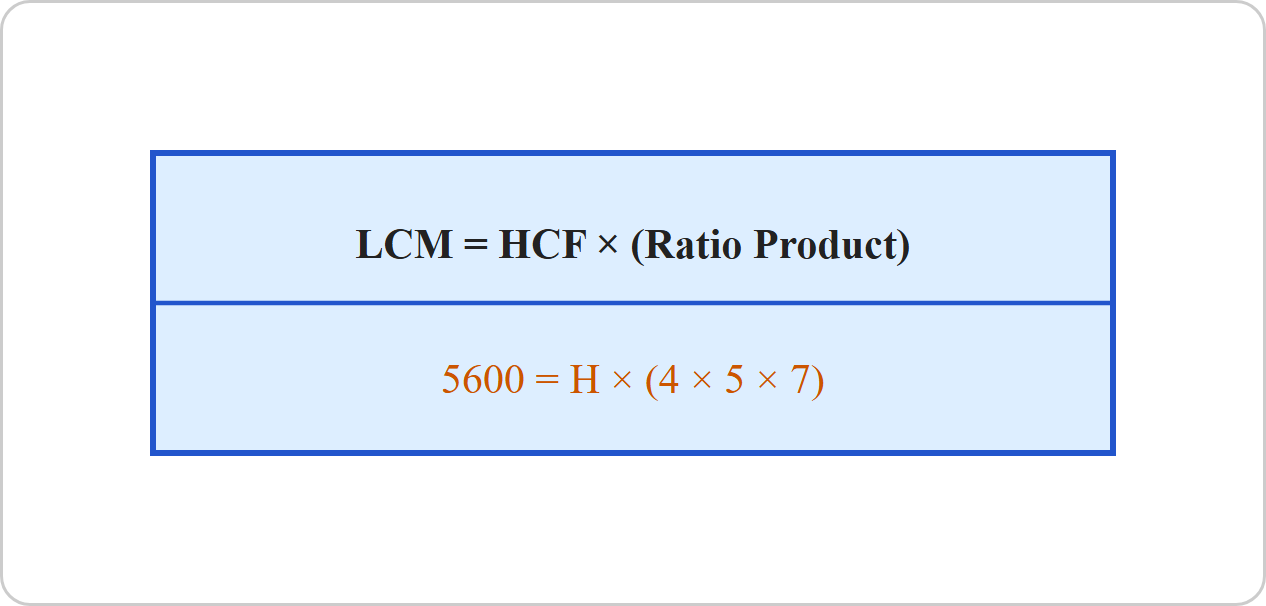
Combined time of Pipe A and Pipe B without leakage = (6 × 30) ÷ (6 + 30) = 5 hr.

Actual time with leakage = 5 hr + 30 min = 5.5 hr.

Time to empty the cistern = (Original Time × Actual Time) ÷ (Actual Time − Original Time).

Required time = (5 × 5.5) ÷ (5.5 − 5) = 27.5 ÷ 0.5 = 55 hr.

∴ The correct answer is 55 hr.

Alternate Method

Given:

Time taken by Pipe A = 6 hr

Time taken by Pipe B = 30 hr

Delay due to leakage = 30 min = 0.5 hr

Formula Used:

Total Work = LCM of time taken | Efficiency = Total Work ÷ Time

PersonHoursTotal Work (Units)Efficiency (Units/hr)
Pipe A6305
Pipe B301

Calculations:

⇒ Total efficiency of (Pipe A + Pipe B) = 5 + 1 = 6 units/hr

⇒ Time taken to fill the cistern without leak = 30 ÷ 6 = 5 hr

⇒ Time taken with leakage = 5 + 0.5 = 5.5 hr (or 11/2 hr)

⇒ Net efficiency with leakage = Total Work ÷ Actual Time = 30 ÷ 5.5 = 60/11 units/hr

⇒ Efficiency of leakage = (Efficiency of A + B) − Net efficiency

⇒ Efficiency of leakage = 6 − 60/11 = (66 − 60) ÷ 11 = 6/11 units/hr

⇒ Time taken by leakage to empty full cistern = Total Work ÷ Efficiency of leak

⇒ Required time = 30 ÷ (6/11) = 30 × 11 ÷ 6 = 5 × 11 = 55 hr

∴ The correct answer is 55 hr.

Additional Information

Inlet and Outlet Pipes

Inlet pipes have positive efficiency as they fill the tank, while outlet pipes (or leaks) have negative efficiency as they empty it.

Net Work Done

If multiple pipes operate, the net rate of filling is the sum of efficiencies of inlet pipes minus the sum of efficiencies of outlet pipes.

Emptying a Full Tank

The time taken to empty a full tank by a leak is given by: Total Capacity ÷ Efficiency of the leak.

3

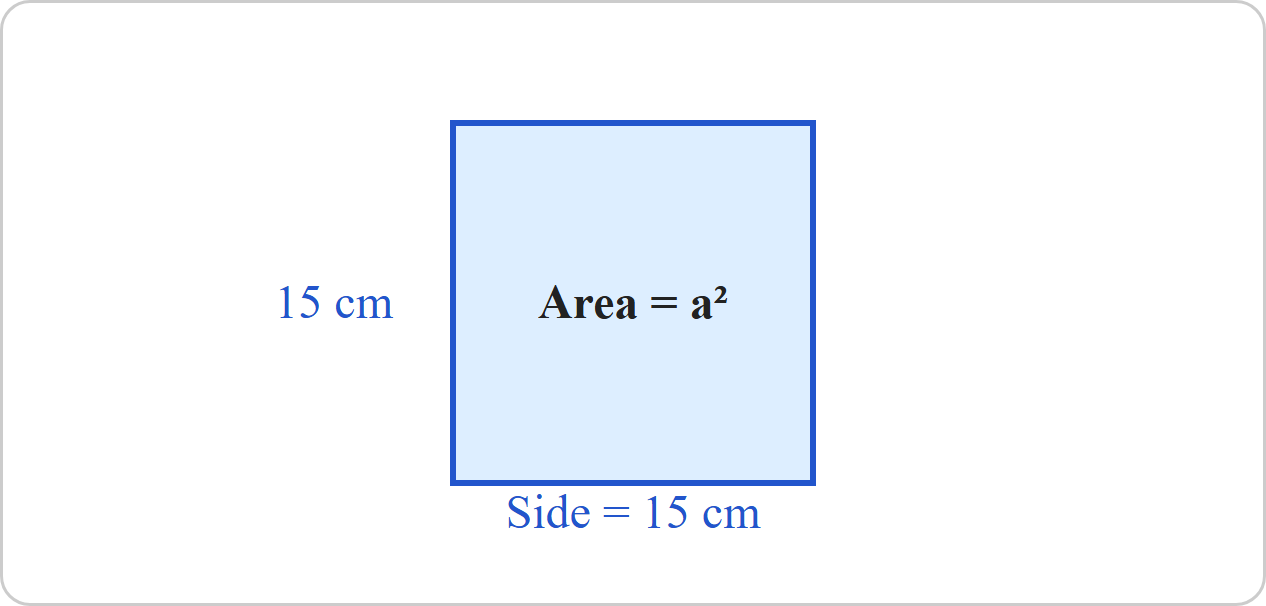
The area of a square having side 15 cm is:

  1. ((a))

    225 cm2

  2. ((b))

    325 cm2

  3. ((c))

    425 cm2

  4. ((d))

    525 cm2

Show Answer
Answer: ((a))

225 cm2

Shortcut Trick

Area of a square is the square of its side.

Side = 15 cm

Area = 152 = 225

∴ The correct answer is 225 cm2.

Alternate Method

Given:

Side (a) of the square = 15 cm

Formula Used:

Area of a square = Side × Side = a2

Calculations:

⇒ Area = 15 cm × 15 cm

⇒ Area = 225 cm2

∴ The correct answer is 225 cm2.

Additional Information

Perimeter of a Square

The total boundary length of a square is given by 4 × Side.

Diagonal of a Square

The length of the diagonal connecting opposite vertices is Side × √2.

Area in terms of Diagonal

Area can also be calculated as (Diagonal)2 ÷ 2.

4

The __________ is the area of the earth where living organisms can be found or where life can be sustained.

  1. ((a))

    biosphere

  2. ((b))

    troposphere

  3. ((c))

    stratosphere

  4. ((d))

    atmosphere

Show Answer
Answer: ((a))

biosphere

The correct answer is biosphere.

Key Points

  • Biosphere refers to the part of the earth where living organisms can be found or where life can be sustained. It includes all living things on earth, including humans, animals, plants, and microorganisms.
  • It is made up of various ecosystems, such as forests, oceans, grasslands, and deserts, that interact with each other and with the physical environment.
  • It is essential for the survival of all living organisms on earth, as it provides us with food, water, air, and other resources.
  • It is constantly changing and evolving, and human activities, such as deforestation, pollution, and climate change, are having a significant impact on it.

Additional Information

  • The atmosphere refers to the layer of gases that surrounds the earth and is composed of several different layers, including the troposphere, stratosphere, mesosphere, thermosphere, and exosphere.
  • The toposphere refers to the lowest layer of the earth's atmosphere, where weather occurs and most of the air we breathe is located.
  • The stratosphere is the layer of the earth's atmosphere that is located above the troposphere and contains the ozone layer.
5

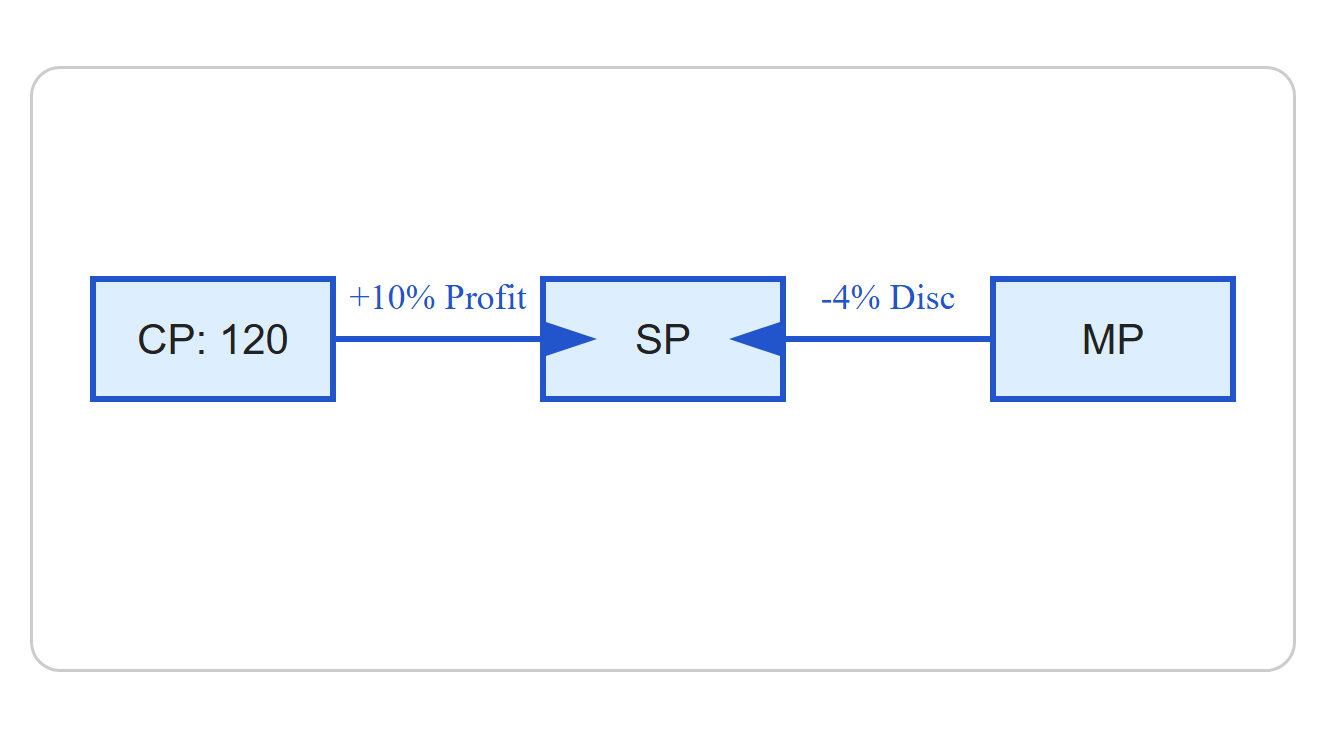
A shopkeeper allows 4% discount on his marked price. If the cost price of an article is Rs. 120 and he has to make a profit of 10%, then his marked price must be:

  1. ((a))

    Rs. 137.50

  2. ((b))

    Rs. 127.50

  3. ((c))

    Rs. 120.50

  4. ((d))

    Rs. 117.50

Show Answer
Answer: ((a))

Rs. 137.50

Shortcut Trick

Ratio of Cost Price (CP) to Marked Price (MP) is given by (100 − Discount%) : (100 + Profit%).

CP : MP = (100 − 4) : (100 + 10) = 96 : 110 = 48 : 55.

Given CP = 48 units = Rs. 120 ⇒ 1 unit = 120 ÷ 48 = 2.5.

MP = 55 units = 55 × 2.5 = Rs. 137.50.

∴ The correct answer is Rs. 137.50.

Alternate Method

Given: CP = Rs. 120, Profit% = 10%, Discount% = 4%.

Formulas: SP = CP × (100 + P%) ÷ 100 | MP = (SP × 100) ÷ (100 − D%).

Selling Price (SP) = 120 × (110 ÷ 100) = 120 × 1.1 = Rs. 132.

⇒ Let Marked Price (MP) be x. Discounted SP = x × (96 ÷ 100) = 132.

⇒ x = (132 × 100) ÷ 96 = 13200 ÷ 96 = Rs. 137.50.

∴ The correct answer is Rs. 137.50.

Additional Information

Relationship between CP and MP

The formula CP/MP = (100 − D%)/(100 + P%) is derived by equating SP = MP × (100 − D)/100 and SP = CP × (100 + P)/100.

Mark-up Percentage

Mark-up % = [(MP − CP) ÷ CP] × 100. It represents how much higher the MP is compared to the CP.

6

Consider the below statements and identify the correct answer.

Statement - I: Bleaching powder is used to make drinking water free from germs.

Statement - II: Bleaching powder is used as an oxidising agent in many chemical industries.

  1. ((a))

    Statement - I is true, and Statement - II is false.

  2. ((b))

    Statement - II is true, and Statement - I is false.

  3. ((c))

    Both the statements are false.

  4. ((d))

    Both the statements are true.

Show Answer
Answer: ((d))

Both the statements are true.

The correct answer is Both the statements are true.

Key PointsBleaching powder:

  • It is also known as calcium hypochlorite.
  • It is commonly used as a disinfectant.
  • It works by releasing chlorine when it is dissolved in water, which kills bacteria and other microorganisms.
  • The chemical formula of bleaching powder is CaOCl2.
  • It is a strong oxidizing agent and is used in many chemical industries as an oxidizing agent.

Additional Information

  • The process of producing bleaching powder involves the reaction of dry, slaked lime with chlorine gas, which is obtained via the chlor-alkali process.
  • It is also used to brighten stained clothing in the laundry.
  • It is important to note that bleaching powder should only be used in small quantities and with caution, as it can be harmful if ingested or inhaled.
7

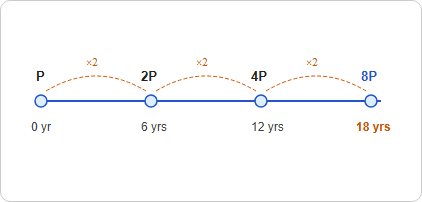
If a certain sum becomes two times itself in 6 years at compound interest in case of annual compounding, then the number of years in which it will become eight times of itself at the same rate of interest under annual compounding is:

  1. ((a))

    12 years

  2. ((b))

    18 years

  3. ((c))

    24 years

  4. ((d))

    36 years

Show Answer
Answer: ((b))

18 years

Shortcut Trick

In Compound Interest, if a sum becomes n times in T years, it will become nk times in k × T years.

Given: n = 2, T = 6 years.

We need the sum to become 8 times.

Since 8 = 23, the value of k = 3.

Required time = k × T = 3 × 6 = 18 years.

∴ The correct answer is 18 years.

Alternate Method

Given:

Initial sum (Principal) = P

Time (t1) = 6 years

Amount after 6 years (A1) = 2P

Formula Used:

A = P(1 + r/100)t

Calculations:

⇒ 2P = P(1 + r/100)6

⇒ 2 = (1 + r/100)6 ... (i)

Let the required time be t years to become 8 times.

⇒ 8P = P(1 + r/100)t

⇒ 8 = (1 + r/100)t

⇒ 23 = (1 + r/100)t

Substituting the value of 2 from equation (i):

⇒ [(1 + r/100)6]3 = (1 + r/100)t

⇒ (1 + r/100)18 = (1 + r/100)t

⇒ t = 18 years

∴ The correct answer is 18 years.

Additional Information

Compound Interest Formula

Amount (A) = P(1 + r/n)nt, where P is principal, r is annual interest rate, n is number of times interest is compounded per year, and t is time in years.

Rule of 72

A quick way to estimate the time required to double the money at a given interest rate: Time ≈ 72 ÷ Rate of Interest.

Effective Annual Rate

When interest is compounded more than once a year, the actual annual return is higher, calculated as: Reff = [1 + (r/n)]n − 1.

8

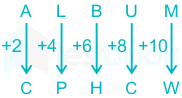
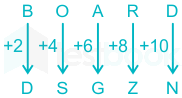
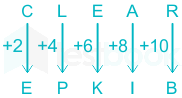
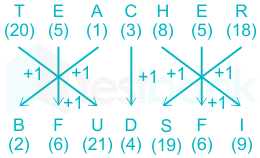
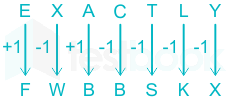
In a certain code language, “ALBUM’ is written as 'CPHCW' and 'BOARD' is written as ‘DSGZN’. How will "CLEAR' be written in that language?

  1. ((a))

    EPKIB

  2. ((b))

    PLEUV

  3. ((c))

    EKNPS

  4. ((d))

    SDOIG

Show Answer
Answer: ((a))

EPKIB

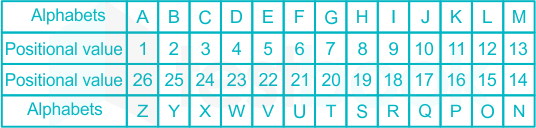
The positional value of alphabet series is;

The pattern followed here is:

ALBUM is written as CPHCW →

BOARD' is written as DSGZN →

Similarly, 

CLEAR be written as EPKIB →

Hence, the correct answer is "EPKIB ".

9

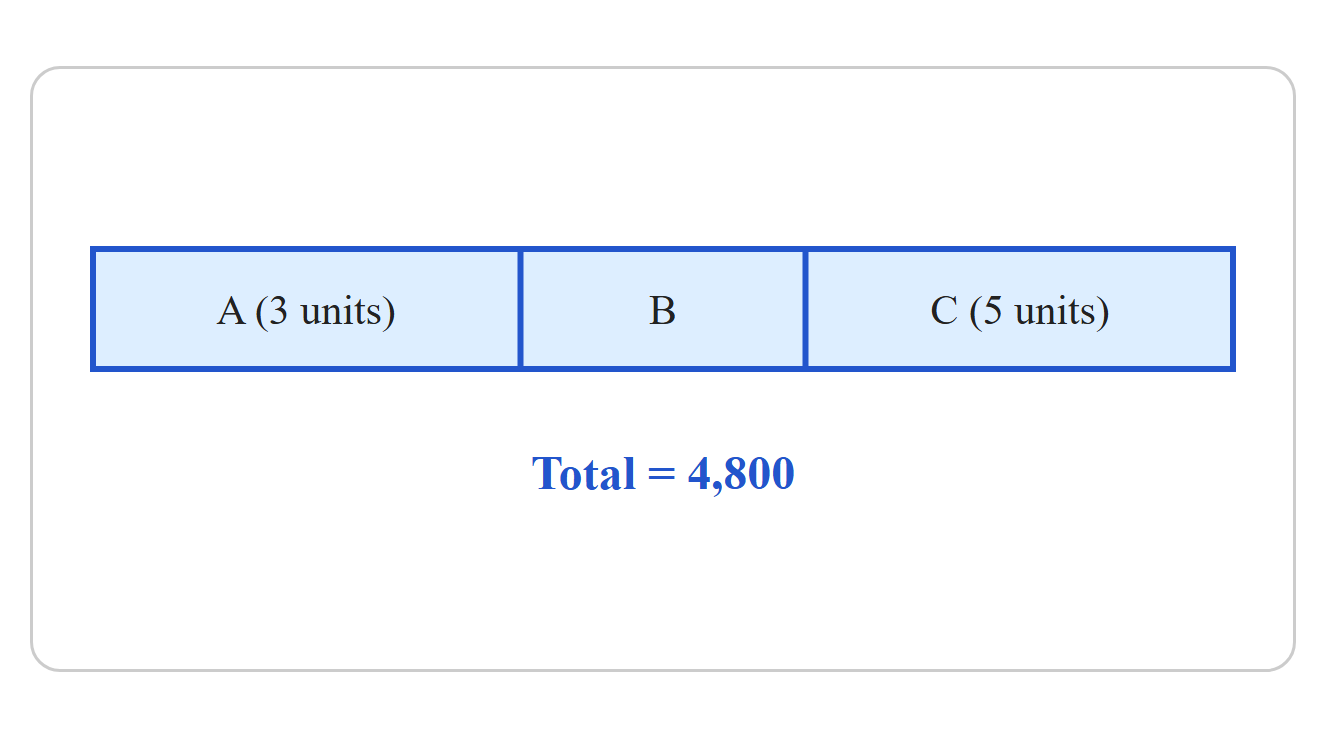
A sum of Rs. 4,800 is divided between A, B and C such that the ratio of the share of A to the combined share of B and C is 3 : 5 and C receives 57\frac{5}{7} of what A and B together receive. The difference (in Rs.) of A's share and B 's share is:

  1. ((a))

    1,000

  2. ((b))

    800

  3. ((c))

    900

  4. ((d))

    850

Show Answer
Answer: ((b))

800

Shortcut Trick

Total sum is 4,800.

Ratio A : (B + C) = 3 : 5 ⇒ Total 8 units = 4,800 ⇒ 1 unit = 600. ∴ A = 1,800.

Ratio C : (A + B) = 5 : 7 ⇒ Total 12 units = 4,800 ⇒ 1 unit = 400. ∴ C = 2,000.

Share of B = Total − (A + C) = 4,800 − (1,800 + 2,000) = 1,000.

Difference between A and B = |1,800 − 1,000| = 800.

∴ The correct answer is Rs. 800.

Alternate Method

Given → Total = 4,800 | A : (B + C) = 3 : 5 | C = 5/7 × (A + B) Formulas: Share = (Ratio part ÷ Total parts) × Total Sum | Difference = |A − B|

⇒ Sum of A, B, and C = 4,800. ⇒ A : (B + C) = 3 : 5. Total parts = 3 + 5 = 8. ⇒ A's share = (3 ÷ 8) × 4,800 = 1,800. ⇒ C : (A + B) = 5 : 7. Total parts = 5 + 7 = 12. ⇒ C's share = (5 ÷ 12) × 4,800 = 2,000. ⇒ B's share = 4,800 − (1,800 + 2,000) = 1,000. ⇒ Difference (A − B) = 1,800 − 1,000 = 800.

∴ The correct answer is Rs. 800.

Additional Information

Ratio and Proportion

If a total amount X is divided in ratio a:b, then shares are [a/(a+b)] × X and [b/(a+b)] × X.

Compound Ratios

When shares are given in relation to the sum of others, ensure the sum of ratio parts is consistent with the total value.

10

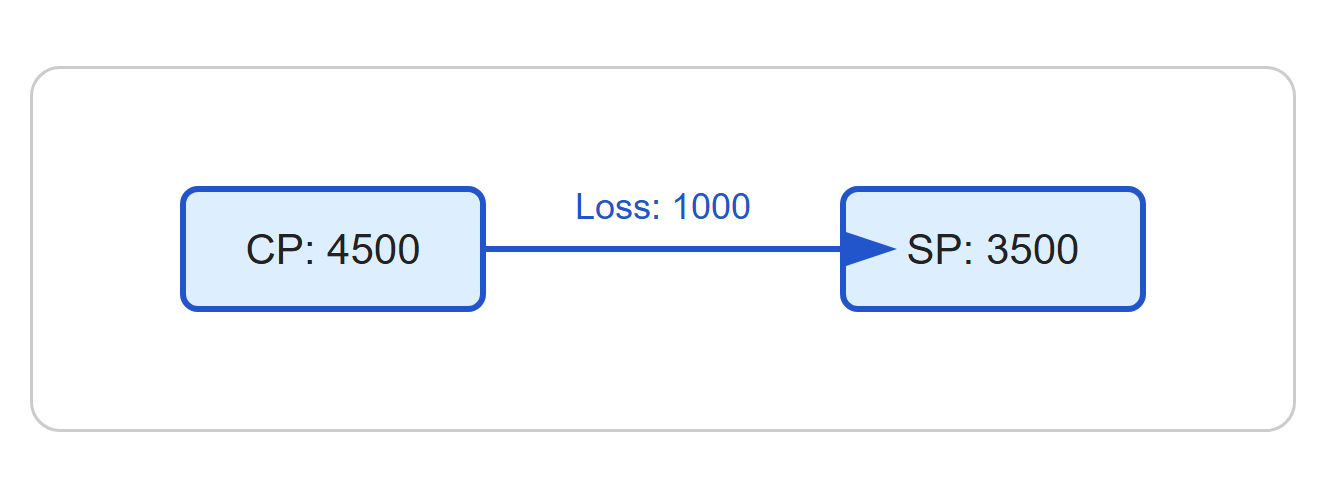
If the cost price of an item is ₹4,500 and its selling price is ₹3,500, then the loss percentage is:

  1. ((a))

    4429%44\frac{2}{9} \%

  2. ((b))

    5529%55\frac{2}{9} \%

  3. ((c))

    3329%33\frac{2}{9} \%

  4. ((d))

    2229%22\frac{2}{9} \%

Show Answer
Answer: ((d))

2229%22\frac{2}{9} \%

Shortcut Trick

Ratio of Cost Price (CP) to Selling Price (SP) = 4500 : 3500 = 9 : 7.

Loss in ratio units = 9 − 7 = 2 units.

Loss percentage = (Loss ÷ CP) × 100 = (2 ÷ 9) × 100.

Since 1/9 = 11(1/9)%, then 2/9 = 22(2/9)%.

∴ The correct answer is 22(2/9) %.

Alternate Method

Given: Cost Price (CP) = ₹4,500, Selling Price (SP) = ₹3,500.

Formulas: Loss = CP − SP | Loss% = (Loss ÷ CP) × 100

Loss = 4500 − 3500 = ₹1,000.

Loss Percentage = (1000 ÷ 4500) × 100.

Loss Percentage = (10 ÷ 45) × 100 = (2 ÷ 9) × 100.

Loss Percentage = 200 ÷ 9 = 22(2/9)%.

∴ The correct answer is 22(2/9) %.

Additional Information

Loss and Profit Calculation

Profit or loss is always calculated on the Cost Price unless otherwise stated in the problem.

Fraction to Percentage Conversion

Understanding that 1/9 ≈ 11.11% or 11(1/9)% helps in solving percentage-based aptitude questions faster.

11

Select the set in which the numbers are related in the same way as are the numbers of the following sets.

(NOTE: Operations should be performed on the whole numbers, without breaking down the numbers into its constituent digits. E.g. 13 - Operations on 13 such as  adding/subtracting/multiplying etc. to 13 can be performed. Breaking down 13 into 1 and 3 and then performing mathematical operations on 1 and 3 is not allowed)

(4, 6, 8)

(6, 9, 12)

  1. ((a))

    (18, 18, 16)

  2. ((b))

    (5, 30, 10)

  3. ((c))

    (8, 12, 16)

  4. ((d))

    (2, 12, 8)

Show Answer
Answer: ((c))

(8, 12, 16)

The logic followed here is:-

[(Second Number - First Number) × 4] = Third Number

In (4, 6, 8) →

= [(6 - 4) × 4

= 2 × 4

= 8

In (6, 9, 12) →

= [(9 - 6) × 4]

= 3 × 4

= 12

Similarly,

In (8, 12, 16) →

= [(12 - 8) × 4]

= 4 × 4

= 16

Hence, the correct answer is "(8, 12, 16)".

12

B Adhiban led a star-studded field at the 58th Senior National ________ Championship, which began on 25 February 2022.

  1. ((a))

    Badminton

  2. ((b))

    Wrestling

  3. ((c))

    Chess

  4. ((d))

    Golf

Show Answer
Answer: ((c))

Chess

The correct answer is Chess.

Key Points58th Senior National Chess Championship:

  • Star-studded field led by Grandmaster B Adhiban began on February 25, 2022.
  • For the first time, 30 International Masters and 23 Grand Masters are taking part in the national championship.
  • It was held in Kanpur.
  • The reward money for the winner is expected to be Rs 6 lakh.
  • The winner will also get 25 bonus points.

Additional InformationNational Chess Championship:

  • It's India's yearly national chess championship.
  • It was founded in 1955 by the Andhra State Chess Federation.
  • Originally held every two years, it has been played annually since 1971.
  • Andhra Pradesh's Eluru hosted the event's debut edition.
  • In 1974, the women's championship was launched.
  • The 59th MPL Senior National Chess Championship 2022 took place at the IG Stadium in New Delhi.
  • Pune hosted the 60th Senior National Chess Championship in 2023 from August 16–26.
13

The value of 39 ÷ {6 × (67 of 78)\rm (\frac{6}{7}\ of\ \frac{7}{8})} is :

  1. ((a))

    263\frac{26}{3}

  2. ((b))

    233\frac{23}{3}

  3. ((c))

    283\frac{28}{3}

  4. ((d))

    253\frac{25}{3}

Show Answer
Answer: ((a))

263\frac{26}{3}

Calculation:

39÷6×(67 of 78)39 ÷{6 ×\rm (\frac{6}{7}\ of\ \frac{7}{8})}

⇒ 39 ÷ 6 × (3/4)

⇒ 39 ÷ (9/2)

⇒ 39 × (2/9)

⇒ 26/3

∴ Option 1 is the correct answer.

14

Solutions for the equation 11a2 + 18a + 7 = 0 are :

  1. ((a))

    -1, 2

  2. ((b))

    -1, 711\frac{-7}{11}

  3. ((c))

    -1, -3

  4. ((d))

    -2, 711\frac{-7}{11}

Show Answer
Answer: ((b))

-1, 711\frac{-7}{11}

Shortcut Trick

Split the middle term (18) into two parts that sum to 18 and multiply to (11 × 7 = 77).

The parts are 11 and 7.

To find the roots, change the signs of these parts and divide by the coefficient of a2 (11).

Roots = −11/11 and −7/11.

Roots = −1 and −7/11.

∴ The correct answer is -1, -7/11.

Alternate Method

Given:

The quadratic equation is 11a2 + 18a + 7 = 0.

Method: Splitting the middle term (factorization method).

⇒ 11a2 + 11a + 7a + 7 = 0

⇒ 11a(a + 1) + 7(a + 1) = 0

⇒ (a + 1)(11a + 7) = 0

⇒ a + 1 = 0 OR 11a + 7 = 0

⇒ a = −1 OR a = −7/11

∴ The correct answer is -1, -7/11.

Additional Information

Quadratic Formula

The solutions for ax2 + bx + c = 0 can also be found using x = [−b ± √(b2 − 4ac)] / 2a.

Nature of Roots

The discriminant D = b2 − 4ac determines the roots: if D > 0, roots are real and distinct; if D = 0, roots are real and equal; if D < 0, roots are imaginary.

Sum and Product of Roots

For any quadratic equation, the sum of roots is −b/a and the product of roots is c/a.

15

The value of sec A (1 - cos A) (cosec A + cot A) is: 

  1. ((a))

    cot A

  2. ((b))

    tan A

  3. ((c))

    sec A

  4. ((d))

    cosec A

Show Answer
Answer: ((b))

tan A

Shortcut Trick

Put A = 45° to verify the expression quickly.

sec 45° (1 − cos 45°) (cosec 45° + cot 45°)

⇒ √2 (1 − 1/√2) (√2 + 1) = (√2 − 1) (√2 + 1)

⇒ (√2)2 − 12 = 2 − 1 = 1.

Check options at 45°: tan 45° = 1.

∴ The correct answer is tan A.

Alternate Method

Given: sec A (1 − cos A) (cosec A + cot A)

Formula Used: sec A = 1/cos A, cosec A = 1/sin A, cot A = cos A/sin A

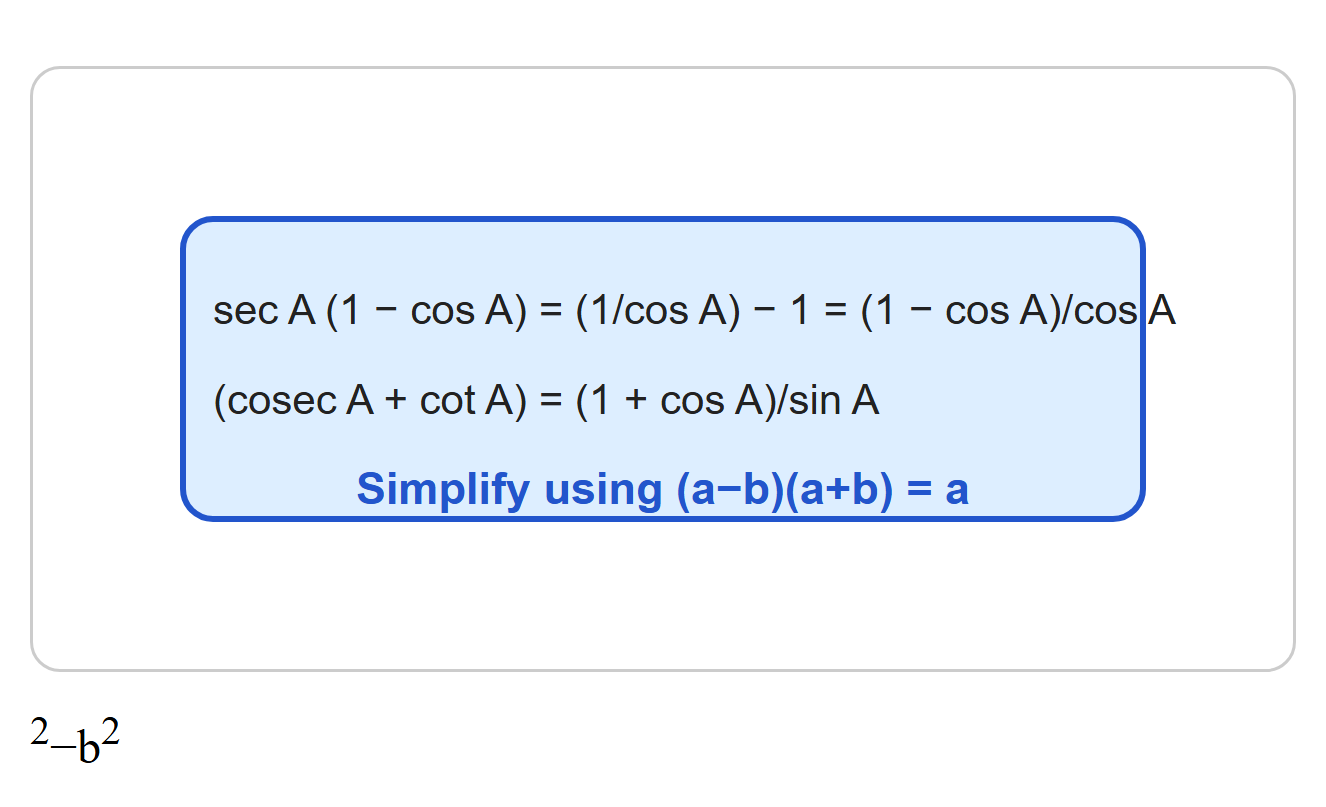
⇒ [(1/cos A) × (1 − cos A)] × [(1/sin A) + (cos A/sin A)]

⇒ [(1 − cos A) / cos A] × [(1 + cos A) / sin A]

⇒ (1 − cos2 A) / (cos A × sin A)

⇒ sin2 A / (cos A × sin A)

⇒ sin A / cos A = tan A

∴ The correct answer is tan A.

Additional Information

Trigonometric Identities

Fundamental identity: sin2 A + cos2 A = 1. Used to substitute (1 − cos2 A) with sin2 A.

Reciprocal Relations

sec A = 1/cos A, cosec A = 1/sin A, and tan A = sin A/cos A = 1/cot A.

Algebraic Identity in Trig

The difference of squares (a − b)(a + b) = a2 − b2 is frequently used to simplify trigonometric expressions involving 1 ± sin A or 1 ± cos A.

16

An object is placed in front of a concave mirror of focal length 12 cm, at a distance of 6 cm. Its image is formed at a distance of ________ and is_________.

  1. ((a))

    12 cm, real

  2. ((b))

    4 cm, real

  3. ((c))

    12 cm, virtual

  4. ((d))

    4 cm, virtual

Show Answer
Answer: ((c))

12 cm, virtual

The correct answer is 12 cm, virtual.

Key Points

  • The given problem is related to the reflection of light by a concave mirror.
  • The focal length of the mirror is given as 12 cm, and the object is placed at a distance of 6 cm from the mirror.
  • Therefore, the object distance (u) is -6 cm (negative sign denotes that the object is placed in front of the mirror) and focal length (f) is negative for concave mirror.
  • To find the image distance (v), we can use the mirror formula: 1/f = 1/v + 1/u, where f is the focal length of the mirror.
  • Substituting the given values, we get v = 12 cm.
  • The resulting image is magnified, erect, and virtual.

Additional Information

  • A concave mirror is a curved mirror in which the inner side of the curved shape is the reflecting surface.
  • Its surface has an inward curvature that makes it resemble the interior surface of a hollow sphere.
  • The fact that they induce light rays to converge, or gather together after reflection, makes them converging mirrors as well.
  • Real and virtual images can be formed by an object and mirror placed in different positions.
17

Which of the following are the end products of respiration in plants?

  1. ((a))

    O2 and Energy

  2. ((b))

    COand O2

  3. ((c))

    CO2, H2O and Energy

  4. ((d))

    Glucose and O2

Show Answer
Answer: ((c))

CO2, H2O and Energy

The correct answer is CO2, H2O and Energy.

Key Points

  • Respiration is a process by which living organisms release energy from food molecules such as glucose.
  • In plants, respiration occurs in mitochondria, which are organelles present in the cells.
  • During respiration, glucose is broken down into smaller molecules such as pyruvate, which then undergo a series of chemical reactions to produce CO2, water, and energy.

Additional InformationRespiration in Roots:

  • The plant's underground portion, the roots, take in air from the spaces and air gaps between the soil particles.
  • The oxygen that is taken up by the roots is used to release energy, which is then employed to move minerals and salts out of the soil.
  • This is the reason we frequently hear people warn against spending the night beneath a tree because the excess carbon dioxide that trees release after they breathe can cause asphyxia.

Respiration in Stems:

  • In order for the stem to breathe, air diffuses into the stomata and travels through various cell regions.
  • The released carbon dioxide is also dispersed via the stomata at this point.
  • Gaseous exchange is known to occur in lenticels in woody or higher plants.

Respiration in Leaves:

  • The minuscule openings in leaves are called stomata.
  • Every stomata is regulated by guard cells.
  • When the stoma between the inferior leaf and the atmosphere closes and opens, gases are exchanged.
18

A certain number of people are sitting in a row, facing north. Lalit sits fourth to the left of Purnima. Lalit is third from the left end. Leela is eleventh from the right end and an immediate neighbour of Lalit. Only four people sit between Sheetal and Lalit. Only four people sit between Sheetal and Neena. How many people are sitting in the row?
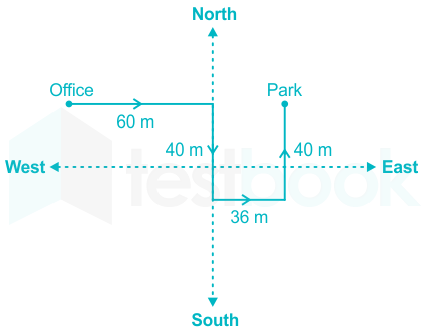
  1. ((a))

    14

  2. ((b))

    18

  3. ((c))

    23

  4. ((d))

    33

Show Answer
Answer: ((a))

14

Given → Certain number of people are sitting in a row, facing north.
1) Lalit sits fourth to the left of Purnima.
2) Lalit is third from the left end.

3) Only four people sit between Sheetal and Lalit.

4) Only four people sit between Sheetal and Neena.

5)  Leela is eleventh from the right end and an immediate neighbour of Lalit.

Here, 14 number of people are sitting in the row.

Hence, the correct answer is "14".

19

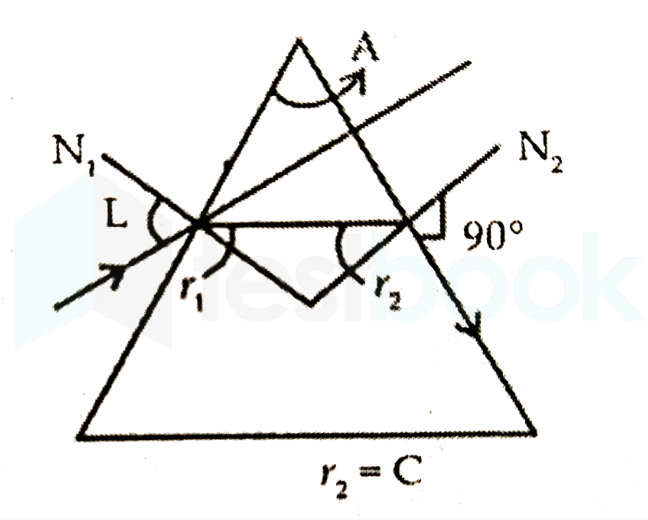
A ray of light is incident on a refracting surface AB of a glass prism and emerges out of the other refracting surface AC. Consider the following statements:

(a) The angle of refraction at surface AB is more than the angle of incidence.

(b) The angle of refraction at the surface AC is less than the angle of incidence.

Which of the above statements is/are correct?

  1. ((a))

    Both (a) and (b)

  2. ((b))

    Only (a)

  3. ((c))

    Only (b)

  4. ((d))

    Neither (a) nor (b)

Show Answer
Answer: ((d))

Neither (a) nor (b)

The correct answer is Neither (a) nor (b).

Key Points

  • The amount of bending depends on the angle at which the light enters the new medium and the refractive index of the medium.
  • Refracted light bends more in the direction of the normal line when it moves from a less dense material to a denser one.
  • When a light beam passes from a rarer medium into a denser medium, its angle of refraction is smaller than its angle of incidence.
  • When a light beam travels from an optically denser medium to a rarer medium, its angle of refraction is always greater than its angle of incidence.

Additional Information

  • In the field of optics, a prism is a transparent substance, such as glass, that has been precisely cut with plane faces and angles.
  • It is used to reflect and analyze light.
  • A standard triangular prism can divide white light into its component colors, or what is known as a spectrum.
  • The bending of light as it moves from one transparent substance into another is known as refraction.
  • The bending caused by refraction allows us to create rainbows, prisms, magnifying glasses, and lenses.
  • Our eyes are dependent on this light bending as well.
20

The average marks obtained in mathematics by the students of a class was 70. The average marks obtained by the boys is 20% more than the average marks obtained by the girls. If the ratio of the number of boys to that of girls is 3 ∶ 2, then the average marks obtained by the girls is:

  1. ((a))

    65

  2. ((b))

    62.5

  3. ((c))

    63

  4. ((d))

    63.5

Show Answer
Answer: ((b))

62.5

Shortcut Trick

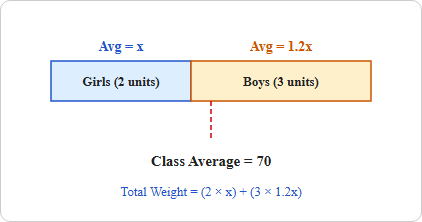
Ratio of Average Marks (Girls : Boys) = 100 : 120 = 5 : 6 units.

Ratio of Number of Students (Boys : Girls) = 3 : 2.

Combined Average = [(3 × 6) + (2 × 5)] ÷ (3 + 2) = 28 ÷ 5 = 5.6 units.

5.6 units = 70 ⇒ 1 unit = 70 ÷ 5.6 = 12.5.

Average marks of girls = 5 units = 5 × 12.5 = 62.5.

∴ The correct answer is 62.5.

Alternate Method

Given:

Average marks of the class = 70

Ratio of Boys (B) to Girls (G) = 3 : 2

Average marks of boys = Average marks of girls + 20%

Formula Used:

Weighted Average = (n1 × A1 + n2 × A2) ÷ (n1 + n2)

Calculations:

⇒ Let the average marks of girls = x

⇒ Average marks of boys = x + 0.20x = 1.2x

⇒ Total Students = 3 + 2 = 5 parts

⇒ Total marks = Average marks × Total students

⇒ 70 × 5 = (3 × 1.2x) + (2 × x)

⇒ 350 = 3.6x + 2x

⇒ 350 = 5.6x

⇒ x = 350 ÷ 5.6

⇒ x = 62.5

∴ The correct answer is 62.5.

Additional Information

Weighted Average Concept

It is used when groups of different sizes have different averages. Formula: Aavg = (Sum of all observations) ÷ (Total number of observations).

Percentage to Fraction Conversion

A 20% increase corresponds to a multiplier of 1.2 or a fraction of 6/5. If the base is 100%, the new value is 120%.

Alligation Method

The ratio of the quantities is inversely proportional to the difference between their individual averages and the mean average: n1/n2 = (A2 − Am) / (Am − A1).

21

How can we reduce the use of non-biodegradable products?

  1. ((a))

    Eatables like biscuits etc., can be bought packed in plastic tins and wrappers

  2. ((b))

    Fruits and vegetables can be bought packed in beautiful polystyrene and plastic packaging

  3. ((c))

    By packing milk and water in polybags

  4. ((d))

    By using eco-friendly packaging

Show Answer
Answer: ((d))

By using eco-friendly packaging

The correct answer is By using eco-friendly packaging.

Key PointsThe use of non-biodegradable products can be reduced by following the below steps:

  • Use eco-friendly packaging: One of the best ways to reduce the use of non-biodegradable products is by using eco-friendly packaging. This includes using paper bags, cloth bags, and biodegradable packaging materials.
  • Avoid using single-use plastic. Single-use plastic products such as straws, plastic bags, and disposable cutlery are major contributors to non-biodegradable waste. It is important to avoid using these products and switch to reusable alternatives.
  • Buy products with minimal packaging: Many products come with excessive packaging that is not necessary. It is important to choose products that come with minimal packaging or packaging that is biodegradable.
  • Recycle: Recycling is an important step in reducing non-biodegradable waste. It is important to segregate waste and recycle materials such as plastic, glass, and paper.

Additional InformationBenefits of Biodegradable Packaging:

  • Reduced Carbon Footprint: Biodegradable packaging materials are better for the environment because they are composed of recycled materials rather than chemicals and polymers.
  • No Harmful Plastics: Employing environmentally friendly packaging enables businesses to use less plastic, which can help lessen the problem of littering.
  • Convenient Disposal: Customers who would rather compost their waste can simply combine shipping materials and biodegradable packaging with other materials that are suitable for composting. Additionally, this technique may benefit the ecosystem in the immediate vicinity.
  • Versatility: Whether it's packing electronics or keeping office supplies organized, there's probably an environmentally friendly material that can meet the needs of the company.
22

The median of the observations 4, 14, 11, 8, 7, 8, 9, 12, 4 and 6 is: 

  1. ((a))

    8

  2. ((b))

    9

  3. ((c))

    11

  4. ((d))

    10

Show Answer
Answer: ((a))

8

Shortcut Trick

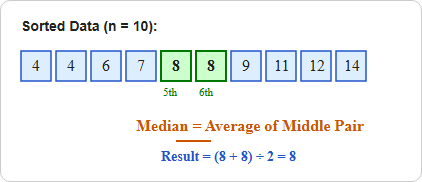
Arrange the observations in ascending order: 4, 4, 6, 7, 8, 8, 9, 11, 12, 14.

Since the total number of observations (n = 10) is even, the median is the average of the two middle terms.

The middle terms are the 5th and 6th positions: 8 and 8.

Median = (8 + 8) ÷ 2 = 8.

∴ The correct answer is 8.

Alternate Method

Given: Observations are 4, 14, 11, 8, 7, 8, 9, 12, 4, 6.

Formula Used:

For an even number of observations (n):

Median = [(n/2)th term + (n/2 + 1)th term] ÷ 2

Total observations (n) = 10

Ascending order: 4, 4, 6, 7, 8, 8, 9, 11, 12, 14

⇒ (n/2)th term = (10/2)th = 5th term = 8

⇒ (n/2 + 1)th term = (10/2 + 1)th = 6th term = 8

⇒ Median = (5th term + 6th term) ÷ 2

⇒ Median = (8 + 8) ÷ 2 = 16 ÷ 2

⇒ Median = 8

∴ The correct answer is 8.

Additional Information

Median for Odd Number of Observations

If n is odd, the median is the exact middle term, calculated as the ((n + 1)/2)th term after sorting the data.

Empirical Relationship

The empirical formula relating Mean, Median, and Mode is: Mode = 3 × Median − 2 × Mean.

Mode

The mode is the observation that appears most frequently in the data set. In this set, both 4 and 8 are modes (bimodal).

Range

The range is the difference between the highest and lowest values: Range = 14 − 4 = 10.

23

The volumes of two spheres are in the ratio 216 ∶ 125. The ratio of their surface areas is: 

  1. ((a))

    16 ∶ 9

  2. ((b))

    25 ∶ 9

  3. ((c))

    36 ∶ 25

  4. ((d))

    9 ∶ 4

Show Answer
Answer: ((c))

36 ∶ 25

Shortcut Trick

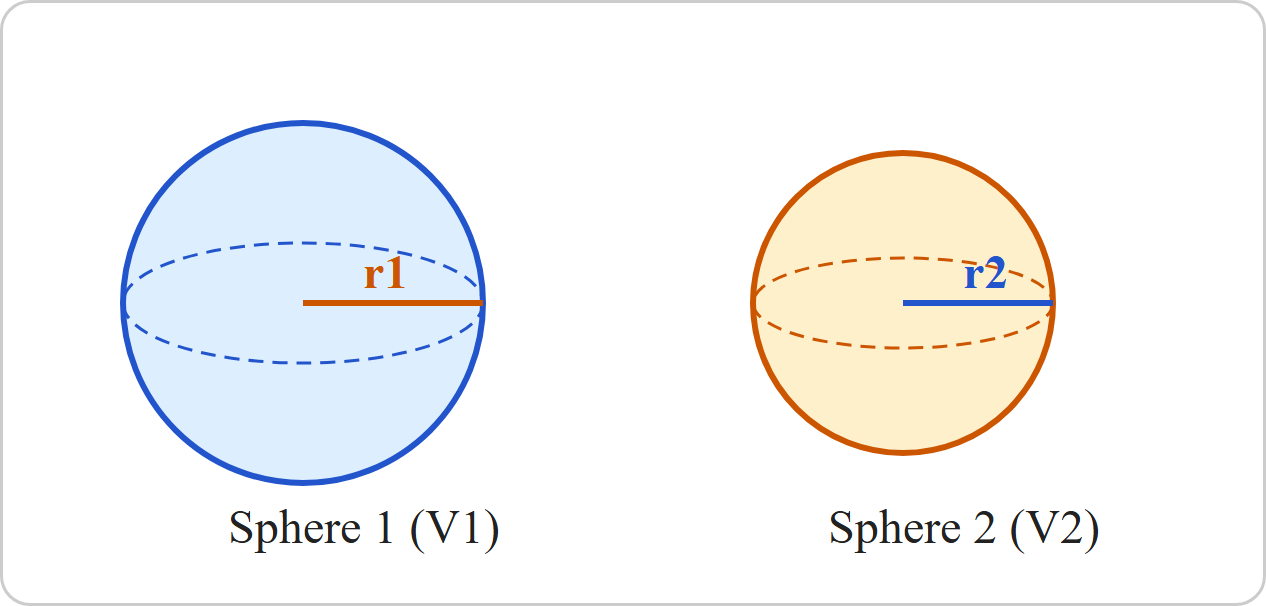
Ratio of Volumes (V1 : V2) = 216 : 125

Ratio of Radii (r1 : r2) = √3216 : √3125 = 6 : 5

Ratio of Surface Areas (S1 : S2) = (r1)2 : (r2)2 = 62 : 52

∴ The correct answer is 36 : 25.

Alternate Method

Given:

Ratio of Volumes of two spheres = 216 : 125

Formula Used:

Volume of sphere (V) = (4/3)πr3

Surface Area of sphere (S) = 4πr2

Calculations:

⇒ V1 / V2 = [(4/3)πr13] / [(4/3)πr23] = 216 / 125

⇒ (r1 / r2)3 = 216 / 125

⇒ r1 / r2 = √3(216 / 125) = 6 / 5

⇒ Ratio of Surface Areas = S1 / S2 = (4πr12) / (4πr22)

⇒ S1 / S2 = (r1 / r2)2

⇒ S1 / S2 = (6 / 5)2 = 36 / 25

∴ The correct answer is 36 : 25.

Additional Information

Properties of Spheres

For any two spheres, if the ratio of their radii is a : b, then the ratio of their surface areas is a2 : b2 and the ratio of their volumes is a3 : b3.

Hemisphere Formulas

For a hemisphere of radius r, the Curved Surface Area is 2πr2, Total Surface Area is 3πr2, and Volume is (2/3)πr3.

24

Section 2(12) of The Juvenile Justice (Care and Protection of Children) Act, 2015 defines a child as 'a person who has not completed ___________ years of age'.

  1. ((a))

    15

  2. ((b))

    12

  3. ((c))

    18

  4. ((d))

    17

Show Answer
Answer: ((c))

18

The correct answer is 18.

Key Points

  • The Juvenile Justice (Care and Protection of Children) Act, 2015 was enacted to provide for the care, protection, and rehabilitation of children who conflict with the law and children in need of care and protection.
  • Section 2(12) of The Juvenile Justice (Care and Protection of Children) Act, 2015 defines a child as 'a person who has not completed 18 years of age
  • This means that any person who is under the age of 18 is considered a child under this act.
  • The term "juvenile" is used to refer to a young person who is not yet an adult and is considered to be under the age of majority.

Additional Information

  • An important provision of the amended Act is that it provides for minors in the age group 16 16–18 years to be treated as adults in the case of heinous crimes.
  • It also gives definitions for petty, serious, and heinous crimes by children.
  • A heinous offense attracts a maximum punishment of 7 years imprisonment under any existing law.
  • A serious offense attracts imprisonment of 3–7 years.
  • A petty offense attracts a maximum of 3 years of imprisonment.
  • The Act gives more clarity on the functions and powers of the Juvenile Justice Board and the Child Welfare Commission.
25

Select the number from among the given options that can replace the question mark (?) in the following series.

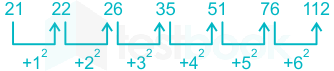
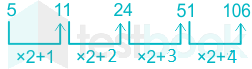
21, 22, 26, 35, 51, 76, ?

  1. ((a))

    112

  2. ((b))

    140

  3. ((c))

    114

  4. ((d))

    110

Show Answer
Answer: ((a))

112

The pattern followed here is:

Hence, the correct answer is "112".

26

Indian sub-continent, in general, is known to have which of the following types of climate?

  1. ((a))

    Mediterranean

  2. ((b))

    Temperate Monsoon

  3. ((c))

    Equatorial

  4. ((d))

    Tropical Monsoon

Show Answer
Answer: ((d))

Tropical Monsoon

The correct answer is Tropical Monsoon.

Key PointsTropical Monsoon Climate:

  • It is characterized by high temperatures, heavy rainfall during the monsoon season, and a dry season.
  • It exhibits a short dry season, usually in the low-sun (winter) season, and the highest temperatures generally occur at the end of this clear spell.
  • The monthly mean temperature is above 18 °C (64 °F).
  • This climate lies in between the drier Aw (also known as the tropical savanna climate) and the wetter Af (also known as the tropical wet climate).
  • It is found in regions such as the Indian subcontinent, Southeast Asia, and the northern parts of Australia.

Additional Information

  • The Mediterranean climate is characterized by hot and dry summers and mild and rainy winters.
  • It is found in regions around the Mediterranean Sea, California, and South Africa.
  • Temperate Monsoon climate is characterized by moderate temperatures and distinct wet and dry seasons.
  • It is found in regions such as East Asia, Southeast Asia, and parts of North America.
  • The equatorial climate is characterized by high temperatures, high humidity, and heavy rainfall throughout the year.
  • It is found in regions near the equator.
27

The 12th Hockey India Senior Male National Championship - 2022 was organised by:

  1. ((a))

    Madhya Pradesh

  2. ((b))

    Orissa

  3. ((c))

    Haryana

  4. ((d))

    Punjab

Show Answer
Answer: ((a))

Madhya Pradesh

The correct answer is Madhya Pradesh.

Key Points12th Senior Men’s National Hockey Championship 2022:

  • The tournament was held in Bhopal, Madhya Pradesh
  • It was held from April 6 to 17, 2022.
  • Haryana has emerged as the champions after defeating Tamil Nadu 3-1 in the shootout after the final ended 1-1 in regulation time.
  • Haryana has won the trophy for the first time since 2011.

Additional Information13th Hockey India Senior Men National Championship 2023:

  • The tournament was held at the Mayor Radhakrishnan Hockey Stadium in Chennai, Tamil Nadu.
  • It was held from November 17 to 28, 2023.
  • Punjab has emerged as the champions after defeating Haryana.
  • This is Punjab's fourth championship.
28

What will come in place of the question mark (?) in the following equation, if '+' and '-' are interchanged and also '×' and ÷ are interchanged?

13 ÷ 7 + 132 × 11 + 23 – 512 × 2 + 122 = ?

  1. ((a))

    165

  2. ((b))

    190

  3. ((c))

    195

  4. ((d))

    200

Show Answer
Answer: ((b))

190

Decoding the information, 

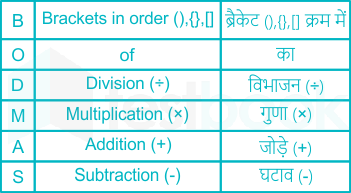
Symbol+-÷×
Meaning-+×÷

Let's solve the given equation using BODMAS rule in each option;

Given the equation: 13 ÷ 7 + 132 × 11 + 23 – 512 × 2 + 122 

After replacing the signs from left to right and using the BODMAS rule,

13 × 7 - 132 ÷ 11 - 23 + 512 ÷  2 - 122 

= 13 × 7 - 12 - 23 + 256 - 122 

= 91 - 12 - 23 + 256 - 122  

= 347 - 12 - 23 - 122

= 347 - 157

= 190

Hence, the correct answer is "190".

29

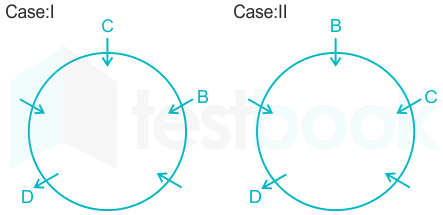
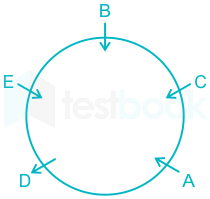
Five people A, B, C, D and E are sitting around a circular table. One of them is facing outside (opposite to the centre) and the other four are facing the centre. C is facing the centre and is sitting at second place to the left of D. B is sitting at second place to the right of D. A is sitting to the immediate left of both C and D. E is sitting to the immediate right of B. Who among them is facing outside?

  1. ((a))

    C

  2. ((b))

    D

  3. ((c))

    E

  4. ((d))

    B

Show Answer
Answer: ((b))

D

  1. C is facing the center and is sitting at second place to the left of D.

2) B is sitting at second place to the right of D.

3) One of them is facing outside (opposite to the centre) and the other four are facing the centre.

4) A is sitting to the immediate left of both C and D.

5) E is sitting to the immediate right of B.

Hence, the correct answer is "D".

30

Select the option that represents the letters that, when placed from left to right in the blanks below, will complete the letter series.

K_G_D_L G P_K L_P D K_G_ D

  1. ((a))

    L K P D L G P

  2. ((b))

    L P K L G D P

  3. ((c))

    L P K D G L P

  4. ((d))

    L L P P K D G

Show Answer
Answer: ((c))

L P K D G L P

By putting the options and checking:

1)  L K P D L G P → K L G K D / P L G P D / K L L P D / K G G P D

2) L P K L G D P → K L G P D / K L G P L / K L G P D / K D G P D 

3) L P K D G L P → K L G P D / K L G P D / K L G P D / K L G P D

Here the letter series is KLGPD. 

4) L L P P K D G → K L G L D / P L G P P / K L K P D / K D G G D 

Hence, the correct answer is "Option 3".

31

Amongst six friends C, V, Z, N, X and B, each has a different height. Z is taller than only four other friends. N is taller than only one friend. X is taller than B but shorter than V. V is not the tallest. Who is the tallest among all the friends?

  1. ((a))

    B

  2. ((b))

    C

  3. ((c))

    N

  4. ((d))

    X

Show Answer
Answer: ((b))

C

The following arrangement is as follows:

1) Z is taller than only four other friends.

 _ >  Z  > _ > _ > _> _

2) N is taller than only one friend.

  _ >  Z  > _ > _ > N > _

3) X is taller than B but shorter than V and V is not the tallest.

C >  Z  > V > X > N > B

So as per the final arrangement "C" is the tallest.

Hence, the correct answer is "C".

32

Refer to the following letter-symbol series and answer the question that follows.

H Y T G B D R V%CDNS V \% ^ C D N S R ^ @ @ F $ V # D % & H

How many such letters are there that are immediately preceded by a symbol and also immediately followed by a symbol?

  1. ((a))

    3

  2. ((b))

    2

  3. ((c))

    4

  4. ((d))

    5

Show Answer
Answer: ((d))

5

The series is as follows:

H Y T G B D R $ V % ^ C D N S $ R ^ @ @ F $ V # D % & H

So there are five letters that are immediately preceded by a symbol and also immediately followed by a symbol: V R F V D.

Hence, the correct answer is "5".

33

A team from the Physical Research Laboratory (PRL) in Ahmedabad identified an exoplanet in 2021 that is _________ times the size of Jupiter.

  1. ((a))

    1.4

  2. ((b))

    3

  3. ((c))

    2

  4. ((d))

    0.70

Show Answer
Answer: ((a))

1.4

The correct answer is 1.4.

Key Points

  • Researchers at the Physical Research Laboratory (PRL) in Ahmedabad have found an exoplanet that is located 725 light years away.
  • It is 1.4 times the size of Jupiter.
  • Its orbital period is 3.2 Earth days, which is abnormally near to a star.
  • It is incredibly hot, with surface temperatures as high as 2,000 degrees Kelvin (1726.85 degrees Celsius) and an expanded radius with very low density due to its close closeness to its star.

Additional InformationPhysical Research Laboratory (PRL):

  • Dr. Vikram A. Sarabhai established the Physical Research Laboratory (PRL) in 1947. The lab's modest beginnings involved studying cosmic rays at his home, the RETREAT.
  • The M. G. Science College in Ahmedabad hosted the Laboratory's formal inauguration on November 11, 1947, with assistance from the Ahmedabad Education Society and the Karmkshetra Educational Foundation.
  • Research on cosmic rays and the characteristics of the upper atmosphere was the primary focus at first.
  • Subsequent research in radio physics and theoretical physics was added with funding from the Atomic Energy Commission.
34

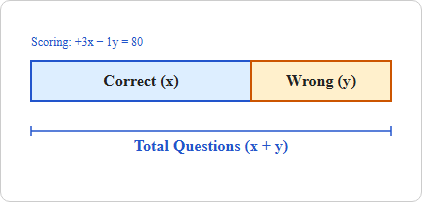
In a competitive exam, 3 marks are to be awarded for every correct answer and for every wrong answer, 1 mark will be deducted. Sindhu scored 80 marks in this exam. Had 4 marks been awarded for each correct answer and 2 marks deducted for each incorrect answer, Sindhu would have scored 90 marks. If Sindhu attempted all the questions, then the number of questions in the test are:

  1. ((a))

    50

  2. ((b))

    60

  3. ((c))

    70

  4. ((d))

    55

Show Answer
Answer: ((b))

60

Shortcut Trick

Divide the second condition by 2 to equate the negative marking: 2 marks for correct and 1 mark deducted for wrong = 45 marks.

Compare with first condition: (3 correct − 1 wrong = 80) and (2 correct − 1 wrong = 45).

Difference in correct answer marks = 1 mark per question → Difference in total marks = 80 − 45 = 35.

Correct questions = 35; Incorrect questions = (3 × 35) − 80 = 105 − 80 = 25.

Total questions = 35 + 25 = 60.

∴ The correct answer is 60.

Alternate Method

Given:

Case 1: +3 for Correct, −1 for Incorrect, Total = 80.

Case 2: +4 for Correct, −2 for Incorrect, Total = 90.

Calculations:

⇒ Let x be the number of correct questions and y be the number of incorrect questions.

⇒ Total questions = x + y

⇒ According to Case 1: 3x − y = 80 → (Equation 1)

⇒ According to Case 2: 4x − 2y = 90 → (Equation 2)

⇒ Simplify Equation 2 by dividing by 2: 2x − y = 45 → (Equation 3)

⇒ Subtracting (Equation 3) from (Equation 1):

⇒ (3x − y) − (2x − y) = 80 − 45

⇒ x = 35

⇒ Substitute x = 35 in (Equation 3):

⇒ 2(35) − y = 45

⇒ 70 − y = 45

⇒ y = 70 − 45 = 25

⇒ Total questions = 35 + 25 = 60

∴ The correct answer is 60.

Additional Information

Negative Marking Principle

Total Score = (Number of Correct Answers × Marks per Correct) − (Number of Wrong Answers × Marks Deducted).

Simultaneous Equations

To solve two variables, use the elimination method by making the coefficient of one variable equal in both equations.

Attempt Strategy

If all questions are attempted, then Total Questions = Correct + Incorrect. If some are left unattempted, they do not contribute to the score.

35

The magnetic field produced by a solenoid increases by:

  1. ((a))

    changing direction of current

  2. ((b))

    placing soft iron core inside it

  3. ((c))

    changing direction of solenoid

  4. ((d))

    decreasing number of turns

Show Answer
Answer: ((b))

placing soft iron core inside it

The correct answer is placing soft iron core inside it.

Key Points

  • A solenoid is a coil of wire that produces a magnetic field when an electric current passes through it.

  • A soft iron core is a magnetic material that can increase the strength of the magnetic field produced by a solenoid.

  • Solenoid types include the following:

  • Linear Solenoid.

  • AC-Laminated Solenoid.

  • DC-C Frame Solenoid.

  • DC-D Frame Solenoid.

Additional InformationApplications of Solenoid:

  • These are found in the starting motors of cars and motorcycles.
  • Highly secure door systems use linear solenoids.
  • They are utilized in industrial equipment, specialty vehicles, agricultural vehicles, and construction.
36

Whenever moving from left to right in a period, metallic character _________.

  1. ((a))

    decreases

  2. ((b))

    first increases, then decreases

  3. ((c))

    remains constant

  4. ((d))

    increases

Show Answer
Answer: ((a))

decreases

The correct answer is decreases.

Key Points

  • An element's propensity to lose electrons and generate positive ions or cations is known as its metallic character.
  • Among all elements, alkali metals such as potassium (K), sodium (Na), and lithium (Li) are the most electropositive.
  • It decreases across the periods from left to right.
  • It increases down the group.

Additional InformationCovalency:

  • It is the process by which one element shares electrons with atoms of the same or distinct elements to become stable.
  • It is maximum when atoms with similar electronegativities share electrons.
  • Covalency of oxygen is two.

Catenation:

  • It is the process by which an element's atoms self-link to form rings and chains.
  • Carbon atoms catenate most easily, forming covalent bonds with other carbon atoms to form longer chains and structures.
  • Electronic and steric characteristics (i.e., the arrangement of the element's molecular orbitals around the atom) and the ability to form different kinds of double bonds are all factors that influence catenation.
37

Which of the following states of India does NOT have a Panchayati Raj system?

  1. ((a))

    Nagaland

  2. ((b))

    Rajasthan

  3. ((c))

    Andhra Pradesh

  4. ((d))

    Uttar Pradesh

Show Answer
Answer: ((a))

Nagaland

The correct answer is Nagaland.

Key PointsPanchayati Raj:

  • It is a system of local governance in India where the administration of rural areas is entrusted to elected representatives at the village, block, and district levels.
  • The 73rd Constitutional Amendment Act of 1992 established it as a constitutional amendment with the goal of fostering democracy at the local level.
  • All states, with the exception of Nagaland, Meghalaya, and Mizoram, as well as all Union Territories, with the exception of Delhi, have the Panchayati Raj system.
  • The Constitution's Eleventh Schedule assigns the Panchayati Raj bodies authority over as many as 29 functions.
  • The first committee to suggest a three-tier system for Panchayati Raj Institutions in India was the Balwant Rai Mehta Committee.
  • The L.M. Singhvi Committee suggested giving Panchayati Raj Institutions constitutional status.

Additional Information

  • Article 243 States the Definition of panchayats.
Article 243AArticle 243A states about the Gram sabha.
Article 243BArticle 243B states the constitution of panchayats.
Article 243CArticle 243C States about the Composition of panchayats
Article 243DArticle 243D states the reservation of seats in panchayats.
Article 243FArticle 243F states about the disqualification of members of panchayats.
Article 243GArticle 243G states about the power authorities and responsibilities of panchayats.
Article 243EArticle 243E states the duration of panchayats.
Article 243HArticle 243H states the power to impose taxes and fund the panchayats.
Article 243IArticle 243I states that the Constitution requires the finance committee to review the financial position of panchayats.
38

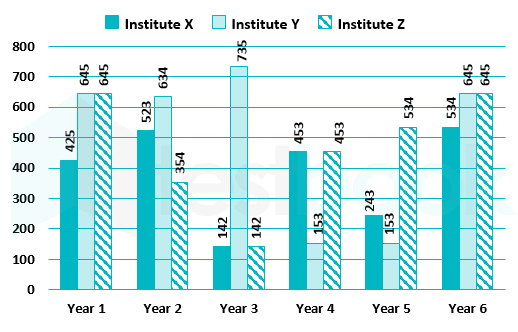
Study the given graph and answer the question that follows.

The graph presents the total number of candidates who qualified for medical entrance examination from three reputed institutions over the six years.


In which year have the maximum number of candidates succeeded in all three institutes taken together?

  1. ((a))

    Year 1

  2. ((b))

    Year 5

  3. ((c))

    Year 2

  4. ((d))

    Year 6

Show Answer
Answer: ((d))

Year 6

Given:

Calculation:

Number of candidates in year 1 = 425 + 645 + 645 = 1715

Number of candidates in year 2 = 523 + 634 + 354 = 1511

Number of candidates in year 3 = 142 + 735 + 142 = 1019

Number of candidates in year 4 = 453 + 153 + 453 = 1059

Number of candidates in year 5 = 243 + 153 + 534 = 930

Number of candidates in year 6 = 534 + 645 + 645 = 1824

Note that the maximum number of candidates is in year 6.

∴ Option 4 is the correct answer.

39

In series combination, the current passing through each resistor is: 

  1. ((a))

    Proportional to their thickness

  2. ((b))

    Increases gradually

  3. ((c))

    Proportional to their resistance

  4. ((d))

    Equal in all resistors

Show Answer
Answer: ((d))

Equal in all resistors

The correct answer is Equal in all resistors.

Key Points

  • When two resistors are connected in series, their equivalent resistance is given by the sum of their individual resistances, i.e., R1+R2.
  • The current flowing through all of the circuit's resistance equals the total current in a series circuit.
  • It is given by:  IT = I1 = I2 = I3 =... = In.
  • ​The sum of each individual voltage drop in a series circuit determines the overall voltage of the circuit.
  • It is given by: ET = E1 + E2 + E3 +... + En.

Additional Information

  • The equivalent resistance of two resistances R1 and R2 connected in parallel is given by R1R2/(R1+R2).
  • The total current in each branch of a parallel circuit is known as the total current.
  • It is given by: I = I1 + I2 + I3+...+In
  • The voltage across each branch and the total voltage of a parallel circuit have the same value.
  • It is expressed as: ET = E1 = E2 = E3 =... = EN.​
40

What happens when calcium hydroxide solution is left open in air?

  1. ((a))

    CaCO3 is formed.

  2. ((b))

    O2 is liberated.

  3. ((c))

    CaO is formed.

  4. ((d))

    H2O (gas) is evolved.

Show Answer
Answer: ((a))

CaCO3 is formed.

The correct answer is CaCO3 is formed.

Key PointsCalcium Hydroxide:

  • It is commonly known as slaked lime.
  • It turns milky when it comes into contact with air because calcium carbonate (CaCO3) is formed.
  • This is a result of carbon dioxide found in air.
  • This reaction is commonly referred to as carbonatation.
  • It has a hexagonal crystal structure.

Additional InformationApplications of Calcium Hydroxide:

  • It is also used as a pH modifier due to its basicity.
  • It is used to fill the cavities in the human teeth.
  • It is used in the leather industry to separate the fur/hair from the animal hide.
  • Carbonation is used in the processing of sugarcane and sugar beets.
41

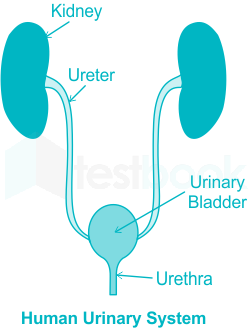
Which of the following constitutes the human excretory system?

  1. ((a))

    One pair of kidneys, one pair of ureters, single urinary bladder and single urethra

  2. ((b))

    One pair of kidneys, single ureter, single urinary bladder and single urethra

  3. ((c))

    One pair of kidneys, single urinary bladder, single ureter and one pair of urethra

  4. ((d))

    Single kidney, single ureter, one pair of urinary bladder and single urethra

Show Answer
Answer: ((a))

One pair of kidneys, one pair of ureters, single urinary bladder and single urethra

The correct answer is One pair of kidneys, one pair of ureters, single urinary bladder and single urethra.

Key PointsHuman Excretory system:

  • It is a system of the body that is responsible for the elimination of waste products from the body.
  • It consists of organs that help the body eliminate nitrogenous waste.
  • The human excretory system includes:
  • A pair of kidneys.
  • A pair of ureters.
  • A urinary bladder.
  • A urethra.

Additional Information

  • Kidneys: These are bean-shaped organs located in the abdomen. They filter the blood and remove waste products from it.
  • Ureters: These are narrow tubes that carry urine from the kidneys to the urinary bladder.
  • Urinary Bladder: This is a muscular sac that stores urine until it is ready to be excreted from the body.
  • Urethra: This is a tube that carries urine from the urinary bladder to the outside of the body.
42

Which of the following parts of the alimentary canal carries out the complete digestion of carbohydrates, proteins and fats?

  1. ((a))

    Oesophagus

  2. ((b))

    Large intestine

  3. ((c))

    Stomach

  4. ((d))

    Small intestine

Show Answer
Answer: ((d))

Small intestine

The correct answer is Small intestine.

Key PointsSmall Intestine:

  • It is the longest part of the alimentary canal, and it is responsible for the complete digestion of carbohydrates, proteins, and fats.
  • It has three segments, the duodenum, jejunum, and ileum, each with specific functions in the digestion process.
  • The duodenum receives chyme from the stomach and digestive juices from the pancreas and liver, where the breakdown of carbohydrates, proteins, and fats begins.
  • The jejunum and ileum continue the digestion process and absorb the nutrients from the digested food into the bloodstream.

Additional Information

  • The oesophagus is a muscular tube that connects the mouth to the stomach and serves as a pathway for food to reach the stomach.
  • It has a sphincter at both ends that prevents the backflow of food and gastric juices.
  • The large intestine is part of the digestive system, and it is responsible for the absorption of water and electrolytes from the remaining food material, producing feces, and eliminating them from the body.
  • The stomach is a muscular sac that receives food from the esophagus and mixes it with gastric juices to partially digest proteins.
  • It also regulates the release of food into the small intestine.
43

In a certain code language, ELDERLY is written as DLEEYLR, and GENERAL is written as NEGELAR. How is NUCLEAR written in that language?

  1. ((a))

    UCNRLEL

  2. ((b))

    CUNLRAE

  3. ((c))

    UCNLARE

  4. ((d))

    CULNREA

Show Answer
Answer: ((b))

CUNLRAE

The pattern for the code is as follows:-

ELDERLY is coded as DLEEYLR 

GENERAL is coded as NEGELAR →

Similarly,

NUCLEAR will be coded →

Hence, the correct answer is "CUNLRAE".

44

ITCZ is a broad trough of low pressure in equatorial latitudes. The full form of ITCZ is:

  1. ((a))

    Inter Tropical Convergence Zone

  2. ((b))

    Inner Tropical Convergence Zone

  3. ((c))

    Inter Terrain Convergence Zone

  4. ((d))

    Inter Tropical Climate Zone

Show Answer
Answer: ((a))

Inter Tropical Convergence Zone

The correct answer is Inter Tropical Convergence Zone.

Key PointsInter Tropical Convergence Zone (ITCZ):

  • It is a broad trough of low pressure that generally exists close to the equator on Earth.
  • This is the meeting point of the northern and southern hemispheres' trade winds, which cause frequent thunderstorms and a lot of rain.
  • These thunderstorms have the ability to ascend to a height of up to 16 kilometers above the ground.
  • It moves all year long, usually with a 1-2 month delay, following the movement of the sun's overhead position.

Additional Information

  • The Equator is defined as 0 degrees latitude.
  • The Tropic of Cancer is roughly 23 degrees north.
  • The Tropic of Capricorn is roughly 23 degrees south.
  • The approximate locations of the Antarctic and Arctic circles are 66 degrees south and north, respectively.
45

Which of the following plants produce unisexual flowers?

  1. ((a))

    Watermelon and Papaya

  2. ((b))

    Watermelon and Mustard

  3. ((c))

    Hibiscus and Papaya

  4. ((d))

    Mustard and Hibiscus

Show Answer
Answer: ((a))

Watermelon and Papaya

The correct answer is Watermelon and Papaya.

Key Points

  • Unisexual flowers are those that have male or female reproductive components, such as stamens or carpels.
  • Flowers containing pistils are referred to as female flowers, or pistillates, where as those with only stamens are known as male flowers, or staminate flowers.
  • There is only cross-pollination among these flowers.
  • Examples:
  • Watermelon.
  • Papaya.
  • Cucumber.
  • Musk melon.
  • Pumpkin.

Additional Information

  • A bisexual flower is one that has both male and female reproductive elements, meaning that it has both carpels and stamens.
  • There is both self- and cross-pollination in these flowers.
  • Examples:
  • Mustard.
  • Hibiscus.
  • Sunflower.
  • Mango.
  • Tomato.
46

A current of 0.4 A is maintained in a resistor of 2 Ω. The heat produced in the resistor in 1 second is:

  1. ((a))

    1.6 J

  2. ((b))

    0.80 J

  3. ((c))

    0.32 J

  4. ((d))

    0.16 J

Show Answer
Answer: ((c))

0.32 J

The correct answer is 0.32 J.

Key Points

  • The formula to calculate heat produced in a resistor is H=I2RTH = I^2RT, where I is the current, R is the resistance, and T is the time.
  • Current, I = 0.4 A
  • Resistance, R = 2 Ω
  • Time, T = 1 second
  • Substituting the given values, we get H=(0.4)221H = (0.4)^2 * 2 * 1 = 0.32 J.

Additional Information

  • Resistance is a measure of the opposition to the flow of electric current in a material or component.
  • Resistors are electronic components that are used to limit or control the flow of electric current in a circuit.
  • When two resistors are connected in series, their equivalent resistance is given by the sum of their individual resistances, i.e., R1+R2.
  • The equivalent resistance of two resistances R1 and R2 connected in parallel is given by R1R2/(R1+R2).
47

Which of the following statements is true about the nature of roots for the equation 2x2 + 9x + 15 = 0?

  1. ((a))

    Both roots are positive real

  2. ((b))

    Both roots are negative real

  3. ((c))

    One root is positive real and one is negative real

  4. ((d))

    Both roots are imaginary or non-real

Show Answer
Answer: ((d))

Both roots are imaginary or non-real

Shortcut Trick

Identify the coefficients for 2x2 + 9x + 15 = 0: a = 2, b = 9, c = 15.

Calculate the Discriminant (D) = b2 − 4ac to find the nature of roots.

D = 92 − 4 × 2 × 15 = 81 − 120 = −39.

Since D < 0, the roots are imaginary or non-real.

∴ The correct answer is Both roots are imaginary or non-real.

Alternate Method

Given:

The quadratic equation is 2x2 + 9x + 15 = 0.

Formula Used:

For a quadratic equation ax2 + bx + c = 0, the nature of roots is determined by the Discriminant (D), where:

D = b2 − 4ac

Calculations:

⇒ Comparing 2x2 + 9x + 15 = 0 with ax2 + bx + c = 0:

a = 2, b = 9, and c = 15.

⇒ D = (9)2 − 4 × 2 × 15

⇒ D = 81 − 120

⇒ D = −39

⇒ Because the value of the Discriminant is negative (D < 0), the roots of the equation are not real numbers.

∴ The correct answer is Both roots are imaginary or non-real.

Additional Information

Nature of Roots Summary

The nature of roots is defined by the Discriminant (D): (1) If D > 0, roots are real and distinct. (2) If D = 0, roots are real and equal.

Non-Real Roots

If D < 0, the roots are imaginary (non-real) and always exist as complex conjugate pairs.

Quadratic Formula

The roots can be found using the formula: x = (−b ± √D) ÷ 2a.

Sum and Product of Roots

For ax2 + bx + c = 0, the sum of roots is −b/a and the product of roots is c/a.

48

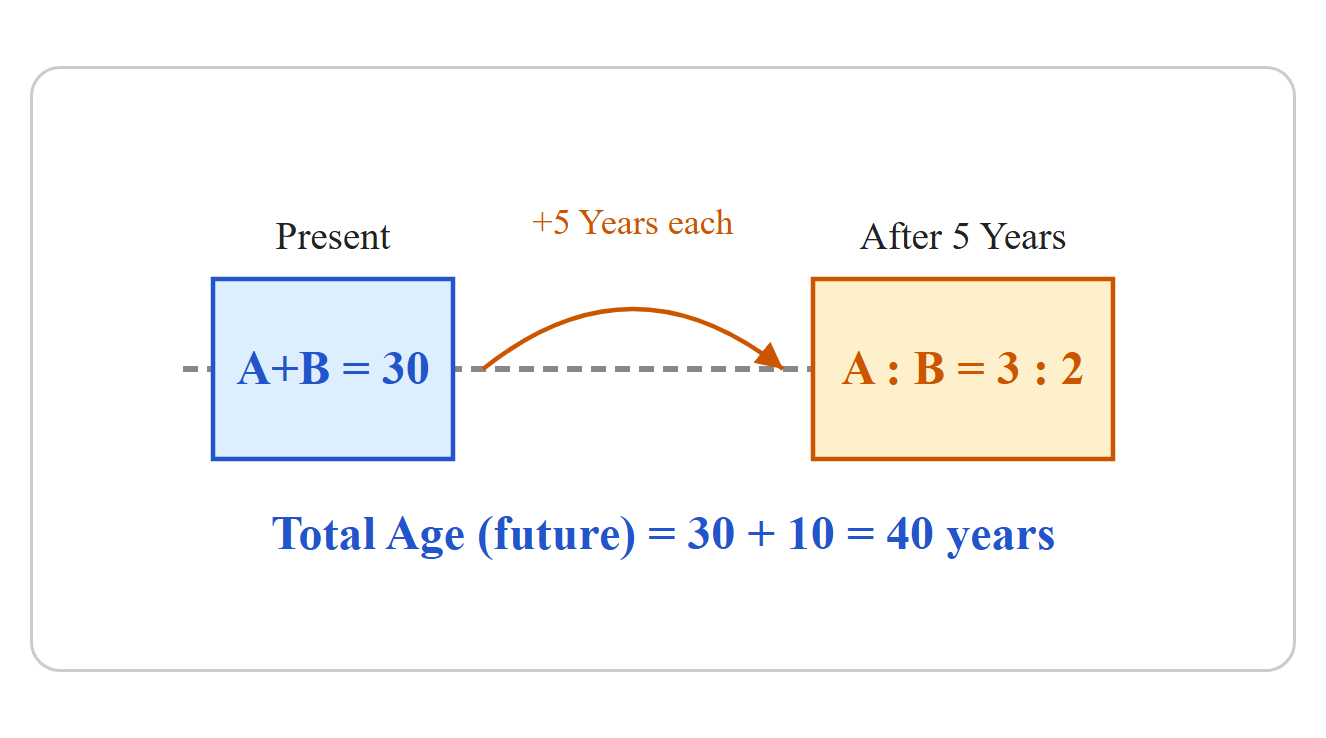
The sum of the present ages of A and B is 30 years. The ratio of their ages after 5 years will be 3 : 2. The present age of A is: 

  1. ((a))

    39 years

  2. ((b))

    19 years

  3. ((c))

    29 years

  4. ((d))

    11 years

Show Answer
Answer: ((b))

19 years

Shortcut Trick

Total age after 5 years = 30 + 5 + 5 = 40 years.

Ratio after 5 years = 3 : 2. Total parts = 3 + 2 = 5 units.

5 units = 40 years ⇒ 1 unit = 8 years.

Age of A after 5 years = 3 × 8 = 24 years.

Present age of A = 24 − 5 = 19 years.

∴ The correct answer is 19 years.

Alternate Method

Given: Sum of ages = 30, Future Ratio = 3 : 2 after 5 years.

⇒ Let the ages of A and B after 5 years be 3x and 2x.

⇒ 3x + 2x = 30 + 5 + 5

⇒ 5x = 40

⇒ x = 8

⇒ Age of A after 5 years = 3 × 8 = 24 years

⇒ Present age of A = 24 − 5 = 19 years

∴ The correct answer is 19 years.

Additional Information

Sum of Ages in Future/Past

If the sum of present ages of 'n' people is S, then the sum of their ages after 't' years will be S + (n × t).

Age Ratio Concept

While the ratio of ages changes over time, the difference between the ages of two individuals always remains constant.

49

The following table shows the investment (in Rs.) of three friends over the years. Study the table carefully and answer the question that follows.

YearsABC
2017550004800036000
2018250008500046000
2019640005600075000
2020790004200084000
2021380006200054000

The sum of average investment of both A and average investment of B for the given years is what percentage of the sum of average investment of B and average investment of C for the given years?

  1. ((a))

    87.25%

  2. ((b))

    85.35%

  3. ((c))

    94.22%

  4. ((d))

    91.36%

Show Answer
Answer: ((c))

94.22%

Given:

YearsABC
2017550004800036000
2018250008500046000
2019640005600075000
2020790004200084000
2021380006200054000


Calculation:

Average investment of A is  (55000 + 25000 + 64000 + 79000 + 38000)/5 = 52200

Average investment of B is  (48000 + 85000 + 56000 + 42000 + 62000)/5 = 58600

Average investment of B is  (36000 + 46000 + 75000 + 84000 + 54000)/5 = 59000

Acc to the question:

Average investment of A and B is 52200 + 58600 = 110800

Average investment of B and c is 58600 + 59000 = 117600

Percentage is = (10800/117600) × 100 = 94.22%

∴ Option 3 is the correct answer.

50

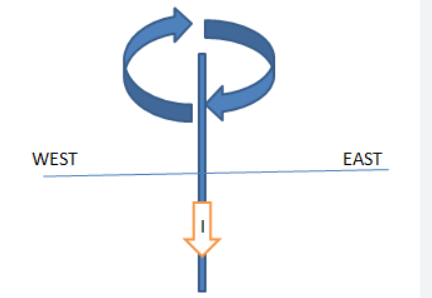
A current carrying wire is placed horizontally in a magnetic field with north pole in upward and south pole in downward direction. The wire is deflected towards south direction. The direction of electrons in the wire is:

  1. ((a))

    north to south

  2. ((b))

    east to west

  3. ((c))

    south to north

  4. ((d))

    west to east

Show Answer
Answer: ((d))

west to east

The correct answer is west to east.

Key Points

  • When a current-carrying wire is placed in a magnetic field, a force is exerted on it due to the interaction between the magnetic field and the current.
  • This force is perpendicular to both the magnetic field and the current direction and is given by the right-hand rule.
  • Since the north pole of the magnet is facing upwards, the force direction is reversed due to the negative charge of electrons in the wire, which results in the wire deflecting towards the south direction.
  • The electrons are flowing from west to east.

Additional InformationFleming’s Right Hand Thumb Rule:

  • This rule is frequently applied as a mnemonic to help remember the way the three axes—X, Y, and Z—orient on a three-dimensional plane.
  • It says that when we position our right hand's thumb, forefinger, and middle finger perpendicular to one another, then:
  • The thumb indicates the direction in which the conductor is moving in relation to the magnetic field.
  • The direction of the magnetic field is shown by the forefinger.
  • The middle finger is pointing in the induced current's direction.
51

Which of the following is NOT included under the right to freedom in the Constitution of India?

  1. ((a))

    To promote one's religion throughout the territory of India

  2. ((b))

    To assemble peaceably and without arms

  3. ((c))

    The freedom of speech and expression

  4. ((d))

    To move freely throughout the territory of India

Show Answer
Answer: ((a))

To promote one's religion throughout the territory of India

The correct answer is To promote one's religion throughout the territory of India.

Key Points

  • The Fundamental Rights in the Constitution of India are enshrined in Part III of the Constitution, which guarantees civil liberties such as freedom of speech, religion, and equality before the law.
  • These Fundamental Rights were inspired by the Bill of Rights of the United States Constitution, which was adopted in 1791. The Indian Constitution borrowed heavily from the US Constitution, which is why it is often called a 'bag of borrowings.'
  • Constitution of India provides for secularism and does not allow the promotion of any particular religion over others.
  • The Indian Constitution's Articles 12-35 outline fundamental rights.

Additional Information

  • The right to freedom is a fundamental right guaranteed under Article 19 of the Constitution of India.
  • It includes various freedoms such as freedom of speech and expression, assembly without arms, movement throughout the territory of India, etc.
  • One of the most important freedoms under the right to freedom, which allows individuals to express their opinions and ideas freely without fear of censorship or punishment.
52

Gautama (Siddhartha) is believed to have piously meditated at which place for six years before he went to Bodhgaya for the final realisation?

  1. ((a))

    Itkhori

  2. ((b))

    Kapilavastu

  3. ((c))

    Pragbodhi

  4. ((d))

    Rajgir

Show Answer
Answer: ((c))

Pragbodhi

The correct answer is Pragbodhi.

Key Points

  • Pragbodhi is an ancient Buddhist site located in Bihar, India.
  • Gautama (Siddhartha) is believed to have piously meditated at Pragbodhi for six years before he went to Bodhgaya for the final realisation.
  • It is also known as Urubilva or Uruvela.
  • It is situated near the banks of the river Nairanjana, about 12 km from Gaya city.

Additional Information

  • Gautama (Siddhartha) was born in Nepal in 563 BCE to Suddhodana, the chief of the Sakya clan.
  • Kapilavastu is the ancient kingdom where Gautama Buddha was born and raised.
  • It is located in present-day Nepal.
53

The Industrial (Development and Regulation) Act was first enacted in which year in India?

  1. ((a))

    1951

  2. ((b))

    1950

  3. ((c))

    1949

  4. ((d))

    1948

Show Answer
Answer: ((a))

1951

The correct answer is 1951.

Key PointsIndustrial (Development and Regulation) Act:

  • It was enacted to regulate and control the development of industries in India.
  • It was first enacted in 1951 in India.
  • It was enacted to regulate and control the development of industries in India.
  • The act aimed to prevent the concentration of economic power in a few hands and promote balanced regional development.
  • It also provided for the establishment of the Industrial Development Bank of India (IDBI) to provide financial assistance to industries.

Additional InformationThe following are the Act's objectives:

  • To implement the industrial policy.
  • Regulation and Development of Important Industries.
  • Planning and Future Development of New Industries.
  • Allowing the free play of laissez-faire policy.
54

The Cash Reserve Ratio (CRR) in India is fixed by _________.

(A) RBI

(B) SEBI

(C) Ministry of Finance

  1. ((a))

    Only A

  2. ((b))

    Only B

  3. ((c))

    Both A and C

  4. ((d))

    Only C

Show Answer
Answer: ((a))

Only A

The correct answer is Only A.

Key PointsReserve Bank of India (RBI) is India’s central bank.

  • In compliance with the terms of the Reserve Bank of India Act, 1934, it was founded on April 1, 1935 in Calcutta.
  • It was permanently moved to Mumbai in 1937.
  • Cash Reserve Ratio (CRR) is an important tool used by the RBI to manage liquidity in the banking system and control inflation.
  • Though originally privately owned, since nationalisation in 1949, the Reserve Bank is fully owned by the Government of India.
  • It also functions as the "lender of last resort" and is considered Banker to Banks.
  • It regulates the issue of Bank notes and keeping of reserves with a view to securing monetary stability in India and generally to operate the currency and credit system of the country to its advantage.
  • It also monitors the monetary policies through its Monetary Policy Committee (MPC).​

Additional InformationSecurities and Exchange Board of India (SEBI):

  • According to the Securities and Exchange Board of India Act, 1992, SEBI is a statutory entity that was founded on April 12, 1992.
  • SEBI plays a crucial role in overseeing and regulating the securities market in India, ensuring fair practices, protecting the interests of investors, and promoting the development of the securities market.
  • The Securities and Exchange Board of India's primary responsibilities are to uphold the rights of securities investors and to foster and oversee the securities industry.
  • Mumbai is the location of SEBI's headquarters.
  • To safeguard the interests of organizations that believe they have been wronged by SEBI's ruling, the Securities Appellate Tribunal (SAT) was established.
55

Which of the following is NOT a part of aggregate demand in an economy? 

  1. ((a))

    Imports

  2. ((b))

    Capital goods

  3. ((c))

    Exports

  4. ((d))

    Increase in population

Show Answer
Answer: ((d))

Increase in population

The correct answer is Increase in population.

Key Points

  • Aggregate demand is the total demand for goods and services in an economy at a given time.
  • It comprises four components: consumption, investment, government spending, and net exports.
  • Increase in population is not a part of aggregate demand.
  • Consumption refers to the spending by households on goods and services.
  • It is the largest component of aggregate demand.
  • Investment includes spending by businesses on capital goods such as machinery, equipment, and buildings.
  • It also includes spending on research and development and the creation of new businesses.
  • Government spending includes all the expenditures made by the government on goods and services, such as defense, education, healthcare, and infrastructure.
  • Net exports refer to the difference between the value of exports and imports.
  • When the value of exports is greater than imports, it is called a trade surplus, and when the value of imports is greater than exports, it is called a trade deficit.

Additional Information

  • Imports are a part of aggregate demand as they represent the spending by households, businesses, and the government on foreign goods and services.
  • Capital goods are a part of aggregate demand as they represent the spending by businesses on the production of goods and services.
  • Exports are a part of aggregate demand as they represent the demand for goods and services from foreign countries.
56

What is the correct order of periods in terms of number of elements? 

  1. ((a))

    1 = 2 = 3 < 4 = 5 < 6 = 7

  2. ((b))

    1 < 2 < 3 = 4 < 5 = 6 < 7

  3. ((c))

    1 < 2 = 3 < 4 = 5 < 6 = 7

  4. ((d))

    1 = 2 < 3 = 4 < 5 = 6 < 7

Show Answer
Answer: ((c))

1 < 2 = 3 < 4 = 5 < 6 = 7

The correct answer is 1 < 2 = 3 < 4 = 5 < 6 = 7.

Key Points

  • Periods are the horizontal rows in the periodic table that represent the number of electron shells in an element's atom.
  • The correct order of periods in terms of the number of elements is 1 < 2 = 3 < 4 = 5 < 6 = 7.
  • The number of electron shells in a row is the same for every element.
  • Every subsequent element in a period is less metallic than the one before it and has one extra proton.

Additional InformationPeriodic Trends:

  • Periodic trends are particular patterns found in the periodic table that, when grouped by period and/or group, highlight different aspects of particular elements.
  • Dmitri Mendeleev, a Russian chemist, discovered them in 1863.
  • Atomic radius, ionization energy, electron affinity, electronegativity, valency, and metallic character are important periodic trends.
  • The comparable electron structures of the elements within their respective groups or periods account for these tendencies.
57

Refer to the following number series and answer the question that follows.

(Left) 1 4 6 7 4 3 2 5 6 7 3 4 6 5 1 3 4 5 2 4 51 5 7 (Right)

If every second number from the left in the above series is dropped, which number would appear at the eighth place from the left?

  1. ((a))

    6

  2. ((b))

    4

  3. ((c))

    5

  4. ((d))

    1

Show Answer
Answer: ((d))

1

Given Series:

(Left) 1 4 6 7 4 3 2 5 6 7 3 4 6 5 1 3 4 5 2 4 51 5 7 (Right)

Every second number from the left in the above series is:-

(Left) 1 4 6 7 4 3 2 5 6 7 3 4 6 5 1 3 4 5 2 41 5 7 (Right)

After dropping every second number from the  left in the above series,

New Arrangement → (Left) 1 6 4 2 6 3 6 1 4 2 5 5 (Right)

Number at eighth place from the left in the new arrangement is:-

(Left) 1 6 4 2 6 3 6 1 4 2 5 5 (Right)

Hence, the correct answer is "1".

58

Each of the digits in the number 8132475 is arranged in descending order from left to right. what will be the sum of the digits which are third from the left and second from the right in the new number thus formed?

  1. ((a))

    9

  2. ((b))

    7

  3. ((c))

    5

  4. ((d))

    2

Show Answer
Answer: ((b))

7

Given Number → 8132475

Arrangement of digits in the number in decreasing order from left to right:-

(Left) 8132475 (Right) → (Left) 8754321 (Right) 

Third digit from the left in the newly formed number [(Left) 8754321 (Right)] → 5

Second digit from the right in the newly formed number [(Left) 8754321 (Right)] → 2

Sum of third digit from left and second digit from the right in the new formed number → 5 + 2 = 7

Hence, the correct answer is "7".

59

If 9x = 552 - 352, then the value of x is :

  1. ((a))

    300

  2. ((b))

    500

  3. ((c))

    200

  4. ((d))

    400

Show Answer
Answer: ((c))

200

Formula used:

a- b2 = (a + b)(a - b)

Calculation:

⇒ 9x = 552 - 352

Using a2 - b2 = (a + b)(a - b),

⇒ 9x = (55 + 35)(55 - 35)

⇒ 9x = (90)(20)

⇒x = 200

∴ The value of x is 200.

60

The value of (0.1 × 0.001 × 0.0001 × 106) is :

  1. ((a))

    1100\frac{1}{100}

  2. ((b))

    100

  3. ((c))

    1

  4. ((d))

    110\frac{1}{10}

Show Answer
Answer: ((a))

1100\frac{1}{100}

Calculation:

(0.1 × 0.001 × 0.0001 × 106)

⇒ 10-1 × 10-3 × 10-4 ×  106

⇒ 10-8 ×  106

⇒ 10-2 or 1/100

∴ Option 1 is the correct answer.

61

A ray of light in air is incident at an angle of 60° on the surface separating air from a medium of refractive index 3\sqrt3.The ray is refracted in the medium at an angle of ______.

  1. ((a))

    60°

  2. ((b))

    45°

  3. ((c))

    30°

  4. ((d))

    15°

Show Answer
Answer: ((c))

30°

The correct answer is 30°.

Key Points

  • The incident angle is 60 degrees, which is greater than the critical angle of 45 degrees for air in the given medium. Therefore, the ray will be refracted into the medium.
  • According to Snell's law, n1n_{1} sin(i) = n2n_{2} sin(r), where n1n_{1} and i are the refractive index and angle of incidence in the first medium, and n2n_{2} and r are the refractive index and angle of refraction in the second medium.
  • Here,n1n_{1} = 1 (for air) and n2n_{2}3\sqrt3, given in the question. Plugging in the values, we get sin(r) = (sin(60°)/3\sqrt3), which gives r = 30°.

Additional Information

  • The bending of light as it moves from one transparent substance into another is known as refraction.
  • The bending caused by refraction allows us to create rainbows, prisms, magnifying glasses, and lenses.
  • Our eyes are dependent on this light bending as well.
  • The refractive index of a medium is a measure of how much the speed of light is reduced when it passes through that medium, compared to the speed of light in a vacuum.
  • In mathematical formulae and descriptive texts, the letter n or n' is most frequently used to represent the refractive index variable.
  • The amount of light path bending, or refractive index, that occurs when light enters a substance is determined by this number.
62

What will be the value of MPC (Marginal Propensity to Consume) if the consumer's consumption patterns change due to a change in income?

  1. ((a))

    MPC = 0

  2. ((b))

    MPC = 1

  3. ((c))

    MPC = (ranging between 0 and 1)

  4. ((d))

    MPC = More than 1

Show Answer
Answer: ((c))

MPC = (ranging between 0 and 1)

The correct answer is MPC = (ranging between 0 and 1).

Key PointsMarginal Propensity to Consume:

  • It is the ratio of change in consumption to change in income.
  • The value of MPC will fluctuate if changes in income cause the consumer's consumption habits to alter.
  • The value of MPC will range from 0 to 1 if the consumer's consumption patterns change due to a change in income.
  • It represents the proportion of additional income that is spent on consumption.

Additional Information

  • MPC = 0 implies that there is no change in consumption despite a change in income.
  • MPC = 1 implies that the consumer spends all the additional income on consumption.
  • MPC = More than 1 implies that the consumer is spending more than what they earn.
63

The present ages of two persons are 46 years and 60 years, respectively. If after 'n' years, the ratio of their ages is 4 : 5, then the value of 'n' is:

  1. ((a))

    13

  2. ((b))

    10

  3. ((c))

    12

  4. ((d))

    11

Show Answer
Answer: ((b))

10

Shortcut Trick

Age difference remains constant: 60 − 46 = 14 years.

Ratio after n years = 4 : 5. Difference in ratio parts = 5 − 4 = 1 unit.

Equating difference: 1 unit = 14 years. Age of first person = 4 × 14 = 56 years.

Value of n = 56 − 46 = 10 years.

∴ The correct answer is 10.

Alternate Method

Given: Present ages = 46 years and 60 years. Future ratio = 4 : 5.

Calculation:

⇒ (46 + n) ÷ (60 + n) = 4 ÷ 5

⇒ 5 × (46 + n) = 4 × (60 + n)

⇒ 230 + 5n = 240 + 4n

⇒ 5n − 4n = 240 − 230

⇒ n = 10

∴ The correct answer is 10.

Additional Information

Constant Difference Rule

In age-related problems, the difference between the ages of two people always remains the same regardless of how many years pass.

Ratio Balancing

If the difference in ratio parts is not equal to the actual age difference, multiply the ratios by suitable constants to balance them before solving.

64

Three statements are given, followed by three conclusions numbered I, II and III. Assuming the statements to be true, even if they seem to be at variance with commonly known facts, decide which of the conclusions logically follow(s) from the statements.

Statements:

1. No Boy is a Singer. 2. All Singers are Musicians.  3. All Musicians are Actors.

Conclusions:

I. All Musicians cannot be Boys.

II. All Boys are Actors.

III. No Actor is a Boy.

  1. ((a))

    Only conclusion I follows 

  2. ((b))

    Only conclusion II follows

  3. ((c))

    Conclusions II and III follow

  4. ((d))

    Conclusions I and II follow

Show Answer
Answer: ((a))

Only conclusion I follows 

The least possible Venn Diagram of the above statement is,

I. All Musicians cannot be Boys → Follows (Since all singers are musicians and no boy is a singer, then it is definite that all musicians can not be Boys)

II. All Boys are Actors → Does not follows (As per the above Venn diagram, it is possible but not definite. So All boys are actors is false)

III. No Actor is a Boy → Does not follows (As per the above Venn diagram, some actors are not boys is definite but no actor is a boy is a possibility. Hence, No actor is a boy is false)

Hence, the correct answer is "Only conclusion I follow".

65

'Azadi Ka Amrit Mahotsav', launched on ________, is an initiative by the Government of India to celebrate 75 years of Indian Independence.

  1. ((a))

    12 January 2021

  2. ((b))

    12 April 2021

  3. ((c))

    12 February 2021

  4. ((d))

    12 March 2021

Show Answer
Answer: ((d))

12 March 2021

The correct answer is 12 March 2021.

Key PointsAzadi Ka Amrit Mahotsav:

  • It is an initiative launched by the Government of India.
  • The launch date of the initiative was 12 March 2021.
  • It is aimed at celebrating 75 years of Indian Independence.
  • It includes a series of events and activities to be held across the country throughout the year, including cultural events, exhibitions, and seminars.
  • It also aims to showcase India's achievements in various fields over the past 75 years.

Additional InformationThe five themes of Azadi Ka Amrit Mahotsav are:

  • Freedom Struggle.
  • Ideas@75.
  • Resolve@75.
  • Actions@75.
  • Achievements@75.
66

The third proportional of 3.6 and 1.2 is:

  1. ((a))

    0.90

  2. ((b))

    0.60

  3. ((c))

    0.40

  4. ((d))

    0.80

Show Answer
Answer: ((c))

0.40

Shortcut Trick

For two numbers a and b, the third proportional is calculated as b2 ÷ a.

Given a = 3.6 and b = 1.2.

Third Proportional = (1.2 × 1.2) ÷ 3.6 = 1.44 ÷ 3.6 = 0.40.

∴ The correct answer is 0.40.

Alternate Method

Given: First number (a) = 3.6, Second number (b) = 1.2.

Formula Used: If x is the third proportional to a and b, then a : b :: b : x.

⇒ 3.6 / 1.2 = 1.2 / x

⇒ 3.6 × x = 1.2 × 1.2

⇒ 3.6x = 1.44

⇒ x = 1.44 ÷ 3.6

⇒ x = 0.40

∴ The correct answer is 0.40.

Additional Information

Mean Proportional

The mean proportional between two numbers a and b is given by √(a × b).

Fourth Proportional

For three numbers a, b, and c, the fourth proportional x satisfies a/b = c/x, so x = (b × c) / a.

Continued Proportion

Three quantities a, b, c are in continued proportion if a : b = b : c.

67

Meeta starts walking from her office and goes 60 m towards the east. She then takes a right turn and walks 40 m. She then turns left and walks 36 m. She then takes a final left turn and walks 40 m to reach a park. In which direction is the park with reference to Meeta's office? (All turns are 90 degree turns only)

  1. ((a))

    North

  2. ((b))

    South

  3. ((c))

    East

  4. ((d))

    West

Show Answer
Answer: ((c))

East

As per the given information, the movement of Meeta is shown in the figure below:

So, the park lies to the east of Meeta's office.

Hence, the correct answer is "East".

68

In July 2022, the Ministry of Health and Family Welfare, Government of India has notified new sets of specified health warnings for all tobacco product packs by making an amendment in the Cigarettes and other Tobacco Products (Packaging and Labelling) Rules, 2008. From which date will these new health warnings be applicable?

  1. ((a))

    1 January 2023

  2. ((b))

    1 April 2023

  3. ((c))

    1 October 2022

  4. ((d))

    1 December 2022

Show Answer
Answer: ((d))

1 December 2022

The correct answer is 1 December 2022.

Key PointsCigarettes and other Tobacco Products (Packaging and Labelling) Rules, 2008:

  • The Ministry of Health and Family Welfare, Government of India has notified new sets of specified health warnings for all tobacco product packs by making an amendment in it.
  • These new health warnings be applicable from 1 December 2022.
  • These rules prescribe the size, design, and content of health warnings that must be displayed on tobacco product packs.
  • The rules were first introduced in 2008 and have been amended from time to time to make them more effective in discouraging the use of tobacco products.

Additional InformationThe components of specified health warning include:

  • Pictorial representation of ill effect of effects of tobbaco use.
  • Size of the specified health warning.
  • Language - English and regional.
  • Printing - colour, intensity and clarity of all components of specified health warning.
69

E, F, G, H, I and J live on six different floors of the same building. The lowermost floor in the building is numbered 1, the floor above it number 2, and so on till the topmost floor is numbered 6.

G lives on the lowermost floor. Only J lives between the floors occupied by H and I. E lives on floor number 2. F lives on an even numbered floor, with I as an immediate neighbour. Who lives on floor number 4?

  1. ((a))

    H

  2. ((b))

    J

  3. ((c))

    F

  4. ((d))

    I

Show Answer
Answer: ((b))

J

Given, Six people, E, F, G, H, I and J, are living on different floors of a six-story building numbered 1 to 6 from bottom to top. No two people live on the same floor.

1. G lives on the lowermost floor.

FloorPerson
6
5
4
3
2
1G

2. E lives on floor number 2

FloorPerson
6
5
4
3
2E
1G

3. F lives on an even-numbered floor.

Thus there will be two possible cases.

FloorPerson (Case 1)Person (Case 2)
6F
5
4F
3
2EE
1GG
  1. I is the immediate neighbour of F.

Thus there will be further two sub-cases of case 1, i.e. case 1.1 and case 1.2 as shown below.

FloorPerson (Case 1.1)Person (Case 1.2)Person (Case 2)
6F
5II
4FF
3I
2EEE
1GGG

5. Only J lives between the floors occupied by H and I.

As none of the two sub-cases of case 1 holds the given statement, thus only case 2 will only sustain.

FloorPerson (Case 2)
6F
5I
4J
3H
2E
1G

So, J lives on the fourth floor.

Hence, the correct answer is "J".

70

In the given figure, 1 || m and t is a transversal. If ∠1 and ∠2 are in the ratio 4 : 11, the measures of the angles ∠8 and ∠7, respectively, are:

  1. ((a))

    65° and 115°

  2. ((b))

    110° and 70°

  3. ((c))

    132° and 48°

  4. ((d))

    87° and 93°

Show Answer
Answer: ((c))

132° and 48°

`

Shortcut Trick

Ratio 4 : 11 ⇒ Total 15 units = 180° (Linear pair).

1 unit = 180° ÷ 15 = 12° ⇒ ∠1 = 48° and ∠2 = 132°.

∠8 and ∠2 are alternate exterior angles, so ∠8 = 132°.

∠7 and ∠1 are alternate exterior angles, so ∠7 = 48°.

∴ The correct answer is 132° and 48°.

Alternate Method

Given: Parallel lines l || m, transversal t, and ∠1 : ∠2 = 4 : 11.

Formula Used: Sum of angles in a linear pair = 180°; Alternate exterior angles are equal.

⇒ Let ∠1 = 4x and ∠2 = 11x.

⇒ 4x + 11x = 180° (Linear pair property)

⇒ 15x = 180°

⇒ x = 12°

⇒ ∠1 = 4 × 12° = 48°

⇒ ∠2 = 11 × 12° = 132°

⇒ ∠8 = ∠2 = 132° (Alternate exterior angles are equal)

⇒ ∠7 = ∠1 = 48° (Alternate exterior angles are equal)

∴ The correct answer is 132° and 48°.

71

Four number triads have been given, out of which three are alike in some manner as they follow the same pattern and one is different. Select the number triad that is different from the rest.

(NOTE: Operations should be performed on the whole numbers, without breaking down the numbers into its constituent digits. E.g. 13 - Operations on 13 such as adding/subtracting/multiplying etc. to 13 can be performed. Breaking down 13 into 1 and 3 is not allowed)

  1. ((a))

    (99, 79, 60)

  2. ((b))

    (34, 22, 12)

  3. ((c))

    (47, 33, 21)

  4. ((d))

    (79, 61, 45)

Show Answer
Answer: ((a))

(99, 79, 60)

The logic used here,

(Difference between 1st and 2nd Number) - 2 = (Difference between 2nd and 3rd Number)

Let's check each option,

  1. (99, 79, 60):

As, per the logic,

LHS = 20 - 2 = 18

RHS = 19

LHS ≠ RHS 

  1. (34, 22, 12):

As, per the logic,

LHS = 12 - 2 = 10

RHS = 10

LHS = RHS

3) (47, 33, 21):

As per the logic,

LHS = 14 - 2 = 12

RHS = 12

LHS = RHS

4) (79, 61, 45):

As, per the logic,

LHS = 18 - 2 = 16

RHS = 16

LHS = RHS.

Here, only option 1 doesn't satisfies the logic.

Hence, the correct answer is " (99, 79, 60) ".

72

Name the process that causes living cells to expand in size and shape when placed in a hypotonic solution. 

  1. ((a))

    Diffusion

  2. ((b))

    Osmosis

  3. ((c))

    Transpiration

  4. ((d))

    Photosynthesis

Show Answer
Answer: ((b))

Osmosis

The correct answer is Osmosis.

Key PointsOsmosis:

  • It is the process by which solvent molecules move through a semi-permeable membrane from a solution of low concentration to one of high concentration.
  • It is a passive process that takes place without using any energy.
  • In a hypotonic solution, a cell will gradually inflate and grow until it bursts.
  • It can occur in any solvent, including gases and supercritical liquids.
  • It is of two types:
  • Endosmosis: When a substance is dissolved in a hypotonic solution, the solvent molecules enter the cell and cause deplasmolysis or turgidness.
  • Exosmosis: When a material is dissolved in a hypertonic solution, the solvent molecules leave the cell and cause plasmolysis or the cell to become floppy.

Additional InformationTranspiration:

  • It is the mechanism by which extra water is removed from the plant's body.
  • It is typically the result of water evaporating off the leaf surface.
  • Variables influencing the transpiration rate are sunlight, temperature, wind, and humidity.

Photosynthesis:

  • It is the process by which plants convert light energy into chemical energy.
  • It is essential for the growth and survival of plants.
  • It releases oxygen as a byproduct.
  • It is an essential component of the food chain.
73

Five persons, P, Q, R, S and T travelled in different months of the same year viz. January, February, March, April and May.

P travelled in February. Only one person travelled between P and R. Only three people travelled between S and Q. Q travelled in a month after R. Who among them travelled in January?

  1. ((a))

    T

  2. ((b))

    Q

  3. ((c))

    R

  4. ((d))

    S

Show Answer
Answer: ((d))

S

Let's create the arrangement using the information given,

  1. P travelled in February.
January
FebruaryP
March
April
May
  1. Only one person travelled between P and R.
January
FebruaryP
March
AprilR
May
  1. Only three people travelled between S and Q.

  2. Q travelled in a month after R.

JanuaryS
FebruaryP
March
AprilR
MayQ

Thus, the final arrangement is:

JanuaryS
FebruaryP
MarchT
AprilR
MayQ

Here, we can see that S travelled in January.

Hence, the correct answer is "S".

74

A statement is given below, followed by four conclusions given in the options. Find out which conclusion is true based on the given statement.

Statement: Q ≥ W = E > R ≤ T < Y

  1. ((a))

    E > Y > T

  2. ((b))

    Q > R < Y

  3. ((c))

    R < Y < T

  4. ((d))

    Q = W = E

Show Answer
Answer: ((b))

Q > R < Y

Given Statement: Q ≥ W = E > R ≤ T < Y

Let's check each option,

  1. E > Y > T → Not Follows (E > R ≤ T < Y→ Thus clear relation can't be determined)

2) Q > R < Y → Follows (Q ≥ E > R ≤ T < Y → Clear relation can be determined)

3) R < Y < T → Not Follows (R ≤ T < Y)

  1. Q = W = E → Not Follows (Q ≥ W = E)

Here, we can see that only option 2 is correct. 

Hence, the correct answer is "Q > R < Y ".

75

Select the correct product when ethanol is heated at 443 K with excess concentrated sulphuric acid.

  1. ((a))

    CH2 = CH2

  2. ((b))

    CH4

  3. ((c))

    CH3 - CH3

  4. ((d))

    CH3COOH

Show Answer
Answer: ((a))

CH2 = CH2

The correct answer is CH2 = CH2.

Key Points

  • Ethene (CH2 = CH2) is produced when ethanol is heated to 443 K with an excess of concentrated sulfuric acid, causing it to dehydrate.
  • The reaction mechanism involves the protonation of the hydroxyl group (-OH) of ethanol by H2SO4 to form an oxonium ion intermediate, which then eliminates a water molecule to form ethene.
  • The excess H2SO4 serves as a dehydrating agent and also helps to remove the water molecule from the reaction mixture.
  • The product formed is a gaseous alkene, which can be collected by passing the reaction mixture through a condenser and then bubbling it through a solution of potassium permanganate to confirm the presence of a double bond.
  • CH3CH2OHconc. H2SO4443KCH2=CH2 + H2OCH_3CH_2OH\xrightarrow[conc.\ H_2SO_4]{443K}CH_2=CH_2\ +\ H_2O

Additional InformationMethane:

  • It is a colorless, odorless gas.
  • It is the most basic alkane.
  • It is one of the most potent greenhouse gases.
  • Its chemical formula is CH4.

Ethane:

  • It is the second-simplest alkane
  • It has six hydrogen atoms and two carbon atoms.
  • It is employed in the production of the chemical ethylene.
  • Its chemical formula is C2H6.

Acetic Acid:

  • It is a carboxylic acid with a carboxyl functional group joined to a methyl group.
  • Water and acetic acid are combined to form vinegar.
  • Its antibacterial properties make it useful as an antiseptic.
  • Its chemical formula is C2H4O2.
76

An object is placed in front of a concave mirror at a point between its pole P and focus F. The image formed is:

  1. ((a))

    real and erect

  2. ((b))

    virtual and inverted

  3. ((c))

    virtual and erect

  4. ((d))

    real and inverted

Show Answer
Answer: ((c))

virtual and erect

The correct answer is virtual and erect.

Key Points

  • A concave mirror creates an erect and virtual image when an object is positioned between its focus and pole.
  • The image is virtual because the reflected rays do not actually converge at the position where the image appears to be located.
  • The image is erect because the object and the image are both on the same side of the mirror, and the reflected rays do not cross over.
  • The size of the image is larger than the size of the object, and the image appears to be located behind the mirror.

Additional Information

  • A convex mirror is also known as a diverging mirror as it diverges the light rays.
  • The image formed by a convex mirror is always virtual, diminished, and upright.
  • The principal focus of a convex mirror is a point on the principal axis where the light rays appear to diverge from after reflecting from the mirror.
  • The focal length of a convex mirror is always negative, and it is equal to half of the radius of curvature of the mirror.
77

A, B, C, D, E, F, G, and H are sitting around a square table facing the center of the table. Some of them are sitting at the corners, while some are sitting in the middle of the sides. G sits third to the left of D. G sits at one of the corners. B sits second to the right of A. A does not sit at any of the corners. A is not an immediate neighbor of G. H is an immediate neighbor of C. H does not sit in any of the middle of the sides. Only three people sit between H and F. Who sits third to the left of E?

  1. ((a))

    B

  2. ((b))

    D

  3. ((c))

    C

  4. ((d))

    F

Show Answer
Answer: ((c))

C

Eight people: A, B, C, D, E, F, G, and H sit around a square table.

  1. G sits third to the left of D.

  2. G sits at one of the corners.

  1. B sits second to the right of A.

  2. A does not sit at any of the corners.

  3. A is not an immediate neighbor of G.

  1. H is an immediate neighbor of C.

  2. H does not sit in any of the middles of the sides. 

  1. Only three people sit between H and F.

The person who sits third to the left of E is C.

Hence, the correct answer is "C".

78

Three statements are given, followed by three conclusions numbered I, II and III. Assuming the statements to be true, even if they seem to be at variance with commonly known facts, decide which of the conclusions logically follow(s) from the statements.

Statements:

  1. All keys are mouse.
  2. Some mouse are processor.
  3. Some processors are drive.

Conclusions:

I. Some processors are mouse.

II. Some processors are keys.

III. Some drives are mouse.

  1. ((a))

    Both conclusions II and III follow

  2. ((b))

    Only conclusion I follows

  3. ((c))

    All the conclusions follow

  4. ((d))

    Only conclusion II follows

Show Answer
Answer: ((b))

Only conclusion I follows

The least possible Venn diagram for the given statements is as below,-

I. Some processors are mouse. → TRUE

II. Some processors are keys→. FALSE (it is possible but not definite)

III. Some drives are mouse.→ FALSE (it is possible but not definite)

Hence, "ONLY CONCLUSION 1 FOLLOWS".

79

If the first and third digits of each number are interchanged and then the numbers are arranged in descending order, the position of how many numbers will NOT change?

7451, 3254, 7353, 3464, 1958

  1. ((a))

    Two

  2. ((b))

    One

  3. ((c))

    Three

  4. ((d))

    Zero

Show Answer
Answer: ((d))

Zero

In this question,

7451, 3254, 7353, 3464, 1958

When  the first and third digits of each number are interchanged 

5471, 5234, 5373, 6434, 5918

then, the numbers are arranged in descending order,

⇒ 6434,5918, >5471,5373,5234.

The position of any number is not changed.

Hence, the correct answer is "ZERO".

80

Tarnishing of ornaments is an example of __________.

  1. ((a))

    oxidation reaction

  2. ((b))

    neutralisation reaction

  3. ((c))

    exothermic reaction

  4. ((d))

    photolytic decomposition reaction

Show Answer
Answer: ((a))

oxidation reaction

The correct answer is oxidation reaction.

Key PointsOxidation:

  • It is a process where a substance loses electrons and becomes more positively charged.
  • It is often accompanied by the gain of oxygen or loss of hydrogen.
  • In the case of tarnishing, the metal in the ornament loses electrons to the oxygen and other substances in the air, resulting in a change in the appearance and properties of the metal.
  • For example, when iron rusts, it undergoes oxidation by reacting with oxygen in the air.

Additional InformationNeutralisation:

  • It is a reaction that occurs between an acid and a base to form salt and water.
  • The acid and base cancel out each other's properties, resulting in a neutral pH.
  • In wastewater treatment, this technique is employed to lessen the harm that the effluents cause.
  • It is employed in the process of making antacid pills.
  • A strong acid and strong base neutralized have a pH of seven.

Decomposition:

  • It is a reaction where a compound breaks down into simpler substances.
  • This can occur through heating, electrolysis, or other chemical reactions.
  • For example, when water is broken down into hydrogen and oxygen gas through electrolysis, it undergoes decomposition.

Exothermic reaction:

  • It is a type of chemical reaction in which heat is released.
  • The change in enthalpy (ΔH) in an exothermic reaction will be negative.
  • Examples include:
  • Combustion.
  • Detonation of Nitroglycerin.
  • Nuclear Fission of Uranium-235.
81

A man goes to his office from his house at the speed of 5 km/h and returns to his house using the same route at the speed of 20 km/h. The average speed during the journey is:

  1. ((a))

    10 km/h

  2. ((b))

    6 km/h

  3. ((c))

    12 km/h

  4. ((d))

    8 km/h

Show Answer
Answer: ((d))

8 km/h

Shortcut Trick

When the distance covered is same for both speeds x and y, Average Speed = 2xy ÷ (x + y).

Average Speed = (2 × 5 × 20) ÷ (5 + 20)

Average Speed = 200 ÷ 25 = 8 km/h.

∴ The correct answer is 8 km/h.

Alternate Method

Given:

Speed from house to office (x) = 5 km/h

Speed from office to house (y) = 20 km/h

Formula Used:

Average Speed = (Total Distance) ÷ (Total Time)

If distance is constant, Average Speed = 2xy ÷ (x + y)

Calculations:

⇒ Average Speed = (2 × 5 × 20) ÷ (5 + 20)

⇒ Average Speed = 200 ÷ 25

⇒ Average Speed = 8 km/h

∴ The correct answer is 8 km/h.

Additional Information

Average Speed for Different Distances

When distances covered are different, use the basic formula: Average Speed = (d1 + d2 + ... + dn) ÷ (t1 + t2 + ... + tn).

Three Equal Distances

If a person travels three equal distances with speeds u, v, and w, Average Speed = 3uvw ÷ (uv + vw + wu).

Relative Speed

For two objects moving in the same direction, relative speed = |s1 − s2|. For opposite directions, relative speed = s1 + s2.

82

In a quadrilateral ABCD, if the sum of angles ∠B and ∠D be 150° while angles ∠A and ∠C are in ratio 4 : 3, then the measure of ∠C will be:

  1. ((a))

    120°

  2. ((b))

    150°

  3. ((c))

    210°

  4. ((d))

    90°

Show Answer
Answer: ((d))

90°

Shortcut Trick

Sum of all angles in a quadrilateral = 360°.

Sum of ∠A + ∠C = 360° − (∠B + ∠D) = 360° − 150° = 210°.

Given ∠A : ∠C = 4 : 3, total parts = 4 + 3 = 7 parts.

7 parts = 210° ⇒ 1 part = 30°.

∠C = 3 parts = 3 × 30° = 90°.

∴ The correct answer is 90°.

Alternate Method

Given:

Sum of angles ∠B + ∠D = 150°

Ratio of angles ∠A : ∠C = 4 : 3

Formula Used:

The sum of all interior angles of a quadrilateral is always 360°.

Calculations:

⇒ ∠A + ∠B + ∠C + ∠D = 360°

⇒ ∠A + ∠C + (∠B + ∠D) = 360°

⇒ ∠A + ∠C + 150° = 360°

⇒ ∠A + ∠C = 360° − 150°

⇒ ∠A + ∠C = 210°

⇒ Let ∠A = 4x and ∠C = 3x

⇒ 4x + 3x = 210°

⇒ 7x = 210°

⇒ x = 210° ÷ 7 = 30°

∠C = 3x = 3 × 30° = 90°

∴ The correct answer is 90°.

Additional Information

Angle Sum Property of Polygons

The sum of interior angles of any n-sided polygon is given by the formula (n − 2) × 180°.

Cyclic Quadrilateral

In a cyclic quadrilateral, the sum of opposite angles is always 180° (∠A + ∠C = 180° and ∠B + ∠D = 180°).

Exterior Angle Sum

The sum of the exterior angles of any convex polygon, including a quadrilateral, is always 360°.

83

Who among the following received the prestigious Padma Shri award in 2022 in the field of science and engineering

  1. ((a))

    Subbanna Ayyappan

  2. ((b))

    Jagjit Singh Dardi

  3. ((c))

    Malji Bhai Desai

  4. ((d))

    Sirpi Balasubramanium

Show Answer
Answer: ((a))

Subbanna Ayyappan

The correct answer is Subbanna Ayyappan.

Key PointsSubbanna Ayyappan:

  • He is an eminent scientist and former Director General of the Indian Council of Agricultural Research (ICAR).
  • He received the prestigious Padma Shri award in 2022 in the field of science and engineering.
  • He has made significant contributions to the field of agriculture and allied sciences, particularly in the areas of livestock production and management, animal nutrition, and biotechnology.
  • He has been recognized with several awards and honors, including the ICAR Award for Team Research, the Rafi Ahmed Kidwai Award.

Additional Information Padma Shri:

  • The Padma Shri, which is also written Padma Shree, is the fourth-highest civilian honor granted by the Indian Republic, ranking behind the Bharat Ratna, Padma Vibhushan, and Padma Bhushan.
  • Awardees are chosen for their "distinguished contribution in various spheres of activity including the arts, education, industry, literature, science, acting, medicine, social service and public affairs."
  • The award was established on January 2, 1954.
  • Every year on India's Republic Day, the Indian government bestows this honour.
84

Raghav starts from Point A and drives 10 km towards the north. He then takes a right turn, drives 4 km, turns right and drives 13 km. He then takes a right turn and drives 7 km. He takes a final right turn, drives 3 km and stops at Point P. How far and towards which direction should he drive in order to reach Point A from Point P? (All turns are 90 degree turns only)

  1. ((a))

    3 km towards the west

  2. ((b))

    5 km towards the north

  3. ((c))

    4 km towards the east

  4. ((d))

    3 km towards the east

Show Answer
Answer: ((d))

3 km towards the east

According to information given:

1) Raghav starts from Point A and drives 10 km towards the north.

2) He then takes a right turn, drives 4 km, turns right and drives 13 km.

3) He then takes a right turn and drives 7 km.

4) He takes a final right turn, drives 3 km and stops at Point P.

In the figure, we can clearly see that Point A is 3 km towards the East from point P.

Hence, the correct answer is "3 km towards the east".

85

Select the option that is related to the fifth letter-cluster in the same way as the second letter-cluster is related to the first letter-cluster and the fourth letter-cluster is related to the third letter-cluster.

TEACHER : BFUDSFI :: STUDENT : VUTEUOF :: CLASSES : ?

  1. ((a))

    DMBTTFT

  2. ((b))

    BMDSTFU

  3. ((c))

    BMDTTFT

  4. ((d))

    BMDTTET

Show Answer
Answer: ((c))

BMDTTFT

The positional value of alphabet series is;

The Pattern is followed here is:-

TEACHER is related to BFUDSFI as →

STUDENT is related to VUTEUOF as →

Similarly, 

CLASSES is related to BMDTTFT as →

Hence, the correct answer is "BMDTTFT ".

86

The LCM of the numbers 36, 54, 72 and 96 is:

  1. ((a))

    864

  2. ((b))

    1064

  3. ((c))

    764

  4. ((d))

    964

Show Answer
Answer: ((a))

864

Shortcut Trick

Identify the highest powers of prime factors: 36 = 22 × 32, 54 = 2 × 33, 72 = 23 × 32, 96 = 25 × 31.

LCM = Max power of 2 × Max power of 3

LCM = 25 × 33 = 32 × 27 = 864.

∴ The correct answer is 864.

Alternate Method

Given: Numbers are 36, 54, 72, and 96.

Method: Common Division Method

⇒ Divide by 2: 18, 27, 36, 48

⇒ Divide by 2: 9, 27, 18, 24

⇒ Divide by 2: 9, 27, 9, 12

⇒ Divide by 2: 9, 27, 9, 6

⇒ Divide by 2: 9, 27, 9, 3

⇒ Divide by 3: 3, 9, 3, 1

⇒ Divide by 3: 1, 3, 1, 1

⇒ Divide by 3: 1, 1, 1, 1

LCM = 2 × 2 × 2 × 2 × 2 × 3 × 3 × 3

LCM = 32 × 27 = 864

∴ The correct answer is 864.

Additional Information

LCM (Least Common Multiple)

The smallest positive integer that is divisible by each of the given numbers.

HCF and LCM Relation

For two numbers a and b: Product of numbers (a × b) = HCF(a, b) × LCM(a, b).

Prime Factorization Rule

LCM is the product of the highest powers of all prime factors involved in the numbers.

87

Given below is a decision followed by two statements I and II. Read the information carefully and select the correct option.

Decision:

Many private schools in country F have decided to discontinue assessments for students until grade 7. All students will be promoted to the next grade irrespective of how they have performed.

Statements:

I. A survey in country F showed that students who were assessed regularly had much better grasp on concepts than those who did not have assessments on a regular basis.

II. As per the current curriculum of grades 4 to 7 in country F, 70-80% of all subject matter consists of basics which are very important for higher education.

  1. ((a))

    Both statements I and II weaken the decision.

  2. ((b))

    Statement I is neutral but statement II strengthens the decision.

  3. ((c))

    Both statements I and II strengthen the decision.

  4. ((d))

    Statement I weakens the decision but statement II is neutral.

Show Answer
Answer: ((a))

Both statements I and II weaken the decision.

Given:

Decision:

Many private schools in country F have decided to discontinue assessments for students until grade 7. All students will be promoted to the next grade irrespective of how they have performed.

Statements:

I. A survey in country F showed that students who were assessed regularly had much better grasp on concepts than those who did not have assessments on a regular basis → Weaken (This statement shows the effect of doing assessments but in decision shows only discontinue assessments and promoted to the next grade).

II. As per the current curriculum of grades 4 to 7 in country F, 70-80% of all subject matter consists of basics which are very important for higher education → Weaken (This statement shows the effect of basics concept and higher education but in decision shows only discontinue assessments and promoted to the next grade).

Hence, the correct answer is "Both statements I and II weaken the decision".

88

Consider the below statements and identify the correct answer.

Statement - I : The chemical formula of bleaching powder is CaOCl2.

Statement - II : It is used to make drinking water free from germs.

  1. ((a))

    Both the statements are false.

  2. ((b))

    Statement - II is true, and Statement - I is false.

  3. ((c))

    Both the statements are true.

  4. ((d))

    Statement - I is true, and Statement - II is false.

Show Answer
Answer: ((c))

Both the statements are true.

The correct answer is Both the statements are true.

Key PointsBleaching powder:

  • It is also known as calcium hypochlorite.
  • It is commonly used as a disinfectant.
  • The chemical formula of bleaching powder is CaOCl2.
  • It works by releasing chlorine when it is dissolved in water, which kills bacteria and other microorganisms.
  • It is important to note that bleaching powder should only be used in small quantities and with caution, as it can be harmful if ingested or inhaled.

Additional Information

  • The process of producing bleaching powder involves the reaction of dry, slaked lime with chlorine gas, which is obtained via the chlor-alkali process.
  • It is also used to brighten stained clothing in the laundry.
  • It is a strong oxidizing agent.
89

Two resistors, each of 10 Ω, are connected in parallel. The combination, in turn, is connected in series to a third resistor of 10 Ω and a battery of 6 V. The power supplied by the battery is:

  1. ((a))

    10.8 W

  2. ((b))

    1.2 W

  3. ((c))

    5.4 W

  4. ((d))

    2.4 W

Show Answer
Answer: ((d))

2.4 W

The correct answer is 2.4 W.

Key Points

  • The two resistors of 10 Ohms each are connected in parallel.
  • The equivalent resistance of two resistances R1 and R2 connected in parallel is given by R1R2/(R1+R2).
  • It would result in an equivalent resistance of 5 Ohms.
  • The 5 Ohm equivalent resistance is connected in series with a third resistor of 10 Ohm, resulting in a total resistance of 15 Ohm.
  • Using Ohm's law, we can find the current flowing through the circuit, which is I = V/R = 6/15 = 0.4 A.
  • Finally, the power supplied by the battery is given by P = VI = 6 x 0.4 = 2.4 W.

Additional Information

  • The equivalent resistance is less than either of the individual resistances when two resistors are connected in parallel.
  • This is because the total current flowing through the circuit is divided between the two resistors, and each resistor experiences a smaller voltage drop.
  • The equivalent resistance of two resistances R1 and R2 connected in parallel is given by R1R2/(R1+R2).
  • The total current in each branch of a parallel circuit is known as the total current.
  • It is given by: I = I1 + I2 + I3+...+In
  • The voltage across each branch and the total voltage of a parallel circuit have the same value.
  • It is expressed as: ET = E1 = E2 = E3 =... = EN.
90

In May 2021, the Chief Minister of _______ announced the Mukhyamantri Sishu Sewa Achoni scheme, which will provide relief to children who have lost their parents due to Covid-19.

  1. ((a))

    Odisha

  2. ((b))

    Gujarat

  3. ((c))

    Bihar

  4. ((d))

    Assam

Show Answer
Answer: ((d))

Assam

The correct answer is Assam.

Key Points

  • The Assam government unveiled the "Mukhyamantri Sishu Sewa Achoni Scheme" on May 29, 2021, as a new program for kids whose parents passed away from COVID-19.
  • This announcement was made by Chief Minister Hemant Biswa Sarma.
  • The child's guardian within the extended family would get a monthly stipend of Rs. 3,500.
  • The state government would contribute the remaining Rs. 3,500, with Rs. 2000 coming from the central government.
  • State government's child care facilities will house children under 10 who are without a guardian or caregiver.

Additional Information

  • The state government of Odisha has also launched a scheme called the "Ashirbad" scheme to provide financial assistance to children who lost their parents due to Covid-19.
  • The state government of Gujarat has announced a scheme called the "Bal Seva Yojana" to provide financial assistance and care to children who lost their parents due to Covid-19.
  • The state government of Bihar has announced a scheme called the "Bihar Baal Sahayata Yojana" to provide financial assistance and care to children who lost their parents due to Covid-19.
91

The Finance Commission of India is set up under ______________.

  1. ((a))

    Article 280

  2. ((b))

    Article 288

  3. ((c))

    Article 265

  4. ((d))

    Article 277

Show Answer
Answer: ((a))

Article 280

The correct answer is Article 280.

Key Points

  • The Finance Commissions are commissions periodically constituted by the President of India under Article 280 of the Indian Constitution to define the financial relations between the central government of India and the individual state governments.
  • Its core responsibility is to:
  • Evaluate the state of finances of the Union and State Governments
  • Recommend the sharing of taxes between them
  • Lay down the principles determining the distribution of these taxes among States.
  • The Finance Commission is required to make recommendations to the President of India.​

Additional Information

  • The sale or purchase of water or electricity is not subject to state taxes under Article 288 of the Indian Constitution, unless the President of India grants permission through legislation.
  • The Indian Constitution's Article 265 addresses taxes that cannot be levied absent legal permission.
  • It indicates that no tax may be imposed or gathered unless authorized by law.
  • The Indian Constitution's Article 277 addresses the Union and State governments' taxing authority.
92

Which of the following numbers will replace the question mark (?) in the given series?

5, 11, 24, 51, ?

  1. ((a))

    102

  2. ((b))

    108

  3. ((c))

    106

  4. ((d))

    104

Show Answer
Answer: ((c))

106

The pattern followed here is;

Hence, the correct answer is "106"

93

Which atomic number is related with four valence electrons?

  1. ((a))

    6

  2. ((b))

    5

  3. ((c))

    8

  4. ((d))

    7

Show Answer
Answer: ((a))

6

The correct answer is 6.

Key Points

  • The atomic number of an element tells us the number of protons in the nucleus of an atom of that element.
  • The atomic number related with four valence electrons is 6.
  • Carbon have atomic number 6 and four valence electrons.
  • In an electrically neutral atom, the number of protons is equal to the number of electrons.
  • Therefore, the atomic number also tells us the number of electrons in a neutral atom of that element.
  • Valence electrons are the outermost electrons in an atom that participate in chemical bonding.
  • The number of valence electrons determines the chemical properties of an element.

Additional InformationCarbon:

  • It is a chemical element that is nonmetallic and belongs to Periodic Table Group 14 (IVa).
  • In terms of weight, carbon is ranked 19th among the elements that are abundant in the crust of Earth.
  • It forms compounds by covalent bond.
  • Graphite differs because all of its carbon atoms are sp² hybridized, which results in delocalized free electrons.
  • It is tetravalent and can form four covalent bonds.
94

Where is the Manikaran Geothermal Energy Plant located in India?

  1. ((a))

    Punjab

  2. ((b))

    Jammu and Kashmir

  3. ((c))

    West Bengal

  4. ((d))

    Himachal Pradesh

Show Answer
Answer: ((d))

Himachal Pradesh

The correct answer is Himachal Pradesh.

Key PointsManikaran Geothermal Energy Plant:

  • It is located in the Parvati Valley of Himachal Pradesh.
  • It is situated at an altitude of 1760 meters above sea level and is one of the highest geothermal energy plants in the world.
  • The plant has a capacity of generating 3.5 MW of electricity and also provides hot water for bathing in the nearby hot springs.
  • The geothermal energy at Manikaran is derived from the hot water springs that are found in the region due to the proximity of the Himalayan mountain range.

Additional InformationThe major power plants in Punjab are:

  • Talwandi Sabo Power Limited.
  • Goindwal Sahib Thermal Power Plant.
  • Guru Gobind Singh Plant.
  • Rajpura Thermal Power Plant.
  • Nabha Power Limited.

The major power plants in Jammu and Kashmir are:

  • Baglihar Power Project.
  • Ratle Hydroelectric Plant.
  • Dul hasti Hydroelectric Plant.

The major power plants in West Bengal are:

  • Mejia Thermal Power Station.
  • Farakka Super Thermal Power Station.
  • Kolaghat Thermal Power Station.
  • Sagardighi Thermal Power Station.
  • Bakreshwar Thermal Power Station.
95

This question is based on the five, three-digit numbers given below.

(Left) 744 345 417 235 829 (Right)

(Example: 697 - first digit = 6, second digit = 9, third digit = 7)

NOTE: All operations to be done from left to right.

What will be the resultant if the second digit of the largest number is added to the third digit of smallest number?

  1. ((a))

    7

  2. ((b))

    14

  3. ((c))

    12

  4. ((d))

    5

Show Answer
Answer: ((a))

7

Given Numbers: 744 345 417 235 829

All numbers arrange in ascending order

235 345 417 744 829

The largest number is 829

The smallest number is 235

The second digit of the largest number + The third digit of smallest number = 5 + 2 = 7

Hence, the correct answer is "7".

96

Each vowel in the word 'EXACTLY' is changed to the letter following it in the English alphabetical order and each consonant is changed to the letter preceding it in the English alphabetical order. If each letter, thus formed, is arranged in alphabetical order, which letter will be third from the right end?

  1. ((a))

    W

  2. ((b))

    F

  3. ((c))

    K

  4. ((d))

    S

Show Answer
Answer: ((d))

S

  1. Following directions from the question, replace all the vowels with the following letter in the English alphabet. We get new words as FXBCTLY replacing E and A in EXACTLY.

  2. Every consonant is also replaced to the previous letter. We get a new word, FWBBSKX.

<br>
  1. After being arranged in alphabetical order, the new word becomes BBFKSWX. "S" is the third from the right end. 

Hence, the correct answer is "S".

97

Three numbers are in the ratio 4 : 5 : 7, and their LCM is 5600. Their HCF is: 

  1. ((a))

    30

  2. ((b))

    20

  3. ((c))

    10

  4. ((d))

    40

Show Answer
Answer: ((d))

40

Shortcut Trick

Let the HCF be H. The numbers are 4H, 5H, and 7H.

Since 4, 5, and 7 are co-prime (their common factor is 1), their LCM is simply their product × H.

LCM ⇒ 4 × 5 × 7 × H = 5600

140 × H = 5600 ⇒ H = 5600 ÷ 140 = 40.

∴ The correct answer is 40.

Alternate Method

Given: Ratio of numbers = 4 : 5 : 7, LCM = 5600.

Formula Used: LCM of (ax, bx, cx) = x × LCM(a, b, c), where x is the HCF.

Calculations:

⇒ Let the numbers be 4x, 5x, and 7x, where x is the HCF.

LCM(4x, 5x, 7x) = x × LCM(4, 5, 7)

⇒ Since 4, 5, and 7 have no common factors, LCM(4, 5, 7) = 4 × 5 × 7 = 140.

⇒ 140x = 5600

⇒ x = 5600 ÷ 140

⇒ x = 40

∴ The correct answer is 40.

Additional Information

LCM and HCF Relationship

For two numbers a and b: Product of numbers (a × b) = HCF(a, b) × LCM(a, b).

HCF of Fractions

HCF of fractions = HCF of Numerators ÷ LCM of Denominators.

Co-prime Numbers

If two or more numbers are co-prime, their HCF is 1 and their LCM is the product of the numbers.

98

Three statements are followed by three conclusions numbered I, II and III. You have to consider these statements to be true, even if they seem to be at variance with commonly known facts. Decide which of the given conclusions logically follow(s) from the given statement.

Statements:

All sofas are chairs

All chairs are benches

All benches are desks

Conclusions:

(I) Some desks are sofas

(II) All chairs are sofas

(III) No chair is a sofa

  1. ((a))

    Only conclusion II follows 

  2. ((b))

    Only conclusion I and III follows

  3. ((c))

    Only conclusion I follows

  4. ((d))

    None of the conclusions follow

Show Answer
Answer: ((c))

Only conclusion I follows

The least possible Venn diagram for the given statements is as follows:

(I) Some desks are sofas → Follows ( it's definite that some desks are sofas, hence follows)

(II) All chairs are sofas → Doesn't follow (Some chairs are sofa, but all chairs are sofa can be possible, not definite)

(III) No chair is a sofa → Doesn't follow (All sofas are chairs, so some chair will be definitely sofa, so No chairs is a sofa is definitely false)

Therefore, Only conclusion I follows.

Hence, the correct answer is "Option (3)".

99

The value of 362 ÷ 92 + 42 is :

  1. ((a))

    36

  2. ((b))

    49

  3. ((c))

    32

  4. ((d))

    25

Show Answer
Answer: ((c))

32

Calculation:

362 ÷ 92 + 42

⇒ 4 × 4 + 16

⇒ 32

∴ The correct answer is 32.

100

Which Indian state has 'KOKBOROK' as one of its official languages?

  1. ((a))

    Himachal Pradesh

  2. ((b))

    Goa

  3. ((c))

    West Bengal

  4. ((d))

    Tripura

Show Answer
Answer: ((d))

Tripura

The correct answer is Tripura.

Key PointsKokborok:

  • It is an indigenous language spoken by the people of Tripura and parts of Assam and Bangladesh.
  • It is a Sino-Tibetan language that dates at least to the first century AD, when Tripuri monarchs' historical records began to be recorded in a book known as the Rajratnakar.
  • As of January 19, 1979, it was recognized as one of Tripura's official languages.
  • The dialect originates from the Sino-Tibetan speech family and is a member of the Tibeto-Burman group of languages.
  • In 1897, Muslim scholar Doulot Ahammad produced the first Kokborok Grammar, known as "KOKBOROMA ANG TRIPURA—VYAKARAN GRAMMAR," giving Kokborok its written form.

Additional InformationHimachal Pradesh:

  • There are many different languages spoken in this multilingual state.
  • The official language of this state is Hindi.
  • According to the 2011 Census of India, there are about 32 different languages that are spoken in this state.
  • The most often spoken regional language in the area is Pahari, also called Himachali, and it has multiple dialects.
  • Tibetan, Dogri, and Kinnauri are some of the other significant languages spoken in the state.

Goa:

  • The official language of Goa is Konkani.
  • In Goa, 66.11% of people speak Konkani.
  • Marathi is spoken by most people after Konkani.
  • Most people who speak Marathi are from north Goa.
  • Kannada is spoken by roughly 5%.

West Bengal:

  • The official languages of the state are Bengali and English.
  • Other language spoken in the state are Hindi, Santali, Urdu, Nepali, and Sadan/Sadri.

Attempt this paper under real exam conditions

Timed interface, section switching, instant scoring, and question-by-question analytics — free.

Start Timed Attempt