Previous Year Paper

RRB Group D Previous Year Paper (Held on: 2 Sept 2022 Shift 2)

100 questions · 90 minutes · with answers · free

CBT (100 questions)

1

Gandhiji founded Harijan Sevak Sangh in _______ to eradicate untouchability and uplift the depressed classes.

  1. ((a))

    1924

  2. ((b))

    1932

  3. ((c))

    1929

  4. ((d))

    1936

Show Answer
Answer: ((b))

1932

The correct answer is 1932.

Key Points:

  • The All India Harijan Sevak Sangh, popularly known as the All India Anti-Untouchability League, is an independent national-level non-profit voluntary organisation.
  • It was established on September 30, 1932, following Gandhiji's Epic Fast at Yervada Jail, Pune, which led to the historic Poona Pact.
  • In order to fight untouchability, the Sangh was founded, and the Harijan, a new weekly newspaper, was launched.
  • The organisation has assisted the underprivileged classes in numerous ways ever since it was founded.
  • The Sangh performed inter-dining and inter-caste marriages and assisted the underprivileged classes in gaining access to public facilities like temples, schools, roads, and water resources.
  • Numerous schools and hostels across the nation were built by Harijan Sevak Sangh, and they are still in operation today.

Additional Information:

  • The recent historical context begins with Gandhiji's opposition to the Hindu community's untouchables being divided into a distinct electoral bloc during the Second Round Table Conference in London in 1931.
  • He thought that the British were prepared to do this in order to fracture the Hindu community and pursue their evil divide-and-conquer strategy.
  • Gandhi began his death-defying fast at Yervada Jail in Pune on September 20, 1932, awakening Indians' consciences to the horrible practise of untouchability.
  • He broke his fast on September 24, 1932, but only after receiving assurances from Hindu leaders over the matter and the Poona Pact's acceptance.
2

_______, the first 'made in India' Petascale supercomputer that was deployed at IIT Roorkee in March 2022, has a supercomputing capacity of 1.66 Petaflops.

  1. ((a))

    PARAM Ganga

  2. ((b))

    PARAM Shakti

  3. ((c))

    PARAM Yukti

  4. ((d))

    PARAM Brahma

Show Answer
Answer: ((a))

PARAM Ganga

The correct answer is PARAM Ganga.

Key Points:

  • A Made in India Petascale Supercomputer named "PARAM Ganga" with a 1.66 Petaflop (Peta Floating-Point Operations Per Second) supercomputing capacity has been deployed at IIT (Indian Institute of Technology) Roorkee, Uttarakhand, as of March 7, 2022.
  • Chairman of the Board of Governors at IIT Roorkee, B.V.R. Mohan Reddy, officially opened this country's supercomputer facility.
  • The National Supercomputing Mission's Phase 2 build strategy included the design and commissioning of PARAM Ganga by the Centre for Development of Advanced Computing (C-DAC) (NSM).
  • This organisation is supported by the Memorandum of Understanding (MoU) that IIT Roorkee and C-DAC signed for the construction of a supercomputer that includes crucial parts such as motherboards for servers and direct contact liquid cooling data centers, among others.

Additional Information:

  • Characteristics of PARAM Ganga:
  • Only in India are its components and software stack produced and assembled.
  • It is a brand-new High-Performance Computing (HPC) facility that will quicken research and development (R&D) efforts in interdisciplinary science and engineering fields to address challenging issues of both global and national significance.
  • Additionally, it provides computing resources to the IIT Roorkee user community and nearby academic institutions.
3

A concave mirror is made from a section of the surface of a sphere of radius 18.0 cm. According to New Cartesian Sign Convention, its principal focus is located at x = _______.

  1. ((a))

    18 cm

  2. ((b))

    -18 cm

  3. ((c))

    -9 cm

  4. ((d))

    9 cm

Show Answer
Answer: ((c))

-9 cm

The correct answer is -9 cm.

Key Points

  • New Cartesian Sign Convention
  • Because the object is always in front of the mirror, its distance is counted as negative.
  • Since the concave mirror's center of curvature and focus are in front of it, the concave mirror's focal length and radius of curvature are considered negative.
  • When an image is formed in front of the mirror, the distance between the two is taken as , which indicates a negative image, while the distance between the two is taken as +, which indicates a positive image.
  • In the case of an upright image, the height of the image is taken as positive, whereas in an inverted image, it is taken as negative.

Additional Information

  • Calculation
  • Concave mirror,

Radius of curvature= 18 cm

We know, Principal Focus is half of radius of curvature. 

So, f= 18/2= 9cm

Now, According to New Cartesian Sign Convention

The concave mirror's focal length is considered negative.

So, the principal focus will be -9cm.

4

The Planning Commission was set up on _______ and the plan era started from 1 April 1951 with the launching of the First Five-Year Plan (1951-56).

  1. ((a))

    1 March 1950

  2. ((b))

    26 January 1950

  3. ((c))

    15 August 1949

  4. ((d))

    15 March 1950

Show Answer
Answer: ((d))

15 March 1950

The correct answer is 15 March 1950.

Key Points:

  • On January 26, 1950, the Constitution became operative.
  • The First Five-Year Plan was then introduced on 1 April 1951, after the Planning Commission had been established on 15 March 1950.
  • The long-term plans of the Indian government to develop and organise the economy with effective resource usage are referred to as economic planning.
  • After gaining independence in 1950, economic planning in India began when it was decided that it was essential for the country's development and economic prosperity.

Additional Information:

  • In India, the five-year plans' long-term goals are:
  • High Growth Rate to Raise Indian Citizens' Living Standards.
  • For prosperity, the economy must be stable.
  • Independent economy.
  • Promoting social justice and decreasing inequality
  • Economic modernization
5

According to India State Forest Survey Report 2021, the forest cover in India is _______ of the geographical area of the country.

  1. ((a))

    24.62%

  2. ((b))

    37.05%

  3. ((c))

    31.05%

  4. ((d))

    27.50%

Show Answer
Answer: ((a))

24.62%

The correct answer is 24.62%.

Key Points:

  • The whole geographic area that the government has designated as a forest is known as forest cover.
  • India's total forest cover as of 2021 was 80.9 million hectares or 24.62 percent of the country's total land area.
  • Over 2019, there has been an increase in the forest cover of about 1,540 sq. km.
  • According to the area, Madhya Pradesh has the most forest cover, followed by Arunachal Pradesh.
  • When compared to the whole geographic area, Mizoram has the greatest proportion of forest cover.​

Additional Information:

  • The country's forest cover and tree cover are updated in the India State of Forest Report 2021.
  • The first survey was released in 1987, and they are now issued every two years.
  • The Forest Survey of India's 17th edition of ISFR is currently available (FSI).
  • The India State of Forest Report 2021 is used for planning and policy development in the forestry, agroforestry, and forest management sectors.
  • Three categories of forests exist:
  • Very dense forests (canopy density - 70%)
  • Moderately dense forests (40-70%)
  • Open forests (10-40%).
  • Although not classified as woods, scrubs (canopy density less than 10%) are also surveyed.
6

What is a possible reason for young females becoming teen mothers?

  1. ((a))

    Females belonging to educated families

  2. ((b))

    Good education to the females

  3. ((c))

    Familial and societal pressure

  4. ((d))

    Good support from family and society

Show Answer
Answer: ((c))

Familial and societal pressure

The correct answer is Familial and societal pressure.

Key Points:

  • When female adolescent becomes pregnant, it is considered to be between age of 13 and 19.
  • These young women have not achieved adulthood yet, and there are many different reasons why adolescent pregnancies occur.
  • Peer pressure, lack of education about the reproduction, and early sexual activity are few factors that may contribute to teenage pregnancy.
  • Although some teenage pregnancies are planned, majority are not, and they have number of negative effects on the teenage mother, the child, other family members, and peers.
  • Teenage moms frequently lack the means to care for a child and are unable to maintain healthy behaviours throughout pregnancy in order to deliver healthy child.

Additional Information:

  • Teen mothers who become pregnant while still adolescents are much more likely to drop out of the school due to their lack of motivation and commitment to completing education.
  • About 38% of female teenagers who give birth to child before turning 18 finish high school by the time they are 22.
  • This implies that sizable portion of teen mothers won't even continue on to complete high school, much less pursue post-secondary education.
  • This results in these young females having jobs with extremely little pay or unemployment since they lack the necessary skills for future employment.
  • Additionally, this results in inadequate living circumstances and the inability to provide clean and safe atmosphere for their newborn child.
7

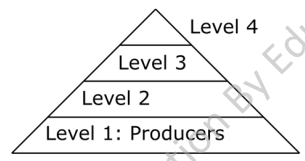
In the following figure, deer occupies _______.

  1. ((a))

    Level 3

  2. ((b))

    Level 2

  3. ((c))

    Level 1

  4. ((d))

    Level 4

Show Answer
Answer: ((b))

Level 2

The correct answer is Level 2.

Key Points

  • Food Chain
  • The sequence of events in an ecosystem is known as a food chain. In a food chain, one living organism eats another living organism, which is then eaten by another larger living organism.
  • A food chain is the movement of energy and nutrients from one organism to another at various trophic levels.
  • The feeding pattern or relationship between living things is also explained by the food chain.
  • Trophic level describes the order in which producers at the bottom of a food chain are followed by primary, secondary, and tertiary consumers.
  • A trophic level is the name given to each level in a food chain.

Additional Information

  • Major parts of food chain
  • The Sun:
  • The sun is the first place that energy comes from, and it powers everything on Earth.
  • Producers:
  • All autotrophs, including phytoplankton, cyanobacteria, algae, and green plants, are producers in a food chain.
  • A food chain begins at this point. The first level of a food chain is made up of producers. Food is produced by producers using the sun's energy.
  • Because producers produce their own food, they are also known as autotrophs. Any plant or other organism that uses photosynthesis to make its own nutrients are producers.
  • Consumers:
  • All organisms that rely on plants or other organisms for food are consumers. Due to the presence of nearly every living thing, this is the largest component of a food web.
  • It includes herbivores, which eat plants, carnivores, which eat other animals, parasites, which live on other organisms by harming them, and scavengers, which eat the carcasses of dead animals.
  • Decomposers:
  • Organisms known as decomposers extract energy from decaying or waste organic material. A food chain ends at this point.
  • Decomposers are an essential component of a food chain because they transform organic waste into inorganic materials, adding nutrients to the soil or land.
8

Find the values of b for which the quadratic equation 4x2 + bx + 1 = 0 has equal roots.

  1. ((a))

    Only 4

  2. ((b))

    -8 and 8

  3. ((c))

    -4 and 4

  4. ((d))

    Only -4

Show Answer
Answer: ((c))

-4 and 4

Shortcut Trick For any quadratic equation to have equal roots, the discriminant D must be 0. In the form ax2 + bx + c = 0, the condition is b2 = 4ac. ⇒ b2 = 4 × 4 × 1 ⇒ b2 = 16 ⇒ b = ±4 ∴ The correct answer is -4 and 4. Alternate Method Given: The quadratic equation is 4x2 + bx + 1 = 0. Formula Used: For a quadratic equation ax2 + bx + c = 0, the roots are equal if the discriminant (D) is zero. D = b2 − 4ac = 0 Calculations: ⇒ Comparing the given equation with the standard form, we have: a = 4, b = b, c = 1. ⇒ For equal roots, D = 0 ⇒ b2 − 4 × 4 × 1 = 0 ⇒ b2 − 16 = 0 ⇒ b2 = 16 ⇒ b = √16 or b = −√16 ⇒ b = 4 or b = −4 ∴ The correct answer is -4 and 4. Additional Information Nature of Roots The discriminant D determines the root types: if D > 0, roots are real and distinct; if D = 0, roots are real and equal; if D < 0, roots are imaginary/complex. Condition for Perfect Square A quadratic expression is a perfect square if and only if its discriminant is zero (D = 0). Sum and Product of Roots For ax2 + bx + c = 0, the sum of roots is −b/a and the product of roots is c/a. For equal roots, each root is exactly −b/2a.

9

A, B, C, D, E and F live on six different floors of the same building. The lowermost floor in the building is numbered 1, the floor above it number 2, and so on till the topmost floor is numbered 6.

B lives on an even numbered floor but not on floor number 4. Only two people live between B and E. D lives immediately below A. A lives on an even numbered floor. Neither D nor C live on the lowermost floor. Who lives on floor number 4?

  1. ((a))

    F

  2. ((b))

    A

  3. ((c))

    C

  4. ((d))

    E

Show Answer
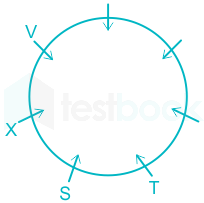
Answer: ((b))

A

From the given information:

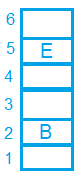
Step 1: B lives on an even numbered floor but not on floor number 4. Only two people live between B and E.


<br>

We place B and E such that there is 2 spaces between them and B sits on an even number except 4 so we choose 2 because when we will have to place A and D the arrangement will be incorrect.

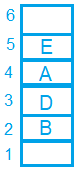
Step 2: D lives immediately below A. A lives on an even numbered floor.


We place A on 4 and D below A because we cannot place A at 6 as there is no space left for D.

Step 3: Neither D nor C live on the lowermost floor.


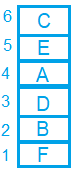
Now we place C at 6 because it cannot be placed at 1 and then we place F at the only spot left.

From the arrangement we can see that A lives on floor 4.

Hence the correct answer is option 2.

10

Read the given statement(s) and conclusions carefully and decide which of the conclusions logically follow(s) from the statement(s).

Statements:

L ≤ R < M ≥ Q, N > Q ≥ T

Conclusions:

I. N ≥ M

II. Q ≤ R

III. M > L

IV. N ≥ L

  1. ((a))

    Only conclusion III follows

  2. ((b))

    All conclusions I, II, III and IV follow

  3. ((c))

    Only conclusions I and IV follow

  4. ((d))

    Only conclusions III and IV follow

Show Answer
Answer: ((a))

Only conclusion III follows

Given statement:

L ≤ R < M ≥ Q, N > Q ≥ T

Conclusions:

I. N ≥ M → False 

We have M ≥ Q and N > Q ⇒ N > Q ≤ M

so relation between M and N cannot be determined.

II. Q ≤ R → False

We have R < M ≥ Q

so the relation between R and Q cannot be determined.

III. M > L → True 

We have L ≤ R < M ⇒ L< M

M is greater than L.

IV. N ≥ L → False

We have L ≤ R < M ≥ Q,  N > Q ⇒ N > Q ≤ M > L

therefore we cannot determine the relation between N and L.

Hence the correct answer is option 1)

11

In a code language, 'let's cook dinner' is written as 'li mu ha', 'dinner is late' is written as 'ha ve ka', and 'let's go out' is written as 'yo pa mu'. What is the code for the word 'cook' in that language?

  1. ((a))

    li

  2. ((b))

    ha

  3. ((c))

    ve

  4. ((d))

    mu

Show Answer
Answer: ((a))

li

When we consider the given lines and their codes, we get:

<br>

From here we can see that "let's" is coded as "mu" and "dinner" is coded as "ha".

In the first line we can see that "cook" is coded as "li".

Hence the correct answer is option 1)

12

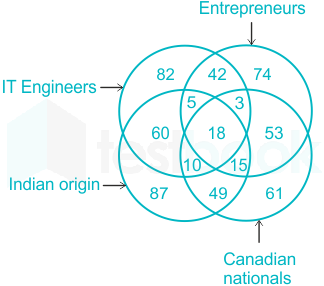
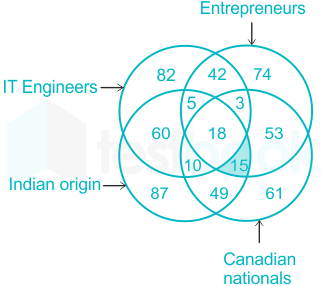
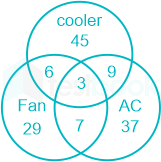
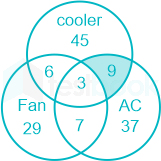
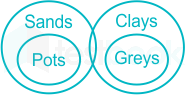
Study the given diagram carefully and answer the question. The numbers in different sections indicate the number of person.

How many Canadian nationals are there who are entrepreneurs of Indian origin but NOT IT engineers?

  1. ((a))

    18

  2. ((b))

    36

  3. ((c))

    33

  4. ((d))

    15

Show Answer
Answer: ((d))

15

We have to find the number of people who are Canadian nationals, entrepreneurs of Indian origin but NOT IT engineers which means we have to find out the region common between all the categories except for IT engineers:

From the diagram we can see that there are 15 Canadian nationals who are entrepreneurs of Indian origin but NOT IT engineers.

Hence the correct answer is option 4)

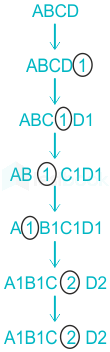
13

Refer to the following letter series and answer the question that follows.

(Left) A F R G H U I N H F W D C T V G Y J M K O Q (Right)

If every third letter in the above series is dropped, which letter would appear at the fifth place from the left?

  1. ((a))

    H

  2. ((b))

    N

  3. ((c))

    U

  4. ((d))

    I

Show Answer
Answer: ((d))

I

We spot every third letter in the given series:

Now when we drop every third letter, we get:

Now in the series, the fifth letter from the left is I.

Hence the correct answer is option 4)

14

Combustion of one methane gas molecule gives _______ carbon dioxide and _______ water molecules, respectively.

  1. ((a))

    2: 3

  2. ((b))

    2: 1

  3. ((c))

    1: 2

  4. ((d))

    3: 2

Show Answer
Answer: ((c))

1: 2

The correct answer is 1: 2.

Key Points

  • Methane gas
  • Methane, which has the chemical formula CH4, is the simplest of the saturated hydrocarbons. The simplest alkane is composed of one carbon atom and four hydrogen atoms.
  • Atmospheric methane, which can be found both below the seafloor and above ground, is produced when natural methane reaches the surface of the atmosphere.
  • It has no color, has no smell, or smells like sweet oil. It is a gas that is not harmful but can burn. It is a molecule with four equivalent C-H bonds and a tetrahedral shape.
  • Anaerobes in the colon make it. In 1776, Italian physicist Alessandro Volta was the first to scientifically identify methane.
  • Combustion of methane gas 
  • ​The term "combustible" refers to the possibility of burning methane. Methane and oxygen undergo a chemical reaction in this process.
  • A lot of energy, water (H2O), and carbon dioxide (CO2) are the byproducts of this reaction.
  • To represent the combustion of methane, chemists would write:

CH4[g] + 2 O2[g] -> CO2[g] + 2 H2O[l] + 891 kJ

Additional Information

  • CH4 Uses (Methane)
  • It is used as a fuel in automobiles, ovens, and water heaters.
  • It is also used to generate electricity.
  • It is used as refined liquid rocket fuel.
  • It is used in industries as an antifreeze ingredient.
  • It is a common fertilizer ingredient.
  • It is used to sanitize products.
  • It is used in gas-fired power stations.
  • It is used in gas cookers.
  • It is used to test gas appliances.
15

Which element is neither metal nor non-metal?

  1. ((a))

    Al

  2. ((b))

    P

  3. ((c))

    Mg

  4. ((d))

    Ge

Show Answer
Answer: ((d))

Ge

The correct answer is Ge.

Key Points

  • Germanium (Ge)
  • The chemical element germanium has the atomic number 32 and the symbol Ge. It has a grayish-white lustre, is hard and brittle, and looks like silicon.
  • It is a metalloid in the carbon group with chemical similarities to silicon and tin, its group neighbors. In nature, germanium, like silicon, naturally reacts with oxygen to form complexes.
  • Since germanium rarely occurs in large quantities, it was discovered relatively late in the discovery of the elements.
  • In terms of the relative abundance of the elements in the Earth's crust, germanium ranks near the top fifty.
  • From its position on his periodic table, Dmitri Mendeleev predicted its existence and some of its properties in 1869, and he named the element eka silicon.

Additional Information

  • Aluminum (Al)
  • The chemical element aluminum, or aluminum in North American English, has the atomic number 13 and the symbol Al.
  • The density of aluminum is approximately one third that of steel, making it less dense than other common metals.
  • When exposed to air, it forms a protective oxide layer on the surface and has a strong affinity for oxygen.
  • Both in terms of its color and its remarkable ability to reflect light, aluminum has a visual resemblance to silver. It is flexible, non-magnetic, and soft.
  • Phosphorus (P)
  • The chemical element phosphorus has the atomic number 15, and the symbol P. White phosphorus and red phosphorus are the two main forms of elemental phosphorus.
  • However, due to its high reactivity, phosphorus is never found as a free element on Earth.
  • It has a concentration of about one gram per kilogram in the Earth's crust, compared to that of copper, which is about 0.06 grams. Phosphorus is typically found in minerals as phosphate.
  • Magnesium (Mg)
  • The chemical element magnesium has the atomic number 12 and the symbol Mg. It is a shiny gray metal with a low density, a high chemical reactivity, and a low melting point.
  • It almost always has an oxidation state of +2, like the other alkaline earth metals in group 2 of the periodic table, which only occur naturally when combined with other elements.
  • It readily reacts with air to form a magnesium oxide passivation coating that prevents the metal from corroding further.
16

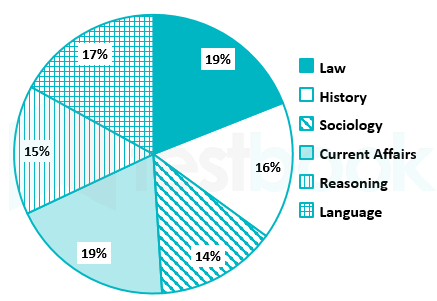
Study the given pie-chart and answer the question that follows.

The pie-chart shows the percentage of question asked in a competitive examination.

If the total number of question asked in the examination was 350, how many questions were asked in History, Law and Language taken together?

  1. ((a))

    111.50

  2. ((b))

    182.00

  3. ((c))

    171.50

  4. ((d))

    122.50

Show Answer
Answer: ((b))

182.00

Given:

Calculations:

According to question,

(17% + 19% + 16%) of 350

= 52% of 350

= 0.52 × 350

= 182

Hence, The Required value is 182.

17

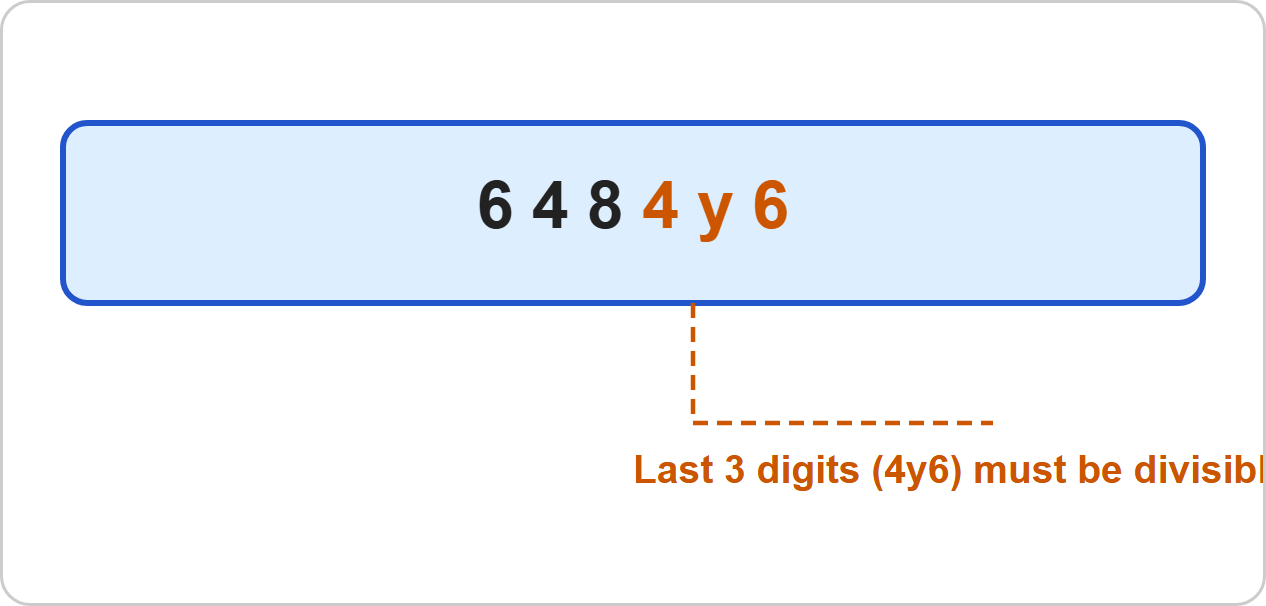
If the number 6484y6 is divisible by 8, then find the least value of y?

  1. ((a))

    7

  2. ((b))

    1

  3. ((c))

    4

  4. ((d))

    3

Show Answer
Answer: ((b))

1

Shortcut Trick

For a number to be divisible by 8, its last three digits must be divisible by 8.

The last three digits of 6484y6 are 4y6.

Testing the smallest single-digit values for y starting from 0:

If y = 1, the last three digits are 416, and 416 ÷ 8 = 52 (perfectly divisible).

∴ The correct answer is 1.

Alternate Method

Given: The number 6484y6 is divisible by 8.

Formula Used: Divisibility rule of 8 states that a number is divisible by 8 if the number formed by its last three digits is divisible by 8.

Let us test the given options for the value of y to find the least value:

⇒ Option 1: y = 7 → Last 3 digits = 476. Division: 476 ÷ 8 = 59.5 (Not divisible)

⇒ Option 2: y = 1 → Last 3 digits = 416. Division: 416 ÷ 8 = 52 (Divisible)

⇒ Option 3: y = 4 → Last 3 digits = 446. Division: 446 ÷ 8 = 55.75 (Not divisible)

⇒ Option 4: y = 3 → Last 3 digits = 436. Division: 436 ÷ 8 = 54.5 (Not divisible)

⇒ Comparing the valid values, the least value of y is 1.

∴ The correct answer is 1.

Additional Information

Divisibility Rule of 2, 4, and 8

A number is divisible by 2n if its last n digits are divisible by 2n. For 2 (21), check the last 1 digit; for 4 (22), check the last 2 digits; for 8 (23), check the last 3 digits.

Divisibility Rule of 3 and 9

A number is divisible by 3 or 9 if the sum of all its digits is divisible by 3 or 9 respectively.

18

The value of 75+4121+199\sqrt{75+\sqrt{41-\sqrt{21+\sqrt{19 - \sqrt {9}}}}} is:

  1. ((a))

    9

  2. ((b))

    6

  3. ((c))

    3

  4. ((d))

    5

Show Answer
Answer: ((a))

9

Calculations:

 75+4121+199\sqrt{75+\sqrt{41-\sqrt{21+\sqrt{19 - \sqrt {9}}}}}  

75+4121+193\sqrt{75+\sqrt{41-\sqrt{21+\sqrt{19 - 3}}}}  

=  75+4121+4\sqrt{75+\sqrt{41-\sqrt{21+ 4}}} 

75+415\sqrt{75+\sqrt{41 - 5}}

= √(75 + 6)

= 9

Hence The Required value is 9.

19

C is twice as efficient as A, while B takes thrice as many days as C to do the same work. A takes 10 days to do the work alone. If they work in pairs [like (A, B), (B, C) and (C, A)], with (A, B) working on the first day, then (B, C) working on the second day and (C, A) working on the third day and continuing the cycle till the work gets completed, then how many days will be required to complete this work?

  1. ((a))

    5785 \frac{7}{8} days

  2. ((b))

    7587 \frac{5}{8} days

  3. ((c))

    4384\frac{3}{8} days

  4. ((d))

    6186\frac{1}{8}days

Show Answer
Answer: ((c))

4384\frac{3}{8} days

Shortcut Trick

Efficiency A : C = 1 : 2. Since A takes 10 days, Total Work = 1 × 10 = 10 units.

Days taken by C = 10 ÷ 2 = 5 days. Days taken by B = 3 × C = 3 × 5 = 15 days.

Efficiencies: A = 3, B = 2, C = 6 (LCM of 10, 15, 5 is 30 units). Work in 3 days: (3+2) + (2+6) + (6+3) = 22 units.

Remaining 8 units: Day 4 (A+B) = 5 units, remaining 3 units on Day 5 by (B+C) takes 3/8 days.

∴ The correct answer is 4(3/8) days.

Alternate Method

Given: Efficiency of C = 2 × A; Days of B = 3 × C; A alone = 10 days.

Formula Used: Total Work = Efficiency × Time; Efficiency = Total Work ÷ Time.

PersonDaysTotal WorkEfficiency
A10303
C (Half of A's days)56
B (Thrice of C's days)152

Day 1 (A + B) work = 3 + 2 = 5 units

Day 2 (B + C) work = 2 + 6 = 8 units

Day 3 (C + A) work = 6 + 3 = 9 units

⇒ Total work in 3-day cycle = 5 + 8 + 9 = 22 units

⇒ Remaining work = 30 − 22 = 8 units

Day 4 (A + B) completes 5 units; Remaining = 8 − 5 = 3 units

Day 5 (B + C) completes remaining work in = 3/8 days

⇒ Total time = 4 + 3/8 = 4(3/8) days

∴ The correct answer is 4(3/8) days.

Additional Information

Efficiency and Time Relation

Efficiency is inversely proportional to the time taken to complete the work. If C is twice as efficient as A, C takes half the time A takes.

Alternate Day/Cycle Work

For cyclic work, calculate the sum of work in one full cycle and divide the total work to find the number of completed cycles and remaining units.

20

Some features of a respiratory surface in animals are mentioned below. Select the INCORRECT option.

  1. ((a))

    Usually placed inside the body

  2. ((b))

    presence of a mechanism for moving air in and out of this area

  3. ((c))

    Is very thick

  4. ((d))

    Has a large surface area

Show Answer
Answer: ((c))

Is very thick

The correct answer is Is very thick.

Key Points

  • Features of all respiratory surfaces
  • Their large surface area allows them to adequately absorb oxygen.
  • Their slender walls facilitate gas exchange and diffusion.
  • All of the respiratory organs, like the skin, gills, and lungs, have a lot of blood flowing through them to move gases from the lungs to the skin.
  • The following are four characteristics of an effective respiratory surface: large surface area, numerous capillaries, and a ventilation mechanism make up the thin epithelium.

Additional Information

  • Respiratory System in Animals
  • The distal alveoli are where the respiratory system ends, and the nose begins. The upper and lower airways make up it.
  • The nose, sinuses, and pharynx are all parts of the upper airway. In hyperthermic patients, the nose regulates temperature and smell.
  • In the beginning, the nasal turbinates filter particulate matter and humidify and warm the air. The trachea, bronchi, bronchioles, and alveoli make up the lower airways.
  • The delivery of oxygen to the lungs, where it is exchanged for carbon dioxide, is the respiratory system's primary function.
  • The alveoli, which are made up of membranes that are one cell layer thick and allow oxygen to enter the capillary and carbon dioxide to enter the alveoli from the blood in the capillary, are the site of gas exchange.
  • Respiratory distress or failure can result from disease-related gas transfer malfunction or major dysfunction.
  • Maintaining a healthy acid-base balance, serving as a blood reservoir, filtering and possibly eliminating emboli, metabolizing some bioactive substances (such as serotonin, prostaglandins, corticosteroids, and leukotrienes), and activating other substances are additional functions of the respiratory system.
21

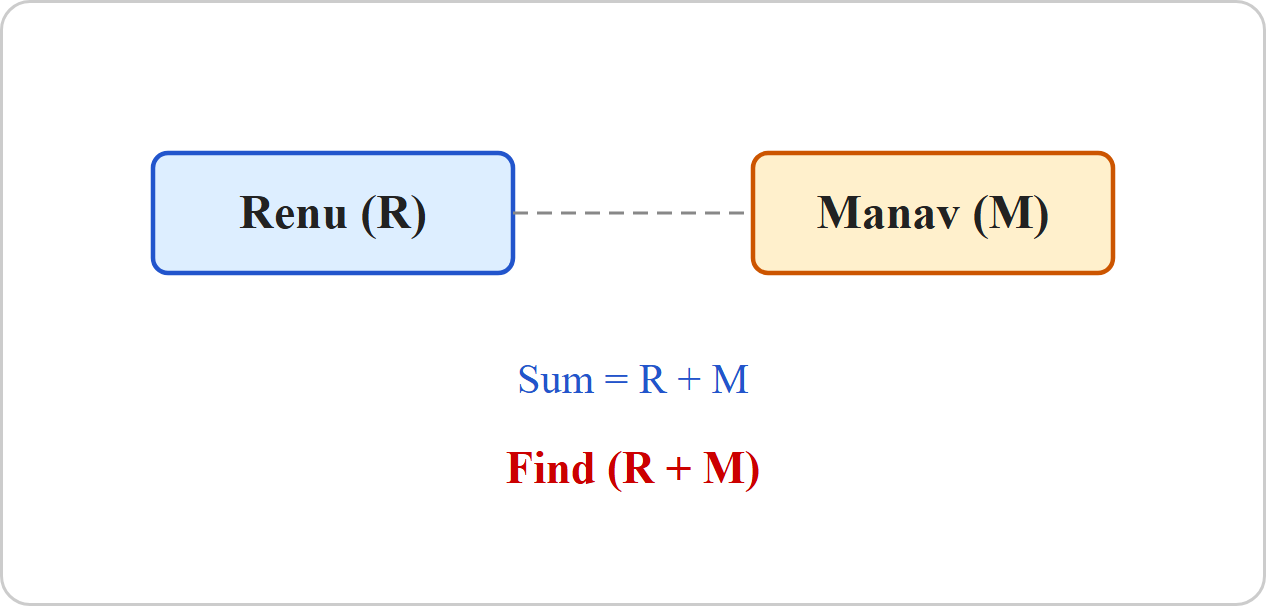
Three times the present age of Renu is 11 years more than two times the present age of Manav, and three times the present age of Manav is 9 years less than four times the present age of Renu. The sum of the present ages (in years) of Renu and Manav is:

  1. ((a))

    29

  2. ((b))

    32

  3. ((c))

    31

  4. ((d))

    37

Show Answer
Answer: ((b))

32

Shortcut Trick

Let R be Renu and M be Manav.

From given conditions: 3R − 2M = 11 and 4R − 3M = 9.

Solving these two simple equations simultaneously:

Multiply first by 3 and second by 2: (9R − 6M = 33) − (8R − 6M = 18) ⇒ R = 15.

Put R = 15 in 3R − 2M = 11 ⇒ 45 − 2M = 11 ⇒ 2M = 34 ⇒ M = 17.

Sum = 15 + 17 = 32.

∴ The correct answer is 32 years.

Alternate Method

Given:

Three times Renu = 2 × Manav + 11

Three times Manav = 4 × Renu − 9

Calculations:

⇒ 3R − 2M = 11 --- (i)

⇒ 4R − 3M = 9 --- (ii)

⇒ Multiply (i) by 4: 12R − 8M = 44 --- (iii)

⇒ Multiply (ii) by 3: 12R − 9M = 27 --- (iv)

⇒ Subtract (iv) from (iii): (12R − 8M) − (12R − 9M) = 44 − 27

⇒ M = 17 years

⇒ Substitute M = 17 in (i): 3R − 2(17) = 11

⇒ 3R − 34 = 11

⇒ 3R = 45 ⇒ R = 15 years

⇒ Sum = R + M = 15 + 17 = 32 years

∴ The correct answer is 32 years.

Additional Information

Linear Equations in Two Variables

To solve for two variables, we need two independent equations. Common methods include Elimination and Substitution.

Age Problems Logic

If the age is increased by 'n' years, the ratio or relation changes. Sum of ages is always the combined value at a specific point in time.

Cross Multiplication Method

For equations a1x + b1y + c1 = 0 and a2x + b2y + c2 = 0, the variables can be solved directly using the coefficient ratios.

22

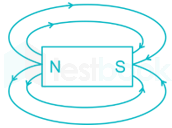
Magnetic field lines at north pole of a magnet are:

  1. ((a))

    parallel lines

  2. ((b))

    lines merging at the pole

  3. ((c))

    lines emerging from the pole

  4. ((d))

    intersecting lines

Show Answer
Answer: ((c))

lines emerging from the pole

The correct answer is lines emerging from the pole.

Key Points

  • Magnetic field lines
  • The magnet or moving electric charges create a field known as the magnetic field. The region within which the force of magnetism operates around a magnetic substance or moving electric charge is known as the magnetic field.

  • Magnetic field lines are used to represent magnetic fields. It is a visual tool used to visualize the magnetic field's direction and strength.
  • A compass needle can be used to draw lines in a magnetic field. Place the compass needle on a piece of paper close to the magnet.
  • Mark the direction that the compass needle is pointing in after you have checked it.
  • Mark the directions by moving the compass needle to various positions. The lines of the magnetic field can be seen by joining the points.

Additional Information

  • Properties of Magnetic Field Lines
  • The magnetic field's direction can be determined by tangenting the lines of the field.
  • The field strength is directly proportional to the density or closeness of the field lines.
  • Lines in the magnetic field appear to start at the north pole and merge or end at the south pole.
  • The magnetic field lines that run inside the magnet run from the south pole to the north pole.
  • Lines of the magnetic field never cross each other.
  • A closed loop is formed by magnetic field lines.
  • At any point on the field, field lines have magnitude as well as direction. Consequently, a vector is used to represent magnetic field lines.
  • They indicate the magnetic field's direction.
  • Because the field lines are denser near the poles, the magnetic field is stronger at the poles.
23

Refer to the following letter, number, symbol series and answer the question.

(Left) H ^ 2 K L 4 D & 3 $ D @ 5 7 % J B # S (Right)

How many such symbols are there which are immediately preceded by a letter and also immediately followed by a number?

  1. ((a))

    3

  2. ((b))

    2

  3. ((c))

    4

  4. ((d))

    1

Show Answer
Answer: ((a))

3

We have to find the number of triads that looks like (letter,symbol,number) in the given series:

From the arrangement we can see that there are 3 such symbols which are immediately preceded by a letter and also immediately followed by a number.

Hence the correct answer is option 1)

24

In 2021, who among the following was awarded the Major Dhyan Chand Khel Ratna award?

  1. ((a))

    PV Sindhu

  2. ((b))

    Jwala Gutta

  3. ((c))

    Tara Iyer

  4. ((d))

    Ravi Kumar

Show Answer
Answer: ((d))

Ravi Kumar

The correct answer is Ravi Kumar.

Key Points:

  • Indian freestyle wrestler Ravi Kumar Dahiya took up a silver medal in the 57 kg division at the 2020 Tokyo Olympics.
  • Dahiya is three-time Asian champion as well as 2019 World Wrestling Championship bronze medalist.
  • He won gold medal in men's 57kg freestyle wrestling division at the 2022 Birmingham Commonwealth Games in Birmingham, England.
  • He received the Major Dhyan Chand Khel Ratna award in 2021.

Additional Information:

  • PV Sindhu:
  • A badminton player from India is Pusarla Venkata Sindhu.
  • Sindhu, who is regarded as one of the India's most accomplished athletes, has won medals at numerous competitions, including the Olympics and the BWF circuit, as well as a gold at the 2019 World Championships.
  • Jwala Gutta:
  • ​Jwala Gutta is an Indian badminton player who was born on September 7, 1983.
  • She began representing India at international competitions in women's doubles and mixed doubles in the late 1990s.
  • She reached at No. 6 in the world rankings and has a total of 316 match victories across both disciplines, the most of any Indian.
  • Tara Iyer: 
  • Indian tennis player Tara Iyer has won one doubles championship and four singles titles in the ITF.
25

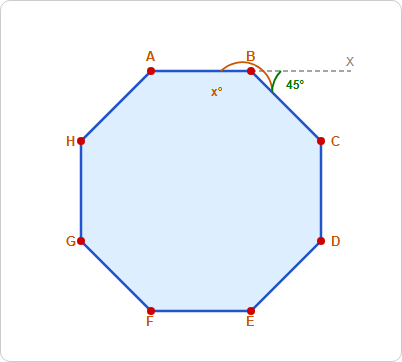
For a regular polygon, the sum of the interior angles is 200% more than the sum of its exterior angles. Each interior angle of the polygon measures x°. What is the value of x°?

  1. ((a))

    135°

  2. ((b))

    144°

  3. ((c))

    140°

  4. ((d))

    108°

Show Answer
Answer: ((a))

135°

Shortcut Trick

The sum of the exterior angles of any polygon is always 360°.

The sum of the interior angles is 200% more than (i.e., 3 times) the sum of the exterior angles.

Sum of interior angles = 3 × 360° = 1080°.

Using the formula (n − 2) × 180° = 1080° ⇒ n − 2 = 6 ⇒ n = 8 (a regular octagon).

Each interior angle (x°) = 1080° ÷ 8 = 135°.

∴ The correct answer is 135°.

Alternate Method

Given:

Sum of interior angles is 200% more than the sum of exterior angles.

Each interior angle of the regular polygon measures x°.

Formula Used:

Sum of exterior angles of any polygon = 360°

Sum of interior angles of an n-sided polygon = (n − 2) × 180°

Each interior angle of a regular polygon = [(n − 2) × 180°] ÷ n

Calculations:

⇒ Sum of exterior angles = 360°

⇒ Sum of interior angles = 360° + 200% of 360°

⇒ Sum of interior angles = 360° + 2 × 360° = 3 × 360° = 1080°

⇒ (n − 2) × 180° = 1080°

⇒ n − 2 = 1080° ÷ 180°

⇒ n − 2 = 6

⇒ n = 8

Since the polygon has 8 sides, it is a regular octagon.

⇒ Each interior angle (x°) = 1080° ÷ 8

⇒ x° = 135°

Option Evaluation:

Option (1) 135°: Correct, as calculated above for a regular octagon (n = 8).

Option (2) 144°: Incorrect. If each interior angle is 144°, then each exterior angle is 180° − 144° = 36°. Number of sides n = 360° ÷ 36° = 10. Sum of interior angles = 1440°, which is 300% more than 360°.

Option (3) 140°: Incorrect. If each interior angle is 140°, then each exterior angle is 40°. Number of sides n = 360° ÷ 40° = 9. Sum of interior angles = 1260°, which is 250% more than 360°.

Option (4) 108°: Incorrect. If each interior angle is 108°, then each exterior angle is 72°. Number of sides n = 360° ÷ 72° = 5. Sum of interior angles = 540°, which is 50% more than 360°.

∴ The correct answer is 135°.

Additional Information

Sum of Exterior Angles

For any convex polygon, the sum of the exterior angles is always constant and equal to 360°, regardless of the number of sides.

Interior and Exterior Angle Relationship

At each vertex of a polygon, the interior angle and its corresponding exterior angle are supplementary, meaning their sum is always 180°.

Number of Diagonals in a Polygon

The total number of diagonals in a polygon with n sides is given by the formula: d = [n × (n − 3)] ÷ 2.

26

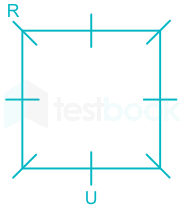
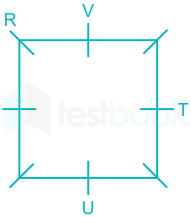
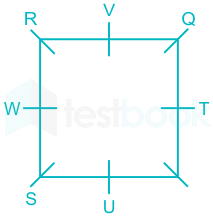
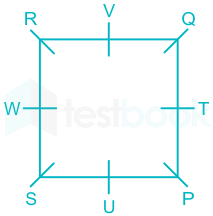
P, Q, R, S, T, U, V and W are sitting around a square table facing the centre of the table. Some of them are sitting at the corners, while some are sitting at the middle of the sides. R sits third to the left of U. R sits at one of the corners. T does not sit at any of the corners. V sits second on the right of T. T is not an immediate neighbour of R. Only three people sit between S and Q. S is an immediate neighbour of W. S does not sit at any of the middle of the sides.

Who sits second to the left of V?

  1. ((a))

    S

  2. ((b))

    T

  3. ((c))

    U

  4. ((d))

    W

Show Answer
Answer: ((b))

T

From the given information:

Step 1: R sits third to the left of U. R sits at one of the corners.


We place R at any corner and then place U third to the right of R.

Step 2: T does not sit at any of the corners. V sits second on the right of T. T is not an immediate neighbour of R.


<br>

Now we have to place V and T such that there is 1 spot between them where T does not sit on any corner also T is not an immediate neighbour of R. According to all these conditions T can only be placed to the second right of U and then we place V second to the right of T.

Step 3: Only three people sit between S and Q. S is an immediate neighbour of W. S does not sit at any of the middle of the sides.

We place S at a corner such that an immediate neighboring place is empty which is only available to the left of U and then we place Q, 3 spots from S.

Now we place P at the only spot left,

From the arrangement we can see that T sits second to the left of V.

Hence the correct answer is option 2)

27

The Kumaun Himalayas (according to the east-west division of the Himalayas) lie between which of the following two rivers?

  1. ((a))

    Indus and Sutlej

  2. ((b))

    Sutlej and Kali

  3. ((c))

    Kali and Teesta

  4. ((d))

    Teesta and Dibang

Show Answer
Answer: ((b))

Sutlej and Kali

The correct answer is Sutlej and Kali.

Key Points:

  • The Kumaun Himalayas, in northern India's west-central region of the Himalayas, stretch for 200 miles (320 km) from the Sutlej River in the east to the Kali River.
  • The range is located primarily inside the state of Uttarakhand, northwest of Nepal, and is made up of the Great Himalayas in the north and the Siwalik Range in the south.
  • It reaches a height of 25,446 feet (7,756 meters) in Kamet, which is close to the Chinese border, and 25,646 feet (7,817 meters) at Nanda Devi, the range's highest peak.

Additional Information:

  • Sutlej:
  • The longest of the five rivers that pass through Punjab, a historic crossroads in northern India and Pakistan, is the Sutlej or Satluj River.
  • The Satadru name for the Sutlej River is also used.
  • It is the Indus River's easternmost tributary.
  • To offer irrigation and other utilities to the states of Punjab, Rajasthan, and Haryana, the Bhakra Dam was constructed around the river Sutlej.
  • Kali: 
  • The Kali River originates at Kalapani in the Himalayas.
  • It is also known as the Sharda River and Mahakali River.
  • The river flows through Nepal's western border with India and joins Ghaghra River, a tributary of the Ganges.
  • The Pancheshwar Dam and the Tanakpur Hydroelectric Project are built on river Sharda.
  • The tributaries of Sharda river are Chameliya, Ramgun in Nepal and Kuthi, Dhauli, Gori, Sarju, Ladhiya rivers in Uttarakhand.
28

In the given letter-cluster triads, the letter-clusters in a particular triad are related following a certain logic. Study the given triads carefully and from the given options, select the triad that follows the same logic.

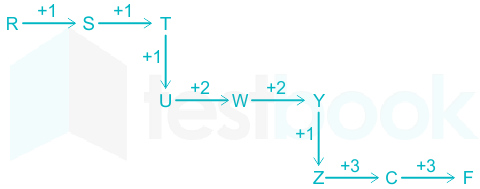
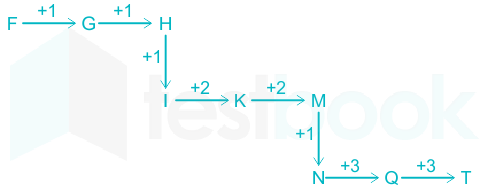
ABC : DFH : ILO

RST : UWY : ZCF

  1. ((a))

    OPQ : RTV : WYA

  2. ((b))

    STU : VWX : YZA

  3. ((c))

    FGH : IKM : NQT

  4. ((d))

    EFG : HKN : ORU

Show Answer
Answer: ((c))

FGH : IKM : NQT

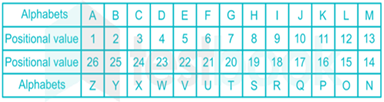
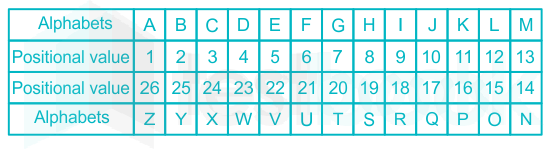
According to the English alphabets & their positional values:

<br>

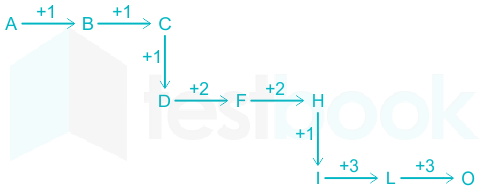
The pattern followed in the given clusters is:

<br>

and

<br>

From the given options only FGH : IKM : NQT follows the same pattern,

Hence the correct answer is option 3)

29

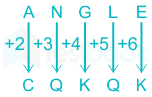
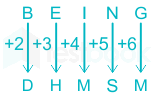
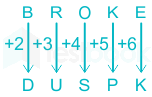
In a certain code language, 'ANGLE' is written as 'CQKQK' and 'BEING' is written as 'DHMSM'. How will 'BROKE' be written in that language?

  1. ((a))

    DUSPK

  2. ((b))

    DUKSP

  3. ((c))

    DUPPK

  4. ((d))

    DUSKP

Show Answer
Answer: ((a))

DUSPK

According to the English alphabets & their positional values:

<br>

The pattern followed in the given codes is:

   First alphabet is increased to 2 positional values.

   Second alphabet is increased to 3 positional values.

   Third alphabet is increased to 4 positional values.

   Fourth alphabet is increased to 5 positional values.

   Fifth alphabet is increased to 6 positional values.

<br>

<br>

Similarly,

Hence the correct answer is option 1)

30

Five friends P, Q, R, S, and T live in a five-storeyed building numbered from 1 (lowest floor) to 5 (top most floor). Each of them lives on different floor of the building.

R lives on the floor below Q's floor. T does not live on the top floor. There are equal number of people living above and below the floor on which S lives. Two people live between the floors where T and R live. Q does not live immediately above or below the floor where S lives. Who lives on second floor?

  1. ((a))

    T

  2. ((b))

    R

  3. ((c))

    P

  4. ((d))

    S

Show Answer
Answer: ((c))

P

Five friends P, Q, R, S, and T live in a five-storeyed building

  • There are equal number of people living above and below the floor on which S lives.
FloorsFriends
5
4
3S
2
1
  • T does not live on the top floor.
  • Two people live between the floors where T and R live.


FloorsFriends
5
4T
3S
2
1R


OR


FloorsFriends
5
4R
3S
2
1T


  • Q does not live immediately above or below the floor where S lives
  • R lives on the floor below Q's floor.
FloorsFriends
5Q
4R
3S
2P
1T


OR

FloorsFriends
5Q
4T
3S
2P
1R


P lives on second floor.

Hence, the correct answer is "Option 3"

31

The pH of milk of magnesia is about _______.

  1. ((a))

    10.4

  2. ((b))

    13.2

  3. ((c))

    4.7

  4. ((d))

    2.9

Show Answer
Answer: ((a))

10.4

The correct answer is 10.4

Key Points

  • Milk of magnesia
  • The chemical compound Mg (OH)2 is also known as milk of magnesia, magnesium dihydroxide, or magnesium hydroxide.
  • The mineral brucite is known to naturally contain this chemical compound. Milk of magnesia is known to exist as a white solid with a very low solubility in water under typical temperature and pressure conditions.
  • It is essential to keep in mind that certain laxatives and antacids contain milk of magnesia.
  • Milk of magnesia is sold as chewable pills, capsules, powder, and liquid suspensions for medical use, frequently flavored.
  • Milk of Magnesia is frequently sold as an antacid to neutralize stomach acid and alleviate indigestion and heartburn.
  • Additionally, it is a laxative that can alleviate constipation. As a laxative, magnesia's osmotic force draws fluids from the body.
  • High doses can cause diarrhea and deplete the body's potassium supply, which can frequently cause muscle cramps.​

Additional Information

  • Properties of Milk of Magnesia
  • Mg (OH)2 can be used to represent milk of magnesia's chemical formula.
  • This chemical compound has a molar mass of 58.3197 grams per mole.
  • This compound is a white solid that does not have any distinctive odor under typical conditions.
  • Under standard temperature and pressure conditions (STP), milk of magnesia has a density of 2.3446 grams per cubic centimeter.
  • This compound has an approximate melting point of 350 degrees Celsius. Nevertheless, it is essential to keep in mind that this compound begins to decompose at this temperature gradient.
32

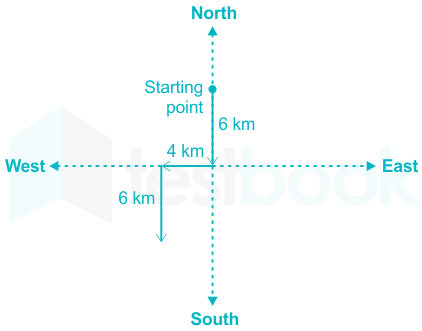
Prince starts from Point A and walks 6 km toward south, and then turns to the right, walks for 4 km. He takes a final turn to the left and walks 6 km. Now, in which direction is he from the starting place?

(All turns are 90 degrees turns only)

  1. ((a))

    South

  2. ((b))

    South-west

  3. ((c))

    East

  4. ((d))

    South-east

Show Answer
Answer: ((b))

South-west

Based on given information,

He is in south- west direction from the starting place.

Hence, the correct answer s "Option 2".

33

It is found that during dispersion of white light by a glass prism, the more a colour component is bent, the more is the refractive index of the glass for that colour component. If μB, μY and μG are refractive indices for blue, yellow and green lights, respectively, then which of the following relations between them is correct?

  1. ((a))

    μY > μG > μB

  2. ((b))

    μY = μG = μB

  3. ((c))

    μG > μB > μy

  4. ((d))

    μB > μG > μY

Show Answer
Answer: ((d))

μB > μG > μY

The correct answer is μB > μG > μY.

Key Points

  • Refraction Of Light Through Prism
  • The speed at which light moves from one medium to another changes, causing it to "bend" or be "refracted."
  • Now, when light enters a prism, it is reflected in the direction of the triangle's base.
  • The below diagram provides an excellent illustration of the refraction of light through the prism.
  • The wavelengths of the various colors in the light spectrum vary.
  • As a result, the speed at which they bend varies depending on their wavelength, with red bending the least and violet bending the most because of its shorter wavelength.
  • When white light is refracted through a prism, this causes its spectrum of colors to be dispersed.

Additional Information

  • Dispersion in prism
  • ​A spectrum of seven colors emerges when white light is forced through a prism, indicating that white light is a mixture of seven distinct colors. Prism only serves as a medium for the seven colors' separation.
  • Refraction occurs when light falls on the glass prism. Because each component of light has a unique wavelength and a constant frequency, the glass medium's difference in velocity causes each component to deviate at a different angle.
  • In the upper part of the spectrum, the color red, which has the longest wavelength, deviates the least, while violet, which has the shortest wavelength, deviates the most.
34

In which year was the Panchayats (Extension to the Schedules Areas) Act (PESA act) passed in India?

  1. ((a))

    1994

  2. ((b))

    1996

  3. ((c))

    1990

  4. ((d))

    1992

Show Answer
Answer: ((b))

1996

The correct answer is "1996''.

Key Points

  • The PESA Act was launched by the Government of India in 1996.
  • This law was enacted for ensuring self-governance for people living in scheduled areas of India by traditional methods.
  • The Fifth Schedule of the constitution of India identifies the schedule area.
  • The schedule areas were not included in the 73rd Constitutional Amendment so PESA was enacted to extend the provisions of the constitution by certain exceptions and modifications.

Additional Information

  • Current affairs related to PESA Act:
  • The Panchayat Extension to Scheduled Areas Act is recently implemented by Madhya Pradesh Government to avoid the exploitation of the tribal population. This was announced on the occasion of the JanjatIya Gaurav Divas.
  • PESA Act is viewed as a positive step towards the development of people living in scheduled areas.
  • This act was enacted on 24 December 1996 to enable panchayats at different levels.
35

An object is placed in front of a convex mirror of focal length 9 cm, at a distance of 18 cm. Its image is formed at a distance of:

  1. ((a))

    6 cm

  2. ((b))

    12 cm

  3. ((c))

    24 cm

  4. ((d))

    18 cm

Show Answer
Answer: ((a))

6 cm

The correct answer is 6 cm.

Key Points

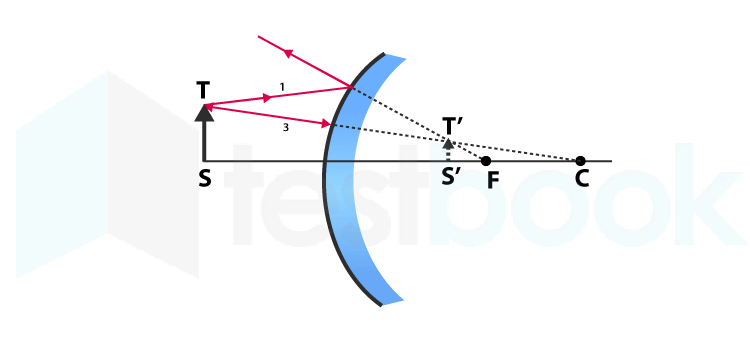
  • Image formation in convex mirror when the Object is Placed Between Infinity and Pole
  • We take into consideration two distinct rays emanating from the object in this instance of the formation of an image by a convex mirror.
  • One runs parallel to the principal axis, and the other points in the direction of the mirror's center of curvature.
  • After being reflected, the image between the pole (P) and the focus (F) behind the mirror is created by these rays.
  • As a result, a diminished, virtual, and erect image is created.

Additional Information

  • Calculations
  • Given a convex mirror 

focal length, f=9cm

object distance, u=-18cm

We know, mirror formula

1/v+ 1/u= 1/f

1/v+ 1/ (-18) = 1/9

1/v= 1/9+1/18

1/v= 2+1/18= 3/18

1/v= 1/6

v= 6cm

36

Which of the following interchanges in signs and numbers will make the given equation correct?

9 - 11 × 24 = 75

  1. ((a))

    × and -, 9 and 11

  2. ((b))

    × and =, 24 and 9

  3. ((c))
    • and ×, 75 and 11
  4. ((d))

    = and -, 75 and 24

Show Answer
Answer: ((a))

× and -, 9 and 11

Given equation : 9 - 11 × 24 = 75

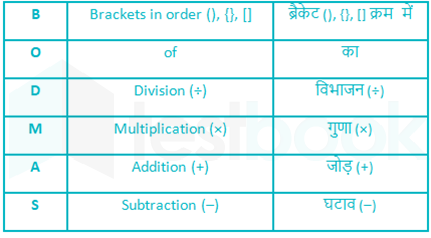
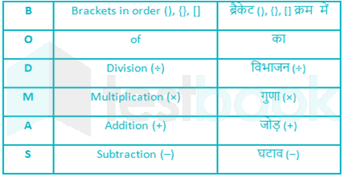
Interchanging values and numbers by using BODMAS rule we get,

1) × and -, 9 and 11

11 × 9 - 24 = 75

99 - 24 = 75 

75 = 75

2) × and =, 24 and 9

24 - 11 = 9 × 75

13 ≠ 675

3) - and ×, 75 and 11

9 × 75 - 24 = 11

675 - 24 = 11

651 ≠ 11

4) = and -, 75 and 24

9 = 11 × 75 - 24

9 = 825 - 24 

9 = 801

Hence, the correct answer is "Option 1".

37

If the resistance of a conductor is doubled then the heat produced is:

  1. ((a))

    Two times

  2. ((b))

    Unchanged

  3. ((c))

    Half

  4. ((d))

    Zero

Show Answer
Answer: ((a))

Two times

The correct answer is two times.

Key Points

  • Joule’s Law of Heating
  • The factors that determine how much heat is produced in a conductor when an electric current flows through it are described by Joule's law of heating. Let's say that for a given time (t), a resistor with a resistance of R experiences current (I).
  • The resistor's heat energy dissipation capacity will be determined by H= I2Rt
  • The heat produced or dissipated in a resistor is
  • (i) directly proportional to the square of the current flowing through the resistor,
  • (ii) directly proportional to the resistance for a given current, and
  • (iii) directly proportional to the time the current flows through the resistance. This is referred to as Joules' law of heating.
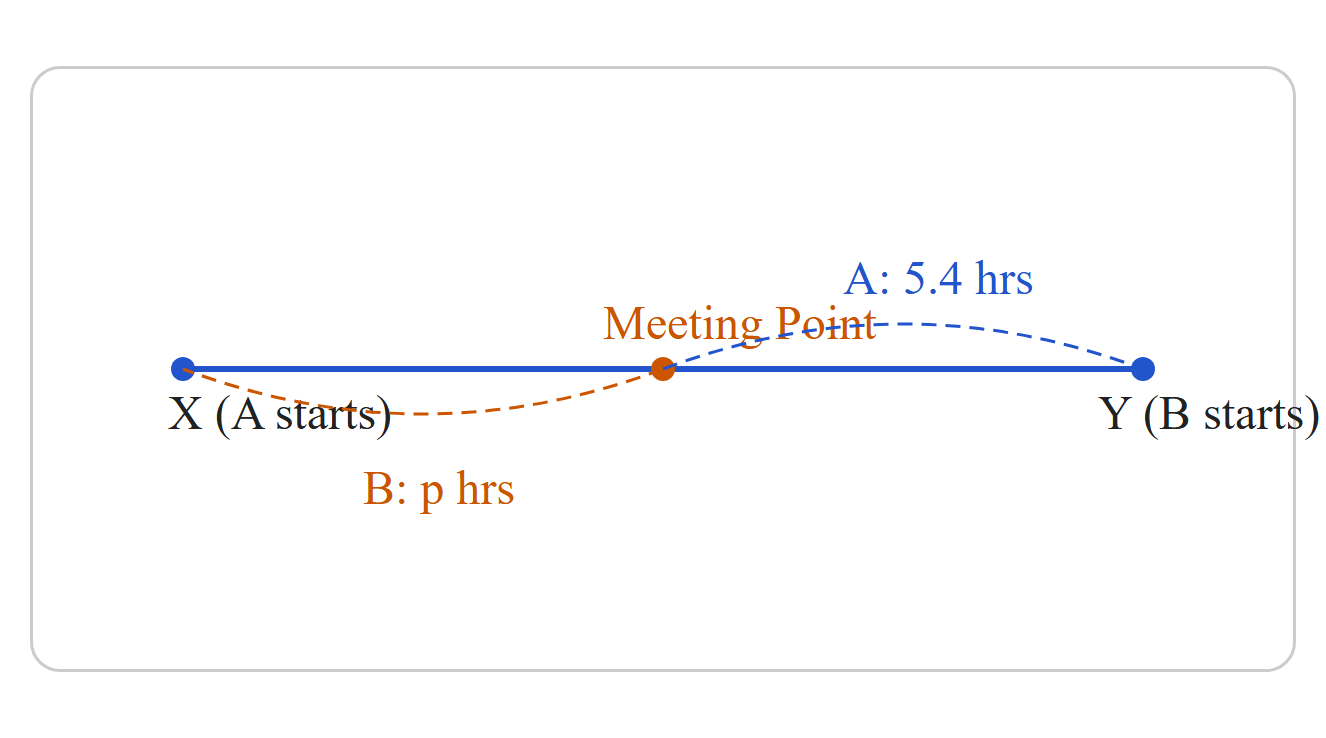
  • The following statements can be drawn from Joule's law of heating:
  • The amount of heat produced will quadruple if the current flowing through a resistor is doubled.
  • The amount of heat produced will also double if the conductor's resistance is doubled. Similarly, when the conductor's resistance is reduced to half, the amount of heat it produces is reduced to half.
  • The amount of heat produced doubles if the amount of time the current travel through the conductor is doubled.

Additional Information

  • Applications of Heating Effect of Electric Current
  • Electric Bulb:
  • The filament of an electric bulb is made of tungsten. Because the melting point of tungsten is 3380°C, tungsten wire has a high resistance and can withstand a lot of heat.
  • When electricity is passed through the bulb's filament, it gets very hot and glows because its temperature rises to 2500°C.
  • If we place our hand below the bulb, we can easily feel the heat that is produced by its filament without actually touching it.
  • An electric bulb is filled with a mixture of argon and nitrogen to prolong the life of the tungsten filament and prevent its corrosion.
  • Electric Fuse:
  • A safety device, an electric fuse, is effective. It prevents damage to the household appliances connected to the circuit from overloading or short-circuiting.
  • It operates on the electric current's heating effect. It usually consists of a thin wire made of a lead-tin alloy.
  • It resists very little. It is connected to the circuit in series. A fuse wire melts when exposed to an excessive amount of current.
  • This interrupts the circuit and prevents damage to the appliances that are connected to it.
38

Which Veda contains the maximum number of verses?

  1. ((a))

    Rig Veda

  2. ((b))

    Atharva Veda

  3. ((c))

    Sama Veda

  4. ((d))

    Yajur Veda

Show Answer
Answer: ((a))

Rig Veda

The correct answer is "Rig Veda".

Key Points

  • Rig Veda is the oldest form of Veda.
  • It is the oldest known Vedic Sanskrit text.
  • 'Rigveda' means praise knowledge.
  • It has 10600 verses, and 1028 hymns called 'Suktas'.
  • It also has a collection of 10 books known as 'Mandalas'.

Additional Information

  • There are four Vedas in Sanskrit:
  • Rigveda
  • Samaveda
  • Yajurveda
  • Atharvaveda
  • Samaveda - It is called the Veda of melodies and chants. There are two Upanishads in Samaveda. This Veda is considered the root of Indian classical dance and music.
  • Yajurveda - This means worship knowledge. It has two types- Krishna and Shukla. It contains ritual-performing mantras.
  • Atharvaveda - This Veda contains daily life routines. It is called as Veda of magical formulas. This contains three primary Upanishads.
39

The carbon and energy requirements of plants are fulfilled by which of the following processes?

  1. ((a))

    Absorption

  2. ((b))

    Translocation

  3. ((c))

    Transpiration

  4. ((d))

    Photosynthesis

Show Answer
Answer: ((d))

Photosynthesis

The correct answer is Photosynthesis.

Key Points

  • Photosynthesis
  • Photosynthesis is the process by which phototrophs transform light energy into chemical energy that is later utilized to power cellular processes. Sugars, made from carbon dioxide and water, are used to store the chemical energy.
  • In addition to green plants, other organisms can perform photosynthesis. Prokaryotes like cyanobacteria, purple bacteria, and green sulfur bacteria are among these.
  • These organisms perform photosynthesis in the same way that green plants do. After that, various cellular activities are fueled by the glucose that is produced during photosynthesis.
  • Oxygen is the physiochemical byproduct of this process.
  • CO2+ H2O+ heat -> C6H12O6+ O2

Additional Information

  • Absorption 
  • Absorption is a chemical or physical phenomenon in which the substance being absorbed's molecules, atoms, and ions enter the bulk phase (gas, liquid, or solid) of the material being absorbed.
  • The process by which one substance is completely absorbed or mixed with another is known as absorption.
  • Energy is captured and transformed by a substance during absorption. The absorbent evenly disperses the captured material across the surface.
  • Translocation
  • The movement of materials throughout the plant from the leaves to other tissues is known as translocation.
  • By photosynthesis, plants produce carbohydrates (sugars) in their leaves; however, the plant's non-photosynthetic parts also need carbohydrates and other organic and inorganic substances.
  • As a result, nutrients are transferred from sinks (regions where the carbohydrate is needed) to sources (regions with excessive carbohydrates, like mature leaves).
  • Roots, flowers, fruits, stems, and developing leaves are all important sinks. The fact that leaves are sinks when they are young and sources when they are about half grown makes them particularly fascinating in this regard.
  • Transpiration
  • Plants, like all other living things, need an excretory system to get rid of excess water.
  • Transpiration is the process by which the plant body removes excess water. Most of the time, it's the water that evaporates from the leaves' surface.
  • Water molecules in the plant tissues are removed from the plants' aerial parts during transpiration.
  • The plants only use a small amount of the water they absorb for growth and development. The remainder is eliminated via transpiration.
40

How many cubic cm of water can a hemispherical container of radius 7 cm hold (rounded off to 2 decimal places) (use π = 227\frac{22}{7})?

  1. ((a))

    616.25

  2. ((b))

    1437.33

  3. ((c))

    154.75

  4. ((d))

    718.67

Show Answer
Answer: ((d))

718.67

Shortcut Trick

Volume of a hemisphere = (2/3) × π × r3

Substitute r = 7 cm: V = (2/3) × (22/7) × 73

V = (2/3) × 22 × 49 = 2156 ÷ 3 = 718.666...

Rounding off to two decimal places, V ≈ 718.67 cm3

∴ The correct answer is 718.67 cm3.

Alternate Method

Given:

Radius of the hemispherical container (r) = 7 cm

Formula Used:

Volume of a hemisphere (V) = (2/3) × π × r3

r = 7 cm

7 cm Hemispherical Container

Calculations:

⇒ V = (2/3) × (22/7) × 73

⇒ V = (2/3) × (22/7) × 343

⇒ V = (2/3) × 22 × 49

⇒ V = 2156 ÷ 3

⇒ V ≈ 718.666... cm3

⇒ V = 718.67 cm3 (rounded off to 2 decimal places)

∴ The correct answer is 718.67 cm3.

Additional Information

Volume of a Sphere

The volume of a complete sphere is double the volume of a hemisphere and is calculated using V = (4/3) × π × r3.

Curved Surface Area of a Hemisphere

The outer curved surface area is half that of a sphere, given by the formula CSA = 2 × π × r2.

Total Surface Area of a Hemisphere

The total surface area includes the curved surface and the flat circular base, resulting in the formula TSA = 3 × π × r2.

41

Researchers at IIT Guwahati have developed a 'smart' window material in May 2021. What is the use of this material?

  1. ((a))

    It locates sources of faint light from distant quasars

  2. ((b))

    It maintains oxygen pressure that works without electricity.

  3. ((c))

    It allows automatic climate control of buildings.

  4. ((d))

    It increase the life of medical oxygen cylinders.

Show Answer
Answer: ((c))

It allows automatic climate control of buildings.

The correct answer is "It allows automatic climate control of buildings".

Key Points

  • A 'smart window' material was developed by IIT Guwahati researchers.
  • This material can effectively control the amount of heat and light passing through it in response to an applied voltage.
  • It can also develop climate control systems in the buildings.
  • This innovation was of Debabrata Sikdar and his student Ashish Kumar Chowdhary.​

Additional Information

  • This was published in Solar Energy Materials and Solar Cells.
  • This development will also help the country to achieve the goals of the Paris Climate Agreement- to improve energy use by 30 percent by 2030.
  • This glass can also be used in vehicles, locomotives, airplanes, and also in greenhouses.
  • These glasses are designed using noble metals.
42

Which of the following elements is most metallic in nature?

  1. ((a))

    Ba

  2. ((b))

    Be

  3. ((c))

    Sr

  4. ((d))

    Ca

Show Answer
Answer: ((a))

Ba

The correct answer is Ba.

Key Points

  • Barium (Ba)
  • According to Genter (2001), barium is a dense alkaline earth metal that naturally occurs in ore deposits and makes up 0.05% of the Earth's crust.
  • Barium and its compounds can be found naturally or made in factories for a variety of purposes.
  • It is a naturally occurring, silvery-white metal that can be found in the environment. It mixes with carbon, oxygen, and sulfur, among other chemicals.
  • It has a density half that of iron and is very light.
  • Hydrogen is released when barium oxidizes in the air and vigorously reacts with water to form hydroxide. Most of the non-metals it interacts with produce poisonous compounds.

Additional Information

  • Beryllium (Be)
  • In the periodic table, beryllium is an element with atomic number 4.
  • It is a highly toxic bivalent element.
  • Among the light metals, the element has one of the highest melting points.
  • Beryllium can be found in thirty different minerals, the most important of which are bertrandite, beryl, chrysoberyl, and phenacite.
  • Strontium (Sr)
  • It has 38 atoms, 88 atoms, one oxidation state (+2), and four naturally occurring isotopes—84Sr, 86Sr, 87Sr, and 88Sr—of which 88Sr accounts for 82.6 percent of the mass.
  • Chemically, Strontium is most similar to Calcium and Barium, two heavier alkali earth elements.
  • Metallic strontium is a lithophile.
  • Additionally, witherite BaCO3 and barite BaSO4 undergo some substitution for Ba.
  • Calcium (Ca)
  • The element calcium, which has the atomic number 20, is denoted by the symbol Ca in the periodic table.
  • Calcium (Ca) is an essential component that keeps our bones strong and able to bear our weight.
  • Additionally, our nervous system relies on calcium for impulse transmission throughout our bodies.
43

Which of the following pairs will be in the same homologous series?

  1. ((a))

    CH3CHO and CH3OH

  2. ((b))

    CH3OH and HCOOH

  3. ((c))

    C2H5OH and CH3COOH

  4. ((d))

    CH3COCH3 and C2H5COCH3

Show Answer
Answer: ((d))

CH3COCH3 and C2H5COCH3

The correct answer is CH3COCH3 and C2H5COCH3

Key Points

  • CH3COCH3
  • ​Acetone is an organic compound that is very flammable. This organic solvent is also known as propanone and has the chemical formula C3H6O.
  • It is present in vehicle, plant, tree, and forest fire exhaust. It is also found in the human body, typically in the form of blood and urine.
  • It has no color and is volatile. It can be dissolved in water, ether, or ethanol, and it has an unpleasant, floral, or pungent scent. As a solvent and antiseptic, it is widely used.
  • Acetone was first made by alchemists. Dry distillation of metal acetates is used to make it. At the moment, propylene can either directly or indirectly produce acetone.
  • The cumene process produces nearly 83% of acetone. Acetone can also be made in other, more traditional ways.
  • C2H5COCH3
  • ​2-Butanone, also known as METHYL ETHYL KETONE, is the above-mentioned compound. Its molecular mass, C2H5COCH3, is 72.1057 g/mol.
  • Methyl ethyl ketone is a colorless, relatively volatile liquid with a pleasant, pungent odor.
  • 20°F flash point, heavier than air vapors.
  • It is stable during normal transportation and does not react with water or many common substances.
  • It affects the throat, eyes, and nose. Toxic substances may result from combustion.
  • Butanone is a naturally occurring product. It is produced by some trees and can be found in trace amounts in some fruits and vegetables.
  • Additionally, vehicle and truck exhausts release it into the air.

Additional Information

  • Homologous series
  • A homologous series is a group of compounds that share similar chemical properties and functional groups that differ from the next member by CH2.
  • In organic compounds with the same general formula, carbon chains of varying lengths have been observed.
  • The homologous series members all belong to the same functional group.
  • All members use the same general formula.
  • Because they belong to the same functional group, their chemical properties are nearly identical.
  • There is a common method of preparation among members.
44

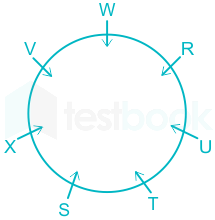
Seven people R, S, T, U, V, W and X were sitting around a circular table, facing the centre. They were equidistant to one another. T was sitting to the immediate right of S. W was sitting to the immediate left of V. R and U were immediate neighbours. Only X was sitting between V and S. U was sitting to the immediate right of T. Who was sitting to the immediate left of W?

  1. ((a))

    T

  2. ((b))

    R

  3. ((c))

    S

  4. ((d))

    U

Show Answer
Answer: ((b))

R

Seven people R, S, T, U, V, W and X were sitting around a circular table, facing the centre.

  • T was sitting to the immediate right of S.
  • Only X was sitting between V and S.

  • W was sitting to the immediate left of V.
  • R and U were immediate neighbours.
  • U was sitting to the immediate right of T.


R was sitting to the immediate left of W.

Hence, the correct answer is "Option 2".

45

Which of the following is a characteristic of public goods?

  1. ((a))

    Non-rivalry

  2. ((b))

    Inelasticity

  3. ((c))

    Elasticity

  4. ((d))

    Excludable

Show Answer
Answer: ((a))

Non-rivalry

The correct answer is "Non-rivalry".

Key Points

  • Public goods are goods that can be used by anyone.
  • The availability of these goods does not reduce if others also use them.
  • One cannot stop another from using these.
  • Examples: Street lamps, clean air, flood control systems, etc.
  • There are two characteristics of public goods:
  • Nonrivalrous
  • Nonexcludable

Additional Information

  • Nonrivalrous - The use of public good by one person does not reduce the availability of that good to another person.
  • Nonexcludable - The government has provided public good to everyone and no one can prevent another person from using that.
  • There are other types of goods also like private goods, common goods, club goods, etc.
  • Any product that is purchased by one and prevents another from its use is called a private good.
  • The characteristics of private goods:
  • Excludability - The consumer cannot use the goods if they do not pay the seller.
  • Rivalry - When a good is used or purchased by an individual that leaves less of the good available for others.
  • Reject - If a consumer does not like the product they can reject it.
46

Which of the following cellular components is absent in most of the prokaryotes?

  1. ((a))

    Nuclear membrane

  2. ((b))

    Ribosome

  3. ((c))

    Cell wall

  4. ((d))

    Cytoplasm

Show Answer
Answer: ((a))

Nuclear membrane

The correct answer is Nuclear membrane.

Key Points

  • Nuclear membrane
  • ​A control center known as a nucleus is where DNA is stored in all eukaryotic cells, which include protists, animals, fungi, and plants.
  • The nuclear envelope or nuclear membrane is a two-layered membrane that wraps around and covers each nucleus. It separates the cytoplasm from the nucleoplasm, which is the fluid in the nucleus.
  • Both plant and animal cells contain the nuclear membrane. Numerous functions are carried out by cells, including the creation of proteins, the transformation of molecules into energy, and the elimination of waste products.
  • The genetic material of the cell is shielded from the exterior of the nucleus, where chemical reactions are taking place, by this membrane. Additionally, it carries a number of proteins that are essential for controlling genes and the organization of DNA.

Additional Information

  • Ribosome
  • During a process known as protein synthesis or translation, a ribosome is a complex molecular machine inside living cells that produces proteins from amino acids. All living cells are responsible for the primary function of protein synthesis.
  • Both prokaryotic and eukaryotic cells contain ribosomes, which are highly specialized organelles of the cell. Ribosomes are necessary for the production of proteins in every living cell.
  • Cell wall
  • The non-living component that covers the outermost layer of a cell is known as a cell wall. It is permeable in nature and has a composition that changes depending on the organism.
  • The cell's interior contents are kept separate from the outside environment by the cell wall. It also gives the cell and its organelles shape, support, and protection.
  • However, only a few prokaryotic organisms, eukaryotic plants, and fungi contain this cellular component.
  • Cytoplasm
  • The term "cytoplasm" refers to the fluid that fills the cells. It includes filaments, ions, proteins, macromolecular structures, and other organelles suspended in the cytosol as well as the cytosol itself.
  • However, recent studies suggest that the conventional definition of cytoplasm is no longer applicable. It was previously thought to be a fluid-like substance, but new evidence shows that it is similar to liquids that form glasses.
  • Except for the nucleus, eukaryotic cells' cytoplasm associates with the contents of the cell.
47

Which team on the Pro Kabaddi League title of Season 8 in 2022?

  1. ((a))

    Dabang Delhi KC

  2. ((b))

    Bengaluru Bulls

  3. ((c))

    U Mumba

  4. ((d))

    Patna Pirates

Show Answer
Answer: ((a))

Dabang Delhi KC

The correct answer is "Dabang Delhi KC".

Key Points

  • Dabang Delhi KC won the Pro Kabaddi League Season 8 Trophy in 2022 over Patna Pirates.
  • They became the sixth team in the league's history to win the title.
  • Perfect Raider of the final - Naveen Kumar
  • Defender of the Final - Manjeet Chhilar

Additional Information

  • This was the eighth season of the Pro Kabaddi League.
  • The venue was Sheraton Grand Hotel and Convention Center in Whitefield, Bangalore.
  • The Pro Kabbadi League was launched in 2014.
Pro Kabaddi League SeasonWinner
Season 7Bengal Warriors
Season 6Bengaluru Bulls
Season 5Patna Pirates
48

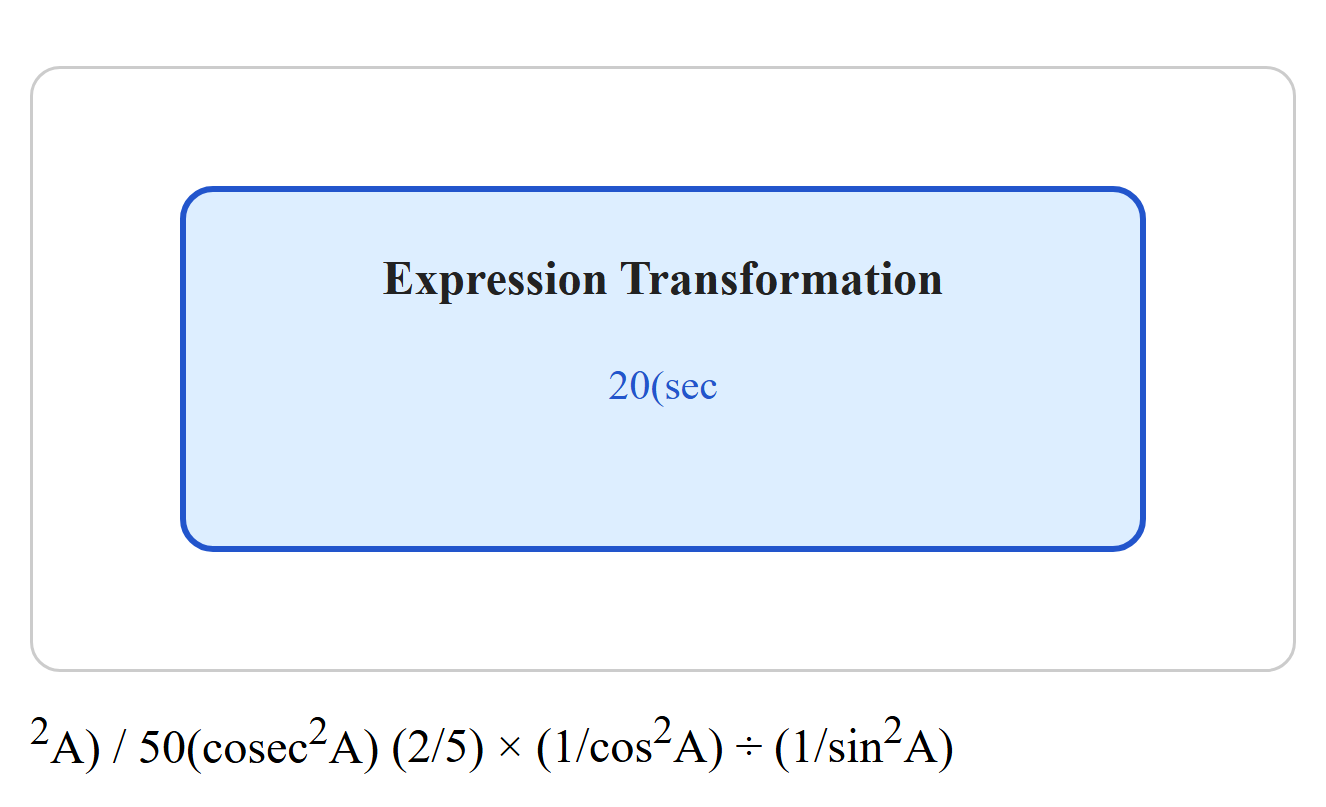
The expression 1+x1x1x1+x+4x1+x2+8x31x4\frac{1+x}{1-x}-\frac{1-x}{1+x}+\frac{4x}{1+x^2}+\frac{8x^3}{1-x^4} is equal to:

  1. ((a))

    8x1x2\frac{8x}{1-x^2}

  2. ((b))

    8x1+x2\frac{8x}{1+x^2}

  3. ((c))

    4x1+x2\frac{4x}{1+x^2}

  4. ((d))

    4x1x2\frac{4x}{1-x^2}

Show Answer
Answer: ((a))

8x1x2\frac{8x}{1-x^2}

Shortcut Trick

The fastest way to solve such algebraic expressions is by using value substitution. Let x = 2.

Expression = (1+2)/(1−2) − (1−2)/(1+2) + (4×2)/(1+22) + (8×23)/(1−24)

Expression = (3/−1) − (−1/3) + (8/5) + (64/−15) = −3 + 1/3 + 8/5 − 64/15

Expression = −8/3 + (24 − 64)/15 = −8/3 − 40/15 = −8/3 − 8/3 = −16/3

Now, checking Option 1: (8 × 2) / (1 − 22) = 16 / (1 − 4) = 16 / −3 = −16/3.

∴ The correct answer is (8x)/(1−x2).

Alternate Method

Given Expression: ((1+x)/(1−x)) − ((1−x)/(1+x)) + (4x)/(1+x2) + (8x3)/(1−x4)

Step 1: Simplify the first two terms using the identity (a+b)2 − (a−b)2 = 4ab.

⇒ [(1+x)2 − (1−x)2] / [(1−x)(1+x)] = 4x / (1−x2)

Step 2: Add the third term to the result.

⇒ [4x / (1−x2)] + [4x / (1+x2)]

⇒ [4x(1+x2) + 4x(1−x2)] / [(1−x2)(1+x2)]

⇒ [4x + 4x3 + 4x − 4x3] / (1−x4) = 8x / (1−x4)

Step 3: Add the fourth term to the result.

⇒ [8x / (1−x4)] + [8x3 / (1−x4)]

⇒ [8x + 8x3] / (1−x4) = [8x(1+x2)] / [(1−x2)(1+x2)]

⇒ 8x / (1−x2)

∴ The correct answer is (8x)/(1−x2).

Additional Information

Difference of Squares Identity

The formula (a − b)(a + b) = a2 − b2 is fundamental in simplifying rational expressions with nested denominators like 1−x2 and 1−x4.

Algebraic Substitution Rule

When simplifying complex identities, substituting a numerical value for the variable (avoiding values that make the denominator zero) is the most efficient competitive exam strategy.

Sum and Difference of Squares

Note that (a + b)2 + (a − b)2 = 2(a2 + b2), which is often useful for other variations of this simplification problem.

49

Consider the below statements and identify the correct answer.

Statement-I: The chemical formula for baking soda is NaHCO3.

Statement-II: It is used in soda-acid fire extinguisher.

  1. ((a))

    Statement-I is true, and Statement-II is false.

  2. ((b))

    Statement-II is true, and Statement-I is false.

  3. ((c))

    Both the Statements are false.

  4. ((d))

    Both the Statements are true.

Show Answer
Answer: ((d))

Both the Statements are true.

The correct answer is Both the Statements are true.

Key Points

  • Baking soda (NaHCO3)
  • Sodium bicarbonate is also known as baking soda. Natron, a natural deposit primarily composed of Na2CO3, was first quarried by Medieval Egyptians. It was used as soap.
  • Nicolas Leblanc, a French chemist, created NaHCO3 for the first time in 1971. John Dwight and Austin Church established a factory in 1846 to manufacture baking soda from sodium carbonate and carbon dioxide.
  • Every room in a house—the bathroom, the kitchen, etc.—is filled with examples of various chemistry applications. One such compound is sodium bicarbonate, which is utilized primarily for its adaptability, utility, and low cost.

Additional Information

  • Uses of Baking Soda
  • Used in the process of washing as a water softener Due to the formation of soapy foam, it is used in fire extinguishers.
  • It removes dirt from materials without damaging the properties of the material. It acts as a pesticide.
  • It is used in the baking industries as carbon dioxide is generated (due to the decomposition of NaHCO3), which helps in the raising of the dough.
  • It is used in ear drops, cosmetics, and personal care products. It is used as a neutral.
50

For a data, if the mean is 28.5 and the median is 32, then the mode using empirical formula is:

  1. ((a))

    42

  2. ((b))

    39

  3. ((c))

    41

  4. ((d))

    40

Show Answer
Answer: ((b))

39

Shortcut Trick

Use the empirical formula directly to find the relationship between Mean, Median, and Mode:

Mode = 3 × Median − 2 × Mean

Mode = 3 × 32 − 2 × 28.5

Mode = 96 − 57 = 39

∴ The correct answer is 39.

Alternate Method

Given:

Mean = 28.5

Median = 32

Formula Used:

For a moderately skewed distribution, the empirical relationship between the central tendencies is:

Mode = 3 × Median − 2 × Mean

Empirical Relationship Mode − Median = 2 × (Median − Mean)

Mean = 28.5

Median = 32

Mode = 39

Diff = 3.5

Diff = 2 × 3.5 = 7

Calculations:

⇒ Substitute the given values into the formula:

⇒ Mode = 3 × 32 − 2 × 28.5

⇒ Mode = 96 − 57

⇒ Mode = 39

∴ The correct answer is 39.

Additional Information

Empirical Formula

For a moderately skewed distribution, the relationship is commonly expressed as: Mean − Mode = 3 × (Mean − Median). Expanding this yields Mode = 3 × Median − 2 × Mean.

Positive Skewness

When the tail on the right side of the distribution is longer, it is positively skewed, meaning the values follow the order: Mean > Median > Mode.

Negative Skewness

When the tail on the left side is longer, it is negatively skewed, meaning Mean < Median < Mode. In this question, since Mean (28.5) < Median (32) < Mode (39), the data forms a negatively skewed distribution.

Symmetrical Distribution

For a perfectly normal or symmetrical distribution, there is no skewness, and the values of the central tendencies are completely equal: Mean = Median = Mode.

51

Who among the following holds the record of presenting the maximum number of budgets in the history of independent India by presenting 10 budgets during his stint as union finance minister?

  1. ((a))

    P Chidambaram

  2. ((b))

    Pranab Mukherjee

  3. ((c))

    Morarji Desai

  4. ((d))

    Yashwant Sinha

Show Answer
Answer: ((c))

Morarji Desai

The correct answer is Morarji Desai.

Key Points

  • Morarji Desai served as the 4th Prime Minister of India.
  • He was also the Home Minister, Finance Minister, and second Deputy Prime Minister of India.
  • He presented eight annual and two interim budgets. He is the Finance Minister who presented a maximum number of budgets.
  • He also became the first Indian Prime Minister who did not belong to the Indian National Congress.

Additional Information

  • Pranab Mukherjee - He was the 13th president of India. Before this, he was the Union Finance Minister. He was awarded, Bharat Ratna.
  • P Chidambaram - He serves as a Member of Parliament. He also served as the Chairman of the Parliamentary Standing Committee on Home Affairs. He served as Union Minister of Finance four times.
  • Yashwant Sinha - He was the Minister of Finance under Prime Minister Chandra Shekhar. He also served as Minister of External Affairs. He was the senior leader of the BJP.
52

A and B started moving at the same time towards each other from points X and Y, respectively. After meeting o the way, A and B took 5.4 hours and p hours, respectively to reach Y and X, respectively. If the speed of B is 50% more than that of A, then what is the value of p?

  1. ((a))

    1.8

  2. ((b))

    2.4

  3. ((c))

    3.6

  4. ((d))

    2.7

Show Answer
Answer: ((b))

2.4

Shortcut Trick

Ratio of speeds SA : SB = 100 : 150 = 2 : 3.

Using the meeting point relation: SA/SB = √(TB/TA).

2/3 = √(p / 5.4) ⇒ 4/9 = p / 5.4.

p = (4 × 5.4) ÷ 9 = 2.4 hours.

∴ The correct answer is 2.4 hours.

Alternate Method

Given:

Time taken by A after meeting (TA) = 5.4 hours

Time taken by B after meeting (TB) = p hours

Speed of B is 50% more than A ⇒ SB = 1.5 × SA ⇒ SA/SB = 1/1.5 = 2/3

Formula Used:

For two objects starting at the same time and meeting on the way: S1/S2 = √(T2/T1)

Calculations:

⇒ 2/3 = √(p / 5.4)

⇒ (2/3)2 = p / 5.4

⇒ 4/9 = p / 5.4

⇒ 9 × p = 4 × 5.4

⇒ 9p = 21.6

⇒ p = 21.6 ÷ 9

⇒ p = 2.4

∴ The correct answer is 2.4 hours.

Additional Information

Meeting Point Formula

When two bodies start simultaneously from X and Y and meet at a point, the time taken to reach the meeting point is T = √(T1 × T2), where T1 and T2 are times taken to reach destinations after meeting.

Speed-Time Relationship

The ratio of speeds is inversely proportional to the square root of the time taken to reach the opposite ends after meeting: S1/S2 = √T2/√T1.

53

Sanjay is 25 years older than his son and Sanjay's wife is 65 years old. If the average age of all the three members of this family is 58 years, then find the age of the son.

  1. ((a))

    45 years

  2. ((b))

    42 years

  3. ((c))

    43 years

  4. ((d))

    41 years

Show Answer
Answer: ((b))

42 years

Shortcut Trick

Total age of 3 members = 58 × 3 = 174 years.

Sum of Sanjay and Son age = 174 − 65 = 109 years.

Son age = (Sum − Difference) ÷ 2

Son age = (109 − 25) ÷ 2 = 84 ÷ 2 = 42 years.

∴ The correct answer is 42 years.

Alternate Method

Let the age of the son be x years.

Sanjay age = x + 25 years.

Wife age = 65 years.

Total age = Average × Number of persons

⇒ x + (x + 25) + 65 = 58 × 3

⇒ 2x + 90 = 174

⇒ 2x = 174 − 90

⇒ 2x = 84

⇒ x = 42

∴ The correct answer is 42 years.

Additional Information

Average Age Concept

Average age is the sum of ages of all members divided by the total number of members. Sum = Average × n.

Age Difference Property

The difference between the ages of two people remains constant regardless of the number of years passed or preceding.

Linear Equations in Ages

Most age problems can be solved by assuming the current age as 'x' and forming equations based on the given conditions.

54

Four bells ring at intervals of 4 minutes, 8 minutes, 12 minutes and 24 minutes respectively. All the four bells rang together at 12 noon. How many times after 12 noon will all the four bells ring together in the next four hours, with the ringing at 4 p.m. being included?

  1. ((a))

    8 times

  2. ((b))

    11 times

  3. ((c))

    10 times

  4. ((d))

    9 times

Show Answer
Answer: ((c))

10 times

Shortcut Trick

Common interval = LCM(4, 8, 12, 24) = 24 minutes.

Total time duration = 4 p.m. − 12 noon = 4 hours.

Total minutes = 4 × 60 = 240 minutes.

Number of times after 12 noon = 240 ÷ 24 = 10.

∴ The correct answer is 10 times.

Alternate Method

Given:

Bells ringing intervals = 4 min, 8 min, 12 min, 24 min.

Initial time = 12 noon.

End time = 4 p.m.

Formula Used:

Next occurrence = Start time + LCM of intervals.

Number of occurrences = Total duration ÷ LCM.

12:00 (Start)

4:00 PM

Interval = 24 mins (LCM) Total 10 rings after start

...

⇒ LCM of 4, 8, 12, 24:

⇒ 4 = 22

⇒ 8 = 23

⇒ 12 = 22 × 3

⇒ 24 = 23 × 3

⇒ LCM = 23 × 3 = 24 minutes.

⇒ Total duration = 4 hours = 4 × 60 = 240 minutes.

⇒ Number of times ringing together after 12 noon = 240 ÷ 24 = 10.

∴ The correct answer is 10 times.

Additional Information

LCM for Periodic Events

For objects moving or ringing at different intervals, the first time they meet/ring together again is the LCM of their individual time periods.

Including vs. Excluding Start Point

If the question asks for total times including the first ringing, use (Total Time ÷ LCM) + 1. If it asks for times "after" the start, use (Total Time ÷ LCM).

Time Conversion

Always ensure all time units (minutes, hours, seconds) are converted to a single common unit before performing LCM or division.

55

Among six friends A, B, C, D E and F, each has a different height. A is taller than only three other friends. B is taller than F. D is taller than only one friend. C is taller than D but shorter than F. Who is the second tallest among all the friends?

  1. ((a))

    A

  2. ((b))

    B

  3. ((c))

    F

  4. ((d))

    C

Show Answer
Answer: ((c))

F

According to given information,

There are 6 friends  A, B, C, D E and F, each has a different height. 

  • A is taller than only three other friends.

A > ? > ? > 

  • D is taller than only one friend.

A > ? > D > ?

  • C is taller than D but shorter than F.
  • B is taller than F.

B > F > A > C > D > E

F is the second tallest among all the friends.

Hence, the correct answer is "Option 3"

56

If x2 + y2 - 4x + 8y + 20 = 0, then the value of x2 + y2 is:

  1. ((a))

    30

  2. ((b))

    40

  3. ((c))

    20

  4. ((d))

    10

Show Answer
Answer: ((c))

20

Shortcut Trick

Rewrite the equation as a sum of squares: (x2 − 4x + 4) + (y2 + 8y + 16) = 0.

This gives (x − 2)2 + (y + 4)2 = 0.

For real numbers, the sum of squares is zero only if each term is zero: x = 2 and y = −4.

Substitute these values: x2 + y2 = 22 + (−4)2 = 4 + 16 = 20.

∴ The correct answer is 20.

Alternate Method

Given: x2 + y2 − 4x + 8y + 20 = 0

Method: Completing the Square for both x and y variables.

⇒ (x2 − 4x) + (y2 + 8y) + 20 = 0

⇒ (x2 − 2 × x × 2 + 22 − 4) + (y2 + 2 × y × 4 + 42 − 16) + 20 = 0

⇒ (x − 2)2 − 4 + (y + 4)2 − 16 + 20 = 0

⇒ (x − 2)2 + (y + 4)2 + (−20 + 20) = 0

⇒ (x − 2)2 + (y + 4)2 = 0

Since the square of any real number is non-negative, the sum is zero only when:

⇒ (x − 2)2 = 0 → x = 2

⇒ (y + 4)2 = 0 → y = −4

Now, calculate the required value:

⇒ x2 + y2 = (2)2 + (−4)2

⇒ x2 + y2 = 4 + 16

⇒ x2 + y2 = 20

∴ The correct answer is 20.

Additional Information

Sum of Squares Property

If A2 + B2 = 0 for real numbers A and B, then it must be that A = 0 and B = 0.

Completing the Square

To make x2 + bx a perfect square, add and subtract (b/2)2, resulting in (x + b/2)2 − (b/2)2.

Equation of a Circle

The general equation x2 + y2 + 2gx + 2fy + c = 0 represents a point circle if g2 + f2 − c = 0.

57

Harsh walks 45 m towards the west and turns to left and walks 25 m. He then turns to the left and walks 21 m. Again, he turns left and walks 18 m. After that he turns right and walks 23 m and finally, he turns left and walks for 37 m. Which direction is Harsh facing now?

(All turns are 90 degree turns only)

  1. ((a))

    North

  2. ((b))

    West

  3. ((c))

    South

  4. ((d))

    East

Show Answer
Answer: ((a))

North

According to the given information,

Harsh is facing north direction now.

Hence, the correct answer is "Option 1"

58

Select the option that is related to the fifth number in the same way as the second number is related to the first number and the fourth number is related to the third number.

(NOTE: Operations should be performed on the whole numbers, without breaking down the numbers into its constituent digits. E.g. 13 - Operations on 13 such as adding/subtracting/multiplying etc. to 13 can be performed. Breaking down 13 into 1 and 3 and then performing mathematical operations on 1 and 3 is not allowed)

25 : 6 :: 64 : 9 :: 9 : ?

  1. ((a))

    3

  2. ((b))

    4

  3. ((c))

    2

  4. ((d))

    5

Show Answer
Answer: ((b))

4

Logic : (second number) - 1 ⇒ (x)2 = First number.

25 : 6 → 6 - 1 ⇒ (5)2 = 25

And,

64 : 9 → 9 - 1 ⇒ (8)2 = 64

Similarly,

9 : 4 → 4 - 1 ⇒ (3)2 = 9

Hence, the correct answer is "Option 2".

59

Which of the following numbers will replace the question mark (?) in the given series?

12, 17, 27, 42, 62, ?

  1. ((a))

    80

  2. ((b))

    82

  3. ((c))

    87

  4. ((d))

    85

Show Answer
Answer: ((c))

87

The pattern followed here is : 

Hence, the correct answer is "Option 3".

60

The direction of the current in a coil of a motor is reversed by:

  1. ((a))

    slip ring

  2. ((b))

    brushes

  3. ((c))

    axle

  4. ((d))

    split ring

Show Answer
Answer: ((d))

split ring

The correct answer is split ring.

Key Points

  • Split ring
  • Even though it is comprised of a straightforward circular as well as a cylindrical shell that is divided axially with the sections isolated from one another, the split ring in an electric motor is in fact referred to as a commutator.
  • The split ring is being used to change the direction that the current travels through the coil.
  • In order for the coil to continue rotating in nearly the same or equivalent directions indefinitely, the current inside must always be reversed.
  • After each and every half-circle, the direction of such a pair turning the coil remains constant, and the coil continues to follow the same pattern.

Additional Information

  • Slip ring 
  • The slip ring is a component of an AC motor that is used to transfer energy between the machine's stationary and rotating parts. The material that is used to make brushes is graphite. It sits on the slip ring's outer surface.
  • Through the brush, the current reaches the slip ring. The slip ring and the motor's coil are connected to transfer energy. It comes in a variety of sizes. The slip ring is also known as the collector ring, the rotary electrical ring, and other names.
  • Brushes
  • An electric motor's carbon brush is an electrical contact that moves current between the motor's moving and stationary parts.
  • These motor parts are stowed away in holders above the slip ring or rotation commutator.
  • Carbon Brushes are utilized in electric motors and generators, among other applications.
  • Axle
  • ​In industries, we perform numerous mechanical operations using an electric motor's axle.
  • To transfer power to other equipment's rotating parts, we attach pulleys and gearboxes to a motor's shaft. The axles basically connect your engine's power and torque to your wheels.
61

Amita travels a certain distance at a speed of 50 km/h and double the earlier distance at 60 km/h. She then returns to the starting point through same route. If her average speed for the entire journey is 45 km/h, then what is her average speed (in km/h) for the return journey?

  1. ((a))

    37.5

  2. ((b))

    42.5

  3. ((c))

    42

  4. ((d))

    40

Show Answer
Answer: ((a))

37.5

Shortcut Trick

Let the first distance be 100 km and the second be 200 km. Total distance for onward journey = 300 km.

Total distance for the entire round trip = 300 + 300 = 600 km.

Total time = Total Distance ÷ Average Speed = 600 ÷ 45 = 40/3 hours.

Onward time = (100/50) + (200/60) = 2 + 10/3 = 16/3 hours.

Return time = Total time − Onward time = 40/3 − 16/3 = 24/3 = 8 hours.

Return speed = 300 ÷ 8 = 37.5 kmph.

∴ The correct answer is 37.5 kmph.

Alternate Method

Given: Onward distance 1 = d, speed 1 = 50 km/h. Onward distance 2 = 2d, speed 2 = 60 km/h. Return distance = 3d, speed = v. Average speed = 45 km/h.

Formula Used: Average Speed = Total Distance ÷ Total Time

⇒ Total Distance = d + 2d + 3d = 6d

⇒ Total Time = (d/50) + (2d/60) + (3d/v)

⇒ Average Speed = 6d / [(d/50) + (d/30) + (3d/v)] = 45

⇒ 6 / [(3+5)/150 + 3/v] = 45

⇒ 6 / [8/150 + 3/v] = 45

⇒ 6 / [4/75 + 3/v] = 45

⇒ 4/75 + 3/v = 6/45 = 2/15

⇒ 3/v = 2/15 − 4/75

⇒ 3/v = (10 − 4) / 75 = 6/75 = 2/25

⇒ v = (3 × 25) / 2 = 75/2 = 37.5 km/h

∴ The correct answer is 37.5 kmph.

Additional Information

Average Speed (Equal Distances)

If a person travels two equal distances at speeds x and y, the average speed is 2xy/(x + y).

Time, Speed and Distance Relation

Distance = Speed × Time. When distance is constant, speed is inversely proportional to time (S ∝ 1/T).

Unit Conversion

To convert km/h to m/s, multiply by 5/18. To convert m/s to km/h, multiply by 18/5.

62

The simple interest on a certain sum for 4254\frac{2}{5} years at the rate of 9.5% p.a. is Rs. 3,553. What will be the amount payable on the same sum at 8.4% p.a. simple interest in 7127\frac{1}{2} years?

  1. ((a))

    Rs. 14,855

  2. ((b))

    Rs. 13,950

  3. ((c))

    Rs. 13,850

  4. ((d))

    Rs. 13,855

Show Answer
Answer: ((d))

Rs. 13,855

Shortcut Trick

Effective Rate of Interest (%) = Rate × Time

First case: 9.5% × 4.4 years = 41.8% ⇒ 41.8% of Principal = Rs. 3,553

Principal (100%) = (3553 ÷ 41.8) × 100 = Rs. 8,500

Second case: Amount % = 100% + (8.4% × 7.5 years) = 100% + 63% = 163%

Total Amount = 1.63 × 8,500 = Rs. 13,855

∴ The correct answer is Rs. 13,855.

Alternate Method

Given:

Simple Interest (SI1) = Rs. 3,553 | Rate (R1) = 9.5% | Time (T1) = 42/5 = 4.4 years

Rate (R2) = 8.4% | Time (T2) = 71/2 = 7.5 years

Formula Used:

Simple Interest (SI) = (P × R × T) ÷ 100

Amount (A) = P + SI = P × [1 + (R × T) ÷ 100]

Calculations:

⇒ 3553 = (P × 9.5 × 4.4) ÷ 100

⇒ 3553 = (P × 41.8) ÷ 100

⇒ P = (3553 × 100) ÷ 41.8

⇒ P = 3553000 ÷ 418 = Rs. 8,500

⇒ SI2 = (8500 × 8.4 × 7.5) ÷ 100

⇒ SI2 = 85 × 63 = Rs. 5,355

⇒ Amount (A2) = P + SI2 = 8500 + 5355

⇒ Amount (A2) = Rs. 13,855

∴ The correct answer is Rs. 13,855.

Additional Information

Effective Rate Method

For Simple Interest, the interest earned over multiple years is simply the product of the annual rate and the number of years (R × T) expressed as a percentage of the Principal.

Amount in Simple Interest

The Total Amount payable at the end of the term is calculated as A = P(1 + RT/100), where P is the initial sum borrowed or invested.

Constant Principal Rule

In Simple Interest, the Principal remains constant throughout the entire duration, unlike Compound Interest where the interest is added back to the principal periodically.

63

ABCD is a quadrilateral in which AB || DC, and E and F are the mid points of the diagonals AC and BD, respectively. If AB = 28 cm, BC = 15 cm, DC = 40 cm, and AD = 9 cm, then what is the length (in cm) of EF?

  1. ((a))

    8

  2. ((b))

    6

  3. ((c))

    9

  4. ((d))

    12

Show Answer
Answer: ((b))

6

Shortcut Trick

In any trapezium (where AB || DC), the length of the segment EF joining the midpoints of the diagonals is half the difference of the parallel sides.

Formula: EF = (DC − AB) ÷ 2

Given AB = 28 cm and DC = 40 cm:

⇒ EF = (40 − 28) ÷ 2

⇒ EF = 12 ÷ 2 = 6 cm

∴ The correct answer is 6 cm.

Alternate Method

Given: Quadrilateral ABCD with AB || DC, AB = 28 cm, DC = 40 cm, BC = 15 cm, and AD = 9 cm. E and F are midpoints of diagonals AC and BD.

Formula Used: Length of segment joining midpoints of diagonals = |(Length of parallel side 1 − Length of parallel side 2)| ÷ 2

Calculation:-

⇒ Parallel sides are AB and DC.

⇒ AB = 28 cm, DC = 40 cm.

⇒ Length EF = (DC − AB) ÷ 2

⇒ EF = (40 − 28) ÷ 2

⇒ EF = 12 ÷ 2

⇒ EF = 6 cm

∴ The correct answer is 6 cm.

64

A statement is given followed by two assumption numbered I and II. You have to assume everything in the statement to be true and decide which of the assumptions is/are implicit in the statement.

Statement:

Reading books will make you a morally good person.

Assumptions:

I. Reading books helps one gain knowledge.

II. All successful people read books.

  1. ((a))

    Only assumption I is implicit

  2. ((b))

    Both assumptions I and II are implicit

  3. ((c))

    Neither assumption I nor II is implicit

  4. ((d))

    Only assumption II is implicit

Show Answer
Answer: ((c))

Neither assumption I nor II is implicit

According to given statement,

Assumption I. Reading books helps one gain knowledge. → This is not implicit because we can not assume about gaining knowledge from books.

Assumption II. All successful people read books. → This is not implicit because we can not assume all successful people read books from the statement. 

Neither assumption I nor II is implicit.

Hence, the correct answer is "Option 3".

65

Kendriya Hindi Sansthan is an autonoumous educational institution established in 1960 by the Department of Higher Education of the Ministry of Education, Government of India. Where is its headquarters located?

  1. ((a))

    Lucknow

  2. ((b))

    Meerut

  3. ((c))

    Kanpur

  4. ((d))

    Agra

Show Answer
Answer: ((d))

Agra

The correct answer is Agra.

Key Points

  • Kendriya Hindi Sansthan/ Central Institute of Hindi is an institute that promotes the Hindi language.
  • This institute is run by the Ministry of Human Resource Development.
  • It was established by the Department of Higher Education in 1960.
  • Its headquarter is in Agra.

Additional Information

  • This institute has eight regional centers - Delhi, Hyderabad, Mysore, Shillong, Dimapur, Guwahati, Ahmedabad, and Bhubaneswar.
  • The first chairman of this institute was Moturi Satyanarayana.
  • This institute conducts various projects for teaching, training, and research & propagation of Hindi.
66

Under the 'Jiyo Parsi' scheme launched by the Government of India Rupees _______ is the maximum amount of childcare support per child per month only up to the age of 18 years as per the guidelines w.e.f. 22nd Oct 2021.

  1. ((a))

    10,000

  2. ((b))

    12,000

  3. ((c))

    8000

  4. ((d))

    15,000

Show Answer
Answer: ((c))

8000

The correct answer is 8000.

Key Points

  • Jiyo Parsi
  • ​Jiyo Parsi is a government of India initiative to stop the Parsi Zoroastrian Community's population loss in India. The Ministry of Minority Affairs (MOMA) and the Parzor Foundation created the Jiyo Parsi Scheme, which consists of three parts:
  • Medical Assistance component- To provide financial assistance to Parsi married couples for medical treatment under standard medical protocols;
  • Advocacy component- To undertake advocacy/ outreach programmes to generate awareness among Parsi population for lineage enhancement;
  • Health of Community Component- For creche/ child care support and assistance to elderly people.
  • Initially, the Jiyo Parsi scheme's primary goal had been to provide funding for various forms of ART (Artificial Reproductive Technology). But it soon became clear that in order to address the community's grave demographic problem, it would have to go beyond fertility difficulties and evolve into a comprehensive movement. The updated plan, which MOMA wef released on October 22nd 2021, consists of three parts.
  • The Ministry of Minority Affairs launched the 'Jiyo Parsi' scheme in November 2013, for which a budget of Rs 4 to 5 crore is provided every year.
  • Parsi couples will now be eligible to receive Rs 4,000 per month for childcare for every child under the age of eight; they will also receive Rs 4,000 for every elderly dependent they care for; and elderly Parsis will be paid Rs 3,000 per month for every child under the age of ten. These benefits are available to Parsi couples whose combined income is less than Rs 15 lakh lakh per annum.

Additional Information

  • More schemes for Minorities-
  • Educational Empowerment
  1. Scholarship Schemes​
  2. Maulana Azad National Fellowship (MANF)
  3. Padho Pardesh - Scheme of Interest Subsidy on Educational Loans for Overseas Studies for the Students Belonging to the Minority Communitie
  • Economic Empowerment
  1. PM VIKAS (Virasat ka Samvardhan)
  2. Seekho aur Kamao (Learn & Earn)
  3. USTTAD (Upgrading the Skills and Training in Traditional Arts/ Crafts for Development)
  4. Nai Manzil
  5. Concessional credit through National Minorities Development and Finance Corporation (NMDFC)
  • Infrastructure development
  1. Pradhan Mantri Jan Vikas Karyakram (PMJVK)
  • Special Needs
  1. Nai Roshni - The Leadership Development of Minority Women
  2. Hamari Dharohar
67

Which of the following statements about double displacement reactions is correct?

  1. ((a))

    An exchange of ions between two reactants.

  2. ((b))

    Only one reactant is required.

  3. ((c))

    The reactant should be organic.

  4. ((d))

    The number of products should be one.

Show Answer
Answer: ((a))

An exchange of ions between two reactants.

The correct answer is an exchange of ions between two reactants.

Key Points

  • Double displacement reactions
  • A type of chemical reaction known as a double displacement reaction occurs when the reactant ions swap positions to produce new products.
  • Precipitation is typically the result of a double displacement reaction.
  • Covalent or ionic chemical bonds may exist between the reactants.
  • Double replacement, salt metathesis, and double decomposition are all variations of the double displacement reaction.
  • Example: A double displacement reaction occurs when sodium chloride and silver nitrate react. The sodium acquires the nitrate anion as a result of the silver trading its nitrite ion for the chloride ion of the sodium.
  • AgNO3 + NaCl → AgCl + NaNO3

Additional Information

  • Types of Double Displacement Reactions
  • Precipitation reaction
  • A new insoluble ionic compound is produced when two aqueous ionic compounds undergo a precipitation reaction.
  • Here is an illustration of how lead(II) nitrate and potassium iodide react to make lead iodide (insoluble) and potassium nitrate (soluble).
  • Pb(NO3)2(aq) + 2 KI(aq) → 2 KNO3(aq) + PbI2(s)
  • The precipitate of lead iodide is referred to as the supernate or supernatant, while the solvent (water) and soluble reactants and products are referred to as the precipitate.
  • As the product leaves the solution, the formation of a precipitate propels the reaction forward.
  • Neutralization reactions 
  • Double displacement reactions between acids and bases are neutralization reactions. A salt is typically the result of a neutralization reaction when water is the solvent.
  • If at least one of the reactants is a strong acid or a strong base, this kind of reaction moves in the right direction.
  • A neutralization reaction is an illustration of what happens when vinegar and baking soda react in the traditional baking soda volcano.
  • The fizz that results from this particular reaction is caused by the release of a gas, carbon dioxide. The initial reaction of neutralization is:
  • NaHCO3 + CH3COOH(aq) → H2CO3 + NaCH3COO
68

Study the given diagram carefully and answer the questions. The numbers in different sections indicate the number of things.

Which number represents AC which are coolers but are not fans?

  1. ((a))

    3

  2. ((b))

    6

  3. ((c))

    9

  4. ((d))

    7

Show Answer
Answer: ((c))

9

From the given diagram we have to find the number of AC which are coolers but are not fans which means we have to find the common region between AC and cooler only:                              

From the diagram we can see that there are 9 AC which are coolers but are not fans.

Hence, the correct answer is Option 3.

69

Two resistors, A(10 Ω) and B (20 Ω), are connected in parallel. The combination is connected to a 6 V battery. The currents in A and B are respectively _______.

  1. ((a))

    0.3 A and 0.6 A

  2. ((b))

    0.6 A and 0.6 A

  3. ((c))

    0.6 A and 0.3 A

  4. ((d))

    0.2 A and 0.2 A

Show Answer
Answer: ((c))

0.6 A and 0.3 A

The correct answer is 0.6 A and 0.3 A

Key Points

  • Resistance in parallel combination
  • Three resistors connected in parallel to a battery of voltage V are depicted in the figure below. In this type of connection, the resistors are typically connected on parallel wires that originate from a common point.
  • The voltage that flows through each resistor is the same in this instance. The equivalent resistance of the three resistances is depicted in the figure on the right.
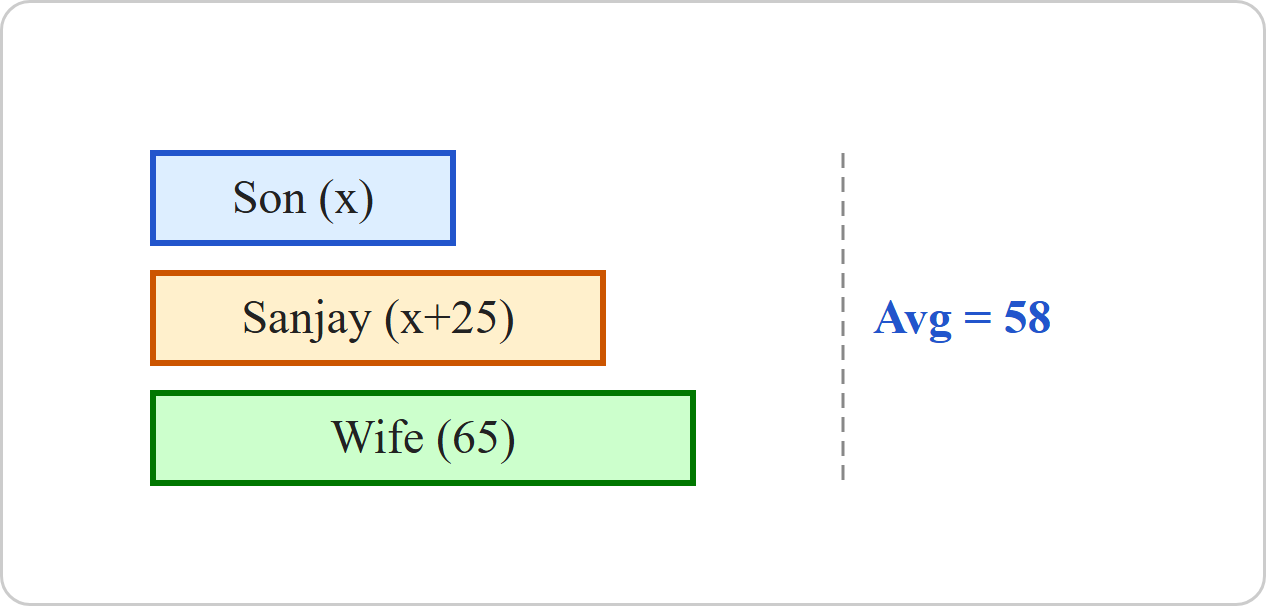
  • The equation for the relationship between voltage and current is, V=IR

It can be rewritten as, I=V/R

The voltages across individual resistors will be, I1 = V/R1, I2 = V/R2, I3 = V/R3

The sum of the current flowing through each resistance will be, I= I1+I2+I3

By substituting individual voltages for the expressions, I = V/R1 + V/R2 + V/R3

Let the equivalent capacitance be R, V/R = V/R1 +V/R2 + V/R3

  • The relation becomes, when the above equation is simplified.

1/R= 1/R1+ 1/R2+ 1/R<sub>3​**</sub>**

Additional Information

  • Calculations
  • Two resistors, A=10 Ω and B=20 Ω, are connected in parallel

Voltage= 6V

We know, V=IR, I=V/R

I1= 6/10= 3/5= 0.6A

I2= 6/20= 3/10= 0.3A

70

Harish bought an article for Rs. 520 and sold it to Renu at a loss of 30%. With this amount, Harish bought another article and sold it at a gain of 55%. What is Harish's overall gain percentage?

  1. ((a))

    9.5%

  2. ((b))

    8.5%

  3. ((c))

    9%

  4. ((d))

    7.8%

Show Answer
Answer: ((b))

8.5%

Shortcut Trick

Net gain or loss percentage can be calculated using the successive percentage change formula: a + b + (ab ÷ 100).

Here, first change (loss) a = −30% and second change (gain) b = +55%.

Net change = −30 + 55 + [(−30 × 55) ÷ 100] = 25 − (1650 ÷ 100) = 25 − 16.5 = 8.5%.

Since the result is positive, it represents an overall gain.

∴ The correct answer is 8.5%.

Alternate Method

Given → Initial CP = Rs. 520, First Loss = 30%, Second Gain = 55%. Formulas: SP = CP × (100 ± P/L%) ÷ 100 | Overall Gain% = [(Final SP − Initial CP) ÷ Initial CP] × 100.

SP of first article (Amount with Harish) = 520 × (100 − 30) ÷ 100 = 520 × 0.7 = Rs. 364.

SP of second article = 364 × (100 + 55) ÷ 100 = 364 × 1.55 = Rs. 564.2.

Overall Gain = Final SP − Initial CP = 564.2 − 520 = Rs. 44.2.

Overall Gain Percentage = (44.2 ÷ 520) × 100 = 8.5%.

∴ The correct answer is 8.5%.

Additional Information

Successive Percentage Change

When a value is changed by x% and then the resulting value is changed by y%, the net change is given by [x + y + (xy ÷ 100)]%.

Independent of Initial Value

In problems asking for net percentage change where the entire proceeds of one transaction are used for the next, the initial amount (Rs. 520) does not affect the final percentage result.

71

The value of 84 - 4 ÷ 2 × 3 + 7 is:

  1. ((a))

    173

  2. ((b))

    127

  3. ((c))

    97

  4. ((d))

    85

Show Answer
Answer: ((d))

85

Formula used:

BODMAS 

BBracket(),{},[]
OOfOf
DDivision÷
MMultiplication×
AAddition+
SSubtraction-

Calculation:

84 - 4 ÷ 2 × 3 + 7 

⇒ 84 - 2 × 3 + 7 

⇒ 91 - 6 = 85  

Hence, the required value is 85.

72

In which state is the five day religious festival of 'Shad Nongkrem' celebrated?

  1. ((a))

    Andhra Pradesh

  2. ((b))

    Meghalaya

  3. ((c))

    Uttar Pradesh

  4. ((d))

    Tripura

Show Answer
Answer: ((b))

Meghalaya

The correct answer is Meghalaya.

Key Points

  • Shad Nongkrem
  • In the fall, Smit, the Khasi Hills' cultural hub, hosts the Nongkrem dance festival. Ka Pomblang Nongkrem Dance, also known as Nongkrem Dance, is a five-day Khasi religious celebration.
  • The Nongkrem Dance Festival, like all other festivals in Meghalaya, is held in order to please the all-powerful Goddess Ka Blei Synshar in exchange for a bountiful harvest and the prosperity of the populace.
  • The Pomblang ceremony is performed as part of the Nongkrem Dance Festival rituals by the high priest and the Syiem of Khyrim. By sacrificing a cock, he makes an offering to a Lei Shyllong, the god of the Shyllong peak. Pomblang is a significant component of this festival (sacrifice of goats). Offerings are then made to the first uncle, the deity of Shillong Peak, and the ancestor and ancestress of the ruling clan.
  • The Nongkrem Dance Festival's Activities Before the dances, which include unmarried girls dressed in all kinds of exotic costumes, the celebration has a religious component. Naturally, the dancing of the men is more active and enthusiastic. They typically hold a white Yak hair whisk in their left hand and a sword in their right hand, maintaining time to the music,  keeping time to the changing beats of drums and playing of the tangmuri or pipes.

Additional Information

  • Other festivals of Meghalaya-
  • Suk Mynsiem Shad- April is Shad Suk Mynsiem celebration month. Individual familial clans or the Khasi state are in charge of conducting the rites or ceremonies (Hima). The matrilineal and patrilineal structures of Khasi society are represented by the dance.
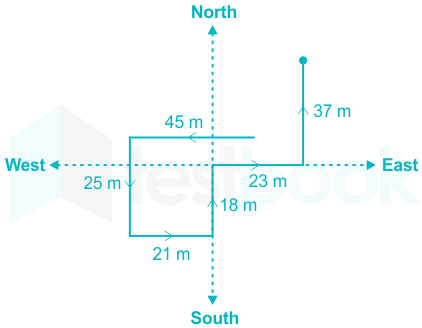
  • Festival of Behdeinkhlam-The Behdeinkhlam Festival is one of the Jaintia people's most significant holidays. The followers of the Niamtre faith commemorate it. It is observed in July, just before the planting season.
  • Shad Sukra-Every year in the months of April or May, the Jaintia people celebrate the Shad Sukra. It serves as a celebration of the beginning of the sowing season. Each and every Jaintia farmer looks forward to this celebration before he can start planting seeds.
  • Festival of Wangala-One of the most significant events for the Garo people is the Wangala festival. It is a post-harvest festival held to commemorate the end of the farming season. It is an occasion to give thanks to Misi-A-Gilpa-Saljong-Galapa, a fertility deity.
  • Festival of strawberries- Every year, Meghalaya hosts the Strawberry Festival to support local farmers and the harvest of the fruit for food. The state's environment is ideal for growing the beloved fruit. People swarm Umsning and Sohliya village in Ri-Bhoi district every February on Valentine's Day to enjoy lush and sweet strawberries.
73

If a : b = 7 : 9 and b : c = 15 : 7, then a : b : c is:

  1. ((a))

    21 : 35 : 45

  2. ((b))

    35 : 45 : 21

  3. ((c))

    45 : 35 : 21

  4. ((d))

    35 : 45 : 25

Show Answer
Answer: ((b))

35 : 45 : 21

Shortcut Trick

Equate the common term b by finding the LCM of 9 and 15, which is 45.

Multiply the first ratio (7 : 9) by 5 and the second ratio (15 : 7) by 3.

a : b = 35 : 45 and b : c = 45 : 21.

∴ The correct answer is 35 : 45 : 21.

Alternate Method

Given:

a : b = 7 : 9

b : c = 15 : 7

To combine the ratios, we make the value of b equal in both ratios.

⇒ a/b = 7/9 and b/c = 15/7

⇒ To make b common, multiply a/b by 15/15 and b/c by 9/9 (or use LCM 45).

⇒ a : b = (7 × 5) : (9 × 5) = 35 : 45

⇒ b : c = (15 × 3) : (7 × 3) = 45 : 21

⇒ a : b : c = 35 : 45 : 21

∴ The correct answer is 35 : 45 : 21.

Additional Information

Compounded Ratio

For two ratios a : b and c : d, the compounded ratio is (a × c) : (b × d).

Mean Proportion

The mean proportion between two numbers a and b is √(a × b).

Third Proportion

The third proportion of a and b is calculated as b2/a.

74

Arun was performing an experiment in the laboratory. He took a solution of ferric chloride and added some smaller pieces of zinc. When the yellow colour of ferric chloride disappeared, which compound was formed?

  1. ((a))

    ZnCl2

  2. ((b))

    Fe(OH)3

  3. ((c))

    FeCl2

  4. ((d))

    Zn(OH)2

Show Answer
Answer: ((a))

ZnCl2

The correct answer is ZnCl2.

Key Points

  • ZnCl2
  • The chemical compound zinc chloride has the formula ZnCl2.
  • At this time, nine distinct crystalline forms of zinc chloride are known. The color of these ZnCl2 hydrates can be white or colorless. They are all highly water-soluble.
  • Zinc chloride has hygroscopic properties, which means that it draws in and holds water molecules from the environment. As a result, protecting zinc chloride from moisture is crucial.
  • ZnCl2(H2O)n, where n can be 1, 1.5, 2.5, 3, or 4, is the general formula for the five known hydrates of zinc chloride.
  • Solid ZnCl2 can have any one of the following crystal structures due to its polymorphism: orthorhombic, monoclinic, and tetragonal.
  • Displacement reaction
  • A displacement reaction occurs when one or more atoms in a molecule are displaced by another atom. For instance, when iron is added to a solution containing copper sulfate, the copper metal is displaced.
  • Chlorine takes the place of bromine in the sodium bromide solution when it is added as a gas or as a gas dissolved in water.
  • Chlorine replaces sodium bromide with bromine, causing the solutions to turn blue because chlorine is more reactive than bromine.
  • The displaced bromine is the brown color. The equation shows that the Cl and Br have moved from their original positions.
  • Reaction: Cl2(aq) + 2NaBr(aq) → 2NaCl(aq) + Br2(aq)​

Additional Information

  • **Fe (OH)**3
  • The chemical compound with the formula Fe(OH)3 is iron (III) hydroxide, which is made from hydrogen, iron, and oxygen.
  • The color of iron III hydroxides ranges from dark brown to black depending on how hydrated they are, how big and how small the particles are, and how they are shaped.
  • FeCl2​
  • Ferric chloride is a crystal with a dark color and an iron oxidation state of +3. Molysite and Iron (III) chloride are other names for it.
  • Molysite solution has a faint odor of hydrochloric acid (HCl) and is colorless to light brown. It damages most tissues and metals.
  • It is widely used for sewage treatment and water purification because it is not flammable.
  • **Zn (OH)**2​
  • Zn (OH)2 is the chemical formula for the inorganic compound zinc hydroxide. It naturally occurs in wulfingite, ashoverite, and sweetite, three rare minerals.
  • It is a hydroxide that is amphoteric. Both bases and acids react with zinc hydroxide. It dissolves in strong acid because it is an insoluble hydroxide.
75

Which of the following options is the closest approximate value which will come in place of question mark(?) in the following equation?

2.04 + 5.019 - 3.001 × 2.04 = ?

  1. ((a))

    1

  2. ((b))

    4

  3. ((c))

    5

  4. ((d))

    3

Show Answer
Answer: ((a))

1

Given:

2.04 + 5.019 - 3.001 × 2.04

Concept used: 

Follow the BODMAS rule according to the table given below:

Calculation:

⇒ 2.04 + 5.019 - 3.001 × 2.04

Taking approximation:

⇒ 2 - 3 × 2 + 5

⇒ 7 - 6

⇒ 1

∴ 2.04 + 5.019 - 3.001 × 2.04 = 1

76

Which article of the Constitution of India says that 'No person shall be deprived of his life or personal liberty except according to procedure established by law'?

  1. ((a))

    Article 22

  2. ((b))

    Article 23

  3. ((c))

    Article 21

  4. ((d))

    Article 24

Show Answer
Answer: ((c))

Article 21

The correct answer is Article 21.

Key Points 

  • Article21
  • No one "shall be deprived of his life or personal liberty unless in accordance with a procedure established by law," according to Article 21. As a result, article 21 protects two rights: 1. The right to life, 2. The right to individual freedom.
  • The Indian Constitution's Article 21 was established by the Government of India Act, 1935. It states that no one may be robbed of their life or personal freedom until doing so in accordance with the legal process. One of the essential freedoms that all Indian citizens are entitled to is Article 21, which is found in Part III of the Indian Constitution. Several rights and liberties that are a part of Article 21 will be covered in this article.
  • Article 21A declares that the State shall provide free and compulsory education to all children of the age of six to fourteen years. It is added by the 86th Constitution Amendment Act, 2002.
  • The right to life in Article 21 of Indian constitution does not mean animal existence or the mere act of breathing. It guarantees the right to a dignified life.
  • History Judgements-
  • Kharak Singh vs. the State of UP and Others: Right to privacy was included in Article 21 by this case.
  • Sunil Batra vs. Delhi Administration: In this case, Supreme Court deemed the fatal handcuffs for the convicted persons as unconstitutional as it suggests inhuman behavior towards the prisoner. The court reiterated the clause “protection to the convicted and accused person” under Article 21.
  • Mohini Jain vs. the State of Karnataka, 1992 SC: The SC held that the Right to life also includes the Right to education.

Additional Information 

  • Article 21 of the Indian Constitution: Important Cases
  • 1951's A.K. Gopalan v. State of Madras In this case, the Supreme Court has applied a strict reading of Article 21. It was decided that only arbitrary executive activity is covered by Article 21's protection, not arbitrary legislative action. This indicates that a legislation may be used by the state to deny a person the rights guaranteed by Article 21.
77

Which of the following methods is a surgical method that is used to prevent sperm transfer from males?

  1. ((a))

    Condom is used

  2. ((b))

    Copper T is inserted

  3. ((c))

    Vas deferens is blocked

  4. ((d))

    Fallopian tubes are blocked

Show Answer
Answer: ((c))

Vas deferens is blocked

The correct answer is Vas deferens is blocked.

Key Points

  • Vas deferens
  • The main part of the male reproductive system is the vas deferens, which is also called the ductus deferens.
  • It is a muscular tube-like structure in the spermatic cord. The spermatozoa are transported from the epididymis to the ejaculatory ducts through this continuation of the epididymis.
  • In the spermatic cord, the vas deferens is a 45 cm-long structure that is located medially to the epididymis and posterior to the testis.
  • The ejaculatory duct is created when it joins forces with the duct of the seminal vesicle.

Additional Information

  • Condom
  • A condom is a barrier device with a sheath that is used during sexual activity to reduce the likelihood of pregnancy or an STI.
  • Condoms are available for both men and women. Women whose partners use male condoms have a 2% annual pregnancy rate when used correctly and at every interaction.
  • The annual rate of pregnancy with typical use is 18%. The risk of gonorrhea, chlamydia, trichomoniasis, hepatitis B, and HIV/AIDS is significantly reduced when they are used.
  • They also protect against syphilis, human papillomavirus (HPV), and genital herpes to varying degrees.
  • Copper T
  • Copper-containing intrauterine devices include the intrauterine coil and the intrauterine device (IUD) with copper. Copper T is the name given to its T-shaped design. Intrauterine devices prevent pregnancy by preventing sperm from reaching eggs and fertilizing them.

Copper T must be inserted by a trained medical professional. Do not attempt to insert yourself.

Within five days of unprotected sex, it is used for contraception and emergency contraception.

  • Fallopian tubes 
  • Through the uterotubal junction, the fallopian tube is a pair of thin tubes that connect the ovaries of female mammals to the uterus.
  • The fallopian tubes play a crucial role in the transportation of gametes, the process of fertilization, and the embryo's early development, all of which may be affected by a variety of factors that reduce fertility.
  • The hollow muscular structure known as the fallopian tube or uterine tube links the ovaries to the uterus.
78

Select the set in which the numbers are related in the same way as are the numbers of the following sets.

(NOTE: Operations should be performed on the whole numbers, without breaking down the numbers into its constituent digits. E.g. 13 - Operations on 13 such as adding/ deleting/ multiplying etc. to 13 can be performed. Breaking down 13 into 1 and 3 and then performing mathematical operations on 1 and 3 is not allowed)

(33, 56)

(44, 67)

  1. ((a))

    (11, 36)

  2. ((b))

    (12, 36)

  3. ((c))

    (7, 38)

  4. ((d))

    (5, 28)

Show Answer
Answer: ((d))

(5, 28)

The logic that followed here is shown below:

2nd number - 1st number = 23

(33, 56) ⇒ 56 - 33 = 23

(44, 67) ⇒ 67 - 44 = 23

By checking the options,

1.(11, 36) 

⇒36 - 11 = 25  23

2.(12, 36)

⇒36 - 12 = 24  23

3.(7, 38)

⇒38 - 7 = 31  23

4.(5, 28)

⇒28 - 5 = 23

Hence, the correct answer is option 4.

79

The power of a convex lens of focal length 20 cm is _______.

  1. ((a))

    5.0 D

  2. ((b))

    -0.05 D

  3. ((c))

    0.05 D

  4. ((d))

    -5.0 D

Show Answer
Answer: ((a))

5.0 D

The correct answer is 5.0 D

Key Points

  • Power of a convex lens
  • The power of a lens is its capacity to alter the light that enters it. Because a lens with a shorter focal length bends lights more, it has more power.
  • The light rays converge toward the principal axis in a convex lens, while the light rays diverge away from the principal axis in a concave lens.
  • Here, P=1/f
  • The inverse of a lens's focal length (f) in meters (m) is its power.
  • A lens's power is measured in m-1. Diopter is another name for this.

Additional Information

  • Calculations
  • Given, Convex lens

Focal Length, f = 20cm= 20/100=0.2m 

We know, P=1/f

So putting values in formula

P=1/0.2=10/2

P= 5.0D

80

If each vowel in the word RUBAL is changed to the next vowel in the English alphabetical order and each consonant is changed to the next letter in the English alphabetical order, which letter will be present in the newly formed word?

  1. ((a))

    R

  2. ((b))

    U

  3. ((c))

    A

  4. ((d))

    L

Show Answer
Answer: ((c))

A

When we change each vowel in the word RUBAL to the next vowel in the English alphabetical order and each consonant to the next letter in the English alphabetical order, we get:


The alphabet common in the new word and the options is A.

Hence the correct answer is option 3)

81

The following table shows the expenditures of a company (in Rs. lakh) per annum over the given years. Study the following table carefully and answer the question that follows.

YearItem of Expenditure
SalaryFuel and TransportBonusInterest on LoansTaxes
2016355563.534.275
2017285854.228.661
2018361724.029.483
2019310695.545.671
2020395765.138.298

Total expenditure on all items in 2018 was what percent of the total expenditure of all the items in 2020?

  1. ((a))

    89.93%

  2. ((b))

    88.63%

  3. ((c))

    87.93%

  4. ((d))

    89.73%

Show Answer
Answer: ((d))

89.73%

Calculation:

Total Expenditure of 2018 = 361 + 72 + 4.0 + 29.4 + 83 

⇒ 549.4

Total Expenditure of 2020 = 395 + 76 + 5.1 + 38.2 + 98

⇒ 612.3

Required percentage = 549.4612.3 \dfrac{549.4}{612.3}  x 100

⇒ 89.73%

∴ Total expenditure on all items in 2018 was 89.73 percent of the total expenditure of all the items in 2020.

82

A man has to cover a distance of 150 km in 12 hours. If he covers two-third of this distance in 58\frac{5}{8} of the time, then what should be his speed (in km/h, correct to one decimal place) to cover the remaining distance in the time left?

  1. ((a))

    6.7

  2. ((b))

    11.5

  3. ((c))

    11.1

  4. ((d))

    10.5

Show Answer
Answer: ((c))

11.1

Shortcut Trick

Remaining Distance = 1/3 × 150 = 50 km

Remaining Time = (1 − 5/8) × 12 = 3/8 × 12 = 4.5 hours

Required Speed = 50 ÷ 4.5 = 11.11... km/h

∴ The correct answer is 11.1 km/h.

Alternate Method

Given: Total Distance = 150 km, Total Time = 12 hours.

Formula Used: Speed = Distance ÷ Time

Calculations:

Distance covered = 150 × (2/3) = 100 km

Remaining Distance = 150 − 100 = 50 km

Time taken = 12 × (5/8) = 7.5 hours

Remaining Time = 12 − 7.5 = 4.5 hours

Required Speed = 50 ÷ 4.5

Required Speed = 11.11... km/h

∴ The correct answer is 11.1 km/h.

Additional Information

Average Speed

Average Speed = Total Distance ÷ Total Time. For two equal distances with speeds x and y, Average Speed = 2xy/(x+y).

Unit Conversion

To convert km/h to m/s, multiply by 5/18. To convert m/s to km/h, multiply by 18/5.

Relative Speed

In the same direction, relative speed is the difference (s1−s2). In opposite directions, it is the sum (s1+s2).

83

Which of the following organisms has a three chambered heart?

  1. ((a))

    Bird

  2. ((b))

    Frog

  3. ((c))

    Fish

  4. ((d))

    Man

Show Answer
Answer: ((b))

Frog

The correct answer is Frog.

Key Points

  • Three chambered heart
  • With the exception of crocodiles, the hearts of all reptiles have three chambers, with two auricles and one ventricle. Compared to fish, this type is more advanced, but not as advanced as mammals.
  • However, the ventricle is divided into two sub chambers by an incomplete partition. The right ventricle, also known as the Calum pulmonale, and the left ventricle, also known as the Calum venosum, are the two sub chambers.
  • A third sub chamber, the cavum arteriosum, is located toward the top of the ventricle. A valve connects it to the left ventricle.
  • Blood that has lost oxygen makes its way into the right atrium and into the right sub chamber of the ventricle. However, it also leaks into and fills the left ventricle as a result of incomplete separation.
  • After that, the blood ascends the ventricle and enters the lungs for oxygenation. This descends once more and clogs the third chamber, the cavum arteriosum, temporarily.
  • After that, the blood flows into the left ventricle, where it reaches the rest of the body.

Additional Information

  • Two chambered heart
  • The heart of some animals, like fish, only has two chambers. There is only one ventricle and one auricle in their heart.
  • The sinus venosus, which leads to the atrium, and the bulbus arteriosus, which follows the ventricle, are on their flanks.
  • The sinus venosus is where the deoxygenated blood enters the atrium. It enters the ventricle from here.
  • When the blood is pumped out of the ventricle, the pressure is much higher than that at the gills, which are the next place the blood goes.
  • Because of their thin walls, the gills run the risk of being damaged by high blood pressure. As a result, the blood pressure that comes out of the ventricle is adjusted by the bulbus arteriosus.
  • The blood's pressure must still be sufficient to circulate the fluid throughout the body, even though the decreased pressure may prevent damage to the lungs.
  • As a result, a fish's blood circulation relies on a delicate balance between low pressure for the gills and sufficient circulation. Fishes do not have double circulation, unlike humans.
84

Out of a few people who participated in a race, Sandeep ranked 17th from the top and 15th from the bottom. How many persons participated in the race?

  1. ((a))

    31

  2. ((b))

    29

  3. ((c))

    32

  4. ((d))

    30

Show Answer
Answer: ((a))

31

Formula used:

[(The rank from the top + The rank from the bottom) - 1] = Total no. of people

Given:

Sandeep's rank from the top = 17th

Sandeep's rank from the bottom = 15th

Total no. of persons participated = [(17 + 15) - 1] = 31

Total number of persons participated in the race is 31.

Hence, the correct answer is 31.

85

What will come in the place of the question mark(?) in the following equation if '+' and '-' are interchanged and also '×' and '÷' are interchanged?

28 - 168 × 4 + 10 ÷ 2 = ?

  1. ((a))

    50

  2. ((b))

    25

  3. ((c))

    40

  4. ((d))

    30

Show Answer
Answer: ((a))

50

The logic followed here is shown below:

By using the BODMAS rule, after interchanging the arithmetic operators,

⇒28 + 168 ÷- 10 × 2

⇒28 + 168 ÷ 4 - 10 × 2

⇒28 + 42 - 10 × 2

28 + 42 - 20

70 - 20

50

Hence, the correct answer is 50.

86

A man sold a shirt for Rs. 960, at a loss of 4%. He sells a sweater for Rs. 840 at a profit of 20%. Find his net profit or loss.

  1. ((a))

    Profit, Rs. 123

  2. ((b))

    Loss, Rs. 100

  3. ((c))

    Profit, Rs. 100

  4. ((d))

    Loss, Rs. 123

Show Answer
Answer: ((c))

Profit, Rs. 100

Shortcut Trick Total Selling Price (SP) = 960 + 840 = 1800. Cost Price (CP) of shirt = 960 ÷ 0.96 = 1000. Loss = 1000 − 960 = 40. CP of sweater = 840 ÷ 1.20 = 700. Profit = 840 − 700 = 140. Net Result = Profit − Loss = 140 − 40 = 100. Since the result is positive, it is a Profit of Rs. 100. ∴ The correct answer is Profit, Rs. 100.

Alternate Method Formulas: CP = SP × 100 ÷ (100 ± P/L%) | Profit = SP − CP | Loss = CP − SP

⇒ CP of Shirt = (960 × 100) ÷ (100 − 4) = 96000 ÷ 96 = Rs. 1000. ⇒ Loss on Shirt = 1000 − 960 = Rs. 40. ⇒ CP of Sweater = (840 × 100) ÷ (100 + 20) = 84000 ÷ 120 = Rs. 700. ⇒ Profit on Sweater = 840 − 700 = Rs. 140. ⇒ Net Profit/Loss = Total Profit − Total Loss = 140 − 40 = Rs. 100. ∴ The correct answer is Profit, Rs. 100.

Additional Information Cost Price and Selling Price Relation If SP > CP, it is a profit. If CP > SP, it is a loss. Net profit or loss is the algebraic sum of individual profits and losses. Percentage Calculations Always calculate profit or loss percentage on the Cost Price unless otherwise stated in the problem.

87

The surface area of a cuboid having length 6 cm, breadth 7 cm and height 8 cm is:

  1. ((a))

    292 cm2

  2. ((b))

    392 cm2

  3. ((c))

    592 cm2

  4. ((d))

    492 cm2

Show Answer
Answer: ((a))

292 cm2

Shortcut Trick

Total Surface Area = 2 × (lb + bh + hl)

Area = 2 × (6 × 7 + 7 × 8 + 8 × 6)

Area = 2 × (42 + 56 + 48) = 2 × 146

Area = 292 cm2

∴ The correct answer is 292 cm2.

Alternate Method

Given:

Length (l) = 6 cm, Breadth (b) = 7 cm, Height (h) = 8 cm

Formula Used:

Total Surface Area of Cuboid = 2(lb + bh + hl)

l = 6 cm h = 8 cm b = 7 cm Cuboid

⇒ Surface Area = 2(6 × 7 + 7 × 8 + 8 × 6)

⇒ Surface Area = 2(42 + 56 + 48)

⇒ Surface Area = 2(146)

⇒ Surface Area = 292 cm2

∴ The correct answer is 292 cm2.

Additional Information

Volume of a Cuboid

The total space occupied by the cuboid is given by the product of its dimensions: Volume = l × b × h.

Lateral Surface Area

The area of the four vertical faces (excluding top and bottom) is calculated as: LSA = 2h(l + b).

Diagonal of a Cuboid

The length of the longest rod that can be placed inside a cuboid is: Diagonal = √(l2 + b2 + h2).

88

This question is based on the following 3-letter words

(left) BOW SAD LOW RAY (right)

If in each of the words, each letter is changed to the next letter in the English alphabetical order, how many words thus formed will have no vowel?

  1. ((a))

    Three

  2. ((b))

    One

  3. ((c))

    Two

  4. ((d))

    None

Show Answer
Answer: ((a))

Three

The position of the letters according to the English alphabet series:

Given:

(left) BOW SAD LOW RAY (right)

Each letter is changed to the next letter in the English alphabetical order.

After the new letters were formed, the underlined words that formed had no vowels.

Hence, the correct answer is option 1.

89

Three statements are followed by three conclusions numbered I, II and III. Assuming the statements to be true, even if they do not conform to real world knowledge, decide which of the given conclusions/possibilities can be true on the basis of the statements.

Statements:

  1. All pots are sands.
  2. Some sands are clays.
  3. All greys are clays.

Conclusions:

I. Some greys are pots.

II. All clays are sands is a possibility.

III. Some clay are pots.

  1. ((a))

    Only conclusion III is true

  2. ((b))

    Only conclusion I is true

  3. ((c))

    Only conclusion I and II are true

  4. ((d))

    Only conclusion II is true

Show Answer
Answer: ((d))

Only conclusion II is true

Statements:

  1. All pots are sands.
  2. Some sands are clays.
  3. All greys are clays.

Venn Diagram:

Conclusions:

I. Some greys are pots. ⇒ False (From diagram Some greys are pots can be true but not definite)

II. All clays are sands is a possibility. ⇒ True (As All clays are sands  is possible, so the conclusion is definitely true)

III. Some clay are pots. ⇒ False (From diagram Some clay are pots can be true but not definite)

Hence, the correct answer is option 4.

90

Which of the following is NOT an example of 'fiat' money in India?

  1. ((a))

    Rs. 1,000 cheque

  2. ((b))

    Rs. 500 note

  3. ((c))

    Rs. 1 coin

  4. ((d))

    Rs. 100 note

Show Answer
Answer: ((a))

Rs. 1,000 cheque

The correct answer is Rs. 1000 cheque.

  • Fiat money 
  • Government-issued currency known as "fiat money" is not backed by a physical good like gold. Because they can manage the amount of money printed, central banks using fiat money have more power over the economy. The majority of contemporary paper currencies, including the dollar, are fiat currencies.
  • Fiat money, which was introduced as a replacement for representational money and commodity money, has a value based on supply and demand.
  • Commodity money is created from precious metals such as gold and silver, while representative money represents a claim on a commodity that can be redeemed.
  • Around the year 1000 AD, China became the first nation to employ fiat money, after which other nations began to use it as well. As a result of President Richard Nixon's law repealing the direct convertibility of the US dollar into gold, it gained popularity in the 20th century. The majority of countries currently employ paper-based fiat currencies that only serve as a mode of payment.
  • History of Fiat Money
  • In the 10th century, mostly under the Yuan, Tang, Song, and Ming dynasties, China is where fiat money first appeared. Metal money was in great demand during the Tang Dynasty (618–907) and was harder to come by than precious metals. The populace was accustomed to using credit notes, and paper or paper draughts were commonly accepted.
  • People were obliged to switch from coins to notes due to a coin shortage. The Sichuan province experienced a boom in trade during the Song Dynasty (960–1276), which resulted in a dearth of copper coins. Private notes backed by a monetary reserve were originally recognised as legal money when traders began issuing them. The only legal tender in the became paper money Yuan Dynasty (1276-1367), and issuing of notes was conferred to the Ministry of Finance during the Ming Dynasty (1368-1644).
  • According to the Bretton Woods Agreement, a troy ounce of gold is worth 35 US dollars. However, due to diminishing gold reserves, US President Richard Nixon implemented a number of economic measures in 1971, including ending the direct conversion of US dollars into gold. Since then, the majority of nations have adopted fiat currencies that can be exchanged for other significant currencies.

Additional Information

  • Advantages and disadvantages of Fiat Money-
  • In the 20th century, governments and banks intervened to shield their economies from the recurrent business cycle busts, which led to the widespread usage of fiat money.

Disadvantage- Currency based on commodities was unstable because of the regular business cycle and cyclical recessions. The central banks have more control over the money supply, interest rates, and liquidity since they can produce or hold paper money as needed. For instance, the Federal Reserve was able to handle the World Banking Crisis of 2008 to prevent more damage to the U.S. financial system and the global economy because to its control over the money supply and demand.

Advantage- The global financial crisis disproved the notion that fiat money is a more stable currency that can protect against recessions. Regardless of the Federal Reserve controls the money supply, it was not able to prevent the crisis from happening. Critics of fiat money argue that the limited supply of gold makes it a more stable currency than fiat money, which has an unlimited supply.

91

Select the term from among the given options that can replace the question mark (?) in the following series.

ABCD, ABCD1, ABC1D1, AB1C1D1, A1B1C1D1, A1B1C1D2, ?

  1. ((a))

    A1B1C2D22

  2. ((b))

    A1B1C2D11

  3. ((c))

    A1B1C2D2

  4. ((d))

    A1B1C2D12

Show Answer
Answer: ((c))

A1B1C2D2

The pattern followed in the given series is:

    A number is added after the alphabets in the reverse order and after the numbers are placed the number is increased by 1.


Hence the correct answer is option 3)

92

The value of 20+20tan2A50+50cot2A\frac{20 + 20 \tan^2A}{50 + 50 \cot^2A} is:

  1. ((a))

    25cot2A\frac{2}{5}\cot^2A

  2. ((b))

    52tan2A\frac{5}{2}\tan^2A

  3. ((c))

    52cot2A\frac{5}{2}\cot^2A

  4. ((d))

    25tan2A\frac{2}{5}\tan^2A

Show Answer
Answer: ((d))

25tan2A\frac{2}{5}\tan^2A

Shortcut Trick

Take common factors: (20(1 + tan2A)) ÷ (50(1 + cot2A))

Use identities: 1 + tan2A = sec2A and 1 + cot2A = cosec2A

Expression becomes (2/5) × (sec2A / cosec2A) = (2/5) × tan2A

∴ The correct answer is (2/5)tan2A.

Alternate Method

Given: Expression (20 + 20 tan2A) ÷ (50 + 50 cot2A)

Formula Used: 1 + tan2A = sec2A; 1 + cot2A = cosec2A; tan A = sin A/cos A

⇒ [20(1 + tan2A)] ÷ [50(1 + cot2A)]

⇒ (20 × sec2A) ÷ (50 × cosec2A)

⇒ (2/5) × (1/cos2A) ÷ (1/sin2A)

⇒ (2/5) × (sin2A / cos2A)

⇒ (2/5)tan2A

∴ The correct answer is (2/5)tan2A.

Additional Information

Trigonometric Pythagorean Identities

Fundamental relations: sin2A + cos2A = 1, sec2A − tan2A = 1, and cosec2A − cot2A = 1.

Reciprocal Relations

sec A = 1/cos A, cosec A = 1/sin A, and tan A = sin A / cos A = 1/cot A.

93

Which of the following has NO effect on the resistance of a conductor?

  1. ((a))

    Thickness

  2. ((b))

    Shape

  3. ((c))

    Length

  4. ((d))

    Temperature

Show Answer
Answer: ((b))

Shape

The correct answer is Shape.

Key Points

  • Factors Affecting Electrical Resistance
  • The following factors influence a conductor's electrical resistance:
  • The cross-sectional area of the conductor
  • Length of the conductor
  • The material of the conductor
  • The temperature of the conducting material
  • Electrical resistance is inversely proportional to the conductor's cross-sectional area (A) and directly proportional to its length (L). The relationship that follows provides it.
  • R=  ρL/A, where ρ is the material's resistivity, expressed as m/ohm meter.

Additional Information

  • Resistivity
  • At a particular temperature, the electrical resistivity, which is denoted by ρ, is defined as the electrical resistance offered per unit length and unit cross-sectional area.
  • Specific electrical resistance is another term for electrical resistance. Electrical resistivity is measured in m by the SI.
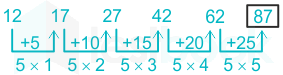
  • The ability of a material to resist the flow of an electric current is measured qualitatively by its resistivity. It goes without saying that the resistivity of insulators will be higher than that of conductors.
  • The resistivities of a few different materials are compared below. Materials with a low resistivity are excellent conductors of electricity.
  • Silver – 1.00×10⁻⁸
  • Copper – 1.68×10⁻⁸
  • Aluminum – 2.82×10⁻⁸
  • Wood – 1.00×10¹⁴
  • Air – 2.30×10¹⁶
  • Teflon – 1.00×10²³
94

Some reasons for conserving coal and petroleum are given below. Select the INCORRECT option.

  1. ((a))

    Saves money of citizens

  2. ((b))

    Decreases the effect of climate change

  3. ((c))

    Increases air pollution even upon judicious usage

  4. ((d))

    No acidification of oceans death of aquatic animals

Show Answer
Answer: ((c))

Increases air pollution even upon judicious usage

The correct answer is Increases air pollution even upon judicious usage.
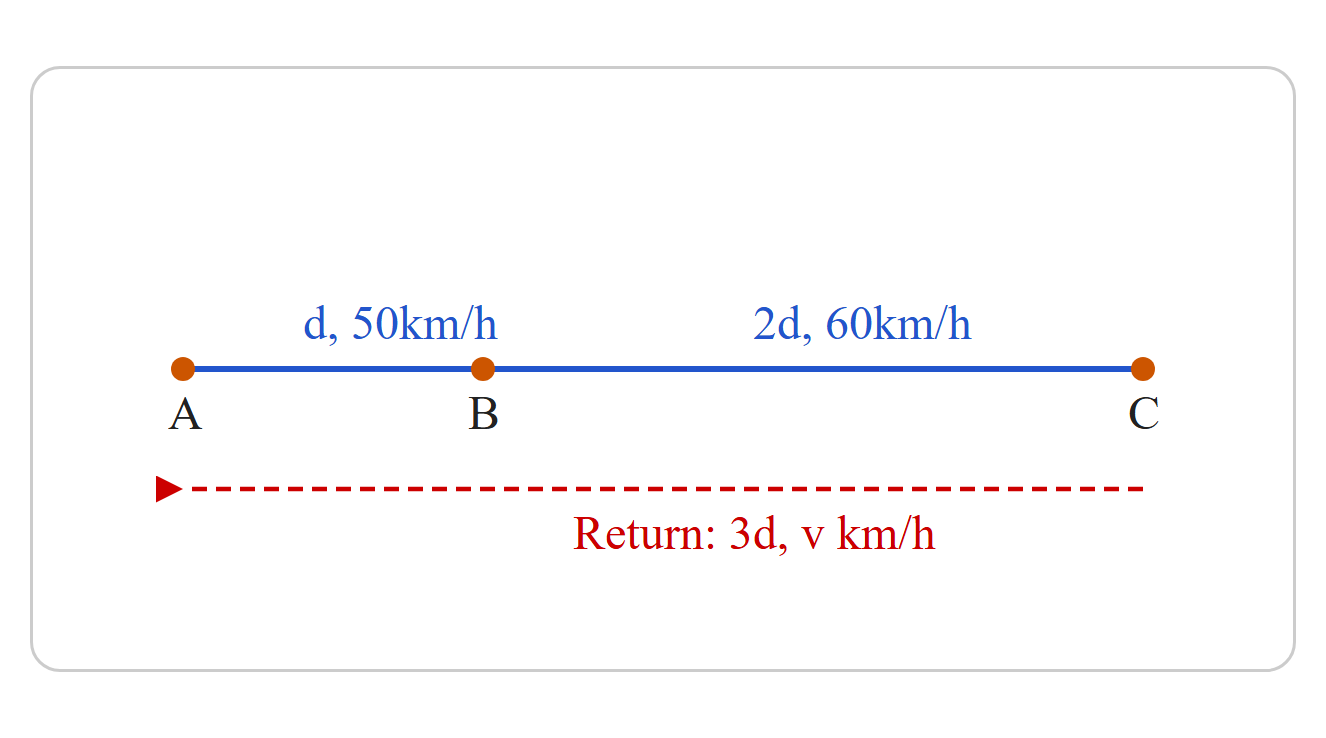
Key Points

  • Energy sources that are not renewable are fossil fuels (which are present in a limited quantity).
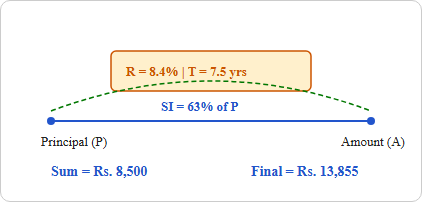
  • If they are not used wisely, they are exhaustible and won't last for very long.
  • Fossil fuels are continually created by natural processes, but because they take millions of years to generate, they are regarded as non-renewable resources.
  • Fossil fuels were created from the rotting remains of terrestrial and marine flora and fauna that were buried in strata under extreme pressure and heat millions of years ago. These sources are to blame for environmental contamination because carbon is the primary component of fossil fuels like coal and petroleum.
  • Coal
  • Coal is a fuel that resembles a black rock and contains between 70 and 90 percent carbon.
  • It is created when plant deteriorates under intense heat and pressure. The period of time when this process occurs is known as the carboniferous age, and the process of coal creation is known as carbonisation. One of the most significant fossil fuels utilised to produce power is coal. Mining techniques such as surface mining or underground mining are used to remove coal from the earth.
  • To obtain energy, we burn coal. In rural areas, coal is mostly utilised as a home fuel to prepare meals. When coal is burned, toxic smoke is released. When subterranean plants is exposed to extremes of heat and pressure, coal is created.
  • The formation of coal takes place in four stages which are peat, lignite, bituminous, and anthracite. Coal mainly contains carbon, hydrogen, and oxygen.
  • Types of coal
  • Lignite- In terms of carbon concentration, lignite is the lowest rank of coal (60–70% carbon). The youngest kind of coal deposit is this one. It is silky and comes in a variety of colours, from black to brown. As a result, brown coal is another name for lignite coal. Due to the higher handling and storage stability of other forms of coal, lignite is not widely used. Synthetic natural gas, power, and fertiliser products like anhydrous ammonia and ammonium sulphate are all produced using lignite.
  • Sub-bituminous- When lignite is exposed to high temperatures and pressure for millions of years, the amount of oxygen and hydrogen decreases while the amount of carbon rises to 75%. Burning coal of this kind cleaner than the lignite variety, producing less greenhouse gas emissions. Sub-bituminous coal is also used in electricity generation and in industrial processes.
  • Bituminous-Sub-bituminous coal is less dense and less black than bituminous coal. It contains bitumen, a material like tar. Its name is bituminous as a result. It can contain up to 85% carbon. The majority of the coal industry is made up of it. In addition to being used to generate energy, bituminous coal is also utilised to heat homes. In addition, it is employed in the production of cement and other industrial processes.
  • Anthracite -Anthracite has the highest carbon content (more than 85%), making it the best type of coal or most mature coal resource. Greater difficulty than bitumen. It serves as a source of energy. It burns in furnaces as a smokeless fuel.
  • Petroleum 
  • Petroleum is a liquid fossil fuel with a dark colour that is made up of different types of hydrocarbons. It has a high viscosity. It is a very practical form of energy. However, the petroleum recovered from oil wells is not in a form that can be used immediately**. Because it is impure, it is referred to as crude oil.**
  • This crude oil is refined via a procedure called fractional distillation, in which different hydrocarbons separate to form different fractions. Some of its fractions include diesel, gasoline, kerosene, and paraffin. Vehicles run on gasoline as fuel. The fractions produced by refining crude oil are used to make a number of goods, including plastics, tyres, and synthetic materials like polyester, in addition to being utilised for transportation. It provides consistent and portable energy.

Additional Information  

  • Conservation of petroleum and coal- Coal and petroleum are finite energy sources, as we all know. They won't last for more than a few decades if they aren't utilised carefully. It is vital to consider their conservation because they are employed as major energy sources all over the world. The process of conserving a resource entails utilising it more sparingly in order to extend its useful life. By using alternative or renewable energy sources, such as hydropower, wind power, geothermal power, tidal power, etc., we may save coal and petroleum. The replacements for fossil fuels like coal and petroleum will provide us more in the future.
95

If α and β, where α > β, are the roots of the equation 5x2 - 3x - 2 = 0, then what is the value of (α - 2β)?

  1. ((a))

    115\frac{11}{5}

  2. ((b))

    95\frac{9}{5}

  3. ((c))

    75\frac{7}{5}

  4. ((d))

    15\frac{1}{5}

Show Answer
Answer: ((b))

95\frac{9}{5}

Shortcut Trick For the equation 5x2 − 3x − 2 = 0, find roots by spliting the middle term: −5 and +2. Dividing by the coefficient of x2 and changing signs, roots are: 1 and −2/5. Since α > β, we have α = 1 and β = −2/5. Required value = α − 2β = 1 − 2(−2/5) = 1 + 4/5 = 9/5. ∴ The correct answer is 9/5.

Alternate Method Given: Quadratic equation 5x2 − 3x − 2 = 0 and α > β. Formula Used: Quadratic formula x = (−b ± √(b2 − 4ac)) ÷ 2a ⇒ a = 5, b = −3, c = −2 ⇒ Discriminant (D) = b2 − 4ac = (−3)2 − 4 × 5 × (−2) ⇒ D = 9 + 40 = 49 ⇒ x = (3 ± √49) ÷ (2 × 5) ⇒ x = (3 ± 7) ÷ 10 ⇒ x1 = (3 + 7) ÷ 10 = 1 ⇒ x2 = (3 − 7) ÷ 10 = −4/10 = −2/5 ⇒ Since α > β, α = 1 and β = −2/5 ⇒ α − 2β = 1 − 2 × (−2/5) ⇒ α − 2β = 1 + 4/5 = 9/5 ∴ The correct answer is 9/5.

Additional Information Sum and Product of Roots For ax2 + bx + c = 0, sum of roots (α + β) = −b/a and product of roots (αβ) = c/a. Nature of Roots If D = b2 − 4ac > 0, roots are real and distinct; if D = 0, roots are real and equal; if D < 0, roots are imaginary. Root Relationship Formula The difference of roots |α − β| can be calculated directly as √D ÷ |a|.

96

Select the number from among the given options that can replace the question mark (?) in the following series.

2, 8, 4, 16, 8, 32, ?, 64

  1. ((a))

    48

  2. ((b))

    32

  3. ((c))

    16

  4. ((d))

    96

Show Answer
Answer: ((c))

16

The logic followed here is as follows:

Hence, the correct answer is 16.

97

River _______ flows through the Malwa Plateau.

  1. ((a))

    Rangeet

  2. ((b))

    Bhima

  3. ((c))

    Godavari

  4. ((d))

    Betwa

Show Answer
Answer: ((d))

Betwa

The correct answer is Betwa.

Key Points

  • Betwa river
  • ​​Northern India's Betwa River, also known as Vetravati (Sanskrit for "Containing Reeds"), rises in the Vindhya Range just to the north of Hoshangabad, Madhya Pradesh. After travelling 380 miles (610 km) across the states of Uttar Pradesh and Madhya Pradesh, it drains into the Yamuna River just east of Hamirpur. Before entering the Bundelkhand highland, about half of its impassable path crosses the Malwa Plateau. The principal tributaries are the Jamni and Dhasan rivers. Both Dukwan and Deogarh have dammed the Betwa.
  • The river has been mentioned in many of the old texts like the epic Mahabharta as Vetravati and Shuktimati.  Some even say that the poets Kalidas and Ban Bhatt wrote their great works Meghdoot and Kadambari respectively, sitting on the banks of this river. The river was worshipped and the capital of Chedi Kingdom was built on its bank.
  • Malwa plateau
  • Indian plateau region known as the Malwa Plateau. It is bordered to the north by the Madhya Bharat Plateau and Bundelkhand Upland, to the east and south by the Vindhya Range, and to the west by the Gujarat Plains. The plateau, which is of volcanic origin, spans southeast Rajasthan state and central Madhya Pradesh state. The Sanskrit word malav is where the name Malwa comes from (part of the abode of Laksmi [goddess of wealth]). The Maurya, Gupta, and Paramara empires alternately dominated the plateau; during this time, numerous Buddhist temples and monuments (such as the stupas at Sanchi), known for their architecture and sculpture, were also constructed. In 1390 CE, the Muslims took control of the plateau, which then belonged to the Maratha empire. It was given to the British in 1817.
  • The Malwa Plateau has an elevation range of 500 to 600 metres (about 1,650 to 2,000 feet). Sandstone hills and solitary mesas, as well as remnants of old lava flows, may be seen scattered throughout the plateau. The Mahi River drains the western portion of the area, the Chambal River the middle, and the Betwa River and the headwaters of the Dhasan and Ken rivers the eastern portion. Additionally, there are the Parbati, Sipra, Gambhir, and Choti Kali Sindh rivers, all of whose valleys are bordered by terraced hills. Savanna-style vegetation is present, with sporadic teak and sal (Shorea robusta) woods.

Additional Information

RiverDescription
Rangeet riverThe Teesta river, the major river in the Indian state of Sikkim, has the Rangeet or Rangit as a tributary. The Rangeet River has its beginnings in the West Sikkim district of the Himalayan Himalayas. The river also divides the districts of Sikkim and Darjeeling.
Bhima riverA significant river in both South and Western India is the Bhima River. It travels 861 kilometres across the states of Maharashtra, Karnataka, and Telangana before emptying into the Krishna River.
Godavari riverAfter the Ganga, the Godavari is the second-longest river in India. It empties into the third-largest basin, which makes up 10% of India's entire land area. Trimbakeshwar, in Nashik, Maharashtra, is where it originates.
98

If 1.6 : 0.6 :: 0.6 : x, find the value of x.

  1. ((a))

    0.98

  2. ((b))

    0.225

  3. ((c))

    0.275

  4. ((d))

    0.25

Show Answer
Answer: ((b))

0.225

Shortcut Trick

In a continued proportion a : b :: b : x, the third proportional x = b2 ÷ a.

Here, a = 1.6 and b = 0.6.

x = (0.6 × 0.6) ÷ 1.6 = 0.36 ÷ 1.6

x = 36 ÷ 160 = 9 ÷ 40 = 0.225

∴ The correct answer is 0.225.

Alternate Method

Given: 1.6 : 0.6 :: 0.6 : x

Formula Used: Product of Extremes = Product of Means

⇒ 1.6 × x = 0.6 × 0.6

⇒ 1.6x = 0.36

⇒ x = 0.36 ÷ 1.6

⇒ x = 36 ÷ 160

⇒ x = 0.225

∴ The correct answer is 0.225.

Additional Information

Fourth Proportional

For four numbers a, b, c, and d in proportion (a:b :: c:d), the fourth proportional d = (b × c) ÷ a.

Mean Proportional

The mean proportional between two numbers a and b is given by √(a × b).

Continued Proportion

Three numbers a, b, c are in continued proportion if a:b = b:c, which implies b2 = ac.

99

In India, _______ is/are governed by the provisions of Section 29A of the Representation of the People Act, 1951.

  1. ((a))

    withdrawal of candidature

  2. ((b))

    appointment of dates for nominations, etc.

  3. ((c))

    general duties of chief electoral officers

  4. ((d))

    registration of political parties

Show Answer
Answer: ((d))

registration of political parties

The correct answer is Registration of Political Parties.

Key Points

  • Section 29A- Registration of organisations and groups as political parties with the Election Commission (29A).
  • (1) To take advantage of the provisions of this Part, any association or group of Indian nationals identifying themselves as political parties must apply to the Election Commission for registration as such for the purposes of this Act.
  • (2) Each such application must be submitted,—(a) if the association or body was already in existence at the time the Representation of the People (Amendment) Act, 1988 (1 of 1989) went into effect, within sixty days after that date; (b) if the association or body was created after that date, within thirty days after that date.
  • (3) The top executive officer of the association or body, whether referred to as the Secretary or by any other title, must sign each application made pursuant to subsection (1) and present it in person or send it by registered mail to the Secretary of the Commission.
  • (4) Each of these applications must include the information listed below: (a) the name of the organisation or body; the name of its president, secretary, treasurer, and other office-holders; (b) the State in which its head office is located; (c) the address to which letters and other communications meant for it should be sent; (d) the number of its members, and if there are categories of its members, the number of members in each category; (f) whether it has any local units; if so, at what levels;

(g) whether it is represented by any member or members in either House of Parliament or of any State Legislature; if so, the number of such member or members.

  • (5) The application under subsection (1) shall be accompanied by a copy of the memorandum or rules and regulations of the association or body, by whatever name called, and such memorandum or rules and regulations shall specifically state that the association or body shall bear true faith and allegiance to the Constitution of India as established by law, to the principles of socialism, secularism, and democracy, and would uphold the sovereignty, unity, and inviolability of the country.
  • (6) The Commission may request from the association or entity any additional information it deems appropriate.
  • (7) The Commission shall decide whether to register the association or body as a political party for the purposes of this Part after taking into account all the aforementioned details in its possession and any other necessary and relevant factors, and after affording the representatives of the association or body a reasonable opportunity to be heard. The Commission shall communicate its decision to the association or body (5).
  • (8) The Commission's judgement is conclusive.
  • (9) Following the registration of an organisation or body as a political party as aforesaid, any change in its name, head office, office-bearers, address or in any other material matters shall be communicated to the Commission without delay.

Additional Information

  • Can the Election Commission deregister political parties?

The Constitution or the undertaking made to it at the time of registration cannot be used as grounds for the ECI to deregister parties. A party may only be declared unlawful by the Central Government, if its registration was gained fraudulently, if it alters its internal constitution and notifies the ECI that it can no longer adhere to the Indian Constitution, or if it was fraudulently registered.

100

As of July 2022, under the National Pension Scheme for Traders and Self-employed Persons, beneficiaries are entitled to receive minimum monthly assured pension of how much after attaining the age of 60 years?

  1. ((a))

    Rs. 4,500

  2. ((b))

    Rs. 3,000

  3. ((c))

    Rs. 5,000

  4. ((d))

    Rs. 2,500

Show Answer
Answer: ((b))

Rs. 3,000

The correct answer is Rs. 3000.

Key Points

  • NPS for traders and self employed persons.
  • ​In 2019, the Modi administration introduced the National Pension Scheme (NPS) for independent contractors and traders. These people, whose annual turnover is Rs 1.5 crore or less, can ensure their future with the NPS scheme.
  • The programme is designed to provide social security and old age protection for independent contractors, business owners, and retail traders. These retail traders, shopkeepers, oil mill owners, workshop owners, commission agents, real estate brokers, owners of small hotels, restaurants, and other Laghu Vyaparis are the main occupations of these self-employed individuals and retail traders.
  • A minimum assured income of Rs. 3000 per month is provided under this voluntary and contributory pension plan for members who reach the age of 60.  If the subscriber dies, the spouse of the beneficiary shall be entitled to receive 50 per cent of the pension as family pension. The family pension is applicable only to spouse.

Additional Information

  • Eligibility requirements- The following are the requirements to be eligible for the NPS programme:
    1. The person must be a retail trader, store owner, or self-employed
    1. The applicant's entering age must be between 18 and 40 years old.
    1. The traders' or self-employed individuals' yearly turnover must be Rs. 1.5 crore or less.
  • Documents are necessary
  • The Aadhar card and a Savings Bank Account / Jan Dhan account number with an IFSC are requirements for NPS enrolment.
  • Contribution from business owners and independent contractors
  • From the date of joining NPS-Traders until the age of 60, the traders' and self-employed individuals' contributions will be made using the "auto-debit" feature from their savings bank accounts or Jan-Dhan accounts. The central government will also give equal matching contribution in his pension account.
  • Should not be - engaged in Organised sector, not be the beneficiary of PM-SYM, and should not be income taxpayer.

Attempt this paper under real exam conditions

Timed interface, section switching, instant scoring, and question-by-question analytics — free.

Start Timed Attempt