Previous Year Paper

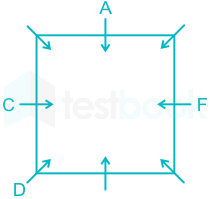
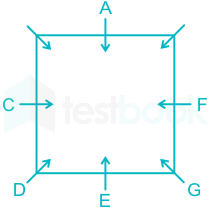
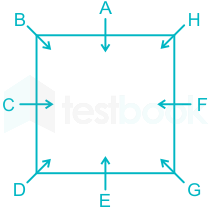
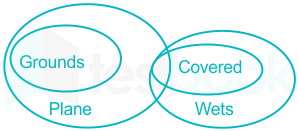
RRB Group D Previous Year Paper (Held on: 1 Sept 2022 Shift 2)

100 questions · 90 minutes · with answers · free

CBT (100 questions)

1

A current-carrying straight conductor is placed in a magnetic field. The conductor experiences the maximum force when the angle between the direction of the current in it and the direction of the magnetic field is:

  1. ((a))

    45°

  2. ((b))

    30°

  3. ((c))

    90°

  4. ((d))

    60°

Show Answer
Answer: ((c))

90°

The correct answer is 90°.

Key Points

  • The force experienced by a current-carrying conductor placed in a magnetic field is given by the formula F = BILsinø, where B is the magnetic field strength, I is the current flowing through the conductor, L is the length of the conductor, and ø is the angle between the direction of the current and the direction of the magnetic field.
  • The maximum force is experienced when the angle is 90o, but in this case, the sinø becomes 1, which is the maximum value.
  • However, in practical scenarios, it is not always possible to have the conductor perpendicular to the magnetic field.
  • When the angle is 0 degrees, the force experienced is zero because sinø is zero.
  • When the angle is 180 degrees, the force experienced is also zero because sinø is again zero.
  • Therefore, the maximum force is experienced when the angle between the direction of the current in the conductor and the direction of the magnetic field is 90 degrees because the sin90 is the maximum value of 1.

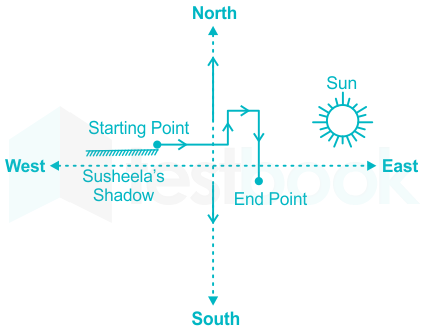
Additional Information

  • When the angle between the direction of the current in the conductor and the direction of the magnetic field is 30 degrees, the sinø is 0.5, which is less than the maximum value of 1.
  • Therefore, the force experienced will be less than the maximum force.

  • When the angle between the direction of the current in the conductor and the direction of the magnetic field is 60 degrees, the sinø is 0.866, which is less than the maximum value of 1.
  • Therefore, the force experienced will be less than the maximum force.

2

In the absence of atmosphere, the colour of the sky would be:

  1. ((a))

    blue

  2. ((b))

    red

  3. ((c))

    white

  4. ((d))

    black

Show Answer
Answer: ((d))

black

The correct answer is black.

Key Points

  • The reason behind the blue colour of the sky is Rayleigh scattering, which occurs due to the scattering of sunlight by the molecules in the Earth's atmosphere.
  • As there is no atmosphere in the absence of it, there would be no scattering of sunlight, and the sky would appear black.
  • Red and white colours are also not possible as they are also the result of scattering of light in the atmosphere, and in the absence of it, the sky would not appear in any colour.
  • The black colour of the sky would also mean that stars would appear brighter and the contrast between them and the sky would be much clearer.
  • The concept of the sky being black in the absence of atmosphere is also applicable to other planets and moons without an atmosphere, such as the Moon and Mercury.

Additional Information

  • The scattering of light by particles up to a tenth of its wavelength that happen in its path without causing an energy loss or wavelength change is known as Rayleigh scattering.
  • Red colour appears during sunrise and sunset when the sunlight passes through more atmosphere, scattering the shorter blue and green wavelengths and allowing the longer red wavelengths to pass through.
  • White colour appears when sunlight is scattered equally by all the molecules in the atmosphere, making the sky appear as a bright white.
3

Select the option that is related to the fifth number in the same way as the second number is related to the first number and the fourth number is related to the third number.

8 ∶ 19 ∶∶ 5 ∶ 13 ∶∶ 7 ∶ ?

  1. ((a))

    21

  2. ((b))

    19

  3. ((c))

    15

  4. ((d))

    17

Show Answer
Answer: ((d))

17

The logic followed here is:

Logic: (1st number × 2) + 3 = 2nd number.

Now,

For, 8 ∶ 19

⇒ (8 × 2) + 3

⇒ 16 + 3 = 19.

For, 5 ∶ 13

⇒ (5 × 2) + 3

⇒ 10 + 3 = 13.

Similarly, for 7 ∶ ?

⇒ (7 × 2) + 3

⇒ 14 + 3 = 17.

Hence, the correct answer is "Option 4".

4

As of March 2022, the common High Court for the states of Punjab and Haryana is located at _____.

  1. ((a))

    Firozpur

  2. ((b))

    Karnal

  3. ((c))

    Chandigarh

  4. ((d))

    Faridabad

Show Answer
Answer: ((c))

Chandigarh

The correct answer is Chandigarh.

Key Points

  • The High Court of Punjab and Haryana was established on 20th April 1955, and it started functioning in Chandigarh from 17th August 1955.
  • This High Court has 85 sanctioned judges, 64 of them are Permanent Judges and 21 Additional Judges, including the Chief Justice.
  • Chandigarh is a Union Territory and serves as the capital of both Punjab and Haryana, and hence it was chosen as the location for the common High Court.

Additional Information

  • The Indian High Courts are the highest courts with appellate authority over all Indian states and union territories.
  • Most high courts handle writ petitions in accordance with Articles 226 and 227 of the constitution, as well as appeals from subordinate courts.
  • Another original jurisdiction of a high court is writ jurisdiction.
  • Every state has judicial districts that are governed by district and sessions judges.
  • All Indian courts, including high courts, are constrained by the decisions and directives of the Supreme Court of India by precedence under Article 141 of the constitution.
  • Firozpur is a city in Punjab and has a district court.
  • Karnal is a city in Haryana and has a district court.
  • Faridabad is a city in Haryana and has a district court.
5

Where is the Bowman's capsule located in the human body?

  1. ((a))

    Lung

  2. ((b))

    Stomach

  3. ((c))

    Liver

  4. ((d))

    Kidney

Show Answer
Answer: ((d))

Kidney

The correct answer is Kidney.

Key Points

  • The Bowman's capsule is a part of the nephron, which is a functional unit of the kidney responsible for filtering waste products from the blood and producing urine.
  • "Bowman's space," which denotes the start of the urinary space and is adjacent to the proximal convoluted tubule of the nephron, is enclosed by Bowman's capsule.
  • Large proteins and cells remain in the blood as long as the kidney filter is functioning properly, while small molecules from the blood can freely enter Bowman's space.

Additional Information

  • The lungs are responsible for exchanging gases (oxygen and carbon dioxide) during respiration. 
  • Within our chest cavity, the lungs are located on either side of the heart.
  • The stomach is responsible for breaking down food through mechanical and chemical digestion. 
  • On the left side of our body, the stomach is located in the upper abdomen.
  • The liver is responsible for producing bile, which aids in digestion and absorption of fats.
  • It also plays a role in detoxification of the blood.
6

Which of the following elements shows a catenation property like carbon?

  1. ((a))

    Ne

  2. ((b))

    Si

  3. ((c))

    O

  4. ((d))

    K

Show Answer
Answer: ((b))

Si

The correct answer is Si.

Key Points

  • Catenation refers to the ability of an element to form bonds with other atoms of the same element, resulting in the formation of long chains or rings.
  • Carbon is well known for its catenation property, which is why it can form a vast number of organic compounds.
  • Silicon (Si), shows a catenation property like carbon.
  • This is because silicon has four valence electrons, like carbon, and can form covalent bonds with other silicon atoms.

Additional Information

  • Neon (Ne) does not show catenation property as it is a noble gas and does not readily form bonds with other atoms.
  • Oxygen (O) can form limited catenation, but not to the same extent as carbon or silicon.
  • This is because oxygen has only two valence electrons and can only form two covalent bonds with other oxygen atoms.
  • Potassium (K) is a metal and does not show catenation property as metals typically lose electrons to form positive ions and do not form covalent bonds with other atoms of the same element.
7

Consider the following statements:

(a) The red light has a wavelength about 1.8 times greater than the blue light.

(b) When sunlight passes through the atmosphere, the fine particles scatter blue light more strongly than red.

Which of the above statements help(s) us to understand the blue colour of a clear sky?

  1. ((a))

    Both (a) and (b)

  2. ((b))

    Neither (a) nor (b)

  3. ((c))

    Only (b)

  4. ((d))

    Only (a)

Show Answer
Answer: ((a))

Both (a) and (b)

The correct answer is Both (a) and (b)

Key Points

  • The statement (b) helps us to understand the blue colour of a clear sky.
  • When sunlight passes through the atmosphere, the fine particles present in the air scatter blue light more strongly than red.
  • This is known as Rayleigh scattering and it is the reason why the sky appears blue during the day.
  • The wavelength of blue light is shorter than that of red light, so it gets scattered more easily by the particles in the air.
  • The wavelength of red light is approximately 1.8 times longer than that of blue light.
  • Because of this, blue light which has shorter wavelengths than red is more severely scattered by fine air particles when it travels through the atmosphere.
  • The sky appears blue when the scattered blue light reaches our sight.
  • The difference in wavelengths between red and blue light is important in other contexts, such as the formation of rainbows.

Additional Information

  • When sunlight is refracted via raindrops and catches an observer's eyes, a rainbow is created.
  • Instead of the frequently portrayed "teardrop" shape, the majority of raindrops are spherical.
  • This spherical form creates the ideal environment for the appearance of a rainbow.
8

Which country won the bronze at the men's Hockey Asia Cup 2022 in Jakarta?

  1. ((a))

    South Korea

  2. ((b))

    India

  3. ((c))

    Japan

  4. ((d))

    Pakistan

Show Answer
Answer: ((b))

India

The correct answer is India.

Key Points

  • India defeated Japan 5-3 in the bronze medal match of the Men's Hockey Asia Cup 2022 held in Jakarta, Indonesia.
  • This was India's second consecutive bronze medal in the tournament, having won it in 2017 as well.
  • South Korea won the gold medal by defeating Pakistan 3-2 in the final.
  • Japan finished fourth after losing to India in the bronze medal match.
  • Pakistan won the silver medal after losing to South Korea in the final.

Additional Information

  • India won the first Men's Hockey 5s Asia Cup 2023 at Salalah, Oman, after defeating Pakistan in a penalty shootout.
  • The victory also served as Asia's means of qualifying for the 2024 FIH Men's Hockey5s Oman World Cup.
  • After defeating Oman 7-3, Pakistan advanced to the final.
9

Seven boxes P, Q, R, S, T, U and V are kept one over the other but not necessarily in the same order. S is kept third from the bottom. Only V is kept between P and S. Only three boxes are kept between T and V. T is kept immediately below U. Q is kept immediately above S. R is kept third from the top. How many boxes are kept between U and S?

  1. ((a))

    Three

  2. ((b))

    One

  3. ((c))

    Two

  4. ((d))

    Four

Show Answer
Answer: ((a))

Three

Given: Seven boxes P, Q, R, S, T, U and V are kept one over the other but not necessarily in the same order.

  1. S is kept third from the bottom.

2) R is kept third from the top.

  1. Only V is kept between P and S.
R
S
V
P


4) Only three boxes are kept between T and V.

T is kept immediately below U. Q is kept immediately above S.

U
T
R
Q
S
V
P


So, there are 'Three' boxes are kept between U and S.

Hence, the correct answer is "Option 1".

10

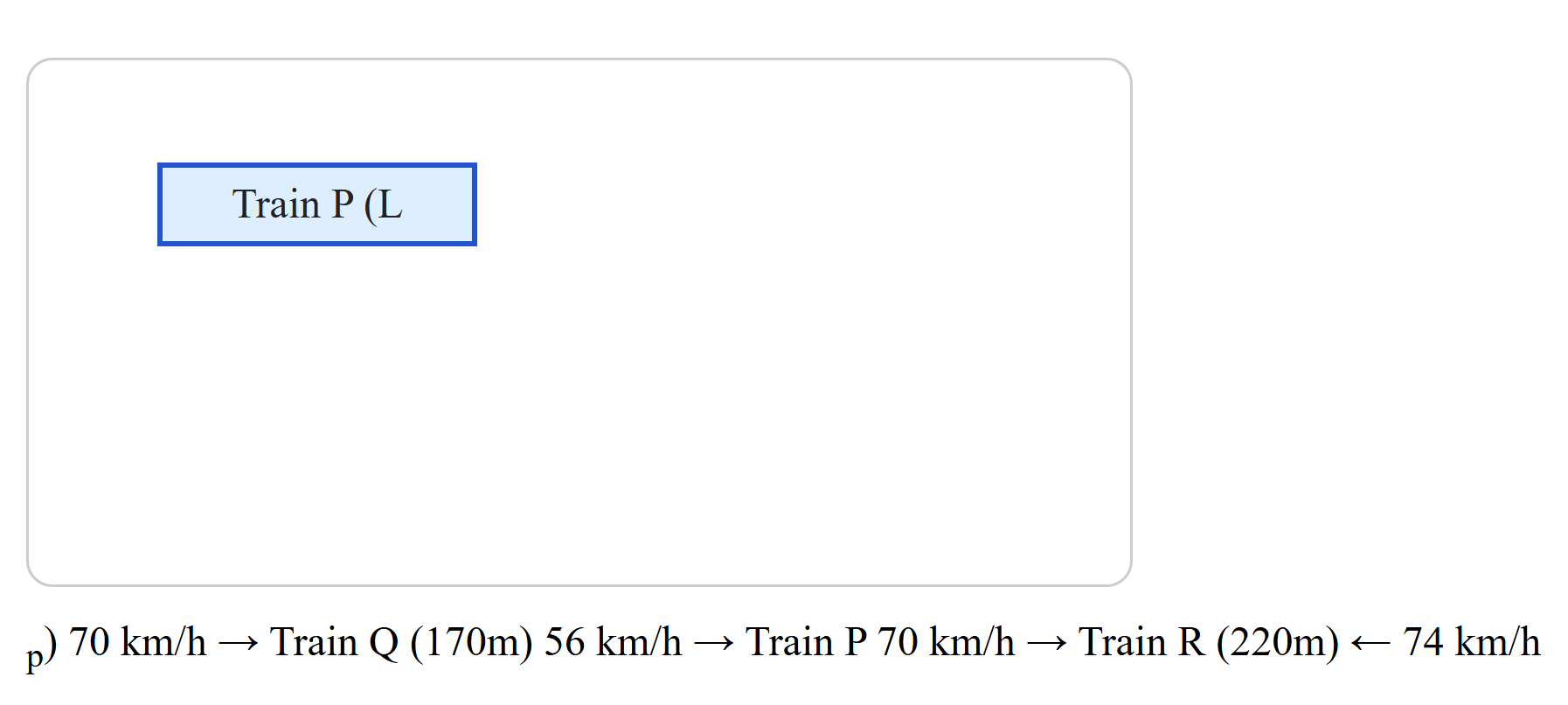
A train P going at the speed of 70 km/h completely passes train Q of length 170 m, going in the same direction on parallel tracks, at 56 km/h, in 1121 \frac{1}{2} minutes. How much time (in seconds) will P take to cross completely train R of length 220 m, going at 74 km/h in the opposite direction?

  1. ((a))

    14

  2. ((b))

    12

  3. ((c))

    15

  4. ((d))

    10

Show Answer
Answer: ((d))

10

Shortcut Trick

Relative Speed (Same direction) = 70 − 56 = 14 km/h = 14 × (5/18) m/s.

Total Length (P + Q) = Speed × Time = (14 × 5/18) × 90 = 350 m.

Length of P = 350 − 170 = 180 m.

Relative Speed (Opposite direction P & R) = 70 + 74 = 144 km/h = 144 × (5/18) = 40 m/s.

Time to cross R = (Length P + Length R) ÷ Speed = (180 + 220) ÷ 40 = 400 ÷ 40 = 10 seconds.

∴ The correct answer is 10 seconds.

Alternate Method

Given: Speed P = 70 km/h, Speed Q = 56 km/h, Length Q = 170 m, Time1 = 1.5 min = 90 s, Length R = 220 m, Speed R = 74 km/h.

Formula Used: Distance = Relative Speed × Time; km/h to m/s conversion = × 5/18.

⇒ Relative Speed (P and Q) = 70 − 56 = 14 km/h = 14 × (5/18) = 70/18 m/s.

⇒ Total Distance = LP + 170 = (70/18) × 90

⇒ LP + 170 = 350

⇒ LP = 180 m.

⇒ Relative Speed (P and R) = 70 + 74 = 144 km/h = 144 × (5/18) = 40 m/s.

⇒ Time taken to cross R = (LP + LR) ÷ Relative Speed = (180 + 220) ÷ 40

⇒ Time = 400 ÷ 40 = 10 seconds.

∴ The correct answer is 10 seconds.

Additional Information

Relative Speed Concept

When two objects move in the same direction, relative speed = S1 − S2. When they move in opposite directions, relative speed = S1 + S2.

Crossing Length Rule

Total distance covered while one train crosses another is always the sum of their lengths (L1 + L2), regardless of direction.

Conversion Units

To convert speed from km/h to m/s, multiply by 5/18. To convert m/s to km/h, multiply by 18/5.

11

In March 2022, Bharat Biotech partnered with which country's bio-pharmaceutical firm Biofabri for TB vaccine?

  1. ((a))

    Australia

  2. ((b))

    USA

  3. ((c))

    Canada

  4. ((d))

    Spain

Show Answer
Answer: ((d))

Spain

The correct answer is Spain.

Key Points

  • Bharat Biotech is an Indian biotechnology company that specializes in vaccine research and development.
  • Biofabri is a Spanish bio-pharmaceutical firm that focuses on the production and commercialization of vaccines and biologics.
  • The partnership between Bharat Biotech and Biofabri aims to develop a new tuberculosis (TB) vaccine, which is a major public health concern globally.
  • TB is a bacterial infection that primarily affects the lungs and is spread through the air when an infected person coughs or sneezes.
  • It is one of the top 10 causes of death worldwide.

Additional Information

  • Australia has a strong biotechnology sector and is known for its research and development in vaccines.
  • The country has several biopharmaceutical firms that specialize in vaccine development, such as CSL Limited and Vaxine Pty Ltd.
  • The United States is a major player in the global biotechnology industry and has several biopharmaceutical firms that specialize in vaccine research and development, such as Pfizer, Moderna, and Johnson Johnson.
  • Canada is home to several biopharmaceutical firms that specialize in vaccine development, such as Medicago and VBI Vaccines.
12

Which of the following herbs is found only in India and is used to treat blood pressure?

  1. ((a))

    Kachnar

  2. ((b))

    Tulsi

  3. ((c))

    Jamun

  4. ((d))

    Sarpagandha

Show Answer
Answer: ((d))

Sarpagandha

The correct answer is Sarpagandha.

Key Points

  • Sarpagandha is a medicinal herb that is native to India and is commonly used to treat high blood pressure, insomnia, and anxiety.
  • The active compound in Sarpagandha is reserpine, which has a sedative effect on the body and helps to lower blood pressure.
  • Because sarpagandha is an appetiser and a digestive, using it can help improve impaired digestion.

Additional Information

  • Kachnar, also known as Bauhinia variegata, is a flowering plant that is native to India and Southeast Asia.
  • It is commonly used in traditional medicine to treat a variety of ailments, including diabetes, inflammation, and respiratory problems.
  • Tulsi, also known as holy basil, is an herb that is native to India and is widely used in Ayurvedic medicine.
  • It is known for its antioxidant and anti-inflammatory properties and is commonly used to treat colds, flu, and other respiratory infections.
  • Jamun, also known as Syzygium cumini, is a fruit tree that is native to India and Southeast Asia.
  • It is commonly used in traditional medicine to treat diabetes, digestive problems, and skin conditions.
13

Which of the following revolutionaries shot himself dead while fighting with the police at Alfred Park in Allahabad in 1931?

  1. ((a))

    Chandrashekhar Azad

  2. ((b))

    Khudiram Bose

  3. ((c))

    Rash Behari Bose

  4. ((d))

    Ram Prasad Bismil

Show Answer
Answer: ((a))

Chandrashekhar Azad

The correct answer is Chandrashekhar Azad.

Key Points

  • Chandrashekhar Azad was a revolutionary freedom fighter who was a member of the Hindustan Socialist Republican Association (HSRA).
  • He was known for his bravery and fearlessness in fighting against the British rule.
  • Azad was born on July 23, 1906, in Bhavra, Madhya Pradesh.
  • He died on February 27, 1931, at Alfred Park in Allahabad while fighting the police.
  • Azad is remembered for his famous quote "Dushman ki goliyon ka hum samna karenge, Azad hee rahein hain, Azad hee rahenge" (We will face the bullets of the enemy, we are free and will remain free).

Additional Information

  • Khudiram Bose was a revolutionary freedom fighter who was executed at the age of 18 for his involvement in the Muzaffarpur conspiracy case.
  • Rash Behari Bose was a revolutionary who was involved in the Indian independence movement and played a key role in the Indian National Army.
  • He had created the Indian Independence League and was one of the main organizers of the Ghadar Mutiny.
  • Ram Prasad Bismil was a revolutionary who was involved in the Kakori conspiracy case.
  • He was a member of the 1918 Mainpuri Conspiracy.
14

Identify the wrong pair (Bank and related category) from following-

  1. ((a))

    Punjab National Bank - Public Sector Bank

  2. ((b))

    Canara Bank - Payments Bank

  3. ((c))

    AU Bank Ltd - Small Finance Bank

  4. ((d))

    Axis Bank Ltd - Private Sector Bank

Show Answer
Answer: ((b))

Canara Bank - Payments Bank

The correct answer is Canara Bank - Payments Bank.

Key Points

  • Canara Bank is not a Payments Bank, it is a Public Sector Bank.
  • Public Sector Banks are those banks in which the government holds a majority stake.
  • These banks are established to provide banking services to the general public and promote financial inclusion.
  • Payments Banks are a new category of banks in India that were introduced by the Reserve Bank of India in 2015.
  • These banks can accept deposits up to Rs. 1 lakh and provide payment and remittance services, but cannot lend money or issue credit cards.

 Additional Information

  • Punjab National Bank is a Public Sector Bank, which is a correct category.
  • AU Bank Ltd is a Small Finance Bank, which is a correct category.
  • Small Finance Banks are a type of niche banks that were introduced by the Reserve Bank of India in 2015.
  • These banks primarily cater to the needs of small businesses, farmers, and low-income households.
  • Axis Bank Ltd is a Private Sector Bank, which is a correct category. 
  • Private Sector Banks are those banks in which the majority of the shares are held by private individuals or companies.
  • These banks are profit-driven and operate with the primary objective of maximizing shareholder value.
15

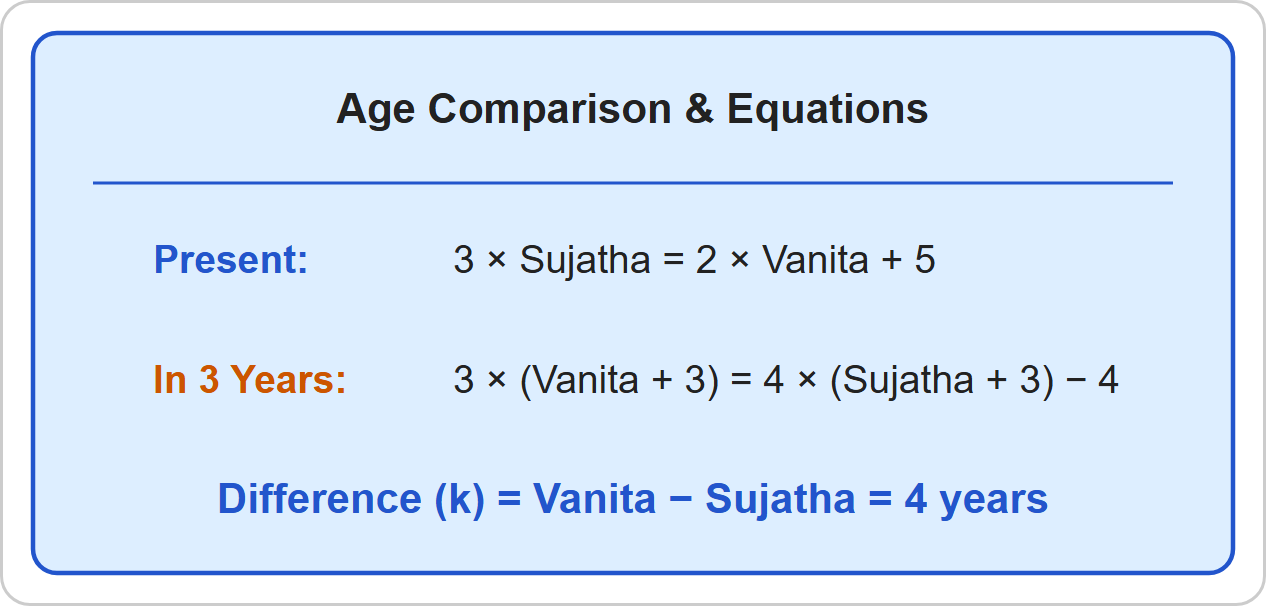
Three times the present age of Sujatha is 5 years more than two times the present age of Vanita. After 3 years, three times the age of Vanita will be 4 years less than four times the age of Sujatha. The age of Vanita is k years more than that of Sujatha. What is the value of k?

  1. ((a))

    3

  2. ((b))

    4

  3. ((c))

    7

  4. ((d))

    9

Show Answer
Answer: ((b))

4

Shortcut Trick

Let the present ages of Sujatha and Vanita be S and V respectively.

From the first condition: 3S − 2V = 5

From the second condition: 3(V + 3) = 4(S + 3) − 4 ⇒ 3V + 9 = 4S + 12 − 4 ⇒ 4S − 3V = 1

Solving these simultaneous equations directly gives S = 13 years and V = 17 years.

The age difference k = V − S = 17 − 13 = 4 years.

∴ The correct answer is 4 years.

Alternate Method

Given:

Let the present age of Sujatha = S years

Let the present age of Vanita = V years

Calculations:

According to the first statement:

→ 3 × S = 2 × V + 5

⇒ 3S − 2V = 5 ——— (Equation 1)

According to the second statement after 3 years:

→ 3 × (V + 3) = 4 × (S + 3) − 4

⇒ 3V + 9 = 4S + 12 − 4

⇒ 3V + 9 = 4S + 8

⇒ 4S − 3V = 1 ——— (Equation 2)

To eliminate V, multiply Equation 1 by 3 and Equation 2 by 2:

⇒ 9S − 6V = 15

⇒ 8S − 6V = 2

Subtracting the two new equations:

⇒ (9S − 6V) − (8S − 6V) = 15 − 2

⇒ S = 13

Substitute S = 13 in Equation 1:

⇒ 3(13) − 2V = 5

⇒ 39 − 2V = 5

⇒ 2V = 34

⇒ V = 17

Finding the value of k:

⇒ k = V − S

⇒ k = 17 − 13 = 4

∴ The correct answer is 4.

Additional Information

Linear Equations in Two Variables

To solve problems involving two unknown ages, set up two distinct linear equations of the form ax + by = c and solve them using substitution or elimination methods.

Age Difference Invariance

The difference between the ages of two individuals always remains constant over time. Therefore, the value of k will remain the same whether calculated today or in the future.

16

Select the set in which the numbers are related in the same way as are the numbers of the following sets.

(NOTE: Operations should be performed on the whole numbers, without breaking down the numbers into its constituent digits. E.g. 13 - Operations on 13 such as adding /deleting /multiplying etc. to 13 can be performed. Breaking down 13 into 1 and 3 and then performing mathematical operations on 1 and 3 is not allowed)

(13, 182, 91)

(17, 306, 153)

  1. ((a))

    15, 200, 125

  2. ((b))

    11, 154, 67

  3. ((c))

    8, 72, 36

  4. ((d))

    9, 125, 50

Show Answer
Answer: ((c))

8, 72, 36

The logic followed here is:

Logic: 1st number × (1st number + 1) = 2nd number,

2nd number ÷ 2 = 3rd number.

Now,

For, (13, 182, 91)

⇒ 13 × (13 + 1) ⇒ 13 × 14 = 182.

⇒ 182 ÷ 2 = 91.

For, (17, 306, 153)

⇒ 17 × (17 + 1) ⇒ 17 × 18 = 306.

⇒ 306 ÷ 2 = 153.

Similarly, for Option 3: (8, 72, 36)

⇒ 8 × (8 + 1) ⇒ 8 × 9 = 72.

⇒ 72 ÷ 2 = 36.

Hence, the correct answer is "Option 3".

17

A statement is given followed by two assumptions numbered I and II. You have to assume everything in the statement to be true and decide which of the assumptions is/are implicit in the statement.

Statement:

Eating too many chocolates will lead to dental problems.

Assumptions:

I. Chocolates have high sugar content which can result in bacterial growth.

II. Brushing twice a day keeps teeth strong.

  1. ((a))

    Both assumptions I and II are implicit

  2. ((b))

    Only assumption II is implicit

  3. ((c))

    Neither assumption I nor II is implicit

  4. ((d))

    Only assumption I is implicit

Show Answer
Answer: ((d))

Only assumption I is implicit

Given Statement: Eating too many chocolates will lead to dental problems.

Now, 

Assumptions:

1. Chocolates have high sugar content which can result in bacterial growth - Implicit (Eating too many chocolates will lead to dental problems due to high sugar content and bacterial growth) 2. Brushing twice a day keeps teeth strong - Not Implicit (Focuses on preventing dental problems through brushing twice a day. it doesn't directly address the specific consequence of consuming too many chocolates mentioned in the statement.)

Here, Only assumption I is implicit.

Hence, the correct answer is "Option 4".

18

Which of the following 'agam' describes nonviolence in Jainism religion?

  1. ((a))

    Samavayanga Sutra

  2. ((b))

    Antah Kradashanga Sutra

  3. ((c))

    Sutrakratang Sutra

  4. ((d))

    Sthananga Sutra

Show Answer
Answer: ((c))

Sutrakratang Sutra

The correct answer is Sutrakratang Sutra.

Key Points

  • 'Agam' refers to the Jain scriptures that contain the teachings of Lord Mahavira and his disciples.
  • Nonviolence, or 'Ahimsa', is one of the core principles of Jainism and is considered the most important virtue.
  • The Sutrakratang Sutra is a Jain text that contains various ethical and moral teachings, including the principle of nonviolence.

Additional Information

  • Samavayanga Sutra talks about the principles of sameness and equanimity.
  • It is the fourth of the Jaina canon's twelve Angas.
  • Antah Kradashanga Sutra discusses the internal purification of the soul.
  • Ten holy monks who destroyed their karmas and attained liberation (Moksha) are the subjects of this agam.
  • Sthananga Sutra provides guidelines for monastic life and conduct.
  • This agam enumerates and describes the principal elements of the Jain faith.
19

If P denotes '×', T denotes '-', M denotes '+' and B denotes '÷', what will come in place of the question mark (?) in the following equation?

54 B 9 P 11 T 13 M 17 = ?

  1. ((a))

    73

  2. ((b))

    70

  3. ((c))

    74

  4. ((d))

    78

Show Answer
Answer: ((b))

70

Given equation: 54 B 9 P 11 T 13 M 17 = ?

Decoding the given information :

SymbolPTMB
Means×-+÷

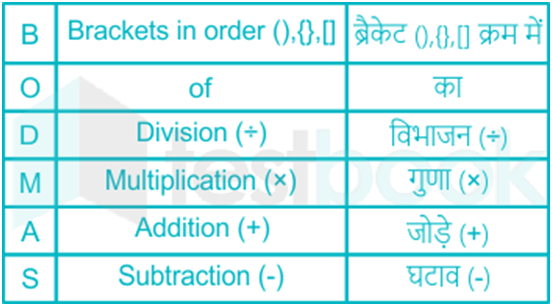
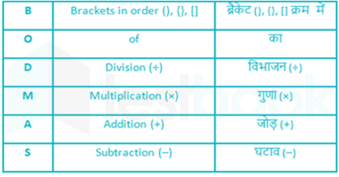
Now, replacing the sign from left to right and using BODMAS rule, we get :

New equation : 54 ÷ 9 × 11 - 13 + 17 = ?

Calculation :

⇒ 54 ÷ 9 × 11 - 13 + 17 = ?

⇒ 6 × 11 - 13 + 17 = ?

⇒ 66 - 13 + 17 = ?

⇒ 83 - 13 = 70.

Hence, the correct answer is "Option 2".

20

If each vowel in the word DUSTER is changed to the letter following it in the English alphabetical order and each consonant is changed to the letter preceding it in the English alphabetical order, how many letters will appear twice in the group of letters thus formed?

  1. ((a))

    Three

  2. ((b))

    One

  3. ((c))

    Two

  4. ((d))

    zero

Show Answer
Answer: ((d))

zero

Given word: DUSTER 

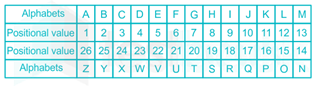
Now, each consonant of the word 'DUSTER' is changed to the letter preceding letter,

And, each vowel in the word 'DUSTER' is changed to the letter following letter:

LetterDUSTER
Alphabetical orderCVRSFQ


Here, Each letter is unique after changed to the given condition.

Hence, the correct answer is "Option 4".

21

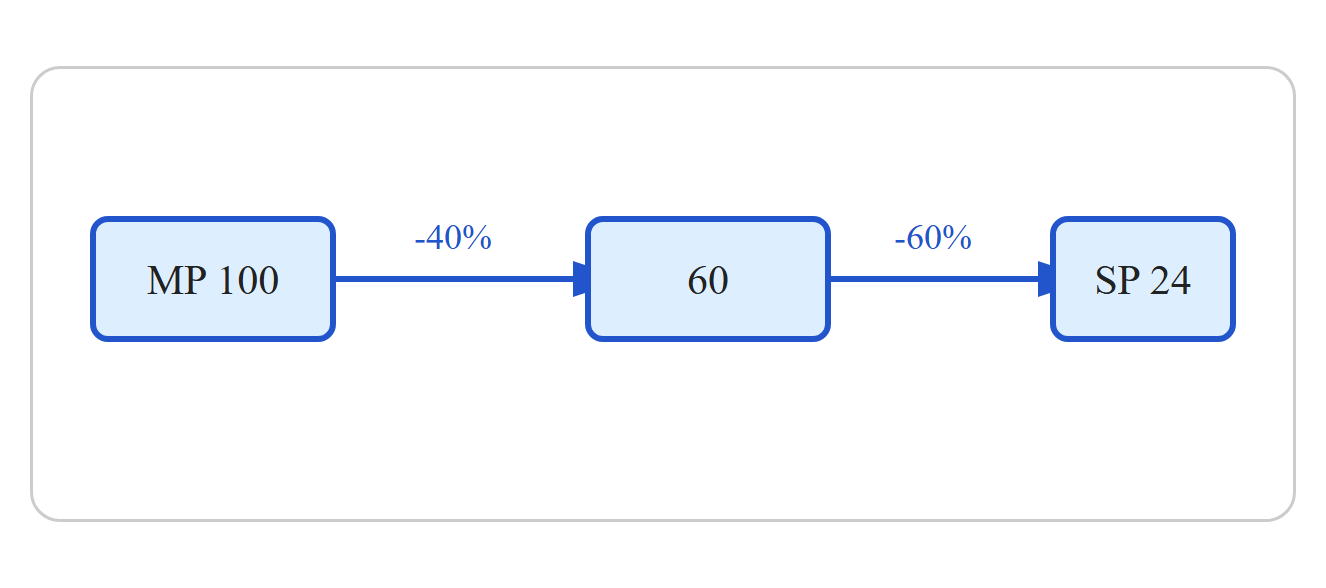
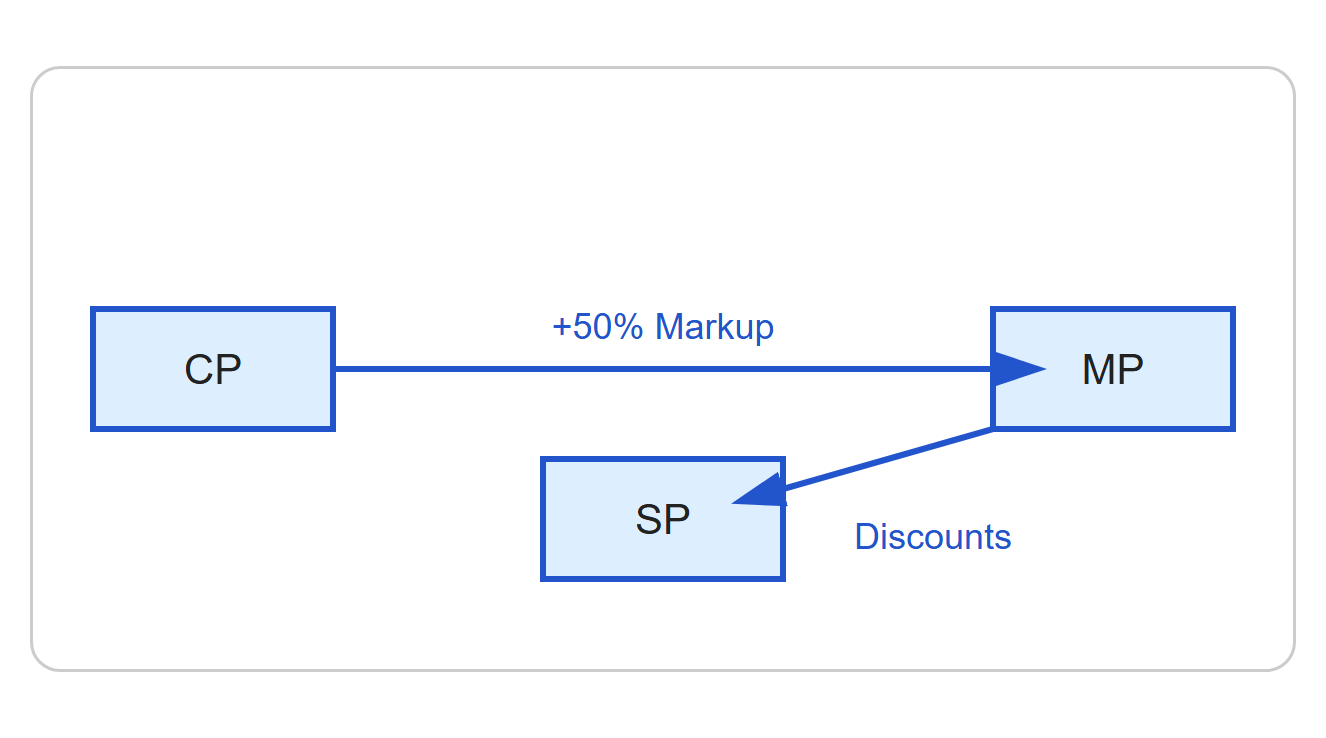
Two successive discounts of 40% and 60% on a deal are equivalent to a single discount of:

  1. ((a))

    70%

  2. ((b))

    76%

  3. ((c))

    80%

  4. ((d))

    66%

Show Answer
Answer: ((b))

76%

Shortcut Trick

Net Discount = a + b − (a × b) ÷ 100

Here, a = 40 and b = 60.

Net Discount = 40 + 60 − (40 × 60) ÷ 100

Net Discount = 100 − 2400 ÷ 100 = 100 − 24 = 76%.

∴ The correct answer is 76%.

Alternate Method

Given: First discount = 40%, Second discount = 60%.

Formulas: Equivalent Discount = 100 − [100 × (100 − d1)/100 × (100 − d2)/100]

⇒ Let the Marked Price (MP) be 100.

⇒ After 40% discount, Price = 100 − 40 = 60.

⇒ After 60% discount on 60, Price = 60 − (60 × 60 ÷ 100) = 60 − 36 = 24.

⇒ Total Discount = MP − Final SP = 100 − 24 = 76.

Equivalent Discount% = (76 ÷ 100) × 100 = 76%.

∴ The correct answer is 76%.

Additional Information

Successive Discounts

When a series of discounts are applied one after another on the reducing balance, they are called successive discounts. The total effective discount is always less than the simple sum of individual discounts.

Marked Price & Discount

Discount is always calculated on the Marked Price (MP). SP = MP × (100 − D%)/100.

22

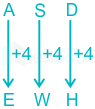
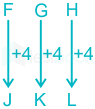
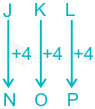
In the given letter-cluster pairs, the first letter-cluster is related to the second letter-cluster following a certain logic. Study the given pairs carefully, and from the given options, select the pair that follows the same logic.

ASD ∶ EWH

FGH ∶ JKL

  1. ((a))

    GYU ∶ JCY

  2. ((b))

    JKL ∶ NOP

  3. ((c))

    NSP ∶ ORQ

  4. ((d))

    CBH ∶ GFM

Show Answer
Answer: ((b))

JKL ∶ NOP

The logic followed here is:

For, ASD ∶ EWH

For, FGH ∶ JKL

Similarly, for JKL ∶ NOP

Hence, the correct answer is "Option 2".

23

In a class of students, Radhika is 18th from the top and 32nd from the bottom. What is the total number of students in the class?

  1. ((a))

    49

  2. ((b))

    52

  3. ((c))

    51

  4. ((d))

    50

Show Answer
Answer: ((a))

49

The logic followed here is:

Rank of Radhika from the Top = 18th

Rank of Radhika from the Bottom = 32th

So,

Total number of the students = Rank from the Top + Rank from the Bottom - 1

= 18 + 32 - 1

= 50 - 1

= 49.

Hence, the correct answer is "Option 1".

24

What is the ranking of India in plant diversity in the world as on December 2010?

  1. ((a))

    25th

  2. ((b))

    15th

  3. ((c))

    20th

  4. ((d))

    10th

Show Answer
Answer: ((d))

10th

The correct answer is 10th.

Key Points

  • India ranks 10th in plant diversity in the world as on December 2010.
  • India is one of the 17 mega-diverse countries in the world, with a rich variety of flora and fauna.
  • It is home to about 8% of the world's total plant species.
  • The plant diversity in India is distributed across various biomes, including tropical rainforests, dry deciduous forests, alpine meadows, and mangroves.
  • This diversity is influenced by factors such as climate, topography, and soil type.
  • The National Biodiversity Act of 2002 and the National Biodiversity Authority of India are some of the initiatives taken by the government to conserve and sustainably use the country's biodiversity.

Additional Information

  • The top three countries in plant diversity are Brazil, Colombia, and China, with around 55,000, 50,000, and 45,000 plant species, respectively.
  • An international plant science journal called Plant Diversity (formerly known as Plant Diversity and Resources) publishes significant original research as well as review papers that enhance our knowledge of the historical and contemporary distribution of plants and aid in the creation of more phylogenetically accurate taxonomic classifications.
  • The community of plant systematic and evolutionary biologists will find fresh information on or insights into evolutionary processes and mechanisms presented in it.
25

Susheela started her morning walk and noted that her shadow is at her back. After some time she turned left and then again turned right. Finally she turned right and started running. In which direction was she running? (All turns are 90 degree turns only)

  1. ((a))

    West

  2. ((b))

    East

  3. ((c))

    North

  4. ((d))

    South

Show Answer
Answer: ((d))

South

Given:

Susheela started her morning walk and noted that her shadow is at her back.

After some time she turned left and then again turned right.

Finally she turned right and started running.

So, Susheela was running in the 'South' direction.

Hence, the correct answer is "Option 4".

26

If sec θ = 53\frac{5}{3}, and θ is an acute angle, then the value of 3tanθ5cosθ5sinθ3secθ=\frac{3 \tan θ-5 \cos θ}{5 \sin θ-3 \sec θ}=?

  1. ((a))

    0

  2. ((b))

    1

  3. ((c))

    -1

  4. ((d))

    4

Show Answer
Answer: ((c))

-1

Shortcut Trick

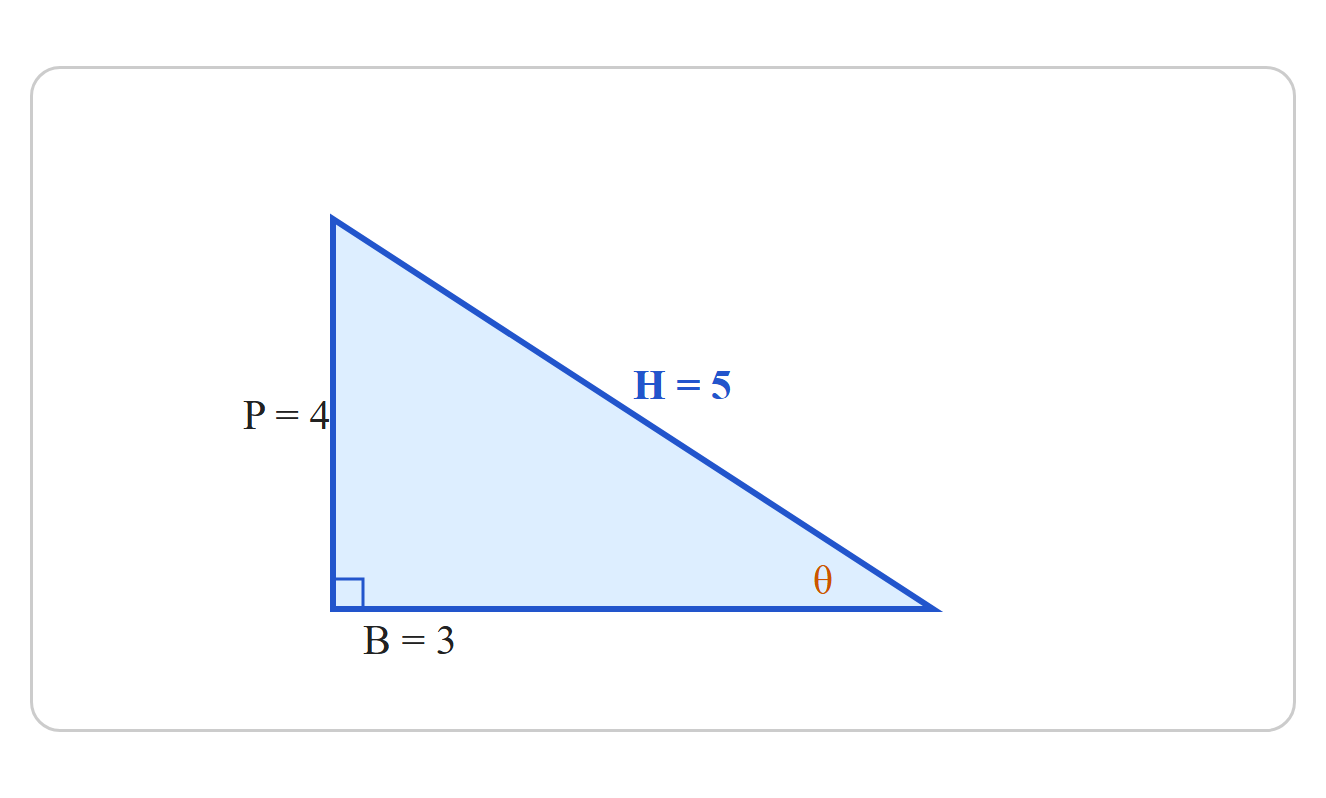
Given sec θ = 5/3, identify the Pythagorean triplet (3, 4, 5).

Here, Hypotenuse (H) = 5, Base (B) = 3, ∴ Perpendicular (P) = √(52 − 32) = 4.

Calculate required ratios: tan θ = 4/3, cos θ = 3/5, sin θ = 4/5, sec θ = 5/3.

Substitute: [3(4/3) − 5(3/5)] / [5(4/5) − 3(5/3)] = [4 − 3] / [4 − 5] = 1 / (−1) = −1.

∴ The correct answer is -1.

Alternate Method

Given: sec θ = 5/3 (H/B)

Formula Used: sin θ = P/H, cos θ = B/H, tan θ = P/B

⇒ H = 5, B = 3

⇒ P = √(H2 − B2) = √(52 − 32) = √16 = 4

⇒ Numerator = 3 × (4/3) − 5 × (3/5) = 4 − 3 = 1

⇒ Denominator = 5 × (4/5) − 3 × (5/3) = 4 − 5 = −1

⇒ Expression = 1 / (−1) = −1

∴ The correct answer is -1.

Additional Information

Trigonometric Ratios

Reciprocal relations: sin θ = 1/cosec θ, cos θ = 1/sec θ, and tan θ = 1/cot θ.

Pythagorean Identity

The fundamental identity: sin2θ + cos2θ = 1. Also, 1 + tan2θ = sec2θ.

Pythagorean Triplets

Common triplets used in exams include (3, 4, 5), (5, 12, 13), (7, 24, 25), and (8, 15, 17).

27

The 73rd Amendment of the Constitution enables the states with a population of less than 20 lakhs to have a minimum ______ structure in the local governance of the state.

  1. ((a))

    one-tier

  2. ((b))

    union rule

  3. ((c))

    two-tier

  4. ((d))

    three-tier

Show Answer
Answer: ((c))

two-tier

The correct answer is two-tier.

Key Points

  • The 73rd Amendment of the Constitution was passed in 1992 to provide constitutional status to the Panchayati Raj Institutions (PRIs) and to strengthen the local self-governance in rural areas of India.
  • The Amendment provides for a three-tier structure of local governance in states with a population of more than 20 lakhs, while states with a population of less than 20 lakhs can have a minimum two-tier structure.

Additional Information

  • The two-tier structure includes the Gram Panchayats at the village level and the Panchayat Samiti at the block level, while the three-tier structure includes the Zilla Parishad at the district level as the third tier.
  • The purpose of the Amendment is to empower the local communities and to ensure their participation in decision-making, planning and implementation of developmental programs.
  • Union rule, on the other hand, refers to the central government's control over the state governments, which is not related to the local governance structure.
28

The monthly wages of 6 employees in a company are ₹5,000, ₹6,000, ₹8,000, ₹8,500, ₹9,300, and ₹9,500. Find the median of their wages.

  1. ((a))

    ₹8,750

  2. ((b))

    ₹8,500

  3. ((c))

    ₹8,250

  4. ((d))

    ₹8,000

Show Answer
Answer: ((c))

₹8,250

Shortcut Trick

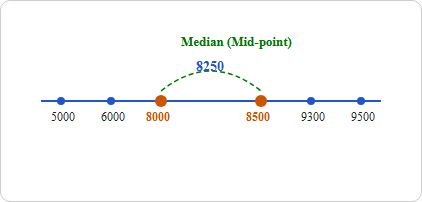
Arrange the wages in ascending order: 5000, 6000, 8000, 8500, 9300, 9500.

Since the number of observations (n = 6) is even, the median is the average of the two middle terms.

Middle terms = 8000 and 8500.

Median = (8000 + 8500) ÷ 2 = 16500 ÷ 2 = 8250.

∴ The correct answer is ₹8,250.

Alternate Method

Given: Wages = {5000, 6000, 8000, 8500, 9300, 9500}

Formula: For an even number of observations (n), Median = [ (n/2)th term + (n/2 + 1)th term ] ÷ 2

⇒ Number of observations (n) = 6

n/2 = 3rd term = 8000

(n/2 + 1) = 4th term = 8500

Median = (8000 + 8500) ÷ 2

Median = 16500 ÷ 2

Median = 8250

∴ The correct answer is ₹8,250.

Additional Information

Median for Odd Data Set

If the number of observations (n) is odd, the median is the exact middle value located at the (n + 1)/2th position.

Empirical Relationship

For a moderately skewed distribution, 3 × Median = Mode + 2 × Mean. This helps find any one measure when the other two are known.

Impact of Outliers

The median is a measure of central tendency that is not affected by extremely large or small values (outliers), unlike the arithmetic mean.

29

If twice the son's age is added to the father's age, the sum is 34 years. If 1.5 times the father's age is added to the son's age, the sum is 45 years. What is the father's age (in years)?

  1. ((a))

    32

  2. ((b))

    30

  3. ((c))

    28

  4. ((d))

    26

Show Answer
Answer: ((c))

28

Shortcut Trick

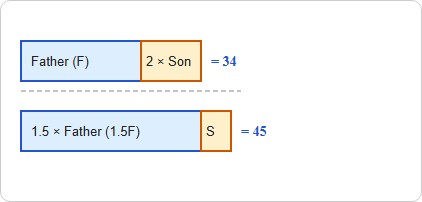
Let the Father's age be F and Son's age be S.

Given: F + 2S = 34 and 1.5F + S = 45.

To eliminate S, multiply the second equation by 2: 3F + 2S = 90.

Subtracting the first equation: (3F + 2S) − (F + 2S) = 90 − 34 ⇒ 2F = 56.

Dividing by 2 gives the Father's age: F = 28 years.

∴ The correct answer is 28 years.

Alternate Method

Given:

Case 1: F + 2S = 34 years

Case 2: 1.5F + S = 45 years

Calculations:

⇒ Let Father's age be x and Son's age be y.

⇒ x + 2y = 34 --- (i)

⇒ 1.5x + y = 45 --- (ii)

⇒ From (ii), y = 45 − 1.5x

⇒ Substitute value of y in (i): x + 2(45 − 1.5x) = 34

⇒ x + 90 − 3x = 34

⇒ −2x = 34 − 90

⇒ −2x = −56

⇒ x = 56 ÷ 2

⇒ x = 28

∴ The correct answer is 28 years.

Additional Information

Linear Equations in Two Variables

These are equations of the form ax + by + c = 0, which can be solved using Substitution, Elimination, or Cross-multiplication methods.

Age Problems

In age-related problems, if the current age is x, then n years ago the age was (x − n) and n years later the age will be (x + n).

Method of Elimination

This involves multiplying equations by suitable constants to make the coefficients of one variable numericaly equal, then adding or subtracting to eliminate that variable.

30

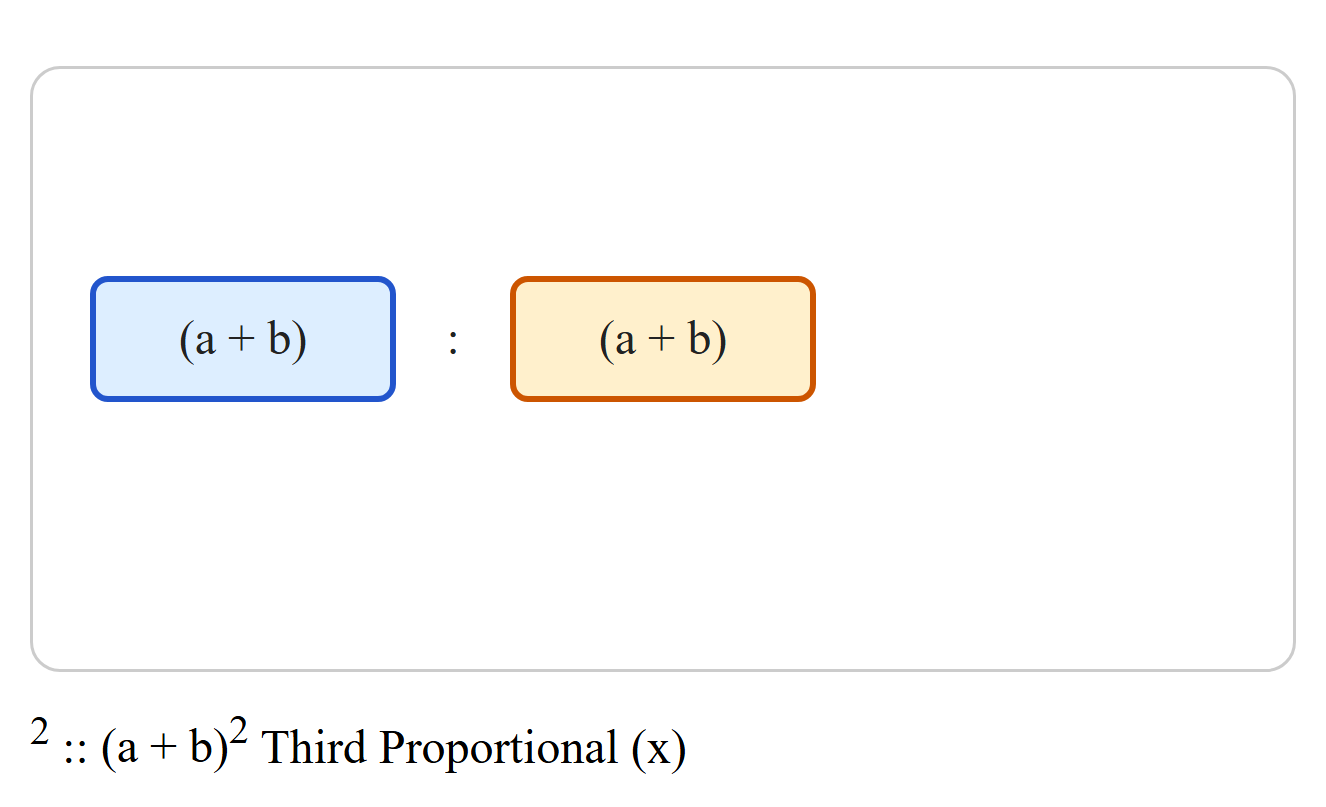
The third proportional of (a + b) and (a + b)2 is

  1. ((a))

    (a + b)3

  2. ((b))

    a

  3. ((c))

    b

  4. ((d))

    (a + b)

Show Answer
Answer: ((a))

(a + b)3

Shortcut Trick

If x and y are two numbers, their third proportional is given by y2 ÷ x.

Here, x = (a + b) and y = (a + b)2.

Third Proportional = [(a + b)2]2 ÷ (a + b) = (a + b)4 ÷ (a + b) = (a + b)3.

∴ The correct answer is (a + b)3.

Alternate Method

Given: First term (A) = (a + b), Second term (B) = (a + b)2.

Formula Used: If c is the third proportional to a and b, then a : b = b : c, which implies c = b2/a.

⇒ Let the third proportional be x.

⇒ (a + b) : (a + b)2 :: (a + b)2 : x

⇒ (a + b) / (a + b)2 = (a + b)2 / x

⇒ x = [(a + b)2 × (a + b)2] / (a + b)

⇒ x = (a + b)4 / (a + b)

⇒ x = (a + b)3

∴ The correct answer is (a + b)3.

Additional Information

Mean Proportional

The mean proportional between two numbers a and b is given by √(a × b).

Fourth Proportional

If four quantities a, b, c, d are in proportion (a:b = c:d), then d is the fourth proportional, calculated as d = (b × c) / a.

Continued Proportion

Three numbers a, b, c are said to be in continued proportion if a/b = b/c, where b2 = ac.

31

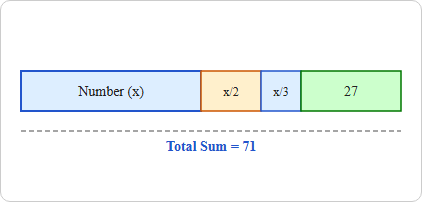
The sum of a number, its half, its 1/3 and 27, is 71. Find the number.

  1. ((a))

    25

  2. ((b))

    24

  3. ((c))

    23

  4. ((d))

    22

Show Answer
Answer: ((b))

24

Shortcut Trick

Assume the number is the LCM of the denominators (2 and 3) = 6 units.

According to the question: 6 units (number) + 3 units (half) + 2 units (one-third) + 27 = 71.

Summing the units: 11 units + 27 = 71.

⇒ 11 units = 71 − 27 = 44.

⇒ 1 unit = 4.

⇒ The number (6 units) = 6 × 4 = 24.

∴ The correct answer is 24.

Alternate Method

Given:

Let the number be x.

Sum of x, x/2, x/3, and 27 is 71.

Formula Used:

Linear equation in one variable: x + (1/2)x + (1/3)x + C = Total

Calculations:

⇒ x + x/2 + x/3 + 27 = 71

⇒ x + x/2 + x/3 = 71 − 27

⇒ x + x/2 + x/3 = 44

⇒ (6x + 3x + 2x) ÷ 6 = 44

⇒ 11x ÷ 6 = 44

⇒ 11x = 44 × 6

⇒ x = (44 × 6) ÷ 11

⇒ x = 4 × 6 = 24

∴ The correct answer is 24.

Additional Information

Linear Equations

An equation involving only linear polynomials with one variable is called a linear equation in one variable, typically in the form ax + b = 0.

Least Common Multiple (LCM) Method

To eliminate fractions in an equation, multiply the entire equation by the LCM of all denominators involved.

Transposition Rule

When a term is moved from one side of the equals sign to the other, its sign changes (+ becomes −, and × becomes ÷).

32

Consider the below statements and identify the correct answer.

Statement - I: Litmus solution is a purple dye, which is extracted from lichen, a plant belonging to the division Thallophyta.

Statement - II: There are many natural materials like red cabbage leaves, turmeric, coloured petals of some flowers, which indicate the presence of acid or base in a solution

  1. ((a))

    Statement-II is true, and Statement-I is false.

  2. ((b))

    Both the statements are true.

  3. ((c))

    Statement-I is true, and Statement-II is false.

  4. ((d))

    Both the statements are false.

Show Answer
Answer: ((b))

Both the statements are true.

The correct answer is Both the statements are true. 

Key Points

  • Statement I is True, Litmus solution is a purple dye, extracted from lichens, a plant belonging to the Thallophyta division, and is commonly used as an indicator. When litmus solution is neither acidic nor alkaline, its color is purple.
  • Statement II is true as there are many natural materials that can indicate the presence of acid or base in a solution.
  • Litmus solution is commonly used as a pH indicator in chemistry to determine whether a solution is acidic or basic.
  • Lichen is a composite organism that arises from algae or cyanobacteria living among filaments of multiple fungi in a mutualistic relationship, and it is used to extract litmus solution in some cases.

Additional Information

  • The pH scale indicates how basic or acidic water is.
  • The neutral number is 7, and the range is 0 to 14.
  • Acidity is indicated by a pH of less than 7, and baseness is indicated by a pH of greater than 7.
  • The relative concentration of free hydrogen and hydroxyl ions in water is what pH actually measures.
33

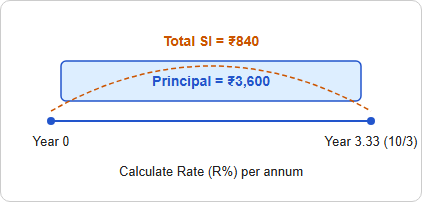
The simple interest on a sum of ₹3,600 for 3 years and 4 months is ₹840. The rate of interest per annum is:

  1. ((a))

    6%

  2. ((b))

    8%

  3. ((c))

    9%

  4. ((d))

    7%

Show Answer
Answer: ((d))

7%

Shortcut Trick

Convert Time to years: 3 years 4 months = 3 + 1/3 = 10/3 years.

Calculate interest for 1 year: 840 ÷ (10/3) = (840 × 3) ÷ 10 = ₹252.

Rate = (Interest per year ÷ Principal) × 100.

Rate = (252 ÷ 3600) × 100 = 7%.

∴ The correct answer is 7%.

Alternate Method

Given:

Principal (P) = ₹3,600

Simple Interest (SI) = ₹840

Time (T) = 3 years 4 months = 3 + 4/12 = 3 + 1/3 = 10/3 years

Formula Used:

Simple Interest (SI) = (P × R × T) ÷ 100

Calculations:

⇒ R = (SI × 100) ÷ (P × T)

⇒ R = (840 × 100) ÷ (3600 × 10/3)

⇒ R = (84000 × 3) ÷ (3600 × 10)

⇒ R = 252000 ÷ 36000

⇒ R = 252 ÷ 36

⇒ R = 7%

∴ The correct answer is 7%.

Additional Information

Simple Interest Concept

Interest calculated only on the initial principal amount throughout the entire period. Formula: SI = P × R × T / 100.

Rate and Time Units

Ensure the Rate of interest and Time are in the same time units (usually per annum and years) before applying the formula.

Amount Calculation

The total amount (A) at the end of the period is the sum of Principal and Simple Interest: A = P + SI = P(1 + RT/100).

34

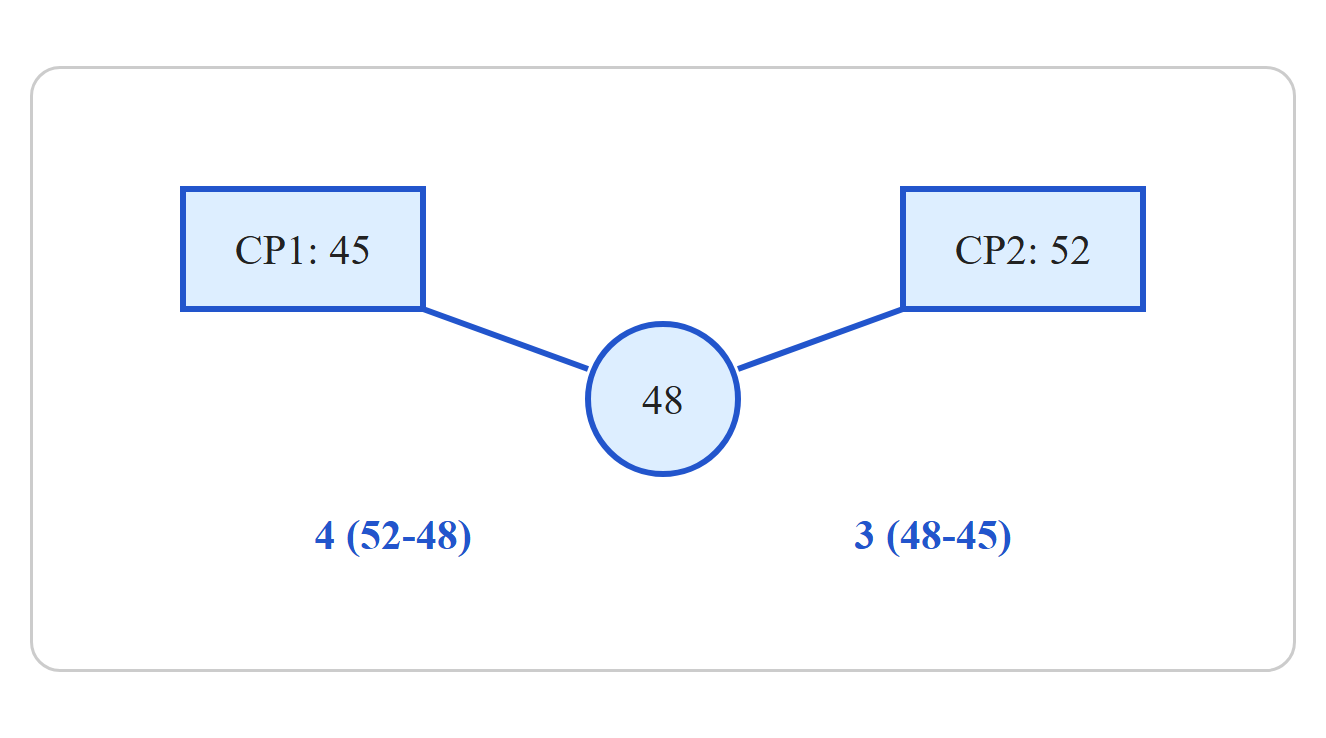
In what ratio should sugar costing ₹45 per kg be mixed with sugar costing ₹52 per kg so that by selling the mixture at ₹55.20 per kg, there is a profit of 15%?

  1. ((a))

    4 ∶ 3

  2. ((b))

    5 ∶ 4

  3. ((c))

    3 ∶ 2

  4. ((d))

    2 ∶ 1

Show Answer
Answer: ((a))

4 ∶ 3

Shortcut Trick

Determine the Cost Price (CP) of the mixture: CP = 55.20 ÷ (1 + 0.15) = 55.20 ÷ 1.15 = ₹48 per kg.

Apply the Rule of Allegation between Sugar 1 (₹45) and Sugar 2 (₹52) with Mean Price (₹48).

Ratio = (52 − 48) : (48 − 45) = 4 : 3.

∴ The correct answer is 4 : 3.

Alternate Method

Given: CP1 = ₹45, CP2 = ₹52, SPmix = ₹55.20, Profit% = 15%.

Formulas: CP = [SP × 100] ÷ [100 + Profit%], Allegation Ratio = (CP2 − CPm) : (CPm − CP1).

Step 1: Calculate mean CP of mixture = (55.20 × 100) ÷ 115 = ₹48.

Step 2: Difference between CP2 and Mean CP = 52 − 48 = 4.

Step 3: Difference between Mean CP and CP1 = 48 − 45 = 3.

Step 4: The required ratio of quantities is 4 : 3.

∴ The correct answer is 4 : 3.

Additional Information

Rule of Alligation

It is used to find the ratio in which two ingredients at given prices must be mixed to produce a mixture of a certain price. All units (CP, SP, or % concentration) must be consistent.

Profit and Loss Relation

The Cost Price is always the base (100%) when calculating Profit or Loss percentages unless stated otherwise.

35

The National Innovation Foundation - India has developed an indigenous herbal medicine called _______ as an alternative to chemical methods to treat worms in livestock.

  1. ((a))

    Lobendazole

  2. ((b))

    Wormivet

  3. ((c))

    Vermiclear

  4. ((d))

    Stomach clean

Show Answer
Answer: ((b))

Wormivet

The correct answer is Wormivet.

Key Points

  • The National Innovation Foundation - India is an autonomous body that supports grassroots innovations and traditional knowledge practices.
  • Herbal medicine is a natural alternative to chemical drugs and is gaining popularity due to its effectiveness and minimal side effects.
  • Wormivet is an indigenous herbal medicine developed by the National Innovation Foundation - India to treat worm infestations in livestock.

Additional Information

  • Endoparasite worms in cattle are treated with the Wormivet.
  • An inventive patent application has been made.
  • The Department of Science and Technology oversees the National Innovation Foundation.
  • It strives to assist grassroots inventions.
  • Along with the CBSE board, it also hosts the annual IGNITE tournament.
36

The Tadoba National Park is located in which state of India?

  1. ((a))

    Uttar Pradesh

  2. ((b))

    Maharashtra

  3. ((c))

    Bihar

  4. ((d))

    Rajasthan

Show Answer
Answer: ((b))

Maharashtra

The correct answer is Maharashtra.

Key Points

  • Maharashtra is a state in the western region of India, known for its diverse culture, history, and natural beauty.
  • Tadoba National Park is one of the largest and oldest national parks in Maharashtra, covering an area of around 625 square kilometers.
  • The park is home to a variety of flora and fauna, including tigers, leopards, sloth bears, sambar deer, and Indian bison.

Additional Information

  • Uttar Pradesh is a state in northern India, known for its historical monuments, temples, and rich cultural heritage.
  • It is home to Dudhwa National Park, Kishanpur Wildlife Sanctuary, Ranipur Wildlife Sanctuary etc.
  • Bihar is a state in eastern India, known for its archaeological sites, temples, and festivals.
  • It is home to Bhimbandh Sanctuary, Gautam Budha Wildlife Sanctuary, Kaimur Wildlife Sanctuary etc.
  • Rajasthan is a state in northwestern India, known for its forts, palaces, and desert landscapes.
  • It is home to Keoladeo National Park, Ranthambore National Park, etc.
37

If x = -1 and x = -2 are the solutions of the quadratic equation 3x2 + px + q = 0, then what is the value of (3p - 2q)?

  1. ((a))

    17

  2. ((b))

    15

  3. ((c))

    12

  4. ((d))

    13

Show Answer
Answer: ((b))

15

Shortcut Trick For a Quadratic Equation ax2 + bx + c = 0, the sum of roots (α + β) = −b/a and the product of roots (αβ) = c/a. Sum of roots: −1 + (−2) = −p/3 ⇒ −3 = −p/3 ⇒ p = 9. Product of roots: (−1) × (−2) = q/3 ⇒ 2 = q/3 ⇒ q = 6. Value of 3p − 2q = 3(9) − 2(6) = 27 − 12 = 15. ∴ The correct answer is 15. Alternate Method Given: The equation is 3x2 + px + q = 0 and its solutions are x = −1 and x = −2. Formula Used: If x = a is a root, then substituting x = a in the equation must satisfy it (result in zero).

⇒ Substitute x = −1: 3(−1)2 + p(−1) + q = 0 ⇒ 3 − p + q = 0 ⇒ p − q = 3 ... (i) ⇒ Substitute x = −2: 3(−2)2 + p(−2) + q = 0 ⇒ 12 − 2p + q = 0 ⇒ 2p − q = 12 ... (ii) ⇒ Subtracting equation (i) from (ii): (2p − q) − (p − q) = 12 − 3 ⇒ p = 9. ⇒ Substitute p = 9 in equation (i): 9 − q = 3 ⇒ q = 6. ⇒ Required calculation: 3p − 2q = 3(9) − 2(6) = 27 − 12 = 15. ∴ The correct answer is 15. Additional Information Relationship between Roots and Coefficients For any equation ax2 + bx + c = 0, the sum of roots is −b/a and the product of roots is c/a. Formation of Quadratic Equation If α and β are the roots, the equation is given by x2 − (α + β)x + αβ = 0. Discriminant (D) The nature of roots is determined by D = b2 − 4ac. If D > 0, roots are real and distinct; if D = 0, roots are real and equal.

38

Two resistors, A (20 Ω) and B (30 Ω), are connected in parallel. The combination is connected to a 3 V battery. The current through the battery is:

  1. ((a))

    0.15 A

  2. ((b))

    0.30 A

  3. ((c))

    0.50 A

  4. ((d))

    0.25 A

Show Answer
Answer: ((d))

0.25 A

The correct answer is 0.25 A.

Key Points

  • The total resistance in a parallel circuit is given by the formula: 1/Rt = 1/R1 + 1/R2, where R1 and R2 are the resistances of the two parallel branches.
  • So, in this case, 1/Rt = 1/20 + 1/30 = 1/12.
  • Rearranging the formula, we get Rt = 12/5 = 2.4 ohms.
  • This is the equivalent resistance of the parallel combination.
  • Using Ohm's Law, we can find the current through the battery, which is given by I = V/Rt, where V is the voltage of the battery.
  • In this case, V = 3V, so I = 3/2.4 = 1.25 A.
  • However, this is not the final answer because the question asks for the current through the battery, not the equivalent resistance.
  • So, we need to find the current through each resistor separately.
  • Using Ohm's Law again, we can find the current through resistor A, which is I1 = V/R1 = 3/20 = 0.15 A.
  • Similarly, the current through resistor B is I2 = V/R2 = 3/30 = 0.1 A.
  • The total current through the battery is the sum of the currents through each resistor, which is I = I1 + I2 = 0.15 + 0.1 = 0.25 A.
  • Therefore, 0.25 A is the correct answer.

Additional Information

  • The amount of obstruction to current passage in an electrical circuit is measured as resistance.
  • Ohms, a unit of measurement for resistance, are represented by the Greek letter omega (Ω).
  • Electrical charge carriers, often electrons or atoms with a deficiency in electrons, travel in current.
  • The ampere, denoted by the letter A, is the standard unit.
39

Select the number from among the given options that can replace the question mark (?) in the following series.

360, ?, 180, 60, 15, 3

  1. ((a))

    240

  2. ((b))

    270

  3. ((c))

    180

  4. ((d))

    360

Show Answer
Answer: ((d))

360

The logic followed here is:

So, '360' will complete the series.

Hence, the correct answer is "Option 4".

40

If 1 is subtracted from each odd digit and 2 is added to each even digit in the number 9345712, what will be difference between the largest and smallest digits thus formed?

  1. ((a))

    4

  2. ((b))

    8

  3. ((c))

    6

  4. ((d))

    2

Show Answer
Answer: ((b))

8

The logic followed here is:

Given number: 9345712.

Odd digits is decreased by - 1

and, Even digits is increased by + 2

After arrange the numbers:

9345712 ⇒ 8264604

Now, The largest digits after rearranging the series: 8

And, The smallest digits after rearranging the series: 0

So, the difference between the largest and smallest digits is: 8 - 0 = 8.

Hence, the correct answer is "Option 2".

41

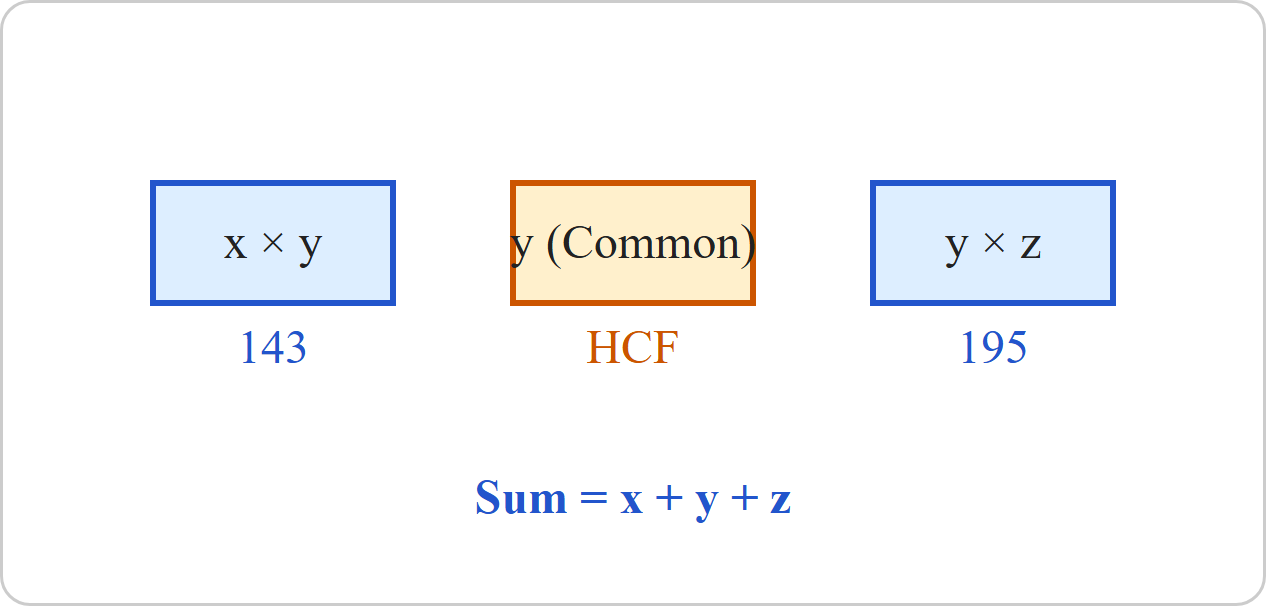
Three numbers x ≤ y ≤ z which are co-prime to each other are such that the product of the first two numbers is 143 and that of the last two numbers is 195. The sum of the three numbers is ______.

  1. ((a))

    62

  2. ((b))

    45

  3. ((c))

    39

  4. ((d))

    29

Show Answer
Answer: ((c))

39

Shortcut Trick

Given xy = 143 and yz = 195.

Since y is common, find HCF(143, 195).

143 = 11 × 13 and 195 = 15 × 13.

y = 13, x = 11, and z = 15.

Sum = 11 + 13 + 15 = 39.

∴ The correct answer is 39.

Alternate Method

Given: x ≤ y ≤ z are co-prime numbers.

Equations:

x × y = 143

y × z = 195

Calculations:

y = HCF(143, 195)

143 = 11 × 13

195 = 13 × 15

⇒ Common factor y = 13

x = 143 ÷ 13 = 11

z = 195 ÷ 13 = 15

x (11) ≤ y (13) ≤ z (15) [Condition Satisfied]

Sum = 11 + 13 + 15 = 39

∴ The correct answer is 39.

Additional Information

Co-prime Numbers

Numbers are co-prime if their Highest Common Factor (HCF) is 1. In this set, HCF(11, 13) = 1, HCF(13, 15) = 1, and HCF(11, 15) = 1.

HCF and Product Property

When two products share a common variable, that variable must be the HCF of the two products if the remaining factors are co-prime.

Prime Factorization

Breaking down a composite number into a product of prime numbers helps in identifying common factors quickly.

42

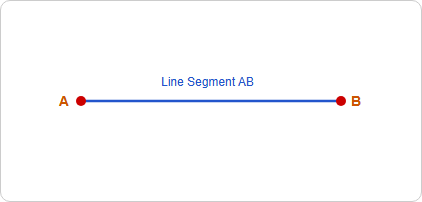
A line joining two end points is called a/an:

  1. ((a))

    parallel line

  2. ((b))

    line segment

  3. ((c))

    ray

  4. ((d))

    intersecting line

Show Answer
Answer: ((b))

line segment

Shortcut Trick

A line segment is a part of a line that is bounded by two distinct end points.

Unlike a line (infinite in both directions) or a ray (infinite in one direction), a line segment has a fixed length.

∴ The correct answer is line segment.

Alternate Method

Given: A line joining two end points.

Definition: In geometry, a line segment is a piece or part of a line that is bounded by two distinct end points and contains every point on the line between its endpoints.

⇒ A line extends infinitely in both directions and has no end points.

⇒ A ray has one starting point (end point) and extends infinitely in the other direction.

⇒ A line segment has exactly two end points, which makes it measurable.

Parallel lines are lines that never meet, and intersecting lines are lines that cross at a point.

∴ The correct answer is line segment.

Additional Information

Ray

A part of a line that starts at a point and goes off to infinity in one direction. It has only one end point.

Parallel Lines

Two lines in the same plane that are at an equal distance from each other and never intersect.

Intersecting Lines

Lines that share exactly one common point, called the point of intersection.

43

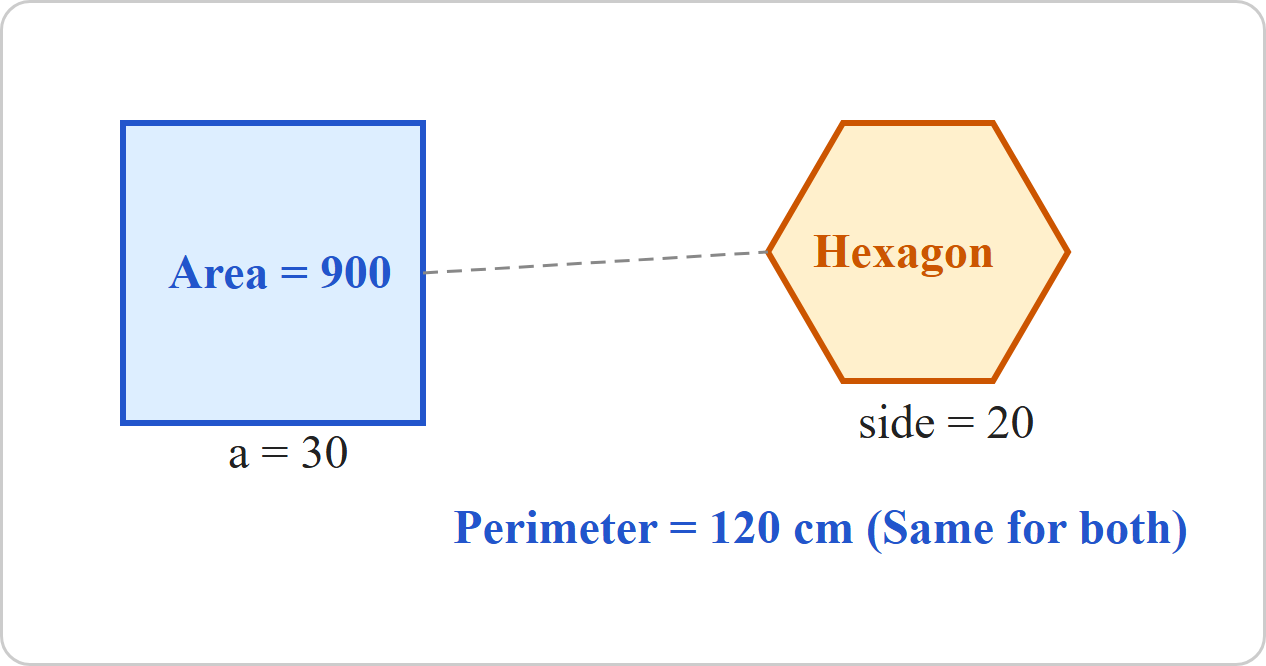
The area of a square is 900 cm2. Its perimeter is equal to the perimeter of a regular hexagon. What is the area (in cm2) of the hexagon?

  1. ((a))

    400√3

  2. ((b))

    300

  3. ((c))

    600

  4. ((d))

    600√3 

Show Answer
Answer: ((d))

600√3 

Shortcut Trick

Side of square = √900 = 30 cm.

Perimeter of square = 4 × 30 = 120 cm.

Side of hexagon = 120 ÷ 6 = 20 cm.

Area of hexagon = 6 × (√3/4) × 202 = 600√3 cm2.

∴ The correct answer is 600√3 cm2.

Alternate Method

Given: Area of square = 900 cm2. Perimeter of square = Perimeter of hexagon.

Formula Used: Area of square = a2 | Perimeter of square = 4a | Perimeter of hexagon = 6s | Area of regular hexagon = (3√3/2)s2.

⇒ Let side of square be a.

⇒ a2 = 900 ⇒ a = 30 cm.

⇒ Perimeter of square = 4 × 30 = 120 cm.

⇒ Let side of regular hexagon be s.

⇒ 6s = 120 ⇒ s = 20 cm.

⇒ Area of hexagon = (3√3 ÷ 2) × (20)2

⇒ Area = (3√3 ÷ 2) × 400 = 3√3 × 200 = 600√3 cm2.

∴ The correct answer is 600√3 cm2.

Additional Information

Regular Hexagon Properties

A regular hexagon is composed of 6 equilateral triangles. Its area is 6 × (√3/4)s2.

Square Properties

For a square with side a, the diagonal is a√2 and the area is a2 or (diagonal2)/2.

Perimeter Comparison

If the perimeter of different regular polygons is the same, the one with more sides will have a larger area.

44

Which of the following parts of a flower develops into a fruit after fertilisation?

  1. ((a))

    Pistil

  2. ((b))

    Ovary

  3. ((c))

    Ovule

  4. ((d))

    Petal

Show Answer
Answer: ((b))

Ovary

The correct answer is Ovary.

Key Points

  • A flower is the reproductive part of a plant, and it comprises several parts, including the pistil, ovary, ovule, petal, etc.
  • After pollination, the ovules in the ovary get fertilized by the sperm cells, which leads to the formation of seeds.
  • The ovary then develops into a fruit that surrounds the seeds and protects them until they are ready for dispersal.
  • The fruit can be fleshy or dry, depending on the type of plant and its mode of reproduction.
  • Therefore, the ovary is the part of a flower that develops into a fruit after fertilization.

Additional Information

  • Pistil is the female reproductive part of a flower that consists of the stigma, style, and ovary.
  • The stigma receives the pollen, and the style connects it to the ovary.
  • Ovule is the structure inside the ovary that contains the female gamete or egg cell.
  • It gets fertilized by the male gamete or sperm cell to form a zygote.
  • Petal is the colorful and attractive part of a flower that attracts pollinators like bees, butterflies, etc.
  • It does not play a direct role in reproduction.
45

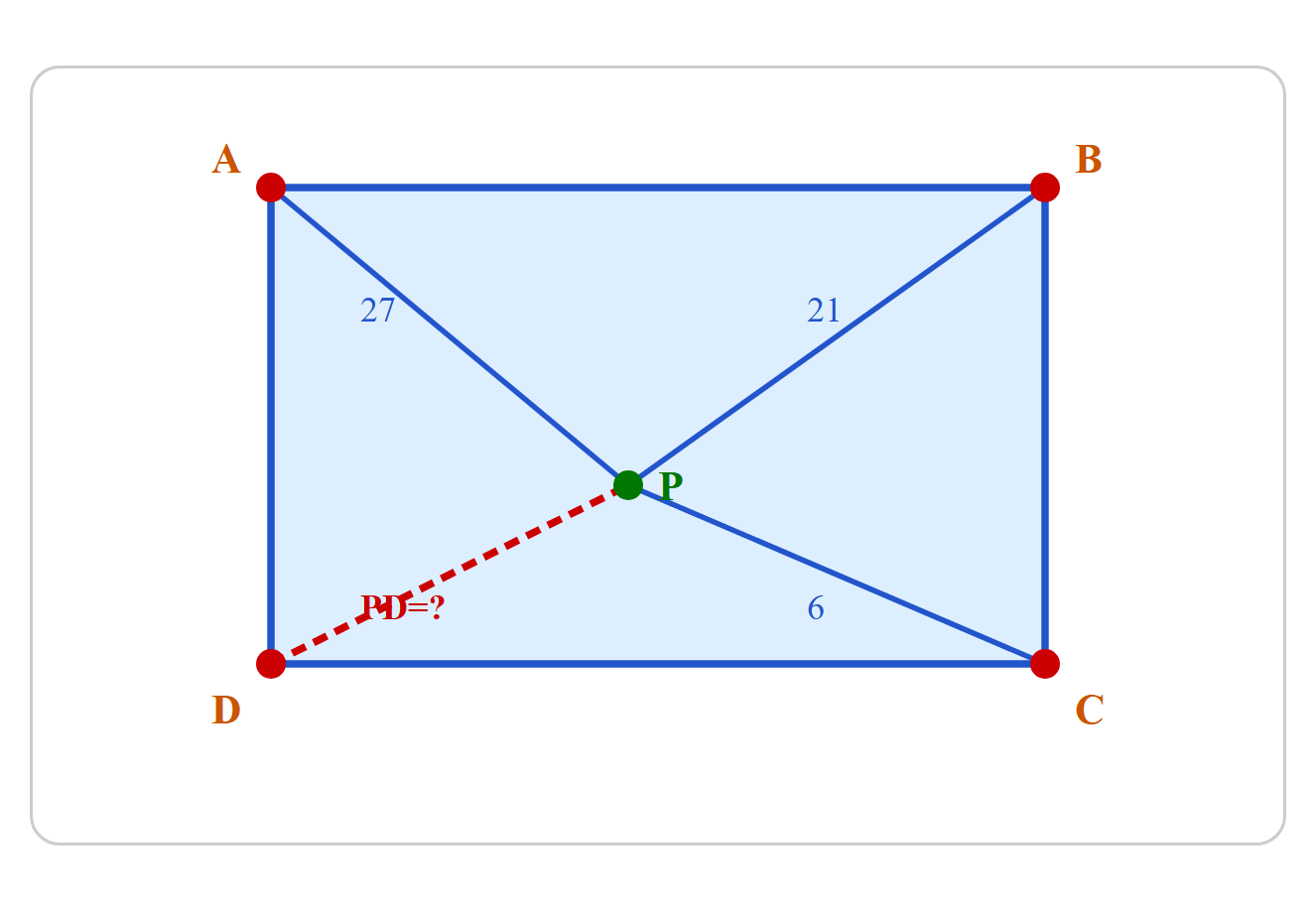
P is any point inside the rectangle ABCD. If PA = 27 cm, PB = 21 cm, PC = 6 cm, then the length PD (in cm) is equal to:

  1. ((a))

    15

  2. ((b))

    10

  3. ((c))

    12

  4. ((d))

    18

Show Answer
Answer: ((d))

18

Shortcut Trick

For any point P inside a rectangle ABCD, the British Flag Theorem states: PA2 + PC2 = PB2 + PD2.

⇒ 272 + 62 = 212 + PD2

⇒ 729 + 36 = 441 + PD2

⇒ 765 − 441 = PD2

⇒ PD2 = 324

⇒ PD = 18 cm

∴ The correct answer is 18 cm.

Alternate Method

Given: Rectangle ABCD, Point P inside. PA = 27 cm, PB = 21 cm, PC = 6 cm.

Formula Used: PA2 + PC2 = PB2 + PD2 (British Flag Theorem).

Calculations:

⇒ PA2 + PC2 = PB2 + PD2

⇒ (27)2 + (6)2 = (21)2 + PD2

⇒ 729 + 36 = 441 + PD2

⇒ 765 = 441 + PD2

⇒ PD2 = 765 − 441

⇒ PD2 = 324

⇒ PD = √324

⇒ PD = 18 cm

∴ The correct answer is 18 cm.

Additional Information

British Flag Theorem

It applies to any point P inside or outside a rectangle, stating that the sums of the squares of distances from P to opposite vertices are equal.

Diagonal Property

In a rectangle, AC = BD. If P is the center (intersection of diagonals), then PA = PB = PC = PD.

Pythagoras Application

The theorem is derived by drawing lines through P parallel to the rectangle sides and using a2 + b2 = c2 on the resulting right triangles.

46

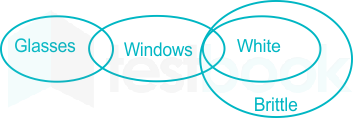
Three statements are followed by three conclusions numbered I, II and III. Assuming the statements to be true, even if they do not conform to real world knowledge, decide which of the given conclusions/possibilities can be true on the basis of the statements.

Statements:

  1. Some glasses are windows.
  2. Some windows are white.
  3. All white are brittle.

Conclusions:

I. Some white are glasses.

II. Some brittle are glasses.

III. Some brittle are windows.

  1. ((a))

    Only conclusion I is true

  2. ((b))

    Only conclusion II is true

  3. ((c))

    Only conclusion III is true

  4. ((d))

    Only I and II are true

Show Answer
Answer: ((c))

Only conclusion III is true

Given Statements:

  1. Some glasses are windows.
  2. Some windows are white.
  3. All white are brittle.

The least possible Venn diagram for the given statement is:

Conclusions:

I. Some white are glasses - False (Because, No definite relation given between white and glasses, so it can be possible only).

II. Some brittle are glasses - False (Because, No definite relation given between brittle and glasses, so it can be possible only).

III. Some brittle are windows - True (Because, Some windows are white and All white are brittle, so those part of brittle that is white will also windows).

So, Only conclusion III follows.

Hence, the correct answer is "Option 3".

47

The word _____ in the Preamble to the Constitution of India implies an 'elected Head of the State'.

  1. ((a))

    democratic

  2. ((b))

    sovereign

  3. ((c))

    socialist

  4. ((d))

    republic

Show Answer
Answer: ((d))

republic

The correct answer is republic.

Key Points

  • The Preamble to the Constitution of India starts with the words "We, the people of India".
  • This implies that the people of India are the ultimate source of power in the country.
  • The Preamble declares India to be a "sovereign, socialist, secular, democratic republic".
  • Each of these words has a specific meaning.
  • India is a republic because it has an elected head of state.
  • The President of India is elected by an Electoral College consisting of the elected members of both houses of Parliament and the Legislative Assemblies of the States.

Additional Information

  • Sovereign: India is a free country and has the power to govern itself without any external interference.
  • Socialist: The Indian government is committed to creating a society where there is social and economic equality for all.
  • Secular: India does not have an official state religion and all religions are treated equally.
  • Democratic: The people of India have the right to elect their representatives and participate in the democratic process.
48

In this question, a statement is followed by four conclusions. Find out which conclusion is true based on the given statement.

Statement:

B ≤ T = N > O = Q ≥ M = R

Conclusions:

  1. N ≥ B
  2. N < B
  3. O < R
  4. T < M
  1. ((a))

    1

  2. ((b))

    2

  3. ((c))

    3

  4. ((d))

    4

Show Answer
Answer: ((a))

1

Given Statement: B ≤ T = N > O = Q ≥ M = R

Now,

Conclusions:

(i) N ≥ B → True (B ≤ T = N It gives N ≥ B)

(ii) N < B → False (B ≤ T = N It gives N ≥ B)

(iii) O < R → False ​(O = Q ≥ M = R It gives O ≥ R)

(iv) T < M → False (T = N > O = Q ≥ M It gives T > M)

Here, Only Conclusion i is true.

Hence, the correct answer is "Option 1".

49

Study the following number arrangement and answer the question given below. All numbers given below are 2 digit numbers.

13 56 46 23 16 34 25 19 78 85 86 24 29 73 94 52 64 63

What will be the difference between the sum of the first half and second half of the above series?

  1. ((a))

    310

  2. ((b))

    260

  3. ((c))

    290

  4. ((d))

    315

Show Answer
Answer: ((b))

260

Given numbers: 13 56 46 23 16 34 25 19 78 85 86 24 29 73 94 52 64 63

Now,

The first half is: 13 56 46 23 16 34 25 19 78

The sum of the first half is: 310.

The second half is: 85 86 24 29 73 94 52 64 63

The sum of the first half is: 570.

So, the difference between the sum of the first half and second half is: 310 - 570 = -260.

Hence, the correct answer is "Option 2".

50

Voice change during puberty occurs due to _______.

  1. ((a))

    cigarette smoking

  2. ((b))

    the development of lungs

  3. ((c))

    muscular development

  4. ((d))

    the development of larynx

Show Answer
Answer: ((d))

the development of larynx

The correct answer is the development of larynx.

Key Points

  • Puberty is a phase of physical and sexual development in which the body undergoes various changes due to hormonal changes.
  • During puberty, the larynx, which is also known as the voice box, grows larger in both males and females.
  • The growth of the larynx causes the vocal cords to lengthen and thicken, resulting in a deeper and more resonant voice.
  • The process of voice change during puberty is more prominent in males than in females.

Additional Information

  • Cigarette smoking is harmful to the lungs and can cause various respiratory diseases such as bronchitis and lung cancer.
  • Lung development is a gradual process that starts before birth and continues throughout childhood and adolescence.
  • Muscular development is also a gradual process that occurs throughout childhood and adolescence.
  • Puberty usually starts in girls between the ages of 8 and 13, and in boys between the ages of 9 and 14.
  • Puberty is characterized by the development of breasts and the onset of menstruation in girls and larger testicles, deeper voice, and more muscular physique in boys.
51

Which of the following sports/activities is NOT covered under the National Air Sports Policy 2022?

  1. ((a))

    Aerobatics

  2. ((b))

    Parasailing

  3. ((c))

    Gliding

  4. ((d))

    Ballooning

Show Answer
Answer: ((b))

Parasailing

The correct answer is Parasailing.

Key Points

  • Parasailing is NOT covered under the National Air Sports Policy 2022.
  • The National Air Sports Policy 2022 is a policy document that outlines the guidelines and regulations for air sports activities in India.
  • Parasailing is not considered an air sports activity as it involves being towed by a boat while attached to a parachute, rather than flying in an aircraft.

Additional Information

  • Aerobatics, Gliding, and Ballooning are all covered under the National Air Sports Policy 2022.
  • Aerobatics is a type of aerial performance that involves complex and precise maneuvers in an aircraft.
  • Gliding is a type of air sports activity that involves flying in a glider, which is an unpowered aircraft.
  • Ballooning is a type of air sports activity that involves flying in a hot air balloon.
52

Seven persons N, O, P, Q, R, S, and T are sitting in a row facing North. Only three persons are sitting between P and T. N is sitting at one end. P is sitting somewhere to the left of N. O is to the immediate right of P and immediate left of R. Exactly two people are sitting to the right of T who is sitting to the immediate right of Q. Who is sitting in the middle?

  1. ((a))

    T

  2. ((b))

    O

  3. ((c))

    Q

  4. ((d))

    S

Show Answer
Answer: ((c))

Q

Given: Seven persons N, O, P, Q, R, S, and T are sitting in a row facing North.

  1. Exactly two people are sitting to the right of T who is sitting to the immediate right of Q. 

2) Only three persons are sitting between P and T. 

3) N is sitting at one end. 

4) P is sitting somewhere to the left of N.

5) O is to the immediate right of P and immediate left of R.

And, S will sit on the remaining place.

So, 'Q' is sitting in the middle.

Hence, the correct answer is "Option 3".

53

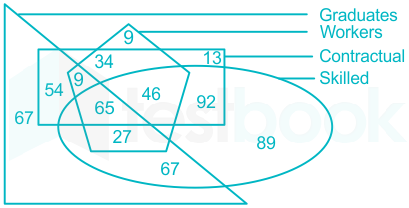
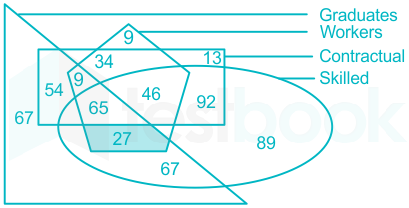
Study the Venn diagram presented below and answer the question that follows.

How many graduated skilled workers are NOT contractual?

  1. ((a))

    9

  2. ((b))

    27

  3. ((c))

    65

  4. ((d))

    46

Show Answer
Answer: ((b))

27

According to the given Venn diagram:

The shaded area shows the "total number of graduated skilled workers are NOT contractual".

So, the total number of graduated skilled workers are NOT contractual = 27.

Hence, the correct answer is "Option 2".

54

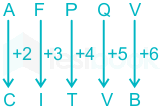
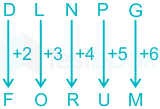
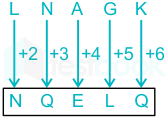
In a certain code language, 'AFPQV' is written as 'CITVB' and 'DLNPG' is written as 'FORUM'. How will 'LNAGK' be written in that language?

  1. ((a))

    NQEQL

  2. ((b))

    NQQLQ

  3. ((c))

    NQELQ

  4. ((d))

    QNEPK

Show Answer
Answer: ((c))

NQELQ

The logic followed here is:

'AFPQV' is written as 'CITVB',

‘DLNPG' is written as 'FORUM’

Similarly, for 'LNAGK'

So, 'LNAGK' will be written as 'NQELQ'.

Hence, the correct answer is "Option 3".

55

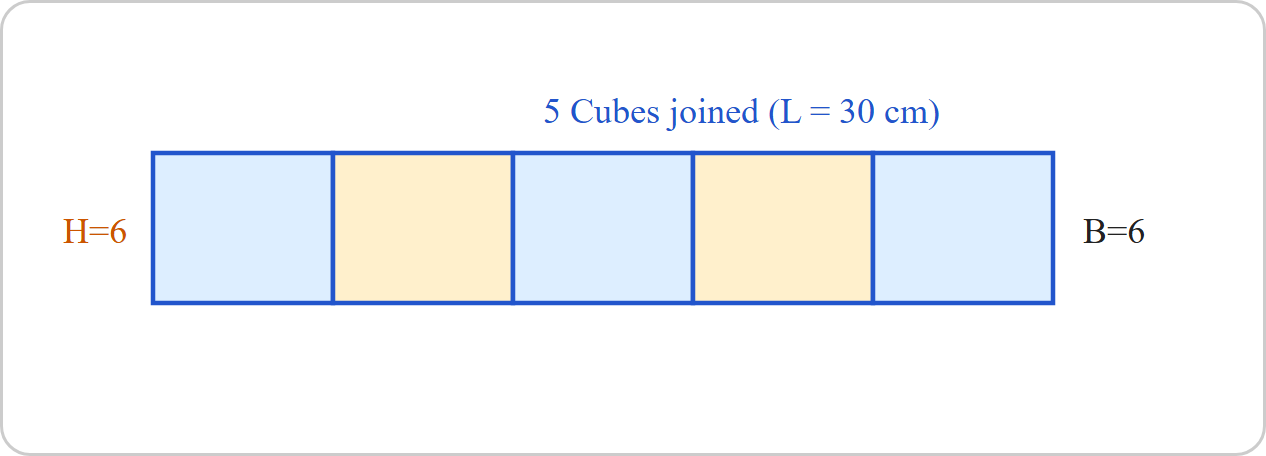
Five solid cubes, each of volume 216 cm3, are joined end to end in a linear manner only (single row arrangement) to form a cuboid. What is the lateral surface area (in cm2) of the cuboid?

  1. ((a))

    468

  2. ((b))

    360

  3. ((c))

    504

  4. ((d))

    432

Show Answer
Answer: ((d))

432

Shortcut Trick

Side of one cube = 3√216 = 6 cm.

When 5 cubes are joined, Length (L) = 5 × 6 = 30 cm, Breadth (B) = 6 cm, Height (H) = 6 cm.

Lateral Surface Area = 2 × (L + B) × H

⇒ 2 × (30 + 6) × 6 = 2 × 36 × 6 = 432 cm2.

∴ The correct answer is 432 cm2.

Alternate Method

Given:

Volume of one cube = 216 cm3

Number of cubes = 5

Formula Used:

Volume of cube = a3

Lateral Surface Area (LSA) of cuboid = 2h(l + b)

Calculations:

⇒ a3 = 216

⇒ a = √3(216) = 6 cm

⇒ New length (l) = 5 × a = 5 × 6 = 30 cm

⇒ Breadth (b) = 6 cm and Height (h) = 6 cm

⇒ LSA = 2 × 6 × (30 + 6)

⇒ LSA = 12 × 36

⇒ LSA = 432 cm2

∴ The correct answer is 432 cm2.

Additional Information

Total Surface Area of Cuboid

It includes the top and bottom faces: TSA = 2(lb + bh + hl).

Lateral Surface Area vs Total Surface Area

Lateral area excludes top and bottom bases. For a cube, LSA = 4a2 and TSA = 6a2.

Diagonal of Cuboid

The longest rod that can be placed inside is given by √(l2 + b2 + h2).

56

Which of the following instruments is used to measure blood pressure?

  1. ((a))

    Spectrophotometer

  2. ((b))

    Sphygmomanometer

  3. ((c))

    Urinometer

  4. ((d))

    Haemoglobin meter

Show Answer
Answer: ((b))

Sphygmomanometer

The correct answer is Sphygmomanometer.

Key Points

  • Sphygmomanometer is used to measure blood pressure.
  • Sphygmomanometer consists of an inflatable cuff to collapse and then release the artery under the cuff in a controlled manner, and a mercury or aneroid manometer to measure the pressure.
  • Blood pressure is measured in millimeters of mercury (mmHg) and is expressed as two numbers: systolic pressure (the higher number) and diastolic pressure (the lower number).

Additional Information

  • Spectrophotometer is an instrument used to measure the amount of light absorbed by a substance at different wavelengths.
  • It is commonly used in chemistry and biology to analyze the properties of substances.
  • Urinometer is an instrument used to measure the specific gravity of urine, which is a measure of the concentration of dissolved substances in urine.
  • Haemoglobin meter is an instrument used to measure the amount of haemoglobin in blood.
  • It is an important parameter in the diagnosis and monitoring of anaemia and other blood disorders.
57

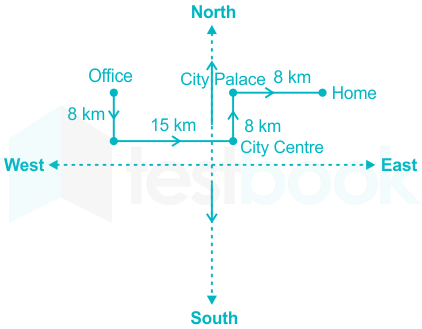
Mr. Amardeep started his drive from his office and drove for 8 km towards the south. Then he took a left turn and drove for 15 km to reach city centre. Then he turned 90° in the anti-clockwise direction and drove for 8 km to reach the city palace. From the city palace, he took a left turn and drove for 8 km to reach his home. In which direction is Amardeep's office from the city centre and his home, respectively? (All turns are 90 degree turns only)

  1. ((a))

    South-east and north

  2. ((b))

    South-west and west

  3. ((c))

    North-east and east

  4. ((d))

    North-west and west

Show Answer
Answer: ((d))

North-west and west

Given:

Mr. Amardeep started his drive from his office and drove for 8 km towards the south.

Then he took a left turn and drove for 15 km to reach city centre.

Then he turned 90° in the anti-clockwise direction and drove for 8 km to reach the city palace.

From the city palace, he took a left turn and drove for 8 km to reach his home.

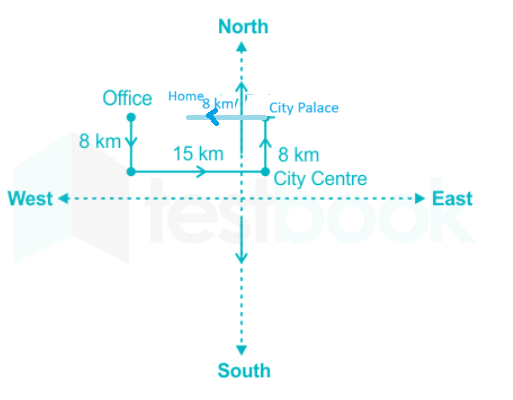
So, Amardeep's office is at the 'North-west' direction from the City centre,

And his Office is in the 'West' direction from his Home.

Hence, the correct answer is "Option 4".

58

The following table shows the marks scored by A, B, C and D in four subjects i.e., Mathematics, Hindi, English and Science. Marks given are out of 100. Study the table and answer the question.

Subject ↓ Student →ABCD
Mathematics90858378
Hindi86807482
English75737076
Science92886468

What is the ratio of 'the sum of the marks scored by A in Mathematics and B in Hindi' to 'the sum of the marks scored by C in Science and D in English'?

  1. ((a))

    12 ∶ 7

  2. ((b))

    2 ∶ 3

  3. ((c))

    17 ∶ 14

  4. ((d))

    14 ∶ 13

Show Answer
Answer: ((c))

17 ∶ 14

Calculation

The sum of the marks scored by A in Mathematics and B in Hindi = 90 + 80 = 170

The sum of the marks scored by C in Science and D in English = 76 + 64 = 140

The ratio = 170: 140 = 17: 14

The answer is 17: 14

59

Which of the following practices is least harmful in the conservation of forests and wildlife?

  1. ((a))

    Using forests as a source of raw material for industries

  2. ((b))

    Converting forests to plantations

  3. ((c))

    Collecting non-timber forest produce

  4. ((d))

    Building roads and dams in forested areas

Show Answer
Answer: ((c))

Collecting non-timber forest produce

The correct answer is Collecting non-timber forest produce.

Key Points

  • Non-timber forest produce (NTFP) refers to goods and services that are obtained from forests other than timber.
  • These include fruits, nuts, honey, medicinal plants, and other resources that can be harvested sustainably without damaging the forest ecosystem.
  • Collecting NTFP can provide livelihoods for local communities and reduce their dependence on unsustainable activities such as logging and poaching.
  • This can help to conserve forests and wildlife in the long term.
  • Unlike other activities such as building roads and dams, collecting NTFP does not require major infrastructure development that can have negative impacts on the environment and local communities.

Additional Information

  • Using forests as a source of raw material for industries can lead to overexploitation of forest resources and contribute to climate change through emissions from processing and transportation of wood products.
  • Converting forests to plantations, especially monoculture plantations, can have negative impacts on biodiversity, soil fertility, water availability, and local livelihoods.
  • Agroforestry and mixed-species plantations can be more sustainable alternatives.
  • Building roads and dams in forested areas can fragment habitats, facilitate illegal activities such as hunting and logging, and displace local communities.
  • Proper environmental impact assessments and community consultations are necessary to minimize these impacts.
60

Simplify 23 × 32 × 7.

  1. ((a))

    603

  2. ((b))

    504

  3. ((c))

    506

  4. ((d))

    702

Show Answer
Answer: ((b))

504

Calculation

⇒ 23 × 32 × 7 = 8 × 9 × 7

= 504

The answer is 504.

61

Sankar and Vishnu work alternately in a tailoring shop on an order of stitching 21 suits. Sankar starts the work, stitches 3 suits in two days, and takes a break, during which Vishnu stitches 3 suits in three days, and then takes a break. This pattern is repeated till all the 21 suits are stitched. How many days did it take the duo to complete the work?

  1. ((a))

    18 days

  2. ((b))

    15 days

  3. ((c))

    17 days

  4. ((d))

    16 days

Show Answer
Answer: ((c))

17 days

Shortcut Trick

Work done in 1 cycle (2 days of Sankar + 3 days of Vishnu) = 3 + 3 = 6 suits.

In 3 cycles: 3 × 6 = 18 suits are completed in 3 × 5 = 15 days.

Remaining suits = 21 − 18 = 3 suits.

Sankar completes these 3 suits in exactly 2 days.

Total time = 15 + 2 = 17 days.

∴ The correct answer is 17 days.

Alternate Method

Given:

Total work = 21 suits.

Sankar stitches 3 suits in 2 days → Efficiency = 3/2 = 1.5 suits/day.

Vishnu stitches 3 suits in 3 days → Efficiency = 3/3 = 1 suit/day.

Days taken by Sankar to finish 21 suits alone = 21 ÷ 1.5 = 14 days.

Days taken by Vishnu to finish 21 suits alone = 21 ÷ 1 = 21 days.

PersonDays to finish 21 suitsTotal Work (LCM)Efficiency (Units/Day)
Sankar14423
Vishnu212

Calculations:

⇒ Target work in units = (21/21) × 42 = 42 units (since Vishnu takes 21 days for 21 suits).

⇒ Work done by Sankar in 2 days = 2 × 3 = 6 units (stitching 3 suits).

⇒ Work done by Vishnu in 3 days = 3 × 2 = 6 units (stitching 3 suits).

⇒ Total work in 1 cycle (5 days) = 6 + 6 = 12 units (stitching 6 suits).

⇒ Work in 3 cycles (15 days) = 12 × 3 = 36 units (stitching 18 suits).

⇒ Remaining work = 42 − 36 = 6 units.

Sankar takes 6 ÷ 3 = 2 days to finish the remaining 6 units.

⇒ Total time taken = 15 + 2 = 17 days.

∴ The correct answer is 17 days.

Additional Information

Alternate Work Concept

In alternate work, tasks are performed in cycles. The total time is the sum of the time taken in complete cycles plus the time taken by the person whose turn is next to finish the residual work.

Efficiency Formula

Efficiency = Total Work ÷ Time Taken. For fractional days, the work done is Efficiency × Time.

Work Equality

If M1D1H1/W1 = M2D2H2/W2, it can be used to find unknown variables when work or number of people change.

62

A statement is given below, followed by four conclusions given in the options. Find out which conclusion is true based on the given statement.

Statement:  Q > A ≥ Z > X < R ≤ H < M

  1. ((a))

    Z > X ≥ M

  2. ((b))

    Q > M > H

  3. ((c))

    Q > X > A

  4. ((d))

    M > R > X

Show Answer
Answer: ((d))

M > R > X

Given Statement: Q > A ≥ Z > X < R ≤ H < M

Now,

Options:

(i) Z > X ≥ M → False (Z > X < R ≤ H < M No relation can be established between X and M)

(ii) Q > M > H → False (Q > A ≥ Z > X < R ≤ H < M No relation can be established between Q and M)

(iii) Q > X > A → False ​(Q > A ≥ Z > X It gives Q > A > X)

(iv) M > R > X → True (X < R ≤ H < M It gives M > R > X)

Here, Only Option iv is true.

Hence, the correct answer is "Option 4".

63

Select the number from among the given options that can replace the question mark (?) in the following series.

1, 0, 2, 1, 3, 2, 4, 5, 5, 26, ?, 677

  1. ((a))

    47

  2. ((b))

    26

  3. ((c))

    52

  4. ((d))

    6

Show Answer
Answer: ((d))

6

The logic followed here is:

So, '6' will be the missing number in the given series.

Hence, the correct answer is "Option 4".

64

How many airlines were nationalised under The Air Corporation Act, 1953?

  1. ((a))

    13

  2. ((b))

    09

  3. ((c))

    11

  4. ((d))

    18

Show Answer
Answer: ((b))

09

The correct answer is 09.

Key Points

  • 9 airlines were nationalised under The Air Corporation Act, 1953.
  • The Air Corporation Act, 1953 was enacted in India to provide for the nationalisation of certain air transport companies.
  • The Act authorised the Central Government to acquire the assets, properties, rights, and liabilities of the existing air transport companies and to transfer them to a newly created corporation called Air India International Limited.
  • The nationalised airlines under the Act included Tata Airlines, Air India Limited, Air Services of India Limited, Airways (India) Limited, Bharat Airways Limited, Deccan Airways Limited, Himalayan Aviation Limited, Kalinga Airlines, and Indian National Airways Limited.

Additional Information

  • According to market share, IndiGo is the largest airline in India.
  • This low-cost airline flies to more than 100 locations in India and beyond on more than 1,700 flights per day.
  • The company's main office is in Gurgaon, Haryana, India.
65

An article is marked 50% above its cost price. If the shopkeeper gives two successive discounts of 10% and 25%, and still earns a profit of ₹15, then the cost price of the article is:

  1. ((a))

    ₹1,600

  2. ((b))

    ₹1,200

  3. ((c))

    ₹1,750

  4. ((d))

    ₹1,500

Show Answer
Answer: ((b))

₹1,200

Shortcut Trick

Let Cost Price (CP) be 100 units.

Marked Price (MP) = 100 + 50% of 100 = 150 units.

Successive discount = a + b − (ab ÷ 100) = 10 + 25 − (10 × 25 ÷ 100) = 35 − 2.5 = 32.5%.

Selling Price (SP) = 150 × (100 − 32.5) ÷ 100 = 150 × 0.675 = 101.25 units.

Profit = 101.25 − 100 = 1.25 units. Given 1.25 units = &8377;15.

CP = (15 ÷ 1.25) × 100 = 12 × 100 = &8377;1,200.

∴ The correct answer is &8377;1,200.

Alternate Method

Given: Markup = 50%, Discounts = 10% and 25%, Profit = &8377;15.

Formulas: SP = MP × (100 − D1)% × (100 − D2)% | Profit = SP − CP.

⇒ Let CP = x.

⇒ MP = x × (150 ÷ 100) = 1.5x.

⇒ SP = 1.5x × (90 ÷ 100) × (75 ÷ 100) = 1.5x × 0.9 × 0.75 = 1.0125x.

⇒ Profit = 1.0125x − x = 0.0125x.

⇒ 0.0125x = 15.

⇒ x = 15 ÷ 0.0125 = 1,200.

∴ The correct answer is &8377;1,200.

Additional Information

Marked Price & Discount

Marked Price is the price displayed on the label. Discount is always calculated on the MP. SP = MP − Discount.

Successive Discounts

When multiple discounts are given, the second is applied to the price after the first discount. Total D% = a + b − (ab ÷ 100).

66

Which of the following is an artificial ecosystem that is manmade?

  1. ((a))

    Lake

  2. ((b))

    Crop field

  3. ((c))

    Forest

  4. ((d))

    Pond

Show Answer
Answer: ((b))

Crop field

The correct answer is Crop field.

Key Points

  • An artificial ecosystem is a man-made ecosystem that is created by humans for various purposes.
  • A crop field is an example of an artificial ecosystem because it is created by humans for the purpose of growing crops.
  • Crop fields are referred to as artificial ecosystems due to the manipulation of various biotic and abiotic elements.
  • Farmers make use of the connection between producers and abiotic variables.

Additional Information

  • A natural ecosystem is a free-living community of both living and non-living things found in the wild.
  • All of the components work together as a single entity through chemical, biological, and physical processes.
  • A lake, forest, and pond are natural ecosystems that are not man-made.
  • A lake is a large body of water that is surrounded by land.
  • It is formed naturally.
  • A forest is a large area that is covered with trees and other vegetation.
  • A pond is a small body of water that is formed naturally and is not created by humans.
67

Raghav's average earning per month in the first three months of a year was ₹45,000. In April, his earning was 3313%33 \frac{1}{3} \% more than the average earning in the first three months. If his average earning per month for the whole year is ₹45,300, then what will be Raghav's average earning (in ₹) per month from May to December?

  1. ((a))

    43,575

  2. ((b))

    43,450

  3. ((c))

    43,425

  4. ((d))

    43,580

Show Answer
Answer: ((a))

43,575

Shortcut Trick

Base average (first 3 months) = 45,000

April earning = 45,000 × (1 + 1/3) = 60,000

Using Deviation Method relative to yearly average 45,300:

Net deviation (Jan-Apr) = [3 × (45,000 − 45,300)] + [1 × (60,000 − 45,300)] = −900 + 14,700 = +13,800

Avg (May-Dec) = 45,300 − (13,800 ÷ 8) = 45,300 − 1,725 = 43,575

∴ The correct answer is ₹43,575.

Alternate Method

Given:

Average (Jan-Mar) = ₹45,000

April earning = 33 1/3% more than ₹45,000

Yearly Average (12 months) = ₹45,300

Formula Used:

Total Earning = Average × Number of months

Calculations:

⇒ Total for Jan-Mar = 3 × 45,000 = ₹1,35,000

⇒ April Earning = 45,000 × (1 + 1/3) = 45,000 + 15,000 = ₹60,000

⇒ Total for Jan-Apr = 1,35,000 + 60,000 = ₹1,95,000

⇒ Total for the year (12 months) = 12 × 45,300 = ₹5,43,600

⇒ Total for May-Dec = 5,43,600 − 1,95,000 = ₹3,48,600

⇒ Average (May-Dec) = 3,48,600 ÷ 8

⇒ Average (May-Dec) = ₹43,575

∴ The correct answer is ₹43,575.

Additional Information

Weighted Average Concept

The combined average of two groups is given by (n1x1 + n2x2) ÷ (n1 + n2), where n is the count and x is the average.

Percentage to Fraction Conversion

Values like 33.33% or 33 1/3% are exactly equal to 1/3. For "more than", use the multiplier (1 + 1/3) = 4/3.

Deviation Rule

The sum of deviations of all observations from the mean is always zero. This is the fastest way to find a missing group average.

68

If x+1x=3x+\frac{1}{x}=3, then x2+1x2x^2+\frac{1}{x^2} is:

  1. ((a))

    6

  2. ((b))

    9

  3. ((c))

    7

  4. ((d))

    8

Show Answer
Answer: ((c))

7

Shortcut Trick

For any algebraic expression of the form x + 1/x = k, the value of x2 + 1/x2 is given by the formula k2 − 2.

Here, the given value k = 3.

∴ x2 + 1/x2 = 32 − 2

⇒ 9 − 2 = 7

∴ The correct answer is 7.

Alternate Method

Given: x + 1/x = 3

Formula Used: (a + b)2 = a2 + b2 + 2ab

Calculations:

Squaring both sides of the given equation:

⇒ (x + 1/x)2 = 32

⇒ x2 + (1/x)2 + 2 × x × (1/x) = 9

⇒ x2 + 1/x2 + 2 = 9

⇒ x2 + 1/x2 = 9 − 2

⇒ x2 + 1/x2 = 7

∴ The correct answer is 7.

Additional Information

Square Identity with Subtraction

If x − 1/x = k, then the value of x2 + 1/x2 is k2 + 2.

Cubic Identity

If x + 1/x = k, then the value of x3 + 1/x3 is k3 − 3k.

Higher Power Relation

If x + 1/x = k, the value of x4 + 1/x4 can be found by squaring the result of (x2 + 1/x2) and subtracting 2.

69

Study the given graph and answer the question that follows.

The graph presents total number of students who opted for different subjects in a college.

What is the difference between the total number of students who have opted for 'Biology and Mathematics' & total number of students who have opted for 'Civics and History'?

  1. ((a))

    49

  2. ((b))

    50

  3. ((c))

    52

  4. ((d))

    51

Show Answer
Answer: ((d))

51

Calculation

The total number of students who have opted for 'Biology and Mathematics = 87 + 65 + 87 + 67 = 306

The total number of students who have opted for 'Civics and History' = 65 + 45 + 78 + 67 = 255

Difference = 306 - 255 = 51

The answer is 51.

70

Consider the below statements and identify the correct answer.

Statement - I: Keeping food in air-tight containers helps to slow down oxidation.

Statement - II: Chips manufacturers usually flush bags of chips with gas such as oxygen to prevent the chips from getting oxidised.

  1. ((a))

    Statement-I is true, and Statement-II is false.

  2. ((b))

    Both the statements are true.

  3. ((c))

    Both the statements are false.

  4. ((d))

    Statement-I is false, and Statement-II is true.

Show Answer
Answer: ((a))

Statement-I is true, and Statement-II is false.

The correct answer is Statement-I is true, and Statement-II is false.

Key Points

  • Keeping food in air-tight containers helps to slow down oxidation as it reduces the exposure of the food to air, which is necessary for oxidation to occur.
  • Chips manufacturers usually flush bags of chips with gas such as nitrogen instead of oxygen to prevent the chips from getting oxidized.
  • This is because nitrogen is an inert gas and does not react with the chips, thus preventing oxidation.
  • Statement-I is true as keeping food in air-tight containers does slow down oxidation.
  • Statement-II is false as chips manufacturers usually flush bags of chips with nitrogen to prevent oxidation, not oxygen.

Additional Information

  • The loss of electrons by a molecule, atom, or ion during a reaction is called oxidation.
  • A molecule, atom, or ion undergoes oxidation when its oxidation status increased.
  • Oxidation is a chemical process in which oxygen reacts with other substances, such as food, and causes a change in their chemical composition.
  • Air-tight containers prevent the entry of oxygen into the container and thus slow down oxidation.
71

The potential difference across a copper wire is 5.0 V when a current of 0.5 A flows through it. The resistance of the wire is:

  1. ((a))

    10.0 Ω

  2. ((b))

    2.5 Ω

  3. ((c))

    0.1 Ω

  4. ((d))

    5.0 Ω

Show Answer
Answer: ((a))

10.0 Ω

The correct answer is 10.0 Ω.

Key Points

  • The formula for calculating resistance is R = V/I, where V is the potential difference and I is the current flowing through the wire.
  • Plugging in the given values, R = 5.0 V / 0.5 A = 10.0 Ω.
  • Therefore, the correct answer is 10.0 Ω.
  • Copper wire is a good conductor of electricity due to its high electrical conductivity and low resistivity.

Additional Information

  • The difference in charge carrier energy between two places in a circuit is known as the potential difference.
  • The ease with which an electric current can pass through a material is measured by its electrical conductivity.
  • The amount of obstruction to current passage in an electrical circuit is measured as resistance.
72

Which institution is the country's premier organisation for literary discourse, publication and promotion, and the only one that does so in 24 Indian languages, including English?

  1. ((a))

    English and Foreign Languages University

  2. ((b))

    Sahitya Akademi

  3. ((c))

    Hindi Granth Academy

  4. ((d))

    Indira Gandhi National Open University

Show Answer
Answer: ((b))

Sahitya Akademi

The correct answer is Sahitya Akademi.

Key Points

  • Sahitya Akademi was established in 1954 by the Government of India to promote and preserve literature in Indian languages.
  • It has its headquarters in New Delhi and regional offices in different parts of the country.
  • Sahitya Akademi organizes literary events, awards, and fellowships to recognize and encourage writers in different languages.
  • The organization also publishes books in various Indian languages, including translations of works from other languages.

Additional Information

  • English and Foreign Languages University is located in Hyderabad.
  • It offers courses in English and foreign languages.
  • Hindi Granth Academy is based in Uttar Pradesh.
  • It is dedicated to promoting Hindi literature.
  • Indira Gandhi National Open University is located in New Delhi.
  • It offers distance education programs.
73

Refer to the following letter, number, symbol series and answer the question.

(Left) K & ^ 5 T & B 4 @ 3 # 1 A 3 P H 9 L % 9 2 (Right)

If all letters are dropped from the series, which of the following will be fifth from the left?

  1. ((a))

    &

  2. ((b))

    4

  3. ((c))

    3

  4. ((d))

Show Answer
Answer: ((b))

4

Given terms: (Left) K & ^ 5 T & B 4 @ 3 # 1 A 3 P H 9 L % 9 2 (Right)

If all the letters are dropped from the series then the arrangements are:

(Left) & ^ 5 & 4 @ 3 # 1 3 9 % 9 2 (Right)

Here,

Fifth from the Left end is: 4.

Hence, the correct answer is "Option 2".

74

A, B, C, D, E, F, G and H are sitting around a square table facing the centre of the table. Some of them are sitting at the corners, while some are sitting at the middle of the sides. D sits third to the left of F. D sits at one of the corners. C sits second to the right of A. A does not sit at any of the corners. A is not an immediate neighbour of D. G is an immediate neighbour of E. G does not sit at any of the middle of the sides. Only three people sit between G and B.

Who sits second to the right of H?

  1. ((a))

    E

  2. ((b))

    G

  3. ((c))

    C

  4. ((d))

    B

Show Answer
Answer: ((d))

B

Given: A, B, C, D, E, F, G and H are sitting around a square table facing the centre of the table.

Some of them are sitting at the corners, while some are sitting at the middle of the sides.

  1. D sits third to the left of F. D sits at one of the corners.

  2. C sits second to the right of A. A does not sit at any of the corners.

  3. A is not an immediate neighbour of D.

  1. G is an immediate neighbour of E.

  2. G does not sit at any of the middle of the sides.

  1. Only three people sit between G and B.

And, H will sit on the remaining place.

Here, 'B' sits second to the right of H.

Hence, the correct answer is "Option 4".

75

When acetic acid is treated with sodium hydroxide, then _______ and water will be formed.

  1. ((a))

    sodium bicarbonate

  2. ((b))

    sodium acetate

  3. ((c))

    sodium carbonate

  4. ((d))

    lactic acid

Show Answer
Answer: ((b))

sodium acetate

The correct answer is sodium acetate.

Key Points

  • When acetic acid is treated with sodium hydroxide, it undergoes a neutralization reaction to form sodium acetate and water.
  • Sodium acetate is a salt that is commonly used in the textile industry for dyeing and printing fabrics.
  • Acetic acid is a weak organic acid that is commonly found in vinegar and used in food preservation and cooking.

Additional Information

  • Sodium bicarbonate is produced when sodium carbonate reacts with carbon dioxide and water.
  • Sodium bicarbonate is commonly known as baking soda and is used as a leavening agent in baking, as well as for cleaning and deodorizing.
  • Sodium carbonate requires a stronger acid to react with sodium hydroxide.
  • Sodium carbonate is commonly known as washing soda and is used as a water softener and in the production of glass, detergents, and paper.
  • Lactic acid is a different organic acid that does not react with sodium hydroxide to form a salt.
  • Lactic acid is a weak organic acid that is produced by the muscles during exercise and is also found in sour milk and some fruits.
  • It is used in the food and beverage industry as a flavoring agent and preservative.
76

Three statements are given, followed by three conclusions numbered I, II and III. Assuming the statements to be true, even if they seem to be at variance with commonly known facts, decide which of the conclusions logically follow(s) from the statements.

Statements:

I. All grounds are plane.

II. Some planes are covered.

III. All covered are wets.

Conclusions:

I. Some wets are plane.

II. Some wets are grounds.

III. Some planes are grounds.

  1. ((a))

    Conclusions I, II and III follow

  2. ((b))

    Conclusions II and III follow

  3. ((c))

    Conclusions I and II follow

  4. ((d))

    Conclusions I and III follow.

Show Answer
Answer: ((d))

Conclusions I and III follow.

Given Statements:

I. All grounds are plane.

II. Some planes are covered.

III. All covered are wets.

The least possible Venn diagram for the given statement is:

Conclusions:

I. Some wets are plane - True (Because, Those part of Plane which is covered will also Wets).

II. Some wets are grounds - False (Because, No definite relation given between wets and grounds, so it can be possible only).

III. Some planes are grounds - True (Because, All Grounds are plane also gives Some planes are Grounds).

So, Conclusions I and III follow..

Hence, the correct answer is "Option 4".

77

This question is based on the following 3-letter words.

(left) ROW MAD LAY CAT (right)

If in each of the words, each letter is changed to the next letter in the English alphabetical order, how many words thus formed will have no vowel?

  1. ((a))

    Two

  2. ((b))

    Three

  3. ((c))

    None

  4. ((d))

    One

Show Answer
Answer: ((a))

Two

Given: (left) ROW MAD LAY CAT (right)

Now, In each of the words, each letter is changed to the next letter in the English alphabetical order,

WordsEach letter is changed by it's next letter
ROWSPX
MADNBE
LAYMBZ
CATDBU


then there are 'Two' words having no vowel: 'SPX' and 'MBZ'.

Hence, the correct answer is "Option 1".

78

In an organic compound, a functional group determines:

  1. ((a))

    its chemical properties

  2. ((b))

    the nature of the carbon chain

  3. ((c))

    the length of carbon chain

  4. ((d))

    its molecular mass

Show Answer
Answer: ((a))

its chemical properties

The correct answer is its chemical properties.

Key Points

  • The functional group in an organic compound determines its chemical properties.
  • The properties of a functional group include its reactivity, polarity, and ability to participate in specific chemical reactions.
  • A functional group is a specific arrangement of atoms within a molecule that imparts characteristic chemical properties to the compound.
  • Examples of functional groups include alcohols, aldehydes, ketones, carboxylic acids, and amines.

Additional Information

  • The nature of the carbon chain refers to whether it is straight or branched, saturated or unsaturated, or contains other substituents such as halogens or functional groups.
  • These factors affect physical properties such as melting point, boiling point, and solubility.
  • The length of the carbon chain can also affect physical properties such as boiling point and solubility.
  • Molecular mass is a measure of the total mass of the atoms in a molecule, which affect physical properties such as density and boiling point.
79

Madan and Mohan are standing in a row of people. Madan is standing at the 16th position from the left side of the row and Mohan is standing at the 19th position from the right side of the row. If both of them interchange their positions Madan becomes 28th from the left. How many people are standing in the row?

  1. ((a))

    35

  2. ((b))

    43

  3. ((c))

    47

  4. ((d))

    46

Show Answer
Answer: ((d))

46

The logic followed here is:

Position of Madan from the left = 16th

Position of Mohan from the right = 19th

After interchanging, Position of Madan from the left = 28th

So,

Total number of people = Position of Mohan from the right + Position of Madan from the right after interchange - 1

= 19 + 28 - 1

= 47 - 1 = 46.

Hence, the correct answer is "Option 4".

80

In which of the following years did the fourteen major Indian scheduled commercial banks get nationalised in India?

  1. ((a))

    1969

  2. ((b))

    1970

  3. ((c))

    1972

  4. ((d))

    1950

Show Answer
Answer: ((a))

1969

The correct answer is 1969.

Key Points

  • In 1969, the Government of India nationalized the fourteen major Indian scheduled commercial banks, which had deposits of over Rs. 50 crores.
  • The nationalization was aimed at achieving the following objectives:
  • To ensure that credit is available to priority sectors such as agriculture, small-scale industries, and exports.
  • To ensure that banking services are available to all sections of society, especially the poor and the marginalized.
  • To promote the development of banking infrastructure in rural areas.

Additional Information

  • The fourteen banks that were nationalized in 1969 were:
  • Allahabad Bank
  • Bank of Baroda
  • Bank of India
  • Bank of Maharashtra
  • Canara Bank
  • Central Bank of India
  • Dena Bank
  • Indian Bank
  • Indian Overseas Bank
  • Punjab Sind Bank
  • Punjab National Bank
  • Syndicate Bank
  • Union Bank of India
  • United Bank of India
  • The Reserve Bank of India, which regulates and supervises the banking system in India, was established in 1935.
81

Who is the chairperson of National Commission for Women in India (As of July 2022)?

  1. ((a))

    Dr. Girija Vyas

  2. ((b))

    Mamta Sharma

  3. ((c))

    Meeta Rajivlochan

  4. ((d))

    Rekha Sharma

Show Answer
Answer: ((d))

Rekha Sharma

The correct answer is Rekha Sharma.

Key Points

  • The National Commission for Women (NCW) is a statutory body established in 1992 under the National Commission for Women Act, 1990.
  • Its primary objective is to protect and promote the rights of women in India.
  • Rekha Sharma was appointed as the chairperson of NCW in August 2018 for a period of three years.
  • Her tenure was extended for another three years in August 2021, which means she will be the chairperson of NCW till August 2024.
  • Rekha Sharma is a well-known social activist and women's rights advocate.
  • She has been associated with various NGOs and advocacy groups working for women's empowerment and gender equality.
  • As the chairperson of NCW, Rekha Sharma has been actively involved in addressing various issues related to women's safety, rights, and welfare.
  • She has also been advocating for stricter laws and policies to ensure gender justice and equality in India.

Additional Information

  • Dr. Girija Vyas was the chairperson of NCW from September 2013 to September 2018.
  • Prior to that, she was a member of parliament and held various ministerial positions in the government of India.
  • Mamta Sharma was the chairperson of NCW from August 2011 to September 2013.
  • She was also a member of the Rajasthan Legislative Assembly and held various positions in the Congress party.
82

The resistance of a wire of length L and area of cross-section A is 1.0 Ω. The resistance of a wire of the same material, but of length 4 L and area of cross-section 5 A will be:

  1. ((a))

    2.5 Ω

  2. ((b))

    0.8 Ω

  3. ((c))

    1.25 Ω

  4. ((d))

    0.4 Ω

Show Answer
Answer: ((b))

0.8 Ω

The correct answer is 0.8 Ω.

Key Points

  • The resistance of a wire is directly proportional to its length and inversely proportional to its area of cross-section.
  • Using the formula R = Ω (L/A), where Ω is the resistivity of the material, we can find the resistance of the second wire.
  • Since the material is the same, the resistivity remains constant.
  • Therefore, R2 = 1.0 Ω (4L/5A) = 4/5(L/A) = 4/5(R1) = 0.8 Ω.
  • Hence, 0.8 Ω is the correct answer.

Additional Information

  • The amount of obstruction to current passage in an electrical circuit is measured as resistance.
  • Ohms, a unit of measurement for resistance, are represented by the Greek letter omega (Ω).
  • The electric current flowing through a conductor between two places is directly proportional to the voltage across those same points, according to Ohm's law.
83

Match the following characteristics in the modern periodic table:

i.Total number of blocks in tablea.4
ii.Total number of periodsb.2
iii.Number of elements in K shellc.8
iv.Number of elements in M shelld.7
vNumber of elements in L shelle.18
  1. ((a))

    i - b, ii - a, iii - d, iv - c, v - e  

  2. ((b))

    i - a, ii - b, iii - c, iv - d, v - e

  3. ((c))

    i - e, ii - c, iii - a, iv - b, v - d

  4. ((d))

    i - a, ii - d, iii - b, iv - e, v - c

Show Answer
Answer: ((d))

i - a, ii - d, iii - b, iv - e, v - c

The correct answer is i - a, ii - d, iii - b, iv - e, v - c.

Key Points

  • The modern periodic table consists of 18 groups and 7 periods.
  • The K shell can hold a maximum of 2 electrons, the L shell can hold a maximum of 8 electrons, and the M shell can hold a maximum of 18 electrons.
  • There are a total of 4 blocks in the periodic table: s, p, d, and f blocks.

Additional Information

  • The definition of the modern periodic table is a table that shows the elements organized into groups and periods.
  • The current periodic table arranges the elements in increasing order of atomic number.
  • This periodic table is divided into groups and periods.
  • The periods are arranged in horizontal rows.
  • Vertical columns hold the arrangement of the groups.
  • The modern periodic table has the elements listed in order from left to right.
84

A Memorandum of Understanding (MoU) was signed between the Survey of India, Government of India and Assam State Government in June 2021 for the implementation of which scheme for rural property survey?

  1. ((a))

    Mission Suraksha

  2. ((b))

    Svamitva scheme

  3. ((c))

    Mission Sagar

  4. ((d))

    Sahakar Mitra Scheme

Show Answer
Answer: ((b))

Svamitva scheme

The correct answer is Svamitva scheme.

Key Points

  • The Survey of India and Assam State Government signed an MoU for the implementation of the Svamitva scheme in June 2021.
  • Svamitva is a Central Sector Scheme launched by the Ministry of Panchayati Raj in April 2020.
  • Its objective is to provide an integrated property validation solution for rural areas.
  • The scheme aims to provide property cards to rural landowners, which will help them establish their ownership and access credit and other government services.
  • The scheme also aims to survey all rural households and map their properties using drone technology, which will help in better planning and implementation of rural development programs.

Additional Information

  • Mission Suraksha is a COVID-19 vaccination drive launched by the Indian government.
  • A total of Rs. 900 Crore was allocated for the Mission's Phase-I over a 12-month period.
  • The Department of Biotechnology (DBT) received the grant for the purpose of doing research and development (R&D) on Indian Covid-19 vaccines.
  • Mission Sagar is a humanitarian mission launched by the Indian Navy.
  • It aimed to provide assistance to friendly foreign countries during the COVID-19 pandemic.
  • Sahakar Mitra Scheme is a scheme launched by the National Cooperative Development Corporation.
  • It aimed to provide technical assistance to cooperatives in India.
85

Hardness of water can be removed by using:

  1. ((a))

    vinegar

  2. ((b))

    POP

  3. ((c))

    washing soda

  4. ((d))

    common salt

Show Answer
Answer: ((c))

washing soda

The correct answer is washing soda.

Key Points

  • Hardness of water refers to the presence of dissolved minerals, such as calcium and magnesium, in the water.
  • These minerals can cause scaling in pipes, reduce the effectiveness of soaps and detergents, and leave spots on dishes and glasses.
  • Washing soda, also known as sodium carbonate, is an effective water softener.
  • It works by reacting with the dissolved minerals to form insoluble precipitates that can be removed by filtration or settling.

Additional Information

  • Common salt is also known as sodium chloride.
  • It actually increase the hardness of water by adding more dissolved ions.
  • Vinegar is also known as acetic acid.
  • While it can react with some minerals, it is not effective at removing calcium and magnesium ions.
  • POP, or polyacrylamide-based polymer is primarily used as a flocculant to settle suspended particles in water.
86

Which of the following interchanges of numbers would make the given equation correct?

6 × 40 ÷ 8 + 2 - 5 = 11

  1. ((a))

    8, 40

  2. ((b))

    5, 6

  3. ((c))

    2, 6

  4. ((d))

    2, 5

Show Answer
Answer: ((c))

2, 6

Given equation: 6 × 40 ÷ 8 + 2 - 5 = 11 .

BODMAS Table: 

Let's check each option one by one.

Option 1) 8, 40

Given: 6 × 40 ÷ 8 + 2 - 5 = 11 

After interchanging the numbers we get;

⇒ 6 × 8 ÷ 40 + 2 - 5 = 11 

⇒ 6 × 0.2 + 2 - 5 = 11 

⇒ 1.2 + 2 - 5 = 11 

⇒ 3.2 - 5 = 11

⇒ -1.8 ≠ 11

⇒ LHS ≠ RHS

Option 2) 5, 6

Given: 6 × 40 ÷ 8 + 2 - 5 = 11 

After interchanging the numbers we get;

⇒ 5 × 40 ÷ 8 + 2 - 6 = 11 

⇒ 5 × 5 + 2 - 6 = 11 

⇒ 25 + 2 - 6 = 11 

⇒ 27 - 6 = 11

⇒ 21 ≠ 11

⇒ LHS ≠ RHS

Option 3) 2, 6

Given: 6 × 40 ÷ 8 + 2 - 5 = 11 

After interchanging the numbers we get;

⇒ 2 × 40 ÷ 8 + 6 - 5 = 11 

⇒ 2 × 5 + 6 - 5 = 11 

⇒ 10 + 6 - 5 = 11 

⇒ 16 - 5 = 11 

⇒ 11 = 11

⇒ LHS = RHS

Option 4) 2, 5

Given: 6 × 40 ÷ 8 + 2 - 5 = 11 

After interchanging the numbers we get;

⇒ 6 × 40 ÷ 8 + 5 - 2 = 11 

⇒ 6 × 5 + 5 - 2 = 11 

30 + 5 - 2 = 11 

⇒ 35 - 2 = 11 

⇒ 33 ≠ 11

⇒ LHS ≠ RHS

Hence, the correct answer is "Option 3".

87

Which of the following terms will replace the question mark (?) in the given series to make it logically complete?

AJM72, DMP81, GPS90, JSV99, ?

  1. ((a))

    MVJ105

  2. ((b))

    MVY108

  3. ((c))

    MSV105

  4. ((d))

    MYV108

Show Answer
Answer: ((b))

MVY108

The logic followed here is:

So, 'MVY108' will replace the question mark in the given series.

Hence, the correct answer is "Option 2".

88

Find the nature of roots of 2(p + q)2x2 + 2(p + q)x + 1 = 0

  1. ((a))

    Real roots

  2. ((b))

    Real and distinct roots

  3. ((c))

    Real and equal roots

  4. ((d))

    Imaginary roots

Show Answer
Answer: ((d))

Imaginary roots

Shortcut Trick For any quadratic equation ax2 + bx + c = 0, the nature of roots depends on the Discriminant (D) = b2 − 4ac. In 2(p + q)2x2 + 2(p + q)x + 1 = 0, let (p + q) = k. Then, D = (2k)2 − 4(2k2)(1) = 4k2 − 8k2 = −4k2. Since the square of any real number k is non-negative (k2 ≥ 0), −4k2 will always be less than 0 (assuming k ≠ 0). As D < 0, the roots are always Imaginary. ∴ The correct answer is Imaginary roots.

Alternate Method Given Equation: 2(p + q)2x2 + 2(p + q)x + 1 = 0 Formula Used: For a quadratic equation ax2 + bx + c = 0:

  1. If D = b2 − 4ac > 0, roots are real and distinct.
  2. If D = b2 − 4ac = 0, roots are real and equal.
  3. If D = b2 − 4ac < 0, roots are imaginary. Calculations: Identify the coefficients from the given equation: a = 2(p + q)2 b = 2(p + q) c = 1 Now, calculate the Discriminant (D): ⇒ D = b2 − 4ac ⇒ D = [2(p + q)]2 − 4 × [2(p + q)2] × 1 ⇒ D = 4(p + q)2 − 8(p + q)2 ⇒ D = −4(p + q)2 Analysis of the sign of D: ⇒ For any real values of p and q, (p + q)2 is always positive or zero. ⇒ If (p + q) = 0, the equation becomes 1 = 0 (not a quadratic), so (p + q) ≠ 0. ⇒ Thus, (p + q)2 > 0, which means −4(p + q)2 < 0. ⇒ Since D < 0, the roots of the equation are Imaginary. ∴ The correct answer is Imaginary roots.

Additional Information Discriminant (D) It is the part of the quadratic formula under the square root, D = b2 − 4ac, which determines the nature and number of roots. Nature of Roots for Real Coefficients When D > 0 and a perfect square, roots are Rational and Distinct. When D > 0 and not a perfect square, roots are Irrational conjugates. Sum and Product of Roots For ax2 + bx + c = 0, Sum of roots (α + β) = −b/a and Product of roots (αβ) = c/a. Complex Conjugate Roots If a quadratic equation has real coefficients and one root is imaginary (a + ib), the other root must be its conjugate (a − ib).

89

In which of the following cases does a concave mirror form a real image?

(i) Object placed between focus and pole

(ii) Object placed at infinity

(iii) Object placed at focus

  1. ((a))

    Both (i) and (iii)

  2. ((b))

    (i), (ii) and (iii)

  3. ((c))

    Only (ii)

  4. ((d))

    Both (i) and (ii)

Show Answer
Answer: ((c))

Only (ii)

The correct answer is Both (ii) and (iii).

Key Points

  • A concave mirror is a reflective surface that curves inward, and the reflecting surface is on the inner side of the curve.
  • The center of the curve is known as the focus.
  • When an object is placed at the focus of a concave mirror, the reflected rays diverge and do not intersect.
  • However, if an object is placed beyond the focus, the reflected rays converge to form a real image.
  • When an object is placed at infinity, the reflected rays are parallel, and they converge at the focus after reflection.
  • As a result, an image is formed at the focus, but it is not a real image.
  • It is a virtual image.
  • When an object is placed beyond the focus of a concave mirror, the reflected rays converge to form a real image.

Additional Information

  • When an object is placed between the focus and the pole of a concave mirror, the reflected rays converge to form a real image.
  • When an object is placed at the focus of a concave mirror, the reflected rays are parallel, and they do not converge to form a real image.
  • A real image is formed when the reflected rays converge to a point after reflection.
  • It can be captured on a screen and is always inverted.
  • A virtual image is formed when the reflected rays appear to converge to a point but do not actually do so.
  • It cannot be captured on a screen and is always upright.
90

One pipe can fill the tank in 20 min while another pipe can empty it in 60 min. If both the pipes are operated together, how long will it take to fill the tank completely?

  1. ((a))

    30 min

  2. ((b))

    10 min

  3. ((c))

    40 min

  4. ((d))

    20 min

Show Answer
Answer: ((a))

30 min

Shortcut Trick

Net work done by one filling pipe (a) and one emptying pipe (b) is given by: Time = (a × b) ÷ (b − a).

Time = (20 × 60) ÷ (60 − 20)

Time = 1200 ÷ 40 = 30 min.

∴ The correct answer is 30 min.

Alternate Method

Given: Filling time = 20 min, Emptying time = 60 min.

Formula: Total Work = LCM of individual times; Efficiency = Total Work ÷ Time.

PipeTime (min)Total Work (units)Efficiency (units/min)
Filling Pipe2060+3
Emptying Pipe60−1

Combined Efficiency = 3 − 1 = 2 units/min.

Time taken = Total Work ÷ Combined Efficiency

⇒ Time = 60 ÷ 2 = 30 min.

∴ The correct answer is 30 min.

Additional Information

Inlet and Outlet Pipes

An Inlet pipe fills the tank (positive work), while an Outlet pipe empties the tank (negative work).

Net Rate of Filling

If pipe A fills in 'x' hours and pipe B empties in 'y' hours (where y > x), the net part filled in 1 hour is (1/x − 1/y).

Pipes and Cisterns Logic

This concept is identical to Time and Work, where efficiency is replaced by the rate of flow of water.

91

In a certain code language, 'RECOVERY' is written as 'YRFVPCFR' and 'REQUIRED' is written as 'DFRJVQFR'. How will 'RIGOROUS' be written in that language?

  1. ((a))

    RJGPRPVS

  2. ((b))

    SVPRPGJR

  3. ((c))

    SVRPPHJR

  4. ((d))

    SVPPRJGR

Show Answer
Answer: ((b))

SVPRPGJR

The logic followed here is:

'RECOVERY' is written as 'YRFVPCFR',

‘REQUIRED' is written as 'DFRJVQFR’

Similarly, for 'RIGOROUS'

So, 'RIGOROUS' will be written as 'SVPRPGJR'.

Hence, the correct answer is "Option 2".

92

Which festival is celebrated in honour of Lord Padmasambhava?

  1. ((a))

    Hornbill Festival

  2. ((b))

    Saga Dawa Festival

  3. ((c))

    Gangaur Festival

  4. ((d))

    Hemis Festival

Show Answer
Answer: ((d))

Hemis Festival

The correct answer is Hemis Festival.

Key Points

  • Hemis Festival is a two-day festival celebrated in the Hemis Monastery in Ladakh, India.
  • The festival is celebrated in honor of Guru Padmasambhava, who is believed to have founded Tibetan Buddhism.
  • During the festival, the locals wear traditional costumes and perform the Cham dance, a masked dance that depicts various episodes from the life of Guru Padmasambhava.
  • The Hemis Festival is also a popular tourist attraction and is attended by people from all over the world.

Additional Information

  • Hornbill Festival is a popular festival celebrated in Nagaland, India.
  • The festival is celebrated in honor of the Hornbill bird, which is considered sacred by the locals.
  • The festival is a celebration of the rich cultural heritage of Nagaland and is attended by people from all over the world.
  • Saga Dawa Festival is a Buddhist festival celebrated in Tibet, India, and Nepal.
  • The festival is celebrated in honor of the birth, enlightenment, and death of Lord Buddha.
  • During the festival, the locals perform various religious rituals and ceremonies.
  • Gangaur Festival is a popular festival celebrated in Rajasthan, India.
  • The festival is celebrated in honor of Goddess Gauri, who is believed to bring good luck and prosperity.
  • During the festival, the women dress up in traditional attire and offer prayers to the goddess.
93

Which elements of Xylem are made of dead cells and YET are responsible for the movement of water and minerals in plants?

  1. ((a))

    Tracheids and Xylem parenchyma

  2. ((b))

    Tracheids and Xylem Fibre

  3. ((c))

    Vessels and Xylem parenchyma

  4. ((d))

    Tracheids and Vessels

Show Answer
Answer: ((d))

Tracheids and Vessels

The correct answer is Tracheids and Vessels.

Key Points

  • Tracheids and vessels are the two types of dead cells that are responsible for the movement of water and minerals in plants.
  • Tracheids are long, slender cells with tapered ends and have pits in their walls for water to pass through.
  • They are found in most vascular plants.
  • Vessels are wider and shorter than tracheids and are made up of many cells joined together.
  • They form a continuous tube through which water can flow rapidly.
  • They are found in some angiosperms and gymnosperms.

Additional Information

  • Xylem parenchyma are living cells that are involved in storage and transport of nutrients within the xylem tissue.
  • The primary functions of xylem parenchyma cells are water conduction, fat storage, and glycogen storage.
  • Sclerenchyma cells that aren't alive make up xylem fibers.
  • Their flexibility and tensile strength make them a crucial component.
  • Xylem fibers are also dead cells, but they provide mechanical support to the plant and do not play a direct role in water and mineral transport.
94

The tendency of formation of basic oxide _____ when we are shifting down in a group.

  1. ((a))

    first increases, then decreases

  2. ((b))

    increases

  3. ((c))

    remains constant

  4. ((d))

    decreases

Show Answer
Answer: ((b))

increases

The correct answer is increases.

Key Points

  • A basic oxide is formed when an element combines with oxygen and produces a basic solution when dissolved in water.
  • The trend of basic oxide formation in a group is dependent on the size of the atom and its valence electrons.
  • As we move down a group, the atomic size increases, and the valence electrons are located farther from the nucleus.
  • The increase in atomic size and distance of valence electrons from the nucleus leads to a decrease in the effective nuclear charge experienced by the valence electrons.
  • As a result, the valence electrons are less strongly attracted to the nucleus, making it easier for them to form a basic oxide.

Additional Information

  • The atomic number increases moving left to right across a period and subsequently so does the effective nuclear charge.
  • As a result, the atomic radii decrease and the nucleus exerts a stronger attraction on the outside electrons as one moves from left to right across a period.
  • The number of full electron shells rises as one moves down a group in the periodic table.
  • The orbitals of valence electrons in a group are now farther from the nucleus, but they still have the same effective nuclear charge.
  • The atomic radii are therefore larger and the nucleus exerts less force on the outside electrons.
95

Three numbers are in the ratio 1 ∶ 2 ∶ 5 and their LCM is 1600. Find the HCF of the numbers.

  1. ((a))

    320

  2. ((b))

    800

  3. ((c))

    160

  4. ((d))

    480

Show Answer
Answer: ((c))

160

Shortcut Trick

Let the HCF be H.

The numbers are 1H, 2H, and 5H.

LCM of (1, 2, 5) × HCF = Given LCM

10 × H = 1600

H = 160

∴ The correct answer is 160.

Alternate Method

Given: Ratio of numbers = 1 : 2 : 5 and LCM = 1600.

Formula Used: If numbers are in ratio a : b : c, then their LCM = HCF × LCM(a, b, c).

⇒ Let the numbers be x, 2x, and 5x, where x is the HCF.

⇒ LCM of x, 2x, and 5x = x × LCM(1, 2, 5)

LCM = x × 10

⇒ 10x = 1600

⇒ x = 1600 ÷ 10

⇒ x = 160

∴ The correct answer is 160.

Additional Information

HCF and LCM Relation

For two numbers A and B, A × B = HCF(A, B) × LCM(A, B). Note: This rule does not directly apply to three or more numbers.

Ratio and Multiples

If numbers are in ratio a:b:c and their HCF is H, then the numbers are aH, bH, and cH. Their LCM is H × LCM(a, b, c).

Co-prime Numbers

The HCF of two or more co-prime numbers is always 1, and their LCM is simply their product.

96

Find the smallest number that can be added to 467851 to make the sum a perfect square.

  1. ((a))

    4

  2. ((b))

    5

  3. ((c))

    6

  4. ((d))

    3

Show Answer
Answer: ((b))

5

Shortcut Trick

Find the nearest square by estimation: 6002 = 360,000 and 7002 = 490,000.

As the number 467851 is close to 490,000, check squares near 680.

6802 = 462,400. The next integer is 684.

Calculate 6842 = 467,856.

Smallest number to add = 467,856 − 467,851 = 5.

∴ The correct answer is 5.

Alternate Method

Given: Number = 467851

Method Used: Long Division Method for finding square roots.

⇒ Group the digits: 46, 78, 51.

⇒ 6 × 6 = 36; Remainder = 10. Bring down 78 → 1078.

⇒ Double 6 = 12. 128 × 8 = 1024; Remainder = 54. Bring down 51 → 5451.

⇒ Double 68 = 136. We need a number slightly larger than 5451.

⇒ 1364 × 4 = 5456.

⇒ Difference to be added = 5456 − 5451 = 5.

⇒ Therefore, 467851 + 5 = 467856, which is 6842.

∴ The correct answer is 5.

Additional Information

Long Division for Square Roots

A systematic method to find the square root of large numbers by grouping digits in pairs from right to left.

Perfect Square Properties

A perfect square never ends in the digits 2, 3, 7, or 8. If it ends in 6, the tens digit must be odd.

Smallest Number to Add

To find the number to add, identify the next higher perfect square (n+1)2 and subtract the original number from it.

97

An object is placed at a distance of 10 cm in front of a concave mirror. Its image is formed at a distance at 15 cm on the same side. The focal length of the mirror is:

  1. ((a))

    -6 cm

  2. ((b))

    6 cm

  3. ((c))

    -30 cm

  4. ((d))

    30 cm

Show Answer
Answer: ((a))

-6 cm

The correct answer is -6 cm.

Key Points

  • The given situation involves a concave mirror as the image is formed on the same side as the object.
  • Using the mirror formula, 1/f = 1/v + 1/u, where f is the focal length, v is the distance of the image from the mirror, and u is the distance of the object from the mirror, we can find the focal length.
  • Substituting the given values, we get 1/f = 1/(-15) + 1/(-10), which gives f = -6 cm.
  • Therefore, the correct answer is, which states that the focal length of the mirror is -6 cm.

Additional Information

  • Concave mirrors are also known as converging mirrors as they converge the light rays.
  • The distance measuring the focal length of a concave mirror is the distance measured from its pole P to its focus F.
  • Thus, by acquiring a "Real image" of a distant object at its focus, one can estimate the focal length of a concave mirror.
98

What is the subunits composition of prokaryotic ribosomes?

  1. ((a))

    50S and 40S

  2. ((b))

    50S and 30S

  3. ((c))

    60S and 30S

  4. ((d))

    60S and 40S

Show Answer
Answer: ((b))

50S and 30S

The correct answer is 50S and 30S.

Key Points

  • The subunits composition of prokaryotic ribosomes is 50S and 30S.
  • The 50S subunit comprises of 34 proteins and 2 ribosomal RNA (rRNA) molecules - 23S and 5S rRNA.
  • The 30S subunit comprises of 21 proteins and 1 rRNA molecule - 16S rRNA.
  • These subunits combine to form a functional 70S ribosome in prokaryotes.
  • The ribosome is responsible for protein synthesis in the cell.

Additional Information

  • 50S and 40S subunits are present in eukaryotic ribosomes.
  • The 50S subunit in eukaryotes comprises of 49 proteins and 2 rRNA molecules - 28S, 5.8S and 5S rRNA.
  • The 40S subunit comprises of 33 proteins and 1 rRNA molecule - 18S rRNA.
  • 60S and 30S subunits are present in mitochondrial ribosomes.
  • The 60S subunit in mitochondria comprises of 49 proteins and 2 rRNA molecules - 16S and 12S rRNA.
  • The 30S subunit comprises of 33 proteins and 1 rRNA molecule - 21S rRNA.
  • 60S and 40S subunits are present in eukaryotic ribosomes.
99

_______ means the additional satisfaction or benefit (utility) that a consumer derives from buying an additional unit of a commodity or service.

  1. ((a))

    Consumer Demand

  2. ((b))

    Marginal Utility

  3. ((c))

    Total Utility

  4. ((d))

    Equilibrium

Show Answer
Answer: ((b))

Marginal Utility

The correct answer is Marginal Utility.

Key Points

  • Marginal Utility refers to the additional satisfaction or benefit a consumer gets from purchasing an additional unit of a commodity or service.
  • Marginal Utility is a key concept in microeconomics that helps explain how consumers make choices about which goods or services to consume.
  • The study of individual and business resource allocation for production, exchange, and consumption is known as microeconomics.

Additional Information

  • Consumer Demand refers to the willingness of consumers to purchase goods or services at a given price.
  • Equilibrium refers to the point where the quantity demanded by consumers equals the quantity supplied by producers, resulting in a stable market price.
  • Consumer Demand and Equilibrium are both important concepts in market analysis, as they help explain how prices are determined and how markets function.
  • Total Utility refers to the total satisfaction or benefit a consumer gets from consuming a certain quantity of a commodity or service.
  • Total Utility is also important in understanding consumer behavior, as it helps determine the optimal level of consumption for a given commodity or service.
  • Understanding these concepts is important for businesses and policymakers alike, as they can help inform decisions about pricing, production, and regulation.
100

Induced EMF in a coil during the phenomenon of electromagnetic induction is directly proportional to:

  1. ((a))

    change in magnetic flux

  2. ((b))

    rate of change in magnetic flux

  3. ((c))

    magnetic flux

  4. ((d))

    resistance of the circuit

Show Answer
Answer: ((b))

rate of change in magnetic flux

The correct answer is rate of change in magnetic flux.

Key Points

  • Induced EMF in a coil during the phenomenon of electromagnetic induction is directly proportional to the rate of change in magnetic flux.
  • Electromagnetic induction is the process of generating an electromotive force (EMF) in a conductor by changing the magnetic field around it.
  • The magnitude of the induced EMF depends on the rate of change of magnetic flux through the coil.
  • This means that the faster the magnetic field changes, the greater the induced EMF will be.

Additional Information

  • Magnetic flux is the amount of magnetic field passing through a surface.
  • It is given by the product of the magnetic field strength and the area of the surface perpendicular to the field.
  • However, the induced EMF is directly proportional to the rate of change of magnetic flux, not the magnetic flux itself.
  • Resistance of the circuit does not affect the magnitude of induced EMF.
  • It only affects the current flowing through the circuit according to Ohm's Law.
  • The phenomenon of electromagnetic induction was discovered by Michael Faraday in 1831.
  • Faraday's Law of Electromagnetic Induction states that the EMF induced in a circuit is proportional to the rate of change of magnetic flux through it.
  • The direction of induced EMF is given by Lenz's Law, which states that the direction of the induced EMF is such that it opposes the change in magnetic flux that produced it.

Attempt this paper under real exam conditions

Timed interface, section switching, instant scoring, and question-by-question analytics — free.

Start Timed Attempt