Official Paper

RBI Assistant Prelims MBT (Held On: 27 March 2022 Shift 2) (Previous Year Paper)

100 questions · 60 minutes · with answers · free

English Language (30 questions)

Read the passage and answer the following questions.

Swami Vivekananda is one of the greatest monks of India and the founder of Ramakrishna Mission. He is considered an important figure in introducing Yoga and Vedanta in America and Europe and in bringing Hinduism to the status of a world religion towards the end of the 19th Century.

Vivekananda was born as Narendranath Dutta to Visvanath Dutta and Bhubaneshwari Devi on 12 January 1863 in Kolkata. He completed his primary education from Sri Eswar Chandra Vidya Sagar. He completed his secondary education of three years in just one year and graduated with distinction. He joined college at the age of 16 years and studied philosophy and logic. In 1880 Vivekananda joined the Arts faculty of Presidency College and studied English, Mathematics, History, Psychology, Philosophy and Logic for his graduation. He had a good voice and had a keen interest in music and drawing. He was bold and good looking as well. His mastery over the English language helped him to be an eloquent orator.


Since childhood, Vivekananda was inclined towards spiritualism. He went to Dakshineswar Kali temple to meet Sri Ramakrishna Paramhansa to find out whether God really existed or not. Once, Naren, as he was popularly known, sang some devotional songs at the request of Sri Ramakrishna. The saint, on hearing his songs, went into trance where he was able to meet god. Vivekananda was greatly inspired by Sri Ramakrishna and became his follower. After the demise of his father, Vivekananda took up a teacher's job to support his family. Sri Ramakrishna continued to be in touch with Vivekananda and endowed him with all his spiritual powers and made him his successor. Vivekananda became a 'Sanyasi' (monk) and took up the name 'Swami Vivekananda'.


With the financial help from Maharaja of Khetri he attended the World Parliament of Religions in 1893 in Chicago to make the West realise the greatness of Hindu religion. He began his address with the words "My dear Sisters and Brothers of America". This delighted the audience, as this greeting reflected the spirit of universal brotherhood. He took several religious tours to America and Europe. It was during this period that Margaret, a young lady, became his disciple and later came to be known as Sister Nivedita. Swami Vivekananda died while meditating at the Ramakrishna Math in Belur, on 4 July 1902. He left behind an immortal legacy for the youth of India.

1

What does the word 'orator' mean?

  1. ((a))

    a person who goes ahead and discovers or shows others a path or way.

  2. ((b))

    a public speaker, especially one who is skilled.

  3. ((c))

    a person who urges others to protest or rebel.

  4. ((d))

    a person who is among the first to explore or settle a new country or area.

  5. ((e))

    a person who deliberately causes trouble between others by spreading rumours or gossip.

Show Answer
Answer: ((b))

a public speaker, especially one who is skilled.

The correct answer is option 2 i.e. a public speaker, especially one who is skilled.

Explanation:

  • The passage is about the great Swami Vivekananda.
  • The sentence in the passage containing the above word is: "His mastery over the English language helped him to be an eloquent orator."
  • Here, 'eloquent' means fluent. An orator is a public speaker who is skilled in his/her ability to deliver their thoughts.
  • Vivekanand was one of the most fluent speakers due to his mastery over the English language.

Therefore, the correct answer is option 2.
2

Vivekananda founded the -

  1. ((a))

    Vedanta

  2. ((b))

    Ramakrishna Mission

  3. ((c))

    Some devotional songs

  4. ((d))

    Presidency college

  5. ((e))

    Not mentioned in the passage.

Show Answer
Answer: ((b))

Ramakrishna Mission

The correct answer is option 2 i.e. Ramakrishna Mission.

Explanation:

  • The passage is about the great Swami Vivekananda
  • The following is stated in the passage: "Swami Vivekananda is one of the greatest monks of India and the founder of Ramakrishna Mission."

Therefore, the correct answer is option 2.

3

Who was Vivekananda inspired by?

  1. ((a))

    Sri Ramakrishna Paramhansa

  2. ((b))

    Narendranath Dutta

  3. ((c))

    Sri Eswar Chandra Vidya Sagar

  4. ((d))

    Naren

  5. ((e))

    Maharaja of Khetri

Show Answer
Answer: ((a))

Sri Ramakrishna Paramhansa

The correct answer is option 1 i.e. Sri Ramakrishna Paramhansa.

Explanation:

  • The passage is about the great Swami Vivekananda
  • The following is stated in the passage: "He went to Dakshineswar Kali temple to meet Sri Ramakrishna Paramhansa to find out whether God really existed or not... Vivekananda was greatly inspired by Sri Ramakrishna and became his follower."

Therefore, the correct answer is option 1.

4

What does the word 'inclined' mean?

  1. ((a))

    felt favourably towards someone or something.

  2. ((b))

    not having or showing enthusiasm.

  3. ((c))

    not connected or concerned with someone or something

  4. ((d))

    leaning or turning away from the vertical or horizontal.

  5. ((e))

    likely to fail in something

Show Answer
Answer: ((a))

felt favourably towards someone or something.

The correct answer is option 1 i.e. felt favourably towards someone or something.**

Explanation:

  • The passage is about the great Swami Vivekananda.
  • The sentence in the passage containing the above word is: "Since childhood, Vivekananda was inclined towards spiritualism."
  • This means that he was always had a preference for spiritualism.
  • Example: "She was inclined to accept their offer."

Therefore, the correct answer is option 1.

5

What is another word for 'monk' according to the passage?

  1. ((a))

    Sri

  2. ((b))

    Sanyasi

  3. ((c))

    Naren

  4. ((d))

    Swami

  5. ((e))

    None of these

Show Answer
Answer: ((b))

Sanyasi

The correct answer is option 2 i.e. Sanyasi.

Explanation:

  • The passage is about the great Swami Vivekananda
  • The following is stated in the passage: "Vivekananda became a 'Sanyasi' (monk) and took up the name 'Swami Vivekananda.'"

Therefore, the correct answer is option 2.

6

Which subjects did Vivekananda study for his graduation?

  1. Philosophy
  2. Psychology
  3. Physics
  1. ((a))

    Only 1

  2. ((b))

    only 2

  3. ((c))

    only 3

  4. ((d))

    All except 3

  5. ((e))

    All of these

Show Answer
Answer: ((d))

All except 3

The correct answer is option 4 i.e. all except 3.

Explanation:

  • The passage is about the great Swami Vivekananda.
  • The following is stated in the passage: " In 1880 Vivekananda joined the Arts faculty of Presidency College and studied English, Mathematics, History, Psychology, Philosophy and Logic for his graduation."

Therefore, the correct answer is option 3.

7

What does the word 'immortal' mean?

  1. ((a))

    a god or goddess

  2. ((b))

    suffer (something painful or difficult) patiently.

  3. ((c))

    living forever; never dying or decaying.

  4. ((d))

    a manifestation of a deity or released soul in bodily form on earth

  5. ((e))

    easily forgotten, especially through being uninteresting or mediocre.

Show Answer
Answer: ((c))

living forever; never dying or decaying.

The correct answer is option 3 i.e*.*** living forever; never dying or decaying.

Explanation:

  • The passage is about the great Swami Vivekananda
  • The sentence in the passage containing the above word is: "He left behind an immortal legacy for the youth of India."
  • Here, it means that Vivekananda's legacy and work will be remembered forever.

Mistake Point:

  • Although gods and goddesses(option 1) are often considered to be immortal beings, this is contextually incorrect here.

Therefore, the correct answer is option 3.

8

Who gave Vivekananda the financial help in order to go to Chicago?

  1. ((a))

    Sri Eswar Chandra Vidya Sagar

  2. ((b))

    Narendranath Dutta

  3. ((c))

    Maharaja of Khetri

  4. ((d))

    Sri Ramakrishna Paramhansa

  5. ((e))

    He helped himself

Show Answer
Answer: ((c))

Maharaja of Khetri

The correct answer is option 3 i.e. Maharaja of Khetri.

Explanation:

  • The passage is about the great Swami Vivekananda
  • The following is stated in the passage: "With the financial help from Maharaja of Khetri he attended the World Parliament of Religions in 1893 in Chicago..."

Therefore, the correct answer is option 3.

9

When was Vivekananda born?

  1. ((a))

    1903

  2. ((b))

    1890

  3. ((c))

    1863

  4. ((d))

    1853

  5. ((e))

    1893

Show Answer
Answer: ((c))

1863

The correct answer is option 3 i.e.1863.

Explanation:

  • The passage is about the great Swami Vivekananda.
  • The following is stated in the passage: "Vivekananda was born as Narendranath Dutta to Visvanath Dutta and Bhubaneshwari Devi on 12 January 1863 in Kolkata."

Therefore, the correct answer is option 3.

Directions: In the following passage, some of the words have been left out. Read the passage carefully, select the most appropriate word for each blank, and mark it as your answer.

Financial inclusion is the effort to make financial services available to all individuals and businesses, regardless of their __(A)_. It is important because it can promote economic growth and reduce poverty. To achieve financial inclusion, governments and financial institutions must provide affordable and accessible _____(B)____services such as savings accounts, loans, and insurance. In addition, financial education is also important to ensure that individuals understand how to manage their _____(C)____and make informed financial decisions. However, there are still many challenges to achieving full financial inclusion, including lack of ______(D)_____infrastructure, cultural barriers, and discrimination. Therefore, it is important for policymakers and financial institutions to continue working towards increasing financial inclusion, so that everyone has the opportunity to participate in the _____(E)____system.

10

Which of the following is the most appropriate word to fill in the blank labeled (A)?

  1. ((a))

    education level

  2. ((b))

    credit score

  3. ((c))

    income level

  4. ((d))

    age

  5. ((e))

    nationality

Show Answer
Answer: ((c))

income level

The correct answer is income level

Key Points

  • Financial inclusion is aimed at providing access to financial services to everyone, regardless of their income level.
  • This means that people who are traditionally underserved by the financial system, such as low-income households, can access services like savings accounts, loans, and insurance.
11

Which of the following is the most appropriate word to fill in the blank labeled (B)?

  1. ((a))

    healthcare

  2. ((b))

    legal

  3. ((c))

    educational

  4. ((d))

    financial

  5. ((e))

    transportation

Show Answer
Answer: ((d))

financial

The correct answer is financial.

Key Points

  • Financial inclusion is about providing access to financial services, so the answer is financial.
  • Providing access to financial services can help promote economic growth and reduce poverty, as people can use these services to save money, invest in their education or business, and protect themselves against financial shocks.
12

Which of the following is the most appropriate word to fill in the blank labeled (D)?

  1. ((a))

    political

  2. ((b))

    social

  3. ((c))

    technological

  4. ((d))

    educational

  5. ((e))

    environmental

Show Answer
Answer: ((c))

technological

The correct answer is technological

Key Points

  • One of the challenges to achieving full financial inclusion is a lack of technological infrastructure, particularly in developing countries where many people do not have access to the internet or mobile phones.
  • This can make it difficult to provide financial services to people in remote or rural areas.
13

Which of the following is the most appropriate word to fill in the blank labeled (C)?

  1. ((a))

    emotions

  2. ((b))

    time

  3. ((c))

    relationships

  4. ((d))

    money

  5. ((e))

    health

Show Answer
Answer: ((d))

money

The correct answer is Money.

Key Points

  • Financial education is important to ensure that people can make informed financial decisions, manage their money effectively, and avoid financial pitfalls.
  • Without financial education, people may not know how to save money, manage debt, or invest in a way that aligns with their financial goals.
14

Which of the following is the most appropriate word to fill in the blank labeled (E)?

  1. ((a))

    healthcare

  2. ((b))

    education

  3. ((c))

    legal

  4. ((d))

    transportation

  5. ((e))

    financial

Show Answer
Answer: ((e))

financial

The correct answer is financial

Key Points

  • The answer is financial, as the financial system is what policymakers and financial institutions are working to make more inclusive.
  • By providing access to financial services to more people, policymakers and financial institutions can help to promote economic growth, reduce poverty, and create more opportunities for everyone.
15

Directions. Read the following sentence and determine whether there is any error in it. The error, if any, will be in one part of the sentence. If the sentence is error-free, select ‘No error’ as your answer.

Reading storybooks and watching movies- is/(A) my two favourite hobbies- and these two/(B) hobbies have helped me prosper more/(C) as an individual and be a better person. (D)

  1. ((a))

    A

  2. ((b))

    B

  3. ((c))

    C

  4. ((d))

    D

  5. ((e))

    No error

Show Answer
Answer: ((a))

A

The correct answer is Option 1 i.e., ‘Reading storybooks and watching movies- is’- the error lies in this part only.


  • The error lies in the wrong usage of the verb ‘is’ in Part A.
  • ‘Is’ should be replaced by ‘are’ because a plural verb is used when two gerunds used as subjects of a sentence are joined by the coordinating conjunction ‘and’.
  • Let’s see a few examples-
  • Baking chocolate cakes and decorating the house are my duties for tomorrow's event. 

  • Baking chocolate cakes and decorating the house is my duties for tomorrow's event. 

  • Singing classical songs and attending concerts have helped me to overcome the loss of my pet dog. 

  • Singing classical songs and attending concerts has helped me to overcome the loss of my pet dog. 

Therefore, the plural verb ‘are’ should be used instead of the singular verb ‘is’ to make the sentence correct.

So, the correct sentence is:

“Reading storybooks and watching movies- are my two favourite hobbies- and these two hobbies have helped me prosper more as an individual and be a better person.” 


  • Gerunds are the verb that ends with '-ing' and does the work of a noun.
  • A singular verb is used when gerunds are subjects of a sentence.
  • For example-
  • Swimming in the dirty pond was a ridiculous stunt by Rohit. 

  • Swimming in the dirty pond were a ridiculous stunt by Rohit. 

  • Playing the synthesizer has been my wish since childhood. 

  • Playing the synthesizer have been my wish since childhood. 

16

Below a sentence is given which is divided into 4 segments. Identify the segment of the sentence which contains the grammatical error. If there is no error, mark 'No error' as your answer.

We work hard so (A) that we should please (B) our CEO to promote us to the post of Manager (C) or at least a raise would be nice for a change (D).

  1. ((a))

    A

  2. ((b))

    C

  3. ((c))

    D

  4. ((d))

    B

  5. ((e))

    No error

Show Answer
Answer: ((d))

B

The correct option is 4) i.e. B.

Key Points

  • This statement shows the possibility that 'we work hard to please our CEO' but we don't know whether CEO is pleased or not.
  • Thus, this statement/situation shows the possibility we use 'may', in such cases where we try to state that an event can or cannot occur, we use 'may'.   
  • ​Example: 'It can be a holiday tomorrow.' (Incorrect) ❌

                                      'It may be a holiday  tomorrow*.'* (Correct) ✔️

Additional Information

USE OF

  • May: Permission to do something
  • Example: May I take that newspaper?
  • Can: Offer something
  • ​Example: I can lend you my scooter till next week.


Correct sentence: 'We work hard so that we may please our CEO to promote us to the post of Manager or at least a raise would be nice for a change.'✔️

17

Read the sentence to find out whether there is any error in it or not. The error, if any, will be in one part of the sentence. The number of that part is the answer. If there is no error, the answer is (5). Ignore errors of punctuation, if any.

The front-page story was about a young girl /(A) which had hurt herself while saving a puppy in an accident. /(B) She single-handedly took the initiative and saved the life of that disowned puppy,/(C) took care of all its medical expenses and even went to see a medical veteran. /(D) No error./(E)

  1. ((a))

    A

  2. ((b))

    B

  3. ((c))

    C

  4. ((d))

    D

  5. ((e))

    E

Show Answer
Answer: ((b))

B

The correct answer is option 2 i.e. B

Key Points​​​

  • ​We use 'who' in relative clauses to refer to people, and sometimes to pet animals.
  • ​As per the rule given above, 'who' will be used instead of 'which' in the 2nd part of the sentence.
  • Here "Young girl" is the noun, hence we will use 'who'.
  • "Who" is used for the noun/pronouns in nominative case i.e. I, we, you, he, she, it, they.

Additional Information  ​

  • The pronouns that connect a clause or phrase to a noun or a pronoun, is called a relative pronoun.
  • The most common relative pronouns are:
  • who, whom, whose, which, that.
  • Example:
  • We don’t know the person who donated this money.

​Correct Sentence: "The front-page story was about a young girl who had hurt herself while saving a puppy in an accident. She single-handedly took the initiative and saved the life of that disowned puppy, took care of all its medical expenses and even went to see a medical veteran." 

18

Directions: In the following sentence, one part of the sentence has an error and other parts are correct. Find out which part has an error and mark it as your answer. If there is no error, mark ‘No error’ as your answer

In my neighbourhood there lived an old couple; they led the (A)/ simplest kind of lives, and studied and wrote; (B)/ they grew their own food, (C)/ built their own houses and furnitures.(D)/ No error/

  1. ((a))

    A

  2. ((b))

    B

  3. ((c))

    C

  4. ((d))

    D

  5. ((e))

    No error

Show Answer
Answer: ((d))

D

The correct Answer is Option 4.

Key Points

  • The error is in part D of the sentence, due to the wrong spelling of uncountable noun.
  • Furniture is an uncountable noun and is not used in a plural sense.
  • Plural of furniture is also furniture.​
  • NOT furnitures.

  • The word furniture is always used along with a singular verb.


Correct sentence: "In my neighbourhood there lived an old couple; they led the simplest kind of lives, and studied and wrote; they grew their own food, built their own houses and furniture."

Additional Information

  • Uncountable nouns are nouns that come in a state or quantity that is impossible to count.
  • Uncountable nouns are always considered to be singular. Hence, require singular verbs according to Subject Verb agreement.
  • To refer to one or more quantities of an uncountable noun, expressions such as a bit of, a piece of, an item of or words for containers and measures must be used:
  • He bought a very expensive piece of furniture for his new apartment.
19

Directions: In the following question, some parts of the sentence may have an error. The error, if any, will be in one part of the sentence. Find out which part of the sentence has an error and select the appropriate option. If a sentence is free from errors, select ‘No error’ as your answer.

A vast number /(A) of people greeted /(B) the politician on her arrival /(C) in the venue. /(D) No Error. /(E)

  1. ((a))

    A

  2. ((b))

    B

  3. ((c))

    C

  4. ((d))

    D

  5. ((e))

    E

Show Answer
Answer: ((d))

D

The correct answer is 'Option 4 (D)'.


Key Points

  • The error is in part D, where the phrase "in the venue" is used.
  • The preposition "at" is used with a specific place or location when referring to an event or activity taking place there.
  • Therefore, "at the venue" is the correct expression instead of "in the venue."
  • Options 1, 2, and 3 do not contain any grammatical error.

Therefore, the correct answer is Option 4.


Complete Sentence: "A vast number of people greeted the politician on her arrival at the venue."


Additional Information

  • Option 1 (A): "A vast number" is grammatically acceptable because "a vast number of" is used to refer to a large quantity of countable people or things.
  • Option 2 (B): "of people greeted" is grammatically correct and appropriately connects the subject with the verb.
  • Option 3 (C): "the politician on her arrival" is grammatically correct and clearly indicates when the politician was greeted.
  • Option 4 (D): "in the venue" is incorrect in this context. The correct preposition is "at", making the phrase "at the venue."
20

In the following question, a sentence is given with three words marked as (A), (B) and (C). These words may or may not be placed in their correct order. Four options with different arrangements of these words have been provided. Mark the option with the correct arrangement as the answer. If no rearrangement is required, mark option (5) as your answer. 

Molly said she wanted to restaurant (A) the new visit (B) but Mark was against (C) it.

  1. ((a))

    B-C

  2. ((b))

    C-A and B-C

  3. ((c))

    C-A and A-B

  4. ((d))

    A-B

  5. ((e))

    No Rearrangement

Show Answer
Answer: ((d))

A-B

The correct answer is option 4 i.e. A-B

We can look at the sentence in the following way:

Molly said she wanted to _______ (A) the new _______ (B) but Mark was _______ (C) it. 

  • Restaurant: A place where people sit and pay to eat meals. 'Restaurant' is not a verb or an action that one can 'do'.
  • Visit: Go to see or spend time somewhere. 'Visit' is a verb and we have to replace it with a noun.
  • Against: To be opposition to something

Hence A and B need to be interchanged in order to make the sentence contextually correct.

Correct Sentence: Molly said she wanted to visit (A) the new restaurant (B) but Mark was against (C) it.

21

In the following question, a sentence is given with three words marked as (A), (B) and (C). These words may or may not be placed in their correct order. Four options with different arrangements of these words have been provided. Mark the option with the correct arrangement as the answer. If no rearrangement is required, mark option (5) as your answer. 

Sally wanted to confused (A) in the startup (B) but she was invest (C).

  1. ((a))

    B-A

  2. ((b))

    C-A

  3. ((c))

    A-C and B-A

  4. ((d))

    C-B

  5. ((e))

    No Rearrangement

Show Answer
Answer: ((b))

C-A

The correct answer is option 2 i.e. C-A

We can look at the sentence in the following way:

Sally wanted to _______ (A) in the _______ (B) but she was _______ (C).

  • Confused: Refers to a state of not being able to think clearly. The preposition 'to' cannot precede the past tense of a verb. Only the base form of the verb can come after 'to'.
  • Startup: A newly established business.
  • Invest: To put money into financial plans for a profit. The past tense verb 'was' cannot precede the base verb form 'invest'.

Hence, A and C need to be interchanged in order to make the sentence contextually correct.

Correct answer: Sally wanted to invest (A) in the startup (B) but she was confused (C).

22

In the following question, a sentence is given with three words marked as (A), (B) and (C). These words may or may not be placed in their correct order. Four options with different arrangements of these words have been provided. Mark the option with the correct arrangement as the answer. If no rearrangement is required, mark option (5) as your answer.

Lightning (A) struck the electric raining (B) as soon as it started pole. (C)

  1. ((a))

    A-B

  2. ((b))

    B-C

  3. ((c))

    C-A and A-B

  4. ((d))

    B-C and C-A

  5. ((e))

    No Rearrangement

Show Answer
Answer: ((b))

B-C

The correct answer is option 2 i.e. B-C

We can look at the sentence in the following way:

_______ (A) struck the electric _______ (B) as soon as it started _______ (C). 

  • Lightning: A natural phenomenon of a large release of energy in the sky that emits powerful light and sound
  • Raining: Pouring of water from the clouds in the sky to the ground. We can't use an adjective like 'electric' to describe it. We have to replace 'raining' with a noun.
  • Pole: A long, slender piece of metal which usually has one end in the ground as support. 'Pole' is a noun and blank C requires an action/verb. 

Hence, we need to interchange B and C in order to make the sentence contextually correct

Correct Sentence: Lightning (A) struck the electric pole (B) as soon as it started raining (C).

23

In the following question, a sentence is given with three words marked as (A), (B) and (C). These words may or may not be placed in their correct order. Four options with different arrangements of these words have been provided. Mark the option with the correct arrangement as the answer. If no rearrangement is required, mark option (5) as your answer.

The empty (A) was usually library (B) but the submission (C) brought everyone out.

  1. ((a))

    A-C

  2. ((b))

    B-A

  3. ((c))

    A-C and B-C

  4. ((d))

    C-B and A-B

  5. ((e))

    No Rearrangement

Show Answer
Answer: ((b))

B-A

The correct answer is option 2 i.e. B-A

We can look at the sentence in the following way:

The _______ (A) was usually _______ (B) but the _______ (C) had brought everyone out.

  • Empty: Refers to something that does not contain anything. 'Empty' is an adjective and needs to be followed by a noun. It has to be replaced with a noun.
  • Library: A building or a room containing a collection of books. A 'library' is not an adjective that can be used to describe something.
  • Submission: The act of presenting some kind of work that one has done. 

Hence, we need to interchange B and A in order to make the sentence contextually correct

Correct Sentence: The library (A) was usually empty (B) but the submission (C) had brought everyone out.

24

In the following question, a sentence is given with three words marked as (A), (B) and (C). These words may or may not be placed in their correct order. Four options with different arrangements of these words have been provided. Mark the option with the correct arrangement as the answer. If no rearrangement is required, mark option (5) as your answer.

The protests (A) were a long speak (B) coming, it was time to time (C) up.

  1. ((a))

    A-B

  2. ((b))

    B-C and C-A

  3. ((c))

    B-C

  4. ((d))

    C-A and A-B

  5. ((e))

    No Rearrangement

Show Answer
Answer: ((c))

B-C

The correct answer is option 3 i.e. B-C

We can look at the sentence in the following way:

The _______ (A) were a long _______ (B) coming, it was time to _______ (C) up. 

  • Protests: Organized public demonstrations expressing strong objection to official policies or courses of action.
  • Speak: The action of talking about something. The verb 'speak' cannot be preceded by the adjective 'long'(it would have been correct if it was 'speech').
  • Time: The arrangement or schedule of when something should have happened. We have to use a verb here in order to make the sentence grammatically correct.

Hence, we need to interchange B and C in order to make it contextually correct.

Correct Sentence: The protests (A) were a long time (B) coming, it was time to speak (C) up. 

<br>

Note- 

  • 'Speak up' is a phrasal verb meaning 'express one's opinions frankly and publicly'.
  • 'A long time coming' means '1. Something that's long overdue. 2. Something that should've happened a long time ago'.
25

Directions: Which of the following phrases given below in the options should replace the phrase that is underlined in the sentence to make it grammatically correct? If the sentence is correct and does not require any correction mark 'No correction required' as your answer.

The industry's automated vehicle segment has not rolled out as fast than originally expected as the technology has proven tough to master.

  1. ((a))

    as fast as original

  2. ((b))

    as faster as originally

  3. ((c))

    faster than original

  4. ((d))

    as fast as originally

  5. ((e))

    No correction required

Show Answer
Answer: ((d))

as fast as originally

The correct answer is option 4.

Key Points

The correct phrase is 'as fast as originally'.

  • As + adjective + as is a correlative conjunction and it is used to compare things that are similar in proportion.
  • For Example -
  • My car is as expensive as his bike.
  • She is as tall as her brother.
  • Thus, 'than' given in the sentence should be replaced with 'as'.
  • Thus, the correct sentence after phrase replacement would be - The industry's automated vehicle segment has not rolled out as fast as originally expected as the technology has proven tough to master.


Additional Information

Let's understand some more correlative conjunctions -

  • Either…or -
  • It is used for two positive options that carry equal value.
  • For Example -
  • You can either get a ride home now or walk home later.
  • Neither...nor -
  • It is used for two or more things that are not true or that do not happen.
  • For Example -
  • My brother neither like mangos nor apples.
  • No sooner...than -
  • It is used to show that one thing happens immediately after another thing.
  • For Example -
  • No sooner had the motivational speaker finished her speech than the lights went out.
  • Both...and -
  • It is used for emphasizing that each of two things is true.
  • For Example -
  • The crowd both applauded, and stood up for the great performance of the actors.
  • Rather...than -
  • It is used to give more importance to one thing when two alternatives or preferences are being compared.
  • For Example -
  • She took the blame rather than blaming everyone else because she did not want to create a scene.
26

Directions: Which of the following phrases given below in the options should replace the phrase that is underlined in the sentence to make it grammatically correct? If the sentence is correct and does not require any correction mark 'No correction required' as your answer.

Postpartum depression is an significant form of depression that can begin after childbirth, with symptoms that vary from person to person.

  1. ((a))

    an significantly form of

  2. ((b))

    a significant form of

  3. ((c))

    a significantly form of

  4. ((d))

    a significant form in

  5. ((e))

    No correction required

Show Answer
Answer: ((b))

a significant form of

The correct answer is option 2.

Key Points

The correct phrase is 'a significant form of'.

  • The use of the article 'an' before 'significant' is incorrect and it should it replaced with the article 'a' because the article 'a' is used before nouns that begin with a consonant sound, and the noun 'significant' has a consonant sound.
  • Thus, the correct sentence after phrase replacement would be - Postpartum depression is a significant form of depression that can begin after childbirth, with symptoms that vary from person to person.

​ 

Additional Information

Use of articles a, an, and the - 

  • Article 'a' is used before nouns that begin with a consonant sound.
  • For Example -
  • I have a book in my purse.
  • (Here, article 'a' is used before the noun 'book' because it begins with a consonant sound)
  • Article 'an' is used before nouns that begin with a vowel sound.
  • For Example -
  • Do you want an apple for breakfast?
  • (Here, the article 'an' is used before the noun 'apple' because it begins with a vowel sound)
  • Article 'the' is used before both singular and plural nouns when the noun is specific.
  • For Example -
  • I saw the play you are talking about.
  • ​​(Here, the article 'the' is used before the noun 'play' because it is the specific play that is being talked about)
27

Directions: Which of the following phrases given below in the options should replace the phrase that is underlined in the sentence to make it grammatically correct? If the sentence is correct and does not require any correction mark 'No correction required' as your answer.

Prominent Indian-American politician Nikki Haley launched her presidential campaign, becoming the first Republican to challenging formerly U.S. President Donald Trump in his 2024 bid for the White House.

  1. ((a))

    Republican to challenging former

  2. ((b))

    Republican to challenged former

  3. ((c))

    Republican to challenge former

  4. ((d))

    Republican to challenge formerly

  5. ((e))

    No correction required

Show Answer
Answer: ((c))

Republican to challenge former

The correct answer is option 3.

Key Points

The correct phrase is 'Republican to challenge former'.

  • The underlined phrase is incorrect because here, after the preposition 'to' the verb 'challenge' is given as its present participle which is incorrect, and as per English grammar rules, after the preposition 'to' we use the base form of the verb.
  • Hence 'challenging' should be replaced with 'challenge'.
  • Also, the use of the adverb 'formerly' is incorrect and it should be replaced with the adjective 'former' because it is used to describe the quality of the noun 'U.S. President'.
  • Thus, the correct sentence after phrase replacement would be - Prominent Indian-American politician Nikki Haley launched her presidential campaign, becoming the first Republican to challenge former U.S. President Donald Trump in his 2024 bid for the White House.
28

Directions: Given below is a word, followed by three sentences that consist of that word. Identify the sentence(s) that express(es) the meaning of the word.

REVISED

A. The college has revised its plans because of local objections.

B. The revised proposal will be presented to the board for discussion at Tuesday's meeting.

C. The judge was revised in the newspapers for his opinions on rape.

  1. ((a))

    Only A

  2. ((b))

    Only B

  3. ((c))

    Only C

  4. ((d))

    Both A and B

  5. ((e))

    Both B and C

Show Answer
Answer: ((d))

Both A and B

The correct answer is '​Both A and B.'

Key Points

  • The word 'Revised' can be defined as both a verb and an adjective.
  • As a verb, the word 'Revised' means To reconsider and amend something, especially in the light of further evidence or to reflect a changed situation.
  • Example: In order to progress their project smoothly, they revised the plan several times.
  • As an adjective, the word 'Revised' means (Of written or printed matter) having been altered or corrected.
  • Example: The code is presently under review and a revised edition will be published later this year.
  • Thus, understanding the meaning of the word 'Revised' we can say that both sentences A and B are correct.

Hence, the only possible answer is option 4.

Additional Information

  • In sentence C, the correct word to be used will be 'Reviled' instead of 'Revised'.
  • The word 'Reviled' means To criticize in an abusive or angrily insulting manner.
  • ​Example: A hundred bad writers misrepresented him and reviled him.
29

Directions: Given below is a word, followed by three sentences that consist of that word. Identify the sentence(s) that express(es) the meaning of the word.

LEAD

A. The cut on my arm lead for a long time.

B. Eating too much sugar can lead to all sorts of health problems.

C. They lead a very busy life.

  1. ((a))

    Only A

  2. ((b))

    Both A and B

  3. ((c))

    Only B

  4. ((d))

    Both B and C

  5. ((e))

    Only C

Show Answer
Answer: ((d))

Both B and C

The correct answer is 'Both B and C.'

Key Points

  • The word 'Lead' as a verb means To have something as a result.
  • The word 'Lead' as a verb means To have a particular type of life.
  • In sentence A, the word 'Lead' is inappropriately used and doesn't fit the context of the sentence.
  • In sentence B, the word 'Lead' has been correctly used as a verb as the sentence is talking about having all sorts of health problems on eating too much sugar.
  • In sentence C, the word 'Lead' has been correctly used as a verb as the sentence is talking about having or living a busy life.

Hence, the only possible answer is option 4.

30

Directions: Given below is a word, followed by three sentences that consist of that word. Identify the sentence(s) that express(es) the meaning of the word.

GOAL

A. The center forward headed the ball into the goal.

B. She never hurt a goal.

C. He achieved his goal of becoming the Prime Minister of England.

  1. ((a))

    Only A

  2. ((b))

    Both A and B

  3. ((c))

    Only B

  4. ((d))

    Both A and C

  5. ((e))

    Only C

Show Answer
Answer: ((d))

Both A and C

The correct answer is 'Both A and C.'

Key Points

  • The word 'Goal' as a noun means The area between two posts into which the ball must be kicked, hit, etc. for a point or points to be scored.
  • The word 'Goal' as a noun means The object of a person's ambition or effort; an aim or desired result.
  • In sentence A, the word 'Goal' has been correctly used as a noun as the sentence is talking about a center forward heading the ball into the area between two posts.
  • In sentence B, the word 'Goal' is inappropriately used and doesn't fit the context of the sentence.
  • In sentence C, the word 'Goal' has been correctly used as a noun as the sentence is talking about achieving a person's ambition or aim.

Hence, the only possible answer is option 4.

Numerical Ability (35 questions)

31

What will come in place of the question mark (‘?’) in the following question?

157% of 360 + 66% of 275 = 30% of ?

  1. ((a))

    2210

  2. ((b))

    2348

  3. ((c))

    2489

  4. ((d))

    2620

  5. ((e))

    None of these

Show Answer
Answer: ((c))

2489

As we know that BODMAS is used of simplifying a mathematical problem.

According to BODMAS first we have to solve ‘brackets’ followed by ‘of’ then ‘division’ then ‘multiplication’ and later ‘addition’, ‘subtraction’.

L.H.S

157/100 × 360 + 66/100 × 275

565.2 + 181.5 = 746.7

R.H.S

Let ‘x’ be the final answer

30/100 × x

Now, cross multiplying

x = (746.7 × 100)/30 = 2489.

32

What should come in place of question mark (?) in the following equations?

423 + 142 × 1.56 = ? × 2

  1. ((a))

    495.5

  2. ((b))

    510.53

  3. ((c))

    322.26

  4. ((d))

    534.16

  5. ((e))

    None of these

Show Answer
Answer: ((c))

322.26

As we know that BODMAS is used of simplifying a mathematical problem.

According to BODMAS first we have to solve ‘brackets’ followed by ‘of’ then ‘division’ then ‘multiplication’ and later ‘addition’, ‘subtraction’.

∴ 142 × 1.56 = 221.52

 221.52 + 423 = 644.52

Now, cross multiplying 2 from R.H.S to L.H.S

644.52/2 = 322.26

33

What should come in place of question mark (?) in the following question?

28% of 450 + 45% of 280 = ?

  1. ((a))

    223

  2. ((b))

    250

  3. ((c))

    232

  4. ((d))

    260

  5. ((e))

    252

Show Answer
Answer: ((e))

252

Concept used:

Follow BODMAS rule to solve this question, as per the order given below:

Calculation:

28% of 450 + 45% of 280 = ?

⇒ (28/100) × 450 + (45/100) × 280 = ?

⇒ 126 + 126 = ?

⇒ 252 = ?

∴ The value of ? is 252

34

What will come in place of question mark ‘?’ in the following question?

123 × 64 ÷ 432 = ?

  1. ((a))

    5184

  2. ((b))

    5060

  3. ((c))

    5148

  4. ((d))

    5011

  5. ((e))

    5814

Show Answer
Answer: ((a))

5184

Follow BODMAS rule to solve this question, as per the order is given below:

Step-1: Parts of an equation enclosed in 'Brackets' must be solved first and in the bracket,

Step-2: Any mathematical 'Of' or 'Exponent' must be solved next,

Step-3: Next, the parts of the equation that contain 'Division' and 'Multiplication' are calculated,

Step-4: Last but not least, the parts of the equation that contain 'Addition' and 'Subtraction' should be calculated.

123 × 64 ÷ 432 = ?

123 × 3 = ?

? = 5184.

35

What should come in the place of question mark ‘?’ in the following question?

16 × 34 ÷ 17 – 5 + 6 = ?

  1. ((a))

    32

  2. ((b))

    33

  3. ((c))

    35

  4. ((d))

    31

  5. ((e))

    30

Show Answer
Answer: ((b))

33

Follow BODMAS rule to solve this question, as per the order given below,Step - 1 - Parts of an equation enclosed in 'Brackets' must be solved first,Step - 2 - Any mathematical 'Of' or 'Exponent' must be solved next,Step - 3 - Next, the parts of the equation that contain 'Division' and 'Multiplication' are calculated,Step - 4 - Last but not least, the parts of the equation that contain 'Addition' and 'Subtraction' should be calculated

⇒ 16 × 2 – 5 + 6

⇒ 32 – 5 + 6

∴ 38 – 5 = 33

36

What will come in the place of the question mark ‘?’ in the following question?

60% of (4/7) of 630 = ?

  1. ((a))

    216

  2. ((b))

    205

  3. ((c))

    230

  4. ((d))

    190

  5. ((e))

    195

Show Answer
Answer: ((a))

216

Convert the data into mathematical form,

⇒ 630 × (4/7) × (60/100) = ?

⇒ 90 × 4 × 0.6 = ?                                      

⇒ ? = 216

37

What will come in place of the question mark ‘?’ in the following question?

(7/19) of 1064 = (?)2 × 2

  1. ((a))

    12

  2. ((b))

    14

  3. ((c))

    √14

  4. ((d))

    196

  5. ((e))

    None of these

Show Answer
Answer: ((b))

14

Given:

(7/19) of 1064 = (?)2 × 2

Concept Used:

Follow the BODMAS rule according to the table given below:

(7/19) of 1064 = (?)2 × 2

⇒ 392 = (?)2 × 2

⇒ 392 ÷ 2 = (?)2

⇒ 196 = (?)2

⇒ 14 = ?

The value of ‘?’ Is 14.

38

What will come in place of the question mark ‘?’ in the following question?

 9672 ÷ 156 – 5 × 3.2 = √(?)

  1. ((a))

    2214

  2. ((b))

    2216

  3. ((c))

    2116

  4. ((d))

    2126

  5. ((e))

    None of these

Show Answer
Answer: ((c))

2116

Follow BODMAS rule to solve this question, as per the order given below,

Step – 1 – Parts of an equation enclosed in the ‘BRACKETS’ must be solved first

Step – 2 – Any mathematical ‘OF’ or ‘EXPONENTS’ must be solved next

Step – 3 – Next the part of the equation that contains ‘DIVISION; and ‘MULTIPLICATION’ are calculated

Step – 4 – Last but not least, the parts of the equation that contains ‘ADDITION’ and ‘SUBTRACTION’ should be calculated

Now, the given expression:

⇒ 9672 ÷ 156 – 5 × 3.2 = √(?)

⇒ 62 – 5 × 3.2 = √(?)

⇒ 62 – 16 = √(?)

⇒ 46 = √(?)

⇒ (46)2 = ?

⇒ 2116 = ?

39

What will come in the place of the question mark ‘?’ in the following question?

 519+72511345=? {5\frac{1}{9}} + 7 {\frac{2}{5}} - 11 {\frac{3}{{45}}} = ?

  1. ((a))

    15045\frac{{150}}{{45}}

  2. ((b))

    16645\frac{{166}}{{45}}

  3. ((c))

    139\frac{{13}}{{9}}

  4. ((d))

    15545\frac{{155}}{{45}}

  5. ((e))

    16545\frac{{165}}{{45}}

Show Answer
Answer: ((c))

139\frac{{13}}{{9}}

Follow BODMAS rule to solve this question, as per the order given below,

Step-1: Parts of an equation enclosed in the ‘BRACKETS’ must be solved first

Step-2: Any mathematical ‘OF’ or ‘EXPONENTS’ must be solved next

Step-3: Next the part of the equation that contains ‘DIVISION; and ‘MULTIPLICATION’ are calculated

Step-4: Last but not least, the parts of the equation that contains ‘ADDITION’ and ‘SUBTRACTION’ should be calculated

Now, the given expression:

519+72511345=? {5\frac{1}{9}} + 7 {\frac{2}{5}} - 11 {\frac{3}{{45}}} = ?

⇒ 469\frac{46}{9} + 375\frac{37}{5} - 49845\frac{498}{45} = ?

⇒ (230 + 333 - 498)/45 = ?

⇒ 65/45 = ?

∴ ? = 13/9.

40

What will come in place of question mark ‘?’ in the following question?

 ?2 + √1024 = 561

  1. ((a))

    28

  2. ((b))

    23

  3. ((c))

    24

  4. ((d))

    22

  5. ((e))

    None of these

Show Answer
Answer: ((b))

23

Follow BODMAS rule to solve this question, as per the order given below,

Step-1: Parts of an equation enclosed in the ‘BRACKETS’ must be solved first

Step-2: Any mathematical ‘OF’ or ‘EXPONEMTS’ must be solved next

Step-3: Next the part of the equation that contains ‘DIVISION; and ‘MULTIPLICATION’ are calculated

Step-4: Last but not least, the parts of the equation that contains ‘ADDITION’ and ‘SUBTRACTION’ should be calculated

Now, the given expression:

⇒ ?2 + √1024 = 561

⇒ ?2 + 32 = 561

⇒ ?2 = 561 – 32

⇒ ?2 = 529

⇒ ?2 = (23)2

⇒ ? = 23

41

What will come in the place of the question mark ‘?’ in the following question?

 937 + (9)3 ÷ 27 × (3)4 = ?

  1. ((a))

    3385

  2. ((b))

    3124

  3. ((c))

    3276

  4. ((d))

    3390

  5. ((e))

    3374

Show Answer
Answer: ((b))

3124

Follow BODMAS rule to solve this question, as per the order given below,

Step-1: Parts of an equation enclosed in the ‘BRACKETS’ must be solved first

Step-2: Any mathematical ‘OF’ or ‘EXPONENTS’ must be solved next

Step-3: Next the part of the equation that contains ‘DIVISION; and ‘MULTIPLICATION’ are calculated

Step-4: Last but not least, the parts of the equation that contains ‘ADDITION’ and ‘SUBTRACTION’ should be calculated

Now, the given expression:

⇒ 937 + (9)3 ÷ 27 × (3)4 = ?

937;+;(9)327;×;34;;=;?\Rightarrow 937; + ;\frac{{{{\left( 9 \right)}^3}}}{{27}}; \times ;{3^{4;}}; = ;?

⇒ 937 + (9)3 × 3 = ?

⇒ 937 + 729 × 3 = ?

⇒ 937 + 2187 = ?

⇒ 3124 = ?

42

What will come in place of question mark (?) in following question?

5 + 5 × 5 - 5 + 5 = ?

  1. ((a))

    30

  2. ((b))

    25

  3. ((c))

    35

  4. ((d))

    20

  5. ((e))

    40

Show Answer
Answer: ((a))

30

Follow BODMAS rule to solve this question, as per the order is given below,

Step-1∶ Parts of an equation enclosed in 'Brackets' must be solved first and in the bracket,

Step-2∶ Any mathematical 'Of' or 'Exponent' must be solved next,

Step-3∶ Next, the parts of the equation that contain 'Division' and 'Multiplication' are calculated,

Step-4∶ Last but not least, the parts of the equation that contain 'Addition' and 'Subtraction' should be calculated

⇒ 5 + (5 × 5) – 5 + 5

⇒ 5 + 25 – 5 + 5

⇒ 30

43

What will come in place of question mark ‘?’ in the following question?

{(3654 + 1346) × 2} ÷ 100 = ?

  1. ((a))

    0.1

  2. ((b))

    1

  3. ((c))

    10

  4. ((d))

    11

  5. ((e))

    100

Show Answer
Answer: ((e))

100

Follow BODMAS rule to solve this question, as per the order given below,

Step 1: Parts of an equation enclosed in 'Brackets' must be solved first, and in the bracket,

Step 2: Any mathematical 'Of' or 'Exponent' must be solved next,

Step 3: Next, the parts of the equation that contain 'Division' and 'Multiplication' are calculated,

Step 4: Last but not least, the parts of the equation that contain 'Addition' and 'Subtraction' should be calculated.

Given expression is,

⇒ {(3654 + 1346) × 2} ÷ 100 = ?

⇒ {(5000) × 2} ÷ 100 = ?

⇒ ? = 10000 ÷ 100

⇒ ? = 100

44

A batsman in his 16th innings makes a score of 60 runs. This increases his average by 3. Find his average after the 16th innings.

  1. ((a))

    20 runs

  2. ((b))

    18 runs

  3. ((c))

    12 runs

  4. ((d))

    14 runs

  5. ((e))

    15 runs

Show Answer
Answer: ((e))

15 runs

Given:

A batsman’s 16th innings score = 60 runs

The average increases by = 3

Calculation:

Let the average after 16th innings be x

The average after 15th innings = (x – 3)

∴ According to the question:

⇒ 16x = 15 (x – 3) + 60

⇒ 16x = 15x – 45 + 60

⇒ 16x – 15x = 15

⇒ x = 15

∴ the batsman’s average after his 16th innings is 15 runs.

45

A train running at a speed of 54 km/h crosses a tree in 13 seconds. In how much time will it cross 75 m long platform?

  1. ((a))

    15 sec

  2. ((b))

    16 sec

  3. ((c))

    17 sec

  4. ((d))

    18 sec

  5. ((e))

    19 sec

Show Answer
Answer: ((d))

18 sec

Given:

Speed of train = 54 km/h

Time train takes to cross a tree = 13 sec

Length of a platform = 75 m

Formula used:

Speed = Distance/Time

Calculation:

Speed of the train in m/sec = 54 × (5/18) = 15 m/sec

⇒ Length of the train = 15 × 13 = 195 m

Time taken to cross the platform = (195 + 75)/15

⇒ Time taken to cross the platform = 270/15 = 18 sec

∴ The time train will take to cross the platform is 18 sec.

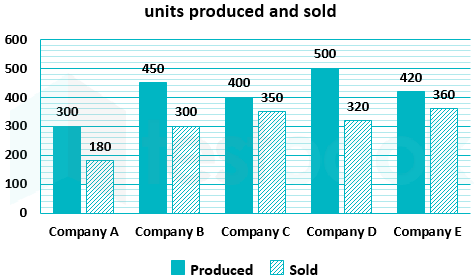
Direction: Following Bar graph show the number of units produced and sold by different companies.

46

What is the difference between the total produced and total sold units by all the companies?

  1. ((a))

    500

  2. ((b))

    560

  3. ((c))

    550 

  4. ((d))

    600

  5. ((e))

    650

Show Answer
Answer: ((b))

560

Total produced units = 300 + 450 + 400 + 500 + 420 = 2070

Total sold units = 180 + 300 + 350 + 320 + 360 = 1510

⇒ required difference = 2070 – 1510 = 560

47

If company F produces 10% more unit that was produced by company A and sells 20% fewer units that were sold by Company C. how many units of company F remain unsold?

  1. ((a))

    60

  2. ((b))

    50

  3. ((c))

    70

  4. ((d))

    90

  5. ((e))

    80

Show Answer
Answer: ((b))

50

Units produced by A = 300

So, units produced by company F = 300 × 110/100 = 330

Units sold by company C = 350

So, units sold by company F = 350 × 80/100 = 280

Unsold unit of company F = 330 – 280 = 50

48

What is the average unit of all the companies that remain unsold?

  1. ((a))

    118

  2. ((b))

    120 

  3. ((c))

    112

  4. ((d))

    150

  5. ((e))

    130

Show Answer
Answer: ((c))

112

Unsold unit of company A = 120

Unsold unit of company B = 150

Unsold unit of company C = 50

Unsold unit of company D = 180

Unsold unit of company E = 60

Average unit remain unsold = (120 + 150 + 50 + 180 + 60)/5 = 112

49

Units produced by company C is how much percent more/less than that of the units sold by company B?

  1. ((a))

    25%

  2. ((b))

    20%

  3. ((c))

    30%

  4. ((d))

    33.33%

  5. ((e))

    37.5%

Show Answer
Answer: ((d))

33.33%

Unit produced by Company C = 400

Units sold by Company B = 300

⇒ Required percent = (400 -300)/300 × 100 = 33.33%

50

What is the ratio of unsold units of Company E and D together to the sold units of company A and B together?

  1. ((a))

    1 : 2

  2. ((b))

    2 : 1

  3. ((c))

    3 : 2

  4. ((d))

    4 : 3

  5. ((e))

    5 : 7

Show Answer
Answer: ((a))

1 : 2

Unsold unit of company E = 420 – 360 = 60

Unsold unit of company D = 500 – 320 = 180

Unsold units of Company E and D together = 180 + 60 = 240

Sold units of company A = 180

Sold units of company B = 300

Sold units of company A and B together = 180 + 300 = 480

⇒ required ratio = 240 : 480

⇒ 1 : 2

51

A boat can travel 35km upstream in 7hours. The speed of the stream is 20kmph. Find the time taken by boat to travel 20km upstream and 45km downstream.

  1. ((a))

    6 hours

  2. ((b))

    3 hours

  3. ((c))

    2 hours

  4. ((d))

    7 hours

  5. ((e))

    5 hours

Show Answer
Answer: ((e))

5 hours

Given:

⇒ Speed upstream = 35/7 = 5kmph

⇒ Speed of stream = 20kmph

⇒ Speed of boat in still water = 20 + 5 = 25 kmph

⇒ Speed downstream = 25 + 20 = 45 kmph

∴ Required time = 45/45 + 20/5 = 5 hours

52

The difference in selling price of an article when sold at 21% profit and 10% loss is Rs. 589 . If it is sold at 25% profit, then what is the selling price ?

  1. ((a))

    Rs. 2350

  2. ((b))

    Rs. 2375

  3. ((c))

    Rs. 2275

  4. ((d))

    Rs. 2355

  5. ((e))

    Rs. 2075

Show Answer
Answer: ((b))

Rs. 2375

Given:

The difference in selling price of an article when sold at 21% profit and 10% loss is Rs. 589

Formula used:

Selling Price = Cost Price (100% ± Profit or Loss) [ + for Profit and - for loss ]

Calculation:

let cost price be 100x,

Selling Price at 21% profit = 100x (100% + 21%)

100x×121100100x \times \frac{121}{100}

= 121x

Selling Price at 10% loss = 100x (100% - 10%)

100x×90100100x \times \frac{90}{100}

= 90x

The difference in selling price of an article when sold at 21% profit and 10% loss is Rs. 589,

121x - 90x = 589

31x = 589

x = 589/31

x = 19

Cost price = 100x

= 100 × 19

= 1900

Selling Price at 25% profit = 1900 (100% + 25%)

1900×1251001900 \times \frac{125}{100}

= 19 × 125

= 2375

Selling price at 25% profit is Rs. 2375

Answer is Rs. 2375.

Alternate MethodGiven:

The difference in selling price of an article when sold at 21% profit and 10% loss is Rs. 589

Formula used:

Selling Price = Cost Price (1 ± Profit or Loss) [ + for Profit and - for loss ]

Calculation:

let 100% be cost price,

Difference in selling price,

21% - (-10%) = 589

21% + 10% = 589

31% = 589

1% = 19

Cost price = 100%

= 100 × 19

= 1900

Selling Price at 25% profit = 1900 (1 + 25%)

1900×1251001900 \times \frac{125}{100}

= 19 × 125

= 2375

Selling price at 25% profit is Rs. 2375

Answer is Rs. 2375.

53

A sum of money becomes 6 times of itself in 7 years at simple interest. In 42 years, amount will become how many times of principal?

  1. ((a))

    31

  2. ((b))

    30

  3. ((c))

    41

  4. ((d))

    60

  5. ((e))

    None of these

Show Answer
Answer: ((a))

31

Given:

Sum of money becomes 6 times of itself in 7 years

Formula used:

SI = PRT/100

Where, P = principal

R = rate

T = time

A = SI + P

Where, A = Amount

SI = simple interest

Calculation:

Let the principal be P.

For 7 years,

SI = (P × R × 7)/100

⇒ 7PR/100

A = SI + P

⇒ 6P = 7PR/100 + P

⇒ 5P = 7PR/100

⇒ R = 500/7

For 42 years,

SI = (P × R × 42)/100

⇒ {P × (500/7) × 42}/100

⇒ 30P

A = SI + P

⇒ A = 30P + P

⇒ A = 31P

In 42 years, amount will become 31 times of principal.

54

The ratio of the present ages of A and B is 5 : 8 and the ratio of the present ages of C and B are 3 : 2 If the sum of their present ages is 100 years then, find the present age of A.

  1. ((a))

    25 years

  2. ((b))

    20 years

  3. ((c))

    30 years

  4. ((d))

    32 years

  5. ((e))

    None of these

Show Answer
Answer: ((b))

20 years

Given:

The ratio of the present ages of A and B = 5 : 8

The ratio of the present ages of C and B = 3 : 2

The sum of their ages = 100 years

Calculation:

As per the question, the ratio of A and B is given and the ratio of C and B is given, so on equalizing the ratio of B in both ratios:

A and B = 5 : 8      ----(1)

C and B = 3 : 2      ----(2)

After multiplying 4 in equation (2), B become equal in both the equations:

A : B : C = 5 : 8 : 12

The sum of their present ages ratio = 5 + 8 + 12

⇒ 25 units

Value of 25 units = 100 years

Value of 1 unit = 4 years

So. the present age of A = 5 units

⇒ 5 × 4

⇒ 20 years

 ∴ The present age of A is 20 years.

55

A and B invested Rs. 8000 each for 2 years and 3 years respectively. B withdrew 60% of his amount after one year of investing. Find the ratio of their profits. 

  1. ((a))

    9 : 10

  2. ((b))

    8 : 9

  3. ((c))

    11 : 14

  4. ((d))

    4 : 7

  5. ((e))

    10 : 9

Show Answer
Answer: ((e))

10 : 9

Given:

A and B invested Rs. 8000 for 2 years and 3 years respectively

B withdrew 60% of his amount after one year of investing

Formula used:

Ratio of profit is the product of capital and time

Calculation:

Effective investment of A

⇒ 8000 × 2 = Rs. 16000

Effective investment of B

⇒ 8000 × 1 + (40/100) × 8000 × 2 = 8000 + 6400 = 14400

∴ Ratio of their profits = 16000 : 14400 = 10 : 9

56

What should come in place of question mark ‘?’ in the following number series?

13860, 6930, ?, 462, 66, 6

  1. ((a))

    2210

  2. ((b))

    2610

  3. ((c))

    3006

  4. ((d))

    2310

  5. ((e))

    None

Show Answer
Answer: ((d))

2310

Given:

13860, 6930, ?, 462, 66, 6

Calculation:

The Series follows the following pattern

13860 ÷ 2 = 6930

6930 ÷ 3 = 2310

2310 ÷ 5 = 462

462 ÷ 7 = 66

66 ÷ 11 = 6

The Required term in the series will be 2310

Note: this series divide by a prime number like 2, 3, 5, 7, 11

57

What should come in place of the question mark ‘?’ in the following number series ?

7, 11, ?, 36, 61, 97

  1. ((a))

    15

  2. ((b))

    19

  3. ((c))

    13

  4. ((d))

    20

  5. ((e))

    None of these

Show Answer
Answer: ((d))

20

Calculation:

The series follows following pattern:

⇒ 7

⇒ 7 + (2)2 = 11

⇒ 11 + (3)2 = 20

⇒ 20 + (4)2 = 36

⇒ 36 + (5)2 = 61

⇒ 61 + (6)2 = 97

∴ The missing number in place of ‘?’ is 20.

58

What should come in place of the question mark '?' in the following number series?

900, 890, 870, 830, 750, ?

  1. ((a))

    580

  2. ((b))

    750

  3. ((c))

    550

  4. ((d))

    600

  5. ((e))

    590

Show Answer
Answer: ((e))

590

Given:

The number series:

900, 890, 870, 830, 750, ?

Concept Used:

Number series following a fixed pattern.

Calculation;

The given number series follows the pattern:

900 – (10 × 20) = 890

890 – (10 × 21) = 870

870 – (10 × 22) = 830

830 – (10 × 23) = 750

750 – (10 × 24) = 590

The Missing Number in the given number series is 590

59

What should come in place of the question mark '?' in the following number series?

171, 173, 170, 175, ?, 179

  1. ((a))

    169

  2. ((b))

    179

  3. ((c))

    172

  4. ((d))

    170

  5. ((e))

    168

Show Answer
Answer: ((e))

168

This series follows following pattern:

⇒ 171 + 2 = 173

⇒ 173 – 3 = 170

⇒ 170 + 5 = 175

⇒ 175 – 7 = 168

⇒ 168 + 11 = 179

∴ The value of ? is 168

60

What should come in place of the question mark '?' in the following number series?

2, 10, ?, 68, 130, 222

  1. ((a))

    15

  2. ((b))

    45

  3. ((c))

    30

  4. ((d))

    40

  5. ((e))

    16

Show Answer
Answer: ((c))

30

The given series follows the given pattern,

13 + 1 = 2

23 + 2 = 10

33 + 3 = 30

43 + 4 = 68

5+ 5 =130

63 + 6 = 222       

∴ The missing term in the series is 30.

Direction: Read the data carefully and answer the question.

Mr. ‘A’ type Different number of Words per Day. He worked for four days. The number of words typed by him on three different days: Monday, Tuesday, and Wednesday are in the ratio 3 : 4 : 2. Also number of words typed by Mr. ‘A’ on Sunday is 30% of the total words typed in four days. The no. of words typed by Mr. ‘A’ on Wednesday is 560.

61

Find difference between total words type by Mr. ‘A’ on Sunday & Wednesday.

  1. ((a))

    540

  2. ((b))

    530

  3. ((c))

    580

  4. ((d))

    520

  5. ((e))

    None of these

Show Answer
Answer: ((d))

520

Tabulation Solution :

DaysNumber of Words typed
Sunday1080
Monday840
Tuesday1120
Wednesday560
Total Words3600


∴ Required difference = 1080 – 560 = 520

Alternate Method

Let total number of word type by Mr. A in four days = x

The number of words type by Mr. A in Sunday = x × 30/100 = 0.3x

The number of words type by Mr. A in Monday = (x – 0.3x) × 3/9 = 0.7x/3

The number of words type by Mr. A in Tuesday = (x – 0.3x) × 4/9 = 2.8x/9

The number of words type by Mr. A in Wednesday = (x – 0.3x) × 2/9 = 1.4x/9

Given that,

1.4x/9 = 560

⇒ x = 560 × 9/1.4 = 3600

The number of words type by Mr. A in Sunday = 0.3x = 0.3 × 3600 = 1080

The number of words type by Mr. A in Wednesday = 560 (Given)

So, required difference = 1080 – 560 = 520

62

Find average number of words type by Mr. ‘A’ on Sunday, Wednesday & Tuesday.

  1. ((a))

    920

  2. ((b))

    890

  3. ((c))

    880

  4. ((d))

    910

  5. ((e))

    900

Show Answer
Answer: ((a))

920

Tabulation Solution :

DaysNumber of Words typed
Sunday1080
Monday840
Tuesday1120
Wednesday560
Total Words3600


∴ Required average = (1080 + 1120 + 560)/3 = 920

Alternate Method

Let total number of word type by Mr. A in four days = x

The number of words type by Mr. A in Sunday = x × 30/100 = 0.3x

The number of words type by Mr. A in Monday = (x – 0.3x) × 3/9 = 0.7x/3

The number of words type by Mr. A in Tuesday = (x – 0.3x) × 4/9 = 2.8x/9

The number of words type by Mr. A in Wednesday = (x – 0.3x) × 2/9 = 1.4x/9

Given that,

1.4x/9 = 560

⇒ x = 560 × 9/1.4 = 3600

The number of words type by Mr. A in Sunday = 0.3x = 0.3 × 3600 = 1080

The number of words type by Mr. A in Monday = 0.7x/3 = 0.7 × 3600/3 = 840

The number of words type by Mr. A in Tuesday = 2.8x/9 = 2.8 × 3600/9 = 1120

The number of words type by Mr. A in Wednesday = 1.4x/9 = 1.4 × 3600/9 = 560

∴ required average = (1080 + 1120 + 560)/3 = 920

63

If ratio between total number of words type by Mr. ‘A’ & Mr. ‘Y’ on Monday is 2 : 3, then find total words type by Mr. ‘Y’ on Monday?

  1. ((a))

    1220

  2. ((b))

    1200

  3. ((c))

    1260

  4. ((d))

    1230

  5. ((e))

    1280

Show Answer
Answer: ((c))

1260

Shortcut Trick

Ratio of words typed on Monday, Tuesday and Wednesday = 3: 4: 2

Given 2 unit = 560

∴ 3 unit  = 840 = words typed by A on Monday

Given that ratio between words typed by A and Y, on Monday = 2: 3

So, Here 2 unit = 840 = words typed by A on Monday

∴ 1 units = 840/2 = 420

∴ 3 unit = 420 × 3 = 1260 words types by Y on Monday.

Tabulation Solution :

DaysNumber of Words typed
Sunday1080
Monday840
Tuesday1120
Wednesday560
Total Words3600


∴ The total words type by Mr. ‘Y’ on Monday = 840 × 3/2 = 1260

Alternate Method

Let total number of word type by Mr. A in four days = x

The number of words type by Mr. A in Sunday = x × 30/100 = 0.3x

The number of words type by Mr. A in Monday = (x – 0.3x) × 3/9 = 0.7x/3

The number of words type by Mr. A in Tuesday = (x – 0.3x) × 4/9 = 2.8x/9

The number of words type by Mr. A in Wednesday = (x – 0.3x) × 2/9 = 1.4x/9

Given that,

1.4x/9 = 560

⇒ x = 560 × 9/1.4 = 3600

The number of words type by Mr. A in Sunday = 0.3x = 0.3 × 3600 = 1080

The number of words type by Mr. A in Monday = 0.7x/3 = 0.7 × 3600/3 = 840

The number of words type by Mr. A in Tuesday = 2.8x/9 = 2.8 × 3600/9 = 1120

The number of words type by Mr. A in Wednesday = 1.4x/9 = 1.4 × 3600/9 = 560

∴ The total words type by Mr. ‘Y’ on Monday = 840 × 3/2 = 1260

64

Find ratio between total words type by Mr. ‘A’ on Sunday to total words typed by Mr. ‘X’ on same day, if total words typed by Mr. ‘X’ on Sunday is 25% less than total words type by Mr. ‘A’ on Tuesday?

  1. ((a))

    9 : 8

  2. ((b))

    9 : 7

  3. ((c))

    1 : 1

  4. ((d))

    3 : 7

  5. ((e))

    1 : 3

Show Answer
Answer: ((b))

9 : 7

Tabulation Solution :

DaysNumber of Words typed
Sunday1080
Monday840
Tuesday1120
Wednesday560
Total Words3600


∴  Required ratio = 1080 : 840 = 9 : 7

Alternate Method

Let total number of word type by Mr. A in four days = x

The number of words type by Mr. A in Sunday = x × 30/100 = 0.3x

The number of words type by Mr. A in Monday = (x – 0.3x) × 3/9 = 0.7x/3

The number of words type by Mr. A in Tuesday = (x – 0.3x) × 4/9 = 2.8x/9

The number of words type by Mr. A in Wednesday = (x – 0.3x) × 2/9 = 1.4x/9

Given that,

1.4x/9 = 560

⇒ x = 560 × 9/1.4 = 3600

The number of words type by Mr. A in Sunday = 0.3x = 0.3 × 3600 = 1080

The number of words type by Mr. A in Monday = 0.7x/3 = 0.7 × 3600/3 = 840

The number of words type by Mr. A in Tuesday = 2.8x/9 = 2.8 × 3600/9 = 1120

The number of words type by Mr. A in Wednesday = 1.4x/9 = 1.4 × 3600/9 = 560

The total words typed by Mr. ‘X’ on Sunday = 1120 × 75/100 = 840

So, required ratio = 1080 : 840 = 9 : 7

65

If total words typed by Mr. ‘Z’ in four days is 200% more than total words type by Mr. ‘A’ on Monday, then find total words typed by Mr. ‘Z’ is what percent less than total words type by Mr. ‘A’ ?

  1. ((a))

    35%

  2. ((b))

    30%

  3. ((c))

    40%

  4. ((d))

    20%

  5. ((e))

    25%

Show Answer
Answer: ((b))

30%

Tabulation Solution :

DaysNumber of Words typed
Sunday1080
Monday840
Tuesday1120
Wednesday560
Total Words3600


∴ Required % = (3600 – 2520)/3600 × 100 = 30%

Alternate Method

Let total number of word type by Mr. A in four days = x

The number of words type by Mr. A in Sunday = x × 30/100 = 0.3x

The number of words type by Mr. A in Monday = (x – 0.3x) × 3/9 = 0.7x/3

The number of words type by Mr. A in Tuesday = (x – 0.3x) × 4/9 = 2.8x/9

The number of words type by Mr. A in Wednesday = (x – 0.3x) × 2/9 = 1.4x/9

Given that,

1.4x/9 = 560

⇒ x = 560 × 9/1.4 = 3600

The number of words type by Mr. A in Sunday = 0.3x = 0.3 × 3600 = 1080

The number of words type by Mr. A in Monday = 0.7x/3 = 0.7 × 3600/3 = 840

The number of words type by Mr. A in Tuesday = 2.8x/9 = 2.8 × 3600/9 = 1120

The number of words type by Mr. A in Wednesday = 1.4x/9 = 1.4 × 3600/9 = 560

The total words typed by Mr. ‘Z’ = 840 × 3 = 2520

So, required % = (3600 – 2520)/3600 × 100 = 30%

Reasoning Ability (35 questions)

Directions: Read the information carefully and answer the questions that follow.

There are eight people P, Q, R, S, T, U, V, and W who lives in an eight-floor apartment but not necessarily in the same order. The lowermost floor is numbered 1, the floor immediately above 1 is numbered 2, and so on. The number of people living between Q and U is the same as the number of people between U and P. Q lives below U but not immediately. Only one person lives between R and P who lives immediately below T. V lives on the odd numbered floor but not on the lowermost floor. Only two person lives between R and S. S lives on the odd-numbered floor below the sixth floor.

66

Who Lives on fifth floor?

  1. ((a))

    P

  2. ((b))

    Q

  3. ((c))

    R

  4. ((d))

    S

  5. ((e))

    T

Show Answer
Answer: ((d))

S

Eight people P,Q,R,S,T,U,V, and W

1)  Only two-person lives between R and S.

  1. S lives on an odd-numbered floor below the sixth floor. 

3) Only one person lives between R and P who lives immediately below T. 

4)  V lives on an odd-numbered floor but not on the lowermost floor. 

Case ICase IICase III
Floor no.PeopleFloor no.PeopleFloor no.People
8R88
7T7V7V
6P66R
5S5S5T
44P4P
3V3T3S
22R2
111


5) The number of people living between Q and U is the same as the number of people between U and P. Q lives below U but not immediately.

  1. Q lives below U but not immediately.

  2. Therefore Case II and Case III are invalid.

So, the final arrangement is,

Case I
Floor no.People
8R
7T
6P
5S
4U
3V
2Q
1W


Hence, S lives on the fifth floor.

67

How many person lives between P and W?

  1. ((a))

    2

  2. ((b))

    3

  3. ((c))

    4

  4. ((d))

    5

  5. ((e))

    0

Show Answer
Answer: ((c))

4

Eight people P,Q,R,S,T,U,V, and W

1)  Only two-person lives between R and S.

  1. S lives on an odd-numbered floor below the sixth floor. 

3) Only one person lives between R and P who lives immediately below T. 

4)  V lives on an odd-numbered floor but not on the lowermost floor. 

Case ICase IICase III
Floor no.PeopleFloor no.PeopleFloor no.People
8R88
7T7V7V
6P66R
5S5S5T
44P4P
3V3T3S
22R2
111


5) The number of people living between Q and U is the same as the number of people between U and P. Q lives below U but not immediately.

  1. Q lives below U but not immediately.

  2. Therefore Case II and Case III are invalid.

So, the final arrangement is,

Case I
Floor no.People
8R
7T
6P
5S
4U
3V
2Q
1W


Therefore, 4 people live between P and W.

Hence, the correct answer is 4.

68

Who lives on the lowermost floor?

  1. ((a))

    W

  2. ((b))

    P

  3. ((c))

    Q

  4. ((d))

    R

  5. ((e))

    S

Show Answer
Answer: ((a))

W

Eight people P,Q,R,S,T,U,V, and W

1)  Only two-person lives between R and S.

  1. S lives on an odd-numbered floor below the sixth floor. 

3) Only one person lives between R and P who lives immediately below T. 

4)  V lives on an odd-numbered floor but not on the lowermost floor. 

Case ICase IICase III
Floor no.PeopleFloor no.PeopleFloor no.People
8R88
7T7V7V
6P66R
5S5S5T
44P4P
3V3T3S
22R2
111


5) The number of people living between Q and U is the same as the number of people between U and P. Q lives below U but not immediately.

  1. Q lives below U but not immediately.

  2. Therefore Case II and Case III are invalid.

So, the final arrangement is,

Case I
Floor no.People
8R
7T
6P
5S
4U
3V
2Q
1W


Hence, W lives on the lowermost floor.

69

If all the persons are arranged alphabetically from bottom to top then how many persons remains on same floor?

  1. ((a))

    One

  2. ((b))

    Two

  3. ((c))

    Three

  4. ((d))

    Four

  5. ((e))

    None

Show Answer
Answer: ((a))

One

Eight people P,Q,R,S,T,U,V, and W

1)  Only two-person lives between R and S.

  1. S lives on an odd-numbered floor below the sixth floor. 

3) Only one person lives between R and P who lives immediately below T. 

4)  V lives on an odd-numbered floor but not on the lowermost floor. 

Case ICase IICase III
Floor no.PeopleFloor no.PeopleFloor no.People
8R88
7T7V7V
6P66R
5S5S5T
44P4P
3V3T3S
22R2
111


5) The number of people living between Q and U is the same as the number of people between U and P. Q lives below U but not immediately.

  1. Q lives below U but not immediately.

  2. Therefore Case II and Case III are invalid.

So, the final arrangement is,

Case I
Floor no.People
8R
7T
6P
5S
4U
3V
2Q
1W
<br>

After rearrangement in alphabetical order from bottom to top,

Case I
Floor no.People
8RW
7TV
6PU
5ST
4US
3VR
2QQ
1WP
<br>

Hence, the correct answer is One.

70

Four of the following five are alike in a certain way based on their arrangement find the one which does not belong to that group?

  1. ((a))

    Q

  2. ((b))

    U

  3. ((c))

    P

  4. ((d))

    T

  5. ((e))

    R

Show Answer
Answer: ((d))

T

Eight people P,Q,R,S,T,U,V, and W

1)  Only two-person lives between R and S.

  1. S lives on an odd-numbered floor below the sixth floor. 

3) Only one person lives between R and P who lives immediately below T. 

4)  V lives on an odd-numbered floor but not on the lowermost floor. 

Case ICase IICase III
Floor no.PeopleFloor no.PeopleFloor no.People
8R88
7T7V7V
6P66R
5S5S5T
44P4P
3V3T3S
22R2
111


5) The number of people living between Q and U is the same as the number of people between U and P. Q lives below U but not immediately.

  1. Q lives below U but not immediately.

  2. Therefore Case II and Case III are invalid.

So, the final arrangement is,

Case I
Floor no.People
8R
7T
6P
5S
4U
3V
2Q
1W
<br>

Except T, all lives on the even number floor.

Hence, the correct answer is T.

71

Directions: In the question below are given two statements followed by two conclusions numbered I and II. You have to take the given statements to be true even if they seem to be at variance from commonly known facts. Read all the conclusions and then decide which of the given conclusions logically follows from the given statements disregarding commonly known facts.

Statements:

Some Fire is air

Only a few air is water

Conclusions:

I. Some water can be Fire

II. Some Fire is water

  1. ((a))

    Only I follow

  2. ((b))

    Only II follow

  3. ((c))

    Either I or II follows

  4. ((d))

    Neither I nor II follows

  5. ((e))

    Both I and II follows

Show Answer
Answer: ((a))

Only I follow

The least possible Venn diagram for the given statements is as follows

Conclusions:

I. Some water can be Fire → True (as there is no relation between water and Fire, so it is possible. Hence, Some water can be Fire is true).

II. Some Fire is water → False (as there is no relation between Fire and water so it is possible nut it's not definite. Hence, Some Fire is water is false).

Hence, Only I follow is the correct answer.

72

Direction: In the question below are given two statements followed by two conclusions numbered I and II. You have to take the given statements to be true even if they seem to be at variance with commonly known facts. Read all the conclusions and then decide which of the given conclusions logically follows from the given statements disregarding commonly known facts.

Statements:

Only a few Pens are Mobile.

No Mobile is Bag.

Conclusions:

I. Some Mobiles are Bags.

II. All Mobiles are Bags.

  1. ((a))

    Only conclusion I follows

  2. ((b))

    Only conclusion II follows

  3. ((c))

    Both conclusion I and II follow

  4. ((d))

    Either conclusion I or II follows

  5. ((e))

    Neither conclusion I nor II follows

Show Answer
Answer: ((e))

Neither conclusion I nor II follows

The least possible diagram for the given statements is as follows;

Conclusions:

I. Some Mobiles are Bags → False (As No Mobile is Bag, no part of Mobile will be Bag. So, it is false)

II. All Mobiles are Bags → False (As No Mobile is Bag, no part of Mobile will be Bag. So, it is false)

Hence, Neither conclusion I nor II follows.

73

Direction: In the question below are given two statements followed by two conclusions numbered I and II. You have to take the given statements to be true even if they seem to be at variance from commonly known facts. Read all the conclusions and then decide which of the given conclusions logically follows from the given statements disregarding commonly known facts.

Statements:

Only a few Pens are Book.

Some Book is Table.

Conclusions:

I. Some Pens are Book.

II. Some Pens are not Book.

  1. ((a))

    Only conclusion I follows

  2. ((b))

    Only conclusion II follows

  3. ((c))

    Both conclusion I and II follow

  4. ((d))

    Either conclusion I or II follows

  5. ((e))

    Neither conclusion I nor II follows

Show Answer
Answer: ((c))

Both conclusion I and II follow

The least possible diagram for the given statements is as follows;

Conclusions:

I. Some Pens are Book → True (because Only a few Pens are Book → Some Pens are Book and Some Pens are not Book. So, It is true)

II. Some Pens are not Book → True (because Only a few Pens are Book → Some Pens are not Books and Some Pens are Book. So, It is true)

Hence, Both conclusions I and II follow.

Directions: Study the followingarrangementcarefully and answer the questions given below:

A C B @ K I 9 D L 4 © 5 2 T $ M 4 J # U 3 1 A δ K 5 V W 6 % F Q 7 H P

74

How many such alphabets are there in the above arrangement each of which are immediately preceded by an alphabet and followed by a symbols?

  1. ((a))

    None

  2. ((b))

    Two

  3. ((c))

    One

  4. ((d))

    Three

  5. ((e))

    More than three

Show Answer
Answer: ((c))

One

Given series:

Left Side A C B @ K I 9 D L 4 © 5 2 T $ M 4 J # U 3 1 A δ K 5 V W 6 % F Q 7 H P Right Side

Alphabets which are immediately preceded by an alphabet and followed by a symbol:

Required order is: Alphabet → Alphabet → Symbol

A C B @ K I 9 D L 4 © 5 2 T $ M 4 J # U 3 1 A δ K 5 V W 6 % F Q 7 H P

Hence, there is only one alphabet which is immediately preceded by an alphabet and followed by a symbol: C B @.

75

How many such numbers are there between first A and W each of which is both immediately preceded and immediately followed by a consonant?

  1. ((a))

    None

  2. ((b))

    One

  3. ((c))

    Two

  4. ((d))

    Three

  5. ((e))

    More than three

Show Answer
Answer: ((c))

Two

Given series:

Left Side A C B @ K I 9 D L 4 © 5 2 T $ M 4 J # U 3 1 A δ K 5 V W 6 % F Q 7 H P Right Side

Required order: First A → → Consonant → Number → Consonant → → W

A C B @ K I 9 D L 4 © 5 2 T $ M 4 J # U 3 1 A δ K 5 V W 6 % F Q 7 H P 

Hence, there are 2 such numbers.

76

How many such vowels are there in the above arrangement each of which is immediately followed by a symbol but not immediately preceded by a number?

  1. ((a))

    None

  2. ((b))

    One

  3. ((c))

    Two

  4. ((d))

    Three

  5. ((e))

    More than three

Show Answer
Answer: ((a))

None

Given series:

Left Side AC B @ K I 9 D L 4 © 5 2 T $ M 4 J # U 3 1 A δ K 5 V W 6 % F Q 7 H PRight Side

Vowels which are immediately followed by a symbol but not immediately preceded by a number:

required order is: Not number → Vowel → Symbol

A C B @ K I 9 D L 4 © 5 2 T $ M 4 J # U 3 1 A δ K 5 V W 6 % F Q 7 H P

Hence, there is no vowel which are immediately followed by a symbol but not immediately preceded by a number.

Hence, the correct answer is none.

77

Which of the following element is exactly in the middle between the fifteenth from the left end and the fifteenth from the right end in the above arrangement?

  1. ((a))

  2. ((b))

    J

  3. ((c))

    4

  4. ((d))

    M

  5. ((e))

    None of these

Show Answer
Answer: ((b))

J

Given series:

Left Side A C B @ K I 9 D L 4 © 5 2 T $ M 4 J # U 3 1 A δ K 5 V W 6 % F Q 7 H P Right Side

15th from the left → $

15th from right → 3

Terms between $and 3 are M 4 J # U

Therefore, J is exactly in middle of $and 3.

Hence, J is exactly in middle between the fifteenth from the left end and the fifteenth from the right end in the above arrangement.

78

Which of the following is the fifth to the right of the sixth element from the right end of the above arrangement?

  1. ((a))

    P

  2. ((b))

    Q

  3. ((c))

    δ

  4. ((d))

    K

  5. ((e))

    5

Show Answer
Answer: ((a))

P

Given series:

Left Side A C B @ K I 9 D L 4 © 5 2 T $ M 4 J # U 3 1 A δ K 5 V W 6 % F Q 7 H P Right Side

As, Right – Right = Right

6th from the Right – 5th from the Right = 1st from the Right

Clearly, 1st from the Right is P.

Hence, P is the fifth to the right of the sixth element from the right end of the above arrangement.

79

How many such pairs of letters are there in the word "HIGHEST" each of which has as many letters between them in the word (both in the forward and backward direction) as they have between them in the English alphabetical order?

  1. ((a))

    3

  2. ((b))

    4

  3. ((c))

    2

  4. ((d))

    1

  5. ((e))

    None

Show Answer
Answer: ((b))

4

So, we get HI, GH, ST, and EG

Hence, we have 4 pairs of letters as in the English alphabetical series.

Direction: Following questions are based on five words given below.

NGX      FHZ      TJU      DOU      WCM

(The new words formed after performing the mentioned operations may or may not necessarily be meaningful English words)

80

If the first and last letter of each word is replaced by immediate preceding letter as per alphabetical series, how many words will have only one vowel after rearrangement?

  1. ((a))

    Three

  2. ((b))

    Four

  3. ((c))

    One

  4. ((d))

    All

  5. ((e))

    Two

Show Answer
Answer: ((e))

Two

Given words: NGX      FHZ      TJU      DOU      WCM

  1. Replacing first and last letter to immediate preceding letter:

MGW   EHY   SJT   COT   VCL

  1. Clearly, there are two words EHY and COT which have only one vowel.

Note: In English alphabetical series there are 5 vowels i.e. A, E, I, O, U else all are consonants.

Hence, two words have only one vowel after rearrangement.

81

If in each of given words, each of the consonants is replaced by their 2nd preceding letters in the alphabetical series, how many words thus formed will have two vowel?

  1. ((a))

    All

  2. ((b))

    One

  3. ((c))

    Four

  4. ((d))

    Three

  5. ((e))

    Two

Show Answer
Answer: ((e))

Two

Given words: NGX      FHZ      TJU      DOU      WCM

  1. Replacing each consonant to 2nd preceding letter:

LEV   DFX   RHU   BOU   UAK  

  1. Clearly, two words BOU and UAK have two vowels.

Note: In English alphabetical series there are 5 vowels i.e. A, E, I, O, U else all are consonants.

Hence, two words have two vowels after rearrangement.

82

If all the alphabets are assigned numbers starting from A till Z (i.e. A = 1, B = 2 and so on), then what will be the sum of WCM?

  1. ((a))

    26

  2. ((b))

    39

  3. ((c))

    17

  4. ((d))

    44

  5. ((e))

    56

Show Answer
Answer: ((b))

39

Given words: NGX      FHZ      TJU      DOU      WCM

  1. Sum of WCM → 23 + 3 + 13 = 39

Hence, 39 is the sum of WCM.

83

If the letter of given words are arranged in alphabetical order from left to right within the words then which of the following words will remain unchanged?

  1. ((a))

    NGX

  2. ((b))

    FHZ

  3. ((c))

    TJU

  4. ((d))

    DOU

  5. ((e))

    2 and 4

Show Answer
Answer: ((e))

2 and 4

Given words: NGX      FHZ      TJU      DOU      WCM

Left side   NGX      FHZ      TJU      DOU      WCM   Right side

  1. Arranging letters of given words as per alphabetical order:

GNX   FHZ   JTU   DOU   CMW

Hence, DOU and FHZ will remain unchanged after rearrangement.

84

. If the first alphabet in each of the words is changed to the next alphabet in the English alphabetical order, which of the following words will have more than two vowels after rearrangement?

  1. ((a))

    NGX

  2. ((b))

    FHZ

  3. ((c))

    TJU

  4. ((d))

    DOU

  5. ((e))

    WCM

Show Answer
Answer: ((d))

DOU

Given words: NGX      FHZ      TJU      DOU      WCM

  1. Changing first alphabet to next alphabet as per English alphabetical series:

OGX      GHZ      UJU      EOU      XCM

  1. Clearly, EOU has more than two vowels.

Note: In English alphabetical series there are 5 vowels i.e. A, E, I, O, U else all are consonants.

Hence, DOU will have more than two vowels after rearrangement.

85

In the given word ‘BEAUTIFUL’ if the vowels are changed to the next letter and the consonants are changed to the previous letters as per the alphabetical series, and alphabets are arranged in alphabetical order from left to right then which letter would be 6th to the right of 2nd letter from the left end?

  1. ((a))

    K

  2. ((b))

    S

  3. ((c))

    V

  4. ((d))

    F

  5. ((e))

    J

Show Answer
Answer: ((c))

V

If the vowels are changed to the next letter and the consonants are changed to the previous letters:

Vowels → Next letter, Consonants → Previous letters

Given WordBEAUTIFUL
After changeAFBVSJEVK
Alphabetical order (Left – Right)ABEFJKSVV
<br>

Hence, ‘V’ is 6th to the right of 2nd letter from the left end.

86

Find the odd one out from the given options:

  1. ((a))

    BEIN

  2. ((b))

    LOSX

  3. ((c))

    DGJN

  4. ((d))

    HKOT

  5. ((e))

    FIMR

Show Answer
Answer: ((c))

DGJN

The pattern followed here is:

  1. BEIN → B + 3 = E; E + 4 = I; I + 5 = N

  2. LOSX → L + 3 = O; O + 4 = S; S + 5 = X

  3. DGJN → D + 3 = G; G + 3 = J; J + 4 = N

  4. HKOT → H + 3 = K; K + 4 = O; O + 5 = T

  5. FIMR → F + 3 = I; I + 4 = M; M + 5 = R

Thus, DGJN does not fulfil the above condition. So, it is the odd one out from the given options.

Direction: Study the following information carefully and answer the question given below.

Eight different people – B, C, D, E, F, G, H and I are sitting on a rectangular table but not necessarily in the same order. Four of them are sitting on the middle side of the table facing outside and rest of them are sitting on the corners of the table facing inside. F is sitting second to the right of C who is sitting in the middle on the smaller side of the table. Two people are sitting between C and the one who is sitting immediate right of H. D is sitting fifth to the right of H. B is sitting immediate left of G. Neither B nor F is an immediate neighbour of E.

87

Who among the following is not sitting at the corner of the table?

  1. ((a))

    B

  2. ((b))

    D

  3. ((c))

    E

  4. ((d))

    G

  5. ((e))

    I

Show Answer
Answer: ((d))

G

8 people – B, C, D, E, F, G, H and I.

Four of them are sitting on the middle side of the table facing outside and rest of them are sitting on the corners of the table facing inside.

  1. F is sitting second to the right of C who is sitting in the middle on the smaller side of the table.

  1. Two people are sitting between C and the one who is sitting immediate right of H.

  2. D is sitting fifth to the right of H.

  1. B is sitting immediate left of G.

  1. Neither B nor F is an immediate neighbour of E.

Thus, case I gets eliminated and the final arrangement is as follows,

Hence, G is not sitting at any corner of the table.

88

What is the position of E with respect to H?

  1. ((a))

    Immediate right

  2. ((b))

    Immediate left

  3. ((c))

    Third to the right

  4. ((d))

    Second to the left

  5. ((e))

    Third to the left

Show Answer
Answer: ((c))

Third to the right

8 people – B, C, D, E, F, G, H and I.

Four of them are sitting on the middle side of the table facing outside and rest of them are sitting on the corners of the table facing inside.

  1. F is sitting second to the right of C who is sitting in the middle on the smaller side of the table.

  1. Two people are sitting between C and the one who is sitting immediate right of H.

  2. D is sitting fifth to the right of H.

  1. B is sitting immediate left of G.

  1. Neither B nor F is an immediate neighbour of E.

Thus, case I gets eliminated and the final arrangement is as follows,

Hence, E is sitting third to the right of H.

89

How many people are sitting between G and E, when counted from the left of E?

  1. ((a))

    Two

  2. ((b))

    Three

  3. ((c))

    Four

  4. ((d))

    Five

  5. ((e))

    Six

Show Answer
Answer: ((e))

Six

8 people – B, C, D, E, F, G, H and I.

Four of them are sitting on the middle side of the table facing outside and rest of them are sitting on the corners of the table facing inside.

  1. F is sitting second to the right of C who is sitting in the middle on the smaller side of the table.

  1. Two people are sitting between C and the one who is sitting immediate right of H.

  2. D is sitting fifth to the right of H.

  1. B is sitting immediate left of G.

  1. Neither B nor F is an immediate neighbour of E.

Thus, case I gets eliminated and the final arrangement is as,

So, 6  people are sitting between G and E, when counted from the left of E.

Hence, six is the correct answer.

90

Who among the following is facing D?

  1. ((a))

    B

  2. ((b))

    E

  3. ((c))

    G

  4. ((d))

    H

  5. ((e))

    I

Show Answer
Answer: ((a))

B

8 people – B, C, D, E, F, G, H and I.

Four of them are sitting on the middle side of the table facing outside and rest of them are sitting on the corners of the table facing inside.

  1. F is sitting second to the right of C who is sitting in the middle on the smaller side of the table.

  1. Two people are sitting between C and the one who is sitting immediate right of H.

  2. D is sitting fifth to the right of H.

  1. B is sitting immediate left of G.

  1. Neither B nor F is an immediate neighbour of E.

Thus, case I gets eliminated and the final arrangement is as,

Hence, B is facing D.

91

If B exchanges his position with C, then what will be the position of C with respect to F?

  1. ((a))

    Second to the right

  2. ((b))

    Third to the left

  3. ((c))

    Fourth to the right

  4. ((d))

    Second to the left

  5. ((e))

    Fifth to the left

Show Answer
Answer: ((e))

Fifth to the left

8 people – B, C, D, E, F, G, H and I.

Four of them are sitting on the middle side of the table facing outside and rest of them are sitting on the corners of the table facing inside.

  1. F is sitting second to the right of C who is sitting in the middle on the smaller side of the table.

  1. Two people are sitting between C and the one who is sitting immediate right of H.

  2. D is sitting fifth to the right of H.

  1. B is sitting immediate left of G.

  1. Neither B nor F is an immediate neighbour of E.

Thus, case I gets eliminated. 

Therefore, the final arrangement is as follows,

After interchanging the positions, we have:

Hence, C is sitting fifth to the left of F.

92

Direction: In the following question assuming the given statements to be true, find which of the conclusion(s) among given conclusions is/are definitely true and then give your answers accordingly.

Statement: 

G ≥ S = F > J > U < W

Conclusions:

I. J < G

II. S > W

  1. ((a))

    Only conclusion I follows

  2. ((b))

    Only conclusion II follows

  3. ((c))

    Both conclusions I and II follow

  4. ((d))

    Either conclusion I or II follows

  5. ((e))

    None follows

Show Answer
Answer: ((a))

Only conclusion I follows

Given statement,

G ≥ S = F > J > U < W

Conclusions:

I. J < G → True (G ≥ S = F > J → G > J i.e. J < G).

II. S > W → False (S = F > J > U < W → S > U < W, thus a clear relation between S and W cannot be determined).

Hence, only conclusion I follows.

93

Directions: In the following question assuming the given statements to be true, find which of the conclusion among given some conclusion is/are definitely true and then give your answers accordingly:

Statement: U > T; X < U = Y; Y ≤ Q < R

Conclusions:

I) U > R

II) T < Q

  1. ((a))

    Only Conclusion I follows

  2. ((b))

    Only Conclusion II follows

  3. ((c))

    Both I and II follow

  4. ((d))

    Either I or II follows

  5. ((e))

    Neither I nor II follows

Show Answer
Answer: ((b))

Only Conclusion II follows

Given Statement: U > T; X < U = Y; Y ≤ Q < R

On combining: X < U = Y ≤  Q < R; U > T

Conclusions:

I) U > R → False (As, X < U = Y ≤  Q < R → There is definite relation between U and R).

II) T < Q → True (As, T < U = Y ≤ Q < R → T < Q).

Hence, Only II follows.

94

Directions: In the following question assuming the given statements to be True, find which of the conclusion among given conclusions is/are definitely true and then give your answers accordingly.

Statements: L = M > O > P; Q < M; N < P

Conclusions:

I. Q < L

II. N < O

  1. ((a))

    Only conclusion I is True

  2. ((b))

    Only conclusion II is True

  3. ((c))

    Either conclusion I or II is True

  4. ((d))

    Neither Conclusion I nor II is True

  5. ((e))

    Both Conclusion I and II is True

Show Answer
Answer: ((e))

Both Conclusion I and II is True

Given Statements: L = M > O > P; Q < M; N < P

On combining: Q < L = M > O > P > N   

Conclusions:

I. Q < L → True (as Q < L = M)

II. N < O → True (as O > P > N)

Therefore, Both Conclusion I and II is True is the correct option

95

Direction: In the following question assuming the given statements to be true, find which conclusion among the given two conclusion(s) is /are definitely true and then give your answers accordingly.

Statements:

J ≤ Q = K ≥ A ≥ X < F

Conclusions:

I. J < F

II. Q ≥ X

  1. ((a))

    Only conclusion I follow

  2. ((b))

    Only conclusion II follow

  3. ((c))

    Either conclusion I or II follows

  4. ((d))

    Neither conclusion I nor II follows

  5. ((e))

    Both conclusion I and II follow

Show Answer
Answer: ((b))

Only conclusion II follow

Given statement: J ≤ Q = K ≥ A ≥ X < F

Conclusions:

I. J < F → False (As J ≤ Q = K ≥ A ≥ X < F; no clear relation between J and F.)

II. Q ≥ X → True (Q = K ≥ A ≥ X, makes Q ≥ X)

Hence, only conclusion II follows.

Directions: Study the following information carefully and answer the questions given below

Eight persons have different designations i.e. General Manager (GM), Deputy General Manager (DGM), Assistant General Manager (AGM), Manager, Assistant Manager, Probationary Officer (PO), Cashier and Clerk in a company. The order of seniority is the same as given above i.e. GM is the senior-most designation and Clerk is the junior-most designation.

Only two persons are senior to D. Only three designations are there between A and F. G is senior to C. A is senior to the Assistant Manager of the company. Number of persons who are senior to E is same as number of persons who are junior to H. E is senior to D. More than four designations are there between H and B.

96

Who is manager among all of them?

  1. ((a))

    B

  2. ((b))

    H

  3. ((c))

    A

  4. ((d))

    F

  5. ((e))

    None of these

Show Answer
Answer: ((c))

A

Given: Eight persons – A, B, C, D, E, F, G and H

Their designation – GM, DGM, AGM, Manager, Assistance Manager, Probationary Officer, Cashier and Clerk.

  1. Only two persons are senior to D. Only three designations are there between A and F. G is senior to C. A is senior to the Assistant Manager of the company.
DesignationCase - 1Case - 2Case - 3
GMA
DGMA
AGMDDD
ManagerA
Assistant ManagerF
Probationary OfficerF
Cashier
ClerkF


  1. Number of persons who are senior to E is same as number of persons who are junior to H. E is senior to D. As more than four designations are there between H and B. So case-2 and case - 3 are eliminated.

As G is senior to C.

DesignationCase - 1Case - 2Case - 3
GMBEA
DGMEAE
AGMDDD
ManagerA
Assistant ManagerGF
Probationary OfficerCF
CashierHH
ClerkFH

The final arrangement is:

DesignationPerson
GMB
DGME
AGMD
ManagerA
Assistant ManagerG
Probationary OfficerC
CashierH
ClerkF

Hence, A  is manager.

97

Who is just senior to H?

  1. ((a))

    C

  2. ((b))

    B

  3. ((c))

    A

  4. ((d))

    E

  5. ((e))

    None of these

Show Answer
Answer: ((a))

C

Given: Eight persons – A, B, C, D, E, F, G and H

Their designation – GM, DGM, AGM, Manager, Assistance Manager, Probationary Officer, Cashier and Clerk.

  1. Only two persons are senior to D. Only three designations are there between A and F. G is senior to C. A is senior to the Assistant Manager of the company.
DesignationCase - 1Case - 2Case - 3
GMA
DGMA
AGMDDD
ManagerA
Assistant ManagerF
Probationary OfficerF
Cashier
ClerkF


  1. Number of persons who are senior to E is same as number of persons who are junior to H. E is senior to D. As more than four designations are there between H and B. So case-2 and case - 3 are eliminated.

As G is senior to C.

DesignationCase - 1Case - 2Case - 3
GMBEA
DGMEAE
AGMDDD
ManagerA
Assistant ManagerGF
Probationary OfficerCF
CashierHH
ClerkFH

The final arrangement is:

DesignationPerson
GMB
DGME
AGMD
ManagerA
Assistant ManagerG
Probationary OfficerC
CashierH
ClerkF

Hence, C is just senior to H.

98

Which of the following is true?

  1. ((a))

    D - AGM

  2. ((b))

    G - Probationary Officer

  3. ((c))

    B - cashier

  4. ((d))

    G - DGM

  5. ((e))

    None of these

Show Answer
Answer: ((a))

D - AGM

Given: Eight persons – A, B, C, D, E, F, G and H

Their designation – GM, DGM, AGM, Manager, Assistance Manager, Probationary Officer, Cashier and Clerk.

  1. Only two persons are senior to D. Only three designations are there between A and F. G is senior to C. A is senior to the Assistant Manager of the company.
DesignationCase - 1Case - 2Case - 3
GMA
DGMA
AGMDDD
ManagerA
Assistant ManagerF
Probationary OfficerF
Cashier
ClerkF


  1. Number of persons who are senior to E is same as number of persons who are junior to H. E is senior to D. As more than four designations are there between H and B. So case-2 and case - 3 are eliminated.

As G is senior to C.

DesignationCase - 1Case - 2Case - 3
GMBEA
DGMEAE
AGMDDD
ManagerA
Assistant ManagerGF
Probationary OfficerCF
CashierHH
ClerkFH

The final arrangement is:

DesignationPerson
GMB
DGME
AGMD
ManagerA
Assistant ManagerG
Probationary OfficerC
CashierH
ClerkF

Hence, D – AGM is the correct answer.

99

How many persons are senior to G?

  1. ((a))

    2

  2. ((b))

    4

  3. ((c))

    6

  4. ((d))

    5

  5. ((e))

    1

Show Answer
Answer: ((b))

4

Given: Eight persons – A, B, C, D, E, F, G and H

Their designation – GM, DGM, AGM, Manager, Assistance Manager, Probationary Officer, Cashier and Clerk.

  1. Only two persons are senior to D. Only three designations are there between A and F. G is senior to C. A is senior to the Assistant Manager of the company.
DesignationCase - 1Case - 2Case - 3
GMA
DGMA
AGMDDD
ManagerA
Assistant ManagerF
Probationary OfficerF
Cashier
ClerkF


  1. Number of persons who are senior to E is same as number of persons who are junior to H. E is senior to D. As more than four designations are there between H and B. So case-2 and case - 3 are eliminated.

As G is senior to C.

DesignationCase - 1Case - 2Case - 3
GMBEA
DGMEAE
AGMDDD
ManagerA
Assistant ManagerGF
Probationary OfficerCF
CashierHH
ClerkFH

The final arrangement is:

DesignationPerson
GMB
DGME
AGMD
ManagerA
Assistant ManagerG
Probationary OfficerC
CashierH
ClerkF

Hence, 4 persons are senior to G.

100

What is designation of H?

  1. ((a))

    Probationary officer

  2. ((b))

    Cashier

  3. ((c))

    Manager

  4. ((d))

    GM

  5. ((e))

    None of these

Show Answer
Answer: ((b))

Cashier

Given: Eight persons – A, B, C, D, E, F, G and H

Their designation – GM, DGM, AGM, Manager, Assistance Manager, Probationary Officer, Cashier and Clerk.

  1. Only two persons are senior to D. Only three designations are there between A and F. G is senior to C. A is senior to the Assistant Manager of the company.
DesignationCase - 1Case - 2Case - 3
GMA
DGMA
AGMDDD
ManagerA
Assistant ManagerF
Probationary OfficerF
Cashier
ClerkF


  1. Number of persons who are senior to E is same as number of persons who are junior to H. E is senior to D. As more than four designations are there between H and B. So case-2 and case - 3 are eliminated.

As G is senior to C.

DesignationCase - 1Case - 2Case - 3
GMBEA
DGMEAE
AGMDDD
ManagerA
Assistant ManagerGF
Probationary OfficerCF
CashierHH
ClerkFH

The final arrangement is:

DesignationPerson
GMB
DGME
AGMD
ManagerA
Assistant ManagerG
Probationary OfficerC
CashierH
ClerkF

Hence, H is cashier.

Attempt this paper under real exam conditions

Timed interface, section switching, instant scoring, and question-by-question analytics — free.

Start Timed Attempt