Official Paper

RBI Assistant Prelims MBT 26 March 2022 (Shift 1) (Previous Year Paper)

100 questions · 60 minutes · with answers · free

English Language (30 questions)

Read the following passage carefully and answer the questions given below it. Certain words have been highlighted for your attention.

Boredom comes in a period of thought where none of my interests are being consciously struck. It’s a selfish concept so to speak. Ideally, as individuals, we would never be bored if we found happiness in all things. Everyone has their own interests and their own tastes. That's a simple phrase that almost everyone knows, but in the grand scheme of things, it means a lot. This freedom of self-concept is the window for boredom to arise. When I am happy with what I am doing, I am not bored. However, even happiness has its limits. I only want to do things for so long before I grow tired of them.

The sensation of boredom is described as feeling weary because one is unoccupied or lacks interest in one's current activity or environment. In 1980 Robert Plutchik created the wheel of emotions. It consisted of 8 basic emotions — anger, fear, sadness, disgust, surprise, anticipation, trust, and joy. Robert’s model made connections _______ the idea of an emotion circle and a color wheel. Like colors, the primary emotions can be expressed at different levels of intensity and can be mixed with one another to form different emotions that one may feel.

Life, itself, existing might not be enough to conquer boredom. The slow process of enlarging a hole by repetitive movements is called boring. This may be why things, that are slow and repetitive that don’t appear to be going anywhere, came to be described as the same word, these things are boring. Boredom, which means being temporarily uninterested in anything happening, has been found as far back as ancient Pompei. Boredom is a feeling we, as humans, don't like, and it happens to everyone. But now we have Facebook, Youtube, Google, and iPhone games to keep ourselves occupied. So why do we get bored and why is boredom important? Although boredom seems trivial to humans, boredom is actually exciting because it is the most unique emotion of all.

1

What will fit in the blank taken from the passage. "Robert’s model made connections _______ the idea of an emotion circle and a color wheel."

  1. ((a))

    Among

  2. ((b))

    Between

  3. ((c))

    Around

  4. ((d))

    Against

  5. ((e))

    To

Show Answer
Answer: ((b))

Between

The correct answer is 'between'.

Key Points

  • Let's refer to this line from the passage: "Robert’s model made connections _______ the idea of an emotion circle and a color wheel."
  • By reading the above line we can understand that it is talking about the two things, 'the idea of an emotion circle' and 'a color wheel'.
  • The preposition 'between' is often used to refer to the time, space, or differences that separate two things, people, places, ideas.
  • Example: This plane flies back and forth between New York and Miami.
  • Therefore, the word 'between' fits most appropriately in the given blank.
  • Hence, option 2 is the correct answer.
2

Choose the synonym of the word 'anticipation'.

  1. ((a))

    Expectation

  2. ((b))

    Ignorance

  3. ((c))

    Amazement

  4. ((d))

    Doubt

  5. ((e))

    Fear

Show Answer
Answer: ((a))

Expectation

The correct answer is 'Expectation'.

Key Points

  • The word 'anticipation' refers to the act of looking forward.
  • Example: The postponement of the film's sequel has held cinemagoers in eager anticipation for several months.
  • The synonyms for the word 'anticipation' are "contemplation, expectation, prospect".
  • The word 'expectation' refers to the feeling or belief that something will or should happen.
  • Example: I have high expectations for this job.
  • Therefore, we can say that the word 'expectation' best expresses the meaning of the word 'anticipation'.
  • Hence, option 1 is the correct answer.
3

Choose the antonym of the word 'happiness'.

  1. ((a))

    Beatitude

  2. ((b))

    Bliss

  3. ((c))

    Felicity

  4. ((d))

    Joy

  5. ((e))

    Misery

Show Answer
Answer: ((e))

Misery

The correct answer is 'Misery'.

Key Points

  • The word 'happiness' refers to the feeling of being happy.
  • Example: It was only later in life that she found happiness and peace of mind.
  • The antonyms for the word 'happiness' are "calamity, misery, sadness".
  • The word 'misery' refers to a state of great unhappiness and emotional distress.
  • Example: The family lived in misery for several years.
  • Therefore, the word 'misery' means the exact opposite of the word 'happiness'.
  • Hence, option 5 is the correct answer.
4

Which of the following is true according to the given passage:

I. The sensation of boredom is described as feeling weary because one is unoccupied or lacks interest in one's current activity or environment.

II. The freedom of self-concept is the window for boredom to arise.

III. The slow process of enlarging a hole by repetitive movements is called happiness.

  1. ((a))

    Only I

  2. ((b))

    II and III

  3. ((c))

    I and III

  4. ((d))

    I and II

  5. ((e))

    None of the above

Show Answer
Answer: ((d))

I and II

The correct answer is 'I and II'.

Key Points

  • Let's refer to these lines from the passage:
  • "The sensation of boredom is described as feeling weary because one is unoccupied or lacks interest in one's current activity or environment" - stated in the first line of the second paragraph.
  • ​The above line makes statement I to be true.
  • "This freedom of self-concept is the window for boredom to arise" - stated in the first paragraph.
  • The above line makes statement II to be true.
  • "The slow process of enlarging a hole by repetitive movements is called boring" - stated in the third paragraph.
  • The above line makes statement III to be false.
  • Hence, the correct answer is option 4.
5

What did Robert Plutchik created?

  1. ((a))

    The wheel of emotions

  2. ((b))

    The time machine

  3. ((c))

    The cart of emotion

  4. ((d))

    Ways to kill boredom

  5. ((e))

    The wheel of colors

Show Answer
Answer: ((a))

The wheel of emotions

The correct answer is 'The wheel of emotions'.

Key Points

  • Let's refer to this line from the passage: "In 1980 Robert Plutchik created the wheel of emotions."
  • By reading the above line we can get that Robert Plutchik was the creator of the wheel of emotions.
  • Hence, option 1 is the correct answer.
6

What is the theme of the passage?

  1. ((a))

    Wheel of emotion

  2. ((b))

    Happiness in life

  3. ((c))

    Boredom is not boring

  4. ((d))

    Things to conquer in life

  5. ((e))

    Different phases of life

Show Answer
Answer: ((c))

Boredom is not boring

The correct answer is 'Boredom is not boring'.

Key Points

  • The passage is about Boredom.
  • By reading the whole passage we can understand that the passage about why boredom is important and how it is one of the most unique emotions and how it is or can be exciting.
  • Therefore, the theme of the passage will be 'Boredom is not boring'.
  • Hence, option 3 is the correct answer.
7

Which of the following is false according to the given passage:

I. When I am happy with what I am doing, I am not bored.

II. It consisted of 8 basic emotions — anger, fear, sadness, disgust, surprise, anticipation, trust, and joy.

III. Life, itself, existing is enough to conquer boredom.

  1. ((a))

    I and II

  2. ((b))

    I and III

  3. ((c))

    Only III

  4. ((d))

    Only II

  5. ((e))

    None of the above

Show Answer
Answer: ((c))

Only III

The correct answer is 'Only III'.

Key Points

  • Let's refer to these lines from the passage:
  • "When I am happy with what I am doing, I am not bored" - stated in the first paragraph.
  • This makes statement I to be true.
  • "It consisted of 8 basic emotions — anger, fear, sadness, disgust, surprise, anticipation, trust, and joy" - stated in the second paragraph.
  • This makes statement II to be true.
  • "Life, itself, existing might not be enough to conquer boredom" - stated in the third paragraph.
  • This makes statement III to be false.
  • Therefore, statement III is the only sentence that is false according to the given passage.
  • Hence, option 3 is the correct answer.
8

What is the synonym of the word 'grand'.

  1. ((a))

    Imperial

  2. ((b))

    Unimposing

  3. ((c))

    Humble

  4. ((d))

    Unimpressive

  5. ((e))

    None of the above

Show Answer
Answer: ((a))

Imperial

The correct answer is 'Imperial'.

Key Points

  • The word 'grand' means impressive and large or important.
  • Example: They always entertain their guests in grand style.
  • The synonyms for the word 'grand' are "magnificent, imperial, majestic".
  • The word 'imperial' refers to someone or something of superior or unusual size or excellence.
  • Example: Past imperial glories are hardly relevant to the present day.
  • Therefore, the word 'imperial' best expresses the meaning of the word 'grand'.
  • Hence, the correct answer is option 1.
9

Below a word is given followed by three sentences which consist of that word. Identify the sentence/s which best expresses the meaning of the word. Choose option 5 (None of these) if the word is not suitable in any of the sentences.

CALLOUS

A. Most small business employers aren't callous mongrels who sack workers unfairly or at the drop of a hat to gain a sense of power.

B. Treating people like pawns and playthings in your own private emotional board game is cruel and callous.

C. History paintings had to be grand and callous, with subjects drawn from the Bible, classical mythology and history.

  1. ((a))

    Only C

  2. ((b))

    Only A

  3. ((c))

    Both A and B

  4. ((d))

    Both B and C

  5. ((e))

    None of these

Show Answer
Answer: ((c))

Both A and B

The correct answer is option 3 i.e. Both A and B.

Important PointsCallous means showing or having an insensitive and cruel disregard for others.

Sentence C would make sense if --didactic: intended to teach, particularly in having moral instruction as an ulterior motive-- was used instead of callous.

10

Directions: Given below is a word, followed by three sentences that consist of that word. Identify the sentence(s) that express(es) the meaning of the word.

SCALE

A. We shall be making the product on a large scale next year.

B. She has a scale complexion.

C. The ruler has one scale in centimeters and one scale in inches.

  1. ((a))

    Only A

  2. ((b))

    Both A and B

  3. ((c))

    Only B

  4. ((d))

    Both A and C

  5. ((e))

    Only C

Show Answer
Answer: ((d))

Both A and C

The correct answer is '​Both A and C.'

Key Points

  • The word 'Scale' as a noun means The size of something, especially when compared to other things.
  • The word 'Scale' as a noun means A series of marks on a tool or piece of equipment that you use for measuring something.
  • In sentence A, the word 'Scale' has been correctly used as a noun as the sentence is talking about production in large quantities.
  • In sentence B, the word 'Scale' is inappropriately used and doesn't fit the context of the sentence.
  • In sentence C, the word 'Scale' has been correctly used as a noun as the sentence is talking about a series of measuring marks on a ruler.

Hence, the only possible answer is option 4.

11

Directions: Given below is a word, followed by three sentences that consist of that word. Identify the sentence(s) that express(es) the meaning of the word.

ISSUE

A. He has taken a public stand on the issue of misuse of hospital funds.

B. She wiped her nose with a issue.

C. The authorities have begun to issue ration cards.

  1. ((a))

    Only A

  2. ((b))

    Both A and B

  3. ((c))

    Only B

  4. ((d))

    Both A and C

  5. ((e))

    Only C

Show Answer
Answer: ((d))

Both A and C

The correct answer is '​Both A and C.'

Key Points

  • The word 'Issue' as a noun means An important topic or problem for debate or discussion.
  • The word 'Issue' as a verb means To supply or distribute something for use or sale.
  • In sentence A, the word 'Issue' has been correctly used as a noun as the sentence is talking about taking a stand on the problem related to misuse of hospital funds.
  • In sentence B, the word 'Issue' is inappropriately used and doesn't fit the context of the sentence.
  • In sentence C, the word 'Issue' has been correctly used as a verb as the sentence is talking about the distribution of ration cards by the authorities.

Hence, the only possible answer is option 4.

12

Directions: Select the most appropriate word to fill in the blank.

The long-term _______ of AAP is to replace Congress as the alternative pole to the BJP.

  1. ((a))

    Strategy

  2. ((b))

    Tragedy

  3. ((c))

    Prodigy

  4. ((d))

    Analogy

  5. ((e))

    Allergy

Show Answer
Answer: ((a))

Strategy

The correct answer is '​Strategy.'

Key Points

  • The given sentence is talking about AAP's long-term planning of becoming a major opponent to the BJP by replacing Congress.
  • Therefore, the most appropriate word to be filled in the blank is 'Strategy'.
  • Also, the use of the phrase ''long-term'' in the sentence indicates the use of the word 'strategy' in the blank.
  • The word 'Strategy' means A plan of action designed to achieve a long-term or overall aim
  • Example: The company's financial strategy is not working.

Hence, the correct answer is option 1.

Complete Sentence: The long-term strategy of AAP is to replace Congress as the alternative pole to the BJP.

Additional Information

  • Let us explore  the other options:
  • Tragedy means A very sad event or situation.
  • Prodigy means An outstanding example of a particular quality.
  • Analogy means A comparison between one thing and another.
  • Allergy means A strong dislike.
13

Directions: Select the most appropriate word to fill in the blank.

Bangladesh has also _______ as a top exporter in a cost-competitive global market.

  1. ((a))

    Chosen

  2. ((b))

    Worsen

  3. ((c))

    Risen

  4. ((d))

    Lessen

  5. ((e))

    Loosen

Show Answer
Answer: ((c))

Risen

The correct answer is '​Risen.'

Key Points

  • The given sentence is talking about Bangladesh becoming a successful top exporter in the global market.
  • Therefore, the most appropriate word to be filled in the blank is 'Risen'.
  • Also, the use of the phrase ''a top exporter'' in the sentence indicates the use of the word 'risen' in the blank.
  • The word 'Risen' means To become more successful, powerful, important, etc
  • Example: He has risen through the ranks to become managing director.

Hence, the correct answer is option 3.

Complete Sentence: Bangladesh has also risen as a top exporter in a cost-competitive global market.

Additional Information

  • Let us explore  the other options:
  • Chosen means Having been selected as the best or most appropriate.
  • Worsen means To make or become worse.
  • Lessen means To make or become less; diminish.
  • Loosen means To make a less strong connection.
14

Directions: The given question has one blank indicating that something has been omitted. Choose the word for the given options that could fit in the blank correctly.

The whole scheme was ______ to fail from the beginning.

  1. ((a))

    destined

  2. ((b))

    uncertain

  3. ((c))

    decided

  4. ((d))

    remote

  5. ((e))

    erroneous

Show Answer
Answer: ((a))

destined

The correct answer is 'destined'.

Key Points 

  • The meaning of the word destined is 'something likely to happen in near future or future' 

.

  • For Example, 'We both felt that we were destined to meet.
  • The given statement is trying to tell that failure of the scheme was likely to happen in the future and it was clear from the beginning.
  • Therefore, 'destined' is the correct answer here.

Additional Information 

Let's learn about the other options given 

  • uncertain: not able to be relied on; not known or definite.
  • decided:  definite; unquestionable.
  • remote: unlikely to occur.
  • erroneous: wrong or incorrect
15

Directions: The given question has one blank indicating that something has been omitted. Choose the word for the given options that could fit in the blank correctly.

The excess water started ______ forcefully through the waterway.

  1. ((a))

    stopped

  2. ((b))

    going

  3. ((c))

    beginning

  4. ((d))

    flowing

  5. ((e))

    setting

Show Answer
Answer: ((d))

flowing

The correct answer is 'flowing'.

Key Points 

  • The meaning of the word flowing is 'move steadily and continuously in a current or stream'.
  • For Example, 'from here the river flows north'
  • The given statement is trying to tell that the excess water started to flow forcefully. Water is a liquid and hence flowing is its property.
  • Therefore, flowing is the correct answer here.

Additional Information 

  • Let's learn about the other options given 
  • stopped: come to an end.
  • setting: the place or type of surroundings where something is positioned or where an event takes place.
  • going: an act of leaving a place.
  • beginning: the point in time or space at which something begins.
16

Directions: The given question has one blank indicating that something has been omitted. Choose the word for the given options that could fit in the blank correctly.

Its current was very _________ and could take away big tree trunks.

  1. ((a))

    compelling

  2. ((b))

    powerful

  3. ((c))

    powerless

  4. ((d))

    gentle

  5. ((e))

    persuasive

Show Answer
Answer: ((b))

powerful

The correct answer is 'powerful'.

Key Points

  • The meaning of the word powerful is 'having great power or strength'.
  • For Example, "America is the world's most powerful nation"
  • The given statement is trying to tell that the current of the 'thing' was so strong that it could take away a big tree trunk.
  • Therefore, powerful is the correct answer here.

Additional Information

  • Let's learn about the other options given: 
  • compelling: evoking interest, attention, or admiration in a powerfully irresistible way.
  • persuasive:  making you want to do or believe a particular thing.
  • powerless: without ability, influence, or power.
  • gentle: having or showing a mild, kind, or tender temperament or character.
17

Arrange the following parts of a sentence in the correct order and mark the correct option.

A. done to pacify the

B. wouldn't damage

C. spirits so that they

D. the crops or cause anyone grief

E. these sacrifices were

  1. ((a))

    EACBD

  2. ((b))

    EDCAB

  3. ((c))

    BACDE

  4. ((d))

    ADCBE

  5. ((e))

    BCADE

Show Answer
Answer: ((a))

EACBD

The correct answer is EACBD.

Key Points

  • E is the only opening segment that can lead to the formation of a meaningful and grammatically correct sentence. Hence, it will be the first part after rearrangement.
  • Part A follows E being a complementary pair.
  • Part C tells about the entity for which the sacrifices were done. Hence C follows A.
  • Part B follows part C to maintain the logical flow of the sentence. So B follows C.
  • Part D ends the sentence by explaining the reason behind the sacrifices.

Correct rearrangement of segments is: These sacrifices were done to pacify the spirits so that they wouldn't damage the crops or cause anyone grief.

Important Points

  • While solving jumbles one must look for any independent segments/sentences or the option that establishes the subject matter.
  • Then one must look for the connection between sentences and segments.
  • Some sentences/segments will have some concluding notion so those options will always be at the end.
18

Arrange the following parts of a sentence in the correct order and mark the correct option.

A. couldn't hit a

B. she had a laser

C. target two feet

D. gun, even if she

E. in front of her

  1. ((a))

    BDACE

  2. ((b))

    BADEC

  3. ((c))

    ADEBC

  4. ((d))

    CDABE

  5. ((e))

    EDBAC

Show Answer
Answer: ((a))

BDACE

The correct answer is BDACE.

Key Points

  • B is the only opening segment that can lead to the formation of a meaningful and grammatically correct sentence. Hence, it will be the first part after rearrangement.
  • Part D follows B being a complementary pair.
  • Part A follows D to maintain the logical flow of the sentence. Hence A follows D.
  • Part C follows part A.
  • Part E ends the sentence as it forms a pair with part C.

Correct rearrangement of segments is: She had a laser gun, even if she couldn't hit a target two feet in front of her.

Important Points

  • While solving jumbles one must look for any independent segments/sentences or the option that establishes the subject matter.
  • Then one must look for the connection between sentences and segments.
  • Some sentences/segments will have some concluding notion so those options will always be at the end.
19

Arrange the following parts of a sentence in the correct order and mark the correct option.

A. found his copy 

B. of the bicycle 

C. he fished around until he

D. at the Byrne home

E. magazine he'd seen

  1. ((a))

    DEABC

  2. ((b))

    ABCDE

  3. ((c))

    CABED

  4. ((d))

    CABDE

  5. ((e))

    CDABE

Show Answer
Answer: ((c))

CABED

The correct answer is CABED.

Key Points

  • C is the only opening segment that can lead to the formation of a meaningful and grammatically correct sentence. Hence, it will be the first part after rearrangement.
  • Part A follows C being a complementary pair and forms a connection with part C.
  • Part B implies what the individual was searching for. Hence B follows A.
  • Part E follows part B to maintain the logical flow of the sentence. So E follows B.
  • Part D ends the sentence by telling about the place where the individual was searching for the bicycle magazine.

Correct rearrangement of segments is: He fished around until he found his copy of the bicycle magazine he'd seen at the Byrne home.

Important Points 

  • While solving jumbles one must look for any independent segments/sentences or the option that establishes the subject matter.
  • Then one must look for the connection between sentences and segments.
  • Some sentences/segments will have some concluding notion so those options will always be at the end.
20

Direction: In the following question, arrange the jumbled words or phrases to make a meaningful sentence.

P. five star hotel to stay during our visit / Q. we went in a / R. to Mumbai where I asked only for / S. bread and butter as breakfast /

  1. ((a))

    QSRP

  2. ((b))

    PQRS

  3. ((c))

    SRPQ

  4. ((d))

    QPRS

  5. ((e))

    RPSQ

Show Answer
Answer: ((d))

QPRS

The correct answer is: 'QPRS'

Key Points

  • We need to find the grammatical and contextual connections between the parts of the sentence to find the correct sequence.
  • Part Q contains a subject and a verb.
  • It will be the first part of the sentence.
  • Part Q ends with 'in a'
  • Part P starts with 'a five star hotel'
  • It maintains the continuity of the content and becomes the second part of the sentence.
  • Part P ends with 'visit'
  • Part R starts with 'to Mumbai'
  • It maintains the continuity of the content and becomes the third part of the sentence.
  • Part S again maintains the continuity of the content and becomes the last part of the sentence.
  • Thus the correct sequence is: 'QPRS'

The complete sentence is:  We went in a five star hotel to stay during our visit to Mumbai where I asked only for bread and butter as breakfast.

Additional Information

  • The part beginning with either a noun or a pronoun becomes the first part of the sentence.
21

DIRECTION: In the following question, parts of a sentence have been jumbled and labelled as P, Q, R, and S. You are required to rearrange the jumbled parts of the sentence and mark your response accordingly by selecting the correct option.

P. are not allowed / Q. players / R. to change to a different position / S. unless there is a special requirement

  1. ((a))

    SPRQ

  2. ((b))

    QPRS

  3. ((c))

    SQPR

  4. ((d))

    RQSP

  5. ((e))

    PQRS

Show Answer
Answer: ((b))

QPRS

The correct answer is option 2) i.e. QPRS.

Key Points

  • Part ‘Q’ is the subject of the given sentence with a noun ‘players’. Hence part ‘Q’ should be the first part of the given sentence. The basic structure of a sentence is Subject + Verb + Object.
  • Only part 'P' is starting with a verb ‘are’ and as we know that verb follows the subject, hence the verb ‘are’ of the part ‘P’ follows the subject ‘players’ of the part ‘Q’.
  • ‘To’ of part ‘R’ links to the verb ‘allowed’ of part ‘P’. The verb ‘allow’ is called ‘causative’ as it expresses how one person or thing causes something else to happen. Hence ‘R’ follows ‘P’.
  • Part ‘S’ is concluding the sentence and also ‘to change’ of part ‘R’ links to ‘unless’ of the part ‘S’.
  • Thus, the correct order is QPRS.

​Correct sentence: "Players are not allowed to change to a different position unless there is a special requirement."

22

Directions: In the following sentence, five words are given in bold, out of which one word is misspelled. Find the misspelled word.

Mr. Putin’s purported(A) objective of ensuring(B) the security(C) of his country(D) will not be acheived(E).

  1. ((a))

    A

  2. ((b))

    B

  3. ((c))

    C

  4. ((d))

    D

  5. ((e))

    E

Show Answer
Answer: ((e))

E

The correct answer is 'E.'

Key Points

  • Let us explore the options:-
  • 'Purported' means Appearing or stated to be true, though not necessarily so; alleged.
  • 'Ensuring' means To make certain that something will occur or be the case.
  • 'Security' means The state of being free from danger or threat.
  • 'Country' means A nation with its own government, occupying a particular territory.
  • 'Acheived': There is no such word in English or we can say that there is some spelling mistake in this word.
  • The correct spelling is 'Achieved' means To successfully bring about or reach (a desired objective or result) by effort, skill, or courage.

Hence, the correct answer is option 5.

Correct Sentence: Mr. Putin’s purported objective of ensuring the security of his country will not be achieved.

Additional Information

  • The synonyms of the word 'Achieved' are "Attain, Reach, Accomplish".
  • Example of 'Achieved' in a sentence:
  • He achieved his aim by sheer strength of will.
23

Directions: In the following sentence, four words are given in bold, out of which one word is misspelled. Find the misspelled word.

It is a big blow for family(A) members to return without(B) being granted a meeting(C) after having incurred the necessary(D) time, travel, and other expanses(E).

  1. ((a))

    A

  2. ((b))

    B

  3. ((c))

    C

  4. ((d))

    D

  5. ((e))

    E

Show Answer
Answer: ((e))

E

The correct answer is 'E.'

Key Points

  • Let us explore the options:-
  • 'Family' means A group of people who are related to each other.
  • 'Without' means Not having or showing something.
  • 'Meeting' means An assembly of people for a particular purpose, especially for formal discussion.
  • 'Necessary' is Needed to be done, achieved, or present; essential.
  • 'Expanses': There is no such word in English or we can say that there is some spelling mistake in this word.
  • The correct spelling is 'Expenses' means The cost incurred in or required for something.

Hence, the correct answer is option 5.

Correct Sentence: It is a big blow for family members to return without being granted a meeting after having incurred the necessary time, travel, and other expenses.

Additional Information

  • The synonyms of the word 'Expenses' are "Costs, Disbursements, Expenditures".
  • Example of 'Expenses' in a sentence:
  • Our living expenses are mounting up.
24

In the following question, a sentence is given with four words marked as (A), (B), (C) and (D). These words may or may not be placed in the correct order. Four options with different arrangements of these words have been provided. Mark the option with the correct arrangement as the answer. If no rearrangement is required, mark option (5) as your answer.

The minister was not the pretended**(A)** man he virtuous**(B)** to be and was soon discharged(C) from his position because of immoral(D) behaviour.

  1. ((a))

    A-C

  2. ((b))

    C-D

  3. ((c))

    A-B

  4. ((d))

    B-C

  5. ((e))

    No rearrangement

Show Answer
Answer: ((c))

A-B

The correct answer is A-B.

Key Points

Let us look at the given sentence in the following manner: 

  • The minister was not the ________ (A) man he ________ (B) to be and was soon ________ (C) from his position because of ________ (D) behaviour.
  • From the below-given table, we get to know the meanings of the words in bold.
  • In (A) pretended man and in (B) he virtuous to be both are incorrect phrases.
  • The sentence tells us that the minister pretended to be a nice man but was soon removed from his position due to this bad behaviour.
  • So, A and B should be interchanged to make the sentence correct. 

Therefore the correct sentence is, The minister was not the virtuous man he pretended to be and was soon discharged from his position because of immoral behaviour.

Additional Information

To understand which word belongs to which blank we need to know their meanings as enlisted below:

WordsMeanings
virtuoushaving or showing high moral standards.
pretendedbehave so as to make it appear that something is the case when in fact it is not
dischargedrelease from the custody or restraint of the law.
immoralnot conforming to accepted standards of morality.
25

In the following question, a sentence is given with four words marked as (A), (B), (C) and (D). These words may or may not be placed in the correct order. Four options with different arrangements of these words have been provided. Mark the option with the correct arrangement as the answer. If no rearrangement is required, mark option (5) as your answer.

Known for his audience**(A)** comebacks, the comedian’s amusing(B) stand-up routine(C) is a hit with every witty**(D).**

  1. ((a))

    A-C

  2. ((b))

    C-D

  3. ((c))

    B-D

  4. ((d))

    A-D

  5. ((e))

    No rarrangement

Show Answer
Answer: ((d))

A-D

The correct answer is A-D.

Key Points

Let us look at the given sentence in the following manner: 

  • Known for his _______ (A) comebacks, the comedian’s _______ (B) stand-up _______ (C) is a hit with every _______ (D).
  • From the below-given table, we get to know the meanings of the words in bold.
  • In (A) audience comebacks and in (D) hit with every witty both are incorrect phrases.
  • The sentence tells us that he was known for his humourous comebacks and his stand up is always a hit among the listeners.
  • So, A and D should be interchanged to make the sentence correct. 

Therefore the correct sentence is, Known for his witty comebacks, the comedian’s amusing stand-up routine is a hit with every audience.

Additional Information

To understand which word belongs to which blank we need to know their meanings as enlisted below:

WordsMeanings
wittyshowing or characterized by quick and inventive verbal humour.
amusingcausing laughter and providing entertainment.
routinea sequence of actions regularly followed
audiencethe assembled spectators or listeners at a public event such as a play, film, concert, or meeting

Directions: Five sentences A, B, C, D, and E are given below, you need to rearrange the sentences so that the five sentences can together form a meaningful paragraph.

A. We breathe polluted air, drink polluted water and eat polluted food.

B. Rising pollution is a very big problem for us.

C. The question is rising how can we protect ourselves from this enemy.

D. It is producing health challenges for all.

E. Pollution produces many health challenges not only for all creatures but also for our environment.

26

Which of the following should be the FIRST sentence after rearrangement?

  1. ((a))

    A

  2. ((b))

    B

  3. ((c))

    C

  4. ((d))

    D

  5. ((e))

    E

Show Answer
Answer: ((b))

B

The correct answer is 'B.'

Key Points

  • The correct sequence of the segments after rearrangement is BDAEC.
  • The sentence 'B' is independent of any other sentence as it is giving general information about "rising pollution". Hence, 'B' is the first part.
  • Sentence D will come after B as it is telling about the effects of rising pollution.
  • Sentence A will come after D as it is giving information about different ways in which pollution enters the human body.
  • Sentence E will come after A as it is saying pollution not only affects humans but also our environment.
  • The sentence 'C' is the concluding part because it is telling rising pollution is a big problem.
  • From the above sequence, we can say that sentence 'B' is the first sentence after rearrangement.

Hence, the correct answer is option 2.

Paragraph after rearranging the sentences: Rising pollution is a very big problem for us. It is producing health challenges for all. We breathe polluted air, drink polluted water and eat polluted food. Pollution produces many health challenges not only for all creatures but also for our environment. The question is rising how can we protect ourselves from this enemy.

Hint

  • Important Rules to Solve the Para Jumbles:
  • Read the sentences attentively and try to comprehend the idea or theme of the sentence and eliminate the irrelevant options.
  • Try to identify the opening (independent sentence) and closing sentences (concluding sentence).
  • Try to identify the mandatory pairs. Two sentences can be connected through various connectors and other determinants.
27

Which of the following should be the SECOND sentence after rearrangement?

  1. ((a))

    A

  2. ((b))

    B

  3. ((c))

    C

  4. ((d))

    D

  5. ((e))

    E

Show Answer
Answer: ((d))

D

The correct answer is 'D.'

Key Points

  • The correct sequence of the segments after rearrangement is BDAEC.
  • The sentence 'B' is independent of any other sentence as it is giving general information about "rising pollution". Hence, 'B' is the first part.
  • Sentence D will come after B as it is telling about the effects of rising pollution.
  • Sentence A will come after D as it is giving information about different ways in which pollution enters the human body.
  • Sentence E will come after A as it is saying pollution not only affects humans but also our environment.
  • The sentence 'C' is the concluding part because it is telling rising pollution is a big problem.
  • From the above sequence, we can say that sentence 'D' is the second sentence after rearrangement.

Hence, the correct answer is option 4.

28

Which of the following should be the THIRD sentence after rearrangement?

  1. ((a))

    A

  2. ((b))

    B

  3. ((c))

    C

  4. ((d))

    D

  5. ((e))

    E

Show Answer
Answer: ((a))

A

The correct answer is 'A.'

Key Points

  • The correct sequence of the segments after rearrangement is BDAEC.
  • The sentence 'B' is independent of any other sentence as it is giving general information about "rising pollution". Hence, 'B' is the first part.
  • Sentence D will come after B as it is telling about the effects of rising pollution.
  • Sentence A will come after D as it is giving information about different ways in which pollution enters the human body.
  • Sentence E will come after A as it is saying pollution not only affects humans but also our environment.
  • The sentence 'C' is the concluding part because it is telling rising pollution is a big problem.
  • From the above sequence, we can say that sentence 'A' is the third sentence after rearrangement.

Hence, the correct answer is option 1.

29

Which of the following should be the FOURTH sentence after rearrangement?

  1. ((a))

    A

  2. ((b))

    B

  3. ((c))

    C

  4. ((d))

    D

  5. ((e))

    E

Show Answer
Answer: ((e))

E

The correct answer is 'E.'

Key Points

  • The correct sequence of the segments after rearrangement is BDAEC.
  • The sentence 'B' is independent of any other sentence as it is giving general information about "rising pollution". Hence, 'B' is the first part.
  • Sentence D will come after B as it is telling about the effects of rising pollution.
  • Sentence A will come after D as it is giving information about different ways in which pollution enters the human body.
  • Sentence E will come after A as it is saying pollution not only affects humans but also our environment.
  • The sentence 'C' is the concluding part because it is telling rising pollution is a big problem.
  • From the above sequence, we can say that sentence 'E' is the fourth sentence after rearrangement.

Hence, the correct answer is option 5.

30

Which of the following should be the FIFTH sentence after rearrangement?

  1. ((a))

    A

  2. ((b))

    B

  3. ((c))

    C

  4. ((d))

    D

  5. ((e))

    E

Show Answer
Answer: ((c))

C

The correct answer is 'C.'

Key Points

  • The correct sequence of the segments after rearrangement is BDAEC.
  • The sentence 'B' is independent of any other sentence as it is giving general information about "rising pollution". Hence, 'B' is the first part.
  • Sentence D will come after B as it is telling about the effects of rising pollution.
  • Sentence A will come after D as it is giving information about different ways in which pollution enters the human body.
  • Sentence E will come after A as it is saying pollution not only affects humans but also our environment.
  • The sentence 'C' is the concluding part because it is telling rising pollution is a big problem.
  • From the above sequence, we can say that sentence 'C' is the fifth sentence after rearrangement.

Hence, the correct answer is option 3.

Numerical Ability (35 questions)

31

A man buy two watches at Rs.4000. He sold one watch at 20% profit and second at 10% loss. In this transaction the overall profit will be 5%.Find the cost price of first watch.

  1. ((a))

    Rs.2000

  2. ((b))

    Rs.3000

  3. ((c))

    Rs.2500

  4. ((d))

    Rs.2300

  5. ((e))

    Rs.2400

Show Answer
Answer: ((a))

Rs.2000

Given

A man buy two watches at Rs.4000

He sold one watch at 20% profit and second at 10% loss.

The overall profit or loss will be 5%

Formula used

CP(1 + P/100) = SP

CP(1 - L/100) = SP

SP = Selling Price

CP = Cost Price

P = Profit

L = Loss

Calculation

Let CP of first watch be Rs.x, then CP of second watch be Rs.(4000 - x)

⇒ Total Selling Price = 4000 × 105 /100

⇒ 4200

⇒ According to question

⇒ x × 120/100 + (4000 - x) × 90/100 = 4200

⇒ 12x/10 + 3600 - 9x/10 = 4200

⇒ 3x/10 = 600

⇒ x = (600 × 10)/3

⇒ x = Rs.2000

∴ Cost price of first watch be Rs.2000

Alternate Method


(1 + 1) unit = 4000

2 unit = 4000

1 unit = 2000

Cost price of each watch is Rs.2000

32

In a mixture of 156 litres, the ratio of milk and water is 7 : 6. How much water should be added to make the ratio 14 : 13?

  1. ((a))

    5 liters

  2. ((b))

    16 litres

  3. ((c))

    60 litres

  4. ((d))

    6 litres

  5. ((e))

    4 litres

Show Answer
Answer: ((d))

6 litres

Given:

The initial quantity of mixture containing milk and water is 156 liters.

Milk : Water
Initial7 : 6
New14 : 13


Calculation:

Let the water to be added be x litres.

Then, initial quantity of milk = {7/(7 + 6)} × 156 liters

⇒ (7/13) × 156 litres

⇒ 84 litres

And, initial quantity of water = {6/(7 + 6)} × 156 liters

⇒ (6/13) × 156 litres

⇒ 72 litres

Now, 84/(72 + x) = 14/13

⇒ 84 × 13 = 14 × (72 + x)

⇒ 6 × 13 = 72 + x

⇒ x = 78 – 72

⇒ x = 6

∴ The quantity of water added is 6 litres.

33

A train travelling at a speed of 72 km/hr crosses a post in 20 seconds. If it crosses another train travelling at a speed of 54 km/hr in the same direction in 1 minute 45 seconds, then the difference in length between the two trains is

  1. ((a))

    275 m

  2. ((b))

    225 m

  3. ((c))

    125 m

  4. ((d))

    175 m

  5. ((e))

    200 m

Show Answer
Answer: ((a))

275 m

Given:

Speed of the first train = 72 km/hr = 20 m/sec

Speed of the second train = 54 km/hr = 15 m/sec

First train crosses a post in 20 seconds and crosses the second train going in same direction in 1 min 45 sec = 105 seconds

Concept:

This question uses concepts of both crossing of trains and relative velocity.

Formula used:

Relative velocity when going in same direction = difference in velocities of the two trains

And, s = v × t  where, v = velocity of the train, t = time taken to cross, s = distance travelled

Calculation:

When the first train is crossing the post, it is actually crossing its own length and while it crosses the second train, it crosses the sum of the lengths of both the trains.

So, length of the train = 20 × 20 = 400 m

Let’s take length of the second train = x m

Relative speed between the two trains = 20 – 15 = 5 m/sec

ATQ,

(400 + x) = 5 × 10⁵

⇒ 400 + x = 525

⇒ x = 125

Difference between their lengths = 400 – 125 = 275 m

34

The average mark of 13 papers is 80. The average marks of the first 7 papers are 84 and that of the last 7 papers is 70. Find the marks obtained in the 7th paper.

  1. ((a))

    28

  2. ((b))

    19

  3. ((c))

    40

  4. ((d))

    42

  5. ((e))

    38

Show Answer
Answer: ((e))

38

Calculation:

The average of 13 papers = 80

∴ the sum of the marks = 13 × 80

⇒ 1040

Average for first 7 papers = 84

∴ The sum = 7 × 84

⇒ 588

Average of last 7 papers = 7 × 70

⇒ 490

∴ the marks obtained in the 7th paper = (588 + 490) – 1040

⇒ 38

the marks obtained in the 7th paper are 38.

35

In an election two candidates participated, the winner got 60% of the total valid votes, 30% of the votes were declared as invalid. If the total number of votes was 8000, the number of valid votes that the other candidate got was.

  1. ((a))

    2440

  2. ((b))

    2140

  3. ((c))

    2340

  4. ((d))

    2240

  5. ((e))

    2540

Show Answer
Answer: ((d))

2240

Given:

Total valid votes = 60%

Invalid votes = 30%

Total numbers of vote = 8000.

Concept used:

Total valid vote = total votes - invalid votes

<br>

Calculation:

Total number of votes = 8000 

Given that 30% of Percentage votes were invalid

⇒ Valid votes = 70%

Total valid votes = 8000 × (70/100) 

⇒ Valid vote = 5600

1st candidate got 60% of the total valid votes. 

Hence the 2nd candidate should have got 40% of the total valid votes 

⇒ Valid votes that 2nd candidate got = total valid votes x (40/100) 

⇒ 5600 × (40/100)

⇒ 2240

∴ The valid votes of 2nd candidate is 2240

36

What will come in place of question mark (?) in the following number series?

2, 5, 11, 23, 44, 77, ?

  1. ((a))

    48

  2. ((b))

    150

  3. ((c))

    125

  4. ((d))

    92

  5. ((e))

    None of these

Show Answer
Answer: ((c))

125

Pattern of the given series can be explained as,

37

What will come in place of question mark (?) in the following number series?

31, 32, 36, ?, 61, 86

  1. ((a))

    45

  2. ((b))

    54

  3. ((c))

    51

  4. ((d))

    48

  5. ((e))

    None of these

Show Answer
Answer: ((a))

45

Calculation:

The series follows the following pattern

31 + 12 = 32

32 + 22 = 36

36 + 32 = 45

45 + 42 = 61

61 + 52 = 86

The missing number is 45.

38

What will come in the place of question mark (?) in the following number series?

3, 6, 18, ?, 630, 6930

  1. ((a))

    60

  2. ((b))

    75

  3. ((c))

    90

  4. ((d))

    105

  5. ((e))

    250

Show Answer
Answer: ((c))

90

The logic behind the following series is as follows:

3 × 2 = 6

6 × 3 = 18

18 × 5 = ? = 90

90 × 7 = 630

630 × 11 = 6930

∴ The value of ‘?’ is 90.

39

What should come in place of the question mark ‘?’ in the following number series?

60, 40, 50, ?, 180, 460

  1. ((a))

    75

  2. ((b))

    95

  3. ((c))

    65

  4. ((d))

    85

  5. ((e))

    None of these

Show Answer
Answer: ((d))

85

Given:

60, 40, 50, ?, 180, 460

Calculation:

The series follows the following pattern

60 × 0.5 + 10 = 40

40 × 1 + 10 = 50

50 × 1.5 + 10 = 85

85 × 2 + 10 = 180

180 × 2.5 + 10 = 460

The Required term in the series will be 85

40

What will come in place of question mark (?) in the following number series?

13, 14, 30, ?, 376, 1885

  1. ((a))

    45

  2. ((b))

    35

  3. ((c))

    32

  4. ((d))

    93

  5. ((e))

    None of these

Show Answer
Answer: ((d))

93

Calculation:

The series follows the following pattern

13 × 1 + 1 = 14

14 × 2 + 2 = 30

30 × 3 + 3 = 93

93 × 4 + 4 = 376

376 × 5 + 5 = 1885

The missing number is 93.

41

What will come in the place of the question mark ‘?’ in the following question?

(15 + 24) × 3 ÷ 13 + 18 – 5 = ?

  1. ((a))

    25

  2. ((b))

    32

  3. ((c))

    22

  4. ((d))

    17

  5. ((e))

    19

Show Answer
Answer: ((c))

22

Given:

(15 + 24) × 3 ÷ 13 + 18 – 5 = ?

Concept used:

Follow the BODMAS rule according to the table given below:

Calculation:

(15 + 24) × 3 ÷ 13 + 18 – 5 = ?

⇒ (39) × 3 ÷ 13 + 18 - 5 = ?

⇒ ? = 9 + 18 - 5

? = 22

∴ The value of ? is 22

42

What should come in place of the question mark '?' in the following question?

13 × 3 of 5 ÷ 26 = ? + 2.5

  1. ((a))

    7

  2. ((b))

    6

  3. ((c))

    4

  4. ((d))

    5

  5. ((e))

    None of these

Show Answer
Answer: ((d))

5

Given:

13 × 3 of 5 ÷ 26 = ? + 2.5

Concept used:

Follow the BODMAS rule according to the table given below:

Calculation:

13 × 3 of 5 ÷ 26 = ? + 2.5

⇒ 13 × 15 ÷ 26 = ? + 2.5

⇒ (15/2) = ? + 2.5

⇒ 7.5 = ? + 2.5

⇒ ? = 7.5 - 2.5

⇒ ? = 5

∴ The value of '?' will be 5.

43

What should come in place of the question mark '?' in the following question?

10% of 450 - (8 × 5) = ? × 5

  1. ((a))

    8.2

  2. ((b))

    2

  3. ((c))

    1

  4. ((d))

    5

  5. ((e))

    None of these

Show Answer
Answer: ((c))

1

Given:

10% of 450 - (8 × 5) = ? × 5

Concept used:

Follow the BODMAS rule according to the table given below:

Calculation:

10% of 450 - (8 × 5) = ? × 5

⇒ 45 - 40 = ? × 5

⇒ 5 = ? × 5

⇒ ? = 1

∴ The value of '?' is 1.

44

What will come in the place of the question mark ‘?’ in the following question?

(66)2 - (34)2 + ?2 = (60)2

  1. ((a))

    400

  2. ((b))

    40

  3. ((c))

    20

  4. ((d))

    30

  5. ((e))

    15

Show Answer
Answer: ((c))

20

Given:

(66)2 - (34)2 + ?2 = (60)2

Formula Used:

a2 - b2 = (a + b)(a - b)

Concept Used:

Follow the BODMAS rule according to the table given below:

Calculation:

(66)2 - (34)2 + ?2 = (60)2

⇒ (66 + 34)(66 - 34) + ?2 = 3600

⇒ 100 × 32 + ?2 = 3600

⇒ ?2 = 3600 - 3200

⇒ ?2 = 400

⇒ ? = 20

∴ 20 will come in place of the question mark ('?').

45

What will come in the place of the question mark ‘?’ in the following question?

3 × ? ÷ 9 = ∛729 × √121

  1. ((a))

    197

  2. ((b))

    300

  3. ((c))

    297

  4. ((d))

    295

  5. ((e))

    None of these

Show Answer
Answer: ((c))

297

Given:

3 × ? ÷ 9 = ∛729 × √121  

Concept used:

Follow the BODMAS rule according to the table given below:

Calculation:

3 × ? ÷ 9 = ∛729 × √121

⇒ 3 × ? × (1/9) = 9 × 11

⇒ ? = 3 × 9 × 11

⇒ ? = 297 

∴ The value of ? is 297.

46

What will come in the place of the question mark ‘?’ in the following question?

∛3375 × 75% of 400 = ?/2

  1. ((a))

    8000

  2. ((b))

    7000

  3. ((c))

    9000

  4. ((d))

    5000

  5. ((e))

    4000

Show Answer
Answer: ((c))

9000

Given:

∛3375 × 75% of 400 = ?/2

Concept used:

Follow the BODMAS rule according to the table given below:

Calculation:

∛3375 × 75% of 400 = ?/2

⇒ 15 × (3/4) × 400 = ?/2

⇒ 15 × 300 = ?/2

⇒ ? = 9000

∴ The value of ? is 9000.

Hint

Percentage to Fraction
100% = 125% = 1/414.28% = 1/710% = 1/10
50% = 1/220% = 1/512.50% = 1/89.09% = 1/11
33.33% = 1/316.66% = 1/611.11% = 1/98.33% = 1/12
7.69% =1/137.14% = 1/146.67% = 1/156.25% = 1/16
5.88% = 1/175.56% = 1/185.26% = 1/195% = 1/20
47

What will come in the place of the question mark ‘?’ in the following question?

225 ÷ 25 × 9 - 3 × ? = 60

  1. ((a))

    4

  2. ((b))

    5

  3. ((c))

    6

  4. ((d))

    7

  5. ((e))

    8

Show Answer
Answer: ((d))

7

Given:

225 ÷ 25 × 9 - 3 × ? = 60

Concept used:

Follow the BODMAS rule according to the table given below:

Calculation:

225 ÷ 25 × 9 - 3 × ? = 60

⇒ 9 × 9 - 3 × ? = 60

⇒ 3 × ? = 81 - 60

⇒ 3 × ? = 21

⇒ ? = 7

∴ 7 should come in place of the question mark (?).

48

What will come in the place of the question mark ‘?’ in the following question?

(1111 ÷ 11) - (650 ÷ 25) = 15 × ?

  1. ((a))

    5

  2. ((b))

    3

  3. ((c))

    90

  4. ((d))

    60

  5. ((e))

    4

Show Answer
Answer: ((a))

5

Given:  

(1111 ÷ 11) - (650 ÷ 25) = 15 × ?

Concept:

Follow the BODMAS rule according to the table given below:

Calculation:

(1111 ÷ 11) - (650 ÷ 25) = 15 × ?

⇒ 101 - 26 = 15 × ?

⇒ 75 = 15 × ?

⇒ ? = 75/15

⇒ ? = 5

∴ 5 will come in place of the question mark ('?').

49

What will come in the place of the question mark ‘?’ in the following question?

15 × 3 + 7 × ? + 24 ÷ 6 × 2 = 60

  1. ((a))

    5

  2. ((b))

    4

  3. ((c))

    3

  4. ((d))

    2

  5. ((e))

    1

Show Answer
Answer: ((e))

1

Given:

15 × 3 + 7 × ? + 24 ÷ 6 × 2 = 60

Concept used:

Follow the BODMAS rule according to the table given below:

Calculation:

15 × 3 + 7 × ? + 24 ÷ 6 × 2 = 60

⇒ 45 + 7 × ? + 4 × 2 = 60

⇒ 45 + 7 × ? + 8 = 60

⇒ 7 × ? = 7

⇒ ? = 1

∴ 1 should come in place of the question mark (?).

50

What will come in the place of the question mark ‘?’ in the following question?

(700 + 800 – 1300 + 800 ) ÷ ? = 200

  1. ((a))

    5

  2. ((b))

    4

  3. ((c))

    3

  4. ((d))

    6

  5. ((e))

    7

Show Answer
Answer: ((a))

5

Concept used:

Follow BODMAS rule to solve this question, as per the order given below,

Calculation:

(700 + 800 – 1300 + 800 ) ÷ ? = 200

⇒ (1500 – 1300 + 800) ÷ ? = 200

⇒ (2300 – 1300) ÷ ? = 200

⇒ 1000 ÷ ? = 200

⇒ ? = 5

∴ The value of ? is 5

51

What value should come in place of questions (?) in the following equations?

56 × 15 ÷ 3 – 83 = ? – 139

  1. ((a))

    314

  2. ((b))

    334

  3. ((c))

    316

  4. ((d))

    336

  5. ((e))

    None of these

Show Answer
Answer: ((d))

336

Concept used:

Follow BODMAS rule to solve this question, as per the order given below.

Calculation:

56 × 15 ÷ 3 – 83 = ? – 139

⇒ 280 – 83 = ? – 139

⇒ ? = 336

52

What will come in the place of the question mark '?' in the following question?

20 × 168 ÷ 14 – 40 = ? + 110

  1. ((a))

    60

  2. ((b))

    30

  3. ((c))

    40

  4. ((d))

    80

  5. ((e))

    90

Show Answer
Answer: ((e))

90

Concept used:

Follow BODMAS rule to solve this question, as per the order given below,

Calculation:

20 × 168 ÷ 14 – 40 = ? + 110

⇒ 20 × 12 – 40

⇒ 200 – 110

⇒ 90

∴ The value of ? is 90

53

What will come in place of the question mark (?) in the following question?

12 + 12 × 10 ÷ 5 = ?2

  1. ((a))

    6

  2. ((b))

    5

  3. ((c))

    10

  4. ((d))

    7

  5. ((e))

    8

Show Answer
Answer: ((a))

6

Concept Used:       

Follow BODMAS rule to solve this question, as per the order given below

Calculation;

⇒ 12 + 12 × 10 ÷ 5 = ?2

⇒ 12 + 12 × 2 = ?2

⇒ 12 + 24 = ?2

⇒ 36 = ?2

⇒ 62 = ?2

⇒ ? = 6

 The value of ? is 6

54

What will come in the place of question mark (?) in the given expression?

450 × 30 + 1500 × 20 = ?% × 43500

  1. ((a))

    100

  2. ((b))

    50

  3. ((c))

    200

  4. ((d))

    150

  5. ((e))

    250

Show Answer
Answer: ((a))

100

Concept used:

Follow BODMAS rule to solve this question, as per the order given below

Calculations:

450 × 30 + 1500 × 20 = ?% × 43500

⇒ 13500 + 30000 = (?/100) × 43500

⇒ 43500 = ? × 435

⇒ ? = 100 

∴ The value of ? is 100

55

What will come in the place of the question mark ‘?’ in the following question?

8974 + 3567 – 8976 – 3565 + 8652 = ?

  1. ((a))

    7652

  2. ((b))

    8752

  3. ((c))

    8662

  4. ((d))

    8652

  5. ((e))

    None of these.

Show Answer
Answer: ((d))

8652

Concept used:

Follow BODMAS rule to solve this question, as per the order given below,

Calculation:

8974 + 3567 – 8976 – 3565 + 8652 = ?

⇒ 8974 + 3567 + 8652  – 3565 – 8976 = ?

⇒ 21193 – 12541 = ?

⇒ 8652 = ?

 The value of ? is 8652

Alternate Method 

8974 + 3567 – 8976 – 3565 + 8652 = ?

⇒ 8974 – 8976 + 3567 – 3565 + 8652 = ?

⇒ -2 + 2 + 8652 = ?

⇒ ? = 8652 

∴ The value of ? is 8652

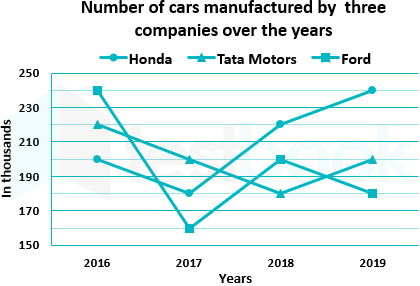
Direction: Study the following line graph and answer the question accordingly.

56

What is the difference between the total production of Ford and Tata motors in the given years?

  1. ((a))

    40,000

  2. ((b))

    20,000

  3. ((c))

    26,000

  4. ((d))

    35,000

  5. ((e))

    25,000

Show Answer
Answer: ((b))

20,000

Calculations:

Total Production of cars from Ford = (240000 + 160000 + 200000 + 180000)

⇒ 780000

Total Production of cars from Tata Motors = (220000 + 200000 + 180000 + 200000)

⇒ 800000

∴ Difference = 800000 - 780000

⇒ 20000

The difference between the total production of Ford and Tata motors in the given years is 20,000.

57

What is the average number of cars manufactured by Honda over the given period?

  1. ((a))

    2,10,000

  2. ((b))

    2,00,000

  3. ((c))

    2,60,000

  4. ((d))

    2,50,000

  5. ((e))

    2,55,000

Show Answer
Answer: ((a))

2,10,000

Calculations:

Total Production of cars from Honda = (200000 + 180000 + 220000 + 240000)

⇒ 840000

∴ Average = 840000 / 4

⇒ 210000

The average number of cars manufactured by Honda over the given period is 2,10,000.

58

The production of Honda in 2018 was approximately what percent of the production of Tata Motors in the same year?

  1. ((a))

    140%

  2. ((b))

    102%

  3. ((c))

    122%

  4. ((d))

    134%

  5. ((e))

    None of the above

Show Answer
Answer: ((c))

122%

Calculations:

∴ Required Percentage = 220000 / 180000 × 100

⇒ 122.22 ≈ 122%

The production of Honda in 2018 was 122% of the production of Tata Motors in the same year.

59

What is the difference between the number of cars manufactured by Ford in the year 2018 and 2019?

  1. ((a))

    22,000

  2. ((b))

    21,000

  3. ((c))

    10,000

  4. ((d))

    20,000

  5. ((e))

    24,000

Show Answer
Answer: ((d))

20,000

Calculations:

∴ Required Difference = 200000 - 180000

⇒ 20000

The difference between the number of cars manufactured by Ford in the year 2018 and 2019 is 20,000.

60

What is the average of all the cars manufactured by Tata Motors and Honda in 2016 and 2019?

  1. ((a))

    2,20,000

  2. ((b))

    2,19,000

  3. ((c))

    2,15,000

  4. ((d))

    2,00,000

  5. ((e))

    2,40,000

Show Answer
Answer: ((c))

2,15,000

Calculations:

∴ Required Average = (220000 + 200000 + 200000 + 240000) / 4

⇒ 215000

The average of all the cars manufactured by Tata Motors and Honda in 2016 and 2019 is 2,15,000.

61

Amar borrowed Rs. 10000 from Sachin at simple interest. After 4 years, Sachin received Rs. 5000 more than the amount given to Amar on loan. Find the rate of interest.

  1. ((a))

    12.5%

  2. ((b))

    25%

  3. ((c))

    20%

  4. ((d))

    4%

  5. ((e))

    None of these

Show Answer
Answer: ((a))

12.5%

Given:

The amount borrowed by Amar = Rs. 10000

Time = 4 years

The extra amount received by Sachin = Rs. 5000

Concept used:

The extra amount Sachin gets is the interest.

Simple Interest = Principal × rate × time/100

Calculation:

Simple Interest = Rs 5000 

⇒ 5000 = 10000 × rate × 4/100

⇒ Rate = 50/4

∴ Rate % = 12.5%

62

Mohan can do a piece of work in 10 days and Sohan in 15 days. They started working together, but after 3 days  Mohan left the work. What time will Sohan take to finish the remaining work?

  1. ((a))

    15/2 days

  2. ((b))

    18 days 

  3. ((c))

    15 days 

  4. ((d))

    5/2 days 

  5. ((e))

    None of these

Show Answer
Answer: ((a))

15/2 days

Given

Mohan can do a piece of work in 10 days

Sohan can do a piece of work in 15 days

Formula Used

(A + B)’s one day work = (1/x + 1/y)

Calculation

Mohan ‘s one day work = 1/10    

Sohan’s one day work = 1/15

(Mohan + Sohan)’s one day work = 1/10 + 1/15 = (3 + 2)/30 = 5/30 = 1/6

Since Mohan and Sohan have worked together for 3 days.

(Mohan + Sohan)’s 3 day work = 3/6 = 1/2

Remaining work  = 1 – 1/2 =  1/2

Now this work has to be done by Sohan. Sohan can do one work in 15 days

∴Sohan can do the 1/2 of the work in 15 × 1/2 = 15/2 days.

63

Rajiv's boat can travel along the current at the 8 km/hour and against the current at the rate 6 km/hour. Find the time taken by the boat to sail 28 km in still water.

  1. ((a))

    4 hours 

  2. ((b))

    5 hours 

  3. ((c))

    6 hours 

  4. ((d))

    7 hours 

  5. ((e))

    None of these

Show Answer
Answer: ((a))

4 hours 

Given

Speed of Rajiv’s boat in downstream = 8 km/hour

Speed of Rajiv’s boat in upstream = 6 km/hour

Formula used

Speed of boat in still water = (Speed Downstream + Speed upstream)/2

Time = Distance/ Speed

Calculation

Speed of Rajiv’s boat in still water = (8 + 6)/2 Km/hour

⇒ 14/2 = 7 Km/hour

Required time = 28 km/7 Km/hour = 4 hours

∴ Time taken by Rajiv’s boat to travel 28 km is 4 hours.

64

Ram, Bharat and Sham signed agreement of partnership in the ratio 7/2 : 4/3 : 6/5 . After 4 months, Ram increases his share 50%. If the total profit at the end of one year be Rs. 16,200, then sham's share in the profit is:

  1. ((a))

    Rs 2,700

  2. ((b))

    Rs 3,000

  3. ((c))

    Rs 4,000

  4. ((d))

    Rs 5,000

  5. ((e))

    None of these 

Show Answer
Answer: ((a))

Rs 2,700

Given:

Ram : Bharat : Sham = 7/2 : 4/3 : 6/5 

Formula:

Profit = Investment × time

Calculations:

Ratio of the initial investment = 7/2 : 4/3 ​: 6/5​

⇒ 105 : 40 : 36

So the actual investment of Ram, bharat, sham = 105x, 40x and 36x

Ram increases his share 50% after 4 months.

Hence the ratio of their investments

⇒ (105x × 4) + (105x × 150/100 ​× 8) : 40x × 12 : 36x × 12

⇒ 1680x ∶ 480x : 432x

⇒ 35 : 10 : 9

⇒ Sum of ratio = 35 + 10 + 9 = 54

⇒ Sham’s profit = (9/54) ​× 16,200 = 2700 Rs.

sham's share in the profit is Rs 2,700

65

Length of a rectangle is 3 cm more than width of rectangle and the difference between area of circle and area of rectangle is 84 cm2. Fiind the length of rectangle if radius of circle is 7 cm.  (circle > rectangle)

  1. ((a))

    8 cm

  2. ((b))

    10 cm

  3. ((c))

    7 cm

  4. ((d))

    14 cm

  5. ((e))

    None of these

Show Answer
Answer: ((b))

10 cm

Shortcut Trick

Area of circle = (22/7) × 72 = 154 cm2.

Area of rectangle = 154 − 84 = 70 cm2.

Let width = x, then length = x + 3. So, x(x + 3) = 70.

By inspection, 7 × 10 = 70, where 10 − 7 = 3. Thus, length = 10 cm.

∴ The correct answer is 10 cm.

Alternate Method

Given: Radius (r) = 7 cm, Difference in areas = 84 cm2, Length (L) = Width (W) + 3 cm.

Formula Used: Area of circle = πr2; Area of rectangle = L × W.

⇒ Area of Circle = (22/7) × 7 × 7 = 154 cm2.

⇒ Area of Rectangle = 154 − 84 = 70 cm2.

⇒ L × W = 70

⇒ (W + 3) × W = 70

⇒ W2 + 3W − 70 = 0

⇒ W2 + 10W − 7W − 70 = 0

⇒ W(W + 10) − 7(W + 10) = 0

⇒ W = 7 cm (ignoring negative value)

⇒ Length = 7 + 3 = 10 cm.

∴ The correct answer is 10 cm.

Additional Information

Properties of Rectangles

Perimeter of a rectangle is 2 × (length + width). The diagonals are equal and bisect each other.

Circle Mensuration

Circumference of a circle = 2πr. For a radius of 7 cm, the circumference is always 44 cm and the area is 154 cm2.

Quadratic Roots Shortcut

For x2 + bx + c = 0, if c is negative, the roots have opposite signs. Find factors of c that differ by b.

Reasoning Ability (35 questions)

Direction: Read the following information and answer the following questions.

<br>

Eight persons whose names begin with A, B, P, C, D, O, Q, and E are sitting around a circular table facing inward. Persons, whose names start with a vowel, do not sit adjacent to each other.

A sits 3rd to the right of D. Two persons sit between P and A. B sits adjacent to O, who sits 4th to the right of E. Q sits 3rd to the left of O.

66

Who sits 2nd to the right of B?

  1. ((a))

    O

  2. ((b))

    P

  3. ((c))

    A

  4. ((d))

    C

  5. ((e))

    Q

Show Answer
Answer: ((b))

P

8 Persons whose names begin with: A, B, P, C, D, O, Q, and E

  1. A sits 3rd to the right of D.

2) Two persons sit between P and A.

  1. B sits adjacent to O, who sits 4th to the right of E.

5) Persons, whose names start with a vowel, do not sit adjacent to each other.

  1. Q sits 3rd to the left of O.

Thus, case 2 gets eliminated.

<br>

Hence, P sits 2nd to the right of B.

67

___ sits 5th to the left of C.

  1. ((a))

    B

  2. ((b))

    A

  3. ((c))

    Q

  4. ((d))

    E

  5. ((e))

    D

Show Answer
Answer: ((c))

Q

8 Persons whose names begin with: A, B, P, C, D, O, Q, and E

  1. A sits 3rd to the right of D.

2) Two persons sit between P and A.

  1. B sits adjacent to O, who sits 4th to the right of E.

5) Persons, whose names start with a vowel, do not sit adjacent to each other.

  1. Q sits 3rd to the left of O.

Thus, case 2 gets eliminated.

<br>

Hence, Q sits 5th to the left of C.

68

Who is sitting opposite O?

  1. ((a))

    E

  2. ((b))

    A

  3. ((c))

    B

  4. ((d))

    P

  5. ((e))

    C

Show Answer
Answer: ((a))

E

8 Persons whose names begin with: A, B, P, C, D, O, Q, and E

  1. A sits 3rd to the right of D.

2) Two persons sit between P and A.

  1. B sits adjacent to O, who sits 4th to the right of E.

5) Persons, whose names start with a vowel, do not sit adjacent to each other.

  1. Q sits 3rd to the left of O.

Thus, case 2 gets eliminated.

<br>

Hence, E is sitting opposite O.

69

Four of the five are alike in a certain way and thus form a group. Find the one that does not belong to that group.

  1. ((a))

    EQ

  2. ((b))

    OP

  3. ((c))

    BO

  4. ((d))

    ED

  5. ((e))

    CA

Show Answer
Answer: ((e))

CA

8 Persons whose names begin with: A, B, P, C, D, O, Q, and E

  1. A sits 3rd to the right of D.

2) Two persons sit between P and A.

  1. B sits adjacent to O, who sits 4th to the right of E.

5) Persons, whose names start with a vowel, do not sit adjacent to each other.

  1. Q sits 3rd to the left of O.

Thus, case 2 gets eliminated.

<br>

Here,

EQ → Both sit adjacent to each other.

OP → Both sit adjacent to each other.

BO → Both sit adjacent to each other.

ED → Both sit adjacent to each other.

CA → Both do not sit adjacent to each other.

Hence, CA does not belong to the group.

70

Who is sitting at the immediate left of B? 

  1. ((a))

    A

  2. ((b))

    P

  3. ((c))

    Q

  4. ((d))

    E

  5. ((e))

    O

Show Answer
Answer: ((a))

A

8 Persons whose names begin with: A, B, P, C, D, O, Q, and E

  1. A sits 3rd to the right of D.

2) Two persons sit between P and A.

  1. B sits adjacent to O, who sits 4th to the right of E.

5) Persons, whose names start with a vowel, do not sit adjacent to each other.

  1. Q sits 3rd to the left of O.

Thus, case 2 gets eliminated.

<br>

Hence, A is sitting at the immediate left of B.

Directions: These questions are based on the following information.

There are 7 members in a family. R is the only sibling of S and son of P. Q is the mother of S. T is the mother of V and sister-in-law of S. V is the nephew of S and U is the wife of S. U has no sibling.

71

How is T related to R?

  1. ((a))

    Sister-in-law

  2. ((b))

    Sister

  3. ((c))

    Wife

  4. ((d))

    None of these

  5. ((e))

    Cannot be determined

Show Answer
Answer: ((c))

Wife

From the given information,

  1. R is the only sibling of S and son of P implies R is the brother of S and P is the father of R and S.
  2. Q is the mother of S.
  3. T is the mother of V and sister-in-law of S implies two possibilities- either T is the wife of R or T is the sister of S's husband or wife.
  4. V is the nephew of S and U is the wife of S implies that V is male.
  5. U has no siblings implies that T is the wife of R and V is the son of R and T.

Hence, the correct answer is Wife.

72

Who is S to V?

  1. ((a))

    Father

  2. ((b))

    Paternal Uncle

  3. ((c))

    Maternal Aunt

  4. ((d))

    Maternal Uncle

  5. ((e))

    Paternal Aunt

Show Answer
Answer: ((b))

Paternal Uncle

From the given information,

  1. R is the only sibling of S and son of P implies R is the brother of S and P is the father of R and S.
  2. Q is the mother of S.
  3. T is the mother of V and sister-in-law of S implies two possibilities- either T is the wife of R or T is the sister of S's husband or wife. 4. V is the nephew of S and U is the wife of S implies that V is male.
  4. U has no siblings implies that T is the wife of R and V is the son of R and T.

Hence, the correct solution is Paternal Uncle.

73

How many such pairs of digits are there in the number ‘95126139', which have as many digits between them in the number (both forward and backward direction) as they have between them in the Numeric Series?

  1. ((a))

    Three

  2. ((b))

    Five

  3. ((c))

    Four

  4. ((d))

    Two

  5. ((e))

    None

Show Answer
Answer: ((c))

Four

Hence, four such pairs are there in the number ‘95126139’, each of which has as many digits between them in the number (both forward and backward direction) as they have between them in the Numeric Series.

Direction: Study the following arrangement and answer the question:

C B T A E X F I M K E U V N X O D

74

If all the vowels are dropped from the given arrangement, which of the following is 9th from the right end?

  1. ((a))

    T

  2. ((b))

    X

  3. ((c))

    B

  4. ((d))

    F

  5. ((e))

    C

Show Answer
Answer: ((a))

T

Given Series: C B T A E X F I M K E U V N X O D

  1. On dropping all the vowels, the arrangement is

C B T X F M K V N X D

2)Letter which is 9th from the right end

Left Side C B T X F M K V N X D Right Side

Hence, T is 9th from the right end.

75

How many such consonants are there which are immediately followed by a consonant and immediately preceded by a vowel?

  1. ((a))

    None

  2. ((b))

    One

  3. ((c))

    Two

  4. ((d))

    Three

  5. ((e))

    Four

Show Answer
Answer: ((d))

Three

Given Series: C B T A E X F I M K E U V N X O D

  1. Consonants which are immediately followed by a consonant and immediately preceded by a vowel

C B T A E X FI M K E U V N X O D

Hence, three consonants are there which are immediately followed by a consonant and immediately preceded by a vowel- EXF, IMK and UVN

76

Which letter is 5th to the right of the 3rd from the left end in the given arrangement?

  1. ((a))

    F

  2. ((b))

    I

  3. ((c))

    X

  4. ((d))

    M

  5. ((e))

    K

Show Answer
Answer: ((b))

I

Given Series: C B T A E X F I M K E U V N X O D

  1. Letter which is 5th to the right of the 3rd from the left end

Right Side + Left Side = Left Side

5th from the right + 3rd from the left = 8th from the left

Left Side C B T A E X F I M K E U V N X O D Right Side

Hence, I is 5th to the right of the 3rd from the left end.

Directions: Read the following information carefully and answer the questions given below:

7 persons A, B, C, D, E, F and G have to attend a meeting but not necessarily in the same order. They have to attend a meeting in a reputed hotel in Agra on Sunday, Monday, Tuesday, Wednesday, Thursday, Friday and Saturday. (Assume that they attend the meeting in the same month of the year.) The week started from Monday.

B attends a meeting on Thursday. Only one person attends the meeting between B and G. A attends the meeting immediately after G. The number of people who attend a meeting before A is the same as the number of people who attend the meeting after C. Only one person attends a meeting between C and D. F attends the meeting after D.

77

On which of the following days does E have to attend the meeting?

  1. ((a))

    Sunday

  2. ((b))

    Monday

  3. ((c))

    Friday

  4. ((d))

    Saturday

  5. ((e))

    Tuesday

Show Answer
Answer: ((e))

Tuesday

Persons: A, B, C, D, E, F, and G.

I. B attends a meeting on Thursday.

II. Only one person attends the meeting between B and G.

III. A attends meeting immediately after G.

DaysCase 1Case 2
Monday
TuesdayG
WednesdayA
ThursdayBB
Friday
SaturdayG
SundayA


IV. The number of people who attend a meeting before A is the same as the number of people who attend the meeting after C. 

V. Only one person attends a meeting between C and D. 

VI. F attends the meeting after D.

DaysPersons
MondayC
TuesdayE
WednesdayD
ThursdayB
FridayF
SaturdayG
SundayA


Hence, E attends the meeting on Tuesday.

78

Who among the following has to attend the meeting on Saturday?

  1. ((a))

    F

  2. ((b))

    D

  3. ((c))

    B

  4. ((d))

    A

  5. ((e))

    G

Show Answer
Answer: ((e))

G

Persons: A, B, C, D, E, F, and G.

I. B attends a meeting on Thursday. 

II. Only one person attends the meeting between B and G. 

III. A attends meeting immediately after G.

DaysCase 1Case 2
Monday
TuesdayG
WednesdayA
ThursdayBB
Friday
SaturdayG
SundayA


IV. The number of people who attend a meeting before A is the same as the number of people who attend the meeting after C. 

V. Only one person attends a meeting between C and D. 

VI. F attends the meeting after D.

DaysPersons
MondayC
TuesdayE
WednesdayD
ThursdayB
FridayF
SaturdayG
SundayA


Hence, G attends the meeting on Saturday.

79

On which of the following days does D have to attend the meeting?

  1. ((a))

    Sunday

  2. ((b))

    Monday

  3. ((c))

    Wednesday

  4. ((d))

    Saturday

  5. ((e))

    Tuesday

Show Answer
Answer: ((c))

Wednesday

Persons: A, B, C, D, E, F, and G.

I. B attends a meeting on Thursday.

II. Only one person attends the meeting between B and G.

III. A attends meeting immediately after G.

DaysCase 1Case 2
Monday
TuesdayG
WednesdayA
ThursdayBB
Friday
SaturdayG
SundayA


IV. The number of people who attend a meeting before A is the same as the number of people who attend the meeting after C. 

V. Only one person attends a meeting between C and D. 

VI. F attends the meeting after D.

DaysPersons
MondayC
TuesdayE
WednesdayD
ThursdayB
FridayF
SaturdayG
SundayA


Hence, D attends the meeting on Wednesday.

80

how many people do attend the meeting between B and A?

  1. ((a))

    5

  2. ((b))

    4

  3. ((c))

    3

  4. ((d))

    2

  5. ((e))

    1

Show Answer
Answer: ((d))

2

Persons: A, B, C, D, E, F, and G.

I. B attends a meeting on Thursday.

II. Only one person attends the meeting between B and G. 

III. A attends meeting immediately after G.

DaysCase 1Case 2
Monday
TuesdayG
WednesdayA
ThursdayBB
Friday
SaturdayG
SundayA


IV. The number of people who attend a meeting before A is the same as the number of people who attend the meeting after C. 

V. Only one person attends a meeting between C and D. 

VI. F attends the meeting after D.

DaysPersons
MondayC
TuesdayE
WednesdayD
ThursdayB
FridayF
SaturdayG
SundayA


Hence, 2 people do attend the meeting between B and A.

81

Find the odd one?

  1. ((a))

    GA

  2. ((b))

    CE

  3. ((c))

    FG

  4. ((d))

    EG

  5. ((e))

    DB

Show Answer
Answer: ((d))

EG

Persons: A, B, C, D, E, F, and G.

I. B attends a meeting on Thursday. 

II. Only one person attends the meeting between B and G. 

III. A attends meeting immediately after G.

DaysCase 1Case 2
Monday
TuesdayG
WednesdayA
ThursdayBB
Friday
SaturdayG
SundayA


IV. The number of people who attend a meeting before A is the same as the number of people who attend the meeting after C. 

V. Only one person attends a meeting between C and D. 

VI. F attends the meeting after D.

DaysPersons
MondayC
TuesdayE
WednesdayD
ThursdayB
FridayF
SaturdayG
SundayA


There are no meetings between these people GA, CE, FG, and DB except EG thus forms a group.

Hence, EG is the odd one.

Directions: The following questions are based on five three digit numbers given below:

453      619      574      471      372

82

If in each number, all the three digits are arranged in ascending order within the number, which of the following will be the second lowest number after rearrangement?

  1. ((a))

    453

  2. ((b))

    574

  3. ((c))

    471

  4. ((d))

    619

  5. ((e))

    None of these

Show Answer
Answer: ((d))

619

Given series:

453         619      574      471      372

After arranging in ascending order within the number, the number formed:

345      169      457      147      237

Hence, the second lowest number is 169.

83

If in each number, all the odd digit is added by 1 and all the even digit is added by 2 then, which of the following will be the lowest number after mentioned operation?

  1. ((a))

    619

  2. ((b))

    574

  3. ((c))

    372

  4. ((d))

    471

  5. ((e))

    453

Show Answer
Answer: ((c))

372

Given series:

453         619      574      471      372

If in each number, all the odd digit is added by 1 and all the even digit is added by 2 then the number formed:

664      8210      686      682      484

Hence, the lowest number is 484 (372).

84

If all the digit in each of the numbers are arranged in descending order within the number then, which of the following will be the highest number in the new arrangement of numbers?

  1. ((a))

    453

  2. ((b))

    372

  3. ((c))

    574

  4. ((d))

    619

  5. ((e))

    None of these

Show Answer
Answer: ((d))

619

Given series:

453       619      574      471      372

If all the digits in each of the numbers are arranged in descending order within the number then:

543      961      754      741      732

Hence, the highest number after new arrangement is 961 (619).

85

If second digit will be interchanged with third digit in each number, then which number will be the second highest number after rearrangement?

  1. ((a))

    453

  2. ((b))

    619

  3. ((c))

    574

  4. ((d))

    372

  5. ((e))

    None of these

Show Answer
Answer: ((c))

574

Given series:

453       619      574      471      372

When second digit will be interchanged with third digit in each number, the number formed:

435      691      547      417      327

Hence, the second highest number after rearrangement is 547.

86

If in each number, both first and third digits are added and after that second digit is subtracted from that addition then how many numbers are less than 2 after mentioned operation?

  1. ((a))

    Three

  2. ((b))

    Four

  3. ((c))

    None

  4. ((d))

    Two

  5. ((e))

    One

Show Answer
Answer: ((d))

Two

Given series:

453        619      574      471      372

If in each number, both first and third digits are added and after that second digit is subtracted from that addition then the numbers are:

453 → 7 - 5 = 2

619 → 15 - 1 = 14

574 → 9 - 7 = 2

471 → 5 - 7 = -2

372 → 5 - 7 = -2

Hence, there are two numbers less than 2.

Direction: Study the following information to answer the given questions:

Point P is 3m towards south of point Q who is 4m towards east of point R. Point S is 6m towards south of point R while point T is 8m towards west of point S. Point V is 7m towards west of point U who is 3m north of point T.

87

What is the direction of U with respect to P?

  1. ((a))

    South-East

  2. ((b))

    East

  3. ((c))

    West

  4. ((d))

    North-West 

  5. ((e))

    None of these

Show Answer
Answer: ((c))

West

We have drawn the figure according to the information given in the question,

<br>

Thus, the point U is at the west direction with respect to point P.

88

What is the shortest distance between R and T?

  1. ((a))

    11m

  2. ((b))

    14m

  3. ((c))

    12m

  4. ((d))

    10m

  5. ((e))

    13m

Show Answer
Answer: ((d))

10m

We have drawn the figure according to the information given in the question,

<br>

From the above diagram,

Distance between R and S = 6m

Distance between S and T = 8m

By Pythagoras’ theorem,

RT2 = RS2 + ST2 = 62 + 82

       = 36 + 64 = 100

Hence, the shortest between R and T = 10 m.

89

If a person walks 3m towards the North from point V, takes a right turn and walks for another 15m, which of the following points would he reach?

  1. ((a))

    R

  2. ((b))

    Q

  3. ((c))

    T

  4. ((d))

    S

  5. ((e))

    Cannot be determined

Show Answer
Answer: ((a))

R

We have drawn the figure according to the information given in the question,

<br>

From the above diagram, the person will reach point R.

90

If in the word 'ADVANCE',  all the vowels are replaced with the next letters and all the consonants are replaced with the previous letters from the English Alphabet. Now if all vowels are deleted how many consonants are remain there?

  1. ((a))

    Three

  2. ((b))

    Four

  3. ((c))

    Five

  4. ((d))

    Six

  5. ((e))

    Seven

Show Answer
Answer: ((d))

Six

The given word is 'ADVANCE' 

Vowels are replaced by the next letters and consonants are replaced by the previous letters- B C U B M B F

After deleting Vowel remaining consonant - BCBMBF

Hence, Six consonants are there after deleting vowel in new arrangement.

Direction: Read the following information carefully and answer the questions that follow:

There are seven persons namely A, B, C, D, E, F, and G. They all are sitting in a row facing north. G sits second from one of the ends. E has equal number of persons to his left and right side. F sits on the extreme left end of the row. There are three persons between F and B. A sits immediate right of C. A does not sit at the extreme end.

91

Who is sitting second to the left of E?

  1. ((a))

    A

  2. ((b))

    C

  3. ((c))

    G

  4. ((d))

    F

  5. ((e))

    B

Show Answer
Answer: ((b))

C

Given names: A, B, C, D, E, F, and G.

Face direction: North

  1. E has equal number of persons to his left and right side.

  2. F sits on the extreme left end of the row.

  1. There are three persons between F and B.

  2. G sits second from one of the ends.

(Here, there will be two cases, Case 1: when G is second from the right end and Case 2: when G is second from the left end).

  1. A sits immediate right of C.

  2. A does not sit at the corner.

(In case 2 A will be at the corner to adjust the statement 5, so we can eliminate case 2 here)

Hence the final arrangement will be as follows:

Hence, C is sitting second to the left of E.

92

How many persons are sitting between A and G?

  1. ((a))

    Five

  2. ((b))

    Two

  3. ((c))

    Four

  4. ((d))

    Three

  5. ((e))

    One

Show Answer
Answer: ((b))

Two

Given names: A, B, C, D, E, F, and G.

Face direction: North

  1. E has equal number of persons to his left and right side.

  2. F sits on the extreme left end of the row.

  1. There are three persons between F and B.

  2. G sits second from one of the ends.

(Here, there will be two cases, Case 1: when G is second from the right end and Case 2: when G is second from the left ed).

  1. A sits immediate right of C.

  2. A does not sit at the corner.

(In case 2 A will be at the corner to adjust the statement 5, so we can eliminate case 2 here.)

Hence the final arrangement will be as follows:

Hence, two persons are sitting between A and G.

93

Who is sitting third from the right end?

  1. ((a))

    D

  2. ((b))

    B

  3. ((c))

    E

  4. ((d))

    A

  5. ((e))

    C

Show Answer
Answer: ((b))

B

Given names: A, B, C, D, E, F, and G.

Face direction: North

  1. E has equal number of persons to his left and right side.

  2. F sits on the extreme left end of the row.

  1. There are three persons between F and B.

  2. G sits second from one of the ends.

(Here, there will be two cases, Case 1: when G is second from the right end and Case 2: when G is second from the left ed).


  1. A sits immediate right of C.

  2. A does not sit at the corner.

(In case 2 A will be at the corner to adjust the statement 5, so we can eliminate case 2 here.)

Hence the final arrangement will be as follows:

Hence, B is sitting third from the right end.

94

How many persons are sitting to the left of G?

  1. ((a))

    Four

  2. ((b))

    Five

  3. ((c))

    One

  4. ((d))

    Two

  5. ((e))

    Three

Show Answer
Answer: ((b))

Five

Given names: A, B, C, D, E, F, and G.

Face direction: North

  1. E has equal number of persons to his left and right side.

  2. F sits on the extreme left end of the row.

  1. There are three persons between F and B.

  2. G sits second from one of the ends.

(Here, there will be two cases, Case 1: when G is second from the right end and Case 2: when G is second from the left ed).


  1. A sits immediate right of C.

  2. A does not sit at the corner.

(In case 2 A will be at the corner to adjust the statement 5, so we can eliminate case 2 here.)

Hence the final arrangement will be as follows:

Hence, five persons are sitting to the left of G.

95

Who is sitting exactly between F and B?

  1. ((a))

    C

  2. ((b))

    B

  3. ((c))

    D

  4. ((d))

    E

  5. ((e))

    A

Show Answer
Answer: ((e))

A

Given names: A, B, C, D, E, F, and G.

Face direction: North

  1. E has equal number of persons to his left and right side.

  2. F sits on the extreme left end of the row.

  1. There are three persons between F and B.

  2. G sits second from one of the ends.

(Here, there will be two cases, Case 1: when G is second from the right end and Case 2: when G is second from the left ed).

  1. A sits immediate right of C.

  2. A does not sit at the corner.

(In case 2 A will be at the corner to adjust the statement 5, so we can eliminate case 2 here.)

Hence the final arrangement will be as follows:

Hence, A is sitting exactly between F and B.

96

Directions: In the following question assuming the given statements to be true, find which of the conclusion(s) among given conclusions is/are definitely true and then give your answers accordingly.

Statement:

Y ≥ C < O ≥ F < R = B

Conclusions:

I. B > F

II. R > C

  1. ((a))

    Only I follows

  2. ((b))

    Only II follows

  3. ((c))

    Either I or II follow

  4. ((d))

    Neither I nor II follow

  5. ((e))

    Both I and II follow

Show Answer
Answer: ((a))

Only I follows

Given statement,

Y ≥ C < O ≥ F < R = B

Conclusions:

I. B > F → True (As we can see that F < R = B, so B > F is true)

II. R > C → False (As we can see that C < O ≥ F < R, here the relation between R and C cannot be determined. So, R > C is false)

Hence, only I follow.

97

Directions: In each of the following questions assuming the given statement to be true, find which of the conclusions among given conclusions is / are definitely true and then give your answers accordingly.

Statement: E < U > L > K ≤ T = H ≤ Q

Conclusions:

I. U > H

II. T ≤ Q

  1. ((a))

    Only Conclusion I follows

  2. ((b))

    Only Conclusion II follows

  3. ((c))

    Either Conclusion I or II follows

  4. ((d))

    Neither Conclusion I nor II follows

  5. ((e))

    Both Conclusion I and II follows

Show Answer
Answer: ((b))

Only Conclusion II follows

Given Statement: E < U > L > K ≤ T = H ≤ Q

Conclusions: 

I. U > H → False (U > L > K ≤ T = H → As the definite relationship between U and H cannot be determined).

II. T ≤ Q → True (T = H ≤ Q →  T ≤ Q)

Hence, only conclusion II follows.

98

Directions: In the following question assuming the given statements to be True, find which of the conclusion among given conclusions is/are definitely true and then give your answers accordingly.

Statements: Y > U ≥ Z ≥ K = X ≤ B ≤ A

Conclusions:

I. U = X

II. U > X

  1. ((a))

    Only conclusion I follow

  2. ((b))

    Only conclusion II follow

  3. ((c))

    Both I and II are follow 

  4. ((d))

    Either conclusion I or II follow

  5. ((e))

    None of these

Show Answer
Answer: ((d))

Either conclusion I or II follow

Given Statements: Y > U ≥ Z ≥ K = X ≤ B ≤ A

Conclusions:

I. U = X → False (we can’t say because U ≥ Z ≥ K = X)

II. U > X → False (we can’t say because U ≥ Z ≥ K = X)

Therefore, the conclusion I and II form a complementary pair.

Hence, either conclusion I or II follows.

99

Directions: In each of the following questions assuming the given statement to be true, find which of the conclusions among given conclusions is/are definitely true and then give your answers accordingly.

Statement: S > L < P = T ≥ V > R

Conclusions:

I. P > R

II. S > V

  1. ((a))

    Only Conclusion I follows

  2. ((b))

    Only Conclusion II follows

  3. ((c))

    Either Conclusion I or II follows

  4. ((d))

    Neither Conclusion I nor II follows

  5. ((e))

    Both Conclusion I and II follows

Show Answer
Answer: ((a))

Only Conclusion I follows

Statement: S > L < P = T ≥ V > R

Conclusions:

I. P > R → True (P = T ≥ V > R → P > R)

II. S > V → False (S > L < P = T ≥ V → As relation between S and V cannot be determined).

Hence, the Only conclusion I follows.

100

If it is possible to make a meaningful word with the third, fifth, ninth, and tenth letters of the word “PERSEVERANCE” which of the following will be the second letter from the right end of that newly formed word? If more than one such word can be made, give M as the answer and if no such word can be made, give Y as the answer.

  1. ((a))

    A

  2. ((b))

    Y

  3. ((c))

    R

  4. ((d))

    M

  5. ((e))

    E

Show Answer
Answer: ((d))

M

The third, fifth, ninth, and tenth letters of the word “PERSEVERANCE”  are R, E, A, N respectively.

The words formed will be EARN and NEAR

Hence, two such words are formed so M will be the answer.

Attempt this paper under real exam conditions

Timed interface, section switching, instant scoring, and question-by-question analytics — free.

Start Timed Attempt