Official Paper

MP Patwari Group-2 (Sub Group-4) 2022 Official Paper (Held On: 09 Apr, 2023 Shift 2) (Previous Year Paper)

200 questions · 180 minutes · with answers · free

Test (200 questions)

1

Under whose supremacy did India come, after the Government of India Act, 1858?

  1. ((a))

    Queen Elizabeth II

  2. ((b))

    Queen Alexandra

  3. ((c))

    Queen Elizabeth I

  4. ((d))

    Queen Victoria

Show Answer
Answer: ((d))

Queen Victoria

Correct answer is Queen Victoria

Key PointsAs per the Government of India Act 1858, The Queen was to become the legal owner of the Company's lands in India, and the Company was to relinquish all authority and control over those areas. The Queen was to be the head of state in India. It was Queen Victoria under who's supremacy the nation went after the Government of India Act, 1858.

  • Government of India Act of 1858:
  • East India Company's rule came to an end and the Indian Administration came under the direct control of the Crown.
  • In England, the Court of Directors and Board of Control were abolished.
  • In their place came the Secretary of State for India and the India council was established.
  • The Secretary of State would be a member of the British cabinet.
  • Lord Stanley was made the 1st Secretary of State for India.
  • India Council consisting of 15 members would assist him.
  • The Governor-General of India was also made the Viceroy of India.
  • The 1st Viceroy of India was Lord Canning.

2

Who were the first to reach India by sea-route?

  1. ((a))

    Dutch

  2. ((b))

    Portuguese

  3. ((c))

    French

  4. ((d))

    English

Show Answer
Answer: ((b))

Portuguese

correct answer is Portuguese

Key Points

  • Vasco-da-Gama
  • Vasco-da-Gama a Portuguese explorer discovered the sea route to India in 1498.
  • His initial voyage to India was by way of the Cape of Good Hope.
  • He was the first to link Europe and Asia by an ocean route, connecting the Atlantic and the Indian oceans.
  • Da Gama's discovery of the sea route to India opened the way for an age of global imperialism.
  • It enabled the Portuguese to establish a long-lasting colonial empire along the way from Africa to Asia.

Additional Information Other travelers: 

  • Christopher Columbus
  • ​Christopher Columbus was an Italian explorer and navigator.
  • He completed four Spanish-based voyages across the Atlantic Ocean sponsored by the Catholic Monarchs of Spain.
  • He opened the way for the widespread European exploration and colonization of the Americas.
  • His expeditions were the first known European contact with the Caribbean, Central America, and South America.
  • Ibn Battuta
  • Ibn Battuta ​was a Berber Maghrebi scholar and explorer.
  • He traveled extensively in the lands of Afro-Eurasia.
  • He visited most of southern Eurasia, including Central Asia, Southeast Asia, South Asia, China, and the Iberian Peninsula.
  • Hsuan Tsang
  • Hsuan Tsang was a 7th-century Chinese Buddhist monk, scholar, traveler, and translator.
  • He is known for the epoch-making contributions to Chinese Buddhism.
3

The magnificent Sun Temple at Konark was built in which century?

  1. ((a))

    13th Century

  2. ((b))

    11th Century

  3. ((c))

    10th Century

  4. ((d))

    12th Century

Show Answer
Answer: ((a))

13th Century

The correct answer is 13th Century

Key Points

  • Sun Temple of Konark
  • It is built in the 13th century by Narasimhadeva I.
  • It is dedicated to the Hindu Sun God Surya.
  • It is a part of the UNESCO world heritage site.
  • It is a classic illustration of Kalinga architecture.
  • Narasimhadev I
  • He was a powerful monarch of the Eastern Ganga Dynasty.
  • He was the first king from Kalinga who took the offensive against the Islamic expansion.
  • He built the Konark temple to commemorate his victories over the Muslims.

Additional Information 

  • The shore temple of Mahabalipuram was built by Narasimhavarman II.
  • He was also known as Rajasimha.
4

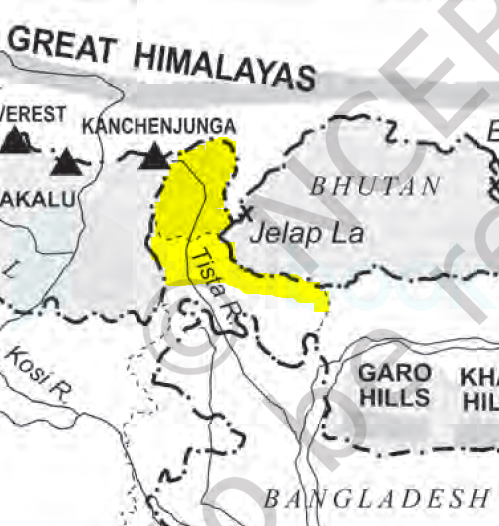
Which of the following features is not visible in the Darjeeling and Sikkim Himalayas?

  1. ((a))

    Tista river

  2. ((b))

    Shiwaliks

  3. ((c))

    Duar formations

  4. ((d))

    Kanchenjunga

Show Answer
Answer: ((b))

Shiwaliks

The correct answer is Shiwaliks.

Key Points

  • The Darjiling and Sikkim Himalayas: 
  • It is situated between the Nepal Himalayas in the west and Bhutan Himalayas in the east.
  • Known for its fast-flowing rivers such as Tista, it is a region of high mountain peaks like Kanchenjunga and deep valleys.
  • The Lepcha tribes occupy the higher reaches of this region, while the Nepalis, Bengalis, and tribals from Central India populate the southern reaches.
  • This region provides the perfect condition like moderate slope, thick soil cover with high organic content, well-distributed rainfall throughout the year, and mild winters for the tea plantation.
  • In this region, 'Duar formation' occurs instead of Shivalik formation, which has also been used for the development of tea gardens.

5

Who has been elected as the President of the Advertising Agencies Association of India (AAAI) for 2022-23?

  1. ((a))

    Rahul Rohatgi

  2. ((b))

    Prasanth Kumar

  3. ((c))

    Saurabh Ghosh

  4. ((d))

    Subhash Singhvi

Show Answer
Answer: ((b))

Prasanth Kumar

The correct answer is Prasanth Kumar.

Key Points 

  • Prasanth Kumar has been elected as the president of the Advertising Agencies Association of India (AAAI) at its annual general body meeting in November 2022.
  • He is the CEO of the South Asia of GroupM Media (India) Pvt Ltd.
  • He has an experience of over 25 years in the Industry.
  • He has served as AAAI’s vice president from 2020-22.
  • Rana Barua was elected vice president of the association.
  • ​AAAI is the official, national organization of advertising agencies, formed in 1945, to promote their interests.
6

Shri Damodar Ganesh Bapat was awarded the (i)______ for 2018, in the field of (ii)________.

  1. ((a))

    (i) Padama Vibhushan,(ii) Social work

  2. ((b))

    (i) Padama Vibhushan, (ii) Art - Music

  3. ((c))

    (i) Padam Shri, (ii) Art – Music

  4. ((d))

    (i) Padam Shri, (ii) Social work

Show Answer
Answer: ((d))

(i) Padam Shri, (ii) Social work

correct answer is (i) Padam Shri, (ii) Social work

Key Points

  • Mr Bapat was known for his social work in tribal areas in Chhattisgarh.
  • He dedicated his life to the treatment and service of leprosy patients at Bhartiya Kushta Nivarak Sangh in Janjgir-Champa district.
  • He was awarded Padma Shri, the fourth highest civilian award, by President Ram Nath Kovind in 2018 for his service to society

Additional Information

  • The Bharat Ratna: India's highest civilian honour, was established in 1954. This prize is open to everyone without regard to race, profession, position, gender, or religion. It is given in appreciation for very good work or performance in any area of human endeavour.
  • The Padma Awards: In 1954, the Padma Awards were established. With the exception of brief hiatuses in the years 1978 to 1979 and 1993 to 1997, these prizes have been presented on Republic Day each year. In decreasing order of precedence, the award is presented in three categories: Padma Vibhushan, Padma Bhushan, and Padma Shri.
  • "Exceptional and distinguished service" describes the Padma Vibhushan award. The Padma Vibhushan is India's second-highest civilian honour.
  • "Distinguished service of a high order" qualifies for the Padma Bhushan award. The third (3rd) highest civilian honour in India is the Padma Bhushan.
  • "Distinguished service" is the reason for the Padma Shri award. The fourth (4th) highest civilian honour in India is the Padma Shri.
7

Presently, the Election Commission of India consists of a Chief Election Commissioner and two other Election Commissioners. Who was the first Chief Election Commissioner of India?

  1. ((a))

    N. Gopalaswami

  2. ((b))

    Sukumar Sen

  3. ((c))

    Dr. Nagendra Singh

  4. ((d))

    ABS Ramadevi

Show Answer
Answer: ((b))

Sukumar Sen

  • The correct answer is Sukumar Sen.

Key Points 

  • The first Chief Election Commissioner of India: Sukumar Sen.
  • The first Chief Information Commissioner of India: Wajahat Habibullah.
  • The first Attorney General of India: Motilal Chimanlal Setalvad.
  • The first Lokpal of India: Pinaki Chandra Ghose.
  • The first Comptroller and Auditor General (CAG) of India after independence: Narhari Rao.​

Additional Information 

  • The current Chief Election Commissioner of India is Rajeev Kumar (25th).
  • He is appointed by the President of India for the term length of 6 years or 65 years whichever is earlier.
  • There is one Chief Election Commissioner and 2 Election Commissioners (presently Anup Chandra Pandey and Arun Goel.
8

Who among the following has become India’s 77th chess Grandmaster? 

  1. ((a))

    Tania Sachdev

  2. ((b))

    Pentala Harikrishna

  3. ((c))

    R.Praggnanandhaa

  4. ((d))

    Aditya Mittal 

Show Answer
Answer: ((d))

Aditya Mittal 

Correct answer is Aditya Mittal.

Key Points

  • Sixteen-year-old Aditya Mittal has become India's 77th chess Grandmaster during an ongoing tournament in Spain.
  • The Mumbai player, who had secured three GM norms, crossed 2,500 ELO points mark during the sixth round of the ongoing Ellobregat Open tournament in Spain. He drew the game against Spain's No.1 Francisco Vallejo Pons to achieve the feat.

Additional Information

  • Tania Sachdev
  • Tania Sachdev (born 20 August 1986)  is an Indian chess player, who holds the FIDE titles of International Master (IM) and Woman Grandmaster (WGM)
  • She is a two-time Indian women's chess champion in 2006 and 2007,[one-time Asian women's chess champion in 2007and three-time and current Commonwealth Women's Chess Champion in 2016 ,2018 and 2019. She is also a chess pre senter and commentator.
  • Pentala Harikrishna
  • Pentala Harikrishna (born 10 May 1986) is an Indian chess grandmaster.
  • He became the youngest grandmaster from India after attaining the title in 2001, a record now held by Gukesh D.
  • He was Commonwealth Champion in 2001, World Junior Champion in 2004, and Asian Individual Champion in 2011. He is currently third highest rated player in India.
  • R.Praggnanandhaa
  • Rameshbabu Praggnanandhaa[a] (born 10 August 2005) is an Indian chess grandmaster.
  • A chess prodigy, he earned the international master title at the age of 10, the youngest at the time to do so, and the Grandmaster title at age 12, the second-youngest at the time to do so.
  • On 22 February 2022, at the age of 16, he became the youngest player till then to defeat then-world champion Magnus Carlsen, when he beat Carlsen in a rapid game at the Airthings Masters Rapid Chess Tournament.
9

The last five year plan in India was which of the following?

  1. ((a))

    13th

  2. ((b))

    10th

  3. ((c))

    11th

  4. ((d))

    12th

Show Answer
Answer: ((d))

12th

The correct answer is Twelfth (12th).

Key Points

  • Twelfth (12th) Five Year Plan (FYP) was the last official Five Year Plan of India.
  • The period of the plan was from 2012-2017.
  • The first priority of the Twelfth Plan was to bring the economy back to rapid growth while ensuring that the growth is both inclusive and sustainable.
  • The broad vision and aspirations which the Twelfth Plan seeks to fulfill were reflected in the subtitle: ‘Faster, Sustainable, and More Inclusive Growth’.
  • The Planning Commission was an institution in the Government of India, which formulated India's Five-Year Plans, among other functions. It was dissolved in 2014 and succeeded by NITI Aayog.

Important Points 

  • About FYPs:
  • After independence, India launched its First FYP in 1951, under the socialist influence of first Prime Minister Jawaharlal Nehru.
  • The process began with setting up of Planning Commission in March 1950.
10

In ___________, Vallathol established the Kerala Kalamandalam

  1. ((a))

    1930

  2. ((b))

    1967

  3. ((c))

    1872

  4. ((d))

    1988

Show Answer
Answer: ((a))

1930

The correct answer is 1930.

Key Points 

  • Kerala kalamandalam is the premiere public institution in India.
  • It was established in 1930.
  • Kerala Kalamandalam is providing training in Kathakali, Mohiniyattam, Kutiyattam, Panchavadyam, Thullal, Mridangam, Karnatic music.
  • Kerala Kalamandalam was originally set up by the famous Malayalam poet Vallathol Narayana Menon.
  • Vallathol Narayana Menon was the first chairman of the Kerala Kalamandalam.

Additional Information 

  • Tirur is a city in the Malappuram district of Kerala
  • Tirur is the first digital literate municipal corporation in Kerala.
  • Kalady is a town located in the Eranakulam district of Kerala.
  • Kalady is the birthplace of the great Hindu saint Sri Sankaracharya.
  • Palakkad is the hottest district in Kerala.
11

Which Indian city is home to the headquarters of the Securities and Exchange Board of India (SEBI)?

  1. ((a))

    Chennai

  2. ((b))

    Kolkata 

  3. ((c))

    Delhi

  4. ((d))

    Mumbai

Show Answer
Answer: ((d))

Mumbai

The correct answer is Mumbai

Key Points

  • The Securities and Exchange Board of India (SEBI) was constituted as a non-statutory body on April 12, 1988, through a resolution of the Government of India.
  • SEBI was established as a statutory body in the year 1992 and the provisions of the SEBI Act, 1992 came into force on January 30, 1992
  • The Preamble of the SEBI describes the basic functions of the SEBI as "... to protect the interests of investors in securities and to promote the development of, and to regulate the securities market and for matters connected therewith or incidental thereto"
  • SEBI has to be responsive to the needs of three groups, which constitute the market
  • Issuer of securities
  • Investors
  • Market Intermediaries

Important Points

  • If any person indulges in fraudulent and unfair trade practices relating to securities, he shall be liable to a penalty of 25 crore rupees or three times the amount of profits made out of such practices, whichever is higher
  • Presently(July 2022) the Executive Director of SEBI is Mr. Pramod Rao

Additional Information

Major Financial InstitutionEstablished year
Imperial Bank of India1921
Industrial Credit and Investment Corporation of India (ICIC)January 1955
State Bank of India1 July 1955
Indian Unit Trust1 February 1964
National Bank for Agriculture and Rural Development (NABARD)12 July 1982
The Export-Import Bank of the United State (EXIM)1 January 1982
Small Industries Development Bank of IndiaApril 1990
12

In India, the Community Development Programme was started on –

  1. ((a))

    October 2, 1953

  2. ((b))

    October 2, 1952

  3. ((c))

    October 2, 1954

  4. ((d))

    October 2, 1955

Show Answer
Answer: ((b))

October 2, 1952

The correct answer is option 3 i.e. Oct 2, 1952. 

Key Points

  • According to Carl Tylor, "community development is a method by which people in villages are involved in helping to improve their own economic and social conditions and thereby they became effective working groups in the programme of their national development".
  • The community development programme was started in India, just after independence (1952).
  • It was a multi-project programme with the aim of the overall development of rural people.
  • This programme consisted of agriculture, animal husbandry, irrigation, cooperation, public wealth, education, social education, communication, village industries etc.
  • There are officials for each activity at the district level to plan execute and evaluate the programme up to the village level.
13

To advance digital creativity skills across the nation, the All India Council for Technical Education (AICTE) has signed a partnership agreement with whom?

  1. ((a))

    Adobe

  2. ((b))

    Facebook

  3. ((c))

    Microsoft

  4. ((d))

    Google 

Show Answer
Answer: ((a))

Adobe

Correct answer is Adobe.

Key Points

  • All India Council for Technical Education 
  • The All-India Council for Technical Education (AICTE) has signed a partnership agreement with Adobe to accelerate digital creativity skills across India.
  • Under the agreement, Adobe will offer courses and expertise for up-skilling educators. It will also integrate digital creativity into the curriculum, to prepare students with creative and digital literacy skills.
  • The partnership aims to empower over 75,000 educators across 10,000 higher education institutions by 2024

Additional Information 

ApplicationFounded onFounder NameHeadquarters
FacebookFebruary 4, 2004.Mark Zuckerberg, Eduardo Saverin, Andrew McCollum, Dustin Moskovitz, Chris HughesMenlo Park, California
Microsoft4 April 1975Bill Gates, Paul AllenRedmond, Washington, United States
GoogleSeptember 4, 1998Larry Page and Sergey BrinMountain View, California, U.S
Whatsapp3 May 2009Jan KoumMenlo Park, California
14

Mohammed bin Salman has been appointed as the Prime Minister of which country in September 2022?

  1. ((a))

    Iran

  2. ((b))

    Indonesia

  3. ((c))

    Iraq

  4. ((d))

    Saudi Arabia

Show Answer
Answer: ((d))

Saudi Arabia

The correct answer is Saudi Arabia.

Key Points 

  • In Saudi Arabia, King Salman bin Abdulaziz named his son and heir Crown Prince Mohammed bin Salman as the Prime Minister of the kingdom.
  • According to a royal decree, King Salman also promoted his second son Prince Khalid from deputy Defense Minister to Defense Minister.
  • Mohammed bin Salman was previously Defense Minister in Saudi Arabia's government.

Additional Information

  • Iran

  • About Iran​

  • | Flag of Iran | | | --- | --- | | Official name | Jomhūrī-ye Eslāmī-ye Īrān (Islamic Republic of Iran) | | Head of State and Government | President: Ebrahim Raisi | | Capital | Tehran | | Official Language | Farsi (Persian) | | Official Religion | Islam | | Total Area | 1,628,771 sq. km |
  • Iraq 

  • Baghdad is the capital of Iraq.

CountryIraq
CapitalBaghdad
PresidentFuad Masum
Prime MinisterHaider al-Abadi
CurrencyIraqi dinar
  • Indonesia: (As on July 2022)
  • Capital and largest city: Jakarta
  • Official language: Indonesian
  • President: Joko Widodo
  • Vice President: Ma'ruf Amin
  • Currency: Indonesian rupiah
15

According to Section 88 of the Income tax Act, which of these committee praise the abolition on tax rebates? 

  1. ((a))

    Chellaiah Committee

  2. ((b))

    Manohtra Committee

  3. ((c))

    Kelkar Committee

  4. ((d))

    Shome Committee

Show Answer
Answer: ((c))

Kelkar Committee

According to Section 88 of the Income Tax Act, the committee that proposed the abolition of tax rebates is the Kelkar Committee.

Key Points

Kelkar Committee:

  • The Kelkar Committee, officially known as the Task Force on Direct Taxes, was established in 2002 and chaired by Vijay Kelkar, an Indian economist and former finance secretary.
  • The committee was formed with the objective of recommending reforms and simplifications in the Indian tax system, including direct taxes.
  • One of the major recommendations put forth by the Kelkar Committee was the abolition of tax rebates.
  • The committee argued that tax rebates and exemptions complicated the tax system and led to distortions in tax compliance.
  • They suggested that a simpler and more transparent tax structure without extensive exemptions and rebates would improve tax administration and reduce the burden of compliance for taxpayers.

 Additional InformationChelliah Committee:

  • The Chelliah Committee, officially known as the Tax Reforms Committee, was formed in 1991 and chaired by Raja Chelliah, an eminent economist.
  • The committee was tasked with suggesting comprehensive tax reforms in India to enhance revenue collection and promote economic growth.
  • While the Chelliah Committee made several recommendations, it did not specifically propose the abolition of tax rebates.

Shome Committee:

  • The Parthasarathi Shome Committee, officially known as the Expert Committee on General Anti-Avoidance Rules (GAAR), was established in 2012 and headed by Parthasarathi Shome, an economist and tax expert.
  • The committee was formed to provide recommendations on the implementation of GAAR in the Indian tax system.
  • GAAR aims to prevent tax avoidance through the use of abusive tax arrangements.
  • While the Shome Committee made significant recommendations on GAAR, it did not specifically propose the abolition of tax rebates.
16

In which state was the Lokayukta established for the first time? 

  1. ((a))

    Madhya Pradesh

  2. ((b))

    Uttar Pradesh

  3. ((c))

    Maharashtra

  4. ((d))

    Orissa

Show Answer
Answer: ((c))

Maharashtra

The correct answer is Maharashtra.

Key Points

  • Maharashtra was the first state to introduce the institution of Lokayukta through The Lokayukta and Upa-Lokayuktas Act in 1971.
  • This was followed by similar acts that were enacted by the states of Odisha, Rajasthan, Bihar, Uttar Pradesh, Karnataka, Madhya Pradesh, Andhra Pradesh, Gujarat, Kerala, Tamil Nadu and the union territory of Delhi.
  • The powers of Lokayukta in each state are different and efforts are being made to make them uniform.

Additional Information 

  • The Lokayukta is the Indian Parliamentary Ombudsman, executed into power, through and for, each of the State Governments of India.
  • It is brought into effect in a state, after passing the Lokayukta Act in the respective state Legislature and a person of reputable background is nominated to the post.
  • The post is created to quickly address grievances against the working integrity and efficiency of the government or its administration (public servants).
17

Which God is the Brihadisvara temple of Thanjavur dedicated to?

  1. ((a))

    Vishnu

  2. ((b))

    Saraswati

  3. ((c))

    Lakshmi

  4. ((d))

    Shiva

Show Answer
Answer: ((d))

Shiva

The correct answer is Shiva

Key Points Raja Raja I

  • Historically, Brihadishvara Temple is also known as Rajarajeswaram and Thanjai Periya Kovil.
  • Raja Raja Cholan, built the Tanjore Brihadeeshwara Temple, which Kunjara Mallan Raja Rama Perunthachan designed.
  • The Brihadeeswarar Temple was constructed by powerful ruler Raja Raja Cholan as a tribute to Lord Shiva.
  • Wall murals from the Chola and Nayak eras adorn the walls of the shrine.
18

Which of the following statements regarding the Chambal River is incorrect?

  1. ((a))

    The Gandhisagar Dam has been constructed over it

  2. ((b))

    It discharges its water in the Bay of Bengal

  3. ((c))

    It is famous for its badland topography

  4. ((d))

    It rises near Mhow in the Malwa plateau of Madhya Pradesh

Show Answer
Answer: ((b))

It discharges its water in the Bay of Bengal

correct answer is It discharges its water in the Bay of Bengal

Key Points

  • Chambal River is also called Dharmavati and Charmavati.
  • It is known for creating ravines.
  • Origin - Janapao Hills, near Mhow, MP.
  • Falls into Yamuna river near Etawah, UP.
  • Total Length - 965 km.
  • Major Tributary - Kshipra, Kalisindh, Parvati, Bansa, Newaj, Kwari, Sindh, etc.
  • Cities on its bank - Dhar, Sheopur, Mhow, Morena, and Ratlam.
  • Area Covered - Indore, Dhar, Ujjain, Ratlam, Mandsaur, Sheopur, Morena, and Bhind districts of Madhya Pradesh.
  • Waterfalls
  • Patalpani (8 m) in Indore
  • Jharidhar (7 m) in Indore
  • Chuliya (18 m) in Rajasthan
  • Projects 
  • Gandhi Sagar Project (Mandsaur)
  • Jawahar Sagar (Kota)
  • Rana Pratap Sagar (Chittaur)

19

Which of the following team won the Syed Mushtaq Ali T20 Trophy title at Eden Gardens, Kolkata in Nov 2022?

  1. ((a))

    Andhra Pradesh 

  2. ((b))

    Mumbai

  3. ((c))

    Kerala

  4. ((d))

    West Bengal

Show Answer
Answer: ((b))

Mumbai

correct answer is Mumbai

Key Points

  • The Mumbai team captained by Ajinkya Rahane defeated Himachal Pradesh at the Eden Gardens in Kolkata to win their maiden title.
  • The Syed Mushtaq Ali Trophy is a domestic T-20 cricket championship in India, organised by the Board of Control for Cricket in India (BCCI) among the teams from the Ranji Trophy.

Additional Information

  • The Syed Mushtaq Ali trophy is an Indian domestic cricket championship.
  • The championship is named after Syed Mushtaq Ali, the famous Indian cricketer.
  • It is organized by BCCI (Board of Control for Cricket in India) and played by the Ranji Trophy teams.
  • The 2009-10 season of the championship was its first edition
20

For which of the following animal/bird’s safeguarding was the Operation Clean Art launched in India?

  1. ((a))

    Elephant

  2. ((b))

    Tiger

  3. ((c))

    Peacock

  4. ((d))

    Mongoose 

Show Answer
Answer: ((d))

Mongoose 

The correct answer is Mongoose

Key Points

  • Operation 'Clean Art' is an Indian operation to crackdown on the smuggling of mongoose hair in the country.
  • Operation Clean Art was the first pan India operation to crack down on the smuggling of mongoose hair in the country.
  • It was conceived by Wildlife Crime Control Bureau (WCCB).
  • It was a planned raid, not to apprehend criminals, but to check on organised factories that were making paintbrushes with mongoose hair.
  • Raids were carried out not only in Uttar Pradesh, but also at Jaipur in Rajasthan, Mumbai, and Pune in Maharashtra, and in Kerala, on the same day.
  • The entire operation across the country yielded 54,352 brushes and 113 kg of raw hair.

<br>

Additional Information

  • Elephant
  • Project Elephant was launched in 1992 by the Government of India, Ministry of Environment and Forests (MoEF) to provide financial and technical support of wildlife management efforts by states for their free-ranging populations of wild Asian Elephants.
  • The objective of the project was to carry out performance evaluation of Centrally Sponsored Scheme ‘Project Elephant’ for the period of 2007-08 to 2011-12 in the four Wildlife Divisions of Meghalaya viz. Khasi Hills Wildlife Division, Jaintia Hills Wildlife Division, East & West Garo Hills Wildlife Division, and Balpakram National Park Division.
  • Tiger
  • Project Tiger was launched on 1st April 1973.
  • Project Tiger was launched from Jim Corbett National Park, which is located in Uttarakhand
  • It was launched by the Union Government of India under the Ministry of Environment, Forest and Climate Change.
  • Nodal Implementing Agency: National Tiger Conservation Authority.
  • There are around 442 tigers present in Uttarakhand (Jim Corbet National Park) According to the latest census released by All India Tiger Estimation 2018 and this result is declared by PM Narendra Modi on International Tiger Day (29 July).
  • Peacock
  • In 1963, Peacock was declared as the national bird of India because of its rich religious and legendary involvement.

Information about Peacock

  • Scientific name: Pavo cristatus
  • Family: Phasianidae
  • Order: Galliformes
  • Class: Aves
  • Kingdom: Animalia
21

Out of the following choose the word which expresses the right meaning of the given word.

ALTRUISM

  1. ((a))

    devotion

  2. ((b))

    self-denial 

  3. ((c))

    dedication

  4. ((d))

    unselfish interest in the welfare of others

Show Answer
Answer: ((d))

unselfish interest in the welfare of others

The correct answer is 'unselfish interest in the welfare of others'.

Key Points

  • The word "altruism" refers to the selfless concern for the well-being and happiness of others.
  • It is the opposite of selfishness and involves a genuine desire to help and benefit others without expecting anything in return.
  • Unselfish interest in the welfare of others (दूसरों के कल्याण में निःस्वार्थ रुचि​): This choice directly aligns with the definition of altruism. It represents the act of genuinely caring about the well-being of others without seeking personal gain or recognition. This option perfectly captures the essence of altruism and is the most accurate choice among the given options.
  • Considering the meanings of the words and their relevance to the concept of altruism, option 4, "unselfish interest in the welfare of others," best expresses the right meaning of the word "altruism."

Additional Information

  • Devotion: Devotion refers to a strong commitment or loyalty towards someone or something. While devotion can involve selflessness, it is not necessarily specific to the concern for the welfare of others. (किसी काम में बहुत-सा समय और शक्ति लगाने की क्रिया; समर्पण भाव)
  • Therefore, it is not the best choice to represent the meaning of "altruism."
  • Self-denial: Self-denial refers to the act of sacrificing one's own desires, interests, or needs. (नैतिक या धार्मिक कारणों से या पैसों के अभाव में स्वयं को अपनी पसंदीदा चीज़ से वंचित रखना; आत्मत्याग; स्वार्थत्याग)
  • It often involves restraining oneself from indulging in certain pleasures or pursuing personal goals. Self-denial can be associated with altruism, as it involves putting aside one's own desires for the benefit of others. Thus, it is a relevant choice and can be considered as a possible answer.
  • Dedication: Dedication refers to the commitment, effort, and focus that someone puts into a particular task or goal. (अभीष्‍ट के प्रति समर्पण)
  • While dedication can involve selflessness and a strong commitment, it does not necessarily capture the essence of altruism, which is primarily concerned with the welfare of others rather than personal achievements. Hence, it may not be the most suitable option.
22

In the following question, out of the four alternatives, choose the one which can be substituted for the given words/sentence.

A formal written or spoken statement, especially one given in a court of law.

  1. ((a))

    Evidence

  2. ((b))

    Hibernation

  3. ((c))

    Testimony

  4. ((d))

    Statement

Show Answer
Answer: ((c))

Testimony

The correct answer is 'Testimony'.

Key Points 

Let's examine each option in detail to determine the correct choice:

  • **Evidence (**सबूत): Evidence refers to information, facts, or proof that is presented to support or refute a claim or argument. While evidence can be part of a formal written or spoken statement in a court of law, it does not encompass the entire concept. Evidence is more general and can exist outside of a courtroom setting as well. Therefore, option 1 is not the best substitution for the given phrase.
  • **Hibernation (**सीतनिद्रा) : Hibernation refers to a state of inactivity or dormancy that certain animals enter during the winter season. It is unrelated to the given phrase and does not represent a formal written or spoken statement in a court of law. Hence, option 2 is incorrect.
  • Testimony ( गवाही): Testimony is the act of giving a formal statement or evidence under oath in a court of law. It involves providing a firsthand account or expert opinion related to a case. Testimony directly aligns with the given phrase and accurately represents a formal written or spoken statement in a legal context. Therefore, option 3 is the correct substitution for the given words/sentence.
  • **Statement (**कथन): While "statement" is included in the original phrase, it alone does not capture the formal and legal context emphasized in the question. A statement can be more general and informal, whereas the given phrase specifically refers to a formal written or spoken statement in a court of law. Thus, option 4 is not the most appropriate choice.

Considering the definitions and the context of the question, option 3, "Testimony," is the word that can be substituted for the given phrase, as it accurately represents a formal written or spoken statement given in a court of law.

23

In the following question, out of the four alternatives, choose the word which is opposite in meaning to the given word and click the button corresponding to it.

Captivate

  1. ((a))

    Bewitch

  2. ((b))

    Obscure

  3. ((c))

    Distract

  4. ((d))

    Imprison

Show Answer
Answer: ((c))

Distract

The correct answer is "Distract".

Key Points

  • "Captivate" is a verb that means to attract and hold the interest or attention of someone. It's often used to describe situations where something is so interesting or engaging that it absorbs all of your attention.
  • For example: "The enchanting landscape captivated the tourists."
  • The antonym, or opposite, of captivate would be a word that means to draw attention away or fail to hold attention.
  • "Distract" is a verb that means to divert the attention of. It's used to describe situations where something interrupts or prevents concentration on something else.
  • For example: "The loud noise outside distracted me from my studies."
  • Hence, the correct answer will be Option 3.

Additional Information

  • Option 1: "Bewitch" is a verb that means to enchant and delight, often in a way that makes rational thought or resistance difficult. This is similar to "captivate" rather than opposite to it.
  • An example of "bewitch" used in a sentence would be: "Her radiant smile bewitched the audience."
  • Option 2: "Obscure" as an adjective means not discovered or known about; uncertain. As a verb, it means to keep from being seen; to conceal. Neither definition provides a direct contrast to "captivate".
  • An example of "obscure" used in a sentence would be: "His answers were obscured by his deliberate evasion of the questions."
  • Option 4: "Imprison" is a verb that means to put or keep in prison; to confine. While it does entail a lack of freedom, it does not specifically relate to attention or interest, which is the key concept in "captivate".
  • An example of "imprison" used in a sentence would be: "The dictator was known to imprison those who opposed him."
24

In the following question, there are six sentences marked S1, S6, P, Q, R, S. The positions of S1 and S6 are fixed. You are required to choose one of the four alternatives which would be the most logical sequence of the sentence in the passage.

S1. The mail is first collected from different letter boxes.

P: From there it is sent to the head post office.

Q: It is then sorted out at the sorting office.

R: The mail is again sorted out at the head office by the concerned beat postman.

S: The sorted mail is sent to the zonal post office.

S6. Finally it is delivered to us.

  1. ((a))

    QSPR

  2. ((b))

    RSQP

  3. ((c))

    RPSQ

  4. ((d))

    QPRS

Show Answer
Answer: ((a))

QSPR

The correct answer is Option 1) QSPR.

Key Points

Logical sequence: 

  • S1: The mail is first collected from different letter boxes.
  • Q: It is then sorted out at the sorting office.
  • S: The sorted mail is sent to the zonal post office.
  • P: From there it is sent to the head post office.
  • R: The mail is again sorted out at the head office by the concerned beat postman.
  • S6: Finally it is delivered to us.

Here, R must come just before final delivery, and among the given options, only QSPR maintains a coherent and acceptable flow of the postal process.

Therefore, the correct answer is 1) QSPR.

25

Four alternatives are given for the idiom/phrase bracket in the sentence. Choose the alternative which best expresses the meaning of the idiom/phrase and mark it.

My neighbour had to (pay through his nose) for a brand new car.

  1. ((a))

    Make a quick buck

  2. ((b))

    Pay an extremely high price

  3. ((c))

    Pay a reasonable price 

  4. ((d))

    Pay huge loans 

Show Answer
Answer: ((b))

Pay an extremely high price

The correct alternative that best expresses the meaning of the idiom/phrase "pay through his nose" in the given sentence is: Pay an extremely high price.

Key Points

  • The phrase "pay through his nose" is an idiom that means paying a significantly high or excessive price for something.
  • It implies that the person had to pay an exorbitant amount, often more than what is considered fair or reasonable.
  • In the context of the sentence, it suggests that the neighbor had to pay a substantial amount of money for the brand new car.
  • Option 2, "Pay an extremely high price," accurately captures the meaning of "pay through his nose" by emphasizing the concept of paying an excessive or inflated price.
  • Therefore, it is the most suitable alternative among the given options.
26

In the below question, a sentence has been given in Active/Passive Voice. Out of the four alternatives suggested, select the one which best expresses the same sentence in Passive/Active Voice.

He expressed an infinite deal of surprise at finding me in so good a condition.

  1. ((a))

    An infinite deal of surprise was expressed at finding me in so good a condition, by him.

  2. ((b))

    An infinite deal of surprise was expressed by him, at finding me in so good a condition.

  3. ((c))

    An infinite deal of surprise was expressed at finding me in so good a condition.

  4. ((d))

    By him an infinite deal of surprise was expressed, at finding me in so good a condition.

Show Answer
Answer: ((b))

An infinite deal of surprise was expressed by him, at finding me in so good a condition.

The original sentence given is in Active Voice: He expressed an infinite deal of surprise at finding me in so good a condition.

Key Points

  • To convert it to Passive Voice, we need to make the object of the active sentence (an infinite deal of surprise) the subject of the passive sentence, and the subject (He) becomes the object preceded by "by." The verb form also needs to be changed to the passive form.
  • Among the given options, the alternative that best expresses the same sentence in Passive Voice is:
  • An infinite deal of surprise was expressed by him, at finding me in so good a condition.
  • In the passive form, the subject "He" has been changed to "An infinite deal of surprise" as the subject of the sentence.
  • The verb "expressed" is in the passive form, and "by him" is added to indicate the doer of the action.
  • The phrase "at finding me in so good a condition" remains unchanged.
  • Therefore, option 2, "An infinite deal of surprise was expressed by him, at finding me in so good a condition," accurately represents the given sentence in Passive Voice.
27

Four alternatives are given for the idiom/phrase bracket in the sentence. Choose the alternative which best expresses the meaning of the idiom/phrase and mark it.

Mothers are always (blind to) their children's faults.

  1. ((a))

    ignorant of

  2. ((b))

    insensitive to

  3. ((c))

    indifferent to

  4. ((d))

    tolerant of

Show Answer
Answer: ((c))

indifferent to

The alternative that best expresses the meaning of the idiom/phrase "blind to" in the given sentence is: indifferent to.

Key Points

  • To be "indifferent to" something means to show a lack of interest, concern, or care towards it.
  • In the context of the sentence, it suggests that mothers are indifferent or unconcerned about their children's faults.
  • They may not pay much attention to or be bothered by their children's shortcomings or mistakes.
28

Read the following group of sentences. The first and the last sentences are numbered 1 and 6, the rest are numbered P, Q, R, and S. Arrange these four sentences in proper order to form a meaningful paragraph/sentence.

  1. The man

P. and no one passing him in the street

Q. was singularly inconspicuous

R. who was called Alfred Nobel

S. would have given him

  1. another look
  1. ((a))

    QPSR

  2. ((b))

    SPRQ

  3. ((c))

    PSQR

  4. ((d))

    RQPS 

Show Answer
Answer: ((d))

RQPS 

The correct arrangement is 4) RQPS.

Key Points

  • The man
  • R. who was called Alfred Nobel
  • Q. was singularly inconspicuous
  • P. and no one passing him in the street
  • S. would have given him
  • Sentence R: "The man who was called Alfred Nobel" introduces us to the central character of the paragraph, emphasizing his identity as Alfred Nobel.
  • Sentence Q: "was singularly inconspicuous" provides an important characteristic of the man, highlighting the fact that he was not noticeable or remarkable in any way.
  • Sentence P: "and no one passing him in the street" adds to the previous sentence by emphasizing that even people passing him on the street did not pay much attention to him.
  • Sentence S: "would have given him" suggests that despite his unremarkable appearance, if people had known who he was, they would have treated him differently or shown him more attention or respect.
  • By arranging the sentences in the order RQPS, the paragraph creates a cohesive flow. It starts by introducing Alfred Nobel, then describes his inconspicuous nature, followed by the observation that people passing him on the street did not pay him much attention. Finally, it suggests that people would have treated him differently if they had known his true identity.
29

In the question below, a sentence is given with a blank. From the options below, choose the correct idiom that can fit in the blank to make the sentence grammatically and meaningfully correct.

I know he is not up to the mark right now but let's ____________ as he's new to this environment and needs time to adjust.

  1. ((a))

    plumb the depths

  2. ((b))

    cut him some slack

  3. ((c))

    make it snappy

  4. ((d))

    play both ends against the middle

Show Answer
Answer: ((b))

cut him some slack

The correct idiom that can fit in the blank to make the sentence grammatically and meaningfully correct is: cut him some slack.

Key Points 

  • The revised sentence would be:
  • "I know he is not up to the mark right now but let's cut him some slack as he's new to this environment and needs time to adjust."
  • The idiom "cut someone some slack" means to be lenient or understanding toward someone, especially when they are new or inexperienced in a particular situation.
  • In this context, it suggests that the speaker is asking others to be patient and give the person some leeway or understanding due to their newness in the environment.
30

In the following question, a sentence has been given in Active/Passive Voice. Out of the four alternatives suggested, select the one which best expresses the same sentence in Passive/Active Voice.

He will have completed the project by then.

  1. ((a))

    The project will have completed by him by then. 

  2. ((b))

    The project be completed by him by then.

  3. ((c))

    The project will have been completed by him by then.

  4. ((d))

    The project he will complete by then.

Show Answer
Answer: ((c))

The project will have been completed by him by then.

The correct alternative that best expresses the given sentence in Passive Voice is: The project will have been completed by him by then.

Key Points

  • In the process of converting an active voice sentence to passive voice, the object of the active voice sentence becomes the subject of the passive voice sentence.
  • The given sentence in in the future perfect tense.
  • Example of Active to Passive conversion of future perfect tense:
  • Active:​ Meena will not have changed the bedsheet.
  • Passive: The bed sheet will not have been changed by Meena.
  • In this case, "the project" is the object in the active sentence and becomes the subject in the correct passive sentence.
  • The form of the verb also changes when converting an active voice sentence to passive voice.
  • The verb tense of the original sentence is future perfect tense ("will have completed").
  • In the passive voice, this changes to 'will have been completed', which accurately maintains the tense while expressing the action's passive nature.
  • The subject of the original active sentence, "He," becomes the agent in the passive voice sentence, expressed with the preposition "by" as "by him".
  • Therefore, the correct sentence in the passive voice is "The project will have been completed by him by then."
31

In the question below, a sentence is given with one blank in it. Choose the option that provides the correct word to be filled in the blank.

Accuracy rates of facial recognition algorithms are ________ low in the case of minorities, women and children, as demonstrated in multiple studies across the world.

  1. ((a))

    Alarming

  2. ((b))

    Repeated

  3. ((c))

    Beautifully

  4. ((d))

    Particularly

Show Answer
Answer: ((d))

Particularly

The correct option to fill in the blank is: Particularly.

Key Points

  • The sentence states that the accuracy rates of facial recognition algorithms are low, specifically in the case of minorities, women, and children.
  • The word "particularly" is used to emphasize this specific group of individuals and highlights that they experience a notable decrease in accuracy compared to others.
  • Therefore, the correct word to fill in the blank is "particularly," indicating that accuracy rates are notably low in the mentioned demographic groups.
32

In the following question, a sentence has been given in Active/Passive Voice. Out of the four alternatives suggested, select the one which best expresses the same sentence in Passive/Active Voice.

Did you know that he is absent today?

  1. ((a))

    Was it known by you that he is absent?

  2. ((b))

    Were it known by you that he is absent?

  3. ((c))

    Had you known that he is absent? 

  4. ((d))

    Was it being known by you that he is absent?

Show Answer
Answer: ((a))

Was it known by you that he is absent?

The correct answer is option 1) "Was it known by you that he is absent?"

Key Points

  • To understand why this is the correct answer, let's analyze the original sentence: "Did you know that he is absent today?"
  • The original sentence is in the active voice, where the subject "you" performs the action of knowing. We are asked to transform this sentence into the passive voice, where the subject receives the action rather than performing it.
  • In the passive voice, the sentence structure is usually: Object + auxiliary verb + past participle + by + subject.
  • Let's apply this structure to the options:
  • "Was it known by you that he is absent?"
  • This option correctly transforms the sentence into the passive voice. The subject "it" receives the action of being known, and "by you" indicates who knows it. The original sentence's meaning is retained.
  • "Were it known by you that he is absent?"
  • This option is similar to the correct answer, but it uses "were" instead of "was." However, in this context, "was" is more appropriate because the original sentence is in the past tense.
  • "Had you known that he is absent?"
  • This option maintains the active voice. It is not a correct transformation into the passive voice.
  • "Was it being known by you that he is absent?"
  • This option is in the passive voice, but it uses the continuous tense ("being known"). The original sentence does not indicate an ongoing action, so this option is not the best choice.

Therefore, option 1) "Was it known by you that he is absent?" is the most suitable transformation of the original sentence into the passive voice.

33

Read the following group of sentences. The first and the last sentences are numbered 1 and 6, the rest are numbered P, Q, R, and S. Arrange these four sentences in proper order to form a meaningful paragraph/sentence.

  1. It may seem odd

P. one should only read

Q. but people read for such a

R. to have to insist that

S. because one liked it

  1. variety of reasons.
  1. ((a))

    RPSQ

  2. ((b))

    RSPQ

  3. ((c))

    QPSR

  4. ((d))

    SPRQ

Show Answer
Answer: ((a))

RPSQ

The correct order seems to be RPSQ.

Key Points

  • It may seem odd 
  • R. to have to insist that
  • P. one should only read
  • S. because one liked it
  • Q. but people read for such a variety of reasons.
  • This makes the paragraph: "It may seem odd to have to insist that one should only read because one liked it, but people read for such a variety of reasons."
  • So, the answer is option 1) RPSQ.
34

In the question given below, a set of four sentences P, Q, R & S is given, which when properly sequenced, form a coherent paragraph. Arrange the sentences in the correct order and mark the correct order as your answer.

P. Over the past few years, India's declining savings rate has been a puzzle for macroeconomists.

Q. However, fresh data from a survey shows that among urban India's working population, the young employees tend to save a higher share of their incomes than their older counterparts.

R. Also, the savings patterns of post-millennials and millennials are similar, the data show.

S. Some have blamed slow rise in household incomes for this while others have suggested that younger Indians saving less than what their parents did may be to blame.

  1. ((a))

    SPQR

  2. ((b))

    PSQR

  3. ((c))

    PRSQ

  4. ((d))

    SRQP

Show Answer
Answer: ((b))

PSQR

The correct order to form a coherent paragraph is: 3) PSQR.

Key Points

The correct order for these sentences to form a coherent paragraph is:

  • P. Over the past few years, India's declining savings rate has been a puzzle for macroeconomists.
  • S. Some have blamed slow rise in household incomes for this while others have suggested that younger Indians saving less than what their parents did may be to blame.
  • Q. However, fresh data from a survey shows that among urban India's working population, the young employees tend to save a higher share of their incomes than their older counterparts.
  • R. Also, the savings patterns of post-millennials and millennials are similar, the data show.
  • This order forms a coherent paragraph as it first introduces the problem (P), then presents some hypotheses about the problem (S), next it introduces new data that contradicts one of the hypotheses (Q), and finally, it provides additional information about the new data (R).
  • The paragraph would be:
  • Over the past few years, India’s declining savings rate has been a puzzle for macroeconomists. Some have blamed slow rise in household incomes for this while others have suggested that younger Indians saving less than what their parents did may be to blame. However, fresh data from a survey shows that among urban India’s working population, the young employees tend to save a higher share of their incomes than their older counterparts. Also, the savings patterns of post-millennials and millennials are similar, the data show.
35

In the following question, a sentence has been given in Active/Passive Voice. Out of the four alternatives suggested, select the one which best expresses the same sentence in Passive/Active Voice.

Saroj will play the tabla.

  1. ((a))

    The tabla will be played by Saroj.

  2. ((b))

    The tabla had been played by Saroj.

  3. ((c))

    The tabla has been played by Saroj.

  4. ((d))

    The tabla will have been played with Saroj.

Show Answer
Answer: ((a))

The tabla will be played by Saroj.

The correct answer is option 1) "The tabla will be played by Saroj."

Key Points

  • To explain in detail, let's analyze the original sentence: "Saroj will play the tabla."
  • The original sentence is in the active voice, where the subject "Saroj" performs the action of playing.
  • We are asked to transform this sentence into the passive voice, where the subject receives the action rather than performing it.
  • In the passive voice, the sentence structure is usually: Object + auxiliary verb + past participle + by + subject.
  • Let's apply this structure to the options:
  • "The tabla will be played by Saroj."
  • This option correctly transforms the sentence into the passive voice.
  • The subject "tabla" receives the action of being played, and "by Saroj" indicates who plays it.
  • The original sentence's meaning is retained.
  • Therefore, option 1) "The tabla will be played by Saroj" is the most suitable transformation of the original sentence into the passive voice.

Lets see why other options are incorrect:-

  • "The tabla had been played by Saroj."
  • This option uses the past perfect tense ("had been played"), indicating an action completed before a certain point in the past. However, the original sentence is in the future tense ("will play"), so this option does not convey the same meaning.
  • "The tabla has been played by Saroj."
  • This option uses the present perfect tense ("has been played"), indicating an action completed in the past with relevance to the present. Again, the original sentence is in the future tense, so this option does not express the same meaning.
  • "The tabla will have been played with Saroj."
  • This option introduces the phrase "with Saroj," which changes the meaning. The original sentence does not mention playing with Saroj but rather Saroj playing the tabla.
36

In the following question, one part of the sentence may or may not have an error. Find out which part of the sentence has an error and select the appropriate option. If the sentence is free from error, select 'No Error'.

Mindfully pausing to take a few slow deep breaths has been shown to enhance overall health.

  1. ((a))

    Mindfully pausing to 

  2. ((b))

    take a few slow deep

  3. ((c))

    No error

  4. ((d))

    breaths has been shown to enhance overall health.

Show Answer
Answer: ((c))

No error

The correct option is 3) No error.

Key Points

  • Let's break down the sentence part by part:
  • "Mindfully pausing to": This segment is grammatically correct.
  • "Mindfully" is an adverb that describes the way in which the action (pausing) is being done. It connects properly with the verb 'pausing' which signifies an action. The preposition 'to' is correctly used to connect this part with the following actions.
  • "take a few slow deep": Here, 'Take' is the verb indicating the action to be done after pausing. The phrase 'a few slow deep' modifies 'breaths', which is in the next part of the sentence. The adjectives 'slow' and 'deep' properly describe the kind of breaths one should take.
  • "breaths has been shown to enhance overall health": This part carries the main message or conclusion of the sentence. 'Breaths' is the object of the verb 'take' from the previous segment and 'has been shown to enhance overall health' is a correct use of the present perfect passive voice. This part of the sentence implies that there's research or evidence that supports this claim.


Hence the correct answer is Option 3.

37

In the following question, a sentence has been given in Active/Passive Voice. Out of the four alternatives suggested, select the one which best expresses the same sentence in Passive/Active Voice.

The parrot repeated the words quickly.

  1. ((a))

    The words are repeated by the parrot quickly.

  2. ((b))

    The words had been repeated by the parrot quickly.

  3. ((c))

    The words have been repeated by the parrot quickly.

  4. ((d))

    The words were repeated by the parrot quickly. 

Show Answer
Answer: ((d))

The words were repeated by the parrot quickly. 

The correct answer is: The words were repeated by the parrot quickly.

Key Points

  • This is a question about changing the voice of a sentence from active to passive.
  • The general rule is to use the past participle form of the verb and add a suitable form of the verb ‘to be’ according to the tense and number of the sentence.
  • The subject and object of the sentence are also switched.
  • In this case, the sentence is in the simple past tense and singular number. Therefore, the correct form of ‘to be’ is ‘was’.
  • The past participle form of ‘repeat’ is ‘repeated’.
  • The subject ‘the parrot’ becomes the object ‘by the parrot’ and the object ‘the words’ becomes the subject.
  • Hence, the correct answer is option 4) The words were repeated by the parrot quickly.
38

In the below question, a part of the sentence is bracketed. Below are given alternatives to the bracketed part which may improve the sentence. Choose the correct alternative. In case no improvement is required, choose 'No Improvement' option.

In recent weeks, banks have been asked to mandatorily collect passport details of those borrowing above Rs.50 crore, and the passports of some wilful defaulters (are been impounded too.)

  1. ((a))

    Have been impound too

  2. ((b))

    No improvement

  3. ((c))

    Has been impounded too

  4. ((d))

    Have been impounded too 

Show Answer
Answer: ((d))

Have been impounded too 

The correct answer is option 4) Have been impounded too.

Key Points

  • The bracketed part of the sentence contains a verb phrase that should agree with the subject and the tense of the sentence.
  • The subject is ‘the passports of some wilful defaulters’, which is plural and the tense is present perfect.
  • Therefore, the correct verb phrase should have ‘have’ as the auxiliary verb and ‘impounded’ as the past participle form of the main verb.
  • Hence, the correct answer is option 4) Have been impounded too.
39

In the following question, there are five sentences/paragraphs. The sentence/paragraph labelled is in its correct place. The four that follow are labelled b, c, d and e, and need to be arranged in the logical order to form a coherent paragraph/passage. From the given options, choose the most appropriate option.

a. Pythagoras lived long ago, and almost nothing is known about him, though his teachings and his name have become immortal.

b. In fact, they were bound together in a kind of brotherhood, the members of which followed rules which are now hardly understood, but which linked them so as to form a club.

c. The people who believed in his philosophy were known as the Pythagoreans.

d. They had common religious observances and pursuits of science, especially mathematics and music.

e. The Pythagoreans were taught to control their passions, especially that of anger, and to endure with patience all kinds of sufferings.

  1. ((a))

    cbde

  2. ((b))

    cdbe

  3. ((c))

    ecdb

  4. ((d))

    ebdc

Show Answer
Answer: ((b))

cdbe

The correct answer is 'cdbe'.

Key Points

  • The first statement is  a- 'Pythagoras lived long ago, and almost nothing is known about him, though his teachings and his name have become immortal.'.
  • Sentence 'c' follows naturally after sentence 'a', as it introduces the individuals who followed Pythagoras's philosophy, thus it provides the basic information about these individuals, who are the focus of the following details.
  • Sentence 'd' ought to come after 'c' because it offers further information on the activities of the Pythagoreans, stating their religious and scientific pursuit and establishing a context for their lifestyle and beliefs.
  • Sentence 'b' should follow 'd' since it describes the structure and formation of their group and how they are linked, which gains importance only after explaining the common beliefs and interests of the group.
  • Sentence 'e' should come last, as it emphasizes specific values taught to the Pythagoreans, like controlling passions and enduring suffering, thus providing a conclusion to the details about this group's philosophy and lifestyle.

Hence the correct answer is Option 2.

40

Fill in the blanks.

Mr Jenkinson interupted their harmless __________, by observing that now my daughter was no more, I should seriously think of the rest of my family.

  1. ((a))

    Beguile

  2. ((b))

    Fussing

  3. ((c))

    Trouble

  4. ((d))

    Prattle

Show Answer
Answer: ((d))

Prattle

The correct answer is 4) Prattle.

Key Points

Let's break down the sentence and explain the context:

  • The sentence is as follows:
  • "Mr. Jenkinson interrupted their harmless _________, by observing that now my daughter was no more, I should seriously think of the rest of my family."
  • From the context provided, we can understand that there was some activity or conversation happening that Mr. Jenkinson interrupted. We need to choose the appropriate word to fill in the blank that best fits the context.
  • Beguile: This word means to deceive or charm someone, often in a cunning way. However, it doesn't fit the context of the sentence, as "beguile" suggests a more intentional and deceptive activity, whereas the sentence describes the interrupted activity as "harmless."
  • Fussing: This word refers to being excessively worried or agitated about something. While it is possible that the interrupted activity involved fussing, it does not necessarily convey the harmless nature described in the sentence.
  • Trouble: This word means to cause difficulty or inconvenience. It is a possibility that the interrupted activity could involve some trouble, but again, it does not capture the idea of being harmless.
  • Prattle: This word refers to meaningless or idle chatter, often done in a playful or casual manner. "Prattle" is the most suitable word in this context, as it aligns with the description of the interrupted activity being harmless. It suggests that the conversation or talk was light-hearted and without much significance.

Therefore, the correct answer is 4) Prattle.

41

In the below question, a sentence has been given in Active/Passive Voice. Out of the four alternatives suggested, select the one which best expresses the same sentence in Passive/Active Voice.

The front room had been used as another office by us, not as a living-room.

  1. ((a))

    We had used the front room as another office, not as a living room.

  2. ((b))

    We have used the front room as another office, not as a living room. 

  3. ((c))

    We used the front room as another office, not as a living room.

  4. ((d))

    We were using the front room as another office, not as a living room.

Show Answer
Answer: ((a))

We had used the front room as another office, not as a living room.

The correct answer is option 1) "We had used the front room as another office, not as a living room."

Key Points

  • To explain in detail, let's analyze the original sentence: "The front room had been used as another office by us, not as a living room."
  • The original sentence is in the passive voice, indicating that the front room was being used as another office by "us" (the subject). We are asked to transform this sentence into the active voice, where the subject performs the action.
  • Let's examine the options:
  • "We had used the front room as another office, not as a living room."
  • This option correctly transforms the sentence into the active voice. The subject "we" performs the action of using the front room as another office. The original sentence's meaning is retained.
  • "We have used the front room as another office, not as a living room."
  • This option is also in the active voice, but it uses the present perfect tense ("have used") instead of the past perfect tense ("had used"). Since the original sentence uses the past perfect tense, option 2 does not convey the same meaning.
  • "We used the front room as another office, not as a living room."
  • This option is also in the active voice, but it uses the simple past tense ("used") instead of the past perfect tense ("had used"). The use of the simple past tense does not accurately represent the action occurring before a certain point in the past, as implied in the original sentence.
  • "We were using the front room as another office, not as a living room."
  • This option is in the past continuous tense ("were using"), indicating an ongoing action in the past. It does not convey the same meaning as the original sentence, which describes a completed action in the past.
  • Therefore, option 1) "We had used the front room as another office, not as a living room" is the most suitable transformation of the original sentence into the active voice.
42

In the following question, a sentence is given with a blank to be filled in with an appropriate word. Four alternatives are suggested for the question. Choose the correct alternative out of the four and indicate it by selecting the appropriate option.

Food was __________, guides were not to be found, and the enemy dogged them all the way.

  1. ((a))

    farce

  2. ((b))

    crass

  3. ((c))

    scarce 

  4. ((d))

    embrace

Show Answer
Answer: ((c))

scarce 

The correct answer is  'scarce'. 

Key Points

  • The sentence describes a difficult situation where the people faced many problems and challenges.
  • Therefore, the word should have a negative connotation and fit grammatically and logically with the word ‘food’.
  • Out of the four options, only one word meets these criteria: scarce.
  • Scare means insufficient or in short supply. It makes sense to say that food was scarce in a difficult situation. It also matches the negative tone and meaning of the sentence.
  • The other options are not suitable for various reasons:
  • Farce means a ridiculous or absurd situation or event. It does not fit grammatically or logically with the word ‘food’.
  • Crass means lacking sensitivity or intelligence. It does not fit grammatically or logically with the word ‘food’.
  • Embrace means to accept or support something willingly or enthusiastically. It does not fit grammatically or logically with the word ‘food’. It also has a positive connotation, which does not match the tone and meaning of the sentence.
  • Hence, the correct answer is option 3) scarce.
43

In the following question, fill the blank with appropriate phrase.

Let's have some tea, ___________?

  1. ((a))

    Will us

  2. ((b))

    Shall we

  3. ((c))

    Might we

  4. ((d))

    Shall us

Show Answer
Answer: ((b))

Shall we

The correct answer is 'Shall we'.

Key Points

  • The blank should be filled with a phrase that forms a tag question. A tag question is a short question added to the end of a statement to invite agreement or confirmation.
  • The general rule is to use the opposite polarity of the statement in the tag question. For example, if the statement is positive, the tag question should be negative, and vice versa. The tag question should also match the subject and tense of the statement.
  • In this case, the statement is positive and in the present tense. The subject is ‘we’, which is implied by ‘let’s’. Therefore, the tag question should be negative and in the present tense. The correct phrase to use is ‘shall we’.
  • Shall is a modal verb that can be used to express suggestion or invitation. It is also commonly used in tag questions after ‘let’s’.
  • Hence, the correct answer is option 2) shall we.

Additional Information

The other options are not suitable for various reasons:

  • Will us is grammatically incorrect. Will is a modal verb that can be used to express future tense or willingness, but it should be followed by a subject pronoun (we, you, they) or a noun, not an object pronoun (us, you, them).
  • Might we is grammatically correct, but it does not form a tag question. Might is a modal verb that can be used to express possibility or permission, but it has the same polarity as the statement (positive). A tag question should have the opposite polarity (negative).
  • Shall us is grammatically incorrect. Shall is a modal verb that can be used to express suggestion or invitation, but it should be followed by a subject pronoun (we, you, they) or a noun, not an object pronoun (us, you, them).
44

Read the following group of sentences. The first and the last sentences are numbered 1 and 6, the rest are numbered P, Q, R, and S. Arrange these four sentences in proper order to form a meaningful paragraph/sentence.

  1. Other than Rome, Philadelphia has a maximum number of murals.

P. Jane Golden started a program pairing troubled youths with artists to paint a mural.

Q. Young people got involved in creating magnificent pieces of art.

R. The benefit could immediately be discovered.

S. The young people became more responsible.

  1. As a result, the mural program became a model for other US cities seeking to help troubled youth.
  1. ((a))

    SPQR

  2. ((b))

    PQRS

  3. ((c))

    QRPS

  4. ((d))

    PRQS

Show Answer
Answer: ((b))

PQRS

The correct order seems to be PQRS.

Key Points Other than Rome, Philadelphia has a maximum number of murals.

  • P. Jane Golden started a program pairing troubled youths with artists to paint a mural.
  • Q. Young people got involved in creating magnificent pieces of art.
  • R. The benefit could immediately be discovered.
  • S. The young people became more responsible.

As a result, the mural program became a model for other US cities seeking to help troubled youth.

  • This makes the paragraph: "Other than Rome, Philadelphia has a maximum number of murals. Jane Golden started a program pairing troubled youths with artists to paint a mural. Young people got involved in creating magnificent pieces of art. The benefit could immediately be discovered. The young people became more responsible. As a result, the mural program became a model for other US cities seeking to help troubled youth."

So, the answer is option 2) PQRS.

45

In the following question, some part of the sentence may have errors. Find out which part of the sentence has an error and select the appropriate option. If a sentence is free from error, select 'No Error'.

One way to opening the container is by using a lever.

  1. ((a))

    the container is

  2. ((b))

    No Error

  3. ((c))

    by using a lever.

  4. ((d))

    One way to opening

Show Answer
Answer: ((d))

One way to opening

The correct answer is "One way to opening".

Key Points

  • The error lies in the phrase "One way to opening".
  • In English grammar, when we say "one way to" do something, we follow it with the base form of the verb, which is also known as the infinitive form without the word "to".
  • In the sentence "One way to opening the container is by using a lever," the word "opening" is a gerund, or a verb that is being used as a noun. However, in this context, we need to use the base form of the verb "open" to express the idea of one method or approach to accomplishing the task of opening the container.
  • So, the corrected sentence is: "One way to open the container is by using a lever."
46

Above______ the noise becomes physically painful to human ears.

  1. ((a))

    50 dB

  2. ((b))

    80 dB

  3. ((c))

    30 dB

  4. ((d))

    10 dB

Show Answer
Answer: ((b))

80 dB

the correct answer is 80 dB

Key Points

Concept-

  • Any unwanted sound that causes annoyance, burning and pain in the human ear is called noise.
  • Noise is measured in dB units which indicates the loudness of the sound.
  • Noise level refers to the decibel level of noise produced by any equipment or machine.

Important Points 

  • The strength of the noise is called the decibel unit (dB), we can measure the level of noise with a sound level meter.
  • A logarithmic scale is used to describe sound levels meaningfully in digits that are better manageable, using 10 as the base, rather than a linear one.
  • This scale is called the decibel scale. A whisper is about 30 dB, regular talk is about 60 dB, and it's about 95 dB to run a motorcycle engine.
  • Noise in excess of 70 dB can damage hearing over a long period of time.
  • Loud sounds above 120 dB will cause immediate damage to the ears. So, sound exceeding 80 dB is harmful to the human ear.

The complication of excessive noise-

  • Excessive noise pollution affects millions of people every day. The most common health problem it causes is noise-induced hearing loss (NIHL). Exposure to loud noises can also lead to high blood pressure, heart disease, sleep disturbances and stress. These health problems can affect all age groups, especially children.
  • Hearing loss in adults includes:
  • excessive noise
  • inheritance
  • head injury
  • infection
  • disease
  • certain prescription drugs
  • circulatory problems such as high blood pressure

Additional Information 

  • The acceptable noise level in India has been determined by the CPCB for different areas. The allowable maximum in industrial areas is 75 dB during the day and 70 dB at night. In commercial areas, it is 65 dB and 55 dB, while in residential neighbourhoods it is 55 dB and 45 dB during the day and night respectively. Also, there is a category called 'silent zone' which comes within 100 meters of the premises of schools, colleges, hospitals, and courts. In this region, the allowable noise limit is 5.
  • The three basic categories of hearing loss are sensorineural hearing loss, conductive hearing loss, and mixed hearing loss.​
47

In which year did India sign the Kyoto Protocol?

  1. ((a))

    2001

  2. ((b))

    2002

  3. ((c))

    2005

  4. ((d))

    2009

Show Answer
Answer: ((b))

2002

The correct answer is 2002.

  • India signed the Kyoto Protocol on 26 August 2002.
  • The Kyoto Protocol was adopted in Kyoto, Japan, in December 1997 and entered into force in February 2005.

Key Points 

  • Kyoto Protocol:
  • It is an international agreement that aims to manage and reduce carbon dioxide emissions and greenhouse gases.
  • Kyoto Protocol is an agreement under the United Nations Framework Convention on Climate Change, adopted in December 1997.
  • It is a legally binding treaty to reduce greenhouse emissions.
  • Annex 1 countries: Includes developed countries and economies in transition.
  • Annex 2 countries: Includes developed countries that provide financial and technical support to the economies in transition and developing countries to assist them in reducing their greenhouse gas emissions.
  • The Clean Development Mechanism allows emission-reduction projects in developing countries to earn certified emission reduction (CER) credits, each equivalent to one tonne of CO2.
  • These CERs can be traded, sold, and used by industrialized countries to meet their emission reduction targets under the Kyoto Protocol.
48

Which of the following live in human intestines?

  1. ((a))

    Moths

  2. ((b))

    Tapeworms

  3. ((c))

    Caterpillars

  4. ((d))

    Silkworms

Show Answer
Answer: ((b))

Tapeworms

The correct answer is Tapeworms

Key Points

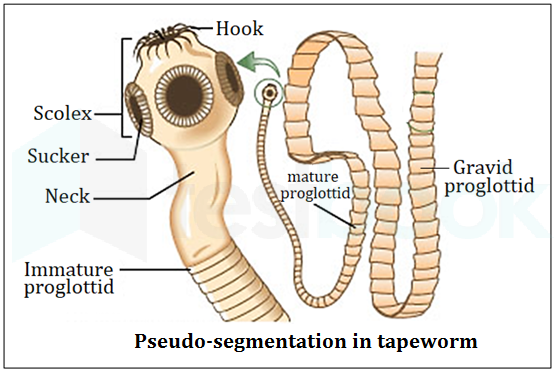
  • Tapeworm belongs to the class Platyhelminthes of Kingdom-Animalia.
  • The organisms of phylum Platyhelminthes have their body unsegmented.
  • In tapeworms, the new segments (called proglottids**) originate from the neck i.e. anterior part of the body.** Hence, tapeworms exhibit pseudo-metamerism.
  • They also live in human intestines.

  • Unsegmented body- The body is not divided into segments.Ex-planaria(phylum-Platyhelminthes).
  • Metamerically segmented-Body is divided into equal segments.Ex-earthworm(phylum-Annelida),centipede(phylum-Arthropoda)

Additional Information

  • Caterpillars:
  • One of the most prevalent categories of invertebrates is the insect.
  • Their bodies are hard on the outside and comprised of three parts: the head, thorax, and abdomen.
  • Most insects have six legs and wings.
  • Insects include ants, flies, caterpillars, beetles etc.
  • Silkworms
  • The life cycle of a silkworm is Egg­ > Caterpillar ­> Pupa­ > Adult.
  • The egg is the first and primary stage of the life cycle of Silkworm.
  • The egg is laid by a  female moth and the egg is the size of small dots.
  • More than 350 eggs are laid by a female moth at a time.
  • The eggs hatch in the springtime due to the warmth in the air.
  • This procedure takes place once a year.
  • Moths
  • They are in the order Lepidoptera, which also includes butterflies.
  • The wings are covered in scales, which give them their distinctive appearance.
  • They use this proboscis to suck nectar from flowers.
  • They use their antennae to detect pheromones released by female moths.
  • They help to spread pollen from flower to flower.
49

Which of the following instrument is used to measure the specific gravity of milk?

  1. ((a))

    Using an odometer

  2. ((b))

    Using a hydrometer

  3. ((c))

    Using a hygrometer

  4. ((d))

    Using a viscometer

Show Answer
Answer: ((b))

Using a hydrometer

The correct answer is Hydrometer.

Key Points 

  • Hydrometer:
  • It is an instrument used to determine the specific gravity of a liquid.
  • Its operation is based on the Archimedes principle that a solid body displaces its weight within a liquid in which it floats.
  • It is made up of a thin glass or plastic tube sealed at both ends with a graduated or printed scale calibrated to specific gravity.
  • It can be divided into two general classes: liquids heavier than water and liquids lighter than water.

Additional Information 

  • Hygrometer
  • It is an instrument used in meteorological science to measure the humidity or amount of water vapour in the air.
  • It is a specially designed apparatus that calculates relative humidity in an open or enclosed area.
  • Viscometer
  • In capillary tube viscometer, the pressure needed to force the fluid to flow at a specified rate through a narrow tube is measured.
  • This type of viscometer is based on laminar flow through a circular pipe.
  • It has a circular tube attached horizontally to a vessel filled with a liquid whose viscosity has to be measured. Suitable head (hf ) is provided to the liquid so that it can flow freely through the capillary tube of certain length (L) into a collection tank as
  • ​Udometer
  • It is an instrument for measuring the amount of rainfall or snowfall.
  • It consists of a cylinder covered by a funnel-like lid.
50

Which of the following is not true about Bryophyta?

  1. ((a))

    Flowers are present

  2. ((b))

    Spores are homospores

  3. ((c))

    Main plant body is haploid

  4. ((d))

    Dominant phase is gametophytes

Show Answer
Answer: ((a))

Flowers are present

correct answer is Flowers are present 

Key Points

  • The divisions of Bryophyta-Mosses, Liverworts, Hornworts.
  • Bryophyta is the division of green plants and it does not have true vascular tissue.
  • Bryophyta has “rhizoids” instead of roots.
  • Mosses- It produces spores for reproduction instead of seeds.
  • Liverworts- Reproduce by means of spores released from capsules.
  • Hornworts- Its elongated and is the gametophyte plant.
  • Lycopsida comes under Pteridophyta. They are vascular plants.
51

Which of the following is NOT a preventive measure for Amoebiasis?

  1. ((a))

    Proper sanitary disposal of faecal matter 

  2. ((b))

    Washing hands before eating 

  3. ((c))

    Taking antibiotics

  4. ((d))

    Maintaining personal hygiene

Show Answer
Answer: ((c))

Taking antibiotics

Correct answer is Taking antibiotics 

Key PointsAmoebiasis:

  • It is a parasitic protozoan disease that affects the gut mucosa and liver, resulting in dysentery, colitis, and liver abscess.
  • The causative agent, Entamoeba histolytica, is a potent pathogen that is spread via ingestion of contaminated food and water.
  • Globally, amoebiasis is highly prevalent and is the second leading cause of death to parasitic disease.

Signs and symptoms:

  • Mild diarrhea with alternating constipation
  • Mucus with stool
  • Blood with stool
  • Pain
  • Weight loss
  • Dyspnea

Causes of amoebiasis:

  • Through food or water contaminated with stools
  • From person to person
  • Through fertilizer made of human waste.
52

Ascaris or round worms are internal parasites found in the human intestines. This is an example of which of the following types of interactions? 

  1. ((a))

    Predation 

  2. ((b))

    Parasitism

  3. ((c))

    Commensalism

  4. ((d))

    Amensalism

Show Answer
Answer: ((b))

Parasitism

The correct answer is Parasitism.

Key Points

  • Ascaris are intestinal parasites that live in the human intestines, feeding off the host and causing harm.
  • In parasitic interactions, the parasite benefits at the expense of the host, often causing disease or discomfort.
  • Parasitism is a non-mutual relationship where one organism (the parasite) benefits while the other (the host) is harmed.
  • Common examples of parasites include roundworms, tapeworms, and lice.
  • Ascaris infections can lead to malnutrition, intestinal blockages, and other health issues in humans.

Additional Information

  • Commensalism: This is a type of interaction where one organism benefits while the other is neither helped nor harmed. Examples include barnacles on whales.
  • Mutualism: This interaction benefits both organisms involved. An example is bees pollinating flowers while collecting nectar.Amensalism: This is an interaction where one organism is inhibited or destroyed while the other remains unaffected. An example is the release of antibiotics by certain fungi.
  • Predation: This involves a predator hunting and consuming its prey. An example is a lion hunting a zebra.
  • Host-Parasite Dynamics: The relationship between parasites and their hosts can have significant impacts on the health, behavior, and population dynamics of the host species.
53

Which of the following is/are type/s of forces in nature?

  1. Gravitational
  2. Electromagnetic
  3. Nuclear
  4. Weak

Choose the correct one.

  1. ((a))

    1, 2 and 3 only

  2. ((b))

    1, 2, 3 and 4 only

  3. ((c))

    1, 3 and 4 only

  4. ((d))

    1 and 2 only

Show Answer
Answer: ((b))

1, 2, 3 and 4 only

The correct answer is 2) 1, 2, 3 and 4 only.

Key Points

  • Gravitational Force: It is a force that attracts any two objects with mass. It is the weakest but has an infinite range.
  • Electromagnetic Force: This force acts between charged particles and is responsible for electricity, magnetism, and light. It has an infinite range and is much stronger than gravitational force.
  • Strong Nuclear Force: This force binds protons and neutrons together in the nucleus of an atom. It is the strongest force but has a very short range, approximately 10^-15 meters.
  • Weak Nuclear Force: This force is responsible for radioactive decay and neutrino interactions. It has a very short range, approximately 10^-18 meters, and is stronger than gravitational force but weaker than both electromagnetic and strong nuclear forces.

Additional Information

  • Gravitational Force: It is central to the understanding of the universe, governing the motion of planets, stars, galaxies, and even light.
  • Electromagnetic Force: This force is described by the theory of electromagnetism, encapsulated in Maxwell's equations, and is integral to the understanding of electric circuits, radio waves, and light.
  • Strong Nuclear Force: It is described by Quantum Chromodynamics (QCD) and is essential in maintaining the stability of atomic nuclei against the repulsive electromagnetic force between protons.
  • Weak Nuclear Force: It plays a crucial role in nuclear fusion processes such as those that power the sun, as well as in the standard model of particle physics.
  • Unified Field Theory: Scientists have been working towards a Unified Field Theory to combine all fundamental forces into a single theoretical framework, with theories like string theory being major contenders.
54

Which element has the chemical symbol Nb?

  1. ((a))

    Nitrogen

  2. ((b))

    Nickel

  3. ((c))

    Neptunium

  4. ((d))

    Niobium 

Show Answer
Answer: ((d))

Niobium 

The correct answer is Niobium 

Key Points

  • Niobium is a chemical element identified by the chemical symbol Nb.
  • It is greyish white, having atomic number 41, and belongs to the transition metal category in the periodic table.
  • In the periodic table, it resides among the 5th group d-block elements.
  • It has high heat resistivity hence showing high melting and boiling points.
  • It is ductile and alternatively introduced in the place of nickel for jewellery making as it is hypoallergenic by nature.

Additional Information 

Physical Properties of Niobium

OdourOdourless
Density8.57 g/cm3
Melting point2477 °C
Boiling point4744 °C
SolubilityWater and acid soluble
Atomic number41
Atomic mass92.91 g/mol

Chemical Properties of Niobium

  • Niobium has identical chemical properties as its neighbour congener Tantalum.
  • It can react with air oxygen and form oxides, creating a layer on niobium itself when exposed to air. Under this situation, the greyish-white colour of niobium slightly changes.
  • It reacts with halogen and sometimes forms octahedral halides.
  • It is water soluble and can form niobium hydroxide.
55

Which of the following processes is responsible for causing rain?

  1. ((a))

    Evaporation and Condensation

  2. ((b))

    Evaporation

  3. ((c))

    Filtration

  4. ((d))

    Condensation

Show Answer
Answer: ((a))

Evaporation and Condensation

Correct Answer is Evaporation and Condensation

Key PointsEvaporation and condensation are responsible for causing rain. These are the phases of the hydrological cycle in which the water first heats and evaporates and later condenses and falls because of a decreased temperature.

56

For photoelectric effect to take place, the metal used as a cathode should have— 

  1. ((a))

    Low resistance

  2. ((b))

    Low work function

  3. ((c))

    Low melting point

  4. ((d))

    High boiling point

Show Answer
Answer: ((b))

Low work function

Correct Answer is Low work function

Key Points

  • Photoelectric effect: When the light of a suitable wavelength is incident on the metal surface, electrons are ejected from the metal instantly. This phenomenon is called the photoelectric effect.
  • Stopping potential (V): The minimum potential required to stop the electron emitted from metal so that its kinetic energy becomes zero is called stopping potential.
  • Work function: It is the minimum amount of energy required so that metal emits an electron. It is represented by ϕ.

Albert Einstein equation for photoelectric emission:

​h ν = ϕ + e V

Where, h = planks constant, ν = incident frequency, ϕ = work function, e = charge on an electron and V = stopping potential.

EXPLANATION: 

  • From the above discussion, In the photoelectric effect ejection of electrons from the surface of metal takes place when Light of suitable wavelength falls on it. So option 2 is correct.
57

Atomic number of which of the following elements is greater than that of Calcium? 

  1. ((a))

    Argon

  2. ((b))

    Chlorine

  3. ((c))

    Sulphur 

  4. ((d))

    Scandium

Show Answer
Answer: ((d))

Scandium

Correct Answer is Scandium

Key Points

Atomic number of calcium is 20

Sulphur (S) 16 < Chlorine (Cl) 17 < Argon (Ar) 18 < Scandium (Sc) 21

Hence scandium has the atomic number greater than 20

Additional InformationThe atomic number of calcium is 20. The atomic number of some commonly used elements is given in the table below.

ElementAtomic Number
Sulphur16
Argon18
Chromium24
58

The most potent greenhouse gas among the following is – 

  1. ((a))

    Ozone

  2. ((b))

    Methane

  3. ((c))

    Carbon dioxide

  4. ((d))

    Water Vapor

Show Answer
Answer: ((d))

Water Vapor

Correct Answer is Water Vapor

Key Points

  • CO2 is the main greenhouse gas globally.
  • Methane is the main greenhouse gas for tropical regions.
  • Water vapor is the most important natural greenhouse gas for the tropical region.

Important Points 

  • GREENHOUSE EFFECT:
  • The rays coming from the sun get reflected after striking the earth's surface. Certain gases do not allow the reflected (infrared) rays to escape the earth's atmosphere and thus the heat gets trapped. This phenomenon is known as the greenhouse effect and the gases involved are termed greenhouses gases.
  • The heat trapped increases the temperature of the earth and this phenomenon is known as global warming.
  • Causes of Greenhouse Effect:
  • Burning of Fossil Fuels
  • Deforestation
  • Farming
  • Industrial Waste and Landfills
  • Effects of Greenhouse Effect:
  • Global Warming
  • Depletion of Ozone Layer
  • Smog and Air Pollution
  • Acidification of Water Bodies
  • The prominent greenhouse gases are - Water Vapour, Carbon dioxide, Methane, Nitrous oxide, Ozone, Chlorofluorocarbons, and Hydrofluorocarbons.
  • The table given below shows the contribution of various greenhouse gases:
Greenhouse gasesContribution
Water vapor (H2O)36-72%
Carbon dioxide (CO2)9-26%
Methane (CH4)4-9%
Ozone (O3)3-7%
  • WATER VAPOUR (H2O):
  • As evident from the above table, it is the most abundant greenhouse gas present in the atmosphere.
  • Warmer air has the capacity of holding more water vapor, which traps more heat. Due to this, a positive feedback loop gets created.
  • CARBON DIOXIDE (CO2):
  • Events like volcanic eruptions, forest fires, burning of fossil fuels lead to an increase in the carbon dioxide concentration in the atmosphere.
  • METHANE (CH4):
  • Though its concentration in the atmosphere is very low, its contribution is approximately 9% in greenhouse gases.
  • It has more heating capacity as compared to water vapor and carbon dioxide.

Confusion Points

In this context, “potent” means: How strongly a gas contributes to the greenhouse effect — i.e., its ability to trap heat in the atmosphere.

So, when we say “the most potent greenhouse gas,” we mean the one that traps the most heat or has the greatest warming effect, whether due to:

  • its quantity in the atmosphere
  • or its heat-trapping ability per molecule (called Global Warming Potential, or GWP)
59

Excretion is best described as the removal of

  1. ((a))

    Toxic wastes by the process of cyclosis

  2. ((b))

    Metabolic wastes from a cell

  3. ((c))

    Water molecules from dipeptide hydrolysis

  4. ((d))

    Undigested material from the digestive tract 

Show Answer
Answer: ((b))

Metabolic wastes from a cell

The correct answer is Metabolic wastes from a cell.

Key Points

  • Nutrients in excess and the by-products of metabolic reactions are harmful for the body and therefore should be removed.
  • The removal of these substances by the body is called excretion.
  • The excretory system comprises of ureters, kidneys, urinary bladder, and urethra.
  • The excretory system in a human body is responsible for the removal of unnecessary and excess materials from the body fluids to prevent the body from any damage and to help maintain the internal chemical homeostasis.
  • The human excretory system includes certain organs that eliminate the wastes such as salts, carbon dioxide, urea, uric acid and water produced by the body.
  • Homeostasis is the process by which waste is eliminated in the excretory system.
60

Which fuel produces the least pollution?

  1. ((a))

    LPG (Liquid Petroleum Gas)

  2. ((b))

    Coal

  3. ((c))

    Diesel

  4. ((d))

    Hydrogen gas

Show Answer
Answer: ((d))

Hydrogen gas

The correct answer is Hydrogen gas

Key Points

  • Hydrogen fuel is a type of fuel that is made from hydrogen gas.
  • It is a clean and renewable energy source that has the potential to replace fossil fuels such as gasoline, diesel, and natural gas.
  • Hydrogen and oxygen are needed to generate energy, the mixture also produces water as a by-product.
  • One of the biggest benefits of these fuel cells is that they produce electricity with very little pollution.
  • Hydrogen Fuel Production
  • By Electrolysis process
  • By Steam Methane Reforming
  • Uses of Hydrogen Fuel
  • It is the best replacement for traditional fuels.
  • It can be utilized to power nearly all types of vehicles or electrical equipment, including generators, electric motors, cars, boats, and airplanes.
61

What is the colour of ash formed from burning of a Magnesium ribbon?

  1. ((a))

    Yellow

  2. ((b))

    Pink

  3. ((c))

    Red

  4. ((d))

    White

Show Answer
Answer: ((d))

White

Correct Answer is White

Key Points

  • When Magnesium (Mg) ribbon is burnt in air, Magnesium Oxide (MgO) is formed.
  • A bright white light is produced when the ribbon is burnt and powdery ash i.e. MgO is formed.
  • The reaction is a highly exothermic reaction, i.e. a lot of heat is produced.
  • The oxygen in the air reacts with Mg to form MgO.
  • 2Mg + O2 → 2MgO + energy; is the balanced equation for this reaction.
62

The main active constituent of tea and coffee is:

  1. ((a))

    Nicotine

  2. ((b))

    Caffeine

  3. ((c))

    Aspirin

  4. ((d))

    Chlorophyll

Show Answer
Answer: ((b))

Caffeine

The correct answer is Caffeine.

  • Caffeine is defined as a drug because it stimulates the central nervous system, causing increased alertness.
  • Caffeine gives most people a temporary energy boost and elevates mood.

Caffeine is in tea, coffee, chocolate, many soft drinks, and pain relievers, and other over-the-counter medications.

Additional Information  

  • Caffeine acts as a central nervous system stimulant.
  • When it reaches your brain, the most noticeable effect is alertness.
  • You'll feel more awake and less tired, so it's a common ingredient in medications to treat or manage drowsiness, headaches, and migraines.
  • Caffeine is an alkaloid occurring naturally in some 60 plant species, of which cocoa beans, kola nuts, tea leaves, and coffee beans are the most well-known.
  • Other natural sources of caffeine include yerba maté, guarana berries, guayusa, and the yaupon holly.
  • Caffeine is a stimulant drug, which means it speeds up the messages traveling between the brain and the body.
  • It's found in the seeds, nuts, and leaves of a number of different plants, including Coffea Arabica (used for coffee) and Thea Sinensis (used for tea).
63

Purpose of an optical filter is to–

  1. ((a))

    Refract light of different colours

  2. ((b))

    Transmit or absorb light of different colours

  3. ((c))

    Dispense light into component colours

  4. ((d))

    Reflect lights of different colours

Show Answer
Answer: ((b))

Transmit or absorb light of different colours

Correct Answer is Transmit or absorb light of different colours 

Key PointsOptical filters are devices that selectively transmit light of different wavelengths, usually implemented as plane glass or plastic devices in the optical path which are either dyed in the bulk or have interference coatings.

64

The death of which bird resulted in the implementation of bird diverters? 

  1. ((a))

    White-bellied heron

  2. ((b))

    Forest Owl

  3. ((c))

    Indian vulture

  4. ((d))

    Great Indian Bustard

Show Answer
Answer: ((d))

Great Indian Bustard

The correct answer is Great Indian Bustard

Key Points

  • 'Great Indian Bustard' is found in the Desert National Park.
  • The scientific name of the Great Indian Bustard is Ardeotis nigriceps.
  • It is critically endangered by hunting and the loss of its habitat.
  • It is protected under the Wildlife Protection Act 1972 of India.
  • The death of the Great Indian Bustard resulted in the implementation of bird diverters
  • It is the state bird of Rajasthan.

Additional Information

  • White-bellied heron
  • The white-bellied heron (Ardea insignis), also known as the imperial heron or great white-bellied heron, is a species of large heron known from the foothills of the eastern Himalayas in India and Bhutan to northeastern Bangladesh and Myanmar.
  • It is mostly solitary and occurs in undisturbed riversides or wetlands.
  • Forest Owl
  • The forest owl (Athene blewit) is endemic to the forests of central India. It is listed as Endangered on the IUCN Red List since 2018, as the population is estimated at less than 1,000 mature individuals.
  • It is threatened foremost by deforestation.
  • Indian vulture
  • The Indian vulture (Gyps indicus) is an Old World vulture native to India, Pakistan and Nepal.
  • It has been listed as Critically Endangered on the IUCN Red List since 2002, as the population severely declined.
  • Indian vultures died of kidney failure caused by diclofenac poisoning.
  • It breeds mainly on hilly crags in central and peninsular India.
65

India’s marine fishery resources include _____ km of coastline and the deep seas beyond it

  1. ((a))

    7500

  2. ((b))

    4500

  3. ((c))

    890

  4. ((d))

    1200

Show Answer
Answer: ((a))

7500

The correct answer is 7500

  • The total length of the coastline of the mainland including Andaman and Nicobar and the Lakshwadeep islands is 7,516.6 km.

Key Points 

  • The total coastline of India measures about 7,517 km, which is distributed among nine coastal states and four Union Territories; and almost entire coast of India falls within tropics.
  • The nine coastal states are Gujarat, Maharashtra, Goa, Karnataka, Kerala, Tamil Nadu, Andhra Pradesh, Odisha and West Bengal.
  • The Four coastal Union Territories are Puducherry, Lakshadweep, Daman & Diu, and Andaman & Nicobar Islands.
  • The coasts of India include the West Coast, East Coast, and Coast of Lakshadweep and Andaman and Nicobar islands.

Important Points 

  • Gujarat is strategically located with the largest share in India’s coastline, followed by Andhra Pradesh and Tamil Nadu.
  • Over 22.6% of the total coasts of India are of islands (Andaman and Nicobar, Lakshadweep, and Diu islands).
66

Nitrogenous Food is

  1. ((a))

    Proteins

  2. ((b))

    Lipids 

  3. ((c))

    Salts

  4. ((d))

    Carbohydrates

Show Answer
Answer: ((a))

Proteins

The correct answer is Proteins

Key Points

  • Nitrogen occurs in all organisms, primarily in amino acids, nucleic acids, and in the energy transfer molecule adenosine triphosphate.
  • Proteins are large biological molecules or macromolecules consisting of one or more long chains of amino acids and carboxylic acid.
  • Vitamin B is a water-soluble vitamin, they contain nitrogen in their ring in all eight different forms i.e., B1, B2, B3, B5, B6, B7, B9, B12.
  • Nitrogen is not present in fats.

Important Points 

  • Nutrients are the substances found in food that drive biological activity and are essential for the human body.
  • They are categorized as:
  • Proteins
  • Fats
  • Carbohydrates (sugars, dietary fiber)
  • Vitamins
  • Minerals
  • They perform the following vital functions:
  • Building all parts of the body such as muscle, bone, teeth, and blood.
  • Producing energy (power and heat).
  • Keeping the body in good working order.
67

Limestone is utilized in the extraction of haematite as _______-

  1. ((a))

    Mineral

  2. ((b))

    Flux

  3. ((c))

    Gangue

  4. ((d))

    Slag

Show Answer
Answer: ((b))

Flux

Correct Answer is Flux

Key Points

Explanation:

  • The main function of limestone in the extraction of iron from haematite is as a flux.
  • Limestone is used as a flux to remove the impurities and dirt from haematite.
  • Limestone decomposes in a hot furnace and forms calcium oxide (CaO).
  • Iron is extracted from its ore, haematite, in a blast furnace.
  • The ore is put into the furnace along with limestone and coke
  • This reacts with the sandy impurities (silicon dioxide) to form a slag (CaSiO3)
  • Blast-furnace slag is a useful by-product used widely in the construction industry.

​ 

Additional Information

  • Wrought iron is the purest form of iron available commercially available and is prepared from cast iron by heating cast iron in a furnace lined with Haematite (Fe2O3).
  • The Haematite reacts with Carbon in the cast iron to give pure iron and carbon monoxide gas which escapes.
68

The credit for Green Revolution in India goes to -

  1. ((a))

    Dr. M. S. Swaminathan

  2. ((b))

    Dr. Verghese Kurien

  3. ((c))

    Dr. P A Sanchez

  4. ((d))

    Dr. R S Paroda

Show Answer
Answer: ((a))

Dr. M. S. Swaminathan

Correct Answer is Dr M. S. Swaminathan

Key Points

Green Revolution in India:

  • The term green revolution was first used by William Gaud and Norman Borlaug is the Father of the Green Revolution.
  • After Independence, Indian policy-makers adopted all measures to achieve self-sufficiency in food grains.
  • In the year 1965, the government of India launched the Green Revolution with the help of a geneticist, now known as the father of the Green revolution (India) M.S. Swaminathan.
  • The movement of the green revolution was a great success and changed the country’s status from a food-deficient economy to one of the world’s leading agricultural nations.
  • It started in 1967 and lasted till 1978.
  • India adopted a new strategy in agriculture, which resulted in the 'Green Revolution', especially in the production of wheat and rice.
  • Indira Gandhi, the then Prime Minister of India, officially recorded the impressive strides of the Green Revolution in agriculture by releasing a special stamp entitled 'Wheat Revolution' in July 1968.
  • The success of wheat was later replicated in rice.
  • Thus, to signify the achievements of the Green Revolution, a stamp was released by the then Prime Minister Mrs. Indira Gandhi entitled as ‘Wheat Revolution’ in July 1968.

Additional Information

Yellow Revolution:

  • The Yellow Revolution is concerned with Oilseeds production.
  • This revolution means the cultivation of mustard as a part of crop rotation.
  • The Father of the Yellow Revolution is Sam Pit Roda.
  • It was also called People Power Revolution.
  • It was first launched in 1986-87 in India.
  • To popularize the four major oilseeds- groundnut, mustard, soyabean, and sunflower.
69

The normal body-temperature of a person is about - 

  1. ((a))

    36-37°C

  2. ((b))

    34-35°C

  3. ((c))

    38-39°C

  4. ((d))

    35-36°C

Show Answer
Answer: ((a))

36-37°C

The Correct Answer is: 36-37°C

Key Points

  • The average body temperature is 98.6 F (37 C).
  • But normal body temperature can range between 97 F (36.1 C) and 99 F (37.2 C) or more.​

Additional Information 

  • Some studies have shown that the "normal" body temperature can have a wide range,

          from 97°F (36.1°C) to 99°F (37.2°C). A temperature over 100.4°F (38°C) most often means you have a fever caused by an infection or illness.

70

Which statement is one component of the cell theory?

  1. ((a))

    All living cells arise from pre-existing cells

  2. ((b))

    Tissues are formed from combinations of cells

  3. ((c))

    All cells are composed of same organelles

  4. ((d))

    DNA is the basis of genetic transfer

Show Answer
Answer: ((a))

All living cells arise from pre-existing cells

The correct answer is All living cells arise from pre-existing cells

Key Points 

  • Cells are the smallest units of life and hence are often referred to as the building blocks of life.
  • The study of cells is called cell biology, cellular biology, or cytology.
  • Cells consist of cytoplasm enclosed within a membrane, which contains many biomolecules such as proteins and nucleic acids.
  • The classical cell theory was proposed by Theodor Schwann in 1839.
  • There are three parts to this theory:
  • The first part states that all organisms are made of cells.
  • The second part states that cells are the basic units of life. These parts were based on a conclusion made by Schwann and Matthias Schleiden in 1838.
  • The third part, which asserts that cells come from preexisting cells that have multiplied, was described by Rudolf Virchow in 1858.

Additional Information 

                                    Diagram of a cell


71

Which of the following measures can reduce the likelihood of data leakage?

  1. ((a))

    Cryptography

  2. ((b))

    Authentication

  3. ((c))

    Chorography

  4. ((d))

    Steganography

Show Answer
Answer: ((d))

Steganography

The correct answer is option 4.

Explanation:

Steganography can reduce the likelihood of data leakage by hiding data within other data, making it difficult for unauthorized individuals to detect and access the sensitive information.

 Additional Information

  • Cryptography can also be used to protect data by encrypting it so that it can only be accessed by authorized individuals with the correct decryption key.
  • Authentication can help prevent data leakage by verifying the identity of users accessing sensitive information, ensuring that only authorized individuals have access.
  • Chorography is not relevant to data security and is therefore not a valid option for reducing the likelihood of data leakage.
72

Which of following character reader is equipped with character recognition software?

  1. ((a))

    Magnetic ink character readers

  2. ((b))

    Optical mark reader

  3. ((c))

    Optical character reader

  4. ((d))

    Image scanner

Show Answer
Answer: ((c))

Optical character reader

The correct answer is Optical character reader.

Key Points

  • An Optical Character Reader device can read data that has been typed or handwritten on a source document.
  • It is a combination of a scanner and special software which converts the printed or handwritten data to ASCII.
  • It is used to convert the paper record into the electric filling and scanned challan into a spreadsheet.

Outsource OCR Services | DEO India


Additional Information

  • Magnetic Ink Character Recognition
  • Magnetic Ink Character Recognition machines are capable of reading magnetic ink characters on Magnetic Ink Character Reader (MICR) documents.
  • Magnetic Ink Character Recognition is a character-recognition technology adopted mainly by the banking industry to facilitate the processing of cheques.
  • The ability to process checks and deduct payment amounts using a routing number is one of the advantages of the magnetic ink character recognition line.

Magnetic Ink Card Reader(MICR)

  • Optical Mark Recognition (OMR):
  • Optical Mark Reader (OMR), sometimes called a mark-sense reader, detects the presence of Pencil mark or Predetermined grids.
  • OMR devices work with a dedicated scanner device that throws a beam of light on the form of paper.
  • It is used to check the objective test mark-sheet, lottery ticket, and official form, etc.

EZData™ OMR Scanner | Scantron

  • Image scanner
  • Image scanner also called a scanner scans images, handwriting, printed text or objects and converts them into a digital image.
  • It is like a photocopy machine.
73

One packet on any data link is called as:

  1. ((a))

    Frame

  2. ((b))

    Group

  3. ((c))

    Path

  4. ((d))

    Block

Show Answer
Answer: ((a))

Frame

The correct answer is option 1.

Key Points

  • A packet on any data link is called a frame.
  • A frame is a unit of data that is transmitted over a network.
  • It consists of a header and a payload (data).
  • The header contains control information, such as source and destination addresses, error detection, and sequencing information.

 Additional Information

  • Group: A group is not a term used to describe a packet on a data link.
  • Path: A path refers to the route that a packet takes through a network, not the packet itself.
  • Block: A block is a group of data that is transmitted as a unit, but it is not a commonly used term to describe a packet on a data link.
74

C, BASIC, COBOL, and Java are examples of ______.

  1. ((a))

    Computer 

  2. ((b))

    High-level languages

  3. ((c))

    System programming

  4. ((d))

    Low-level languages

Show Answer
Answer: ((b))

High-level languages

The correct answer is option 2

Key Points

  • High-level languages are programming languages that are closer to natural language and are easier to read and write than low-level languages.
  • C, BASIC, COBOL, and Java are all examples of high-level languages.
  • High-level languages are used for application programming and are generally easier to learn and use than low-level languages.

Additional Information

  • Option 1 (Computer) is incorrect because the question is asking about programming languages, not computers.
  • Option 3 (System programming) is incorrect because while high-level languages can be used for system programming, they are primarily used for application programming.
  • Option 4 (Low-level languages) is incorrect because C, BASIC, COBOL, and Java are all high-level languages, not low-level languages.
75

What does MS-DOS operating system use for interacting with the end users? 

  1. ((a))

    MPU

  2. ((b))

    MLI

  3. ((c))

    CLI

  4. ((d))

    CPU

Show Answer
Answer: ((c))

CLI

The correct answer is option 3.

 Key Points

  • MS-DOS operating system uses CLI (Command Line Interface) for interacting with end users.
  • CLI is a text•based interface where users enter commands to perform tasks.
  • MS-DOS commands are entered in the CLI prompt and executed by pressing Enter.
  • CLI allows users to perform tasks quickly and efficiently through keyboard shortcuts and command syntax.

 Additional Information

  • MPU (Microprocessor Unit): It is a component of a computer system, not an interface for interacting with users.
  • MLI (Machine Language Interpreter): It is a program that translates machine language into human-readable code, but it is not a user interface.
  • CPU (Central Processing Unit): It is the main processing component of a computer system, not an interface for interacting with users.
76

Among the following, which is considered the main memory?

  1. ((a))

    RAM

  2. ((b))

    ROM

  3. ((c))

    Cache memory

  4. ((d))

    Memory card

Show Answer
Answer: ((a))

RAM

The correct answer is option 1.

Key Points

  • RAM is considered the main memory.
  • RAM stands for Random Access Memory, and it is the primary memory of a computer.
  • It is a volatile memory, meaning it loses its content when the power is turned off.
  • It is used to temporarily store data and instructions that the CPU needs to access quickly.

Additional Information

  • ROM (Read-Only Memory) is a non-volatile memory that stores firmware and is not used as the main memory.
  • Cache memory is a small, fast memory used to store frequently accessed data and instructions.
  • Memory cards are external storage devices used to store data and are not considered as main memory.
77

IT Act 2000, provides guidelines to the user on:

  1. processing of sensitive information
  2. storage of sensitive information
  3. transmission of sensitive information
  1. ((a))

    1, 2 and 3

  2. ((b))

    2 and 3 only

  3. ((c))

    1 and 3 only

  4. ((d))

    1 and 2 only

Show Answer
Answer: ((a))

1, 2 and 3

The correct answer is option 1.

Key Points

  • The IT Act 2000 provides guidelines to the user on processing, storage, and transmission of sensitive information.
  • 1. Processing of sensitive information involves the collection, use, disclosure, retention, and disposal of personal information.
  • 2. Storage of sensitive information involves the protection of personal information from unauthorized access, use, disclosure, and destruction.
  • 3. Transmission of sensitive information involves the secure transfer of personal information from one location to another.

Option 1 is the correct answer as it includes all three aspects of the IT Act guidelines. 

Additional Information

  • Option 2 includes only storage and transmission, missing out on processing.
  • Option 3 includes only processing and transmission, missing out on storage.
  • Option 4 includes only processing and storage, missing out on transmission.
78

Unwanted or unlawful email messages are frequently referred to as___ .

  1. ((a))

    Spam

  2. ((b))

    Anti virus

  3. ((c))

    Smishing

  4. ((d))

    Rootkit

Show Answer
Answer: ((a))

Spam

The correct answer is option 1.

 Key Points

  • Unwanted or unlawful email messages are referred to as spam.
  • Spam emails are usually sent in bulk to a large number of recipients, without their permission.
  • Spam emails can contain various types of content, such as advertisements, scams, malware, or phishing attempts.
  • Spam emails can be harmful to the recipient's privacy, security, and productivity.

 Additional Information

  • Anti-virus:  
  • It is a software designed to protect a computer or network from malware and other threats.
  • Anti-virus software can detect and remove viruses, spyware, adware, and other malicious software.
  • However, Anti-virus software cannot prevent or stop spam emails from reaching the recipient's inbox.
  • Smishing:
  • Smishing is a type of phishing attack that uses SMS text messages instead of email.
  • Smishing messages usually contain a link or phone number that the recipient is encouraged to click or call, which can lead to fraud or malware infection.
  • Smishing can be prevented by being cautious of unexpected or suspicious text messages, and by not clicking on links or calling numbers from unknown sources.
  • Rootkit:
  • A rootkit is a type of malware that is designed to hide its presence and activities from the user and the anti-virus software.
  • Rootkits can be used to gain unauthorized access to a computer or network, steal data, or perform other malicious activities.
  • However, rootkits are not directly related to spam emails, and can be detected and removed by specialized anti-malware tools.
79

Which areas are high-speed storage areas within the CPU, but have the least storage capacity?

  1. ((a))

    Storage units

  2. ((b))

    Logical units

  3. ((c))

    Processors

  4. ((d))

    Registers

Show Answer
Answer: ((d))

Registers

The correct answer is option 4.

 Key Points

  • Registers are high-speed storage areas within the CPU that have the least storage capacity.
  • Registers are used to store data that the CPU needs to access frequently and quickly, such as data being used in arithmetic operations.
  • Registers are located within the CPU, making them faster to access than other types of memory.
  • Registers are typically small in size, ranging from 8 to 64 bits.

Additional Information

  • Storage units: Are not a specific type of memory within the CPU and could refer to various types of storage devices outside of the CPU.
  • Logical units: It is not a common term used to describe memory within the CPU.
  • Processors: Are not a type of memory but rather the component that executes instructions and performs calculations.
80

Which of the following had the capability to exploit buggy Microsoft email clients and spread itself to everyone?

  1. ((a))

    Mydoom

  2. ((b))

    Sasser

  3. ((c))

    Melissa

  4. ((d))

    Klez

Show Answer
Answer: ((d))

Klez

The correct answer is option 4.

Key Points

  • Klez had the capability to exploit buggy Microsoft email clients and spread itself to everyone.
  • Klez was a worm that spread through email attachments and network shares.

 Additional Information

  • Mydoom: It was a worm that spread through email and peer-to-peer file sharing. Mydoom did not exploit buggy Microsoft email clients like Klez did.
  • Sasser: It was a worm that exploited a vulnerability in Windows operating systems. Sasser did not exploit buggy Microsoft email clients like Klez did.
  • Melissa: It was a macro virus that spread through email attachments. Melissa did not exploit buggy Microsoft email clients like Klez did.
81

Which unit of ALU is responsible for logic operations?

  1. ((a))

    Comparing unit

  2. ((b))

    Arithmetic unit

  3. ((c))

    Logic unit 

  4. ((d))

    Number unit

Show Answer
Answer: ((c))

Logic unit 

The correct answer is option 3.

Key Points

  • The logic unit of ALU is responsible for performing logical operations such as AND, OR, NOT, and XOR.
  • It receives input from the memory unit and sends the output to the register.
  • The arithmetic unit of ALU is responsible for performing arithmetic operations such as addition, subtraction, multiplication, and division.
  • The comparing unit of ALU is responsible for comparing two values and determining if they are equal, greater than, or less than each other.

Additional Information

  • Comparing unit: The comparing unit is responsible for comparing two values and determining if they are equal, greater than, or less than each other.
  • Arithmetic unit: The arithmetic unit is responsible for performing arithmetic operations such as addition, subtraction, multiplication, and division.
  • Number unit: The number unit is not a component of ALU and is an incorrect option.
82

Which keyword is used for “Debugging” in Java ?

  1. ((a))

    Abstract

  2. ((b))

    Insert

  3. ((c))

    Assert 

  4. ((d))

    Boolean

Show Answer
Answer: ((c))

Assert 

The correct answer is option 3.

Key Points

  • The keyword used for "Debugging" in Java is "Assert".
  • It checks whether a particular condition is true or false and if it is false, it throws an error.
  • Assert is used to check the correctness of a program during development and testing.
  • It helps in identifying the errors in the code and fixing them before the code is released.
  • Assert statements are usually removed from the code during production as they can impact performance and are not required for normal functioning of the code.

 Additional Information

  • Abstract: It is a keyword used to declare a class or method as abstract, meaning it cannot be instantiated and must be extended or implemented by a subclass.
  • Insert: It is not a keyword in Java.
  • Boolean: It is a keyword used to declare a Boolean variable or method. It has two possible values - true and false.
83

Which contains the current instruction most recently fetched?

  1. ((a))

    Program counter

  2. ((b))

    Compiler

  3. ((c))

    Data register

  4. ((d))

    Instruction registers

Show Answer
Answer: ((d))

Instruction registers

The correct answer is option 4.

 Key Points

  • The instruction register contains the current instruction most recently fetched.
  • It is a special register that holds the instruction that the processor is currently executing.
  • The program counter holds the memory address of the next instruction to be executed.
  • The compiler is a software tool that translates source code into machine code.
  • The data register holds data that is being used by the processor.

Additional Information

  • Program counter: The program counter holds the memory address of the next instruction to be executed.
  • Compiler: The compiler is a software tool that translates source code into machine code.
  • Data register: The data register holds data that is being used by the processor.
84

Which of the following is NOT a symptom of the presence of the virus in the computer?

  1. ((a))

    Automatic log-out of the user may happen.

  2. ((b))

    Self-execution of programs may take place.

  3. ((c))

    Information in a local language on a website

  4. ((d))

    Suddenly the system stops working smoothly.

Show Answer
Answer: ((c))

Information in a local language on a website

The correct answer is option 3.

Explanation:

Information in a local language on a website: This is not a symptom of a virus and is unrelated to the presence of a virus in the computer.

Additional Information

  • Automatic log-out of the user may happen: This can be a symptom of a virus as it may cause the system to behave abnormally and log out the user without any apparent reason.
  • Self-execution of programs may take place: This can also be a symptom of a virus as it can cause programs to execute without the user's knowledge or consent.
  • Suddenly the system stops working smoothly: This can be a symptom of a virus as it may cause the system to slow down or stop working altogether.
85

What does USB port use to connect to the devices, and many devices can share that simultaneously? 

  1. ((a))

    Device

  2. ((b))

    Circuit

  3. ((c))

    Thin Wire

  4. ((d))

    Disk 

Show Answer
Answer: ((c))

Thin Wire

The correct answer is option 3.

Key Points

  • USB port uses thin wires to connect to devices.
  • These thin wires are used to transmit data and power between the device and the computer.
  • USB ports are designed to be hot-swappable, meaning that devices can be connected and disconnected without having to restart the computer.
  • Multiple devices can be connected to a single USB port through the use of a hub.

 Additional Information

  • Device: It is too broad and does not provide specific information about the connection method of USB ports.
  • Circuit: It is not directly related to the physical connection between USB ports and devices.
  • Disk: It is not related to the connection method of USB ports and devices. Disks may be connected to USB ports, but they are not the primary type of device that USB ports are designed to connect to.
86

Which of the following gate will person addition operation?

  1. ((a))

    NOR

  2. ((b))

    AND

  3. ((c))

    OR

  4. ((d))

    NOT

Show Answer
Answer: ((c))

OR

The correct answer is OR

Key Points

  • The OR gate performs the addition operation in digital logic.
  • In an OR gate, the output is true (1) if at least one of the inputs is true (1).
  • The OR gate is a fundamental building block in digital circuits, often used in various computational and logical operations.
  • It is commonly represented by the symbol "+" in Boolean algebra.

Additional Information

  • In digital electronics, logic gates are the building blocks of digital circuits.
  • There are several types of logic gates including AND, OR, NOT, NAND, NOR, XOR, and XNOR.
  • Each type of gate performs a specific logical function and has a unique symbol and truth table.
  • Logic gates are used in various applications such as arithmetic operations, data processing, and control systems.
87

What does COD in e-commerce mean in its entirety?

  1. ((a))

    Cash on Delivery

  2. ((b))

    Cash on Demand

  3. ((c))

    Cart on Delivery

  4. ((d))

    Cart on Demand

Show Answer
Answer: ((a))

Cash on Delivery

The correct answer is option 1.

 Key Points

  • COD in e-commerce stands for Cash on Delivery, which is a payment method where the customer pays for their order in cash at the time of delivery.
  • This payment option is particularly popular in countries where online shopping is still gaining traction, or where customers may not have access to credit or debit cards.
  • Cash on Delivery can be beneficial for customers who may be hesitant to pay for their order upfront, or who want to ensure they receive their purchase before paying for it.
  • However, COD can also come with some drawbacks, such as the risk of fraud or non-payment, as well as additional costs for the retailer, such as shipping and handling fees.

 Additional Information

  • Cash on Demand: Is not a commonly used term in e-commerce and does not refer to a specific payment method.
  • Cart on Delivery and Cart on Demand: Are also not commonly used in e-commerce and do not refer to payment methods.
88

Which is NOT correct regarding the Network layer?

(i) The Network layer provides the functional and procedural means of transferring variable length data sequences.

(ii) The addressing scheme is hierarchical in nature.

(iii) The router does not operate at this layer.

  1. ((a))

    Only (iii)

  2. ((b))

    Only (ii)

  3. ((c))

    (ii) and (iii)

  4. ((d))

    Only (i)

Show Answer
Answer: ((a))

Only (iii)

The correct answer is option 1.

 Key Points

  • The Network layer is the third layer of the OSI model and provides logical addressing and routing services to move data from one network to another.
  • The Network layer protocol is responsible for breaking down data into smaller packets and transmitting them across the network.
  • The addressing scheme used in the Network layer is hierarchical in nature, which means that the network address and the host address are separate.
  • The router is a device that operates at the Network layer and is responsible for forwarding packets between different networks based on the destination address.

 Additional Information

  • Option 2 states that only (ii) is not correct regarding the Network layer. This is incorrect because the addressing scheme is indeed hierarchical in nature.
  • Option 3 states that both (ii) and (iii) are not correct regarding the Network layer. This is also incorrect because the addressing scheme is hierarchical and routers do operate at this layer.
  • Option 4 states that only (i) is not correct regarding the Network layer. This is also incorrect because the Network layer does provide the means of transferring variable-length data sequences.
89

In PowerPoint which of the following shortcut keys is used to start the slideshow?

  1. ((a))

    Press F1

  2. ((b))

    Press F5

  3. ((c))

    Press Shift + F1

  4. ((d))

    Press Shift + F5

Show Answer
Answer: ((b))

Press F5

The correct answer is option 2.

Key Points

  • The correct shortcut key to start the slideshow in PowerPoint is F5.
  • Pressing F5 will start the slideshow from the beginning.

 Additional Information

  • Press F1: It opens the PowerPoint help feature.
  • Press Shift + F1: It opens the task pane for PowerPoint help and How-to content.
  • Press Shift + F5: It starts the slideshow from the current slide, not the beginning.
90

Which symptom of the virus represents the gibberish messages, messages you hadn’t seem before, undesired ad messages especially antivirus messages?

  1. ((a))

    Anti-virus

  2. ((b))

    Hardware Trouble

  3. ((c))

    unusual error message 

  4. ((d))

    Slow Performance

Show Answer
Answer: ((c))

unusual error message 

The correct answer is option 3.

 Key Points

  • The symptom of the virus that represents gibberish messages, messages you haven't seen before, and undesired ad messages is an unusual error message.
  • This type of message may appear on your screen unexpectedly and may contain strange characters or language.
  • It is a common sign of a virus or malware infection, as these programs often try to display messages or ads to the user.
  • Other symptoms of a virus may include slow performance, hardware trouble, or anti-virus messages.

 Additional Information

  • Anti-virus: While anti-virus messages can be a symptom of a virus, they are not necessarily the type of message described in the question.
  • Hardware Trouble: It may cause error messages, but it is unlikely to produce gibberish or ad messages.
  • Slow Performance: It can be a symptom of a virus, but it is not specifically related to the type of message described in the question.
91

Select the related number from the given alternatives.

14: 53 :: 26 : ?

  1. ((a))

    86

  2. ((b))

    68

  3. ((c))

    84

  4. ((d))

    88

Show Answer
Answer: ((c))

84

The logic followed here is:

14: 53

(1 + 4) × 10 + (4 - 1) = 53

5 × 10 + 3 = 53

50 + 3 = 53

53 = 53 (LHS = RHS) 

Similarly,

26 : ?

(2 + 6) × 10 + (6 - 2) = ?

8 × 10 + 4 = ?

80 + 4 = ?

84 = ?

Hence, "Option 3" is the correct answer.

Alternate Method14: 53

(1 + 4)  = 5 (Tens place digit of 2nd number)

(4 - 1)  = 3 (Ones place digit of 2nd number)

Similarly,

26 : ?

(2 + 6)  = 8 (Tens place digit of 2nd number)

(6 - 2)  = 4 (Ones place digit of 2nd number)

Thus, '84' is the correct answer.

92

Select the option that represents the number of triangles in the given figure.

  1. ((a))

    14

  2. ((b))

    15

  3. ((c))

    13

  4. ((d))

    17

Show Answer
Answer: ((b))

15

The number of triangles in the given figure is shown below :

Here, as marked there are a total of 15 triangles.

Hence, "Option 2" is the correct answer.

93

A Hippo said to an Elephant that, ‘The animal who is watching the movie is my wife’s father-in-law’s wife’s only son’s son'. How is Hippo’s wife related to that animal?

  1. ((a))

    Daughter

  2. ((b))

    Grandmother

  3. ((c))

    Mother

  4. ((d))

    Sister

Show Answer
Answer: ((c))

Mother

Given: A Hippo said to an Elephant that, ‘The animal who is watching the movie is my wife’s father-in-law’s wife’s only son’s son'. 

Thus, Hippo's wife is animal's mother.

Hence, the correct answer is "Option 3".

94

DIRECTIONS: Select one alternative out of given four alternatives, which has same relationship as first two terms of given question.

Eye : Ophthalmologist : : Music : ?

  1. ((a))

    Conductor

  2. ((b))

    Composer

  3. ((c))

    Planist

  4. ((d))

    Player

Show Answer
Answer: ((b))

Composer

The logic followed here is:

Eye : Ophthalmologist → An Ophthalmologist is a specialist in medical and surgical eye problems.

Similarly,

Music : ? → A composer is one who creates music.

Hence, "Option 2" is the correct answer.

95

How many triangles are there in the figure given below?

  1. ((a))

    18

  2. ((b))

    16

  3. ((c))

    19

  4. ((d))

    15

Show Answer
Answer: ((b))

16

The number of triangles in the given figure is shown below :

1) Total triangles = [Number of parts × (1 + Number of parts)] ÷ 2

= [4 × (1 + 4)] ÷ 2

= [4 × 5] ÷ 2

= 20 ÷ 2

= 10

1) Total triangles = [Number of parts × (1 + Number of parts)] ÷ 2

= [2 × (1 + 2)] ÷ 2

= [2 × 3] ÷ 2

= 6 ÷ 2

= 3

As there are 1 same types of triangles, therefore total number of triangles will be (3 × 2) = 6 

Thus, there are a total of (10 + 6) 16 triangles.

Hence, "Option 2" is the correct answer.

96

DIRECTIONS: Select one alternative out of given four alternatives, which has same relationship as first two terms of given question.

6 : 10 :: 9 : ?

  1. ((a))

    12

  2. ((b))

    10

  3. ((c))

    15

  4. ((d))

    18

Show Answer
Answer: ((c))

15

The logic followed here is:

6 : 10

(6 × 2) - (6 ÷ 3) = 10

12 - 2 = 10

10 = 10 (LHS = RHS) 

Similarly,

9 : ?

(9 × 2) - (9 ÷ 3) = ?

18 - 3 = ?

15 = ? 

Hence, "Option 3" is the correct answer.

97

A is 40 m south-west of B. C is 40 m south-east of B. Then C is in which direction of A?

  1. ((a))

    South

  2. ((b))

    West

  3. ((c))

    North

  4. ((d))

    East

Show Answer
Answer: ((d))

East

Given:

A is 40 m south-west of B. C is 40 m south-east of B.

Thus, C is to the east of A.

Hence, "Option 4" is the correct answer.

98

In the following question, select the related word from the given alternatives.

Food : cook :: Movie : ?

  1. ((a))

    Director

  2. ((b))

    Scientist

  3. ((c))

    Composer

  4. ((d))

    Author 

Show Answer
Answer: ((a))

Director

The logic followed here is:

Food : cook → A cook is a person who prepares and cooks food.

Similarly,

Movie : ? → A director is a person who creates movie.

Hence, "Option 1" is the correct answer.

99

Find the odd one.

  1. ((a))

    UXA

  2. ((b))

    DGJ

  3. ((c))

    LOR

  4. ((d))

    RTV

Show Answer
Answer: ((d))

RTV

The logic followed here is:

Option 1) UXA

Option 2) DGJ

Option 3) LOR

Option 4) RTV

Thus, out of all the options, 'RTV' is the odd one out.

Hence, "Option 4" is the correct answer.

100

Three of the following are alike in a certain way and so form a group. Which is the one that does not belong to that group?

  1. ((a))

    Mug

  2. ((b))

    Pitcher

  3. ((c))

    Cup

  4. ((d))

    Container

Show Answer
Answer: ((d))

Container

The logic followed here is:

Logic: Mug, Pitcher, and Cup are generally used for drinking or serving beverages.

Whereas,

The container is used to store things and doesn't specifically relate to beverages.

Hence, The correct answer is " Container ".

101

Find the missing letter in the series. 

BEH, DGJ, FIL, ?

  1. ((a))

    GKN

  2. ((b))

    NMH

  3. ((c))

    HON

  4. ((d))

    HKN 

Show Answer
Answer: ((d))

HKN 

The logic followed here is:

Hence, "Option 4" is the correct answer.

102

Which of the following will be the mirror image of the given image when a mirror is placed along MN?

  1. ((a))

  2. ((b))

  3. ((c))

  4. ((d))

Show Answer
Answer: ((a))

The correct mirror image of the given figure when the mirror is placed at MN is as shown below:

Here. option figure 1 shows the mirror image of the given figure.

Hence, the correct answer is "Option 1".

103

How many triangles are there in the given figure? 

  1. ((a))

    7

  2. ((b))

    5

  3. ((c))

    4

  4. ((d))

    6

Show Answer
Answer: ((d))

6

The number of triangles in the given figure is shown below :

Thus, there are a total of 6 triangles.

Hence, "Option 4" is the correct answer.

104

Select the answer figure which complete the pattern given in the question figure.

  1. ((a))

  2. ((b))

  3. ((c))

  4. ((d))

Show Answer
Answer: ((d))

The figure which is most suitable as the last part of the given figure is shown below:

Thus, option Figure 4 completes the given figures.

Hence, "Option 4" is the correct answer.

105

If '×' means '-', '-' means '×', '+' means '÷', '÷' means '+' then, 

(15 - 10) ÷ (130 + 10) × 50 = ?

  1. ((a))

    1800

  2. ((b))

    123

  3. ((c))

    2000

  4. ((d))

    113

Show Answer
Answer: ((d))

113

Decoding signs:

Letter×-+÷
Stands For-×÷+

Given: (15 - 10) ÷ (130 + 10) × 50 = ?

(15 - 10) ÷ (130 + 10) × 50 = ? ⇒ (15 × 10) + (130 ÷ 10) - 50 = ?

⇒ (15 × 10) + (130 ÷ 10) - 50 = ?

⇒ (15 × 10) + 13 - 50 = ?

150 + 13 - 50 = ?

163 - 50 = ?

⇒ 113 = ?

Hence, "Option 4" is the correct answer.

106

If teacher is called doctor, doctor is called barber, barber is called postman, postman is called lawyer and lawyer is called cobbler. Which one of the following cuts our hair?

  1. ((a))

    Barber

  2. ((b))

    Teacher

  3. ((c))

    Postman

  4. ((d))

    Doctor

Show Answer
Answer: ((c))

Postman

From the given information,

WordCalled
TeacherDoctor
DoctorBarber
BarberPostman
PostmanLawyer
LawyerCobbler

Thus, Barber is the who cuts hair is called 'Postman'.

Hence, the correct answer is "Option 3".

107

Select the Venn diagram that illustrates the relationship between the following classes.

Nurses, Doctors, Pharmacists

  1. ((a))

  2. ((b))

  3. ((c))

  4. ((d))

Show Answer
Answer: ((d))

The diagram that best represents the relationship between the given classes is shown below :

There is no relation between nurses, doctors and pharmacists.

Hence, "Option 4" is the correct answer.

108

R is to the West of P. T is to the East of S. P is to the north of S. T is in which direction with reference to R?

  1. ((a))

    East

  2. ((b))

    South-East

  3. ((c))

    South-West

  4. ((d))

    West

Show Answer
Answer: ((b))

South-East

Given:

R is to the West of P. T is to the East of S. P is to the north of S.

Thus, T is to the southeast of R.

Hence, "Option 2" is the correct answer.

109

In a queue, Sheetal is standing 14th from left and Pooja is standing 18th from left. Kriti is standing 18th from right. If Kriti is 8th to the right of Pinky, who in turn is 7th to the right of Sheetal, what is the position of Pooja from the right side?

  1. ((a))

    30

  2. ((b))

    32

  3. ((c))

    28

  4. ((d))

    29

Show Answer
Answer: ((d))

29

Given: In a queue, Sheetal is standing 14th from left and Pooja is standing 18th from left. Kriti is standing 18th from right. If Kriti is 8th to the right of Pinky, who in turn is 7th to the right of Sheetal.

Thus, Pooja is standing 29th from right.

Hence, "Option 4" is the correct answer.

110

In a code language, 'CERTAIN ' is written as 'XVIGZRM'. How will 'CLIMATE' be written as in that language?

  1. ((a))

    XRONZGV

  2. ((b))

    XORNZVG

  3. ((c))

    XONRZGV

  4. ((d))

    XORNZGV

Show Answer
Answer: ((d))

XORNZGV

The logic followed here is:

'CERTAIN ' is written as 'XVIGZRM'

Similarly,

'CLIMATE' is written as

Hence, "Option 4" is the correct answer.

111

In each of the following question an alphabet series is given. Find the missing alphabet that follows series. Then answer the question that follows.

A, Q, Y, ?, E, F

  1. ((a))

    X

  2. ((b))

    Z

  3. ((c))

    C

  4. ((d))

    D

Show Answer
Answer: ((c))

C

The logic followed here is:

Hence, "Option 3" is the correct answer.

112

If cost price of an article is 2/5 of its marked price and it is sold on 10% discount, then the profit will be – 

  1. ((a))

    25% profit

  2. ((b))

    40% profit

  3. ((c))

    50% profit

  4. ((d))

    125% profit

Show Answer
Answer: ((d))

125% profit

Given:

The cost of production is (2/5) of the marked price

Concept used :

Marked price (100 - discount rate/100) = selling price

Profit = selling price - cost price

Calculations :

Let the selling price be 100x

Cost of production = 25\dfrac{2 }{5}  of 100x = 40x

⇒ Selling price = 100x × (100-10)/100) = 90x

⇒ Profit = 90x - 40x = 50 x

⇒ Profit % = (50x)/40x) × 100 = 125 %

∴ The correct answer is option 4.

113

Arrange the following words in a sequence to form a logical order.

a) Ant

b) Whale

c) Rat

d) Tiger

e) Dog

  1. ((a))

    aecbd

  2. ((b))

    acebd

  3. ((c))

    aecdb

  4. ((d))

    acedb

Show Answer
Answer: ((d))

acedb

The logic followed here is:

We are arranging animals in the order of their size from smallest to largest.

a) Ant → Ants are tiny insects and are the smallest among the given options.

c) Rat → Rats are small domesticated mammals, larger than ants but smaller than dogs.

e) Dog → Dogs domesticated animals, larger than rats but smaller than tigers.

d) Tiger → Tigers are large wild cats, larger than dogs but smaller than whales.

b) Whale → Whales are the largest animals among the given options.

So, the order would be: 'acedb'.

Hence, the correct answer is "Option 4".

114

The population of town A is 125% more than that of town B. for the next two years the population of A decreases by x% per year and that of B increases by the same percentage per year. After 2 years if the population of A and B become equal, then the value of x is?

  1. ((a))

    30%

  2. ((b))

    2034%20\frac{3}{4}\%

  3. ((c))

    4013%40\frac{1}{3}\%

  4. ((d))

    20%

Show Answer
Answer: ((d))

20%

Given:

The population of town A is 125% more than that of town B.

After 2 years the population of A and B = 1 : 1

Calculation:

We're told that the initial population of Town A is 125% more than that of Town B.

Let's population of Town B is P.

So, initially, the population of Town A is 1.25P + P = 2.25P.

Population of town A Decrease by x% per year for 2 years = 2.25P ×  (1-x/100) 2,

Population of town B Increase by x% per year for 2 years:=  P ×  (1+x/100) 2

So we can set up an equation where Town A's final population equals Town B's:

⇒ 2.25P ×  (1-x/100) 2

⇒ P ×  (1+x/100)2

We can simplify this equation by dividing both sides by P:

⇒ 2.25 ×  (1 - x/100) 2

⇒  (1 + x/100) 2.

Square roots on both sides:

⇒  2.25\sqrt{2.25}  ×  (1 - x/100) = 1 + x/100

⇒  1.5 * (1 - x/100) = 1 + x/100.

⇒  1.5 - 1.5x/100 = 1 + x/100.

⇒  0.5 = 1.5x/100 + x/100,

⇒  0.5 = 2.5x/100.

⇒  x = 0.5 ×  100 / 2.5,

⇒  x = 20.

So, x, the annual change in population, is 20%.

115

Graph below shows marks of 50 students. Give the answer of question below:- 

How many students have secured 20 or less than 20 marks?

  1. ((a))

    2 or 7

  2. ((b))

    9

  3. ((c))

    7

  4. ((d))

    2

Show Answer
Answer: ((b))

9

Calculation:

Students have secured 20 or less than 20 marks :

⇒ 2 +  7

⇒ 9 Students.

116

Rakhi can swim 86 km in 6 hours while going along the flow of the river and while returning back it takes her 5 hours to swim 48 km. At what speed (km/hr) Rakhi can swim in still water?

  1. ((a))

    11.97 km/h

  2. ((b))

    23.93 km/h

  3. ((c))

    10.60 km/h

  4. ((d))

    13.55 km/h

Show Answer
Answer: ((a))

11.97 km/h

Given:

Downstream: 86 km in 6 hours

Upstream: 48 km in 5 hours

Formula used:

Speed = Distance / Time

Speed in still water = (Downstream speed + Upstream speed) / 2

Calculation:

Downstream speed = 86 km / 6 hours = 43/3 km/hr

Upstream speed = 48 km / 5 hours = 48/5 km/hr

Speed in still water = (43/3 + 48/5) / 2

Speed in still water = ((43 × 5) / 15 + (48 × 3) / 15) / 2

Speed in still water = (215/15 + 144/15) / 2

Speed in still water = (359/15) / 2

Speed in still water = 359 / (15 × 2) 

Speed in still water = 359 / 30 km/hr ≈ 11.97 km/hr

∴ Rakhi can swim at approximately 11.97 km/hr in still water.

117

From the given alternative words, select the one which cannot be formed using the letters of the given word only once.

SOVEREIGN

  1. ((a))

    RAIN

  2. ((b))

    RINSE

  3. ((c))

    NOSE

  4. ((d))

    IRON

Show Answer
Answer: ((a))

RAIN

Given Word: SOVEREIGN

Option 1) RAIN → Cannot be formed, as 'A' is not in the given word.

Option 2) RINSE → Can be formed

Option 3) NOSE → Can be formed

Option 4) IRON  → Can be formed

Hence "Option 1" is the correct answer.

118

Four pairs of Numbers have been given, out of which three are alike in some manner, while one is different. Choose out the odd one.

  1. ((a))

    15 : 3375

  2. ((b))

    17 : 4913

  3. ((c))

    16 : 1280

  4. ((d))

    12 : 1728

Show Answer
Answer: ((c))

16 : 1280

The logic followed here is:

Option 1) 15 : 3375 → 153 = 3375

Option 2) 17 : 4913 → 173 = 4913

Option 3) 16 : 1280 → 163 = 4096 ≠ 1280

Option 4) 12 : 1728 → 123 = 1728

Thus, out of all '16 : 1280' is the odd one out.

Hence, "Option 3" is the correct answer.

119

If a dealer marks up the cost of an article by 80% and gives a discount of 7K/40% on its marked price, then he gets a profit of 17%. Had he marked up the cost of the article by K/2% and given a discount of K/12%, what would have been his profit percentage? 

  1. ((a))

    46.67%

  2. ((b))

    66.67%

  3. ((c))

    33.33%

  4. ((d))

    50%

Show Answer
Answer: ((b))

66.67%

Given:

Scenario 1: Markup = 80%, Discount = 7K/40%, Profit = 17%

Scenario 2: Markup = K/2%, Discount = K/12%

Formula used:

MP = CP + Markup

SP = MP - Discount

Profit = SP - CP

Profit percentage = (Profit / CP) * 100

Calculation:

Scenario 1: 

Let CP = 100, MP = 180

Discount = (7K/4000) × 180 = 63K/200

SP = 180 - 63K/200 = 117

63K/200 = 63

K = 200

Scenario 2: 

Markup = 200/2% = 100%

Discount = 200/12% = 50/3%

Scenario 2: 

CP = 100, MP = 200

Discount = (50/300) × 200 = 100/3

SP = 200 - 100/3 = 500/3

Profit = 500/3 - 100 = 200/3

Profit percentage = (200/3 / 100) × 100 = 200/3 ≈ 66.67%

∴ The profit percentage would have been 66.67%.

120

Which number will replace the question mark (?) in the following series?

2, 4, 16, 52, 132, 282, ?

  1. ((a))

    512

  2. ((b))

    572

  3. ((c))

    534

  4. ((d))

    527

Show Answer
Answer: ((c))

534

The logic followed here is:

Hence, "Option 3" is the correct answer.

121

Complete the following series given below.

V2R, Y8T, B15V, E76X, (...)

  1. ((a))

    H355Z

  2. ((b))

    H355B

  3. ((c))

    G452Z

  4. ((d))

    F350Z

Show Answer
Answer: ((a))

H355Z

The logic followed here is:

Hence, "Option 1" is the correct answer.

122

Two trains are moving towards each other from a distance of 800 m at speeds of 108 km/hr. and 90 km/hr., such that they cross each other in 24 seconds. If one train is 40 m longer than other train, then find the length of longer train. 

  1. ((a))

    290 m

  2. ((b))

    300 m

  3. ((c))

    280 m

  4. ((d))

    270 m

Show Answer
Answer: ((c))

280 m

Given:

Distance between two trains  = 800 m

Speed= 108 kmph  , Speed = 90 km/hr.

Cross each other in = 24 seconds

Concept Used:

Distance = Speed × time 

Time taken by trains to cross each other = Total distance covered/Their relative speed

Calculation:

Let the length of the longer train be ‘x’ m

⇒ Length of shorter train = (x – 40) m

∵ The two trains are moving towards each other, i.e., in opposite directions, their relative speed is the sum of their individual speeds

⇒ Relative speed of trains = 108 + 90 = 198 km/hr. = 198 × 5/18 = 55 m/sec.

Now,

Total distance covered by the trains to cross each other = Distance between them + Sum of their lengths = 800 + x + x – 40 = (2x + 760) m

∵ Time taken by trains to cross each other = Total distance covered/Their relative speed

⇒ 24 = (2x + 760)/55

⇒ 2x = 1320 – 760 = 560

⇒ x = 560/2 = 280 m

∴ Length of longer train = 280 m

123

Raman has 63 pens. He sells some of them at 25% profit and remaining at a loss of 10%. He gains 15% on the whole process. The number of pens sold at 25% profit?

  1. ((a))

    25

  2. ((b))

    21

  3. ((c))

    20

  4. ((d))

    45

Show Answer
Answer: ((d))

45

Given:

Total Pens Sold = 63 

Gain =25% , Loss = 10% overall Profit = 15%

Calculation:

Let

The number of pens sold at 25% profit as = x.

The number of pens sold at a loss of 10% =  63 - x 

Given that he gained 15% on the whole process, it means that the weighted average of the profit and loss percentages equals a 15% gain.

So, we can set up the following equation:

(25x10(63x))63\dfrac{(25x - 10(63 - x))}{63 } = 15 

Solving this for x, which represents the number of pens sold at 25% profit:

⇒ 25x - 630 + 10x = 15 ×  63 

Combine like terms:

⇒ 35x - 630 = 945 

Isolate x by adding 630 to both sides of the equation and then dividing by 35:

⇒ x = (945+630)35\dfrac{(945 + 630)}{35 }

⇒ x =157535\dfrac{1575}{35 }

⇒ x = 45

Therefore, Raman sold 45 pens at a 25% profit.

124

Identify the diagram that best represents the relationship among the given classes.

Sun, moon, star

  1. ((a))

  2. ((b))

  3. ((c))

  4. ((d))

Show Answer
Answer: ((d))

The diagram that best represents the relationship between the given classes is shown below :

Sun is a star.

Moon is a natural satellite.

Hence, "Option 4" is the correct answer.

125

Find the value of a in the following expression- 

(1+36/64)=(2+a/4)\rm\sqrt{(1+36/64)}=(2+a/4)

  1. ((a))

    -3

  2. ((b))

    2

  3. ((c))

    -2

  4. ((d))

    3

Show Answer
Answer: ((a))

-3

Given

(1+36/64)=(2+a/4)\rm\sqrt{(1+36/64)}=(2+a/4)

Calculation:

(1+36/64)=(2+a/4)\rm\sqrt{(1+36/64)}=(2+a/4)

⇒ (64+36)/64=(2+a/4)\rm\sqrt{(64+36)/64}=(2+a/4)

⇒ (100/64)=(2+a/4)\rm\sqrt{(100/64)}=(2+a/4)

⇒ 108=(2+a/4) \dfrac{10}{8} =(2+a/4)

⇒ 542 \dfrac{5}{4} - 2  = a/4

⇒ 584 \dfrac{5 - 8 }{4}  = a/4

⇒ 34×4 \dfrac{ - 3}{4} \times 4  = a

⇒ a = - 3

∴ The value of "a" is - 3.

126

Study the following table carefully and answer the question given below:

Loan disbursed by five banks (Rupees in Crores)

Banks/Years20102011201220132014
SBI1823453070
IDBI2733184137
BOB2929221711
CBI3116283243
PNB1319273442
Total118120140154203
<br>

What was the percentage increase of disbursement of loans of all banks together from 2012 to 2013?

  1. ((a))

    90101190\frac{10}{11}

  2. ((b))

    110

  3. ((c))

    14

  4. ((d))

    10

Show Answer
Answer: ((d))

10

Calculation:

Disbursement of loans of all banks together in  2012.

⇒ 45 + 18 + 22 + 28 + 27 = 140 crores

Disbursement of loans of all banks together in  2013.

⇒ 30 + 41 + 17 + 32 + 34 = 154 crores

Percentage increase of disbursement of loans of all banks together from 2012 to 2013

⇒ 154140140×100\dfrac{154 - 140 }{140} \times 100 ⇒ 14140×100\dfrac{14 }{140} \times 100

⇒ 10%

127

The price of a T.V. is Rs. 28000. A seller marks its price 16% above its cost price and gives a discount of 5%. The discount is? 

  1. ((a))

    Rs. 1734

  2. ((b))

    Rs. 1840

  3. ((c))

    Rs. 2024

  4. ((d))

    Rs. 1624

Show Answer
Answer: ((d))

Rs. 1624

Given:

CP of T.V. =Rs. 28000. , MP = 16% ,Discounts= 5%.

Calculation:

MP of the TV = 28000×11610028000 \times \dfrac{116 }{100}  =  Rs 32,480

Discount in price after getting 8% discount 

⇒ 32,480×510032,480 \times \dfrac{5 }{100} = Rs 1624 

The correct answer is option 4 i.e. Rs 1624

128

Study the following table and answer the question given blow it.

Expenditures of a company (in Rs lakh) per annum over the given years

Expenditure
YearSalaryFuel and energyIncentivesInterest on loanTaxes
20163881055.0031.6103
20173421202.6532.5108
20185401253.8545.575
20196501354.7536.4109
20207201423.9049.5116
<br>

What is the difference between average salary of year 2018, 2019 and 2020 and average expenditure on fuel and energy for all the given years?

  1. ((a))

    516.11

  2. ((b))

    511.26

  3. ((c))

    620.11

  4. ((d))

    517.57

Show Answer
Answer: ((b))

511.26

Calculation:

The average salary for the years 2018, 2019 and 2020 are:

⇒ 540+650+7203\dfrac{540+650+720}{3}  = 636.66

The average Expenditure on fuel and energy of years 2018, 2019 and 2020 are: 

⇒ 105+120+125+135+1425\dfrac{105 +120+125+135 +142}{5}  =  125.4 

∴ Required difference = 636.66 - 125.4 = 511.26

129

A sum of money becomes 13.824 times of itself in 30 years then in how many years it was 2.4 times of itself?

  1. ((a))

     15 years

  2. ((b))

    10 years

  3. ((c))

    20 years

  4. ((d))

     5 years

Show Answer
Answer: ((b))

10 years

Given:

Sum becomes 13.824 times in 30 years.

Find time for sum to become 2.4 times.

Formula used:

Amount = P(1 + r/100)t

Calculation:

Amount = P(1 + r/100)t

13.824P = P(1 + r/100)30

13.824 = (1 + r/100)30

2.43 = (1 + r/100)30

2.4(1/10) = 1 + r/100

1.0905 = 1 + r/100

r = 9.05%

The time (t) for the sum to become 2.4 times:

2.4P = P(1 + r/100)t

2.4 = (1.0905)t

2.4 = (1.0905)10

t = 10 years

∴ It was 2.4 times of itself in 10 years.

130

Each of the questions below consists of a question and two statements numbered I and II given below it. You have to decide whether the data provided in the statements are sufficient to answer the question.

How is P related to J?

I. M is brother of P and T is sister of P.

II. P's mother is married to J's husband who has one son and two daughters.

  1. ((a))

    if the data either in statement I alone or in statement II alone are sufficient to answer the question.

  2. ((b))

    if the data in statement II alone are sufficient to answer the question, while the data in statement I alone are not sufficient to answer the question.

  3. ((c))

    if the data in statement I alone are sufficient to answer the question, while the data in statement II alone are not sufficient to answer the question

  4. ((d))

    if the data in both the statements I and II together are necessary to answer the question.

Show Answer
Answer: ((d))

if the data in both the statements I and II together are necessary to answer the question.

Statement I. M is brother of P and T is sister of P.

Here, no relation with J is given, therefore the data in statement I alone are not sufficient to answer the question.

Statement II. P's mother is married to J's husband who has one son and two daughters.

Here, P's gender cannot be determined therefore the data in statement II alone are not sufficient to answer the question.

Statement I and II. M is brother of P and T is sister of P. P's mother is married to J's husband who has one son and two daughters.

Here, P is J's daughter.

Thus, the data in both the statements I and II together are necessary to answer the question.

Hence, the correct answer is "Option 4".

131

Which of the following is the method of acquiring the competitive advantages?

  1. ((a))

    Decreasing profit

  2. ((b))

    Inefficient human resource 

  3. ((c))

    Merger 

  4. ((d))

    Decreasing sale

Show Answer
Answer: ((c))

Merger 

The correct answer is - Merger

Key Points

  • Merger
  • A merger is a strategic move where two companies combine to form a single entity.
  • It often aims to achieve synergies that enhance efficiency and competitive advantage.
  • Mergers can lead to cost reduction through economies of scale and increased market share.
  • They can also result in a stronger financial position and expanded product offerings.

Additional Information

  • Types of Mergers
  • Horizontal merger: Combines firms in the same industry to reduce competition.
  • Vertical merger: Combines companies at different stages of production, enhancing control over the supply chain.
  • Conglomerate merger: Combines companies from different industries, diversifying business operations.
  • Benefits of Mergers
  • Increased market share: The new entity often has a larger market presence.
  • Enhanced R&D capabilities: Pooling resources can lead to better research and development.
  • Financial strength: Combined assets and revenues can improve financial stability and creditworthiness.
  • Challenges of Mergers
  • Integration issues: Merging different corporate cultures can be challenging.
  • Regulatory hurdles: Mergers often need approval from regulatory bodies, which can delay the process.
  • Employee uncertainty: Job redundancies and reorganization can affect employee morale.
132

Markets are influenced by:

  1. ((a))

    nature

  2. ((b))

    economic force

  3. ((c))

    businessmen

  4. ((d))

    product

Show Answer
Answer: ((b))

economic force

The correct answer is - economic force

Key Points

  • Economic force
  • Markets are primarily influenced by economic forces such as supply and demand, inflation rates, and economic policies.
  • These forces determine the pricing, availability, and desirability of products and services in the market.
  • Changes in economic conditions can lead to shifts in consumer behavior, affecting market trends.
  • Understanding economic forces is crucial for businesses to make informed decisions and strategize effectively.

Additional Information

  • Supply and Demand
  • Supply refers to the quantity of a product or service that the market can offer.
  • Demand is the quantity of a product or service that consumers are willing to buy at a given price.
  • The interaction of supply and demand determines the market equilibrium, setting the price and quantity of goods sold.
  • Inflation
  • Inflation is the rate at which the general level of prices for goods and services rises, eroding purchasing power.
  • High inflation can lead to uncertainty in the economy, affecting consumer and business spending.
  • Economic Policies
  • Government policies, such as fiscal and monetary policies, play a critical role in shaping economic conditions.
  • Fiscal policy involves government spending and tax policies to influence the economy.
  • Monetary policy involves managing the money supply and interest rates to control inflation and stabilize the currency.
133

Which of the following refers to a decrease in the number of employees working for a company?

  1. ((a))

    Employees attrition

  2. ((b))

    Increased job satisfaction

  3. ((c))

    Increased productivity

  4. ((d))

    Healthy work environment

Show Answer
Answer: ((a))

Employees attrition

The correct answer is - Employees attrition

Key Points

  • Employees attrition
  • Refers to the reduction in the number of employees through various means such as resignations, retirements, or layoffs.
  • It can be voluntary (when employees leave on their own accord) or involuntary (due to company decisions like layoffs).
  • High attrition rates can indicate underlying issues within the company, such as poor management, lack of growth opportunities, or low employee satisfaction.

Additional Information

  • Impact of Attrition
  • Loss of experienced and skilled employees can affect the overall performance and productivity of the company.
  • High attrition can lead to increased recruitment and training costs for new employees.
  • Managing Attrition
  • Companies can implement retention strategies such as providing competitive salaries, growth opportunities, and a healthy work environment.
  • Regular employee feedback and engagement surveys can help identify and address issues before they lead to attrition.
134

As a measure of credit control which of the following rate is also known as discount rate?

  1. ((a))

    Bank Rate

  2. ((b))

    CRR

  3. ((c))

    Reverse Repo Rate

  4. ((d))

    Repo Rate

Show Answer
Answer: ((a))

Bank Rate

The correct answer is - Bank Rate

Key Points

  • Bank Rate
  • The Bank Rate is also known as the discount rate.
  • It is the rate at which the central bank of a country lends money to commercial banks.
  • This rate is used as a tool for credit control and monetary policy.

Additional Information

  • CRR (Cash Reserve Ratio)
  • CRR is the percentage of a commercial bank's total deposits that must be maintained as reserves with the central bank.
  • This is a tool for controlling liquidity in the banking system.
  • Reverse Repo Rate
  • The reverse repo rate is the rate at which the central bank borrows money from commercial banks.
  • This is used to control the money supply in the economy.
  • Repo Rate
  • The repo rate is the rate at which commercial banks borrow money from the central bank.
  • It influences the interest rates offered by banks to consumers.
135

With respect to banking terminology SLR Stands for?

  1. ((a))

    Strength liquid ratio

  2. ((b))

    Straight less roll

  3. ((c))

    Stationary liquid rate

  4. ((d))

    Statutory liquidity ratio

Show Answer
Answer: ((d))

Statutory liquidity ratio

The correct answer is - Statutory liquidity ratio

Key Points

  • Statutory liquidity ratio
  • The Statutory liquidity ratio (SLR) is a requirement that banks must hold a certain percentage of their net demand and time liabilities (NDTL) in the form of liquid assets.
  • These liquid assets can include cash, gold, and government securities.
  • SLR is a monetary policy tool used by the Reserve Bank of India (RBI) to regulate the growth of credit in the economy.
  • Maintaining the required SLR helps ensure the bank's solvency and limits the bank's leverage.

Additional Information

  • Net Demand and Time Liabilities (NDTL)
  • NDTL includes the total demand and time liabilities (deposits) of a bank minus the deposits with other banks and the interbank liabilities.
  • It is an important figure in calculating SLR and Cash Reserve Ratio (CRR).
  • Monetary Policy Tools
  • SLR is one of the key tools used by the RBI to control liquidity in the banking system.
  • Other tools include the Cash Reserve Ratio (CRR), Repo Rate, and Reverse Repo Rate.
  • By adjusting the SLR, the RBI can influence the amount of funds available for banks to lend, thereby impacting economic growth.
  • Importance of SLR
  • SLR helps in ensuring the liquidity and stability of banks.
  • It also serves as a cushion against unforeseen withdrawals by depositors.
  • Higher SLR means less availability of funds with banks for lending, which can help in controlling inflation.
136

What does the SWOT(strengths, weaknesses, opportunities, and threats) analyses not inform?

  1. ((a))

    Demographic constraints

  2. ((b))

    Competitive Advantage

  3. ((c))

    Segment to target

  4. ((d))

    Vendor cost analysis

Show Answer
Answer: ((d))

Vendor cost analysis

The correct answer is - Vendor cost analysis

Key Points

  • Vendor cost analysis
  • A SWOT analysis is a strategic planning tool used to identify and analyze the Strengths, Weaknesses, Opportunities, and Threats related to a business or project.
  • It focuses on internal and external factors that impact the business environment, but it does not typically delve into specific financial details such as vendor cost analysis.
  • Vendor cost analysis is more specific to financial and operational assessments rather than strategic planning.

Additional Information

  • SWOT Analysis
  • Strengths
  • Internal attributes and resources that support a successful outcome.
  • Weaknesses
  • Internal factors that might hinder achieving objectives.
  • Opportunities
  • External factors the organization could exploit to its advantage.
  • Threats
  • External challenges that could cause trouble for the business or project.
  • Other Considerations in SWOT Analysis
  • Demographic constraints
  • Analyzing how demographic factors might limit or influence market strategies.
  • Competitive Advantage
  • Identifying strengths that can be leveraged to gain an edge over competitors.
  • Segment to target
  • Determining the most promising market segments based on strengths and opportunities.
137

The significant of placement:

  1. ((a))

    All of the given options

  2. ((b))

    Reducing absenteeism

  3. ((c))

    Reducing accident rates

  4. ((d))

    Improves employee welfare 

Show Answer
Answer: ((a))

All of the given options

The correct answer is - All of the given options

Key Points

  • All of the given options
  • Placement is crucial in an organization as it helps in reducing absenteeism by placing employees in roles where they are most suited and likely to be more engaged.
  • Proper placement can lead to a reduction in accident rates as employees are assigned tasks that match their skills and capabilities, enhancing safety.
  • It also improves employee welfare by ensuring that employees are satisfied with their job roles, leading to higher job satisfaction and morale.

Additional Information

  • Job Satisfaction
  • Proper placement contributes to higher levels of job satisfaction as employees are more likely to enjoy their work and feel valued by the organization.
  • Increased job satisfaction can lead to higher productivity and better overall performance.
  • Employee Retention
  • When employees are placed in roles that suit their skills and interests, it can lead to higher employee retention rates.
  • This reduces the costs associated with recruitment and training of new employees.
  • Organizational Efficiency
  • Effective placement strategies contribute to better organizational efficiency by ensuring that the right people are in the right jobs.
  • This leads to smoother workflow, better teamwork, and higher overall efficiency.
138

The Union Ministry of Environment and Forests, created in

  1. ((a))

    1985

  2. ((b))

    1984

  3. ((c))

    1981

  4. ((d))

    1982

Show Answer
Answer: ((a))

1985

The correct answer is - 1985

Key Points

  • 1985
  • The Union Ministry of Environment and Forests in India was established in 1985.
  • The creation of this ministry marked a significant step towards structured environmental governance and conservation efforts in India.
  • It was formed to oversee the implementation of the policies and programs relating to conservation of the country's natural resources including its lakes and rivers, its biodiversity, forests, and wildlife, ensuring the welfare of animals, and the prevention and abatement of pollution.
  • This ministry also plays a crucial role in India's compliance with international environmental protocols and agreements.

Additional Information

  • Structure and Responsibilities
  • The ministry is divided into several departments, each responsible for different aspects of environmental and forestry management.
  • Key departments include the Department of Environment, Forests and Wildlife, and the Department of Climate Change.
  • It also includes various statutory and autonomous bodies like the Central Pollution Control Board (CPCB) and the National Biodiversity Authority (NBA).
  • Major Policies and Acts
  • The ministry is responsible for the formulation and implementation of a wide range of policies and laws, such as the Environment Protection Act, 1986, and the Wildlife Protection Act, 1972.
  • It also oversees the implementation of the Forest Conservation Act, 1980, which regulates deforestation and promotes sustainable forest management.
  • International Commitments
  • India, under this ministry, is a signatory to various international treaties and conventions aimed at environmental protection, such as the United Nations Framework Convention on Climate Change (UNFCCC) and the Convention on Biological Diversity (CBD).
  • The ministry is also involved in the reporting and compliance mechanisms for these international agreements.
139

Which type of debentures that do not have any feature of conversion and are payable on maturity?

  1. ((a))

    Irredeemable preference share

  2. ((b))

    Fully convertible debentures

  3. ((c))

    Non convertible debentures

  4. ((d))

    Partly convertible debentures

Show Answer
Answer: ((c))

Non convertible debentures

The correct answer is - Non convertible debentures

Key Points

  • Non convertible debentures
  • These are debentures that cannot be converted into equity shares of the issuing company.
  • They are redeemable and are paid back to the debenture holder upon maturity.
  • Non convertible debentures are usually issued with a fixed interest rate that is paid periodically until maturity.
  • They are considered safer than convertible debentures as they do not pose dilution risk to existing shareholders.

Additional Information

  • Irredeemable preference shares
  • These shares cannot be redeemed during the lifetime of the company.
  • They are typically perpetual and pay dividends indefinitely.
  • Fully convertible debentures
  • These debentures can be converted into equity shares after a specified period.
  • The conversion is either compulsory or at the discretion of the holder.
  • Partly convertible debentures
  • These debentures are split into two parts: one part is converted into equity shares, and the other remains as debt.
  • This conversion usually happens after a specified period.
140

Which of the following are correct statements?

  1. ((a))

    Carriage inwards are debited to the trading account

  2. ((b))

    Interest paid is debited to profit and loss account

  3. ((c))

    Amount of rent paid is shown on the debit side of the profit and loss account

  4. ((d))

    All of the given options

Show Answer
Answer: ((d))

All of the given options

The correct answer is - All of the given options

Key Points

  • Carriage inwards are debited to the trading account
  • Carriage inwards refers to the cost incurred in transporting goods to the place of business.
  • It is considered a part of the cost of goods sold, hence it is debited to the trading account.
  • Interest paid is debited to profit and loss account
  • Interest paid is an expense for the business.
  • All expenses, including interest paid, are recorded on the debit side of the profit and loss account.
  • Amount of rent paid is shown on the debit side of the profit and loss account
  • Rent paid is also considered an expense.
  • Similar to other expenses, it is shown on the debit side of the profit and loss account.

Additional Information

  • Trading Account
  • The trading account is used to determine the gross profit or loss of a business.
  • It includes direct expenses such as carriage inwards, purchase costs, and opening stock.
  • Profit and Loss Account
  • The profit and loss account is used to determine the net profit or loss.
  • It includes both direct and indirect expenses such as interest paid and rent paid.
  • Incomes and gains are recorded on the credit side, while expenses and losses are recorded on the debit side.
141

Which term means the sum total of all individuals, institutions and other forces that are outside the control of a business enterprise but that may effect its performance?

  1. ((a))

    Technology

  2. ((b))

    Economic environment

  3. ((c))

    Business environment

  4. ((d))

    Employment

Show Answer
Answer: ((c))

Business environment

The correct answer is - Business environment

Key Points

  • Business environment
  • Refers to the sum total of all external forces affecting a business.
  • These forces are outside the control of the business enterprise.
  • It includes various elements like economic conditions, legal framework, social factors, and technological changes.
  • Understanding the business environment is crucial for strategic planning and decision-making.

Additional Information

  • Economic environment
  • Includes factors like inflation rates, interest rates, and economic growth.
  • These elements can significantly impact business operations and profitability.
  • Technological environment
  • Refers to the state of technological advancements and innovation in a business's industry.
  • Businesses must adapt to technological changes to remain competitive.
  • Legal and regulatory environment
  • Comprises laws and regulations that businesses must comply with.
  • These include labor laws, environmental laws, and trade regulations.
  • Socio-cultural environment
  • Involves societal norms, customs, and demographics.
  • Businesses need to understand and adapt to these factors to effectively serve their markets.
142

In unit-elastic demand, where the demand curve is a

  1. ((a))

    fairly flat

  2. ((b))

    fairly steep

  3. ((c))

    horizontal

  4. ((d))

    rectangular hyperbola

Show Answer
Answer: ((d))

rectangular hyperbola

The correct answer is - rectangular hyperbola

Key Points

  • Unit-elastic demand
  • Occurs when the percentage change in quantity demanded is exactly equal to the percentage change in price.
  • Rectangular hyperbola
  • In unit-elastic demand, the demand curve is a rectangular hyperbola.
  • This shape indicates that the product of price and quantity demanded is constant along the curve.

Additional Information

  • Elasticity of Demand
  • Elastic demand:
  • Occurs when the percentage change in quantity demanded is greater than the percentage change in price.
  • The demand curve is relatively flat.
  • Inelastic demand:
  • Occurs when the percentage change in quantity demanded is less than the percentage change in price.
  • The demand curve is relatively steep.
  • Perfectly Elastic and Perfectly Inelastic Demand
  • Perfectly elastic demand:
  • Demand curve is horizontal.
  • Any change in price results in an infinite change in quantity demanded.
  • Perfectly inelastic demand:
  • Demand curve is vertical.
  • Quantity demanded remains constant regardless of price changes.
143

Which of the following is TRUE about Zero-Based budgeting?

  1. ((a))

    Started from the scratch

  2. ((b))

    Cost accounting oriented 

  3. ((c))

    Based on the previous year’s budget

  4. ((d))

    Less clarity and responsiveness

Show Answer
Answer: ((a))

Started from the scratch

The correct answer is - Started from the scratch

Key Points

  • Started from the scratch
  • Zero-Based Budgeting (ZBB) is a method where the budget is created from a "zero base."
  • Every expense must be justified for each new period, starting from zero.
  • It ensures that every function within an organization is analyzed for its needs and costs.
  • This method contrasts with traditional budgeting, which often adjusts previous budgets to create new ones.

Additional Information

  • Traditional Budgeting
  • Involves adjusting the previous year's budget to create a new one.
  • Often results in incremental changes rather than a thorough review of all expenses.
  • Benefits of Zero-Based Budgeting
  • Helps in reducing unnecessary costs by justifying every expense.
  • Enhances cost management and resource allocation efficiency.
  • Promotes accountability and transparency within the organization.
  • Challenges of Zero-Based Budgeting
  • Can be time-consuming and require significant effort to prepare.
  • May involve a detailed analysis that could be resource-intensive.
144

If the scarcity of human resource exist in the organization an HR manager can

  1. ((a))

    Do job rotation

  2. ((b))

    Enlarge employees activities

  3. ((c))

    overload employees with work

  4. ((d))

    Go for recruitment

Show Answer
Answer: ((d))

Go for recruitment

Code

**The correct answer is - Go for recruitment**

![](https://cdn.testbook.com/resources/lms_creative_elements/key-point-image.png)

 Key Points

- **Recruitment**
- **Recruitment** is the process of attracting, screening, and selecting qualified candidates for a job at an organization.
- When there is a scarcity of human resources, going for **recruitment** helps to fill the gaps with the right talent.
- It ensures that the organization has the required manpower to meet its objectives and maintain productivity.

![](https://cdn.testbook.com/resources/lms_creative_elements/additional-information-image.png)

 Additional Information

- **Job Rotation**
- Job rotation involves moving employees between different tasks to promote experience and variety.
- It is typically used for employee development and avoiding job monotony.
- **Job Enlargement**
- Job enlargement refers to increasing the scope of a job by adding more tasks or responsibilities.
- This can help improve job satisfaction but does not address the issue of resource scarcity directly.
- **Overloading Employees**
- Overloading employees with work can lead to burnout and decreased productivity.
- This is not a sustainable solution to human resource scarcity.

145

the process of searching for prospective employees and stimulating them to apply for jobs in an organisation.’ 

  1. ((a))

    Recruitment

  2. ((b))

    Performance appraisal

  3. ((c))

    Training

  4. ((d))

    Selection

Show Answer
Answer: ((a))

Recruitment

The correct answer is - Recruitment

Key Points

  • Recruitment
  • The process of searching for prospective employees and stimulating them to apply for jobs in an organization.
  • It involves identifying the needs of the organization and attracting a pool of qualified candidates.
  • Recruitment aims to create a talent pool of candidates to facilitate the selection process.
  • It includes various methods such as advertising, job portals, employee referrals, and recruitment agencies.

Additional Information

  • Performance Appraisal
  • The systematic evaluation of the performance of employees and understanding their abilities for future growth and development.
  • It is conducted at regular intervals and focuses on assessing an employee's job performance and productivity.
  • Training
  • Training involves improving an employee's skills, knowledge, and competencies to perform better in their current job role.
  • It is aimed at enhancing the overall efficiency and effectiveness of employees.
  • Selection
  • The process of choosing the most suitable candidate from the pool of applicants recruited.
  • It involves various stages such as screening applications, conducting interviews, and performing background checks.
146

Which of the following comes under macro environment forces of marketing? 

  1. ((a))

    Personnel activities

  2. ((b))

    Labour activities

  3. ((c))

    Financial activities

  4. ((d))

    Social and cultural forces

Show Answer
Answer: ((d))

Social and cultural forces

The correct answer is - Social and cultural forces

Key Points

  • Social and cultural forces
  • These are part of the macro environment in marketing.
  • They include demographics, norms, values, and customs that affect consumer behavior.
  • Understanding these forces helps companies tailor their marketing strategies to better meet the needs of different cultural groups.

Additional Information

  • Macro environment forces
  • These are external factors that can influence a company’s decision-making and performance.
  • They include:
  • Economic factors: Overall economic health, interest rates, inflation, and other economic indicators.
  • Technological factors: Innovations, advancements, and technological changes that can impact how companies operate.
  • Political and legal factors: Government policies, regulations, and legal issues that can affect business operations.
  • Environmental factors: Natural resource availability, environmental regulations, and sustainability concerns.
147

It is the amount of overall positive effect of feelings that individuals have towards their job. It is called____.

  1. ((a))

    Productivity

  2. ((b))

    Employee turnover 

  3. ((c))

    Absenteeism

  4. ((d))

    Job satisfaction

Show Answer
Answer: ((d))

Job satisfaction

The correct answer is - Job satisfaction

Key Points

  • Job satisfaction
  • Defined as the amount of overall positive effect of feelings that individuals have towards their job.
  • It is a key factor in employee motivation and overall workplace happiness.
  • High job satisfaction typically leads to increased productivity and lower turnover.
  • It can be influenced by factors like work environment, job role, and management style.

Additional Information

  • Related Concepts
  • Productivity
  • Refers to the efficiency with which employees complete tasks and contribute to organizational goals.
  • Directly influenced by factors such as job satisfaction, training, and work environment.
  • Employee turnover
  • Measures the rate at which employees leave a company and are replaced by new employees.
  • High turnover rates can indicate low job satisfaction and can be costly for organizations.
  • Absenteeism
  • Refers to the habit of being frequently absent from work without good reason.
  • High levels of absenteeism may indicate low job satisfaction or workplace issues.
148

________is a process of assigning specific job to each of the selected candidates.

  1. ((a))

    Selection practices

  2. ((b))

    preliminary interview

  3. ((c))

    Training

  4. ((d))

    Placement

Show Answer
Answer: ((d))

Placement

The correct answer is - Placement

Key Points

  • Placement
  • Placement is the process of assigning specific job roles to each of the selected candidates.
  • This process ensures that the right person is given the right job based on their skills, qualifications, and interests.
  • Effective placement is crucial for enhancing employee satisfaction and organizational efficiency.

Additional Information

  • Selection practices
  • This involves the methods and procedures used to identify and choose the best candidates for a job.
  • It includes steps like application, testing, interviews, and reference checks.
  • Preliminary interview
  • This is the initial step in the interview process where candidates are screened based on basic criteria.
  • The goal is to narrow down the pool of applicants for more detailed interviews.
  • Training
  • Training involves providing employees with the necessary skills and knowledge to perform their job effectively.
  • This can include on-the-job training, workshops, seminars, and formal courses.
149

What is a seniority-based promotion?

  1. ((a))

    Length of service

  2. ((b))

    Merit

  3. ((c))

    Age

  4. ((d))

    Behaviour

Show Answer
Answer: ((a))

Length of service

The correct answer is - Length of service

Key Points

  • Length of service
  • Seniority-based promotions primarily consider the duration of an employee's service within the organization.
  • Employees with a longer tenure are generally given priority for promotions.
  • This method rewards loyalty and experience within the company.

Additional Information

  • Merit-based promotions
  • These are based on an employee's performance and contributions to the organization.
  • Factors such as skills, qualifications, and achievements are considered.
  • Age
  • Promotions based on age are less common and generally not a standard practice in modern organizations.
  • Age-based promotions may be more prevalent in traditional or family-run businesses.
  • Behavior
  • While important, behavior is usually a factor in performance appraisals rather than the sole criterion for promotion.
  • Positive behavior can enhance an employee's chances for promotion when combined with other factors.
150

Book of primary entry in which cash and Bank transactions are recorded in a chronological order is

  1. ((a))

    sales book

  2. ((b))

    purchase book

  3. ((c))

    cash book

  4. ((d))

    purchase return book

Show Answer
Answer: ((c))

cash book

The correct answer is - cash book

Key Points

  • Cash Book
  • The cash book is a primary book of entry used to record all cash and bank transactions.
  • Transactions are recorded in chronological order, ensuring that every cash movement is documented as it occurs.
  • It serves as both the journal and the ledger for cash and bank transactions.
  • Maintaining an accurate cash book is essential for financial tracking and reconciliation processes.

Additional Information

  • Types of Cash Books
  • Single Column Cash Book: Records only cash transactions.
  • Double Column Cash Book: Records both cash and bank transactions.
  • Triple Column Cash Book: Records cash, bank, and discount transactions.
  • Purpose of Cash Book
  • Helps in monitoring cash flow within an organization.
  • Ensures accuracy in financial reporting.
  • Aids in reconciliation of cash and bank balances with actual amounts.
  • Difference from Other Books
  • Sales Book: Records only credit sales.
  • Purchase Book: Records only credit purchases.
  • Purchase Return Book: Records returns of previously purchased goods.
151

Simplify: -23 - (-42)

  1. ((a))

    -16

  2. ((b))

    -66

  3. ((c))

    8

  4. ((d))

    -24

Show Answer
Answer: ((d))

-24

Calculation:

⇒ -23 - (-42)

⇒ -8 - (16)

⇒ -24 

The correct answer is option 4 i.e.-24

152

A piece of work can be done by A and B in 10 days by B and C in 15 days and by C and A in 20 days. All three worked for 6 days and then A withdrew. B and C worked for another 4 days and then B stopped working. How many more days will C take to complete the Remaining work?

  1. ((a))

    12

  2. ((b))

    12.5

  3. ((c))

    10.33

  4. ((d))

    10

Show Answer
Answer: ((d))

10

Given:

Work can be done by A and B in = 10 days

Work can be done by B and C in = 15 days

Work can be done by C and A  in = 20 days

All three worked for = 6 days 

Calculation:

Total Work = Efficimcy × Time.

Calculation:

For Total work take LCM of 10,15 and 20. i.e 60

Efficiency of A and B =6010\dfrac{60 }{10 } =  6

Efficiency of B and C =6015\dfrac{60 }{15 } = 4

Efficiency of C and A = 6020\dfrac{60 }{20 } = 3  

∴ 2(A+B+C) = 13  

⇒ A+B+C = 132\dfrac{13 }{2 }

C's efficiency =  1326\dfrac{13 }{2} -6 = 12\dfrac{1 }{2}

⇒ All 3 work together for 6 days, Remaining Work  = 60 - 132×6\dfrac{13 }{2} × 6 = 21 

Now B and C work for 4 days, Remaining work = 21 - 4 × 4 = 5 

∴ Time taken By C to do remaining work = 512\dfrac{5 }{ \frac{1}{2} }  = 10 days. 

The correct answer is option 4 i.e. days

153

Snehi wanted to sell an article with 20% profit: but he actually sold at 20% Loss at Rs. 480. At what price he wanted to sell it to earn the profit?

  1. ((a))

    Rs. 750

  2. ((b))

    Rs. 860

  3. ((c))

    Rs. 720

  4. ((d))

    Rs. 625

Show Answer
Answer: ((c))

Rs. 720

Given:

When it sold at a 20% loss, the Selling price = Rs. 480

Profit % = 20%

Formula used:

Profit = S.P. – C.P.

Loss = C.P. – S.P.

Profit % = (profit/C.P.) × 100

Loss % = (loss/C.P.) × 100

Calculation:

Let the cost price be 'x'.

Initially, the selling price = Rs. 480

Loss = 20% of x

⇒ Loss = x/5

S.P = C.P + loss

⇒ S.P = x – x/5

⇒ (4x)/5 = 480

⇒ x = 600

Profit = 20% of 600

⇒ Profit = Rs. 120

New selling price = C.P + profit

⇒ New selling price = 600 + 120

⇒ Rs. 720

∴ The new selling price when a 20% profit is required is Rs. 720.

154

Due to leakage in a tank it would take half an hour longer than usual time to full. Usual time to fill this tank is 3.5 hours. If the tank is full of water, how long would it take to empty itself if water starts leaking out at double the usual rate once the tank is half empty?

  1. ((a))

    7 hours

  2. ((b))

    28 hours 

  3. ((c))

    21 hours

  4. ((d))

    14 hours 

Show Answer
Answer: ((a))

7 hours

Given:

The usual time to fill this tank = 3.5 hours.

Time taken to fill the tank due to some leakage = (3.5 + 0.5 ) = 4 hours

Calculation:

The usual time to fill this tank = 3.5 hours.

Time taken to fill the tank due to Leakage = 4 hours.

For the total capacity of the tank Take LCM of 3.5 and 4 i.e. 14 units

∴ Tank filling capacity = 4 units per minute

Capacity to empty the tank = 3.5 units per minute

∴ Draining capacity = ( 4 -- 3.5 ) = 0.5 units per minute

Time emptys itself if water starts leaking out at double the usual rate once the tank is half empty 

⇒ 142×1\dfrac{14}{2 \times 1}  = 7 hours

The tank will be empty in 7 hours.

155

A shopkeeper sells shirts in the scheme "Buy 2 Get 1 free" and earns a profit of 3313%33\frac{1}{3}\%. Find his profit % when he sells without this scheme.

  1. ((a))

    100%

  2. ((b))

    75%

  3. ((c))

    200%

  4. ((d))

    50%

Show Answer
Answer: ((a))

100%

Given:

A shopkeeper sells shirts in the scheme "Buy 2 Get 1 Free" and earns a profit of 3313%33 \frac 1 3 \%

Calculation:

Let the Cost Price of one shirt be X

⇒ Cost Price of 3 shirts = 3X

Let the Selling Price of one shirt be Y

⇒ Selling Price of 2 shirts = 2Y

He sells 3 shirts for the price of 2 

∴ Profit = 2Y - 3X

Profit% = 3313%33 \frac 1 3 \% = =(100/3)% = (100/3)\%

Profit% = ((2Y - 3X)/3X) × 100

⇒ ((2Y - 3X)/3X) × 100 = (100/3)%

⇒ (2Y - 3X)/X = 1

⇒ Y = 2X

If the Shopkeeper sells the shirts without the scheme,

Selling price = 3Y

∵ Y = 2X

⇒ Selling price = 3Y = 6X

Profit = 6X - 3X = 3X

∴ Profit% = (3X/3X) × 100 = 100%

156

Average of 11 numbers is 32. If the average of first six numbers is 26 and the average of last six numbers is 36 then what is the value of the sixth number?

  1. ((a))

    26

  2. ((b))

    32

  3. ((c))

    20

  4. ((d))

    32 

Show Answer
Answer: ((c))

20

Given:

The average of 11 numbers is 32.

The average of the first six numbers is 26.

The average of the last six numbers is 36.

Formula used:

Average = sum of observations/Number of observations

Calculation:

The sum of all eleven numbers = 32 × 11 = 352      ----(i)

And the sum of first six numbers = 26 × 6 = 156      ----(ii)

And the sum of last six numbers = 36 × 6  = 216      ----(iii)

On adding (ii) and (iii), we get

Sum of all eleven numbers + sixth numbers = 156 + 216

⇒ 372

352 + sixth number = 372

Sixth number = 372 - 352

∴ Sixth number is 20.

The correct answer is option 3 i.e. 20

157

In how much time will a car cover a distance of 9000 meter with a speed of 90 kmph.?

  1. ((a))

    0.4 Hour

  2. ((b))

    0.2 Hour

  3. ((c))

    0.3 Hour

  4. ((d))

    0.1 Hour

Show Answer
Answer: ((d))

0.1 Hour

Given:

Distance = 9000 meters , Speed = 90 kmph.

Concept Used:

Distance  = Speed × Time.

Calculation:

Distance = 9000 m = 9 km

Speed = 90 kmph

Time = Distance/Speed = 9/90 = 0.1 hour 

The correct answer is option 4 i.e. 0.1 Hour

158

Compound interest on a sum at 12% rate of interest after two years is Rs. 12720. What is the compound interest on same sum at 16% rate of interest after three years?

  1. ((a))

    Rs. 24620.4

  2. ((b))

    Rs. 30125.2

  3. ((c))

    Rs. 26828.6

  4. ((d))

    Rs. 28044.8

Show Answer
Answer: ((d))

Rs. 28044.8

Given:

Compound interest = Rs 12720, Rate = 12%

Formula Used:

A = P (1+rn)nt(1 + \dfrac{r}{n} )^{nt}

where:

A  = Amonut , P = principal ,r = rate on i interest 

t = time,n =  number of times interest is compounded per year

Calculation:

⇒ 12720 = P (1+rn)nt(1 + \dfrac{r}{n} )^{nt}  -P  

⇒ P(1 + 0.12)2 - P = 12720

⇒ P[(1 + 0.12)2 - 1] = 12720

⇒ P[1.2544 - 1] = 12720

⇒ P[0.2544] = 12720 

⇒ P = 12720 / 0.2544 P = 50000

∴ Compound Interest = P(1 + r)t - P

⇒  50000(1 + 0.16) 3 - 50000

⇒  50000 (1.16)3 - 50000

⇒ 50000 × 1.560736 - 50000

⇒ 78036.8 - 50000 = Rs 28036.8

The correct answer is option 4 i.e. Rs 28036.8

159

A Zoo has an average of 630 visitors on Sundays and 311 on other days. The average number of visitors per day in the month of February of 29 days beginning with a Monday is:

  1. ((a))

    428

  2. ((b))

    372

  3. ((c))

    355

  4. ((d))

    402

Show Answer
Answer: ((c))

355

Given:

Sunday visitors: 630

Other day visitors: 311

February: 29 days, starting on Monday

Formula used:

Average = Total visitors / Total days

Calculation:

Number of Sundays:

4 Sundays (7th, 14th, 21st, 28th)

Number of other days:

29 - 4 = 25 days

Total Sunday visitors:

4 × 630 = 2520 visitors

Total other day visitors:

25 × 311 = 7775 visitors

Total visitors:

2520 + 7775 = 10295 visitors

Average visitors per day = 10295 / 29 = 355 visitors/day

∴ The average number of visitors per day in February is 355.

160

4 men, 5 children and 8 women together complete a work in 25 day while 4 children and 6 women together can do the same task in 50 days. If 6 men and 9 women complete the same work in 40 days, then what is the time taken by 60 women together to complete the whole work? 

  1. ((a))

    35 days

  2. ((b))

    60 days

  3. ((c))

    40 days

  4. ((d))

    55 days

Show Answer
Answer: ((d))

55 days

Given:

4 men + 5 children + 8 women = 25 days

4 children + 6 women = 50 days

6 men + 9 women = 40 days

Calculations:

m = work by man, c = work by child, w = work by woman, W = total work

(4m + 5c + 8w) × 25 = W ...(1)

(4c + 6w) × 50 = W ...(2)

(6m + 9w) × 40 = W ...(3)

Simplify Equations:

100m + 125c + 200w = W

200c + 300w = W

240m + 360w = W

Equate (2) and (3):

10c = 12m + 3w ...(4)

Equate (1) and (2):

4m = 3c + 4w ...(5)

Adding (4) and (5):

c = 15w

Substitute c into (5):

m = 49w / 4

Substitute c and m into (2):

W = 3300w

Time for 60 women:

Time = 3300w / 60w = 55 days

∴ 60 women will take 55 days.

161

In a cyclic quadrilateral ABCD where O is the centre of the circle, ∠ABO = 18°, ∠OBC = 72°, & ∠OCD = 30°, then find angle ∠ADO?

  1. ((a))

    40°

  2. ((b))

    50°

  3. ((c))

    70°

  4. ((d))

    60°

Show Answer
Answer: ((d))

60°

Given:

ABCD is a cyclic quadrilateral.

O is the center of the circle.

∠ABO = 18°

∠OBC = 72°

∠OCD = 30°

Calculations:

∠ABC = 18° + 72° = 90°

∠ADC = 180° - 90° = 90°

∠BOC = 180° - (72° + 72°) = 36°   [∠OBC = ∠OCB] Equal Angle made radius.

∠COD = 180° - (30° + 30°) = 120°   [∠ODC = ∠OCD] Equal Angle made radius.

∠AOB = 180° - (18° + 18°) = 144°   [∠OBC = ∠OCB] Equal Angle made radius.

∠AOD = 360° - 36° - 120° - 144° = 60°

60° + 2 × ∠ADO = 180°

∠ADO = 60°

∴ The correct answer is option 4.

162

The distance between the two stations is 384 km. If two trains start at the same time from stations P and Q towards each other, they meet after 4 hours. If both the trains run in the same direction, they meet after 96 hours, then what is the speed of both trains?

  1. ((a))

    42 kmph and 48 kmph

  2. ((b))

    46 kmph and 50 kmph 

  3. ((c))

    30 kmph and 36 kmph 

  4. ((d))

    50 kmph and 54 kmph

Show Answer
Answer: ((b))

46 kmph and 50 kmph 

Given:

Distance between stations P and Q: 384 km

Meeting time (opposite direction): 4 hours

Meeting time (same direction): 96 hours

Formula used:

Distance = Speed × Time

Calculation:

Let Speed of train from P = x km/h

Speed of train from Q = y km/h

Trains travel towards each other:

x + y = 384 / 4

x + y = 96 ...(Equation 1)

Trains travel in the same direction:

x - y = 384 / 96

x - y = 4 ...(Equation 2)

Adding both equations,

2x = 96 + 4

2x = 100

x = 50 km/h

Putting value of x in equation 1,

50 + y = 96

y = 96 - 50

y = 46 km/h

∴ The speed of the train from station P is 50 km/h and the speed of the train from station Q is 46 km/h.

163

What is the difference between each interior and exterior angle of a regular polygon which has total 18 sides?

  1. ((a))

    140°

  2. ((b))

    160°

  3. ((c))

    120°

  4. ((d))

    100°

Show Answer
Answer: ((a))

140°

Given:

Number of sides (n) = 18

Formula used:

Each interior angle = ((n2)×180n)(\frac{(n-2)\times 180^{\circ}}{n})

Each exterior angle = (360n)(\frac{360^{\circ}}{n})

Calculations:

Each interior angle = ((182)×18018)(\frac{(18-2)\times 180^{\circ}}{18})

⇒ Each interior angle = (16×18018)(\frac{16\times 180^{\circ}}{18})

⇒ Each interior angle = 16 × 10°

⇒ Each interior angle = 160°

Each exterior angle = (36018)(\frac{360^{\circ}}{18})

⇒ Each exterior angle = 20°

Difference = Each interior angle - Each exterior angle

⇒ Difference = 160° - 20°

⇒ Difference = 140°

∴ The difference between each interior and exterior angle is 140°.

164

Rajesh has two varieties of rice A and B in the ratio 3 ∶ 4 respectively such that the quantity of rice of type A is 3 kg less than quantity of rice of type B. If the cost of rice of type A and B are Rs.30 per kg and Rs. 20 per kg respectively, then what will be the average cost of total quantity of rice?

  1. ((a))

    Rs. 26.78

  2. ((b))

    Rs. 24.28

  3. ((c))

    Rs. 27.33

  4. ((d))

    Rs. 22.56

Show Answer
Answer: ((b))

Rs. 24.28

Given:

Two varieties of rice A and B = 3: 4

The cost of rice of type A and B = Rs.30 per kg and Rs. 20 per kg respectively.

The quantity of rice of type A is 3 kg less than the quantity of rice of type B.

Concept Used:

The average cost of the total quantity of rice = Total cost/ Total quantity 

Calculation:

Let's 

Quantity of type A rice = 3x

Quantity of type B rice =​ 4x 

From the problem, we know that type A rice is 3 kg less than type B:

⇒  3x = 4x - 3 kg  ⇒  x = 3 kg

Quantity of type A rice = 33 = 9 kg

Quantity of type B rice = 43 = 12 kg

Total cost of type A rice = 9kg ×  Rs.30/kg = Rs. 270 Total cost of type B rice = 12kg ×  Rs.20/kg = Rs. 240

The total cost of the rice is Rs.270 + Rs.240 = Rs.510

The total quantity of rice = 9 kg + 12 kg = 21 kg

The average cost = Rs.510 / 21 kg = Rs. 24.29 per kg

The correct answer is option 2 i.e.. 24.28

165

Solve:

{7.88 × 2 + 2.4 × 5 - 242.4 ÷ 4 + [9.2 × 4 - 2.46 of 3 + (36.3 ÷ 3 - 1.42 × 2)]}

  1. ((a))

    5.84

  2. ((b))

    3.64

  3. ((c))

    2.64

  4. ((d))

    3.85

Show Answer
Answer: ((a))

5.84

Given:

{7.88 × 2 + 2.4 × 5 - 242.4 ÷ 4 + [9.2 × 4 - 2.46 of 3 + (36.3 ÷ 3 - 1.42 × 2)]}

Concept Used:  BODMAS Rule:

Calculation:

{7.88 × 2 + 2.4 × 5 - 242.4 ÷ 4 + [9.2 × 4 - 2.46 of 3 + (36.3 ÷ 3 - 1.42 × 2)]}

⇒ 15.76 + 12 - 60.6 + [ 36.8 - 7.38 +( 12.1 - 2.84)]

⇒ 27.76 - 60.6 + [ 29.42 + 9.26]

⇒ -32.84 + 38.68

⇒ 5.84

∴ The correct answer is 5.84.

166

There is a square of side a cm, then the respective ratio of its diagonal to its side is:

  1. ((a))

    √1 ∶ 2

  2. ((b))

    1 ∶ 2

  3. ((c))

    2 ∶ 1

  4. ((d))

    √2 ∶ 1

Show Answer
Answer: ((d))

√2 ∶ 1

Given:

Side of Square = a cm.

Concept Used:

The diagonal of Square = 2side\sqrt{2} side

Calculation:

Respective ratio = 2a:a\sqrt{2} a : a

⇒ 2:1\sqrt{2} : 1

The correct answer is option 4 i.e. √2 ∶ 1

167

The total number of students in section A and B of a class is 110. The number of students in section A is 10 more than that of section B. The average score of the students in B, in a test, is 20% more than that of students in A. If the average score of all the students in the class in 72, then what is the average score of the students in A?

  1. ((a))

    66

  2. ((b))

    63

  3. ((c))

    70

  4. ((d))

    68

Show Answer
Answer: ((a))

66

Given:

The total number of students in sections A and B =110

Average of All students = 72 

The number of students in section A = 10 + B

The average score of the students in B, in a test, is 20% more than that of students in A. 

Calculation:

Since the number of students in section A is 10 more than that of section B :

The number of Students in Sections A and B  = 60 and 50 respectively 

The average overall score was 72, and we can use the formula:

Therefore:

⇒ 72 = (50 ×  Bavg + 60 ×  Aavg) / 110

Substitute Bavg = 1.20 ×  Aavg into this equation will then give:

⇒ 72 = (50 × 1.20 ×  Aavg + 60 ×  Aavg) / 110

⇒ 72 = 60 ×  Aavg + 60 ×  Aavg / 110

⇒ 72 = 120 ×  Aavg

⇒ Aavg = 7920 / 120

⇒ Aavg = 66

Therefore, the average score of students in Section A is 66.

168

What minimum number must be subtracted from 1024 to get the largest 3-digit number which is divisible by 19?

  1. ((a))

    36

  2. ((b))

    37

  3. ((c))

    35

  4. ((d))

    34

Show Answer
Answer: ((a))

36

Given:

The minimum number must be subtracted from 1024 to get the largest 3-digit number which is divisible by 19.

Calculation:

Let's find the largest number which is less than 999 and divisible by 19.

999 divided by 19 equals 52 remainder 11.

⇒ 999 - 11 = 988.

The number 988 is the largest 3-digit number divisible by 19.

Now, we subtract 988 from 1024 to find the minimum number that needs to be subtracted from 1024 to get the largest 3-digit number divisible by 19.

⇒ 1024 - 988 = 36.

Therefore, 36 is the minimum number that must be subtracted from 1024 to get the largest 3-digit number divisible by 19.

169

What should come in place of the question mark (?) in the following question?

98 ÷ 14 × 49 - 294 = (?)2

  1. ((a))

    14

  2. ((b))

    √7

  3. ((c))

    ±7

  4. ((d))

    196

Show Answer
Answer: ((c))

±7

Given:

98 ÷ 14 × 49 - 294 = (?)2

Concept used:

Follow the BODMAS rule according to the table given below:

Calculation:

Let the value to be found is x.

⇒ 98 ÷ 14 × 49 - 294 = (x)2

⇒ 7 × 49 - 294 =  x2

⇒ 343 - 294 =  x2

⇒ 49 = x2

⇒ x = ±7

The correct answer is option 3 i.e.  ±7

170

What should come in place of the question mark (?) in the following question?

3456+3688=?\frac{3}{4}-\frac{5}{6}+\frac{3}{6}-\frac{8}{8}=?

  1. ((a))

    1924\frac{-19}{24}

  2. ((b))

    1424\frac{-14}{24}

  3. ((c))

    1724\frac{-17}{24}

  4. ((d))

    2024\frac{-20}{24}

Show Answer
Answer: ((b))

1424\frac{-14}{24}

Given:

3456+3688=?\dfrac{3}{4}-\dfrac{5}{6}+\dfrac{3}{6}-\dfrac{8}{8}=?

Calculation:

Let the value to be found is x.

⇒ 3456+3688=x\dfrac{3}{4}-\dfrac{5}{6}+\dfrac{3}{6}-\dfrac{8}{8}=x

⇒ 1820+122424\dfrac{18-20+12-24}{24}

⇒ 304424\dfrac{30-44}{24}  

⇒ 1424\dfrac{-14}{24}

The correct answer is option 2 i.e. 1424\dfrac{-14}{24}

171

Average of 39 numbers is zero. How many numbers of them can be greater than zero. 

  1. ((a))

    0

  2. ((b))

    39

  3. ((c))

    20

  4. ((d))

    38

Show Answer
Answer: ((d))

38

Concept Used:

when the number is n, the number of them can be greater than zero. = (n - 1) 

Calculation:

If the average of 39 numbers is zero, this means the total sum of all 39 numbers is 0.

This allows for both negative and positive numbers.

⇒ here n = 39  the number of them can be greater than zero. = (39 - 1)  = 38 

Hence, a maximum of 38 numbers can be greater than zero.

172

A shopkeeper marks his goods at 20% above the cost price. He allows his customers a discount of 8% on marked price. Find out his profit percent?

  1. ((a))

    8.6%

  2. ((b))

    8.2%

  3. ((c))

    12%

  4. ((d))

    10.4%

Show Answer
Answer: ((d))

10.4%

Given:

MP of Goods =  20% above the cost price.

Discount given = 8%

Formula used:

Profit percentage = (Profit × 100) / CP

Profit = SP - CP

Calculation:

Let CP = 100 x 

∴ MP = 100x×120100 100x \times \dfrac{120}{100}  = 120x 

The discount given is 8% in MP.

∴ SP  = 120x×92100 120x \times \dfrac{92}{100}  = 110.4x

Profit = 110.4x - 100x = 10.4%

The correct answer is option 4 i.e. 10.4%

173

If x1x=32\rm \sqrt x-\frac{1}{\sqrt x}=3\sqrt2 then x2+1x2\rm x^2+\frac{1}{x^2} is equal to:

  1. ((a))

    402

  2. ((b))

    324

  3. ((c))

    326

  4. ((d))

    398

Show Answer
Answer: ((d))

398

Given:

x1x=32\rm \sqrt x-\frac{1}{\sqrt x}=3\sqrt2

Calculation:

As we know,

⇒ (x – 1/x)2 = x2 + 1/x2 – 2

Given, √x – 1/√x = 32 3\sqrt{2}

⇒ (√x – 1/√x)2 = (√x)2 + (1/√x)2 – 2

322 3\sqrt{2}^{2}  = x + 1/x – 2

⇒ x + 1/x = 18 + 2 = 20

⇒ (x + 1/x)2 = x2 + (1/x)2 + 2

⇒ 202 = x2 + 1/x2 + 2

⇒ x2 + 1/x2 = 400 – 2 = 398

The correct answer is option 4 i.e. 398

174

If wire of a length 88 cm is first bent to from a circle and then re-bent to form a square. The difference of the two areas is?

  1. ((a))

    110 sq.cm

  2. ((b))

    130 sq.cm

  3. ((c))

    132 sq.cm 

  4. ((d))

    88 sq.cm

Show Answer
Answer: ((c))

132 sq.cm 

Given:

Length of Wire  = 88 cm.

Concept used:

Circumference of the circle = 2πr.

The perimeter of square of side a = 4a

Calculation:

∵ A wire of length 88 cm is bent in the form of a circle.

∴ Circumference of the circle = 2πr = 88 cm

⇒  2×2272 \times \dfrac{22}{7} × r = 88

⇒ r = 14 cm

Area of circle = πr2 = 227\dfrac{22}{7}  × 14 × 14 = 616 cm2

Now, the wire is bent in form of a square.

Perimeter of square of side a = 4a = 88 cm

⇒ a =  884\dfrac{88}{4}  = 22 cm

∴ Area of square of side a = a2 = 22 × 22 = 484 cm2

∴ Required difference = 616 – 484 = 132 cm2

The correct answer is option 3 i.e.132 cm2

175

Two articles are sold for Rs. 10,384 each. On one, the seller gains 18% and on the other, he loses 12%. What is his overall gain or loss?

  1. ((a))

    Rs. 168 loss

  2. ((b))

    Rs. 168 gain

  3. ((c))

    Rs. 178 gain

  4. ((d))

    Rs. 178 loss

Show Answer
Answer: ((b))

Rs. 168 gain

Given:

SP of two articles = Rs. 10,384 each.

Gain on one = 18%, Loss on other = 12%

Concept Used:

Gain/ Loss = Total SP -Total CP 

Calculation:

SP of each article = Rs. 10,384

CP of first article =  10384×10011810384 \times \dfrac{100}{118} = 8800

CP of second article = 10384×1008810384 \times \dfrac{100}{88} = 11,800

Total SP of both article = 10,384 × 2 = 20,768

Total CP of both article = 8,800 + 11,800 = 20,600

Total gain = 20,768 – 20,600 = Rs.168 Gain

The correct answer is option 2 i.e. Rs.168 Gain.

176

निम्नलिखित में से असंगत/बेमेल शब्द का चयन कीजिए-

  1. ((a))

    बेपरदा

  2. ((b))

    बेरहम

  3. ((c))

    निर्मम

  4. ((d))

    निर्दय

Show Answer
Answer: ((a))

बेपरदा

असंगत/बेमेल शब्द है - 'बेपरदा'

  • बेरहम- क्रूर, निर्मम, बेदर्द, बेदर्दी, बर्बर, निर्दय
  • बेपरदा- जिसके आगे कोई पर्दा न हो।

Key Points

  • जो शब्द समान अर्थ के कारण किसी दूसरे शब्द की जगह ले लेते हैं उन्हें पर्यायवाची शब्द कहते हैं।

Additional Information कुछ अन्य महत्वपूर्ण पर्यायवाची शब्द:- 

  • अतिथि- मेहमान, अभ्यागत, आगन्तुक, पाहूना।
  • इंदु- चाँद, चंद्रमा, चंदा, शशि, राकेश, मयंक, महताब।
  • उत्कृष्ट- उत्तम, उन्नत, श्रेष्ठ, अच्छा, बढ़िया, उम्दा।
  • ओझल- अदृश्य, अंतर्धान, तिरोहित, लुप्त, गायब, विलुप्त।
  • कुबेर- कित्ररेश, यक्षराज, धनद, धनाधिप, राजराज।
  • खादिम- नौकर, चाकर, भृत्य, अनुचर।
  • गहन- अभेद्य, दुर्गम, घना, निविड़, सघन, गंभीर, गहरा।
177

निम्न में से कौन सा विकल्प हास्य रस का सही उदाहरण है?

  1. ((a))

    बिंध्य के बासी उदासी तपोब्रत धारी महा बिनु नारि दुखारे ।

    गौतमतीय तरी, तुलसी, सो कथा सुनि भे मुनिबंद सुखारे ॥

    ह्वै हैं सिला सब चंद्रमुखी परसे पद मंजुल कंज तिहारे ।

    कीन्हीं भली रघुनायकजू करुना करि कानन को पगु धारे ॥

  2. ((b))

    अभी तो मुकुट बँधा था माथ, हुए कल ही हल्दी के हाथ ।

    खुले भी न थे लाज के बोल, खिले थे चुम्बन शून्य कपोल ।

    हाय! रुक गया यहाँ संसार, बना सिन्दूर अनल अंगार ।

    वातहत लतिका यह सुकुमार, पड़ी है छिन्नाधार ।।

  3. ((c))

    चरन कमल बंदौ हरिराइ ।

    की कृपा पंगु गिरि लंघे, अंधे को सब कुछ दरसाई ॥

    बहिरौ नै, गूँग पुनि बोलै, रंक चलै सिर छत्र धराई

    सूरदास स्वामी करूनामय, बार बार बंदौं तिहिं पाई ॥

  4. ((d))

    सिसु सब राम प्रेमबस जाने। प्रीति समेत निकेत बखाने ।।

    निज निज रुचि सब लेंहिं बोलाई। सहित सनेह जाहिं दोउ भाई ।।

Show Answer
Answer: ((a))

बिंध्य के बासी उदासी तपोब्रत धारी महा बिनु नारि दुखारे ।

गौतमतीय तरी, तुलसी, सो कथा सुनि भे मुनिबंद सुखारे ॥

ह्वै हैं सिला सब चंद्रमुखी परसे पद मंजुल कंज तिहारे ।

कीन्हीं भली रघुनायकजू करुना करि कानन को पगु धारे ॥

बिंध्य के बासी उदासी तपोब्रत धारी महा बिनु नारि दुखारे ।

गौतमतीय तरी, तुलसी, सो कथा सुनि भे मुनिबंद सुखारे ॥

ह्वै हैं सिला सब चंद्रमुखी परसे पद मंजुल कंज तिहारे ।

कीन्हीं भली रघुनायकजू करुना करि कानन को पगु धारे ॥

पद्यांश में हास्य रस का भाव है।

Key Points

  • हास्य रस -  हास्य रस मनोरंजक है। आचार्यों के मतानुसार ‘हास्य’ नामक स्थाई भाव अपने अनुकूल , विभाव , अनुभाव और संचारी भाव के सहयोग से अभिव्यक्त होकर जब आस्वाद का रूप धारण कर लेता है तब उसे हास्य कहा जाता है। सामान्य विकृत आकार-प्रकार वेशभूषा वाणी तथा आंगिक चेष्टाओं आदि को देखने से हास्य रस की निष्पत्ति होती है। यह हास्य दो प्रकार का होता है – १ आत्मस्थ तथा २ परस्य।

अन्य विकल्प 

  • अभी तो मुकुट बँधा था माथ, हुए कल ही हल्दी के हाथ ।

खुले भी न थे लाज के बोल, खिले थे चुम्बन शून्य कपोल ।

हाय! रुक गया यहाँ संसार, बना सिन्दूर अनल अंगार ।

वातहत लतिका यह सुकुमार, पड़ी है छिन्नाधार ।। 

 - करुण रस

  • चरन कमल बंदौ हरिराइ ।

की कृपा पंगु गिरि लंघे, अंधे को सब कुछ दरसाई ॥

बहिरौ नै, गूँग पुनि बोलै, रंक चलै सिर छत्र धराई

सूरदास स्वामी करूनामय, बार बार बंदौं तिहिं पाई ॥

 - भक्ति रस

  • सिसु सब राम प्रेमबस जाने। प्रीति समेत निकेत बखाने ।।

निज निज रुचि सब लेंहिं बोलाई। सहित सनेह जाहिं दोउ भाई ।।

  • वात्सल्य रस

Additional Information

रस - 

  • रस काव्य का मूल आधार ‘ प्राणतत्व ‘ अथवा ‘ आत्मा ‘ है रस का संबंध ‘ सृ ‘ धातु से माना गया है।
  • जिसका अर्थ है जो बहता है , अर्थात जो भाव रूप में हृदय में बहता है उसे को रस कहते हैं।
  • एक अन्य मान्यता के अनुसार रस शब्द ‘ रस् ‘ धातु और ‘ अच् ‘ प्रत्यय के योग से बना है।
  • जिसका अर्थ है – जो वहे अथवा जो आश्वादित किया जा सकता है।
  • रस निष्पत्ति अर्थात विभाव अनुभाव और संचारी भाव के सहयोग से ही रस की निष्पत्ति होती है ,
  • किंतु साथ ही वे स्पष्ट करते हैं कि स्थाई भाव ही विभाव , अनुभाव और संचारी भाव के सहयोग से स्वरूप को ग्रहण करते हैं।
178

निम्नलिखित में से कौन-सा शब्द तत्पुरुष समास का सही उदाहरण है-

  1. ((a))

    सप्तर्षि

  2. ((b))

    राजदरबार

  3. ((c))

    पंचतत्व

  4. ((d))

    हाथी-घोड़ा

Show Answer
Answer: ((b))

राजदरबार

सही उत्तर है - ‘राजदरबार’।

  • ‘राजदरबार’ पद में तत्पुरुष समास है।
  • विग्रह - राजा का दरबार

Key Points तत्पुरुष समास :

  • समास का वह रूप जिसमें द्वितीय पद या उत्तर पद प्रधान हो उसे तत्पुरुष समास कहते हैं।

उदाहरण :

  • काल को जीतने वाला — कालजयी

राजा को धोखा देने वाला — राजद्रोही।

अन्य विकल्प :

  • सप्तर्षि पद में द्विगु समास है।
  • समास विग्रह - सात ऋषियों का समाहार।
  • पंचतत्व पद में द्विगु समास है।
  • समास विग्रह - पांच तत्वों का समूह।
  • हाथी-घोड़ा पद में द्वन्द्व समास है।
  • समास विग्रह - हाथी और घोड़ा।

Additional Information

समास:

  • समास शब्द-रचना की ऐसी प्रक्रिया है जिसमें अर्थ की दृष्टि से परस्पर भिन्न तथा स्वतंत्र अर्थ रखने वाले दो या दो से अधिक शब्द मिलकर किसी

अन्य स्वतंत्र शब्द की रचना करते हैं।

समास विग्रह:

  • यह सामासिक शब्दों को विभक्ति सहित पृथक करके उनके संबंधों को स्पष्ट करने की प्रक्रिया है। यह समास रचना से पूर्ण रूप से विपरित प्रक्रिया है।

समास के निम्नलिखित छ: भेद होते हैं:-

  • तत्पुरुष समास
  • कर्मधारय समास
  • द्विगु समास
  • द्वन्द्व समास
  • बहुव्रीहि सम���स
  • अव्ययीभाव समास
179

निम्नलिखित में से अशुद्ध वर्तनी वाले शब्द का चयन कीजिए-

  1. ((a))

    राज्यमहल

  2. ((b))

    नारायण

  3. ((c))

    अध्ययन

  4. ((d))

    आकांक्षा

Show Answer
Answer: ((a))

राज्यमहल

सही उत्तर है - "राज्यमहल"।

  • ‘राज्यमहल’ अशुद्ध वर्तनी वाला शब्द है।
  • ‘राजमहल’ शब्द शुद्ध है।
  • अन्य विकल्प सही नहीं है क्योंकि उनकी वर्तनी शुद्ध हैं।

Key Points 

  • राजमहल का अर्थ : राजा का महल।

►वाक्य : मैसूर का राजमहल आज भी देखने योग्य है।

Important Points वर्तनी:- 

  • ​लिखने की रीति को वर्तनी कहते हैं।
  • ‘वर्तनी’ शब्द का अर्थ ‘पीछे चलना’ है।
  • अर्थात उच्चारित होने वाले शब्द के लेखन में प्रयोग होने वाले लिपि चिह्नों के व्यवस्थित रूप को वर्तनी कहा जाता है।

उदाहरण :

अशुद्ध वर्तनीशुद्ध वर्तनी
उधमऊधम
पुत्रिपुत्री
कामयावीकामयाबी
180

धातु 'गिर' का रूढ़ क्रिया रूप निम्न में से क्या होगा?

  1. ((a))

    गिरावना

  2. ((b))

    गिरवाना

  3. ((c))

    गिराना

  4. ((d))

    गिरना

Show Answer
Answer: ((d))

गिरना

दिए गए विकल्पों में से "गिरना" रूढ़ शब्द है।  

Key Points

रूढ़ शब्द -  

  • रूढ़ शब्द ऐसे शब्द जो किसी विशेष अर्थ को प्रकट करते हैं लेकिन अगर उनके टुकड़े कर दिए जाएँ तो निरर्थक हो जाते हैं।
  • ऐसे शब्दों को रूढ़ शब्द कहते हैं।
  • जैसे- जल, कल, जप आदि।

Important Points 

  • गिरवाना= द्वितीय प्रेरणार्थक
  • गिराना= प्रथम प्रेरणार्थक

Additional Information 

रचना के आधार पर शब्द के निम्नलिखित तीन भेद होते हैं-

रूढ़ शब्द -  रूढ़ शब्द-ऐसे शब्द जो किसी विशेष अर्थ को प्रकट करते हैं लेकिन अगर उनके टुकड़े कर दिए जाएँ तो निरर्थक हो जाते हैं। ऐसे शब्दों को रूढ़ शब्द कहते हैं, जैसे- जल, कल, जप आदि।
यौगिक शब्द- ऐसे शब्द जो किन्हीं दो सार्थक शब्दों के मेल से बनते हों वे शब्द यौगिक शब्द कहलाते हैं। इन शब्दों के खंड भी सार्थक होते हैं। जैसे- स्वदेश - स्व + देश
देवालय - देव + आलय
योगरूढ़ शब्द - जो शब्द अन्य शब्दों के योग से बनते हो, परन्तु एक विशेष अर्थ के लिए प्रसिद्ध होते है, उन्हें योगरूढ़ शब्द कहते है। जैसे - लम्बोदर =लम्ब +उदर बड़े पेट वाला )=गणेश जी
पंकज - कीचड़ में उत्पन्न होने वाला अर्थात कमल आदि।
181

निम्नलिखित में से वाच्य के प्रकार का चयन कीजिए-

हमसे इतनी गरमी में नहीं रहा जाता ।

  1. ((a))

    कर्मवाच्य

  2. ((b))

    कर्तृवाच्य

  3. ((c))

    भाववाच्य

  4. ((d))

    क्रियावाच्य

Show Answer
Answer: ((c))

भाववाच्य

सही उत्तर 'भाववाच्य' है। अन्‍य व‍िकल्‍प असंगत हैं। 

Key Points

  • हमसे इतनी गरमी में नहीं रहा जाता। यह भाववाच्‍य है।
  • क्रिया के जिस रूप से क्रिया या भाव की प्रधानता का बोध हो उसे भाववाच्य कहते हैं।

Additional Information वाच्य : जिससे वाक्य के अंतर्गत क्रिया के द्वारा परिवर्तन से कर्ता, कर्म या भाव की प्रधानता का बोध हो उसे वाच्य कहते हैं।

ये तीन प्रकार के होते हैं- 1. कर्तृवाच्य, 2. कर्मवाच्य और 3. भाववाच्य।

वाच्यपरिभाषाउदाहरण
कर्मवाच्यक्रिया के जिस रूप से वाक्य में कर्म की प्रधानता का बोध हो उसे कर्मवाच्य कहते हैं।बीमार आदमी से खाना नहीं खाया जाता।
भाववाच्यक्रिया के जिस रूप से क्रिया या भाव की प्रधानता का बोध हो उसे भाववाच्य कहते हैं।दिन में कैसे सोया जाएगा।
कर्तृवाच्यक्रिया के जिस रूप से वाक्य में कर्ता की प्रधानता का बोध हो उसे कर्तृवाच्य कहते हैं।आप खाना खाएं।
182

निम्नलिखित में से दिए गए वाक्य के लिए एक शब्द का चयन कीजिए-

अन्न को पचाने वाली अग्नि ______

  1. ((a))

    जठराग्नि

  2. ((b))

    बड़वाग्नि

  3. ((c))

    धात्वाग्नि

  4. ((d))

    दावानल

Show Answer
Answer: ((a))

जठराग्नि

अन्न को पचाने वाली अग्नि 'जठराग्नि’ है। अन्‍य व‍िकल्‍प असंगत हैं। 

Key Points

  • 'अन्न को पचाने वाली अग्नि' के लिए उचित शब्द ‘जठराग्नि’ है।

अन्‍य व‍िकल्‍प- 

वाक्‍यएक शब्‍द
वन या जंगल में स्वतः लगने वाली आगदावानल
समुद्र के भीतर की आग या तापबड़वाग्नि

Important Points 

शब्‍दवाक्‍यांश
दुर्गमजहॉं पहुँचना कठिन हो।
अगमजहॉं पहुँचा न जा सके।
दुष्‍करजिसे करना बहुत कठिन हो।

Additional Information 

परिभाषा- कम से कम शब्‍दों में अधिकाधिक भावों एवं विचारों की अभिव्‍यक्ति का प्रयास करना ही अनेक शब्‍दों के लिए एक शब्‍द है। जैसे- जिसके हृदय में ममता न हो- निर्मम
183

निम्नलिखित में से "परिहार्य" का विलोम शब्द क्या है?

  1. ((a))

    मंथर

  2. ((b))

    अतुलनीय

  3. ((c))

    अपरिहार्य

  4. ((d))

    पुरुष

Show Answer
Answer: ((c))

अपरिहार्य

"परिहार्य" का उचित विलोम अपरिहार्य है। अन्‍य व‍िकल्‍प असंगत हैं। 

Key Points

  • प‍र‍िहार्य का अर्थ- टाल-मटोल के योग्य, उपेछणीय,  जो अनिवार्य न हो।
  • अपर‍िहार्य का अर्थ- जिसका परिहार न हो सके, अवर्जनीय, अबाध्य, अनिवार्य।
  • अत: परिहार्य का व‍िलोम शब्‍द अपरिहार्य है।

अन्‍य व‍िकल्‍प- 

शब्‍दविलोम
मंथरतीव्र
अतुलनीयतुलनीय
पुरुषस्‍त्री

Important Points कुछ अन्‍य व‍िलोम शब्‍द- 

शब्‍दविलोम
जड़चेतन
वक्‍ताश्रोता
उन्‍मूलनरोपण
आघातप्रतिघात
अनिवार्यऐच्छिक
आवृत्तअनावृत्त
विज्ञअज्ञ
आलोकतिमिर
कृत्रिमप्राकृतिक

Additional Information 

विलोम शब्‍द- एक-दूसरे के विपरीत या उल्‍टा अर्थ देने वाले शब्‍द विलोम शब्‍द कहलाते हैं।उदाहरण अच्‍छा- बुरा लाभ- हानि
184

निम्नलिखित में से शब्द-युग्म "अतल - अतुल" के सही अर्थ भेद का चयन कीजिए-

  1. ((a))

    तरणि - पानी गिरने का स्थान

  2. ((b))

    बिना बल के - बिना तल के।

  3. ((c))

    जिसका तल न हो - जिसकी तुलना न हो

  4. ((d))

    संसार - पृथ्वी

Show Answer
Answer: ((c))

जिसका तल न हो - जिसकी तुलना न हो

"अतल - अतुल" का सही अर्थ भेद- जिसका तल न हो - जिसकी तुलना न हो। 

Key Points

  • अतल का अर्थ- जिसका तल न हो
  • अतुल का अर्थ- जिसकी तुलना न हो​

Additional Information

  • हिंदी व्याकरण में अनेक प्रकार के ऐसे शब्द होते हैं जिन का उच्चारण एक समान होता है।
  • परंतु उनके अर्थ अलग-अलग होते हैं, तो इसे युग्म शब्द कहते हैं।

उदाहरण - 

शब्द- अर्थशब्द - अर्थ
अन्न-अनाजअन्य - दूसरा
कपि - बंदरकपी - घिरनी
गण - समूहगण्य - गिनने योग्य
जिला - मंडलजीला - चमक
चाष - नीलकंठचास - खेत की जुताई
185

निम्न में से उपर्युक्त विकल्प का चयन कर रिक्त स्थान की पूर्ति कीजिए-

अथक परिश्रम और सतत _______ चरमसीमा प्राप्त कर सकता है।

  1. ((a))

    व्यवसाय

  2. ((b))

    व्यवहार

  3. ((c))

    प्रयास

  4. ((d))

    अव्यवसाय

Show Answer
Answer: ((c))

प्रयास

र‍िक्‍त स्‍थान की पूर्ति के लिए सर्वाधिक उपयुक्‍त शब्‍द प्रयास है। अन्‍य व‍िकल्‍प असंगत हैं। 

Key Points

  • अथक परिश्रम और सतत प्रयास चरमसीमा प्राप्त कर सकता है।
  • प्रयास का अर्थ- प्रयत्न, कोशिश।

अन्‍य व‍िकल्‍प- 

शब्‍दअर्थ
व्यवहारबर्ताव
अव्यवसायजो कोई व्यवसाय या उद्यम न कर रहा हो
व्यवसायव्यवसाय

Additional Information अन्य रिक्त स्थान प्रश्न के उदाहरण-

  • भारत में निर्धनता-निर्मलता                    कार्य गति से नहीं हो सका। (प्रशंसनीय)
  • (1. प्रशंसनीय 2. स्तुल्य 3. संस्तुल्य 4. अनुशंसनीय )
  • गांधीजी का रामराज्य का स्वप्न आज तक                 नहीं हुआ। (साकार)
  • (1. साकार 2. स्वीकार 3. आकार 4. निराकार)
  • अंतरराष्ट्रीय कवि सम्मेलन का                        स्वयं में बड़ा काम है। (आयोजन)
  • (1. प्रयोजन 2. आरक्षण 3. आयोजन 4. संगठन )
  • वायुयान के उतार-चढ़ाव से यात्री घबरा गए पर चालक ने उन्हें                किया। (आश्वस्त)
  • (1. निरस्त 2. विश्वस्त 3. आश्वस्त 4. संतुष्ट )
186

निम्नलिखित में से किस लोकोक्ति का अर्थ "बुद्धिमान तो इशारे से ही समझकर काम करते हैं; किन्तु मूर्ख तमाचे खाकर" है ?

  1. ((a))

    थोड़ी चीज से ज्यादा चाहनेवाले को तसल्ली नहीं मिलती।

  2. ((b))

    एक तो कोई व्यक्ति पहले से ही बुरा था, अब उसे बुरी संगति भी मिल गई।

  3. ((c))

    जहाँ सब कुछ नष्ट हो रहा हो, वहाँ जो थोड़ा बच जाय, वही लाभ समझना चाहिए।

  4. ((d))

    अक्लमंद को इशारा, बेवकूफ को तमाचा ।

Show Answer
Answer: ((d))

अक्लमंद को इशारा, बेवकूफ को तमाचा ।

सही लोकोक्ति 'अक्लमंद को इशारा, बेवकूफ को तमाचा।' है।

Key Points

लोकोक्तिअर्थवाक्‍य प्रयोग
अक्लमंद को इशारा, बेवकूफ को तमाचाबुद्धिमान तो इशारे से ही समझकर काम करते हैं; किन्तु मूर्ख तमाचे खाकरराम बुद्धिमान लड़का है जिसे समझने के लिए इशारा ही काफी होता है। और श्‍याम बेवकूफ लड़का है, जिसे तमाचे की जरूरत रहती है।

Important Points

कुछ महत्‍वपूर्ण मुहावरे-

मुहावराअर्थवाक्य प्रयोग
कान भरनाचुगली करनाउसने उनके कान भर दिए।
तंग करनापरेशान करनाबच्चों ने टीचर को तंग कर लिया।
कमर कसनातैयार होनापरीक्षा पास है, कमर कस लो।

Additional Information

मुहावराउदाहरण
मुहावरा का शाब्दिक अर्थ 'अभ्‍यास' है। मुहावरा शब्‍द अरबी भाषा का शब्‍द है। हिंदी में ऐसे वाक्‍यांशों को मुहावरा कहा जाता है। जो अपने साधारण अर्थ को छोड़कर विशेष अर्थ को व्‍यक्‍त करते हैं।अपनी खिचड़ी अलग पकाना-अर्थ- सबसे पृथक् काम करना।
वाक्य प्रयोग-वह अपनी खिचड़ी अलग पकाता है।
187

निम्नलिखित में से 'तुमने मेहनत की होती तो अवश्य अच्छा परिणाम मिलता'- अर्थ के आधार पर वाक्य का प्रकार बताइए-

  1. ((a))

    इच्छावाचक

  2. ((b))

    संदेहवाचक

  3. ((c))

    विस्मयवाचक

  4. ((d))

    संकेतवाचक

Show Answer
Answer: ((d))

संकेतवाचक

दिया गया वाक्‍य ‘संकेतवाचक​’ वाक्‍य होगा। अन्य विकल्प असंगत हैं। 

Key Points 

  • "तुमने मेहनत की होती तो अवश्य अच्छा परिणाम मिलता" संकेतवाचक वाक्य है।
  • संकेतवाचक वाक्य में एक क्रिया का होना दूसरी क्रिया पर निर्भर करती है।
  • उपरोक्त वाक्य में 'अच्छा परिणाम मिलना', 'किसी के मेहनत करने' पर निर्भर है।

Important Points अर्थ के आधार पर आठ प्रकार के वाक्य होते हैं

वाक्य भेदपरिभाषाउदाहरण
विधानवाचक वाक्यवह वाक्य जिससे किसी प्रकार की जानकारी प्राप्त होती है, वह विधानवाचक वाक्य कहलाता है।भारत एक देश है।
निषेधवाचक वाक्यजिन वाक्यों से कार्य न होने का भाव प्रकट होता है, उन्हें निषेधवाचक वाक्य कहते हैं।मैंने दूध नहीं पिया।
प्रश्नवाचक वाक्यवह वाक्य जिसके द्वारा किसी प्रकार प्रश्न किया जाता है, वह प्रश्नवाचक वाक्य कहलाता है।भारत क्या है?
आज्ञावाचक वाक्यवह वाक्य जिसके द्वारा किसी प्रकार की आज्ञा दी जाती है या प्रार्थना किया जाता है, वह आज्ञावाचक वाक्य कहलाता हैं।कृपया बैठ जाइये।
विस्मयादिबोधक वाक्यवह वाक्य जिससे किसी प्रकार की गहरी अनुभूति का प्रदर्शन किया जाता है, वह विस्मयादिबोधक वाक्य कहलाता हैं।अहा! कितना सुन्दर उपवन है।
इच्छावाचक वाक्यजिन वाक्यों में किसी इच्छा, आकांक्षा या आशीर्वाद का बोध होता है, उन्हें इच्छावाचक वाक्य कहते हैं।नववर्ष मंगलमय हो।
संकेतवाचक वाक्यजिन वाक्यों एक क्रिया का होना दूसरी क्रिया पर निर्भर करती है, उन्हें संकेतवाचक वाक्य कहते हैं।वर्षा होती तो फसल अच्छी होती।
संदेहवाचक वाक्यजिन वाक्यों में संदेह का बोध होता है, उन्हें संदेहवाचक वाक्य कहते हैं।क्या वह यहाँ आ गया ?

Additional Information 

वाक्य की परिभाषाशब्दों का ऐसा समूह जिसका जिसका कोई भाव/अर्थ प्रकट होता है,वाक्य कहलाता हैजैसे - राम खाना खाता है।
188

निम्नलिखित में से कौन-सा शब्द प्रत्यय का प्रयोग कर नहीं बनाया गया है?

  1. ((a))

    सलाहकार

  2. ((b))

    पश्चिम

  3. ((c))

    नैतिक

  4. ((d))

    परिश्रम

Show Answer
Answer: ((d))

परिश्रम

"परिश्रम" शब्‍द में प्रत्‍यय का प्रयोग नहीं किया गया है। 

Key Points

  • परिश्रमशब्‍द में उपसर्ग का प्रयोग हुआ है।
  • परि उपसर्ग और श्रम मूल शब्‍द है।
  • परिश्रम का अर्थ- मेहनत (जैसे- खेती करने में बहुत परिश्रम करना पड़ता है)।

अन्‍य व‍िकल्‍प- 

शब्‍दप्रत्‍ययमूल शब्‍द
सलाहकारसलाह + कारसलाह
पश्चिमपश्च + इमपश्च
नैतिकनीति + इकनीति

Additional Information

शब्‍दपरिभाषाउदाहरण
उपसर्गवे शब्दांश, जो किसी शब्द के आरंभ में लगकर उनके अर्थ में विशेषता ला देते हैं या तो उनके अर्थ को बदल देते हैं, उपसर्ग कहलाते हैं।प्र + वीर = प्रवीर
प्रत्‍ययजब कोई शब्‍दांश किसी भी मूल शब्‍द के अंत में जुड़ कर और उसके अर्थ में पूरी तरीके से प‍रिवर्तन कर देता है, तो इसे हम प्रत्‍यय कहते हैं।सफल + ता = सफलता
189

निम्नलिखित में से "अनुपम" का पर्यायवाची शब्द क्या है ?

  1. ((a))

    उर्मि

  2. ((b))

    तनय

  3. ((c))

    अद्वितीय

  4. ((d))

    कंदरा

Show Answer
Answer: ((c))

अद्वितीय

अनुपम का उचित पर्यायवाची शब्‍द "अद्व‍ितीय" है। अन्‍य व‍िकल्‍प असंगत हैं। 

Key Points

  • अनुपम के पर्यायवाची शब्द - अद्वितीय, अप्रतिम, उपमारहित, निरुपम, अद्भुत, अतुल, अतुलनीय आदि।

अन्‍य व‍िकल्‍प- 

शब्‍दपर्यायवाची
उर्मिलहर, तरंग, उल्लोल, हिलोर, कंपन, मौज आदि।
तनयबेटा, सुत, आत्मज, जनज, लड़का, तनुज आदि।
कंदरागुफा, खोह, विवर, गुहा आदि।

Important Points कुछ महत्‍वपूर्ण पर्यायवाची शब्‍द- 

शब्‍दपर्यायवाची
अतिथिमेहमान, अभ्यागत, आगन्तुक, पाहुना
अलंकारआभूषण, भूषण, विभूषण, गहना, जेवर
अश्वहय, तुरंग, वाजि, घोडा, घोटक
अरण्यजंगल, वन, कानन, अटवी, कान्तार
अंतरिक्षखगोल, नभमंडल, गगनमंडल, आकाशमंडल
अंबुजकमल, पंकज, नीरज, वारिज, जलज

Additional Information 

शब्‍दपरिभाषाउदाहरण
पर्यायवाची या समानार्थीजिन शब्‍दों से समान अथवा आंशिक समान अर्थ का बोध होता है, उसे पर्यायवाची शब्‍द कहते है। 'पर्यायवाची' शब्‍द को 'समानार्थी' शब्‍द भी कहा जाता है।यमुना-अर्कजा, रविजा, सूर्यजा दूध- अमृत, क्षीर, गोरस
190

निम्नलिखित में से जातिवाचक संज्ञा शब्दों का चयन कीजिए-

  1. ((a))

    कक्ष, सेना, गिरोह

  2. ((b))

    वकील, तोता, कलम

  3. ((c))

    कृष्ण, संतरा, कामायनी

  4. ((d))

    कुशाग्रता, बुढ़ापा, शत्रुता

Show Answer
Answer: ((b))

वकील, तोता, कलम

"वकील, तोता, कलम" आदि शब्‍द जातिवाचक संज्ञा के शब्‍द हैं। अन्‍य व‍िकल्‍प असंगत हैं। 

Key Points

  • "वकील, तोता, कलम" आदि शब्‍द जातिवाचक संज्ञा के शब्‍द हैं।
जातिवाचक संज्ञाउदाहरण
जिस शब्द से एक जाति के सभी प्राणियों अथवा वस्तुओं का बोध हो, उसे ‘जातिवाचक संज्ञा’ कहते हैं।वकील, तोता, कलम आदि।

अन्‍य व‍िकल्‍प- 

शब्‍दसंज्ञा का नाम
कक्ष, सेना, गिरोहसमूहवाचक संज्ञा
कृष्ण, संतरा, कामायनीव्यक्तिवाचक संज्ञा
कुशाग्रता, बुढ़ापा, शत्रुताभाववाचक संज्ञा

Additional Information

संज्ञा - वे शब्द जो किसी प्राणी, वस्तु,स्थान, जाति, भाव आदि के नाम होते हैं। जैसे - राम, पर्वत, वर्ग, क्रोध आदि। संज्ञा के पाँच भेद होते है - व्यक्तिवाचक, जातिवाचक, भाववाचक, समूहवाचक, द्रव्यवाचक।
संज्ञापरिभाषा
व्यक्तिवाचक संज्ञाजो किसी व्यक्ति, स्थान या वस्तु के नाम का बोध कराती है। जैसे- राम, गंगा, पटना आदि।
जातिवाचक संज्ञाजो संज्ञा एक ही प्रकार की वस्तुओं का (पूरी जाति का) बोध कराती है। जैसे – नदी, पर्वत, लड़की आदि।
द्रव्यवाचक संज्ञाजिस संज्ञा शब्द से उस सामग्री या पदार्थ का बोध होता है जिससे कोई वस्तु बनी है तथा जिनका प्रयोग हम माप-तौल कर करते हैं। जैसे- सोना, चाँदी, पानी आदि।
समूहवाचक संज्ञाजो संज्ञा शब्द किसी एक व्यक्ति का वाचक न होकर पूरे समूह या समुदाय का वाचक हो। जैसे – वर्ग, तीम, सभा आदि।
भाववाचक संज्ञाजो संज्ञा किसी भाव, गुण, दशा आदि का बोध कराती है। जैसे – क्रोध, मिठास, यौवन आदि।
191

निम्नलिखित में से शुद्ध वर्तनी वाले शब्द का चयन कीजिए-

  1. ((a))

    प्रान

  2. ((b))

    बहिष्कार

  3. ((c))

    अध्यन

  4. ((d))

    कारन

Show Answer
Answer: ((b))

बहिष्कार

'बहिष्‍कार' शब्‍द की वर्तनी शुद्ध है। अन्‍य विकल्‍प असंगत हैं। 

Key Points

  • बहिष्‍कार शब्‍द की वर्तनी शुद्ध है।
  • बहिष्‍कार का अर्थ- बाहर करना, निकालना।
  • बहिष्‍कार का व‍िलोम- स्वीकार

अन्‍य व‍िकल्‍प- 

अशुद्ध शब्‍दशुद्ध शब्‍द
प्रानप्राण
अध्यनअध्ययन
कारनकारण

Important Points 

अशुध्‍द शब्‍दशुध्‍द शब्‍द
महत्‍वमहत्त्व
उज्‍जवलउज्‍ज्‍वल
कवियित्रीक‍वयित्री
रसायणरसायन

Additional Information 

वर्तनी- किसी शब्‍द में आए हुए अक्षरों को मात्राओं सहित कहने या लिखने की रीति को वर्तनी कहते है। वर्तनी का सम्‍बन्‍ध उच्‍चारण से होता है।
192

निम्नलिखित में से कौन-सी रचना के रचनाकार "रामचन्द्र शुक्ल" है ?

  1. ((a))

    मालविकाग्निमित्र

  2. ((b))

    राजतरंगिणी

  3. ((c))

    कागज-ते- कैनवास

  4. ((d))

    चिन्तामणी

Show Answer
Answer: ((d))

चिन्तामणी

'चिन्‍तामणी' के रचनाकार "रामचन्‍द्र शुक्‍ल" है। अन्‍य व‍िकल्‍प असंगत हैं। 

Key Points

  • चिन्तामणी का प्रकाशन सन् 1939 में हुआ था, जिसके रचियता आचार्य रामचन्द्र शुक्ल थे।
  • चिन्तामणी एक निबंधात्मक ग्रन्थ है।
रचनाकाररचनाऍं
रामचन्‍द्र शुक्‍लनिबन्ध-संग्रह-'चिन्तामणि' भाग 1 और 2 तथा 'विचार वीथी। इतिहास– 'हिन्दी साहित्य का इतिहास'। आलोचना– 'सूरदास', 'रसमीमांसा', 'त्रिवेणी'। सम्पादन– जायसी ग्रन्थावली', 'तुलसी ग्रन्थावली', 'भ्रमरगीत सार', 'हिन्दी शब्द सागर', 'काशी नागरी प्रचारिणी पत्रिका', 'आनन्द कादम्बिनी'

अन्‍य व‍िकल्‍प- 

रचनाऍंरचनाकार
मालविकाग्निमित्र (संस्कृत नाटक)कालिदास
राजतरंगिणी (संस्कृत ग्रन्थ)कल्‍हण
कागज-ते- कैनवास (कविता)अमृता प्रीतम
193

निम्नलिखित में से रचना "लाइफ डिवाइन" के रचनाकार कौन है?

  1. ((a))

    अरविन्द घोष

  2. ((b))

    कुलदीप नैयर

  3. ((c))

    वेद मेहता

  4. ((d))

    डॉ. राजेन्द्र प्रसाद

Show Answer
Answer: ((a))

अरविन्द घोष

"लाइफ डिवाइन" के रचनाकार अरविन्‍द घोष है। अन्‍य व‍िकल्‍प असंगत हैं। 

Key Points

  • लाइफ डिवाइन पुस्‍तक अरविन्‍द घोष द्वारा लिखी गई है।
  • यह पुस्‍तक अरविन्‍द घोष द्वारा 1939 में लिखी गई थी।
  • 'द लाइफ डिवाइन' अरविन्‍द घोष की प्रमुख दार्शनिक रचना है, जिसमें आध्‍यात्मिक विकास के सिद्धांत को दर्शाया गया है।
  • अरविन्‍द घोष की प्रमुख पुस्‍तकें-
  1. ऐस्‍से ऑन द गीता
  2. सावित्री
  3. द फ्यूचर पोयट्री
  4. पावर्स विदिन
  5. द मदर

अन्‍य व‍िकल्‍प- 

रचनाकारपुस्‍तकें
कुलदीप नैयरबिटवीन द लाइन्स, डिस्टेण्ट नेवर : ए टेल ऑफ द सब काॅनण्टीनेण्ट, इण्डिया आफ्टर नेहरू आदि।
वेद मेहताMamaji (1979), Vedi (1982), The Ledge Between the Streams (1984), Sound-Shadows of the New World (1986),The Stolen Light (1989) आदि।
डॉ. राजेन्द्र प्रसादबापू के कदमों में बाबू (1954), इण्डिया डिवाइडेड (1946), सत्याग्रह ऐट चम्पारण (1922) आदि।
194

निम्नलिखित में से किस वाक्य में शब्दों का अना���श्यक एवं अनपेक्षित प्रयोग नहीं किया गया है?

  1. ((a))

    आपको हिन्दी का अच्छा ज्ञान है।

  2. ((b))

    सिवाय आपको छोड़कर सभी आए थे।

  3. ((c))

    जहाँ तक हमारा विचार तो यही है।

  4. ((d))

    पर्वतों में हिमालय सबसे बहुत ऊँचा है।

Show Answer
Answer: ((a))

आपको हिन्दी का अच्छा ज्ञान है।

"आपको हिन्दी का अच्छा ज्ञान है।" यह वाक्‍य व्‍याकरण की दृष्टि से सही है। 

Key Points 

  • "आपको हिन्दी का अच्छा ज्ञान है।" इस वाक्‍य में कोई त्रुटि नहीं है।

अन्‍य व‍िकल्‍प- 

  • सिवाय आपको छोड़कर सभी आए थे। इस वाक्‍य में सिवाय शब्‍द का प्रयोग अनावश्‍यक किया गया है।
  • सही वाक्‍य- आपको छोड़कर सभी आए थे।
  • पर्वतों में हिमालय सबसे बहुत ऊँचा है। इस वाक्‍य में बहुत शब्‍द का प्रयोग अनावश्‍यक कि‍या गया है।
  • सही वाक्‍य- पर्वतों में ह‍िमालय सबसे ऊँचा है।
  • जहाँ तक हमारा विचार तो यही है। इस वाक्‍य में तो शब्‍द का प्रयोग अनावश्‍यक क‍िया गया है।
  • सही वाक्‍य- जहॉं तक हमारा व‍िचार यही है।

Additional Information वाक्यों में निम्नलिखित अशुद्धियाँ  होती है - 

संज्ञा संबंधित वाक्य शुद्धि

  • अशुद्ध - मैं रविवार के दिन तुम्हारे घर आऊँगा।
  • शुद्ध - मैं रविवार को तुम्हारे घर आऊँगा।

लिंग संबंधित अशुद्धियाँ

  • अशुद्ध - सविता ने जोर से हँस दिया।
  • शुद्ध - सविता जोर से हँस दी।

वचन संबंधित अशुद्धियाँ

  • अशुद्ध -मेरे आँसू से रूमाल भींग गया।
  • शुद्ध - मेरे आँसुओं से रूमाल भींग गया।

कारक संबंधित अशुद्धियाँ

  • अशुद्ध - सब से नमस्ते।
  • शुद्ध - सब को नमस्ते।

सर्वनाम संबंधित अशुद्धियाँ

  • अशुद्ध - आप आपका काम करो।
  • शुद्ध - आप अपना काम करो।

अनुपयुक्त संज्ञा पदों का प्रयोग

  • अशुद्ध - दंगे में गोलियों की बाढ़ आ गई।
  • शुद्ध - दंगे में गोलियों की बौछार आ गई।

विशेषण संबंधित अशुद्धियाँ

  • अशुद्ध - मुझे बड़ी भूख लगी है।
  • शुद्ध - मुझे बहुत भूख लगी है।

क्रिया संबंधित अशुद्धियाँ

  • अशुद्ध - मैं दर्शन देने आया था।
  • शुद्ध - मैं दर्शन करने आया था।

अव्यय संबंधित अशुद्धियाँ

  • अशुद्ध - एकमात्र दो उपाय है।
  • शुद्ध - केवल दो उपाय है।
195

वाक्य "पुलिस तमाशा देखती रही और अपहरणकर्ता कार से लड़की को ले भागा।" निम्न में से किस कारक का उदाहरण है?

  1. ((a))

    अधिकरण कारक

  2. ((b))

    कर्म कारक

  3. ((c))

    करण कारक

  4. ((d))

    सम्बोधन कारक

Show Answer
Answer: ((c))

करण कारक

सही उत्तर "करण कारक" है। अन्‍य व‍िकल्‍प असंगत हैं। 

Key Points

  • "पुलिस तमाशा देखती रही और अपहरणकर्ता कार से लड़की को ले भागा।" यह वाक्‍य कारण कारक का है।
कारकपरिभाषाउदाहरण
करण कारकसंज्ञा आदि शब्दों के जिस रूप से क्रिया के करने के साधन का बोध हो अर्थात् जिसकी सहायता से कार्य संपन्न हो वह करण कारक कहलाता है। इसके हिन्दी परसर्ग 'से' के 'द्वारा' है।पुलिस तमाशा देखती रही और अपहरणकर्ता कार से लड़की को ले भागा।

Important Pointsअन्‍य व‍िकल्‍प-

कारकपरिभाषाचिन्ह/ परसर्ग
अधिकरणशब्द के जिस रूप से क्रिया के आधार का बोध होता है, उसे 'अधिकरण कारक' कहते है।'में' तथा 'पर'
सम्बोधनसंज्ञा या सर्वनाम का वह रूप जिससे किसी को बुलाने, पुकारने या बोलने का बोध होता है, तो वह सम्बोधन कहलाता है।हे ! ओ ! अरे !
कर्मकिसी भी वस्तु या व्यक्ति द्वारा वाक्य में की गई क्रिया का प्रभाव पड़ता है, उसे कर्म कारक कहते हैं।को

Additional Information

परसर्ग - ये वे अक्षर हैं जो किसी शब्द के बाद आते हैं और कोई विशेषता लाते हैं। जैसे - का, की, रे, ने, द्वारा, से आदि।
कारक - संज्ञा या सर्वनाम के जिस रूप से वाक्य के अन्य शब्दों के साथ उसके सम्बन्ध का बोध होता है, उसे कारक कहते हैं।
विभक्तिकारकचिन्ह/ परसर्ग
प्रथमकर्ता कारकने
द्वितीयकर्म कारकको
तृतीयकरण कारकसे, के द्वारा
चतुर्थीसम्प्रदान कारकको, के लिए (देने का भाव)
पंचमीअपादान कारकसे, (अलग होने के लिए)
षष्ठीसंबंध कारकका, की, के, रा, री, रे
सप्तमीअधिकरण कारकमें, पर
अष्टमीसंबोधनहे ! ओ ! अरे !
196

निम्नलिखित में से मिश्र वाक्य का चयन कीजिए-

  1. ((a))

    परिश्रम करके सफलता प्राप्त करो।

  2. ((b))

    आश्चर्य है कि वह हार गया।

  3. ((c))

    दोनों में से कोई काम पूरा नहीं हुआ।

  4. ((d))

    दोष तुम्हारा है और इसका मुझे विश्वास है।

Show Answer
Answer: ((b))

आश्चर्य है कि वह हार गया।

'आश्चर्य है कि वह हार गया।' यह वाक्‍य मिश्र वाक्‍य का उदाहरण है। 

Key Points

  • मिश्र वाक्‍य- 'आश्चर्य है कि वह हार गया।'
वाक्‍यपरिभाषाउदाहरण
मिश्र वाक्‍यजिस वाक्‍य में एक प्रधान उपवाक्‍य हो और शेष उपवाक्‍य उस पर आश्रित हों, उसे जटिल या मिश्र वाक्‍य कहा जाता है।आश्चर्य है कि वह हार गया।

अन्‍य व‍िकल्‍प- 

वाक्‍यप्राकर
परिश्रम करके सफलता प्राप्त करो।सरल वाक्‍य
दोनों में से कोई काम पूरा नहीं हुआ।सरल वाक्‍य
दोष तुम्हारा है और इसका मुझे विश्वास है।संयुक्‍त वाक्‍य

Additional Informationरचना के आधार पर वाक्‍य के तीन भेद हैं- 

वाक्‍यपरिभाषाउदाहरण
सरल वाक्‍यऐसा वाक्य जिसमे एक ही क्रिया एवं एक ही कर्ता होता है। या जिस वाक्य में एक ही उद्देश्य एवं एक ही विधेय होता है, वे वाक्य सरल वाक्य कहलाते हैं।स्‍कूल बंद होने पर लड़के घर जाने लगे।
संयुक्‍त वाक्‍यजिस वाक्य में दो या दो से अधिक स्वतंत्र या मुख्य उपवाक्य समानाधिकरण योजक से जुड़े हों, वह संयुक्त वाक्य कहलाता है। योजक शब्द − और, परंतु, इसलिए आदि।राम आया और मोहन गया।
जटिल या मिश्र वाक्‍यजिस वाक्‍य में एक प्रधान उपवाक्‍य हो और शेष उपवाक्‍य उस पर आश्रित हों, उसे जटिल या मिश्र वाक्‍य कहा जाता है।अमित ने वह घर खरीदा जो उसके चाचा का था।
197

निम्नलिखित में से कौन-सा शब्द एकवचन है?

  1. ((a))

    तारे

  2. ((b))

    चाबी

  3. ((c))

    पत्तियाँ

  4. ((d))

    मिठाइयाँ

Show Answer
Answer: ((b))

चाबी

"चाबी" शब्‍द एकवचन है। अन्‍य व‍िकल्‍प असंगत हैं। 

Key Points

  • चाबी शब्‍द एकवचन है।
  • चाबी का बहुवचन चाबियाँ है।
  • चाबी का अर्थ- ताली, कुंजी (जैसे- चोर ने बिना चाबी के ताला कैसे खोला)।

अन्‍य व‍िकल्‍प- 

एकवचनबहुवचन
तारातारे
पत्तिपत्तियाँ
मिठाईमिठाइयाँ

Additional Information

वचन - संज्ञा, सर्वनाम, विशेषण और क्रिया के जिस रूप से संख्या का बोध हो उसे वचन कहते हैं।
वचन के दो प्रकार हैं - 1. एकवचन, 2. बहुवचन
वचनपरिभाषाउदाहरण
एकवचनशब्द के जिस रूप से किसी व्यक्ति, वस्तु आदि के एक होने का बोध हो, उसे एकवचन कहते हैंस्त्री, घोड़ा, नदी, रुपया इत्यादि।
बहुवचनशब्द के जिस रूप से एक से अधिक व्यक्तियों या वस्तुओं आदि का बोध हो, उसे बहुवचन कहते हैं।स्त्रियाँ, घोड़े, नदियाँ, रुपये इत्यादि।
198

निम्नलिखित में से कौन-सा वाक्य अधिकरण का है?

  1. ((a))

    दीक्षा ने पुस्तक पढ़ी।

  2. ((b))

    सीता ने गीता को उपहार भेंट किया।

  3. ((c))

    भूखों को भोजन कराओ।

  4. ((d))

    कमल सभी फूलों में सुन्दरतम है।

Show Answer
Answer: ((d))

कमल सभी फूलों में सुन्दरतम है।

'कमल सभी फूलों में सुन्दरतम है।' यह वाक्‍य अधि‍करण कारक है।  

Key Points

कारकपरिभाषाउदाहरण
अध‍िकरणशब्द के जिस रूप से क्रिया के आधार का बोध होता है, उसे 'अधिकरण कारक' कहते है। इसके विभक्ति-चिह्न 'में' तथा 'पर' है।कमल सभी फूलों में सुन्दरतम है।

अन्‍य व‍िकल्‍प- 

वाक्‍यकारकपरिभाषा
दीक्षा ने पुस्तक पढ़ी।कर्तासंज्ञा या सर्वनाम के जिस रूप से क्रिया करने वाले का बोध होता है, उसे कर्ता कारक कहते हैं।
सीता ने गीता को उपहार भेंट किया।सम्‍प्रदानसम्प्रदान का अर्थ ‘देना’ होता है। जब वाक्य में किसी को कुछ दिया जाए या किसी के लिए कुछ किया जाए तो वहां पर सम्प्रदान कारक होता है।
भूखों को भोजन कराओ।कर्मकिसी भी वस्तु या व्यक्ति द्वारा वाक्य में की गई क्रिया का प्रभाव पड़ता है, उसे कर्म कारक कहते हैं। कर्म कारक में 'को' विभक्ति चिन्ह का प्रयोग होता है।

Additional Information

परसर्ग - ये वे अक्षर हैं जो किसी शब्द के बाद आते हैं और कोई विशेषता लाते हैं। जैसे - का, की, रे, ने, द्वारा, से आदि।
कारक - संज्ञा या सर्वनाम के जिस रूप से वाक्य के अन्य शब्दों के साथ उसके सम्बन्ध का बोध होता है, उसे कारक कहते हैं।
विभक्तिकारकचिन्ह/ परसर्ग
प्रथमकर्ता कारकने
द्वितीयकर्म कारकको
तृतीयकरण कारकसे, के द्वारा
चतुर्थीसम्प्रदान कारकको, के लिए (देने का भाव)
पंचमीअपादान कारकसे, (अलग होने के लिए)
षष्ठीसंबंध कारकका, की, के, रा, री, रे
सप्तमीअधिकरण कारकमें, पर
अष्टमीसंबोधनहे ! ओ ! अरे !
199

जिन वर्णों के उच्चारण में मुख से विशेष प्रकार की गर्म वायु निकलती है, उन्हें निम्नलिखित में से क्या कहते है। 

  1. ((a))

    स्पर्श व्यंजन

  2. ((b))

    अंतस्थ व्यंजन

  3. ((c))

    ऊष्म व्यंजन

  4. ((d))

    संयुक्त व्यंजन

Show Answer
Answer: ((c))

ऊष्म व्यंजन

सही उत्तर ‘ऊष्म व्यंजन’ है। अन्य विकल्प असंगत हैं। 

Key Points 

  • जिन वर्णों के उच्चारण में मुख से विशेष प्रकार की गर्म वायु निकलती है। उन्हें ऊष्म व्यंजन कहते है।
  • ऊष्म व्यंजन चार है- श, ष, स, ह।
  • व्यंजन उन वर्णों को कहते हैं जिनका उच्चारण स्वर की सहायता से होता है।

Additional Information 

स्पर्श व्यंजनस्पर्श का अर्थ छूना होता है। ऐसे व्यंजन जिनका उच्चारण करते समय जीभ कण्ठ, तालु, मूर्धा, दाँत, अथवा होठ का स्पर्श करती है, उन्हें स्पर्श व्यंजन कहते है। क वर्ग, च वर्ग, त वर्ग, ट वर्ग और प वर्ग। कुल = 25 वर्ण
संयुक्त व्यंजनदो अलग-अलग व्यंजनों के योग से बने व्यंजनों को संयुक्त व्यंजन कहते हैं। हिंदी वर्णमाला में कुल चार संयुक्त व्यंजन है। क् + ष = क्ष, त् + र = त्र, ज् + ञ = ज्ञ, श् + र = श्र। कुल = 4 वर्ण
अंतस्थ व्यंजनअन्तःस्थ व्यंजन उन व्यंजनों को कहा जाता है जो जीभ, तालु, दन्त, ओष्ठ के स्पर्श से होता है किन्तु ये अंग कहीं भी एक-दूसरे का पूर्ण स्पर्श नहीं करते। ये संख्या में चार हैं- य, र, ल, व। कुल = 4 वर्ण
200

निम्नलिखित में से शुद्ध वर्तनी वाले शब्द का चयन कीजिए-

  1. ((a))

    तात्कालिक

  2. ((b))

    परिणती

  3. ((c))

    कल्यण

  4. ((d))

    तलाब

Show Answer
Answer: ((a))

तात्कालिक

'तात्कालिक' शब्‍द की वर्तनी शुद्ध है। अन्‍य व‍िकल्‍प असंगत हैं। 

 Key Points

  • तात्कालिक शब्‍द की वर्तनी शुद्ध है।
  • तात्कालिक का अर्थ- तत्काल का, तुरंत का (जैसे- तात्कालिक आवश्यकता)।

अन्‍य व‍िकल्‍प- 

अशुद्ध शब्‍दशुद्ध शब्‍द
परिणतीपरिणति
कल्यणकल्‍याण
तलाबतालाब

Important Points

अशुध्‍द शब्‍दशुध्‍द शब्‍द
महत्‍वमहत्त्व
उज्‍जवलउज्‍ज्‍वल
कवियित्रीक‍वयित्री
रसायणरसायन

Additional Information 

वर्तनी- किसी शब्‍द में आए हुए अक्षरों को मात्राओं सहित कहने या लिखने की रीति को वर्तनी कहते है। वर्तनी का सम्‍बन्‍ध उच्‍चारण से होता है।

Attempt this paper under real exam conditions

Timed interface, section switching, instant scoring, and question-by-question analytics — free.

Start Timed Attempt