Official Paper

LIC AAO Prelims Memory Based Paper Shift 2 (Held on: 17 Feb 2023) (Previous Year Paper)

100 questions · 60 minutes · with answers · free

Reasoning Ability (35 questions)

Direction: Read the following information carefully and answer the question that follows:

Eight persons - A, B, C, D, E, F, G  and H were born in different months of January to August of the same year but not necessarily in the same order. Not more than one person is born in a month. G was born in a month that has 31 days but not in the month of May. There is a gap of one month between G and A. A born somewhere after G. B was born in the month which has the least number of days.  E was born immediately after C. Number of persons born before E is one more than the number of person born after E. F born before D. There is a gap of two months between A and H.

1

How many persons born before C?

  1. ((a))

    One

  2. ((b))

    Two

  3. ((c))

    Three

  4. ((d))

    Four

  5. ((e))

    No one

Show Answer
Answer: ((c))

Three

Eight persons - A, B, C, D, E, F, G  and H 

Months - January to August 

1) G was born in a month that has 31 days but not in the month of May. 

2) There is a gap of one month between G and A.

  1. A born somewhere after G.

  2. B was born in the month which has the least number of days.

Case 1:Case 2:
MonthPersonPerson
January (31 days)G
February (28/29 days)BB
March (31 days)AG
April (30 days)
May (31 days)A
June (30 days)
July (31 days)
August (31 days)


  1. There is a gap of two months between A and H.

  2. E was born immediately after C.

  3. Number of persons born before E is one more than the number of person born after E.

(This will eliminate Case 2)

Case 1:
MonthPerson
January (31 days)G
February (28/29 days)B
March (31 days)A
April (30 days)C
May (31 days)E
June (30 days)H
July (31 days)
August (31 days)


  1. F born before D.
Case 1:
MonthPerson
January (31 days)G
February (28/29 days)B
March (31 days)A
April (30 days)C
May (31 days)E
June (30 days)H
July (31 days)F
August (31 days)D


Hence, three persons were born before C.
2

Who born in the month of January?

  1. ((a))

    A

  2. ((b))

    B

  3. ((c))

    G

  4. ((d))

    D

  5. ((e))

    F

Show Answer
Answer: ((c))

G

Eight persons - A, B, C, D, E, F, G  and H 

Months - January to August 

1) G was born in a month that has 31 days but not in the month of May. 

2) There is a gap of one month between G and A.

  1. A born somewhere after G.

  2. B was born in the month which has the least number of days.

Case 1:Case 2:
MonthPersonPerson
January (31 days)G
February (28/29 days)BB
March (31 days)AG
April (30 days)
May (31 days)A
June (30 days)
July (31 days)
August (31 days)


  1. There is a gap of two months between A and H.

  2. E was born immediately after C.

  3. Number of persons born before E is one more than the number of person born after E.

(This will eliminate Case 2)

Case 1:
MonthPerson
January (31 days)G
February (28/29 days)B
March (31 days)A
April (30 days)C
May (31 days)E
June (30 days)H
July (31 days)
August (31 days)


  1. F born before D.
Case 1:
MonthPerson
January (31 days)G
February (28/29 days)B
March (31 days)A
April (30 days)C
May (31 days)E
June (30 days)H
July (31 days)F
August (31 days)D


Hence, G was born in the month of January.

3

Which of the following persons born in the month which has 30 days?

  1. ((a))

    A, G

  2. ((b))

    C, G

  3. ((c))

    H, D

  4. ((d))

    C, H

  5. ((e))

    H, B

Show Answer
Answer: ((d))

C, H

Eight persons - A, B, C, D, E, F, G  and H 

Months - January to August 

1) G was born in a month that has 31 days but not in the month of May. 

2) There is a gap of one month between G and A.

  1. A born somewhere after G.

  2. B was born in the month which has the least number of days.

Case 1:Case 2:
MonthPersonPerson
January (31 days)G
February (28/29 days)BB
March (31 days)AG
April (30 days)
May (31 days)A
June (30 days)
July (31 days)
August (31 days)


  1. There is a gap of two months between A and H.

  2. E was born immediately after C.

  3. Number of persons born before E is one more than the number of person born after E.

(This will eliminate Case 2)

Case 1:
MonthPerson
January (31 days)G
February (28/29 days)B
March (31 days)A
April (30 days)C
May (31 days)E
June (30 days)H
July (31 days)
August (31 days)


  1. F born before D.
Case 1:
MonthPerson
January (31 days)G
February (28/29 days)B
March (31 days)A
April (30 days)C
May (31 days)E
June (30 days)H
July (31 days)F
August (31 days)D


Hence, C and H were born in the month which has 30 days.

4

Who born immediately after F?

  1. ((a))

    A

  2. ((b))

    G

  3. ((c))

    C

  4. ((d))

    D

  5. ((e))

    H

Show Answer
Answer: ((d))

D

Eight persons - A, B, C, D, E, F, G  and H 

Months - January to August 

1) G was born in a month that has 31 days but not in the month of May. 

2) There is a gap of one month between G and A.

  1. A born somewhere after G.

  2. B was born in the month which has the least number of days.

Case 1:Case 2:
MonthPersonPerson
January (31 days)G
February (28/29 days)BB
March (31 days)AG
April (30 days)
May (31 days)A
June (30 days)
July (31 days)
August (31 days)


  1. There is a gap of two months between A and H.

  2. E was born immediately after C.

  3. Number of persons born before E is one more than the number of person born after E.

(This will eliminate Case 2)

Case 1:
MonthPerson
January (31 days)G
February (28/29 days)B
March (31 days)A
April (30 days)C
May (31 days)E
June (30 days)H
July (31 days)
August (31 days)


  1. F born before D.
Case 1:
MonthPerson
January (31 days)G
February (28/29 days)B
March (31 days)A
April (30 days)C
May (31 days)E
June (30 days)H
July (31 days)F
August (31 days)D


Hence, D was immediately after F..

5

Which of the following statement is true?

  1. ((a))

    G was born in the month of March.

  2. ((b))

    There are two persons between A and E.

  3. ((c))

    E was born immediately before H. 

  4. ((d))

    H was born in the month of July.

  5. ((e))

    None is correct.

Show Answer
Answer: ((c))

E was born immediately before H. 

Eight persons - A, B, C, D, E, F, G  and H 

Months - January to August 

1) G was born in a month that has 31 days but not in the month of May. 

2) There is a gap of one month between G and A.

  1. A born somewhere after G.

  2. B was born in the month which has the least number of days.

Case 1:Case 2:
MonthPersonPerson
January (31 days)G
February (28/29 days)BB
March (31 days)AG
April (30 days)
May (31 days)A
June (30 days)
July (31 days)
August (31 days)


  1. There is a gap of two months between A and H.

  2. E was born immediately after C.

  3. Number of persons born before E is one more than the number of person born after E.

(This will eliminate Case 2)

Case 1:
MonthPerson
January (31 days)G
February (28/29 days)B
March (31 days)A
April (30 days)C
May (31 days)E
June (30 days)H
July (31 days)
August (31 days)


  1. F born before D.
Case 1:
MonthPerson
January (31 days)G
February (28/29 days)B
March (31 days)A
April (30 days)C
May (31 days)E
June (30 days)H
July (31 days)F
August (31 days)D


Let's check each option:

1) G was born in the month of March. → False

2) There are two persons between A and E. → False

3) E was born immediately before H. → True

4) H was born in the month of July. → False

Hence, E was born immediately before H is true.

6

Direction: In the following question assuming the given statements to be true, find which of the conclusion among given conclusions is/are definitely true and then give your answers accordingly.

Statements: M > L = O < K; O < Q ≥ S

Conclusions: 

I. K > Q

II. S > M

  1. ((a))

    Only I follow

  2. ((b))

    Only II follow

  3. ((c))

    Both I and II follow

  4. ((d))

    Either I or II follows

  5. ((e))

    Neither I nor II follows

Show Answer
Answer: ((e))

Neither I nor II follows

Given Statements: M > L = O < K; O < Q ≥ S

On Combining: M > L = O < Q ≥ S; K > L = O < Q ≥ S

Conclusions: 

I. K > Q → False (As K > L = O < Q ≥ S, there is no relation between K and Q because of the opposite sign between K and Q)

II. S > M → False (As M > L = O < Q ≥ S, there is no relation between S and M because of the opposite sign between S and M)

Hence, Neither I nor II follows.

7

Directions: In the following question assuming the given statements to be true, find which of the conclusion among the given conclusions is/are definitely true and then give your answers accordingly.

Statement: P ≤ Q < R = S; P ≥ L < M; N > S

Conclusion:

I. L < Q

II. Q = L

  1. ((a))

    Only I follow

  2. ((b))

    Only II follow

  3. ((c))

    Both I and II follow

  4. ((d))

    Neither I nor II follow

  5. ((e))

    Either I or II follow

Show Answer
Answer: ((e))

Either I or II follow

Given statement: P ≤ Q < R = S; P ≥ L < M; N > S

On combining: M > L ≤ P ≤ Q < R = S < N

Conclusion:

I. L < Q → (L ≤ P ≤ Q → L ≤ Q The given conclusion is false)

II. Q = L → (L ≤ P ≤ Q → L ≤ Q The given conclusion is false)

Hence, Either I or II follow.

Point to remember:

  1. Both the conclusion should be false.

  2. It should be complementary pair.

8

Directions: In the following question assuming the given statements to be true, Find which of the conclusion among the given conclusions is/are definitely true and then give your answers accordingly.

Statement: A > B > C < D; E ≥ D; A ≥ Z

Conclusion:

I. A > D

II. C < E

  1. ((a))

    Only II follow

  2. ((b))

    Only I follow

  3. ((c))

    Both I and II follow

  4. ((d))

    Neither I nor II follow

  5. ((e))

    Either I or II follow

Show Answer
Answer: ((a))

Only II follow

Given statement: A > B > C < D; E ≥ D; A ≥ Z

On combining: Z ≤ A > B > C < D ≤ E

Conclusion:

I. A > D → False (A > B > C < D, There is no definite path between A and D. So, A > D is false) 

II. C < E → True (C < D ≤ E → C < E is true)

Hence, Only II follow.

Directions: Study the following information carefully and answer the questions followed by it.

Eight persons, A, B, C, D, E, F, G and H buy some stuff on different occasions.

Four persons buy between E and F. A buys on the fifth number. B buys just after D. Neither E nor F buys first or at the last. The number of persons who buy between A and D is equal to the number of persons who buy between A and F. G buys after H but not on the 6th number. C does not buy at the first number.

9

Four of the following persons are similar somehow and form a group, which of the following does not belong to that group?

  1. ((a))

    D

  2. ((b))

    H

  3. ((c))

    F

  4. ((d))

    A

  5. ((e))

    B

Show Answer
Answer: ((e))

B

Given: 

Eight persons, A, B, C, D, E, F, G and H buy some stuff on different occasions.

  1. A buys on the fifth number.

2) Four persons buy between E and F. 

3) Neither E nor F buys first or at the last. 

S.No.Case 1Case 2
1
2EF
3
4
5AA
6
7FE
8

4) B buys just after D.

S.No.Case 1Case 2
1
2EF
3DD
4BB
5AA
6
7FE
8

5) The number of persons who buy between A and D is equal to the number of persons who buy between A and F.

Here, case 2 will be cancelled.

S.No.Person
1
2E
3D
4B
5A
6
7F
8

6) G buys after H but not on the 6th number.

7) C does not buy at the first number.

S.No.Person
1H
2E
3D
4B
5A
6C
7F
8G


So, the above shown arrangement is the final order of persons buying stuff.

Here, in the options, all persons except B has purchased their stuff on odd place.

Hence, B does not belong to the group.

10

Had they bought in reverse alphabetical order, how many of them would have bought at the same rank?

  1. ((a))

    1

  2. ((b))

    2

  3. ((c))

    3

  4. ((d))

    4

  5. ((e))

    None

Show Answer
Answer: ((b))

2

Given: 

Eight persons, A, B, C, D, E, F, G and H buy some stuff on different occasions.

  1. A buys on the fifth number.

2) Four persons buy between E and F. 

3) Neither E nor F buys first or at the last. 

S.No.Case 1Case 2
1
2EF
3
4
5AA
6
7FE
8

4) B buys just after D.

S.No.Case 1Case 2
1
2EF
3DD
4BB
5AA
6
7FE
8

5) The number of persons who buy between A and D is equal to the number of persons who buy between A and F.

Here, case 2 will be cancelled.

S.No.Person
1
2E
3D
4B
5A
6
7F
8

6) G buys after H but not on the 6th number.

7) C does not buy at the first number.

S.No.Person
1H
2E
3D
4B
5A
6C
7F
8G


So, the above shown arrangement is the final order of persons buying stuff.

S.No.PersonReverse Alphabetical order
1HH
2EG
3DF
4BE
5AD
6CC
7FB
8GA


Hence, had they bought their stuff in reverse alphabetical order, 2 of them would have bought at the same rank as they have bought in actual case.

11

Three statements are given below, followed by a question. Read them and answer accordingly.

I. E buys stuff at the second number.

II. C buys stuff just after A.

III. One person buys stuff between D and A.

  1. ((a))

    Only I is true

  2. ((b))

    Only II is true

  3. ((c))

    II & III are true

  4. ((d))

    I, II & III are true

  5. ((e))

    None is true

Show Answer
Answer: ((d))

I, II & III are true

Given: 

Eight persons, A, B, C, D, E, F, G and H buy some stuff on different occasions.

  1. A buys on the fifth number.

2) Four persons buy between E and F. 

3) Neither E nor F buys first or at the last. 

S.No.Case 1Case 2
1
2EF
3
4
5AA
6
7FE
8

4) B buys just after D.

S.No.Case 1Case 2
1
2EF
3DD
4BB
5AA
6
7FE
8

5) The number of persons who buy between A and D is equal to the number of persons who buy between A and F.

Here, case 2 will be cancelled.

S.No.Person
1
2E
3D
4B
5A
6
7F
8

6) G buys after H but not on the 6th number.

7) C does not buy at the first number.

S.No.Person
1H
2E
3D
4B
5A
6C
7F
8G


So, the above shown arrangement is the final order of persons buying stuff.

I. E buys stuff at the second number. : True

II. C buys stuff just after A. : True

III. One person buys stuff between D and A. : True

Hence, I, II & III are true.

12

Three statements are given below, followed by a question. Read them and answer accordingly.

I. E buys stuff just before B

II. Three persons buy stuff between F and B.

III. G buys in the last.

  1. ((a))

    None of the statements is true

  2. ((b))

    I & II does not follow

  3. ((c))

    Only II does not follow

  4. ((d))

    II & III does not follow

  5. ((e))

    All follow

Show Answer
Answer: ((b))

I & II does not follow

Given: 

Eight persons, A, B, C, D, E, F, G and H buy some stuff on different occasions.

  1. A buys on the fifth number.

2) Four persons buy between E and F. 

3) Neither E nor F buys first or at the last. 

S.No.Case 1Case 2
1
2EF
3
4
5AA
6
7FE
8

4) B buys just after D.

S.No.Case 1Case 2
1
2EF
3DD
4BB
5AA
6
7FE
8

5) The number of persons who buy between A and D is equal to the number of persons who buy between A and F.

Here, case 2 will be cancelled.

S.No.Person
1
2E
3D
4B
5A
6
7F
8

6) G buys after H but not on the 6th number.

7) C does not buy at the first number.

S.No.Person
1H
2E
3D
4B
5A
6C
7F
8G


So, the above shown arrangement is the final order of persons buying stuff.

I. E buys stuff just before B. : False(E buys stuff just before D)

II. Three persons buy stuff between F and B. : False( Only two persons buy stuff between F and B.)

III. G buys in the last. : True

Hence, I & II does not follow.

13

Which of the following buys stuff on 5th number?

  1. ((a))

    D

  2. ((b))

    F

  3. ((c))

    E

  4. ((d))

    A

  5. ((e))

    H

Show Answer
Answer: ((d))

A

Given: 

Eight persons, A, B, C, D, E, F, G and H buy some stuff on different occasions.

  1. A buys on the fifth number.

2) Four persons buy between E and F. 

3) Neither E nor F buys first or at the last. 

S.No.Case 1Case 2
1
2EF
3
4
5AA
6
7FE
8

4) B buys just after D.

S.No.Case 1Case 2
1
2EF
3DD
4BB
5AA
6
7FE
8

5) The number of persons who buy between A and D is equal to the number of persons who buy between A and F.

Here, case 2 will be cancelled.

S.No.Person
1
2E
3D
4B
5A
6
7F
8

6) G buys after H but not on the 6th number.

7) C does not buy at the first number.

S.No.Person
1H
2E
3D
4B
5A
6C
7F
8G


So, the above shown arrangement is the final order of persons buying stuff.

Hence, A buys stuff on 5th number.

14

Directions: Read the given information carefully and answer the following questions.

If in the given word 'PROBLEMATIC', all the consonants are replaced by the previous letter, and all the vowels are replaced by the next letter according to the English alphabetical series and then all the letters are arranged in ascending order from left to right according to alphabetical order after eliminating all the vowels and the letters which are repeated, then which letter which appears fifth from the right end?

  1. ((a))

    L

  2. ((b))

    K

  3. ((c))

    P

  4. ((d))

    J

  5. ((e))

    B

Show Answer
Answer: ((b))

K

Given Word:- PROBLEMATIC

According to alphabetical order, all the consonants are replaced by the previous letter, and all the vowels are replaced by the next letter according to the English alphabetical series.

LettersPROBLEMATIC
-1 if consonant, +1 if vowel-1-1+1-1-1+1-1+1-1+1-1
Changed toOQPAKFLBSJB


  1. Eliminate all the vowels and the letters which are repeated in the new alphabets - 

The vowels are A and O and the letter B is repeated twice so eliminate it.

  1. All the letters are arranged in ascending order from left to right -

FJKLPQS.

The letter which is fifth from the right end is K.

Hence, the correct answer is K.

15

How many meaningful four-letter English words can be formed from the second, third, fifth, and ninth letters from the left end of the word 'TROPHOGENIST'?

  1. ((a))

    Two

  2. ((b))

    None

  3. ((c))

    Three

  4. ((d))

    One

  5. ((e))

    More than three

Show Answer
Answer: ((d))

One

Given Word:- TROPHOGENIST

The second letter is 'R', the third letter is 'O', the fifth letter is 'H' and the ninth letter is 'N' from the left end.

Meaningful four-letter English words can be formed is -

1) HORN which means the device in a vehicle that gives a loud warning sound.

Thus, only one such word can be formed.

Hence, the correct answer is One.

Study the following information carefully and answer the questions given below:

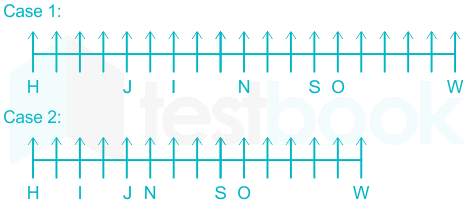
A certain number of persons are sitting in a row facing to the north. There are four persons sitting between O and W, who sits third from the extreme right end. I sits 3rd to the left of N. One person sits between I and J. H sits 4th to the left of J. S sits immediate left of O. Two persons sit between N and S. At least 15 persons sit between H and W. One person sits between W and V. G sits 2nd from one of the ends. One person sits between G and H. V sits left of W.

16

How many persons are sitting in the given row?

  1. ((a))

    21

  2. ((b))

    22

  3. ((c))

    23

  4. ((d))

    24

  5. ((e))

    20

Show Answer
Answer: ((d))

24

From the given statements,

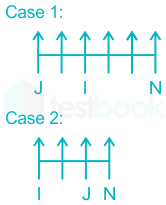
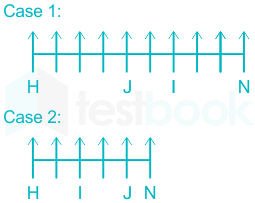
  1. I sits 3rd to the left of N. As both I and N faces north direction hence I sits third to the left of N.

  1. One person sits between I and J. We get 2 possibilities now – Case 1 and Case 2.  In case 1 , J sits on the left of I while in case 2 J sits on the right of I.


  1. H sits 4th to the left of J. Hence in case 1 and case 2, H sits on the left side of J.

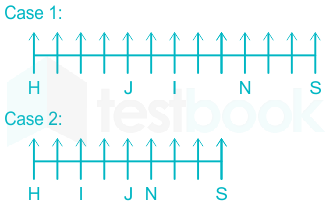
  1. Two persons sit between N and S. Hence in both the cases, S sits on the right side of N because on the left side I is placed so there is no place remaining for S in the given condition.

  1. S sits immediate left of O. Hence O placed on the right of S.

6)There are four persons sitting between O and W, who sits third from the extreme right end. Hence W sits on the right side of O in both the cases.

  1. At least 15 persons are sitting between H and W. Now Case 2 is ruled out now because in case 2, less than 15 persons are sit between H and W.

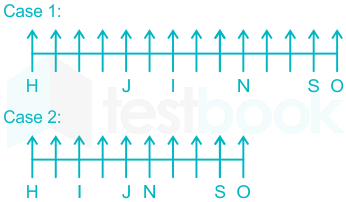
  1. One person sits between W and V. As W sits on the corner so V sits on the left side of W.

  1. G sits 2nd from one of the ends. One person sits between G and H. So here we have to place G on the left side because H is already placed there and we have to satisfy the condition of one person between H and G. Hence H sits on the right of G.

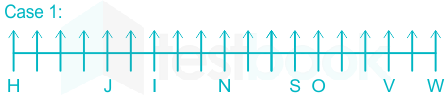
So, the final arrangement-

Hence, 24 persons are sitting in the given row.

17

What is the position of J with respect to N?

  1. ((a))

    Fourth to the left

  2. ((b))

    Fourth to the right

  3. ((c))

    Fifth to the right

  4. ((d))

    Fifth to the left

  5. ((e))

    Immediate left

Show Answer
Answer: ((d))

Fifth to the left

From the given statements,

  1. I sits 3rd to the left of N. As both I and N faces north direction hence I sits third to the left of N.

  1. One person sits between I and J. We get 2 possibilities now – Case 1 and Case 2.  In case 1 , J sits on the left of I while in case 2 J sits on the right of I.


  1. H sits 4th to the left of J. Hence in case 1 and case 2, H sits on the left side of J.

  1. Two persons sit between N and S. Hence in both the cases, S sits on the right side of N because on the left side I is placed so there is no place remaining for S in the given condition.

  1. S sits immediate left of O. Hence O placed on the right of S.

  1. There are four persons sitting between O and W, who sits third from the extreme right end. Hence W sits on the right side of O in both the cases.

  1. At least 15 persons are sitting between H and W. Now Case 2 is ruled out now because in case 2, less than 15 persons are sit between H and W.

  1. One person sits between W and V. As W sits on the corner so V sits on the left side of W.

  1. G sits 2nd from one of the ends. One person sits between G and H. So here we have to place G on the left side because H is already placed there and we have to satisfy the condition of one person between H and G. Hence H sits on the right of G.

So, the final arrangement-

Hence, J sits fifth to the left of N.

18

How many persons are sitting between H and I?

  1. ((a))

    Five

  2. ((b))

    Six

  3. ((c))

    Four

  4. ((d))

    Seven

  5. ((e))

    Three

Show Answer
Answer: ((a))

Five

From the given statements,

  1. I sits 3rd to the left of N. As both I and N faces north direction hence I sits third to the left of N.

  1. One person sits between I and J. We get 2 possibilities now – Case 1 and Case 2.  In case 1 , J sits on the left of I while in case 2 J sits on the right of I.


  1. H sits 4th to the left of J. Hence in case 1 and case 2, H sits on the left side of J.

  1. Two persons sit between N and S. Hence in both the cases, S sits on the right side of N because on the left side I is placed so there is no place remaining for S in the given condition.

  1. S sits immediate left of O. Hence O placed on the right of S.

  1. There are four persons sitting between O and W, who sits third from the extreme right end. Hence W sits on the right side of O in both the cases.

  1. At least 15 persons are sitting between H and W. Now Case 2 is ruled out now because in case 2, less than 15 persons are sit between H and W.

  1. One person sits between W and V. As W sits on the corner so V sits on the left side of W.

  1. G sits 2nd from one of the ends. One person sits between G and H. So here we have to place G on the left side because H is already placed there and we have to satisfy the condition of one person between H and G. Hence H sits on the right of G.

So, the final arrangement-

Hence, five persons are sitting between H and I.

19

How many persons are sitting on the left of J?

  1. ((a))

    Six

  2. ((b))

    Seven

  3. ((c))

    Eight

  4. ((d))

    Three

  5. ((e))

    Five

Show Answer
Answer: ((b))

Seven

From the given statements,

  1. I sits 3rd to the left of N. As both I and N faces north direction hence I sits third to the left of N.

  1. One person sits between I and J. We get 2 possibilities now – Case 1 and Case 2.  In case 1 , J sits on the left of I while in case 2 J sits on the right of I.


  1. H sits 4th to the left of J. Hence in case 1 and case 2, H sits on the left side of J.

  1. Two persons sit between N and S. Hence in both the cases, S sits on the right side of N because on the left side I is placed so there is no place remaining for S in the given condition.

  1. S sits immediate left of O. Hence O placed on the right of S.

6)There are four persons sitting between O and W, who sits third from the extreme right end. Hence W sits on the right side of O in both the cases.

  1. At least 15 persons are sitting between H and W. Now Case 2 is ruled out now because in case 2, less than 15 persons are sit between H and W.

  1. One person sits between W and V. As W sits on the corner so V sits on the left side of W.

  1. G sits 2nd from one of the ends. One person sits between G and H. So here we have to place G on the left side because H is already placed there and we have to satisfy the condition of one person between H and G. Hence H sits on the right of G.

So, the final arrangement-

Hence, seven persons are sitting on the left of J.

20

What is the position of V with respect to N?

  1. ((a))

    Fifth to the left

  2. ((b))

    Fifth to the right

  3. ((c))

    Sixth to the right

  4. ((d))

    Seventh to the right

  5. ((e))

    Seventh to the left

Show Answer
Answer: ((d))

Seventh to the right

From the given statements,

  1. I sits 3rd to the left of N. As both I and N faces north direction hence I sits third to the left of N.

  1. One person sits between I and J. We get 2 possibilities now – Case 1 and Case 2.  In case 1 , J sits on the left of I while in case 2 J sits on the right of I.


  1. H sits 4th to the left of J. Hence in case 1 and case 2, H sits on the left side of J.

  1. Two persons sit between N and S. Hence in both the cases, S sits on the right side of N because on the left side I is placed so there is no place remaining for S in the given condition.

  1. S sits immediate left of O. Hence O placed on the right of S.

  1. There are four persons sitting between O and W, who sits third from the extreme right end. Hence W sits on the right side of O in both the cases.

  1. At least 15 persons are sitting between H and W. Now Case 2 is ruled out now because in case 2, less than 15 persons are sit between H and W.

  1. One person sits between W and V. As W sits on the corner so V sits on the left side of W.

  1. G sits 2nd from one of the ends. One person sits between G and H. So here we have to place G on the left side because H is already placed there and we have to satisfy the condition of one person between H and G. Hence H sits on the right of G.

So, the final arrangement-

Hence, V sits seventh to the right of N.

21

In a family, P is the only son-in-law of R. L is the daughter of S. Q is the daughter of P. S is the grand father of Q. How is L related to Q?

  1. ((a))

    Mother

  2. ((b))

    Father

  3. ((c))

    Brother

  4. ((d))

    Cousin

  5. ((e))

    Grandmother

Show Answer
Answer: ((a))

Mother

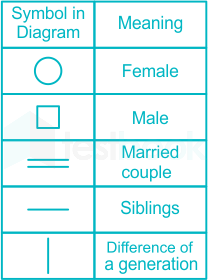
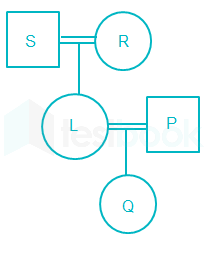
With the dat given, we can draw a family tree diagram as shown below.

  1. P is the only son-in-law of R.
  2. L is the daughter of S.

 So, L is the wife of P.

  1. Q is the daughter of P.
  2. S is the grand father of Q.

 So, R is the grand mother of Q.

Hence, L is the mother of Q.

Hence, Mother is the answer.

Direction: Study the information given below carefully and answer the question that follows.

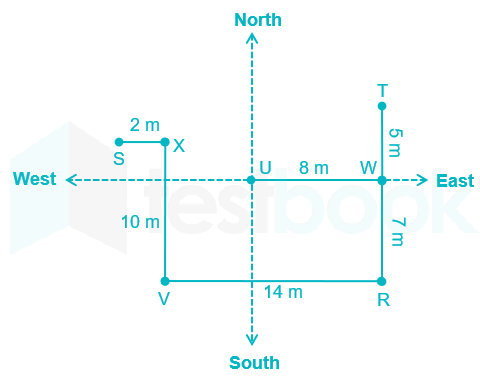
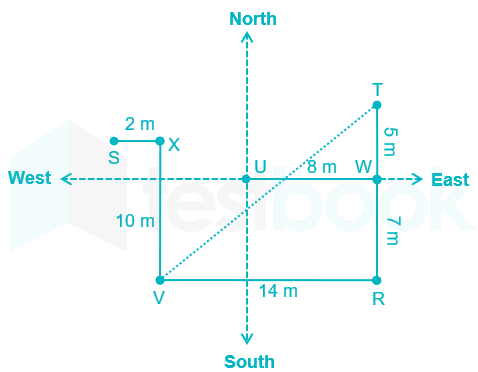
R, S, T, U, V, W and X are seven shops. U is 8 m West of W. T is 5 m North of W and R is 7 m South of W. X is 2 m East of S while V is 10 m South of X. R is 14 m East of V.

22

What is the position of R with respect to X?

  1. ((a))

    North-east

  2. ((b))

    North-west

  3. ((c))

    South-east

  4. ((d))

    South-west

  5. ((e))

    South

Show Answer
Answer: ((c))

South-east

According to the given information, we have the following diagram:

Clearly, R is to the South-east direction with respect to X.

Hence, South-east is the correct answer.

23

What is the shortest distance between T and V?

  1. ((a))

    265m { 2\sqrt{65}}m

  2. ((b))

    285m { 2\sqrt{85}}m

  3. ((c))

    355m { 3\sqrt{55}}m

  4. ((d))

    365m { 3\sqrt{65}}m

  5. ((e))

    435m { 4\sqrt{35}}m

Show Answer
Answer: ((b))

285m { 2\sqrt{85}}m

According to the given information, we have the following diagram:

Distance TV = TR2+VR2{ \sqrt{TR^2+VR^2}}

122+142{ \sqrt{12^2+14^2}}

144+196{ \sqrt{144+196}}

340 { \sqrt{340}}

285 { 2\sqrt{85}}

Hence, 285m { 2\sqrt{85}} m is the correct answer.

24

Find the odd pair among the following five options (as per the directions).

  1. ((a))

    V and U

  2. ((b))

    U and T

  3. ((c))

    V and T

  4. ((d))

    R and T

  5. ((e))

    V and W

Show Answer
Answer: ((d))

R and T

According to the given information, we have the following diagram:

Clearly, all the given options except "R and T", the first shop is in the South-west direction with respect to the second shop.

Hence, R and T is the correct answer.

Direction: Read the following information carefully and answer the question that follows.           

Ten persons A, B, C, D, E, F, G, H, I and J live on five different floors of a building but not necessarily in the same order. The bottom-most floor is numbered 1, the floor above it is numbered 2 and so on till topmost floor which is numbered as 5. There are two flats on each floor- flat – 1 and flat – 2 from west to the east such that flat – 1 is west of flat – 2. Flat – 1 of the second floor is exactly above flat – 1 of the first floor and exactly below the flat – 1 if the third floor, other flats are placed in the same way.

C lives North West of D and southwest of A. E lives on the northwest of H. Three floors are there between the F and B, which is living in the odd floor. Two floors are between B and I, which is the living left of person A. D living on the same floor as B. Two floors are there between J and C and both are at same in same flat number.

25

Who is living at the immediately left of person who live in third floor of  flat 2?

  1. ((a))

    A

  2. ((b))

    B

  3. ((c))

    C

  4. ((d))

    E

  5. ((e))

    G

Show Answer
Answer: ((d))

E

Floor: 1, 2, 3, 4, 5

Flat: 1, 2

Persons: A, B, C, D, E, F, G, H, I and J

  1. Three floors are there between the F and B, which is living in the odd flat.
FloorsCase 1Case 2Case 3Case 4
Flat 1Flat 2Flat 1Flat 2Flat 1Flat 2Flat 1Flat 2
5BBFF
4
3
2
1FFBB


  1. Two floors are between B and I, which is living left of person A.

  2. D living on the same floor as B.

FloorsCase 1Case 2Case 3Case 4
Flat 1Flat 2Flat 1Flat 2Flat 1Flat 2Flat 1Flat 2
5BDBDFF
4IAIA
3
2IAIA
1FFBDBD


  1. C lives North West of D and south west of A. (Case 1 and 2 get eliminated)

  2. Two floors are there between J and C and both are at same in same flat number (This eliminate case 4)

  3. E lives on the north west of H.

FloorsCase 3
Flat 1Flat 2
5JF
4IA
3EG
2CH
1BD


G lives on the third floor of flat 2.

Hence, E lives to the immediate left of the person who lives on third floor.

26

Four of the following are alike in certain way hence form a group. Find the one which does not belongs to the group?

  1. ((a))

    C - H

  2. ((b))

    I - A

  3. ((c))

    B - D

  4. ((d))

    E - G

  5. ((e))

    C - D

Show Answer
Answer: ((e))

C - D

Floor: 1, 2, 3, 4, 5

Flat: 1, 2

Persons: A, B, C, D, E, F, G, H, I and J

  1. Three floors are there between the F and B, which is living in the odd flat.
FloorsCase 1Case 2Case 3Case 4
Flat 1Flat 2Flat 1Flat 2Flat 1Flat 2Flat 1Flat 2
5BBFF
4
3
2
1FFBB


  1. Two floors are between B and I, which is living left of person A.

  2. D living on the same floor as B.

FloorsCase 1Case 2Case 3Case 4
Flat 1Flat 2Flat 1Flat 2Flat 1Flat 2Flat 1Flat 2
5BDBDFF
4IAIA
3
2IAIA
1FFBDBD


  1. C lives North West of D and south west of A. (Case 1 and 2 get eliminated)

  2. Two floors are there between J and C and both are at same in same flat number (This eliminate case 4)

  3. E lives on the north west of H.

FloorsCase 3
Flat 1Flat 2
5JF
4IA
3EG
2CH
1BD


All the above except C - D are the persons who live on the same floor number.

Hence, C - D does not belong to the group.

27

Who is living in the south east of the person C?

  1. ((a))

    A

  2. ((b))

    D

  3. ((c))

    J

  4. ((d))

    G

  5. ((e))

    E

Show Answer
Answer: ((b))

D

Floor: 1, 2, 3, 4, 5

Flat: 1, 2

Persons: A, B, C, D, E, F, G, H, I and J

  1. Three floors are there between the F and B, which is living in the odd flat.
FloorsCase 1Case 2Case 3Case 4
Flat 1Flat 2Flat 1Flat 2Flat 1Flat 2Flat 1Flat 2
5BBFF
4
3
2
1FFBB


  1. Two floors are between B and I, which is living left of person A.

  2. D living on the same floor as B.

FloorsCase 1Case 2Case 3Case 4
Flat 1Flat 2Flat 1Flat 2Flat 1Flat 2Flat 1Flat 2
5BDBDFF
4IAIA
3
2IAIA
1FFBDBD


  1. C lives North West of D and southwest of A. (Case 1 and 2 get eliminated)

  2. Two floors are there between J and C and both are at same in same flat number (This eliminate case 4)

  3. E lives on the northwest of H.

FloorsCase 3
Flat 1Flat 2
5JF
4IA
3EG
2CH
1BD


Hence, D lives in the south east of C.

28

Which of the following statement is true?

  1. ((a))

    D lives immediately above H

  2. ((b))

    B lives in Flat 1

  3. ((c))

    D lives in Flat 1

  4. ((d))

    No one lives below C

  5. ((e))

    No is true.

Show Answer
Answer: ((b))

B lives in Flat 1

Floor: 1, 2, 3, 4, 5

Flat: 1, 2

Persons: A, B, C, D, E, F, G, H, I and J

  1. Three floors are there between the F and B, which is living in the odd flat.
FloorsCase 1Case 2Case 3Case 4
Flat 1Flat 2Flat 1Flat 2Flat 1Flat 2Flat 1Flat 2
5BBFF
4
3
2
1FFBB


  1. Two floors are between B and I, which is living left of person A.

  2. D living on the same floor as B.

FloorsCase 1Case 2Case 3Case 4
Flat 1Flat 2Flat 1Flat 2Flat 1Flat 2Flat 1Flat 2
5BDBDFF
4IAIA
3
2IAIA
1FFBDBD


  1. C lives North West of D and southwest of A. (Case 1 and 2 get eliminated)

  2. Two floors are there between J and C and both are at same in same flat number (This eliminate case 4)

  3. E lives on the northwest of H.

FloorsCase 3
Flat 1Flat 2
5JF
4IA
3EG
2CH
1BD


Hence, B lives in Flat 1 is the correct answer.

29

The number of floors above G is same as the number of floors below _____ ?

  1. ((a))

    A

  2. ((b))

    H

  3. ((c))

    F

  4. ((d))

    E

  5. ((e))

    C

Show Answer
Answer: ((d))

E

Floor: 1, 2, 3, 4, 5

Flat: 1, 2

Persons: A, B, C, D, E, F, G, H, I and J

  1. Three floors are there between the F and B, which is living in the odd flat.
FloorsCase 1Case 2Case 3Case 4
Flat 1Flat 2Flat 1Flat 2Flat 1Flat 2Flat 1Flat 2
5BBFF
4
3
2
1FFBB


  1. Two floors are between B and I, which is living left of person A.

  2. D living on the same floor as B.

FloorsCase 1Case 2Case 3Case 4
Flat 1Flat 2Flat 1Flat 2Flat 1Flat 2Flat 1Flat 2
5BDBDFF
4IAIA
3
2IAIA
1FFBDBD


  1. C lives North West of D and southwest of A. (Case 1 and 2 get eliminated)

  2. Two floors are there between J and C and both are at same in same flat number (This eliminate case 4)

  3. E lives on the northwest of H.

FloorsCase 3
Flat 1Flat 2
5JF
4IA
3EG
2CH
1BD


Hence, The number of floors above G is the same as the number of floors below E.

30

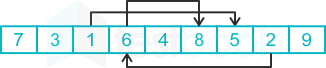
How many such pairs of digits are there in the number '731648529', each of which has as many digits between them in the number (both forward and backward direction) as they have between them in the numerical series?

  1. ((a))

    None

  2. ((b))

    One

  3. ((c))

    Two

  4. ((d))

    Three

  5. ((e))

    Four

Show Answer
Answer: ((d))

Three

The required pairs in the given number are:

In Forward Direction -  (1, 5), (6, 8)

In Backward Direction - (2, 6) 

Thus, there are three such pairs that have as many digits between them in the number (both forward and backward direction) as they have between them in the numerical series.

Hence, the correct answer is Three.

Directions: Read the instructions carefully and answer the question below.

Twelve people are sitting in two rows in such a way that each person of the first row is facing the respective person of the second row. A, B, C, D, E, and F are sitting in a row that is facing south while L, M, N, O, P, and Q are facing in a row that is facing north.

E is facing O who is sitting third to the right of Q. D is sitting to the immediate right of the person who is facing Q. B, who is not an immediate neighbour of D, is sitting on one of the extreme ends. M is an immediate neighbour of P. P is facing the person who is sitting to the immediate right of C. F is not an immediate neighbour of D. L is not facing D.

31

Who is sitting opposite the person who is sitting to the immediate left of C?

  1. ((a))

    Q

  2. ((b))

    A

  3. ((c))

    L

  4. ((d))

    O

  5. ((e))

    F

Show Answer
Answer: ((d))

O

Given:   L, M, N, O, P, and Q are facing north and A, B, C, D, E, and F are facing south.

  1. E is facing O who is sitting third to the right of Q. i.e. E is facing O and O is sitting third to the right of Q

  1. D is sitting to the immediate right of the person who is facing Q. 

(The second statement implies that at least one person is sitting to the left of Q.)

  1. B, who is not an immediate neighbour of D, is sitting on one of the extreme ends. At most we can place one people to the right of D because Six people sit in a row But B is not neighbour of D . SoB will sit extreme left end.

  1. P is facing the person who is sitting to the immediate right of C.

5) M is an immediate neighbour of P

  1. F is not an immediate neighbour of D.

(Implies, F must be sitting second to the left of D and it further implies that A must be sitting between F and D as it is the only seat left to be filled.)

  1. L is not facing D.

(Implies, L must be facing B because it is the only other option for L. Also, N must be facing D as it is the only seat left for N and in first row only one seat left for A.)

Clearly, E is sitting to the immediate left of C and O is sitting opposite E.

Hence, the correct answer is "O".

32

How many persons are sitting between N and P?

  1. ((a))

    One

  2. ((b))

    Zero

  3. ((c))

    Two

  4. ((d))

    Three

  5. ((e))

    Four

Show Answer
Answer: ((a))

One

Given:   L, M, N, O, P, and Q are facing north and A, B, C, D, E, and F are facing south.

  1. E is facing O who is sitting third to the right of Q. i.e. E is facing O and O is sitting third to the right of Q

  1. D is sitting to the immediate right of the person who is facing Q. 

(The second statement implies that at least one person is sitting to the left of Q.)

  1. B, who is not an immediate neighbour of D, is sitting on one of the extreme ends. At most we can place one people to the right of D because Six people sit in a row But B is not neighbour of D . So, B will sit extreme left end.

  1. P is facing the person who is sitting to the immediate right of C.

5) M is an immediate neighbour of P

  1. F is not an immediate neighbour of D.

(Implies, F must be sitting second to the left of D and it further implies that A must be sitting between F and D as it is the only seat left to be filled.)

  1. L is not facing D.

(Implies, L must be facing B because it is the only other option for L. Also, N must be facing D as it is the only seat left for N and in first row only one seat left for A.)

Clearly, only one person is sitting between N and P.

Hence, the correct answer is "one".

33

Four of the following five are alike based on their seating positions and thus form a group. Which of the following does not belong to the group?

  1. ((a))

    Q

  2. ((b))

    L

  3. ((c))

    N

  4. ((d))

    D

  5. ((e))

    B

Show Answer
Answer: ((a))

Q

Given:   L, M, N, O, P, and Q are facing north and A, B, C, D, E, and F are facing south.

  1. E is facing O who is sitting third to the right of Q. i.e. E is facing O and O is sitting third to the right of Q.

  1. D is sitting to the immediate right of the person who is facing Q. 

(The second statement implies that at least one person is sitting to the left of Q.)

  1. B, who is not an immediate neighbour of D, is sitting on one of the extreme ends. At most we can place one people to the right of D because Six people sit in a row But B is not neighbour of D . So, B will sit extreme left end.

  1. P is facing the person who is sitting to the immediate right of C.

5) M is an immediate neighbour of P

  1. F is not an immediate neighbour of D.

(Implies, F must be sitting second to the left of D and it further implies that A must be sitting between F and D as it is the only seat left to be filled.)

  1. L is not facing D.

(Implies, L must be facing B because it is the only other option for L. Also, N must be facing D as it is the only seat left for N and in first row only one seat left for A.)

Except for Q, all are sitting on extreme ends.

Hence, the correct answer is "Q"

34

Who is sitting opposite A?

  1. ((a))

    D

  2. ((b))

    L

  3. ((c))

    M

  4. ((d))

    Q

  5. ((e))

    O

Show Answer
Answer: ((d))

Q

Given:   L, M, N, O, P, and Q are facing north and A, B, C, D, E, and F are facing south.

  1. E is facing O who is sitting third to the right of Q. i.e. E is facing O and O is sitting third to the right of Q

  1. D is sitting to the immediate right of the person who is facing Q. 

(The second statement implies that at least one person is sitting to the left of Q.)

  1. B, who is not an immediate neighbour of D, is sitting on one of the extreme ends. At most we can place one people to the right of D because Six people sit in a row But B is not neighbour of D . So, B will sit extreme left end.

  1. P is facing the person who is sitting to the immediate right of C.

5) M is an immediate neighbour of P

  1. F is not an immediate neighbour of D.

(Implies, F must be sitting second to the left of D and it further implies that A must be sitting between F and D as it is the only seat left to be filled.)

  1. L is not facing D.

(Implies, L must be facing B because it is the only other option for L. Also, N must be facing D as it is the only seat left for N and in first row only one seat left for A.)

Clearly, Q is sitting opposite A.

Hence, the correct answer is "Q".

35

Which of the following pairs is correctly matched?

  1. ((a))

    DM

  2. ((b))

    BL

  3. ((c))

    CO

  4. ((d))

    AP

  5. ((e))

    FQ

Show Answer
Answer: ((b))

BL

Given:   L, M, N, O, P, and Q are facing north and A, B, C, D, E, and F are facing south.

  1. E is facing O who is sitting third to the right of Q. i.e. E is facing O and O is sitting third to the right of Q

  1. D is sitting to the immediate right of the person who is facing Q. 

(The second statement implies that at least one person is sitting to the left of Q.)

  1. B, who is not an immediate neighbour of D, is sitting on one of the extreme ends. At most we can place one people to the right of D because Six people sit in a row But B is not neighbour of D . So, B will sit extreme left end.

  1. P is facing the person who is sitting to the immediate right of C.

5) M is an immediate neighbour of P

  1. F is not an immediate neighbour of D.

(Implies, F must be sitting second to the left of D and it further implies that A must be sitting between F and D as it is the only seat left to be filled.)

  1. L is not facing D.

(Implies, L must be facing B because it is the only other option for L. Also, N must be facing D as it is the only seat left for N and in first row only one seat left for A.)

Clearly, L is sitting opposite B.

Hence, the correct answer is "BL".

Quantitative Aptitude (35 questions)

36

What should come in the place of (?) in the given series?

 19,30,43,58,75,?

  1. ((a))

     78

  2. ((b))

     76

  3. ((c))

     110

  4. ((d))

     98

  5. ((e))

     94

Show Answer
Answer: ((e))

 94

Solution :

 The series follows the following pattern :

⇒ 3 × 6 + 1 = 19

⇒ 4 × 7+ 2 = 30

⇒ 5 × 8 + 3 = 43

⇒ 6 × 9+ 4 = 58

⇒ 7 × 10 + 5 = 75

⇒ 8 × 11 + 6 = 94

⇒ The next term in the series will be 94.

 Hence 94 is the correct answer.

37

What should come in the place of (?) in the given series?

 42,46,58,78,106,?

  1. ((a))

     152

  2. ((b))

     142

  3. ((c))

     144

  4. ((d))

     178

  5. ((e))

     192

Show Answer
Answer: ((b))

 142

Solution :

 The series follows the following pattern :

 ⇒ 42 + 4 = 46

 ⇒ 46 + 12 = 58

 ⇒ 58 + 20 = 78

 ⇒ 78 + 28 = 106

 ⇒ 106 + 36 = 142

 ⇒ The next term in the series will be 142.

 Hence 142 is the correct answer.

38

What should come in the place of (?) in the given series?

 ?,18,45,126,369,1098

  1. ((a))

     11

  2. ((b))

     8

  3. ((c))

     7

  4. ((d))

     9

  5. ((e))

     5

Show Answer
Answer: ((d))

 9

Solution :

The series follows the following pattern :

9 + 32 = 18

⇒18 + 33 = 45

⇒45 + 34 = 126

⇒126 + 35 = 369

⇒369 + 36 = 1098

⇒The next term in the series will be 9

Hence 9 is the correct answer.

39

What should come in the place of (?) in the given series?

 143,170,?,226,255,290

  1. ((a))

     195

  2. ((b))

     187

  3. ((c))

     193

  4. ((d))

     194

  5. ((e))

     175

Show Answer
Answer: ((a))

 195

Solution :

The series follows the following pattern :

⇒122 - 1 = 143

⇒132 + 1 = 170

⇒142 - 1 = 195

⇒152 + 1 = 226

⇒162 - 1 = 255

⇒172 + 1 = 290

⇒The next term in the series will be 195.

Hence 195 is the correct answer.

40

What should come in the place of (?) in the given series?

7, 5, 6, 12, 40, 190,?

  1. ((a))

     1128

  2. ((b))

     1124

  3. ((c))

     1118

  4. ((d))

     1018

  5. ((e))

     1100

Show Answer
Answer: ((a))

 1128

Solution :

 The series follows the following pattern :

⇒ 7 × 1 - 2 = 5

⇒ 5 × 2 - 4 = 6

⇒ 6 × 3 - 6 = 12

⇒ 12 × 4 - 8 = 40

⇒ 40 × 5 - 10 = 190

⇒ 190 × 6 - 12 = 1128

⇒ The next term in the series will be 1128.

Hence 1128 is the correct answer.

41

Prashant bought a laptop from an electronic shop and sold it to Satish at 25% profit. Satish sold it to Yash at 25% profit. Yash sold it to Shivansh at 20% profit for Rs. 53,250. Find the price at which Prashant bought the laptop.

  1. ((a))

    Rs. 20,600

  2. ((b))

    Rs. 28,400

  3. ((c))

    Rs. 25,400

  4. ((d))

    Rs. 24000

  5. ((e))

    None of these

Show Answer
Answer: ((b))

Rs. 28,400

Given:

Profit of Prashant = 25%

Profit of Satish = 25%

Profit of Yash = 20%

CP for Shivansh = Rs. 53,250

Formula:

Selling price = (100 + Profit%)/100 × Cost Price

Calculation:

Let the cost at which Prashant bought the laptop be x

According to question,

x × 125/100 × 125/100 × 120/100 = 53250

⇒ x × 5/4 × 5/4 × 6/5 = 53,250

⇒ x = 53250 × 8/15 = Rs. 28,400

∴ Price at which Prashant bought the laptop = Rs. 28400

42

The total time taken by a boat to go 120 km upstream and came back to the starting point is 8 hours. If the speed of the stream is 25% of the speed of the boat in still water, then find the difference between the upstream speed and the downstream speed of the boat.

  1. ((a))

    16 km/h

  2. ((b))

    20 km/h

  3. ((c))

    12 km/h

  4. ((d))

    15 km/h

  5. ((e))

    None of these

Show Answer
Answer: ((a))

16 km/h

Given:

Time to go 120 km upstream and come back to the starting point = 8 hours

The speed of the stream is 25% of the speed of the boat in still water

Formula Used:

Downstream Speed = Speed of boat + Speed of stream 

Upstream Speed = Speed of boat - Speed of stream

Calculation:

Let the speed of the boat in still water be x km/h.

So, the speed of stream = x × 25/100 = (x/4) km/h

The upstream speed of boat = x – (x/4) = (3x/4) km/h

The downstream speed of boat = x + (x/4) = (5x/4) km/h

According to the question:

[120/ (3x/4)] + [120/ (5x/4)] = 8

⇒ (480/3x) + (480/5x) = 8

⇒ 480[(5 + 3) /15x] = 8

⇒ 15x = 480

⇒ x = 32

⇒ The upstream speed of the boat = 32 × 3/4 = 24 km/h

⇒ The downstream speed of the boat = 32 × 5/4 = 40 km/h

∴ The required difference = 40 – 24 = 16 km/h

43

Pipes A, B, and C together can fill a tank in 12 hours. Pipes A and B together can fill the same tank in 24 hours. There is another pipe D that can empty this tank in 48 hours. If all the pipes are opened together and after 8 hours pipes A and B are closed then Find the total time taken to fill this tank.

  1. ((a))

    28 hours

  2. ((b))

    34 hours

  3. ((c))

    32 hours

  4. ((d))

    22 hours

  5. ((e))

    38 hours

Show Answer
Answer: ((c))

32 hours

Given:

Pipes A, B, and C together can fill a tank in 12 hours.

Pipes A and B together can fill the same tank in 24 hours.

Pipe D can empty this tank in 48 hours.

Formula Used:

Efficiency = Total work/Total time

Calculation:

Let's assume the capacity of the tank = 48 units (LCM of 12, 24, and 48)

So in 1 hour A, B, and C together can fill = 48/12

4 unit 

In 1 hour A, and B together can fill = 48/24

2 unit

Then in 1 hour C can fill = 4 - 2

2 unit 

Pipe D can empty this tank in 48 hours

So in 1 hour D can empty = 48/48

1 unit 

For 8 hours all pipes are opened so they will fill = (4 -1) × 8

⇒ 24 unit

Remaining capacity of tank = 48 - 24

⇒ 24 unit

Now only C and D are open so they will take = 24/(2-1)

⇒ 24 hours 

∴ Total time taken = 8 + 24 = 32 hours

44

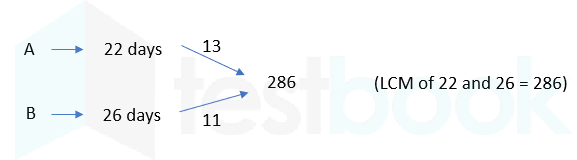
A can do a piece of work in 22 days while B alone can complete the whole work in 26 days. They work together for 5 days then A left the work and remaining work can done by B alone. In how many days will finish the whole work?  

  1. ((a))

    13 days

  2. ((b))

    15 days

  3. ((c))

    2011120\frac{1}{11} days

  4. ((d))

    1511115\frac{1}{11} days

  5. ((e))

    None of these

Show Answer
Answer: ((c))

2011120\frac{1}{11} days

Given:

A alone can complete whole work = 22 days

B alone can complete whole work = 26 days

They work together for 5 days

Concept used:

Work efficiency = Total work/Total working time

Total time = Total work/ Work efficiency

Per hour work = 1/Total time 

Calculation:

Total work = LCM of 22 and 26 = 286 unit

Efficiency of A = 286/22 = 13 days

Efficiency of B = 286/26 = 11 days

Work done by A and B together in 1 day = 13 + 11

⇒ 24 unit

Hence Work done by A and B together in 5 day = 5 x 24

⇒ 120 unit

Remaining work = 286 - 120

⇒ 166 unit

When A left the work then remaining work done by B alone.

Days for completing the remaining work = 166/11

⇒ 1511115\frac{1}{11} days.

Total days for complete the work = 5 + 1511115\frac{1}{11} = 2011120\frac{1}{11} days

∴ Total days for complete the work is 2011120\frac{1}{11} days.

45

A, B, and C founded a company together. A's and B's respective investment ratios were 3 : 5 and B's and C's respective investment ratios were 10 : 13. What was the total annual profit earned by all of them if C received Rs 17628 at the end of the year as the yearly profit. 

  1. ((a))

    37854

  2. ((b))

    39324

  3. ((c))

    36824

  4. ((d))

    49284

  5. ((e))

    400834

Show Answer
Answer: ((b))

39324

Given:

Ratio of A and B = 3 : 5

Ratio of B and C = 10 : 13

C's Profit at the end of year = 17628

Calculation:

A : B = 3 : 5

B : C = 10 : 13

A : B : C = 6 : 10 : 13

According to the question, we get

⇒ (13 × x)/(6 + 10 + 13) = 17628

⇒13x/29 = 17628

⇒ x = 39324

∴ Total profit earned by all is Rs. 39324.

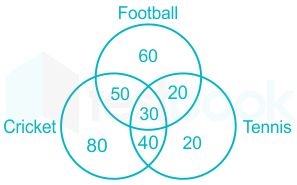
There are 300 students in a college. Every student plays different games that is cricket, football and tennis. Students playing only cricket is twice the number of students playing only cricket and tennis both that is 20% less than the number of students playing only football and cricket both. Students playing all the 3 sports are 10% of the total number of students and is 50% of students playing only football. The number of students playing only tennis and the number of students playing only football and tennis both is same that is 2 / 30 of the total number of students.

46

If 25% of the students playing only cricket started playing all 3 types of sports, then how many students play all 3 types of sports

  1. ((a))

    60

  2. ((b))

    70

  3. ((c))

    50

  4. ((d))

    35

  5. ((e))

    55

Show Answer
Answer: ((c))

50

Calculation:

Student playing all 3 type of sports = (10 / 100) × 300 = 30

∴ Students playing only football = 2 × 30 = 60

Number of student playing only tennis = Number of students playing football and tennis both = (2 / 30) × 300 = 20

We know, 20% = 1 / 5

Let the number of students playing football and cricket both = 5x

According to question, number of students playing cricket and tennis both = 4x

And, Students playing only cricket = 8x

∴ 8x + 4x + 5x = 300 – (30 + 60 + 20 + 20)

⇒ 17x = 170

⇒ x = 10

∴ Number of students playing football and cricket both = 5x = 5 × 10 = 50

Number of student playing cricket and tennis both = 4x = 4 × 10 = 40

Number of Student playing only cricket = 8x = 8 × 10 = 80

25% of 80 = (1 / 4) × 80 = 20

∴ Number of student playing all 3 sports will be = 30 + 20 = 50

47

Find the Ratio of students playing only cricket and only football together to the students playing all of the 3 sports.

  1. ((a))

    12 : 7

  2. ((b))

    14 : 15

  3. ((c))

    14 : 3

  4. ((d))

    4 : 7

  5. ((e))

    6 : 11

Show Answer
Answer: ((c))

14 : 3

Calculation:

Student playing all 3 type of sports = (10 / 100) × 300 = 30

∴ Students playing only football = 2 × 30 = 60

Number of student playing only tennis = Number of students playing football and tennis both = (2 / 30) × 300 = 20

We know, 20% = 1 / 5

Let the number of students playing football and cricket both = 5x

According to question, number of students playing cricket and tennis both = 4x

And, Students playing only cricket = 8x

∴ 8x + 4x + 5x = 300 – (30 + 60 + 20 + 20)

⇒ 17x = 170

⇒ x = 10

∴ Number of students playing football and cricket both = 5x = 5 × 10 = 50

Number of student playing cricket and tennis both = 4x = 4 × 10 = 40

Number of Student playing only cricket = 8x = 8 × 10 = 80

Student playing only basketball and only football together = 80 + 60 = 140

Students playing all of the 3 sports = 30

∴ Required ratio = 140 : 30

⇒ 14 : 3

48

Find the number of students playing at least 2 games.

  1. ((a))

    120

  2. ((b))

    140

  3. ((c))

    150

  4. ((d))

    110

  5. ((e))

    70

Show Answer
Answer: ((b))

140

Calculation:

Student playing all 3 type of sports = (10 / 100) × 300 = 30

∴ Students playing only football = 2 × 30 = 60

Number of student playing only tennis = Number of students playing football and tennis both = (2 / 30) × 300 = 20

We know, 20% = 1 / 5

Let the number of students playing football and cricket both = 5x

According to question, number of students playing cricket and tennis both = 4x

And, Students playing only cricket = 8x

∴ 8x + 4x + 5x = 300 – (30 + 60 + 20 + 20)

⇒ 17x = 170

⇒ x = 10

∴ Number of students playing football and cricket both = 5x = 5 × 10 = 50

Number of student playing cricket and tennis both = 4x = 4 × 10 = 40

Number of Student playing only cricket = 8x = 8 × 10 = 80

∴ Number of students playing atleast 2 games = 50 + 30 + 20 + 40 = 140

49

Find the average number of students playing only one game.

  1. ((a))

    52

  2. ((b))

    53

  3. ((c))

    53.33

  4. ((d))

    54.2

  5. ((e))

    48.25

Show Answer
Answer: ((c))

53.33

Calculation:

Student playing all 3 type of sports = (10 / 100) × 300 = 30

∴ Students playing only football = 2 × 30 = 60

Number of student playing only tennis = Number of students playing football and tennis both = (2 / 30) × 300 = 20

We know, 20% = 1 / 5

Let the number of students playing football and cricket both = 5x

According to question, number of students playing cricket and tennis both = 4x

And, Students playing only cricket = 8x

∴ 8x + 4x + 5x = 300 – (30 + 60 + 20 + 20)

⇒ 17x = 170

⇒ x = 10

∴ Number of students playing football and cricket both = 5x = 5 × 10 = 50

Number of student playing cricket and tennis both = 4x = 4 × 10 = 40

Number of Student playing only cricket = 8x = 8 × 10 = 80

Number of student playing only one game = 80 + 20 + 60 = 160

∴ Average = 160 / 3 = 53.33

50

Find Students playing only football is what percent more/less than the students playing both football and cricket

  1. ((a))

    20%

  2. ((b))

    25%

  3. ((c))

    15%

  4. ((d))

    12%

  5. ((e))

    18%

Show Answer
Answer: ((a))

20%

Calculation:

Student playing all 3 type of sports = (10 / 100) × 300 = 30

∴ Students playing only football = 2 × 30 = 60

Number of student playing only tennis = Number of students playing football and tennis both = (2 / 30) × 300 = 20

We know, 20% = 1 / 5

Let the number of students playing football and cricket both = 5x

According to question, number of students playing cricket and tennis both = 4x

And, Students playing only cricket = 8x

∴ 8x + 4x + 5x = 300 – (30 + 60 + 20 + 20)

⇒ 17x = 170

⇒ x = 10

∴ Number of students playing football and cricket both = 5x = 5 × 10 = 50

Number of student playing cricket and tennis both = 4x = 4 × 10 = 40

Number of Student playing only cricket = 8x = 8 × 10 = 80

∴ Required percentage = 605050×100=1050×100=20%\frac{{60 - 50}}{{50}} \times 100 = \frac{{10}}{{50}} \times 100 = 20\%

51

In the given question, two equations numbered l and II are given. Solve both the equations and mark the appropriate answer.

I. x2 - 15x + 56 = 0

II. y2 - 21y + 80 = 0

  1. ((a))

    x > y

  2. ((b))

    x < y

  3. ((c))

    x ≥ y

  4. ((d))

    x ≤ y

  5. ((e))

    x = y or relationship between x and y cannot be established.

Show Answer
Answer: ((e))

x = y or relationship between x and y cannot be established.

Calculation:

I. x2 - 15x + 56 = 0

⇒ x2 - 7x - 8x + 56 = 0

⇒ x (x - 7) - 8 (x - 7) = 0

⇒ (x - 7) (x - 8) = 0

⇒ x = 7, 8

II. y2 - 21y + 80 = 0

⇒ y2 - 16y - 5y + 80 = 0

⇒ y (y - 16) - 5 (y - 16) = 0

⇒ (y - 16) (y - 5) = 0

⇒ y = 16, 5

Comparison between x and y (via Tabulation):

Value of xValue of yRelation
716x < y
75x > y
816x < y
85x > y
<br>

∴ x = y or relationship between x and y cannot be established.

52

In the given question, two equations numbered l and II are given. Solve both the equations and mark the appropriate answer.

I. x2 – 10x + 9 = 0

II. y2 – 18y + 81 = 0

  1. ((a))

    x < y

  2. ((b))

    x > y

  3. ((c))

    x ≤ y

  4. ((d))

    x ≥ y

  5. ((e))

    x = y or the relation between x and y can't be established.

Show Answer
Answer: ((c))

x ≤ y

Calculation:

I. x2 - 10x + 9 = 0

⇒ x– 9x – x + 9 = 0

⇒ x(x – 9) – 1(x – 9)= 0

⇒ (x – 9)(x – 1) = 0

⇒ x = 9, 1

II. y2 – 18y + 81 = 0

⇒ y– 9y – 9y + 81 = 0

⇒ y(y – 9) – 9(y – 9) =0

⇒ (y – 9)(y – 9) = 0

⇒ y = 9, 9

Value of ‘x’RelationValue of ‘y’
9=9
1<9
<br>

When we compared the values of ‘x’ and ‘y’ in the table above, we found that there is TWO relations between X and Y i.e. < and =. So, a relation between x and y is “x ≤ y”.

 After comparison, all the values of x and y the relation is “x  y”.

53

In the given question, two equations numbered l and II are given. Solve both the equations and mark the appropriate answer.

I. 5x2 + 6x - 27 = 0

II. y2 + 5y - 14 = 0

  1. ((a))

    x > y

  2. ((b))

    x < y

  3. ((c))

    x ≥ y

  4. ((d))

    x ≤ y

  5. ((e))

    x = y or relation between x and y can not be established.

Show Answer
Answer: ((e))

x = y or relation between x and y can not be established.

Given:

I. 5x2 + 6x - 27 = 0

II. y2 + 5y - 14 = 0

Calculation:

From I,

5x2 + 6x - 27 = 0

⇒ 5x2 + 15x - 9x - 27 = 0

⇒ 5x(x + 3) - 9(x + 3) = 0

⇒ (x + 3)(5x - 9) = 0

Taking,

⇒ (x + 3) = 0 or  (5x - 9) = 0

⇒ x = -3 or (9/5)

From II,

y2 + 5y - 14 = 0

⇒ y2 + 7y - 2y - 14 = 0

⇒ y(y + 7) - 2(y + 7) = 0

⇒ (y + 7)(y - 2) = 0

Taking,

⇒ (y - 2) = 0 or (y + 7) = 0

⇒ y = 2 or -7

Comparison between x and y (via Tabulation):

Value of xValue of yRelation
-32x < y
-3-7x > y
9/52x < y
9/5-7x > y
<br>

∴ x = y or relation between x and y can not be established.

54

In the given question, two equations numbered l and II are given. Solve both the equations and mark the appropriate answer.

I. x2 - 7x + 10 = 0

II. y2 - 29y + 54 = 0

  1. ((a))

    x > y

  2. ((b))

    x < y

  3. ((c))

    x ≥ y

  4. ((d))

    x ≤ y

  5. ((e))

    No relation in x and y or x = y

Show Answer
Answer: ((e))

No relation in x and y or x = y

Given:

I. x2 - 7x + 10 = 0

II. y2 - 29y + 54 = 0

Calculation:

I. x2 - 7x + 10 = 0

⇒ x2 - 5x - 2x + 10 = 0

⇒ x(x - 5) - 2(x - 5) = 0

⇒ (x - 5)(x - 2) = 0

⇒ x = 5, 2

II. y2 - 29y + 54 = 0

⇒ y2 - 27y - 2y + 54 = 0

⇒ y(y - 27) - 2(y - 27) = 0

⇒ (y - 27)(y - 2) = 0

⇒ y = 27, 2

Value of xValue of yRelation between x & y
527x < y
52x > y
227x < y
22x = y


∴ No relation in x and y or x = y

55

In the given question, two equations numbered l and II are given. Solve both the equations and mark the appropriate answer.

I. x2 + 19x + 34 = 0

II. y2 + 21y + 54 = 0

  1. ((a))

    x > y

  2. ((b))

    x < y

  3. ((c))

    x ≥ y

  4. ((d))

    x ≤ y

  5. ((e))

    x = y or the relationship between x and y cannot be established.

Show Answer
Answer: ((e))

x = y or the relationship between x and y cannot be established.

Calculation:

I. x2 + 19x + 34 = 0

⇒ x2 + 17x + 2x+ 34 = 0

⇒ x(x + 17) + 2(x + 17) = 0

⇒ (x + 17) (x + 2) = 0

∴ x = -17, -2

II. y2 + 21y + 54 = 0

⇒ y2 + 18x + 3x + 54= 0

⇒ y(y + 18) + 3(x + 18) = 0

⇒ (y + 18) (y + 3) = 0

∴ y = -18, -3

Comparison between x and y (via Tabulation):

Value of xValue of yRelation
-17-18x > y
-17-3x < y
-2-18x > y
-2-3x > y
<br>

∴ x = y or the relationship between x and y cannot be established.

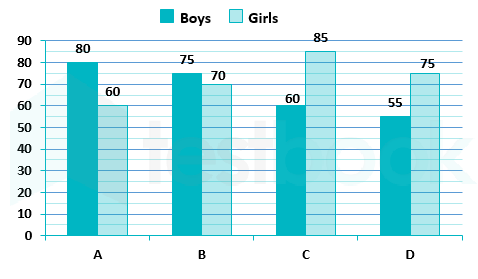
Direction: The given bar graph shows the number of boys and girls four classes. Study the following data and answer the following questions:

56

Find the ratio of the number of  boys in class A to the number of girls in class C.

  1. ((a))

    13 : 14

  2. ((b))

    14 : 15

  3. ((c))

    15 : 16

  4. ((d))

    16 : 17

  5. ((e))

    None of these

Show Answer
Answer: ((d))

16 : 17

Number of boys in class A = 80

Number of girls in class C = 85

Ratio of number of boys in class A and girls in class B = 80 : 85 = 16 :17

∴ the required ratio = 16 : 17

57

What is the difference between the number of boys and girls together in class C and D?

  1. ((a))

    25

  2. ((b))

    15

  3. ((c))

    20

  4. ((d))

    10

  5. ((e))

    None of these 

Show Answer
Answer: ((b))

15

Number of boys in class C = 60

Number of girls in class C = 85

Total number of boys and girl in class C= 60 + 85 = 145

Number of boys in class D = 55

Number of girls in class D = 75

Total number of boys and girls in class D = 55 + 75 = 130

Difference between number of boys and girls in class C and in class D = 145 – 130 = 15

∴ the required difference = 15

58

Find that the number of boys in class A is how much percent more than the number of boys in class C.

  1. ((a))

    37.5%

  2. ((b))

    42.5%

  3. ((c))

    33.33%

  4. ((d))

    47.5%

  5. ((e))

    None of these

Show Answer
Answer: ((c))

33.33%

Number of boys in class A = 80

Number of boys in class C = 60

Percent of boys Class A is more than boys in class C = (20/60 )× 100 = 1/3 = 33.33%

59

Find the average of the number boys in class A and C together and the number of girls in C and D together.

  1. ((a))

    75

  2. ((b))

    85

  3. ((c))

    72

  4. ((d))

    78

  5. ((e))

    None of these

Show Answer
Answer: ((a))

75

Total numbers of boys in Class A and C = 80 + 60 = 140

Total numbers of girls in class C and D= 85 + 75 = 160

Total numbers of boys in Class A and C and girls in class C and D = 140 + 160 = 300

Average = 300 / 4 = 75

∴ the required average = 75

60

Find the ratio of the number of boys in class A and C together to the number of girls in class B and D together.

  1. ((a))

    27 : 28

  2. ((b))

    28 : 29

  3. ((c))

    29 : 30

  4. ((d))

    26 : 27

  5. ((e))

    None of these

Show Answer
Answer: ((b))

28 : 29

Number of boys in class A = 80

Number of boys in class C= 60

Total number of boys in class A and C = 80 + 60 = 140

Number of girl in class B = 70

Number of girl in class D = 75

Total number of girl in class B and D= 70 + 75 = 145

Ratio of Total number of boys in class A and C : Total number of girls in Class B and D = 140 : 145 = 28 : 29

∴ the required ratio = 28 : 29

61

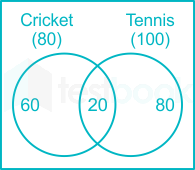
In a group of 160 people, 100 people like tennis and 20 people like both cricket and tennis. If each one likes at least one of these two games, then find the ratio between the number of people who like only cricket and the number of people who like only tennis.

  1. ((a))

    4 : 3

  2. ((b))

    3 : 4 

  3. ((c))

    5 : 4

  4. ((d))

    4 : 5

  5. ((e))

    None of these

Show Answer
Answer: ((b))

3 : 4 

Given:

Total number of people = 160

People who like tennis = 100

People who like both tennis and cricket = 20

Concept used:

Venn Diagram

Calculation:

The number of students who like only tennis = 100 – 20 = 80

The number of students who like only cricket = 160 – (100) = 60

According to the question,

Required ratio = 60 : 80 = 3 : 4

∴ The ratio between the people who like only cricket and the number of people who like only tennis is 3 : 4.

62

A certain sum of money is distributed among Ravi, Rahul, and Raj in ratio 8 : 5 : 7 in such a way that share of Ravi was Rs. 1000 less than that the sum of share of Rahul and Raj. Find the difference between the shares of Ravi and Raj?

  1. ((a))

    Rs. 450

  2. ((b))

    Rs. 350

  3. ((c))

    Rs. 250

  4. ((d))

    Rs. 190

  5. ((e))

    None of these

Show Answer
Answer: ((c))

Rs. 250

Given:

The ratio in the distributed amount of Ravi, Rahul and Raj = 8 : 5 : 7

Calculation

Let the Ratio of money distributed among Ravi, Rahul and Raj = 8x : 5x : 7x

Ratio of Rahul and Raj = 5x + 7x = 12x

Difference between the ratio of Ravi and Rahul = 12x – 8x = 4x

According to question,

4x = 1000

⇒ 1x = 250

Then share of Ravi = 8x = 250 × 8 = 2000

Share of Raj = 7x = 250 × 7 = 1750

Difference between shares of Ravi and Raj = 2000 – 1750

∴ Difference between shares of Ravi and Raj = 250 Ans.

63

Radha's expenditure is 20% of her income. If the income for next month is increased by 20%, and the amount of savings remains the same, then find the percentage increase in expenditure of Radha.

  1. ((a))

    200%

  2. ((b))

    50%

  3. ((c))

    150%

  4. ((d))

    100%

  5. ((e))

    None of these

Show Answer
Answer: ((d))

100%

Given:

In the first case:

Radha's expenditure = 20% of her income.

In the second case:

The income for next month = increased by 20%,

The amount of savings remains the same,

Calculation:

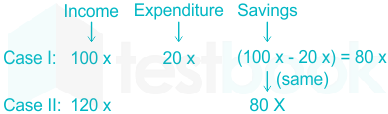
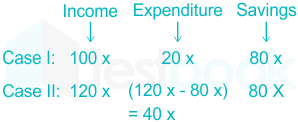
In the first case:

Let the income of Radha = ₹100

The expenditure of Radha = 20% of ₹100 = ₹20

The saving of Radha = ₹100 - ₹20 = ₹80

In the second case:

The increased income of Radha = (100% of 20%) of ₹100 = ₹120

The saving of Radha = ₹80

The expenditure of Radha = ₹120 - ₹80 = ₹40

The required percentage increase = 402020\frac{₹40-₹20}{₹20} × 100 = 100%

∴ The percentage increase in expenditure of Radha is 100%.

Alternate Method

Given:

In the first case:

Radha's expenditure = 20% of her income.

In the second case:

The income for next month = increased by 20%,

The amount of savings remains the same,

Calculation:

According to the question,

The expenditure of Radha = ₹120 - ₹80 = ₹40

The required percentage increase = 402020\frac{₹40-₹20}{₹20} × 100 = 100%

∴ The percentage increase in expenditure of Radha is 100%.

64

A container filled with mixture of milk and water. The ratio of quantity of milk and water in the mixture is 5 : 7. When 10 litres of milk and 6 litres of water added into the mixture then ratio of milk and water becomes 5 : 6. Find the difference between the quantity of water and milk in the new mixture.

  1. ((a))

    15 litres

  2. ((b))

    11 litres

  3. ((c))

    8 litres

  4. ((d))

    12 litres

  5. ((e))

    7 litres

Show Answer
Answer: ((c))

8 litres

Given:

Let quantity of milk and water in the original mixture be 3a litres and 7a litres respectively.

Calculation:

The quantity of milk in new mixture = (3a + 10) litres

The quantity of water in new mixture = (7a + 6) litres

Then,

⇒ (5a + 10) : (7a + 6) = 5 : 6

⇒ 30a + 60 = 35a - 30

⇒ 5a = 30

⇒ a = 6

The quantity of milk in new mixture = 5 × 6 + 10 = 40 litres

The quantity of water in new mixture = 7 × 6 + 6 = 48 litres

∴ Required difference = 48 - 40 = 8 litres.

65

The ratio of present ages of A and B is 7 : 8. After 6 years from now, the ratio of their ages will be 8 : 9. If C's present age is 10 years more than the present age of A, then the present age (in years) of C is:

  1. ((a))

    59

  2. ((b))

    56

  3. ((c))

    45

  4. ((d))

    52

  5. ((e))

    55

Show Answer
Answer: ((d))

52

Shortcut Trick

Ratio of A : B is 7 : 8 (Present) and 8 : 9 (After 6 years).

Change in ratio units for both is 8 − 7 = 1 unit and 9 − 8 = 1 unit.

Since the time gap is 6 years, 1 unit → 6 years.

A's present age = 7 units × 6 = 42 years.

C's present age = 42 + 10 = 52 years.

∴ The correct answer is 52 years.

Alternate Method

Given: Present age ratio A : B = 7 : 8. After 6 years, ratio A : B = 8 : 9. C = A + 10.

Calculation:

⇒ Let present ages of A and B be 7x and 8x.

⇒ (7x + 6) ÷ (8x + 6) = 8 ÷ 9

⇒ 9 × (7x + 6) = 8 × (8x + 6)

⇒ 63x + 54 = 64x + 48

⇒ 64x − 63x = 54 − 48

⇒ x = 6

A's present age = 7 × 6 = 42 years

C's present age = 42 + 10 = 52 years

∴ The correct answer is 52 years.

Additional Information

Age Difference Property

The difference between ages of two people remains constant regardless of the number of years passed.

Ratio Balancing Method

If the difference in ratio parts is not equal, multiply the ratios by the difference of the other ratio to balance them before solving.

Linear Equation in Ages

For any 'n' years after/before, add/subtract 'n' to the current age variables to form the equation: (Ax + n) / (Bx + n) = New Ratio.

Directions: Read the given table carefully and answer the questions based on it. 

Given table shows the total number of persons (Male and Female) applying for reservations in different hotels (A, B, C, D, and E) and the percentage of females, who applied for Reservations in different hotels. 

HotelsTotal number of persons applying for ReservationsPercentage of Females, who applied for Reservations
A44030
B33060
C48425
D67250
E54040
66

Total number of males, who applied for hotel reservations in all hotels together is what percent of total number of females, who applied for hotel reservations in all hotels together?

  1. ((a))

    144.56%

  2. ((b))

    149.67%

  3. ((c))

    132.45%

  4. ((d))

    145.28%

  5. ((e))

    142.76%

Show Answer
Answer: ((d))

145.28%

From the given table, we get:

HotelsTotal number of persons applying for ReservationsNumber of Males, who applied for ReservationsNumber of Females, who applied for Reservations
A440308132
B330132198
C484363121
D672336336
E540324216

Total number of males, who applied for Hotel reservations in all hotels together = (308 + 132 + 363 + 336 + 324) = 1463

Total number of females, who applied for Hotel reservations in all hotels together = (132 + 198 + 121 + 336 + 216) = 1003

Required percentage = (1463/1003 x 100) = 145. 28%

Hence, the correct answer is option 4.

67

If 25% of females, who applied for Hotel reservations in Hotel A, applied for Hotel reservations in Hotel F, and 200 males applied for hotel reservations in Hotel F, then what is the total number of people, applied for Hotel reservations in Hotel F?

  1. ((a))

    242

  2. ((b))

    225

  3. ((c))

    233

  4. ((d))

    256

  5. ((e))

    None of these

Show Answer
Answer: ((c))

233

From the given table, we get:

HotelsTotal number of persons applying for ReservationsNumber of Males, who applied for ReservationsNumber of Females, who applied for Reservations
A440308132
B330132198
C484363121
D672336336
E540324216

 200 males applied for hotel reservations in Hotel F.

Number of females, who applied for Hotel reservations in Hotel F = 25% of 132 = 33

So, total number of persons, who applied for Hotel reservations in Hotel F = (200 + 33) = 233

Hence, the correct answer is option 3.

68

Number of Female, who applied for reservations in Hotel C is what percent of number of males, who applied for reservations in Hotel E?

  1. ((a))

    35%

  2. ((b))

    32%

  3. ((c))

    33.33%

  4. ((d))

    66.66%

  5. ((e))

    None of these

Show Answer
Answer: ((e))

None of these

From the given table, we get:

HotelsTotal number of persons applying for ReservationsNumber of Males, who applied for ReservationsNumber of Females, who applied for Reservations
A440308132
B330132198
C484363121
D672336336
E540324216


Total number of females, who applied for Hotel reservations in Hotel C = 121

Total number of males, who applied for Hotel reservations in Hotel E = 324

Required percentage = 121/324 x 100 = 37.34%

Hence, the correct answer is option 5.

69

What is the total number of Males, who applied for Reservations in all five hotels together?

  1. ((a))

    1441

  2. ((b))

    1463

  3. ((c))

    1499

  4. ((d))

    1452

  5. ((e))

    1433

Show Answer
Answer: ((b))

1463

From the given table, we get:

HotelsTotal number of persons applying for ReservationsNumber of Males, who applied for ReservationsNumber of Females, who applied for Reservations
A440308132
B330132198
C484363121
D672336336
E540324216

Total number of males, who applied for Hotel reservations in Hotel A = 308

Total number of males, who applied for Hotel reservations in Hotel B = 132

Total number of males, who applied for Hotel reservations in Hotel C = 363

Total number of males, who applied for Hotel reservations in Hotel D = 336

Total number of males, who applied for Hotel reservations in Hotel E = 324

Required sum (308 + 132 + 363 + 336 + 324) = 1463

Hence, the correct answer is option 2.

70

Total number of males, who applied for Hotel reservations in Hotel B and C together is how much more/less than the number of females, who applied for Hotel reservations in Hotel E and D together?

  1. ((a))

    57, less

  2. ((b))

    59, Less

  3. ((c))

    58, More

  4. ((d))

    58, Less

  5. ((e))

    None of these

Show Answer
Answer: ((a))

57, less

From the given table, we get:

HotelsTotal number of persons applying for ReservationsNumber of Males, who applied for ReservationsNumber of Females, who applied for Reservations
A440308132
B330132198
C484363121
D672336336
E540324216

Total number of males, who applied for Hotel reservations in Hotel B and C together = (132 + 363) = 495

Total number of females, who applied for Hotel reservations in Hotel E and D together = (336 + 216) = 552

Required difference = (552 - 495) = 57, Less

Hence, the correct answer is option 1.

English Language (30 questions)

Read the passage and answer the questions that follow. Some words may be highlighted for you. Pay careful attention.

In order for it to be fraud in the legal sense the person on whom the fraud was sought to be committed should have necessarily fallen prey to it. If an attempt of fraud is made but the person concerned was not actually deceived, it is not ‘fraud’ as understood legally. Bank fraud is a fraud committed on banks mainly by fraudulent representations using false documents. Bank fraud concerns all citizens. It is a very sensitive issue as it affects the public faith on which the whole Banking system is predominantly based. Bank fraud includes all sorts of misappropriations, embezzlements, manipulations of negotiable instruments like cheques, bank drafts, bills or statements of accounts, securities etc. With the boom in the banking business, bank frauds are also on the rise. Bank fraud is covered under the Indian Penal Code. Cheques are a major area where frauds are committed by putting counterfeit signature on the cheque. After the economic liberalization started in 1991 in India’s banking system, there has been a lot of expansion and changes have also taken place. Generally, arrangements are also made to monitor banks in every country. And the Reserve Bank does this work in India, but despite this, banks in India have their own challenges. These challenges are related to ethics, financial crisis, and corporate governance in the functioning of banks. The ever-increasing NPA (sinking debt of banks) and the money withdrawn by fraud is troubling the banks. According to RBI annual report 2019-20, the amount involved in banking frauds is Rs 1.85 lakh crore in 2019-20 and the number of frauds is 8,707. But several big bank frauds have put the banking system in India in serious condition. With this, serious questions have also arisen on the credibility of the monitoring and audit system of banks. Finance Minister Arun Jaitley says that if there are scams happening in many branches of the same bank and no voice is raised then it is a matter of concern. It is regrettable that the bank management remained ignorant of this matter or negligent. Those who do business in the country should do their work with ethics otherwise its consequences can be serious. Apart from all this, banks should also take special care of their employees because some employees work closely with the fraudsters.

71

Select the most appropriate word(synonym) for the emboldened word - 'serious'

  1. ((a))

    Trivial 

  2. ((b))

    Unimportant

  3. ((c))

    Important

  4. ((d))

    Superficial

  5. ((e))

    Uncommitted 

Show Answer
Answer: ((c))

Important

The correct answer is Important.

Key Points

  • The given passage is about Banking fraud.
  • The underlined word serious means demanding or characterized by careful consideration or application.
  • In option 3, Important means of great significance or value.
  • So, '​Important' is the most appropriate word for the blank.

Additional Information

  • Let us see the meanings of the other words: 
  • Trivial - of very little importance or value
  • Unimportant - lacking in importance or significance.
  • Superficial -  all about the surface of appearances.
  • Uncommitted - not committed to a cause, activity, etc.
72

Select the most appropriate antonym for the word "regrettable".

  1. ((a))

    Undesirable

  2. ((b))

    Sorry

  3. ((c))

    Disappointing

  4. ((d))

    Unfortunate

  5. ((e))

    Desirable

Show Answer
Answer: ((e))

Desirable

The correct answer is Desirable**.**

Key Points

  • The given passage is about Banking fraud.
  • The given word regrettable means things that make you feel sorry.
  • In option 5, Desirable means wished for as being an attractive, useful, or necessary course of action or worth having or wanting; pleasing, excellent, or fine.
  • So, '​Desirable' is the most appropriate antonym.

Additional Information

  • Let us see the meanings of the other words: 
  • Undesirable - Not wanted
  • Sorry - feeling sad or distressed through sympathy with someone else's misfortune.
  • Disappointing - something not as good or as large as you hoped it would be.
  • Unfortunate - having or marked by bad fortune; unlucky.
73

Why is bank fraud a sensitive issue?

  1. ((a))

    it affects public faith

  2. ((b))

    It undergoes lots of expansion and changes

  3. ((c))

    It contains misappropriations

  4. ((d))

    It is done by fraudulent

  5. ((e))

    None of the above

Show Answer
Answer: ((a))

it affects public faith

The correct answer is it affects public faith.

Key Points

  • The given passage is about Banking fraud.
  • Let us refer to the line from the passage, "It is a very sensitive issue as it affects the public faith on which the whole Banking system is predominantly based".
  • From the given passage we get to know bank frauds concerns all citizens so it becomes a very sensitive issue because the whole banking system is based on the public.
  • So, if citizens face fraud, it will adversely affect the whole Banking system.
  • So, '​'it affects public faith' is the correct option.
74

What are the major areas where frauds are committed?

  1. ((a))

    Banks

  2. ((b))

    Public

  3. ((c))

    Cheques

  4. ((d))

    Corporate companies

  5. ((e))

    None of the above

Show Answer
Answer: ((c))

Cheques

The correct answer is Cheques.

Key Points

  • The given passage is about Banking fraud.
  • Let us refer to the line from the passage, "Cheques are a major area where frauds are committed by putting counterfeit signature on the cheque".
  • From the given passage we get to know the most common type of fraud that occurs is in cheques.
  • Anyone can forge a fake signature on any cheque and commit fraud.
  • So, '​​Cheques​' is the correct option.
75

Select the most appropriate synonym for the word "negotiable".

  1. ((a))

    mismanage

  2. ((b))

    misconduct

  3. ((c))

    quash

  4. ((d))

    debatable

  5. ((e))

    inflexible

Show Answer
Answer: ((d))

debatable

The correct answer is debatable.

Key Points

  • The given passage is about Banking fraud.
  • The given word negotiable (adjective) means something you can talk it over until you reach an agreement.
  • In option 4, debatable (adjective) means open to discussion or argument.
  • So, '​debatable' is the most appropriate synonym.

Additional Information

  • Let us see the meanings of the other words: 
  • mismanage - to handle something badly.
  • misconduct - unacceptable or improper behaviour, especially by an employee or professional person.
  • quash - to suppress or extinguish summarily and completely
  • inflexible - incapable of change
76

How should one do business in the country?

  1. ((a))

    One must be aware of frauds

  2. ((b))

    One should do their work with ethics 

  3. ((c))

    One should try out new things

  4. ((d))

    One must create new connections

  5. ((e))

    None of the above

Show Answer
Answer: ((b))

One should do their work with ethics 

The correct answer is One should do their work with ethics.

Key Points

  • The given passage is about Banking fraud.
  • Let us refer to the line from the passage, "Those who do business in the country should do their work with ethics otherwise its consequences can be serious".
  • From the given passage we get to know that bank management is sometimes ignorant about the scams happening under them. Anyone who does business must do it with ethics as it would lead to an ideal environment.
  • Businesses not done ethically will have to face their consequences.
  • So, '​​One should do their work with ethics​' is the correct option.
77

According to Finance Minister Arun Jaitley, what is a matter of concern?

  1. ((a))

    Challenges faced by banks

  2. ((b))

    Ethics and financial crisis

  3. ((c))

    No voice raised against the scams

  4. ((d))

    sinking debts of banks

  5. ((e))

    None of the above

Show Answer
Answer: ((c))

No voice raised against the scams

The correct answer is No voice raised against the scams.

Key Points

  • The given passage is about Banking fraud.
  • Let us refer to the line from the passage, "Finance Minister Arun Jaitley says that if there are scams happening in many branches of the same bank and no voice is raised then it is a matter of concern".
  • From the given passage we get to know that it becomes a big worry it scams are happening in many branches of the same bank. It becomes a huge matter of worry when these scams are not voiced out.
  • So, '​No voice raised against the scams' is the correct option.
78

Select the most appropriate sentence with respect to grammar and usage.

  1. ((a))

    There is nothing left in this world except hatred and despair.

  2. ((b))

    I am coming on town this week.

  3. ((c))

    No one are perfect in this world.

  4. ((d))

    Please return back my money.

  5. ((e))

    None of these

Show Answer
Answer: ((a))

There is nothing left in this world except hatred and despair.

The correct answer is There is nothing left in this world except hatred and despair.

<br>

Key Points

  • "Except" in a sentence denotes exception. The placement of all the parts of speech in the sentence **"There is nothing left in this world except hatred and despair." is absolutely correct.

  • The corrected form of the other sentences are:

  • | Option | Grammatical mistake | Corrected sentence | | --- | --- | --- | | 2 | The preposition 'to' will replace 'on' in the sentence. | I am coming to town this week. | | 3 | Be verb "is" will replace "are" in the sentence. "No one" always takes a singular verb. | No one is perfect in this world. | | 4 | "Back" is superfluous as "return" itself means to give back. | Please return my money. |

  • Therefore, the correct answer is: There is nothing left in this world except hatred and despair.

79

Select the most appropriate sentence with respect to grammar and usage.

  1. ((a))

    Cristiano is the best player in the world.

  2. ((b))

    Please don't me leave alone.

  3. ((c))

    The library comprises of books and notes.

  4. ((d))

    Messi play a very good game yesterday.

  5. ((e))

    None of these

Show Answer
Answer: ((a))

Cristiano is the best player in the world.

The correct answer is Cristiano is the best player in the world.

<br>

Key Points

  • The sentence "Cristiano Ronaldo is the best player in the world" is absolutely correct with no grammatical errors.

  • Article "The" is always placed before a superlative degree or a comparative degree.

  • For example: He is the best player in the world. (superlative degree)

  • He is the better of the two sisters. (comparative degree)

  • The corrected form of the other sentences are:

  • | Option | Grammatical mistake | Corrected sentence | | --- | --- | --- | | 2 | The placement of the pronoun "me" and the verb "leave" are incorrect in the sentence. | Please don't leave me alone. | | 3 | "Comprises" is not followed by the preposition "of". | The library comprises books and notes. | | 4 | As "yesterday" is mentioned, it denotes that the event happened in the past. Therefore, "placed" will replace "place" in the sentence. | Messi played a very good game yesterday. |

  • Therefore, the correct answer is: Cristiano is the best player in the world.

80

Select the most appropriate sentence with respect to grammar and usage.

  1. ((a))

    I am smart but I study never.

  2. ((b))

    I will abide with the rules.

  3. ((c))

    Is any there way to tackle the problem?

  4. ((d))

    I will not only go to the party but also enjoy it.

  5. ((e))

    None of these

Show Answer
Answer: ((d))

I will not only go to the party but also enjoy it.

The correct answer is I will not only go to the party but also enjoy it.

Not only...but also' is a correlative conjunction and is always used in pairs.

Key Points

  • The corrected form of the other sentences are:

  • | Option | Grammatical mistake | Corrected sentence | | --- | --- | --- | | 1 | The position of "study" and "never" must be interchanged in the sentence. | I am smart but I never study. | | 2 | "Abide" agrees with the preposition "by". Therefore, "by" will replace "with" in the sentence. | I will abide by the rules. | | 3 | The position of "any" and "there" will be interchanged in the sentence. | Is there any way to tackle the problem? |

  • Therefore, the correct answer is: I will not only go to the party but also enjoy it.

81

In the following question, parts of a sentence have been jumbled and labelled as P, Q, R, and S. You are required to rearrange the jumbled parts of the sentence and mark your response accordingly by selecting the correct option.

P. who became famous as an artillery commander / Q. during the French Revolution / R. statesman and military leader / S. Napoleon Bonaparte was a

  1. ((a))

    PSQR

  2. ((b))

    QSRP

  3. ((c))

    SQPR

  4. ((d))

    SRPQ

  5. ((e))

    PQSR

Show Answer
Answer: ((d))

SRPQ

The correct answer is option 4) i.e. SRPQ.

Key Points

  • Only Part ‘S’ of the given sentence begins with the independent subject ‘Napoleon Bonaparte’ which is a noun. Hence part ‘S’ should come first.
  • Part 'R' ‘statesman and military leader’ follows part ‘S’ as it is a case of a noun as apposition.

When we use two nouns for one thing or a person then it is a case of a noun as apposition. Hence SR is the sequence. From here we can choose option 4) as an answer.

  • Part ‘P’ starts with a subjective case of relative pronoun ‘who’ used for a person and comes after whom it qualifies. The relative pronoun ‘who’ of part ‘P’ qualified the noun ‘leader’ of the part ‘R’. Hence ‘P’ follows ‘R’.
  • Part ‘Q’ is concluding the sentence and also ‘became famous’ of part ‘P’ links to ‘during’ of the part ‘Q’.
  • Thus, the correct order is SRPQ.

Correct sentence: "Napoleon Bonaparte was a statesman and military leader who became famous as an artillery commander during the French Revolution"

82

In the following question, parts of a sentence have been jumbled and labelled as P, Q, R, and S. You are required to rearrange the jumbled parts of the sentence and mark your response accordingly by selecting the correct option.

P.  ate a huge / Q. after my exam, I / R. lunch with / S. my friend

  1. ((a))

    QPRS

  2. ((b))

    PQRS

  3. ((c))

    SQRP

  4. ((d))

    SPRQ

  5. ((e))

    RPQS

Show Answer
Answer: ((a))

QPRS

The correct answer is option 1) i.e. QPRS.

<br>

Key Points

  • Part ‘Q’ of the sentence is starting with a preposition ‘after’ even then it will be the first part of our sentence because the given sentence only becomes meaningful when we start with part ‘Q’. The best way to start a sentence with a preposition is in an introductory phrase. When we do this, we should usually place a comma after the phrase. Hence ‘Q’ should be the first part.
  • Part ‘P’ of the sentence is starting with a verb ‘ate’ so it cannot be used as the first part of the sentence, it is not even an interrogative sentence. The verb ‘ate’ of the part ‘P’ links to the pronoun ‘I’ of the part ‘Q’. Hence ‘P’ follows ‘Q’.
  • Part ‘R’ starts with a noun ‘lunch’ still it is not the first part of the sentence because it makes no sense to the sentence when we start with part ‘R’. As part ‘R’ is ending with the preposition ‘with’ so it cannot be used as the final part of the sentence as it is grammatically incorrect. The adjective 'huge' of part 'P' links to the noun 'lunch' of the part 'R'. Hence 'R' follows 'P'.
  • Part ‘S’ is starting with a ‘pronoun’ but it is also not used as the first part as it will make the sentence contextually incorrect. The pronoun ‘my’ of the part ‘S’ links to the preposition ‘with’ of the part ‘R’.Hence ‘S’ follows ‘R’.
  • Thus, the correct order is QPRS.

Correct sentence: "After my exam, I ate a huge lunch with my friend "

83

Each of the following items in this section consists of a sentence, parts of which have been jumbled. These parts have been labelled as P, Q, R and S. You are required to re-arrange the jumbled parts of the sentence and mark your response accordingly.

enough potassium, /(P) banana provides /(Q) from various sugars /(R) and sustained energy /(S)

  1. ((a))

    RSPQ

  2. ((b))

    PQRS

  3. ((c))

    QPSR

  4. ((d))

    RPSQ

  5. ((e))

    QSRP

Show Answer
Answer: ((c))

QPSR

The correct answer is- QPSR​.

Key Points

  • While arranging the parts of the passage, we should find some grammatical or contextual connections between them-
  • Sentence Q introduces us to the noun 'Banana'. Hence it will be put in the first place.
  • Sentence P further tells us about the particular nutrient (potassium) provided by a banana. It will be put in second place.
  • Sentence S is in continuation (mentions an additional point related to the provision of energy) of the previous sentence. Hence it will be the 3rd sentence.
  • The last sentence is R as it mentions the conclusion (the role of sugars in bananas).
  • Thus, the correct order is- Banana provides enough potassium and sustained energy from various sugars.
84

Directions: In the given sentence, three words are marked as (A), (B), and (C). These words may or may not be placed in their right places. Four options with different arrangements of these words are given below, mark the option with the correct arrangement as your answer. If no change is required mark 'No rearrangement required' as your answer.

Kolkata, with one the largely(A) road space among the metropolis of the country, is fast(B) dependent on metro railway services for lowest(C) movement of passengers.

  1. ((a))

    ACB

  2. ((b))

    CBA

  3. ((c))

    BAC

  4. ((d))

    CAB

  5. ((e))

    No rearrangement required

Show Answer
Answer: ((d))

CAB

The correct answer is option 4.

Key Points

The given sentence is - 

Kolkata, with one the _______(A) road space among the metropolis of the country, is ______(B) dependent on metro railway services for ______(C) movement of passengers.

  • To answer the question let's first look at the meanings of all the marked words -
  • (A) Largely - It's an adverb that means 'to a great extent; on the whole; mostly'. (काफी हद तक)
  • (B) Fast - It's an adjective that means 'moving or capable of moving at high speed'. (तेज़)
  • (C) Lowest - It's a superlative adjective that means 'below average in amount, extent, or intensity'. (निम्नतम)
  • After looking at the meanings of all the marked words we can conclude that 'lowest' should come in the first blank because it is a superlative adjective and as per grammar rules, it should be preceded by the article 'the'.
  • Also, 'largely' which is an adverb should come in the second blank because then it would be followed by the verb 'dependent' and 'fast' that is an adjective should come in the third blank before the noun 'movement'.
  • Therefore, the correct answer is 'CAB'.


The correct sentence after rearrangement would be - Kolkata, with one the lowest(C) road space among the metropolis of the country, is largely(A) dependent on metro railway services for fast(B) movement of passengers.

85

Directions: In the given sentence, three words are marked as (A), (B), and (C). These words may or may not be placed in their right places. Four options with different arrangements of these words are given below, mark the option with the correct arrangement as your answer. If no change is required mark 'No rearrangement required' as your answer.

It is not easy to always be original and maintain credit(A) but this does not justify taking acknowledgement(B) for someone else’s work without explicit permission or consistency(C).

  1. ((a))

    BAC

  2. ((b))

    ACB

  3. ((c))

    CAB

  4. ((d))

    CBA

  5. ((e))

    No rearrangement required

Show Answer
Answer: ((c))

CAB

The correct answer is option 3.

Key Points

The given sentence is - 

It is not easy to always be original and maintain _______(A) but this does not justify taking _______(B) for someone else’s work without explicit permission or _______(C).

  • To answer the question let's first look at the meanings of all the marked words -
  • (A) Credit - It's a noun that means 'public acknowledgement or praise, given or received when a person's responsibility for an action or idea becomes apparent'. (श्रेय देना)
  • (B) Acknowledgement - It's a noun that means 'recognition of the importance or quality of something'.(अभिस्वीकृति)
  • (C) Consistency - It's a noun that means 'consistent behaviour or treatment'. (स्थिरता)
  • After looking at the meanings of all the marked words we can conclude that 'consistency' should come in the first blank and 'credit' and 'acknowledgement' should come in the second and third blank respectively.
  • Therefore, the correct answer is 'CAB'.

The correct sentence after rearrangement would be - It is not easy to always be original and maintain consistency(C) but this does not justify taking credit(A) for someone else’s work without explicit permission or acknowledgement(B).

86

Directions: In the given sentence, three words are marked as (A), (B), and (C). These words may or may not be placed in their right places. Four options with different arrangements of these words are given below, mark the option with the correct arrangement as your answer. If no change is required mark 'No rearrangement required' as your answer.

Reserve Bank of India Governor Shaktikanta Das said that the economy(A) policy will continue to be agile and alert to effectively(B) address challenges to the monetary(C).

  1. ((a))

    ACB

  2. ((b))

    BAC

  3. ((c))

    CAB

  4. ((d))

    CBA

  5. ((e))

    No rearrangement required

Show Answer
Answer: ((d))

CBA

The correct answer is option 4.

Key Points

The given sentence is - 

Reserve Bank of India Governor Shaktikanta Das said that the _______(A) policy will continue to be agile and alert to _______(B) address challenges to the _______(C).

  • To answer the question let's first look at the meanings of all the marked words -
  • (A) Economy - It's a noun that means 'the state of a country or region in terms of the production and consumption of goods and services and the supply of money'. (अर्थव्यवस्था)
  • (B) Effectively - It's an adverb that means 'in such a manner as to achieve a desired result.' (प्रभावी रूप से)
  • (C) Monetary - It's an adjective that means 'relating to money or currency'. (मौद्रिक)
  • After looking at the meanings of all the marked words we can conclude that in the given sentence 'monetary' should come in the first blank because it is an adjective and it should be followed by the noun 'policy'.
  • Also, 'effectively' i.e. an adverb should be followed by the verb 'address'. And 'economy' should come in the last blank.
  • Therefore, the correct answer is 'CBA'.


The correct sentence after rearrangement would be - Reserve Bank of India Governor Shaktikanta Das said that the monetary(C) policy will continue to be agile and alert to effectively(B) address challenges to the economy(A).

87

Direction: The given sentence contains a blank. Identify the phrase/statement that can make the given sentence grammatically and contextually correct. 

_________, Asahi Shimbun, recently published an editorial urging Prime Minister Yoshihide Suga to cancel Tokyo 2020.

  1. ((a))

    One of a largest Japanese newspapers

  2. ((b))

    One of the larger Japanese newspapers

  3. ((c))

    One of the largest Japanese newspaper

  4. ((d))

    One of the largest Japanese newspapers

  5. ((e))

    One of largest Japanese newspapers

Show Answer
Answer: ((d))

One of the largest Japanese newspapers

The correct answer is 'One of the largest Japanese newspapers'.

Key Points

  • Options 1 and 5 get eliminated as the definite article 'the' should be used before the superlative adjectives (largest).
  • Option 2 gets eliminated as the use of the comparative adjective 'larger' is wrong. A superlative adjective should be used in the given sentence to express the extreme or highest degree of quality.
  • Option 3 gets eliminated as the phrase 'one of the' is followed by the plural noun.
  • From the given explanation, we can understand that option 4 fits correctly in the given sentence.
  • Therefore, option 4 is the correct answer.
<br>

Complete Sentence: One of the largest Japanese newspapers, Asahi Shimbun, recently published an editorial urging Prime Minister Yoshihide Suga to cancel Tokyo 2020.

88

Direction: The given sentence contains a blank. Identify the phrase/statement that can make the given sentence grammatically and contextually correct. 

________ diplomatic relations, but there are periodical political talks.

  1. ((a))

    China and Bhutan do not maintain

  2. ((b))

    China and Bhutan does not maintain

  3. ((c))

    China and Bhutan do not maintains

  4. ((d))

    The China and Bhutan do not maintain

  5. ((e))

    The China and the Bhutan do not maintain

Show Answer
Answer: ((a))

China and Bhutan do not maintain

The correct answer is 'China and Bhutan do not maintain'.

Key Points

  • We use 'does' with singular pronouns and noun forms and we use 'do' with plural pronouns and nouns.
  • The verb that is followed by 'do/does', does not take 's/es' with it.
  • Articles are not used before the names of the countries.
  • From the given explanation, we can understand that only option 1 is grammatically correct.
  • Therefore, option 1 is the correct answer.
<br>

Complete Sentence: China and Bhutan do not maintain diplomatic relations, but there are periodical political talks.

89

Direction: The given sentence contains a blank. Identify the phrase/statement that can make the given sentence grammatically and contextually correct. 

It must be admitted that Nepal has ________ mechanism to execute it if any.

  1. ((a))

    either a well-articulated foreign policy nor an effective

  2. ((b))

    neither a well-articulated foreign policy or an effective

  3. ((c))

    neither a well-articulated foreign policy nor have an effective

  4. ((d))

    neither a well-articulated foreign policy nor an effective

  5. ((e))

    neither a well-articulated foreign policies nor an effective

Show Answer
Answer: ((d))

neither a well-articulated foreign policy nor an effective

The correct answer is 'neither a well-articulated foreign policy nor an effective'.

Key Points

  • The correct structure to be used is 'neither......nor' because 'any' is usually used in negative sentences.
  • Thus, options 1 and 2 get eliminated.
  • Option 3 gets eliminated as the use of 'have' is wrong.
  • Option 5 gets eliminated because we do not use plural nouns after the article 'a'.
  • From the given explanation, we can understand that option 4 fits correctly in the given sentence.
  • Therefore, option 4 is the correct answer.
<br>

Complete Sentence: It must be admitted that Nepal has neither a well-articulated foreign policy nor an effective mechanism to execute it if any.

90

Direction: The given sentence contains a blank. Identify the phrase/statement that can make the given sentence grammatically and contextually correct. 

Industries and mining not only use land and water ________ of pollutants back into the environment.

  1. ((a))

    in its processing but also add a tremendous

  2. ((b))

    for their processing but also add a tremendous

  3. ((c))

    to the processing but also added a tremendous

  4. ((d))

    to their processing and also add a tremendous

  5. ((e))

    for their processing while adding a tremendous

Show Answer
Answer: ((b))

for their processing but also add a tremendous

The correct answer is 'for their processing but also add a tremendous'.

Key Points

  • Option 1 gets eliminated as the use of the singular pronoun 'its' is wrong. Since there are two nouns connected by 'and', we should use the plural pronoun 'their'.
  • As we have used V1 (use) after 'not only', we should use V1 'add' after 'but also'.
  • Thus, option 3 gets eliminated.
  • As we have used 'not only' in the first part of the sentence, we should use 'but also' in the latter part in order to complete the structure.
  • Thus, options 4 and 5 get eliminated.
<br>

Complete Sentence: Industries and mining not only use land and water for their processing but also add a tremendous of pollutants back into the environment.

In the following passage there are blanks each of which has been numbered. The numbers are printed below the passage and against each five words are suggested one of which fits the blank appropriately. Find out the appropriate word in each case.

The world should react with the same urgency to climate change as to the coronavirus ____(A)_, the Red Cross said Tuesday, warning that global warming poses a greater threat than COVID-19. "Even as the pandemic rages, climate change is not taking a break from wreaking (B)", the International Federation of Red Cross and Red Crescent societies (IFRC) said in a new report. In the report, on global catastrophes since the 1960s, the Geneva-based organization pointed out that the world had been hit by more than 100 disasters (many of them climate related) since the World Health Organization declared the pandemic in March. More than 50 million people had been affected, it said. "Of course, the COVID-19 is there, it's in front of us, it is affecting our families, our friends, our relatives," IFRC Secretary-General Jagan Chapagain told a virtual press conference. "It's a very, very serious crisis the world is facing currently," he said of the pandemic, which has already (C) more than 1.3 million lives. But he warned that the IFRC expects "climate change will have a more significant medium and long term impact on the human life and on Earth." And while it looked increasingly likely that one or several vaccines would soon become (D) against COVID-19, Chapagain stressed that "unfortunately there is no vaccine for climate change". When it comes to global warming, he warned, "it will require a much more (E) action and investment to really protect the human life on this Earth." The frequency and intensity of extreme weather and climate-related (F) had already increased considerably in recent decades", said the IFRC. In 2019 alone, the world was hit by 308 natural disasters (77 percent of them climate or weather-related) killing some 24,400 people. The number of climate and weather-related disasters has been steadily climbing since the 1960s, and has surged by nearly 35 percent since the 1990s, IFRC said. This is a (G) development. Weather and climate-related disasters have killed more than 410,000 people over the past decade, most of them in poorer countries, with heatwaves and storms proving the most deadly, the report said. Faced with this threat, which "literally (H) our long-term survival", IFRC called on the international community to act with the urgency required.

91

Which of the following words most appropriately fits the blank labelled (H)?

  1. ((a))

    Highlights

  2. ((b))

    Threatens

  3. ((c))

    Signifies

  4. ((d))

    Increases

  5. ((e))

    Provides

Show Answer
Answer: ((b))

Threatens

The correct answer is Threatens.

Key Points

  • Threatens: causes (someone or something) to be vulnerable or at risk; endanger

Faced with this threat, which "literally threatens our long-term survival". Thus, threatens is the correct answer.

Additional Information

  • Highlights: attracts attention or emphasizes something important
  • It was one of the highlights of the town's robust Fourth of July celebration.
  • Signifies: has importance or matters
  • The name of Dublin signifies the 'Black pool'.
  • Increases: becomes or makes greater in size, amount, or degree
  • This increases the resistance of the electrolytic cell.
  • Provides: makes available (something wanted or needed)
  • For those to whom it is accessible it provides a type of entertainment which they really enjoy.
92

Which of the following words most appropriately fits the blank labelled (B)?

  1. ((a))

    Change

  2. ((b))

    Disaster

  3. ((c))

    Havoc

  4. ((d))

    Disruption

  5. ((e))

    Circumstance

Show Answer
Answer: ((c))

Havoc

The correct answer is Havoc.

Key Points

  • Havoc: widespread destruction

Even as the pandemic rages(violent uncontrollable anger), climate change is not taking a break from wreaking havoc. Thus, havoc is the correct answer.

  • Change: make (someone or something) different; alter or modify
  • Sometimes we have to accept change, if we want to move forward.
  • Disruption: disturbance or problems which interrupt an event, activity, or process
  • Strikes are causing severe disruption to all train services.
  • Disaster: a sudden event that causes a lot of damage, such as a very bad fire, storm, or accident
  • Insurance companies often charge extra to cover floods, earthquakes, or other natural disasters.
  • Circumstance: a fact or condition connected with or relevant to an event or action 
  • You should soon accommodate yourself to the new circumstance.
93

Which of the following words most appropriately fits the blank labelled (A)?

  1. ((a))

    Crisis

  2. ((b))

    Problem

  3. ((c))

    Generic

  4. ((d))

    Mistake

  5. ((e))

    Miracle

Show Answer
Answer: ((a))

Crisis

The correct answer is Crisis.

Key Points

  • Crisis: a time of intense difficulty or danger

The world should react with the same urgency to climate change as to the coronavirus crisis. Thus, crisis is the correct answer.

  • Problem: a situation, person, or thing that needs attention and needs to be dealt with 
  • He doped out a solution to the problem.
  • Generic: characteristic of or relating to a class or group of things; not specific
  • Fine Arts is a generic term for subjects such as painting, music and sculpture.
  • Mistake: an action, decision, or judgment that produces an unwanted or unintentional result
  • Tense usage is a common mistake in student writing.
  • Miracle: an extraordinary and welcome event that is not explicable by natural or scientific laws and is therefore attributed to a divine agency
  • His recovery is a miracle.
94

Which of the following words most appropriately fits the blank labelled (C)?

  1. ((a))

    Complained

  2. ((b))

    Obsessed

  3. ((c))

    Claimed

  4. ((d))

    Attached

  5. ((e))

    Controlled

Show Answer
Answer: ((c))

Claimed

The correct answer is Claimed.

Key Points

  • Claimed: taken in a violent manner as if by right

"It's a very, very serious crisis the world is facing currently," he said of the pandemic*( of a disease: prevalent over a whole country or the world)*, which has already claimed more than 1.3 million lives. Thus, claimed is the correct answer.

  • Complained: expressed dissatisfaction or annoyance about something
  • His wife complained that he was out of sympathy with her.
  • Obsessed: preoccupied or filled the mind of (someone) continually and to a troubling extent
  • He was obsessed with American gangster movies.
  • Attached: liked someone or something very much
  • This worthy nobleman was and is much attached to his home-farm.
  • Controlled: restrained or managed or kept within certain bounds
  • Police destroyed the suspect package in a controlled explosion.
95

Which of the following words most appropriately fits the blank labelled (G)?

  1. ((a))

    Significant

  2. ((b))

    Deadly

  3. ((c))

    Imperative

  4. ((d))

    Incredibly

  5. ((e))

    Desolate

Show Answer
Answer: ((b))

Deadly

The correct answer is Deadly.

Key Points

  • Deadly: causing or able to cause death

This is a deadly development. (The passage talks about pandemic and disaster, that's why deadly).Thus, deadly is the correct answer.

Additional Information

  • Significant: sufficiently great or important to be worthy of attention
  • Penicillin was an extremely significant medical discovery.
  • Imperative: of vital importance; crucial
  • It's imperative to restrict everything that makes his stomach upset.
  • Incredibly: to a great degree; extremely
  • They just sounded incredibly romantic.
  • Desolate: feeling or showing great unhappiness or loneliness
  • The house stands desolate and empty.
96

Which of the following words most appropriately fits the blank labelled (D)?

  1. ((a))

    Obligatory

  2. ((b))

    Scarce

  3. ((c))

    Malignant

  4. ((d))

    Available

  5. ((e))

    Absolute

Show Answer
Answer: ((d))

Available

The correct answer is Available.

Key Points

  • Available: able to be bought or used

And while it looked increasingly likely that one or several vaccines would soon become available against COVID-19. Thus, available is the correct answer.

  • Obligatory: required by a legal, moral, or other rule; compulsory
  • The obligatory picture of such a wagon appeared on the screen.
  • Scarce: (especially of food, money, or some other resource) insufficient for the demand
  • Wealthy people could afford to choose scarce antiques.
  • Malignant: dispose to cause harm, suffering, or distress deliberately
  • We believe she has malignant lymphoma.
  • Absolute: not qualified or diminished in any way
  • The fact that two plus two equals four is absolute in mathematics.
97

Which of the following words most appropriately fits the blank labelled (E)?

  1. ((a))

    Deliberate

  2. ((b))

    Rejected

  3. ((c))

    Sustained

  4. ((d))

    Revoked

  5. ((e))

    Eluded

Show Answer
Answer: ((c))

Sustained

The correct answer is Sustained.

Key Points

  • Sustained: maintained at length or continued without interruption or weakening

When it comes to global warming, he warned, "it will require a much more sustained action and investment to really protect the human life on this Earth". Thus, sustained is the correct answer.

  • Deliberate: (often of something bad) intentional or planned
  • She has a slow, deliberate way of talking.
  • Rejected: not given approval or acceptance
  • Feeling rejected, she nodded and moved to the couch.
  • Revoked: officially cancelled (a decree, decision, or promise)
  • The will of an unmarried woman is revoked by her marriage.
  • Eluded: escaped from or avoided(a danger, enemy, or pursuer), typically in a skillful or cunning way
  • Jason hurried out of the grocery store and eluded his crazy ex-girlfriend.
98

Which of the following words most appropriately fits the blank labelled (F)?

  1. ((a))

    Events

  2. ((b))

    Opportunities

  3. ((c))

    Pandemic

  4. ((d))

    Candid

  5. ((e))

    Devastation

Show Answer
Answer: ((a))

Events

The correct answer is Events.

Key Points

  • Events: anything that happens, especially something important or unusual

The frequency and intensity of extreme weather and climate-related events had already increased considerably in recent decades. Thus, events is the correct answer.

  • Opportunities: occasions or situations that make it possible to do something that you want to do or have to
  • There you will have a hundred opportunities of marrying with distinction and with honor.
  • Pandemic: (of a disease) prevalent over a whole country or the world
  • Most experts agree that another pandemic could strike at any time.
  • Candid: honest and telling the truth, especially about something difficult or painful
  • For once, the media has promised to deliver a candid look at the president.
  • Devastation: great destruction or damage
  • The hurricane caused widespread devastation.
99

In the following sentence, four words are given in bold out of which one word is misspelled. Find the misspelled word.

The liability(A) to contribute(B) is incoate(C) only when the sacrifice(D) has been made.

  1. ((a))

    A

  2. ((b))

    C

  3. ((c))

    B

  4. ((d))

    D

  5. ((e))

    No Error

Show Answer
Answer: ((b))

C

The correct answer is 'C'.

Key Points 

  • The correct spelling is 'Inchoate'.
  • Let's explore the meaning and context of it.
  • Inchoate: recently begun; imperfectly formed or developed; elementary

Ex: Before the Creation, the world was an inchoate mass.

  • Thus the correct answer is Option 2.

Additional Information Let's explore the meaning of other options as well.

  • Liability: The state of being legally responsible for something.
  • Contribute: give (something, especially money) in order to help achieve or provide something.
  • Sacrifice: An act of slaughtering an animal or person or surrendering a possession as an offering to a deity.
100

In the following sentence, four words are given in bold out of which one word is misspelled. Find the misspelled word.

Refusing to let the enemy(A) see how deeply shaken(B) he was by his capture(C), the prisoner kept his face inpassive(D).

  1. ((a))

    A

  2. ((b))

    B

  3. ((c))

    D

  4. ((d))

    C

  5. ((e))

    None of the above

Show Answer
Answer: ((c))

D

The correct answer is 'D'.

Key Points 

  • The correct spelling is 'Impassive'.
  • Let's explore the meaning and context of it.
  • Impassive: giving no sign of feeling or emotion

Ex: Her face remained impassive throughout the trial.

  • Thus the correct answer is Option 3.

Additional Information

​ Let's explore the meaning of other options as well.

  • Enemy: one that is antagonistic to another
  • Shaken: to move irregularly to and fro
  • Capture: an act of catching, winning, or gaining control by force

Attempt this paper under real exam conditions

Timed interface, section switching, instant scoring, and question-by-question analytics — free.

Start Timed Attempt