Official Paper

LIC AAO Prelims 4 May 2019 Shift 2 Memory Based Paper (Previous Year Paper)

100 questions · 60 minutes · with answers · free

Reasoning Ability (35 questions)

Directions: Read the following information carefully and answer the questions that follow.

A, B, C, D, E, F, G, and H live on 8 different floors of 8 storey building. Lowermost floor is numbered 1. The one above it is numbered 2. going on like this, the topmost floor is numbered 8. One person lives on each floor.

A lives on an odd-numbered floor below floor 5. Three people live between A and B. The number of people who live above B is equal to the number of people who live below C. There are two people live between C and D. F lives on one of the floors above G but below H. F lives on an even numbered floor. E lives immediately above the floor on which D lives.

1

Who lives immediately above A?

  1. ((a))

    D

  2. ((b))

    F

  3. ((c))

    C

  4. ((d))

    E

  5. ((e))

    None of these

Show Answer
Answer: ((b))

F

Total number of people: 8 (A, B, C, D, E, F, G, and H)

Number of floors: 8

1) A lives on an odd-numbered floor below floor 5.

2) Three people live between A and B.

FloorsCase ICase II
8
7B
6
5B
4
3A
2
1A


3) The number of people who live above B is equal to the number of people who live below C.

4) There are two people live between C and D.

FloorsCase ICase II
8
7BD
6
5DB
4C
3A
2C
1A


5) E lives immediately above the floor on which D lives.

6) F lives on one of the floors above G but below H.

FloorsCase ICase II
8HE
7BD
6EH
5DB
4FC
3AF
2CG
1GA


  1. F lives on an even numbered floor. (Case II gets eliminated)
FloorsPeople
8H
7B
6E
5D
4F
3A
2C
1G

Hence, 'F' lives immediately above 'A'.

2

Who among following lives exactly between E and H?

  1. ((a))

    A

  2. ((b))

    G

  3. ((c))

    B

  4. ((d))

    F

  5. ((e))

    C

Show Answer
Answer: ((c))

B

Total number of people: 8 (A, B, C, D, E, F, G, and H)

Number of floors: 8

1) A lives on an odd-numbered floor below floor 5.

2) Three people live between A and B.

FloorsCase ICase II
8
7B
6
5B
4
3A
2
1A


3) The number of people who live above B is equal to the number of people who live below C.

4) There are two people live between C and D.

FloorsCase ICase II
8
7BD
6
5DB
4C
3A
2C
1A


5) E lives immediately above the floor on which D lives.

6) F lives on one of the floors above G but below H. 

FloorsCase ICase II
8HE
7BD
6EH
5DB
4FC
3AF
2CG
1GA


  1. F lives on an even numbered floor. (Case II gets eliminated)
FloorsPeople
8H
7B
6E
5D
4F
3A
2C
1G

Hence, 'B' lives exactly between 'E' and 'H'.

3

On which of the following floors F lives?

  1. ((a))

    4th

  2. ((b))

    1st

  3. ((c))

    8th

  4. ((d))

    6th

  5. ((e))

    2nd

Show Answer
Answer: ((a))

4th

Total number of people: 8 (A, B, C, D, E, F, G, and H)

Number of floors: 8

1) A lives on an odd-numbered floor below floor 5.

2) Three people live between A and B.

FloorsCase ICase II
8
7B
6
5B
4
3A
2
1A


3) The number of people who live above B is equal to the number of people who live below C.

4) There are two people live between C and D.

FloorsCase ICase II
8
7BD
6
5DB
4C
3A
2C
1A


5) E lives immediately above the floor on which D lives.

6) F lives on one of the floors above G but below H. 

FloorsCase ICase II
8HE
7BD
6EH
5DB
4FC
3AF
2CG
1GA


  1. F lives on an even numbered floor. (Case II gets eliminated)
FloorsPeople
8H
7B
6E
5D
4F
3A
2C
1G

Hence, 'F' lives on the 4th floor.

4

Which of the following statements is not correct?

  1. ((a))

    H lives on the topmost floor

  2. ((b))

    G lives immediately below C

  3. ((c))

    There are three people living between E and G

  4. ((d))

    D lives on the odd numbered floor

  5. ((e))

    All are correct

Show Answer
Answer: ((c))

There are three people living between E and G

Total number of people: 8 (A, B, C, D, E, F, G, and H)

Number of floors: 8

1) A lives on an odd-numbered floor below floor 5.

2) Three people live between A and B.

FloorsCase ICase II
8
7B
6
5B
4
3A
2
1A


3) The number of people who live above B is equal to the number of people who live below C.

4) There are two people live between C and D.

FloorsCase ICase II
8
7BD
6
5DB
4C
3A
2C
1A


5) E lives immediately above the floor on which D lives.

6) F lives on one of the floors above G but below H. 

FloorsCase ICase II
8HE
7BD
6EH
5DB
4FC
3AF
2CG
1GA


  1. F lives on an even numbered floor. (Case II gets eliminated)
FloorsPeople
8H
7B
6E
5D
4F
3A
2C
1G

Hence, 'There are three people lives between E and G' is the incorrect statement.

5

Four of the following five are alike in a certain way and hence they form a group, which one of the following does not belong to the group?

  1. ((a))

    G

  2. ((b))

    D

  3. ((c))

    B

  4. ((d))

    H

  5. ((e))

    A

Show Answer
Answer: ((d))

H

Total number of people: 8 (A, B, C, D, E, F, G, and H)

Number of floors: 8

1) A lives on an odd-numbered floor below floor 5.

2) Three people live between A and B.

FloorsCase ICase II
8
7B
6
5B
4
3A
2
1A


3) The number of people who live above B is equal to the number of people who live below C.

4) There are two people live between C and D.

FloorsCase ICase II
8
7BD
6
5DB
4C
3A
2C
1A


5) E lives immediately above the floor on which D lives.

6) F lives on one of the floors above G but below H. 

FloorsCase ICase II
8HE
7BD
6EH
5DB
4FC
3AF
2CG
1GA


  1. F lives on an even numbered floor. (Case II gets eliminated)
FloorsPeople
8H
7B
6E
5D
4F
3A
2C
1G

Here, except 'H' all others are living on the odd-numbered floor.

Hence, 'H' is the odd one out.

6

Direction: In the question below are given three statements followed by two conclusions numbered I, and II. You have to take the given statements to be true even if they seem to be at variance with commonly known facts. Read all the conclusions and then decide which of the given conclusions logically follows from the given statements disregarding commonly known facts.

Statements:

All dates are appointment.

No appointment is a visit.

Only a few visits are months.

Conclusions:

I. No date is a visit.

II. All months being appointment is a possibility.

  1. ((a))

    Only I follows

  2. ((b))

    Only II follows

  3. ((c))

    Both I or II follow

  4. ((d))

    Either I or II follows

  5. ((e))

    Neither I or II follows

Show Answer
Answer: ((a))

Only I follows

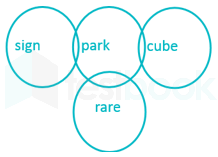
The least possible diagram is shown below:

Conclusion:

I. No date is a visit → True (All dates are appointment and no appointment is visit)

II. All months being appointment is a possibility → False (only a few visits are months so, the part of month that is visit can never be appointment)

Hence, only I follow.

7

Directions: In the question below are given three statements followed by two conclusions numbered I and II. You have to take the given statements to be true even if they seem to be at variance with commonly known facts. Read all the conclusions and then decide which of the given conclusions logically follows from the given statements disregarding commonly known facts.

Statements:

Some sign are park.

Some cube are park.

Some park are rare.

Conclusion:

I. Some sign are rare.

II. Some cube are rare.

  1. ((a))

    None follows

  2. ((b))

    Only I follows

  3. ((c))

    Only II follows

  4. ((d))

    Both I & II follow

  5. ((e))

    Either I or II follows

Show Answer
Answer: ((a))

None follows

The least possible Venn diagram for the given statements is as follows,

Conclusion:

I. Some sign are rare → It is possible but not definite in least possible Venn diagram. Hence, it is False.

II. Some cube are rare → It is possible but not definite in least possible Venn diagram. Hence, it is False.

Hence, none follows.

8

Directions: Directions: In the question below are given three statements followed by two conclusions numbered I and II. You have to take the given statements to be true even if they seem to be at variance with commonly known facts. Read all the conclusions and then decide which of the given conclusions logically follows from the given statements disregarding commonly known facts.

Statements:

All wings are summer.

Some summer are soap.

No soap is an ant.

Conclusion:

I. At least some wing are soap.

II. Some ant being summer is a possibility.

  1. ((a))

    None follows

  2. ((b))

    Only I follows

  3. ((c))

    Only II follows

  4. ((d))

    Both I & II follow

  5. ((e))

    Either I or II follows

Show Answer
Answer: ((c))

Only II follows

The least possible Venn diagram for the given statements is as follows,

Conclusion:

I. At least some wing are soap → It is possible but not definite in least possible Venn diagram. Hence, it is false.

II. Some ant being summer is a possibility → the possibility is true.

Hence, only conclusion II follows.

9

Directions: In the following question assuming the given statements to be true, find which of the conclusion among the given two conclusion(s) is /are definitely true and then give your answers accordingly.

Statements:

P ≤ Q > R ≥ S; T > R < X

Conclusions:

I. X > S

II. T < P

  1. ((a))

    Only conclusion I follows.

  2. ((b))

    Only conclusion I & II follow.

  3. ((c))

    Only conclusion II follow.

  4. ((d))

    Either I or II follows.

  5. ((e))

    Neither conclusion I nor conclusion II follows.

Show Answer
Answer: ((a))

Only conclusion I follows.

Given statements: P ≤ Q > R ≥ S; T > R < X

Conclusions:

I. X > S → True (As S ≤ R < X) 

II. T < P → False (As P ≤ Q > R < T; no clear relation can be detected between T and P)

Hence, the only conclusion I follows.

10

Directions: In the following question assuming the given statements to be true, find which of the conclusion among the given two conclusion(s) is /are definitely true and then give your answers accordingly.

Statements:

K ≤ U = J ≥ H  ≥ W < B

Conclusions:

I. K < B

II. U  ≥ W

  1. ((a))

    Only conclusion I follows.

  2. ((b))

    Only conclusion I & II follow.

  3. ((c))

    Only conclusion II follow.

  4. ((d))

    Either I or II follows.

  5. ((e))

    Neither conclusion I nor conclusion II follows.

Show Answer
Answer: ((c))

Only conclusion II follow.

Given statements: K ≤ U = J ≥ H  ≥ W < B

Conclusions:

I. K < B → False (As K ≤ U = J ≥ H  ≥ W < B; no clear relation can be detected between K and B) 

II. U ≥ W → True (As U = J ≥ H  ≥ W)

Hence, the only conclusion II follows.

11

Directions: In the following question assuming the given statements to be true, find which of the conclusion among the given two conclusion(s) is /are definitely true and then give your answers accordingly.

Statements:

A < B < C ≤ D; E ≥ B ≥ F

Conclusions:

I. F < D

II. E > A

  1. ((a))

    Only conclusion I follows

  2. ((b))

    Both I and II follow

  3. ((c))

    Only conclusion II follow

  4. ((d))

    Either I or II follows

  5. ((e))

    Neither conclusion I nor conclusion II follows

Show Answer
Answer: ((b))

Both I and II follow

Given statements: A < B < C ≤ D; E ≥ B ≥ F

Conclusions:

I. F < D → True (As F ≤ B < C < D) 

II. E > A → True (As E ≥ B > A)

Hence, both I and II follow.

Direction: Read the following instruction carefully and answer the questions that follow:

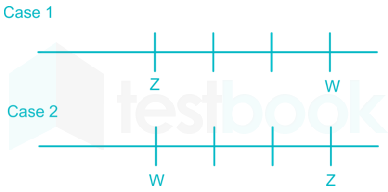
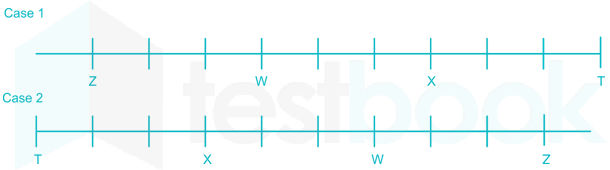
Certain people are sitting in a row facing North. There are as many people to the right of Z as there are to the left of Z. Y is third to the left of U who sits fourth from one of the extreme ends of the row. T sits at one of the extreme ends of the row. There are five persons sitting between T and W. X sits exactly in the middle of T and W. Two persons sits between W and Z. Y does not sit at one of the extreme ends of the row. There are as many persons sitting between Y and V as many are sitting between W and Y.

12

Who is sitting sixth to the right of X?

  1. ((a))

    Z

  2. ((b))

    V

  3. ((c))

    X

  4. ((d))

    T

  5. ((e))

    U

Show Answer
Answer: ((a))

Z

  1. There are as many people to the right of Z as there are to the left of Z.

  2. Two persons sit between W and Z.

  1. There are five persons sitting between T and W.

  2. X sits exactly in the middle of T and W.

  3. T sits at one of the extreme ends of the row.

  1. Y is third to the left of U who sits fourth from one of the extreme ends of the row.

  2. Y does not sit at one of the extreme ends of the row.

This eliminates Case 1.

  1. There are as many persons sitting between Y and V as many are sitting between W and Y.

Hence, Z sits sixth to the right of X.

13

Who is sitting exactly in the middle of Z and U?

  1. ((a))

    Y

  2. ((b))

    Z

  3. ((c))

    U

  4. ((d))

    V

  5. ((e))

    Cannot be determined

Show Answer
Answer: ((a))

Y

  1. There are as many people to the right of Z as there are to the left of Z.

  2. Two persons sit between W and Z.

  1. There are five persons sitting between T and W.

  2. X sits exactly in the middle of T and W.

  3. T sits at one of the extreme ends of the row.

  1. Y is third to the left of U who sits fourth from one of the extreme ends of the row.

  2. Y does not sit at one of the extreme ends of the row.

This eliminates Case 1.

  1. There are as many persons sitting between Y and V as many are sitting between W and Y.

Hence, Y is sitting exactly in the middle of Z and U.

14

How many persons are sitting in the row?

  1. ((a))

    20

  2. ((b))

    21

  3. ((c))

    24

  4. ((d))

    19

  5. ((e))

    17

Show Answer
Answer: ((d))

19

  1. There are as many people to the right of Z as there are to the left of Z.

  2. Two persons sit between W and Z.

  1. There are five persons sitting between T and W.

  2. X sits exactly in the middle of T and W.

  3. T sits at one of the extreme ends of the row.

  1. Y is third to the left of U who sits fourth from one of the extreme ends of the row.

  2. Y does not sit at one of the extreme ends of the row.

This eliminates Case 1.

  1. There are as many persons sitting between Y and V as many are sitting between W and Y.

Hence, there are 19 persons sitting in the row.

Direction: Study the following information carefully and answer the given questions:

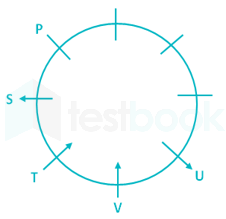
Eight persons P, Q, R, S, T, U, V and W are sitting around a circular table, not all of them are facing the centre of table. V, who is facing the centre is second to the left of S and is to the right of U. P’s is opposite to U and S is not adjacent to U. R is third to the left of U. Q is second to the right of P but is not third to the right of V. T is sitting between S and V but is not the neighbour of R. No three consecutive persons are facing either towards the centre or are away from the centre. If two persons face the same direction, they both either face the centre or away from the centre. If two persons face different directions, then if one faces the centre, the other faces away from the centre.

15

Who is sitting second to the left of V?

  1. ((a))

    U

  2. ((b))

    W

  3. ((c))

    S

  4. ((d))

    P

  5. ((e))

    None of these

Show Answer
Answer: ((b))

W

Person: P, Q, R, S, T, U, V and W

  1. V, who is facing the centre is second to the left of S and is to the right of U.

(In circular arrangement right means immediate right.)

  1. No three consecutive persons are facing either towards the centre or are away from the centre.
  2. P’s is opposite to U and S is not adjacent to U.
  3. T is sitting between S and V but is not the neighbour of R.

Two possibilities arise:

Case (i):

Case (ii):

  1. R is third to the left of U.
  2. Q is second to the right of P but is not third to the right of V.

(Case (i) will be eliminated as there would not be any place left for Q.)

Hence, only case (ii) is left.

(The remaining position is occupied by W.

As P and S are facing towards the centre, R must be facing away from the centre.

As R and W are facing away from the centre, Q must be facing towards the centre.)

The final figure is shown below.

Clearly, W is sitting second to the left of V.

16

Which direction is W facing?

  1. ((a))

    Towards the centre

  2. ((b))

    Away from the centre

  3. ((c))

    Same direction as S is facing

  4. ((d))

    Same direction as P is facing

  5. ((e))

    None of these

Show Answer
Answer: ((b))

Away from the centre

Person: P, Q, R, S, T, U, V and W

  1. V, who is facing the centre is second to the left of S and is to the right of U.

(In circular arrangement right means immediate right.)

  1. No three consecutive persons are facing either towards the centre or are away from the centre.
  2. P’s is opposite to U and S is not adjacent to U.
  3. T is sitting between S and V but is not the neighbour of R.

Two possibilities arise:

Case (i):

Case (ii):

  1. R is third to the left of U.
  2. Q is second to the right of P but is not third to the right of V.

(Case (i) will be eliminated as there would not be any place left for Q.)

Hence, only case (ii) is left.

(The remaining position is occupied by W.

As P and S are facing towards the centre, R must be facing away from the centre.

As R and W are facing away from the centre, Q must be facing towards the centre.)

The final figure is shown below.

Clearly, W is facing away from the centre.

17

Who is sitting to the opposite of S?

  1. ((a))

    U

  2. ((b))

    Q

  3. ((c))

    R

  4. ((d))

    W

  5. ((e))

    V

Show Answer
Answer: ((d))

W

Person: P, Q, R, S, T, U, V and W

  1. V, who is facing the centre is second to the left of S and is to the right of U.

(In circular arrangement right means immediate right.)

  1. No three consecutive persons are facing either towards the centre or are away from the centre.
  2. P’s is opposite to U and S is not adjacent to U.
  3. T is sitting between S and V but is not the neighbour of R.

Two possibilities arise:

Case (i):

Case (ii):

  1. R is third to the left of U.
  2. Q is second to the right of P but is not third to the right of V.

(Case (i) will be eliminated as there would not be any place left for Q.)

Hence, only case (ii) is left.

(The remaining position is occupied by W.

As P and S are facing towards the centre, R must be facing away from the centre.

As R and W are facing away from the centre, Q must be facing towards the centre.)

The final figure is shown below.

Clearly, W is sitting in the position opposite that of S.

18

Who is sitting third to the right of U?

  1. ((a))

    P

  2. ((b))

    S

  3. ((c))

    R

  4. ((d))

    Q

  5. ((e))

    T

Show Answer
Answer: ((b))

S

Person: P, Q, R, S, T, U, V and W

  1. V, who is facing the centre is second to the left of S and is to the right of U.

(In circular arrangement right means immediate right.)

  1. No three consecutive persons are facing either towards the centre or are away from the centre.
  2. P’s is opposite to U and S is not adjacent to U.
  3. T is sitting between S and V but is not the neighbour of R.

Two possibilities arise:

Case (i):

Case (ii):

  1. R is third to the left of U.
  2. Q is second to the right of P but is not third to the right of V.

(Case (i) will be eliminated as there would not be any place left for Q.)

Hence, only case (ii) is left.

(The remaining position is occupied by W.

As P and S are facing towards the centre, R must be facing away from the centre.

As R and W are facing away from the centre, Q must be facing towards the centre.)

The final figure is shown below.

Clearly, S is sitting third to the right of U.

19

Who, among the following, are immediate neighbours?

  1. ((a))

    P and T

  2. ((b))

    T and U

  3. ((c))

    P and R

  4. ((d))

    V and W

  5. ((e))

    Cannot be determined

Show Answer
Answer: ((c))

P and R

Person: P, Q, R, S, T, U, V and W

  1. V, who is facing the centre is second to the left of S and is to the right of U.

(In circular arrangement right means immediate right.)

  1. No three consecutive persons are facing either towards the centre or are away from the centre.
  2. P’s is opposite to U and S is not adjacent to U.
  3. T is sitting between S and V but is not the ​neighbour of R.

Two possibilities arise:

Case (i):

Case (ii):

  1. R is third to the left of U.
  2. Q is second to the right of P but is not third to the right of V.

(Case (i) will be eliminated as there would not be any place left for Q.)

Hence, only case (ii) is left.

(The remaining position is occupied by W.

As P and S are facing towards the centre, R must be facing away from the centre.

As R and W are facing away from the centre, Q must be facing towards the centre.)

The final figure is shown below.

Clearly, P and R are immediate neighbours.

Direction: These questions are based on the following information.

P’s mother is the sister of R who is Q’s daughter. R’s brother-in-law has only one son whose grandparents are Q and S, and they have only two daughters. A’s husband B is Q’s son-in-law.

20

Who is B’s mother-in-law?

  1. ((a))

    P

  2. ((b))

    Q

  3. ((c))

    S

  4. ((d))

    B

  5. ((e))

    Cannot be determined

Show Answer
Answer: ((e))

Cannot be determined

From the given information,

  1. P’s mother is R’s sister.

  2. R is Q’s daughter.

  3. R’s brother-in-law has only one son whose grandparents are Q and S who have only two daughters.

  4. A’s husband is B.

As the gender of Q and S is not specified here, we cannot determine B’s mother-in-law.

21

What is the relation between Q and A?

  1. ((a))

    Father-in law and son-in-law

  2. ((b))

    Father and daughter

  3. ((c))

    Father/Mother and daughter

  4. ((d))

    Mother and daughter

  5. ((e))

    Cannot be determined

Show Answer
Answer: ((c))

Father/Mother and daughter

From the given information,

  1. P’s mother is R’s sister.

  2. R is Q’s daughter.

  3. R’s brother-in-law has only one son whose grandparents are Q and S who have only two daughters.

  4. A’s husband is B.

Here, the gender of Q is not specified,

Hence, Q can be the mother or the father of A.

Hence, the relation between Q and A will be ‘Father/Mother and daughter.

There are seven boxes A, B, C, D, E, F and G. They are kept one above the other. They are of different colour i.e. Purple, Red, Blue, Yellow, Green, White and Black. They all contain different number of balls i.e. 4, 7, 9, 11, 12, 15 and 16.

There are three boxes between the box D and box G. Box D is of Red colour. Box White is placed immediately below the Red colour box. There are four boxes placed between the box which is of Blue colour and the box which is of White colour. The box which is placed at the top has number of balls which is perfect square of even number. Box having 12 balls is immediately below the box having 4 balls. Sum of balls in box A and box C is 24. Box F is placed immediately above the box D. Difference of balls in box C and box F is 8. There are two boxes between box E and box A. Difference of balls in box E and box G is 5. Box E is not of Blue colour. There are two boxes placed between the box which is of Purple colour and Yellow colour. Box which is of Black colour is placed immediately below Yellow colour box.

22

How many balls does Purple colour box contain?

  1. ((a))

    6

  2. ((b))

    11

  3. ((c))

    16

  4. ((d))

    15

  5. ((e))

    7

Show Answer
Answer: ((c))

16

There are three boxes between the box D and box G.

  1. Box D is of Red colour.
  2. Box White is placed immediately below the Red colour box.
  3. There are four boxes placed between the box which is of Blue colour and the box which is of White colour.

Case 1:

BoxColourNumber of balls
GBlue
DRed
White


Case 2:

BoxColourNumber of balls
DRed
White
G
Blue


  1. Box F is placed immediately above the box D. (Case 2 will be eliminated)
  2. There are two boxes placed between the box which is of Purple colour and Yellow colour.
  3. Box which is of Black colour is placed immediately below Yellow colour box.
  4. The box which is placed at the top has number of balls which is perfect square of even number.

Case 1:

BoxColourNumber of balls
Purple4 / 16
GBlue
Yellow
FBlack
DRed
White


  1. Sum of balls in box A and box C is 24.
  2. Difference of balls in box C and box F is 8.
  3. Difference of balls in box E and box G is 5.

(From statement 9, 10 and 11 we have number of balls in boxes C= 15, A=9, F=7, E=16 and G=11.)

BoxColourNumber of balls
Purple4 / 16
GBlue11
Yellow
FBlack7
DRed
White


  1. Box having 12 balls is immediately below the box having 4 balls.

Therefore, the box on the top i.e. E will contain 16 balls.

  1. There are two boxes between box E and box A.
BoxColourNumber of balls
EPurple16
GBlue11
CGreen15
AYellow9
FBlack7
DRed4
BWhite12


Hence, Purple colour box contain 16 balls.

23

What is the colour of box C?

  1. ((a))

    Black

  2. ((b))

    Yellow

  3. ((c))

    Blue

  4. ((d))

    Green

  5. ((e))

    Purple

Show Answer
Answer: ((d))

Green

There are three boxes between the box D and box G.

  1. Box D is of Red colour.
  2. Box White is placed immediately below the Red colour box.
  3. There are four boxes placed between the box which is of Blue colour and the box which is of White colour.

Case 1:

BoxColourNumber of balls
GBlue
DRed
White


Case 2:

BoxColourNumber of balls
DRed
White
G
Blue


  1. Box F is placed immediately above the box D. (Case 2 will be eliminated)
  2. There are two boxes placed between the box which is of Purple colour and Yellow colour.
  3. Box which is of Black colour is placed immediately below Yellow colour box.
  4. The box which is placed at the top has number of balls which is perfect square of even number.

Case 1:

BoxColourNumber of balls
Purple4 / 16
GBlue
Yellow
FBlack
DRed
White


  1. Sum of balls in box A and box C is 24.
  2. Difference of balls in box C and box F is 8.
  3. Difference of balls in box E and box G is 5.

(From statement 9, 10 and 11 we have number of balls in boxes C= 15, A=9, F=7, E=16 and G=11.)

BoxColourNumber of balls
Purple4 / 16
GBlue11
Yellow
FBlack7
DRed
White


  1. Box having 12 balls is immediately below the box having 4 balls.

Therefore, the box on the top i.e. E will contain 16 balls.

  1. There are two boxes between box E and box A.
BoxColourNumber of balls
EPurple16
GBlue11
CGreen15
AYellow9
FBlack7
DRed4
BWhite12


Hence, C is of Green colour.

24

Which box is placed immediately above box A?

  1. ((a))

    G

  2. ((b))

    C

  3. ((c))

    B

  4. ((d))

    D

  5. ((e))

    E

Show Answer
Answer: ((b))

C

There are three boxes between the box D and box G.

  1. Box D is of Red colour.
  2. Box White is placed immediately below the Red colour box.
  3. There are four boxes placed between the box which is of Blue colour and the box which is of White colour.

Case 1:

BoxColourNumber of balls
GBlue
DRed
White


Case 2:

BoxColourNumber of balls
DRed
White
G
Blue


  1. Box F is placed immediately above the box D. (Case 2 will be eliminated)
  2. There are two boxes placed between the box which is of Purple colour and Yellow colour.
  3. Box which is of Black colour is placed immediately below Yellow colour box.
  4. The box which is placed at the top has number of balls which is perfect square of even number.

Case 1:

BoxColourNumber of balls
Purple4 / 16
GBlue
Yellow
FBlack
DRed
White


  1. Sum of balls in box A and box C is 24.
  2. Difference of balls in box C and box F is 8.
  3. Difference of balls in box E and box G is 5.

(From statement 9, 10 and 11 we have number of balls in boxes C= 15, A=9, F=7, E=16 and G=11.)

BoxColourNumber of balls
Purple4 / 16
GBlue11
Yellow
FBlack7
DRed
White


  1. Box having 12 balls is immediately below the box having 4 balls.

Therefore, the box on the top i.e. E will contain 16 balls.

  1. There are two boxes between box E and box A.
BoxColourNumber of balls
EPurple16
GBlue11
CGreen15
AYellow9
FBlack7
DRed4
BWhite12


Hence, box C is placed immediately above box A.

25

Which colour box is placed immediately below Green colour box?

  1. ((a))

    Yellow

  2. ((b))

    Red

  3. ((c))

    Blue

  4. ((d))

    Black

  5. ((e))

    Purple

Show Answer
Answer: ((a))

Yellow

There are three boxes between the box D and box G.

  1. Box D is of Red colour.
  2. Box White is placed immediately below the Red colour box.
  3. There are four boxes placed between the box which is of Blue colour and the box which is of White colour.

Case 1:

BoxColourNumber of balls
GBlue
DRed
White


Case 2:

BoxColourNumber of balls
DRed
White
G
Blue


  1. Box F is placed immediately above the box D. (Case 2 will be eliminated)
  2. There are two boxes placed between the box which is of Purple colour and Yellow colour.
  3. Box which is of Black colour is placed immediately below Yellow colour box.
  4. The box which is placed at the top has number of balls which is perfect square of even number.

Case 1:

BoxColourNumber of balls
Purple4 / 16
GBlue
Yellow
FBlack
DRed
White


  1. Sum of balls in box A and box C is 24.
  2. Difference of balls in box C and box F is 8.
  3. Difference of balls in box E and box G is 5.

(From statement 9, 10 and 11 we have number of balls in boxes C= 15, A=9, F=7, E=16 and G=11.)

BoxColourNumber of balls
Purple4 / 16
GBlue11
Yellow
FBlack7
DRed
White


  1. Box having 12 balls is immediately below the box having 4 balls.

Therefore, the box on the top i.e. E will contain 16 balls.

  1. There are two boxes between box E and box A.
BoxColourNumber of balls
EPurple16
GBlue11
CGreen15
AYellow9
FBlack7
DRed4
BWhite12


Hence, Yellow coloured box is placed immediately below Green coloured box.

26

What is the sum of balls in box B and C?

  1. ((a))

    19

  2. ((b))

    27

  3. ((c))

    28

  4. ((d))

    16

  5. ((e))

    22

Show Answer
Answer: ((b))

27

There are three boxes between the box D and box G.

  1. Box D is of Red colour.
  2. Box White is placed immediately below the Red colour box.
  3. There are four boxes placed between the box which is of Blue colour and the box which is of White colour.

Case 1:

BoxColourNumber of balls
GBlue
DRed
White


Case 2:

BoxColourNumber of balls
DRed
White
G
Blue


  1. Box F is placed immediately above the box D. (Case 2 will be eliminated)
  2. There are two boxes placed between the box which is of Purple colour and Yellow colour.
  3. Box which is of Black colour is placed immediately below Yellow colour box.
  4. The box which is placed at the top has number of balls which is perfect square of even number.

Case 1:

BoxColourNumber of balls
Purple4 / 16
GBlue
Yellow
FBlack
DRed
White


  1. Sum of balls in box A and box C is 24.
  2. Difference of balls in box C and box F is 8.
  3. Difference of balls in box E and box G is 5.

(From statement 9, 10 and 11 we have number of balls in boxes C= 15, A=9, F=7, E=16 and G=11.)

BoxColourNumber of balls
Purple4 / 16
GBlue11
Yellow
FBlack7
DRed
White


  1. Box having 12 balls is immediately below the box having 4 balls.

Therefore, the box on the top i.e. E will contain 16 balls.

  1. There are two boxes between box E and box A.
BoxColourNumber of balls
EPurple16
GBlue11
CGreen15
AYellow9
FBlack7
DRed4
BWhite12


Hence, box B and C contain 27 balls together.

27

Sum of number of balls in which two boxes is highest?

  1. ((a))

    C and E

  2. ((b))

    C and G

  3. ((c))

    B and E

  4. ((d))

    C and B

  5. ((e))

    None of these

Show Answer
Answer: ((a))

C and E

There are three boxes between the box D and box G.

  1. Box D is of Red colour.
  2. Box White is placed immediately below the Red colour box.
  3. There are four boxes placed between the box which is of Blue colour and the box which is of White colour.

Case 1:

BoxColourNumber of balls
GBlue
DRed
White


Case 2:

BoxColourNumber of balls
DRed
White
G
Blue


  1. Box F is placed immediately above the box D. (Case 2 will be eliminated)
  2. There are two boxes placed between the box which is of Purple colour and Yellow colour.
  3. Box which is of Black colour is placed immediately below Yellow colour box.
  4. The box which is placed at the top has number of balls which is perfect square of even number.

Case 1:

BoxColourNumber of balls
Purple4 / 16
GBlue
Yellow
FBlack
DRed
White


  1. Sum of balls in box A and box C is 24.
  2. Difference of balls in box C and box F is 8.
  3. Difference of balls in box E and box G is 5.

(From statement 9, 10 and 11 we have number of balls in boxes C= 15, A=9, F=7, E=16 and G=11.)

BoxColourNumber of balls
Purple4 / 16
GBlue11
Yellow
FBlack7
DRed
White


  1. Box having 12 balls is immediately below the box having 4 balls.

Therefore, the box on the top i.e. E will contain 16 balls.

  1. There are two boxes between box E and box A.
BoxColourNumber of balls
EPurple16
GBlue11
CGreen15
AYellow9
FBlack7
DRed4
BWhite12


Hence, C and E is the correct answer.

28

How many boxes are kept between black colored box and the box containing 11 balls?

  1. ((a))

    4

  2. ((b))

    3

  3. ((c))

    2

  4. ((d))

    1

  5. ((e))

    None of these

Show Answer
Answer: ((c))

2

There are three boxes between the box D and box G.

  1. Box D is of Red colour.
  2. Box White is placed immediately below the Red colour box.
  3. There are four boxes placed between the box which is of Blue colour and the box which is of White colour.

Case 1:

BoxColourNumber of balls
GBlue
DRed
White


Case 2:

BoxColourNumber of balls
DRed
White
G
Blue


  1. Box F is placed immediately above the box D. (Case 2 will be eliminated)
  2. There are two boxes placed between the box which is of Purple colour and Yellow colour.
  3. Box which is of Black colour is placed immediately below Yellow colour box.
  4. The box which is placed at the top has number of balls which is perfect square of even number.

Case 1:

BoxColourNumber of balls
Purple4 / 16
GBlue
Yellow
FBlack
DRed
White


  1. Sum of balls in box A and box C is 24.
  2. Difference of balls in box C and box F is 8.
  3. Difference of balls in box E and box G is 5.

(From statement 9, 10 and 11 we have number of balls in boxes C= 15, A=9, F=7, E=16 and G=11.)

BoxColourNumber of balls
Purple4 / 16
GBlue11
Yellow
FBlack7
DRed
White


  1. Box having 12 balls is immediately below the box having 4 balls.

Therefore, the box on the top i.e. E will contain 16 balls.

  1. There are two boxes between box E and box A.
BoxColourNumber of balls
EPurple16
GBlue11
CGreen15
AYellow9
FBlack7
DRed4
BWhite12


Hence 2 is the correct answer.

29

How many such pairs of letters are there in the word DYNAMIC each of which has as many letters between them in the word (in forward and backward direction) as they have between them in the English alphabetical order?

  1. ((a))

    None

  2. ((b))

    One

  3. ((c))

    Three

  4. ((d))

    Two

  5. ((e))

    More than three.

Show Answer
Answer: ((d))

Two

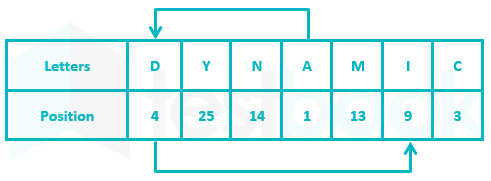
The given word is DYNAMIC,

Hence, two pairs of letters (DI, AD) are there in the word DYNAMIC each of which has as many letters between them in the word (in forward and backward direction) as they have between them in the English alphabetical order.

30

In a certain coding language, 'BOUGHT' is coded as 'APVHIS', and 'EATING' is coded as 'DBUJOF', then how 'GROUND' can be coded in the given coding language?

  1. ((a))

    FSPVOV

  2. ((b))

    FPVSOC

  3. ((c))

    FPSVOC

  4. ((d))

    FSPVOC

  5. ((e))

    FSPVOU

Show Answer
Answer: ((d))

FSPVOC

Hence, 'GROUND’ can be coded as ‘FSPVOC’.

Direction: Read the following information carefully and answer the questions that follow:

Seven people P, Q, R, S, T, U, and V have to attend a seminar on seven different days of the same week starting from Monday and ending on Sunday, but not necessarily in the same order.

Q attends a seminar on Thursday. Only one person attends the seminar between R and S. U attends the seminar after S. Only one person attends the seminar between Q and V. The number of people who attend the seminar before P is same as the number of people who attend the seminar after R. P attends the seminar immediately after V.

31

On which of the following days does T have to attend the seminar?

  1. ((a))

    Sunday

  2. ((b))

    Monday

  3. ((c))

    Tuesday

  4. ((d))

    Wednesday

  5. ((e))

    Friday

Show Answer
Answer: ((c))

Tuesday

Persons: P, Q, R, S, T, U, and V.

  1. Q attends a seminar on Thursday.

  2. Only one person attends the seminar between Q and V.

  3. P attends seminar immediately after V.

Case 1:

PersonsDays
Monday
Tuesday
Wednesday
QThursday
Friday
VSaturday
PSunday


Case 2:

PersonsDays
Monday
VTuesday
PWednesday
QThursday
Friday
Saturday
Sunday


  1. The number of people who attend a seminar before P is the same as the number of people who attend the seminar after R.

Case 1:

PersonsDays
RMonday
Tuesday
Wednesday
QThursday
Friday
VSaturday
PSunday


Case 2:

PersonsDays
Monday
VTuesday
PWednesday
QThursday
RFriday
Saturday
Sunday


  1. Only one person attends a seminar between R and S.

  2. U attends the seminar after S.

This is not possible in case 2. So, case 1 is correct.

PersonsDays
RMonday
TTuesday
SWednesday
QThursday
UFriday
VSaturday
PSunday


Hence, T attends the seminar on Tuesday.

32

Who among the following has to attend the seminar on Saturday?

  1. ((a))

    U

  2. ((b))

    V

  3. ((c))

    T

  4. ((d))

    P

  5. ((e))

    Q

Show Answer
Answer: ((b))

V

Persons: P, Q, R, S, T, U, and V.

  1. Q attends a seminar on Thursday.

  2. Only one person attends a seminar between Q and V.

  3. P attends seminar immediately after V.

Case 1:

PersonsDays
Monday
Tuesday
Wednesday
QThursday
Friday
VSaturday
PSunday


Case 2:

PersonsDays
Monday
VTuesday
PWednesday
QThursday
Friday
Saturday
Sunday


  1. The number of people who attend a seminar before P is the same as who attend the seminar after R.

Case 1:

PersonsDays
RMonday
Tuesday
Wednesday
QThursday
Friday
VSaturday
PSunday


Case 2:

PersonsDays
Monday
VTuesday
PWednesday
QThursday
RFriday
Saturday
Sunday


  1. Only one person attends a seminar between R and S.

  2. U attends seminar after S.

This is not possible in case 2. So, case 1 is correct.

PersonsDays
RMonday
TTuesday
SWednesday
QThursday
UFriday
VSaturday
PSunday


Hence, V attends the seminar on Saturday.

33

If every person is made to attend the seminar in alphabetical order from Monday to Sunday, the day of attending the seminar of how many people will remain unchanged?

  1. ((a))

    None

  2. ((b))

    One

  3. ((c))

    Two

  4. ((d))

    Three

  5. ((e))

    Four

Show Answer
Answer: ((a))

None

Persons: P, Q, R, S, T, U, and V.

  1. Q attends a seminar on Thursday.

  2. Only one person attends the seminar between Q and V.

  3. P attends seminar immediately after V.

Case 1:

PersonsDays
Monday
Tuesday
Wednesday
QThursday
Friday
VSaturday
PSunday


Case 2:

PersonsDays
Monday
VTuesday
PWednesday
QThursday
Friday
Saturday
Sunday


  1. The number of people who attend the seminar before P is the same as who attend the seminar after R.

Case 1:

PersonsDays
RMonday
Tuesday
Wednesday
QThursday
Friday
VSaturday
PSunday


Case 2:

PersonsDays
Monday
VTuesday
PWednesday
QThursday
RFriday
Saturday
Sunday


  1. Only one person attends the seminar between R and S.

  2. U attends the seminar after S.

This is not possible in case 2. So, case 1 is correct.

PersonsDays
RMonday
TTuesday
SWednesday
QThursday
UFriday
VSaturday
PSunday


Hence, the position of nobody remains unchanged.

34

On which of the following days does S have to attend the seminar?

  1. ((a))

    Monday

  2. ((b))

    Tuesday

  3. ((c))

    Wednesday

  4. ((d))

    Thursday

  5. ((e))

    Friday

Show Answer
Answer: ((c))

Wednesday

Persons: P, Q, R, S, T, U, and V.

  1. Q attends the seminar on Thursday.

  2. Only one person attends the seminar between Q and V.

  3. P attends the seminar immediately after V.

Case 1:

PersonsDays
Monday
Tuesday
Wednesday
QThursday
Friday
VSaturday
PSunday


Case 2:

PersonsDays
Monday
VTuesday
PWednesday
QThursday
Friday
Saturday
Sunday


  1. The number of people who attend the seminar before P is the same as who attend the seminar after R.

Case 1:

PersonsDays
RMonday
Tuesday
Wednesday
QThursday
Friday
VSaturday
PSunday


Case 2:

PersonsDays
Monday
VTuesday
PWednesday
QThursday
RFriday
Saturday
Sunday


  1. Only one person attends the seminar between R and S.

  2. U attends the seminar after S.

This is not possible in case 2. So, case 1 is correct.

PersonsDays
RMonday
TTuesday
SWednesday
QThursday
UFriday
VSaturday
PSunday


Hence, S attends the seminar on Wednesday.

35

Who among the following has to attend the seminar on Saturday?

  1. ((a))

    T

  2. ((b))

    V

  3. ((c))

    U

  4. ((d))

    S

  5. ((e))

    P

Show Answer
Answer: ((b))

V

Persons: P, Q, R, S, T, U, and V.

  1. Q attends a seminar on Thursday.

  2. Only one person attends the seminar between Q and V.

  3. P attends the seminar immediately after V.

Case 1:

PersonsDays
Monday
Tuesday
Wednesday
QThursday
Friday
VSaturday
PSunday


Case 2:

PersonsDays
Monday
VTuesday
PWednesday
QThursday
Friday
Saturday
Sunday


  1. The number of people who attend the seminar before P is the same as who attend the seminar after R.

Case 1:

PersonsDays
RMonday
Tuesday
Wednesday
QThursday
Friday
VSaturday
PSunday


Case 2:

PersonsDays
Monday
VTuesday
PWednesday
QThursday
RFriday
Saturday
Sunday


  1. Only one person attends the seminar between R and S.

  2. U attends the seminar after S.

This is not possible in case 2. So, case 1 is correct.

PersonsDays
RMonday
TTuesday
SWednesday
QThursday
UFriday
VSaturday
PSunday


Hence, V attends the seminar on Saturday.

Quantitative Aptitude (35 questions)

36

Directions: In the following questions two equations numbered I and II are given. You have to solve both the equations and Give answer:

I. 2x2 – 9x + 9 = 0

II. 2y2 – 9y + 10 = 0

  1. ((a))

    If x > y

  2. ((b))

    If x ≥ y

  3. ((c))

    If x < y

  4. ((d))

    If x ≤ y

  5. ((e))

    If x = y or the relationship cannot be established

Show Answer
Answer: ((e))

If x = y or the relationship cannot be established

I. 2x2 – 9x + 9 = 0

2x2 – 6x - 3x + 9 = 0

2x(x – 3) - 3 (x – 3) = 0

(x - 3) (2x - 3) = 0

x = 3, 3/2

II. 2y2 – 9y + 10 = 0

2y2 – 4y - 5y + 10 = 0

2y(y - 2) - 5(y - 2) = 0

y = 2, 5/2

When x = 3 and y = 2 then x > y

When x = 3 and y = 5/2 then x > y

When x = 3 /2 and y = 2 then x < y

When x = 3/2 and y = 5/2 then x < y

So the relationship cannot be established.

37

Directions: In the following questions two equations numbered I and II are given. You have to solve both the equations and Give answer:

I. x2 – 11x + 24 = 0

II. y2 + 4y – 12 = 0

  1. ((a))

    If x > y

  2. ((b))

    If x ≥ y

  3. ((c))

    If x < y

  4. ((d))

    If x ≤ y

  5. ((e))

    If x = y or the relationship cannot be established

Show Answer
Answer: ((a))

If x > y

I. x2 – 11x + 24 = 0

x(x – 8) – 3(x – 8) = 0

(x – 8) (x – 3)

x = 8, 3

II. y2 + 4y – 12 = 0

y(y + 6) – 2(y + 6) = 0

(y + 6) (y – 2) = 0

y = 2, -6

When x = 8 and y = 2 then x > y

When x = 8 and y = -6 then x > y

When x = 3 and y = 2 then x > y

When x = 3 and y = -6 then x > y

Hence, x > y

38

Directions: In the following questions two equations numbered I and II are given. You have to solve both the equations and Give answer:

I. x2 + 2x = 0

​​II. y+4+4y=0y + 4 + \frac{4}{y} = 0

  1. ((a))

    If x > y

  2. ((b))

    If x ≥ y

  3. ((c))

    If x < y

  4. ((d))

    If x ≤ y

  5. ((e))

    If x = y or the relationship cannot be established

Show Answer
Answer: ((b))

If x ≥ y

I. x2 + 2x = 0

⇒ x(x + 2) = 0

⇒ x = -2, 0

II. ​y+4+4y=0y + 4 + \frac{4}{y} = 0

⇒ y(y + 2) + 2(y + 2) = 0

⇒ y = -2,

When x = 0 and y = -2 then x > y

When x = -2 and y = -2 then x = y

∴ x ≥ y

39

Directions: In the following questions two equations numbered I and II are given. You have to solve both the equations and Give answer:

I. 3y + 18 = 50 – 5y

II. x2 = 16

  1. ((a))

    If x > y

  2. ((b))

    If x ≥ y

  3. ((c))

    If x < y

  4. ((d))

    If x ≤ y

  5. ((e))

    If x = y or the relationship cannot be established

Show Answer
Answer: ((d))

If x ≤ y

I. 3y + 18 = 50 – 5y

8y = 32

y = 4

II. x2 = 16

x = ± 4

When x = 4 and y = 4 then x = y

When x = -4 and y = 4 then x < y

So x ≤ y

40

Directions: In the following questions two equations numbered I and II are given. You have to solve both the equations and Give answer:

I. x2 + 2x – 3 = 0

II. y2 + 6y + 8 = 0

  1. ((a))

    If x > y

  2. ((b))

    If x ≥ y

  3. ((c))

    If x < y

  4. ((d))

    If x ≤ y

  5. ((e))

    If x = y or the relationship cannot be established

Show Answer
Answer: ((e))

If x = y or the relationship cannot be established

I. x2 + 2x – 3 = 0

x(x + 3) - 1(x + 3) = 0

(x + 3) (x - 1) = 0

x = -3, 1

II. y2 + 6y + 8 = 0

y(y + 4) + 2(y + 4) = 0

y = -2, -4

When x = -3 and y = -2 then x < y

When x = -3 and y = -4 then x > y

When x = 1 and y = -2 then x > y

When x = 1 and y = -4 then x > y

So, the relationship cannot be established.

41

Direction: Find the missing term in the series.

7, 16, 34, 70, ?, 286

  1. ((a))

    136

  2. ((b))

    142

  3. ((c))

    138

  4. ((d))

    132

  5. ((e))

    128

Show Answer
Answer: ((b))

142

7 × 2 + 2 = 16

16 × 2 + 2 = 34

34 × 2 + 2 = 70

70 × 2 + 2 = 142

142 × 2 + 2 = 286

42

Direction: Find the missing term in the series.

77, 82, 72, 87, 67, ?

  1. ((a))

    91

  2. ((b))

    90

  3. ((c))

    92

  4. ((d))

    93

  5. ((e))

    None of these

Show Answer
Answer: ((c))

92

77 + 5 = 82

82 – 10 = 72

72 + 15 = 87

87 – 20 = 67

67 + 25 = 92

43

Direction: Find the missing term in the series.

5, 12, 24, 40, 59, ?

  1. ((a))

    81

  2. ((b))

    83

  3. ((c))

    82

  4. ((d))

    80

  5. ((e))

    None of these

Show Answer
Answer: ((d))

80

12 – 5 = 7

24 – 12 = 12 (7 + 5)

40 – 24 = 16 (12 + 4)

59 – 40 = 19 (16 + 3)

80 – 59 = 21 (19 + 2)

44

Direction: Find the missing term in the series.

17, 22, 39, 76, 141, ?

  1. ((a))

    242

  2. ((b))

    142

  3. ((c))

    240

  4. ((d))

    342

  5. ((e))

    178

Show Answer
Answer: ((a))

242

17          22          39          76          141          242

     +5          +17          +37        +65        +101

           +12          +20         +28        +36

                    +8           +8           +8

45

Direction: Find the missing term in the series.

14, 37, 64, 95, ?, 169

  1. ((a))

    130

  2. ((b))

    135

  3. ((c))

    139

  4. ((d))

    140

  5. ((e))

    120

Show Answer
Answer: ((a))

130

14 + 23 = 37

37 + 27 = 64

64 + 31 = 95 

95 + 35 = 130

130 + 39 = 169

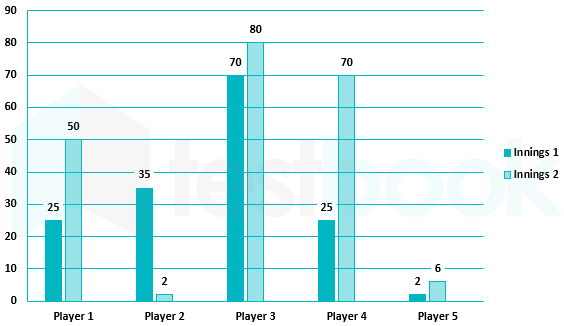
The following bar graph shows the runs scored by different players of a team in the two innings of a test match.

46

Total runs scored by player 1 in both innings is by what percent much more/less than the player 4 in both innings (round off digit)?

  1. ((a))

    25% less

  2. ((b))

    20% more

  3. ((c))

    50% more

  4. ((d))

    21% less

  5. ((e))

    Both have scored same runs.

Show Answer
Answer: ((d))

21% less

Total runs scored by player 1 in both innings = 25 + 50 = 75

Total runs scored by player 4 in both innings = 25 + 70 = 95

Player 1 scored = 95 - 75 = 20

Player 1 scored = (20/95) × 100 = 21.05 % less

47

Which player has scored the highest runs in both innings?

  1. ((a))

    Player 2

  2. ((b))

    Player 5

  3. ((c))

    Player 1

  4. ((d))

    Player 3

  5. ((e))

    Player 4

Show Answer
Answer: ((d))

Player 3

Player 1 = 25 + 50 = 75

Player 2 = 35 + 2 = 37

Player 3 = 70 + 80 = 150

Player 4 = 25 + 70 = 95

Player 5 = 2 + 6 = 8

48

Runs scored by player 1 in innings 2 is by what percent more/less than innings 1?

  1. ((a))

    50% more

  2. ((b))

    75% less

  3. ((c))

    40% more

  4. ((d))

    25% less

  5. ((e))

    100% more

Show Answer
Answer: ((e))

100% more

Runs scored by Player 1 in innings 2 = 50

Runs scored by Player 1 in innings 1 = 25

% Difference = {(50 - 25)/25} × 100 = 100% more

49

Find the average runs scored by all the players in innings 1?

  1. ((a))

    24.6

  2. ((b))

    31.4

  3. ((c))

    45

  4. ((d))

    25

  5. ((e))

    35.8

Show Answer
Answer: ((b))

31.4

Total runs scored by all the five players in innings 1 = 25 + 35 + 70 + 25 + 2 = 157

Average = 157/5 = 31.4

50

How many players scored more runs than the average runs scored in innings 2?

  1. ((a))

    4

  2. ((b))

    0

  3. ((c))

    2

  4. ((d))

    3

  5. ((e))

    1

Show Answer
Answer: ((d))

3

Average runs scored in innings 2 = (50 + 2 + 80 + 70 + 6)/5 = 41.6

Player 1, Player 3, Player 4 scored more runs than the average.

51

Directions: Each question below is followed by two statements I and II. You have to determine whether the data given in the statement is sufficient for answering the question. You should use the data and your knowledge of Mathematics to choose the best possible answer.

What is the average age of employees?

I. Age of manager is equal to number of employees in the firm.

II. Average age is increased by 2 when manager’s age is added in total age of employees.

  1. ((a))

    If the data given in the statement I alone is sufficient to answer the question whereas the data given in statement II alone is not sufficient to answer the question.

  2. ((b))

    If the data given in the statement II alone is sufficient to answer the question whereas the data given in statement I alone is not sufficient to answer the question.

  3. ((c))

    If the data in either statement I alone or in statement II alone is sufficient to answer the question.

  4. ((d))

    If the data in both the statements I & II is not sufficient to answer the question.

  5. ((e))

    If the data given in both the statements I & II is necessary to answer the question.

Show Answer
Answer: ((d))

If the data in both the statements I & II is not sufficient to answer the question.

By checking each statement individually-

Statement I-

Age of manager is equal to number of employees in the firm.

As we don’t know about number of employees or age of employees; therefore, statement I alone is not sufficient to find average ages of employees.

Statement II-

Average age is increased by 2 when manager’s age is added in total age of employees.

Let the number of employees be x .

∴ Age of manager will be x years.

Let the average age of employees be y years.

∴ From statement II-

Average age of (x + 1) people = y + 2

As there are more than 1 variable involved we cannot determine value of x or y.

∴ Statement II alone is not sufficient to find required answer.

52

Directions: Each question below is followed by two statements I and II. You have to determine whether the data given in the statement is sufficient for answering the question. You should use the data and your knowledge of Mathematics to choose the best possible answer.

Nehal, Mayur and Sujit are running a business firm in partnership. What is Nehal’s share in the profit earned by them if all three invested for same time period?

I. Nehal, Mayur and Sujit invested the amounts in the ratio 3 ∶ 9 ∶ 18.

II. Sujit’s share in the profit is Rs. 3618.

  1. ((a))

    Only I

  2. ((b))

    Only II

  3. ((c))

    Both I and II

  4. ((d))

    Either I or II

  5. ((e))

    Neither I nor II

Show Answer
Answer: ((c))

Both I and II

Considering both the statements,

Ratio of Nehal, Mayur and Sujit’s profit = Ratio of their investments = 3 ∶ 9 ∶ 18 = 1 ∶ 3 ∶ 6

Nehal’s profit/Sujit’s profit = 1/6

⇒ Nehal’s profit = 1/6 × 3618 = Rs. 603

∴ Both the statements are required to answer the question

53

Directions: Each question below is followed by two statements I and II. You have to determine whether the data given in the statement is sufficient for answering the question. You should use the data and your knowledge of Mathematics to choose the best possible answer.

A boat takes a total time of three hours to travel downstream from P and Q and upstream back from Q to P. What is the speed of the boat in still water?

I. The speed of the river current is 4 km per hour

II. The distance between P and Q is 16 km.

  1. ((a))

    I alone sufficient while II alone not sufficient to answer

  2. ((b))

    II alone sufficient while I alone not sufficient to answer

  3. ((c))

    Either I or II alone sufficient to answer

  4. ((d))

    Both I and II are sufficient to answer

  5. ((e))

    None of above

Show Answer
Answer: ((d))

Both I and II are sufficient to answer

From statement I,

Speed of the current = 4 km/hr.

From statement II,

PQ = 16 km

Considering both the statements,

Let the speed of the boat in still water be X km/hr.,

Downstream speed = speed in still water + speed of current = (X + 4) km/hr

Upstream speed = speed in still water - speed of current = (X - 4) km/hr

Total time = 16/(X + 4) + 16/(X - 4) = 3

⇒ 16X - 64 + 16X + 64 = 3X2 - 48

⇒ 3X2 - 32X - 48 = 0

⇒ 3X2 - 36X + 4X - 48 = 0

⇒ 3X(X - 12) + 4(X - 12) = 0

⇒ (X - 12)(3X + 4) = 0

⇒ X = 12, -4/3

⇒ Speed of boat in still water = 12 km/hr

∴ Both the statements are necessary to answer the question

54

Directions: Each question below is followed by two statements I and II. You have to determine whether the data given in the statement is sufficient for answering the question. You should use the data and your knowledge of Mathematics to choose the best possible answer.

What is the marked price of the book which was sold at a discounted price?

I. The marked price of the book is 36% above the cost price of the table. Two consecutive discounts were given while selling the table.

II. The book was sold for Rs. 567.8. The percentage of discount given for the second time while selling the table is three times the percentage of discount given for the first time while selling the table.

  1. ((a))

    The data in both statement I and II together are necessary to answer the question.

  2. ((b))

    The data either in statement I alone or in statement II alone are sufficient to answer the question.

  3. ((c))

    The data in both statement I and II together are not sufficient to answer the question.

  4. ((d))

    The data in statement II alone are sufficient to answer the question, while the data in statement I alone are not sufficient to answer the question.

  5. ((e))

    The data in statement I alone are sufficient to answer the question, while the data in statement II alone are not sufficient to answer the question.

Show Answer
Answer: ((c))

The data in both statement I and II together are not sufficient to answer the question.

Using statement I

Let,

The cost price is = Rs. x

∴ Marked price = Rs. 1.36x

Using statement II

Let,

The first discount percentage = y

∴ Second discount percentage = 3y

Total discount = Marked Price × (y/100) + Marked Price × (y/100) × (3y/100) = [1.36x × (y/100)] + [1.36x × (y/100) × (3y/100)]

∵ Selling price = Marked price - discount

567.8 = 1.36x - {[1.36x × (y/100)] + [1.36x × (y/100) × (3y/100)]}

Value of x and y can’t be found

∴ The data in both statement I and II together are not sufficient to answer the question

55

Directions: Each question below is followed by two statements I and II. You have to determine whether the data given in the statement is sufficient for answering the question. You should use the data and your knowledge of Mathematics to choose the best possible answer.

What is the total number of girls in the classroom?

I. The ratio of the number of boys to the number of girls in the classroom is 8 : 7.

II. The average marks of girls in the classroom is 15 less than the average marks of boys in the classroom. The average marks of all the students in the classroom is 64.

  1. ((a))

    The data in both statements I and II together are not sufficient to answer the question.

  2. ((b))

    The data either in statement I alone or in statement II alone are sufficient to answer the question.

  3. ((c))

    The data in statement I alone are sufficient to answer the question, while the data in statement II alone are not sufficient to answer the question.

  4. ((d))

    The data in statement II alone are sufficient to answer the question, while the data in statement I alone are not sufficient to answer the question.

  5. ((e))

    The data in both statement I and II together are necessary to answer the question.

Show Answer
Answer: ((a))

The data in both statements I and II together are not sufficient to answer the question.

Using statement I

The ratio of the number of boys to the number of girls in the classroom is 8 ∶ 7

∴ The number of boys and girls are 8m and 7m respectively.

∴ Total number of students = 7m + 8m = 15m

Let the average marks of boys be ‘n’.

Total marks of boys together = 8mn

Using statement II

The average marks of girls is 15 less than the average mark of boys

∴ Total marks of girls together = 7m (n - 15)

The average marks of all the students (both boys and girls) in the classroom is 64.

∴ Total marks of students (both boys and girls) = 15m × 64 = 960m

∴ 8mn + 7m(n - 15) = 960m

⇒ 8n + 7n - 105 = 960

⇒ 15n = 1065

⇒ n = 1065/15 = 71

But there is no sufficient information to find out the value of m.

So, the data in both the statements I and II together are not sufficient to answer the question.

The Class 9th of Vidya Mandir School consists of 120 students and the ratio of boys and girls studying in the class is 5 : 7. In an examination, there are five subjects – A, B, C, D and E. The ratio of the average marks obtained by students in Subject A and Subject B is 8 : 7 and for Subject B and Subject C is 35 : 36. The average obtained in Subject E is 5 more than the average marks obtained in Subject D. (Given that the sum of average marks obtained in Subjects A, B and C is 222)

Note: use data from the previous questions, if any are required

56

Find the average marks obtained in Subjects A, B and C respectively.

  1. ((a))

    70, 75, 77

  2. ((b))

    82, 69, 71

  3. ((c))

    80, 70, 72

  4. ((d))

    88, 66, 68

  5. ((e))

    None of these

Show Answer
Answer: ((c))

80, 70, 72

The ratio of the average marks obtained by students in Subject A and Subject B = 8 : 7

The ratio of the average marks obtained by students in Subject B and Subject C = 35 : 36

For the ratio of average marks obtained by students in Subject A, Subject B and Subject C, we have to multiply the first ratio by 5 .

⇒ Ratio = 40 : 35: 36

It is given that the sum of average marks obtained in Subjects A, B and C is 222.

⇒ 40x + 35x + 36x = 222

⇒ 111x = 222

⇒ x = 2

∴ The average marks obtained in Subjects A, B and C respectively are 80, 70, 72

57

If the average marks obtained in Subject D is 5 more than the average marks obtained in Subject A and the ratio of average marks obtained in Subject D and Subject E is 17 : 18. Find the average marks obtained in Subject E.

  1. ((a))

    84

  2. ((b))

    72

  3. ((c))

    90

  4. ((d))

    54

  5. ((e))

    96

Show Answer
Answer: ((c))

90

The average marks obtained in Subject D = The average marks obtained in Subject A + 5

⇒ The average marks obtained in Subject D = 80 + 5 = 85

Ratio of average marks obtained in Subject D and Subject E is 17 : 18

⇒ The average marks obtained in Subject E = 85 × 18/17

∴ The average marks obtained in Subject E = 90


Alternative method : 

E - D = 18x - 17x = x

Now according to question

E - D = 5

so D = 17 × 5 = 85

∴ The average marks obtained in Subject E = 18 × 5 = 90

58

If the average marks obtained by girls in Subject A is 70. Find the average marks obtained by boys in Subject A.

  1. ((a))

    94

  2. ((b))

    90

  3. ((c))

    85

  4. ((d))

    75

  5. ((e))

    100

Show Answer
Answer: ((a))

94

The average marks obtained in Subject A = 80

It is given that the average marks obtained by girls in Subject A = 70

Number of Girls = 70

Number of Boys = 50

Let the average marks obtained by boys in Subject A = x

(80 × 120) = (70 × 70) + 50 × x

∴ The average marks obtained by boys in Subject A = x = 94

59

If the number of students is increased to 150 and there is no increase in sum total of marks. What would be the new average of Subject B, Subject C and Subject E? 

  1. ((a))

    56, 90, 55

  2. ((b))

    45, 44, 72

  3. ((c))

    56, 57.6, 72

  4. ((d))

    44.5, 51.2, 74

  5. ((e))

    Data insufficient

Show Answer
Answer: ((c))

56, 57.6, 72

When the number of Students were 120

Total Sum of Marks in Subject B, C & E =  8400 (70 × 120), 8640 (72 × 120), 10800 (90× 120)

If the number of students is increased to 150

Respective New Averages = 8400/150, 8640/150 & 10800/150

∴ Respective New Average = 56, 57.6, 72

60

Suresh gets exactly the same marks in all subjects as their average are. (average marks in each subject= Suresh’s individual marks). What is his percentage marks if maximum marks that can be obtained is 100 in each subject?

  1. ((a))

    87.2%

  2. ((b))

    79.40%

  3. ((c))

    80.5%

  4. ((d))

    81.15%

  5. ((e))

    82.30%

Show Answer
Answer: ((b))

79.40%

Average Marks in all the subjects are 80, 70, 72, 85, 90

 Suresh's Marks = Average Marks in all the subjects

Suresh's Total Marks = 80 + 70 + 72 + 85 + 90 = 397

∴ Suresh's Percentage Marks = 397/500 × 100 = 79.40%

61

A mixture of 40 litres of milk and water contains 10% water. How much water (in litres) should be added so that the water is 20% in the new mixture?

  1. ((a))

    4

  2. ((b))

    5

  3. ((c))

    7

  4. ((d))

    8

  5. ((e))

    None of these

Show Answer
Answer: ((b))

5

In current mixture there is 4L of water and 36L of milk.

We take x = water present in final solution.

Now 36 + x = total volume of final solution

that means 20% of (36 + x) = x

0.2(36 + x) = x

36 + x = 5x

4x = 36

x = 9

Since there was 4L of water already there, you need to add another 5 litres.

62

Raju and Arun are two business partners. They invest their capital in the ratio 7 : 9. After 6 months, a third person Jitu joins them with a capital of two third of that of Arun. After a year, profit share of Raju was Rs 5600 then find total profit.

  1. ((a))

    15200

  2. ((b))

    12400

  3. ((c))

    16400

  4. ((d))

    30400

  5. ((e))

    24600

Show Answer
Answer: ((a))

15200

Shortcut Trick

Ratio of Profit = Investment × Time Period.

Let investments be Raju = 7k, Arun = 9k, Jitu = (2÷3) × 9k = 6k.

Profit ratio (R : A : J) = (7 × 12) : (9 × 12) : (6 × 6) = 84 : 108 : 36 = 7 : 9 : 3.

Raju profit share 7 units = 5600 ⇒ 1 unit = 800.

Total profit (7 + 9 + 3) = 19 units = 19 × 800 = 15200.

∴ The correct answer is Rs 15200.

Alternate Method

Given → Investment ratio Raju : Arun = 7 : 9. Jitu capital = 2÷3 of Arun. Total time = 12 months. Formulas: Profit = Investment × Time | Profit Ratio = (I1 × T1) : (I2 × T2)

Raju Investment = 7x, Arun Investment = 9x. ⇒ Jitu Investment = (2÷3) × 9x = 6x. ⇒ Profit Ratio = (7x × 12) : (9x × 12) : (6x × 6) = 84x : 108x : 36x. ⇒ Simplified Ratio = 7 : 9 : 3. ⇒ Raju share = (7 ÷ 19) × Total Profit = 5600. ⇒ Total Profit = (5600 × 19) ÷ 7 = 800 × 19 = 15200.

∴ The correct answer is Rs 15200.

Additional Information

Partnership Basics

When Time Periods are different, profit is shared in the ratio of the product of Capital and Time.

Ratio Proportionality

If investment I1, I2 are for periods T1, T2, then P1:P2 = I1T1 : I2T2.

63

15 man can complete a work in 12 days. 18 woman can complete the same work in 15 days. 6 man and 6 woman can complete the same work in 18 days. In how many days, 6 woman alone will finish the work?

  1. ((a))

    50

  2. ((b))

    45

  3. ((c))

    65

  4. ((d))

    40

  5. ((e))

    None of these

Show Answer
Answer: ((b))

45

Given

⇒ 18 women can complete in 15 days,

<br>

Formula used

Efficiency = Total Work/Days

Total Work = Efficiency x Days

therefore,

⇒ Total work = 18 x 15 = 270

⇒ 6 women can complete it in = 270/6= 45 days

64

The volume of right circular cylinder is 1078 cm3. Also, the curved surface of the cylinder is 308 cm2. Find the height of the right circular cylinder in cm.

  1. ((a))

    8

  2. ((b))

    7

  3. ((c))

    6

  4. ((d))

    5

  5. ((e))

    None of these

Show Answer
Answer: ((b))

7

Volume of cylinder  is  πr2h , that is equal to 1078 cm sq

Curved surface area of cylinder is 2πrh, that is equal to 308 cm sq

divide the volume by curved surface area, we get

r/2 = 3.5

⇒ r = 7

on putting the value of r in the volume, we get 

 h = 7 cm

65

The simple interest on a sum is INR 1600 when the rate of interest is taken as 6% per year and the time is 4 years. Use this information to compute the approx. compound interest on the same amount of money.

  1. ((a))

    INR 1800

  2. ((b))

    INR 1750

  3. ((c))

    INR 1550

  4. ((d))

    INR 1650

  5. ((e))

    None of these

Show Answer
Answer: ((b))

INR 1750

S.I. = (P x R x T)/100

1600 = (P x 6 x 4)/100

1600 x 100 = P x 24

(1600 x 100)/24 = P

INR 6,667 = P

Therefore, the sum of money is Rs. 6,667.

Now, to compute the compound interest (C.I.) for the same sum, we use the formula directly 

C.I. = [P x (1 + R/100)N] – P

C.I. = [6667 x (1 + 6/100)4] – 6667

C.I. = INR 1,749.93 ~ INR 1,750

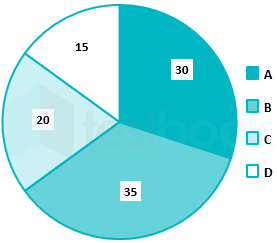
Direction: Study the following pie-chart carefully & answer the questions given below: 

Pie-chart shows the % distribution of students in different colleges. Total number of students are 1200

MaleColleges
216A
382B
132C
144D
66

What is the ratio of female to male students in A and B together ?

  1. ((a))

    2 : 1

  2. ((b))

    3 : 4

  3. ((c))

    5 : 4

  4. ((d))

    9 : 5

  5. ((e))

    None of above

Show Answer
Answer: ((e))

None of above

The given information can be formulated as:

Male(Given)Female (No. Of Students - Male)CollegePercentageNo. of Students
216144A30%360
38238B35%420
132108C20%240
14436D15%180


The ratio of female to male students in A & B together

⇒ (144 + 38) : (216 + 382)

⇒ 182 : 598

∴ Ratio = 7 : 23

67

Out of total no. of students in college C, what % were female?

  1. ((a))

    30%

  2. ((b))

    33.33%

  3. ((c))

    45%

  4. ((d))

    50%

  5. ((e))

    None of above

Show Answer
Answer: ((c))

45%

The given information can be formulated as:

Male(Given)Female (No. Of Students - Male)CollegePercentageNo. of Students
216144A30%360
38238B35%420
132108C20%240
14436D15%180


∴ % of female in college C = 108/240 × 100 = 45%

68

What is average no. of females in all the colleges?

  1. ((a))

    78.5

  2. ((b))

    81.5

  3. ((c))

    75

  4. ((d))

    90

  5. ((e))

    None of above

Show Answer
Answer: ((b))

81.5

The given information can be formulated as:

Male(Given)Female (No. Of Students - Male)CollegePercentageNo. of Students
216144A30%360
38238B35%420
132108C20%240
14436D15%180


∴ Average no. of females in all the colleges = (144 + 38 + 108 + 36)/4 = 81.5

69

What is the approx. % of female to male in College B?

  1. ((a))

    10%

  2. ((b))

    11%

  3. ((c))

    12%

  4. ((d))

    13%

  5. ((e))

    14%

Show Answer
Answer: ((a))

10%

The given information can be formulated as:

Male(Given)Female (No. Of Students - Male)CollegePercentageNo. of Students
216144A30%360
38238B35%420
132108C20%240
14436D15%180


Approx. % of female to male in College B = 38/382 × 100 = 9.947 ≈  10

70

What is the difference between the number of the males in college A and number of females in college D?

  1. ((a))

    180

  2. ((b))

    120

  3. ((c))

    200

  4. ((d))

    240

  5. ((e))

    210

Show Answer
Answer: ((a))

180

The given information can be formulated as:

Male(Given)Female (No. Of Students - Male)CollegePercentageNo. of Students
216144A30%360
38238B35%420
132108C20%240
14436D15%180


∴ Number of the males in college A - Number of females in college D = 216 - 36 = 180

English Language (30 questions)

The following sentences form a paragraph. The sentences are numbered as A, B, C, D, E, and F. These six parts are not given in their proper order. Read the sentences and choose the alternative that arranges them in a correct order.

A. For over a year the Authorised Push Payment Scams Steering Group has been working on a voluntary code

B. The code is squarely aimed at victims of authorized push payment (APP) scams, where a customer is tricked into sending money to a scammer directly

C. On that date, a new code of conduct comes into play that will require the banks to treat fraud victims better

D. Bank customers who fall victim to frauds after 28 May will have a greater chance of being refunded

E. The new code states customers should be reimbursed provided they took “sufficient care and heeded any warnings

F. that has now been adopted by all the big banks

71

Which of the following should be the first sentence after rearrangement?

  1. ((a))

    D

  2. ((b))

    F

  3. ((c))

    A

  4. ((d))

    E

  5. ((e))

    B

Show Answer
Answer: ((a))

D

Correct answer: Option 1.

The passage is about a new regulation that will prevent bank customers from falling in the trap of scam artists. Sentence D introduces the topic and hence it is the first sentence. C follows D using "on that date" to refer to May 28. A carries forward the conversation adding information about the Authorised Push Payment Scams Steering Group and its attempt to curb scams. F attaches itself to A through the clause 'that has now been adopted by all..." B talks more about that code and E finishes the conversation regarding that.

The order is DCAFBE.

72

Which of the following should be the second sentence after rearrangement?

  1. ((a))

    A

  2. ((b))

    B

  3. ((c))

    C

  4. ((d))

    D

  5. ((e))

    E

Show Answer
Answer: ((c))

C

Correct answer: Option 3.

The passage is about a new regulation that will prevent bank customers from falling in the trap of scam artists. Sentence D introduces the topic and hence it is the first sentence. C follows D using "on that date" to refer to May 28. A carries forward the conversation adding information about the Authorised Push Payment Scams Steering Group and its attempt to curb scams. F attaches itself to A through the clause 'that has now been adopted by all..." B talks more about that code and E finishes the conversation regarding that.

The order is DCAFBE.

73

Which of the following should be the fourth sentence after rearrangement?

  1. ((a))

    E

  2. ((b))

    A

  3. ((c))

    F

  4. ((d))

    D

  5. ((e))

    C

Show Answer
Answer: ((c))

F

Correct answer: Option 3.

The passage is about a new regulation that will prevent bank customers from falling in the trap of scam artists. Sentence D introduces the topic and hence it is the first sentence. C follows D using "on that date" to refer to May 28. A carries forward the conversation adding information about the Authorised Push Payment Scams Steering Group and its attempt to curb scams. F attaches itself to A through the clause 'that has now been adopted by all..." B talks more about that code and E finishes the conversation regarding that.

The order is DCAFBE.

74

Which of the following should be the sixth sentence after rearrangement?

  1. ((a))

    D

  2. ((b))

    A

  3. ((c))

    C

  4. ((d))

    B

  5. ((e))

    E

Show Answer
Answer: ((e))

E

Correct answer: option 5.

The passage is about a new regulation that will prevent bank customers from falling in the trap of scam artists. Sentence D introduces the topic and hence it is the first sentence. C follows D using "on that date" to refer to May 28. A carries forward the conversation adding information about the Authorised Push Payment Scams Steering Group and its attempt to curb scams. F attaches itself to A through the clause 'that has now been adopted by all..." B talks more about that code and E finishes the conversation regarding that.

The order is DCAFBE.

75

Directions: Read each sentence to find out whether there is any grammatical mistake/error in it. Choose the option which is CORRECT (without any errors in it). If all sentences are incorrect, mark option 5 as your answer.

A. You should leave a generous tip to reward good service.

B. They ask for 8% extra from customers who pay the insurance by direct debit instead of as a lump sum.

C. The company refused to except responsibility for the accident.

  1. ((a))

    Only A

  2. ((b))

    Only B

  3. ((c))

    Only C

  4. ((d))

    Both A and B

  5. ((e))

     All are incorrect

Show Answer
Answer: ((d))

Both A and B

Option 4 is the correct one. Both A and B are grammatically correct. 

In C, the word 'except' is incorrect. It should be 'accept'.

76

Directions: Read each sentence to find out whether there is any grammatical mistake/error in it. Choose the option which is CORRECT (without any errors in it). If all sentences are incorrect, mark option 5 as your answer.

A. The police are trying to trace the mother of a newborn baby found abandoned outside a hospital.

B. After the bars closed, gangs of youths roam the city streets.

C. She hitched her skirt in before wading across the stream.

  1. ((a))

    Only A

  2. ((b))

    Only B

  3. ((c))

    Only C

  4. ((d))

    Both A and B

  5. ((e))

     All are incorrect

Show Answer
Answer: ((a))

Only A

Option 1 is the correct one. Only A is grammatically correct. 

In B, the verb 'closed' is used in the wrong tense, it should be 'close'.

In C, the preposition 'in' has been incorrectly used, it should be 'up',

77

Directions: Read each sentence to find out whether there is any grammatical mistake/error in it. Choose the option which is CORRECT (without any errors in it). If all sentences are incorrect, mark option 5 as your answer.

A. James coughed loudly so attract her attention.

B. The position of the adverb is important when there is more than one verb in a sentence. 

C. He asked me to leave the house queitly.

  1. ((a))

    Only A

  2. ((b))

    Only B

  3. ((c))

    Only C

  4. ((d))

    Both A and B

  5. ((e))

     All are incorrect

Show Answer
Answer: ((b))

Only B

Option 2 is the correct one. Only B is grammatically correct. 

In A, 'so' is used incorrectly, it should be 'to'.

In C, the spelling of 'queitly' is incorrect, it should be 'quietly'.

78

Directions: Read each sentence to find out whether there is any grammatical mistake/error in it. Choose the option which is CORRECT (without any errors in it). If all sentences are incorrect, mark option 5 as your answer.

A. Clearly, there has been unacceptable delays.

B. They were made insane amounts of money.

C. John cut an aloof and somewhat austere figure.

  1. ((a))

    Only A

  2. ((b))

    Only B

  3. ((c))

    Only C

  4. ((d))

    Both A and B

  5. ((e))

     All are incorrect

Show Answer
Answer: ((c))

Only C

Option 3 is the correct one. Only C is grammatically correct. 

In A, 'has' is used incorrectly, it should be 'have' as 'delays' is plural.

In B, 'made' is incorrectly used, it should be 'making'.

79

Directions: Read each sentence to find out whether there is any grammatical mistake/error in it. Choose the option which is CORRECT (without any errors in it). If all sentences are incorrect, mark option 5 as your answer.

A. She imagined him in his desk, his head in his hands.

B. I cannot even afford to paid the rent on this flat.

C. After Ned died, everyone imagines that Mabel would move away.

  1. ((a))

    Only A

  2. ((b))

    Only B

  3. ((c))

    Only C

  4. ((d))

    Both A and B

  5. ((e))

     All are incorrect.

Show Answer
Answer: ((e))

 All are incorrect.

Option 5 is the correct one.  All are incorrect. 

In A, the preposition 'in' is used incorrectly, it should be 'at'.

In B, 'paid' is incorrectly used, it should be 'pay'.

In C, 'imagines; is incorrectly used, it should be 'imagined'.

80

Fill in the blank with the correct word.

This awful traffic is definitely going to ________our trip to the beach

  1. ((a))

    Hamper

  2. ((b))

    Dump

  3. ((c))

    Hampered

  4. ((d))

    Beautify

  5. ((e))

    Elaborate

Show Answer
Answer: ((a))

Hamper

The correct answer is option 1) i.e. 'Hamper'. 

  • 'Hamper' means 'to obstruct', 'to hinder the movement of'. The word fits the context. as 'the awful traffic is responsible for the restriction of the flow of action 'to go on a trip'.
  • 'Dump' means 'A deposit of waste', 'A collection of things carelessly carried'.
  • 'Hampered' is the 'past form of 'hamper'.
  • 'Beautify' means 'to improve the appearance of'.

Hence, option 1)

81

Fill in the blank with the correct word

Since the police will not help her, Helen is going to abduct her daughter from the _______cult.

  1. ((a))

    Cultural

  2. ((b))

    Provincial

  3. ((c))

    Harmful

  4. ((d))

    Delightful

  5. ((e))

    Harmless

Show Answer
Answer: ((c))

Harmful

Correct answer: Option 3.

The sentence talks about a helpless mother trying to save her daughter. Hence, 'harmful' is the correct answer.

82

Fill in the blank with the correct word.

Although she is _______ well rounded, Rashi is definitely a much stronger reader than she is a mathematician.

  1. ((a))

    Physically

  2. ((b))

    Academic

  3. ((c))

    Politically

  4. ((d))

    Academically

  5. ((e))

    Philosophically

Show Answer
Answer: ((d))

Academically

Correct answer: Option 4.

This sentence implies that Rashi has a good academic record, especially with details like she is a very good reader. Hence, Option 4 is the correct answer.

83

Fill in the blank with the correct word.

During the monthly meeting, the company president will present an _______to the employee of the month.

  1. ((a))

    Reward

  2. ((b))

    Accolade

  3. ((c))

    Aim

  4. ((d))

    Report

  5. ((e))

    Gift

Show Answer
Answer: ((b))

Accolade

Correct answer: Option 2.

Since the blank is preceded by 'an', we can eliminate every option except 2 and 3. 'Aim' is not the correct word here. Hence, option 2 is the correct answer.

84

Fill in the blank with the correct word.

Staring up at the odd-looking statue with a puzzle, the children ________who made it and what it stood for.

  1. ((a))

    Wonder

  2. ((b))

    Wondered

  3. ((c))

    Would

  4. ((d))

    Wondering

  5. ((e))

    Agitate

Show Answer
Answer: ((b))

Wondered

Correct answer: Option 2.

The correct form to be used in the blank is the -ed form of wonder.

None of the other options make any sense whatsoever.

85

Fill in the blank with the correct word.

Since the goal is a tough one, you will need a lot of _____ to reach it.

  1. ((a))

    Zealous

  2. ((b))

    Jealousy

  3. ((c))

    Thirsty

  4. ((d))

    Zeal

  5. ((e))

    Anger

Show Answer
Answer: ((d))

Zeal

Correct answer: Option 4.

Zeal means great energy or enthusiasm in pursuit of a cause or an objective.

Thirst would have been the correct option. But thirsty is the wrong form of the word to be used here.

None of the other options make any sense.

86

In the following sentence, a part of the sentence is underlined. Below are given alternatives to the underlined part, which may improve the sentence. Choose the correct alternative. In case no improvement is needed, choose the option ‘No improvement’.

Bilateral tariff wars are not the solution because Indian consumers will mere buy goods from other countries.

  1. ((a))

    Would mere buy

  2. ((b))

    Would mere buying

  3. ((c))

    Will merely buy

  4. ((d))

    Should merely buy

  5. ((e))

    No improvement

Show Answer
Answer: ((c))

Will merely buy

The sentence uses the form will mere buy, which is incorrect and needs improvement.

Mere- only, a small amount.

The context suggests that the word is referring to the verb and not the noun. So, the correct form should be the adverb form 'merely'.

The only alternative that improves the sentence is 3.

None of the other alternatives can make the sentence meaningful.

Therefore, the correct answer is option 3.

87

In the following sentence, a part of the sentence is underlined. Below are given alternatives to the underlined part, which may improve the sentence. Choose the correct alternative. In case no improvement is needed, choose the option ‘No improvement’.

It covers a range of issues from domestic economic imbalances to the failure of plug into global supply chains.

  1. ((a))

    Failing to plug to

  2. ((b))

    Failure in plug into

  3. ((c))

    Failures of plugs in

  4. ((d))

    Failure of plugging into

  5. ((e))

    No improvement

Show Answer
Answer: ((d))

Failure of plugging into

The sentence uses the form failure of plug into, which is incorrect and needs improvement.

The phrase, in order to be meaningful, must refer to an act of plugging into the supply chains.

It should be the failure of plugging into something. 

The only alternative that improves the sentence is 4.

None of the other alternatives can make the sentence meaningful.

Therefore, the correct answer is option 4.

88

In the following sentence, a part of the sentence is underlined. Below are given alternatives to the underlined part, which may improve the sentence. Choose the correct alternative. In case no improvement is needed, choose the option ‘No improvement’.

There is no doubt that India's trade deficit with China is partaker a larger challenge of trade competitiveness.

  1. ((a))

    Part to a larger

  2. ((b))

    Partakers of a larger

  3. ((c))

    Part of a larger

  4. ((d))

    Parting off a larger

  5. ((e))

    No improvement

Show Answer
Answer: ((c))

Part of a larger

The sentence uses the form partaker a larger, which is incorrect and needs improvement.

A partaker is someone who partakes in or is involved/joined in an activity. In its correct form, the noun is used as being a partaker 'of/in' something.

The only alternative that improves the sentence is 'part of a larger'.

None of the other alternatives can make the sentence meaningful.

Therefore, the correct answer is option 3.

89

In the following sentence, a part of the sentence is underlined. Below are given alternatives to the underlined part, which may improve the sentence. Choose the correct alternative. In case no improvement is needed, choose the option ‘No improvement’.

The government has actively used subsidies to promote the domestic industry, giving in an unfair advantage in many areas.

  1. ((a))

    Giving it an unfair

  2. ((b))

    Giving into unfair

  3. ((c))

    Given in an unfair

  4. ((d))

    Gave it an unfairly

  5. ((e))

    No improvement

Show Answer
Answer: ((a))

Giving it an unfair

The sentence uses the form giving in an unfair , which is incorrect and needs improvement.

the sentence is referring to the 'domestic industry'. So, the phrase must also refer to the noun.

This is only possible by using a pronoun like 'it'- by 'giving it an unfair' advantage.

The only alternative that improves the sentence is 1.

None of the other alternatives can make the sentence meaningful.

Therefore, the correct answer is option 1.

90

In the following sentence, a part of the sentence is underlined. Below are given alternatives to the underlined part, which may improve the sentence. Choose the correct alternative. In case no improvement is needed, choose the option ‘No improvement’.

China has also been strongly interventionist in the way it has managed its exchange rate.

  1. ((a))

    With the way in which

  2. ((b))

    For the way it is

  3. ((c))

    From the way it will

  4. ((d))

    In the way it have

  5. ((e))

    No improvement

Show Answer
Answer: ((e))

No improvement

The sentence uses the form in the way it has, which is correct and needs no improvement.

None of the given alternatives can make the sentence meaningful.

Therefore, the correct answer is option 5.

91

Below a word is given in three sentences. Find out which one/ones make/makes a correct usage of the given word and mark the option accordingly. If the sentences are all correct mark option 5 as the answer.

A: The team's manager was magnanimous in victory and praised the losing team.

B: "The best man won," he said, magnanimously conceding defeat.

C: Ram felt very magnanimous after lending him the money.

  1. ((a))

    Only A

  2. ((b))

    Only B

  3. ((c))

    Only C

  4. ((d))

    Both A and B

  5. ((e))

    All of these. 

Show Answer
Answer: ((d))

Both A and B

Option 4 is the correct answer. Both A and B are incorrect. 

Magnanimous means very kind and generous towards an enemy or someone you have defeated.

According to this definition, sentence C is incorrect as the word magnanimous does not fit in it contextually.

92

Below a word is given in three sentences. Find out which one/ones make/makes a correct usage of the given word and mark the option accordingly. If the sentences are all correct mark option 5 as the answer.

A: We were discussing the roots of the current economic malaise.

B: Economic degradation roots in illiteracy. 

C: The high crime rate has its roots in unemployment and poverty.

  1. ((a))

    Only A

  2. ((b))

    Both A and C

  3. ((c))

    Only C

  4. ((d))

    Only B

  5. ((e))

    All of these.

Show Answer
Answer: ((b))

Both A and C

The correct option is 2. Both A and C are incorrect. 

Root means the part of a plant that grows down into the earth to get water and food and holds the plant firm in the ground; the cause or origin of something bad.

From this, it can be seen that sentence B uses the word incorrectly. It should be 'Economic degradation has its roots in illiteracy'

93

Below a word is given in three sentences. Find out which one/ones make/makes a correct usage of the given word and mark the option accordingly. If the sentences are all correct mark option 5 as the answer.

A: The retreation of the French army changed the course of the war.

B: Her body pulsed with the surge and retreat of magic.

C: Only then did he turn and retreat down the hallway.

  1. ((a))

    Only A

  2. ((b))

    Only B

  3. ((c))

    Only C

  4. ((d))

    Both B and C

  5. ((e))

    All of these.

Show Answer
Answer: ((d))

Both B and C

The correct option is 4. Both B and C. 

Retreat means an act of moving back or withdrawing.

From this, it can be seen that sentence A uses the word incorrectly. It should be 'The retreat of the French army changed the course of the war.'

Read the following passage and answer the questions given below.

More and more people are feeling tired and lonely at work. In analyzing the General Social Survey of 2016, we found that, compared with roughly 20 years ago, people are twice as likely to report that they are always exhausted. Close to 50% of people say they are often or always exhausted due to work. This is a shockingly high statistic — and it’s a 32% increase from two decades ago. What’s more, there is a significant correlation between feeling lonely and work exhaustion: The more people are exhausted, the lonelier they feel.

This loneliness is not a result of social isolation, as you might think, but rather is due to the emotional exhaustion of workplace burnout. In researching the book The Happiness Track, we found that 50% of people — across professions, from the nonprofit sector to the medical field — are burned out. This isn’t just a problem for busy, overworked executives (though the high rates of loneliness and burnout among this group are well known). Our work suggests that the problem is pervasive across professions and up and down corporate hierarchies.

Loneliness, whether it results from social isolation or exhaustion, has serious consequences for individuals. John Cacioppo, a leading expert on loneliness and coauthor of Loneliness: Human Nature and the Need for Social Connection, emphasizes its tremendous impact on psychological and physical health and longevity. Research by Sarah Pressman, of the University of California, Irvine, corroborates his work and demonstrates that while obesity reduces longevity by 20%, drinking by 30%, and smoking by 50%, loneliness reduces it by a whopping 70%. In fact, one study suggests that loneliness increases your chance of stroke or coronary heart disease — the leading cause of death in developed countries — by 30%. On the other hand, feelings of social connection can strengthen our immune system, lengthen our life, and lower rates of anxiety and depression.

94

What was the findings of the General Social Survey of 2016?

  1. ((a))

    People are twice as likely to report that they are always exhausted

  2. ((b))

    People are very energetic

  3. ((c))

    Employers believe it is their job to motivate the employees

  4. ((d))

    All of the above

  5. ((e))

    None of the above

Show Answer
Answer: ((a))

People are twice as likely to report that they are always exhausted

Correct answer: Option 1.

The answer can be found in this line: In analyzing the General Social Survey of 2016, we found that, compared with roughly 20 years ago, people are twice as likely to report that they are always exhausted.

95

What is the reason behind loneliness in the passage?

  1. ((a))

    Social inclusion

  2. ((b))

    Social exclusion

  3. ((c))

    The emotional exhaustion of workplace burnout

  4. ((d))

    The physical exhaustion of workplace

  5. ((e))

    All of the above

Show Answer
Answer: ((c))

The emotional exhaustion of workplace burnout

Correct answer: Option 3.

The answer can be found in this line: This loneliness is not a result of social isolation, as you might think, but rather is due to the emotional exhaustion of workplace burnout.

96

What does John Cacioppo say about the impact of loneliness? 

  1. ((a))

    It hampers physical health

  2. ((b))

    It hampers emotional health

  3. ((c))

    It hampers longevity

  4. ((d))

    Both 1 and 2

  5. ((e))

    All of the above

Show Answer
Answer: ((e))

All of the above

Correct answer: Option 5.

The answer can be found in the line: John Cacioppo, a leading expert on loneliness and coauthor of Loneliness: Human Nature and the Need for Social Connection, emphasizes its tremendous impact on psychological and physical health and longevity.

97

What is the tone of the passage?

  1. ((a))

    Cynical

  2. ((b))

    Satirical

  3. ((c))

    Moral

  4. ((d))

    Descriptive

  5. ((e))

    None of the above

Show Answer
Answer: ((d))

Descriptive

Correct answer: Option 4. 

The passage talks about work exhaustion and how loneliness is related to it. It delineates the logic of the passage through explanations and referential statements from social researchers.

98

Given below is a word which is also given in bold in the passage. From the following options choose the one which is closest in meaning to the word.

Isolation

  1. ((a))

    Jubilation

  2. ((b))

    Satire

  3. ((c))

    Addiction

  4. ((d))

    Privacy

  5. ((e))

    Loneliness

Show Answer
Answer: ((e))

Loneliness

The correct option is 5.

Here are the meanings of all the words:

Isolation: the process or fact of isolating or being isolated.

Satire: The art of making fun of something or somebody.

Jubilation: happiness.

Addiction: the fact or condition of being addicted to a particular substance or activity.

Privacy: a state in which one is not observed or disturbed by other people.

Loneliness: sadness because one has no friends or company.

99

Given below is a word which is also given in bold in the passage. From the following options choose the one which is opposite in meaning to the word.

Exhaustion

  1. ((a))

    Rejuvenation

  2. ((b))

    Acceleration

  3. ((c))

    Attenuation

  4. ((d))

    Imagination

  5. ((e))

    Exclamation

Show Answer
Answer: ((a))

Rejuvenation

The correct option is 1.

Here are the meanings of all the words:

Exhaustion: a state of extreme physical or mental tiredness.

Rejuvenation: the action or process of making someone or something look or feel better, younger, or more vital.

Acceleration: a vehicle's capacity to gain speed.

Attenuation: the reduction of the force, effect, or value of something.

Imagination: the faculty or action of forming new ideas, or images or concepts of external objects not present to the senses.

Exclamation: a sudden cry or remark expressing surprise, strong emotion, or pain.

100

Given below is a word which is also given in bold in the passage. From the following options choose the one which is opposite in meaning to the word.

Strengthen

  1. ((a))

    Construction

  2. ((b))

    Cement

  3. ((c))

    Weaken

  4. ((d))

    Subtraction

  5. ((e))

    Action

Show Answer
Answer: ((c))

Weaken

The correct option is 3.

Here are the meanings of all the words:

Strengthen: make or become stronger.

Construction: the action of building something, typically a large structure.

Cement: fix with cement.

Weaken: make or become weaker in power, resolve, or physical strength.

Subtraction: the process or skill of taking one number or amount away from another.

Action: the fact or process of doing something, typically to achieve an aim.

Attempt this paper under real exam conditions

Timed interface, section switching, instant scoring, and question-by-question analytics — free.

Start Timed Attempt